
Energy Supply Shocks and the Inflationary Erosion of Sovereign Debt: Scenario Analysis and Ex-Post Evidence from the 2026 Hormuz LNG Disruption

 ,
,  , and
, and
Abstract
1. Introduction
2. Two Literatures That Rarely Meet
2.1. Energy Supply Shocks and Inflation
2.2. Debt Liquidation and Financial Repression
3. Data and Methods
4. Anatomy of the 2026 Shock
4.1. Five Weeks in Spring—And the Five Months After

| Indicator | Pre-Shock (Date) | Peak/Crisis Level (Date) | Change | Type | Source |
|---|---|---|---|---|---|
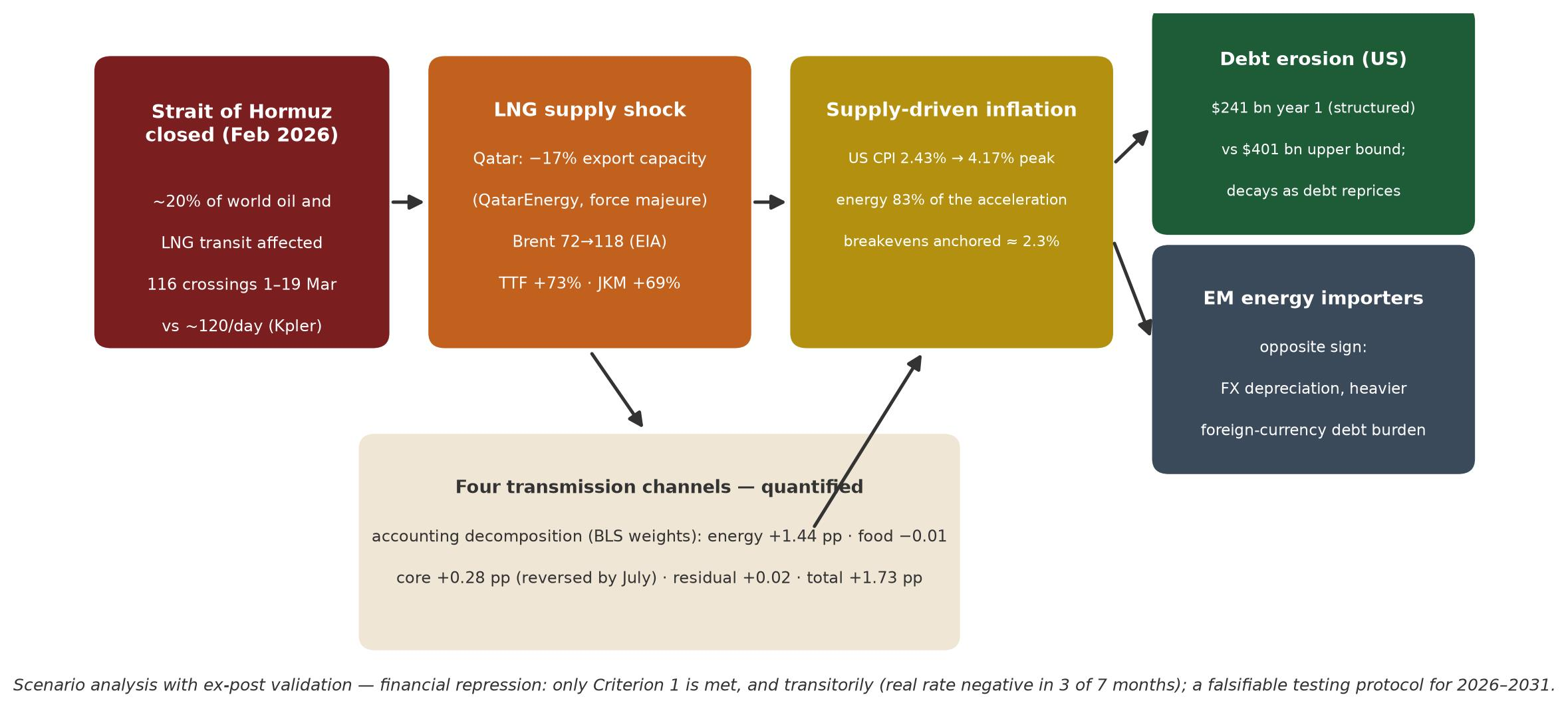
| Brent front-month (USD/bbl) | ~72 (27 February) | >100 (12 March); 118 (end-Q1) | +64% vs. pre-shock | Realized | EIA (2026a) |
| Brent–WTI spread (USD/bbl) | ~4 (January) | 25 (31 March) | — | Realized | EIA (2026a) |
| TTF front-month (EUR/MWh) | ~32 (27 February) | 55.6 (March) | +73% | Realized | ICE Endex |
| JKM LNG spot (USD/MMBtu) | ~15.0 (February) | 25.30 (March) | +69% | Realized | S&P Global (2026a) |
| Qatar LNG capacity loss | — | 12.8 mtpa (Trains 4 & 6) = 17% of exports | repair up to 5 yrs; force majeure | Realized | QatarEnergy (2026) |
| Ras Laffan undamaged trains | — | restart May–late August 2026 | — | Realized | The National (2026a) |
| War-risk premium (% hull value) | 0.25 (pre-war) | 3–10 (July) | ×12–×40 | Realized | The National (2026b); Al Jazeera (2026b) |
| Hormuz commodity-carrier transits | ~120/day | 116 total, 1–19 March | −95% | Realized | Kpler via Gulf News (2026) |
| US anhydrous ammonia (USD/ton) | 843 (20 February) | 1116 (late April) | +32% (+43% y/y) | Realized | DTN (2026) |
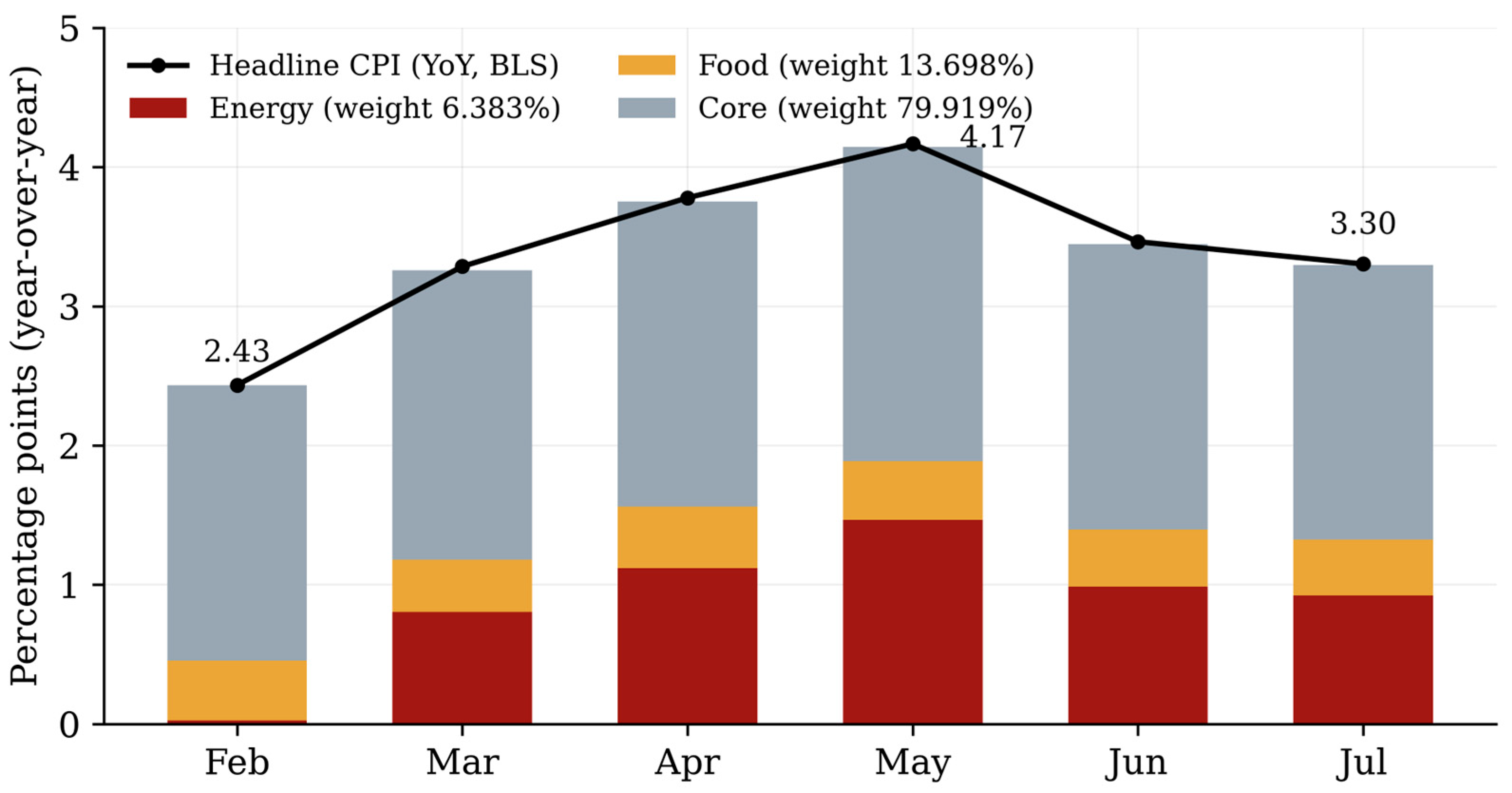
| US CPI inflation (YoY) | 2.4% (February) | 4.2% (May); 3.3% (July) | +1.8 pp peak | Realized | BLS via FRED |
| US 10 yr breakeven inflation | 2.30% (avg 2024–February 2026) | 2.27% (mid-August) | ~0 | Realized | FRED T10YIE |
4.2. Transmission Channels, with a Quantitative Accounting Decomposition
| Component (Channel) | Weight (%) | YoY February 2026 | YoY May 2026 | Contribution to +1.73 pp |
|---|---|---|---|---|
| Energy (channels a + b, direct) | 6.383 | 0.4% | 23.0% | +1.44 pp (83%) |
| Food (channel c) | 13.698 | 3.1% | 3.1% | −0.01 pp (−1%) |
| Core, less food & energy (channel d) | 79.919 | 2.5% | 2.8% | +0.28 pp (16%); mostly reversed by July (2.5%) |
| Aggregation residual | — | — | — | +0.02 pp (1%) |
| Total (headline acceleration) | 100.000 | 2.43% | 4.17% | +1.73 pp |

4.3. Winners and Losers
5. The Monetary Policy Response of 2026
6. From Arithmetic to a Maturity-Structured Erosion Model
6.1. Why the Single-Figure Arithmetic Overstates
6.2. The Model
6.3. Scenarios and Ex-Post Validation
6.4. Sensitivity
7. Is This Financial Repression? An Operational Assessment
8. A Testing Protocol, 2026–2031
9. Discussion
10. Conclusions
Author Contributions
Funding
Institutional Review Board Statement
Informed Consent Statement
Data Availability Statement
Acknowledgments
Conflicts of Interest
References
- Ahinsah-Wobil, I. (2026). Systemic risk assessment of geopolitical energy shocks: A macroprudential stress-test framework for Strait of Hormuz disruption and cross-border transmission to sovereign debt markets. SSRN working paper. Available online: https://papers.ssrn.com/sol3/results.cfm (accessed on 8 September 2026).
- Aizenman, J., & Marion, N. (2011). Using inflation to erode the US public debt. Journal of Macroeconomics, 33, 524–541. [Google Scholar] [CrossRef] [Scilit]
- Albrizio, S., Bluedorn, J., Brasier, R., Koch, C., Pescatori, A., & Stuermer, M. (2025). Trade integration and supply disruptions: Sharing the pain from a Russian gas shut-off to Europe. The Energy Journal, 46, 1–24. [Google Scholar] [CrossRef] [Scilit]
- Al Jazeera. (2026a). Gas prices soar as QatarEnergy halts LNG production after Iran attacks. 2 March. Available online: https://www.aljazeera.com/news/2026/3/2/qatarenergy-worlds-largest-lng-firm-halts-production-after-iran-attacks (accessed on 8 September 2026).
- Al Jazeera. (2026b). How shipping insurance rates are rising, as Hormuz, Bab al-Mandeb shut down. 23 July. Available online: https://www.aljazeera.com/economy/2026/7/23/how-shipping-insurance-rates-are-rising-as-hormuz-bab-al-mandeb-shut-down (accessed on 8 September 2026).
- Al Jazeera. (2026c). Oil prices rise as attacks dent hopes for Strait of Hormuz reopening. 12 August. Available online: https://www.aljazeera.com/economy/2026/8/12/oil-prices-rise-as-attacks-dent-hopes-for-strait-of-hormuz-reopening (accessed on 8 September 2026).
- Al Jazeera. (2026d). Oil prices, stocks surge as Hormuz closure drags on. 10 August. Available online: https://www.aljazeera.com/economy/2026/8/10/oil-prices-stocks-surge-as-hormuz-closure-drags-on (accessed on 8 September 2026).
- Atlantic Council. (2026). How the US can use its natural gas abundance to ease rising fertilizer prices. EnergySource. Atlantic Council Global Energy Center. [Google Scholar]
- Auclert, A., Monnery, H., Rognlie, M., & Straub, L. (2023). Managing an energy shock: Fiscal and monetary policy (NBER Working Paper 31543). NBER. [Google Scholar]
- Bank of England. (2026). Monetary policy report, April and June 2026. Bank of England. [Google Scholar]
- Becker, B., & Ivashina, V. (2017). Financial repression in the European sovereign debt crisis. Review of Finance, 22, 83–115. [Google Scholar] [CrossRef] [Scilit]
- Bianchi, F., & Melosi, L. (2022). Inflation as a fiscal limit (Paper presented at the Jackson Hole Economic Policy Symposium, Jackson Hole, WY, USA). Federal Reserve Bank of Chicago. [Google Scholar]
- Blinder, A. S., & Rudd, J. B. (2013). The supply-shock explanation of the great stagflation revisited. In The great inflation: The rebirth of modern central banking (pp. 119–175). University of Chicago Press. [Google Scholar]
- BLS (U.S. Bureau of Labor Statistics). (2026). Consumer price index, table 1: Relative importance of components in the consumer price indexes, 2024 weights. BLS. Available online: https://www.bls.gov/cpi/tables/relative-importance/ (accessed on 8 September 2026).
- Board of Governors of the Federal Reserve System. (2026). Factors affecting reserve balances (H.4.1), statistical release, week ending 26 August 2026. Board of Governors. Available online: https://www.federalreserve.gov/releases/h41/ (accessed on 8 September 2026).
- Caldara, D., & Iacoviello, M. (2022). Measuring geopolitical risk. American Economic Review, 112, 1194–1225. [Google Scholar] [CrossRef] [Scilit]
- Coccia, S., & Russo, A. (2025). Inflation, inequality and financial vulnerability: Monetary vs. fiscal policy in the face of an energy shock. Energy Economics, 143, 108222. [Google Scholar] [CrossRef] [Scilit]
- Cochrane, J. H. (2023). The fiscal theory of the price level. Princeton University Press. [Google Scholar]
- Council of the European Union. (2025). 19th package of restrictive measures against Russia (Russian LNG import prohibition). Available online: https://www.consilium.europa.eu/en/press/press-releases/2025/10/23/19th-package-of-sanctions-against-russia-eu-targets-russian-energy-third-country-banks-and-crypto-providers/ (accessed on 8 September 2026).
- CRS (Congressional Research Service). (2019). The Strait of Hormuz: Security developments and impacts on oil, gas, and other commodities (Report R45281). Congressional Research Service. [Google Scholar]
- DTN. (2026). Retail fertilizer trends: UAN, anhydrous lead fertilizer prices higher in last week of April. DTN. [Google Scholar]
- Dufrénot, G., Jawadi, F., & Khayat, G. A. (2018). A model of fiscal dominance under the Reinhart Conjecture. Journal of Economic Dynamics and Control, 93, 332–345. [Google Scholar] [CrossRef] [Scilit]
- ECB (European Central Bank). (2026a). Monetary policy decisions. 19 March. ECB. [Google Scholar]
- ECB (European Central Bank). (2026b). Monetary policy decisions. 11 June. ECB. [Google Scholar]
- EIA (U.S. Energy Information Administration). (2026a). Crude oil and petroleum product prices increased sharply in the first quarter of 2026. Today in energy, 7 April. Available online: https://www.eia.gov/todayinenergy/detail.php?id=67424 (accessed on 8 September 2026).
- EIA (U.S. Energy Information Administration). (2026b). The 9th U.S. liquefied natural gas export terminal, Golden Pass, ships first cargo. Today in energy. Available online: https://www.eia.gov/todayinenergy/detail.php?id=67564 (accessed on 8 September 2026).
- EIA (U.S. Energy Information Administration). (2026c). U.S. natural gas exports to grow nearly 30% by 2027 as LNG facilities ramp up. Today in energy. Available online: https://www.eia.gov/todayinenergy/detail.php?id=67484 (accessed on 8 September 2026).
- Emiliozzi, S., Ferriani, F., & Gazzani, A. (2024). The European energy crisis and the consequences for the global natural gas market. The Energy Journal, 46, 119–145. [Google Scholar] [CrossRef] [Scilit]
- FRED (Federal Reserve Bank of St. Louis). (2026). Federal reserve economic data: Series T10YIE, T5YIE, DGS10, CPIAUCSL, CPIENGSL, CPIUFDSL and CPILFESL. Federal Reserve Bank of St. Louis. Available online: https://fred.stlouisfed.org/ (accessed on 8 September 2026).
- Gnutzmann, H., & Spiewanowski, P. (2016). Fertilizer fuels food prices: Identification through the oil-gas spread (SSRN Working Paper). SSRN. [Google Scholar] [CrossRef] [Scilit]
- Goldthau, A. C., & Youngs, R. (2023). The EU energy crisis and a new geopolitics of climate transition. JCMS: Journal of Common Market Studies, 61, 115. [Google Scholar] [CrossRef] [Scilit]
- Gulf News. (2026). 95% drop in Hormuz traffic as war disrupts oil route (Kpler data). Available online: https://gulfnews.com/world/mena/95-drop-in-hormuz-traffic-as-war-disrupts-oil-route-1.500481217 (accessed on 8 September 2026).
- Hamilton, J. D. (1983). Oil and the macroeconomy since World War II. Journal of Political Economy, 91, 228–248. [Google Scholar] [CrossRef] [Scilit]
- Hilscher, J., Raviv, A., & Reis, R. (2022). Inflating away the public debt? An empirical assessment. Review of Financial Studies, 35, 1553–1595. [Google Scholar] [CrossRef] [Scilit]
- IIF (Institute of International Finance). (2026). Global debt monitor. IIF. [Google Scholar]
- IMF (International Monetary Fund). (2026). Fiscal monitor: Fiscal policy under pressure—High debt, rising risks. IMF. [Google Scholar]
- Khoso, W. M., Akher, M. J., Laghari, A. A., Jamali, R., Tunio, R. A., & Laghari, M. A. (2025). Energy accessibility gap: A key barrier to human development. International Journal of Sustainable Development & World Ecology, 32(7), 827–841. [Google Scholar] [CrossRef] [Scilit]
- Kilian, L. (2009). Not all oil price shocks are alike: Disentangling demand and supply shocks in the crude oil market. American Economic Review, 99, 1053–1069. [Google Scholar] [CrossRef] [Scilit]
- Kim, J., Jaumotte, F., Panton, A. J., & Schwerhoff, G. (2025). Energy security and the green transition. Energy Policy, 198, 114409. [Google Scholar] [CrossRef] [Scilit]
- OECD. (2026). Consumer prices, OECD monthly release, February 2026. OECD. [Google Scholar]
- Olanipekun, I. O., & Alola, A. A. (2020). Crude oil production in the Persian Gulf amidst geopolitical risk, cost of damage and resources rents: Is there asymmetric inference? Resources Policy, 69, 101873. [Google Scholar] [CrossRef] [Scilit]
- Palaios, P., Triantafyllou, A., & Zombanakis, G. (2024). Economic and geopolitical uncertainty vs energy variables: Exploring connectedness in the LNG freight market. Maritime Policy & Management, 52, 287–308. [Google Scholar] [CrossRef] [Scilit]
- QatarEnergy. (2026). Official statement on the damage from the missile attacks on Ras Laffan industrial city. Doha. [Google Scholar]
- Reinhart, C. M., & Rogoff, K. S. (2009). This time is different: Eight centuries of financial folly. Princeton University Press. [Google Scholar]
- Reinhart, C. M., & Sbrancia, M. B. (2012). The return of financial repression. Financial Stability Review, 16, 37–48. [Google Scholar]
- Reinhart, C. M., & Sbrancia, M. B. (2015). The liquidation of government debt. Economic Policy, 30, 291–333. [Google Scholar] [CrossRef] [Scilit]
- S&P Global. (2026a). Platts JKM (Japan Korea Marker) LNG price assessments, February–March 2026. S&P Global. [Google Scholar]
- S&P Global. (2026b). South Korea sees no LNG shortages despite Middle East supply disruptions. 5 March. S&P Global. [Google Scholar]
- Teles, P., & Tristani, O. (2024). The monetary financing of a large fiscal shock. Journal of Monetary Economics, 147, 103630. [Google Scholar] [CrossRef] [Scilit]
- The National. (2026a). Qatar’s Ras Laffan LNG site may not be fully back online for months. 9 April. The National. [Google Scholar]
- The National. (2026b). Shipping insurance surges again as attacks intensify over Strait of Hormuz. 17 July. The National. [Google Scholar]
- US Treasury. (2026a). Average interest rates on U.S. Treasury securities, monthly series. Bureau of the Fiscal Service. Available online: https://fiscaldata.treasury.gov/datasets/average-interest-rates-treasury-securities/ (accessed on 8 September 2026).
- US Treasury. (2026b). Debt to the Penny, daily series, 26 August 2026. Bureau of the Fiscal Service. Available online: https://fiscaldata.treasury.gov/datasets/debt-to-the-penny/ (accessed on 8 September 2026).
- US Treasury. (2026c). Monthly statement of the public debt of the United States, 31 July 2026. Bureau of the Fiscal Service. Available online: https://fiscaldata.treasury.gov/datasets/monthly-statement-public-debt/summary-of-treasury-securities-outstanding (accessed on 8 September 2026).
- Vatsa, P., Miljkovic, D., & Baek, J. (2023). Linkages between natural gas, fertiliser and cereal prices: A note. Journal of Agricultural Economics, 74, 935–940. [Google Scholar] [CrossRef] [Scilit]
- Vivoda, V. (2019). LNG import diversification and energy security in Asia. Energy Policy, 129, 967–974. [Google Scholar] [CrossRef] [Scilit]
- Vivoda, V. (2022). LNG export diversification and demand security: A comparative study of major exporters. Energy Policy, 170, 113218. [Google Scholar] [CrossRef] [Scilit]

| Base of the Calculation | Stock (USD trn) | Erosion per 1 pp (USD bn) | Status |
|---|---|---|---|
| Panel A. Static definitions of the exposed base | |||
| Gross federal debt | 40.07 | 400.7 | Upper bound—not this paper’s estimate |
| Debt held by the public | 32.31 | 323.1 | The measure used throughout |
| Less TIPS (indexed principal) | 30.16 | 301.6 | Removes indexed securities |
| Less bills and FRNs (repricing < 1 year) | 22.51 | 225.1 | Exposed base—benchmark |
| Less Federal Reserve nominal coupon holdings | 18.89 | 188.9 | Consolidated-government view |
| Panel B. Maturity-structured model, year one (not a subtotal of Panel A) | |||
| Maturity-structured model, year 1 | n.a. | 241 | This paper’s benchmark estimate |
| Structured model excluding Federal Reserve holdings, year 1 | n.a. | 204 | Conservative variant |
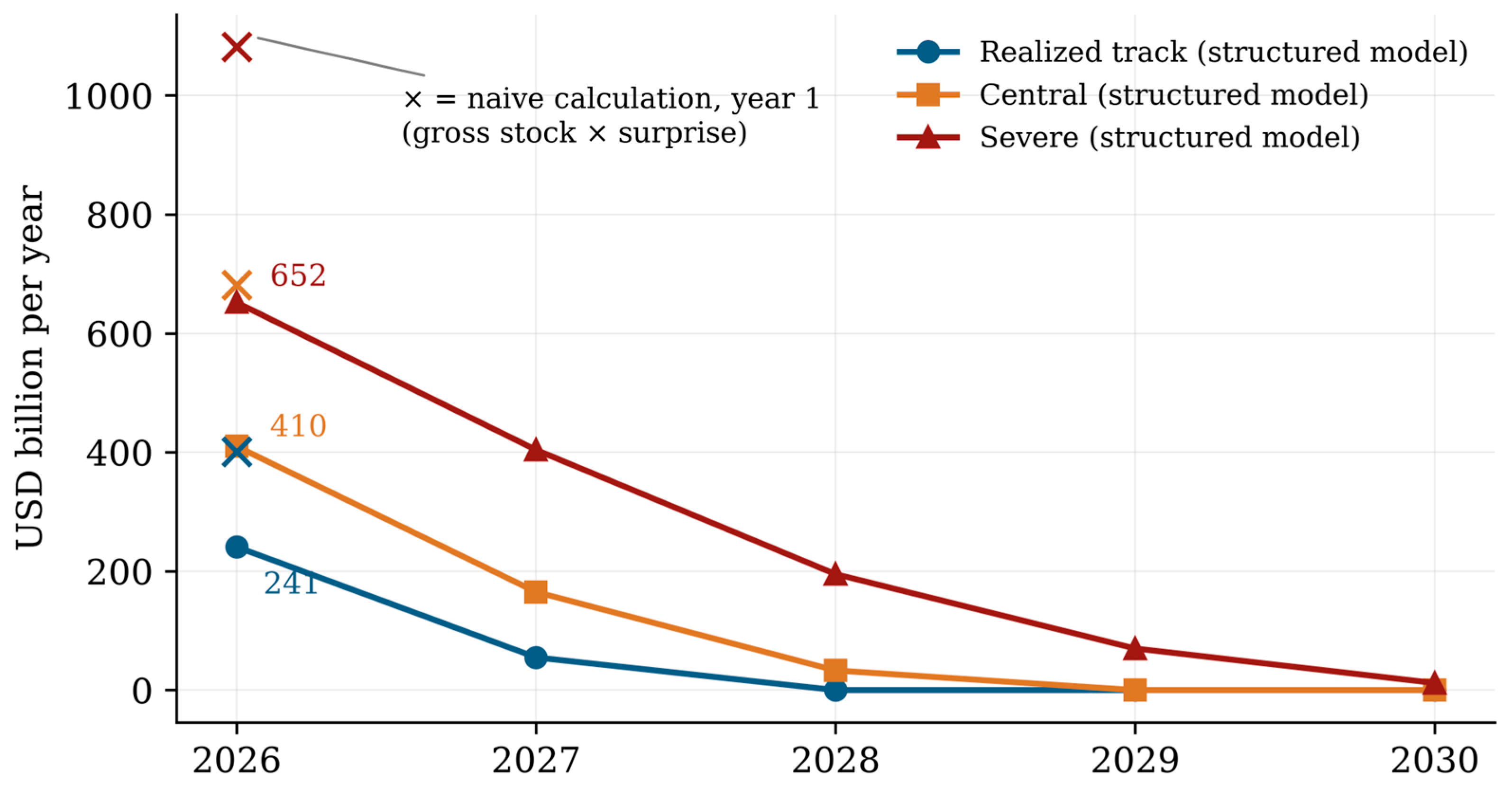
| Scenario | Data Type | 2026 Inflation | Year-1 Surprise | Naïve Upper Bound | Structured Model, Year 1 | Cumulative, 5 Years |
|---|---|---|---|---|---|---|
| Realized track (realized through July) | Realized | 3.3% (realized avg January–July) | 1.0 pp | 401 | 241 | 296 |
| Central (partial closure persists into 2027) | Scenario | 4.0% (assumption) | 1.7 pp | 681 | 410 | 608 |
| Severe (escalation, wage second round) | Scenario | 5.0% (assumption) | 2.7 pp | 1082 | 652 | 1333 |
| Criterion | Evidence at Cutoff | Met? |
|---|---|---|
| 1. Sustained negative real rates on public debt | Ex post real rate on the outstanding stock (average interest rate paid minus same-month CPI inflation) negative in three of seven months: April −0.44, May −0.81, June −0.06; positive in January (+0.93), February (+0.89), March (+0.04) and July (+0.14) | Partial/transitory |
| 2. Administrative ceilings on nominal rates | Not observed in the US or euro area | No |
| 3. Captive audiences (regulatory holding requirements) | No new regulatory changes attributable to the episode | No |
| 4. Capital controls or exit restrictions | Not observed in advanced economies | No (AE) |
| 5. Below-market debt placement (dominant central-bank absorption, moral suasion) | QE ended; central-bank balance sheets contracting | No |
| 6. Identifiable fiscal motive for inflation tolerance | Tolerance observed, but breakevens anchored (~2.3%) and CPI decelerating from June—consistent with looking through a supply shock | Not identifiable |
Disclaimer/Publisher’s Note: The statements, opinions and data contained in all publications are solely those of the individual author(s) and contributor(s) and not of MDPI and/or the editor(s). MDPI and/or the editor(s) disclaim responsibility for any injury to people or property resulting from any ideas, methods, instructions or products referred to in the content. |
© 2026 by the authors. Licensee MDPI, Basel, Switzerland. This article is an open access article distributed under the terms and conditions of the Creative Commons Attribution (CC BY) license.
Share and Cite
Restrepo-Morales, J.A.; Giraldo Betancur, E.A.; Rodríguez Flores, E.A.; Suárez Pizzarello, M.A. Energy Supply Shocks and the Inflationary Erosion of Sovereign Debt: Scenario Analysis and Ex-Post Evidence from the 2026 Hormuz LNG Disruption. Int. J. Financ. Stud. 2026, 14, 252. https://doi.org/10.3390/ijfs14090252
Restrepo-Morales JA, Giraldo Betancur EA, Rodríguez Flores EA, Suárez Pizzarello MA. Energy Supply Shocks and the Inflationary Erosion of Sovereign Debt: Scenario Analysis and Ex-Post Evidence from the 2026 Hormuz LNG Disruption. International Journal of Financial Studies. 2026; 14(9):252. https://doi.org/10.3390/ijfs14090252
Chicago/Turabian StyleRestrepo-Morales, Jorge A., Emerson Andrés Giraldo Betancur, Eduar Antonio Rodríguez Flores, and Marianella Alicia Suárez Pizzarello. 2026. "Energy Supply Shocks and the Inflationary Erosion of Sovereign Debt: Scenario Analysis and Ex-Post Evidence from the 2026 Hormuz LNG Disruption" International Journal of Financial Studies 14, no. 9: 252. https://doi.org/10.3390/ijfs14090252
APA StyleRestrepo-Morales, J. A., Giraldo Betancur, E. A., Rodríguez Flores, E. A., & Suárez Pizzarello, M. A. (2026). Energy Supply Shocks and the Inflationary Erosion of Sovereign Debt: Scenario Analysis and Ex-Post Evidence from the 2026 Hormuz LNG Disruption. International Journal of Financial Studies, 14(9), 252. https://doi.org/10.3390/ijfs14090252