Article

From Perception to Protection: How Fraud Worry Shapes Investor Behavior


1
Department of Financial Planning, Housing and Consumer Economics, University of Georgia, 210B Dawson Hall, Athens, GA 30602, USA
2
Department of Personal Financial Planning, Kansas State University, 343O Justin Hall, Manhatta, KS 66506, USA
*
Author to whom correspondence should be addressed.
Int. J. Financ. Stud. 2026, 14(9), 245; https://doi.org/10.3390/ijfs14090245
Submission received: 17 June 2026 / Revised: 18 August 2026 / Accepted: 9 September 2026 / Published: 14 September 2026

Abstract

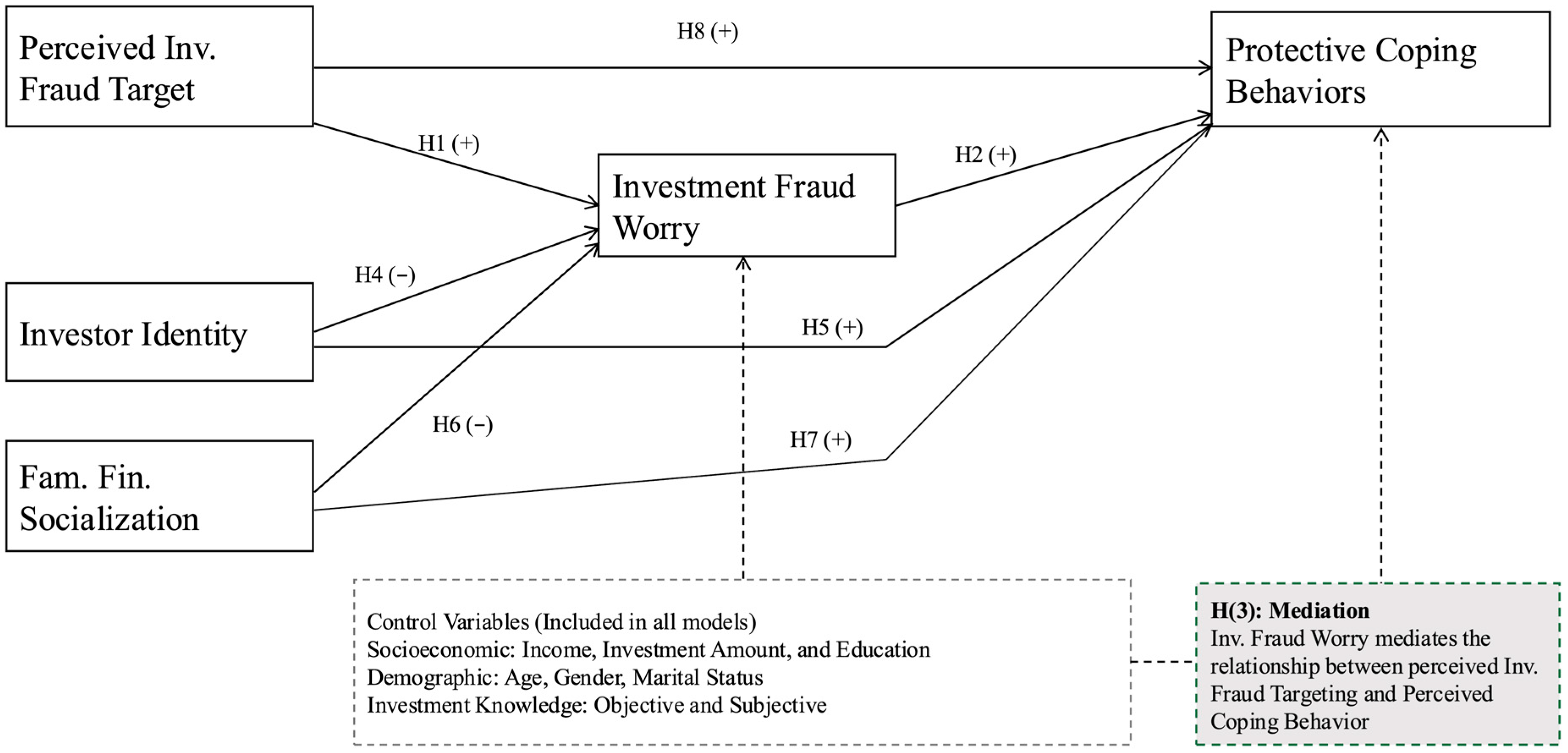
This study develops an integrated conceptual framework to examine the association between investors’ subjective perception of being targeted by investment fraud and their adoption of protective coping behaviors. Drawing on the transactional model of stress and coping, the paper proposes that perceived fraud targeting acts as a stressor that increases fraud-related worry, which in turn motivates behavioral responses. Using merged data from the 2024 FINRA Investor Survey and the National Financial Capability Study (N = 2198), the study employs mediation analysis with OLS and Poisson regression models. The results show that perceived fraud targeting significantly increases both fraud worry and protective behaviors, with worry partially mediating this relationship. Additional findings indicate that investor identity reduces worry, while family financial socialization and market trust promote protective actions. Heterogeneity analyses reveal that objective investment knowledge moderates these pathways. The study highlights the importance of subjective risk perception in shaping proactive fraud prevention behaviors and offers implications for policymakers, educators, and financial advisors.
Keywords: perceived fraud targeting; investment fraud worry; protective coping behaviors; family financial socialization; market trust perceived fraud targeting; investment fraud worry; protective coping behaviors; family financial socialization; market trust