
Review

Scientific Evolution of Women in Entrepreneurial Finance: Intellectual Structure, Thematic Development, and Future Research Agenda (2006–2026)

by
Joel Alderete Velita
,
Kerwin Chávez Vera
*,
Ascención Tomás Alcalá
and
Victor Hugo Bazan
Centro de Investigación para la Gestión, Emprendimiento, Finanzas e Innovación (CIGEFI), Facultad de Ciencias Empresariales, Universidad San Ignacio de Loyola, Av. La Fontana 550, La Molina, Lima 15012, Peru
*
Author to whom correspondence should be addressed.
Int. J. Financ. Stud. 2026, 14(9), 240; https://doi.org/10.3390/ijfs14090240
Submission received: 5 August 2026 / Revised: 18 August 2026 / Accepted: 31 August 2026 / Published: 9 September 2026

Abstract

Access to finance remains a significant challenge for women entrepreneurs, even as new financial alternatives and technologies have emerged. This study examines how research on women’s entrepreneurial finance evolved between 2006 and 2026. Using Bibliometrix and Biblioshiny, 327 articles retrieved from Scopus and Web of Science were analyzed in terms of scientific development, intellectual structure, thematic evolution, and international collaboration, including network centrality, density, and comparisons across economic-development groups. The results show that the field has moved from a primary focus on gender and access to capital toward a broader agenda in which financial inclusion, crowdfunding, microfinance, and digitalization have gained prominence. At the same time, traditional research streams on gender and finance coexist with research on alternative mechanisms for accessing capital. Three complementary intellectual foundations were identified: gender-related mechanisms in financing decisions, crowdfunding and alternative entrepreneurial finance, and structural and institutional conditions shaping access to financial resources. International collaboration also differs across economic contexts, with high-income economies showing denser and more internationally connected research networks. The findings reveal an expanding field in which new financial opportunities coexist with persistent gender inequalities and provide an integrated basis for future research on AI-enabled financing, cross-context institutional differences, and green and sustainable finance.

1. Introduction

Financing is one of the key determinants of the creation, growth, and sustainability of women-led businesses (Hill et al., 2006). However, women entrepreneurs face additional constraints in accessing external financial resources, which may restrict their business opportunities from the earliest stages of development (Presbitero et al., 2014). These constraints are particularly relevant in contexts where financial system conditions restrict the financing options available to women-led businesses (Ahmad & Muhammad, 2015). Therefore, understanding the conditions that shape access to finance is essential for explaining the development opportunities available to women-led businesses.
However, financial gaps are not limited to the availability of capital; they also involve institutional conditions and resource allocation mechanisms that may create disparities in financing opportunities for women entrepreneurs (Forrester & Neville, 2021). International evidence shows that these differences in access to business finance persist across changing economic conditions (Chundakkadan & Sasidharan, 2022), while financial frictions may shape the allocation of capital to women-led initiatives (Morazzoni & Sy, 2022). At the same time, the growth of digital finance has created new opportunities for financial inclusion and women’s entrepreneurial activity (Yang et al., 2022), although the ability to benefit from these opportunities depends partly on the development of digital financial capabilities (Hasan et al., 2023).
The diversification of financing sources has extended research on women’s entrepreneurial finance to alternative financing mechanisms, particularly crowdfunding (Wesemann & Wincent, 2021). However, access to capital through digital platforms does not necessarily eliminate gender differences, as stereotypes may influence investors’ decisions in equity crowdfunding (Kleinert & Mochkabadi, 2022). These differences are also reflected in the financing opportunities and outcomes experienced by women entrepreneurs across different types of crowdfunding (Prokop & Wang, 2022; Seigner et al., 2022). In addition, the gender composition of investors may shape the financing opportunities available to women-led businesses (Snellman & Solal, 2023).
The growing diversity of the field has prompted several reviews seeking to systematize different dimensions of women’s entrepreneurial finance. Koziol et al. (2025) analyze gender differences in equity financing, while Rejeb et al. (2025) examine the evolution of the main research streams related to female entrepreneurship. More recently, Valencia-Arias et al. (2026) systematized the role of financing in the development of female entrepreneurship, whereas Li et al. (2026) integrated the factors and mechanisms underlying gender differences in entrepreneurial finance.
However, these reviews have addressed specific dimensions of the phenomenon without providing an integrated perspective that connects the evolution of scientific production, the intellectual and conceptual structure, thematic development, and patterns of international collaboration across different economic contexts. As a result, the development of women’s entrepreneurial finance as a research domain remains insufficiently understood, particularly regarding how its financial themes, mechanisms, intellectual foundations, and collaboration structures have evolved over time. This fragmentation makes it difficult to achieve a comprehensive understanding of how the field has been configured and transformed, as well as to systematically identify emerging research opportunities that could shape the future research agenda.
Against this background, the following research question is posed: How have scientific production, intellectual structure, international scientific collaboration, and the thematic development of research on women’s entrepreneurial finance evolved during the 2006–2026 period, and what future research opportunities emerge from this evolution? Accordingly, this study aims to comprehensively analyze the scientific, intellectual, thematic, and collaborative evolution of this field, identifying its main actors, patterns of international scientific collaboration, differences in collaboration across economic contexts, and future research directions. Specifically, it seeks to examine the evolution of scientific production; identify the leading sources, authors, institutions, and countries; analyze the intellectual structure and collaboration networks; compare international collaboration patterns across economies at different levels of economic development; determine the main clusters and thematic evolution; and identify emerging topics, gaps, and future research opportunities.
To achieve these objectives, a bibliometric analysis combining scientific performance indicators and science mapping is conducted, as these approaches are appropriate for analyzing the configuration and evolution of a field of knowledge (Donthu et al., 2021; Zupic & Čater, 2015). The analysis integrates performance, intellectual and conceptual structure, thematic evolution, and the structural characteristics of international collaboration networks. This integrated approach enables the examination of dimensions that previous reviews have largely addressed separately while providing a longitudinal view of how knowledge related to women’s entrepreneurial finance has been structured and transformed.
In particular, the study provides a finance-centered mapping of the field by connecting its intellectual foundations with the evolution of access to finance, financial inclusion, and alternative and digital financing mechanisms. It further extends this perspective by examining the structural patterns of international scientific collaboration and how these patterns differ across economic contexts. This integration enables the joint examination of the field’s growth, intellectual and conceptual configuration, thematic transformation, and international collaboration structure, providing a more comprehensive basis for identifying emerging research directions and informing the future research agenda.

2. Theoretical Framework

2.1. Women in Entrepreneurial Finance: Conceptualization, Relevance, and Evolution of the Field

The literature consistently identifies access to finance as a key factor in the creation and development of women-led businesses (Hill et al., 2006; Klapper & Parker, 2011). From this perspective, financing not only enables the creation of new businesses but also shapes their growth and sustainability. Cowling et al. (2012) show that financial constraints negatively affect the performance of small businesses, while Kwong et al. (2012) and Van Hulten (2012) demonstrate that women face greater obstacles in accessing capital even before beginning entrepreneurial activity. Consequently, financing has become a key element in understanding the development and sustainability of women’s entrepreneurship.
Subsequently, research broadened its focus by showing that financial constraints do not arise solely from the functioning of credit markets. In this regard, Mordi et al. (2010) show that cultural factors directly influence women’s opportunities to develop business initiatives. Along the same lines, Carter et al. (2015) emphasize that inequalities in access to finance are also shaped by institutional factors and public policies, a perspective supported in different contexts by Naegels et al. (2018) and Bentancor (2022). Cross-country evidence further indicates that gender differences in access to credit persist across countries (Aristei & Gallo, 2016), while social capital can help reduce these constraints (Pham & Talavera, 2018). Taken together, this evidence supports a multidimensional perspective on women’s entrepreneurial finance in which access to capital is shaped by the interaction of economic, institutional, social, and cultural factors.
In recent years, the literature has incorporated new approaches aimed at explaining how financing opportunities for women entrepreneurs can be expanded. Goel and Madan (2019) identify financial inclusion as a key factor in strengthening female entrepreneurship, while Andriamahery and Qamruzzaman (2022) argue that access to finance produces better outcomes when complemented by financial literacy and technical capabilities. Similarly, Hasan et al. (2023) emphasize that digital financial literacy is an important factor in expanding financial inclusion among women entrepreneurs. Collectively, this research reflects an expansion of the field beyond the availability of capital toward the capabilities and financial conditions that enable women entrepreneurs to access and use financial resources, incorporating financial inclusion, capability development, and digital transformation.
More recently, the literature has incorporated alternative financing mechanisms that complement traditional sources of capital. In this context, Greenberg and Mollick (2017) show that crowdfunding platforms display support dynamics influenced by gender affinity between women entrepreneurs and investors, while Malaga et al. (2018) identify gender differences in equity crowdfunding. Further evidence points to the democratizing potential of equity crowdfunding (A. F. Cicchiello et al., 2024; Cumming et al., 2021), although financing opportunities remain influenced by investor characteristics and the stage of venture development (Zhao et al., 2021). Thus, alternative financing mechanisms broaden access to capital while introducing new contexts in which gender-related differences may persist.
Taken together, these studies reflect an expansion of the field toward new forms of financing, in which access to traditional credit coexists with digital and alternative financing mechanisms that diversify the options available to women entrepreneurs for obtaining capital. This evolution has been synthesized by Ndione et al. (2024) and Li et al. (2026), who note that research has moved toward approaches that integrate financial inclusion, technological innovation, and new financing instruments as fundamental dimensions of women’s entrepreneurial finance. Thus, the evolution of the field shows a shift from approaches focused mainly on constraints in access to credit toward a broader perspective that incorporates financial inclusion, capabilities, digitalization, and alternative financing mechanisms.
Overall, the literature suggests that women’s entrepreneurial finance has evolved from a predominant focus on barriers to credit toward a multidimensional perspective in which financing opportunities depend on the interaction among institutional conditions, financial capabilities, digitalization, and alternative financing mechanisms.

2.2. Main Research Streams on Women Entrepreneurial Finance

Financial inclusion has become one of the most relevant research streams for explaining women entrepreneurs’ opportunities to access capital (Rani & Sundaram, 2023; Yang et al., 2022). From this perspective, Kairiza et al. (2017) show that gender differences in financial inclusion continue to persist and shape business development, while Sobhan and Hassan (2024) indicate that the institutional environment in which women-led businesses operate affects access to finance. Mahmood (2011), in turn, argues that microfinance is a useful instrument for enhancing female entrepreneurship opportunities. Therefore, this research stream links financial inclusion not only to the availability of financial services but also to the reduction in structural constraints on access to capital and the institutional conditions that shape financing opportunities for women entrepreneurs.
Studies have also examined the effectiveness of different financial instruments used to strengthen female entrepreneurship (Ngono, 2021; Sherwani et al., 2024). Mahmood et al. (2014) show that the conditions of microcredit programs influence the performance of women entrepreneurs, while Abebe and Kegne (2023) highlight the contribution of microfinance institutions to women’s business development. Likewise, Hewa-Wellalage et al. (2022) show that constraints on access to debt financing persisted during the COVID-19 pandemic. Overall, recent evidence suggests that expanding the availability of financial resources alone may not be sufficient, as the conditions under which these resources are provided also shape their contribution to women’s business development.
Alternative financing mechanisms have become increasingly important by diversifying women entrepreneurs’ options for accessing capital (Bapna & Ganco, 2021; Gafni et al., 2021). In this context, Geiger and Oranburg (2018) show that women entrepreneurs continue to face differences in access to resources through crowdfunding platforms, while Duan et al. (2020) demonstrate that perceived trustworthiness positively influences the success of crowdfunding campaigns. Groza et al. (2020), in turn, highlight that these platforms strengthen support networks between women entrepreneurs and investors. These findings show that crowdfunding expands financing alternatives but does not necessarily eliminate gender-related asymmetries in capital allocation processes, suggesting that alternative financing mechanisms may transform rather than fully remove existing barriers to finance.
Financial digitalization has given rise to a new research stream on the use of FinTech as a means of expanding access to business finance (Guo et al., 2021; Sun & Xie, 2024). Islam and Muzi (2022) show that the use of mobile money supports investment in women-led businesses, while Kedir and Kouame (2022) argue that the adoption of FinTech services contributes to expanding financing opportunities for women entrepreneurs. Likewise, Fisch et al. (2022) highlight that digital financial instruments diversify sources of capital for emerging firms.
Therefore, these studies show that the digitalization of the financial system is creating new financing opportunities for women entrepreneurs. This research stream broadens the analysis of women’s entrepreneurial finance by incorporating technologies, digital services, and new financial intermediation mechanisms as elements capable of transforming traditional conditions of access to capital. Taken together, these research streams indicate that women’s entrepreneurial finance is increasingly shaped by the interaction among financial inclusion, financial instruments, alternative financing mechanisms, and financial digitalization, while institutional conditions and persistent gender-related constraints continue to influence the access to and use of financial resources.

2.3. Research Gap and Contribution of the Study

The literature on women’s entrepreneurial finance has grown steadily in recent years; however, existing reviews indicate that knowledge remains fragmented across different financing mechanisms, institutional contexts, and analytical approaches (Kanth et al., 2025; S. Singh & Dash, 2021). In this regard, Koziol et al. (2025) show that knowledge has focused mainly on gender differences related to venture capital, angel investment, and equity crowdfunding, while Valencia-Arias et al. (2026) synthesize the role of financing in female entrepreneurship from the perspective of a systematic literature review.
Complementarily, Rejeb et al. (2025) show the evolution of scientific production toward new research streams related to digitalization, financial inclusion, and innovation, while K. Singh et al. (2025) emphasize the transition from financial support policies toward approaches aimed at strengthening entrepreneurial ecosystems. Thus, although these reviews make significant contributions, they show that existing knowledge remains distributed across distinct thematic and methodological perspectives, without simultaneously integrating scientific performance, intellectual and conceptual structure, thematic evolution, and international collaboration across different economic contexts to explain how the financial foundations and financing mechanisms of the field have evolved over time. Limited attention has been given to the structural characteristics of international collaboration networks and to whether collaboration patterns differ across economies at different levels of economic development.
In response to this gap, the present study conducts a bibliometric analysis of the 2006–2026 period and proposes a future research agenda based on the bibliometric evidence obtained. Beyond mapping scientific performance and thematic development, this study integrates the intellectual and conceptual structure of the field with the structural analysis of international collaboration and the comparison of collaboration patterns across economic contexts. In doing so, the study seeks to provide a longitudinal and integrated view of the configuration, transformation, and main emerging directions of women’s entrepreneurial finance, connecting its intellectual foundations with the evolution of traditional, alternative, and digital financing mechanisms and with the international structure through which knowledge in the field is produced and connected.

3. Materials and Methods

3.1. Research Design

This study adopts a bibliometric design with a descriptive and exploratory approach aimed at analyzing the scientific evolution of women’s entrepreneurial finance during the 2006–2026 period. Bibliometric analysis is a widely used methodology for examining the structure, performance, and evolution of a field of knowledge through the systematic study of scientific production (Zupic & Čater, 2015). It also makes it possible to identify growth patterns, intellectual structures, collaboration networks, and thematic dynamics, providing a comprehensive view of the development of a research field (Donthu et al., 2021).
The Bibliometrix package (version 5.4.1) was used to process and analyze the information. It was implemented in the R statistical environment (version 4.6.1 R Foundation for Statistical Computing, Vienna, Austria) through the Biblioshiny interface, designed to facilitate the application of bibliometric techniques and the visual representation of scientific indicators (Aria & Cuccurullo, 2017). This study analyzed scientific performance indicators, author co-citation networks, keyword co-occurrence networks, thematic maps, thematic evolution, and international collaboration networks to characterize scientific performance, intellectual and conceptual structures, thematic development and patterns of international collaboration (Donthu et al., 2021).

3.2. Search Strategy and Corpus Collection

The bibliographic corpus was collected from Scopus and Web of Science (WoS), using a dual-database retrieval strategy to broaden the coverage of the scientific literature and improve the comprehensiveness of the bibliometric corpus. Both databases provide extensive coverage of peer-reviewed literature and standardized bibliographic metadata suitable for bibliometric analysis. The Scopus search was conducted on 31 July 2026, and the Web of Science search was conducted on 14 August 2026, with equivalent search criteria used in both databases to retrieve publications related to women’s entrepreneurial finance. A search strategy was established using terms associated with women entrepreneurs and different forms of financing, combined through the Boolean operators AND and OR, to obtain a set of documents aligned with the objective of the study.
To ensure the relevance and homogeneity of the documentary corpus, filters were applied for document type (scientific articles), language (English), and publication period (2006–2026). The analysis was restricted to English-language articles to maintain consistency in the bibliographic metadata used for the comparative bibliometric analyses. For Scopus, the search strategy used was as follows: TITLE-ABS-KEY ((“women entrepreneur*” OR “female entrepreneur*” OR “women-owned business*” OR “women-led business*” OR “female-owned business*”) AND (fintech OR “financial inclusion” OR “digital finance” OR “digital financial service*” OR “digital financial inclusion” OR “digital lending” OR crowdfunding OR “mobile money” OR “digital banking” OR “access to finance” OR “entrepreneurial finance”)). Eligibility was therefore determined through these predefined criteria rather than through a separate subjective title-and-abstract relevance assessment.
The search strategy was deliberately centered on broad financing mechanisms rather than on specific emerging technologies or sustainability-related financing niches. This decision was intended to preserve conceptual consistency with the study objective of mapping the broader field of women’s entrepreneurial finance, while allowing emerging topics to be identified inductively through subsequent bibliometric analyses. Accordingly, these terms were treated as broad financing mechanisms rather than as predefined thematic categories, allowing the thematic structure of the field to emerge from the relationships identified in the bibliometric analyses.

3.3. Selection of the Documentary Corpus

The identification and selection process for the documentary corpus was reported using the PRISMA flow diagram to provide transparency in the retrieval and screening of the records analyzed. Initially, the search strategies retrieved 452 records from Scopus and 228 records from Web of Science, yielding a combined total of 680 records. After applying the document-type criterion, 174 records were excluded, leaving 506 scientific articles. The records retrieved from both databases were subsequently merged and duplicate records were identified and removed. This procedure excluded 174 duplicates, resulting in 332 unique records. The language criterion was then applied, excluding five documents published in languages other than English. Therefore, the final bibliometric corpus consisted of 327 scientific articles published in English during the 2006–2026 period. Figure 1 presents the PRISMA diagram summarizing the identification, screening, eligibility, and inclusion process for the documents analyzed.

3.4. Bibliometric Analysis Procedure

The bibliometric analysis was conducted using the Bibliometrix package, which made it possible to calculate scientific performance indicators and apply network analysis techniques to examine the structure and evolution of a research field (Aria & Cuccurullo, 2017). Before the bibliometric analyses were performed, records retrieved from Scopus and Web of Science were integrated into a single dataset and duplicate records were removed to obtain the final documentary corpus. To improve consistency across the integrated dataset, equivalent keyword variants were standardized before conducting the science-mapping analyses. First, performance indicators related to the annual evolution of scientific production, the leading scientific journals, the most productive and institutions, and the countries contributing most to the development of research on women’s entrepreneurial finance were analyzed.
Subsequently, science mapping techniques were applied to examine the intellectual, conceptual, and thematic structure of the field. For this purpose, reference co-citation, keyword co-occurrence, thematic maps, thematic evolution, and international collaboration networks were analyzed, allowing the main intellectual streams, predominant conceptual axes, evolution of research topics, and patterns of scientific collaboration among countries to be identified (Donthu et al., 2021).
Reference co-citation was used to identify the intellectual structure of the field based on relationships among jointly cited documents, while keyword co-occurrence was used to examine its conceptual structure and identify the main thematic clusters. For the keyword co-occurrence network, the frequency of occurrence and Total Link Strength (TLS) were calculated to assess the presence of each keyword and the overall strength of its relationships with other terms in the network. Network structures were characterized using clustering and centrality measures, including betweenness, closeness, and PageRank. For the international collaboration network, network density was also calculated as the proportion of observed connections relative to all possible connections among countries. Betweenness was used to assess the intermediary role of countries within the collaboration network, closeness to capture their relative proximity to other connected countries, and PageRank to assess their structural prominence based on the pattern of connections within the network.
The thematic map was used to classify topics according to their levels of centrality and density, distinguishing motor, basic, niche, and emerging or declining themes. The thematic map was constructed from merged keywords (KW_Merged), considering 150 terms with a minimum frequency of two occurrences, using unigram analysis without stemming and the Louvain clustering algorithm. Thematic evolution, in turn, made it possible to analyze transformations in the main topics across three time periods: 2006–2019, 2020–2023, and 2024–2026. The analysis was based on authors’ keywords, considering up to 250 terms with a minimum frequency of five occurrences, using unigram analysis without stemming and Louvain clustering.
Rather than using equal-length intervals, the temporal segmentation was defined according to changes observed in the trajectory of scientific production. The 2006–2019 period represents the initial stage of relatively limited scientific production, 2020–2023 captures the period of accelerated growth and thematic diversification, and 2024–2026 represents the most recent stage, characterized by the highest concentration of publications. This segmentation therefore allows thematic changes to be examined across distinct stages in the development of the field.
Finally, the country collaboration network was used to identify the main patterns and groupings of international scientific cooperation. The collaboration network was normalized using the association method and clustered using the Louvain algorithm, with isolated nodes removed from the network. To extend the analysis beyond the visual representation of international collaboration, countries were additionally compared according to their level of economic development. Countries were classified according to the World Bank income classification, contrasting high-income economies with low- and middle-income economies. The comparison considered publication patterns, international collaboration (SCP and MCP), and network centrality. This stratified analysis was used to examine whether the structure and intensity of international scientific collaboration differed across economic-development groups.

4. Results

4.1. Scientific Performance and General Characteristics of the Field

The integrated bibliometric corpus provides a broad representation of the development of research on women’s entrepreneurial finance. As summarized in Table 1, the final corpus comprised 327 articles published between 2006 and 2026 across 230 scientific sources. The field exhibited an annual growth rate of 23.21%, indicating a substantial expansion of research on women’s entrepreneurial finance over the period analyzed. The corpus involved 832 authors, with an average of 2.74 co-authors per document, while 34.86% of the publications involved international co-authorship. The articles received an average of 21.38 citations per document and contained 16,391 references. At the conceptual level, the corpus included 915 authors’ keywords and 589 Keywords Plus, reflecting the diversity of topics associated with the development of the field.
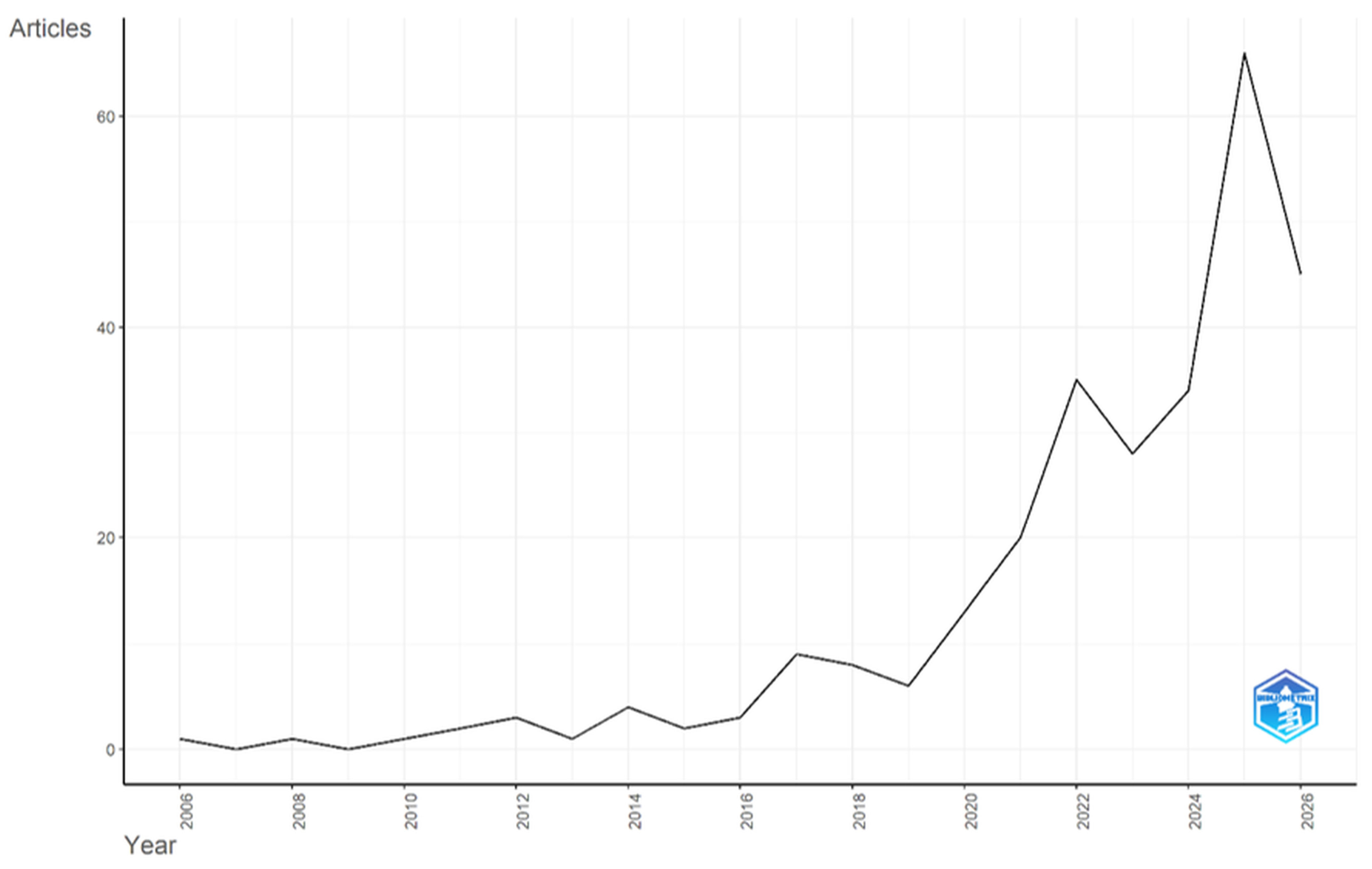
The evolution of scientific production reveals a marked change in the development of the field over the period analyzed. Research output remained relatively limited until 2019, but increased substantially from 2020 onward, reaching its highest levels in the most recent years. This trajectory suggests three distinguishable stages: an initial period of relatively limited production between 2006 and 2019, an accelerated growth phase between 2020 and 2023, and a period of greater publication concentration between 2024 and 2026. Figure 2 illustrates this progression and highlights the marked acceleration of scientific production during the most recent period.
The sharp increase observed in the final stage is particularly noteworthy, with annual production increasing from 30 articles in 2023 to 39 in 2024 and reaching its highest level in 2025. Moreover, the production recorded for 2026 is already close to the 2025 level despite representing an incomplete publication year, as the database search was conducted on 14 August 2026. This pattern indicates that the recent expansion of research on women’s entrepreneurial finance is not merely cumulative but has intensified considerably in the latest period analyzed.
Scientific activity in women’s entrepreneurial finance is distributed across a broad range of journals, authors, institutions, and countries, although the results reveal the prominence of a relatively small group of contributors. Small Business Economics was the leading source with 11 articles, followed by the International Journal of Gender and Entrepreneurship with 10 and the International Journal of Entrepreneurship & Small Business with 7. At the author level, Kazemikhasragh, Kurniasari, Lestari, and Milanov recorded the highest productivity, with four articles each, although their fractionalized contributions ranged from 1.20 to 1.67. The University of Johannesburg was the most productive institution, with 12 articles, while several institutions from Europe, Asia, and Africa also appeared among the leading contributors. At the country level, India registered the highest number of occurrences (115), followed by the USA (101), the UK (63), China (54), and Italy (53). Table 2 summarizes the leading sources, authors, institutions, and countries identified in the corpus.
Taken together, these results show that the field combines broad international participation with a discernible concentration of scientific production. The prominence of journals specifically focused on entrepreneurship and gender coexists with contributions from broader business and management outlets. Similarly, the institutional distribution extends across different geographical regions, while the country rankings highlight the strong presence of India and other Asian economies alongside established research systems such as the USA and the UK. However, publication prominence does not necessarily imply a central position in international scientific collaboration; this distinction is examined subsequently through country-level collaboration and network centrality indicators.

4.2. Conceptual Structure of Women’s Entrepreneurial Finance

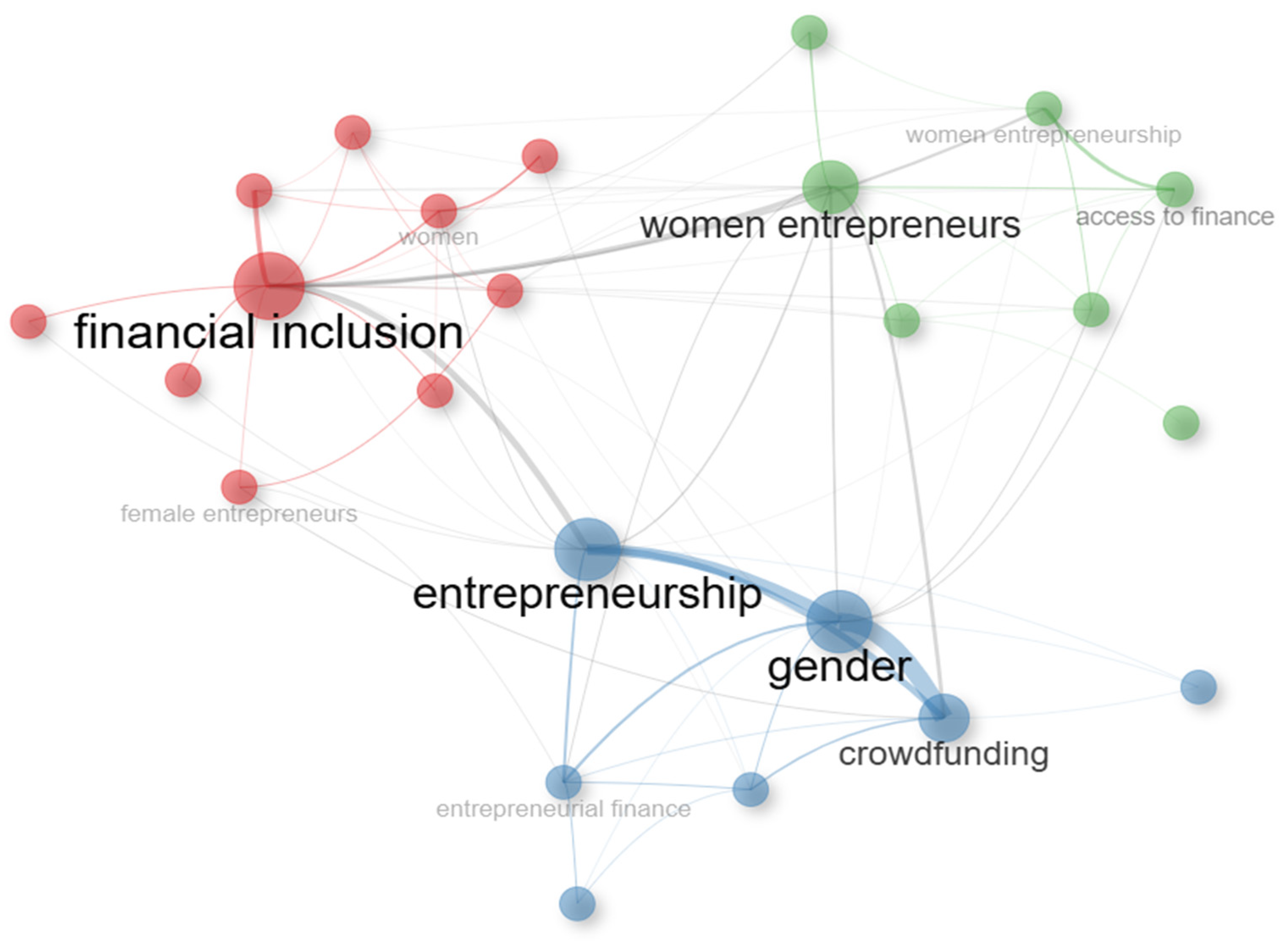
The keyword co-occurrence analysis identified three interconnected clusters that structure research on women’s entrepreneurial finance. These clusters capture three main conceptual domains: financial inclusion and digital finance, gender and entrepreneurial finance, and women entrepreneurs’ access to financial resources. Figure 3 presents the configuration and relationships among these clusters.
The first cluster is centered on financial inclusion, the most frequent and strongly connected keyword in the network (63 occurrences; TLS = 319). It is associated with female entrepreneurs, financial literacy, fintech, women empowerment, gender equality, and digital finance. Its high betweenness (70.650) and PageRank (0.1148) further indicate its structural importance in connecting different areas of the network. Conceptually, this cluster reflects the intersection between women’s financial inclusion, financial capabilities, women’s empowerment, and the growing role of digital financial mechanisms.
The second cluster connects entrepreneurship (53 occurrences; TLS = 251) and gender (48; TLS = 218) with crowdfunding (40; TLS = 170), entrepreneurial finance, female entrepreneurship, equity crowdfunding, and innovation. Gender also displays high betweenness (42.071), suggesting an important bridging role within the network. This cluster captures research examining entrepreneurial finance through a gender lens, particularly in alternative financing contexts such as crowdfunding, where gender-related differences in funding processes have received particular attention (Greenberg & Mollick, 2017; Johnson et al., 2018).
The third cluster is organized around women entrepreneurs (47 occurrences; TLS = 225), access to finance (31; TLS = 143), women entrepreneurship (29; TLS = 152), and microfinance (16; TLS = 88). It also incorporates empowerment and India, the latter showing relatively high betweenness (22.212). This cluster reflects the persistent importance of access to financial resources and microfinance in the study of women’s entrepreneurship, consistent with research documenting gender-related financing constraints across different institutional contexts (Aterido et al., 2013; Muravyev et al., 2009). Table 3 summarizes the main keywords and network indicators for the three clusters. Overall, the three clusters reveal an interconnected conceptual structure in which financial inclusion and digitalization, gendered entrepreneurial finance, and access to financial resources constitute complementary dimensions of women’s entrepreneurial finance.

4.3. Intellectual Structure of Women’s Entrepreneurial Finance

The reference co-citation analysis revealed three clusters that constitute the intellectual structure of research on women’s entrepreneurial finance. These clusters reflect complementary foundations of the field, encompassing gender-related mechanisms in entrepreneurial financing, crowdfunding and alternative finance, and the broader structural conditions shaping women’s entrepreneurship and access to financial resources. Table 4 summarizes the most influential references within each cluster together with their co-citation frequency and network centrality indicators.
The first cluster is centered on the role of gender in entrepreneurial financing decisions and investor evaluations. Greenberg and Mollick (2017) was the most frequently co-cited reference in this cluster, cited by 24 documents and recording the highest PageRank (0.0491), while Eddleston et al. (2016) exhibited the highest betweenness (0.1296) and closeness (0.2202). Together with Gupta et al. (2009), Kanze et al. (2018), and Alsos and Ljunggren (2017), these references form an intellectual foundation concerned with gender stereotypes, signaling mechanisms, investor–entrepreneur relationships, and gender-related differences in funding evaluations.
The second cluster is structured around crowdfunding and the mechanisms underlying alternative entrepreneurial finance. Mollick (2014) occupies the most prominent position, with 21 citing documents and the highest betweenness (0.0877), closeness (0.2211), and PageRank (0.0473) within the cluster. The presence of Colombo et al. (2015), Belleflamme et al. (2014), Parhankangas and Renko (2017), and Johnson et al. (2018) indicates that this intellectual stream combines foundational research on crowdfunding with studies addressing social capital, communication, funding success, and gender bias in crowd-based financing.
The third cluster reflects the broader gendered and institutional foundations of women’s entrepreneurship and financial access. Ahl (2006) occupies a particularly important structural position, with 20 citing documents and the highest betweenness in the entire co-citation network (0.2281). This cluster also includes Muravyev et al. (2009), Brush et al. (2009), Aterido et al. (2013), and Barney (1991), connecting gender-aware approaches to entrepreneurship with research on financial constraints, access to finance, institutional context, and resource-based explanations of entrepreneurial outcomes.
Taken together, the three clusters show that the intellectual structure of the field has developed at the intersection of three complementary perspectives: gender-related mechanisms affecting financing decisions, alternative entrepreneurial financing through crowdfunding, and structural and institutional conditions affecting women’s access to financial resources. The connections among these intellectual streams show that women’s entrepreneurial finance extends beyond a singular concern with access to capital toward a broader examination of how gender, financing mechanisms, investor behavior, and institutional conditions jointly shape entrepreneurial financing.
Citation impact provides a complementary perspective on this intellectual structure by showing which documents in the corpus have achieved the greatest visibility in the broader scientific literature. Table 5 presents the ten most globally cited documents, together with their annual and normalized citation indicators. Greenberg and Mollick (2017) were associated with the most globally cited document, with 367 citations and the highest normalized citation score (6.05), followed by Carter et al. (2015) with 271 citations and Cowling et al. (2012) with 226. Johnson et al. (2018) accumulated 215 citations, while Klapper and Parker (2011) received 210. Among the more recent contributions, Cumming et al. (2021) stands out with 197 total citations, 32.80 citations per year, and a normalized citation score of 5.79. These results indicate that scientific influence in the field derives from both established contributions and more recent studies that have achieved substantial citation impact over shorter publication periods.

4.4. Thematic Structure and Evolution of Women’s Entrepreneurial Finance

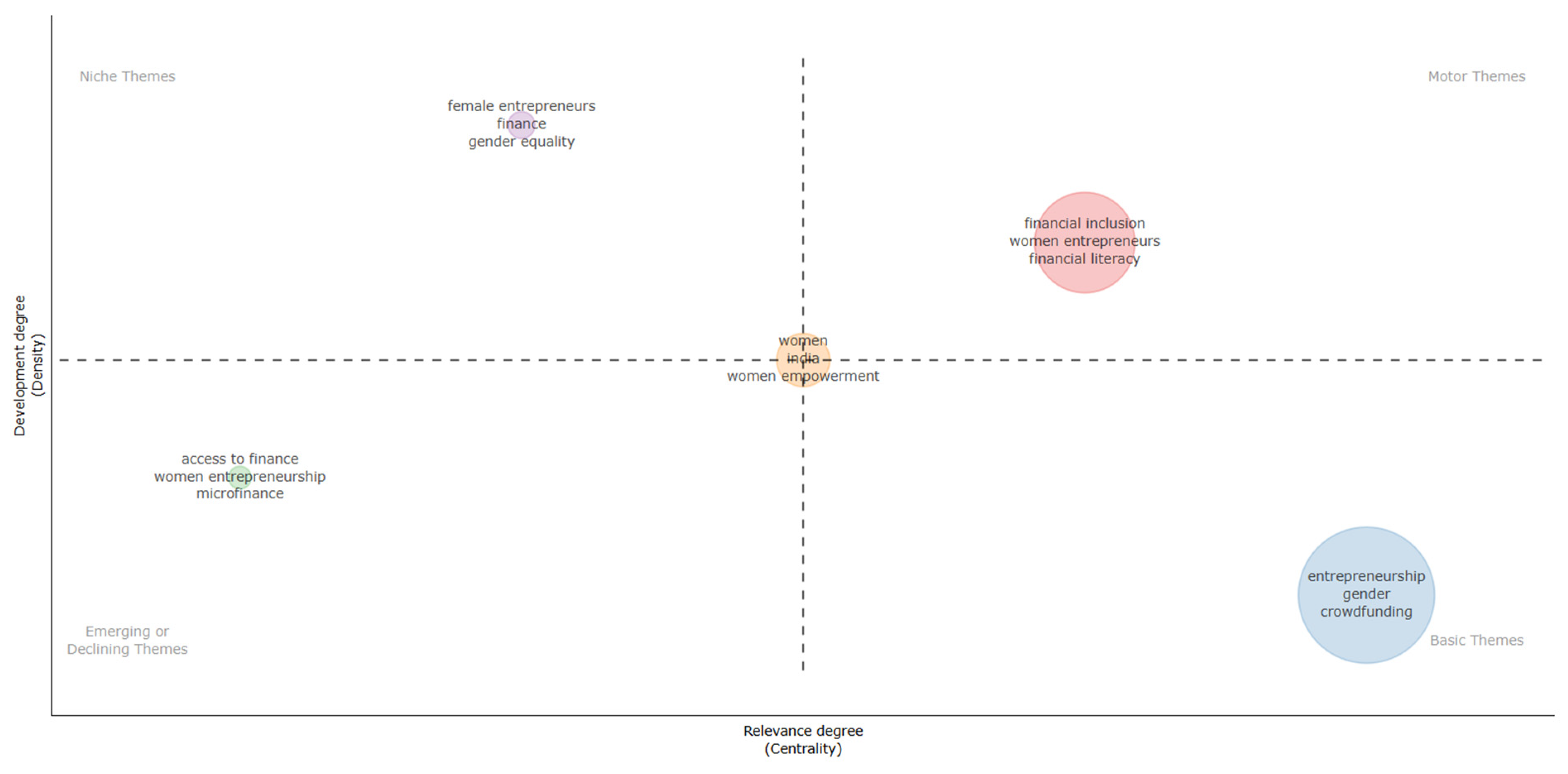
The thematic structure of women’s entrepreneurial finance reveals differences in the development and relevance of the topics that constitute the field. The thematic map identifies financial inclusion, women entrepreneurs, and financial literacy as a motor theme, characterized by relatively high centrality and density. This position indicates that these topics are both internally developed and strongly connected with the broader research field. In contrast, entrepreneurship, gender, and crowdfunding form the largest basic theme, combining high centrality with comparatively lower density. The prominence of crowdfunding within this thematic core is consistent with research examining gender differences in entrepreneurial financing and investor evaluations in crowdfunding contexts (Greenberg & Mollick, 2017; Johnson et al., 2018).
Other thematic groups occupy more specialized or less consolidated positions. Female entrepreneurs, finance, and gender equality appear as a niche theme, reflecting relatively strong internal development but weaker connections with the broader thematic network. Conversely, access to finance, women entrepreneurship, and microfinance are located within the emerging or declining quadrant. This position should be interpreted cautiously because the thematic map does not by itself establish whether these topics are emerging or losing relevance. Nevertheless, their association is consistent with a longstanding stream of research addressing gender-related financial constraints and women’s access to formal and informal sources of finance (Muravyev et al., 2009; Aterido et al., 2013). A smaller group composed of women, India, and women empowerment is located close to the intersection of the centrality and density axes, indicating an intermediate thematic position. Figure 4 presents the distribution of these themes according to their centrality and density.
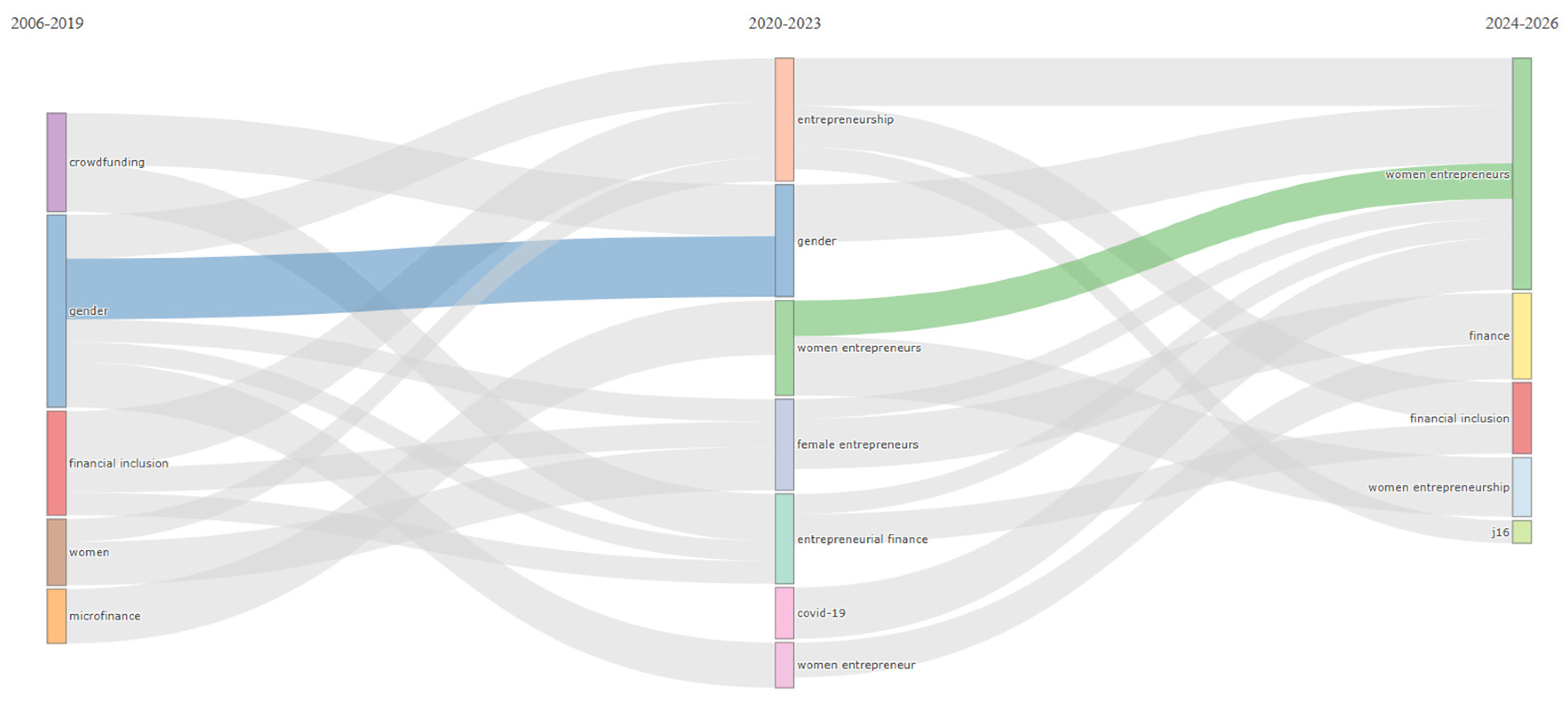
The longitudinal analysis provides a complementary perspective by showing how the thematic configuration of the field changed across the periods analyzed. During 2006–2019, research was organized mainly around crowdfunding, gender, financial inclusion, women, and microfinance. These themes reflect two foundations that also appear in the intellectual structure of the field: the examination of gender and financing constraints in women’s entrepreneurship (Ahl, 2006; Muravyev et al., 2009) and the development of crowdfunding as an alternative mechanism for entrepreneurial finance (Greenberg & Mollick, 2017; Mollick, 2014).
During 2020–2023, the thematic structure became more diversified, incorporating entrepreneurship, women entrepreneurs, female entrepreneurs, entrepreneurial finance, COVID-19, and women entrepreneur, while gender remained visible. Rather than indicating the disappearance of the earlier research streams, the connections between periods show their recombination into more differentiated topics centered on entrepreneurial actors and financing mechanisms.
The most recent period, 2024–2026, displays a more concentrated thematic configuration around women entrepreneurs, finance, financial inclusion, and women entrepreneurship, together with the smaller theme J16. Particularly notable is the continuity of financial inclusion across the three periods and the increasing prominence of terms explicitly centered on women entrepreneurs. Figure 5 illustrates these thematic continuities and transformations across the three periods.
Taken together, the thematic map and thematic evolution indicate that the field has developed through both continuity and thematic reconfiguration. Financial inclusion remains a persistent component of the research agenda, while gender, crowdfunding, microfinance, and access to finance provide important foundations from which more differentiated research on women entrepreneurs and entrepreneurial finance has developed. The most recent configuration therefore suggests a greater concentration around the financing experiences of women entrepreneurs, while retaining connections with the gender and financial-access perspectives that have historically structured the field.

4.5. International Collaboration and Economic-Development Patterns

International collaboration in women’s entrepreneurial finance varies considerably across the leading countries in terms of both the intensity of international co-authorship and their structural position within the collaboration network. India recorded the largest number of articles among the countries analyzed (46), but almost all were single-country publications (SCP = 45), resulting in an MCP ratio of only 2.17%. In contrast, Italy showed the highest MCP ratio (58.82%), followed by the United Kingdom (45.83%), China and France (44.44% each). These differences indicate that publication volume and international collaboration do not necessarily follow the same pattern.
Network centrality provides a complementary view of these differences. The United Kingdom occupied the strongest structural position among the leading countries, recording the highest betweenness (0.2103), closeness (0.4286), and PageRank (0.0725). The USA also displayed comparatively high values across the three indicators, whereas India combined high publication output with a less prominent position in the international collaboration network. Table 6 summarizes the publication and network indicators of the leading countries.
A clearer contrast emerges when countries are grouped according to their level of economic development. Although low- and middle-income economies accounted for more countries (35) and more articles with an identifiable corresponding-author country (170), their international collaboration was substantially lower. High-income economies recorded an overall MCP ratio of 43.75%, compared with 18.82% for low- and middle-income economies. The difference was even greater when considering the median MCP ratio by country, which reached 50.00% among high-income economies but only 2.17% among low- and middle-income economies.
The structure of the collaboration subnetworks reinforces this contrast. High-income economies formed a network of 21 nodes and 54 edges, with a density of 0.257, whereas the low- and middle-income subnetwork contained 18 nodes and only 16 edges, resulting in a density of 0.105. High-income economies also displayed higher median closeness (0.01136) and PageRank (0.02018), while low- and middle-income economies showed a higher median betweenness (3.250 versus 2.254). Table 7 presents the comparison between the two economic-development groups.
Taken together, these results reveal a marked difference between scientific production and international network integration. Low- and middle-income economies contribute substantially to the volume of research on women’s entrepreneurial finance, but their collaboration network is less dense, and their international co-authorship rate is lower than those observed among high-income economies. Conversely, high-income economies exhibit stronger cross-country connectivity and greater structural prominence within the collaboration network. These findings provide the empirical basis for examining the geographical and developmental asymmetries of the field in the Discussion.

5. Discussion

The results show that research on women’s entrepreneurial finance has evolved from an agenda characterized by approaches centered on gender and entrepreneurship toward one that incorporates financial inclusion, digitalization, and new financing alternatives. This transformation is consistent with Rejeb et al. (2025), who point to a recent diversification of research streams on female entrepreneurship, as well as with Valencia-Arias et al. (2026), who attribute a multidimensional character to financing in the development of female entrepreneurship. Similar evidence is provided by Koziol et al. (2025) who identify persistent gender differences across entrepreneurial equity financing mechanisms, while Wesemann and Wincent (2021) highlight the growing relevance of alternative financing channels in women’s entrepreneurship. Research on digital financial inclusion further shows that the expansion of the field increasingly incorporates technology-enabled access to financial services (Hasan et al., 2023; Yang et al., 2022). In this way, the findings make it possible to understand the evolution of the field as a progressive expansion of the financial mechanisms and factors considered when examining women’s access to finance.
Within this transformation, the incorporation of new financing mechanisms does not imply the disappearance of gender inequalities in access to capital. Chundakkadan and Sasidharan (2022) note that these differences persist across countries, while Morazzoni and Sy (2022) show that financial frictions can generate unequal capital allocation in women-led projects. Alene (2020) provides additional evidence on the financial constraints that shape the performance of women entrepreneurs in small businesses. These persistent differences are also observed in alternative financing environments. Kleinert and Mochkabadi (2022) show that gender stereotypes influence how investors interpret quality signals in equity crowdfunding, while Hewa-Wellalage et al. (2022) demonstrate that gender differences in financing may vary according to the type of financial resource and the conditions of the external environment. This coexistence of new financial alternatives and persistent inequalities shows that the diversification of financing mechanisms does not by itself guarantee equitable conditions of access to capital.
These frictions affect not only the possibility of obtaining resources but also the conditions involved in accessing finance. Forrester and Neville (2021) indicate that institutional conditions may discourage women entrepreneurs from applying for financing, while Naegels et al. (2022) examine the process of female borrower discouragement in greater depth. Dutta and Mallick (2023) further show that majority-female-owned firms perceive particular constraints in accessing finance, while Naegels et al. (2020) identify collateral-related difficulties and the role of informal networks in addressing them. Pal and Gupta (2023) further highlight the importance of access to credit for the economic empowerment of women entrepreneurs. Together, these studies indicate that financing barriers involve not only the availability of capital but also the conditions under which women entrepreneurs interact with formal financing mechanisms. The persistence of these barriers helps explain why access to finance remains one of the central themes of the field despite the diversification of available financial mechanisms.
Financial inclusion occupies a central place in this transformation, particularly because of its connection with the digitalization of financial services. Yang et al. (2022) argue that digital financial inclusion can foster female entrepreneurship, while Hasan et al. (2023) note that its effective use depends on the development of digital financial capabilities. Gichuki and Mulu-Mutuku (2018) highlight the importance of mobile money technologies among women microentrepreneurs, and Mahato and Jha (2023) relate financial inclusion to the development of sustainable livelihoods through microentrepreneurship. Likewise, Kurniasari and Lestari (2024) link financial literacy and FinTech adoption to women’s business performance. These studies support the prominence of financial inclusion identified in the bibliometric structure of the field but also indicate that greater access to digital financial services does not automatically translate into equivalent financial opportunities for women entrepreneurs. Rather, the benefits of digitalization appear to depend on the financial and digital capabilities required to effectively use these services.
Crowdfunding expands options for accessing capital beyond traditional channels, although its effects show gender-related differences. Greenberg and Mollick (2017) highlight dynamics related to gender affinity, while Cowden et al. (2021) and Elitzur and Solodoha (2021) show the influence of gender roles and gender differences on these platforms. Oo et al. (2022) identify variations in assessments of competence and warmth, while Kleinert and Mochkabadi (2022) point to the influence of stereotypes on quality signals. From another perspective, Wang and Prokop (2025) identify investor preferences associated with gender and geographic proximity, and A. F. F. Cicchiello and Kazemikhasragh (2022) identify biases among Latin American investors.
Taken together, these findings support the prominence of crowdfunding identified in the conceptual structure of the field and show that digital platforms may change the mechanisms through which capital is allocated without necessarily removing gender-related influences on investors’ decisions. In this sense, gender inequalities in alternative finance may operate through perceptions, stereotypes, and investor preferences rather than solely through traditional barriers to credit.
Microfinance remains relevant as a means of accessing capital, especially in contexts of greater financial constraint. Nilakantan et al. (2019) relate its effectiveness to the conditions under which microenterprises operate, while Bettoni et al. (2023) highlight the potential of microcredit to promote investment and inclusion. This evidence is consistent with Mahmood et al. (2014), who show that the conditions under which microcredit programs operate influence women entrepreneurs’ business performance, and with Abebe and Kegne (2023), who highlight the contribution of microfinance institutions to the development of women-owned businesses.
Kromidha et al. (2023) incorporate the convergence of microfinance and digital crowdfunding for women entrepreneurs, and Fiamohe et al. (2024) show that its effects vary according to the characteristics of rural women-owned enterprises. Social capital adds another dimension: Urban and Moetse (2024) emphasize the importance of networks among women entrepreneurs, while Shahzad et al. (2025) highlight their contribution to female rural entrepreneurship. Taken together, these findings suggest that the contribution of microfinance depends not only on the provision of capital but also on the conditions of financial programs, institutional support, business characteristics, and the social networks available to women entrepreneurs. These findings show the relevance of the social and contextual environment for understanding access to finance.
The intellectual structure also reveals the coexistence of two knowledge bases that have contributed to shaping the field. The first, organized around Brush, Coleman, Ahl, Carter, and Marlow, reflects a tradition centered on the relationships among gender, entrepreneurship, and access to finance; this knowledge base approaches financing inequalities as embedded in broader gendered, institutional, and entrepreneurial contexts rather than as differences attributable exclusively to firms’ financial characteristics. This interpretation is consistent with the foundational contributions of Brush et al. (2009) and Ahl (2006), which emphasize the need to understand women’s entrepreneurship within its social and institutional context. The second, associated with Greenberg, Mollick, Johnson, Balachandra, and Colombo, incorporates crowdfunding and alternative financing mechanisms.
In this cluster, studies such as Greenberg and Mollick (2017) and Johnson et al. (2018) shift attention toward investor behavior, gender stereotypes, and the mechanisms through which financing decisions are made in emerging entrepreneurial finance environments. Rather than representing disconnected intellectual traditions, the two clusters are complementary: the first provides the gendered and institutional foundations for explaining inequalities in entrepreneurial finance, whereas the second extends these concerns to new financing environments and investor decision-making. This coexistence shows that the field has not replaced its original foundations but has expanded its intellectual base through the incorporation of new forms of access to capital.
This intellectual configuration is accompanied by marked geographic diversity. Saviano et al. (2017) show specific financial constraints affecting women in the Middle East and North Africa, while Shoma (2019) identifies particular conditions in Bangladesh. Brixiová et al. (2020) provide evidence on female entrepreneurship in Southern Africa, and Kitole and Genda (2024) highlight the challenges present in rural settings. A. F. F. Cicchiello and Kazemikhasragh (2022), in turn, provide evidence from Latin America.
Evidence from South Africa further reinforces this contextual interpretation, as Ojo and Zondi (2021) show that institutional quality and governance conditions influence financial inclusion among women entrepreneurs. Taken together, these studies indicate that financing constraints cannot be interpreted as a homogeneous phenomenon across countries, since differences in institutional environments, financial systems, and socioeconomic conditions shape both the barriers women entrepreneurs face and the mechanisms available to overcome them. This contextual diversity reinforces the need to interpret women’s entrepreneurial finance by considering the institutional, economic, and social particularities of each setting.
Emerging technologies open new frontiers for research on the financing of women-led ventures. Alateeg and Al-Ayed (2024) emphasize the potential of artificial intelligence to support these initiatives, while Medina-Vidal et al. (2025) incorporate this technology into the analysis of financial inclusion from a gender perspective. Gashi and Baruti (2026) relate AI-supported digital transformation to female entrepreneurship. Parameswaran and Kadam (2026), in turn, provide evidence that technology adoption may help reduce gaps in access to formal credit.
This emerging trajectory extends an earlier stream of research in which FinTech and mobile money were associated with broader financing and investment opportunities for women-led businesses (Islam & Muzi, 2022; Kedir & Kouame, 2022), while evidence on FinTech also showed its potential relevance for reducing gender-related economic gaps (Guo et al., 2021). The recent incorporation of artificial intelligence therefore represents a further development of this technological stream, shifting attention toward AI-supported financial inclusion and access to formal credit.
Taken together, the findings show that research on women’s entrepreneurial finance has expanded considerably over time. Traditional concerns about access to capital and gender-related financial barriers remain relevant, but they now coexist with growing interest in financial inclusion, crowdfunding, and digital finance. This coexistence is consistent with Li et al. (2026), who show that gender disparities differ across financial channels and according to supply- and demand-side mechanisms, and with Koziol et al. (2025), who identify heterogeneous gender-related outcomes across venture capital, angel investment, and equity crowdfunding.
This suggests that changes in financing mechanisms have broadened the opportunities available to women entrepreneurs without necessarily removing the inequalities that affect their access to financial resources. The field therefore continues to evolve as new financial technologies and alternatives interact with persistent institutional and gender-related constraints. Accordingly, the evolution identified in this study should be understood not as the replacement of traditional financing barriers by new mechanisms, but as the emergence of a more complex financial environment in which traditional, alternative, and digital forms of finance coexist with persistent gender-related constraints.

5.1. Theoretical Implications

The findings broaden the theoretical understanding of women’s entrepreneurial finance beyond differences in access to capital. The three intellectual foundations identified in the co-citation analysis connect gender-related mechanisms in financing decisions, alternative entrepreneurial finance, and structural and institutional conditions. This configuration extends gender-aware approaches that emphasize the social and institutional embeddedness of women’s entrepreneurship (Ahl, 2006; Brush et al., 2009) by showing that financing mechanisms constitute an additional context in which gender-related differences may emerge. Women’s entrepreneurial finance can therefore be understood through the interaction between gender-related, institutional, and financing-mechanism conditions.
A second contribution concerns the expansion of financial access to capabilities and technological intermediation. The prominence of financial inclusion and its connections with financial literacy (Andriamahery & Qamruzzaman, 2022), FinTech, empowerment, and digital finance suggest that access depends not only on capital availability but also on the capabilities required to use increasingly diversified financial services (Hasan et al., 2023). At the same time, the coexistence of crowdfunding, FinTech, and emerging AI-enabled finance suggests that technology should not be theorized as inherently equalizing, since gender-related constraints may be reduced, transformed, or reproduced as financing mechanisms evolve.

5.2. Practical and Policy Implications

The findings suggest that policies aimed at improving women’s entrepreneurial finance should be differentiated according to the characteristics of the financial environment. In developed financial systems, policy attention should increasingly address gender-related differences in investor evaluation, crowdfunding, and technology-enabled financing (Andriamahery & Qamruzzaman, 2022). In emerging economies, expanding access to credit and microfinance should be complemented by financial and digital capability development and institutional support (Hasan et al., 2023; Kairiza et al., 2017). This differentiation recognizes that women entrepreneurs face different financing constraints across institutional and economic contexts.
Financial regulators and digital financial intermediaries also face specific challenges as FinTech, crowdfunding, and AI-enabled financial services expand. Regulators should strengthen gender-disaggregated monitoring of financing outcomes and transparency in digital decision-making processes, while platforms should assess whether their evaluation and investor-interaction mechanisms reproduce gender-related differences, particularly given evidence of stereotypes and biases in alternative financing environments (Greenberg & Mollick, 2017; Kleinert & Mochkabadi, 2022).
For microfinance providers, the findings suggest moving beyond credit provision alone by combining financing with financial and digital literacy, business support, and network-building mechanisms. Such complementary support is particularly relevant in financially constrained environments, where access to capital interacts with the capabilities and social conditions that enable women entrepreneurs to use financial resources effectively.

5.3. Limitations

Several limitations should be considered when interpreting the findings. First, although the use of Scopus and Web of Science improves the coverage of the literature, the corpus remains conditioned by the indexing criteria of these databases and by the search strategy used. Second, the analysis was restricted to scientific articles published in English between 2006 and 2026, excluding other document types and languages that may contain relevant evidence. Finally, bibliometric methods identify patterns, relationships, and knowledge structures but do not allow for an in-depth assessment of the theoretical arguments, methodological quality, or empirical findings of each study.

5.4. Future Research Agenda

The emergence of artificial intelligence and increasingly sophisticated digital financial services opens a first research avenue. Recent studies have begun to examine AI in women-led ventures and gender-sensitive financial inclusion (Almheiri et al., 2025; Medina-Vidal et al., 2025), while FinTech research points to new mechanisms for expanding women’s financing opportunities (Kedir & Kouame, 2022). Future studies should examine whether AI-enabled credit scoring and lending systems reduce or reproduce gender disparities in loan approval, financing conditions, and access to entrepreneurial capital. Comparative experimental and longitudinal designs could also assess whether algorithmic decision-making produces different outcomes from traditional credit evaluation.
A second avenue concerns the contextual heterogeneity identified across the field and the differences in international collaboration observed across economic-development groups. Cross-country evidence indicates that gender gaps in access to finance vary across economic and institutional settings (Chundakkadan & Sasidharan, 2022), while recent studies continue to identify differences in financial inclusion among women entrepreneurs in emerging economies (Hendrawaty et al., 2024). Future research should therefore compare high-income and low- and middle-income economies, regions, and institutional environments to determine which financial and institutional conditions amplify or mitigate financing inequalities. Multi-country studies using comparable indicators could help distinguish the effects of financial-system development, regulatory quality, digital infrastructure, and institutional support.
A third avenue concerns the emerging intersection between women’s entrepreneurial finance and sustainable finance. Although sustainability is increasingly connected with financial inclusion and women-led enterprises (Kurniasari & Lestari, 2024), the role of green entrepreneurial finance remains insufficiently developed in the corpus. Future studies could examine women entrepreneurs’ access to green credit, sustainable investment, and climate-oriented financing, as well as whether eligibility criteria for these instruments generate different opportunities across gender and firm characteristics. This would connect the financial inclusion agenda with the growing sustainability orientation of entrepreneurial finance.
Based on these emerging directions, future research could address more specific questions: How do AI-enabled financing mechanisms affect women entrepreneurs’ access to credit across different institutional contexts? To what extent do financial literacy and digital financial capabilities shape women entrepreneurs’ use of emerging financing mechanisms? How do institutional and economic conditions influence gender-related financing gaps across countries? Finally, what factors facilitate women entrepreneurs’ access to green and sustainable finance?

6. Conclusions

This study highlights that academic research on women’s entrepreneurial finance underwent a notable change during the 2006–2026 period, moving from a predominant focus on constraints on access to capital and gender inequalities toward a broader perspective that connects financial inclusion, digitalization, and alternative financing mechanisms. This evolution of the field does not imply that the issues initially addressed have lost relevance; rather, they coexist with new ways of understanding the financial opportunities and barriers faced by women entrepreneurs. In this regard, women’s entrepreneurial finance emerges as a field still under development, whose evolution reflects both the diversification of forms of access to capital and the persistence of gender-related inequalities.
The analysis of the thematic and intellectual structure of the field shows that it is supported by three complementary intellectual foundations: gender-related mechanisms in financing decisions, crowdfunding and alternative entrepreneurial finance, and the structural and institutional conditions shaping women’s access to financial resources. This configuration reflects a thematic evolution in which financial inclusion and access to finance gain greater centrality, alongside the development of research streams related to microfinance, social capital, and digital technologies. Overall, these findings show that the expansion of alternatives for obtaining capital has not eliminated gender inequalities but has opened new contexts in which they may emerge. From a practical perspective, this finding supports differentiated interventions according to financial and institutional contexts and highlights the need for regulators, financial intermediaries, and microfinance providers to consider not only access to capital but also the conditions and capabilities that shape its effective use.
Finally, the study provides an integrated and longitudinal view of a field that previous research has addressed from different and often separate perspectives. Connecting scientific performance, intellectual and conceptual structure, thematic development, and patterns of international collaboration makes it possible to understand how knowledge about women’s entrepreneurial finance has been configured and transformed. This integration highlights the growing relevance of institutional, social, and technological conditions in understanding women’s access to financial resources alongside persistent gender inequalities. These findings are particularly connected with SDG 5 (Gender Equality) and SDG 10 (Reduced Inequalities) through the persistence of gender-related financing gaps; with SDG 8 (Decent Work and Economic Growth) through the role of financial access in supporting women’s entrepreneurial activity; and with SDG 9 (Industry, Innovation and Infrastructure) through the growing relevance of digital finance, FinTech, and emerging financial technologies. Within the limitations associated with database coverage, language and document-type restrictions, and the scope of bibliometric methods, future research should further examine AI-enabled financing, differences across economic and institutional contexts, and women entrepreneurs’ access to green and sustainable finance. In this way, the study contributes to defining the current configuration of the field and provides a starting point for future research.

Author Contributions

Conceptualization, J.A.V. and K.C.V.; methodology, J.A.V., K.C.V. and A.T.A.; software, K.C.V. and V.H.B.; validation, J.A.V., A.T.A. and V.H.B.; formal analysis, K.C.V., A.T.A. and V.H.B.; investigation, J.A.V., K.C.V., A.T.A. and V.H.B.; resources, A.T.A. and V.H.B.; data curation, K.C.V. and V.H.B.; writing—original draft preparation, J.A.V., K.C.V., A.T.A. and V.H.B.; writing—review and editing, J.A.V., K.C.V., A.T.A. and V.H.B.; visualization, K.C.V. and V.H.B.; supervision, J.A.V.; project administration, J.A.V. All authors have read and agreed to the published version of the manuscript.

Funding

This research received no external funding.

Institutional Review Board Statement

Not applicable.

Informed Consent Statement

Not applicable.

Data Availability Statement

The bibliographic data used in this study were obtained from the Scopus and Web of Science databases. The processed dataset supporting the results of this study is available from the corresponding author upon request.

Acknowledgments

During the preparation of this manuscript, the authors used ChatGPT (GPT-5.5, OpenAI) to support language editing and improve the clarity and readability of the text. The authors reviewed and edited the output and took full responsibility for the content of this publication.

Conflicts of Interest

The authors declare no conflicts of interest.

References

  1. Abebe, A., & Kegne, M. (2023). The role of microfinance institutions on women’s entrepreneurship development. Journal of Innovation and Entrepreneurship, 12(1), 17. [Google Scholar] [CrossRef] [Scilit] [PubMed]
  2. Ahl, H. (2006). Why research on women entrepreneurs needs new directions. Entrepreneurship Theory and Practice, 30(5), 595–621. [Google Scholar] [CrossRef] [Scilit]
  3. Ahmad, S. Z., & Muhammad, A. M. (2015). Strengthening access to finance for women-owned SMEs in developing countries. Equality, Diversity and Inclusion: An International Journal, 34(7), 634–639. [Google Scholar] [CrossRef] [Scilit]
  4. Alateeg, S., & Al-Ayed, S. (2024). Exploring the role of artificial intelligence technology in empowering women-led startups. Knowledge and Performance Management, 8(2), 28–38. [Google Scholar] [CrossRef] [Scilit]
  5. Alene, E. T. (2020). Determinants that influence the performance of women entrepreneurs in micro and small enterprises in Ethiopia. Journal of Innovation and Entrepreneurship, 9(1), 24. [Google Scholar] [CrossRef] [Scilit]
  6. Almheiri, A., Chopra, A., & Haddad, A. (2025). The role of artificial intelligence in empowering women entrepreneurs in the United Arab Emirates. JWEE, 19–39. [Google Scholar] [CrossRef]
  7. Alsos, G. A., & Ljunggren, E. (2017). The role of gender in entrepreneur–investor relationships: A signaling theory approach. Entrepreneurship Theory and Practice, 41(4), 567–590. [Google Scholar] [CrossRef] [Scilit]
  8. Andriamahery, A., & Qamruzzaman, M. (2022). Do access to finance, technical know-how, and financial literacy offer women empowerment through women’s entrepreneurial development? Frontiers in Psychology, 12, 776844. [Google Scholar] [CrossRef] [Scilit] [PubMed]
  9. Aria, M., & Cuccurullo, C. (2017). bibliometrix: An R-tool for comprehensive science mapping analysis. Journal of Informetrics, 11(4), 959–975. [Google Scholar] [CrossRef] [Scilit]
  10. Aristei, D., & Gallo, M. (2016). Does gender matter for firms’ access to credit? Evidence from international data. Finance Research Letters, 18, 67–75. [Google Scholar] [CrossRef] [Scilit]
  11. Aterido, R., Beck, T., & Iacovone, L. (2013). Access to finance in sub-Saharan Africa: Is there a gender gap? World Development, 47, 102–120. [Google Scholar] [CrossRef] [Scilit]
  12. Bapna, S., & Ganco, M. (2021). Gender gaps in equity crowdfunding: Evidence from a randomized field experiment. Management Science, 67(5), 2679–2710. [Google Scholar] [CrossRef] [Scilit]
  13. Barney, J. (1991). Firm resources and sustained competitive advantage. Journal of Management, 17(1), 99–120. [Google Scholar] [CrossRef] [Scilit]
  14. Belleflamme, P., Lambert, T., & Schwienbacher, A. (2014). Crowdfunding: Tapping the right crowd. Journal of Business Venturing, 29(5), 585–609. [Google Scholar] [CrossRef] [Scilit]
  15. Bentancor, A. (2022). Women’s entrepreneurship and government policy: Facilitating access to credit through a national program in Chile. Social Sciences, 11(1), 14. [Google Scholar] [CrossRef] [Scilit]
  16. Bettoni, L., Santos, M., & Filho, G. O. (2023). The impact of microcredit on small firms in Brazil: A potential to promote investment, growth and inclusion. Journal of Policy Modeling, 45(3), 592–608. [Google Scholar] [CrossRef] [Scilit]
  17. Brixiová, Z., Kangoye, T., & Tregenna, F. (2020). Enterprising women in Southern Africa: When does land ownership matter? Journal of Family and Economic Issues, 41(1), 37–51. [Google Scholar] [CrossRef] [Scilit]
  18. Brush, C. G., de Bruin, A., & Welter, F. (2009). A gender-aware framework for women’s entrepreneurship. International Journal of Gender and Entrepreneurship, 1(1), 8–24. [Google Scholar] [CrossRef] [Scilit]
  19. Carter, S., Mwaura, S., Ram, M., Trehan, K., & Jones, T. (2015). Barriers to ethnic minority and women’s enterprise: Existing evidence, policy tensions and unsettled questions. International Small Business Journal: Researching Entrepreneurship, 33(1), 49–69. [Google Scholar] [CrossRef] [Scilit]
  20. Chundakkadan, R., & Sasidharan, S. (2022). Gender gap and access to finance: A cross-country analysis. Review of Development Economics, 26(1), 180–207. [Google Scholar] [CrossRef] [Scilit]
  21. Cicchiello, A. F., Pietronudo, M. C., Perdichizzi, S., & Cheng, Y. (2024). Does a rising tide lift all boats? An empirical analysis of the relationship between country digitalization and low-tech SMEs performance. Technological Forecasting and Social Change, 207, 123632. [Google Scholar] [CrossRef] [Scilit]
  22. Cicchiello, A. F. F., & Kazemikhasragh, A. (2022). Tackling gender bias in equity crowdfunding: An exploratory study of investment behaviour of Latin American investors. European Business Review, 34(3), 370–395. [Google Scholar] [CrossRef] [Scilit]
  23. Colombo, M. G., Franzoni, C., & Rossi-Lamastra, C. (2015). Internal social capital and the attraction of early contributions in crowdfunding. Entrepreneurship Theory and Practice, 39(1), 75–100. [Google Scholar] [CrossRef] [Scilit]
  24. Cowden, B. J., Creek, S. A., & Maurer, J. D. (2021). Gender role congruity and crowdfunding success. Journal of Small Business Management, 59(Suppl. S1), 6. [Google Scholar] [CrossRef] [Scilit]
  25. Cowling, M., Liu, W., & Ledger, A. (2012). Small business financing in the UK before and during the current financial crisis. International Small Business Journal: Researching Entrepreneurship, 30(7), 778–800. [Google Scholar] [CrossRef] [Scilit]
  26. Cumming, D., Meoli, M., & Vismara, S. (2021). Does equity crowdfunding democratize entrepreneurial finance? Small Business Economics, 56(2), 533–552. [Google Scholar] [CrossRef] [Scilit]
  27. Donthu, N., Kumar, S., Mukherjee, D., Pandey, N., & Lim, W. M. (2021). How to conduct a bibliometric analysis: An overview and guidelines. Journal of Business Research, 133, 285–296. [Google Scholar] [CrossRef] [Scilit]
  28. Duan, Y., Hsieh, T.-S., Wang, R. R., & Wang, Z. (2020). Entrepreneurs’ facial trustworthiness, gender, and crowdfunding success. Journal of Corporate Finance, 64, 101693. [Google Scholar] [CrossRef] [Scilit]
  29. Dutta, N., & Mallick, S. (2023). Gender and access to finance: Perceived constraints of majority-female-owned Indian firms. British Journal of Management, 34(2), 973–996. [Google Scholar] [CrossRef] [Scilit]
  30. Eddleston, K. A., Ladge, J. J., Mitteness, C., & Balachandra, L. (2016). Do you see what I see? Signaling effects of gender and firm characteristics on financing entrepreneurial ventures. Entrepreneurship Theory and Practice, 40(3), 489–514. [Google Scholar] [CrossRef] [Scilit]
  31. Elitzur, R., & Solodoha, E. (2021). Does gender matter? Evidence from crowdfunding. Journal of Business Venturing Insights, 16, e00268. [Google Scholar] [CrossRef] [Scilit]
  32. Fiamohe, R., Dedehouanou, S. F. A., & Araar, A. (2024). What microfinance schemes for women-owned microenterprises’ productivity in rural Benin? Small Business Economics, 62(3), 1075–1097. [Google Scholar] [CrossRef] [Scilit]
  33. Fisch, C., Meoli, M., & Vismara, S. (2022). Does blockchain technology democratize entrepreneurial finance? An empirical comparison of ICOs, venture capital, and REITs. Economics of Innovation and New Technology, 31(1–2), 70–89. [Google Scholar] [CrossRef] [Scilit]
  34. Forrester, J. K., & Neville, F. (2021). An institutional perspective on borrowing discouragement among female-owned enterprises and the role of regional female empowerment. Journal of Business Venturing, 36(6), 106156. [Google Scholar] [CrossRef] [Scilit]
  35. Gafni, H., Marom, D., Robb, A., & Sade, O. (2021). Gender dynamics in crowdfunding (kickstarter): Evidence on entrepreneurs, backers, and taste-based discrimination. Review of Finance, 25(2), 235–274. [Google Scholar] [CrossRef] [Scilit]
  36. Gashi, R., & Baruti, B. (2026). AI-driven digital transformation and women entrepreneurship: Evidence from the Western Balkans. HighTech and Innovation Journal, 7(2), 627–644. [Google Scholar] [CrossRef] [Scilit]
  37. Geiger, M., & Oranburg, S. C. (2018). Female entrepreneurs and equity crowdfunding in the US: Receiving less when asking for more. Journal of Business Venturing Insights, 10, e00099. [Google Scholar] [CrossRef] [Scilit]
  38. Gichuki, C. N., & Mulu-Mutuku, M. (2018). Determinants of awareness and adoption of mobile money technologies: Evidence from women micro entrepreneurs in Kenya. Women’s Studies International Forum, 67, 18–22. [Google Scholar] [CrossRef] [Scilit]
  39. Goel, N., & Madan, P. (2019). Benchmarking financial inclusion for women entrepreneurship—A study of Uttarakhand state of India. Benchmarking: An International Journal, 26(1), 160–175. [Google Scholar] [CrossRef] [Scilit]
  40. Greenberg, J., & Mollick, E. (2017). Activist choice homophily and the crowdfunding of female founders. Administrative Science Quarterly, 62(2), 341–374. [Google Scholar] [CrossRef] [Scilit]
  41. Groza, M. P., Groza, M. D., & Barral, L. M. (2020). Women backing women: The role of crowdfunding in empowering female consumer-investors and entrepreneurs. Journal of Business Research, 117, 432–442. [Google Scholar] [CrossRef] [Scilit]
  42. Guo, Q., Chen, S., & Zeng, X. (2021). Does Fintech narrow the gender wage gap? Evidence from China. China & World Economy, 29(4), 142–166. [Google Scholar] [CrossRef] [Scilit]
  43. Gupta, V. K., Turban, D. B., Wasti, S. A., & Sikdar, A. (2009). The role of gender stereotypes in perceptions of entrepreneurs and intentions to become an entrepreneur. Entrepreneurship Theory and Practice, 33(2), 397–417. [Google Scholar] [CrossRef] [Scilit]
  44. Hasan, R., Ashfaq, M., Parveen, T., & Gunardi, A. (2023). Financial inclusion—Does digital financial literacy matter for women entrepreneurs? International Journal of Social Economics, 50(8), 1085–1104. [Google Scholar] [CrossRef] [Scilit]
  45. Hendrawaty, E., Hasnawati, S., Widodo, J., & Hadianto, B. (2024). The determinants of the financial inclusion of Indonesian female entrepreneurs. International Journal of Management and Sustainability, 13(2), 273–282. [Google Scholar] [CrossRef] [Scilit]
  46. Hewa-Wellalage, N., Boubaker, S., Hunjra, A. I., & Verhoeven, P. (2022). The gender gap in access to finance: Evidence from the COVID-19 pandemic. Finance Research Letters, 46, 102329. [Google Scholar] [CrossRef] [Scilit] [PubMed]
  47. Hill, F. M., Leitch, C. M., & Harrison, R. T. (2006). ‘Desperately seeking finance?’ The demand for finance by women-owned and -led businesses. Venture Capital, 8(2), 159–182. [Google Scholar] [CrossRef] [Scilit]
  48. Islam, A. M., & Muzi, S. (2022). Does mobile money enable women-owned businesses to invest? Firm-level evidence from Sub-Saharan Africa. Small Business Economics, 59(3), 1245–1271. [Google Scholar] [CrossRef] [Scilit]
  49. Johnson, M. A., Stevenson, R. M., & Letwin, C. R. (2018). A woman’s place is in the… startup! Crowdfunder judgments, implicit bias, and the stereotype content model. Journal of Business Venturing, 33(6), 813–831. [Google Scholar] [CrossRef] [Scilit]
  50. Kairiza, T., Kiprono, P., & Magadzire, V. (2017). Gender differences in financial inclusion amongst entrepreneurs in Zimbabwe. Small Business Economics, 48(1), 259–272. [Google Scholar] [CrossRef] [Scilit]
  51. Kanth, D., Sinha, A. R., & Asif Shah, M. (2025). Global research on financial well-being for women entrepreneurs: A bibliometric analysis. SAGE Open, 15(3), 21582440251357160. [Google Scholar] [CrossRef] [Scilit]
  52. Kanze, D., Huang, L., Conley, M. A., & Higgins, E. T. (2018). We ask men to win and women not to lose: Closing the gender gap in startup funding. Academy of Management Journal, 61(2), 586–614. [Google Scholar] [CrossRef] [Scilit]
  53. Kedir, A., & Kouame, E. (2022). FinTech and women’s entrepreneurship in Africa: The case of Burkina Faso and Cameroon. Journal of Cultural Economy, 15(4), 452–467. [Google Scholar] [CrossRef] [Scilit]
  54. Kitole, F. A., & Genda, E. L. (2024). Empowering her drive: Unveiling the resilience and triumphs of women entrepreneurs in rural landscapes. Women’s Studies International Forum, 104, 102912. [Google Scholar] [CrossRef] [Scilit]
  55. Klapper, L. F., & Parker, S. C. (2011). Gender and the business environment for new firm creation. The World Bank Research Observer, 26(2), 237–257. [Google Scholar] [CrossRef] [Scilit]
  56. Kleinert, S., & Mochkabadi, K. (2022). Gender stereotypes in equity crowdfunding: The effect of gender bias on the interpretation of quality signals. The Journal of Technology Transfer, 47(6), 1640–1661. [Google Scholar] [CrossRef] [Scilit]
  57. Koziol, K., Schmitz, M., & Bort, S. (2025). Gender differences in entrepreneurial equity financing—A systematic literature review. Small Business Economics, 65(1), 231–286. [Google Scholar] [CrossRef] [Scilit]
  58. Kromidha, E., Yadav, N., & Ilavarasan, P. V. (2023). Digital microfinance crowdfunding for disconnected women entrepreneurs in India. International Journal of Entrepreneurship and Small Business, 50(4), 459–481. [Google Scholar] [CrossRef] [Scilit]
  59. Kurniasari, F., & Lestari, E. D. (2024). Development of financial literacy and fintech adoption on women SMEs business performance in Indonesia. Eastern-European Journal of Enterprise Technologies, 131(13), 67–75. [Google Scholar] [CrossRef] [Scilit]
  60. Kwong, C., Jones-Evans, D., & Thompson, P. (2012). Differences in perceptions of access to finance between potential male and female entrepreneurs: Evidence from the UK. International Journal of Entrepreneurial Behavior & Research, 18(1), 75–97. [Google Scholar] [CrossRef] [Scilit]
  61. Li, J., Colombo, M. G., Rossi-Lamastra, C., & Brush, C. (2026). Gender disparities in entrepreneurial finance: Drivers, mechanisms, boundary conditions, and future research avenues. The Journal of Technology Transfer, 51(3), 1641–1682. [Google Scholar] [CrossRef] [Scilit]
  62. Liu, S., Koster, S., & Chen, X. (2022). Digital divide or dividend? The impact of digital finance on the migrants entrepreneurship in less developed regions of China. Cities, 131, 103896. [Google Scholar] [CrossRef] [Scilit]
  63. Mahato, J., & Jha, M. K. (2023). Does financial inclusion promote sustainable livelihood development? Mediating effect of microentrepreneurship. Journal of Financial Economic Policy, 15(4–5), 485–499. [Google Scholar] [CrossRef] [Scilit]
  64. Mahmood, S. (2011). Microfinance and women entrepreneurs in Pakistan. International Journal of Gender and Entrepreneurship, 3(3), 265–274. [Google Scholar] [CrossRef] [Scilit]
  65. Mahmood, S., Hussain, J., & Matlay, H. Z. (2014). Optimal microfinance loan size and poverty reduction amongst female entrepreneurs in Pakistan. Journal of Small Business and Enterprise Development, 21(2), 231–249. [Google Scholar] [CrossRef] [Scilit]
  66. Malaga, R., Mamonov, S., & Rosenblum, J. (2018). Gender difference in equity crowdfunding: An exploratory analysis. International Journal of Gender and Entrepreneurship, 10(4), 332–343. [Google Scholar] [CrossRef] [Scilit]
  67. Medina-Vidal, A., Alonso-Galicia, P. E., González-Mendoza, M., & Ramírez-Montoya, M. S. (2025). Financial inclusion of vulnerable sectors with a gender perspective: Risk analysis model with artificial intelligence based on complex thinking. Journal of Innovation and Entrepreneurship, 14(1), 4. [Google Scholar] [CrossRef] [Scilit]
  68. Mollick, E. (2014). The dynamics of crowdfunding: An exploratory Study. Journal of Business Venturing, 29(1), 1–16. [Google Scholar] [CrossRef] [Scilit]
  69. Morazzoni, M., & Sy, A. (2022). Female entrepreneurship, financial frictions and capital misallocation in the US. Journal of Monetary Economics, 129, 93–118. [Google Scholar] [CrossRef] [Scilit]
  70. Mordi, C., Simpson, R., Singh, S., & Okafor, C. (2010). The role of cultural values in understanding the challenges faced by female entrepreneurs in Nigeria. Gender in Management: An International Journal, 25(1), 5–21. [Google Scholar] [CrossRef] [Scilit]
  71. Muravyev, A., Talavera, O., & Schäfer, D. (2009). Entrepreneurs’ gender and financial constraints: Evidence from international data. Journal of Comparative Economics, 37(2), 270–286. [Google Scholar] [CrossRef] [Scilit]
  72. Naegels, V., D’Espallier, B., & Mori, N. (2020). Perceived problems with collateral: The value of informal networking. International Review of Economics & Finance, 65, 32–45. [Google Scholar] [CrossRef] [Scilit]
  73. Naegels, V., Mori, N., & D’Espallier, B. (2018). An institutional view on access to finance by Tanzanian women-owned enterprises. Venture Capital, 20(2), 191–210. [Google Scholar] [CrossRef] [Scilit]
  74. Naegels, V., Mori, N., & D’Espallier, B. (2022). The process of female borrower discouragement. Emerging Markets Review, 50, 100837. [Google Scholar] [CrossRef] [Scilit]
  75. Ndione, M., Ashta, A., & Bako Liba, B. B. (2024). Banks, microfinance institutions and fintech: How the ratio of male and female entrepreneurs moderates their capacity for financial inclusion. Cogent Economics & Finance, 12(1), 2402031. [Google Scholar] [CrossRef] [Scilit]
  76. Ngono, J. F. L. (2021). Financing women’s entrepreneurship in Sub-Saharan Africa: Bank, microfinance and mobile money. Labor History, 62(1), 59–73. [Google Scholar] [CrossRef] [Scilit]
  77. Nilakantan, R., Iyengar, D., & Rao, S. (2019). On operations and marketing in microfinance-backed enterprises. International Journal of Physical Distribution & Logistics Management, 49(5), 514–533. [Google Scholar] [CrossRef] [Scilit]
  78. Ojo, T. A., & Zondi, S. (2021). Impact of institutional quality and governance on financial inclusion for women in South Africa: A case of Gauteng women entrepreneurs. Strategic Review for Southern Africa, 43(2), 59–82. [Google Scholar] [CrossRef] [Scilit]
  79. Oo, P. P., Creek, S. A., & Sheppard, L. D. (2022). Perceived warmth and competence in crowdfunding: Which matters more and for whom? Journal of Business Venturing Insights, 17, e00288. [Google Scholar] [CrossRef] [Scilit]
  80. Pal, M., & Gupta, H. (2023). Sustainable women empowerment at the bottom of the pyramid through credit access. Equality, Diversity and Inclusion: An International Journal, 42(1), 157–171. [Google Scholar] [CrossRef] [Scilit]
  81. Parameswaran, S., & Kadam, A. (2026). Access to formal credit for women-owned enterprises in India’s unorganized sector: Does technology adoption help close the gender gap? Applied Economics, 58(33), 6872–6885. [Google Scholar] [CrossRef] [Scilit]
  82. Parhankangas, A., & Renko, M. (2017). Linguistic style and crowdfunding success among social and commercial entrepreneurs. Journal of Business Venturing, 32(2), 215–236. [Google Scholar] [CrossRef] [Scilit]
  83. Pham, T., & Talavera, O. (2018). Discrimination, social capital, and financial constraints: The case of Viet Nam. World Development, 102, 228–242. [Google Scholar] [CrossRef] [Scilit]
  84. Presbitero, A. F., Rabellotti, R., & Piras, C. (2014). Barking up the wrong tree? Measuring gender gaps in firm’s access to finance. The Journal of Development Studies, 50(10), 1430–1444. [Google Scholar] [CrossRef] [Scilit]
  85. Prokop, J., & Wang, D. (2022). Is there a gender gap in equity-based crowdfunding? Small Business Economics, 59(3), 1219–1244. [Google Scholar] [CrossRef] [Scilit]
  86. Rani, V. S., & Sundaram, N. (2023). Impact of financial inclusion on women entrepreneurs in India: An empirical study. Journal of Law and Sustainable Development, 11(7), e1308. [Google Scholar] [CrossRef] [Scilit]
  87. Rejeb, A., Rejeb, K., & Süle, E. (2025). A systematic review of female entrepreneurship using co-word and main path analyses. Quality & Quantity, 60(1), 727–765. [Google Scholar] [CrossRef] [Scilit]
  88. Saviano, M., Nenci, L., & Caputo, F. (2017). The financial gap for women in the MENA region: A systemic perspective. Gender in Management: An International Journal, 32(3), 203–217. [Google Scholar] [CrossRef] [Scilit]
  89. Seigner, B. D. C., Milanov, H., & McKenny, A. F. (2022). Who can claim innovation and benefit from it? Gender and expectancy violations in reward-based crowdfunding. Strategic Entrepreneurship Journal, 16(2), 381–422. [Google Scholar] [CrossRef] [Scilit]
  90. Shahzad, F., Mir, S., Ghaffar, C., & Ferreira, J. J. (2025). Women, networks and enterprise: The impact of social capital on rural artisans’ entrepreneurship. Journal of Enterprising Communities: People and Places in the Global Economy, 19(5), 1422–1445. [Google Scholar] [CrossRef] [Scilit]
  91. Sherwani, F. K., Shaikh, S. Z., Behal, S., & Siddiqui, M. S. (2024). Determinants of financial inclusion among women-owned enterprises: A case study of the informal sector. Arab Gulf Journal of Scientific Research, 42(4), 1340–1358. [Google Scholar] [CrossRef] [Scilit]
  92. Shoma, C. D. (2019). Financing female entrepreneurs in cottage, micro, small, and medium enterprises: Evidence from the financial sector in Bangladesh 2010–2018. Asia & the Pacific Policy Studies, 6(3), 397–416. [Google Scholar] [CrossRef] [Scilit]
  93. Singh, K., Shailja, D., & Vandita, S. (2025). From financial aid to ecosystem development a systematic literature review of an evolving government support mechanism for women entrepreneurs. Journal of Applied Bioanalysis, 11, 441–451. [Google Scholar] [CrossRef] [Scilit]
  94. Singh, S., & Dash, B. M. (2021). Gender Discrimination in accessing finance by women-owned businesses: A review. Journal of International Women’s Studies, 22(9), 381–399. [Google Scholar]
  95. Snellman, K., & Solal, I. (2023). Does investor gender matter for the success of female entrepreneurs? Gender homophily and the stigma of incompetence in entrepreneurial finance. Organization Science, 34(2), 680–699. [Google Scholar] [CrossRef] [Scilit]
  96. Sobhan, N., & Hassan, A. (2024). The effect of institutional environment on entrepreneurship in emerging economies: Female entrepreneurs in Bangladesh. Journal of Entrepreneurship in Emerging Economies, 16(1), 12–32. [Google Scholar] [CrossRef] [Scilit]
  97. Sun, X., & Xie, X. (2024). How does digital finance promote entrepreneurship? The roles of traditional financial institutions and BigTech firms. Pacific-Basin Finance Journal, 85, 102316. [Google Scholar] [CrossRef] [Scilit]
  98. Urban, B., & Moetse, P. (2024). Social capital in a digital age: A focus on bridging and bonding social capital of women entrepreneurs in South Africa. International Journal of Entrepreneurship and Small Business, 52(1), 67–85. [Google Scholar] [CrossRef] [Scilit]
  99. Valencia-Arias, A., Gallegos, A., Valencia, J., Gómez-Bayona, L., Gallegos Pacheco, R., & Londoño-Celis, W. (2026). The role of finance in the development of female entrepreneurship: A systematic literature review. Intangible Capital, 22(2), 503. [Google Scholar] [CrossRef] [Scilit]
  100. Van Hulten, A. (2012). Women’s access to SME finance in Australia. International Journal of Gender and Entrepreneurship, 4(3), 266–288. [Google Scholar] [CrossRef] [Scilit]
  101. Wang, D., & Prokop, J. (2025). Gender homophily and local bias in equity crowdfunding. Small Business Economics, 64(3), 805–836. [Google Scholar] [CrossRef] [Scilit]
  102. Wesemann, H., & Wincent, J. (2021). A whole new world: Counterintuitive crowdfunding insights for female founders. Journal of Business Venturing Insights, 15, e00235. [Google Scholar] [CrossRef] [Scilit]
  103. Yang, X., Huang, Y., & Gao, M. (2022). Can digital financial inclusion promote female entrepreneurship? Evidence and mechanisms. The North American Journal of Economics and Finance, 63, 101800. [Google Scholar] [CrossRef] [Scilit]
  104. Zhao, Y., Xie, X., & Yang, L. (2021). Female entrepreneurs and equity crowdfunding: The consequential roles of lead investors and venture stages. International Entrepreneurship and Management Journal, 17(3), 1183–1211. [Google Scholar] [CrossRef] [Scilit]
  105. Zupic, I., & Čater, T. (2015). Bibliometric methods in management and organization. Organizational Research Methods, 18(3), 429–472. [Google Scholar] [CrossRef] [Scilit]
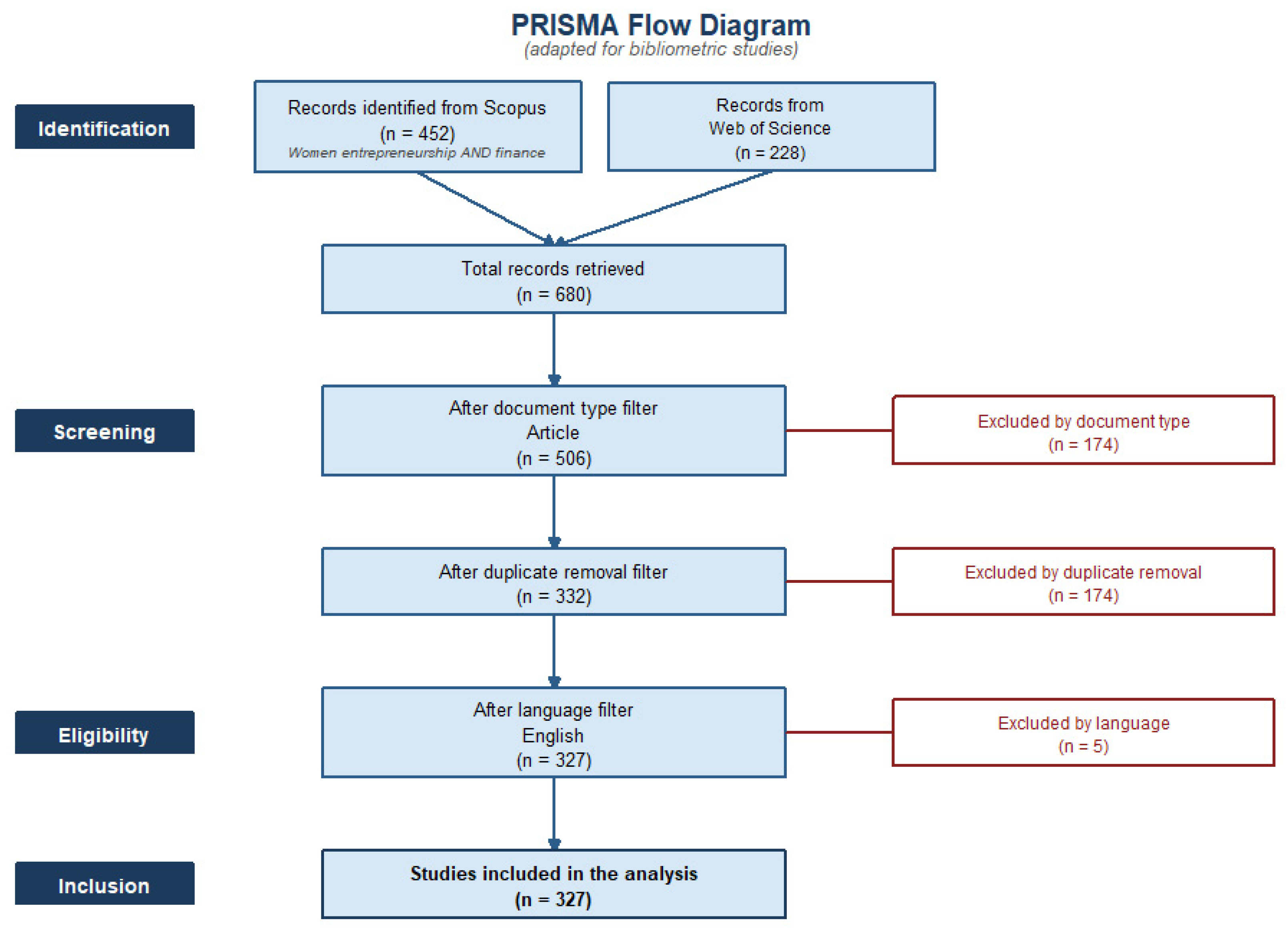
Figure 1. PRISMA flow diagram of the documentary corpus selection process.
Ijfs 14 00240 g001
Figure 2. Annual scientific production on women’s entrepreneurial finance (2006–2026).
Ijfs 14 00240 g002
Figure 3. Keyword co-occurrence network in women’s entrepreneurial finance.
Ijfs 14 00240 g003
Figure 4. Thematic map of women’s entrepreneurial finance.
Ijfs 14 00240 g004
Figure 5. Thematic evolution of women’s entrepreneurial finance, 2006–2026.
Ijfs 14 00240 g005
Table 1. General characteristics of the bibliometric corpus.
IndicatorResult
Timespan2006–2026
Documents327
Sources230
Annual growth rate23.21%
Document average age3.25 years
Average citations per document21.38
References16,391
Authors832
Single-authored documents64
Co-authors per document2.74
International co-authorship34.86%
Author’s keywords915
Keywords Plus589
Table 2. Leading sources, authors, institutions, and countries.
RankLeading SourcesArticlesLeading AuthorsArticlesFractionalized ArticlesLeading InstitutionsArticlesLeading CountriesCountry Occurrences
1Small Business Economics11Kazemikhasragh A.41.67University of Johannesburg12India115
2International Journal of Gender and Entrepreneurship10Kurniasari F.41.20School of Management 7USA101
3International Journal of Entrepreneurship & Small Business7Lestari E.41.20Università Cattolica del Sacro Cuore7UK63
4Cogent Business & Management6Milanov H.41.42Hefei University of Technology6China54
5Journal of Business Venturing Insights6Cicchiello A.31.17Jamhuriya University of Science and Technology6Italy53
6Journal of Women’s Entrepreneurship and Education6D’Espallier B.31.00KU Leuven6Indonesia38
7Administrative Sciences5Hussain J.31.00Peking University6South Africa34
8Gender in Management4Kumar S.31.08Tongji University6France32
9International Journal of Entrepreneurial Behavior & Research4Li Y.30.70University of Delhi6Germany31
10Journal of Innovation and Entrepreneurship4Mahato J.31.50University of the Witwatersrand6Pakistan26
Table 3. Keyword co-occurrence network clusters.
ClusterKeywordOccurrencesTotal Link Strength (TLS)BetweennessClosenessPageRank
1Financial inclusion6331970.6500.03570.1148
1Female entrepreneurs221000.7140.02330.0256
1Finance11604.0040.02630.0357
1Women9477.3180.02630.0509
1Financial literacy14670.2750.02380.0339
1Fintech13710.0000.02220.0185
1Gender equality9460.3260.02330.0261
1Women empowerment14680.0000.02170.0156
1Digital finance10400.0000.02170.0156
1Entrepreneurs6290.2340.02270.0200
2Entrepreneurship5325131.1860.02940.0948
2Gender4821842.0710.03130.0989
2Crowdfunding401704.8090.02500.0676
2Entrepreneurial finance221165.7980.02500.0481
2Female entrepreneurship22862.3140.02440.0337
2Equity crowdfunding12430.0000.01960.0186
2Innovation10490.0000.02170.0139
3Women entrepreneurs4722522.1150.03030.0825
3Access to finance311432.4040.02630.0429
3Women entrepreneurship291522.7140.02500.0420
3Microfinance16880.6670.02560.0341
3India117622.2120.02560.0339
3Empowerment6310.1900.02220.0226
3Women’s entrepreneurship13720.0000.01640.0098
Table 4. Intellectual structure of the field based on reference co-citation analysis.
ClusterInfluential ReferenceCited by DocumentsBetweennessClosenessPageRank
1(Greenberg & Mollick, 2017), Activist choice homophily and the crowdfunding of female founders240.07150.21490.0491
1(Eddleston et al., 2016), Do you see what I see? Signaling effects of gender and firm characteristics on financing entrepreneurial ventures170.12960.22020.0479
1(Gupta et al., 2009), The role of gender stereotypes in perceptions of entrepreneurs and intentions to become an entrepreneur130.04990.18960.0346
1(Kanze et al., 2018), We ask men to win and women not to lose: Closing the gender gap in startup funding130.00130.18700.0331
1(Alsos & Ljunggren, 2017), The role of gender in entrepreneur–investor relationships: A signaling theory approach90.00270.18930.0330
2(Mollick, 2014), The dynamics of crowdfunding: An exploratory study210.08770.22110.0473
2(Colombo et al., 2015), Internal social capital and the attraction of early contributions in crowdfunding100.04120.20560.0388
2(Belleflamme et al., 2014), Crowdfunding: Tapping the right crowd120.02160.19510.0359
2(Parhankangas & Renko, 2017), Linguistic style and crowdfunding success among social and commercial entrepreneurs90.00540.18650.0349
2(Johnson et al., 2018), A woman’s place is in the startup! Crowdfunder judgments, implicit bias, and the stereotype content model110.01620.18720.0346
3(Ahl, 2006), Why research on women entrepreneurs needs new directions200.22810.19300.0416
3(Muravyev et al., 2009), Entrepreneurs’ gender and financial constraints: Evidence from international data140.04180.11580.0190
3(Brush et al., 2009), A gender-aware framework for women’s entrepreneurship100.00540.14410.0171
3(Aterido et al., 2013), Access to finance in Sub-Saharan Africa: Is there a gender gap?140.05130.10330.0151
3(Barney, 1991), Firm resources and sustained competitive advantage80.05130.09070.0129
Table 5. Most globally cited documents.
RankPaperTotal CitationsCitations per YearNormalized
Citations
1(Greenberg & Mollick, 2017), Administrative Science Quarterly36736.706.05
2(Carter et al., 2015), International Small Business Journal27122.601.79
3(Cowling et al., 2012), International Small Business Journal22615.102.15
4(Johnson et al., 2018), Journal of Business Venturing21523.903.29
5(Klapper & Parker, 2011), World Bank Research Observer21013.102.74
6(Cumming et al., 2021), Small Business Economics19732.805.79
7(Mordi et al., 2010), Gender in Management1176.901.00
8(Bapna & Ganco, 2021), Management Science11018.303.23
9(Liu et al., 2022), Cities10921.804.23
10(Pham & Talavera, 2018), World Development10611.801.62
Table 6. International collaboration and network centrality of leading countries.
CountryArticlesSCPMCPMCP Ratio (%)BetweennessClosenessPageRank
India464512.170.07630.35160.0366
USA2519624.000.15990.40910.0600
United Kingdom24131145.830.21030.42860.0725
China1810844.440.02420.31250.0210
Indonesia1713423.530.01920.30200.0256
Italy1771058.820.12180.38140.0460
South Africa141317.140.01060.32140.0220
Germany1310323.080.00770.33090.0196
France95444.440.07230.36000.0338
Pakistan75228.570.00990.26950.0187
Table 7. Comparison of international collaboration by economic development level.
IndicatorHigh-Income EconomiesLow- and Middle-Income Economies
Countries represented2535
Articles with identifiable corresponding-author country128170
SCP72138
MCP5632
Overall MCP ratio (%)43.7518.82
Median MCP ratio by country (%)50.002.17
Median Betweenness2.2543.250
Median Closeness0.011360.01031
Median PageRank0.020180.01564
Subnetwork nodes2118
Subnetwork edges5416
Subnetwork density0.2570.105
Disclaimer/Publisher’s Note: The statements, opinions and data contained in all publications are solely those of the individual author(s) and contributor(s) and not of MDPI and/or the editor(s). MDPI and/or the editor(s) disclaim responsibility for any injury to people or property resulting from any ideas, methods, instructions or products referred to in the content.