1. Introduction
Housing markets have a great impact on macroeconomic stability, financial cycles, and household wealth. Over the past two decades, European housing markets have experienced great swings, especially during the 2008 global financial crisis, the European sovereign debt crisis, and the post-pandemic recovery period. These ups and downs have raised an obvious question: Are house price dynamics driven mainly by common macroeconomic factors, or do country-specific conditions dominate?
Within the European Union, deeper economic integration, cross-border capital movements, and the single monetary policy could all cause house price cycles in different countries to move together. Previous research suggests that housing markets in European and OECD economies exhibit increasing interconnectedness, although the degree of synchronization remains incomplete because of institutional, regulatory, and structural differences across countries (
Huang et al., 2020;
Visković & Cipcic, 2025). At the same time, regional studies indicate that housing market responses to macroeconomic shocks may vary substantially depending on local market characteristics and housing system structures (
Cermáková et al., 2022;
Rubaszek, 2019). However, at the same time, national housing policies, tax systems, labor market conditions, and demographic trends differ, which can create substantial heterogeneity in housing market outcomes.
Knowing to what extent house price cycles are synchronized is useful for macroeconomic policy and financial stability. If housing markets are highly synchronized, common shocks and monetary policy transmission tend to override national dynamics. If synchronization is weak, domestic factors remain the main drivers, and policy responses should be country-specific.
The aim of this study is to investigate the macroeconomic determinants and synchronization of house price cycles across European Union Member States and to identify whether common macroeconomic factors or country-specific conditions dominate housing market dynamics.
To achieve this objective, the study pursues the following objectives:
- (1)
To identify and extract house price cycles across EU countries;
- (2)
To measure synchronization between housing cycles;
- (3)
To evaluate the influence of macroeconomic determinants;
- (4)
To distinguish common and country-specific drivers;
- (5)
To identify clusters of countries with similar housing market behavior.
The paper makes three main contributions. First, it provides fresh empirical evidence on macroeconomic drivers using panel data techniques. Second, it adds a dynamic perspective, using VAR analysis to see how macroeconomic shocks transmit over time. Third and most importantly, it combines synchronization analysis with hierarchical clustering of panel data, offering a different angle on regional housing market heterogeneity and partial convergence among member states.
Our findings suggest that the dynamics of EU house prices are shaped by both common macroeconomic factors and country-specific conditions. GDP growth and unemployment play a dominant role, but the degree of synchronization between countries remains only partial, pointing to persistent structural differences within the EU.
These findings have implications for housing affordability, financial stability, and sustainable urban development in the European Union.
Recent evidence from European housing markets further suggests that integration and institutional differences jointly shape housing market convergence and divergence processes.
The remainder of the paper is structured as follows.
Section 2 presents the literature review and develops the research hypotheses.
Section 3 describes the data and methodology.
Section 4 presents empirical results.
Section 5 discusses the findings and their implications for sustainable housing development and concludes.
2. Literature Review
2.1. Macroeconomic Determinants of House Prices
Much empirical work confirms that house prices are strongly tied to macroeconomic fundamentals such as GDP growth, income levels, inflation, and employment. For example, some studies show that house price fluctuations are largely driven by economic fundamentals and credit expansion (
Tupenaite et al., 2017;
Hung et al., 2025). Research on transition economies highlights structural and institutional factors, for example, financial system development and the maturity of the market (
Snieska et al., 2011). Evidence from OECD countries suggests that housing markets follow the broader business cycle quite closely (
Huang et al., 2020). Country-level studies also indicate that house prices are influenced by a wide set of external macroeconomic, financial, and labor market factors, and the effects vary between different phases of the economic cycle (
Stundziene et al., 2022).
2.2. Housing Cycles and Dynamic Behavior
Housing markets tend to have strong cyclical patterns and persistence. There is a large body of literature documenting boom–bust cycles driven by macroeconomic fluctuations, credit expansion, and financial conditions.
Dynamic approaches show that the impact of macroeconomic variables changes over time. Uncertainty shocks and external disturbances can significantly affect house price dynamics and synchronicity between regions, often with persistent negative effects on housing markets (
Alola & Uzuner, 2021;
Cepni et al., 2025). Long-term relationships between housing demand, income, and demographics add to that persistence. Housing supply adjusts slowly to changes in demand, leading to prolonged deviations from equilibrium and long-lasting price movements (
Alola & Uzuner, 2021).
More recent dynamic models highlight that house price cycles are shaped by multiple interacting forces—monetary policy, global financial conditions, and structural market characteristics—and the effects differ between time periods and economic regimes (
Bhar et al., 2024). Time-varying VAR approaches also show that the impact of macroeconomic shocks on house prices differs between countries and periods; monetary policy, inflation, and output shocks play varying roles depending on the economic environment (
Plakandaras et al., 2020).
2.3. Financial Factors, Credit Conditions, and Spillovers
A key strand of the literature looks at how housing markets interact with financial systems. House prices are closely related to credit conditions, mortgage markets, and financial cycles.
Both theoretical and empirical studies show that housing markets can influence and be influenced by macroeconomic fluctuations. Shocks in housing markets generate significant spillovers to consumption and economic activity—housing is an active driver of business cycles (
Iacoviello & Neri, 2010). The dynamics of the financial sector, including risk premiums and interactions between banks and non-bank financial institutions, play a central role in business and housing cycles (
Becard & Gauthier, 2023).
Empirical evidence also points to the critical role of credit conditions for the equilibrium of the housing market. Changes in lending standards (such as loan-to-value ratios) significantly affect house price dynamics, especially during boom–bust periods (
Lyons, 2018). Credit expansion and financial liberalization amplify housing cycles, increasing demand during upturns and making downturns worse during crises. Macroprudential policy tools that target credit conditions (again, loan-to-value ratios) are essential to stabilizing housing markets and reducing systemic risks while also affecting household consumption through housing and credit channels (
Qi et al., 2022).
2.4. Synchronization, Spillovers, and Regional Heterogeneity
With growing economic integration, housing markets should show some degree of synchronization. Cross-border capital flows and common monetary policy push house prices closer together.
However, empirical evidence suggests that synchronization is only partial. Housing markets are still shaped by national and regional characteristics, institutional frameworks, and housing supply restrictions, for example. Recent studies decompose house price comovements into national, regional, and idiosyncratic components. Common factors often explain a substantial share of price dynamics, yet local heterogeneity remains significant (
Cepni et al., 2025). These differences lead to varying responses to macroeconomic shocks.
In addition, the dynamics of the housing market can differ across regions due to structural rigidities and specific demand patterns (e.g., second-home markets), which can amplify regional disparities and reduce overall synchronization (
Hjalager et al., 2023).
In the European context, institutional factors such as membership of the euro area and Schengen integration further influence house prices by affecting interest rates, capital flows, and labor mobility, contributing to both convergence and divergence between countries (
Visković & Cipcic, 2025).
2.5. Institutional and Structural Factors
Institutional and structural characteristics are crucial to explaining the differences in housing markets between countries. These include housing tenure systems, regulatory frameworks, and financial market development.
Studies in transition economies emphasize the role of institutional change, credit expansion, and speculative behavior in shaping the dynamics of house prices (
Snieska et al., 2011). Regional studies show that house prices often diverge rather than converge, with stronger price increases in economically attractive areas due to demand pressures and supply constraints (
Cermáková et al., 2022). These factors can lead to greater volatility and greater sensitivity to macroeconomic shocks.
Differences in market structure and access to housing also contribute to disparities in housing wealth distribution, which may reinforce the long-term divergence in the outcomes of the housing market between countries (
Guerrero, 2020). The structure of housing systems—especially the level of rental market development—plays an important role in housing market stability. A well-functioning rental sector can reduce the volatility of house prices and soften the impact of financial shocks by offering an alternative to homeownership (
Rubaszek, 2019).
2.6. Behavioral Factors and Housing Market Expectations
Beyond macroeconomic determinants, behavioral factors also matter, such as investor sentiment, expectations, and uncertainty. Research shows that sentiment and uncertainty can significantly influence house prices, with stronger effects during periods of economic stress and elevated risk (
Alola & Uzuner, 2021).
Investor sentiment, in particular, has been shown to drive house prices away from fundamental values, with lagged effects on future returns and stronger impacts in more speculative market segments (
Lam & Hui, 2018). Expectations and ‘news shocks’ propagate through the economy and affect housing markets by influencing investment decisions, financial conditions, and macroeconomic dynamics (
Guinea et al., 2024). House price dynamics therefore cannot be fully explained by fundamentals alone.
Recent studies using machine learning highlight the non-linear and time-varying importance of macroeconomic and market-specific drivers, especially during periods of high uncertainty (
Jenett et al., 2026). Other recent work also emphasizes the growing importance of non-linear modeling and predictive techniques in housing market analysis, pointing to complex interactions between macroeconomic and financial variables (
Yu et al., 2025;
Zhu et al., 2024).
2.7. Housing Cycles, Bubbles, and Policy Implications
Literature often distinguishes between housing cycles and bubbles, though the boundary is blurry. Housing bubbles are typically driven by speculative behavior and excessive credit growth.
Empirical studies identify demand conditions, expectations, and policy factors as key determinants of housing cycles (
Senadjki et al., 2026). Housing markets are also closely linked to household balance sheets and consumption behavior; rising house prices and associated debt can stimulate consumption through wealth effects while also increasing financial vulnerability (
Lu & Zhu, 2024).
Recent evidence suggests that housing markets can serve as early indicators of macroeconomic downside risks. Declines in house prices are closely associated with greater economic vulnerability and financial instability, which have important implications for financial stability and macroeconomic policy. Housing markets can act as leading indicators of downside risks, as house price fluctuations are closely tied to future economic instability and growth risks, strengthening their importance for monitoring and policy design (
Sui et al., 2024).
There is also a growing emphasis on the role of housing markets in sustainable development, particularly affordability, financial stability, and equitable access to housing as key components of sustainable urban and economic systems.
Although panel models identify average macroeconomic effects, they do not capture dynamic interdependencies across variables, which motivates the use of VAR analysis. Furthermore, existing synchronization studies mainly rely on correlation-based measures, which do not reveal the structural groupings of countries. For this reason, we used cluster analysis in this study.
2.8. Research Gap
Despite the large body of literature on housing markets, several limitations remain. Most previous studies examined individual dimensions in isolation: macroeconomic determinants, financial conditions, or behavioral factors. Although these approaches provide useful information, they do not provide a comprehensive picture of how these factors jointly shape house price cycles across countries.
Furthermore, the literature on synchronization has mainly relied on correlation-based measures and comovement indicators. Although previous studies have examined housing market cycles in individual European countries (
Knetsch, 2010) and explored the effects of European integration on real estate markets (
Visković & Cipcic, 2025), relatively limited attention has been devoted to simultaneously examining macroeconomic determinants, dynamic shock transmission, synchronization, and structural clustering within a unified EU-wide empirical framework. These capture the degree of comovement but tell us little about structural heterogeneity in housing markets and do not allow us to identify distinct groups of countries with similar dynamic patterns.
Dynamic approaches such as VAR models have been widely used to analyze how macroeconomic shocks transmit to housing markets. However, these studies are usually done for single countries or small groups of economies. There is still limited evidence on dynamic interactions between macroeconomic variables and house price cycles in a broader multi-country EU framework.
Relatively few studies combine panel econometric methods with dynamic modeling and clustering within a single empirical framework. As a result, the interaction between common macroeconomic drivers, dynamic shock transmission, and cross-country heterogeneity remains underexplored in European housing markets.
This study addresses these gaps by integrating panel data analysis, dynamic VAR modeling, and hierarchical clustering to provide a comprehensive assessment of house price dynamics and synchronization between EU countries. By combining these approaches, the paper offers new insights into both the common macroeconomic drivers and the structural heterogeneity underlying the behavior of the housing market in the European Union.
Based on the reviewed literature and identified research gap, the following hypotheses are formulated:
H1: House price cycles are positively synchronized across EU economies.
H2: GDP growth has a positive effect on house price cycles.
H3: Higher unemployment rates negatively affect house price cycles (weaker purchasing power and housing demand).
H4: More migration inflows positively affect house price cycles by increasing housing demand in the receiving countries.
H5: Higher mortgage interest rates reduce house price growth by raising borrowing costs.
H6: Higher property taxes dampen house price increases by lowering investment incentives.
H7: House price cycles are more synchronized among euro area countries because of the common monetary policy.
3. Data and Methodology
3.1. Data and Variables
We used panel data for EU member states during the period from 2005 to 2024 (depending on data availability).
The dependent variable was the House Price Index (HPI), measured as the annual growth rate of residential property prices (Eurostat).
The explanatory variables used in the analysis are presented in
Table 1, together with their expected effects and data sources.
Table 2 presents variable–method clarification.
The empirical analysis consisted of several steps. The empirical analysis uses an unbalanced panel of EU countries over 2005–2024 due to differences in data availability across variables and countries.
3.2. Extraction of House Price Cycles
To isolate cyclical movements from long-term trends, house price cycles were extracted using the Hodrick–Prescott filter (λ = 6.25 for annual data). As a robustness check, Baxter–King filtering was also applied and produced comparable cyclical patterns. The HP-filtered series were retained for subsequent synchronization and clustering analysis. This allows the identification of house price booms and busts across EU countries.
3.3. Synchronization Measurement
Synchronization was assessed primarily through clustering of standardized cyclical components. Standardization ensured comparability across countries with different amplitudes of house price fluctuations.
These measures allow identification of the degree to which housing cycles move together across countries.
3.4. Fixed Effects and GMM Models
To analyze the determinants of house price cycles, a dynamic panel model was estimated.
where
denotes the vector of macroeconomic determinants,
country fixed effects, and
time fixed effects.
House price dynamics typically exhibit persistence; therefore, a lagged dependent variable was included.
The Arellano–Bond generalized method of moments (GMM) estimator was applied to address the following:
Dynamic GMM estimation was employed primarily to reduce endogeneity and Nickell bias.
3.5. VAR Analysis
A pooled VAR model was estimated to analyze dynamic interactions between house prices and macroeconomic variables. Lag length was selected using AIC.
Impulse responses were generated from one-standard-deviation shocks.
Stability was assessed using eigenvalue diagnostics.
This approach allows for the estimation of:
These factors illustrate how macroeconomic shocks affect house prices over time.
Although panel VAR estimators with fixed effects, such as the approach proposed by
Abrigo and Love (
2016), may better account for cross-country heterogeneity (
Abrigo & Love, 2016), the objective of the present study is to identify aggregate dynamic relationships and common transmission mechanisms across EU housing markets rather than estimate country-specific responses. Therefore, a pooled VAR framework was adopted as a parsimonious approach for examining the average dynamic interactions between house prices and key macroeconomic variables. Nevertheless, the assumption of parameter homogeneity represents a limitation of the analysis and should be considered when interpreting the results. Future research could extend the present framework by applying fixed-effects panel VAR models to investigate heterogeneous dynamic responses across EU Member States.
3.6. Cluster Analysis
Cluster analysis was used to group EU countries based on similarities in house price cycles and macroeconomic characteristics.
Clustering was performed using:
Hierarchical clustering;
Clustering.
This step helped identify regional housing market patterns within the EU.
4. Empirical Results
This section presents the empirical findings of the panel data models, dynamic analysis, and the clustering approach. These findings have important implications for sustainability, as stable housing markets contribute to long-term economic resilience and social well-being. The observed influence of macroeconomic factors on house prices suggests that policy coordination is necessary to prevent excessive volatility, which can otherwise reduce housing affordability and increase socioeconomic disparities.
4.1. Descriptive Statistics and Preliminary Diagnostics
Table 3 reports descriptive statistics for the main variables used in the analysis. House price growth exhibits substantial variability across countries and over time, with a mean of 1.55% and a standard deviation of 7.69%, reflecting pronounced housing cycles in the EU. GDP growth shows similar volatility, while unemployment rates display significant cross-country dispersion.
Migration variables exhibit strong skewness and kurtosis, indicating the presence of outliers and large differences between countries. Mortgage rates and property taxation show comparatively lower variability.
All variables reject normality based on the Jarque–Bera test, suggesting that nonnormality is a common feature of macroeconomic panel data.
Panel unit root tests were performed using Levin–Lin–Chu (LLC), Im–Pesaran–Shin (IPS) and Fisher-type ADF tests. The results (
Table 4) indicate that most variables are stationary at levels, including house price growth, GDP growth, and unemployment. However, some variables, such as immigration and mortgage rates, exhibit nonstationarity in levels, but house price cycles become stationary after logarithmic transformation or differencing.
These findings justify the use of transformed variables where necessary and support the validity of the panel regression framework.
A correlation matrix was also examined to assess potential multicollinearity. While GDP growth and house price growth show moderate positive correlation, and unemployment is negatively correlated with both variables, no excessively high correlations are observed. Migration variables exhibit high mutual correlation, suggesting potential redundancy when included simultaneously.
4.2. Baseline Fixed-Effects Model
Fixed-effects estimation was selected because the study focuses on controlling for unobserved country-specific characteristics that are likely to be correlated with macroeconomic determinants of house prices. Given the substantial institutional, regulatory, and structural differences across EU Member States identified in the literature review, the fixed-effects specification was considered more appropriate than a random-effects approach.
Table 5 presents the results of the fixed-effects estimation, including both cross-section and period fixed effects to control for country-specific heterogeneity and common macroeconomic shocks.
The results indicate strong persistence in house price dynamics, as the lagged dependent variable is positive and highly significant across all specifications. GDP growth exerts a consistently positive and statistically significant effect, confirming that economic expansion stimulates housing demand and price growth.
Unemployment has a strong negative effect, indicating that deteriorating labor market conditions reduce housing demand and exert downward pressure on prices. These findings are consistent with theoretical expectations and support Hypotheses H2 and H3.
Migration variables, whether measured as net migration or immigration, were statistically insignificant in all specifications. This suggests that short-term migration flows do not play an important role in explaining house price fluctuations at the aggregate EU level. Hypothesis H4 can therefore be rejected.
Property taxation shows a positive and statistically significant coefficient, which may reflect structural differences between countries, where higher tax revenues are associated with more developed housing markets and stronger institutional frameworks. This finding does not support Hypothesis H6 and may reflect institutional differences rather than a direct causal dampening effect.
4.3. Robustness Analysis
The alternative model specifications confirm the stability of the main results. Replacing net migration with immigration does not materially affect the estimated coefficients of GDP growth and unemployment. The consistency of these findings indicates that the results are robust to alternative measures of migration flows.
4.4. Dynamic Panel (GMM) Results
To account for potential endogeneity and dynamic effects, a dynamic panel model was estimated using the Arellano–Bond GMM estimator (
Table 6).
The GMM results confirm the findings from the fixed-effects models. House price growth remains highly persistent, while GDP growth and unemployment continue to have statistically significant but small effects with expected signs. This may reflect aggregation bias or delayed effects of migration on housing demand, which are not captured in annual data and may operate through longer-term structural channels.
However, the Hansen test indicates potential problems with instrument validity, suggesting possible instrument proliferation. To address potential instrument proliferation, the number of instruments was carefully monitored and limited relative to the number of cross-sectional units, ensuring the robustness of the estimation results. Results should therefore be interpreted cautiously.
4.5. Dynamic Interactions: VAR Results
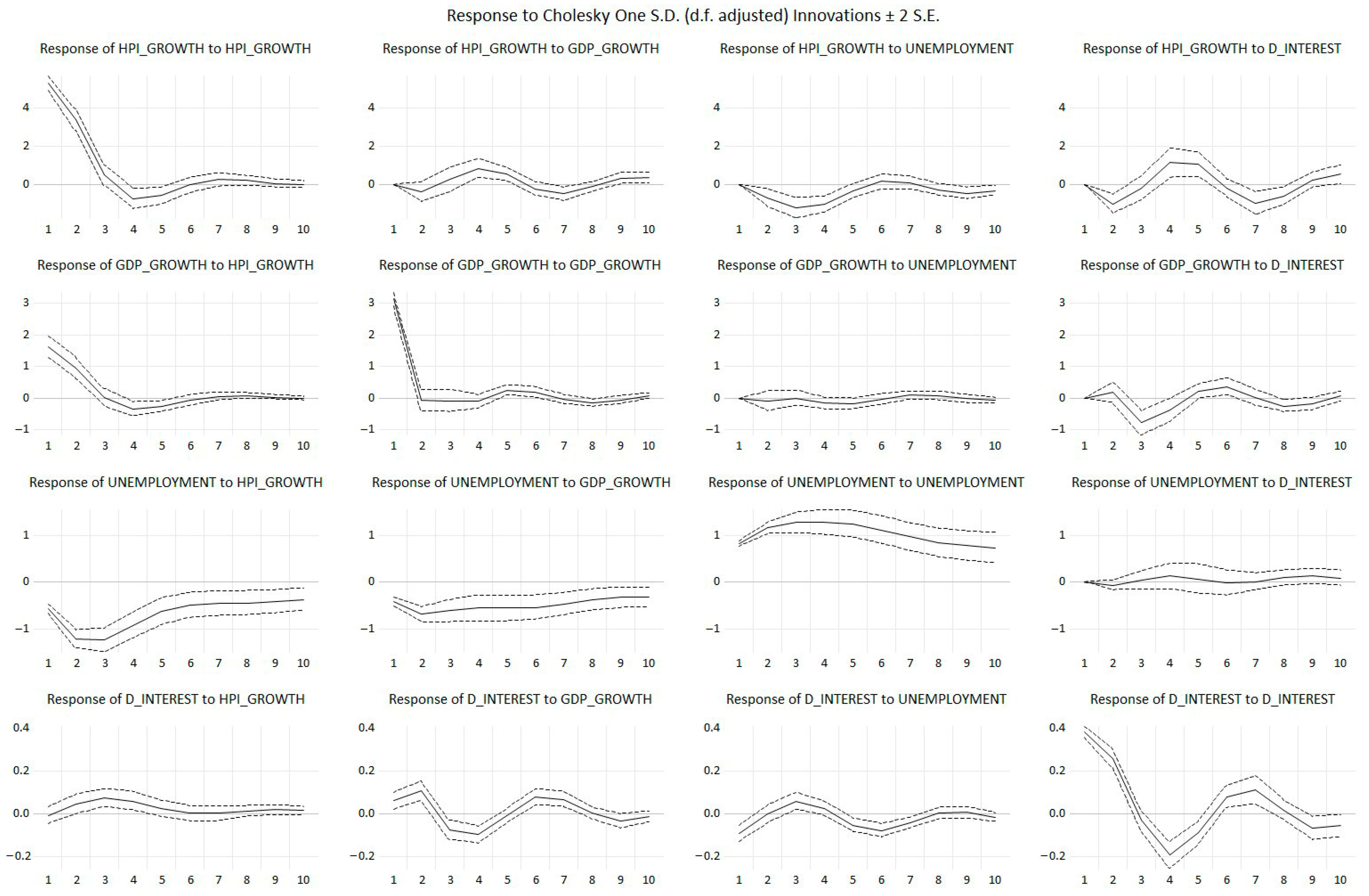
A pooled VAR model was estimated to examine the dynamic interactions between house price growth, GDP growth, unemployment, and interest rate changes.
The VAR results confirm a strong persistence in the dynamics of the house price, with significant first and second lag effects. Macroeconomic variables exert meaningful dynamic influences: GDP growth, unemployment, and interest rate changes all significantly affect house price growth.
Granger causality tests further confirm that these macroeconomic variables have predictive power for housing market developments, indicating the presence of dynamic macrofinancial linkages (
Table 7). Granger causality is interpreted as predictive rather than strictly causal evidence.
These findings suggest that macroeconomic shocks play an important role in driving house price dynamics across EU countries.
Figure 1 presents the impulse response functions derived from the panel VAR model, illustrating the dynamic effects of macroeconomic shocks on house price growth.
The results in
Figure 1 show that a positive shock to GDP growth immediately increases house price growth. This effect stays positive for several periods before slowly fading away. This confirms the procyclical link between economic activity and housing markets.
In contrast, a positive shock to unemployment lowers house price growth—weaker labor market conditions hurt housing demand. The effect is strongest in the short run and tapers off over time.
Interest rate shocks also have a negative effect on house price growth, which supports Hypothesis H5. Higher borrowing costs reduce housing demand, pushing prices down. This effect is especially clear in the short term, highlighting how monetary policy is transmitted to housing markets.
Overall, impulse response analysis confirms that macroeconomic shocks have a strong influence on house price dynamics, with effects that are economically meaningful and last for several periods. The relatively quick convergence of responses suggests that housing markets adjust to these shocks within a limited time frame.
4.6. Housing Market Synchronization: Cluster Analysis
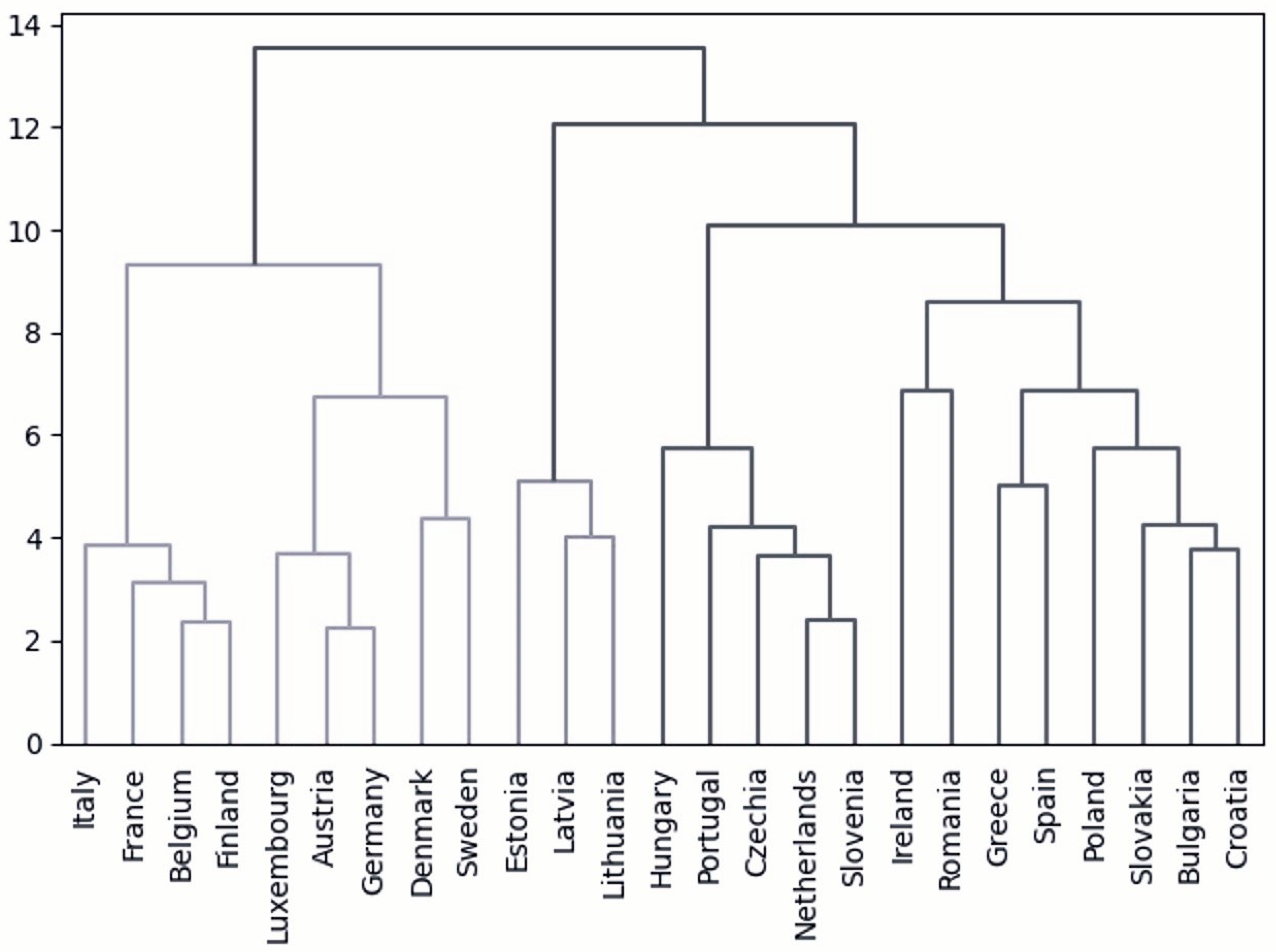
To understand how synchronized housing markets are across EU countries, we performed a hierarchical cluster analysis of standardized house price growth data. The results point to three distinct clusters of countries with similar house price dynamics. We used Euclidean distance and the Ward linkage method. Alternative k-means clustering specifications produced broadly similar groupings, suggesting robustness of the clustering results.
Before clustering, we standardized the data to make countries with different volatility levels comparable. Each country’s house price growth series was converted into z scores (subtracting the mean and dividing by the standard deviation). Thus, clustering reflects co-movement patterns rather than scale differences.
Distance metric: Euclidean Distance;
Clustering method: Hierarchical clustering;
Linkage criterion: Ward method (chosen because it minimizes variance and is common in macroeconomic clustering).
The pairwise Euclidean distance matrix between countries is reported in
Table A1. Smaller values mean more similar behavior (
Table A1). The standardized house price growth data used for the clustering is in
Table A2; each country’s values have zero mean and unit variance.
Table A3 summarizes the hierarchical clustering process, showing the linkage matrix from the Ward method; each step merges two clusters, with distance and cluster size reported.
We applied clustering to a balanced panel, leaving out years with missing observations to maintain comparability across countries.
First cluster: Mostly the core EU economies, Germany, France, and the Nordic countries. These have relatively stable and synchronized housing market behavior.
Second cluster: The Baltic states. They show more volatile but internally consistent housing cycles.
Third cluster: Southern, Central and Eastern European countries. They exhibit greater volatility and more heterogeneous responses to macroeconomic shocks (
Table 8).
Clustering shows that the EU housing markets are not fully synchronized. Instead, there are distinct regional clusters, and synchronization is partial, not complete. The dendrogram of EU house price clusters shows this grouping (
Figure 2).
The identified clusters also highlight differences in housing market structures across EU countries, suggesting that sustainability challenges are not uniform and require tailored policy responses reflecting national and regional conditions.
These findings suggest that while macroeconomic fundamentals influence the dynamics of house prices in all countries, the degree of synchronization varies significantly between groups. Therefore, EU housing markets cannot be considered fully synchronized but rather organized into regional clusters with distinct dynamics.
The synchronization analysis perfectly complements other models (
Table 9).
The results provide indirect evidence in support of Hypothesis H1, which posits that house price cycles are synchronized across EU economies. The consistent and significant effects of common macroeconomic variables between countries, such as GDP growth and unemployment, suggest that shared economic conditions play a dominant role in driving house price dynamics.
The inclusion of period fixed effects further supports this interpretation, as they capture common shocks such as the global financial crisis, the European debt crisis, and the post-pandemic recovery.
Overall, the findings indicate that house price movements in the EU are influenced by both common macroeconomic forces and country-specific factors, indicating a moderate degree of synchronization across national housing markets.
5. Discussion
This study offers a broad look at what drives house price cycles across EU countries and the degree of synchronicity between these cycles. The results confirm that the dynamics of the housing market are strongly shaped by macroeconomic fundamentals but also vary a lot from one country to another. In the following section, we interpret the findings in light of the existing literature and our hypotheses.
First, the results strongly support H2 and H3: GDP growth has a positive effect on house price cycles, while unemployment pulls them down. This matches a large body of work showing that housing markets are procyclical and closely related to macroeconomic conditions. Previous studies have found that economic expansion increases household income and borrowing capacity, boosting housing demand and prices. Rising unemployment does the opposite: it weakens purchasing power and demand, placing downward pressure on prices (
Tupenaite et al., 2017;
Hung et al., 2025;
Snieska et al., 2011;
Huang et al., 2020;
Stundziene et al., 2022).
Second, dynamic analysis using the VAR framework tells us more about how macroeconomic shocks are transmitted. Impulse response functions show that shocks to GDP growth, unemployment, and interest rates have statistically and economically significant effects on house prices. This agrees with dynamic housing market models that stress the importance of macroeconomic conditions and financial channels in shaping housing cycles (
Bhar et al., 2024;
Plakandaras et al., 2020). The relatively fast adjustment of house prices to shocks suggests that EU housing markets are responsive to macroeconomic changes, but the persistence observed in the panel models means that adjustment is not instantaneous.
The interest rate findings support H5 and confirm that the transmission of monetary policy is important. Higher borrowing costs reduce housing demand and lower house price growth, especially in the short term. This agrees with existing work that highlights interest rates and credit conditions as key drivers of housing cycles (
Lyons, 2018;
Qi et al., 2022). However, the effect is moderate in size—monetary policy works alongside other structural and institutional factors.
Property taxation produced a positive coefficient, which rejects H6. This probably means that tax variables capture broader institutional and development effects, not just a direct dampening of housing demand.
We did not find strong support for H4. Migration variables were not statistically significant in most specifications. This differs from some earlier studies that emphasize their role in driving housing demand. However, there are several possible explanations. Migration effects might play out over longer time horizons than annual data. The impact of migration could be highly local, affecting specific regions or cities rather than national housing markets. Therefore, the lack of significance at the aggregate level does not mean that migration is irrelevant; it just means that the effects are more complex and context-dependent (
Stundziene et al., 2022).
The synchronization analysis gives important information on H1. House price cycles in the EU are only partially synchronized. Common macroeconomic factors do create some comovement, but cluster analysis shows distinct groups of countries with similar housing market dynamics. This is consistent with the literature on regional heterogeneity and the role of institutional and structural differences (
Cepni et al., 2025;
Hjalager et al., 2023).
In particular, the three groups highlight how structural characteristics shape the behavior of the housing market. The core EU economies show relatively stable, synchronized cycles and mature housing markets with stronger fundamentals. The Baltic countries have more volatile boom–bust patterns. Southern, Central, and Eastern European countries show higher volatility and more varied responses to shocks. EU housing markets therefore cannot be treated as a homogeneous system.
The findings also indirectly support H7—common monetary policy seems to contribute to synchronization within certain groups, especially inside the euro area. However, persistent heterogeneity means that national factors (housing policies, institutional frameworks, market structures) remain very relevant.
In general, these results have important implications for sustainability. Stable and well-functioning housing markets are essential for economic resilience, social inclusion, and long-term development. Large fluctuations in house prices can hurt affordability, widen inequality, and create financial instability, all key sustainability challenges. The heterogeneity we observe across EU countries means that sustainability challenges are not uniform and require differentiated policy approaches (
Qi et al., 2022;
Lu & Zhu, 2024).
In that context, the results point to the need for coordinated but flexible policy frameworks. Common macroeconomic policies, especially monetary policy, play an important role in shaping the dynamics of the housing market. However, they should be complemented by country-specific measures that account for structural differences. These could include housing supply policies, regulatory frameworks, and targeted fiscal interventions to improve affordability and reduce volatility.
From a sustainability angle, housing markets are essential for economic stability, social inclusion, and balanced regional development. Large price swings can hurt affordability, widen inequality, and create financial vulnerabilities, all key concerns within sustainable development. Understanding what drives house price cycles and how synchronized they are is therefore essential for designing policies that support resilient, sustainable housing systems across the European Union.
The findings are particularly relevant for Sustainable Development Goal 11, which focuses on access to adequate, safe, and affordable housing. By identifying common drivers and structural differences in housing markets, this study helps to clarify how housing policies can support sustainable urban development in the EU.
Finally, several directions for future research emerge. First, further studies could explore non-linear and regime-dependent dynamics, especially during crises. Second, the use of higher frequency data could tell us more about short-term dynamics and policy transmission. Third, future research could incorporate housing supply constraints, credit conditions, and financial variables in more detail to better capture the complexity of the housing market dynamics. Lastly, a longitudinal analysis of clustering patterns could show whether housing market synchronization in the EU is increasing over time, particularly with ongoing economic integration.
In general, this study shows that the dynamics of the housing market in the European Union are shaped by a complex mix of macroeconomic, structural, and institutional factors. Common drivers are very important, but persistent heterogeneity across countries means that we must consider both convergence and divergence processes when analyzing the sustainability of the housing market.