1. Introduction
According to the Moroccan Capital Market Authority (
AMMC, 2024), debt constitutes the predominant source of financing on the Casablanca Stock Exchange (CSE), where listed firms raise capital primarily through bonds and marketable debt securities rather than equity instruments. In 2024, private debt issuance reached nearly 101 billion MAD (10.1 billion USD), reflecting a 16.8% increase from 87 billion MAD (8.7 billion USD) in 2023. This growth was driven by 28 bond issuances totaling 23.7 billion MAD and 353 marketable debt securities amounting to 77.5 billion MAD (2.37 billion USD), while equity issuance remained marginal at only 6.26 billion MAD (626 million USD) over the same period (
AMMC, 2024). This pronounced imbalance underscores the strongly debt-oriented nature of the Moroccan capital market.
In such a market, the cost of debt (COD), defined as the interest rate paid by firms on externally sourced financing (
Tanin et al., 2024), emerges as a central financial setting. It serves as a key benchmark for capital budgeting and performance evaluation (
Baule, 2019) while also playing a pivotal role in shaping firms’ trade-off between debt and equity financing. By reflecting lenders’ assessment of a firm’s risk profile and financial reliability (
Goss & Roberts, 2011), the COD effectively conditions firms’ access to external capital. Firms benefiting from favorable borrowing conditions are therefore more likely to rely on debt financing, whereas those facing higher borrowing costs tend to substitute toward equity.
Accordingly, reducing the cost of debt constitutes a managerial priority, given its direct influence on the firm’s overall cost of capital, and ultimately, on shareholder value (
Jabbouri et al., 2019). Nonetheless, attaining such an optimization remains inherently complex, as it requires a thorough understanding of the COD dynamics, a corporate finance challenge that persists since the seminal work on capital structure puzzle by
Myers (
1984).
Empirical literature has made substantial progress over the past decade in assessing the dynamics of the corporate cost of debt (COD). However, several important gaps persist (
Letaifa & Matoussi, 2021). In effect, prior research emphasizes the role of firm-specific characteristics, such as profitability, leverage, firm size, liquidity (
Tanin et al., 2024), asset tangibility, and growth opportunities (
Sánchez-Ballesta & García-Meca, 2011), as key drivers of borrowing costs. Nonetheless, this body of evidence is predominantly derived from developed economies, particularly the United States (
Tanin et al., 2024), thereby limiting its external validity in other institutional settings. This limitation is particularly critical in the context of emerging and developing economies, where financial and institutional environments differ markedly. The Moroccan capital market, for instance, is typically characterized by higher levels of information asymmetry, greater opacity, weaker corporate governance mechanisms, limited regulatory effectiveness, and lower levels of investor’s protection (
Jabbouri & Naili, 2020). These structural features are likely to exacerbate agency costs of debt and alter the mechanisms through which creditors assess risk, leading to borrowing cost dynamics that may diverge significantly from those observed in more developed and transparent markets. Hence, the extrapolation of Western-based empirical evidence to emerging contexts remains highly problematic, underscoring the need for context-specific empirical investigation.
A limited number of empirical studies have examined the drivers of the cost of debt (COD) in the North African region, with existing contributions primarily focusing on governance-related factors, such as ownership identity (
Jabbouri et al., 2019) and ownership concentration (
Jabbouri & Naili, 2020). In contrast, empirical investigations into the role of firm-specific characteristics in shaping the cost of debt remain relatively scarce.
Against this backdrop, there is a clear need for novel and context-specific empirical evidence that captures these evolving dynamics. This study seeks to address this gap by examining how firm-specific characteristics influence the cost of debt among Moroccan non-financial listed firms over the period 2018–2024. Accordingly, we formulate the following research question: What are the key firm-level attributes influencing the cost of debt among Moroccan non-financial listed firms? By addressing this question, the study seeks to shed light on the key drivers of borrowing conditions in an emerging, bank-based financial system, providing firms with actionable insights into the factors that determine both their access to credit and the cost of debt.
The Moroccan context offers a particularly compelling empirical setting for examining the determinants of the cost of debt. The Casablanca Stock Exchange (CSE), which comprised 77 listed firms with a total market capitalization of 752.4 billion MAD (75.24 billion USD) at the end of 2024, ranks among the most active stock exchanges in Africa. Yet, the market remains predominantly debt-oriented, with firms relying heavily on debt instruments (
AMMC, 2024), while initial public offerings and primary equity issuances contribute only marginally to corporate financing (
Benmoussa, 2026). The Moroccan financial system is also characterized by concentrated ownership structures, distinct governance practices, and pronounced agency concerns, all of which are likely to shape the relationship between firm-specific characteristics and borrowing costs. In this context, understanding the determinants of the cost of debt is critical for facilitating access to external capital under favorable conditions.
By embedding the analysis within this debt-oriented and institutionally distinctive environment, the study provides novel, context-specific insights into debt financing dynamics in an emerging, bank-based economy. It extends the limited literature on the determinants of the cost of debt in North Africa, offering empirical evidence that complements and refines existing theoretical perspectives, particularly those related to agency cost theory in settings marked by severe informational concerns and governance challenges. Moreover, the study delivers practical implications by identifying key firm-level drivers of borrowing costs, thereby providing guidance to managers seeking to optimize capital structure decisions, as well as to investors and policymakers concerned with capital market development and performance evaluation.
The remainder of this paper is organized as follows.
Section 2 presents the theoretical background and the research hypotheses.
Section 3 details the sample selection procedure, data, variables definition, and data analysis technique.
Section 4 reports the empirical findings.
Section 5 discusses the empirical findings and elaborates on their theoretical contributions and practical implications. Finally,
Section 6 concludes, acknowledging the study’s limitations, and outlining directions for future research.
2. Theoretical Background and Research Hypotheses
The cost of debt (COD), defined as the interest rate firms incur when obtaining external financing (
Tanin et al., 2024), constitutes a major concern for investors and shareholders worldwide (
Letaifa & Matoussi, 2021) and represents a central concept in corporate finance, as it reflects how creditors price the risks associated with lending to firms. The theoretical foundations of the COD are deeply rooted in classical financial theories, notably agency theory, pecking order theory, and trade-off-theory, which explain the mechanisms through which borrowing costs are determined.
The agency theory posits that borrowing costs are shaped by conflicts of interests and information asymmetry among stakeholders and the resulting agency costs of debt (
Hossain et al., 2025). These conflicts arise primarily between shareholders, managers, and creditors, and manifest through incentive misalignments that may induce value-destroying behaviors, such as risk-shifting or asset substitution (
Jensen & Meckling, 1976). Within this framework, debt plays a dual role. On the one hand, it can mitigate agency conflicts between shareholders and managers by reducing free cash flow and enhancing external monitoring, thereby disciplining managerial behavior (
Jensen, 1986). On the other hand, debt may intensify conflicts between shareholders/managers and external creditors, as the firsts have incentives to undertake high-risk investments that maximize their residual claims while transferring downside risk to lenders. Anticipating such opportunistic behavior, creditors incorporate risk premium into lending rates, leading to a higher COD (
Chakraborty, 2010;
Lasfer, 1995).
Indeed, information asymmetry constitutes the main cornerstone in the theoretical understanding of the COD. In the presence of asymmetric information between insiders and creditors, the latest face uncertainty regarding the firm’s true risk profile and future cash flows. This informational opacity reduces investor confidence and increases the required return on debt as compensation for heightened uncertainty. This mechanism is formalized in pecking order theory, which establishes a hierarchical order for financing sources based on their sensitivity to information asymmetry: firms prioritize internal financing, followed by debt, and resort to equity issuance only as a last alternative (
Myers & Majluf, 1984). Crucially, this framework implies that even low-risk debt is more costly than internal funds due to adverse selection problems, and that the cost of external financing increases with the degree of informational sensitivity and riskiness of the securities issued (
Derrien et al., 2016).
A growing body of empirical literature provides robust support for the role of information asymmetry in shaping the cost of debt. Exogenous increases in informational opacity have been shown to significantly raise the borrowing costs and default risk, with evidence indicating increases in COD of approximately 25 basis points alongside substantial rises in credit event probabilities (
Derrien et al., 2016). Conversely, greater transparency through high-quality financial reporting mitigates information asymmetry, enhances creditor trust, and reduces financing constraints, thereby lowering the cost of debt (
Vander Bauwhede et al., 2015). These findings underscore the critical importance of information environments in debt pricing.
Taken together, these theoretical and empirical insights converge toward a unified interpretation of the COD as a market-based reflection of firm-specific risks arising from agency conflicts, information asymmetry, and expected financial distress. Creditors incorporate these dimensions into their assessment of firms’ repayment capacity and potential opportunistic behavior, which ultimately determines both the availability and the pricing of external debt.
Grounded in these theoretical frameworks, the empirical literature has identified a set of firm-specific characteristics as key determinants of borrowing costs. Extending this line of inquiry, the present study investigates the impact of seven firm-level attributes on the cost of debt, with the aim of rigorously assessing the explanatory validity of classical financial theories in institutional contexts characterized by heightened agency frictions and significant information asymmetries. The selected determinants are outlined hereafter, together with their associated hypotheses.
- (a)
Firm profitability and the COD
Firm profitability constitutes a key indicator of a firm’s financial health, and it reflects its ability to generate sufficient resources to repay borrowed funds and meet debt obligations (
Borisova et al., 2015;
Kopyrina & Stepanova, 2023). It serves as an inverse indicator of a firm’s default risk, as profitable firms are better positioned to forecast interest expenses and manage debt-related cash outflows, thereby lowering the likelihood of default (
Tanin et al., 2024). Moreover, profitable firms are perceived as less risky by creditors, who are more inclined to grant them loans at a lower cost. An important volume of literature reports an inverse association between firm’s profitability and corporate COD, suggesting that profitable firms enjoy favorable access to debt financing (
Jabbouri et al., 2019;
Ye et al., 2023). Building on this, we formulate the following research hypothesis:
H1. Firm’s profitability reduces the corporate COD.
- (b)
Liquidity and the COD
The literature provides arguments in support of both a positive and a negative association between the firm’s liquidity and the corporate COD. One stream of research argues that firms with limited liquidity tend to restrain their reliance on leverage and maintain lower debt levels, which ultimately contributes to a reduction in their cost of debt (COD). Conversely, the alternative perspective contends that firms holding illiquid assets face higher liquidation, financing, and bankruptcy costs. Since such assets are more difficult to convert into cash, they heighten creditors’ perception of risk. As a result, investors demand a higher risk premium, which ultimately increases the COD (
Tanin et al., 2024).
Empirical evidence on the relationship between liquidity and the COD remains mixed. For instance, the study by
Chaieb (
2025) revealed a significant and negative effect of cash holdings on the COD, suggesting that firms that maintain higher liquidity levels face lower borrowing costs.
Sánchez-Ballesta and García-Meca (
2011) corroborated these findings and provide evidence that firms with higher liquidity face lower COD. In contrast, the study by
Gmati (
2020) revealed that liquidity led to increased COD. Moreover, the study by
Jabbouri et al. (
2019), which was conducted in the Moroccan context, shows that liquidity does not affect the corporate COD. Indeed, the existing literature provides conflicting results regarding the effect of the firm’s liquidity on the corporate COD. Therefore, we propose the following research hypothesis:
H2. Firm’s liquidity positively/negatively affects the corporate COD.
- (c)
Asset tangibility and the COD
The literature suggests that the tangibility of a firm’s assets plays a critical role in shaping both the agency costs of debt and the costs associated with financial distress, as tangible assets can serve as effective collaterals, thereby influencing creditor–shareholder relations and mitigating potential conflicts (
Booth et al., 2001). The agency costs of debt arise when information asymmetry exists between a firm’s managers/shareholders and its creditors. Such imbalances create uncertainty for lenders, potentially limiting the firm’s access to external financing. To mitigate the risks associated with information asymmetry, creditors often impose higher interest rates or require additional collaterals, thereby increasing the firm’s COD. Firms can counteract these agency costs through a variety of mechanisms aimed at reducing information asymmetry. These encompass signaling strategies, such as improving the transparency of accounting and financial disclosures and furnishing potential lenders with credible, verifiable information, and offering collaterals, whereby firms offer tangible assets as additional guarantees to secure financing (
Camisón et al., 2022).
Within the framework of the TOT, tangible assets operate as collaterals by providing lenders with enhanced security in the event of financial distress. Thus, firms with important tangible assets (collaterals) are likely to present a lower risk for creditors, and consequently benefit from a reduced COD (
Sánchez-Ballesta & García-Meca, 2011). This effect is documented in the Moroccan context, where prior empirical findings indicate that access to bank financing is significantly facilitated when firms can provide substantial collateral (
Oudgou & Boudhar, 2023). Such collateral helps alleviate both ex ante and ex post information asymmetries between borrowers and lenders (
Oudgou & Boudhar, 2023).
Furthermore, because tangible assets generally preserve greater market value than intangible assets under such conditions, bondholders are inclined to require lower risk premiums. This, in turn, contributes to a reduction in the firm’s overall cost of capital (
Santos et al., 2014). In support of this, an important volume of empirical literature reports an inverse relationship between asset tangibility and the corporate COD (
Owusu et al., 2022;
Sánchez-Ballesta & García-Meca, 2011). Therefore, we propose the following hypothesis:
H3. Asset tangibility reduces the corporate COD.
- (d)
Firm leverage and the COD
Leverage is a critical factor shaping the corporate COD (
Tanin et al., 2024). It reflects the firm’s financial management (
Ye et al., 2023) and the risk-taking behavior (
Owusu et al., 2022). Indeed, firm leverage is associated with the default risk (
Sánchez-Ballesta & García-Meca, 2011), and it explains it from the side of the capital structure of the debt issuer (
Kopyrina & Stepanova, 2023). Indeed, the literature suggests that higher leverage is associated with an increased likelihood of debt default (
Kopyrina & Stepanova, 2023). Therefore, firms with higher levels of debt financing are more prone to default risk, thereby increasing creditors’ risk exposure. In response, creditors typically adjust by requiring greater compensation for this elevated risk, which ultimately translates into a higher COD (
Sánchez-Ballesta & García-Meca, 2011). In support of this,
Owusu et al. (
2022) showed that leverage leads to higher COD. Based on this, we establish the following research hypothesis:
H4. High leveraged firms face higher COD.
- (e)
Growth opportunities and the COD
The relationship between growth opportunities and the COD is theoretically ambiguous. On the one hand, high-growth firms may benefit from lower borrowing costs because their growth potential is positively perceived by creditors, signaling future profitability and financial strength. On the other hand, firms with significant growth opportunities often hold a larger proportion of intangible assets, which reduces asset tangibility and increases information asymmetry between managers and creditors. This opacity can elevate perceived risk, potentially leading to higher debt financing costs (
Graham et al., 2008;
Li & Richie, 2016). Moreover, when a firm carries risky debt and managers seek to maximize equity value instead of total firm value, they may engage in either under- or over-investment in future growth opportunities. Such suboptimal investment behavior erodes firm value and represents a substantial component of the agency cost of debt, thereby potentially increasing the borrowing costs for high-growth firms (
Billett et al., 2007;
Myers, 1977). Although theoretical arguments support both perspectives, empirical findings largely support a negative effect “reduction” in the growth opportunities on the COD. For instance, studies by
Sánchez-Ballesta and García-Meca (
2011) and
Graham et al. (
2008) show that growth opportunities lead to reduced costs of debt. Based on this, we may assume that firms with higher growth opportunities experience lower borrowing costs. Hence, we propose the following hypothesis:
H5. Firms with higher growth opportunities experience lower COD.
- (f)
Firm size and the COD
The literature indicates that large firms, due to their greater diversification and easier access to financial markets, face lower bankruptcy risk. Consequently, investors perceive a reduced default risk and demand a smaller risk premium, resulting in a lower COD (
Burgstaller & Wagner, 2015;
Tanin et al., 2024). Indeed, large firms possess a substantial asset base that creditors may view as collateral in the event of default or financial distress, thereby reducing perceived risk and lowering the firm’s COD (
Jabbouri & Naili, 2020). Previous empirical studies largely support the inverse relationship between the firm size and the COD. For instance, the study by
Tanin et al. (
2024) demonstrates that firm size negatively affects the corporate COD during crisis circumstances, highlighting the critical role of a large asset base in ensuring favorable access to debt financing even under adverse market conditions.
Based on the above, we propose the following research hypothesis:
H6. Larger firms are likely to enjoy reduced COD.
- (g)
Firm age and the COD
It is widely admitted in the literature that mature firms enjoy better access to debt financing (
Tanin et al., 2024). The theoretical explanations for this relationship are the “reputation hypothesis” and the “relationship banking hypothesis”(
Sakai et al., 2010). The first one suggests that as the firm ages, it builds reputation, which consequently leads to a decrease in the borrowing costs (
Tanin et al., 2024). Indeed, some firms establish a successful track record of repayment, while those that default exit the credit market. As a result, the former are considered creditworthy and benefit from lower interest rates. The reputation effect then drives borrowers to choose safer projects to protect this asset, further lowering their borrowing costs. The second explanation related to the lender–borrower relationship suggests that as firms mature and establish a consistent repayment record, information asymmetries diminish, easing liquidity constraints. Thus, strong, long-term relationships between borrowers and lenders facilitate the exchange of valuable information, thereby improving the efficiency of credit allocation (
Sakai et al., 2010) and boosting investor confidence, consequently leading to lower COD. This is particularly relevant in the Moroccan context, where bank lending is predominantly grounded in long-standing relationships between firms and financial institutions (
Nassim et al., 2026).
Previous empirical findings report an inverse relationship between firm age and the COD. For instance, the study by
Hyytinen and Pajarinen (
2007) documents that the COD is higher for younger firms. Interestingly, their findings show that when a firm ages 1 year, its COD capital decreases by 1–2 basis points. Based on these insights, we propose the following hypothesis:
H7. Older firms are expected to face a lower cost of debt.
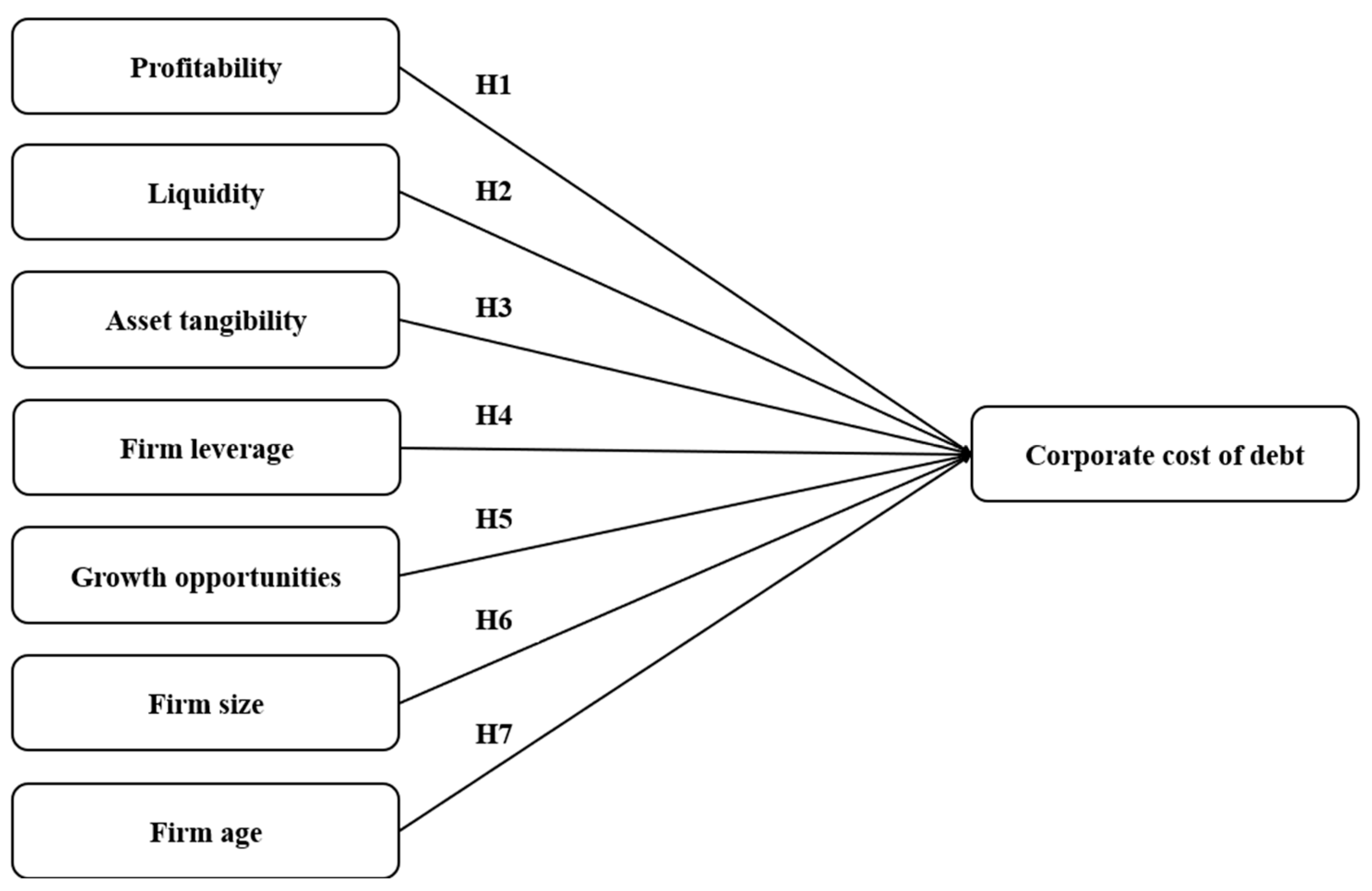
The conceptual model of our research is presented in
Figure 1 below.
4. Empirical Findings
4.1. Descriptive Statistics
Table 2 reports the descriptive statistics of the study variables. An examination of the results revealed that the average corporate cost of debt (COD) among the sample firms was 5.2%.
On average, Moroccan non-financial listed firms appear to be profitable, with a mean return on assets (ROA) of 4%. They also exhibit an average cash ratio (LIQ) of 5.9%. In terms of asset composition, tangible fixed assets (TANG) account for approximately 28.2% of total assets. Debt financing (TD) plays a significant role in corporate funding, representing, on average, 23.1% of total assets. The growth indicator (GROWTH) is positive, with average asset growth of 5.3%, suggesting that Moroccan non-financial listed firms have experienced steady expansion in their asset base.
Detailed descriptive statistics are presented in
Table 2.
4.2. Correlation and Multicollinearity Analysis
The correlation matrix reported in the
Table 3 reveals that the cost of debt (COD) is statistically correlated with most firm characteristics, suggesting its potential sensitivity to firm-level determinants. Among the seven firm-specific variables, COD exhibited significant negative correlations with tangibility (−0.165 ***), firm size (−0.189 ***), growth opportunities (−0.226 ***), the debt-to-total-assets ratio (−0.301 ***), and financial performance (−0.173 ***). These findings suggest that firms with greater collateral availability, larger asset bases, stronger growth opportunities, higher profitability, and higher leverage tend to benefit from a lower cost of debt.
These associations are generally consistent with theoretical expectations, except for the financial debt and liquidity ratios. Indeed, the negative relationship between leverage and the cost of debt is unexpected, as the literature generally documents a positive association between indebtedness and borrowing costs. Similarly, the positive correlation between liquidity and the cost of debt (0.130 **) contrasts with the expected negative relationship. Nevertheless, correlation analysis alone does not establish causality. Therefore, multivariate regression analysis is conducted in the following section to further examine the impact of firm-specific characteristics on the corporate cost of debt.
Overall, all correlation coefficients among the regressors were below the commonly accepted threshold of 0.8, indicating that correlation is unlikely to be a concern in our dataset.
To further assess potential linear dependencies among the regressors, the variance inflation factor (VIF) test was performed. The findings reported in
Table 4 indicate that all VIF values were well below the conventional cutoff value of 5, confirming that the selected variables can be simultaneously included in the model without compromising estimation reliability.
4.3. Regression Analysis
Table 5 presents the estimation results of our research model. We begin by estimating both fixed-effects and random-effects regression models, followed by a Hausman test to determine the most appropriate specification for our dataset.
The Hausman test results (Chi2 = 18.892; Prob > Chi2 = 0.127) indicate that the random-effects model is the appropriate specification for estimating our model. Accordingly, the estimates reported in
Table 5 were obtained using a random effects GLS regression with Driscoll–Kraay standard errors.
The results show that the model is correctly specified, as indicated by the significant results of the Wald Chi2 statistic (Wald Chi2 = 644.45; Prob > chi2 = 0.000). Moreover, the overall R-squared was 20%, implying that the model explains an important variation in the COD across firms.
Findings revealed that out of the seven explanatory variables, three were found to significantly influence the COD. These were firm profitability (ROA), growth opportunities, (GROWTH), and financial leverage (TD). Specifically, the results show that profitability (ROA) exerts a strong negative effect on the COD (Coefficient = −0.104 **; p-value = 0.044), thereby confirming our hypothesis H1. This coefficient was the largest in the estimated model, highlighting the central role of profitability in determining firms’ borrowing costs. Indeed, this negative relationship suggests that more profitable firms enjoy lower debt financing expenses.
Moreover, growth opportunities reduce the COD (Coefficient = −0.045;
p-value = 0.001), confirming our hypothesis H5. This negative relationship suggests that firms with higher assets growth enjoy lower COD. Interestingly, asset tangibility does not exert a significant influence on debt costs (Coefficient = −0.012;
p-value = 0.497), which rejects our hypothesis H3 and contradicts earlier evidence (
Graham et al., 2008).
Our findings further show that neither firm size nor firm age emerged as a significant determinant of the corporate cost of debt, leading to the rejection of H6 and H7, respectively. The non-significance of firm size (Coefficient = −0.002;
p-value = 0.182) contradicts the theoretical expectation that larger firms benefit from more favorable access to debt financing compared to smaller businesses. Similarly, the absence of any significant effect of firm age (coefficient = 0.002;
p-value = 0.380) contradicts both the “reputation hypothesis” and the “relationship banking” hypothesis (
Sakai et al., 2010), which predict that mature firms should benefit from an established credit history and stronger lender confidence, ultimately translating into lower borrowing costs
In addition, no significant relationship was found between firm liquidity and the COD (Coefficient = 0.052; p-value = 0.113), thus failing to support our hypothesis H2. This implies that cash and cash equivalent resources are not a key determinant of debt financing costs. These results imply that Moroccan lenders and creditors may not place substantial weight on a firm’s internal liquidity when assessing credit risk and borrower profiles. Consequently, this evidence challenges the conventional hypothesis that firms with higher liquidity are better positioned to avoid external debt, which would otherwise reduce the borrowing costs given the presumed positive association between leverage and the COD.
Surprisingly, we documented a pronounced negative relationship between financial leverage (TD) and the COD (Coefficient = −0.101;
p-value = 0.000). This result is somewhat unexpected. Indeed, prior literature typically found a positive association between leverage and the COD, given that leverage is often considered as a proxy for default risk. Higher leverage usually signals a serious probability of default (
Graham et al., 2008), prompting creditors to incorporate a risk premium, which in turn raises the COD. Our findings, however, are consistent with those of
Tanin et al. (
2024), who documented that during crisis periods, leverage is negatively associated with the corporate COD, a result attributed to the adverse and subsequent effects of the global financial crisis. This explanation may also apply to our study, as our sample period encompassed the COVID-19 pandemic, which likely altered the financial characteristics of Moroccan listed firms.
Indeed, the negative effect of financial leverage on the COD may further be explained by the relatively moderate leverage levels in our sample, as the mean value of the overall debt in our sample represents approximately 23.1% of the firm’s total assets, suggesting that it is far from signaling high default risk. Instead, leverage may reflect firms’ ability to access external financing, potentially enhancing their attractiveness to lenders and consequently allowing it to secure lower borrowing costs.
To further deepen our analysis, we investigated the potential nonlinear relationship between firm leverage and the cost of debt. The results, presented in
Table 6, revealed a distinct nonlinear pattern, as the coefficient of financial debt (TD) was negative and highly significant at the 1% level (Coefficient = −0.325;
p-value = 0.003), whereas the squared term (TD
2) was positive and significant at the 1% level (Coefficient = 0.429;
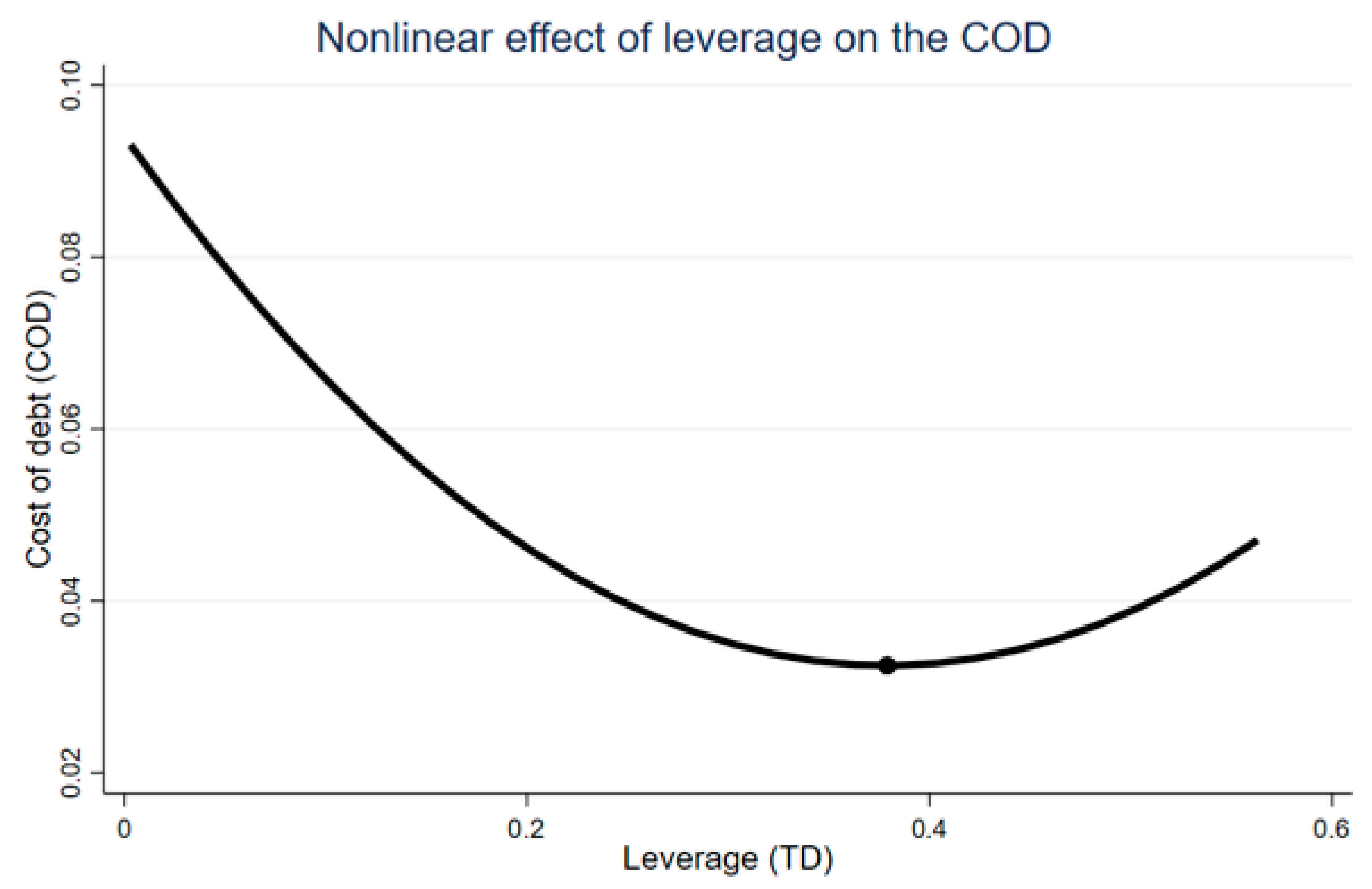
p-value= 0.003). Thus, as firms initially increase their leverage, the COD declines, reflecting creditors’ perception of these firms as more trustworthy and financially disciplined, thereby improving their access to external financing. However, beyond a threshold level of leverage of approximately 37.86% of total assets, this relationship reverses as additional debt leads to a higher COD. This turning point suggests that beyond a certain debt capacity, firms are perceived as riskier, prompting lenders to demand a higher risk premium when pricing their loans or investments.
Figure 2 illustrates the nonlinear effect of financial leverage on the cost of debt based on the random effects GLS regression estimation. The curve confirms the U-shaped relationship, with the cost of debt reaching its minimum at a leverage ratio of approximately 37.86%, beyond which additional indebtedness leads to progressively higher borrowing costs.
4.4. Robustness Check
The most important and pervasive issue confronting studies in empirical corporate finance is endogeneity (
Roberts & Whited, 2013), which refers to the condition in which an explanatory variable correlates with the error term (
Ullah et al., 2018). Indeed, endogeneity, if not addressed, leads to biased and inconsistent parameter estimates, and consequently, to invalid causal claims. Our dataset may suffer from endogeneity issues due to potential simultaneity bias, as the cost of debt could both influence and be influenced by certain regressors, particularly financial leverage (i.e., the cost of debt may affect, and in turn be affected by, the level of firm indebtedness) (
Roberts & Whited, 2013). To address potential endogeneity concerns, we employed a dynamic panel data model that incorporates the lagged dependent variable and uses lagged values of the suspected endogenous regressors as instruments, and estimated it using the one-step System Generalized Method of Moments (GMM) estimator.
The results reported in
Table 7 indicate that both models (GMM 1) and (GMM 2) were correctly specified and statistically valid. The AR (2) test was not significant (
p = 0.259 (GMM 1) and
p-value = 0.334 (GMM 2)), suggesting the absence of second-order serial correlation and confirming the consistency of the estimators. Moreover, the Hansen test of overidentifying restrictions was also not significant (
p = 0.398 (GMM 1) and
p = 0.420 (GMM 2)), supporting the overall validity of the instruments used in both specifications.
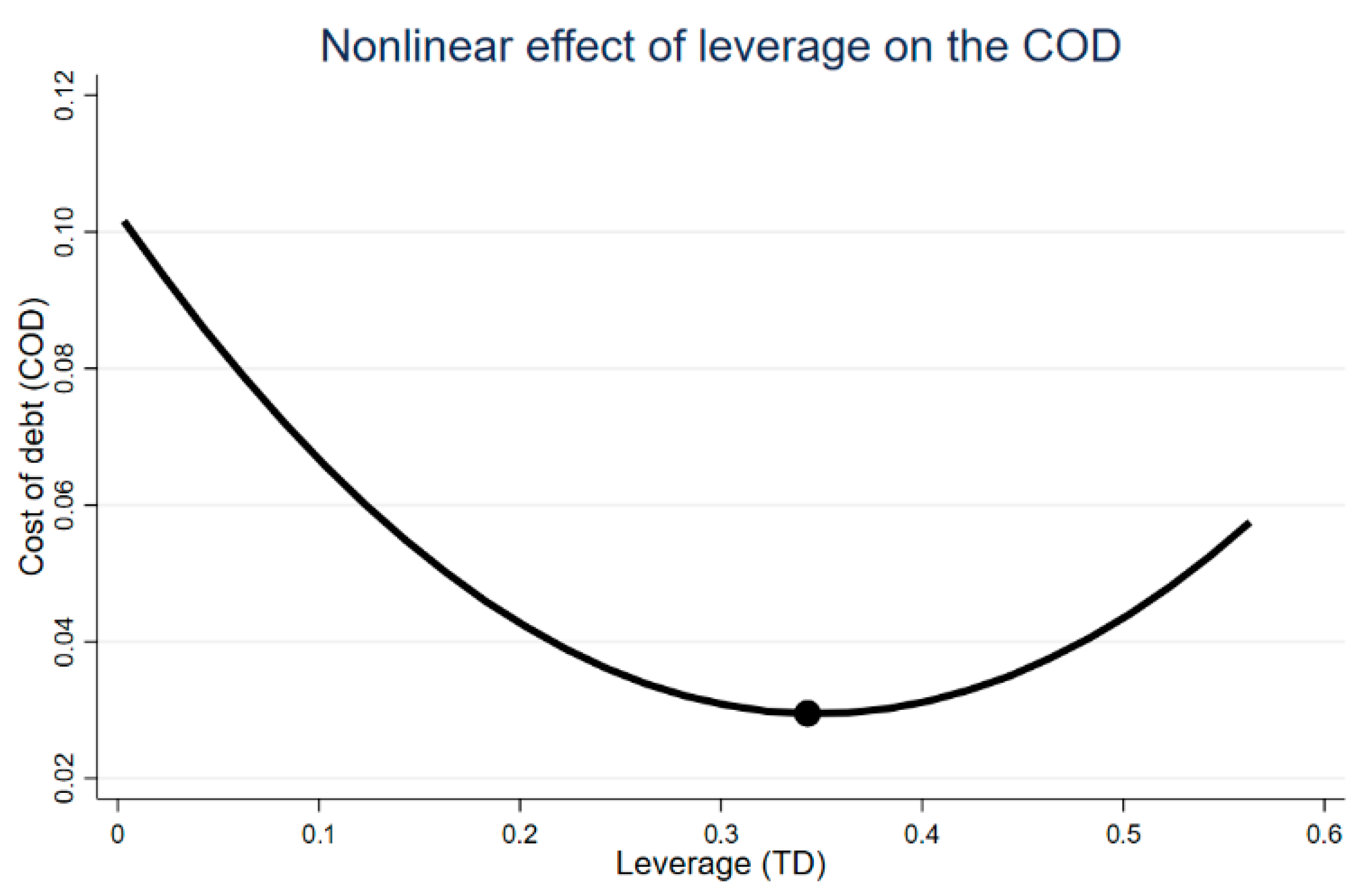
Consistent with prior findings, the results confirm the nonlinear effect of financial leverage on the corporate cost of debt. Specifically, the total debt (TD) variable exhibited a significant negative effect on the cost of debt (−0.422 ***), while its squared term (TD2) showed a significant positive effect (0.607 **), indicating a U-shaped relationship. This suggests that leverage reduces the cost of debt up to a certain threshold (34.8%), beyond which further increases in indebtedness lead to higher borrowing costs.
The results also provide robust evidence of the significant negative effect of growth opportunities (GROWTH) on the cost of debt (−0.0521 ***), highlighting that firms with stronger growth prospects benefit from lower financing costs. In contrast, the effect of firm financial performance (ROA), although negative, becomes statistically insignificant after controlling for endogeneity, suggesting that its impact is not robust.
Regarding the remaining firm-specific characteristics, the findings indicate no statistically significant influence on the corporate cost of debt, suggesting limited explanatory power for these variables in the Moroccan context.
Figure 3 illustrates the nonlinear effect of leverage on the cost of debt based on the System GMM estimation. The curve confirms the U-shaped relationship, with the cost of debt reaching its minimum at a leverage ratio of approximately 34.8%, beyond which additional indebtedness leads to progressively higher borrowing costs.
Table 8 summarizes the research hypotheses, expected signs, empirical findings across both estimation methods, and the corresponding decisions. Overall, the evidence provides robust support for the nonlinear U-shaped effect of financial leverage on the cost of debt (H4) and for the negative effect of growth opportunities (H5), while the effect of financial performance is only partially supported (H1). The remaining hypotheses are rejected, as tangibility, liquidity, firm age, and firm size did not emerge as significant determinants of the corporate cost of debt in the Moroccan context.
5. Discussion
This paper investigated the firm-level determinants of the cost of debt in the Moroccan emerging market. By employing panel data analysis, we provide robust evidence on the dynamics of the cost of debt financing in Morocco, where heightened agency conflicts exacerbate financing constraints, thereby limiting firms’ investment capacity, operational efficiency, and overall economic growth.
We show that growth opportunities constitute a key firm-level attribute shaping corporate borrowing costs. Specifically, we document a robust negative effect of growth opportunities on the cost of debt, suggesting that firms with higher growth prospects enjoy more favorable access to debt financing. This result holds after controlling for endogeneity under the one-step System GMM specification, underscoring its reliability. While prior literature suggests that high-growth firms may face elevated borrowing costs due to increased information asymmetry and agency conflicts, as managers of highly levered firms may engage in suboptimal investment behavior that erodes firm value (
Myers, 1977;
Billett et al., 2007), our findings point in the opposite direction. This divergence may be attributed to the specific institutional context of Morocco, where capital markets are less developed and bank-based financing dominates. In such an environment, creditors appear to rely primarily on observable asset growth as a concrete indicator of financial strength and repayment capacity, rather than penalizing firms for potential agency conflicts. Furthermore, while
Graham et al. (
2008) and
Li and Richie (
2016) highlight that growth driven by intangible assets can increase opacity and information asymmetry between firms and creditors, the positive signaling effect of sustained asset expansion appears to dominate these concerns in the Moroccan setting, as lenders interpret continuous growth as evidence of managerial discipline. This interpretation is consistent with the empirical evidence reported by
Jabbouri et al. (
2019) in the Moroccan context, as well as with the broader international literature documented by
Sánchez-Ballesta and García-Meca (
2011) and
Graham et al. (
2008), collectively suggesting that the signaling and collateral benefits associated with firm growth outweigh the potential agency costs, ultimately translating into lower borrowing costs for growing firms
Unlike prior studies, which have primarily focused on linear relationships between financial leverage and the cost of debt (i.e.,
Jabbouri & Naili, 2020;
Tanin et al., 2024), we uncovered a distinct nonlinear pattern. We found that at lower levels of leverage, an increase in debt is associated with a reduction in borrowing costs, implying that creditors interpret moderate leverage as a signal of financial discipline and reliability, thereby facilitating access to external financing. However, once financial leverage exceeds 34.8% of total assets (based on the System GM estimates), this relationship reverses, and additional debt leads to higher borrowing costs. This inflection indicates that beyond this level of indebtedness, firms are viewed as riskier, prompting lenders to incorporate a higher risk premium when pricing their debt.
In effect, the relationship between leverage and the cost of debt can be drawn from both information asymmetry and signaling theories. In markets characterized by information asymmetry, such as the Moroccan capital market, financing decisions constitute important signals through which managers convey private information to external investors regarding the firm’s quality and future prospects (
Klein et al., 2002).
However, the signaling effect of leverage is theoretically ambiguous. On the one hand, the signaling model developed by
Ross (
1977) posits that firms endowed with informational advantages have incentives to convey their private information to the market through their debt policy. Indeed, firms with strong expected future cash flows are both able and better positioned to issue higher levels of debt, as their anticipated cash-flow stability enhances their capacity to meet and manage future debt obligations. By doing so, they credibly signal favorable private information regarding their financial performance and growth prospects, an option that is not available to low-quality firms, which are unable to mimic such financing choices due to the associated financial constraints and risk of distress. Indeed, firms with weaker expected future cash flows are less likely to engage in high leverage, since elevated indebtedness entails greater financial costs and substantially increases the likelihood of financial distress and bankruptcy. Therefore, such firms are unable to employ debt as a positive signaling mechanism (
Klein et al., 2002;
Ross, 1977). From this perspective, high leverage is interpreted by the market as a credible signal of the firm’s financial strength.
On the other hand, the relationship between debt and signaling theory is negative, as higher leverage levels are generally associated with greater financial risk (
Agustin et al., 2023). In this regard, leverage may be perceived by creditors as an indicator of increased financial distress and default risk, prompting investors to demand higher risk premiums, and consequently, increasing the firm’s cost of debt. From this perspective, leverage progressively loses its positive signaling effect.
Our findings reconcile these two opposing perspectives by demonstrating that the relationship between leverage and the cost of debt is nonlinear. At low and moderate levels (under 34.8%), leverage is negatively associated with the cost of debt, suggesting that creditors initially perceive debt as a favorable signal reflecting firms’ confidence in their future cash flows and repayment capacity. Debt therefore appears to play a certification role, reducing perceived information asymmetry between firms and lenders.
Nevertheless, this beneficial signaling effect persists only up to 34.8% of total assets. Once leverage exceeds this level, the relationship reverses and leverage becomes positively associated with the cost of debt. Beyond this turning point, creditors no longer interpret additional debt as a signal of quality, but rather as evidence of heightened financial vulnerability and increased probability of default. Consequently, lenders require higher risk premiums to compensate for the additional financial risk borne by the firm.
Overall, these results suggest that the informational content of leverage is contingent upon its magnitude. Debt acts as a positive signal when maintained at reasonable levels, but becomes a negative signal when it reaches high proportions. This finding extends signaling theory by showing that the effect of leverage on creditors’ perceptions is not linear, but rather depends on whether debt remains within an acceptable range or surpasses a critical threshold beyond which concerns regarding financial distress dominate.
Our results further reveal a negative relationship between firm profitability and the cost of debt under the baseline RE-GLS estimation, suggesting that profitable firms tend to enjoy more favorable borrowing conditions. This finding is consistent with prior empirical evidence (
Jabbouri et al., 2019;
Raimo et al., 2021;
Li & Richie, 2016), and aligns with the perspective that creditors perceive profitable firms as less risky and more capable of meeting their debt obligations (
Graham et al., 2008;
Raimo et al., 2021). Profitability may thus serve as a credible signal of lower default risk and stronger debt management capacity (
Tanin et al., 2024). However, this effect loses statistical significance once endogeneity is controlled for under the System GMM specification, suggesting that the observed relationship may partly reflect reverse causality rather than a genuine structural effect. Accordingly, we interpret this finding with caution and consider H1 as only partially supported.
Moreover, asset tangibility does not appear to significantly influence investors’ assessments of credit risk. This evidence provides limited support for the agency theory, particularly the argument that tangible assets mitigate information asymmetry and reduce borrowing costs by serving as collateral that creditors can claim in the event of default (
Van Binsbergen et al., 2010). In the Moroccan context, creditors do not seem to rely primarily on asset tangibility as a key determinant of credit risk assessment. Instead, greater emphasis appears to be placed on firms’ growth opportunities as a signal of expansion potential, financial strength, and long-term viability. Although rapid growth, particularly when driven by intangible assets, may increase informational opacity and risk exposure (
Graham et al., 2008), its positive signaling role appears to prevail. Overall, these findings suggest that creditors in the Casablanca Stock Exchange are more responsive to growth-based signals than to collateral-based considerations when assessing firm creditworthiness.
Firm age does not emerge as a significant determinant of the cost of debt. Theoretically, mature firms are expected to benefit from an established reputation and a longer credit history with lenders, which should enhance creditor confidence and reduce the COD. Long-term relationships between borrowers and lenders are also thought to facilitate the exchange of valuable information, reducing information asymmetry, thereby leading to lower borrowing costs (
Sakai et al., 2010). However, our analysis of the Moroccan stock market provides no empirical support for these assumptions. Indeed, while the theoretical rationale linking firm age to lower debt costs is well-developed, most existing empirical studies either did not examine this relationship or found no significant association (
Jabbouri & Naili, 2020;
Jabbouri et al., 2019;
Raimo et al., 2021;
Tanin et al., 2024). This suggests that in practice, firm age may not be a decisive factor in shaping the COD in emerging markets such as Morocco.
Similarly, firm size does not influence the COD. This finding contrasts with the theoretical expectation that larger firms, owing to their greater diversification and substantial asset base, face lower bankruptcy risk and are perceived by creditors as less likely to default, resulting in lower borrowing costs (
Burgstaller & Wagner, 2015;
Tanin et al., 2024). The absence of a significant size effect may reflect the relatively homogeneous nature of firms listed on the Casablanca Stock Exchange, where size differences may not be sufficiently pronounced to generate meaningful variation in creditors’ risk perceptions.
Indeed, the expected mitigating effects of asset tangibility, firm age, and firm size on the corporate cost of debt are not empirically supported in the Moroccan context. This suggests that creditors do not rely on these conventional proxies for information asymmetry and agency costs when assessing credit risk. Instead, creditors in the Moroccan capital market appear primarily sensitive to firms’ growth opportunities, leverage, and to a lesser degree profitability, pricing debt accordingly. Thus, rather than relying on collateral-based or reputational signals, creditors seem to adopt a repayment ability-oriented approach, placing greater emphasis on variables that more directly reflect a firm’s financial health, growth prospects, and debt servicing capacity. This is kind of unexpected, as emerging markets are generally characterized by weak creditor protection mechanisms and high information asymmetry, conditions under which agency concerns are likely to intensify, making the mitigating role of variables such as collateral (tangible assets), firm size, and age, particularly important (
Baker & Jabbouri, 2017). However, evidence from the Casablanca Stock Exchange suggests that creditors place greater emphasis on firm’s growth prospects and financial health (leverage), rather than on factors associated with information asymmetry.
Overall, this study provides valuable insights for Moroccan listed firms, and more broadly, for firms operating in similar cultural, institutional, and legal environments. Its main contribution lies in enhancing the understanding of firm-level determinants that shape the COD. By clarifying the mechanisms underlying debt pricing, the findings offer evidence-based guidance for managers seeking to conceive strategies that minimize borrowing costs, lower the overall cost of capital, and ultimately enhance shareholder value. Specifically, firms can optimize their COD through financing and investment policies, coupled with effective performance management. Indeed, creditors and investors in the CSE tend to interpret leverage as a positive signal of a firm’s ability to access external financing and meet its obligations efficiently. Such perceptions facilitate additional borrowing at more favorable terms. However, maintaining these benefits requires a prudent approach to debt management. Thus, firms are encouraged to sustain leverage within an optimal range, ideally not exceeding 34.8% of the total assets, to balance growth opportunities against financial risk and ensure continued access to cost-effective financing.
With regard to growth opportunities, the findings indicate that firms pursuing active investment and expansion strategies tend to benefit from more favorable debt financing conditions, as creditors interpret sustained asset growth as a credible signal of financial strength and long-term viability. Beyond their direct value-creation effect, growth-oriented investment strategies therefore generate positive externalities in terms of borrowing costs, reinforcing the strategic importance of sustained capital investment. From a managerial standpoint, these results suggest that investment decisions should not be evaluated solely on the basis of their expected returns, but also in light of their signaling value to creditors. Managers are accordingly encouraged to pursue sustainable growth strategies and to communicate their investment plans transparently to lenders, as a demonstrated commitment to expansion can meaningfully enhance a firm’s creditworthiness and improve its access to debt financing at more competitive terms.
Moreover, while improved profitability appears to enhance lenders’ confidence and translate into lower borrowing costs, managers should be cautious in relying solely on profitability as a lever for reducing the cost of debt, given that this effect is not fully robust across estimation methods. Nevertheless, maintaining strong financial performance and operational efficiency remains a prudent managerial practice, as profitability constitutes a credible signal of repayment capacity that may contribute to more favorable financing conditions.
Taken together, these findings underscore the importance of adopting a coherent and integrated financial strategy that simultaneously optimizes leverage within the identified threshold, sustains growth-oriented investment, and strengthens financial performance, as these attributes collectively shape creditors’ risk perceptions and determine a firm’s ability to secure debt financing under favorable conditions.
In sum, this study contributes to the literature in many ways. It uncovers the key determinants of the cost of debt in a bank-based emerging economy characterized by pronounced agency costs, offering novel insights into the applicability of agency cost theory in such contexts. By doing so, it not only advances the capital structure literature but also provides practical guidance for managers seeking to optimize borrowing costs and enhance firm value. In fact, while prior research on the dynamics of the COD has predominantly focused on Western markets (
Graham et al., 2008;
Hyytinen & Pajarinen, 2007;
Sánchez-Ballesta & García-Meca, 2011;
Tanin et al., 2024), limited attention has been devoted to the Arab and North African context, leaving a gap in the literature regarding the determinants of the COD in the later contexts, as findings from developed markets may not be directly applicable or generalizable to emerging and developing markets, given their distinct cultural, legal, and institutional environments. This study contributes to filling this gap by providing new empirical evidence based on recent data from Morocco, thereby enriching the corporate finance literature with insights applicable to emerging markets.
Additionally, while prior empirical studies have documented linear relationships, either positive or negative, between leverage and the cost of debt, our study advances the literature by uncovering a nonlinear pattern, providing a more nuanced understanding of how leverage shapes borrowing costs and offering fresh insights into the determinants of the COD.
6. Conclusions, Limitations, and Future Research Directions
In bank-based economies, debt financing constitutes the principal source of external capital, playing a crucial role in sustaining operations, supporting investment initiatives, and fostering firm growth and long-term survival. In such a setting, the cost of debt (COD) functions as a critical benchmark for financing and investment decisions, as it directly impacts the firm’s overall cost of capital, financial performance, and firm value. Accordingly, minimizing the COD represents a central objective for managers. Achieving this goal, however, requires a deep understanding of the determinants that drive borrowing costs. In this light, this study aimed to investigate the factors influencing the corporate COD among Moroccan listed firms, offering new insights with both theoretical relevance and practical managerial implications.
Using data from a sample of non-financial firms listed on the Casablanca Stock Exchange over the period 2018–2024, and employing random-effects GLS regression with Driscoll–Kraay standard errors and one-step System GMM estimation, this study provides empirical evidence on the firm-level determinants of the cost of debt in the Moroccan financial market. The results reveal a robust nonlinear relationship between financial leverage and the cost of debt, whereby low to moderate debt levels contribute to reducing borrowing costs, while high leverage leads to higher financing costs. This suggests that in the Moroccan context, leverage is perceived not merely as a proxy for default risk, but rather as a signal of creditworthiness and financing capacity, up to the point at which it becomes excessive. Furthermore, firms with stronger growth prospects benefit from more favorable debt financing conditions, as sustained asset expansion is positively interpreted by creditors as a signal of financial strength and long-term viability. Additionally, profitability is found to reduce the cost of debt, although this effect is not fully robust across estimation methods. In contrast, asset tangibility, firm size, firm age, and liquidity do not emerge as significant determinants of the cost of debt, highlighting the context-specific nature of credit risk assessment in the Moroccan market and questioning the empirical relevance of agency cost theory in this institutional setting.
By providing empirical insights into the dynamics of corporate COD, this study offers both theoretical and practical implications for academics, practitioners, and policymakers. The findings may also be informative for firms operating in comparable cultural, legal, and institutional environments. Nonetheless, this study has certain limitations that need to be acknowledged. First, the analysis covered the COVID-19 crisis period, which may have influenced firms’ financial characteristics, so the results should be interpreted with caution. Second, the focus on listed firms may limit the generalizability of the findings to unlisted firms or to firms in markets with stronger creditor protection mechanisms. Indeed, the results are contextual to Morocco’s legal, financial, and institutional framework, limiting their applicability to other economies with different regulatory and financial structures. Moreover, because of our sample size, firms were aggregated across industries, which may obscure sector-specific dynamics. Finally, some potentially relevant variables, such as borrower–creditor relationship history, were not included due to data unavailability, though they may significantly influence the COD. Future research is therefore encouraged to explore additional firm-level determinants, including ownership type (e.g., institutional, family) and governance-related factors, to further enhance our understanding of the drivers of corporate debt costs in developing and emerging economies.