
Article

Financial Development, Income Inequality, and Business Environments: A Nonlinear Analysis Across Country Income Groups

Economics Department, College of Business Administration (CBA), Kuwait University, Shadadiya 13060, Kuwait
*
Author to whom correspondence should be addressed.
Int. J. Financial Stud. 2026, 14(5), 125; https://doi.org/10.3390/ijfs14050125
Submission received: 24 March 2026 / Revised: 27 April 2026 / Accepted: 28 April 2026 / Published: 8 May 2026

Abstract

This paper explores how financial development and income inequality interact across different country income groups and what this means for business environments and market participation in both emerging and advanced economies. Using an Unobserved Components Model (UCM) with time-series data covering 1990–2023, the analysis shows that the link between finance and inequality varies markedly with the level of economic development. An inverted U-shaped relationship appears only in high-income and upper-middle-income countries, suggesting that once financial systems reach a certain level of maturity, further deepening tends to support more inclusive outcomes. By contrast, in lower-middle-income countries, financial development is associated with a positive and monotonic increase in inequality, while in low-income countries, the relationship remains weak, unstable, and statistically insignificant. A closer breakdown indicates that financial markets, rather than financial institutions, play a stronger role in influencing inequality in higher-income economies. Overall, the findings highlight that the distributional impact of financial development—and its implications for business conditions, market access, and investment incentives—is strongly income-dependent, reinforcing the need for financial frameworks that align with countries’ stages of development.

1. Introduction

Recent research on the financial Kuznets curve (FKC) suggests that the link between financial development and income inequality is inherently nonlinear. In many countries, financial deepening initially helps reduce inequality by widening access to credit and financial services. As financial systems mature, however, this effect can reverse, with inequality rising due to financialization, rent extraction, and the concentration of financial gains. In other contexts, the pattern is inverted: financial development may first exacerbate inequality, before later contributing to a more equal income distribution once access becomes sufficiently broad (Baiardi & Morana, 2016). These mixed outcomes reflect two competing theoretical perspectives. One view sees finance as an equalizing force. It argues that finance relaxes credit constraints for lower-income groups and improves capital allocation, thereby reducing inequality (Beck et al., 2007). The opposing view treats finance as a source of divergence. It suggests that finance increases inequality through skill-biased technological change, rent-seeking behavior, and the concentration of returns among capital owners (Rajan & Zingales, 2003). This tension between theory and reality is also reflected in the empirical evidence. Studies report positive, negative, and statistically insignificant effects of financial development on income inequality across countries and time periods (Demirgüç-Kunt & Levine, 2009; Öndes & Kızılgöl, 2024).
This paper argues that reconciling the mixed evidence in the literature requires moving beyond linear models and uniform assumptions. The existing results show that the relationship between financial development and inequality is highly sensitive to structural, institutional, and developmental conditions. Accordingly, this study examines the Financial Kuznets Curve (FKC) as a nonlinear relationship. Financial development may initially increase (or decrease) income inequality. However, beyond a certain threshold, its effect reverses, leading to either an inverted U-shaped or a U-shaped pattern. The study makes three main contributions. First, it formally tests for nonlinearity using an Unobserved Components Model (UCM) following A. C. Harvey (1989). This approach accounts for omitted variable bias through a stochastic trend and is particularly well suited to capturing complex and evolving time-series dynamics. Second, it conducts a comparative analysis across World Bank income groups to assess whether the shape of the FKC depends on the level of economic development, thereby challenging the validity of a uniform, one-size-fits-all relationship. Third, the analysis decomposes financial development into institutional finance (bank-based systems) and market-based finance (stock markets) to examine their distinct effects on income inequality, addressing an area where existing evidence remains limited and inconclusive (Zhang & Ben Naceur, 2019; Altunbaş & Thornton, 2020).
The results indicate that the FKC holds primarily in more advanced economies. A clear inverted U-shaped relationship emerges in high-income and upper-middle-income countries, implying that financial development initially increases inequality before eventually contributing to its reduction. In contrast, no turning point is detected for lower-income groups, where the relationship remains linear and positive. This suggests that these economies are still positioned on the upward-sloping segment of the curve, a stage in which financial deepening tends to widen income disparities. In addition, the findings show that the development of financial markets is a stronger source of inequality at higher income levels than the expansion of financial institutions. Taken together, these results extend earlier panel-based evidence, including Altunbaş and Thornton (2020). They suggest that the positive relationship between financial development and inequality in low-income countries reflects their position below the turning point of the Financial Kuznets Curve. It does not indicate a fundamentally different long-run relationship. In this context, the finance–inequality nexus also carries important implications for business environments and market participation, as access to financial resources plays a central role in shaping firms’ ability to enter, compete, and grow within the market.
The remainder of the paper is structured as follows. Section 2 reviews the related theoretical and empirical literature. Section 3 presents the data and methodology employed in the analysis. Section 4 discusses empirical results. Finally, Section 5 concludes the paper by providing research implications and offers recommendations.

2. Literature Review and Hypotheses

The FKC extends the original Kuznets’ (1955) hypothesis by proposing a nonlinear relationship between financial development and income distribution. Following Greenwood and Jovanovic (1990), financial development may initially increase inequality, as access to financial services is limited to higher-income groups. Over time, however, as financial systems deepen and become more inclusive, this effect can reverse. Empirical evidence, however, remains mixed. Some studies emphasize the inequality-reducing role of finance through improved access to credit and more efficient allocation of resources (Beck et al., 2007). Others highlight its inequality-increasing effects, particularly through financialization, rent-seeking, and the concentration of financial returns among capital owners (Rajan & Zingales, 2003). More broadly, these effects depend on underlying structural conditions, including the stage of economic development, institutional quality, and the structure of the financial system (Demirgüç-Kunt & Levine, 2009; Altunbaş & Thornton, 2020). In addition, Jaumotte et al. (2013) show that broader structural forces—especially technological change and financial globalization—play a key role in shaping income inequality across countries.
Building on these insights, this study formulates a set of hypotheses to guide the empirical analysis.
H1. 
The relationship between financial development and income inequality is nonlinear, consistent with the Financial Kuznets Curve, such that financial development initially increases inequality before reducing it beyond a certain threshold (Greenwood & Jovanovic, 1990; Beck et al., 2007).
H2. 
The nature and strength of the finance–inequality relationship differ across income groups, reflecting variations in financial maturity, institutional development, and access to financial services (Demirgüç-Kunt & Levine, 2009; Altunbaş & Thornton, 2020).
H3. 
The impact of financial development on income inequality varies by financial structure, with financial institutions playing a more prominent role in earlier stages of development, while financial markets become more influential in advanced economies (Zhang & Ben Naceur, 2019).
These hypotheses provide a structured framework for linking the empirical analysis to the broader theoretical and empirical literature on the finance–inequality nexus.

2.1. Background

The literature on income inequality identifies two main hypotheses regarding how finance influences inequality. The inequality-widening view (Banerjee & Newman, 1993) argues that credit constraints disproportionately affect low-income groups, limiting their ability to invest in human capital and entrepreneurial activities. This mechanism is further emphasized by Galor and Zeira (1993), who show that limited access to credit can trap poorer individuals in low-productivity paths, thereby reinforcing inequality over time. In contrast, the inequality-narrowing hypothesis (Beck et al., 2007; Zhang & Ben Naceur, 2019) suggests that financial deepening can reduce inequality by improving capital allocation and expanding access to financial services to a broader segment of the population, particularly previously excluded and lower-income groups. By easing borrowing constraints and facilitating investment in education, entrepreneurship, and productive activities, financial development can promote more inclusive growth and help reduce income disparities over time.
Whereas earlier studies concentrated on finance and growth (Beck & Levine, 2004), the finance–inequality nexus received less attention and yielded contradictory results. Demirgüç-Kunt et al. (2013) demonstrate that as economies mature, the role of securities markets expands relative to that of banks. Zhang and Ben Naceur (2019) find stronger inequality effects from the banking sector. Altunbaş and Thornton (2020) further demonstrate that finance exacerbates inequality in both high- and low-income countries but reduces it in upper-middle-income economies, implying that the FKC may be conditional on structural and institutional thresholds.
A growing strand of the literature distinguishes between favourable financial development, which enhances efficiency and inclusion, and financialization, where finance expands beyond the needs of the real economy. This distinction helps explain why the Financial Kuznets Curve (FKC) may shift from an inverted U-shape to a U-shape at advanced stages of development. In this context, Stockhammer (2015) argues that excessive financialization can increase income inequality and contribute to macroeconomic instability, particularly when financial gains become concentrated among higher-income groups. Empirical evidence supports this view. Using both time-series and cross-sectional data, studies find a robust inverted U-shaped relationship between financialization and GDP growth. These findings are consistent with the “finance curse” hypothesis, which suggests that while early financial development supports growth, excessive expansion of the financial sector may eventually have adverse economic effects. Moreover, Sahay et al. (2015) highlight that financial development involves important trade-offs, as further deepening beyond a certain level may increase financial instability and exacerbate inequality. This suggests that the benefits of financial expansion are not unlimited, but depend on how inclusive and well-regulated the financial system is.

2.2. Empirical Evidence from Developed Countries

Empirical research on developed economies—particularly those in the OECD and the European Union—yields nuanced and sometimes contradictory results, reflecting mature financial systems and varying institutional contexts. Baiardi and Morana (2016) provide robust evidence for FKC within the Eurozone, demonstrating that financial deepening can simultaneously promote growth and equality. Similarly, Nikoloski (2013) confirms an inverted U-shaped relationship between finance and income inequality that is consistent with Greenwood and Jovanovic (1990), suggesting that beyond a certain threshold, financial development begins to reduce inequality. In contrast, Tekin and Cengiz (2017) reject the inverted-U hypothesis for several EU countries, finding a U-shaped pattern instead—where further financialization increases inequality. In these economies, the marginal benefits of financial deepening appear to accrue primarily to capital owners.
Furthermore, some studies highlight the role of financial structure and governance. For instance, Kim (2019) finds that the effect of finance on inequality depends strongly on institutional quality and financial regulations. In economies with robust governance and social safety nets, finance can help reduce inequality, whereas in those with weaker oversight, excessive finance exacerbates disparities. These findings align with the “finance curse” hypothesis—where excessive financialization redistributes wealth upward and undermines equality. Institutional quality, regulatory design, and globalization emerge as critical conditioning factors determining whether finance becomes a stabilizing or destabilizing force.

2.3. Empirical Evidence from Developing Countries

In developing and emerging economies, studies generally find limited empirical support for the Financial Kuznets Curve (FKC). Khan and Raza (2018) confirm the FKC for ASEAN-5 countries, showing that financial development initially increases inequality but later contributes to a more equitable distribution. Similar evidence is reported by Law and Tan (2009) for Malaysia, who also find a nonlinear relationship consistent with the FKC. Shahbaz et al. (2015) and Nadabo et al. (2024) report comparable results for Iran and Nigeria, respectively, identifying turning points beyond which financial development becomes more inclusive. Yıldız and Akbulut Yıldız (2023), using a sample of 21 middle-income countries, find that inequality declines once financial development surpasses a certain threshold, highlighting the importance of structural transformation in financial systems. Kamalu and Wan Ibrahim (2023) introduce the concept of an Islamic Financial Kuznets Curve (IFKC) across OIC countries, showing that Shariah-compliant finance—when combined with improvements in human development—can promote a more equitable income distribution. This underscores the role of institutional design and ethical frameworks in shaping the distributional effects of finance.
Nevertheless, not all evidence supports the FKC in developing economies. Seven and Coskun (2016) show that financial development does not automatically reduce inequality or poverty, particularly when access to financial services remains limited. Their findings suggest that financial expansion alone is not sufficient, and that the degree of financial inclusion plays a crucial role in determining distributional outcomes. Similarly, Bektur (2023) finds no evidence of the FKC in Türkiye over the period 1995–2021, while Kotarski (2015) shows that China’s experience diverges from the expected inverted U-shaped pattern.

3. Data and Methodology

The sample comprises aggregate time-series data for four country groups, covering the period from 1990 to 2023. The country groups are classified based on the World Bank income classification—following Altunbaş and Thornton (2020)—into four categories: (1) high-income, (2) upper middle-income, (3) lower middle-income, and (4) low-income. The dependent variable, the Gini coefficient, is obtained from the Global Consumption and Income Project Database (GCIP) developed by Lahoti et al. (2016), which builds on several well-known income distribution databases, including the Standardized World Income Inequality Database (SWIID) developed by Solt (2009) and the World Income Inequality Database (WIID) developed by UNU-WIDER. The IMF’s index of financial development and its sub-components—financial institutions and financial markets—are used to proxy financialization. This choice is guided by the multidimensional view of financial development proposed by Čihák et al. (2012), who argue that financial systems should be evaluated not only in terms of size, but also in terms of depth, access, efficiency, and stability. These dimensions are reflected in widely used international indicators developed by the IMF and the World Bank, providing a more comprehensive basis for assessing financial development across countries.
The financial Kuznets curve is estimated using the unobserved components model (UCM) developed by A. C. Harvey (1989) that takes the following form:
Y t =   μ t +   β 1 f t +   β 2 f t 2 + ε t  
where Y is the Gini coefficient, which takes values between 0 and 1, where 0 indicates perfect equality, and 1 indicates perfect inequality. f is the financialisation proxy. μ t is the trend component, which represents the long-run tendency of the time series, is specified as follows:
μ t =   μ t 1   +   β t 1 +   η t   ,   η t   N I D   0 ,   σ η 2  
β t =   β t 1 +   ξ t   ,   ξ t   N I D   0 ,   σ ξ 2  
where μ t and β t represent the stochastic level and slope of the trend, respectively. It is assumed that η t   and ξ t are independent of each other. The trend is modelled as a random walk with drift β t that follows a first-order autoregressive process as represented by Equation (3). The model components capture the key features of the observed time series. These features help explain and predict its behavior. The UCM estimation is carried out using the STAMP software (version 8.3).
To enhance the robustness of the analysis, an additional specification check is conducted within the same modeling framework by comparing the estimated relationship across alternative financial development measures, including the aggregate index (FD) and its sub-components (financial institutions, FI, and financial markets, FM). The results remain qualitatively consistent, with the nonlinear (inverted U-shaped) pattern preserved across specifications, indicating that the findings are not sensitive to the choice of financial development proxy but reflect a stable underlying relationship. At the same time, the Unobserved Components Model (UCM) helps account for unobserved influences through its stochastic trend component (A. C. Harvey, 1989), capturing persistent factors—such as institutional changes, technological progress, and broader macroeconomic dynamics—that evolve over time and affect income inequality. This makes the approach particularly suitable for long time-series data, where introducing multiple additional variables could lead to multicollinearity and over-parameterization. While incorporating explicit control variables or alternative inequality measures could provide further validation, such extensions require consistent long-run data that are not uniformly available across all country groups, and are therefore left for future research.

4. Empirical Results

4.1. Summary Statistics

Table 1 presents the descriptive statistics, revealing clear patterns across income groups. To begin with, average income inequality, as measured by the Gini coefficient, decreases as income level rises. For instance, low-income countries have the highest average Gini (0.584), indicating severe inequality, while high-income nations have the lowest (0.370). The gradients of financial development are even steeper. The aggregate FD index rises from a mean of 0.092 in low-income countries to 0.485 in high-income countries. This pattern holds for both sub-components (FI and FM); nonetheless, financial markets exhibit the largest disparity, being practically non-existent in low-income countries (mean FM = 0.007) compared to a substantial presence in high-income countries (mean FM = 0.391).
Moreover, the correlation matrix in Table 2 reveals statistically significant and negative associations between the Gini coefficient and all measures of financial development (FD, FI, and FM), with correlation coefficients ranging from −0.59 to −0.68. At first glance, this suggests that more developed financial systems are associated with lower levels of income inequality. However, this relationship is not merely a statistical pattern; it reflects a set of underlying economic mechanisms through which financial systems shape how income and opportunities are distributed across society.
In practice, financial development affects inequality through several interrelated channels. On the one hand, improved access to credit allows households and firms—especially smaller and previously excluded agents—to invest, expand, and participate more actively in economic activity. This tends to reduce inequality by broadening opportunity and improving resource allocation (Beck et al., 2007). On the other hand, financial expansion can also amplify existing disparities when access to sophisticated financial instruments and capital market returns remains concentrated among wealthier individuals. In such cases, gains from financial development accrue disproportionately to those who already hold assets, reinforcing inequality (Rajan & Zingales, 2003). These dynamics are closely tied to the functioning of the business environment. When financial systems are inclusive, they lower barriers to entry, support entrepreneurship, and enable a wider range of firms to compete and grow. By contrast, when financial deepening primarily serves established firms and high-income groups, it can limit market access and entrench structural advantages. In this sense, the observed negative correlation should be interpreted as the outcome of a complex interaction between financial development, access to opportunity, and the broader institutional context in which markets operate (Demirgüç-Kunt & Levine, 2009).

4.2. UCM Estimation Results

Table 3 presents the results from the Unobserved Components Model (UCM) using the IMF’s aggregate Financial Development Index (FD) as the explanatory variable. The significant coefficient of the quadratic term (β2) demonstrates that the relationship between financial development and income inequality is non-linear.
For high-income countries, the first-order coefficient (β1 = 0.51) is positive and significant, while the quadratic term (β2 = −0.51) is negative and significant, confirming an inverted U-shaped relationship consistent with the Financial Kuznets Curve. To further interpret this nonlinear pattern, the turning point of financial development—beyond which inequality begins to decline—can be derived from the estimated coefficients as FD* = −β1/(2β2). Substituting the estimated values yields a turning point of approximately FD* ≈ 0.50. This result implies that in high-income countries, financial development initially contributes to rising inequality up to a moderate level of financial depth. However, once this threshold is reached, further development of the financial sector becomes more inclusive, leading to a gradual reduction in inequality.
Economically, this turning point reflects a transition from a phase in which financial gains are concentrated among higher-income groups to a more mature stage where access to financial services becomes broader, supporting wider participation in economic activity. This interpretation is consistent with the theoretical framework of the Financial Kuznets Curve (Greenwood & Jovanovic, 1990) and empirical evidence highlighting the role of financial inclusion in reducing inequality (Beck et al., 2007). Similar nonlinear patterns are observed for upper-middle-income countries, although the estimated turning points differ in magnitude, reflecting variations in financial structure and institutional development. In contrast, the absence of a statistically meaningful turning point in low-income countries suggests that these economies remain below the threshold level of financial development required for inequality-reducing effects to emerge.
These results align closely with Altunbaş and Thornton (2020), who also report that finance widens inequality in high-income economies. Similar results are reported for upper-middle-income countries and lower-middle-income countries. However, for low-income countries, the linear term is positive (β1 = 0.53, t = 1.23), while the quadratic term is small and only marginally significant (β2 = 0.05), suggesting a weak and unstable positive association, with no statistically meaningful turning point. At the same time, the relatively low explanatory power of the model for this group—as reflected in the low R2—suggests that financial development alone does not adequately capture the main drivers of income inequality in low-income economies. This result should therefore be interpreted with caution, as financial development does not appear to be a primary driver of inequality in these economies.
One possible explanation is that financial systems in low-income countries remain shallow and unevenly developed, limiting their direct impact on income distribution. In such contexts, inequality is more likely to be shaped by structural factors that are not explicitly included in the model, such as informal economic activity, institutional constraints, limited access to education, and labor market segmentation. In addition, data limitations may also contribute to the weaker results. Measures of income inequality in low-income countries are often subject to measurement error, limited coverage, and inconsistencies over time, which can reduce the precision of the estimated relationships. Similarly, financial development indicators may not fully capture informal or non-bank financial activities that are prevalent in these economies. In conclusion, these factors help explain both the weaker statistical significance and the lower explanatory power of the model in the low-income group. Rather than contradicting the overall findings, this result reinforces the interpretation that these economies remain at an early stage of financial development, where the finance–inequality relationship is less stable and more difficult to identify empirically (Demirgüç-Kunt & Levine, 2009).
What these results suggest, more broadly, is that the relationship between financial development and inequality evolves alongside the financial system itself. In the earlier stages, access to finance is typically limited, so the initial gains tend to accrue to those already connected to formal financial channels. As the system deepens and becomes more accessible, a wider group of households and firms begins to benefit, which helps ease inequality over time. Yet at more advanced stages, further financial expansion—especially through capital markets—can once again tilt the balance toward those with existing assets and better access to financial opportunities.
This has clear implications for how we understand the business environment. When access to finance becomes more inclusive, it opens the door for new firms, supports entrepreneurial activity, and strengthens competition. But when financial development mainly serves established players, it can raise barriers to entry and limit broader participation in the market. In this sense, the results are not just capturing a statistical pattern, but reflecting how financial systems shape both income distribution and the way markets actually function.
Furthermore, the estimated trend component (μt) in all income groups is positive and highly significant, indicating that a substantial portion of the variation in income inequality is driven by persistent, long-run forces beyond financial development itself (A. Harvey & Proietti, 2005). In economic terms, this trend can be interpreted as capturing a combination of structural transformations that evolve gradually over time and shape income distribution across countries. These include improvements in institutional quality, changes in labor market structures, technological progress, and increasing global economic integration. Such factors influence how the benefits of financial development are distributed, even though they are not explicitly included in the model. More specifically, the strong and positive trend suggests that, in many countries, underlying structural dynamics—such as skill-biased technological change or uneven access to economic opportunities—continue to exert upward pressure on inequality, independently of financial sector developments. At the same time, in more advanced economies, these forces may interact with financial deepening in ways that eventually support broader participation in economic activity. Therefore, the trend component should not be viewed merely as a statistical artifact, but as a proxy for deep, evolving economic processes that jointly determine the long-run trajectory of income inequality alongside financial development (A. C. Harvey, 1989).
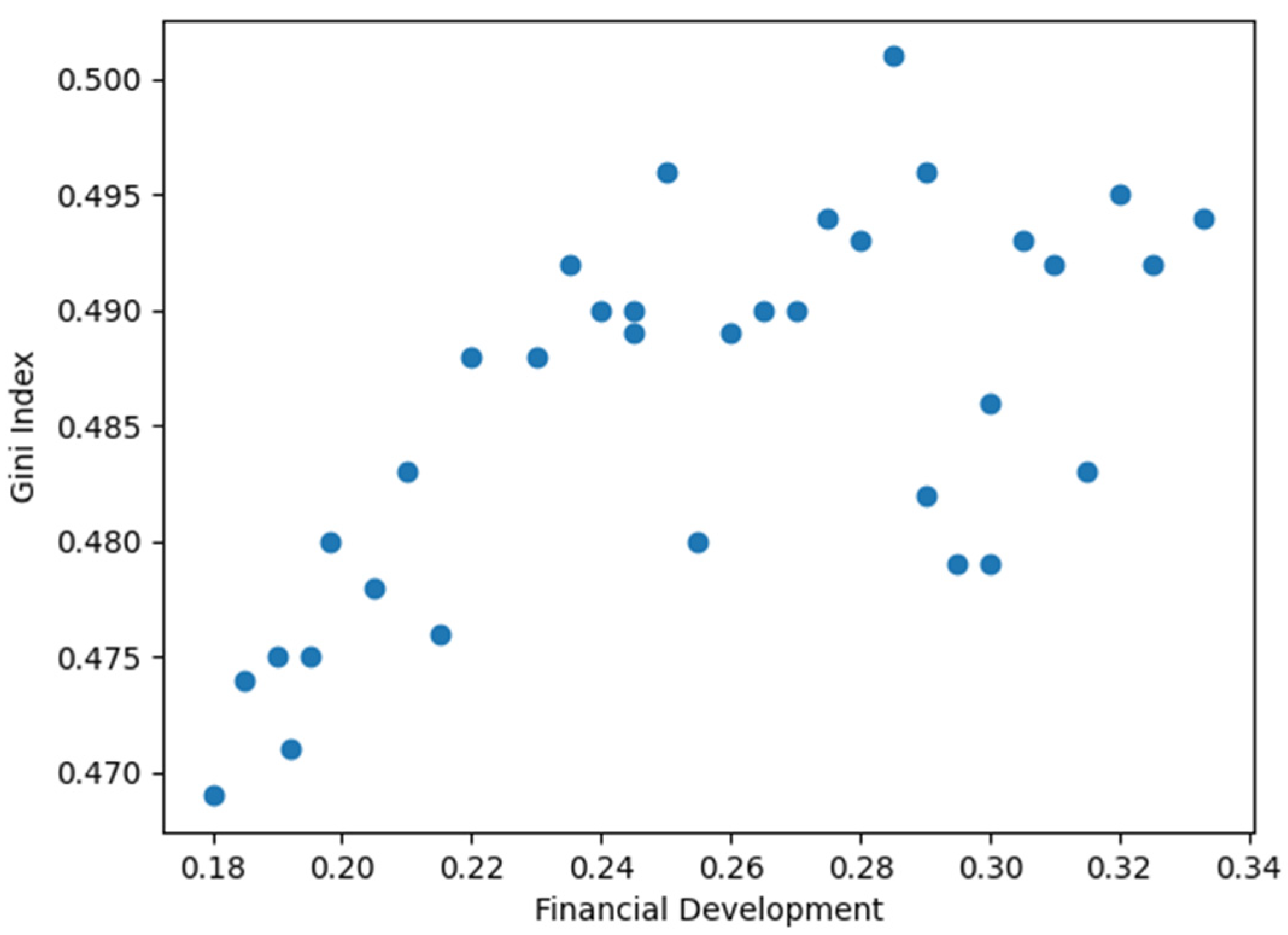
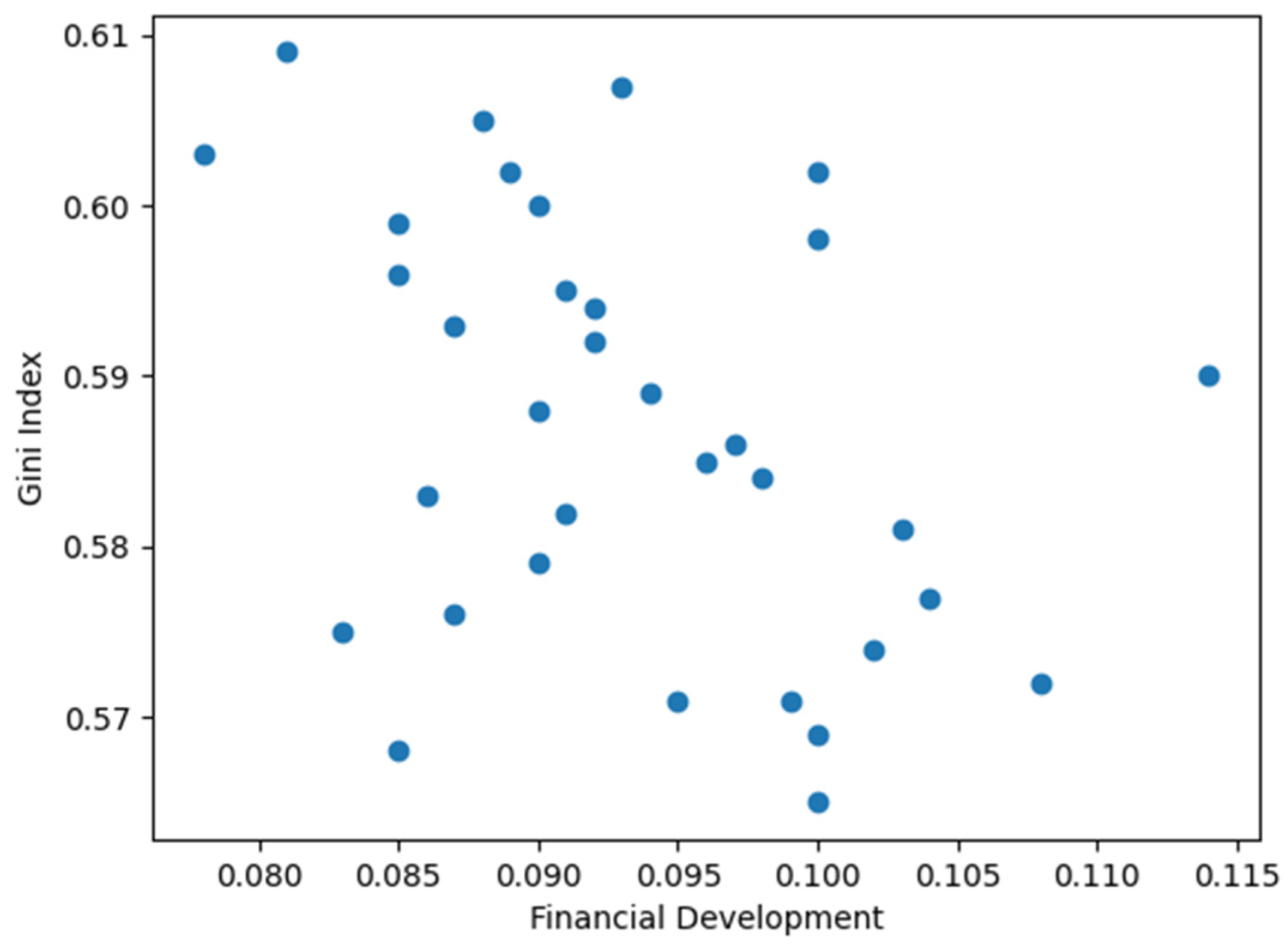
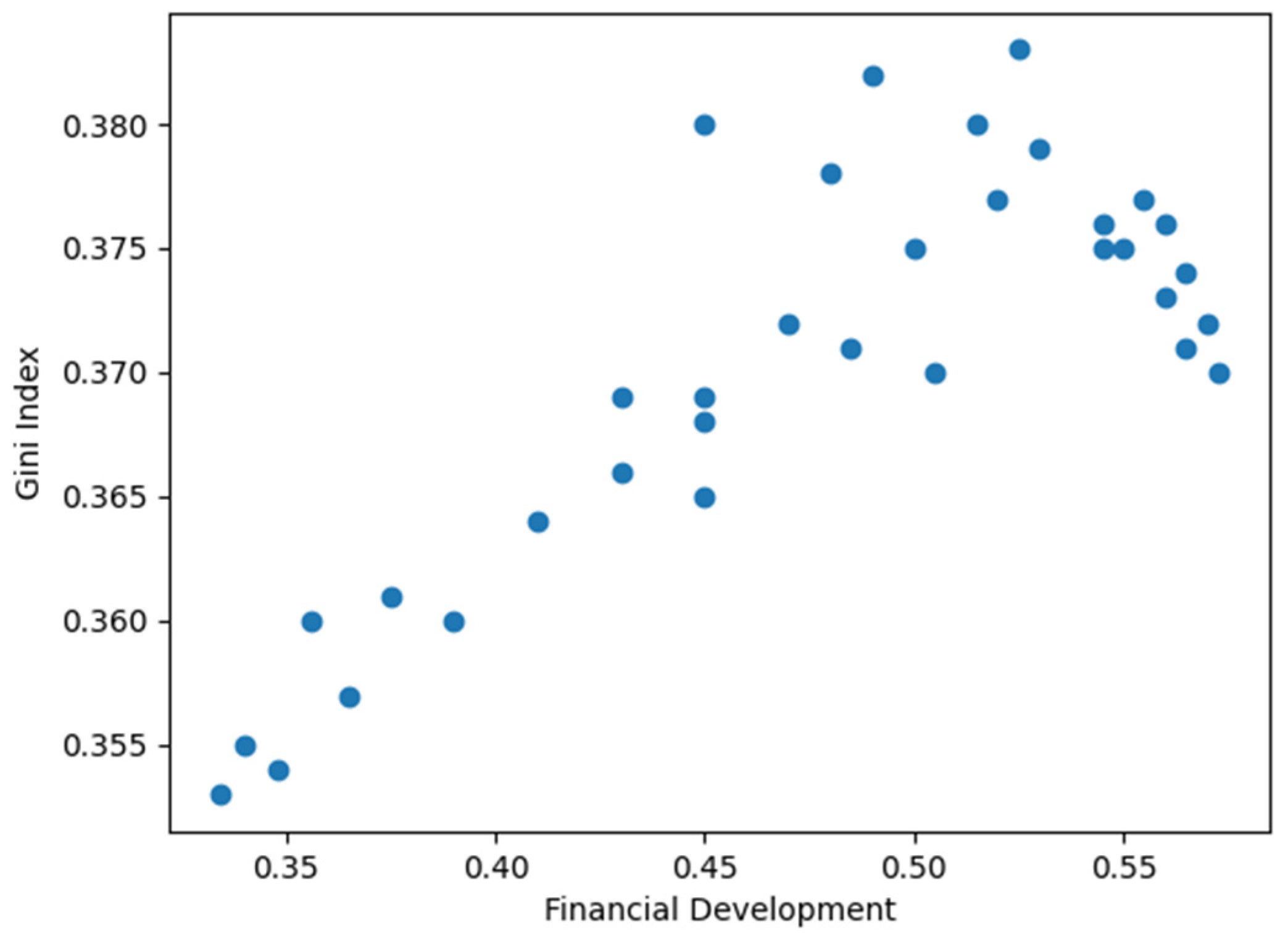
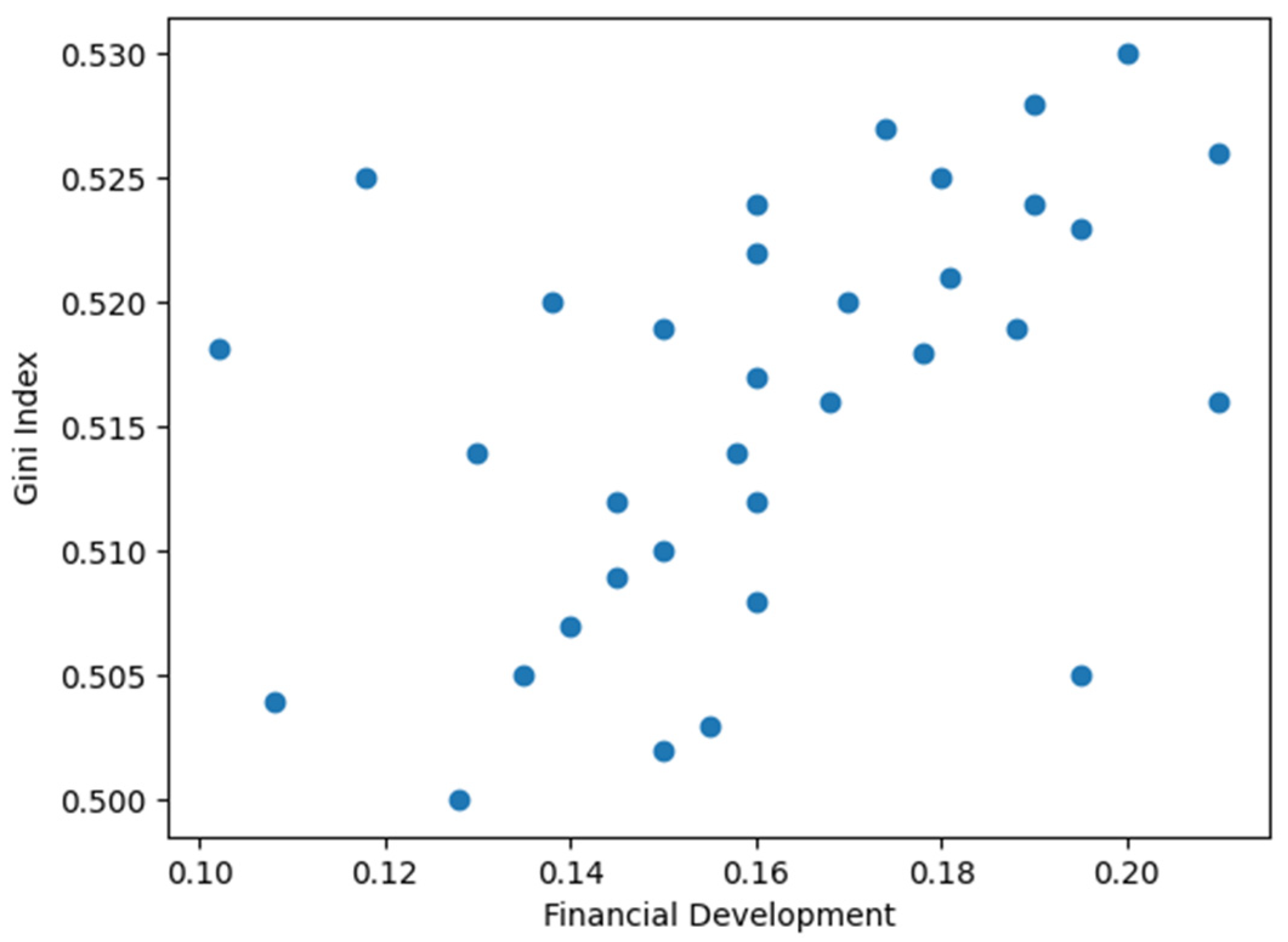
To complement the regression results reported in Table 3, the relationship between financial development and income inequality is illustrated graphically for each income group. Figure 1, Figure 2, Figure 3 and Figure 4 provide a visual representation of the relationship between financial development and income inequality across different income groups. The patterns reveal substantial heterogeneity in the finance–inequality nexus. In high-income countries (Figure 1), the relationship follows a clear inverted U-shape, consistent with the Financial Kuznets Curve. In upper-middle-income countries (Figure 2), the nonlinear pattern is present but less pronounced, indicating a weaker and less stable turning point. In lower-middle-income countries (Figure 3), the relationship appears predominantly linear and positive, with no evidence of a turning point. In contrast, in low-income countries (Figure 4), the scatter shows no clear pattern, suggesting a weak and statistically insignificant relationship. These visual findings are fully consistent with the UCM estimation results reported in Table 3.
We extend the analysis in Table 4 by decomposing financial development into its two structural channels—financial institutions (FI) and financial markets (FM)—providing a more comprehensive perspective on the finance–inequality nexus. The general pattern mirrors the full-index results, but important differences emerge regarding the magnitude and dominant transmission mechanism. Across all income groups, financial institutions appear to exert a stronger and more persistent effect on income inequality than financial markets, confirming that banking depth and intermediation remain the dominant channels through which finance affects distributional outcomes.
For high-income economies, both the FI and FM coefficients are positive and significant (β1 = 0.65 and β2 = 0.24, respectively), but the effect of institutions is substantially larger. This implies that in advanced financial systems, inequality is more responsive to changes in bank intermediation than to developments in the stock market. This finding is consistent with Zhang and Ben Naceur (2019), who find that the banking sector has a stronger inequality effect than financial markets, particularly in highly developed economies where asset ownership is concentrated.
In upper- and lower-middle-income economies, the coefficients on FI are negative and significant (β1 = −2.75 and β1 = −0.2, respectively), confirming that FI alleviates income inequality, albeit to different magnitudes. In contrast, FM is insignificant in upper-middle-income countries and positively significant in lower-middle-income countries, suggesting that market-based finance remains underdeveloped and less influential in this income category. These results align with those of Beck et al. (2007) and Khan and Raza (2018), who observed that inclusive financial development in middle-income economies enhances equity through improved intermediation and capital allocation efficiency. Similarly, FI has an insignificant coefficient in the lower-income country group, whereas FM has a negative coefficient. These results suggest that emerging financial markets make a limited contribution to inclusive finance (Beck & Levine, 2004). Demirgüç-Kunt and Levine (2009) argue that banking channels predominate in the early stages of development, while markets become more significant only after institutional infrastructures and regulatory frameworks mature. Furthermore, the robustness of the results is further supported by the consistency of the estimated nonlinear patterns across income groups, suggesting that the findings are not driven by omitted short-term fluctuations but reflect underlying structural relationships.
To sum up, the impact of financial development on inequality is largest in high-income economies, both in absolute magnitude and through the institutional channel. This reflects the disproportionate gains of capital income and financial assets among the wealthy (Rajan & Zingales, 2003). In contrast, upper-middle-income economies display the most inclusive financial structure, with both FI and FM channels supporting distributional improvements. For lower-income economies, the effects remain mixed and statistically weaker, highlighting the limited penetration of formal finance and the persistence of structural barriers.
From a policy perspective, the results suggest that there is no universal Financial Kuznets Curve (FKC), and caution against adopting uniform financial liberalization strategies. Beyond their distributional implications, these findings have direct relevance for business environments and market participation. In particular, improvements in financial inclusion—through broader access to credit, SME financing, and digital financial services—can enhance the business environment by lowering entry barriers for firms and enabling wider participation in economic activity. As financial systems become more inclusive, smaller firms and new market entrants are better able to access funding, compete, and expand, thereby fostering a more dynamic and competitive economic environment. Conversely, in highly financialized economies, where financial gains may be concentrated among established firms and capital owners, the resulting increase in inequality can limit market participation by constraining access to finance for less privileged groups. This may weaken the inclusiveness of the business environment and reduce opportunities for new entrants. Accordingly, the relationship between financial development and inequality should be understood not only in distributional terms but also in terms of its implications for market access, firm dynamics, and the overall functioning of the business environment.

5. Conclusions

This study reexamines the Financial Kuznets Curve (FKC) hypothesis by assessing whether the relationship between financial development and income inequality is nonlinear and conditioned by a country’s income level. Using an Unobserved Components Model applied to time-series data for four World Bank income groups over the period 1990–2023, the analysis shows that the FKC is not a universal pattern. An inverted U-shaped relationship is evident only in high-income and upper-middle-income countries, implying that once financial systems reach a sufficient degree of depth and sophistication, further financial development tends to mitigate income inequality. By contrast, lower-middle-income countries display a positive linear relationship, whereas in low-income countries, the relationship remains weak and statistically insignificant.
Overall, the findings underscore that the distributional effects of finance depend critically on the stage of economic development. In economies with mature and broadly inclusive financial systems, finance can act as a corrective force that narrows income disparities. In less developed contexts, however, financial growth tends to disproportionately benefit groups already integrated into formal markets, thereby reinforcing existing inequalities. Disaggregating finance into institutional and market-based components further refines this conclusion. Financial markets are found to be more powerful drivers of inequality in advanced economies, while the role of financial institutions, particularly banks, is more nuanced and context-specific: they can reduce inequality when credit access is genuinely inclusive, yet exacerbate it when lending remains concentrated among privileged segments of the population.

Author Contributions

Conceptualization, M.A. and E.M.; methodology, M.A. and E.M.; software, E.M.; validation, E.M. and M.A.; formal analysis, M.A.; investigation, M.A.; resources, E.M.; writing—original draft preparation, E.M. and M.A.; writing—review and editing, M.A. and E.M.; visualization, E.M.; supervision, E.M.; project administration, E.M. and M.A. All authors have read and agreed to the published version of the manuscript.

Funding

This research received no external funding.

Institutional Review Board Statement

Not applicable.

Informed Consent Statement

Not applicable.

Data Availability Statement

Upon reasonable request, the supporting data of this study can be provided.

Conflicts of Interest

The authors declare no conflicts of interest.

References

  1. Altunbaş, Y., & Thornton, J. (2020). Finance and income inequality revisited. Finance Research Letters, 37, 101355. [Google Scholar] [CrossRef]
  2. Baiardi, D., & Morana, C. (2016). The financial Kuznets curve: Evidence for the Euro Area. Journal of Empirical Finance, 39, 265–276. [Google Scholar] [CrossRef]
  3. Banerjee, A. V., & Newman, A. F. (1993). Occupational choice and the process of development. Journal of Political Economy, 101(2), 274–298. [Google Scholar] [CrossRef]
  4. Beck, T., Demirgüç-Kunt, A., & Levine, R. (2007). Finance, inequality and the poor. Journal of Economic Growth, 12(1), 27–49. [Google Scholar] [CrossRef]
  5. Beck, T., & Levine, R. (2004). Stock markets, banks, and growth: Panel evidence. Journal of Banking & Finance, 28(3), 423–442. [Google Scholar]
  6. Bektur, Ç. (2023). The effects of financial development and tax on income inequality in Türkiye: The financial Kuznets curve hypothesis. Holistic Economics, 2(2), 85–93. [Google Scholar] [CrossRef]
  7. Čihák, M., Demirgüç-Kunt, A., Feyen, E., & Levine, R. (2012). Benchmarking financial systems around the world. World Bank Policy Research Working Paper No. 6175. World Bank. [Google Scholar]
  8. Demirgüç-Kunt, A., Feyen, E., & Levine, R. (2013). The evolving importance of banks and securities markets. The World Bank Economic Review, 27(3), 476–490. [Google Scholar] [CrossRef]
  9. Demirgüç-Kunt, A., & Levine, R. (2009). Finance and inequality: Theory and evidence. Annual Review of Financial Economics, 1(1), 287–318. [Google Scholar] [CrossRef]
  10. Galor, O., & Zeira, J. (1993). Income distribution and macroeconomics. The Review of Economic Studies, 60(1), 35–52. [Google Scholar] [CrossRef]
  11. Greenwood, J., & Jovanovic, B. (1990). Financial development, growth, and the distribution of income. Journal of Political Economy, 98(5), 1076–1107. [Google Scholar] [CrossRef]
  12. Harvey, A., & Proietti, T. (2005). Readings in unobserved components models. Oxford University Press. [Google Scholar]
  13. Harvey, A. C. (1989). Forecasting, structural time series models and the Kalman filter. Cambridge University Press. [Google Scholar]
  14. Jaumotte, F., Lall, S., & Papageorgiou, C. (2013). Rising income inequality: Technology, or trade and financial globalization? IMF Economic Review, 61, 271–309. [Google Scholar] [CrossRef]
  15. Kamalu, K., & Wan Ibrahim, W. H. B. (2023). The effect of Islamic financial development and human development on income inequality: Does Islamic finance Kuznets curve valid in the OIC countries? Journal of Islamic Monetary Economics and Finance, 9(2), 247–272. [Google Scholar] [CrossRef]
  16. Khan, M. A., & Raza, S. A. (2018). Financial sector development and income inequality in ASEAN-5 countries: Does the financial Kuznets curve exists? Global Business and Economics Review, 20(1), 88–114. [Google Scholar]
  17. Kim, I. (2019). Financial Kuznets curve and the governance nexus. Journal of Economic Studies, 46(7), 1330–1347. [Google Scholar]
  18. Kotarski, K. (2015). Financial deepening and income inequality: Is there any financial Kuznets curve in China? The political economy analysis. China Economic Journal, 8(2), 151–174. [Google Scholar] [CrossRef]
  19. Kuznets, S. (1955). Economic growth and income inequality. American Economic Review, 45(1), 1–28. [Google Scholar]
  20. Lahoti, R., Jayadev, A., & Reddy, S. (2016). The global consumption and income project (GCIP): An overview. Journal of Globalization and Development, 7(1), 61–108. [Google Scholar] [CrossRef]
  21. Law, S. H., & Tan, H. B. (2009). The role of financial development on income inequality in Malaysia. Journal of Economic Development, 34(2), 153–168. [Google Scholar] [CrossRef]
  22. Nadabo, S. Y., Dakyong, T. G., & Ismail, H. (2024). Financial development and income inequality in Nigeria: Testing the financial Kuznets curve hypothesis. FUDMA Journal of Accounting and Finance Research, 2(1), 92–105. [Google Scholar] [CrossRef]
  23. Nikoloski, Z. (2013). Financial sector development and inequality: Is there a financial Kuznets curve? Journal of International Development, 26(7), 897–911. [Google Scholar] [CrossRef]
  24. Öndes, H., & Kızılgöl, Ö. (2024). Financial development and income inequality in newly industrialized countries: Does financial Kuznets curve exists? Journal of the Knowledge Economy, 15(4), 15618–15651. [Google Scholar] [CrossRef]
  25. Rajan, R. G., & Zingales, L. (2003). The great reversals: The politics of financial development in the twentieth century. Journal of Financial Economics, 69(1), 5–50. [Google Scholar] [CrossRef]
  26. Sahay, R., Čihák, M., N’Diaye, P., Barajas, A., Bi, R., Ayala, D., Gao, Y., Kyobe, A., Nguyen, L., Saborowski, C., Svirydzenka, K., & Yousefi, S. R. (2015). Rethinking financial deepening: Stability and growth in emerging markets. IMF Staff Discussion Note SDN/15/08. International Monetary Fund. [Google Scholar]
  27. Seven, U., & Coskun, Y. (2016). Does financial development reduce income inequality and poverty? Evidence from emerging countries. Emerging Markets Review, 26, 34–63. [Google Scholar] [CrossRef]
  28. Shahbaz, M., Loganathan, N., Tiwari, A. K., & Sherafatian-Jahromi, R. (2015). Financial development and income inequality: Is there any financial Kuznets curve in Iran? Social Indicators Research, 124(2), 357–382. [Google Scholar] [CrossRef]
  29. Solt, F. (2009). Standardizing the world income inequality database. Social Science Quarterly, 90(2), 231–242. [Google Scholar] [CrossRef]
  30. Stockhammer, E. (2015). Rising inequality as a cause of the present crisis. Cambridge Journal of Economics, 39(3), 935–958. [Google Scholar] [CrossRef]
  31. Tekin, İ., & Cengiz, O. (2017). Nexus between financial development and inequality: An empirical investigation of financial Kuznets curve for selected EU countries. Economic Studies Journal, 25(2), 45–63. [Google Scholar]
  32. Yıldız, B., & Akbulut Yıldız, G. (2023). The relationship between income inequality and financial development: Is the financial Kuznets curve valid in middle-income countries? Trendy v Podnikání, 13(1), 3–15. [Google Scholar] [CrossRef]
  33. Zhang, R., & Ben Naceur, S. (2019). Financial development, inequality, and poverty: Some international evidence. International Review of Economics & Finance, 61, 1–16. [Google Scholar] [CrossRef]
Figure 1. Financial Development and Income Inequality in High-Income Countries.
Ijfs 14 00125 g001
Figure 2. Financial Development and Income Inequality in Upper-Middle-Income Countries.
Ijfs 14 00125 g002
Figure 3. Financial Development and Income Inequality in Lower-Middle-Income Countries.
Ijfs 14 00125 g003
Figure 4. Financial Development and Income Inequality in Low-Income Countries.
Ijfs 14 00125 g004
Table 1. Descriptive Statistics.
Variable High-IncomeUpper-Middle Income Lower-Middle Income Low-Income
Gini CoefficientMean0.3700.4900.5170.584
SD0.0080.0090.0080.016
Min0.3530.4690.4980.565
Max0.3830.5010.5300.609
Financial Development (FD)Mean0.4850.2650.1710.092
SD0.0750.0480.0330.010
Min0.3340.1780.1020.078
Max0.5730.3350.2140.114
Financial Institutions Development (FI)Mean0.5640.3360.2240.174
SD0.0710.0660.0490.019
Min0.4280.2290.1390.148
Max0.6400.4470.3070.214
Financial Markets Development (FM)Mean0.3910.1860.1120.007
SD0.0810.0330.0250.002
Min0.2220.1210.0600.005
Max0.4940.2350.1480.010
Table 2. Correlation Matrix.
GiniFDFIFM
Gini1
FD−0.6832 *1
FI−0.6712 *0.9981 *1
FM−0.5865 *0.6701 *0.6230 *1
Note: * indicate statistical significance at the 5% level.
Table 3. Estimation Results of the Unobserved Components Model (IMF’s Financial Development Index).
High-IncomeUpper-Middle Income Lower-Middle Income Low-Income
Financial Development ProxyFDFDFDFD
β 1 0.51 ***0.26 ***0.26 ***0.53
(2.60)(2.89)(2.89)(1.23)
β 2 −0.51 ***−1.76 ***−1.76 ***0.05 *
(−2.68)(−3.89)(−3.90)(1.78)
μt0.24 ***0.52 ***0.52 ***0.50 ***
(4.72)(26.59)(26.59)(9.82)
R20.340.340.340.04
N2.6840.010.010.11
H0.2442.102.100.72
DW2.161.621.622.28
Q2.432.262.263.62
Note: Coefficients are reported with t-statistics in parentheses. * and *** indicate statistical significance at the 10% and 1% levels, respectively.
Table 4. Estimation Results of the Unobserved Components Model (Financial Institutions Development and Financial Markets Development).
High-IncomeUpper-Middle IncomeLower-Middle IncomeLow-Income
Financial Structure ProxyFIFMFIFMFIFMFIFM
β 1 0.65 **0.240 **−2.75 **−0.12−0.20 ***0.21 **−0.19−1.09 **
(2.4)(2.17)(−2.09)(−0.83)(−4.29)(1.89)(−1.36)(−1.96)
β 2 −0.54 **−0.30 **2.97 **0.77−0.10 **−1.66 **1.07−0.16
(−2.33)(−2.31)(2.07)(1.16)(−5.42)(−2.22)(1.61)(−1.13)
μt0.173 **0.32 ***1.11 ***0.46 ***0.57 ***0.50 ***0.56 ***0.58 ***
(2.067)(14.64)(3.56)(28.13)(36.71)(74.35)(27.70)(107.10)
R20.270.290.220.230.330.190.080.18
N0.3182.992.760.190.262.212.121.00
H0.240.250.950.953.421.170.580.58
DW1.952.051.791.961.651.681.691.95
Q1.71.990.291.094.003.672.400.89
Note: Coefficients are reported with t-statistics in parentheses. ** and *** denote statistical significance at the 5% and 1% levels, respectively. FI refers to financial institutions, while FM refers to financial markets.
Disclaimer/Publisher’s Note: The statements, opinions and data contained in all publications are solely those of the individual author(s) and contributor(s) and not of MDPI and/or the editor(s). MDPI and/or the editor(s) disclaim responsibility for any injury to people or property resulting from any ideas, methods, instructions or products referred to in the content.