
Artificial Intelligence in Banking Risk Management: A Bibliometric Analysis

Abstract
1. Introduction
2. Theoretical Background, Literature Review and Analytical Expectations
2.1. Theoretical Foundations of Artificial Intelligence in Banking Risk Management
2.2. Empirical Studies on AI Applications in Banking Risk Management
2.3. Research Gaps
2.4. Analytical Expectations
3. Methodology
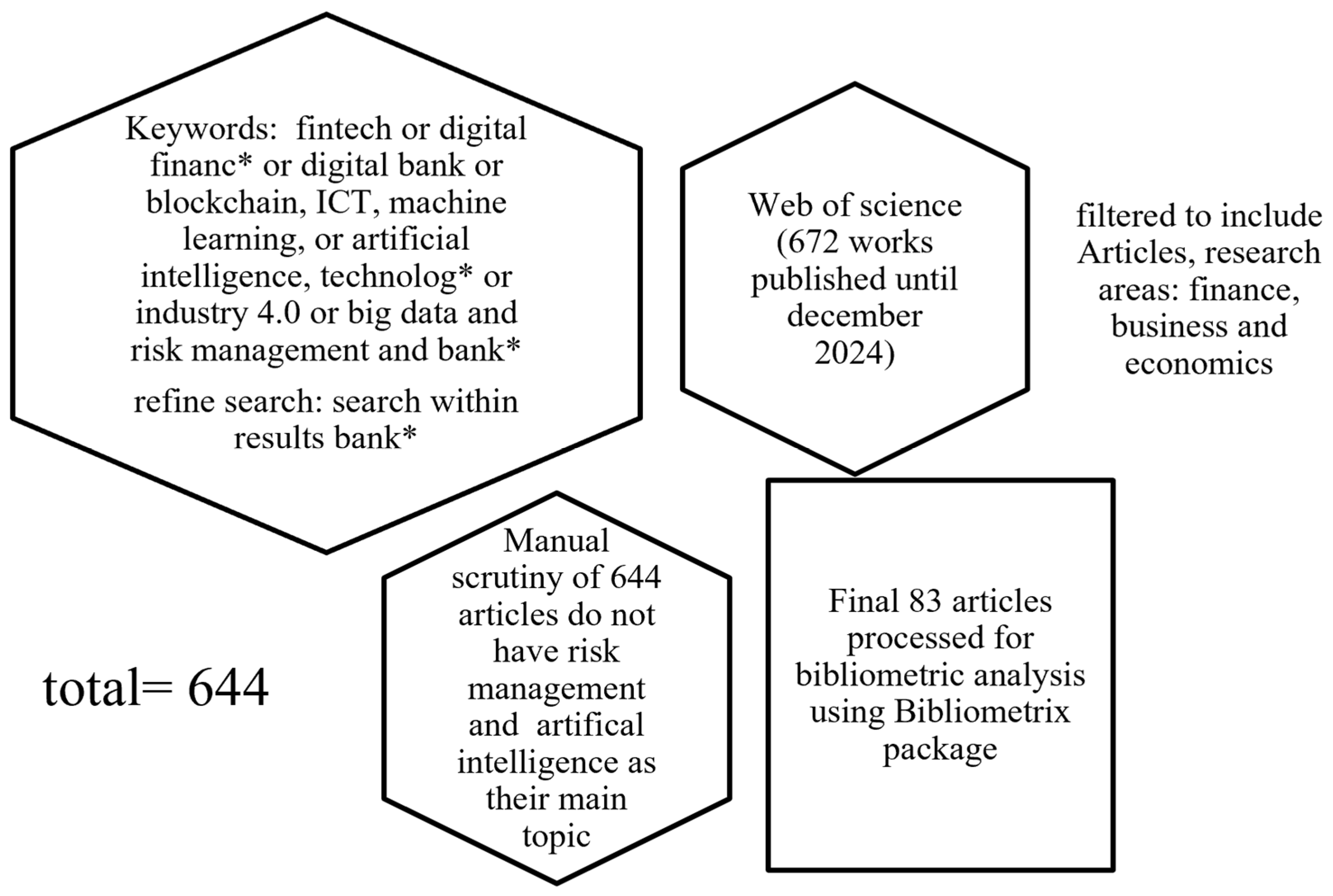
Data Screening
4. Results
- -
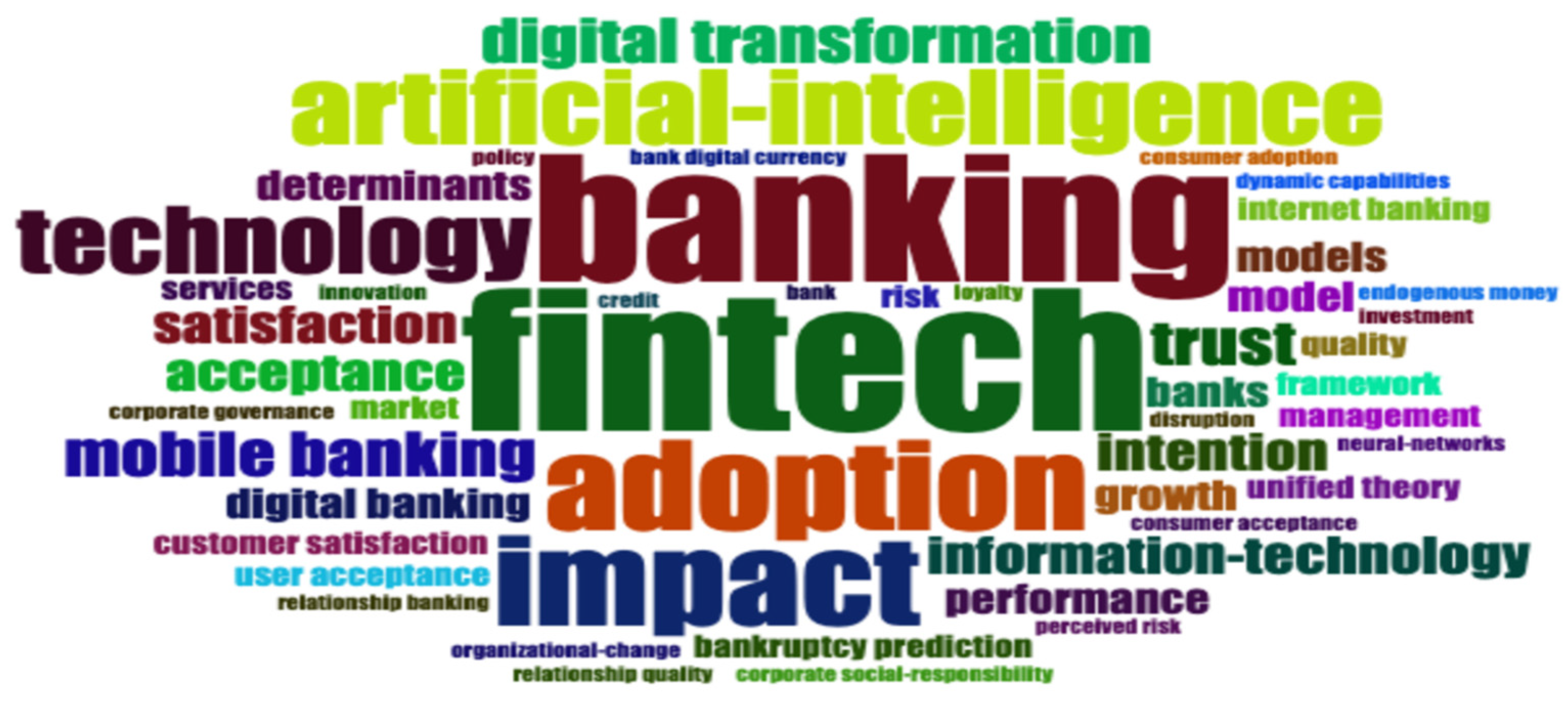
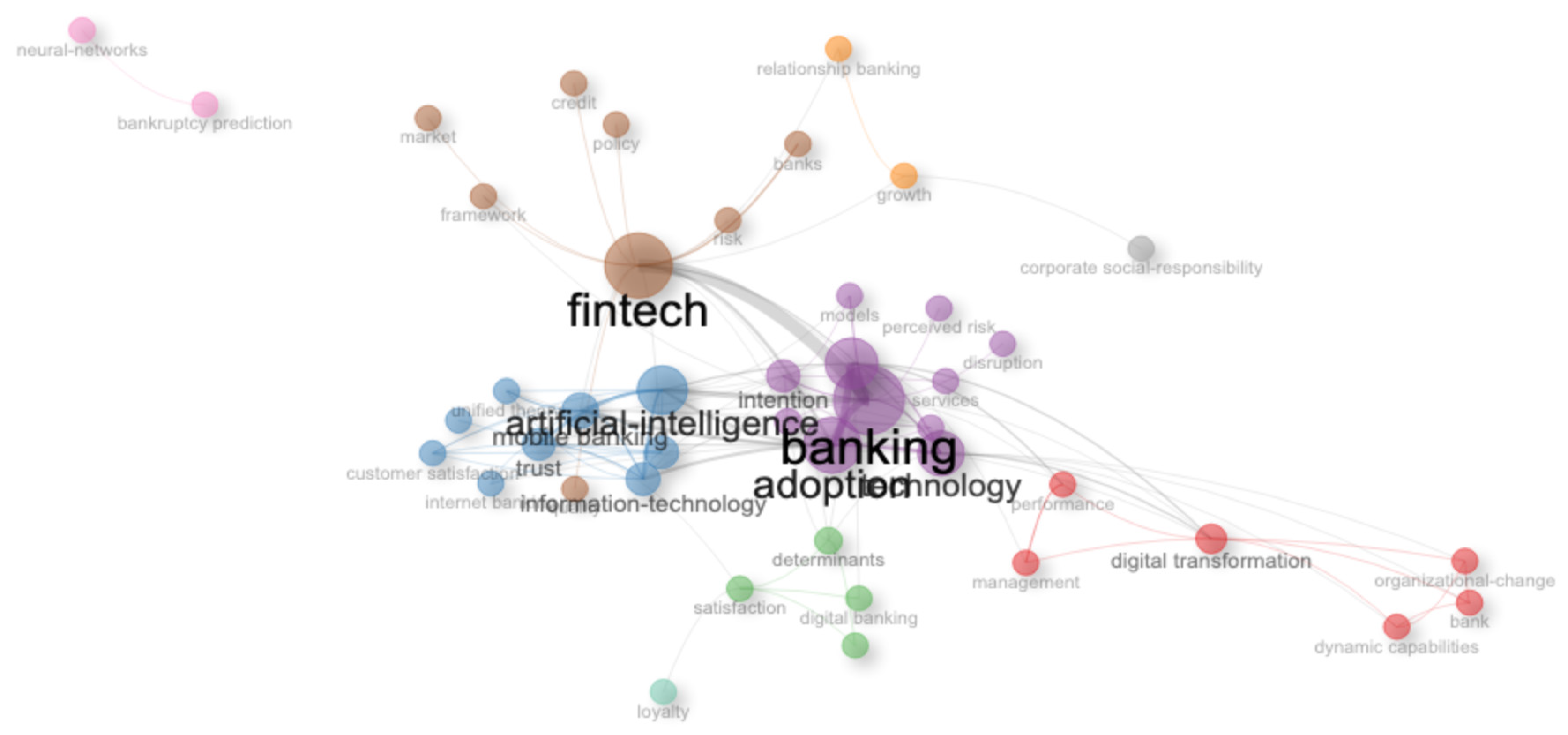
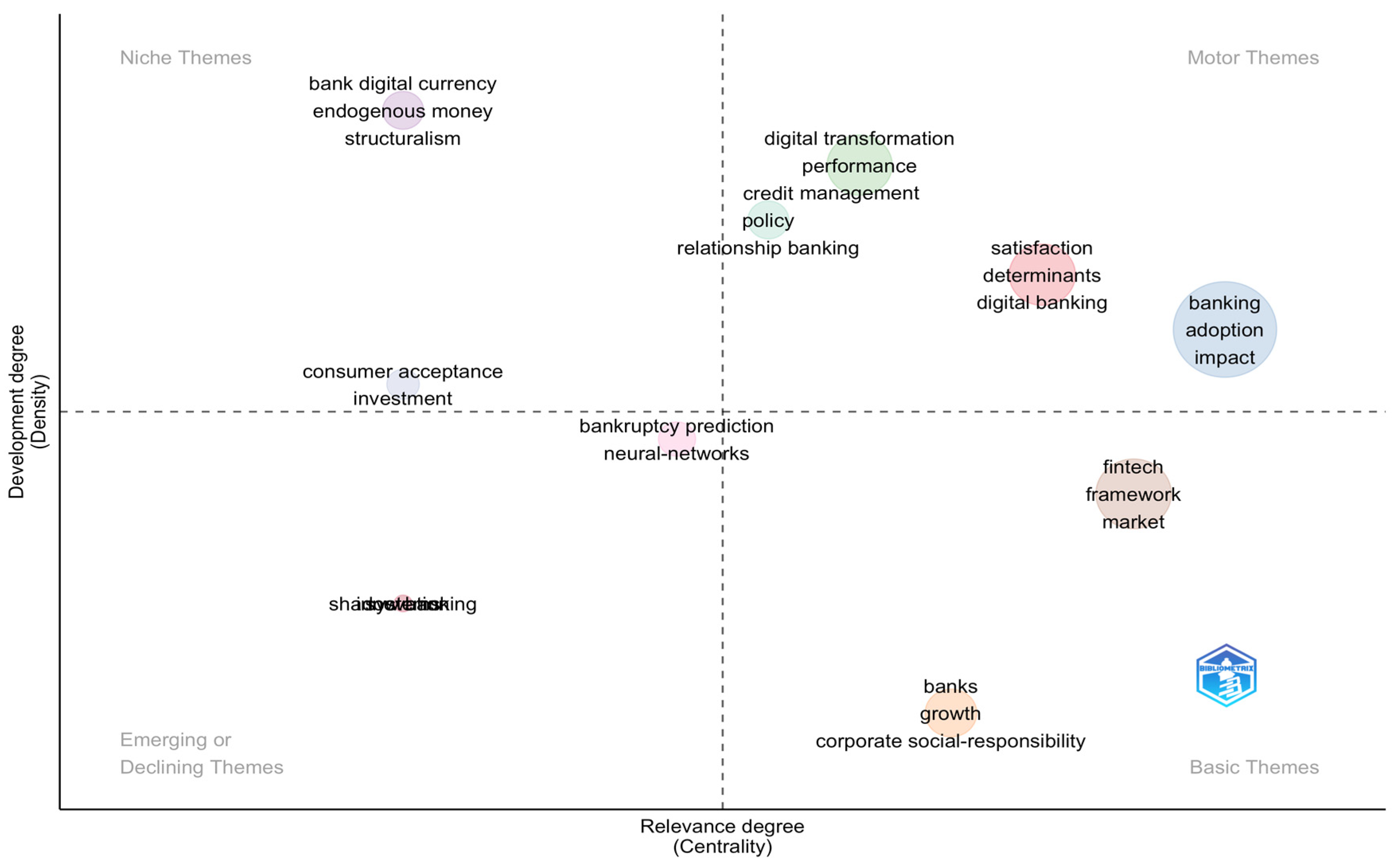
- Credit Risk Modeling and Alternative Data Analytics, emphasis on machine learning, credit scoring, and data-driven borrower assessment (Chawla & Joshi, 2021; Ahmed et al., 2023; Mhlanga, 2021; Sawafta, 2021; Buzaubayeva et al., 2024).
- -
- Fraud Detection and Anomaly Recognition, frequent keywords include “fraud detection,” “anomaly detection,” and “transaction monitoring,” reflecting continued scholarly interest in security and consumer protection (Ngai et al., 2011; Hassan et al., 2023; Davenport & Ronanki, 2018).
- -
- AML and Financial Crime Analytics, studies applying AI to anti-money laundering (AML), suspicious activity detection, and regulatory reporting processes texts (Javaid et al., 2022; Zhang et al., 2020; Truby et al., 2022).
- -
- Cybersecurity and Operational Risk, Topics include cyber-risk modeling, intrusion detection, operational disruptions, and system vulnerabilities, increasingly relevant given digitalization (Nourallah, 2023; Sang, 2024; Aria & Cuccurullo, 2017).
- -
- digital finance and transformation research;
- -
- machine learning methodology papers;
- -
- regulatory compliance and model governance literature.
Thematic Clusters and Banking Risk Categories
5. Discussion and Limitations
6. Conclusions
Author Contributions
Funding
Institutional Review Board Statement
Informed Consent Statement
Data Availability Statement
Acknowledgments
Conflicts of Interest
References
- Achary, R. (2021). Artificial intelligence transforming Indian banking sector. International Journal of Economics and Management Systems, 6, 19–31. Available online: https://www.iaras.org/iaras/filedownloads/ijems/2021/007-0003(2021).pdf (accessed on 12 December 2025).
- Adeniran, I. A., Abhulimen, A. O., Obiki-Osafiele, A. N., Osundare, O. S., Agu, E. E., & Efunniyi, C. P. (2024). Strategic risk management in financial institutions: Ensuring robust regulatory compliance. Finance & Accounting Research Journal, 6(8), 1582–1596. [Google Scholar] [CrossRef]
- Adepetun, A., Odutola, O., & Dopemu, E. M. (2022). Exploring the impact of machine learning on financial decision-making in the Nigerian banking sector. International Journal of Scientific and Management Research, 5, 12. [Google Scholar] [CrossRef]
- Ahmed, I. E., Mehdi, R., & Mohamed, E. A. (2023). The role of artificial intelligence in developing a banking risk index: An application of Adaptive Neural Network-Based Fuzzy Inference System (ANFIS). Artificial Intelligence Review, 56(11), 13873–13895. [Google Scholar] [CrossRef]
- Akerlof, G. A. (1970). The market for “lemons”: Quality uncertainty and the market mechanism. Quarterly Journal of Economics, 84(3), 488–500. [Google Scholar] [CrossRef]
- Alassuli, A. (2025). Impact of artificial intelligence using the robotic process automation system on the efficiency of internal audit operations at Jordanian commercial banks. Banks and Bank Systems, 20(1), 122–135. [Google Scholar] [CrossRef]
- Aria, M., & Cuccurullo, C. (2017). Bibliometrix: An R tool for comprehensive science mapping analysis. Journal of Informetrics, 11(4), 959–975. [Google Scholar] [CrossRef]
- Ashurbayli-Huseynova, N., & Garmidarova, Y. (2025). Bank capital management in emerging and frontier markets: Bibliometric analysis. Banks and Bank Systems, 20(1), 304–322. [Google Scholar] [CrossRef]
- Bahoo, S., Alon, I., & Paltrinieri, A. (2020). Sovereign wealth funds: Past, present, and future. International Review of Financial Analysis, 67, 101512. [Google Scholar] [CrossRef]
- Barbu, C. M., Florea, D. L., Dabija, D.-C., & Barbu, M. C. R. (2021). Customer experience in FinTech. Journal of Theoretical and Applied Electronic Commerce Research, 16(5), 1415–1433. [Google Scholar] [CrossRef]
- Berg, T., Burg, V., Gombović, A., & Puri, M. (2020). On the rise of fintechs: Credit scoring using digital footprints. Review of Financial Studies, 33(7), 2845–2897. [Google Scholar] [CrossRef]
- Bhatt, A., Joshipura, M., & Joshipura, N. (2022). Decoding the trinity of FinTech, digitalization, and financial services: An integrated bibliometric analysis and thematic literature review approach. Cogent Economics & Finance, 10(1), 2114160. [Google Scholar] [CrossRef]
- Bouchetara, M., Zerouti, M., & Zouambi, A. R. (2024). Leveraging artificial intelligence (AI) in public sector financial risk management: Innovations, challenges, and future directions. EDPACS, 69(9), 124–144. [Google Scholar] [CrossRef]
- Brika, S. (2022). A bibliometric analysis of FinTech trends and digital finance. Frontiers in Environmental Science, 9, 796495. [Google Scholar] [CrossRef]
- Brown, M. (2024). Influence of artificial intelligence on credit risk assessment in the banking sector. International Journal of Modern Risk Management, 2(1), 24–33. [Google Scholar] [CrossRef]
- Brynjolfsson, E., & McAfee, A. (2014). The second machine age: Work, progress, and prosperity in a time of brilliant technologies. W. W. Norton & Company. Available online: http://digamo.free.fr/brynmacafee2.pdf (accessed on 19 December 2025).
- Buzaubayeva, P., Orazbayeva, A., Alina, G., Baimagambetova, Z., & Kenges, G. (2024). Enhancing financial performance and risk management in Kazakhstan’s banking sector. Banks and Bank Systems, 19(1), 157–169. [Google Scholar] [CrossRef]
- Chawla, D., & Joshi, H. (2021). Importance-performance map analysis to enhance the performance of attitude towards mobile wallet adoption among Indian consumer segments. Aslib Journal of Information Management, 73(6), 946–966. [Google Scholar] [CrossRef]
- Davenport, T. H., & Ronanki, R. (2018). Artificial intelligence for the real world. Harvard Business Review, 96(1), 108–116. Available online: https://hbr.org/2018/01/artificial-intelligence-for-the-real-world (accessed on 19 December 2025).
- Davis, F. D. (1989). Perceived usefulness, perceived ease of use, and user acceptance of information technology. MIS Quarterly, 13(3), 319–340. [Google Scholar] [CrossRef]
- Donthu, N., Kumar, S., Mukherjee, D., Pandey, N., & Lim, W. M. (2021). How to conduct a bibliometric analysis: An overview and guidelines. Journal of Business Research, 133, 285–296. [Google Scholar] [CrossRef]
- Ellili, N. O. D. (2022). Is there any association between FinTech and sustainability? Evidence from bibliometric review and content analysis. Journal of Financial Services Marketing, 28, 748–762. [Google Scholar] [CrossRef]
- Fares, O. H., Butt, I., & Lee, S. H. M. (2022). Utilization of artificial intelligence in the banking sector: A systematic review of literature. Journal of Financial Services Marketing, 28(4), 835–852. [Google Scholar] [CrossRef]
- Fernández-Arias, D., López-Martín, M., Montero-Romero, T., Martínez-Estudillo, F., & Fernández-Navarro, F. (2018). Financial soundness prediction using a multi-classification model: Evidence from current financial crisis in OECD banks. Computational Economics, 52(1), 275–297. [Google Scholar] [CrossRef]
- Fountaine, T., McCarthy, B., & Saleh, T. (2019). Building the AI-powered organization: Technology is not the biggest problem. Culture is. Harvard Business Review, 97(4), 62–70. Available online: https://hbr.org/2019/07/building-the-ai-powered-organization (accessed on 19 December 2025).
- Fuster, A., Goldsmith-Pinkham, P., Ramadorai, T., & Walther, A. (2022). Predictably unequal? The effects of machine learning on credit markets. Journal of Finance, 77(1), 5–47. [Google Scholar] [CrossRef]
- Fülöp, M. T., Topor, D. I., Ionescu, C. A., Căpușneanu, S., Breaz, T. O., & Stanescu, S. G. (2022). FinTech accounting and Industry 4.0: Future-proofing or threats to the accounting profession? Journal of Business Economics and Management, 23(5), 997–1015. [Google Scholar] [CrossRef]
- Gangwar, A. S., Shukla, A., & Singh, R. (2025). A comprehensive bibliometric analysis of money laundering and related scams: Trends, influences, and research gaps. International Research Journal of Multidisciplinary Scope, 6(3), 1236–1251. [Google Scholar] [CrossRef]
- Gupta, R., Kaur, H., & Kaur, M. (2023). Evolution of FinTech ensuring sustainability in financial markets: A bibliometric analysis. International Management Review, 19(2), 163–186. Available online: https://americanscholarspress.us/journals/IMR/pdf/IMR-0-2023/IMR2023SpringSp-art15.pdf (accessed on 19 December 2025).
- Hassan, M., Aziz, L. A. R., & Andriansyah, Y. (2023). The role of artificial intelligence in modern banking: An exploration of AI-driven approaches for enhanced fraud prevention, risk management, and regulatory compliance. Reviews of Contemporary Business Analytics, 6(1), 110–132. Available online: https://researchberg.com/index.php/rcba/article/view/153 (accessed on 19 December 2025).
- Heaton, J. B., Polson, N. G., & Witte, J. H. (2017). Deep learning for finance: Deep portfolios. Applied Stochastic Models in Business and Industry, 33(1), 3–12. [Google Scholar] [CrossRef]
- Hull, J. (2018). Risk management and financial institutions. Wiley. [Google Scholar]
- Jafri, J. A., Imna, M., Mohd Amin, S., & Rahman, A. A. (2025). Financial technology (FinTech) research trends: A bibliometric analysis. Discover Sustainability, 6, 513. [Google Scholar] [CrossRef]
- Javaid, H. A., Haleem, A., Singh, R., & Suman, R. (2022). Artificial intelligence applications for Industry 4.0: A literature-based study. Journal of Industrial Integration and Management, 7(1), 83–111. [Google Scholar] [CrossRef]
- Jorion, P. (2007). Value at Risk: The new benchmark for managing financial risk. McGraw-Hill. [Google Scholar]
- Khandani, A., Kim, A., & Lo, A. (2010). Consumer credit-risk models via machine-learning algorithms. Journal of Banking & Finance, 34(11), 2767–2787. [Google Scholar]
- Kuanova, L., Kenzhegulova, G., & Akhmetkyzy, A. (2025). Research trends in Sukuk studies: A bibliometric analysis of global academic publications. Investment Management and Financial Innovations, 22(2), 338–353. [Google Scholar] [CrossRef]
- Kumar, A., Srivastava, A., & Gupta, P. K. (2022). Banking 4.0: The era of artificial intelligence-based fintech. Strategic Change, 31(6), 591–601. [Google Scholar] [CrossRef]
- Kumar, S., Xiao, J. J., Pattnaik, D., Lim, W. M., & Rasul, T. (2022). The past, present, and future of bank marketing: A bibliometric analysis of the International Journal of Bank Marketing (1983–2020). International Journal of Bank Marketing, 40(6), 1169–1196. [Google Scholar] [CrossRef]
- Martono, S., Nurkhin, A., Mukhibad, H., Anisykurlillah, I., & Wolor, C. W. (2020). Understanding the employee’s intention to use information systems: The technology acceptance model and information system success model approach. The Journal of Asian Finance, Economics and Business, 7(10), 1007–1013. [Google Scholar] [CrossRef]
- Mhlanga, D. (2021). Financial inclusion in emerging economies: The application of machine learning and artificial intelligence in credit risk assessment. International Journal of Financial Studies, 9(3), 39. [Google Scholar] [CrossRef]
- Ngai, E. W. T., Hu, Y., Wong, Y. H., Chen, Y., & Sun, X. (2011). The application of data mining techniques in financial fraud detection: A classification framework and an academic review of literature. Decision Support Systems, 50(3), 559–569. [Google Scholar] [CrossRef]
- Nguyen, D. K., Sermpinis, G., & Stasinakis, C. (2022). Big data, artificial intelligence and machine learning: A transformative symbiosis in favour of financial technology. European Financial Management, 29(2), 517–548. [Google Scholar] [CrossRef]
- Nnaomah, U. I., Odejide, O. A., Aderemi, S., & Olanrewaju, D. (2024). AI in risk management: An analytical comparison between the US and Nigerian banking sectors. International Journal of Science and Technology Research Archive, 6(1), 127–146. [Google Scholar] [CrossRef]
- Nourallah, M. (2023). One size does not fit all: Young retail investors’ initial trust in financial robo-advisors. Journal of Business Research, 156, 113470. [Google Scholar] [CrossRef]
- Othman, M. (2025). AI and FinTech adoption in Jordanian banking: Toward inclusive and culturally aligned innovation. Banks and Bank Systems, 20(4), 45–59. [Google Scholar] [CrossRef]
- Paltrinieri, A., Hassan, M. K., Bahoo, S., & Khan, A. (2023). A bibliometric review of Sukuk literature. International Review of Economics & Finance, 86, 897–918. [Google Scholar] [CrossRef]
- Qahtani, E. H. A., & Alsmairat, M. A. K. (2023). Assisting artificial intelligence adoption drivers in human resources management: A mediation model. Acta Logistica, 10(1), 141–150. [Google Scholar] [CrossRef]
- Rogers, E. (2003). Diffusion of innovations. Free Press. [Google Scholar]
- Rolando, B., & Mulyono, H. (2024). Managing risks in FinTech: Applications and challenges of artificial intelligence-based risk management. Economics and Business Journal (ECBIS), 2(3), 249–268. [Google Scholar] [CrossRef]
- Roy, P., Saha, S., Dutta, A., & Ghosh, S. (2025). Artificial intelligence and finance: A bibliometric review on trends, influences, and research directions. F1000Research, 14, 959. [Google Scholar] [CrossRef]
- Safari, K., Bisimwa, A., & Armel, M. B. (2020). Attitudes and intentions toward internet banking in an underdeveloped financial sector. PSU Research Review, 6(1), 39–58. [Google Scholar] [CrossRef]
- Sang, M. A. (2024). Evolution and future directions of banking risk management research: A bibliometric analysis. Banks and Bank Systems, 19(2), 1–14. [Google Scholar] [CrossRef]
- Sawafta, O. (2021). Risk management in conventional and Islamic banks in Palestine: A comparative analysis. Banks and Bank Systems, 16(2), 182–189. [Google Scholar] [CrossRef]
- Sánchez, M. A. (2022). A multi-level perspective on financial technology transitions. Technological Forecasting and Social Change, 176, 121466. [Google Scholar] [CrossRef]
- Spankulova, L., Kredina, A., Kuanova, L., Gamidullaeva, L., & Konyrbay, A. (2024). Analyzing the impact of cultural accessibility and ICT infrastructure on economic growth in Kazakhstan. Journal of Infrastructure, Policy and Development, 8(8), 6001. [Google Scholar] [CrossRef]
- Stiglitz, J. E., & Weiss, A. (1981). Credit rationing in markets with imperfect information. American Economic Review, 71(3), 393–410. [Google Scholar]
- Tiwari, A., Kumar, A., Kant, R., & Jaiswal, D. (2024). Impact of fashion influencers on consumers’ purchase intentions: Theory of planned behaviour and mediation of attitude. Journal of Fashion Marketing and Management: An International Journal, 28, 209–225. [Google Scholar] [CrossRef]
- Truby, J., Brown, R., Ibrahim, I., & Parellada, O. (2022). A sandbox approach to regulating high-risk artificial intelligence applications. European Journal of Risk Regulation, 13(2), 270–294. [Google Scholar] [CrossRef]
- Venkatesh, V., Morris, M., Davis, G., & Davis, F. (2003). User acceptance of information technology: Toward a unified view. MIS Quarterly, 27(3), 425–478. [Google Scholar] [CrossRef]
- Waltman, L., & van Eck, N. J. (2019). Field normalization of scientometric indicators. In Springer handbook of science and technology indicators (pp. 281–300). Springer. [Google Scholar] [CrossRef]
- Zhan, X., Ling, Z., Xu, Z., Guo, L., & Zhuang, S. (2024). Driving efficiency and risk management in finance through AI and RPA. Journal of Advanced Computing Systems, 4(5), 1–9. [Google Scholar] [CrossRef]
- Zhang, Y., Xiong, F., Xie, Y., Fan, X., & Gu, H. (2020). The impact of artificial intelligence and blockchain on the accounting profession. IEEE Access, 8, 110461–110477. [Google Scholar] [CrossRef]
- Zou, Z., Liu, X., Wang, M., & Yang, X. (2023). Insight into digital finance and fintech: A bibliometric and content analysis. Technology in Society, 73, 102221. [Google Scholar] [CrossRef]
- Zupic, I., & Čater, T. (2015). Bibliometric methods in management and organization. Organizational Research Methods, 18(3), 429–472. [Google Scholar] [CrossRef]





| Filters/Actions Applied | Result |
|---|---|
| Data Collection | |
| Database | Web of Science Core Collection |
| Search fields | Title, abstract, author keywords, Keywords Plus |
| Search keywords/strategy | “Artificial intelligence” (primary) combined with finance and banking subject categories |
| Initial output | 644 documents retrieved |
| Data Screening | |
| Scope filtering | Excluded non-financial and non-banking AI studies |
| Title–abstract–keyword review | Excluded general AI or FinTech papers without risk focus; excluded risk papers without AI |
| Full-text verification (ambiguous cases) | Removed documents where AI or risk was only marginally mentioned |
| Final Dataset | |
| Indexing and metadata validation | All retained publications are WoS-indexed and bibliographically complete |
| Final sample for bibliometric analysis | 83 publications |
| Bibliometric Analysis | |
| Tools | Bibliometrics and Biblioshiny App, Microsoft Excel |
| Main Information About Data | Value |
|---|---|
| Timespan | 2020:2024 |
| Sources (books, journals, etc.) | 42 |
| Documents | 83 |
| The percentage of annual growth | 41.42 |
| Average Age of Documents | 1.26 |
| Citations per document on average | 9.28 |
| Citations (references) | 3818 |
| Document contents | |
| Plus keywords (ID) | 191 |
| Keywords of the Author (DE) | 221 |
| Authors | 175 |
| Single-authored document authors | 5 |
| Collaboration of authors | |
| Co-authors per document | 3.66 |
| Percentage of international co-authorships | 30 |
| Paper | DOI | Total Citations | TC per Year | Normalized TC |
|---|---|---|---|---|
| Barbu et al. (2021) | 10.3390/jtaer16050080 | 83 | 16.60 | 2.86 |
| S. Kumar et al. (2022) | 10.1108/IJBM-07-2021-0351 | 57 | 14.25 | 4.35 |
| Fülöp et al. (2022) | 10.3846/jbem.2022.17695 | 29 | 7.25 | 2.22 |
| Nguyen et al. (2022) | 10.1111/eufm.12365 | 26 | 8.67 | 4.27 |
| Martono et al. (2020) | 10.13106/jafeb.2020.vol7.no10.1007 | 24 | 4.00 | 2.18 |
| Tiwari et al. (2024) | 10.1108/JFMM-11-2022-0253 | 15 | 7.50 | 4.83 |
| Sánchez (2022) | 10.1016/j.techfore.2022.121766 | 14 | 3.50 | 1.07 |
| Fernández-Arias et al. (2018) | 10.1007/s10614-017-9676-6 | 13 | 1.63 | 1.00 |
| Nourallah (2023) | 10.1016/j.jbusres.2022.113470 | 13 | 4.33 | 2.14 |
| Author | Theme | Purpose | Methods | Findings |
|---|---|---|---|---|
| Barbu et al. (2021) | Customer Experience in Fintech | The purpose of the study is to analyze the financial industry’s customer experience (CX). | Young Romanians from Generation Z and Millennials participated in a study to evaluate customer experience in the financial industry. By computing Cronbach’s α and composite reliability, construct reliability was assessed to validate the measurement model. The HTMT criterion on the conventional Fornell-Larcker criterion was used to verify discriminant validity. | All the relevant customer experience dimensions, such as cognitive, affective, and social expertise, contribute to loyalty intentions. A small contribution to the knowledge of the fintech industry’s concept of customer experience. The findings indicated that in the fintech industry, consumer experience explains loyalty intentions. |
| S. Kumar et al. (2022) | Past, present, and future of bank marketing: a bibliometric analysis of International Journal of Bank Marketing (1983–2020) | The purpose of this study is to provide a comprehensive overview of bank marketing. | A bibliometric analysis of bank marketing literature’s performance and intellectual structure | Relationship marketing and service quality, consumer behavior, customer happiness and loyalty, online or electronic banking and financial services, Islamic banking and financial services, and service failure and recovery are the six main clusters (themes) that comprise banking and financial services. |
| Fülöp et al. (2022) | Fintech accounting and industry 4.0: future-proofing or threats to the accounting profession? | The study looks at the current state and emerging trends of accounting digitization, as well as the responsibilities of implementation for accounting digitization. | There are a total of thirty questions based on the literature in the research model. | In the accounting industry, AI is crucial since it helps with the accountant’s tasks, and blockchain technology helps the accountant oversee the activity. For accountants to embrace and use technological innovation, it must be secure and readily available. |
| Nguyen et al. (2022) | Big data, artificial intelligence, and machine learning: A transformative symbiosis in favour of financial technology | Artificial intelligence (AI), machine learning (ML), and big data techniques are integrated into the financial technology roadmap. | It employs descriptive analysis with several dimensions. | The framework’s influence on fintech, the financial services industry, and the evolving definition of the data scientist position provides validation. There has been discussion of the negative aspects of this symbiosis, including how AI and ML techniques relate to the upcoming issues of AI ethics, regulatory technology, and intelligent data exploitation. |
| Martono et al. (2020) | Understanding the employee’s intention to use information systems: Technology acceptance model and information system success model approach | Identifying the factors that influence an employee’s intention to use information systems within the framework of the Information System Success Model (ISSM) and the Technology Acceptance Model(TAM) | The Warp-PLS program was utilized to do a structural equation model (SEM) analysis of data. | The results demonstrated that the employee’s intention to utilize SIKEU was favorably and significantly influenced by the TAM characteristics (perceived utility and ease of use). SIKEU’s practical use was significantly impacted by the ISSM dimension (information and system quality). |
| Sánchez (2022) | A multi-level perspective on financial technology transitions | Response to the query about how changes in financial technology take place. | Provides a multifaceted approach to the shift in financial technologies. The socio-technical landscape, regime, and niche levels are explained based on a survey of the literature. | It offers a fresh framework for financial technology transitions that may be tailored for research at the national level and utilized as an analytical tool to expound on upcoming changes in the industry. |
| Fernández-Arias et al. (2018) | Financial Soundness Prediction Using a Multi-classification Model: Evidence from the Current Financial Crisis in OECD Banks | Its goal is to create an early warning model that uses a one-year timeframe and separates previously rated banks (337 OECD Fitch-rated banks) into three classes according to their financial health. | Bankscope macroeconomic, regulatory, and bank-specific data are input variables used in Fitch ratings. It suggests a hybridization technique that blends the Synthetic Minority Oversampling Technique with the Extreme Learning Machine. | The suggested methodology performs better than other categorization methods already in use for predicting bank solvency. It was crucial in raising average accuracy, particularly the minority group’s performance. |
| Nourallah (2023) | One size does not fit all: Young retail investors’ initial trust in financial robo-advisors. | Its goal is to provide a theoretical framework for initial confidence in FRA and test it on YRIs in Sweden and Malaysia. | Partial least squares structural equation modeling (PLS-SEM) was used in the investigation. | The findings show that initial trust in FRAs, which motivates behavioral intention to employ the technology, is addressed by trust propensity, performance expectancy, and hedonic incentive. |
| Authors | Articles | Articles Fractionalized | TC | C per Article | H Index | Affiliation |
|---|---|---|---|---|---|---|
| Chawla D (2021) | 6 | 3 | 7 | 2.5 | 3 | Arabian gulf univ |
| Kumar A (2022) | 6 | 1.36 | 15 | 7.5 | 2 | Amity univ |
| Asongu (2023) | 5 | 2.83 | 4 | 1.5 | 2 | Rmit univ |
| Joshi (2021) | 5 | 2.5 | 57 | 19 | 1 | Univ loyola andalucia |
| Jiu (2022) | 5 | 1.53 | 22 | 7.3 | 1 | Babes bolyai univ |
| Singh (2022) | 5 | 1.75 | 110 | 18.3 | 1 | Guizhou univ finance and econ |
| Ali (2021) | 4 | 1.33 | 9 | 3 | 1 | Shanghai lixin univ accounting and finance |
| Gupta (2022) | 4 | 1.75 | 20 | 5 | 1 | Sun yat-sen univ |
| Li y (2021) | 4 | 0.92 | 36 | 5.14 | 1 | Swinburne univ technol |
| Li z (2022) | 4 | 0.83 | 7 | 3.5 | 3 | Zhihong Lab |
Disclaimer/Publisher’s Note: The statements, opinions and data contained in all publications are solely those of the individual author(s) and contributor(s) and not of MDPI and/or the editor(s). MDPI and/or the editor(s) disclaim responsibility for any injury to people or property resulting from any ideas, methods, instructions or products referred to in the content. |
© 2026 by the authors. Licensee MDPI, Basel, Switzerland. This article is an open access article distributed under the terms and conditions of the Creative Commons Attribution (CC BY) license.
Share and Cite
Kuanova, L.A.; Otegen, A.N. Artificial Intelligence in Banking Risk Management: A Bibliometric Analysis. Int. J. Financial Stud. 2026, 14, 93. https://doi.org/10.3390/ijfs14040093
Kuanova LA, Otegen AN. Artificial Intelligence in Banking Risk Management: A Bibliometric Analysis. International Journal of Financial Studies. 2026; 14(4):93. https://doi.org/10.3390/ijfs14040093
Chicago/Turabian StyleKuanova, Laura Aibolovna, and Aizhan Nartaiqyzy Otegen. 2026. "Artificial Intelligence in Banking Risk Management: A Bibliometric Analysis" International Journal of Financial Studies 14, no. 4: 93. https://doi.org/10.3390/ijfs14040093
APA StyleKuanova, L. A., & Otegen, A. N. (2026). Artificial Intelligence in Banking Risk Management: A Bibliometric Analysis. International Journal of Financial Studies, 14(4), 93. https://doi.org/10.3390/ijfs14040093