
Article

From ESG Alignment to Value: Post-Merger ESG Dynamics and Market Valuation in Global M&As
by
Selin Kamiloğlu
1,* and
Elif Güneren Genç
2
1
Department of Financial Economics, Istanbul Commerce University, Beyoğlu, Istanbul 34445, Turkey
2
Department of International Trade and Finance, Istanbul Commerce University, Beyoğlu, Istanbul 34445, Turkey
*
Author to whom correspondence should be addressed.
Int. J. Financial Stud. 2026, 14(3), 58; https://doi.org/10.3390/ijfs14030058
Submission received: 9 February 2026 / Revised: 15 February 2026 / Accepted: 25 February 2026 / Published: 2 March 2026

Abstract

This study examines whether targets’ environmental, social, and governance (ESG) performance is associated with acquirers’ post-merger ESG outcomes and market valuation over the merger year and the subsequent two years. We treat controversies-adjusted ESG scores (ESGC) as outcome-based indicators. Using a global panel of 4572 acquirer-year observations from 47 countries between 2002 and 2023, we analyze the association between targets’ ESGC and acquirers’ post-merger ESG trajectories and market value. Tobit estimations trace combined and pillar-level ESG dynamics over the merger year and the first two post-merger years. The results indicate that target ESG performance is associated with persistent improvements in acquirer sustainability, with the strongest effects in social and environmental dimensions and more gradual adjustments in governance, reflecting institutional and organizational integration complexity. Heterogeneity analyses reveal that cross-border within-industry acquisitions generate the largest ESG gains, whereas domestic within-industry transactions are associated with ESG deterioration. Regarding market valuation, acquirers’ own ESG performance is reflected in Tobin’s Q, while target ESG becomes value-relevant with a one-year lag, highlighting a two-stage valuation mechanism linked to post-merger absorption and institutionalization. Adopting a multi-period perspective, the study shows that ESGC track post-merger sustainability outcomes in ways consistent with learning, institutionalization, and legitimacy-based interpretations.

1. Introduction

In recent years, sustainability-oriented investment and corporate responsibility have become central priorities in financial markets and corporate strategy. Although the mergers and acquisitions (M&A) literature has extensively examined financial synergies, market reactions, and post-merger efficiency, the integration and institutionalization of environmental, social, and governance (ESG) capabilities within M&A processes remain comparatively underexplored, particularly from a dynamic post-merger perspective. At the same time, investors, regulators, and other stakeholders increasingly view ESG performance not only as an ethical benchmark but also as a determinant of long-term financial resilience and legitimacy (Kotsantonis et al., 2016; Shan et al., 2024). Despite the strategic importance of M&As as mechanisms for growth, restructuring, and organizational learning (Haleblian et al., 2009), their sustainability implications remain insufficiently understood (Khan, 2022). Prior studies primarily focus on how acquirers’ ESG profiles influence announcement returns or integration outcomes (Hiltunen & King, 2025; Tang et al., 2024). However, considerably less attention has been paid to how ESG-related practices, routines, and governance structures are transferred, absorbed, and embedded between merging firms, and how these processes shape subsequent sustainability trajectories and value creation. In this study, ESG scores are not treated as mere disclosure outcomes; rather, they are used as observable outcome indicators that may reflect underlying sustainability-related practices, while not directly measuring routines or capability transfer.
The growing integration of ESG factors into capital markets has reshaped how corporate combinations are evaluated. High-ESG firms are perceived as less exposed to regulatory, reputational, and operational risks, whereas low-ESG firms often face higher financing costs and weaker legitimacy (Atz et al., 2020). Within the M&A context, these differences raise important questions regarding whether and how acquiring firms can benefit from the sustainability strengths of their targets. Resource-based and organizational learning perspectives suggest that ESG-related practices constitute transferable and value-relevant capabilities that can enhance post-merger performance once they are absorbed and institutionalized (Brede et al., 2025; Gordano et al., 2024). In contrast, agency theory emphasizes that managerial opportunism, coordination failures, and short-term financial pressures may undermine the realization of sustainability-related synergies (Ezenwa et al., 2025; Just et al., 2023). Together, these perspectives underscore the need for systematic empirical evidence on how ESG capabilities evolve following M&A transactions.
This study addresses this gap by examining how targets’ sustainability performance shapes acquirers’ post-merger ESG outcomes and, in turn, their market valuation. Unlike prior research that concentrates on contemporaneous associations or announcement effects, we adopt a multi-period framework that allows us to distinguish short-term ESG co-movements from longer-term patterns consistent with organizational learning and capability integration. Using a global sample of completed M&As between 2002 and 2023 across 47 countries, we analyze the evolution of controversies-adjusted combined ESG scores over three horizons: the merger year (t), one year after (t + 1), and two years after (t + 2). Tobit models are employed to capture both the likelihood and the magnitude of ESG improvement, aligning the econometric design with a capability-accumulation interpretation of ESG dynamics. By further disaggregating ESG into environmental, social, and governance pillars, we identify which sustainability dimensions adjust more rapidly and which require longer institutionalization horizons.
The study also examines how deal characteristics condition sustainability integration. Cross-border transactions expose acquirers to heterogeneous regulatory environments and stakeholder expectations, while cross-industry transactions expand opportunities for knowledge recombination but increase coordination complexity (Barros et al., 2024; Brede et al., 2025). Analyzing these dimensions jointly allows us to identify the institutional and organizational conditions under which ESG capability transfer is amplified, constrained, or reshaped across different merger configurations.
This study advances the ESG–M&A literature in four distinct and complementary ways. First, rather than treating ESG as a static post-merger outcome, we document its multi-period evolution and reveal systematic differences in adjustment speed across ESG pillars, thereby extending prior work that primarily reports aggregate or short-horizon effects. Second, we move beyond documenting ESG co-movement by explicitly linking post-merger ESG trajectories to market valuation, showing that ESG becomes value-relevant only after observable institutionalization. Third, by jointly classifying transactions along cross-border and cross-industry dimensions, we provide the first comparative ranking of merger configurations in terms of ESG outcomes, demonstrating that institutional distance and industry proximity interact in shaping sustainability integration. Fourth, using controversies-adjusted ESG scores in a global developed–emerging market setting, we show that ESG integration reflects both strategic capability recombination and legitimacy-driven adaptation, thereby reconciling RBV and stakeholder interpretations within a unified empirical framework.
The remainder of the paper is organized as follows. Section 2 reviews the relevant literature and develops the hypotheses. Section 3 presents the data and methodology. Section 4 reports the empirical results, and Section 5 concludes with theoretical implications, managerial relevance, and directions for future research.

2. Literature Review and Hypothesis Development

The long-standing debate on whether M&As create durable value has gradually shifted from short-horizon announcement returns toward the organizational processes and intangible resources that shape post-merger performance over time (Khan, 2022; Kotsantonis et al., 2016). While early studies emphasized financial and strategic synergies, the heterogeneity and attenuation of long-run outcomes suggest that non-financial determinants are essential for understanding integration success (Ezenwa et al., 2025). In this context, environmental, social, and governance (ESG) practices, observed through controversies-adjusted ESG scores that serve as outcome-based indicators potentially consistent with underlying organizational practices, have become central to explanations of resilience, stakeholder alignment, and downside risk management in complex transactions (Atz et al., 2020; Shan et al., 2024). Markets increasingly interpret ESG as a signal of process quality and risk control (Gigante et al., 2025; Xu et al., 2025), while organizations treat ESG as a routinized capability that can be transferred, scaled, and recombined through acquisitions (Ioannou & Serafeim, 2015). Accordingly, ESG performance is conceptualized not as a static disclosure outcome but as an observable proxy for sustainability-related organizational capabilities.
Multiple theoretical perspectives converge on the relevance of ESG in M&As, although through distinct mechanisms. Shareholder-value logic permits sustainability investments when they improve risk-adjusted returns (Friedman, 1970). Agency theory cautions that managers may overinvest in ESG for private benefits, implying the need for governance discipline and credible monitoring (Barnea & Rubin, 2010; Donaldson & Preston, 1995; Donghui et al., 2024; Just et al., 2023). Accordingly, incentive alignment and credible monitoring are necessary to ensure that post-merger ESG investments are value-enhancing rather than manifestations of managerial opportunism (Barnea & Rubin, 2010; Donaldson & Preston, 1995; Ioannou & Serafeim, 2015). Stakeholder theory emphasizes that ESG reduces transactional frictions with key constituencies and facilitates post-merger legitimacy (Tang et al., 2024). The resource-based view frames ESG routines, reputational capital, and stakeholder trust as valuable and difficult-to-imitate resources that can sustain competitive advantage (Khan, 2022; Khanra et al., 2022). Organizational learning theory highlights acquisitions as vehicles for acquiring tacit sustainability know-how through direct exposure and socialization (Brede et al., 2025; Hadjimichael et al., 2024). Slack resources theory predicts that financially stronger firms are better positioned to sustain ESG investments during integration (Heubeck & Ahrens, 2025). Finally, institutional and legitimacy theories stress that regulatory and normative pressures condition whether ESG practices diffuse and persist, particularly in cross-border contexts (Xu et al., 2025). Together, these perspectives imply that ESG affects both integration dynamics and valuation outcomes, while also suggesting important boundary conditions.
Within this framework, the literature has developed along two complementary lines. One stream shows that acquirers with stronger ESG engagement experience more favorable market reactions and long-run outcomes (Gigante et al., 2025). Another emphasizes that targets act as carriers of sustainability-related organizational capabilities, including environmental systems, social routines, and governance practices, which can be transplanted into acquirers through formal and tacit channels (Jung & Yoo, 2023; Nguyen et al., 2025). Information asymmetry plays a critical role in this process, as credible ESG disclosure reduces due-diligence risk and facilitates stakeholder acceptance (Capelle-Blancard & Petit, 2019; Tang et al., 2024). ESG therefore represents both a signal of firm quality and a transferable repertoire of organizational routines (Krueger et al., 2024; Liang & Renneboog, 2017). Overall, sustainability constitutes not only an indicator of firm quality but also a repertoire of routines that can be acquired, redeployed, and transferred through M&As (Krueger et al., 2024; Liang & Renneboog, 2017). Consistent with this perspective, ESG performance is interpreted not as a static disclosure outcome, but as an observable proxy for transferable sustainability-related capabilities embedded within organizational routines. Although prior studies document positive associations between ESG, M&A activity, and firm outcomes, they largely treat ESG as a homogeneous construct and rarely compare merger configurations within a unified multi-period framework. By integrating pillar-level dynamics, merger-type heterogeneity, and valuation responses, our study extends this literature from documenting associations to mapping structured sustainability integration trajectories.
Hypothesis 1. 
Acquirer post-merger ESG outcomes are positively associated with the ESG performance of the target firm over the merger year (t) and subsequent post-merger periods (t + 1, t + 2), consistent with observable post-merger ESG alignment dynamics.
This relationship is examined for the controversies-adjusted combined ESG score as well as for the Environmental, Social, and Governance pillars to identify which sustainability dimensions are more readily absorbed and institutionalized after the merger.
Hypothesis 2. 
The positive association between target and acquirer ESG performance is stronger in cross-border transactions, where institutional distance increases both the marginal value and the learning potential of transferable sustainability-related capabilities, conditional on absorptive capacity and post-merger integration discipline.
The strength of capability-consistent ESG outcome patterns is unlikely to be uniform, as institutional distance may either magnify or constrain diffusion. Although cross-border deals increase regulatory, cultural, and cognitive heterogeneity, the marginal value of transferable sustainability capabilities rises even more in such contexts (Chen et al., 2022; Depperu et al., 2024), making strong ESG disclosure particularly valuable for reducing due-diligence risk and facilitating post-merger assimilation (Zou et al., 2025). From a signaling viewpoint, high target ESG is especially valuable where information gaps are large: credible sustainability disclosure helps bridge due-diligence asymmetries and reduces adverse-selection risk (Bris & Cabolis, 2008; Rossi & Volpin, 2004). From an institutional perspective, exposure to stricter host-country norms can induce upward convergence in acquirer practices; conversely, large distances may obstruct assimilation without sufficient organizational capacity and integration discipline (Aguilera & Jackson, 2003; Kostova & Zaheer, 1999).
Hypothesis 3. 
The positive association between target ESG and acquirer ESG performance is stronger in cross-industry transactions, where industry heterogeneity enhances opportunities for sustainability-related capability recombination, conditional on complementarities and absorptive capacity.
Industry relatedness introduces a second boundary condition. Although cross-industry combinations expand the scope for knowledge recombination, the marginal value of transferable sustainability capabilities increases, although coordination and integration costs also rise. This is particularly salient for sustainability, where some routines (stakeholder engagement, transparency, internal controls) are portable across sectors, yet they also elevate cultural and coordination frictions that can erode benefits if integration discipline is weak (Hitt et al., 1998; King et al., 2008). RBV and learning perspectives imply that the net effect depends on complementarities and the acquirer’s absorptive capacity; agency concerns caution that complexity can dissipate gains absent tight execution (Jensen, 2001; Mate-Sanchez-Val & Martinez-Victoria, 2025; Pan et al., 2025).
Hypotheses 4–7. 
The association between target ESG performance and acquirer ESG outcomes varies across merger configurations defined by joint cross-border and cross-industry characteristics, reflecting context-dependent integration conditions rather than uniform spillover effects.
These hypotheses recognize that cross-border and cross-industry attributes jointly shape the institutional and organizational context in which sustainability-related capabilities are transferred and absorbed. When both dimensions coexist, acquirers are simultaneously exposed to heterogeneous regulatory regimes, stakeholder expectations, and industry-specific routines. This dual heterogeneity amplifies both learning opportunities and integration frictions, thereby creating asymmetric conditions for ESG capability diffusion. From an institutional perspective, cross-border exposure strengthens coercive and normative pressures to align sustainability practices with international expectations. From a resource-based and organizational learning perspective, cross-industry combinations expand the opportunity set for recombining ESG-related routines beyond sector-specific templates, while simultaneously increasing coordination complexity. In such environments, absorptive capacity and integration discipline become critical determinants of whether sustainability capabilities can be effectively internalized. Consequently, sustainability spillovers are unlikely to follow a uniform linear pattern. Instead, they depend on the specific configuration of institutional and industrial boundaries. Accordingly, we hypothesize that the marginal effect of target ESG on acquirer ESG differs systematically across merger types characterized by their joint cross-border and cross-industry attributes, rather than exhibiting a homogeneous relationship across transactions (Bauer et al., 2024; Vermeulen & Barkema, 2001).
Hypothesis 8. 
Acquirer market value is positively associated with target ESG performance only after post-merger ESG integration outcomes become observable.
Building on the sustainability capability transfer perspective, we examine whether capability-consistent ESG outcome patterns is economically meaningful by evaluating its association with acquirer market valuation. Prior event studies document more favorable investor reactions to socially responsible acquirers at announcement dates (Krueger, 2013), while longer-horizon analyses link sustained sustainability engagement to superior process quality, lower downside risk, and reputational capital that markets reward (Albuquerque et al., 2019; Eccles et al., 2014; Matos, 2020). From an agency perspective, investors distinguish value-enhancing sustainability investment from managerial overextension. Stakeholder and legitimacy perspectives predict valuation premia when ESG performance reduces conflicts with salient constituencies, while information-asymmetry arguments suggest that credible ESG disclosure lowers uncertainty and improves pricing efficiency (Haleblian et al., 2009; Ioannou & Serafeim, 2015). Within this framework, Tobin’s Q provides a forward-looking valuation metric that captures intangible sources of firm value including innovation capacity, stakeholder trust, reputational capital, and sustainability-related capabilities that are not fully reflected in accounting-based measures (Chung & Pruitt, 1994). Accordingly, a positive association between target ESG performance and acquirer market value would indicate that transferred sustainability capabilities are not only strategically relevant but also economically valued by capital markets.
Hypothesis 9. 
Acquirer ESG performance is positively associated with acquirer market value, reflecting the valuation relevance of internally embedded sustainability capabilities.
Finally, if ESG performance reflects internally embedded organizational capabilities rather than purely symbolic disclosure, improvements in acquirer sustainability should be capitalized into valuation multiples as indicators of risk mitigation, governance quality, and long-term strategic alignment. Organizational learning theory implies that the successful absorption and redeployment of target routines become observable in acquirer ESG trajectories (Aktas et al., 2011). Slack resources facilitate the transformation of these improvements into credible strategic commitments and follow-on sustainability investments, while governance discipline constrains agency drift and aligns ESG initiatives with shareholder value through monitoring and accountability mechanisms (X. Deng et al., 2013; Mahajan et al., 2023). Accordingly, acquirer ESG performance should be positively valued by capital markets to the extent that it signals not only responsible conduct, but also the presence of durable, value-relevant sustainability capabilities embedded within the firm’s post-merger organizational structure.
Two additional considerations qualify interpretation. First, measurement heterogeneity across ESG providers may introduce noise; controversies-adjusted ESG mitigates selective disclosure bias (Berg et al., 2022). Second, endogeneity related to partner selection and ESG engagement poses identification challenges (Khan, 2022; Lyu et al., 2024). Our empirical approach addresses these concerns by aligning ESG measurement with merger timing, modeling heterogeneous merger configurations, including standard controls, and employing estimators consistent with the distributional properties of ESG outcomes.
Overall, the literature portrays M&As as organizational settings in which sustainability capabilities are transferred, recombined, and institutionalized. By adopting a controversies-adjusted ESG framework, a multi-period design, and explicit institutional and industrial boundary conditions, the hypotheses integrate shareholder, agency, stakeholder, RBV, organizational learning, slack resources, legitimacy, institutional, and information-asymmetry perspectives into a unified empirical agenda on how sustainability diffuses and is valued in corporate combinations.

3. Research Design

This study investigates how M&As reshape acquiring firms’ sustainability orientation, as captured by their combined environmental, social, and governance performance, and how such transformations are reflected in long-term market value creation. Drawing on stakeholder theory and the resource-based view, we conceptualize M&As as strategic mechanisms through which acquirers gain access to, absorb, and internalize ESG-related capabilities and other intangible resources embedded in their targets (Kwon et al., 2018). The analysis focuses on the association between target firms’ ESG performance and subsequent changes in acquirers’ ESG outcomes in the merger year (t) and examines whether this association persists in the first (t + 1) and second (t + 2) post-merger years. Furthermore, we assess whether capital markets price these sustainability trajectories into firm value, proxied by Tobin’s Q, thereby recognizing ESG performance not merely as a disclosure metric but as a value-enhancing strategic resource contributing to sustained competitive advantage.
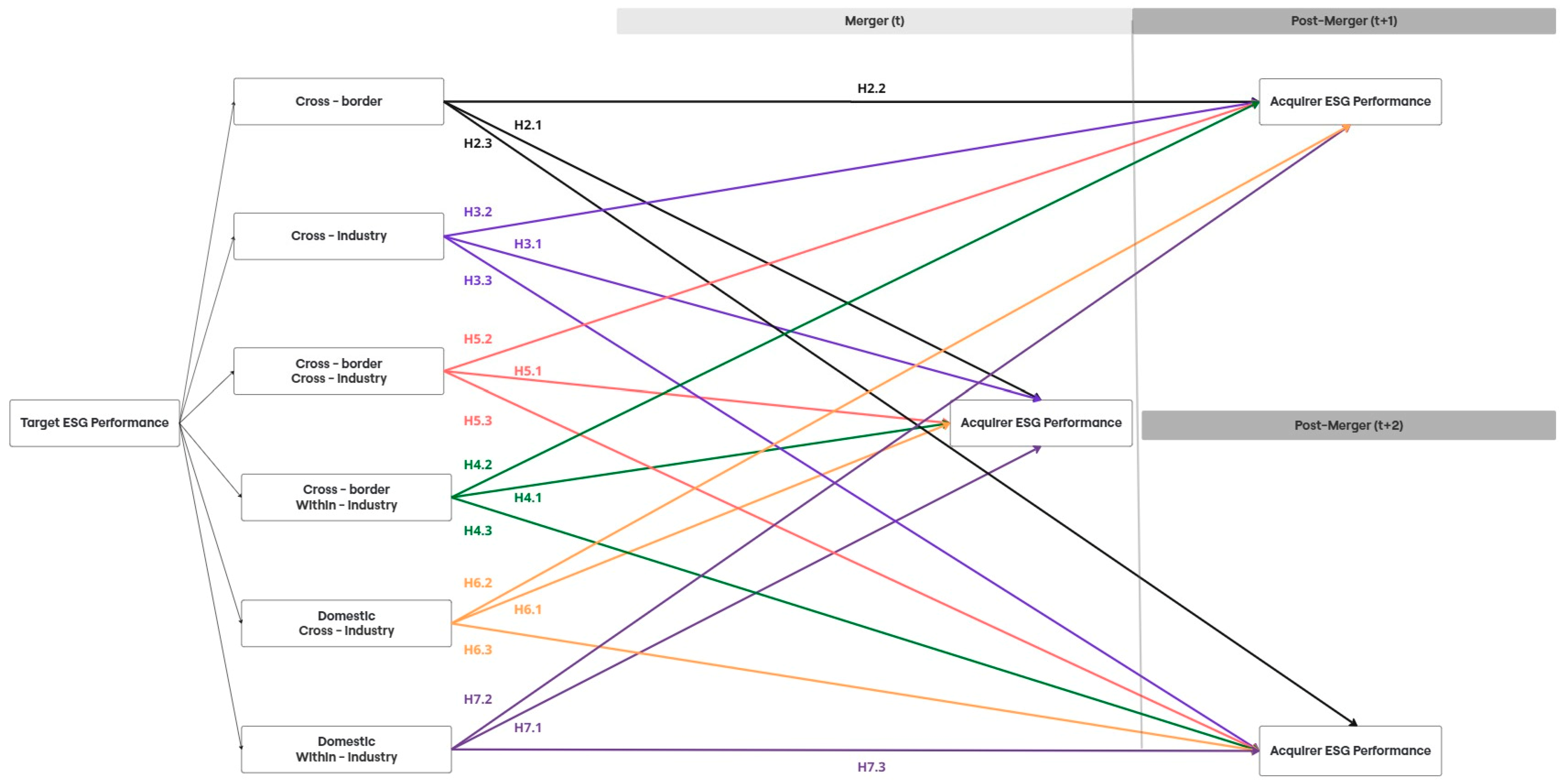
Our research design comprises two interrelated components. The first component focuses on the association between target ESG performance and acquirers’ post-merger ESG outcomes and market value across the transaction year (t) and the subsequent two years (t + 1, t + 2), as illustrated in Figure 1. The second component incorporates deal-level heterogeneity by distinguishing cross-border versus domestic and within-industry versus cross-industry transactions, as shown in Figure 2. Rather than modeling these deal characteristics solely as slope-based interaction terms, we conceptualize them as mutually exclusive structural merger configurations that generate systematically different post-merger ESG environments across institutional and industrial contexts.
These characteristics may either intensify integration challenges or facilitate the transfer of ESG-related knowledge and practices, thereby shaping the magnitude and persistence of observed sustainability spillovers. By embedding these contextual contingencies, the framework captures both the core mechanism of ESG capability transmission and the boundary conditions under which these transfers materialize as value-relevant outcomes.
Endogeneity concerns may arise due to reverse causality, omitted variables, and non-random target selection in M&A transactions. To mitigate these concerns, we adopt a multi-period framework aligned with merger timing, include a comprehensive set of firm-level controls, and employ industry-clustered standard errors. By aligning target ESG with subsequent post-merger acquirer outcomes across t, (t + 1), and (t + 2), our design reduces the likelihood that the observed associations merely reflect contemporaneous co-movements or purely disclosure-driven adjustments. Despite the temporal alignment of target ESG and post-merger acquirer outcomes, reverse causality and selection concerns cannot be fully eliminated. Acquirers may systematically select targets with similar ESG profiles or trajectories, implying that the observed associations may partly reflect assortative matching rather than pure post-merger integration effects. Therefore, the findings should be interpreted as robust associations rather than causal effects. In addition, ESG scores are outcome-based proxies that may not fully capture underlying sustainability capabilities or organizational routines, and the relatively short post-merger horizon (t to t + 2) may not fully reflect longer-term ESG convergence dynamics. These limitations imply that the results should be interpreted as indicative of structured ESG outcome patterns rather than as direct evidence of capability transfer or long-term sustainability transformation.
Accordingly, the first set of hypotheses (H1.1–H1.3 and their sub-hypotheses) examines whether target ESG scores are positively associated with acquirer ESG performance in the merger year (t), the first post-merger year (t + 1), and the second post-merger year (t + 2). The second group of hypotheses (H8.1–H8.3 and H9.1–H9.3) extends the analysis beyond sustainability integration by examining whether ESG capability integration is ultimately reflected in acquirer market valuation. Rather than modeling ESG as a formal mediating mechanism, we treat market value effects as a complementary extension that evaluates whether sustainability capability integration observed in ESG trajectories is reflected in capital market valuation. In addition, hypotheses H2–H7 examine whether ESG outcomes differ systematically across merger configurations defined by cross-border and cross-industry characteristics, relative to domestic within-industry transactions. These hypotheses test whether distinct institutional and industrial environments are associated with different ESG performance levels, conditional on target ESG and firm characteristics. Consistent with our measurement strategy, the dependent variable denoted as ESG corresponds to the controversies-adjusted combined ESG score. Although ESG performance is empirically observed through score-based measures, we conceptualize these scores as imperfect but informative empirical proxies for latent sustainability-related organizational capabilities. This specification ensures that the analysis incorporates not only firm-reported ESG disclosures but also the influence of ESG-related controversies. Accordingly, our empirical analysis adopts a capability-based perspective rather than a purely disclosure-based interpretation of ESG performance.
  • Let k ∈ {0,1,2} denote the merger year and the first two post-merger years.
  • Define X t = ( S i z e t ,   L e v e r a g e t ,   R O A t ,   M V t   )
        Z t = ( S i z e t ,   L e v e r a g e t ,   R O A t   )
  • Let d _ c o u n t r y { 0,1 } denote cross-border and
    d _ i n d u s t r y { 0,1 } denote cross-industry transactions.
    The merger-type indicators are defined as:
    d c 1 , d i 1   : Cross-border and cross-industry
    d c 0 , d i 1   : Domestic and cross-industry
    d c 1 , d i 0   : Cross-border and within-industry
    d c 0 , d i 0   : Domestic and within-industry; reference category
Model 1: Baseline ESG relationship
E S G A ,   t + k =   α +   β   E S G T ,   t + k +   τ   X t +   ε t + k
Model 2: Cross-border merger configuration
E S G A ,   t + k =   α +   β   E S G T ,   t + k +   δ   d c o u n t r y +   τ   X t +   ε t + k
Model 3: Cross-industry merger configuration
E S G A ,   t + k =   α +   β   E S G T ,   t + k +   λ   d i n d u s t r y + τ   X t +   ε t + k
Models 4–7: Merger-type configurations
E S G A ,   t + k =   α +   β   E S G T ,   t + k +   δ 1   d c 1 , d i 0 +   δ 2   d c 0 , d i 1 +   δ 3   d c 1 , d i 1 + τ   X t + ε t + k
This specification allows ESG outcomes to differ systematically across merger types relative to the domestic within-industry reference category.
Model 8 (Association between Target ESG and Acquirer Market Value):
M V A ,   t + k =   α +   β   E S G T ,   t + k + ω   Z   t + u t + k
Model 9 (Association between Acquirer ESG and Acquirer Market Value):
M V A ,   t + k =   α +   λ   E S G A ,   t + k + ω   Z t + u t + k
Models (1)–(7) are estimated using Tobit regression to account for the left-censored nature of ESG outcomes at zero. Ordinary least squares estimates would be biased and inconsistent in this setting due to censoring at zero and the resulting violation of the normality and linearity assumptions underlying ordinary least squares estimation (Gurıs et al., 2015). The Tobit framework jointly models the likelihood of positive ESG changes and their conditional magnitude, which is particularly appropriate in the M&A context where many firms exhibit no observable ESG improvement after the transaction.
All Tobit models employ industry-clustered robust standard errors, and the observed Hessian is used as the information matrix estimator. Models (8) and (9) are estimated using linear regression with identical clustering. Table 1 summarizes the definitions and measurement of all variables used in Models (1) through (9).

3.1. Data Sources and Sampling Procedure

We construct the sample from completed M&A recorded in the Thomson SDC Platinum Mergers and Acquisitions database. The initial universe comprises transactions completed between 1 January 2002 and 31 December 2023 across 47 countries that follow the MSCI developed–emerging market classification framework. To ensure comparability of operating and financial characteristics, we exclude financial firms (defined as acquirers with a primary Standard Industrial Classification (SIC) code between 6000 and 6999) and retain only non-financial acquirers (Nguyen et al., 2025; Tampakoudis & Anagnostopoulou, 2020). Following the deal taxonomy, we include transactions with disclosed or undisclosed consideration, tender offers, and leveraged buyouts. We exclude spin-offs, recapitalizations, self-tenders, repurchases, minority-stake purchases, acquisitions of remaining interest, exchange offers, and privatizations. Transactions are further screened to allow reliable data linkage: we require valid firm and security level identifiers to merge the M&A file with the ESG and market-based datasets, and exclude observations with missing or inconsistent identifiers.
The M&A file is merged with firm-level ESG measures provided by the London Stock Exchange Group (LSEG) and with market-based financial variables obtained from Worldscope. ESG information is analyzed both at the controversies-adjusted combined score and at the pillar level. Country classification follows MSCI taxonomy. A transaction is coded as cross-border when acquirer and target are domiciled in different countries, and as cross-industry when their two-digit SIC codes differ. These indicators are combined into mutually exclusive merger-type dummies. After applying all selection criteria and completing the merges, the final sample consists of 4572 acquirer-year observations. To account for cross-sectional dependence, standard errors are clustered at the industry level, yielding 11 industry clusters.

3.2. ESG Performance

The growing importance of sustainability and socially responsible investment (SRI) has increased demand for reliable indicators of firms’ ESG performance. Rating agencies meet this need by compiling disclosures from reports, CSR documents, corporate websites, and news sources into standardized metrics. Prominent systems include FTSE Russell, Bloomberg ESG Scores, and, most relevant for this study, the London Stock Exchange Group (LSEG Data & Analytics, 2024).
Following prior research (Barros et al., 2022), we use LSEG’s controversies-adjusted combined ESG score (ESGC) as the primary measure (hereafter ESG). ESGC integrates firm-reported practices with externally observed controversies, providing a comprehensive proxy of sustainability performance. LSEG covers more than 11,000 firms since 2002 and evaluates over 500 indicators across ten categories within the E, S, and G pillars on a 0–100 scale, while the controversies overlay spans 23 ESG-related risk themes (LSEG ESG Scores, 2025). The controversies adjustment spans 23 themes, reflecting both proactive initiatives and exposure to ESG risks.
Where appropriate, we analyze the three pillars separately to identify which dimensions respond most strongly to M&A activity. ESG values are aligned with merger timing and merged with transaction and market-level data as described in the sampling procedure. Consistent with our conceptual framework, these ESG measures are interpreted as observable indicators consistent with underlying sustainability-related organizational routines and practices rather than as purely symbolic disclosure outcomes.
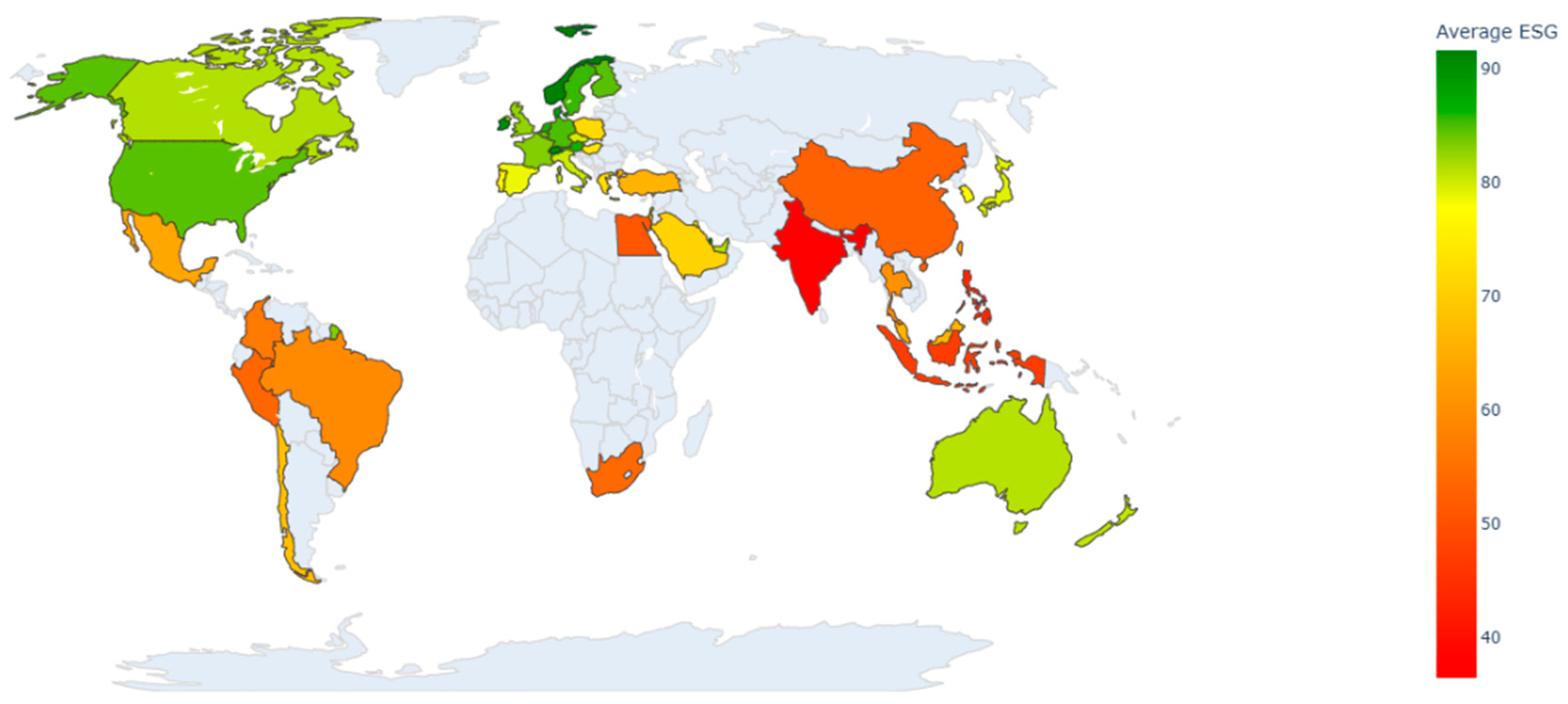
Table 2 reports the average country-level ESG scores obtained from LSEG, as defined by the MSCI-developed emerging market classification, for the period 2002–2023. It also shows the number of acquirer-year observations included in the sample for each country. The country-level ESG data represent the average firm-level performance within each country (rather than sample-specific averages for the acquirers). To compute the overall ESG benchmark for the analytic sample, country-level scores are weighted by the number of acquirer-year observations (N), ensuring proportional representation and avoiding distortions arising from unequal country sample sizes. The N-weighted average ESG across all acquiring firm-years equals 78.32, concealing substantial institutional heterogeneity. Developed markets average 82.86, whereas emerging markets average only 58.18. Dispersion is pronounced within both groups, ranging from 91.62 (Norway) to 75.30 (Israel) among developed markets and from 90.31 (Qatar) to 36.45 (India) among emerging markets, reflecting wide variation in regulatory quality, enforcement capacity, and disclosure practices.
Together, these cross-country patterns highlight substantial between- and within-group heterogeneity in sustainability practices and provide essential context for interpreting how institutional environments condition ESG outcomes in M&A transactions, thereby motivating our subsequent heterogeneity analyses.
Figure 3 maps ESG levels across 47 countries, showing higher scores in Northern and Western Europe and lower performance in South Asia and Latin America.
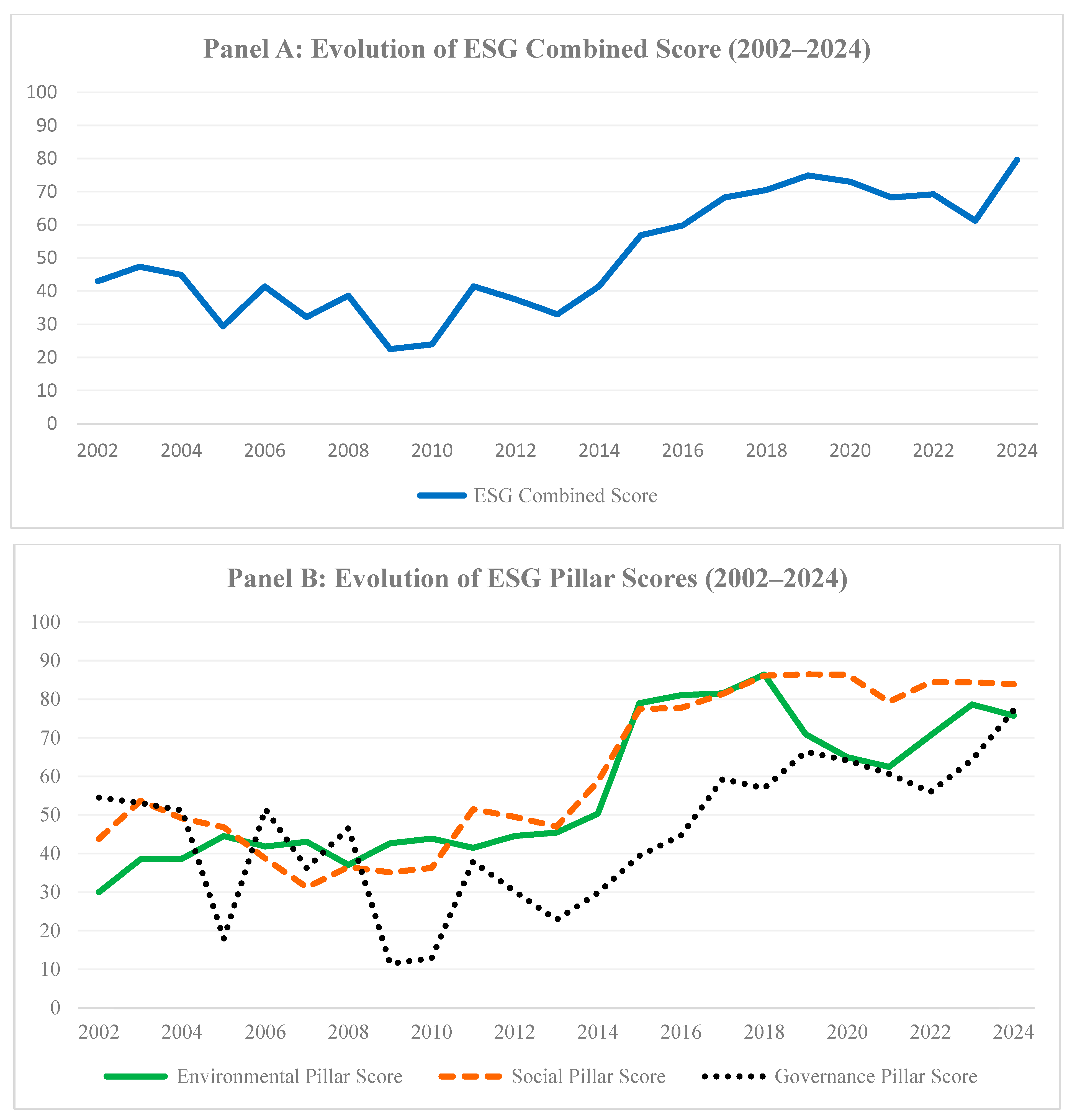
Figure 4 documents a steady upward ESG trajectory from the early 2000s to the late 2010s, with accelerated improvement after the mid-2010s, broadly consistent with intensified global sustainability initiatives. Growth is primarily driven by environmental and social pillars, whereas governance starts from a higher baseline and evolves more gradually. During the early 2020s, the social dimension strengthens further, reflecting heightened attention to workforce and community-related issues. These dynamics illustrate the shifting priorities of corporate sustainability, with environmental and social dimensions gaining increasing prominence relative to governance.

3.3. Market Value

In M&A research, market value (MV) provides a critical lens for assessing whether strategic transactions translate into durable financial gains. Although traditional event studies emphasize short-term announcement returns, such measures often fail to capture the gradual effects of post-merger integration and sustainability-related synergies (Alexandridis et al., 2017). Recent evidence indicates that ESG-related strengths, such as stakeholder relations, reputational capital, and risk management, are increasingly priced by financial markets over longer horizons (Zheng et al., 2025).
We operationalize firm value using Tobin’s Q, a forward-looking ratio that compares the market valuation of a firm with the book value of its assets. Unlike purely accounting-based measures, Tobin’s Q captures intangible sources of value such as innovation capacity, reputational capital, and sustainability-related organizational assets (Di Tommaso & Thornton, 2020). Values above one indicate that investors assign a premium reflecting growth opportunities and governance quality, whereas values below one signal discounted asset valuation due to weaker prospects or elevated risk (Tampakoudis & Anagnostopoulou, 2020).
Tobin’s Q is calculated as the market value of equity plus the book value of preferred stock and debt, divided by the book value of total assets. This specification is widely adopted in corporate finance and sustainability research because it integrates market expectations with accounting fundamentals (Albuquerque et al., 2019; Tampakoudis & Anagnostopoulou, 2020).
Tobin’s Q enters the analysis in two ways. In Models 1–7, it serves as a control capturing market-based valuation differences across firms. In Models 8–9, it becomes the dependent variable, allowing us to assess whether ESG performance, originating from target characteristics (Model 8) or from acquirer post-merger ESG trajectories (Model 9), is associated with higher market valuation. This design moves beyond short-term announcement effects and evaluates whether sustainability-oriented M&As generate durable financial value for acquiring firms.

3.4. Control Variables

To isolate the incremental role of ESG from core firm characteristics, we include three standard control variables, size, leverage, and profitability, which prior theory and empirical evidence identify as primary determinants of valuation and post-merger performance.
Firm size captures variation in scale, financing conditions, and organizational capacity. Larger acquirers typically benefit from scale economies, lower financing frictions, and more formalized governance and disclosure structures. Size is measured as the natural logarithm of total assets, a standard proxy that reduces skewness and is widely used in sustainability and M&A research (Barros et al., 2022; Tampakoudis & Anagnostopoulou, 2020).
Leverage reflects firms’ capital structure choices that influence risk tolerance and investment capacity during integration. Higher leverage may constrain discretionary sustainability investments and increase refinancing risk, whereas lower leverage relaxes financing constraints and facilitates ESG initiatives. Leverage is measured as total liabilities divided by total assets, a standard ratio that ensures cross-country comparability (Krishnamurti et al., 2019; Kwon et al., 2018).
Profitability represents the internal resource base available for post-merger integration and ESG improvement. More profitable firms possess greater slack resources to support sustainability initiatives and may also be jointly priced with ESG attributes in capital markets. We measure profitability using return on assets, which is less sensitive than ROE and therefore more suitable for multi-country samples (Kwon et al., 2018; Tampakoudis & Anagnostopoulou, 2020).
Including size, leverage, and ROA in all model specifications mitigates omitted-variable bias by controlling for variation in scale, financial risk, and operating performance that could otherwise be confounded with ESG effects in M&A settings.

4. Results and Discussion

4.1. Descriptive Statistics

Table 3 presents the summary statistics of all key variables employed in the regression models.
The mean ESG score of acquiring firms is 34.34 (median = 36.68), indicating moderate sustainability performance with a slightly right-skewed distribution. This dispersion reflects heterogeneity in organizational routines, governance structures, and stakeholder engagement capacities, consistent with a capability-based interpretation of ESG. Among the pillars, Governance exhibits the highest mean (39.13), suggesting that governance routines and disclosure practices are more institutionally embedded than environmental and social initiatives, in line with institutional theory. Social and Environmental scores follow with means of 37.19 and 33.09, respectively.
Target firms exhibit a substantially lower average ESG score (23.92), indicating weaker sustainability capabilities relative to acquirers and creating scope for post-merger ESG capability transfer. The high dispersion (SD = 25.98) reveals pronounced heterogeneity among targets, a necessary condition for capability recombination emphasized in resource-based and organizational learning perspectives. At the pillar level, governance again dominates (mean = 27.45), suggesting greater institutionalization of governance routines relative to environmental and social practices.
The average firm size (16.90) indicates that the sample is dominated by relatively large acquirers, consistent with the requirement of organizational scale and absorptive capacity for complex M&A transactions. The mean leverage ratio (0.52) and ROA (6.24%) reflect financial discipline and moderate profitability. Together, these characteristics support slack-resources arguments that financially capable firms are better positioned to sustain ESG integration. Market valuation averages 1.64, indicating that investors assign a premium to acquiring firms beyond book value.
Regarding deal characteristics, 15.9% of transactions are cross-border and 11.5% are cross-industry, indicating that most mergers occur within homogeneous institutional and industrial contexts. This distribution underscores the relevance of explicitly testing ESG outcomes under more complex merger environments. Overall, the statistics reveal substantial cross-firm and cross-deal variation, with ESG outcomes displaying both mass points at zero and wide dispersion. This distributional structure provides strong justification for employing a Tobit framework to model heterogeneous post-merger sustainability trajectories.
Table 4 reports descriptive statistics for ESG pillars at both acquirer and target levels. Governance exhibits the highest average scores, indicating deeper institutionalization, whereas Environmental performance shows the lowest mean and greatest dispersion, reflecting substantial heterogeneity and scope for post-merger upgrading. The Social pillar occupies an intermediate position, suggesting moderate but uneven stakeholder-related performance.
These patterns are consistent with prior M&A–ESG evidence (Barros et al., 2022), in which governance dominates ESG structures while environmental performance remains the most volatile component.
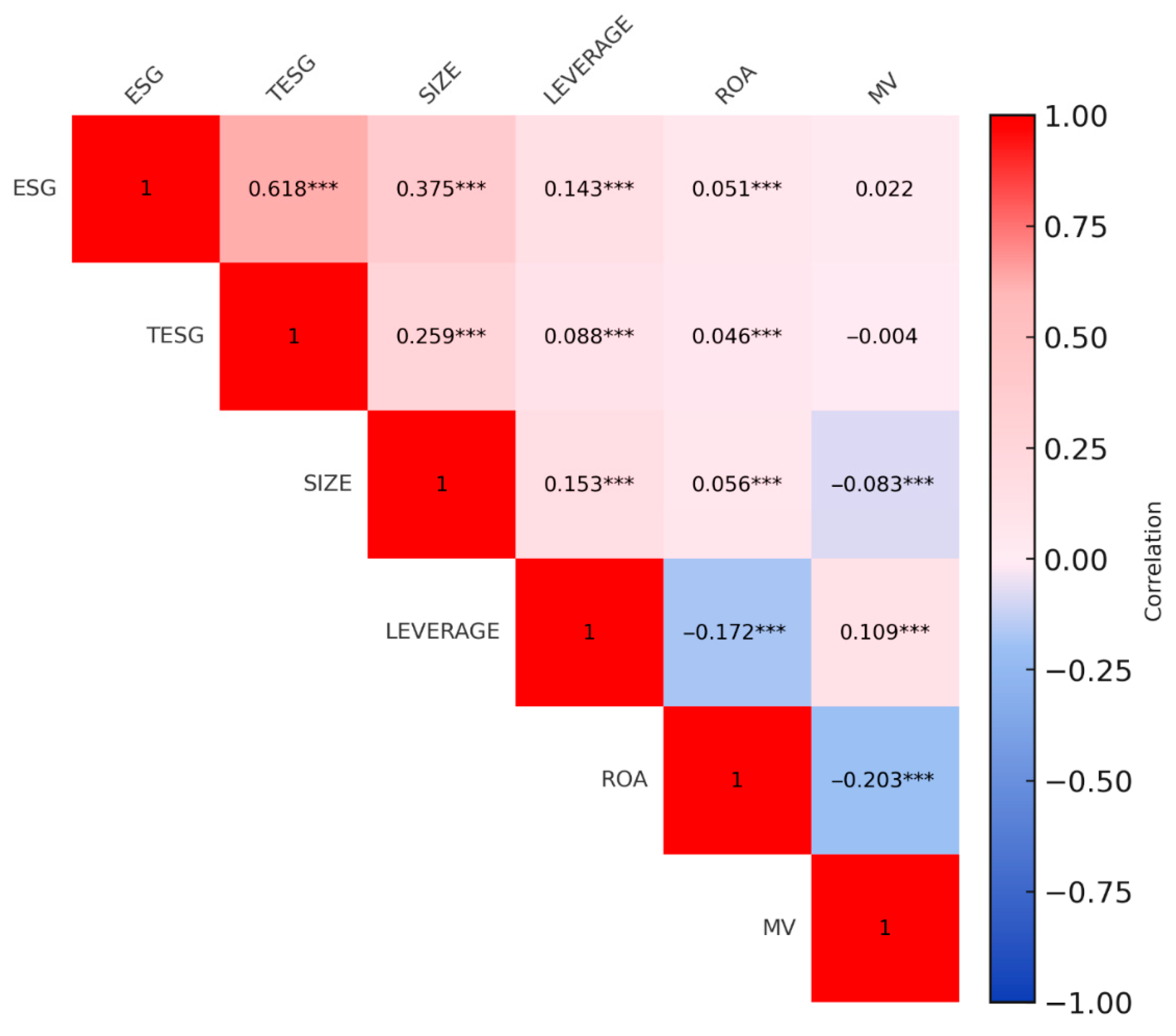
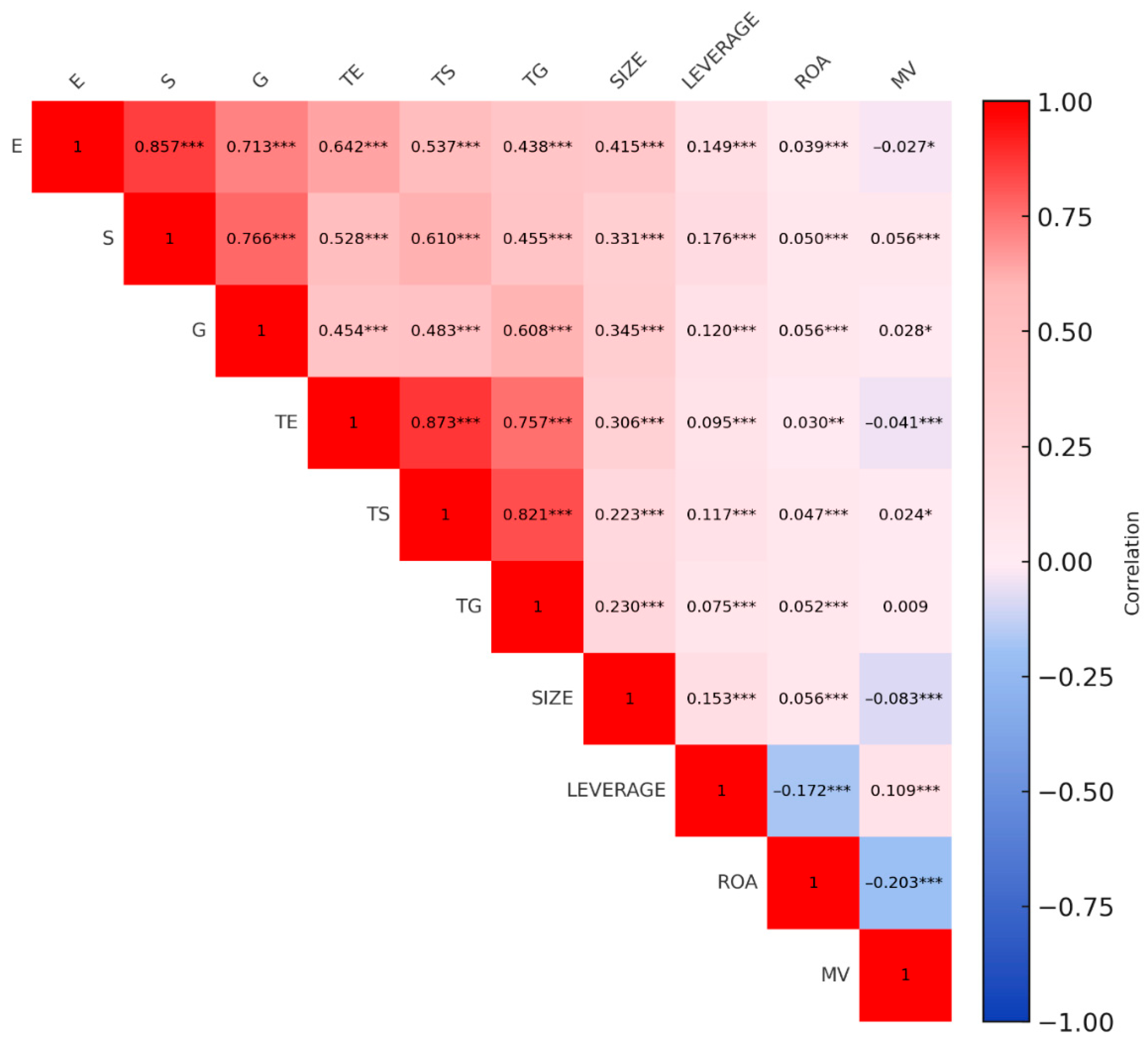
Figure 5 and Figure 6 report the Pearson correlation coefficients among the main variables and the ESG pillar-level variables, respectively. Acquirer ESG is strongly correlated with target ESG (ρ = 0.618, p < 0.01), indicating assortative matching in partner selection, consistent with signaling and information-asymmetry arguments. Firm size is also positively associated with ESG for both acquirers and targets, reflecting scale advantages in disclosure and governance capacity. Leverage shows weak positive correlations with ESG, while ROA exhibits very small positive associations. Market valuation is negatively related to size and profitability, and remains largely uncorrelated with ESG in unconditional terms, indicating that sustainability and valuation capture distinct dimensions of firm quality.
Figure 6 decomposes ESG into its environmental, social, and governance pillars for acquirers and targets. Within-firm ESG pillars are highly correlated, reflecting shared reporting processes and integrated sustainability routines. Cross-party pillar correlations are moderate but significant, supporting the premise that sustainability attributes co-move and are potentially transferable between merging firms. This alignment further indicates that ESG disclosure mechanisms are standardized across firms, reducing measurement heterogeneity. Cross-party pillar correlations are moderate but significant (e.g., E–TE ρ = 0.642; S–TS ρ = 0.61; G–TG ρ = 0.608; all p < 0.01), indicating meaningful co-movement between acquirer and target ESG attributes and supporting the conceptual premise behind Hypotheses H1–H3 that sustainability-related capabilities co-move and are potentially transferable between merging firms.
The control variables display intuitive patterns. Firm size is positively related to acquirer and target pillars (ρ ≈ 0.22–0.42), consistent with scale economies in disclosure and sustainability infrastructure. Leverage exhibits small positive correlations with pillars (ρ ≈ 0.08–0.18), whereas ROA shows very small positive associations (ρ ≈ 0.03–0.06). Market value displays mixed and economically small links with pillars (e.g., S–MV ρ = 0.056; TE–MV ρ = −0.041), indicating that the unconditional link between individual pillars and valuation is weak in levels and will be better identified in the multivariate setting. These results reinforce the idea that financial performance and sustainability outcomes coexist but capture different dimensions of firm quality.
Collectively, these patterns indicate meaningful co-movement between acquirer and target sustainability attributes alongside limited unconditional overlap between ESG and financial controls. This motivates the subsequent multivariate analysis, in which ESG outcomes are interpreted as manifestations of underlying sustainability capabilities rather than purely disclosure-driven metrics.

4.2. Regression Analysis and Discussion

In all specifications, we employ Tobit estimations to accommodate the limited-dependent nature of the ESG outcomes. The ESG and pillar variables are left-censored at zero and exhibit a pronounced mass point at this boundary. In addition, ESG coverage varies across firms and years, yielding an unbalanced panel. Accordingly, Tobit models are appropriate for describing post-merger sustainability dynamics under censoring, and we report marginal effects (dy/dx) to facilitate economic interpretation. Conceptually, this approach is consistent with an integration-based interpretation of post-merger ESG dynamics: many acquirers exhibit no observable ESG improvement (censoring at zero), whereas others display measurable gains that are consistent with post-merger learning and organizational adjustment. Importantly, the Tobit structure captures (i) whether ESG improvements are observed and (ii) their magnitude when observed; it does not directly observe the underlying micro-mechanisms of capability transfer.
The observable ESG measure follows:
y i , t =   0                   i f   y i , t *   0 y i , t *             i f   y i , t *   > 0 ,
where y i , t * is the latent (uncensored) sustainability outcome. Because the conditional expectation of y i , t is nonlinear in the covariates when censoring is present, linear estimators may be inconsistent (Maddala, 1983). The Tobit estimator addresses this by simultaneously modeling (i) the probability that the ESG outcome crosses the censoring threshold and (ii) the expected magnitude of the outcome among uncensored observations. This dual structure is well suited to post-merger sustainability outcomes: some firms show no measurable ESG improvement, while others do. Interpreting these patterns through organizational learning and RBV is conceptually informative, but our empirical design identifies robust associations in ESG outcomes rather than directly tracking the transfer, absorption, or redeployment of specific ESG routines.
Importantly, while the discussion is informed by capability-integration perspectives, the empirical design identifies robust associations rather than directly observing micro-level transfer mechanisms. Therefore, the results are interpreted as robust patterns in ESG outcomes that are consistent with the proposed theoretical mechanisms, while acknowledging that causal claims and direct tests of capability transfer mechanisms are beyond the scope of the observational design. Economic interpretations are based on marginal effects (dy/dx) reported in the second parentheses, while industry-clustered robust standard errors are reported in the first parentheses.
The Tobit results for Models 1.1 to 1.3 indicate that target ESG performance is positively and statistically significantly associated with acquirers’ combined ESG outcomes across all three horizons. This temporal persistence is consistent with integration and institutionalization interpretations emphasized in the RBV and organizational learning literature, while the estimates themselves should be interpreted as robust associations in ESG outcomes rather than direct evidence of routine-level capability transfer. The results contribute to ESG–M&A research by demonstrating that post-merger ESG outcomes are systematically conditioned by merger configuration and institutional context. Importantly, these findings extend prior studies such as (Tampakoudis & Anagnostopoulou, 2020) and (Barros et al., 2022) by moving beyond predominantly static ESG–performance associations and providing evidence on the temporal evolution and configurational heterogeneity of ESG integration. By contrast, our results uncover the temporal dynamics and configurational heterogeneity of ESG integration, thereby advancing the literature toward a more nuanced and process-oriented understanding of post-merger sustainability outcomes. Rather than supporting a simplistic transfer logic, the findings suggest that ESG evolution reflects a joint process of organizational learning, legitimacy adaptation, and selective institutionalization. This interpretation further strengthens the ESG–M&A evidence by emphasizing temporal dynamics and configuration sensitivity, thereby extending the predominantly static and linear perspectives in earlier studies that focus on contemporaneous ESG–performance associations. Consistent with this dynamic framework, the results reveal a persistent but gradually attenuating ESG adjustment pattern alongside a delayed valuation response, reinforcing the importance of temporal dynamics in post-merger sustainability integration.
Table 5 reports Tobit marginal effects (dy/dx) for Model 1, where the dependent variables are the acquirer’s combined ESG score and its three pillars (E, S, G) across the merger year (t) and the first two post-merger years (t + 1 and t + 2). Target ESG is positively and significantly associated with acquirer ESG at all horizons (dy/dx = 0.55 at t, 0.49 at t + 1, and 0.48 at t + 2), indicating a persistent yet gradually attenuating relationship. This attenuation is consistent with a post-merger integration trajectory in which ESG alignment is strongest around deal completion and moderates as integration stabilizes, in line with learning-based interpretations. Pillar-level estimates reveal differentiated adjustment dynamics. The pillar-level patterns align with a differentiated integration interpretation. Environmental and Social pillars exhibit relatively stable associations across horizons, suggesting greater standardization in post-merger integration. Governance effects remain positive but attenuate more strongly over time. This slower adjustment is consistent with the institutional and regulatory rigidity surrounding governance structures. Unlike environmental reporting systems or social engagement initiatives, governance integration requires formal alignment of board structures, committee compositions, executive compensation schemes, internal control systems, audit practices, and shareholder-rights frameworks. These elements are embedded in national corporate law, listing requirements, and investor protection regimes, making cross-firm harmonization structurally more complex and path-dependent. Consequently, governance convergence typically unfolds more gradually than environmental and social adjustments, reflecting regulatory constraints and formal organizational restructuring processes rather than purely managerial discretion. These results are interpreted as theory-consistent outcome patterns rather than direct evidence of underlying routines. Control variables display economically meaningful and theoretically coherent effects. Firm size and ROA remain positive, supporting slack-resources arguments regarding integration and sustainability capacity. Leverage also enters positively, consistent with agency-based monitoring and creditor discipline reinforcing ESG compliance. Market value is positively associated with ESG outcomes, while its valuation role is examined explicitly in Models 8–9. Overall, Model 1 supports a hybrid interpretation in which post-merger ESG outcomes reflect both strategic capability redeployment (RBV/organizational learning) and legitimacy-seeking adaptation (stakeholder and institutional theory), with the relative pace differing across ESG pillars.
As reported in Table 6, Model 2 indicates that target ESG remains positively associated with acquirer ESG across all horizons, while the cross-border indicator is positive and economically large. This pattern is consistent with institutional theory, as cross-border deals intensify regulatory and stakeholder scrutiny and strengthen incentives for ESG integration. The interpretation remains outcome-based and associative. From an information-asymmetry perspective, cross-border uncertainty increases the value of transparency and sustainability signaling. The positive cross-border coefficient reflects multi-jurisdictional scrutiny, regulatory heterogeneity, and the diffusion of stricter reporting standards. Thus, cross-border acquisitions not only transmit sustainability practices but also activate institutional and reputational incentives that reinforce ESG integration. Pillar-level results reveal distinct temporal dynamics. The Environmental pillar exhibits stable effects (0.58, 0.54, 0.52), consistent with standardized and compliance-oriented environmental routines being efficiently integrated. The Social pillar shows the strongest and most persistent association (0.60, 0.54, 0.53), reflecting heightened stakeholder visibility and legitimacy concerns in cross-border mergers. By contrast, the Governance pillar, although remaining positive across all periods (0.59, 0.51, 0.47), shows a sharper decline over time, reflecting the greater institutional complexity, cultural heterogeneity, and longer adjustment horizons required for governance convergence. This slower adjustment is driven by concrete regulatory frictions, including differences in board independence requirements, minority shareholder protection rules, disclosure standards, and enforcement intensity across jurisdictions. These differences necessitate formal restructuring processes and board-level adjustments, which are typically subject to legal approval, shareholder consent, and regulatory compliance procedures, thereby slowing the alignment of governance systems relative to more operational ESG dimensions. Control variables exhibit economically meaningful and theoretically coherent patterns. Firm size remains positive and significant, reflecting scale economies in ESG infrastructure and disclosure (Drempetic et al., 2020). ROA remains positive, supporting slack-resources arguments. Leverage also enters positively with large magnitudes, consistent with the intensified monitoring and transparency expectations imposed by global lenders and institutional investors. Market value shows stable positive associations, indicating that capital markets reward sustained ESG improvements during integration. Overall, cross-border mergers exhibit stronger ESG outcomes due to higher institutional scrutiny and learning incentives. As ESG ratings are outcome measures, the findings are interpreted as patterns consistent with capability integration rather than direct evidence of capability inheritance. Environmental and social practices, being more visible and standardized, are integrated more rapidly, whereas governance adjustments require longer institutionalization windows. Collectively, the results support a hybrid interpretation in which cross-border M&As facilitate sustainability integration through both resource recombination (Barney, 1991) and legitimacy-seeking adaptation (Barros et al., 2022; Tampakoudis & Anagnostopoulou, 2020).
As presented in Table 7, Model 3 shows that target ESG remains positively and statistically significantly associated with acquirer ESG across all horizons. The positive cross-industry indicator is consistent with RBV and recombination logic, as industrial heterogeneity expands opportunities for sustainability-related resource recombination. From a stakeholder perspective, industry diversification increases visibility and scrutiny, strengthening incentives for ESG engagement. Accordingly, cross-industry acquirers achieve higher ESG outcomes. Sectoral heterogeneity therefore does not hinder sustainability integration but activates legitimacy and learning incentives (Barney, 1991). Pillar-level results reveal heterogeneous adjustment dynamics. The Environmental pillar exhibits stable effects (0.54, 0.51, 0.49), consistent with standardized and codified environmental routines being highly transferable. The Social pillar shows strong and persistent associations (0.57, 0.52, 0.51), reflecting its continued legitimacy relevance in cross-industry contexts. The Governance pillar remains positive (0.56, 0.48, 0.45) but attenuates more strongly, reflecting greater complexity of cross-sector governance alignment. This complexity is further reinforced by differences in sector-specific regulatory frameworks, reporting standards, and compliance requirements, which require time-intensive adjustments in internal control systems and oversight structures. Nevertheless, the persistence of significance indicates that governance convergence, although gradual, reinforces post-merger transparency and institutional stability. Control variables follow economically meaningful and theoretically coherent effects. Firm size and ROA remain positive, supporting absorptive capacity and slack-resources arguments. Leverage also enters positively, consistent with creditor and investor monitoring pressures (Dhaliwal et al., 2011). Market value maintains a positive and significant relationship with ESG outcomes, implying that capital markets reward sustainability improvements following industrial diversification. Altogether, sustainability routines diffuse effectively even across industry boundaries. Cross-industry M&As are therefore compatible with improved post-merger ESG outcomes. This pattern is consistent with both recombination-learning and legitimacy-based interpretations, while reflecting outcome associations rather than direct observation of capability transfer. Collectively, these findings reinforce the complementary insights of the RBV and stakeholder theory by showing that sectoral diversification enhances both strategic capability recombination and legitimacy-oriented adaptation in post-merger sustainability trajectories.
Table 8 shows that in cross-border within-industry acquisitions (Model 4), target ESG is positively and significantly associated with acquirer ESG across all horizons. The effects decline only modestly over time (0.58, 0.51, 0.50), indicating a persistent sustainability linkage. This pattern suggests efficient absorption and retention of sustainability practices despite cross-national differences. The result supports the RBV, as industry similarity facilitates knowledge transfer and the redeployment of ESG-related intangible capabilities, and aligns with stakeholder theory, which emphasizes legitimacy-seeking behavior in cross-border settings. The indicator for cross-border within-industry transactions is positive and highly significant, confirming that such deals systematically generate higher ESG outcomes. This configuration combines sectoral familiarity with international legitimacy pressures, creating a favorable environment for sustainability diffusion. Pillar-level results display highly consistent adjustment dynamics. The Environmental pillar shows the most stable effects (0.57, 0.53, 0.51), consistent with standardized environmental routines being easily transferable. The Social pillar also shows strong and persistent effects (0.59, 0.54, 0.52), suggesting that employee welfare, diversity, and community engagement practices are effectively internalized when acquirers and targets share industry-specific operational norms. This pattern reflects the importance of stakeholder legitimacy in cross-border integration. The Governance pillar remains positive (0.58, 0.50, 0.46) but attenuates more strongly, reflecting greater institutional complexity. In cross-border settings, this complexity is amplified by differences in legal systems, investor protection regimes, and governance codes, which require gradual alignment and limit the speed of governance convergence. Nevertheless, the continued significance of governance effects confirms its central role in sustaining post-merger accountability and institutional convergence. Control variables display economically and theoretically coherent patterns. Firm size and ROA remain positive, supporting absorptive capacity and slack-resources arguments. Leverage also enters positively, consistent with creditor and investor monitoring pressures. Market value maintains a positive association with ESG performance, implying that investors reward visible sustainability progress as cross-border integration unfolds. Overall, cross-border within-industry mergers generate the strongest ESG improvements. Collectively, this configuration is associated with particularly strong ESG outcomes.
As reported in Table 9 (Model 5), in cross-border cross-industry acquisitions, target ESG is positively and significantly associated with acquirer ESG across all horizons. The estimated effects decline only moderately over time (0.55, 0.49, 0.48), indicating persistence despite high institutional and industrial heterogeneity. This finding supports the RBV, which emphasizes the strategic value of rare and inimitable ESG-related resources, and aligns with stakeholder theory, as acquirers operating in unfamiliar environments face stronger incentives to enhance transparency and legitimacy. The indicator capturing transactions that span both national and industry boundaries is positive and highly significant, confirming that such complex mergers are systematically associated with higher ESG outcomes. This reflects the joint influence of dual legitimacy pressures and cross-domain capability recombination. Disaggregating the combined ESG score reveals differentiated adjustment dynamics across pillars. The Environmental pillar shows strong and persistent effects (0.54, 0.51, 0.49), consistent with the codified and transferable nature of environmental routines. The Social pillar also exhibits robust persistence (0.56, 0.51, 0.50) The Governance pillar attenuates more strongly (0.55, 0.48, 0.44), reflecting greater institutional and regulatory complexity. These challenges stem from the need to reconcile heterogeneous governance regimes, including differences in legal enforcement, disclosure practices, and board accountability mechanisms across countries and industries. Control variables exhibit economically and theoretically consistent patterns. Firm size and ROA remain positive and statistically significant, indicating that larger and more profitable firms possess stronger absorptive capacity and greater resources to support sustainability integration. Leverage also shows strong positive effects, consistent with intensified monitoring by creditors and institutional investors, which encourages enhanced ESG transparency. Market value maintains a positive association with ESG performance, suggesting that investors reward visible sustainability progress even in highly complex merger settings. Jointly, ESG integration remains feasible even in highly complex merger configurations. Cross-border and cross-industry mergers therefore represent demanding but strategically valuable settings. Collectively, the findings reinforce the predictions of the RBV, stakeholder theory, and shareholder theory by showing that ESG integration simultaneously enhances legitimacy, strengthens strategic capabilities, and contributes to long-term value creation in globally diversified mergers.
Table 10 (Model 6) shows that in domestic cross-industry acquisitions, target ESG is positively and significantly associated with acquirer ESG across all horizons. The estimated effects decline only modestly from the merger year to (t + 2) (0.55, 0.49, 0.48), demonstrating that sustainability capabilities can be transferred and sustained even when acquirers diversify into new industries within their home institutional environment. This pattern is consistent with RBV-based capability recombination across industries. The domestic cross-industry indicator is positive and highly significant. This reflects reputational incentives and institutional expectations in domestic diversification. Disaggregating ESG into its individual pillars reveals differentiated adaptation dynamics. The Environmental pillar exhibits strong persistence (0.53, 0.51, 0.49), consistent with regulatory and disclosure harmonization within domestic markets. The Social pillar exhibits the strongest initial association (0.56, 0.51, 0.50), suggesting that employee welfare, diversity initiatives, and community engagement benefit from local institutional familiarity and stakeholder proximity. This pattern is consistent with stakeholder-based legitimacy arguments. The Governance pillar remains positive but attenuates over time (0.55, 0.47, 0.44). This reflects the longer institutionalization process of governance alignment. Even within domestic settings, governance harmonization requires adjustments in internal control systems, compliance procedures, and board oversight practices, which evolve more gradually than operational ESG dimensions. Firm size and ROA remain positive and statistically significant, indicating that larger and more profitable acquirers possess greater absorptive capacity and financial resources to support sustainability integration. Leverage also maintains strong positive effects, consistent with heightened monitoring by domestic creditors, which encourages transparency and sustainability reporting. Market value exerts a positive influence as well, suggesting that investors reward domestic acquirers that successfully translate ESG improvements into value-enhancing outcomes. Overall, domestic cross-industry mergers generate systematic ESG spillovers. Industrial heterogeneity provides learning opportunities despite weaker institutional pressure. Collectively, the findings support the RBV, stakeholder theory, and shareholder perspectives by showing that domestic diversification facilitates ESG learning, strengthens legitimacy, and contributes to sustainable firm performance.
Table 11 (Model 7) shows a distinct pattern for domestic within-industry mergers. The coefficient on the domestic within-industry indicator is negative and highly significant, indicating that these transactions are associated with lower ESG levels relative to the reference category, consistent with more limited incremental scope under high institutional and industrial similarity. This suggests diminishing marginal scope for ESG improvement under high institutional and industrial similarity. Despite this configuration effect, target ESG remains strongly and positively associated with acquirer ESG across all horizons. The persistence of these coefficients demonstrates that ESG-related routines continue to diffuse efficiently between acquirers and targets operating within the same industry and country. However, the combination of a strong target ESG effect and a negative merger-type indicator implies that while ESG alignment is rapid, incremental improvement is constrained by high baseline similarity between the merging firms. Pillar-level results clarify this mechanism. The Environmental pillar exhibits the strongest and most persistent influence (0.59, 0.56, 0.53), indicating that environmental practices are quickly standardized among firms operating under identical regulatory regimes. The Social pillar shows similarly robust effects (0.61, 0.56, 0.54), reflecting the efficient diffusion of social practices within shared stakeholder environments. These outcomes underscore the importance of social legitimacy in maintaining local stakeholder trust. The Governance pillar remains positive and statistically significant across all periods (0.60, 0.52, 0.48), although its gradual decline highlights the longer institutionalization horizon required for governance harmonization, even when firms share industrial and national characteristics. Governance integration remains stabilizing but gradually consolidating. Firm size and ROA remain positive and significant, indicating that larger and more profitable acquirers possess superior absorptive capacity and resource flexibility to sustain ESG practices. Leverage also preserves a strong positive association, implying that monitoring by domestic creditors reinforces transparency and sustainability discipline. Market value remains positively related to ESG outcomes, suggesting that investors continue to reward measurable ESG alignment even in homogeneous merger contexts. The findings broadly suggest domestic within-industry mergers are associated with lower ESG outcomes relative to more complex configurations. This pattern is consistent with institutional and stakeholder perspectives: when both institutional and industrial contexts are highly homogeneous, external legitimacy pressures and novelty-driven learning incentives are weaker, making ESG upgrading less likely to be prioritized during integration. From an RBV standpoint, high similarity can also reduce the marginal gains from recombination because the acquired sustainability resource base overlaps more strongly with the acquirer’s existing routines, implying diminishing incremental scope for post-merger ESG improvement. These findings suggest that in highly homogeneous environments, observable ESG outcomes are less likely to improve relative to other configurations.
The comparative analysis of Models 4 through 7 provides a consolidated view of how different merger configurations shape acquirer ESG outcomes over time, as summarized in Table 12 and Table 13. The ranking of merger types is highly consistent across all post-merger horizons and aligns with a joint RBV/organizational learning and stakeholder/institutional interpretation: industry proximity facilitates absorptive capacity, whereas cross-border exposure intensifies legitimacy pressure and disclosure incentives. These interpretations provide theory-consistent explanations of outcome patterns rather than causal claims.
In the merger year, cross-border within-industry transactions exhibit the largest marginal ESG effect (17.53), indicating that acquirers operating in familiar industrial settings but unfamiliar regulatory environments achieve the strongest sustainability gains. This configuration reflects intensified international legitimacy pressure and strong incentives for ESG alignment. Consistent with stakeholder theory, cross-border exposure amplifies scrutiny from regulators, investors, and civil society, encouraging more transparent and responsible conduct. The second-largest effects are observed for cross-border cross-industry mergers (13.82), suggesting that geographic and industrial diversification jointly expand sustainability capability recombination opportunities, albeit under higher coordination and institutional adaptation costs. This pattern supports the RBV by highlighting the trade-off between access to novel ESG resources and integration complexity. Domestic cross-industry mergers display smaller but still positive marginal effects (3.32), implying that sustainability learning occurs primarily through industrial diversification rather than institutional novelty. The absence of cross-border legitimacy pressures limits the transformative potential of ESG integration, resulting in incremental rather than structural sustainability improvement. In contrast, domestic within-industry mergers generate negative marginal effects across all horizons (−15.23, −13.89, −12.86), indicating that highly homogeneous environments constrain ESG advancement. When acquirers and targets share similar institutional and industrial contexts, both capability recombination potential and external monitoring pressure are limited, resulting in diminishing marginal returns in sustainability development. Although the magnitude of all effects gradually attenuates over time, reflecting post-merger integration normalization, the relative ranking remains remarkably stable. This stability underscores that merger structure exerts a persistent influence on sustainability trajectories beyond the immediate integration phase. Taken together, these findings demonstrate that the scope and complexity of M&A transactions systematically shape post-merger ESG outcomes. Cross-border mergers, particularly within-industry combinations, emerge as the most effective vehicles for sustainability capability transfer, combining strong absorptive capacity with intensified legitimacy incentives. Conversely, purely domestic consolidations, especially within-industry, tend to yield limited ESG advancement due to low recombination potential and reduced institutional pressure. Collectively, the evidence supports a hybrid theoretical perspective in which ESG integration reflects both strategic capability development and legitimacy-driven adaptation processes. In relation to prior ESG–M&A studies, the present results both confirm and extend existing evidence. Consistent with (Tampakoudis & Anagnostopoulou, 2020) and (Barros et al., 2022), we document a positive association between target ESG and post-merger acquirer ESG outcomes. However, unlike these studies, which primarily adopt a static or short-horizon perspective, our findings reveal a multi-period adjustment process with gradual attenuation and pillar-level heterogeneity, thereby providing a more dynamic view of ESG integration.
Moreover, the results extend the prior literature by showing that ESG outcomes are systematically conditioned by merger configuration. While earlier studies typically focus on average effects, our analysis demonstrates that cross-border within-industry transactions generate the strongest ESG improvements, highlighting the joint role of institutional pressure and absorptive capacity. This configuration-based evidence contributes to a more nuanced understanding of when ESG integration is most effective.
As presented in Table 14, Model 8 examines whether target firms’ ESG performance translates into higher market valuation for acquirers over the merger year and subsequent periods. The results indicate that the association between target ESG and acquirer valuation is not immediate but becomes statistically evident at (t + 1). This timing is consistent with a verification and institutionalization interpretation: markets place greater weight on target ESG once post-merger outcomes make sustainability integration more observable. From signaling and stakeholder perspectives, capital markets discount pre-merger sustainability attributes until ESG improvements become verifiable through post-merger integration outcomes. In RBV terms, ESG-related routines contribute to valuation only after they are absorbed, recombined, and operationalized within the acquirer’s processes, implying that the market response depends on observable institutionalization rather than deal-time promises.
Accordingly, Model 8 supports a time-lagged valuation association in which target-linked sustainability attributes become value-relevant after observable integration progress. Consistent with stakeholder theory, sustainability attributes must be demonstrated through credible post-merger practices before being reflected in market valuation. Similarly, the RBV implies that ESG-related routines contribute to firm value only after organizational institutionalization. The control variables display economically coherent dynamics. Firm size enters negatively, indicating that valuation ratios of larger acquirers are less sensitive to ESG-related changes due to scale and diversification effects. Leverage remains positive across all horizons, consistent with the view that higher monitoring by creditors and investors enhances the valuation impact of disciplined post-merger integration. Profitability exhibits a time-varying profile: the initial negative coefficient reflects short-term integration costs and accounting adjustments in the merger year, whereas the subsequent positive effect indicates that financially stronger acquirers regain market confidence once integration stabilizes and synergies begin to materialize. Collectively, Model 8 demonstrates that target ESG quality generates a delayed but economically meaningful valuation premium, which peaks in the first post-merger year and moderates thereafter. This evidence indicates that sustainability-driven M&As create value through gradual institutionalization rather than immediate signaling. This finding complements prior ESG–valuation studies, e.g., (Barros et al., 2022; Tampakoudis & Anagnostopoulou, 2020), which primarily document contemporaneous or short-horizon effects, by showing that valuation relevance emerges with a lag as ESG integration becomes observable.
Model 9 shows that the acquirer’s ESG is positively associated with valuation at (t) and (t + 1), with attenuation by (t + 2). This pattern is consistent with an ‘immediate credibility/risk’ channel in which the acquirer’s ESG standing is priced more contemporaneously around deal uncertainty, followed by normalization as uncertainty declines. The premium moderates as integration stabilizes and informational frictions decline. From an RBV perspective, acquirer ESG represents an intangible strategic asset valued primarily in the short run. This temporal profile suggests that capital markets initially capitalize the acquirer’s ESG standing as a reputational and risk-mitigating signal, particularly in periods of heightened information uncertainty such as M&A transactions. The declining magnitude over time is consistent with a front-loaded market response, whereby ESG information is rapidly incorporated into prices once the transaction is completed, followed by normalization as post-merger integration stabilizes. Firm size is negative across all horizons, indicating lower valuation sensitivity to ESG signals among larger acquirers. Leverage remains positive and significant, implying that monitoring by creditors and investors reinforces valuation discipline. Profitability exhibits a dynamic pattern: it is negative in the merger year, reflecting short-term integration and restructuring costs, but turns positive in subsequent periods as operational and sustainability synergies materialize and investor confidence is restored. Altogether, Model 9 shows that the acquirer’s ESG performance contributes positively to market value, particularly in the early post-merger phase. The persistence of this effect supports the stakeholder perspective that ESG commitment enhances transparency and investor trust. Simultaneously, from a resource-based view, ESG capabilities emerge as valuable and difficult-to-imitate intangible assets that generate economic rents once embedded in the acquirer’s post-acquisition structure.
In sum, Models 8–9 are consistent with a two-stage valuation narrative: (i) acquirer ESG is priced more contemporaneously around the deal period (an immediate credibility/risk channel), whereas (ii) target ESG becomes value-relevant with a lag as integration outcomes become more observable (a verification/institutionalization channel). These interpretations describe timing patterns rather than micro-mechanisms. When sustainability is embedded in the target (Model 8), the market response is delayed until integration outcomes become observable. When sustainability is measured on the acquirer (Model 9), the valuation premium is contemporaneous and functions as a credibility and risk signal. Together, these results align stakeholder and shareholder views by indicating that ESG can simultaneously enhance legitimacy (stakeholder trust) and valuation-relevant confidence (risk pricing), while remaining consistent with RBV arguments that sustainability-related capabilities generate value once embedded into organizational routines. Collectively, the findings suggest that sustainability-oriented M&As enhance corporate valuation through a two-stage process, in which ESG operates both as an immediate credibility signal and as a gradually institutionalized strategic asset. More broadly, this study demonstrates that post-merger sustainability outcomes are not uniform but depend systematically on merger configuration and temporal dynamics. By integrating these dimensions, the paper contributes to a more nuanced understanding of how ESG is embedded, interpreted, and ultimately valued in global M&A settings. This interpretation supports both the RBV and stakeholder theory by framing ESG as a strategic resource transmitted through legitimacy and investor confidence. Relative to prior ESG–valuation studies, this paper provides additional temporal insight into how sustainability is priced by capital markets. While earlier research typically documents a contemporaneous positive association between ESG performance and firm value, our results show that target ESG becomes value-relevant with a lag, whereas acquirer ESG is priced more immediately around the deal period. This distinction refines existing evidence by suggesting that markets differentiate between observable, already-internalized ESG attributes (acquirer ESG) and yet to be verified sustainability attributes (target ESG), which only become value-relevant after post-merger institutionalization is observed. More broadly, these results contribute to the ESG–valuation literature by showing that the pricing of sustainability attributes is time-dependent and contingent on post-merger observability, rather than purely contemporaneous as often assumed in prior studies.
Throughout the results, we interpret coefficient patterns through RBV, organizational learning, stakeholder, and institutional lenses. Because ESG ratings are outcome-based indicators and the study is observational, the estimates are interpreted as robust associations consistent with integration mechanisms rather than as direct evidence of capability transfer or causal effects. Overall, the results provide a coherent, multi-period picture of post-merger ESG dynamics and valuation. Across all Tobit specifications (Models 1–7), targets’ controversies-adjusted ESG scores are positively and significantly associated with acquirers’ ESG outcomes over (t), (t + 1), and (t + 2), with gradual attenuation and clear pillar heterogeneity: more stable effects in Environmental and Social outcomes and slower adjustment in Governance. Deal configuration further conditions these patterns: cross-border within-industry mergers exhibit the strongest ESG effects, followed by cross-border cross-industry and domestic cross-industry transactions, whereas domestic within-industry mergers display the weakest ESG outcomes. The valuation models (Models 8–9) complement these findings by revealing a time-dependent pricing pattern consistent with a two-stage valuation narrative: the acquirer’s own ESG is priced more contemporaneously around the deal period (t) and (t + 1), while target ESG becomes value-relevant with a one-year lag (t + 1), consistent with markets placing greater weight on sustainability attributes once post-merger integration outcomes and disclosures become more observable. Taken together, the evidence documents robust associations in ESG outcomes and market valuation consistent with post-merger integration and institutionalization, while recognizing that the observational design and outcome-based ESG measures do not directly test micro-level transfer mechanisms or establish causality.

5. Conclusions

The empirical results of this study illuminate how sustainability performance evolves through M&As and how it contributes to acquirers’ long-term market value. The evidence indicates that post-merger sustainability evolution is neither instantaneous nor uniform, but follows a path-dependent trajectory shaped by time, sustainability dimension, and merger configuration. By examining combined ESG performance over the merger year (t), the first post-merger year (t + 1), and the second post-merger year (t + 2), the analysis captures how environmental, social, and governance performance trajectories evolve, are institutionalized, and ultimately reflected in market valuation. Although our findings are consistent with a capability-transfer interpretation, we acknowledge that ESG integration and firm value may be jointly influenced by unobserved strategic and organizational factors. Our multi-period design and control structure reduce but cannot fully eliminate endogeneity concerns. Therefore, the results should be interpreted as robust associations consistent with theoretical expectations rather than as definitive causal effects.
The results confirm that target firms’ combined ESG performance is consistently and positively associated with acquirers’ post-merger sustainability outcomes. This supports the view that M&As provide organizational settings in which sustainability-related practices are more likely to diffuse, be adapted, and reinforced. However, the strength and persistence of this effect vary across time. The largest marginal effects generally occur contemporaneously, followed by moderate yet sustained improvements in later years. This suggests that while acquirers may more rapidly align with codified aspects of sustainability, such as environmental management systems and standardized reporting, the diffusion of more tacit or relational practices, including social engagement and governance routines, requires organizational learning and gradual adaptation. This temporal pattern aligns with the organizational learning and resource-based perspectives, which emphasize absorptive capacity as a prerequisite for transforming acquired capabilities into lasting advantages.
Disaggregating by ESG dimension reveals further nuances. Environmental performance shows stable and persistent gains, indicating that environmental management routines are relatively easier to standardize and replicate across merged entities. The social dimension demonstrates the most pronounced and durable improvement, consistent with the idea that employee relations, diversity initiatives, and community engagement gradually embed into the corporate culture as integration matures. Governance-related gains, while positive, emerge more slowly, reflecting the greater complexity of harmonizing oversight structures, compliance systems, and board practices across different regulatory environments. This slower adjustment can be attributed to regulatory and institutional frictions, such as differences in board structures, shareholder rights, disclosure requirements, and enforcement intensity across jurisdictions, which make governance harmonization more time-consuming than the integration of environmental or social practices. Moreover, governance changes often require formal restructuring processes and board-level decisions, which inherently evolve more gradually than operational sustainability practices. Unlike environmental and social practices, which can often be adjusted through managerial discretion and operational policies, governance structures are subject to formal legal constraints and external oversight, making their integration inherently slower and more path-dependent. These findings reinforce that sustainability integration is multidimensional, each pillar responds differently to post-merger integration processes, and collectively underscore that ESG transfer is a cumulative process combining rapid operational assimilation with long-term cultural alignment.
Merger configurations further refine this interpretation. Cross-border and cross-industry characteristics define distinct institutional and industrial contexts for sustainability outcomes. Among the four merger types analyzed, cross-border within-industry transactions yield the strongest ESG improvements, reflecting both exposure to international institutional pressures and ease of knowledge transfer within similar industrial logics. Cross-border cross-industry mergers produce the second-highest gains, where institutional diversity and capability recombination jointly enhance learning potential despite coordination challenges. Domestic cross-industry mergers also show positive, albeit smaller, effects, suggesting that heterogeneity across sectors can foster sustainability learning even without cross-national exposure. In contrast, domestic within-industry mergers exhibit a strongly negative effect on acquirers’ combined ESG outcomes, suggesting that when both institutional and industrial environments are homogeneous, mergers are associated with weaker sustainability outcomes. The absence of external legitimacy pressures and the dominance of efficiency-driven motives can lead to short-term integration priorities that crowd out sustainability initiatives (Ahsan et al., 2024; Speitmann et al., 2025). These differentiated outcomes align with institutional theory and information asymmetry perspectives, indicating that acquirers operating in more complex, international environments are incentivized to strengthen transparency and sustainability disclosure to mitigate uncertainty and gain stakeholder trust (P. Deng, 2007; Luo & Tung, 2007).
While our primary contribution lies in identifying ESG capability transfer through M&As, the valuation analysis serves as an extension that evaluates whether such sustainability integration is economically rewarded by capital markets. When sustainability performance is linked to market valuation, the results demonstrate that the relationship between ESG and firm value is both time-dependent and multidimensional. The positive association between target ESG quality and acquirer market value becomes most evident one year after deal completion, indicating that target sustainability attributes are capitalized by markets only after post-merger absorption and institutionalization processes become observable. This delayed yet persistent valuation effect aligns with stakeholder and signaling perspectives, suggesting that the market values credible sustainability integration as an indicator of managerial quality and long-term resilience. Conversely, the acquirer’s own combined ESG performance exerts a more immediate impact on market value, reflecting contemporaneous signaling and reputation channels. These findings jointly reveal that ESG integration strengthens both stakeholder legitimacy and shareholder confidence, bridging two traditionally distinct perspectives in corporate governance. Control variables behave in a manner that complements these interpretations. Firm size and profitability are consistently positive and statistically significant across valuation specifications, confirming the slack resources argument that larger and more profitable firms have greater capacity to invest in sustainability and are more visible to stakeholders. Leverage does not exhibit a negative or constraining effect, diverging from earlier studies that associated debt with ESG underperformance. This likely reflects the disciplined financial environment of M&A transactions, where leveraged firms operate under heightened external monitoring, which may help maintain the credibility of sustainability commitments. Together, these relationships suggest that ESG progress is facilitated when financial strength and governance quality coexist, enabling firms to allocate resources efficiently toward long-term sustainability goals.
Overall, the evidence presents a cohesive narrative in which ESG integration in M&As follows a two-stage valuation pattern: the market immediately capitalizes the acquirer’s own sustainability standing, while the sustainability attributes of the target are priced with a delay, once post-merger absorption and institutionalization processes become visible. Importantly, these findings should be interpreted within a capability-based view of ESG performance: ESG scores in this study represent empirical manifestations of deeper organizational routines and sustainability-related processes, albeit measured through external rating systems. This distinction is critical for interpreting ESG not merely as an outcome indicator, but as a strategic organizational asset embedded in firm processes. The multi-period persistence of ESG improvements supports this interpretation, indicating that M&As facilitate not only symbolic alignment but also substantive capability transformation. The environmental and social pillars drive much of this enhancement, while governance effects consolidate more gradually. Cross-border transactions, particularly within-industry combinations, amplify these outcomes by exposing firms to international norms, regulatory stringency, and stakeholder expectations. In contrast, domestic transactions generate weaker spillovers, underscoring the catalytic role of institutional diversity in fostering ESG advancement. Collectively, these findings demonstrate that M&As serve as critical organizational settings for the adaptation and scaling of sustainability-related capabilities, aligning with an integrated stakeholder–shareholder framework of value creation. An important conceptual implication of this study concerns the distinction between ESG performance as an observable score-based outcome and ESG capability as an underlying organizational construct. Although ESG is empirically measured through rating-based indicators, our multi-period evidence suggests that these scores proxy deeper organizational routines rather than merely reflecting symbolic disclosure. The persistence of target ESG effects across post-merger horizons indicates that sustainability improvements are not short-term signaling responses, but manifestations of organizational learning, governance realignment, and stakeholder integration processes. In this sense, ESG scores in our framework serve as empirical indicators that are consistent with the presence of underlying sustainability-related organizational routines and practices.
Beyond empirical implications, this study advances theory and practice in several meaningful ways. Theoretically, it bridges short-term event perspectives with long-term integration analyses by modeling ESG dynamics over multiple post-merger horizons. It extends the resource-based and organizational learning literature by conceptualizing combined ESG performance as a strategic asset transferable through acquisitions. It also enriches institutional and information asymmetry frameworks by demonstrating how cross-border exposure and disclosure credibility shape sustainability outcomes. Finally, by empirically linking ESG evolution to market valuation, it provides evidence connecting non-financial integration with financial performance within a unified analytical structure. Rather than positioning market value as a mediating mechanism, we treat valuation effects as an extension that validates the economic relevance of sustainability capability integration in M&A settings. Compared to prior ESG–M&A research, which largely emphasizes average effects and static relationships, this study provides a dynamic and configuration-sensitive perspective on how ESG outcomes and valuation evolve following M&A transactions. By integrating temporal dynamics with deal-level heterogeneity, the paper offers a more differentiated and process-oriented understanding of post-merger sustainability evolution. More broadly, the findings align with the growing ESG–performance literature documenting positive associations between sustainability and firm outcomes, while extending this literature by uncovering how these relationships evolve dynamically in post-merger settings. In contrast to studies focusing on cross-sectional or short-term effects, our results demonstrate that ESG integration follows a gradual and path-dependent adjustment process shaped by institutionalization dynamics. Furthermore, while prior research often treats ESG improvements as homogeneous our findings reveal systematic heterogeneity across ESG pillars and deal configurations, thereby providing a more nuanced, context-dependent, and theoretically grounded interpretation of sustainability integration in M&A settings.
From a managerial and policy standpoint, the findings suggest that sustainability-oriented acquisition strategies are associated with both reputational and economic benefits. Managers should prioritize targets whose ESG profiles complement their own organizational capabilities, integrate sustainability objectives into post-merger processes, and communicate integration progress transparently to investors and stakeholders. For investors, the results underscore that post-merger ESG alignment is a reliable indicator of future value creation and risk mitigation. Policymakers and regulators, in turn, should promote harmonized ESG disclosure standards across jurisdictions to reduce institutional frictions that may hinder post-merger ESG integration and comparability in cross-border transactions. The findings of this study provide several actionable implications for managers involved in M&A decision-making and post-merger integration. First, the results suggest that target ESG characteristics should be explicitly incorporated into acquisition screening and valuation processes, as post-merger ESG trajectories are systematically associated with target ESG profiles over multiple periods. This implies that ESG due diligence should go beyond disclosure-based metrics and assess the compatibility of sustainability practices and organizational structures between merging firms. Second, the evidence of delayed market valuation effects indicates that ESG improvements are not immediately priced unless they are institutionalized within the acquiring firm. Managers should therefore prioritize formal integration mechanisms, such as governance restructuring, standardization of reporting systems, and alignment of sustainability policies to ensure that ESG improvements become visible and credible to external stakeholders. Third, the findings regarding merger configurations highlight that cross-border and within-industry acquisitions offer distinct advantages for ESG integration, likely due to a combination of institutional pressure and absorptive capacity. Managers should account for these contextual factors when designing integration strategies and allocating resources to ESG initiatives. Finally, the slower adjustment observed in governance dimensions suggests that ESG integration is not uniform across pillars. Managers should anticipate longer adjustment horizons and higher coordination costs in governance-related changes, particularly in cross-border settings where regulatory heterogeneity is pronounced. This underscores the importance of phased integration strategies and early engagement with regulatory and institutional stakeholders.

6. Limitations and Future Research

This study is subject to several limitations that should be acknowledged. First, ESG measures are outcome-based indicators that primarily capture disclosed performance rather than underlying organizational routines or capabilities. Therefore, the empirical results should be interpreted as associations in ESG outcomes rather than direct evidence of capability transfer or micro-level integration mechanisms.
Second, despite the use of panel data, control variables, and Tobit estimation, the observational design does not fully address potential endogeneity concerns, including target selection and unobserved firm characteristics that may jointly influence acquisition decisions and ESG trajectories. As a result, causal interpretations should be made with caution, and the results should be understood as consistent with, rather than definitive proof of ESG capability transfer mechanisms. In particular, the observed relationships may partly reflect assortative matching between acquirers and targets with similar ESG profiles, rather than purely post-merger integration effects.
Third, while the study incorporates cross-border and cross-industry dimensions, it does not explicitly account for deal-specific strategic motives, post-merger integration processes, or managerial actions that may shape ESG outcomes. These factors may play an important role in explaining heterogeneity in post-merger sustainability performance.
Finally, the analysis focuses on a three-year post-merger window, which may not fully capture longer-term ESG dynamics and valuation effects. Future research could extend the time horizon and incorporate process-level or qualitative evidence to better identify the mechanisms underlying ESG integration in M&A settings.
Although this study provides comprehensive evidence on ESG dynamics and valuation in M&A settings, several avenues remain open for future research. Extending the analysis to longer post-merger horizons could clarify whether ESG improvements persist, stabilize, or dissipate over time. While ESG scores offer standardized empirical proxies, future studies could integrate qualitative or process-level evidence to more directly capture micro-level sustainability capability integration. Further research may also examine the roles of managerial mobility, board reconfiguration, and supply chain integration in shaping ESG assimilation. Cross-country comparative designs could deepen understanding of how institutional maturity, investor protection, and cultural context influence sustainability adoption. Overall, future research should continue to investigate how sustainability-oriented M&As transform organizational behavior, stakeholder relations, and market perceptions in an evolving global governance environment.

Author Contributions

Conceptualization, S.K. and E.G.G.; Methodology, S.K. and E.G.G.; Validation, E.G.G.; Formal analysis, S.K.; Investigation, S.K.; Resources, S.K.; Data curation, S.K.; Writing—original draft, S.K.; Writing—review & editing, S.K. and E.G.G.; Visualization, S.K.; Supervision, E.G.G.; Project administration, E.G.G. All authors have read and agreed to the published version of the manuscript.

Funding

This research received no external funding.

Institutional Review Board Statement

Not applicable because this study is based on secondary data and does not involve human or animal subjects.

Informed Consent Statement

Not applicable.

Data Availability Statement

Restrictions apply to the availability of these data. M&A deal data were obtained from Thomson SDC Platinum Mergers and Acquisitions database, ESG scores from LSEG, and financial data from Worldscope. These data were used under license and are not publicly available. Data may be available from the corresponding author upon reasonable request and subject to the permissions of the data providers.

Conflicts of Interest

The authors declare no conflicts of interest.

References

  1. Aguilera, R. V., & Jackson, G. (2003). The cross-national diversity of corporate governance: Dimensions and determinants. Academy of Management Review, 28(3), 447–465. [Google Scholar] [CrossRef]
  2. Ahsan, F. M., Popli, M., & Kumar, V. (2024). Formal institutions and cross-border mergers and acquisitions: A systematic literature review and research agenda. International Business Review, 33(5), 102306. [Google Scholar] [CrossRef]
  3. Aktas, N., de Bodt, E., & Cousin, J.-G. (2011). Do financial markets care about SRI? Evidence from mergers and acquisitions. Journal of Banking & Finance, 35(7), 1753–1761. [Google Scholar] [CrossRef]
  4. Albuquerque, R., Koskinen, Y., & Zhang, C. (2019). Corporate social responsibility and firm risk: Theory and empirical evidence. Management Science, 65(10), 4451–4469. [Google Scholar] [CrossRef]
  5. Alexandridis, G., Antypas, N., & Travlos, N. (2017). Value creation from M&As: New evidence. Journal of Corporate Finance, 45, 632–650. [Google Scholar] [CrossRef]
  6. Atz, U., Van Holt, T., & Liu, Z. Z. (2020). Does sustainability generate better financial performance? Review, meta-analysis, and propositions. SSRN Electronic Journal. [Google Scholar] [CrossRef]
  7. Barnea, A., & Rubin, A. (2010). Corporate social responsibility as a conflict between shareholders. Journal of Business Ethics, 97(1), 71–86. [Google Scholar] [CrossRef]
  8. Barney, J. (1991). Firm resources and sustained competitive advantage. Journal of Management, 17(1), 99–120. [Google Scholar] [CrossRef]
  9. Barros, V., Verga Matos, P., Miranda Sarmento, J., & Rino Vieira, P. (2022). M&A activity as a driver for better ESG performance. Technological Forecasting and Social Change, 175, 121338. [Google Scholar] [CrossRef]
  10. Barros, V., Verga Matos, P., Miranda Sarmento, J., & Rino Vieira, P. (2024). ESG performance and firms’ business and geographical diversification: An empirical approach. Journal of Business Research, 172, 114392. [Google Scholar] [CrossRef]
  11. Bauer, F., King, D. R., Friesl, M., Schriber, S., & Weng, Q. (2024). Acquisition integration capabilities and organizational design. Long Range Planning, 57(6), 102479. [Google Scholar] [CrossRef]
  12. Berg, F., Kölbel, J. F., & Rigobon, R. (2022). Aggregate confusion: The divergence of ESG ratings. Review of Finance, 26(6), 1315–1344. [Google Scholar] [CrossRef]
  13. Brede, M., Gerstel, H., Wöhrmann, A., & Bausch, A. (2025). Mind the gap: The effect of cultural distance on mergers and acquisitions—Evidence from glassdoor reviews. Review of Managerial Science, 19(8), 2279–2326. [Google Scholar] [CrossRef]
  14. Bris, A., & Cabolis, C. (2008). The value of investor protection: Firm evidence from cross-border mergers. Review of Financial Studies, 21(2), 605–648. [Google Scholar] [CrossRef]
  15. Capelle-Blancard, G., & Petit, A. (2019). Every little helps? ESG news and stock market reaction. Journal of Business Ethics, 157(2), 543–565. [Google Scholar] [CrossRef]
  16. Chen, K., Cheng, X., Zhang, R., Cillo, G., & Ragusa, A. (2022). Unveiling the role of cross-cultural and cognitive differences in organizational learning mechanism of technology-acquiring cross-border mergers and acquisitions: Evidence from emerging market enterprises. Frontiers in Psychology, 13, 863442. [Google Scholar] [CrossRef]
  17. Chung, K. H., & Pruitt, S. W. (1994). A simple approximation of Tobin’s q. Financial Management, 23(3), 70–74. [Google Scholar] [CrossRef]
  18. Deng, P. (2007). Investing for strategic resources and its rationale: The case of outward FDI from Chinese companies. Business Horizons, 50(1), 71–81. [Google Scholar] [CrossRef]
  19. Deng, X., Kang, J., & Low, B. (2013). Corporate social responsibility and stakeholder value maximization: Evidence from mergers. Journal of Financial Economics, 110(1), 87–109. [Google Scholar] [CrossRef]
  20. Depperu, D., Galavotti, I., & Baraldi, F. (2024). Institutional distance and cross-border acquisitions into emerging markets: The moderating effect of context experience. International Journal of Emerging Markets, 19(5), 1449–1472. [Google Scholar] [CrossRef]
  21. Dhaliwal, D. S., Li, O. Z., Tsang, A., & Yang, Y. G. (2011). Voluntary nonfinancial disclosure and the cost of equity capital: The initiation of corporate social responsibility reporting. The Accounting Review, 86(1), 59–100. [Google Scholar] [CrossRef]
  22. Di Tommaso, C., & Thornton, J. (2020). Do ESG scores effect bank risk taking and value? Evidence from European banks. Corporate Social Responsibility and Environmental Management, 27(5), 2286–2298. [Google Scholar] [CrossRef]
  23. Donaldson, T., & Preston, L. E. (1995). The stakeholder theory of the corporation: Concepts, evidence, and implications. Academy of Management Review, 20(1), 65–91. [Google Scholar] [CrossRef]
  24. Donghui, Z., Salleh, M., Yusoff, W. S., Ngan, S. L., Jamil, A. H., Bin Abd Rani, M. J., & Shaari, M. (2024). The impact of ESG and the institutional environment on investment efficiency in China through the mediators of agency costs and financial constraints. Social Sciences & Humanities Open, 11, 101323. [Google Scholar] [CrossRef]
  25. Drempetic, S., Klein, C., & Zwergel, B. (2020). The influence of firm size on the ESG score: Corporate sustainability ratings under review. Journal of Business Ethics, 167(2), 333–360. [Google Scholar] [CrossRef]
  26. Eccles, R. G., Ioannou, I., & Serafeim, G. (2014). The impact of corporate sustainability on organizational processes and performance. Management Science, 60(11), 2835–2857. [Google Scholar] [CrossRef]
  27. Ezenwa, N., Adekunle, I. A., & Maialeh, R. (2025). Material ESG performance and bid premium in merger and acquisition deals. International Journal of Finance & Economics, 1–20. [Google Scholar] [CrossRef]
  28. Friedman, M. (1970, September 13). The social responsibility of business is to increase its profits. New York Times Magazine. Available online: https://www.nytimes.com/1970/09/13/archives/a-friedman-doctrine-the-social-responsibility-of-business-is-to.html (accessed on 21 January 2025).
  29. Gigante, G., Galli, L., & Scarlini, F. (2025). Corporate sustainability and M&A acquisition premiums. Business Strategy and the Environment, 34(5), 5563–5575. [Google Scholar] [CrossRef]
  30. Gordano, S., Bauer, F., & King, D. R. (2024). Environmental, social, and governance (ESG) acquisitions: Deal structure and outcome. Business Strategy and the Environment, 33(6), 6010–6028. [Google Scholar] [CrossRef]
  31. Gurıs, S., Sacıldı, İ. S., & Genc, E. G. (2015). Determining the effects of the factors on FDI in global crisis period. International Journal of Economic Perspectives, 9(1), 50–60. [Google Scholar]
  32. Hadjimichael, D., Ribeiro, R., & Tsoukas, H. (2024). how does embodiment enable the acquisition of tacit knowledge in organizations? from Polanyi to Merleau-Ponty. Organization Studies, 45(4), 545–570. [Google Scholar] [CrossRef]
  33. Haleblian, J., Devers, C. E., McNamara, G., Carpenter, M. A., & Davison, R. B. (2009). Taking stock of what we know about mergers and acquisitions: A review and research agenda. Journal of Management, 35(3), 469–502. [Google Scholar] [CrossRef]
  34. Heubeck, T., & Ahrens, A. (2025). Governing the responsible investment of slack resources in environmental, social, and governance (ESG) performance: How beneficial are CSR committees? Journal of Business Ethics, 198(2), 365–385. [Google Scholar] [CrossRef]
  35. Hiltunen, L., & King, T. (2025). Creating value in M&A: Does ESG performance matter for acquirer returns? (pp. 61–79). Springer Nature. [Google Scholar] [CrossRef]
  36. Hitt, M., Harrison, J., Ireland, R. D., & Best, A. (1998). Attributes of successful and unsuccessful acquisitions of US firms. British Journal of Management, 9(2), 91–114. [Google Scholar] [CrossRef]
  37. Ioannou, I., & Serafeim, G. (2015). The impact of corporate social responsibility on investment recommendations: Analysts’ perceptions and shifting institutional logics. Strategic Management Journal, 36(7), 1053–1081. [Google Scholar] [CrossRef]
  38. Jensen, M. C. (2001). Value maximization, stakeholder theory and the corporate objective function. Journal of Applied Corporate Finance, 14(3), 8–21. [Google Scholar] [CrossRef]
  39. Jung, Y. L., & Yoo, H. S. (2023). Environmental, social, and governance activities and firm performance: Global evidence and the moderating effect of market competition. Corporate Social Responsibility and Environmental Management, 30(6), 2830–2839. [Google Scholar] [CrossRef]
  40. Just, R., Sommer, F., Heubeck, T., & Meckl, R. (2023). Sustainability as a stumbling block in closing acquisitions? The joint effect of target and acquirer ESG performance on time to completion. Finance Research Letters, 58, 104422. [Google Scholar] [CrossRef]
  41. Khan, M. A. (2022). ESG disclosure and Firm performance: A bibliometric and meta analysis. Research in International Business and Finance, 61, 101668. [Google Scholar] [CrossRef]
  42. Khanra, S., Kaur, P., Joseph, R. P., Malik, A., & Dhir, A. (2022). A resource-based view of green innovation as a strategic firm resource: Present status and future directions. Business Strategy and the Environment, 31(4), 1395–1413. [Google Scholar] [CrossRef]
  43. King, D. R., Slotegraaf, R. J., & Kesner, I. (2008). Performance implications of firm resource interactions in the acquisition of R&D-intensive firms. Organization Science, 19(2), 327–340. [Google Scholar] [CrossRef]
  44. Kostova, T., & Zaheer, S. (1999). Organizational legitimacy under conditions of complexity: The case of the multinational enterprise. Academy of Management Review, 24(1), 64–81. [Google Scholar] [CrossRef]
  45. Kotsantonis, S., Pinney, C., & Serafeim, G. (2016). ESG integration in investment management: Myths and realities. Journal of Applied Corporate Finance, 28(2), 10–16. [Google Scholar] [CrossRef]
  46. Krishnamurti, C., Shams, S., Pensiero, D., & Velayutham, E. (2019). Socially responsible firms and mergers and acquisitions performance: Australian evidence. Pacific-Basin Finance Journal, 57, 101193. [Google Scholar] [CrossRef]
  47. Krueger, P. (2013). Corporate goodness and shareholder wealth. Journal of Financial Economics, 115(2), 304–329. [Google Scholar] [CrossRef]
  48. Krueger, P., Sautner, Z., Tang, D. Y., & Zhong, R. (2024). The effects of mandatory ESG disclosure around the world. Journal of Accounting Research, 62(5), 1795–1847. [Google Scholar] [CrossRef]
  49. Kwon, O., Lim, S., & Lee, D. H. (2018). Acquiring startups in the energy sector: A study of firm value and environmental policy. Business Strategy and the Environment, 27(8), 1376–1384. [Google Scholar] [CrossRef]
  50. Liang, H., & Renneboog, L. (2017). On the foundations of corporate social responsibility. The Journal of Finance, 72(2), 853–910. [Google Scholar] [CrossRef]
  51. LSEG Data & Analytics. (2024). Environmental, social and governance scores from LSEG. Available online: https://www.lseg.com/content/dam/data-analytics/en_us/documents/methodology/lseg-esg-scores-methodology.pdf (accessed on 29 December 2025).
  52. LSEG ESG Scores. (2025). LSEG data and analytics/sustainable finance and investment. Available online: https://www.lseg.com/en/data-analytics/sustainable-finance/esg-scores (accessed on 29 December 2025).
  53. Luo, Y., & Tung, R. L. (2007). International expansion of emerging market enterprises: A springboard perspective. Journal of International Business Studies, 38(4), 481–498. [Google Scholar] [CrossRef]
  54. Lyu, S., Yang, M., & Zhang, Q. (2024). Top Management team heterogeneity, top management incentives, and ESG performance: Evidence from Chinese listed companies. Sustainability, 16(18), 8036. [Google Scholar] [CrossRef]
  55. Maddala, G. S. (1983). Limited-dependent and qualitative variables in econometrics. Cambridge University Press. [Google Scholar] [CrossRef]
  56. Mahajan, R., Lim, W. M., Sareen, M., Kumar, S., & Panwar, R. (2023). Stakeholder theory. Journal of Business Research, 166, 114104. [Google Scholar] [CrossRef]
  57. Mate-Sanchez-Val, M., & Martinez-Victoria, M. (2025). Does your neighbor’s absorptive capacity matter? The effect of the local dimension on firms’ absorptive capacity and business failure. Journal of Business Research, 189, 115168. [Google Scholar] [CrossRef]
  58. Matos, P. (2020). ESG and responsible institutional investing around the world: A critical review. CFA Institute Research Foundation. [Google Scholar] [CrossRef]
  59. Nguyen, D. T., Michayluk, D., Van de Venter, G., & Walker, S. (2025). Improvement in sustainability: Evidence from the mergers and acquisitions market. Australian Journal of Management, 50(2), 484–523. [Google Scholar] [CrossRef]
  60. Pan, Y., Mai, N. T., Truong, N. N. V., Bui, D. G., & Li, R. (2025). Do investors value the acquirers’ complexity in a merger and acquisition? International Review of Economics & Finance, 99, 103985. [Google Scholar] [CrossRef]
  61. Rossi, S., & Volpin, P. F. (2004). Cross-country determinants of mergers and acquisitions. Journal of Financial Economics, 74(2), 277–304. [Google Scholar] [CrossRef]
  62. Shan, X., Song, Y., & Song, P. (2024). How ESG performance impacts corporate financial performance: A DuPont analysis approach. International Journal of Climate Change Strategies and Management, 17(2), 1–24. [Google Scholar] [CrossRef]
  63. Speitmann, Ş. Ö., Speitmann, R., & Wu, Y. (2025). Financial transparency and cross-border mergers and acquisitions in the extractives industries. Resources Policy, 109, 105699. [Google Scholar] [CrossRef]
  64. Tampakoudis, I., & Anagnostopoulou, E. (2020). The effect of mergers and acquisitions on environmental, social and governance performance and market value: Evidence from EU acquirers. Business Strategy and the Environment, 29(5), 1865–1875. [Google Scholar] [CrossRef]
  65. Tang, N., Xu, X., Hsu, Y.-T., & Lin, C.-Y. (2024). The impact of ESG distance on mergers and acquisitions. International Review of Financial Analysis, 96, 103677. [Google Scholar] [CrossRef]
  66. Vermeulen, F., & Barkema, H. (2001). Learning through acquisitions. Academy of Management Journal, 44(3), 457–476. [Google Scholar] [CrossRef]
  67. Xu, B., Mulatu, A., & Van Binh, T. (2025). Through the narrow door: The role of ESG in the completion of cross-border mergers and acquisitions deals. Elsevier BV. [Google Scholar] [CrossRef]
  68. Zheng, Y., Pu, S., Sun, X., & Gu, J. (2025). Research on the impact of ESG performance on firm value. Polish Journal of Environmental Studies. [Google Scholar] [CrossRef] [PubMed]
  69. Zou, X., Wang, Z., & Zhao, J. (2025). The impact of ESG performance of acquirer on the long-term performance of cross-border mergers and acquisitions of China a-share listed companies: An analysis based on two-way fixed effect and threshold effect. Sustainability, 17(14), 6566. [Google Scholar] [CrossRef]
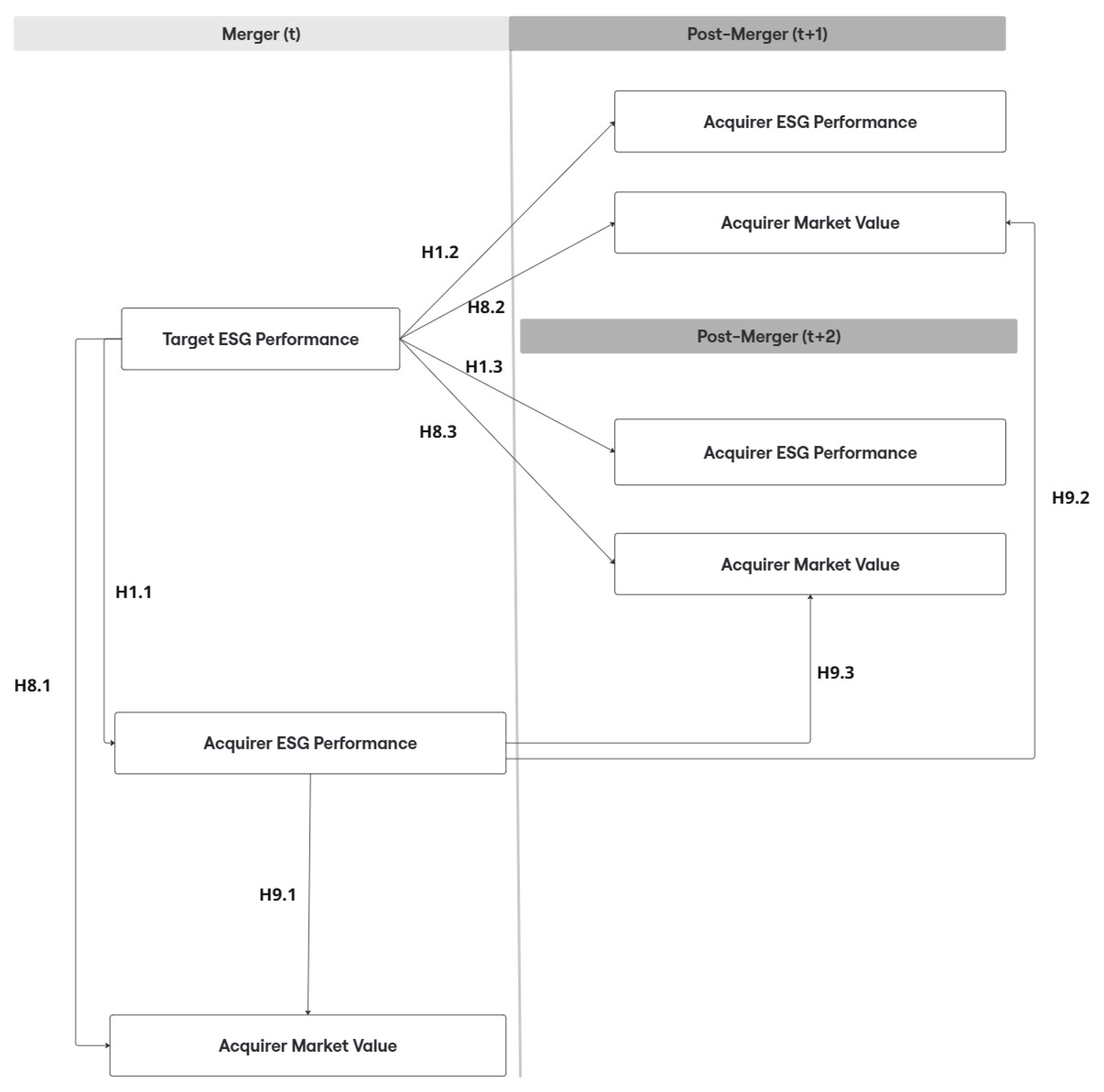
Figure 1. This figure illustrates the ESG framework, depicting the sequential links from target ESG performance at the time of the merger (t) to acquirer ESG performance in the merger year and the subsequent post-merger years (t + 1 and t + 2), and ultimately to changes in acquirer market value. The framework reflects both the direct valuation relevance of target ESG and the indirect valuation channel operating through acquirer ESG trajectories. While the figure is presented at the aggregate ESG level, the same structure is applied to the environmental, social, and governance pillars, which are analyzed separately.
Ijfs 14 00058 g001
Figure 2. This figure extends the baseline ESG framework by incorporating cross-border and cross-industry deal characteristics. These merger configurations capture whether ESG capability integration outcomes differ systematically across institutional and industrial environments, conditional on target ESG and firm characteristics. The framework therefore allows sustainability outcomes to vary across merger types rather than assuming a uniform integration process across all transactions.
Ijfs 14 00058 g002
Figure 3. Average ESG scores per country. Note. Russia was removed from the MSCI Emerging Markets Index and excluded from all MSCI classifications effective March 2022.
Ijfs 14 00058 g003
Figure 4. Evolution of ESG performance.
Ijfs 14 00058 g004
Figure 5. Correlogram of baseline variables. This figure presents the Pearson’s correlations among variables. *** indicates significance at the 1% level.
Ijfs 14 00058 g005
Figure 6. Correlogram of ESG pillar variables. This figure presents the Pearson’s correlations among variables. *, ** and *** indicate significance at the 10%, 5% and 1% level, respectively.
Ijfs 14 00058 g006
Table 1. Variable definitions and data sources.
VariableDefinition
ESGESG performance of the acquirer companies.
EEnvironmental score of the acquirer companies.
SSocial score of the acquirer companies.
GGovernance score of the acquirer companies.
TESGESG performance of the target companies.
TEEnvironmental score of the target companies.
TSSocial score of the target companies.
TGGovernance score of the target companies.
SIZENatural logarithm of the book value of the acquiring company’s total assets reported by Worldscope.
LEVERAGEThe ratio of total liabilities to total assets. The data are from Worldscope.
ROAReturn on assets ratio reported by Worldscope.
MVMarket value is measured using Tobin’s Q, calculated as the market value of equity (common shares outstanding multiplied by stock price) plus the book value of preferred stock and debt, divided by the book value of total assets. All data are obtained from Worldscope.
D_COUNTRYA binary variable denoting whether the acquirer and target companies are headquartered in different countries (1), otherwise (0).
D_INDUSTRYA binary variable denoting whether the acquirer and target companies’ Standard Industrial Classification (SIC) codes are different (1), otherwise (0).
Table 2. Country-level ESG and pillar scores by MSCI Developed–Emerging Market Classification, with sample distribution of acquiring firms (2002–2023).
MarketsESGCEnvironmental ScoreSocial ScoreGovernance ScoreN
Developed Markets
Australia81.1179.8283.7479.09222
Austria86.2585.9884.9087.219
Belgium84.6783.6283.8985.8219
Canada81.2979.0883.1381.07217
Denmark88.3087.4187.0989.6429
Finland84.7283.0583.4786.8513
France83.2382.4883.1883.54139
Germany85.0184.2785.1885.08110
Hong Kong80.7182.7181.3377.5339
Ireland90.2689.05NANA24
Israel75.3074.0477.1374.339
Italy80.2480.9681.1078.2839
Japan79.2476.7578.7881.50884
Netherlands86.3184.9887.5185.8550
New Zealand80.6677.9680.0383.187
Norway91.6290.2893.5390.2136
Portugal76.1075.6474.2777.958
Singapore90.2590.1693.6585.6213
Spain78.6478.4277.7779.3878
Sweden85.5384.9985.4985.5841
Switzerland90.6490.8690.0290.4182
United Kingdom82.6583.0581.9082.58206
United States84.6581.7985.6085.771456
Emerging Markets
Brazil59.3959.7858.8559.7050
Chile68.1465.7567.9270.423
China (Mainland)52.5848.3252.4556.59222
Colombia56.5556.7354.6758.415
Czech Republic79.8878.2679.6681.212
Egypt51.0151.9953.0948.043
Greece72.3973.9872.5870.4414
Hungary74.0071.9573.0276.502
India36.4535.1035.0039.88105
Indonesia46.8045.8445.9049.1018
Korea (South)76.5573.9476.9778.20108
Kuwait77.1478.7782.7166.433
Malaysia66.0563.9968.4565.5528
Mexico63.9862.4261.6367.4656
Peru53.4552.7651.4356.2816
Philippines43.1541.4541.2847.0016
Poland72.0271.0571.8972.8011
Qatar90.3190.7896.3279.723
Saudi Arabia71.0072.5178.5455.7111
South Africa53.9451.9253.5556.4637
Taiwan63.4333.5873.1550.8771
Thailand60.6358.0360.7962.9629
Turkey65.8765.4064.7167.4014
United Arab Emirates81.1582.4787.5869.1915
Developed Markets82.8680.8882.7883.093730
Emerging Markets58.1853.6958.8658.95842
Total (All Acquiring Firm-Years)78.3275.8778.3878.654572
Note. ESG and pillar scores are country-level averages obtained from LSEG. The “Developed” and “Emerging” rows report N-weighted means across countries. N denotes the number of acquirer-year observations in our sample (2002–2023). Country classification follows the MSCI Developed–Emerging Market framework.
Table 3. Summary statistics of main variables.
VariablesNMeanStd. Dev.P25MedianP75
ESG457234.33726.334036.6856.37
TESG457223.91625.978016.3246.2
SIZE457216.92.70714.9216.7518.93
LEVERAGE45720.5220.2030.380.530.67
ROA45726.2436.3832.735.649.795
MV45721.6370.931.011.311.93
D_COUNTRY45720.1590.366001
D_INDUSTRY45720.1150.319001
Note. This table reports the summary statistics for the main variables used in the regression models. ESG and TESG denote the environmental, social, and governance performance of acquirer and target firms, respectively. SIZE is the natural logarithm of total assets, LEVERAGE is the total liabilities-to-assets ratio, ROA denotes return on assets, and MV represents Tobin’s Q. D_COUNTRY (1 = cross-border) and D_INDUSTRY (1 = cross-industry) are binary indicators of deal characteristics. Percentile values (p25 and p75) are reported in the descriptive statistics to characterize the distribution. No winsorization or trimming is applied to the regression data.
Table 4. Summary statistics of ESG pillar variables.
VariablesNMeanStd. Dev.P25MedianP75
E457233.08831.769027.7263.075
S457237.18630.542036.4164.545
G457239.12530.309042.0867.05
TE457221.67728.7780044.93
TS457225.09528.645012.37548.14
TG457227.45329.877017.2955.425
Note. This table reports descriptive statistics for the environmental (E), social (S), and governance (G) pillars for both acquirer and target firms. TE, TS, and TG denote the corresponding pillar scores for target firms. Percentile values (p25 and p75) are reported in the descriptive statistics to characterize the distribution. No winsorization or trimming is applied to the regression data.
Table 5. Tobit regression results for Model 1.
Models(1.1)(1.1.1)(1.1.2)(1.1.3)(1.2)(1.2.1)(1.2.2)(1.2.3)(1.3)(1.3.1)(1.3.2)(1.3.3)
Dependent VariablesESGESGESG(t + 1)E(t + 1)S(t + 1)G(t + 1)ESG(t + 2)E(t + 2)S(t + 2)G(t + 2)
TESG0.677 ***
(0.05)
(0.55)
0.601 ***
(0.04)
(0.49)
0.593 ***
(0.03)
(0.48)
TE 0.759 ***
(0.05)
(0.53)
0.708 ***
(0.04)
(0.50)
0.680 ***
(0.04)
(0.48)
TS 0.707 ***
(0.05)
(0.56)
0.643 ***
(0.04)
(0.51)
0.632 ***
(0.03)
(0.50)
TG 0.683 ***
(0.05)
(0.55)
0.587 ***
(0.04)
(0.47)
0.547 ***
(0.03)
(0.44)
SIZE2.705 ***
(0.32)
(2.18)
3.948 ***
(0.55)
(2.77)
2.974 ***
(0.42)
(2.34)
3.009 ***
(0.37)
(2.41)
2.808 ***
(0.39)
(2.27)
4.076 ***
(0.53)
(2.88)
3.088 ***
(0.45)
(2.43)
3.182 ***
(0.46)
(2.55)
2.805 ***
(0.32)
(2.26)
4.111 ***
(0.46)
(2.90)
3.095 ***
(0.38)
(2.43)
3.090 ***
(0.42)
(2.48)
LEVERAGE11.062 ***
(2.76)
(8.92)
17.991 ***
(4.76)
(12.62)
15.308 ***
(3.55)
(12.04)
10.928 ***
(2.85)
(8.75)
10.433 ***
(2.43)
(8.43)
18.253 ***
(3.95)
(12.91)
13.933 ***
(3.43)
(10.97)
10.869 ***
(2.69)
(8.72)
10.083 ***
(2.85)
(8.14)
17.230 ***
(4.08)
(12.17)
13.038 ***
(3.75)
(10.23)
9.518 ***
(2.77)
(7.64)
ROA0.073 ***
(0.02)
(0.06)
0.117 **
(0.06)
(0.08)
0.092 ***
(0.03)
(0.07)
0.081 ***
(0.03)
(0.07)
0.047 ***
(0.02)
(0.04)
0.099 **
(0.04)
(0.07)
0.072 ***
(0.02)
(0.06)
0.050 ***
(0.02)
(0.04)
0.039 ***
(0.01)
(0.03)
0.103 ***
(0.04)
(0.07)
0.051 ***
(0.02)
(0.04)
0.034 **
(0.02)
(0.03)
MV1.306 ***
(0.35)
(1.05)
0.728 *
(0.43)
(0.51)
1.770 ***
(0.50)
(1.39)
1.440 ***
(0.37)
(1.15)
1.458 ***
(0.26)
(1.18)
0.930 ***
(0.29)
(0.66)
1.833 ***
(0.33)
(1.44)
1.759 ***
(0.28)
(1.41)
1.444 ***
(0.21)
(1.17)
1.126 ***
(0.21)
(0.80)
1.669 ***
(0.27)
(1.31)
1.605 ***
(0.28)
(1.29)
Constant−40.496 ***
(4.77)
−70.288 ***
(9.86)
29.999 ***
(1.40)
−44.455 ***
(1.09)
−39.383 ***
(6.24)
−70.325 ***
(9.54)
31.666 ***
(1.08)
32.505 ***
(0.85)
−37.402 ***
(5.12)
34.109 ***
(0.97)
32.397 ***
(1.00)
−38.888 ***
(6.64)
Obs457245724572457240384038403840383503350335033503
F457.2376.1670.5427.5613.7391.61536465.1429203.2569.2368.3
Prob > F************************************
Pseudo R20.07220.07990.06810.06740.05680.07010.0550.04980.05190.06250.05030.0421
LogL−16,700−15,763−17,204−17,214−14,978−14,158−15,398−15,494−13,071−12,352−13,425−13,544
Note. Industry-clustered robust standard errors are reported in the first parentheses; Tobit marginal effects (dy/dx) are reported in the second parentheses. *** p ≤ 0.01, ** p ≤ 0.05, * p ≤ 0.10.
Table 6. Tobit regression results for Model 2.
Models(2.1)(2.1.1)(2.1.2)(2.1.3)(2.2)(2.2.1)(2.2.2)(2.2.3)(2.3)(2.3.1)(2.3.2)(2.3.3)
Dependent VariablesESGESGESG(t + 1)E(t + 1)S(t + 1)G(t + 1)ESG(t + 2)E(t + 2)S(t + 2)G(t + 2)
TESG0.733 ***
(0.04)
(0.59)
0.646 ***
(0.04)
(0.52)
0.631 ***
(0.03)
(0.51)
TE 0.824 ***
(0.05)
(0.58)
0.761 ***
(0.04)
(0.54)
0.728 ***
(0.04)
(0.52)
TS 0.759 ***
(0.05)
(0.60)
0.687 ***
(0.04)
(0.54)
0.672 ***
(0.03)
(0.53)
TG 0.736 ***
(0.05)
(0.59)
0.632 ***
(0.04)
(0.51)
0.585 ***
(0.03)
(0.47)
SIZE2.436 ***
(0.27)
(1.97)
3.511 ***
(0.46)
(2.46)
2.681 ***
(0.36)
(2.11)
2.750 ***
(0.32)
(2.20)
2.585 ***
(0.35)
(2.09)
3.702 ***
(0.45)
(2.62)
2.834 ***
(0.39)
(2.24)
2.957 ***
(0.42)
(2.37)
2.593 ***
(0.27)
(2.09)
3.722 ***
(0.37)
(2.64)
2.837 ***
(0.31)
(2.23)
2.877 ***
(0.37)
(2.31)
LEVERAGE10.114 ***
(2.00)
(8.16)
16.514 ***
(3.78)
(11.59)
13.989 ***
(2.55)
(11.02)
10.023 ***
(2.20)
(8.03)
9.390 ***
(1.78)
(7.59)
16.629 ***
(2.88)
(11.78)
12.490 ***
(2.56)
(9.85)
9.815 ***
(2.13)
(7.87)
9.127 ***
(2.33)
(7.37)
15.638 ***
(3.04)
(11.07)
11.669 ***
(3.01)
(9.18)
8.581 ***
(2.42)
(6.89)
ROA0.064 ***
(0.02)
(0.05)
0.103 **
(0.05)
(0.07)
0.082 ***
(0.03)
(0.06)
0.072 **
(0.03)
(0.06)
0.042 **
(0.02)
(0.03)
0.090 **
(0.04)
(0.06)
0.065 ***
(0.02)
(0.05)
0.043 **
(0.02)
(0.03)
0.035 **
(0.02)
(0.03)
0.096 **
(0.04)
(0.07)
0.045 **
(0.02)
(0.04)
0.029
(0.02)
(0.02)
MV1.294 ***
(0.31)
(1.04)
0.773 **
(0.39)
(0.54)
1.732 ***
(0.44)
(1.36)
1.421 ***
(0.34)
(1.14)
1.465 ***
(0.24)
(1.18)
0.993 ***
(0.25)
(0.70)
1.826 ***
(0.30)
(1.44)
1.758 ***
(0.28)
(1.41)
1.452 ***
(0.22)
(1.17)
1.182 ***
(0.23)
(0.84)
1.666 ***
(0.25)
(1.31)
1.605 ***
(0.29)
(1.29)
D_COUNTRY22.302 ***
(1.93)
(17.99)
29.790 ***
(2.85)
(20.91)
26.827 ***
(2.19)
(21.13)
23.491 ***
(2.23)
(18.81)
19.908 ***
(2.33)
(16.09)
28.283 ***
(3.01)
(20.04)
24.875 ***
(2.69)
(19.62)
21.533 ***
(2.59)
(17.28)
18.127 ***
(2.39)
(14.64)
27.370 ***
(3.24)
(19.38)
23.576 ***
(2.74)
(18.54)
19.223 ***
(2.81)
(15.43)
Constant24.168 ***
(4.19)
−68.093 ***
(8.84)
28.153 ***
(1.24)
−44.707 ***
(4.98)
−39.163 ***
(0.51)
−68.554 ***
(0.73)
−46.275 ***
(6.39)
31.504 ***
(6.60)
27.075 ***
(4.70)
32.283 ***
(7.64)
−43.609 ***
(0.75)
−38.785 ***
(6.21)
Obs.457245724572457240384038403840383503350335033503
F327.6257.2482428.8357317.9677.5411.5596.7245.8536.9603.3
Prob > F************************************
Pseudo R20.08480.09470.08130.07730.06540.08240.06490.05660.05870.07340.05880.0472
LogL−16,473−15,508−16,961−17,032−14,842−13,970−15,237−15,384−12,978−12,208−13,306−13,473
Note. Industry-clustered robust standard errors are reported in the first parentheses; Tobit marginal effects (dy/dx) are reported in the second parentheses. *** p ≤ 0.01, ** p ≤ 0.05.
Table 7. Tobit regression results for Model 3.
Models(3.1)(3.1.1)(3.1.2)(3.1.3)(3.2)(3.2.1)(3.2.2)(3.2.3)(3.3)(3.3.1)(3.3.2)(3.3.3)
Dependent VariablesESGESGESG(t + 1)E(t + 1)S(t + 1)G(t + 1)ESG(t + 2)E(t + 2)S(t + 2)G(t + 2)
TESG0.694 ***
(0.05)
(0.56)
0.617 ***
(0.04)
(0.50)
0.607 ***
(0.03)
(0.49)
TE 0.775 ***
(0.06)
(0.54)
0.727 ***
(0.04)
(0.51)
0.699 ***
(0.04)
(0.49)
TS 0.725 ***
(0.05)
(0.57)
0.660 ***
(0.04)
(0.52)
0.647 ***
(0.03)
(0.51)
TG 0.698 ***
(0.05)
(0.56)
0.600 ***
(0.04)
(0.48)
0.557 ***
(0.04)
(0.45)
SIZE2.579 ***
(0.33)
(2.08)
3.796 ***
(0.58)
(2.66)
2.825 ***
(0.44)
(2.22)
2.883 ***
(0.36)
(2.31)
2.691 ***
(0.38)
(2.17)
3.897 ***
(0.53)
(2.76)
2.946 ***
(0.45)
(2.32)
3.075 ***
(0.44)
(2.47)
2.708 ***
(0.31)
(2.19)
3.940 ***
(0.45)
(2.78)
2.985 ***
(0.37)
(2.34)
3.014 ***
(0.41)
(2.42)
LEVERAGE10.628 ***
(2.62)
(8.57)
17.510 ***
(4.67)
(12.28)
14.703 ***
(3.32)
(11.56)
10.501 ***
(2.65)
(8.41)
10.078 ***
(2.31)
(8.14)
17.722 ***
(3.78)
(12.54)
13.418 ***
(3.25)
(10.56)
10.552 ***
(2.57)
(8.46)
9.760 ***
(2.75)
(7.88)
16.684 ***
(3.86)
(11.79)
12.601 ***
(3.60)
(9.89)
9.278 ***
(2.73)
(7.45)
ROA0.072 ***
(0.02)
(0.06)
0.117 **
(0.06)
(0.08)
0.091 ***
(0.03)
(0.07)
0.081 ***
(0.03)
(0.07)
0.047 ***
(0.02)
(0.04)
0.099 **
(0.04)
(0.07)
0.071 ***
(0.02)
(0.06)
0.049 ***
(0.02)
(0.04)
0.038 ***
(0.01)
(0.03)
0.102 ***
(0.04)
(0.07)
0.050 ***
(0.02)
(0.04)
0.033 **
(0.02)
(0.03)
MV1.301 ***
(0.37)
(1.05)
0.719
(0.45)
(0.50)
1.756 ***
(0.53)
(1.38)
1.434 ***
(0.39)
(1.15)
1.444 ***
(0.27)
(1.17)
0.912 ***
(0.29)
(0.65)
1.808 ***
(0.34)
(1.42)
1.743 ***
(0.29)
(1.40)
1.431 ***
(0.22)
(1.15)
1.109 ***
(0.23)
(0.78)
1.648 ***
(0.27)
(1.29)
1.593 ***
(0.28)
(1.28)
D_INDUSTRY8.942 ***
(2.47)
(7.21)
8.921 ***
(3.10)
(6.25)
11.056 ***
(2.98)
(8.69)
9.622 ***
(3.34)
(7.71)
8.518 ***
(2.20)
(6.88)
10.897 ***
(2.64)
(7.71)
10.966 ***
(2.79)
(8.63)
8.483 ***
(3.11)
(6.80)
8.370 ***
(1.71)
(6.75)
11.930 ***
(1.83)
(8.43)
10.095 ***
(2.01)
(7.92)
7.164 ***
(2.30)
(5.75)
Constant25.464 ***
(0.89)
32.107 ***
(10.10)
29.787 ***
(6.05)
29.769 ***
(5.41)
−38.526 ***
(6.04)
−68.588 ***
(1.08)
−45.436 ***
(6.88)
−43.307 ***
(0.87)
27.835 ***
(4.92)
−67.025 ***
(8.53)
−43.456 ***
(1.04)
33.545 ***
(0.80)
Obs.457245724572457240384038403840383503350335033503
F438.9305.4684.4463.2515.1308.41301413.4323.1308.7461.3363.7
Prob > F************************************
Pseudo R20.07360.08080.06970.06860.05790.07140.05630.05060.05290.06390.05140.0426
LogL−16,674−15,747−17,175−17,192−14,961−14,139−15,376−15,482−13,057−12,335−13,410−13,538
Note. Industry-clustered robust standard errors are reported in the first parentheses; Tobit marginal effects (dy/dx) are reported in the second parentheses. *** p ≤ 0.01, ** p ≤ 0.05.
Table 8. Tobit regression results for Model 4.
Models(4.1)(4.1.1)(4.1.2)(4.1.3)(4.2)(4.2.1)(4.2.2)(4.2.3)(4.3)(4.3.1)(4.3.2)(4.3.3)
Dependent VariablesESGESGESG(t + 1)E(t + 1)S(t + 1)G(t + 1)ESG(t + 2)E(t + 2)S(t + 2)G(t + 2)
TESG0.720 ***
(0.04)
(0.58)
0.636 ***
(0.04)
(0.51)
0.623 ***
(0.03)
(0.50)
TE 0.808 ***
(0.05)
(0.57)
0.748 ***
(0.04)
(0.53)
0.716 ***
(0.04)
(0.51)
TS 0.748 ***
(0.04)
(0.59)
0.678 ***
(0.04)
(0.54)
0.664 ***
(0.03)
(0.52)
TG 0.725 ***
(0.04)
(0.58)
0.623 ***
(0.04)
(0.50)
0.577 ***
(0.03)
(0.46)
SIZE2.556 ***
(0.28)
(2.06)
3.696 ***
(0.47)
(2.60)
2.816 ***
(0.36)
(2.22)
2.869 ***
(0.33)
(2.30)
2.674 ***
(0.36)
(2.16)
3.852 ***
(0.47)
(2.73)
2.938 ***
(0.41)
(2.32)
3.046 ***
(0.43)
(2.44)
2.671 ***
(0.28)
(2.16)
3.863 ***
(0.38)
(2.74)
2.929 ***
(0.32)
(2.30)
2.953 ***
(0.38)
(2.37)
LEVERAGE10.678 ***
(2.12)
(8.61)
17.320 ***
(3.93)
(12.16)
14.698 ***
(2.74)
(11.57)
10.583 ***
(2.35)
(8.48)
9.838 ***
(1.91)
(7.95)
17.334 ***
(3.06)
(12.28)
13.068 ***
(2.73)
(10.30)
10.270 ***
(2.31)
(8.24)
9.608 ***
(2.40)
(7.76)
16.446 ***
(3.21)
(11.64)
12.298 ***
(3.08)
(9.67)
9.062 ***
(2.45)
(7.28)
ROA0.067 ***
(0.02)
(0.05)
0.106 **
(0.05)
(0.07)
0.084 ***
(0.03)
(0.07)
0.074 ***
(0.03)
(0.06)
0.044 ***
(0.02)
(0.04)
0.092 **
(0.04)
(0.07)
0.067 ***
(0.02)
(0.05)
0.045 **
(0.02)
(0.04)
0.037 **
(0.02)
(0.03)
0.098 ***
(0.04)
(0.07)
0.048 ***
(0.02)
(0.04)
0.031 *
(0.02)
(0.03)
MV1.310 ***
(0.31)
(1.06)
0.783 **
(0.39)
(0.55)
1.756 ***
(0.43)
(1.38)
1.438 ***
(0.33)
(1.15)
1.485 ***
(0.24)
(1.20)
1.012 ***
(0.27)
(0.72)
1.854 ***
(0.30)
(1.46)
1.779 ***
(0.27)
(1.43)
1.480 ***
(0.23)
(1.20)
1.213 ***
(0.22)
(0.86)
1.706 ***
(0.27)
(1.34)
1.635 ***
(0.30)
(1.31)
DC1_DI021.738 ***
(1.93)
(17.53)
29.660 ***
(3.30)
(20.82)
26.458 ***
(2.54)
(20.83)
22.837 ***
(2.34)
(18.29)
19.603 ***
(2.60)
(15.85)
28.002 ***
(3.38)
(19.83)
24.656 ***
(2.92)
(19.44)
21.315 ***
(2.58)
(17.10)
17.721 ***
(2.63)
(14.31)
27.025 ***
(3.59)
(19.13)
23.577 ***
(3.03)
(18.54)
18.966 ***
(2.97)
(15.23)
Constant−41.448 ***
(4.22)
30.463 ***
(8.76)
28.534 ***
(5.23)
−45.839 ***
(1.05)
26.410 ***
(0.51)
−70.284 ***
(8.58)
30.458 ***
(6.49)
31.701 ***
(0.81)
27.266 ***
(4.85)
−68.043 ***
(0.74)
31.276 ***
(5.15)
−39.516 ***
(6.37)
Obs.457245724572457240384038403840383503350335033503
F346.1295.6548.2405.6391.7504.8746.9406.22903229.31126579.9
Prob > F************************************
Pseudo R20.08190.09190.07850.0750.06360.080.06290.05530.05720.07120.05730.0462
LogL−16,525−15,558−17,013−17,074−14,870−14,008−15,270−15,406−12,998−12,237−13,327−13,487
Note. Industry-clustered robust standard errors are reported in the first parentheses; Tobit marginal effects (dy/dx) are reported in the second parentheses. *** p ≤ 0.01, ** p ≤ 0.05, * p ≤ 0.10.
Table 9. Tobit regression results for Model 5.
Models(5.1)(5.1.1)(5.1.2)(5.1.3)(5.2)(5.2.1)(5.2.2)(5.2.3)(5.3)(5.3.1)(5.3.2)(5.3.3)
Dependent VariablesESGESGESG(t + 1)E(t + 1)S(t + 1)G(t + 1)ESG(t + 2)E(t + 2)S(t + 2)G(t + 2)
TESG0.686 ***
(0.05)
(0.55)
0.608 ***
(0.04)
(0.49)
0.599 ***
(0.03)
(0.48)
TE 0.770 ***
(0.05)
(0.54)
0.717 ***
(0.04)
(0.51)
0.689 ***
(0.04)
(0.49)
TS 0.715 ***
(0.05)
(0.56)
0.649 ***
(0.04)
(0.51)
0.638 ***
(0.03)
(0.50)
TG 0.691 ***
(0.05)
(0.55)
0.593 ***
(0.04)
(0.48)
0.552 ***
(0.03)
(0.44)
SIZE2.615 ***
(0.32)
(2.11)
3.817 ***
(0.56)
(2.68)
2.874 ***
(0.43)
(2.26)
2.920 ***
(0.37)
(2.34)
2.741 ***
(0.39)
(2.21)
3.966 ***
(0.52)
(2.81)
3.011 ***
(0.44)
(2.37)
3.117 ***
(0.45)
(2.50)
2.746 ***
(0.32)
(2.22)
4.006 ***
(0.45)
(2.83)
3.029 ***
(0.37)
(2.38)
3.034 ***
(0.41)
(2.44)
LEVERAGE10.633 ***
(2.70)
(8.57)
17.425 ***
(4.67)
(12.22)
14.786 ***
(3.44)
(11.63)
10.500 ***
(2.76)
(8.41)
10.100 ***
(2.33)
(8.16)
17.735 ***
(3.82)
(12.55)
13.508 ***
(3.32)
(10.63)
10.538 ***
(2.56)
(8.45)
9.714 ***
(2.79)
(7.84)
16.628 ***
(3.97)
(11.75)
12.589 ***
(3.70)
(9.88)
9.165 ***
(2.72)
(7.36)
ROA0.071 ***
(0.02)
(0.06)
0.115 **
(0.06)
(0.08)
0.090 ***
(0.03)
(0.07)
0.080 ***
(0.03)
(0.06)
0.046 ***
(0.02)
(0.04)
0.098 **
(0.04)
(0.07)
0.070 ***
(0.02)
(0.06)
0.048 **
(0.02)
(0.04)
0.037 ***
(0.01)
(0.03)
0.101 **
(0.04)
(0.07)
0.049 ***
(0.02)
(0.04)
0.033 *
(0.02)
(0.03)
MV1.292 ***
(0.36)
(1.04)
0.719
(0.44)
(0.50)
1.751 ***
(0.51)
(1.38)
1.427 ***
(0.38)
(1.14)
1.443 ***
(0.27)
(1.17)
0.915 ***
(0.28)
(0.65)
1.812 ***
(0.33)
(1.43)
1.743 ***
(0.29)
(1.40)
1.421 ***
(0.21)
(1.15)
1.100 ***
(0.23)
(0.78)
1.640 ***
(0.26)
(1.29)
1.581 ***
(0.28)
(1.27)
DC1_DI117.137 ***
(3.06)
(13.82)
20.698 ***
(2.84)
(14.51)
19.897 ***
(3.58)
(15.65)
18.154 ***
(3.85)
(14.54)
14.984 ***
(2.08)
(12.10)
20.761 ***
(2.33)
(14.69)
18.406 ***
(2.87)
(14.49)
15.737 ***
(3.21)
(12.62)
14.084 ***
(2.51)
(11.37)
20.372 ***
(2.56)
(14.39)
16.712 ***
(3.38)
(13.12)
14.246 ***
(3.09)
(11.43)
Constant−39.504 ***
(0.86)
−68.680 ***
(10.07)
29.745 ***
(1.46)
29.718 ***
(1.11)
−38.708 ***
(0.65)
32.915 ***
(1.04)
−45.701 ***
(7.04)
−43.406 ***
(7.08)
27.838 ***
(5.06)
−67.285 ***
(8.72)
32.235 ***
(0.99)
−38.324 ***
(0.79)
Obs.457245724572457240384038403840383503350335033503
F399.3332.1497.6363.5486.3509.81160400.5427.4212.4568.5349.1
Prob > F************************************
Pseudo R20.0740.08160.06990.06890.0580.07170.05630.05070.05290.06390.05130.0428
LogL−16,667−15,733−17,172−17,187−14,959−14,134−15,377−15,480−13,058−12,334−13,411−13,535
Note. R. Industry-clustered robust standard errors are reported in the first parentheses; Tobit marginal effects (dy/dx) are reported in the second parentheses. *** p ≤ 0.01, ** p ≤ 0.05, * p ≤ 0.10.
Table 10. Tobit regression results for Model 6.
Models(6.1)(6.1.1)(6.1.2)(6.1.3)(6.2)(6.2.1)(6.2.2)(6.2.3)(6.3)(6.3.1)(6.3.2)(6.3.3)
Dependent VariablesESGESGESG(t + 1)E(t + 1)S(t + 1)G(t + 1)ESG(t + 2)E(t + 2)S(t + 2)G(t + 2)
TESG0.683 ***
(0.05)
(0.55)
0.608 ***
(0.04)
(0.49)
0.599 ***
(0.03)
(0.48)
TE 0.762 ***
(0.05)
(0.53)
0.714 ***
(0.04)
(0.51)
0.687 ***
(0.04)
(0.49)
TS 0.714 ***
(0.05)
(0.56)
0.650 ***
(0.04)
(0.51)
0.639 ***
(0.03)
(0.50)
TG 0.688 ***
(0.05)
(0.55)
0.591 ***
(0.04)
(0.47)
0.550 ***
(0.03)
(0.44)
SIZE2.668 ***
(0.32)
(2.15)
3.924 ***
(0.57)
(2.75)
2.925 ***
(0.43)
(2.30)
2.971 ***
(0.36)
(2.38)
2.764 ***
(0.39)
(2.23)
4.020 ***
(0.54)
(2.84)
3.032 ***
(0.45)
(2.39)
3.146 ***
(0.45)
(2.52)
2.769 ***
(0.32)
(2.23)
4.050 ***
(0.46)
(2.86)
3.053 ***
(0.37)
(2.40)
3.069 ***
(0.42)
(2.46)
LEVERAGE10.964 ***
(2.70)
(8.84)
17.931 ***
(4.76)
(12.57)
15.143 ***
(3.44)
(11.91)
10.831 ***
(2.76)
(8.68)
10.341 ***
(2.38)
(8.35)
18.130 ***
(3.89)
(12.82)
13.778 ***
(3.35)
(10.84)
10.798 ***
(2.66)
(8.66)
10.022 ***
(2.82)
(8.09)
17.119 ***
(3.99)
(12.09)
12.939 ***
(3.68)
(10.16)
9.491 ***
(2.76)
(7.62)
ROA0.073 ***
(0.02)
(0.06)
0.117 **
(0.06)
(0.08)
0.092 ***
(0.03)
(0.07)
0.081 ***
(0.03)
(0.07)
0.047 ***
(0.02)
(0.04)
0.100 **
(0.04)
(0.07)
0.072 ***
(0.02)
(0.06)
0.049 ***
(0.02)
(0.04)
0.039 ***
(0.01)
(0.03)
0.103 ***
(0.04)
(0.07)
0.051 ***
(0.02)
(0.04)
0.034 **
(0.02)
(0.03)
MV1.306 ***
(0.36)
(1.05)
0.726 *
(0.44)
(0.51)
1.768 ***
(0.51)
(1.39)
1.440 ***
(0.37)
(1.15)
1.455 ***
(0.27)
(1.18)
0.925 ***
(0.29)
(0.65)
1.825 ***
(0.34)
(1.44)
1.755 ***
(0.29)
(1.41)
1.444 ***
(0.22)
(1.17)
1.124 ***
(0.22)
(0.79)
1.667 ***
(0.27)
(1.31)
1.605 ***
(0.28)
(1.29)
DC0_DI14.117 *
(2.17)
(3.32)
2.187
(2.76)
(1.53)
5.715 **
(2.61)
(4.49)
4.588
(3.02)
(3.67)
4.636 **
(2.26)
(3.74)
5.034 *
(2.80)
(3.56)
6.404 **
(2.86)
(5.04)
4.245
(3.01)
(3.40)
4.793 **
(2.01)
(3.87)
6.577 **
(2.83)
(4.65)
5.921 **
(2.80)
(4.65)
3.032
(2.12)
(2.43)
Constant25.601 ***
(0.86)
−70.098 ***
(1.44)
29.962 ***
(5.97)
29.900 ***
(5.53)
27.239 ***
(0.66)
−69.825 ***
(1.05)
31.616 ***
(6.95)
−43.827 ***
(7.00)
27.938 ***
(5.03)
34.058 ***
(1.00)
32.354 ***
(5.55)
−38.830 ***
(6.58)
Obs.457245724572457240384038403840383503350335033503
F497.9333.1751.1549.9554.5315.91328493.8342.2252.2583334.2
Prob > F************************************
Pseudo R20.07240.07990.06840.06760.0570.07030.05530.050.05220.06280.05060.0422
LogL−16,696−15,762−17,199−17,210−14,975−14,155−15,392−15,492−13,068−12,349−13,421−13,544
Note. Industry-clustered robust standard errors are reported in the first parentheses; Tobit marginal effects (dy/dx) are reported in the second parentheses. *** p ≤ 0.01, ** p ≤ 0.05, * p ≤ 0.10.
Table 11. Tobit regression results for Model 7.
Models(7.1)(7.1.1)(7.1.2)(7.1.3)(7.2)(7.2.1)(7.2.2)(7.2.3)(7.3)(7.3.1)(7.3.2)(7.3.3)
Dependent VariablesESGESGESG(t + 1)E(t + 1)S(t + 1)G(t + 1)ESG(t + 2)E(t + 2)S(t + 2)G(t + 2)
TESG0.751 ***
(0.05)
(0.61)
0.664 ***
(0.04)
(0.54)
0.647 ***
(0.03)
(0.52)
TE 0.844 ***
(0.05)
(0.59)
0.784 ***
(0.04)
(0.56)
0.749 ***
(0.04)
(0.53)
TS 0.780 ***
(0.05)
(0.61)
0.708 ***
(0.04)
(0.56)
0.690 ***
(0.03)
(0.54)
TG 0.751 ***
(0.05)
(0.60)
0.646 ***
(0.04)
(0.52)
0.595 ***
(0.04)
(0.48)
SIZE2.313 ***
(0.27)
(1.87)
3.343 ***
(0.47)
(2.35)
2.532 ***
(0.36)
(1.99)
2.629 ***
(0.31)
(2.10)
2.460 ***
(0.34)
(1.99)
3.500 ***
(0.45)
(2.48)
2.681 ***
(0.39)
(2.11)
2.837 ***
(0.40)
(2.28)
2.504 ***
(0.26)
(2.02)
3.560 ***
(0.36)
(2.52)
2.731 ***
(0.30)
(2.15)
2.807 ***
(0.36)
(2.25)
LEVERAGE9.825 ***
(1.98)
(7.92)
16.180 ***
(3.83)
(11.35)
13.530 ***
(2.45)
(10.65)
9.751 ***
(2.12)
(7.81)
9.208 ***
(1.88)
(7.44)
16.340 ***
(2.94)
(11.57)
12.171 ***
(2.59)
(9.60)
9.686 ***
(2.23)
(7.77)
9.053 ***
(2.37)
(7.31)
15.483 ***
(3.02)
(10.96)
11.514 ***
(3.01)
(9.06)
8.600 ***
(2.52)
(6.90)
ROA0.067 ***
(0.02)
(0.05)
0.111 **
(0.05)
(0.08)
0.084 ***
(0.03)
(0.07)
0.074 ***
(0.03)
(0.06)
0.042 ***
(0.02)
(0.03)
0.093 **
(0.04)
(0.07)
0.065 ***
(0.02)
(0.05)
0.043 **
(0.02)
(0.04)
0.035 **
(0.01)
(0.03)
0.098 **
(0.04)
(0.07)
0.046 ***
(0.02)
(0.04)
0.030 *
(0.02)
(0.02)
MV1.302 ***
(0.35)
(1.05)
0.755 *
(0.43)
(0.53)
1.732 ***
(0.49)
(1.36)
1.428 ***
(0.37)
(1.14)
1.454 ***
(0.26)
(1.18)
0.967 ***
(0.27)
(0.69)
1.805 ***
(0.32)
(1.42)
1.745 ***
(0.29)
(1.40)
1.453 ***
(0.23)
(1.17)
1.175 ***
(0.25)
(0.83)
1.662 ***
(0.27)
(1.31)
1.606 ***
(0.30)
(1.29)
DC0_ DI0−18.896 ***
(2.05)
(−15.23)
−24.173 ***
(2.57)
(−16.95)
−22.997 ***
(2.01)
(−18.09)
−19.956 ***
(2.55)
(−15.97)
−17.182 ***
(2.22)
(−13.89)
−23.951 ***
(2.57)
(−16.96)
−21.661 ***
(2.38)
(−17.08)
−18.248 ***
(2.95)
(−14.64)
−15.918 ***
(2.07)
(−12.86)
−23.892 ***
(2.44)
(−16.92)
−20.557 ***
(2.19)
(−16.17)
−16.069 ***
(2.62)
(−12.90)
Constant−20.554 ***
(4.28)
30.452 ***
(1.25)
28.272 ***
(1.36)
−24.039 ***
(4.39)
−21.127 ***
(5.62)
31.417 ***
(0.82)
−23.562 ***
(0.97)
31.582 ***
(0.85)
27.078 ***
(0.58)
−41.263 ***
(0.78)
−22.635 ***
(0.84)
32.914 ***
(5.01)
Obs.457245724572457240384038403840383503350335033503
F391.7280.1530.5510.9415.5264.2835.2414.7526.6388.9565.9509.8
Prob > F************************************
Pseudo R20.08390.09220.08060.07660.06510.08140.06470.05620.05860.07310.05860.0467
LogL−16,489−15,551−16,973−17,044−14,846−13,986−15,239−15,391−12,978−12,212−13,308−13,480
Note. Industry-clustered robust standard errors are reported in the first parentheses; Tobit marginal effects (dy/dx) are reported in the second parentheses. *** p ≤ 0.01, ** p ≤ 0.05, * p ≤ 0.10.
Table 12. Comparative results across merger types (Models 4–7).
MODEL 4-5-6-7Cross-Border & Within-IndustryCross-Border & Cross-IndustryDomestic & Cross-IndustryDomestic & Within-Industry
Models(4.1)(4.2)(4.3)(5.1)(5.2)(5.3)(6.1)(6.2)(6.3)(7.1)(7.2)(7.3)
Dependent VariablesESGESG(t + 1)ESG(t + 2)ESGESG(t + 1)ESG(t + 2)ESGESG(t + 1)ESG(t + 2)ESGESG(t + 1)ESG(t + 2)
TESG0.720 ***
(0.04)
(0.58)
0.636 ***
(0.04)
(0.51)
0.623 ***
(0.03)
(0.50)
0.686 ***
(0.05)
(0.55)
0.608 ***
(0.04)
(0.49)
0.599 ***
(0.03)
(0.48)
0.683 ***
(0.05)
(0.55)
0.608 ***
(0.04)
(0.49)
0.599 ***
(0.03)
(0.48)
0.751 ***
(0.05)
(0.61)
0.664 ***
(0.04)
(0.54)
0.647 ***
(0.03)
(0.52)
SIZE2.556 ***
(0.28)
(2.06)
2.674 ***
(0.36)
(2.16)
2.671 ***
(0.28)
(2.16)
2.615 ***
(0.32)
(2.11)
2.741 ***
(0.39)
(2.21)
2.746 ***
(0.32)
(2.22)
2.668 ***
(0.32)
(2.15)
2.764 ***
(0.39)
(2.23)
2.769 ***
(0.32)
(2.23)
2.313 ***
(0.27)
(1.87)
2.460 ***
(0.34)
(1.99)
2.504 ***
(0.26)
(2.02)
LEVERAGE10.678 ***
(2.12)
(8.61)
9.838 ***
(1.91)
(7.95)
9.608 ***
(2.40)
(7.76)
10.633 ***
(2.70)
(8.57)
10.100 ***
(2.33)
(8.16)
9.714 ***
(2.79)
(7.84)
10.964 ***
(2.70)
(8.84)
10.341 ***
(2.38)
(8.35)
10.022 ***
(2.82)
(8.09)
9.825 ***
(1.98)
(7.92)
9.208 ***
(1.88)
(7.44)
9.053 ***
(2.37)
(7.31)
ROA0.067 ***
(0.02)
(0.05)
0.044 ***
(0.02)
(0.04)
0.037 **
(0.02)
(0.03)
0.071 ***
(0.02)
(0.06)
0.046 ***
(0.02)
(0.04)
0.037 ***
(0.01)
(0.03)
0.073 ***
(0.02)
(0.06)
0.047 ***
(0.02)
(0.04)
0.039 ***
(0.01)
(0.03)
0.067 ***
(0.02)
(0.05)
0.042 ***
(0.02)
(0.03)
0.035 **
(0.01)
(0.03)
MV1.310 ***
(0.31)
(1.06)
1.485 ***
(0.24)
(1.20)
1.480 ***
(0.23)
(1.20)
1.292 ***
(0.36)
(1.04)
1.443 ***
(0.27)
(1.17)
1.421 ***
(0.21)
(1.15)
1.306 ***
(0.36)
(1.05)
1.455 ***
(0.27)
(1.18)
1.444 ***
(0.22)
(1.17)
1.302 ***
(0.35)
(1.05)
1.454 ***
(0.26)
(1.18)
1.453 ***
(0.23)
(1.17)
Merger-type indicator21.738 ***
(1.93)
(17.53)
19.603 ***
(2.60)
(15.85)
17.721 ***
(2.63)
(14.31)
17.137 ***
(3.06)
(13.82)
14.984 ***
(2.08)
(12.10)
14.084 ***
(2.51)
(11.37)
4.117 *
(2.17)
(3.32)
4.636 **
(2.26)
(3.74)
4.793 **
(2.01)
(3.87)
−18.896 ***
(2.05)
(−15.23)
−17.182 ***
(2.22)
(−13.89)
−15.918 ***
(2.07)
(−12.86)
Constant−41.448 ***
(4.22)
26.410 ***
(0.51)
27.266 ***
(4.85)
−39.504 ***
(0.86)
−38.708 ***
(0.65)
27.838 ***
(5.06)
25.601 ***
(0.86)
27.239 ***
(0.66)
27.938 ***
(5.03)
−20.554 ***
(4.28)
−21.127 ***
(5.62)
27.078 ***
(0.58)
Obs.457240383503457240383503457240383503457240383503
F346.1391.72903399.3486.3427.4497.9554.5342.2391.7415.5526.6
Prob > F************************************
Pseudo R20.08190.06360.05720.0740.0580.05290.07240.0570.05220.08390.06510.0586
LogL−16,525−14,870−12,998−16,667−14,959−13,058−16,696−14,975−13,068−16,489−14,846−12,978
Note. Industry-clustered robust standard errors are reported in the first parentheses; Tobit marginal effects (dy/dx) are reported in the second parentheses. *** p ≤ 0.01, ** p ≤ 0.05, * p ≤ 0.10.
Table 13. Ranking of merger types by their positive effect on acquirer ESG (Models 4–7).
Ranking of Merger Types by Their Positive Effect on Acquirer ESG at (t):
RankMerger and Acquisition TypeMarginal Effect (dy/dx)p-Value
(Std. Err.)
Effect on the Acquirer’s ESG
1Cross-border & within-industry17.53***
(1.93)
Largest positive effect
2Cross-border & cross-industry13.82***
(3.06)
Strong positive effect
3Domestic & cross-industry3.32*
(2.17)
Small positive effect
4Domestic & within-industry−15.23***
(2.05)
Strong negative effect
Ranking of Merger Types by Their Positive Effect on Acquirer ESG at (t + 1):
RankMerger and Acquisition TypeMarginal Effect (dy/dx)p-Value
(Std. Err.)
Effect on the Acquirer’s ESG
1Cross-border & within-industry15.85***
(2.60)
Largest positive effect
2Cross-border & cross-industry12.1***
(2.08)
Strong positive effect
3Domestic & cross-industry3.74**
(2.26)
Small positive effect
4Domestic & within-industry−13.89***
(2.22)
Strong negative effect
Ranking of Merger Types by Their Positive Effect on Acquirer ESG at (t + 2):
RankMerger and Acquisition TypeMarginal Effect (dy/dx)p-Value
(Std. Err.)
Effect on the Acquirer’s ESG
1Cross-border & within-industry14.31***
(2.63)
Largest positive effect
2Cross-border & cross-industry11.37***
(2.51)
Strong positive effect
3Domestic & cross-industry3.87**
(2.01)
Small positive effect
4Domestic & within-industry−12.86***
(2.07)
Strong negative effect
Note. *** p ≤ 0.01, ** p ≤ 0.05, * p ≤ 0.10. Effect sizes decline from (t) to (t + 2), while the ranking remains unchanged.
Table 14. Regression results for Models 8 and 9.
Models(8.1)(8.2)(8.3)(9.1)(9.2)(9.3)
Dependent VariablesMVMV(t + 1)MV(t + 2)MVMV(t + 1)MV(t + 2)
TESG0.001
(0.00)
0.003 **
(0.00)
0.002
(0.00)
ESG 0.004 ***
(0.00)
0.003 ***
(0.00)
0.002
(0.00)
SIZE−0.042 ***
(0.01)
−0.122 ***
(0.01)
−0.133 ***
(0.01)
−0.050 ***
(0.01)
−0.126 ***
(0.01)
−0.133 ***
(0.01)
LEVERAGE0.605 ***
(0.10)
0.346 ***
(0.11)
0.793 ***
(0.13)
0.574 ***
(0.10)
0.327 ***
(0.11)
0.790 ***
(0.13)
ROA−0.015 ***
(0.00)
0.003 **
(0.00)
0.006 ***
(0.00)
−0.015 ***
(0.00)
0.003 **
(0.00)
0.006 ***
(0.00)
Constant2.191 ***
(0.12)
3.569 ***
(0.16)
3.528 ***
(0.19)
2.237 ***
(0.12)
3.595 ***
(0.17)
3.526 ***
(0.19)
Obs.457240383503457240383503
Adj. R20.0540.0450.0510.0570.0460.051
Note. Industry-clustered robust standard errors are reported in parentheses. *** p ≤ 0.01, ** p ≤ 0.05.
Disclaimer/Publisher’s Note: The statements, opinions and data contained in all publications are solely those of the individual author(s) and contributor(s) and not of MDPI and/or the editor(s). MDPI and/or the editor(s) disclaim responsibility for any injury to people or property resulting from any ideas, methods, instructions or products referred to in the content.