1. Introduction
The last 15 years between 2010 and 2024 have seen major change in financial markets attributed to financial technology and sustainability in finance. Financial technology firms (in the field of payments, lending, deposit taking, and neo-banking) have disrupted banking providing new and innovative technology solutions that increase efficiency, decrease transaction costs, and increase financial inclusion. Simultaneously, the banks, which are at the core of worldwide financial intermediation, face the challenge of meeting the accelerating pace of digital and regulatory competition. Concurrently, sustainability has increasingly become a key driver of corporate strategy and capital allocation. There is a growing market for environmental, social, and governance (ESG) indicators from investors, regulators, and stakeholders to assess firm performance, risk management, and long-term resilience. Financial institutions are in a uniquely sensitive position in that sustainability considerations impact their not just reputation but also their ability to access and pay for capital.
Voluntary Disclosure theory suggests that firms providing more transparent ESG information reduce information asymmetry and uncertainty for investors and creditors, thereby improving their financing conditions (
Botosan, 1997). A number of studies suggest that firms with positive ESG performance face lower financing costs, due to lower perceived risk and more transparent performances (
Cheng et al., 2014). ESG disclosure improves the stability of banks (
Liaqat et al., 2025), which enables the mechanisms for a lower cost of equity and capital by reducing risk and information asymmetry. Previous research on the effect of financial fundamentals such as profitability, leverage, and valuation ratios has not investigated the impact of sustainability disclosure on capital costs among various financial business types. Despite the extensive literature on capital structure and funding costs (
Acheampong & Ibeji, 2024;
Zhang & Kou, 2025), empirical evidence on how ESG transparency affects banks’ cost of capital is still lacking. This is particularly relevant given banks’ adoption of financial technologies, which enable additional risks that can lead to expensive cost of capital.
Despite the rapidly growing importance of sustainability and fintech concepts, empirical evidence on how ESG disclosure affects the cost of capital of banks and financial technology firms is still lacking. For example, the authors (
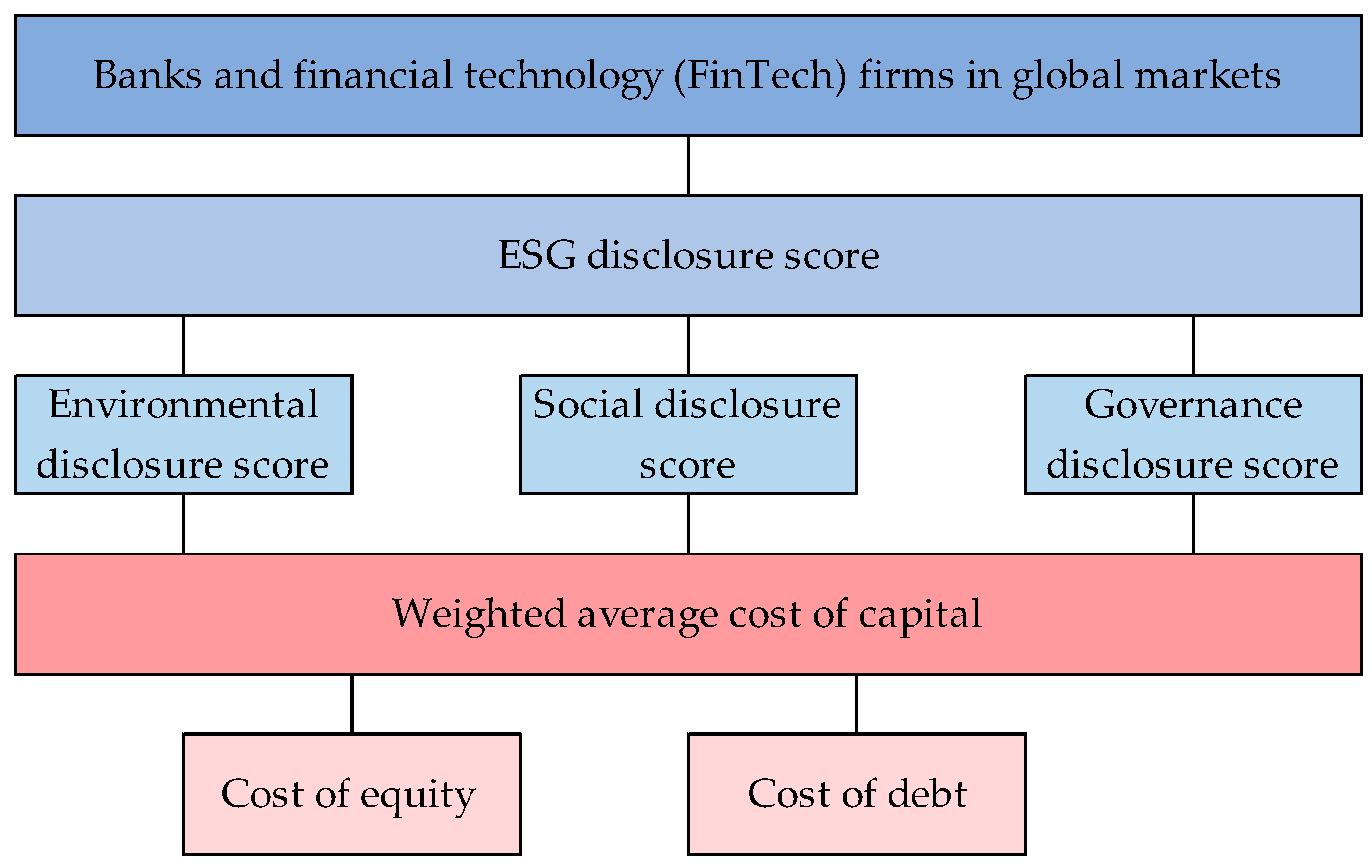
Liu et al., 2025) demonstrate that integrating fintech into green supply chain financing improves the efficiency of financing strategies. This, in turn, enables increased transparency and reduced financing constraints. There is a lack of research on how sustainability transparency relates to the cost of capital in traditional and financial technology companies, and their financial business models. This study addresses this issue by examining the relationship between ESG disclosure and the cost of capital in banks and financial technology firms in key regions of the world. In this way, the study adds to the sustainable finance literature by highlighting the dual impact of innovation and sustainability on the future of capital markets.
2. Theoretical Background
Financial technology has become an important tool for expanding the accessibility of payments, savings, and financial transfers. As
Asif et al. (
2023) have emphasized, a solid background is crucial to explain the technology-related dynamics that drive financial system transformations and to enable meaningful, empirically testable hypotheses. Financial technologies aim to include users in the financial system by providing affordable, convenient, and easy access to digital services.
Sun et al. (
2025) show that digital inclusive finance is significant in promoting green agricultural development. Their study shows that financial technology accelerates progress, improves agricultural production services, and is beneficial to agriculture and rural industrial integration. Financial technology strengthens rural integration, which has a significant impact in highly environmentally regulated areas. This shows that financial technology not only promotes financial inclusion, but also contributes to broader changes in environmental, social, and governance fields (ESG) and economic development.
Financial technology companies are using a variety of digital technologies that have the potential to reduce the cost of capital, improve the quality of environmental, social, and governance (ESG) disclosures and enhance investor confidence. These technologies include real-time data generated using artificial intelligence, application programming interfaces, and automated reporting tools. Advances in financial technology help companies attract green investors by reducing financing barriers, strengthening environmental governance, and increasing transparency of sustainability-related information (
Jiang et al., 2025). As these digital tools together reduce uncertainty and risk award, financial technology companies can obtain more favorable conditions for credit ratings and ultimately reduce the cost of both equity and debt financing.
A more detailed understanding of the association between sustainability disclosure and the cost of capital may arise from different theories.
Based on the Voluntary Disclosure theory, companies offer information outside the mandatory reporting rules as an effort to mitigate the effects of information asymmetry, uncertainty, and the risk premium expected by investors and creditors.
Botosan (
1997) showed that the cost of equity is decreased when a level of voluntary disclosure is higher, the impact of which is particularly evident for the financial sector where information quality, regulatory oversight, and credit rating requirements are paramount. In this paper, the ESG disclosure is presented as a mechanism to reduce the information asymmetry between financial institutions and capital markets, allowing for more accurate measurement of non-financial risks.
Agency theory posits that any manager–shareholder conflict of interest results in information asymmetry and monitoring costs (
Jensen & Meckling, 2019). A firm’s disclosure on ESG, particularly in terms of the governance dimension, has an oversight function initiate to provide the firm’s information that reducing agency cost because increase appropriateness and accountability. Corporate signaling of good management practices can reduce investor uncertainties which decreases the equity risk premium and, hence, financing costs. This is consistent with previous studies indicating that better governance reduces the cost of equity and fosters investors’ trust (
Trinh et al., 2020). Signaling theory highlights the role of financial reporting to transmit private information from the management to outside stakeholders. Firms with better ESG performance disclose to signal a credible commitment toward long-term strategic orientation, good quality of risk management, and a high level of resilience. Investors and lenders interpret ESG reporting as a proxy for a lower default risk and better long-term value creation, implying both a lower cost of equity and debt.
Residual income assessment research (
Dechow et al., 1999) points out that the perceived informational value of reported earnings and book values directly affects investors’ ability to measure valuations, indicating that the quality of the disclosure relates to a firm’s cost of capital. This is supported by the seminal work of
Botosan (
1997), who found empirically that it is true when the extent of discretionary transparency is higher that information asymmetry decreases and costs of equity are lower, which is of paramount interest for all financial institutions whose risk evaluations are subject to sustained disclosure flows. The importance of value relevance theory developed by
Srivastava and Muharam (
2021) adds to this the idea that the utility and trustworthiness of financial information enhance market efficiency and reduce financing frictions in the markets, especially at a point of regulatory shift. Further, according to accounting conservatism theory (
Watts, 2003), by early loss recognition and prudent reporting, agency conflicts have to be lessened to strengthen creditor protection and to reduce the perceived default risk.
Recent literature points to firm-specific parameters (profitability, leverage, valuation ratios, size) as a determinant of the cost of equity and debt (
Frank & Goyal, 2009;
Gungoraydinoglu & Öztekin, 2011). In the finance sector, capital costs are also affected by regulatory requirements, systemic risk, and funding structures (
Allen et al., 2013). A growing body of literature suggests that firms displaying better environmental, social, and governance (ESG) performance also earn lower financing costs as a consequence of lower financial cost, as reflected in lower risk perception and transparency (
Friede et al., 2015;
Albuquerque et al., 2020;
Broadstock et al., 2021). Environmental and social considerations are also positive, but sometimes lead to a raising of short-term financing expense for financial institutions if compliance investment is required (
Krüger, 2015;
Li et al., 2018). Europe’s banks on the higher sustainability rankings reach cheaper wholesale funding (
Raimo et al., 2021), similar to the finding of America and Asian research showing that disclosure regulation and investor preferences significantly condition an ESG-WACC relationship. Regional differences further confine these relationships. From Europe, stringent regulatory frameworks amplify the positive effect of ESG disclosure on finance costs and firm value (
European Central Bank, 2021;
Capelle-Blancard & Petit, 2019). Capital costs are still more sensitive to market turbulence and investor sentiment, and investors evaluate those companies that announce emissions (
Krueger et al., 2020;
Flammer, 2021). The European Union has developed a comprehensive and robust framework that combines digital finance regulation with mandatory ESG disclosure standards, such as the Sustainable Finance Disclosure Regulation (SFDR) and the Corporate Sustainability Reporting Directive (CSRD) (
European Commission, 2023). Meanwhile, the United States has adopted a more market-driven and fragmented regulatory approach, with ESG disclosure requirements applied only to a limited and often politically contested extent (
Securities and Exchange Commission, 2022). Asian economies show a more heterogeneous pattern: advanced financial hubs such as Singapore and Japan are closer to European practices, while emerging markets such as China and India prioritize digital financial inclusion and state-led financial technology development, while sustainability regulation is still evolving and largely dependent on national strategies (
OECD, 2023). In Asia, sustainability is closely associated with macroeconomic development and financial inclusion activities (
Bai, 2024).
By assessing banks and financial technology firms across Europe, America, and Asia from 2010 to 2024, and by disaggregating capital costs into cost of equity and cost of debt, we offer new insights into how sustainability disclosure and financial performance interact with each other. We enhance knowledge on how sustainability impacts financing efficiency in the global financial arena. This study yields fresh evidence on the causal effect of sustainability disclosure on the cost of equity, debt, and capital as a whole and enriches the literature in the areas of sustainable finance and financial technology.
In this study, drawing from the theoretical background of Voluntary Disclosure, Agency, and Signaling theories, we argue that ESG disclosure serves as a mechanism whereby financial institutions mitigate information asymmetry, reduce the costs of monitoring and credibly signal long-term resilience to their capital markets.
H1. Higher ESG disclosure reduces the overall cost of capital (WACC) by decreasing information asymmetry, improving governance transparency and lowering the risk premium demanded by capital providers.
H1a. The reduction in WACC associated with higher ESG disclosure is partly driven by a lower cost of equity, reflecting reduced information asymmetry and improved investor confidence.
H1b. The reduction in WACC associated with higher ESG disclosure is partly driven by a lower cost of debt, as greater governance transparency signals lower default risk and enhances lenders’ credit risk assessment.
These hypotheses enable the empirical study by investigating the extent to which sustainability disclosure influences the financing conditions of banks and financial technology companies.
6. Conclusions
In the global banking and financial technology sectors, the role of equity has grown even more as higher risk and limited borrowing options have increased their reliance on equity issuance, confirming the Signaling theory that investors are more sensitive to risk and information transparency factors. Agency and Voluntary disclosure theories have also been confirmed, as greater ESG and governance transparency have reduced information asymmetry and lenders’ perceived risk, thereby lowering the cost of debt.
Our study proved and adds to the existing literature new insights that ESG disclosure impacts the cost of capital for banks and financial technology companies in Europe, America, and Asia between 2010 and 2024. Using fixed effects and instrumental variable 2SLS regressions with peer-based instruments, we established that higher ESG transparency, especially governance, significantly reduced borrowed and overall capital costs—the equity cost remained unaffected. It implies that financial institutions with better integration of sustainability strategies and reporting frameworks gain better financing conditions and increased resilience. While governance disclosure becomes a key factor for banking by reducing the cost of debt due to lower perceived default risk, sustainable practices help financial technology firms by increasing reputational capital and investor confidence, which limits the equity risk premium because of fast technological changes.
Such conclusions have various implications for all stakeholders. Managers may use the findings to understand sustainable disclosure’s strategic value for optimizing their financing structure. Investors may consider ESG as a sustainable, long-term stabilizer and risk reducing indicator.
The results of this study suggest several important policy implications that can be taken to improve financial inclusion through the services provided by banks and financial technology companies on a broader scale. This is consistent with the findings and suggestions of other studies (
Asif et al., 2023) on the importance of financial inclusion. Policymakers should first consider investing in digital financial infrastructure, including mobile networks and low-cost payment systems, as mobile financial technology services significantly increase peoples’ ability to transact, save, and increase income. Government support plays an important role in accelerating the integration of financial technology. Regulatory pilot environments, simplified licensing, and public–private partnerships would increase market development and access to digital financial products. Digital financial literacy interventions should be implemented at scale. Responsible oversight of consumer protection systems would strengthen trust in digital financial platforms.
Our findings do support the main hypothesis that higher ESG transparency contributes to a lower weighted cost of capital within the banking sector. We argue that reducing WACC is driven by lower costs of debt financing, in line with our previous assumption that improvement in the transparency of sustainability will mitigate information asymmetry and lender default risk. The influence of the factor on cost of equity is not statistically significant, but its implication is that investors tend to be more willing to chase growth opportunities. More generally, the findings suggest that sustainability transparency is a financial instrument that enables financing conditions, as it acts to exert the greatest influence on financing through the debt market, which helps to reduce the systemic impact of risk on the banking sector (
Aifan et al., 2025). This study has limitations. It covers only publicly listed institutions, and regional heterogeneity may bias small estimates. Future research may explore this gap by including disclosed unlisted financial technology companies, adding diverse regulatory and institutional variables, and checking nonlinear ESG impacts on capital costs. Nonetheless, our study contributes to the sustainable finance understanding. It proves that ESG disclosure, and governance in particular, is a strategic tool for strengthening financing conditions, reducing capital costs, and creating a more sustainable and resilient system.