
Community Pharmacist-Led Interventions to Improve Preconception and Pregnancy Health: A Systematic Review
 , , ,
, , ,
Abstract
:1. Introduction
2. Materials and Methods
2.1. Inclusion and Exclusion Criteria
2.2. Literature Search
2.3. Study Selection and Data Extraction
2.4. Quality Assessment
2.5. Analysis and Synthesis
3. Results
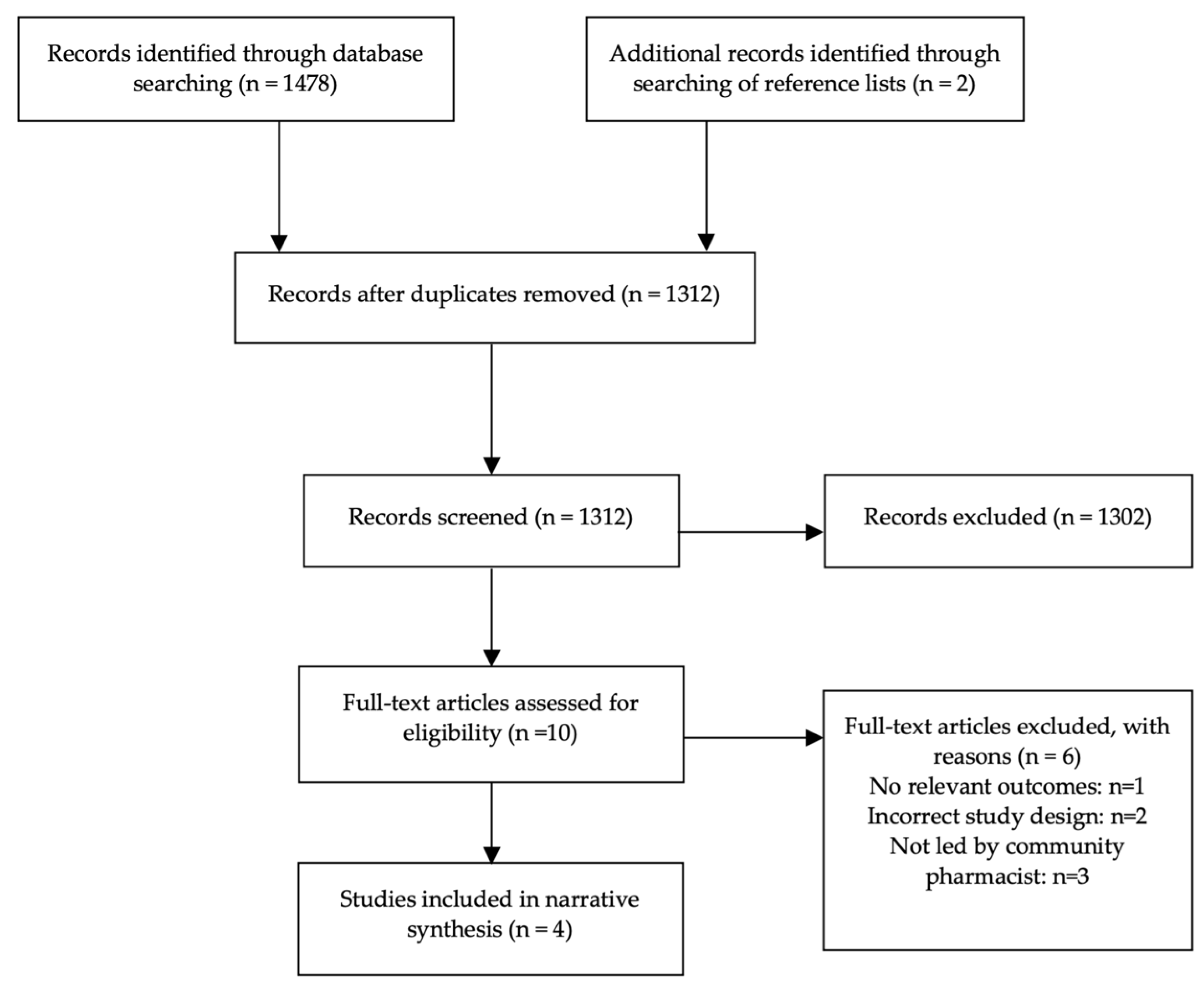
3.1. Study Characteristics
3.2. Study Population
3.3. Study Interventions
3.4. Study Outcomes
3.5. Study Quality
4. Discussion
5. Conclusions
Supplementary Materials
Author Contributions
Funding
Conflicts of Interest
References
- World Health Organization. Obesity and Overweight. Available online: https://www.who.int/news-room/fact-sheets/detail/obesity-and-overweight (accessed on 11 August 2021).
- Poston, L.; Caleyachetty, R.; Cnattingius, S.; Corvalan, C.; Uauy, R.; Herring, S.; Gillman, M.W. Preconceptional and maternal obesity: Epidemiology and health consequences. Lancet Diabetes Endocrinol. 2016, 4, 1025–1036. [Google Scholar] [CrossRef]
- Stephenson, J.; Heslehurst, N.; Hall, J.; Schoenaker, D.A.; Hutchinson, J.; Cade, J.E.; Poston, L.; Barrett, G.; Crozier, S.R.; Barker, M. Before the beginning: Nutrition and lifestyle in the preconception period and its im-portance for future health. Lancet 2018, 391, 1830–1841. [Google Scholar] [CrossRef]
- Gernand, A.D.; Schulze, K.J.; Stewart, C.P.; West, K.P., Jr.; Christian, P. Micronutrient deficiencies in pregnancy worldwide: Health effects and prevention. Nat. Rev. Endocrinol. 2016, 12, 274–289. [Google Scholar] [CrossRef] [PubMed] [Green Version]
- Farebrother, J.; Dalrymple, K.V.; White, S.L.; Gill, C.; Brockbank, A.; Lazarus, J.H.; Godfrey, K.M.; Poston, L.; Flynn, A.C. Iodine status of pregnant women with obesity from inner city populations in the United Kingdom. Eur. J. Clin. Nutr. 2021, 75, 801–808. [Google Scholar] [CrossRef] [PubMed]
- Blumfield, M.L.; Hure, A.; MacDonald-Wicks, L.; Smith, R.; Collins, C.E. Systematic review and meta-analysis of energy and macronutrient intakes during pregnancy in developed countries. Nutr. Rev. 2012, 70, 322–336. [Google Scholar] [CrossRef] [PubMed]
- Flynn, A.C.; Seed, P.T.; Patel, N.; Barr, S.; Bell, R.; Briley, A.L.; Godfrey, K.M.; Nelson, S.M.; Oteng-Ntim, E. Dietary patterns in obese pregnant women; influence of a behavioral intervention of diet and physical activity in the UPBEAT randomized controlled trial. Int. J. Behav. Nutr. Phys. Act. 2016, 13, 124. [Google Scholar] [CrossRef] [Green Version]
- Nascimento, S.L.; Surita, F.G.; Godoy, A.C.; Kasawara, K.T.; Morais, S.S. Physical activity patterns and fac-tors related to exercise during pregnancy: A cross sectional study. PLoS ONE 2015, 10, e0128953. [Google Scholar]
- Public Health England, Local Tobacco Control Profiles. Available online: https://fingertips.phe.org.uk/search/delivery (accessed on 1 March 2021).
- Mårdby, A.-C.; Lupattelli, A.; Hensing, G.; Nordeng, H. Consumption of alcohol during pregnancy—A multinational European study. Women Birth 2017, 30, e207–e213. [Google Scholar] [CrossRef]
- McDougall, B.; Kavanagh, K.; Stephenson, J.; Poston, L.; Flynn, A.C.; White, S.L. Health behaviours in 131,182 UK women planning pregnancy. BMC Pregnancy Childbirth 2021, 21, 1–11. [Google Scholar] [CrossRef]
- Public Health England, Making the Case for Preconception Care. Available online: https://www.gov.uk/government/publications/preconceptioncare-making-the-case (accessed on 20 February 2021).
- Todd, A.; Copeland, A.; Husband, A.; Kasim, A.; Bambra, C. The positive pharmacy care law: An area-level analysis of the relationship between community pharmacy distribution, urbanity and social deprivation in England. BMJ Open 2014, 4, e005764. [Google Scholar] [CrossRef] [Green Version]
- Brown, T.J.; Todd, A.; O’Malley, C.; Moore, H.; Husband, A.; Bambra, C.; Kasim, A.S.; Sniehotta, F.; Steed, L.; Smith, S.; et al. Community pharmacy-delivered interventions for public health priorities: A systematic review of interventions for alcohol reduction, smoking cessation and weight management, including meta-analysis for smoking cessation. BMJ Open 2016, 6, e009828. [Google Scholar] [CrossRef] [Green Version]
- Moher, D.; Liberati, A.; Tetzlaff, J.; Altman, D.G.; The PRISMA Group. Preferred reporting items for systematic reviews and meta-analyses: The PRISMA statement. PLoS Med. 2009, 6, e1000097. [Google Scholar] [CrossRef] [PubMed] [Green Version]
- Tappin, D.; Bauld, L.; Purves, D.; Boyd, K.; Sinclair, L.; MacAskill, S.; McKell, J.; Friel, B.; McConnachie, A.; De Caestecker, L.; et al. Financial incentives for smoking cessation in pregnancy: Randomised controlled trial. BMJ 2015, 350, h134. [Google Scholar] [CrossRef] [PubMed] [Green Version]
- Forinash, A.B.; Yancey, A.; Chamness, D.; Koerner, J.; Inteso, C.; Miller, C.; Gross, G.; Mathews, K. Smoking Cessation Following Text Message Intervention in Pregnant Women. Ann. Pharmacother. 2018, 52, 1109–1116. [Google Scholar] [CrossRef] [PubMed]
- Effective Public Health Practice Project Quality Assessment Tool for Quantitative Studies. Available online: http://www.ephpp.ca/tools.html (accessed on 5 April 2021).
- Campbell, M.; McKenzie, J.E.; Sowden, A.; Katikireddi, S.V.; Brennan, S.E.; Ellis, S.; Hartmann-Boyce, J.; Ryan, R.; Shepperd, S.; Thomas, J.; et al. Synthesis without meta-analysis (SWiM) in systematic reviews: Reporting guideline. BMJ 2020, 368, l6890. [Google Scholar] [CrossRef] [PubMed] [Green Version]
- Heryadi, P.L.; Sauriasari, R.; Andrajati, R. The influence of pharmacist counseling on changes in hemoglobin levels of pregnant women at a community health center in Indonesia. Asian J. Pharm. Clin. Res. 2017, 10, 114. [Google Scholar] [CrossRef] [Green Version]
- Meijer, W.; de Smit, D.J.; Jurgens, R.A.; De Jong-Van Den Berg, L.T.W. Improved periconceptional use of folic acid after patient education in pharmacies: Promising results of a pilot study in the Netherlands. Int. J. Pharm. Pr. 2010, 13, 47–51. [Google Scholar] [CrossRef] [Green Version]
- Radley, A.; Ballard, P.; Eadie, D.; MacAskill, S.; Donnelly, L.; Tappin, D. Give it up for baby: Outcomes and fac-tors influencing uptake of a pilot smoking cessation incentive scheme for pregnant women. BMC Public Health 2013, 13, 343. [Google Scholar] [CrossRef] [Green Version]
- Kusumawardani, N.; Darmawan, E.; Akrom, A.; Retnowati, S. Brief counseling by pharmacists enhances the knowledge, perceptions, and compliance of first and second-trimester pregnant women consuming ferrous fumarate at Jetis Community Health Center of Yogyakarta. Pharmaciana 2019, 9, 249–260. [Google Scholar] [CrossRef] [Green Version]
- Foisy, M.M.; Akai, P.S. Pharmaceutical Care for HIV patients on directly observed therapy. Ann. Pharmacother. 2004, 38, 550–556. [Google Scholar] [CrossRef]
- Forinash, A.B.; Yancey, A.M.; Shyken, J. Pharmacist lead vaccination rates in opioid addicted obstetric patients. J. Am. Coll. Clin. Pharm. 2020, 4, 296–302. [Google Scholar]
- Luli, A.J.; Tran, N.; Ataya, A.; Rafie, S. Patient screenings for preconception health interventions at a community pharmacy. Pharmacy 2020, 8, 181. [Google Scholar] [CrossRef] [PubMed]
- Mardle, T.; Merrett, S.; Wright, J.; Percival, F.; Lockhart, I. Real world evaluation of three models of NHS smoking cessation service in England. BMC Res. Notes 2012, 5, 9. [Google Scholar] [CrossRef] [PubMed] [Green Version]
- Tappin, D.M.; Macaskill, S.; Bauld, L.; Eadie, U.; Shipton, D.; Galbraith, L. Smoking prevalence and smoking cessation services for pregnant women in Scotland. Subst. Abus. Treat. Prev. Policy 2010, 5, 1–10. [Google Scholar] [CrossRef] [PubMed]
- Kistin, C.; Silverstein, M. Pilot studies: A critical but potentially misused component of interventional re-search. JAMA 2015, 314, 1561–1562. [Google Scholar] [CrossRef] [PubMed]
- Stevens, G.A.; Finucane, M.M.; De-Regil, L.M.; Paciorek, C.J.; Flaxman, S.R.; Branca, F.; Peña-Rosas, J.P.; Bhutta, Z.A.; Ezzati, M. Global, regional, and national trends in haemoglobin concentration and prevalence of total and severe anaemia in children and pregnant and non-pregnant women for 1995–2011: A systematic analysis of population-representative data. Lancet Glob. Health 2013, 1, 16–25. [Google Scholar] [CrossRef] [Green Version]
- Mahmood, T.; Rehman, A.U.; Tserenpil, G.; Siddiqui, F.; Ahmed, M.; Siraj, F.; Kumar, B. The association be-tween iron-deficiency anemia and adverse pregnancy outcomes: A retrospective report from Pakistan. Cureus 2019, 11, e5854. [Google Scholar]
- Kumar, K.J.; Asha, N.; Murthy, D.S.; Sujatha, M.; Manjunath, V. Maternal anemia in various trimesters and its effect on newborn weight and maturity: An observational study. Int. J. Prev. Med. 2013, 4, 193–199. [Google Scholar]
- National Institute for Health and Care Excellence. Antenatal Care for Uncomplicated Pregnancies. Available online: https://www.nice.org.uk/guidance/cg62/chapter/1-Guidance (accessed on 20 July 2021).
- Pavord, S.; Myers, B.; Robinson, S.; Allard, S.; Strong, J.; Oppenheimer, C. UK guidelines on the management of iron deficiency in pregnancy. Br. J. Haematol. 2012, 156, 588–600. [Google Scholar] [CrossRef]
- De-Regil, L.M.; Peña-Rosas, J.P.; Fernández-Gaxiola, A.C.; Rayco-Solon, P. Effects and safety of periconceptional oral folate supplementation for preventing birth defects. Cochrane Database Syst. Rev. 2015, 12, CD007950. [Google Scholar] [CrossRef]
- Ishitsuka, K.; Sasaki, S.; Yamamoto-Hanada, K.; Mezawa, H.; Konishi, M.; Ohya, Y. Changes in dietary intake in pregnant women from periconception to pregnancy in the japan environment and children’s study: A Nationwide Japanese Birth Cohort Study. Matern. Child Health J. 2020, 24, 389–400. [Google Scholar] [CrossRef]
- Bitzer, J.; von Stenglin, A.; Bannemerschult, R. Women’s awareness and periconceptional use of folic acid: Data from a large European survey. Int. J. Women’s Health 2013, 5, 201–213. [Google Scholar] [CrossRef] [Green Version]
- Bright, D.R.; DiPietro Mager, N.A. Preconception care and contraception services: Opportunities for community pharmacists. J Am. Coll. Clin. Pharm. 2019, 2, 414–422. [Google Scholar] [CrossRef]
- NHS. Health Education England Making Every Contact Count. Available online: http://www.makingeverycontactcount.co.uk/ (accessed on 3 May 2021).
- Ko, T.J.; Tsai, L.Y.; Chu, L.C.; Yeh, S.J.; Leung, C.; Chen, C.Y.; Chou, H.C.; Tsao, P.N.; Chen, P.C.; Hsieh, W.S. Parental smoking during pregnancy and its association with low birth weight, small for gestational age, and pre-term birth offspring: A birth cohort study. Pediatr. Neonatol. 2014, 55, 20–27. [Google Scholar] [CrossRef] [PubMed] [Green Version]
- Marufu, T.C.; Ahankari, A.; Coleman, T.; Lewis, S. Maternal smoking and the risk of still birth: Systematic review and meta-analysis. BMC Public Health 2015, 15, 239. [Google Scholar] [CrossRef] [Green Version]
- Zhang, K.; Wang, X. Maternal smoking and increased risk of sudden infant death syndrome: A meta-analysis. Leg. Med. 2013, 15, 115–121. [Google Scholar] [CrossRef]
- McCowan, L.M.E.; Dekker, G.A.; Chan, E.; Stewart, A.; Chappell, L.C.; Hunter, M.; Moss-Morris, R.; North, R.A. On behalf of the SCOPE consortium Spontaneous preterm birth and small for gestational age infants in women who stop smoking early in pregnancy: Prospective cohort study. BMJ 2009, 338, b1081. [Google Scholar] [CrossRef] [Green Version]
- Pharmaceutical Services Negotiating Committee, Community. Pharmacy Contractual Framework—A Summary. Available online: https://psnc.org.uk/contract-it/the-pharmacy-contract/ (accessed on 21 March 2021).
- Pharmacy4Mums2B—Final Evaluation Report. Available online: https://www.middlesexlpcs.org.uk/wp-content/uploads/2020/07/P4M2B-v10-FINAL-200819-PDF.pdf (accessed on 9 July 2021).


| P—Population | Women over the age of 18 planning pregnancy or pregnant women |
| I—Intervention | Interventions including smoking cessation, weight management, micronutrient supplementation and alcohol reduction led by a community-based pharmacist |
| C—Comparison | Non-active or usual care controls |
| O—Outcome | Outcomes including nutritional intake, levels of physical activity, smoking and alcohol status, micronutrient supplementation and weight status |
| S—Study type | RCTs and nRCTs |
| Reference | Country of Study | Aim of Study | Study Design | Sample Size | Age (Years) |
|---|---|---|---|---|---|
| Heryadi, Sauriasari and Andrajati, 2017 | Indonesia | To determine the effect of counselling by pharmacists on adherence to ISTs, IST consumption patterns and Hb levels | Randomised before–after controlled trial, single centre | 192 I: n = 96 C: n = 96 | I: 75 (78.1%) aged 21–35 C: 80 (83.3%) aged 21–35 |
| Kusumawardani et al., 2019 | Indonesia | To determine the influence of a brief counseling intervention by pharmacists on knowledge, perceptions, and adherence of pregnant women taking ferrous fumarate | Pretest–posttest control trial, single centre | 26 I: n = 13 C: n = 13 | I: 4 (31%) < 20 years, 9 (69%) 20–40 years C: 6 (46%) < 20 years, 7 (54%) 20–40 years |
| Meijer et al., 2005 | The Netherlands | To assess the effect of information provided by community pharmacies on knowledge, attitudes and use of folic acid among women prescribed oral contraceptives | Pilot study with randomly allocated intervention and reference pharmacies, multicentre | 880 I: n = 600 C: n = 280 | I: mean age 33.2 years (SD 3.40) C: mean age 32.6 years (SD 3.51) |
| Radley et al., 2013 | Scotland | To evaluate the smoking cessation outcomes and factors associated with success in pregnant women enrolled in an incentivised scheme at community pharmacies | Pilot study without a control group, multicentre | 383 Intervention A1: n = 160 Intervention A2: n = 144 Intervention A3: n = 89 | A1: mean age 26.7 (SD 6.10) A2: mean age 26.9 (SD 6.60) A3: mean age 27.7 (SD 5.80) |
| Reference | Pharmacy Characteristics | Intervention | Intervention Duration |
|---|---|---|---|
| Heryadi, Sauriasari and Andrajati, 2017 | Pharmacy care provided within a community health centre in the Pagedangan Sub-district, Tangerang District | I: single session of pharmacist counselling on anaemia and ISTs with a media leaflet C: no counselling | 30 days |
| Kusumawardani et al., 2019 | Pharmacy care provided within the Jetis Community Health Center of Yogyakarta | I: single session of pharmacist counselling using the 5A model on the importance of using ferrous fumarate for anaemia treatment and prevention C: received medication information according to the practiced procedure at Jetis Community Health Center | 30 days |
| Meijer et al., 2005 | Community pharmacies in a Dutch town, randomised into groups I: 4 pharmacies C: 3 reference pharmacies | I: sticker and leaflet containing information on folic acid supplied with oral contraception C: no intervention provided | 6 months |
| Radley et al., 2013 | Community pharmacies within three intervention areas (A1, A2, A3) across Tayside | Initial meeting with pharmacist to set a quit date and provide NRT, 12 weekly visits to pharmacies for support, education and CO breath tests, financial rewards provided after every negative test, opportunity to continue to 12 weeks postpartum Comparisons made between intervention areas and national data on smoking cessation | 6 months |
| Reference | Study Outcome Meaures | Study Outcomes |
|---|---|---|
| Heryadi, Sauriasari and Andrajati, 2017 | Hb level measured with Hbocue 301 Analyzer Hb Adherence to ISTs, calcium consumption patterns, food/beverage consumption patterns measured with questionnaire | Within-group analysis: I—Hb level increased from 10.39 ± 1.24 g/dL to 11.52 ± 0.92 g/dL, p < 0.001 C—no changes in Hb level, p = 0.3Between-group analysis: I—Hb increased compared to C (OR = 8.6, p < 0.05) after controlling for confounders |
| Kusumawardani et al., 2019 | Knowledge, perceptions, and adherence to ferrous fumarate assessed with questionnaires | No difference in pre-test level of knowledge, perceptions, or aderence between groups Post-test knowledge: I—0 (0.0%) low, 1 (7.7%) medium, 12 (92.3%) high C—2 (15.4%) low, 11 (84.6%) medium, 0 (0.0%) high p < 0.001 Post-test perceptions: I—0 (0.0%) negative, 13 (100.0%) positive C—12 (92.3%) negative, 1 (7.7%) positive p < 0.001 Post-test adherence: I—0 (0.0%) non-compliant, 2 (15.4%) less compliant, 11 (84.6%) compliant C—5 (38.5%) non-compliant, 7 (53.8%) less compliant, 1 (7.7%) compliant p < 0.001 RR values of the 3 parameters (4.55, 4.54, 10.29, respectively, with p < 0.05) |
| Meijer et al., 2005 | Knowledge of folic acid, identification of information sources, planned recommendation of folic acid supplements to otherwomen, current or planned use of folic acid supplementation assessed with questionnaire | Nulligravida women: I—15 (62.5%) currently using and 5 (20.8%) intend to use folic acid supplements C—4 (30.8%) currently using and 1 (7.7%) intend to use folic acid supplements p = 0.02 Women with a previous pregnancy: No change in current or intended use of folic acid supplements p = 0.42. I—9 (45.0%) knew the correct time period to take folic acid C—1 (6.7%) knew the correct time period to take folic acid p = 0.01 |
| Radley et al., 2013 | Short and long term quit rates measured with CO breath testsEngagement with programme measured with attendance | Quit rates were 54% at 4 weeks, 32% at 12 weeks and 17% at 3 months post partum 7.8% of women in the intervention areas compared to 3.9% of all pregnant smokers in Scotland quit at 4 weeks By intervention areas: A1—76 (47.5%) quit rate at 4 weeks A2—86 (59.7%) quit rate at 4 weeks p = 0.0330 A2—31 (21.5%) quit rate at 3 months postpartum A3—9 (10.1%) quit rate at 3 months postpartum p = 0.0248 |
Publisher’s Note: MDPI stays neutral with regard to jurisdictional claims in published maps and institutional affiliations. |
© 2021 by the authors. Licensee MDPI, Basel, Switzerland. This article is an open access article distributed under the terms and conditions of the Creative Commons Attribution (CC BY) license (https://creativecommons.org/licenses/by/4.0/).
Share and Cite
Scott, P.A.; Quotah, O.F.; Dalrymple, K.V.; White, S.L.; Poston, L.; Farebrother, J.; Lakhani, S.; Alter, M.; Blair, M.; Weinman, J.; et al. Community Pharmacist-Led Interventions to Improve Preconception and Pregnancy Health: A Systematic Review. Pharmacy 2021, 9, 171. https://doi.org/10.3390/pharmacy9040171
Scott PA, Quotah OF, Dalrymple KV, White SL, Poston L, Farebrother J, Lakhani S, Alter M, Blair M, Weinman J, et al. Community Pharmacist-Led Interventions to Improve Preconception and Pregnancy Health: A Systematic Review. Pharmacy. 2021; 9(4):171. https://doi.org/10.3390/pharmacy9040171
Chicago/Turabian StyleScott, Polly A., Ola F. Quotah, Kathryn V. Dalrymple, Sara L. White, Lucilla Poston, Jessica Farebrother, Shivali Lakhani, Marsha Alter, Mitch Blair, John Weinman, and et al. 2021. "Community Pharmacist-Led Interventions to Improve Preconception and Pregnancy Health: A Systematic Review" Pharmacy 9, no. 4: 171. https://doi.org/10.3390/pharmacy9040171
APA StyleScott, P. A., Quotah, O. F., Dalrymple, K. V., White, S. L., Poston, L., Farebrother, J., Lakhani, S., Alter, M., Blair, M., Weinman, J., & Flynn, A. C. (2021). Community Pharmacist-Led Interventions to Improve Preconception and Pregnancy Health: A Systematic Review. Pharmacy, 9(4), 171. https://doi.org/10.3390/pharmacy9040171