
Pharmacy Students’ Perceptions of Self-Reflection and Peer and Educator Feedback on the Development of Patient Counselling Skills: A Qualitative Analysis

Abstract
1. Introduction
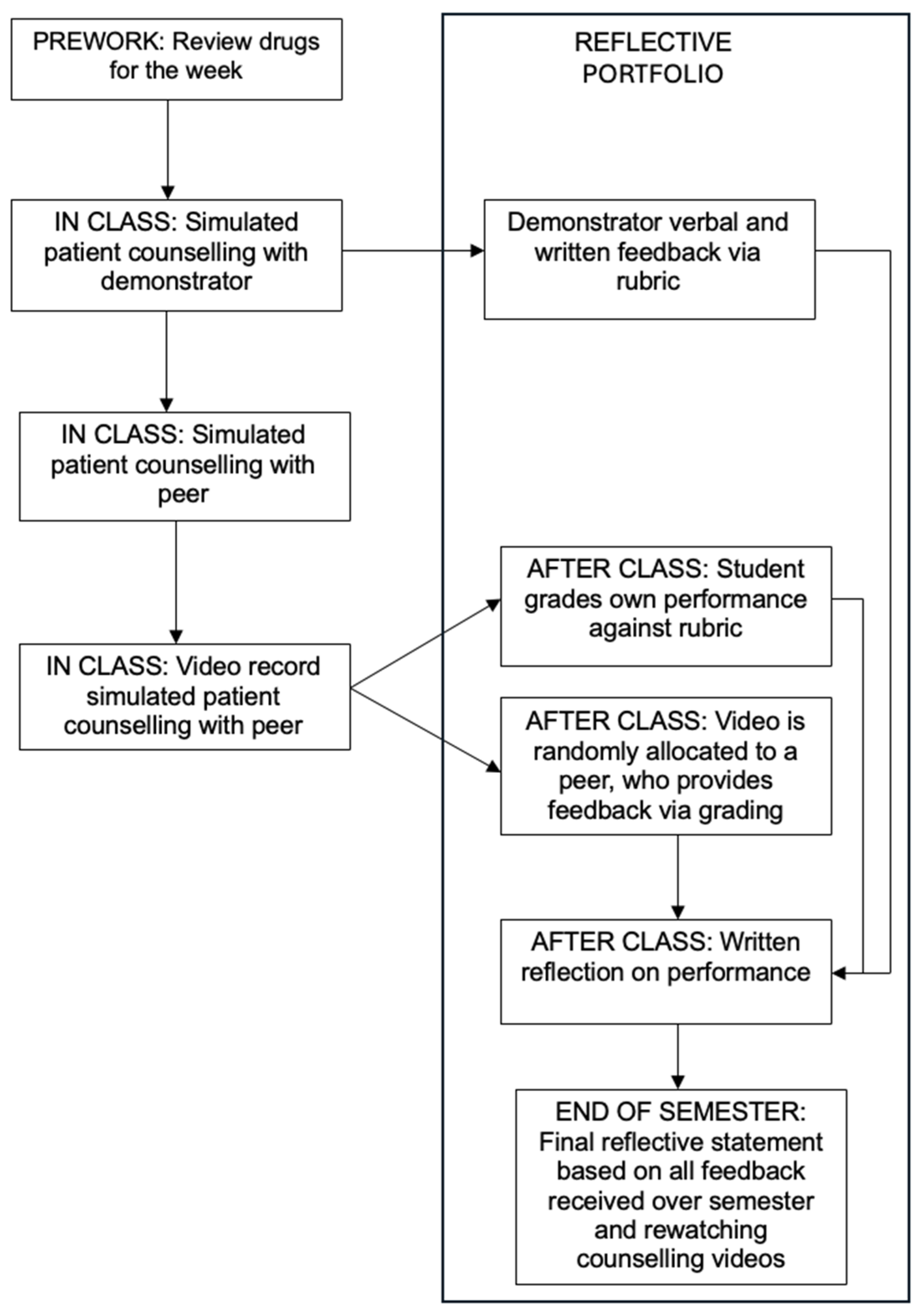
2. Materials and Methods
2.1. Study Setting
- What did the doctor say this medicine is for?
- How did the doctor say to take it?
- What did the doctor say to expect [11]?
2.2. Data Collection and Analysis
Reflexivity Statement
3. Results
3.1. Impact of Peer Feedback on Development of Skills and Confidence
3.1.1. Supportive Peer Dynamics
“Practicing with peers is extremely helpful, as stakes are lower than when practicing with tutors and thus not as stressful… In my experience my partner and I were keen to help each other improve and were non-judgemental when we made mistakes.”
“Throughout the semester, I found the tutor’s recommendations at the end of my counselling sessions to be more honest than my peers. Whilst my peers tended to say that I was doing great, the tutors gave me the more direct advice.”
“To be completely honest, besides the feedback that I received on my last video, the feedback that I would receive from the anonymous users were not really beneficial.”
3.1.2. Developing a Personal Counselling Style Through Peer Practice
“For me, practicing with peers is the most effective form of learning as it incorporates feedback and actual practice. I get to acquire tips and insights into how my peers approach their counselling, which is highly beneficial to my learning. I tend to learn better with others, so this form of learning is best suited for me.”
“I believe it is very important to practice with your peers. This is because you are able to learn how they counsel and implement it into your own style.”
3.2. Impact of Self-Reflection and Assessment on Development of Skills and Confidence
3.2.1. Goal Setting Through Self-Reflection
“Self-reflection was also helpful for my learning as sometimes I can get very caught up with my classes, lectures and don’t have time to self-reflect… By writing it down and coming back, it allows me to see if I have overcome my problems and if I should do something different next time. Also seeing if the goals I made were achievable and how I achieved it and maybe next time I could use a similar approach in solving other problems.”
“Although initially it was fantastic, beyond [the third class] it became fairly repetitive and slightly unnecessary as we had already worked on most, if not all, of our weaknesses, and our counselling was essentially “perfect” where we didn’t really need to watch it back because we would be awarding ourselves full marks.”
3.2.2. Video Review as a Tool for Skill Refinement
“Through watching my performance in the counselling videos, I was able to evaluate my performance objectively and hence identify areas of improvement. Watching videos of myself from the first counselling session through to the last, I realised there were subtle improvements progressively which felt rewarding.”
“I do not think the self-reflection was beneficial our peers critique us naturally after the video counselling and most students self-reflect almost immediately after the video counselling naturally. Hence, it seems to be more of an extra step to write down what we’ve already thought of and discussed onto the portal for self-reflection.”
3.3. Impact of Demonstrator Feedback on Development of Skills and Confidence
3.3.1. Feedback Variation in Learning Growth
“I often think that I pause for too long or say too many “ums” however when I brought up my concerns with the demonstrator, they assured me that it was not to the extent that I had thought. This allowed my confidence to improve which eventually led me to have a better flow during my counselling sessions. The demonstrator also reassured me whenever I had doubts on my performance and they eased my anxiety that I had.”
“One way I improved in the second aspect was by taking on the advice from my marker, where I was told to “chunk and check”. This saw me improve in ensuring the patient understood the information I was giving them whilst also involving them in their own healthcare.”
“Feedback from demonstrators was useful. My demonstrator was much more encouraging than others and I believe they could have been harsher.”
3.3.2. Addressing Self-Doubt in Counselling Certain Medications
“There were definitely certain medications that I found uncomfortable to counsel such as anti-depressants. It always felt awkward prying into people’s lives when I didn’t know how comfortable they were with sharing that information…but after advice from the tutors I realised it’s something you just have to approach with a more casual take.”
3.4. Professional Identity
3.4.1. Learning About the Value Pharmacists Can Bring
“PHAR3825 made me aware that pharmacy isn’t just about dispensing medication. It’s about ensuring that we are able to add value to a patient’s pharmacy experience. Value can come in many different forms like sympathy, educating them on misconceptions, creating a safe and honest space. As pharmacists we have the ability to break down any health care stigmas and give our patients the care and education they deserve.”
“I know that each case is unique and individual, and I need to be prepared to approach a specific situation differently. This requires both confidence and experience.”
“I believe that it is important to hear out patient’s concerns and to provide empathy and reassurance towards them. I find that it is very easy for anybody to just read whatever is printed on the medication label.”
3.4.2. Opportunities to Learn About Struggles in Real-Life Practice
“I also had the chance to ask the demonstrators how they would articulate themselves in difficult situations—for example, discussing the tolerance and addiction potential associated with opioids, and the increased risk of suicidal ideation associated with initial use of antidepressants.”
3.4.3. Incorporating Feedback to Working Opportunities
“I carry the lessons I learned from my demonstrators every shift at work and even passed them onto my peers. It is essential to know the proper practice of a pharmacist as we (as health care professionals) have a duty of educating and providing care to the community.”
3.4.4. Reinforcing Skills to Self-Reflect in Future Pharmacy Practice
“Although I didn’t see it at the start, I have come to realise that self-reflection was an integral part of my learning. It was watching myself back on video that I better understood the feedback I was receiving and allowed myself to be more comfortable counselling patients as I was able to see how I came across from a third-person perspective and what to improve.”
4. Discussion
Limitations
5. Conclusions
Supplementary Materials
Author Contributions
Funding
Institutional Review Board Statement
Informed Consent Statement
Data Availability Statement
Conflicts of Interest
References
- Mesquita, A.; Lyra, D., Jr.; Brito, G.; Balisa-Rocha, B.; Aguiar, P.M.; Neto, A.C.d.A. Developing communication skills in pharmacy: A systematic review of the use of simulated patient methods. Patient Educ. Couns. 2009, 78, 143–148. [Google Scholar] [CrossRef]
- Foucault-Fruchard, L.; Michelet-Barbotin, V.; Leichnam, A.; Tching-Sin, M.; Nizet, P.; Tollec, S.; Nativel, F.; Vene, E.; Fronteau, C.; Huon, J.F. The impact of using simulation-based learning to further develop communication skills of pharmacy students and pharmacists: A systematic review. BMC Med. Educ. 2024, 24, 1435. [Google Scholar] [CrossRef] [PubMed]
- GÜLpinar, G.; ÖZÇElİKay, G. Development of a Structured Communication and Counseling Skills Course for Pharmacy Students: A Simulation-based Approach. Turk. J. Pharm. Sci. 2021, 18, 176–184. [Google Scholar] [CrossRef]
- Tremblay, M.-L.; Leppink, J.; Leclerc, G.; Rethans, J.-J.; Dolmans, D.H.J.M. Simulation-based education for novices: Complex learning tasks promote reflective practice. Med. Educ. 2019, 53, 380–389. [Google Scholar] [CrossRef] [PubMed]
- Tsingos, C.; Bosnic-Anticevich, S.; Smith, L. Reflective practice and its implications for pharmacy education. Am. J. Pharm. Educ. 2014, 78, 18. [Google Scholar] [CrossRef]
- Austin, Z.; Gregory, P.A. Evaluating the accuracy of pharmacy students’ self-assessment skills. Am. J. Pharm. Educ. 2007, 71, 89. [Google Scholar] [CrossRef]
- Tsingos, C.; Bosnic-Anticevich, S.; Smith, L. Learning styles and approaches: Can reflective strategies encourage deep learning? Curr. Pharm. Teach. Learn. 2015, 7, 492–504. [Google Scholar] [CrossRef]
- Brown, B.; Holt-Macey, S.; Martin, B.; Skau, K.; Vogt, E.M. Developing the reflective practitioner: What, so what, now what. Curr. Pharm. Teach. Learn. 2015, 7, 705–715. [Google Scholar] [CrossRef]
- Schwindt, R.G.; Posey, L.; Zhou, Q.; Birch, K. Just Another Patient? Student Reflections on Providing Mental Health Care to Transgender and Gender Expansive People During Simulated Encounters. Nurs. Educ. Perspect. 2024, 45, 139–144. [Google Scholar] [CrossRef] [PubMed]
- Australian Government Department of Health and Aged Care. PBS Expenditure and Prescriptions. 2025. Available online: https://www.pbs.gov.au/info/statistics/expenditure-prescriptions/pbs-expenditure-and-prescriptions (accessed on 1 February 2026).
- Lam, N.; Muravez, S.N.; Boyce, R.W. A comparison of the Indian Health Service counseling technique with traditional, lecture-style counseling. J. Am. Pharm. Assoc. 2015, 55, 503–510. [Google Scholar] [CrossRef]
- Braun, V.; Clarke, V. Using thematic analysis in psychology. Qual. Res. Psychol. 2006, 3, 77–101. [Google Scholar] [CrossRef]
- Saldaña, J. The Coding Manual for Qualitative Researchers, 2nd ed.; Sage Publications: Thousand Oaks, CA, USA, 2012. [Google Scholar]
- Bowen, G.A. Naturalistic inquiry and the saturation concept: A research note. Qual. Res. 2008, 8, 137–152. [Google Scholar] [CrossRef]
- Booth, A.; Hannes, K.; Harden, A.; Noyes, J.; Harris, J.; Tong, A. COREQ (Consolidated Criteria for Reporting Qualitative Studies). In Guidelines for Reporting Health Research: A User’s Manual, 1st ed.; Moher, D., Altman, D.G., Schulz, K.F., Simera, I., Wager, E., Eds.; John Wiley & Sons: West Sussex, UK, 2014; pp. 214–226. [Google Scholar] [CrossRef]
- Boud, D.; Cohen, R.; Sampson, J. Peer Learning in Higher Education: Learning from and with Each Other, 1st ed.; Taylor and Francis Group: Oxfordshire, UK, 2001. [Google Scholar] [CrossRef]
- Mort, J.R.; Hansen, D.J. First-year pharmacy students’ self-assessment of communication skills and the impact of video review. Am. J. Pharm. Educ. 2010, 74, 578. [Google Scholar] [CrossRef] [PubMed]
- Kerman, N.T.; Banihashem, S.K.; Karami, M.; Er, E.; van Ginkel, S.; Noroozi, O. Online peer feedback in higher education: A synthesis of the literature. Educ. Inf. Technol. 2023, 29, 763–813. [Google Scholar] [CrossRef]
- Daou, D.; Sabra, R.; Zgheib, N.K. Factors That Determine the Perceived Effectiveness of Peer Feedback in Collaborative Learning: A Mixed Methods Design. Med Sci. Educ. 2020, 30, 1145–1156. [Google Scholar] [CrossRef]
- Storjohann, T.; Raney, E.; Buckley, K. Assessment of a Revised Method for Evaluating Peer-graded Assignments in a Skills-based Course Sequence. Am. J. Pharm. Educ. 2015, 79, 123. [Google Scholar] [CrossRef]
- Ean Teng, K.; Mutthulakshmi, K. A Systematic Review of the Role of Learning Analytics in Supporting Personalized Learning. Educ. Sci. 2024, 14, 51. [Google Scholar] [CrossRef]
- Schön, D. The Reflective Practitioner: How Professionals Think in Action, 1st ed.; Routledge: Oxfordshire, UK, 2017. [Google Scholar] [CrossRef]
- Sargeant, J.; Mann, K.; van der Vleuten, C.; Metsemakers, J. “Directed” self-assessment: Practice and feedback within a social context. J. Contin. Educ. Health Prof. 2008, 28, 47–54. [Google Scholar] [CrossRef]
- Donner, Y.; Hardy, J.L. Piecewise power laws in individual learning curves. Psychon. Bull. Rev. 2015, 22, 1308–1319. [Google Scholar] [CrossRef] [PubMed]
- Hayton, A.; Kang, I.; Wong, R.; Loo, L.K. Teaching Medical Students to Reflect More Deeply. Teach. Learn. Med. 2015, 27, 410–416. [Google Scholar] [CrossRef] [PubMed]
- Mann, K.; Gordon, J.; MacLeod, A. Reflection and reflective practice in health professions education: A systematic review. Adv. Health Sci. Educ. 2009, 14, 595–621. [Google Scholar] [CrossRef] [PubMed]
- Crimmins, G.; Nash, G.; Oprescu, F.; Liebergreen, M.; Turley, J.; Bond, R.; Dayton, J. A written, reflective and dialogic strategy for assessment feedback that can enhance student/teacher relationships. Assess. Eval. High. Educ. 2016, 41, 141–153. [Google Scholar] [CrossRef]
- Toh, R.Q.E.; Koh, K.K.; Lua, J.K.; Wong, R.S.M.; Quah, E.L.Y.; Panda, A.; Ho, C.Y.; Lim, N.; Ong, Y.T.; Chua, K.Z.Y.; et al. The role of mentoring, supervision, coaching, teaching and instruction on professional identity formation: A systematic scoping review. BMC Med. Educ. 2022, 22, 531. [Google Scholar] [CrossRef] [PubMed]
- Briceland, L.L.; Dudla, C.; Watson, A.; Denvir, P. Exploring the Impact of a Vicarious Learning Approach on Student Pharmacists’ Professional Identity Formation Using a Simulated Pharmacist–Patient Encounter. Pharmacy 2023, 11, 177. [Google Scholar] [CrossRef]
- Bergen, N.; Labonté, R. “Everything Is Perfect, and We Have No Problems”: Detecting and Limiting Social Desirability Bias in Qualitative Research. Qual. Health Res. 2020, 30, 783–792. [Google Scholar] [CrossRef]
- Brookfield, S.D. Becoming a Critically Reflective Teacher, 2nd ed.; Jossey-Bass: San Francisco, CA, USA, 2017. [Google Scholar]


| Timepoint | Reflection Questions |
|---|---|
| After each counselling session | What did you do well in this interaction? What can you improve? What have you learnt from this class? |
| End of semester reflective statement | Describe how you felt about watching yourself on video. Compare your performance from the start of semester to the end. What areas needed improvement? What helped you to improve and can you see the feedback given to you during the semester was implemented? Describe how the lessons you have learned will influence your practice. Do you believe that each of the following is a beneficial way of learning: Practice with peers, feedback from demonstrators, and self-reflection. Why or why not? |
| Theme | Subthemes |
|---|---|
| Impact of peer feedback on development of skills and confidence | Supportive peer dynamics Developing a personal counselling style through peer practice |
| Impact of self-reflection and assessment on development of skills and confidence | Goal setting through self-reflection Video review as a tool for skill refinement |
| Impact of demonstrator feedback on development of skills and confidence | Feedback variation in learning growth Addressing self-doubt in counselling certain medications |
| Professional identity | Learning about the value pharmacists can bring Opportunities to learn about struggles in real-life practice Incorporating feedback to working opportunities Reinforcing skills to self-reflect in future practice |
Disclaimer/Publisher’s Note: The statements, opinions and data contained in all publications are solely those of the individual author(s) and contributor(s) and not of MDPI and/or the editor(s). MDPI and/or the editor(s) disclaim responsibility for any injury to people or property resulting from any ideas, methods, instructions or products referred to in the content. |
© 2026 by the authors. Licensee MDPI, Basel, Switzerland. This article is an open access article distributed under the terms and conditions of the Creative Commons Attribution (CC BY) license.
Share and Cite
Pace, J.; Bartlett, A.; Iu, T.; Penm, J. Pharmacy Students’ Perceptions of Self-Reflection and Peer and Educator Feedback on the Development of Patient Counselling Skills: A Qualitative Analysis. Pharmacy 2026, 14, 41. https://doi.org/10.3390/pharmacy14020041
Pace J, Bartlett A, Iu T, Penm J. Pharmacy Students’ Perceptions of Self-Reflection and Peer and Educator Feedback on the Development of Patient Counselling Skills: A Qualitative Analysis. Pharmacy. 2026; 14(2):41. https://doi.org/10.3390/pharmacy14020041
Chicago/Turabian StylePace, Jessica, Andrew Bartlett, Tiffany Iu, and Jonathan Penm. 2026. "Pharmacy Students’ Perceptions of Self-Reflection and Peer and Educator Feedback on the Development of Patient Counselling Skills: A Qualitative Analysis" Pharmacy 14, no. 2: 41. https://doi.org/10.3390/pharmacy14020041
APA StylePace, J., Bartlett, A., Iu, T., & Penm, J. (2026). Pharmacy Students’ Perceptions of Self-Reflection and Peer and Educator Feedback on the Development of Patient Counselling Skills: A Qualitative Analysis. Pharmacy, 14(2), 41. https://doi.org/10.3390/pharmacy14020041