
Abstract
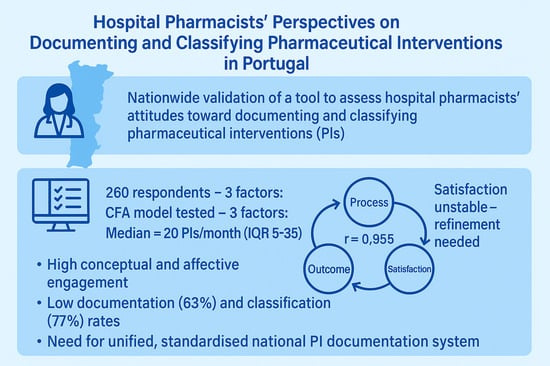
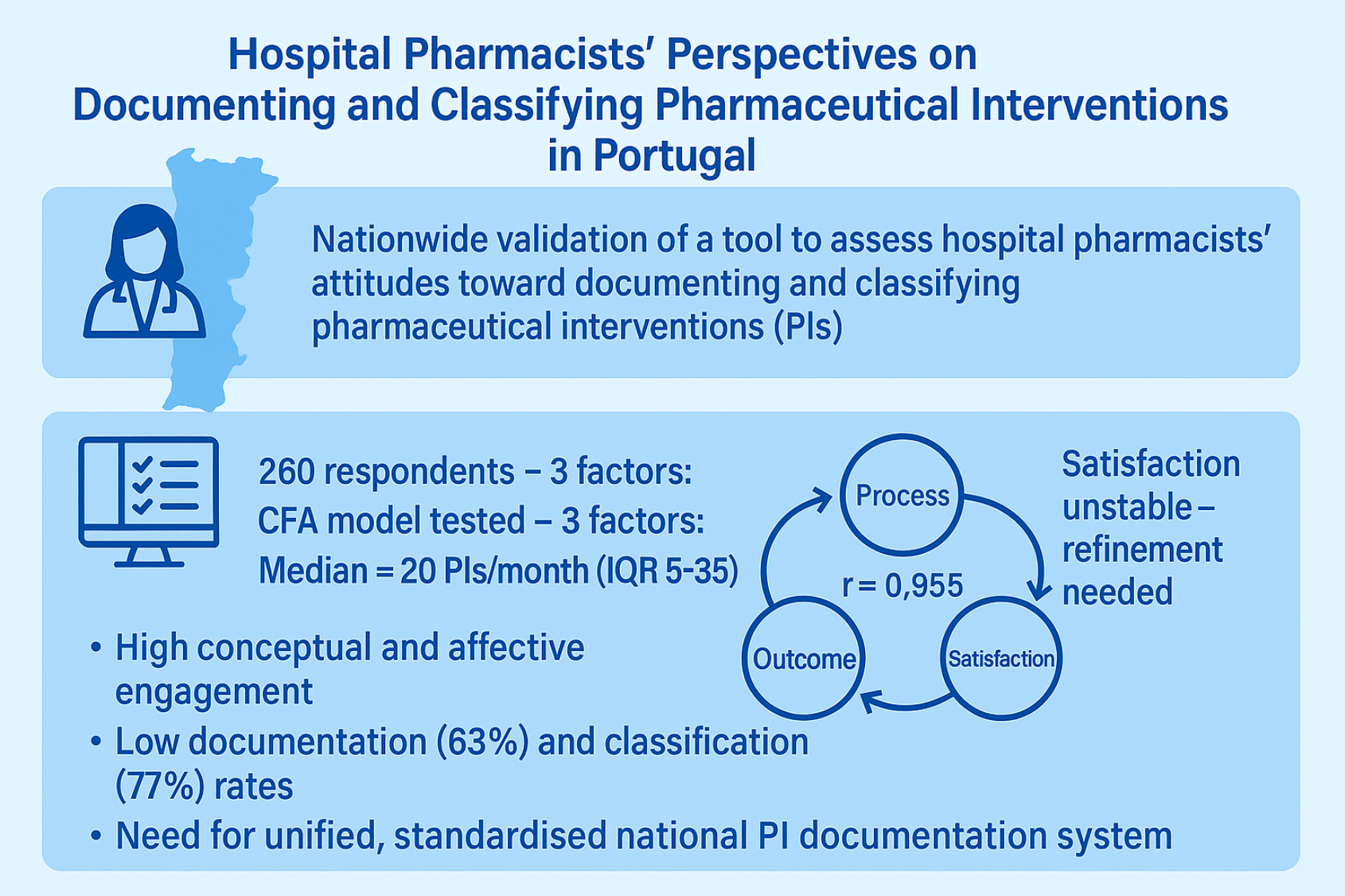
Pharmacist interventions (PIs) are central to optimising pharmacotherapy, preventing drug-related problems, and improving patient outcomes. In Portugal, the absence of a validated tool to consistently document and classify PIs limits data comparability and service development. Given these gaps, this study aimed to describe hospital pharmacists’ attitudes towards PI documentation and classification, following confirmatory factor analysis (CFA) of a survey instrument, and to provide a comprehensive overview of current practices and behaviours in hospital settings across Portugal. An online questionnaire, previously validated, was distributed online to all hospital pharmacists registered with the Portuguese Pharmaceutical Society (October–December 2024). Sociodemographic data and the cognitive and behavioural domains of pharmacists’ attitudinal model were analysed descriptively, and CFA tested the three-factor structure (Process, Outcome, Satisfaction) of the attitudinal affective domain. Of 1848 pharmacists, 260 responded (14%). Respondents reported performing a mean of 49 PIs/month (SD = 196), although many never recorded (28.8%), classified (56.2%), or analysed (52.3%) interventions. Only 2.7% declared to use a validated classification framework. The CFA supported the structural coherence of the Process factor but revealed some overlapping between Process and Outcome and instability in the Satisfaction factor. The nationwide scope and application of CFA provided partial support for the hypothesised model and highlighted areas for refinement, including revision of Satisfaction items and reconsideration of Process and Outcome as overlapping constructs. Findings highlight strong professional commitment to PIs but persistent barriers, including less clear procedures and satisfaction, underscoring the need for a unified, standardised national system to support consistent recording, classification, and evaluation.
1. Introduction
Pharmacist interventions (PIs) are a cornerstone of modern pharmaceutical care, playing a pivotal role in optimising pharmacotherapy, preventing drug-related problems (DRPs), and improving patient outcomes [1,2,3]. As healthcare systems increasingly prioritise safer and more effective medication use, the documentation and classification of these interventions have gained growing relevance, not only to support clinical decision-making, but also to demonstrate the impact of pharmacists within multidisciplinary teams [4,5].
Despite efforts to structure and harmonise the recording of PIs, many healthcare systems, such as Portugal’s, still lack validated tools capable of consistently documenting and classifying PIs. This gap poses risks to patient safety, as undocumented or inconsistently reported interventions hinder continuity of care and the prevention of DRPs [6]. It also limits data comparability, quality assurance, and service development, underscoring the need for robust, contextually appropriate instruments [7,8,9]. National frameworks such as Act-IP (France), GSASA (Switzerland), and Be-CLIPSS (Belgium) have demonstrated how standardised documentation systems can mitigate these risks by supporting consistent data collection, facilitating evaluation, and informing institutional and national strategies [10,11,12]. Understanding pharmacists’ behaviours, attitudes, and beliefs regarding PI documentation is essential to overcoming these limitations and fostering the institutional integration of pharmaceutical care.
To address this need, a questionnaire was recently developed and validated to assess hospital pharmacists’ attitudes and behaviours concerning the documentation and classification of PIs in Portugal [13]. Grounded in the tripartite model of attitudes, comprising affective, behavioural, and cognitive domains, the tool was designed to inform both practice and policy by capturing the psychological and operational dimensions that influence pharmacists’ engagement with both PI registration and classification. An exploratory factor analysis (EFA) was earlier conducted and identified the latent structure of the measurement scale, and the final questionnaire demonstrated acceptable psychometric properties, including reliability and validity, for assessing Portuguese hospital pharmacists’ involvement in PIs [13].
However, beyond identifying individual constructs, it is also important to examine the correlations among sub-dimensions. Therefore, a confirmatory factorial analysis (CFA) was employed to test the model’s dimensional structure further and assess its psychometric adequacy [14]. Confirmatory research serves multiple purposes, such as developing new measurement tools, assessing the psychometric characteristics of recently created instruments, validating theoretical constructs, and exploring the impact of measurement instruments [15].
Given the limited existing data on Portuguese pharmacists’ perspectives and practices in documenting and classifying PIs in hospital settings, it was also necessary to test the instrument in a larger, nationwide sample. Thus, the present study aims to describe hospital pharmacists’ attitudes towards PI documentation and classification, following CFA of the survey instrument, and to provide a comprehensive overview of current practices and behaviours in hospital settings across Portugal.
2. Materials and Methods
2.1. Participants and Procedure
The questionnaire was administered online via the QuestionPro© platform, which enabled secure questionnaire design and data storage, ensuring efficient survey management. The survey was distributed to all hospital pharmacists registered with the Portuguese Pharmaceutical Society, a mandatory requirement for professional practice in Portugal [16].
Participation was voluntary and anonymous, and informed consent was obtained electronically prior to the start of the questionnaire. The email invitation included a link to the survey and a consent form outlining the study objectives, ethical approval, confidentiality, and data protection procedures. The data collection period extended from 25 October to 31 December 2024, during which two reminder emails were sent. To avoid duplicate entries, each submission was tied to a unique IP address; duplicate, incomplete, or blank responses were excluded from the analysis, resulting in the removal of 16 responses.
2.2. Measures and Instruments
The instrument included 37 items, addressing pharmacists’ feelings, beliefs, and behaviours of hospital pharmacists regarding PIs in daily practice. The questionnaire was initially developed in Portuguese (an English translation is provided as Supplementary Materials). It consisted of an introductory sociodemographic block followed by three attitudinal dimensions: cognitive, behavioural, and affective. The cognitive and affective domains—addressing pharmacists’ conceptual understanding and emotional perceptions, respectively—were evaluated using a five-point Likert scale ranging from strongly disagree to strongly agree. The behavioural domains included both short, closed-ended questions and multiple-selection items.
The previous study, reporting the EFA results, found for the affective domain a three-factor structure consisting of Process, Outcome, and Satisfaction [13]. The present study builds upon that work by conducting a CFA to test the hypothesised model.
Given the highly independent and non-correlated nature of the cognitive and behavioural items, EFA and CFA were not applied to these sections of the questionnaire, as they were not expected to reflect latent constructs. These, as well as sociodemographic data, were analysed using descriptive statistics.
Within the scope of this research, recording PIs was defined as documenting the intervention in any format, while classification referred to assigning the intervention to a structured category [17], either using a published framework (e.g., the Act-IP© system [18]) or an in-house developed classification.
2.3. Data Analysis
Data were exported in .csv format and analysed using IBM SPSS Statistics (Version 29.0). Descriptive statistics were used to summarise participants’ sociodemographic characteristics, cognitive and behavioural responses. The 5-point Likert scale responses were recoded into two categories—agreement (scores 4–5) and disagreement (scores 1–3)—to simplify the interpretation of response patterns.
The CFA was conducted using IBM Analysis of Moment Structures (AMOS) Software (Version 30) to test the internal structure of the affective domain, based on a hypothesised three-factor model derived from the prior study (i.e., Process, Outcome, and Satisfaction). Nine affective items were included as observed variables.
The model fit was assessed using a range of fit indices: chi-square (χ2), Comparative Fit Index (CFI), Tucker–Lewis Index (TLI), Incremental Fit Index (IFI), Normed Fit Index (NFI), Relative Fit Index (RFI), and the Root Mean Square Error of Approximation (RMSEA) with its 90% confidence interval. Standardised regression weights, latent correlations, and variance estimates were examined to evaluate the internal consistency and discriminant validity of the model.
Following the recommendations of Brown [19], a close model fit (PCLOSE) is suggested by values of CFI, TLI, IFI, NFI, and RFI ≥ 0.95, RMSEA ≤ 0.06 with PCLOSE > 0.05, and a non-significant chi-square (χ2) (p > 0.05), although χ2 is known to be highly sensitive to sample size, since larger samples can render even minor model discrepancies statistically significant [20].
Convergent validity was assessed using the Average Variance Extracted (AVE), with values ≥ 0.50 considered acceptable, as per Fornell and Larcker’s criterion [21]. Discriminant validity was examined by comparing the square root of each construct’s AVE with the inter-factor correlations [22].
3. Results
3.1. Participants’ Background Data
Of the total 1848 registered hospital pharmacists [23], 260 accepted the invitation and completed the questionnaire, corresponding to a 14% net response rate.
The mean age of respondents was 42 years (SD = 10), and the majority were women (90%). The majority of respondents (69.2%) were specialists in hospital pharmacy, and 1.2% were currently enrolled in the hospital pharmacy residency program. In terms of professional experience, 46.5% of respondents had up to 10 years of experience in hospital pharmacy. More experienced pharmacists (i.e., more than 25 years of practice) represented 13.1% of the sample. Regarding the type of institution, most respondents (78.8%) worked in a hospital setting integrated into a Local Health Unit (LHU), an integrated healthcare organization combining hospital and primary care services within a defined geographical area.
Respondents reported involvement in a wide range of hospital pharmacy activities. The most frequently selected areas were clinical pharmacy for inpatients (70.4%), followed by outpatient clinical pharmacy (49.6%) and oncology (46.9%). Respondents were also asked whether they were assigned to or held responsibility for specific clinical services. The most frequently reported services were general medicine (12.3%), oncology/haematology (9.6%), general surgery (9.2%), intensive care units (ICUs) (7.7%), and day hospitals (7.3%). Ten percent of respondents reported not being assigned to any particular service, while 28.5% indicated that this type of clinical service organisation did not apply to their professional context. An overview of the participants’ background characteristics is presented in Table 1.
Table 1.
Participants’ background data.
3.2. Confirming the Questionnaire Domains
The majority of respondents (91.2%) reported that performing PIs is part of their routine professional activities. Pharmacists reported performing a median of 20 PIs per month (IQR = 5–35), indicating a highly skewed distribution with a few respondents reporting very high counts. However, despite the reported frequency of interventions, the option “never” was the most frequently selected response regarding the recording (28.8%), classification (56.2%), and analysis (52.3%) of PIs. Assuming a total of 100 potential PIs in daily practice, participants estimated that 31.8% of these are not performed, 63.0% are not registered, 76.8% are not classified, and 78.4% are not subjected to any form of analysis.
The most commonly used formats for documenting PIs were Microsoft Excel (42.7%), Computerised Physician Order Entry (CPOE) systems (37.3%), and Electronic Health Records (EHRs) (26.5%). Formats such as Google Forms (10.8%), Microsoft Access (9.2%), and paper-based records (11.0%) were reported less frequently. Concerning the classification of PIs, slightly more than half (55.8%) of the respondents reported that, in their institutions, PIs were not subject to any classification. Only 2.7% of the participants reported using a validated classification, whereas 41.5% use an in-house developed classification without further validation. Of the seven participants who reported using a published, valid classification, one used the Faus–Dáder classification [12], one the CLEO tool [13], one the Pharmaceutical Care Network Europe (PCNE) framework [14], and the other four were unable to specify the classification used. These results are compiled in Table 2.
Table 2.
PI documentation and classification methods employed (N = 260).
The results for the cognitive and affective domains are summarised in Table 3.
Table 3.
Results for cognitive and affective domains (N = 260).
3.3. Confirmatory Factor Analysis
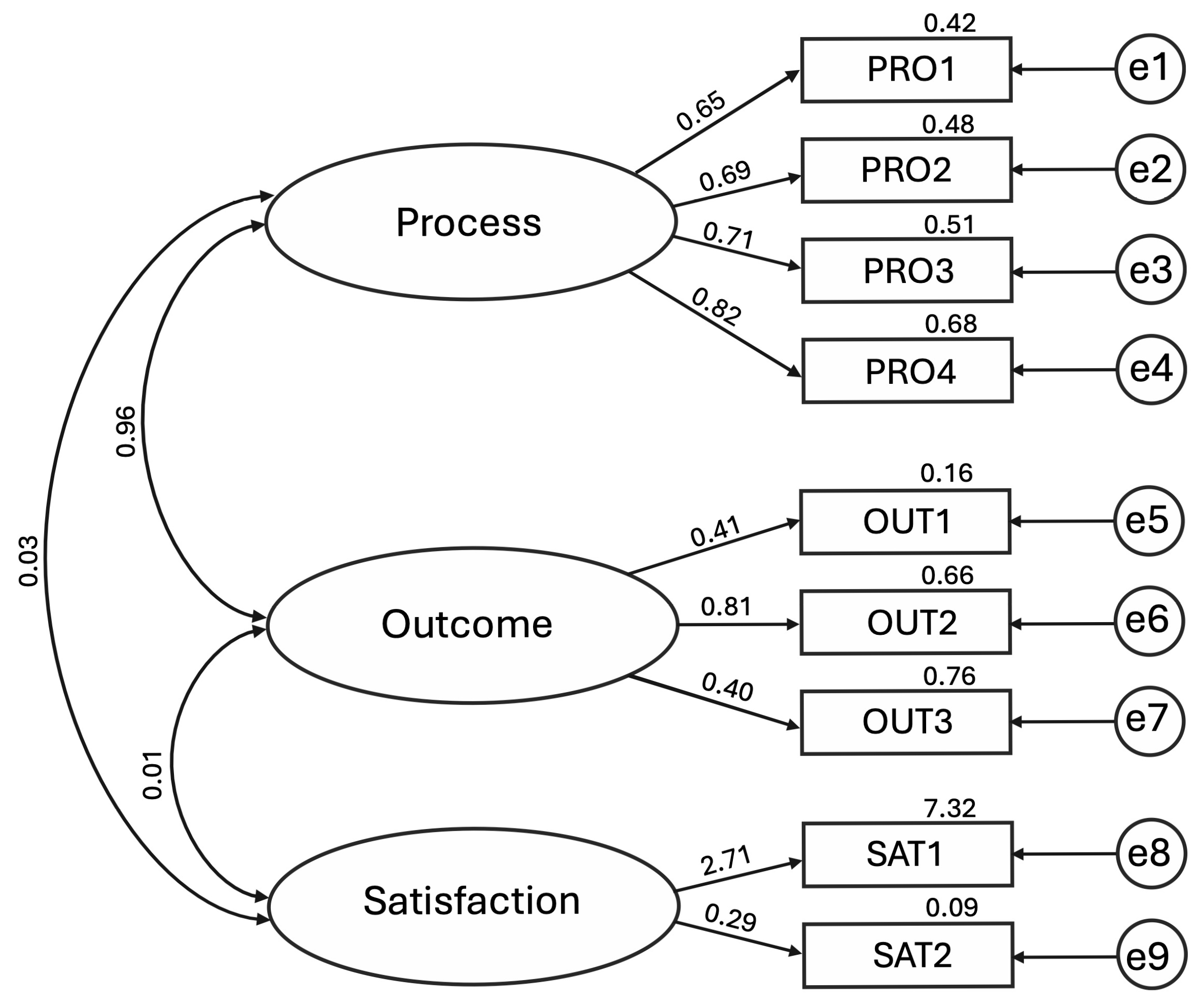
The three-factor CFA model demonstrated an overall acceptable fit. Although the chi-square was statistically significant, χ2 (24) = 42.011, p = 0.013, this result was expected given the sample size. Other fit indices indicated good model adequacy: CFI = 0.979; TLI = 0.968; IFI = 0.979; NFI = 0.953; RFI = 0.929; RMSEA = 0.054 (90% CI: 0.038–0.065); PCLOSE = 0.378. The Process factor displayed strong and consistent standardised loadings, ranging from 0.648 (PRO1) to 0.823 (PRO4), with PRO2 (0.693) and PRO3 (0.711) also showing adequate contributions, supporting its internal coherence. Its Average Variance Extracted (AVE) was 0.521, meeting the recommended threshold.
The Outcome factor showed heterogeneous contributions: OUT2 loaded strongly (0.814), whereas OUT1 (0.406) and OUT3 (0.402) presented weaker associations. The AVE was 0.330, below the recommended threshold, indicating limited convergent validity.
The Satisfaction factor presented estimation anomalies, with SAT1 displaying an excessively high standardised loading (2.706) and SAT2 a very low value (0.293), accompanied by a negative error variance (Heywood case). Due to these anomalies, the AVE could not be meaningfully interpreted.
Discriminant validity was examined using the Fornell–Larcker criterion. The square root of the AVE for Process (√0.521 = 0.72) and Outcome (√0.330 = 0.57) were both lower than their latent correlation (r = 0.955), indicating a lack of discriminant validity between these constructs. In contrast, Satisfaction showed negligible correlations with Process (r = 0.027) and Outcome (r = 0.009); however, due to the estimation anomalies and inadmissible AVE, discriminant validity could not be meaningfully evaluated for this factor.
A graphical representation of the model is provided in Figure 1.
Figure 1.
Confirmatory factor analysis of a hypothetical three-factor model of hospital pharmacists’ attitudes towards documenting and classifying pharmaceutical interventions (N = 260); latent constructs: Process (PRO), Outcome (OUT), and Satisfaction (SAT); observed variables: PRO1–PRO4, OUT1–OUT3, and SAT1–SAT3 correspond to the questionnaire items retained in the final model.
Detailed unstandardised and standardised regression weights, AVE values, and inter-factor correlations are presented in Table 4.
Table 4.
Confirmatory factor analysis of a hypothetical three-factor model (N = 260).
4. Discussion
This study builds on previous research that focused on the pretest, factor structure, validity, and reliability of a novel tool designed to assess pharmacists’ perspectives and routines in documenting and classifying PIs within hospital settings [13]. However, further validation and assessment of its broader impact were needed, which was pursued through the nationwide application of the questionnaire, while recognising that the sample was not designed to guarantee statistical representativeness or power for broader generalisation.
The questionnaire, targeting individual hospital pharmacists in Portugal, obtained a 14% response rate. Despite reminders and a user-friendly platform, participation remained modest, though consistent with previous pharmacist surveys in Portugal, which are scarce and typically report rates around 11–12% [30]. At the European level, hospital pharmacy surveys such as the EAHP Statements Survey achieved 14% in 2018 and 19% in a later edition, although the Portuguese rate in that study was only 10% [31,32]. Thus, our findings align with international evidence of limited engagement in this professional group. While modest, a 14% response rate can be considered acceptable for voluntary, non-incentivised surveys of healthcare professionals, where survey fatigue is a recognised challenge [33]. Nonetheless, concerns about representativeness remain. Portugal lacks updated sociodemographic data on hospital pharmacists, and the only available indicator—the proportion of pharmacists with the Hospital Pharmacy specialty (51.2%)—is lower than observed in our sample (69.2%), [23] suggesting possible overrepresentation of specialists with greater interest in the survey topic.
Portuguese pharmacists reported performing an average of 49 PIs per month (SD = 196), a value higher than that described in studies conducted in other countries, where monthly averages range between 20 and 30 PIs [34,35,36]. These latter studies were retrospective and relied on documented interventions, whereas in our study, the data are self-reported and therefore subject to self-reporting bias. A substantial proportion of pharmacists acknowledged that they never record (28.8%), classify (56.2%), or analyse (52.3%) the PIs performed, and a similar pattern emerged when considering all potential PIs (100%). These findings may be explained by dissatisfaction with current documentation and classification systems and by the frequent use of non-validated, in-house classifications, which limits the generalisability and utilisation of data. For instance, only 7% of the respondents reported using a validated classification, and, even within this subgroup, there was heterogeneity, with some applying frameworks centred on DRPs, such as PCNE, or the Faus-Dáder model, originally developed for the provision of pharmaceutical care. Taken together with broader challenges faced globally by hospital pharmacy services, such as lack of time, limited staff, and increasing workload pressures [37,38], these factors help explain the low rate of PI documentation and classification reported.
Within the cognitive domain, respondents demonstrated high levels of agreement with the four literature-based definitions of PIs [16,17,18,19]. Despite differences in wording and emphasis, these definitions consistently reflect core concepts such as the prevention and resolution of DRPs, interprofessional collaboration, and the optimisation of medication use and therapeutic outcomes, indicating a strong conceptual alignment among hospital pharmacists. Item (e), which did not present a definition but instead addressed the potential ambiguity of the term ‘intervention’ when interpreted by non-pharmacist stakeholders [28], received a slightly lower agreement rate (86.2%). This result may reflect a perceived need to increase awareness of the scope and nature of hospital pharmacists’ clinical roles, particularly among healthcare administrators and other professional groups.
Previous studies have underscored the importance of clearly communicating pharmacists’ contributions to patient safety, therapeutic optimisation, and interdisciplinary care, as a way to support their effective integration within healthcare teams [39,40,41,42]. Strengthening the articulation of this professional identity may also facilitate more structured practice-based research, contribute to broader recognition of the pharmacist’s role. However, only 53.1% of respondents agreed with the statement “There is no internationally recognised and widely accepted definition of PI.” This finding indicates that, while formal international consensus is indeed lacking, the strong conceptual convergence across the four literature-based definitions in this study appears to foster a shared understanding among hospital pharmacists. In practice, this internal consistency may lead professionals to perceive existing definitions as sufficiently robust for clinical application—even without official harmonisation.
Respondents expressed positive attitudes towards PIs, as evidenced by the high level of agreement on the need to classify and record interventions, to standardise classification systems, to assess their impact, and on the notion that the pharmacist’s presence in the clinical setting can increase the number of PIs performed. All respondents agreed that PIs contribute positively to health outcomes, a finding extensively supported in the literature [1,43,44,45]. Nevertheless, there was a substantial level of dissatisfaction with the systems currently used to record and classify PIs, highlighting an unmet need within Portuguese hospital pharmacy practice.
The affective domain of the tool, originally conceptualised with three subdimensions (Process, Outcome, and Satisfaction), demonstrated overall adequate psychometric properties in previous exploratory analyses [13]. In the present study, CFA was conducted to test its structural validity and goodness of fit. The analysis provided partial support for the hypothesised three-factor structure: while the overall model fit indices indicated adequacy, a closer inspection of standardised regression weights, AVE values, and latent correlations revealed important psychometric limitations.
The Process dimension emerged as the most stable and interpretable factor. All items demonstrated strong and statistically significant standardised regression weights, and the construct achieved an AVE above the recommended threshold (0.52), supporting adequate convergent validity. This suggests that pharmacists clearly recognise and differentiate procedural elements related to PI documentation, including classification standards and documentation protocols. In contrast, the Outcome factor presented substantial challenges. Although OUT2 displayed a strong loading, OUT1 and OUT3 had much weaker contributions. Moreover, this factor showed very high correlation with Process (r = 0.955), failing to meet the Fornell–Larcker criterion and indicating a lack of discriminant validity and potential redundancy between the two constructs. This finding may reflect a real-world perception among pharmacists that procedural rigour and clinical outcomes are closely intertwined in documentation practices, raising the question of whether these should be treated as distinct latent dimensions.
The Satisfaction factor proved psychometrically unstable. One item (SAT1) produced an inadmissible loading (Heywood case), while the other (SAT2) had a very low and non-significant loading, leading to AVE values far below acceptable thresholds. This pattern indicates model misspecification and suggests that the construct is not being adequately captured by the current items. A likely explanation is the semantic and spatial proximity of (e.g., SAT1 and SAT2) in the questionnaire layout, which may have induced redundancy or response bias. Respondents may have interpreted these items similarly despite their intended conceptual distinction. This suggests the need for item reformulation or alternative conceptualisation.
Strengths and Limitations
The nationwide scope and the application of CFA allowed for the assessment of the structural properties of the tool, providing partial support for the hypothesised model. The Process domain demonstrated coherence and convergence validity, suggesting potential utility in practice evaluation, research, and policy. By contrast, the Outcome factor showed insufficient discriminant validity due to its high overlap with Process, and the Satisfaction factor revealed problematic item performance and estimation anomalies, indicating that both domains require further refinement.
Additional limitations should be acknowledged. As mentioned earlier, although the national application expanded the scope of testing, the sample was not designed to ensure statistical representativeness or power for broader generalisation. In addition, the low response rate may have reduced statistical power, reliability, and precision, while the reliance on self-reported data introduces the possibility of reporting bias. The predominance of specialist and more experienced pharmacists among respondents may also have influenced the attitudinal profile observed, limiting generalizability to less experienced professionals. The limited number of items per factor, defined based on evidence from the literature and the previous EFA, may also have affected model stability and some reliability indicators. To enhance construct validity, future versions of the instrument should consider rewording and spatially separating the Satisfaction items, but also expanding the overall number of items per construct. This would allow a more stable factor structure and stronger reliability estimates. In particular, additional items could better capture the multidimensional nature of professional satisfaction, including perceived usability, relevance to practice, and alignment with professional values. Given the high empirical overlap between Process and Outcome, future modelling could explore representing them as a single latent factor, or as first-order subdimensions under a second-order construct reflecting the perceived utility of PI documentation systems. Despite these limitations, the CFA results support the structural coherence of the Process dimension and provide valuable insights for instrument refinement. These findings contribute to the development of more valid and reliable tools for assessing pharmacists’ affective engagement with documentation practices in clinical settings.
5. Conclusions
This study advances the validation of a questionnaire designed to assess hospital pharmacists’ opinions and practices regarding the documentation and classification of PIs. The CFA findings provided evidence for the structural coherence of the Process factor, while highlighting overlap between domains and weaknesses in Satisfaction items, indicating that further refinement is needed. A discrepancy emerged between theory—reflected in pharmacists’ positive perceptions of the importance of documenting and classifying PIs—and practice, evidenced by their limited engagement in these activities. Although national data suggest strong professional commitment to PIs, they also highlight significant barriers to systematic documentation. Persistent challenges, including dissatisfaction with current systems, lack of standardisation, and workload constraints, underscore the need for targeted interventions to improve PI recording and classification, namely the establishment of a framework enabling data collection and integration from multiple sites, and the creation of a unified system for PI documentation and classification to generate representative national overviews. A future refined tool may provide a contextually relevant resource to support practice evaluation, guide research, and inform policy decisions aimed at strengthening the quality, visibility, and impact of pharmaceutical care in hospital settings.
Supplementary Materials
The following supporting information can be downloaded at: https://www.mdpi.com/article/10.3390/pharmacy13060159/s1, File S1: English translation of the original questionnaire (Practices of Recording and Classifying Hospital Pharmaceutical Interventions in Portugal).
Author Contributions
Conceptualisation, S.M. and A.M.C.; methodology, S.M. and A.M.C.; software, S.M.; validation, S.M. and A.M.C.; formal analysis, S.M.; resources, A.M.C.; data curation, S.M.; writing—original draft preparation, S.M.; writing—review and editing, F.F. and A.M.C.; supervision, F.F. and A.M.C. All authors have read and agreed to the published version of the manuscript.
Funding
This research received no external funding.
Institutional Review Board Statement
The study was conducted in accordance with the Declaration of Helsinki and approved by the Ethics Committee for Human Research of the Faculty of Pharmacy of the University of Lisbon (approval number 01/2024, 26 March 2024).
Informed Consent Statement
Informed consent was obtained from all subjects involved in the study.
Data Availability Statement
The data presented in this study are available on reasonable request from the corresponding author due to privacy and confidentiality considerations and institutional data protection policies.
Acknowledgments
The authors would like to thank Ordem dos Farmacêuticos—Portuguese Pharmaceutical Society for disseminating the questionnaire, and Rui Almeida for his valuable support with the statistical analysis.
Conflicts of Interest
The authors declare no conflicts of interest.
Abbreviations
The following abbreviations are used in this manuscript:
| AMOS | Analysis of Moment Structures |
| AVE | Average Variance Extracted |
| CFA | Confirmatory Factor Analysis |
| CFI | Comparative Fit Index |
| CPOE | Computerised Physician Order Entry |
| DRP | Drug-Related Problem |
| EAHP | European Association of Hospital Pharmacists |
| EFA | Exploratory Factor Analysis |
| EHR | Electronic Health Record |
| ICU | Intensive Care Unit |
| IFI | Incremental Fit Index |
| LHU | Local Health Unit |
| LTCFs | Long-Term Care Facilities |
| NFI | Normed Fit Index |
| OUT | Outcome (Latent Factor) |
| PCLOSE | P of Close Model Fit |
| PCNE | Pharmaceutical Care Network Europe |
| PI | Pharmacist Intervention |
| PRO | Process (Latent Factor) |
| RFI | Relative Fit Index |
| RMSEA | Root Mean Square Error of Approximation |
| SAT | Satisfaction (Latent Factor) |
| SD | Standard Deviation |
| SE | Standard Error of Unstandardised Regression Weights |
| SRW | Standardised Regression Weights |
| TLI | Tucker–Lewis Index |
| URW | Unstandardised Regression Weights |
| χ2 | Chi-square |
References
- Delgado-Silveira, E.; Vélez-Díaz-Pallarés, M.; Muñoz-García, M.; Correa-Pérez, A.; Álvarez-Díaz, A.M.; Cruz-Jentoft, A.J. Effects of Hospital Pharmacist Interventions on Health Outcomes in Older Polymedicated Inpatients: A Scoping Review. Eur. Geriatr. Med. 2021, 12, 509–544. [Google Scholar] [CrossRef]
- Alshehri, A.A.; Jalal, Z.; Cheema, E.; Haque, M.S.; Jenkins, D.; Yahyouche, A. Impact of the Pharmacist-Led Intervention on the Control of Medical Cardiovascular Risk Factors for the Primary Prevention of Cardiovascular Disease in General Practice: A Systematic Review and Meta-Analysis of Randomised Controlled Trials. Br. J. Clin. Pharmacol. 2020, 86, 29–38. [Google Scholar] [CrossRef]
- Hazen, A.; Sloeserwij, V.; Pouls, B.; Leendertse, A.; de Gier, H.; Bouvy, M.; de Wit, N.; Zwart, D. Clinical Pharmacists in Dutch General Practice: An Integrated Care Model to Provide Optimal Pharmaceutical Care. Int. J. Clin. Pharm. 2021, 43, 1155–1162. [Google Scholar] [CrossRef]
- Clarenne, J.; Mongaret, C.; Vermorel, C.; Bosson, J.L.; Gangloff, S.C.; Lambert-Lacroix, S.; Bedouch, P. Characteristics of Hospital Pharmacist Interventions and Their Clinical, Economic and Organizational Impacts: A Five-Year Observational Study on the French National Observatory. Int. J. Clin. Pharm. 2024, 47, 403–411. [Google Scholar] [CrossRef]
- Calloway, S.; Akilo, H.; Bierman, K. Impact of a Clinical Decision Support System on Pharmacy Clinical Interventions, Documentation Efforts, and Costs. Hosp. Pharm. 2013, 48, 744–752. [Google Scholar] [CrossRef]
- Fatiha Mahomedradja, R.; Wang, S.; Catherina, K.; Sigaloff, E.; Tichelaar, J.; Adriaan Van Agtmael, M. Hospital-Wide Interventions for Reducing or Preventing in-Hospital Prescribing Errors: A Scoping Review. Expert. Opin. Drug Saf. 2025, 24, 529–546. [Google Scholar] [CrossRef]
- Machado, S.; Falcão, F.; das Cavaco, A.M. Documentation and Classification of Hospital Pharmacist Interventions: A Scoping Review. Br. J. Clin. Pharmacol. 2023, 90, 722–739. [Google Scholar] [CrossRef]
- Sanders, K.A.; Wolverton, D.; Stamopoulos, M.; Zunich, R.; Niznik, J.; Ferreri, S.P. An EHR-Based Method to Structure, Standardize, and Automate Clinical Documentation Tasks for Pharmacists to Generate Extractable Outcomes. JAMIA Open 2023, 6, ooad034. [Google Scholar] [CrossRef]
- Cossart, A.R.; Canning, M.L.; Yong, F.R.; Freeman, C.R. Benchmarking Hospital Clinical Pharmacy Practice Using Standardised Key Performance Indicators (KPIs). J. Pharm. Policy Pract. 2024, 17, 2431181. [Google Scholar] [CrossRef]
- Charpiat, B.; Conort, O.; Juste, M.; Rose, F.; Roubille, R.; Bedouch, P.; Allenet, B. The French Society of Clinical Pharmacy ACT-IP© Project: Ten Years Onward, Results and Prospects. Pharm. Hosp. Clin. 2015, 50, 15–24. [Google Scholar] [CrossRef]
- Maes, K.A.; Tremp, R.M.; Hersberger, K.E.; Lampert, M.L.; GSASA Working group on clinical pharmacy. Demonstrating the Clinical Pharmacist’s Activity: Validation of an Intervention Oriented Classification System. Int. J. Clin. Pharm. 2015, 37, 1162–1171. [Google Scholar] [CrossRef]
- Verheyen, S.; Steurbaut, S.; Cortoos, P.J.; Wuyts, S.C.M. Development and Partial Validation of Be-CLIPSS: A Classification System for Hospital Clinical Pharmacy Activities. Int. J. Clin. Pharm. 2024, 46, 80–89. [Google Scholar] [CrossRef]
- Machado, S.; Falcão, F.; Cavaco, A.M. Development and Validation of a Feasible Questionnaire to Assess Pharmacists’ Attitudes to Documenting and Classifying Pharmaceutical Interventions in Hospital Settings. Eur. J. Hosp. Pharm. 2025. [Google Scholar] [CrossRef]
- Carter, S.R. Using Confirmatory Factor Analysis to Manage Discriminant Validity Issues in Social Pharmacy Research. Int. J. Clin. Pharm. 2016, 38, 731–737. [Google Scholar] [CrossRef]
- Harrington, D. Assessing Confirmatory Factor Analysis Model Fit and Model Revision, 1st ed.; Oxford University Press: Oxford, UK, 2009; ISBN 9780195339888. [Google Scholar]
- Assembleia da República. Lei n.o 131/2015—Estatuto Da Ordem Dos Farmacêuticos; Diário da República: Lisbon, Portugal, 2015; pp. 7010–7048.
- Hochhold, D.; Nørgaard, L.S.; Stewart, D.; Weidmann, A.E. Identification, Classification, and Documentation of Drug Related Problems in Community Pharmacy Practice in Europe: A Scoping Review. Int. J. Clin. Pharm. 2025, 47, 247–269. [Google Scholar] [CrossRef]
- Allenet, B.; Bedouch, P.; Rose, F.-X.; Escofier, L.; Roubille, R.; Charpiat, B.; Juste, M.; Conort, O. Validation of an Instrument for the Documentation of Clinical Pharmacists’ Interventions. Pharm. World Sci. 2006, 28, 181–188. [Google Scholar] [CrossRef]
- Brown, T.A. Confirmatory Factor Analysis for Applied Research, 2nd ed.; The Guilford Press: New York, NY, USA, 2015; pp. 1–462. [Google Scholar]
- Schumaker, R.; Lomax, R. A Beginner’s Guide to Structural Equation Modeling, 3rd ed.; Taylor and Francis Group, LLC: New York, NY, USA, 2022; ISBN 978-1-84169-890-8. [Google Scholar]
- Fornell, C.; Larcker, D.F. Evaluating Structural Equation Models with Unobservable Variables and Measurement Error. J. Mark. Res. 1981, 18, 39–50. [Google Scholar] [CrossRef]
- Hair, J.F.; Babin, B.J.; Anderson, R.E.; Black, W.C. Multivariate Data Analysis, 8th ed.; Cengage Learning: Hampshire, UK, 2009; ISBN 9353501350. [Google Scholar]
- Farmacêuticos em Números—Ordem dos Farmacêuticos. Available online: https://www.ordemfarmaceuticos.pt/pt/numeros/ (accessed on 27 June 2025).
- Kim, Y.; Schepers, G. Pharmacist Intervention Documentation in US Health Care Systems. Hosp. Pharm. 2017, 38, 1141–1147. [Google Scholar] [CrossRef]
- SHPA Committee of Specialty Practice in Clinical Pharmacy. SHPA Standards of Practice for Clinical Pharmacy. J. Pharm. Pract. Res. 2013, 43, S42–S46. [Google Scholar]
- Al-jedai, A.; Nurgat, Z.A. Electronic Documentation of Clinical Pharmacy Interventions in Hospitals. In Data Mining Applications in Engineering and Medicine; Karahoca, A., Ed.; IntechOpen: London, UK, 2012; ISBN 978-953-51-4286-7. [Google Scholar]
- Langebrake, C.; Ihbe-Heffinger, A.; Leichenberg, K.; Kaden, S.; Kunkel, M.; Lueb, M.; Hilgarth, H.; Hohmann, C. Nationwide Evaluation of Day-to-Day Clinical Pharmacists’ Interventions in German Hospitals. Pharmacotherapy 2015, 35, 370–379. [Google Scholar] [CrossRef]
- Alderman, C.P.; Farmer, C. A Brief Analysis of Clinical Pharmacy Interventions Undertaken in an Australian Teaching Hospital. J. Qual. Clin. Pract. 2001, 21, 99–103. [Google Scholar] [CrossRef]
- Ihbe-Heffinger, A.; Langebrake, C.; Hohmann, C.; Leichenberg, K.; Hilgarth, H.; Kunkel, M.; Lueb, M.; Schuster, T. Prospective Survey-Based Study on the Categorization Quality of Hospital Pharmacists’ Interventions Using DokuPIK. Int. J. Clin. Pharm. 2019, 41, 414–423. [Google Scholar] [CrossRef]
- Ferreira-da-Silva, R.; Alves, J.M.; Vieira, C.; Silva, A.M.; Marques, J.; Morato, M.; Polónia, J.J.; Ribeiro-Vaz, I. Motivation and Knowledge of Portuguese Community Pharmacists Towards the Reporting of Suspected Adverse Reactions to Medicines: A Cross-Sectional Survey. J. Community Health 2022, 48, 295–308. [Google Scholar] [CrossRef]
- Amann, S.; Underhill, J.; Horák, P.; Batista, A.; Miljkovic, N.; Gibbons, N. EAHP European Statements Survey 2018, Focusing on Section 1: Introductory Statements and Governance, Section 3: Production and Compounding, and Section 4: Clinical Pharmacy Services. Eur. J. Hosp. Pharm. 2019, 29, 26–32. [Google Scholar] [CrossRef]
- Kuruc Poje, D.; William Fitzpatrick, R.; Stevens, C.; Machin, C.; Underhill, J.; Horák, P.; Batista, A.; Süle, A.; Miljković, N.; Plesan, C.; et al. Investigation of the Hospital Pharmacy Profession in Europe. Eur. J. Hosp. Pharm. 2024, 32, 316–323. [Google Scholar] [CrossRef]
- Ghafourifard, M. Survey Fatigue in Questionnaire Based Research: The Issues and Solutions. J. Caring Sci. 2024, 13, 214–215. [Google Scholar] [CrossRef]
- Abushanab, D.; Atchan, M.; Elajez, R.; Elshafei, M.; Abdelbari, A.; Hail, M.A.; Abdulrouf, P.V.; El-Kassem, W.; Ademi, Z.; Fadul, A.; et al. Economic Impact of Clinical Pharmacist Interventions in a General Tertiary Hospital in Qatar. PLoS ONE 2023, 18, e0286419. [Google Scholar] [CrossRef]
- Durand, A.; Gillibert, A.; Membre, S.; Mondet, L.; Lenglet, A.; Mary, A. Acceptance Factors for In-Hospital Pharmacist Interventions in Daily Practice: A Retrospective Study. Front. Pharmacol. 2022, 13, 811289. [Google Scholar] [CrossRef]
- Langebrake, C.; Hohmann, C.; Lezius, S.; Lueb, M.; Picksak, G.; Walter, W.; Kaden, S.; Hilgarth, H.; Ihbe-Heffinger, A.; Leichenberg, K. Clinical Pharmacists’ Interventions across German Hospitals: Results from a Repetitive Cross-Sectional Study. Int. J. Clin. Pharm. 2022, 44, 64–71. [Google Scholar] [CrossRef]
- Bondi, D.S.; Alavandi, P.; Allen, J.M.; Avery, L.M.; Buatois, E.; Connor, K.A.; Martello, J.L.; Michienzi, S.M.; Trujillo, T.C.; Ybarra, J.; et al. Addressing Challenges of Providing Remote Inpatient Clinical Pharmacy Services. J. Am. Coll. Clin. Pharm. 2021, 4, 1594–1600. [Google Scholar] [CrossRef]
- Abuzour, A.S.; Hoad-Reddick, G.; Shahid, M.; Steinke, D.T.; Tully, M.P.; Williams, S.D.; Lewis, P.J. Patient Prioritisation for Hospital Pharmacy Services: Current Approaches in the UK. Eur. J. Hosp. Pharm. 2021, 28, 102–108. [Google Scholar] [CrossRef]
- Le, L.M.; Veettil, S.K.; Donaldson, D.; Kategeaw, W.; Hutubessy, R.; Lambach, P.; Chaiyakunapruk, N. The Impact of Pharmacist Involvement on Immunization Uptake and Other Outcomes: An Updated Systematic Review and Meta-Analysis. J. Am. Pharm. Assoc. 2022, 62, 1499–1513.e16. [Google Scholar] [CrossRef]
- Oliveira, C.S.; Silva, M.P.; Miranda, Í.K.S.P.B.; Calumby, R.T.; de Araújo-Calumby, R.F. Impact of Clinical Pharmacy in Oncology and Hematology Centers: A Systematic Review. J. Oncol. Pharm. Pract. 2021, 27, 679–692. [Google Scholar] [CrossRef]
- Lankford, C.; Dura, J.; Tran, A.; Lam, S.W.; Naelitz, B.; Willner, M.; Geyer, K. Effect of Clinical Pharmacist Interventions on Cost in an Integrated Health System Specialty Pharmacy. J. Manag. Care Spec. Pharm. 2021, 27, 379–384. [Google Scholar] [CrossRef]
- Nelson, N.R.; Armistead, L.T.; Blanchard, C.M.; Rhoney, D.H. The Pharmacist’s Professional Identity: Preventing, Identifying, and Managing Medication Therapy Problems as the Medication Specialist. J. Am. Coll. Clin. Pharm. 2021, 4, 1564–1571. [Google Scholar] [CrossRef]
- Duwez, M.; Chanoine, S.; Lepelley, M.; Vo, T.H.; Pluchart, H.; Mazet, R.; Allenet, B.; Pison, C.; Briault, A.; Saint-Raymond, C.; et al. Clinical Evaluation of Pharmacists’ Interventions on Multidisciplinary Lung Transplant Outpatients’ Management: Results of a 7-Year Observational Study. BMJ Open 2020, 10, e041563. [Google Scholar] [CrossRef]
- Renaudin, P.; Boyer, L.; Esteve, M.A.; Bertault-Peres, P.; Auquier, P.; Honore, S. Do Pharmacist-Led Medication Reviews in Hospitals Help Reduce Hospital Readmissions? A Systematic Review and Meta-Analysis. Br. J. Clin. Pharmacol. 2016, 82, 1660–1673. [Google Scholar] [CrossRef]
- Ali, S.; Salahudeen, M.S.; Bereznicki, L.R.E.; Curtain, C.M. Pharmacist-Led Interventions to Reduce Adverse Drug Events in Older People Living in Residential Aged Care Facilities: A Systematic Review. Br. J. Clin. Pharmacol. 2021, 87, 3672–3689. [Google Scholar] [CrossRef]
Disclaimer/Publisher’s Note: The statements, opinions and data contained in all publications are solely those of the individual author(s) and contributor(s) and not of MDPI and/or the editor(s). MDPI and/or the editor(s) disclaim responsibility for any injury to people or property resulting from any ideas, methods, instructions or products referred to in the content. |
© 2025 by the authors. Licensee MDPI, Basel, Switzerland. This article is an open access article distributed under the terms and conditions of the Creative Commons Attribution (CC BY) license (https://creativecommons.org/licenses/by/4.0/).