Article

Challenging Misconceptions About Studying Moroccan Arabic: Beliefs of L2 Multidialectal Learners Beginning a Year-Long Study Abroad in Morocco

Department of Languages, Cultures & Applied Linguistics, Carnegie Mellon University, 5000 Forbes Avenue, Pittsburgh, PA 15213, USA
*
Author to whom correspondence should be addressed.
Languages 2026, 11(1), 4; https://doi.org/10.3390/languages11010004
Submission received: 16 May 2025 / Revised: 11 December 2025 / Accepted: 12 December 2025 / Published: 26 December 2025
(This article belongs to the Special Issue Second Language Acquisition and Sociolinguistic Studies)

Abstract

Morocco has recently been cited by the Institute of International Education as a leading destination for Arabic study abroad. However, research has shown that ideologies of language purism and unintelligibility position Eastern varieties of Arabic as more prestigious than Western. Yet, how these beliefs affect learners studying abroad remains an understudied topic, with few studies specifically investigating learners going to Morocco. This study utilizes language learning questionnaires and one-on-one interviews to explore learner beliefs about varieties of Arabic, with particular focus on Moroccan Arabic. Specifically, it looks at four advanced L2 Arabic learners who just started their one-year-long study abroad sojourn in Morocco. Findings show that due to negative stereotypes and misconceptions from native speakers, instructors, and colleagues, learners reported not wanting to learn Darija, the Moroccan variety of Arabic, before studying abroad. However, due to the immediate need of studying and living in Morocco, participants gained interest in Darija and started challenging stereotypes and misconceptions related to this variety of Arabic. These findings highlight the impact of standard language ideology and prestige on learners’ beliefs about what language varieties to study, and how these beliefs may change once learners prepare to and go abroad. Findings from this study support pedagogical and research suggestions to prepare learners for the sociolinguistic realities of the Arabic-speaking world, including critical awareness of ideologies and developing agency in dialect choice.

1. Introduction

Arabic is a diglossic language; and the existence of multiple regional varieties has been the focus of research in Arabic sociolinguistics (Bassiouney, 2020; Holes, 2004). This sociolinguistic reality makes the process of learning Arabic as a second/foreign language (L2 Arabic) more challenging due to lack of agreement on which dialect or variety of Arabic should be taught in the classroom. Part of the challenge is that while L2 Arabic learners need both Modern Standard Arabic (MSA) and at least one spoken variety to mirror the linguistic reality on the ground, formal L2 contexts seem to prioritize teaching MSA in the classroom (e.g., Al Masaeed, 2022c; Towler, 2025a). Research on L2 Arabic has shown that teaching a spoken variety alongside MSA is crucial for L2 Arabic learners to develop literacy and pragmatic competence to be better prepared to interact with Arabic speakers (Al-Batal, 2018; Al Masaeed, 2022a; Nassif & Al Masaeed, 2022; Younes, 2015).
Research has also shown that learners often do not align with top-down approaches of enforcing MSA in a way that conflicts with the multilingual reality of the Arabic-speaking world and, instead, develop more interest in regional dialects from the places in which they study abroad (Al Masaeed, 2020; Shiri, 2013). Historically, L2 Arabic study abroad (SA) programs focused on Egypt compared to North African destinations (Institute of International Education, 2024). This preference could be motivated by language ideologies that uphold Egyptian (Masri) and Levantine Arabic (Shaami) varieties as more prestigious than those in North Africa (Hachimi, 2013). This view also contributes to the increase in teaching Masri and Shaami along with MSA in the US and elsewhere (Shiri, 2013). However, in response to geopolitics and global affairs, U.S.-based Arabic study-abroad programs have substantially increased in Morocco. Data published by IIE and Open Doors found that the number of students studying abroad in Egypt was the highest in 2009/2010. However, the number dropped substantially in the following year. Since 2012, more learners have gone to Morocco than Egypt (Institute of International Education, 2024) and in 2010, learners had preferred to study in Jordan and Egypt over Morocco due to dialect-related factors Shiri (2013). New approaches to dialect integration have called for adapting Arabic curriculum to include Darija to help prepare learners for SA (Turner, 2018). Nevertheless, research on the beliefs of L2 Arabic learners regarding East and West Arabic in SA is underinvestigated. Therefore, this study utilizes a language learning questionnaire and one-on-one interviews to explore beliefs about varieties of Arabic, with particular focus on Darija. Specifically, it looks at four advanced L2 Arabic learners who just started their one-year-long SA in Morocco.

2. Background

2.1. Arabic Diglossia

Common description of Arabic divides it between the formal register known as FusHa in Arabic and the colloquial ‘Āmmiyya. These branch further with the colloquial split into spoken regional varieties. Writing is traditionally considered to be the domain of FusHa. Sociolinguists have formulated numerous ways to describe Arabic with the most well-known being Ferguson’s (1959) usage of the term diglossia. Diglossia refers to a language comprising a high and low variety reserved for different purposes and functions. The high variety in this understanding is used for religious sermons, academia, and published writing, while the low is what is spoken in casual conversations or used for folk literature (Ferguson, 1959; Bassiouney, 2020). However, this description and his work were not without critique (Ferguson, 1996). Allen (2004) called it “an unfortunate coinage” due to the fact that Arabic speakers are not always able to use the standard variety, and that shifting registers in Arabic should be considered along a spectrum and not binary (p. 276). Nevertheless, Ferguson’s work has inspired thousands of studies since 1960. Haeri (2000) goes on to say that diglossia became a “convenient albeit controversial description of Arabic-speaking speech communities” (p. 66). In other words, the understanding of Arabic as diglossic spread in research and frequent reference to high and low varieties shared an implicit understanding of these two registers as not changing and not touching. Furthermore, reference to Arabic became a key example for diglossia generally. Over the next 60 years, diglossia became the ubiquitous term used to describe the Arabic sociolinguistic situation, but it is not the only description.
Owens (2001), for example, describes how some researchers noticed that Arabic speakers rarely relied on a specific register exclusively but used FusHa and ‘Āmmiyya concurrently. Badawi (1973) provided a more nuanced understanding of Arabic existing in Egyptian society, ranging between five levels (Badawi, 1973, 1985) that “are not segregated entities” (1985, p. 17), but rather a continuous flow along the continuum from “classical Arabic” to “Illiterate spoken Arabic” (1985, p. 17). When a speaker wants to shift to a higher register, their speech retains aspects of the lower register and vice versa (Bassiouney, 2020). Badawi (1985) attempted to address the issue of Educated Spoken Arabic (ESA) for L2 learners: ESA is another theorization for understanding Arabic sociolinguistics. While the theorization of describing Arabic sociolinguistics lies outside the purview of this study, the studies here highlight the complexity of Arabic sociolinguistics with extensive research conducted (see Bassiouney, 2020 for more details on the topic). Importantly, both vertical (diglossic) and horizontal (varying regional varieties) levels of Arabic play significant roles in Arabic sociolinguistics.
As description of Arabic is a complex topic, scholars have also found different ways to classify and differentiate spoken varieties. Bassiouney (2020), based on the work of Versteegh (2001), describes five large groups: Arabian Peninsula, Mesopotamian, Syro-Lebanese, Egyptian, and Maghreb or North African (p. 21). While this is a compelling description, it should be noted that spoken dialects or registers within these groups vary drastically, even between local areas and communities (for examples of differences between these five varieties, see Bassiouney, 2020, pp. 22–27). Novel approaches have begun using corpus and computational methods to investigate the differences between dialects. One study providing useful examples of dialects by Salameh et al. (2018) employed a fine-grained approach to successfully identify the exact city of origin of speakers with high accuracy (67% for 7-word sentences and 90% for 16-word sentences) from 25 different dialects. This study shows how future work in this domain will help provide data on just how different Arabic dialects and registers can be. At this point, it is clear that although there are shared features between dialects, salient differences allow the determination of their unique city-based speaker location. These differences might be why, to unite the region and increase communication, “Arab governments are in general still keen on promoting Standard Arabic (SA) as their official language rather than the various vernaculars” (Bassiouney, 2020, p. 23). Furthermore, the differences between dialects and interest in SA are among the reasons behind perpetuating the widespread idea that SA is a lingua franca needed for communication in the Arabic-speaking world. However, research on cross-dialectal conversations has shown that Arabic speakers use multiple strategies to communicate and do not rely on MSA or one other dialect specifically (Soliman, 2014). Furthermore, despite common claims that some regional varieties are not mutually intelligible, empirical work by Trentman and Shiri (2020) has found that second language (L2) speakers do relatively well at comprehending unfamiliar dialects at the intermediate level. The colloquial variety of particular interest in this article is Moroccan Arabic--part of the North African language group. It is referred to as Darija or Maghrebi. Other regional varieties mentioned in this article are Egyptian Arabic (Masri) and Levantine Arabic (Shaami). MSA is often called FusHa, though the term refers to both classical and MSA (Bassiouney, 2020).

2.2. Code-Switching and Translanguaging

Code-switching is “the use of several languages or dialects in the same conversation or sentence by bilingual people” (Gardner-Chloros, 2009, p. 4). Scholars investigated switching between Arabic and other languages (e.g., Al Masaeed, 2016, 2018; Belaskri & Drew, 2023; Kniaź & Zawrotna, 2020) and switching between dialects and standard Arabic (e.g., Bassiouney, 2017; Nassif, 2021). The context of Morocco, where this study takes place, has inspired many studies on code-switching, presenting important connections to the current study. Considering the social and political background of the region, Morocco has a rich history, leading to linguistic and cultural diversity. Today, MSA, Moroccan Darija, Amazigh, French, Spanish, and English “all constitute the main ingredients of Morocco’s linguistic and cultural plurality “ (Laaraj, 2023, p. 5403). Out of the languages highlighted, French and Arabic are seen as a key interest for research on code-switching in Morocco (e.g., Aabi, 2020; Bentahila, 1983). Studies on code-switching used varied approaches and show how salient French/Arabic code-switching is in the country. However, fewer studies are found specifically studying code-switching and SA in Morocco. Al Masaeed (2018), for example, explored the code-switching practices of L2 Arabic learners and their first language (L1) partners. His study found that learners and language partners used code-switching to express communicative competence and thereby, “negotiate meaning and enhance L2 learning” (p. 294). The author, therefore, argued for judicious use of code-switching to be allowed in educational contexts. Code-switching in Morocco, like much of the world, is understood as a common practice used by both L1 and L2 speakers, but more work is needed to understand its impact on L2 learners studying there.
Another theorization of the use of multiple languages or varieties by a speaker is translanguaging, which is based on the understanding that language users’ competence and repertoire are not restricted to distinct named languages or codes. Therefore, translanguaging is viewed as a perspective that challenges language hierarchies and abandons standardized languages as the goal (Al Masaeed, 2020; Kawafha & Al Masaeed, 2023). L2 Arabic research that incorporates such a multilingual perspective has grown in recent years (e.g., Al Masaeed, 2022b, 2023, 2024; Kawafha & Al Masaeed, 2023; Nassif & Al Masaeed, 2022), with research insights pointing to the need for L2 Arabic research to move towards an understanding of L2 learners as multilingual language users generally. For example, Nassif and Al Masaeed (2022) looked at learners’ abilities to perform different classroom activities: formal presentations vs. non-formal skits. After the semester-long multidialectal training, learners were found to successfully use MSA for the formal context and colloquial Arabic for the non-formal. These findings were then posited to support integrating dialect and MSA in the L2 Arabic classroom. By moving beyond a monolingual framework, this study calls into question the ideologies that students have, and how these affect studying abroad in Morocco.

2.3. Language Ideology and Arabic Varieties

Given that Arabic has different levels or registers, there is an ongoing debate on the role of prestige in Arabic sociolinguistics. Early work on prestige in Arabic applied Western research to a different linguistic situation and, therefore, assumed that MSA would be the only prestigious variety (Ibrahim, 1986). However, this is not necessarily the case; many studies have demonstrated that there are prestigious regional varieties alongside MSA (Abdel-Jawad, 1986; Haeri, 1997; Holes, 1983, 1987). Insights from these studies found that in these contexts, dialectal prestige is more closely tied to social power and wealth than to the status of the standard language or ideological language hierarchies (Al Masaeed, 2022c).
This relationship is understood well when investigating the language ideologies present in the Arab world. Woolard (2020) defines language ideologies as “morally and politically loaded representations of the structure and use of languages in a social world” (p. 1). However, they relate to more than just language. They are intertwined with and connect “other social phenomena” (p. 2) such as identities, morality, correctness, truth, esthetics, and more. One key language ideology is Standard language ideology (SLI), which relates to the process of standardization, where one variety becomes regarded as prestigious and superior (Milroy, 2001). This relates to the ideology of purism, “which stipulates what constitutes ‘good’ or ‘proper’ language” (Horner & Weber, 2017, p. 25). These ideologies form part of the hierarchy of language ideology, which refers to the belief that language practices can be organized into hierarchies, positioning some as legitimate and others as illegitimate.
Research on language ideology in Arabic sociolinguistics has investigated L1 (e.g., Brustad, 2017; Hachimi, 2013, 2015) and L2 contexts (e.g., Shiri, 2013; Soulaimani, 2019). Hachimi (2013) investigated the relationship between the Maghrebi (North African) and the Mashreqi (Eastern) regional varieties and concluded that Maghrebi Arabic is mocked in contrast to the adulation of Mashreqi Arabic. S’hiri (2002) examined Tunisian Arabic and found that Arabic speakers from the non-Mashreqi regions are expected to accommodate to Eastern speakers, maintaining asymmetrical power relations that position non-Mashreq dialects as illegitimate or incomprehensible. Hachimi (2013) found significant issues related to authenticity, i.e., who is a true Arabic speaker and what is considered Arabic. The ideologies she presented discuss Moroccan Arabic specifically as being unintelligible, which is often associated with distance from FusHa (p. 287), a common theme in Arabic ideology research. She also found the interrelation between “impurity and unintelligibility” (p. 288). In short, Maghrebi is regarded as impure due to influence from “Berber, French, Spanish, and Arabic-French code switching” (p. 288). Therefore, Hachimi (2013) termed the Maghreb-Mashreq language ideology to describe the relationship between the Maghrebi and Mashreqi rather than between spoken varieties and FusHa. Hachimi (2015) is a perceptual dialectology study gathering data from 52 Moroccans that found “seven key ideologized values for Arabic regional varieties: pan-Arab intelligibility, closeness to SA, esthetic pleasantness, social attractiveness, status, morality, and gender appropriateness” (p. 48). She found that although many Moroccans were loyal to their variety, they did not rate it as the most preferred and consistently rated Syrian and Egyptian varieties higher, supporting the Maghreb-Mashreq ideology.
Language ideologies are particularly powerful beliefs as they “permeate all levels” of language learning and education and thereby influence language policy, learner assessment, classroom practices, and more (Douglas Fir Group, 2016, p. 33). Such ideologies “often index the political economic interests of individual speakers, ethnic and other interest groups, and nation states” (Kroskrity, 2010, p. 192). So, teachers and learners must have the critical language awareness (CLA) to challenge negative ideologies. CLA is a pedagogical approach to language teaching that emphasizes the relationship between language and power that incorporates discussions about sociolinguistic hierarchies and the relationship between social prestige and linguistic prestige. It is particularly useful in immersion contexts where non-native speakers will not only interact with ways of speaking different from their own, but will also be exposed to linguistic ideologies that imply that only certain ways of speaking are considered “correct” (see Pozzi et al., 2025). Work done on languages, such as Spanish (Beaudrie & Loza, 2022; Leeman, 2014, 2018) has shown not only how CLA can be applied to education but has also provided actionable directions.
Research has shown the positive effects of SA on L2 learners’ views of spoken dialects of Arabic. Shiri (2013) explored the language attitudes among L2 Arabic learners during summer SA programs and demonstrated notable favorable changes in learners’ attitudes toward various destinations in the Arab world and toward learning regional varieties alongside MSA. Soulaimani (2019) investigated L2 learners’ attitudes and ideologies towards Moroccan Arabic and found that although learners reflected ideologies of language purism/impurity towards Moroccan Arabic, their language ideologies shifted, reflecting a development of sociolinguistic awareness and positive views of Moroccan Arabic during short-term SA.
Towler (2025a) discussed learners’ sociolinguistic awareness as she examined students’ perspectives on their Arabic learning in English undergraduate courses. She found that a majority of learners wanted to learn a regional variety, but many also expressed a need to establish an MSA base first. Furthermore, she found that although learners can learn a regional variety effectively, they also need better explicit sociolinguistic training to prepare them for communication when traveling abroad. Research on teacher and tutor beliefs (e.g., Kawafha & Al Masaeed, 2023; Towler, 2025b) is another domain investigating Arabic language ideologies in SLA. As one example, Towler (2025b) found that tutors’ beliefs and ideologies, such as language purism and standard language ideology of FusHa vs. spoken dialects, affected inclusion of regional varieties into Arabic curricula.
In sum, research has found that some salient attitudes and beliefs among L1 Arabic speakers can influence those of L2 Arabic speakers. Although SA is also found to have an effect on learners’ beliefs and attitudes, more work is needed to confirm these results and to understand not only the beliefs they report but what language ideologies inform these beliefs. Therefore, this study sets out to explore (1) the beliefs about Moroccan Arabic and other dialects that learners bring to SA with them; and (2) how these beliefs relate to well-known language ideologies in the Arabic-speaking world.

3. Materials and Methods

3.1. Research Design

The case study presented here was part of a larger project investigating L2 learners during a year abroad in Morocco. The larger project was designed as a mixed-methods study (Creswell & Creswell, 2005) to gather longitudinal data on learners’ experiences during SA, particularly related to learner beliefs and identity. The research procedure was planned and performed in a consecutive pattern, including three key portions: (1) language background and Arabic questionnaire, (2) semi-structured interviews, and (3) researcher observations. Questionnaires and interviews were designed to be repeated iteratively throughout the year, concluding with a final data collection at the end of the participants’ SA experience. Researcher observations were planned at the beginning and end of the study. Based on Creswell and Creswell (2005), this project can be understood as a “triangulation design” where quantitative and qualitative data are collected “simultaneously so that the investigator can converge the data to make comparisons” (p. 320). Our instruments drew on those used by Soulaimani’s (2019) to examine learner beliefs and by Trentman (2012) with respect to the background questions. The current study focuses only on the first questionnaires and interviews from the four focal participants.
The questionnaires explored language background and language beliefs. The background section was made up of 13 questions with multiple possible answers. This section asked students about general demographic data, such as age and gender, as well as their experience studying Arabic and other languages. It included questions about how long the students had spent studying Arabic, the background(s) of their instructors, time spent studying abroad, self-reported oral proficiency interview (OPI) scores, and self-evaluation on dialectal ability. The beliefs section was made up of 48 individual questions, including multiple choice, short answer, and gradable scales. Specific questions looked at what students viewed as the easiest or hardest varieties of Arabic, what they wanted to study, why they were studying Arabic, and how much they wanted to learn different dialects. The 21 gradable scale questions were designed to capture learners’ beliefs and feelings towards Arabic dialects and Arabic usage (Appendix C).
Each interview was designed using a protocol (Appendix D) consisting of five questions. Before the interview questions began, the interviewer read a short introductory paragraph in which participants confirmed they were okay with being video and audio recorded. Participants were given the opportunity to provide a pseudonym and were asked not to use anyone’s real name for the sake of their privacy. Questions were designed in sections of language background, SA, perceptions of Moroccan Arabic, identity, and language partners/interactions with Moroccans, with follow-up questions based on participants’ responses throughout the interviews, which were conducted in English. All portions of the study design (consent form, questionnaires, and interview questions) were submitted and approved by the institutional review board (STUDY2024_00000126).

3.2. Research Context and Participants

A total of 14 participants in their capstone (final) year of a federally funded Arabic Flagship Program were recruited from a Moroccan language center at the beginning of the program in June 2024. The current study focuses on the first semi-structured one-on-one interviews and language questionnaires. Of the 14 participants who joined the study and completed the first questionnaire, five volunteered for interviews, and four of them completed the first and second interviews. The four participants focused on in this study are Sheila, Max, Claire, and Anna Baghit (AB), Table 1. To protect learners’ anonymity, pseudonyms were given to three of the participants, and AB chose his own pseudonym.

3.3. Procedures and Data Analysis

After recruitment, participants completed the digital consent form, then the language background and Arabic learning questionnaire and, if they volunteered, an interview. Questionnaires were administered using Qualtrics, and the interviews were conducted face-to-face. Each interview was recorded using two video cameras to capture both the participant and the interviewer (the first author).
The videos were synced using V-Note 3.4.1 Pro software and, upon review, were examined for language beliefs that were both expressed explicitly and covertly. This included noting portions of the videos that corresponded to the two points of interest, i.e., learners’ beliefs about dialects and what ideologies informed these beliefs. Next, specific instances were transcribed using V-Note software and manually reviewed and retranscribed throughout the analysis. Then, the data were organized into an Excel sheet by research point of interest. This process included listing the participants, synthesizing data informing each research point of interest, at what point the data occurred in the interview for easy reference, and direct quotes from the transcriptions.
Data analysis began with removing incomplete responses using R version 4.3.1 (2023-06-16) software and Excel. All participant data were reviewed before focusing on the four target participants. Then, data corresponding to themes based on the research point of interests were reviewed and organized. Data visualizations were made using RStudio 2023.06.2+561 software.
Data analysis involved a qualitative approach (for the open-ended part of the questionnaire and interview data). We adopted both inductive and deductive analysis, and it was an iterative and recursive process through a constant comparison of one piece of data to another (Corbin & Strauss, 2015; Hadley, 2019). Themes were developed based on research points of interest and were investigated in the questionnaires and interviews. This interpretation not only relied on a qualitative analysis but is informed through the convergence of numeric data with qualitative data (Creswell & Creswell, 2005). Excel was used to organize numeric data (Appendix A), while RStudio 2023.06.2+561 software was chosen to produce useful visuals for data interpretation and representation (Creswell & Poth, 2016). Interviews ranged from approximately 10 (Claire’s) to 16 min (Max’s).

4. Findings

In this section, we present the results from the questionnaire data and the semi-structured interviews about participants’ beliefs and desires regarding learning Darija as they began their SA in Morocco. Overall findings from questionnaires found that learners evaluated Moroccan Arabic highly in terms of wanting to learn and expecting to learn the variety. Furthermore, learners rated positive ideologies about Darija highly and negative ideologies low. Their positive evaluations of Darija in the questionnaire data were also reflected in the interviews, as learners disagreed with negative ideas about Darija and described a new desire to learn it. Analysis of questionnaire and interview data together, therefore, shows that learners began SA with positive views towards Moroccan Arabic and show shifting beliefs and increasing sociolinguistic competence.

4.1. Questionnaire Data

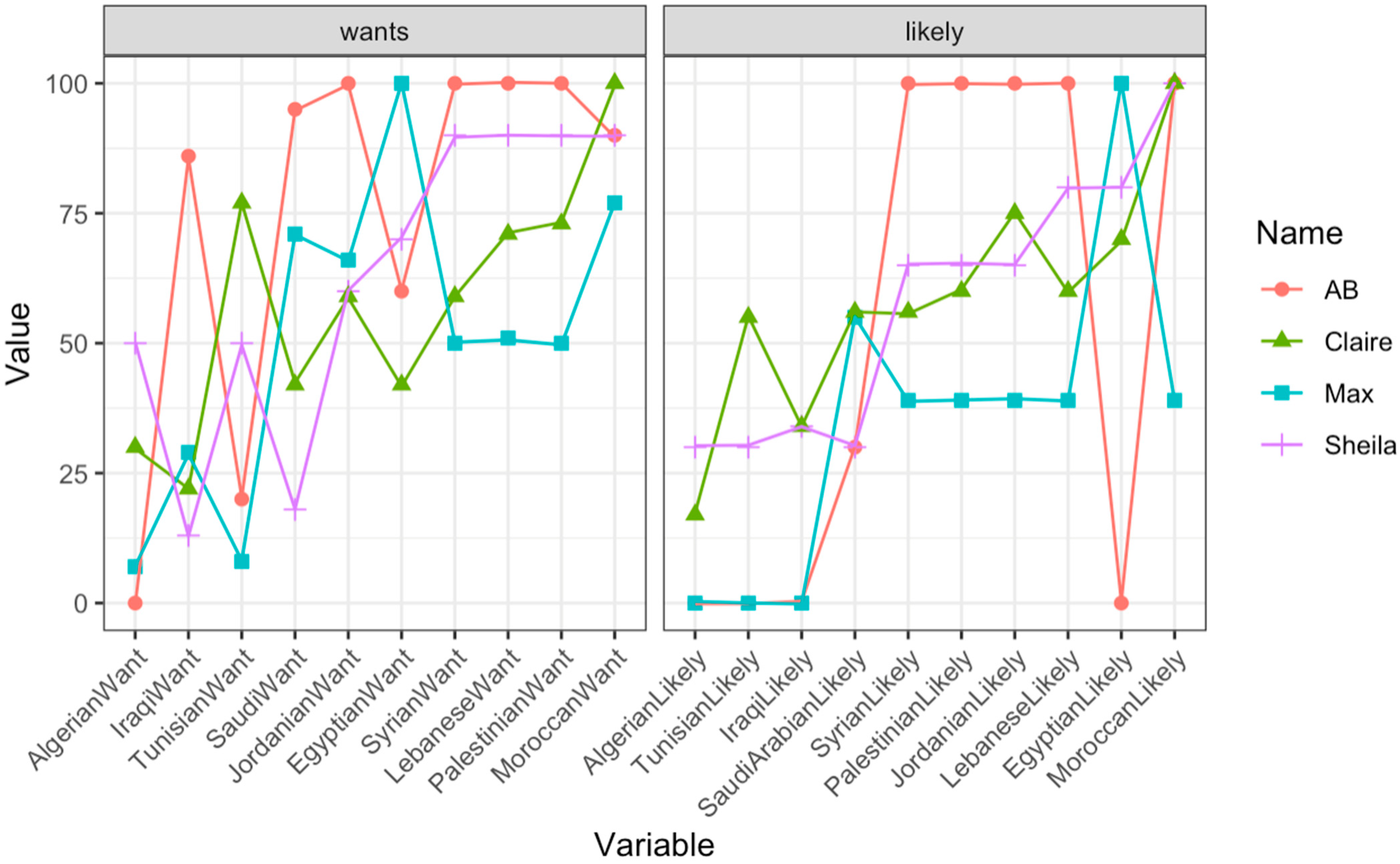
Data presented in Figure 1 show participants’ responses to two sets of questions. First, they were asked to rate from 0–100 how much they wanted to learn to communicate in the 10 dialects in Figure 1. Then they were asked to rate how likely they were to learn to communicate in the same dialects. Data below are organized to show responses ranging from lowest to highest based on the median of participants’ ratings. Dialects were originally presented in alphabetical order.
The responses to wanting to learn a dialect showed the lowest evaluations were given to Algerian, Iraqi, Tunisian, and Saudi. The highest responses were for Syrian, Lebanese, Palestinian, and Moroccan, with Moroccan being the highest (all ratings over 75). Egyptian was classified as a moderate response. Although evaluations to “wanting to learn a dialect” scales were relatively similar to the likeliness evaluations, participants evaluated Egyptian (as opposed to Levantine) higher. Moroccan was rated as 100 by AB, Claire, and Sheila. Throughout the data as a whole, AB evaluated both want and likely highly. Max, on the other hand, evaluated them more conservatively. Numeric data are available in Appendix A.
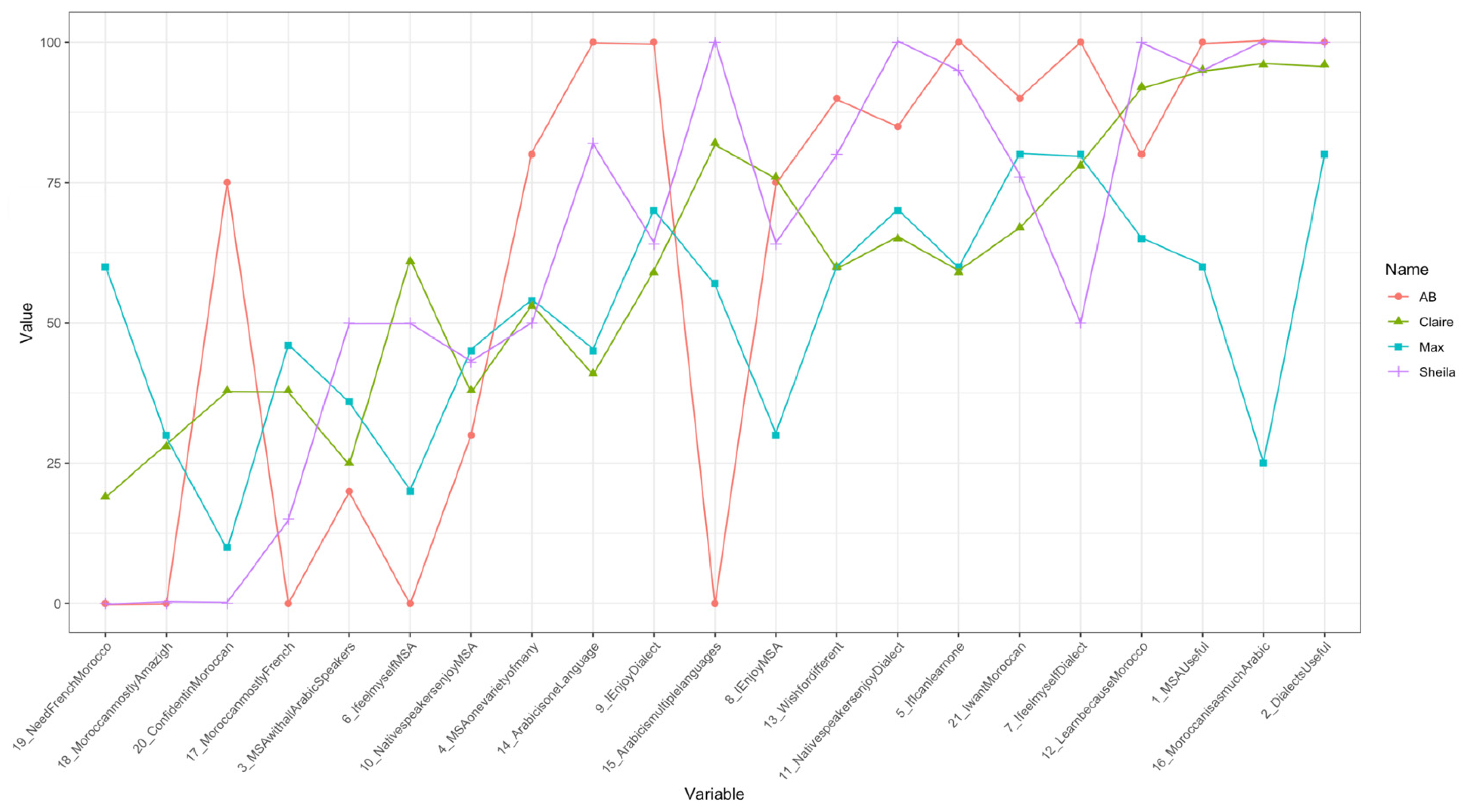
As for beliefs, students were asked to respond to 21 scales with ratings from 0–100. The 21 statements are presented in a table in Appendix C. Reference to each statement is made through the number found in the table. For example, the statement “Modern Standard Arabic is useful” is listed first and with “1.” Therefore, each number found in Appendix C and Figure 2 below corresponds to one of the 21 belief statements listed in the table. For visualization, we present participants’ responses below organized from lowest to highest ratings based on the median values in Figure 2. Participant responses varied extensively throughout the scales, but general results show the lowest evaluations for statements 17, 18, 19, and 20. Three of these statements corresponded to statements of Moroccan Arabic being mostly French / Amazigh or that French was needed to live in Morocco. The overall lowest evaluation was given to statement 19: “I need to know French to live in Morocco”. Claire, Sheila, and AB gave this a rating below 25, however, Max was an outlier with an evaluation well above 50.
Positive evaluations were given to statements 12, 1, 16, and 2. Statement 12 relates to a desire to learn Darija because of SA in Morocco, while statements 1 and 2 address the usefulness of MSA and Dialects. Looking at the total numeric data found in Appendix B, median values for statements 16 and 2 were tied at 98. Statement 16 says, “The Moroccan dialect is as much an Arabic dialect as Levantine, Egyptian, or any other regional variety.” AB, Sheila, and Claire gave this a near 100 score. However, Max rated this significantly lower at 25.
Final data from the questionnaire come from participants’ responses to an open-ended statement: “I believe Moroccan Arabic is…” Participants had varying responses. Generally, responses were brief, but the analysis of these statements reveals interesting aspects related to general themes found in the interviews and other questionnaire data. AB’s response described Darija as a “rich” dialect, highlighting how it is mixed with many “influences.” Claire was very concise, stating it is “difficult but useful.” Sheila provided a more negative view, stating that it was “hard to understand” or “communicate with other native Arabic speakers.” Finally, Max made a noteworthy statement as he claimed Moroccan Arabic was “essentially its own language (s).” Therefore, in these brief statements, participants are seen describing Moroccan Arabic in substantially different ways, ranging from a dialect of Arabic to a completely new language or set of languages.

4.2. Semi-Structured Interviews

Analysis of semi-structured interviews found a shift in learners’ attitudes toward learning Darija due to the immediate need of SA in Morocco. Participants were also found to explicitly reject the negative beliefs they previously had due to their lack of experience with Darija or due to what others (professors, fellow students, Arabic speakers) had said about it. Below, we provide some representative excerpts from each participant.

4.2.1. Sheila

Sheila had studied Arabic the longest of all the participants (eight years and 10 months). She began learning Arabic during middle school when she viewed the opportunity to study it as a “once-in-a-lifetime opportunity.” Her ability to study Arabic during her undergraduate studies was a deciding factor in her university choice, but she still claimed that she did not “need” Arabic. She had studied abroad in Jordan previously, but reported facing fatigue due to the program’s language pledge, leading her to take a year off from formal study before this SA sojourn. She described Arabic learning as a journey that requires learners to be confident in themselves. Sheila reported studying under professors from many different backgrounds, for example, Jordanians, Lebanese, Palestinians, Syrians, and Yemenis. She self-evaluated as advanced in MSA and intermediate in Levantine and listed beginner for North African and Egyptian.
In response to the question, “Before you came to Morocco or this SA experience, did you want to study Moroccan Arabic?” in Excerpt 1 below, Sheila immediately said, “Oh no” (line 4). Continuing, she explained her reluctance as due to most people saying, “It’s so different.” She quoted this in a mimicking deep tone while waving her hands in the air. Furthermore, she explained that L1 Arabic speakers said that they cannot understand Moroccans.
Excerpt 1: Sheila shares her views of Darija before SA.
1INTBefore you came to Morocco or
2 this study abroad experience
3 did you wanna study Moroccan Arabic
4SHOh no -
5INTWhy or why not
6SHUmmm (.) no (.) I was scared of it
Lines 6–14 omitted
15INTyeah
16SHSo I was like
17 yeah
18 Well that kind of sucks hhhhh ummmhhhh
19 Whyyy dooo I
20 but yeah,
21 So (.) no I did not
However, as Excerpt 2 shows, beginning the SA experience and after a short period traveling in Morocco, she opposed L1 Arabic speakers’ comments, emphasizing that Darija is “not thaat different” (line 5). She then disagreed with herself immediately, saying, “It is really different” (line 6). Concluding her comments, Sheila stated that the things that are really different are some “daily stuff,” which is similar to differences in Levantine and Egyptian, but the “cherry on the top” is the pronunciation and use of French (lines 7–24). However, she remarked that this experience had already helped her understand Moroccans better and given her a “more versatile … ear to Arabic” (lines 28–39).
Excerpt 2: Sheila explains her shifting views of Darija.
1INThow do you feel now
2SHIii (1) feel (2)((chewing gum))
3 I feel things shifting [a lit]tle bit
4INT            [mmmm]
5SHBecause (.) to be honest it’s not thaat different
6 It is very different like there’s a lot of like
7 daily life words
8INTyeahh
9SHbut that’s common in most
10 like lahajaat ((dialects))
11INTmhm
12SHYou know like fuc- ((trying to find word)) dialects
13INTdialects yeah
14SHumm tsa Umm Like whether it’s um in
15 the Levant or you know Egypt or
16 wherever like there’s
17 a lot of just like
18 daily stuff thats thats re(h)ally really
19INT       [mhm]
20SHdifferent um. It’s just
21 the pronunciation really that
22 mak[es] kind of puts the
23INT[yeah]
24SHthe cherry on top and the use of French
25 and stuff but .hhh I like the fact I do like
26 the fact that I can better understand Moroccans-
27INT-ye[ah]
28SH     [Now] it feels like I have a little bit more
29 versatile of an ear to Arabic

4.2.2. Max

Max was also an advanced MSA learner who self-evaluated as advanced in MSA, intermediate in Egyptian, and a beginner in North African and Levantine. When asked to report any languages considered a first language or mother tongue, Max wrote that he was a “highly fluent” speaker of Spanish as a second language and that French was his third language. He was the only participant to report an additional language on this question. Max described his experience as starting very well. He had studied abroad previously in Jordan and completed a summer program at the same center in Morocco two years prior. Max was seen as a very outgoing and strategic language learner. He frequently discussed his previous experiences studying romance languages (French and Spanish) and compared those to his experience with Arabic. Furthermore, he often suggested big claims about the nature of language and spoke with a sense of established knowledge based on his experience. He regarded his extroversion as fitting with Arabic society, which allowed him to thrive. Max reported only studying under Egyptian and L2 Arabic-speaking professors.
During the interview (Excerpts 3 and 4), as with the other participants, Max was asked if he wanted to study Moroccan Arabic before this SA experience. He quickly started answering by describing what he called “my philosophy.” He described how he started with Shaami (which he found the easiest) before switching to Masri two years ago because this would allow him to be understood more easily, considering that Masri is “the most understood version” and “of course with Darija that is not really the case” (lines 1–9).
Excerpt 3: Why Max did not want to study Darija.
1Maxand so I I chose masri because i was like
2 you know what if I’m gonna mess up little things
3INTmhm
4MaxI wanna be
5 attempting to say the most
6 understood version ((Moves hands apart in front of him))
7INTokay gotcha
8Maxuhh and of course with darija
9 that’s [not really] the case
Two summers before, Max was a student in the summer program at the same institution. Max shared that he enjoyed the Darija class previously and even thought, “If I come back and do Capstone, that’s something I really want to get the opportunity to study.” Stating his reasoning for wanting to learn Darija, he associated dialects to his learning of other languages, saying, “For whatever reason, dialect, I just find like it almost makes sense more in the way that romance languages did for me” (lines 1 & 2). Max frequently compared his experience learning Arabic to his time learning French and Spanish. Discussing his learning of Darija and his changing desire to learn it, he shared, “I don’t know how true this is at all, but I was hoping that speaking French and Spanish would help sort of accelerate it a little bit” (line 12–15). Yet, he ended by saying that it is maybe at the lexical level, but “not as much with the grammar or anything.” (lines 18–22). He concluded that the deciding factor in his learning of Darija was “just the practicality of speaking here” (lines 23 & 24), and that “it would be nice to to be able to speak the local dialect well” (lines 31 & 32). Excerpt 4 below displays this interaction and shows how Max’s desire to learn Darija changed.
Excerpt 4: Max explains how his desire to learn Darija changed.
1Maxfor whatever reason dialect I just find
2 like it almost makes sense [more]
3Int            [yeah]
4Maxin the way that romance languages did for me
5 and so that’s a little bit more
6 even when it’s unfamiliar it feels more familiar
7Intmhmm
8Maxand uhhhh so I really like that
9 And then you know
10 knowing that i’d be here for a while
11Intyeah
12Maxof course piques the interest
13 And I don’t know how true this is at all
14 but I was hoping that speaking French
15 and Spanish would help sort of accelerate it=
16Int=yeahh=
17Max#NAME?
18 Whi[ch it]
19Int  [maybe]
20Maxcertain vocab words
21Intmhm
22Maxnot as much with the grammar or anything like that
23 But uhhh yeah I would say just the
24 practicality of speaking it here
25Intmhm
26MaxBecause (1) people tend to
27 understand masri oka[yyy] and obviously I’m not
28Int         [yeah]
29Maxperfect at speaking it hhh by any means
30IntFor sure yeah
31Maxuhhh but it would be nice to
32 to be able to speak the local dialect well
33Intmmm yeahh
34MaxI’d say that’s probably the biggest reason

4.2.3. Claire

As with other participants, Claire had studied abroad previously for what she described as “long periods of time.” Nevertheless, she said it was still hard to come to a new place and described a mix of excitement and anxiety. In her self-report on official OPI scores, she listed three different scores, but it is assumed that her highest score (Advanced Low) would be the most recent. In general, Claire was noticed often doubting her abilities in Arabic with remarks about learning things late or not understanding frequently. Claire had studied with professors from Egypt, Jordan, Lebanon, Syria, and L2 Arabic speakers.
As can be seen in Excerpt 5 below, for Claire, learning Darija was something that she “put off” (line 14). She stated that she did not know much about the dialects when she started learning Arabic. However, she described how she thought learning Darija “would happen somewhere along the line” but that “it seemed like Shaami dialect was more useful to [her], or [her] interest in the region” (lines 5–10). Progressing, in lines 16- 23, Claire said, “There is already kind of a joke about it…the joke that it’s like the not useful, um or the harder to learn one.”
Excerpt 5. Claire explains why she did not want to learn Darija initially.
1COkay so back when I first decided to learn Arabic
2 I didn’t really know much about the
3 dialects
4INTmhm
5Cumm and then after that (3)
6 it wasn’t necessarily an aversion to learning Moroccan
7 Arabic it was just always
8 this is going to happen somewhere along the line
9INTyeahh
10Cand it seemed like shaami dialect was more uu:se[ful] to me
11INT                     [mhm]
12Cor like my interest in like the region
13INTyeahh
14Cumm (.) So I kind of I guess put off learning Darija
15INTyeahh
16Cand then it kind of you
17 know there’s already kind of a joke
18 about it which I guess is part of ( ).
19 Anyways
20INTyeahh hh[hhh]
21INT     [theres kind] of a joke
22Cthat it’s like the not as useful ((hands with air quotes))
23 um or harder to learn one
Excerpt 6 shows how Claire continued her reflection on learning Darija (line 1). She discussed how the experience was interesting because she was able to pick out where words are similar between other dialects and languages. Specifically, she reported finding words that were similar to the Khaliji ((Gulf)) dialect, although someone (unspecified) keeps saying they are not (line 8). After these comments, Claire was asked when she noticed her views changing, and she stated that it was during a class she took to prepare to come to Morocco.
Excerpt 6: Claire explains her shift in the desire to learn Darija.
1Claireumm I feel like learning has been really interesting
2 because you can pick out where words are similar
3INTmmm
4ClaireAnd there are words that
5 are similar to the Kh- Khaliiji dialect th[at I’ve he]ard
6INT                    [Yeahh]
7 Oh really=
8Claire=but keep saying they’re not
9 but whatever
Moreover, Claire explained that she viewed “knowing Darija as very useful” at the beginning of her SA. Explaining why, she added, “especially, because from my experience with people who know Darija [they] can switch between dialects a lot easier,” plus it gives them the ability “to understand what’s happening.” She ended by arguing that “the assumptions or stereotype that it’s not useful comes from the stereotype that it’s so crazy different ((said with a sarcastic tone and quoting hands)) from MSA or other dialects, that nobody will use it and if you speak it people won’t understand you. Which I don’t necessarily think is true. I think that is more of a stereotype.”

4.2.4. AB

AB was an advanced Arabic speaker who evaluated himself as advanced in both MSA and Levantine. He discussed his familiarity with being in a SA experience, as he had studied abroad in Jordan, while also experiencing culture shock. He reported having experience with Arabic professors from different backgrounds, including Egyptian, Lebanese, and Non-Arab. When discussing his identity, he spoke about being a white man (although he stated that it was “such a small thing”) and his identity as a Christian. Each of these aspects was described as affecting his Arabic. AB was also married, and his wife joined him during his SA in Morocco, but she did not speak Arabic. AB reported having to act as a translator with their host family.
AB was the only participant who stated that learners should begin with MSA and dialect at the same time. When answering whether he wanted to learn Darija before studying abroad, he stated that his program only used MSA, and that he had a lot of “misconceptions” coming from “stereotypes” surrounding Darija and what it’s made up of”. When asked directly what the misconceptions that he previously mentioned were, AB first described them as “in the Arab world … there’s common misconceptions that like its oh its basically you know. Just like a big hodgepodge of you know Tamazight and Fransi ((French)) and Arabic you know just all jumbled together”. However, he quickly refuted these thoughts, saying, “and it’s just not how it is.” Conceding slightly, “like certainly there are aspects of of French language… and certain words from Tamazight that make their way… in.”
When answering whether he wanted to learn Darija, knowing that he was going to SA in Morocco, AB explained that “Darija was going to be part of my life” for his year abroad and maybe in the long run as well. Finally, trying to understand how he stopped having those misconceptions, he was asked when he noticed them changing. He responded by saying it was when he “started taking Darija for the first time” and he was “shocked with how easy it was to get started.”


5. Discussion

5.1. Overall Findings

This study investigated the language beliefs vis-à-vis Darija among four advanced Arabic learners as they began a year-long SA sojourn abroad in Morocco. Analysis of questionnaire data and semi-structured interviews revealed that the need to use Darija in SA contributed to participants’ desire to acquire it. Furthermore, participants recalled negative beliefs about Darija, such as being unintelligible, impure, not useful, or difficult, reflecting standard language ideology, language impurity, hierarchy of language ideology (Horner & Weber, 2017; Milroy, 2001), and, most clearly, Maghreb-Mashreq ideolog (or the belief that eastern varieties of Arabic are more prestigious than western (Hachimi, 2013, 2015)). Three of the participants were found attributing these beliefs to what others told them and then explicitly rejecting these beliefs based on their recent experiences with Darija, especially after deciding to study in Morocco. One participant, Max, referenced negative beliefs about Moroccan Arabic without stating whether they came from others’ comments or not. Findings from this study add to the already documented positive effects of SA (Shiri, 2013; Soulaimani, 2019) by showing how pre-departure dialectical training and experiences can help learners reject negative misconceptions and form their own views. Quantitative data from the questionnaire confirmed the findings from the interviews in two ways: (1) participants rated Moroccan highly in terms of what they wanted to learn and expected to learn and (2) participants gave high evaluations to scales positively describing Darija and spoken dialects and low scores to negative beliefs.

5.2. Beliefs Beginning Study Abroad

For Sheila, Max, Claire, and AB, learning Moroccan Arabic became a priority in their lives. They chose to study abroad for one year in Morocco, and all expressed that this directly impacted their dialect learning choice. Therefore, they all viewed Moroccan Arabic as important. They evaluated Darija highly on questionnaires and explicitly described how they now wanted to learn it due to its usefulness in their lives. However, they were also well aware of the negative views of Darija. They referenced negative beliefs about Darija being unintelligible, not useful, difficult, mixed with French, Spanish, or Amazigh, far from Fusha, and not pure Arabic (Hachimi, 2013, 2015; S’hiri, 2002; Shiri, 2013). As examples, Claire said there are “stereotypes” and jokes about Moroccan Arabic. AB said there are “misconceptions.” Sheila described the negative comments people make about Moroccan Arabic. Max is the only participant who did not talk about these explicitly, a point we will return to. However, in contrast to negative views, learners in this study explicitly and covertly expressed their positive views of Moroccan Arabic at the beginning of SA. Therefore, this study shows how learners’ pre-SA experiences are important for contrasting negative ideologies and preparing learners for the locations in which they will study.

5.3. Tracing Negative Ideologies

Learners in this study described how L1 speakers, teachers, and even other colleagues told them that Darija is not useful, unintelligible, or impure. Through comparison to Hachimi (2013, 2015), which found that NSs of Arabic regard Darija as less Arabic than Eastern varieties due to “corrupting influences of Berber, French, Spanish, and Arabic-French code-switching” (Hachimi, 2013, p. 288) and other factor (referred to as the Maghreb-Mashreq language ideology) it becomes salient that learners viewed the Maghreb-Mashreq language ideology as still widespread among L1 speakers and shared with L2 learners. These negative beliefs learners referenced were informed by standard language ideology, language purity, and hierarchy of language (see Milroy, 2001; Brustad, 2017; Horner & Weber, 2017; Towler, 2025b) that not only uphold MSA as better than colloquial Arabic, but Eastern varieties as better than Western ones.

5.4. Rejecting Negative Beliefs and Expressing Agency

In this study, students can be seen not only reporting negative ideologies but also explicitly challenging these ideologies. Claire and AB both made obvious and explicit statements contrasting the stereotypes. Claire stated that learning Darija was “very useful” before explaining where she thought the stereotype came from; the belief that it is different from MSA or other dialects and that is why nobody will use it. Claire discussed negative thoughts as stereotypes and used a lower pitch to report others’ beliefs while also challenging them. This is precisely what one participant, Adam, did in Soulaimani (2019, p. 83). The author argued that “through prosody, the speaker trivializes these statements and expresses his disproval toward the way Moroccan Arabic has been depicted” (p. 83). Claire can be seen doing the same thing as she called the stereotypes jokes and changed her prosody. AB reported having misconceptions about Darija before learning it, but described confidently how they had changed. He argued that Darija is “othered” because of the influence of the French and Tamazight and discussed the socio-political history of Morocco. He referenced Darija’s difficulty and the idea that it is not pure Arabic (Brustad, 2017; Hachimi, 2013, 2015; Shiri, 2013); however, he stated that his opinions changed when he had personal experience and was shocked by how easy it was. He noted that his program began with MSA only to establish a base before MSA (Towler, 2025a), a belief that is not uncommon in the field of L2 Arabic.
Overall, participants exhibited varying instances of shifting language beliefs in the data. AB and Claire both reported what others told them and explicitly challenged these views. Furthermore, they described how they had changed and started to form their own beliefs. Sheila appeared to be in a moment of shift, even in the way she shared about what NSs told her. Max did not refer to any ideologies being told to him, but presented his disagreement with deficient Moroccan ideologies as coming from his own thoughts. Soulaimani (2019) found learners’ views of Darija had shifted from before to after SA. Learners in this study show that shifting is occurring even as they arrive.

5.5. Developing Sociolinguistic Awareness

Overall, participants in this study revealed their sociolinguistic awareness of Arabic. They spoke to varying extents, challenging deficient ideological beliefs and recognizing the need for multiple dialects and languages. This awareness grew during their courses to prepare them for Morocco, specifically by studying Darija. Max and Sheila did not study Darija at university, but both had prior experience in the country. Max studied abroad in Morocco two years before this experience, but stated that he wanted to learn Darija only when he knew he would return for a year. Sheila had traveled in Morocco before this experience but was now entering her first Darija courses. AB had a class that revealed how easy it was to learn Darija. These aspects support previous studies by presenting how learners develop sociolinguistic awareness through first-hand experiences, and it adds to scholarship calling for Arabic education that reflects the sociolinguistic reality of the Arabic-speaking world (Al Masaeed, 2022c; Nassif & Al Masaeed, 2022; Towler, 2025a, 2025b). Furthermore, it shows how negative ideologies can be challenged through firsthand experience both in the classroom and in study abroad.
Additionally, all participants referenced the French influence in Darija. Sheila listed “the use of French” along with pronunciation as “the cherry on top.” It seemed that she used this to exemplify the difference or challenge of Darija. When Claire discussed her Darija class before coming to Morocco, she shared how it was fun to find similarities with her roommate, who studied French. AB referenced French mixing (i.e., code-switching; Aabi, 2020; Bentahila, 1983) as an aspect of the misconceptions people share about Darija i.e., that Darija is mixed with “tamazight and Fransi ((French))” and suggested that he had studied French to come to Morocco. Lastly, Max hoped that French and Spanish would be useful for learning Darija. It would be natural to suggest that learners are revealing the well-documented ideologies about Moroccan Arabic being mixed with French and therefore, impure (Hachimi, 2013, 2015). However, it must also be considered that French is a colonial language of Morocco and remains important in Morocco. Boukous (2009) argues that in Morocco’s public education, “French is alternately incorporated, marginalized, worshipped and even reviled, depending upon the situation” (p. 128). Additionally, some research has suggested that French marks modernity and high prestige status in Morocco, even more than MSA (Chakrani, 2013). So, while learners’ comments are likely related to beliefs or attitudes shared with them, they also present sociolinguistic awareness of the environment where they are studying. This is important as research confirms the integral role of awareness in sociolinguistic competence (Nassif & Al Masaeed, 2022; Nassif & Shapiro, 2023). Learners studying abroad in Morocco and other places would benefit from sociolinguistic training that reflects the reality of the location where they will study to raise their awareness and increase competence.

5.6. Pedagogical Implications

All participants in this study had studied abroad before, which is assumed to add to their sociolinguistic awareness and exposure to Arabic ideologies. However, they also all relate formally studying Darija to be a significant transformative experience. Learners in this study exemplify the need to continue teaching spoken varieties alongside MSA while also ensuring students have adequate sociolinguistic (Towler, 2025a) and pragmatic instruction (McCombie & Al Masaeed, 2025). This instruction should consider what ideologies are intertwined and work to prepare students for the environments in which they will study and live. One approach could be the adoption of materials on Maximizing Study Abroad (Cohen et al., 2005; Paige et al., 2002) into Arabic. Notably, as learners in this study were found to contrast misconceptions at arrival in Morocco, SA programs would benefit from more focus on predeparture training that includes explicit sociolinguistic instruction. A key aspect of this should focus on explicit instruction to help learners develop sociolinguistic awareness, as called for in previous research (Nassif & Shapiro, 2023; Nassif & Al Masaeed, 2022; Towler, 2025a, 2025b). Finally, the research here highlighted learners developing agency; they expressed their own desires and goals as key factors influencing their language beliefs and learning choices. Learners need to be given the space to express their agency as multilingual language users (Douglas Fir Group, 2016). So, though learners might not be able to choose their SA location or dialect of choice in formal settings, they should be informed and educated about the sociolinguistic reality of the location where they study and be encouraged to use their entire linguistic repertoire (Blommaert & Backus, 2013; Al Masaeed, 2020).
As we have called for increased focus on sociolinguistic awareness, we also suggest pedagogical and research approaches informed by critical CLA (e.g., Beaudrie & Loza, 2022; Burns & Quan, 2025; Leeman, 2018), which might be a useful pedagogical approach for transforming Arabic education into a field that helps combat negative ideologies and “struggle against” oppression (Leeman, 2014, p. 287).

6. Conclusions and Future Directions

This study used semi-structured interviews and questionnaires to investigate L2 Arabic learners’ language beliefs during SA. Data revealed common trends and themes among participants based on two research points of interest: First, the beliefs about Moroccan Arabic and other dialects learners bring to SA with them, and second, how these beliefs relate to well-known language ideologies in the Arabic-speaking world. In general, data from the questionnaire confirmed participants’ positive views towards Darija, both in terms of their desire to learn the dialect and beliefs about it. Similarly, data from the interviews confirmed comments from learners rejecting negative stereotypes about Darija, while one participant seemed unsure. All four participants indicated that they initially did not seek to learn Darija for various reasons, including (1) misconceptions and stereotypes they heard from others (professors, fellow students, and Arabic native speakers) about Darija (e.g., it is hard, different, and not understood by other Arabic speakers); (2) learners’ focus on other regions of the Arabic-speaking world and their varieties (e.g., the Levant and Egypt); and (3) lack of Darija classes in the US. However, each participant stated a desire to learn Moroccan Arabic as they began their SA sojourn. Participants’ desire to learn Darija was due to the SA opportunity and began either during their preparation or in Morocco. Lastly, in general, participants were seen explicitly disapproving of negative views towards Darija, presenting varying levels of sociolinguistic competence and agency. As this study is part of a longitudinal project, future studies are intended to track learners throughout their year-long study abroad process, gathering more data on their ideologies and transformation.
Finally, it is worth pointing out that while this study has offered insights regarding learners’ beliefs towards learning Darija, the findings presented cannot be generalized, and it is clear that more research in this area is needed. Therefore, future work would do well to include more participants and allow for a more robust quantitative analysis. Moreover, collecting data from classrooms and language socialization outside the classroom would allow for a better comparison between what learners report believing and what they actually do. As more learners pursue SA in Morocco, increased research is needed to investigate their experiences. One domain that is particularly lacking is on language ideologies surrounding Darija and L2 learners. For example, future research is needed to better understand how the Maghreb-Mashreq language ideology (Hachimi, 2013, 2015) is shared with L2 learners. The current study shows how these learners attribute negative ideologies to comments from L1 speakers and how they begin to reject these views through first-hand experience with Darija, and has implications for not only including dialects alongside MSA in Arabic classes but also for incorporating pedagogical approaches such as CLA into Arabic language teaching in an effort to address language ideologies related to Arabic-speaking contexts and prepare learners for the sociolinguistic realities of where they SA.

Author Contributions

Conceptualization, J.G. and K.A.M.; methodology, J.G. and K.A.M.; software, J.G.; formal analysis, J.G.; investigation, J.G.; data curation, J.G.; writing—original draft preparation, J.G. and K.A.M.; writing—review and editing, J.G. and K.A.M.; visualization, J.G.; supervision, K.A.M.; project administration, J.G. All authors have read and agreed to the published version of the manuscript.

Funding

This research received no external funding.

Institutional Review Board Statement

The study was conducted in accordance with the Declaration of Helsinki, and approved by the Carnegie Mellon University Institutional Review Board (CMU IRB) MOD202400000351: MOD #1 for STUDY2024_00000126 2024-04-30.

Informed Consent Statement

Informed consent was obtained from all subjects involved in the study.

Data Availability Statement

The original contributions presented in this study are included in the article. Further inquiries can be directed to the corresponding author(s).

Conflicts of Interest

The authors declare no conflict of interest.

Appendix A. Numeric Data from the Questionnaire Comparing Want and Likeliness of Studying Dialects

Question: Please rate the following varieties on how much you want to learn to communicate in them or continue to learn (if you have already begun).
AlgerianIraqiTunisianSaudi ArabianJordanianEgyptianSyrianLebanesePalestinianMoroccan
AB08620951006010010010090
Claire302277425942597173100
Max7298716610050515077
Sheila50135018607090909090
Totals87150155226285272299312313357
Median18.525.53556.5636574.580.581.590
Question: Please rate the following varieties on how likely you are to learn to communicate in them (or continue to learn if you have already begun)
AlgerianTunisianIraqiSaudi ArabianSyrianPalestinianJordanianLebaneseEgyptianMoroccan
AB000301001001001000100
Claire175534565660756070100
Max000553939393910039
Sheila303034306565658080100
Totals478568171260264279279250339
Median8.5151742.560.562.5707075100

Appendix B. Numerica Data from the Questionnaire on Participant Evaluation of Ideological and Belief Statements

Prompt: Please rate the following statements on your agreement. 0 will mean that you do not agree at all, while 100 means you completely agree.
I need to know French to live in Morocco.The Moroccan dialect is mostly Amazigh/Berber.I feel confident in Moroccan ArabicThe Moroccan dialect is mostly French.Modern Standard Arabic allows me to communicate with all Arabic speakers.I feel most like myself when speaking MSA.Native speakers of Arabic enjoy speaking with me in MSA.MSA is one of many Arabic VarietiesArabic is best understood as one language made up of many dialects.I enjoy speaking in dialect.I enjoy speaking in MSA.Arabic is better understood as multiple languages from a similar ancestor.I wish I could be in a different dialect context.If I learn one dialect, I can learn another.Native speakers of Arabic enjoy speaking with me in their regional variety.I want to learn Moroccan Arabic.I feel most like myself when speaking in dialect.I am learning Moroccan Arabic because I live in Morocco.Modern Standard Arabic is useful.Knowing Dialects is useful.The Moroccan dialect is as much an Arabic dialect as Levantine, Egyptian, or any other regional variety.
AB00750200308010010075090100859010080100100100
Claire192838382561385341597682605965677892959696
Max603010463620455445703057606070808065608025
Sheila00015505043508264641008095100765010095100100
Totals795812399131131156237268293245239290314320313308337350376321
Median9.5142426.530.53540.553.563.56769.569.57077.577.5787986959898

Appendix C. Statements Related to Beliefs Rated by Participants

Prompt: Please rate the following statements on your agreement. 0 will mean that you do not agree at all, while 100 means you completely agree.
1.Modern Standard Arabic is useful.
2.Knowing Dialects is useful.
3.Modern Standard Arabic allows me to communicate with all Arabic speakers.
4.MSA is one of many Arabic Varieties
5.If I learn one dialect, I can learn another.
6.I feel most like myself when speaking MSA.
7.I feel most like myself when speaking in dialect.
8.I enjoy speaking in MSA.
9.I enjoy speaking in dialect.
10.Native speakers of Arabic enjoy speaking with me in MSA.
11.Native speakers of Arabic enjoy speaking with me in their regional variety.
12.I am learning Moroccan Arabic because I live in Morocco.
13.I wish I could be in a different dialect context.
14.Arabic is best understood as one language made up of many dialects.
15.Arabic is better understood as multiple languages from a similar ancestor.
16.The Moroccan dialect is as much an Arabic dialect as Levantine, Egyptian, or any other regional variety.
17.The Moroccan dialect is mostly French.
18.The Moroccan dialect is mostly Amazigh/Berber.
19.I need to know French to live in Morocco.
20.I feel confident in Moroccan Arabic
21.I want to learn Moroccan Arabic.

Appendix D. Interview Protocol

Semi-structured Interview Protocol
Thank you for agreeing to participate in this research. I will audio and video record this conversation for the purposes of data analysis and reporting, is that okay with you?
Also, in any report of this research I will use a pseudonym for you. Is there a pseudonym you’d like me to use for you?
Finally, when you tell stories about any one if you could try not to use their real name, for the sake of their privacy, that would be great! If you do use their real name, I will change it to a pseudonym to protect their identity.
The questions today will be about your experience learning Arabic and studying abroad in Morocco. I’d love to hear your honest experiences. This is not an evaluation of you in anyway.
Do you have any questions before we started?
Interview Questions
General Student Interview Questions
Note: As a semi-structured interview, the questions listed here only outline the general questions that will be asked. The answers provided might lead the PI to ask follow-up questions related to the topic of interest.
Language Background Questions
QuestionsObservation Notes
How do you feel about starting this study abroad experience?
What advice would you give to someone starting to learn Arabic?
Perception of Moroccan Arabic
Questions Observation Notes
Before studying abroad, did you want to learn Moroccan Arabic? Why or why not?
Identity Questions
QuestionsObservation Notes
In what ways do you think your identity affects your Arabic usage? Or vice/versa?
Language partner questions
Can you tell me about your experience with your language partner, professors, or other Moroccans?

References

  1. Aabi, M. (2020). The syntax of Arabic and French code switching in Morocco. Palgrave Macmillan. [Google Scholar]
  2. Abdel-Jawad, H. R. (1986). The emergence of an urban dialect in the Jordanian urban centers. International Journal of the Sociology of Language, 61(1), 53–63. [Google Scholar] [CrossRef]
  3. Al-Batal, M. (Ed.). (2018). Arabic as one language: Integrating dialect within the Arabic curriculum. Georgetown University Press. [Google Scholar]
  4. Allen, R. (2004). Perspectives on Arabic teaching and learning. The Modern Language Journal, 88(2), 275–278. [Google Scholar]
  5. Al Masaeed, K. (2016). Judicious use of L1 in L2 Arabic speaking practice sessions. Foreign Language Annals, 49(4), 716–728. [Google Scholar] [CrossRef]
  6. Al Masaeed, K. (2018). Code-switching in L2 Arabic collaborative dyadic interactions. In Routledge handbook of Arabic second language acquisition (pp. 289–302). Routledge. [Google Scholar]
  7. Al Masaeed, K. (2020). Translanguaging in L2 Arabic study abroad: Beyond monolingual practices in institutional talk. The Modern Language Journal, 104(1), 250–266. [Google Scholar] [CrossRef]
  8. Al Masaeed, K. (2022a). Bidialectal practices and L2 Arabic pragmatic development in a short-term study abroad. Applied Linguistics, 43(1), 88–114. [Google Scholar] [CrossRef]
  9. Al Masaeed, K. (2022b). Researching and measuring L2 pragmatic development in study abroad: Insights from Arabic. In J. McGregor, & J. Plews (Eds.), Designing second language study abroad research: Critical reflections on methods and data (pp. 155–170). Palgrave Macmillan. [Google Scholar]
  10. Al Masaeed, K. (2022c). Sociolinguistic research vs. language ideology in L2 Arabic. In K. Geeslin (Ed.), The Routledge handbook of second language acquisition and sociolinguistics (pp. 359–370). Routledge. [Google Scholar]
  11. Al Masaeed, K. (2023). Tracking learnables and teachables in L2 Arabic dyadic conversations-for-learning. The Modern Language Journal, 107(3), 782–801. [Google Scholar] [CrossRef]
  12. Al Masaeed, K. (2024). Topical talk and repair practices through embodied and multilingual resources in L2 Arabic conversation-for-learning. Critical Multilingualism Studies, 11(1), 326–350. [Google Scholar]
  13. Badawi, E. M. (1973). Mustawayāt al-ʿArabīyah al-muʿāṣirah fī Miṣr: Baḥth fī ʿalāqat al-lughah bi-al-ḥaḍārah. Dār al-Maʿārif. [Google Scholar]
  14. Badawi, E. M. (1985). Educated spoken Arabic: A problem in teaching Arabic as a foreign language. In Scientific and humanistic dimensions of language (pp. 15–22). John Benjamins Publishing Company. [Google Scholar]
  15. Bassiouney, R. (2017). Functions of code switching in Egypt: Evidence from monologues (Vol. 46). Brill. [Google Scholar]
  16. Bassiouney, R. (2020). Arabic sociolinguistics: Topics in diglossia, gender, identity, and politics. Georgetown University Press. [Google Scholar]
  17. Beaudrie, S., & Loza, S. (Eds.). (2022). Heritage language teaching: Critical language awareness perspectives for research and pedagogy. Routledge. [Google Scholar]
  18. Belaskri, K., & Drew, P. (2023). Arabic–French code-switching in medical consultations in Algeria: A conversation analytic study. Language & Communication, 93, 30–42. [Google Scholar]
  19. Bentahila, A. (1983). Motivations for code-switching among Arabic-French bilinguals in Morocco. Language & Communication, 3(3), 233–243. [Google Scholar]
  20. Blommaert, J., & Backus, A. (2013). Superdiverse repertoires and the individual. In Multilingualism and multimodality: Current challenges for educational studies (pp. 11–32). SensePublishers. [Google Scholar]
  21. Boukous, A. (2009). Globalization and sociolinguistic stratification in North Africa: The case of Morocco. In Globalization and language vitality: Perspectives from Africa (pp. 127–141). Continuum International. [Google Scholar]
  22. Brustad, K. (2017). Diglossia as Ideology. In J. Høigilt, & G. Mejdell (Eds.), The politics of written language in the Arab world: Writing change (pp. 41–67). Brill. Available online: http://www.jstor.org/stable/10.1163/j.ctt1w76vkk.7 (accessed on 1 May 2025).
  23. Burns, K. E., & Quan, T. (2025). The ideological positioning of heritage language learners: A critical discourse analysis of world language teacher preparation textbooks. The Modern Language Journal, 109(4), 800–820. [Google Scholar] [CrossRef]
  24. Chakrani, B. (2013). The impact of the ideology of modernity on language attitudes in Morocco. The Journal of North African Studies, 18(3), 431–442. [Google Scholar] [CrossRef]
  25. Cohen, A. D., Paige, R. M., Shively, R. L., Emert, H., & Hoff, J. (2005). Maximizing study abroad through language and culture strategies: Research on students, study abroad program professionals, and language instructors. Final report to the International Research and Studies Program, Office of International Education, DOE. Center for Advanced Research on Language Acquisition, University of Minnesota. Available online: https://archive.carla.umn.edu/maxsa/documents/MAXSAResearchReport.pdf (accessed on 15 May 2025).
  26. Corbin, J. M., & Strauss, A. L. (2015). Basics of qualitative research: Techniques and procedures for developing grounded theory (4th ed.). SAGE. [Google Scholar]
  27. Creswell, J. W., & Creswell, J. D. (2005). Mixed methods research: Developments, debates, and dilemmas. Research in Organizations: Foundations and Methods of Inquiry, 2, 315–326. [Google Scholar]
  28. Creswell, J. W., & Poth, C. N. (2016). Qualitative inquiry & research design: Choosing among five approaches. Sage Publications. [Google Scholar]
  29. Douglas Fir Group. (2016). A transdisciplinary framework for SLA in a multilingual world. The Modern Language Journal, 100(S1), 19–47. [Google Scholar] [CrossRef]
  30. Ferguson, C. A. (1959). Diglossia. Word, 15(2), 325–340. [Google Scholar] [CrossRef]
  31. Ferguson, C. A. (1996). Epilogue: Diglossia revisited. In Understanding Arabic: Essays in contemporary Arabic linguistics in honor of El-Said Badawi (pp. 49–67). American University in Cairo Press. [Google Scholar]
  32. Gardner-Chloros, P. (2009). Code-switching. Cambridge university press. [Google Scholar]
  33. Hachimi, A. (2013). The Maghreb-Mashreq language ideology and the politics of identity in a globalized Arab world1. Journal of Sociolinguistics, 17(3), 269–296. [Google Scholar] [CrossRef]
  34. Hachimi, A. (2015). “Good Arabic, Bad Arabic” Mapping Language Ideologies in the Arabic-Speaking World. Zeitschrift für arabische Linguistik, 61, 35–70. [Google Scholar]
  35. Hadley, G. (2019). Grounded theory method. In J. Mckinley, & H. Rose (Eds.), The Routledge handbook of research methods in applied linguistics (pp. 264–275). Routledge. [Google Scholar]
  36. Haeri, N. (1997). The reproduction of symbolic capital: Language, state, and class in Egypt. Current Anthropology, 38(5), 795–816. [Google Scholar] [CrossRef]
  37. Haeri, N. (2000). Form and ideology: Arabic sociolinguistics and beyond. Annual Review of Anthropology, 29(1), 61–87. [Google Scholar] [CrossRef]
  38. Holes, C. (1983). Patterns of communal variation in Bahrain. Language in Society, 12(4), 433–457. [Google Scholar] [CrossRef]
  39. Holes, C. (1987). Language variation and change in a modernising Arab state: The case of Bahrain. Routledge. [Google Scholar] [CrossRef]
  40. Holes, C. (2004). Modern Arabic: Structures, functions, and varieties. Georgetown University Press. [Google Scholar]
  41. Horner, K., & Weber, J. J. (2017). Introducing multilingualism: A social approach. Routledge. [Google Scholar]
  42. Ibrahim, M. (1986). Standard and prestige Arabic: A problem in Arabic sociolinguistics. Anthropological Linguistics, 28(1), 115–126. [Google Scholar]
  43. Institute of International Education. (2024). Host regions and destinations of U.S. study abroad students, 1999/00–2022/23. Open Doors Report on International Educational Exchange. Available online: http://www.opendoorsdata.org (accessed on 1 April 2025).
  44. Kawafha, H., & Al Masaeed, K. (2023). Multidialectal and multilingual practices in L2 Arabic classrooms: Teachers’ beliefs vs. actual practices. Frontiers in Education, 8, 1060196. [Google Scholar] [CrossRef]
  45. Kniaź, M., & Zawrotna, M. (2020). Embedded English verbs in Arabic-English code-switching in Egypt. International Journal of Bilingualism, 25(3), 622–639, (Original work published 2021). [Google Scholar] [CrossRef]
  46. Kroskrity, P. V. (2010). Language ideologies–Evolving perspectives. In Society and language use (pp. 192–211). John Benjamins Publishing Company. [Google Scholar]
  47. Laaraj, Y. (2023). Overview of the Moroccan language situation. International Journal of Science and Research, 4(4), 5401–5404. [Google Scholar]
  48. Leeman, J. (2014). Critical approaches to teaching Spanish as a local/foreign language. In M. Lacorte (Ed.), The Routledge handbook of Hispanic applied linguistics (pp. 275–292). Routledge. [Google Scholar]
  49. Leeman, J. (2018). Critical language awareness and Spanish as a heritage language: Challenging the linguistic subordination of U.S. Latinxs. In K. Potowski (Ed.), The Routledge handbook of Spanish as a minority/heritage language (pp. 345–358). Routledge. [Google Scholar]
  50. McCombie, S., & Al Masaeed, K. (2025). L2 Arabic pragmatics in the classroom: Insights from language instructors’ beliefs and practices. System, 128, 103546. [Google Scholar] [CrossRef]
  51. Milroy, J. (2001). Language ideologies and the consequences of standardization. Journal of Sociolinguistics, 5(4), 530–555. [Google Scholar] [CrossRef]
  52. Nassif, L. (2021). Codeswitching between Modern Standard and Colloquial Arabic as L2 sociolinguistic competence: A cross-sectional study from an integrated approach curriculum. Applied Pragmatics, 3(1), 26–50. [Google Scholar] [CrossRef]
  53. Nassif, L., & Al Masaeed, K. (2022). Supporting the sociolinguistic repertoire of emergent diglossic speakers: Multidialectal practices of L2 Arabic learners. Journal of Multilingual and Multicultural Development, 43(8), 759–773. [Google Scholar] [CrossRef]
  54. Nassif, L., & Shapiro, S. (2023). Sociolinguistic awareness in L2 Arabic: A study of learners’ code use repertoires. Foreign Language Annals, 56(4), 1013–1034. [Google Scholar] [CrossRef]
  55. Owens, J. (2001). Arabic sociolinguistics. Arabica, 48(Fasc. 4), 419–469. [Google Scholar] [CrossRef]
  56. Paige, R. M., Cohen, A. D., Kappler, B., Chi, J. C., & Lassegard, J. P. (2002). Maximizing study abroad: A students’ guide to strategies for language and culture learning and use. Center for Advanced Research on Language Acquisition, University of Minnesota. [Google Scholar]
  57. Pozzi, R., Escalante, C., & Quan, T. (2025). Mi lengua, mi identidad: Formación para docentes en programas de estudios en el extranjero sobre hablantes de herencia. Journal of Spanish Language Teaching, 12, 1–13. [Google Scholar] [CrossRef]
  58. Salameh, M., Bouamor, H., & Habash, N. (2018, August 21–24). Fine-grained Arabic dialect identification. 27th International Conference on Computational Linguistics (pp. 1332–1344), Santa Fe, NM, USA. Association for Computational Linguistics. [Google Scholar]
  59. S’hiri, S. (2002). Speak Arabic please!: Tunisian Arabic speakers’ linguistic accommodation to middle Easterners. In Language contact and language conflict in Arabic: Variations on a sociolinguistic theme (pp. 149–174). Routledge. [Google Scholar]
  60. Shiri, S. (2013). Learners’ attitudes toward regional dialects and destination preferences in study abroad. Foreign Language Annals, 46(4), 565–587. [Google Scholar] [CrossRef]
  61. Soliman, R. (2014). Arabic cross-dialectal conversations with implications for the teaching of Arabic as a second language [Doctoral dissertation, University of Leeds]. [Google Scholar]
  62. Soulaimani, D. (2019). “They don’t speak Arabic”: Producing and reproducing language ideologies towards Moroccan Arabic. Al-’Arabiyya, 52, 73–100. Available online: https://www.jstor.org/stable/48600456 (accessed on 7 May 2024).
  63. Towler, M. A. (2025a). Language variation on Arabic undergraduate degree courses in England: Students’ perspectives. The Language Learning Journal, 53(2), 173–200. [Google Scholar] [CrossRef]
  64. Towler, M. A. (2025b). Arabic language tutors’ beliefs on including regional varieties in undergraduate degree courses in England. Linguistics and Education, 87, 101427. [Google Scholar] [CrossRef]
  65. Trentman, E. G. (2012). Study abroad in Egypt: Identity, access, and Arabic language learning (Order No. 3517251). Available from proquest dissertations & theses global; Proquest one literature. (1038141852). Available online: https://www.proquest.com/dissertations-theses/study-abroad-egypt-identity-access-arabic/docview/1038141852/se-2 (accessed on 7 May 2024).
  66. Trentman, E. G., & Shiri, S. (2020). The mutual intelligibility of Arabic dialects: Implications for the language classroom. Critical Multilingualism Studies, 8(1), 104–134. [Google Scholar]
  67. Turner, M. (2018). An integrated Moroccan and Modern Standard Arabic curriculum for first-year learners. In M. Al-Batal (Ed.), Arabic as one language: Integrating dialect in the Arabic language curriculum (pp. 134–153). Georgetown University Press. [Google Scholar]
  68. Versteegh, K. (2001). The arabic language. Edinburgh University Press. [Google Scholar]
  69. Woolard, K. A. (2020). Language ideology. In The international encyclopedia of linguistic anthropology (pp. 1–21). Wiley. [Google Scholar]
  70. Younes, M. (2015). The integrated approach to Arabic instruction. Routledge. [Google Scholar]
Figure 1. Participants’ rating of wanting to learn a dialect and likeliness of learning a dialect.
Languages 11 00004 g001
Figure 2. Participants’ ratings of 21 scales targeting beliefs.
Languages 11 00004 g002
Table 1. Overview of Participants.
Participant PseudonymGenderSelf-Reported Score on Oral Proficiency Interview (OPI)/MSA Speaking *Time Spent Studying Arabic
SheilaFemaleIntermediate Low, Intermediate Mid,
Advanced Low
8 years and 10 months
MaxMaleAdvanced Low4 years and 1 month
ClaireFemaleIntermediate Mid, Intermediate High, Advanced Low4 years and 1 month
Anna Baghit (AB)MaleAdvanced Mid4 years and 1 month
* Learners were asked to report their most recent OPI scores and self-evaluate their MSA speaking ability. They were allowed to choose as many options as possible from a list, leading to multiple scores being reported. It is assumed the highest score is the most recent, but that is not clear from responses.
Disclaimer/Publisher’s Note: The statements, opinions and data contained in all publications are solely those of the individual author(s) and contributor(s) and not of MDPI and/or the editor(s). MDPI and/or the editor(s) disclaim responsibility for any injury to people or property resulting from any ideas, methods, instructions or products referred to in the content.