Article

Aerodynamic Configuration and Stability Analysis of a Split-Type Tilt-Rotor Cargo Flying Vehicle


School of Mechanical Engineering, University of Science and Technology Beijing, Beijing 100083, China
*
Authors to whom correspondence should be addressed.
Aerospace 2026, 13(4), 325; https://doi.org/10.3390/aerospace13040325
Submission received: 11 March 2026 / Revised: 30 March 2026 / Accepted: 31 March 2026 / Published: 31 March 2026
(This article belongs to the Section Aeronautics)

Abstract

The flying car, academically known as electric vertical takeoff and landing (eVTOL) aircraft, is one of the core vehicles for low-altitude transportation. The split-type tilt-rotor cargo flying vehicle that is composed of tilt rotors, a fixed wing, and a detachable cargo pod exhibits characteristics of rotor–wing coupling and significant changes in weight and center of gravity (CG). Therefore, empirical design rules for conventional aircraft are not directly applicable. This paper presents the stability analysis of two configurations, i.e., the aerial vehicle module (AVM) and the aerial cargo configuration (ACC). The dynamic model of the proposed cargo flying vehicle is developed. Based on test data from the tilt-rotor experimental bench, the CFD models of the rotor subsystems and the full vehicle were validated and subsequently used to simulate the aerodynamic performance and stability of the flying vehicle under various operating conditions. The results indicate that vertical takeoff and landing (VTOL) stability is highly sensitive to the rotor–CG lever arm. Under cruise conditions, the CG positions were tested within a range of 1.4–1.7 c A (mean aerodynamic chord) from the wing leading edge with the most favorable static stability observed at 1.62 c A . Among the three proposed tilt-rotor strategies, initiating the secondary tilt rotors first while keeping the main tilt rotors vertical results in the weakest rotor–surface aerodynamic coupling, the lowest pitching-moment peaks, and favorable longitudinal static stability. These findings inform CG management, aerodynamic layout, and tilt-schedule design for split-type tilt-rotor cargo vehicles in low-altitude transportation.

1. Introduction

As the demand for three-dimensional transportation systems grows, flying cars, which are aircraft capable of VTOL, have attracted intense research and development efforts. Urban air mobility (UAM), which is based on such VTOL vehicles, has emerged as an innovative and potentially disruptive transportation paradigm [1]. A relatively comprehensive research framework has been developed for demand forecasting, network design, and the operational management of three-dimensional transportation [2]; studies on airport design and VTOL regulations have been progressing rapidly [3]; and investigations into noise prediction and mitigation for VTOL aircraft have also been carried out [4], demonstrating that research on flying cars has evolved from conceptual studies to in-depth explorations aimed at practical engineering applications.
Unlike helicopters, which also have VTOL capability, flying cars differ from conventional gas-turbine power systems and single-rotor configurations: they achieve lift and propulsion through multiple rotors and tilt rotors, which, combined with electric motors, form a distributed electric propulsion system, which is considered a more promising rotor configuration and power supply solution [5,6,7]. The distributed electric propulsion layout offers advantages, including flexible configuration and high redundancy. Multiple tilt rotors can be freely arranged on the airframe, provided that lift and thrust requirements are met, which helps optimize aerodynamic performance, flight efficiency, and adaptability to various flight conditions. This layout can also integrate with hybrid-electric, all-electric, and hydrogen-based new-energy power systems, thereby significantly reducing reliance on conventional fossil fuels. Therefore, research on distributed electric propulsion for aircraft has been rapidly increasing in recent years. For example, Wang et al. (2024) focused on the impact of the distributed electric propulsion system on the flight performance of tilt-rotor aircraft, but their study has limitations in exploring real-world scenarios [8]. Li et al. (2024) investigated an adaptive fault-tolerant control strategy for distributed electric propulsion systems based on multivariable model predictive control, but they did not fully address the integration of control strategies with the physical design parameters of the vehicle [9]. Jiang and Pakmehr (2022) explored the application of model predictive control for distributed electric propulsion systems in eVTOL aircraft. While their research provided valuable insights into control strategy optimization, it did not adequately consider the vehicle’s aerodynamics and physical layout [10].
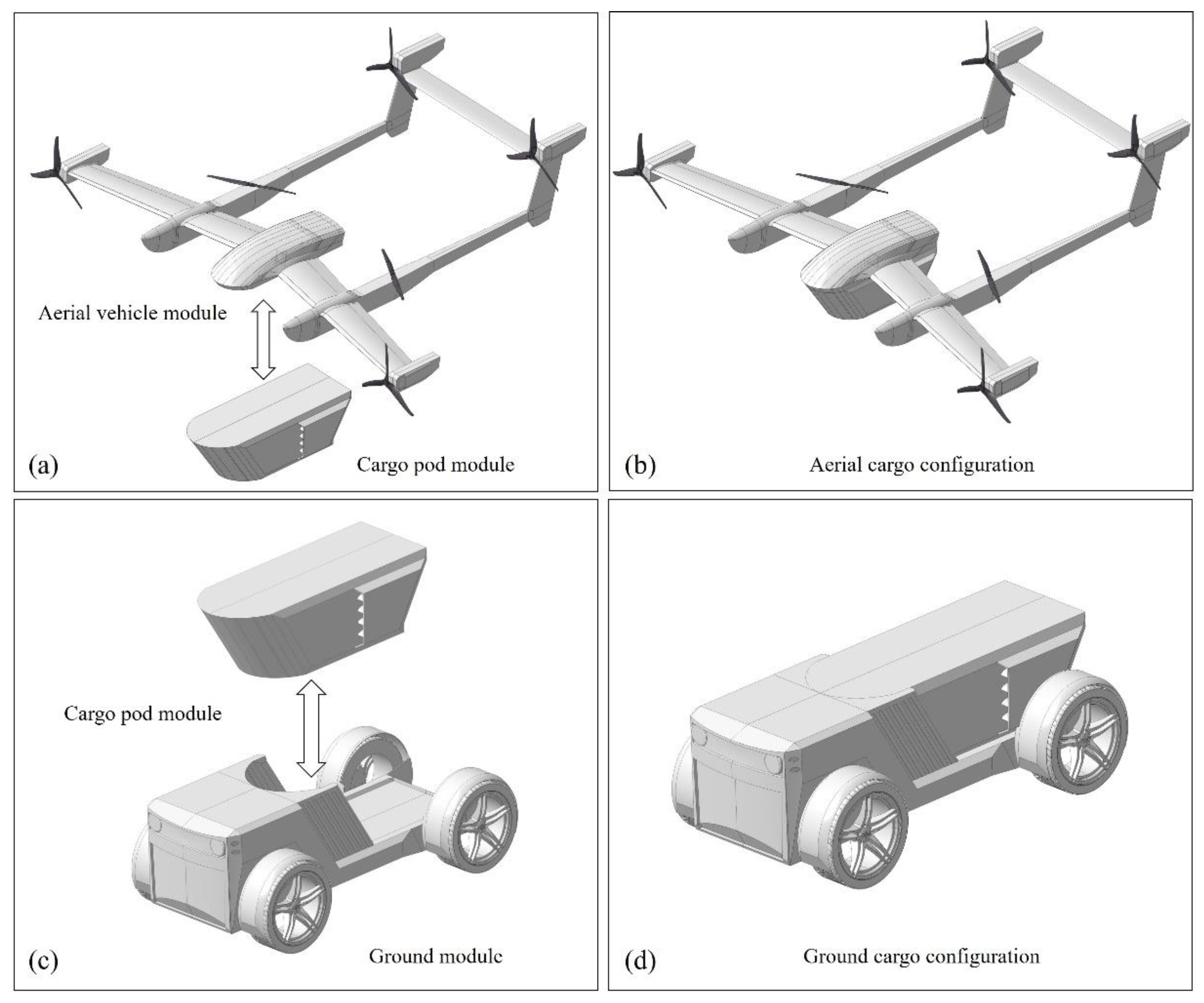
The split-type tilt-rotor cargo flying vehicle, an unmanned aerial vehicle (UAV) for cargo transportation, consists of three modules: the aerial vehicle module equipped with distributed electric propulsion, the cargo pod module (CPM), and the ground module (GM). When the aerial vehicle module is docked with the cargo pod module, they form the aerial cargo configuration; when the cargo pod module is mounted on the ground module, they form the ground cargo configuration (GCC). In this paper, unless stated otherwise, the term ‘vehicle’ refers to the split-type tilt-rotor cargo flying vehicle in either the AVM or ACC configurations.
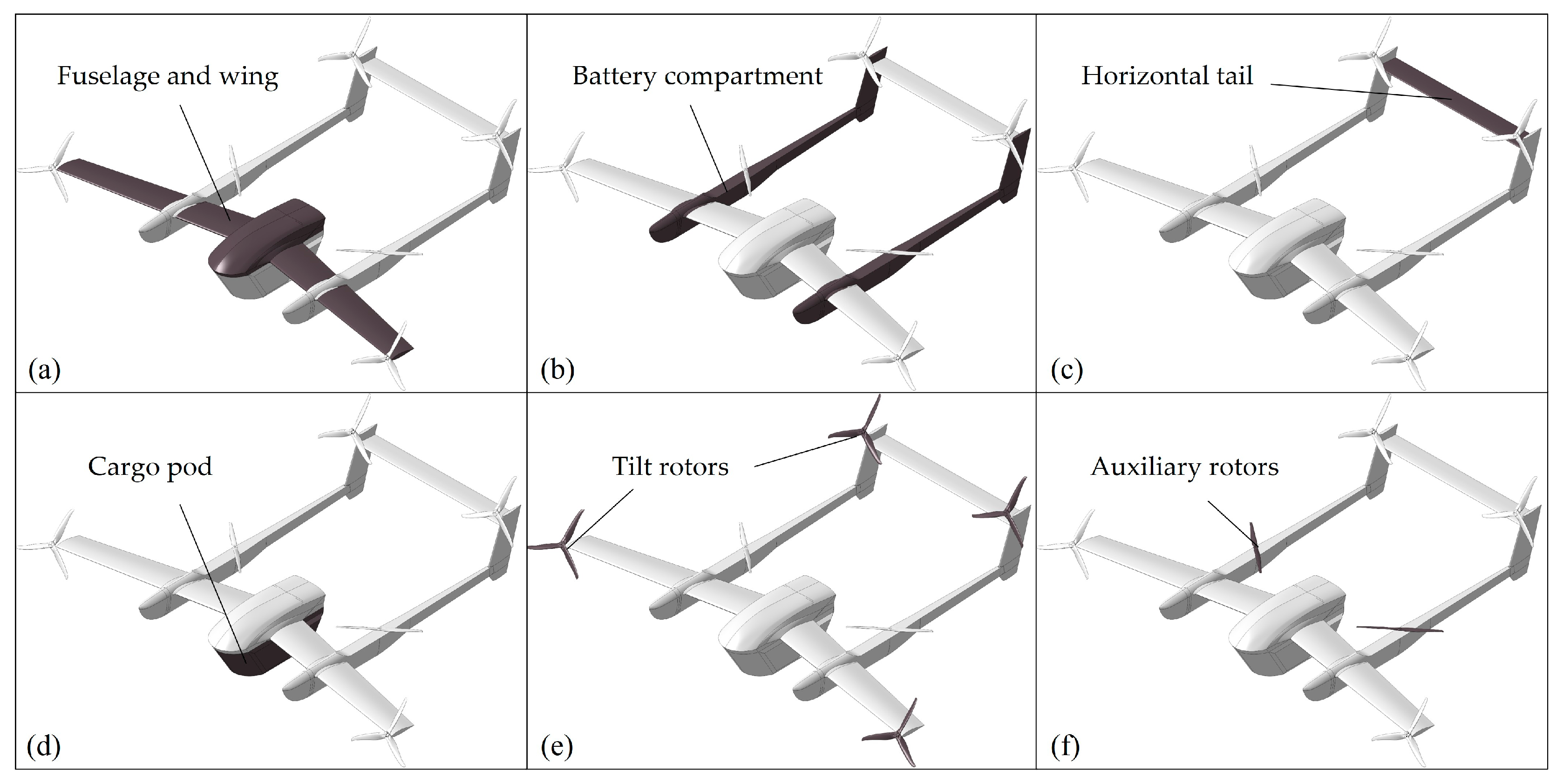
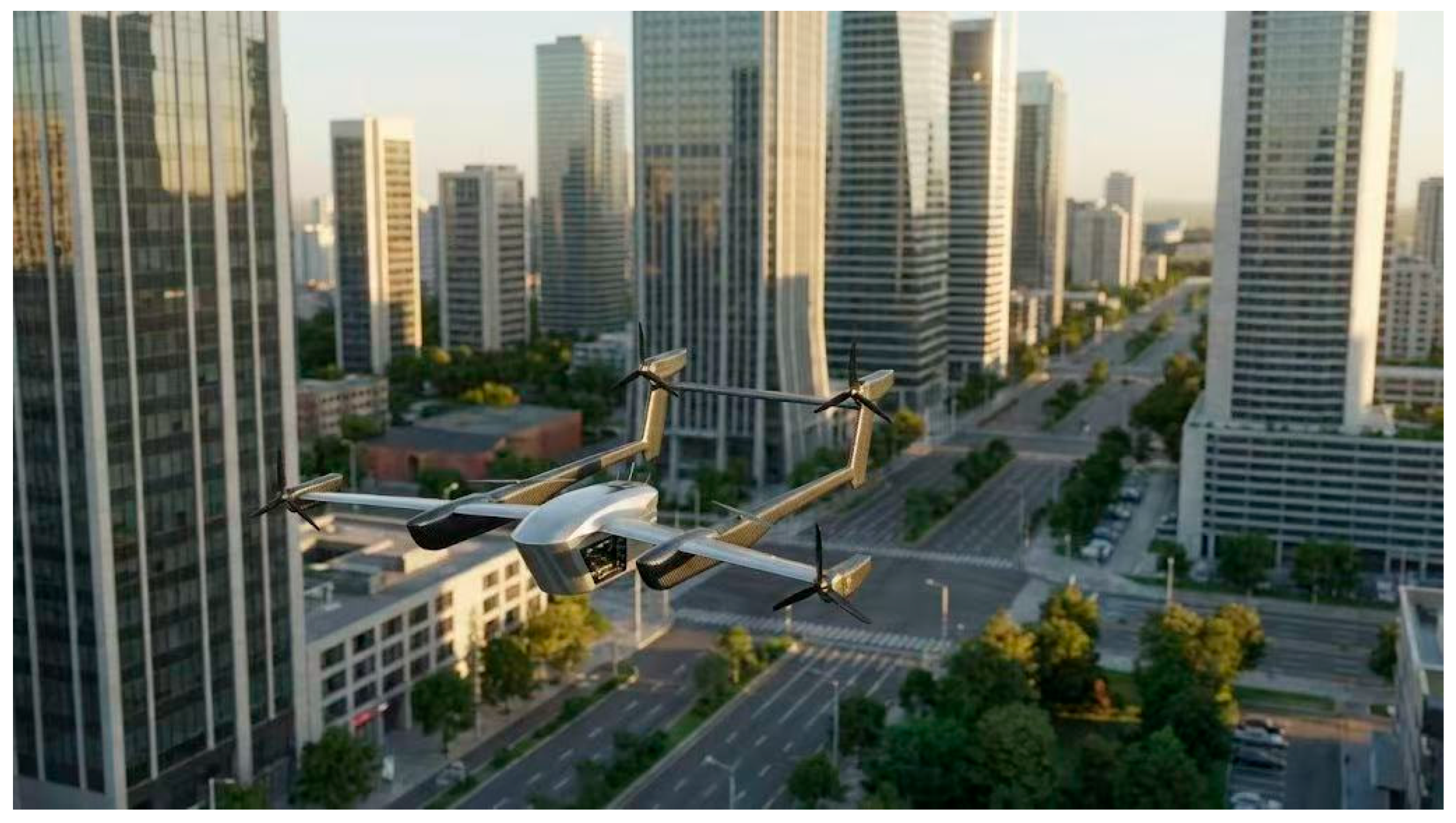
The split-type tilt-rotor cargo flying vehicle described in this paper is shown in Figure 1. During different flight missions, its overall weight and CG position vary significantly depending on the cargo pod weight and docking state [11]. The dockable split-type design between the AVM and CPM results in varying aerodynamic configurations of the split-type flying vehicle depending on transport mission requirements, making the mass distribution and aerodynamic characteristics of the entire vehicle more complex than those of conventional fixed-configuration aircraft. To meet multi-scenario operational requirements for both aerial flight and ground driving, the external layout and aerodynamic design of the cargo flying vehicle differ significantly from those of conventional transport aircraft, making its aerodynamic performance difficult to assess using empirical parameters and design methods developed for traditional airplanes.
A multi-rotor configuration with distributed propulsion generates more trailing and tip vortices around the aircraft, with more complex flow structures, resulting in an unsteady flow field around the entire vehicle [12]. During the tilt-rotor transition, the rotor wakes interact strongly with the fuselage, wings, and other components, significantly altering the surface pressure distribution and the lift-to-drag characteristics of each component, which degrades the vehicle’s aerodynamic performance [13], and it may even severely compromise its stability. Additionally, when the incoming flow direction is misaligned with the rotor shaft, the resulting asymmetric inflow generates additional aerodynamic forces and moments, including lateral forces, bending moments, and torques, acting on the rotor disc [14]. Consequently, the resultant forces and moments from multiple rotors along the three axes show pronounced coupling, which significantly affects the longitudinal and directional stability of distributed propulsion aircraft.
To address these challenges, several studies have specifically investigated split-type configurations. Wang et al. (2024) [15] explored the optimization of motion planning methods for the docking of split-type flying vehicles. However, their study did not delve deeply into the dynamic interactions between the vehicle’s aerodynamic performance and docking configuration [15]. Saunders et al. (2026) [16] investigated the design and testing methods of a modular tilt-rotor eVTOL aircraft with a distributed electric propulsion system. However, their study did not explore the stability during the transition phase or the interactions between flight modes [16]. Moral et al. (2024) [17] examined the design and control of a modular multi-rotor system, but their work did not address the aerodynamic interactions or stability analysis [17]. Li et al. (2024) [18] studied drag reduction matching and mitigation methods for modular flying cars based on nested configurations. However, their research did not consider stability analysis under varying center of gravity positions or dynamic flight conditions [18]. In summary, the aerodynamic loads and flight characteristics of split-type tilt-rotor cargo vehicles are considerably more sensitive and less predictable compared to conventional aircraft configurations. Aerodynamic models and analysis methods developed for single-rotor or dual tilt-rotor configurations are thus insufficient for accurately assessing its stability and control. Therefore, a systematic analysis of the layout rationality, along with comprehensive studies of the aerodynamic characteristics and stability of the flying vehicle, is necessary to provide a basis for safety margin assessment and overall configuration design.
At the flying car configuration level, Chen et al. proposed an overall tilt-rotor flying car configuration that considers both road trafficability and aerodynamic efficiency, and they conducted comparative analyses of wing folding, tilt-rotor arrangements, and lift-to-drag characteristics. However, the split-type connection scheme, cargo pod docking state variations, and the associated changes in flight weight and CG migration were not included in a unified framework for systematic investigation [19]. Liu et al. conducted a quantitative comparison of various flying car concepts regarding range, payload, energy efficiency, and safety, but they gave little consideration to the coupling between mass distribution and stability during cargo missions [20].
Regarding flight dynamics and stability, Schoser et al. proposed a method to incorporate control and stability analysis into the conceptual design phase of eVTOL vehicles, and they performed trim and linearized stability analyses for typical operating conditions, such as hover, transition, and cruise [21]. Nguyen and Webb, for multi-rotor eVTOLs, proposed an analytical flight dynamics model that automatically extracts stability and control derivatives from comprehensive rotor aerodynamic analysis, and they validated the method using NASA’s ‘lift + cruise’ configuration [22]. Su et al. developed a nonlinear rigid-body model for tilt-rotor UAM vehicles, capturing the dynamics of the tilt rotors and their gyroscopic coupling effects. By linearizing the model at several trim points, they constructed a linear parameter-varying (LPV) model and designed an adaptive model predictive control (MPC) scheme based on it to ensure smooth control during the tilt-rotor transition [23]. These studies are crucial for understanding the fundamental flying qualities of VTOL aircraft; however, stability analyses explicitly accounting for CG migration induced by the split-type layout and cargo loading variations have not been conducted.
In aerodynamic modeling and transition-flight characteristics, Wang et al. noted that traditional physics-based models cannot fully capture the complex aerodynamic behavior of tilt-rotor eVTOLs during the longitudinal transition [24]. Zanotti et al. investigated a typical tilt-wing eVTOL with a tandem-wing configuration and studied the effects of tilt angle and inter-rotor spacing on the aerodynamic performance of the front and rear rotors [25]. Shahjahan et al. performed multi-condition optimization of the propulsion rotors for a tilt-wing eVTOL in hover, transition, and cruise, and they showed that optimizing the rotor blades for hover or cruise alone results in significant performance degradation during transition, emphasizing the importance of explicitly accounting for transition conditions in propulsion system design [26]. However, most of these studies focus on individual components or aerodynamic characteristics and have not been integrated with overall mass layout, CG position, and longitudinal stability analysis.
Existing research lacks an integrated analysis framework for the split-type tilt-rotor cargo flying vehicles that considers the aerodynamic layout, cargo CG position, and multi-condition stability during vertical takeoff, tilt transition, and cruise. Based on the current research status and identified issues, this paper focuses on a split-type tilt-rotor cargo flying vehicle, specifically examining stability variations due to changes in weight and CG position with docking states during mission profiles, and the coupling between the propulsion system and aerodynamic layout. It develops an analysis framework linking aerodynamic layout, mass and CG distribution, and multi-condition stability. The specific objectives of this paper follow: design and arrange the aerodynamic lifting and control surfaces of the AVM; establish an aerodynamic layout that includes the wing, horizontal tail, vertical tail, and tilt rotors; develop a mass and CG distribution model that accounts for the docking/undocking states of the CPM and different cargo-load distributions; propose criteria for a rational CG layout and allowable CG range for the split-type flying vehicle; construct a six-degree-of-freedom rigid-body model of the entire vehicle to analyze the influence of layout parameters on vehicle stability under typical VTOL conditions with a focus on static or quasi-steady stability; formulate the equilibrium equations for cruise conditions to investigate the static stability and flying qualities of the split-type tilt-rotor layout in cruise; and, in the tilt-transition phase, select three representative tilt strategies, compare the stability margins and control characteristics under each strategy, and identify the one that best matches the split-type flying vehicle configuration as the recommended tilt strategy.

2. Aerodynamic Modeling Framework

2.1. Aerodynamic Contributors and Baseline Dimensions

Aircraft equipped with a pair of tilt rotors, such as the XV-15, typically exhibit pronounced negative longitudinal static stability when entering the tilt-rotor transition regime [27]. This occurs because at the onset of the transition regime, the flight speed is low and the wing-generated lift is insufficient to balance the weight; consequently, the aircraft relies primarily on the vertical lift component produced by the tilt rotors. Meanwhile, changes in the rotor tilt angle, together with increasing flight speed, intensify the aerodynamic coupling between the wing and the rotors, resulting in nonlinear variations of the pitching moment. Therefore, the coexistence of multiple lift sources and the attendant unsteady aerodynamic interactions often cause twin tilt-rotor aircraft to exhibit negative longitudinal static stability during transition.
By adopting a distributed-propulsion layout with multiple tilt rotors, the vehicle’s lift and thrust loads can be shared among multiple rotor subsystems. In particular, during transitions, this configuration provides lift redundancy. Multiple tilt rotors also introduce additional control degrees of freedom, allowing the system to compensate for the loss of total lift associated with changing flight speed, mitigate thrust imbalance as individual rotors tilt, and thereby maintain more stable modal characteristics. In this paper, a pair of auxiliary rotors was added to the baseline four-tilt-rotor layout, forming the ACC six-rotor configuration shown in Figure 1b. This modification aims to enhance the stability of the vehicle [28] and satisfies the stability requirements for VTOL operations and docking between modules. Meanwhile, the auxiliary rotors provide additional lift, reducing the lift demand on the main tilt rotors and enhancing the safety margins in VTOL and tilt-rotor transition conditions [29]. During cruise, the auxiliary rotors are set to a fixed orientation, maintaining a constant alignment relative to the battery compartment, which effectively reduces the overall aerodynamic drag of the vehicle [30].
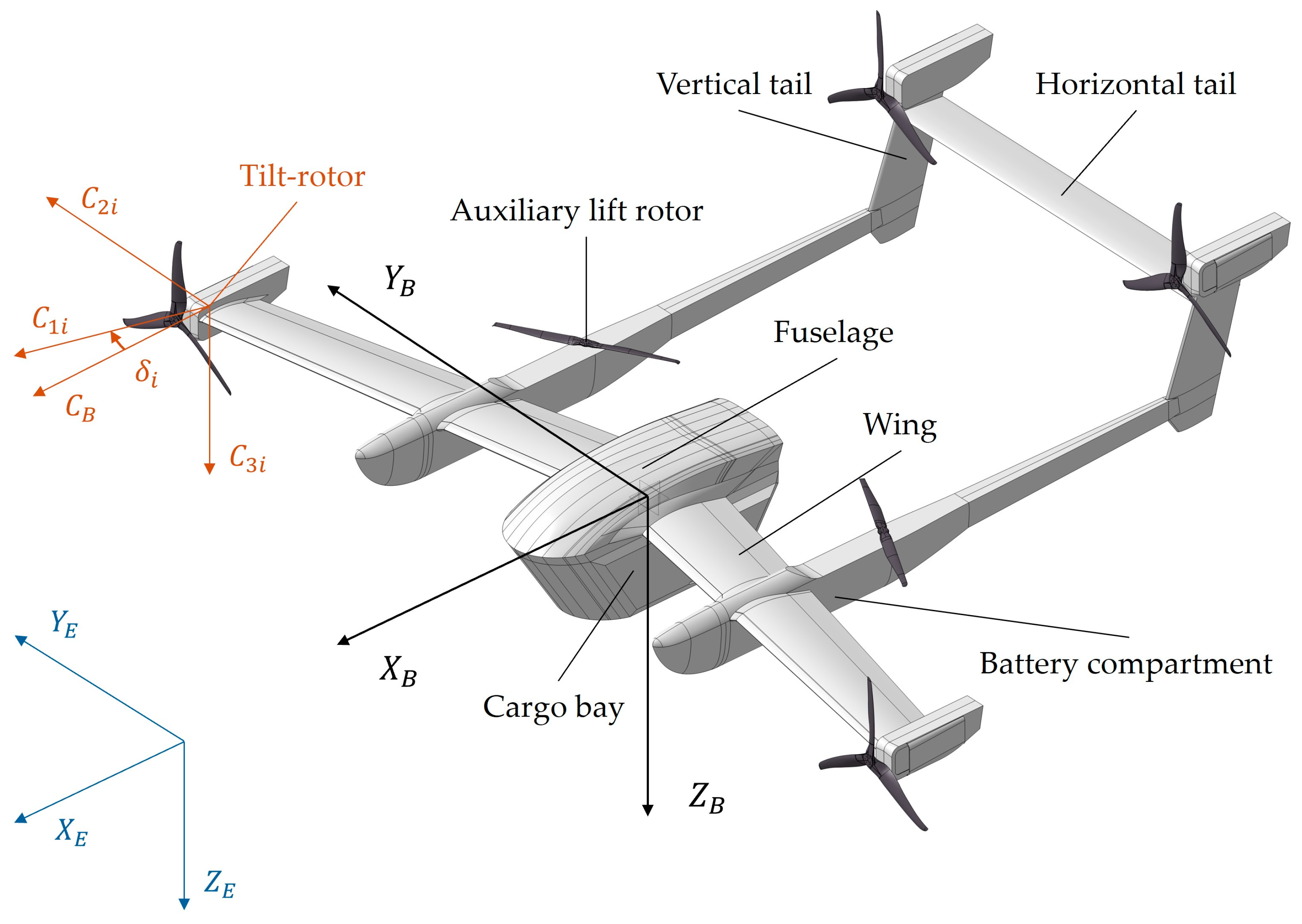
The main aerodynamic components of the six-rotor tilt-rotor cargo flying vehicle are shown in Figure 2. The wing uses a NACA 63-412 airfoil, which offers a relatively high maximum lift coefficient and low drag at low Reynolds numbers; consequently, it is widely adopted in low-speed applications [31,32]. For a trapezoidal wing, the mean aerodynamic chord is calculated as
c A = 2 3 · c r · 1 + λ + λ 2 1 + λ ,
where c r is the root chord length of the wing, which is taken as 0.767 m in this paper; λ is the taper ratio, which is defined as the ratio of the tip chord length to the root chord length and is taken as 0.6519; and the mean aerodynamic chord, c A , is 642.9 mm. It is defined as the chord length of an equivalent untwisted, unswept, and untapered wing that produces the same total lift and pitching moment as the actual wing.
The split-type cargo flying vehicle adopts a twin-boom configuration, in which the vertical tail is split into left and right surfaces and the horizontal tail is mounted between them. This arrangement helps reduce aerodynamic interference on the horizontal tail induced by wing downwash and fuselage wake [33], and it also provides mounting locations for the auxiliary tilt rotors. NACA 0012 is a classical symmetric airfoil with a geometry symmetric about the chord line. It is well suited for designs that require predictable aerodynamic behavior and a wide operational margin at low speeds. In the present application, its lift characteristics contribute to maintaining adequate stability and controllability. As discussed in our previous work [34], the design process of the AVM, including the sizing and selection of key parameters such as the wing and rotor, has been preliminarily analyzed and presented, and the geometric parameters of the split-type cargo flying vehicle are listed in Table 1.

2.2. Coordinate Frames for Aerodynamic Force/Moment Representation

To develop an accurate yet tractable flight-dynamics model for the tiltrotor aircraft, the following assumptions are adopted:
(1)
The Earth-fixed reference frame is treated as inertial;
(2)
A flat-Earth approximation is used; Earth curvature is neglected;
(3)
The tiltrotor aircraft is modeled as a rigid body;
(4)
Rotor blades are assumed to be rigid in bending and linearly elastic in torsion;
(5)
The tiltrotor aircraft is assumed to be bilaterally symmetric about the longitudinal ( x z ) plane.
Figure 3 illustrates the coordinate frames adopted for the ACC. The fuselage, wing, tail assembly, and battery compartment are modeled as a single rigid body. A local-level Earth frame { E } is introduced as an inertial reference under the flat-Earth assumption. The body-fixed frame { B } is attached to the rigid airframe at the mass center with unit vectors { b ^ 1 , b ^ 2 , b ^ 3 } pointing forward (nose direction), starboard, and downward, respectively, forming a right-handed forward–right–down convention [35].
For each tilt-rotor i , a tilt-rotor frame { C i } is defined at the nacelle hinge. The only relative motion with respect to the rigid airframe is the rotor tilting about a single revolute joint whose axis is parallel to b ^ 2 (i.e., the Y B -direction). Accordingly, the C ^ 2 i axis is aligned with the hinge axis such that C ^ 2 i = b ^ 2 , while C ^ 1 i is chosen to be collinear with the rotor thrust axis. The rotor tilt angle δ i fully parameterizes the orientation of { C i } relative to { B } and is defined as the rotation about b ^ 2 , which is measured in the ( b ^ 1 , b ^ 3 ) plane from b ^ 1 toward − b ^ 3 following the right-hand rule with δ i = 0 corresponding to the airplane-mode alignment C ^ 1 i b ^ 1 . Under this definition, the basis vectors satisfy
C ^ 1 i = cos δ i b ^ 1 sin δ i b ^ 3 ,
C ^ 2 i = b ^ 2 ,
C ^ 3 i = sin δ i b ^ 1 + cos δ i b ^ 3 ,
or equivalently the direction-cosine matrix
C i R B = cos δ i 0 sin δ i 0 1 0 sin δ i 0 cos δ i ,
this compact formulation allows the rotor thrust direction, as well as the resulting force and moment contributions, to be expressed directly in the body frame for dynamic modeling and control allocation.

3. CFD Method and Validation

3.1. Governing Equations and Turbulence Model

In this paper, the incompressible viscous Reynolds-averaged Navier–Stokes (RANS) equations were solved with the Spalart–Allmaras (SA) one-equation turbulence model. The continuity equation is given by
· u = 0 ,
and the momentum equation can be written in conservative form as
( ρ u ) x + · ρ u u = p + · τ + S ,
where u is the mean velocity, p is the pressure, τ denotes the combined viscous and Reynolds-stress term, and S is the source term used to account for the multiple reference frame (MRF) treatment in the rotating region (see Equation (12)).
The SA turbulence closure was implemented by solving the transport equation for the modified turbulent kinematic viscosity v ~ ,
D v ~ D t = C b 1 1 f t 2 S ~ v ~ + 1 σ · v + v ~ v ~ + C b 1 v ~ 2 C ω 1 f ω v ~ d 2 ,
where d is the distance to the nearest wall and S ~ is the modified vorticity magnitude; the remaining symbols and model constants follow the standard SA definitions.
The rotor–wing aerodynamic interactions during tilt transition were modeled using the RANS equations with the MRF approach, which is widely used for steady-state analysis; it represents a simplification of the inherently unsteady phenomena, particularly in the tilt-transition phase. The interaction between the rotor wake and the wing, as well as the dynamic changes in the flow field, cannot be fully captured using MRF, which assumes a steady flow condition. Therefore, this approach may not fully account for the transient effects that are crucial for accurate stability predictions, especially in regions close to instability. The flow field was defined and discretized by the finite volume method. Pressure–velocity coupling was handled using the coupled scheme, and all convective terms were discretized with a second-order upwind scheme. All numerical simulations were carried out using ANSYS Fluent (Version 2020R1, licensed to the University of Science and Technology Beijing).

3.2. Method Validation

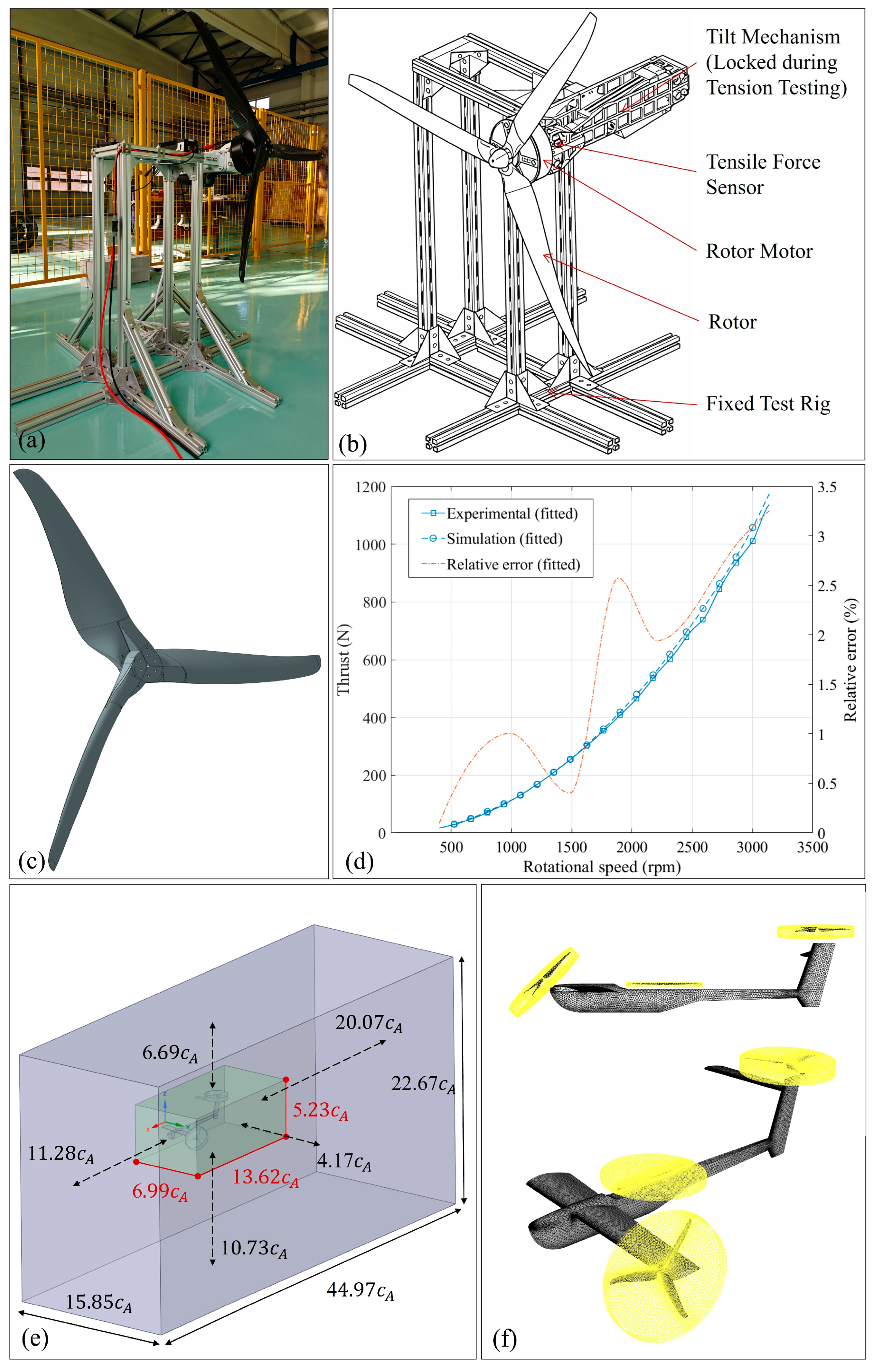
In the absence of wind tunnel tests, to verify the numerical approach, the team compared the CFD methodology with established benchmark cases in prior work [34], ensuring that the error remained within 5%. To further validate the rotor simulation method, and considering the unique characteristics of rotor simulations, a tilt-rotor test bench was built for this study, as shown in Figure 4a. Sensor calibration errors and experimental uncertainties can affect the accuracy of rotor thrust testing. To address this, the sensors are calibrated after installation to minimize the impact of gravity and dimensional deviations. To avoid ground effect interference, the rotor is mounted on the side in an unobstructed test area, and dynamic calibration is performed during the testing to account for sensor response under varying thrust loads. These measures ensure the reliability and accuracy of the test results, as shown in Figure 4b, with an error margin of less than 3%.
The tested three-bladed rotor (shown in Figure 4c) had the same geometry as the rotor used in the numerical model. The rotor thrust was obtained by integrating the pressure and shear stresses over the blade surfaces,
T = F · e T ,   F = S b ( p I + τ ) · n d S   ,
where S b is the blade surface and e T is the unit vector along the thrust axis. The thrust coefficient ( C T ) is defined as a dimensionless parameter used to characterize the thrust generated by the rotor in relation to the dynamic pressure of the flow. It is given by the following equation [36]:
C T = T 1 2 ρ A V 2   ,
where ρ is the air density, A = π ( D 2 ) 2 is the rotor disk area, and V is the tip speed of the rotor. The relative error was defined as
ε T % = T C F D T e x p T e x p × 100 %   ,
Figure 4d compares the measured and simulated thrust. At low rotational speeds, the computed thrust matches the experimental data closely with relative errors below 1%. As the rotational speed increases, the error becomes non-monotonic. The remaining discrepancies can be attributed to geometric deviations in the rotor model, grid-discretization errors, and measurement uncertainties; moreover, stronger aerodynamic interactions at higher rotational speeds may amplify these effects, resulting in larger oscillations in the error curve. Nevertheless, the relative error remains within 3.5% over the entire tested speed range. Therefore, the numerical method is deemed sufficiently accurate for the subsequent aerodynamic analysis of the main configuration.

3.3. Computational Setup for the Main Aerodynamic Airframe Configuration

To minimize the influence of the far-field on the numerical calculation of the flow field, ideally, the far-field in numerical simulations should be infinitely large. However, in practical calculations, an excessively large far-field would significantly increase the mesh size, thus expanding the computational workload. Considering both the computational accuracy and efficiency, the far-field size must be chosen rationally. After validating the suitability of the numerical method, a rectangular computational domain of dimensions 45 c A × 16 c A × 23 c A is selected, as shown in Figure 4e, where c A represents the mean aerodynamic chord length of the tilt-rotor aircraft. Due to the symmetrical nature of the tilt-rotor aircraft flow field, only half of the fuselage and rotor (i.e., a half-model) is selected for meshing and flow field computation to reduce the mesh size and improve computational efficiency. The computational domain includes the rotor region and the far-field/fuselage region. The domain mesh is divided into far-field mesh, fuselage mesh, blade mesh, rotating domain mesh, symmetry plane mesh, and local BOI refinement mesh. To match the complex surface contours of the fuselage and blades, unstructured tetrahedral meshes are used for grid generation. Local refinement control such as ‘Proximity’ for the fuselage-wing junction, ‘Curvature’ for the leading and trailing edges of the wings, and blade surface mesh refinement is applied to improve mesh quality and computational accuracy, as illustrated in Figure 4f.
For boundary condition setup, a velocity inlet is used with velocity defined by ‘Magnitude and Direction’. The velocity values are set according to the specific operating conditions, and the default value is used for the turbulence viscosity ratio. The outlet boundary condition is set as a pressure outlet, with air as the flow medium, a density of 1.225 kg/m3, and dynamic viscosity of 1.79 × 10⁻⁵ Pas. Symmetry conditions are applied at the half-plane of the model’s longitudinal axis. The S-A turbulence model is chosen with a no-slip wall condition for the fuselage surfaces. A second-order upwind scheme is used for the viscous flux calculation to improve accuracy, and the SIMPLE method is applied for the coupling of the velocity and pressure fields. The MRF method is employed for the propeller, with the rotational axis direction and rotational speed of each propeller defined, and the ‘interface’ is set for information exchange between the rotating and stationary flow domains. The maximum residual is set to 1 × 10⁻⁵, and convergence of the steady-state solution is monitored. In the rotating region, the non-inertial effects were introduced as a source term in the momentum equation,
S M R F = 2 ρ Ω × u r ρ Ω × ( Ω × r )   ,
where Ω is the angular velocity vector, u r is the velocity relative to the rotating frame, and r is the position vector. Interfaces were defined between the rotating and stationary regions to exchange flow information, and the rotor blade surfaces were set as no-slip rotating walls. The inlet boundary was specified as a velocity inlet, the outlet was specified as a pressure outlet, and the default turbulence viscosity ratio was used.
The quality and quantity of the mesh have a significant impact on the accuracy and validity of the computational results. Therefore, before conducting computational analysis, it is essential to consider the potential effects that these factors may have on the results. To minimize the influence of the mesh on the computational outcomes, multiple mesh cases were first calculated for the rotor system, which is the most complex and difficult part of the entire vehicle model. These calculations were performed under specific operating conditions, and mesh independence verification was conducted based on the results. The factors influencing the effect of the mesh on the results include the mesh density and refinement level. By increasing the number of discrete points in the rotating domain, the computational domain was divided into three sets of grids with coarse, medium, and fine mesh densities. The impact of the mesh density on the results was compared for each case. The mesh quantity increased from small to large with the rotor speed set at 2500 rpm. The calculation results are shown in the Table 2.
Based on the mesh-independence results in Table 2, the thrust and torque predictions converge rapidly as the mesh is refined from Sim 1 to Sim 4, while the improvement from Sim 4 to Sim 5 becomes marginal. Further refinement to Sim 6 does not yield additional accuracy gains, indicating that the remaining discrepancy is likely dominated by modeling and setup uncertainties rather than mesh resolution. Considering the credibility required for moment/stability-related analyses, Sim 4 (136 × 104 cells) is selected as the baseline mesh for subsequent simulations, whereas Sim 3 (85 × 104 cells) is retained as an engineering-cost alternative when computational efficiency is prioritized. It should be noted that the present CFD results for the full vehicle have not been experimentally validated due to the lack of wind tunnel or flight-test data. Consequently, the quantitative accuracy of integrated aerodynamic forces and moments may be limited, particularly in strongly coupled or near-instability regions. Nevertheless, the rotor-level validation and mesh-independence studies provide a reasonable basis for analyzing trends and relative variations in aerodynamic performance and stability. Readers should interpret absolute values of integrated forces and moments with caution.

4. Results and Stability Analysis

Following the design of the aerodynamic layout of the split-type tilt-rotor cargo flying vehicle and the selection of the CFD method, this section analyzes the stability of two aerodynamic models, the AVM and the ACC, under VTOL, cruise, and tilt-rotor transition conditions.

4.1. Stability Analysis Under VTOL Conditions

The CG position is a key parameter influencing flight stability and controllability [37]. Pierre-Jean et al. investigated the effect of CG location on the stability of quadrotor UAVs and reported that under their tested conditions, stability is not primarily governed by precise CG adjustment but by other dynamic characteristics, such as thrust distribution and rotor flexibility [38]. By analyzing design constraints and criteria, Bhakti et al. showed that heavy-lift hexarotor vehicles can maintain stable attitudes under payload conditions [39]. Ibrahim et al. further examined the control and stability of hexarotor UAVs with particular emphasis on the effects of mass distribution and CG variations [40]. Under VTOL conditions, the vehicle can be approximated as a hexarotor system in which all rotors are oriented perpendicular to the fuselage. The pitching moment generated by each rotor depends on its moment arm relative to the CG, and it is therefore directly affected by the CG position. Consequently, the CG location, together with the rotor layout, strongly influences the VTOL stability of the AVM.
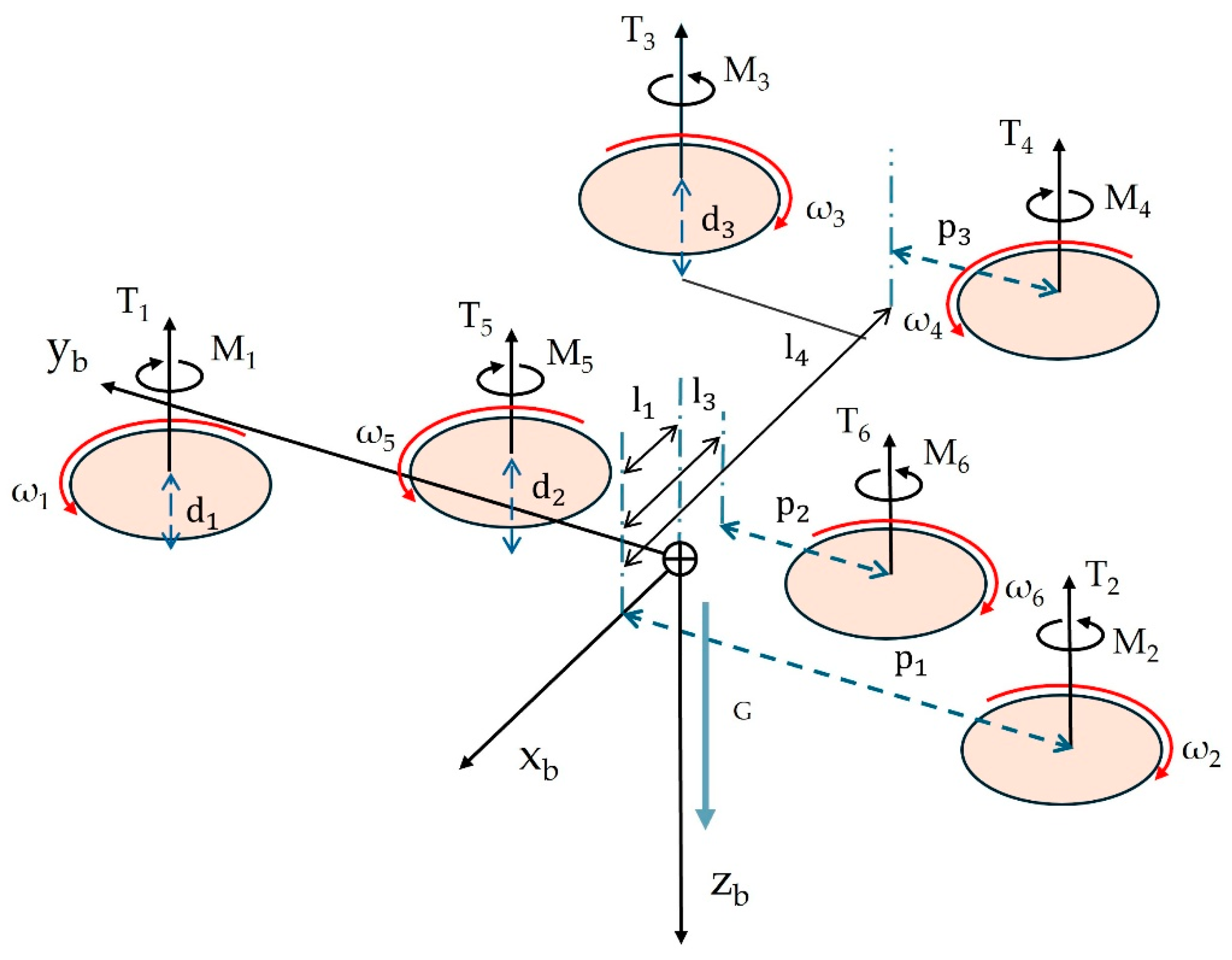
Figure 5 shows a schematic of the body-fixed coordinate system of the split-type tilt-rotor cargo flying vehicle. This coordinate system is fixed to the vehicle and moves with it, and it is used to describe the attitude of the vehicle, the positions of its components, and the aerodynamic forces and moments. It is defined according to the right-hand rule. The x b axis is aligned with the forward direction of the vehicle, y b points toward the right wing, and z b points downward along the fuselage. The ellipses in the figure represent the positions of the six rotors of the hexarotor vehicle. The distances l 1 , l 3 , and l 4 denote the x-axis distances from the CG to the main tilt rotors, the auxiliary rotors, and the secondary tilt rotors, respectively. The distances p 1 , p 2 , and p 3 denote the y-axis distances from the CG to the main tilt rotors, the auxiliary rotors, and the secondary tilt rotors, respectively. The distances d 1 , d 2 , and d 3 denote the z-axis distances from the CG to the thrust application points of the main tilt rotors, auxiliary rotors, and secondary tilt rotors, respectively. The angular velocities of rotors 1 6 are denoted by ω 1 ω 6 , and their rotation directions are indicated by the red arrows. The torques generated by rotors 1 6 are denoted by M 1 M 6 with directions indicated by the black arrows. The rotor thrusts are denoted by T 1 T 6 and act opposite to z b . The vehicle weight is denoted by G and acts along the + z b axis.
The positions of the vehicle’s rotors relative to the CG can be expressed as
r i = ( x i , y i , d i ) T ,
where x i ± l 1 , ± l 3 , ± l 4 , y i ± p 1 , ± p 2 , ± p 3 , d i d 1 , d 2 , d 3 . The forces generated by the rotors, the aerodynamic torques of the rotors, and the total force in the body-fixed frame can be written as
F i = 0,0 , T i T ,
M R i = 0,0 , M i T ,
F b = 0 0 m g + i = 1 6 0 0 T i .
The moment generated by the rotors is composed of two parts: (1) the cross-product of the moment arm and the thrust and (2) the rotor’s own aerodynamic torque. By expanding the cross product, the total moment can be written as
τ b = i = 1 6 y i T i i = 1 6 x i T i i = 1 6 d i T i + i = 1 6 M i ,
where the term d i T i represents an additional yawing-moment contribution induced by the different rotor installation heights (z-direction offsets), which affects yaw stability and control allocation under VTOL conditions. During hover and vertical climb, the vehicle is assumed to be in equilibrium, balancing the vertical force, roll moment, pitch moment, and yaw moment. Small perturbations about this equilibrium state [41] are defined in Equation (18) and can be linearized to obtain four generalized control inputs:
δ T i = T i T i 0 , δ M i = M i M i 0 ,
δ F z = i = 1 6 δ T i ,
δ τ x = i = 1 6 y i δ T i ,
δ τ y = i = 1 6 x i δ T i ,
δ τ z = i = 1 6 d i δ T i + i = 1 6 δ M i ,
since τ x and τ y are independent of d i , the influence of a symmetric rotor layout on the pitch and roll stability of the vehicle is small. In contrast, yaw control depends not only on the aerodynamic torque but also on d i . A larger d i indicates stronger coupling between the rotor lift and the yawing moment, which increases the condition number of the yaw-moment-related term in the control allocation matrix. As a result, the yaw mode becomes more sensitive, and yaw oscillations are more easily excited by external disturbances.
In the early design stage of the cargo flying vehicle, the stability analysis under VTOL conditions can be simplified to a lift allocation problem among three rotor pairs. The vehicle is assumed to be strictly symmetric about the x z -plane, and each symmetric rotor pair is assumed to carry the same lift, which is denoted by ( T 1 , T 2 , T 3 ). Based on the vehicle data in Table 1, the rotor lift distribution for the two vehicle configurations is given in Table 3.
The disk loading ( σ ) is defined as the thrust generated by the rotor divided by the rotor disk area. The formula to calculate disk loading is as follows:
σ = 4 T i π D i 2 ,
where T i is the lift generated by the rotor, and D i is the rotor diameter.
According to Table 4, the disk loading for the Lift + Cruise configuration is 648.5 N/m2, which is relatively high and suitable for short-range VTOL operations. This higher disk loading contributes to improved cruise performance but slightly reduces the hover efficiency. On the other hand, the Tiltrotor configuration has a disk loading of 471.6 N/m2, which results in a decrease in hover efficiency, but it supports higher flight speeds, making it ideal for missions requiring vertical takeoff and fast cruising. The Lift + Tiltrotor configuration has a disk loading of 491.0 N/m2, providing a balance between hover and cruise performance, thus offering good adaptability for both flight modes. Based on the data in Table 3, under VTOL conditions, the maximum disk loading of the main tilt rotors is 643.1 N/m2, which falls within the typical disk loading range for VTOL rotors, ensuring efficient lift generation during takeoff and hover. Meanwhile, the disk loading of the auxiliary rotors is 396.3 N/m2, which is slightly lower in efficiency, but the use of two-blade rotors is appropriate for this design. The secondary tilt rotors have the lowest disk loading at 245.7 N/m2, primarily due to their extended arm length, which reduces their aerodynamic efficiency. In future optimization efforts, we will consider replacing them with smaller-sized rotors to enhance performance.
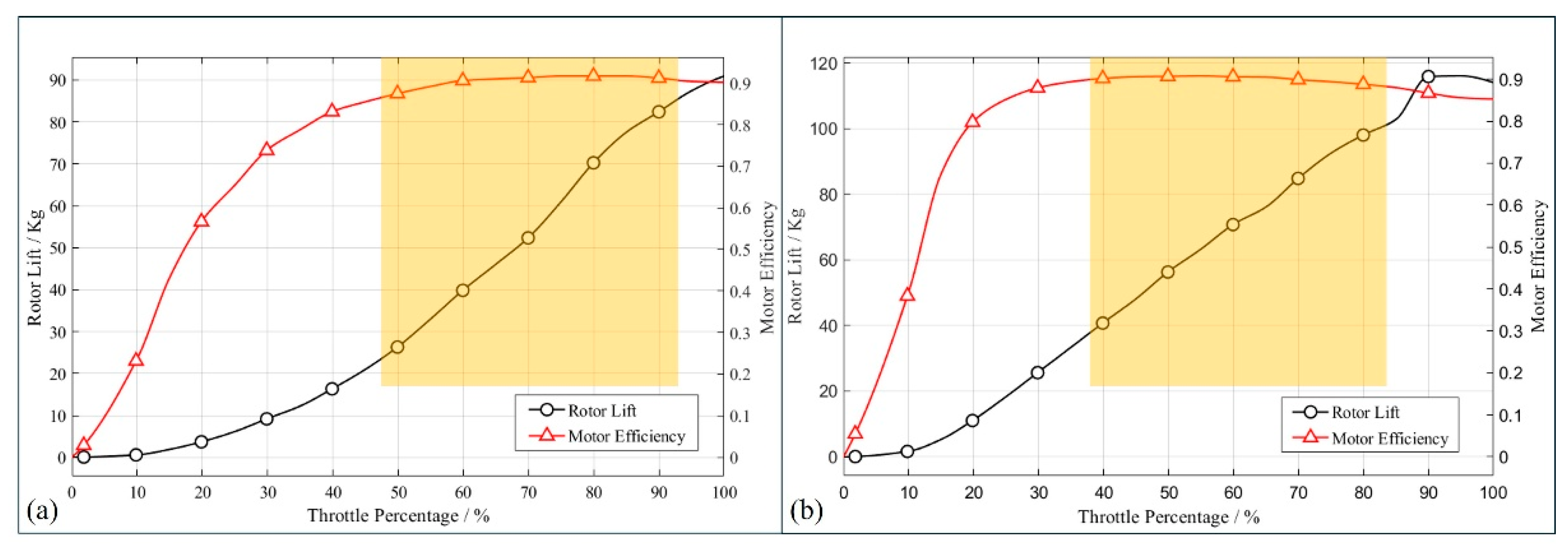
When the differences in the CG coordinates along the x and y axes are small, similar lift distribution ratios among the rotors are obtained for the two gross-weight cases. According to Table 3, under VTOL conditions, the required lift is mainly allocated to the main tilt rotors and the auxiliary rotors, while the secondary tilt rotors are used to balance the pitching moment of the vehicle. Figure 6 shows the curves of motor efficiency versus lift for the different rotor types. The motor efficiency is defined as the ratio of the motor output power to the system input power, and the motor efficiency can be calculated using the following formula:
η M E = P M o t o r   O u t P S y s t e m   I n p u t ,
where η M E is the motor efficiency, P M o t o r   O u t is the useful power delivered by the motor for thrust generation, and P S y s t e m   I n p u t is the total electrical power supplied to the motor. Under the above lift allocation, the main tilt rotors and the secondary tilt rotors operate in a high-efficiency region, whereas the auxiliary rotors operate near their start-up region, where the motor efficiency is relatively low but the power consumption remains small. Since the secondary tilt rotors are mounted at the tips of the vertical tails, their d i values are larger than those of the other rotors; however, because only a small portion of lift is assigned to them under VTOL conditions, their influence on the yaw-moment stability of the vehicle is limited. Based on the above results, the current layout of the vehicle still offers potential for optimization, particularly through the adjustment of arm lengths to achieve a better distribution of rotor efficiency. It can also be concluded that under VTOL conditions, the vehicle is capable of achieving its mission objectives while maintaining a stable state.

4.2. Stability Analysis Under Cruise Conditions

When the CG is located too far forward or too far aft, the stability of the vehicle is reduced and large pitching moments may be induced during flight, which degrades controllability and response. In particular, when a payload is carried, dynamic variations of the CG can further affect the stability of the vehicle. Changes in the CG position also influence the efficiency and thrust distribution of the rotor systems, which can lead to imbalances in lift and thrust moments and, in turn, have a significant impact on the pitch, roll, and yaw stability of the vehicle.
The CG location is nondimensionalized using the mean aerodynamic chord, and the x -axis distance x c g from the vehicle CG to the foremost point of the wing planform can be written as
x c g = k c A ,
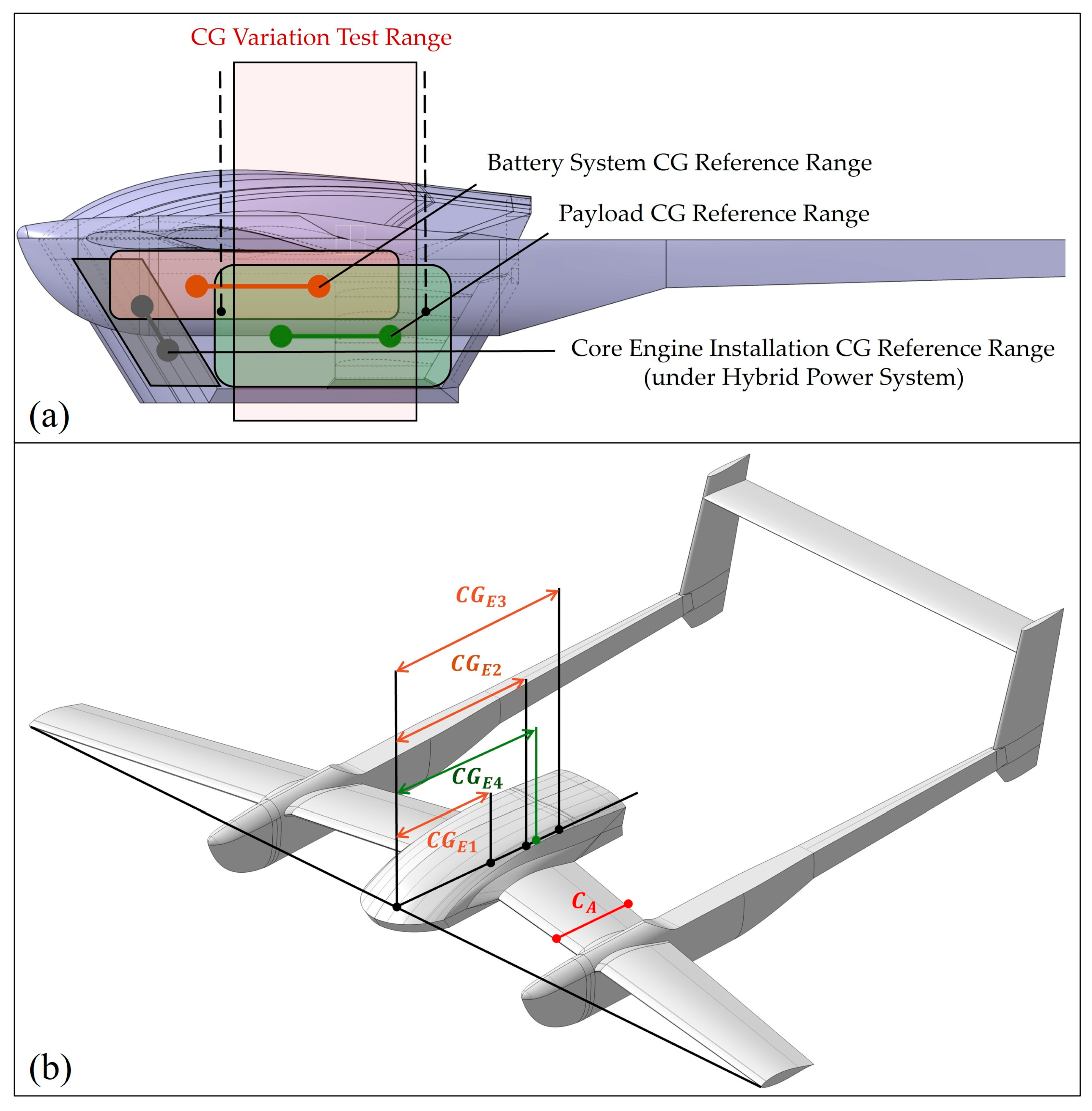
the coefficient k is a dimensionless parameter, which is taken as 1.4–1.8 (this range primarily depends on the variation in the center of gravity for the battery system, payload compartment, and the core engine in the future hybrid power design, as shown in Figure 7a. Values of k outside this range lead to excessive sensitivity of the entire vehicle to rotor lift variations or make it difficult to achieve the desired center of gravity balance in structural design). In this paper, to analyze the static stability of the vehicle, the flight condition is set to cruise with a cruise speed of 120–150 km/h and an angle of attack of 0°.
For an ideal design, the pitching-moment coefficient in cruise is expected to be close to zero in order to reduce trim forces and trim drag [43]. Trim force is the aerodynamic force generated by the control surfaces to maintain the balance of the moment and keep the aircraft in a stable attitude. Trim drag is the additional component of drag introduced by the control surfaces to achieve the trim force, which increases the overall drag and, consequently, leads to higher fuel or energy consumption. The additional energy consumption resulting from trim drag can be expressed as
Energy   Consumption = C k 1 · T f i · C k 2 ,
where T f i is the required trim force, C k 1 is a constant that reflects the relationship between trim force and trim drag, and C k 2 is a constant that reflects the relationship between trim drag and energy consumption. The additional trim drag requires additional thrust, and there is a linear relationship between thrust and energy consumption.
If a given CG position produces a large pitching-moment coefficient, a larger horizontal-tail area is required to generate the compensating moment, which increases the trim drag and overall power consumption; if a small negative pitching-moment coefficient is obtained, the trim cost is small, but the longitudinal static stability derivative must still be kept negative to ensure static stability [44]. In the cruise condition, the auxiliary tilt rotors are set to a “fixed orientation” mode, where the rotors remain parallel to the battery compartment. In this mode, the auxiliary rotors do not generate significant pitching moments, and their contribution to the overall pitching moment of the vehicle is considered negligible. This simplification is based on the assumption that the rotors are fixed in the same direction as the battery compartment, minimizing any aerodynamic effects that could affect the vehicle’s stability during cruise.
Therefore, minimizing trim force by optimizing the CG position is a crucial aspect of the aircraft design process to enhance its performance and efficiency. To quantify trim force in terms of the pitching moment, we can use the following equation:
M o m e n t = T w i n g · l 2 + T t a i l · l 5 ,
where M o m e n t is the pitching moment, T w i n g is the trim force generated by the wing control surface, l 2 is the distance from the center of gravity to the aerodynamic center of the wing control surface, T t a i l is the trim force generated by the tail control surface, and l 5 is the distance from the center of gravity to the aerodynamic center of the tail control surface. A smaller trim force from the horizontal tail typically indicates a larger static stability margin (i.e., a greater distance between the center of gravity and the aerodynamic center), which generally results in the aircraft being more inclined to self-recover its balance, thereby exhibiting improved stability. Table 5 presents the aerodynamic performance of the vehicle at different center of gravity (CG) locations. The CG location significantly affects the pitching moment coefficient and the overall stability of the vehicle.
At C G E 1 , the moment is negative, corresponding to a nose-heavy configuration. The negative pitching moment indicates stability but requires a relatively large trim moment to maintain balance. However, this configuration may lead to higher trim drag and lower efficiency in certain flight phases. At C G E 2 , the moment is positive, and the pitching moment coefficient C m is close to zero. This suggests a near-neutral stability configuration, making it easier for the vehicle to maintain stable flight, particularly during cruise, with reduced trim requirements. This configuration achieves a balance between stability and control, offering better maneuverability compared to C G E 1 ; At C G E 3 , the moment is positive, indicating a tail-heavy configuration. The positive pitching moment suggests a reduction in stability, leading to higher trim costs and lower stability.
Based on the analysis, C G E 2 provides the most favorable configuration, with a pitching moment coefficient close to zero, indicating balanced stability and minimized trim force as well as ensuring efficient flight. Therefore, the CG location near C G E 2 represents the optimal choice within the experimental range, offering a good balance between stability, efficiency, and maneuverability. Longitudinal static stability is defined as follows: when the vehicle is disturbed and its angle of attack deviates from the original equilibrium state, if, after the disturbance vanishes and without control inputs, the vehicle tends to return to the original angle of attack, the vehicle is said to possess longitudinal static stability [45,46]. The derivative C m α is defined as the derivative of the pitching-moment coefficient C m , referenced to the vehicle CG, with respect to the angle of attack α:
C m α C m α t r i m ,
where α is the angle of attack, and the subscript “ t r i m ” denotes linearization about a given trim condition. For a given CG trim location, if C m α is negative, a positive perturbation in α induces a restoring pitching moment that tends to reduce the angle of attack, and the trim point is longitudinally statically stable. If C m α is positive, small perturbations are amplified and the vehicle is longitudinally statically unstable. In this paper, aerodynamic simulations are carried out for the AVM and the ACC at different CG locations C G i over an angle-of-attack range from −5° to 15°, and C m α is computed.
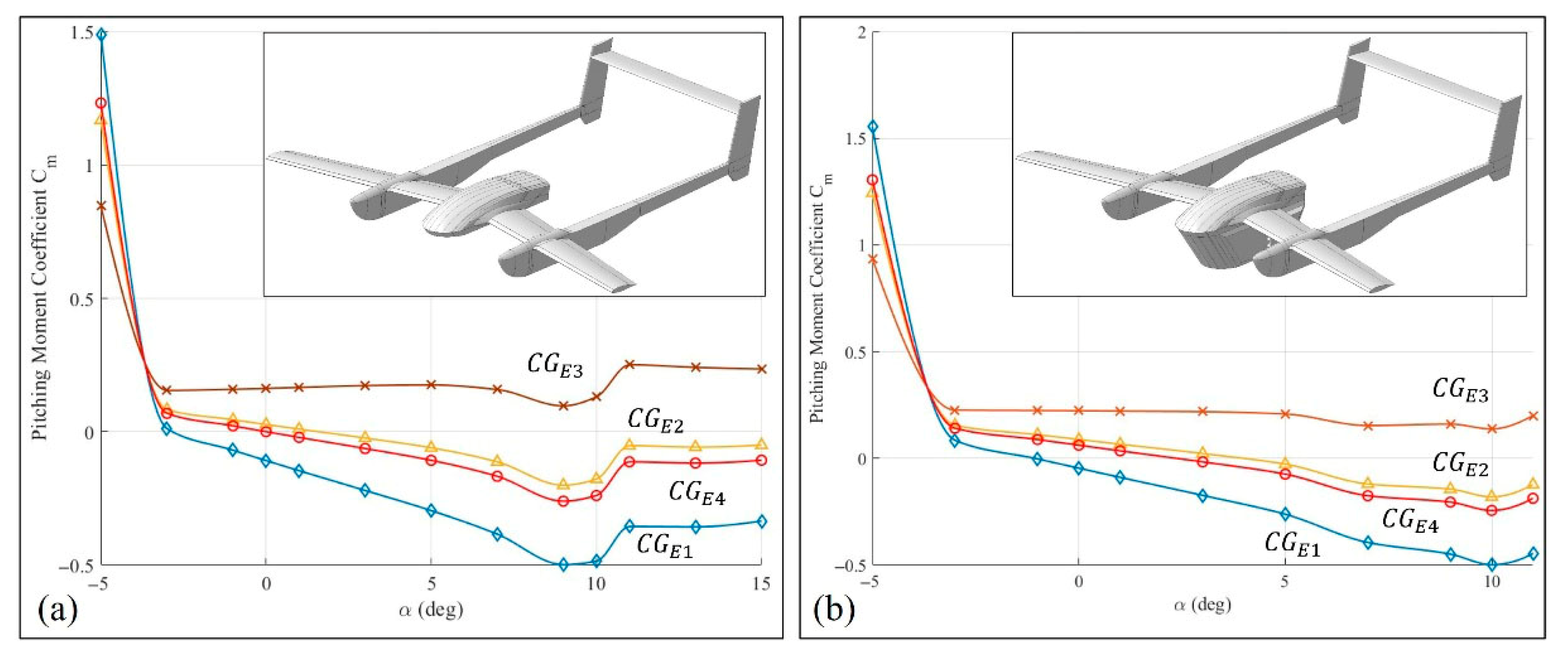
Figure 8a shows the variation in C m α with the angle of attack for four CG locations of the AVM. C G E 4 is defined as the reference CG location at which the pitching moment is zero at an angle of attack of 0°. Clear differences in C m α are observed among the different CG locations. As the CG is shifted forward from C G E 3 to C G E 1 , C m α increases monotonically, and the pitch stiffness and static stability margin are gradually enhanced. C G E 1 corresponds to the foremost CG configuration with the strongest longitudinal static stability, whereas C m α at C G E 3 is already close to zero, indicating pronounced neutral stability. The linear trim angle-of-attack relation at each CG location can be written as
α t r i m b C m α ,
where b is the intercept in the corresponding linear interval. When the CG is moved forward to C G E 1 , α t r i m ≈ −2.5°, indicating that a large nose-up trim moment from the horizontal tail (downward tail load) is required in cruise to balance the inherent nose-down moment. As a result, the trim force and cruise power consumption are increased, but a larger static stability margin and stronger disturbance-rejection capability are obtained. When the CG is shifted aft to C G E 2 , α t r i m ≈ 1.5°, so the horizontal-tail trim force and trim drag are reduced while a sufficient static stability margin is still maintained, making this CG position a compromise between efficiency and stability. For C G E 3 , C m α remains positive over the angle-of-attack range α = −5°∼15°, and the linear fit yields α t r i m ≈ 40°, which is far beyond the angle-of-attack range considered here. This indicates that no natural pitch trim point exists within a practically feasible angle-of-attack range, and a very large trim force from the tail or control surfaces would be required to achieve equilibrium. At the same time, the absolute value of C m α at C G E 3 is the smallest, implying that the static stability margin has been greatly relaxed; this corresponds to a typical high-maneuverability, low passive-stability configuration, which is more suitable as an aft-CG limit when used in conjunction with an active flight-control system. As the CG is shifted aft from C G E 1 to C G E 3 , the longitudinal static stability and pitch stiffness of the vehicle are gradually weakened, whereas the horizontal-tail trim force and trim drag are reduced accordingly. The CG position corresponding to C G E 4 yields C m α 0 in the vicinity of zero angle of attack, providing a moderate static stability margin and a relatively low trim cost, and it can be recommended as the design CG location for the AVM.
To evaluate the influence of the aerodynamic configuration change after docking the CPM with the AVM, as well as the effect of the downward shift of the overall CG caused by the cargo weight, the variation in C m α with angle of attack at four CG locations of the ACC is shown in Figure 8b. The C m α - α curves of the ACC are overall smoother and more monotonic. For C G E 1 and C G E 4 , the curves retain a relatively large negative slope at small angles of attack, while the pronounced “valley-and-rise” behavior at high angles of attack is significantly weakened. This indicates that while strong static stability is maintained, the nonlinear tendency toward instability at high angles of attack is mitigated. For the mid-to-aft CG locations C G E 2 and C G E 3 , the curves that previously rose markedly at moderate to high angles of attack are transformed into curves that are nearly flat or slowly decreasing over −5°∼10°. The range of positive slope is greatly reduced or even eliminated, indicating that the longitudinal static stability margin of the combined configuration at aft CG locations is clearly improved and the usable angle-of-attack envelope is extended. On the other hand, it can be observed from Figure 8b that near small angles of attack, the C m α curves at each CG location are shifted slightly upward relative to those in Figure 8a, while the pitching-moment coefficient at zero angle of attack tends to take a more positive value. This implies that for a given cruise angle of attack, a larger nose-down moment from the horizontal tail and associated trim surfaces is required to achieve pitching-moment equilibrium, leading to an increment in trim drag and energy consumption.
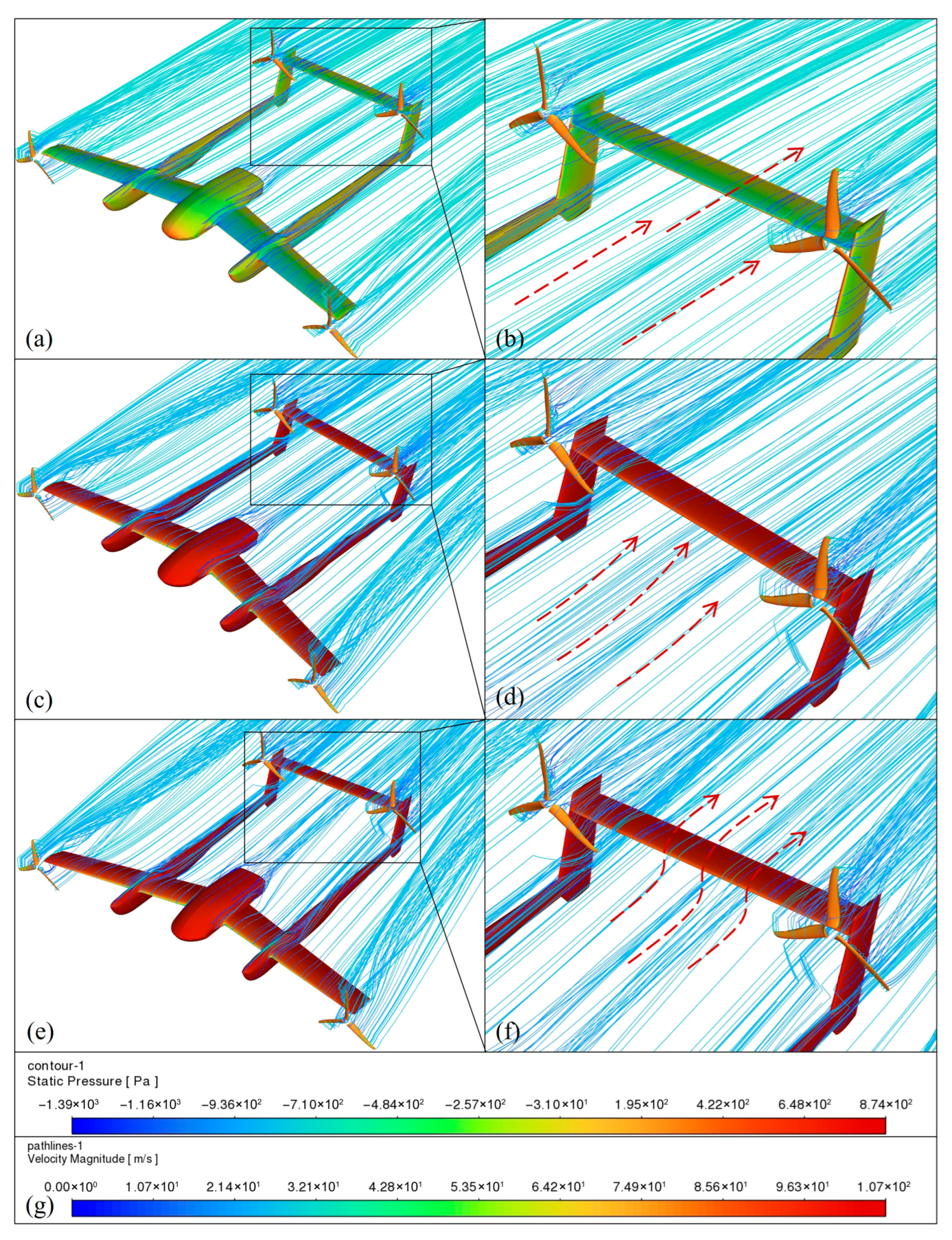
The introduction of the cargo pod and the resulting downward CG shift therefore have a pronounced stabilizing effect for mid-to-aft CG layouts, allowing the configuration to maintain negative or near-zero C m α over a wider angle-of-attack range and improving the longitudinal static stability margin and high-angle-of-attack envelope while at the same time increasing the zero-angle pitching moment and causing a slight increase in trim force. It can be observed from Figure 8 that for C G E 2 C G E 4 , C m α remains negative in the angle-of-attack range from −5° to 9°, but in the range from 9°to 15°, it first becomes positive and then stays very close to zero. This implies that the AVM changes from longitudinal static stability to static instability at about 9°, and it remains in a neutrally stable state over 11° to 15°. To explain this change in stability within this interval, the flow-velocity streamlines in this angle-of-attack range are analyzed, as shown in Figure 9.
Based on the local streamlines and static pressure contours around the horizontal tail, it is observed that as the angle of attack increases from 9° to 11°, the fuselage wake progressively impinges upon the tail region, indicating that the local inflow at the tail becomes increasingly dominated by the wake. At α = 9°, the horizontal tail lies above the fuselage wake, is only weakly affected, and steadily generates a restoring pitching moment opposing disturbances, thereby maintaining the AVM in a statically stable state. As α increases from 9° to 11°, the separated regions and trailing vortices originating from the aft fuselage and wing-root area expand, and the local flow velocity over the tail decreases, as indicated by the streamline color variation and static pressure contours. Consequently, the effective inflow angle and flow topology at the tail are altered, leading to a significant reduction in the local lift-curve slope of the tail [47]. This mechanism can be expressed by decomposing the longitudinal static-stability derivative as
C m α C m α = C m α w f + C m α t ,
where the subscripts w f and t denote the wing–fuselage combination and the horizontal tail, respectively. Under a conventional linear tail approximation, the tail contribution can be written as
C m α t η t V H a t ( 1 ε α ) ,
with η t = q t / q the tail dynamic-pressure ratio, a t = C L t α the tail lift-curve slope, ε the downwash angle, and V H = S t l t S c ¯ the horizontal-tail volume coefficient. As the wake covers the tail, η t decreases and a t is reduced, weakening the (typically stabilizing) restoring-moment contribution of the horizontal tail. In this regime, the tail contribution diminishes and decays more rapidly than that of the wing–fuselage combination, causing the overall C m α to change from negative to positive and rendering the AVM statically unstable. When the angle of attack exceeds 11°, the fuselage wake is convected downstream of the horizontal tail and the tail’s restoring contribution approaches zero; it provides neither a restoring nor a destabilizing moment, and the overall C m α returns to a value close to zero, corresponding to near-neutral static stability.

4.3. Stability Analysis Under Tilt-Rotor Transition Conditions

In the tilt-rotor transition regime, the aerodynamic interference effects of rotor downwash on the wing and tail surfaces exhibit distinct and strong nonlinear characteristics as the tilt angle changes. This nonlinearity is manifested in the way the accelerated flow field induced by the rotors alters the effective angle of attack and lift distribution over the wing, subsequently inducing variations in the vehicle’s pitching moment [14]. The interaction between the rotor wake and the wing plays a key role in this process, leading to complex and dynamic changes in the aerodynamic characteristics. These changes are time-dependent and exhibit pronounced nonlinear effects as the tilt angle evolves. For an aircraft equipped with a single pair of tilt rotors, when entering the tilt-rotor transition regime, the rotor downwash directly impinges on the wing, which gradually takes over the total lift of the aircraft. As the tilt angle and tilt rate change, the complex aerodynamic coupling and disturbances become more pronounced, significantly affecting the overall stability of the vehicle [48].
As a result, the stability of classical twin tilt-rotor aircraft, such as the XV-15, in the tilt-rotor transition regime is strongly dependent on the flight-control system. At the same time, the rotor disks and supporting structures of a single pair of tilt rotors are required to carry most of the lift load, and the associated dynamic coupling may excite modal instabilities [49]. It has therefore been suggested that the number of tilt-rotor mechanisms should be increased to provide additional safety redundancy. For aircraft equipped with multiple tilt rotors, such as the Joby S4, the tilt-transition scheme usually adopts the simultaneous or phased tilting of several tilt-rotor mechanisms and likewise relies on flight-control allocation and rotor-speed modulation [50]. Compound rotorcraft (e.g., Sikorsky X2, Eurocopter X3, Piasecki X-49) employ multiple fixed lifting rotors together with propulsive rotors to provide lift in the initial flight phase and high-speed propulsion. These configurations also experience a change in operating mode from “lift provided by the rotors” to “lift provided by the wings with the rotors providing thrust” [50], but they generally possess larger safety margins. Sheng proposed that a tilt-rotor aircraft be decomposed into several subsystems that are modeled separately and then coupled to obtain the overall aircraft response so that stability in the tilt-rotor transition regime can be analyzed [51]. Du et al., for a quad tilt-rotor UAV, also adopted separate CFD simulations of the subsystems and the full vehicle to investigate the aerodynamic interaction between the rotors and the fuselage in the tilt-rotor transition regime. It was shown that at certain tilt angles, adverse moments or abrupt changes in the lift-to-drag ratio may occur, and it was suggested that optimization of the tilt schedule can be used to improve stability in the tilt-rotor transition regime [52].
In summary, for tilt-rotor flying vehicles, the selection of an appropriate tilt strategy directly determines the stability in the tilt-rotor transition regime. Therefore, in this paper, the rotors, wings, and other subsystems, as well as the aerodynamic coupling between them, are analyzed separately, a moment model of the full vehicle is established, and the stability associated with several representative tilt strategies is investigated.
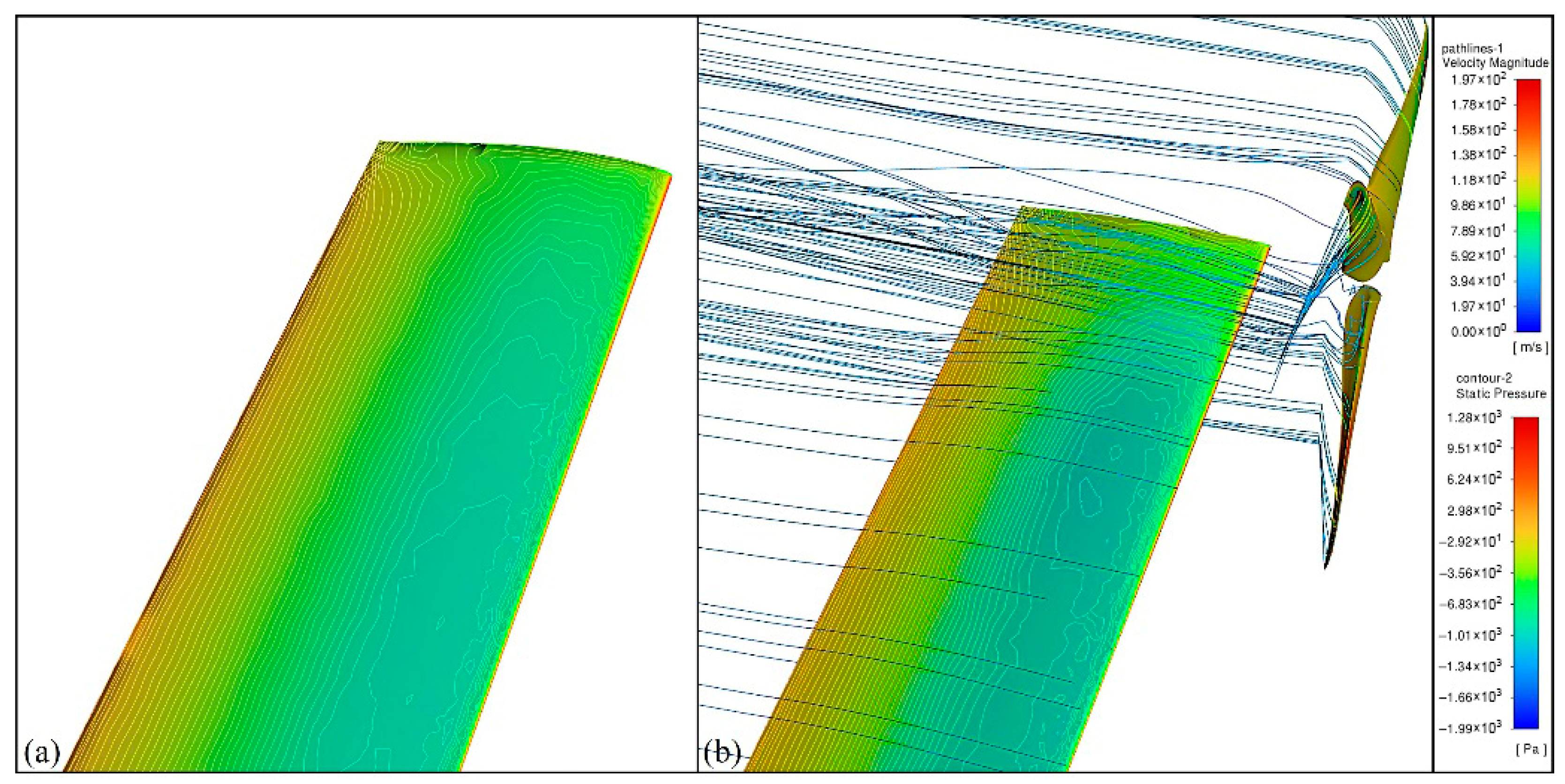
At a tilt angle of 90°, the freestream is perpendicular to the rotor disk, and the rotors provide thrust in the horizontal direction. In Figure 10a, the pressure contours on the wing exhibit a nearly uniform gradient from the leading edge toward the trailing edge, whereas in Figure 10b, they show a tendency to spread from the forward mid-span region toward the wingtip. In the area downstream of the rotors, the isobar density is increased and a strong static-pressure gradient appears, indicating a local rise in surface pressure. The velocity streamlines in Figure 10b show a pronounced acceleration region downstream of the rotors, which is characteristic of a rotor/propeller slipstream; the local velocity there is much higher than the freestream velocity, explaining the static-pressure increase and the formation of a rotor-wash lift-augmentation strip in this region.
The axial-induced velocity and tangential swirl carried by the rotor wake modify the effective angle of attack and inflow direction of the wing section, which explains the shift of the surface-pressure contour distribution in Figure 10b relative to Figure 10a. When the tilt-rotor shaft line is aligned with the wing spar near the quarter-chord, the moment arm of the horizontal thrust component about the wing torsional axis is small, so its influence on the pitching moment of the vehicle is relatively limited; the longitudinal coupling is weakened, which is favorable for maintaining stability in the tilt-rotor transition regime. In addition, placing the tilt rotors at the wingtips allows the rotor slipstream vortices to have an opposite sense of rotation to the wingtip vortices, and their interaction can effectively alleviate induced drag [53,54].
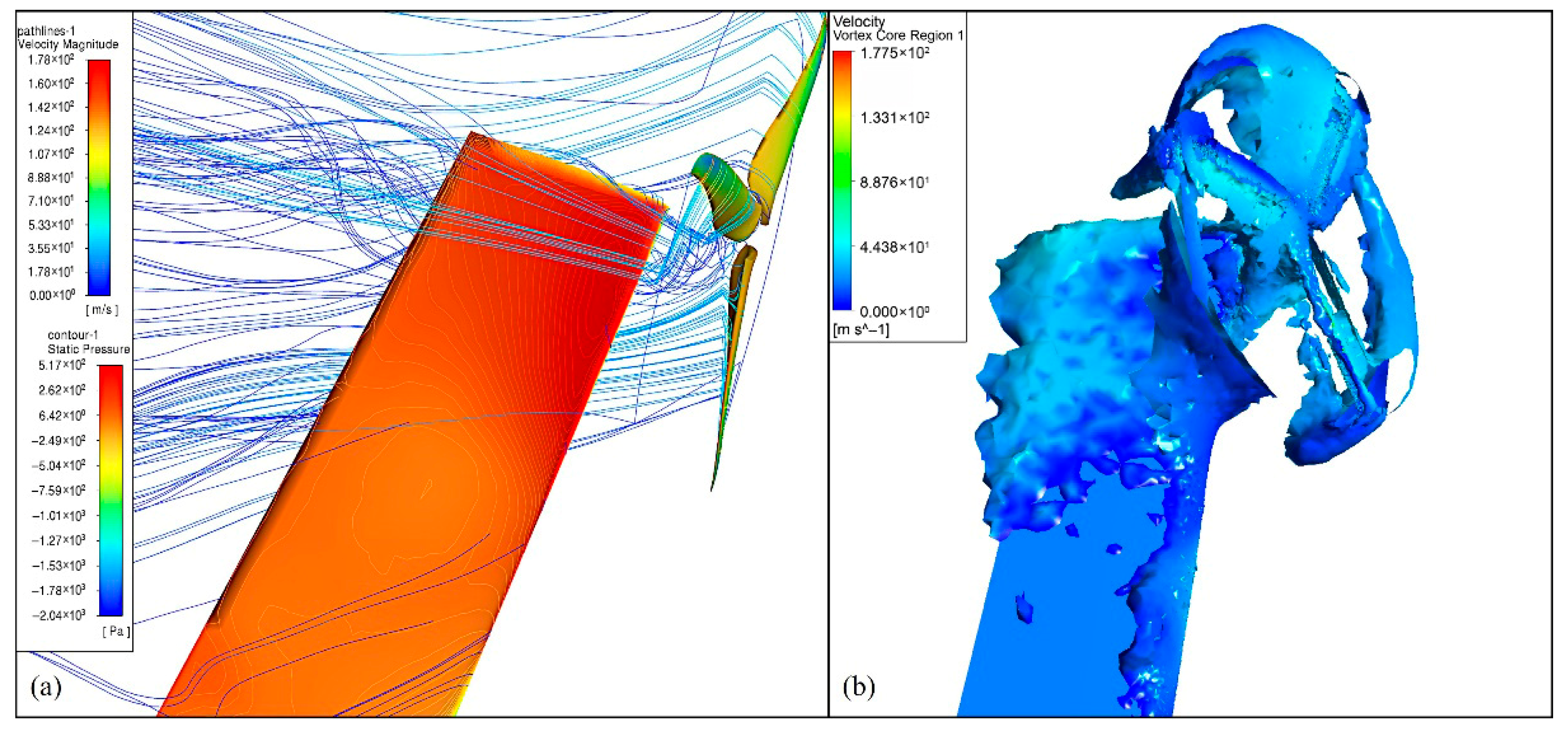
Figure 11 shows that at a tilt angle of 45°, the rotor wake exhibits a pronounced downwash component relative to the wing as well as a streamwise acceleration component. In this case, the rotor wake has a significant influence on the lift distribution and drag of the wing and on the longitudinal static stability of the vehicle. The velocity streamlines in Figure 11a indicate that because the wake velocity is higher than the freestream and impinges on the wing at an oblique angle, the surface pressure in the wake-covered region of the wing is substantially increased. As the wake spreads over the upper surface of the wing, its velocity gradually decays and diffuses toward the inboard side, and a distinct pressure-gradient band is formed near the wake boundary. This band coincides with the region of high vorticity and vortex structures in Figure 11b, and as the tilt angle is further increased, this region may become the first separation-sensitive zone. The high-speed wake increases the local inflow velocity over the wing.
However, because its direction forms a finite angle with respect to the wing chord, the local effective angle of attack is altered, so the resulting local aerodynamic-force change on the wing is not a simple lift increase but rather a coupled variation in lift and drag components [55]. The pressure contours in Figure 11a show that a large positive-pressure region is formed on the upper surface of the wing in the downstream area of the rotors, with pressure levels clearly higher than in the region not covered by the wake and with densely packed isobars, indicating a strong local pressure gradient and pronounced peaks in local aerodynamic loading. In the vicinity of the wing leading edge within the rotor wake, a local negative-pressure peak is observed, corresponding to the streamlines being accelerated over the leading edge; moving downstream along the chord, the pressure contours first rise rapidly and then gradually decrease, suggesting that the pressure center is located near the leading edge. In the spanwise direction, the positive pressure on the side closer to the wingtip is noticeably stronger than on the side farther from the rotor, leading to a “valley-shaped” non-uniform lift distribution near the tip. This introduces additional rolling moments and torsional loads. In Figure 11b, a characteristic helical vortex is observed at the rotor blade tips, which rolls up and convects downstream along the wake direction and constitutes the dominant high-intensity vortex structure. This vortex structure develops along the inclined wake channel and forms a rope-like helical vortex system, whose spatial pattern is consistent with experimental and numerical observations of tilt-rotor wakes reported in the literature [56]. At the intersection of the rotor wake with the wing leading edge and upper surface, shear-layer vortices attached to the wing and arranged in strip-like patterns are observed, indicating strong velocity shear and boundary-layer thickening in this region. Near the wing trailing edge, part of the vortical structures entrained from the rotor-wake shear layer interact with the vortices shed from the trailing edge, forming a complex three-dimensional wake. This wake pattern tends to induce nonlinear control responses at the control surfaces, so it is not recommended to place control surfaces in this region.
It is important to note that the use of the RANS-MRF approach has certain limitations when analyzing stability under tilt-transition conditions. Specifically, in regions near instability, the inability of the MRF method to accurately capture unsteady wake interactions may result in pitching moments and stability derivatives that do not fully represent the true behavior [57]. This potential discrepancy should be taken into account when interpreting the results. To address the limitations of the RANS-MRF method, future work will include uncertainty analysis by comparing results with those obtained using more advanced techniques, such as Large Eddy Simulations (LESs), which are better equipped to capture unsteady flow characteristics [58]. In future work, the team will conduct LES method validation alongside aerodynamic experiments, with a particular focus on the interaction between the rotor and wing during tilt-transition conditions, as well as stability prediction methods. This will help enhance confidence in the stability trends predicted for the vehicle under various CG locations and flight conditions [59].
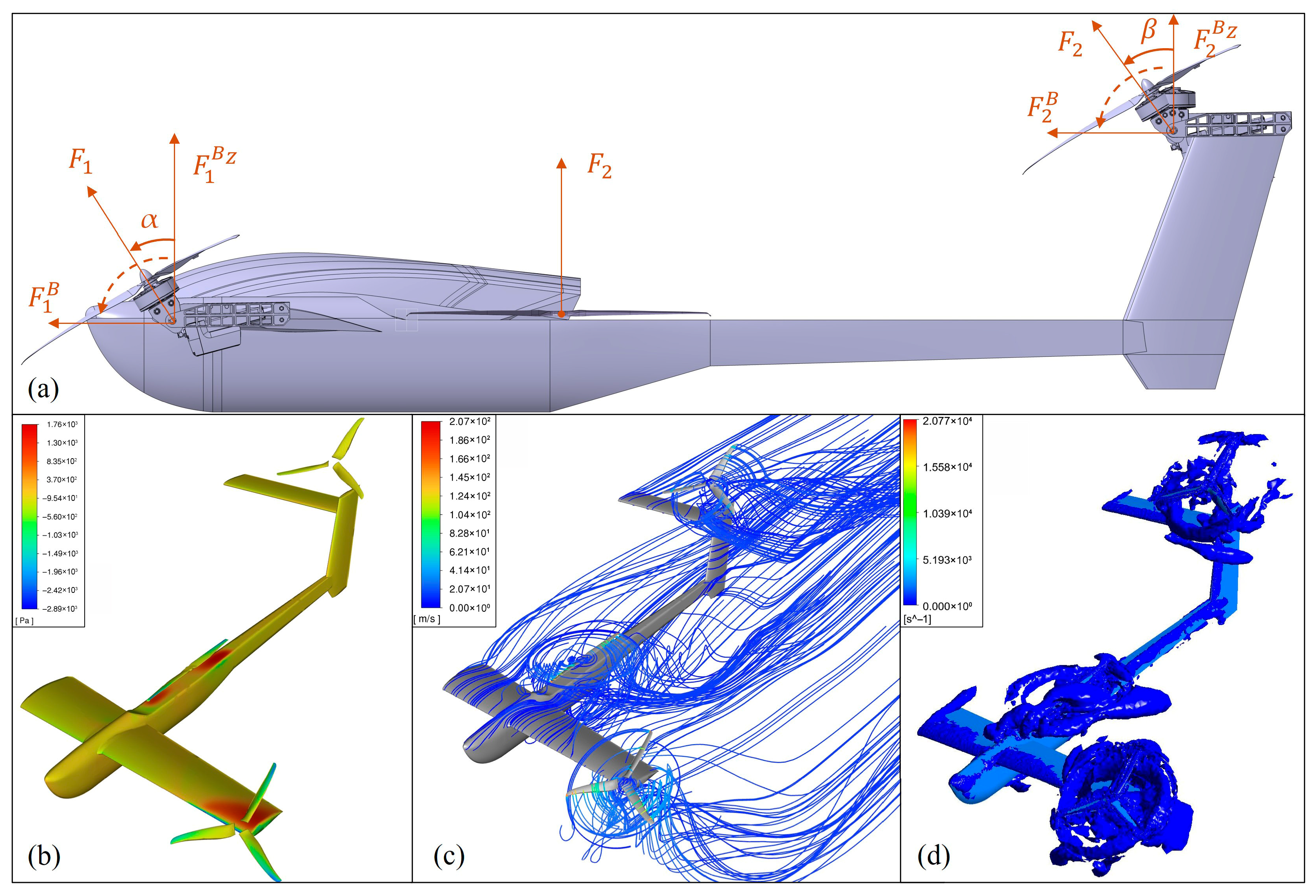
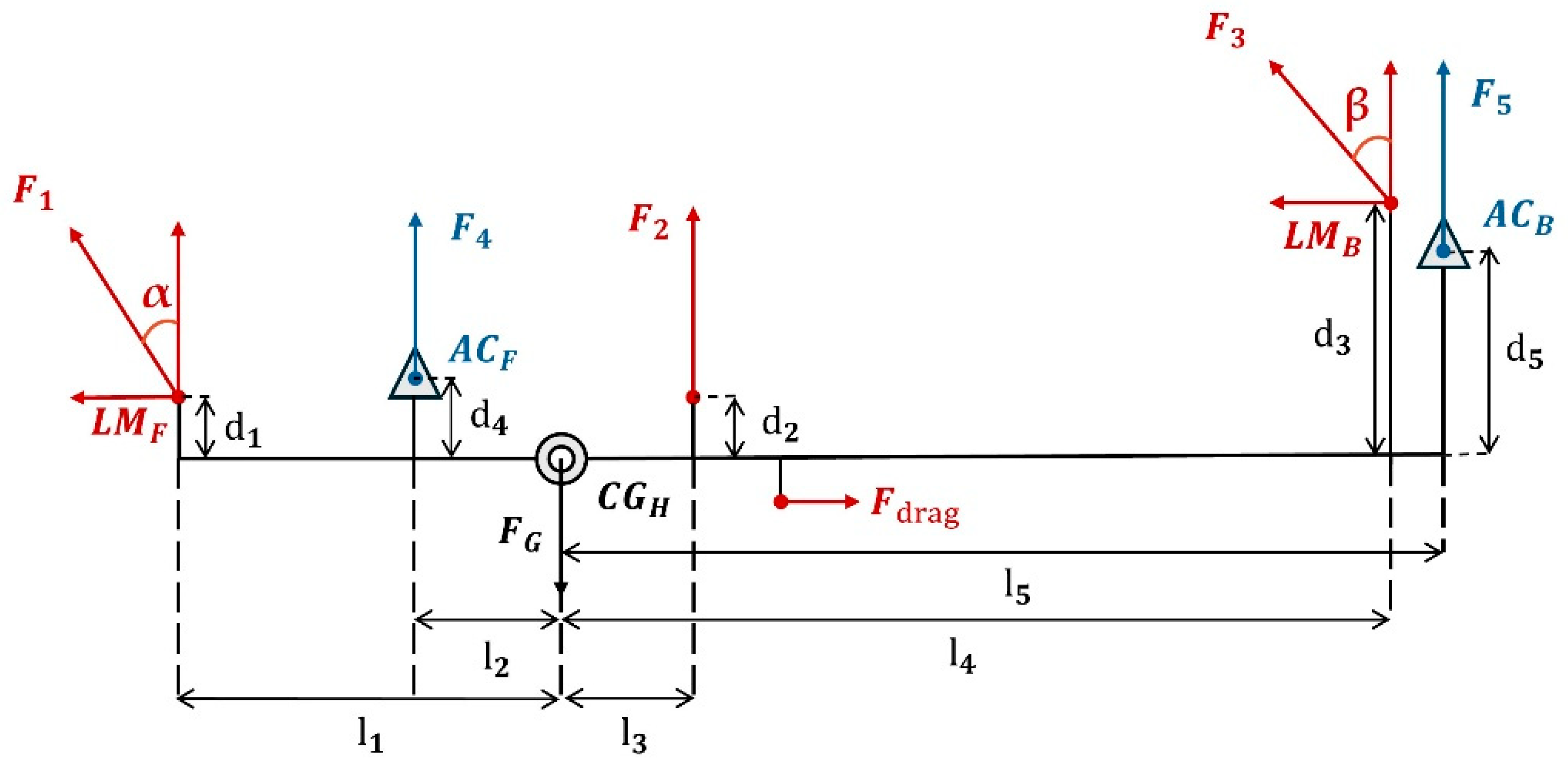
Figure 12 illustrates the main thrust components and their moment arms for the vehicle in the tilt-rotor transition regime. Here, F 1 is the thrust generated by the main tilt rotors (tilt range 0° to 90°, with α denoting the actual tilt angle); F 2 is the thrust generated by the auxiliary rotors (perpendicular to the flight direction of the vehicle); F 3 is the thrust generated by the secondary tilt rotors (tilt range 0° to 90°, with β denoting the actual tilt angle); F 4 is the lift produced by the wing; F 5 is the lift produced by the horizontal tail; F G is the weight of the vehicle; and F d r a g is the aerodynamic drag acting on the vehicle. The points L M F and L M B denote the thrust application points of the main and secondary tilt rotors, respectively; A C w and A C H denote the aerodynamic centers of the wing and the horizontal tail, respectively; and C G H denotes the CG of the vehicle. The distances l 1 l 5 are the x-axis distances from the CG to L M F , A C w , the auxiliary rotors, L M B , and A C H , respectively. The distances d 1 d 5 are the corresponding z-axis distances from the CG to the thrust application point of the main tilt rotors, the auxiliary rotors and the secondary tilt rotors, A C w and A C H , respectively. The net pitching moment of the vehicle about the CG can be written as
M p i t c h = i F i · l i + j F j · d j + M d r o g ,
where M d r o g denotes the pitching moment produced by the drag force at its line of action. Depending on the tilt angles of the tilt rotors, F 1 and F 3 can be decomposed into a lift component perpendicular to the fuselage and a thrust component along the cruise direction, and their contributions vary significantly with α and β . According to Figure 9, Figure 10 and Figure 11, the aerodynamic coupling between the tilt rotors and the wing/horizontal tail affects F 4 and F 5 and thus modifies the overall lift of the vehicle.
The above analysis suggests that the design of the tilt-transition strategy should explicitly account for the following aspects: (i) the evolution of the rotor wake over the wing as the tilt angle varies, and the resulting changes in effective angle of attack and wing loading; (ii) rotor–wing interaction effects that induce nonlinear variations in pitching moment and longitudinal static stability; and (iii) strongly non-uniform spanwise loading associated with wake non-uniformity and vortex structures together with the resulting additional rolling moments and torsional loads. These aspects represent the key aerodynamic coupling mechanisms that should be considered in stability analyses of the tilt-rotor transition regime.

4.3.1. Simultaneous-Tilt Strategy of the Main and Secondary Tilt Rotors

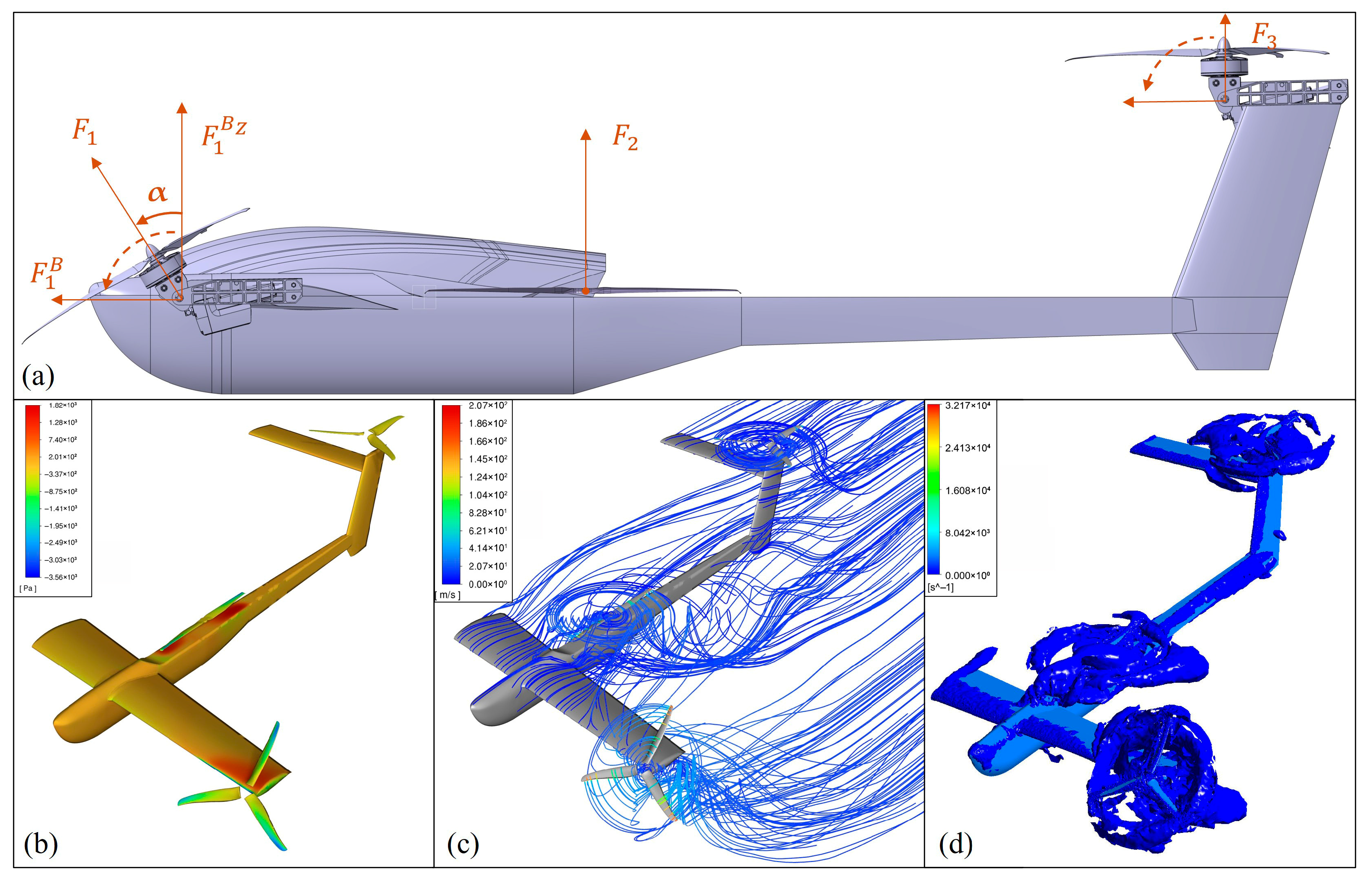
This tilt strategy is shown in Figure 13a: the main and secondary tilt rotors are scheduled to tilt simultaneously from the vertical position to an intermediate angle and then further toward the horizontal direction as forward speed builds up, while the auxiliary rotors remain vertical to provide supplemental lift during the early transition.
Figure 13b presents the surface static-pressure distribution. The pressure field over the forward battery-compartment region and the wing root remains relatively smooth, and no large-scale stall patches are observed. Nevertheless, a pronounced pressure-loading concentration appears in the wingtip region, which is consistent with the strong downwash influence of the main tilt rotors at low forward speed. The streamline visualization in Figure 13c indicates that the main-rotor wake develops downstream beneath the wing and along the lower surface of the battery compartment, and it subsequently rises in the aft-compartment region where it interacts with the wake structures associated with the wing trailing-edge flow. Meanwhile, the secondary-rotor wake convects downward from the vertical-tail tips and overlaps with the wake of the main rotors in the vicinity of the aft battery compartment and tail assembly. As a result, the streamlines around the horizontal and vertical tails become dense and strongly curved, indicating that the tail surfaces operate in a highly non-uniform inflow during this strategy. Figure 13d further shows coherent helical wake structures behind the rotors and multiple vortex cores near the wingtip trailing edge and the tail region. These vortical features are concentrated within the rotor wake channels and extend into the wing–tail vicinity, suggesting enhanced wake-induced disturbances and stronger rotor–wing–tail aerodynamic coupling compared with the other strategies.

4.3.2. Main-First Tilt Strategy: Main Tilt Rotors Tilt While Secondary Tilt Rotors Remain Vertical

Tilt-Transition Strategy 2, illustrated in Figure 14a, involves tilting the main tilt rotors first while keeping the secondary tilt rotors vertical. The main tilt rotors gradually transition from providing vertical lift to supplying forward thrust, whereas the secondary tilt rotors, along with the auxiliary rotors, primarily maintain lift and contribute to pitch-moment control.
The surface pressure contours in Figure 14b indicate that the high-pressure regions are predominantly concentrated beneath the main tilt rotors and the forward wing area, with minimal pressure variation on the horizontal tail, suggesting limited direct contribution to pitch-moment generation. The streamlined visualization in Figure 14c shows that the main-rotor wake flows obliquely downward and partially interacts with the freestream over the wing, while the secondary tilt rotors remain outside the strong wake region, reducing rotor–surface aerodynamic coupling. Figure 14d highlights that strong vortex structures are localized around the main and secondary rotors and at the vertical tail junction, whereas the wing and horizontal tail surfaces exhibit only minor streak-like vortices without large-scale separation. This flow-field separation ensures that variations in lift and pitching moment are mainly driven by rotor thrust changes, thereby maintaining predictable longitudinal responses. Overall, this tilt strategy mitigates strong rotor–surface interactions, reduces pitching-moment peaks, and enhances longitudinal static stability during the tilt-transition phase.

4.3.3. Secondary-First Tilt Strategy: Secondary Tilt Rotors Tilt While Main Tilt Rotors Remain Vertical for Lift

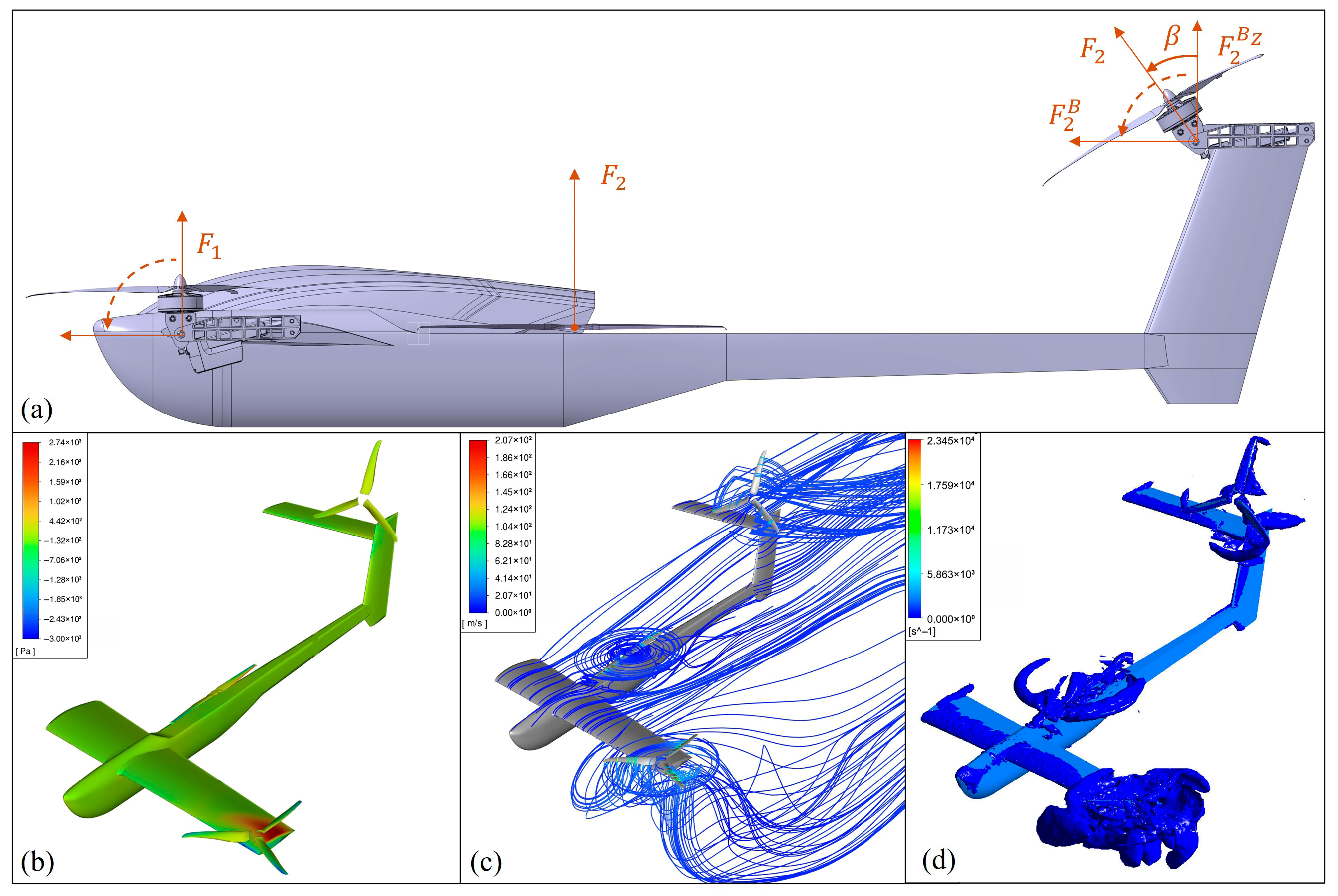
As illustrated in Figure 15a, the secondary tilt rotors are tilted first from the vertical to the horizontal orientation to provide forward thrust, while the main tilt rotors remain vertical and, together with the auxiliary rotors, supply the lift required for vertical takeoff and hover. Once the vehicle accelerates, the wing progressively assumes the primary lift role, allowing the main tilt rotors to be throttled and tilted forward to contribute to cruise thrust.
Figure 15b presents the surface pressure distribution, indicating that high-pressure regions are concentrated primarily on the wing beneath the main tilt rotors’ wake, whereas the horizontal tail experiences comparatively minor pressure variation. Figure 15c shows the velocity streamlines, demonstrating that the main rotor wake converges downstream without significantly interfering with the inflow to the secondary rotors or tail surfaces. During the tilting of the secondary rotors, partial wake impingement on the horizontal tail occurs, but no large-scale recirculation or intense shear layers develop. Figure 15d highlights the vortex structures, with strong vortices localized near the secondary rotor disks and the main rotor downwash region, while only thin streak-like vortices appear on the wing and horizontal tail.
This tilt strategy produces weak rotor–surface aerodynamic coupling, reduces peak pitching moments, and maintains favorable longitudinal static stability. By separating the flow fields of the main and secondary tilt rotors and minimizing interaction with the tail surfaces, the configuration allows for predictable lift and pitching-moment responses, facilitating control law design and enhancing stability during tilt transition. Due to its flow-field separation characteristics, this tilt strategy exhibits relatively weak flow interference and unsteady aerodynamic loads compared to the other two strategies, allowing the tilt-transition process to be divided into two relatively benign stages. This effectively reduces unsteady flow disturbances and instantaneous pitching moments [60]. The resulting configuration is similar to the tail-pusher mode of compound helicopters (e.g., Sikorsky X2), where the forward tilt rotors provide multi-rotor-type hover lift and an aft fixed propeller supplies forward thrust. The thrust and main lift are clearly separated along the longitudinal axis, providing stronger resistance to pitching disturbances and improving longitudinal stability [61]. Under this strategy, the main tilt rotors remain in the vertical mode for a longer duration, maintaining strong pitch-moment control authority and high lift support, which helps to more effectively respond to gust disturbances and increases the safety margin during the tilt-transition phase. After the secondary tilt rotors are tilted and begin providing forward thrust, the wing lift gradually replaces the hover lift as the speed increases, making it easier to tilt the main rotors subsequently, thus reducing peak total motor power and alleviating the load on the propulsion system.

4.3.4. Comparative Summary of Tilt Strategies

To quantitatively evaluate and rank the three tilt-transition strategies under the present quasi-steady CFD framework, a stability-margin metric is defined based on the trim pitching-moment demand. For each strategy, the pitching moment about the vehicle CG, denoted as M y , is extracted from the steady-state CFD solution at the specified operating condition (Table 6). The required trim moment is quantified by the absolute value of the pitching moment:
M t r i m , r e q = M y ,
where M t r i m , r e q represents the quasi-steady trim/control effort required to counterbalance the aerodynamic pitching moment under the given tilt-transition condition. A smaller M t r i m , r e q indicates a lower trim requirement and, therefore, a more favorable quasi-steady stability/controllability margin.
For comparison across different strategies, a normalized stability-margin index (SMI) is further introduced:
S M I = 1 M y m a x M y ,
where m a x M y is the maximum value of M y among the strategies considered under the same evaluation condition. The SMI is a dimensionless quantity in the range [0, 1]; a larger SMI corresponds to a smaller trim pitching-moment demand.
The quantitative comparison of the three tilt-transition strategies for the ACC configuration was conducted using CFD-derived aerodynamic forces and moments (Table 6) and the associated flow-field visualizations (Figure 13, Figure 14 and Figure 15). Strategy 1, in which the main and secondary tilt rotors tilt simultaneously, exhibits strong aerodynamic coupling between the rotor wakes, wing, and tail surfaces. The fuselage and wing mid-span regions, as well as the horizontal and vertical tails, are continuously exposed to non-uniform inflow, and vortex cores are densely concentrated in the aft region. Consequently, the lift and pitching-moment derivatives vary nonlinearly with rotor tilt, producing significant transient pitching moments. Although this strategy maintains continuous lift and thrust generation, the pronounced rotor–wing–tail interaction increases the sensitivity of longitudinal stability and imposes a high demand on the flight-control system, resulting in the lowest stability margin among the three strategies.
Strategy 2, in which the main tilt rotors tilt first while the secondary tilt rotors remain vertical, partially decouples the flow fields. The wake from the main tilt rotors primarily propagates along the fuselage and interacts with the horizontal and vertical tails, while the secondary rotors continue to provide lift. This arrangement reduces but does not eliminate rotor–surface coupling. The corresponding pitching-moment variation is moderate, requiring larger trim corrections than Strategy 3, and the stability margin is intermediate.
Strategy 3, where the secondary tilt rotors tilt first while the main tilt rotors remain vertical, achieves the most favorable aerodynamic characteristics. The main rotors provide the primary lift and maintain strong pitching-moment control, while the secondary rotors contribute thrust and moderate lift. Flow-field visualizations indicate that vortex cores from the secondary rotors are concentrated beneath the rotors with minimal interaction with the wing and tail surfaces. This configuration reduces unsteady aerodynamic loads and nonlinear variations in the pitching moment, resulting in the smallest pitching-moment peaks (−20.45 N·m) and the largest stability margin. The decoupling of the rotor and surface flows allows segmented control during tilt transition, enhances gust rejection, and provides the highest engineering feasibility. Consequently, Strategy 3 is recommended as the optimal tilt-transition scheme for the ACC configuration, balancing longitudinal stability, aerodynamic efficiency, and controllability.

5. Discussion

Some performance comparisons with other unmanned and manned aircraft used in the same mission were realized. Chen et al. optimized the folding wing and tilt-rotor layout of a tilt-rotor flying car using computational fluid dynamics, focusing on roadability and aerodynamic performance, and obtained a configuration with a high lift-to-drag ratio [19]. However, they did not extend the analysis to multi-condition stability or the design of tilt-transition strategies. This paper shows that for tilt-rotor flying vehicles, optimizing the lift-to-drag ratio alone is not sufficient to ensure safe tilt transition; aerodynamic coupling and CG variations must be incorporated into a systematic stability assessment. Mihara et al. compared three flying-car concepts—multi-rotor, vectored-thrust (tilt-rotor), and lift-cruise configurations—by varying rotor layouts and using simulations to evaluate mission suitability and endurance performance [62]. Their work demonstrated the feasibility of tilt-rotor flying cars at the system and mission levels, but it did not address detailed aerodynamic characteristics, CG positioning, or stability for specific configurations. In contrast, this paper provides quantitative aero-stability indicators tailored to a concrete tilt-rotor configuration (motor efficiency characteristics, CG range, and tilt-transition strategy), offering a reference for more detailed airframe design in similar mission scenarios.
Wang et al. constructed an aerodynamic model for the transition phase of a tiltrotor eVTOL using XV-15 wind-tunnel data and concluded that traditional physics-based simplified models cannot capture rotor-wake effects and complex nonlinear aerodynamic couplings [24]. Both their work and this paper indicate that the aerodynamic characteristics in the tilt-transition regime are highly nonlinear; here, this nonlinearity is further used as a basis for selecting and comparing tilt strategies. Moreira et al. conducted low-speed wind-tunnel tests on a semi-wing model of a typical tiltrotor eVTOL, measured the influence of rotor wake on wing lift, drag, and moment, and showed that tilt angle and propulsion conditions have a significant effect on wing loading and stability. Their experiments confirmed that rotor wakes modify local wing lift distribution and pitching moment [63], but they did not extend the discussion to the flight envelope, CG boundaries, or tilt strategies. In this paper, similar “slipstream-induced lift stripes” and local pressure peaks are observed at different tilt angles, and these features are directly linked to the shape of the C m α curve and changes in static stability, and they are further extended to a distributed tilt-rotor configuration with a split-type cargo layout. Zhu et al. investigated a non-parallel tandem dual-tilt-rotor system by wind-tunnel testing and quantified the thrust, moment, and efficiency variations under different combinations of front and rear rotor tilt angles. They showed that a “front-up, rear-thrust” combination can reduce adverse aerodynamic interference [64]. This paper further demonstrates that at the whole-aircraft level, a strategy in which the aft (secondary) tilt rotors tilt first while the forward (main) tilt rotors remain vertical minimizes pitching-moment peaks and improves longitudinal stability.
These similarities and differences collectively underline the importance of this paper. At present, there is no complete stability analysis framework or generally applicable tilt-transition strategy specifically for split-type tilt-rotor flying cars. The layout and tilt strategy proposed in this paper therefore provide a promising reference for unmanned urban cargo transport missions with favorable aerodynamic performance and stability characteristics. Figure 16 presents an artistic rendering of the tilt-rotor cargo flying vehicle operating over an urban environment.

6. Conclusions

After conducting layout and stability analyses of the split-type tilt-rotor cargo flying vehicle, the following conclusions were drawn:
  • For VTOL conditions, the length of the arm along the z-axis of each rotor is the primary factor affecting the vehicle’s stability disturbances. Changes in the relative position of the rotors with respect to the CG impact the aircraft’s yaw stability.
  • In cruise conditions, the CG position directly influences the vehicle’s static stability. The CG range (1.4 c A –1.7 c A ) under stability constraints was calculated, and the recommended position 1.62 c A for this configuration was provided, offering a reliable method for static stability assessment and guidance for CG selection by designers.
  • For tilt-transition conditions, CFD analysis was conducted to examine the aerodynamic characteristics of the subsystems and the full vehicle. Three classical tilt-transition strategies were compared in terms of rotor–surface interactions, lift distribution, and pitching moments. Strategy 3, where the secondary tilt rotors tilt first while the primary tilt rotors remain vertical, yields the lowest pitching-moment peaks and the largest stability margin. This strategy significantly enhances longitudinal stability during tilt transition and provides the most favorable balance between aerodynamic performance, control authority, and engineering feasibility, making it the recommended transition scheme for this configuration.
Although this paper provides a solid framework for stability analysis and tilt-transition strategy selection, it is based on computational simulations and simplified aerodynamic models. The transient simulation analysis of rotor downwash-induced time-varying aerodynamic interference on the wing and tail surfaces during the tilt-transition process, as well as the dynamic stability analysis of the aircraft under different flight conditions, have not been conducted. Additionally, several real-world factors, such as rotor performance under extreme conditions, the impact of external disturbances, and the role of the flight control system during the transition phase, were not fully considered.
Building on this research, future studies will focus on transient simulations and full-vehicle dynamic stability analysis under tilt-transition conditions. These studies will aim to validate the proposed tilt-transition strategies under real flight conditions, particularly in dynamic and unpredictable environments, and explore corresponding flight control strategies. Furthermore, attention will be directed toward the design and energy management of the vehicle’s propulsion system with a focus on improving the efficiency and reliability of distributed electric propulsion systems for low-altitude transport. These efforts will further advance the commercialization of split-type tilt-rotor cargo flying vehicles.

Author Contributions

Conceptualization, S.L. and Y.S.; methodology, S.L.; software, S.L. and Y.S.; validation, S.L. and Y.S.; formal analysis, S.L.; investigation, D.C., L.Y. and S.H.; resources, B.L. and G.F.; data curation, S.L. and Y.S.; writing—original draft preparation, S.L.; writing—review and editing, S.L. and G.F.; visualization, S.L.; supervision, B.L. and G.F. All authors have read and agreed to the published version of the manuscript.

Funding

This paper was supported by the Fundamental Research Funds for the Central Universities under the project “Research and Demonstration of Key Technologies for Flying Cars and Lightweight Manufacturing” (No. FRF-BD-25-018).

Data Availability Statement

The original contributions presented in this paper are included in the article; further inquiries can be directed to the corresponding author.

Conflicts of Interest

The authors declare no conflicts of interest.

Symbols and Abbreviations

The following table provides the list of symbols and abbreviations used in this manuscript along with their definitions and explanations.
SymbolDefinitionSymbolDefinition
h C Cruise altitude l 5 The distance from the horizontal-tail aerodynamic center to the CG along the x-axis
h V T O L Vertical takeoff and landing height p 1 The distance from the lift/thrust application point of main tilt rotors to the CG along the y-axis
S M R F The non-inertial effects p 2 The distance from the lift application point of auxiliary rotors to the CG along the y-axis
u r The velocity relative to the rotating frame p 3 The distance from the lift/thrust application point of secondary tilt rotors to the CG along the y-axis
A C i The aerodynamic centers of the wing and the horizontal tail x c g The x -axis distance from the vehicle CG
C m α The derivative of the pitching-moment coefficient C m C G E i Schematic of CG test locations
C T The thrust coefficient e T The unit vector along the thrust axis
C m The pitching-moment coefficient r i The positions of the vehicle’s rotors relative to the CG
D A Auxiliary rotor size α t r i m The linear trim angle-of-attack relation at each CG location
D T Tilt-rotor diameter ε T The relative error
D t a i l The trim drag generated by the tail control surface η M E The motor efficiency
D w i n g The trim drag generated by the wing control surface η t The tail dynamic-pressure ratio
F 1 The thrust generated by the main tilt rotors ω i The angular velocities of rotors
F 2 The thrust generated by the auxiliary rotors { b ^ 1 , b ^ 2 , b ^ 3 } Unit vectors pointing forward (nose direction), starboard, and downward, respectively, forming a right-handed forward–right–down convention
F 3 The thrust generated by the secondary tilt rotors { C i } The tilt-rotor frame
F 4 The lift produced by the wing { B } The body-fixed frame
F 5 The lift produced by the horizontal tail { E } The local-level Earth frame
F G The weight of the vehicle r The position vector
F d r a g The aerodynamic drag acting on the vehicle A The rotor disk area
L M i The thrust application points of rotors M o m e n t The pitching moment
M i The torques generated by rotors S Effective wing area
P M o t o r   O u t The useful power delivered by the motor for thrust generation T f i Required trim force
P S y s t e m   I n p u t The total electrical power supplied to the motor V The tip speed of the rotor
S ~ The modified vorticity magnitude b The intercept in the corresponding linear interval
S b The blade surface d The distance to the nearest wall
T i The rotor thrusts k A dimensionless parameter
V H The horizontal-tail volume coefficient. p Pressure
a t The tail lift-curve slope p l Weight of cargo
c A Mean aerodynamic chord v Cruise speed
c r The root chord length of the wing w Maximum takeoff weight
d 1 The distance from the lift/thrust application point of main tilt rotors to the CG along the z-axis. S The source term used to account for the MRF treatment
d 2 The distance from the lift application point of auxiliary rotors to the CG along the z-axis. u The mean velocity
d 3 The distance from the lift/thrust application point of secondary tilt rotors to the CG along the z-axis. Ω The angular velocity vector
d 4 The distance from the wing aerodynamic center to the CG along the z-axis. α The angle of attack
d 5 The distance from the horizontal-tail aerodynamic center to the CG along the z-axis. ε The downwash angle
l 1 The distance from the lift/thrust application point of main tilt rotors to the CG along the x-axis. λ The taper ratio, which is defined as the ratio of the tip chord length to the root chord length
l 2 The distance from the wing aerodynamic center to the CG along the x-axis. ρ The air density
l 3 The distance from the lift application point of auxiliary rotors to the CG along the x-axis. σ The disk loading
l 4 The distance from the lift/thrust application point of secondary tilt rotors to the CG along the x-axis. τ The combined viscous and Reynolds-stress term
ACCThe aerial cargo configurationLESLarge Eddy Simulation
AVMThe aerial vehicle moduleMRFThe multiple reference frame
CFDComputational fluid dynamicsRANSReynolds-averaged Navier–Stokes
CGCenter of gravitySASpalart–Allmaras
CPMThe cargo pod moduleUAMUrban air mobility
eVTOLElectric vertical takeoff and landingUAVUnmanned aerial vehicle
GCCThe ground cargo configurationVTOLVertical takeoff and landing
GMThe ground module

References

  1. Garrow, L.A.; German, B.J.; Leonard, C.E. Urban air mobility: A comprehensive review and comparative analysis with autonomous and electric ground transportation for informing future research. Transp. Res. Part C Emerg. Technol. 2021, 132, 103377. [Google Scholar] [CrossRef]
  2. Chen, S.; Meng, Q.; Choi, T.-M. Transportation research Part E-logistics and transportation review: 25 years in retrospect. Transp. Res. Part E Logist. Transp. Rev. 2022, 161, 102709. [Google Scholar] [CrossRef]
  3. Schweiger, K.; Preis, L. Urban air mobility: Systematic review of scientific publications and regulations for vertiport design and operations. Drones 2022, 6, 179. [Google Scholar] [CrossRef]
  4. Raza, W.; Stansbury, R.S. Noise Prediction and Mitigation for UAS and eVTOL Aircraft: A Survey. Drones 2025, 9, 577. [Google Scholar] [CrossRef]
  5. Brelje, B.J.; Martins, J.R. Electric, hybrid, and turboelectric fixed-wing aircraft: A review of concepts, models, and design approaches. Prog. Aerosp. Sci. 2019, 104, 1–19. [Google Scholar] [CrossRef]
  6. Kim, H.D.; Perry, A.T.; Ansell, P.J. A review of distributed electric propulsion concepts for air vehicle technology. In Proceedings of the 2018 AIAA/IEEE Electric Aircraft Technologies Symposium (EATS), Cincinnati, OH, USA, 12–14 July 2018; IEEE: New York, NY, USA, 2018; pp. 1–21. [Google Scholar]
  7. Yanev, R.Y.; Staack, I. Framework Development for Conceptual Design and Configuration Analysis of Evtol Aircraft. In Proceedings of the 34th Congress of the International Council of the Aeronautical Sciences (ICAS), Florence, Italy, 9–13 September 2024. [Google Scholar]
  8. Wang, Y.; Ma, W.; Chen, Z. Sensitivity Analysis for Design Parameters of Electric Tilt-Rotor Aircraft. Aerospace 2024, 11, 322. [Google Scholar] [CrossRef]
  9. Li, J.; Sheng, H.; Liu, S.; Chen, Q.; Zhang, H. Adaptive fault-tolerant control of distributed electric propulsion aircraft based on multivariable model predictive control. Expert Syst. Appl. 2024, 255, 124539. [Google Scholar] [CrossRef]
  10. Jiang, Z.; Pakmehr, M. Model predictive control for distributed electric propulsion of eVTOL vehicles: A preliminary design. In Proceedings of the AIAA SciTech 2022 Forum, San Diego, CA, USA, 3–7 January 2022; p. 0878. [Google Scholar] [CrossRef]
  11. Pounds, P.E.I.; Bersak, D.R.; Dollar, A.M. Stability of small-scale UAV helicopters and quadrotors with added payload mass under PID control. Auton. Robot. 2012, 33, 129–142. [Google Scholar] [CrossRef]
  12. Zanotti, A. Experimental study of the aerodynamic interaction between side-by-side propellers in evtol airplane mode through stereoscopic particle image velocimetry. Aerospace 2021, 8, 239. [Google Scholar] [CrossRef]
  13. Shukla, D.; Komerath, N. Low Reynolds number multirotor aerodynamic wake interactions. Exp. Fluids 2019, 60, 77. [Google Scholar] [CrossRef]
  14. Kim, D.; Lee, Y.; Oh, S.; Park, Y.; Choi, J.; Park, D. Aerodynamic analysis and static stability analysis of Manned/unmanned distributed propulsion aircrafts using actuator methods. J. Wind. Eng. Ind. Aerodyn. 2021, 214, 104648. [Google Scholar] [CrossRef]
  15. Wang, W.; Li, B.; Yang, C.; Qie, T.; Li, Y.; Cheng, J. Optimal motion planning method for accurate split-type flying vehicle docking. IEEE Trans. Transp. Electrif. 2024, 10, 8175–8188. [Google Scholar] [CrossRef]
  16. Saunders, G.; Sumagaysay, G.; Patel, S.; Iribe, A.; Francis, D.; Salib, G.; Harris, J.; Escalante, J.; Amaya, K.; Sherman, T.M.; et al. Design, Analysis, and Testing of a Modular Tiltrotor eVTOL Vehicle with Distributed Electric Propulsion. In Proceedings of the AIAA SCITECH 2026 Forum, Orlando, FL, USA, 12–16 January 2026; p. 1878. [Google Scholar] [CrossRef]
  17. Moral, K.; Ayran, B.; Altug, E. Design and control of a modular multi-drone system with vertical assemble capability: K. Moral et al. Int. J. Dyn. Control 2024, 12, 2991–3004. [Google Scholar] [CrossRef]
  18. Li, Y.; Ye, S.; Zhou, H. Research on Drag Reduction Matching of Modular Flying Cars Based on Nested Configuration. In Proceedings of the SAE 2024 Intelligent Urban Air Mobility Symposium. SAE Technical Paper, Hangzhou, China, 6–7 September 2024. [Google Scholar] [CrossRef]
  19. Chen, C.; Tian, Z.; Li, A.; Xiong, M.; Wang, Y.; Chen, F.; Yang, S. Configuration Design and Analysis of Tilt-Rotor-Type Flying Car. Eng. Proc. 2025, 80, 33. [Google Scholar] [CrossRef]
  20. Liu, W.; Hou, C.; Yang, Y.; Chen, Z.; Han, J.; Hu, X. Analysis of key performance metrics of electric flying cars for urban air mobility. J. Mech. Eng. 2024, 60, 257–275. [Google Scholar]
  21. Schoser, J.; Cuadrat-Grzybowski, M.; Castro, S.G. Preliminary control and stability analysis of a long-range eVTOL aircraft. In Proceedings of the AIAA SCITECH 2022 Forum, San Diego, CA, USA, 3–7 January 2022; p. 1029. [Google Scholar] [CrossRef]
  22. Nguyen, N.T.; Webb, B. Analytical Flight Dynamic Model Development for eVTOL Aircraft. In Proceedings of the AIAA SciTech 2025 Forum, Orlando, FL, USA, 6–10 January 2025; p. 0657. [Google Scholar] [CrossRef]
  23. Su, W.; Qu, S.; Zhu, G.; Swei, S.S.-M.; Hashimoto, M.; Zeng, T. Modeling and control of a class of urban air mobility tiltrotor aircraft. Aerosp. Sci. Technol. 2022, 124, 107561. [Google Scholar] [CrossRef]
  24. Wang, H.; Li, P.; Wu, D. A Novel Aerodynamic Modeling Method Based on Data for Tiltrotor evtol. Appl. Sci. 2024, 14, 4055. [Google Scholar] [CrossRef]
  25. Zanotti, A.; Velo, A.; Pepe, C.; Savino, A.; Grassi, D.; Riccobene, L. Aerodynamic interaction between tandem propellers in eVTOL transition flight configurations. Aerosp. Sci. Technol. 2024, 147, 109017. [Google Scholar] [CrossRef]
  26. Shahjahan, S.; Gong, A.; Moore, A.; Verstraete, D. Optimisation of proprotors for tilt-wing eVTOL aircraft. Aerosp. Sci. Technol. 2023, 144, 108835. [Google Scholar] [CrossRef]
  27. Lu, K.; Liu, C.; Li, C.; Chen, R. Flight Dynamics Modeling and Dynamic Stability Analysis of Tilt-Rotor Aircraft. Int. J. Aerosp. Eng. 2019, 2019, 5737212. [Google Scholar] [CrossRef]
  28. Wen, F.-H.; Hsiao, F.-Y.; Shiau, J.-K. Analysis and management of motor failures of hexacopter in hover. Actuators 2021, 10, 48. [Google Scholar] [CrossRef]
  29. Yeo, H. Design and aeromechanics investigation of compound helicopters. Aerosp. Sci. Technol. 2019, 88, 158–173. [Google Scholar] [CrossRef]
  30. Zhang, T.; Barakos, G.N. On the aerodynamic performance of redundant propellers for multi-rotor eVTOL in cruise. Aerosp. Sci. Technol. 2024, 145, 108846. [Google Scholar] [CrossRef]
  31. Timmer, W. An overview of NACA 6-digit airfoil series characteristics with reference to airfoils for large wind turbine blades. In Proceedings of the 47th AIAA Aerospace Sciences Meeting Including the New Horizons Forum and Aerospace Exposition, Orlando, FL, USA, 5–8 January 2009; p. 268. [Google Scholar] [CrossRef]
  32. Taşkaya, G.; Erdogan, B. Investigation of a New Blade Design to Improve the Efficiency of an Axial Fan Used in an Underground Mine. Karaelmas Sci. Eng. J. 2024, 14, 144–162. [Google Scholar] [CrossRef]
  33. Wang, X.L.; Long, S.; Wu, D.; Li, G. Research progress of general aerodynamic design on twin-boom configuration UAV. Flight Dyn. 2021, 39, 1–6. [Google Scholar]
  34. Li, S.; Zhang, Y.; Liu, Z. Aerodynamic design and analysis of an aerial vehicle module for split-type flying cars in urban transportation. Aerospace 2025, 12, 871. [Google Scholar] [CrossRef]
  35. Pei, J.; Roithmayr, C. Equations of Motion for a Generic Multibody Tilt-rotor Aircraft. In Proceedings of the AIAA Aviation 2022 Forum, Chicago, IL, USA, 27 June–1 July 2022; p. 3511. [Google Scholar]
  36. Fukumine, Y.; Lei, Z. Estimation of eVTOL flight performance using rotorcraft theory. In Proceedings of the 33rd Congress of the International Council of the Aeronautical Sciences, Stockholm, Sweden, 4–9 September 2022; pp. 4–9. [Google Scholar]
  37. Zhai, S.; Li, G.; Huang, P.; Hou, M.; Jia, Q. A novel estimation method for weight and center-of-gravity via the aircraft trim data. Measurement 2023, 220, 113362. [Google Scholar] [CrossRef]
  38. Bristeau, P.-J.; Martin, P.; Salaun, E.; Petit, N. The role of propeller aerodynamics in the model of a quadrotor UAV. In Proceedings of the 2009 European Control Conference (ECC), Budapest, Hungary, 23–26 August 2009; IEEE: New York, NY, USA, 2009; pp. 683–688. [Google Scholar] [CrossRef]
  39. Ismail, K.B.; RAHIM, A.H.A.; Zawawi, F. Design and development of heavy-lift hexacopter for heavy payload. J. Transp. Syst. Eng. 2020, 7, 53–63. [Google Scholar]
  40. Ibrahim, I.N.; Izhevsk, K.; Pavol, B.; Aiman, A.A.M.; Karam, A. Navigation control and stability investigation of a hexacopter equipped with an aerial manipulater. In Proceedings of the 2017 21st International Conference on Process Control (PC), Štrbské Pleso, Slovakia, 6–9 June 2017; IEEE: New York, NY, USA, 2017; pp. 204–209. [Google Scholar] [CrossRef]
  41. Zhou, X.; Xu, Y.; Du, S.; Zhao, Q. Immersion and Invariance Adaptive Control for Unmanned Helicopter Under Maneuvering Flight. Drones 2025, 9, 565. [Google Scholar] [CrossRef]
  42. Yip, S.L.K.; Hoong, A.K.J.; Wang, J. A Simplified Model for Evaluating eVTOL Conceptual Designs and with Example Results for Three Types of eVTOL Aircraft Configurations. Available online: https://hdl.handle.net/20.500.11881/4428 (accessed on 30 March 2026).
  43. Andrews, S.A.; Perez, R.E. Comparison of box-wing and conventional aircraft mission performance using multidisciplinary analysis and optimization. Aerosp. Sci. Technol. 2018, 79, 336–351. [Google Scholar] [CrossRef]
  44. Perez, R.E.; Liu, H.T.; Behdinan, K. Relaxed static stability aircraft design via longitudinal control-configured MDO methodology. In Proceedings of the CASI Conference on Aerospace Technology and Innovation, Aircraft Design & Development Symposium, Toronto, ON, Canada, 26–27 April 2005. [Google Scholar]
  45. Liu, Y.; Chen, X. Analysis of static stability on unmanned aircraft. Mod. Def. Technol. 2019, 12, 123–135. [Google Scholar]
  46. Guan, S.-Y. Relaxed stability principle and its application in modern aircraft design. Tactical Missile Technol. 1985, 2, 38–50. [Google Scholar] [CrossRef]
  47. Nguyen, D.H.; Lowenberg, M.H.; Neild, S.A. Analysing dynamic deep stall recovery using a nonlinear frequency approach. Nonlinear Dyn. 2022, 108, 1179–1196. [Google Scholar] [CrossRef]
  48. Rysdyk, R.T.; Calise, A.J. Adaptive model inversion flight control for tilt-rotor aircraft. J. Guid. Control Dyn. 1999, 22, 402–407. [Google Scholar] [CrossRef]
  49. Kvaternik, R.G. Studies in Tilt-Rotor VTOL Aircraft Aeroelasticity, Volume 1. No. NASA-TM-X-69497, 1973. Available online: https://ntrs.nasa.gov/citations/19730020244 (accessed on 30 March 2026).
  50. Thai, A.D.; Bain, J.J.; Pascioni, K.A. Identification and Computation of Individual Propeller Acoustics of the Joby Aviation Aircraft. In Proceedings of the 30th AIAA/CEAS Aeroacoustics Conference, Rome, Italy, 4–7 June 2024; p. 3232. [Google Scholar] [CrossRef]
  51. Sheng, H.; Zhang, C.; Xiang, Y. Mathematical modeling and stability analysis of tiltrotor aircraft. Drones 2022, 6, 92. [Google Scholar] [CrossRef]
  52. Du, S.; Zha, Y. Numerical simulation of the transition flight aerodynamics of cross-shaped quad-tiltrotor UAV. Sci. Rep. 2024, 14, 17878. [Google Scholar] [CrossRef] [PubMed]
  53. Snyder, M.H.; Zumwalt, G.W. Effects of wingtip-mounted propellers on wing lift and induced drag. J. Aircr. 1969, 6, 392–397. [Google Scholar] [CrossRef]
  54. Sinnige, T.; van Arnhem, N.; Stokkermans, T.C.A.; Eitelberg, G.; Veldhuis, L.L.M. Wingtip-mounted propellers: Aerodynamic analysis of interaction effects and comparison with conventional layout. J. Aircr. 2019, 56, 295–312. [Google Scholar] [CrossRef]
  55. Appleton, W. Aeromechanics Modelling of Tiltrotor Aircraft; The University of Manchester: Manchester, UK, 2020. [Google Scholar]
  56. Lim, J.W. Fundamental investigation of proprotor and wing interactions in tiltrotor aircraft. In Proceedings of the 75th Annual Vertical Flight Society Forum and Technology Display, Philadelphia, PA, USA, 13–16 May 2019; pp. 13–16. [Google Scholar] [CrossRef]
  57. Syriac, J.S.; Vinod, N. Numerical simulation of blade vortex interaction (BVI) in helicopter using LES. In Recent Asian Research on Thermal and Fluid Sciences; Springer: Berlin/Heidelberg, Germany, 2020; pp. 601–613. [Google Scholar] [CrossRef]
  58. Caprace, D.-G.; Chatelain, P.; Winckelmans, G. Wakes of rotorcraft in advancing flight: A large-eddy simulation study. Phys. Fluids 2020, 32, 087107. [Google Scholar] [CrossRef]
  59. Moreau, S.; Sanjosé, M.; Koch, R. Large-eddy simulation and broadband acoustic prediction of a helicopter rotor in forward flight. In Proceedings of the 30th AIAA/CEAS Aeroacoustics Conference, Rome, Italy, 4–7 June 2024; p. 3094. [Google Scholar] [CrossRef]
  60. Huang, Q.; He, G.; Jia, J.; Hong, Z.; Yu, F. Numerical simulation on aerodynamic characteristics of transition section of tilt-wing aircraft. Aerospace 2024, 11, 283. [Google Scholar] [CrossRef]
  61. Gu, H.; Lyu, X.; Li, Z.; Shen, S.; Zhang, F. Development and experimental verification of a hybrid vertical take-off and landing (VTOL) unmanned aerial vehicle (UAV). In Proceedings of the 2017 International Conference on Unmanned Aircraft Systems (ICUAS), Miami, FL, USA, 13–16 June 2017; IEEE: New York, NY, USA, 2017; pp. 160–169. [Google Scholar] [CrossRef]
  62. Mihara, Y.; Nakamura, T.; Nakamoto, A.; Nakano, M. Airframe design optimization and simulation of a flying car for medical emergencies. Int. J. Autom. Technol. 2022, 16, 183–196. [Google Scholar] [CrossRef]
  63. Moreira, R.; Breitsamter, C. Aerodynamic interaction effects of tiltrotor eVTOL aircraft. In Proceedings of the 34th Congress of the International Council of the Aeronautical Sciences, ICAS, Florence, Italy, 9–13 September 2024. [Google Scholar]
  64. Zhu, H.; Du, Y.; Nie, H.; Xin, Z.; Geng, X. Experimental investigation of aerodynamic interaction in non-parallel tandem dual-rotor systems for tiltrotor UAV. Drones 2025, 9, 374. [Google Scholar] [CrossRef]
Figure 1. Schematic of the split-type tilt-rotor cargo split-type flying vehicle: (a) AVM docked with CPM; (b) aerial cargo configuration; (c) GM docked with CPM; (d) ground cargo configuration.
Aerospace 13 00325 g001
Figure 2. Main aerodynamic components of the split-type tilt-rotor cargo flying vehicle: (a) fuselage and wing; (b) battery compartment; (c) horizontal tail; (d) cargo pod; (e) tilt rotors; (f) auxiliary rotors.
Aerospace 13 00325 g002
Figure 3. Configuration of the tilt-rotor cargo flying vehicle and definition of coordinate frames.
Aerospace 13 00325 g003
Figure 4. (a) Tilt-rotor test platform. (b) Schematic diagram of the rotor thrust test. (c) 3D view of the three-blade rotor. (d) Comparison between experimental and simulated rotor data. (e) Control volume for the numerical simulations. (f) Unstructured mesh and grid details for the simulation.
Aerospace 13 00325 g004
Figure 5. Body-fixed coordinate system of the split-type tilt-rotor cargo flying vehicle.
Aerospace 13 00325 g005
Figure 6. Relationships between throttle setting, lift, and motor efficiency for the rotors: (a) test data for the three-bladed propellers of the main and secondary tilt rotors; (b) test data for the two-bladed propellers of the auxiliary rotors.
Aerospace 13 00325 g006
Figure 7. Schematic of the variation range of the vehicle CG position: (a) factors limiting the CG range; (b) schematic of CG test locations.
Aerospace 13 00325 g007
Figure 8. Variation in pitching-moment coefficient with angle of attack at C G 1 C G 4 : (a) pitching-moment coefficient of the AVM; (b) pitching-moment coefficient of the ACC.
Aerospace 13 00325 g008
Figure 9. Velocity streamlines at C G E 4 for angles of attack from 9° to 11°: (a) vehicle streamlines at α = 9°; (b) horizontal-tail streamlines at α = 9°; (c) vehicle streamlines at α = 10°; (d) horizontal-tail streamlines at α = 10°; (e) vehicle streamlines at α = 11°; (f) horizontal-tail streamlines at α = 11°; (g) velocity and pressure distributions.
Aerospace 13 00325 g009
Figure 10. Comparison of wing aerodynamic characteristics with and without rotor effects: (a) surface pressure contours on the wing without rotors; (b) surface pressure contours and velocity streamlines on the wing under the wake of tilt rotors at a tilt angle of 90°.
Aerospace 13 00325 g010
Figure 11. Aerodynamic coupling between the rotors and the wing at a tilt angle of 45°: (a) surface pressure contours and velocity streamlines on the rotor–wing system; (b) vortex cores on the rotor–wing surfaces.
Aerospace 13 00325 g011
Figure 12. Schematic of the pitching moment of the vehicle in the tilt-rotor transition regime.
Aerospace 13 00325 g012
Figure 13. (a) Schematic of Tilt Strategy 1: (b) surface pressure contours for the simultaneous-tilt strategy of the main and secondary tilt rotors; (c) velocity streamlines for the simultaneous-tilt strategy; (d) vortex cores for the simultaneous-tilt strategy.
Aerospace 13 00325 g013
Figure 14. (a) Schematic of Tilt Strategy 2: (b) surface pressure contours for the main-first, secondary-later tilt strategy; (c) velocity streamlines for the main-first, secondary-later tilt strategy; (d) vortex cores for the main-first, secondary-later tilt strategy.
Aerospace 13 00325 g014
Figure 15. (a) Schematic of Tilt Strategy 3: (b) surface pressure contours for the secondary-first, main-later tilt strategy; (c) velocity streamlines for the secondary-first, main-later tilt strategy; (d) vortex cores for the secondary-first, main-later tilt strategy.
Aerospace 13 00325 g015
Figure 16. Artistic rendering of the split-type tilt-rotor cargo flying vehicle in urban flight.
Aerospace 13 00325 g016
Table 1. Key coordinate locations and main parameters of the AVM and ACC.
ItemDescriptionSymbolAVMACC
Lift/thrust application point of main tilt rotorsx-axis distance from CG l 1 980 mm990 mm
Wing aerodynamic center l 2 530 mm540 mm
Lift application point of auxiliary rotors l 3 −845 mm−835 mm
Lift/thrust application point of secondary tilt rotors l 4 −3520 mm−3510 mm
Horizontal-tail aerodynamic center l 5 −3470 mm−3460 mm
Lift/thrust application point of main tilt rotorsy-axis distance from CG p 1 3500 mm3500 mm
Lift application point of auxiliary rotors p 2 1500 mm1500 mm
Lift/thrust application point of secondary tilt rotors p 3 1500 mm1500 mm
Lift/thrust application point of main tilt rotorsz-axis distance from CG d 1 0 mm100 mm
Lift application point of auxiliary rotors d 2 100 mm200 mm
Lift/thrust application point of secondary tilt rotors d 3 1000 mm1100 mm
Wing aerodynamic center d 4 0 mm100 mm
Horizontal-tail aerodynamic center d 5 650 mm750 mm
Flight speedcruise speed v 120 km/h150 km/h
Vertical takeoff and landing height/ h V T O L 10 m10 m
Cruise altitude/ h C 500 m500 m
Payloadweight of cargo p l 0100 kg
Maximum takeoff weight / w 200 kg300 kg
Wing area effective wing area S 3.948 m23.948 m2
Tilt-rotor sizedisk diameter D T 1.27 m1.27 m
Auxiliary rotor sizedisk diameter D A 1.32 m1.32 m
Table 2. Mesh-independence validation for rotor thrust and torque predictions.
CaseMesh Size (×104 Cells)Thrust (N)Thrust ErrorTorque (N·m)Torque Error
Experiment/514.76/40.30/
Sim 127456.2511.37%42.966.61%
Sim 254477.337.28%42.355.08%
Sim 385499.273.02%41.954.10%
Sim 4136503.462.20%41.422.78%
Sim 5270506.791.55%41.182.18%
Sim 6580500.562.76%41.192.21%
Table 3. Lift distribution among the rotors.
Vehicle MassLift of Main Tilt RotorsLift of Auxiliary RotorsLift of Secondary Tilt Rotors
200 kg543.82 N362.61 N74.57 N
Disk loading 1428.7 N/m2264.8 N/m2164.7 N/m2
300 kg815.73 N543.92 N111.85 N
Disk loading 2643.1 N/m2396.3 N/m2245.7 N/m2
Lift distribution ratio55.44%36.96%7.60%
Table 4. Typical eVTOL disk loading for different aircraft configurations [42].
eVTOL
Configuration
Aircraft ExampleMaximum Takeoff Weight (kg)Disk Loading (N/m2)
Lift + CruiseBeta Technologies Alia3175648.5
TiltrotorJoby S42177471.6
Lift + TiltrotorVertical Aerospace VX43175491.0
Table 5. Aerodynamic performance of the vehicle at different CG locations under 0° angle of attack in cruise condition.
Project C G E 1 C G E 2 C G E 3 C G E 4
Distance1.40 c A 1.56 c A 1.71 c A 1.62 c A
Moment−188.28325 Nm47.34895 Nm282.98115 Nm0.22251 Nm
T w i n g 355.12 N000
T t a i l 013.65 N81.59 N0.064 N
C m −0.108036930.0271688270.162374580.000127676
L/D13.3432914913.3432914913.3432914913.34329149
Table 6. Quantitative comparison of three tilt-transition strategies (ACC).
ItemUnitStrategy 1Strategy 2Strategy 3
Freestream velocitym/s151515
Fuselage lift *N−260.776−255.126−138.1752
Total vehicle drag *N−487.235−701.2067−123.58041
Main tilt-rotor tilt angledeg30440
Main tilt-rotor speedrpm290031302700
Main tilt-rotor liftN843.49143811.1799819.6657
Main tilt-rotor thrustN487.0042783.437621.37609
Auxiliary-rotor speedrpm300030003000
Auxiliary-rotor liftN536.3898530.9212543.1406
Secondary tilt-rotor tilt angledeg30060
Secondary tilt-rotor speedrpm110010001300
Secondary tilt-rotor liftN119.8226110.92428120.079
Secondary tilt-rotor thrustN69.18160.4103207.9768
Pitching moment (about CG) *N·m85.11266.75−20.45
* Sign convention follows the coordinate definition used in the manuscript (see Figure 3 and Figure 7).
Disclaimer/Publisher’s Note: The statements, opinions and data contained in all publications are solely those of the individual author(s) and contributor(s) and not of MDPI and/or the editor(s). MDPI and/or the editor(s) disclaim responsibility for any injury to people or property resulting from any ideas, methods, instructions or products referred to in the content.