
Article

On the Design and Operation of the Thermal Management System of PEMFC-Powered Aircraft
1
Leibniz University Hannover, Institute of Thermodynamics, An der Universität 1, 30823 Garbsen, Germany
2
Cluster of Excellence SE2A–Sustainable and Energy-Efficient Aviation, Technische Universität Braunschweig, 38106 Braunschweig, Germany
3
Technische Universität Braunschweig, Institute of Jet Propulsion and Turbomachinery, Hermann-Blenk-Straße 37, 38108 Braunschweig, Germany
4
Department of Mechanical Engineering, The University of British Columbia, Vancouver, BC V6T 1Z4, Canada
*
Author to whom correspondence should be addressed.
Aerospace 2026, 13(3), 243; https://doi.org/10.3390/aerospace13030243
Submission received: 30 January 2026 / Revised: 27 February 2026 / Accepted: 1 March 2026 / Published: 4 March 2026

Abstract

Hydrogen fuel-cell-powered all-electric aircraft are promising for decarbonizing short-range aviation, but the substantial low-temperature waste heat demands a compact thermal management system (TMS). This study presents a methodological framework for the integrated co-design of the TMS and powertrain using multi-objective optimization and holistic mission-level analysis to identify optimal TMS designs and operating strategies. Changes in TMS net drag translate into changes in required aircraft thrust, while changes in powertrain, TMS, and fuel mass affect the available payload under a constant maximum take-off mass assumption. This iterative process yields performance metrics across TMS cooling architectures (parallel or series), heat exchanger mass-drag characteristics, coolant temperature targets (50, 70, or 90 °C), and installation objectives (minimizing mass or ram-air duct length). The optimal design is a parallel cooling architecture that balances mass-specific heat rejection of 4.77 kW kg−1 at hot-day take-off with drag-specific heat rejection of 1.29 kW N−1 at standard-day cruise. A reduction in coolant temperature at standard-day missions entails no significant performance penalties and could improve the efficiency of electrical components. A shorter ram-air duct significantly decreases the available payload by 630 kg but may facilitate nacelle integration. The findings underscore that holistic TMS-powertrain co-design and optimization is essential for rigorous design of sustainable all-electric aircraft.

1. Introduction

The civil aviation sector is responsible for 2.5% of global CO2 emissions, and non-CO2 effects, such as NOx emissions and contrail formation, further amplify its climate impact [1]. Short-haul flights of up to three hours flight time account for 35% of sectoral emissions, underscoring the importance of targeted mitigation in this segment [2]. Current strategies focus on a portfolio of measures, including sustainable aviation fuels, operational improvement, and novel airframe and propulsion technologies [3]. For the short-range market, all-electric aircraft could replace conventional hydrocarbon-fueled propulsion with electric drive systems powered by onboard energy sources, typically batteries or fuel cells [4]. By 2050, electric aircraft are projected to account for up to 50% of domestic short-haul flights, depending on policy measures, such as fuel taxes, electricity subsidies, and fleet restrictions [5,6]. Compared with conventional aircraft, they offer the potential for higher overall efficiencies, reduced noise emissions, eliminated in-flight emissions, and lower operational and maintenance costs [7]. However, significant challenges remain, including limited energy density, complex system integration, and low aviation technology readiness level, along with emerging certification requirements and processes [8].

1.1. Background

As the primary energy source, polymer electrolyte membrane fuel cells (PEMFCs) powered by hydrogen have become the focus of research, as batteries alone are unlikely to meet the energy density requirements for aviation [9]. Fuel cells electrochemically convert hydrogen and oxygen into electricity, with water and heat as by-products [10]. For aviation applications, high power densities, rapid start-ups, low noise emissions, and scalability through stacking are advantageous. Recent reports indicate stack-level power densities of up to 3 kW kg−1, with further improvements anticipated [11]. The main drawbacks of PEMFCs include their limited durability, high sensitivity to fuel and oxidant impurities, and performance degradation resulting from transient operating conditions and contaminant exposure [12].
PEMFCs are broadly categorized into low- and high-temperature variants. High-temperature PEMFCs operate at temperatures between 130 and 180 °C, exhibit higher tolerance to reactant contaminants, and generally require fewer balance-of-plant components compared to low-temperature PEMFCs. These operate between 70 and 90 °C and therefore require an active thermal management system (TMS) integrated with the powertrain into the aircraft. Nevertheless, their faster dynamic response and higher specific power currently make them the preferred choice for electrified aircraft applications [13,14]. For this reason, the remainder of this study focuses on low-temperature PEMFCs.
Given that fuel cell systems achieve roughly 50% efficiency at peak power, the TMS must reject low-temperature waste heat on the order of the aircraft’s propulsive power [15]. The TMS therefore has to absorb the waste heat from the electrical component, transport it, and reject it to a heat sink. In addition, the TMS must manage mission-dependent variations in ambient conditions and waste heat, and remain compact, efficient, and reliable [16]. A common approach is a liquid cooling loop that consists of a heat absorption device, a coolant pump, piping and instrumentation, and a compact heat exchanger for heat rejection to the ambient air [17]. These components can be arranged in various configurations, yielding multiple potential TMS cooling architectures [18,19]. Alternatively, phase-change cooling systems offer the potential for higher heat transfer capabilities, but their technology readiness level for large-scale aircraft applications remains low [20]. Pure air cooling is viable only for small heat loads, as the airflow required to achieve a sufficient temperature difference between component and air is prohibitively large [21].

1.2. State of Research

In recent TMS-focused studies for PEMFC-powered aircraft, the fuel cell is often idealized as a lumped heat source and the TMS is analyzed in isolation [22]. Filipe et al. [23] conducted a comparative analysis of a liquid cooling system with a TMS based on a vapor compression cycle for an ATR42-600. The liquid system outperformed in terms of reduced mass, energy consumption, and drag. Koudounas et al. [24] designed a TMS for a 19-seater and achieved cruise energy savings by reducing the coolant mass flow rate by a factor of 2. Frey et al. [25] investigated the influence of coolant selection on heat transfer, pumping power, and total system mass, finding that the optimal choice strongly depends on the fuel cell operating temperature.
In early aircraft design phases, the TMS often receives little attention, and estimates based on cooling power densities between 0.7 and 3 kW kg−1 are used [26,27,28,29]. Building on these assumptions, Pontika et al. [27] retrofitted a regional aircraft and showed that the energy consumption is highly sensitive to the underlying technology assumptions. Their findings underscore the need for high power densities in both the fuel cell and the TMS as key enablers of electric aircraft. Similar conclusions were drawn by Marksel and Prapotnik Brdnik [30], based on an estimation method for the maximum take-off mass of a 19-seat fuel-cell-powered aircraft. Compared with conventionally powered aircraft, the mass increased by 25% under current technology assumptions. However, expected technology improvements could render fuel-cell-powered aircraft mass competitive. Hartmann et al. [31] proposed cryogenic cooling of all powertrain components except the fuel cell with the onboard hydrogen, achieving powertrain power densities of up to 1.63 kW kg−1. In general, particular attention should be paid to the fuel cell operating temperature, as the TMS for high-temperature PEMFCs is significantly lighter than that for low-temperature variants [27,32].
Integrated approaches that co-design and optimize the powertrain and the TMS simultaneously require greater computational effort but yield feasible designs that account for interdependencies between the two systems. Niehuis and Jeschke [33] considered a small propulsion system with 1 kN of thrust in cruise. Through co-design, they showed that high TMS drag can be mitigated by integrating a puller fan, albeit at the expense of increased fuel cell power demand. Ahluwalia et al. [34] analyzed a single-aisle regional aircraft and reduced the fuel cell operating temperature from 95 °C at take-off to 75 °C in cruise, thereby downsizing the TMS and highlighting the strong mass sensitivity to the operating temperature. Massaro et al. [35] used an integrated sizing approach to emphasize the importance of the fuel cell operating point and showed that deliberate oversizing of the stack can significantly reduce TMS mass and total powertrain mass by up to 22%. Schröder et al. [36] performed a multi-objective co-design of the fuel cell and TMS for a regional aircraft, demonstrating a trade-off between system efficiency and mass. For their selected system, the powertrain achieved a power density of 0.5 kW kg−1. Sain et al. [37] proposed a nacelle-integrated system within a distributed propulsion concept and highlighted additional challenges due to the limited installation space. Wiegand et al. [38] reported that only high-temperature PEMFC-powered architectures appear feasible for short-range all-electric aircraft, whereas low-temperature variants require hybridization. Other studies, however, have demonstrated feasibility with low-temperature PEMFCs [39,40] and have even extend integrated analyses to larger aircraft classes, such as the Boeing 737-800 [41] and the Airbus A320 [42,43].
These presented integrated design studies of the powertrain and the TMS are often restricted to one or a few analyzed mission points, as listed in Table 1. Most of the studies consider a single TMS cooling architecture under largely fixed operating conditions, while the specific architecture type is frequently unspecified. However, multiple cooling strategies are feasible [18,19], and their aircraft-level impacts due to additional mass, drag, and power consumption remain unexplored. The TMS itself is typically not optimized. Instead, the studies assume a fixed geometry derived from prior work or manufacturer data. A few studies have sampled geometric parameters and determined the minimum mass or maximum system efficiency from the sampled data [33,36,38], which risks missing the global optimum. Only the two-part study by Stöwer et al. [42] and Meyer et al. [43] applied a genetic algorithm to identify the minimum mass and drag of the TMS, but it was tailored to a medium-range aircraft and did not address the TMS in detail. This limited fidelity in TMS design selection, modeling, and optimization within integrated powertrain–TMS co-design studies constitutes a clear research gap.

1.3. Aim and Structure

The aim of this study is to close the outlined gap by comparing different liquid cooling architectures and operating strategies for holistically optimized TMSs across the full flight mission. To this end, we outline a methodological framework for integrated, iterative sizing and mission analysis of the powertrain and TMS (Section 2 and Section 3) and demonstrate its application to an all-electric short-range aircraft (Section 4). The aircraft-level impact is quantified in terms of changes in powertrain mass, available payload, and mission fuel, and we address the following objectives:
1.
Quantify the mission-level impact of the TMS (Section 4.1).
2.
Compare parallel and series TMS cooling architectures (Section 4.2).
3.
Assess the heat exchanger design trade-off between mass and drag (Section 4.3).
4.
Evaluate the effect of the coolant temperature level on the TMS (Section 4.4).
5.
Explore volume minimization strategies to facilitate nacelle integration (Section 4.5).
The concluding discussion and conclusion (Section 5 and Section 6) derive performance metrics, place them in context to prior studies, state the limitations, and summarize the main takeaways. This research article builds upon the proceedings paper from the 15th EASN International Conference, which focused on the second objective [44].

2. Aircraft and Powertrain Modeling

A short-range aircraft based on the ATR-72 serves as the reference platform for this study. In a previous study, this aircraft was modified to integrate six distributed propeller engines driven by hydrogen-powered, low-temperature PEMFCs [39]. The aircraft features a harmonic design range of 1100 km with additional reserve requirements according to the EASA (European Union Aviation Safety Agency) certification specifications CS-25 [45], a cruise Mach number of 0.43, and a cruise altitude of 6 km. The design-mission payload is 8400 kg, including 85 passengers. In that previous study, the powertrain and TMS were represented with low-fidelity models to limit computational cost in the full aircraft design process.

2.1. Integrated Sizing Procedure

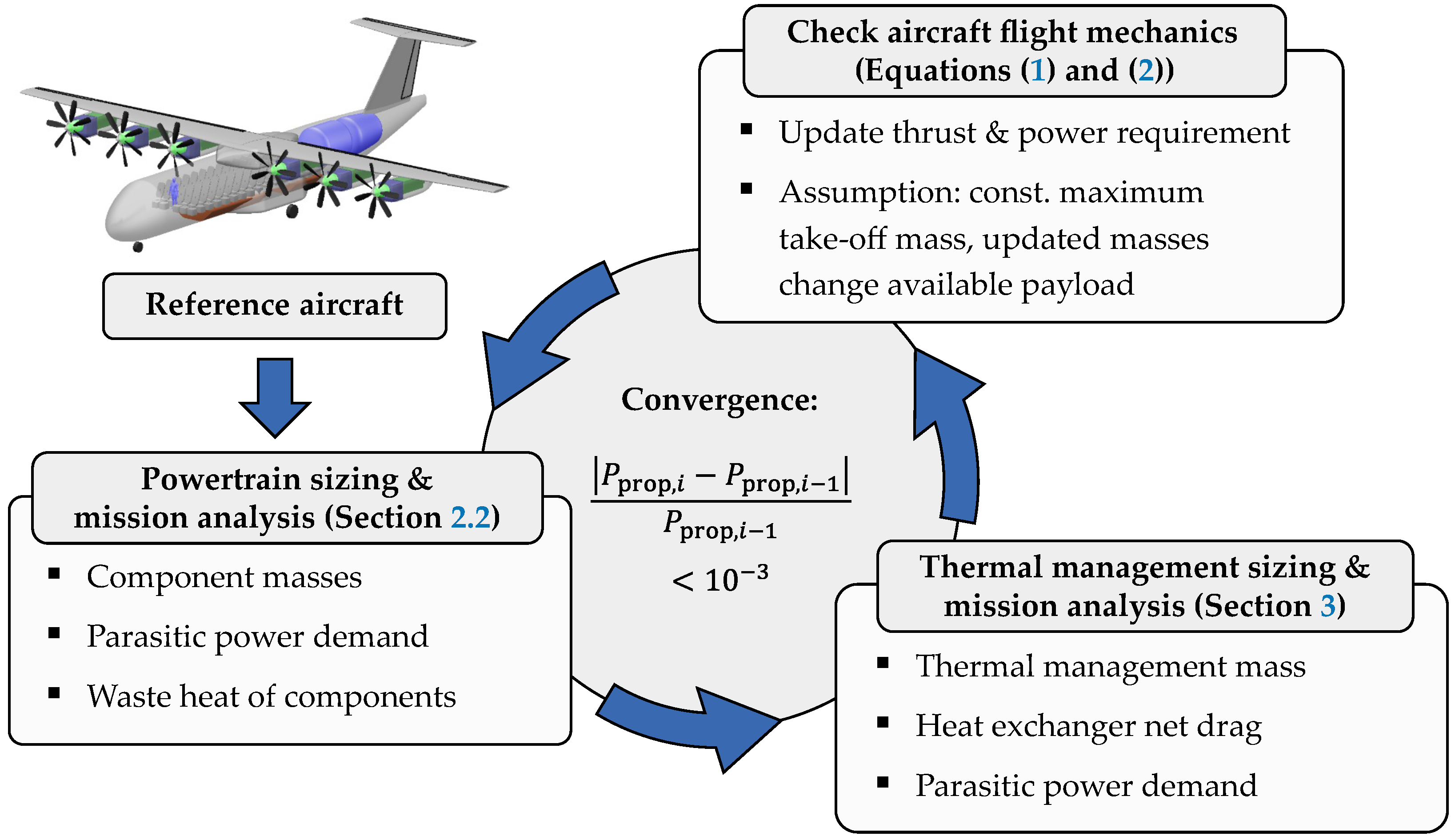
In this study, the powertrain and the TMS are resized with higher-fidelity models and are integrated into an aircraft performance model. The methodological framework is shown in Figure 1. First, the powertrain sizing and mission analysis provides the powertrain mass, parasitic power demand, and waste heat of the fuel cell and balance-of-plant components (detailed explanation in Section 2.2). Second, these values are used as inputs for the following TMS sizing, optimization, and subsequent mission analysis to quantify the TMS mass, net drag, as well as its parasitic power demand (detailed explanation in Section 3). These alternations change the aircraft’s thrust and therefore power requirement, and these are recalculated in a third step to ensure the design mission is met.
For this purpose, the aircraft’s steady-state equations of motion are solved for the required propulsive thrust F prop and aircraft drag D to account for the additional TMS net drag D net caused by the heat exchanger (introduced in Equation (15)) and the change in aircraft mass m resulting from fuel consumption during flight [46]:
m · d v d t = F prop · cos α ( D + D net ) m · g · sin γ ,
m · v · d γ d t = F prop · sin α + L m · g · cos γ .
The flight altitude h and speed v as a function of flight time t as well as the aircraft’s lift-to-drag ratio ( L / D ) and angle of attack α are taken from the reference flight mission in Ref. [39]. The flight path angle γ is determined by the flight speed and the change in altitude with time γ = arcsin ( v 1 · d h / d t ) . The procedure is described in detail by Meyer et al. [43]. The maximum take-off mass is maintained at a constant value to avoid structural redesign. Consequently, it is assumed that mass changes of powertrain and TMS directly translate into changes in the available payload, similar to approaches in previous studies [35,36,37,38]. The propeller efficiency η prop from Ref. [39] is then used to calculate the required propulsion power [46]:
P prop = F prop · v η prop .
As the modified propulsion power demand affects the sizing of the powertrain and the TMS, the process is iterated until a converged solution is reached. Convergence is declared when the relative change in the propulsion power between successive iterations falls below 10 3 . Tighter tolerances did not alter the final results.

2.2. Powertrain Sizing and Mission Analysis

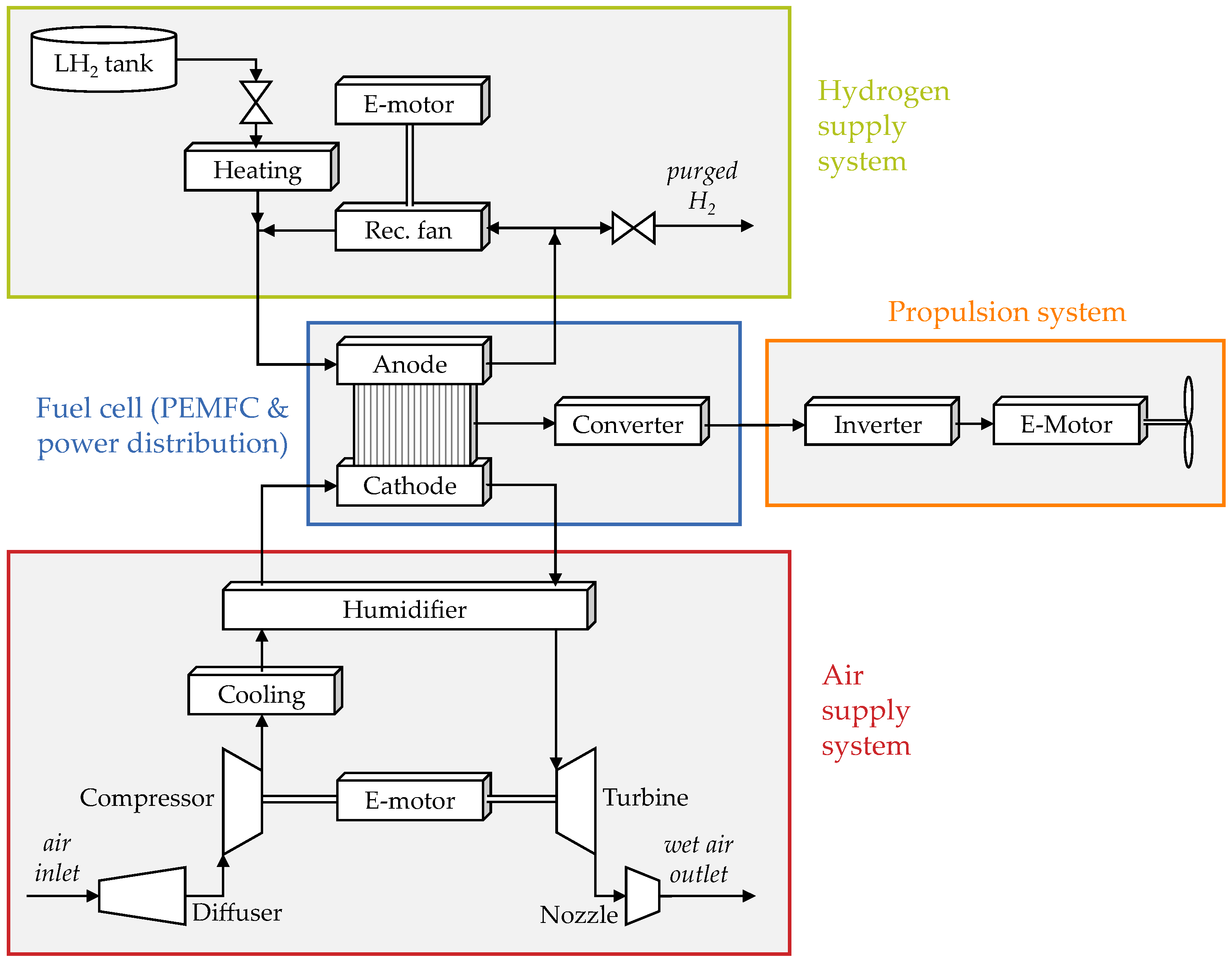
The investigated powertrain depicted in Figure 2 is divided into the fuel cell stack including its converter for power distribution, the air supply system, the hydrogen supply system, and the propulsion system. The subsequent models are formulated under steady-state assumptions, in line with previous studies [30,31,32,33,34,35,36,37,38,39,40,41,42,43].
The fuel cell is oversized and designed with a peak power capability of 150% of the maximum propulsion power, based on the results from previous studies [35,42]. During operation, it provides both the propulsion power and the additional parasitic power required by the subsystems:
P PEMFC = 1 η inv · η conv · P prop + P air supply η e - motor + P TMS ,
where P air supply is the mechanical power of the electric motor of the air supply system (compressor power minus turbine power), P TMS is the coolant pump power given by Equation (9), and η inv , η conv , and η e - motor are the electrical component efficiencies. The fuel cell efficiency η PEMFC and waste heat Q ˙ PEMFC are calculated using the hydrogen mass flow rate m ˙ H 2 and its lower heating value LHV H 2 [10]:
η PEMFC = P PEMFC m ˙ H 2 · LHV H 2 = P PEMFC P PEMFC + Q ˙ PEMFC .
The fuel cell model takes into account the effect of changes in operating conditions, such as pressure, temperature and humidity, on fuel cell efficiency and waste heat [10,47,48,49]. The inlet conditions at the cathode are adjusted by the design and the control strategy of the compressor, air cooler, and membrane humidifier. Throughout the flight mission, the operating pressure is 2.5 bar at take-off and 1.85 bar during cruise, and the average fuel cell temperature is approximately 85 °C, depending on the TMS operating strategy. The inlet relative humidity varies between 70 to 82%, as the humidifier is considered as a passive component. The fuel cell air mass flow rate varies depending on the required power and compressor operating point, with stoichiometries in the range of 1.5 to 4.5.
The focus of the powertrain simulation is the air supply system, as it is the main driver of parasitic power and can account for 7 to 9% of the total fuel cell power, according to previous studies [43]. In addition, the air supply significantly influences the operating point of the fuel cell in terms of conditioned air pressure, temperature, and humidity, which also affects efficiency and waste heat. In contrast, the hydrogen supply system contributes negligibly to parasitic power and waste heat due to the pre-compressed onboard storage and comparably low hydrogen mass flow rates compared to the required airflow [42].
The powertrain is designed and analyzed using a zero-dimensional thermodynamic cycle calculation simulation based on the constant mass flow approach. The system modeling approach is embedded in the in-house tool ASTOR (aircraft engine simulation for transient operation research) and implemented in MATLAB (R2023b). In previous studies, the tool has been applied and validated using various aero engines [50,51,52] and fuel cell systems [42,43,53,54,55]. These references also provide more in-depth information and calculation flowcharts. The tool comprises on-design and steady-state off-design performance calculations solving the mass conservation and power balances in the system using the Newton–Raphson method. Ideal gas equations are used, but gas properties are obtained from gas tables, taking into account changes in gas composition and relative humidity [56].
The gas path and the individual components are sized according to their respective critical operating points and to ensure the aforementioned inlet conditions of the fuel cell at each operating point. The design efficiency of the compressor is assumed to be 85%, and that of the turbine 90%. The masses of the compressor and turbine are derived using correlations from various designed turbo components from a previous study [43]. For the humidifier, the mass is correlated to its mass flow rate based on an existing cathode air humidifier [57]. For the electrical components, the efficiencies listed in Table 2 are taken into account and mass estimates are calculated using the specified power densities.
In order to determine the critical and thus dimensioning operating points of the individual components, a flight mission analysis is necessary. To this end, the off-design performance is analyzed at 95 discrete operating points of the given flight mission, which are calculated sequentially to account for fuel consumption and the subsequent reduction in aircraft mass. Flight phases involving major changes in boundary conditions, such as altitude, speed, or power requirements, are sampled more densely to ensure adequate calculation of the consumed hydrogen mass. A further increase in the level of discretization did not result in significant changes to the integral parameters and was therefore avoided for computational cost reasons.
The atmosphere is modeled according to the International Standard Atmosphere (ISA) (15 °C ground temperature [62]) and further for a hot day with an additional temperature increase of 28.3 °C [63]. To solve the power and mass balances in the system, the cathode stoichiometry, the shaft speed of the compressor and turbine, and their operating points in the performance maps are determined iteratively. The performance maps from a previous study are used for the compressor and turbine, and are scaled according to the mass flow and pressure requirements [42]. The fuel cell temperature is adjusted by the TMS.
As a result of the powertrain sizing, the fuel cell, the humidifier, and all the electrical components are designed for the highest power requirement during a hot-day take-off. In contrast, the turbo components are designed for the end of the climb phase, when the highest corrected mass flows and pressure ratios are achieved. Once all the component design points are determined, a final mission analysis determines the parasitic power demands and waste heat flow rates during the entire flight mission, which serve as inputs for the subsequent design of the TMS. Additionally, mission fuel is calculated by integrating the consumed hydrogen over flight time.

3. Thermal Management System Modeling

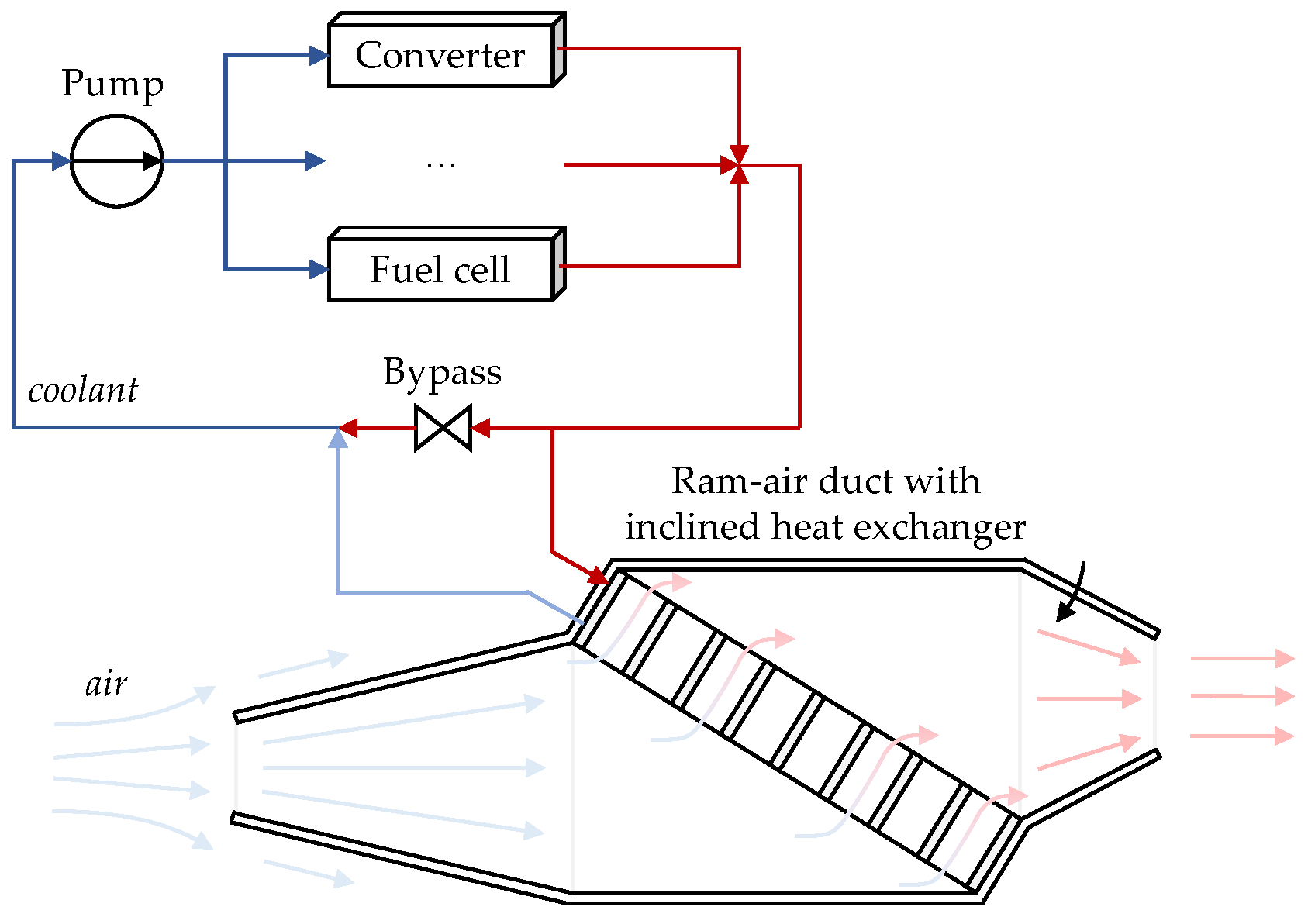
The TMS maintains all relevant heat-generating components within their allowable temperature limits. In this study, the inverter and electric motor of the propulsion system, the compressor discharge air and the electric motor of the air supply system, and the fuel cell including its converter for power distribution are considered as the primary heat sources. The electric motor to drive the recirculation fan within the hydrogen supply system is not considered, as its waste heat is insignificant compared with the primary heat sources. All components are integrated into a single liquid cooling loop using a mixture of 40 vol-% ethylene glycol and water to prevent freezing under cruise conditions, as shown in Figure 3. The waste heat is absorbed at each heat source, transported by the coolant, and rejected to the ambient air, which serves as the ultimate heat sink. The modeling of these processes is implemented in steady-state similar to the powertrain modeling, and is detailed below. For further details on the fundamental heat transfer mechanisms, see Refs. [64,65].

3.1. Heat Absorption

Heat absorption at each component is modeled via a mass-flow-dependent thermal resistance that relates the component and coolant temperatures T component and T cool :
Q ˙ = 1 R th · T component T cool
where Q ˙ denotes the absorbed waste heat flow rate and R th the thermal resistance. First, the full-load thermal resistance R th , full is calculated for the mission point with the maximum waste heat flow rate, using the maximum allowable component and coolant temperatures listed in Table 2. Subsequently, the thermal resistance at each remaining mission point with reduced mass flow rate is determined based on the McAdams correlation [66]:
R th = R th , full · m ˙ rel 4 / 5
where m ˙ rel is the ratio of the mass flow rate at the partial-load mission point to its maximum across the mission. The component temperature then follows from the present coolant temperature by rearranging Equation (6).
The discharge air of the compressor is cooled in a compact heat exchanger that is modeled analogously to the heat exchanger that rejects the waste heat to the ambient air (see Section 3.3). A minimum temperature difference between air and coolant of 5 K is assumed.
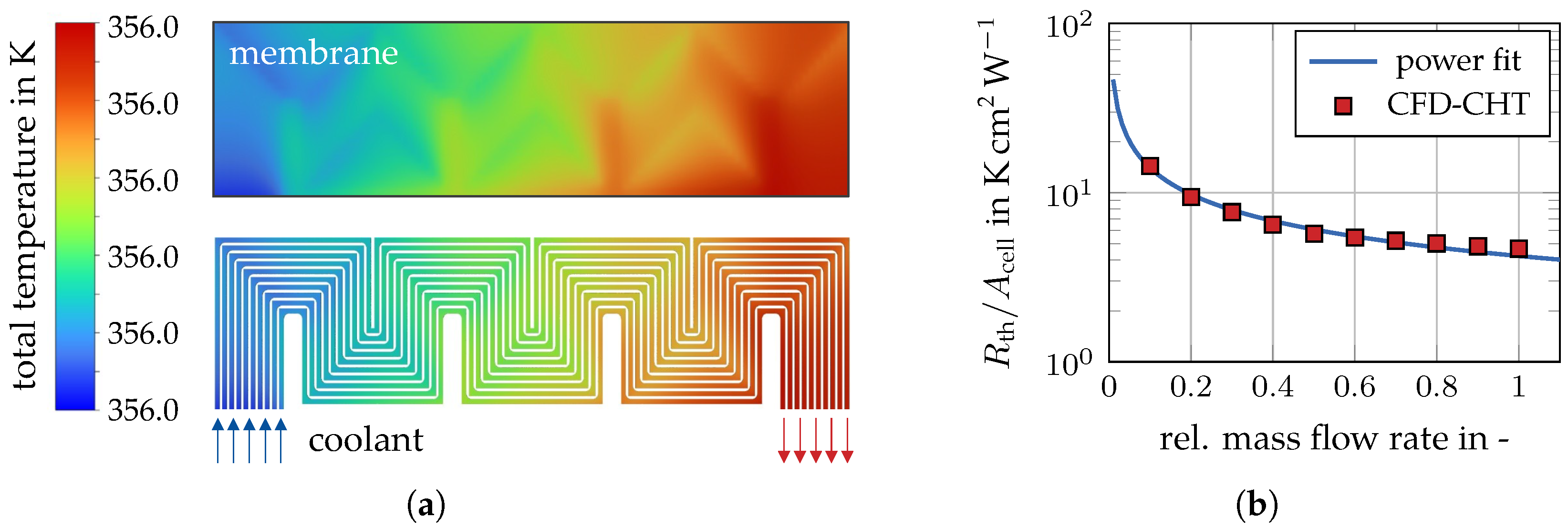
Because the fuel cell contributes the largest share of waste heat and thus dominates the performance of the TMS, its thermal resistance is investigated in more detail using a coupled three-dimensional CFD–CHT (computational fluid dynamics–computational heat transfer) analysis in Ansys Fluent (2023 R2). The waste heat is absorbed by the coolant within bipolar plates with serpentine coolant channels. A representative unit, consisting of one bipolar plate, two gas diffusion layers, and two membranes, is modeled. A uniform heat-flux boundary condition is applied at the membranes, and each membrane emits half of the cell-level waste heat. The bipolar plate is assumed to be located at the stack mid-plane, so the entire heat is absorbed by the coolant. The coolant flow through the channels is modeled with the k- ω -SST turbulence model. Prior to conducting the analysis, a simpler cold plate was modeled and validated against the experimental data reported by Li et al. [67]. Subsequently, the geometry was adapted to the serpentine layout suitable for fuel cell cooling [68], and a grid-independence study was performed.
The temperature distribution in the membrane and of the coolant within the bipolar plate at the full-load mission point are illustrated in Figure 4(a). Both peak at the outlet, with a 3.4 K difference between the domains. The simulations are repeated for partial-load operating points with reduced heat fluxes and mass flow rates, and the results are expressed as a cell-area-specific thermal resistance (see Figure 4(b)). A simple power-law fit
R th / A cell = 4.226 · m ˙ rel 0.5212
yields a coefficient of determination greater than 0.98, indicating excellent agreement.
Furthermore, the rise in coolant temperature is approximately equal to the membrane temperature span. This indicates that axial heat conduction in the membrane is not dominant. Accordingly, membrane thermal stresses can be estimated by simply considering the coolant-side axial temperature gradient.

3.2. Heat Transport

The absorbed waste heat is transported by a commercially available reference coolant pump (2.96 kg) that can circulate a volumetric flow rate V ˙ of 140 L min−1 at a pressure rise Δ p of 2 bar with an efficiency η of 50% [69]. The mass of the pump is scaled linearly with the actual volumetric flow rate based on the reference values. The required power is
P TMS = V ˙ · Δ p η .
As an assumption, the available pump head Δ p is distributed evenly across all the TMS components to define component-level design pressure drops.
The inner pipe diameters d i , pipe are determined from the continuity equation. The coolant velocity is iterated until the pressure drop calculated with the equations in Ref. [70] equals its maximum allowable value. Only half of the available design pressure drop is used for this straight-pipe friction. The remaining half is reserved for minor losses due to bends and fittings, which are not modeled in this study. The piping mass is
m pipe = π · l pipe · ρ pipe · δ pipe · ( d i , pipe + δ pipe ) dry + π 4 · d i , pipe 2 · l pipe · ρ cool coolant
with the coolant density ρ cool , the piping length l pipe , and the wall thickness δ pipe , which are listed in Appendix A. Aluminum is selected as the material with a density of ρ pipe = 2700 kg m 3 .
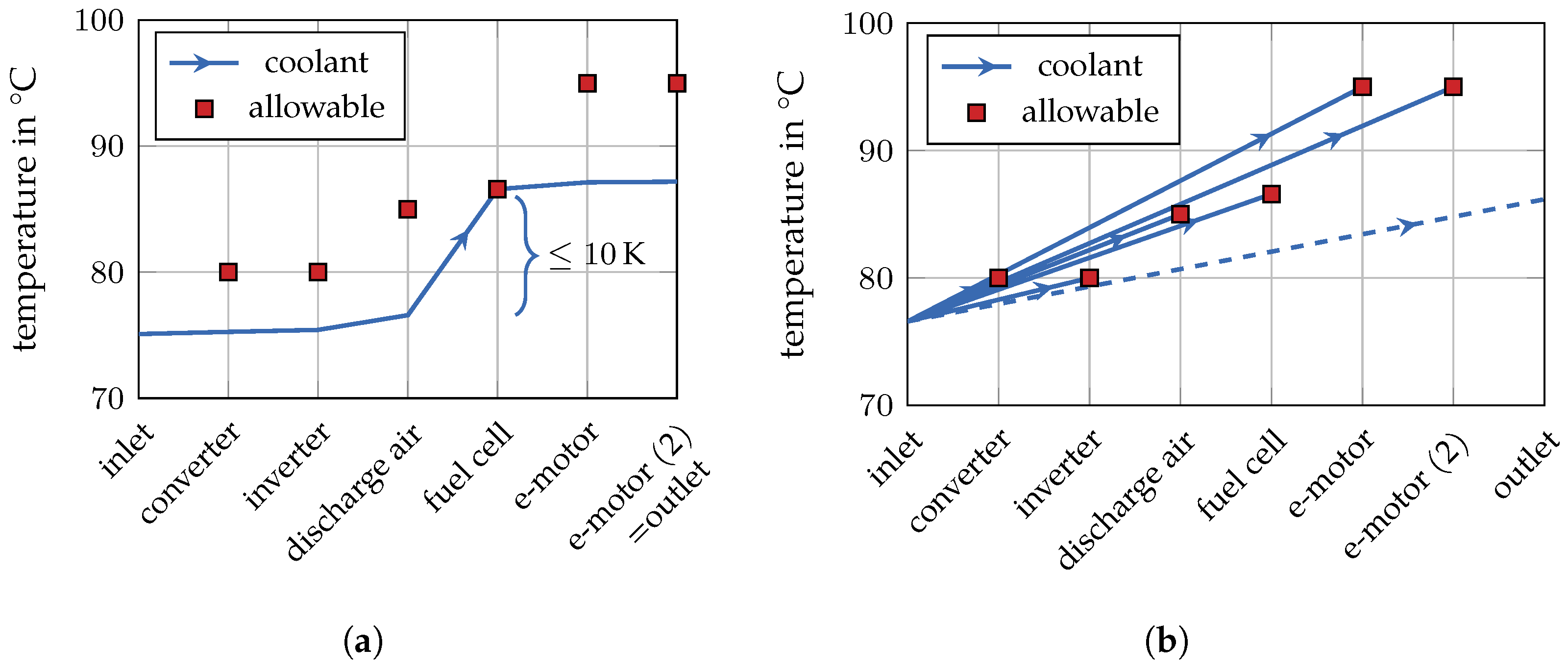
Two TMS architectures are considered in this study: series and parallel. The maximum allowable component outlet temperatures constrain the coolant inlet temperature, which should be selected as high as possible to minimize heat exchanger size. In addition, the fuel cell temperature rise is limited to 10 K to avoid thermal stresses. Other heat sources may also impose limits on their permissible temperature rise, but these are not addressed in this study.
In the series architecture, the full coolant flow passes sequentially through all components. The resulting full-load temperature profile is shown in Figure 5(a). Not all components attain their maximum allowable temperatures because the outlet temperature of one component sets the inlet temperature of the next. As a result, the coolant temperature level cannot be raised to its maximum potential value in the series cooling architecture.
In contrast, in the parallel architecture, the pump discharge splits into branches. The mass flow rate is adjusted independently for each heat source, which enables all components to operate at their maximum allowable temperatures, as illustrated in Figure 5(b). Consequently, the inlet temperature is 2 K higher than in the series architecture. This comes at the cost of an approximately 20% higher total coolant flow rate, implying a heavier pump and larger pipe diameters. Moreover, for the specified pump head, the allowable design pressure drop per component is higher than in the series architecture, as each coolant branch traverses fewer components. The parallel architecture is adopted as the baseline cooling architecture for the remainder of the study, and its aircraft-level performance is compared with the series architecture.

3.3. Heat Rejection

The waste heat is rejected by two compact aluminum heat exchangers per nacelle, each installed in a separate ram-air duct. Each duct consists of a scoop intake, a diffuser, an inclined heat exchanger with flat tubes on the coolant side and offset strip fins on the air side, and a nozzle with a variable exit area, as illustrated in Figure 3. The heat exchanger adopts a two-pass crossflow configuration, where the coolant is distributed through headers that also function as coolant tanks. The configuration follows the design guidelines for compact heat exchangers in electric aircraft derived by Nozinski and Kabelac [71]. The main equations used to design the heat exchanger and to adapt it to off-design conditions are outlined below. For further details and model validation, see Ref. [71]. The required input variables are summarized in Appendix A.
In the design model, each ram-air duct and heat exchanger is sized for take-off at hot ambient temperatures (43.3 °C ground temperature, occurrence below 1% [63]). The intake cross-sectional area
A intake = m ˙ air ρ · v · M F C R
follows from the captured air mass flow rate m ˙ air , the free-stream air density and velocity ρ and v , and the mass flow capture ratio M F C R . Values below unity for M F C R oversize the intake to promote pre-compression outside the ram-air duct. Depending on the flow conditions, the intake drag D intake is induced [72]. The subsequent two-dimensional diffuser decelerates the airflow and increases the static pressure. Its length is selected to maximize pressure recovery at a specified area ratio. The heat exchanger is inclined to integrate a larger frontal area into the duct, which causes additional pressure losses due to flow deflection and flow non-uniformity [73].
The ram-air duct defines the installation space for the heat exchanger. It is sized using the ε -NTU method:
Q ˙ = ε · C ˙ min · ( T in , cool T in , air )
where Q ˙ denotes the waste heat flow rate, C ˙ min is the smaller of the coolant and air heat capacity rates, and T in , cool and T in , air are the inlet temperatures of coolant and air at the heat exchanger. The effectiveness ε for a crossflow heat exchanger is
ε = 1 exp 1 C r · N T U 0.22 · exp C r · N T U 0.78 1
with the ratio of minimum to maximum heat capacity rate C r . The equation is solved for the number of transfer units N T U = U A / C ˙ min , which determines the required product of overall heat transfer coefficient and area U A . Heat transfer coefficients on the coolant and air sides are obtained from semi-empirical correlations for microchannels and offset strip fins. The heat transfer area is governed by the heat exchanger geometry, and the heat exchanger depth is iterated until the desired rejected waste heat flow rate Q ˙ is met.
The dry mass and the coolant mass within the headers and coolant channels are determined from the derived geometry. Pressure drops on both coolant and air sides are then calculated:
Δ p = G 2 2 · ρ in · 1 σ 2 + K c + 2 · ρ in ρ out 1 + + 4 · f · l d h · ρ in · 1 ρ m 1 σ 2 K e · ρ in ρ out
with the mass flux G, density ρ , porosity σ , contraction and expansion loss coefficients K c and K e , flow length l, and hydraulic diameter d h . The Fanning friction factor f is derived from semi-empirical correlations.
Excess air-side static pressure at the heat exchanger outlet is expanded to ambient pressure by conversion into kinetic energy in the tilt-back region and the nozzle. The recovery thrust offsets part of the intake drag D intake , which yields the net drag
D net = D intake m ˙ air · v out
with the nozzle exit velocity v out . The ram-air duct is made of carbon-fiber-reinforced polymers and its mass is derived from the geometry.
To adapt to off-design conditions with reduced waste heat and lower ambient temperatures, a bypass past the heat exchanger is added (see Figure 3). In addition, the exit nozzle area is adjustable to control the airflow rate through the duct. Both the bypass ratio and the nozzle exit area are set to reject the off-design waste heat while minimizing net drag.
The ambient air is the only heat sink considered in this study. Cryogenic liquid hydrogen is a potential second heat sink because it must be heated to the fuel cell operating temperature. The required heat is typically 5 to 10% of the fuel cell waste heat [24], which could consequently reduce the required heat exchanger area by up to 10%. However, this study focuses on a nacelle-integrated TMS, which would require liquid hydrogen to be routed to the nacelle to fully exploit its potential. This is a challenging task [74], and it would couple the fuel management system to the TMS. Such coupling introduces interactions, additional complexity, and higher failure risk [75]. Liquid hydrogen is therefore not considered as a heat sink here.

3.4. Optimization Method

The design and off-design models are embedded in the TMS optimization framework. The design point is set to the hot-day take-off (43.3 °C ground temperature), and the off-design point evaluates the net drag at cruise on an ISA day (15 °C ground temperature [62]). The coolant temperature and mass flow rate are determined by the cooling architecture described in Section 3.2, and ambient conditions and waste heat result from the aircraft design in Section 2.2. This multi-point design ensures sufficient heat rejection under the most demanding conditions while optimizing cruise performance over the longest flight segment. This approach reduces the net drag across an ISA-day mission by up to a factor of 3 compared with conventional single-point optimization at hot-day take-off [71].
A multi-objective non-dominated sorting genetic algorithm (NSGA-II) [76] is applied to minimize the TMS mass and the TMS net drag at ISA-day cruise. The optimization is performed in Python (3.11) using pymoo [77]. The TMS simulation models are implemented in Dymola (2024x Refresh 1) using the object-oriented Modelica language [78] and are accessed via an interface. The optimizer varies the design variables related to the ram-air duct and heat exchanger (listed in Appendix A) and improves their selection through a sequence of non-dominated sorting, crowding-distance-based survival, selection, crossover, and mutation, which iteratively minimized mass and net drag.
In each generation, the design model is evaluated first to obtain the mass as the first objective. The maximum allowable coolant pressure drop and a maximum ram-air duct length serve as constraints. The designed geometry is then passed to the off-design model to obtain the net drag at cruise as the second objective. This procedure is repeated until the change in objective space falls below 0.0025 over 15 consecutive generations, which is taken as convergence. The masses of the piping and the pump, which are not subject to optimization, are added to the optimized heat exchanger mass after convergence.
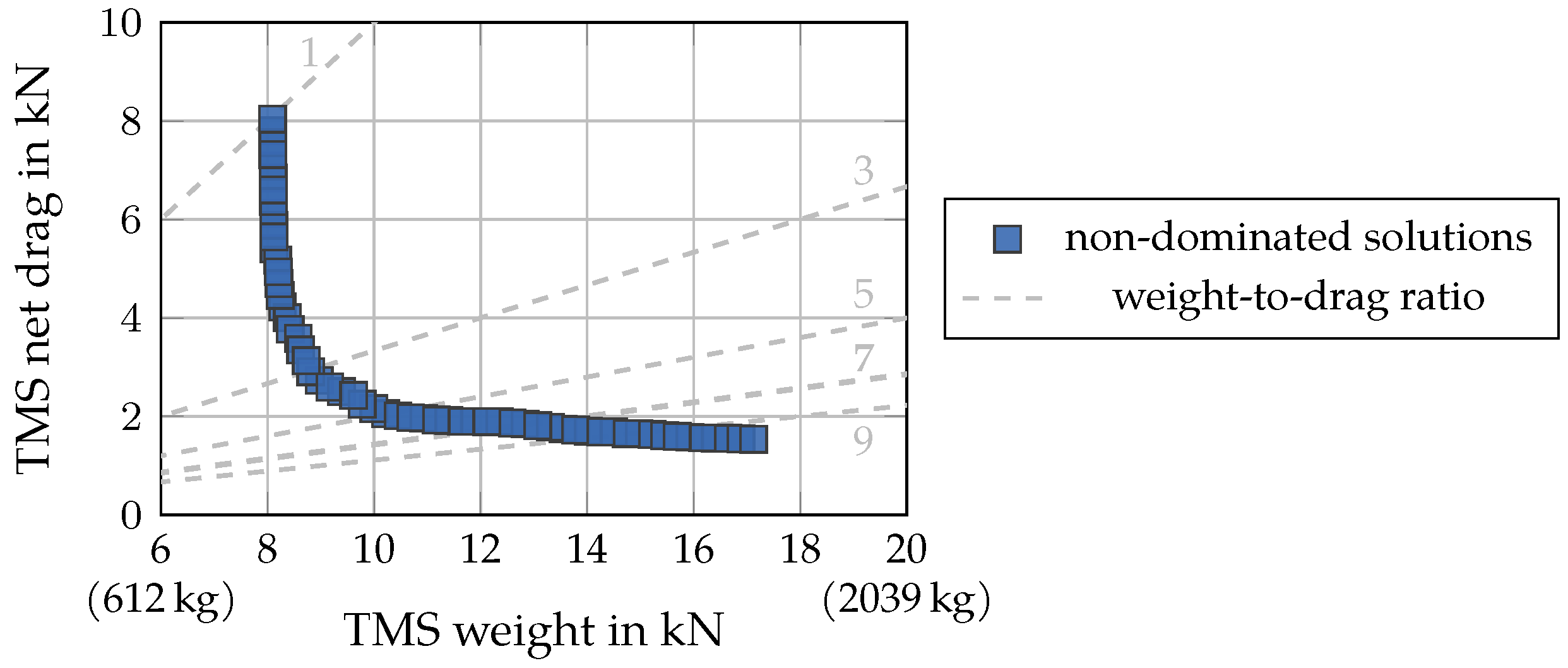
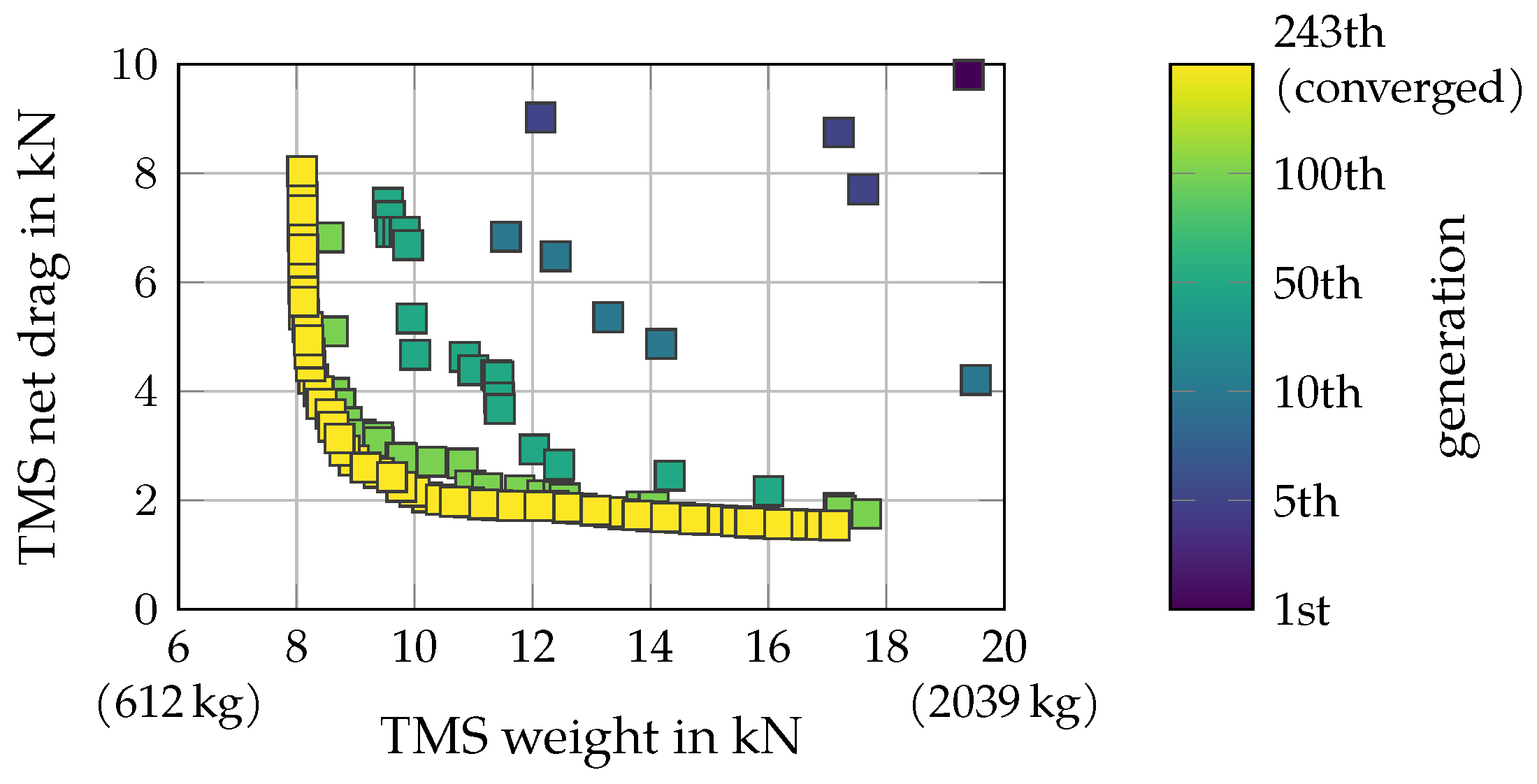
The optimization returns non-dominated solutions that form a Pareto front, characterized by a trade-off design selection in TMS net drag against TMS mass. Example results are shown in Figure 6 for the parallel cooling architecture. Weight (mass times gravitational acceleration) is used to enable a direct comparison with net drag through the weight-to-drag ratio. As the final design, either a lightweight TMS with high net drag (weight-to-drag around 1), a heavy TMS with low net drag (weight-to-drag around 9), or any design in between can be selected for aircraft integration. A design with a weight-to-drag ratio of 7 is set as the baseline, and its impact is investigated in Section 4.3. With the selected design, the entire mission is computed and the TMS results are passed back to the powertrain design until global convergence is reached.

4. Results

This section presents the aircraft-level impact of the TMS based on the objectives in Section 1.3, including its design and operating parameter choice. Only the final, converged aircraft iteration is presented. All the reported results refer to the complete aircraft system (e.g., the TMS mass represents the total mass across all subsystems).

4.1. Mission-Level Impact

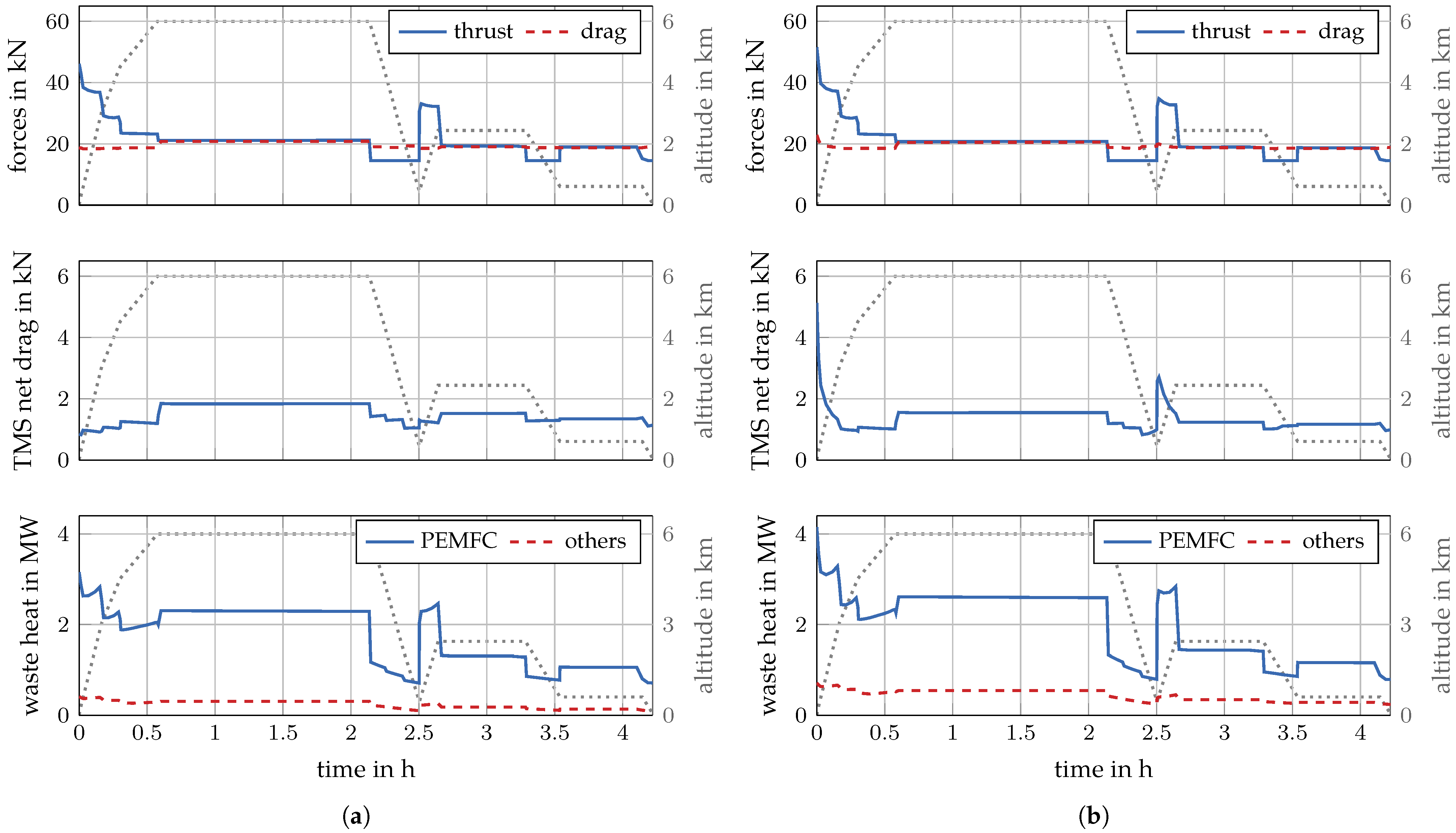
The relevant results across the entire mission are shown in Figure 7. In all the mission figures, flight altitude is shown in gray on the secondary y-axis to provide context for the results relative to the flight phases. Under ISA-day conditions, the TMS accounts for about 5% of the total aircraft drag at take-off and about 10% during cruise. On a hot-day mission, the net TMS drag contribution increases to approximately 25% at take-off, which raises the required take-off thrust by about 10%.
The waste heat of the fuel cell dominates the component heat loads. It peaks at take-off when full power is required. Over the mission, the total waste heat decreases to 70% in cruise and to 20% at landing approach, relative to the take-off value. On the hot-day mission, the waste heat is on average 30% higher, driven by the higher power demand due to the increased aircraft drag and by the greater cooling demand of the compressor discharge air.
The differences between ISA-day and hot-day missions, as well as between take-off and cruise, can be explained by the change in ambient temperature. The temperature difference between coolant and ambient air is smallest at hot-day take-off, which requires the highest airflow rate and produces substantial ram drag. For lower ambient temperatures in cruise, the required airflow rate decreases, which is controlled by the exit nozzle area. However, closing the nozzle too far causes a significant portion of the free-stream air to spill around the intake, which adds spillage drag. Overall, this leads to double the net drag in cruise compared with take-off on the ISA-day mission.

4.2. Thermal Management System Architectures

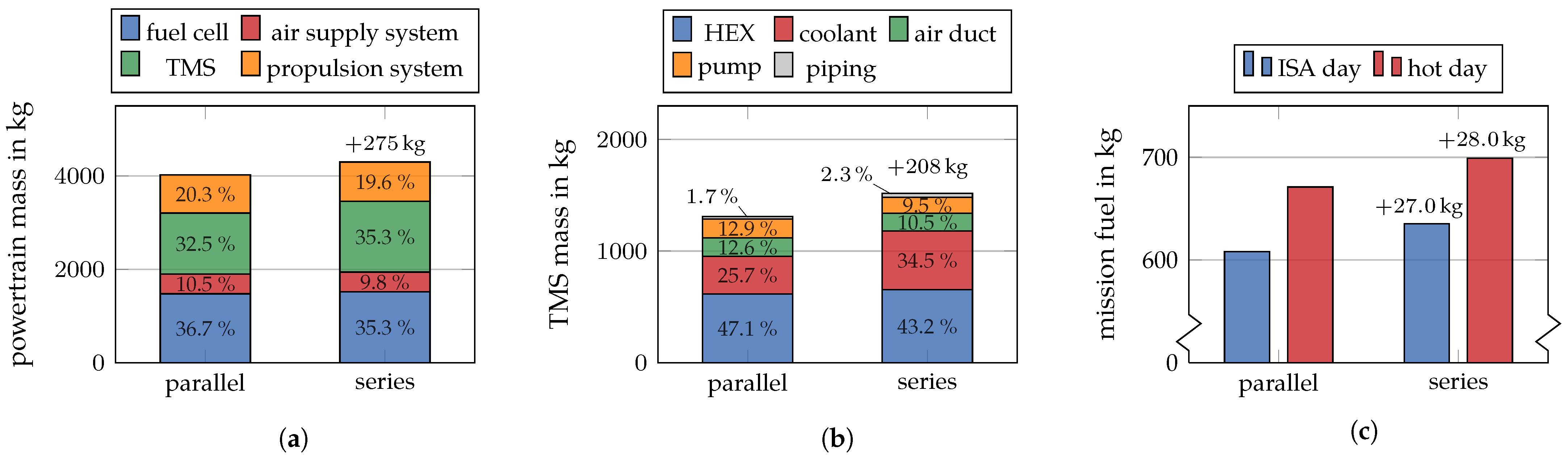
A comparison between the parallel and the series cooling architecture based on the boundary conditions presented in Section 3.2 is shown in Figure 8. The implementation of the series architecture results in a powertrain that is 275 kg heavier than for the parallel architecture, which directly reduces the available payload under the constant maximum take-off mass assumption. Overall, the TMS accounts for approximately 5% of the total aircraft mass. The TMS for the series architecture is 208 kg heavier, which is mainly attributable to a larger coolant charge. This is caused by the lower allowable pressure drop across the heat exchanger in the series architecture, which requires larger coolant channels than in the parallel architecture. The mass reduction from the lighter coolant pump due to the reduced coolant flow rate cannot offset this increase. Regarding mission fuel consumption, the series architecture requires 27 kg more fuel than the parallel architecture on an ISA-day mission due to an increased net drag of about 15%. The hot-day mission requires, on average, 63 kg more fuel than an ISA-day mission.

4.3. Heat Exchanger Design

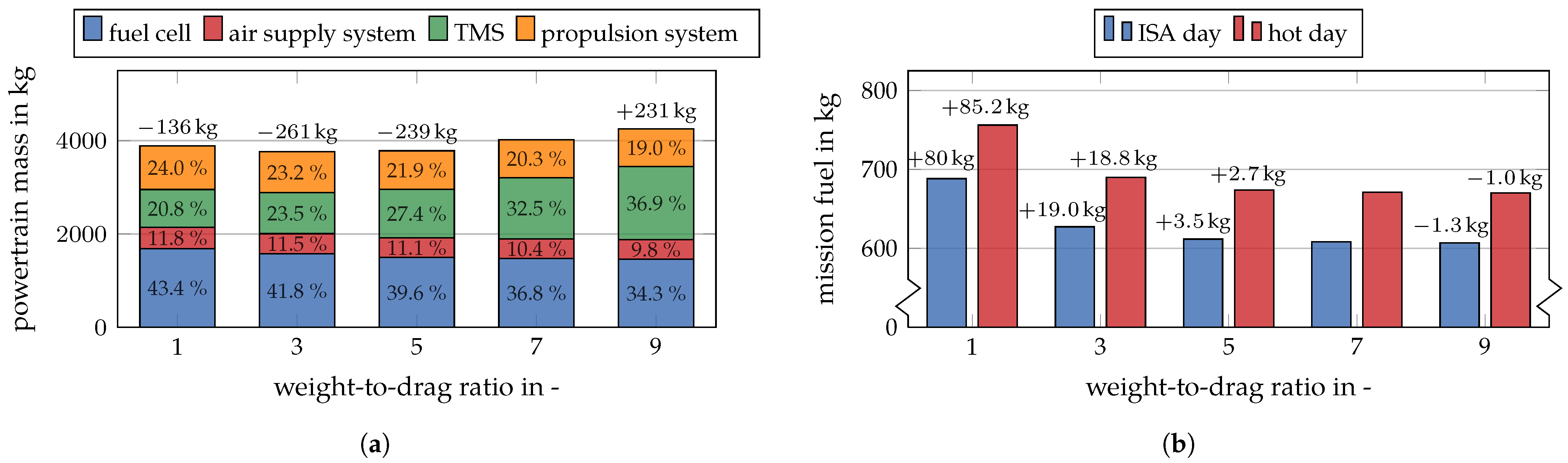
The impact of the selected heat exchanger design based on the TMS weight-to-drag ratio (see Figure 6 for visualization) is shown in Figure 9. Lower ratios correspond to a lighter TMS with higher net drag, whereas higher ratios imply the opposite. Relative to the baseline ratio of 7, increasing the ratio increases the powertrain mass by 231 kg because of the heavier TMS. Decreasing the ratio to 1 yields the lowest TMS mass. However, the associated rise in net drag increases the required thrust, and thereby also increases the power and masses of the fuel cell, the air supply system, and the propulsion system. These increases offset the TMS mass savings, so the largest powertrain mass reduction occurs at a weight-to-drag ratio of 3.
Mission fuel consumption follows the same trend: a low weight-to-drag ratio with a lightweight TMS but high net drag requires more fuel across the mission due to the larger installed fuel cell power. The TMS design with the ratio of 3 that minimizes the powertrain mass increases mission fuel by 19 kg, whereas the heaviest powertrain design at a ratio of 9 reduces mission fuel burn by 1.3 kg relative to the baseline design.

4.4. Coolant Temperature Level

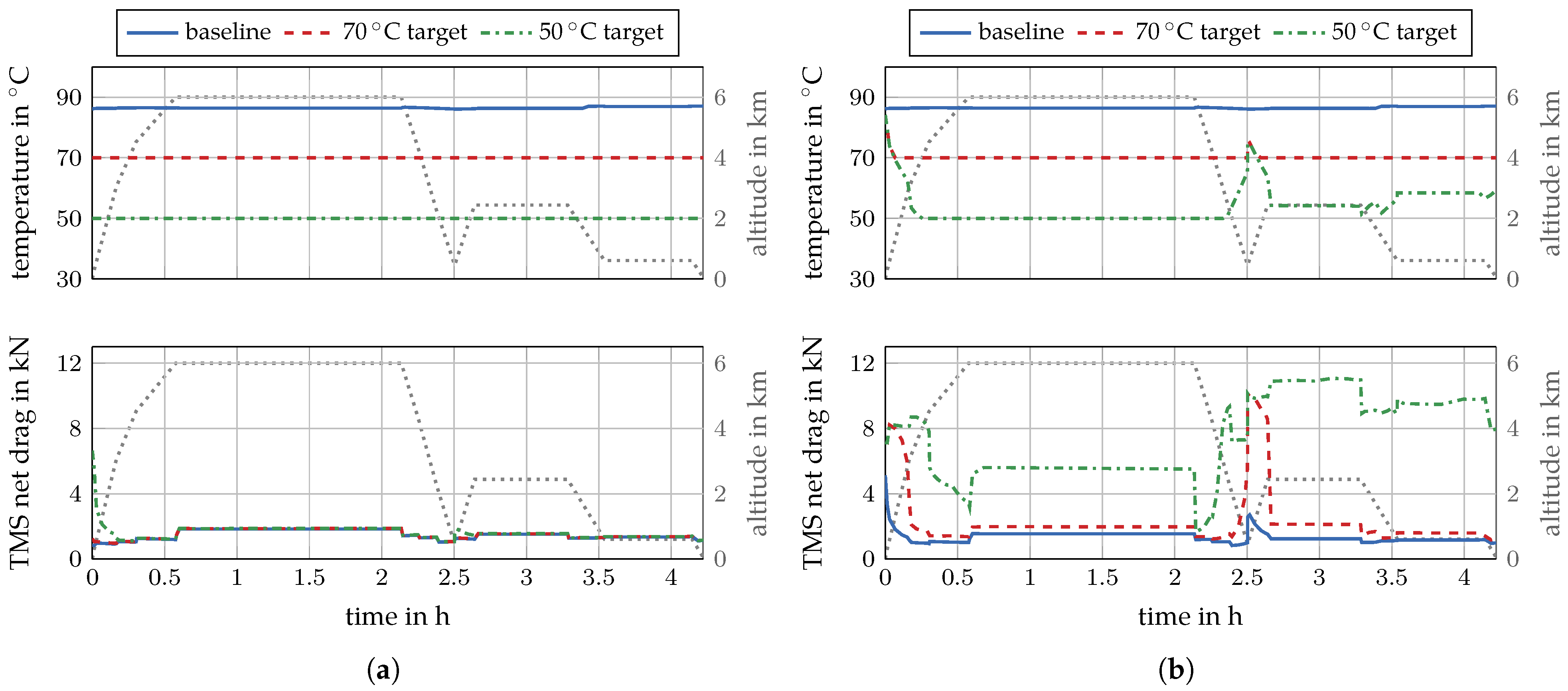
In the previous results, the coolant temperature across the mission was kept as high as possible, consistent with the full-load temperature profiles in Figure 5. This strategy keeps the operation of the electrical components close to their maximum allowable temperatures while avoiding large temperature fluctuations across the mission. Lowering the component temperature setpoint can improve their efficiency and lifetime, but it reduces the driving temperature difference across the heat exchanger. This trade-off is quantified from the TMS perspective in Figure 10 by showing the effect of a targeted coolant temperature reduction on the TMS net drag.
Under ISA-day conditions, target coolant return temperatures of 70 or 50 °C are feasible throughout the entire mission due to the lower ambient air temperature compared with the hot-day design point. For a 50 °C target, the higher required airflow rate at take-off due to the diminished temperature difference between coolant and air temporarily increases the net TMS drag by a factor of eight relative to the baseline strategy. The resulting mission fuel penalty is 3.1 kg.
On a hot-day mission, the performance impact is more pronounced. Because the heat exchanger is sized to reject the waste heat at hot-day take-off at the high baseline coolant temperature, only a small temperature reduction of about 2 K is attainable at take-off through complete exit nozzle opening. This marginal temperature reduction increases the TMS net drag at take-off by 40% relative to the baseline strategy, which increases the powertrain mass by 92 kg. The target coolant temperature is reached during initial climb for a 70 °C target and at 60% of the total climb altitude for a 50 °C target. After a go-around following a rejected landing, coolant temperatures rise again and cannot be maintained at their setpoints. The TMS net drag rises significantly at take-off and during go-around for a 70 °C target and across the entire mission for a 50 °C target. Ultimately, mission fuel consumption increases by 22 kg (70 °C) and by 181 kg (50 °C).

4.5. Thermal Management System Integration

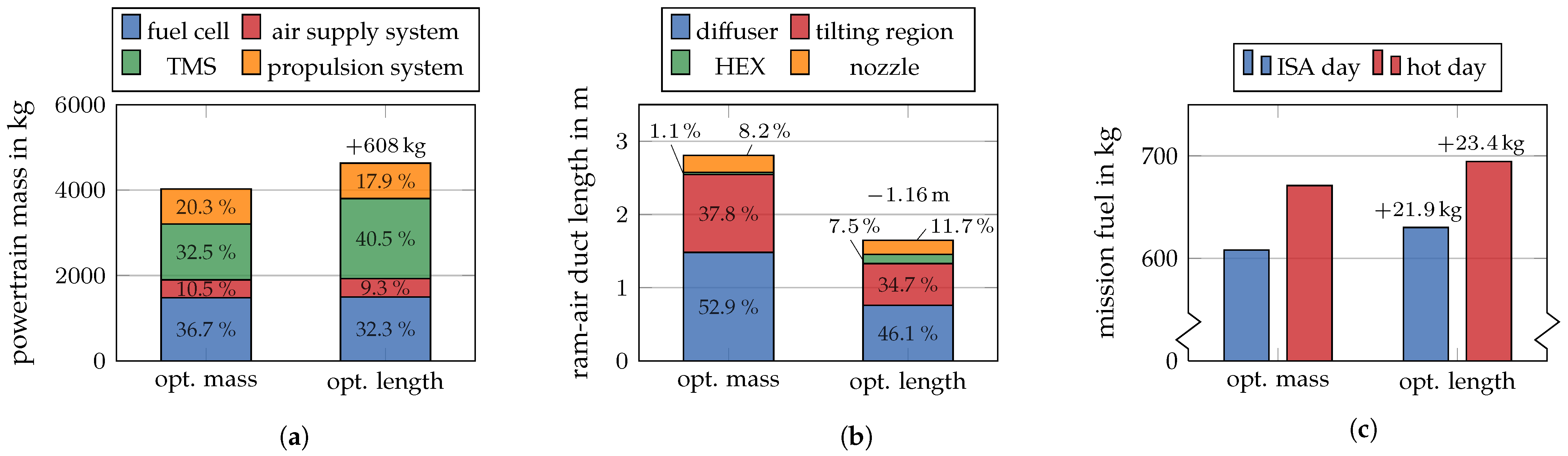
The typical objective in TMS optimization is to minimize mass and net drag, since both directly affect aircraft performance. However, the TMS must also fit within the nacelle, so volume cannot be neglected. In the previous results, integration was handled indirectly by constraining the ram-air duct length to 3 m and by including the duct mass in the total TMS mass, thereby penalizing large ducts. To address integration more directly, the mass objective is replaced with ram-air duct length and compared to the mass-objective baseline. The net drag as the second objective is maintained.
The aircraft-level comparison of both optimization strategies is shown in Figure 11. In the mass-optimized baseline, the ram-air duct nearly exploits the 3 m limit, while the length optimization shortens the duct by 1.16 m. The reduction is achieved by a shorter diffuser and a smaller heat exchanger inclination angle, which reduces the diffuser pressure recovery and forces a smaller frontal heat exchanger area. The available design space for the heat exchanger shrinks, and the smaller frontal area is compensated by increasing the heat exchanger core depth by a factor of 3.6 relative to the mass-optimized heat exchanger. The longer flow path and the higher face velocity raise the air-side pressure drop, which in turn increases the net drag of the TMS. The length-optimized TMS is 566 kg heavier than the mass-optimized baseline, which increases the total powertrain mass by 608 kg. Mission fuel consumption increases by 21.9 kg on an ISA-day mission and by 23.4 kg on a hot-day mission.
The broader impacts of a smaller TMS beyond the reported mass and fuel penalties are not assessed in this study. A more compact TMS could provide additional installation freedom for the remaining nacelle components or enable a smaller nacelle, potentially reducing its mass and external drag. The present results serve as a baseline for future work that jointly optimizes the nacelle and its sub-components.

5. Discussion

This section consolidates the results presented above, benchmarks them against the prior literature, and establishes aircraft-level performance metrics. Additionally, the trade-off between mission fuel consumption and payload is analyzed to identify the optimal TMS configuration for the investigated short-range all-electric aircraft and the limitations of this study are givenl.

5.1. Performance Metrics

Based on the previous section, performance metrics are derived and compared to previous studies. A comparison is listed in Table 3. The powertrain designed in this study is lighter than in previous works, primarily due to the higher assumed fuel cell power density based on forecasts for 2050 [39,58]. However, not only the fuel cell but also the TMS mass significantly affects the total powertrain power density by up to 30%, depending on the TMS design choice. Consequently, the well-established sensitivity of results to technology assumptions [27,30] extends to TMS design, underscoring the need for holistic co-optimization.
The TMS achieves a mass-specific heat rejection (design waste heat flow rate at hot-day take-off divided by total TMS mass) of 2.63 to 6.85 kW kg−1. This partially aligns with previous works [23,36], but exceeds the metrics reported in other studies [21,24,33,35]. A key reason is the multi-objective optimization used in this work to minimize mass and net drag of the heat exchanger, while constraining its dimension to fit within the nacelle [71]. In the early generations of the genetic algorithm, most candidate heat exchanger designs are infeasible due to excessive air duct lengths or large air-side pressure drops. The evolutionary progress across representative generations is illustrated in Figure 12. In the first generation, only 1 of 500 individuals generated a feasible design. Compared with the final set of the non-dominated solutions in the last converged generation, its mass increased by a factor greater than 2, and its net drag increased by a factor of up to 5. Several prior studies omitted such optimization and instead assumed fixed mass-specific heat rejection values or adopted porosity factors transferred from other applications, thereby incurring the risk of missing significant performance improvements.
Regarding the TMS mass breakdown, Koudounas et al. [24] reported that the heat exchanger accounted for 71% (wet mass) of the total TMS mass. Similar results are obtained in this study, with wet mass shares of 64 to 75%, depending on the TMS architecture and heat exchanger design. The coolant pump and the surrounding ram-air duct are the next-largest contributors, although the latter is often neglected. In an actual aircraft installation, additional instrumentation and manifolds are likely to slightly increase TMS mass, but the heat exchanger will remain the dominant contributor.
Finally, it is important to emphasize the significance of TMS net drag, which is often under-reported in system-level assessments (see Table 3). In this study, the TMS achieves drag-specific heat rejection values (waste heat flow rate divided by net TMS drag at the respective mission point) of 0.55 to 1.51 kW N−1 under ISA-day cruise conditions and 0.42 to 0.94 kW N−1 at hot-day take-off. These values partially exceed those reported in previous studies [21,36], which is also attributable to the multi-objective optimization applied here. Increasing drag-specific heat rejection results in a reduction of mass-specific heat rejection, reflecting an inherent mass–drag trade-off. Therefore, reporting both mass- and drag-specific performance metrics is essential for a fair comparison across studies.

5.2. Combined Aircraft Impact

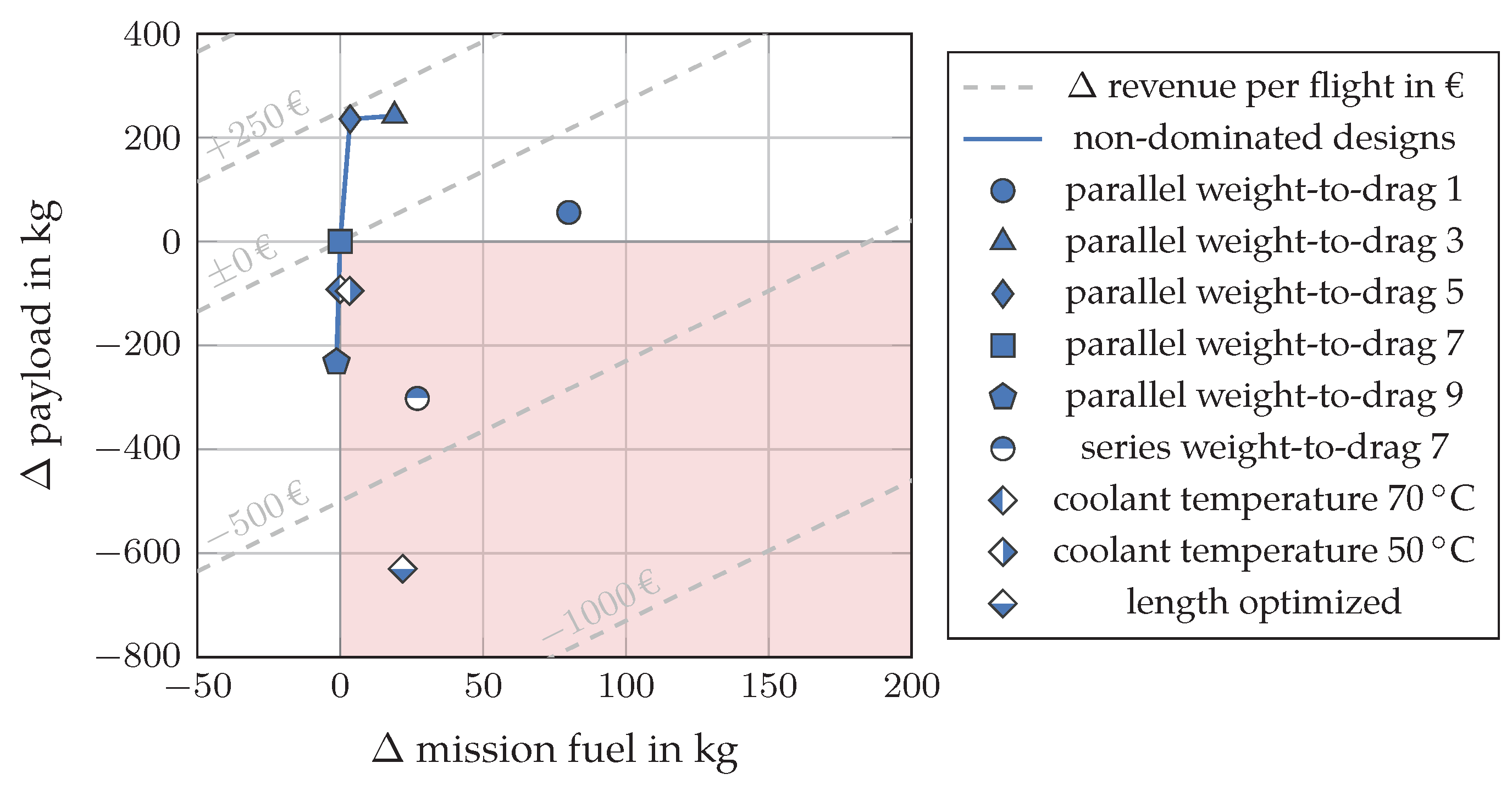
The performance metrics indicate a broad TMS design space. In Section 4, each TMS design has been evaluated by its change in powertrain mass and mission fuel relative to the baseline parallel cooling architecture with a design weight-to-drag ratio of 7. To identify the mission-optimal TMS design for the studied short-range aircraft, all candidates are plotted in Figure 13 as the change in payload against the change in mission fuel. The change in payload is defined as the negative sum of the change in powertrain mass and the change in mission fuel over the ISA-day mission. The desired region is the upper-left corner in the diagram, where the available payload increases and the mission fuel decreases.
The red-shaded region contains TMS designs that increase mission fuel and reduce available payload relative to the baseline TMS. Consequently, in terms of aircraft performance, these are not mission-optimal. Designs that either reduce mission fuel or increase payload are exclusively parallel cooling architectures with different weight-to-drag ratios (see Section 4.3). Ratios between 3 and 9 can be considered as non-dominated designs. In contrast, a ratio of 1 increases mission fuel and decreases payload compared with other candidates, and is therefore dominated.
To trade payload against mission fuel in economic terms, the change in revenue per flight is calculated. Hydrogen is assumed at 2.7 € kg−1 (forecast for 2050 [79]) and the payload value is estimated at 1.0 € kg−1, derived from an average short-haul ticket price of 100 € per passenger (100 kg including luggage) [80]. The resulting iso-revenue lines (gray dashed in Figure 13) identify a parallel cooling architecture with a design weight-to-drag ratio of 5 as mission-optimal, yielding an estimated additional revenue of 250 € per flight relative to the baseline TMS. This optimal design achieves a mass-specific heat rejection (design waste heat flow rate at hot-day take-off divided by total TMS mass) of 4.77 kW kg−1 and drag-specific heat rejections (waste heat flow rate divided by net TMS drag at the respective mission point) of 1.29 kW N−1 (ISA-day cruise) and 0.76 kW N−1 (hot-day take-off). Compared with the maximum achievable performance metrics in Table 3, these values reveal the mission-optimal trade-off between TMS mass against net drag. We stress that these revenue estimates depend on assumptions and are sensitive to economic conditions, policies, and market dynamics, so absolute numbers should be treated with caution. However, for the parallel cooling architecture with a design weight-to-drag ratio of 3 to become revenue-competitive, the ratio of payload to hydrogen price would need to increase by a factor of 10 (e.g., 10 € kg−1 payload at 2.7 € kg−1 hydrogen). For the design weight-to-drag ratio of 7, the ratio of hydrogen to payload price would even need to increase by a factor of 20 (e.g., 54 € kg−1 hydrogen at 1.0 € kg−1 payload).
Revenue, however, is not the only driver of TMS design. Although the length-optimized TMS (see Section 4.5) significantly reduces the available payload, its shorter ram-air duct and smaller installation volume can offer aircraft-level benefits, such as a smaller nacelle or more space for other nacelle components. Potential gains from reduced external drag or improved component efficiencies were not within the scope of this study. Furthermore, lowering the coolant temperature to 70 or 50 °C (see Section 4.4) yields only marginal revenue decreases. If the 70 °C target temperature were applied only during ISA-day operations and not on hot days, the available payload would remain unchanged relative to the baseline TMS, since TMS net drag, and therefore required aircraft thrust, would not increase. For the 50 °C target, the modest rise in mission fuel of 3.1 kg would slightly degrade performance. The same temperature targets could be combined with the mission-optimal TMS with a weight-to-drag ratio of 5, so the potential benefits of a temperature reduction for ISA-day operation should be evaluated in future studies at the individual electrical component levels, with the primary aim of assessing impacts on performance, degradation, and reliability.

5.3. Limitations

The results of this study are subject to certain limitations. The TMS design point is defined as a hot-day take-off at 43.3 °C ambient temperature, corresponding to an occurrence probability of less than 1% [63]. This choice is representative for large parts of Europe and comparable climate zones, whereas prior studies adopted lower design temperatures between 30 and 40 °C (see Table 1). Hotter conditions (e.g., heat waves in southern Europe) and take-off at high-altitude airports would reduce both the available aircraft thrust and the ram-air flow for the air supply system and the TMS. Extreme wetter scenarios and relevant failure modes should therefore be examined in future work. However, given that the mass and net drag of all the investigated TMS architectures and operating strategies scale equally with those extreme wetter scenarios, the main conclusions of this work remain unchanged.
The analysis relies on steady-state modeling. Especially for the TMS, this can slightly oversize thermal components because a portion of the waste heat rejection can be shifted into the climb phase with lower ambient temperatures. Thus, accounting for transients may yield higher performance metrics than those derived in Section 5.1. Nonetheless, as with ambient-condition sensitivities, these effects influence all TMS architectures equally, and the optimal system is maintained.
Finally, we assumed a fixed maximum take-off mass throughout the iterative process, so changes in powertrain and TMS mass translate into changes in the available payload. This modeling approach was already used in previous studies [35,36,37,38], and it avoids complex structural redesign of the aircraft. Its main implication is a potential shift in the center of gravity, since payload is located differently than powertrain and TMS. However, given that the reference aircraft has already been adapted for hydrogen-powered PEMFC operation [39], any required structural changes are expected to be small. Holding payload constant instead, as in Refs. [30,34,42,43], would change the maximum take-off mass and typically entail more extensive structural redesign. Future studies should couple surrogate models of the powertrain and the optimized TMS to the aircraft design to avoid the resulting inaccuracies.

6. Conclusions

In this study, we presented a methodological framework for integrated, iterative sizing and mission analysis of the thermal management system (TMS) and the electric powertrain. Changes in TMS net drag translate into changes in required aircraft thrust, while changes in powertrain, TMS, and mission fuel masses affect the available payload under a constant maximum take-off mass assumption. We applied this method to an all-electric short-range aircraft to identify mission-optimal TMS cooling architectures and operating strategies. The key findings with respect to the objectives in Section 1.3 are:
  • Mission-level impact: The TMS net drag contributes 5 to 25% of total aircraft drag, depending on ambient temperature and mission point. At the hot-day take-off design point (43.3 °C), increased TMS net drag raises the required aircraft thrust by about 10% relative to operation in International Standard Atmosphere (ISA, 15 °C).
  • Architecture choice: A parallel cooling architecture for the nacelle-integrated TMS provides a payload advantage of 307 kg (≈ three passengers) and reduces mission fuel by 27 kg compared with a series architecture. The main driver is the larger heat exchanger mass including coolant required by the series architecture due to lower allowable component-level pressure drops.
  • Heat exchanger design: A heat exchanger with a design weight-to-drag ratio of 5 is identified as mission-optimal across all studied TMS designs. Under the stated economic assumptions, it yields the highest additional revenue per flight by combining a large payload advantage with only a slight increase in mission fuel. Its performance corresponded to a mass-specific heat rejection of 4.77 kW kg−1 at hot-day take-off and to a drag-specific heat rejection of 1.29 kW N−1 at ISA-day cruise.
  • Coolant temperature level: Lowering the coolant temperature under ISA-day conditions to 70 °C entails no performance penalties, while a reduction to 50 °C increases mission fuel only marginally by 3.1 kg. In contrast, reducing the coolant temperature during hot-day operation, particularly at take-off and climb, can increase mission fuel by up to 181 kg relative to the 90 °C baseline temperature.
  • Nacelle integration: Optimizing the heat exchanger for minimum ram-air duct length shortens the duct from 2.81 m to 1.65 m relative to mass optimization, but decreases payload by 630 kg. Potential aircraft-level benefits must be evaluated in future studies by detailed aero-integrated nacelle design analysis.
Overall, these findings underscore the significance of holistic TMS optimization to generate the most suitable designs tailored to aircraft application. The omission of such optimization entails the risk of significantly lower cooling power densities and misleading conclusions at the aircraft system level. Future work should include wind-tunnel experiments of the nacelle-integrated ram-air system and further model refinement through high-fidelity numerical simulations.

Author Contributions

Conceptualization, M.N. and P.M.; methodology, M.N. and P.M.; software, M.N., P.M. and F.D.; formal analysis, M.N. and P.M.; investigation, M.N. and P.M.; data curation, M.N., P.M. and F.D.; writing—original draft preparation, M.N. and P.M.; writing—review and editing, M.N., P.M., F.D., J.F., J.G. and S.K.; visualization, M.N.; supervision, J.F., J.G. and S.K.; project administration, J.F., J.G. and S.K.; funding acquisition, J.F., J.G. and S.K. All authors have read and agreed to the published version of the manuscript.

Funding

We would like to acknowledge the funding by the Deutsche Forschungsgemeinschaft (DFG, German Research Foundation) under Germany’s Excellence Strategy—EXC 2163/1—Sustainable and Energy Efficient Aviation—Project-ID 390881007.

Data Availability Statement

The data presented in this study are openly available in the Research Data Repository (LUH) at https://doi.org/10.25835/xl4o9wha [81].

Conflicts of Interest

The authors declare no conflicts of interest.

Abbreviations

The following abbreviations are used in this manuscript:
ASTORAircraft engine simulation for transient operation research
CFD–CHTComputational fluid dynamics - computational heat transfer
EASAEuropean Union Aviation Safety Agency
HEXHeat exchanger
ISAInternational Standard Atmosphere
NSGANon-dominated sorting genetic algorithm
PEMFCPolymer electrolyte membrane fuel cell
TMSThermal management system

Appendix A

Table A1 contains the boundary conditions for the TMS model. The minimum and maximum values serve as bounds for the multi-objective heat exchanger optimization. The total pipe lengths for the parallel and series cooling architectures are estimated from nacelle geometries. If not otherwise indicated in Section 4, the maximum allowable ram-air duct length is 3 m.
Table A1. Inputs for the TMS model. Minimum and maximum bounds are used for the multi-objective heat exchanger optimization.
QuantityUnitMinimumMaximum
Intake aspect ratio26
Mass flow capture ratio01
Diffuser area ratio24
HEX inclination ° 4570
Coolant channel heightmm0.15
Coolant channel aspect ratio0.15
Fin heightmm0.120
Fin pitchmm0.56.5
Number of offset fins220
Air-side temperature riseK545
Coolant tube thicknessmm0.5
Coolant channel thicknessmm0.15
Fin thicknessmm0.15
Ram-air duct thicknessmm1
Manifold pipe velocity m s 1 1.5
Pipe wall thicknessmm1
Total pipe length (parallel)m10.08
Total pipe length (series)m4.62

References

  1. Klöwer, M.; Allen, M.R.; Lee, D.S.; Proud, S.R.; Gallagher, L.; Skowron, A. Quantifying aviation’s contribution to global warming. Environ. Res. Lett. 2021, 16, 104027. [Google Scholar] [CrossRef]
  2. Teoh, R.; Engberg, Z.; Shapiro, M.; Dray, L.; Stettler, M.E.J. The high-resolution Global Aviation emissions Inventory based on ADS-B (GAIA) for 2019–2021. ACP 2024, 24, 725–744. [Google Scholar] [CrossRef]
  3. Air Transport Action Group. Waypoint 2050: An Air Transport Action Group Project. 2021. Available online: https://aviationbenefits.org/media/167417/w2050_v2021_27sept_full.pdf (accessed on 28 October 2025).
  4. Zhang, J.; Roumeliotis, I.; Zolotas, A. Sustainable Aviation Electrification: A Comprehensive Review of Electric Propulsion System Architectures, Energy Management, and Control. Sustainability 2022, 14, 5880. [Google Scholar] [CrossRef]
  5. Talwar, C.; Joormann, I.; Ginster, R.; Spengler, T.S. How much can electric aircraft contribute to reaching the Flightpath 2050 CO2 emissions goal? A system dynamics approach for european short haul flights. J. Air Transp. Manage. 2023, 112, 102455. [Google Scholar] [CrossRef]
  6. Eaton, J.; Naraghi, M.; Boyd, J.G. Market capabilities and environmental impact of all-electric aircraft. Transp. Res. D Trans. Environ. 2023, 124, 103944. [Google Scholar] [CrossRef]
  7. Schäfer, A.W.; Barrett, S.R.H.; Doyme, K.; Dray, L.M.; Gnadt, A.R.; Self, R.; O’Sullivan, A.; Synodinos, A.P.; Torija, A.J. Technological, economic and environmental prospects of all-electric aircraft. Nat. Energy 2018, 4, 160–166. [Google Scholar] [CrossRef]
  8. Adu-Gyamfi, B.A.; Good, C. Electric aviation: A review of concepts and enabling technologies. Transp. Eng. 2022, 9, 100134. [Google Scholar] [CrossRef]
  9. Guida, D.; Minutillo, M. Design methodology for a PEM fuel cell power system in a more electrical aircraft. Appl. Energy 2017, 192, 446–456. [Google Scholar] [CrossRef]
  10. O’Hayre, R.; Cha, S.W.; Colella, W.; Prinz, F.B. Fuel Cell Fundamentals, 3rd ed.; John Wiley & Sons: Nashville, TN, USA, 2016. [Google Scholar]
  11. Xue, Y.; Alnajideen, M.; Navaratne, R. Evolution of Proton Exchange Membrane Fuel Cell Technology for Aviation Applications: A Review. Energy Fuels 2025, 39, 22839–22887. [Google Scholar] [CrossRef]
  12. Pourrahmani, H.; Siavashi, M.; Yavarinasab, A.; Matian, M.; Chitgar, N.; Wang, L.; Van herle, J. A Review on the Long-Term Performance of Proton Exchange Membrane Fuel Cells: From Degradation Modeling to the Effects of Bipolar Plates, Sealings, and Contaminants. Energies 2022, 15, 5081. [Google Scholar] [CrossRef]
  13. Song, K.; Hou, T.; Jiang, J.; Grigoriev, S.A.; Fan, F.; Qin, J.; Wang, Z.; Sun, C. Thermal management of liquid-cooled proton exchange membrane fuel cell: A review. J. Power Sources 2025, 648, 237227. [Google Scholar] [CrossRef]
  14. Kazula, S.; de Graaf, S.; Enghardt, L. Review of Fuel Cell Technologies and Evaluation of their Potential and Challenges for Electrified Propulsion Systems in Commercial Aviation. In Proceedings of the GPPS-TC-2024, Chania, Greece, 12–14 September 2022. [Google Scholar] [CrossRef]
  15. He, L.; Yang, Y.; Zhang, Y.; Li, P.; Xin, Y. A review of thermal management of proton exchange membrane fuel cell systems. JRSE 2023, 15, 012703. [Google Scholar] [CrossRef]
  16. Asli, M.; König, P.; Sharma, D.; Pontika, E.; Huete, J.; Konda, K.R.; Mathiazhagan, A.; Xie, T.; Höschler, K.; Laskaridis, P. Thermal management challenges in hybrid-electric propulsion aircraft. Prog. Aerosp. Sci. 2024, 144, 100967. [Google Scholar] [CrossRef]
  17. van Heerden, A.; Judt, D.; Jafari, S.; Lawson, C.; Nikolaidis, T.; Bosak, D. Aircraft thermal management: Practices, technology, system architectures, future challenges, and opportunities. Prog. Aerosp. Sci. 2022, 128, 100767. [Google Scholar] [CrossRef]
  18. Coutinho, M.; Bento, D.; Souza, A.; Cruz, R.; Afonso, F.; Lau, F.; Suleman, A.; Barbosa, F.R.; Gandolfi, R.; Affonso, W.; et al. A review on the recent developments in thermal management systems for hybrid-electric aircraft. Appl. Therm. Eng. 2023, 227, 120427. [Google Scholar] [CrossRef]
  19. Shi, M.; Gladin, J.; Mavris, D.N. A Systematic Methodology for Populating the Aircraft Thermal Management System Architecture Space. In Proceedings of the AIAA Scitech 2021 Forum, Virtual Event, 11–21 January 2021. [Google Scholar] [CrossRef]
  20. Affonso, W.; Tavares, R.; Barbosa, F.R.; Gandolfi, R.; dos Reis, R.J.N.; da Silva, C.R.I.; Kipouros, T.; Laskaridis, P.; Enalou, H.B.; Chekin, A.; et al. System architectures for thermal management of hybrid-electric aircraft - FutPrInt50. IOP Conf. Ser. Mater. Sci. Eng. 2022, 1226, 012062. [Google Scholar] [CrossRef]
  21. Habrard, V.; Pommier-Budinger, V.; Hazyuk, I.; Jézégou, J.; Benard, E. Thermal Management System Modeling for Preliminary Design of Fuel Cell-Based Aircraft. In Proceedings of the AIAA AVIATION 2023 Forum, San Diego, CA, USA & Online, 12–16 June 2023. [Google Scholar] [CrossRef]
  22. Caggese, S.; Di Fede, F.; Fioriti, M. Dynamic Model of a Thermal Management System for Hybrid-Electric Aircraft Propulsion Using Different Coolants. In Proceedings of the AIAA AVIATION FORUM and ASCEND 2024, Las Vegas, NV, USA, 30 July–1 August 2024. [Google Scholar] [CrossRef]
  23. Filipe, M.; Afonso, F.; Suleman, A. A Study on Thermal Management Systems for Fuel-Cell Powered Regional Aircraft. Energies 2025, 18, 3074. [Google Scholar] [CrossRef]
  24. Koudounas, G.; Renuke, A.; Bermperis, D.; Chen, H.; Claesson, J.; Kyprianidis, K. Thermal Management System Modelling for Liquid Hydrogen-Fueled Hybrid Electric Aircraft. In Proceedings of the GT2025 Vol 1, Memphis, TN, USA, 16–20 June 2025. [Google Scholar] [CrossRef]
  25. Frey, A.C.; Bosak, D.; Stonham, J.; Sangan, C.M.; Pountney, O.J. Liquid Cooling of Fuel Cell Powered Aircraft: The Effect of Coolants on Thermal Management. J. Eng. Gas Turbines Power. 2024, 146, 111021. [Google Scholar] [CrossRef]
  26. Gkoutzamanis, V.G.; Tsentis, S.E.; Valsamis Mylonas, O.S.; Kalfas, A.I.; Kyprianidis, K.G.; Tsirikoglou, P.; Sielemann, M. Thermal Management System Considerations for a Hybrid-Electric Commuter Aircraft. J. Thermophys. Heat Transf. 2022, 36, 650–666. [Google Scholar] [CrossRef]
  27. Pontika, E.; Zaghari, B.; Zhou, T.; Enalou, H.B.; Laskaridis, P. Integrated Mission Performance Analysis of Novel Propulsion Systems: Analysis of a Fuel Cell Regional Aircraft Retrofit. In Proceedings of the AIAA SCITECH 2023 Forum, National Harbor, MD, USA & Online, 23–27 January 2023. [Google Scholar] [CrossRef]
  28. Jansen, R.; Bowman, C.; Jankovsky, A. Sizing Power Components of an Electrically Driven Tail Cone Thruster and a Range Extender. In Proceedings of the 16th AIAA Aviation Technology, Integration, and Operations Conference, Washington, DC, USA, 13–17 June 2016. [Google Scholar] [CrossRef]
  29. Chapman, J.W.; Schnulo, S.L.; Nitzsche, M.P. Development of a Thermal Management System for Electrified Aircraft. In Proceedings of the AIAA Scitech 2020 Forum, Orlando, FL, USA, 6–10 January 2020. [Google Scholar] [CrossRef]
  30. Marksel, M.; Prapotnik Brdnik, A. Maximum Take-Off Mass Estimation of a 19-Seat Fuel Cell Aircraft Consuming Liquid Hydrogen. Sustainability 2022, 14, 8392. [Google Scholar] [CrossRef]
  31. Hartmann, C.; Noland, J.K.; Nilssen, R.; Mellerud, R. Dual Use of Liquid Hydrogen in a Next-Generation PEMFC-Powered Regional Aircraft With Superconducting Propulsion. IEEE Trans. Transp. Electrification 2022, 8, 4760–4778. [Google Scholar] [CrossRef]
  32. Shah, A.; Ansell, P.J. Analysis and Implementation of MW Scale Integrated Propulsion Systems for Hydrogen Fuel Cells. In Proceedings of the AIAA SCITECH 2025 Forum, Orlando, FL, USA, 6–10 January 2025. [Google Scholar] [CrossRef]
  33. Niehuis, M.; Jeschke, P. Performance Calculation of the Thermal Management System for a Fuel Cell Aircraft Engine. In Proceedings of the GPPS-TC-2024, Chania, Greece, 4–6 September 2024. [Google Scholar] [CrossRef]
  34. Ahluwalia, R.; Wang, X.; Shah, A.; Lauer, M.G.; Ansell, P.J. Fuel cells for single-aisle regional aircraft: System configuration, performance and cost. Int. J. Hydrogen Energy 2025, 159, 150568. [Google Scholar] [CrossRef]
  35. Massaro, M.C.; Pramotton, S.; Marocco, P.; Monteverde, A.H.A.; Santarelli, M. Optimal design of a hydrogen-powered fuel cell system for aircraft applications. Energy Convers. Manag. 2024, 306, 118266. [Google Scholar] [CrossRef]
  36. Schröder, M.; Becker, F.; Gentner, C. Optimal design of proton exchange membrane fuel cell systems for regional aircraft. Energy Convers. Manag. 2024, 308, 118338. [Google Scholar] [CrossRef]
  37. Sain, C.K.; Hänsel, J.; Kazula, S. Conceptual Design of Air and Thermal Management in a Nacelle-Integrated Fuel Cell System for an Electric Regional Aircraft. In Proceedings of the AIAA AVIATION 2023 Forum, San Diego, CA, USA & Online, 12–16 June 2023. [Google Scholar] [CrossRef]
  38. Wiegand, M.; Schuchard, L.; Lauro, S.D.; Lange, M.; Mailach, R. Fuel Cell Hybrid-Electric Aircraft Performance: Optimizing Thermal Management for Reduced Climate Impact. In Proceedings of the GT2025 Vol 1, Memphis, TN, USA, 16–20 June 2025. [Google Scholar] [CrossRef]
  39. Nachtigal, P.; Küstner, C.; Stöwer, M.; Karpuk, S.; Lück, S.; Jan, G.; Mimic, D. Coupled design of fuel cell-powered aircraft, propulsion system, and turbo components. In Proceedings of the ETC16, Hannover, Germany, 24–28 March 2025. [Google Scholar] [CrossRef]
  40. Karpuk, S.; Mosca, V.; Liu, C.; Elham, A. Development of a Multi-fidelity Design, Analysis, and Optimization Environment for Future Transport Aircraft. In Proceedings of the AIAA SCITECH 2022 Forum, San Diego, CA, USA & Online, 3–7 January 2022. [Google Scholar] [CrossRef]
  41. White, A.S.; Waddington, E.; Merret, J.M.; Greitzer, E.M.; Ansell, P.J.; Hall, D.K. System-level Utilization of Low-grade, MW-scale Thermal Loads for Electric Aircraft. In Proceedings of the AIAA AVIATION 2022 Forum, Chicago, IL, USA & Online, 27 June–1 July 2022. [Google Scholar] [CrossRef]
  42. Stoewer, M.; Meyer, P.; Nozinski, M.; Lück, S.; Kabelac, S.; Friedrichs, J.; Goeing, J.; Mimic, D. Design of Fuel Cell Systems in Aviation—Part I: Modelling and Component Design. J. Eng. Gas Turbines Power 2025, 148, 021024. [Google Scholar] [CrossRef]
  43. Meyer, P.; Stoewer, M.; Nozinski, M.; Lück, S.; Kabelac, S.; Mimic, D.; Friedrichs, J.; Goeing, J. Design of Fuel Cell Systems in Aviation—Part II: Evaluation and Mission Analysis. J. Eng. Gas Turbines Power 2025, 148, 021025. [Google Scholar] [CrossRef]
  44. Nozinski, M.; Meyer, P.; Delony, F.; Friedrichs, J.; Göing, J.; Kabelac, S. On the Design and Operation of the Thermal Management System of PEMFC-Powered Aircraft. In Proceedings of the 15th EASN International Conference, Madrid, Spain, 14–17 October 2025. [Google Scholar]
  45. CS-25. Amendment 25; Certification Specifications and Acceptable Means of Compliance for Large Aeroplanes. European Union Aviation Safety Agency (EASA): Cologne, Germany, 2020.
  46. Torenbeek, E.; Wittenberg, H. (Eds.) Flight Physics: Essentials of Aeronautical Disciplines and Technology, with Historical Notes; SpringerLink Bücher; Springer: Dordrecht, The Netherlands, 2009. [Google Scholar] [CrossRef]
  47. Pukrushpan, J.T.; Stefanopoulou, A.G.; Peng, H. Control of Fuel Cell Power Systems—Principles, Modeling, Analysis and Feedback Design; Advances in Industrial Control; Springer: London, UK, 2004. [Google Scholar] [CrossRef]
  48. Dicks, A.L.; Rand, D.A.J. Fuel Cell Systems Explained, 3rd ed.; John Wiley & Sons: Chichester, UK, 2018. [Google Scholar] [CrossRef]
  49. Lück, S.; Göing, J.; Wittmann, T.; Mimic, D.; Friedrichs, J. Fuel Cell-Based Propulsion Architectures for Short Range Aircraft. In Proceedings of the ICTC2023, Kyoto, Japan, 26 November–1 December 2023. [Google Scholar]
  50. Göing, J.; Seehausen, H.; Pak, V.; Lueck, S.; Seume, J.R.; Friedrichs, J. Influence of Combined Compressor and Turbine Deterioration on the Overall Performance of a Jet Engine Using RANS Simulation and Pseudo Bond Graph a Approach. J. Glob. Power Propuls. Soc. 2020, 4, 296–308. [Google Scholar] [CrossRef] [PubMed]
  51. Göing, J.; Hogrefe, J.; Lück, S.; Friedrichs, J. Validation of a Dynamic Simulation Approach for Transient Performance Using the Example of a Turbojet Engine. In New Results in Numerical and Experimental Fluid Mechanics XIII; Dillmann, A., Heller, G., Krämer, E., Wagner, C., Eds.; Springer: Cham, Switherland, 2021; Volume 151, pp. 559–568. [Google Scholar] [CrossRef]
  52. Göing, J.; Lück, S.; Friedrichs, J. A Validated Unsteady Turbofan Engine Performance Simulation Using Pseudo Bond Graph Approach. J. Eng. Gas Turbines Power 2024, 147, 041009. [Google Scholar] [CrossRef]
  53. Meyer, P.; Lück, S.; Göing, J.; Friedrichs, J. Evaluation of Air Supply Conditioning Architectures for PEM Fuel Cell Systems in Aviation. In Proceedings of the GT2024 Vol 5, London, UK, 24–28 June 2024. [Google Scholar] [CrossRef]
  54. Lück, S.; Göing, J.; Nachtigal, P.; Mimic, D.; Friedrichs, J. Design and Performance Analysis of a Fuel Cell Propulsion System Driven by a Hydrogen-Fired Micro Gas-Turbine. In Proceedings of the GT2024 Vol 5, London, UK, 24–28 June 2024. [Google Scholar] [CrossRef]
  55. Lück, S.; Bień, M.; Meyer, P.; Friedrichs, J.; Göing, J. Performance Analysis of a Fuel Cell Propulsion System with Micro Gas Turbine under Realistic Environmental Conditions. IJTPP, 2026; accepted. [Google Scholar]
  56. McBride, B.J.; Zehe, M.J.; Gordon, S. NASA Glenn Coefficients for Calculating Thermodynamic Properties of Individual Species; NASA: Washington, DC, USA, 2002. [Google Scholar]
  57. Fumatech. Ecomate H100N—Technical Data. 2024. Available online: https://www.bwt.com/en/-/media/bwt/fumatech/datasheets/new/ecomate/h100n.pdf?rev=aa0492709590434cb8fbf2f8e545a059 (accessed on 29 January 2026).
  58. Waddington, E.; Merret, J.M.; Ansell, P.J. Impact of Liquid-Hydrogen Fuel-Cell Electric Propulsion on Aircraft Configuration and Integration. J. Aircr. 2023, 60, 1588–1600. [Google Scholar] [CrossRef]
  59. Ebersberger, J.; Hagedorn, M.; Lorenz, M.; Mertens, A. Potentials and Comparison of Inverter Topologies for Future All-Electric Aircraft Propulsion. JESTPE 2022, 10, 5264–5279. [Google Scholar] [CrossRef]
  60. Keuter, R.J.; Niebuhr, F.; Nozinski, M.; Krüger, E.; Kabelac, S.; Ponick, B. Design of a Direct-Liquid-Cooled Motor and Operation Strategy for the Cooling System. Energies 2023, 16, 5319. [Google Scholar] [CrossRef]
  61. Göing, J.; Hanisch, L.; Lück, S.; Henke, M.; Friedrichs, J. Modelling the Nonlinear System Performance of Hybrid-Electric Propulsion Systems with Aerothermodynamic Interdependencies. J. Glob. Power Propuls. Soc. 2024, 8, 98–110. [Google Scholar] [CrossRef]
  62. ISO 2533:1975; Standard Atmosphere. International Organization for Standardization: Geneva, Switzerland, 1975.
  63. Department of Defense. Handbook: Global Climatic Data fot Developing Military Products (MIL-HDBK-310); United States of America, Department of Defense: Washington, DC, USA, 1997. [Google Scholar]
  64. Shah, R.K.; Sekulic, D.P. Fundamentals of Heat Exchanger Design; John Wiley & Sons: Nashville, TN, USA, 2003. [Google Scholar]
  65. Incropera, F.P.; DeWitt, D.P.; Bergman, T.L.; Lavine, A.S. Fundamentals of Heat and Mass Transfer, 6th ed.; John Wiley & Sons: Nashville, TN, USA, 2006. [Google Scholar]
  66. McAdams, W.H. Heat Transmission, 3rd ed.; Series in Chemical Engineering; McGraw-Hill: New York, NY, USA, 1954. [Google Scholar]
  67. Li, H.; Ding, X.; Meng, F.; Jing, D.; Xiong, M. Optimal design and thermal modelling for liquid-cooled heat sink based on multi-objective topology optimization: An experimental and numerical study. Int. J. Heat Mass Transf. 2019, 144, 118638. [Google Scholar] [CrossRef]
  68. Yu, S.H.; Sohn, S.; Nam, J.H.; Kim, C.J. Numerical study to examine the performance of multi-pass serpentine flow-fields for cooling plates in polymer electrolyte membrane fuel cells. J. Power Sources 2009, 194, 697–703. [Google Scholar] [CrossRef]
  69. Coolant Pumps. Available online: https://www.spalautomotive.com/en/coolant-pumps (accessed on 28 October 2025).
  70. Kast, W.; Nirschl, H.; Gaddis, E.S.; Wirth, K.E.; Stichlmair, J. L1 Pressure Drop in Single Phase Flow. In VDI Heat Atlas; Springer: Berlin/Heidelberg, Germany, 2010; pp. 1053–1116. [Google Scholar] [CrossRef]
  71. Nozinski, M.; Kabelac, S. Design Guidelines for Compact Heat Exchangers in Electric Aircraft. Preprint, 2026. Available online: https://ssrn.com/abstract=6113727 (accessed on 26 January 2026).
  72. Engineering Sciences Data Unit. Drag and Pressure Recovery Characteristics of Auxiliary Air Inlets at Subsonic Speeds. 86002; ESDU International PLC: London, UK, 2004. [Google Scholar]
  73. Beltrame, F.; Van Dongen, L.J.; Colonna, P.; De Servi, C.M. Optimal design of a ram air cooling duct housing the condenser of an airborne ORC WHR unit. In Proceedings of the GPPS-TC-2024, Chania, Greece, 4–6 September 2024. [Google Scholar] [CrossRef]
  74. Ebrahimi, A.; Rolt, A.; Jafari, S.; Anton, J.H. A review on liquid hydrogen fuel systems in aircraft applications for gas turbine engines. Int. J. Hydrogen Energy 2024, 91, 88–105. [Google Scholar] [CrossRef]
  75. Ouyang, Z.; Nikolaidis, T.; Jafari, S. Integrated Power and Thermal Management Systems for Civil Aircraft: Review, Challenges, and Future Opportunities. Appl. Sci. 2024, 14, 3689. [Google Scholar] [CrossRef]
  76. Deb, K.; Pratap, A.; Agarwal, S.; Meyarivan, T. A fast and elitist multiobjective genetic algorithm: NSGA-II. IEEE Trans. Evol. Comput. 2002, 6, 182–197. [Google Scholar] [CrossRef]
  77. Blank, J.; Deb, K. Pymoo: Multi-Objective Optimization in Python. IEEE Access 2020, 8, 89497–89509. [Google Scholar] [CrossRef]
  78. Fritzson, P.; Bunus, P. Modelica—A general object-oriented language for continuous and discrete-event system modeling and simulation. In Proceedings of the 35th Annual Simulation Symposium. SS 2002, San Deigo, CA, USA, 14–18 April 2002; IEEE: New York, NY, USA, 2002; pp. 365–380. [Google Scholar] [CrossRef]
  79. Frieden, F.; Leker, J. Future costs of hydrogen: A quantitative review. Sustain. Energy Fuels 2024, 8, 1806–1822. [Google Scholar] [CrossRef]
  80. Berster, P.; Gelhausen, M.; Pabst, H. DLR MONITOR Luftverkehr und Low-Cost 1/2025. Available online: https://elib.dlr.de/220593/1/DLR%20MONITOR%20Luftverkehr%20und%20Low-Cost_1-2025_DE%20%281%29.pdf (accessed on 26 January 2026).
  81. Nozinski, M.; Meyer, P.; Delony, F.; Friedrichs, J.; Göing, J.; Kabelac, S. On the Design and Operation of the Thermal Management System of PEMFC-Powered Aircraft [Dataset], LUIS. 2026. Available online: https://data.uni-hannover.de/dataset/on-the-design-and-operation-of-the-thermal-management-system-of-pemfc-powered-aircraft (accessed on 28 February 2026). [CrossRef]

Figure 1. Methodological framework for the integrated iterative sizing and mission analysis of powertrain and TMS. Reference aircraft and initial powertrain data is based on Ref. [39].
Aerospace 13 00243 g001
Figure 2. Investigated fuel cell powertrain.
Aerospace 13 00243 g002
Figure 3. Illustration of the thermal management system with the three main steps: (i) heat absorption (at converter, fuel cell, …, see Section 3.1), (ii) heat transport (by pump and piping, see Section 3.2), and (iii) heat rejection (by inclined heat exchanger, see Section 3.3). Lines in dark red denote the hottest temperatures, whereas light blue denotes the coldest. The baseline parallel cooling architecture is depicted.
Aerospace 13 00243 g003
Figure 4. Heat absorption within the bipolar plate of the fuel cell: (a) Temperature distribution in the membrane and coolant for full-load derived from a three-dimensional CFD–CHT study in Ansys Fluent. (b) Derived cell-area-specific thermal resistance from the CFD–CHT study and power fit.
Aerospace 13 00243 g004
Figure 5. Temperature profiles at the full-load design point for both TMS architectures. The temperatures shown correspond to the coolant outlet temperatures of each component. E-motor (2) is the electric motor within the air supply system: (a) Series. (b) Parallel (baseline in this study).
Aerospace 13 00243 g005
Figure 6. Non-dominated solutions of the TMS optimization for the baseline parallel cooling architecture, characterized by a trade-off in net drag at ISA-day cruise conditions against weight (mass times gravitational acceleration). A weight-to-drag ratio of 7 is used as a baseline for the results.
Aerospace 13 00243 g006
Figure 7. Mission-level results for the baseline parallel cooling architecture with a design weight-to-drag ratio of 7: aircraft forces (thrust and drag), TMS net drag, and waste heat: (a) ISA-day mission (15 °C ground temperature). (b) Hot-day mission (43.3 °C ground temperature).
Aerospace 13 00243 g007
Figure 8. Mass breakdown comparison between parallel and series architecture. Both designs feature a design weight-to-drag ratio of 7: (a) Powertrain mass; fuel cell includes converter for power distribution. (b) TMS mass; heat exchanger (HEX) and piping masses exclude coolant (dry). (c) Mission fuel.
Aerospace 13 00243 g008
Figure 9. Mass breakdown comparison between different heat exchanger designs based on the TMS weight-to-drag ratio. Absolute mass changes are shown relative to the baseline parallel architecture with a design weight-to-drag ratio of 7: (a) Powertrain mass; fuel cell includes converter for power distribution. (b) Mission fuel.
Aerospace 13 00243 g009
Figure 10. Effect of reducing the target coolant return temperature on TMS net drag. All designs feature a parallel cooling architecture with a design weight-to-drag ratio of 7: (a) ISA-day mission (15 °C ground temperature). (b) Hot-day mission (43.3 °C ground temperature).
Aerospace 13 00243 g010
Figure 11. Mass breakdown comparison between mass- and length-optimized TMS architectures. Both designs feature a parallel cooling architecture with a design weight-to-drag ratio of 7: (a) Powertrain mass; fuel cell includes converter for power distribution. (b) Ram-air duct length; the heat exchanger (HEX) contribution corresponds to its depth projected onto the free-stream direction. (c) Mission fuel.
Aerospace 13 00243 g011
Figure 12. Evolution of non-dominated solutions across selected generations of TMS optimization for the baseline parallel cooling architecture with a design weight-to-drag ratio of 7, characterized by a trade-off in net drag at ISA-day cruise conditions against weight (mass times gravitational acceleration). Population size is 500, and convergence was reached after 243 generations (objective space change below 0.0025 over 15 consecutive generations).
Aerospace 13 00243 g012
Figure 13. Trade-off between change in available payload against change in mission fuel (ISA day) relative to the baseline design (parallel cooling architecture with a design weight-to-drag ratio of 7) for all investigated TMS designs, including the implied change in estimated revenue per flight. The payload change equals the total negative mass change due to the TMS (change in powertrain mass plus change in mission fuel).
Aerospace 13 00243 g013
Table 1. Level of detail in TMS modeling and optimization in recent PEMFC-powered aircraft studies. All listed studies co-designed the powertrain and the TMS simultaneously.
ReferenceMission AnalysisTMS ArchitectureTMS Design PointTMS Optimization
Pontika et al. [27]yesnot addressedtake-off (40 °C) 1not optimized
Marksel and Prapotnik Brdnik [30]4 flight phasesnot addressedcruisenot optimized
Hartmann et al. [31]yesseries architecturetake-off (39 °C)not optimized
Shah and Ansell [32]yesnot addressedtake-offnot optimized
Niehuis and Jeschke [33]nonot addressedcruisefrontal area sampled
Ahluwalia et al. [34]yesnot addressedtake-off (40 °C)not optimized
Massaro et al. [35]nonot addressedtake-off (40 °C)not optimized
Schröder et al. [36]7 flight phasesseparate cooling loopstake-off (37.8 °C)geometry sampled
Sain et al. [37]noparallel architecturetake-off (30 °C)not optimized
Wiegand et al. [38]yesnot addressedtake-off (40 °C)geometry sampled
Stöwer et al. [42] and Meyer et al. [43]yesnot addressedtake-off (30 °C)genetic algorithm
1 Values in parentheses indicate the ambient temperature at the design point. If no value is shown, the ambient temperature was not specified in the study.
Table 2. Power densities and efficiencies of the most relevant components within the powertrain. Maximum component and coolant temperatures are listed for all the components that are considered as heat sources, as further outlined in Section 3.
ComponentPower DensityEfficiencyMaximum Component TemperatureMaximum Coolant Temperature
Fuel cell5.5 kW kg−1 57 68 % 190 °C86.6 °C[39,58]
Converter33 kW kg−199%125 °C80 °C[39,59]
Inverter33 kW kg−199%125 °C80 °C[39,59]
E-motor7.8 kW kg−196.5%130 °C95 °C[60,61]
Compressor8.7 kW kg−1 76 85 % 2[42]
Humidifier62  kg kg s 1 dry air 1 [57]
Turbine15.6 kW kg−1 85 90 % 2[42]
1 Evaluated based on polarization curves. 2 Evaluated based on performance maps.
Table 3. Performance metrics derived in this and in previous studies. Fuel cell power density refers to stack-level values. Specific heat rejection is defined as the ratio of rejected waste heat flow rate to total TMS mass or net TMS drag.
ReferencePowertrain Power Density kW kg 1 Fuel Cell Power Density kW kg 1 Mass-Specific
Heat Rejection kW kg 1
Drag-Specific
Heat Rejection kW N 1
Habrard et al. [21]0.610.49
Filipe et al. [23] 0.54 1.09 1.28 4.13 3.19
Koudounas et al. [24]0.94
Niehuis and Jeschke [33]0.432.750.76
Massaro et al. [35]0.3431.14
Schröder et al. [36]0.538.850.81
This study 1.09 1.41 5.5 2.63 6.85 0.55 1.51 1 0.42 0.94 2
1 At ISA-day cruise conditions. 2 At hot-day take-off conditions.
Disclaimer/Publisher’s Note: The statements, opinions and data contained in all publications are solely those of the individual author(s) and contributor(s) and not of MDPI and/or the editor(s). MDPI and/or the editor(s) disclaim responsibility for any injury to people or property resulting from any ideas, methods, instructions or products referred to in the content.