Article

Research on Analysis and Predictive Modeling of the Frontal Flow Field During Parachutist High-Speed Descent


1
Department of Earth Science and Engineering, Imperial College London, London SW7 2AZ, UK
2
School of Aerospace Engineering, Huazhong University of Science and Technology, Wuhan 430074, China
*
Author to whom correspondence should be addressed.
Aerospace 2026, 13(3), 211; https://doi.org/10.3390/aerospace13030211
Submission received: 29 December 2025 / Revised: 23 February 2026 / Accepted: 23 February 2026 / Published: 26 February 2026
(This article belongs to the Section Aeronautics)

Abstract

In high-speed parachuting, complex turbulent phenomena (i.e., deadly vortices) may cause problems such as parachute inflation delay or even deployment failure. To address these issues, this study develops a high-precision numerical simulation dummy model in which adaptive mesh generation techniques, combined with Euler–Lagrange bidirectional coupling based on a large eddy simulation, are employed to model the multiphase flow field during parachute descent. The key parameters are adjusted, and the numerical model is refined based on wind tunnel experiments and User-Defined Functions. The bidirectional validation of the experimental and simulated data reveals the mechanism of turbulent flow formation and its evolutionary patterns around the parachutist–parachute system for different lateral and descent velocities during the high-speed descent phase. A prediction model based on a multi-information fusion neural network algorithm is further established to address the challenge in special parachuting scenarios whereby vortices in the flow field around the parachutist prevent the parachute from opening. The model integrates the Haar wavelet to extract global low-frequency features that characterize the overall structure and trends, an energy valley optimization algorithm, a convolutional neural network, a bidirectional long short-term memory network, and a self-attention mechanism to achieve one-second-ahead turbulence prediction. With nine physical quantities as inputs and descent velocity as the output indicator, the model has a Root Mean Square Error of 0.085, a Mean Absolute Error of 0.051, and a Mean Absolute Percentage Error of 0.0021.

1. Introduction

Airdrop technology is a widely utilized technique in military operations, rescue missions, and material transportation [1,2]. During airdrops, situations such as the main parachutes failing to open normally or at all are frequently encountered. As the descent velocity of parachutists increases, the surrounding flow field undergoes rapid changes. When specific conditions are met (descent speed ≥ threshold), a complex turbulence region called the “deadly vortex” forms around the parachutist, thus leading to delayed parachute inflation or even complete failure to deploy; this in turn causes the parachutist to miss the optimal parachute deployment altitude, which results in parachuting accidents and significantly impacts the subsequent airdrop operations.
In response to the above pressing parachuting challenge, current research primarily focuses on the aerodynamic characteristics of parachutes [3,4], flow field analysis during the stable descent phase [5], and precision airdrop navigation control systems [6]. Traditional numerical simulation and experimental studies on parachute aerodynamic characteristics have largely concentrated on analyzing parachute performance during the stable descent phase. However, research on flow field characteristics during the transient phase before parachute deployment is relatively scarce; the mechanism of influence of lateral speed on deployment success rates under high-speed airdrop conditions remains particularly unclear. Recently, Cao et al. [7] performed airdrop tests and measured data such as parachute descent speed, pitch angle, and angle of attack, combined with numerical simulation methods, to infer the aerodynamic characteristics of parachutes during airdrops. Zhu et al. [8] established a model by using a fluid–structure interaction approach, integrating an incompressible fluid dynamic solver and a structural dynamic solver for estimating structural deformation and aerodynamic forces, to analyze the flight dynamic response and initiation characteristics of parafoil systems under symmetric control inputs. Wang et al. [9] analyzed the interactions among multiple models, including wind field distribution, drag effects, and parachute deployment processes, in airdrop operations while using the Relative Gain Array (RGA) to analyze the mechanism of influence of wind field detection errors on airdrop prediction methods. These works highlight the urgent need for in-depth studies on flow field variation patterns during the airdrop process.
In the field of precise airdrop system technology, Civelek et al. [10] systematically reviewed the development history of precise airdrop systems. In the early stages, airdrop systems exhibited poor resistance to wind interference, thus resulting in a high probability of errors. Therefore, improving wind direction prediction and investigating the impact of wind speed on airdrops are crucial future research directions for precise airdrop systems [11,12,13]. To address these challenges, Gerlach et al. [14] focused on wind field reconstruction from airdrop trajectory measurements, while Bury et al. [15] experimentally revealed detailed vortex structures and turbulence characteristics in the aircraft wake using PIV techniques. Numerical prediction capabilities were assessed by Sahu et al. [16] through comparative CFD studies of airdrop flow fields, and Schade et al. [17] further combined experimental and unsteady numerical approaches to analyze the flow topology and its influence on airdrop dynamics. Therefore, while previous studies have provided valuable insights into wind field estimation, wake flow characterization, and the numerical prediction of airdrop-related flow fields, most existing works rely on indirect wind reconstruction, simplified experimental configurations, or time-averaged or weakly unsteady flow descriptions. The detailed non-steady turbulent structures experienced by the airdropped body itself remain insufficiently quantified, especially during high-speed descent and in the near-body region. In this context, the present study aims to systematically investigate the unsteady flow field around the parachutist–parachute system using large eddy simulation, with a particular focus on resolving transient vortex structures and their influence on aerodynamic loads and descent dynamics.
Significant progress in the application of deep learning to fluid mechanics has been made in recent years. Ahmed et al. [18] pointed out that traditional CFD discretizes space into grids and solves variables at each grid point; their study developed Physics-Informed Neural Networks (PINNs) to represent the entire flow field. Compared with traditional methods, neural networks can describe an infinite-dimensional continuous flow field with a limited number of network parameters. Similarly, Li et al. [19] proposed a novel approach to solving physical flow fields in fluid mechanics: the Physics-Informed Long Short-Term Memory network. Neural networks also play a non-negligible role in determining whether a model has converged. Diaz et al. [20] trained two deep learning models, steady-state RANS and unsteady RANS, to determine the physical meaning and numerical state represented by iteration curves; the research results indicated that the solutions derived from deep learning were almost indistinguishable from those manually generated by experienced CFD engineers.
Based on the aforementioned preliminary research, this study employs the Euler–Lagrange coupling algorithm in ANSYS-2022R1 Fluent and establishes constitutive and control motion equations for a flexible parachutist–parachute system coupled with airflow. We further employ the LES-WALE method to develop a turbulence model, thus yielding more precise pressure and velocity contour plots of the time-varying turbulent evolution process, and we systematically simulate the influence of lateral exit and descent velocities on parachute deployment during parachuting operations. Finally, we establish a high-precision dummy model and simulation calculations to analyze flow field characteristics, velocity distribution, and turbulence behavior in depth for different velocities, thus providing a theoretical basis for parachute design and velocity control in practical parachuting operations and ultimately enhancing parachuting safety and reliability. The main contributions of this study are an investigation into the mechanism of turbulence region formation; the proposal of an adaptive mesh combined with a large eddy simulation, membrane structural elements, and the Euler–Lagrange bidirectional coupling method; the establishment of an equivalent model of the flow field around parachutists; and the validation of the model’s accuracy with wind tunnel experiments. Additionally, by adopting an improved neural network prediction model based on multi-information fusion, we also enhance the accuracy and real-time capability of flow field vortex situation prediction. This model is a Haar–EVO–CNN–BiLSTM–Attention hybrid architecture integrating Haar wavelet denoising (applied to collected data), energy valley optimization (EVO), a convolution neural network (CNN), bidirectional long short-term memory (BiLSTM), and an attention mechanism. It effectively captures nonlinear relationships among multiple variables and the time-varying characteristics of pressure and can precisely predict the mechanism of turbulence formation one second in advance, thereby representing a high-precision, real-time predictive tool for forecasting parachute deployment risks, warning of deployment anomalies caused by excessive negative pressure zones, and providing essential data for analyzing the formation of turbulence. A block diagram illustrating the workflow of this study is shown in Figure 1.

2. Modeling and Simulation

2.1. Geometric Model

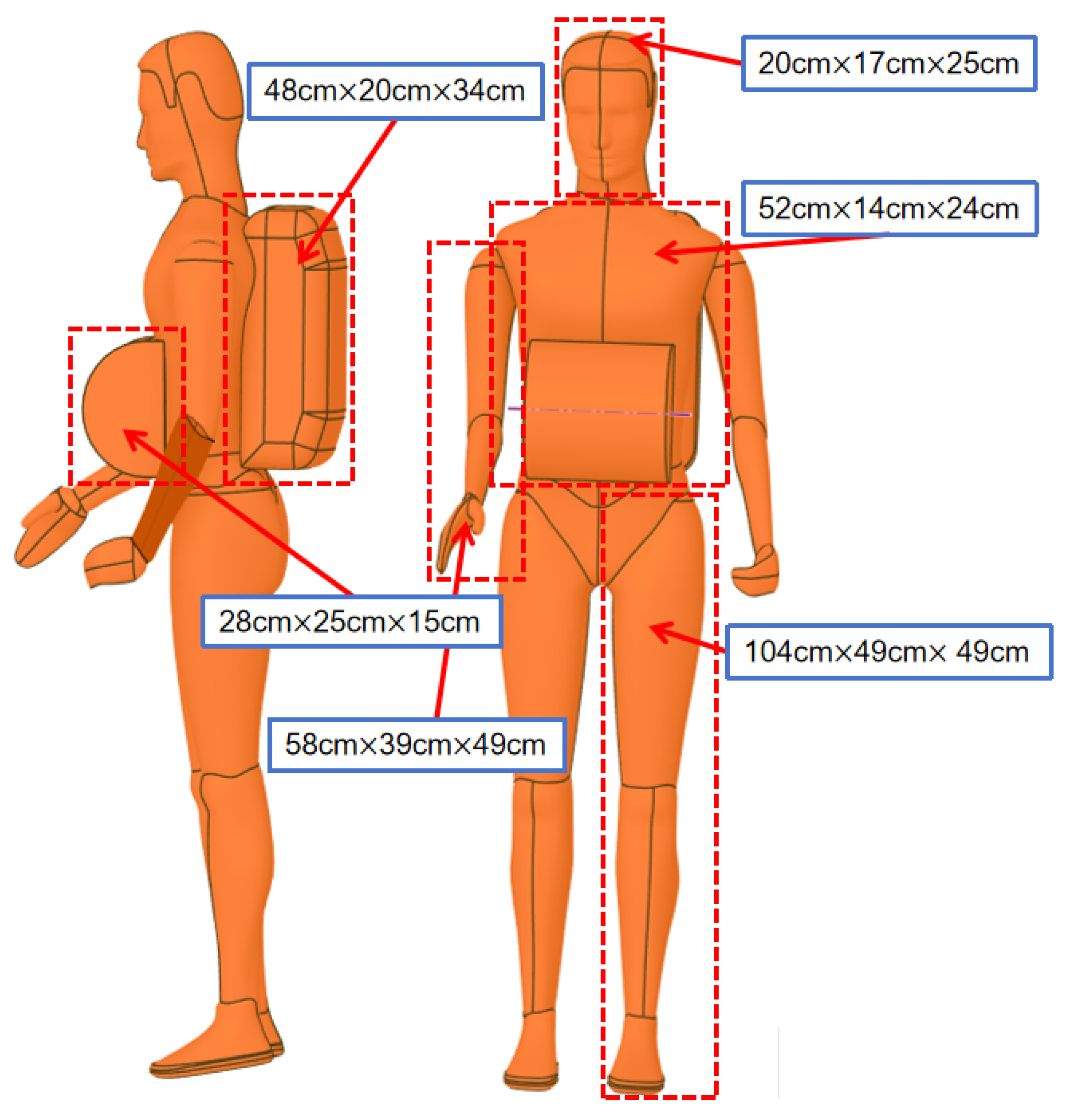
This study focuses on high-speed parachuting dynamics, aiming to determine the variation patterns of pressure during descent and analyze the dynamic changes in turbulence in the flow field around parachutists. The dummy model, as shown in Figure 2, with its parameters listed in Table 1, is subdivided into multiple physiological components (e.g., the head, upper limbs, and lower limbs), each modeled using homogeneous shell elements to accurately simulate the mechanical response of the human body.
Based on simulation analysis, the dummy is meshed using an adaptive mesh combined with coupled membrane structural elements, whose primary function is to simulate the mechanical properties of flexible membrane components in the parachute system. These elements are integrated with a large eddy simulation (LES) and the Euler–Lagrange two-way coupling method to meet the simulation requirements for the parachutist model.
For the membrane structural elements (parachutist and parachute pack), we adopt a Lagrangian framework, moving in real time with changes in wind speed, while for the surrounding air flow field, we employ an Eulerian framework, which is calculated with the adaptive mesh. Their interaction is described with Euler–Lagrange bidirectional coupling, with the adaptive mesh dynamically adapting to the motion of the membrane structural elements.
In addition, the computational domain was designed to ensure sufficient flow development upstream of the parachutist–parachute system, complete wake evolution downstream, and negligible boundary interference while maintaining a reasonable computational cost. In large eddy simulation (LES), the domain size is commonly determined based on the characteristic length of the simulated bluff body.
In this study, the characteristic length L c was defined as the equivalent height of the parachutist–parachute system, which is approximately 1.8 2.0 m . According to LES best practices, the domain dimensions should satisfy the following scaling criteria:
L in 2 L c , L out 3 L c , L lat 2 L c ,
where L in and L out denote the upstream and downstream distances from the model to the inlet and outlet boundaries, respectively, and L lat represents the minimum lateral or vertical distance from the model to the domain boundaries.
Based on the above criteria, the final computational domain was set to 773.54 cm × 500 cm × 518.945 cm in the streamwise, lateral, and vertical directions, respectively. The streamwise length corresponds to approximately 4– 5 L c , ensuring that the incoming flow is fully developed before reaching the model and that the wake and vortex structures can evolve and decay naturally before reaching the outlet boundary. The lateral and vertical extents, each exceeding 2.5 L c , effectively reduce artificial confinement and boundary-induced disturbances, which is particularly important for capturing large-scale vortex structures in high-speed turbulent flows.
The inlet-to-model distance was selected to minimize artificial boundary effects and ensure that the imposed inlet condition does not directly contaminate the near-body flow field. For external bluff body flows, a commonly used criterion is to prescribe an upstream buffer length proportional to a characteristic geometric scale of the body, i.e.,
L in κ L ref ,
where L in is the distance from the inlet boundary to the upstream-most point of the model, L ref is the characteristic length of the parachutist–parachute system (e.g., the maximum projected dimension normal to the inflow), and κ is an empirical factor typically chosen in the range of 2–3 for LES with a uniform velocity inlet when the objective is to resolve near-body separation and wake evolution while maintaining computational efficiency.
In the present setup, L in was set to 2090 mm , and the corresponding non-dimensional spacing is as follows:
Π in = L in L ref .
with the adopted geometry, L ref was taken as the maximum projected dimension of the model normal to the inflow direction, and thus, Π in is on the order of unity to a few, thus satisfying the buffer length requirement in Equation (2). This upstream spacing provides a sufficient relaxation region for the numerical solution and mesh adaptation to attenuate inlet-induced artifacts, thereby preventing spurious reflections or nonphysical gradients near the model.
The adequacy of the selected inlet-to-model distance was further supported by the grid independence study and wind tunnel validation, in which no noticeable inlet-boundary-induced distortion was observed in the pressure and velocity distributions around the parachutist–parachute system.

Control Functions and UDF Settings

In this study, the WALE large eddy simulation (LES) was employed, and the fluid was assumed to be incompressible. The governing equations for the coupled dummy–air system are solved using a coupled implicit algorithm, which integrates the continuity (Equation (4)), momentum (Equation (5)), filtered energy (temperature) (Equation (6)), and other transport equations into a unified system.
· u = 0 ,
u t + u · u = 1 ρ p + · ν + ν s g s u + F ,
ρ c p T t + u · T = · k + k s g s T + S T .
Here, u denotes the filtered velocity vector, p is the filtered pressure, ρ is the fluid density, ν is the kinematic viscosity, and ν s g s is the subgrid-scale eddy viscosity evaluated using the WALE model. T represents the filtered temperature, c p is the specific heat at constant pressure, k is the molecular thermal conductivity, and k s g s denotes the subgrid-scale thermal diffusivity. F and S T represent the momentum and thermal source terms, respectively.
Given the complex aerodynamic characteristics of the parachutist–parachute system, this study integrates fluid–structure interaction and the subgrid-scale viscosity of large eddy simulations by using User-Defined Functions (UDFs), thus providing a numerical basis for system optimization. The core mechanism is the use of an adaptive mesh refinement strategy combined with large eddy simulation for the bidirectional coupled simulation of the parachute flow field. Based on the instantaneous flow field information, the aerodynamic drag acting on the parachute and dummy is evaluated in real time to update the solid motion state. Subsequently, the reaction force from the dummy is converted into an equivalent momentum source term and fed back into the fluid domain, thus completing the bidirectional coupling process.
The subgrid-scale viscosity ν s g s appearing in Equation (5) is evaluated using the WALE model with a model constant C w = 0.5 and a filter width defined as Δ = V 1 / 3 , where V is the local cell volume. Corrections are applied based on the flow characteristics at a Mach number of 0.2, which enables the accurate capture of the influence of small-scale turbulence structures on parachute deployment stability and dummy attitude.
The UDFs are automatically called at each time step ( Δ t = 0.05 s , total duration of 5 s ) to perform two main computational tasks. First, a strain rate invariant S r , derived from the local velocity gradient tensor, is evaluated to identify high-shear regions in the flow field. The velocity gradient tensor u is decomposed into its symmetric and antisymmetric components as follows:
S = 1 2 u + u T , Ω = 1 2 u u T ,
and the strain rate invariant is defined as
S r = i , j S i j 2 + Ω i j 2 1 / 2 .
Cells with S r > 8.0 × 10 3 s 1 are identified as high-shear regions and stored in user-defined memory for flow diagnostics and transition localization.
Subsequently, localized momentum source terms are introduced in predefined regions to promote physically realistic vortex development and avoid excessive numerical laminarization in LES. The body force perturbation applied in the momentum equations takes the following form:
f ( x , t ) = A sin ( 2 π f t ) e z ,
where A and f denote the perturbation amplitude and characteristic frequency, respectively, and z is the vertical coordinate. The UDF also accesses local flow variables, such as air velocity and density, to evaluate aerodynamic forces, which are converted into equivalent momentum source terms and fed back into the governing equations. This formulation establishes a weakly coupled feedback mechanism, enabling a physically consistent simulation of the interaction between the airflow and the dummy from aircraft exit to stable descent.

2.2. Simulation Settings

2.2.1. Network Settings

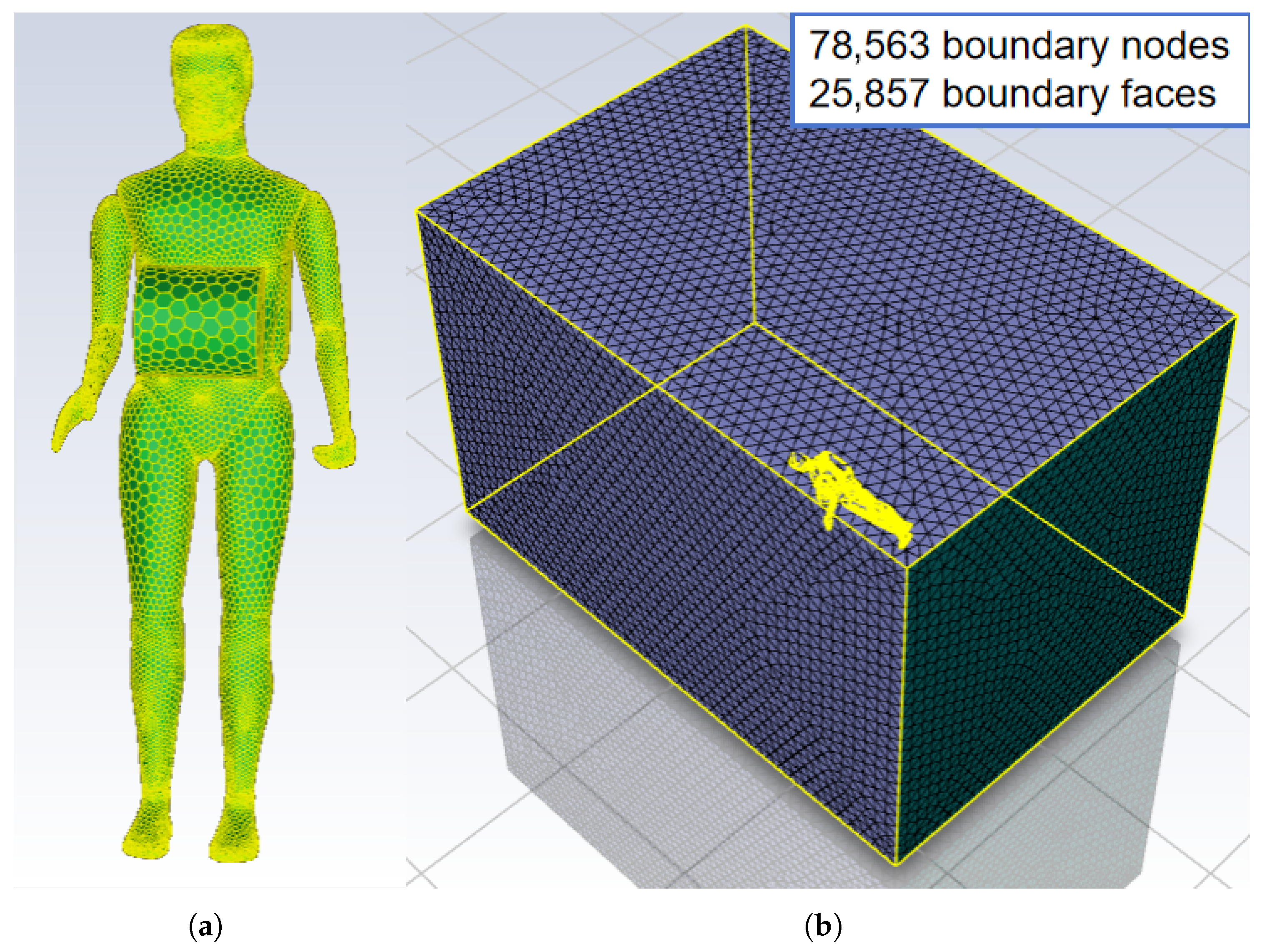
In mesh generation, we adopt a Lagrangian mesh for the dummy body, while for the air domain, we employ an Eulerian mesh, with local refinement being applied around the dummy to accurately capture stress and strain variations, particularly at joints and gaps. Figure 3 illustrates the surface mesh of the model. Considering the complex geometry of the dummy model, the volume mesh type is selected as polyhedral, with the maximum cell size set to 250 mm and a growth rate controlled at 1.2, to accommodate the complex shape and enhance computational efficiency. The minimum mesh size is set as 7.55 mm.
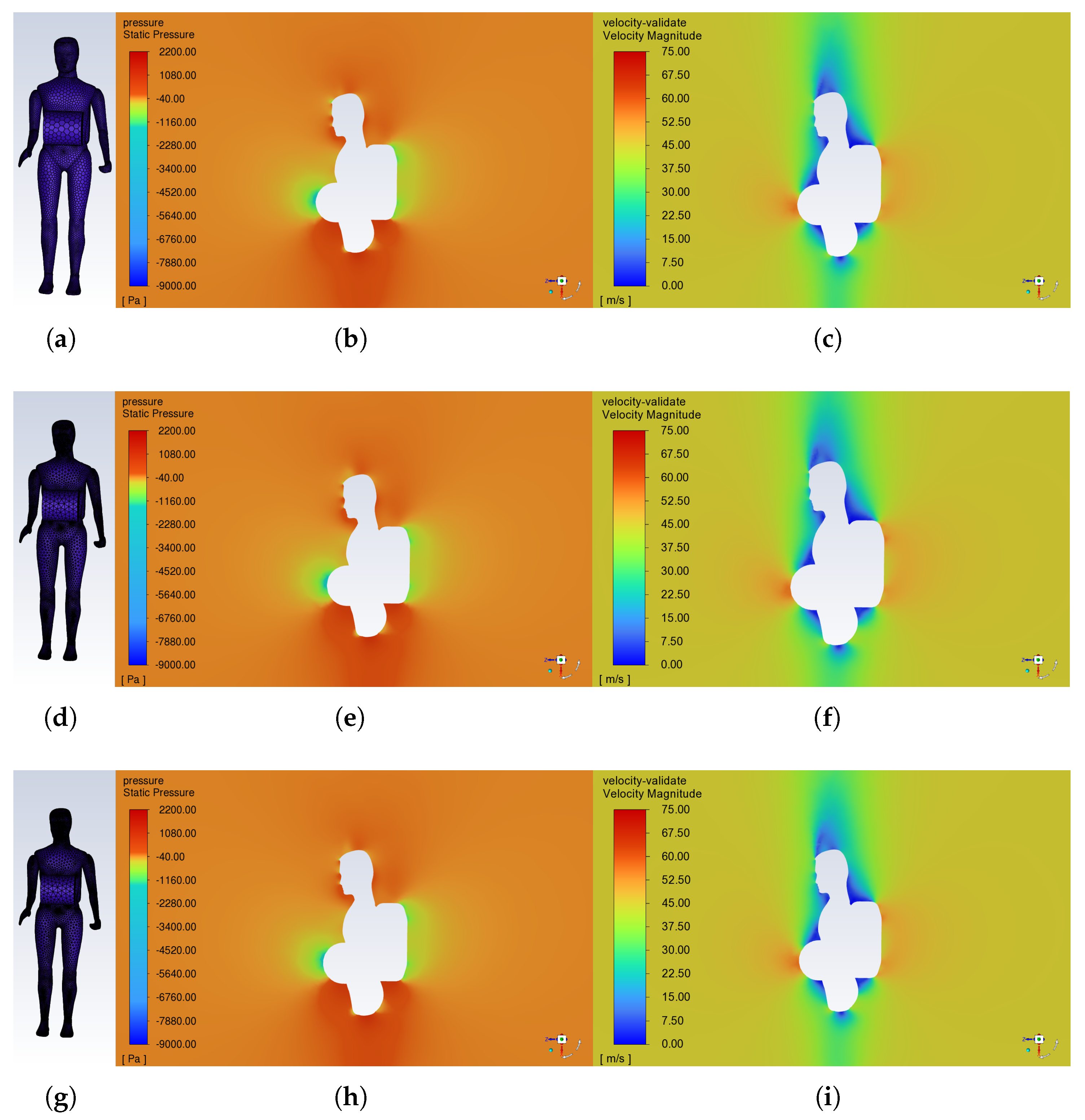
An adaptive mesh strategy is applied to dynamically adjust the mesh density based on the flow field characteristics, with focused refinement around the parachute pack area to capture the evolution of turbulence structures and low-pressure regions. This mesh system provides accurate flow field inputs for the membrane structural elements (representing the parachutist and parachute pack); this enables us to precisely calculate their mechanical responses and obtain a fully coupled simulation of “flow field structure–carrier,” which offers reliable data support for risk assessment during parachute deployment. To ensure the validity of the simulation results, mesh independence was verified for the numerical model. As shown in Figure 4, the surface mesh size was progressively refined, thus leading to a corresponding increase in the total number of grid cells around the dummy. The accompanying mesh refinement illustrations demonstrate the gradual densification of the body surface mesh. As the mesh resolution increases, the pressure and velocity distributions on the dummy’s torso exhibit no significant variation, with the differences in characteristic pressure and velocity values remaining within 2–5%. Based on these results, it can be concluded that the adopted mesh density is sufficient to ensure the accuracy and reliability of the simulations.
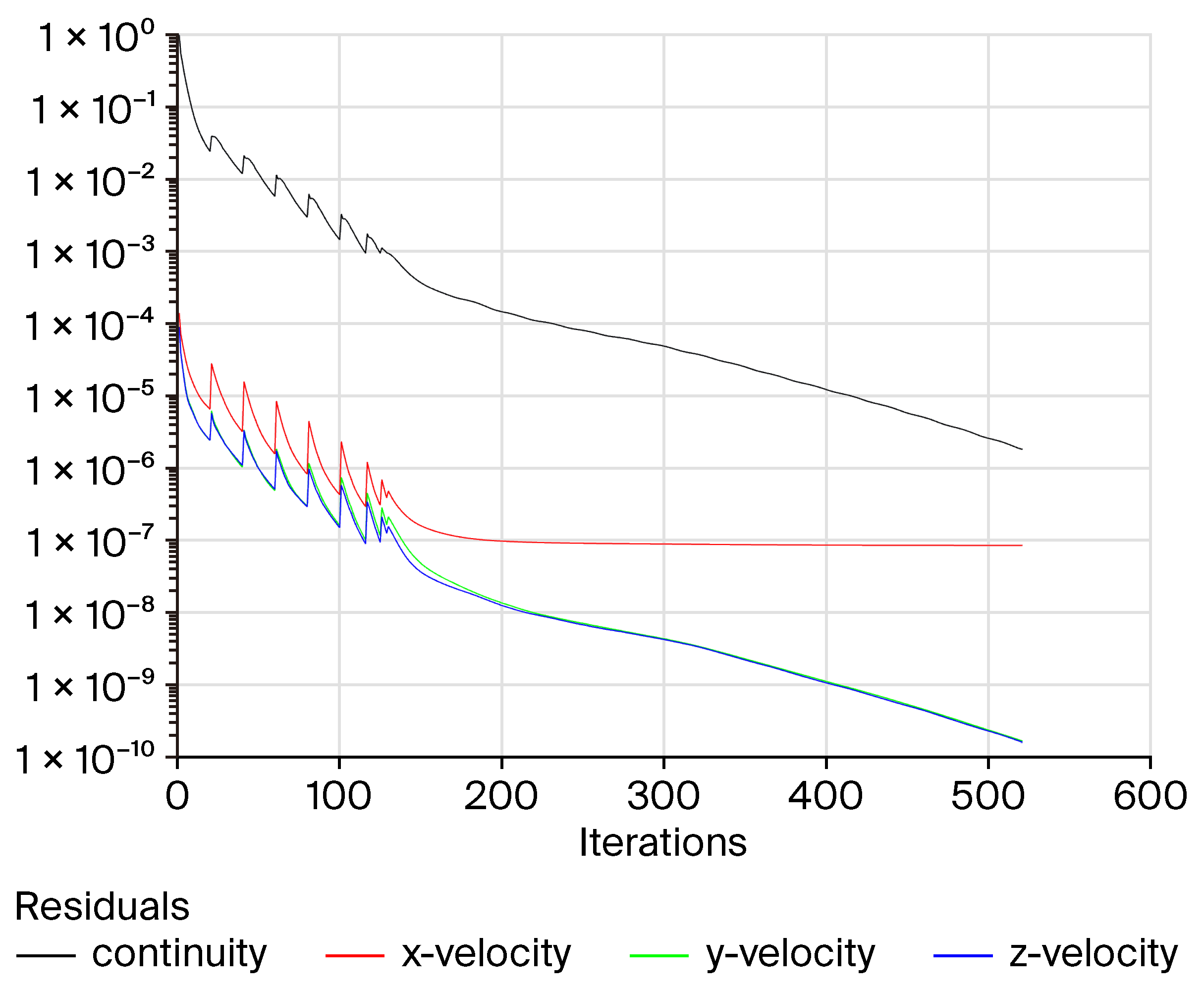
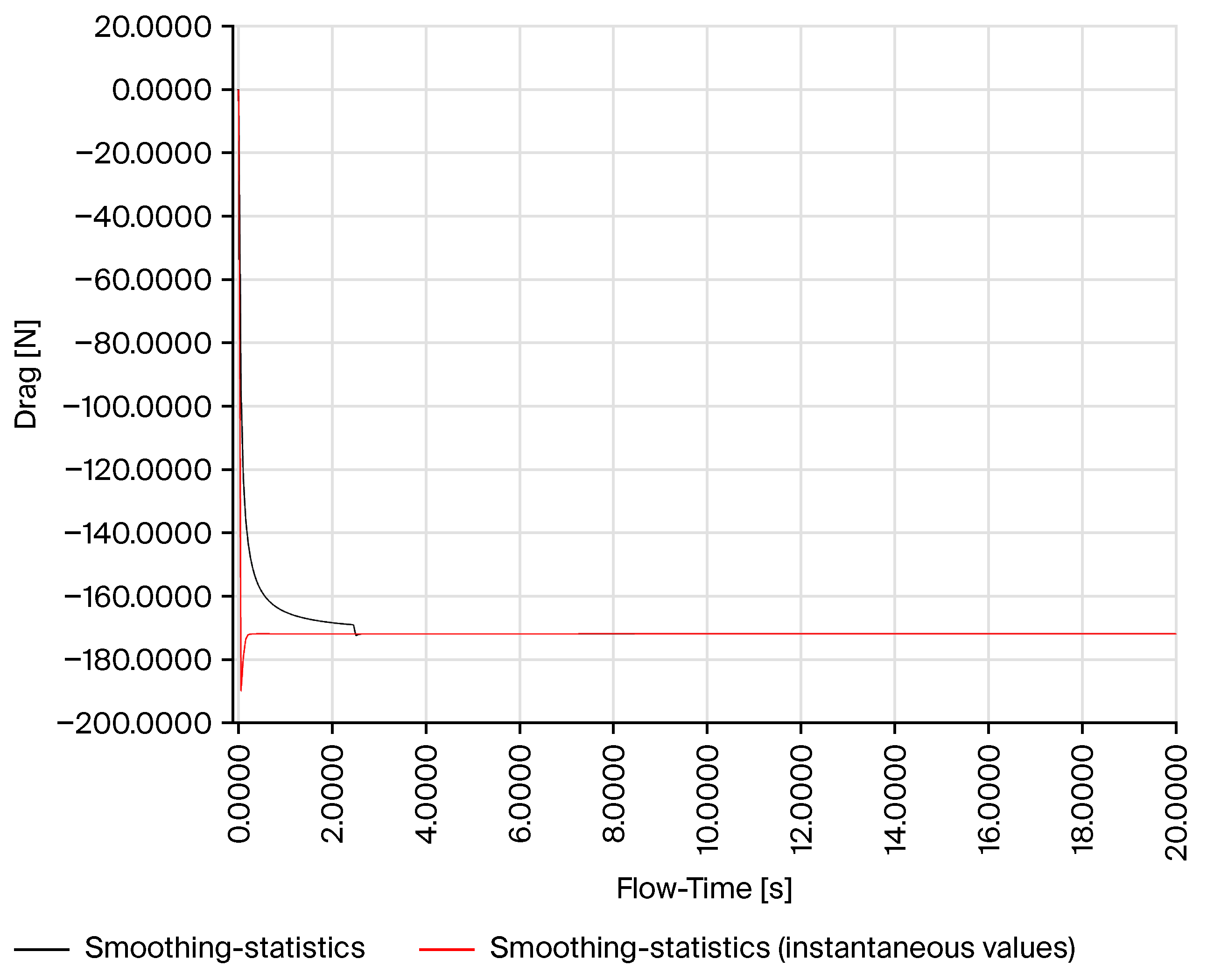
To further demonstrate numerical convergence and statistical stability, the residual history and monitored physical quantity are presented in Figure 5 and Figure 6.
Figure 5 displays the residual convergence histories of the governing equations. The residuals decrease by several orders of magnitude throughout the iterations and subsequently remain at low levels, thus indicating that the discretized equations are adequately satisfied and that the solver exhibits stable numerical behavior.
Given that the present simulations employ a transient LES framework, residuals are not expected to converge to perfectly flat asymptotic values as they do in steady-state computations. Instead, convergence is evaluated based on sufficient residual reduction within each physical time step. The observed oscillatory behavior is therefore consistent with the inherent unsteadiness of LES and does not indicate numerical divergence.
Figure 6 shows the time history of the drag force acting on the human body. The black curve represents the smoothed (time-averaged) drag force, while the red curve denotes the instantaneous drag force obtained at each time step. After an initial transient adjustment stage, both curves approach a nearly constant level, thus indicating that the monitored aerodynamic force reaches statistical stabilization. This behavior confirms that the unsteady LES solution has developed into a physically consistent regime suitable for data analysis.
Taken together, the reduction in residuals and the statistical stabilization of the monitored drag force confirm that the numerical solution achieves sufficient convergence for the subsequent flow field analysis.

2.2.2. Boundary Conditions and Material Settings

The boundary conditions and material parameters were set as shown in Table 2. The inlet velocity was initially set to 30 m/s to simulate a typical moderate descent speed; to investigate the influence of velocity, the subsequent comparisons were conducted with conditions of 40 m/s and 50 m/s. For the parachutist’s body surface, we employed a no-slip boundary condition to accurately simulate the viscous effects of air. Sufficient distance was reserved between the inlet and model to ensure fully developed flow.
The key parameters of the solver, i.e., the under-relaxation factors for pressure, density, body force, and momentum, are set to 0.3, 1, 1, and 0.7, respectively. Among these, the low relaxation factor for pressure is adapted to the SIMPLE algorithm, thus aiding in the stability of the pressure/velocity coupling. The factor of 1 for density and body force conforms to the incompressible flow assumption and ensures the direct effect of gravity. Finally, the factor of 0.7 for momentum promotes convergence while maintaining transient accuracy.
We employ the SIMPLE algorithm for pressure/velocity coupling, and for the flux type, we use the distance-based Rhie–Chow scheme to enhance the accuracy of pressure gradient calculation on complex geometries with non-orthogonal grids, thus supporting the accurate capture of large-scale turbulence structures with LESs.
For spatial discretization, we adopt second-order schemes for gradient, pressure, and momentum to achieve high accuracy and prevent numerical dissipation. For temporal discretization, we use a second-order implicit scheme to balance computational efficiency with the resolution accuracy of transient flow. The density of the human body material is set to 1.03 g/cm3.

3. Wind Tunnel Validation

To verify the accuracy of the high-speed airdrop simulation model and ensure its capability to precisely simulate the conditions of turbulence formation, wind tunnel experiments were conducted to simulate the aerodynamic environment experienced by parachutists at different lateral and descent velocities during airdrops. Prior to the experiments, the wind tunnel was calibrated using standard velocity and pressure calibration procedures to ensure measurement accuracy. The flow quality of the wind tunnel test section was carefully controlled, and the turbulence intensity at the center of the test section was maintained below 1%. This low turbulence level ensures stable and uniform inflow conditions, which is essential for reliable aerodynamic measurements and consistent comparison with numerical simulations. In addition, the blockage ratio was evaluated to assess the influence of the model on the wind tunnel flow. The upper bound projected frontal area of the model was approximately 0.084 m 2 , while the cross-sectional area of the wind tunnel test section was approximately 7.065 m 2 , corresponding to a tunnel radius of 1.5 m. Therefore, the blockage ratio was calculated to be about 1.19%, which is well below the commonly accepted limit of 5% for wind tunnel experiments. This low blockage ratio ensures that the blockage effect is negligible and does not affect the accuracy of the experimental results. The experimental dummy was equipped with a main parachute pack, and six altimetric pressure sensors were installed on the dummy’s surface. The altitude, which is the air pressure value measured with the sensors, is calculated according to the following formula:
P = P 0 ( 1 L · h T 0 ) g 0 · M R u · L
In this equation, P is the atmospheric pressure at the target altitude; P 0 is the standard sea-level pressure, which is approximately 101,325 Pa; L is the temperature lapse rate, at 0.00649 K/m; T 0 is the sea-level temperature, at 288.15 K; g 0 is the gravitational acceleration, at 9.80665 m/s; M is the molar mass of dry air under the International Standard Atmosphere (ISA), taken as 0.0289644 kg/mol; R u is the universal gas constant, which is 8.31447 J/(mol·K); and h is the altitude (m).
For each set of experiments, three wind speed levels (30 m/s, 40 m/s, and 50 m/s) were set. Under each wind speed condition, stable operation was maintained for one minute, and the tests were conducted three times to calculate the average value, thereby ensuring the stability and representativeness of the data. Pressure data were converted into relative altitude indices by using the standard pressure–altitude conversion formula, thus aiding in the quantitative analysis of flow field pressure. In the experiments, we placed particular emphasis on pressure variations in the parachute and its surrounding area.

3.1. Lateral Velocity Validation

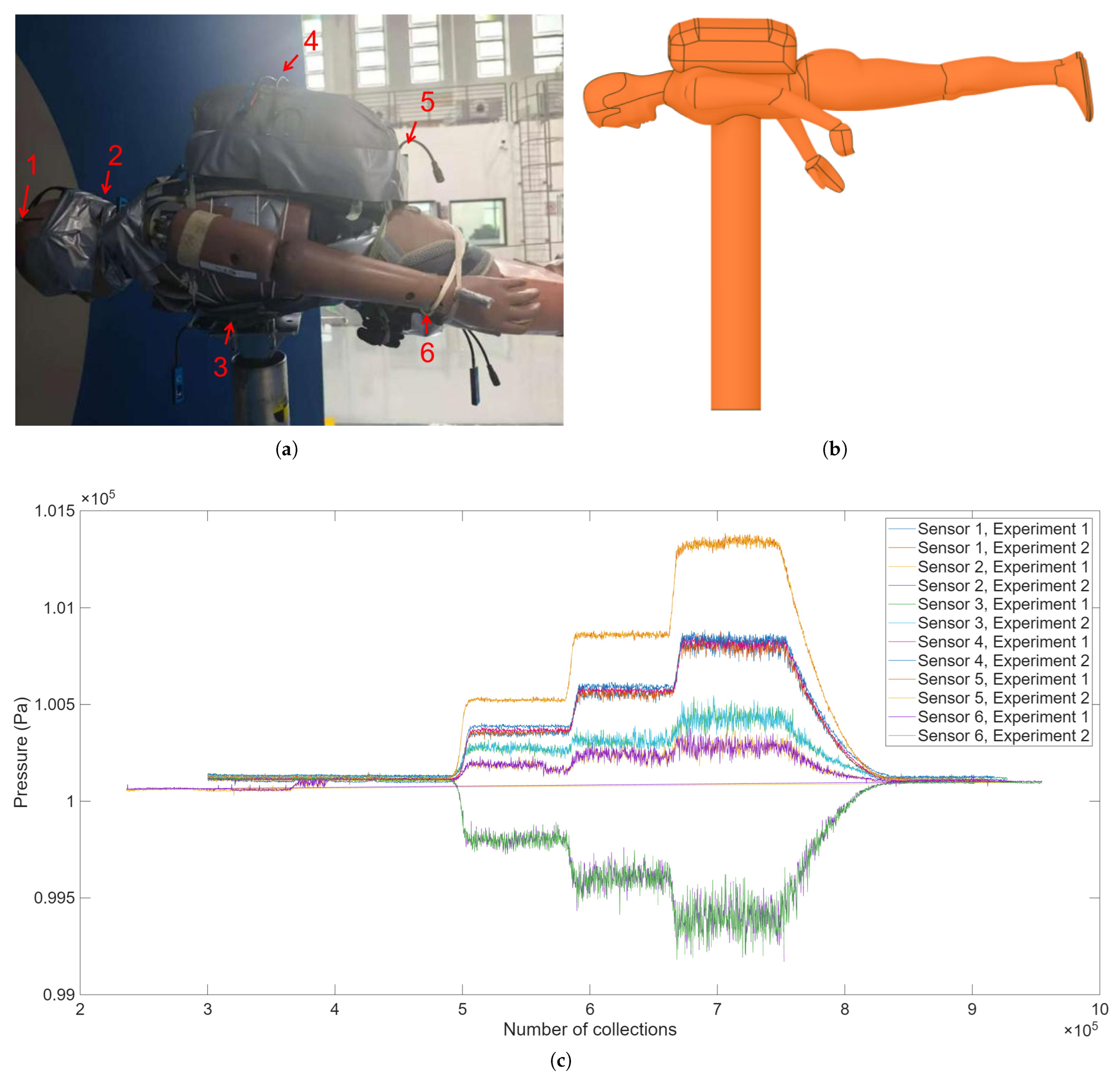
Wind tunnel tests were conducted to validate the lateral wind velocity, with the dummy facing the wind direction and being tilted upward by 12° to simulate actual airdrop scenarios under crosswind conditions. As shown in Figure 7a, sensors were sequentially placed on the dummy’s head (at the top), neck, thoracic center, abdomen, right lumbar region, and lower abdomen, corresponding to numbers 1 to 6.
In the experiment, the wind tunnel speed was increased incrementally. When the speed reached 30 m/s, it was maintained steadily for one minute, during which pressure data around the dummy were collected. After one minute, the wind speed was further increased to 40 m/s and maintained for the same duration, and the data were recorded. Subsequently, the wind speed was increased again to 50 m/s and held for one minute, and the experiment was then concluded. This process was repeated twice to ensure accuracy, and the experimental results are presented in Figure 7c.
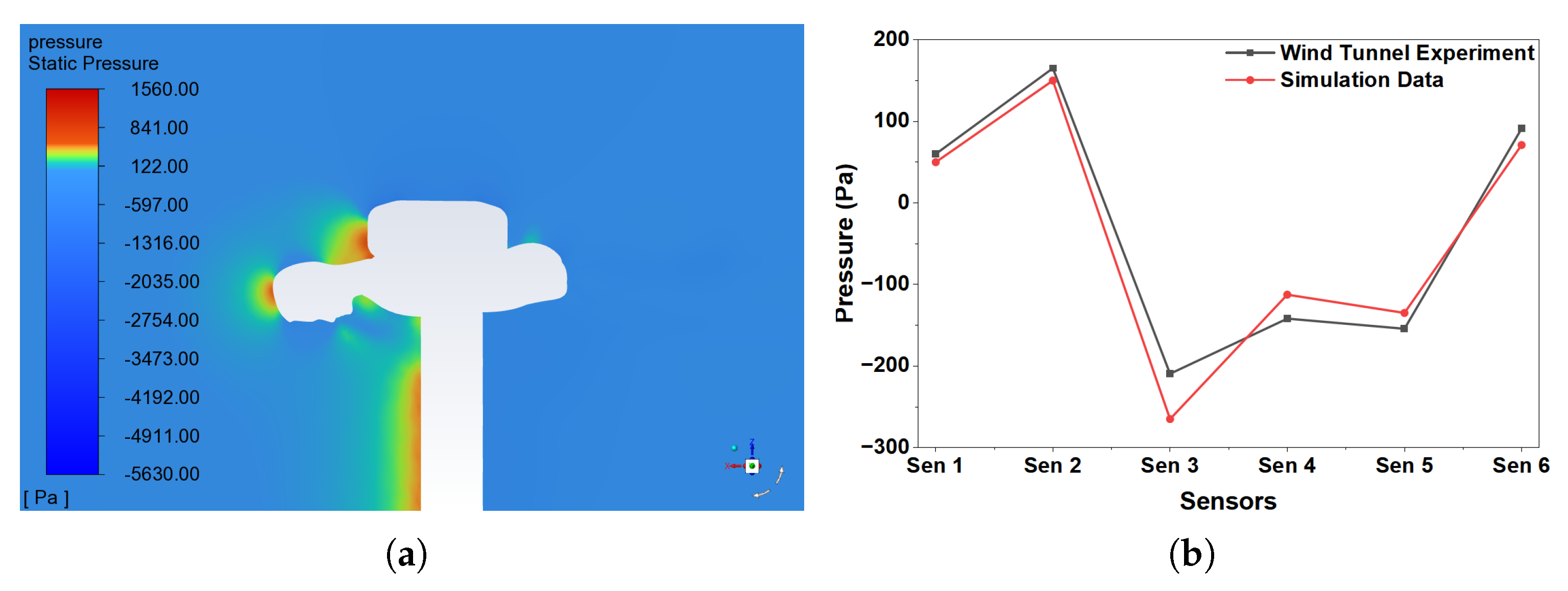
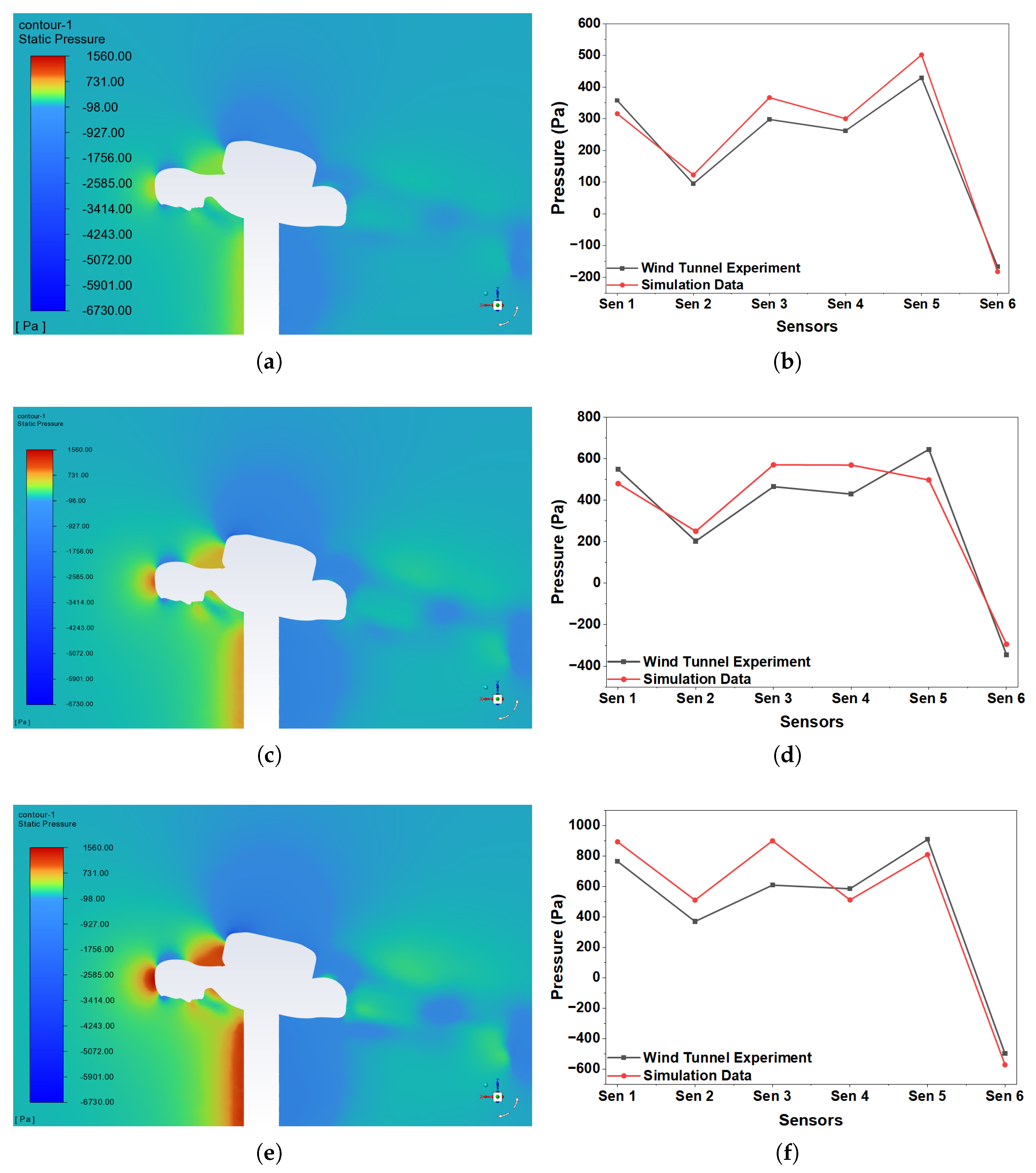
Further, a numerical model corresponding to the dummy used in the wind tunnel tests (Figure 7b) was established and simulated, and its accuracy was verified by adjusting the parameters of the subgrid-scale viscosity module, including model constant C w and filter width Δ = (cell volume)(1/3), by using UDFs. The simulation results are shown in Figure 8a,c,e.
The experimentally measured pressure curves and the data extracted from the flow field simulation contours were compared, and the results are presented in Figure 8b,d,f.
According to the comparison chart of the wind tunnel experiments and simulation data, under the 30 m/s wind speed condition, the measured pressure values of sensors 1 to 6 are 357.76 Pa, 95.30 Pa, 298.0 Pa, 262.26 Pa, 429.4 Pa, and −166.6 Pa, respectively, while the corresponding simulation results are approximately 316.21 Pa, 123.13 Pa, 366.9 Pa, 300.45 Pa, 501.62 Pa, and −182.15 Pa, respectively. The degrees of similarity between them are 88.33%, 77.46%, 81.24%, 87.42%, 85.61%, and 91.21%, respectively, with sensors 1, 4, 5, and 6 exhibiting agreement exceeding 85%.
When the wind speed increases to 40 m/s, the measured pressure values exhibit an overall rising trend, and the similarity between the simulation data and the measured values shows a differentiated pattern: the accuracy of both sensors 1 and 6 remains above 85 % , while the consistency of sensors 4 and 5 decreases to 75.43 % and 77.19 % , respectively.
When the wind speed increases to 50 m/s, the simulation accuracy of sensors 1, 4, 5, and 6 exceeds 85 % , while a notable deviation is observed in sensor 3 (a measured value of 608.8 Pa vs. a simulated value of 900 Pa, with a similarity of only 67.64 % ), thus indicating that the model tends to overestimate the high-speed vortices in this region.

3.2. Descent Velocity Validation

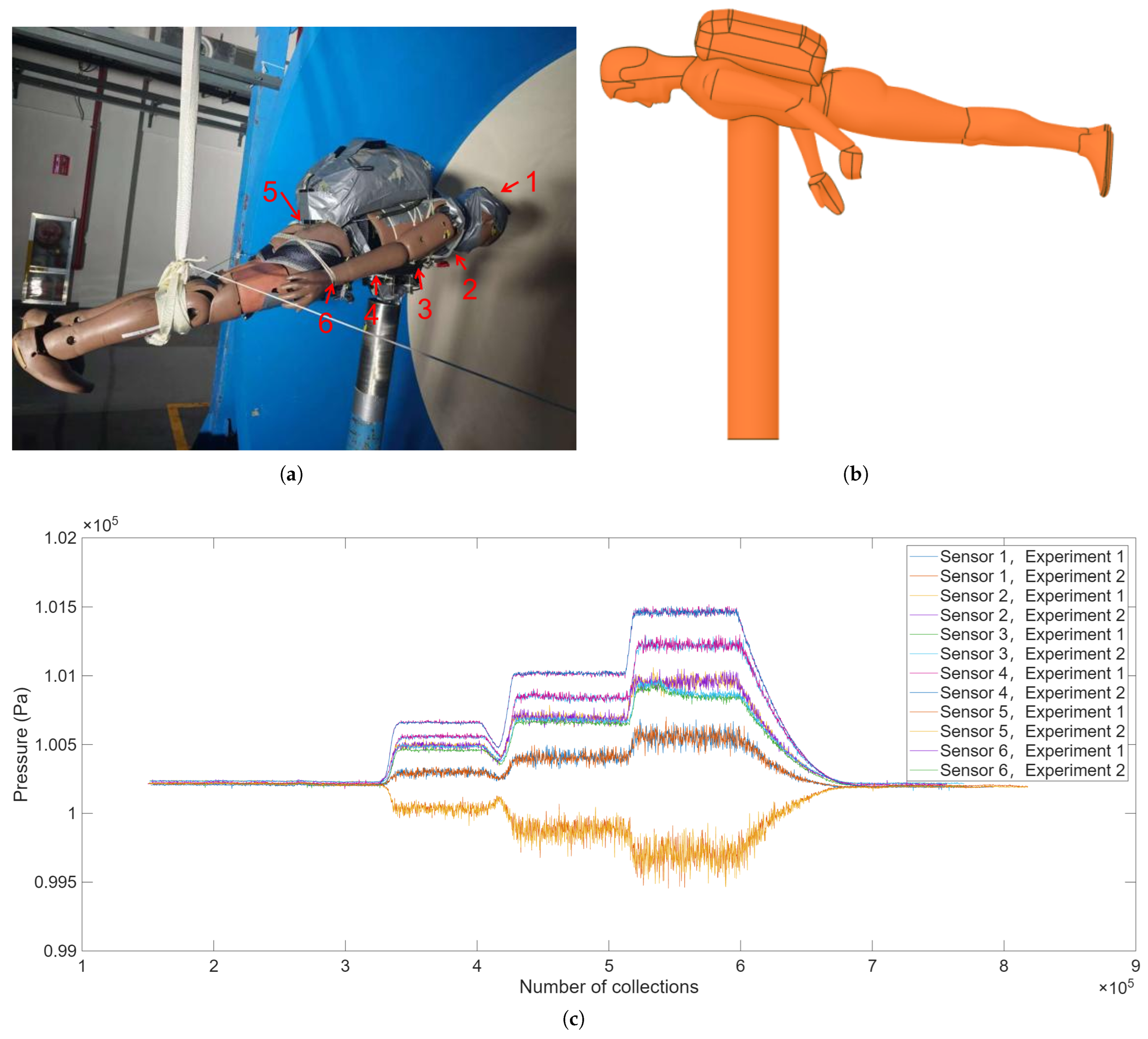
Wind tunnel experiments were conducted to validate the descent speed. During the experimental procedure, as shown in Figure 9a, sensors were sequentially placed at the top of the head, at the back of the head, at the center of the chest, at the center of the parachute, at the bottom of the parachute, and on the lower abdomen, corresponding to numbers 1 to 6. The experimental steps were the same as those described in Section 3.1 for lateral velocity validation, and the results are presented in Figure 9c.
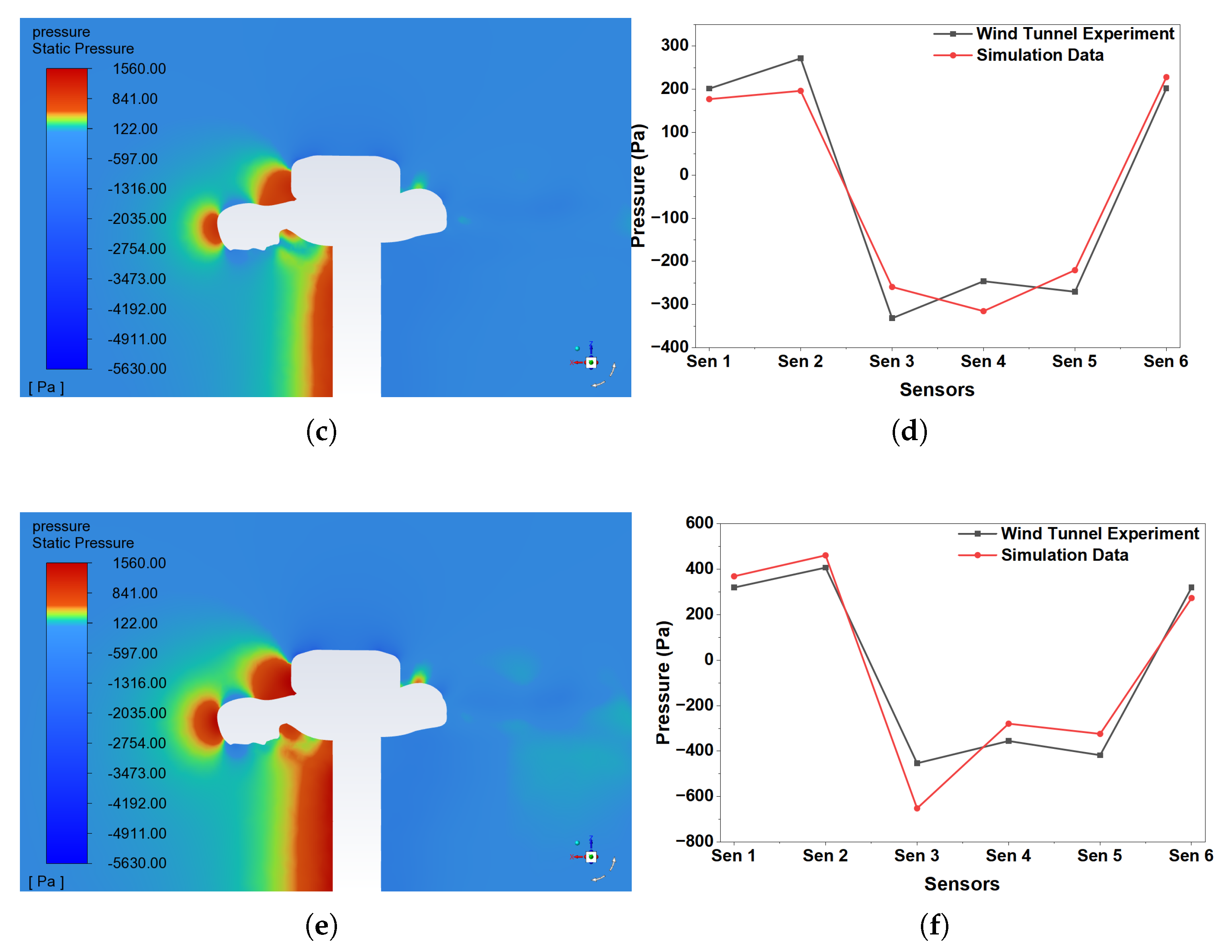
A model identical to the dummy used in the wind tunnel tests (Figure 9b) was established and simulated to verify the accuracy of the simulation, with the results being shown in Figure 10a,c,e. The data from the wind tunnel experiments and the simulation were extracted and compared, and the results are presented in Figure 10b,d,f.
Pressure data were collected with six sensors distributed across various locations on the dummy under the wind speed conditions of 30 m/s, 40 m/s, and 50 m/s, and they were then compared with the simulated values from the WALE large eddy simulation model. The results indicate that the similarity for all sensors exceeded 70 % at each wind speed. Specifically, at 30 m/s, the similarity for sensor 2 reached 90.90 % , and under the 50 m/s condition, multiple sensors exhibited similarity levels above 85 % .

3.3. Conclusions Drawn from Experiments

According to the validation of the lateral and descent velocities of the parachute dummy, the similarity between the experimental and numerical results remained within the range of 75 % to 90 % under various conditions, with only a small portion falling below this interval. In this study, the similarity was defined as the ratio of the smaller value to the larger value between the experimental and simulation results, which reflects the level of agreement between the two datasets.
The corresponding deviations are therefore approximately within the range of 10 % to 25 % , which are considered acceptable for high-speed turbulent flow experiments involving complex separated flow and vortex structures. These deviations mainly arise from inherent experimental uncertainties, turbulent flow unsteadiness, and numerical modeling assumptions.
Overall, the high similarity and acceptable deviation range demonstrate the accuracy and reliability of the simulation model and provide substantial experimental confidence and data support for subsequent research on turbulence formation.

4. Simulation Data Results

4.1. Lateral Velocity Analysis

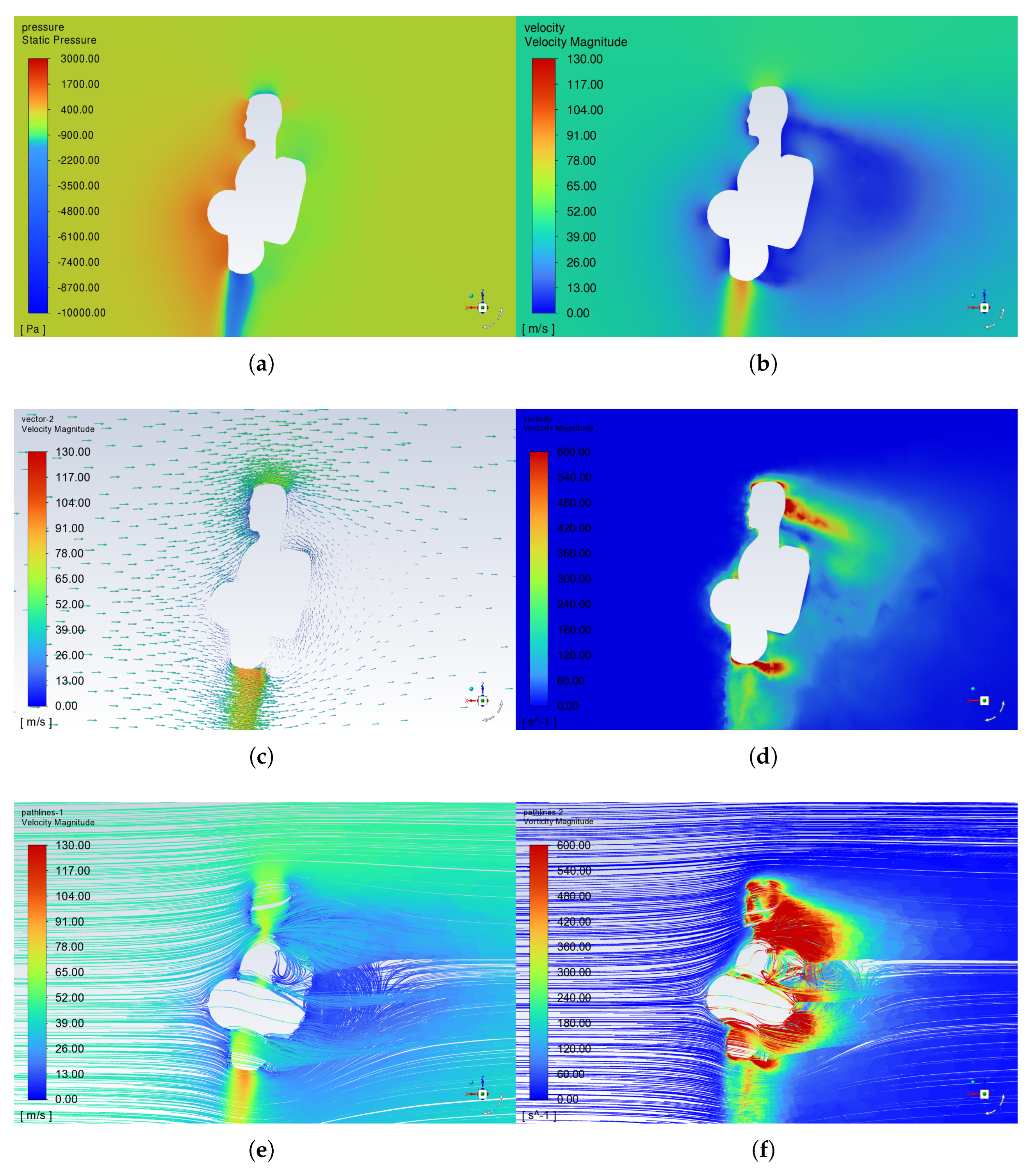
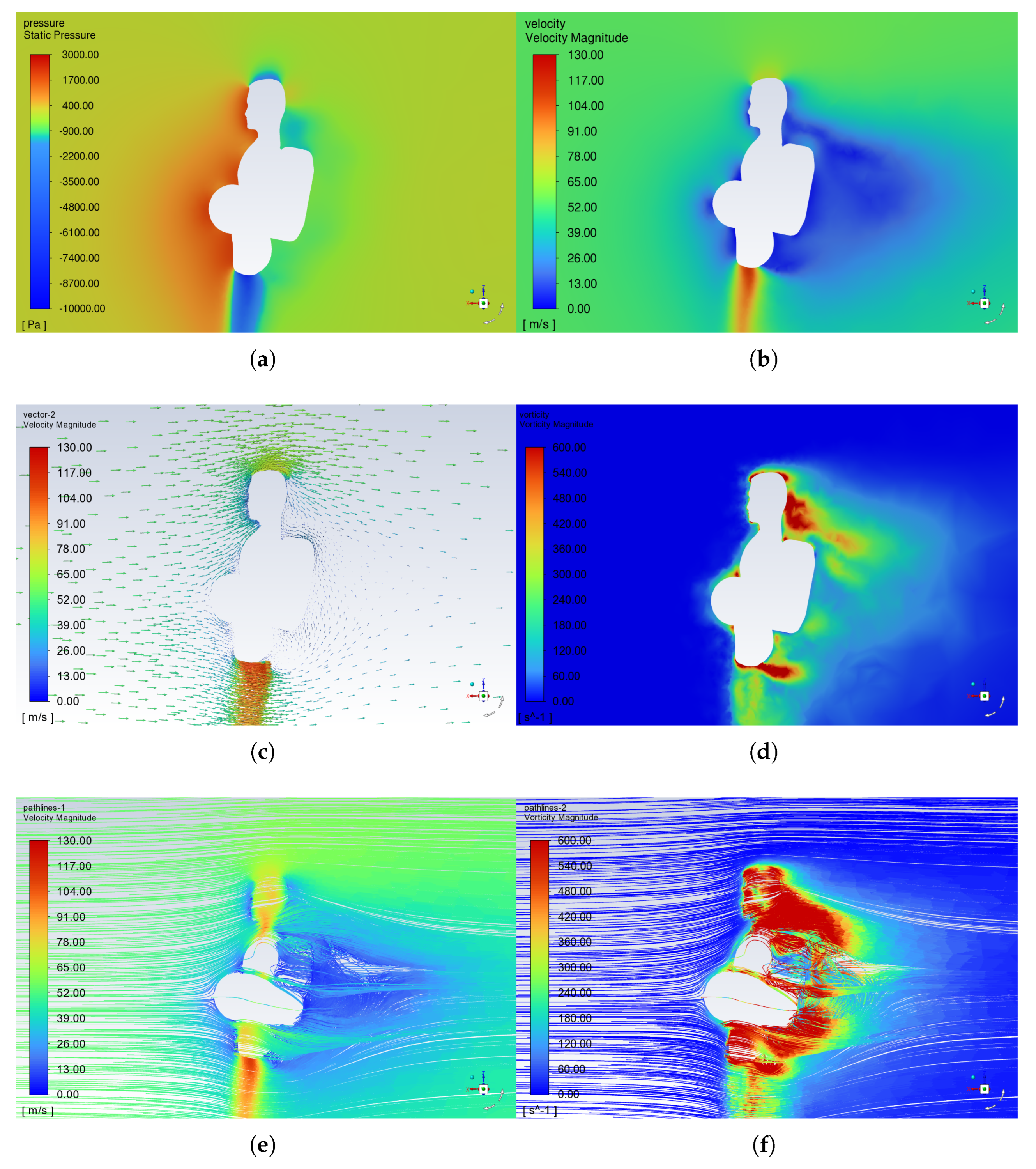
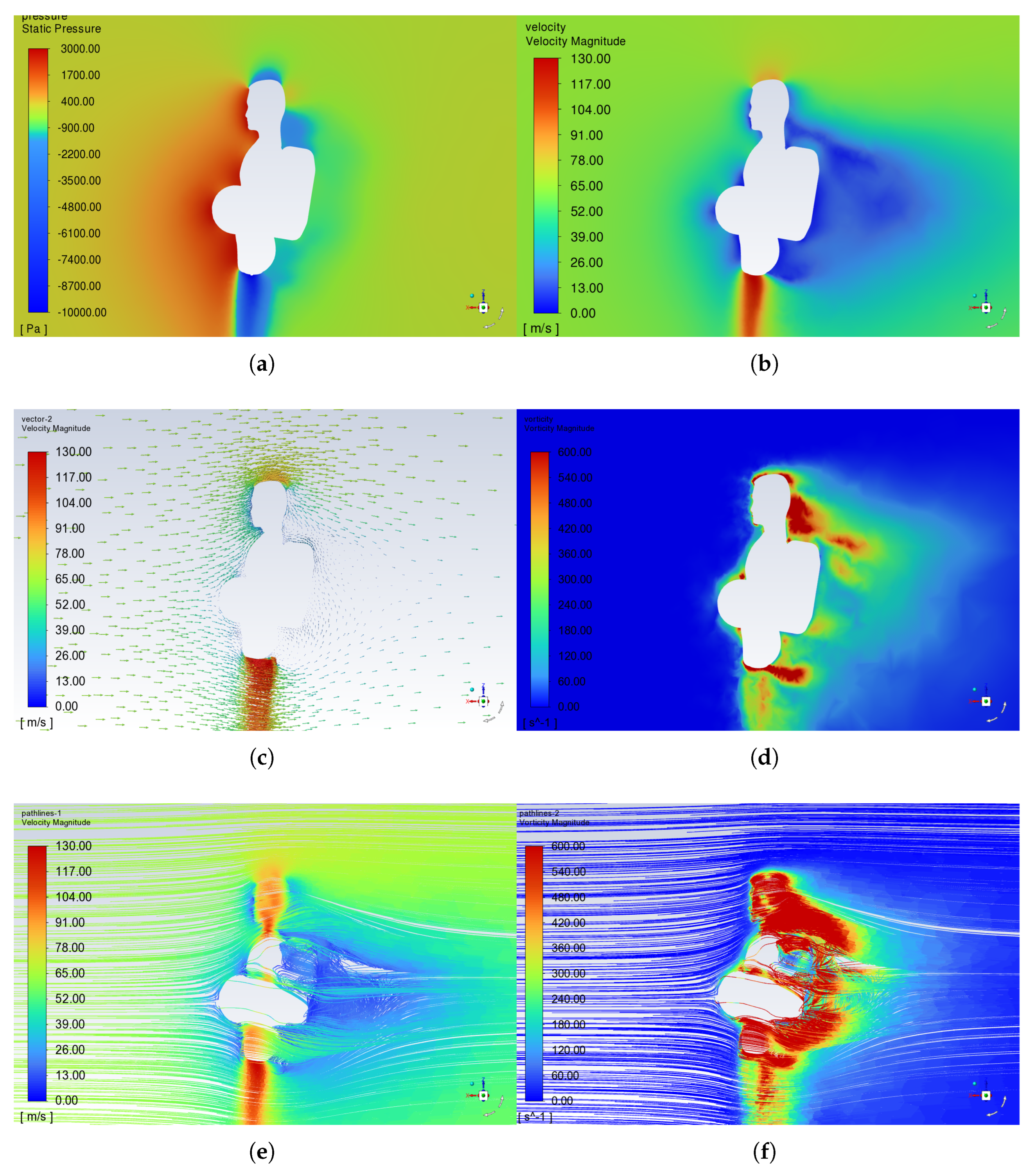
Simulations were conducted for different lateral speed values (45 m/s, 55 m/s, and 65 m/s) immediately after the dummy left the aircraft, combined with a descent speed of 10 m/s. These lateral velocity values were selected based on realistic high-speed airdrop conditions and safety analysis. Previous experimental observations and operational experience indicate that vortex formation and deployment instability become significant when the relative flow velocity approaches approximately 55 m/s. Therefore, 45 m/s was chosen to represent a sub-critical stable condition, 55 m/s corresponds to the critical transition condition, and 65 m/s represents a high-risk condition with strong vortex formation. This velocity range enables systematic investigation of the evolution of vortex structures and their influence on parachute deployment stability. Velocity (V) can be equivalently expressed as the vector sum of the lateral speed and the initial descent speed, forming an angle θ with the vertical descent direction, where tan θ = V l V d , V l is the lateral velocity, and V d is the descent velocity. The simulation results are illustrated in Figure 11, Figure 12 and Figure 13.
Under lateral inflow conditions, the flow field around the parachute pack exhibits pronounced asymmetry, with pressure, velocity, and vortical structures being strongly dependent on the lateral velocity magnitude. The introduction of pathline visualization further clarifies the evolution of flow separation and wake development.
At a lateral velocity of 45 m/s, the pressure field shows a localized positive-pressure region on the windward side and a relatively limited low-pressure region in the wake. The velocity vectors indicate that the boundary layer remains largely attached along the windward surface, with only weak separation near geometric transitions. This behavior is confirmed by the pathlines, which remain smooth and mostly aligned with the freestream direction, showing only minor curvature and limited recirculation behind the body. The velocity gradients are moderate, and vorticity is confined to thin shear layers close to the surface, thus indicating a low level of turbulent fluctuation and a relatively stable aerodynamic environment for parachute deployment.
When the lateral velocity increases to 55 m/s, the asymmetry of the flow field becomes more pronounced. The velocity vectors reveal the expansion of separated shear layers on the leeward side, accompanied by coherent vortical structures in the wake. Pathline visualization shows the clear bending and clustering of trajectories downstream, thus indicating the formation of recirculation zones and enhanced mixing. The vorticity magnitude increases and extends downstream, while the low-pressure region expands accordingly. These features indicate that the flow approaches a transitional regime, in which unsteady aerodynamic effects become significant and the sensitivity of parachute deployment to disturbances increases.
At a lateral velocity of 65 m/s, strong flow separation dominates the leeward side of the parachute pack. Large-scale vortices with high vorticity intensity develop and persist in the wake. This behavior is clearly illustrated by the pathlines, which exhibit pronounced entanglement, spiral motion, and extended reverse-flow regions downstream of the body. The pressure field shows a strong contrast between the windward high-pressure region and the extensive downstream low-pressure zone. This vortex-dominated and highly unsteady flow regime is expected to induce large and rapidly varying aerodynamic loads on the parachutist, thus substantially increasing the risk of unstable or failed parachute deployment.

4.2. Descent Velocity Analysis

The terminal velocity of a parachutist in free fall is typically limited by air resistance. As the parachutist descends from a high altitude, air resistance gradually increases with velocity, and when air resistance balances the gravitational force, the descent velocity stabilizes at a relatively constant value, which is known as the terminal velocity. During free fall, once air resistance and gravity reach an equilibrium, the human body’s limiting velocity generally fluctuates between 50 and 60 m/s, which is equivalent to 180–216 km/h.
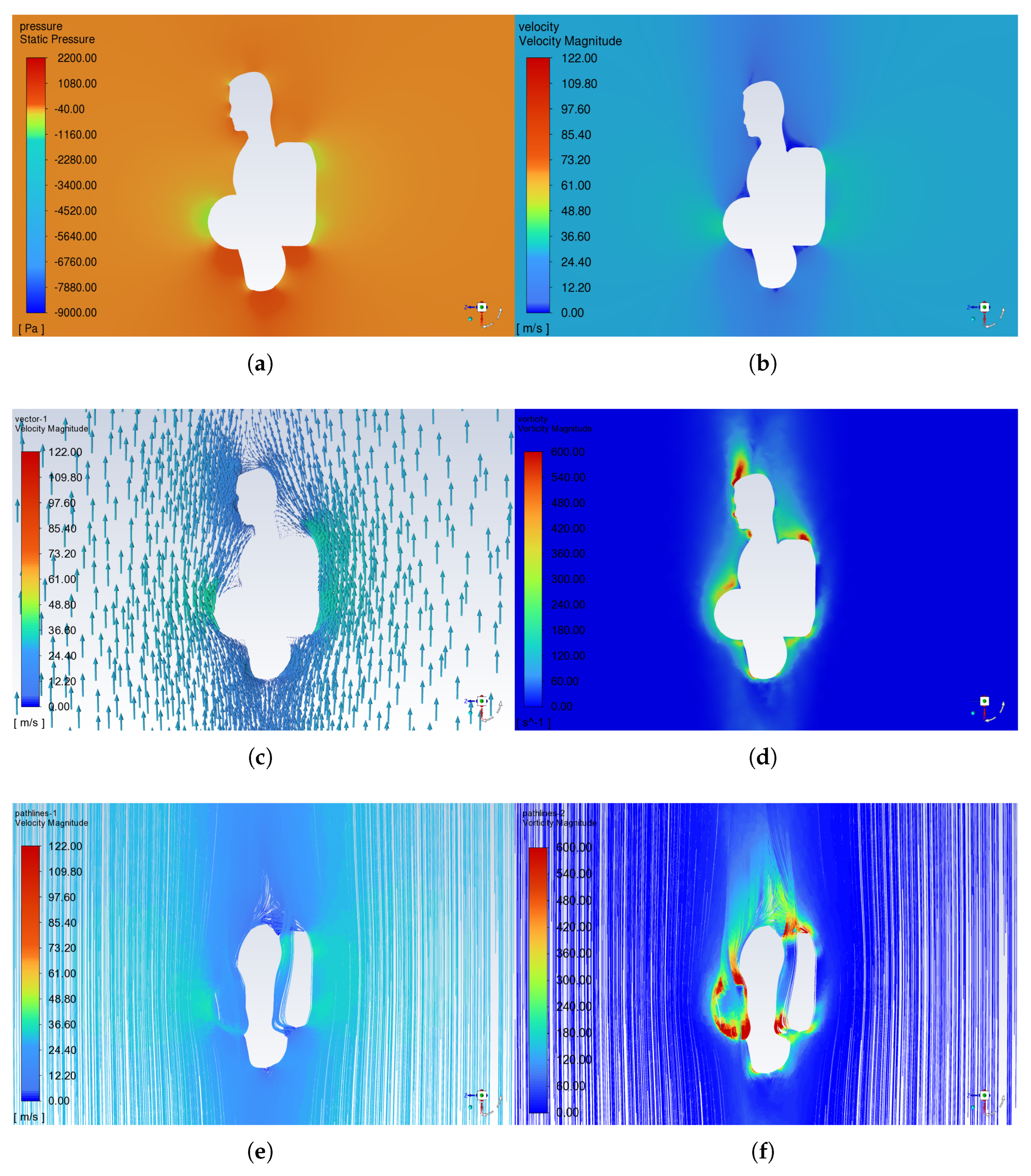
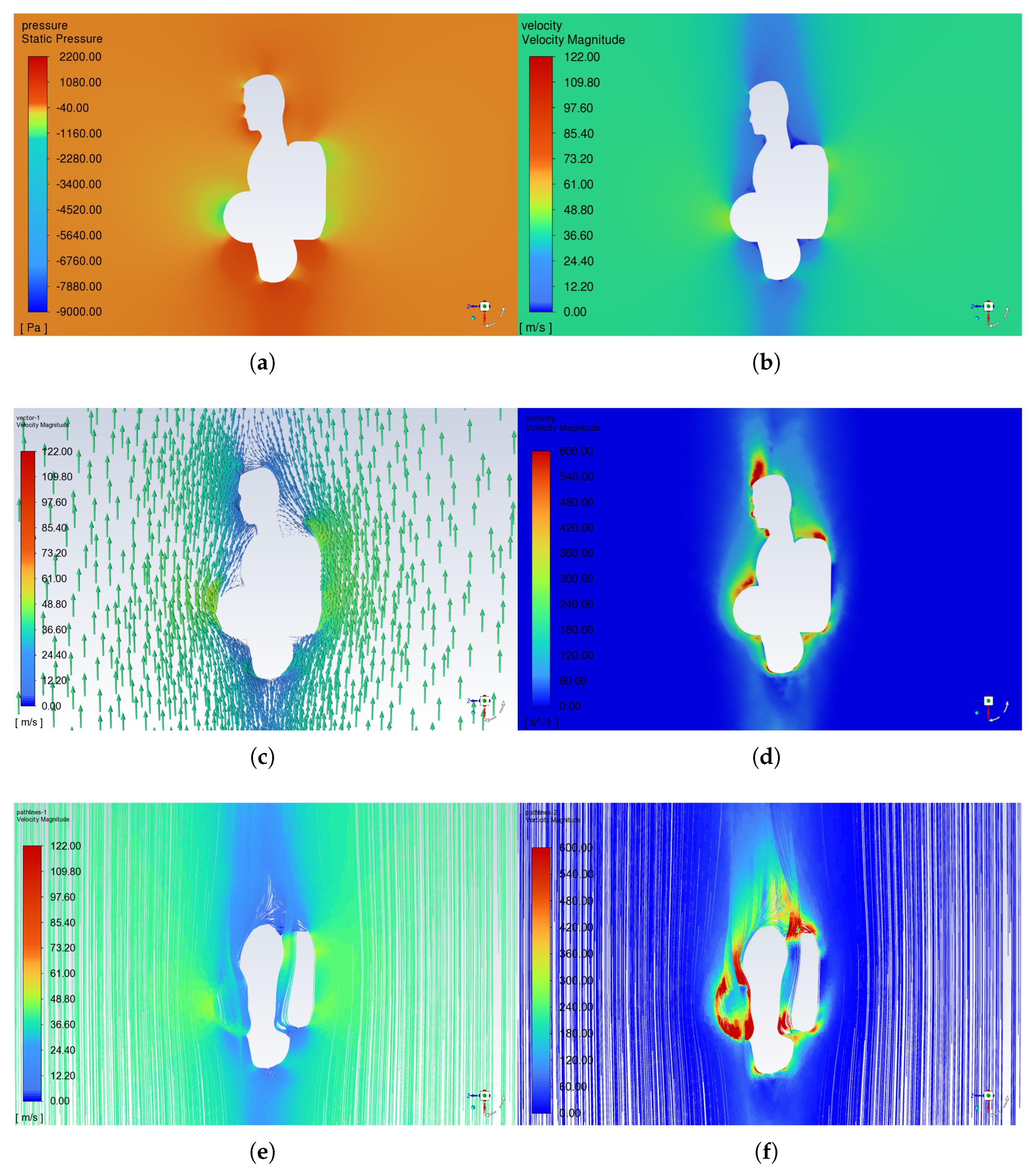
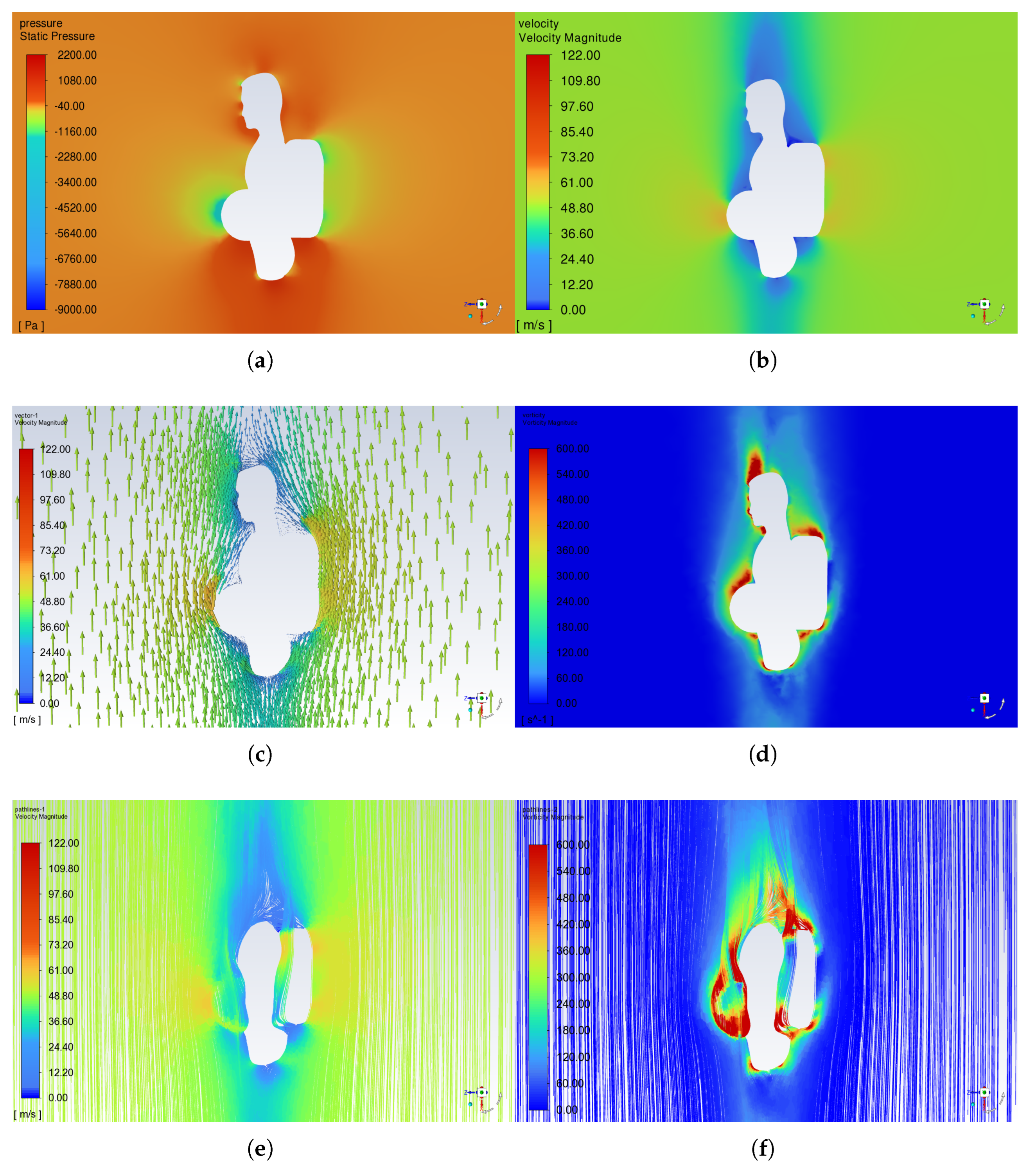
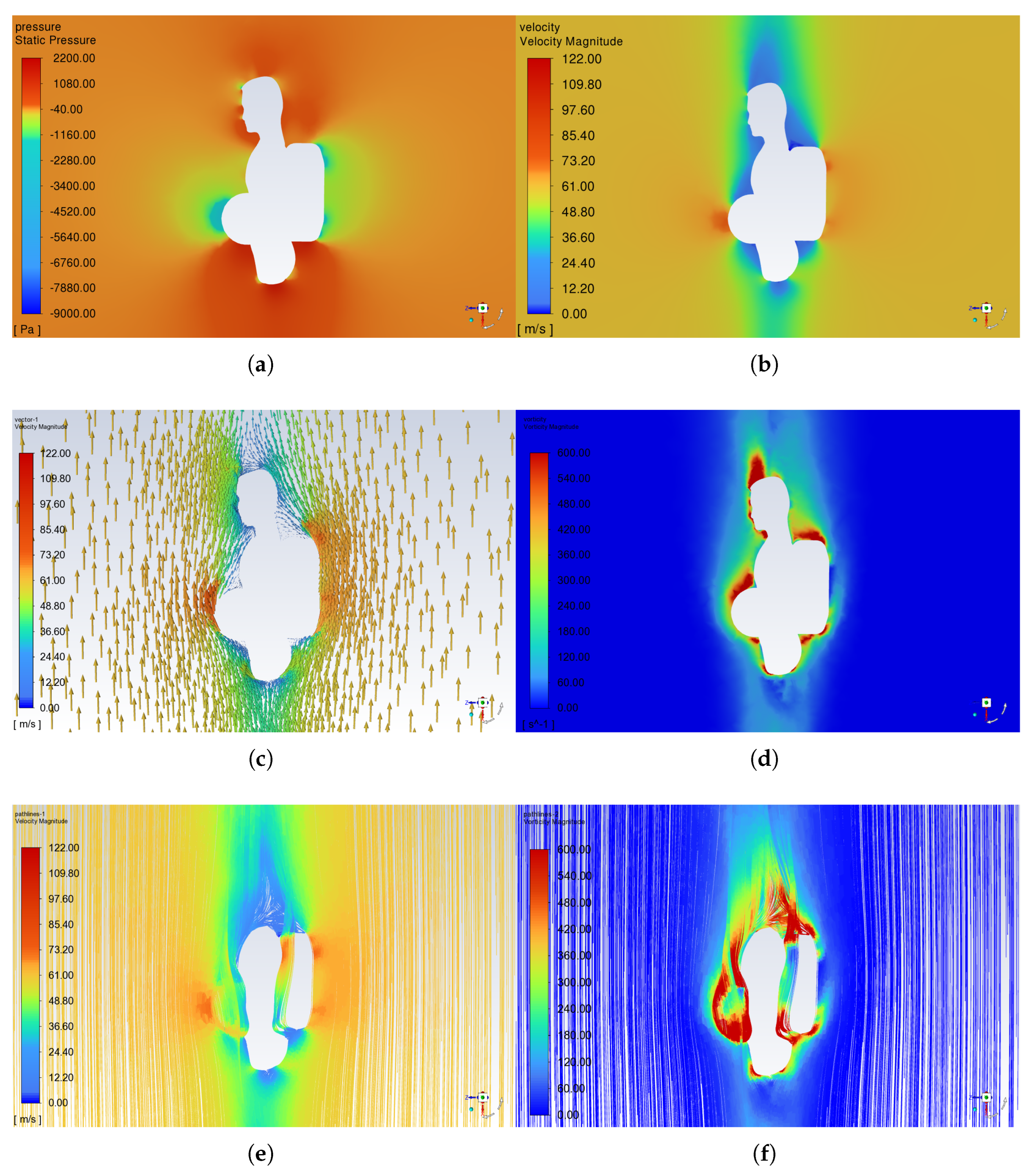
Therefore, in this scenario, assuming that the parachutist’s main parachute fails to deploy in a timely manner and free fall exceeds 5 s, they experience a higher or even significantly higher descent velocity than normal. This simulation examined conditions with descent speeds of 30 m/s, 40 m/s, 50 m/s, and 60 m/s; a lateral speed of 0 m/s; and an angle θ = 0 relative to the vertical descent direction. The simulation results are illustrated in Figure 14, Figure 15, Figure 16 and Figure 17.
During the vertical descent simulations with inflow velocities ranging from 30 m/s to 60 m/s, the flow field around the parachute pack exhibits a clear velocity-dependent evolution in terms of flow separation, vortical structures, velocity gradients, pressure distribution, and streamline topology.
At a descent speed of 30 m/s, the velocity and pressure fields remain relatively smooth. The pathline patterns indicate that the incoming flow is only mildly deflected when passing around the forebody, and most streamlines remain attached along the surface. Only a weak divergence of pathlines is observed near geometric discontinuities, corresponding to limited separation zones. The velocity gradients are small, and the vorticity magnitude is confined to thin near-wall regions, thus indicating weak shear layers and low turbulent fluctuation intensity. The pressure distribution is relatively uniform, with mild positive pressure on the windward side and limited negative pressure in the wake, thereby suggesting a stable aerodynamic environment for parachute deployment.
When the descent speed increases to 40 m/s, localized flow separation becomes evident along the lateral sides of the parachute pack. This behavior is clearly reflected in the pathline deviation and widening gaps between neighboring trajectories, which indicate the growth of separated shear layers and partial wake formation. Recirculation patterns begin to appear downstream, showing the early development of coherent vortical motion. The vorticity magnitude increases near the shoulder and lower forebody regions, while the pressure field reveals an expanding low-pressure wake region. These features indicate a transition toward a moderately separated flow regime accompanied by enhanced velocity gradients and increasing unsteady effects.
At 50 m/s, the pathlines demonstrate pronounced curvature and clustering within the wake region, thus highlighting strong flow detachment and organized recirculation behind the pack. Streamline wrapping and spiral-like trajectories provide direct evidence of large-scale vortex formation and the entrainment of surrounding flow. Strong velocity gradients appear along the lateral surfaces, and elevated vorticity levels extend downstream. Although high local velocities are observed adjacent to regions of low static pressure, this apparent velocity–pressure inconsistency results from vortex-dominated separated flow rather than attached Bernoulli-type behavior. The intensified vortices and expanded separation zone lead to highly non-uniform aerodynamic loading, thus indicating a critical condition for deployment safety.
When the descent speed further increases to 60 m/s, severe boundary layer separation dominates the flow field. Pathlines show extensive divergence upstream and large-scale recirculating loops downstream, thus revealing strong wake instability and persistent eddy structures. Flow entrainment into the wake becomes stronger, and multiple interaction regions between shear layers are evident. The velocity vector field confirms intense recirculation, while vorticity magnitude peaks and spreads over a wider region. The pressure field exhibits pronounced contrast between windward high pressure and extensive downstream low pressure. These characteristics demonstrate that the flow has entered a highly unsteady, turbulence-dominated regime in which strong velocity gradients and coherent vortices may induce significant fluctuating aerodynamic forces on the parachutist, thereby posing substantial risks to deployment stability and flight safety.

4.3. Conclusions Drawn from Simulations

The combined numerical and experimental results show that the flow field around a parachutist descending at high speed undergoes distinct regime transitions depending on both descent velocity and inflow direction. For vertical descent, a critical transition occurs near 50 m/s, beyond which strong flow separation and large-scale vortical structures dominate. Under lateral inflow, flow asymmetry and vortex development intensify rapidly with increasing velocity, thus leading to highly unsteady, vortex-dominated wake structures at 65 m/s. These results demonstrate that a higher descent speed combined with lateral inflow substantially increases aerodynamic unsteadiness and poses a significant challenge to parachute deployment stability.

5. Haar–EVO–CNN–BiLSTM–Attention Model

To address the challenge of parachute failure caused by vortex-induced flow around parachutists during high-speed parachuting, this study proposes an enhanced neural network prediction model based on multi-information fusion. The model accurately predicts the generation of turbulent vortices one second in advance. It integrates an energy valley optimization (EVO) algorithm, a convolutional neural network (CNN), a bidirectional long short-term memory (BiLSTM) network, and an attention mechanism (Attention), thus forming a hybrid Haar–EVO–CNN–BiLSTM–Attention architecture. This model aims to improve the accuracy and real-time performance of vortex state prediction in flow fields, thereby providing technical support for emergency response.
The energy valley (EVO) algorithm can optimize the hyperparameters and initial weights of the CNN–BiLSTM–Attention model, adapt it to the characteristics of airdrop flow field time-series data, enhance the accuracy of turbulence evolution prediction, shorten the training cycle, and support the real-time prediction of parachute deployment risks. It exhibits robust temporal adaptability, thus enabling the precise capture of correlations and sudden fluctuations within data.
During model training, forward propagation first proceeds to the CNN-BiLSTM layer. The CNN layer extracts the pressure distribution around the dummy, while the BiLSTM layer captures pressure variations and learns dynamic features through computations in the CNN and BiLSTM modules. Ultimately, the model is applied to predict the descent velocity of parachutists over different time periods and is used to analyze the conditions of turbulence formation combined with a CFD simulation and wind tunnel experiments.

5.1. Experimental Data Acquisition and Preprocessing

Since last year, our research team has conducted 100 experimental trials, accumulating over 1000 data entries. The data collected from emergency parachute deployment experiments cover a 10 s duration per trial, with 180 sampling points per second, thus resulting in a total of 1800 data points per trial. The inputs are physical quantities representing nine dimensions, including atmospheric pressure, lateral velocity, descent velocity, triaxial dynamic load, and triaxial attitude sensor readings, and the output is the descent velocity. The data were reshaped into three-dimensional tensors of size 9 × 15 × 1, where the feature dimension is 9, the time step is 15, the number of channels is 1, and the sample size is 120. Subsequently, the dataset was partitioned along the temporal sequence, with the first 119 sets being allocated to the training set and the remaining 1 set to the test set, thereby preserving the continuity of the sequential data and ensuring the realism of the predictions.
Both the training and test sets were subjected to Haar wavelet denoising, which effectively separates genuine features from noise in data, thus providing cleaner and more essential input data for the neural network model. Moreover, due to noise, the loss function tends to become unstable and filled with local minima, which increases the difficulty of finding the optimal solution for the energy valley algorithm. By introducing Haar wavelet denoising, the loss function is stabilized, thus enabling the energy valley algorithm to converge to the optimal solution more efficiently and accurately.

5.2. Model Parameters

In this study, the neural network model was constructed on the MATLAB-R2025a platform, and training was performed using the Stochastic Gradient Descent with Momentum (SGDM) algorithm. The hyperparameters for model training are presented in Table 3.
Among the hyperparameters, the learning rate, convolutional kernel size, and the number of neurons were jointly optimized using the energy valley optimization algorithm to identify the optimal hyperparameter combination within a limited number of evaluations, with the Mean Absolute Percentage Error (MAPE) serving as the optimization metric. In the energy valley optimization algorithm, the maximum number of evaluations was set to 18, and the swarm size was set to 5.

5.3. Model Design

The dimensions of each layer are shown in Table 4. In this model, the input sequence has dimensions of 9 × 15 × 1, where 9 represents the number of features, 15 the time steps, and 1 the channel count.
In the CNN module, features are extracted with a 2D convolutional layer, with its kernel being determined by the energy valley algorithm. This is followed by batch normalization, a ReLU activation function, and a max-pooling layer, thus resulting in compressed feature output. The convolutional layer has dimensions of 9 × 15 × 3, indicating that after 3 × 3 convolution, the channel count changes from 1 to 3, while the spatial dimensions remain 9 × 15. The batch normalization layer retains dimensions of 9 × 15 × 3, thus performing only numerical standardization without altering the shape. The ReLU activation layer also retains dimensions of 9 × 15 × 3, applying only a nonlinear transformation. The 2D max-pooling layer similarly maintains dimensions of 9 × 15 × 3 after 3 × 3 max pooling. The flattening layer outputs dimensions of 405 × 1, where 405 is derived from 9 × 15 × 3. The CNN employed in this study adopts a conventional architecture without major structural modifications and is used primarily as a standard feature extraction module. No specialized CNN training strategies are introduced, and the focus of this work is placed on feature optimization and temporal sequence modeling.
In the BiLSTM module, the flattened features from the CNN are fed to a BiLSTM layer, whose neuron count is determined by the energy valley algorithm. This layer utilizes its memory mechanism to process airdrop flow field data along the temporal dimension, thus capturing the long-term dependencies of turbulence over time, accurately modeling the dynamic evolution of turbulence, and extracting the time-varying sequential features of the flow field. The BiLSTM layer has dimensions of [100, 200] × 1, with [100, 200] representing the number of hidden units.
In the attention module, key time points are automatically identified, and higher weights are assigned to important time steps, thus effectively filtering noise and redundant information in airdrop data, highlighting core turbulence features, and enhancing the model’s perception of critical turbulence information. The module employs one head and 15-dimensional feature mapping, and the attention layer has dimensions of [100, 200] × 1.
Finally, the fully connected and regression output layers produce the prediction results. The former, with dimensions of 15 × 1, maps the [100, 200]-dimensional output from the attention layer to 15 output values. The regression output layer, also of dimensions 15 × 1, uses the Mean Square Error (MSE) loss function to compute regression loss and outputs continuous value predictions.

5.4. Prediction Results

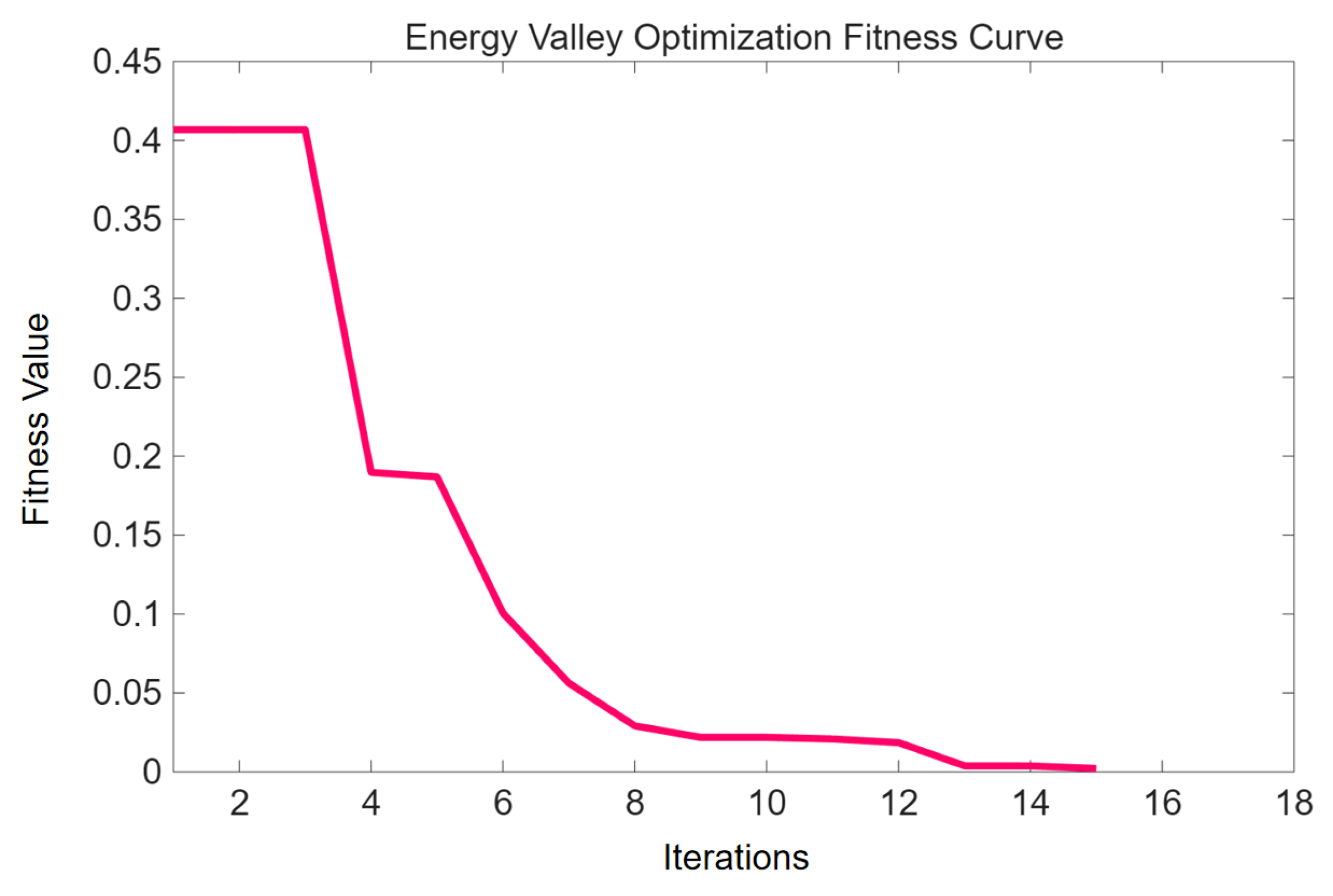
As shown in Figure 18, the energy valley optimization fitness curve illustrates the optimization progress of the energy valley algorithm. The curve exhibits a continuous downward trend, indicating that as iterations proceed, the algorithm continuously explores better model parameters, gradually improves model fitness, and achieves favorable convergence.
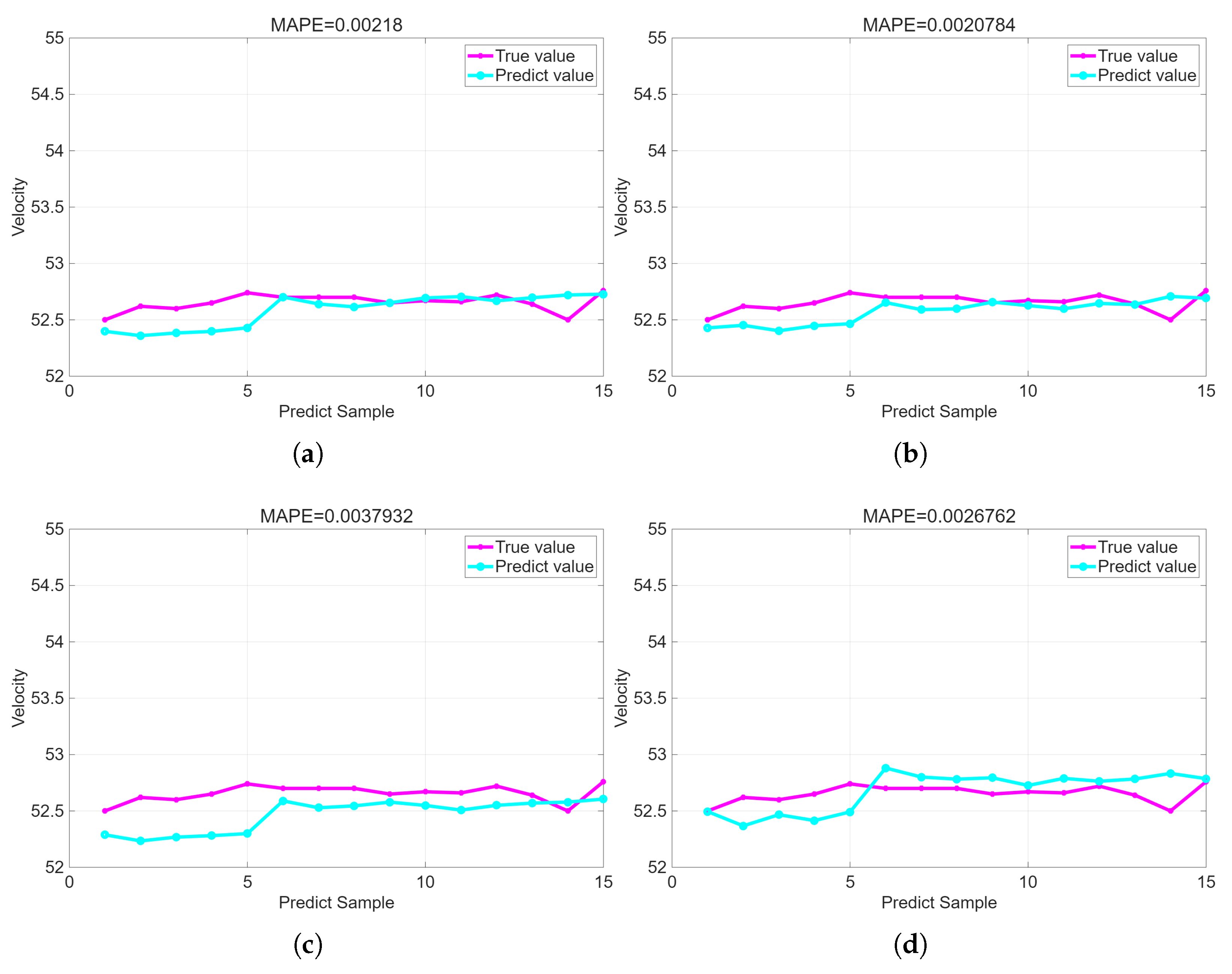
According to the comparison chart of the test set prediction results in Figure 19, the Haar–EVO–CNN–BiLSTM–Attention model demonstrates excellent predictive performance. In this figure, the pink curve, representing the true values, and the cyan curve, representing the predicted values, exhibit a high degree of alignment overall, with the predicted values closely following the trend in the true values. Meanwhile, the RMSE is about 0.085, the MAE is approximately 0.051, and the MAPE is only about 0.0021, which are extremely low. These findings indicate that the model achieves very high accuracy in descent speed prediction on the test set data from airdrop tests, thus accurately capturing the speed variation patterns during the parachute descent process.

5.5. Model Comparison

Multiple traditional models were employed to make predictions on the test set, and they were compared with the model proposed in this study: Haar–EVO–CNN–LSTM–Attention, EVO–CNN–LSTM–Attention, CNN–LSTM–Attention, and LSTM. The evaluation metrics used were the Root Mean Square Error (RMSE), Mean Absolute Error (MAE), and Mean Absolute Percentage Error (MAPE), and the evaluation results are presented in Table 5.
The results presented in Table 5 demonstrate that the Haar–EVO–CNN–BiLSTM–Attention model exhibits clear superiority over the baseline models in terms of predictive accuracy. Compared with the EVO–CNN–LSTM–Attention model, the proposed method reduces the RMSE, MAE, and MAPE by approximately 7.6%, 23.9%, and 4.5%, respectively. More significant improvements are observed when compared with the CNN–LSTM–Attention model, with reductions of 29.7% in the RMSE, 42.7% in the MAE, and 40.0% in the MAPE. Furthermore, relative to the traditional LSTM model, the proposed approach achieves substantial error reductions of 49.1% in the RMSE, 56.4% in the MAE, and 61.8% in the MAPE. These results indicate that the proposed model provides consistently improved prediction accuracy across all evaluation metrics.

6. Conclusions

This study investigated the turbulent flow mechanisms around a parachutist–parachute system during high-speed descent through coupled CFD simulation, wind tunnel validation, and data-driven prediction modeling. The main research findings are summarized as follows:
1.
Numerical simulations revealed distinct flow interaction regimes associated with lateral and descent velocities. The transition from mild interaction to strong separation and vortex concentration was observed as velocity increased. A critical velocity threshold near 55 m/s and a high-risk regime around 65 m/s were identified, beyond which large-scale vortical structures and strong pressure gradients dominate the wake region, thus potentially affecting deployment stability.
2.
Wind tunnel measurements showed overall agreement with the simulation results, with similarity levels ranging from approximately 75 % to 90 % across sensor locations and velocity conditions. This validation confirms that the proposed LES–Euler–Lagrange framework captures the essential pressure and flow structure characteristics of the descent environment.
3.
The adaptive mesh LES approach successfully resolved transient vortex evolution, flow separation, and low-pressure zone formation around the parachute pack. The simulations demonstrate how increasing velocity amplifies shear layer instability, enlarges recirculation regions, and intensifies the aerodynamic load fluctuations acting on the system.
4.
The proposed Haar–EVO–CNN–BiLSTM–Attention model achieved accurate one-second-ahead prediction of descent velocity variations, with a MAPE on the order of 10 3 . The model consistently reproduced temporal trends across multiple runs, thus indicating strong capability in capturing nonlinear multivariate flow state dependencies.
Overall, the combined numerical–experimental–predictive framework provides quantitative insight into turbulence evolution and velocity-dependent deployment risk during high-speed descent, thus offering a practical analytical basis for parachute system design, operational safety assessment, and future real-time monitoring development.

Author Contributions

Conceptualization, Z.C. and Z.X. Data curation, Z.C., X.X. and S.M. Methodology, Z.C. and Z.X. Project administration, Z.X. Supervision, R.L., Y.L. and Z.X. Writing—original draft preparation, Z.C. Writing—review and editing, Z.C., J.Y., Z.W., Y.L. and Z.X. All authors have read and agreed to the published version of the manuscript.

Funding

This research study received no external funding.

Data Availability Statement

Restrictions apply to the dataset.

Conflicts of Interest

The authors declare no conflicts of interest.

References

  1. Pramod, A.; Shankaranarayanan, H.; Raj, A.A.B. A precision airdrop system for cargo loads delivery applications. In Proceedings of the 2021 International Conference on System, Computation, Automation and Networking (ICSCAN), Puducherry, India, 30–31 July 2021; IEEE: New York, NY, USA, 2021; pp. 1–5. [Google Scholar]
  2. Ning, L.; Chen, J.; Tong, M. Development of an efficient contact-friction model for high-fidelity cargo airdrop simulation. Chin. J. Aeronaut. 2019, 32, 1145–1155. [Google Scholar] [CrossRef]
  3. Wan, T.; Cheng, C.A.; Huo, R. Numerical simulations of parachute aerodynamic characteristics under severe weather. In Proceedings of the 54th AIAA Aerospace Sciences Meeting, San Diego, CA, USA, 4–8 January 2016; AIAA: Reston, VA, USA, 2016; p. 2030. [Google Scholar]
  4. Han, Y.; Wang, Y.; Yang, C. Numerical methods for analyzing the aerodynamic characteristics of cross parachute with permeability. In Proceedings of the AIAA Aerodynamic Decelerator Systems (ADS) Conference, Daytona Beach, FL, USA, 25–28 March 2013; AIAA: Reston, VA, USA, 2013; p. 1283. [Google Scholar]
  5. Gao, X.; Zhang, Q.; Tang, Q. Parachute dynamics and perturbation analysis of precision airdrop system. Chin. J. Aeronaut. 2016, 29, 596–607. [Google Scholar] [CrossRef]
  6. Dever, C.; Hamilton, L.; Truax, R.; Wholey, L.; Bergeron, K. Guided-airdrop vision-based navigation. In Proceedings of the 24th AIAA Aerodynamic Decelerator Systems Technology Conference, Denver, CO, USA, 5–9 June 2017; AIAA: Reston, VA, USA, 2017; p. 3723. [Google Scholar]
  7. Cao, Y.; Wei, N. Flight Trajectory Simulation and Aerodynamic Parameter Identification of Large-Scale Parachute. Int. J. Aerosp. Eng. 2020, 2020, 5603169. [Google Scholar] [CrossRef]
  8. Zhu, H.; Sun, Q.; Sun, H.; Chen, Z.; Zeng, X.; Soulat, D. Aerodynamic prediction for flight dynamics simulation of parafoil system and airdrop test validation. Nonlinear Dyn. 2023, 111, 11065–11085. [Google Scholar] [CrossRef]
  9. Wang, X.; Yin, J.; Li, J.; Li, Y. A Multidimensional Parameter Dynamic Evolution-Based Airdrop Target Prediction Method Driven by Multiple Models. Remote Sens. 2025, 17, 2476. [Google Scholar] [CrossRef]
  10. Civelek, B.; Kivrak, S. A review on the precision guided airdrop systems. Int. J. Latest Technol. Eng. Manag. Appl. Sci. (IJLTEMAS) 2019, 8, 13–17. [Google Scholar]
  11. Cinnamon, A.; Mudrak, J.; Gilkey, A. Wind Modeling for Airdrop Simulation. In Proceedings of the 24th AIAA Aerodynamic Decelerator Systems Technology Conference, Denver, CO, USA, 5–9 June 2017; AIAA: Reston, VA, USA, 2017; p. 3881. [Google Scholar]
  12. Yang, S.; Jeon, S. Recursive path planning and wind field estimation for precision airdrop. J. Guid. Control Dyn. 2019, 42, 1429–1437. [Google Scholar] [CrossRef]
  13. Kelly, K.; Peña, B. Wind study and GPS dropsonde applicability to airdrop testing. In Proceedings of the 16th AIAA Aerodynamic Decelerator Systems Technology Conference and Seminar, Boston, MA, USA, 21–24 May 2001; AIAA: Reston, VA, USA, 2001; p. 2022. [Google Scholar]
  14. Gerlach, A.R.; Doman, D.B. Wind field estimation from airdrop trajectory measurements. In Proceedings of the AIAA Guidance, Navigation, and Control Conference, San Diego, CA, USA, 7 January 2016; AIAA: Reston, VA, USA, 2016; p. 1616. [Google Scholar]
  15. Bury, Y.; Morton, S.; Charles, R. Experimental investigation of the flow field in the close wake of a simplified C130 shape a model approach of airflow influence on airdrop. In Proceedings of the 26th AIAA Applied Aerodynamics Conference, Hawaii, HI, USA, 18–21 August 2008; AIAA: Reston, VA, USA, 2008; p. 6415. [Google Scholar]
  16. Sahu, J.; Edge, H.; Heavey, K.; Stein, K.; Benney, R.; Chakravarthy, S. Comparison of numerical flow field predictions for Army airdrop systems. In Proceedings of the 15th Aerodynamic Decelerator Systems Technology Conference, Toulouse, France, 8–11 June 1999; AIAA: Reston, VA, USA, 1999; p. 1715. [Google Scholar]
  17. Schade, N.; Geisbauer, S.; Schmidt, H.; Enk, S.; Arnold, J. Experimental and numerical investigation of the flow topology during airdrop operations. In Proceedings of the 21st AIAA Aerodynamic Decelerator Systems Technology Conference and Seminar, Dublin, Ireland, 23–26 May 2011; AIAA: Reston, VA, USA, 2011; p. 2565. [Google Scholar]
  18. Atallah, A.; Elmaradny, A.; Taha, H.E. A novel approach for data-free, physics-informed neural networks in fluid mechanics using the principle of minimum pressure gradient. In Proceedings of the AIAA SCITECH 2024 Forum, Orlando, FL, USA, 8–12 January 2024; AIAA: Reston, VA, USA, 2024; p. 2742. [Google Scholar]
  19. Li, Z.; Hu, G. New approach of the solution of physical fields of fluid dynamics: Physics-informed long short-term memory network. Int. J. Heat Fluid Flow 2026, 117, 110024. [Google Scholar] [CrossRef]
  20. Diaz, J.F.; Dalle, D.J.; Papadopoulos, P.E. Deep Neural Network Based Convergence Classification for Computational Fluid Dynamics. In Proceedings of the AIAA SCITECH 2024 Forum, Orlando, FL, USA, 8–12 January 2024; AIAA: Reston, VA, USA, 2024; p. 2515. [Google Scholar]
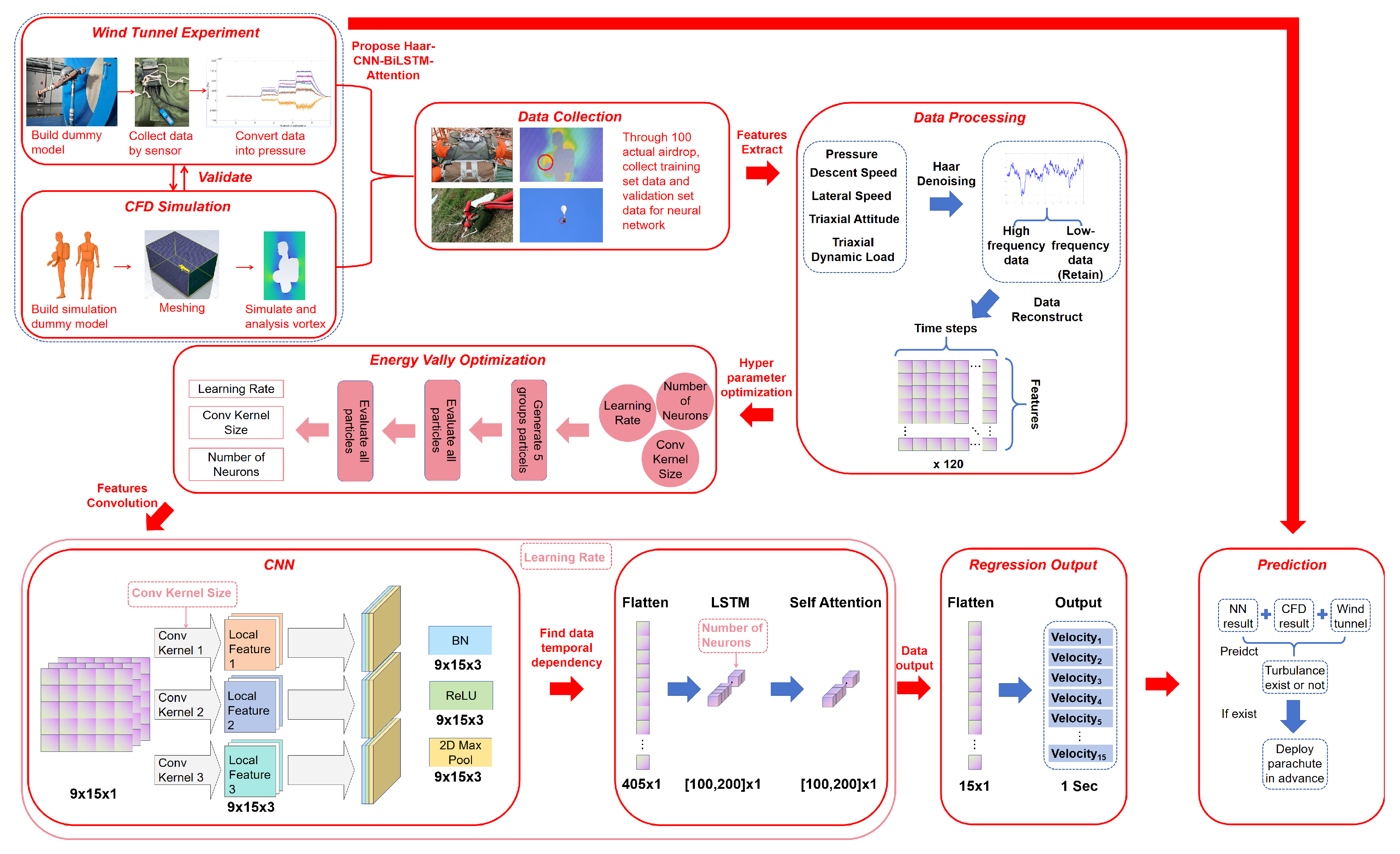
Figure 1. Model workflow.
Aerospace 13 00211 g001
Figure 2. Side and front views of simulation dummy model.
Aerospace 13 00211 g002
Figure 3. Model grid meshing: (a) dummy grid; (b) overall grid.
Aerospace 13 00211 g003
Figure 4. Simulation contour plots: (ac) 100% of size; (df) 80% of size; (gi) 60% of size.
Aerospace 13 00211 g004
Figure 5. Residual convergence history of continuity and velocity components during simulation.
Aerospace 13 00211 g005
Figure 6. Time history of drag force demonstrating statistical stabilization.
Aerospace 13 00211 g006
Figure 7. (a) Sensor placement; (b) simulation model; (c) wind tunnel experimental data.
Aerospace 13 00211 g007
Figure 8. Pressure cloud maps: (a,b) 30 m/s; (c,d) 40 m/s; (e,f) 50 m/s.
Aerospace 13 00211 g008
Figure 9. (a) Sensor placement; (b) simulation model; (c) wind tunnel experimental data.
Aerospace 13 00211 g009
Figure 10. Pressure cloud maps: (a,b) 30 m/s; (c,d) 40 m/s; (e,f) 50 m/s.
Aerospace 13 00211 g010aAerospace 13 00211 g010b
Figure 11. Flow field around body at 45 m/s: (a) pressure, (b) velocity, (c) velocity vector, (d) vorticity, (e) pathlines colored by velocity magnitude, (f) pathlines colored by vorticity magnitude.
Aerospace 13 00211 g011
Figure 12. Flow field around body at 55 m/s: (a) pressure, (b) velocity, (c) velocity vector, (d) vorticity, (e) pathlines colored by velocity magnitude, (f) pathlines colored by vorticity magnitude.
Aerospace 13 00211 g012
Figure 13. Flow field around body at 65 m/s: (a) pressure, (b) velocity, (c) velocity vector, (d) vorticity, (e) pathlines colored by velocity magnitude, (f) pathlines colored by vorticity magnitude.
Aerospace 13 00211 g013
Figure 14. Flow field around body at 30 m/s: (a) pressure, (b) velocity, (c) velocity vector, (d) vorticity, (e) pathlines colored by velocity magnitude, (f) pathlines colored by vorticity magnitude.
Aerospace 13 00211 g014
Figure 15. Flow field around body at 40 m/s: (a) pressure, (b) velocity, (c) velocity vector, (d) vorticity, (e) pathlines colored by velocity magnitude, (f) pathlines colored by vorticity magnitude.
Aerospace 13 00211 g015
Figure 16. Flow field around body at 50 m/s: (a) pressure, (b) velocity, (c) velocity vector, (d) vorticity, (e) pathlines colored by velocity magnitude, (f) pathlines colored by vorticity magnitude.
Aerospace 13 00211 g016
Figure 17. Flow field around body at 60 m/s: (a) pressure, (b) velocity, (c) velocity vector, (d) vorticity, (e) pathlines colored by velocity magnitude, (f) pathlines colored by vorticity magnitude.
Aerospace 13 00211 g017
Figure 18. Energy valley optimization fitness curve.
Aerospace 13 00211 g018
Figure 19. Prediction results in multiple runs, (a) First run, (b) Second run, (c) Third run, (d) Forth run.
Aerospace 13 00211 g019
Table 1. Dummy parameters.
TypePartSize (cm)
DummyLeg104 × 49 × 49
Arm58 × 39 × 49
Head20 × 17 × 25
Torso52 × 14 × 44
ParachuteMain48 × 20 × 34
Sub28 × 25 × 15
Table 2. Simulation parameters.
TypeCharacteristics
Inlet Speed30–50 m/s
Wall SurfaceNo-slip boundary condition
Wall Shear ConditionSpecified shear stress (with X, Y, and Z components set to 0 Pa)
Under-Relaxation Factor: Pressure0.3
Under-Relaxation Factor: Density1
Under-Relaxation Factor: Body force1
Under-Relaxation Factor: Momentum0.7
Pressure/Velocity CouplingSIMPLE algorithm
Flux TypeRhie–Chow: distance-based
Spatial Discretization: GradientBased on Least Squares Cells
Spatial Discretization: PressureSecond Order
Spatial Discretization: MomentumSecond Order, Upwind
Temporal Discretization SchemeSecond Order, Implicit
Human Density1.03 g/cm3
Table 3. Hyperparameters.
ParameterValue
Training Period400
Learning Rate[0.001, 0.01]
Batch Size30
Sequence Length15
Gradient Clipping1
Convolutional Kernel Size[1, 5]
Number of Neurons[100, 200]
Table 4. Layers Dimension.
LayerDimension
Sequence Input9 × 15 × 1
Two-Dimensional Convolution9 × 15 × 3
Batch Normalization9 × 15 × 3
ReLU9 × 15 × 3
2D Max Pool9 × 15 × 3
Flattening405 × 1
BiLSTM[100, 200] × 1
Attention[100, 200] × 1
Fully Connected15 × 1
Regression Output15 × 1
Table 5. Model comparison.
ModelRMSEMAEMAPE
Haar–EVO–CNN–BiLSTM–Attention0.0850.0510.0021
EVO–CNN–LSTM–Attention0.0920.0670.0022
CNN–LSTM–Attention0.1210.0890.0035
LSTM0.1670.1170.0055
Disclaimer/Publisher’s Note: The statements, opinions and data contained in all publications are solely those of the individual author(s) and contributor(s) and not of MDPI and/or the editor(s). MDPI and/or the editor(s) disclaim responsibility for any injury to people or property resulting from any ideas, methods, instructions or products referred to in the content.