
Article

Wind Energy Potential over the Eastern Mediterranean During the Summer Season: Evaluation and Future Projections from CMIP6


by
Ioannis Logothetis
1,2,*,
Maria-Elissavet Koukouli
1,*,
Athanasios Kerchoulas
2,
Dimitrios-Sotirios Kourkoumpas
2,
Adamantios Mitsotakis
2,
Panagiotis Grammelis
2,
Kleareti Tourpali
1 and
Dimitrios Melas
1
1
Laboratory of Atmospheric Physics, Department of Physics, Faculty of Sciences, Aristotle University of Thessaloniki, GR 54124 Thessaloniki, Greece
2
Centre for Research and Technology Hellas, Chemical Process and Energy Resources Institute, Thermi, GR 57001 Thessaloniki, Greece
*
Authors to whom correspondence should be addressed.
Climate 2026, 14(3), 64; https://doi.org/10.3390/cli14030064
Submission received: 26 January 2026 / Revised: 27 February 2026 / Accepted: 3 March 2026 / Published: 5 March 2026
(This article belongs to the Special Issue Wind‑Speed Variability from Tropopause to Surface)

Abstract

Renewables are key pillars of the European Union’s (EU) strategy for green transition and climate neutrality. In particular, wind energy lies at the core of a sustainable framework regarding the energy policy (i.e., European Green Deal and REPowerEU plan) supporting clean, secure, and affordable electricity for a resilient future. In this study, Global Climate Models (GCMs) simulations were used to investigate the efficiency of GCMs to capture and reproduce the spatial and temporal features of Wind Energy Potential (WEP). The GCMs that have been used in this study are available in the context of the Coupled Model Intercomparison Project Phase 6 (CMIP6). The analysis focuses on high-interest regions of the Eastern Mediterranean (EMed) during the summer season (JJA). The ERA5 reanalysis dataset was used as a reference data set. Furthermore, projected changes in WEP were calculated under two Shared Socioeconomic Pathways (the “moderate”, SSP2-4.5 and the “fossil-fueled development”, SSP5-8.5 scenarios), covering the period from 1970 to 2099. The results indicate that most GCMs underestimate mean WEP, with model performance ranging from “poor” to “good” scores based on the Kling–Gupta Efficiency index (−0.45 < KGE < 0.5). Future WEP projections show no consistent spatial patterns among GCMs. By the late 21st century, WEP is projected to decrease (about 10–15%) over the Southeastern Aegean and increase between Crete and Libya (about 10–15%) relative to the baseline historical period (1970–2000) under both SSP scenarios. Finally, findings provide elements for the WEP evolution over the Eastern Mediterranean, contributing to the EU energy policy.

1. Introduction

Climate change is recognized as one of the most significant and challenging issues that humanity currently faces. Human and natural environments are systems that are prone to the impacts of climate change that raise important socioeconomic challenges for societies. In addition, global warming increases the vulnerability and decreases the resilience of natural ecosystems, frequently characterized as “one of the defining challenges of our era” [1,2]. In this context, the Mediterranean area is categorized as one of the most vulnerable regions in the world regarding its response to increased climate stress. In other words, this area is recognized as a climate hot-spot (the “Mediterranean hot-spot”), showing 20% faster warming than other ecosystems [3,4,5,6,7,8]. In general, the Mediterranean basin is exposed to severe climate-related impacts that threaten the resilience of natural and human systems, affecting key sectors such as tourism, energy, water resources, and agriculture [9]. In addition, urbanization and the relation between energy demand and supply are the dominant challenges for the energy sector of the Mediterranean area.
Focusing on the Southeastern Mediterranean, energy demand is projected to increase by about 118% till 2040 [10], highlighting the critical role of renewable energy sources in enhancing energy, security, and system resilience [11,12]. Among renewables, wind energy represents a reliable and viable option, with significant potential to contribute to the regional energy mix and support energy autonomy [13,14].
Previous studies have already shown that the southeastern Mediterranean is a significant wind energy area [15,16,17,18,19]. In particular, the Aegean Sea is characterized by persistent (annual) and intense winds during the summer season (Etesian winds regime, also called meltemi). The projections for Etesian winds under different evolution scenarios show an increase in frequency and intensity mainly during the last period of the 21st century [20,21,22]. In this context, this summertime wind system could be an important factor that offers significant energy potential in the renewable green-energy footprint for the eastern Mediterranean area, and particularly the Aegean basin. The projected climatic features increase the interest in further wind energy exploitation over the Eastern Mediterranean [23].
Global Climate Models (GCMs) and Regional Climate Models (RCMs) are robust tools that are widely used to investigate the atmospheric circulation features during past and future periods under different climate evolution scenarios [24,25,26,27]. Recent advances in regional climate modeling have enabled the development of high-resolution convection-permitting climate models (CPMs) that explicitly resolve convection instead of using other parameterization schemes [28]. Zhou et al. [29] have shown that CPMs provide improved efficiency regarding wind speed representation in fine scales as compared to ERA5. Additionally, high-resolution convection-permitting evaluations such as the CNRM-AROME (horizontal resolution 2.5 km) simulations over Corsica demonstrate added value in representing local wind features and diurnal circulations relevant to Mediterranean climate studies [30]. In general, CPMs can potentially offer improved representation of local circulation features (i.e., sea breezes) and small-scale dynamical features compared to coarser model simulations [31,32,33]. While RCMs and CPMs offer enhanced representation of local atmospheric phenomena, the use of GCMs can provide a consistent representation of the large-scale atmospheric circulation patterns. In addition, modern high-resolution GCMs offer improved spatial reproduction of climate variables [26]. In this context, GCMs can be considered as a particularly relevant tool for capturing the synoptic-scale drivers of summer WEP over long-term temporal scales across different SSPs. This approach provides a robust baseline that complements finer-scale regional modeling efforts.
Focusing on the Eastern Mediterranean, previous analyses have identified significant changes in climate conditions as compared to the historical period. RCM simulations have projected temperature increases of about 4.3 °C and precipitation decreases of about 16% till the end of the 21st century (compared to the period from 1971 to 2000) for the Greek domain according to the RCP8.5 scenario [34,35]. Previous studies, based on GCM (CMIP5) and RCM model simulations, have provided valuable results, but discrepancies for the wind field still remain or, e.g., [36,37,38,39]. In addition, the models’ resolution sensitivity and the various future evolution scenarios induce uncertainties [22,40,41]. Concerning the wind field over the Eastern Mediterranean, the meridional wind speed component increases in the late 21st century both for “moderate” and “extreme” future scenarios, indicating a strengthening of the Etesian regime. However, GCMs show high multi-model variability in reproducing the mean meridional winds (v10) pattern [18,22]. By employing CMIP6 models, this study provides an up-to-date and harmonized assessment of future WEP based on simulations from multiple modeling centers. It addresses existing gaps by leveraging improved representations of physical processes and diverse socio-economic pathways, with particular emphasis on key wind-energy regions of the Eastern Mediterranean.
Within this context, the European Union has developed an ambitious policy and legislative framework to support climate resilience and green transition, including the European Green Deal, REPowerEU, and the “Fit for 55” package [42,43,44,45]. These initiatives promote renewable and emission reduction strategies. The revised Renewable Energy Directive is setting a binding EU renewable energy target of at least 42.5% by 2030, underscoring the role of offshore renewables in mitigating climate risk and supporting long-term sustainability [46,47].
Furthermore, wind energy plays a central role in the EU decarbonization strategies, both as a major source of renewable electricity and a key enabler of cross-sectoral integration across industry, transport, and heating. Under the Fit for 55 package, achieving climate targets requires substantial capacity expansion, with projections indicating the need for approximately 30 GW of new wind installations annually to reach 433–452 GW by 2030 [48,49]. While recent deployment shows strong growth (reaching around 220 GW of installed capacity by 2023, supplying approximately 20% of EU electricity demand), current trajectories show a shortfall without accelerated policy implementation [49,50].
This study aims to (i) evaluate the ability of CMIP6 GCMs to reproduce the distributional characteristics of wind energy potential (WEP) over the Eastern Mediterranean by benchmarking against the ERA5 reanalysis, and (ii) assess future WEP changes under “moderate” and “extreme” scenarios (SSP2-4.5 and SSP5-8.5). A subset of models is selected based on their skill in reproducing observed WEP features (KGE > 0) and used to analyze projections in regions of high wind-energy relevance. The results reveal pronounced spatial heterogeneity in WEP responses across scenarios, underscoring the need for regionalized assessments in climate-resilient energy planning. By focusing on climate- and energy-sensitive areas of the Eastern Mediterranean, this work fills a key gap in the literature and provides insights relevant to energy autonomy and sustainable development in a region of increasing seasonal demand. The findings can support policymakers in designing climate and energy strategies aligned with EU decarbonisation and green transition targets.
The study is organized in the following sections. In Section 2, the data and methods that are used in this work are presented. In Section 3, the model efficiency to reproduce WEP features and future changes in Aeolian potential is shown. In addition, a short discussion of the main findings as well as the limitations of this work is presented. Finally, the main findings are shown in the conclusion section (Section 4).

2. Materials and Methods

2.1. Data

In this work, summer (JJA) zonal (u10) and meridional (v10) wind speed components of thirteen (13) CMIP6 are analyzed in order (a) to evaluate the wind energy potential (WEP) against ERA5 data (employed as reference dataset) and (b) to investigate WEP changes according to two Shared Socioeconomic Pathways (SSPs) scenarios. In particular, WEP changes according to a “moderate” (SSP2-4.5–“medium challenges to mitigation”) and an “extreme” (SSP5-8.5–“high challenges to mitigation, low challenges to adaptation”) SSP scenario are studied. SSPs are scenarios that project climate evolution and greenhouse emissions under different future socio-economic developments in the context of Assessment Report 6 (AR6) IPCC [1]. ERA5 monthly mean data of meridional and zonal wind speed at 10 m (u10 and v10) during summer months (JJA) were downloaded from the European Center for Medium-Range Weather Forecast (ECMWF). ERA5 is a valuable reanalysis model tool that is widely used for climate and environmental studies [51,52]. Our analysis covers the period from 1970 to 2099, subdivided into a historical baseline (1970–2014) and a future projection period (2015–2099). Future analyses are conducted under both SSP2-4.5 and SSP5-8.5 emission scenarios. The GCM model simulations that are used in this study were selected according to the following criteria: (1) the availability of the u10 and v10 (zonal and meridional wind components at 10 m) for the region of the Eastern Mediterranean both for historical and SSPs scenarios, (2) completeness and continuity of the datasets that cover the period from 1970 to 2100 and (3) consistency with models that were used in previous studies for wind and WEP patterns of the Eastern Mediterranean in order to facilitate comparison with the literature (e.g., [5,6,21,22,34,41,53]). GCM model simulations were re-gridded to a 1.0° × 1.0° spatial resolution using linear interpolation. In general, linear interpolation is widely used in the literature, providing comparison among model results with different resolutions [41,54,55]. Linear interpolation from a coarser (native grid) to a finer (target) grid spatial resolution usually increases the uncertainties, especially in case that studied variables show high spatial variability (i.e., precipitation extremes and surface wind speed) [55,56,57]. Table 1 lists the GCMs that are used in this study.

2.2. Methodology

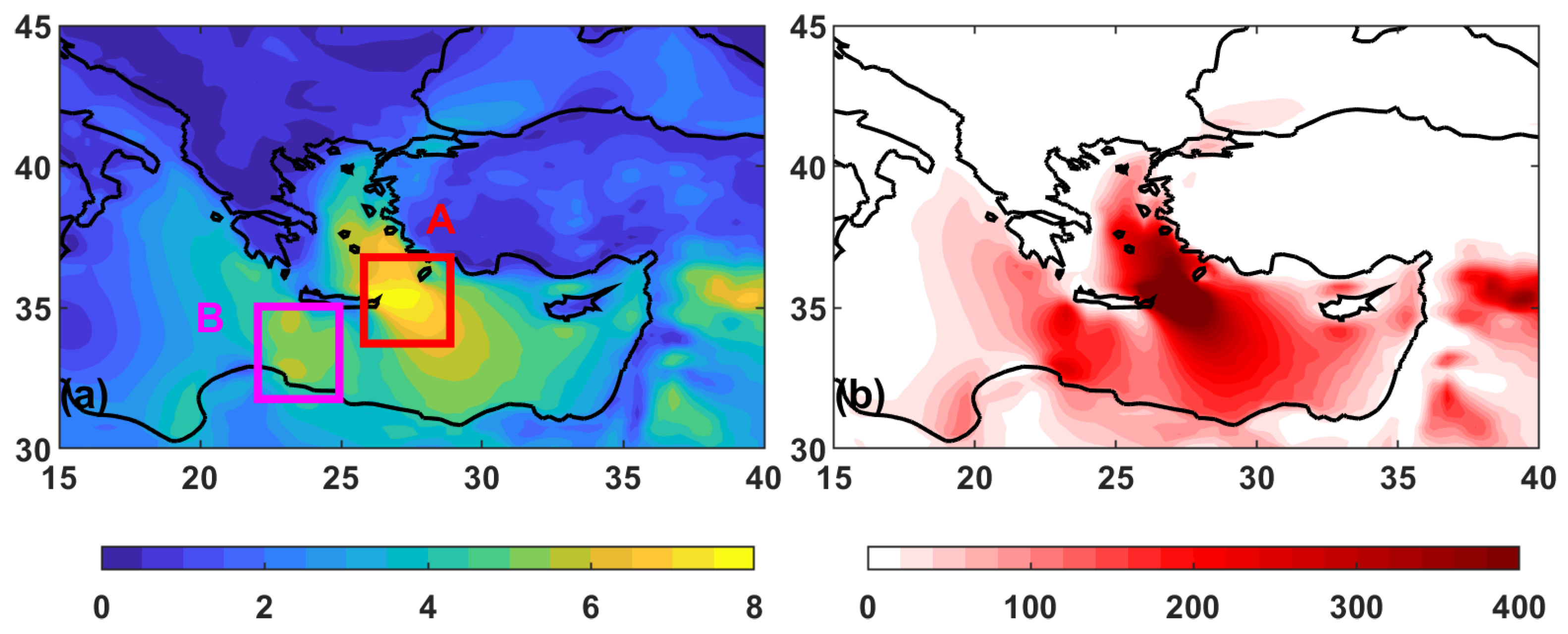
The investigation mainly targets two key regions in the Eastern Mediterranean, selected for their wind energy potential (WEP) characteristics. These regions correspond to areas of maximum WEP identified in previous studies [70,71] and confirmed by the present analysis, which shows that they also experience peak summer wind speeds over the wider Aegean basin. The first region (hereafter Region A) covers the geographical window of the Southeastern Aegean basin (26–29° E, 34–37° N), and the second region (hereafter Region B) covers the area between Crete Island and the north coast of Africa (22–25° E, 32–35° N) Previous studies have already shown that these areas show significant JJA wind speed, and they are considered high-interest areas regarding WEP [21,22,23,41]. The analysis considers, both for GCM simulations and ERA5 data, the typical offshore turbine height of 80 m [72]. The extrapolated wind speed at this height was calculated using Equation (1) (logarithmic law) [15,73]:
V H = V 10 l n H z 0 l n 10 z 0
where
  • V H is the hub height of the offshore wind turbine at height H;
  • V 10 is the wind speed at 10 m;
  • z 0 is the roughness length ( z 0 = 0.001 m was used for open calm seas; [15,23,74].
WEP is calculated using Equation (2) [15,73,75]:
W E P = 1 2 ρ V H 3
where
  • ρ is air density.
In order to evaluate the efficiency of CMIP6 model simulations to capture and reproduce spatiotemporal features of WEP on regions of interest, (a) mean WEP averaged over regions of interest, (b) the variability ratio and (c) the Kling–Gupta combined statistical efficiency index (KGE) were calculated for each model simulation using ERA5 as a reference data set during the period from 1970 to 2000 (basis historical period). The KGE index is calculated considering three statistical measures (Pearson correlation coefficient, standard deviation, and average values for model simulations and reference data set), and it is commonly employed to evaluate the efficiency of GCMs to reproduce climatic variables [76] capturing both temporal and distributional characteristics. The index values vary between −∞ and 1, with the larger values reflecting better model efficiency [77,78]. In general, KGE values greater than −0.41 are considered acceptable regarding model performance [79]. In our analysis, a statistically rigorous criterion (KGE > 0) is considered in order to select the CMIP6 model simulations that reflect “good” performance [80] to reproduce WEP (temporal and distributional features) over regions of interest. In addition, the selected threshold reduces the uncertainties of the results. Adopting a less rigorous criterion (e.g., KGE > −0.41), the inter-model variability significantly increases, compromising the reliability of the findings.
For the calculation of KGE, the following Equation (3) is used:
K G E = 1 r 1 2 + σ s σ 0 1 2 + μ s μ 0 1 2
where
  • r is the Pearson correlation coefficient between CMIP6 model simulations and ERA5;
  • σ s and σ 0 are the standard deviation of CMIP6 model simulations and ERA5;
  • μ s and μ 0 the averages of CMIP6 model simulations and ERA5, respectively.
For the investigation of WEP changes during the 21st century, the analysis is focused mainly on the period from 2070 to 2099. The composite mean WEP difference maps between the future and basis historical periods (years from 1970 to 2000) are constructed for each of the CMIP6 model simulations, both for “moderate” and “extreme” future evolution scenarios. In addition, the mean WEP differences between the future periods (mid-century: from 2030 to 2069; late-century: from 2070 to 2099) and the historical reference period are shown using bar charts. The analysis was conducted for both study regions, and both selected SSP scenarios for each model simulation. To calculate the statistical significance of future and basis period differences, a two-tailed t-test was used at the 95% statistical significance level [81].
To further study the WEP future projections according to the CMIP6 model simulations, the time series of yearly WEP anomalies (related to the base historical period) averaged over Region A and Region B were calculated both for the SSP2-4.5 and SSP5-8.5 scenarios. This approach can provide results for WEP evolution, reducing the uncertainties and mitigating the impacts of systematic WEP underestimation. Furthermore, the mean WEP differences (%) both for the studied regions and future scenarios are calculated in order to reduce the influence of inherent model biases, as systematic errors in the historical baseline tend to be canceled out during the projection periods. In addition, the differences between the two future scenarios regarding the projected WEP changes are studied. Finally, the composite mean WEP differences between the period from 2070 to 2099 and the historical basis period are constructed for model simulations that present better efficiency to reproduce the historical basis period WEP over Region A (group A model simulations) and Region B (group B model simulations). For this analysis, the simulations that show KGE values larger than zero (KGE > 0) are considered the model simulations with better performance [79,82].

3. Results and Discussion

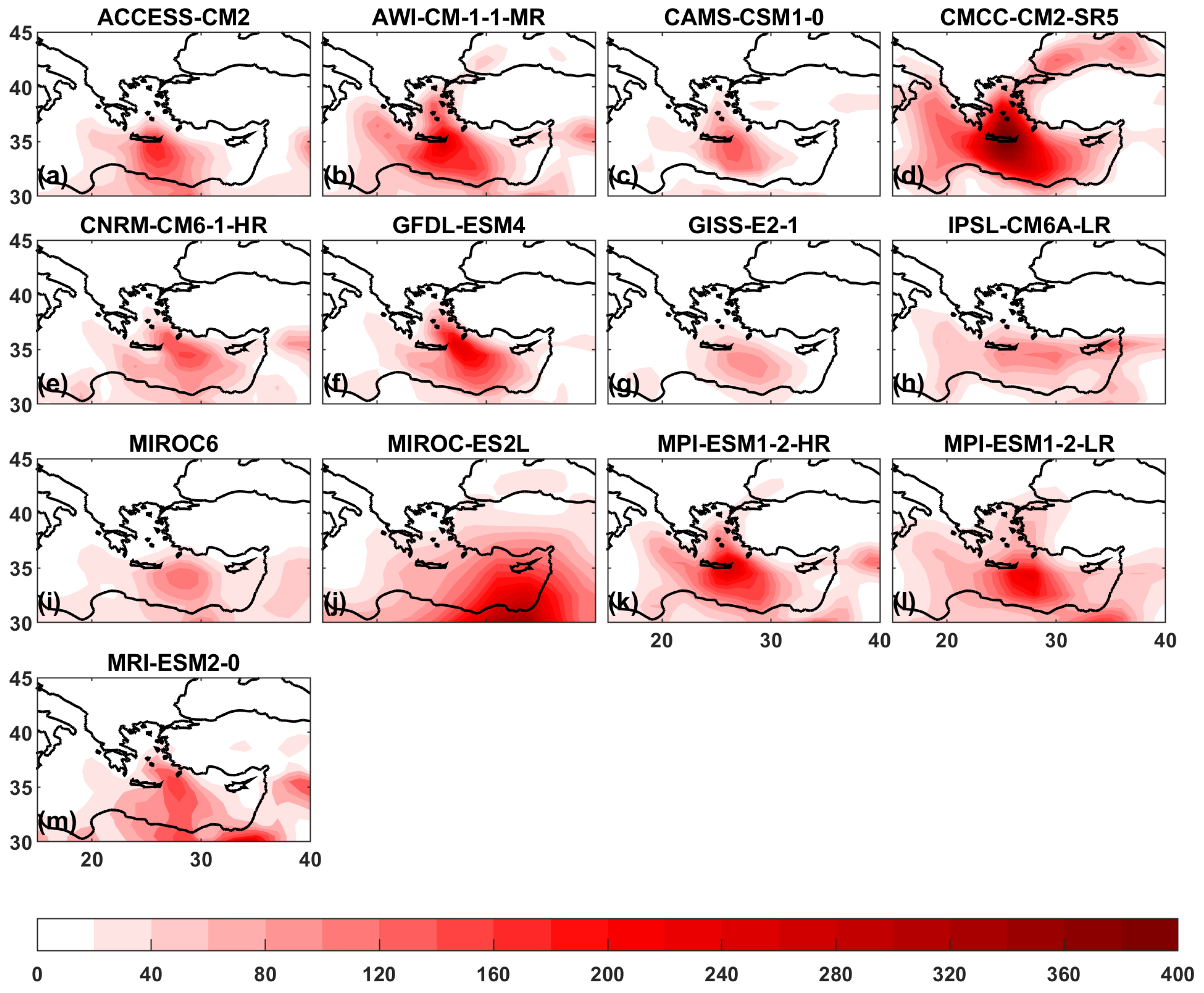
Figure 1 shows the mean wind speed (m/s) and mean WEP (W/m2) during the JJA season of the basis period (from 1970 to 2000) over the region of EMed according to the ERA5 reanalysis dataset. The regions that show maximum WEP are located over (a) the central Aegean and southern area of Crete Island, as well as (b) between the region of central–southwest Crete Island and North Africa (Figure 1a). Furthermore, the standard deviation of WEP is maximized over these areas (Figure 1b). The mean WEP during the basis period of the historical era is shown for each of the CMIP6 model simulations in Figure 2.
The analysis shows that the majority of model simulations indicate the maximum WEP over an extended area that covers the geographical window of the central Aegean Sea and south-southeast of Crete Island up to the north coast of Africa. Note that our analysis is mainly focused on the areas that show the maximum WEP and variation during the JJA period (Region A and Region B). Rusu et al. [83] have shown that the Aegean basin is classified as a hot-spot area regarding WEP. Logothetis et al. [18], using RCM (Euro-Cordex) model simulations have shown that the maximum WEP is over the central east and south-east Aegean basin. Kokkos et al. [84], using data from Copernicus Marine Environmental Monitoring Service (CMEMS), have shown that the north Aegean regions, such as Lemnos and the Dardanelles, are categorized as excellent according to the international standards for wind energy potential (class 5). In addition, Delagrammatikas et al. [85] have shown that the north-east Aegean, central Aegean, and south-east Aegean show increased WEP over the Aegean basin. Furthermore, the area between the Peloponnese, southwest Crete Island, and the north coast of Africa identifies a region with significant WEP [86,87]. This area is potentially considered a suitable wind energy source for future offshore wind investments [75] supporting the renewable energy transition for the region of the Southeastern Mediterranean [88].
In general, GCMs are able to simulate and reproduce large scale features of eastern Mediterranean atmospheric circulation such as the wind speed pattern [41,89,90]; however, the spatial resolution of GCMs and parametrization schemes in combination with complex terrain (i.e., orography, channeling effects in straights, mountain gaps and many different size islands) of the Southeastern Mediterranean possibly explains the coarse reproduction of wind field in regional and local scales over the region [91,92,93]. In this context, CMIP6 model simulations can reliably reproduce large-scale atmospheric circulation patterns and the seasonal cycles of the Mediterranean area, but there are discrepancies regarding local atmospheric features and interactions (i.e., the impact of complex terrain) [38,41]. For example, model simulations show increased multi-model variability regarding the wind speed and distributional features of the wind fields [22,41,94]. Within this framework, GCMs are selected based on their ability to reproduce key atmospheric circulation features, as evaluated against reanalysis and observational datasets, in order to minimize biases in the main results [90,95].

3.1. The Performance of CMIP6 Model Simulations to Reproduce WEP over Regions of Interest

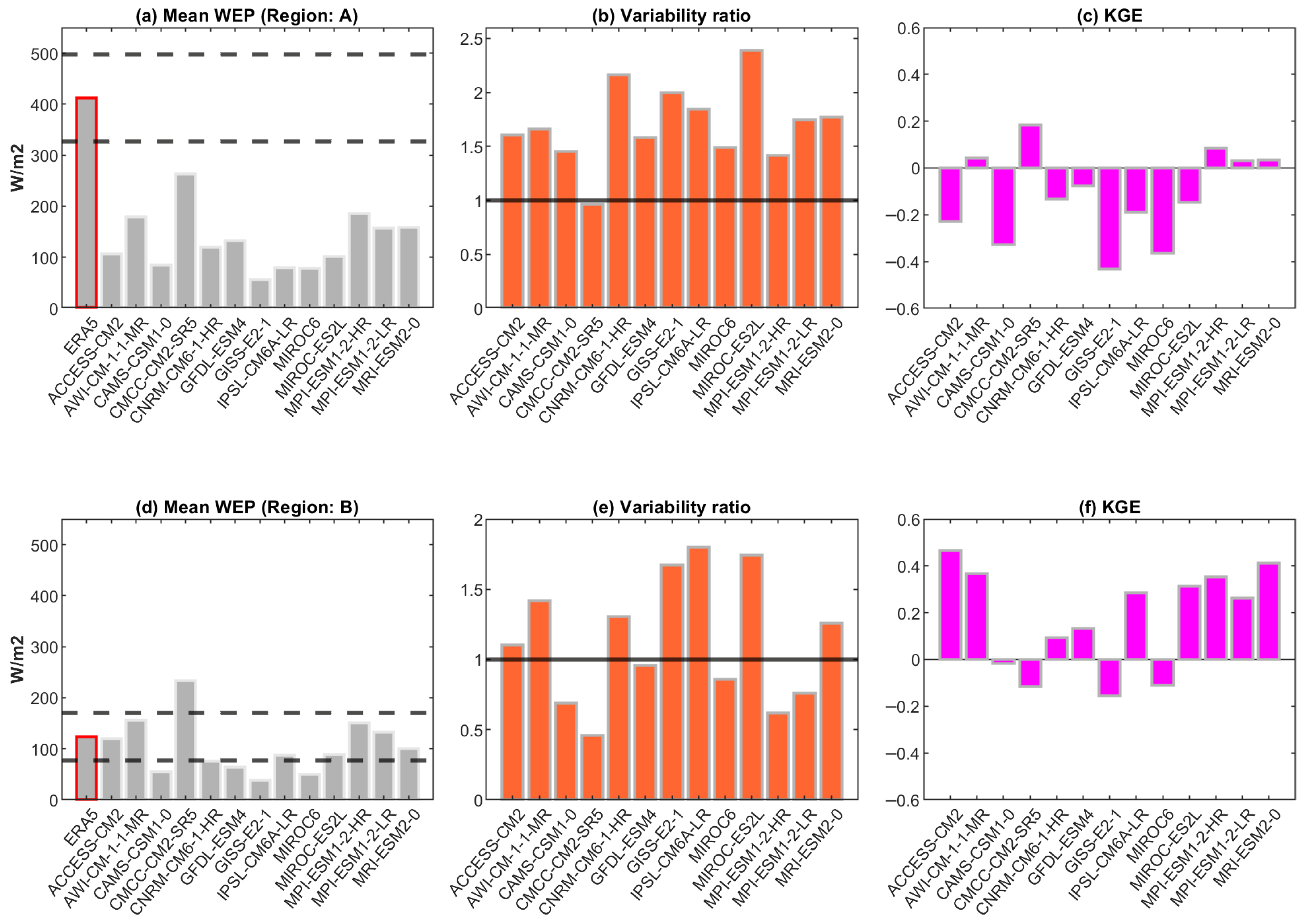
In order to study the ability of CMIP6 model simulations to capture and reproduce the spatial and distributional JJA WEP features averaged over the domain of Regions A and B, the KGE statistical index is calculated (as a measure of the models’ efficiency) using ERA5 as a reference dataset (Figure 3).
Focusing on Region A, model simulations seem to underestimate the JJA WEP. The mean WEP for ERA5 is about 411 W/m2, while the CMIP6 model simulations show high WEP multi-model variation (between 56 and 262 W/m2; Figure 3a). In addition, the variability ratio is larger than the null value (“one”) for GCMs (CMCC-CM2-SR5 is an exception) (Figure 3b). The majority of CMIP6 model simulations show negative KGE values (−0.41 ≤ KGE ≤ 0.0) while five out of thirteen (5/13) model simulations show positive values. Namely, CMCC-CM2-SR5 shows a KGE value equal to 0.18, and AWI-CM-1-1-MR, MPI-ESM1-2-HR, MPI-ESM1-2-LR, and MRI-ESM2-0 show limited positive KGE values (equal to 0.04, 0.09, 0.03, and 0.03, respectively; Figure 3c).
Focusing on Region B, model simulations also seem to underestimate the JJA WEP but to a lesser extent than for Region A. The mean WEP for ERA5 in this case is about 123 W/m2, and the CMIP6 model simulations show that WEP varies between 75 and 155 W/m2 (Figure 3d). The variability ratio for (about) half of the GCM simulations shows lower values than the “null” value. Nine out of thirteen (9/13) model simulations show positive KGE values (0.0 ≤ KGE ≤ 0.45). In particular, ACCESS-CM2, AWI-CM-1-1-MR, MIROC-ES2L, MPI-ESM1-2-HR, MPI-ESM1-2-LR, and MRI-ESM2-0 show KGE values larger than 0.35 (KGE > 0.35). Studying the models performance regarding their efficiency to capture and reproduce wind features, Logothetis et al. [41] have shown that CMIP5 model simulations underestimate the wind speed in the central Aegean Sea.
Region B shows a clear signal regarding the changes in projected WEP. The geographical characteristics of this region—specifically, the fewer islands and less complex terrain as compared with Region A—likely explain why the model simulations show reduced inter-model variation in Region B (as compared to Region A). In contrast, the complex topography of Region A contributes to higher inter-model variability in WEP projections, affecting the efficiency of GCMs to reproduce the atmospheric circulation features.
Individual GCMs continue to exhibit biases in wind speed and spatial distribution, making careful model selection essential for reliable regional WEP estimates [96]. Although CMIP6 models generally outperform CMIP5 in representing climatic conditions [97,98], substantial differences remain across datasets in their ability to reproduce spatial and temporal wind speed variability, particularly given the strong seasonal and regional contrasts of the Eastern Mediterranean. These limitations indicate that further targeted work is needed to improve wind field representation in high-priority areas [99].
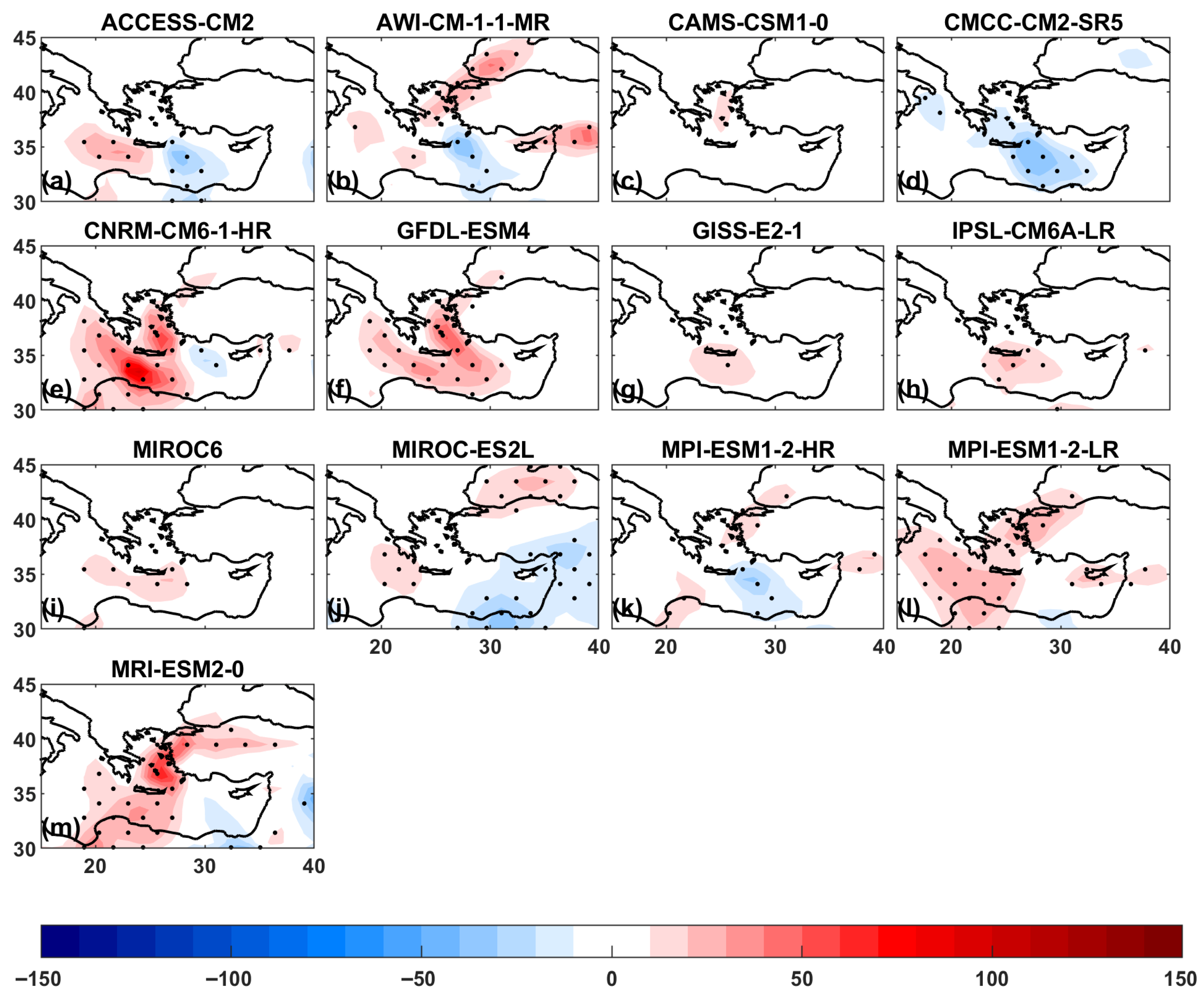
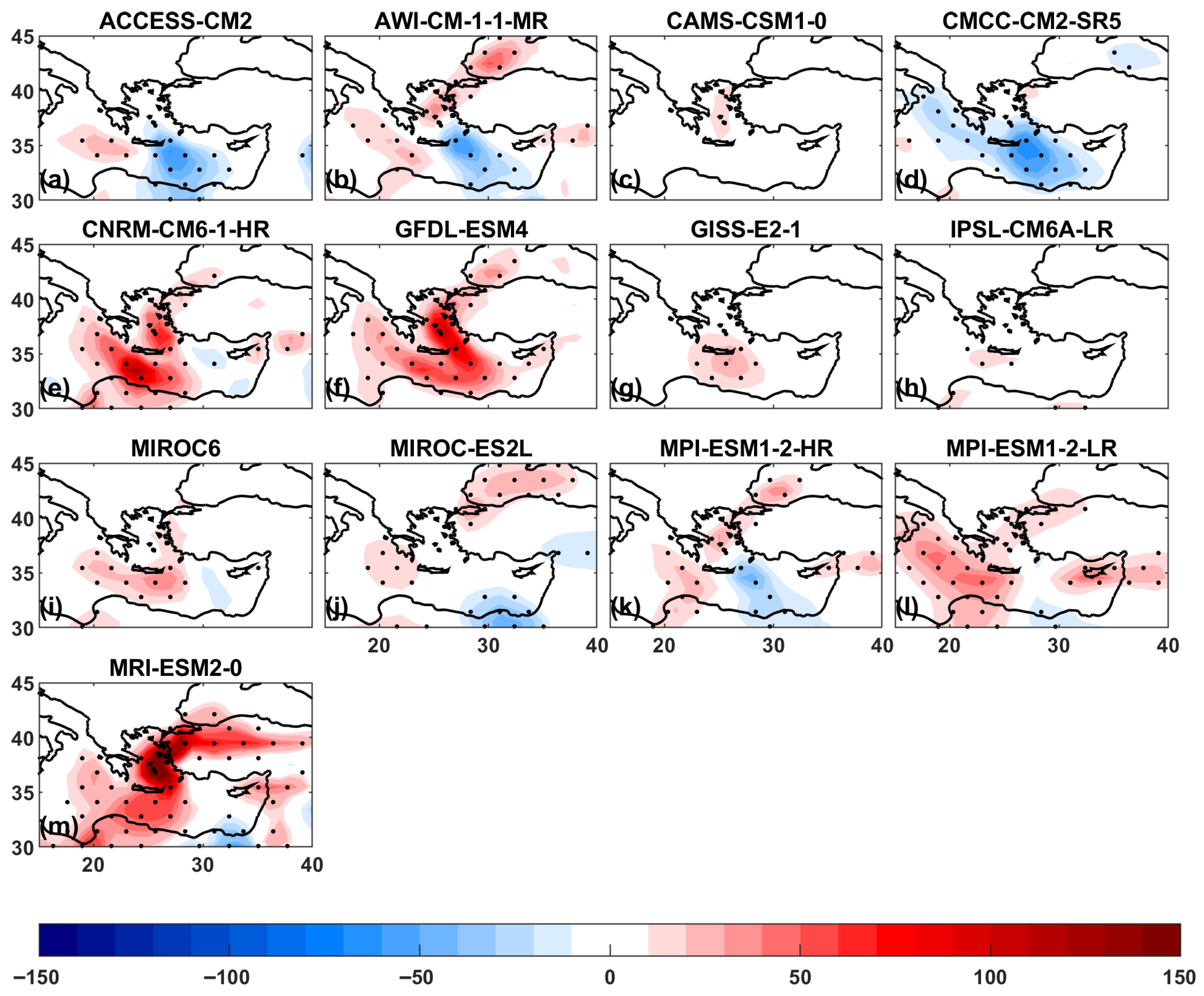
Figure 4 shows the changes in WEP between the future period (from 2070 to 2099) and the baseline historical period (from 1970 to 2000) for each of the CMIP6 model simulations according to the “moderate” SSP2-4.5 scenario. Five out of thirteen (5/13) model simulations show a decrease in WEP of 0 to 50 W/m2 over the Southeastern domain of the Mediterranean (East of Crete Island and the Levantine basin; see Figure 4a,b,d,j,k,m). Four out of thirteen (4/13) model simulations show an increase in WEP of about 30 to 100 W/m2 over the central Aegean Sea as well as the area between Crete Island and the north coast of Africa (see Figure 4e,f,l,m). Finally, three out of thirteen model simulations (3/13) show slight changes in WEP (see Figure 4c,g,h). Figure 5 shows WEP differences as Figure 4, but for the extreme SSP5-8.5 scenario. In general, the analysis reveals consistent patterns of WEP alterations across both SSPs; however, these changes are significantly more pronounced under the SSP5-8.5 scenario compared to the more moderate SSP2-4.5. In particular, five out of thirteen (5/13) model simulations show a decrease in WEP of about 10 to 70 W/m2 over the Southeastern domain of the Mediterranean (eastern part of Crete Island and Levantine basin; Figure 5a,b,d,j,k). Seven out of thirteen (7/13) model simulations show an increase in WEP of about 20 to 150 W/m2 over the central Aegean Sea and the area between Crete Island and the north coast of Africa (Figure 5e,f,g,i,k,l,m). In general, findings show that GCMs present high multi-model variability regarding the evolution of WEP over the EMed region.
Boreal summer (JJA) circulation over the Eastern Mediterranean is largely controlled by large-scale atmospheric dynamics, whose variability shapes regional wind conditions. The region is typically described as having a monsoon-type circulation [100], with the South Asian monsoon exerting a remote influence on the Etesian winds through subsidence over the Eastern Mediterranean (for, e.g., [41,101,102,103]. Changes in future monsoon behavior are therefore likely to affect Etesian characteristics across the Aegean basin. Model projections indicate a strengthening of the regional pressure gradient—driven by increasing high pressure over central Europe and the northern Balkans and deepening low pressure over the Southeastern Mediterranean [53], which is expected to enhance the Etesian regime. At the same time, increasing monsoon rainfall but weakening circulation [104] may partly explain the variability in projected WEP across models.
In order to investigate the differences in WEP changes (last period of the 21st century against the historical basis period) between the two studied scenarios (SSP5-8.5 vs SSP2-4.5) for each CMIP6 model simulation, the related WEP differences are calculated over two regions of interest. The analysis does not reveal consistent patterns (high multi-model variability). In particular, for Region A, three out of thirteen (3/13) model simulations indicate a decrease in WEP (averaged over the region A) approximately from 15 to 20 W/m2, while two out of thirteen (2/13) models show an increase approximately from 20 to 30 W/m2. In Region B, two out of thirteen (2/13) simulations show a WEP reduction of approximately 5 W/m2, whereas four out of thirteen (4/13) CMIP6 models exhibit an increase ranging from 8 to 15 W/m2.
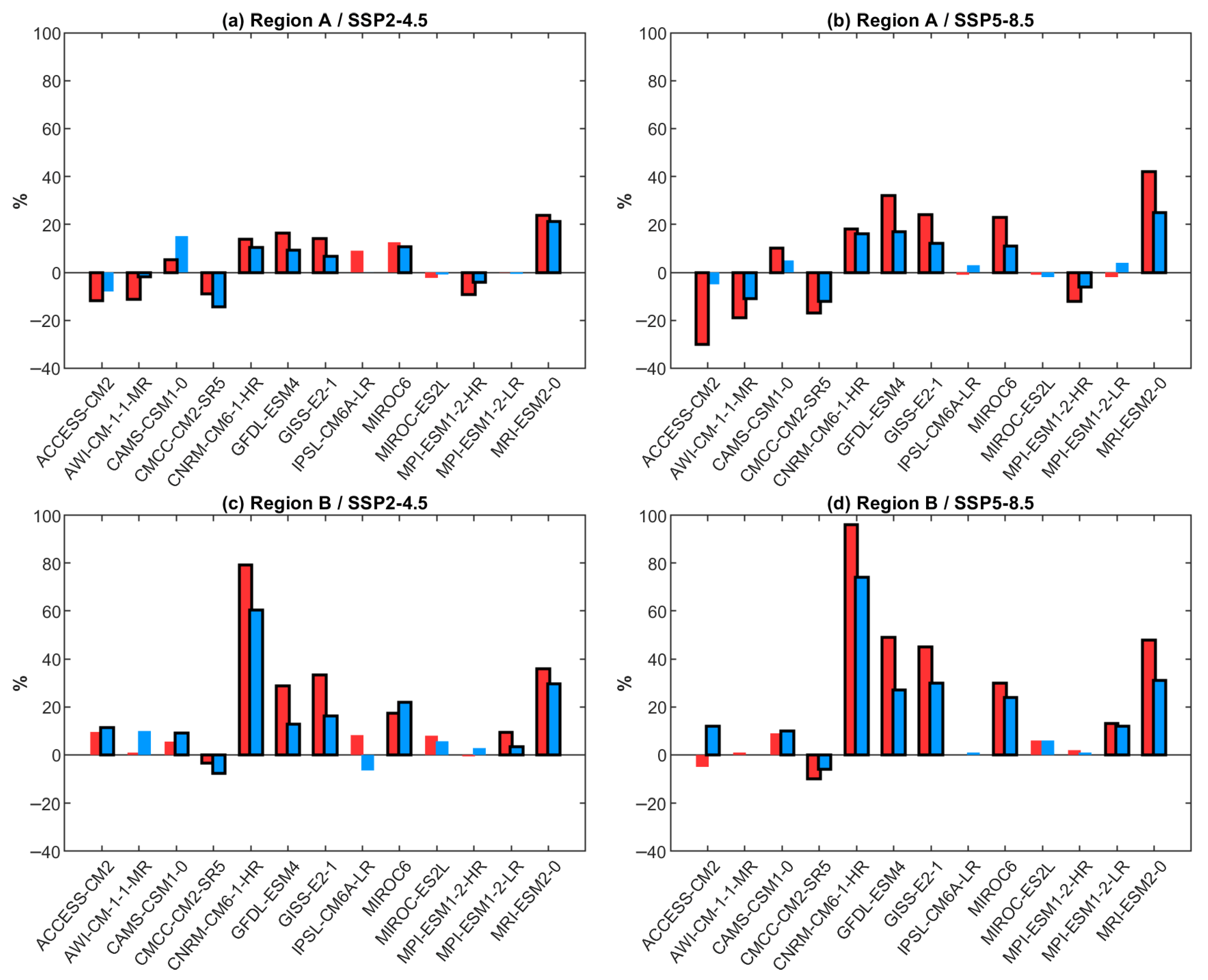
In order to further investigate the future changes in WEP, the bar chart of WEP changes (%) between middle-/late-21st century and the baseline historical period over the regions of interest, Region A and B are calculated (Figure 6). Findings show that Region B presents the most significant WEP changes mainly during the last period of the 21st century (Figure 6c,d).
According to the moderate scenario (SSP2-4.5), CMIP6 model simulations show multi-model variation in the average over Region A WEP changes both for the mid and late 21st century. In particular, four out of thirteen (4/13) model simulations show an increase in WEP of about 5% to 25%, and four out of thirteen (4/13) model simulations show a decrease in WEP of about 10%, respectively, during the late 21st century (with reference to the basis historical period). Focusing on the middle 21st century, WEP changes show a common trend but smaller WEP differences (%) as compared to the last period of the 21st century. For Region B, the WEP changes (%) show that WEP increases for the majority of models’ simulations by about 15% to 80% compared to the baseline historical period for both 21st century periods studied here.
According to the extreme scenario (SSP5-8.5), for the last period of 21st century, six out of thirteen (6/13) model simulations show an increase in WEP about 10% to 40% and four out of thirteen (4/13) model simulations show a decrease about 5% to 15% (as compared to the basis period), respectively (Figure 6b). WEP changes during the middle 21st century show smaller changes as compared to the last period of the future studied period. For Region B, the maximum WEP changes (%) are shown during the last period of the 21st century, indicating an increase of about 15% to 95% for six out of thirteen (6/13) model simulations and insignificant changes for the other simulations (except one that shows a decrease in WEP of about 10%) (Figure 6d). The changes in WEP (%) between the middle 21st century and the reference period show an increase in WEP of about 10% to 75% (one model simulation shows a decrease of about 5%) (Figure 6d).
To sum up, CMIP6 model simulations show high multi-model variation in WEP changes averaged over Region A both for the middle and late 21st century with reference to basis historical period. For Region B, the WEP seems to increase for both studied future scenarios. Finally, the moderate scenario (SSP2-4.5) follows the common trend but with a reduced WEP sign as compared to WEP future changes in the extreme scenario (SSP5-8.5).
Previous studies have investigated the future dynamics of WEP over the Mediterranean basin, using results from various data sources such as GCMs, RCMs, and reanalysis datasets. Using results from nine GCMs (CMIP6), Martinez et al. [12] have shown a rather negative evolution of WEP in the Mediterranean Sea, although localized WEP increases are identified in the Aegean Sea, Alboran Sea, and Gulf of Lyon. Logothetis et al. [22], focusing on the JJA season, have shown that the Etesian regime (which is indicative of the wind speed over the Aegean Sea) does not project a clear change in the Etesians’ sign, using CMIP6 GCMs (both for SSP2-4.5 and SSP5-8.5 over the last period of the 21st century). In particular, for the second half of 21st century, five out of eleven (5/11) CMIP6 model simulations show a statistically significant increase in averaged meridional wind speed components (v10) over central Aegean Sea (of about 0.2 to 1.4 m/s), and four out of eleven (4/11) simulations show a significant decrease (about 0.3 to 0.6 m/s), respectively [22]. Note that the meridional wind component is considered indicative of reproducing the Etesian sign over the Aegean basin. RCMs WEP projections (using the Euro-Cordex data) have shown an increase in Aegean WEP over Northeastern Aegean, central Aegean, and Southeastern Aegean (in Crete Island) mainly during the second half of the 21st century according to RCP4.5 and RCP8.5 scenarios [22,105]. In addition, the analysis of Ezber [21] has shown that Etesian winds increase in the future due to the strengthening of anticyclonic circulation in the Balkan Peninsula. In line with this, Anagnostopoulou et al. [20] have shown that RCMs projected a strengthening of the Etesian regime that is related to the strengthening of high pressure center over the north Balkan Peninsula, central Europe, and the deepening of a thermal low that is extended from the Indian monsoon area to the Southeastern Mediterranean [41]. Furthermore, the ensemble mean of RCM (Euro-Cordex) model simulations has shown a significant increase in frequency and wind speed of the Etesians under RCP4.5 and RCP8.5 scenarios [53].
To sum up, our findings are generally in line with previous analyses showing increased multi-model variability in WEP changes over the EMed region. Differences between our results and previous studies [12,22] can be attributed to the modeling framework used—specifically, differences between GCM- and RCM-based simulations—as well as to our focus on two regions of particularly high WEP in the Southeastern Mediterranean. In particular, the majority of GCMs show an increase in WEP over the region between Crete Island and the north coast of Africa (Region B), a rather moderate increase over the north Aegean Sea, and no changes to a slight decrease over the region of the southeastern Aegean basin.

3.2. WEP Projections: WEP Features over Region A and B Using Selected CMIP6 Simulations

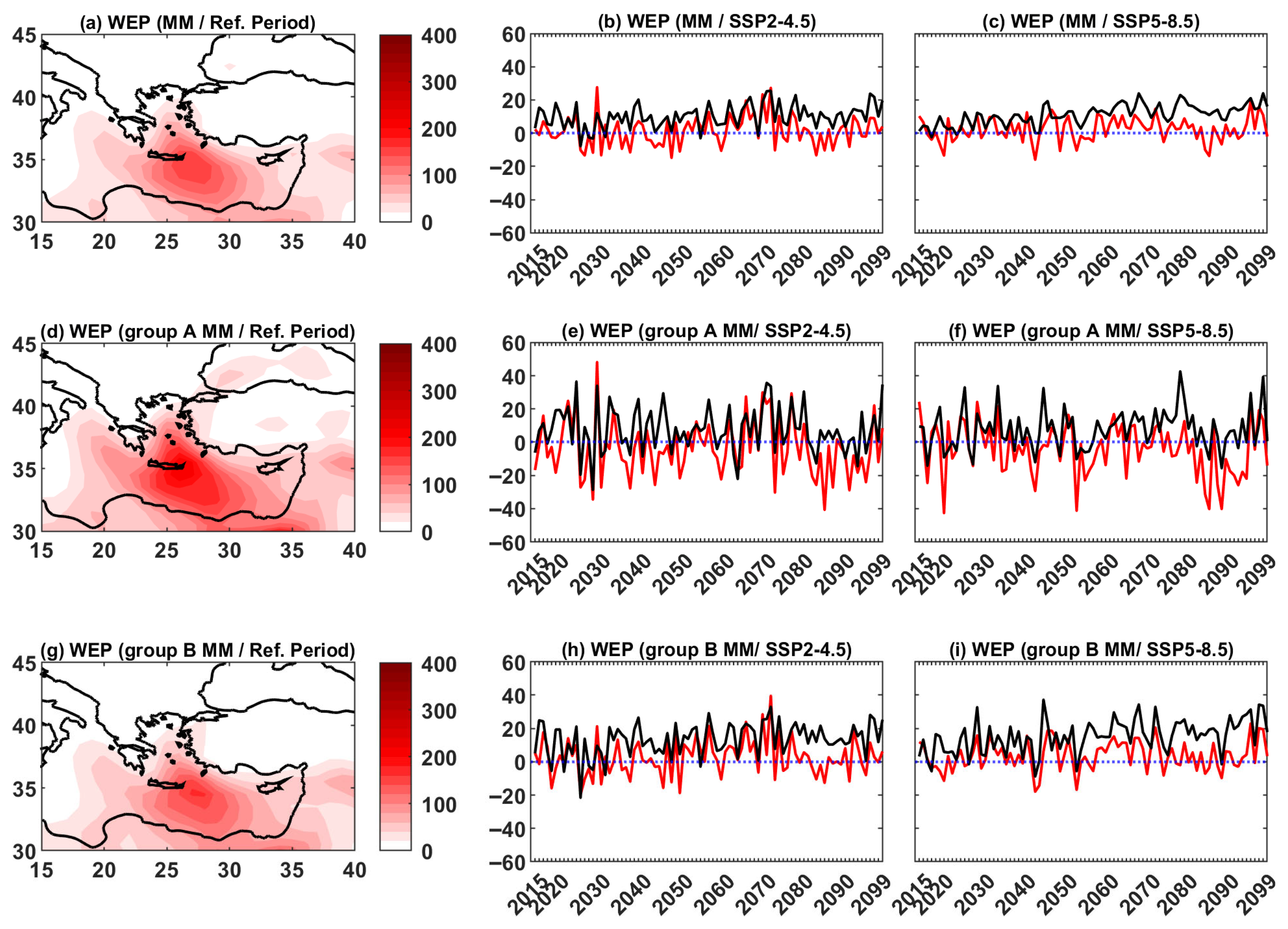
Figure 7 shows the model mean WEP (calculated from CMIP6 model simulations) and the model mean for the simulations that present better efficiency (in terms of KGE values using ERA5 as a reference dataset) to capture the spatial and distributional features of JJA WEP over Region A (group A model simulations) and Region B (group B model simulations). The analysis shows that the CMIP6 model mean WEP is maximized over the area between the Island of Crete and the north coast of Africa (Figure 7a). The calculation of model mean anomalies with reference to basis historical period (from 1970 to 2000) for all CMIP6, group A and group B model simulations over areas of interest (Region A and Region B) show that Region B shows a slight increase in WEP during the last period of 21st century (Figure 7b,c,e,f,h,i) In particular, findings for the CMIP6 model mean (considering the 13 CMIP6) show a positive WEP difference for SSP2-4.5 (slightly positive) and SSP5-8.5, for Region B. The analysis for region A shows unclear results regarding WEP changes. Focusing on this period, group B model simulations (that present improved performance to reproduce WEP features over Region B) show an increase in mean WEP of about 20 to 40 W/m2 for SSP2-4.5 and SSP5-8.5 over the geographical window of Region B (Figure 7h,i). For group A model simulations (that present improved performance to reproduce WEP features over Region A), the analysis shows insignificant and high annual variation in WEP changes that range from −10 to 40 W/m2 over Region A, for both studied scenarios (Figure 7e,f).
Focusing on the CMIP6 model simulations that show better performance (in terms of KGE values), among the 13 CMIP6 model simulations, the CMIP6 simulations with finer spatial resolution generally tend to perform better in capturing WEP features over Region A and Region B (adopting the strict criterion of KGE > 0). Specifically, GISS-E2-1-G (2.5° × 1.3°) and MIROC6 (1.4° × 1.4°) yield negative KGE values for both regions, whereas higher-resolution models (~1.0° × 1.0°, e.g., AWI-CM-1-1-MR, MPI-ESM1-2-HR, MRI-ESM2-0) show consistently positive KGE values. While the spatial resolution feature does not fully determine model skill, these results suggest a possible relation between finer spatial resolution and improved representation of local circulation features (such as wind speed).
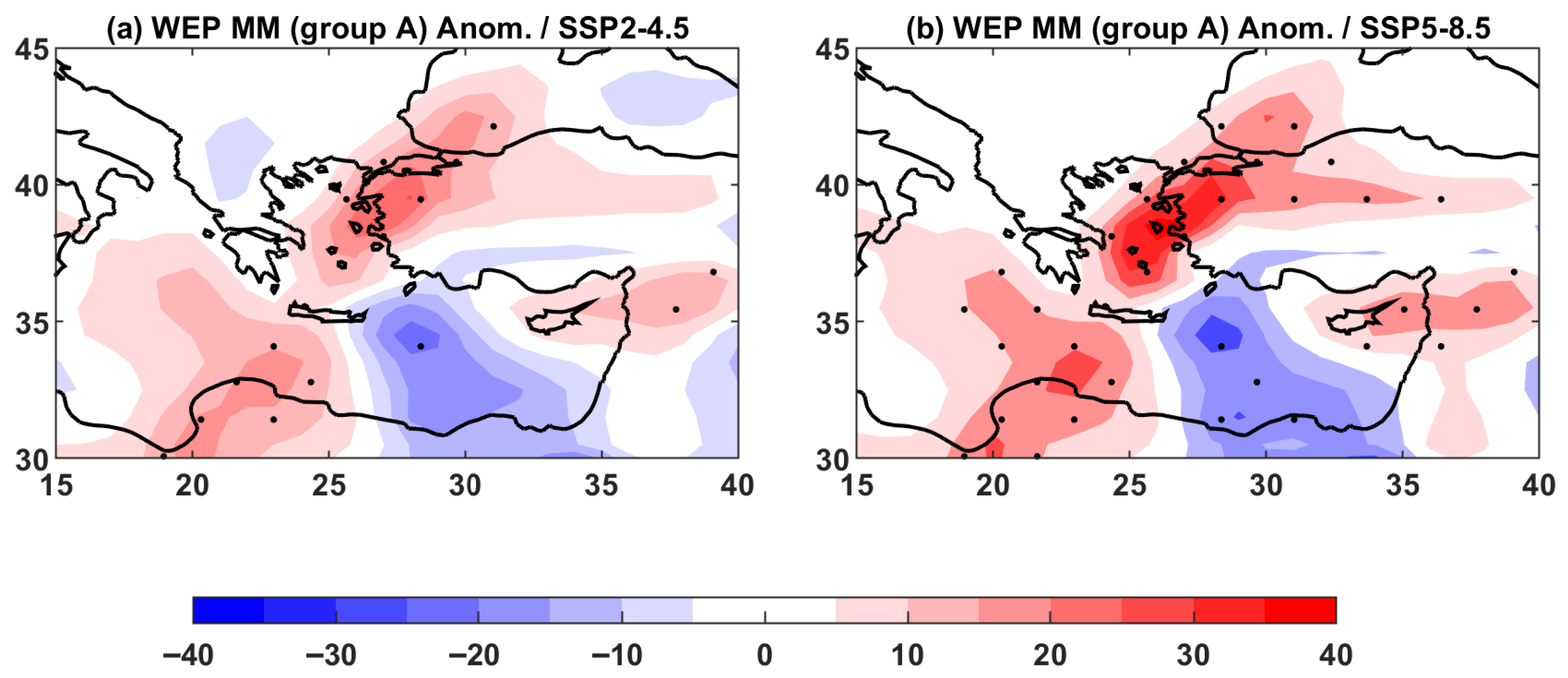
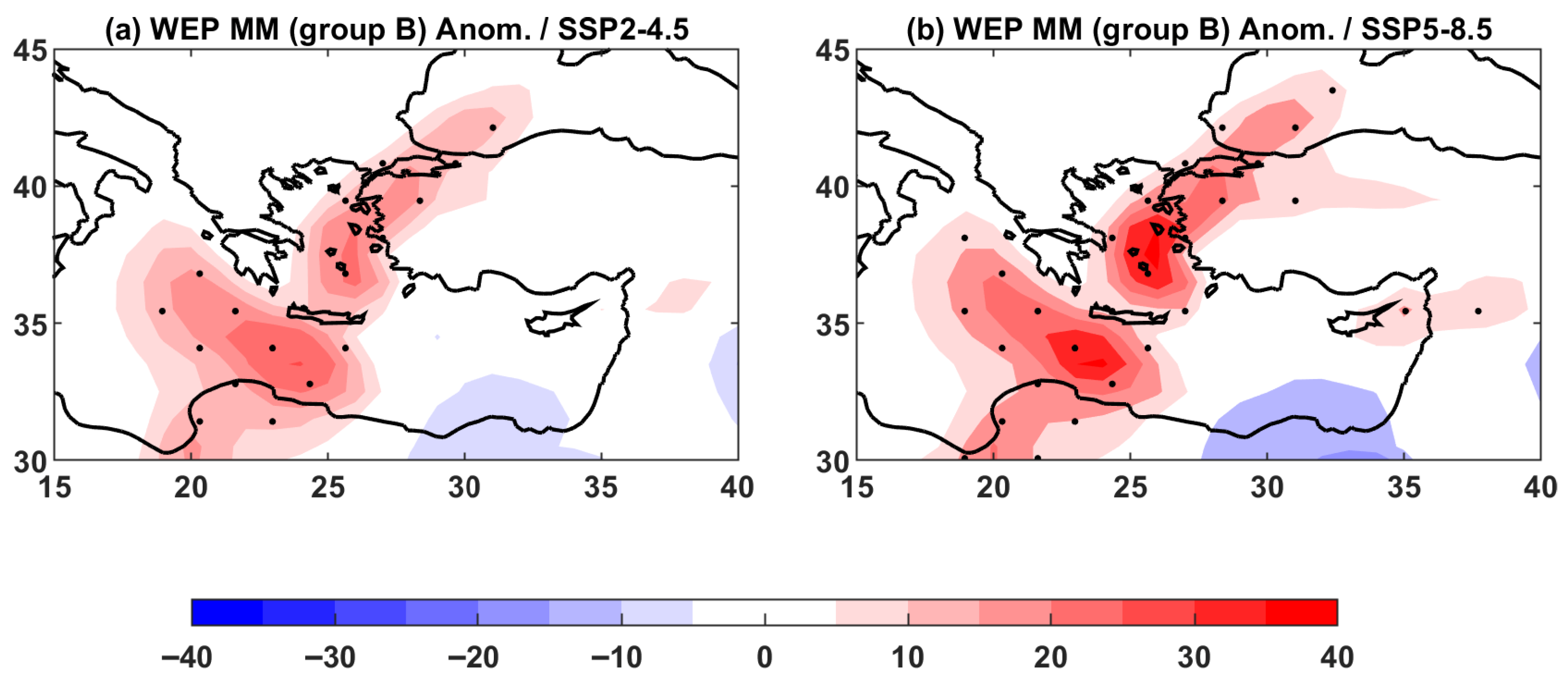
In order to further investigate the future changes in WEP in the Southeastern Mediterranean, Figure 8 and Figure 9 show the composite mean differences in WEP between the last period of the 21st century and the baseline historical period for model simulations group A (Figure 8) and group B (Figure 9), both for “moderate” and “extreme” future evolution scenarios.
Focusing on the results of group A, WEP increases about 10 and 30 W/m2 over the central Aegean and decreases about 10 and 30 over the region east of Crete Island and north of the African coast for SSP2-4.5 and SSP5-8.5, respectively (Figure 8). Regarding the WEP changes focusing on group B, WEP increases about 5 and 40 W/m2 over the regions of central Aegean as well as between Crete Island and the north coast of Africa for SSP2-4.5 and SSP5-8.5, respectively (Figure 9).
To sum up, group A model simulations show a reduction in WEP over region A (about 10 to 20 W/m2) and group B simulations an increase (about 10 to 40 W/m2) over region B for “moderate” and “extreme” future scenarios. In other words, a reduction in WEP (about 0 to 40 W/m2) is shown over the south area of the Southeastern Mediterranean and a WEP increase over the Northeast Aegean (about 10 to 40 W/m2), as well as in the southwest area of the Eastern Mediterranean (about 10 to 40 W/m2 in the region between North Africa and Crete Island). Finally, findings highlight the importance of GCM selection regarding the biases and uncertainties of results (WEP changes and projections).

3.3. Limitations

This study investigates the performance of CMIP6 model simulations to capture WEP features and to project WEP changes, focusing on two regions with high wind energy interest for the Eastern Mediterranean.
Despite the importance of the results, the interpretation of these findings should be approached with caution due to some inherent limitations. The selection of a subset of CMIP6 model simulations (13 CMIP6 model simulations) that are used in this work may increase the uncertainty regarding local atmospheric processes. While this study focuses on selected GCMs that show good efficiency to reproduce WEP features over the Eastern Mediterranean, the inclusion of a significant number of model simulations, ensembles, and different emission scenarios could provide further insights. Our analysis shows that the performance of GCMs exhibits significant spatial sensitivity in capturing and reproducing WEP across the Eastern Mediterranean. Consequently, model simulations display considerable variability in their skill to reproduce WEP at local scales. In this context, the special features of the Eastern Mediterranean (i.e., the complex topography) are also a limitation to generalizing the findings to other areas that show common energy and climatic challenges. In addition, the complex topography, channeling effects, and coastal areas are some of the features that also tend to increase the uncertainties [38,106], although CMIP6 simulations adequately reproduce large-scale circulation patterns and seasonal variability over the Eastern Mediterranean [41]. Note that the aim of this work is not to involve all the available CMIP6 model simulations for analysis, but to focus on a representative subset of models that have already been used in the literature.
In the current analysis, the ERA5 reanalysis dataset is considered as the reference dataset. There are previous studies that indicate that ERA5 performance can be influenced by various factors, such as complex topography and local atmospheric circulations. These factors result in biases (i.e., underestimation of low and increased wind speeds but strong correlation with in situ observations) (for, e.g., [107,108,109]). Regardless, ERA5 is considered a robust reference data set [110] and is extensively used for climate studies.
In our analysis, spatial regridding was performed using linear interpolation. This is a common approach that is extensively used for multi-model comparisons [41,54]. Regridding may increase uncertainties when downscaling from coarse (native) resolutions to finer resolutions (especially for variables with high spatial variability) [56,57]. For the analysis, a height of 80 m is selected as typical to calculate the WEP using the logarithmic law [18,72]. The modern offshore turbines tend to increase the typical hub height to approximately 100–150 m. This change could possibly induce uncertainty in the calculated WEP up to approximately 5%.
The performance of GCMs to reproduce the WEP over regions of interest in the Eastern Mediterranean against ERA5 (as a reference dataset) is studied using the KGE index. KGE is a statistical measure for efficiency that is widely used in the literature to investigate models’ performance [79,82]. This index is sensitive to extremes and outliers. In addition, it does not indicate which component drives the poor performance, and it takes into consideration only the linear correlation (Pearson Correlation), possibly covering uncertainties that are affected by non-linear relations. Nevertheless, despite these limitations, the KGE metric remains a widely accepted statistical metric to study model simulations’ performance, taking into consideration various statistical measures (correlation, bias ratio, and variability ratio) [111].
Despite these limitations, the adopted methodological framework and the use of performance-based models’ selection ensure the robustness of the results, providing reliable insights and a meaningful contribution to the scientific community regarding wind energy potential over the Eastern Mediterranean.

4. Conclusions

Wind energy significantly supports Sustainable Development Goals (SDGs) for “affordable and clean energy” (SDG 7), “climate actions” (SDG 13), and “industry, innovation and infrastructure” (SDG 9), ensuring energy autonomy and efficiency for sensitive Mediterranean ecosystems that are prone to climate and socioeconomic challenges. The increasing share of wind (Aeolian) energy in the energy mix contributes to energy autonomy and security, climate change mitigation, and green transition, increasing clean power footprint and reducing fossil fuel dependence. In this context, this study focuses on the investigation of wind energy potential over the climate-sensitive area of the Eastern Mediterranean using results from GCMs. The efficiency of CMIP6 model simulations to reproduce WEP features during the summer period of 1970 to 2000 against ERA5 reanalysis data (common period) is investigated. In addition, the future projections and changes in WEP are studied, focusing mainly on the last period of the 21st century.
Results show that the majority of model simulations indicate maximum WEP over an extended area that covers the geographical window of the central and Southeastern Aegean basin (Region A) and south- southeast of Crete Island up to the north coast of Africa (Region B). Model simulations show uncertainties in reproducing and capturing the distributional features of WEP. Findings show that five/ nine out of thirteen (5/9 out of 13) model simulations present positive KGE values for Region A/ B, respectively. Note that the KGE statistical index is calculated for each of the model simulations as a measure of model performance to reproduce WEP features (ERA5 reanalysis is used as the reference dataset). Regarding WEP projections, CMIP6 model simulations show high multi-model variation in WEP changes averaged over Region A both for the middle and late 21st century with reference to basis historical period. For Region B, the WEP seems to increase for both studied future scenarios. In addition, the moderate scenario (SSP2-4.5) follows the common trend but with a reduced WEP sign as compared to the extreme scenario (SSP5-8.5). The model mean WEP changes between the last period of the 21st century and the baseline historical period are calculated, focusing on the GCMs that show better performance in capturing WEP features (in terms of KGE) over Region A (group A model simulations) and Region B (group B model simulations). This analysis shows that group A models’ mean presents an increased WEP (about 10 and 30 W/m2) over the central Aegean and decreased by about 10 and 30 over the eastern region of Crete Island and to the north of the African coast for SSP2-4.5 and SSP5-8.5, respectively. Focusing on group B models’ mean, WEP increases by about 5 and 40 W/m2 over the regions of central Aegean and the geographical window that covers the area between Crete Island and the north coast of Africa for SSPs, respectively.
Model results show that the Aegean Basin, as well as the region between South Crete Island and the north coast of Africa, projected an increase in WEP. Despite inter-model variability and uncertainties in projections of future WEP evolution, the locally increasing tendencies over the EMed indicate exploitable opportunities for renewables, which could be systematically integrated into regional energy planning in alignment with long-term sustainable development policies, green transition, and decarbonization strategies.
The findings of this study provide some interesting insights for EU energy planners and policymakers within the framework of the European Green Deal and REPowerEU. Regions such as the central Aegean as well as the area between Crete Island and the North African coast show WEP increase under future SSPs climate scenarios (particularly under SSP5-8.5). These conditions can be considered as favorable for long-term offshore wind development and investments. These areas could be prioritized for early-stage planning, infrastructure investments, and grid integration, supporting energy autonomy and sustainable energy sufficiency for sensitive insular ecosystems. In contrast, regions that show high multi-model WEP variability or projected decreases in WEP underline the importance of adaptive and risk-informed strategies, including phased deployment. These perspectives can potentially ensure a resilient long-term viability framework managing wind energy variability and climate uncertainties for the design of the energy system.

Author Contributions

Conceptualization, I.L., M.-E.K., P.G., K.T. and D.M.; methodology, I.L.; software, I.L.; validation, I.L. and M.-E.K.; formal analysis, I.L.; investigation, I.L. and M.-E.K.; resources, I.L.; data curation, I.L.; writing—original draft preparation, I.L.; writing—review and editing, I.L., M.-E.K., A.K., K.T., D.-S.K., A.M. and P.G.; visualization, I.L.; supervision, K.T., D.M. and P.G.; project administration, K.T. and D.M. All authors have read and agreed to the published version of the manuscript.

Funding

This research received no external funding.

Data Availability Statement

https://esgf-data.dkrz.de/search/cmip6-dkrz/ (accessed on 11 August 2023). https://cds.climate.copernicus.eu/ (accessed on 7 October 2024).

Acknowledgments

The authors would like to thank the World Climate Research Program’s (WCRP) Coupled Model Inter-Comparison Project 6th Phase (CMIP6) climate model data for enabling us to obtain the data freely without restriction from https://esgf-data.dkrz.de/search/cmip6-dkrz/ (accessed on 7 October 2024). In addition, we would like to acknowledge the European Center for Medium-Range Weather Forecasts (ECMWF) for providing ERA-5 data that are freely available in the Copernicus Climate Change Service CDS (https://cds.climate.copernicus.eu/ accessed on 17 August 2025). Finally, the authors would like to acknowledge “Support for upgrading the operation of the National Network for Climate Change (CLIMPACT II)” (Project Code 75539; reference 2023NA11900001–N. 5201588), funded by the Public Investment Program of Greece, General Secretary of Research and Technology/Ministry of Development and Investments.

Conflicts of Interest

The authors declare no conflicts of interest.

Abbreviations

The following abbreviations are used in this manuscript:
CMIP6Coupled Model Intercomparison Project Phase 6 Simulations
SSPsShared Socioeconomic Pathways
EUEuropean Union
GCMsGlobal Climate Models
WEPWind Energy Potential
CMEMSCopernicus Marine Environmental Monitoring Service
JJA June-July-August
KGEKling–Gupta Efficiency Statistical Index
RESRenewables
RCMsRegional Climate Models
RCPRepresentative Concentration Pathways
RED IIIRenewable Energy Directive
AR6Assessment Report 6
IPCCIntergovernmental Panel on Climate Change
ECMWFEuropean Center for Medium-Range Weather Forecasts
EMedEastern Mediterranean
SDGsSustainable Development Goals

References

  1. European Environment Agency. European Climate Risk Assessment; European Environment Agency: Copenhagen, Denmark, 2024. [Google Scholar] [CrossRef]
  2. Calvin, K.; Dasgupta, D.; Krinner, G.; Mukherji, A.; Thorne, P.W.; Trisos, C.; Romero, J.; Aldunce, P.; Barrett, K.; Blanco, G.; et al. IPCC, 2023: Climate Change 2023: Synthesis Report. Contribution of Working Groups I, II and III to the Sixth Assessment Report of the Intergovernmental Panel on Climate Change; Core Writing Team, Lee, H., Romero, J., Eds.; IPCC: Geneva, Switzerland, 2023. [Google Scholar] [CrossRef]
  3. Giorgi, F. Climate change hot-spots. Geophys. Res. Lett. 2006, 33, 8707. [Google Scholar] [CrossRef]
  4. Giorgi, F.; Lionello, P. Climate change projections for the Mediterranean region. Glob. Planet. Change 2008, 63, 90–104. [Google Scholar] [CrossRef]
  5. Cos, J.; Doblas-Reyes, F.; Jury, M.; Marcos, R.; Bretonnière, P.-A.; Samsó, M. The Mediterranean climate change hotspot in the CMIP5 and CMIP6 projections. Earth Syst. Dyn. 2022, 13, 321–340. [Google Scholar] [CrossRef]
  6. Lazoglou, G.; Papadopoulos-Zachos, A.; Georgiades, P.; Zittis, G.; Velikou, K.; Manios, E.M.; Anagnostopoulou, C. Identification of climate change hotspots in the Mediterranean. Sci. Rep. 2024, 14, 29817. [Google Scholar] [CrossRef] [PubMed]
  7. Available online: https://www.unep.org/unepmap/resources/factsheets/climate-change (accessed on 15 December 2025).
  8. Kotsias, G.; Lolis, C.J. Air Temperature Extremes in the Mediterranean Region (1940–2024): Synoptic Patterns and Trends. Atmosphere 2025, 16, 852. [Google Scholar] [CrossRef]
  9. MedECC. Climate and Environmental Change in the Mediterranean Basin—Current Situation and Risks for the Future. First Mediterranean Assessment Report; Cramer, W., Guiot, J., Marini, K., Eds.; Union for the Mediterranean, Plan Bleu; UNEP/MAP: Marseille, France, 2020. [Google Scholar] [CrossRef]
  10. MedECC. Summary for Policymakers. In Climate and Environmental Change in the Mediterranean Basin—Current Situation and Risks for the Future. First Mediter-Ranean Assessment Report; Cramer, W., Guiot, J., Marini, K., Eds.; Union for the Mediterranean, Plan Bleu; UNEP/MAP: Marseille, France, 2020; pp. 11–40. [Google Scholar] [CrossRef]
  11. Curto, D.; De Luca, A.; Mantegna, M.; Montana, F. Potential solutions to increase the sustainability of the energy sector in small islands. A case study in the Mediterranean Sea. In Proceedings of the OCEANS 2024—Halifax, Halifax, NS, Canada, 23–26 September 2024; pp. 1–6. [Google Scholar] [CrossRef]
  12. Martinez, A.; Iglesias, G. Climate-change impacts on offshore wind resources in the Mediterranean Sea. Energy Convers. Manag. 2023, 291, 117231. [Google Scholar] [CrossRef]
  13. Olabi, A.G.; Obaideen, K.; Abdelkareem, M.A.; AlMallahi, M.N.; Shehata, N.; Alami, A.H.; Mdallal, A.; Hassan, A.A.M.; Sayed, E.T. Wind Energy Contribution to the Sustainable Development Goals: Case Study on London Array. Sustainability 2023, 15, 4641. [Google Scholar] [CrossRef]
  14. World Bank Group. Going Global: Expanding Offshore Wind to Emerging Markets. In Technical Potential for Offshore Wind in Libya—Map; The World Bank: Washington, DC, USA, 2020; Volume 36. [Google Scholar]
  15. Koletsis, I.; Kotroni, V.; Lagouvardos, K.; Soukissian, T. Assessment of offshore wind speed and power potential over the Mediterranean and the Black Seas under future climate changes. Renew. Sustain. Energy Rev. 2016, 60, 234–245. [Google Scholar] [CrossRef]
  16. Görmüş, T.; Aydoğan, B.; Ayat, B. Offshore wind power potential analysis for different wind turbines in the Mediterranean Region, 1959–2020. Energy Convers. Manag. 2022, 274, 116470. [Google Scholar] [CrossRef]
  17. Majidi Nezhad, M.; Groppi, D.; Marzialetti, P.; Fusilli, L.; Laneve, G.; Cumo, F.; Garcia, D.A. Wind energy potential analysis using Sentinel-1 satellite: A review and a case study on Mediterranean islands. Renew. Sustain. Energy Rev. 2019, 109, 499–513. [Google Scholar] [CrossRef]
  18. Logothetis, I.; Tourpali, K.; Melas, D. Projected Changes in Wind Power Potential over a Vulnerable Eastern Mediterranean Area Using EURO-CORDEX RCMs According to rcp4.5 and rcp8.5 Scenarios. Eng. Proc. 2025, 87, 18. [Google Scholar] [CrossRef]
  19. Obermann-Hellhund, A. State of the Simulation of Mesoscale Winds in the Mediterranean and Opportunities for Improvements. Atmosphere 2022, 13, 1007. [Google Scholar] [CrossRef]
  20. Anagnostopoulou, C.; Zanis, P.; Katragkou, E.; Tolika, K.; Tegoulias, I.; Anagnostopoulou, C.; Zanis, P.; Katragkou, E.; Tolika, K.; Tegoulias, I. The future perspective of Etesian wind patterns over Aegean Sea. In International Conference on Meteorology, Climatology and Atmospheric Physics; e-Book of Proceedings; Crete University Press: Heraklion, Greece, 2014; pp. 55–60. [Google Scholar]
  21. Ezber, Y. Assessment of the changes in the Etesians in the EURO-CORDEX regional model projections. Int. J. Climatol. 2019, 39, 1213–1229. [Google Scholar] [CrossRef]
  22. Logothetis, I.; Tourpali, K.; Melas, D. Projected Changes in Etesians Regime over Eastern Mediterranean in CMIP6 Simulations According to SSP2-4.5 and SSP5-8.5 Scenarios. Environ. Sci. Proc. 2023, 27, 4. [Google Scholar] [CrossRef]
  23. Soukissian, T.; Apostolou, V.; Koutri, N.-E. A Systematic Evaluation of the New European Wind Atlas and the Copernicus European Regional Reanalysis Wind Datasets in the Mediterranean Sea. J. Mar. Sci. Eng. 2025, 13, 1445. [Google Scholar] [CrossRef]
  24. Khan, N.; Nasara, M.A.; Sa’adi, Z.; Awhari, D.P.; Asiri, M.I.; Shahid, S.; Yaseen, Z.M. Global climate models performance: A comprehensive review of applied approaches, recognized issues and possible future directions. Atmos. Res. 2025, 326, 108300. [Google Scholar] [CrossRef]
  25. Kochkov, D.; Yuval, J.; Langmore, I.; Norgaard, P.; Smith, J.; Mooers, G.; Klöwer, M.; Lottes, J.; Rasp, S.; Düben, P.; et al. Neural general circulation models for weather and climate. Nature 2024, 632, 1060–1066. [Google Scholar] [CrossRef] [PubMed]
  26. Tapiador, F.J.; Navarro, A.; Moreno, R.; Sánchez, J.L.; García-Ortega, E. Regional climate models: 30 years of dynamical downscaling. Atmos. Res. 2020, 235, 104785. [Google Scholar] [CrossRef]
  27. Giorgi, F. Thirty Years of Regional Climate Modeling: Where Are We and Where Are We Going Next? J. Geophys. Res. Atmos. 2019, 124, 5696–5723. [Google Scholar] [CrossRef]
  28. Zhao, Y.; Zhou, T.; Li, P.; Furtado, K.; Zou, L. Added Value of a Convection Permitting Model in Simulating Atmospheric Water Cycle Over the Asian Water Tower. J. Geophys. Res. Atmos. 2021, 126, e2021JD034788. [Google Scholar] [CrossRef]
  29. Zhou, X.; Yang, K.; Ouyang, L.; Wang, Y.; Jiang, Y.; Li, X.; Chen, D.; Prein, A. Added value of kilometer-scale modeling over the third pole region: A CORDEX-CPTP pilot study. Clim. Dyn. 2021, 57, 1673–1687. [Google Scholar] [CrossRef]
  30. Cortés-Hernández, V.E.; Caillaud, C.; Bellon, G.; Brisson, E.; Alias, A.; Lucas-Picher, P. Evaluation of the convection permitting regional climate model CNRM-AROME on the orographically complex island of Corsica. Clim. Dyn. 2024, 62, 4673–4696. [Google Scholar] [CrossRef]
  31. Prein, A.F.; Langhans, W.; Fosser, G.; Ferrone, A.; Ban, N.; Goergen, K.; Keller, M.; Tölle, M.; Gutjahr, O.; Feser, F.; et al. A review on regional convection-permitting climate modeling: Demonstrations, prospects, and challenges. Rev. Geophys. 2015, 53, 323–361. [Google Scholar] [CrossRef]
  32. Soares, P.M.M.; Careto, J.A.M.; Cardoso, R.M.; Goergen, K.; Katragkou, E.; Sobolowski, S.; Coppola, E.; Ban, N.; Belušić, D.; Berthou, S.; et al. The added value of km-scale simulations to describe temperature over complex orography: The CORDEX FPS-Convection multi-model ensemble runs over the Alps. Clim. Dyn. 2024, 62, 4491–4514. [Google Scholar] [CrossRef]
  33. Coppola, E.; Sobolowski, S.; Pichelli, E.; Raffaele, F.; Ahrens, B.; Anders, I.; Ban, N.; Bastin, S.; Belda, M.; Belusic, D.; et al. A first-of-its-kind multi-model convection permitting ensemble for investigating convective phenomena over Europe and the Mediterranean. Clim. Dyn. 2020, 55, 3–34. [Google Scholar] [CrossRef]
  34. Georgoulias, A.K.; Akritidis, D.; Kalisoras, A.; Kapsomenakis, J.; Melas, D.; Zerefos, C.S.; Zanis, P. Climate change projections for Greece in the 21st century from high-resolution EURO-CORDEX RCM simulations. Atmos. Res. 2022, 271, 106049. [Google Scholar] [CrossRef]
  35. Zanis, P.; Georgoulias, A.K.; Velikou, K.; Akritidis, D.; Kalisoras, A.; Melas, D. Future Projections of Precipitation Extremes for Greece Based on an Ensemble of High-Resolution Regional Climate Model Simulations. Atmosphere 2024, 15, 601. [Google Scholar] [CrossRef]
  36. Carvalho, D.; Rocha, A.; Gómez-Gesteira, M.; Silva Santos, C. Potential impacts of climate change on European wind energy resource under the CMIP5 future climate projections. Renew. Energy 2017, 101, 29–40. [Google Scholar] [CrossRef]
  37. Karnauskas, K.B.; Lundquist, J.K.; Zhang, L. Southward shift of the global wind energy resource under high carbon dioxide emissions. Nat. Geosci. 2018, 11, 38–43. [Google Scholar] [CrossRef]
  38. Carvalho, D.; Rocha, A.; Costoya, X.; DeCastro, M.; Gómez-Gesteira, M. Wind energy resource over Europe under CMIP6 future climate projections: What changes from CMIP5 to CMIP6. Renew. Sustain. Energy Rev. 2021, 151, 111594. [Google Scholar] [CrossRef]
  39. Andres-Martin, M.; Azorin-Molina, C.; Shen, C.; Fernández-Alvarez, J.C.; Gimeno, L.; Vicente-Serrano, S.M.; Zha, J. Uncertainty in surface wind speed projections over the Iberian Peninsula: CMIP6 GCMs versus a WRF-RCM. Ann. N. Y. Acad. Sci. 2023, 1529, 101–108. [Google Scholar] [CrossRef] [PubMed]
  40. Morim, J.; Hemer, M.; Andutta, F.; Shimura, T.; Cartwright, N. Skill and uncertainty in surface wind fields from general circulation models: Intercomparison of bias between AGCM, AOGCM and ESM global simulations. Int. J. Climatol. 2020, 40, 2659–2673. [Google Scholar] [CrossRef]
  41. Logothetis, I.; Tourpali, K.; Misios, S.; Zanis, P. Etesians and the summer circulation over East Mediterranean in Coupled Model Intercomparison Project Phase 5 simulations: Connections to the Indian summer monsoon. Int. J. Climatol. 2020, 40, 1118–1131. [Google Scholar] [CrossRef]
  42. European Commission: Directorate-General for Communication. The European Green Deal; Publications Office of the European Union: Luxembourg, 2020; Available online: https://data.europa.eu/doi/10.2775/19001 (accessed on 16 January 2026).
  43. European Commission. REPowerEU: Joint European Action for More Affordable, Secure and Sustainable Energy; European Commission: Brussels, Belgium, 2022. [Google Scholar]
  44. Olczyk, M.; Kuc-Czarnecka, M. European Green Deal Index: A new composite tool for monitoring European Union’s Green Deal strategy. J. Clean. Prod. 2025, 495, 145077. [Google Scholar] [CrossRef]
  45. European Commission. Fit for 55: Delivering the European Green Deal. 2021. Available online: https://commission.europa.eu/topics/climate-action/delivering-european-green-deal/fit-55-delivering-proposals_en (accessed on 18 January 2026).
  46. European Parliament & Council. Document 32023L2413, Directive (EU) 2023/2413 of the European Parliament and of the Council of 18 October 2023 Amending Directive (EU) 2018/2001, Regulation (EU) 2018/1999 and Directive 98/70/EC as Regards the Promotion of Energy from RenNewable Sources. Available online: https://eur-lex.europa.eu/eli/dir/2023/2413/oj/eng (accessed on 22 December 2025).
  47. European Environment Agency (EEA). Share of Energy Consumption from Renewable Sources in Europe. Available online: https://www.eea.europa.eu/en/analysis/indicators/share-of-energy-consumption-from (accessed on 20 January 2026).
  48. BalticWind.eu. Analysis: Fit-for-55% Package Recognises Offshore Wind as Key to Deliver EU’s Climate and Energy Targets. Available online: https://balticwind.eu/analysis-fit-for-55-package-recognises-offshore-wind-as-key-to-deliver-eus-climate-and-energy-targets/ (accessed on 8 January 2026).
  49. WindEurope. Fit-for-55 Package: Higher Targets Alone Will Not Make for More Wind Energy. Available online: https://windeurope.org/news/fit-for-55-package-higher-targets-alone-will-not-make-for-more-wind-energy/ (accessed on 8 January 2026).
  50. WindEurope. Wind Energy in Europe: 2024 Statistics and Outlook for 2025–2030; WindEurope: Brussels, Belgium, 2025. [Google Scholar]
  51. CDS. Cliamet Data Store n.d. Available online: https://cds.climate.copernicus.eu/datasets/reanalysis-era5-single-levels-monthly-means?tab=quality_assurance_tab (accessed on 16 November 2024).
  52. Hersbach, H.; Bell, B.; Berrisford, P.; Hirahara, S.; Horányi, A.; Muñoz-Sabater, J.; Nicolas, J.; Peubey, C.; Radu, R.; Schepers, D.; et al. The ERA5 global reanalysis. Q. J. R. Meteorol. Soc. 2020, 146, 1999–2049. [Google Scholar] [CrossRef]
  53. Dafka, S.; Toreti, A.; Zanis, P.; Xoplaki, E.; Luterbacher, J. Twenty-First-Century Changes in the Eastern Mediterranean Etesians and Associated Midlatitude Atmospheric Circulation. J. Geophys. Res. Atmos. 2019, 124, 12741–12754. [Google Scholar] [CrossRef]
  54. Bian, C.; Liang, X.; Li, B.; Hu, Z.; Min, X.; Yue, Z. The Future Climate Change Projections for the Hengduan Mountain Region Based on CMIP6 Models. Sustainability 2025, 17, 5306. [Google Scholar] [CrossRef]
  55. Iles, C.E.; Vautard, R.; Strachan, J.; Joussaume, S.; Eggen, B.R.; Hewitt, C.D. The benefits of increasing resolution in global and regional climate simulations for European climate extremes. Geosci. Model. Dev. 2020, 13, 5583–5607. [Google Scholar] [CrossRef]
  56. Bailey, M.D.; Nychka, D.; Sengupta, M.; Habte, A.; Xie, Y.; Bandyopadhyay, S. Regridding uncertainty for statistical downscaling of solar radiation. Adv. Stat. Climatol. Meteorol. Oceanogr. 2023, 9, 103–120. [Google Scholar] [CrossRef]
  57. Rajulapati, C.R.; Papalexiou, S.M.; Clark, M.P.; Pomeroy, J.W. The Perils of Regridding: Examples using a Global Precipitation Dataset. J. Appl. Meteorol. Climatol. 2021, 60, 1561–1573. [Google Scholar] [CrossRef]
  58. Bi, D.; Dix, M.; Marsland, S.; O’Farrell, S.; Rashid, H.; Uotila, P.; Hirst, A.; Kowalczyk, E.; Golebiewski, M.; Sullivan, A.; et al. The ACCESS coupled model: Description, control climate and evaluation. Aust. Meteorol. Oceanogr. J. 2013, 63, 41–64. [Google Scholar] [CrossRef]
  59. Semmler, T.; Danilov, S.; Gierz, P.; Goessling, H.F.; Hegewald, J.; Hinrichs, C.; Koldunov, Ν.; Khosravi, Ν.; Mu, L.; Rackow, T.; et al. Simulations for CMIP6 with the AWI climate model AWI-CM-1-1. J. Adv. Model. Earth Syst. 2020, 12, e2019MS002009. [Google Scholar] [CrossRef]
  60. Rong, X.Y.; Jian, L.; Chen, H.M.; Xin, Y.F.; Su, J.Z.; Hua, L.J.; Zhang, Z.Q. Introduction of CAMS-CSM model and its participation in CMIP6. Clim. Change Res. 2019, 15, 540–544. [Google Scholar]
  61. Cherchi, A.; Fogli, P.G.; Lovato, T.; Peano, D.; Iovino, D.; Gualdi, S.; Masina, S.; Scoccimarro, E.; Materia, S.; Bellucci, A.; et al. Global Mean Climate and Main Patterns of Variability in the CMCC-CM2 Coupled Model. J. Adv. Model. Earth Syst. 2019, 11, 185–209. [Google Scholar] [CrossRef]
  62. Voldoire, A.; Saint-Martin, D.; Sénési, S.; Decharme, B.; Alias, A.; Chevallier, M.; Colin, J.; Guérémy, J.-F.; Michou, M.; Moine, M.-P.; et al. Evaluation of CMIP6 DECK Experiments With CNRM-CM6-1. J. Adv. Model. Earth Syst. 2019, 11, 2177–2213. [Google Scholar] [CrossRef]
  63. Dunne, J.P.; Horowitz, L.W.; Adcroft, A.J.; Ginoux, P.; Held, I.M.; John, J.G.; Krasting, J.P.; Malyshev, S.; Naik, V.; Paulot, F.; et al. The GFDL Earth System Model Version 4.1 (GFDL-ESM 4.1): Overall Coupled Model Description and Simulation Characteristics. J. Adv. Model. Earth Syst. 2020, 12, e2019MS002015. [Google Scholar] [CrossRef]
  64. Kelley, M.; Schmidt, G.A.; Nazarenko, L.S.; Bauer, S.E.; Ruedy, R.; Russell, G.L.; Ackerman, A.S.; Aleinov, I.; Bauer, M.; Bleck, R.; et al. GISS-E2.1: Configurations and Climatology. J. Adv. Model. Earth Syst. 2020, 12, e2019MS002025. [Google Scholar] [CrossRef]
  65. Boucher, O.; Servonnat, J.; Albright, A.L.; Aumont, O.; Balkanski, Y.; Bastrikov, V.; Bekki, S.; Bonnet, R.; Bony, S.; Bopp, L.; et al. Presentation and Evaluation of the IPSL-CM6A-LR Climate Model. J. Adv. Model. Earth Syst. 2020, 12, e2019MS002010. [Google Scholar] [CrossRef]
  66. Tatebe, H.; Ogura, T.; Nitta, T.; Komuro, Y.; Ogochi, K.; Takemura, T.; Sudo, K.; Sekiguchi, M.; Abe, M.; Saito, F.; et al. Description and basic evaluation of simulated mean state, internal variability, and climate sensitivity in MIROC6. Geosci. Model. Dev. 2019, 12, 2727–2765. [Google Scholar] [CrossRef]
  67. Hajima, T.; Watanabe, M.; Yamamoto, A.; Tatebe, H.; Noguchi, M.A.; Abe, M.; Ohgaito, R.; Ito, A.; Yamazaki, D.; Okajima, H.; et al. Development of the MIROC-ES2L Earth system model and the evaluation of biogeochemical processes and feedbacks. Geosci. Model. Dev. 2020, 13, 2197–2244. [Google Scholar] [CrossRef]
  68. Mauritsen, T.; Bader, J.; Becker, T.; Behrens, J.; Bittner, M.; Brokopf, R.; Brovkin, V.; Claussen, M.; Crueger, T.; Esch, M.; et al. Developments in the MPI-M Earth System Model version 1.2 (MPI-ESM1.2) and Its Response to Increasing CO2. J. Adv. Model. Earth Syst. 2019, 11, 998–1038. [Google Scholar] [CrossRef] [PubMed]
  69. Yukimoto, S.; Kawai, H.; Koshiro, T.; Oshima, N.; Yoshida, K.; Urakawa, S.; Tsujino, H.; Deushi, M.; Tanaka, T.; Hosaka, M.; et al. The Meteorological Research Institute Earth System Model Version 2.0, MRI-ESM2.0: Description and Basic Evaluation of the Physical Component. J. Meteorol. Soc. Japan Ser. II 2019, 97, 931–965. [Google Scholar] [CrossRef]
  70. Onea, F.; Deleanu, L.; Rusu, L.; Georgescu, C. Evaluation of the wind energy potential along the Mediterranean Sea coasts. Energy Explor. Exploit. 2016, 34, 766–792. [Google Scholar] [CrossRef]
  71. Nikolaidis, G.; Karaolia, A.; Matsikaris, A.; Nikolaidis, A.; Nicolaides, M.; Georgiou, G.C. Blue Energy Potential Analysis in the Mediterranean. Front. Energy Res. 2019, 7, 62. [Google Scholar] [CrossRef]
  72. Chaskos, D.C.; Bartzokas, A.; Pnevmatikos, J.D. Advances in Meteorology, Climatology and Atmospheric Physics; Springer: Berlin/Heidelberg, Germany, 2013; pp. 43–50. [Google Scholar] [CrossRef]
  73. Hoogwijk, M.; de Vries, B.; Turkenburg, W. Assessment of the global and regional geographical, technical and economic potential of onshore wind energy. Energy Econ. 2004, 26, 889–919. [Google Scholar] [CrossRef]
  74. Göçmen, T.; van der Laan, P.; Réthoré, P.-E.; Diaz, A.P.; Larsen, G.C.; Ott, S. Wind turbine wake models developed at the technical university of Denmark: A review. Renew. Sustain. Energy Rev. 2016, 60, 752–769. [Google Scholar] [CrossRef]
  75. Ganea, D.; Amortila, V.; Mereuta, E.; Rusu, E. A Joint Evaluation of the Wind and Wave Energy Resources Close to the Greek Islands. Sustainability 2017, 9, 1025. [Google Scholar] [CrossRef]
  76. Zareian, M.J.; Dehban, H.; Gohari, A.; Torabi Haghighi, A. Assessment of CMIP6 models performance in simulation precipitation and temperature over Iran and surrounding regions. Environ. Monit. Assess. 2024, 196, 701. [Google Scholar] [CrossRef] [PubMed]
  77. Patil, S.D.; Stieglitz, M. Comparing spatial and temporal transferability of hydrological model parameters. J. Hydrol. 2015, 525, 409–417. [Google Scholar] [CrossRef]
  78. Santos, L.; Thirel, G.; Perrin, C. Technical note: Pitfalls in using log-transformed flows within the KGE criterion. Hydrol. Earth Syst. Sci. 2018, 22, 4583–4591. [Google Scholar] [CrossRef]
  79. Knoben, W.J.M.; Freer, J.E.; Woods, R.A. Technical note: Inherent benchmark or not? Comparing Nash–Sutcliffe and Kling–Gupta efficiency scores. Hydrol. Earth Syst. Sci. 2019, 23, 4323–4331. [Google Scholar] [CrossRef]
  80. Atiah, W.A.; Bendito, E.G.; Muthoni, F.K. Evaluating Seasonal Rainfall Forecast Gridded Models over Sub-Saharan Africa. Hydrology 2025, 12, 251. [Google Scholar] [CrossRef]
  81. Wilks, D.S. Resampling Hypothesis Tests for Autocorrelated Fields. J. Clim. 1997, 10, 65–82. [Google Scholar] [CrossRef]
  82. Gupta, H.V.; Kling, H.; Yilmaz, K.K.; Martinez, G.F. Decomposition of the mean squared error and NSE performance criteria: Implications for improving hydrological modelling. J. Hydrol. 2009, 377, 80–91. [Google Scholar] [CrossRef]
  83. Rusu, E. The expected wind power dynamics in the Mediterranean Sea considering different climate change scenarios. Renew. Energy 2024, 227, 120500. [Google Scholar] [CrossRef]
  84. Kokkos, N.; Zoidou, M.; Zachopoulos, K.; Nezhad, M.M.; Garcia, D.A.; Sylaios, G. Wind Climate and Wind Power Resource Assessment Based on Gridded Scatterometer Data: A Thracian Sea Case Study. Energies 2021, 14, 3448. [Google Scholar] [CrossRef]
  85. Delagrammatikas, G.; Roukanas, S. Offshore Wind Farm in the Southeast Aegean Sea and Energy Security. Energies 2023, 16, 5208. [Google Scholar] [CrossRef]
  86. Soukissian, T.; Sotiriou, M.-A. Long-Term Variability of Wind Speed and Direction in the Mediterranean Basin. Wind 2022, 2, 513–534. [Google Scholar] [CrossRef]
  87. Gaudiosi, G.; Borri, C. Offshore wind energy in the mediterranean countries. Rev. Des Energ. Renouvelables SMEE 2010, 10, 173–188. [Google Scholar]
  88. Abudabbous, A.A.M. Evaluation of Energy Output for a 50 MW Coastal Wind Farm in Sirte, Libya Utilizing the System Advisor Model. N. Afr. J. Sci. Publ. 2025, 3, 15–25. [Google Scholar]
  89. Latt, M.; Adinolfi, M.; Mercogliano, P.; Hochman, A. High-resolution projection of wind energy in the Eastern Mediterranean and Middle East summer. Clim. Change 2025, 178, 111. [Google Scholar] [CrossRef]
  90. Olmo, M.E.; Cos, P.; Campos, D.; Muñoz, Á.G.; Altava-Ortiz, V.; Barrera-Escoda, A.; Jury, M.; Loosveldt-Tomas, S.; Bretonniere, P.-A.; Doblas-Reyes, F.; et al. Filtering CMIP6 models in the Euro-Mediterranean based on a circulation patterns approach. Weather Clim. Extrem. 2025, 48, 100765. [Google Scholar] [CrossRef]
  91. Rampal, N.; Hobeichi, S.; Gibson, P.B.; Baño-Medina, J.; Abramowitz, G.; Beucler, T.; González-Abad, J.; Chapman, W.; Harder, P.; Gutiérrez, J.M. Enhancing Regional Climate Downscaling through Advances in Machine Learning. Artif. Intell. Earth Syst. 2024, 3, 230066. [Google Scholar] [CrossRef]
  92. Maraun, D.; Widmann, M.; Gutiérrez, J.M.; Kotlarski, S.; Chandler, R.E.; Hertig, E.; Wibig, J.; Huth, R.; Wilcke, R.A.I. VALUE: A framework to validate downscaling approaches for climate change studies. Earth’s Futur. 2015, 3, 1–14. [Google Scholar] [CrossRef]
  93. Song, J.-N.; Fu, G.; Xu, Y.; Han, Z.-Y.; Sun, Q.-Z.; Wang, H. Assessment of the capability of CMIP6 global climate models to simulate Arctic cyclones. Adv. Clim. Change Res. 2021, 12, 660–676. [Google Scholar] [CrossRef]
  94. Jiang, Y.; Ge, F.; Chen, Q.; Lin, Z.; Fraedrich, K.; Chen, Z. How compound wind and precipitation extremes change over Southeast Asia: A comprehensive assessment from CMIP6 models. Atmos. Sci. Lett. 2025, 26, e1293. [Google Scholar] [CrossRef]
  95. Chericoni, M.; Fosser, G.; Flaounas, E.; Gaetani, M.; Anav, A. Unravelling drivers of the future Mediterranean precipitation paradox during cyclones. npj Clim. Atmos. Sci. 2025, 8, 260. [Google Scholar] [CrossRef]
  96. Çetin, I.I.; Yücel, I.; Yılmaz, M.T.; Önol, B. Historical variability of Coupled Model Intercomparison Project Version 6 (CMIP6)-driven surface winds and global reanalysis data for the Eastern Mediterranean. Theor. Appl. Climatol. 2024, 155, 4101–4121. [Google Scholar] [CrossRef]
  97. Bağçaci, S.Ç.; Yucel, I.; Duzenli, E.; Yilmaz, M.T. Intercomparison of the expected change in the temperature and the precipitation retrieved from CMIP6 and CMIP5 climate projections: A Mediterranean hot spot case, Turkey. Atmos. Res. 2021, 256, 105576. [Google Scholar] [CrossRef]
  98. Hamed, M.M.; Nashwan, M.S.; Shiru, M.S.; Shahid, S. Comparison between CMIP5 and CMIP6 Models over MENA Region Using Historical Simulations and Future Projections. Sustainability 2022, 14, 10375. [Google Scholar] [CrossRef]
  99. Hadjipetrou, S.; Kyriakidis, P. High-Resolution Wind Speed Estimates for the Eastern Mediterranean Basin: A Statistical Comparison Against Coastal Meteorological Observations. Wind 2024, 4, 311–341. [Google Scholar] [CrossRef]
  100. Poupkou, A.; Zanis, P.; Nastos, P.; Papanastasiou, D.; Melas, D.; Tourpali, K.; Zerefos, C. Present climate trend analysis of the Etesian winds in the Aegean Sea. Theor. Appl. Climatol. 2011, 106, 459–472. [Google Scholar] [CrossRef]
  101. Dafka, S.; Xoplaki, E.; Toreti, A.; Zanis, P.; Tyrlis, E.; Zerefos, C.; Luterbacher, J. The Etesians: From observations to reanalysis. Clim. Dyn. 2016, 47, 1569–1585. [Google Scholar] [CrossRef]
  102. Tyrlis, E.; Lelieveld, J.; Steil, B. The summer circulation over the eastern Mediterranean and the Middle East: Influence of the South Asian monsoon. Clim. Dyn. 2013, 40, 1103–1123. [Google Scholar] [CrossRef]
  103. Rizou, D.; Flocas, H.; Hatzaki, M.; Bartzokas, A. A Statistical Investigation of the Impact of the Indian Monsoon on the Eastern Mediterranean Circulation. Atmosphere 2018, 9, 90. [Google Scholar] [CrossRef]
  104. He, L.; Zhou, T.; Guo, Z. Past warm intervals inform the future South Asian summer monsoon. Nature 2025, 641, 653–659. [Google Scholar] [CrossRef]
  105. Gumuscu, I.; Sahin, C.; Yuksel, Y.; Arı Güner, H.A.; Islek, F. Evaluation of future wind climate over the Eastern Mediterranean Sea. Reg. Stud. Mar. Sci. 2024, 78, 103780. [Google Scholar] [CrossRef]
  106. Kazora, J.; Zhu, W.; Oo, K.T.; Akimana, D.; Paul, K.J.; Ayugi, B.O.; Gahigi, A. Evaluation of CMIP6 models for rainfall simulation in Central Eastern Africa using extreme precipitation indices. Discov. Atmos. 2025, 3, 40. [Google Scholar] [CrossRef]
  107. Kardakaris, K.; Boufidi, I.; Soukissian, T. Offshore Wind and Wave Energy Complementarity in the Greek Seas Based on ERA5 Data. Atmosphere 2021, 12, 1360. [Google Scholar] [CrossRef]
  108. TULGER KARA, G.; ELBİR, T. Evaluation of ERA5 and MERRA-2 Reanalysis Datasets over the Aegean Region, Türkiye. Dokuz Eylül Üniversitesi Mühendislik Fakültesi Fen Ve Mühendislik Derg. 2024, 26, 9–21. [Google Scholar] [CrossRef]
  109. Afolabi, L.A.; Soukissian, T.; Vicinanza, D.; Contestabile, P. Wind Speed Forecasting in the Greek Seas Using Hybrid Artificial Neural Networks. Atmosphere 2025, 16, 763. [Google Scholar] [CrossRef]
  110. Velikou, K.; Lazoglou, G.; Tolika, K.; Anagnostopoulou, C. Reliability of the ERA5 in Replicating Mean and Extreme Temperatures across Europe. Water 2022, 14, 543. [Google Scholar] [CrossRef]
  111. Sa’adi, Z.; Awhari, D.P.; Kemarau, R.A.; Zainon Noor, Z.; Taining, Z.; Ahmad, M.F.; Salem, A.; Muniandy, G.; Mohammed Dafalla, M.F.; Nursiwan, W.A.; et al. Optimizing category-based statistical metrics for selecting global climate models in rainfall projections for Peninsular Malaysia. Theor. Appl. Climatol. 2026, 157, 67. [Google Scholar] [CrossRef]
Figure 1. (a) Mean wind speed (m/s) and (b) mean WEP (W/m2) over the geographical window of EMed for the summer (JJA) basis historical period from the ERA5 data. The red and magenta rectangles show Region A and B, respectively.
Climate 14 00064 g001
Figure 2. Mean WEP (W/m2) over the EMed region for each one of the CMIP6 model simulations.
Climate 14 00064 g002
Figure 3. (a) Mean WEP (W/m2), (b) variability ratio and (c) KGE Index for each of the CMIP6 model simulations with reference to the ERA5 dataset for Region A. (df) as (ac) but for Region B. Dashed lines show mean JJA ERA5 WEP plus/minus one standard deviation and black lines show the “null” value of variability ratio.
Climate 14 00064 g003
Figure 4. Composite mean WEP (W/m2) differences between the future period from 2070 to 2099 and the baseline historical period for each of the CMIP6 model simulations according to the SSP2-4.5 scenario. The dots indicate the statistically significant differences at the 95% level.
Climate 14 00064 g004
Figure 5. Composite mean WEP (W/m2) differences between the future period from 2070 to 2099 and the baseline historical period for each of the CMIP6 model simulations according to the SSP5-8.5 scenario. The dots indicate the statistically significant differences at the 95% level.
Climate 14 00064 g005
Figure 6. Mean WEP (W/m2) differences (%) for (a) SSP2-4.5 and (b) SSP5-8.5 averaged over Region A. (c,d) as (a,b) but for Region B. Red/blue bars show the mean WEP differences for the late/middle 21st century. The bold charts show the statistical differences at the 95% significance level.
Climate 14 00064 g006
Figure 7. (a) Model mean WEP (W/m2) during the baseline historical period, (b) model mean anomalies (with reference to the basis period) for SSP2-4.5, and (c) model mean anomalies (with reference to the baseline period) for SSP5-8.5. (df) and (gi) as (ac) but for group A and group B WEP model mean, respectively. Red/black lines show the WEP anomalies (with reference to the basis period) over Regions A/B, respectively.
Climate 14 00064 g007
Figure 8. Composite WEP (W/m2) mean differences in group A CMIP6 model simulations for (a) SSP2-4.5 and (b) SSP5-8.5. The dots indicate the statistically significant differences at the 95% level.
Climate 14 00064 g008
Figure 9. Composite WEP (W/m2) mean differences in group B CMIP6 model simulations for (a) SSP2-4.5 and (b) SSP5-8.5. The dots indicate the statistically significant differences at the 95% level.
Climate 14 00064 g009
Table 1. List of CMIP6 model simulations that are used in this study.
Model *Institute (Country)Horizontal Resolution (lon/lat)Reference
ACCESS-CM2Australian Community Climate and Earth System Simulator Climate Model Version 2 (Australia)1.9° × 1.3°[58]
AWI-CM-1-1-MRAlfred Wegener Institute, Helmholtz Center for Polar and Marine Research1.1° × 1.1°[59]
CAMS-CSM1-0Climate Academy of Meteorological Sciences-Climate Simulation Model1.1° × 1.1°[60]
CMCC-CM2-SR5Fondazione Centro Euro-Mediterraneo sui Cambiamenti Climatici, Italy1.2° × 0.9°[61]
CNRM-CM6-1-HRCenter National de Recherches Meteorologiques, Center Europeen de Recherche et de Formation Avancee en Calcul Scientifique, France0.5° × 0.5°[62]
GFDL-ESM4National Oceanic and Atmospheric Administration, Geophysical Fluid Dynamics Laboratory, USA1.3° × 1.0°[63]
GISS-E2-1-GGoddard Institute for Space Studies, USA2.5° × 1.3°[64]
IPSL-CM6A-LRInstitut Pierre Simon Laplace, France2.5° × 1.3°[65]
MIROC6Japan Agency for Marine-Earth Science and Technology, The University of Tokyo, Japan1.4° × 1.4°[66]
MIROC-ES2LJapan Agency for Marine-Earth Science and Technology, The University of Tokyo, Japan2.8° × 2.8° [67]
MPI-ESM1-2-LRMax Planck Institute for Meteorology, Germany1.9° × 1.9°[68]
MPI-ESM1-2-HRMax Planck Institute for Meteorology, Germany0.9° × 0.9°[68]
MRI-ESM2-0Meteorological Research Institute, Japan1.1° × 1.1°[69]
* All ensembles are r1i1p1f1, apart from CNRM-CM6-1-HR and GISS-E2-1-G which are r1i1p1f2.
Disclaimer/Publisher’s Note: The statements, opinions and data contained in all publications are solely those of the individual author(s) and contributor(s) and not of MDPI and/or the editor(s). MDPI and/or the editor(s) disclaim responsibility for any injury to people or property resulting from any ideas, methods, instructions or products referred to in the content.