Article

Time Left to Critical Climate Feedback/Loops: Annual Solar Geoengineering-PLUS, Pathways to Planetary Self-Cooling


DfRSoft Research, Northeastern University, Boston, MA 02115, USA
Climate 2026, 14(2), 37; https://doi.org/10.3390/cli14020037
Submission received: 8 October 2025 / Revised: 20 December 2025 / Accepted: 23 December 2025 / Published: 1 February 2026

Highlights

  • Modeling indicates that self-heating feedback loops are likely to reach a mitigation critical 50% threshold of global warming between 2075 and 2125 if no Solar Geoengineering is applied, making reversing global warming overly difficult, and tipping points are anticipated.
  • Annual Solar Geoengineering-PLUS pathways are introduced to counter high-amplification regions through Earth Brightening, Arctic Stratospheric Aerosol Injection, and L1 Space Sunshading. This approach also focuses on amplified feedback regions in the Arctic and the tropics, reducing local chain reactions by promoting self-cooling negative feedback loops.
  • The mitigation difficulty and cost rate (MDCR) is estimated to increase by 1.33–1.5% per year, so that by 2100, without intervention, the increase will be ≈100% of today’s baseline, an unsustainable mitigation critical threshold.
  • L1 Space Sunshading (SS) area efficiency assessments show that the required shading area is ≈32× lower than prior flawed estimates, and ≈1600× lower when using the ASG+Ps method. Given the long-term risks to civilization, development in this area should be treated as an urgent priority for space agencies.

Simple Summary

Global warming is entering a critical phase where the planet is beginning to heat itself through feedback loops, chain reactions that amplify warming. Human-caused warming is increased by nature’s feedback problems, like snow and ice melting, which makes the planet hotter as we lose reflectivity. But as the planet loses reflectivity and warms, more snow and ice melt, and this is called a feedback loop. There are a number of self-heating feedback loops, making the system hotter and harder to control. This study estimates that within 50 to 100 years, these self-reinforcing feedback loops could amplify over half of all global warming, reaching a mitigation critical point beyond which reversal may be nearly impossible. While reducing CO2 emissions remains essential, there is poor progress, and these chain-reactive heating loops continue to increase. Because warming comes from sunlight, Solar Geoengineering (SG) can be used, which reduces solar warming. It includes Earth Brightening and feasible Space Sunshading that are estimated to be 14–15 times stronger than CO2 removal per unit of energy. The moderate Annual SG-PLUS pathways proposed here, which include targeted high feedback loop regions like the Arctic and the tropics, would buy crucial time and help excite reverse feedback loop chain reactions, encouraging the planet to self-cool alongside other mitigation methods. Results also indicate that space agencies like NASA and SpaceX could safely and feasibly help substantially in climate mitigation. If we delay, the mitigation difficulty and its cost are estimated to increase by about 1.5% each year. SG activities have the potential to lessen the severe danger that climate change poses to society, saving trillions in damages.

Abstract

Global warming (GW) contributions from feedbacks and feedback loops are projected to rise from ≈54% (loops: 29%) in 2024 to ≈71% (loops: 50%) under faltering RCP pathways without Solar Geoengineering (SG) by about 2100. A critical threshold, RCP_Critical, defined as the point at which feedback loops account for more than half of GW, is projected to occur between 2075 and 2125. Beyond this point, reversing warming becomes severely constrained, and climate tipping points become more likely. From these trends, an average mitigation difficulty and cost increase rate (MDCR) of ≈1.33–1.5% per year is estimated. By 2100, absent mitigation, the effort required to offset global warming would roughly double relative to today, approaching an unsustainable mitigation critical threshold. Current feedback levels may already be driving nonlinear warming behavior. These diagnostic estimates align with three key indicators: a minimum-feedback baseline from 1870, an equilibrium climate sensitivity (ECS) range of 3.1 °C–4.3 °C (potentially reached by ≈2082), and consistency with IPCC AR6 confidence bounds. In response, this study proposes Annual Solar Geoengineering-PLUS pathways (ASG+Ps) as supplemental measures. These include Earth Brightening, targeted Arctic Stratospheric Aerosol Injection (SAI), and feasible L1 Space Sunshade systems designed to reduce feedback amplification and extend mitigation timelines. The “PLUS” component refers to the use of increased mitigation levels with a focus on high-amplification regions, particularly the Arctic and the tropics, to help reverse local feedbacks and promote negative feedback loops. These moderate ASG+P pathways directly address AR6 concerns while avoiding many governance challenges of full-scale SG. ASG+Ps are less controversial and provide ≈14× stronger cooling potential per Wm−2 than Carbon Dioxide Removal (CDR), while allowing variable regional targeting. Meanwhile, RCP2.6 has already been missed, placing RCP4.5 and RCP6 at risk. In 2024, atmospheric CO2 rose by ≈23 Gt (≈3 ppm), while forest tree losses exceeded afforestation gains by 2×, yielding a 2 GtCO2 sink loss, further diminishing CDR’s effectiveness. Declines in planetary albedo since 1998 continue to amplify warming. Urbanization accounts for roughly 13% of total surface GW, affecting 60% of the population, underscoring the mitigation potential of urban Earth Brightening. New results here also show major Space Sunshading area reductions, at ≈32× less than prior flawed estimates (detailed here) and ≈1600× less under the ASG+P method, substantially improving feasibility and the importance of space agencies’ needed mitigation role. A coordinated global ASG+P strategy, supported by IPCC working groups and space agencies like NASA/SpaceX, are needed to provide a critical supplemental pathway for climate stabilization. Given the shrinking intervention window, rising MDCR, and the escalating risks to civilization, prioritizing timely work in this area is essential; the investment is minor compared to the trillions in climate financial damages that could be avoided.

1. Introduction

Global warming (GW) is increasingly driven by feedback and feedback loop processes that amplify greenhouse gas (GHG) forcing and accelerate temperature rise. These feedbacks, such as water vapor increases, ice and snow loss albedo warming, and cloud effects, are now estimated to roughly double the initial warming caused by anthropogenic radiative forcing, pushing the climate system toward tipping thresholds [1]. Recent studies [2,3,4] show the nonlinear warming acceleration since 2023, confirming that feedback amplification has become a dominant component of GW.
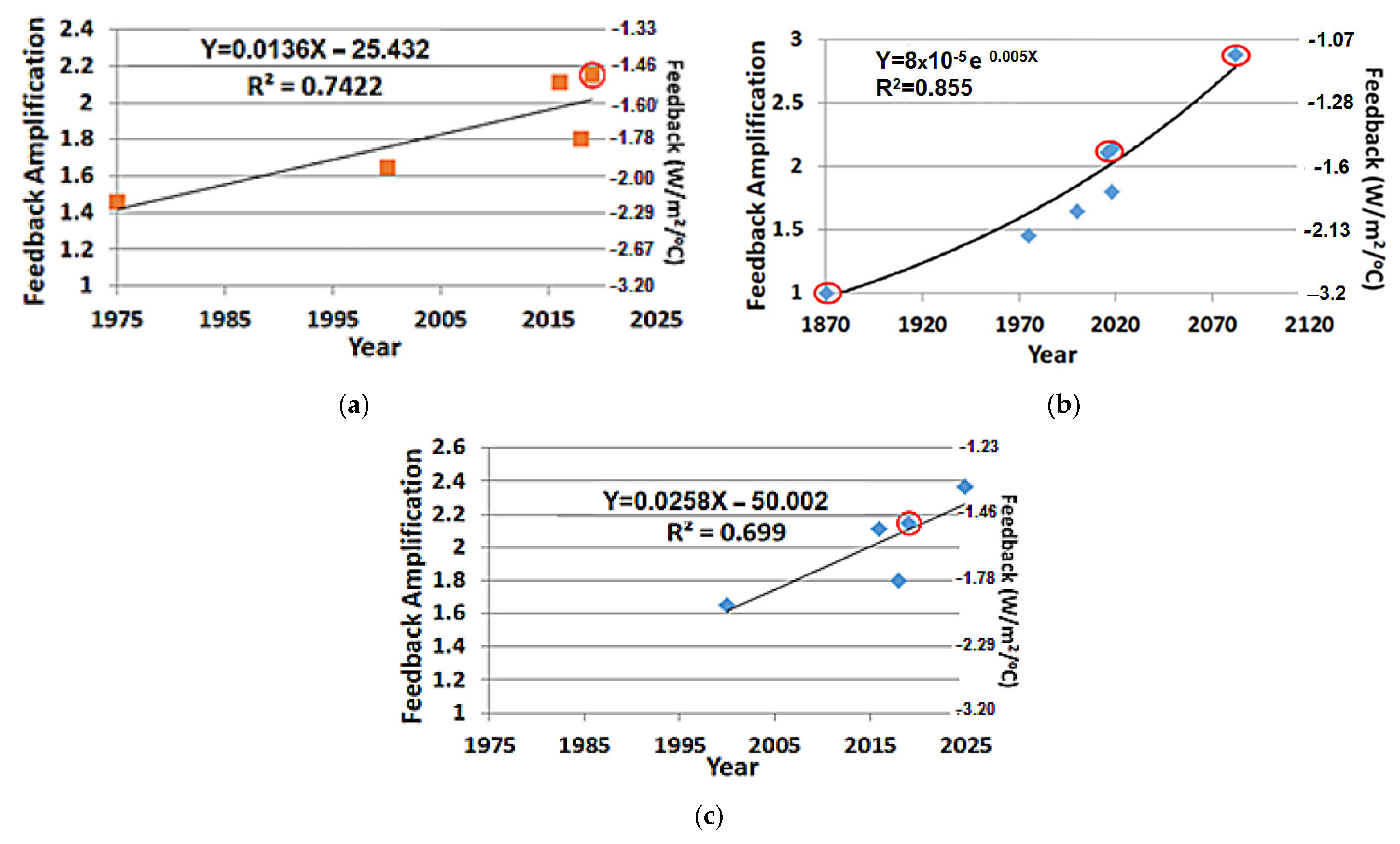
Figure 1a illustrates how feedback amplification trends are increasing [5], where circled data points show substantiated diagnostic estimates consistent with IPCC AR6 feedback ranges. The right-hand side of Figure 1a represents the net feedback consistent with AR6 confidence limits. As shown, the total effective feedback has already surpassed the 50% contribution level (around 2019), as indicated by an effective feedback amplification factor of two. These findings suggest that feedback-driven warming is now growing faster than primary GHG forcing and amplifies over half of the total radiative imbalance. As shown in prior work [5,6], the 2019 effective feedback amplification factor (A = 2.15) was independently confirmed using multiple methods (Section 3.1, Appendix B). Derived Equilibrium Climate Sensitivity (ECS) estimates align with AR6 values, ranging from 3.1 to 4.3 °C by 2082, corresponding to feedback amplification values of A = 2.7–3.7 (Section 3.1.2). The fitted value A = 1 in 1870 arises from the exponential fit and is just a diagnostic reference showing that feedback was small.
Previous studies [7,8,9], while confirming this doubling, have mainly focused on aggregate feedback factors or ECS, but the relative contribution of feedback loops to total warming has not been explicitly characterized in a diagnostic or time-evolving framework, representing a key gap in climate diagnostics. Feedback loops are particularly important because they represent the feedback-on-feedback chain reaction portion of global warming, where initial warming triggers additional processes that reinforce and accelerate the next cycle of feedback. For example, when human-induced GW melts polar ice, the reduced surface reflectivity amplifies further warming. As this continues, even more ice melts, creating a feedback loop. In this paper, we quantify this feedback loop (chain reaction) portion of total feedback over time.
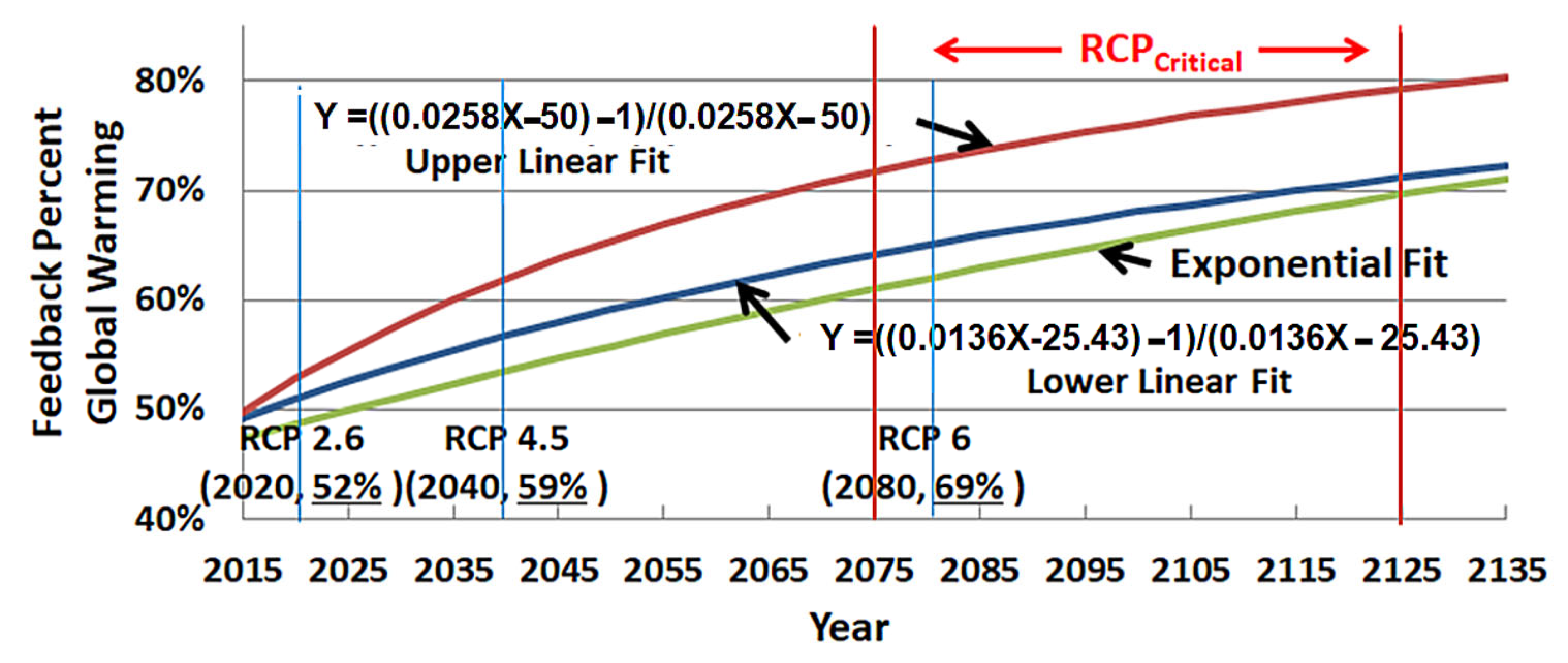
We introduce a new diagnostic threshold, RCP_Critical, representing the point where the feedback loop portion of feedback exceeds 50% of total GW, coinciding with total feedback of about 71% (a large fraction of GW). Results of this paper indicate that this RCP_Critical could occur between 2075 and 2125 if CO2 mitigation targets are missed and no supplemental Solar Geoengineering (SG) pathways are introduced. Crossing this 50% threshold marks a potential mitigation critical condition, beyond which reversing GW trends and its chain reaction portion may become prohibitively difficult. Figure 1b, detailed in Section 3.3.1, breaks down total feedback into the initial feedback response, and the feedback-on-feedback chain reaction loop response is found in Section 3.3.2. Note RCP_Critical having 71% total feedback (or loops: 50%) would cause human-induced warming to be amplified by about 3.5×, while today’s feedback amplification is about 2.2×. Based on this RCP_Critical mitigation threshold, this study estimates, from the diagnostic feedback trends, a mitigation difficulty and cost rate (MDCR = 1.33% to 1.5% per Yr.) over the coming decades, implying that by the end of the century [10,11], sustaining the necessary SRM-based interventions may become highly challenging. This highlights a potential unsustained mitigation threshold (USMT = 75 years) under increasing tipping point risks, which are detailed and estimated in Section 3.3.2. This differs from other studies, providing an anticipated mitigation timeline instead of just a timeframe for tipping points.
While the state of the art in climate modeling has improved ECS estimates and identified multiple reinforcing feedback loops, few studies quantify how these feedback loops evolve dynamically over time or interact with surface forcing and albedo decline. This paper addresses that gap by quantifying feedback loop growth and defining the RCP_Critical mitigation threshold where feedback loops exceed 50% of total GW. Based on current rates, this transition is projected to occur within 50–100 years, as indicated by the red flag region in Figure 1b.
To evaluate potential mitigation, this study develops and assesses Annual Solar Geoengineering-PLUS pathways (ASG+Ps), a moderate, phased approach (Section 3.4) consisting of Earth Brightening, Arctic Stratospheric Aerosol Injection (SAI), L1 Space-based Sunshade systems, and supplementary targeted SRM areas of the Arctic, Antarctic, and the tropics (Figure 2). ASG+Ps are designed to provide immediate reverse forcing and reduce feedback/loop amplification. Targeting highly amplified areas is needed to encourage negative feedback looping in critical regions that have the highest likelihood of exciting a self-cooling chain reaction reversal. These are still moderate SG approaches that also directly address AR6 concerns and promote feasible starting activities, while avoiding many of the scale and governance challenges associated with full SG. ASG+Ps are less controversial, significantly more efficient than Carbon Dioxide Removal (CDR), and have faster cooling potential via water vapor condensation. Compared to conventional solar radiation management (SRM), ASG+Ps not only require ≈50–150 times less implementation area [12], improving feasibility and international acceptance, but also encourage negative feedback loop reversals.
As of 2024, RCP 2.6 targets have already been missed, placing RCP 4.5 and RCP 6 at risk. In 2024, CO2 increased by +23 Gt (3 ppm), while forest tree losses (+4 Gt) exceeded afforestation gains (–2 Gt) by 2:1 (Section 2.4), reducing the effectiveness of CDR. These results indicate that Solar Geoengineering is needed. Furthermore, CDR cannot easily target regions with high feedback/loops. Recent findings [13] show SG to be 14–15 times more efficient (stronger) than CDR per Wm−2 for reverse forcing, making SG a premier mitigation tool.
Figure 2 summarizes the ASG+ pathway options (in Section 3.4), including Urbanization Earth Brightening (UEB), Hotspot Earth Brightening (HEB), and the target regions, polar SAI (ASAI/AASAI) and tropic SAI (TSAI). Concentrating ASG+P efforts in polar regions and the tropics is important; having high-feedback/loop regions could directly address the most sensitive tipping elements and encourage negative feedback looping. Together, these measures can buy critical time for achieving RCP stabilization goals. Results further show that ASG Space Sunshading offers the highest SRM area efficiency (detailed in Section 3.4 and Section 4.3). As well, results here corrected prior flawed SS overestimates (Section 3.4 and Section 4.4), showing that the ASG approach is economically viable. This finding should motivate space agencies like NASA and SpaceX to prioritize work in this area, given its feasibility and minimal governance concerns, and the fact that an L1 disk would produce essentially no noticeable Earth system effects (less than 0.18% solar reduction). This should be economically viable in the ASG approach, with a 10-year cost likely far less than the cost of the International Space Station, especially when including the potential trillions in climate damages avoided. In summary, this paper (1) analyzes global feedback trends and quantifies the projected feedback loop share of GW, (2) introduces the concept of RCP_Critical and USMT as diagnostic thresholds, and (3) proposes feasible ASG+P strategies with targeted SRM for negative feedback looping to delay or prevent feedback-driven climate instability and encourage the planet to add a measure of self-cooling (Section 3.4 and Section 4.4). The results emphasize that mitigation based solely on CO2 reduction is expected to be insufficient (Section 2.4) without supplemental SG. Given the limited intervention window and escalating systemic danger posed to civilization, advancing work in this area should be treated as critical and would likely prevent trillions in damages.

Overview of Topics

Table 1 provides an overview of the topics covered and how this paper is organized.

2. Methods and Data

2.1. Feedback and Feedback Amplification Analysis Methods

Symbols used in this paper are provided in Appendix A, while abbreviations are listed near that area.
Recent feedback trend analysis [5] estimated that by around 2017, global warming from direct forcing had been effectively doubled by feedback processes, and that by 2025, feedbacks may account for ≈54% of total warming (see Appendix B). In this context, feedback doubling refers to the amplification of initial forcing by the climate system, such that the resulting warming is roughly twice the direct forced component. Other studies suggest that this doubling may have occurred even earlier, primarily due to water vapor feedback [7,8,9,14].
To clarify the feedback percentages used in this paper, we can partition the global warming temperature. For example,
Δ T G W = Δ T F o r c i n g + Δ T F e e d b a c k
Here, ΔT = temperature change (°C) from forcing and feedback amplification.
From the feedback trends in Section 3.2, the 2024 estimated GW percentages are 46% due to forcing and 54% due to the climate feedback system’s response, so we can estimate the following:
Δ T 2024 = ( 1 f ) Δ T 2024 F o r c i n g + f Δ T 2024 F e e d b a c k 0.46 Δ T 2024 + 0.54 Δ T 2024
Here, f is the fraction of global warming due to the total feedback effect (see Appendix A). For example, a f ≈ 0.54 value corresponds to a feedback amplification factor of A = 2.17. This can be noted from Feinberg [5], who showed that the conversion from feedback amplification A to % of GW due to feedback is
% of GW   due   to   Feedback   effect = 100 × f = 100 × A 1 A = 100 × 2.17 1 2.17 = 54 %
Then, Equation (2) is Δ T 2024 = A 0.46 Δ T 2024 = 2.17 × 0.46 Δ T 2024 . Note also A = 1/(1 − f). We can write GW using A and the initial forced warming change (i.e., the warming without feedback; see Section 3.1.2, as follows:
Δ T G W = A Δ T F o r c i n g
Here, ΔTGW is the GW temperature change, and ΔTForcing is the temperature change due to forcing, and ΔTforcing = ΔF/λ0. It is helpful to note that we can also write, similar to Equation (4), the following:
Δ R G W = A Δ R F o r c i n g
This is shown in Appendix A.1 and is used in Section 3.4. In Section 3.4, we are interested in SG reverse forcing. We see from Equation (5) that A helps us estimate the amount of reverse forcing albedo change required. That is, while feedback amplifies the forcing effects, it can also help us reverse GW and can create some self-cooling (Section 3.4). The reverse SG forcing required is Δ R Annual   Reverse Forcing = Δ R A n n u a l G W / A Region (see Equation (32)).
In Section 3.4, ASG+Ps are proposed, and we extend feedback amplification A to Aregional to include albedo amplification feedback and forcing potential (AAFP). These include any amplification occurring with an albedo change. AAFP regional values are provided in Section 3.4.
Therefore, it is helpful to work with the surface albedo changes Δα needed in Annual Solar Geoengineering. There is also higher accuracy in temperature estimates at the surface (compared to TOA forcing conversions) when working with Δα in Section 3.4 (such as surface brightening). Also, we see from the Stefan–Bolzmann (SB) relation (commonly used at the surface) how Equations (4) and (5) hold nicely in Appendix A.1. Therefore, we can carefully assess A as an effective feedback that relates to the effects that amplify albedo changes Δα at the surface. Note that the amplification factor A > 1. The relations between these quantities, as used in AR6, are specific to feedback, and A is then the feedback amplification, as follows:
λ N e t = λ o A , λ N e t = λ o + i λ i , a n d λ e f f = i λ i = λ N e t λ o
Here λNet denotes the net climate effective feedback parameter, and λi denotes a specific feedback type, like water vapor, clouds (λ_WV, λ_Cl), etc., consistent with AR6 usage, while λ0 denotes the Planck feedback (no feedbacks) value λo ≈ −3.2 Wm−2K−1. Note that in Figure 1 and in Section 3.1, the RHS uses the net feedback, so it is referenced to AR6 metrics relative to the Planck parameter. For example, in the figures in Section 3.1, a fitted feedback amplification of A = 1 corresponds to an approximate value close to the Planck feedback λ0 = −3.2 Wm−2.
Example 1. 
For A = 2.15 (53.5% of GW, Equation (3)), λo ≈ −3.2 Wm−2K−1 and λNet = λo/A ≈ −1.49 Wm−2K−1 (Equation (6)) and λeff = +1.71 Wm−2K−1. This more than doubles the initial warming (2 × ΔTo, Equation (5)). Note that this is in the AR6 estimated net feedback very likely range of −1.81 Wm−2K−1 to −0.51 Wm−2K−1. Although AR6 values represent long-term equilibrium feedbacks, this λ obtained from long-term slopes reflects the effective response of the climate system. From Equation (5), a factor of A = 2 implies that feedback processes are responsible for more than 50% of total global warming. This can also be interpreted as an effective doubling of the forcing. This is strong feedback, and the albedo planetary decline is likely a significant contributor.
These equations clarify the relationship between percentage contributions and amplification terminology used in this paper. Appendix A provides an overview of the symbols and definitions applied in the climate physics framework (see also abbreviations near that area).

2.1.1. Feedback Amplification Graphical Assessment Methods and Data

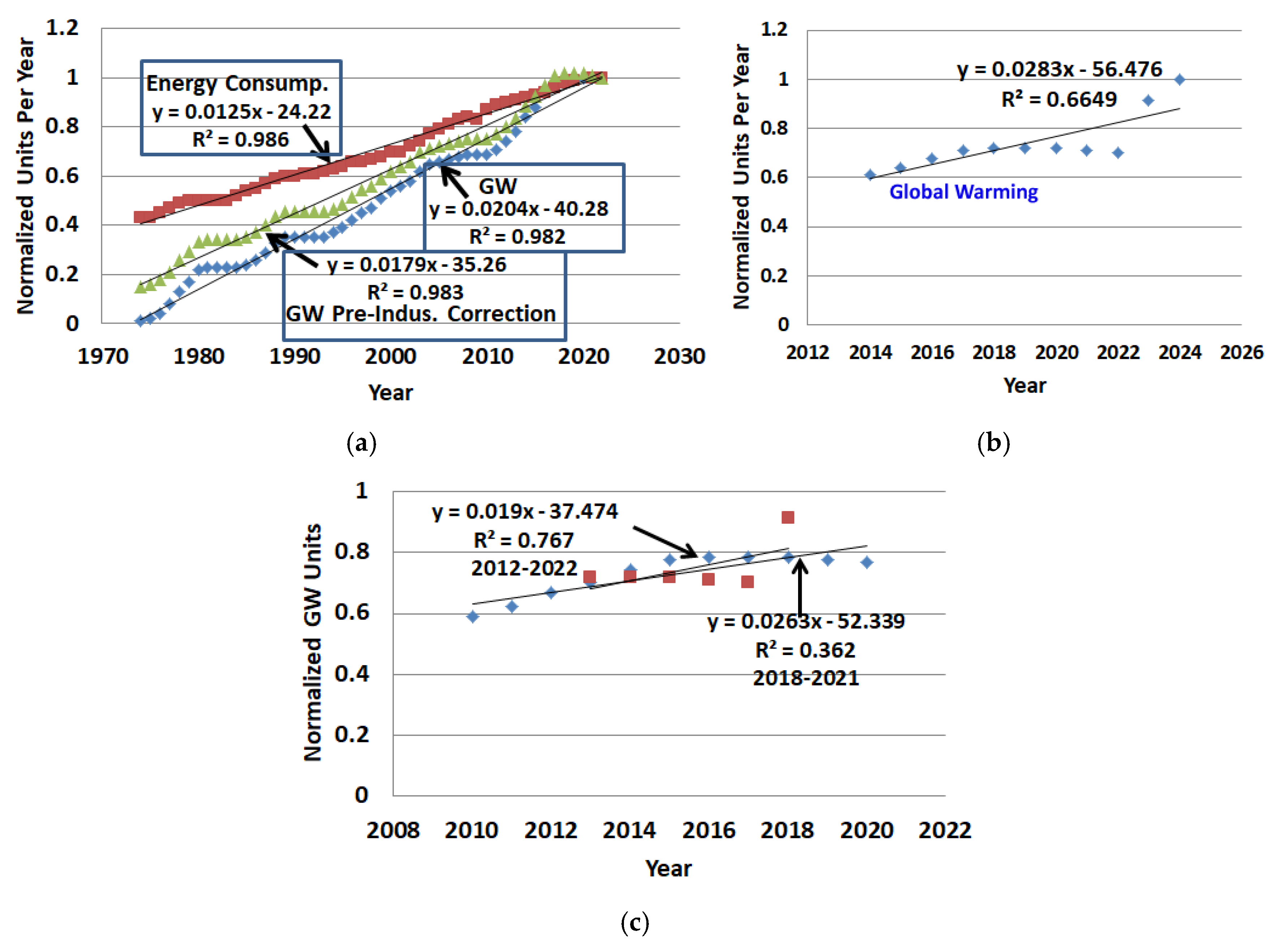
A review of GW and energy consumption time series graphs shows a higher rate of GW compared to the energy consumption growth rate. To make a direct comparison, both series are normalized for unitless quantities. In Feinberg [5], the effective feedback amplification was diagnosed as the ratio of normalized correlated rates (NCR) between global warming (GW) and energy consumption rather than absolute levels.
The energy consumption NCR was found to closely track with the effective radiative forcing growth. Short-lived regional effects such as aerosols (which have not also increased since 2000) were anticipated to have a limited influence on the long-term NCR ERF slope. Since GW trends follow energy consumption, the fact that GW’s NCR exceeds that of energy consumption (Appendix B, Figure A1a; Table A2) reasonably provides an empirical indication of the net feedback amplification (see Equations (5)–(10) in Ref. [5]).
By relying on normalized growth rates (slopes) rather than absolute values, the NCR approach reduces the influence of time-lagged responses associated with ocean heating and other slow adjustments. The method therefore provides a practical, time-averaged diagnostic of effective climate feedback operating on multi-decadal timescales.
NCRs were sufficiently linear over the chosen periods to provide robust estimates, with feedback values assigned to the average year of each period and adjusted for GW increases from 1870 to the present (Appendix B).
Converted amplification values fall within IPCC ranges, as shown in Section 3.1 and Appendix B. Normalization rates (slopes) produced unitless long-term per-year values (Appendix B, Figure A1), with original data in Appendix B, Table A2. GW data were obtained from NASA Vital Signs [15] and NOAA [16], while energy consumption data came from Ritchie and Roser [17] and the Energy Institute Report [18]. Amplification ratios were then converted to feedback fractions f via Equation (3), which generated feedback percentage graphs (Section 3.2). Further analysis extended these values into feedback loop trends (Section 3.3).

2.2. RCP Goals

RCP goals can be assessed via CO2 peak years or ERF targets. This study estimates the worst-case feedback if RCP goals are unmet and Solar Geoengineering (SG) is not deployed, motivating ASG+ pathways (Section 3.4). RCP goals are summarized in Appendix C [19,20]. Without ASG, RCP_Critical is expected to be reached (Section 2.4); this may also trigger potential tipping points identified in the prior literature [10,11,21,22,23,24], and IPCC reports [25] (see Figure 1b).

2.3. Urbanization’s Influence on Global Warming

Section 4.1 and Appendix D revisit urbanization’s impact, which, while seemingly controversial in the recent literature [26,27,28,29,30], is misinterpreted as detailed in Section 4.1. Satellite-based assessments are challenged by vertical structures in cities, while ERF corrections (Section 4.1) have been shown to align with ground-based measurements [26,30], showing similar GW urbanization contribution.

2.4. Sustainability Is Estimated to Be Unattainable Without ASGPs

Real-world constraints suggest that RCP goals are unlikely to be met solely with CO2 reductions in fossil fuel use due to increasing feedback loops (Section 3.3), urbanization contributions (≈12.7%, Zhang et al. [26]), and limitations in intentional CDR (ICDR) capacity [31,32,33,34]. Population growth [34], wildfires [35], wars, and CO2 longevity exacerbate this challenge.
Current ICDR, dominated by afforestation/reforestation (≈70–90%) [32,33], removes only ≈2 GtCO2/yr. Novel methods like DACCS contribute <0.1% but are growing [36,37]. Projections indicate that, without SG, RCP_Critical is expected to occur between 2075 and 2125 (Section 3.3.2; Figure 1b). Equations (7) and (8) formalize net CO2 dynamics: CO2 increased by +23 Gt (3 ppm) for 2024 in Equation (7), while forest tree losses (+4 Gt) exceeded forest gains (−2 Gt) by 2:1 in Equation (8), further reducing Carbon Dioxide Removal (CDR) effectiveness.
( D F + F D ) + Δ N Emissions ( A F + R E F ) + Δ Other - CO 2   Reduc   23 GtCO 2
and
( D F + F D ) ( A F + R E F ) + Δ Other - CO 2   Reduc   4 G t C O 2 2 G t C O 2 2 G t C O 2
Here, Δother-CO2 Reduc indicates CDR methods (non-forests), deforestation (DF), forest degradation (FD) mainly from forest fires, afforestation (AF), and reforestation (REF). Forestation and ICDR improvements are required to offset emissions, yet constraints on land, biodiversity, monitoring, and verification persist.

2.5. Largest CO2-Emitting Countries and Challenges

Major emitters (the US, China, Russia, India, and Japan) face implementation and governance challenges. The withdrawal of the U.S. from the Paris Agreement and EPA deregulation [38,39] may reduce global climate action. Russia relies heavily on fossil fuels, exacerbated by the emissions resulting from the Ukraine conflict [40]. China balances coal reliance with clean energy investment [41]. Japan faces hurdles in phasing out coal. Collectively, these geopolitical and socioeconomic constraints reduce the likelihood of meeting RCP goals without coordinated SG interventions.

2.6. Workflow Method for Estimating Time Left to RCP_Critical

Table 2 outlines the workflow in Section 3 for determining the time left to reach RCP_Critical, the point when feedback loops reach 50% of the global warming. As well, ASG+Ps are detailed in Section 3.4.

3. Results

3.1. Feedback Trend Estimates Revisited

A brief review is provided here of recent trend estimates showing that feedback now accounts for ≈54% of the GW problem [5] (Figure 1b and Figure 3c), having risen from ≈50% in 2017 (Section 3.2; Equation (3)). This context helps frame the new assessments that follow.
Feedback crossing the 50% threshold is particularly concerning, as the rate of GW has become nonlinear (Section Overview of Topics). Feedback amplification trends are shown in Figure 3 from Feinberg [5]. These figures have been clarified by identifying the verified points and the RHS axis, and these have been added (showing the conventional feedback values) as a baseline for later loop estimates in Section 3.1.2, offering a graphical assessment of feedback contributions by percent of GW (Section 3.2). Section 2.1.1 outlines the feedback assessment method for Figure 3, and Appendix B provides supporting details for several of the data points to aid the reader.
Note the relationship between feedback amplification and net feedback λNet = λo/A = 3.2 Wm−2K−1/A, as provided on the graphs’ RHS vertical axis.
AR6 reports net climate feedback λNet in the very likely range −0.5 to −1.81 W m−2 K−1, which corresponds to amplification factors A ≈ 1.78–6.40 (using λo≈−3.2 W m−2 K−1). Our 2019 empirical range (A = 1.80–2.15) maps to net λNet ≈ −1.78 Wm−2 K−1 to −1.49 Wm−2 K−1. Here, the upper value −1.49 Wm−2K−1 yields a positive λeff = +1.71 Wm−2K−1 (Equation (6)), a strong feedback with likely significant contribution from the planet’s albedo decline (see next Section). Thus, our estimates are consistent with AR6’s values while excluding the feedback value of λNet ≈−0.5 Wm−2 K−1, which would map to a very large amplification value of 6.4, and feedback in that case would equate to 84% (Equation (3)) of global warming in 2019, which illustrates an unrealistic upper feedback bound. Our 2019 values indicate that feedback was about 44% to 53% of the global warming problem (Equation (3)), which are more reasonable values. The value A = 1 is discussed in the next section.

3.1.1. Why NCR Method Captures Additional Diagnostics Including Planetary Albedo Decline

The NCR framework is based on the observed growth rates of global temperature and energy consumption and, therefore, implicitly captures additional diagnostics. In particular, recent planetary albedo decline (from ice, snow, and cloud changes) appears as enhanced warming in the global temperature NCR and is thus incorporated as (likely strong) feedback without additional approximations. Likewise, urbanization-related forcing influences, including waste heat release and surface albedo changes, scale with energy use and are implicitly captured in the energy consumption NCR. As a result, the NCR method provides a complementary and likely the most optimal empirical feedback diagnostic for long-term amplification trends. As mentioned above, short-lived regional effects such as aerosols (which have also not increased since 2000) were anticipated to have a limited influence on the long-term NCR ERF slope.

3.1.2. Feedback Estimated Trends with Substantiated Points, Including ECS

We can quickly provide ECS estimates from the feedback trend equations in Figure 3. Here, the purpose is to verify projections to 2082, the year that current CO2 trends show it could double without mitigation. We note from Equations (5) and (6) that
Δ T G W = A Δ T o = A F T O A / λ o = ( F / λ N e t )
The radiative forcing for a doubling of CO2, from IPCC AR6 and earlier reports, is commonly assessed as
Δ F = 5.35 W m 2 L n ( 2 ) = 3.71 W m 2
Using the Planck feedback parameter λo of about −3.2 W/m2/°C, the Planck ECS response, which is an estimate of Earth’s average surface temperature resulting from a doubling of atmospheric CO2, yields the no feedback ECS value (ΔTλo), which is estimated as
Δ T λ o = Δ F λ o = 3.71 W / m 2 3.2 W / m 2 / o C = 1.16 o C
Using the trend estimates in Figure 3a–c for the year 2082, the estimated year for 2 × CO2 at the current rate (about 2.53 ppm/year, estimated in my prior work Feinberg [5]), we calculate the feedback amplification range for A is 2.66–3.7 (Figure 3a and c, respectively, for 2082). Then the estimated ECS values for these linear and exponential fits in Figure 3 are
E C S 2082 = A 2082 Δ T λ o = 2.66 × 1.16 ° C 2.88 × 1.16 ° C 3.7 × 1.16 ° C = 3.08 ° C 3.34 ° C 4.3 ° C
The values 3.08 °C, 3.34 °C and 4.3 °C are from the exponential fit in Figure 3b, linear fit in Figure 3a, and worst-case linear fit in Figure 3c, respectively. The results show that the diagnostic values 2.66 < Afeedback < 3.7 are reasonable for 2082 in Figure 3b. These indicate that the first two ECS values fall within the IPCC AR6 likely range [42] and are consistent with other studies [43]. The higher value corresponds to worst-case projected pipeline estimates [2] and aligns with trends through 2026 [4]. This worst-case ECS is 3.7 times higher than the no-feedback climate sensitivity, meaning forcing alone would cause a 1.16 °C increase, with feedback responsible for 73% of global warming in 2082 (Equation (3)). These results underscore the potential role of SG in mitigating feedback amplification.
In Appendix B, the feedback amplification value A = 2.15 for 2019 was obtained, matching an independent estimate from an earlier study (see Equation (24) in Feinberg [6]). The value A = 1 in 1870 resulted from the exponential fit and is taken as a reasonable diagnostic estimate since the climate was near radiative balance with negligible forcing to amplify, so its effective value of unity should be taken as minimal feedback. The three reasonably estimated points [A = 1, 1870; A = 2.15, 2019; A = 2.66, 2082] are shown in the exponential fit in Figure 3b. The plotted feedback values also reasonably agree with IPCC estimates as they are within the AR6 95% confidence ranges [5].

3.2. Feedback Trend Percent Projections Relative to RCP Goals

We note that the diagnostic feedback amplification is given by
A . = 0.0258 Y e a r 50   0.0136 Y e a r 25.43
These are shown in Figure 3C (linear upper trend worst case estimate) and Figure 3a (linear lower trend estimate). Using Equation (3), the upper trend equations can be written in terms of the percent of GW, as follows:
% of GW   due   to   Feedback = f × 100 = 100 × A 1 A = 100 × ( 0.0258 Y e a r 50 ) 1 0.0258 Y e a r 50
Similarly, the lower trend equation is given by
% of GW   due   to   Feedback = f x 100 = 100 × A 1 A = 100 × ( 0.0136 Y e a r 25.43 ) 1 0.0136 Y e a r 25.43
Using these equations and a similar approach for the exponential fit in Figure 3b, Figure 4 illustrates trends for the percent of global warming due to feedback effects, along with some RCP estimated critical peak CO2 years. These trends are anticipated without the aid of SG.
As an example, in RCP4.5, it is assessed that the CO2 peak year should be around 2040 (Appendix C). In that year (see Section 3.3.1), the feedback is estimated to be responsible for about 56.7% to 62% of the global warming problem (averaging about 59.4%). Note that the RCP_Critical region is estimated to occur when feedback is about 71%. This would amplify human-induced warming by about 3.5 (Equation (3)). This is the likely approximate estimate for feedback loops to dominate at about 50% without SG, as shown in Section 3.3.

3.3. Framework for Feedback Analysis

To better assess feedback risks, it is useful to separate total feedback into its components. The temperature increase due to feedback ΔTFK can be expressed as the sum of its initial response ΔTFK_I and its loop portion (feedback on feedback) ΔTFK_L, so that
Δ T F K = Δ T F K _ I + Δ T F K _ L
In practical terms, an initial warming from forcing (i.e., warming without feedback) triggers a first-order feedback, such as snow and ice melting. This, in turn, initiates feedback loops, for example, further loss of reflectivity caused by the initial melting.
Here, we assume that whenever a climate feedback occurs, it also generates additional feedback. This is generally the case. For example, well-known feedbacks, such as water vapor amplification and Arctic ice-albedo effects, already operate as interacting loops rather than isolated processes. This will help us provide a guide for defining a critical point for estimating when feedback loops reach the 50% time frame relative to feedback growth, when mitigation can become prohibitively difficult.
Accordingly, the total feedback fraction f can be separated into f_initial (non-loop) and f_loop (looping feedback). The overall fraction is then the sum of these two contributions (see Equation (31)). This framework is exemplified in the following section.

3.3.1. Initial Feedback and Loop Estimates for the Case of 54% Feedback

By the end of 2024, global warming had reached ≈1.3 °C above the preindustrial period. Feedback processes are estimated to account for ≈54% of this warming, or ≈0.7 °C. It is now important to distinguish how much of this feedback arises from the initial (first-order) response versus the portion driven by feedback on feedback, the loop contribution.
Δ G W 2024 = 1.3 o C = 0.6 o C + 0.7 o C = ( Δ T F ) F o r c i n g + ( Δ T F K ) F e e d b a c k = Δ T F + Δ T F K _ I + Δ T F K _ L
Here, ΔTF is the warming change due to forcing. Therefore,
Δ T F = 0.6 o C Δ T F K = Δ T F K _ I + Δ T F K _ L = 0.7 o C
Non-Loop Portion
The initial feedback ΔTFK_I portion (i.e., without loops) is assessed from the total feedback fraction f = 54% of global warming in 2024, from forcing amplification (ΔTF = 0.6 °C), yielding
Δ T F K _ I = f × Δ T F = 0.54 × 0.6 ° C = 0.323 ° C
Loop Portion
The loop portion is the remainder from Equation (19), yielding
Δ T F K _ L = 0.7 ° C 0.323 ° C = 0.379 ° C
To obtain the general required results, we can detail how the loop portion builds as a progressive geometric iteration from the initial feedback due to the problem of feedback on feedback increasing the warming.
If we start with the initial feedback,
Δ T F K _ I = f × Δ T F = 0.54 × 0.6 ° C = 0.323 ° C
Then the first feedback on feedback yields the loop iteration portion
Δ T ( Δ F K _ L ) 1 = f × ( f × Δ T F ) I n i t i a l = 0.54 × 0.54 × 0.6 ° C
This causes another iteration of feedback on this feedback, f x { f x ( f x Δ T F ) } , and so forth. This represents the geometric series (adding Equations (22) and (23), and the next series values), which converges as
G e o S e r i e s = f + f 2 + f 3 + = n = 1 ( f ) n = f 1 f = 0.54 1 0.54 = 1.174
Then, the loop portion of the series is given by
( f 2 + f 3 + ) L o o p f = 1.174 0.54 = 0.634
Then the feedback loop warming converges to
Δ T F K _ L = 0.634 × T F = 0.634 × 0.6 ° C = 0.379 ° C
This agrees with Equation (20).
Non-Loop and Loop Percentages
Therefore, the percentages relative to the total feedback for the initial non-loop portion is as follows:
% Δ T F K _ I = 0.323 ° C / 0.7 ° C = 46 %
The loop portion in percent is as follows:
% Δ T F K _ L = 0.379 ° C / 0.7 ° C = 54 %
The feedback percentage of global warming due to the loop portion is then
% Δ T F K _ L = 0.379 ° C / 1.3 ° C = 29.16 % = 0.54 × 54 %
and the initial feedback or non-loop feedback percentage of global warming is
% Δ T F K _ I = 0.323 ° C / 1.3 ° C = 24.8 % = 0.46 × 54 %
Here we have provided the results for f = 0.54. For a feedback f-value, we are now able to provide the general loop estimate, which is f-squared (Equation (28)), i.e.,
f L o o p s = f × f a n d f N o n L o o p = f f L o o p s
This is what we might expect from the feedback loop portion, which can also be thought of as feedback on feedback, and which should equate to fxf, as formally found in Equation (28). Therefore, Equations (20) and (28) show that we are also consistent with the geometric series. For example, for f = 0.71 (i.e., if 71% of global warming was due to feedback effects, a very large portion), we will obtain for the loop portion fLoops = 0.71 × 0.71 = 0.50 and the non-loop initial portion fNon-Loop = 0.7–0.5 = 0.2.
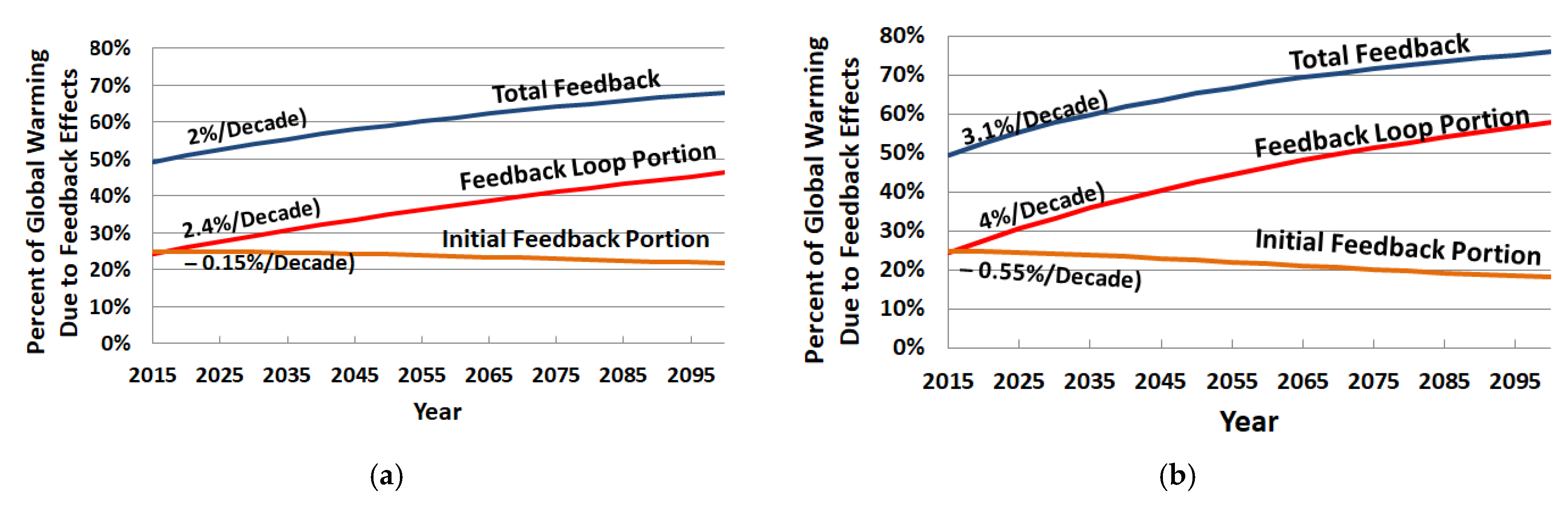
We can then plot these results, as shown in Figure 5, based on the diagnostic feedback estimates in Figure 3 and Figure 4. For example, multiplying the Figure 4 (lower) curve by f yields the Figure 5a loop curve (Equations (15) and (30)). In Figure 5, the tapering off of both feedback and loop trends suggests the system is stabilizing, with a reduced tendency toward runaway behavior (f > 1). However, this does not mean that the system cannot still reach an unlivable condition.

3.3.2. Estimated Time Left for Critical Feedback Loops and Mitigation Difficulty and Cost Rate

From Figure 5a,b, we are now in a position to present the results in Figure 1b. In this figure, we define a likely time-left window to RCP_Critical as 50–100 years. Using this framework for estimating when mitigation may become prohibitively difficult, we may consider critical feedbacks occur at ≈71% of the total warming corresponding to feedback-loops contributions of ≈50%. This marks the red flag region in Figure 1b for the mitigation critical period; as well, tipping points are more likely. Conceptually, this can also be interpreted as the time left for sustainability.
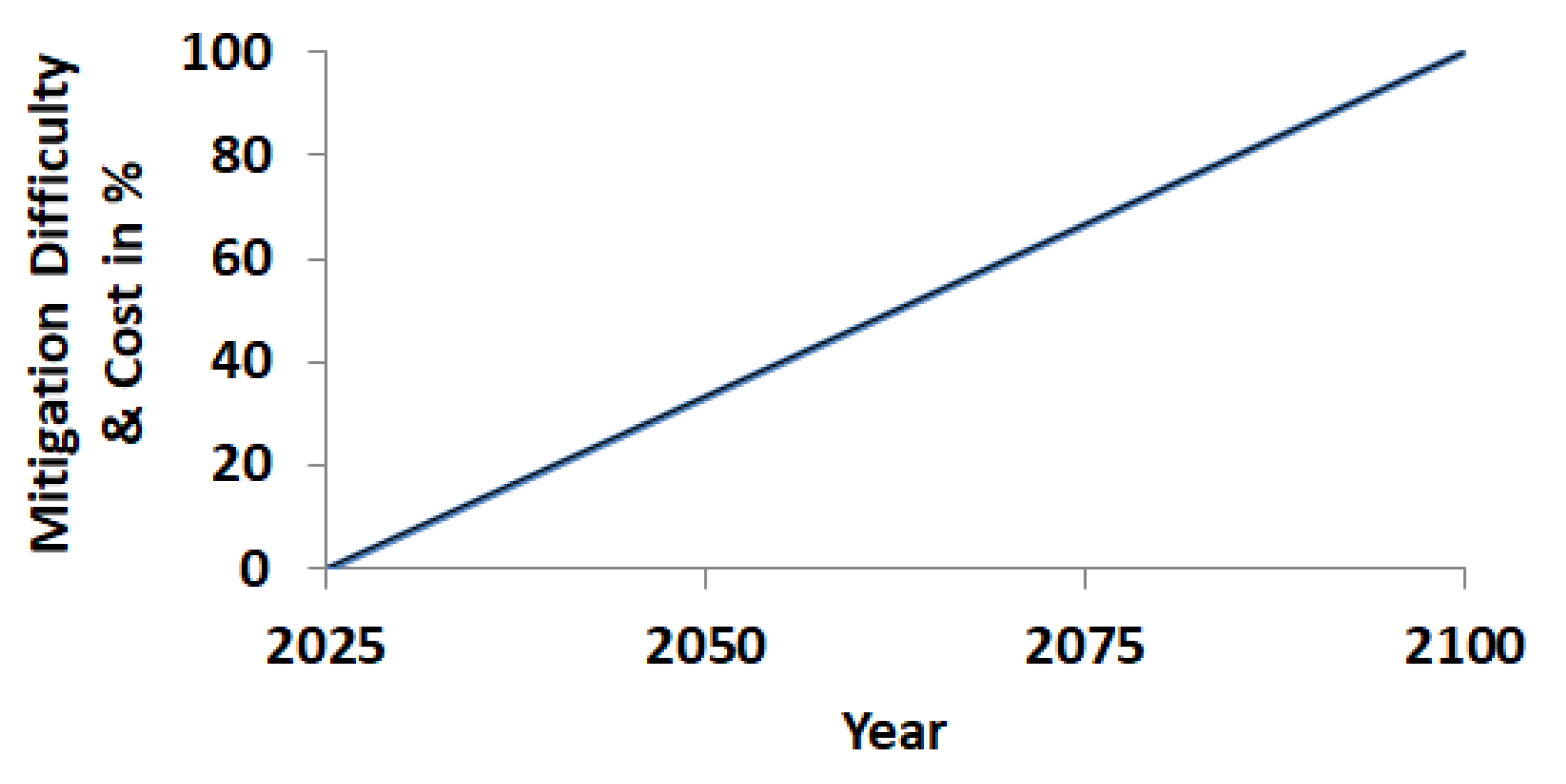
Using this timeframe, we define a corresponding mitigation difficulty and cost rate (MDCR) and a corresponding unsustained mitigation critical threshold (USMT) with 2025 as the baseline. Assuming a mean time left of 75 years and roughly a linear increase, the MDCR is estimated as follows:
M D C R = 1 75 1.33 % p e r y e a r , U S M T b a s e = 2025 75 Y e a r s
This implies that with each year, without employing Solar Radiation Management (SRM), the cumulative climate mitigation difficulty and associated cost increases are anticipated to rise by ≈1.33% per year, as shown in Figure 6, with a linear midpoint interpolation of 1.5%. Approaching the 75-year mark, with or without a formal tipping-point environment, may make it increasingly difficult to maintain late-stage SRM and other mitigation efforts, as the system approaches an unsustainable mitigation critical threshold.
It is interesting to note that the observed global warming acceleration (slope), which has been about 0.02 °C per year per 1 °C of GW (about 2% per year up to 2019), is broadly consistent with this MDCR of 1.33% to 1.5% per year. This further supports the estimate.

3.4. Proposed Annual Solar Geoengineering-PLUS Pathways to Supplement RCP Goals

Annual Solar Geoengineering-PLUS (ASG+P) is proposed as an extension of the author’s prior ASG framework [12], designed to accelerate mitigation timelines, complement RCP pathways, and bypass many scale, cost, and governance barriers associated with full-scale SG deployment. Whereas the original ASG concept aimed to apply just enough SRM each year to offset the incremental global warming increase. In the ASG+ method, the goal is to increase the reverse forcing somewhat above the estimated yearly GW increases to additionally slowly resolve the GW problem with enhanced mitigation, by focusing on potentially self-cooling (see Section 4.4) areas that experience high levels of feedback looping, such as the Arctic and the tropics.
The Arctic warms approximately four times faster than the global mean [44,45,46], and we adopt A_Arctic ≈ 4 as a representative amplification. This region is not only more sensitive to warming but also highly responsive to cooling. Even moderate brightening can trigger secondary snow–ice feedbacks by a factor of 4× amplification that reinforces self-cooling, generating localized negative feedback loops that contribute to broader planetary stabilization. Additionally, it is a large area that has a strong effect on the energy imbalance.
Amplification factors A_Region for major regions were previously estimated in Feinberg [6,13,30,47] and are summarized in the accompanying table. Importantly, the amplification value A used throughout earlier sections refers solely to feedback amplification. In this section, however, we employ the Amplification Forcing and Feedback Potential (AFFP), which is required for SG diagnostics. The AFFP values consist of any effects that amplify albedo change (or other forcings such as waste heat) for a region, also referred to as ARegion. Then, in addition to feedback, we include forcing amplification effects of albedo changes: Therefore, the AFFP includes both:
  • Feedback amplification per Section 3.1, and
  • Forcing amplification effects from albedo changes, specifically the Albedo GHG Forcing Potential (AGFP ≈ 1.62), which arises from the albedo–GHG interaction (or could be used for anthropogenic waste heat in other circumstances). Here, albedo-driven heat flux changes are amplified by the background GHG climate, as detailed in Feinberg [5,6,12,13,30,47] (this is mainly due to the Earth’s energy budget, where GHGs increase the surface flux from 240 Wm−2 to 387 Wm−2, a 1.62 increase).
As indicated in Table 3, the principal global background contributions are from feedback amplification (such as due to water vapor) factor (≈2.15) and the AGFP (≈1.62). For UHIs, we additionally apply a microclimate amplification factor of ≈2 [30], reflecting the enhanced radiative trapping and reduced cooling efficiency caused by urban canyons, reduced wind/evaporative cooling, and elevated local water vapor feedback, as detailed in Feinberg [48].
Section 4.4 discusses how negative feedback looping relates to these amplification potentials and how ASG+P leverages them to promote self-cooling trajectories.
Designing such pathways is a major scientific challenge, and the framework outlined here offers suggested values that should be refined by future working groups.
For long-term sustainability, ASG+Ps must be formally considered by a dedicated working group in the forthcoming AR7. While this proposal seeks to address AR6 concerns, further refinement by the IPCC may still be required.
Table 4 provides the ASGP legend for this section, and the proposed timeline is illustrated in Figure 2.
In this proposal, phases are designated using the notation ASGP–N, where N indicates the Annual Solar Geoengineering pathway phase. The value of N also serves as a multiplier relative to Phase 1.0. ASGPs begin with mild increments, primarily through Earth Brightening each year, but should also include preparations for Arctic SAI (ASAI), Antarctic SAI (AASAI), and Space Sunshading (SS) (see Figure 2).
Here, the proposed phases are N = 0.25, 0.5, 0.75, 1.0, 1.25, 1.5, 2.0, and 2.5, which act as multipliers of the Phase 1.0 reversal estimate, exemplified here with ABackground:
Δ P A S G P _ N _ A ( Δ T ) Δ P A S G ( 0.02 ° C ) A Region × N
0.11 W m 2 2.15 ( 1 + 0.62 ) Background   Climate   A × N 0.032 W m 2 , N = 1
Here, the value of ΔPASG(ΔT = 0.02 °C) = 0.11 Wm−2 is estimated by Feinberg [12] using the linearized Stefan–Boltzmann relation ΔP ≈ 4σT3ΔT (T = 288 K, ΔT = 0.02 °C) = 0.11 Wm−2, with ARegion being the background value of climate 3.5 (=2.15 × 1.62) used for this example. The required area depends strongly on both the achievable albedo change (Δα) and the regional amplification factor ARegion. It is generally more useful to work with Stefan–Boltzmann (SB) diagnostics rather than TOA forcing because these interventions produce lower-tropospheric albedo-driven cooling (i.e., albedo interventions directly change surface energy balance) and SB provides consistent, directly interpretable estimates. ASG corresponds to N = 1, whereas ASG+ requires N > 1. Note that these are illustrative bounding values to guide governance discussions, not final engineering specifications. Areas like the tropics and the Arctic have high feedback/loop issues (see Section 4.5 and Appendix E). Alternative target values could also be applied. Equation (32) represents a conservative, reasonable estimate intended to minimize SRM area requirements and motivate further work in this area. More detailed computer modeling could yield improved conservative annual SG reversal forcing estimates. The ASGP models for the different SRM intervention methods are summarized in Table 5.
Using the Equations in Table 6, ASGPs are summarized in Table 7, with the reversal power (ΔPASG-N = −0.11 Wm−2 × N/A). The estimates for reversal power, albedo, and intervention areas are presented in Table 7, obtained by using the appropriate model in Table 5.
The suggested model inputs are given in Table 6, with the models for each area given in Table 5.
The results of using the appropriate model in Table 5, with the suggested inputs in Table 6, yield the ASGPs that are presented in Table 7. Note that Space Sunshades require the least amount of area for the 0.11 Wm−2 goal. For example, compared to HEB for N = 1, the SS area reduction is a factor of 120 (See Section 4.3).
Supplemental Material: An ASG+P Excel calculator is provided with this paper for Table 7.
Earth Brightening should begin as soon as possible. SAI and L1 Space Sunshade implementations require more preparation time and, therefore, demand urgent funding and careful planning. The SRM ASG mitigation area required grows by roughly 2% per year (corresponding to about 0.02 °C per 1 °C of global warming), which is higher than the estimated mitigation difficulty and cost rate of 1.33% per year.
ASG maintenance is a special topic not covered in this paper. The reader is referred to Feinberg [12]. Table 7 in that paper touches on the subject, and it is also discussed there, but not in detail. Maintenance planning is forward-looking work that will be needed upon implementation and can be complex, as in the case of SAI.
It should be noted that Marine Cloud Brightening (MCB) and Cirrus Cloud Thinning (CCT) are not considered viable even for ASGPs. The extremely short lifespan of clouds (less than a week) and the enormous annual area requirements make these approaches cost-inefficient, preventing meaningful SRM coverage and yielding negligible global impact.

3.4.1. Annual Solar Geoengineering Allocation by Country

To support solar radiation management, ASGP goals can be allocated among countries based on relative wealth. Using total household wealth by country as a metric, the United States and the United Kingdom would be responsible for approximately 31% and 3.5% of the effort, respectively [12,49].
Under this scheme, the minimum area allocations for Earth Brightening Phase 1.0 (Table 5) would be as follows:
  • The US’s mitigation = 31% × 96,000 Km2 = 29,760 Km2/Yr or 102 mi2/day;
  • The UK’s mitigation = 3.5% × 96,000 Km2 = 3360 Km2/Yr or 11.5 mi2/day;
Costs for SAI and Space Sunshade interventions could be divided similarly.

4. Discussion

This study suggests that long-term sustainability is unlikely without active Solar Geoengineering (SG) Plus pathways (Section 2.4). It is essential to distinguish theoretical sustainability from real-world capability. While there are concerns that SG could reduce motivation for CO2 mitigation, there is an excessive risk of delaying SG efforts that are urgently required before RCP_Critical is reached. With atmospheric CO2 still increasing, sustainable climate stabilization appears improbable if Annual Solar Geoengineering pathways (ASGPs) are ignored.
Although anthropogenic greenhouse gases (GHGs) are the main cause of global warming (GW), their removal alone is not the most efficient path to stabilization. Solar heating is the dominant process in the energy budget, and the consistent failure to meet RCP targets underscores the limits of current mitigation capacity. SG represents a more direct and practical route. It has now been shown that SG is 14–15 times more radiatively efficient (stronger) than Carbon Dioxide Removal per Wm−2 (CDR) [13,50]. A paradigm shift is needed, where the IPCC includes ASGPs in AR7 and strongly promotes their phased implementation. As shown in Figure 1b, feedback loop growth trends indicate that the available mitigation window is rapidly narrowing.
Results of this study indicate that the time remaining before reaching RCP_Critical, the point where feedback loop contributions exceed 50% of total GW, is likely between 50 and 100 years. This period defines a diagnostic red flag zone, beyond which reversing GW trends may become overwhelmingly difficult, with increasing risk of irreversible tipping points. Recent pipeline warming estimates [2,4] suggest that the earlier 2075 estimate (≈50 years) is more likely. In this context, the time left before RCP_Critical and USMT may be interpreted as the time left for sustainability itself.

4.1. Why It Is Essential to Include Urbanization (UHI) Earth Brightening Due to Its Significant Contribution

Urbanization-driven Earth Brightening (EB) is identified as a potentially useful ASGP (Section 3.4). However, the existing literature presents differing assessments: ground-based studies (e.g., Zhang et al. [26]) estimate an influence on surface global warming of about 12.7%, supported by effective radiative forcing (ERF) heat flux modeling [30], whereas satellite-based analyses suggest a smaller or negligible contribution [27,28,29]. The IPCC AR6 Regional Fact Sheet [51] aligns more closely with the satellite-derived interpretation. Their definition of forcing is at the TOA.
However, Feinberg [13] recently demonstrated, using Zhou et al.’s [29] satellite data, that a small observed radiative forcing (RF) signal of 0.008 °C, attributed to urbanization, when converted to effective radiative forcing (ERF), using microclimate amplification within the urban heat island (UHI) framework and with some coupling with background amplification from GHG trapping and feedback processes, aligns closely with the higher ERF estimates reported by Zhang et al.’s [26] albedo portion and verified through Feinberg’s [30] modeling.
Satellite-derived albedo data are generally limited to direct radiative forcing (RF) estimates and often overlook geometric effects, such as tall buildings, solar canyon light trapping, window absorption, temperature inversions, humidity, CO2 heat trapping, reduced wind-driven cooling, and evapotranspiration losses. As a result, satellite-based RF assessments tend to underestimate urban forcing due to coarse resolution and limited surface geometry sensitivity. In contrast, ground-based observations and effective radiative forcing (ERF) flux modeling provide complementary evidence indicating a substantially larger contribution. These methodological limitations can lead to significant underestimation errors in satellite-only methods.

4.2. The Difficulty Mapping Urbanization GW to TOA from Ground-Based Estimates

We live in the Troposphere, yet IPCC estimates the Earth’s energy balance at the TOA. On average, these map closely. For example, in 2019, the GW increase was 0.95 °C, which, using the Stefan–Boltzmann relation, yields about 5 Wm−2. If we divide out the surface warming by the background climate average feedback factors of about two, this yields roughly the same Wm−2 at the TOA in 2019 as in AR6. This shows why TOA and surface warming can appear equivalent on average. But local or non-average areas (e.g., cities, arctic regions, and deserts) may not map neatly. Microclimate effects, urban heat islands, ice–albedo feedbacks, and land use changes produce amplified surface warming that is not proportional to local TOA flux changes, so attribution at small scales is much more complicated. This is why urbanization can contribute ≈13% of surface warming without showing clearly in TOA metrics, and it is easy to misinterpret what is causing the forcing at the TOA.
Urban heat islands (UHI)/impermeable surfaces cover a tiny fraction of the Earth’s surface (≈0.25%) but affect roughly 60% of the global population, producing amplified local warming through microclimate effects, waste heat, and feedbacks. This contributes ≈13% of observed land surface warming [26], yet it is effectively invisible in top-of-atmosphere (TOA) energy measurements because the area is small (see Equation (38)).
In other words, the TOA metric can underestimate human-experienced surface warming and mask the origin of localized forcings, which is why distinguishing surface vs. planetary warming is critical for both attribution and mitigation planning.
These findings reinforce that Urban Earth Brightening is essential for near-term mitigation. To meaningfully reduce urban radiative forcing, the use of dark, low-albedo materials, such as black asphalt pavements, dark roofing, building sides, and vehicles, should be systematically phased out and replaced with reflective alternatives. This action could be formally adopted through international frameworks, such as the Paris Agreement, to accelerate albedo-based climate mitigation and reduce feedback-driven global warming with governance objections.

4.3. Negative Solar Geoengineering and Background Climate Amplification Effects

The widespread use of dark, low-albedo materials, roads, roofs, vehicles, and building walls acts as an unintended form of negative Solar Geoengineering (SG), amplifying surface heating and global radiative forcing [26]. Public and policy attention remains focused on greenhouse gas (GHG) emissions, while the powerful role of surface color and reflectivity is largely overlooked. Building and transportation codes seldom account for albedo effects, despite their clear contribution to heat stress and feedback amplification in urban areas. Current global accords, such as the Paris Agreement, emphasize carbon mitigation but neglect the equally critical role of Earth Brightening (EB) as a practical, low-cost complement to SG.
Quantitatively, a single acre of dark surface can amplify local urban heat island (UHI) effects by a factor of 2.2 [13,30]. When coupled with background climate amplification (Equation (32); Figure 3), the combined heating potential may reach factors of up to seven (Table 3), consistent with Zhang et al. [26] and Feinberg’s [13,30] ERF-based findings. These results indicate that local albedo choices, often dismissed as minor, can strongly influence both regional microclimates and global radiative feedbacks. Anthropogenic heat release is further magnified through UHI-driven humidity and feedback loop processes, compounding the risk of crossing critical climate thresholds.

4.4. Prior Assessments Have Overestimated Space Sunshading Required Area: It Is the Optimum ASG+P for Area Efficiency and Governance:

Many authors have relied on Early’s [52] original, flawed L1 sunshade area estimate. A correct diagnostic formulation is provided in Table 5 (see also [12,47]). Early’s approach, subsequently repeated by numerous studies, e.g., Govindasamy et al. [53], McInnes [54], Sánchez et al. [55], Fuglesang et al. [56], and Bromley et al. [57], produced widely cited claims such as a disk “twice the size of India” (≈6.6 × 10⁶ km2). These estimates are incorrect because they use a simplistic formula that incorporates sun-to-shade to Earth distance ratios and sun-to-disk size ratios that do not enter the physics. Since sunlight arrives at Earth as an effectively parallel beam, the required shading is determined solely by the geometric area of the shade relative to Earth’s cross-sectional area, not by its distance from Earth or by any sun–disk size comparison. This error systematically overestimates the required L1 sunshade area by roughly a factor of 32. When combined with the additional ≈50× efficiency gained under the ASG+Ps approach, the total effective area reduction reaches ≈1600× compared to these flawed legacy estimates.
These authors’ incorrect estimates have likely discouraged progress on space-based options, and space agencies should be made aware that the earlier scaling estimates are not physically consistent. Importantly, an L1 sunshade also tends to be the least intrusive form of Solar Geoengineering. Unlike land or ocean brightening, ASG for Space Sunshade would not be noticeable. For N = 2.5, the most aggressive SS goal, this equates to a reversal of 0.28 Wm−2 out of 160 Wm−2 that on average falls on the Earth’s surface, an unnoticeable change in sunlight of 0.18%. For these reasons, experts in climate governance should view L1 Sunshading as one of the lowest-concern SG pathways; it uses the smallest physical area, avoids local environmental disruption, and introduces minimal side effects relative to Earth-based methods. While further modeling is needed, the diagnostic results here indicate that Space Sunshading is the most efficient and least disruptive option available.
Space Sunshading is the most area-efficient solar geoengineering method. This comes from the irradiance leverage (1360/340 × 0.47), achievable albedo reduction (0.7/.2), and at L1 we use the cross-sectional area of the Earth instead of its full surface area, a factor of 4. The advantage in ASG is about 8.3 × 3.5 × 4 = 120. Note the difference in Table 7 for Hot Spot Area compared to the SS area, N = 1; the area ratio is 120. Then, when we consider the background climate of 3.5, the total saving is 417.

4.5. Feedback Amplification and the Logic of Self-Cooling

A central feature of GW is that many regions respond more strongly than the global average to warming. This response is captured by [13] the Amplification Forcing and Feedback Potential (AFFP), and for a region, is calculated as follows:
A Region = A f e e d b a c k × A a l b e d o G H G
For the global background, the 2.15 reflects physical climate feedbacks (water vapor, lapse rate, clouds, etc.), which will continue to increase over time without intervention (per Figure 3), and 1.62 reflects the albedo–GHG enhancement [12]. An amplification factor ARegion means the region experiences ARegion times the temperature change in the global mean for the same radiative forcing. Thus, if the Arctic has ARegion ≈ 4, a 1 °C global increase produces about 4 °C of Arctic warming.

4.5.1. Why Amplification Helps with Cooling

The key insight is that amplification works in both directions:
  • A positive forcing produces amplified warming.
  • A negative forcing (e.g., increasing albedo) produces amplified cooling.
Amplification does not reduce the effectiveness of SRM; it multiplies it. The local temperature response is governed by
Δ T Region = Δ F Region / λ E f f e c t i v e N e t = A R e g i o n F R e g i o n λ o
Here, the effective local feedback parameter becomes (see Equation (6)) λNet ≈ λo/A, with λo = λPlanck≈−3.2 Wm−2K−1; then, the Arctic with A = 4 = λo/λNet, Region yields an effective λMet ≈ −3.2 Wm−2K−1/4 ≈ −0.8 Wm−2K−1. A smaller-magnitude (less negative) λ means higher sensitivity: the region warms and cools more per unit of albedo forcing. Thus, high-A regions are vulnerable to warming but extremely responsive to cooling. This is the physical basis of self-cooling: a modest local brightening can initiate secondary snow/ice regrowth, which increases reflectivity and reinforces further cooling.

4.5.2. Why This Matters for ASG+

To convert a regional forcing into a global mean equivalent, for a diagnostic, we can use the following:
E R F g l o b a l = f r A Region Δ R F r e g i o n
Here, fr is the regional fractional area of the Earth (e.g., Arctic area ≈ 4–6%). Thus, the global leverage (surface warming) comes from the combined effect of the following factors:
  • Area fraction fr, Amplification A, and local radiative forcing ΔRF from albedo change. If ARegion is coupled with the background climate, we can assess the TOA impact and the ground warming portion as well by modeling the ARegional value as in Table 3 to assess the micro versus the global warming influence.
Annual Solar Geoengineering-PLUS uses the amplification property intentionally. We choose regions where ARegion is large (i.e., the Arctic and Alaska), then apply modest albedo increases, which creates a reverse amplified feedback looping of the local region to increase snow/ice. This then converts that amplified cooling into a measurable global mean benefit via frA rather than just fr. This means less area and smaller albedo adjustments are needed to achieve a given global cooling:
  • Over land, using ARegion ≈ 3.5 reduces the required SRM area by roughly this factor of 3.5.
  • In the Arctic, where A ≈ 4, the required area or Δα is reduced by ≈4×.
  • These reductions are the physical basis for self-cooling leverage.

5. Summary

This study provides numerous findings. Therefore, the summary is broken down into five sections consisting of Feedback and Feedback loop Assessment, Feedback trend verification, Sustainability, Urbanization, and ASG+P. It is helpful to provide the summary in a list of highlighted findings provided below.
Feedback—Feedback Loop Assessment:
  • Feedback loop trends were assessed relative to RCP goals (Figure 1). RCP_Critical was defined as the point when feedback loops contribute >50% of GW (coincides with 71% total feedback), projected to occur between 2075 and 2125 (Figure 1 and Figure 5; Section 3.3.1). Recent pipeline warming trends suggest the earlier 2075 estimate is more likely [2,3,4,5].
  • Feedback contributions were shown in Figure 4 as %GW along with potentially failed RCP peak years (Section 3.2). Nonlinear warming projections by numerous authors [2,4,5,8,58,59] and in Figure 3 indicate that feedback has already exceeded the 50% threshold, further underscoring the need for SG.
  • Figure 5 presents the relative GW percentages of feedback loops versus non-loop components (Section 3.3.1).
  • The feedback fraction was given in terms of the amplification factor A as f = ( A 1 ) / A where A ≥ 1 (see Figure 3).
  • The feedback loop fraction was found as f L o o p = f × f (Section 3.3.1).
  • The feedback non-loop fraction is f N o n L o o p = f f L o o p (Section 3.3.1).
  • RCP_Critical is estimated to occur (Figure 4) if we do not implement ASGPs and improve ICDR. Two related metrics are estimated under a no-SRM scenario: a mitigation difficulty and cost rate (MDCR) of 1.33–1.5% per year, and an unsustainable mitigation critical threshold (USMT) of 75 years, representing the timeframe beyond which mitigation will be prohibitively difficult (see Section 3.3.2) with tipping point concerns.
Feedback Trend Verification
  • Three feedback amplification A values are substantiated, in Figure 3b, improving confidence. ECS projections (Section 3.1.2) ranged from 3.08 °C to 4.3 °C, corresponding to A values 2.7–3.7 that may occur around 2082 without intervention.
  • The 2019 amplification value of A = 2.15 (Figure 3) was independently confirmed: first in Feinberg [6], then via NCR methods in Appendix B are within the AR6 95% confidence ranges. The exponential intercept for A = 1 was ≈1870 in Figure 3b, a reasonable minimal feedback point.
Sustainability
  • Forest tree losses in 2024 exceeded gains by 2:1, adding +4 GtCO2 while gains removed only –2 GtCO2, a net +2 GtCO2. Combined with a 23 GtCO2 rise, this trend jeopardizes RCP targets without ASGPs. As of 2024, 70–90% of ICDR depended on forest gains (Section 2.4).
  • Sustainability thus depends on achieving both ASG+P and RCP goals (Section 3.4).
  • Major CO2 emitters, the US, China, Russia, India, and Japan, face major real-world implementation barriers due to economic priorities (Section 2.4).
Urbanization:
  • Satellite albedo methods face limitations (Appendix D) in terms of missing vertical structures, ERF components, and UHI effects. They conflict with ground-based findings [26] and ERF flux modeling [30]. Recent work by Feinberg [13] finds that satellite measurements, when converted from RF to ERF using UHI amplification estimates, are actually close to Zhang et al.’s [26] estimates.
  • Ground-based measurements indicate a 12.7% GW [26] contribution from urbanization, supported by heat flux modeling [30].
Annual Solar Geoengineering-PLUS Pathways:
  • Key intervention pathways include urban EB, hotspot EB, Arctic and Antarctic SAI, and Space Sunshades (Section 3.4). Table 5 provides physics models for SRM albedo and area estimates.
  • Pathways use a Phase-N multiplier of ΔPASG(N) = (−0.11 Wm−2 N)/A (Equation (32)). Reversal power, albedo, and SRM areas requirements were estimated for multipliers from 0.25 to 2.5 (Section 3.4).
  • Space Sunshading remains widely overestimated with flawed estimates in the literature (Section 4.3) by as much as 32× [12,47] (Section 4.4). In this framework, a starting Phase 0.25 SS requires only ≈1 × 10³ km2 (radius 17.8 km), a 6400× area reduction relative to some prior estimates [52,53,54,55,56,57].
  • Overall, ASG+Ps offer ≈50× in reduced area requirements compared to full SG implementations, reducing circulation and governance concerns, and enhancing feasibility (Feinberg, [12]).
  • The “PLUS” component requires N > 1, corresponding to mitigation exceeding the yearly small GW increase (Table 7). These pathways explicitly target high-amplification regions, including the Arctic and tropical feedback areas, to trigger reverse negative-feedback chain reactions that encourage self-cooling and long-term climate stabilization.

6. Conclusions

Feedback amplification has already reached a critical level [5], with A = 2.15 in 2019 independently confirmed [5,6], meaning feedback processes now account for slightly more than 50% of observed GW (see Figure 3), and feedback loops, the chain reaction component, already slightly over 25% of the total warming (Figure 5). Feedback more than doubles the human-induced warming today. RCP_Critical, the point when feedback (≈71%) or loops exceed 50% of total warming, is projected between 2075 and 2125 (see Figure 4), but current trends and pipeline warming estimates (Figure 3c) suggest it is more likely to occur near 2075. This would increase human-induced warming by about 3.5×. This chain reaction growth rate emphasizes that standard RCP scenarios underestimate near-term feedback risks and highlights the urgent need for supplemental SG pathways. Each year that ASGPs are not initiated, the mitigation difficulty and cost rate (MDCR) increases by 1.33% to 1.5% relative to 2025, so that by ≈2100, the unsustainable mitigation threshold (USMT) of 75 years will be reached, doubling today’s mitigation and cost difficulty. At that point, with or without active tipping points occurring, sustaining mitigation is anticipated to be extremely difficult.
Given the limited intervention time before RCP_Critical and the unsustainable mitigation critical time of 75 years, a unified ASG+P program should be immediately evaluated, with recommendations incorporated into IPCC AR7 and international climate governance frameworks. With improved feasibility estimates for L1 Space Sunshading (Table 7), a factor of about 32× area reduction from prior flawed estimates (Section 4.4) and 1600× when using ASG methods, space agencies like NASA/SpaceX must prioritize work in this area. Considering the profound risks to human civilization, government funding for an ASG+P-focused international space initiative is urgent and should be treated as non-negotiable to accelerate progress on L1 SS, Arctic SAI, and AI-assisted drone-based Earth Brightening, alongside other pathways [12]; prioritizing timely work in this area is critical and will likely prevent trillions in climate damages.

Supplementary Materials

The following supporting information can be downloaded at: https://www.mdpi.com/article/10.3390/cli14020037/s1, Excel ASG+P calculator, which can generate Table 7.

Funding

This study was unfunded. The author would like to thank the journal Climate for providing an open-access article processing charge waiver.

Data Availability Statement

All data are provided within this paper. There are no external sources other than the references listed.

Acknowledgments

The author would like to thank the reviewers for their helpful suggestions.

Conflicts of Interest

The author declares no conflict of interest.

Abbreviations

AFAfforestation UHI Urban Heat Island
AASAIAntarctic SAI NCRNormalized correlated rates
ASG+PAnnual Solar Geoengineering-PLUS pathwaysRCPRepresentative concentration pathway
ASAIArctic SAIREF Reforestation
CDR Carbon Dioxide RemovalSBStefan–Boltzmann
DFDeforestationSGSolar Geoengineering
ERFEffective radiative forcingSRM Solar radiation modification
ECSEquilibrium climate sensitivity SSSpace Sunshading
GMEEB Global Mean Earth Energy Budget SAIStratospheric aerosol injection
FDForest degradationUUrbanization
GHGsGreenhouse gasesUEBUrbanization Earth Brightening
GWGlobal warmingMDCRMitigation difficulty and Cost rate
ICDRIntentional Carbon Dioxide RemovalUSMTUnsustainable mitigation threshold
HEBHotspot Earth Brightening

Appendix A. Acronyms and Symbols and Amplification Overview Assessment

Table A1. Definition of parameters.
ParameterPeriod Model ValueSource and/or Description
A = Feedback amplification20192.15[5,6]
F = Forcing 1950–20192.38 Wm−2(Butler et al. [60])
r = Re-radiation parameter20190.62[6] r = 1/(1 + r)
So/4 340.15 Wm−2
r = ( 1 r ) 1 , r = 0.618 Golden Ratio Conjugate
XC = 0.47 Average Irradiance reaching Earth
ERF Effective Radiation Forcing
HT Weighted Urban Micro Amp
Δ T F K Temp. Change due to Feedback
Δ T F K _ I Initial Temp. Feedback Change
Δ T F K _ L Feedback Loop Temp. Change
Δ T 0 = Δ T F o r c i n g Initial Temp. Change (no feedback)
Δ T λ o No Feedback ECS Value (1.16 °C)
A = 1 / ( 1 f ) Feedback Amplification (≈2.2 in 2024)
f = ( A 1 ) / A Feedback Fraction
f L o o p = f × f Feedback Loop Fraction
f N o n L o o p = f f L o o p Initial Feedback Non-loop Fraction
λPlanck = λo ≈ −3.2 W/m2/°C Planck Feedback
λ = λ o A λ N e t Net (effective) Feedback (used on RHS of graphs consistent with AR6 λs)
Δ N For Net Forestation
Δ N CO 2 Net CO2
D F + F D Deforestation, Forest Degradation
A F + R E F Afforestation and Reforestation

Appendix A.1. Relationship of a for Temperature and Radiative Forcing

The initial concept of amplification comes from the fact that feedback amplifies the initial forcing, so that for a GW change, we can write
Δ T G W = Δ T F o r c i n g + Δ T F e e d b a c k = A Δ T F o r c i n g
It is also true that we can write for radiative forcing at the surface, where we apply SG, that
Δ R G W = A Δ R F o r c i n g
We can see this using the Stefan–Bolzmann (SB) relation (commonly used at the surface). For example,
A   ( Δ R F o r c i n g ) = A ( 4 σ T 3 Δ T F o r c i n g ) = 4 σ T 3 Δ T = Δ R S u r f a c e
Because climate feedbacks operate through TOA radiative imbalances, the same amplification factor A applies at the TOA as at the surface. Thus, ΔTGW = A · ΔTforcing and likewise ΔRGW = A · ΔRforcing, where ΔR refers to TOA radiative forcing or imbalance. Note that the feedback amplification is usually estimated A = λ P l a n c k / λ N e t . As we focus on any effect that amplifies albedo change in SG, it is best to use an effective net feedback. Then we write
A = λ P l a n c k λ N e t .
Note, the feedback is then
Δ F = λ N e t Δ T F o r c i n g .
We can also show, using this relationship with Equation (A2), the following:
Δ R G W = λ N e t Δ T G W = λ N e t ( A Δ T F o r c i n g ) = A ( λ N e t Δ T F o r c i n g ) = A   Δ R F o r c i n g
This works as ΔRforing= λNet ΔTforcing, so similar to ΔTGW = A ΔTforcing. Note that Equation (A2) is important and is used in Equation (32) in Section 3.4. The reverse forcing needed is reduced using the feedback amplification factor, as follows:
Δ R Reverse Forcing = Δ R G W A

Appendix B. Review of Feedback Trend Analysis

This appendix reviews how the amplification factors A were estimated, yielding the data points in Figure 3 [5]. Table A2 lists the key values in Column 5, with A obtained as the ratio of Column a to Column b.
Why does this ratio provide A? Recall that feedback amplifies warming (Equation (5)), which is equivalent to amplifying forcing. Forcing strength rates were shown to follow energy consumption rates in Feinberg [5] for the years in Figure A1. The reason the global warming normalized slope, termed the normalized correlated rate (NCR), exceeds the normalized energy consumption slope is that warming is further amplified by feedback. Thus, the ratio of normalized rates yields both the amplification factor A and the percent of GW due to feedback (Equation (3)).
Table A2 provides the normalized data plotted in Figure A1a–c. For instance, Column 2 contains GW data normalized to the 2022 value of 0.92 °C (Column 3), producing unitless values for direct comparison with normalized energy consumption. Rates were then calculated for the periods of interest (Column 2, Figure A1a–c). The 1975 row includes a correction of +0.15 °C for the post-industrial baseline (≈1900–1975).
The 2019 row obtains A = 2.15. This value was first estimated by Feinberg [6] using a separate re-radiation model for Earth’s 2019 energy budget and is reproduced here via the NCR ratio for 2014–2024 (Figure A1c). The agreement between these two independent approaches, combined with the large dataset of the original study, provides estimates within the AR6 95% confidence range consistent with IPCC values.
Table A2. Key data points in Figure A1 and Figure 3 review.
abb/a
Average
Year
Period
(Years)
Energy Consumption
NCR
Figure A1
GW NCRA
Feedback Amp.
19751900–20220.01250.0179 (Figure A1a)1.46
20001975–20220.01250.0204 (Figure A1a)1.65
20192014–20240.01250.0283 (Figure A1b)2.15
2018, 20252013–20250.01250.023–0.0296 (Figure A1c)1.84–2.37 *
* Adjusted, pipeline trend [2]. Figure A1c.
Figure A1. Data plotted from Table A2. (a) Normalized data in Table A2 plotted with a linear fit providing the NCR for 1975–2022. (b) Normalized data in Table A2 plotted from 2014 to 2024 showing the NCR. (c) NCR of recent years estimates indicate some pipeline trends.
Climate 14 00037 g0a1
Table A3. Key GW-related data used in this study.
GW *GWEnergyEnergyGW
Year°CNormalizedConsump. **Consump.Normalized
Smoothed TWhNormalizedPost-Indus. Corr. ***
19740.010.0176,1910.430.15
19750.020.0276,5710.430.16
19760.040.0480,1970.450.18
19770.070.0882,8410.470.21
19780.120.1385,8530.490.26
19790.160.1788,5190.500.30
19800.200.2287,9330.500.33
19810.210.2387,7120.500.34
19820.210.2387,3940.500.34
19830.210.2388,7510.500.34
19840.210.2392,6040.520.34
19850.220.2494,8380.540.35
19860.240.2696,8370.550.37
19870.270.2999,9550.570.40
19880.310.33103,4390.590.44
19890.330.35105,3490.600.46
19900.330.35106,6380.600.46
19910.330.35107,4580.610.46
19920.330.35108,1960.610.46
19930.330.35109,0920.620.46
19940.340.37110,4730.630.47
19950.360.39112,8340.640.49
19960.390.42115,8680.660.51
19970.420.45117,0630.660.54
19980.440.47117,8810.670.56
19990.470.51119,9270.680.59
20000.500.54122,7450.700.62
20010.520.56123,8210.700.64
20020.540.58126,2290.720.66
20030.580.62130,1310.740.70
20040.600.65135,7630.770.71
20050.610.66139,6410.790.72
20060.620.67143,1840.810.73
20070.630.68147,1640.830.74
20080.640.69148,6420.840.75
20090.640.69146,4740.830.75
20100.640.69152,9660.870.75
20110.660.71156,2470.890.77
20120.690.74158,1560.900.80
20130.730.78160,6530.910.84
20140.780.84162,1980.920.89
20150.820.88163,3720.930.92
20160.870.94165,5300.940.97
20170.910.98168,5170.961.01
20180.920.99172,8840.981.02
20190.920.99174,2850.991.02
20200.921.0167,7810.951.02
20210.921.0176,4311.001.01
20220.921.0NA1.001.00
20231.17
20241.28
* NASA Vital Signs [14], * NOAA [16], ** Ritchie and Roser [17], Energy Institute [18], and *** 0.15 °C added to GW then normalized.

Appendix C. Summary of RCP Goals and Issues

Table A4 overviews RCP goals [19,20], provided here as a quick reference for the interested reader.
Table A4. RCP goals and issues.
RCP
(Year Declines, Target)
Description in Terms of CO2 Mitigation
RCP 2.6
(2020, 2.6 Wm−2)
Requires CO2 emissions to peak by 2020 and fall below zero by 2070. Radiative forcing peaks near ≈3 Wm−2 before 2100, then declines to ≈2.6 Wm−2. This pathway assumes a rapid transition to renewable energy along with widespread carbon capture, storage, and negative emission technologies (NETs). Its goal is to limit global warming to below 2 °C, ideally 1.5 °C, by 2100.
Status: Emissions reached record highs in 2022 and remain elevated through 2024 at ≈3 ppm net. Global temperatures have already risen 1.2–1.3 °C, and current trends suggest 1.5 °C will likely be exceeded before 2030.
RCP 4.5
(2040, 4.5 Wm−2)
CO2 emissions peak by ≈2040 and then decline, cutting levels roughly in half by 2050. Radiative forcing stabilizes near 4.5 Wm−2 by 2100, with CO2 concentrations leveling off around 650 ppm. Projected warming is 2.4–2.6 °C by 2100.
Status: Current trends show we are off track. Emissions continue to rise, fossil fuel use remains high, and major new investments are going into oil, gas, and coal. With CO2 already at ≈425 ppm, stabilization at 650 ppm by 2100 is increasingly unlikely.
RCP 6
(2080, 6 Wm−2)
CO2 emissions peak around ≈2080 before declining. Radiative forcing stabilizes near 6.0 Wm−2 by 2100, with projected global warming of ≈3–4 °C by 2100.
RCP_Critical
(2075–2125)
Represents failure to achieve the CO2 decline required in RCP 6.0 by ≈2080. At this stage, there is a high probability of entering the red flag zone (Figure 1), where feedback loops are projected to contribute more than 50% of total global warming.
Status: Based on recent nonlinear warming and pipeline trend estimates (Hansen, [2]; Rahmstorf and Foster [4]), see Figure 3c, RCP_Critical is more likely to occur closer to 2075 than 2125, underscoring the urgency of SG pathways.

Appendix D. Reconciling Satellite and Ground-Based Assessments: RF Versus ERF for Urbanization Effects

Satellite-based studies, such as those by Ouyang et al. [28] and Zhou et al. [29], suggest that urbanization contributes minimally to global warming (GW), based on top-of-atmosphere (TOA) radiative forcing (RF) measurements. For example, Zhou et al. reported ΔT ≈ 0.008 °C for SUHI contributions in 2015, concluding a negligible global effect. However, these studies report only top-of-atmosphere RF, which does not account for ERF, neglecting effects from local amplification, urban structural complexity, and microclimates. In contrast, ground-based studies, such as that of Zhang et al. [26], found that urbanization contributed ≈12.7% of global land-averaged annual mean surface air temperature change from 1951 to 2018. Diagnostic modeling using the AAFP framework [13,30] demonstrates that applying local amplification factors to satellite RF aligns these estimates with ground observations, effectively converting RF to ERF. However, satellite estimates also have major challenges that are listed below.

Appendix D.1. Key Limitations of Satellite RF for Urbanization

  • Spatial resolution and averaging
    o
    Coarse satellite pixels (250 m–1 km) dilute urban signals, often misclassifying surfaces (rooftops as vegetation, and concrete as soil).
  • Vertical and structural complexity
    o
    Satellites observe rooftops and horizontal surfaces but miss walls, urban canyons, and reflective building elements, which significantly affect heat absorption.
  • Local microclimates and anthropogenic effects
    o
    Urban humidity, evapotranspiration suppression, anthropogenic heat, and diurnal/seasonal variability are largely invisible in satellite RF, but are captured in ground ERF modeling.
  • Atmospheric and directional biases
    o
    Aerosols, cloud cover, and bidirectional reflectance effects further obscure the urban contribution to RF.

Appendix D.2. Converting RF to ERF Using Diagnostics

Using the AAFP framework, satellite-observed RF can be scaled to ERF by accounting for [13]:
o
Local feedback amplification
o
Albedo–GHG coupling
o
Microclimate amplification effects [30]

Appendix E. Tropic Amplification Estimate

Dessler [7,58] estimated that the global average water vapor feedback is about 1.2–2.0 Wm−2K−1. Dessler and Wong [59] analyzed ENSO (natural climate fluctuations) conditions, during which tropical Pacific warming increases atmospheric moisture; they reported 4.7 Wm−2K−1 in models and re-analyses. This indicates tropical water vapor feedback can be substantially higher than the global mean. It appears to be about a factor of at least two times higher than the global mean [61]. This means that in the tropics background climate must be larger than the global background estimate of λBackground = 3.48 Wm−2K−1. In Table 3, as this factor is not easily known, a conservative estimate of ATropics = 4 is made. However, it is likely higher.

References

  1. Ripple, W.; Wolf, C.; Lenton, T.; Gregg, J.; Natali, S.; Duffy, P.; Rockström, J.; Schellnhuber, H. Many risky feedback loops amplify the need for climate action. One Earth 2023, 6, 86–91. [Google Scholar] [CrossRef]
  2. Hansen, J.E.; Sato, M.; Simons, L.; Nazarenko, L.S.; Sangha, I.; Kharecha, P.; Zachos, J.C.; von Schuckmann, K.; Loeb, N.G.; Osman, M.B.; et al. Global warming in the pipeline. Oxf. Open Clim. Change 2023, 3, kgad008. [Google Scholar] [CrossRef]
  3. Hansen, J.E.; Kharecha, P.; Sato, M.; Tselioudis, G.; Kelly, J.; Bauer, S.E.; Ruedy, R.; Jeong, E.; Jin, Q.; Rignot, E.; et al. Global Warming Has Accelerated: Are the United Nations and the Public Well-Informed? Environ. Sci. Policy Sustain. Dev. 2025, 67, 6–44. [Google Scholar] [CrossRef]
  4. Rahmstorf, S.; Foster, G. Global Warming has accelerated significantly. Res. Sq. 2025, preprint. [Google Scholar] [CrossRef]
  5. Feinberg, A. Feedback trends with ECS from energy rates: Feedback doubling and vital need for solar geoengineering. Climate 2025, 13, 43. [Google Scholar] [CrossRef]
  6. Feinberg, A. A Re-Radiation Model for the Earth’s Energy Budget and the Albedo Advantage in Global Warming Mitigation. Dyn. Atmos. Oceans 2022, 97, 101267. [Google Scholar] [CrossRef]
  7. Dessler, A. Observations of climate feedback over 2000–2010 and comparisons to climate models. J. Clim. 2013, 26, 333–342. [Google Scholar] [CrossRef]
  8. Gordon, N.; Jonko, A.; Forster, P.; Shell, K. An observationally based constraint on the water-vapor feedback. J. Geophys. Res. 2013, 118, 12435–12443. [Google Scholar] [CrossRef]
  9. Liu, R.; Su, H.; Liou, K.; Jiang, J.; Gu, Y.; Liu, S.; Shiu, C. An Assessment of Tropospheric Water Vapor Feedback Using Radiative Kernels. J. Geophys. Res. Atmos. 2018, 123, 1499–1509. [Google Scholar] [CrossRef]
  10. Abrams, J.; Huntingford, C.; Williamson, M.; McKay, D.; Boulton, C.; Buxton, J.; Sakschewski, B.; Loriani, S.; Zimm, C.; Winkelmann, R.; et al. Committed Global Warming Risks Triggering Multiple Climate Tipping Points. Earth’s Future 2023, 11, e2022EF003250. [Google Scholar] [CrossRef]
  11. Armstrong, D.; McKay, A.; Staal, A.; Abrams, J.; Winkelman, R.; Boris Sakschewski, B.; Sina Loriani, S.; Fetzer, I.; Cornell, S.; Rockström, J.; et al. Exceeding 1.5 °C global warming could trigger multiple climate tipping points. Science 2022, 377. [Google Scholar] [CrossRef]
  12. Feinberg, A. Annual Solar Geoengineering: Mitigating Yearly Global Warming Increases. Climate 2024, 12, 26. [Google Scholar] [CrossRef]
  13. Feinberg, A. Solar Geoengineering and Forcing 14 Times Greater than CO2 Changes: Climate and Land Use Amplification in GW Diagnostics. ResearchGate. 2025. Available online: https://www.researchgate.net/publication/394470822.
  14. Patel, V.; Kuttippurath, J. Increase in Tropospheric Water Vapor Amplifies Global Warming and Climate Change. Ocean-Land-Atmos. Res. 2023, 2, 5753–5761. [Google Scholar] [CrossRef]
  15. NASA Vital Signs. Global Temperature|Vital Signs—Climate Change: Vital Signs of the Planet (nasa.gov), (GW Smoothed and Unsmoothed Data). Available online: https://climate.nasa.gov/vital-signs/global-temperature/ (accessed on 10 September 2024).
  16. NOAA Global Monitoring Laboratory. 2024. Available online: https://gml.noaa.gov/ozwv/wvap/ (accessed on 10 November 2024).
  17. Ritchie, H.; Roser, M. Energy Production and Consumption, Our World in Data. 2022. Available online: https://ourworldindata.org/energy-production-consumption (accessed on 5 January 2025).
  18. Energy Institute Report. 2024. Available online: https://www.energyinst.org/statistical-review/resources-and-data-downloads (accessed on 5 January 2025).
  19. Vuuren, D.; Edmonds, J.; Kainuma, M.; Riahi, K.; Thomson, A.; Hibbard, K.; Hurtt, G.; Kram, T.; Krey, V.; Lamarque, J.; et al. The representative concentration pathways: An overview. Clim. Change 2011, 109, 5–31. [Google Scholar] [CrossRef]
  20. IPCC. Climate Change 2014: Synthesis Report. Contribution of Working Groups I, II and III to the Fifth Assessment Report of the Intergovernmental Panel on Climate Change; Core Writing Team; Pachauri, R.K., Meyer, L.A., Eds.; IPCC: Geneva, Switzerland, 2014; 151p. [Google Scholar]
  21. Steffen, W.; Rockström, J.; Richardson, K.; Lenton, T.M.; Folke, C.; Liverman, D.; Summerhayes, C.P.; Barnosky, A.D.; Cornell, S.E.; Crucifix, M.; et al. Trajectories of the Earth System in the Anthropocene. Proc. Natl. Acad. Sci. USA 2018, 115, 8252–8259. [Google Scholar] [CrossRef]
  22. Goldblatt, C.; Watson, A. The Runaway Greenhouse: Implications for future climate change, geoengineering and planetary atmospheres. Philos. Trans. R. Soc. A Math. Phys. Eng. Sci. 2012, 370, 4197–4216. [Google Scholar] [CrossRef]
  23. Kriegler, E.; Hall, J.; Held, H.; Dawson, R.; Schellnhuber, H. Imprecise probability assessment of tipping points in the climate system. Proc. Natl. Acad. Sci. USA 2009, 106, 5041–5046. [Google Scholar] [CrossRef]
  24. Deutloff, J.; Held, H.; Lenton, T. High probability of triggering climate tipping points under current policies modestly amplified by Amazon dieback and permafrost thaw. Earth Syst. Dynam 2025, 16, 565–583. [Google Scholar] [CrossRef]
  25. Lee, J.; Marotzke, J.; Bala, G.; Cao, L.; Corti, S.; Dunne, J.; Engelbrecht, F.; Fischer, E.; Fyfe, J.; Jones, C.; et al. Future Global Climate: Scenario-Based Projections and Near-Term Information. In Climate Change 2021: The Physical Science Basis. Contribution of Working Group I to the Sixth Assessment Report of the Intergovernmental Panel on Climate Change; Masson-Delmotte, V., Zhai, P., Pirani, A., Connors, S., Péan, C., Berger, S., Caud, N., Chen, Y., Goldfarb, L., Gomis, M., et al., Eds.; Cambridge University Press: Cambridge, UK; New York, NY, USA, 2021; pp. 553–672. [Google Scholar] [CrossRef]
  26. Zhang, P.; Ren, G.; Qin, Y.; Zhai, Y.; Zhai, T.; Tysa, S.K.; Xue, X.; Yang, G.; Sun, X. Urbanization effects on estimates of global trends in mean and extreme air temperature. J. Clim. 2021, 34, 1923–1945. [Google Scholar] [CrossRef]
  27. Guo, T.; He, T.; Liang, S.; Roujean, J.; Zhou, Y.; Huang, X. Multi-decadal analysis of high-resolution albedo changes induced by urbanization over contrasted Chinese cities based on Landsat data. Remote Sens. Environ. 2022, 269, 112832. [Google Scholar] [CrossRef]
  28. Ouyang, Z.; Sciusco, P.; Jiao, T.; Feron, S.; Lei, C.; Li, F.; John, R.; Fan, P.; Li, X.; Williams, C.A.; et al. Albedo changes caused by future urbanization contribute to global warming. Nat. Commun. 2022, 13, 3800. [Google Scholar] [CrossRef] [PubMed]
  29. Zhou, D.; Xiao, J.; Frolking, S.; Zhang, L.; Zhou, G. Urbanization Contributes Little to Global Warming but Substantially Intensifies Local and Regional Land Surface Warming. Earth’s Future 2022, 10, e2021EF002401. [Google Scholar] [CrossRef]
  30. Feinberg, A. Urbanization Heat Flux Modeling Confirms It Is a Likely Cause of Significant Global Warming: Urbanization Mitigation Requirements. Land 2023, 12, 1222. [Google Scholar] [CrossRef]
  31. Global Carbon Budget. Available online: https://globalcarbonbudget.org/; https://globalcarbonbudget.org/fossil-fuel-co2-emissions-increase-again-in-2024/?utm_source=chatgpt.com (accessed on 15 May 2024).
  32. Smith, S.; Geden, O.; Nemet, G.; Gidden, M.; Lamb, W.; Powis, C.; Bellamy, R.; Callaghan, M.; Cowie, A.; Cox, E.; et al. The State of Carbon Dioxide Removal, 1st ed.; Technical Report; OSF: Charlottesville, VA, USA, 2023. [Google Scholar] [CrossRef]
  33. Pongratz, J.; Schwingshackl, C.; Gasser, T.; Castanho, A.; Grassi, G. The state of carbon dioxide removal through afforestation and reforestation. In Proceedings of the 11th International Carbon Dioxide Conference, Manaus, Brazil, 29 July–2 August 2024; Available online: https://carbondioxide-removal.eu/2024/12/06/the-state-of-carbon-dioxide-removal-through-afforestation-and-reforestation/ (accessed on 10 October 2025).
  34. UN Population Report. Department of Economic and Social Affairs, World Population Prospects. 2024. Available online: https://population.un.org/wpp/assets/Files/WPP2024_Summary-of-Results.pdf (accessed on 10 January 2025).
  35. Carrington, E. Wildfires Drive Record Leap in Global Level of Climate-Heating CO2, The Guardian. 2025. Available online: https://www.theguardian.com/environment/2025/jan/17/wildfires-drive-record-leap-in-global-level-of-climate-heating-co2#:~:text=Wildfires%20that%20blazed%20around%20the,world%20of%20supercharged%20extreme%20weather (accessed on 5 January 2025).
  36. CarbonBrief. The State of Carbon Dioxide Removal in Seven Charts. 2023. Available online: https://www.carbonbrief.org/guest-post-the-state-of-carbon-dioxide-removal-in-seven-charts/ (accessed on 15 May 2025).
  37. Abegg, M.; Clulow, Z.; Nava, L.; Reiner, D. Expert insights into future trajectories: Assessing cost reductions and scalability of carbon dioxide removal technologies. Front. Clim. 2024, 6, 1331901. [Google Scholar] [CrossRef]
  38. Gerrard, M. Trump Attacks on Climate Science May Violate Numerous Federal Laws. N.Y.L.J.: New York, NY, USA, 2025. Available online: https://scholarship.law.columbia.edu/faculty_scholarship/4638.
  39. Temple, J. The Trump Administration has Shut Down More Than 100 Climate Studies, MIT Technology Review. June 2025. Available online: https://www.technologyreview.com/2025/06/02/1117653/the-trump-administration-has-shut-down-more-than-100-climate-studies/ (accessed on 16 June 2025).
  40. Statista. 2025. Available online: https://www.statista.com/statistics/1473619/total-ghg-emissions-from-russia-ukraine-war-by-sector/#:~:text=Total%20GHG%20emissions%20during%20the,war%202022%2D2024%2C%20by%20sector&text=It%20is%20estimated%20that%20at,needed%20to%20reconstruct%20civilian%20infrastructure.&text=Log%20in%20or%20register%20to%20access%20precise%20data (accessed on 5 July 2025).
  41. World Economic Forum. Clean Energy has Caused China’s Emissions to Drop for the First Time. 2025. Available online: https://www.weforum.org/stories/2025/06/clean-energy-china-emissions-peak/ (accessed on 15 July 2025).
  42. Forster, P.; Storelvmo, T.; Armour, K.; Collins, W.; Dufresne, J.L.; Frame, D.; Lunt, D.J.; Mauritsen, T.; Palmer, M.D.; Watanabe, M.; et al. The Earth’s Energy Budget, Climate Feedbacks, and Climate Sensitivity. In Climate Change 2021: The Physical Science Basis: Contribution of Working Group I to the Sixth Assessment Report of the Intergovernmental Panel on Climate Change; Masson-Delmotte, V., Zhai, P., Pirani, A., Connors, S.L., Péan, C., Berger, S., Caud, N., Chen, Y., Goldfarb, L., Gomis, M.I., et al., Eds.; Cambridge University Press: Cambridge, UK; New York, NY, USA, 2023; Chapter 7; pp. 923–1054. [Google Scholar]
  43. Sherwood, S.; Webb, M.J.; Annan, J.D.; Armour, K.C.; Forster, P.M.; Hargreaves, J.; Hegerl, G.; Klein, S.A.; Marvel, K.D.; Rohling, E.J.; et al. An assessment of Earth’s climate sensitivity using multiple lines of evidence. Rev. Geophys. 2020, 58, e2019RG000678. [Google Scholar] [CrossRef]
  44. Previdi, M.; Janoski, T.; Chiodo, G.; Smith, K.; Polvani, L. Arctic Amplification: A Rapid Response to Radiative Forcing. Geophys. Res. Lett. 2020, 47, e2020GL089933. [Google Scholar] [CrossRef]
  45. Rantanen, M.; Karpechko, M.; Lipponen, A.; Nordling, K.; Hyvärinen, O.; Ruosteenoja, K.; Vihma, T.; Laaksonen, A. The Arctic has warmed nearly four times faster than the globe since 1979. Commun. Earth Environ. 2022, 3, 168. [Google Scholar] [CrossRef]
  46. Huo, Y.; Wang, H.; Lu, J.; Fu, Q.; Jonko, A.; Lee, Y.; Ma, W.; Maslowski, W.; Qin, Y. Assessing Radiative Feedbacks and Their Contribution to the Arctic Amplification Measured by Various Metrics. JGR Atmos. 2024, 129, e2024JD040880. [Google Scholar] [CrossRef]
  47. Feinberg, A. Solar Geoengineering Modeling and Applications for Mitigating Global Warming: Assessing Key Parameters and the Urban Heat Island Influence. Front. Clim. 2022, 4, 870071. [Google Scholar] [CrossRef]
  48. Feinberg, A. Urban Heat Island High Water-Vapor Feedback Estimates and Heatwave Issues: A Temperature Difference Approach to Feedback Assessments. Sci 2022, 4, 44. [Google Scholar] [CrossRef]
  49. Wikipedia. List of Countries by Wealth per Adult. 2025. Available online: https://en.wikipedia.org/wiki/List_of_countries_by_wealth_per_adult (accessed on 15 May 2025).
  50. Modak, M.; Bala, G.; Cao, L.; Caldeira, K. Why must a solar forcing be larger than a CO2 forcing to cause the same global mean surface temperature change? Environ. Res. Lett. 2016, 11, 044013. [Google Scholar] [CrossRef]
  51. IPCC AR6. Regional Fact Sheet—Urban Areas. 2021. Available online: https://www.ipcc.ch/report/ar6/wg1/downloads/factsheets/IPCC_AR6_WGI_Regional_Fact_Sheet_Urban_areas.pdf (accessed on 11 January 2023).
  52. Early, J. Space-based solar shield to offset greenhouse effect. J. Br. Interplanet. Soc. 1989, 42, 567–569. [Google Scholar]
  53. Govindasamy, B.; Caldeira, K. Geoengineering Earth’s radiation balance to mitigate CO2-induced climate change. Geophys. Res. Lett. 2000, 27, 2141–2144. [Google Scholar] [CrossRef]
  54. McInnes, C. Space-based geoengineering: Challenges and requirements. Proc. Inst. Mech. Eng. Part C J. Mech. Eng. Sci. 2010, 224, 571–580. [Google Scholar] [CrossRef]
  55. Sánchez, J.; McInnes, C. Optimal Sunshade Configurations for Space-Based Geoengineering near the Sun-Earth L1 Point. PLoS ONE 2015, 10, e0136648. [Google Scholar] [CrossRef] [PubMed]
  56. Fuglesang, C.; Miciano, M. Realistic sunshade system at L1 for global temperature control. Acta Astronaut. 2021, 186, 269–279. [Google Scholar] [CrossRef]
  57. Bromley, B.; Khan, S.; Kenyon, S. Dust as a solar shield. PLoS Clim. 2023, 2, e0000133. [Google Scholar] [CrossRef]
  58. Dessler, A.; Zhang, Z.; Yang, P. Water-vapour feedback inferred from climate fluctuations, 2003–2008. Geophys. Res. Lett. 2008, 35, L20704. [Google Scholar] [CrossRef]
  59. Dessler, A.; Wong, S. Estimates of the Water Vapor Climate Feedback during El Nino-Southern Oscillations. J. Clim. 2009, 22, 6404–6412. [Google Scholar] [CrossRef]
  60. Butler, H.; Montzka, A. The NOAA Annual Greenhouse Gas Index; Earth System Research Lab.; Global Monitoring Laboratory, Data Set: Boulder, CO, USA, 2020. Available online: https://www.esrl.noaa.gov/gmd/aggi/aggi.html (accessed on 4 October 2021).
  61. Hartmann, D.L.; Klein, A.M.G.; Tank, M.; Rusticucci, L.V.; Alexander, S.; Brönnimann, Y.; Charabi, F.J.; Dentener, E.J.; Dlugokencky, D.; Easterling, D.R.; et al. Observations: Atmosphere and Surface. In Climate Change 2013: The Physical Science Basis. Contribution of Working Group I to the Fifth Assessment Report of the Intergovernmental Panel on Climate Change; Stocker, T.F., Qin, D., Plattner, G.-K., Tignor, M., Allen, S.K., Boschung, J., Nauels, A., Xia, Y., Bex, V., Midgley, P.M., Eds.; Cambridge University Press: Cambridge, UK; New York, NY, USA, 2013. [Google Scholar]
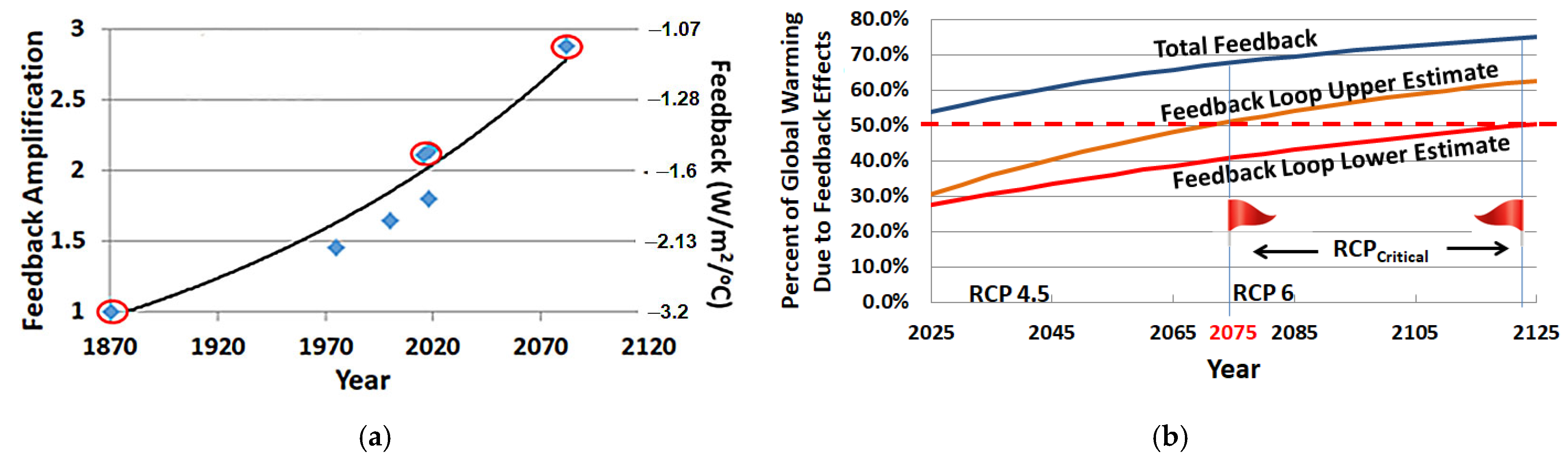
Figure 1. (a) Diagnostic feedback amplification trends [5] with circled substantiated data points (note the RHS of Figure 1a is net feedback consistent with AR6). (b) Estimated red flag diagnostic feedback loop region projected from feedback amplification trends relative to RCP potential failed goals.
Climate 14 00037 g001
Figure 2. ASGPs with UEB–Urbanization Earth Brightening, HEB–Hotspot Earth Brightening, SS-L1 Space Sunshade with target areas of tropics SAI, Arctic SAI, and Antarctic ASAI. Shown are also the estimated start dates performed until RCP goals are met.
Climate 14 00037 g002
Figure 3. Diagnostic feedback amplification trend [5] analysis (RHS is net feedback; Equation (6)). (a) 1975–2019 data—linear fit with circled substantiated points A = 2.15. (b) 1870–2082 data—exponential fit with three reasonable diagnostic estimated points: A = 1, A = 2.15, and A = 2.66 (see ECS estimate). (c) Worst case trend 2000–2019 data with 2025 data point due to Hansen et al. [2] pipeline point and circled substantiated points A = 2.15, linear fit.
Climate 14 00037 g003
Figure 4. Estimated feedback percent contributions to GW (with linear upper, lower, and exponential trend lines). RCP scenarios for CO2 peak years and critical estimated years added.
Climate 14 00037 g004
Figure 5. Percentages of global warming due to the feedback effects broken down into the feedback loop and feedback non-loop portions: (a) lower estimate from Figure 4; (b) upper worst-case estimate from Figure 4.
Climate 14 00037 g005
Figure 6. Mitigation difficulty and cost for no intervention (slope 1.33%/Yr).
Climate 14 00037 g006
Table 1. Topics covered and their sections.
Overview of TopicsSection
IntroductionSection 1
Method and DataSection 2
Feedback and Feedback Amplification Analysis MethodsSection 2.1
Feedback Amplification Graphical Assessment Methods and Data Section 2.1.1
RCP GoalsSection 2.2
Urbanization’s Influence on Global WarmingSection 2.3
Sustainability is Estimated to be Unattainable Without ASGPsSection 2.4
Largest CO2-Emitting Countries and ChallengesSection 2.5
Workflow Method for Estimating Time Left to RCP_CriticalSection 2.6
ResultsSection 3
Feedback Trend Estimates RevisitedSection 3.1
Why NCR Method Captures Additional Diagnostics Including Planetary Albedo DeclineSection 3.1.1
Feedback Estimated Trends with Substantiated Points, Including ECSSection 3.1.2
Feedback Trend Percent Projections Relative to RCP GoalsSection 3.2
Framework for Feedback AnalysisSection 3.3
Initial Feedback and Loop Estimates for the Case of 54% FeedbackSection 3.3.1
Estimated Time Left for Critical Feedback Loops and Mitigation Difficulty and Cost RateSection 3.3.2
Proposed Annual Solar Geoengineering-PLUS Pathways To Supplement RCP GoalsSection 3.4
Annual Solar Geoengineering Allocation By CountrySection 3.4.1
DiscussionSection 4
Why it is Essential to include Urbanization (UHI) Earth Brightening Due to its Significant Contribution Section 4.1
The Difficulty Mapping Urbanization GW to TOA from Ground-Based EstimatesSection 4.2
Negative Solar Geoengineering and Background Climate Amplification EffectsSection 4.3
Prior Assessments Have Overestimated Space Sunshading Required Area: It is the Optimum ASG+ P for Area Efficiency and Governance: Section 4.4
Feedback Amplification and the Logic of Self-CoolingSection 4.5
SummarySection 5
ConclusionsSection 5
Acronyms, Symbols, and Amplification Overview AssessmentsAppendix A
Review of Feedback Trend Analysis Appendix B
Summary of RCP Goals and IssuesAppendix C
Reconciling Satellite and Ground-Based Assessments: RF versus ERF for Urbanization EffectsAppendix D
Tropics Amplification EstimateAppendix E
Table 2. Workflow method for Section 3.
  • Revisit and update feedback trends.
  • Update ECS. This will aid in developing feedback loop graphical trends.
Section 3.1
  • Define time left until RCPCritical in terms of feedback loop contributing to 50% of GW.
Section 3.2
  • Graphically estimate the feedback trend in % relative to RCP goals
Section 3.2
  • Define feedback loop framework to help estimate the time left.
Section 3.3
  • Break feedback up into initial feedback and feedback loop portions.
  • Calculate feedback loop portion based on the total feedback (obtain the general formula fLoop = f × f).
Section 3.3.1
  • Estimate time left until RCP_Critical (fLoop = 50%) and mitigation difficulty rate.
Section 3.3.2
  • Provide ASG+P solutions.
Section 3.4
Table 3. Estimates for AAFP *.
Regionfmicroffeedback
fd
(2025)
AGFP
AFFP
Estimates
(fmicro × fd × AGEP)
Baseline (Oceans, Δα = 0)1111
Background, Roads (no traffic), Roofs, etc.12.15 *1.62 *3.5
Roads with Traffic1.32.151.624.53
Alaska, Arctic12.51.624.05
UHI Mixed (Dry, Humid)2.0 **2.15 *1.62 *7.0
Tropics12.471.624 ***
Space12.151.623.5
* Feinberg [13], ** Feinberg [6,30], *** See Appendix E.
Table 4. ASGP legend.
EB = Earth Brightening
HEB = Hotspot EB
U = Urbanization
AEB = Automotive Earth Brightening
SAIEB = Stratosphere Aerosol Injections
ASAI = Arctic SAI
AASAI = Antarctic SAI
SS = Space L1 Sunshading
AT = Intervention area
ASG Phases = Annual Solar Geoengineering Phases
Table 5. Suggested physics models for SRM intervention estimates [12,47].
ModelExample for Phase N = 1.0
Urbanization EB (UHI, Urban, Rural, and Automotive) A = 7.66, Xc = 0.47
Δ P A S G × N A U H I = S o 4 A T A E S H H T X C ( α T α T ) Equation (33) 0.11 Wm 2 7.66 = 340.15 Wm 2 A T A E ( 0.85 ) ( 0.47 ) ( 0.15 ) , A T = 3 . 6 × 10 5 K m 2
Hotspot Earth Brightening (Rural Roads, Roofs, Mountain top areas, Death Valley, etc) A = 3.5, Xc = 0.47
Δ P A S G × N A H E B = S o 4 A T A E X C ( α T α T ) Equation (34) 0.11 Wm 2 3.5 = 340.15 Wm 2 A T A E 0.47 ( 0.2 ) , A T = 2 . 6 × 10 5 K m 2
Arctic SAI and Alaska A = 4, Xc = 0.47/2
Δ P A S G × N A A S A I = S o 4 A T ( A E x 4 % ) X C ( α T α T ) Equation (35) 0.11 Wm 2 4 = 340.15 Wm 2 A T ( A E ) ( 0.235 ) ( 0.016 ) , A T = 1.1 × 10 7 K m 2
Space Sunshade A = 3.5, Xc = 1
Δ P A S G × N A S S = X S S o 4 A T A X E X C ( α T α T ) Equation (36) 0.11 Wm 2 3.5 = 1361 Wm - 2 A T ( A X E ) ( 1 ) ( 0.7 ) , A T = 3.8 × 10 3 K m 2
Table 6. Suggested model inputs.
ParameterUHIHEB(ASAI)TSAISS
Average Irradiance Xc0.470.470.47/2 = 0.2350.471
Xs (Space Sunshade)11114
I = Xc Xs (So/4) (Wm−2)160160801601360
Δα0.20.20.0160.20.7
A Albedo Amp. and Feedback Factor7.663.5443.5
ΔP Goal/A, N = 1 (Wm−2)0.11/7.7 = 0.0130.11/3.48
= 0.32
0.11/4
= 0.025
0.11/4
= 0.025
0.11/3.5
= 0.29
UHI Tree and Building Unshade SH0.851111
HT2.21111
AE (km2)5.1 × 1085.1 × 1083.0 × 107 *5 × 1081.3 × 108 **
* Arctic Area 6% of Earth; ** Cross-Section area of Earth AE., 25% smaller than Earth’s surface area.
Table 7. ASGPs with suggested albedo, DPASG (see Supplemental Materials calculator).
ASGP—N Phases0.250.50.751.001.251.50 E2.02.5
ΔPASG-N = Nx 0.11 Wm−2−0.028−0.055−0.083−0.110−0.138−0.165−0.220−0.275
Urbanization EB (UHI) A = 7.0, Xc = 0.47, I = 160 Wm−2
ΔPASG-N = Nx 0.11 Wm−2/A−0.004−0.008−0.012−0.016−0.020−0.024−0.031−0.039
Albedo Change Δα0.150.150.150.150.150.150.150.15
EB Area (km2)9.8 × 1042.0 × 1052.9E + 053.9 × 1054.9 × 1055.9 × 1057.9 × 1059.8 × 105
HEB (Rural Roads, Roofs, Mountain top areas, Death Valley, etc), A = 3.5, Xc = 0.47, I = 160 Wm−2
ΔPASG-N = 0.11 Wm−2/A−0.008−0.016−0.024−0.032−0.039−0.047−0.063−0.079
Albedo Change Δα0.20.20.20.20.20.20.20.2
EB Area (km2)1.3 × 1052.5 × 1053.8 × 1055.04 × 1056.3 × 1057.6 × 1051.0 × 1061.3 × 106
Arctic SAI and Alaska, A = 4, Xc = 0.47/2 = 0.235, I = 80 Wm−2
ΔPASG-N = 0.11 Wm−2/A−0.0069−0.0138−0.0206−0.0275−0.0344−0.0413−0.0550−0.0688
Albedo Change Δα0.0160.0.0160.0160.0160.0160.0160.016
SAI Area (km2)2.74 × 1065.48 × 1068.22 × 1061.10 × 1071.37 × 1071.64 × 1072.19 × 1072.74 × 107
Space Sunshade A = 3.5, Xc = 1, Xs = 4, I = 1360 Wm−2
ΔPASG-N = 0.11 Wm−2/A−0.0079−0.0158−0.0237−0.032−0.039−0.047−0.063−0.079
Albedo Change Δα0.70.70.70.70.70.70.70.7
Disk Area (km2)1.1 × 1032.1 × 1033.2 × 1034.2 × 1035.3 × 1036.3 × 1038.5 × 1031.1 × 104
Disk Radius (km)1826323741455258
Topics A = 4, Xc = 0.47, I = 160 Wm−2
ΔPASG-N = 0.11 Wm−2/A−0.0069−0.0138−0.0206−0.0275−0.0344−0.0413−0.0550−0.0688
Albedo Change Δα0.20.20.20.20.20.20.20.2
Tropics Area (km2)1.1 × 1052.2 × 1053.3 × 1054.4 × 1055.5 × 1056.6 × 1058.8 × 1051.1 × 106
Disclaimer/Publisher’s Note: The statements, opinions and data contained in all publications are solely those of the individual author(s) and contributor(s) and not of MDPI and/or the editor(s). MDPI and/or the editor(s) disclaim responsibility for any injury to people or property resulting from any ideas, methods, instructions or products referred to in the content.