
Time Left to Critical Climate Feedback/Loops: Annual Solar Geoengineering-PLUS, Pathways to Planetary Self-Cooling


Highlights
- Modeling indicates that self-heating feedback loops are likely to reach a mitigation critical 50% threshold of global warming between 2075 and 2125 if no Solar Geoengineering is applied, making reversing global warming overly difficult, and tipping points are anticipated.
- Annual Solar Geoengineering-PLUS pathways are introduced to counter high-amplification regions through Earth Brightening, Arctic Stratospheric Aerosol Injection, and L1 Space Sunshading. This approach also focuses on amplified feedback regions in the Arctic and the tropics, reducing local chain reactions by promoting self-cooling negative feedback loops.
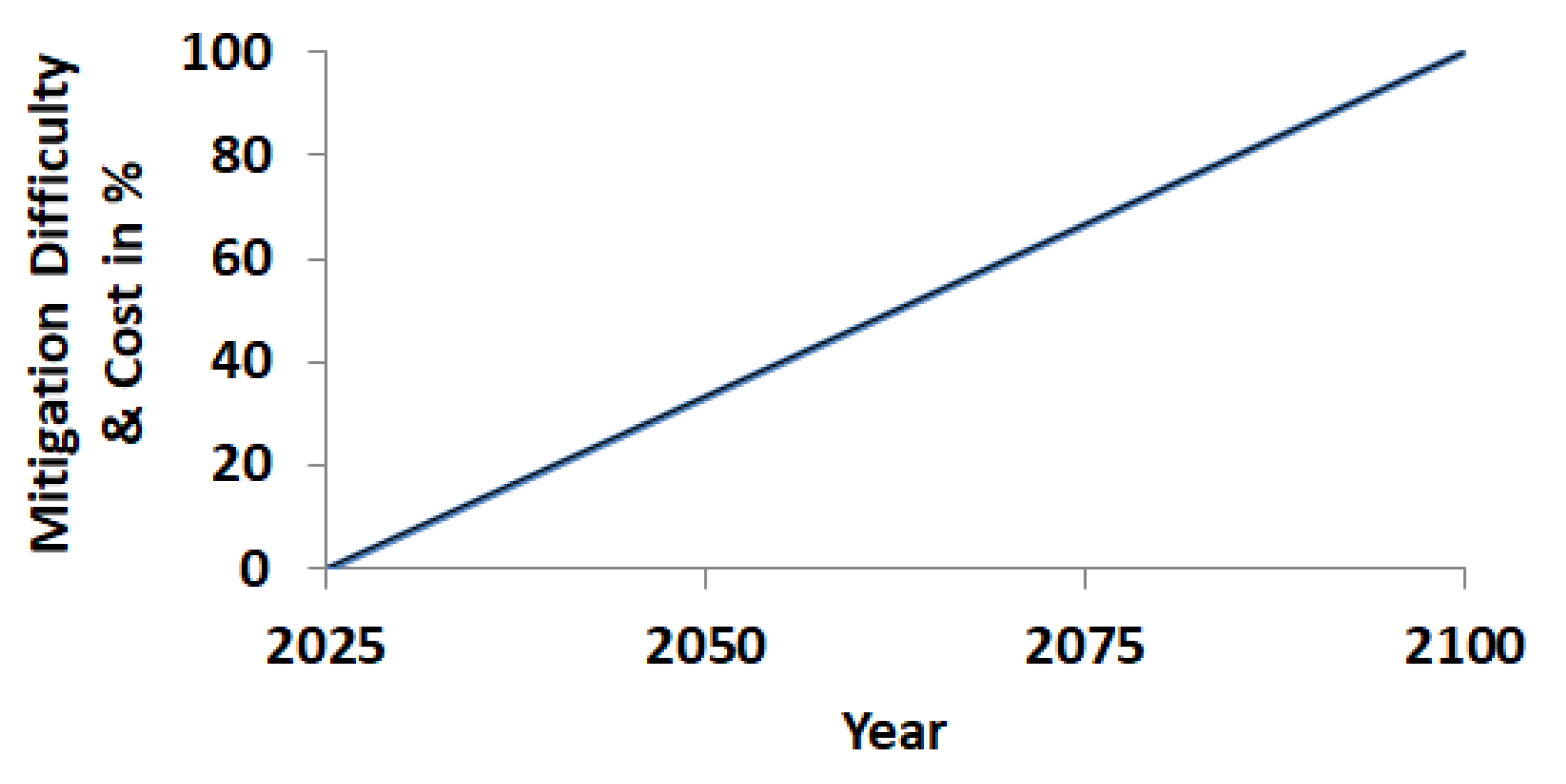
- The mitigation difficulty and cost rate (MDCR) is estimated to increase by 1.33–1.5% per year, so that by 2100, without intervention, the increase will be ≈100% of today’s baseline, an unsustainable mitigation critical threshold.
- L1 Space Sunshading (SS) area efficiency assessments show that the required shading area is ≈32× lower than prior flawed estimates, and ≈1600× lower when using the ASG+Ps method. Given the long-term risks to civilization, development in this area should be treated as an urgent priority for space agencies.
Simple Summary
Abstract
1. Introduction
Overview of Topics
2. Methods and Data
2.1. Feedback and Feedback Amplification Analysis Methods
2.1.1. Feedback Amplification Graphical Assessment Methods and Data
2.2. RCP Goals
2.3. Urbanization’s Influence on Global Warming
2.4. Sustainability Is Estimated to Be Unattainable Without ASGPs
2.5. Largest CO2-Emitting Countries and Challenges
2.6. Workflow Method for Estimating Time Left to RCP_Critical
3. Results
3.1. Feedback Trend Estimates Revisited
3.1.1. Why NCR Method Captures Additional Diagnostics Including Planetary Albedo Decline
3.1.2. Feedback Estimated Trends with Substantiated Points, Including ECS
3.2. Feedback Trend Percent Projections Relative to RCP Goals
3.3. Framework for Feedback Analysis
3.3.1. Initial Feedback and Loop Estimates for the Case of 54% Feedback
Non-Loop Portion
Loop Portion
Non-Loop and Loop Percentages
3.3.2. Estimated Time Left for Critical Feedback Loops and Mitigation Difficulty and Cost Rate
3.4. Proposed Annual Solar Geoengineering-PLUS Pathways to Supplement RCP Goals
- Feedback amplification per Section 3.1, and
- Forcing amplification effects from albedo changes, specifically the Albedo GHG Forcing Potential (AGFP ≈ 1.62), which arises from the albedo–GHG interaction (or could be used for anthropogenic waste heat in other circumstances). Here, albedo-driven heat flux changes are amplified by the background GHG climate, as detailed in Feinberg [5,6,12,13,30,47] (this is mainly due to the Earth’s energy budget, where GHGs increase the surface flux from 240 Wm−2 to 387 Wm−2, a 1.62 increase).
3.4.1. Annual Solar Geoengineering Allocation by Country
- The US’s mitigation = 31% × 96,000 Km2 = 29,760 Km2/Yr or 102 mi2/day;
- The UK’s mitigation = 3.5% × 96,000 Km2 = 3360 Km2/Yr or 11.5 mi2/day;
4. Discussion
4.1. Why It Is Essential to Include Urbanization (UHI) Earth Brightening Due to Its Significant Contribution
4.2. The Difficulty Mapping Urbanization GW to TOA from Ground-Based Estimates
4.3. Negative Solar Geoengineering and Background Climate Amplification Effects
4.4. Prior Assessments Have Overestimated Space Sunshading Required Area: It Is the Optimum ASG+P for Area Efficiency and Governance:
4.5. Feedback Amplification and the Logic of Self-Cooling
4.5.1. Why Amplification Helps with Cooling
- A positive forcing produces amplified warming.
- A negative forcing (e.g., increasing albedo) produces amplified cooling.
4.5.2. Why This Matters for ASG+
- Area fraction fr, Amplification A, and local radiative forcing ΔRF from albedo change. If ARegion is coupled with the background climate, we can assess the TOA impact and the ground warming portion as well by modeling the ARegional value as in Table 3 to assess the micro versus the global warming influence.
- Over land, using ARegion ≈ 3.5 reduces the required SRM area by roughly this factor of 3.5.
- In the Arctic, where A ≈ 4, the required area or Δα is reduced by ≈4×.
- These reductions are the physical basis for self-cooling leverage.
5. Summary
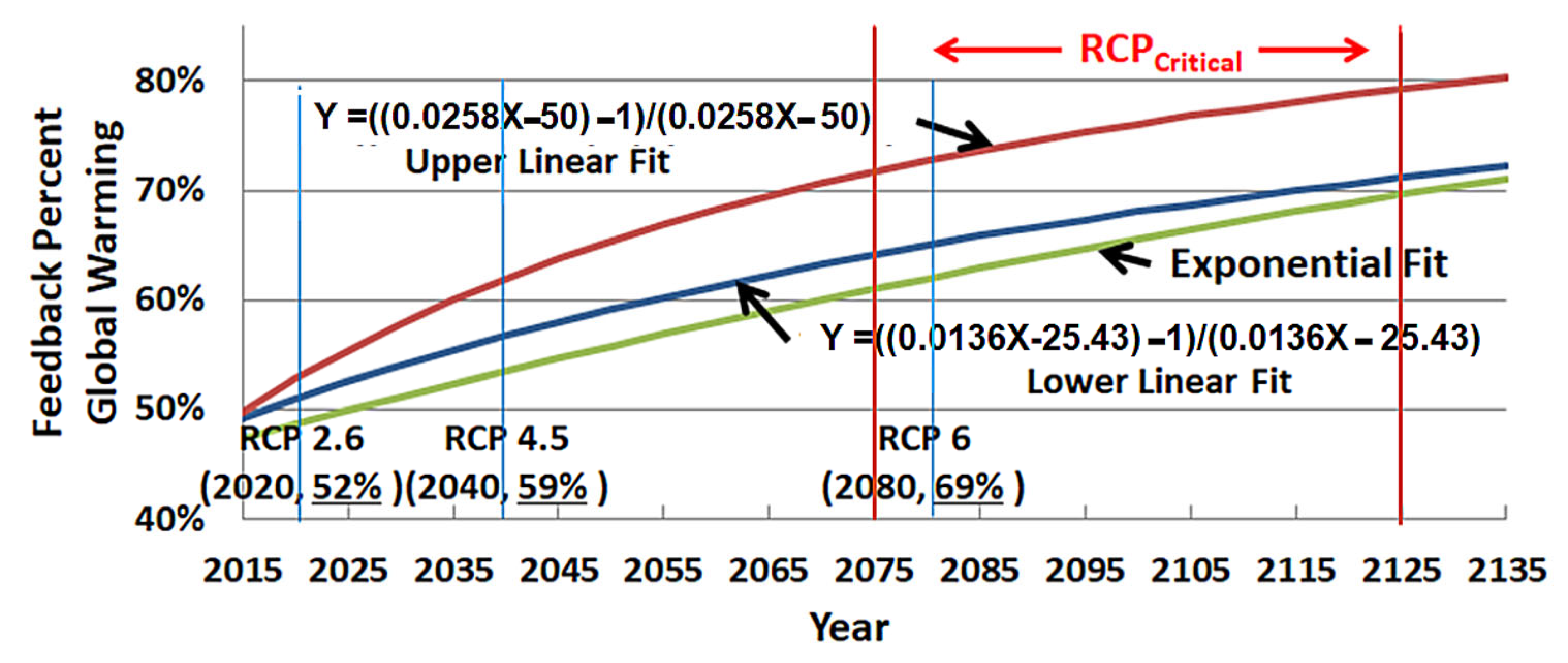
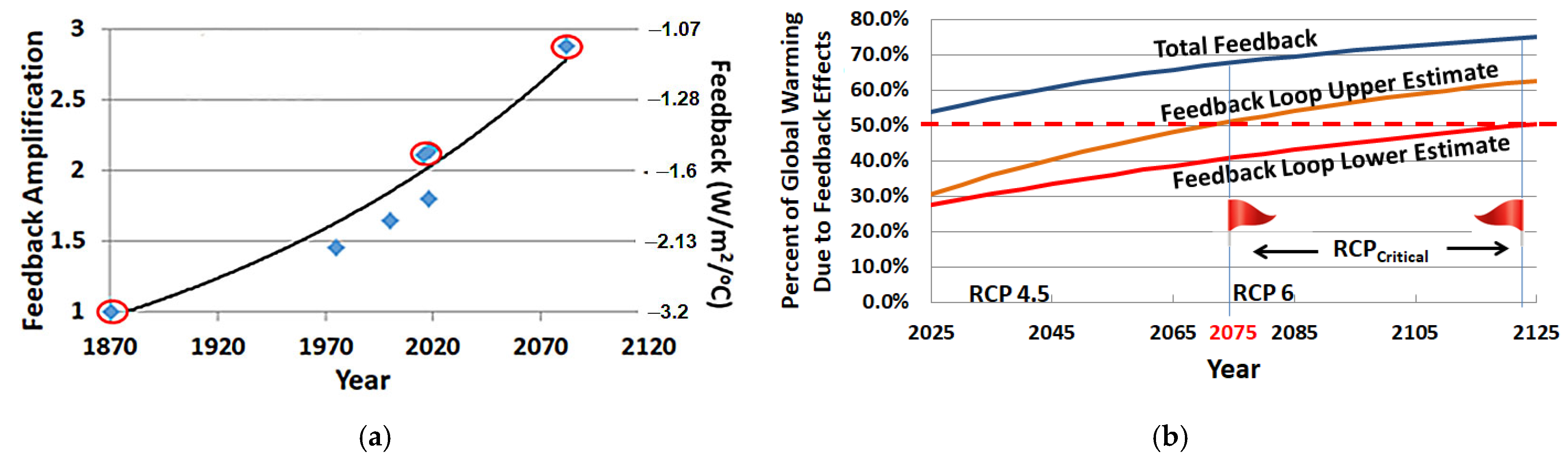
- Feedback loop trends were assessed relative to RCP goals (Figure 1). RCP_Critical was defined as the point when feedback loops contribute >50% of GW (coincides with 71% total feedback), projected to occur between 2075 and 2125 (Figure 1 and Figure 5; Section 3.3.1). Recent pipeline warming trends suggest the earlier 2075 estimate is more likely [2,3,4,5].
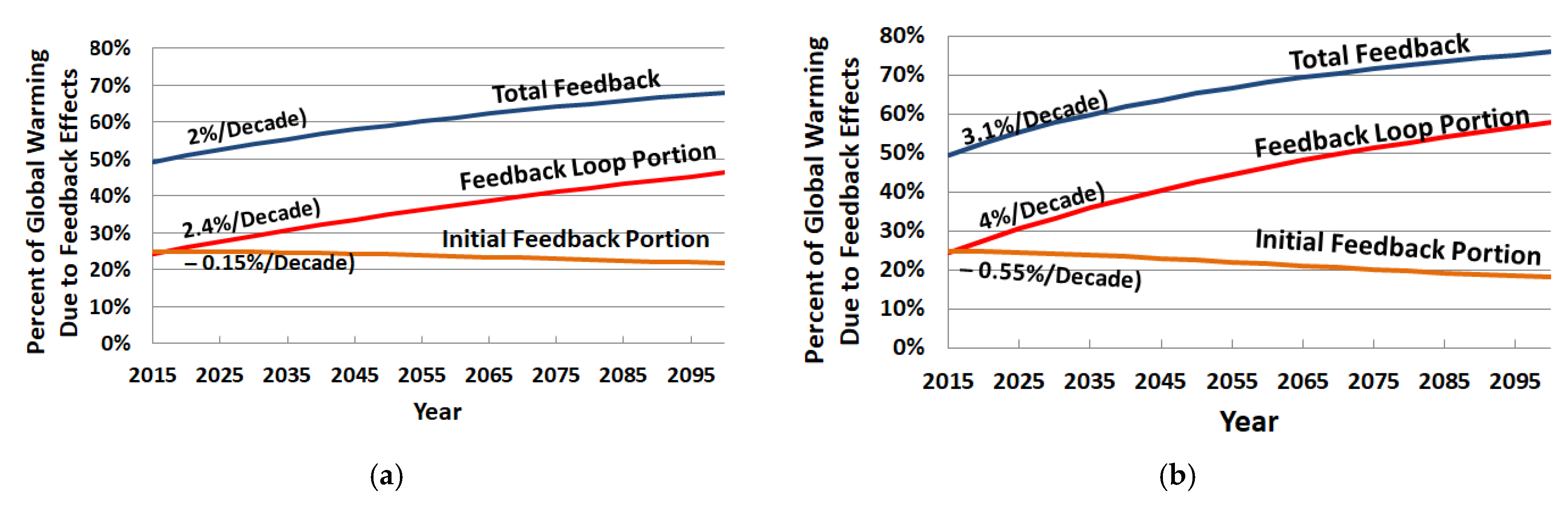
- Figure 5 presents the relative GW percentages of feedback loops versus non-loop components (Section 3.3.1).
- The feedback fraction was given in terms of the amplification factor A as where A ≥ 1 (see Figure 3).
- The feedback loop fraction was found as (Section 3.3.1).
- The feedback non-loop fraction is (Section 3.3.1).
- RCP_Critical is estimated to occur (Figure 4) if we do not implement ASGPs and improve ICDR. Two related metrics are estimated under a no-SRM scenario: a mitigation difficulty and cost rate (MDCR) of 1.33–1.5% per year, and an unsustainable mitigation critical threshold (USMT) of 75 years, representing the timeframe beyond which mitigation will be prohibitively difficult (see Section 3.3.2) with tipping point concerns.
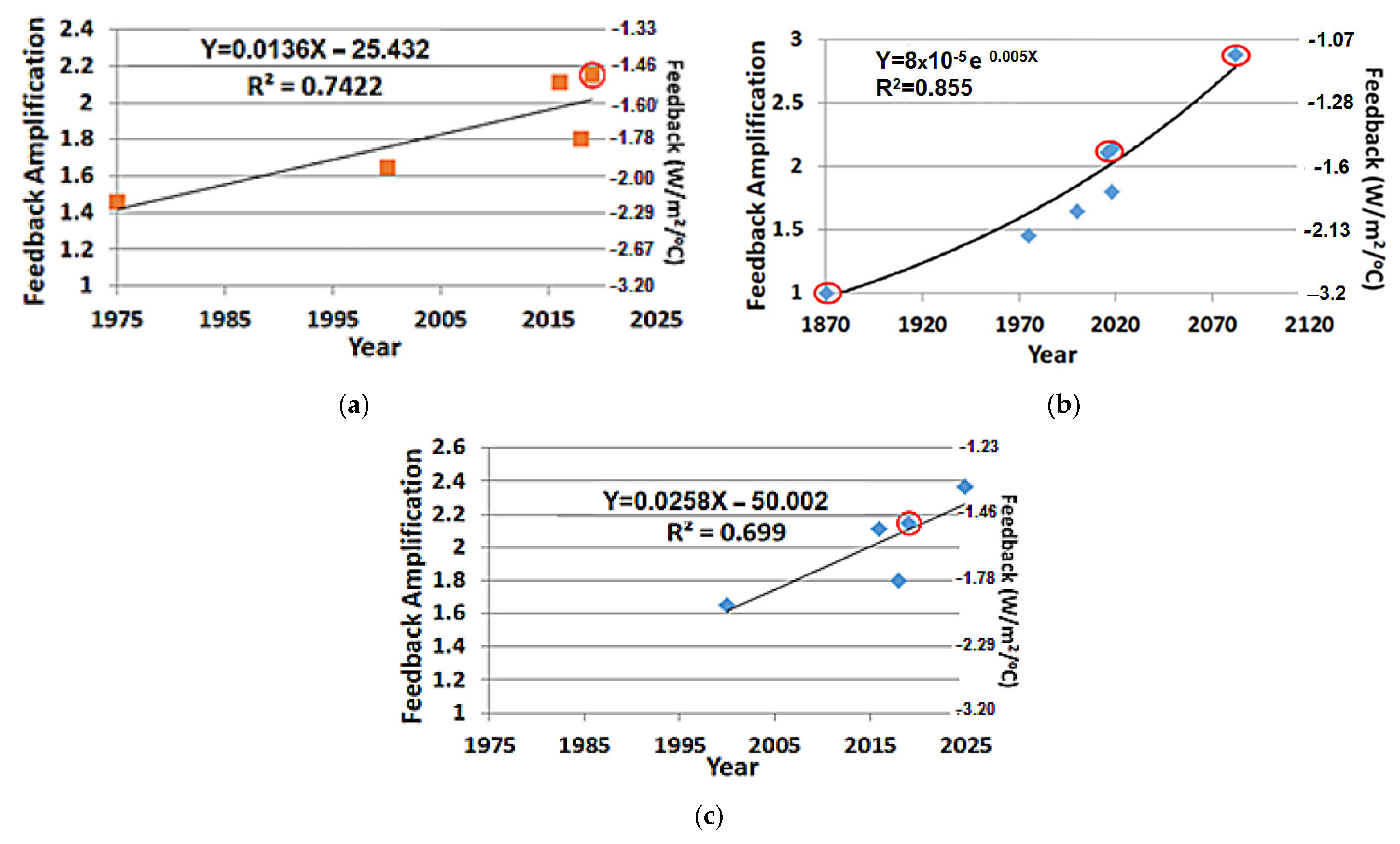
- Three feedback amplification A values are substantiated, in Figure 3b, improving confidence. ECS projections (Section 3.1.2) ranged from 3.08 °C to 4.3 °C, corresponding to A values 2.7–3.7 that may occur around 2082 without intervention.
- The 2019 amplification value of A = 2.15 (Figure 3) was independently confirmed: first in Feinberg [6], then via NCR methods in Appendix B are within the AR6 95% confidence ranges. The exponential intercept for A = 1 was ≈1870 in Figure 3b, a reasonable minimal feedback point.
- Forest tree losses in 2024 exceeded gains by 2:1, adding +4 GtCO2 while gains removed only –2 GtCO2, a net +2 GtCO2. Combined with a 23 GtCO2 rise, this trend jeopardizes RCP targets without ASGPs. As of 2024, 70–90% of ICDR depended on forest gains (Section 2.4).
- Sustainability thus depends on achieving both ASG+P and RCP goals (Section 3.4).
- Major CO2 emitters, the US, China, Russia, India, and Japan, face major real-world implementation barriers due to economic priorities (Section 2.4).
- Satellite albedo methods face limitations (Appendix D) in terms of missing vertical structures, ERF components, and UHI effects. They conflict with ground-based findings [26] and ERF flux modeling [30]. Recent work by Feinberg [13] finds that satellite measurements, when converted from RF to ERF using UHI amplification estimates, are actually close to Zhang et al.’s [26] estimates.
- Key intervention pathways include urban EB, hotspot EB, Arctic and Antarctic SAI, and Space Sunshades (Section 3.4). Table 5 provides physics models for SRM albedo and area estimates.
- Pathways use a Phase-N multiplier of ΔPASG(N) = (−0.11 Wm−2 N)/A (Equation (32)). Reversal power, albedo, and SRM areas requirements were estimated for multipliers from 0.25 to 2.5 (Section 3.4).
- Space Sunshading remains widely overestimated with flawed estimates in the literature (Section 4.3) by as much as 32× [12,47] (Section 4.4). In this framework, a starting Phase 0.25 SS requires only ≈1 × 10³ km2 (radius 17.8 km), a 6400× area reduction relative to some prior estimates [52,53,54,55,56,57].
- Overall, ASG+Ps offer ≈50× in reduced area requirements compared to full SG implementations, reducing circulation and governance concerns, and enhancing feasibility (Feinberg, [12]).
- The “PLUS” component requires N > 1, corresponding to mitigation exceeding the yearly small GW increase (Table 7). These pathways explicitly target high-amplification regions, including the Arctic and tropical feedback areas, to trigger reverse negative-feedback chain reactions that encourage self-cooling and long-term climate stabilization.
6. Conclusions
Supplementary Materials
Funding
Data Availability Statement
Acknowledgments
Conflicts of Interest
Abbreviations
| AF | Afforestation | UHI | Urban Heat Island |
| AASAI | Antarctic SAI | NCR | Normalized correlated rates |
| ASG+P | Annual Solar Geoengineering-PLUS pathways | RCP | Representative concentration pathway |
| ASAI | Arctic SAI | REF | Reforestation |
| CDR | Carbon Dioxide Removal | SB | Stefan–Boltzmann |
| DF | Deforestation | SG | Solar Geoengineering |
| ERF | Effective radiative forcing | SRM | Solar radiation modification |
| ECS | Equilibrium climate sensitivity | SS | Space Sunshading |
| GMEEB | Global Mean Earth Energy Budget | SAI | Stratospheric aerosol injection |
| FD | Forest degradation | U | Urbanization |
| GHGs | Greenhouse gases | UEB | Urbanization Earth Brightening |
| GW | Global warming | MDCR | Mitigation difficulty and Cost rate |
| ICDR | Intentional Carbon Dioxide Removal | USMT | Unsustainable mitigation threshold |
| HEB | Hotspot Earth Brightening |
Appendix A. Acronyms and Symbols and Amplification Overview Assessment

| Parameter | Period | Model Value | Source and/or Description |
|---|---|---|---|
| A = Feedback amplification | 2019 | 2.15 | [5,6] |
| F = Forcing | 1950–2019 | 2.38 Wm−2 | (Butler et al. [60]) |
| r = Re-radiation parameter | 2019 | 0.62 | [6] r = 1/(1 + r) |
| So/4 | 340.15 Wm−2 | ||
| Golden Ratio Conjugate | |||
| XC = 0.47 | Average Irradiance reaching Earth | ||
| ERF | Effective Radiation Forcing | ||
| HT | Weighted Urban Micro Amp | ||
| Temp. Change due to Feedback | |||
| Initial Temp. Feedback Change | |||
| Feedback Loop Temp. Change | |||
| Initial Temp. Change (no feedback) | |||
| No Feedback ECS Value (1.16 °C) | |||
| Feedback Amplification (≈2.2 in 2024) | |||
| Feedback Fraction | |||
| Feedback Loop Fraction | |||
| Initial Feedback Non-loop Fraction | |||
| λPlanck = λo ≈ −3.2 W/m2/°C | Planck Feedback | ||
| Net (effective) Feedback (used on RHS of graphs consistent with AR6 λs) | |||
| Net Forestation | |||
| Net CO2 | |||
| Deforestation, Forest Degradation | |||
| Afforestation and Reforestation |
Appendix A.1. Relationship of a for Temperature and Radiative Forcing
Appendix B. Review of Feedback Trend Analysis
| a | b | b/a | ||
|---|---|---|---|---|
| Average Year | Period (Years) | Energy Consumption NCR Figure A1 | GW NCR | A Feedback Amp. |
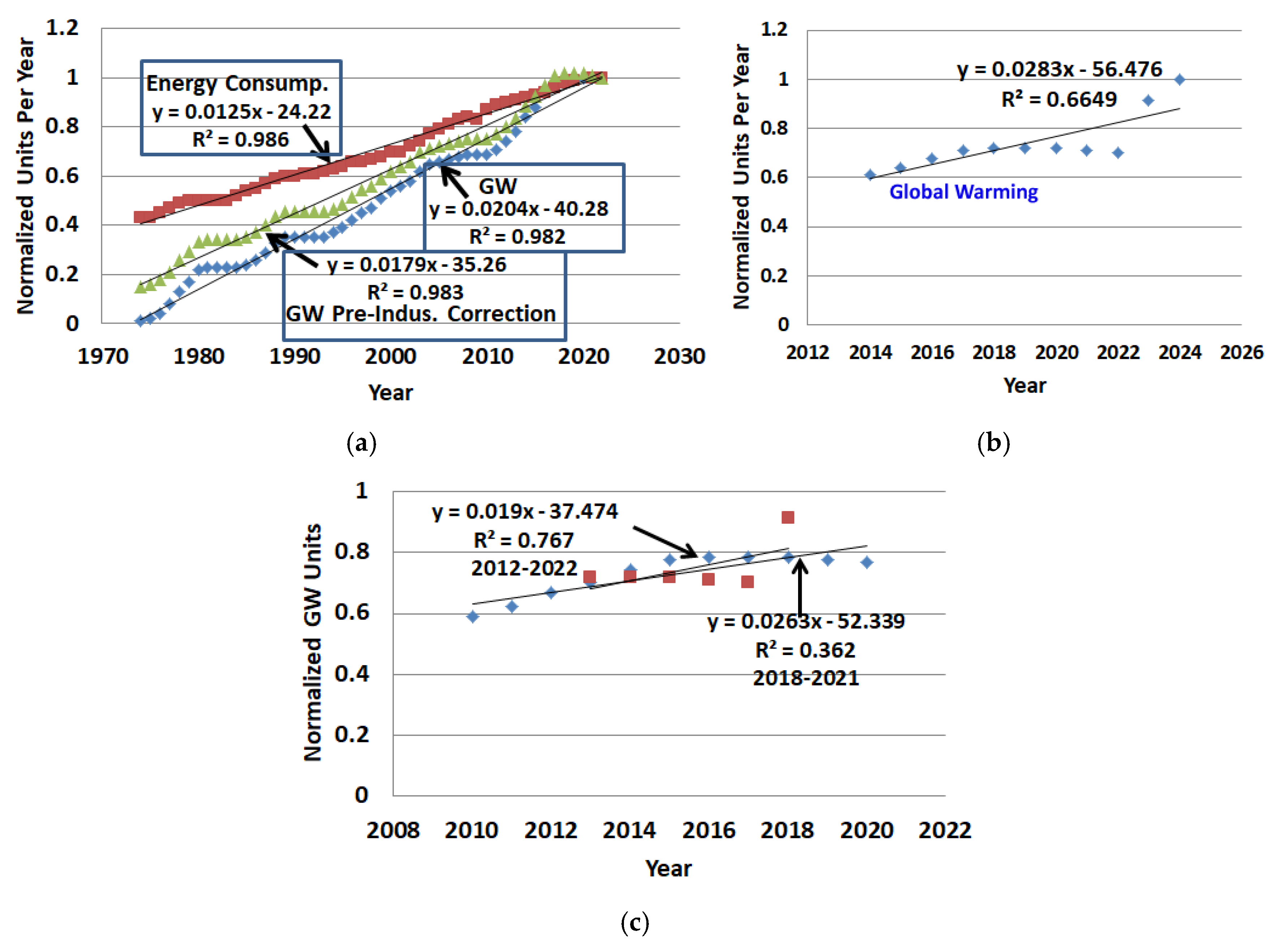
| 1975 | 1900–2022 | 0.0125 | 0.0179 (Figure A1a) | 1.46 |
| 2000 | 1975–2022 | 0.0125 | 0.0204 (Figure A1a) | 1.65 |
| 2019 | 2014–2024 | 0.0125 | 0.0283 (Figure A1b) | 2.15 |
| 2018, 2025 | 2013–2025 | 0.0125 | 0.023–0.0296 (Figure A1c) | 1.84–2.37 * |

| GW * | GW | Energy | Energy | GW | |
|---|---|---|---|---|---|
| Year | °C | Normalized | Consump. ** | Consump. | Normalized |
| Smoothed | TWh | Normalized | Post-Indus. Corr. *** | ||
| 1974 | 0.01 | 0.01 | 76,191 | 0.43 | 0.15 |
| 1975 | 0.02 | 0.02 | 76,571 | 0.43 | 0.16 |
| 1976 | 0.04 | 0.04 | 80,197 | 0.45 | 0.18 |
| 1977 | 0.07 | 0.08 | 82,841 | 0.47 | 0.21 |
| 1978 | 0.12 | 0.13 | 85,853 | 0.49 | 0.26 |
| 1979 | 0.16 | 0.17 | 88,519 | 0.50 | 0.30 |
| 1980 | 0.20 | 0.22 | 87,933 | 0.50 | 0.33 |
| 1981 | 0.21 | 0.23 | 87,712 | 0.50 | 0.34 |
| 1982 | 0.21 | 0.23 | 87,394 | 0.50 | 0.34 |
| 1983 | 0.21 | 0.23 | 88,751 | 0.50 | 0.34 |
| 1984 | 0.21 | 0.23 | 92,604 | 0.52 | 0.34 |
| 1985 | 0.22 | 0.24 | 94,838 | 0.54 | 0.35 |
| 1986 | 0.24 | 0.26 | 96,837 | 0.55 | 0.37 |
| 1987 | 0.27 | 0.29 | 99,955 | 0.57 | 0.40 |
| 1988 | 0.31 | 0.33 | 103,439 | 0.59 | 0.44 |
| 1989 | 0.33 | 0.35 | 105,349 | 0.60 | 0.46 |
| 1990 | 0.33 | 0.35 | 106,638 | 0.60 | 0.46 |
| 1991 | 0.33 | 0.35 | 107,458 | 0.61 | 0.46 |
| 1992 | 0.33 | 0.35 | 108,196 | 0.61 | 0.46 |
| 1993 | 0.33 | 0.35 | 109,092 | 0.62 | 0.46 |
| 1994 | 0.34 | 0.37 | 110,473 | 0.63 | 0.47 |
| 1995 | 0.36 | 0.39 | 112,834 | 0.64 | 0.49 |
| 1996 | 0.39 | 0.42 | 115,868 | 0.66 | 0.51 |
| 1997 | 0.42 | 0.45 | 117,063 | 0.66 | 0.54 |
| 1998 | 0.44 | 0.47 | 117,881 | 0.67 | 0.56 |
| 1999 | 0.47 | 0.51 | 119,927 | 0.68 | 0.59 |
| 2000 | 0.50 | 0.54 | 122,745 | 0.70 | 0.62 |
| 2001 | 0.52 | 0.56 | 123,821 | 0.70 | 0.64 |
| 2002 | 0.54 | 0.58 | 126,229 | 0.72 | 0.66 |
| 2003 | 0.58 | 0.62 | 130,131 | 0.74 | 0.70 |
| 2004 | 0.60 | 0.65 | 135,763 | 0.77 | 0.71 |
| 2005 | 0.61 | 0.66 | 139,641 | 0.79 | 0.72 |
| 2006 | 0.62 | 0.67 | 143,184 | 0.81 | 0.73 |
| 2007 | 0.63 | 0.68 | 147,164 | 0.83 | 0.74 |
| 2008 | 0.64 | 0.69 | 148,642 | 0.84 | 0.75 |
| 2009 | 0.64 | 0.69 | 146,474 | 0.83 | 0.75 |
| 2010 | 0.64 | 0.69 | 152,966 | 0.87 | 0.75 |
| 2011 | 0.66 | 0.71 | 156,247 | 0.89 | 0.77 |
| 2012 | 0.69 | 0.74 | 158,156 | 0.90 | 0.80 |
| 2013 | 0.73 | 0.78 | 160,653 | 0.91 | 0.84 |
| 2014 | 0.78 | 0.84 | 162,198 | 0.92 | 0.89 |
| 2015 | 0.82 | 0.88 | 163,372 | 0.93 | 0.92 |
| 2016 | 0.87 | 0.94 | 165,530 | 0.94 | 0.97 |
| 2017 | 0.91 | 0.98 | 168,517 | 0.96 | 1.01 |
| 2018 | 0.92 | 0.99 | 172,884 | 0.98 | 1.02 |
| 2019 | 0.92 | 0.99 | 174,285 | 0.99 | 1.02 |
| 2020 | 0.92 | 1.0 | 167,781 | 0.95 | 1.02 |
| 2021 | 0.92 | 1.0 | 176,431 | 1.00 | 1.01 |
| 2022 | 0.92 | 1.0 | NA | 1.00 | 1.00 |
| 2023 | 1.17 | ||||
| 2024 | 1.28 |
Appendix C. Summary of RCP Goals and Issues
| RCP (Year Declines, Target) | Description in Terms of CO2 Mitigation |
|---|---|
| RCP 2.6 (2020, 2.6 Wm−2) | Requires CO2 emissions to peak by 2020 and fall below zero by 2070. Radiative forcing peaks near ≈3 Wm−2 before 2100, then declines to ≈2.6 Wm−2. This pathway assumes a rapid transition to renewable energy along with widespread carbon capture, storage, and negative emission technologies (NETs). Its goal is to limit global warming to below 2 °C, ideally 1.5 °C, by 2100. |
| Status: Emissions reached record highs in 2022 and remain elevated through 2024 at ≈3 ppm net. Global temperatures have already risen 1.2–1.3 °C, and current trends suggest 1.5 °C will likely be exceeded before 2030. | |
| RCP 4.5 (2040, 4.5 Wm−2) | CO2 emissions peak by ≈2040 and then decline, cutting levels roughly in half by 2050. Radiative forcing stabilizes near 4.5 Wm−2 by 2100, with CO2 concentrations leveling off around 650 ppm. Projected warming is 2.4–2.6 °C by 2100. |
| Status: Current trends show we are off track. Emissions continue to rise, fossil fuel use remains high, and major new investments are going into oil, gas, and coal. With CO2 already at ≈425 ppm, stabilization at 650 ppm by 2100 is increasingly unlikely. | |
| RCP 6 (2080, 6 Wm−2) | CO2 emissions peak around ≈2080 before declining. Radiative forcing stabilizes near 6.0 Wm−2 by 2100, with projected global warming of ≈3–4 °C by 2100. |
| RCP_Critical (2075–2125) | Represents failure to achieve the CO2 decline required in RCP 6.0 by ≈2080. At this stage, there is a high probability of entering the red flag zone (Figure 1), where feedback loops are projected to contribute more than 50% of total global warming. Status: Based on recent nonlinear warming and pipeline trend estimates (Hansen, [2]; Rahmstorf and Foster [4]), see Figure 3c, RCP_Critical is more likely to occur closer to 2075 than 2125, underscoring the urgency of SG pathways. |
Appendix D. Reconciling Satellite and Ground-Based Assessments: RF Versus ERF for Urbanization Effects
Appendix D.1. Key Limitations of Satellite RF for Urbanization
- Spatial resolution and averaging
- o
- Coarse satellite pixels (250 m–1 km) dilute urban signals, often misclassifying surfaces (rooftops as vegetation, and concrete as soil).
- Vertical and structural complexity
- o
- Satellites observe rooftops and horizontal surfaces but miss walls, urban canyons, and reflective building elements, which significantly affect heat absorption.
- Local microclimates and anthropogenic effects
- o
- Urban humidity, evapotranspiration suppression, anthropogenic heat, and diurnal/seasonal variability are largely invisible in satellite RF, but are captured in ground ERF modeling.
- Atmospheric and directional biases
- o
- Aerosols, cloud cover, and bidirectional reflectance effects further obscure the urban contribution to RF.
Appendix D.2. Converting RF to ERF Using Diagnostics
- o
- Local feedback amplification
- o
- Albedo–GHG coupling
- o
- Microclimate amplification effects [30]
Appendix E. Tropic Amplification Estimate
References
- Ripple, W.; Wolf, C.; Lenton, T.; Gregg, J.; Natali, S.; Duffy, P.; Rockström, J.; Schellnhuber, H. Many risky feedback loops amplify the need for climate action. One Earth 2023, 6, 86–91. [Google Scholar] [CrossRef]
- Hansen, J.E.; Sato, M.; Simons, L.; Nazarenko, L.S.; Sangha, I.; Kharecha, P.; Zachos, J.C.; von Schuckmann, K.; Loeb, N.G.; Osman, M.B.; et al. Global warming in the pipeline. Oxf. Open Clim. Change 2023, 3, kgad008. [Google Scholar] [CrossRef]
- Hansen, J.E.; Kharecha, P.; Sato, M.; Tselioudis, G.; Kelly, J.; Bauer, S.E.; Ruedy, R.; Jeong, E.; Jin, Q.; Rignot, E.; et al. Global Warming Has Accelerated: Are the United Nations and the Public Well-Informed? Environ. Sci. Policy Sustain. Dev. 2025, 67, 6–44. [Google Scholar] [CrossRef]
- Rahmstorf, S.; Foster, G. Global Warming has accelerated significantly. Res. Sq. 2025, preprint. [Google Scholar] [CrossRef]
- Feinberg, A. Feedback trends with ECS from energy rates: Feedback doubling and vital need for solar geoengineering. Climate 2025, 13, 43. [Google Scholar] [CrossRef]
- Feinberg, A. A Re-Radiation Model for the Earth’s Energy Budget and the Albedo Advantage in Global Warming Mitigation. Dyn. Atmos. Oceans 2022, 97, 101267. [Google Scholar] [CrossRef]
- Dessler, A. Observations of climate feedback over 2000–2010 and comparisons to climate models. J. Clim. 2013, 26, 333–342. [Google Scholar] [CrossRef]
- Gordon, N.; Jonko, A.; Forster, P.; Shell, K. An observationally based constraint on the water-vapor feedback. J. Geophys. Res. 2013, 118, 12435–12443. [Google Scholar] [CrossRef]
- Liu, R.; Su, H.; Liou, K.; Jiang, J.; Gu, Y.; Liu, S.; Shiu, C. An Assessment of Tropospheric Water Vapor Feedback Using Radiative Kernels. J. Geophys. Res. Atmos. 2018, 123, 1499–1509. [Google Scholar] [CrossRef]
- Abrams, J.; Huntingford, C.; Williamson, M.; McKay, D.; Boulton, C.; Buxton, J.; Sakschewski, B.; Loriani, S.; Zimm, C.; Winkelmann, R.; et al. Committed Global Warming Risks Triggering Multiple Climate Tipping Points. Earth’s Future 2023, 11, e2022EF003250. [Google Scholar] [CrossRef]
- Armstrong, D.; McKay, A.; Staal, A.; Abrams, J.; Winkelman, R.; Boris Sakschewski, B.; Sina Loriani, S.; Fetzer, I.; Cornell, S.; Rockström, J.; et al. Exceeding 1.5 °C global warming could trigger multiple climate tipping points. Science 2022, 377. [Google Scholar] [CrossRef]
- Feinberg, A. Annual Solar Geoengineering: Mitigating Yearly Global Warming Increases. Climate 2024, 12, 26. [Google Scholar] [CrossRef]
- Feinberg, A. Solar Geoengineering and Forcing 14 Times Greater than CO2 Changes: Climate and Land Use Amplification in GW Diagnostics. ResearchGate. 2025. Available online: https://www.researchgate.net/publication/394470822.
- Patel, V.; Kuttippurath, J. Increase in Tropospheric Water Vapor Amplifies Global Warming and Climate Change. Ocean-Land-Atmos. Res. 2023, 2, 5753–5761. [Google Scholar] [CrossRef]
- NASA Vital Signs. Global Temperature|Vital Signs—Climate Change: Vital Signs of the Planet (nasa.gov), (GW Smoothed and Unsmoothed Data). Available online: https://climate.nasa.gov/vital-signs/global-temperature/ (accessed on 10 September 2024).
- NOAA Global Monitoring Laboratory. 2024. Available online: https://gml.noaa.gov/ozwv/wvap/ (accessed on 10 November 2024).
- Ritchie, H.; Roser, M. Energy Production and Consumption, Our World in Data. 2022. Available online: https://ourworldindata.org/energy-production-consumption (accessed on 5 January 2025).
- Energy Institute Report. 2024. Available online: https://www.energyinst.org/statistical-review/resources-and-data-downloads (accessed on 5 January 2025).
- Vuuren, D.; Edmonds, J.; Kainuma, M.; Riahi, K.; Thomson, A.; Hibbard, K.; Hurtt, G.; Kram, T.; Krey, V.; Lamarque, J.; et al. The representative concentration pathways: An overview. Clim. Change 2011, 109, 5–31. [Google Scholar] [CrossRef]
- IPCC. Climate Change 2014: Synthesis Report. Contribution of Working Groups I, II and III to the Fifth Assessment Report of the Intergovernmental Panel on Climate Change; Core Writing Team; Pachauri, R.K., Meyer, L.A., Eds.; IPCC: Geneva, Switzerland, 2014; 151p. [Google Scholar]
- Steffen, W.; Rockström, J.; Richardson, K.; Lenton, T.M.; Folke, C.; Liverman, D.; Summerhayes, C.P.; Barnosky, A.D.; Cornell, S.E.; Crucifix, M.; et al. Trajectories of the Earth System in the Anthropocene. Proc. Natl. Acad. Sci. USA 2018, 115, 8252–8259. [Google Scholar] [CrossRef]
- Goldblatt, C.; Watson, A. The Runaway Greenhouse: Implications for future climate change, geoengineering and planetary atmospheres. Philos. Trans. R. Soc. A Math. Phys. Eng. Sci. 2012, 370, 4197–4216. [Google Scholar] [CrossRef]
- Kriegler, E.; Hall, J.; Held, H.; Dawson, R.; Schellnhuber, H. Imprecise probability assessment of tipping points in the climate system. Proc. Natl. Acad. Sci. USA 2009, 106, 5041–5046. [Google Scholar] [CrossRef]
- Deutloff, J.; Held, H.; Lenton, T. High probability of triggering climate tipping points under current policies modestly amplified by Amazon dieback and permafrost thaw. Earth Syst. Dynam 2025, 16, 565–583. [Google Scholar] [CrossRef]
- Lee, J.; Marotzke, J.; Bala, G.; Cao, L.; Corti, S.; Dunne, J.; Engelbrecht, F.; Fischer, E.; Fyfe, J.; Jones, C.; et al. Future Global Climate: Scenario-Based Projections and Near-Term Information. In Climate Change 2021: The Physical Science Basis. Contribution of Working Group I to the Sixth Assessment Report of the Intergovernmental Panel on Climate Change; Masson-Delmotte, V., Zhai, P., Pirani, A., Connors, S., Péan, C., Berger, S., Caud, N., Chen, Y., Goldfarb, L., Gomis, M., et al., Eds.; Cambridge University Press: Cambridge, UK; New York, NY, USA, 2021; pp. 553–672. [Google Scholar] [CrossRef]
- Zhang, P.; Ren, G.; Qin, Y.; Zhai, Y.; Zhai, T.; Tysa, S.K.; Xue, X.; Yang, G.; Sun, X. Urbanization effects on estimates of global trends in mean and extreme air temperature. J. Clim. 2021, 34, 1923–1945. [Google Scholar] [CrossRef]
- Guo, T.; He, T.; Liang, S.; Roujean, J.; Zhou, Y.; Huang, X. Multi-decadal analysis of high-resolution albedo changes induced by urbanization over contrasted Chinese cities based on Landsat data. Remote Sens. Environ. 2022, 269, 112832. [Google Scholar] [CrossRef]
- Ouyang, Z.; Sciusco, P.; Jiao, T.; Feron, S.; Lei, C.; Li, F.; John, R.; Fan, P.; Li, X.; Williams, C.A.; et al. Albedo changes caused by future urbanization contribute to global warming. Nat. Commun. 2022, 13, 3800. [Google Scholar] [CrossRef] [PubMed]
- Zhou, D.; Xiao, J.; Frolking, S.; Zhang, L.; Zhou, G. Urbanization Contributes Little to Global Warming but Substantially Intensifies Local and Regional Land Surface Warming. Earth’s Future 2022, 10, e2021EF002401. [Google Scholar] [CrossRef]
- Feinberg, A. Urbanization Heat Flux Modeling Confirms It Is a Likely Cause of Significant Global Warming: Urbanization Mitigation Requirements. Land 2023, 12, 1222. [Google Scholar] [CrossRef]
- Global Carbon Budget. Available online: https://globalcarbonbudget.org/; https://globalcarbonbudget.org/fossil-fuel-co2-emissions-increase-again-in-2024/?utm_source=chatgpt.com (accessed on 15 May 2024).
- Smith, S.; Geden, O.; Nemet, G.; Gidden, M.; Lamb, W.; Powis, C.; Bellamy, R.; Callaghan, M.; Cowie, A.; Cox, E.; et al. The State of Carbon Dioxide Removal, 1st ed.; Technical Report; OSF: Charlottesville, VA, USA, 2023. [Google Scholar] [CrossRef]
- Pongratz, J.; Schwingshackl, C.; Gasser, T.; Castanho, A.; Grassi, G. The state of carbon dioxide removal through afforestation and reforestation. In Proceedings of the 11th International Carbon Dioxide Conference, Manaus, Brazil, 29 July–2 August 2024; Available online: https://carbondioxide-removal.eu/2024/12/06/the-state-of-carbon-dioxide-removal-through-afforestation-and-reforestation/ (accessed on 10 October 2025).
- UN Population Report. Department of Economic and Social Affairs, World Population Prospects. 2024. Available online: https://population.un.org/wpp/assets/Files/WPP2024_Summary-of-Results.pdf (accessed on 10 January 2025).
- Carrington, E. Wildfires Drive Record Leap in Global Level of Climate-Heating CO2, The Guardian. 2025. Available online: https://www.theguardian.com/environment/2025/jan/17/wildfires-drive-record-leap-in-global-level-of-climate-heating-co2#:~:text=Wildfires%20that%20blazed%20around%20the,world%20of%20supercharged%20extreme%20weather (accessed on 5 January 2025).
- CarbonBrief. The State of Carbon Dioxide Removal in Seven Charts. 2023. Available online: https://www.carbonbrief.org/guest-post-the-state-of-carbon-dioxide-removal-in-seven-charts/ (accessed on 15 May 2025).
- Abegg, M.; Clulow, Z.; Nava, L.; Reiner, D. Expert insights into future trajectories: Assessing cost reductions and scalability of carbon dioxide removal technologies. Front. Clim. 2024, 6, 1331901. [Google Scholar] [CrossRef]
- Gerrard, M. Trump Attacks on Climate Science May Violate Numerous Federal Laws. N.Y.L.J.: New York, NY, USA, 2025. Available online: https://scholarship.law.columbia.edu/faculty_scholarship/4638.
- Temple, J. The Trump Administration has Shut Down More Than 100 Climate Studies, MIT Technology Review. June 2025. Available online: https://www.technologyreview.com/2025/06/02/1117653/the-trump-administration-has-shut-down-more-than-100-climate-studies/ (accessed on 16 June 2025).
- Statista. 2025. Available online: https://www.statista.com/statistics/1473619/total-ghg-emissions-from-russia-ukraine-war-by-sector/#:~:text=Total%20GHG%20emissions%20during%20the,war%202022%2D2024%2C%20by%20sector&text=It%20is%20estimated%20that%20at,needed%20to%20reconstruct%20civilian%20infrastructure.&text=Log%20in%20or%20register%20to%20access%20precise%20data (accessed on 5 July 2025).
- World Economic Forum. Clean Energy has Caused China’s Emissions to Drop for the First Time. 2025. Available online: https://www.weforum.org/stories/2025/06/clean-energy-china-emissions-peak/ (accessed on 15 July 2025).
- Forster, P.; Storelvmo, T.; Armour, K.; Collins, W.; Dufresne, J.L.; Frame, D.; Lunt, D.J.; Mauritsen, T.; Palmer, M.D.; Watanabe, M.; et al. The Earth’s Energy Budget, Climate Feedbacks, and Climate Sensitivity. In Climate Change 2021: The Physical Science Basis: Contribution of Working Group I to the Sixth Assessment Report of the Intergovernmental Panel on Climate Change; Masson-Delmotte, V., Zhai, P., Pirani, A., Connors, S.L., Péan, C., Berger, S., Caud, N., Chen, Y., Goldfarb, L., Gomis, M.I., et al., Eds.; Cambridge University Press: Cambridge, UK; New York, NY, USA, 2023; Chapter 7; pp. 923–1054. [Google Scholar]
- Sherwood, S.; Webb, M.J.; Annan, J.D.; Armour, K.C.; Forster, P.M.; Hargreaves, J.; Hegerl, G.; Klein, S.A.; Marvel, K.D.; Rohling, E.J.; et al. An assessment of Earth’s climate sensitivity using multiple lines of evidence. Rev. Geophys. 2020, 58, e2019RG000678. [Google Scholar] [CrossRef]
- Previdi, M.; Janoski, T.; Chiodo, G.; Smith, K.; Polvani, L. Arctic Amplification: A Rapid Response to Radiative Forcing. Geophys. Res. Lett. 2020, 47, e2020GL089933. [Google Scholar] [CrossRef]
- Rantanen, M.; Karpechko, M.; Lipponen, A.; Nordling, K.; Hyvärinen, O.; Ruosteenoja, K.; Vihma, T.; Laaksonen, A. The Arctic has warmed nearly four times faster than the globe since 1979. Commun. Earth Environ. 2022, 3, 168. [Google Scholar] [CrossRef]
- Huo, Y.; Wang, H.; Lu, J.; Fu, Q.; Jonko, A.; Lee, Y.; Ma, W.; Maslowski, W.; Qin, Y. Assessing Radiative Feedbacks and Their Contribution to the Arctic Amplification Measured by Various Metrics. JGR Atmos. 2024, 129, e2024JD040880. [Google Scholar] [CrossRef]
- Feinberg, A. Solar Geoengineering Modeling and Applications for Mitigating Global Warming: Assessing Key Parameters and the Urban Heat Island Influence. Front. Clim. 2022, 4, 870071. [Google Scholar] [CrossRef]
- Feinberg, A. Urban Heat Island High Water-Vapor Feedback Estimates and Heatwave Issues: A Temperature Difference Approach to Feedback Assessments. Sci 2022, 4, 44. [Google Scholar] [CrossRef]
- Wikipedia. List of Countries by Wealth per Adult. 2025. Available online: https://en.wikipedia.org/wiki/List_of_countries_by_wealth_per_adult (accessed on 15 May 2025).
- Modak, M.; Bala, G.; Cao, L.; Caldeira, K. Why must a solar forcing be larger than a CO2 forcing to cause the same global mean surface temperature change? Environ. Res. Lett. 2016, 11, 044013. [Google Scholar] [CrossRef]
- IPCC AR6. Regional Fact Sheet—Urban Areas. 2021. Available online: https://www.ipcc.ch/report/ar6/wg1/downloads/factsheets/IPCC_AR6_WGI_Regional_Fact_Sheet_Urban_areas.pdf (accessed on 11 January 2023).
- Early, J. Space-based solar shield to offset greenhouse effect. J. Br. Interplanet. Soc. 1989, 42, 567–569. [Google Scholar]
- Govindasamy, B.; Caldeira, K. Geoengineering Earth’s radiation balance to mitigate CO2-induced climate change. Geophys. Res. Lett. 2000, 27, 2141–2144. [Google Scholar] [CrossRef]
- McInnes, C. Space-based geoengineering: Challenges and requirements. Proc. Inst. Mech. Eng. Part C J. Mech. Eng. Sci. 2010, 224, 571–580. [Google Scholar] [CrossRef]
- Sánchez, J.; McInnes, C. Optimal Sunshade Configurations for Space-Based Geoengineering near the Sun-Earth L1 Point. PLoS ONE 2015, 10, e0136648. [Google Scholar] [CrossRef] [PubMed]
- Fuglesang, C.; Miciano, M. Realistic sunshade system at L1 for global temperature control. Acta Astronaut. 2021, 186, 269–279. [Google Scholar] [CrossRef]
- Bromley, B.; Khan, S.; Kenyon, S. Dust as a solar shield. PLoS Clim. 2023, 2, e0000133. [Google Scholar] [CrossRef]
- Dessler, A.; Zhang, Z.; Yang, P. Water-vapour feedback inferred from climate fluctuations, 2003–2008. Geophys. Res. Lett. 2008, 35, L20704. [Google Scholar] [CrossRef]
- Dessler, A.; Wong, S. Estimates of the Water Vapor Climate Feedback during El Nino-Southern Oscillations. J. Clim. 2009, 22, 6404–6412. [Google Scholar] [CrossRef]
- Butler, H.; Montzka, A. The NOAA Annual Greenhouse Gas Index; Earth System Research Lab.; Global Monitoring Laboratory, Data Set: Boulder, CO, USA, 2020. Available online: https://www.esrl.noaa.gov/gmd/aggi/aggi.html (accessed on 4 October 2021).
- Hartmann, D.L.; Klein, A.M.G.; Tank, M.; Rusticucci, L.V.; Alexander, S.; Brönnimann, Y.; Charabi, F.J.; Dentener, E.J.; Dlugokencky, D.; Easterling, D.R.; et al. Observations: Atmosphere and Surface. In Climate Change 2013: The Physical Science Basis. Contribution of Working Group I to the Fifth Assessment Report of the Intergovernmental Panel on Climate Change; Stocker, T.F., Qin, D., Plattner, G.-K., Tignor, M., Allen, S.K., Boschung, J., Nauels, A., Xia, Y., Bex, V., Midgley, P.M., Eds.; Cambridge University Press: Cambridge, UK; New York, NY, USA, 2013. [Google Scholar]


| Overview of Topics | Section |
|---|---|
| Introduction | Section 1 |
| Method and Data | Section 2 |
| Feedback and Feedback Amplification Analysis Methods | Section 2.1 |
| Feedback Amplification Graphical Assessment Methods and Data | Section 2.1.1 |
| RCP Goals | Section 2.2 |
| Urbanization’s Influence on Global Warming | Section 2.3 |
| Sustainability is Estimated to be Unattainable Without ASGPs | Section 2.4 |
| Largest CO2-Emitting Countries and Challenges | Section 2.5 |
| Workflow Method for Estimating Time Left to RCP_Critical | Section 2.6 |
| Results | Section 3 |
| Feedback Trend Estimates Revisited | Section 3.1 |
| Why NCR Method Captures Additional Diagnostics Including Planetary Albedo Decline | Section 3.1.1 |
| Feedback Estimated Trends with Substantiated Points, Including ECS | Section 3.1.2 |
| Feedback Trend Percent Projections Relative to RCP Goals | Section 3.2 |
| Framework for Feedback Analysis | Section 3.3 |
| Initial Feedback and Loop Estimates for the Case of 54% Feedback | Section 3.3.1 |
| Estimated Time Left for Critical Feedback Loops and Mitigation Difficulty and Cost Rate | Section 3.3.2 |
| Proposed Annual Solar Geoengineering-PLUS Pathways To Supplement RCP Goals | Section 3.4 |
| Annual Solar Geoengineering Allocation By Country | Section 3.4.1 |
| Discussion | Section 4 |
| Why it is Essential to include Urbanization (UHI) Earth Brightening Due to its Significant Contribution | Section 4.1 |
| The Difficulty Mapping Urbanization GW to TOA from Ground-Based Estimates | Section 4.2 |
| Negative Solar Geoengineering and Background Climate Amplification Effects | Section 4.3 |
| Prior Assessments Have Overestimated Space Sunshading Required Area: It is the Optimum ASG+ P for Area Efficiency and Governance: | Section 4.4 |
| Feedback Amplification and the Logic of Self-Cooling | Section 4.5 |
| Summary | Section 5 |
| Conclusions | Section 5 |
| Acronyms, Symbols, and Amplification Overview Assessments | Appendix A |
| Review of Feedback Trend Analysis | Appendix B |
| Summary of RCP Goals and Issues | Appendix C |
| Reconciling Satellite and Ground-Based Assessments: RF versus ERF for Urbanization Effects | Appendix D |
| Tropics Amplification Estimate | Appendix E |
| Section 3.1 |
| Section 3.2 |
| Section 3.2 |
| Section 3.3 |
| Section 3.3.1 |
| Section 3.3.2 |
| Section 3.4 |
| Region | fmicro | ffeedback fd (2025) | AGFP | AFFP Estimates (fmicro × fd × AGEP) |
|---|---|---|---|---|
| Baseline (Oceans, Δα = 0) | 1 | 1 | 1 | 1 |
| Background, Roads (no traffic), Roofs, etc. | 1 | 2.15 * | 1.62 * | 3.5 |
| Roads with Traffic | 1.3 | 2.15 | 1.62 | 4.53 |
| Alaska, Arctic | 1 | 2.5 | 1.62 | 4.05 |
| UHI Mixed (Dry, Humid) | 2.0 ** | 2.15 * | 1.62 * | 7.0 |
| Tropics | 1 | 2.47 | 1.62 | 4 *** |
| Space | 1 | 2.15 | 1.62 | 3.5 |
| EB = Earth Brightening HEB = Hotspot EB U = Urbanization AEB = Automotive Earth Brightening SAIEB = Stratosphere Aerosol Injections | ASAI = Arctic SAI AASAI = Antarctic SAI SS = Space L1 Sunshading AT = Intervention area |
| ASG Phases = Annual Solar Geoengineering Phases |
| Model | Example for Phase N = 1.0 | |
|---|---|---|
| Urbanization EB (UHI, Urban, Rural, and Automotive) A = 7.66, Xc = 0.47 | ||
| Equation (33) | ||
| Hotspot Earth Brightening (Rural Roads, Roofs, Mountain top areas, Death Valley, etc) A = 3.5, Xc = 0.47 | ||
| Equation (34) | ||
| Arctic SAI and Alaska A = 4, Xc = 0.47/2 | ||
| Equation (35) | ||
| Space Sunshade A = 3.5, Xc = 1 | ||
| Equation (36) | ||
| Parameter | UHI | HEB | (ASAI) | TSAI | SS |
|---|---|---|---|---|---|
| Average Irradiance Xc | 0.47 | 0.47 | 0.47/2 = 0.235 | 0.47 | 1 |
| Xs (Space Sunshade) | 1 | 1 | 1 | 1 | 4 |
| I = Xc Xs (So/4) (Wm−2) | 160 | 160 | 80 | 160 | 1360 |
| Δα | 0.2 | 0.2 | 0.016 | 0.2 | 0.7 |
| A Albedo Amp. and Feedback Factor | 7.66 | 3.5 | 4 | 4 | 3.5 |
| ΔP Goal/A, N = 1 (Wm−2) | 0.11/7.7 = 0.013 | 0.11/3.48 = 0.32 | 0.11/4 = 0.025 | 0.11/4 = 0.025 | 0.11/3.5 = 0.29 |
| UHI Tree and Building Unshade SH | 0.85 | 1 | 1 | 1 | 1 |
| HT | 2.2 | 1 | 1 | 1 | 1 |
| AE (km2) | 5.1 × 10⁸ | 5.1 × 10⁸ | 3.0 × 10⁷ * | 5 × 10⁸ | 1.3 × 10⁸ ** |
| ASGP—N Phases | 0.25 | 0.5 | 0.75 | 1.00 | 1.25 | 1.50 E | 2.0 | 2.5 |
| ΔPASG-N = Nx 0.11 Wm−2 | −0.028 | −0.055 | −0.083 | −0.110 | −0.138 | −0.165 | −0.220 | −0.275 |
| Urbanization EB (UHI) A = 7.0, Xc = 0.47, I = 160 Wm−2 | ||||||||
| ΔPASG-N = Nx 0.11 Wm−2/A | −0.004 | −0.008 | −0.012 | −0.016 | −0.020 | −0.024 | −0.031 | −0.039 |
| Albedo Change Δα | 0.15 | 0.15 | 0.15 | 0.15 | 0.15 | 0.15 | 0.15 | 0.15 |
| EB Area (km2) | 9.8 × 10⁴ | 2.0 × 10⁵ | 2.9E + 05 | 3.9 × 10⁵ | 4.9 × 10⁵ | 5.9 × 10⁵ | 7.9 × 10⁵ | 9.8 × 10⁵ |
| HEB (Rural Roads, Roofs, Mountain top areas, Death Valley, etc), A = 3.5, Xc = 0.47, I = 160 Wm−2 | ||||||||
| ΔPASG-N = 0.11 Wm−2/A | −0.008 | −0.016 | −0.024 | −0.032 | −0.039 | −0.047 | −0.063 | −0.079 |
| Albedo Change Δα | 0.2 | 0.2 | 0.2 | 0.2 | 0.2 | 0.2 | 0.2 | 0.2 |
| EB Area (km2) | 1.3 × 10⁵ | 2.5 × 10⁵ | 3.8 × 10⁵ | 5.04 × 10⁵ | 6.3 × 10⁵ | 7.6 × 10⁵ | 1.0 × 10⁶ | 1.3 × 10⁶ |
| Arctic SAI and Alaska, A = 4, Xc = 0.47/2 = 0.235, I = 80 Wm−2 | ||||||||
| ΔPASG-N = 0.11 Wm−2/A | −0.0069 | −0.0138 | −0.0206 | −0.0275 | −0.0344 | −0.0413 | −0.0550 | −0.0688 |
| Albedo Change Δα | 0.016 | 0. | 0.016 | 0.016 | 0.016 | 0.016 | 0.016 | 0.016 |
| SAI Area (km2) | 2.74 × 10⁶ | 5.48 × 10⁶ | 8.22 × 10⁶ | 1.10 × 10⁷ | 1.37 × 10⁷ | 1.64 × 10⁷ | 2.19 × 10⁷ | 2.74 × 10⁷ |
| Space Sunshade A = 3.5, Xc = 1, Xs = 4, I = 1360 Wm−2 | ||||||||
| ΔPASG-N = 0.11 Wm−2/A | −0.0079 | −0.0158 | −0.0237 | −0.032 | −0.039 | −0.047 | −0.063 | −0.079 |
| Albedo Change Δα | 0.7 | 0.7 | 0.7 | 0.7 | 0.7 | 0.7 | 0.7 | 0.7 |
| Disk Area (km2) | 1.1 × 10³ | 2.1 × 10³ | 3.2 × 10³ | 4.2 × 10³ | 5.3 × 10³ | 6.3 × 10³ | 8.5 × 10³ | 1.1 × 10⁴ |
| Disk Radius (km) | 18 | 26 | 32 | 37 | 41 | 45 | 52 | 58 |
| Topics A = 4, Xc = 0.47, I = 160 Wm−2 | ||||||||
| ΔPASG-N = 0.11 Wm−2/A | −0.0069 | −0.0138 | −0.0206 | −0.0275 | −0.0344 | −0.0413 | −0.0550 | −0.0688 |
| Albedo Change Δα | 0.2 | 0.2 | 0.2 | 0.2 | 0.2 | 0.2 | 0.2 | 0.2 |
| Tropics Area (km2) | 1.1 × 10⁵ | 2.2 × 10⁵ | 3.3 × 10⁵ | 4.4 × 10⁵ | 5.5 × 10⁵ | 6.6 × 10⁵ | 8.8 × 10⁵ | 1.1 × 10⁶ |
Disclaimer/Publisher’s Note: The statements, opinions and data contained in all publications are solely those of the individual author(s) and contributor(s) and not of MDPI and/or the editor(s). MDPI and/or the editor(s) disclaim responsibility for any injury to people or property resulting from any ideas, methods, instructions or products referred to in the content. |
© 2026 by the author. Licensee MDPI, Basel, Switzerland. This article is an open access article distributed under the terms and conditions of the Creative Commons Attribution (CC BY) license.
Share and Cite
Feinberg, A. Time Left to Critical Climate Feedback/Loops: Annual Solar Geoengineering-PLUS, Pathways to Planetary Self-Cooling. Climate 2026, 14, 37. https://doi.org/10.3390/cli14020037
Feinberg A. Time Left to Critical Climate Feedback/Loops: Annual Solar Geoengineering-PLUS, Pathways to Planetary Self-Cooling. Climate. 2026; 14(2):37. https://doi.org/10.3390/cli14020037
Chicago/Turabian StyleFeinberg, Alec. 2026. "Time Left to Critical Climate Feedback/Loops: Annual Solar Geoengineering-PLUS, Pathways to Planetary Self-Cooling" Climate 14, no. 2: 37. https://doi.org/10.3390/cli14020037
APA StyleFeinberg, A. (2026). Time Left to Critical Climate Feedback/Loops: Annual Solar Geoengineering-PLUS, Pathways to Planetary Self-Cooling. Climate, 14(2), 37. https://doi.org/10.3390/cli14020037