Article

From Policy to Progress: How Stringent Environmental Policies Drive Global Energy Transitions

1
School of Marxism, Peking University, Beijing 100871, China
2
Keough School of Global Affairs, University of Notre Dame, Notre Dame, IN 46556, USA
3
Dyson School of Applied Economics and Management, Cornell University, Ithaca, NY 14853, USA
*
Author to whom correspondence should be addressed.
Climate 2026, 14(2), 30; https://doi.org/10.3390/cli14020030
Submission received: 24 November 2025 / Revised: 25 December 2025 / Accepted: 21 January 2026 / Published: 23 January 2026
(This article belongs to the Special Issue Sustainable Development Pathways and Climate Actions)

Abstract

In pursuit of global climate goals and sustainable development, countries have adopted a wide range of environmental policy instruments. This study examines the relationship between environmental policy stringency (EPS) and environmental outcomes, measured by carbon intensity (CI) and renewable energy intensity (REI), in 16 G20 countries from 1990 to 2020. The empirical findings reveal that more stringent environmental policy is a significant predictor of reduced CI and increased REI, although effects vary by policy type, time horizon, and country group. A novel sub-index-level analysis reveals that market-based incentive instruments, particularly trading schemes on CO2 emissions and renewable energy, as well as technology support instruments, particularly wind and solar initiatives, exhibit the strongest and most robust effects. Emerging economies generally display greater responsiveness to policy interventions than advanced economies. By identifying which specific policy instruments are most effective across different development contexts, this study provides actionable insights for designing targeted climate policies that support both energy transition and sustainable development pathways.

1. Introduction

Global climate change poses an existential threat to ecosystems, economies, and human societies around the world. The continuous accumulation of greenhouse gases in the atmosphere, primarily driven by fossil fuel combustion, land-use change, and industrial processes, has led to rising global temperatures, disrupted weather patterns, and an increased frequency of climate-related disasters [1,2,3]. According to the Intergovernmental Panel on Climate Change [4], limiting global warming to below 1.5 °C requires unprecedented reductions in carbon emissions and a rapid transformation of the energy system over the coming decades. In response, countries have established a series of international and domestic initiatives, such as the Paris Agreement, to strengthen collective climate action. Despite these growing commitments and the formal adoption of climate targets, global carbon dioxide emissions continue to increase, highlighting the challenge of translating policy ambitions into tangible results [5,6,7,8].
In addition to the formulation and adoption of climate policies and international agreements, the effectiveness of policy implementation is equally important in determining environmental outcomes. Even well-designed environmental policies may fail to achieve the intended results if they are not adequately enforced, coordinated, or supported by institutional capacity [9,10,11]. Therefore, it is crucial to evaluate how policy design and enforcement interact to shape real environmental performance. The United Nations Environment Programme [12] has urged countries to deliver stronger ambition and action in the next round of Nationally Determined Contributions; otherwise, the 1.5 °C goal of the Paris Agreement will disappear in a few years. Understanding the extent to which environmental policy implementation contributes to emission reduction and energy transition provides essential insight into the uneven pace of sustainability progress across countries.
A growing body of research suggests that national climate and environmental policy frameworks, particularly their stringency and consistency over time, play a decisive role in shaping emission trajectories and driving the energy transition [13,14,15]. To capture these aspects, the Environmental Policy Stringency (EPS) index developed by the OECD (Organisation for Economic Co-operation and Development) has been employed in academic research. Policy stringency refers to how forceful and comprehensive climate and environmental policies are, often measured using composite indices [16]. The EPS index comprises three equally weighted subindices: (1) Market-Based Instruments, (2) Non-Market-Based Instruments, and (3) Technology Support Instruments. Each category plays a distinct role in mitigating climate change and shaping sustainable development pathways.
Motivated by this framework, this study examines the relationship between EPS and environmental outcomes, measured by carbon intensity and renewable energy intensity. This investigation moves beyond simply identifying whether policies exist to examine how variations in environmental policy stringency influence key environmental outcomes across countries over time. Moreover, rather than focusing on the overall EPS and its main components, this study examines 13 specific policy instruments in detail, with further disaggregation between advanced and emerging countries. This approach allows us to examine systematic differences in the effectiveness of environmental policy stringency across development contexts, with important implications for global environmental justice. By uncovering the dynamic policy–outcome relationships, this study contributes to a deeper understanding of policy effectiveness and offers insights for designing more targeted and impactful climate strategies.

2. Literature Review

A review of the literature on Environmental Policy Stringency (EPS) reveals that existing research primarily focuses on three aspects: (1) more stringent environmental policies are associated with better climate change outcomes; (2) different types of environmental policies display varying effects on climate-related outcomes; and (3) the impact of environmental policies differs across countries and regions.
In terms of the first aspect, researchers have found that more stringent environmental policies can not only reduce carbon emissions directly but also mitigate climate change indirectly. Ref. [17] found that EPS significantly and negatively impact carbon emissions. Similarly, ref. [18] showed that EPS has a negative impact on NOX and SOX emissions, as well as a weaker effect on PM2.5 emissions and exposure. Ref. [19] showed that the coefficient of EPS on environmental damage associated with economic growth is highly significantly negative, indicating that environmental policies effectively reduce the environmental damage associated with economic growth. In addition to directly lowering emissions, stringent policies can induce shifts toward cleaner energy and innovation that support mitigation [20]. For example, ref. [21] found that EPS has a significant positive impact on renewable energy consumption and mitigates the adverse effect of global economic policy uncertainty on renewable energy use. Similarly, ref. [22] indicated that positive shocks to EPS could restrict trade in energy commodities, especially fossil fuels, both in the short and long term. Furthermore, ref. [23] suggested that well-designed environmental regulations can spur eco-innovation and efficiency improvements rather than hinder growth. Ref. [24] also argued that strict regulations can drive innovation and efficiency gains, benefiting both the economy and the environment. Moreover, ref. [25] indicated that stringent environmental policies increase the benefits of green technologies through the adoption of environmentally friendly practices, which also help mitigate climate change.
With respect to the second aspect, different researchers have drawn conclusions at varying scales. Ref. [26] noted that all three EPS subindices show positive effects on green energy use. Specifically, a cross-country study conducted by [27] found that the adoption of carbon pricing was associated with a significantly slower growth in CO2 emissions. Moreover, ref. [28] indicated that market-based and technology support instruments significantly contribute to reducing greenhouse gas emissions. However, an increasing number of studies argue that combining different types of policy instruments can be more effective in mitigating climate change. A cross-country analysis by [29] identified policy combinations that significantly reduced emissions in 41 countries and underscored “the important role of price-based instruments in well-designed policy mixes” for achieving substantial CO2 reductions. Ref. [30] also found that stringent environmental policies coupled with environmentally friendly innovation are an impetus for sustainable development. Ref. [31] argued that the most promising policy packages would be to combine innovation support and information provision with a carbon tax and adoption subsidy, or with a carbon market and no-adoption subsidy.
As for the third aspect, differences in economic, social, and institutional contexts across countries and regions may lead to heterogeneous policy impacts. Ref. [9] confirmed that increases in EPS are correlated with reductions in per capita emissions, though the effect varies across countries. Ref. [32] showed that EPS significantly reduces emissions, especially in countries with initially lower emission levels. Ref. [32] further noted that the mitigation effect of EPS is stronger for EU countries at high risk of missing the 20-20-20 greenhouse gas reduction target. Similarly, ref. [33] found that more polluting industries tend to innovate less as EPS becomes more stringent, compared to less polluting industries. Ref. [34] showed that within emerging economies, the effectiveness of environmental policy instruments varies depending on regional and economic contexts. Ref. [35] also suggested that the effectiveness of environmental policy depends on a country’s biocapacity surplus or deficit and its level of industrialization. Ref. [36] emphasized that government position constitutes a decisive factor for environmental policy outcomes, in addition to institutional frameworks, economic conditions, and situational pressures that shape a government’s ability to act.
Table 1 presents a summary of the literature examining various environmental outcome variables using the Environmental Policy Stringency (EPS) index. Based on this review, several important research gaps can be identified. First, many existing studies focus primarily on whether overall EPS influences climate-related outcomes or limit their analyses to the three broad EPS components, without a deeper examination of individual policy instruments. Consequently, there remains a significant gap in understanding the effectiveness of specific environmental policy instruments captured by the 13 EPS sub-indices. Second, numerous studies rely on direct environmental indicators such as carbon dioxide emissions or renewable energy consumption, while paying limited attention to the role of national economic scale. By employing intensity-based measures that incorporate GDP, we examine countries’ carbon reduction and renewable energy expansion relative to their economic activity, providing a more informative metric for evaluating progress toward global energy transitions. There is also a notable gap in studies focusing on G20 countries. Finally, although some research conducts country-by-country analyses, few studies group countries according to meaningful characteristics to examine heterogeneity in the influence of EPS across countries with shared structural or developmental features.
This study addresses the aforementioned research gaps by employing panel data from 16 G20 countries covering the period 1990–2020, with a particular focus on the relationship between EPS and two energy transition indicators: Carbon Intensity (CI) and Renewable Energy Intensity (REI). Using panel Granger non-causality models and subgroup comparisons between advanced and emerging countries, we examine the predictive capacity of EPS for both CI and REI. Moreover, rather than limiting the analysis to the three main EPS subindices, this study further investigates 13 next-level sub-index policy instruments that capture a wider range of regulatory and technological measures. By incorporating this more detailed policy structure, the analysis provides a comprehensive understanding of how different types of policy interventions interact with broader structural forces in the global decarbonization process and identifies which environmental policies are most effective across diverse country groups.

3. Materials and Methods

3.1. Data

This study primarily draws on three major data sources: the World Bank Database, the Energy Institute, and the OECD Database. Given the limited availability of data for certain years and the need to exclude countries with substantial information gaps, we constructed a balanced panel dataset of 16 countries spanning over 30 years from 1990 to 2020. The integration of these databases provides a robust foundation for analyzing the relationship between environmental policy stringency and climate change outcomes within the G20 countries.
Despite the central role of major economies in global climate governance, the existing EPS literature contains a significant gap in studies that focus explicitly on G20 countries. This study addresses this gap by concentrating on G20 members, which collectively account for the majority of global greenhouse gas emissions, energy consumption, and economic output, and therefore play a disproportionately important role in shaping global climate outcomes. In addition, G20 countries tend to have more established and comparable policy frameworks, which facilitate meaningful cross-country comparisons of policy instruments and their impacts over time.
This study employs two key indicators of energy transition. Carbon intensity (CI), defined as carbon dioxide emissions per unit of gross domestic product (GDP, in constant 2021 prices), is derived from the World Bank’s World Development Indicators (WDI) database. This dataset provides internationally standardized and annually updated environmental and economic statistics for nearly all countries, making it a widely trusted source for cross-national empirical research. The CI captures the efficiency of an economy in terms of its carbon footprint relative to its economic output, serving as a key indicator of low-carbon development. Renewable Energy Intensity (REI), defined as the consumption of renewable energy per unit of GDP, is constructed using data from the 2024 edition of the Statistical Review of World Energy published by the Energy Institute, combined with GDP data. The Statistical Review of World Energy, managed by Heriot-Watt University in partnership with S&P Global, is one of the most comprehensive and authoritative global datasets on energy production and consumption. It includes detailed annual statistics on renewable energy, such as hydro, wind, solar, and bioenergy.
Existing literature has focused extensively on broad outcome variables such as carbon emissions, energy consumption, and their per-capita versions. As such, the application of intensity measures such as CI and REI remains largely underexplored. CI reflects the emissions efficiency of economic activity, while REI indicates the extent to which renewable energy deployment is integrated into the production process. Together, these measures help assess whether economic growth can be separated from environmental degradation, an important topic in the decoupling literature [58,59,60,61]. Declining CI alongside stable or rising GDP is interpreted as evidence of relative or absolute decoupling, while increasing REI suggests that renewable energy expansion contributes to weakening the traditional link between economic growth and fossil-fuel-based energy use. These outcome variables assess progress toward decoupling growth from carbon emissions, contributing to a better understanding of the global energy transition and the sustainable development goals [62,63].
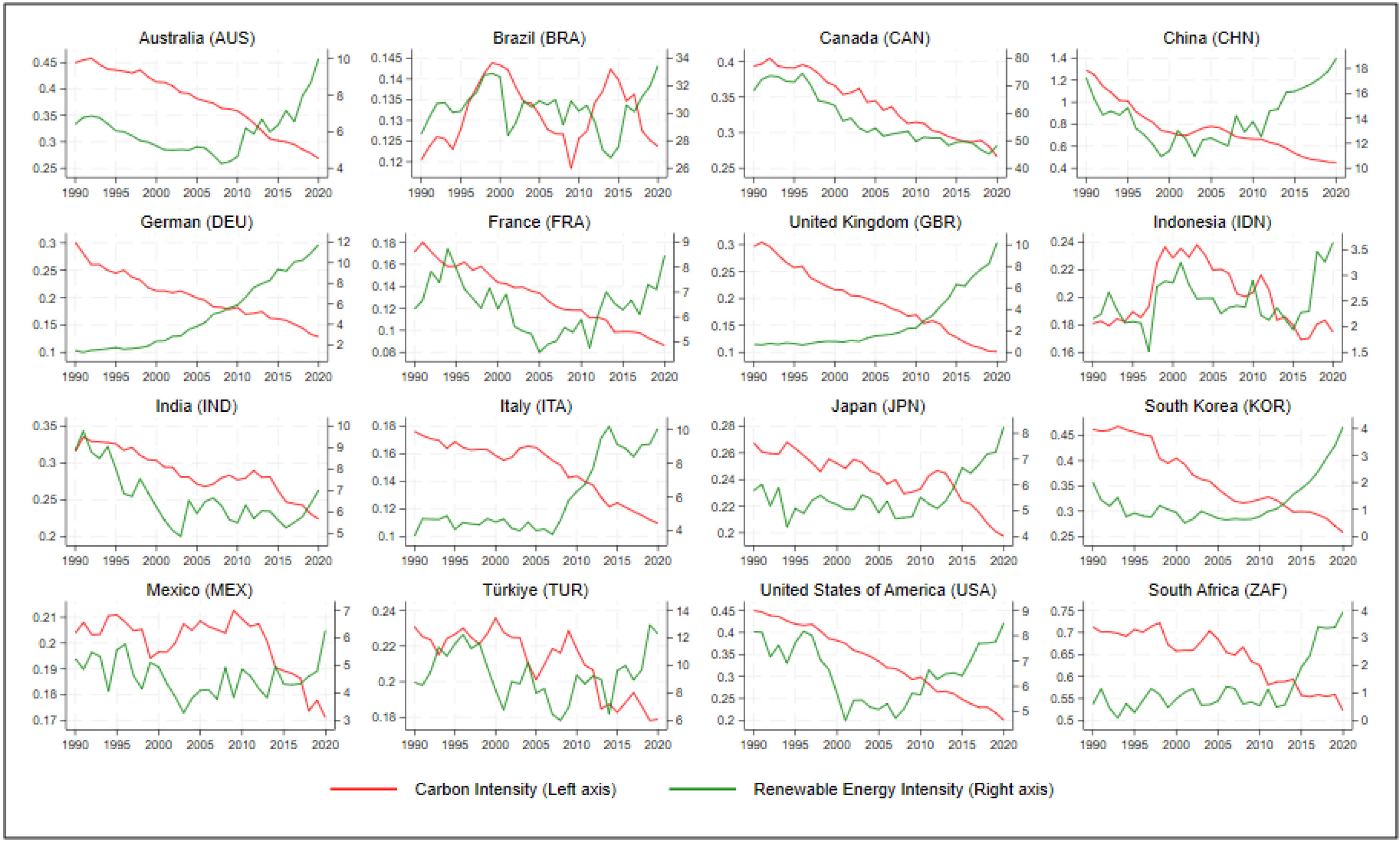
Figure 1 presents the temporal trends of CI and REI for 16 G20 countries in this study from 1990 to 2020. The red lines represent CI (measured on the left axis), while the green lines represent REI (measured on the right axis). Overall, most countries display a clear downward trajectory in carbon intensity, indicating lower CO2 emissions per unit of GDP and providing evidence of a gradual decoupling between economic growth and carbon emissions. Countries such as Germany and the United Kingdom show substantial increases in REI, suggesting greater integration of renewable energy into their energy systems. A noticeable turning point appears around 2005, when the Kyoto Protocol entered into force [64,65]. After this year, a sharp upward trend becomes particularly evident in most advanced economies as well as in China.
The Environmental Policy Stringency (EPS) index used in this study is obtained from the OECD database, which is widely recognized as an authoritative and standardized source of cross-country environmental policy indicators. The EPS index measures the extent to which environmental policies impose costs on environmentally harmful behavior, primarily in the areas of climate and air pollution. The index is constructed using a rule-based coding framework, which translates observable policy characteristics into numerical scores. Each policy instrument is coded on a scale from 0 to 6, where higher values indicate greater stringency. The index covers the years 1990 to 2020 across 40 countries and 13 specific policy instruments, grouped into market-based instruments (EPS_MB), non-market-based instruments (EPS_NMB), and technology support instruments (EPS_TS) (also see Supplementary File Table S1). Within each category, individual instrument scores are averaged, and the three categories are then equally weighted to form the overall EPS index [16]. Given its methodological transparency, consistent cross-country coverage, and rigorous data validation, the EPS index has become a foundational reference for empirical research on environmental governance and climate policy effectiveness.
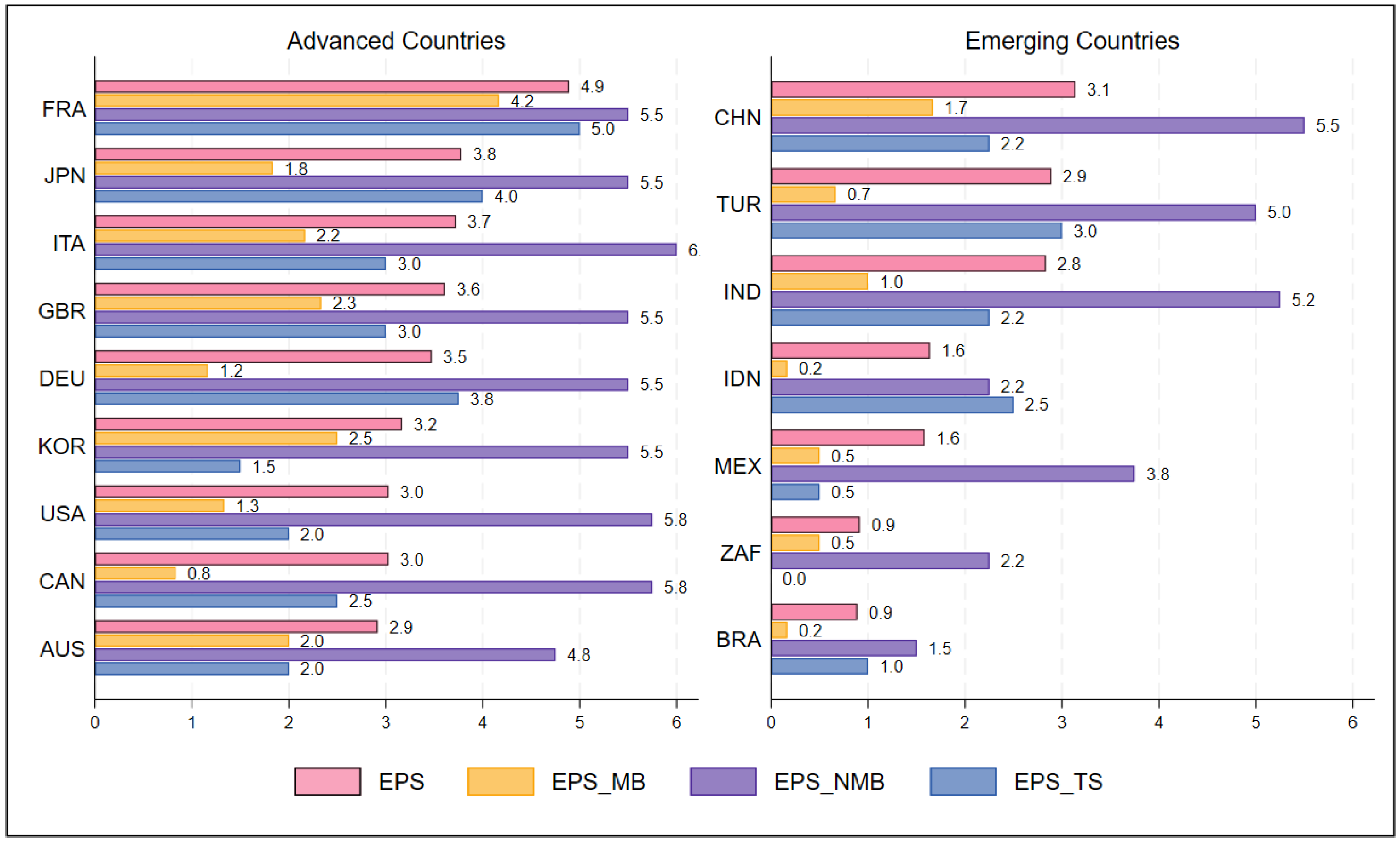
Figure 2 presents the comparative results of the EPS index and its three main subindex instruments in 2020, ranked by EPS values in descending order. On average, advanced countries outperformed emerging countries in both the overall EPS and its components. Among the policy instruments, non-market-based instruments (EPS_NMB) show the strongest driving effect, followed by technology support (EPS_TS) and market-based instruments (EPS_MB). France recorded the highest EPS value at 4.9, while no other country exceeded 4. In contrast, South Africa and Brazil recorded EPS values below 1. Notably, China stands out as the leading emerging country, surpassing several advanced economies and reflecting its intensified commitment to climate change mitigation.
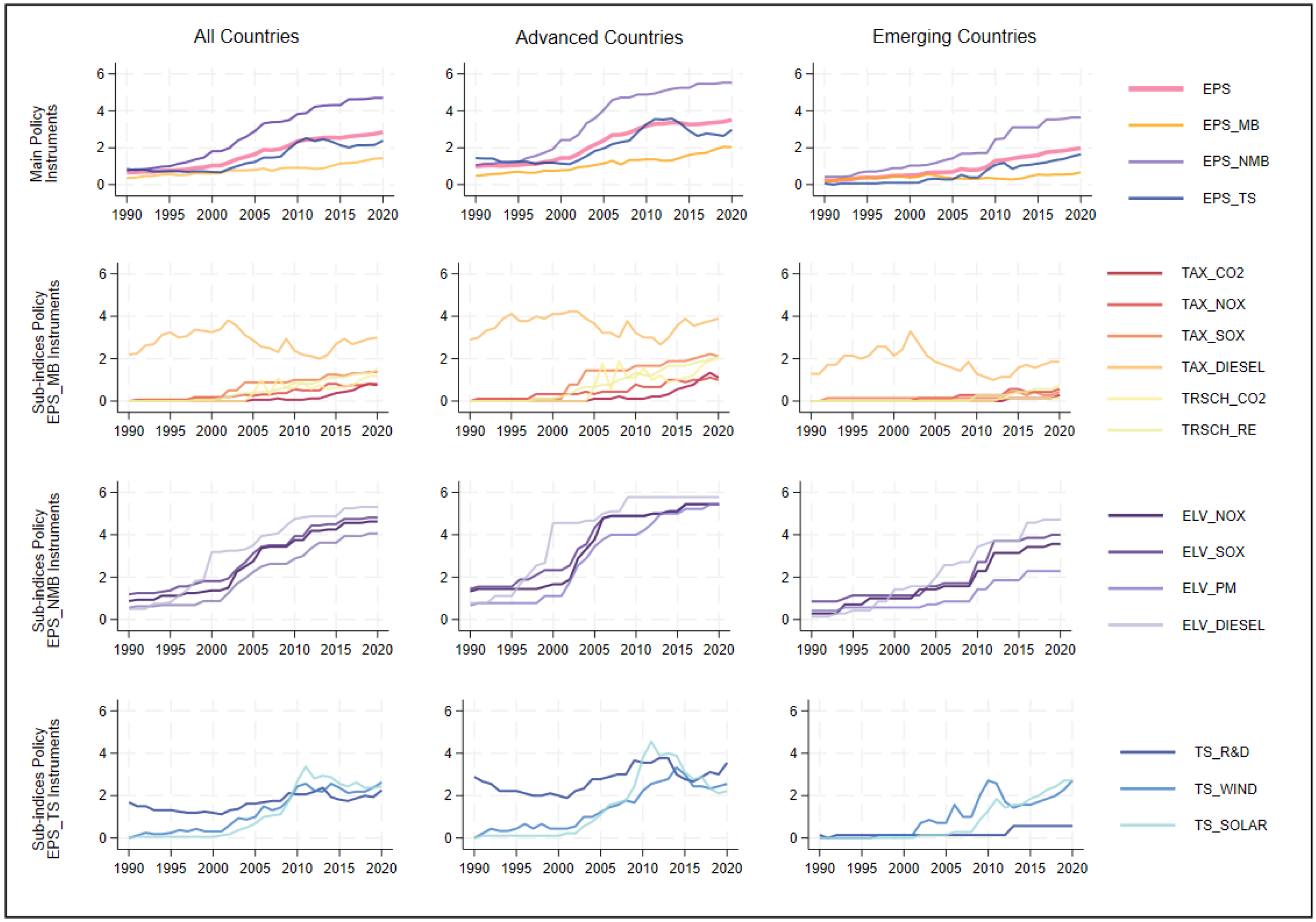
Figure 3 presents the temporal trends of the main policy instruments and their 13 subindex instruments for all countries, advanced countries, and emerging countries from 1990 to 2020. The results indicate that EPS_NMB (purple line) is the primary driver of the overall growth in policy stringency across all groups, showing a steady and substantial increase after 2000, particularly among advanced countries. EPS_TS (blue line) also rose markedly after 2005, reflecting increased government support for research, innovation, and clean technology following the implementation of international climate agreements. In contrast, EPS_MB (orange line) remained relatively low throughout the period, especially in emerging economies, likely due to limited institutional capacity, market infrastructure, and political feasibility of implementing market-based measures such as carbon pricing or emissions trading schemes.
Within the EPS_MB category, TAX_DIESEL dominates, particularly in advanced countries, peaking in the early 2000s. This reflects the early adoption of fuel taxation as a key market mechanism to internalize environmental externalities and discourage fossil fuel use. In contrast, emerging countries display minimal engagement with the other five EPS_MB instruments, likely due to limited fiscal capacity, political resistance to fuel price reforms, and weaker institutional frameworks for implementing carbon-related taxes.
For EPS_NMB, all emission limit values (ELV) show a marked upward trend over time, led by ELV_DIESEL in advanced countries. This pattern suggests the effectiveness of command-and-control regulations in driving emissions reductions, particularly as part of the tightening of vehicle and industrial emission standards during the 2000s. Emerging countries also exhibit gradual increases in ELV instruments, though at a slower pace, likely reflecting delayed regulatory adoption and enforcement challenges.
In the EPS_TS category, all three instruments rise steadily in advanced countries after 2000 and peak around 2010, coinciding with increased public investment in renewable energy research and innovation. Among emerging countries, TS_WIND shows the earliest acceleration around 2000, indicating early experimentation with wind power development. TS_SOLAR begins to rise after 2007 and surpasses TS_WIND around 2015, becoming the dominant instrument. This shift likely reflects the rapid decline in solar technology costs, expanded international financing, and policy incentives that made solar energy more accessible and scalable across emerging economies.

3.2. Methods

Using the constructed panel dataset, this study aims to test three hypotheses: (1) whether environmental policy stringency is statistically associated with environmental outcomes; (2) which policy instruments are most effective in shaping those outcomes; and (3) how these effects differ between advanced and emerging countries.
In doing so, we apply the Granger non-causality framework, which provides a rigorous econometric approach for testing directional predictability in time-series data. By evaluating whether lagged realizations of one variable systematically improve the forecasting accuracy of another, this method helps identify causal precedence within dynamic systems. Its ability to explicitly incorporate lagged structures is particularly valuable for addressing our research question, as our analysis examines a total of 17 policy instruments and requires systematic comparison of their relative effectiveness as well as their lagged policy effects. Specifically, in a panel structure with N cross-sectional units and T time periods, the relationship can be written as:
y i , t = f x i , t l
where i = 1 , , N , l = 1 , , L , and t = L + 1 , , T , with L denoting the maximum number of lags.
Because the Granger non-causality test requires the underlying variables to be either stationary or not cointegrated, we first conducted standard panel unit-root and cointegration tests to confirm that this condition holds. Panel unit-root properties are assessed using the CIPS test by [66], which allows for cross-sectional dependence. Panel cointegration is examined using the error-correction-based tests proposed by [67]. The test results are shown in Supplementary File Tables S2–S4. We find consistent evidence of no cointegration among the key variables. Panel unit-root tests indicate that the outcome variables, carbon intensity and renewable energy intensity, are stationary. Policy variables exhibit mixed stationarity properties. Accordingly, panel Granger non-causality tests are conducted using levels of stationary policy variables and first differences of non-stationary policy variables to ensure stationarity of the estimated models. This prerequisite allows us to proceed with the Granger framework with confidence.
To test Granger non-causality in heterogeneous panels, following [68], the equation in (1) can be specified within a linear dynamic panel framework as:
y i , t = α 0 , i + l = 1 L α l , i y i , t l + l = 1 L β l , i x i , t l + ϵ i , t
where α 0 , i denotes individual-specific effects, α l , i are heterogeneous feedback coefficients, and β l , i represent the Granger causality parameters.
In this study, we investigate whether environmental policy stringency can predict climate change outcomes and which types of policy instruments exert the greatest influence. Using a panel dataset of 16 countries spanning 1990 to 2020, Equation (2) can be rewritten as:
Outcomes i , t = α 0 , i + l = 1 L α l , i Outcomes i , t l + l = 1 L β l , i Policies i , t l + ϵ i , t
where i = 1 , , N ( = 16 ) , l = 1 , , L ( = 1 , 2 , or 3 ) , and t = L + 1 , , T ( = 31 ) . Given the 31-year sample period, a 1–3 year lag window is appropriate for examining near-term policy responses, as the Granger non-causality framework is designed to capture short-run predictive relationships rather than long-run equilibrium effects. Using longer lag lengths would substantially reduce the effective sample size and increase the risk of over-parameterization. The outcome variable is operationalized as either carbon intensity (CI) or renewable energy intensity (REI). The policy variables include both the main EPS policy instruments and their 13 sub-indices.
The null hypothesis for Equation (3) can be expressed as
H 0 : β l , i = 0 for all i and l
against the alternative hypothesis:
H 1 : β l , i 0 for some i and l
The null hypothesis states that environmental policy stringency does not Granger-cause the environmental performance variables examined. Rejecting the null implies that past values of policy stringency contain predictive information about future environmental outcomes. The Wald test statistic and its corresponding p-value are reported to assess whether the null hypothesis can be rejected at conventional significance levels.
In addition to the main analysis, we also explored the reverse relationship, treating environmental policy stringency as the outcome and environmental performance indicators as the predictors. The results of these tests are presented in the Supplementary File Tables S5–S8. While such an analysis can provide insights into whether improvements in environmental outcomes might encourage stricter policy adoption, it is not the central focus of this study. Our primary objective is to examine how different policy instruments influence environmental outcomes and to compare the relative effectiveness of these policies across countries.

4. Results

4.1. Estimation Results on Carbon Intensity (CI)

Table 2 provides definitions and summary statistics of the variables for all countries studied. The average carbon intensity (CI) is 0.298, with a minimum of 0.086, while renewable energy intensity (REI) averages 10.388, reaching a maximum of 74.463. EPS scores range from 0 to 6, with higher values indicating more stringent environmental policies. Among the policy categories, EPS_NMB shows the highest mean value (2.765), followed by EPS_TS (1.435) and EPS_MB (0.881). EPS_NMB also exhibits the greatest variation across countries, as indicated by the standard deviation of 1.964. Similarly, heterogeneous patterns are also reflected in the sub-indices of each category.
We first implemented Granger non-causality tests between different policy instruments and carbon intensity, with the results reported in Table 3. The top panel examines whether the main policy instruments help predict carbon intensity, while the bottom panel focuses on the sub-indices of the policy instruments. To explore potential predictive relationships, we conducted tests using one-year, two-year, and three-year lags, although the AIC indicates a one-year lag as optimal. For each lag specification, the table reports whether the null hypothesis can be rejected, along with the estimated feedback coefficients and corresponding p-values. Our primary interest lies in negative coefficients, as they provide empirical evidence of the effectiveness of EPS in reducing carbon intensity.
We find evidence that the overall EPS Granger causes CI when a one-year lag is applied. The significant coefficients suggest that higher EPS scores are followed by subsequent reductions in carbon intensity. For EPS_MB, Granger causality is observed across all three lag settings, indicating a strong influence of market-based policy instruments on environmental outcomes. For EPS_NMB, Granger causality is observed exclusively at lag 3, with a statistically significant coefficient. Similarly to EPS_MB, EPS_TS consistently Granger-causes CI across the three lag specifications, with highly significant coefficients at lags 1 and 2. These results reinforce the robustness of technology support instruments in driving sustained reductions in carbon intensity.
To identify which policy instruments are most strongly associated with reductions in CI, we conducted Granger non-causality tests on 13 sub-indices. The results show substantial heterogeneity. Within EPS_MB, differentiated temporal patterns are observed for air-pollution-related taxes: TAX_CO2 displays effectiveness under all three lag specifications, indicating influence in both the short and longer term; TAX_NOX tends to exert influence only in the short term; and TAX_SOX and TAX_DIESEL are largely ineffective. Trading schemes provide mixed evidence. The TRSCH_CO2 exhibits the strongest influence by rejecting the null hypothesis across all three lags, with consistently negative individual coefficients. In contrast, TRSCH_RE does not produce consistent significance, with significance appearing only at lag 3. These results are intuitive, as the carbon trading scheme is designed specifically to address carbon emission outcomes. Among emission limit values, ELV_SOX and ELV_DIESEL are mainly effective in the long run, while ELV_NOX shows significant coefficients in both the short and long run, whereas ELV_PM appears ineffective. Regarding technology support instruments, TS_R&D and TS_WIND tend to exhibit the predictive relationship in the short run, whereas TS_SOLAR shows the strongest influence, with significant negative coefficients across all three lags at the 1% significance level.
To sum up, the overall EPS level is associated with subsequent reductions in carbon intensity. In particular, we identify two policy instruments with the strongest effects on carbon intensity: the CO2 trading scheme, commonly referred to as a cap-and-trade program, and solar energy support. These two instruments exhibit the strongest statistical significance, indicating that market-based instruments and technology support instruments play a key role in driving progress toward energy transition goals.

4.2. Estimation Results on Renewable Energy Intensity (REI)

Table 4 reports the Granger non-causality results between the main policy instruments, their 13 sub-indices, and renewable energy intensity (REI). Our focus here is on positive coefficients, which indicate that more stringent policies are associated with greater renewable energy intensity. Overall, EPS Granger-causes REI across all lag specifications, with significance concentrated at the first and second lags. For EPS_MB, Granger causality is observed, but significant coefficients are limited to lags 2 and 3. By contrast, EPS_NMB displays more consistent effects, but with negatively significant coefficients primarily concentrated in lag 1. EPS_TS shows weaker evidence, as the null hypothesis can be rejected only under a three-year lag specification. This pattern is likely due to the longer time horizon typically required for technology support instruments to manifest their effects.
In the sub-indices analysis, several market-based instruments exhibit notable effects on REI. Among these instruments, TAX_CO2 and TAX_NOX show relatively consistent influence, with significance exhibited in lag 2, whereas TAX_DIESEL and TAX_SOX provide little predictive strength. It is also worth noting that TRSCH_CO2 no longer shows significance across all lags, while TRSCH_RE emerges as the most effective driver among market-based instruments. This result is intuitive, as TRSCH_RE is targeted at addressing renewable energy expansion. Among non-market-based instruments, ELV_NOX, ELV_SOX, and ELV_PM consistently Granger-cause REI, although no positively significant coefficients are observed, whereas ELV_DIESEL provides no evidence of effectiveness. For technology support instruments, TS_WIND displays weak evidence, while TS_SOLAR exhibits strong and sustained Granger-causal effects, underscoring its central role in driving renewable energy deployment.
To sum up, the overall EPS level is also found to promote renewable energy expansion. In particular, we identify two policy instruments with the strongest effects: the renewable energy trading scheme and solar energy support. These instruments exhibit the highest and most consistent statistical significance, reinforcing the critical role of market-based and technology support instruments in advancing energy transition goals.

4.3. Estimation Results Between Advanced and Emerging Countries

Next, we investigate the potential heterogeneous relationship between EPS and both CI and REI across advanced and emerging countries. Advanced economies are generally characterized by higher income levels, mature industrial structures, more developed financial markets, and stronger institutional and regulatory capacity. They typically exhibit lower energy intensity, higher technological readiness, and more established environmental policy frameworks. Emerging economies, by contrast, tend to have lower average income levels, faster economic growth, more energy- and resource-intensive production structures, and greater reliance on fossil fuels. While many emerging economies are rapidly expanding renewable energy capacity, they often face institutional, financial, and technological constraints that shape the design and effectiveness of environmental policies.
Table 5 summarizes the descriptive statistics for the two groups. Carbon intensity (CI) is lower and less variable among advanced countries (mean 0.259, SD 0.103), whereas emerging countries exhibit higher and more variable CI (mean 0.347, SD 0.246). Similarly, average REI is higher in advanced countries (10.829) than in emerging ones (9.428), indicating that advanced countries perform better on both outcomes and face greater challenges than emerging countries. Regarding environmental policy stringency, non-market-based instruments dominate the overall EPS in both groups, followed by technology support and market-based instruments. However, advanced countries consistently record higher mean values across all sub-indices. The gap is particularly pronounced for market-based instruments, highlighting a notable weakness in emerging countries. A similar divergence is observed in technology support instruments, especially public R&D expenditure, where emerging countries attain an average of 0.249 and a maximum of only 2, whereas advanced countries reach an average of 2.749 and the highest possible score of 6.
Table 6 reports the Granger non-causality results for CI across two groups. Note, however, that some results for emerging countries are reported as N/A. This is because the policy variables exhibit little variation over time and across countries, largely due to the fact that certain policies were not implemented during the sample period.
In advanced countries, evidence of Granger causality for the overall EPS is relatively limited. The overall EPS shows only weak effects, with rejection of the null hypothesis observed only under the two-year lag specification without individually significant coefficients. Nevertheless, consistent with the full-sample results, market-based instruments (EPS_MB) and technology support instruments (EPS_TS) remain negatively and statistically significant. At the sub-index level, in addition to the strong influence of the CO2 trading scheme, taxes on CO2, NOX, and SOX are also found to Granger-cause reductions in carbon intensity, with statistically significant negative coefficients across various lag specifications. Moreover, beyond solar energy support, both R&D support and wind energy support exhibit strong effects, highlighting the continued importance of technological innovation in advanced economies.
In emerging countries, a notable contrast emerges. The overall EPS exhibits a strong negative influence on carbon intensity at lags 2 and 3, indicating delayed but substantial policy effectiveness. Furthermore, all three categories of policy instruments (EPS_MB, EPS_NMB, EPS_TS) are found to significantly Granger-cause carbon intensity. This suggests that although emerging countries generally exhibit lower levels of policy stringency, the marginal effectiveness of EPS in mitigating environmental outcomes may be greater. In particular, non-market-based instruments display consistent significance at lag 3, pointing to delayed yet pronounced policy effects. By contrast, technology support instruments related to R&D investment and wind energy appear weaker in emerging countries, while solar energy support remains significant across all three lag specifications.
Overall, the carbon intensity results indicate that advanced countries are already on a trajectory of declining carbon emissions, making the selection of the most effective policy instruments increasingly important. We find continued evidence that market-based approaches targeting carbon emissions, such as CO2 taxes and emissions trading schemes, remain effective, while strong support for technology-oriented instruments is essential for achieving deeper energy transition goals. In contrast, emerging countries appear to have a broader range of policy options to address carbon intensity, including non-market-based regulatory instruments. However, given potential trade-offs between stringent environmental regulation and technological innovation, emerging economies should design policy packages carefully. In this context, targeted support for clean energy, particularly solar energy, emerges as a highly effective and robust policy instrument.
Table 7 reports the Granger non-causality results for REI across advanced and emerging country groups. Overall, the results indicate that EPS plays a meaningful role in promoting renewable energy expansion in both groups. The null hypothesis is rejected across all lag specifications in advanced countries and at the two-year lag in emerging countries, suggesting that policy effects on renewable deployment tend to materialize relatively quickly in more mature policy environments, while exhibiting modest delays in emerging economies. Across policy components, all categories, including non-market-based instruments, are found to Granger-cause REI, with positively significant effects concentrated particularly at lag 2. This pattern is intuitive, as renewable energy deployment typically requires time for project planning, regulatory compliance, and investment execution. Among market-based instruments, most tax policies (with the exception of TAX_DIESEL) display short-run predictive power, while the CO2 trading scheme (TRSCH_CO2) stands out as the most robust and systematic driver of REI across both country groups. This finding is consistent with the design of emissions trading systems, which create continuous economic incentives for cleaner energy substitution. Non-market-based instruments also show substantial effectiveness. Emission limit values for NOX, SOX, and PM generally exhibit significant short- and medium-term predictive effects on REI, whereas DIESEL-related regulations remain weak. These effects are particularly pronounced in emerging countries, where coefficient patterns closely align with the lag structure, suggesting that regulatory instruments can play an important role in steering renewable expansion when market mechanisms are still developing. Technology support instruments demonstrate strong and consistent predictive performance. Support for TS_WIND and TS_SOLAR energy is strongly linked to increases in REI in both advanced and emerging countries, underscoring the central role of targeted clean energy support in accelerating the energy transition. Support for R&D appears weaker in advanced countries but becomes significant at lag 3 in emerging economies, reflecting the longer time horizon typically required for innovation-oriented policies to translate into observable renewable deployment.

5. Discussion

The Granger non-causality test results indicate that environmental policy stringency possesses meaningful predictive power for environmental outcomes, with past policy changes helping to forecast subsequent developments. Market-based instruments and technology support instruments emerge as the primary drivers, consistently associated with lower carbon intensity and higher renewable energy intensity. Non-market-based instruments also exhibit predictive power, with the effects more pronounced for renewable energy intensity. At the sub-index level, substantial heterogeneity is observed. Among market-based instruments, the trading scheme for CO2 and the tax on NOx show the most consistent and robust predictive power for both CI and REI, while the trading scheme for renewable energy is also effective in promoting REI. For non-market-based instruments, emission limit values on NOx, SOx, and PM are generally significant predictors of REI, whereas the influence of DIESEL is limited. Finally, technology support policies, particularly support for wind and solar, exhibit strong and systematic predictive effects on both CI and REI. This suggests that direct support for wind and solar investment can generate immediate progress in the energy transition, while the extended development timeline associated with public R&D may not be fully reflected in this study.
Furthermore, the results reveal fundamentally different policy environments and transition challenges between advanced and emerging countries. In advanced economies, the energy transition appears to be occurring within a mature policy and institutional framework, where overall environmental policy stringency plays a more limited marginal role. Carbon intensity is already on a declining path, and renewable deployment is increasingly driven by targeted, well-designed instruments, particularly market-based mechanisms and technology support policies. This suggests that the key challenge for advanced countries is no longer the introduction of additional stringency per se, but rather the fine-tuning of policy instruments to sustain progress and address remaining emissions at the margin.
In contrast, emerging countries face a broader structural transition challenge, where environmental policy stringency exerts a stronger and more delayed influence on both carbon intensity and renewable energy outcomes. The results indicate that a wider set of policy instruments, including market-based, non-market-based, and technology support measures, can be effective in these contexts. This reflects the fact that emerging economies are still undergoing fundamental adjustments in their energy systems, regulatory capacity, and production structures. As a result, policies often require more time to translate into measurable outcomes, but their marginal effectiveness can be substantial once implementation takes hold.
We acknowledge several limitations of this study. First, the analysis draws on a relatively small sample of 16 G20 countries. Although the G20 comprises the world’s major economies and accounts for most global emissions and energy consumption, it excludes low-income and least-developed countries, which confront distinct environmental governance challenges such as limited institutional capacity, constrained technical resources, and competing developmental priorities. As a result, the findings may not be generalizable to countries with markedly different economic structures, dependency profiles, or political institutions. The restricted sample size also reduces the statistical power of certain econometric tests, particularly those that require substantial cross-sectional variation to identify long-run relationships or structural breaks.
Second, while the panel Granger non-causality framework is well suited for examining dynamic and short-run predictive relationships, it does not identify structural causal mechanisms or fully account for all potential sources of omitted common factors. As a result, the estimated relationships should be interpreted as evidence of temporal precedence rather than definitive causal effects. Future research could extend the present analysis by incorporating multivariate frameworks, such as common correlated effects or structural panel models, to explicitly account for unobserved common shocks and broader policy interactions, thereby complementing the dynamic insights provided by the causality test approach.
Third, although the EPS index developed by the OECD is a widely used and systematic tool for assessing policy stringency, it does not fully reflect the multidimensional nature of environmental governance. The index primarily captures the formal design of policies and does not account for implementation effectiveness, enforcement capacity, or compliance outcomes. Moreover, EPS focuses on energy- and air-pollution-related instruments, omitting other important domains such as biodiversity protection, land-use regulation, or climate adaptation measures. Therefore, while EPS provides a valuable basis for cross-country comparison, it should be interpreted as an approximate rather than a comprehensive measure of environmental policy stringency.
Despite these limitations, our research yields several important implications. First, the findings underscore the critical role of stringent environmental policies in reducing carbon intensity and enhancing renewable energy intensity. Specifically, the CO2 trading scheme and renewable energy support for wind and solar emerge as particularly effective in lowering carbon intensity. Similarly, the CO2 trading scheme and renewable energy support, along with most non-market-based and technology support instruments, prove effective in promoting renewable energy intensity. These results indicate that strengthening targeted environmental policies can meaningfully improve climate change outcomes.
In addition, the effectiveness of specific policy instruments highlights the need for tailored policy strategies. In advanced countries, policymakers should prioritize the subset of instruments that demonstrate significant impact, such as technology support measures and targeted taxes, to reinforce existing regulatory frameworks. In emerging countries, the broader responsiveness to environmental policies suggests that a comprehensive mix of instruments can be particularly effective. At the same time, policy design should recognize both shared and context-specific effects: for instance, technology support instruments are effective across all countries, while emission limits for particulate matter and diesel taxes show effectiveness only in specific country groups. This underscores the importance of selecting and sequencing policy instruments based on national circumstances to maximize environmental outcomes.
Finally, it is crucial for countries to maintain an optimal level of environmental policy stringency, even for instruments that show statistically insignificant effects in our analysis. Such policies remain essential for safeguarding existing achievements in climate governance. For example, although our study does not find significant evidence that renewable energy support for R&D in advanced countries, this should not be interpreted as a reason to discontinue these measures. Many instruments, particularly those with long time horizons that our study cannot fully capture, can foster institutional, behavioral, and technological changes that support long-term decarbonization. Therefore, policy effectiveness should be assessed not only by short-term measurable outcomes but also by its capacity to shape the structural and normative conditions necessary for sustained climate action.

6. Conclusions

To our knowledge, this study is among the first to move beyond aggregate indices to systematically examine environmental policy stringency at the sub-index level, allowing for a more precise identification of the policy instruments that are most effective in driving climate outcomes.
Based on our theoretical framework and empirical evidence, this study underscores a clear and robust link between environmental policy stringency and climate-related outcomes. Beyond confirming that policy matters, our findings highlight that how policies are designed, sequenced, and implemented plays a decisive role in shaping both emissions trajectories and renewable energy expansion. This points to the need for policy debates to move beyond questions of whether environmental regulation should be strengthened, toward a deeper focus on the mechanisms through which different instruments operate under varying economic and institutional conditions.
From a policy perspective, our results suggest that instruments demonstrating consistent and measurable impacts on carbon intensity and renewable deployment should be prioritized and reinforced. This does not imply a simple increase in regulatory intensity, but rather a strategic consolidation of policies that combine credible market signals, targeted technology support, and effective implementation capacity. More broadly, effective climate action is closely tied to broader development pathways. Policies that successfully reduce emissions intensity and accelerate renewable integration also contribute to productivity gains, energy security, and long-term economic resilience. Designing climate policies with these co-benefits in mind can enhance political feasibility and durability, particularly in the face of economic shocks and evolving climate risks. Future research should continue to explore these dynamic linkages, with particular attention to how policy mixes can be adapted over time to support both environmental goals and sustainable development outcomes.

Supplementary Materials

The following supporting information can be downloaded at: https://www.mdpi.com/article/10.3390/cli14020030/s1, Table S1: Full Definition of the Policy Variables; Table S2: Panel Unit root Tests on Variables Used; Table S3: Panel Cointegration Tests on Policy Variables and Carbon Intensity; Table S4: Panel Cointegration Tests on Policy Variables and Renewable Energy Intensity; Table S5: Reverse Granger Causality Test: CI & Policy Instruments; Table S6: Reverse Granger Causality Test: REI & Policy Instruments; Table S7: Reverse Granger Causality Test: CI & Policy Instruments in Subgroup Countries; Table S8: Reverse Granger Causality Test: REI & Policy Instruments in Subgroup Countries.

Author Contributions

Conceptualization, Y.L. and S.M.; methodology, Y.L. and S.M.; data curation, Y.L., formal analysis, Y.L.; validation, S.M.; visualization, Y.L. and S.M.; writing—original draft preparation, Y.L.; writing—review and editing, S.M.; supervision, S.M. All authors have read and agreed to the published version of the manuscript.

Funding

This research received no external funding.

Data Availability Statement

Data used for the analysis will be made available upon request.

Acknowledgments

The authors acknowledge support from the Keough School of Global Affairs at the University of Notre Dame. We are grateful to the three anonymous reviewers for their careful reading of the manuscript and their constructive comments and suggestions, which have substantially improved the quality and clarity of this study.

Conflicts of Interest

The authors declare no conflicts of interest.

References

  1. Campiglio, E.; Dafermos, Y.; Monnin, P.; Ryan-Collins, J.; Schotten, G.; Tanaka, M. Climate change challenges for central banks and financial regulators. Nat. Clim. Change 2018, 8, 462–468. [Google Scholar] [CrossRef]
  2. Nielsen, K.S.; Cologna, V.; Bauer, J.M.; Berger, S.; Brick, C.; Dietz, T.; Hahnel, U.J.; Henn, L.; Lange, F.; Stern, P.C.; et al. Realizing the full potential of behavioural science for climate change mitigation. Nat. Clim. Change 2024, 14, 322–330. [Google Scholar] [CrossRef]
  3. Meng, S.; Wang, W.; Zhang, K. Beyond wind and rainfall: Insights into Hurricane Helene fatalities with the National Risk Index. NPJ Nat. Hazards 2025, 2, 38. [Google Scholar] [CrossRef]
  4. IPCC. Summary for Policymakers. 2018. Available online: https://www.ipcc.ch/site/assets/uploads/sites/2/2022/06/SPM_version_report_LR.pdf (accessed on 15 September 2025).
  5. Griscom, B.W.; Adams, J.; Ellis, P.W.; Houghton, R.A.; Lomax, G.; Miteva, D.A.; Schlesinger, W.H.; Shoch, D.; Siikamäki, J.V.; Smith, P.; et al. Natural climate solutions. Proc. Natl. Acad. Sci. USA 2017, 114, 11645–11650. [Google Scholar] [CrossRef] [PubMed]
  6. Keith, D.W.; Holmes, G.; Angelo, D.S.; Heidel, K. A process for capturing CO2 from the atmosphere. Joule 2018, 2, 1573–1594. [Google Scholar] [CrossRef]
  7. Baldos, U.L.C.; Chepeliev, M.; Cultice, B.; Huber, M.; Meng, S.; Ruane, A.C.; Suttles, S.; Van Der Mensbrugghe, D. Global-to-local-to-global interactions and climate change. Environ. Res. Lett. 2023, 18, 053002. [Google Scholar] [CrossRef]
  8. Meng, S. Environmental governance is critical for mitigating human displacement due to weather-related disasters. Commun. Earth Environ. 2024, 5, 363. [Google Scholar] [CrossRef]
  9. Borowiec, J.; Papież, M.; Śmiech, S. The impact of environmental regulations on carbon emissions in countries with different levels of emissions. Environ. Sci. Pollut. Res. 2024, 31, 66759–66779. [Google Scholar] [CrossRef]
  10. Ma, X.; Zhao, C.; Song, C.; Meng, D.; Xu, M.; Liu, R.; Yan, Y.; Liu, Z. The impact of regional policy implementation on the decoupling of carbon emissions and economic development. J. Environ. Manag. 2024, 355, 120472. [Google Scholar] [CrossRef]
  11. Gurney, R.M.; Meng, S.; Rumschlag, S.; Hamlet, A.F. The influences of political affiliation and weather-related impacts on climate change adaptation in US cities. Weather Clim. Soc. 2022, 14, 919–931. [Google Scholar] [CrossRef]
  12. UNEP. Emissions Gap Report 2024: No More Hot Air...Please! 2024. Available online: https://www.unep.org/resources/emissions-gap-report-2024 (accessed on 20 September 2025).
  13. Sadik-Zada, E.R.; Ferrari, M. Environmental policy stringency, technical progress and pollution haven hypothesis. Sustainability 2020, 12, 3880. [Google Scholar] [CrossRef]
  14. Bergquist, P.; Warshaw, C. How climate policy commitments influence energy systems and the economies of US states. Nat. Commun. 2023, 14, 4850. [Google Scholar] [CrossRef]
  15. Fatima, N.; Xuhua, H.; Alnafisah, H.; Zeast, S.; Akhtar, M.R. Enhancing climate action in OECD countries: The role of environmental policy stringency for energy transitioning to a sustainable environment. Environ. Sci. Eur. 2024, 36, 157. [Google Scholar] [CrossRef]
  16. Kruse, T.; Dechezleprêtre, A.; Saffar, R.; Robert, L. Measuring environmental policy stringency in OECD countries: An update of the OECD composite EPS indicator. In OECD Economics Department Working Papers; OECD: Paris, France, 2022; pp. 1–56. [Google Scholar]
  17. Tiwari, S.; Mohammed, K.S.; Mentel, G.; Majewski, S.; Shahzadi, I. Role of circular economy, energy transition, environmental policy stringency, and supply chain pressure on CO2 emissions in emerging economies. Geosci. Front. 2024, 15, 101682. [Google Scholar] [CrossRef]
  18. Wang, K.; Yan, M.; Wang, Y.; Chang, C.P. The impact of environmental policy stringency on air quality. Atmos. Environ. 2020, 231, 117522. [Google Scholar] [CrossRef]
  19. de Angelis, E.M.; Di Giacomo, M.; Vannoni, D. Climate change and economic growth: The role of environmental policy stringency. Sustainability 2019, 11, 2273. [Google Scholar] [CrossRef]
  20. Zhang, D.; Zheng, M.; Feng, G.F.; Chang, C.P. Does an environmental policy bring to green innovation in renewable energy? Renew. Energy 2022, 195, 1113–1124. [Google Scholar] [CrossRef]
  21. Athari, S.A. Global economic policy uncertainty and renewable energy demand: Does environmental policy stringency matter? Evidence from OECD economies. J. Clean. Prod. 2024, 450, 141865. [Google Scholar] [CrossRef]
  22. Usman, M.; Khan, N.; Omri, A. Environmental policy stringency, ICT, and technological innovation for achieving sustainable development: Assessing the importance of governance and infrastructure. J. Environ. Manag. 2024, 365, 121581. [Google Scholar] [CrossRef] [PubMed]
  23. Martínez-Zarzoso, I.; Bengochea-Morancho, A.; Morales-Lage, R. Does environmental policy stringency foster innovation and productivity in OECD countries? Energy Policy 2019, 134, 110982. [Google Scholar] [CrossRef]
  24. Bhowmik, R.; Sharif, A.; Anwar, A.; Syed, Q.R.; Cong, P.T.; Ha, N.N. Does environmental policy stringency alter the natural resources-emissions nexus? Evidence from G-7 countries. Geosci. Front. 2024, 15, 101874. [Google Scholar] [CrossRef]
  25. Xie, P.; Xu, Y.; Tan, X.; Tan, Q. How does environmental policy stringency influence green innovation for environmental managements? J. Environ. Manag. 2023, 338, 117766. [Google Scholar] [CrossRef]
  26. Hassan, M.; Kouzez, M.; Lee, J.Y.; Msolli, B.; Rjiba, H. Does increasing environmental policy stringency enhance renewable energy consumption in OECD countries? Energy Econ. 2024, 129, 107198. [Google Scholar] [CrossRef]
  27. Best, R.; Burke, P.J.; Jotzo, F. Carbon pricing efficacy: Cross-country evidence. Environ. Resour. Econ. 2020, 77, 69–94. [Google Scholar] [CrossRef]
  28. Mihai, D.M.; Doran, M.D.; Puiu, S.; Doran, N.M.; Jianu, E.; Cojocaru, T.M. Managing environmental policy stringency to ensure sustainable development in OECD countries. Sustainability 2023, 15, 15427. [Google Scholar] [CrossRef]
  29. Stechemesser, A.; Koch, N.; Mark, E.; Dilger, E.; Klösel, P.; Menicacci, L.; Nachtigall, D.; Pretis, F.; Ritter, N.; Schwarz, M.; et al. Climate policies that achieved major emission reductions: Global evidence from two decades. Science 2024, 385, 884–892. [Google Scholar] [CrossRef]
  30. Ahmed, K. Environmental policy stringency, related technological change and emissions inventory in 20 OECD countries. J. Environ. Manag. 2020, 274, 111209. [Google Scholar] [CrossRef]
  31. van den Bergh, J.; Castro, J.; Drews, S.; Exadaktylos, F.; Foramitti, J.; Klein, F.; Konc, T.; Savin, I. Designing an effective climate-policy mix: Accounting for instrument synergy. Clim. Policy 2021, 21, 745–764. [Google Scholar] [CrossRef]
  32. Albulescu, C.T.; Boatca-Barabas, M.E.; Diaconescu, A. The asymmetric effect of environmental policy stringency on CO2 emissions in OECD countries. Environ. Sci. Pollut. Res. 2022, 29, 27311–27327. [Google Scholar] [CrossRef] [PubMed]
  33. Milani, S. The impact of environmental policy stringency on industrial R&D conditional on pollution intensity and relocation costs. Environ. Resour. Econ. 2017, 68, 595–620. [Google Scholar]
  34. Apeaning, R.W.; Labaran, M.; Simbi, C.H.; Ennin, E. How Effective Are Climate Policy Measures in Reducing CO2 Emissions? Evidence from Emerging Economies. J. Clean. Prod. 2025, 507, 145395. [Google Scholar] [CrossRef]
  35. Sohag, K.; Husain, S.; Soytas, U. Environmental policy stringency and ecological footprint linkage: Mitigation measures of renewable energy and innovation. Energy Econ. 2024, 136, 107721. [Google Scholar] [CrossRef]
  36. Klagges, L. How governments address climate change through carbon pricing intensity. NPJ Clim. Action 2025, 4, 36. [Google Scholar] [CrossRef]
  37. Afshan, S.; Ozturk, I.; Yaqoob, T. Facilitating renewable energy transition, ecological innovations and stringent environmental policies to improve ecological sustainability: Evidence from MM-QR method. Renew. Energy 2022, 196, 151–160. [Google Scholar] [CrossRef]
  38. Ahmed, K.; Ahmed, S. A predictive analysis of CO2 emissions, environmental policy stringency, and economic growth in China. Environ. Sci. Pollut. Res. 2018, 25, 16091–16100. [Google Scholar] [CrossRef]
  39. Alsagr, N. How environmental policy stringency affects renewable energy investment? Implications for green investment horizons. Util. Policy 2023, 83, 101613. [Google Scholar] [CrossRef]
  40. Bashir, M.F.; Rao, A.; Sharif, A.; Ghosh, S.; Pan, Y. How do fiscal policies, energy consumption and environmental stringency impact energy transition in the G7 economies: Policy implications for the COP28. J. Clean. Prod. 2024, 434, 140367. [Google Scholar] [CrossRef]
  41. Balsalobre-Lorente, D.; Topaloglu, E.E.; Nur, T.; Evcimen, C. Exploring the linkage between financial development and ecological footprint in APEC countries: A novel view under corruption perception and environmental policy stringency. J. Clean. Prod. 2023, 414, 137686. [Google Scholar] [CrossRef]
  42. Corrocher, N.; Mancusi, M.L. International collaborations in green energy technologies: What is the role of distance in environmental policy stringency? Energy Policy 2021, 156, 112470. [Google Scholar] [CrossRef]
  43. Dai, S.; Du, X. Discovering the role of trade diversification, natural resources, and environmental policy stringency on ecological sustainability in the BRICST region. Resour. Policy 2023, 85, 103868. [Google Scholar] [CrossRef]
  44. Degirmenci, T.; Sofuoglu, E.; Aydin, M.; Adebayo, T.S. The role of energy intensity, green energy transition, and environmental policy stringency on environmental sustainability in G7 countries. Clean Technol. Environ. Policy 2025, 27, 2981–2993. [Google Scholar] [CrossRef]
  45. Demiral, M.; Akça, E.E.; Tekin, I. Predictors of global carbon dioxide emissions: Do stringent environmental policies matter? Environ. Dev. Sustain. 2021, 23, 18337–18361. [Google Scholar] [CrossRef]
  46. Hassan, M.; Rousselière, D. Does increasing environmental policy stringency lead to accelerated environmental innovation? A research note. Appl. Econ. 2022, 54, 1989–1998. [Google Scholar] [CrossRef]
  47. Kaymaz, V.; Fuinhas, J.A.; Silva, N.; Domingos, H.; Betencourt, M. Do the relationships among policy stringency, corruption, and public size differ across country groups in the context of green transformation? J. Environ. Manag. 2025, 384, 125533. [Google Scholar] [CrossRef]
  48. Kongbuamai, N.; Bui, Q.; Nimsai, S. The effects of renewable and nonrenewable energy consumption on the ecological footprint: The role of environmental policy in BRICS countries. Environ. Sci. Pollut. Res. 2021, 28, 27885–27899. [Google Scholar] [CrossRef]
  49. Li, Z.; Kuo, Y.K.; Mahmud, A.R.; Nassani, A.A.; Haffar, M.; Muda, I. Integration of renewable energy, environmental policy stringency, and climate technologies in realizing environmental sustainability: Evidence from OECD countries. Renew. Energy 2022, 196, 1376–1384. [Google Scholar] [CrossRef]
  50. Li, X.; Ozturk, I.; Raza Syed, Q.; Hafeez, M.; Sohail, S. Does green environmental policy promote renewable energy consumption in BRICST? Fresh insights from panel quantile regression. Econ. Res.-Ekon. Istraž. 2022, 35, 5807–5823. [Google Scholar] [CrossRef]
  51. Li, S.; Samour, A.; Irfan, M.; Ali, M. Role of renewable energy and fiscal policy on trade adjusted carbon emissions: Evaluating the role of environmental policy stringency. Renew. Energy 2023, 205, 156–165. [Google Scholar] [CrossRef]
  52. Olasehinde-Williams, G.; Akadiri, S.S. Environmental policy stringency and carbon leakages: A case for carbon border adjustment mechanism in the European Union. Environ. Dev. Sustain. 2024, 27, 30817–30838. [Google Scholar] [CrossRef]
  53. Yirong, Q. Does environmental policy stringency reduce CO2 emissions? Evidence from high-polluted economies. J. Clean. Prod. 2022, 341, 130648. [Google Scholar] [CrossRef]
  54. Rasheed, M.Q.; Ahad, M.; Shahzad, K.; Imran, Z.A. Economic policy uncertainty and green growth in IEA member countries: A role of environmental stringency policy. Nat. Resour. Forum 2025, 49, 44–46. [Google Scholar] [CrossRef]
  55. Sezgin, F.H.; Bayar, Y.; Herta, L.; Gavriletea, M.D. Do environmental stringency policies and human development reduce CO2 emissions? Evidence from G7 and BRICS economies. Int. J. Environ. Res. Public Health 2021, 18, 6727. [Google Scholar] [CrossRef]
  56. Wang, Z.; Yen-Ku, K.; Li, Z.; An, N.B.; Abdul-Samad, Z. The transition of renewable energy and ecological sustainability through environmental policy stringency: Estimations from advance panel estimators. Renew. Energy 2022, 188, 70–80. [Google Scholar] [CrossRef]
  57. Wolde-Rufael, Y.; Weldemeskel, E.M. Environmental policy stringency, renewable energy consumption and CO2 emissions: Panel cointegration analysis for BRIICTS countries. Int. J. Green Energy 2020, 17, 568–582. [Google Scholar] [CrossRef]
  58. Chiroleu-Assouline, M.; Fodha, M.; Kirat, Y. Carbon curse in developed countries. Energy Econ. 2020, 90, 104829. [Google Scholar] [CrossRef]
  59. Zhang, H.; Di Maria, C.; Ghezelayagh, B.; Shan, Y. Climate policy in emerging economies: Evidence from China’s low-carbon city pilot. J. Environ. Econ. Manag. 2024, 124, 102943. [Google Scholar] [CrossRef]
  60. Wang, R.; Laila, U.; Nazir, R.; Hao, X. Unleashing the influence of industrialization and trade openness on renewable energy intensity using path model analysis: A roadmap towards sustainable development. Renew. Energy 2023, 202, 280–288. [Google Scholar] [CrossRef]
  61. Dong, K.; Hochman, G.; Zhang, Y.; Sun, R.; Li, H.; Liao, H. CO2 emissions, economic and population growth, and renewable energy: Empirical evidence across regions. Energy Econ. 2018, 75, 180–192. [Google Scholar] [CrossRef]
  62. Infante-Amate, J.; Travieso, E.; Aguilera, E. Green growth in the mirror of history. Nat. Commun. 2025, 16, 3766. [Google Scholar] [CrossRef]
  63. Jiang, J.; Shi, S.; Raftery, A.E. Mitigation efforts to reduce carbon dioxide emissions and meet the Paris Agreement have been offset by economic growth. Commun. Earth Environ. 2025, 6, 823. [Google Scholar] [CrossRef]
  64. United Nations. Kyoto Protocol. 1997, pp. 230–240. UNFCCC Website. Available online: http://unfccc.int/kyoto_protocol/items/2830.php (accessed on 1 January 2011).
  65. Iwata, H.; Okada, K. Greenhouse gas emissions and the role of the Kyoto Protocol. Environ. Econ. Policy Stud. 2014, 16, 325–342. [Google Scholar] [CrossRef]
  66. Pesaran, M.H. A simple panel unit root test in the presence of cross-section dependence. J. Appl. Econom. 2007, 22, 265–312. [Google Scholar] [CrossRef]
  67. Westerlund, J. Testing for error correction in panel data. Oxf. Bull. Econ. Stat. 2007, 69, 709–748. [Google Scholar] [CrossRef]
  68. Juodis, A.; Karavias, Y.; Sarafidis, V. A homogeneous approach to testing for Granger non-causality in heterogeneous panels. Empir. Econ. 2021, 60, 93–112. [Google Scholar] [CrossRef]
Figure 1. Temporal Trend of Carbon Intensity and Renewable Energy Intensity (1990–2020).
Climate 14 00030 g001
Figure 2. Environmental Policy Stringency (EPS) Index and Three Main Subindex Instruments by Advanced and Emerging Countries (2020).
Climate 14 00030 g002
Figure 3. Temporal Trend of Sub-indices Policy Instruments by Country Group.
Climate 14 00030 g003
Table 1. Summary of the Literature on Environmental Policy Stringency (EPS) Studies.
ArticlePolicy VariablesEnvironmental Outcome VariablesCountriesYearsMethodsFindings
[37]EPSEcological Footprint27 OECD1990–2017MM-QRNegative
[30]EPSGreen Innovation;
CO2 Emissions
20 OCED1999–2015Panel ARDL-PMGPositive;
Negative
[38]EPSCO2 EmissionsChina1990–2012CGMCNegative
[32]EPSCO2 Emissions per Capita32 OECD1990–2015Panel Quantile RegressionNegative
[39]EPSRenewable Energy InvestmentBRICS1995–2021QADRLPositive
[21]EPSRenewable Energy Consumption27 OECD2000–2019Panel Quantile RegressionPositive
[40]EPSEnergy TransitionG71995–2021FGLS, CCEMGPositive
[41]EPSEcological FootprintAPEC1994–2018FMOLS, Causality TestNegative
[9]EPSCO2 Emissions38 OECD1992–2019DCCE-MGMixed
[42]EPS, MB, NMB,
Sub-indices
Technological CollaborationsOECD &
BRICS
1995–2014Pooled OLSNegative
[43]EPSEcological FootprintBRICST1995–2021MMQRNegative
[19]MB, NMBCO2 Emissions per Capita32 OECD1992–2012Panel FE RegressionNegative
[44]EPSLoad Capacity FactorG71990–2020CCEMG, AMGInsignificant
[45]EPSCO2 Emissions per Capita15 OECD1995–2015Pooled OLSPositive
[15]EPSGHG Emissions36 OECD1990–2020MMQR, DOLS, CCRNegative
[46]MB, NMBGreen Innovation27 OECD1990–2015GMMPositive
[26]EPS, MB,
NMB, TS
Renewable Energy Consumption32 OECD1990–2019Granger Causality Test,
GMM
Positive
[47]EPSCarbon Intensity19 European1999–2020fsQCANegative
[48]EPSEcological FootprintBRICS1995–2016DSUR, Panel Causality TestNegative
[49]EPSCO2 Emissions15 OCED2001–2018CS-ARDLNegative
[50]EPSRenewable Energy ConsumptionBRICST1991–2019Panel Quantile RegressionMixed
[51]EPSCCO2 EmissionsBRICS1990–2019Panel Quantile Regression,
Causality Test
Negative
[23]EPSTotal Factor Productivity14 OECD1990–2011Panel Quantile RegressionPositive
[28]MB, NMB,
TS
Greenhouse Gas Emissions;
Renewable Energy Consumption
20 OECD1990–2020Granger Causality Test,
FMOLS
Mixed; Positive
[52]EPSCarbon Leakage20 EU1995–2020CUP-FM, Causality TestPositive
[53]EPSCO2 EmissionsTop 5 Emitter1990–2019STIRPATMixed
[54]EPSGreen Growth8 IEA1990–2020ARDL-PMG, FMOLS, DOLSPositive
[13]EPSCO2 Emissions26 OECD1995–2011Panel ARDL–PMGMixed
[55]EPSCO2 Emissions per CapitaG7 & BRICS1995–2015Panel Granger CausalityMixed
[17]EPSCO2 Emissions GrowthHigh GDP1997–2020QARDL, Panel PMGNegative
[22]EPSSustainable Development Index17 Advanced1996–2021FGLSPositive
[18]EPSAir Quality Variables23 OECD1990–2015LSDVCNegative
[56]EPSCO2 Emissions per CapitaBRICS1990–2019CSARDLNegative
[57]EPSCCO2 EmissionsBRIICTS1993–2014PMG-ARDLNonlinear
[25]EPSCCO2 Emissions21 OECD1990–2020MMQRNegative
Table 2. Description and Summary Statistics of Outcome and Policy Variables.
Variable TypeNameDefinitionMeanStd. Dev.MinMax
Outcome
Variables
CICarbon Intensity: CO2 emissions per dollar of GDP0.2980.1850.0861.292
REIRenewable Energy Intensity: Renewable energy
consumption per million dollars of GDP
10.38814.2810.85874.463
Main
Policy
Instruments
EPSEnvironmental Policy Stringency1.6711.18804.889
EPS_MBThe Stringency on Market-Based Instruments0.8110.69904.167
EPS_NMBThe Stringency on Non-Market-Based Instruments2.7651.96406
EPS_TSThe Stringency on Technology Support Instruments1.4351.34406
Sub-indices
MarketBased
(EPS_MB)
TAX_CO2The Stringency of the Carbon Dioxides (CO2) tax0.1470.63606
TAX_NOXThe Stringency of the Nitrogen Oxides (NOx) tax0.3571.05006
TAX_SOXThe Stringency of the Sulphur Oxides (SOx) tax0.6511.65306
TAX_DIESELThe Stringency of the Fuel (Diesel) tax2.8102.09706
TRSCH_CO2The Stringency of CO2 Trading Schemes0.3930.88304
TRSCH_REThe Stringency of Renewable Energy Trading Schemes0.5081.25006
Sub-indices
Non-Market-Based
(EPS_NMB)
ELV_NOXEmission Limit Value for Nitrogen Oxides (NOx)2.6982.21006
ELV_SOXEmission Limit Value for Sulphur Oxides (SOx)2.9542.16706
ELV_PMEmission Limit Value for Particulate Matter (PM)2.1312.10306
ELV_DIESELEmission Limit Value for Sulphur Content in Diesel3.2782.26706
Sub-indices
Technology Support
(EPS_TS)
TS_R&DPublic Research and Development Expenditure1.6551.75806
TS_WINDRenewable Energy Support for Wind1.2401.78506
TS_SOLARRenewable Energy Support for Solar1.1921.85406
Table 3. Granger Causality Tests: From Policy Instruments to Carbon Intensity (CI).
Null Hypothesis (H0) Number of Lags = 1Number of Lags = 2Number of Lags = 3
Reject H0 Beta_L1 Reject  H 0 Beta_L1Beta_L2 Reject  H 0 Beta_L1Beta_L2Beta_L3
Results of Main Policy Instruments
EPS ↛ CIYes−0.006 ***Yes−0.002−0.003No−0.003−0.001−0.001
(0.001)(0.001)(0.075)(0.336)(0.385)(0.106)(0.160)(0.651)(0.752)
EPS_MB ↛ CIYes−0.004 ***Yes−0.004 **−0.004 **Yes−0.003 **−0.003 *−0.005 ***
(0.000)(0.000)(0.002)(0.001)(0.036)(0.003)(0.020)(0.057)(0.002)
EPS_NMB ↛ CINo−0.001No0.000−0.001Yes0.000−0.001−0.003 **
(0.701)(0.701)(0.822)(0.809)(0.534)(0.091)(0.767)(0.702)(0.029)
EPS_TS ↛ CIYes−0.005 ***Yes−0.003 **−0.005 ***Yes−0.003 **−0.005 ***0.001
(0.000)(0.000)(0.000)(0.017)(0.000)(0.000)(0.020)(0.001)(0.681)
Results of Sub-indices Policy Instruments
TAX_CO2 ↛ CIYes−0.003 ***Yes−0.003 **0.001Yes−0.0030.002 *−0.004 ***
(0.009)(0.009)(0.036)(0.011)(0.661)(0.000)(0.102)(0.069)(0.000)
TAX_NOX ↛ CIYes−0.002 ***Yes−0.002 ***−0.001 ***Yes−0.001 ***0.002 ***0.001
(0.005)(0.005)(0.000)(0.000)(0.000)(0.000)(0.000)(0.001)(0.333)
TAX_SOX ↛ CINo0.000Yes0.002 ***−0.000Yes0.002 ***0.0010.001
(0.297)(0.297)(0.000)(0.000)(0.725)(0.000)(0.000)(0.191)(0.329)
TAX_DIESEL ↛ CINo0.000No0.000−0.000No0.001−0.0000.000
(0.856)(0.856)(0.800)(0.555)(0.987)(0.371)(0.112)(0.461)(0.651)
TRSCH_CO2 ↛ CIYes−0.001 ***Yes−0.002 ***−0.000Yes−0.002 ***−0.002 **−0.003 ***
(0.000)(0.000)(0.000)(0.001)(0.581)(0.000)(0.001)(0.011)(0.000)
TRSCH_RE ↛ CINo−0.001No−0.0010.001Yes−0.001−0.000−0.003 ***
(0.682)(0.682)(0.693)(0.670)(0.685)(0.000)(0.349)(0.803)(0.000)
ELV_NOX ↛ CIYes−0.001 **No−0.000−0.001Yes−0.000−0.001−0.002 ***
(0.039)(0.039)(0.616)(0.819)(0.348)(0.033)(0.748)(0.433)(0.006)
ELV_SOX ↛ CINo0.000No0.0000.000Yes0.0000.000−0.003 ***
(0.879)(0.879)(0.926)(0.922)(0.749)(0.015)(0.744)(0.959)(0.005)
ELV_PM ↛ CINo−0.001No−0.000−0.000No−0.000−0.001−0.002 **
(0.500)(0.500)(0.608)(0.549)(0.419)(0.233)(0.539)(0.224)(0.041)
ELV_DIESEL ↛ CINo−0.000No−0.000−0.001Yes−0.001 **−0.001−0.001
(0.444)(0.444)(0.314)(0.473)(0.197)(0.063)(0.032)(0.264)(0.258)
TS_R&D ↛ CINo−0.000No−0.000−0.001Yes−0.000−0.001 **−0.001 **
(0.802)(0.802)(0.460)(0.754)(0.287)(0.013)(0.745)(0.023)(0.027)
TS_WIND ↛ CINo0.000Yes−0.000−0.002 **Yes0.000−0.002*−0.000
(0.927)(0.927)(0.054)(0.800)(0.034)(0.012)(0.546)(0.054)(1.000)
TS_SOLAR ↛ CIYes−0.003 ***Yes−0.002 **−0.003 ***Yes−0.002 ***−0.002 ***0.002 ***
(0.000)(0.000)(0.000)(0.031)(0.000)(0.000)(0.006)(0.007)(0.007)
Note: The p-values are given in (). ***, **, * represent the significance of 1%, 5%, and 10% respectively.
Table 4. Granger Causality Tests: From Policy Instruments to Renewable Energy Intensity (REI).
Null Hypothesis (H0) Number of Lags = 1Number of Lags = 2Number of Lags = 3
Reject H0 Beta_L1 Reject  H 0 Beta_L1Beta_L2 Reject  H 0 Beta_L1Beta_L2Beta_L3
Results of Main Policy Instruments
EPS ↛ REIYes0.176 ***Yes−0.432 *0.713 ***Yes−0.702 ***1.251 ***−0.203
(0.001)(0.001)(0.000)(0.056)(0.002)(0.000)(0.003)(0.007)(0.450)
EPS_MB ↛ REINo0.318Yes0.3130.534 ***Yes0.3490.769 ***0.238
(0.198)(0.198)(0.000)(0.215)(0.000)(0.000)(0.231)(0.000)(0.343)
EPS_NMB ↛ REIYes−0.139 *Yes−0.294 ***0.130Yes−0.426 ***−0.124−0.161
(0.088)(0.088)(0.008)(0.002)(0.183)(0.000)(0.000)(0.126)(0.150)
EPS_TS ↛ REINo−0.016No0.0040.010Yes−0.068−0.075−0.026
(0.730)(0.730)(0.961)(0.965)(0.920)(0.026)(0.510)(0.702)(0.802)
Results of Sub-indices Policy Instruments
TAX_CO2 ↛ REINo0.544Yes0.5060.400 ***Yes0.3960.368 ***0.177
(0.143)(0.143)(0.000)(0.160)(0.002)(0.000)(0.230)(0.000)(0.171)
TAX_NOX ↛ REINo−0.014Yes−0.0120.100 ***No−0.0180.209 ***0.011
(0.884)(0.884)(0.000)(0.831)(0.000)(0.859)(0.583)(0.000)(0.919)
TAX_SOX ↛ REINo0.009No0.0120.047Yes−0.0070.048−0.102 *
(0.847)(0.847)(0.554)(0.841)(0.278)(0.002)(0.918)(0.331)(0.064)
TAX_DIESEL ↛ REINo0.051No0.137 *−0.083Yes0.140−0.018−0.159 ***
(0.235)(0.235)(0.212)(0.081)(0.210)(0.003)(0.159)(0.801)(0.001)
TRSCH_CO2 ↛ REINo0.004No−0.0040.017No0.0080.0430.025
(0.875)(0.875)(0.876)(0.900)(0.788)(0.908)(0.811)(0.542)(0.583)
TRSCH_RE ↛ REINo0.061Yes0.1820.221 ***Yes0.241 *0.288 ***0.786 ***
(0.693)(0.693)(0.015)(0.238)(0.005)(0.000)(0.096)(0.008)(0.000)
ELV_NOX ↛ REINo−0.049Yes−0.161 ***0.056Yes−0.279 ***−0.138 **−0.055
(0.320)(0.320)(0.009)(0.003)(0.396)(0.000)(0.000)(0.012)(0.441)
ELV_SOX ↛ REIYes−0.067 *Yes−0.141 ***−0.020Yes−0.260 ***−0.188 ***−0.176 ***
(0.080)(0.080)(0.011)(0.006)(0.788)(0.000)(0.000)(0.004)(0.002)
ELV_PM ↛ REINo−0.008Yes−0.102 **0.046Yes−0.211 ***−0.099 *−0.160 **
(0.829)(0.829)(0.038)(0.016)(0.486)(0.000)(0.000)(0.079)(0.032)
ELV_DIESEL ↛ REINo−0.131No−0.1150.073No−0.0640.077−0.048
(0.127)(0.127)(0.291)(0.216)(0.227)(0.226)(0.442)(0.249)(0.223)
TS_R&D ↛ REIYes−0.168 *Yes−0.206 *0.007Yes−0.207 **−0.0090.149
(0.099)(0.099)(0.085)(0.055)(0.948)(0.002)(0.027)(0.940)(0.272)
TS_WIND ↛ REINo0.050No0.0620.010Yes0.139 **0.0140.039
(0.395)(0.395)(0.385)(0.281)(0.779)(0.000)(0.048)(0.721)(0.494)
TS_SOLAR ↛ REIYes0.194 ***Yes0.127 ***0.022Yes0.116 ***−0.292 ***0.226 ***
(0.000)(0.000)(0.000)(0.001)(0.584)(0.000)(0.002)(0.000)(0.000)
Note: The p-values are given in (). ***, **, * represent the significance of 1%, 5%, and 10% respectively.
Table 5. Summary Statistics of Variables by Advanced and Emerging Countries.
Advanced Countries (N = 9)Emerging Countries (N = 7)
Variable Type Variable Name Mean Std. Dev. Min Max Mean Std. Dev. Min Max
Outcome
Variables
CI0.2590.1030.0860.4680.3470.2460.1181.292
REI10.82917.1350.50074.4639.4289.4280.08633.450
Main
Policy
Instruments
EPS2.2521.1150.0834.8890.9230.79803.139
EPS_MB1.1270.73304.1670.4050.36601.667
EPS_NMB3.5221.885061.7931.60505.500
EPS_TS2.1081.301060.5710.79303
Sub-indices
Market-Based
(MB)
TAX_CO20.2330.822060.0370.18901
TAX_NOX0.4871.243060.1890.69804
TAX_SOX1.0142.083060.1840.53803
TAX_DIESEL3.5731.946061.8291.86706
TRSCH_CO20.6701.089040.0370.18901
TRSCH_RE0.7851.492060.1520.70005
Sub-indices
Non-Market-Based
(NMB)
ELV_NOV3.4302.117061.7561.96006
ELV_SOX3.6311.955062.0832.11806
ELV_PM2.9352.322061.0971.13204
ELV_DIESEL4.0902.043062.2352.11106
Sub-indices
Technology
Support (TS)
TS_R&D2.7491.599060.2490.51202
TS_WIND1.4161.825061.0141.70906
TS_SOLAR1.5162.046060.7741.47506
Table 6. Granger Causality Tests: Policy & Carbon Intensity by Advanced and Emerging Countries.
Advanced Countries (N = 9)Emerging Countries (N = 7)
Number of Lags = 1Number of Lags = 2Number of Lags = 3Number of Lags = 1Number of Lags = 2Number of Lags = 3
Null Hypothesis (H0)Reject  H 0 Beta_L1Reject  H 0 Beta_L1Beta_L2Reject  H 0 Beta_L1Beta_L2Beta_L3Reject  H 0 Beta_L1Reject  H 0 Beta_L1Beta_L2Reject  H 0 Beta_L1Beta_L2Beta_L3
Results of Main Policy Instruments
EPS ↛ CINo−0.000Yes0.0000.001No0.001−0.0000.000No−0.008Yes−0.006−0.017 ***Yes−0.009 **−0.016 ***−0.013 **
(0.867)(0.867)(0.005)(0.839)(0.278)(0.677)(0.382)(0.968)(0.909)(0.183)(0.183)(0.000)(0.269)(0.000)(0.000)(0.049)(0.001)(0.022)
EPS_MB ↛ CIYes−0.002 ***Yes−0.002 ***−0.000Yes−0.002−0.002−0.006 ***Yes−0.007 **Yes−0.005 *−0.012 *No−0.005−0.005−0.001
(0.005)(0.005)(0.026)(0.007)(0.717)(0.001)(0.104)(0.163)(0.000)(0.013)(0.013)(0.071)(0.054)(0.066)(0.373)(0.142)(0.361)(0.642)
EPS_NMB ↛ CINo−0.000Yes0.0010.001Yes0.004 ***−0.002−0.001Yes−0.007 ***Yes−0.001−0.007 *Yes−0.005 *0.003−0.006
(0.477)(0.477)(0.000)(0.398)(0.433)(0.000)(0.000)(0.224)(0.303)(0.000)(0.000)(0.000)(0.638)(0.084)(0.000)(0.076)(0.498)(0.042)
EPS_TS ↛ CIYes−0.003 ***Yes−0.002 **−0.003 ***Yes−0.002 **−0.003 ***0.000Yes−0.009 ***Yes−0.005−0.008 **Yes−0.003−0.011 ***0.002
(0.000)(0.000)(0.000)(0.027)(0.000)(0.000)(0.039)(0.007)(0.698)(0.000)(0.000)(0.000)(0.181)(0.023)(0.000)(0.291)(0.000)(0.552)
Results of Sub-indices Policy Instruments
TAX_CO2 ↛ CIYes−0.003 **Yes−0.003 **0.001Yes−0.0020.002 **−0.004 ***N/A−0.001 ***N/A−0.002 ***−0.000 ***N/A0.000 ***0.002 ***−0.003 ***
(0.011)(0.011)(0.047)(0.015)(0.596)(0.000)(0.132)(0.046)(0.000)N/A(0.000)N/A(0.000)(0.000)N/A(0.000)(0.000)(0.000)
TAX_NOX ↛ CIYes−0.000 ***Yes−0.000 **0.001 ***No−0.000 *0.000−0.000N/A−0.014 ***N/A−0.028 ***−0.024 ***N/A0.005 ***0.002 ***0.003 ***
(0.000)(0.000)(0.000)(0.029)(0.000)(0.961)(0.082)(0.476)(0.961)N/A(0.000)N/A(0.000)(0.000)N/A(0.000)(0.000)(0.000)
TAX_SOX ↛ CINo0.000Yes0.000 **−0.002 ***Yes−0.000−0.002 ***−0.001N/A−0.021 ***N/A−0.029 ***−0.019 ***N/A−0.008 ***−0.006 ***0.013 ***
(0.907)(0.907)(0.000)(0.015)(0.002)(0.000)(0.826)(0.000)(0.285)N/A(0.000)N/A(0.000)(0.000)N/A(0.000)(0.000)(0.000)
TAX_DIESEL ↛ CINo0.000Yes0.001 ***−0.001 *Yes0.001 ***0.0000.000No−0.001No−0.0010.001No0.0000.0000.001
(0.171)(0.171)(0.001)(0.000)(0.088)(0.020)(0.004)(0.354)(0.936)(0.523)(0.523)(0.268)(0.160)(0.356)(0.465)(0.491)(0.994)(0.623)
TRSCH_CO2 ↛ CIYes−0.002 ***Yes−0.002 ***0.000Yes−0.002 ***0.000−0.001N/A−0.037 ***N/A−0.037 ***−0.048 ***N/A−0.035 ***−0.052 ***−0.027 ***
(0.000)(0.000)(0.000)(0.000)(0.391)(0.000)(0.000)(0.202)(0.107)N/A(0.000)N/A(0.000)(0.000)N/A(0.000)(0.000)(0.000)
TRSCH_RE ↛ CINo−0.001No−0.001−0.001Yes−0.001−0.002−0.003 ***N/A0.001 ***N/A0.002 ***0.007 ***N/A0.001 ***0.006 ***−0.003 ***
(0.465)(0.465)(0.716)(0.469)(0.500)(0.000)(0.349)(0.155)(0.000)N/A(0.000)N/A(0.000)(0.000)N/A(0.000)(0.000)(0.000)
ELV_NOX ↛ CINo0.000Yes0.0000.001 *Yes0.002 ***−0.003 ***0.002 ***Yes−0.002 **No−0.000−0.002Yes−0.002−0.002−0.003 ***
(0.776)(0.776)(0.002)(0.938)(0.073)(0.000)(0.001)(0.000)(0.000)(0.019)(0.019)(0.415)(0.585)(0.260)(0.000)(0.114)(0.239)(0.000)
ELV_SOX ↛ CINo0.000Yes0.0010.000Yes0.003 ***−0.001−0.001Yes−0.008 ***Yes−0.002−0.009 **Yes−0.003−0.001−0.007 ***
(0.504)(0.504)(0.051)(0.279)(0.732)(0.000)(0.000)(0.612)(0.431)(0.000)(0.000)(0.000)(0.451)(0.013)(0.000)(0.185)(0.757)(0.000)
ELV_PM ↛ CINo0.000No0.0000.000No0.001−0.0010.001*Yes−0.008 ***Yes−0.004 **−0.005Yes−0.005 **0.002−0.003 ***
(0.733)(0.733)(0.811)(0.950)(0.711)(0.217)(0.149)(0.122)(0.085)(0.000)(0.000)(0.001)(0.022)(0.124)(0.000)(0.033)(0.409)(0.001)
ELV_DIESEL ↛ CIYes−0.001 ***Yes−0.0010.001 **No−0.001 **0.0010.000No0.001No0.000−0.001Yes−0.001−0.001−0.003 ***
(0.002)(0.002)(0.031)(0.183)(0.011)(0.197)(0.040)(0.397)(0.697)(0.568)(0.568)(0.761)(0.856)(0.461)(0.009)(0.517)(0.468)(0.005)
TS_R&D ↛ CIYes−0.002 **Yes−0.002 *−0.001Yes−0.002 *−0.001 *0.000No−0.000No−0.004−0.002No−0.0020.002−0.004 ***
(0.043)(0.043)(0.001)(0.082)(0.243)(0.027)(0.089)(0.072)(0.535)(0.992)(0.992)(0.188)(0.147)(0.402)(0.622)(0.578)(0.370)(0.000)
TS_WIND ↛ CINo−0.000Yes−0.001 ***−0.001 ***Yes−0.000 *−0.001 ***−0.002 ***No0.001Yes0.001−0.003 *Yes0.001−0.0030.002
(0.160)(0.160)(0.000)(0.000)(0.001)(0.000)(0.080)(0.000)(0.000)(0.542)(0.542)(0.030)(0.659)(0.080)(0.090)(0.116)(0.154)(0.125)
TS_SOLAR ↛ CIYes−0.001 ***Yes0.000−0.003 ***Yes−0.001−0.001 **0.002 ***Yes−0.002 *Yes−0.003 ***−0.008 ***Yes−0.002−0.011 ***0.002
(0.000)(0.000)(0.000)(0.227)(0.000)(0.000)(0.102)(0.041)(0.002)(0.094)(0.094)(0.000)(0.003)(0.000)(0.000)(0.351)(0.000)(0.525)
Note: The p-values are given in (). ***, **, * represent the significance of 1%, 5%, and 10% respectively.
Table 7. Granger Causality Tests: Policy & Renewable Energy Intensity by Advanced and Emerging Countries.
Advanced Countries (N = 9)Emerging Countries (N = 7)
Number of Lags = 1Number of Lags = 2Number of Lags = 3Number of Lags = 1Number of Lags = 2Number of Lags = 3
Null Hypothesis (H0)Reject  H 0 Beta_L1Reject  H 0 Beta_L1Beta_L2Reject  H 0 Beta_L1Beta_L2Beta_L3Reject  H 0 Beta_L1Reject  H 0 Beta_L1Beta_L2Reject  H 0 Beta_L1Beta_L2Beta_L3
Results of Main Policy Instruments
EPS ↛ REIYes0.154 ***Yes−0.389 *0.612 ***Yes−0.659 ***1.226 **−0.197No−0.466Yes−0.8260.797 **No−0.8970.356−0.350
(0.000)(0.000)(0.000)(0.052)(0.006)(0.000)(0.002)(0.034)(0.578)(0.342)(0.342)(0.037)(0.119)(0.023)(0.492)(0.181)(0.386)(0.491)
EPS_MB ↛ REINo0.214No0.2260.325 **Yes0.1940.515 ***0.150Yes0.816 **Yes0.731 *1.299 ***Yes0.7811.504 ***0.867 **
(0.439)(0.439)(0.110)(0.418)(0.038)(0.033)(0.487)(0.005)(0.621)(0.048)(0.048)(0.000)(0.077)(0.000)(0.000)(0.267)(0.000)(0.032)
EPS_NMB ↛ REIYes0.112 ***Yes−0.284 ***0.427 ***Yes−0.469 ***0.723 ***0.074Yes0.209 ***Yes−0.2030.468 **Yes−0.3730.3720.230 *
(0.000)(0.000)(0.000)(0.001)(0.000)(0.000)(0.000)(0.000)(0.537)(0.006)(0.006)(0.000)(0.383)(0.018)(0.000)(0.110)(0.104)(0.098)
EPS_TS ↛ REIYes−0.120 ***Yes−0.085−0.252 **Yes−0.151−0.336−0.044Yes0.319 **Yes0.0730.872 ***Yes−0.3621.025 ***−0.262
(0.000)(0.000)(0.000)(0.361)(0.026)(0.000)(0.145)(0.150)(0.707)(0.024)(0.024)(0.000)(0.754)(0.000)(0.000)(0.205)(0.008)(0.228)
Results of Sub-indices Policy Instruments
TAX_CO2 ↛ REINo0.618Yes0.5530.408 ***Yes0.4080.308 ***0.193N/A−0.720 ***N/A−0.700 ***−0.103 ***N/A−0.611 ***0.322 ***−0.305 ***
(0.118)(0.118)(0.000)(0.148)(0.001)(0.000)(0.248)(0.000)(0.177)N/A(0.000)N/A(0.000)(0.000)N/A(0.000)(0.000)(0.000)
TAX_NOX ↛ REINo0.060No0.0730.088 ***Yes0.0460.222 ***0.162 **N/A−0.489 ***N/A−0.501 ***0.179 ***N/A0.002 ***0.220 ***−0.383 ***
(0.596)(0.596)(0.309)(0.309)(0.000)(0.018)(0.301)(0.000)(0.018)N/A(0.000)N/A(0.000)(0.000)N/A(0.000)(0.000)(0.000)
TAX_SOX ↛ REINo−0.001No0.099−0.032Yes−0.068−0.145 ***−0.283 ***N/A−0.529 ***N/A−0.825 ***−0.630 ***N/A0.027 ***−0.096 ***0.288 ***
(0.985)(0.985)(0.216)(0.122)(0.506)(0.000)(0.325)(0.009)(0.000)N/A(0.000)N/A(0.000)(0.000)N/A(0.000)(0.000)(0.000)
TAX_DIESEL ↛ REINo0.064No0.141−0.070No0.108−0.050−0.048No0.048No0.130−0.087Yes0.1750.002−0.264 ***
(0.241)(0.241)(0.450)(0.232)(0.453)(0.581)(0.370)(0.422)(0.174)(0.487)(0.487)(0.411)(0.187)(0.351)(0.000)(0.263)(0.988)(0.002)
TRSCH_CO2 ↛ REIYes0.225 ***Yes0.195 ***0.241 ***Yes0.000 ***0.000 ***0.000 ***N/A2.201 ***N/A2.144 ***0.464 ***N/A2.244 ***0.555 ***0.546 ***
(0.000)(0.000)(0.000)(0.000)(0.000)(0.000)(0.000)(0.000)(0.009)N/A(0.000)N/A(0.000)(0.000)N/A(0.000)(0.000)(0.000)
TRSCH_RE ↛ REINo0.017Yes0.1460.260 ***Yes0.2390.329 **0.778 ***N/A0.249 ***N/A0.323 ***−0.044 ***N/A0.151 ***−0.027 ***0.515 ***
(0.926)(0.926)(0.011)(0.438)(0.003)(0.002)(0.191)(0.010)(0.000)N/A(0.000)N/A(0.000)(0.000)N/A(0.000)(0.000)(0.000)
ELV_NOX ↛ REIYes0.099 ***Yes−0.087 ***0.261 ***Yes−0.284 ***0.453 ***0.068No−0.065Yes−0.0990.183 **Yes−0.1480.1220.134 *
(0.000)(0.000)(0.000)(0.000)(0.000)(0.000)(0.000)(0.000)(0.370)(0.597)(0.597)(0.018)(0.469)(0.017)(0.000)(0.282)(0.132)(0.095)
ELV_SOX ↛ REIYes0.134 ***Yes−0.0170.227 ***Yes−0.203 ***0.454 ***0.009Yes0.139 ***Yes−0.354 ***0.555 ***Yes−0.523 ***0.699 ***−0.153 *
(0.000)(0.000)(0.000)(0.590)(0.000)(0.000)(0.000)(0.001)(0.922)(0.010)(0.010)(0.000)(0.003)(0.000)(0.000)(0.000)(0.000)(0.074)
ELV_PM ↛ REIYes0.085 ***Yes−0.0180.207 ***Yes−0.117 ***0.341 ***0.027Yes0.289 ***Yes−0.806 ***1.179 ***Yes−1.075 ***1.183 ***−0.001
(0.000)(0.000)(0.000)(0.432)(0.000)(0.000)(0.000)(0.000)(0.710)(0.004)(0.004)(0.000)(0.000)(0.000)(0.000)(0.000)(0.000)(0.991)
ELV_DIESEL ↛ REINo−0.085Yes−0.2590.154Yes−0.1600.041−0.012No−0.088Yes−0.0920.269 ***No−0.1700.132−0.111
(0.144)(0.144)(0.047)(0.113)(0.209)(0.000)(0.346)(0.765)(0.822)(0.352)(0.352)(0.005)(0.355)(0.001)(0.197)(0.122)(0.156)(0.170)
TS_R&D ↛ REINo−0.029Yes−0.238 ***0.133Yes−0.258 ***0.129−0.094No−0.552Yes−1.515 **−1.369 ***Yes−1.091 ***−0.698 ***0.567 ***
(0.587)(0.587)(0.000)(0.002)(0.350)(0.000)(0.000)(0.542)(0.353)(0.287)(0.287)(0.000)(0.013)(0.000)(0.005)(0.005)(0.004)(0.000)
TS_WIND ↛ REIYes0.111 ***Yes0.125 ***−0.006Yes0.211 ***0.0180.078No−0.040Yes−0.0160.080Yes−0.304 **0.211 **−0.054
(0.001)(0.001)(0.000)(0.000)(0.910)(0.000)(0.000)(0.713)(0.283)(0.716)(0.716)(0.002)(0.884)(0.209)(0.000)(0.027)(0.010)(0.475)
TS_SOLAR ↛ REIYes0.210 ***Yes0.129 ***0.380 ***Yes0.110 ***0.392 ***0.045Yes0.402 ***Yes0.017−0.720 ***Yes−0.040−0.674 ***−0.172
(0.000)(0.000)(0.000)(0.000)(0.000)(0.000)(0.000)(0.000)(0.358)(0.002)(0.002)(0.000)(0.893)(0.000)(0.000)(0.782)(0.000)(0.141)
Note: The p-values are given in (). ***, **, * represent the significance of 1%, 5%, and 10% respectively.
Disclaimer/Publisher’s Note: The statements, opinions and data contained in all publications are solely those of the individual author(s) and contributor(s) and not of MDPI and/or the editor(s). MDPI and/or the editor(s) disclaim responsibility for any injury to people or property resulting from any ideas, methods, instructions or products referred to in the content.