
Region Segmentation of Images Based on a Raster-Scan Paradigm


Abstract
1. Introduction
- Region segmentation.
- Collaborative segmentation.
- Semantic segmentation.The main goal of semantic segmentation methods is to divide an image into meaningful regions that are assigned to the most suitable predefined category labels [19,20]. Nowadays, the great majority of semantic segmentation methods are based on deep neural networks and other machine learning techniques. The most popular architectures include SegNet [21], ReSeg [22], DeepLab [23], CFNet [24], and HRViT [25]. Despite high segmentation performance [26], the downside of such methods is the demand for huge pre-annotated datasets during the training phase of the models.
- A new, highly efficient method named the raster-scan segmentation method (RMS) based on a raster scan for the region segmentation of images.
- The design of different distance metrics, which define the similarity of pixels to segments, and actions, which are utilised for the incremental building of segments.
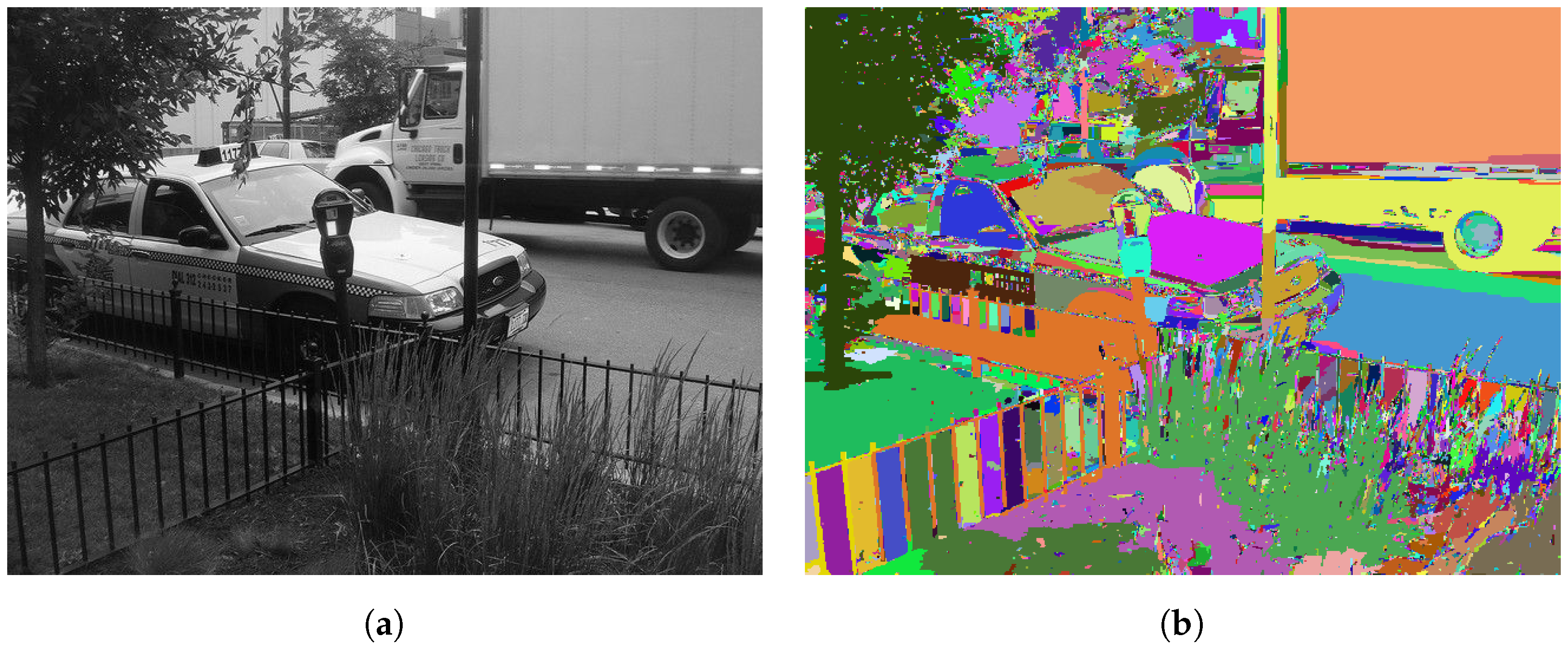
- Extensive experimental work, which demonstrates the efficiency of the RMS, and a comparison with state-of-the-art region segmentation methods (i.e., Watershed and DBSCAN).
2. Background and Related Work
2.1. Edge Detection
2.2. Region Division
2.3. Clustering
3. Raster-Scan Segmentation Method
- One-Neighbour Metric (.This metric is based on the differences between the current pixel value and the pixel values of its left and top neighbours. The differences and are calculated according to Equation (1).
- Two-Neighbour Metric (.This metric considers the differences between the current pixel value and the average value of two pixels to the left and at the top. The differences and are calculated according to Equation (2).
- Adjacent Segments’ Average Metric (.Unlike the other two, this metric assesses larger areas in I instead of only separate adjacent pixels’ values. Let belong to the segment and let belong to . If and represent the average pixel values of the segments and , the differences and are calculated according to Equation (3).
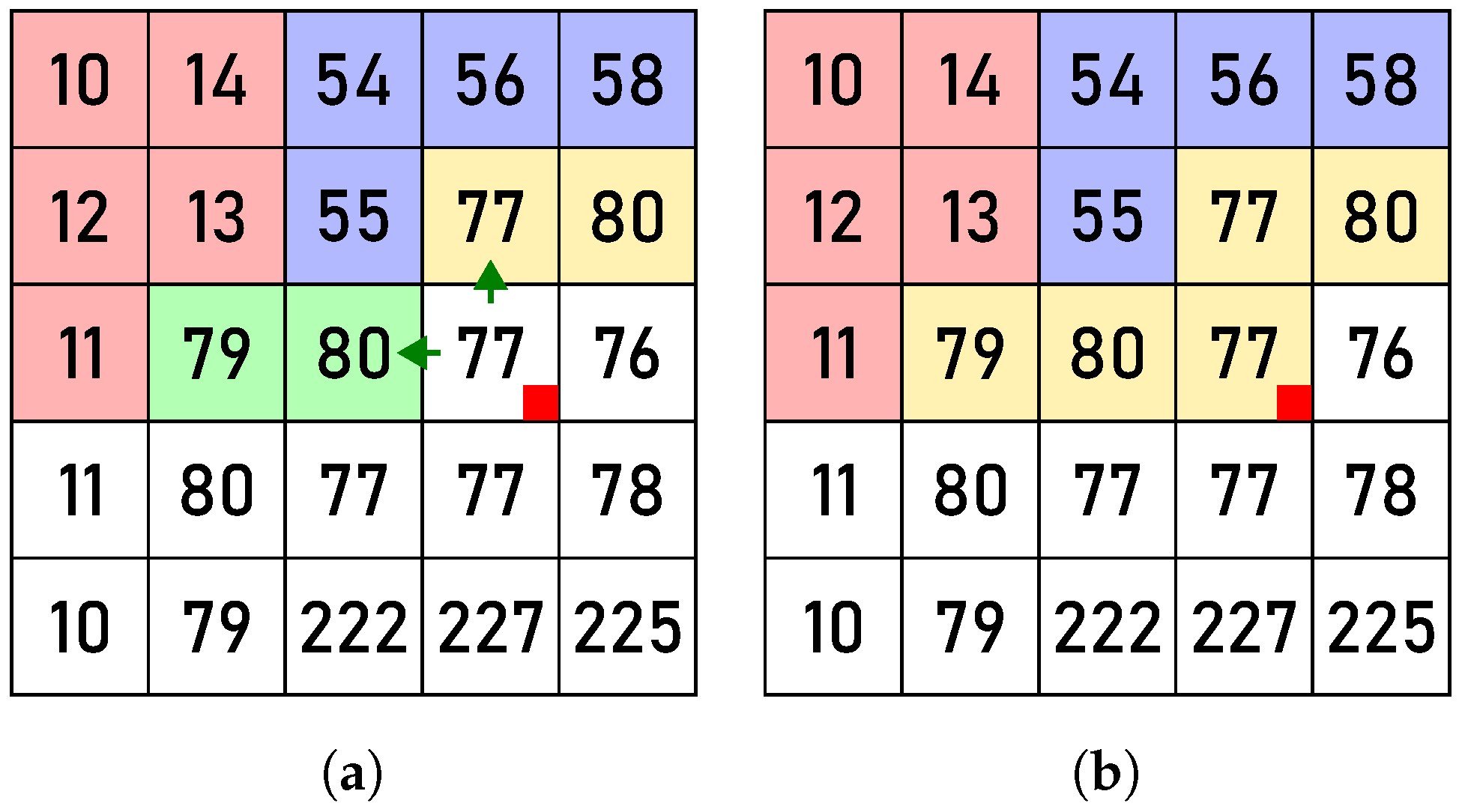
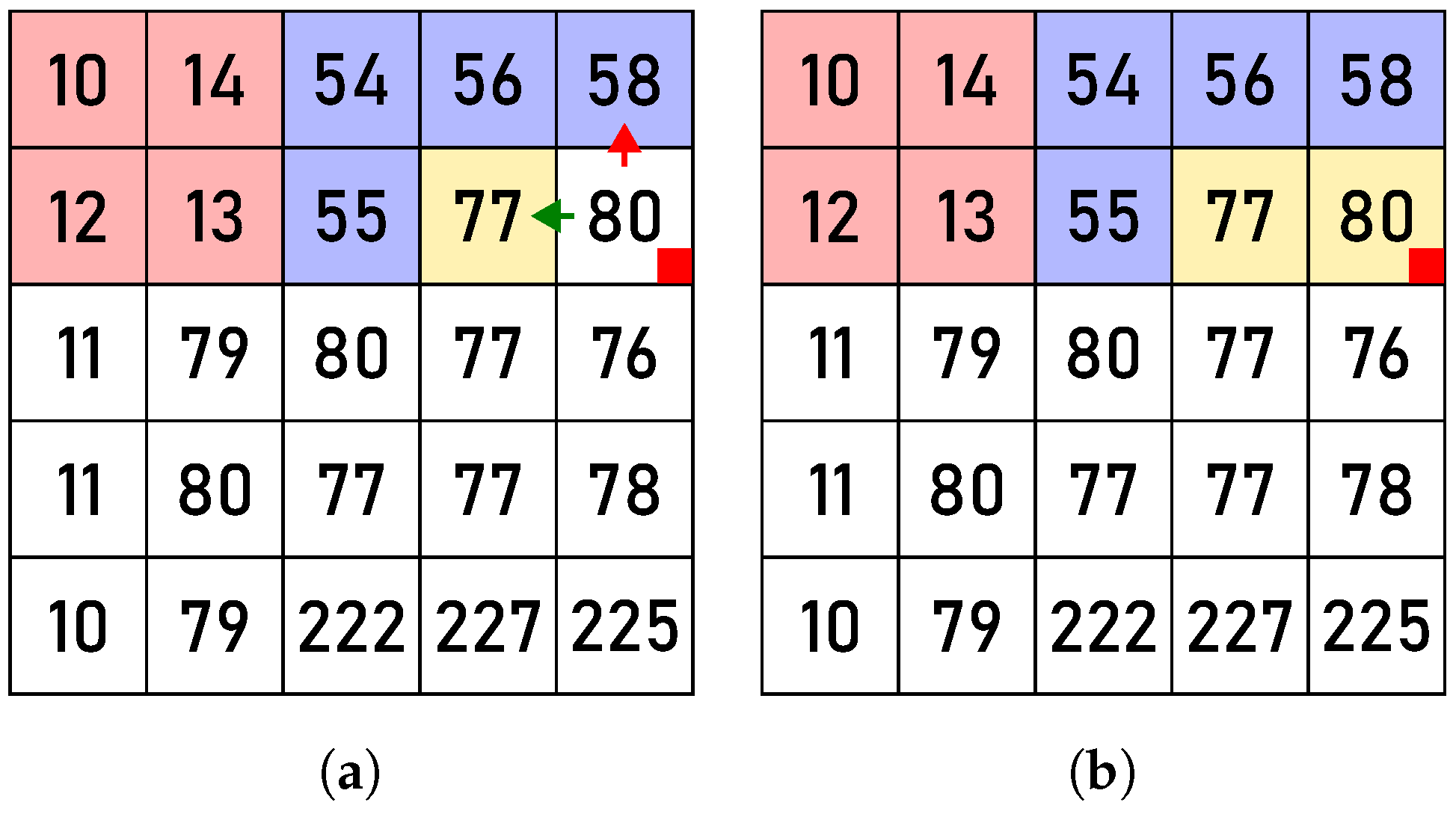
- Merge.If , , , , and , segments of and are merged into a single segment . After that, is expanded with the current pixel . The latter is performed using a union: (Figure 3).
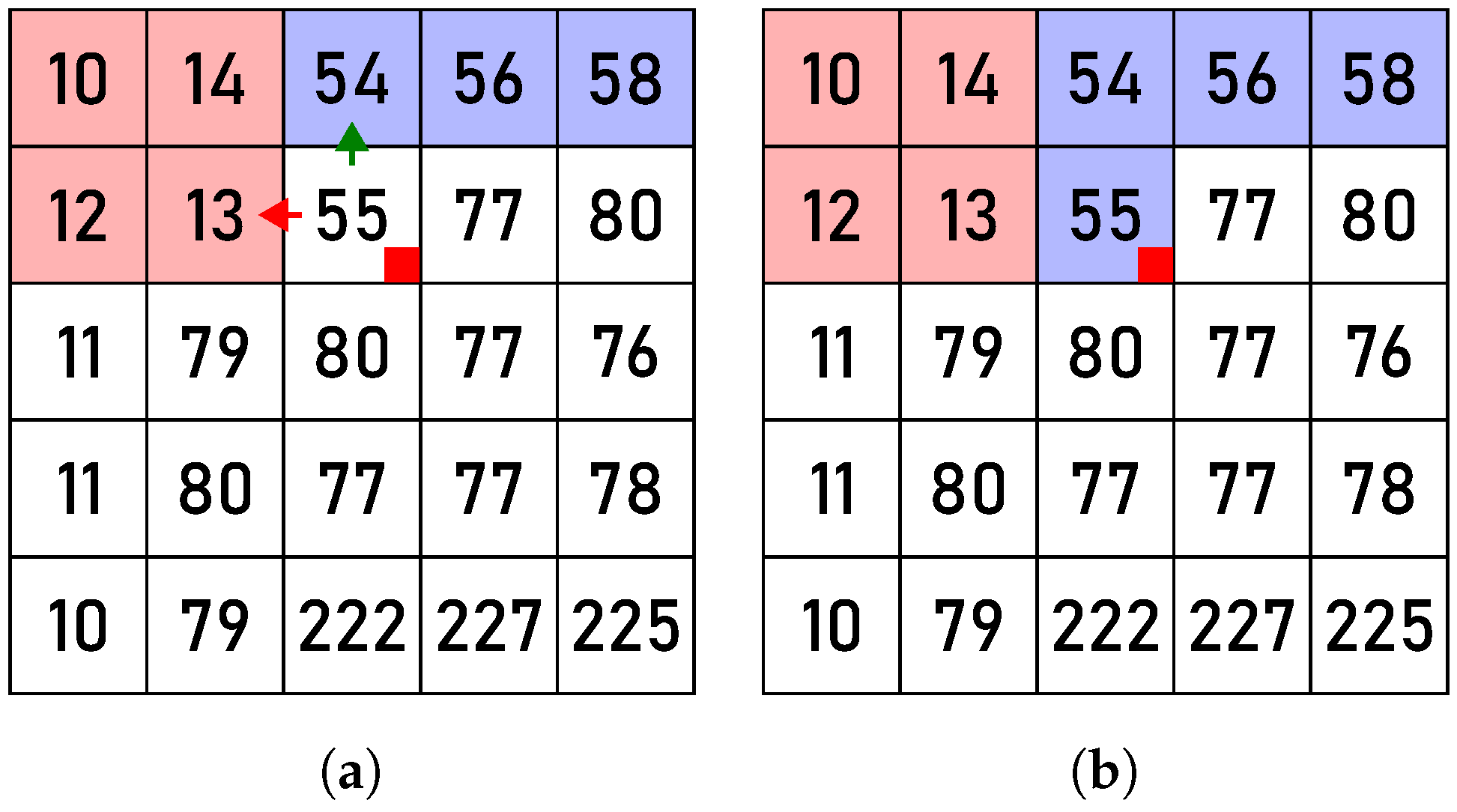
- Add.If , , , , , and , the segment is expanded as follows: (Figure 4).
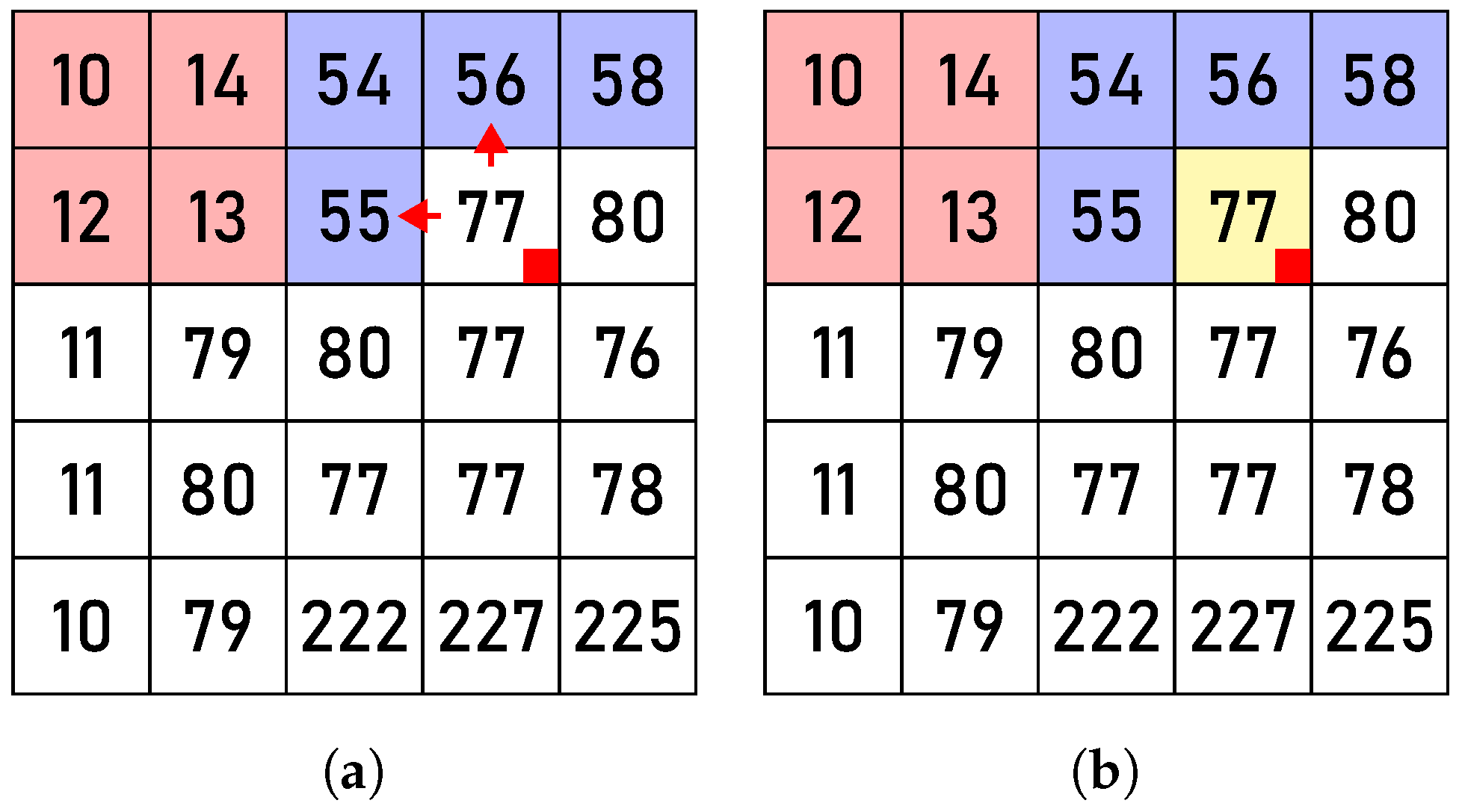
- Add-Left.If , , , and , the segment is expanded as follows: (Figure 5).
- Add-Up.If , , , and , the segment is expanded as follows: (Figure 6).
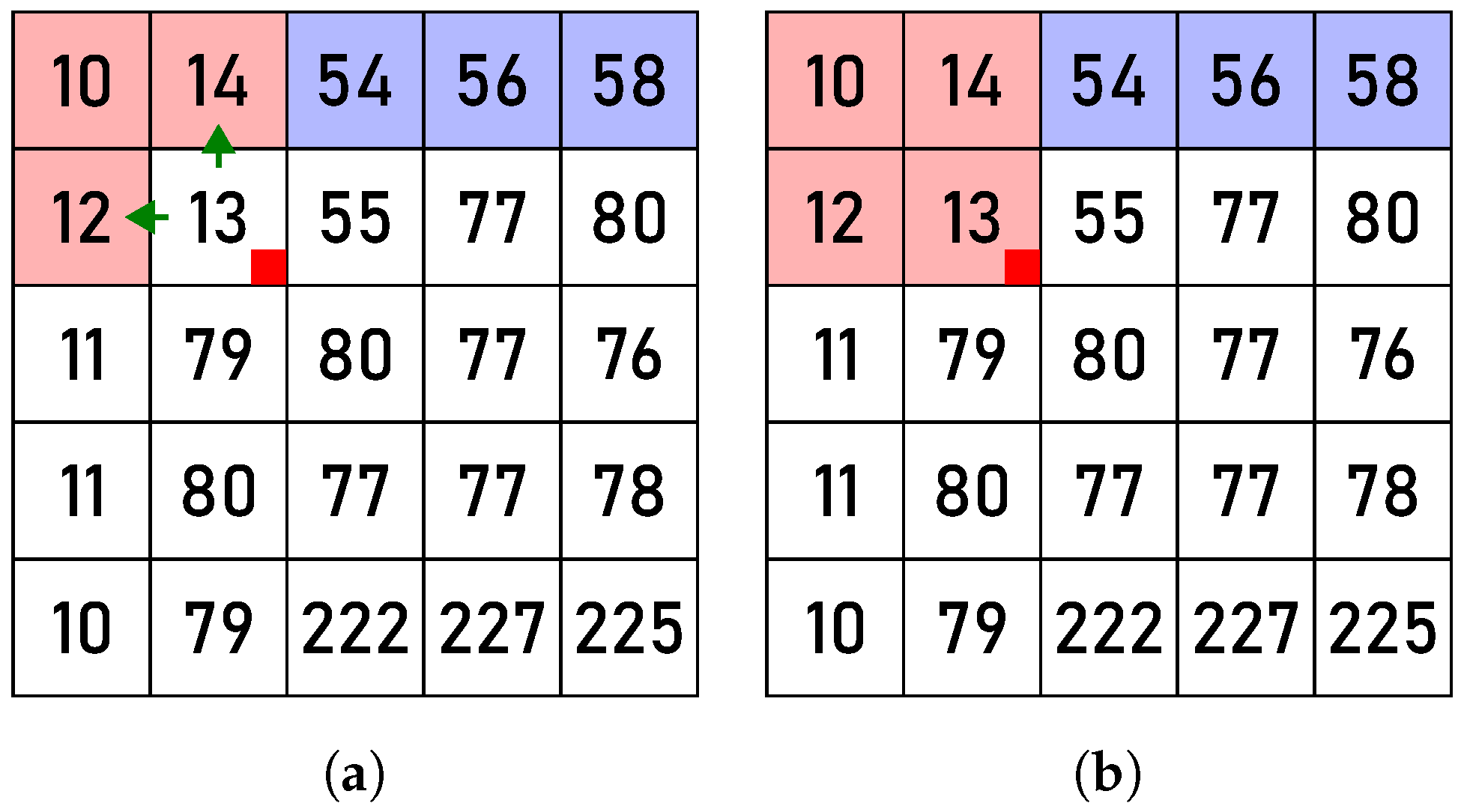
- New.In all other cases, a new segment is added to (Figure 7).
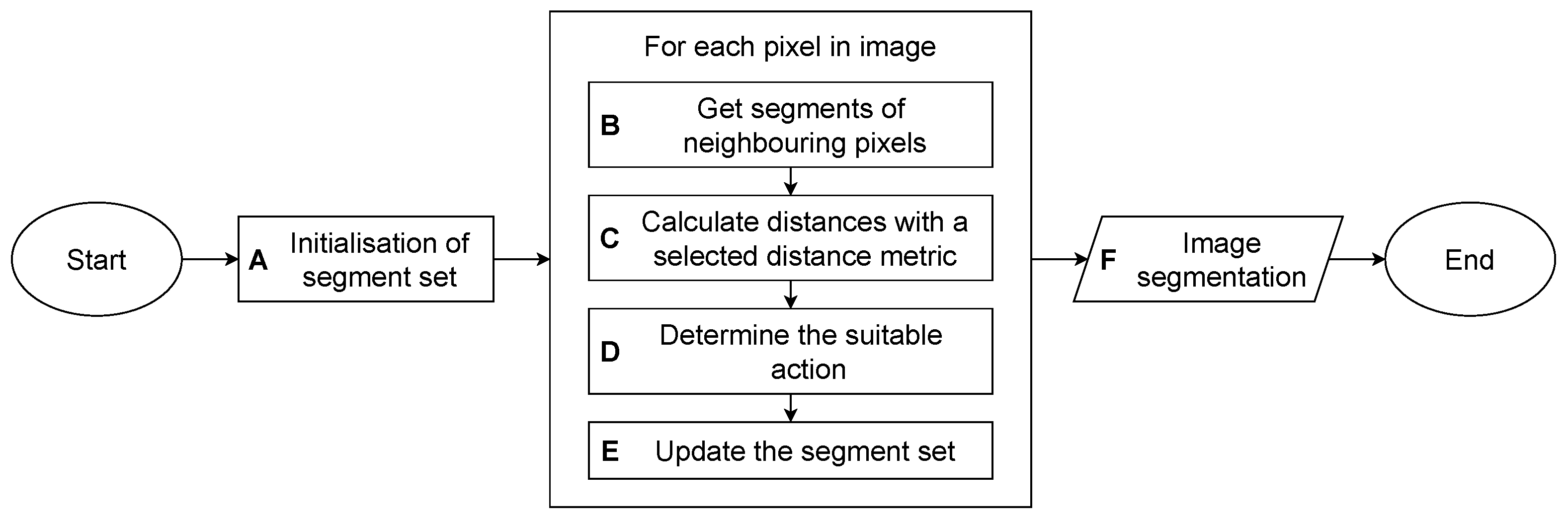
| Algorithm 1 Region image segmentation with the RSM |
|
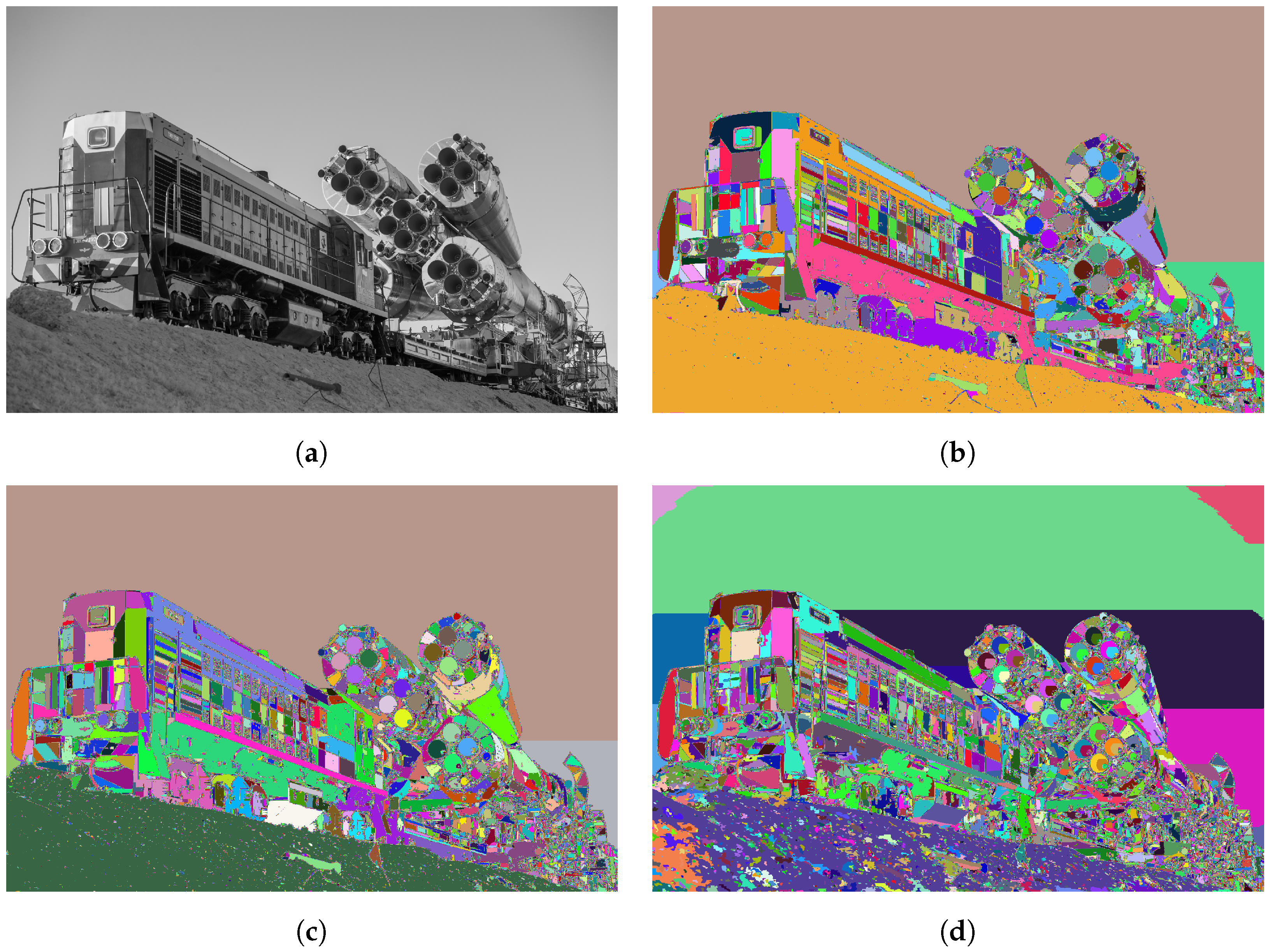
4. Results
5. Conclusions
Author Contributions
Funding
Institutional Review Board Statement
Informed Consent Statement
Data Availability Statement
Conflicts of Interest
References
- Cheng, H.; Jiang, X.; Sun, Y.; Wang, J. Color image segmentation: Advances and prospects. Pattern Recognit. 2001, 34, 2259–2281. [Google Scholar] [CrossRef]
- Girshick, R.; Donahue, J.; Darrell, T.; Malik, J. Region-based convolutional networks for accurate object detection and segmentation. IEEE Trans. Pattern Anal. Mach. Intell. 2016, 38, 142–158. [Google Scholar] [CrossRef]
- Hoeser, T.; Kuenzer, C. Object detection and image segmentation with deep learning on Earth observation data: A review-Part I: Evolution and recent trends. Remote Sens. 2020, 12, 1667. [Google Scholar] [CrossRef]
- Pham, D.L.; Xu, C.; Prince, J.L. Current methods in medical image segmentation. Annu. Rev. Biomed. Eng. 2000, 2, 315–337. [Google Scholar] [CrossRef] [PubMed]
- Fenster, A.; Chiu, B. Evaluation of Segmentation Algorithms for Medical Imaging. In Proceedings of the 2005 IEEE Engineering in Medicine and Biology 27th Annual Conference, Shanghai, China, 1–4 September 2005; pp. 7186–7189. [Google Scholar] [CrossRef]
- Guo, Z.; Li, X.; Huang, H.; Guo, N.; Li, Q. Deep learning-based image segmentation on multimodal medical imaging. IEEE Trans. Radiat. Plasma. Med. Sci. 2019, 3, 162–169. [Google Scholar] [CrossRef] [PubMed]
- Wang, Z.; Jensen, J.R.; Im, J. An automatic region-based image segmentation algorithm for remote sensing applications. Environ. Modell. Softw. 2010, 25, 1149–1165. [Google Scholar] [CrossRef]
- Kotaridis, I.; Lazaridou, M. Remote sensing image segmentation advances: A meta-analysis. ISPRS J. Photogramm. Remote Sens. 2021, 173, 309–322. [Google Scholar] [CrossRef]
- El-Hajj-Chehade, W.; Abdel Kader, R.; Kassem, R.; El-Zaart, A. Image Segmentation for Fingerprint Recognition. In Proceedings of the 2018 IEEE Applied Signal Processing Conference (ASPCON), Kolkata, India, 7–9 December 2018; pp. 314–319. [Google Scholar] [CrossRef]
- Tobji, R.; Di, W.; Ayoub, N. FMnet: Iris segmentation and recognition by using fully and multi-scale CNN for biometric security. Appl. Sci. 2019, 9, 2042. [Google Scholar] [CrossRef]
- Trokielewicz, M.; Czajka, A.; Maciejewicz, P. Post-mortem iris recognition with deep-learning-based image segmentation. Image Vision Comput. 2020, 94, 103866. [Google Scholar] [CrossRef]
- Kaur, D.; Kaur, Y. Various image segmentation techniques: A review. Int. J. Comput. Sci. Mob. Comput. 2014, 3, 809–814. [Google Scholar]
- Yu, Y.; Wang, C.; Fu, Q.; Kou, R.; Huang, F.; Yang, B.; Yang, T.; Gao, M. Techniques and challenges of image segmentation: A review. Electronics 2023, 12, 1199. [Google Scholar] [CrossRef]
- Vicente, S.; Rother, C.; Kolmogorov, V. Object Cosegmentation. In Proceedings of the CVPR 2011, Colorado Springs, CO, USA, 20–25 June 2011; pp. 2217–2224. [Google Scholar] [CrossRef]
- Rother, C.; Minka, T.; Blake, A.; Kolmogorov, V. Cosegmentation of Image Pairs by Histogram Matching—Incorporating a Global Constraint into MRFs. In Proceedings of the 2006 IEEE Computer Society Conference on Computer Vision and Pattern Recognition (CVPR’06), New York, NY, USA, 17–22 June 2006; pp. 993–1000. [Google Scholar] [CrossRef]
- Chen, D.J.; Chen, H.T.; Chang, L.W. Video Object Cosegmentation. In Proceedings of the 20th ACM International Conference on Multimedia, Nara, Japan, 29 October–2 November 2012; pp. 805–808. [Google Scholar] [CrossRef]
- Liu, Z.; Wang, L.; Hua, G.; Zhang, Q.; Niu, Z.; Wu, Y.; Zheng, N. Joint video object discovery and segmentation by coupled dynamic Markov networks. IEEE Trans. Image Process. 2018, 27, 5840–5853. [Google Scholar] [CrossRef]
- Wang, L.; Lv, X.; Zhang, Q.; Niu, Z.; Zheng, N.; Hua, G. Object cosegmentation in noisy videos with multilevel hypergraph. IEEE Trans. Multimedia 2021, 23, 1287–1300. [Google Scholar] [CrossRef]
- Hao, S.; Zhou, Y.; Guo, Y. A brief survey on semantic segmentation with deep learning. Neurocomputing 2020, 406, 302–321. [Google Scholar] [CrossRef]
- Patil, S.; Varadarajan, V.; Mahadevkar, S.; Athawade, R.; Maheshwari, L.; Kumbhare, S.; Garg, Y.; Dharrao, D.; Kamat, P.; Kotecha, K. Enhancing optical character recognition on images with mixed text using semantic segmentation. J. Sens. Actuator Netw. 2022, 11, 63. [Google Scholar] [CrossRef]
- Badrinarayanan, V.; Kendall, A.; Cipolla, R. SegNet: A deep convolutional encoder-decoder architecture for image segmentation. IEEE Trans. Pattern Anal. Mach. Intell. 2017, 39, 2481–2495. [Google Scholar] [CrossRef] [PubMed]
- Visin, F.; Ciccone, M.; Romero, A.; Kastner, K.; Cho, K.; Bengio, Y.; Matteucci, M.; Courville, A. ReSeg: A Recurrent Neural Network-Based Model for Semantic Segmentation. In Proceedings of the IEEE Conference on Computer Vision and Pattern Recognition Workshops (CVPRW), Las Vegas, NV, USA, 26 June–1 July 2016. [Google Scholar]
- Chen, L.C.; Papandreou, G.; Kokkinos, I.; Murphy, K.; Yuille, A.L. DeepLab: Semantic image segmentation with deep convolutional nets, atrous convolution, and fully connected CRFs. IEEE Trans. Pattern Anal. Mach. Intell. 2018, 40, 834–848. [Google Scholar] [CrossRef] [PubMed]
- Zhang, H.; Zhang, H.; Wang, C.; Xie, J. Co-Occurrent Features in Semantic Segmentation. In Proceedings of the IEEE/CVF Conference on Computer Vision and Pattern Recognition (CVPR), Long Beach, CA, USA, 15–20 June 2019; pp. 548–557. [Google Scholar]
- Gu, J.; Kwon, H.; Wang, D.; Ye, W.; Li, M.; Chen, Y.H.; Lai, L.; Chandra, V.; Pan, D.Z. Multi-Scale High-Resolution Vision Transformer for Semantic Segmentation. In Proceedings of the IEEE/CVF Conference on Computer Vision and Pattern Recognition (CVPR), New Orleans, LA, USA, 18–24 June 2022; pp. 12094–12103. [Google Scholar] [CrossRef]
- Kulhandjian, H.; Barron, J.; Tamiyasu, M.; Thompson, M.; Kulhandjian, M. AI-based pedestrian detection and avoidance at night using multiple sensors. J. Sens. Actuator Netw. 2024, 13, 34. [Google Scholar] [CrossRef]
- Chen, J.; Ran, X. Deep learning with edge computing: A review. Proc. IEEE 2019, 107, 1655–1674. [Google Scholar] [CrossRef]
- Khan, W.Z.; Ahmed, E.; Hakak, S.; Yaqoob, I.; Ahmed, A. Edge computing: A survey. Future Gener. Comput. Syst. 2019, 97, 219–235. [Google Scholar] [CrossRef]
- Nayak, S.; Patgiri, R.; Waikhom, L.; Ahmed, A. A review on edge analytics: Issues, challenges, opportunities, promises, future directions, and applications. Digit. Commun. Netw. 2024, 10, 783–804. [Google Scholar] [CrossRef]
- Hossain, M.D.; Chen, D. Segmentation for Object-Based Image Analysis (OBIA): A review of algorithms and challenges from remote sensing perspective. ISPRS J. Photogramm. Remote Sens. 2019, 150, 115–134. [Google Scholar] [CrossRef]
- Jahanbakht, M.; Xiang, W.; Waltham, N.J.; Azghadi, M.R. Distributed deep learning and energy-efficient real-time image orocessing at the edge for fish segmentation in underwater videos. IEEE Access 2022, 10, 117796–117807. [Google Scholar] [CrossRef]
- Wang, E.K.; Chen, C.M.; Hassan, M.M.; Almogren, A. A deep learning based medical image segmentation technique in Internet-of-Medical-Things domain. Future Gener. Comput. Syst. 2020, 108, 135–144. [Google Scholar] [CrossRef]
- Ali, O.; Ali, H.; Shah, S.A.A.; Shahzad, A. Implementation of a modified U-Net for medical image segmentation on edge devices. IEEE Trans. Circuits Syst. II Express Br. 2022, 69, 4593–4597. [Google Scholar] [CrossRef]
- Gruosso, M.; Capece, N.; Erra, U. Human segmentation in surveillance video with deep learning. Multimed. Tools Appl. 2021, 80, 1175–1199. [Google Scholar] [CrossRef]
- Muhadi, N.A.; Abdullah, A.F.; Bejo, S.K.; Mahadi, M.R.; Mijic, A. Deep learning semantic segmentation for water level estimation using surveillance camera. Appl. Sci. 2021, 11, 9691. [Google Scholar] [CrossRef]
- Bruce, J.; Balch, T.; Veloso, M. Fast and Inexpensive Color Image Segmentation for Interactive Robots. In Proceedings of the 2000 IEEE/RSJ International Conference on Intelligent Robots and Systems (IROS 2000), Takamatsu, Japan, 31 October–5 November 2000; pp. 2061–2066. [Google Scholar] [CrossRef]
- Wan, H.; Fan, Z.; Yu, X.; Kang, M.; Wang, P.; Zeng, X. A real-time branch detection and reconstruction mechanism for harvesting robot via convolutional neural network and image segmentation. Comput. Electron. Agric. 2022, 192, 106609. [Google Scholar] [CrossRef]
- Podgorelec, D.; Uran, S.; Nerat, A.; Bratina, B.; Pečnik, S.; Dimec, M.; Žaberl, F.; Žalik, B.; Šafarič, R. LiDAR-based maintenance of a safe distance between a human and a robot arm. Sensors 2023, 23, 4305. [Google Scholar] [CrossRef] [PubMed]
- Nixon, M.S.; Aguado, A.S. Feature Extraction and Image Processing, 2nd ed.; Academic Press: Oxford, UK, 2013. [Google Scholar]
- Ding, Y.; Ping, X.; Hu, M.; Wang, D. Range image segmentation based on randomized Hough transform. Pattern Recognit. Lett. 2005, 26, 2033–2041. [Google Scholar] [CrossRef]
- Sagiv, C.; Sochen, N.; Zeevi, Y. Integrated active contours for texture segmentation. IEEE Trans. Image Process. 2006, 15, 1633–1646. [Google Scholar] [CrossRef] [PubMed]
- Zhang, K.; Zhang, L.; Song, H.; Zhou, W. Active contours with selective local or global segmentation: A new formulation and level set method. Image Vision Comput. 2010, 28, 668–676. [Google Scholar] [CrossRef]
- Jiang, X.; Mojon, D. Adaptive local thresholding by verification-based multithreshold probing with application to vessel detection in retinal images. IEEE Trans. Pattern Anal. Mach. Intell. 2003, 25, 131–137. [Google Scholar] [CrossRef]
- Phansalkar, N.; More, S.; Sabale, A.; Joshi, M. Adaptive Local Thresholding for Detection of Nuclei in Diversity Stained Cytology Images. In Proceedings of the 2011 International Conference on Communications and Signal Processing, Kerala, India, 10–12 February 2011; pp. 218–220. [Google Scholar] [CrossRef]
- Benson, C.C.; Rajamani, K.; Lajish, V.L. A review on automatic marker identification methods in watershed algorithms used for medical image segmentation. Int. J. Innov. Sci. Eng. Technol. 2015, 2, 829–839. [Google Scholar]
- Dhanachandra, N.; Manglem, K.; Chanu, Y.J. Image segmentation using K-means clustering algorithm and subtractive clustering algorithm. Procedia Comput. Sci. 2015, 54, 764–771. [Google Scholar] [CrossRef]
- Zheng, X.; Lei, Q.; Yao, R.; Gong, Y.; Yin, Q. Image segmentation based on adaptive K-means algorithm. J. Image Video Proc. 2018, 2018, 1–10. [Google Scholar] [CrossRef]
- Debelee, T.G.; Schwenker, F.; Rahimeto, S.; Yohannes, D. Evaluation of modified adaptive K-means segmentation algorithm. Comput. Vis. Media. 2019, 5, 347–361. [Google Scholar] [CrossRef]
- Manavalan, R.; Thangavel, K. TRUS Image Segmentation Using Morphological Operators and DBSCAN Clustering. In Proceedings of the 2011 World Congress on Information and Communication Technologies, Mumbai, India, 11–14 December 2011; pp. 898–903. [Google Scholar] [CrossRef]
- Baselice, F.; Coppolino, L.; D’Antonio, S.; Ferraioli, G.; Sgaglione, L. A DBSCAN Based Approach for Jointly Segment and Classify Brain MR Images. In Proceedings of the 2015 37th Annual International Conference of the IEEE Engineering in Medicine and Biology Society (EMBC), Milan, Italy, 25–29 August 2015; pp. 2993–2996. [Google Scholar] [CrossRef]
- Kurumalla, S.; Rao, P.S. K-nearest neighbor based DBSCAN clustering algorithm for image segmentation. J. Theor. Appl. Inf. Technol. 2016, 92, 395–402. [Google Scholar]
- Comaniciu, D.; Meer, P. Mean shift: A robust approach toward feature space analysis. IEEE Trans. Pattern Anal. Mach. Intell. 2002, 24, 603–619. [Google Scholar] [CrossRef]
- Achanta, R.; Shaji, A.; Smith, K.; Lucchi, A.; Fua, P.; Süsstrunk, S. SLIC superpixels compared to state-of-the-art superpixel methods. IEEE Trans. Pattern Anal. Mach. Intell. 2012, 34, 2274–2282. [Google Scholar] [CrossRef]
- Li, Z.; Chen, J. Superpixel Segmentation Using Linear Spectral Clustering. In Proceedings of the IEEE Conference on Computer Vision and Pattern Recognition (CVPR), Boston, MA, USA, 7–12 June 2015; pp. 1356–1363. [Google Scholar]
- Muñoz, X.; Freixenet, J.; Cufı, X.; Martı, J. Strategies for image segmentation combining region and boundary information. Pattern Recognit. Lett. 2003, 24, 375–392. [Google Scholar] [CrossRef]
- Duda, R.O.; Hart, P.E. Use of the Hough transformation to detect lines and curves in pictures. Commun. ACM 1972, 15, 11–15. [Google Scholar] [CrossRef]
- Tian, Q.C.; Pan, Q.; Cheng, Y.M.; Gao, Q.X. Fast Algorithm and Application of Hough Transform in Iris Segmentation. In Proceedings of the 2004 International Conference on Machine Learning and Cybernetics, Shanghai, China, 26–29 August 2004; pp. 3977–3980. [Google Scholar] [CrossRef]
- Asano, T.; Katoh, N. Variants for the Hough transform for line detection. Comput. Geom. 1996, 6, 231–252. [Google Scholar] [CrossRef][Green Version]
- Kass, M.; Witkin, A.; Terzopoulos, D. Snakes: Active contour models. Int. J. Comput. Vision 1988, 1, 321–331. [Google Scholar] [CrossRef]
- Xu, G.; Segawa, E.; Tsuji, S. Robust active contours with insensitive parameters. Pattern Recognit. 1994, 27, 879–884. [Google Scholar] [CrossRef]
- Freedman, D.; Zhang, T. Interactive Graph Cut Based Segmentation with Shape Priors. In Proceedings of the 2005 IEEE Computer Society Conference on Computer Vision and Pattern Recognition (CVPR’05), San Diego, CA, USA, 20–25 June 2005; pp. 755–762. [Google Scholar] [CrossRef]
- Boykov, Y.; Funka-Lea, G. Graph cuts and efficient ND image segmentation. Int. J. Comput. Vision 2006, 70, 109–131. [Google Scholar] [CrossRef]
- Shapiro, L.G.; Stockman, G.C. Computer Vision; Prentice Hall: Hoboken, NJ, USA, 2001. [Google Scholar]
- Reddi, S.S.; Rudin, S.F.; Keshavan, H.R. An optimal multiple threshold scheme for image segmentation. IEEE Trans. Syst. Man Cybern. 1984, SMC-14, 661–665. [Google Scholar] [CrossRef]
- Mongus, D.; Žalik, B. An efficient approach to 3D single tree-crown delineation in LiDAR data. ISPRS J. Photogramm. Remote Sens. 2015, 108, 219–233. [Google Scholar] [CrossRef]
- Forte, A.M.; Whipple, K.X. Criteria and tools for determining drainage divide stability. Earth Planet. Sci. Lett. 2018, 493, 102–117. [Google Scholar] [CrossRef]
- Vincent, L.; Soille, P. Watersheds in digital spaces: An efficient algorithm based on immersion simulations. IEEE Trans. Pattern Anal. Mach. Intell. 1991, 13, 583–598. [Google Scholar] [CrossRef]
- Meijster, A.; Roerdink, J.B.T.M. A Proposal for the Implementation of a Parallel Watershed Algorithm. In Proceedings of the Computer Analysis of Images and Patterns, Prague, Czech Republic, 6–8 September 1995; pp. 790–795. [Google Scholar] [CrossRef]
- Kornilov, A.S.; Safonov, I.V. An overview of watershed algorithm implementations in open source libraries. J. Imaging 2018, 4, 123. [Google Scholar] [CrossRef]
- El Habib Kahla, M.; Beggas, M.; Laouid, A.; Hammoudeh, M. A nature-inspired partial distance-based clustering algorithm. J. Sens. Actuator Netw. 2024, 13, 36. [Google Scholar] [CrossRef]
- Žalik, K.R.; Žalik, B. A sweep-line algorithm for spatial clustering. Adv. Eng. Softw. 2009, 40, 445–451. [Google Scholar] [CrossRef]
- Lukač, N.; Žalik, B.; Žalik, K.R. Sweep-hyperplane clustering algorithm using dynamic model. Informatica 2014, 25, 563–580. [Google Scholar] [CrossRef]
- Mittal, M.; Goyal, L.M.; Hemanth, D.J.; Sethi, J.K. Clustering approaches for high-dimensional databases: A review. WIREs Data. Mining. Knowl. Discov. 2019, 9, e1300. [Google Scholar] [CrossRef]
- MacQueen, J. Some Methods for Classification and Analysis of Multivariate Observations. In Proceedings of the Fifth Berkeley Symposium on Mathematical Statistics and Probability, Berkeley, CA, USA, 21 June–18 July 1965 and 27 December 1965–7 January 1966; University of California Press: Berkeley, CA, USA, 1967; pp. 281–297. [Google Scholar]
- Luo, M.; Ma, Y.F.; Zhang, H.J. A Spatial Constrained K-means Approach to Image Segmentation. In Proceedings of the Fourth International Conference on Information, Communications and Signal Processing, 2003 and the Fourth Pacific Rim Conference on Multimedia, Proceedings of the 2003 Joint, Singapore, 15–18 December 2003; pp. 738–742. [Google Scholar] [CrossRef]
- Žalik, K.R. An efficient k’-means clustering algorithm. Pattern Recognit. Lett. 2008, 29, 1385–1391. [Google Scholar] [CrossRef]
- Mat Isa, N.A.; Salamah, S.A.; Ngah, U.K. Adaptive fuzzy moving K-means clustering algorithm for image segmentation. IEEE Trans. Consum. Electron. 2009, 55, 2145–2153. [Google Scholar] [CrossRef]
- Ester, M.; Kriegel, H.P.; Sander, J.; Xu, X. A Density-Based Algorithm for Discovering Clusters in Large Spatial Databases with Noise. In Proceedings of the Second International Conference on Knowledge Discovery and Data Mining, Portland, OR, USA, 2–4 August 1996; pp. 226–231. [Google Scholar]
- Ali, T.; Asghar, S.; Sajid, N.A. Critical Analysis of DBSCAN Variations. In Proceedings of the 2010 International Conference on Information and Emerging Technologies, Karachi, Pakistan, 14–16 June 2010; pp. 1–6. [Google Scholar] [CrossRef]
- Felzenszwalb, P.F.; Huttenlocher, D.P. Efficient graph-based image segmentation. Int. J. Comput. Vis. 2004, 59, 167–181. [Google Scholar] [CrossRef]
- Jones, P.F. The graphics screen. In CAD/CAM: Features, Applications and Management; Macmillan Education: London, UK, 1992; pp. 21–30. [Google Scholar] [CrossRef]
- Martin, A. Cathode ray tubes for industrial and military applications. Adv. Imaging Electron Phys. 1986, 67, 183–328. [Google Scholar] [CrossRef]
- Lin, T.Y.; Maire, M.; Belongie, S.; Hays, J.; Perona, P.; Ramanan, D.; Dollár, P.; Zitnick, C.L. Microsoft COCO: Common Objects in Context. In Proceedings of the Computer Vision–ECCV 2014, Springer, Zurich, Switzerland, 6–12 September 2014; pp. 740–755. [Google Scholar] [CrossRef]
- Agustsson, E.; Timofte, R. NTIRE 2017 Challenge on Single Image Super-Resolution: Dataset and Study. In Proceedings of the IEEE Conference on Computer Vision and Pattern Recognition Workshops (CVPRW), Honolulu, HI, USA, 21–26 July 2017; pp. 1122–1131. [Google Scholar] [CrossRef]
- Zhang, H.; Tian, Y.; Wang, K.; Zhang, W.; Wang, F.Y. Mask SSD: An effective single-stage approach to object instance segmentation. IEEE Trans. Image Process. 2020, 29, 2078–2093. [Google Scholar] [CrossRef]
- Masubuchi, S.; Watanabe, E.; Seo, Y.; Okazaki, S.; Sasagawa, T.; Watanabe, K.; Taniguchi, T.; Machida, T. Deep-learning-based image segmentation integrated with optical microscopy for automatically searching for two-dimensional materials. NPJ 2D Mater. Appl. 2020, 4, 3. [Google Scholar] [CrossRef]
- Timofte, R.; Agustsson, E.; Van Gool, L.; Yang, M.H.; Zhang, L.; Lim, B.; Son, S.; Kim, H.; Nah, S.; Lee, K.M.; et al. NTIRE 2017 Challenge on Single Image Super-Resolution: Methods and Results. In Proceedings of the IEEE Conference on Computer Vision and Pattern Recognition (CVPR) Workshops, Honolulu, HI, USA, 21–26 July 2017. [Google Scholar]
- OpenCV: Image Segmentation with Watershed Algorithm. Available online: https://docs.opencv.org/4.x/d3/db4/tutorial_py_watershed.html (accessed on 1 October 2024).
- Curtin, R.R.; Edel, M.; Shrit, O.; Agrawal, S.; Basak, S.; Balamuta, J.J.; Birmingham, R.; Dutt, K.; Eddelbuettel, D.; Garg, R.; et al. mlpack 4: A fast, header-only C++ machine learning library. J. Open Source Softw. 2023, 8, 5026. [Google Scholar] [CrossRef]
- Bieniek, A.; Moga, A. An efficient watershed algorithm based on connected components. Pattern Recognit. 2000, 33, 907–916. [Google Scholar] [CrossRef]
- Cormen, T.; Leiserson, C.; Rivest, R.; Stein, C. Introduction to Algorithms, 4th ed.; MIT Press: London, UK, 2022. [Google Scholar]




| Method | Advantages | Disadvantages |
|---|---|---|
| Differential operators [39] | Low computational complexity | Poor resistance to noise, bad results for images with small pixel gradients |
| Hough transform [40] | High-accuracy segmentation of regular polygons | Poor segmentation of concave and wavy structures, high computational complexity |
| Active contour approach [41,42] | Accurate segmentation of concave and wavy polygons | Difficult tuning of parameters |
| Thresholding [43,44] | Low computational complexity, robust adaptive approaches | Difficult choice of threshold value, possibility of over-segmentation |
| Watershed [45] | Low computational complexity, efficient marker-controlled approach | Tendency toward over-segmentation, difficult determination of markers’ positions |
| k-means [46,47,48] | Simplicity, low computational complexity | Difficult tuning of parameters |
| DBSCAN [49,50,51] | Accurate segmentation of non-linearly separable image clusters | Sensitivity to input parameters |
| Superpixel methods [52,53,54] | Low computational complexity | Inability to process regions with high-intensity varieties |
| Dataset | Resolution | ||
|---|---|---|---|
| Airplane | MS COCO | 259,840 | |
| Baseball | MS COCO | 273,280 | |
| Canal | DIV2K | 3,108,960 | |
| Fruits | DIV2K | 2,766,240 | |
| Seashore | DIV2K | 2,766,240 | |
| Stop Sign | MS COCO | 307,200 | |
| Sunflowers | DIV2K | 2,766,240 | |
| Taxi | MS COCO | 307,200 | |
| Tennis | MS COCO | 273,280 | |
| Train | DIV2K | 2,766,240 |
| Airplane | 23,761 | 39,949 | 33,809 |
| Baseball | 10,505 | 16,520 | 12,659 |
| Canal | 215,024 | 349,251 | 282,342 |
| Fruits | 416,740 | 698,121 | 538,066 |
| Seashore | 84,695 | 160,417 | 118,450 |
| Stop Sign | 60,134 | 74,841 | 65,451 |
| Sunflowers | 349,382 | 588,149 | 457,998 |
| Taxi | 36,891 | 55,769 | 42,701 |
| Tennis | 17,703 | 28,048 | 25,093 |
| Train | 160,412 | 249,109 | 190,581 |
| Airplane | 39,469 | 23,761 | 16,017 | 11,789 | 9245 |
| Baseball | 25,948 | 17,356 | 13,076 | 10,505 | 8669 |
| Canal | 443,081 | 300,451 | 215,024 | 161,928 | 126,380 |
| Fruits | 624,147 | 416,740 | 294,988 | 216,854 | 163,314 |
| Seashore | 275,453 | 180,119 | 122,328 | 84,695 | 59,557 |
| Stop Sign | 107,356 | 87,775 | 72,513 | 60,134 | 50,191 |
| Sunflowers | 349,382 | 224,471 | 155,674 | 112,928 | 84,441 |
| Taxi | 86,543 | 61,972 | 46,599 | 36,891 | 30,081 |
| Tennis | 31,942 | 17,703 | 12,234 | 9405 | 7501 |
| Train | 355,059 | 258,854 | 200,255 | 160,412 | 131,059 |
| Airplane | 27,237 | 24,581 | 23,920 | 23,761 | 23,747 |
| Baseball | 13,126 | 11,032 | 10,505 | 10,360 | 10,344 |
| Canal | 261,231 | 225,578 | 216,978 | 215,024 | 214,898 |
| Fruits | 464,036 | 429,965 | 420,911 | 417,494 | 416,740 |
| Seashore | 124,666 | 93,531 | 86,474 | 84,695 | 84,444 |
| Stop Sign | 67,569 | 61,315 | 60,265 | 60,135 | 60,134 |
| Sunflowers | 366,326 | 354,651 | 350,808 | 349,382 | 348,971 |
| Taxi | 44,238 | 36,891 | 35,326 | 34,930 | 34,906 |
| Tennis | 20,349 | 18,458 | 17,754 | 17,708 | 17,703 |
| Train | 197,737 | 167,779 | 160,412 | 158,535 | 158,417 |
| Watershed | DBSCAN | RSM | |
|---|---|---|---|
| Airplane | 28,409 | 48,542 | 23,761 |
| Baseball | 23,278 | 21,298 | 10,505 |
| Canal | 197,729 | 498,016 | 215,024 |
| Fruits | 243,714 | 583,656 | 416,740 |
| Seashore | 126,108 | 394,168 | 84,695 |
| Stop Sign | 23,324 | 113,411 | 60,134 |
| Sunflowers | 157,878 | 576,622 | 349,382 |
| Taxi | 27,862 | 96,811 | 36,891 |
| Tennis | 24,391 | 42,800 | 17,703 |
| Train | 153,704 | 538,013 | 160,412 |
| Watershed [s] | DBSCAN [s] | RSM [s] | |
|---|---|---|---|
| Airplane | 0.011 | 0.743 | 0.006 |
| Baseball | 0.011 | 0.916 | 0.005 |
| Canal | 0.098 | 17.163 | 0.069 |
| Fruits | 0.136 | 10.462 | 0.083 |
| Seashore | 0.076 | 16.246 | 0.053 |
| Stop Sign | 0.011 | 0.818 | 0.010 |
| Sunflowers | 0.103 | 13.694 | 0.075 |
| Taxi | 0.012 | 0.837 | 0.010 |
| Tennis | 0.011 | 0.879 | 0.008 |
| Train | 0.080 | 13.883 | 0.053 |
Disclaimer/Publisher’s Note: The statements, opinions and data contained in all publications are solely those of the individual author(s) and contributor(s) and not of MDPI and/or the editor(s). MDPI and/or the editor(s) disclaim responsibility for any injury to people or property resulting from any ideas, methods, instructions or products referred to in the content. |
© 2024 by the authors. Licensee MDPI, Basel, Switzerland. This article is an open access article distributed under the terms and conditions of the Creative Commons Attribution (CC BY) license (https://creativecommons.org/licenses/by/4.0/).
Share and Cite
Lukač, L.; Nerat, A.; Strnad, D.; Horvat, Š.; Žalik, B. Region Segmentation of Images Based on a Raster-Scan Paradigm. J. Sens. Actuator Netw. 2024, 13, 80. https://doi.org/10.3390/jsan13060080
Lukač L, Nerat A, Strnad D, Horvat Š, Žalik B. Region Segmentation of Images Based on a Raster-Scan Paradigm. Journal of Sensor and Actuator Networks. 2024; 13(6):80. https://doi.org/10.3390/jsan13060080
Chicago/Turabian StyleLukač, Luka, Andrej Nerat, Damjan Strnad, Štefan Horvat, and Borut Žalik. 2024. "Region Segmentation of Images Based on a Raster-Scan Paradigm" Journal of Sensor and Actuator Networks 13, no. 6: 80. https://doi.org/10.3390/jsan13060080
APA StyleLukač, L., Nerat, A., Strnad, D., Horvat, Š., & Žalik, B. (2024). Region Segmentation of Images Based on a Raster-Scan Paradigm. Journal of Sensor and Actuator Networks, 13(6), 80. https://doi.org/10.3390/jsan13060080