Communication

Auxin-Induced Adventitious Rooting in Pepper Involves CaLBD16: Functional Evidence from Tomato Overexpression

1
Engineering Research Center for Germplasm Innovation and New Varieties Breeding of Horticultural Crops, Key Laboratory for Vegetable Biology of Hunan Province, College of Horticulture, Hunan Agricultural University, Changsha 410125, China
2
Vegetable Variety Creation Center, Yue Lushan Lab, Changsha 410128, China
3
School of Tropical Agriculture and Forestry, Hainan University, Haikou 570228, China
4
Microbial Variety Creation Center of Yuelushan Laboratory, Yue Lushan Lab, Changsha 410128, China
5
Institute of Plant Protection, Hunan Academy of Agricultural Sciences, Changsha 410125, China
*
Authors to whom correspondence should be addressed.
These authors contributed equally to this work.
Plants 2026, 15(8), 1188; https://doi.org/10.3390/plants15081188
Submission received: 4 March 2026 / Revised: 1 April 2026 / Accepted: 3 April 2026 / Published: 13 April 2026
(This article belongs to the Section Plant Molecular Biology)

Abstract

The formation of adventitious roots plays a key role in plant asexual reproduction, yet research on this process in pepper remains limited. Exogenous auxin treatment substantially promotes adventitious root formation in pepper, and we identified CaLBD16 as a positive regulator acting downstream of auxin signaling. Further analysis revealed that the signal transduction from auxin to CaLBD16 is mediated through the activation of CaARF6 and CaWOX11, both of which also contribute to adventitious root formation. Together, our findings uncover a molecular mechanism underlying auxin-induced adventitious root formation in pepper, offering valuable insights for its practical application in production.

1. Introduction

Adventitious roots (AR) arise from non-root tissues, and their formation is a critical step in cutting propagation [1]. Through clonal propagation via cuttings, it is possible to multiply such as insect or disease resistance. Multiple hormones influence AR formation, including auxin, ethylene, jasmonic acid, and cytokinins [2,3,4,5], indicating that this process is complex. Among these, endogenous auxin plays the most critical role and is widely used in tissue culture to induce rooting [6]. At the physiological level, IAA gradually accumulates at wound sites, thereby promoting AR formation [7]. Treatments with exogenous IAA can stimulate the differentiation of phloem cells, creating a way for unidirectional endogenous auxin canalization, contributing to the initiation of AR primordia [4]. At the molecular level, auxin biosynthesis, transport, and signaling are closely linked to AR formation through the activation of key genes. These include auxin biosynthesis genes such as AtYUC2 and AtYUC6; auxin transporters like AUX1, LAX3 [8], and PIN1 [9]; and auxin signaling components, including auxin response factors such as ARF4, ARF6/8, and ARF7 [10,11,12]. In addition, auxin/indole-3-acetic acid (Aux/IAA) family members—including IAA4 [13], IAA14 [14], IAA13, and IAA16 [15]—have been demonstrated to participate in the regulation of AR formation.
AR formation involves a shift in cell fate, a process in which the WOX gene family plays a key role. WOX11 regulates the first step—from regeneration-competent cells to root founder cells—while WOX5, activated downstream, controls the second step, driving the transition from root founder cells to AR primordium [10,16]. In Arabidopsis, the expression of both AtWOX11 and AtWOX5 during AR formation is induced by auxin [16]. In addition, members of the LBD gene family have been shown to be essential for AR formation. In particular, LBD16/29, LBD18, and SBRL have been functionally implicated in this process across different species, among them, LBD16 and LBD29 are considered to be direct downstream targets of WOX11 [4,17,18].
Pepper (Capsicum annuum) is a globally important vegetable crop, yet many elite cultivars exhibit poor adventitious rooting capacity, which limits their efficient propagation via cuttings. Although auxin is well known to promote adventitious root formation in various plant species, its role and the underlying molecular mechanisms in pepper remain entirely unexplored. Given the woody characteristics of pepper stems and the lack of research on its de novo root organogenesis, it is essential to identify key regulatory factors that mediate auxin-induced adventitious rooting in this crop. Elucidating such mechanisms will not only advance our understanding of root development in pepper but also provide a theoretical basis for improving cutting propagation efficiency in commercial production.
In this study, we found that CaLBD16 plays a key role in de novo root organogenesis. Notably, exogenous auxin treatment significantly promoted AR formation in pepper. We further demonstrated that CaARF6 mediates auxin signaling to activate CaLBD16 expression. Beyond this canonical auxin signaling module, CaWOX11 was also found to respond to auxin and activate CaLBD16 transcription. Collectively, these findings suggest that the regulatory framework governing AR formation is relatively conserved across plant species and provide a theoretical basis for improving AR formation in pepper.

2. Results

2.1. Exogenous IAA Significantly Promotes AR Formation in Pepper

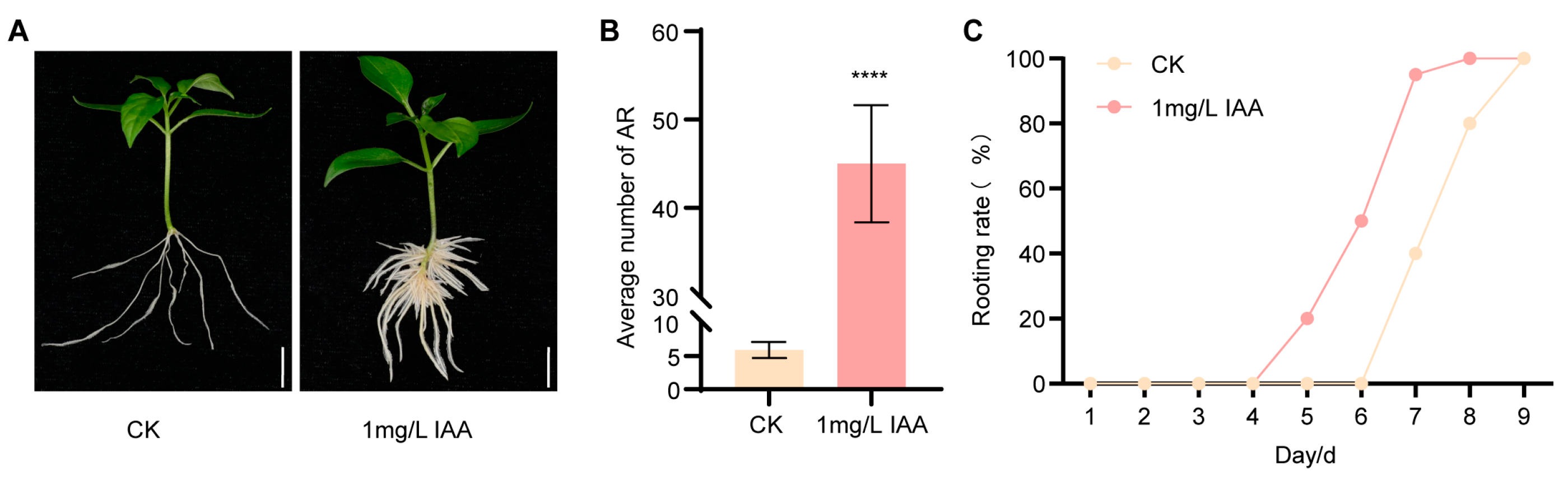
To investigate AR formation in pepper, we selected cultivar S8—a widely grown yet difficult-to-root line—as the experimental material. Two-week-old tissue-cultured seedlings were excised and transferred to either basal MS medium or MS medium supplemented with 1 mg/L IAA, and phenotypic observations were recorded over 10 days. After 10 days of treatment, explants cultured on IAA-containing medium produced approximately eight times the number of ARs as the control (Figure 1A,B). Moreover, AR emergence was observed by day 5 under IAA treatment, whereas in the control group, ARs did not appear until day 7 (Figure 1C).

2.2. Overexpression of CaLBD16 Significantly Promotes AR Formation in Tomato

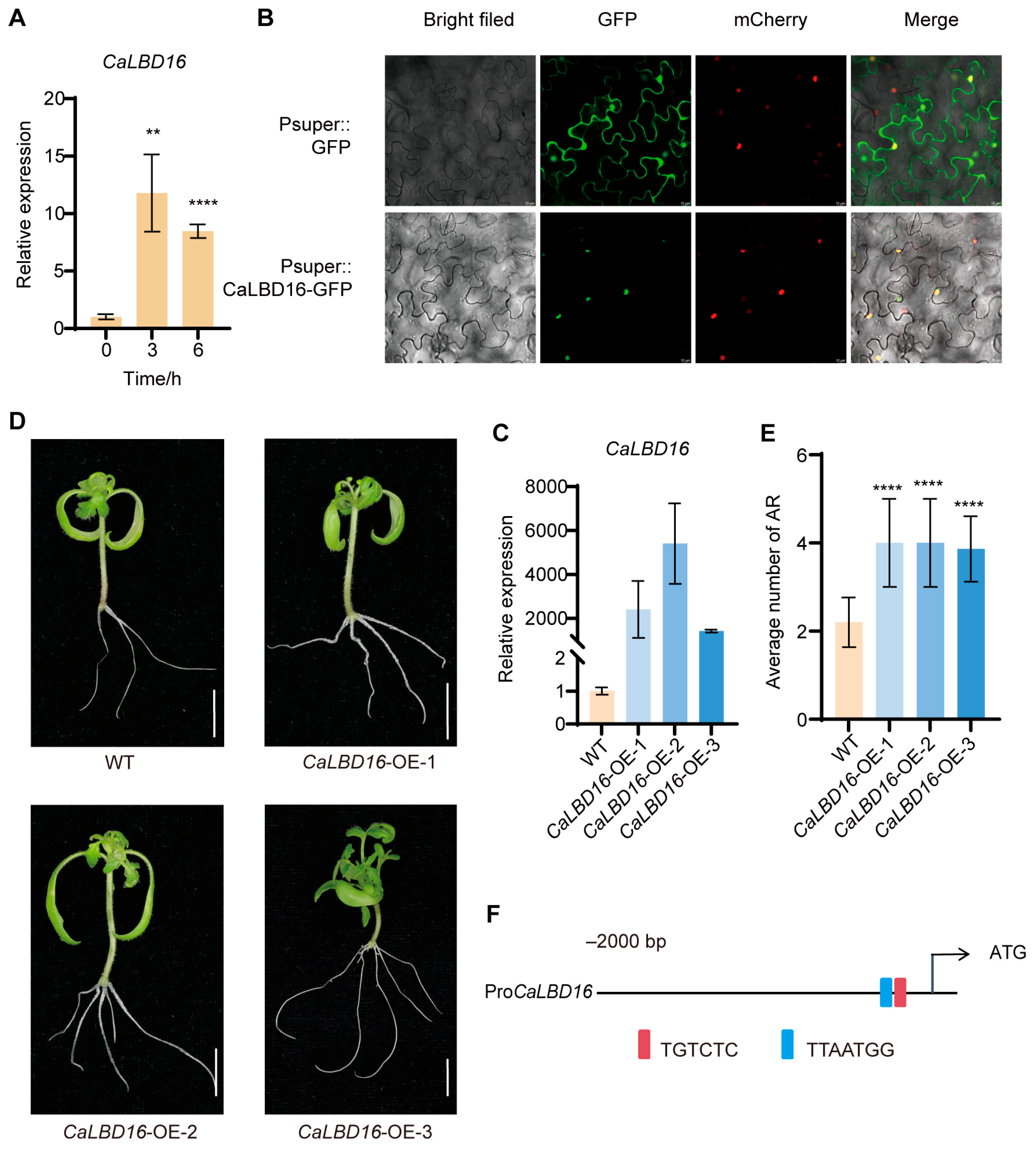
Hypocotyls of cultivar S8 were treated with 1 mg/L IAA and collected for qRT-PCR analysis to examine the expression of CaLBD16, a key transcription factor known to promote AR formation in multiple species [4,17,19]. The results showed that CaLBD16 expression was significantly upregulated in response to exogenous IAA treatment (Figure 2A). Subcellular localization analysis further revealed that CaLBD16 localizes to the nucleus (Figure 2B), consistent with its anticipated role as a transcription factor. The CaLBD16 gene was cloned and introduced into tomato for overexpression, resulting in three independent transgenic lines (Figure 2C). Two-week-old tissue-cultured seedlings of these lines were subjected to cutting propagation, and AR numbers were subsequently recorded. Compared with the wild type (WT), all three CaLBD16-overexpression lines exhibited significantly enhanced AR formation, with an average of approximately 4 ARs per explant compared to approximately 2 in the WT (Figure 2D,E), suggesting that the role of CaLBD16 in promoting AR formation is evolutionarily conserved across plant species.
Given that CaLBD16 expression is auxin-responsive, the molecular mechanism underlying its induction by auxin was further explored. Promoter analysis of CaLBD16 revealed the presence of two conserved cis-regulatory elements upstream of the ATG start codon: a canonical ARF-binding motif (TGTCTC) at position −190 bp and a WOX11-binding motif (TTAATGG) at −194 bp (Figure 2F). These findings provide important clues for identifying upstream regulators involved in the auxin-mediated transcriptional control of CaLBD16.

2.3. CaARF6 Activates CaLBD16

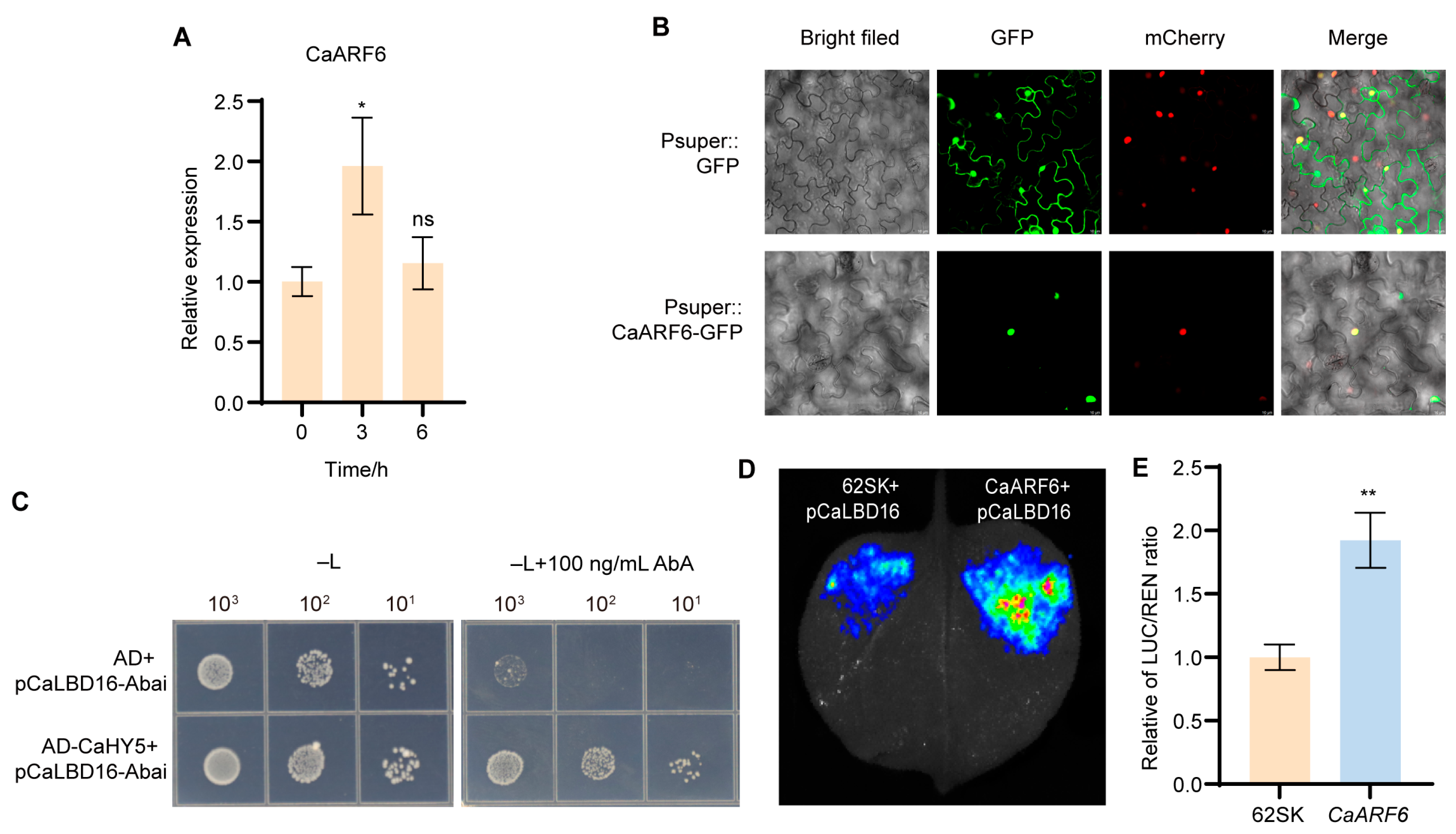
ARF transcription factors are known to play important roles in AR formation. To investigate whether CaARF6 in pepper responds to auxin and participates in this process, we first examined its expression under IAA treatment. The results showed that CaARF6 exhibited an expression pattern similar to that of CaLBD16, with significant upregulation in response to auxin (Figure 3A). Subcellular localization analysis revealed that CaARF6 localizes to the nucleus (Figure 3B), consistent with its role as a transcription factor.
To determine whether CaARF6 directly binds the TGTCTC element, tandem repeats of this motif were used as bait in a yeast one-hybrid (Y1H) assay. The results confirmed that CaARF6 specifically binds to this element (Figure 3C). Using an artificial differentiated system, transient overexpression dual-luciferase reporter assays in Nicotiana benthamiana leaves further demonstrated that CaARF6 significantly activates CaLBD16 expression, with an approximately 1.9-fold increase (Figure 3D,E).

2.4. Overexpression of CaARF6 Significantly Promotes AR Formation in Tomato

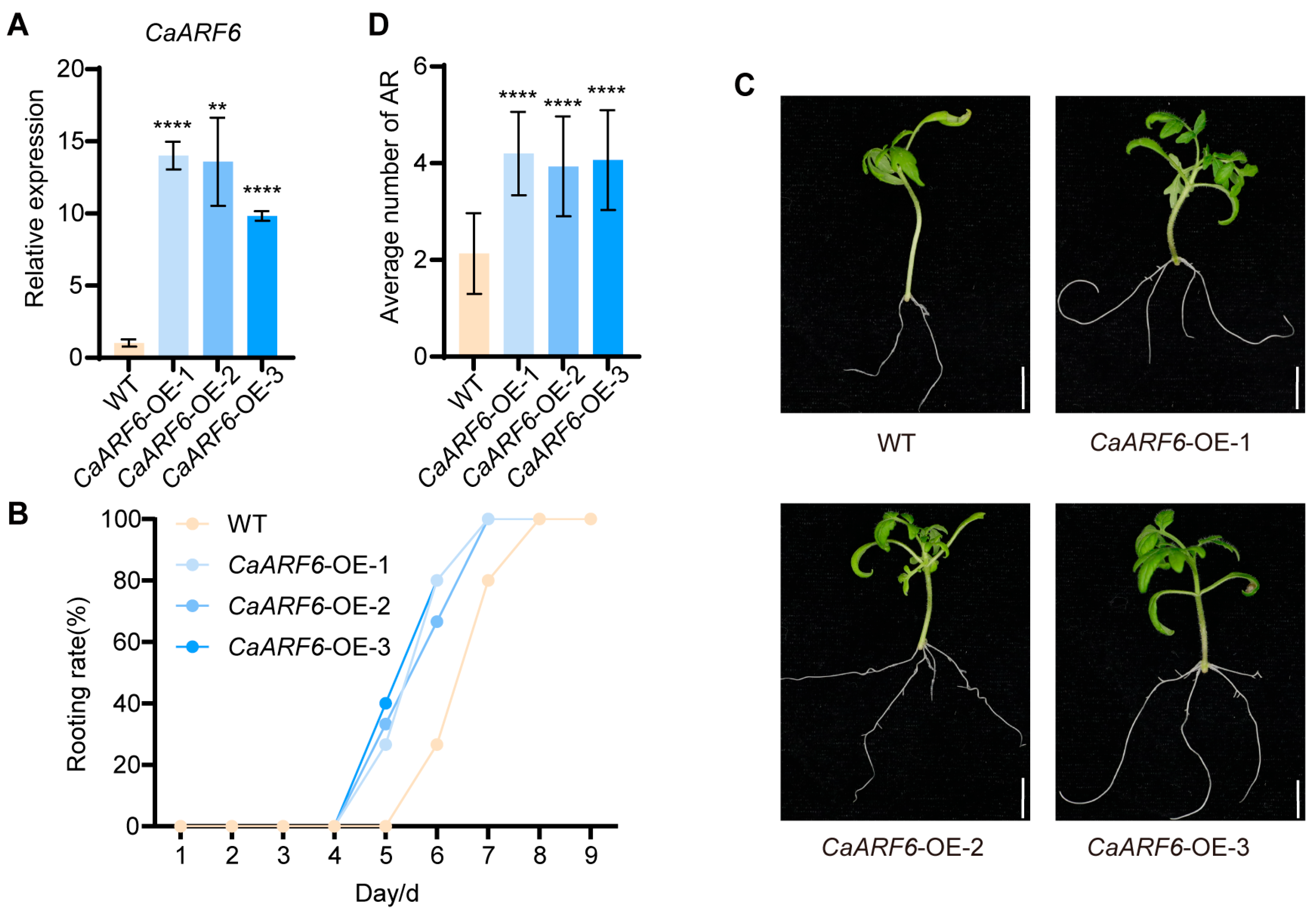
The 35S:CaARF6 construct was introduced into tomato, and three independent transgenic lines were successfully obtained (Figure 4A). Two-week-old hypocotyls of CaARF6-OE lines were excised at the base and transferred to fresh MS medium for AR induction. Root emergence was observed in CaARF6-OE lines at 5d, whereas in WT plants, ARs did not appear until 6d (Figure 4B). Subsequent quantitative analysis revealed that the CaARF6-OE lines produced significantly more ARs than the WT, with an average of approximately four roots per plant compared to only about two in the WT (Figure 4C,D). These results indicate that CaARF6 promotes AR formation.

2.5. CaWOX11 Activates CaLBD16

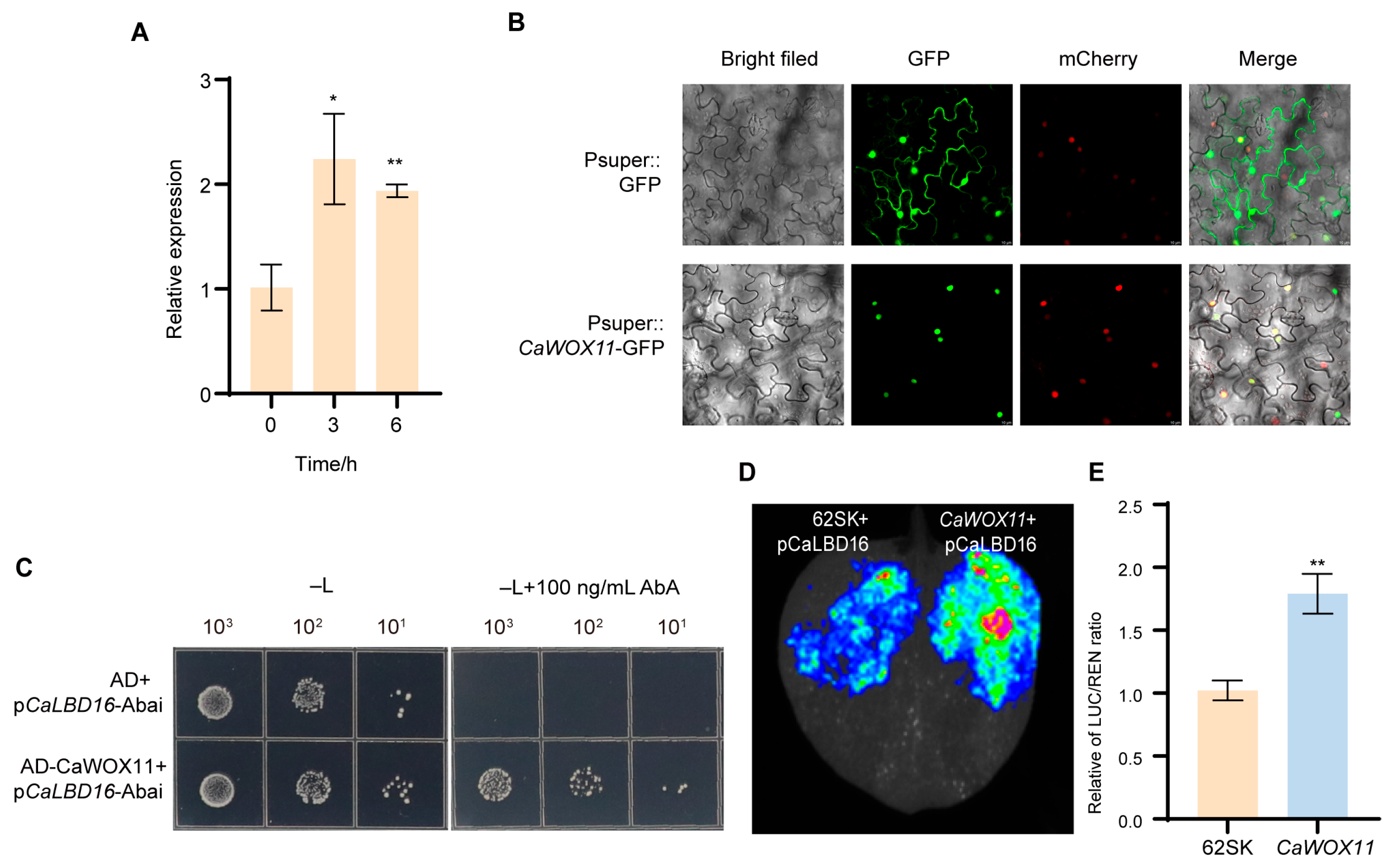
Given that the CaLBD16 promoter contains a TTAATGG motif identical to the WOX11-binding element reported in apple [4], we investigated whether CaWOX11 regulates CaLBD16 in pepper. First, expression analysis showed that CaWOX11 was significantly upregulated in hypocotyls in response to IAA treatment (Figure 5A), consistent with the expression pattern of CaLBD16 (Figure 2A). Transient overexpression of Psuper:CaWOX11 in Nicotiana benthamiana leaves revealed that CaWOX11 localizes to the nucleus (Figure 5B), consistent with its function as a transcription factor.
To determine whether CaWOX11 directly binds the TTAATGG element, tandem repeats of this motif were used as bait in a Y1H assay. The results demonstrated that CaWOX11 specifically binds to this element (Figure 5C). Using an artificial differentiated system, transient overexpression dual-luciferase reporter assays in Nicotiana benthamiana leaves further demonstrated that CaWOX11 significantly activates CaLBD16 expression, with an approximately 1.7-fold increase (Figure 5D,E).

2.6. Overexpression of CaWOX11 Significantly Promotes AR Formation in Tomato

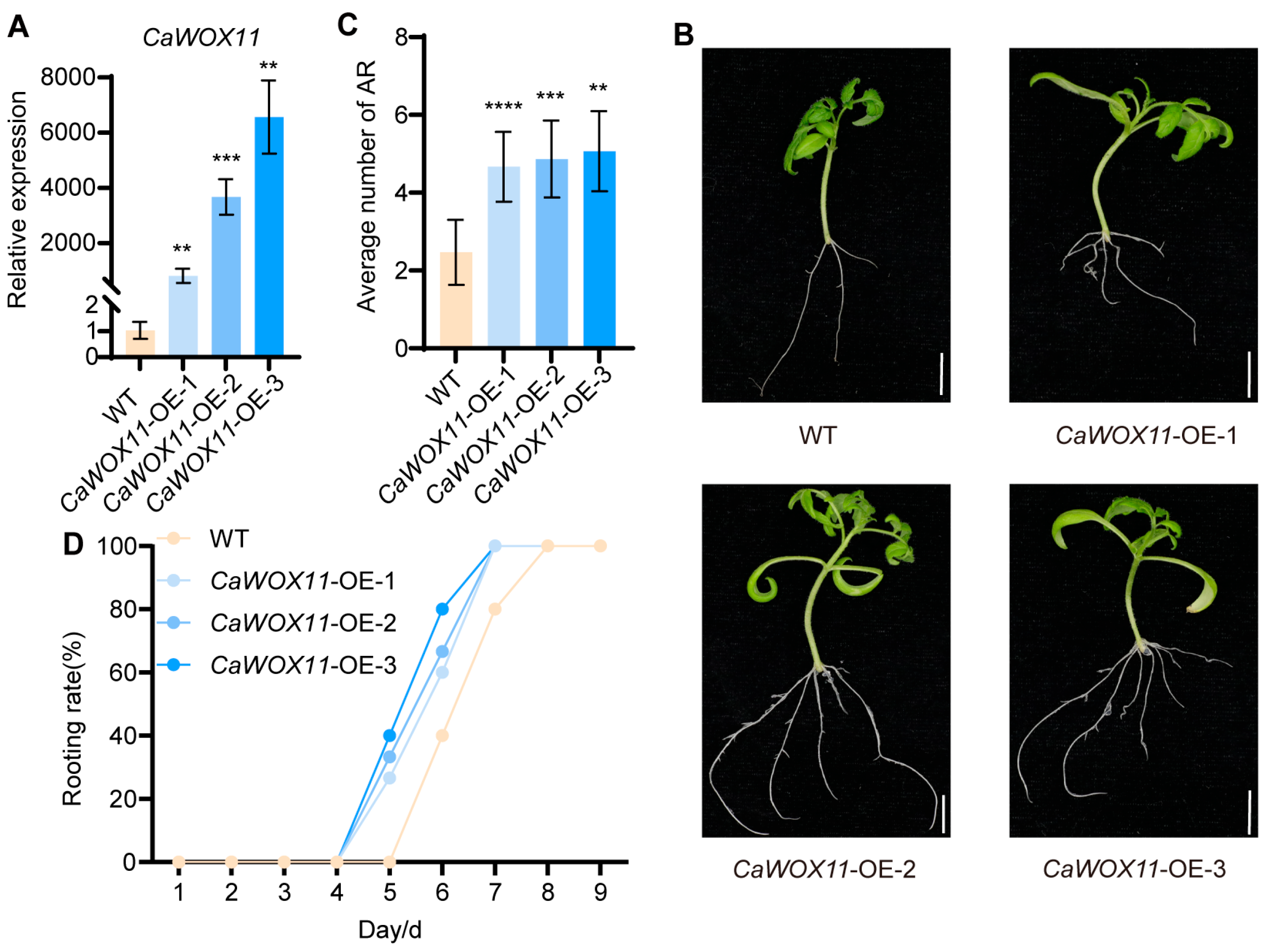
The CaWOX11 gene was overexpressed in tomato, and three independent transgenic lines were successfully generated (Figure 6A). Hypocotyls of two-week-old tissue-cultured seedlings from CaWOX11-OE lines were excised at the base and transferred to fresh MS medium. AR number and rooting rate were recorded over a nine-day period. The results showed that CaWOX11-OE lines exhibited more than twice the number of ARs compared with the WT (Figure 6B,C) and accelerated AR emergence (Figure 6D).

3. Discussion

AR formation is a crucial step in asexual propagation, which serves as an important means of multiplying horticultural crops. Considerable variation in adventitious rooting capacity exists among different pepper cultivars, highlighting the significance of understanding the underlying molecular mechanisms in this species. The formation of ARs occurs as a result of the polar transport of auxin, which establishes an auxin gradient and subsequently leads to the differentiation of root primordium founder cells under auxin stimulation. Exogenous auxin can only mimic endogenous auxin by providing a transient pulse effect. This study investigated the role of exogenous auxin treatment in simulating the process by which auxin promotes adventitious root formation in peppers, and elucidated the connection between the auxin signal transduction pathway and AR formation [20].
Accumulating evidence has demonstrated that auxin promotes adventitious root formation across a wide range of plant species, including Arabidopsis [21], water fern [22], Ulmus pumila [3], tomato [23], sweet potato [24], and cucumber [25]. In line with these findings, our experiments in pepper also showed that auxin enhances AR formation during cutting propagation (Figure 1). This suggests that the promoting role of auxin in AR formation is likely conserved across the plant kingdom.
LBD transcription factors have been implicated in the development of various plant organs, including lateral roots [17], flowers [26], and leaves [27]. Several members of this family are also known to regulate AR formation, such as LBD16/29 [28], LBD17 [18], and LBD18 [17]. Among these, LBD16 has been reported to control adventitious rooting in multiple species, including Arabidopsis, peach [29], poplar [30], and maize [31]. However, whether LBD16 plays a similar role in pepper remained unknown. In this study, we overexpressed CaLBD16 in tomato and observed a significant promotion of AR formation. Moreover, CaLBD16 expression was upregulated in response to IAA treatment, suggesting that IAA induces CaLBD16 to enhance adventitious rooting in pepper (Figure 2).
The signaling pathway through which auxin regulates CaLBD16 in pepper warrants further investigation. ARF transcription factors, as key mediators of auxin signaling, have been implicated in AR formation across diverse species. Notably, studies indicate that ARFs ultimately converge on the activation of LBD16 to exert their function, as observed in peach [29] and poplar [30]. In this study, we identified a canonical ARF-binding motif (TGTCTC) within the CaLBD16 promoter and experimentally validated CaARF6 as a direct upstream regulator (Figure 3). Furthermore, phenotypic analysis confirmed that CaARF6 promotes AR formation (Figure 4).
De novo AR formation requires cell fate transition, a process in which WOX11 and WOX5 have been shown to play key roles [16]. These factors subsequently promote adventitious rooting through the activation of LBD16 [32]. In apple and Arabidopsis, the WOX11-binding element has been identified as TTAATGG [4,10]. Promoter analysis of CaLBD16 revealed the presence of this element at position −194 bp relative to the start codon. Experimental validation confirmed that CaWOX11 regulates CaLBD16 expression in pepper. Notably, compared with the element positions reported in apple and Arabidopsis, this motif is located closer to the start codon in pepper, suggesting a potentially stronger regulatory effect.
Although auxin is widely recognized for its role in promoting AR formation, its function in pepper has not been specifically investigated. Our study demonstrates that exogenous IAA serves as a key hormone in promoting adventitious rooting in pepper. Furthermore, we elucidated a regulatory pathway—conserved in other species—by which mechanical wounding induces AR formation through auxin activation, mediated by CaWOX11 and CaARF6, with CaLBD16 at its core. These findings provide a theoretical basis for improving rooting efficiency in pepper production and offer valuable insights for breeding cultivars more amenable to cutting propagation.

4. Materials and Methods

4.1. Plant Materials and Treatment

Seeds of pepper S8 were surface-sterilized and sown on 1/2 MS medium (Coolaber, Beijing, China). Two weeks later, the basal parts of the hypocotyls were excised and transferred to MS medium supplemented with 1 mg/L IAA (Sigma-Aldrich, St. Louis, MO, USA) for subculture. Tomato seeds were similarly sterilized and germinated on1/2 MS medium supplemented with 1.5% (w/v) sucrose and solidified with 0.8% agar. After two weeks, the basal hypocotyl segments were cut and subcultured onto MS medium (Coolaber, Beijing, China) supplemented with 3% (w/v) sucrose and solidified with 0.8% agar containing 1 mg/L IAA as well as onto hormone-free MS medium. All plant materials were maintained in sterile growth chambers under controlled conditions: a day/night temperature of 26/23 °C, a 16 h light/8 h dark photoperiod, and a light intensity of 144 μmol/m2/s.
S8 seedlings at two weeks of age were treated by spraying the hypocotyls with a solution containing 1 mg/L IAA and 0.1% (v/v) Triton X-100 (Solarbio, Beijing, China). Samples were harvested from hypocotyls at 0, 3, and 6 h after treatment, immediately flash-frozen in liquid nitrogen, and kept at −80 °C until RNA isolation. Each biological replicate consisted of pooled tissue from five individual plants, and three independent replicates were collected per time point.

4.2. Construction of Transgenic Overexpression

The effects of overexpressing CaARF6, CaWOX11, and CaLBD16 under the control of the 35S promoter were investigated in Ailsa Craig (AC). Full-length coding sequences of these genes were amplified from pepper S8 and cloned into the pHellgate 8 vector. The constructs were then heterologously introduced into tomato plants via Agrobacterium rhizocarpus-mediated transformation with strain GV3101. Transgenic plants were confirmed by PCR analysis, and transgene expression levels were determined by RT-qPCR.

4.3. RNA Isolation and Expression Analysis

Total RNA was isolated from frozen tissue samples using the SteadyPure Plant RNA Extraction Kit. Approximately 1 μg of RNA was reverse-transcribed into cDNA with the HiScript II 1st Strand cDNA Synthesis Kit (Vazyme, Nanjing, China). Quantitative real-time PCR (qRT-PCR) was performed on a Roche LightCycler® 480 system (Roche Diagnostics, Basel, Switzerland) using ChamQ Universal SYBR qPCR Master Mix (Vazyme, Nanjing, China) in 96-well plates. The housekeeping gene (Caz06g27840/Solyc11g005330.1) served as an internal reference [33], and all primer sequences are provided in Table S1.

4.4. Subcellular Localization

The coding sequences of CaARF6, CaWOX11, and CaLBD16 (excluding stop codons) were inserted into the 35S::pCAMBIA1300-GFP vector. The resulting constructs and the empty vector were introduced into Nicotiana benthamiana leaves via Agrobacterium rhizogenes strain GV3101, along with the nuclear marker AtHY5-mCherry. Fluorescence was visualized using a Zeiss LSM510 META confocal microscope (Carl Zeiss, Oberkochen, Germany) with excitation/emission wavelengths of 488/510 nm for GFP and 561/610 nm for mCherry.

4.5. Yeast One-Hybrid Assay

The full-length coding sequences of CaARF6 and CaWOX11 were inserted into the pGADT7 vector. A tandem triple repeat of the CaLBD16 promoter fragment (AAGCCATTAATAA or AAATGTCTCCTA) was synthesized and cloned into the pAbAi bait vector following BstBI (New England Biolabs, Ipswich, MA, USA) digestion. The resulting construct was linearized and integrated into the yeast Y1H Gold (WeiDi Biotechnology, Shanghai, China) genome to generate reporter strains. These strains were subsequently transformed with either AD-CaARF6 or AD-CaWOX11. Transformants were selected on SD/-Leu/-Ura medium (Coolaber, Beijing, China) at 28 °C for 72 h. Positive colonies were resuspended in distilled water to an OD600 of 0.2, and aliquots were spotted onto SD/-Leu/-Ura plates with or without aureobasidin A (AbA) (Coolaber, Beijing, China). Yeast cells co-transformed with empty pGADT7 and pAbAi-CaLBD16 served as the negative control.

4.6. Dual-Luciferase Transactivation Assay

For binding activity assays, a 2000 bp promoter fragment upstream of the start codon of each target gene was cloned into the pGreen II 0800-LUC vector as the reporter. This vector also contains a 35S-driven Renilla luciferase (REN) cassette serving as an internal control. The full-length coding sequences of CaARF6 and CaWOX11 were inserted into the pGreen II 62-SK vector to generate effector constructs, while the empty 62-SK vector was used as a negative control. All constructs were transformed into Agrobacterium tumefaciens GV3101. Appropriate combinations of agrobacterial cultures were mixed and co-infiltrated into Nicotiana benthamiana leaves. After three days, the leaves were sprayed with luciferin and images were captured using a CCD camera (e.g., NEWTON 7.0 Bio) (Vilber, Marne-la-Vallée, France). Firefly and Renilla luciferase activities were quantified using a dual-luciferase assay kit (Promega, Madison, WI, USA).

Supplementary Materials

The following supporting information can be downloaded at: https://www.mdpi.com/article/10.3390/plants15081188/s1, Table S1: Primers used in the present study.

Author Contributions

Data curation, X.Z. and B.T.; funding acquisition, F.L.; investigation, H.S., K.L., M.H., Q.D., Z.Y., L.X., M.W., M.Y. and J.L.; methodology, X.Z. and B.T. and F.L.; resources, B.T., Z.Z. and F.L.; validation, X.Z.; writing—original draft, X.Z.; writing—review and editing, X.Z., Z.Z. and F.L. All authors have read and agreed to the published version of the manuscript.

Funding

This research was funded by the National Natural Science Foundation of China (Grant No. 32272517 and Grant Nos. 32494784) and the Yuelushan Laboratory Breeding Program (2025-ZY01012).

Data Availability Statement

The data used to support the findings of this study are available upon request to the corresponding author.

Conflicts of Interest

The authors declare no conflicts of interest.

References

  1. Bellini, C.; Pacurar, D.I.; Perrone, I. Adventitious Roots and Lateral Roots: Similarities and Differences. Annu. Rev. Plant Biol. 2014, 65, 639–666. [Google Scholar] [CrossRef]
  2. Qi, X.; Li, Q.; Ma, X.; Qian, C.; Wang, H.; Ren, N.; Shen, C.; Huang, S.; Xu, X.; Xu, Q.; et al. Waterlogging-Induced Adventitious Root Formation in Cucumber Is Regulated by Ethylene and Auxin through Reactive Oxygen Species Signalling. Plant Cell Environ. 2019, 42, 1458–1470. [Google Scholar] [CrossRef]
  3. Wei, K.; Ruan, L.; Wang, L.; Cheng, H. Auxin-Induced Adventitious Root Formation in Nodal Cuttings of Camellia Sinensis. Int. J. Mol. Sci. 2019, 20, 4817. [Google Scholar] [CrossRef]
  4. Mao, J.; Niu, C.; Li, K.; Fan, L.; Liu, Z.; Li, S.; Ma, D.; Tahir, M.M.; Xing, L.; Zhao, C.; et al. Cytokinin-Responsive MdTCP17 Interacts with MdWOX11 to Repress Adventitious Root Primordium Formation in Apple Rootstocks. Plant Cell 2023, 35, 1202–1221. [Google Scholar] [CrossRef] [PubMed]
  5. Wang, W.; Jiao, M.; Huang, X.; Liang, W.; Ma, Z.; Lu, Z.; Tian, S.; Gao, X.; Fan, L.; He, X.; et al. The Auxin-Responsive CsSPL9-CsGH3.4 Module Finely Regulates Auxin Levels to Suppress the Development of Adventitious Roots in Tea (Camellia sinensis). Plant J. Cell Mol. Biol. 2024, 119, 2273–2287. [Google Scholar] [CrossRef]
  6. Yusuf, Z.; Desta, M.; Mohammed, W. Direct Organogenesis of Citrus Cultivars from Shoot Tip Nodal Segments. Recent Pat. Biotechnol. 2024, 18, 63–70. [Google Scholar] [CrossRef]
  7. Cheng, L.; Liu, H.; Zhao, J.; Dong, Y.; Xu, Q.; Yu, Y. Hormone Orchestrates a Hierarchical Transcriptional Cascade That Regulates Al-Induced de Novo Root Regeneration in Tea Nodal Cutting. J. Agric. Food Chem. 2021, 69, 5858–5870. [Google Scholar] [CrossRef] [PubMed]
  8. Li, Q.-Q.; Zhang, Z.; Zhang, C.-X.; Wang, Y.-L.; Liu, C.-B.; Wu, J.-C.; Han, M.-L.; Wang, Q.-X.; Chao, D.-Y. Phytochrome-Interacting Factors Orchestrate Hypocotyl Adventitious Root Initiation in Arabidopsis. Development 2022, 149, dev200362. [Google Scholar] [CrossRef]
  9. Della Rovere, F.; Fattorini, L.; D’Angeli, S.; Veloccia, A.; Falasca, G.; Altamura, M.M. Auxin and Cytokinin Control Formation of the Quiescent Centre in the Adventitious Root Apex of Arabidopsis. Ann. Bot. 2013, 112, 1395–1407. [Google Scholar] [CrossRef]
  10. Zhang, T.; Ge, Y.; Cai, G.; Pan, X.; Xu, L. WOX-ARF Modules Initiate Different Types of Roots. Cell Rep. 2023, 42, 112966. [Google Scholar] [CrossRef] [PubMed]
  11. Liu, S.; Wang, Q.; Zhong, M.; Lin, G.; Ye, M.; Wang, Y.; Zhang, J.; Wang, Q. The CRY1-COP1-HY5 Axis Mediates Blue-Light Regulation of Arabidopsis Thermotolerance. Plant Commun. 2025, 6, 101264. [Google Scholar] [CrossRef]
  12. Sun, C.; Fan, K.; Wang, X.; Liu, H.; Guo, N.; Liu, W.; Ye, G.; Lin, W.; Lin, W.; Li, Z. The Involvement of Auxin Response Factor OsARF7 in Positively Regulating Root Development by Mediating the Expression of OsCRL1 in Rice (Oryza sativa L.). Plant Mol. Biol. 2025, 115, 38. [Google Scholar] [CrossRef]
  13. Zhang, Y.; Yang, X.; Cao, P.; Xiao, Z.; Zhan, C.; Liu, M.; Nvsvrot, T.; Wang, N. The bZIP53-IAA4 Module Inhibits Adventitious Root Development in Populus. J. Exp. Bot. 2020, 71, 3485–3498. [Google Scholar] [CrossRef]
  14. Cao, H.; Zhang, X.; Li, F.; Han, Z.; Ding, B. A Point Mutation in the IAA14 Promoter Enhances Callus Formation and Regeneration. Physiol. Mol. Biol. Plants Int. J. Funct. Plant Biol. 2024, 30, 1253–1263. [Google Scholar] [CrossRef]
  15. Zhu, H.; Li, H.; Yu, J.; Zhao, H.; Zhang, K.; Ge, W. Regulatory Mechanisms of ArAux/IAA13 and ArAux/IAA16 in the Rooting Process of Acer Rubrum. Genes 2023, 14, 1206. [Google Scholar] [CrossRef] [PubMed]
  16. Hu, X.; Xu, L. Transcription Factors WOX11/12 Directly Activate WOX5/7 to Promote Root Primordia Initiation and Organogenesis. Plant Physiol. 2016, 172, 2363–2373. [Google Scholar] [CrossRef]
  17. Lee, H.W.; Cho, C.; Pandey, S.K.; Park, Y.; Kim, M.-J.; Kim, J. LBD16 and LBD18 Acting Downstream of ARF7 and ARF19 Are Involved in Adventitious Root Formation in Arabidopsis. BMC Plant Biol. 2019, 19, 46. [Google Scholar] [CrossRef]
  18. Omary, M.; Gil-Yarom, N.; Yahav, C.; Steiner, E.; Hendelman, A.; Efroni, I. A Conserved Superlocus Regulates Above- and Belowground Root Initiation. Science 2022, 375, eabf4368. [Google Scholar] [CrossRef]
  19. Wu, X.; Wang, Z.; Du, A.; Gao, H.; Liang, J.; Yu, W.; Yu, H.; Fan, S.; Chen, Q.; Guo, J.; et al. Transcription Factor LBD16 Targets Cell Wall Modification/Ion Transport Genes in Peach Lateral Root Formation. Plant Physiol. 2024, 194, 2472–2490. [Google Scholar] [CrossRef] [PubMed]
  20. Pasternak, T.; Yaroshko, O. Molecular Biology Needs a Map: Spatial in Situ Approaches in Plant Science. Plant Biol. 2026, 28, 323–327. [Google Scholar] [CrossRef] [PubMed]
  21. da Costa, C.T.; Gaeta, M.L.; de Araujo Mariath, J.E.; Offringa, R.; Fett-Neto, A.G. Comparative Adventitious Root Development in Pre-Etiolated and Flooded Arabidopsis Hypocotyls Exposed to Different Auxins. Plant Physiol. Biochem. PPB 2018, 127, 161–168. [Google Scholar] [CrossRef] [PubMed]
  22. Yu, J.; Zhang, Y.; Liu, W.; Wang, H.; Wen, S.; Zhang, Y.; Xu, L. Molecular Evolution of Auxin-Mediated Root Initiation in Plants. Mol. Biol. Evol. 2020, 37, 1387–1393. [Google Scholar] [CrossRef] [PubMed]
  23. Guan, L.; Tayengwa, R.; Cheng, Z.M.; Peer, W.A.; Murphy, A.S.; Zhao, M. Auxin Regulates Adventitious Root Formation in Tomato Cuttings. BMC Plant Biol. 2019, 19, 435. [Google Scholar] [CrossRef]
  24. Zhou, Y.; Li, A.; Du, T.; Qin, Z.; Zhang, L.; Wang, Q.; Li, Z.; Hou, F. A Small Auxin-up RNA Gene, IbSAUR36, Regulates Adventitious Root Development in Transgenic Sweet Potato. Genes 2024, 15, 760. [Google Scholar] [CrossRef]
  25. Qi, X.; Li, Q.; Shen, J.; Qian, C.; Xu, X.; Xu, Q.; Chen, X. Sugar Enhances Waterlogging-Induced Adventitious Root Formation in Cucumber by Promoting Auxin Transport and Signalling. Plant Cell Environ. 2020, 43, 1545–1557. [Google Scholar] [CrossRef] [PubMed]
  26. Kim, M.-J.; Kim, M.; Lee, M.R.; Park, S.K.; Kim, J. LATERAL ORGAN BOUNDARIES DOMAIN (LBD)10 Interacts with SIDECAR POLLEN/LBD27 to Control Pollen Development in Arabidopsis. Plant J. Cell Mol. Biol. 2015, 81, 794–809. [Google Scholar] [CrossRef]
  27. Wu, M.; He, W.; Wang, L.; Zhang, X.; Wang, K.; Xiang, Y. PheLBD29, an LBD Transcription Factor from Moso Bamboo, Causes Leaf Curvature and Enhances Tolerance to Drought Stress in Transgenic Arabidopsis. J. Plant Physiol. 2023, 280, 153865. [Google Scholar] [CrossRef]
  28. Wan, Q.; Zhai, N.; Xie, D.; Liu, W.; Xu, L. WOX11: The Founder of Plant Organ Regeneration. Cell Regen. 2023, 12, 1. [Google Scholar] [CrossRef]
  29. Liu, J.; Gao, L.; Zhang, R.; Gao, A.; Oginga, Z.K.; Zheng, B.; Han, Y. ARF4 Acting Upstream of LBD16 Promotes Adventitious Root Formation in Peach. Hortic. Plant J. 2025, 11, 145–161. [Google Scholar] [CrossRef]
  30. Yue, J.; Yang, H.; Yang, S.; Wang, J. TDIF Regulates Auxin Accumulation and Modulates Auxin Sensitivity to Enhance Both Adventitious Root and Lateral Root Formation in Poplar Trees. Tree Physiol. 2020, 40, 1534–1547. [Google Scholar] [CrossRef]
  31. Xu, C.; Tai, H.; Saleem, M.; Ludwig, Y.; Majer, C.; Berendzen, K.W.; Nagel, K.A.; Wojciechowski, T.; Meeley, R.B.; Taramino, G.; et al. Cooperative Action of the Paralogous Maize Lateral Organ Boundaries (LOB) Domain Proteins RTCS and RTCL in Shoot-Borne Root Formation. New Phytol. 2015, 207, 1123–1133. [Google Scholar] [CrossRef] [PubMed]
  32. Bustillo-Avendaño, E.; Ibáñez, S.; Sanz, O.; Sousa Barros, J.A.; Gude, I.; Perianez-Rodriguez, J.; Micol, J.L.; Del Pozo, J.C.; Moreno-Risueno, M.A.; Pérez-Pérez, J.M. Regulation of Hormonal Control, Cell Reprogramming, and Patterning during de Novo Root Organogenesis. Plant Physiol. 2018, 176, 1709–1727. [Google Scholar] [CrossRef] [PubMed]
  33. Tang, B.; Yang, H.; Yin, Q.; Miao, W.; Lei, Y.; Cui, Q.; Cheng, J.; Zhang, X.; Chen, Y.; Du, J.; et al. Fertility Restorer Gene CaRf and PepperSNP50K Provide a Promising Breeding System for Hybrid Pepper. Hortic. Res. 2024, 11, uhae223. [Google Scholar] [CrossRef] [PubMed]
Figure 1. Exogenous IAA treatment promotes adventitious root (AR) formation in pepper. (A) Morphological observation of two-week-old pepper cuttings (with roots removed) cultured on MS medium for 10 days with 1 mg/L exogenous IAA treatment, using control medium as a control. (B) Counting of adventitious root (AR) numbers within 10 days of exogenous IAA treatment. (C) Statistical analysis of the AR formation rate. Data are means ± SE [n = 15 (A,B)], n represents the biological replicate. Differences (**** p < 0.0001) are based on two-tailed Student’s t-test.
Plants 15 01188 g001
Figure 2. CaLBD16 mediates IAA signaling to promote AR formation. (A) CaLBD16 was upregulated in response to IAA treatment. (B) CaLBD16-GFP is localized to the nucleus in differentiated tobacco cells, along with the nuclear marker AtHY5-mCherry. Scale bar = 10 μm. (C) Three tomato lines overexpressing CaLBD16 were identified by qRT-PCR. (D) Morphological observation of AR formation in CaLBD16-overexpressing tomato cuttings compared with WT. (E) Quantification of AR formation in (D). (F) Promoter analysis of CaLBD16. Data are means ± SE [n = 3 (A,C), n = 15 (D,E)], n represents the biological replicate. Differences (** p < 0.01, **** p < 0.0001) are based on two-tailed Student’s t-test.
Plants 15 01188 g002
Figure 3. CaARF6 activates CaLBD16 expression in response to IAA signaling. (A) CaARF6 was upregulated in response to IAA treatment. (B) CaARF6-GFP is localized to the nucleus in differentiated tobacco cells, along with the nuclear marker AtHY5-mCherry. Scale bar = 10 μm. (C) Yeast one-hybrid assays demonstrated that CaARF6 binds to the CaLBD16 promoter fragment. (D,E) Dual-LUC reporter gene assay demonstrating transactivation of CaLBD16 by CaARF6 in N. benthamiana leaves. The activity of firefly LUC and REN was assessed by co-expression of 35S:CaARF6 with ProCaLBD16:LUC in N. benthamiana leaves. The empty vector served as the control. Data are means ± SE [n = 3 (A,E)], n represents the biological replicate. Differences (ns p > 0.05, * p < 0.05, ** p < 0.01,) are based on two-tailed Student’s t-test.
Plants 15 01188 g003
Figure 4. CaARF6 promotes AR formation. (A) Three tomato lines overexpressing CaARF6 were identified by qRT-PCR. (B) Rooting rates of CaARF6-overexpressing tomato cuttings within 9 days compared to WT. (C) Morphological observation of AR formation in CaARF6-overexpressing tomato cuttings compared with WT. (D) Quantification of AR formation in B. Data are means ± SE [n = 3 (A), n = 15 (BD)], n represents the biological replicate. Differences (** p < 0.01, **** p < 0.0001) are based on two-tailed Student’s t-test.
Plants 15 01188 g004
Figure 5. CaWOX11 activates CaLBD16 expression in response to IAA signaling. (A) CaWOX11 was upregulated in response to IAA treatment. (B) CaWOX11-GFP is localized to the nucleus in differentiated tobacco cells, along with the nuclear marker AtHY5-mCherry. Scale bar = 10. (C) Y1H assays demonstrated that CaWOX11 binds to the CaLBD16 promoter fragment. (D,E) Dual-LUC reporter gene assay demonstrating transactivation of CaLBD16 by CaWOX11 in N. benthamiana leaves. The activity of firefly LUC and REN was assessed by co-expression of 35S: CaWOX11 with ProCaLBD16:LUC in N. benthamiana leaves. The empty vector served as the control. Data are means ± SE [n = 3 (A,E)], n represents the biological replicate. Differences (* p < 0.05, ** p < 0.01,) are based on two-tailed Student’s t-test.
Plants 15 01188 g005
Figure 6. CaWOX11 promotes AR formation. (A) Three tomato lines overexpressing CaWOX11 were identified by qRT-PCR. (B) Morphological observation of AR formation in CaWOX11-overexpressing tomato cuttings compared with WT. (C) Quantification of AR formation in (B). (D) Rooting rates of CaWOX11-overexpressing tomato cuttings within 9 days compared to WT in (B). Data are means ± SE [n = 3 (A), n = 15 (BD)], n represents the biological replicate. Differences (** p < 0.01, *** p < 0.001, **** p < 0.0001) are based on two-tailed Student’s t-test.
Plants 15 01188 g006
Disclaimer/Publisher’s Note: The statements, opinions and data contained in all publications are solely those of the individual author(s) and contributor(s) and not of MDPI and/or the editor(s). MDPI and/or the editor(s) disclaim responsibility for any injury to people or property resulting from any ideas, methods, instructions or products referred to in the content.