Tree Height Prediction Using a Double Hidden-Layer Neural Network and a Mixed-Effects Model




Abstract
1. Introduction
2. Materials and Methods
2.1. Data Sources
2.2. BP Neural Network
2.2.1. Number of Hidden-Layer Nodes and Transfer Function
2.2.2. Normalization and Denormalization of Input/Output Data
2.2.3. Model Training
2.2.4. Model Selection
2.2.5. Neural Network Modeling Process
2.3. Mixed-Effects Modeling
2.3.1. Mixed-Effects Model
2.3.2. Basic Model
2.3.3. Structure of Mixed-Effects Model
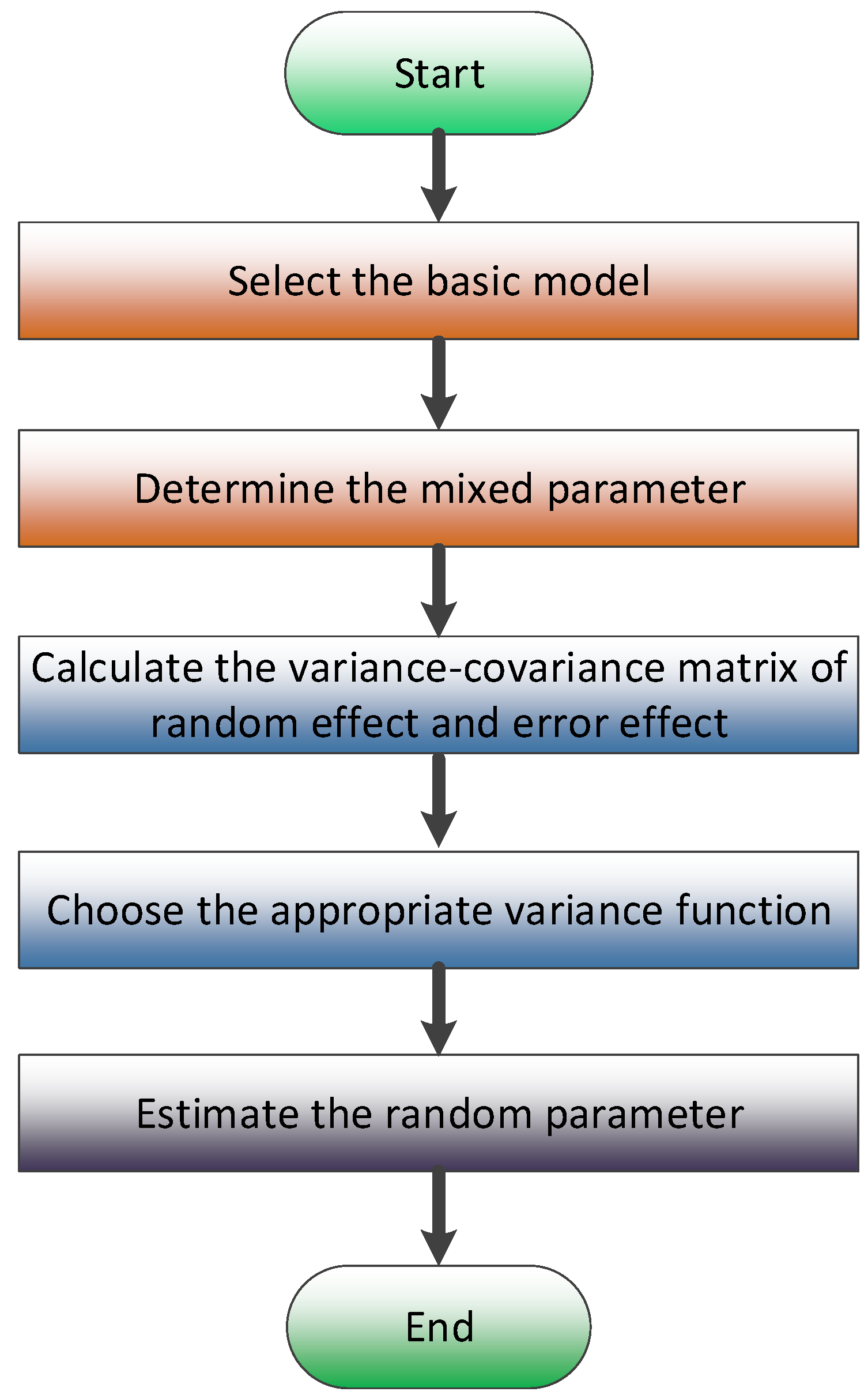
2.3.4. Calculating Parameter of Mixed-Effects Model
- (1)
- Determining Parameter
- (2)
- Calculating Variance–Covariance Matrix of Random Effect
- (3)
- Calculating Variance–Covariance Matrix of Error Effect
- (4)
- Estimating Random Parameter
2.4. Evaluation Index of the Two Models
3. Results
3.1. Data Characteristic
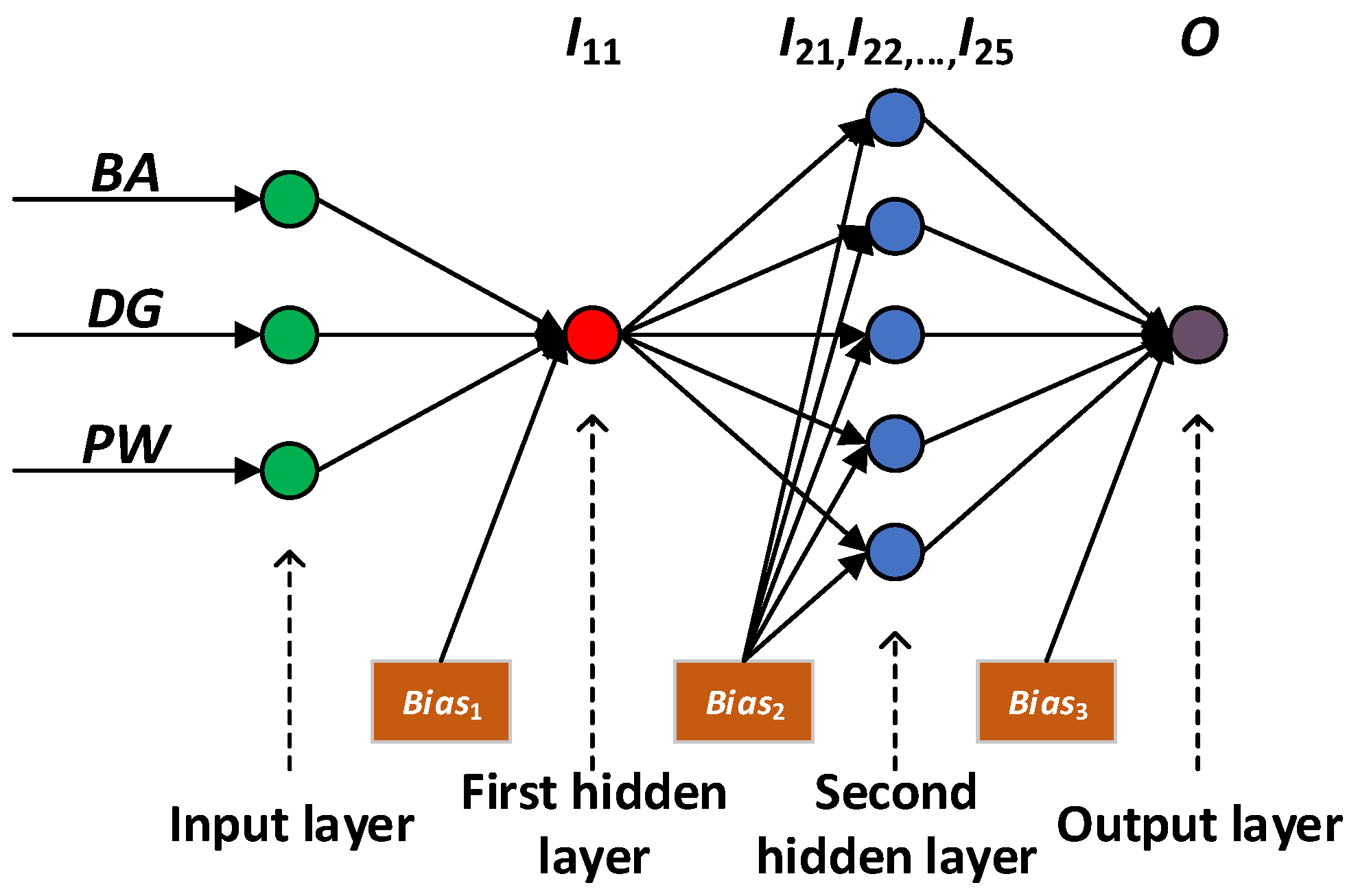
3.2. Strucutre of Neural Nework
3.3. Construction of Mixed-Effects Model
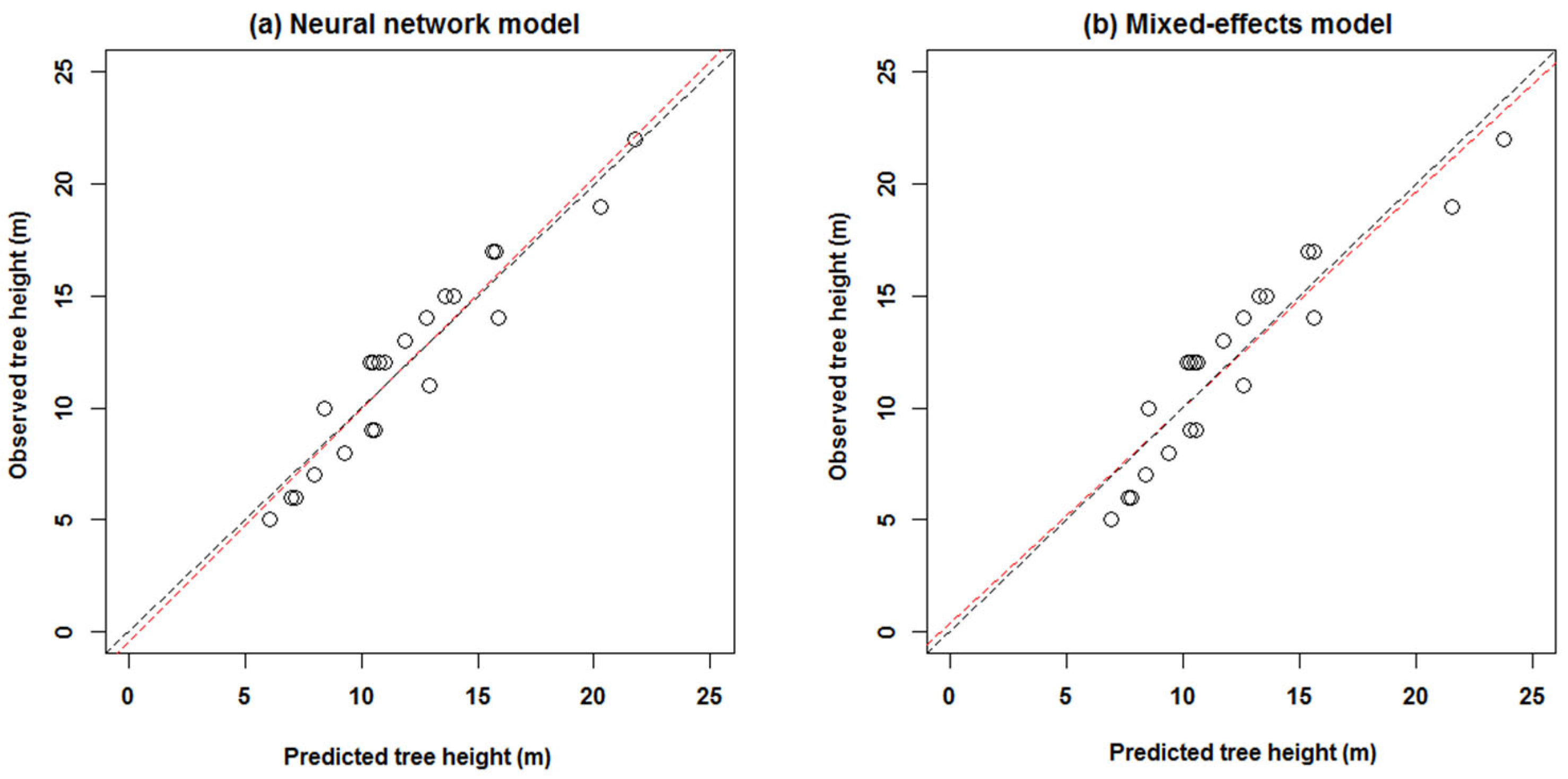
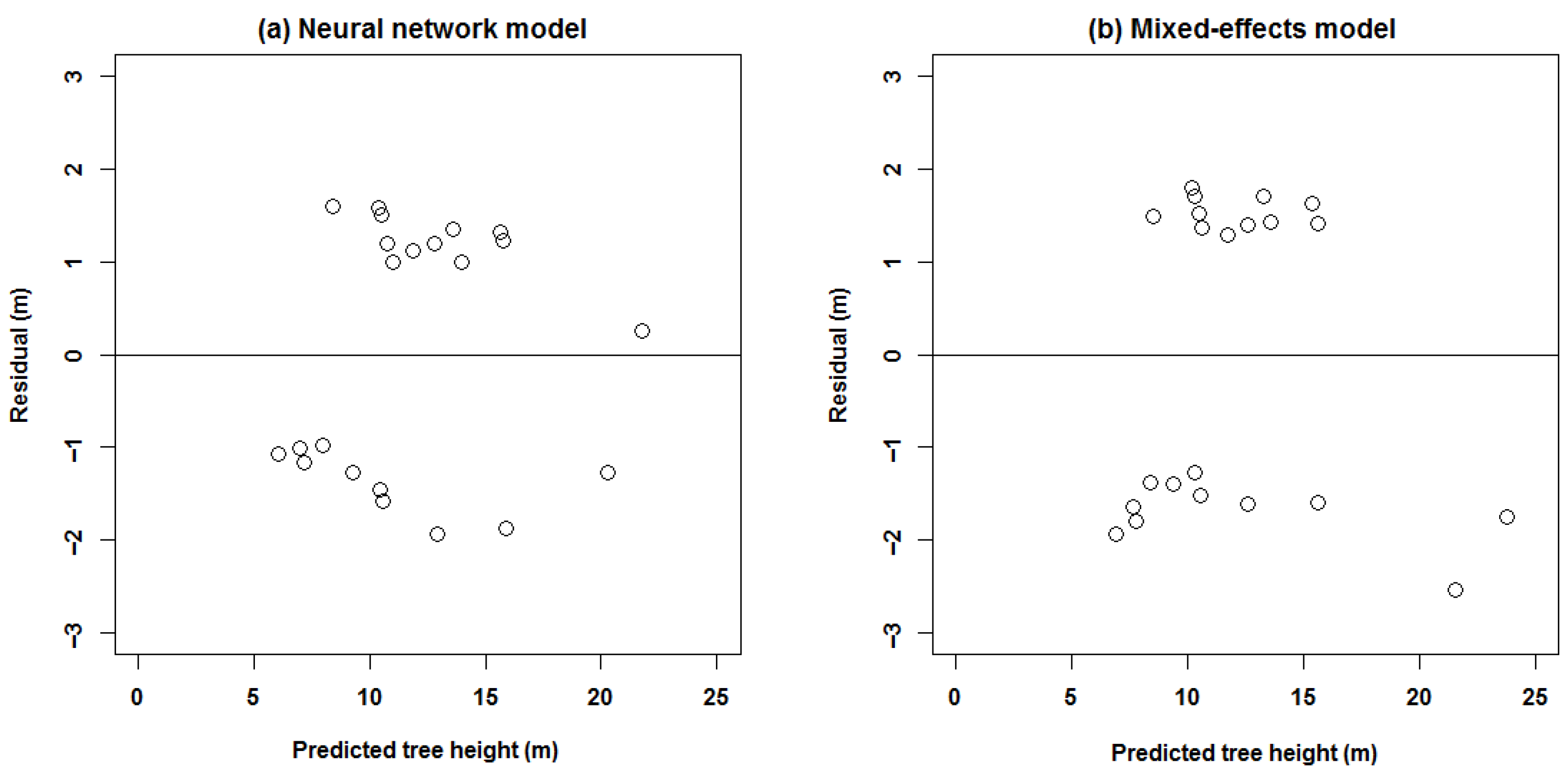
3.4. Comparsion Results of Evaluation Index
4. Discussion
5. Conclusions
Author Contributions
Funding
Data Availability Statement
Conflicts of Interest
References
- Watt, M.S.; Dash, J.P.; Bhandari, S.; Watt, P. Comparing parametric and non-parametric methods of predicting Site Index for radiata pine using combinations of data derived from environmental surfaces, satellite imagery and airborne laser scanning. For. Ecol. Manag. 2015, 357, 1–9. [Google Scholar] [CrossRef]
- Burkhart, H.E.; Tomé, M. Modeling Forest Trees and Stands; Springer: Dordrecht, The Netherlands, 2016. [Google Scholar]
- Ibrahim, E.M.M.; Osman, E.M.H.; Idris, E.Z.A. Height-Diameter Prediction Models for Some Utilitarian Natural Tree Species. J. For. Prod. Ind. 2013, 2, 31–39. [Google Scholar]
- Kearsley, E.; Moonen, P.C.; Hufkens, K.; Doetterl, S.; Lisingo, J.; Bosela, F.B.; Boeckx, P.; Beeckman, H.; Verbeeck, H. Model performance of tree height-diameter relationships in the central Congo Basin. Ann. For. Sci. 2017, 74, 7. [Google Scholar] [CrossRef]
- Park, G.; Lee, D.; Seo, Y.; Choi, J. Height Growth Models for Pinus thunbergii in Jeju Island. J. For. Environ. Sci. 2015, 31, 255–260. [Google Scholar] [CrossRef]
- Sumida, A.; Miyaura, T.; Torii, H. Relationships of tree height and diameter at breast height revisited: Analyses of stem growth using 20-year data of an even-aged Chamaecyparis obtusa stand. Tree Physiol. 2013, 33, 106–118. [Google Scholar] [CrossRef]
- Bontemps, J.D.; Hervé, J.C.; Duplat, P.; Dhôte, J. Shifts in the height-related competitiveness of tree species following recent climate warming and implications for tree community composition: The case of common beech and sessile oak as predominant broadleaved species in Europe. Oikos 2012, 121, 1287–1299. [Google Scholar] [CrossRef]
- Scrinzi, G.; Marzullo, L.; Galvagni, D. Development of a neural network model to update forest distribution data for managed alpine stands. Ecol. Model. 2007, 206, 331–346. [Google Scholar] [CrossRef]
- Pirotti, F.; Guarnieri, A.; Vettore, A. Neural network and quad-tree approach to extract tree position and height from LiDAR data. In Proceedings of the SilviLaser, The 8th International Conference on LiDAR Applications in Forest Assessment and Inventory, Edinburgh, UK, 17–19 September 2008. [Google Scholar]
- Diamantopoulou, M.J.; Milios, E. Modelling total volume of dominant pine trees in reforestations via multivariate analysis and artificial neural network models. Biosyst. Eng. 2010, 105, 306–315. [Google Scholar] [CrossRef]
- Leite, H.G.; da Silva, M.L.M.; Binoti, D.H.B.; Fardin, L.; Takizawa, F.H. Estimation of Inside-bark Diameter and Heartwood Diameter for Tectona grandis, Linn. Trees Using Artificial Neural Networks. Eur. J. For. Res. 2011, 130, 263–269. [Google Scholar] [CrossRef]
- Castaño-Santamaría, J.; Crecente-Campo, F.; Fernández-Martínez, J.L.; Barrio-Anta, M.; Obeso, J.R. Tree height prediction approaches for uneven-aged beech forests in northwestern Spain. For. Ecol. Manag. 2013, 307, 63–73. [Google Scholar] [CrossRef]
- Özçelik, R.; Diamantopoulou, M.J.; Crecentecampo, F. Estimating Crimean Juniper Tree Height Using Nonlinear Regression and Artificial Neural Network Models. For. Ecol. Manag. 2013, 306, 52–60. [Google Scholar] [CrossRef]
- Miguel, E.P.; Mota, F.C.M.; Téo, S.J. Artificial intelligence tools in predicting the volume of trees within a forest stand. Afr. J. Agric. Res. 2016, 11, 1914–1923. [Google Scholar] [CrossRef]
- Nandy, S.; Singh, R.; Ghosh, S.; Watham, T.; Kushwaha, S.P.S.; Kumar, A.S.; Dadhwal, V.K. Neural Network-based Modelling for Forest Biomass Assessment. Carbon Manag. 2017, 8, 305–317. [Google Scholar] [CrossRef]
- Hecht-Nielsen, R. Kolmogorov’s Mapping Neural Network Existence Theorem. In The First IEEE International Conference on Neural Networks; IEEE: New York, NY, USA, 1987. [Google Scholar]
- Fisher, L.; McDonald, J.N. Fixed Effects Analysis of Variance; Academic Press: New York, NY, USA, 2014. [Google Scholar]
- Kalbi, S.; Fallah, A.; Bettinger, P.; Shataee, S.; Yousefpour, R. Mixed-effects modeling for tree height prediction models of Oriental beech in the Hyrcanian forests. J. For. Res. 2017, 3, 1195–1204. [Google Scholar] [CrossRef]
- Razali, W.W.; Razak, T.A.; Azani, A.M.; Kamziah, A.K. Mixed-effects models for predicting early height growth of forest trees planted in Sarawak, Malaysia. J. Trop. For. Sci. 2015, 27, 267–276. [Google Scholar]
- Lam, T.Y.; Kershaw, J.A.; Hajar, Z.S.N.; Rahman, K.A.; Weiskittel, A.R.; Potts, M.D. Evaluating and modeling genus and species variation in height-to-diameter relationships for Tropical Hill Forests in Peninsular Malaysia. Forestry 2016, 90, 268–278. [Google Scholar]
- Ma, W.; Lei, X. Nonlinear Simultaneous Equations for Individual-Tree Diameter Growth and Mortality Model of Natural Mongolian Oak Forests in Northeast China. Forests 2015, 6, 2261–2280. [Google Scholar] [CrossRef]
- Ding, S.; Su, C.; Yu, J. An Optimizing BP Neural Network Algorithm Based on Genetic Algorithm. Artif. Intell. Rev. 2011, 36, 153–162. [Google Scholar] [CrossRef]
- Shen, J.; Hu, Z.; Sharma, R.P.; Wang, G.; Meng, X.; Wang, M.; Wang, Q.; Fu, L. Modeling Height–Diameter Relationship for Poplar Plantations Using Combined-Optimization Multiple Hidden Layer Back Propagation Neural Network. Forests 2020, 11, 442. [Google Scholar] [CrossRef]
- Thomas, A.J.; Petridis, M.; Walters, S.D.; Gheytassi, S.M.; Morgan, E.R. On predicting the optimal number of hidden nodes. In Proceedings of the International Conference on Computational Science and Computational Intelligence, Las Vegas, NV, USA, 7–9 December 2015; pp. 565–570. [Google Scholar]
- FECIT Technological Product Research Center. Neural Network Theory and Implementation with MATLAB 7; Publishing House of Electronics Industry: Beijing, China, 2005. (In Chinese) [Google Scholar]
- Stathakis, D. How many hidden layers and nodes? Int. J. Remote Sens. 2009, 30, 2133–2147. [Google Scholar] [CrossRef]
- Wanas, N.; Auda, G.; Kamel, M.S.; Karray, F. On the optimal number of hidden nodes in a neural network. In Proceedings of the IEEE Canadian Conference on Electrical and Computer Engineering, Waterloo, ON, Canada, 25–28 May 1998; pp. 918–921. [Google Scholar]
- Xu, S.; Chen, L. A novel approach for determining the optimal number of hidden layer neurons for FNN’s and its application in data mining. In Proceedings of the 5th International Conference on Information Technology and Applications, Cairns, QLD, Australia, 23–26 June 2008; pp. 683–686. [Google Scholar]
- Tan, X.; Ji, Z.; Zhang, Y. Non-invasive continuous blood pressure measurement based on mean impact value method, BP neural network, and genetic algorithm. Technol. Health Care 2018, 26, 87–101. [Google Scholar] [CrossRef] [PubMed]
- Miller, J.W.; Goodman, R.; Smyth, P. On loss functions which minimize to conditional expected values and posterior probabilities. IEEE Trans. Inf. Theory 1993, 39, 1404–1408. [Google Scholar] [CrossRef]
- Russell, R.; Robert, J.M. Neural Smithing: Supervised Learning in Feedforward Artificial Neural Networks; MIT Press: Cambridge, MA, USA, 1999. [Google Scholar]
- Huang, N.; Lin, L. An Improved BP Neural Network Model Based on Quasic-Newton Algorithm. In Proceedings of the Fifth International Conference on Natural Computation, Tianjin, China, 14–16 August 2009. [Google Scholar]
- Lu, P.X. Research on BP Neural Network Algorithm Based on Quasi-Newton Method. Appl. Mech. Mater. 2014, 686, 388–394. [Google Scholar] [CrossRef]
- Lewis, A.S.; Overton, M.L. Nonsmooth optimization via quasi-Newton methods. Math. Program. 2013, 141, 135–163. [Google Scholar] [CrossRef]
- Du, S.S.; Lee, J.D.; Li, H.; Wang, L.; Zhai, X. Gradient Descent Finds Global Minima of Deep Neural Networks. In Proceedings of the 36th International Conference on Machine Learning, Long Beach, CA, USA, 9–15 June 2019. [Google Scholar]
- Martin, F.M. A scaled conjugate gradient algorithm for fast supervised learning. Neural Netw. 1993, 6, 525–533. [Google Scholar]
- Chen, L.N.; Aihara, K. Chaotic simulated annealing by a neural network model with transient chaos. Neural Netw. 1995, 8, 915–930. [Google Scholar] [CrossRef]
- Shanno, D.F. Conditioning of quasi-Newton methods for function minimization. Math. Comput. 1970, 24, 647–656. [Google Scholar] [CrossRef]
- Fletcher, R.; Powell, M.J.D. A rapidly convergent descent method for minimization. Comput. J. 1963, 6, 163–168. [Google Scholar] [CrossRef]
- Fletcher, R.; Spedicato, E. An Overview of Unconstrained Optimization. In Algorithms for Continuous Optimization; NATO ASI Series (Series C: Mathematical and Physical Sciences); Springer: Dordrecht, The Netherlands, 1994; Volume 434, pp. 109–143. [Google Scholar]
- Nocedal, J. Updating Quasi-Newton Matrices with Limited Storage. Math. Comput. 1980, 35, 773–782. [Google Scholar] [CrossRef]
- Zhang, Y.; Yang, Y. Cross-validation for selecting a model selection procedure. J. Econom. 2015, 187, 95–112. [Google Scholar] [CrossRef]
- Liu, C.Y.; Ling, J.C.; Kou, L.Y.; Wu, J.Q. Performance Comparison between GA BP Neural Network an BP Neural Network. Chin. J. Health Stat. 2013, 30, 173–176, (In Chinese with English Abstract). [Google Scholar]
- Harville, D.A. Maximum likelihood approaches to variance component estimation and to related problems. J. Am. Stat. Assoc. 1977, 72, 320–338. [Google Scholar] [CrossRef]
- Laird, N.M.; Ware, J.H. Random effects models for longitudinal data. Biometrics 1982, 38, 963–974. [Google Scholar] [CrossRef] [PubMed]
- Hui, G.Y.; Gadow, K.V. Zur entwicklung von einheitshöhenkurven am beispel der baumart cunninghamia lanceolata. Allg. Forstund Jagdztg. 1993, 164, 218–220. [Google Scholar]
- Brunori, A.; Nair, P.K.R.; Rockwood, D.L. Performance of two Eucalyptus species at different slope positions and aspects in a contour-ridge planting system in the Negev Desert of Israel. For. Ecol. Manag. 1995, 75, 41–48. [Google Scholar] [CrossRef]
- Vinícius Oliveira Castro, R.; Boechat Soares, C.P.; Leite, H.G.; Lopes de Souza, A.; Saraiva Nogueira, G.; Bolzan Martins, F. Individual growth model for Eucalyptus stands in Brazil using artificial neural network. Forestry 2013, 2013, 1–12. [Google Scholar]



| Characteristic | Min | Max | Mean | Standard Deviation |
|---|---|---|---|---|
| DBH/cm | 5.7 | 26.1 | 12.4 | 4.3 |
| Stand basal area/m2·hm−2 | 1.35 | 32.56 | 15.44 | 7.97 |
| Tree height/m | 5 | 22 | 12.8 | 3.8 |
| Neurons in Each Layer | MSE | Iterations | MSE | Iterations | MSE | Iterations | MSE | Iterations |
|---|---|---|---|---|---|---|---|---|
| log:log | tan:tan | log:tan | tan:log | |||||
| 3:3:3:1 | 0.0613 | 35.0 | 0.0242 | 35.6 | 0.0280 | 53.2 | 0.0295 | 42.8 |
| 3:3:6:1 | 0.0278 | 35.0 | 0.0136 | 30.4 | 0.0210 | 42.2 | 0.0234 | 34.0 |
| 3:3:9:1 | 0.0146 | 31.4 | 0.0188 | 40.8 | 0.0416 | 37.2 | 0.0163 | 30.0 |
| 3:3:12:1 | 0.0244 | 29.8 | 0.0180 | 36.2 | 0.0357 | 31.0 | 0.0255 | 36.8 |
| 3:6:3:1 | 0.0262 | 30.6 | 0.0283 | 31.2 | 0.0310 | 29.6 | 0.0561 | 24.0 |
| 3:6:6:1 | 0.0304 | 35.6 | 0.0279 | 37.8 | 0.0360 | 22.0 | 0.0216 | 28.8 |
| 3:6:9:1 | 0.0243 | 46.8 | 0.0190 | 38.8 | 0.0368 | 29.0 | 0.0278 | 36.4 |
| 3:6:12:1 | 0.0232 | 38.0 | 0.0242 | 32.0 | 0.0642 | 22.4 | 0.0322 | 34.6 |
| 3:9:3:1 | 0.0545 | 40.8 | 0.0250 | 28.0 | 0.0412 | 24.4 | 0.0184 | 50.6 |
| 3:9:6:1 | 0.0362 | 29.0 | 0.0271 | 24.2 | 0.0265 | 31.2 | 0.1304 | 35.2 |
| 3:9:9:1 | 0.0357 | 39.0 | 0.0142 | 29.6 | 0.0385 | 24.8 | 0.0390 | 26.4 |
| 3:9:12:1 | 0.0360 | 29.2 | 0.0401 | 33.8 | 0.0631 | 48.8 | 0.0361 | 28.8 |
| 3:12:3:1 | 0.0310 | 41.4 | 0.0326 | 21.4 | 0.0423 | 35.6 | 0.0244 | 26.6 |
| 3:12:6:1 | 0.0553 | 26.2 | 0.0208 | 31.6 | 0.0356 | 37.8 | 0.0330 | 33.2 |
| 3:12:9:1 | 0.0402 | 34.2 | 0.0400 | 27.6 | 0.0211 | 41.8 | 0.0271 | 36.8 |
| 3:12:12:1 | 0.0200 | 34.2 | 0.0697 | 25.0 | 0.0205 | 32.8 | 0.0273 | 34.0 |
| Neurons in Each Layer | MSE | Iterations | Neurons in Each Layer | MSE | Iterations | Neurons in Each Layer | MSE | Iterations |
|---|---|---|---|---|---|---|---|---|
| tan:tan | tan:tan | tan:tan | ||||||
| 3:1:4:1 | 0.0158 | 27.6 | 3:2:7:1 | 0.0838 | 37.8 | 3:4:6:1 | 0.0710 | 40.8 |
| 3:1:5:1 | 0.0133 | 30.0 | 3:2:8:1 | 0.0460 | 29.4 | 3:4:7:1 | 0.0266 | 43.6 |
| 3:1:6:1 | 0.0952 | 31.0 | 3:3:4:1 | 0.0164 | 39.2 | 3:4:8:1 | 0.0172 | 41.2 |
| 3:1:7:1 | 0.0624 | 28.0 | 3:3:5:1 | 0.0480 | 24.6 | 3:5:4:1 | 0.0191 | 35.2 |
| 3:1:8:1 | 0.0192 | 29.8 | 3:3:7:1 | 0.0549 | 31.6 | 3:5:5:1 | 0.0317 | 26.6 |
| 3:2:4:1 | 0.0166 | 41.4 | 3:3:8:1 | 0.0339 | 29.4 | 3:5:6:1 | 0.0200 | 31.4 |
| 3:2:5:1 | 0.0606 | 32.4 | 3:4:4:1 | 0.0265 | 28.2 | 3:5:7:1 | 0.0164 | 36.0 |
| 3:2:6:1 | 0.0620 | 28.0 | 3:4:5:1 | 0.0186 | 44.4 | 3:5:8:1 | 0.0177 | 35.8 |
| Residual Variance Model | Formula | AIC | BIC | LL |
|---|---|---|---|---|
| Exponential function | 147.2112 | 164.4823 | −65.60562 | |
| Power function | 147.927 | 165.1981 | −65.9635 | |
| Power function with constant | 149.927 | 169.357 | −65.96352 |
| Items | Name | Value | Standard Deviation | p Value |
|---|---|---|---|---|
| fixed parameters | a | 1.2306873 | 0.09217312 | p = 0.0000 < 0.05 |
| b | 0.0034150 | 0.00158609 | p = 0.0356 < 0.05 | |
| c | 0.8759386 | 0.03105736 | p = 0.0000 < 0.05 | |
| variance | 0.00000460513 | |||
| 0.00000044662 | ||||
| −0.00000122332 | ||||
| 1.2345006919 |
| Models | R2 | RMSE | MAE |
|---|---|---|---|
| Neural network model | 0.9068 | 1.3197 | 1.2736 |
| Mixed-effects model | 0.8590 | 1.6230 | 2.2658 |
Disclaimer/Publisher’s Note: The statements, opinions and data contained in all publications are solely those of the individual author(s) and contributor(s) and not of MDPI and/or the editor(s). MDPI and/or the editor(s) disclaim responsibility for any injury to people or property resulting from any ideas, methods, instructions or products referred to in the content. |
© 2026 by the authors. Licensee MDPI, Basel, Switzerland. This article is an open access article distributed under the terms and conditions of the Creative Commons Attribution (CC BY) license.
Share and Cite
Shen, J.; Lei, X.; Li, Y.; Pan, Y.; Wang, G. Tree Height Prediction Using a Double Hidden-Layer Neural Network and a Mixed-Effects Model. Plants 2026, 15, 1176. https://doi.org/10.3390/plants15081176
Shen J, Lei X, Li Y, Pan Y, Wang G. Tree Height Prediction Using a Double Hidden-Layer Neural Network and a Mixed-Effects Model. Plants. 2026; 15(8):1176. https://doi.org/10.3390/plants15081176
Chicago/Turabian StyleShen, Jianbo, Xiangdong Lei, Yutang Li, Yuehong Pan, and Gongming Wang. 2026. "Tree Height Prediction Using a Double Hidden-Layer Neural Network and a Mixed-Effects Model" Plants 15, no. 8: 1176. https://doi.org/10.3390/plants15081176
APA StyleShen, J., Lei, X., Li, Y., Pan, Y., & Wang, G. (2026). Tree Height Prediction Using a Double Hidden-Layer Neural Network and a Mixed-Effects Model. Plants, 15(8), 1176. https://doi.org/10.3390/plants15081176