Article

Annual Biochar Application Regulates Maize Internode Development and Yield by Modulating Photosystem II Photosynthetic Efficiency


1
Corn Research Institute, Liaoning Academy of Agricultural Sciences, Shenyang 110161, China
2
Rice Research Institute, Agronomy College, Shenyang Agricultural University, Shenyang 110866, China
*
Author to whom correspondence should be addressed.
Plants 2026, 15(8), 1141; https://doi.org/10.3390/plants15081141
Submission received: 27 February 2026 / Revised: 1 April 2026 / Accepted: 4 April 2026 / Published: 8 April 2026
(This article belongs to the Section Crop Physiology and Crop Production)

Abstract

Excessive planting density and heavy rainfall weather threatens global agriculture, particularly affecting maize. Biochar is an environmentally friendly soil amendment that has a yield-increasing effect. However, the regulatory mechanism of biochar frequency on crop internode development and photosystem II photosynthetic efficiency remains unknown. A total of nine treatments were followed in this experiment. Three applications of biochar were as follows: no biochar application (B0); biochar application at 4.2 t ha−1 year−1 (B1); and biochar application at 8.4 t ha−1 2 year−1 (B2), alongside three nitrogen (N) fertilizer rates (0, N0; 180 kg ha−1, N1 and 225 kg ha−1, N2). The results showed that the internode thickness of the 2nd to 5th nodes under N2B2 treatment increased by 17.7%, 16.0%, 19.7%, and 21.7%, respectively, compared to N0B0. Annual biochar application had a higher stem diameter coefficient for the 1st to 3rd nodes than no biochar (B0) and treatments applied every two years (B2). Annual biochar application had the highest dry weight of internodes and plant height compared with B0 and B2. The relative chlorophyll content of leaves was significantly increased by biochar combined with N fertilizer or by N fertilizer alone. Biochar combined with N fertilizer significantly reduced NPQt and ΦNPQ, which were reduced by 59% and 50%, respectively, under N2B1 treatment compared with N0B0. The N2B1 treatment increased ΦII by 30% compared to N0B0. Stem diameter coefficient was significantly negatively correlated with NPQt and ΦNPQ and significantly positively correlated with ΦII and Fv/Fm. Compared to B1, B2 increased the maize yield. Annual biochar application combined with N fertilizer reduced stem collapse and enhanced post-flowering photosynthesis. Overall, considering the yield traits, 8.4 t ha−1 biochar application combined with 180 kg ha−1 N fertilizer treatment was the best. This study will provide reference data for cultivation regulation to enhance maize’s resistance to collapse and maintain photosynthetic capacity.

1. Introduction

In cereal crops such as maize, which is one of the most widely cultivated, especially for high-yielding populations, lodging largely impairs grain yield and efficient mechanical harvesting [1,2]. Modern high-yield production, including high-yield breeding and high-yield cultivation techniques, is mainly achieved through large-panicle varieties, high planting density, and heavy fertilizer input [3]. This leads to reducing stem strength and increasing lodging risk [4] when heavy rain occurs or the strong winds blow [5,6].
An effective way to address these problems is to enhance stem strength [7,8,9]. Some cultivation measures, such as reducing planting density, decreasing N fertilizer inputting, and using growth regulators, have tried to strengthen maize stalk but had significant drawbacks, which limited the yield improvement [10]. So, it is necessary to find a method that can not only promote the crop production capacity but also enhance the stem strength.
Biochar, as an effective soil amendment, has been widely used in agricultural fields [11,12,13]. There are generally two methods for applying biochar: one is to apply it continuously every growing season [14,15], and the other is to add a large amount at one time, equivalent to the dosage for several growing seasons or years [16,17]. Some research on the effect of biochar on crop stem growth has focused on rice. The major findings indicated that biochar enhances lodging resistance by increasing stem wall thickness and plumpness. Due to its ability to hold nutrients, biochar released NH4+ as the sole N source resulted in thickened cell walls. Additionally, biochar generates a more negative electrical potential at the root epidermal cell layer, driving Si uptake [18]. Gong et al. [19] found that 5–10 t ha−1 biochar can reduce the lodging index by increasing the number of large and small vascular bundles and by raising lignin and silicon content in rice stems. Previous studies mainly focused on the lodging characteristics at different internodes. Stalk lodging mainly occurs in the 2nd to 5th internodes [20]. Changes in the dimensions of the stalk cross-section were more sensitive to external stresses than changes in the material properties of the stalk internode [21]. The stalk cross-section is highly predictive of stalk strength, and it appears to be largely unaffected by hybridization, planting area, or planting density [22].
Chlorophyll fluorescence parameters have been confirmed to play important roles in providing early warning of crop abiotic stress [23,24]. Previous studies on chlorophyll fluorescence have concentrated on various stress conditions [25]. For example, He et al. [26] found that low oxygen stress caused by waterlogging may destroy the photosynthetic electron transport chain of PSII. Similarly, Ratajczak et al. [27] examined the recovery capability of phytostimulators on chlorophyll fluorescence and photosynthetic parameters under cold stress. Twenty days after using the phytostimulator, the effective quantum yield of photosystem II, maximum photosynthetic efficiency of PSII, and electron transport rate of maize leaves were increased, indicating recovery from cold stress. In actuality, it is common to find that nitrogen fertilizer improves the performance of photosynthetic system and the efficiency of electron transfer [28]. Likewise, Wu et al. [29] reported that 48 t ha−1 biochar enhanced the potential photochemical efficiency of the PSII reaction center and produced the greatest increase in soybean yield the. Similarly, when biochar was added to the paddy soil, the application of 8 t ha−1 biochar increased the light energy conversion efficiency of the PSII reaction center [30].
Current studies on biochar have concentrated on crop yield. For example, Yu et al. [31] examined the incorporation of biochar with dicyandiamide and its effects on soybean–wheat yield. They found that the application of 30 t ha−1 biochar increased the annual total output of soybeans and wheat by more than 15%. Some studies have found that biochar combined with organic fertilizer improves root development and increases rice yield [32,33]. This is because it improves the availability of nutrients, regulates the C/N balance, and leads to an increase in the utilization efficiency of soil nitrogen [34]. It is presumed that the effect of biochar on stem characteristics is mainly regulated by PSII fluorescence. Therefore, system research of the effects of a biennial application of biochar on the fluorescence characteristics and stem resistance traits of maize is a worthy topic, which could offer new insights into the mechanistic coupling between photosynthetic performance and stem properties in response to biochar.
Herein, this study uses two-year/annual application of biochar under a 6-year experiment, and the following hypothesis was proposed: biochar amendment improves stem properties by enhancing PSII efficiency during the post-flowering stage. The results of this study are expected to provide theoretical support for the scientific evaluation of the long-term effects of biochar.

2. Results

2.1. Effects of Biochar Amendment on Agronomic Traits of Maize Stems

Five years after biochar application, both the length of the 1st to 5th internode and stem diameter of maize increased (Table 1). All treatments affected internode the lengths of the 2nd to 5th internodes, except that of the 1st internode. In the N0 level, the mean length of B2 treatment was the highest, which was 8.58 cm. Only biochar treatments, the B1 treatment exhibited the greatest average diameter of at 16.92 mm, while the B2 treatment exhibited the smallest average diameter of 16.43 mm. In the N1 level, the average length of the 1st to 5th internodes increased with increasing biochar amount, while the stem diameter decreased. At the N2 level, the B1 treatment had the highest average internode length at 10.83 cm, and B2 treatment showed the lowest at 9.37 cm. The biochar only treatment had a significant impact on the 5th internode length (p < 0.05). The interaction between biochar and nitrogen fertilizer on stem thickness was significant between the 2nd and 4th internodes. The length of the 4th internode was significantly different between the N2B1 and N0B0 treatments (p < 0.05), as well as between the N2B2 and N0B0 treatments. Similar differences were observed for the 5th internode. Biochar did not influence the length and diameter of the 1st to 4th internodes, but nitrogen fertilization significantly influenced the 2nd to 5th internodes (all p < 0.05). Significant interactions were found for length (p < 0.01) and diameter (p < 0.05) of the 4th internode.
Biochar did not significantly influence the stalk width coefficient and the moment of inertia of the 1st–5th internodes, but it enhanced the moment of inertia of the 4th and 5th internodes by 4.3% and 4.4% (B1), 6.5%, and 2.6% (B2), respectively (Table 2). We find that nitrogen fertilization significantly influenced the stalk width coefficient and the moment of inertia of the 3rd to 5th internodes.
In Table 3, different biochar treatments had different effects on internode dry weight and plant height. First, the B1 treatment has the greatest improvement in 3rd to 5th internodes, with dry weights of 5.16, 5.53, and 5.40 g, representing the increases of 7.3, 13.6, and 17.9% compared to the B0 treatment. However, the effect was not significant (p > 0.05). The B1 treatment resulted in the most significant increase in plant height, reaching 266.63 cm. The plant height of the B1 and B2 treatments increased by 6.2 and 3.0%, respectively, compared with B0. In terms of internode dry weight and plant height, the biochar influence was weaker than that of N fertilization. Statistically significant influence was observed in N fertilization. Significant interactions of biochar and N fertilization were found for stem node dry weight and plant height except for 1st inernode (all p < 0.05 or p < 0.01).

2.2. Chlorophyll a Fluorescence Measurements Under Biochar Treatments

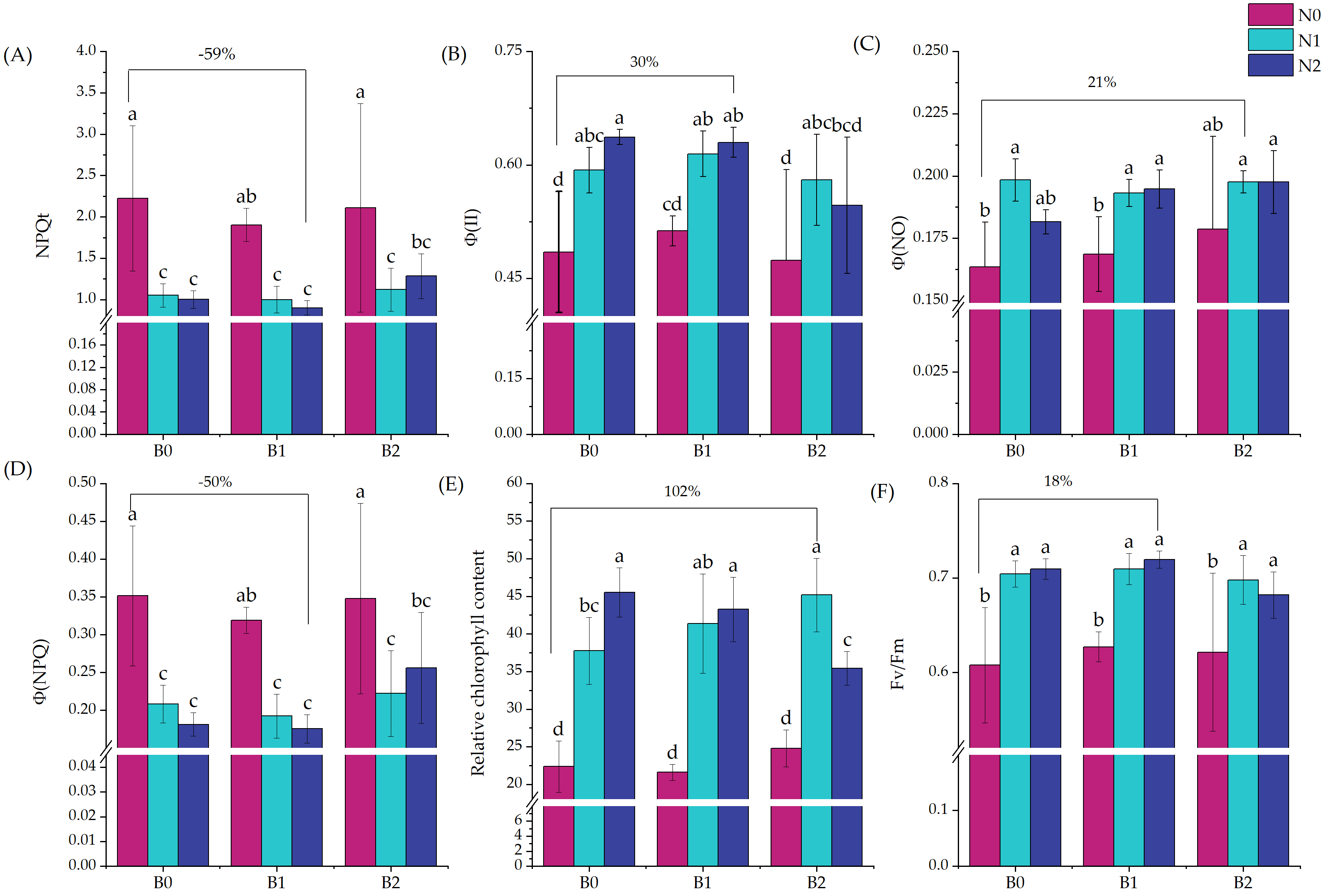
The NPQt measurements for the nine treatments revealed that maize under biochar treatments differed from N fertilization (Figure 1A). NPQt was decreased sharply after the N fertilization. The NPQt value ranged from 0.90 to 2.22. Furthermore, NPQ tension was associated with a rise in Φ(II) (PSII quantum yield). No differences in biochar treatments were observed in Figure 1A. Biochar and N fertilizer led to a substantial reduction in NPQt, with the N2B1 treatment exhibiting a significantly lower value compared to the N0B0 treatment, indicating a decrease of approximately 59%.
Φ(II) significantly changed (p < 0.05) in N fertilization. The incorporation of biochar and N fertilizer resulted in a substantial enhancement of Φ(II). Under the N2B1 treatment, Φ(II) significantly (p < 0.05) improved, by approximately 30%, compared to the N0B0 treatment. However, Φ(II) significantly declined due to the treatment with N2B2, while no change was observed for the treatment with N2B1 compared to N2B0. This finding suggests that the concurrent application of biochar and nitrogen fertilizer can enhance the photochemical efficiency of PSII. The corresponding values of Φ(NO) and Φ(NPQ) are given in Figure 1. Under both B1 and B2 treatments, no significant change in photosynthetic efficiency was observed. N fertilization improved Φ(NO) but reduced Φ(NPQ). Φ(NO) of the N1B2 treatment was increased by approximately 21% compared to N0B0. Meanwhile, the maximum of Φ(NPQ) was reduced by 50% under N2B1. These data indicate that moderate biochar combined with N fertilizer stimulates the PSII antenna system to capture more photosynthetically active radiation (PAR) efficiently.
Under the N0 conditions, no significant differences were observed in the Chl content and Fv/Fm parameter (Figure 1F). Fv/Fm ranged from 0.61 to 0.72 during the flowering stage. Both biochar combined with N fertilizer and N fertilizer alone significantly increased the Fv/Fm ratio and Chl content. The N2B1 treatment showed a higher Fv/Fm than the N0B0, with an increase of approximately 18%.
In Table 4, maize yield differed among the treatments. The yield of the B0 treatment was the highest yield compared with those of the B2 and B1 treatments, but the difference was not significant. The highest yield (12,977 kg/ha) was achieved under the N2B0 treatment, with increases of 36.4% and 21.7%, compared to the N2B2 and N1B2 treatments, respectively. The 1000-grain weight of the B2 treatment significantly increased by 3.5 and 3.2%, respectively, compared with the B0 and B1 treatments. However, the B2 treatment significantly reduced the number of kernels per ear (p < 0.05). Biochar and its interaction with N significantly influenced 1000-grain weight and kernels per ear. This indicates that N fertilizer exerts the most significant influence on yield when it comes to biochar treatments.
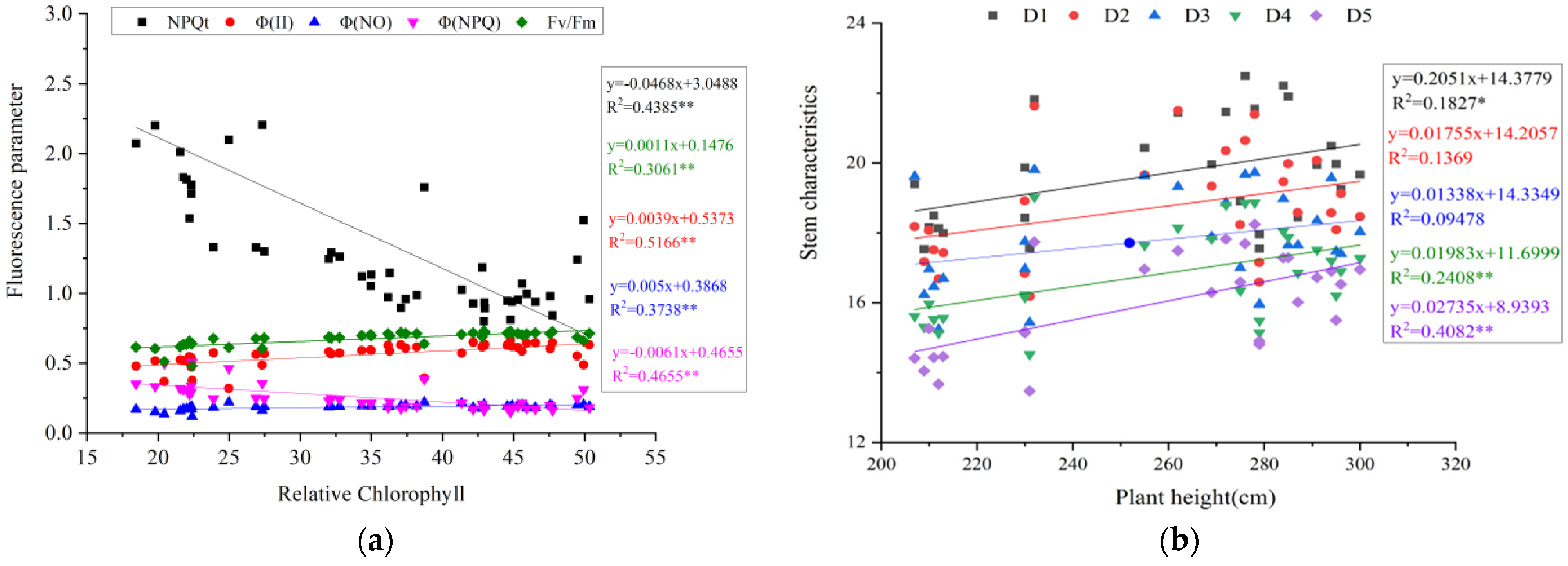
The analysis of the correlation between relative chlorophyll content and fluorescence parameters revealed (Figure 2a) that during the flowering period, chlorophyll content was significantly negatively correlated with NPQt and Φ(NPQ) (p < 0.01) while exhibiting a significant positive correlation with Φ(II), Φ(NO), and Fv/Fm (p < 0.01). When it comes to the correlation between plant height and stem thickness (Figure 2b), there was a significant positive correlation at the 4th and 5th internodes (p < 0.01) and a significant positive correlation with stem diameter at the 1st internode (p < 0.05).
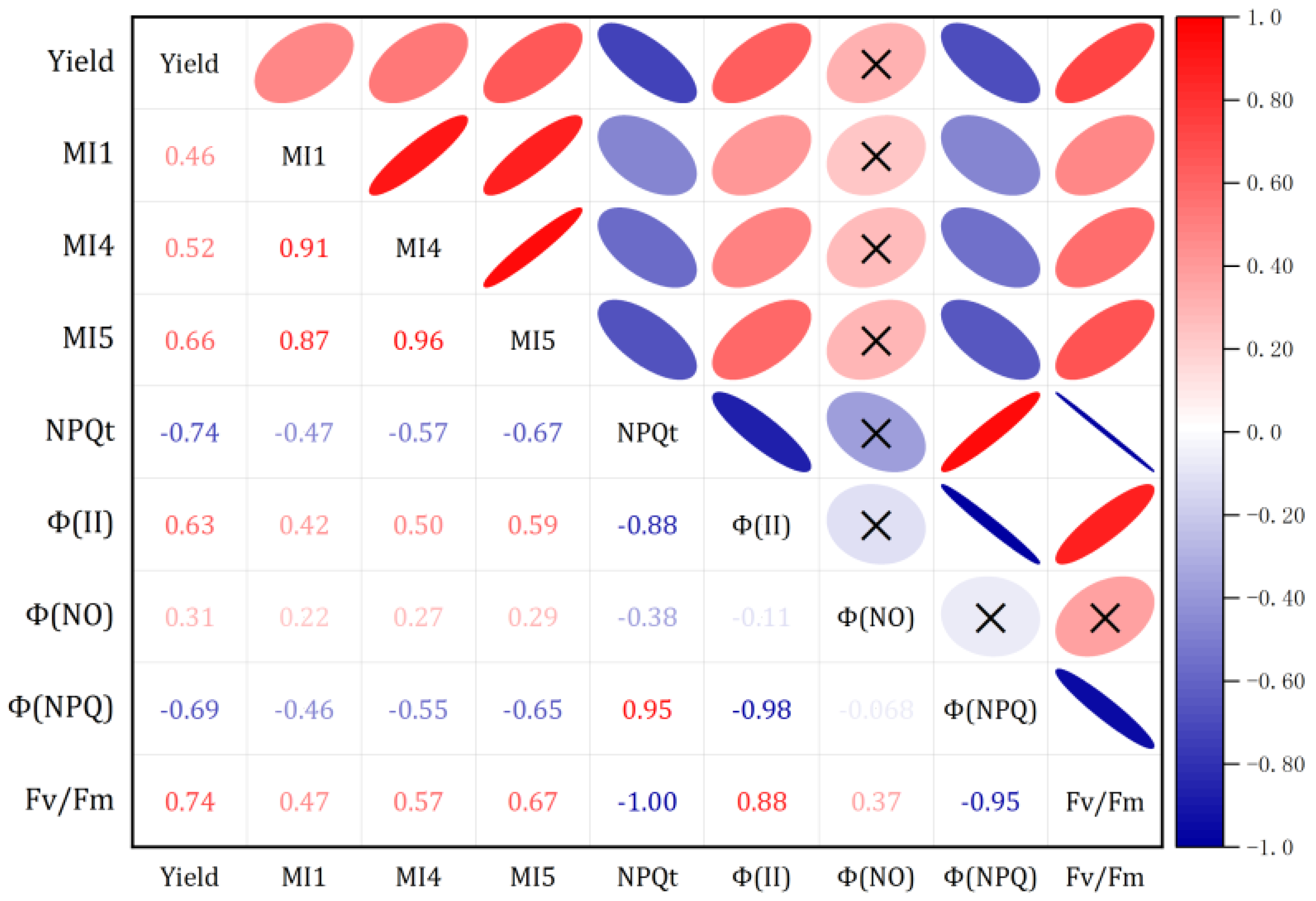
The correlation analysis indicated that, under the co-application of biochar and N fertilizer, maize yield was significantly negatively correlated with NPQt and Φ(NPQ), but it showed a significant positive correlation with Φ(II) and Fv/Fm (Figure 3). The cross-sectional moment of inertia of the 1st internode exhibits a significant negative correlation with NPQt and Φ(NPQ), as well as a significant positive correlation with Φ(II) and Fv/Fm. However, the sectional moment of inertia of the 4th and 5th internodes showed stronger correlations with fluorescence parameters.
Figure 3. The correlation of main internode characteristics, fluorescence parameters, and yield. MI1—cross-sectional moment of inertia of 1st internode; MI4—cross-sectional moment of inertia of 4th internode; MI5—cross-sectional moment of inertia of 5th internode. The red oval indicate positive correlation; The blue oval indicate negative correlation; “X” indicate no significant correlation.
Plants 15 01141 g003

3. Discussion

Current research often overlooks the long-term effectiveness of biochar in enhancing internode development and instead assumes that a one-time application, such as B2 treatment in this study, is sufficient. A 6-year field experiment indicated that the N2B2 treatment enhanced the thickness of the 4th and 5th internodes, as well as their cross-sectional moment of inertia. Luckily, our research further demonstrated that the nitrogen–biochar interaction occurred only on 4th and 5th internodes. After 6 years, the nitrogen–biochar interaction on yield still persisted. This is mainly attributed to nitrogen–biochar interaction’s sustained leaf photosynthetic efficiency in maize over the years.

3.1. Effects of Different Applications of Biochar on Stem Characteristics and Mazie Yield

Although biochar addition alone had no significant effect on the lodging resistance of maize after 6 years, the combined application of N fertilizer and biochar enhanced the lodging resistance of maize, especially at 180–225 kg N ha−1 (Table 1 and Table 2). The reason for this was that the internode thickness significantly increased, and the moment of inertia further increased (Table 1 and Table 2). Biochar can enhance crop nutrient uptake [35] and promote dry matter accumulation [36], thereby increasing crop yield [37]. Our experiment indicates that biochar combined with reduced N increased internode lengths of the 2nd to 5th nodes (Table 1) while decreasing cross-sectional moment of inertia and reducing lodging resistance. In contrast, biochar combined with conventional N (equal to 225 kg N ha−1) significantly increased the stem thickness of the 2nd to 5th inernodes and enhanced lodging resistance, which is consistent with previous findings [18,19]. This study also discovered that biochar combined with reduced N decreased the sectional moment of inertia of the 2nd to 5th internodes and that the 5th section had the smallest decrease. However, when combined with conventional N fertilizer, the sectional moment of inertia of the 2nd to 5th internodes increased, with the 5th section showing the smallest increase. This indicated that 5th internode is not sensitive to N fertilizer. Compared with the B0 and B2 treatments, the sectional moment of inertia of the 1st–5th internodes in the B1 treatment increased, except at the 4th internode (Table 2), indicating that continuous application of biochar can reduce the risk of stem lodging. Gong et al. [19] found that biochar enhances rice lodging resistance by reducing the lengths of the 1st and 2nd internodes while increasing inner and outer diameters, which is consistent with our findings. In addition, further research demonstrated that biochar improves rice mechanical strength by promoting silica, hemicellulose, and lignin deposition in stem cell walls [18]. The effect of adding biochar to different crops is different. In this study, the application rates of 4.2–8.4 t ha−1 have been consistently shown to improve photosynthetic performance and stem strength. But in rice, the effective biochar application rate was 30 t ha−1, derived from rice husk, which enhanced rice biomass and lodging resistance [18]. Previous studies have shown that straw-derived and wood-derived biochars can effectively reduce the lodging index [34]. This physiological basis may be attributed to the cell wall structure. Ammonium and nitrate are the primary nitrogen sources for key cell wall polymers such as lignin, hemicellulose, and cellulose, and the deposition of these polymers directly affects stem bending resistance [18,38]. Additionally, differences in resistance parameters among biochars derived from various feedstocks may be related to specific elements they contain. For instance, husk-derived biochar is rich in silicon [39], and the transport and deposition of silicon in plants can significantly increase stem wall thickness, thereby further enhancing lodging resistance. Excessive N fertilization could bring about more weight to the basal stems and higher plant height, making the crops increase the risk of lodging [40]. We observed that grain yield under the co-application of N and biochar was slightly lower compared with the high-N treatment (Table 4), but it was more beneficial for crop height (Table 3), and it reduced lodging risk (Table 2). Therefore, biochar can coordinate the contradiction between high yield and lodging risk under high-N fertilizer conditions [41].

3.2. Effects of Different Applications of Biochar on Photosynthesis

Chlorophyll fluorescence is a crucial parameter for photosynthesis, reflecting the absorption and utilization of light energy by PSII. Previous studies indicated that 10 t ha−1 biochar enhanced peanut leaf photosynthetic capacity [42], primarily by increasing chlorophyll fluorescence parameters, including photochemical quenching, actual photochemical efficiency, and net photosynthetic rate. Our study also established that the interactions between biochar and N fertilization have significantly improved ΦII. El-Desouki et al. [43] reported that the combined application of biochar and P fertilizer enhanced the maximum photochemical quantum yield of PSII (Fv/Fm) while also significantly increasing the electron transport rate and photosynthetic rate. In our study, both Fv/Fm and ΦNO were significantly enhanced under the combination of biochar and N fertilizer, as well as under N fertilizer alone. This suggests that the combination of biochar and N fertilizer enhances the efficiency of light quantum capture by the PSII reaction center, thereby mitigating the suppression of photosynthesis caused by environmental stress [44]. The different raw materials, carbonization temperatures, and application amounts of biochar have shaped crop responses, ultimately leading to the observed results. Similarly, 10 t ha−1 biochar significantly reduced ΦNPQ and ΦNO during peanut pod development, while 40 t ha−1 biochar increased ΦNPQ [42], which partially contradicts with our findings. These results suggest that light energy absorbed by PSII antenna pigments may be dissipated as heat rather than transferred through photochemical electron transport [45]. Only a few studies reported that biochar produced under 600 °C reduced NPQ in salt-alkali-tolerant ramie [46], which is consistent with our findings. We recorded that the co-application of biochar and N fertilizer significantly reduced NPQ in maize. This influence was largely affected by enhancing the relative chlorophyll content of maize [47], thereby ensuring the synthesis of various enzymes and electron carriers involved in photosynthetic carbon assimilation, ultimately improving leaf photosynthetic function [48]. Consequently, more light energy is absorbed, resulting in a reduced NPQ. Additionally, biochar may promote root morphology development [49], which enables greater nutrient and water uptake, thereby enhancing photosynthetic performance [50]. In our previous study, we reported that applying 8.4 t ha−1 biochar promotes fine root growth of maize [51]. Considering the correlations among these indicators, long-term biochar application enhances the relationship between agronomic traits at the first, fourth, and fifth internodes, as well as the fluorescence characteristics of leaves. Our findings are consistent with those of Kong et al. [52], who reported that lodging resistance in densely planted maize depends most strongly on the mechanical properties of the 3rd to 5th internodes. Similarly, Xue et al. [53] demonstrated that basal internodes showed the greatest plasticity in response to agronomic measures. Therefore, this study infers that the basal internodes are also sensitive to photosynthetic efficiency. This suggests that biochar’s modification of internode traits may be linked to leaf photosynthesis.
Although this study has achieved certain results in exploring the impact of N and alternate-year application of biochar on the internodes of maize, there were still some limitations. We have explored the effect of the fluorescence properties, especially the photosystem II (PSII) reaction center. However, future studies can delve into the microscopic characteristics of stems and substance transport.

4. Materials and Methods

4.1. Site Description

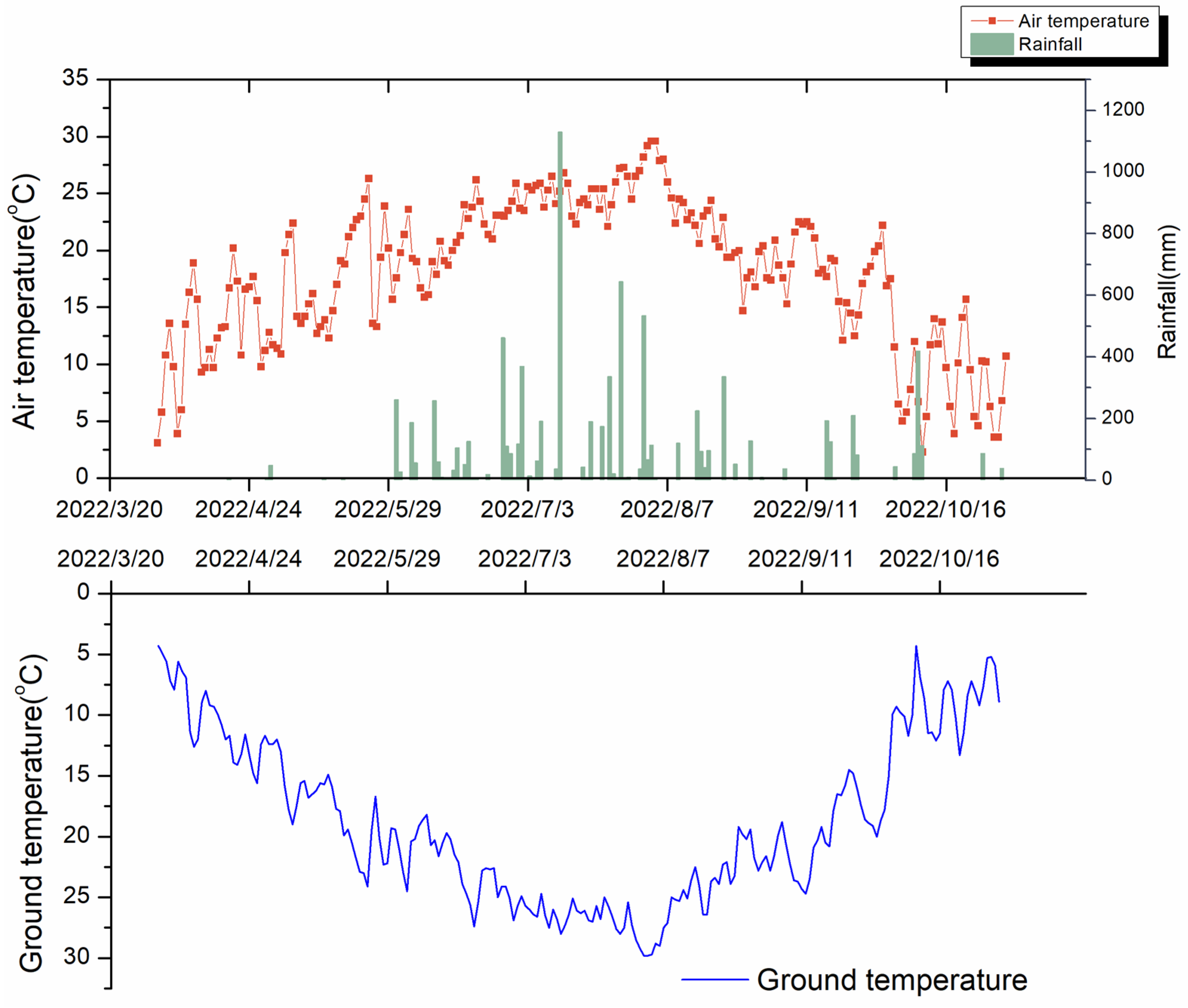
The experiment was conducted at the Liaoning Academy of Agricultural Sciences (42.0344° N, 123.5698° E), Liaoning Province, China. The climate in this region is classified as the northern temperate continental monsoon climate. Figure 4 shows the climate variables observed during the growing season (March to October). This region is mainly characterized by continuous maize cropping, and the soil is classified as Udalfs according to the USDA Soil Taxonomy, which corresponds to brown soil in the Chinese Genetic Soil Classification. The basic properties of the soil are as follows: organic matter of 14.1 g kg−1, alkaline hydrolysis nitrogen of 94.7 mg kg−1, total nitrogen (TN) of 1.08 g kg−1, total phosphorus (TP) of 0.52 g kg−1, total potassium of 18.05 g kg−1, available phosphorus (AP) of 27.2 mg kg−1, and available potassium (AK) of 79 mg kg−1; pH = 6.3 [51].
The maize cultivar used was Zhengdan 958, and different amounts of biochar were applied to the soil in 2017 as a regulator to assess its long-term effects on maize. Maize straw was utilized as feedstock, and biochar was produced by Jilin Hongyuan Jialianhe Biomass Energy Co., Ltd., Jilin, China The biochar preparation process follows the parameters described by Gao et al. [54]. The properties of biochar are as follows: total carbon and nitrogen contents were 46.6% and 1.21%, respectively, and the pH value was 9.2. Biochar was uniformly applied to the upper soil surface of each plot before sowing, and it was evenly spun into the soil at a depth of about 10 cm. All treatments were normally applied with P and K fertilizers. The dosages of phosphorus and potassium were 120 kg P2O5 ha−1 and 90 kg K2O ha−1, respectively. All nitrogen, phosphorus, and potassium fertilizers should be applied to the soil at one time as base fertilizers during maize sowing. The planting density in all treatments was 67,500 plants ha−1, with sowing carried out in late April every spring. For each replicate, each treatment was carried out in a 6 m long 16-row plot, with a 0.6 m inter-row spacing.

4.2. Experimental Design

The experiment was conducted using a completely randomized plot design (Table 5). The trials were conducted in nine experimental blocks, comprising three biochar management treatments with triplicate replication: B0, no biochar application; B1, biochar application at 4.2 t ha−1 year−1; and B2, biochar application at 8.4 t ha−1 2 year−1. In the 6-year field experiment, the experimental area and agricultural management were consistent across all treatments. Additionally, the total amount of biochar incorporation was the same for the B1 and B2 scenarios. The three nitrogen treatments included no N addition (N0), 20% reduction in N at 180 kg ha−1 year−1 (N1), and conventional N fertilizer application at 225 kg ha−1 year−1 (N2).

4.3. Field Investigation and Measurement

The following traits were measured in the field experiment: length and thickness of the 1st to 5th internodes, plant height, grain yield, and yield components.
Plant height was measured during the silking stage (R1) for 10 plants per plot in each of the three replicate blocks, resulting in a total of 30 plants measured per treatment.

4.3.1. Stalk Agronomic Traits

Five representative plants of each block from each replicate that were as close as possible to the calculated mean plant height were used for the measurement of the internode. The internode length (IL) and internode diameter (ID) traits of the stalk were measured using electronic micrometers. Based on the measured indicator values, we calculated the cross-sectional moment of inertia (CSM, Equation (1)) and the stem diameter coefficient (SDC, Equation (2)).
CSM = πd4/64,
SDC = IL/ID,

4.3.2. Analysis of Chlorophyll Fluorescence

An ultra-portable MultispeQ device (PhotosynQ, East Lansing, MI, USA) connected to the PhotosynQ platform (www.photosynq.org, accessed on 11 August 2022) was used to determine the maximal quantum yield of PSII photochemistry (Fv/Fm), quantum yield of PSII photochemistry (ΦII), quantum yield of non-photochemical energy loss [Φ(NPQ)], kinetics for induction of non-photochemical quenching (NPQt), and fraction of energy absorbed by PSII that is lost to unregulated processes [Φ(NO)]. Chlorophyll (Chl) fluorescence parameters were measured in a field from 9:00 to 11:30 a.m. Weather conditions were normal during the investigation. The ear leaf of three randomly selected plants per treatment was clamped in the leaf chamber to measure chlorophyll fluorescence. The measurements were taken from the middle part of the leaf.

4.3.3. Grain Yield

At the R6 stage in October, the plants were harvested from 12-m2 areas comprising two middle rows within each block for the determination of grain yield, which was adjusted to 14% moisture content [55]. A total of 10 standard ears were selected, which were the closest to the mean from each plot, and row numbers and kernels per row of each ear was counted.

4.4. Statistical Analysis

The differences between treatment means were analyzed using SPSS statistics 17.0 (IBM, NY, USA) using two-way ANOVA (Duncan’s method, p < 0.05). Plotting was performed using OriginPro 8.5.

5. Conclusions

Our findings showed that annual biochar application combined with N fertilizer significantly increased the internode diameter of the 2nd to 5th internodes. Biochar combined with N fertilizer significantly enhanced maize photosynthetic capacity after flowering, ensuring post-flowering photochemical electron transport and reducing dissipation in the form of heat. The sectional moment of inertia of the 4th and 5th internodes showed stronger correlations with fluorescence parameters. Future research should further investigate how the synergistic effects of biochar modulate crop growth across different soil types and crops, as well as optimize biochar application strategies to enhance crop yield and resilience.

Author Contributions

Conceptualization, Y.S. and J.G.; methodology, Y.S. and Y.W.; software, Y.S.; validation, Y.Z. and Y.Y.; formal analysis, Y.S. and J.G.; investigation, Y.S. and W.X.; resources, Y.Z. and Y.W.; data curation, D.W.; writing—original draft preparation, Y.S.; writing—review and editing, Y.S. and J.G.; visualization, Y.S.; supervision, Y.S.; project administration, Y.S.; funding acquisition, Y.S. and Y.W. All authors have read and agreed to the published version of the manuscript.

Funding

This research was funded by the National Natural Sciences Foundation of China, grant number 32101832; the Natural Science Foundation of Liaoning Province, grant number 2024-MS-230; the Earmarked Fund for China Agriculture Research System, grant number CARS-02-52; and the Presidential Foundation of the Liaoning Academy of Agricultural Sciences, China, grant number 2024QN1805.

Data Availability Statement

The data presented in this study are available on request from the corresponding author.

Acknowledgments

We thank to Cheng Chang and Shuping Zhang for technical assistance during lab work. We would like to thank Jing Liu and Lei Shi for field management assistance. The authors are grateful to the anonymous reviewers for their constructive comments on the manuscript.

Conflicts of Interest

The authors declare no conflicts of interest.

References

  1. Sun, N.; Bian, S.; Meng, X.; Zhao, H.; Zhang, L.; Tan, G.; Yan, W.; Yu, W. Effects of chemical regulation on lodging resistance of maize under high density condition. Mol. Plant Breed. 2021, 19, 4449–4455. [Google Scholar]
  2. Li, S.; Wang, Y.; Hu, C.; Yan, Y. Effects of strong wind lodging at pre- and post-tasseling stages on growth and yield of summer maize. Chin. J. Appl. Ecol. 2015, 26, 2405–2413. [Google Scholar]
  3. Li, S.K.; Zhao, J.R.; Dong, S.T.; Zhao, M.; Li, C.H.; Cui, Y.H.; Liu, Y.H.; Gao, J.L.; Xue, J.Q.; Wang, L.C.; et al. Advances and Prospects of Maize Cultivation in China. Sci. Agric. Sin. 2017, 50, 1941–1959. [Google Scholar]
  4. Shah, L.; Yahya, M.; Shah, S.M.A.; Nadeem, M.; Ali, A.; Ali, A.; Wang, J.; Riaz, M.W.; Rehman, S.; Wu, W. Improving Lodging Resistance: Using Wheat and Rice as Classical Examples. Int. J. Mol. Sci. 2019, 20, 4211. [Google Scholar] [CrossRef]
  5. Xue, J.; Ming, B.; Xie, R.; Wang, K.; Hou, P.; Li, S. Evaluation of maize lodging resistance based on the critical wind speed of stalk breaking during the late growth stage. Plant Methods 2020, 16, 148. [Google Scholar] [CrossRef]
  6. Hirano, K.; Ordonio, R.L.; Matsuoka, M. Engineering the lodging resistance mechanism of post-Green Revolution rice to meet future demands. Proc. Jpn. Acad. 2017, 93, 220–233. [Google Scholar] [CrossRef]
  7. Huang, G.; Guo, Y.; Tan, W.; Zhang, M.; Li, Z.; Zhou, Y.; Duan, L. Development of a model for maize stalk lodging resistance based on plant bending strength and trait selection. Field Crops Res. 2025, 325, 109828. [Google Scholar] [CrossRef]
  8. Wang, B.; Lin, Z.; Li, X.; Zhao, Y.; Zhao, B.; Wu, G.; Ma, X.; Wang, H.; Xie, Y.; Li, Q.; et al. Genome-wide selection and genetic improvement during modern maize breeding. Nat. Genet. 2020, 52, 565–571. [Google Scholar] [CrossRef]
  9. Yano, K.; Ookawa, T.; Aya, K.; Ochiai, Y.; Hirasawa, T.; Ebitani, T.; Takarada, T.; Yano, M.; Yamamoto, T.; Fukuoka, S.; et al. Isolation of a Novel Lodging Resistance QTL Gene Involved in Strigolactone Signaling and Its Pyramiding with a QTL Gene Involved in Another Mechanism. Mol. Plant 2015, 8, 303–314. [Google Scholar] [CrossRef]
  10. Zhao, X.; Zhou, S. Research progress on traits and assessment methods of stalk lodging resistance in maize. Acta Agron. Sin. 2022, 48, 15–26. [Google Scholar] [CrossRef]
  11. Ren, T.; Liao, J.; Jin, L.; Delgado-Baquerizo, M.; Ruan, H. Application of biogas-slurry and biochar improves soil multifunctionality in a poplar plantation during afforestation processes. Plant Soil 2024, 501, 107–123. [Google Scholar] [CrossRef]
  12. Dong, Z.; Li, H.; Xiao, J.; Sun, J.; Liu, R.; Zhang, A. Soil multifunctionality of paddy field is explained by soil pH rather than microbial diversity after 8-years of repeated applications of biochar and nitrogen fertilizer. Sci. Total Environ. 2022, 853, 158620. [Google Scholar] [CrossRef] [PubMed]
  13. Kätterer, T.; Roobroeck, D.; Andrén, O.; Kimutai, G.; Karltun, E.; Kirchmann, H.; Nyberg, G.; Vanlauwe, B.; Röing de Nowina, K. Biochar addition persistently increased soil fertility and yields in maize-soybean rotations over 10 years in sub-humid regions of Kenya. Field Crops Res. 2019, 235, 18–26. [Google Scholar] [CrossRef]
  14. Yuan, J.; Wang, Y.; Zhao, X.; Chen, H.; Chen, G.; Wang, S. Seven years of biochar amendment has a negligible effect on soil available P and a progressive effect on organic C in paddy soils. Biochar 2022, 4, 13. [Google Scholar] [CrossRef]
  15. Liu, B.; Li, H.; Li, H.; Zhang, A.; Rengel, Z. Long-term biochar application promotes rice productivity by regulating root dynamic development and reducing nitrogen leaching. GCB Bioenergy 2020, 13, 257–268. [Google Scholar] [CrossRef]
  16. Zhang, Q.; Song, Y.; Wu, Z.; Yan, X.; Gunina, A.; Kuzyakov, Y.; Xiong, Z. Effects of six-year biochar amendment on soil aggregation, crop growth, and nitrogen and phosphorus use efficiencies in a rice-wheat rotation. J. Clean. Prod. 2020, 242, 118435. [Google Scholar] [CrossRef]
  17. Wang, Z.; Tang, C.; Wang, H.; Zhao, C.; Yin, D.; Yuan, Y.; Yang, K.; Li, Z. Effect of Different Amounts of Biochar on Meadow Soil Characteristics and Maize Yields Over Three Years. Bioresources 2019, 14, 419–4209. [Google Scholar] [CrossRef]
  18. Miao, W.; Li, F.; Lu, J.; Wang, D.; Chen, M.; Tang, L.; Xu, Z.; Chen, W. Biochar application enhanced rice biomass production and lodging resistance via promoting co-deposition of silica with hemicellulose and lignin. Sci. Total Environ. 2023, 855, 158818. [Google Scholar] [CrossRef]
  19. Gong, D.; Xu, Z.; Zheng, W.; Dai, G.; Chen, Y.; Yu, G. Biochar application improves the yield, lodging resistance, and lignin synthesis mechanism in rice. Crop Sci. 2024, 64, 968–981. [Google Scholar] [CrossRef]
  20. Xue, J.; Gao, S.; Fan, Y.; Li, L.; Ming, B.; Wang, K.; Xie, R.; Hou, P.; Li, S. Traits of plant morphology, stalk mechanical strength, and biomass accumulation in the selection of lodging-resistant maize cultivars. Eur. J. Agron. 2020, 117, 126073. [Google Scholar] [CrossRef]
  21. Forell, G.V.; Robertson, D.; Lee, S.Y.; Cook, D.D. Preventing lodging in bioenergy crops: A biomechanical analysis of maize stalks suggests a new approach. J. Exp. Bot. 2015, 66, 4367–4371. [Google Scholar] [CrossRef]
  22. Robertson, D.J.; Julias, M.; Lee, S.Y.; Cook, D.D. Maize Stalk Lodging: Morphological Determinants of Stalk Strength. Crop Sci. 2017, 57, 926–934. [Google Scholar] [CrossRef]
  23. Wang, C.; Ling, L.; Kuai, J.; Xie, J.; Ma, N.; You, L.; Batchelor, W.D.; Zhang, J. Integrating UAV and satellite LAI data into a modified DSSAT-rapeseed model to improve yield predictions. Field Crops Res. 2025, 327, 109883. [Google Scholar] [CrossRef]
  24. Wang, Y.; Yu, Q.; Liu, Z.; Ren, W.; Lu, X. A practical SIF-based crop model for predicting crop yields by quantifying the fraction of open PSII reaction centers (qL). Remote Sens. Environ. 2025, 320, 114658. [Google Scholar] [CrossRef]
  25. Kalaji, H.M.; Jajoo, A.; Oukarroum, A.; Brestic, M.; Zivcak, M.; Samborska, I.A.; Cetner, M.D.; Łukasik, I.; Goltsev, V.; Ladle, R.J. Chlorophyll a fluorescence as a tool to monitor physiological status of plants under abiotic stress conditions. Acta Physiol. Plant. 2016, 38, 102. [Google Scholar] [CrossRef]
  26. He, L.; Yu, L.; Li, B.; Du, N.; Guo, S. The effect of exogenous calcium on cucumber fruit quality, photosynthesis, chlorophyll fluorescence, and fast chlorophyll fluorescence during the fruiting period under hypoxic stress. BMC Plant Biol. 2018, 18, 180. [Google Scholar] [CrossRef]
  27. Ratajczak, K.; Sulewska, H.; Panasiewicz, K.; Faligowska, A.; Szymańska, G. Phytostimulator Application after Cold Stress for Better Maize (Zea mays L.) Plant Recovery. Agriculture 2023, 13, 569. [Google Scholar] [CrossRef]
  28. Noor, H.; Ding, P.; Ren, A.; Sun, M.; Gao, Z. Effects of Nitrogen Fertilizer on Photosynthetic Characteristics and Yield. Agronomy 2023, 13, 1550. [Google Scholar] [CrossRef]
  29. Wu, D.; Yuan, H.; Gu, W.; Feng, Z.; Sun, Y.; Xiu, L.; Zhang, W.; Chen, W. Photosynthetic physiological metabolism and yield response of continuous soybean cropping mediated by long–term application of biochar. J. Agro–Environ. Sci. 2023, 42, 37–45. [Google Scholar]
  30. Ying, C.; Manli, Z.; Xianping, L.; Guijin, D.; Shougui, H. Effects of Biochar on Chlorophyll Fluorescence at Full Heading Stage and Yield Components of Rice. Crops 2016, 3, 94–98. [Google Scholar]
  31. Yu, C.; Chen, H.; Tang, B.; Liu, H.; Liu, X.; Zhang, H.; Wang, G. Biochar integrate dicyandiamide modified soil aggregates and optimized nitrogen supplying to boosting the soybean-wheat yield in saline-alkali soil. Soil Tillage Res. 2026, 257, 106922. [Google Scholar] [CrossRef]
  32. Cao, X.; Liu, D.; Liu, J.; Zhang, L.; Li, M.; Shi, G.; Liu, H.; Wang, H.; Sun, W. Synergistic effects of biochar and organic fertilizer on root exudates, microbial community, and yield in dry direct-seeded rice. Appl. Soil Ecol. 2025, 216, 106501. [Google Scholar] [CrossRef]
  33. Liu, J.; Shu, A.; Song, W.; Shi, W.; Li, M.; Zhang, W.; Li, Z.; Liu, G.; Yuan, F.; Zhang, S.; et al. Long-term organic fertilizer substitution increases rice yield by improving soil properties and regulating soil bacteria. Geoderma 2021, 404, 115287. [Google Scholar] [CrossRef]
  34. Ghorbani, M.; Amirahmadi, E. Biochar and soil contributions to crop lodging and yield performance—A meta-analysis. Plant Physiol. Biochem. 2024, 215, 109053. [Google Scholar] [CrossRef]
  35. Gao, Y.; Rao, W.; Jie, H.; Zhang, W.; Niu, Y.; Yuan, Y.; Xu, G.; Zhang, W.; Zhang, D.; Wang, D. Effects of wheat and corn straw biochar application on nutrient uptake of maize and extracellular enzyme activities in the rhizosphere of different textural fluvo-aquic soils. J. Plant Nutr. Fertil. 2022, 28, 933–945. [Google Scholar]
  36. Li, B.; Ye, Y.; Chu, R.; Jing, M.; Zhang, S.; Yan, J. Effects of biochar application on dry matter accumulation, transport, and distribution of foxtail millet and soil physicochemical properties. Acta Agron. Sin. 2024, 50, 695–708. [Google Scholar] [CrossRef]
  37. Rong, F.; Qin, S.; Su, G.; Wu, L.; Wu, A.; Wang, X.; Zhang, M.; Chen, F. Legacy effect of single biochar application on soil ecosystem multifunctionality and its contribution to rice yield: A five-year field experiment for acidic paddy. Field Crops Res. 2023, 303, 109141. [Google Scholar] [CrossRef]
  38. Głazowska, S.; Baldwin, L.; Mravec, J.; Bukh, C.; Fangel, J.U.; Willats, W.G.; Schjoerring, J.K. The source of inorganic nitrogen has distinct effects on cell wall composition in Brachypodium distachyon. J. Exp. Bot. 2019, 70, 6461–6473. [Google Scholar] [CrossRef]
  39. Asadi, H.; Ghorbani, M.; Rezaei-Rashti, M.; Abrishamkesh, S.; Amirahmadi, E.; Chengrong, C.; Gorji, M. Application of Rice Husk Biochar for Achieving Sustainable Agriculture and Environment. Rice Sci. 2021, 28, 325–343. [Google Scholar] [CrossRef]
  40. Li, Q.; Fu, C.; Liang, C.; Ni, X.; Zhao, X.; Chen, M.; Ou, L. Crop Lodging and The Roles of Lignin, Cellulose, and Hemicellulose in Lodging Resistance. Agronomy 2022, 12, 1795. [Google Scholar] [CrossRef]
  41. Li, C.; Chang, Y.; Luo, Y.; Li, W.; Jin, M.; Wang, Y.; Cui, H.; Sun, S.; Li, Y.; Wang, Z. Nitrogen regulates stem lodging resistance by breaking the balance of photosynthetic carbon allocation in wheat. Field Crops Res. 2023, 296, 108908. [Google Scholar] [CrossRef]
  42. Wang, S.; Zheng, J.; Wang, Y.; Yang, Q.; Chen, T.; Chen, Y.; Chi, D.; Xia, G.; Siddique, K.H.M.; Wang, T. Photosynthesis, Chlorophyll Fluorescence, and Yield of Peanut in Response to Biochar Application. Front. Plant Sci. 2021, 12, 650432. [Google Scholar] [CrossRef] [PubMed]
  43. El-Desouki, Z.; Xia, H.; Abouseif, Y.; Cong, M.; Zhang, M.; Riaz, M.; Moustafa-Farag, M.; Jiang, C. Improved chlorophyll fluorescence, photosynthetic rate, and plant growth of Brassica napus L. after co-application of biochar and phosphorus fertilizer in acidic soil. J. Plant Nutr. Soil Sci. 2024, 187, 260–273. [Google Scholar] [CrossRef]
  44. Zhang, L.; Shangguan, Z.; Mao, M.; Yu, G. Effects of long term application of nitrogen fertilizer on leaf chlorophyll fluorescence of upland winter wheat. Chin. J. Appl. Ecol. 2003, 5, 695–698. [Google Scholar]
  45. Perkins, R.; Williamson, C.; Lavaud, J.; Mouget, J.L.; Campbell, D.A. Time-dependent upregulation of electron transport with concomitant induction of regulated excitation dissipation in Haslea diatoms. Photosynth. Res. 2018, 137, 377–388. [Google Scholar] [CrossRef]
  46. Tang, J.; Zhang, S.; Zhang, X.; Chen, J.; He, X.; Zhang, Q. Effects of pyrolysis temperature on soil-plant-microbe responses to Solidago canadensis L.-derived biochar in coastal saline-alkali soil. Sci. Total Environ. 2020, 731, 138938. [Google Scholar] [CrossRef]
  47. Feng, W.; Yang, F.; Cen, R.; Liu, J.; Qu, Z.; Miao, Q.; Chen, H. Effects of straw biochar application on soil temperature, available nitrogen and growth of corn. J. Environ. Manag. 2021, 277, 111331. [Google Scholar] [CrossRef]
  48. Hou, W.; Zhang, Y.; Wang, H.; Zhang, Q.; Hou, M.; Cong, B.; Du, X. Effects of nitrogen application level on leaf photosynthetic characteristics and chlorophyll fluorescence characteristics of Leymus chinensis. Acta Agrestia Sin. 2021, 29, 531–536. [Google Scholar]
  49. Xiang, Y.; Deng, Q.; Duan, H.; Guo, Y. Effects of biochar application on root traits: A meta-analysis. GCB Bioenergy 2017, 9, 1563–1572. [Google Scholar] [CrossRef]
  50. Prashar, P.; Vandenberg, A. Genotype-specific responses to the effects of commercial Trichoderma formulations in lentil (Lens culinaris ssp. culinaris) in the presence and absence of the oomycete pathogen Aphanomyces euteiches. Biocontrol Sci. Technol. 2017, 27, 1123–1144. [Google Scholar] [CrossRef]
  51. Sui, Y.; Gao, J.; Wang, Y.; Xiao, W.; Liu, J.; Shi, L.; Zhao, H.; Zhang, Y. Biochar and nitrogen fertilizer effects on soil nutrient and root distribution in dryland maize. Ecol. Environ. Sci. 2021, 30, 2026–2032. [Google Scholar]
  52. Kong, F.; Liu, F.; Li, X.; Yin, P.; Lan, T.; Feng, D.; Song, B.; Lei, E.; Li, Z.; Wang, X.; et al. Ecological factors regulate stalk lodging within dense planting maize. Field Crops Res. 2024, 317, 109529. [Google Scholar] [CrossRef]
  53. Xue, J.; Gou, L.; Zhao, Y.; Yao, M.; Yao, H.; Tian, J.; Zhang, W. Effects of light intensity within the canopy on maize lodging. Field Crops Res. 2016, 188, 133–141. [Google Scholar] [CrossRef]
  54. Gao, J.; Zhao, Y.; Zhang, W.; Sui, Y.; Jin, D.; Xin, W.; Yi, J.; He, D. Biochar prepared at different pyrolysis temperatures affects urea-nitrogen immobilization and N2O emissions in paddy fields. PeerJ 2019, 7, e7027. [Google Scholar] [CrossRef]
  55. Ma, R.; Cao, N.; Li, Y.; Hou, Y.; Wang, Y.; Zhang, Q.; Wang, T.; Cui, J.; Li, B.; Shi, W.; et al. Rational reduction of planting density and enhancement of NUE were effective methods to mitigate maize yield loss due to excessive rainfall. Eur. J. Agron. 2024, 160, 127326. [Google Scholar] [CrossRef]
Figure 1. Effect of different biochar treatments on chlorophyll a fluorescence measurements of maize ear leaf. (A) NPQt, kinetics for induction of non-photochemical quenching; (B) Φ(II), PSII quantum yield; (C) Φ(NO), fraction of energy absorbed by PSII that is lost to unregulated processes; (D) Φ(NPQ), NPQ quantum yield; (E) relative chlorophyll content, and (F) Fv/Fm, the maximal quantum yield of PSII photochemistry. Different letters above the error bars indicate significant differences (p < 0.05) among the treatments. N0—Nil nitrogen; N1—180 kg Nha−1; N2—225 kg Nha−1; B0—Nil biochar; B1—4.2 t ha−1 year−1 of biochar; B2—8.4 t ha−1 2 year−1 of biochar.
Plants 15 01141 g001
Figure 2. Correlation between chlorophyll content and fluorescence parameters (a) and plant height and stem thickness (b) under different biochar treatments. D1—1st internode; D2—2nd internode; D3—3rd internode; D4—4th internode; D5—5th internode. Stars indicate the level of significance (* p < 0.05, ** p < 0.01). The different colored lines represent the linear fitting of the corresponding legends.
Plants 15 01141 g002
Figure 4. Mean daily air temperature (°C), precipitation (mm), and ground temperature in 2022.
Plants 15 01141 g004
Table 1. Changes in maize plant height, internode length, and thickness from 1st to 5th internodes under different biochar treatments.
Treatment1st2nd3rd4th5th
Length/cmDiameter/mmLength/cmDiameter/mmLength/cmDiameter/mmLength/cmDiameter/mmLength/cmDiameter/mm
B0N05.57 ± 0.23 a18.00 ± 0.48 b7.43 ± 0.75 cd17.37 ± 0.18 cd8.70 ± 0.26 c16.46 ± 0.23 c9.23 ± 0.61 c15.46 ± 0.14 c10.80 ± 0.50 d14.31 ± 0.23 b
N18.27 ± 2.24 a21.23 ± 0.72 a8.13 ± 0.49 bcd20.93 ± 1.10 a11.23 ± 0.72 abc19.59 ± 0.25 a13.87 ± 0.51 b18.27 ± 0.70 a14.20 ± 0.66 c17.40 ± 0.40 a
N27.50 ± 0.75 a19.55 ± 0.84 ab9.70 ± 0.20 ab18.64 ± 0.45 bcd12.13 ± 0.29 ab17.99 ± 1.38 abc15.80 ± 0.87 a16.81 ± 0.44 abc16.90 ± 0.92 ab16.67 ± 0.20 a
Average7.11 ± 1.69 A19.59 ± 1.52 A8.42 ± 1.11 A18.98 ± 1.67 A10.69 ± 1.60 A18.01 ± 1.53 A12.97 ± 2.98 A16.85 ± 1.29 A13.97 ± 2.72 B16.13 ± 1.42 A
B1N04.43 ± 0.93 a19.13 ± 0.90 ab6.57 ± 1.07 d17.92 ± 1.14 cd8.93 ± 0.38 bc17.53 ± 2.20 abc10.10 ± 0.56 c15.63 ± 0.51 c10.93 ± 0.50 d14.41 ± 0.74 b
N15.73 ± 2.35 a20.85 ± 2.09 a8.63 ± 1.10 abc19.34 ± 0.71 abc12.90 ± 3.50 a18.09 ± 0.76 abc13.17 ± 1.51 b17.59 ± 0.65 ab15.47 ± 1.08 bc16.86 ± 0.74 a
N27.60 ± 2.48 a19.86 ± 0.17 ab10.60 ± 0.53 a18.87 ± 1.05 abcd11.70 ± 2.05 abc17.95 ± 0.45 abc16.43 ± 1.19 a16.99 ± 0.70 abc18.20 ± 0.26 a16.39 ± 0.78 a
Average5.92 ± 2.24 A19.95 ± 1.36 A8.60 ± 1.93 A18.71 ± 1.06 A11.18 ± 2.69 A17.86 ± 1.21 A13.23 ± 2.92 A16.74 ± 1.02 A14.87 ± 3.24 A15.89 ± 1.30 A
B2N05.93 ± 3.33 a18.05 ± 0.45 b7.53 ± 2.15 cd17.03 ± 0.96 d9.03 ± 1.42 bc16.45 ± 0.89 c9.80 ± 0.75 c15.57 ± 0.92 c11.13 ± 0.67 d14.63 ± 1.01 b
N18.93 ± 4.91 a18.99 ± 2.15 ab8.90 ± 1.06 abc18.03 ± 2.03 cd13.27 ± 1.88 a16.92 ± 1.68 bc16.00 ± 1.08 a16.47 ± 2.02 ab18.00 ± 1.45 a15.84 ± 1.71 ab
N26.37 ± 1.82 a21.33 ± 1.28 a9.07 ± 0.55 abc20.45 ± 1.04 ab11.03 ± 0.99 abc19.09 ± 1.04 ab14.07 ± 0.58 b18.51 ± 0.59 a16.33 ± 0.55 b17.41 ± 1.01 a
Average7.08 ± 3.41 A19.46 ± 1.94 A8.50 ± 1.43 A18.50 ± 1.96 A11.11 ± 2.23 A17.49 ± 1.63 A13.29 ± 2.84 A16.85 ± 1.74 A15.16 ± 3.21 A15.96 ± 1.64 A
Source of variation
N application rate (N)ns*****************
B addition rate (B)nsnsnsnsnsnsnsns*ns
N × Bnsnsns*nsns*****ns
Different lowercase letters within the same column indicate significant differences among the treatments (p < 0.05); different capital letters indicate significant differences among the biochar (B) treatments; stars indicate the level of significance (* p < 0.05, ** p < 0.01), ns indicates not significant; B0—nil biochar; B1—4.2 t ha−1 year−1 of biochar; B2—8.4 t ha−1 2 year−1 of biochar; N0—nil nitrogen; N1—180 kg Nha−1; N2—225 kg Nha−1; values are means ± SD (n = 3).
Table 2. The effect of different biochar treatments on the stem diameter coefficient (SDC) and cross-sectional moment of inertia (CSM) of the 1st to 5th internodes.
Treatment1st2nd3rd4th5th
SDCCSM/mm4SDCCSM/mm4SDCCSM/mm4SDCCSM/mm4SDCCSM/mm4
B0N02.62 ± 0.15 a5168.88 ± 551.29 b4.28 ± 0.48 ab4468.18 ± 181.60 c5.29 ± 0.23 b3604.19 ± 201.35 c5.97 ± 0.45 b2803.69 ± 100.81 c7.55 ± 0.36 d2061.36 ± 129.77 c
N13.26 ± 0.96 a10,011.91 ± 1323.43 a3.90 ± 0.45 b9517.46 ± 1899.01 a5.74 ± 0.43 b7225.52 ± 363.82 a7.60 ± 0.53 b5494.63 ± 849.91 ab8.17 ± 0.48 cd4503.18 ± 407.11 a
N23.21 ± 0.25 a7215.15 ± 1263.60 ab5.21 ± 0.20 ab5936.69 ± 575.96 bc6.78 ± 0.65 ab5263.79 ± 1685.54 abc9.41 ± 0.76 a3931.23 ± 402.97 bc10.14 ± 0.63 ab3793.91 ± 182.34 a
Average3.03 ± 0.59 A7465.31 ± 2312.15 A4.46 ± 0.67 A6640.78 ± 2460.07 A5.93 ± 0.78 A5364.50 ± 1793.90 A7.66 ± 1.57 A4076.52 ± 1262.27 A8.62 ± 1.25 A3452.81 ± 1112.37 A
B1N01.99 ± 0.53 a6627.97 ± 1203.33 ab3.69 ± 0.77 b5143.64 ± 1251.92 c5.16 ± 0.77 b4921.73 ± 2308.29 abc6.47 ± 0.47 b2940.60 ± 384.05 c7.61 ± 0.63 d2135.52 ± 432.63 c
N12.35 ± 1.11 a9632.24 ± 3444.52 a4.48 ± 0.73 ab6900.52 ± 992.78 abc7.09 ± 1.67 ab5292.08 ± 919.29 abc7.51 ± 1.15 b4722.03 ± 672.08 ab9.20 ± 1.07 bcd3994.15 ± 667.51 a
N23.15 ± 1.02 a7634.60 ± 252.25 ab5.63 ± 0.50 a6304.01 ± 1451.56 bc6.51 ± 1.05 ab5105.89 ± 501.06 abc9.66 ± 0.31 a4118.52 ± 652.17 bc11.12 ± 0.39 a3572.01 ± 649.94 ab
Average2.50 ± 0.95 A7964.94 ± 2257.83 A4.60 ± 1.03 A6116.06 ± 1328.01 A6.25 ± 1.36 A5106.57 ± 1277.42 A7.88 ± 1.55 A3927.05 ± 933.69 A9.31 ± 1.65 A3233.89 ± 987.84 A
B2N02.82 ± 1.58 a5220.46 ± 507.70 b4.45 ± 1.42 ab4179.71 ± 955.97 c5.53 ± 1.13 b3636.43 ± 740.77 c6.33 ± 0.86 b2925.46 ± 653.62 c7.65 ± 0.94 d2291.34 ± 586.40 bc
N13.97 ± 2.34 a6721.58 ± 3198.43 ab5.02 ± 1.07 ab5458.30 ± 2573.36 c7.96 ± 1.80 a4186.07 ± 1750.62 bc9.85 ± 1.68 a3836.99 ± 1977.18 bc11.50 ± 1.98 a3241.99 ± 1477.25 abc
N22.45 ± 0.64 a10,306.84 ± 2394.06 a4.44 ± 0.30 ab8674.79 ± 1721.86 ab5.80 ± 0.71 b6596.59 ± 1361.00 ab7.61 ± 0.48 b5786.80 ± 717.31 a9.39 ± 0.27 bc4563.38 ± 1009.72 a
Average3.08 ± 1.60 A7416.29 ± 3029.38 A4.63 ± 0.94 A6104.27 ± 2578.47 A6.43 ± 1.61 A4806.36 ± 1796.06 A7.93 ± 1.83 A4183.08 ± 1677.87 A9.51 ± 2.00 A3365.57 ± 1364.88 A
Source of variation
N application rate (N)ns**ns************
B addition rate (B)nsnsnsnsnsnsnsnsnsns
N × B nsnsns*nsns*****ns
Different lowercase letters within the same column indicate significant differences among the treatments (p < 0.05); different capital letters indicate significant differences among the biochar (B) treatments; stars indicate the level of significance (* p < 0.05, ** p < 0.01), ns indicates not significant; B0—nil biochar; B1—4.2 t ha−1 year−1 of biochar; B2—8.4 t ha−1 2 year−1 of biochar; N0—nil nitrogen; N1—180 kg Nha−1; N2—225 kg Nha−1; values are means ± SD (n = 3).
Table 3. The effect of different biochar treatments on maize plant height and internode dry weight.
TreatmentDry Weight of Internode/g Plant−1Plant
1st2nd3rd4th5thOtherHeight/cm
B0N02.77 ± 0.49 bc3.10 ± 0.44 e3.10 ± 0.46 f2.93 ± 0.47 d2.97 ± 0.23 c13.07 ± 1.65 d216.6 ± 12.0 e
N15.10 ± 0.89 ab6.20 ± 0.17 a6.87 ± 0.50 a7.10 ± 0.20 a6.20 ± 0.44 ab28.13 ± 2.02 b252.7 ± 36.1 d
N24.40 ± 0.78 abc4.67 ± 0.25 cd5.03 ± 0.55 cd5.17 ± 0.35 c5.07 ± 0.49 b23.40 ± 3.01 c294.8 ± 9.1 a
Average4.09 ± 1.22 A4.66 ± 1.37 A5.00 ± 1.69 A5.07 ± 1.83 A4.74 ± 1.46 A21.53 ± 6.96 B254.7 ± 39.1 B
B1N02.47 ± 0.40 c3.37 ± 0.31 e3.53 ± 0.38 ef3.53 ± 0.38 d3.30 ± 0.35 c15.73 ± 2.07 d227.2 ± 11.4 e
N14.07 ± 1.12 abc5.17 ± 0.25 bc5.43 ± 0.42 bc5.63 ± 0.45 bc5.73 ± 0.35 ab28.20 ± 2.55 b283.1 ± 7.6 ab
N25.10 ± 2.31 ab5.80 ± 1.05 ab5.83 ± 1.55 abc6.60 ± 1.25 ab6.40 ± 1.05 ab28.60 ± 2.00 b289.6 ± 7.0 ab
Average3.88 ± 1.73 A4.78 ± 1.23 A4.93 ± 1.35 A5.26 ± 1.52 A5.14 ± 1.53 A24.18 ± 6.62 A266.6 ± 34.3 A
B2N02.67 ± 0.84 c3.83 ± 0.45 de3.73 ± 0.51 def3.50 ± 0.44 d3.47 ± 0.61 c15.67 ± 2.03 d229.9 ± 9.9 de
N12.87 ± 1.02 bc4.00 ± 0.53 de4.67 ± 0.50 cde4.97 ± 0.81 c5.10 ± 0.53 b22.30 ± 4.42 c277.9 ± 5.6 bc
N26.10 ± 2.10 a6.17 ± 0.93 a6.53 ± 1.22 ab6.87 ± 1.10 a6.90 ± 1.48 a33.80 ± 0.70 a268.0 ± 9.8 c
Average3.88 ± 2.08 A4.67 ± 1.27 A4.98 ± 1.42 A5.11 ± 1.63 A5.16 ± 1.71 A23.92 ± 8.32 AB258.6 ± 2.5 B
Source of variation
N application rate (N)**************
B addition rate (B)nsnsnsnsnsns**
N × B ns***********
Different lowercase letters within the same column indicate significant differences among the treatments (p < 0.05); different capital letters indicate significant differences among the biochar (B) treatments; stars indicate the level of significance (* p < 0.05, ** p < 0.01), ns indicates not significant; B0—nil biochar; B1—4.2 t ha−1 year−1 of biochar; B2—8.4 t ha−1 2 year−1 of biochar; N0—nil nitrogen; N1—180 kg Nha−1; N2—225 kg Nha−1; Values are means ± SD (n = 3).
Table 4. Effect of different biochar treatments on maize yield and yield components.
Treatment Yield (kg/ha)1000-Grain Weight/gKernels per EarEar Number (Ears/ha)
B0N02416 ± 117 c279 ± 10 d260 ± 22 d53,889 ± 4194 c
N18880 ± 1033 b326 ± 10 a475 ± 28 b60,000 ± 3333 bc
N212,977 ± 1333 a336 ± 7 a574 ± 68 a66,667 ± 4410 ab
Average  8091 ± 1333 A314 ± 28 B436 ± 144 A60,185 ± 6532 A
B1N03052 ± 441 c294 ± 6 c289 ± 42 cd53,333 ± 6667 c
N18915 ± 2340 b325 ± 5 a511 ± 17 b66,111 ± 2546 ab
N29307 ± 1008 b327 ± 4 a451 ± 25 b70,000 ± 1667 a
Average 7091 ± 3298 A315 ± 16 B417 ± 103 A63,148 ± 8393 A
B2N02808 ± 1010 c310 ± 5 b212 ± 45 c53,889 ± 5853 c
N110,663 ± 614 b334 ± 10 a467 ± 15 b67,778 ± 5853 ab
N29515 ± 1260 b330 ± 2 a472 ± 11 b65,556 ± 4811 ab
Average 7662 ± 3774 A325 ± 13 A384 ± 131 B62,407 ± 8041 A
Source of variation
N application rate (N)********
B addition rate (B)ns**ns
N × B ******ns
Different lowercase letters within the same column indicate significant differences among the treatments (p < 0.05); different capital letter indicate significant differences among the biochar (B) treatments; stars indicate the level of significance (* p < 0.05, ** p < 0.01), ns indicated not significant; Values are means ± SD (n = 3); B0—Nil biochar; B1—4.2 t ha−1 year−1 of biochar; B2—8.4 t ha−1 2 year−1 of biochar; N0—Nil nitrogen; N1—180 kg Nha−1; N2—225 kg Nha−1.
Table 5. The nine treatments of the experiment.
LevelsB0B1B2
N0N0B0N0B1N0B2
N1N1B0N1B1N1B2
N2N2B0N2B1N1B2
B0—nil biochar; B1—4.2 t of biochar ha−1 year−1; B2—8.4 t of biochar ha−1 2 year−1; N0—nil nitrogen; N1—180 kg Nha−1; N2—225 kg Nha−1.
Disclaimer/Publisher’s Note: The statements, opinions and data contained in all publications are solely those of the individual author(s) and contributor(s) and not of MDPI and/or the editor(s). MDPI and/or the editor(s) disclaim responsibility for any injury to people or property resulting from any ideas, methods, instructions or products referred to in the content.