Spider Mite Response, Agronomic Performance, and Stability of a Urochloa spp. Diversity Panel Under Field Conditions

 , , , , , and
Abstract
1. Introduction
2. Materials and Methods
2.1. Data Collection
2.2. Data Analysis
2.2.1. Analysis of Variance and Statistical Model
2.2.2. Genetic Variability Parameters Estimation
2.2.3. AMMI Analysis of Total Dry Weight
2.2.4. Stress Tolerance Index
3. Results
3.1. ANOVA of Agro-Morphological Traits and Physiological Indicators Across Diverse Urochloa Genotypes
3.2. Estimation of Variance Components
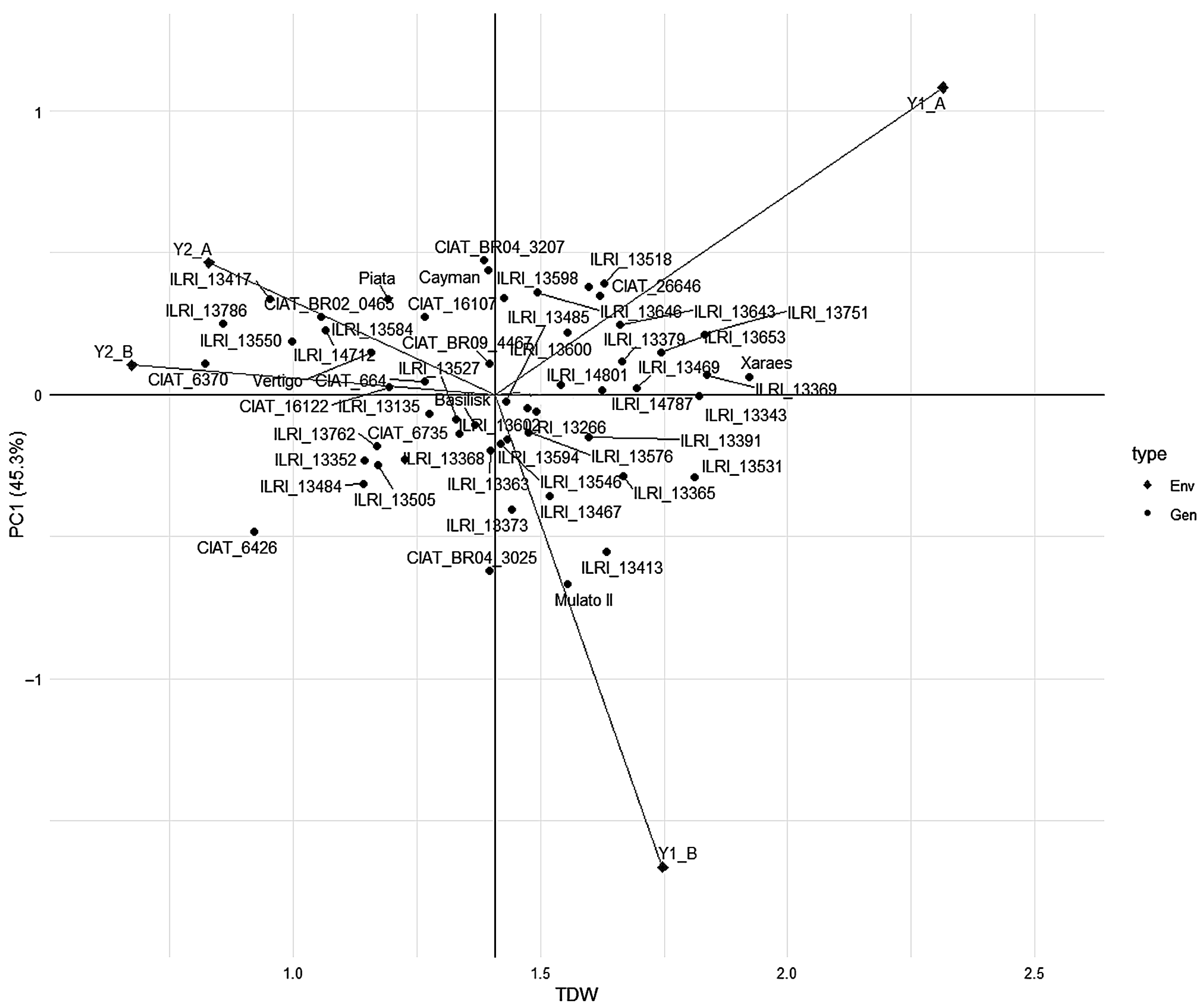
3.3. AMMI Biplot Analysis for Stability and Adaptability of Urochloa Genotypes Under Spider Mite Infestation
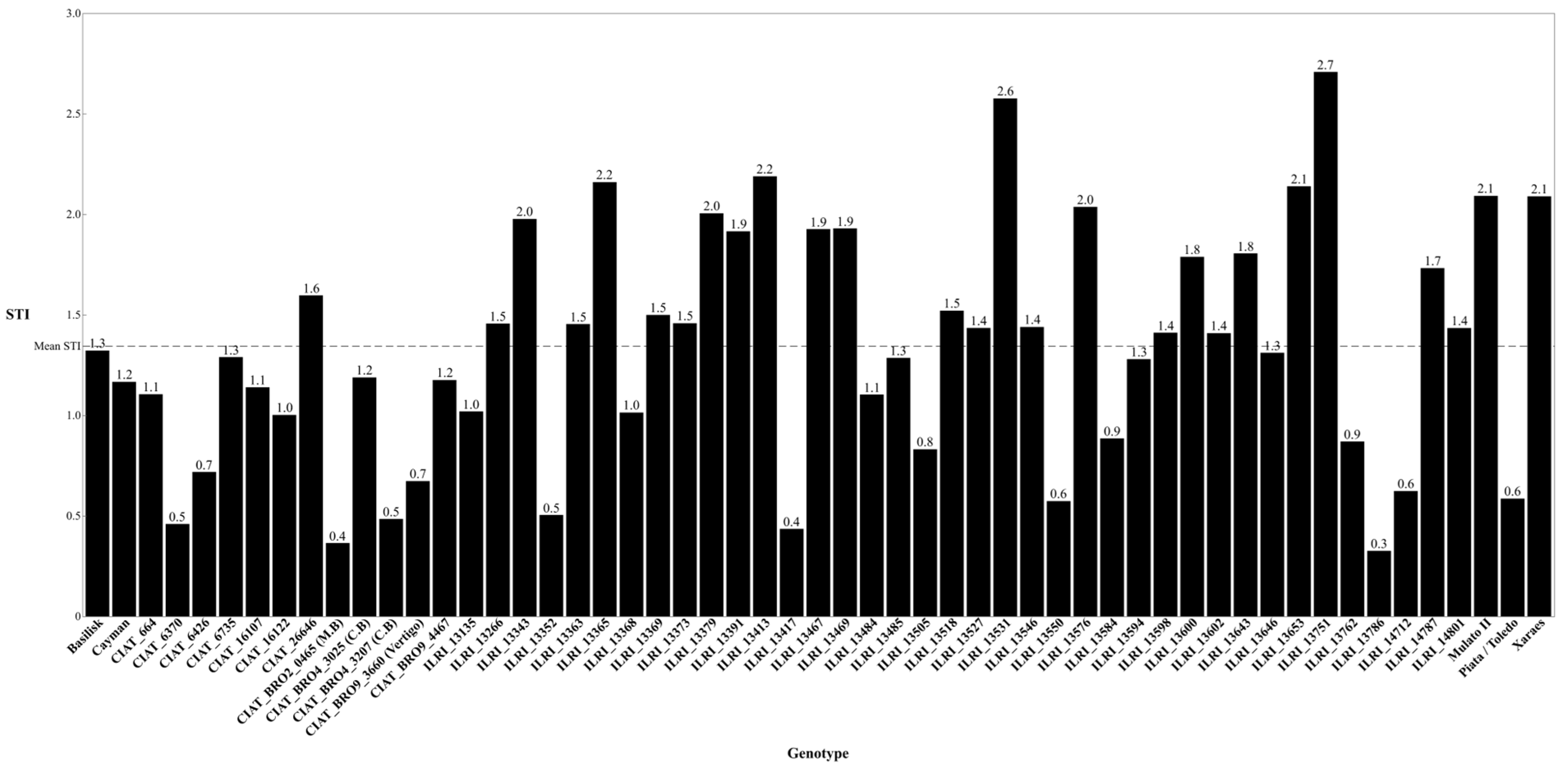
3.4. Indices of Stress Tolerance on TDW in Various Genotypes Under Mite Infestation
4. Discussion
5. Conclusions
Supplementary Materials
Author Contributions
Funding
Data Availability Statement
Acknowledgments
Conflicts of Interest
Abbreviations
| C4 | Carbon 4 Photosynthetic Pathway |
| CGIAR | Consultative Group on International Agricultural Research |
| CIAT | International Center for Tropical Agriculture (Centro Internacional de Agricultura Tropical) |
| HPR | Host-Plant Resistance |
| ILRI | International Livestock Research Institute |
| NDVI | Normalized Difference Vegetation Index |
| PH | Plant Height |
| TDW | Total Dry Weight |
| TN | Tiller Number |
| STI | Stress Tolerance Index |
| VSI | Visual Severity Index |
| GEI | Genotype by Environment Interaction |
| AMMI | Additive Main Effects and Multiplicative Interaction Model |
| ANOVA | Analysis of Variance |
| ASV | AMMI Stability Value |
| Den DF | Denominator Degrees of Freedom |
| DF | Degrees of Freedom |
| GCV | Genotypic Coefficient of Variation |
| H2 | Heritability (broad-sense) |
| Mean Sq | Mean Square |
| PCV | Phenotypic Coefficient of Variation |
| Pr(>F) | Probability Value (from F-test) |
| Signif. | Significance Codes (e.g., *, **, ***) |
| SS | Sum of Squares |
| WAASB | Weighted Average of Absolute Scores from the Best Linear Unbiased Prediction |
References
- Baptistella, J.L.C.; de Andrade, S.A.L.; Favarin, J.L.; Mazzafera, P. Urochloa in Tropical Agroecosystems. Front. Sustain. Food Syst. 2020, 4, 119. [Google Scholar] [CrossRef]
- Marlon, C.; Munyaradzi, P.; Tongai, B.; Milton, Z.; Accadius, T. The Potential of Brachiaria Grass in the Smallholder Dairy Fodder Flow Systems: A Review. Pastures Pastor. 2025, 3, 66–77. [Google Scholar] [CrossRef]
- Chidawanyika, F.; Midega, C.A.O.; Bruce, T.J.A.; Duncan, F.; Pickett, J.A.; Khan, Z.R. Oviposition Acceptance and Larval Development of Chilo partellus Stemborers in Drought-Stressed Wild and Cultivated Grasses of East Africa. Entomol. Exp. Appl. 2014, 151, 209–217. [Google Scholar] [CrossRef]
- Cheruiyot, D.; Midega, C.A.O.; Ueckermann, E.A.; Van den Berg, J.; Pickett, J.A.; Khan, Z.R. Genotypic Response of Brachiaria (Urochloa spp.) to Spider Mite (Oligonychus trichardti) (Acari: Tetranychidae) and Adaptability to Different Environments. Field Crops Res. 2018, 225, 163–169. [Google Scholar] [CrossRef]
- Cheruiyot, D.; Midega, C.A.O.; Pittchar, J.O.; Pickett, J.A.; Khan, Z.R. Farmers’ Perception and Evaluation of Brachiaria Grass (Brachiaria spp.) Genotypes for Smallholder Cereal-Livestock Production in East Africa. Agriculture 2020, 10, 268. [Google Scholar] [CrossRef]
- de Pinho Costa, K.A.; da Costa Severiano, E.; Simon, G.A.; Epifanio, P.S.; da Silva, A.G.; Costa, R.R.G.F.; Santos, C.B.; Rodrigues, C.R. Nutritional Characteristics of Brachiaria brizantha Cultivars Subjected to Different Intensities Cutting. Am. J. Plant Sci. 2014, 5, 1961–1972. [Google Scholar] [CrossRef]
- Tesfai, M.; Njarui, D.M.G.; Ghimire, S.R. Sustainable Intensifications of African Agriculture through Legume-Based Cropping and Brachiaria Forage Systems. Afr. J. Agric. Res. 2019, 14, 1138–1148. Available online: https://cgspace.cgiar.org/items/7d96db02-61f3-4d86-a387-02cea76878cb (accessed on 18 December 2025).
- Sustek-Sánchez, F.; Rognli, O.A.; Rostoks, N.; Sõmera, M.; Jaškūnė, K.; Kovi, M.R.; Statkevičiūtė, G.; Sarmiento, C. Improving Abiotic Stress Tolerance of Forage Grasses—Prospects of Using Genome Editing. Front. Plant Sci. 2023, 14, 1127532. [Google Scholar] [CrossRef]
- Miles, J.W.; Cardona, C.; Sotelo, G. Recurrent Selection in a Synthetic Brachiaria grass Population Improves Resistance to Three Spittlebug Species. Crop Sci. 2006, 46, 1088–1093. [Google Scholar] [CrossRef]
- Aguirre, L.M.; Cardona, C.; Miles, J.W.; Sotelo, G. Characterization of Resistance to Adult Spittlebugs (Hemiptera: Cercopidae) in Brachiaria spp. J. Econ. Entomol. 2013, 106, 1871–1877. [Google Scholar] [CrossRef] [PubMed]
- Migeon, A.; Nouguier, E.; Dorkeld, F. Spider Mites Web: A Comprehensive Database for the Tetranychidae. In Trends in Acarology; Sabelis, M., Bruin, J., Eds.; Springer: Dordrecht, The Netherlands, 2010; pp. 557–560. [Google Scholar]
- Pretty, J.; Bharucha, Z. Integrated Pest Management for Sustainable Intensification of Agriculture in Asia and Africa. Insects 2015, 6, 152–182. [Google Scholar] [CrossRef]
- Falconer, D.S.; Mackay, T.F.C. Introduction to Quantitative Genetics, 4th ed.; Addison Wesley Longman Limited: Edinburgh, UK, 1996. [Google Scholar]
- Holland, J.B.; Nyquist, W.E.; Cervantes-Martínez, C.T. Estimating and Interpreting Heritability for Plant Breeding: An Update. In Plant Breeding Reviews; Wiley: Hoboken, NJ, USA, 2002; pp. 9–112. [Google Scholar]
- Jones, H.G.; Serraj, R.; Loveys, B.R.; Xiong, L.; Wheaton, A.; Price, A.H. Thermal Infrared Imaging of Crop Canopies for the Remote Diagnosis and Quantification of Plant Responses to Water Stress in the Field. Funct. Plant Biol. 2009, 36, 978–989. [Google Scholar] [CrossRef]
- Živčák, M.; Olšovská, K.; Slamka, P.; Galambošová, J.; Rataj, V.; Shao, H.B.; Brestič, M. Application of Chlorophyll Fluorescence Performance Indices to Assess the Wheat Photosynthetic Functions Influenced by Nitrogen Deficiency. Plant Soil Environ. 2014, 60, 210–215. [Google Scholar] [CrossRef]
- Fischer, R.; Maurer, R. Drought Resistance in Spring Wheat Cultivars. I. Grain Yield Responses. Aust. J. Agric. Res. 1978, 29, 897–912. [Google Scholar] [CrossRef]
- Fois, M.; Malinowska, M.; Schubiger, F.X.; Asp, T. Genomic Prediction and Genotype-by-Environment Interaction Analysis of Crown and Stem Rust in Ryegrasses in European Multi-Site Trials. Agronomy 2021, 11, 1119. [Google Scholar] [CrossRef]
- Atumo, T.T.; Samago, T.Y.; Yada, T.A.; Teko, O.O.; Kalsa, G.K.; Hibebo, D.K.; Heliso, M.F.; Ekule, M.Z.; Wamatu, J. Genotype by Environment Interaction Effect on Yield and Forage Quality of Native Panic Grasses: AMMI, GGE Biplot and Correlation Analysis. Discov. Sustain. 2026, 7, 224. [Google Scholar] [CrossRef]
- Mahana, S.; Ranjan Padhan, S.; Ranjan Padhan, S. An Insight into GreenSeeker Technology: A Vital Tool for Precision Nutrient Management. Biot. Res. Today 2022, 4, 26–28. [Google Scholar]
- Baruch, Z.; Guenni, O. Irradiance and Defoliation Effects in Three Species of the Forage Grass Brachiaria. Trop. Grassl. 2007, 41, 269–276. [Google Scholar]
- Bhagasara, V.K.; Ranwah, B.R. Genetic Divergence in Sorghum (Sorghum bicolor (L.) Moench). Master’s Thesis, Maharana Pratap University of Agriculture and Technology, Udaipur, India, 2017. [Google Scholar]
- Burton, G.W.; DeVane, E.H. Estimating Heritability in Tall Fescue (Festuca arundinacea) from Replicated Clonal Material. Agron. J. 1953, 45, 478–481. [Google Scholar] [CrossRef]
- Olivoto, T.; Lúcio, A.D. Metan: An R Package for Multi-environment Trial Analysis. Methods Ecol. Evol. 2020, 11, 783–789. [Google Scholar] [CrossRef]
- Purchase, J.L.; Hatting, H.; van Deventer, C.S. Genotype × Environment Interaction of Winter Wheat (Triticum aestivum L.) in South Africa: II. Stability Analysis of Yield Performance. South Afr. J. Plant Soil 2000, 17, 101–107. [Google Scholar] [CrossRef]
- Papathanasiou, F.; Dordas, C.; Gekas, F.; Pankou, C.; Ninou, E.; Mylonas, I.; Tsantarmas, K.; Sistanis, I.; Sinapidou, E.; Lithourgidis, A.; et al. The Use of Stress Tolerance Indices for the Selection of Tolerant Inbred Lines and Their Correspondent Hybrids under Normal and Water-Stress Conditions. Procedia Environ. Sci. 2015, 29, 274–275. [Google Scholar] [CrossRef]
- Blaazer, C.J.H.; Villacis-Perez, E.A.; Chafi, R.; Van Leeuwen, T.; Kant, M.R.; Schimmel, B.C.J. Why Do Herbivorous Mites Suppress Plant Defenses? Front. Plant Sci. 2018, 9, 1057. [Google Scholar] [CrossRef]
- Bernardo, R. Reinventing Quantitative Genetics for Plant Breeding: Something Old, Something New, Something Borrowed, Something BLUE. Heredity 2020, 125, 375–385. [Google Scholar] [CrossRef]
- Hallauer, A.R.; Carena, M.J.; Miranda Filho, J.B. Quantitative Genetics in Maize Breeding; Springer: Berlin/Heidelberg, Germany, 2010; ISBN 9781441907653. [Google Scholar]
- Kimani, A.M.; Henga, S.A.; Kimani, W.; Muui, C. Drench Effect of Orthosilicic Acid on Drought Stress Tolerance on Morphological and Phenotypic Traits of Sorghum (Sorghum bicolor L. Moench) Landraces. East Afri. Agric. For. J. 2023, 87, 189–203. [Google Scholar]
- Espitia-Buitrago, P.; Cotes Torres, J.M.; Hernández, L.M.; Cardoso, J.A.; Chidawanyika, F.; Jauregui, R.N. Enhancing Phenotyping Accuracy for Selection of Urochloa spp. Tolerant Genotypes to Red Spider Mite (Oligonychus trichardti). Grass Forage Sci. 2025, 80, e70007. [Google Scholar] [CrossRef]
- Fernandez, G.C.J. Effective Selection Criteria for Assessing Plant Stress Tolerance. In Adaptation of Food Crops to Temperature and Water Stress: Proceedings of An International Symposium, Taiwan, 13–18 August 1992; Kuo, C.G., Ed.; AVRDC: Taipei, Taiwan, 1992; pp. 257–270. [Google Scholar] [CrossRef]
- Mofokeng, M.A.; Shimelis, H.; Laing, M.; Shargie, N. Genetic Variability, Heritability and Genetic Gain for Quantitative Traits in South African Sorghum Genotypes. Aust. J. Crop Sci. 2019, 13, 1–10. [Google Scholar] [CrossRef]
- Gebremedhin, A.; Badenhorst, P.; Wang, J.; Giri, K.; Spangenberg, G.; Smith, K. Development and Validation of a Model to Combine NDVI and Plant Height for High-Throughput Phenotyping of Herbage Yield in a Perennial Ryegrass Breeding Program. Remote Sens. 2019, 11, 2494. [Google Scholar] [CrossRef]
- Rieseberg, L.H.; Widmer, A.; Arntz, A.M.; Burke, B. The Genetic Architecture Necessary for Transgressive Segregation Is Common in Both Natural and Domesticated Populations. Philos. Trans. R. Soc. Lond. B Biol. Sci. 2003, 358, 1141–1147. [Google Scholar] [CrossRef]
- Cortés, A. Abiotic Stress Tolerance Boosted by Genetic Diversity in Plants. Int. J. Mol. Sci. 2024, 25, 5367. [Google Scholar] [CrossRef]
- Gauch, H.G. A Simple Protocol for AMMI Analysis of Yield Trials. Crop Sci. 2013, 53, 1860–1869. [Google Scholar] [CrossRef]
- Bocianowski, J.; Liersch, A. Multidimensional Analysis of Diversity in Genotypes of Winter Oilseed Rape (Brassica napus L.). Agronomy 2022, 12, 633. [Google Scholar] [CrossRef]
- Mullualem, D.; Tsega, A.; Mengie, T.; Fentie, D.; Kassa, Z.; Fassil, A.; Wondaferew, D.; Gelaw, T.A.; Astatkie, T. Genotype-by-Environment Interaction and Stability Analysis of Grain Yield of Bread Wheat (Triticum aestivum L.) Genotypes Using AMMI and GGE Biplot Analyses. Heliyon 2024, 10, e32918. [Google Scholar] [CrossRef]
- Pour-Aboughadareh, A.; Khalili, M.; Poczai, P.; Olivoto, T. Stability Indices to Deciphering the Genotype-by-Environment Interaction (GEI) Effect: An Applicable Review for Use in Plant Breeding Programs. Plants 2022, 11, 414. [Google Scholar] [CrossRef]
- Esan, V.I.; Oke, G.O.; Ogunbode, T.O.; Obisesan, I.A. AMMI and GGE Biplot Analyses of Bambara Groundnut [Vigna subterranea (L.) Verdc.] for Agronomic Performances under Three Environmental Conditions. Front. Plant Sci. 2023, 13, 997429. [Google Scholar] [CrossRef] [PubMed]
- Sun, F.; Chen, Q.; Chen, Q.; Jiang, M.; Qu, Y. Yield-Based Drought Tolerance Index Evaluates the Drought Tolerance of Cotton Germplasm Lines in the Interaction of Genotype-by-Environment. PeerJ 2023, 11, e14367. [Google Scholar] [CrossRef] [PubMed]



| Source | Type | Species | N |
|---|---|---|---|
| CIAT genebank | Accessions | Urochloa decumbens, U. brizantha | 10 |
| CIAT breeding program | Hybrids | Urochloa ruziziensis × U. brizantha × U. decumbens | 7 |
| ILRI genebank | Accessions | Urochloa brizantha | 38 |
| Total | 55 |
| Visual Severity Damage | % Damage | Damage |
|---|---|---|
| 0 | 0% | No damage |
| 1–3 | 10–30% | Moderately damaged |
| 3–7 | 30–70% | Damaged—Visible chlorotic lesions |
| 7–10 | 70–100% | Severely damaged—Insuperable chlorotic lesions |
| Trait | Source of Variation | SS | Mean Sq | DF | DenDF | F-Value | Pr(>F) | Signif. |
|---|---|---|---|---|---|---|---|---|
| Plant Height | Field | 1439 | 1438.9 | 1 | 109.94 | 5.30 | 0.02 | * |
| Genotype | 113,025 | 2093.1 | 54 | 831.46 | 7.72 | <2.2 × 10⁻¹⁶ | *** | |
| Year × Genotype | 50,768 | 940.2 | 54 | 834.95 | 3.47 | 1.55 × 10⁻¹⁴ | *** | |
| Field × Genotype | 39,088 | 723.8 | 54 | 829.62 | 2.67 | 3.83 × 10⁻⁹ | *** | |
| Tiller Number | Field | 753,733 | 753,733 | 1 | 140.4 | 80.24 | 1.82 × 10⁻¹⁵ | *** |
| Genotype | 1,549,527 | 28,695 | 54 | 857.28 | 3.05 | 9.56 × 10⁻¹² | *** | |
| Year × Genotype | 893,287 | 16,542 | 54 | 844.62 | 1.76 | 0.0008 | *** | |
| Field × Genotype | 748,725 | 13,865 | 54 | 856 | 1.48 | 0.016 | * | |
| NDVI | Field | 0.59 | 0.59 | 1 | 139.66 | 101.40 | <2 × 10⁻¹⁶ | *** |
| Genotype | 0.38 | 0.01 | 54 | 847.33 | 1.20 | 0.16 | ns | |
| Year × Genotype | 0.43 | 0.01 | 54 | 846.75 | 1.35 | 0.05 | ns | |
| Field × Genotype | 0.43 | 0.01 | 54 | 846.36 | 1.35 | 0.05 | * | |
| VSI | Field | 769.26 | 769.26 | 1 | 125.33 | 462.41 | <2.2 × 10⁻¹⁶ | *** |
| Genotype | 139.16 | 2.58 | 54 | 807.05 | 1.55 | 0.008 | ** | |
| Year × Genotype | 202.06 | 3.74 | 54 | 846.85 | 2.25 | 1.55 × 10⁻⁶ | *** | |
| Field × Genotype | 138.95 | 2.57 | 54 | 804.63 | 1.55 | 0.008 | ** |
| Trait | Source of variation | SS | Mean Sq | DF | DenDF | F-Value | Pr(>F) | Signif. |
|---|---|---|---|---|---|---|---|---|
| TDW | Field | 6.59 | 6.59 | 1 | 56.85 | 18.88 | 5.808 × 10⁻⁵ | *** |
| Genotype | 23.8 | 0.44 | 54 | 277.43 | 1.26 | 0.01 | ** | |
| Year × Genotype | 28.61 | 0.53 | 54 | 295.16 | 1.52 | 0.02 | ** | |
| Field × Genotype | 25.2 | 0.47 | 54 | 277.32 | 1.34 | 0.04 | ** |
| Traits | Field | Mean ± S.E | PCV% | GCV% | H2 | CV% | ||
|---|---|---|---|---|---|---|---|---|
| TDW | Infested | 2.24 ± 0.08 | 0.54 | 0.31 | 34.3 | 19.58 | 0.57 | 27.21 |
| Control | 2.71 ± 0.08 | 0.41 | 0.4 | 33.19 | 32.03 | 0.98 | 34.22 | |
| PH | Infested | 65.29 ± 2.13 | 317.56 | 211.31 | 25.69 | 17.11 | 0.67 | 24.16 |
| Control | 75.03 ± 2.14 | 314.04 | 206.93 | 22.49 | 14.83 | 0.66 | 21.11 | |
| TN | Infested | 187.41 ± 6.8 | 5677.54 | 4816.13 | 74.2 | 62.9 | 0.85 | 27 |
| Control | 224.6 ± 8.55 | 11,224 | 9324.29 | 75.83 | 63 | 0.83 | 28 | |
| NDVI | Infested | 0.77 ± 0.003 | 0.002 | 0.0018 | 1.62 | 1.3 | 0.9 | 3.05 |
| Control | 0.73 ± 0.003 | 0.003 | 0.0023 | 1.81 | 1.57 | 0.77 | 5.79 | |
| STI | 1.38 ± 0.04 | 0.05 | 0.04 | 21.8 | 16.51 | 0.8 | 22.41 |
Disclaimer/Publisher’s Note: The statements, opinions and data contained in all publications are solely those of the individual author(s) and contributor(s) and not of MDPI and/or the editor(s). MDPI and/or the editor(s) disclaim responsibility for any injury to people or property resulting from any ideas, methods, instructions or products referred to in the content. |
© 2026 by the authors. Licensee MDPI, Basel, Switzerland. This article is an open access article distributed under the terms and conditions of the Creative Commons Attribution (CC BY) license.
Share and Cite
Kimani, A.M.; Muruu, D.K.; Espitia-Buitrago, P.; Henga, S.; Muui, C.; Chidawanyika, F.; Jauregui, R.N. Spider Mite Response, Agronomic Performance, and Stability of a Urochloa spp. Diversity Panel Under Field Conditions. Plants 2026, 15, 1117. https://doi.org/10.3390/plants15071117
Kimani AM, Muruu DK, Espitia-Buitrago P, Henga S, Muui C, Chidawanyika F, Jauregui RN. Spider Mite Response, Agronomic Performance, and Stability of a Urochloa spp. Diversity Panel Under Field Conditions. Plants. 2026; 15(7):1117. https://doi.org/10.3390/plants15071117
Chicago/Turabian StyleKimani, Adrian Mating’i, David Kariuki Muruu, Paula Espitia-Buitrago, Sylvia Henga, Catherine Muui, Frank Chidawanyika, and Rosa Noemi Jauregui. 2026. "Spider Mite Response, Agronomic Performance, and Stability of a Urochloa spp. Diversity Panel Under Field Conditions" Plants 15, no. 7: 1117. https://doi.org/10.3390/plants15071117
APA StyleKimani, A. M., Muruu, D. K., Espitia-Buitrago, P., Henga, S., Muui, C., Chidawanyika, F., & Jauregui, R. N. (2026). Spider Mite Response, Agronomic Performance, and Stability of a Urochloa spp. Diversity Panel Under Field Conditions. Plants, 15(7), 1117. https://doi.org/10.3390/plants15071117