Article

De Novo Chromosome-Level Genome Assembly of ‘Qing Zhou Mi’ Landrace Peach and Analysis of Late Maturity and Fruit Weight Traits in Peach

1
National Key Laboratory of Efficient Utilization of Nutrient Resources, Shandong Academy of Agricultural Sciences, Jinan 250000, China
2
Shandong Institute of Pomology, Longtai Road No.66, Taian 271000, China
3
Weifang Academy of Agricultural Science, Weifang 261000, China
*
Author to whom correspondence should be addressed.
Plants 2026, 15(7), 1113; https://doi.org/10.3390/plants15071113
Submission received: 14 February 2026 / Revised: 19 March 2026 / Accepted: 1 April 2026 / Published: 3 April 2026
(This article belongs to the Special Issue Plant Genetic Diversity and Molecular Evolution)

Abstract

‘Qing Zhou Mi’ (QZM) is a typical representative landrace of the late-ripening, high-resistance, and small-fruited peaches found in northern China. However, its genetic information has not been systematically analyzed. In this study, we sequenced and de novo assembled the QZM genome. The chromosome-level genome was 252.39 Mb in size, with a contig N50 of 24.35 Mb. Comparative genomic analysis found a total of 9.24 Mb unique fragments and 418 genes in the QZM genome, most of which were associated with resistance. Compared with the genomes of some early maturing peach accessions, the differentiation ability of the ACC oxidase and ethylene receptor gene families related to ethylene synthesis and transport in QZM was significantly weakened. In the genome-wide association study, we identified PpNAC1 as a major gene regulating the late-ripening trait of QZM. In addition, we discovered a novel locus associated with fruit weight and focused on a candidate gene in its regulation, PpLOB33. The findings of this study can serve as a foundation for further research on the genetic basis underlying the core traits of QZM, providing precise targets for molecular breeding.

1. Introduction

The study of plant genomics improves our understanding of the genetic basis of plant diversity. Since the publication of the Arabidopsis genome in 2000 [1], the development of plant genomics over the past 20 years can be divided into two stages. During the first stage, due to the limitations of sequencing technology, researchers achieved the genome sequencing and assembly of model terrestrial plant species or cash crops with small diploid genomes [2,3]. The study of plant genomics has now entered the second stage with the further development of sequencing technology, and the amount of research on plant genome sequencing has rapidly increased, with sequenced samples expanded to include plants with special phenotypes, medicinal plants, and endangered plants [4,5,6].
The first assembled peach genome was the western rootstock ‘Lovell’ [7]. In recent years, with the rapid development of third-generation sequencing technology, the genomes of selected peach varieties have been assembled for the analysis of important agronomic traits. For example, Yu et al. [8] generated the genome of ‘Longhuashuimi’ (LHSM), a representative of the Chinese cling peaches, and identified two key genes, PpALMT1 and PpERDL16, that were associated with fruit flavor. In another study, the genome of a flat-fruit peach cultivar, ‘Rui You Pan 1’ (RYP1), was assembled, and a 1.67 Mb heterozygous inversion was found to influence the flat fruit shape [9]. The genome of Chinese cling peach, an important founder cultivar for peach breeding programs, has also been generated, and 25 quantitative trait loci related to seven volatile compounds have been identified [10]. The draft genome of the flat peach cultivar ‘124 Pan’ was assembled in another study, and the expansion of genes involved in terpene biosynthesis was analyzed [11]. Other work assembled a high-quality genome of ‘Zhongyoutao 14’ (CN14), and PpTIP2 was found to be associated with temperature sensitivity in this semi-dwarf cultivar [12]. The de novo genome assembly of four wild relatives of peach has also been performed, providing detailed basic data to support the study of peach evolution and dissect the genetic mechanism of resistance traits [13]. In addition, the genome of an ancient representative peach landrace, ‘Feichenghongli’, has been released, and key genes controlling late fluorescence and narrow leaf traits in this landrace have been identified [14].
Ethylene is a plant hormone that plays a core regulatory role in the fruit ripening process, influencing the entire cycle of ripening initiation, quality formation, and senescence [15,16]. The ethylene biosynthesis process in plants begins with methionine. First, methionine is catalyzed by S-adenosylmethionine synthetase (SAMS) to form S-adenosylmethionine (SAM). Then, in the rate-limiting step, SAM is catalyzed by ACC synthase (ACS) to produce 1-aminocyclopropane-1-carboxylic acid (ACC), which is the direct precursor of ethylene. Finally, ACC is converted into ethylene under the action of ACC oxidase (ACO). ACS is a rate-limiting enzyme in the ethylene biosynthesis pathway that directly determines the rate of ethylene synthesis. In tomato, increasing the expression of ACS genes such as ACS1A, ACS2, and ACS4 promotes ethylene production, thereby accelerating fruit ripening [17]. ACOs also play an important role in the ethylene synthesis pathway. The expression level of PpACO1 in peaches increases significantly during fruit ripening, which promotes ethylene synthesis and thereby drives fruit ripening [18].
Fruit softening is a crucial process that affects the post-harvest quality and storage life of fruits, and plant polygalacturonase (PG) genes play a key role in this process [19]. The main functions of PG genes include participating in pectin degradation and regulating cell wall metabolism. In strawberries, the expression level of the FxaC_21g15770 gene increases significantly during the fruit ripening and softening stages, and silencing this gene can significantly enhance the firmness of strawberry fruits [20]. In strawberries, after silencing the FaPG1 gene, the expression of many genes encoding cell wall-modifying enzymes is downregulated, which indicates that PG genes hold an important regulatory position in the cell wall metabolic network [21].
As the origin of peaches and a major center of peach domestication, China possesses extremely rich peach germplasm resources and has established long-term and systematic peach breeding programs. National peach germplasm repositories have been constructed to conserve thousands of accessions, including wild relatives, landraces, and improved cultivars [8,10]. Over recent decades, China’s breeding objectives have gradually shifted toward peaches with a high sugar content, low acidity, attractive appearance, extended maturity period, good disease resistance, high abiotic stress tolerance, and good suitability for mechanical harvesting and protected cultivation. Meanwhile, conventional hybridization has been combined with advanced molecular breeding technologies such as genomic selection, pan-genome analysis, and gene mapping [11,12,14]. These efforts have successfully bred hundreds of new peach cultivars with excellent agronomic traits, supporting the sustainable development of the peach industry in China.
The landrace peach ‘Qing Zhou Mi’ (QZM) originated in Qingzhou City, Shandong Province, China, and has been cultivated for more than 400 years. The fruits feature a small fruit shape, a pleasantly sweet flavor, extremely late maturity, and a long storage period. In addition, QZM has excellent resistance and is widely utilized as a rootstock in the peach industry of Shandong Province. With its long cultivation history and seed propagation, some individuals with phenotypic variations have been generated in the progeny population of QZM. In this study, we sequenced and de novo assembled the genome of QZM (252.39 Mb). We compared the assembled genome with previously released peach genomes to identify the genome specificity of QZM. In addition, we performed a genome-wide association study (GWAS) of 145 peach accessions (including 29 QZM variant accessions) to explore the key genes involved in fruit weight and fruit ripening period. This study aims to address the lack of systematic analysis of the genetic information of QZM and fill the gap in research on the genetic background of this distinctive local peach variety. Additionally, it is designed to provide theoretical support for exploring the genetic mechanisms underlying core agronomic traits in peach, to identify precise targets for peach molecular breeding, and to promote the directional breeding of peach varieties with elite traits, such as late maturity and high resistance.

2. Results

2.1. QZM Genome Sequencing, Assembly, and Assessment

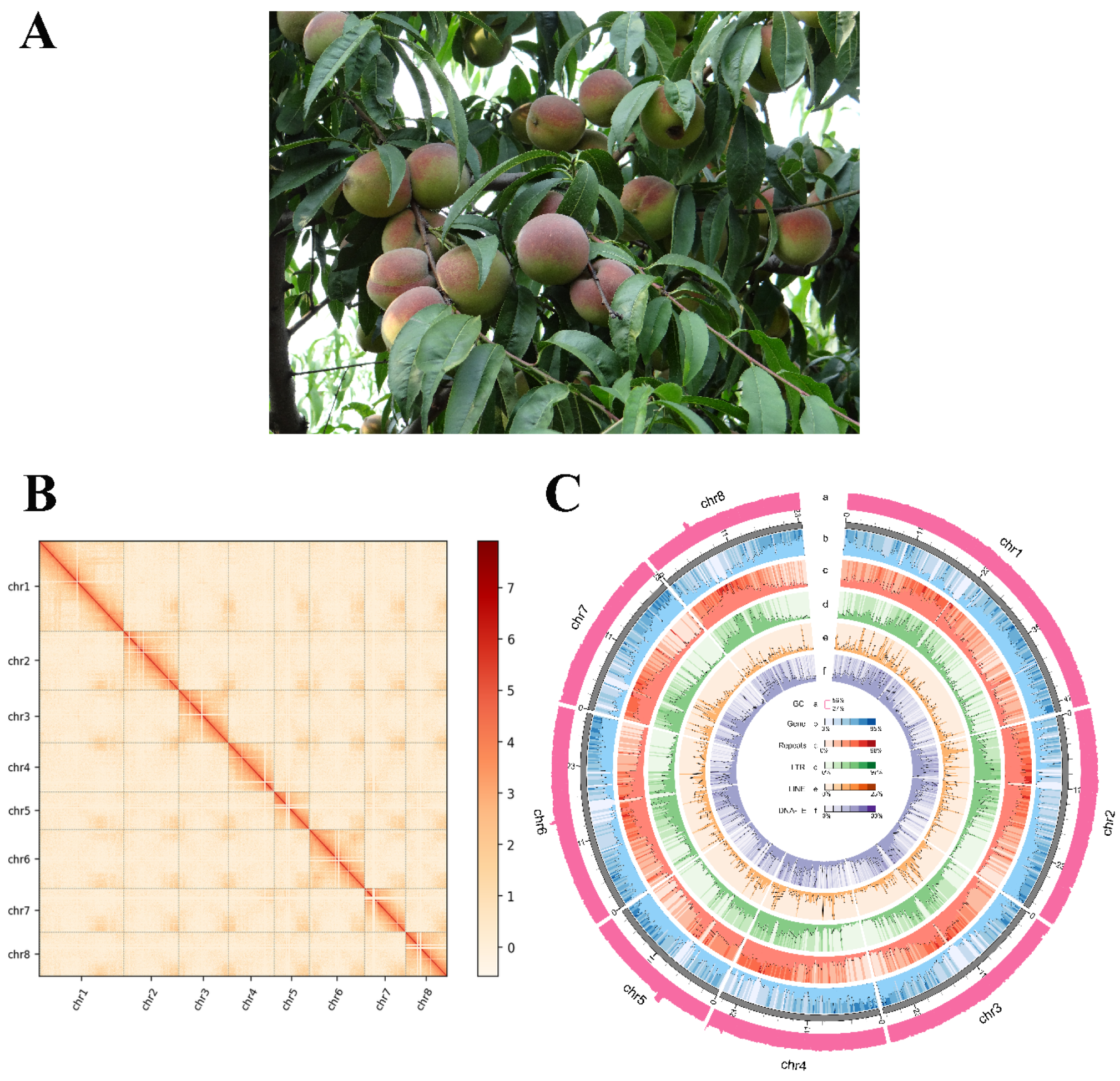
The genome of QZM was de novo assembled using 118× coverage of 29.84 Gb of HiFi reads, 100× coverage of 25.28 Gb of Illumina short reads, and 106× coverage of 27.18 Gb of Hi-C data. Based on k-mer analysis (k = 17), the estimated genome of QZM was 255 Mb, with a heterozygosity of 0.49%. Eight chromosomes and 194 scaffolds were constructed using the original 213 contigs (contig N50 = 24.35 Mb). The chromosome anchoring rate was 93.79%, and the assembled genome size reached up to 252.39 Mb, which accounted for 98.9% of the total assembled sequences (Figure 1).
The assembled QZM genome was assessed using three strategies. First, the second- and third-generation data were compared with the assembled genome, and the mapping rate and coverage reached up to 99.86% and 99.96%, respectively. Second, to evaluate the genome continuity, the LTR assembly index (LAI) was used, with the QZM genome assembly exhibiting a good LAI score of 14.55. Third, the high percentage of complete BUSCO genes (99.07%, 1599 of 1614) aligned to the QZM genome. Collectively, these findings confirm that the assembled QZM genome can serve as a good reference for further investigation of the molecular biology of peach.

2.2. Genome Annotation

Repeat sequences were identified using TRF (v4.09.1), RepeatMasker (v4.0.9), RepeatProteinMask (v4.0.9), RepeatModeler (v2.0.5), and LTR-FINDER (v1.07) software [22,23,24,25]. After the removal of redundant repeat sequences using the software, a total of 99.16 Mb repeat sequences (39.29%) in the QZM genome were detected (Tables S1 and S2). Gene prediction was performed using a strategy of homologous prediction from 10 libraries for related species. Finally, a total of 26,259 genes (98.31%) were annotated. Noncoding RNAs (ncRNAs) in the QZM genome were also annotated, yielding 130 miRNAs (0.006%), 571 tRNAs (0.017%), 7995 rRNAs (1.571%), and 472 snRNAs (0.022%).

2.3. Unique Fragments of the QZM Genome Compared with Four Different Peach Genomes

To identify unique fragments of the QZM genome, we conducted comparative analysis utilizing four additional re-sequenced peach genomes: 124Pan, CN14, Lovell, and Prunus ferganensis. The results yielded a total of 1939 fragments containing 9,247,663 bp (Table 1), as well as 418 genes. Among them, the proportion of the number of aligned fragments on the chromosome accounted for 81.03% of the total (1571/1939), and the proportion of their length accounted for 25.41% (2,350,054 bp/9,247,663 bp). The proportion of the number of unaligned fragments on the chromosome accounted for 18.97% (368/1939), and the proportion of their length accounted for 74.59% (6,897,629 bp/9,247,663 bp).
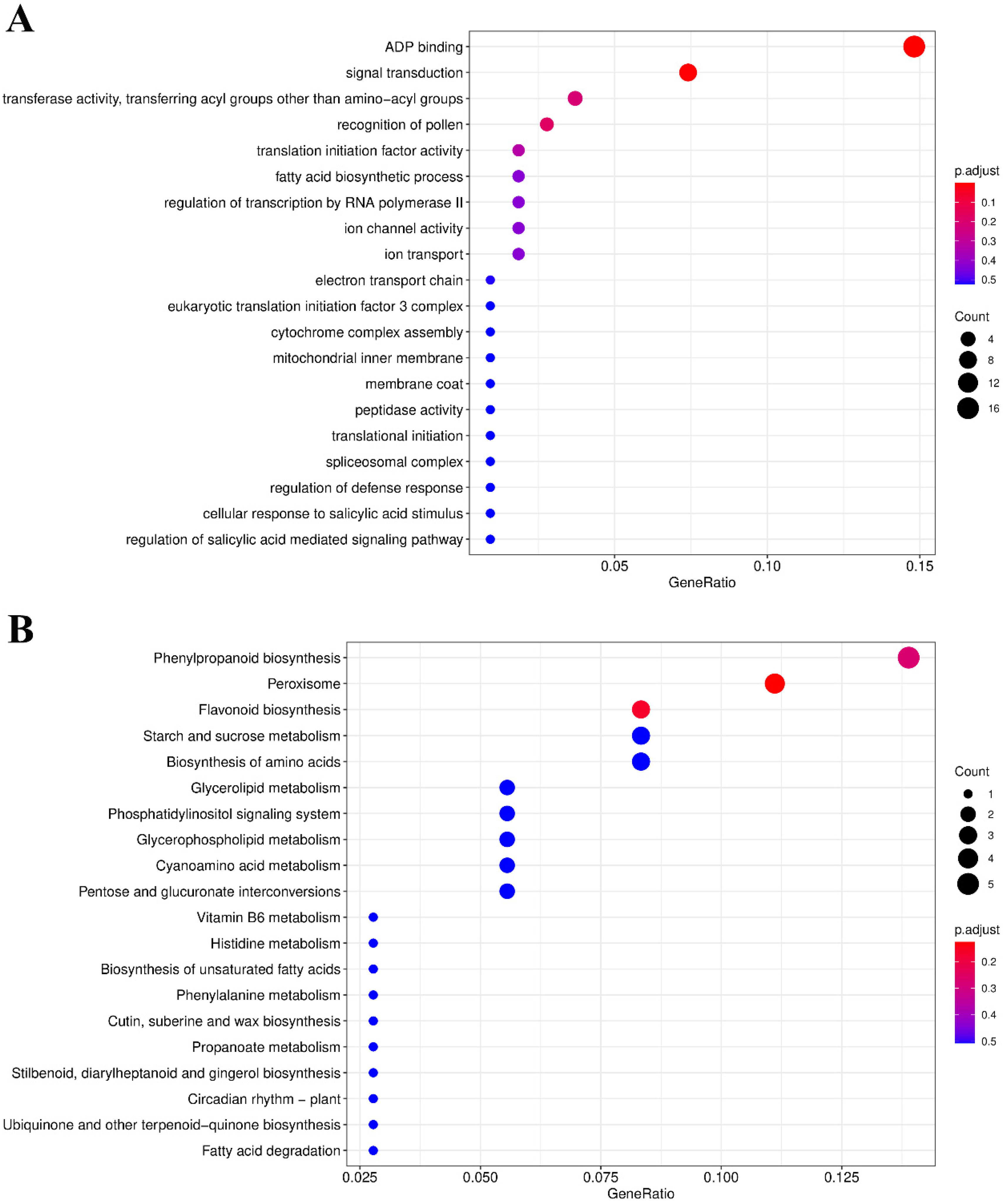
To further investigate the functional characteristics of 418 genes in the unique fragments of the QZM genome, Gene Ontology (GO) functional enrichment analysis and Kyoto Encyclopedia of Genes and Genomes (KEGG) pathway enrichment analysis were performed. The top 20 terms in the GO analysis were mainly enriched in ADP binding, signal transduction, and recognition of pollen (Figure 2A). In the KEGG analysis, the top 20 terms were primarily enriched in peroxisome, flavonoid biosynthesis, and phenylpropanoid biosynthesis (Figure 2B).

2.4. Expansion and Contraction of Gene Families in the QZM Genome

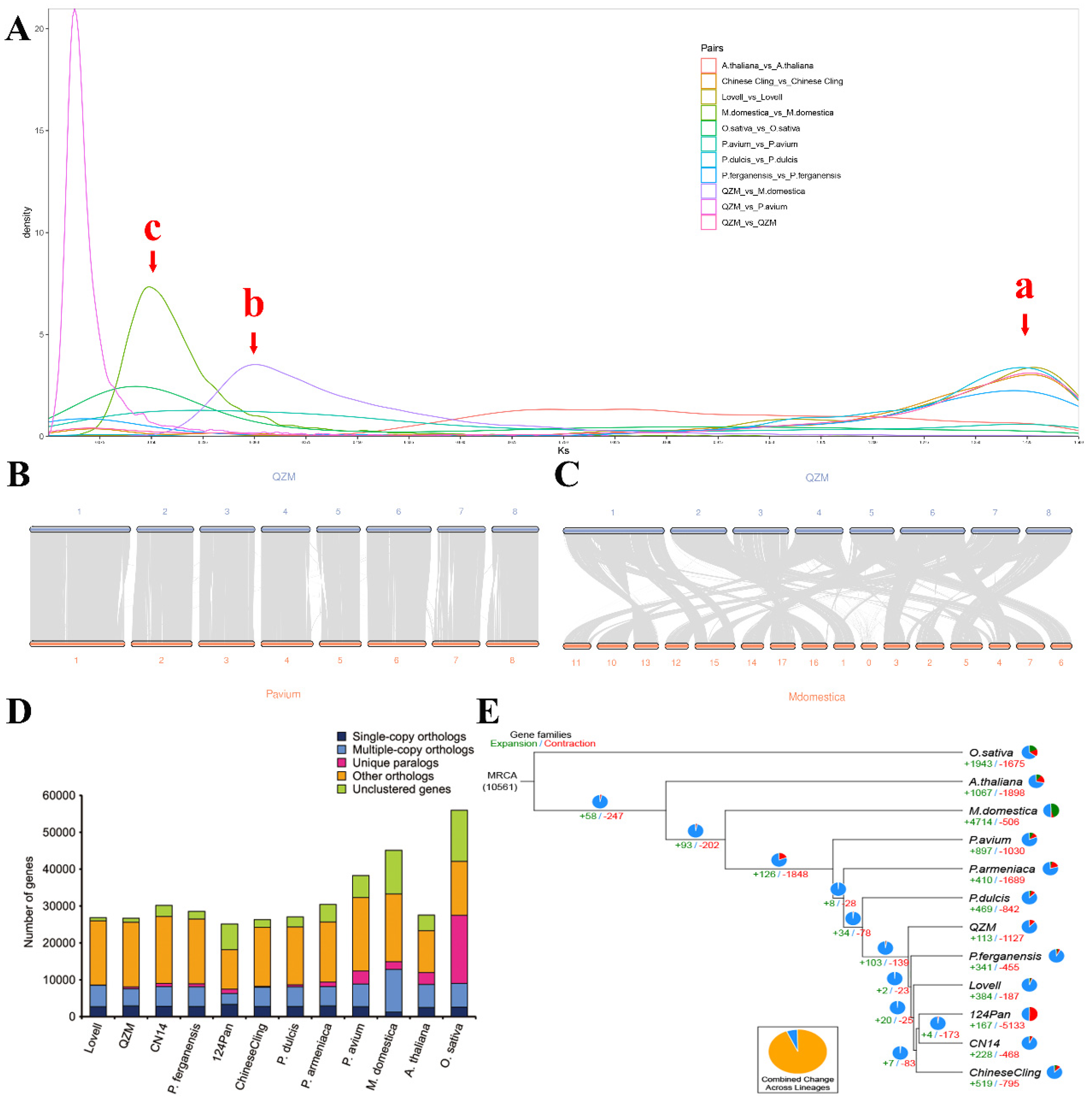
To detect whole genome duplication (WGD) events in 12 genomes comprising six peach varieties (Lovell, P. ferganensis, Chinese cling, 124Pan, and CN14), four closely related crops (Prunus dulcis, Prunus armeniaca, Prunus avium, and Malus domestica), and the non-Rosaceae plants A. thaliana and Oryza sativa, the nucleotide diversity was examined using the synonymous substitution rate (Ks) method. A shared peak (Ks = 1.42) was detected in 11 genomes, excluding A. thaliana, which indicated that most species underwent the γ early duplication event (Figure 3A; arrow a). In addition, two distant peaks were detected, representing the divergence times of QZM vs. M. domestica (Ks = 0.30; arrow b) and QZM vs. P. avium (Ks = 0.15; arrow c). The divergence time of QZM vs. M. domestica was earlier than that of QZM vs. P. avium, which suggested that QZM shared a closer genetic relationship with P. avium than M. domestica. To further investigate the genome evolution, we examined the collinear relationships between QZM and the closely related species M. domestica and P. avium (Figure 3B–C). The results revealed a one-to-one syntenic block pairwise relationship between QZM and P. avium. However, the collinear relationships between QZM and M. domestica displayed numerous rearrangements and translocations of chromosome fragments. The results also indicated that QZM had a closer genetic relationship with P. avium than M. domestica.
To analyze the evolution of QZM at the genome level, 12 genomes encompassing six peach varieties (Lovell, P. ferganensis, Chinese cling, 124Pan, and CN14), four closely related crops (P. dulcis, P. armeniaca, P. avium, and M. domestica), and the non-Rosaceae plants A. thaliana and O. sativa (serving as the outgroup) were collected. The 12 genomes contained 4250 common families and 688 single-copy genes, with the number of unique families per genome ranging from 12 to 2494 (Figure 3D). A phylogenetic tree of the 12 species was constructed based on the 688 single-copy genes (Figure 3E). As expected, the six peach varieties were clustered into a single group in the resulting tree. Within this group, the distribution of QZM revealed a distant genetic relationship between QZM and the other five peach varieties. The four closely related crops were distributed on the exterior of the peach group.
To explore the evolutionary details of the QZM gene families, the expansion and contraction of gene families across 12 genomes were analyzed (Figure 3E). Among the six peach genomes, the QZM genome contained the fewest expanded families (113) and the second-largest number of contracted gene families (1127). We selected 51 gene families with significant expansion (286 genes) and 63 gene families with significant contraction (479 genes) (p < 0.05) for KEGG enrichment analysis (Figures S1 and S2). Enrichment was mainly detected in the plant–pathogen interaction, ABC transporters, and flavonoid biosynthesis pathways in the contracted gene families, while the oxidative phosphorylation, photosynthesis, and ribosome pathways were the predominant enriched pathways in the expanded gene families.
In addition, we screened for genes undergoing positive evolution under natural selection pressure (Ka/Ks > 1) throughout the QZM genome, and a total of 46 positively selected genes were identified (Table S3). Among these genes, chromosome 6 contained the largest number of positively selected genes (11 genes), suggesting that chromosome 6 underwent relatively strong natural selection pressure. Chromosomes 5 and 8 contained the fewest positively selected genes (two genes), implying that these two chromosomes underwent relatively weak natural selection pressure compared with the other chromosomes.

2.5. Key Members in the Ethylene Biosynthesis Pathway Across the QZM Genome and Other Peach Genomes

Ethylene plays a crucial regulatory role in fruit ripening. To investigate the ethylene biosynthesis pathway, ACS and ACO genes from the QZM genome and two other genomes of mid-maturing varieties, 124Pan and P. ferganensis, were identified (Table 2). The results showed that the three genomes contained the same number of ACS genes, but the number of ACO genes was fewer in QZM (29 genes) than in 124Pan (31 genes) and P. ferganensis (33 genes), which reflected a significant contraction in the QZM genome compared with the other two peach varieties. Ethylene receptor (ETR) family genes were also identified across the three genomes (Table 2), revealing that the QZM genome contained fewer ETR genes (three genes) than the 124Pan and P. ferganensis genomes, both of which contained four ETRs.
PG family genes are core genes that regulate fruit softening by degrading pectin. The fruits of QZM possess good storability. We further examined the differences between the PG family genes in the QZM genome and those of two peach varieties with poor storability, namely, CN14 and Lovell (Tables S4 and S5). The results showed that the number of PG genes was significantly fewer in the QZM genome (52 genes) than in the CN14 (68 genes) and Lovell (70 genes) genomes, which suggests that the relatively weak fruit softening found in QZM is correlated with the smaller number of PGs in its genome.

2.6. GWAS on the Agronomic Traits of QZM

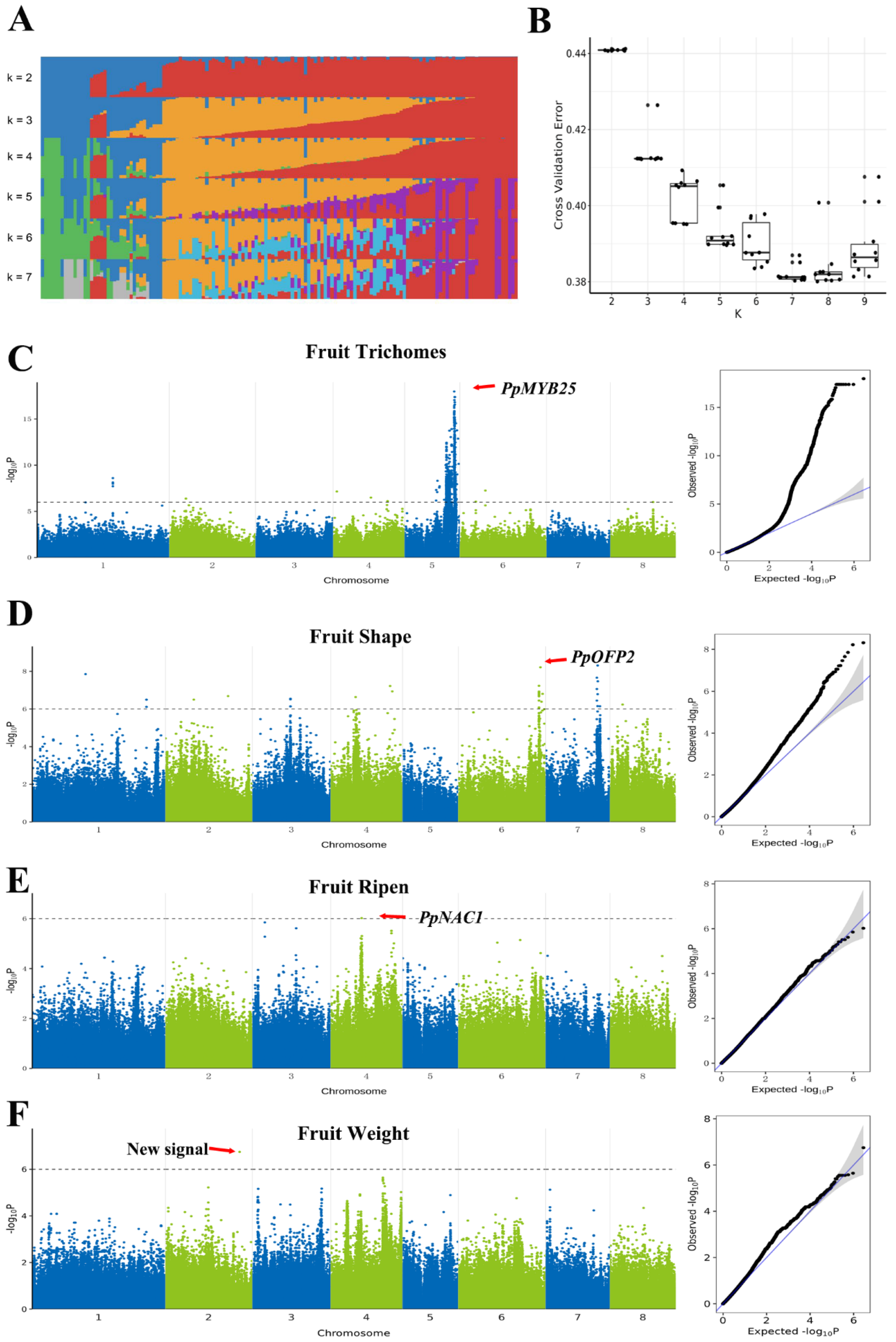
The QZM landrace peach is famous for its distinct agronomic traits, such as its small fruit size and extremely late ripening. To reveal the genetic basis of these traits, a GWAS population encompassing 145 peach accessions was constructed, which contained 29 landrace peaches from Shandong Province and 116 other peach varieties (Table S6). The K values of the population structure were analyzed, and cross-validation error analysis demonstrated that K = 7 was the optimal result (Figure 4A,B). This indicated that there was no significant family differentiation in the selected peach accessions, making them suitable for the subsequent GWAS analysis.
Using the QZM genome assembled in this study as the reference genome, 145 samples were re-sequenced and then subjected to alignment analysis with the QZM genome, yielding a total of 1,412,216 single-nucleotide polymorphisms (SNPs). After associating SNP markers with the traits of fruit hairs, fruit shape, fruit ripening, and fruit weight, peak signals were detected for all four traits. The peak signal associated with fruit trichomes was distributed on chromosome 5, and the reported key gene PpMYB25 was identified near this peak signal (Figure 4C). The peak signal associated with fruit shape was detected on the end of chromosome 6, which contained the reported key gene PpOFP2 (Figure 4D). The peak signal associated with fruit ripening was detected on the middle of chromosome 4, which featured the reported key gene PpNAC1 (Figure 4E). Finally, a novel peak signal associated with fruit weight was detected on chromosome 2 (Figure 4F). This signal did not overlap with any previously reported genes, suggesting that this signal represented a novel locus regulating fruit weight.

3. Discussion

With the gradual maturity of sequencing technologies and the continuous reduction in sequencing costs, research has shifted from a focus on plant phenotypic differences to exploring genomic data linking gene functions, evolutionary history, environmental adaptations, and production applications [9,12]. Sequencing technology has become an indispensable technical support in the field of plant science, providing molecular-level solutions to address global issues such as food security, ecological crises, and resource shortages. Next-generation sequencing technology can be utilized to determine the genome size of a specific peach variety. The long evolutionary history of peach has given rise to three main groups of peaches, namely wild varieties, local varieties, and modern cultivated varieties [26,27]. In the present study, we collected genomic information for selected sequenced peach varieties and identified the evolutionary trends of the peach genome.
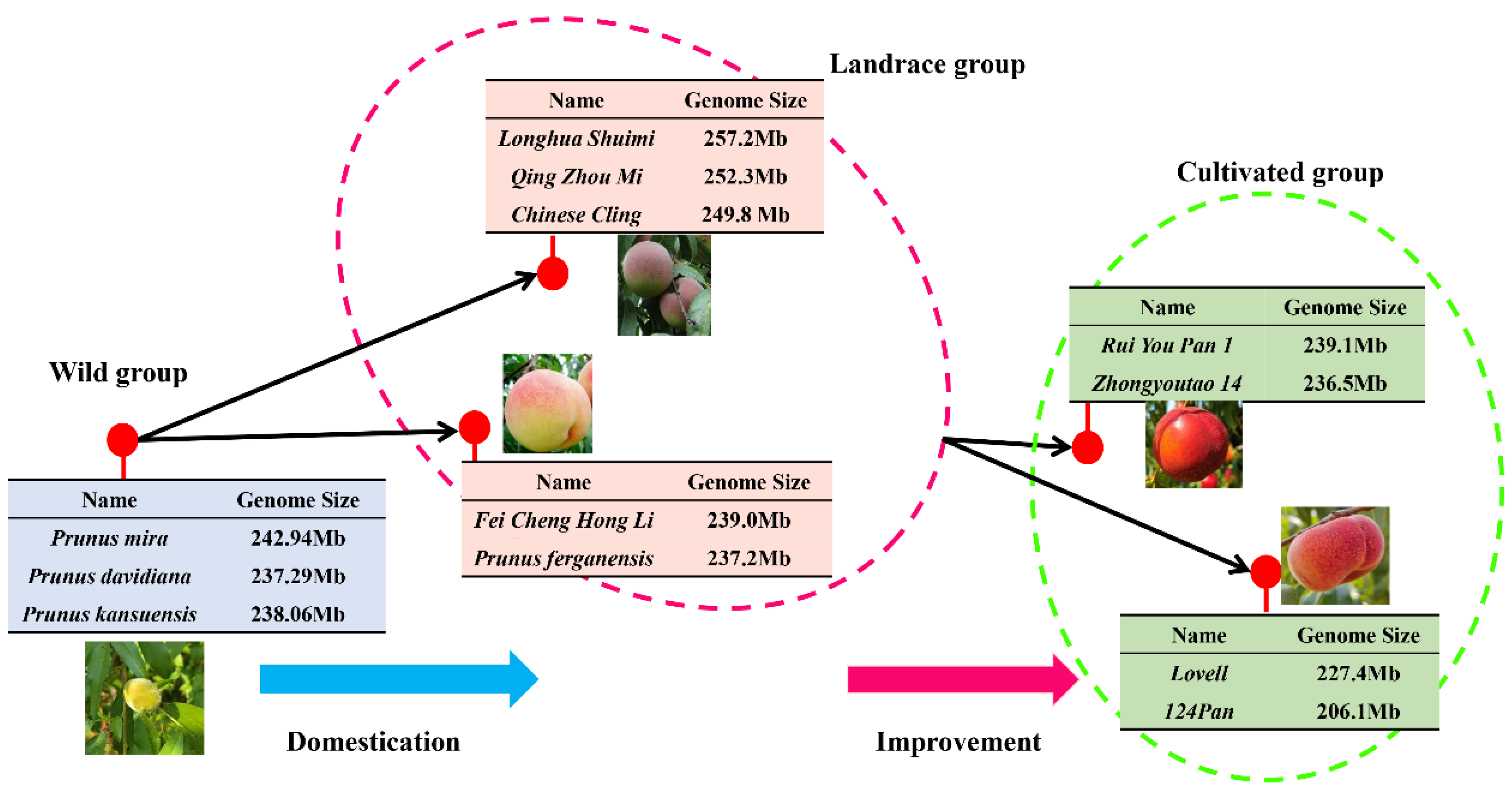
As shown in Figure 5, the genomes of re-sequenced wild varieties, including Prunus davidiana (237.2 Mb), Prunus mira (237.2 Mb), and Prunus kansuensis (238.0 Mb), were significantly smaller than those of landraces such as QZM (252.3 Mb), LHSM (252.3 Mb), and Chinese cling (249.8 Mb). This finding reflected the increase in genomic information during the early domestication of peach, which led to phenotypic changes such as enhanced fruit size and improved fruit quality [28,29]. However, not all landraces displayed a significant increase in genome size compared with wild varieties. The genome sizes of some landraces, such as Feichenghongli (239.0 Mb) and P. ferganensis (237.2 Mb), showed negligible expansion compared with those of wild varieties. Based on this finding, we infer that Feichenghongli and P. ferganensis retain a relatively large amount of genetic information from wild peaches and occupy a transitional position between the wild group and the landrace group. The genomes of landraces were significantly larger than those of modern cultivated varieties such as CN14 (236.5 Mb), 124Pan (206.1 Mb), and Lovell (227.4 Mb). This reflected the loss of genomic information during the subsequent improvement process, which led to changes in some phenotypes, such as the loss of fruit aroma and weakened stress resistance [26,27,30].
As a landrace variety, QZM has a long cultivation history of over 400 years. QZM not only possesses distinctive agronomic traits, such as small fruit size and good storage tolerance, but also exhibits uniqueness in its genome. In the present study, aligning the genome of QZM with four reported sequenced genomes enabled the identification of numerous unique fragments. Interestingly, only a quarter of these unique fragments could be aligned to eight chromosomes, while most of the remaining fragments were located in mitochondria and chloroplasts. We speculate that the genomic information in mitochondria and chloroplasts plays an indispensable role in regulating the development of the unique traits of QZM. Regarding the 418 genes on these unique fragments, we inferred the existence of several key genes based on gene annotation. For example, genes homologous to Ppe_1G0015450 (annotation: putative disease resistance protein RGA1) have been shown to positively regulate resistance in wheat and cotton [31,32]. Therefore, we hypothesize that Ppe_1G0015450 may contribute to the disease resistance of QZM. In addition, we detected important transcription factors, such as Ppe_3G0008150 (annotation: transcription factor MYB32), for which the homologous gene AtMYB32 was reported to positively regulate drought resistance in Arabidopsis [33]. Therefore, we speculate that Ppe_3G0008150 may contribute to the drought resistance of QZM. Furthermore, KEGG enrichment analysis revealed that the functions of some genes were significantly enriched in the flavonoid and phenylalanine synthesis pathways, both of which positively regulated the secondary metabolic defense system, leading to enhanced plant resistance [29,34,35]. Overall, it can be seen that the excellent resistance of QZM may be closely related to its unique fragments.
Based on the ripening stage of fruit, the ethylene system in the late-ripening peach variety QZM was significantly less developed than that in the mid-ripening varieties 124Pan and P. ferganensis. Using comparative genomic methods, we analyzed the key enzymes in the ethylene biosynthesis pathway by comparing the QZM genome with the genomes of 124Pan and P. ferganensis. The results showed that the number of members in both the ACO and ETR families was notably lower in QZM than in 124Pan and P. ferganensis. We hypothesize that this underdeveloped expansion of ethylene-related gene families may be associated with the underdevelopment of the fruit’s ethylene system. Similarly, we found that QZM, with strong storage tolerance, contained significantly fewer PG family members than the storage-sensitive varieties CN14 and Lovell. This implies that the superior storage trait of QZM is associated with the smaller number of PG family members in its genome.
Utilizing GWAS analysis, we not only identified the key genes regulating the qualitative traits of fruit skin pubescence (PpMYB12) and fruit shape (PpOFP2) but also identified the major-effect gene PpNAC1, which controls quantitative traits. This demonstrated that the association analysis conducted in this study was scientific, accurate, and reasonable. Furthermore, we performed an association analysis of fruit weight and detected a significant peak signal, SNP27296631. No previously reported genes that regulate peach fruit weight were found in this region, indicating that this may represent a novel locus involved in the regulation of fruit weight. We searched for the significant signal SNP27296631 and identified one potential key gene associated with fruit development regulation, Ppe_2G0023670, which was annotated as LOB domain-containing protein 33, while the reported functions of its homologous genes include regulating cell cycle progression and influencing plant hormone signal transduction [36]. This provides a foundation for deciphering the regulatory mechanism underlying the small fruit trait of QZM.

4. Materials and Methods

4.1. Plant Materials and Sampling

Sequencing samples including roots, stems, leaves, flowers, and fruits were collected from the landrace peach QZM (tree with an age of over 30 years) in Yangjiawo village, Wangfen Town, Qingzhou City, Shandong Province, China (118.06° E, 36.04° N).

4.2. Genome Survey and Sequencing

Genomic DNA was isolated from QZM leaves using the cetyl trimethylammonium bromide method [37]. For short-read sequencing, fragmented DNA (−50 bp) generated via the S220 Focused-ultrasonicator (Covaris, Woburn, MA, USA) was adapter-ligated and sequenced on the Illumina NovaSeq X platform (Illumina Inc., San Diego, CA, USA) to produce 150 bp paired-end reads. Concurrently, a −20 kb SMRTbell library was constructed for PacBio sequencing. Following quality assessment (agarose gel electrophoresis and Thermo Fisher Scientific Qubit 4 fluorometry; Waltham, MA, USA), high-molecular-weight DNA was sheared to −15 kb using a g-TUBE (Covaris; Roswell, GA, USA) and size-selected with 0.45× AMPure beads (Beckman Coulter, Brea, CA, USA). Damaged ends were repaired enzymatically, and hairpin adapters were blunt-end ligated prior to sequencing on the PacBio Sequel II platform (P6-C4 chemistry; Menlo Park, CA, USA) at Shanghai OE Biotech Co., Ltd. (Shanghai, China).

4.3. Hi-C Library Construction

The Hi-C library was constructed following the standard protocol with minor modifications [38]. Briefly, nuclear DNA was cross-linked and digested to generate cohesive ends, which were then filled in with biotinylated nucleotides. The library was constructed by enriching for biotin-labeled products, followed by shearing to produce fragments of −350 bp. Sequencing was performed on an Illumina HiSeq X-Ten platform (Illumina, San Diego, CA, USA) to support the construction of chromosome-level pseudomolecules.

4.4. Genome Size Estimation

The genome survey was conducted using Jellyfish (v2.3.0) (parameters “-m 17 -C”) to analyze K-mer distribution [39]. Subsequently, GenomeScope (v2.0.1) was employed to estimate the genome size, heterozygosity rate, and repeat content of QZM [40].

4.5. Genome Assembly

High-fidelity HiFi reads were generated using the CCS sequencing mode (v4.2.0; https://github.com/PacificBiosciences/ccs (accessed on 15 October 2023)), which performed consensus correction on multiple subreads from the same SMRTbell molecule template. This yielded a total of 30.24 Gb of high-quality data. The QZM genome was subsequently assembled using Hifiasm (v0.14.2) [41].

4.6. Hi-C Scaffolding and Gap Filling

Sequencing yielded 189,278,390 raw reads, of which 184,752,308 high-quality clean reads were retained after filtering adapter and low-quality sequences using fastp v0.20.0 [42]. These clean reads were aligned to the contigs using BWA-mem v0.7.17 [43] with default parameters. The aligned reads were subsequently processed through Juicer v1.5.7 [44] and 3d-DNA v20180922 [38] for Hi-C analysis and scaffolding. The Hi-C contact matrix was visualized and manually corrected based on neighboring interactions using Juicebox v1.11.9 [44].

4.7. Repeat Annotation

We performed extensive de novo TE annotation using Annotator11 (EDTA v1.7.0) [45], which integrates LTRharvest from GenomeTools (v1.5.10) [46,47], LTR_FINDER (v1.0.7) [25], TIR-Learner (v2.4) [48], and HelitronScanner (v1.1) [49] to customize filtering scripts for each TE class (LTRs, TIRs, and Helitrons). Subsequently, LTR_retriever (v2.8.2) [50], RepeatModeller (v1.0.11) [51], and RepeatMasker (v4.0.9) [52] were employed to construct a comprehensive TE library by eliminating false positive LTR predictions and identifying previously undiscovered elements. Homology-based and structural annotations were conducted using RepeatMasker.

4.8. Gene Annotation

To annotate the genome, RNA-seq reads from five tissues (roots, stems, leaves, flowers, and fruits) were aligned using HISAT2 v2.10.2 [53] and reconstructed using StringTie v1.3.0. An equimolar RNA mixture from these tissues was used to generate a high-quality full-length transcript (Iso-seq) for enhanced annotation. Two rounds of MAKER v2.31.10 [54] prediction were conducted. The first round used BLAST v2.15.0 and Exonerate v2.4.0 to align assembled transcripts, homologous proteins, and ESTs to the genome, training Augustus [55] and GeneMark-ES [56] via BRAKER2 [57]. The second round integrated these data for final de novo gene prediction. BUSCO v3.1.0 [58] assessed annotation completeness. Functional annotation used Diamond (v2.1) [59] to assign gene functions based on the best matches in the NR, KOG, GO, Swiss-Prot, TrEMBL, eggnog, KEGG, InterPro, and Pfam databases (E-value ≤ 1 × 10⁻⁵). InterProScan v5.36 [60] annotated protein domains against InterPro and Pfam, integrating GO terms from InterPro.
For non-coding RNA prediction, miRNAs, snRNAs, and snoRNAs were annotated using the Rfam v14.1 library [61]. tRNAs were identified using tRNAscan-SE v1.3.1 [62], and rRNAs were predicted using Barrnap (0.9) [63].

4.9. Whole-Genome Synteny Analysis

MUMmer software (v4.0.0beta) [64] was employed to align the genome sequences of 124Pan, CN14, Lovell, and P. ferganensis to the genome sequence of QZM. Then, we extracted the unique fragments of QZM that differed compared with each of the other four genomes.

4.10. Genome Evolution, Divergence Time, and Duplication Events

The genomes of Lovell (v2.0), P. ferganensis, Chinese cling, 124Pan, CN14, P. dulcis, P. armeniaca, P. avium, and M. domestica were downloaded from GDR (https://www.rosaceae.org/ (accessed on 7 July 2023)). The genomes of O. sativa and Arabidopsis thaliana were downloaded from the National Center for Biotechnology Information (NCBI) (https://www.ncbi.nlm.nih.gov/ (accessed on 3 July 2023)) and The Arabidopsis Information Resource (TAIR) (https://www.arabidopsis.org/ (accessed on 5 July 2023)). The gene sequences in each single-copy gene family were aligned using MAFFT software (v7.511) [65] for multiple sequence alignment. The phylogenetic tree of species was constructed using the maximum likelihood method (ML TREE) in RAxML software (v8.2.13) [66]. The Ks of each homologous gene pair was calculated based on the aforementioned alignment results using the KaKs Calculator software (v3.0) [67]. The divergence time was estimated in MCMCTree software (v4.9; parameters: clock = 3 and model = 0) [68]. The expanded and contracted genes were analyzed using Cafe5 (v5.0.0) [69].

4.11. GWASs

A total of 145 peach accessions comprising 29 landrace peaches from Shandong Province and 116 additional peach varieties were employed to perform GWASs for fruit hairs, fruit shape, fruit ripening, and fruit weight. Two-year data for fruit weight in each accession were averaged and then log2-transformed to serve as the final trait data in the association panel.
The raw SNP dataset was subjected to a multi-step filtering process to ensure that the data was of high quality. First, hard filtering was applied using the Genome Analysis Toolkit [70] based on standard best practices. Variants were excluded if they met any of the following criteria: quality by depth < 2.0, mapping quality < 40.0, Fisher strand bias > 60.0, strand odds ratio > 3.0, mapping quality rank sum test (MQRankSum) < −12.5, or read position rank sum test (ReadPosRankSum) < −8.0. Subsequently, loci with a missing genotype rate exceeding 20% across individuals were removed. To retain only biallelic SNPs, multiallelic sites were discarded. Rare variants were filtered out by excluding SNPs with a minor allele frequency less than 0.05. Finally, 1,412,216 high-quality SNPs with minor allele frequency > 0.05 were utilized as the genotypic panel for GWAS analysis. The Benjamini–Hochberg method was applied to adjust p values for multiple testing [71]. To control for the confounding effects of population structure in GWAS, principal component analysis was performed using the high-quality SNPs. The top principal components 1, 2, 3, and 4 reflecting the genetic structure of the population were incorporated as covariates in the GWAS model to reduce spurious associations caused by population stratification and improve the accuracy and reliability of the detected loci (Figure S3). Principal component analysis was performed using EIGENSOFT to plot the first four principal components [72]. GWAS analysis was then performed for the four traits in the resequencing population using the mixed linear model (MLM) in EMMAX software (v1.0 beta) [73]. Admixture software (v1.32) [74] was utilized for population structure analysis. The significance screening threshold for the four traits in this association analysis was set to 6 [75].

5. Conclusions

This study presents a high-quality chromosome-level genome assembly of the QZM landrace peach, an important genetic resource with over 400 years of cultivation history. Our comprehensive genomic analyses reveal several key findings that illuminate the genetic basis of QZM’s distinctive agronomic traits. First, comparative genomics identified 1939 unique genomic fragments containing 418 genes, many of which are associated with disease resistance or stress tolerance pathways. Second, evolutionary analysis demonstrated significant contraction in gene families related to ethylene biosynthesis (ACOs and ETRs) and fruit softening (PGs), providing molecular explanations for QZM’s extremely late-ripening phenotype and improved storage tolerance. Third, GWAS analysis uncovered a novel peak signal on chromosome 2 associated with fruit weight. These findings not only advance our understanding of peach domestication and genome evolution, but they also provide actionable genetic targets for breeding programs seeking to improve fruit quality, extend shelf life, and enhance stress resistance. The QZM genome assembly established in this study serves as a critical foundation for future functional genomics research and the development of superior peach cultivars.

Supplementary Materials

The following supporting information can be downloaded at: https://www.mdpi.com/article/10.3390/plants15071113/s1, Figure S1. Kyoto Encyclopedia of Genes and Genomes (KEGG) terms for genes from the contracted gene families in the ‘Qing Zhou Mi’ (QZM) landrace peach genome. Figure S2. Kyoto Encyclopedia of Genes and Genomes (KEGG) terms for genes from the expanded gene families in the ‘Qing Zhou Mi’ (QZM) landrace peach genome. Figure S3. Principal component analysis plots of the first four principal components (PC1, PC2, PC3, and PC4) for 145 samples. Table S1. Statistical results of repetitive sequences. Table S2. Statistical results of repetitive sequence classification. Table S3. List of 46 positively selected genes. Table S4. List of PG genes across three genomes of peach accessions. Table S5. Information on Qizhoumi and four sequenced accessions (124Pan, CN14, Lovell, and Prunus ferganensis). Table S6. Information on the GWAS population.

Author Contributions

A.Z. and M.L. planned and designed the research. M.L., Q.G., J.G., and G.L. performed experiments, analyzed data and drew conclusions based on the results. A.Z. and M.L. wrote the manuscript. All authors have read and agreed to the published version of the manuscript.

Funding

This study was supported by the Shandong Provincial Agricultural Improved Variety Project (2025LZGC041), the Natural Science Foundation of Shandong Province (ZR2023QC056), the China Agriculture Research System (CARS-30-Z-08), the Projects of the Key Research and Development Program of Shandong Province (2023TZXD088), the Agricultural Science and Technology Innovation Project (CXGC2025A06), the Scientific Research and Innovation Fund of Shandong Institute of Pomology (2023GSKY08) and the Shandong Improved Agricultural Seed Project (2024LZGCQY021).

Data Availability Statement

The raw sequencing data of the QZM genome have been uploaded to the NCBI (https://www.ncbi.nlm.nih.gov/ (accessed on 10 November 2023)) under the data number SAMN37778061. The GWAS resequencing data have been uploaded to the NCBI under the data number SAMN37823607.

Acknowledgments

We thank LetPub (www.letpub.com.cn) for its linguistic assistance during the preparation of this manuscript.

Conflicts of Interest

The authors declare no conflicts of interest.

Abbreviations

ACO, ACC Oxidase; ACS, ACC Synthase; CN14, Zhongyoutao 14; ETR, Ethylene Receptor; GWAS, Genome-Wide Association Study; FCHL, Feichenghongli; GO, Gene Ontology; GWAS, Genome Wide Association Studies; KEGG, Kyoto Encyclopedia of Genes and Genomes; LHSM, Longhuashuimi; MLM, Mixed Linear Model; PG, Polygalacturonase; QZM, Qing Zhou Mi; RYP1, Rui You Pan 1; SAM, S-adenosylmethionine.

References

  1. Kaul, S.; Koo, H.L.; Jenkins, J.; Rizzo, M.; Rooney, T.; Tallon, L.J.; Feldblyum, T.; Nierman, W.; Benito, M.I.; Lin, X.; et al. Analysis of the genome sequence of the flowering plant Arabidopsis thaliana. Nature 2000, 408, 796–815. [Google Scholar] [CrossRef] [PubMed]
  2. Jaillon, O.; Aury, J.M.; Noel, B.; Policriti, A.; Clepet, C.; Casagrande, A.; Choisne, N.; Aubourg, S.; Vitulo, N.; Jubin, C. The grapevine genome sequence suggests ancestral hexaploidization in major angiosperm phyla. Nature 2007, 449, 463–467. [Google Scholar] [CrossRef] [PubMed]
  3. Paterson, A.H.; Bowers, J.E.; Bruggmann, R.; Dubchak, I.; Grimwood, J.; Gundlach, H.; Haberer, G.; Hellsten, U.; Mitros, T.; Poliakov, A.; et al. The Sorghum bicolor genome and the diversification of grasses. Nature 2009, 457, 551–556. [Google Scholar] [CrossRef] [PubMed]
  4. Huang, X.H.; Kurata, N.; Wei, X.H.; Wang, Z.X.; Wang, A.H.; Zhao, Q.; Zhao, Y.; Liu, K.Y.; Lu, H.Y.; Li, W.J. A map of rice genome variation reveals the origin of cultivated rice. Nature 2012, 490, 497–501. [Google Scholar] [CrossRef]
  5. Xu, H.; Luo, J.; Zhang, H.; Li, Y.; Zhu, Q.; Xu, Y.; Li, J.; Song, Y.; Wang, C.; Sun, B.; et al. Analysis of the Genome Sequence of the Medicinal Plant Salvia miltiorrhiza. Mol. Plant 2016, 6, 949–952. [Google Scholar] [CrossRef]
  6. Zhao, Y.P.; Fan, G.Y.; Yin, P.P.; Sun, S.; Li, N.; Hong, X.N.; Hu, G.; Zhang, H.; Zhang, F.M.; Han, J.D.; et al. Resequencing 545 ginkgo genomes across the world reveals the evolutionary history of the living fossil. Nat. Commun. 2019, 10, 4201. [Google Scholar] [CrossRef]
  7. The International Peach Genome Initiative. The high-quality draft genome of peach (Prunus persica) identifes unique patterns of genetic diversity, domestication and genome evolution. Nat. Genet. 2013, 45, 487–494. [Google Scholar] [CrossRef]
  8. Yu, Y.; Guan, J.; Xu, Y.; Ren, F.; Zhang, Z.; Yan, J.; Fu, J.; Guo, J.; She, Z.; Zhao, J.; et al. Population-scale peach genome analyses unravel selection patterns and biochemical basis underlying fruit favor. Nat. Commun. 2021, 12, 3604. [Google Scholar] [CrossRef]
  9. Guan, J.; Xu, Y.; Yu, Y.; Fu, J.; Ren, F.; Guo, J.; Zhao, J.; Jiang, Q.; Wei, J.; Xie, H. Genome structure variation analyses of peach reveal population dynamics and a 1.67 Mb causal inversion for fruit shape. Genome Biol. 2021, 22, 13. [Google Scholar] [CrossRef]
  10. Cao, K.; Yang, X.; Li, Y.; Zhu, G.; Fang, W.; Chen, C.; Wang, X.; Wu, J.; Wang, L. New high-quality peach (Prunus persica L. Batsch) genome assembly to analyze the molecular evolutionary mechanism of volatile compounds in peach fruits. Plant J. 2021, 108, 281–295. [Google Scholar] [CrossRef]
  11. Zhang, A.; Zhou, H.; Jiang, X.; Han, Y.; Zhang, X. The Draft Genome of a Flat Peach (Prunus persica L. cv. ‘124 Pan’) Provides Insights into Its Good Fruit Flavor Traits. Plants 2021, 10, 538. [Google Scholar] [CrossRef] [PubMed]
  12. Lian, X.; Zhang, H.; Jiang, C.; Gao, F.; Yan, L.; Zheng, X.; Cheng, J.; Wang, W.; Ye, X.; Li, J.; et al. De novo chromosome-level genome of a semi-dwarf cultivar of Prunus persica identifies the aquaporin PpTIP2 as responsible for temperature-sensitive semi-dwarf trait and PpB3-1 for flower type and size. Plant Biotechnol. J. 2022, 20, 886–902. [Google Scholar] [CrossRef] [PubMed]
  13. Cao, K.; Peng, Z.; Zhao, X.; Li, Y.; Liu, K.; Arus, P.; Fang, W.; Chen, C.; Wang, X.; Wu, J.; et al. Chromosome-level genome assemblies of four wild peach species provide insights into genome evolution and genetic basis of stress resistance. BMC Biol. 2022, 20, 139. [Google Scholar] [CrossRef] [PubMed]
  14. Li, M.; Li, J.; Nie, P.; Li, G.; Liu, W.; Gong, Q.; Dong, X.; Gao, X.; Chen, W.; Zhang, A. A high-quality assembled genome of a representative peach landrace, ‘Feichenghongli’, and analysis of distinct late florescence and narrow leaf traits. BMC Plant Biol. 2023, 23, 230. [Google Scholar] [CrossRef]
  15. Chen, T.; Qin, G.; Tian, S. Regulatory network of fruit ripening: Current understanding and future challenges. New Phytol. 2020, 228, 1219–1226. [Google Scholar] [CrossRef]
  16. Fenn, M.; Giovannoni, J. Phytohormones in Fruit Development and Maturation. Plant J. 2021, 105, 446–458. [Google Scholar] [CrossRef]
  17. Chen, H.; Bai, S.; Kusano, M.; Ezura, H.; Wang, N. Increased ACS enzyme dosage causes initiation of climacteric ethylene production in tomato. Int. J. Mol. Sci. 2022, 23, 10788. [Google Scholar] [CrossRef]
  18. Luo, L.; Zhao, P.; Su, Z.; Huang, Y.; Zhang, Y.; Mu, Q.; Xuan, X.; Qu, Z.; Yu, M.; Qi, Z.; et al. Characterization and Potential Action Mode Divergences of Homologous ACO1 Genes during the Organ Development and Ripening Process between Non-Climacteric Grape and Climacteric Peach. Int. J. Mol. Sci. 2024, 25, 789. [Google Scholar] [CrossRef]
  19. Cheng, C.; Liu, J.; Wang, X.; Wang, Y.; Yuan, Y.; Yang, S. PpERF/ABR1 functions as an activator to regulate PpPG expression resulting in fruit softening during storage in peach (Prunus persica). Postharvest Biol. Technol. 2022, 189, 111919. [Google Scholar] [CrossRef]
  20. Paniagua, C.; Ric-Varas, P.; Garcia-Gago, J.; Lopez-Casado, G.; Blanco-Portales, R.; Munoz-Blanco, J.; Schuckel, J.; Knox, J.; Matas, A.; Quesada, M.; et al. Elucidating the role of polygalacturonase genes in strawberry fruit softening. J. Exp. Bot. 2020, 71, 7103. [Google Scholar] [CrossRef]
  21. Quesada, M.; Blanco-Portales, R.; Pose, S.; Garcia-Gago, J.A.; Jimenez-Bermudez, S.; Muoz-Serrano, A.; Caballero, J.; Pliego-Alfaro, F.; Mercado, J.; Munoz-Blanco, J. Antisense Down-Regulation of the FaPG1 Gene Reveals an Unexpected Central Role for Polygalacturonase in Strawberry Fruit Softening. Plant Physiol. 2009, 150, 1022–1032. [Google Scholar] [CrossRef]
  22. Gary, B. Tandem repeats finder: A program to analyze DNA sequences. Nucleic Acids Res. 1999, 2, 573–580. [Google Scholar] [CrossRef]
  23. Price, A.L.; Jones, N.C.; Pevzner, P.A. De novo identification of repeat families in large genomes. Bioinformatics 2005, 21, i351–i358. [Google Scholar] [CrossRef]
  24. Edgar, R.C.; Myers, E.W. Piler: Identification and classification of genomic repeats. Bioinformatics 2025, 21, 152–158. [Google Scholar] [CrossRef] [PubMed]
  25. Xu, Z.; Wang, H. Ltr_finder: An efficient tool for the prediction of full-length ltr retrotransposons. Nucleic Acids Res. 2007, 35, W265–W268. [Google Scholar] [CrossRef] [PubMed]
  26. Cao, K.; Zheng, Z.; Wang, L.; Liu, X.; Zhu, G.; Fang, W.; Cheng, S.; Zeng, P.; Chen, C.; Wang, X.; et al. Comparative population genomics reveals the domestication history of the peach, Prunus persica, and human influences on perennial fruit crops. Genome Biol. 2014, 15, 415. [Google Scholar] [CrossRef] [PubMed]
  27. Li, Y.; Cao, K.; Zhu, G.; Fang, W.; Chen, C.; Wang, X.; Zhao, P.; Guo, J.; Ding, T.; Guan, L.; et al. Genomic analyses of an extensive collection of wild and cultivated accessions provide new insights into peach breeding history. Genome Biol. 2019, 20, 36. [Google Scholar] [CrossRef]
  28. Cao, X.; Su, Y.; Zhao, T.; Zhang, Y.; Cheng, B.; Xie, K.; Yu, M.; Allan, A.; Klee, H.; Chen, K.; et al. Multi-omics analysis unravels chemical roadmap and genetic basis for peach fruit aroma improvement. Cell Rep. 2024, 43, 114623. [Google Scholar] [CrossRef]
  29. Li, Y.; Arus, P.; Wu, J.; Zhu, G.; Fang, W.; Chen, C.; Wang, X.; Cao, K.; Wang, L. Panvariome and pangenome of 1,020 global peach accessions shed light on evolution patterns, hidden natural variations, and efficient gene discovery. Mol. Plant 2025, 18, 995–1013. [Google Scholar] [CrossRef]
  30. Carolina, F.I.F.; Gradziel, T.M.; Gogorcena, Y.; Moreno, M.A. Phenotypic diversity among local Spanish and foreign peach and nectarine [Prunus persica (L.) Batsch] accessions. Euphytica 2014, 197, 261–277. [Google Scholar] [CrossRef]
  31. Cao, X.; Liu, Y.; Liu, Z.; Liu, F.; Wu, Y.; Zhou, Z.; Cai, X.; Wang, X.; Zhang, Z.; Wang, Y.; et al. Microdissection of the Ah01 chromosome in upland cotton and microcloning of resistance gene anologs from the single chromosome. Hereditas 2017, 154, 13. [Google Scholar] [CrossRef] [PubMed]
  32. Zheng, S.; Wu, Y.; Zhou, M.; Zeng, L.; Liu, R.; Li, Y.; Liu, Z.; Zhang, C.; Lu, L.; Zhang, L. Characterization and diagnostic marker development for Yr28-rga1 conferring stripe rust resistance in wheat. Eur. J. Plant Pathol. 2020, 156, 623–634. [Google Scholar] [CrossRef]
  33. Li, X.; Zhong, M.; Qu, L.; Yang, J.; Liu, X.; Zhao, Q.; Liu, X.; Zhao, X. AtMYB32 regulates the ABA response by targeting ABI3, ABI4 and ABI5 and the drought response by targeting CBF4 in Arabidopsis. Plant Sci. 2021, 310, 110983. [Google Scholar] [CrossRef] [PubMed]
  34. Cui, J.; Li, X.; Gan, Q.; Lu, Z.; Du, Y.; Noor, I.; Wang, L.; Liu, S.; Jin, B. Flavonoids Mitigate Nanoplastic Stress in Ginkgo biloba. Plant Cell Environ. 2025, 48, 1790–1811. [Google Scholar] [CrossRef]
  35. Xiang, D.; Tu, H.; Yuan, Y.; Yao, Y.; Liao, W.; Wang, H.; Yan, Y.; Wang, Y.; Chen, Y.; Liu, D.; et al. A Blast-Resistant NLR Gene Confers Drought Resistance by Competitively Interacting with an E3 Ligase to Protect Phenylalanine Ammonia-Lyase in Rice. Adv. Sci. 2025, 12, e02662. [Google Scholar] [CrossRef]
  36. Berckmans, B.; Vassileva, V.; Schmid, S.; Maes, S.; Parizot, B.; Naramoto, S.; Magyar, Z.; Kamei, C.L.A.; Koncz, C.; Bogre, L.; et al. Auxin-dependent cell cycle reactivation through transcriptional regulation of Arabidopsis E2Fa by lateral organ boundary proteins. Plant Cell 2011, 23, 3671–3683. [Google Scholar] [CrossRef]
  37. Murray, G.; Thompson, F. Rapid isolation of high molecular weight plant DNA. Nucleic Acids Res. 1980, 8, 4321–4326. [Google Scholar] [CrossRef]
  38. Dudchenko, O.; Batra, S.; Omer, D.; Nyquist, K.; Hoeger, M.; Durand, C.; Shamim, S.; Machol, I.; Lander, S.; Aiden, P.; et al. De novo assembly of the Aedes aegypti genome using Hi-C yields chromosome-length scaffolds. Science 2017, 356, 925. [Google Scholar] [CrossRef]
  39. Marcais, G.; Kingsford, C. A fast, lock-free approach for efficient parallel counting of occurrences of k-mers. Bioinformatics 2011, 27, 764–770. [Google Scholar] [CrossRef]
  40. Vurture, W.; Sedlazeck, F.J.; Nattestad, M.; Underwood, J.; Fang, H.; Gurtowski, J.; Schatz, C. GenomeScope: Fast reference-free genome profiling from short reads. Bioinformatics 2017, 33, 2202–2204. [Google Scholar] [CrossRef]
  41. Cheng, H.; Concepcion, G.; Feng, X.; Zhang, H.; Li, H. Haplotype-resolved de novo assembly using phased assembly graphs with hifiasm. Nat. Methods 2021, 8, 170–175. [Google Scholar] [CrossRef]
  42. Chin, S.; Peluso, P.; Sedlazeck, J.; Nattestad, M.; Concepcion, T.; Clum, A.; Dunn, C.; O’Malley, R.; Figueroa-Balderas, R.; Morales-Cruz, A.; et al. Phased diploid genome assembly with single-molecule real-time sequencing. Nat. Methods 2016, 13, 1050–1054. [Google Scholar] [CrossRef] [PubMed]
  43. Li, H.; Durbin, R. Fast and accurate short read alignment with Burrows—Wheeler transform. Bioinformatics 2009, 25, 1754–1760. [Google Scholar] [CrossRef] [PubMed]
  44. Durand, C.; Shamim, S.; Machol, I.; Rao, P.; Huntley, H.; Lander, S.; Aiden, L. Juicer provides a one-click system for analyzing loop-resolution Hi-C experiments. Cell Syst. 2016, 3, 95–98. [Google Scholar] [CrossRef] [PubMed]
  45. Ou, S.; Su, W.; Liao, Y.; Chougule, K.; Agda, A.; Hellinga, L.; Lugo, B.; Elliott, A.; Ware, D.; Peterson, T.; et al. Benchmarking transposable element annotation methods for creation of a streamlined comprehensive pipeline. Genome Biol. 2019, 20, 275. [Google Scholar] [CrossRef]
  46. Ellinghaus, D.; Kurtz, S.; Willhoeft, U. LTRharvest, an efficient and flexible software for de novo detection of LTR retrotransposons. BMC Bioinform. 2008, 9, 18. [Google Scholar] [CrossRef]
  47. Gremme, G.; Steinbiss, S.; Kurtz, S. Genome tools: A comprehensive software library for efficient processing of structured genome annotations. IEEE/ACM Trans. Comput. Biol. Bioinform. 2013, 10, 645–656. [Google Scholar] [CrossRef]
  48. Su, W.; Gu, X.; Peterson, T. TIR-Learner, a New Ensemble Method for TIR Transposable Element Annotation, Provides Evidence for Abundant New Transposable Elements in the Maize Genome. Mol. Plant 2019, 12, 447–460. [Google Scholar] [CrossRef]
  49. Xiong, W.; He, L.; Lai, J.; Dooner, K.; Du, C. HelitronScanner uncovers a large overlooked cache of Helitron transposons in many plant genomes. Proc. Natl. Acad. Sci. USA 2014, 111, 10263–10268. [Google Scholar] [CrossRef]
  50. Ou, S.; Chen, J.; Jiang, N. Assessing genome assembly quality using the LTR Assembly Index (LAI). Nucleic Acids Res. 2018, 46, e126. [Google Scholar] [CrossRef]
  51. Smit, A.; Hubley, R. RepeatModeler Open-1.0. 2015. Available online: http://www.repeatmasker.org (accessed on 8 July 2023).
  52. Smit, A.; Hubley, R.; Green, P. RepeatMasker Open-4.0. 2013. Available online: http://www.repeatmasker.org (accessed on 8 July 2023).
  53. Kim, D.; Langmead, B.; Salzberg, L. HISAT: A fast spliced aligner with low memory requirements. Nat. Methods 2015, 12, 357–360. [Google Scholar] [CrossRef]
  54. Cantarel, L.; Korf, I.; Robb, C.; Parra, G.; Ross, E.; Moore, B.; Holt, C.; Alvarado, S.; Yandell, M. MAKER: An easy-to-use annotation pipeline designed for emerging model organism genomes. Genome Res. 2008, 18, 188–196. [Google Scholar] [CrossRef] [PubMed]
  55. Stanke, M.; Keller, O.; Gunduz, I.; Hayes, A.; Waack, S.; Morgenstern, B. AUGUSTUS: A b initio prediction of alternative transcripts. Nucleic Acids Res. 2006, 34, W435–W439. [Google Scholar] [CrossRef] [PubMed]
  56. Lomsadze, A.; Ter-Hovhannisyan, V.; Chernof, O.; Borodovsky, M. Gene identification in novel eukaryotic genomes by self-training algorithm. Nucleic Acids Res. 2005, 33, 6494–6506. [Google Scholar] [CrossRef] [PubMed]
  57. Hof, J.; Lomsadze, A.; Borodovsky, M.; Stanke, M. Whole-genome annotation with BRAKER. Methods Mol. Biol. 2019, 1962, 65–95. [Google Scholar]
  58. Simao, A.; Waterhouse, M.; Ioannidis, P.; Kriventseva, V.; Zdobnov, M. BUSCO: Assessing genome assembly and annotation completeness with single- copy orthologs. Bioinformatics 2015, 31, 3210–3212. [Google Scholar] [CrossRef]
  59. Brandenburg, K. DIAMOND—Crystal and Molecular Structure Visualization, Version 4.8; Crystal Impact GbR: Bonn, Germany, 2023. [Google Scholar]
  60. Quevillon, E.; Silventoinen, V.; Pillai, S.; Harte, N.; Mulder, N.; Apweiler, R.; Lopez, R. InterProScan: Protein domains identifier. Nucleic Acids Res. 2005, 33, W116–W120. [Google Scholar] [CrossRef]
  61. Grifths-Jones, S.; Moxon, S.; Marshall, M.; Khanna, A.; Eddy, R.; Bateman, A. Rfam: Annotating non-coding RNAs in complete genomes. Nucleic Acids Res. 2005, 33, 121–124. [Google Scholar] [CrossRef]
  62. Lowe, M.; Eddy, R. tRNAscan-SE: A program for improved detection of transfer RNA genes in genomic sequence. Nucleic Acids Res. 1997, 25, 955–964. [Google Scholar] [CrossRef]
  63. Lagesen, K.; Hallin, P.; Rodland, E.A.; Stærfeldt, H.; Rognes, T.; Ussery, W. RNAmmer: Consistent and rapid annotation of ribosomal RNA genes. Nucleic Acids Res. 2007, 35, 3100–3108. [Google Scholar] [CrossRef]
  64. Marcais, G.; Delcher, A.; Phillippy, A.; Coston, R.; Salzberg, S.; Zimin, A. MUMmer4: A fast and versatile genome alignment system. PLoS Comput. Biol. 2018, 14, e1005944. [Google Scholar] [CrossRef]
  65. Katoh, M.; Kuma, M. MAFFT: A novel method for rapid multiple sequence alignment based on fast Fourier transform. Nucleic Acids Res. 2002, 30, 3059–3066. [Google Scholar] [CrossRef] [PubMed]
  66. Stamatakis, A.; Ludwig, T.; Meier, H. RAxML-III: A fast program for maximum likelihood-based inference of large phylogenetic trees. Bioinformatics 2005, 21, 456–463. [Google Scholar] [CrossRef] [PubMed]
  67. Zhang, Z.; Li, J.; Zhao, X.; Wang, J.; Wong, G.; Yu, J. KaKs_Calculator: Calculating Ka and Ks through model selection and model averaging. Genom. Proteom. Bioinform. 2006, 4, 259–263. [Google Scholar] [CrossRef] [PubMed]
  68. Yang, Z. PAML 4: Phylogenetic analysis by maximum likelihood. Mol. Biol. Evol. 2007, 24, 1586–1591. [Google Scholar] [CrossRef]
  69. Mendes, K.; Vanderpool, D.; Fulton, B.; Hahn, W. CAFE 5 models variation in evolutionary rates among gene families. Bioinformatics 2020, 36, 5516–5518. [Google Scholar] [CrossRef]
  70. McKenna, A.; Hanna, M.; Banks, E.; Sivachenko, A.; Cibulskis, K.; Kernytsky, A.; Garimella, K.; Altshuler, D.; Gabriel, S.; Daly, M. The Genome Analysis Toolkit: A MapReduce framework for analyzing next-generation DNA sequencing data. Genome Res. 2010, 20, 1297–1303. [Google Scholar] [CrossRef]
  71. Benjamini, Y.; Hochberg, Y. Controlling the false discovery rate: A practical and powerful approach to multiple testing. J. R. Stat. Soc. Ser. B Methodol. 1995, 57, 289–300. [Google Scholar] [CrossRef]
  72. Price, A.; Patterson, N.; Plenge, R.; Weinblatt, M.; Shadick, N.; Reich, D. Principal components analysis corrects for stratification in genome-wide association studies. Nat. Genet. 2006, 38, 904–909. [Google Scholar] [CrossRef]
  73. Zhou, X.; Stephens, M. Genome-wide efficient mixed-model analysis for association studies. Nat. Genet. 2012, 44, 821–824. [Google Scholar] [CrossRef]
  74. Alexander, D.H.; Novembre, J.; Lange, K. Fast model-based estimation of ancestry in unrelated individuals. Genome Res. 2009, 19, 1655–1664. [Google Scholar] [CrossRef]
  75. Manolio, T.; Collins, F.; Cox, N.; Goldstein, D.; Hindorff, L.; Hunter, D.; McCarthy, M.; Ramos, E.; Cardon, L.; Chakravarti, A.; et al. Finding the missing heritability of complex diseases. Nature 2009, 461, 747–753. [Google Scholar] [CrossRef]
Figure 1. Characterization of the ‘Qing Zhou Mi’ (QZM) landrace peach genome. (A) Mature fruit phenotype of QZM. (B) Hi-C interactions among eight chromosomes (100 kb resolution). Strong interactions are indicated in dark red, and weak interactions are indicated in white. (C) Features across the QZM genome. Tracks (outer to inner circles) indicate (a) GC content, (b) gene density, (c) repeats, (d) LTRs, (e) lines, and (f) transposable elements.
Plants 15 01113 g001
Figure 2. Top 20 Gene Ontology (GO) terms (A) and Kyoto Encyclopedia of Genes and Genomes (KEGG) terms (B) for genes in specific fragments.
Plants 15 01113 g002
Figure 3. (A) Synonymous substitution rate (Ks) distribution map of 12 genomes (‘Lovell’, Prunus ferganensis, ‘Chinese cling’, ‘124Pan’, ‘CN14’, Prunus dulcis, Prunus armeniaca, Prunus avium, Malus domestica, Arabidopsis thaliana, and Oryza sativa). The peak in the plot produced by intraspecific combinations indicates the whole-genome duplication event of the species itself; the peak in the plot generated from interspecific combinations represents species divergence. a, the γ early duplication event; b, the divergence times of QZM vs. M. domestica; c, the divergence times of QZM vs. P. avium. (B) Collinearity analysis of ‘Qing Zhou Mi’ (QZM) landrace peach vs. P. avium based on coding sequences. The numbers in the figure represent the chromosome numbers. (C) Collinearity analysis of QZM vs. M. domestica based on coding sequences. The numbers in the figure represent the chromosome numbers. (D) Statistical results for homologous gene numbers of 12 species. (E) Phylogenetic tree and gene family expansion and contraction of 12 species. MRCA, most recent common ancestor. Green numbers indicate the number of expanded gene families, and red numbers indicate the number of contracted gene families during the evolution of the species.
Plants 15 01113 g003
Figure 4. (A) Population structure of 145 peach accessions with different K values (ranging from 2 to 7). (B) Cross-validation errors of the re-sequenced population with different K values (ranging from 2 to 9). (C) Manhattan plot (left) and QQ plot (right) of the genome-wide association study (GWAS) for fruit trichomes and the corresponding peak signal on chromosome 5. (D) Manhattan plot (left) and QQ plot (right) of the GWAS for fruit shape and the corresponding peak signal on chromosome 6. (E) Manhattan plot (left) and QQ plot (right) of the GWAS for fruit ripening time and the corresponding peak signal on chromosome 4. (F) Manhattan plot (left) and QQ plot (right) of the GWAS for fruit weight and the corresponding peak signal on chromosome 2.
Plants 15 01113 g004
Figure 5. Genome size trends of selected sequenced peach accessions among the wild, landrace, and cultivated groups.
Plants 15 01113 g005
Table 1. Length distribution of specific fragments from the QZM a genome vs. four different peach genomes b.
TypeNumberLength (bp)
All<100 bp40912,748
100 bp–1 kb867316,920
1 kb–10 kb3901,379,294
>10 kb2737,538,701
Chromosomal Regions<100 bp40412,614
100 bp–1 kb847306,312
1 kb–10 kb273800,539
>10 kb471,230,589
Non-chromosomal
Region
<100 bp5134
100 bp–1 kb2010,608
1 kb–10 kb117578,755
>10 kb2266,308,112
a QZM, landrace peach, Qing Zhou Mi. b Four different peach genomes: 124Pan, CN14, Lovell, and Prunus ferganensis.
Table 2. Statistics of three gene families across the genomes of three accessions.
FamilyQZM a124Pan bPrunus ferganensis
ACS888
ACO293331
ETR344
a QZM, landrace peach, Qing Zhou Mi. b 124Pan, cultivar peach 124 Pan.
Disclaimer/Publisher’s Note: The statements, opinions and data contained in all publications are solely those of the individual author(s) and contributor(s) and not of MDPI and/or the editor(s). MDPI and/or the editor(s) disclaim responsibility for any injury to people or property resulting from any ideas, methods, instructions or products referred to in the content.