Floral Traits, Pollination and Reproductive Differentiation in Gynodioecious Minuartia nifensis (Caryophyllaceae)

Abstract
1. Introduction
2. Results
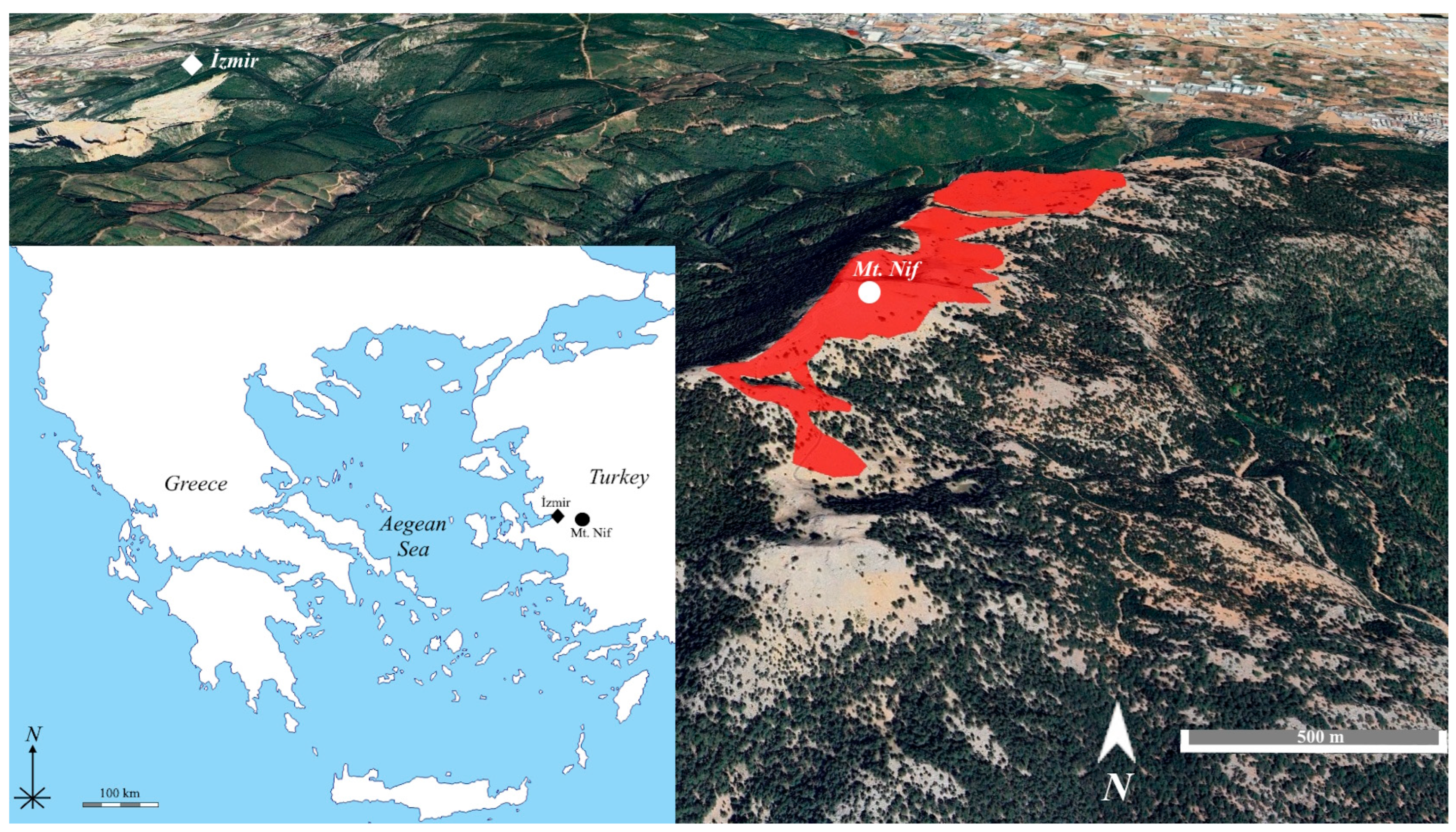
2.1. Distribution Area, Number of Individuals and IUCN Category
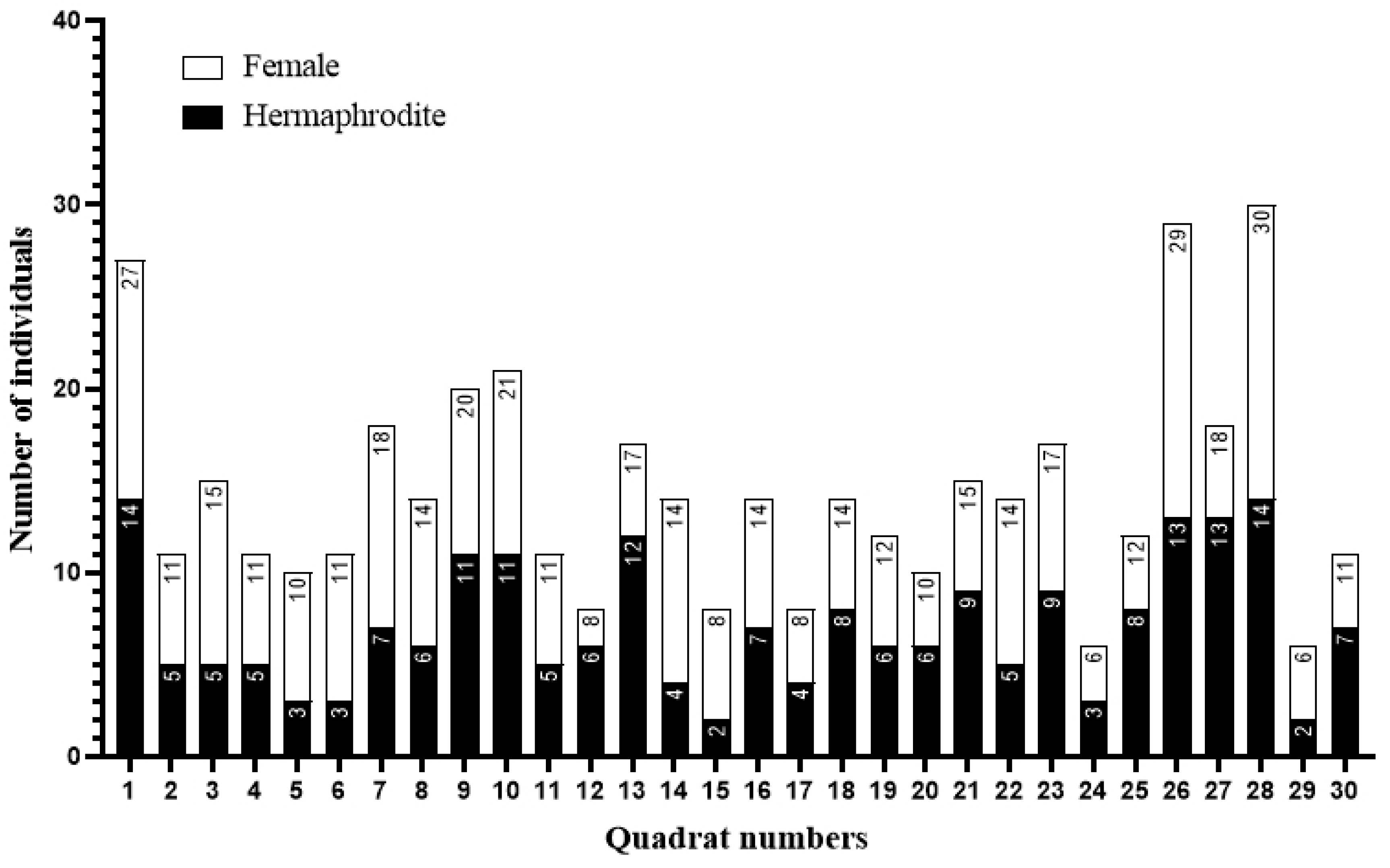
2.2. Evaluating of Morph Ratios
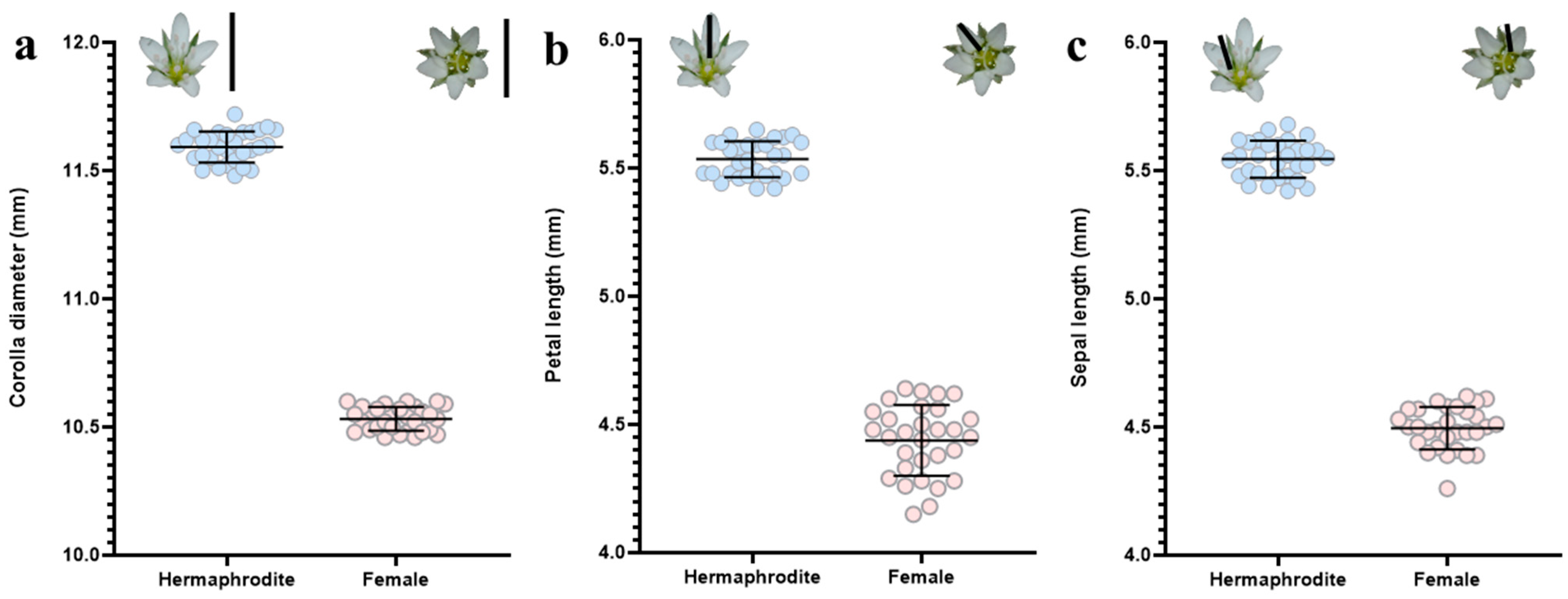
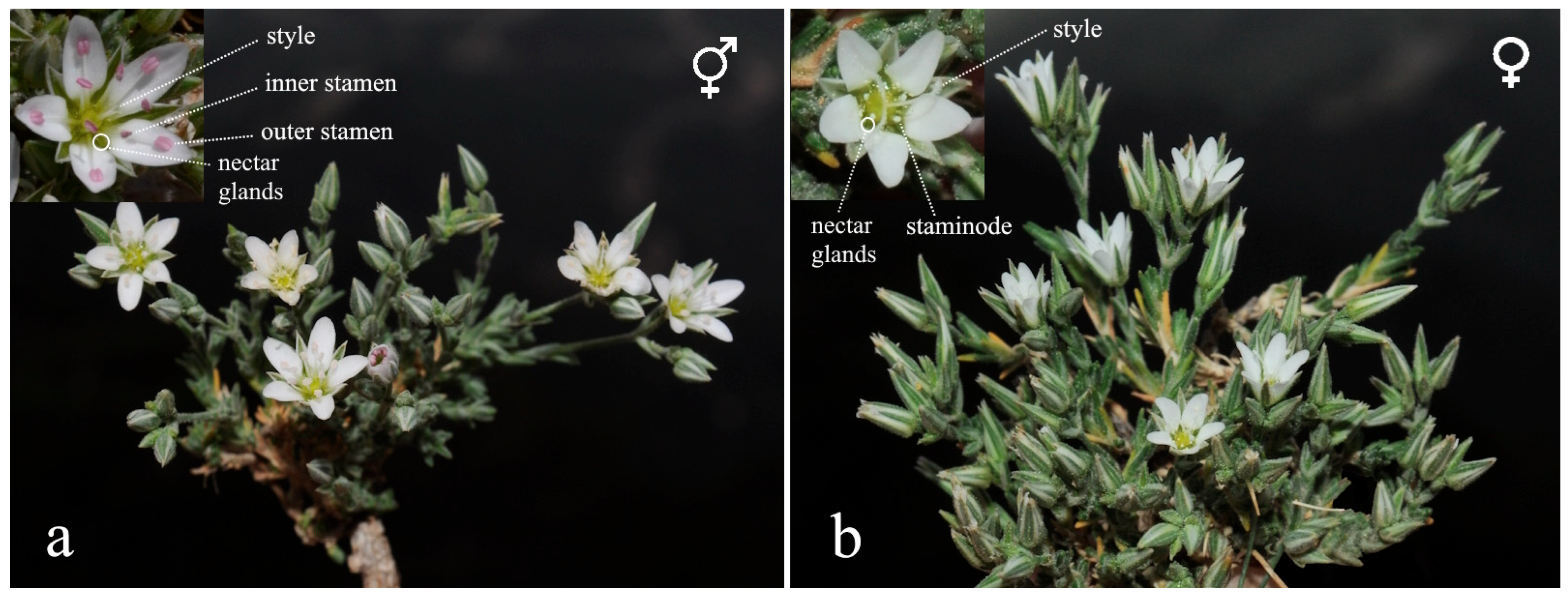
2.3. Comparison of Hermaphrodite and Female Flower Morphology
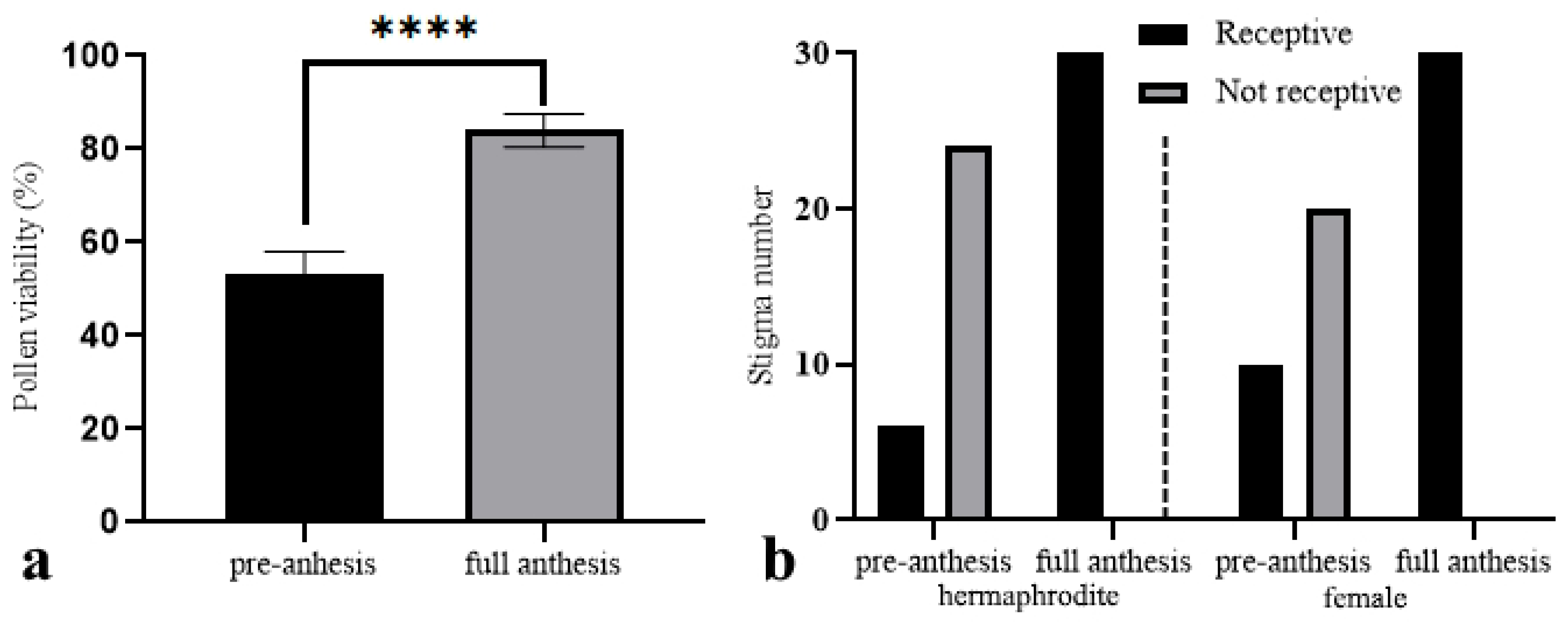
2.4. Pollen Viability and Stigma Receptivity
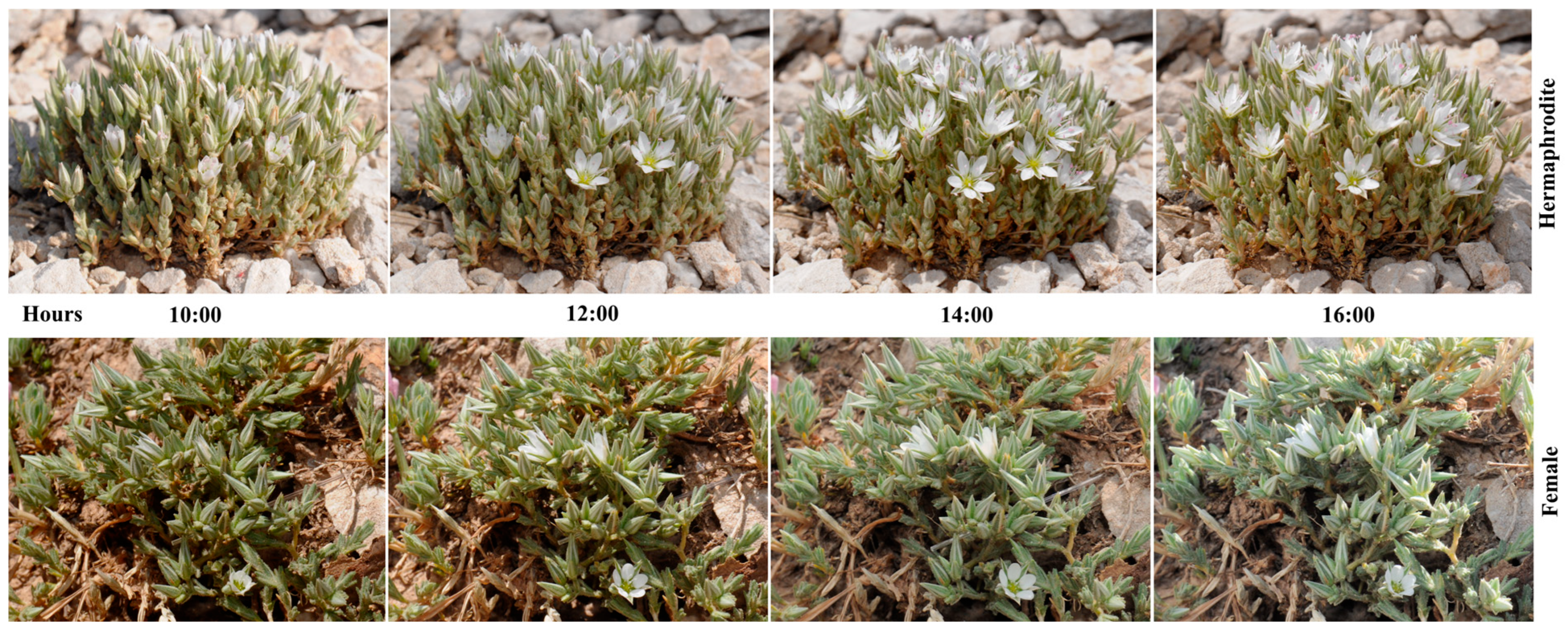
2.5. Temporal Details of Flower Anthesis
2.6. Pollen/Ovule Ratio and Index of Self-Incompatiblity in Hermaphrodites
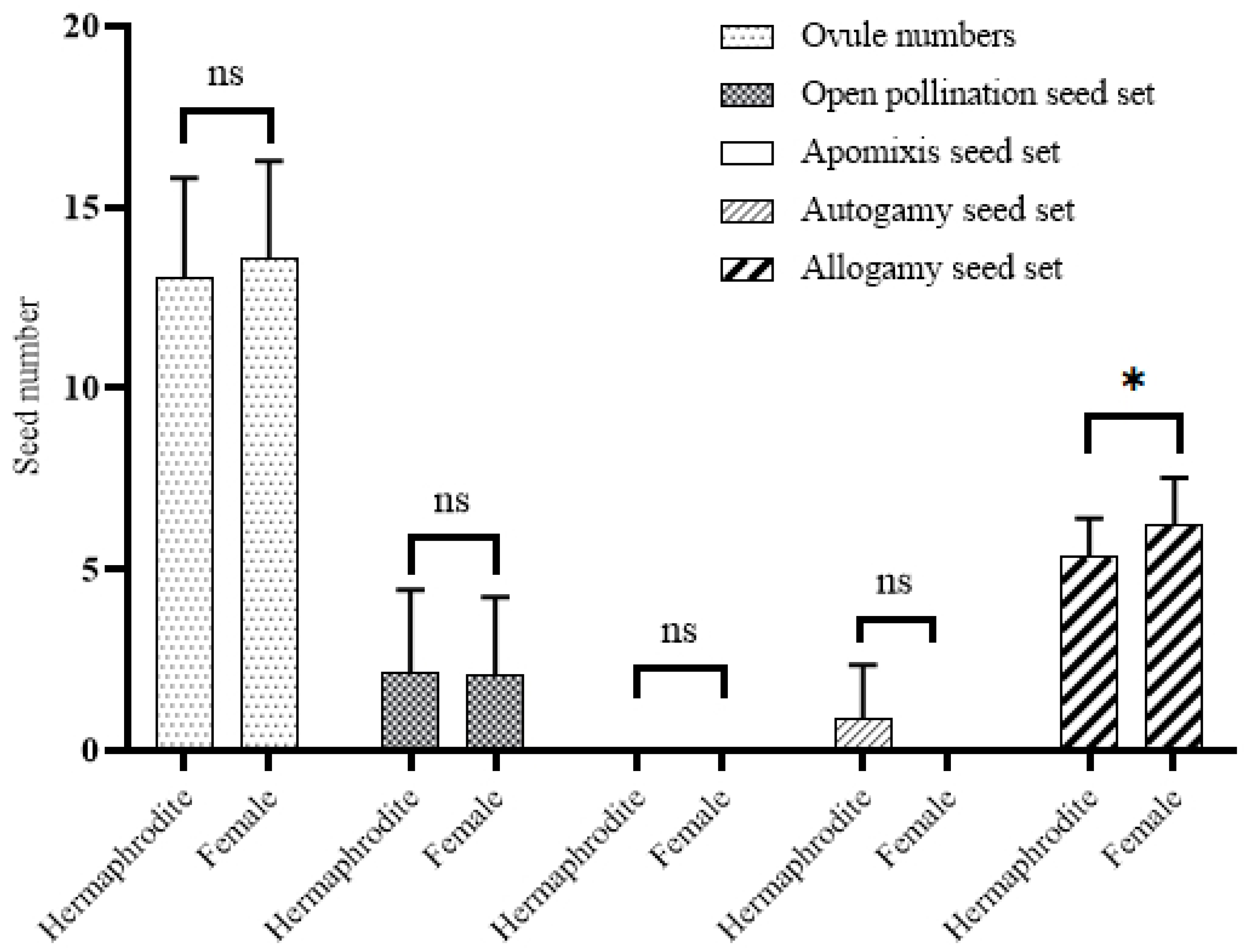
2.7. Mating System
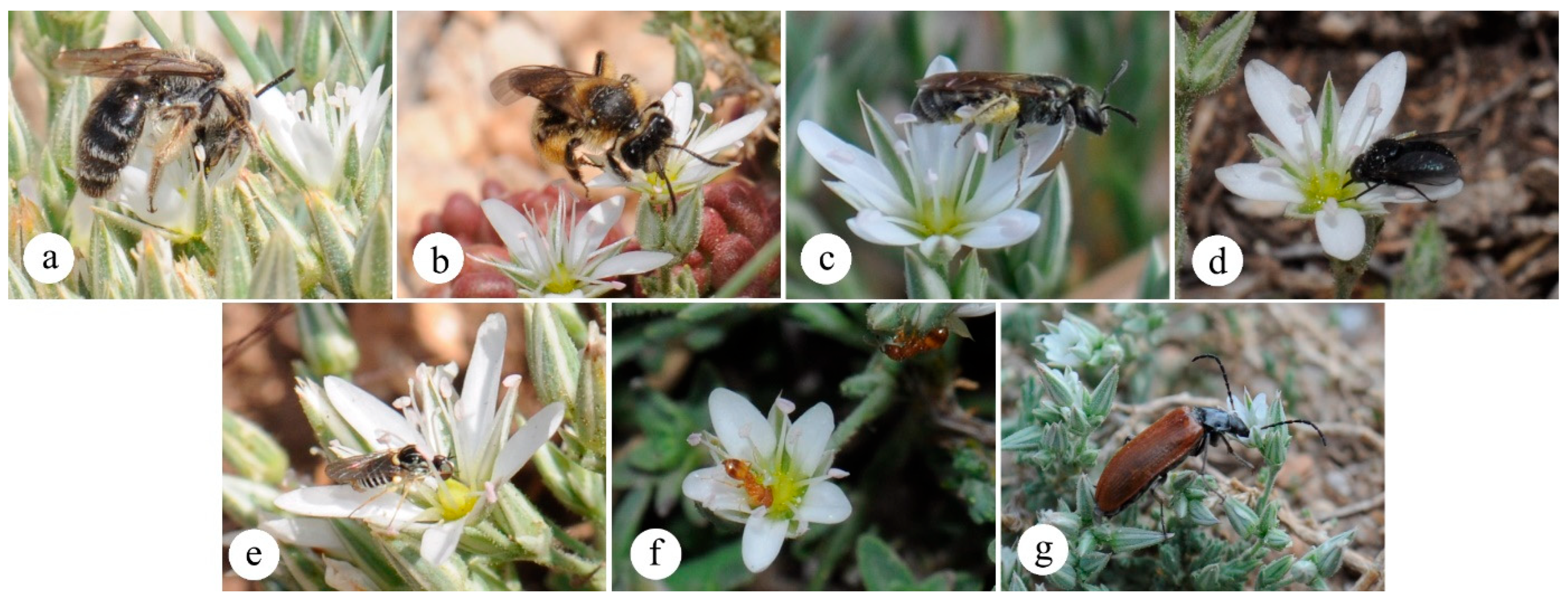
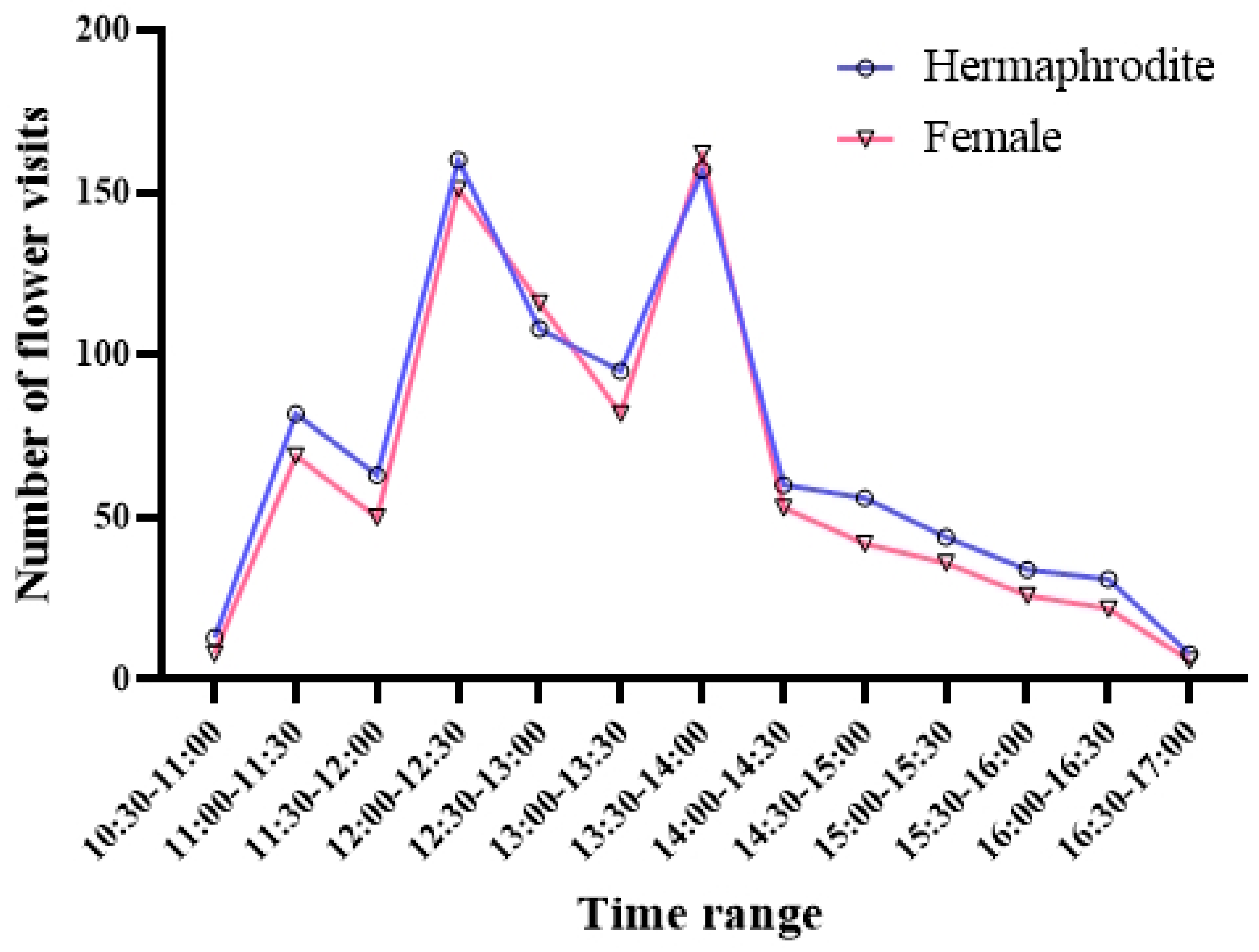
2.8. Floral Visitors and Their Behaviors
3. Discussion
4. Materials and Methods
4.1. Plant Species and Study Area
4.2. Distribution Area and Number of Individuals
4.3. Determination of Morph Ratios
4.4. Quantitative and Functional Analysis of Floral and Reproductive Traits
4.5. Experimental Investigation of the Mating System
4.6. Determination of Pollen:Ovule Ratio and Self-Incompatibility in Hermaphrodites
4.7. Floral Visitors and Their Behaviors
4.8. Statistical Analysis
5. Conclusions
Supplementary Materials
Author Contributions
Funding
Data Availability Statement
Conflicts of Interest
Abbreviations
| IUCN | International Union of Conservation Nature |
| ISI | Index of Self-Incompatibility |
| P/O | Pollen/Ovule ratio |
References
- Razumova, O.; Alexandrov, O.; Bone, K.; Karlov, G.; Divashuk, M. Sex Chromosomes and Sex Determination in Dioecious Agricultural Plants. Agronomy 2023, 13, 540. [Google Scholar] [CrossRef]
- Yuan, S.; Zeng, G.; Zhang, K.; Wu, M.; Zhang, D.; Harder, L.; Barrett, S. Diverse mating consequences of the evolutionary breakdown of the sexual polymorphism heterostyly. Proc. Natl. Acad. Sci. USA 2023, 120, e2214492120. [Google Scholar] [CrossRef]
- Carey, S.B.; Laramie, A.; Lovell, J.T.; Jenkins, J.; Healey, A.L.; Shu, S.; Grabowski, P.; Yocca, A.; Stewart, A.; Jones, T.; et al. ZW sex chromosome structure in Amborella trichopoda. Nat. Plants 2024, 10, 1944–1954. [Google Scholar] [CrossRef] [PubMed]
- Charlesworth, D.; Harkess, A. Why should we study plant sex chromosomes? Plant Cell 2024, 36, 1242–1256. [Google Scholar] [CrossRef]
- Pattnaik, A.; Prusty, P.K.; Barik, M.; Mishra, R.; Mohanty, J.N. Sex evolution path involved in flowering plant family Cucurbitaceae: A review. Plant Sci. Today 2025, 12, 1–10. [Google Scholar] [CrossRef]
- Wang, Y.; Gong, G.N.; Wang, Y.; Zhang, R.G.; Hörandl, E.; Zhang, Z.X.; Charlesworth, D.; He, L. Gap-free X and Y chromosome assemblies of Salix arbutifolia reveal an evolutionary change from male to female heterogamety in willows, without a change in the position of the sex-determining locus. New Phytol. 2024, 242, 2872–2887. [Google Scholar] [CrossRef]
- Groh, J.S.; Vik, D.C.; Davis, M.; Monroe, J.G.; Stevens, K.A.; Brown, P.J.; Langley, C.H.; Coop, G. Ancient structural variants control sex-specific flowering time morphs in walnuts and hickories. Science 2025, 387, eado5578. [Google Scholar] [CrossRef]
- Leite Montalvão, A.P.; Kersten, B.; Fladung, M.; Müller, N.A. The diversity and dynamics of sex determination in dioecious plants. Front. Plant Sci. 2021, 11, 580488. [Google Scholar] [CrossRef]
- Darwin, C.R. The Different Forms of Flowers on Plants of the Same Species, 1st ed.; John Murray: London, UK, 1877; pp. 278–287. [Google Scholar]
- Romero, L.G.; Alvarado-Sizzo, H.; Cuevas, E. Evidence of gynodioecy in Fuchsia arborescens (Onagraceae). Plant Ecol. 2024, 225, 623–628. [Google Scholar] [CrossRef]
- Shibata, A.; Kameyama, Y.; Kudo, G. Low seed fertility of hermaphrodites is maintained in a gynodioecious species throughout the distribution range in Japan. Plant Syst. Evol. 2021, 307, 55. [Google Scholar] [CrossRef]
- Martínez-Peralta, C.; Martínez-Zavala, A. Flower biology of the cactus Coryphantha elephantidens in the tropical dry forest of Central Mexico. Plant Species Biol. 2021, 36, 102–113. [Google Scholar] [CrossRef]
- Kučera, J.; Svitok, M.; Gbúrová Štubňová, E.; Mártonfiová, L.; Lafon Placette, C.; Slovák, M. Eunuchs or females? Causes and consequences of gynodioecy on morphology, ploidy, and ecology of Stellaria graminea L. (Caryophyllaceae). Front. Plant Sci. 2021, 12, 589093. [Google Scholar] [CrossRef]
- Álvarez, I.; Agudo, A.B.; Herrero, A.; Torices, R. The Mendelian inheritance of gynomonoecy: Insights from Anacyclus hybridizing species. Am. J. Bot. 2020, 107, 116–125. [Google Scholar] [CrossRef]
- Delannay, X. La gynodioécie chez les angiospermes. Nat. Belg. 1978, 59, 223–303. [Google Scholar]
- McCauley, D.E.; Olson, M.S. Do recent findings in plant mitochondrial molecular and population genetics have implications for the study of gynodioecy and cytonuclear conflict? Evolution 2008, 62, 1013–1025. [Google Scholar] [CrossRef] [PubMed]
- Caruso, C.M.; Eisen, K.; Case, A.L. An angiosperm-wide analysis of the correlates of gynodioecy. Int. J. Plant Sci. 2016, 177, 115–121. [Google Scholar] [CrossRef]
- Shibata, A.; Kudo, G. Conservative seed fertility maintains hermaphrodites in gynodioecious Daphne jezoensis: A test of the sex-differential plasticity hypothesis. Plant Biol. 2022, 24, 1022–1030. [Google Scholar] [CrossRef]
- Masaka, K.; Takada, T. Transition model for the hermaphroditism-dioecy continuum in higher plants. Ecol. Model. 2023, 475, 110135. [Google Scholar] [CrossRef]
- Moon, H.K.; Hong, S.P. Morphological traits of gynodioecious Persicaria amphibia (Polygonaceae). Phytotaxa 2015, 219, 133–143. [Google Scholar] [CrossRef]
- Koch, I.; Alves, D.M.; Souto, L.S. Anther wall and pollen development in two species of Rauvolfia L. (Apocynaceae). Rev. Bras. Bot. 2018, 41, 175–184. [Google Scholar] [CrossRef]
- Neustupa, J. Gynodioecy in the common spindle tree (Euonymus europaeus L.) involves differences in the asymmetry of corolla shapes between sexually differentiated flowers. PeerJ 2020, 8, e8571. [Google Scholar] [CrossRef]
- Gama, R.L.; El Ottra, J.H.L.; Pirani, J.R.; Demarco, D. Gynodioecy in Trichilia (Meliaceae) and a peculiar case of male sterility due to tapetal necrotic cell death. Rev. Bras. Bot. 2022, 45, 449–462. [Google Scholar] [CrossRef]
- Neustupa, J.; Woodard, K. Male sterility significantly elevates shape variation and fluctuating asymmetry of zygomorphic corolla in gynodioecious Glechoma hederacea (Lamiaceae). AoB Plants 2021, 13, plab013. [Google Scholar] [CrossRef]
- Jeon, Y.C.; Moon, H.K.; Kong, M.J.; Hong, S.P. Floral dimorphism of Elsholtzia angustifolia (Loes.) Kitag. (Lamiaceae). Flora 2024, 319, 152583. [Google Scholar] [CrossRef]
- Molano-Flores, B.; Faivre, A.E. Sexual differences in Lobelia spicata populations: Floral morphometrics, stigma pollen loads, and pollen tube growth. Plant Species Biol. 2015, 30, 202–211. [Google Scholar] [CrossRef]
- Shibata, A.; Kudo, G. Size-dependent sex allocation and reproductive investment in a gynodioecious shrub. AoB Plants 2017, 9, plw089. [Google Scholar] [CrossRef]
- Sinclair, J.P.; Kameyama, Y.; Shibata, A.; Kudo, G. Male-biased hermaphrodites in a gynodioecious shrub, Daphne jezoensis. Plant Biol. 2016, 18, 859–867. [Google Scholar] [CrossRef] [PubMed]
- Wang, X.; Wen, M.; Wu, M.; Xu, Y.; Zhang, K.; Zhang, D. Gynodioecy or leaky dioecy? The unusual sexual system of a coral dune-habitant Tournefortia argentea (Boraginaceae). Plant Syst. Evol. 2020, 306, 70. [Google Scholar] [CrossRef]
- Godin, V.N.; Astashenkov, A.Y.; Cheryomushkina, V.A.; Bobokalonov, K.A. Gynodioecy of Origanum vulgare ssp. gracile (Lamiaceae) in Tajikistan. Nord. J. Bot. 2024, 2024, e04148. [Google Scholar] [CrossRef]
- Ferguson, C.S.; Schroeder, P.C.; Donham, K.R.; Wineteer, M.L. Insect visitors of Sidalcea hickmanii ssp. petraea (Malvaceae) and their effect on flower, fruit, and seed production. Northwest Sci. 2020, 94, 62–69. [Google Scholar] [CrossRef]
- Sigrist, M.R.; Leme, F.M.; Fabiano, V.S.; Pinheiro, F.P.; dos Santos Ferreira, B.H.; Nakamura, S.S.; da Silva, S.O. Chrysophyllum marginatum (Sapotaceae): Generalist pollination and cryptic gynomonoecious. Plant Species Biol. 2021, 36, 436–449. [Google Scholar] [CrossRef]
- Shibata, A.; Kudo, G. Night and day: Contributions of diurnal and nocturnal visitors to pollen dispersal, paternity diversity, and fruit set in an early-blooming shrub, Daphne jezoensis. Am. J. Bot. 2023, 110, e16239. [Google Scholar] [CrossRef] [PubMed]
- Waytes, R.; Cartar, R.; Hoover, S. Consequences of pollinator availability and effectiveness for pollen transfer in a gynodioecious seed crop system. J. Pollinat. Ecol. 2022, 32, 154–169. [Google Scholar] [CrossRef]
- Martínez-Peralta, C.; Palma-Bahena, A.; Arroyo-Cosultchi, G.; Fierros-López, H.E. Bee species perform differently between sexes of a gynodioecious globose cactus. Arthropod Plant Interact. 2024, 18, 1111–1122. [Google Scholar] [CrossRef]
- Soininen, J.O.; Kytöviita, M.M. Geranium sylvaticum increases pollination probability by sexually dimorphic flowers. Ecol. Evol. 2022, 12, e9670. [Google Scholar] [CrossRef]
- Brody, A.K.; Burnham, P.A.; Smith, B. Feeding friend and foe: Ample pollen mitigates the effects of pollen theft for a gynodioecious plant, Polemonium foliosissimum (Polemoniaceae). Ann. Bot. 2021, 128, 127–134. [Google Scholar] [CrossRef]
- Hossack, G.C.; Caruso, C.M. Simulated pollinator decline has similar effects on seed production of female and hermaphrodite Lobelia siphilitica, but different effects on selection on floral traits. Am. J. Bot. 2023, 110, e16106. [Google Scholar] [CrossRef] [PubMed]
- Weller, S.G.; Sakai, A.K. The evolution of dicliny in Schiedea (Caryophyllaceae), an endemic Hawaiian genus. Plant Species Biol. 1990, 5, 83–95. [Google Scholar] [CrossRef]
- Morris, W.F.; Doak, D.F. Life history of the long-lived gynodioecious cushion plant Silene acaulis (Caryophyllaceae), inferred from size-based population projection matrices. Am. J. Bot. 1998, 85, 784–793. [Google Scholar] [CrossRef] [PubMed]
- Collin, C.L.; Shykoff, J.A. Outcrossing rates in the gynomonoecious-gynodioecious species Dianthus sylvestris (Caryophyllaceae). Am. J. Bot. 2003, 90, 579–585. [Google Scholar] [CrossRef]
- Weller, S.G.; Sakai, A.K. Selfing and resource allocation in Schiedea salicaria (Caryophyllaceae), a gynodioecious species. J. Evol. Biol. 2005, 18, 301–308. [Google Scholar] [CrossRef]
- López-Villavicencio, M.; Branca, A.; Giraud, T.; Shykoff, J.A. Sex-specific effect of Microbotryum violaceum (Uredinales) spores on healthy plants of the gynodioecious Gypsophila repens (Caryophyllaceae). Am. J. Bot. 2005, 92, 896–900. [Google Scholar] [CrossRef]
- Lafuma, L.; Maurice, S. Reproductive characters in a gynodioecious species, Silene italica (Caryophyllaceae), with attention to the gynomonoecious phenotype. Biol. J. Linn. Soc. 2006, 87, 583–591. [Google Scholar] [CrossRef][Green Version]
- Godé, C.; Touzet, P.; Martin, H.; Lahiani, E.; Delph, L.F.; Arnaud, J.F. Characterization of 24 polymorphic microsatellite markers for Silene nutans, a gynodioecious–gynomonoecious species, and cross-species amplification in other Silene species. Conserv. Genet. Resour. 2014, 6, 915–918. [Google Scholar] [CrossRef]
- Gholipour, A. Silene aminiradii (Caryophyllaceae), an interesting alpine plant in Iran. Novon 2021, 29, 195–199. [Google Scholar] [CrossRef]
- Postel, Z.; Poux, C.; Gallina, S.; Varré, J.S.; Godé, C.; Schmitt, É.; Meyer, E.; Van Rossum, F.; Touzet, P. Reproductive isolation among lineages of Silene nutans (Caryophyllaceae): A potential involvement of plastid-nuclear incompatibilities. Mol. Phylogenet. Evol. 2022, 169, 107436. [Google Scholar] [CrossRef]
- Gavini, S.S. Sexual dimorphism and female advantage hypothesis in the gynomonoecious-gynodioecious Dianthus plumarius (Caryophyllaceae). AoB Plants 2023, 15, plad084. [Google Scholar] [CrossRef]
- Kartal, C.; Tekin, M. Embryological Studies on Silene muradica Schischk. (Caryophyllaceae)–A Gynodioecious Species from Turkey. Acta Biol. Cracov. Bot. 2021, 63, 21–29. [Google Scholar] [CrossRef]
- Postel, Z.; Sloan, D.B.; Gallina, S.; Godé, C.; Schmitt, É.; Mangenot, S.; Drouard, L.; Varré, J.; Touzet, P. The decoupled evolution of the organellar genomes of Silene nutans leads to distinct roles in the speciation process. New Phytol. 2023, 239, 766–777. [Google Scholar] [CrossRef]
- Wolf, S.J.; Packer, J.G.; Denford, K.E. The taxonomy of Minuartia rossii (Caryophyllaceae). Can. J. Bot. 1979, 57, 1673–1686. [Google Scholar] [CrossRef]
- Dillenberger, M.S.; Kadereit, J.W. Maximum polyphyly: Multiple origins and delimitation with plesiomorphic characters require a new circumscription of Minuartia (Caryophyllaceae). Taxon 2014, 63, 64–88. [Google Scholar] [CrossRef]
- Govaerts, R.; Nic Lughadha, E.; Black, N.; Turner, R.; Paton, A. The World Checklist of Vascular Plants, a continuously updated resource for exploring global plant diversity. Sci. Data 2021, 8, 215. [Google Scholar] [CrossRef] [PubMed]
- Plants of the World Online. Available online: https://powo.science.kew.org/taxon/30406119-2 (accessed on 2 February 2026).
- Yıldız, B. Minuartia. In Resimli Türkiye Florası (Illustrated Flora of Türkiye), 1st ed.; Güner, A., Yıldız, K., Vural, M., Kandemir, A., Menemen, Y., Yıldırım, H., Aslan, S., Çimen, A.Ö., Asal, D., Güner, I., et al., Eds.; ANG Vakfı Nezahat Gökyiğit Botanik Bahçesi Yayınları: İstanbul, Türkiye, 2025; Volume 17b, pp. 28–102. [Google Scholar]
- Asikainen, E.; Mutikainen, P. Female frequency and relative fitness of females and hermaphrodites in gynodioecious Geranium sylvaticum (Geraniaceae). Am. J. Bot. 2003, 90, 226–234. [Google Scholar] [CrossRef]
- Ramula, S.; Mutikainen, P. Sex allocation of females and hermaphrodites in the gynodioecious Geranium sylvaticum. Ann. Bot. 2003, 92, 207–213. [Google Scholar] [CrossRef]
- Miyake, K.; Miyake, T.; Terachi, T.; Yahara, T. Relative fitness of females and hermaphrodites in a natural gynodioecious population of wild radish, Raphanus sativus L. (Brassicaceae): Comparison based on molecular genotyping. J. Evol. Biol. 2009, 22, 2012–2019. [Google Scholar] [CrossRef]
- Gibson, J.P.; Diggle, P.K. Structural analysis of female and hermaphroditic flowers of a gynodioecious tree, Ocotea tenera (Lauraceae). Am. J. Bot. 1997, 84, 298–307. [Google Scholar] [CrossRef]
- Delph, L.F.; Galloway, L.F.; Stanton, M.L. Sexual dimorphism in flower size. Am. Nat. 1996, 148, 299–320. [Google Scholar] [CrossRef]
- Barrett, S.C.; Hough, J. Sexual dimorphism in flowering plants. J. Exp. Bot. 2013, 64, 67–82. [Google Scholar] [CrossRef]
- Baptiste, F.J.; Jong-Yi, F. Study on pollen viability and stigma receptivity throughout the flowering period in the selected taxa of the Gesneriaceae family. Folia Hortic. 2023, 35, 123–133. [Google Scholar] [CrossRef]
- Souza, C.G.; Ramos, S.M.B.; Nietsche, S.; Possobom, C.C.F.; Almeida, E.F.A.; Pereira, M.C.T. Viability of pollen grains and stigma receptivity in Desert Rose. Ornam. Hortic. 2022, 28, 92–98. [Google Scholar] [CrossRef]
- Van Doorn, W.G.; Van Meeteren, U. Flower opening and closure: A review. J. Exp. Bot. 2003, 54, 1801–1812. [Google Scholar] [CrossRef] [PubMed]
- Van Doorn, W.G.; Kamdee, C. Flower opening and closure: An update. J. Exp. Bot. 2014, 65, 5749–5757. [Google Scholar] [CrossRef] [PubMed]
- Bhattacharya, A.; Mandal, S. Pollination, pollen germination and stigma receptivity in Moringa oleifera Lamk. Grana 2004, 43, 48–56. [Google Scholar] [CrossRef]
- Nascimento, G.Q.S.D.S.; Silva, T.A.D.; de Almeida, P.S.; Rossi, M.L.; Souza, F.V.D.; Aona, L.Y.S.; de Carvalho Costa, M.A.P.; de Souza, E.H. Pollen and Stigma Morphology, Pollen Viability and Stigma Receptivity of Wittmackia Species (Bromeliaceae) by Light, Fluorescence and Scanning Electron Microscopy. Microsc. Res. Tech. 2025, 88, 1451–1477. [Google Scholar] [CrossRef]
- Varga, S. Female advantage in gynodioecious plants: A meta-analysis focused on seed quality. Plant Biol. 2021, 23, 695–701. [Google Scholar] [CrossRef]
- Asikainen, E.; Mutikainen, P.I.A. Preferences of pollinators and herbivores in gynodioecious Geranium sylvaticum. Ann. Bot. 2005, 95, 879–886. [Google Scholar] [CrossRef]
- Chabert, S.; Mallinger, R.E. Self-sterility, self-incompatibility and xenia: A review of the mechanisms of cross-pollination benefits in animal-pollinated crops. Ann. Bot. 2025, 136, 245–262. [Google Scholar] [CrossRef] [PubMed]
- Fei, X.; Shi, J.; Liu, Y.; Niu, J.; Wei, A. The steps from sexual reproduction to apomixis. Planta 2019, 249, 1715–1730. [Google Scholar] [CrossRef] [PubMed]
- Kalisz, S.; Vogler, D.W.; Hanley, K.M. Context-dependent autonomous self-fertilization yields reproductive assurance and mixed mating. Nature 2004, 430, 884–887. [Google Scholar] [CrossRef]
- Goodwillie, C.; Kalisz, S.; Eckert, C.G. The evolutionary enigma of mixed mating systems in plants: Occurrence, theoretical explanations, and empirical evidence. Annu. Rev. Ecol. Evol. Syst. 2005, 36, 47–79. [Google Scholar] [CrossRef]
- Williams, C.F.; Kuchenreuther, M.A.; Drew, A. Floral dimorphism, pollination, and self-fertilization in gynodioecious Geranium richardsonii (Geraniaceae). Am. J. Bot. 2000, 87, 661–669. [Google Scholar] [CrossRef]
- Van Etten, M.L.; Chang, S.M. Frequency-dependent pollinator discrimination acts against female plants in the gynodioecious Geranium maculatum. Ann. Bot. 2014, 114, 1769–1778. [Google Scholar] [CrossRef] [PubMed]
- McNeill, J. New species of Minuartia (Caryophyllaceae). Notes R. Bot. Gard. Edinb. 1969, 29, 325–327. [Google Scholar] [CrossRef]
- Turkish State Meteorological Service. Available online: https://www.mgm.gov.tr/veridegerlendirme/il-ve-ilceler-istatistik.aspx?k=A&m=IZMIR (accessed on 2 February 2026).
- Rodriguez-Riano, T.; Dafni, A. A new procedure to asses pollen viability. Sex. Plant Reprod. 2000, 12, 241–244. [Google Scholar] [CrossRef]
- Dafni, A. Pollination Ecology: A Practical Approach, 1st ed.; Oxford University Press: New York, NY, USA, 1992; pp. 78–79. [Google Scholar]
- Cruden, R.W. Pollen-ovule ratios: A conservative indicator of breeding systems in flowering plants. Evolution 1977, 31, 32–46. [Google Scholar] [CrossRef]
- Zapata, T.R.; Arroyo, M.T.K. Plant reproductive ecology of a secondary deciduous tropical forest in Venezuela. Biotropica 1978, 10, 221–230. [Google Scholar] [CrossRef]





| Hermaphrodite | Mean Difference | 95.00% CI of Difference | Significant | Summary | Adjusted p Value |
|---|---|---|---|---|---|
| O vs. OP | 10.88 | 9.939 to 11.82 | Yes | **** | <0.0001 |
| O vs. ApS | 13.06 | 12.12 to 14.00 | Yes | **** | <0.0001 |
| O vs. AuS | 12.2 | 11.26 to 13.14 | Yes | **** | <0.0001 |
| O vs. AlS | 7.72 | 6.779 to 8.661 | Yes | **** | <0.0001 |
| OPS vs. ApS | 2.18 | 1.239 to 3.121 | Yes | **** | <0.0001 |
| OPS vs. AuS | 1.32 | 0.3785 to 2.261 | Yes | ** | 0.0013 |
| OPS vs. AlS | −3.16 | −4.101 to −2.219 | Yes | **** | <0.0001 |
| ApS vs. AuS | −0.86 | −1.801 to 0.08147 | No | ns | 0.092 |
| ApS vs. AlS | −5.34 | −6.281 to −4.399 | Yes | **** | <0.0001 |
| ApS vs. AlS | −4.48 | −5.421 to −3.539 | Yes | **** | <0.0001 |
| Female | Mean Difference | 95.00% CI of difference | Significant | Summary | Adjusted p Value |
| O vs. OPS | 11.5 | 10.56 to 12.44 | Yes | **** | <0.0001 |
| O vs. ApS | 13.58 | 12.64 to 14.52 | Yes | **** | <0.0001 |
| O vs. AlS | 7.34 | 6.399 to 8.281 | Yes | **** | <0.0001 |
| OPS vs. ApS | 2.08 | 1.139 to 3.021 | Yes | **** | <0.0001 |
| OPS vs. AlS | −4.16 | −5.101 to −3.219 | Yes | **** | <0.0001 |
| ApS vs. AlS | −6.24 | −7.181 to −5.299 | Yes | **** | <0.0001 |
Disclaimer/Publisher’s Note: The statements, opinions and data contained in all publications are solely those of the individual author(s) and contributor(s) and not of MDPI and/or the editor(s). MDPI and/or the editor(s) disclaim responsibility for any injury to people or property resulting from any ideas, methods, instructions or products referred to in the content. |
© 2026 by the authors. Licensee MDPI, Basel, Switzerland. This article is an open access article distributed under the terms and conditions of the Creative Commons Attribution (CC BY) license.
Share and Cite
Eroğlu, V.; Şenol, S.G. Floral Traits, Pollination and Reproductive Differentiation in Gynodioecious Minuartia nifensis (Caryophyllaceae). Plants 2026, 15, 913. https://doi.org/10.3390/plants15060913
Eroğlu V, Şenol SG. Floral Traits, Pollination and Reproductive Differentiation in Gynodioecious Minuartia nifensis (Caryophyllaceae). Plants. 2026; 15(6):913. https://doi.org/10.3390/plants15060913
Chicago/Turabian StyleEroğlu, Volkan, and Serdar Gökhan Şenol. 2026. "Floral Traits, Pollination and Reproductive Differentiation in Gynodioecious Minuartia nifensis (Caryophyllaceae)" Plants 15, no. 6: 913. https://doi.org/10.3390/plants15060913
APA StyleEroğlu, V., & Şenol, S. G. (2026). Floral Traits, Pollination and Reproductive Differentiation in Gynodioecious Minuartia nifensis (Caryophyllaceae). Plants, 15(6), 913. https://doi.org/10.3390/plants15060913