Sown Summer-Blooming Wildflowers as a Tool to Support Pollinator Biodiversity During Dry Periods in Mediterranean Agroecosystems


Abstract
1. Introduction
2. Materials and Methods
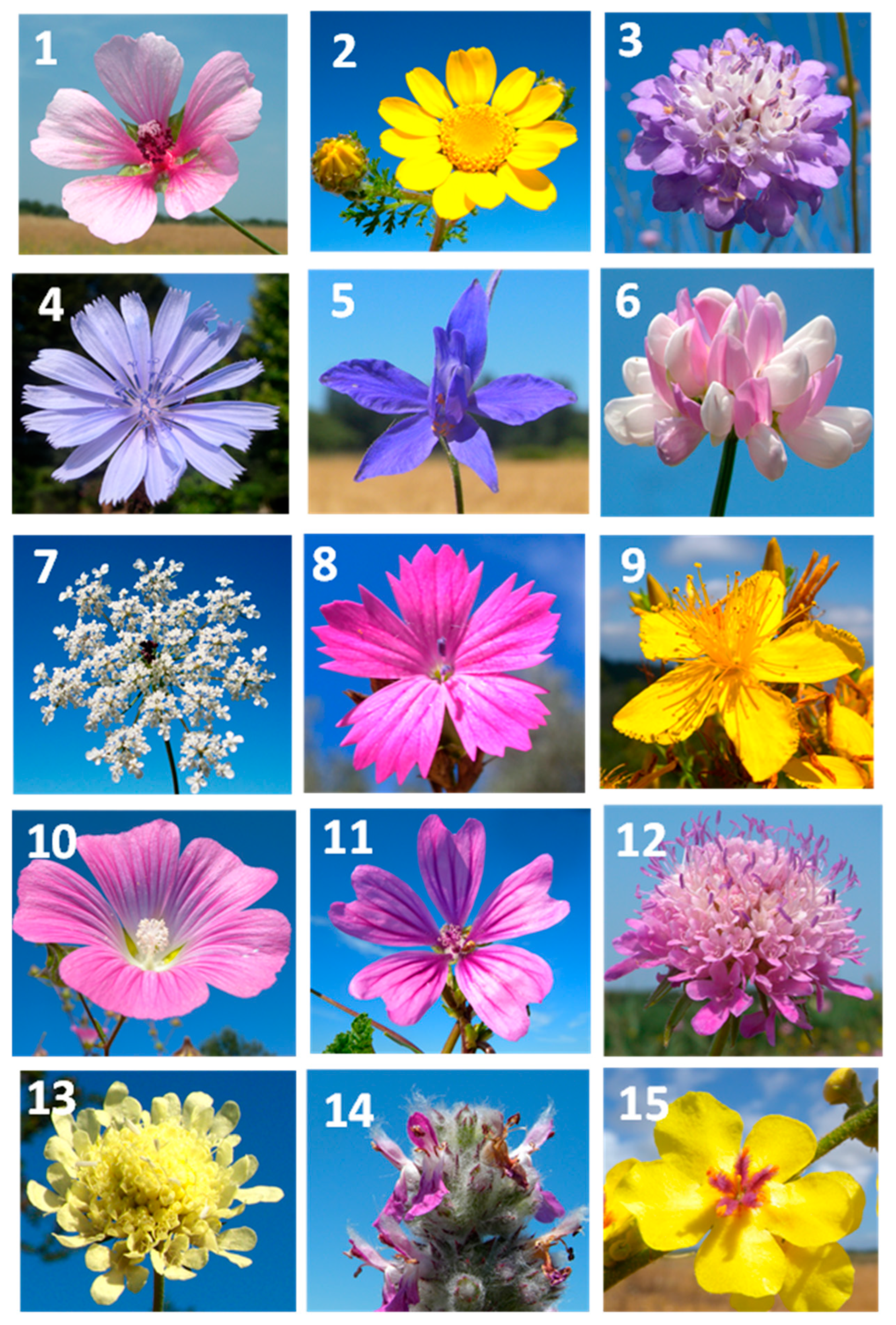
2.1. Plant Material
2.2. Agronomic Environment
2.3. Laboratory Evaluation of Seed Germination and Treatments to Remove Dormancy
2.4. Seed Weight
2.5. Preliminary Stale Seedbed Preparation on Experimental Plots
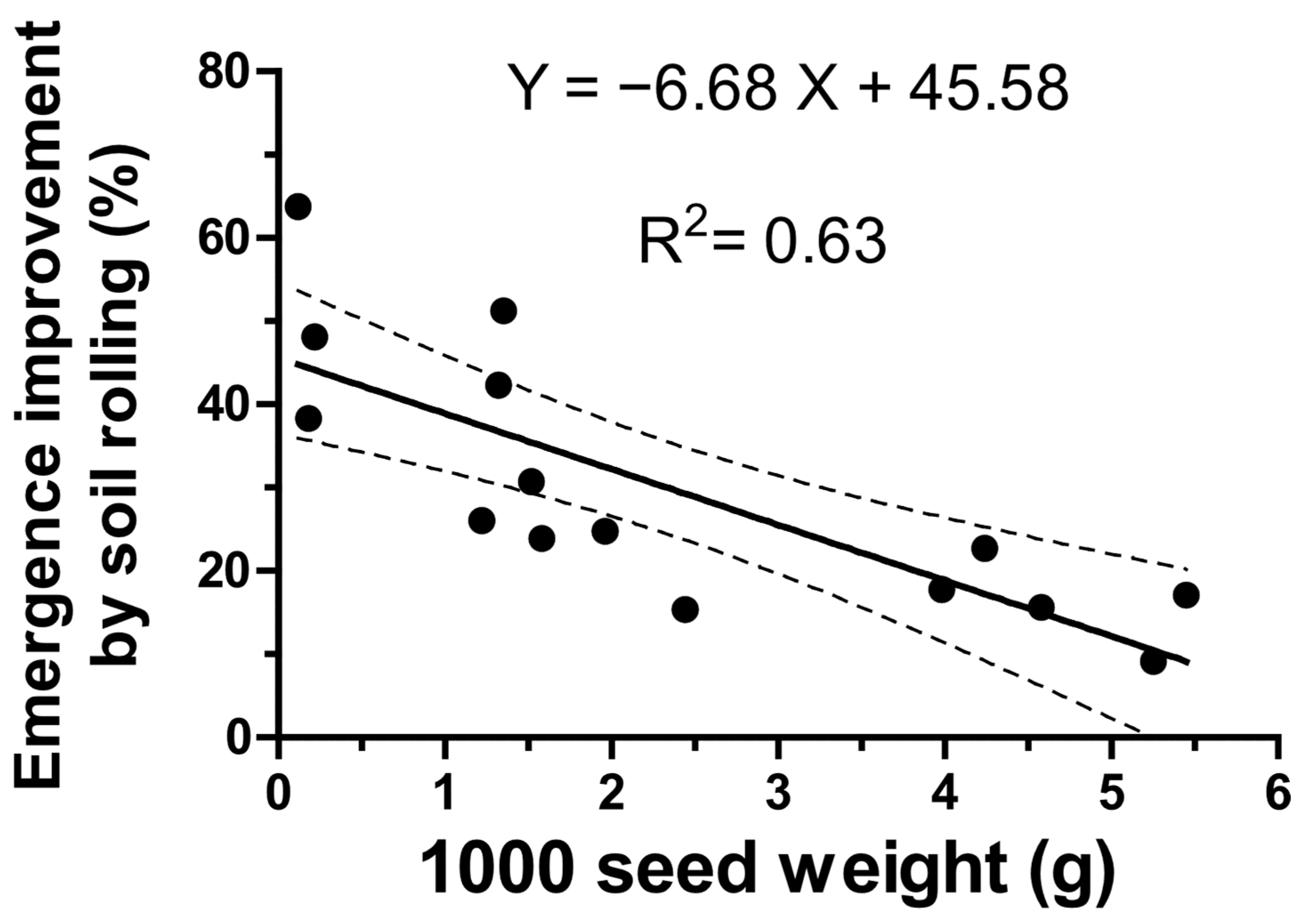
2.6. Preliminary Seedling Emergence Test of Treated Seeds with or Without Soil Rolling
2.7. Wildflower Field Sowing
2.8. Flowering Dynamics
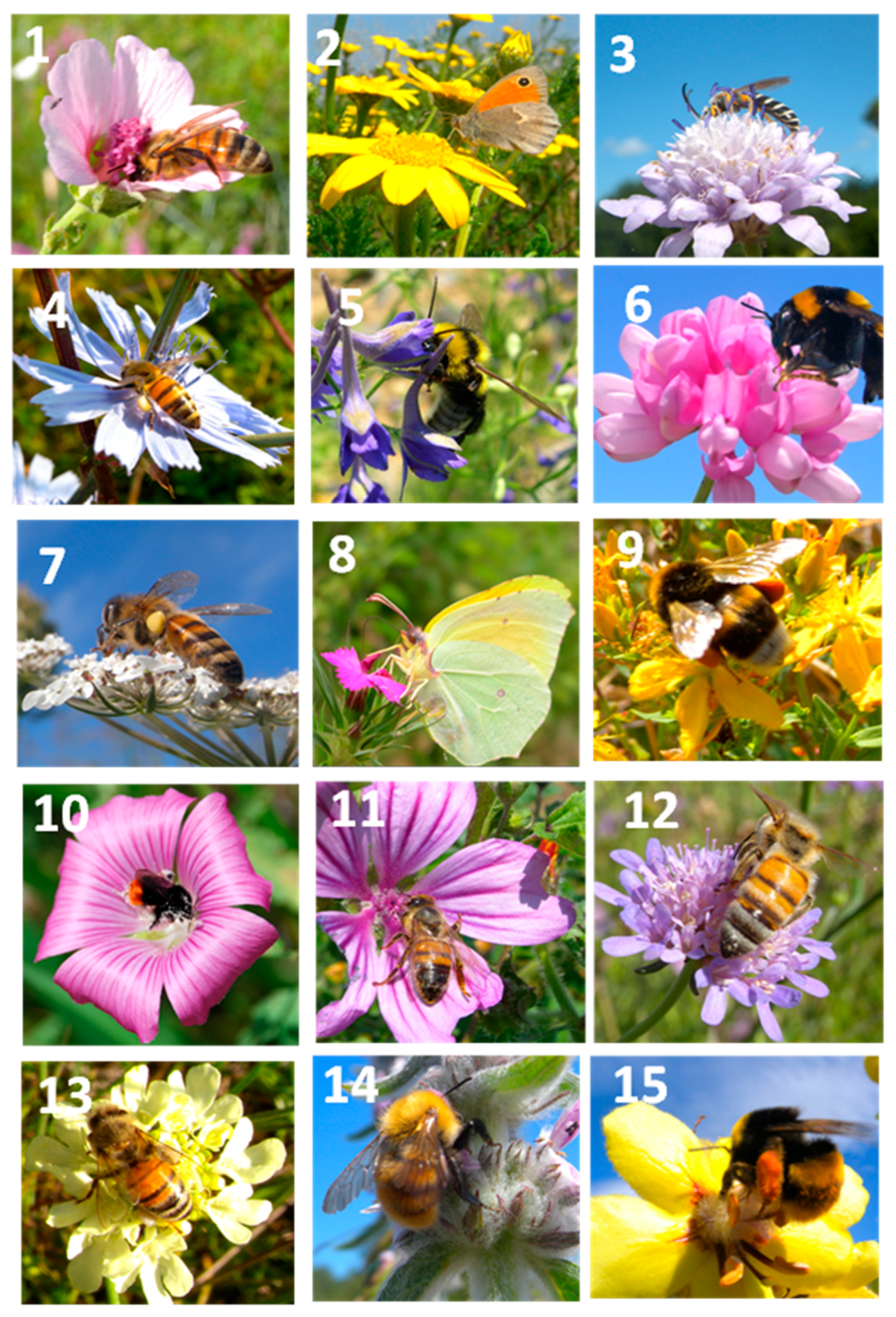
2.9. Evaluation of Flower Visitors of the First Experimental Year
2.10. Agronomic Management After the First Experimental Year
2.11. Evaluation of Plant Density in the Second Experimental Year
2.12. Calculation of Diversity Index of Pollinator Communities
H′ = −∑pi log pi
I = 1
2.13. Statistical Analyses
3. Results
3.1. Seed Germination and Dormancy-Breaking Treatments
3.2. Seedling Emergence Test
3.3. Wildflower Flowering Dynamics
3.4. Pollinator Flower-Visit Quantity and Biodiversity During the First Experimental Year
3.5. Wildflower Survival and Pollinator Biodiversity During the Second Experimental Year
4. Discussion
4.1. Wildflower Strips Establishment
4.2. Wildflower Pollinators Attractivity and Biodiversity
4.3. Wildflowers Sustainability and Functionality over Time
5. Conclusions
Funding
Data Availability Statement
Conflicts of Interest
References
- Nath, R.; Singh, H.; Mukherjee, S. Insect pollinators decline: An emerging concern of Anthropocene epoch. J. Apic. Res. 2023, 62, 23–38. [Google Scholar] [CrossRef]
- Kevan, P.G.; Viana, B.F. The global decline of pollination services. Biodiversity 2003, 4, 3–8. [Google Scholar] [CrossRef]
- Feuerbacher, A. Pollinator declines, international trade and global food security: Reassessing the global economic and nutritional impacts. Ecol. Econ. 2025, 232, 108565. [Google Scholar] [CrossRef]
- Blaauw, B.R.; Isaacs, R. Flower plantings increase wild bee abundance and the pollination services provided to a pollination-dependent crop. J. Appl. Ecol. 2014, 51, 890–898. [Google Scholar] [CrossRef]
- Requier, F.; Pérez-Méndez, N.; Andersson, G.K.; Blareau, E.; Merle, I.; Garibaldi, L.A. Bee and non-bee pollinator importance for local food security. Trends Ecol. Evol. 2023, 38, 196–205. [Google Scholar] [CrossRef]
- Feuerbacher, A.; Kempen, M.; Steidle, J.L.; Wieck, C. The economic, agricultural, and food security repercussions of a wild pollinator collapse in Europe. Nat. Commun. 2025, 16, 9892. [Google Scholar] [CrossRef] [PubMed]
- Goulson, D.; Nicholls, E.; Botías, C.; Rotheray, E.L. Bee declines driven by combined stress from parasites, pesticides, and lack of flowers. Science 2015, 347, 1255957. [Google Scholar] [CrossRef] [PubMed]
- Buhk, C.; Oppermann, R.; Schanowski, A.; Bleil, R.; Lüdemann, J.; Maus, C. Flower strip networks offer promising long-term effects on pollinator species richness in intensively cultivated agricultural areas. BMC Ecol. 2018, 18, 55. [Google Scholar] [CrossRef] [PubMed]
- Cole, L.J.; Baddeley, J.A.; Robertson, D.; Topp, C.F.; Walker, R.L.; Watson, C.A. Supporting wild pollinators in agricultural landscapes through targeted legume mixtures. Agric. Ecosyst. Environ. 2022, 323, 107648. [Google Scholar] [CrossRef] [PubMed]
- Bretagnolle, V.; Gaba, S. Weeds for bees? A review. Agron. Sustain. Dev. 2015, 35, 891–909. [Google Scholar] [CrossRef]
- Rollings, R.; Goulson, D. Quantifying the attractiveness of garden flowers for pollinators. J. Insect Conserv. 2019, 23, 803–817. [Google Scholar] [CrossRef]
- Neumann, A.E.; Conitz, F.; Karlebowski, S.; Sturm, U.; Schmack, J.M.; Egerer, M. Flower richness is key to pollinator abundance: The role of garden features in cities. Basic Appl. Ecol. 79, 102–113. [CrossRef]
- Ameen, A.; Raza, S. Green revolution: A review. Int. J. Adv. Sci. Res. 2017, 3, 129–137. [Google Scholar] [CrossRef]
- Cole, L.J.; Kleijn, D.; Dicks, L.; Stout, J.C.; Potts, S.G.; Albrecht, M.; Balzan, M.V.; Bartomeus, I.; Bebeli, P.J.; Bevk, D.; et al. A critical analysis of the potential for EU Common Agricultural Policy measures to support wild pollinators on farmland. J. Appl. Ecol. 2020, 57, 681–694. [Google Scholar] [CrossRef]
- Horrigan, L.; Lawrence, R.; Walker, P. How sustainable agriculture can address the environmental and human health harms of industrial agriculture. Environ. Health Perspect. 2002, 110, 445. [Google Scholar] [CrossRef] [PubMed]
- Neumüller, U.; Burger, H.; Schwenninger, H.R.; Hopfenmüller, S.; Krausch, S.; Weiß, K.; Ayasse, M. Prolonged blooming season of flower plantings increases wild bee abundance and richness in agricultural landscapes. Biodivers. Conserv. 2021, 30, 3003–3021. [Google Scholar] [CrossRef]
- Haaland, C.; Naisbit, R.E.; Bersier, L.F. Sown wildflower strips for insect conservation: A review. Insect Conserv. Divers. 2011, 4, 60–80. [Google Scholar] [CrossRef]
- Campbell, A.J.; Wilby, A.; Sutton, P.; Wäckers, F.L. Do sown flower strips boost wild pollinator abundance and pollination services in a spring-flowering crop? A case study from UK cider apple orchards. Agric. Ecosyst. Environ. 2017, 239, 20–29. [Google Scholar] [CrossRef]
- Kowalska, J.; Antkowiak, M.; Sienkiewicz, P. Flower strips and their ecological multifunctionality in agricultural fields. Agriculture 2022, 12, 1470. [Google Scholar] [CrossRef]
- Nichols, R.N.; Goulson, D.; Holland, J.M. The best wildflowers for wild bees. J. Insect Conserv. 2019, 23, 819–830. [Google Scholar] [CrossRef]
- Kozuharova, E.; Trifonov, T.; Stoycheva, C.; Zapryanova, N.; Sokolov, R.S. Plants for Wild Bees—Field Records in Bulgaria. Diversity 2025, 17, 214. [Google Scholar] [CrossRef]
- Scheper, J.; Bommarco, R.; Holzschuh, A.; Potts, S.G.; Riedinger, V.; Roberts, S.P.; Rundlöf, M.; Smith, H.G.; Steffan-Dewenter, I.; Wickens, J.B.; et al. Local and landscape-level floral resources explain effects of wildflower strips on wild bees across four European countries. J. Appl. Ecol. 2015, 52, 1165–1175. [Google Scholar] [CrossRef]
- Ouvrard, P.; Transon, J.; Jacquemart, A.L. Flower-strip agri-environment schemes provide diverse and valuable summer flower resources for pollinating insects. Biodivers. Conserv. 2018, 27, 2193–2216. [Google Scholar] [CrossRef]
- Williams, N.M.; Ward, K.L.; Pope, N.; Isaacs, R.; Wilson, J.; May, E.A.; Ellis, J.; Daniels, J.; Pence, A.; Ullmann, K.; et al. Native wildflower plantings support wild bee abundance and diversity in agricultural landscapes across the United States. Ecol. Appl. 2015, 25, 2119–2131. [Google Scholar] [CrossRef]
- Twerski, A.; Albrecht, H.; Fründ, J.; Moosner, M.; Fischer, C. Effects of rare arable plants on flower-visiting wild bees in agricultural fields. Agric. Ecosyst. Environ. 2022, 323, 107685. [Google Scholar] [CrossRef]
- Vogiatzakis, I.N.; Mannion, A.M.; Sarris, D. Mediterranean island biodiversity and climate change: The last 10,000 years and the future. Biodivers. Conserv. 2016, 25, 2597–2627. [Google Scholar] [CrossRef]
- Lavorel, S. Ecological diversity and resilience of Mediterranean vegetation to disturbance. Divers. Distrib. 1999, 5, 3–13. [Google Scholar] [CrossRef]
- Baskin, C.C.; Baskin, J.M. Seed dormancy in wild flowers. In Flower Seeds: Biology and Technology; CABI Publishing: Wallingford UK, 2005; pp. 163–185. [Google Scholar]
- Baskin, C.C.; Baskin, J.M. Breaking seed dormancy during dry storage: A useful tool or major problem for successful restoration via direct seeding? Plants 2020, 9, 636. [Google Scholar] [CrossRef] [PubMed]
- Hilhorst, H.W. A critical update on seed dormancy. I. Primary dormancy1. Seed Sci. Res. 1995, 5, 61–73. [Google Scholar] [CrossRef]
- Benvenuti, S.; Mazzoncini, M. Soil physics involvement in the germination ecology of buried weed seeds. Plants 2018, 8, 7. [Google Scholar] [CrossRef]
- Benvenuti, S. Soil texture involvement in wildflower strip ecosystem services delivery in Mediterranean agro-environment. Eur. J. Agron. 2023, 145, 126793. [Google Scholar] [CrossRef]
- Håkansson, I.; Myrbeck, Å.; Etana, A. A review of research on seedbed preparation for small grains in Sweden. Soil Till. Res. 2002, 64, 23–40. [Google Scholar] [CrossRef]
- Benvenuti, S.; Bretzel, F. Agro-biodiversity restoration using wildflowers: What is the appropriate weed management for their long-term sustainability? Ecol. Eng. 2017, 102, 519–526. [Google Scholar] [CrossRef]
- Stroot, L.; Brinkert, A.; Hölzel, N.; Rüsing, A.; Bucharova, A. Establishment of wildflower strips in a wide range of environments: A lesson from a landscape-scale project. Restor. Ecol. 2022, 30, e13542. [Google Scholar] [CrossRef]
- Benvenuti, S. Wildflower strips in the agroecosystem for pollinator biodiversity restoration: Which plant species are capable of self-seeding? Ecol. Eng. 2025, 212, 107486. [Google Scholar] [CrossRef]
- Mockford, A.; Urbaneja, A.; Ashbrook, K.; Westbury, D.B. Developing perennial wildflower strips for use in Mediterranean orchard systems. Ecol. Evol. 2023, 13, e10285. [Google Scholar] [CrossRef] [PubMed]
- Baskin, C.C.; Baskin, J.M. Germinating seeds of wildflowers, an ecological perspective. HortTechnology 2004, 14, 467–473. [Google Scholar] [CrossRef]
- International Seed Testing Association (ISTA). International rules for seed testing. Seed Sci. Technol. 1999, 27, 50–52. [Google Scholar]
- Gardarin, A.; Dürr, C.; Colbach, N. Effects of seed depth and soil aggregates on the emergence of weeds with contrasting seed traits. Weed Res. 2010, 50, 91–101. [Google Scholar] [CrossRef]
- Steel, R.G.D.; Torrie, J.H. Principles and Procedures of Statistics, a Biometrical Approach, 2nd ed.; McGraw-Hill Kogakusha, Ltd.: Tokyo, Japan, 1981; p. 633. [Google Scholar]
- Penfield, S. Seed dormancy and germination. Curr. Biol. 2017, 27, R874–R878. [Google Scholar] [CrossRef]
- Baskin, J.M.; Baskin, C.C. A classification system for seed dormancy. Seed Sci. Res. 2004, 14, 1–16. [Google Scholar] [CrossRef]
- Baskin, C.C.; Baskin, J.M. Seed dormancy and germination in the Malvaceae: A palaeohistory, subfamily, growth form and geographical distribution perspective. Seed Sci. Res. 2025, 35, 181–208. [Google Scholar] [CrossRef]
- Nautiyal, P.C.; Sivasubramaniam, K.; Dadlani, M. Seed dormancy and regulation of germination. Seed Sci. Tech. 2023, 52, 39–66. [Google Scholar]
- Blunk, S.; De Heer, M.I.; Sturrock, C.J.; Mooney, S.J. Soil seedbed engineering and its impact on germination and establishment in sugar beet (Beta vulgaris L.) as affected by seed–soil contact. Seed Sci. Res. 2018, 28, 236–244. [Google Scholar] [CrossRef]
- Travlos, I.; Gazoulis, I.; Kanatas, P.; Tsekoura, A.; Zannopoulos, S.; Papastylianou, P. Key factors affecting weed seeds germination, weed emergence, and their possible role for the efficacy of false seedbed technique as weed management practice. Front. Agron. 2020, 2, 1. [Google Scholar] [CrossRef]
- Brown, A.D.; Dexter, A.R.; Chamen, W.C.T.; Spoor, G. Effect of soil macroporosity and aggregate size on seed-soil contact. Soil Till. Res. 1996, 38, 203–216. [Google Scholar] [CrossRef]
- Leishman, M.R.; Westoby, M. The role of seed size in seedling establishment in dry soil conditions—Experimental evidence from semi-arid species. J. Ecol. 1994, 82, 249–258. [Google Scholar] [CrossRef]
- Upretee, P.; Bandara, M.S.; Tanino, K.K. The role of seed characteristics on water uptake preceding germination. Seeds 2024, 3, 559–574. [Google Scholar] [CrossRef]
- Bosch, J.; Retana, J.; Cerdá, X. Flowering phenology, floral traits and pollinator composition in a herbaceous Mediterranean plant community. Oecologia 1997, 109, 583–591. [Google Scholar] [CrossRef]
- Herrera, C.M. Daily patterns of pollinator activity, differential pollinating effectiveness, and floral resource availability, in a summer-flowering Mediterranean shrub. Oikos 1990, 58, 277–288. [Google Scholar] [CrossRef]
- Pareja-Bonilla, D.; Arista, M.; Morellato, L.P.C.; Ortiz, P.L. Better soon than never: Climate change induces strong reassembly in the flowering of a Mediterranean shrub community. Ann. Bot. 2025, 135, 239–254. [Google Scholar] [CrossRef]
- Benelli, G.; Benvenuti, S.; Desneux, N.; Canale, A. Cephalaria transsylvanica-based flower strips as potential food source for bees during dry periods in European Mediterranean basin countries. PLoS ONE 2014, 9, e93153. [Google Scholar] [CrossRef][Green Version]
- Møller, A.P. Bumblebee preference for symmetrical flowers. Proc. Nat. Acad. Sci. USA 1995, 92, 2288–2292. [Google Scholar] [CrossRef]
- Miller-Struttmann, N.E.; Geib, J.C.; Franklin, J.D.; Kevan, P.G.; Holdo, R.M.; Ebert-May, D.; Lynn, A.M.; Kettenbach, J.A.; Hedrick, E.; Galen, C. Functional mismatch in a bumble bee pollination mutualism under climate change. Science 2015, 349, 1541–1544. [Google Scholar] [CrossRef]
- Jürgens, A. Flower scent composition in diurnal Silene species (Caryophyllaceae): Phylogenetic constraints or adaption to flower visitors? Biochem. Syst. Ecol. 2004, 32, 841–859. [Google Scholar] [CrossRef]
- Nicolson, S.W.; Thornburg, R.W. Nectar chemistry. In Nectaries and Nectar; Springer: Dordrecht, The Netherlands, 2007; pp. 215–264. [Google Scholar]
- Kephart, S. Pollination mutualisms in Caryophyllaceae. New Phytol. 2006, 169, 637–640. [Google Scholar] [CrossRef]
- Warzecha, D.; Diekötter, T.; Wolters, V.; Jauker, F. Attractiveness of wildflower mixtures for wild bees and hoverflies depends on some key plant species. Insect Conserv. Divers. 2018, 11, 32–41. [Google Scholar] [CrossRef]
- Grass, I.; Albrecht, J.; Jauker, F.; Diekötter, T.; Warzecha, D.; Wolters, V.; Farwig, N. Much more than bees—Wildflower plantings support highly diverse flower-visitor communities from complex to structurally simple agricultural landscapes. Agric. Ecosyst. Environ. 2016, 225, 45–53. [Google Scholar] [CrossRef]
- Benvenuti, S.; Mazzoncini, M.; Cioni, P.L.; Flamini, G. Wildflower-pollinator interactions: Which phytochemicals are involved? Basic Appl. Ecol. 2020, 45, 62–75. [Google Scholar] [CrossRef]
- Fründ, J.; Linsenmair, K.E.; Blüthgen, N. Pollinator diversity and specialization in relation to flower diversity. Oikos 2010, 119, 1581–1590. [Google Scholar] [CrossRef]
- Schmied, H.; Getrost, L.; Hamm, A.; Dünzkofer, T. The flower strip dilemma (FSD): An overlooked challenge in nature conservation and a possible first step towards a solution by combining different aged flower strips. Agric. Ecosyst. Environ. 2023, 347, 108375. [Google Scholar] [CrossRef]
- Benvenuti, S.; Mazzoncini, M. “Active” weed seed bank: Soil texture and seed weight as key factors of burial-depth inhibition. Agronomy 2021, 11, 210. [Google Scholar] [CrossRef]



| Wildflower Species | Botanic Family | 1000 Seed Weight (g) | Environment of Seed Collection | Life Cycle |
|---|---|---|---|---|
| Althaea cannabina L. | Malvaceae | 4.24 ± 0.32 | Roadside | H |
| Anacyclus radiatus Loisel. | Asteraceae | 0.12 ± 0.01 | Crop edges | T |
| Cephalaria transylvanica (L.) Roem. and Schult. | Dipsacaceae | 5.25 ± 0.43 | Roadside | T |
| Cichorium intybus L. | Asteraceae | 1.58 ± 0.14 | Crop edges | H |
| Consolida regalis Gray | Ranunculaceae | 1.52 ± 0.15 | Crop edges | T |
| Coronilla varia L. | Fabaceae | 4.58 ± 0.36 | Roadside | H |
| Daucus carota L. | Apiaceae | 1.22 ± 0.16 | Arid grassland | H |
| Dianthus carthusianorum L. | Caryophyllaceae | 1.35 ± 0.21 | Grasslands | H |
| Hypericum perforatum L. | Hypericaceae | 0.18 ± 0.02 | Pastures | H |
| Lavatera punctata L. | Malvaceae | 5.45 ± 0.42 | Crop edges | T |
| Malva sylvestris L. | Malvaceae | 3.98 ± 0.34 | Crop edges | H |
| Scabiosa columbaria L. | Dipsacaceae | 2.44 ± 0.22 | Arid grassland | H |
| Scabiosa ochroleuca L. | Dipsacaceae | 1.96 ± 0.18 | Arid grassland | H |
| Stachys germanica L. | Lamiaceae | 1.32 ± 0.12 | Grasslands | H |
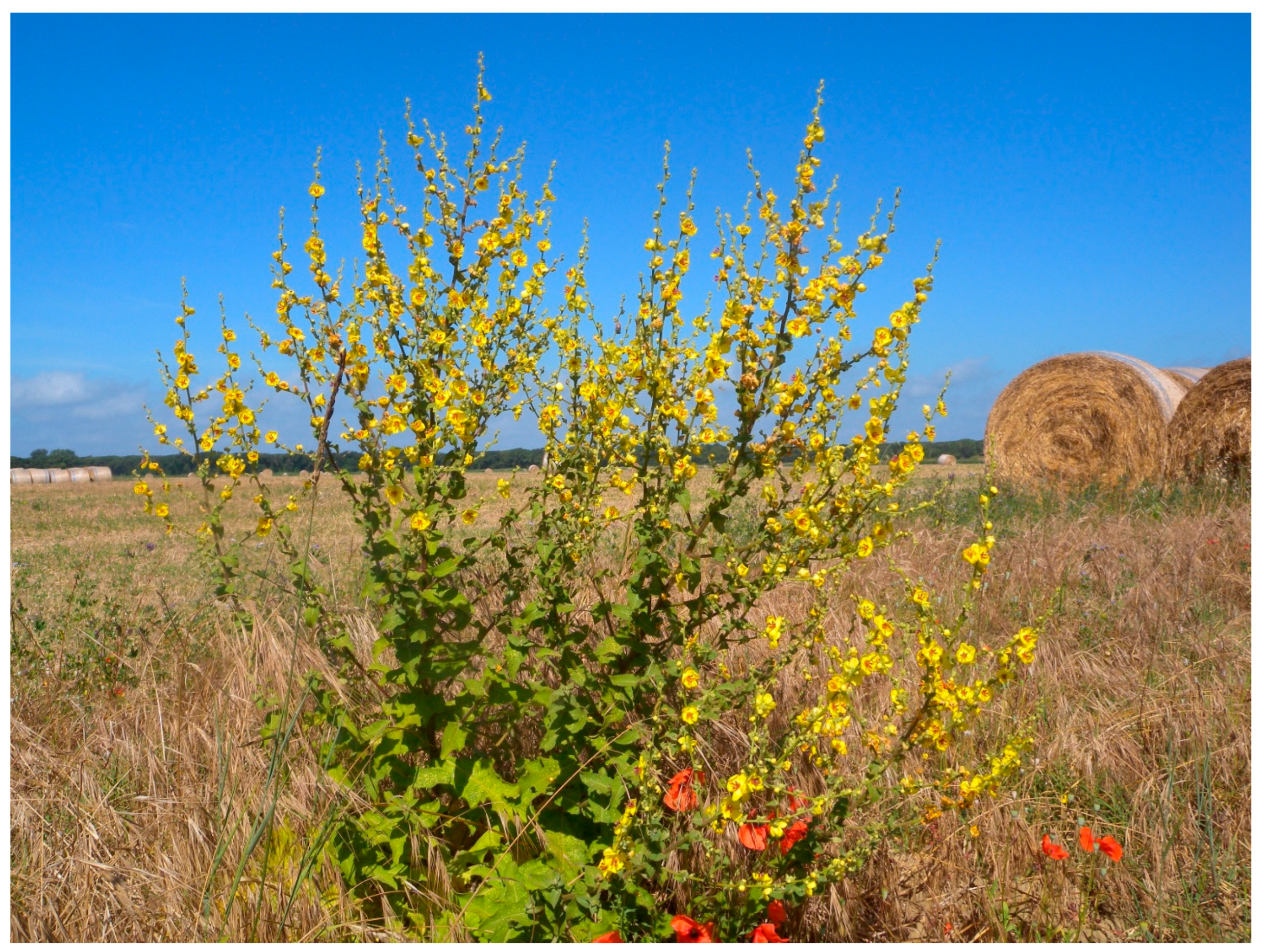
| Verbascum sinuatum L. | Scrophulariaceae | 1.25 ± 0.01 | Crop edges | H |
| Wildflower Species | Germination Before Seed Treatment % | Seed Treatment | Germination After Seed Treatment % | Statistical Significance 1 |
|---|---|---|---|---|
| Althaea cannabina | 23.2 ± 2.0 | Scarification | 76.5 ± 5.2 | ** |
| Anacyclus radiatus | 37.5 ± 2.8 | Washing | 52.3 ± 3.8 | * |
| Cephalaria transsylvanica | 48.1 ± 4.2 | Washing | 75.6 ± 6.2 | ** |
| Cichorium intybus | 35.6 ± 2.9 | Washing | 64.2 ± 5.6 | ** |
| Consolida regalis | 15.5 ± 2.0 | Chilling | 54.5 ± 4.3 | ** |
| Coronilla varia | 25.6 ± 2.2 | Scarification | 88.5 ± 7.3 | ** |
| Daucus carota | 38.4 ± 3.6 | Washing | 65.4 ± 4.4 | * |
| Dianthus cartusianorum | 47.4 ± 3.8 | Chilling | 72.2 ± 6.2 | ** |
| Hypericum perforatum | 28.7 ± 2.3 | Chilling | 41.4 ± 3.5 | * |
| Lavatera punctata | 21.4 ± 1.9 | Scarification | 88.2 ± 7.4 | ** |
| Malva sylvestris | 24.6 ± 2.0 | Scarification | 92.2 ± 8.5 | ** |
| Scabiosa columbaria | 35.7 ± 3.1 | Washing | 77.3 ± 6.1 | ** |
| Scabiosa ochroleuca | 38.4 ± 3.4 | Washing | 75.5 ± 4.5 | ** |
| Stachys germanica | 32.5 ± 2.8 | Chilling | 66.2 ± 5.8 | ** |
| Verbascum sinuatum | 18.5 ± 1.6 | Chilling | 51.5 ± 2.8 | * |
| Wildflower Species | Seedling Emergence % | Statistical Significance 1 | |
|---|---|---|---|
| Sowing Without Soil Rolling | Soil Rolling After Sowing | ||
| Althaea cannabina | 46.5 ± 4.2 | 54.5 ± 3.2 | * |
| Anacyclus radiatus | 14.3 ± 3.8 | 35.6 ± 2.5 | ** |
| Cephalaria transsylvanica | 55.6 ± 5.2 | 61.2 ± 5.3 | * |
| Cichorium intybus | 34.4 ± 3.6 | 45.2 ± 5.6 | * |
| Consolida regalis | 24.4 ± 2.2 | 35.2 ± 3.3 | * |
| Coronilla varia | 49.2 ± 4.3 | 58.3 ± 4.1 | * |
| Daucus carota | 28.2 ± 2.4 | 38.1 ± 3.0 | * |
| Dianthus cartusianorum | 35.2 ± 3.2 | 72.2 ± 6.2 | ** |
| Hypericum perforatum | 22.1 ± 3.5 | 45.8 ± 3.2 | ** |
| Lavatera punctata | 45.6 ± 4.4 | 55.0 ± 4.4 | * |
| Malva sylvestris | 53.7 ± 4.5 | 65.3 ± 5.5 | * |
| Scabiosa columbaria | 49.5 ± 4.1 | 58.5 ± 5.1 | * |
| Scabiosa ochroleuca | 45.3 ± 2.5 | 53.8 ± 4.2 | * |
| Stachys germanica | 22.2 ± 1.8 | 43.7 ± 3.7 | ** |
| Verbascum sinuatum | 15.4 ± 1.2 | 38.3 ± 1.8 | ** |
| Wildflower Species | Flowering Period (Months of the Year) | |||||||||||
|---|---|---|---|---|---|---|---|---|---|---|---|---|
| JAN | FEB | MAR | APR | MAY | JUN | JUL | AUG | SEP | OCT | NOV | DEC | |
| Althaea cannabina | ● | ● | ● | ● | ● | ● | ||||||
| Anacyclus radiatus | ● | ● | ● | |||||||||
| Cephalaria transsylvanica | ● | ● | ● | ● | ● | |||||||
| Cichorium intybus | ● | ● | ● | ● | ||||||||
| Consolida regalis | ● | ● | ● | |||||||||
| Coronilla varia | ● | ● | ● | |||||||||
| Daucus carota | ● | ● | ● | ● | ● | |||||||
| Dianthus cartusianorum | ● | ● | ● | |||||||||
| Hypericum perforatum | ● | ● | ● | |||||||||
| Lavatera punctata | ● | ● | ● | |||||||||
| Malva sylvestris | ● | ● | ● | ● | ● | ● | ||||||
| Scabiosa columbaria | ● | ● | ● | ● | ● | |||||||
| Scabiosa ochroleuca | ● | ● | ● | ● | ● | |||||||
| Stachys germanica | ● | ● | ● | |||||||||
| Verbascum sinuatum | ● | ● | ● | ● | ||||||||
| Wildflower Species | Flower Visitation Rate (Visits m−2 h−1) | Total Visitation Rate (Visits m−2 h−2) | ||||
|---|---|---|---|---|---|---|
| May | June | July | August | September | ||
| Althaea cannabina | 4.3 ± 0.1 a | 24.5 ± 0.1 b | 44.3 ± 0.1 c | 50.2 ± 0.1 c | 29.8 ± 0.1 b | 153.1 ± 12.4 c |
| Anacyclus radiatus | 18.3 ± 1.3 b | 38.7 ± 2.9 c | 28.4 ± 2.3 b | 21.4 ± 2.1 b | 10.8 ± 1.1 a | 117.6 ± 10.1 a |
| Cephalaria transsylvanica | 10.2 ± 1.1 a | 43.5 ± 3.9 c | 68.5 ± 5.0 c | 75.5 ± 4.1 c | 42.3 ± 4.0 b | 240.0 ± 20.6 e |
| Cichorium intybus | 5.5 ± 0.4 a | 35.6 ± 2.9 c | 55.3 ± 4.3 d | 24.3 ± 2.1 c | 18.4 ± 1.1 b | 139.1 ± 12.8 b |
| Consolida regalis | 22.4 ± 1.6 b | 45.2 ± 2.9 c | 41.6 ± 2.3 c | 20.6 ± 2.1 b | 5.5 ± 1.1 a | 135.3 ± 10.1 b |
| Coronilla varia | 10.5 ± 1.1 a | 38.9 ± 3.2 c | 44.5 ± 3.6 c | 15.8 ± 1.6 b | 4.0 ± 0.3 a | 113.7 ± 11.4 a |
| Daucus carota | 15.2 ± 1.2 a | 28.6 ± 2.1 b | 48.3 ± 3.8 c | 43.5 ± 3.6 c | 25.6 ± 2.2 b | 161.2 ± 10.1 c |
| Dianthus cartusianorum | 6.3 ± 0.4 a | 35.6 ± 3.1 c | 38.4 ± 3.3 c | 22.3 ± 2.1 b | 18.9 ± 1.5 b | 121.5 ± 12.2 a |
| Hypericum perforatum | 5.8 ± 0.3 a | 38.3 ± 2.5 c | 35.2 ± 2.9 c | 15.8 ± 1.1 b | 11.5 ± 0.3 a | 115.3 ± 10.1 a |
| Lavatera punctata | 4.4 ± 0.3 a | 53.3 ± 3.9 c | 50.2 ± 4.2 c | 10.8 ± 1.8 b | 4.9 ± 1.3 a | 125.0 ± 12.6 a |
| Malva sylvestris | 19.5 ± 1.5 a | 43.2 ± 3.9 b | 42.4 ± 3.7 b | 36.6 ± 3.1 b | 22.5 ± 2.1 a | 164.2 ± 14.2 c |
| Scabiosa columbaria | 12.2 ± 1.2 a | 51.3 ± 3.6 c | 55.2 ± 4.9 c | 38.2 ± 2.5 b | 30.8 ± 1.1 b | 187.7 ± 16.6 d |
| Scabiosa ochroleuca | 5.3 ± 0.4 a | 40.4 ± 3.0 c | 45.8 ± 3.6 c | 42.3 ± 4.0 c | 22.5 ± 2.1 b | 156.3 ± 13.8 c |
| Stachys germanica | 3.5 ± 0.3 a | 60.5 ± 2.2 c | 60.2 ± 4.3 b | 19.2 ± 3.5 b | 11.5 ± 1.0 b | 155.0 ± 13.2 c |
| Verbascum sinuatum | 4.0 ± 0.4 a | 33.5 ± 3.1 c | 35.4 ± 3.3 c | 31.3 ± 2.8 c | 18.3 ± 1.6 b | 122.5 ± 11.4 a |
| Means | 9.8 ±1.1 a | 40.7 ± 3.9 d | 46.2 ± 4.4 d | 28.0 ± 2.7 c | 18.7 ± 1.9 b | 147.2 ± 12.8 |
| Wildflower Species | Flower Visits (% of the Total) | |||||||
|---|---|---|---|---|---|---|---|---|
| Honey Bees | Solitary Bees | Bumblebees | Diptera | Lepidoptera | Coleoptera | |||
| Syrphidae | Bombyliidae | Tachinidae | ||||||
| Althaea cannabina | 45.3 a | 22.8 b | 15.4 c | 6.0 d | 3.7 e | 0.2 e | 4.5 d | 2.1 e |
| Anacyclus radiatus | 22.3 a | 23.6 a | 3.5 c | 5.6 b | 7.2 b | 2.3 c | 26.4 a | 4.1 c |
| Cephalaria transsylvanica | 35.2 b | 41.5 a | 12.3 c | 3.3 d | 2.1 d | 1.2 d | 4.2 d | 0.2 e |
| Cichorium intybus | 52.8 a | 32.5 b | 3.5 c | 2.2 c | 3.5 c | 2.0 c | 3.1 c | 0.4 d |
| Consolida regalis | 22.1 b | 25.3 b | 33.7 a | 2.7 d | 1.5 d | 0 d | 16.7 c | 0 d |
| Coronilla varia | 29.2 b | 25.5 b | 31.7 a | 3.2 d | 2.3 d | 0 e | 8.1 c | 0 e |
| Daucus carota | 45.7 a | 18.9 b | 4.2 c | 4.6 c | 3.4 d | 5.6 c | 2.4 d | 15.2 b |
| Dianthus cartusianorum | 10.7 c | 31.7 b | 0 e | 13.2 c | 4.6 d | 0 e | 44.3 a | 5.5 d |
| Hypericum perforatum | 25.3 b | 41.2 a | 14.4 c | 6.6 d | 9.5 c | 3.1 d | 6.9 d | 3.0 e |
| Lavatera punctata | 18.3 b | 22.7 b | 31.2 a | 6.2 d | 4.8 d | 2.1 | 10.2 c | 4.5 d |
| Malva sylvestris | 30.7 a | 32.8 a | 15.2 b | 2.2 c | 3.1 c | 0 d | 15.3 b | 0.7 d |
| Scabiosa columbaria | 37.4 a | 32.4 a | 14.2 b | 1.2 c | 0.8 c | 0.4 c | 13.4 b | 0.2 c |
| Scabiosa ochroleuca | 31.2 a | 25.3 b | 13.1 c | 14.2 c | 1.1 d | 0.5 d | 14.2 c | 0.4 d |
| Stachys germanica | 25.4 b | 29.3 b | 40.4 a | 8.3 d | 0.3 e | 0 e | 16.1 c | 0.2 e |
| Verbascum sinuatum | 22.1 c | 28.5 b | 41.2 a | 0 e | 3.0 e | 0 e | 5.2 d | 0 e |
| Means | 30.2 a | 28.7 a | 18.2 b | 5.3 d | 2.4 d | 1.1 e | 11.7 c | 2.4 d |
| Wildflower Species | Shannon Index (H′) |
|---|---|
| Althaea cannabina | 0.65 ± 0.04 b |
| Anacyclus radiatus | 0.74 ± 0.06 d |
| Cephalaria transsylvanica | 0.60 ± 0.05 b |
| Cichorium intybus | 0.53 ± 0.03 a |
| Consolida regalis | 0.51 ± 0.05 b |
| Coronilla varia | 0.65 ± 0.05 b |
| Daucus carota | 0.72 ± 0.06 c |
| Dianthus cartusianorum | 0.53 ± 0.07 e |
| Hypericum perforatum | 0.77 ± 0.06 d |
| Lavatera punctata | 0.67 ± 0.05 c |
| Malva sylvestris | 0.61 ± 0.05 b |
| Scabiosa columbaria | 0.71 ± 0.06 c |
| Scabiosa ochroleuca | 0.65 ± 0.05 b |
| Stachys germanica | 0.52 ± 0.05 b |
| Verbascum sinuatum | 0.74 ± 0.06 d |
| Wildflower Species | Residual Plant Density 1 % | Flower Visits Loss 1 % | Statistical Significance 2 | Pollinator Biodiversity Loss 1 % | Statistical Significance 3 |
|---|---|---|---|---|---|
| Althaea cannabina | 74.2 ± 6.5 | 14.6 ± 0.4 | n.s. | 0.02 ± 0.001 | n.s. |
| Anacyclus radiatus | 44.3 ± 3.8 | 66.2 ± 0.5 | ** | 0.02 ± 0.002 | n.s. |
| Cephalaria transylvanica | 55.8 ± 4.5 | 25.8 ± 7.6 | * | 0.03 ± 0.002 | n.s. |
| Cichorium intybus | 75.4 ± 6.5 | 35.8 ± 5.8 | * | 0.02 ± 0.003 | n.s. |
| Consolida regalis | 24.0 ± 6.5 | 61.2 ± 4.5 | ** | 0.01 ± 0.002 | n.s. |
| Coronilla varia | 68.9 ± 5.6 | 23.6 ± 0.3 | n.s. | 0.03 ± 0.003 | n.s. |
| Daucus carota | 87.5 ± 7.2 | 14.4 ± 1.2 | n.s. | 0.02 ± 0.002 | n.s. |
| Dianthus cartusianorum | 69.8 ± 5.9 | 18.8 ± 1.4 | n.s. | 0.02 ± 0.001 | n.s. |
| Hypericum perforatum | 54.2 ± 4.6 | 21.1 ± 2.2 | * | 0.01 ± 0.001 | n.s. |
| Lavatera punctata | 52.6 ± 4.4 | 55.8 ± 5.1 | ** | 0.02 ± 0.002 | n.s. |
| Malva sylvestris | 92.2 ± 8.2 | 5.5 ± 0.4 | n.s. | 0.03 ± 0.003 | n.s. |
| Scabiosa columbaria | 84.8 ± 7.6 | 8.5 ± 0.6 | n.s. | 0.02 ± 0.001 | n.s. |
| Scabiosa ochroleuca | 67.3 ± 6.0 | 25.3 ± 1.3 | * | 0.03 ± 0.002 | n.s. |
| Stachys germanica | 44.2 ± 3.9 | 54.5 ± 4.0 | * | 0.01 ± 0.001 | n.s. |
| Verbascum sinuatum | 34.6 ± 2.5 | 78.5 ± 3.5 | ** | 0.02 ± 0.001 | n.s. |
Disclaimer/Publisher’s Note: The statements, opinions and data contained in all publications are solely those of the individual author(s) and contributor(s) and not of MDPI and/or the editor(s). MDPI and/or the editor(s) disclaim responsibility for any injury to people or property resulting from any ideas, methods, instructions or products referred to in the content. |
© 2026 by the author. Licensee MDPI, Basel, Switzerland. This article is an open access article distributed under the terms and conditions of the Creative Commons Attribution (CC BY) license.
Share and Cite
Benvenuti, S. Sown Summer-Blooming Wildflowers as a Tool to Support Pollinator Biodiversity During Dry Periods in Mediterranean Agroecosystems. Plants 2026, 15, 887. https://doi.org/10.3390/plants15060887
Benvenuti S. Sown Summer-Blooming Wildflowers as a Tool to Support Pollinator Biodiversity During Dry Periods in Mediterranean Agroecosystems. Plants. 2026; 15(6):887. https://doi.org/10.3390/plants15060887
Chicago/Turabian StyleBenvenuti, Stefano. 2026. "Sown Summer-Blooming Wildflowers as a Tool to Support Pollinator Biodiversity During Dry Periods in Mediterranean Agroecosystems" Plants 15, no. 6: 887. https://doi.org/10.3390/plants15060887
APA StyleBenvenuti, S. (2026). Sown Summer-Blooming Wildflowers as a Tool to Support Pollinator Biodiversity During Dry Periods in Mediterranean Agroecosystems. Plants, 15(6), 887. https://doi.org/10.3390/plants15060887