Conservation—Oriented Analysis of Apocynum venetum’s Distribution in Response to Climate Change Based on MaxEnt Model

 ,
,
Abstract
1. Introduction
2. Materials and Methods
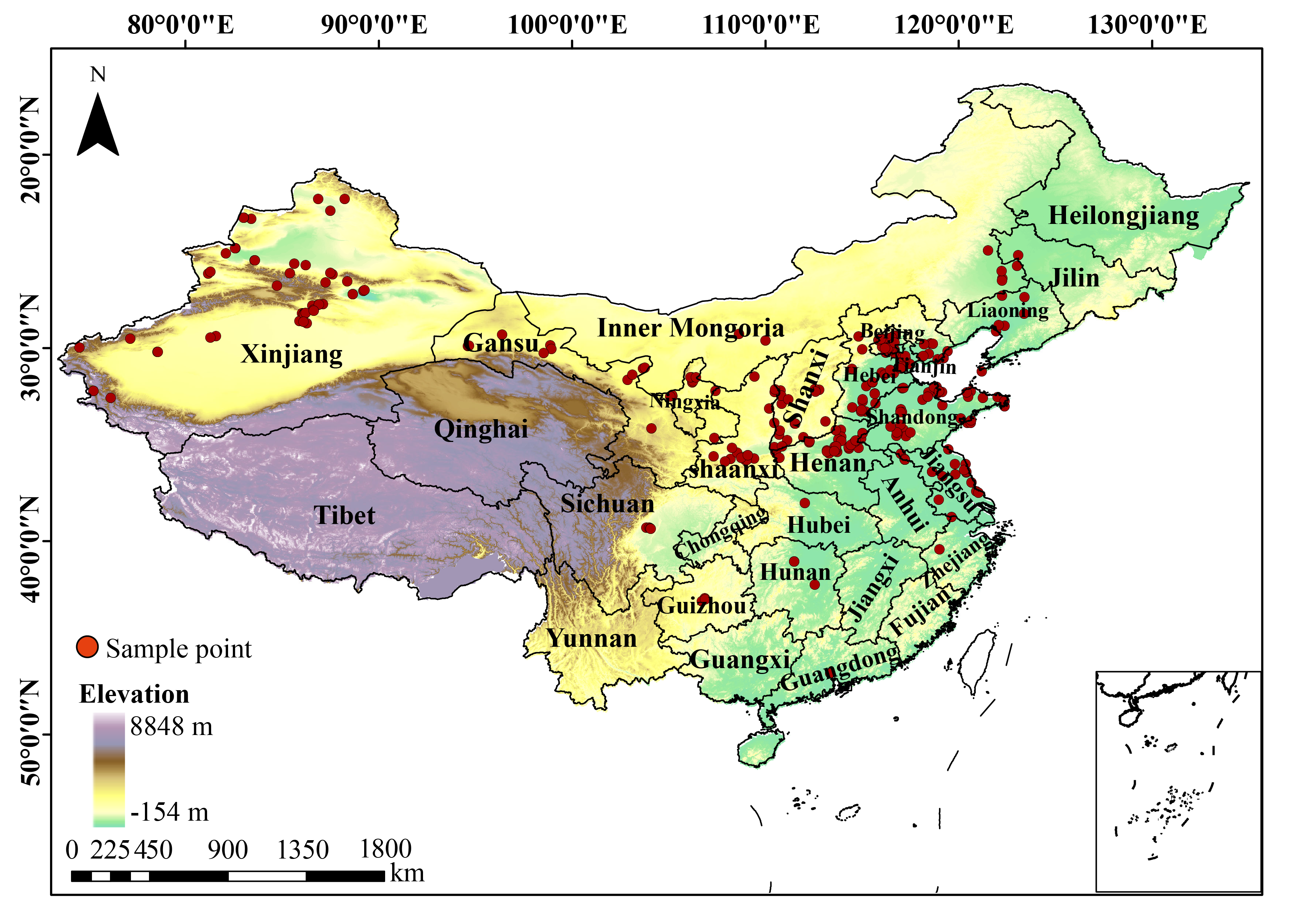
2.1. Sources of Data on the Geographical Distribution of A. venetum
2.2. Environmental Data Collection and Screening
2.3. MaxEnt Model Operation and Evaluation
2.4. Areas of Suitability
2.5. Analysis of Centroid Shift in Suitable Distribution Areas
3. Results
3.1. MaxEnt Model Evaluation
3.2. Analysis of Environmental Factor Importance
3.3. Current Potential Distribution Estimates
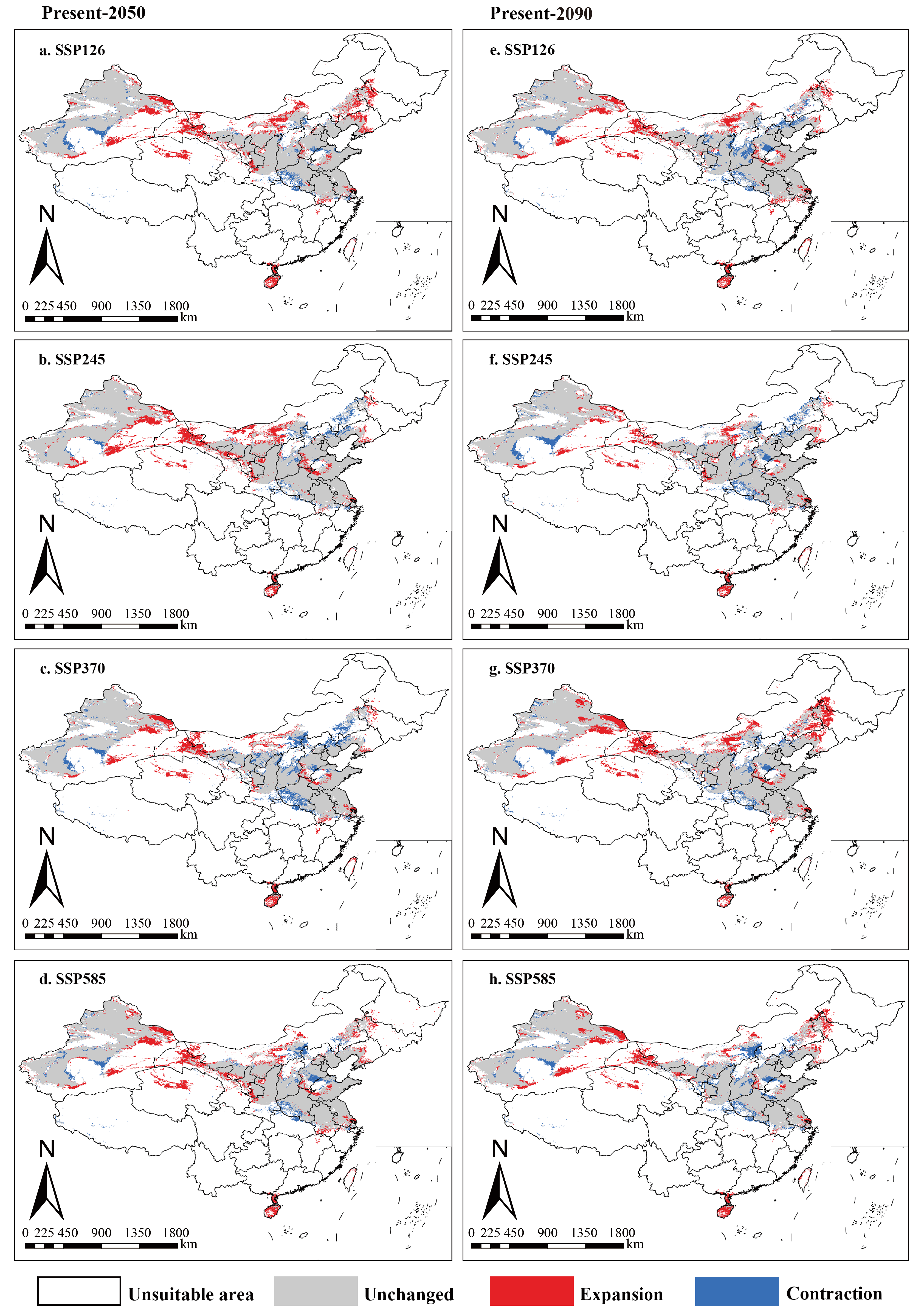
3.4. Suitable Distribution Under Future Climate Scenarios
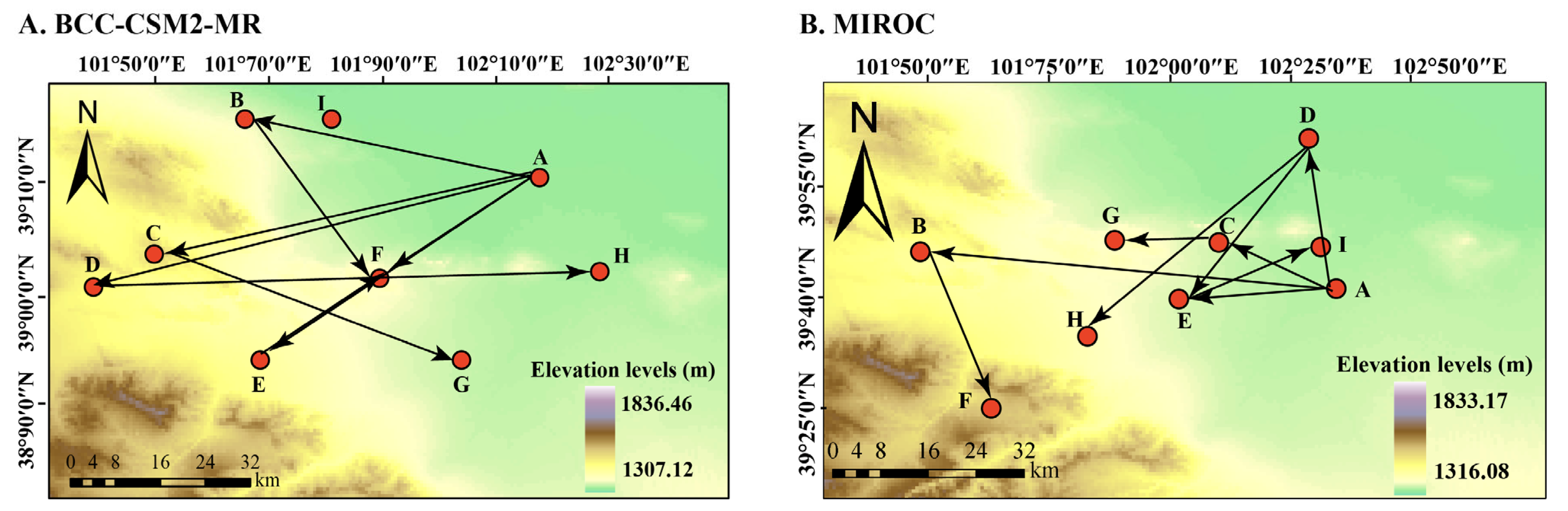
3.5. The Shift Trends of the Geometric Center of Suitable Habitat
4. Discussion
4.1. Model Uncertainty and Limitations
4.2. Influence of Environmental Factors on Habitats of Species
4.3. Response of Spatial Distribution Pattern of A. venetum to Climate Change
4.4. Resource Conservation and Sustainable Harvesting Strategies
5. Research Prospects
6. Conclusions
Supplementary Materials
Author Contributions
Funding
Institutional Review Board Statement
Informed Consent Statement
Data Availability Statement
Conflicts of Interest
References
- Hilonga, S.; Otieno, J.N.; Ghorbani, A.; Pereus, D.; Kocyan, A.; de Boer, H. Trade of wild-harvested medicinal plant species in local markets of Tanzania and its implications for conservation. Ethnobotany 2019, 122, 214–224. [Google Scholar] [CrossRef]
- Yan, H.Y.; He, J.; Zhao, Y.F.; Zhang, L.; Zhu, C.P.; Wu, D. Gentiana macrophylla response to climate change and vulnerability evaluation in China. Glob. Ecol. Conserv. 2020, 22, e00948. [Google Scholar] [CrossRef]
- Rana, S.K.; Rana, H.K.; Ranjitkar, S.; Ghimire, S.K.; Gurmachhan, C.M.; O’Neill, A.R.; Sun, H. Climate-change threats to distribution, habitats, sustainability and conservation of highly traded medicinal and aromatic plants in Nepa. Ecol. Indic. 2020, 115, 106435. [Google Scholar] [CrossRef]
- Jia, L.; Sun, M.; He, M.; Yang, M.; Zhang, M.; Yu, H. Study on the change of global ecological distribution of Nicotiana tabacum L. based on MaxEnt model. Front. Plant Sci. 2024, 15, 1371998. [Google Scholar] [CrossRef]
- Wang, Y.; Xie, L.; Zhou, X.; Chen, R.; Zhao, G.; Zhang, F. Prediction of the potentially suitable areas of Leonurus japonicus in China based on future climate change using the optimized MaxEnt model. Ecol. Evol. 2023, 13, e10597. [Google Scholar] [CrossRef] [PubMed]
- Zhao, Z.Y.; Wei, X.X.; Guo, J.X.; Bi, Y.Q.; Shi, T.T.; Shan, F.B.; Zhang, C.H.; Li, M.H. Research on planting planning of Glycyrrhiza uralensis in Naiman Banner based on MaxEnt model and remote sensing technology. Sci. Rep. 2024, 14, 23601. [Google Scholar] [CrossRef] [PubMed]
- Applequist, W.L.; Brinckmann, J.A.; Cunningham, A.B.; Hart, R.E.; Heinrich, M.; Katerere, D.R.; Andel, T.V. Scientists’ Warning on Climate Change and Medicinal Plants. Planta Med. 2020, 86, 10–18. [Google Scholar] [PubMed]
- Fischer, A.; Spekkink, W.; Polzin, C.; Díaz-Ayude, A.; Brizi, A.; Macsinga, I. Social representations of governance for change towards sustainability: Perspectives of sustainability advocates. Environ. Politics 2018, 27, 621–643. [Google Scholar] [CrossRef]
- Yang, X.Q.; Kushwaha, S.P.S.; Saran, S.; Xu, J.; Roy, P.S. Maxent modeling for predicting the potential distribution of medicinal plant, Justicia adhatoda L. in Lesser Himalayan foothills. Ecol. Eng. 2013, 51, 83–87. [Google Scholar] [CrossRef]
- Tariq, M.; Nandi, S.K.; Bhatt, I.D.; Bhavsar, D.K.; Roy, A.; Pande, V. Phytosociological and niche distribution study of Paris polyphylla smith, an important medicinal herb of Indian Himalayan region. Trop. Ecol. 2021, 62, 163–173. [Google Scholar] [CrossRef]
- Kearney, M.R.; Wintle, B.A.; Porter, W.P. Correlative and mechanistic models of species distribution provide congruent forecasts under climate change. Conserv. Lett. 2010, 3, 203–213. [Google Scholar] [CrossRef]
- Wiens, J.A.; Stralberg, D.; Jongsomjit, D.; Howell, C.A.; Snyder, M.A. Niches, models, and climate change: Assessing the assumptions and uncertainties. Proc. Natl. Acad. Sci. USA 2009, 106, 19729–19736. [Google Scholar] [CrossRef]
- Phillips, S.J.; Anderson, R.P.; Schapire, R.E. Maximum entropy modeling of species geographic distributions. Ecol. Model. 2006, 190, 231–259. [Google Scholar] [CrossRef]
- Yang, J.; Jiang, P.; Huang, Y.; Yang, Y.; Wang, R.; Yang, Y. Potential geographic distribution of relict plant Pteroceltis tatarinowii in China under climate change scenarios. PLoS ONE 2022, 17, e0266133. [Google Scholar] [CrossRef] [PubMed]
- Wang, Y.E.; Zhang, L.I.; Du, Z.; Pei, J.; Huang, L. Chemical diversity and prediction of potential cultivation areas of Cistanche herbs. Sci. Rep. 2019, 9, 19737. [Google Scholar] [CrossRef]
- Hu, J.; Feng, Y.; Zhong, H.T.; Liu, W.; Tian, X.F.; Wang, Y.H.; Tan, T.; Hu, Z.G.; Liu, Y.F. Impact of climate change on the geographical distribution and niche dynamics of Gastrodia elata. PeerJ 2023, 11, e15741. [Google Scholar] [CrossRef] [PubMed]
- Wang, Z.; Jia, Y.J.; Li, P.P.; Tang, Z.S.; Guo, Y.; Wen, L.X.; Yu, H.Q.; Cui, F.; Hu, F.D. Study on environmental factors affecting the quality of codonopsis radix based on MaxEnt model and all-in-one functional factor. Sci. Rep. 2023, 13, 20726. [Google Scholar] [CrossRef]
- Yang, M.; Li, Z.; Liu, L.; Bo, A.; Zhang, C.; Li, M. Ecological niche modeling of Astragalus membranaceus var. mongholicus medicinal plants in Inner Mongolia, China. Sci. Rep. 2020, 10, 12482. [Google Scholar] [CrossRef]
- Xiao, Z.C.; Zhang, W.M. The name and study of Apocynum venetum L. in ancient China. Chin. Wild Plant Resour. 2016, 35, 55–57. [Google Scholar]
- Gao, G.; Liu, N.; Yu, C.; Chen, P.; Chen, J.; Chen, K.; Wang, X.; Liu, B.; Zhu, A. UPLC-ESI-MS/MS Based Characterization of Active Flavonoids from Apocynum spp. and Anti-Bacteria Assay. Antioxidants 2021, 10, 1901. [Google Scholar] [CrossRef]
- Li, X.; Wu, T.; Yu, Z.; Li, T.; Zhang, J.; Zhang, Z. Apocynum venetum leaf extract reverses depressive-like behaviors in chronically stressed rats by inhibiting oxidative stress and apoptosis. Biomed. Pharmacother. 2018, 100, 394–406. [Google Scholar] [CrossRef]
- Fathima, A.; Rao, J.R. Selective toxicity of Catechin—A natural flavonoid towards bacteria. Appl. Microbiol. Biotechnol. 2016, 100, 6395–6402. [Google Scholar] [CrossRef]
- Xu, Z.; Wang, M.; Ren, T.; Li, K.; Li, Y.; Marowa, P.; Zhang, C. Comparative transcriptome analysis reveals the molecular mechanism of salt tolerance in Apocynum venetum. Plant Physiol. Biochem. 2021, 167, 816–830. [Google Scholar] [CrossRef] [PubMed]
- Tan, Y.L.; Xu, Y.; Zhu, J. Research on the Properties and Current Situation of Apocynum venetum. Light Text. Ind. Technol. 2021, 50, 16–18. [Google Scholar] [CrossRef]
- Su, Q.; Qiu, L.Y. Overview of Apocynum venetum resources in Xinjiang. J. Agric. Catastrophol. 2015, 5, 61–65. [Google Scholar]
- Feng, Y.; Jiang, C.; Yang, F.; Chen, Z.; Li, Z. Apocynum venetum leaf extract protects against H2O2-induced oxidative stress by increasing autophagy in PC12 cells. Biomed. Rep. 2020, 13, 6. [Google Scholar] [CrossRef]
- Zhang, Y.; Liu, S.; Ma, J.L.; Chen, C.; Huang, P.; Ji, J.H.; Ren, L.Q. Apocynum venetum leaf extract alleviated doxorubicin-induced cardiotoxicity through the AKT/Bcl-2 signaling pathway. Phytomedicine 2022, 94, 153815. [Google Scholar] [CrossRef]
- Zheng, L.S.; Gao, S.; Wang, K.; Qiao, T.J.; Sun, B.F. Antimicrobial mechanism of Apocynum venetum fibre. J. Insp. Quar. 2009, 3, 13–16. [Google Scholar]
- Xu, Z.L.; Peng, H.H.; Peng, S.Z. Development of species distribution models and evaluation methods. Acta Ecol. Sin. 2015, 35, 557. [Google Scholar]
- Fick, S.E.; Hijmans, R.J. WorldClim 2: New 1-km spatial resolution climate surfaces for global land areas. Int. J. Climatol. 2017, 37, 4302–4315. [Google Scholar] [CrossRef]
- FAO; IIASA; ISRIC; ISSCAS; JRC. Harmonized World Soil Database (Version 1.2); FAO: Rome, Italy; IIASA: Laxenburg, Austria, 2012. [Google Scholar]
- Wu, T.; Lu, Y.; Fang, Y.; Xin, X.; Li, L.; Li, W.; Jie, W.; Zhang, J.; Liu, Y.; Zhang, L.; et al. The Beijing Climate center climate system model (BCC-CSM): The main progress from CMIP5 to CMIP6. Geosci. Model. Dev. 2019, 12, 1573–1600. [Google Scholar] [CrossRef]
- Jiang, D.; Hu, D.; Tian, Z.; Lang, X. Differences between CMIP6 and CMIP5 models in simulating climate over China and the East Asian monsoon. Adv. Atmos. Sci. 2020, 37, 1102–1118. [Google Scholar] [CrossRef]
- Debella-Gilo, M.; Etzelmuller, B. Spatial prediction of soil classes using digital terrain analysis and multinomial logistic regression modeling integrated in GIS: Examples from Vestfold County, Norway. Catena 2009, 77, 8–18. [Google Scholar] [CrossRef]
- Zhao, G.; Cui, X.; Sun, J.; Li, T.; Wang, Q.; Ye, X.; Fan, B. Analysis of the distribution pattern of Chinese Ziziphus jujuba under climate change based on optimized biomod2 and MaxEnt models. Ecol. Indic. 2021, 132, 108256. [Google Scholar] [CrossRef]
- Dong, P.B.; Wang, L.Y.; Wang, L.J.; Jia, Y.; Li, Z.H.; Bai, G.; Chen, Y. Distributional response of the rare and endangered tree species Abies chensiensis to climate change in east Asia. Biology 2022, 11, 1659. [Google Scholar] [CrossRef]
- Gao, X.; Lin, F.; Li, M.; Mei, Y.; Li, Y.; Bai, Y.; Zheng, Y. Prediction of the potential distribution of a raspberry (Rubus idaeus) in China based on MaxEnt model. Sci. Rep. 2024, 14, 24438. [Google Scholar] [CrossRef]
- Bu, F.; Yue, X.; Sun, S.; Jin, Y.; Li, L.; Li, X.; Fu, H. Would future climate warming cause zoonotic diseases to spread over long distances? PeerJ 2024, 12, e16811. [Google Scholar] [CrossRef] [PubMed]
- Cobos, M.E.; Peterson, A.T.; Barve, N.; Osorio-Olvera, L. kuenm: An R package for detailed development of ecological niche models using Maxent. PeerJ 2019, 7, e6281. [Google Scholar] [CrossRef] [PubMed]
- Warren, D.L.; Seifert, S.N. Ecological niche modeling in Maxent: The importance of model complexity and the performance of model selection criteria. Ecol. Appl. 2011, 21, 335–342. [Google Scholar] [CrossRef]
- Barbet-Massin, M.; Jiguet, F.; Albert, C.H.; Thuiller, W. Selecting pseudo-absences for species distribution models: How, where and how many? Methods Ecol. Evol. 2012, 3, 327–338. [Google Scholar] [CrossRef]
- Peterson, A.T.; Soberón, J.; Pearson, R.G.; Anderson, R.P.; Martínez-Meyer, E.; Nakamura, M.; Araújo, M.B. Ecological Niches and Geographic Distributions (MPB-49); Princeton University Press: Princeton, NJ, USA, 2011. [Google Scholar]
- Akpoti, K.; Kabo-Bah, A.T.; Dossou-Yovo, E.R.; Groen, T.A.; Zwart, S.J. Mapping suitability for rice production in inland valley landscapes in Benin and Togo using environmental niche modeling. Sci. Total Environ. 2020, 709, 136165. [Google Scholar] [CrossRef]
- Allouche, O.; Tsoar, A.; Kadmon, R. Assessing the accuracy of species distribution models: Prevalence, kappa and the true skill statistic (TSS). J. Appl. Ecol. 2006, 43, 1223–1232. [Google Scholar] [CrossRef]
- Liu, C.; White, M.; Newell, G. Selecting thresholds for the prediction of species occurrence with presence-only data. J. Biogeogr. 2013, 40, 778–789. [Google Scholar] [CrossRef]
- Liu, C.; Newell, G.; White, M.; Bennett, A.F. On the selection of thresholds for predicting species occurrence with presence-only data. Ecol. Evol. 2016, 6, 337–348. [Google Scholar] [CrossRef]
- Brown, J.L.; Bennett, J.R.; French, C.M. SDMtoolbox 2.0: The next generation Python-based GIS toolkit for landscape genetic, biogeographic and species distribution model analyses. PeerJ 2017, 5, e4095. [Google Scholar] [CrossRef] [PubMed]
- Elith, J.; Leathwick, J.R. Species distribution models: Ecological explanation and prediction across space and time. Annu. Rev. Ecol. Evol. Syst. 2009, 40, 677–697. [Google Scholar] [CrossRef]
- Friedman, S.K.; Franklin, J.; Miller, J.A. Mapping Species Distributions: Spatial Inference and Prediction; Cambridge University Press: Cambridge, UK, 2011; Volume 26, pp. 895–897. [Google Scholar]
- Araújo, M.B.; Peterson, A.T. Uses and misuses of bioclimatic envelope modeling. Ecology 2012, 93, 1527–1539. [Google Scholar] [CrossRef]
- Guisan, A.; Thuiller, W. Predicting species distribution: Offering more than simple habitat models. Ecol. Lett. 2005, 8, 993–1009. [Google Scholar] [CrossRef]
- Dormann, C.F.; Schymanski, S.J.; Cabral, J.; Chuine, I.; Graham, C.; Hartig, F.; Kearney, M.; Morin, X.; Römermann, C.; Schröder, B.; et al. Correlation and process in species distribution models: Bridging a dichotomy. J. Biogeogr. 2012, 39, 2119–2131. [Google Scholar] [CrossRef]
- Newbold, T. Future effects of climate and land-use change on terrestrial vertebrate community diversity under different scenarios. Proc. R. Soc. B 2018, 285, 20180792. [Google Scholar] [CrossRef]
- Muller, M.M.P.; Santana, D.J.; Costa, H.C.; Ceron, K. Geographic patterns of distribution and ecological niche of the snake-necked turtle genus Hydromedusa. PeerJ 2024, 12, e16712. [Google Scholar]
- Araújo, M.B.; Luoto, M. The importance of biotic interactions for modelling species distributions under climate change. Glob. Ecol. Biogeogr. 2007, 16, 743–753. [Google Scholar] [CrossRef]
- Wisz, M.S.; Pottier, J.; Kissling, W.D.; Pellissier, L.; Lenoir, J.; Damgaard, C.F.; Dormann, C.F.; Forchhammer, M.C.; Grytnes, J.A.; Guisan, A.; et al. The role of biotic interactions in shaping distributions and realised assemblages of species: Implications for species distribution modelling. Biol. Rev. 2013, 88, 15–30. [Google Scholar] [CrossRef]
- Thuiller, W.; Guéguen, M.; Renaud, J.; Karger, N.K.; Zimmermann, N.E. Uncertainty in ensembles of global biodiversity scenarios. Nat. Commun. 2019, 10, 1446. [Google Scholar] [CrossRef]
- Guo, X.L.; Zhou, L.H.; Chen, Y.; Gu, M.H.; Zhao, M.M. Analysis on the adaptability of farmers to ecological and environmental changes and the driving factors in the inner mongolia autonomous region. Acta Ecol. Sin. 2018, 38, 7629–7637. [Google Scholar]
- Huang, L.F.; Li, W.T.; Wang, Z.; Fu, J.; Chen, S.L. Correlative study between chemical constituents and ecological factors of Notopterygii Rhizoma Et Radix of endangered plateau plant. Acta Ecol. Sin. 2013, 33, 7667–7678. [Google Scholar] [CrossRef]
- Yang, J.L.; Zhang, L.X.; Jiang, L.; Zhan, Y.G.; Fan, G.Z. Quercetin alleviates seed germination and growth inhibition in Apocynum venetum and Apocynum pictum under mannitol-induced osmotic Stress. Plant Physiol. Biochem. 2021, 159, 268–276. [Google Scholar] [CrossRef]
- Wu, X.L.; Yuan, J.; Luo, A.X.; Chen, Y.; Fan, Y.J. Drought stress and re-watering increase secondary metabolites and enzyme activity in Dendrobium moniliforme. Ind. Crops Prod. 2016, 94, 385–393. [Google Scholar] [CrossRef]
- Choi, K.; Kim, J.; Wang, H.J.; Kim, S.; Park, C.; Kim, S.Y.; Lee, I. The FRIGIDA complex activates transcription of FLC, a strong flowering repressor in Arabidopsis, by recruiting chromatin modification factors. Plant Cell 2011, 23, 289–303. [Google Scholar] [CrossRef] [PubMed]
- Hacke, U.G. Cavitation fatigue: Embolism and refilling cycles can weaken the cavitation resistance of xylem. Plant Physiol. 2001, 125, 779–786. [Google Scholar] [CrossRef]
- Rong, Y.; Li, H.; Johnson, D. Germination response of Apocynum venetum seeds to temperature and water potential. J. Appl. Bot. Food Qual. 2015, 88, 202–208. [Google Scholar]
- Cramer, V.A.; Hobbs, R.J.; Atkins, L. The influence of local elevation on the effects of secondary salinity in remnant eucalypt woodlands: Changes in understorey communities. Plant Soil 2004, 265, 253–266. [Google Scholar] [CrossRef]
- Vitasse, Y.; Schneider, L.; Rixen, C.; Christen, D.; Rebetez, M. Increase in the risk of exposure of forest and fruit trees to spring frosts at higher elevations in Switzerland over the last four decades. Agric. For. Meteorol. 2018, 248, 60–69. [Google Scholar] [CrossRef]
- He, X.; Arif, M.; Zheng, J.; Ni, X.; Yuan, Z.; Zhu, Q.; Wang, J.; Ding, D.; Li, C. Plant diversity patterns along an elevation gradient: The relative impact of environmental and spatial variation on plant diversity and assembly in arid and semi-arid regions. Front. Environ. Sci. 2023, 11, 1021157. [Google Scholar] [CrossRef]
- Buri, A.; Cianfrani, C.; Pinto-Figueroa, E.; Yashiro, E.; Spangenberg, J.E.; Adatte, T.; Verrecchia, E.; Guisan, A.; Pradervand, J.N. Soil factors improve predictions of plant species distribution in a mountain environment. Prog. Phys. Geogr. Earth Environ. 2017, 41, 703–722. [Google Scholar] [CrossRef]
- Rota, F.; Scherrer, D.; Bergamini, A.; Price, B.; Walthert, L.; Baltensweiler, A. Unravelling the impact of soil data quality on species distribution models of temperate forest woody plants. Sci. Total Environ. 2024, 944, 173719. [Google Scholar] [CrossRef]
- Xu, Z.; Zhou, J.; Zhang, C.; Li, Y. Review of current research and utilization status of Apocynum venetum germplasm in China. Chin. Bot Bull 2018, 53, 382–390. [Google Scholar]
- Guisan, A.; Zimmermann, N.E. Predictive habitat distribution models in ecology. Ecol. Model. 2000, 135, 147–186. [Google Scholar] [CrossRef]
- Austin, M. Species distribution models and ecological theory: A critical assessment and some possible new approaches. Ecol. Model. 2007, 200, 1–19. [Google Scholar] [CrossRef]
- Hao, Y.; Dong, P.; Wang, L.; Ke, X.; Hao, X.; He, G.; Guo, F. Predicting the Potential Distribution of Hypericum perforatum under Climate Change Scenarios Using a Maximum Entropy Model. Biology 2024, 13, 452. [Google Scholar] [CrossRef]
- Jingya, X.; Tian, L.; Guozhang, Z.; Yiqi, Z. Prediction of suitable areas of Eremochloa ophiuroides in China under different climate scenarios based on MaxEnt model. J. Beijing For. Univ. 2024, 46, 91–102. [Google Scholar]
- Ye, X.M.; Chen, F.S.; Sun, R.X. Prediction of potential suitable distribution areas for Choerospondias axillaris besed on MaxEnt model. Acta Agric. Univ. Jiangxiensis 2019, 41, 440−446. [Google Scholar]
- Bergengren, J.C.; Waliser, D.E.; Yung, Y.L. Ecological sensitivity: A biospheric view of climate change. Clim. Change 2011, 107, 433–457. [Google Scholar] [CrossRef]
- Wang, L.; Wang, J.; He, F.; Wang, Q.; Zhao, Y.; Lu, P.; Jia, X. Spatial–temporal variation of extreme precipitation in the Yellow–Huai–Hai–Yangtze Basin of China. Sci. Rep. 2023, 13, 9312. [Google Scholar] [CrossRef] [PubMed]
- Senkoro, A.M.; Munt, D.D.; Shackleton, C.M.; Ribeiro-Barros, A.I.; Voeks, R.A. The case of a threatened medicinal tree with optimistic prospects under climate change. Glob. Ecol. Conserv. 2024, 54, e03126. [Google Scholar] [CrossRef]
- Xie, W.; Zhang, X.; Wang, T.; Hu, J. Botany, traditional uses, phytochemistry and pharmacology of Apocynum venetum L. (Luobuma): A review. J. Ethnopharmacol. 2012, 141, 1–8. [Google Scholar] [CrossRef]
- Du, S.Y.; Huang, H.F.; Li, X.Q.; Zhai, L.X.; Zhu, Q.C.; Zheng, K.; Song, X.; Xu, C.S.; Li, C.Y. Anti-inflammatory properties of uvaol on DSS-induced colitis and LPS-stimulated macrophages. Chin. Med. 2020, 15, 020–00322. [Google Scholar] [CrossRef] [PubMed]
- Xu, X.; Gong, J.; Zhang, T.; Li, Z.; Zhang, J.; Wang, L.; Huang, J. Insights into antibacterial mechanism of Apocynum venetum L. fiber: Evolution of bioactive natural substances in bast during chemical degumming process. Ind. Crops Prod. 2020, 151, 112419. [Google Scholar] [CrossRef]
- Liang, Q.; Xu, X.; Mao, K.; Wang, M.; Wang, K.; Xi, Z. Shifts in plant distributions in response to climate warming in a biodiversity hotspot, the Hengduan Mountains. J. Biogeogr. 2018, 45, 1334–1344. [Google Scholar] [CrossRef]
- Hageer, Y.; Esperón-Rodrıguez, M.; Baumgartner, J.B.; Beaumont, L.J. Climate, soil or both? Which variables are better predictors of the distributions of Australian shrub species? PeerJ 2017, 5, e3446. [Google Scholar] [CrossRef] [PubMed]
- Xiong, Z.R.; Zhang, X.C.; Zou, X.; Zhao, Y.; Chen, X. Prediction of the suitable distribution and responses to climate change of Sorbus tianschanica in China. Ecol. Sci. 2019, 38, 44–51. [Google Scholar]
- Pecl, G.T.; Araújo, M.B.; Bell, J.D.; Blanchard, J.; Bonebrake, T.C.; Chen, I.C.; Clark, T.D.; Colwell, R.K.; Danielsen, F.; Evengård, B..; et al. Biodiversity redistribution under climate change: Impacts on ecosystems and human well-being. Science 2017, 355, eaai9214. [Google Scholar] [CrossRef] [PubMed]
- Zurell, D.; Franklin, J.; König, C.; Bouchet, P.J.; Dormann, C.F.; Elith, J.; Fandos, G.; Feng, X.; Guillera-Arroita, G.; Guisan, A.; et al. A standard protocol for reporting species distribution models. Ecography 2020, 43, 1261–1277. [Google Scholar] [CrossRef]
- O’Neill, B.C.; Tebaldi, C.; van Vuuren, D.P.; Eyring, V.; Friedlingstein, P.; Hurtt, G.; Knutti, R.; Kriegler, E.; Lamarque, J.-F.; Lowe, J.; et al. The Scenario Model Intercomparison Project (ScenarioMIP) for CMIP6. Geosci. Model Dev. 2016, 9, 3461–3482. [Google Scholar] [CrossRef]
- Svenning, J.-C.; Skov, F. Limited filling of the potential range in European tree species. Ecol. Lett. 2004, 7, 565–573. [Google Scholar] [CrossRef]
- Dobrowski, S.; Parks, S. Climate change velocity underestimates climate change exposure in mountainous regions. Nat. Commun. 2016, 7, 12349. [Google Scholar] [CrossRef]
- Chen, I.C.; Hill, J.K.; Ohlemüller, R.; Roy, D.B.; Thomas, C.D. Rapid range shifts of species associated with high levels of climate warming. Science 2011, 333, 1024–1026. [Google Scholar] [CrossRef]
- Lenoir, J.; Gégout, J.C.; Marquet, P.A.; de Ruffray, P.; Brisse, H. A significant upward shift in plant species optimum elevation during the 20th century. Science 2008, 320, 1768–1771. [Google Scholar] [CrossRef]
- Zu, K.; Wang, Z.; Zhu, X.; Lenoir, J.; Shrestha, N.; Lyu, T.; Zhou, J. Upward shift and elevational range contractions of subtropical mountain plants in response to climate change. Sci. Total Environ. 2021, 783, 146896. [Google Scholar] [CrossRef]
- Corlett, R.T.; Westcott, D.A. Will plant movements keep up with climate change? Trends Ecol. Evol. 2013, 28, 482–488. [Google Scholar] [CrossRef] [PubMed]
- Xiang, T.; Wu, L.; Isah, M.B.; Chen, C.; Zhang, X. Apocynum venetum, a medicinal, economical and ecological plant: A review update. PeerJ 2023, 11, e14966. [Google Scholar] [CrossRef] [PubMed]
- Hoegh-Guldberg, O.; Hughes, L.; McIntyre, S.; Lindenmayer, D.B.; Parmesan, C.; Possingham, H.P.; Thomas, C.D. Assisted colonization and rapid climate change. Science 2008, 321, 345–357. [Google Scholar] [CrossRef]
- Kelly, E.; Phillips, B.L. Targeted gene flow for conservation. Conserv. Biol. 2015, 30, 259–267. [Google Scholar] [CrossRef]
- Lin, Y.B.; Gu, W.; Liu, S.J.; Lv, J. Analysis on the Feasibility and Prospect of Artificial Planting of Apocynum venetum in Coastal Saline-alkali Soil. J. Anhui Agric. Sci. 2012, 40, 12182–12183. [Google Scholar]
- Gao, J.Q. Tissue Culture and Rapid MultiplicationTechniques of Apocynum L. Agric. Sci. Technol. 2012, 13, 2269–2272+2354. [Google Scholar]
- Ahmed, S.E.; Mcinerny, G.; Hara, K.; Harper, R.H.R. scientists and software-surveying the species distribution modelling community. Divers. Distrib. 2015, 21, 258–267. [Google Scholar] [CrossRef]
- Estes, L.D.; Bradley, B.A.; Beukes, H.; Hole, D.G.; Lau, M.; Oppenheimer, M.G. Comparing mechanistic and empirical model projections of crop suitability and productivity: Implications for ecological forecasting. Glob. Ecol. Biogeogr. 2013, 22, 1007–1018. [Google Scholar] [CrossRef]
- Porfirio, L.L.; Harris, R.M.; Lefroy, E.C.; Hugh, S.; Gould, S.F.; Lee, G.; Bindoff, N.; Mackey, B. Improving the use of species distribution models in conservation planning and management under climate change. PLoS ONE 2014, 9, e113749. [Google Scholar] [CrossRef] [PubMed]
- Ye, X.Z.; Zhang, M.Z.; Lai, W.F.; Yang, M.M.; Fan, H.H.; Zhang, G.F.; Chen, S.P.; Liu, B. Prediction of potential suitable distribution of Phoebe bournei based on MaxEnt optimization model. Acta Ecol. Sin. 2021, 41, 8135–8144. [Google Scholar] [CrossRef]




| Category | Variable | Description | Source | Spatial Resolution | Temporal Coverage | Code Unit |
|---|---|---|---|---|---|---|
| Bioclimatic variables | Bio2 | Mean diurnal range (Mean of monthly) | WorldClim v2.1 | 2.5 arc-min | Current and future | °C |
| Bio11 | Mean temperature of coldest quarter | °C | ||||
| Bio15 | Precipitation seasonality (coefficient of variation) | mm | ||||
| Energy variables | Srad5 | Solar radiation in May | current | kJ m−2 day−1 | ||
| Srad6 | Solar radiation in June | kJ m−2 day−1 | ||||
| Topographic variable | Elev | Elevation | m | |||
| Soil variables | Awc_class | AWC range | HWSD | Code | ||
| T_oc | Topsoil organic carbon | % weight | ||||
| T_ph_h2o | Topsoil pH (H2O) | −log (H+) |
| Species | Model | Period | Area of Each Suitable Region (×104 Km2) | |||
|---|---|---|---|---|---|---|
| Unsuitable Region | Unchanged Region | Expansion Region | Contraction Region | |||
| A. venetum | BCC-CSM2-MR | Current vs. SSP126-2050s | 703.03 | 181.31 | 40.94 | 14.40 |
| Current vs. SSP245-2050s | 705.34 | 183.66 | 38.63 | 12.05 | ||
| Current vs. SSP370-2050s | 714.37 | 169.65 | 29.60 | 26.05 | ||
| Current vs. SSP585-2050s | 704.73 | 180.64 | 39.23 | 15.06 | ||
| Current vs. SSP126-2090s | 710.44 | 176.72 | 33.53 | 18.99 | ||
| Current vs. SSP245-2090s | 717.24 | 176.38 | 26.72 | 19.32 | ||
| Current vs. SSP370-2090s | 702.25 | 181.26 | 41.71 | 14.45 | ||
| Current vs. SSP585-2090s | 710.20 | 175.26 | 33.77 | 20.44 | ||
| MIROC | Current vs. RCP2.6-2050s | 692.51 | 184.63 | 51.40 | 11.03 | |
| Current vs. RCP4.5-2050s | 688.07 | 185.88 | 55.84 | 9.77 | ||
| Current vs. RCP6.0-2050s | 685.59 | 183.88 | 58.32 | 11.78 | ||
| Current vs. RCP8.5-2050s | 708.72 | 185.61 | 42.23 | 13.06 | ||
| Current vs. RCP2.6-2090s | 684.44 | 187.23 | 59.48 | 8.43 | ||
| Current vs. RCP4.5-2090s | 673.03 | 187.90 | 70.88 | 7.76 | ||
| Current vs. RCP6.0-2090s | 690.88 | 184.08 | 53.03 | 11.58 | ||
| Current vs. RCP8.5-2090s | 684.93 | 186.33 | 58.99 | 9.33 | ||
Disclaimer/Publisher’s Note: The statements, opinions and data contained in all publications are solely those of the individual author(s) and contributor(s) and not of MDPI and/or the editor(s). MDPI and/or the editor(s) disclaim responsibility for any injury to people or property resulting from any ideas, methods, instructions or products referred to in the content. |
© 2026 by the authors. Licensee MDPI, Basel, Switzerland. This article is an open access article distributed under the terms and conditions of the Creative Commons Attribution (CC BY) license.
Share and Cite
Chen, Y.; Cheng, J.; Chen, Y.; Dong, P.; Wang, L.; Yang, H.; Chen, R.; Wang, J. Conservation—Oriented Analysis of Apocynum venetum’s Distribution in Response to Climate Change Based on MaxEnt Model. Plants 2026, 15, 876. https://doi.org/10.3390/plants15060876
Chen Y, Cheng J, Chen Y, Dong P, Wang L, Yang H, Chen R, Wang J. Conservation—Oriented Analysis of Apocynum venetum’s Distribution in Response to Climate Change Based on MaxEnt Model. Plants. 2026; 15(6):876. https://doi.org/10.3390/plants15060876
Chicago/Turabian StyleChen, Yong, Jiali Cheng, Yuan Chen, Pengbin Dong, Liyang Wang, Hongwei Yang, Ru Chen, and Juanli Wang. 2026. "Conservation—Oriented Analysis of Apocynum venetum’s Distribution in Response to Climate Change Based on MaxEnt Model" Plants 15, no. 6: 876. https://doi.org/10.3390/plants15060876
APA StyleChen, Y., Cheng, J., Chen, Y., Dong, P., Wang, L., Yang, H., Chen, R., & Wang, J. (2026). Conservation—Oriented Analysis of Apocynum venetum’s Distribution in Response to Climate Change Based on MaxEnt Model. Plants, 15(6), 876. https://doi.org/10.3390/plants15060876