Spatial–Temporal Heterogeneity and Driving Mechanisms of the Relationship Between Vegetation Carbon Sequestration and Biogenic Volatile Organic Compounds (BVOC) Emissions in China

 and
and
Abstract
1. Introduction
2. Results
2.1. Temporal Change Trends of BCEI in Different Scales
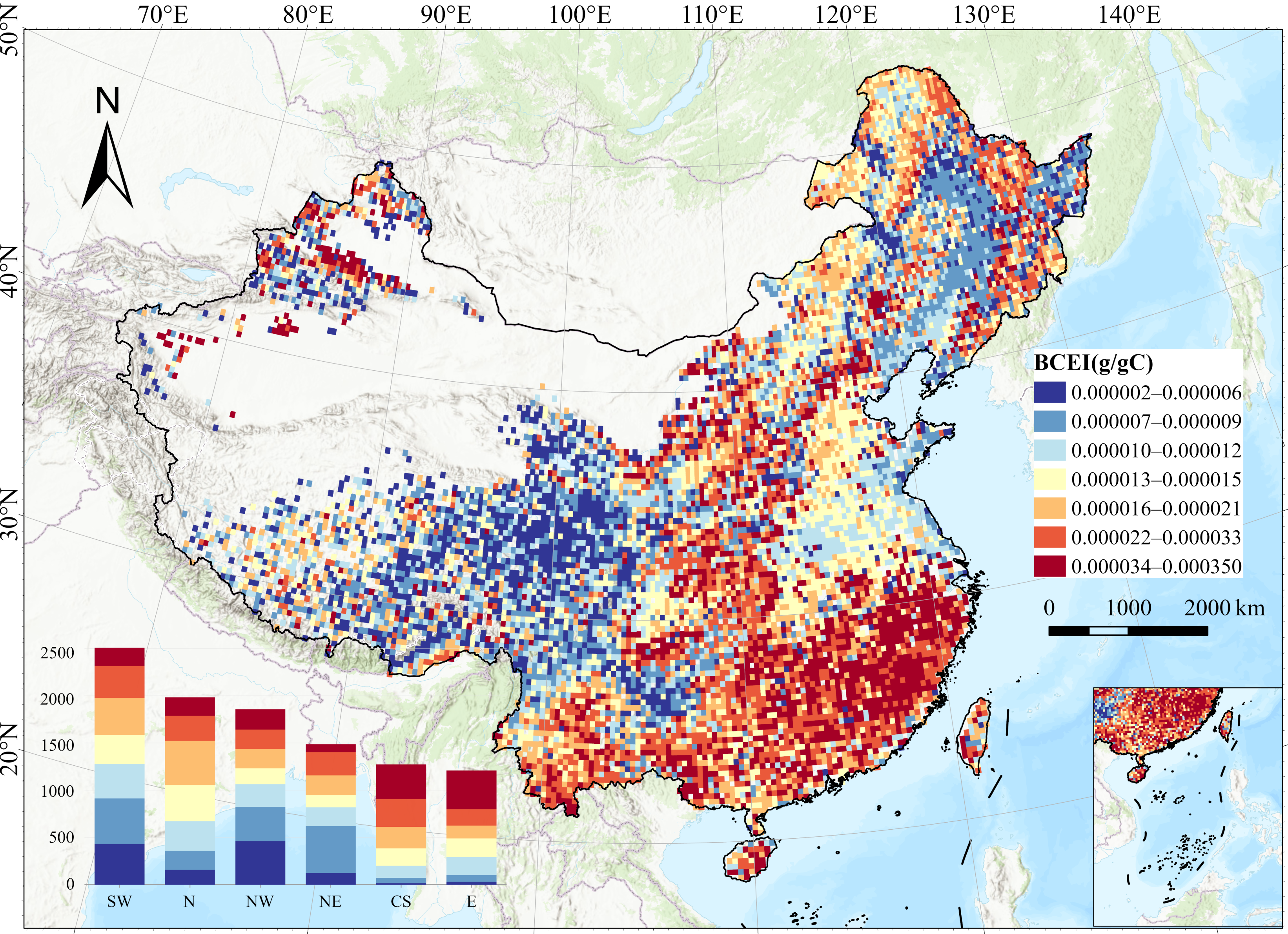
2.2. Spatial Distribution of BCEI
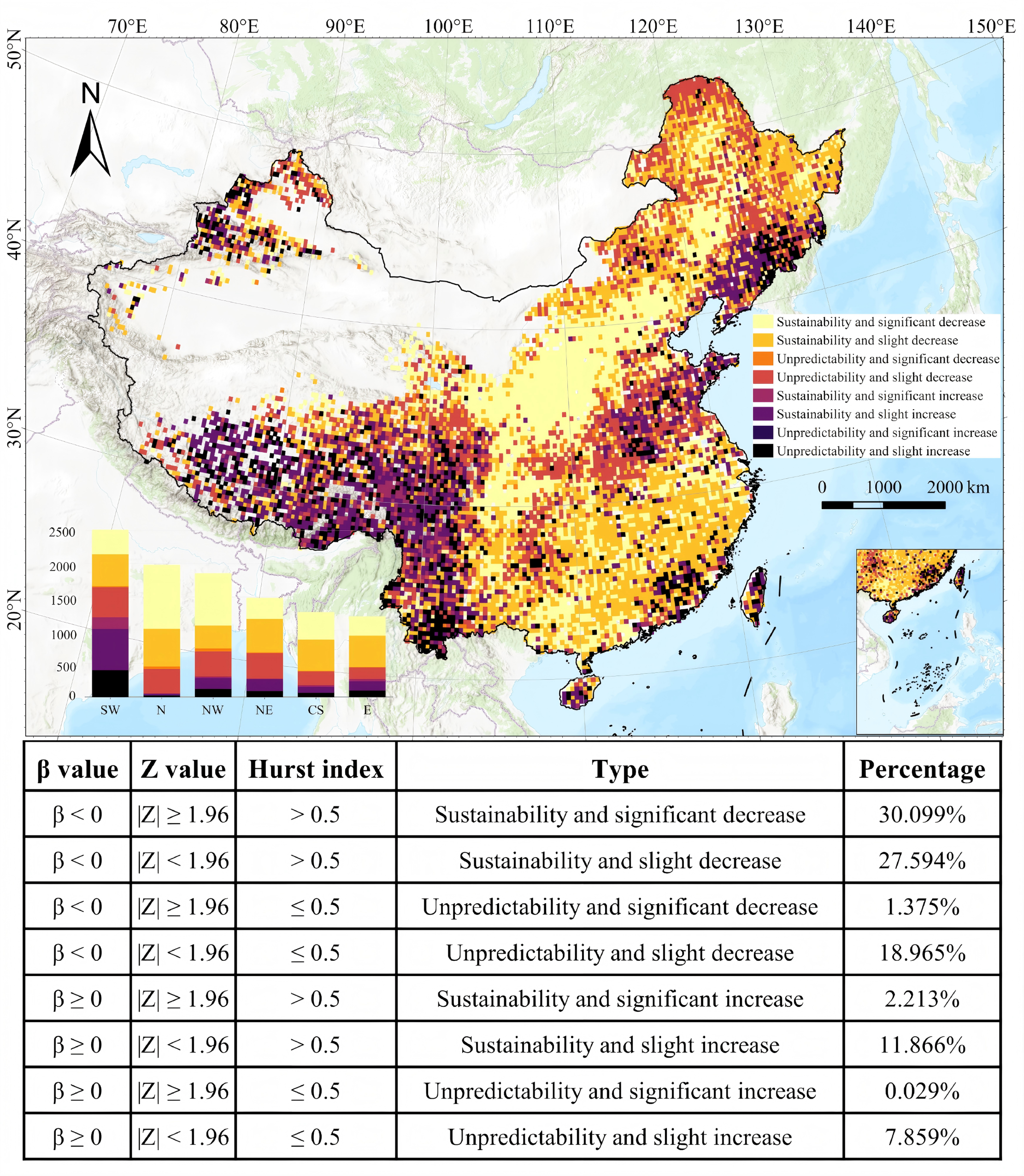
2.3. Spatiotemporal Analysis and Future Trends
2.4. Driving Analysis
2.4.1. Independent Effects of Factors
2.4.2. Interactive Effects of Factors
3. Discussion
3.1. Interregional Differences in the Spatiotemporal Patterns of BCEI
3.2. Associations of Hydroclimatic Variables with BCEI
3.3. Limitations and Future Works
4. Materials and Methods
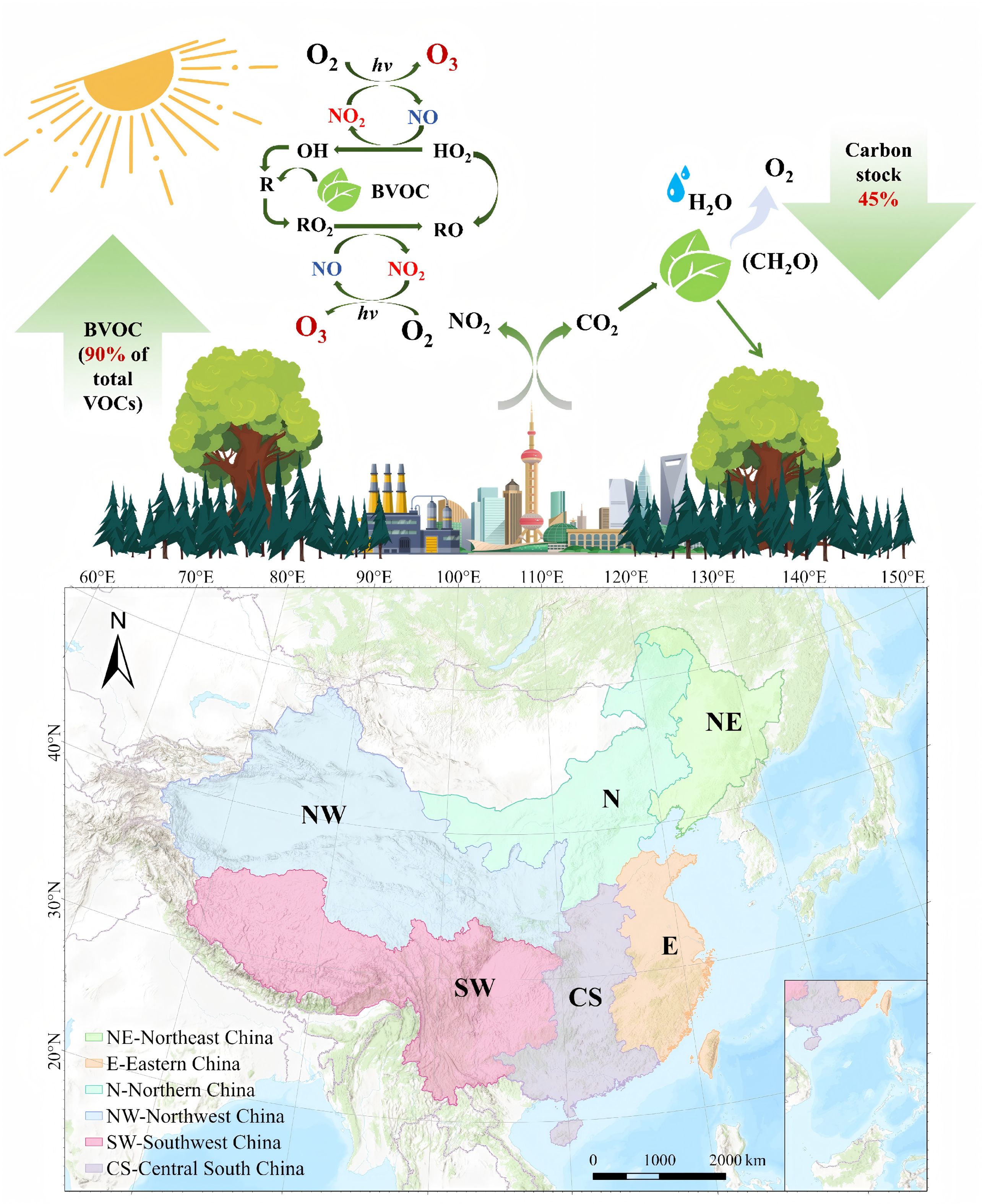
4.1. Study Area
4.2. Data Sources and Processing
4.2.1. BVOC Dataset
4.2.2. GPP Dataset
4.2.3. Driving Factors
4.3. Methods
4.3.1. Quantifying the Relationship Between BVOCs and GPP
- •
- Calculation of OFP
- •
- Calculating the Index of Coordinated Development Level
4.3.2. Trend Analysis
4.3.3. Hurst Exponent
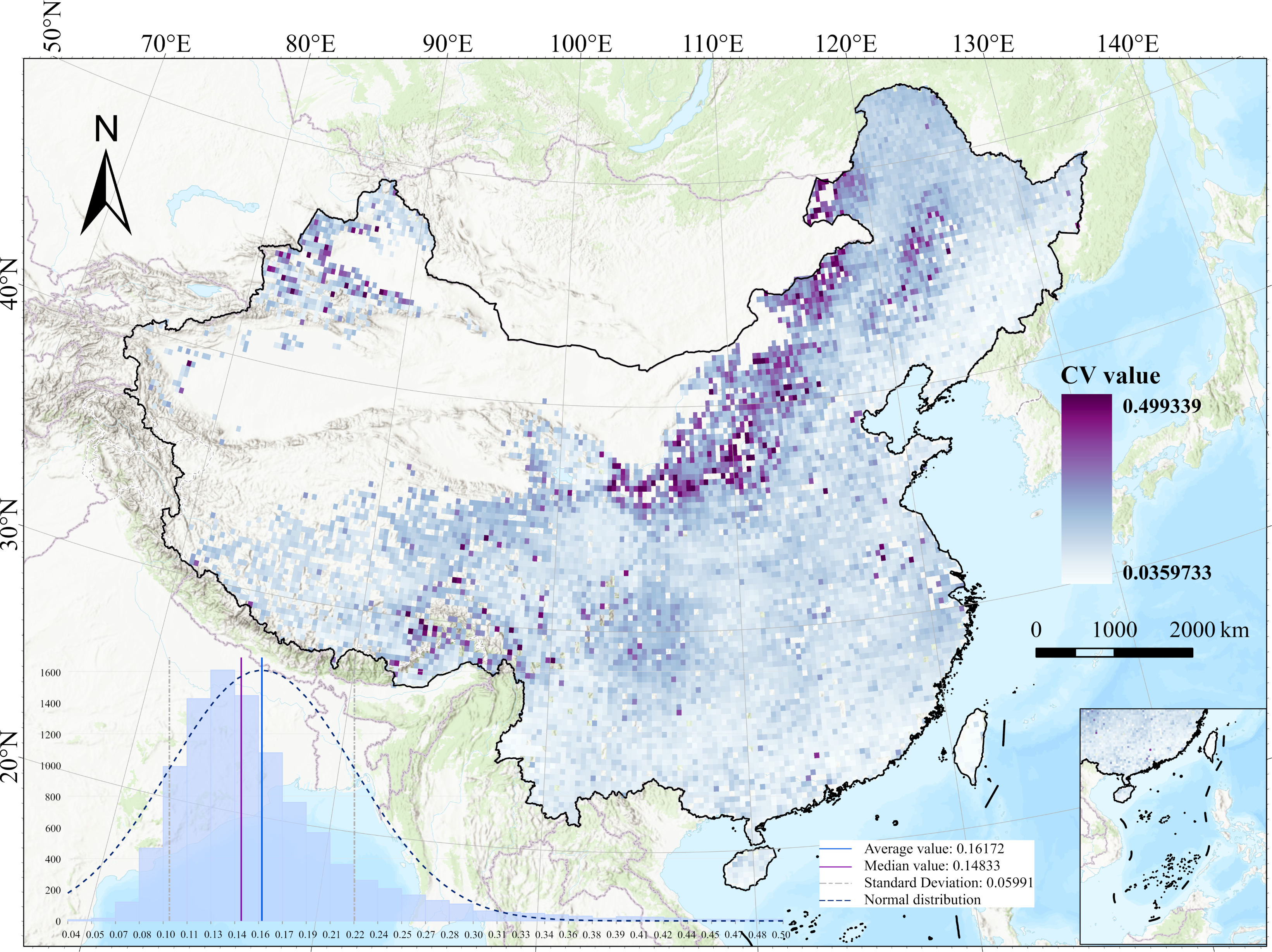
4.3.4. Coefficient Variability Stability Analysis
4.3.5. Geographical Detector
- •
- Factor detector
- •
- Interaction detector
5. Conclusions
Supplementary Materials
Author Contributions
Funding
Data Availability Statement
Conflicts of Interest
References
- Alkama, R.; Forzieri, G.; Duveiller, G.; Grassi, G.; Liang, S.; Cescatti, A. Vegetation-based climate mitigation in a warmer and greener World. Nat. Commun. 2022, 13, 606. [Google Scholar] [CrossRef]
- Wu, K.; Yang, X.; Chen, D.; Gu, S.; Lu, Y.; Jiang, Q.; Wang, K.; Ou, Y.; Qian, Y.; Shao, P.; et al. Estimation of biogenic VOC emissions and their corresponding impact on ozone and secondary organic aerosol formation in China. Atmos. Res. 2020, 231, 104656. [Google Scholar] [CrossRef]
- Xiong, Y.; Du, K.; Huang, Y. One-third of global population at cancer risk due to elevated volatile organic compounds levels. npj Clim. Atmos. Sci. 2024, 7, 54. [Google Scholar] [CrossRef]
- Weber, J.; King, J.A.; Abraham, N.L.; Grosvenor, D.P.; Smith, C.J.; Shin, Y.M.; Lawrence, P.; Roe, S.; Beerling, D.J.; Martin, M.V. Chemistry-albedo feedbacks offset up to a third of forestation’s CO2 removal benefits. Science 2024, 383, 860–864. [Google Scholar] [CrossRef] [PubMed]
- Loreto, F.; Fares, S. Biogenic Volatile Organic Compounds and Their Impacts on Biosphere–Atmosphere Interactions. Dev. Environ. Sci. 2013, 13, 57–75. [Google Scholar]
- National Forestry and Grassland Administration. China Forestry And Grassland Statistical Yearbook; National Forestry and Grassland Administration: Beijing, China, 2021; pp. 1–7. [Google Scholar]
- Cai, Y.; Zhang, F.; Duan, P.; Yung Jim, C.; Weng Chan, N.; Shi, J.; Liu, C.; Wang, J.; Bahtebay, J.; Ma, X. Vegetation cover changes in China induced by ecological restoration-protection projects and land-use changes from 2000 to 2020. Catena 2022, 217, 106530. [Google Scholar] [CrossRef]
- Cheng, K.; Yang, H.; Tao, S.; Su, Y.; Guan, H.; Ren, Y.; Hu, T.; Li, W.; Xu, G.; Chen, M.; et al. Carbon storage through China’s planted forest expansion. Nat. Commun. 2024, 15, 4106. [Google Scholar] [CrossRef]
- Wei, S.; Li, X.; Wang, K.; Wang, T.; Piao, S. Two decades of persistent greening in China despite 2023 climate extremes. Sci. China-Earth Sci. 2025, 68, 1064–1073. [Google Scholar] [CrossRef]
- Fang, J.; Yu, G.; Liu, L.; Hu, S.; Chapin, F.S. Climate change, human impacts, and carbon sequestration in China. Proc. Natl. Acad. Sci. USA 2018, 115, 4015–4020. [Google Scholar] [CrossRef]
- Friedlingstein, P.; O’Sullivan, M.; Jones, M.W.; Andrew, R.M.; Hauck, J.; Olsen, A.; Peters, G.P.; Peters, W.; Pongratz, J.; Sitch, S.; et al. Global Carbon Budget 2020. Earth Syst. Sci. Data 2020, 12, 3269–3340. [Google Scholar] [CrossRef]
- Hong, S.; Ding, J.; Kan, F.; Xu, H.; Chen, S.; Yao, Y.; Piao, S. Asymmetry of carbon sequestrations by plant and soil after forestation regulated by soil nitrogen. Nat. Commun. 2023, 14, 3196. [Google Scholar] [CrossRef]
- Shi, Y.; Zhang, B.; Liang, L.; Wang, S.; Zhang, H.; Sun, H.; Han, X. Unfolding the effectiveness of ecological restoration programs in enhancing vegetation carbon sinks across different climate zones in China. Resour. Conserv. Recycl. 2025, 212, 107974. [Google Scholar] [CrossRef]
- Li, L.Y.; Xie, S.D. Historical variations of biogenic volatile organic compound emission inventories in China, 1981–2003. Atmos. Environ. 2014, 95, 185–196. [Google Scholar] [CrossRef]
- Wang, H.; Wu, Q.; Guenther, A.B.; Yang, X.; Wang, L.; Xiao, T.; Li, J.; Feng, J.; Xu, Q.; Cheng, H. A long-term estimation of biogenic volatile organic compound (BVOC) emission in China from 2001-2016: The roles of land cover change and climate variability. Atmos. Chem. Phys. 2021, 21, 4825–4848. [Google Scholar] [CrossRef]
- Gai, Y.; Sun, L.; Fu, S.; Zhu, C.; Zhu, C.; Li, R.; Liu, Z.; Wang, B.; Wang, C.; Yang, N.; et al. Impact of greening trends on biogenic volatile organic compound emissions in China from 1985 to 2022: Contributions of afforestation projects. Sci. Total Environ. 2024, 929, 172551. [Google Scholar] [CrossRef]
- Gu, S.; Guenther, A.; Faiola, C. Effects of Anthropogenic and Biogenic Volatile Organic Compounds on Los Angeles Air Quality. Environ. Sci. Technol. 2021, 55, 12191–12201. [Google Scholar] [CrossRef]
- Piao, S.; Fang, J.; Ciais, P.; Peylin, P.; Huang, Y.; Sitch, S.; Wang, T. The carbon balance of terrestrial ecosystems in China. Nature 2009, 458, 1009–1013. [Google Scholar] [CrossRef]
- Jiang, F.; Chen, J.M.; Zhou, L.; Ju, W.; Zhang, H.; Machida, T.; Ciais, P.; Peters, W.; Wang, H.; Chen, B.; et al. A comprehensive estimate of recent carbon sinks in China using both top-down and bottom-up approaches. Sci. Rep. 2016, 6, 22130. [Google Scholar] [CrossRef]
- Wang, H.; Liu, X.; Wu, C.; Lin, G. Regional to global distributions, trends, and drivers of biogenic volatile organic compound emission from 2001 to 2020. Atmos. Chem. Phys. 2024, 24, 3309–3328. [Google Scholar] [CrossRef]
- Li, L.; Cao, J.; Hao, Y. Spatial and species-specific responses of biogenic volatile organic compound (BVOC) emissions to elevated ozone from 2014-2020 in China. Sci. Total Environ. 2023, 868, 161636. [Google Scholar] [CrossRef]
- Yao, Y.; Wang, X.; Li, Y.; Wang, T.; Shen, M.; Du, M.; He, H.; Li, Y.; Luo, W.; Ma, M.; et al. Spatiotemporal pattern of gross primary productivity and its covariation with climate in China over the last thirty years. Glob. Change Biol. 2018, 24, 184–196. [Google Scholar] [CrossRef]
- Kesselmeier, J.; Ciccioli, P.; Kuhn, U.; Stefani, P.; Biesenthal, T.; Rottenberger, S.; Wolf, A.; Vitullo, M.; Valentini, R.; Nobre, A.; et al. Volatile organic compound emissions in relation to plant carbon fixation and the terrestrial carbon budget. Glob. Biogeochem. Cycles 2002, 16, 73-1–73-79. [Google Scholar] [CrossRef]
- Guo, P.; Guo, K.; Ren, Y.; Shi, Y.; Chang, J.; Tani, A.; Ge, Y. Biogenic volatile organic compound emissions in relation to plant carbon fixation in a subtropical urban-rural complex. Landsc. Urban Plan. 2013, 119, 74–84. [Google Scholar] [CrossRef]
- Loreto, F.; Schnitzler, J.-P. Abiotic stresses and induced BVOCs. Trends Plant Sci. 2010, 15, 154–166. [Google Scholar] [CrossRef] [PubMed]
- Bai, J.; Yang, F.; Wang, H.; Xu, M. An Empirical Model of Gross Primary Productivity (GPP) and Relations between GPP and Its Driving Factors, Biogenic Volatile Organic Compounds in a Subtropical Conifer Plantation in China. Atmosphere 2023, 14, 1046. [Google Scholar] [CrossRef]
- Kulmala, M.; Nieminen, T.; Chellapermal, R.; Makkonen, R.; Bäck, J.; Kerminen, V.-M. Climate Feedbacks Linking the Increasing Atmospheric CO2 Concentration, BVOC Emissions, Aerosols and Clouds in Forest Ecosystems. In Biology, Controls and Models of Tree Volatile Organic Compound Emissions; Niinemets, Ü., Monson, R.K., Eds.; Springer: Dordrecht, The Netherlands, 2013; pp. 489–508. [Google Scholar]
- Xia, J.; Niu, S.; Ciais, P.; Janssens, I.A.; Chen, J.; Ammann, C.; Arain, A.; Blanken, P.D.; Cescatti, A.; Bonal, D.; et al. Joint control of terrestrial gross primary productivity by plant phenology and physiology. Proc. Natl. Acad. Sci. USA 2015, 112, 2788–2793. [Google Scholar] [CrossRef]
- Zhang, Y.; Xue, L.; Carter, W.P.L.; Pei, C.; Chen, T.; Mu, J.; Wang, Y.; Zhang, Q.; Wang, W. Development of ozone reactivity scales for volatile organic compounds in a Chinese megacity. Atmos. Chem. Phys. 2021, 21, 11053–11068. [Google Scholar] [CrossRef]
- Sun, Y.; Zhang, X.; Ding, Y.; Chen, D.; Qin, D.; Zhai, P. Understanding human influence on climate change in China. Natl. Sci. Rev. 2021, 9, nwab113. [Google Scholar] [CrossRef]
- Han, J.; Zhang, R.; Guo, B.; Han, B.; Xu, T.; Guo, Q. Long-Term Variation Patterns of Precipitations Driven by Climate Change in China from 1901 to 2022. Sustainability 2024, 16, 7283. [Google Scholar] [CrossRef]
- Liu, L.; Seyler, B.C.; Liu, H.; Zhou, L.; Chen, D.; Liu, S.; Yan, C.; Yang, F.; Song, D.; Tan, Q.; et al. Biogenic volatile organic compound emission patterns and secondary pollutant formation potentials of dominant greening trees in Chengdu, southwest China. J. Environ. Sci. 2022, 114, 179–193. [Google Scholar] [CrossRef]
- Chen, T.; Meunier, F.; Peaucelle, M.; Tang, G.; Yuan, Y.; Verbeeck, H. Elevated atmospheric CO2 concentration and vegetation structural changes contributed to gross primary productivity increase more than climate and forest cover changes in subtropical forests of China. Biogeosciences 2024, 21, 2253–2272. [Google Scholar] [CrossRef]
- Sun, H.; Cheng, Y.; An, Q.; Liu, L. Evolution and Mechanism Analysis of Terrestrial Ecosystems in China with Respect to Gross Primary Productivity. Land 2024, 13, 1346. [Google Scholar] [CrossRef]
- Li, L.Y.; Chen, Y.; Xie, S.D. Spatio-temporal variation of biogenic volatile organic compounds emissions in China. Environ. Pollut. 2013, 182, 157–168. [Google Scholar] [CrossRef] [PubMed]
- Bai, J.; Guenther, A.; Turnipseed, A.; Duhl, T. Seasonal and interannual variations in whole-ecosystem isoprene and monoterpene emissions from a temperate mixed forest in Northern China. Atmos. Pollut. Res. 2015, 6, 696–707. [Google Scholar] [CrossRef]
- Zhang, B.; Jia, Y.; Bai, G.; Han, H.; Yang, W.; Xie, W.; Li, L. Characterizing BVOC emissions of common plant species in northern China using real world measurements: Towards strategic species selection to minimize ozone forming potential of urban greening. Urban For. Urban Green. 2024, 96, 128341. [Google Scholar] [CrossRef]
- Luo, Y.; Gessler, A.; D’Odorico, P.; Hufkens, K.; Stocker, B. Quantifying effects of cold acclimation and delayed springtime photosynthesis resumption in northern ecosystems. New Phytol. 2023, 240, 984–1002. [Google Scholar] [CrossRef]
- Niinemets, Ü. Mild versus severe stress and BVOCs: Thresholds, priming and consequences. Trends Plant Sci. 2010, 15, 145–153. [Google Scholar] [CrossRef]
- Potosnak, M.J.; LeStourgeon, L.; Pallardy, S.G.; Hosman, K.P.; Gu, L.H.; Karl, T.; Geron, C.; Guenther, A.B. Observed and modeled ecosystem isoprene fluxes from an oakdominated temperate forest and the influence of drought stress. Atmos. Environ. 2014, 84, 314–322. [Google Scholar] [CrossRef]
- Zhou, S.; Williams, A.P.; Berg, A.M.; Cook, B.I.; Zhang, Y.; Hagemann, S.; Lorenz, R.; Seneviratne, S.I.; Gentine, P. Land-atmosphere feedbacks exacerbate concurrent soil drought and atmospheric aridity. Proc. Natl. Acad. Sci. USA 2019, 116, 18848–18853. [Google Scholar] [CrossRef]
- Hu, Z.; Piao, S.; Knapp, A.K.; Wang, X.; Peng, S.; Yuan, W.; Running, S.; Mao, J.; Shi, X.; Ciais, P.; et al. Decoupling of greenness and gross primary productivity as aridity decreases. Remote Sens. Environ. 2022, 279, 113120. [Google Scholar] [CrossRef]
- Cao, J.; Han, H.; Qiao, L.; Li, L. Biogenic Volatile Organic Compound Emission and Its Response to Land Cover Changes in China During 2001–2020 Using an Improved High-Precision Vegetation Data Set. J. Geophys. Res. Atmos. 2024, 129, e2023JD040421. [Google Scholar] [CrossRef]
- Stocker, B.D.; Zscheischler, J.; Keenan, T.F.; Prentice, I.C.; Peñuelas, J.; Seneviratne, S.I. Quantifying soil moisture impacts on light use efficiency across biomes. New Phytol. 2018, 218, 1430–1449. [Google Scholar] [CrossRef] [PubMed]
- Zhang, Y.; Xiao, X.M.; Guanter, L.; Zhou, S.; Ciais, P.; Joiner, J.; Sitch, S.; Wu, X.C.; Nabel, J.; Dong, J.W.; et al. Precipitation and carbon-water coupling jointly control the interannual variability of global land gross primary production. Sci. Rep. 2016, 6, 39748. [Google Scholar] [CrossRef] [PubMed]
- Svendsen, S.H.; Lindwall, F.; Michelsen, A.; Rinnan, R. Biogenic volatile organic compound emissions along a high arctic soil moisture gradient. Sci. Total Environ. 2016, 573, 131–138. [Google Scholar] [CrossRef]
- Fuentes, J.D.; Wang, D. On the Seasonality of Isoprene Emissions from a Mixed Temperate Forest. Ecol. Appl. 1999, 9, 1118–1131. [Google Scholar] [CrossRef]
- Atkinson, R.; Arey, J. Atmospheric Degradation of Volatile Organic Compounds. Chem. Rev. 2003, 103, 4605–4638. [Google Scholar] [CrossRef]
- Carter, W. Updated maximum incremental reactivity scale and hydrocarbon bin reactivities for regulatory applications. In California Air Resources Board Contract Report; This work is a government technical report. “07-339” refers to the contract number; no volume or page numbers are applicable; California Air Resources Board: Sacramento, CA, USA, 2010. [Google Scholar]
- Theil, H. A Rank-Invariant Method of Linear and Polynomial Regression Analysis. In Henri Theil’s Contributions to Economics and Econometrics: Econometric Theory and Methodology; Raj, B., Koerts, J., Eds.; Springer: Dordrecht, The Netherlands, 1992; pp. 345–381. [Google Scholar]
- Forthofer, R.N.; Lehnen, R.G. Rank Correlation Methods. In Public Program Analysis: A New Categorical Data Approach; Forthofer, R.N., Lehnen, R.G., Eds.; Springer: Boston, MA, USA, 1981; pp. 146–163. [Google Scholar]
- Chang, J.; Liu, Q.; Wang, S.; Huang, C. Vegetation Dynamics and Their Influencing Factors in China from 1998 to 2019. Remote Sens. 2022, 14, 3390. [Google Scholar] [CrossRef]
- Alharbi, S.; Raun, W.R.; Arnall, D.B.; Zhang, H. Prediction of maize (Zea mays L.) population using normalized-difference vegetative index (NDVI) and coefficient of variation (CV). J. Plant Nutr. 2019, 42, 673–679. [Google Scholar] [CrossRef]
- Wang, J.; Xu, C. Geodetector: Principle and Prospective. Acta Geogr. Sin. 2017, 72, 116–134. [Google Scholar] [CrossRef]




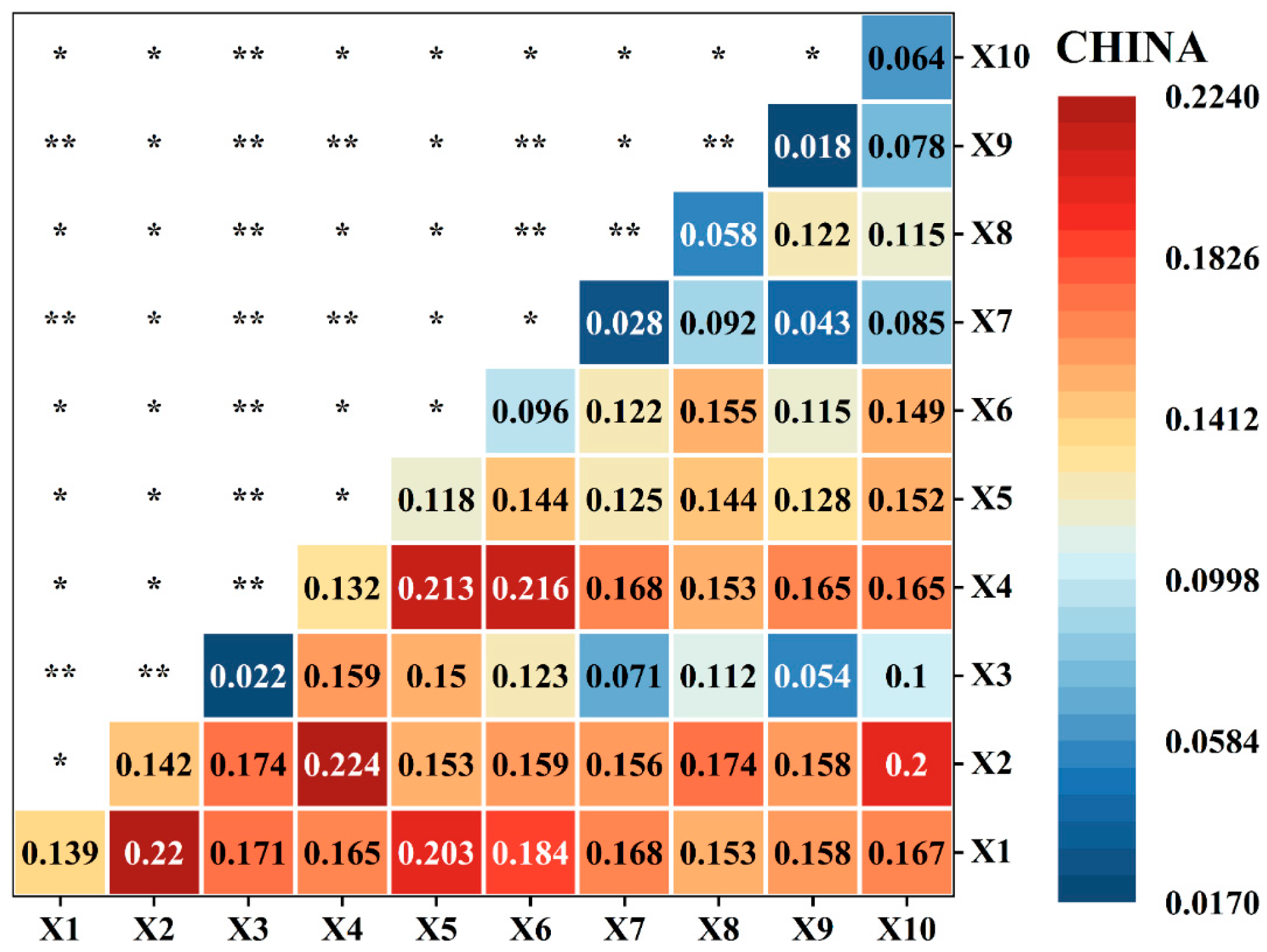
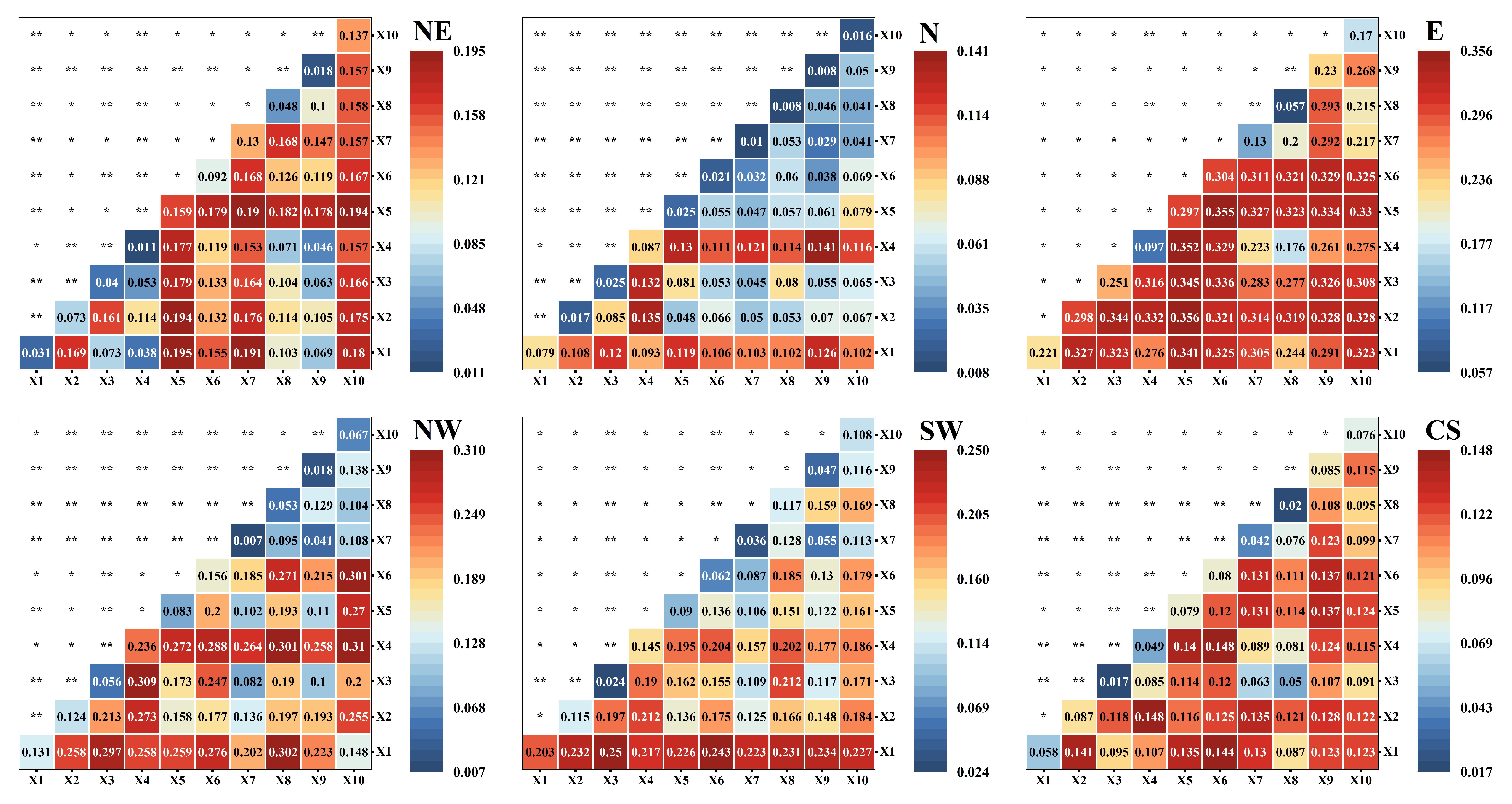
| CHINA | NE | N | E | NW | SW | CS | |
|---|---|---|---|---|---|---|---|
| X1 | 0.1390 | 0.0308 | 0.0787 | 0.2207 | 0.1310 | 0.2034 | 0.0576 |
| X2 | 0.1418 | 0.0732 | 0.0169 | 0.2977 | 0.1244 | 0.1149 | 0.0872 |
| X3 | 0.0217 | 0.0397 | 0.0250 | 0.2506 | 0.0564 | 0.0239 | 0.0170 |
| X4 | 0.1323 | 0.0110 | 0.0872 | 0.0969 | 0.2360 | 0.1448 | 0.0486 |
| X5 | 0.1184 | 0.1593 | 0.0251 | 0.2968 | 0.0830 | 0.0900 | 0.0790 |
| X6 | 0.0964 | 0.0925 | 0.0211 | 0.3038 | 0.1558 | 0.0618 | 0.0797 |
| X7 | 0.0281 | 0.1304 | 0.0097 | 0.1300 | 0.0065 | 0.0359 | 0.0424 |
| X8 | 0.0580 | 0.0482 | 0.0083 | 0.0567 | 0.0535 | 0.1171 | 0.0204 |
| X9 | 0.0185 | 0.0177 | 0.0078 | 0.2298 | 0.0179 | 0.0470 | 0.0855 |
| X10 | 0.0641 | 0.1366 | 0.0160 | 0.1705 | 0.0675 | 0.1079 | 0.0759 |
| Crop | Grass | Forest | Shrub | Total | |
|---|---|---|---|---|---|
| NE | 1.044 | 0.800 | 1.782 | 1.483 | 5.110 |
| N | 1.558 | 1.401 | 1.585 | 1.340 | 5.884 |
| E | 1.725 | - | 3.227 | 3.527 | 8.479 |
| NW | 1.937 | 1.258 | 1.354 | 1.741 | 6.291 |
| SW | 1.443 | 1.072 | 1.486 | 1.517 | 5.517 |
| CS | 2.120 | - | 2.504 | 2.539 | 7.162 |
Disclaimer/Publisher’s Note: The statements, opinions and data contained in all publications are solely those of the individual author(s) and contributor(s) and not of MDPI and/or the editor(s). MDPI and/or the editor(s) disclaim responsibility for any injury to people or property resulting from any ideas, methods, instructions or products referred to in the content. |
© 2026 by the authors. Licensee MDPI, Basel, Switzerland. This article is an open access article distributed under the terms and conditions of the Creative Commons Attribution (CC BY) license.
Share and Cite
Li, Y.; Lun, X.; Fang, P.; Huang, S.; Liang, Y.; Li, Y.; Zheng, P.; Wang, J.; Wang, L. Spatial–Temporal Heterogeneity and Driving Mechanisms of the Relationship Between Vegetation Carbon Sequestration and Biogenic Volatile Organic Compounds (BVOC) Emissions in China. Plants 2026, 15, 564. https://doi.org/10.3390/plants15040564
Li Y, Lun X, Fang P, Huang S, Liang Y, Li Y, Zheng P, Wang J, Wang L. Spatial–Temporal Heterogeneity and Driving Mechanisms of the Relationship Between Vegetation Carbon Sequestration and Biogenic Volatile Organic Compounds (BVOC) Emissions in China. Plants. 2026; 15(4):564. https://doi.org/10.3390/plants15040564
Chicago/Turabian StyleLi, Yibing, Xiaoxiu Lun, Panfei Fang, Shaodong Huang, Yuying Liang, Yujie Li, Pengfei Zheng, Jia Wang, and Longhuan Wang. 2026. "Spatial–Temporal Heterogeneity and Driving Mechanisms of the Relationship Between Vegetation Carbon Sequestration and Biogenic Volatile Organic Compounds (BVOC) Emissions in China" Plants 15, no. 4: 564. https://doi.org/10.3390/plants15040564
APA StyleLi, Y., Lun, X., Fang, P., Huang, S., Liang, Y., Li, Y., Zheng, P., Wang, J., & Wang, L. (2026). Spatial–Temporal Heterogeneity and Driving Mechanisms of the Relationship Between Vegetation Carbon Sequestration and Biogenic Volatile Organic Compounds (BVOC) Emissions in China. Plants, 15(4), 564. https://doi.org/10.3390/plants15040564