Article

Split Versus Single Applications of Solid and Liquid Vermicompost: Impacts on Growth, Chlorophyll Content and Soil Characteristics of Tea (Camellia sinensis L.) Seedlings


1
Department of Landscape Architecture, Faculty of Engineering and Architecture, Recep Tayyip Erdoğan University, Rize 53020, Türkiye
2
Rize Forest Enterprise Directorate, Trabzon Regional Directorate of Forestry, General Directorate of Forestry, Rize 53020, Türkiye
3
Department of Interior Architecture and Environmental Design, Faculty of Architecture, Design and Fine Arts, Osmaniye Korkut Ata University, Osmaniye 80000, Türkiye
*
Author to whom correspondence should be addressed.
Plants 2026, 15(20), 3082; https://doi.org/10.3390/plants15203082
Submission received: 21 August 2026 / Revised: 23 September 2026 / Accepted: 29 September 2026 / Published: 9 October 2026
(This article belongs to the Section Plant Response to Abiotic Stress and Climate Change)

Abstract

Limited information is available on how vermicompost form, form-specific dose, and application schedule jointly affect tea seedling development. This 135-day humid outdoor nursery study evaluated solid and liquid vermicompost applied at two doses as either single or three split applications to 270 individually potted Camellia sinensis seedlings assigned to eight factorial treatments and an untreated control. Repeated measurements of seedling height, root collar diameter, and leaf chlorophyll content were analyzed using linear mixed-effects models fitted by restricted maximum likelihood (REML); the control was retained only in supplementary one-way ANOVAs. Soil pH, electrical conductivity (EC), and temperature were analyzed by two-way ANOVA. Vermicompost form, measurement time, and their interaction significantly affected seedling height and root collar diameter. Application schedule significantly affected root collar diameter (F = 7.35, p = 0.007) and chlorophyll content (F = 19.74, p < 0.001), but not seedling height, whereas dose within form showed no significant main effect on any of these traits. The form × application schedule × time interaction was significant for seedling height, whereas dose within form × application schedule × time was significant for root collar diameter and chlorophyll content. Treatment differences generally emerged from day 30 onward. The 30 g solid vermicompost treatment applied in three equal doses produced the highest final seedling height (24.80 cm) and root collar diameter (14.00 mm) and the highest chlorophyll content recorded during the experiment (914.98 µmol m−2 on day 75). Treatment, measurement time, and their interaction significantly affected soil pH, EC, and temperature; pH remained within 4.90–5.76, and EC values did not indicate salinity stress. Selected split applications of solid vermicompost therefore showed potential to improve tea seedling growth, but significant higher-order interactions demonstrated that responses depended on vermicompost form, dose within form, application schedule, trait, and measurement time.

1. Introduction

Tea, produced from the leaves of Camellia sinensis (L.) Kuntze, is an economically and culturally important crop and one of the most widely consumed beverages worldwide, second only to water [1,2]. Its high concentrations of phenolic compounds, catechins, and other bioactive constituents have generated substantial scientific and commercial interest [3,4]. The global tea sector provides employment for approximately 13 million people [5], and its market value is projected to reach USD 98.2 billion by 2033 [6]. In Türkiye, tea is cultivated predominantly in the Eastern Black Sea Region, particularly in Rize Province, where it plays a strategic role in the regional economy and rural livelihoods [7].
Tea cultivation in Türkiye began in 1938 [8,9], and the cultivated area has expanded considerably over time. However, a significant portion of the existing tea plantations has reached an advanced age, resulting in declines in yield and quality [10]. In tea plantations with declining productivity, chemical fertilizers are often applied excessively or without adequate soil-based planning to increase production. Such practices may cause important environmental problems, including the contamination of groundwater and surface water resources, deterioration of soil structure and health, and loss of biodiversity [11]. When plant nutrition practices rely primarily on producer experience rather than soil analysis, these environmental risks may be further intensified [12,13]. Another challenge is the need to adapt aging tea plantations to changing climatic conditions, including changes in temperature and precipitation and increased drought risk. In addition, the supply of high-quality tea seedlings for renewing aging plantations and establishing new plantations in the Eastern Black Sea Region remains limited. Therefore, producing high-quality tea seedlings with strong growth performance and improved tolerance to diseases, pests, and climate-related stresses is of great importance. This would support both the renewal of existing plantations and the development of sustainable tea production systems.
Considering the environmental risks associated with chemical fertilizer use, the development and wider adoption of environmentally friendly organic fertilizers that support soil and plant health are important for sustainable agriculture and are consistent with the United Nations Sustainable Development Goals. Vermicompost is among the organic amendments that have been widely investigated and used in sustainable crop production systems. Its potential for production and application at different agricultural scales has further increased interest in this fertilizer. In addition, vermicompost contains diverse microbial communities [14,15,16,17,18] and a wide range of nutrients [11,19,20,21], which can improve soil physicochemical properties and biological functioning [22,23,24,25,26], thereby creating favorable conditions for plant growth. In particular, liquid vermicompost contains dissolved organic carbon, beneficial microorganisms, and plant growth-promoting bioactive compounds. It has been reported to support root development [27,28], enhance chlorophyll accumulation, and improve plant tolerance to environmental stresses [16,29].
In tea planting material production, organic manures and bio-inoculants were evaluated, and a treatment combining vermicompost with a biofertilizer mixture produced superior performance compared with the other tested treatments and the control [30]. However, information on vermicompost application specifically in tea seedlings remains limited, particularly regarding the comparative effects of vermicompost form, dose, and application timing. Although many studies have reported beneficial effects of vermicompost on plant growth and soil properties, much of the existing research has focused on total application dose rather than application schedule. In regions with high rainfall, however, the effectiveness of organic fertilizers may depend not only on the total amount applied but also on how that amount is distributed over time. Applying the total dose at once may increase nutrient losses through leaching or result in a short-lived nutrient supply, whereas split applications may provide more sustained nutrient availability and better alignment with plant demand. Nevertheless, direct comparisons of single and split applications of solid and liquid vermicompost in tea seedlings remain scarce.
The aim of this study was to evaluate the effects of vermicompost form, dose within form, and application schedule on the growth, leaf chlorophyll content, and selected growing-medium properties of tea (Camellia sinensis) seedlings. The specific objectives were:
  • To compare the effects of solid and liquid vermicompost on tea seedling growth;
  • To determine the individual and interactive effects of dose within form and application schedule on seedling height, root collar diameter, and leaf chlorophyll content over time;
  • To evaluate changes in selected growing-medium properties, including pH, electrical conductivity, and temperature, following vermicompost application;
  • To identify promising vermicompost form–dose–schedule combinations that may inform sustainable fertilization strategies for tea seedling production.
By addressing these objectives, the study provides evidence to support more sustainable and environmentally responsible vermicompost management in tea seedling production.

2. Materials and Methods

2.1. Plant Material and Study Area

The study was initiated on 26 April 2024 and conducted under outdoor nursery conditions in Rize Province for 135 days. The study area is located at approximately 41°01′ N latitude and 40°31′ E longitude, and the region is characterized by a humid, high-rainfall climate. One-year-old (1 + 0) Camellia sinensis L. seedlings produced from seeds were used as plant material. Before the experiment, healthy seedlings with similar initial seedling heights and root collar diameters were selected and assigned to the treatment groups. The solid and liquid vermicompost materials used in the study were obtained from a vermicompost production unit under standard production conditions. All vermicompost applications during the experimental period were performed using materials obtained from the same production batch. Some physicochemical properties of the solid and liquid vermicompost materials are presented in Table 1.

2.2. Experimental Design

The study was established using a completely randomized design (CRD). The treatment structure comprised vermicompost form (solid or liquid), dose nested within form (30 or 60 g for solid vermicompost and 30 or 60 mL for liquid vermicompost), and application schedule (single or split application). These factors yielded eight vermicompost treatment combinations. An untreated control was included for treatment-wise comparisons but was not part of the factorial structure. Each treatment comprised 30 individually potted seedlings, which were operationally arranged into six groups of five seedlings for experimental management and data recording. The assigned vermicompost treatment was applied separately to each potted seedling; therefore, each seedling constituted an independent experimental unit. Accordingly, each treatment comprised 30 experimental units, resulting in a total of 270 seedlings across the nine treatments. The experiment was conducted under outdoor conditions in polyethylene growing bags for 135 days. When filled with the growing substrate, the polyethylene bags were approximately 19 cm in height and 8 cm in upper opening diameter, with the substrate surface maintained approximately 3.0 ± 0.5 cm below the upper rim of the bag. In split applications, the total amount assigned to each seedling was divided into three equal doses and applied at 30-day intervals within the first 90 days. In single applications, the entire amount assigned to each seedling was applied once at the beginning of the experiment. For both single and split treatments, solid vermicompost was incorporated into the growing medium of each individual bag at the time of application. Before application, liquid vermicompost was diluted to 10% (v/v) with tap water. Accordingly, the 30 and 60 mL vermicompost doses were applied as 300 and 600 mL of diluted solution per seedling, respectively; in the split treatments, these volumes were divided into three equal applications. The treatment groups and experimental design are presented in Table 2.

2.3. Growth Conditions and Measurement Schedule

The seedlings were grown in polyethylene growing bags containing a standard growing medium used for tea seedling production. All treatments received the same maintenance practices, and the seedlings were grown under natural environmental conditions. Measurements were conducted at 15-day intervals throughout the 135-day experimental period. Seedling height and root collar diameter were measured on day 0 and subsequently at 15-day intervals through day 135, resulting in ten measurement occasions. Leaf chlorophyll content and growing-medium properties (pH, electrical conductivity, and temperature) were measured from day 15 through day 135, resulting in nine measurement occasions. Different and independent growing-medium samples were evaluated at each measurement occasion.

2.4. Growth, Physiological, and Growing-Medium Measurements

Root collar diameter was measured using a digital caliper to the nearest 0.01 mm. Seedling height was measured from the surface of the growing medium to the shoot tip (apical meristem) using a ruler. Leaf chlorophyll content was measured using an Apogee MC-100 chlorophyll meter (Apogee Instruments Inc., Logan, UT, USA). At each measurement occasion, chlorophyll content was measured on one leaf per seedling, and the resulting value was used as the chlorophyll observation for that seedling. Growing-medium pH and electrical conductivity (EC) were measured using a portable Hanna Instruments meter (Hanna Instruments, Temse, Belgium), with EC values recorded in mS cm−1 as indicated by the instrument. Growing-medium temperature was measured concurrently with pH and EC at each measurement occasion. Growing-medium temperature was measured concurrently with pH and EC at each measurement occasion.

2.5. Statistical Analysis

Data were analyzed using IBM SPSS Statistics, version 23.0 (IBM Corp., Armonk, NY, USA). Repeated measurements of seedling height, root collar diameter, and leaf chlorophyll content were primarily analyzed using linear mixed-effects models fitted by restricted maximum likelihood (REML). Separate one-way analyses of variance (ANOVA) conducted at each measurement occasion were used as supplementary treatment-wise comparisons. Vermicompost form, dose nested within form, application schedule, measurement time, and their interactions were specified as fixed effects. Measurement occasion was treated as a categorical fixed effect, whereas numeric time was included as a random slope. Seedling identity was specified as the subject, and a random intercept and random linear time slope were fitted using an unstructured covariance matrix. For seedling height and root collar diameter, measurements obtained from days 15–135 were included as repeated responses, and the corresponding day-0 measurement was included as a covariate. No baseline covariate was included in the chlorophyll model because chlorophyll was not measured on day 0. Type III tests of fixed effects were used. Significant higher-order interactions were interpreted using estimated marginal means. The factorial mixed-model analyses included the eight vermicompost treatment combinations; the untreated control was retained in the supplementary treatment-wise analyses but excluded from the factorial models because vermicompost form, dose, and application schedule were not defined for the control. Because different and independent growing-medium samples were evaluated at each measurement occasion, growing-medium properties (pH, EC, and temperature) were analyzed using two-way ANOVA to test the main effects of treatment, time, and their interaction. For the ANOVA-based analyses, normality of data distribution was assessed using skewness and kurtosis values, and homogeneity of variances was evaluated using Levene’s test. When significant differences were detected in the ANOVA-based analyses, means were compared using Tukey’s HSD test. Statistical significance was set at p ≤ 0.05.

3. Results

3.1. Root Collar Diameter

The effects of vermicompost treatments on root collar diameter were not statistically significant on days 0 and 15 (p = 0.515 and p = 0.429, respectively), but became significant from day 30 onward (all p < 0.001; Table 3).
No statistically significant differences were observed among treatments at the beginning of the experiment or on day 15. On day 30, the highest mean root collar diameter was recorded in T5 (30 g solid vermicompost applied once; 9.54 mm), whereas the lowest value was recorded in T3 (60 mL liquid vermicompost applied once; 7.67 mm). By day 135, the highest mean values were recorded in T6 (30 g solid vermicompost applied in split doses; 14.00 mm) and T8 (60 g solid vermicompost applied in split doses; 13.96 mm). These treatments were followed by T5 and T7, with mean values of 12.75 and 12.55 mm, respectively. Among the liquid vermicompost treatments, the highest final mean was recorded in T4 (60 mL applied in split doses; 10.81 mm). Overall, the final root collar diameter values were higher under solid vermicompost, particularly with split application, than under liquid vermicompost or the untreated control (Table 3).

3.2. Seedling Height

The effects of vermicompost treatments on seedling height were not statistically significant on days 0 and 15 (p = 0.509 and p = 0.069, respectively), but became significant on day 30 (p = 0.015) and remained significant at all subsequent measurement occasions (all p <0.001; Table 4). On day 30, the highest mean seedling height was recorded in T3 (60 mL liquid vermicompost applied once; 14.33 cm), whereas the lowest value was recorded in T7 (60 g solid vermicompost applied once; 12.32 cm). At the end of the experiment, the highest mean seedling height was recorded in T6 (30 g solid vermicompost applied in split doses; 24.80 cm), followed by T8 (60 g solid vermicompost applied in split doses; 24.26 cm). The lowest final value was recorded in T1 (30 mL liquid vermicompost applied once; 16.47 cm). Relative to its day-0 value, seedling height in T6 increased by 110.17%. At day 135, all solid vermicompost treatments produced significantly greater seedling heights than the untreated control and the liquid vermicompost treatments. Although seedling height also increased under liquid vermicompost, the final values remained lower than those obtained under solid vermicompost (Table 4). Between day 0 and day 135, the relative increase in seedling height ranged from 35.22% in T1 to 110.17% in T6. The next highest increases were observed in T8 (94.39%) and T7 (79.95%), whereas the untreated control showed an increase of 41.10% (Table 5).

3.3. Leaf Chlorophyll Content

Vermicompost treatments had no significant effect on leaf chlorophyll content at the first chlorophyll measurement on day 15 (p = 0.514). Significant treatment differences were observed from day 30 to day 90 and again on days 120 and 135 (all p < 0.001; Table 6). Treatment rankings varied among measurement occasions, indicating distinct temporal response patterns rather than the consistent superiority of a particular vermicompost form or treatment. The highest chlorophyll content recorded during the experiment was 914.98 µmol m−2 in T6 (30 g solid vermicompost applied in split doses) on day 75. At the final measurement, the highest value was recorded in T4 (60 mL liquid vermicompost applied in split doses; 825.35 µmol m−2; Table 6). Between days 15 and 135, T4 also showed the largest absolute and relative increases (632.86 µmol m−2 and 328.78%, respectively), followed by T6 with a relative increase of 309.30% (Table 7).

3.4. Soil Properties

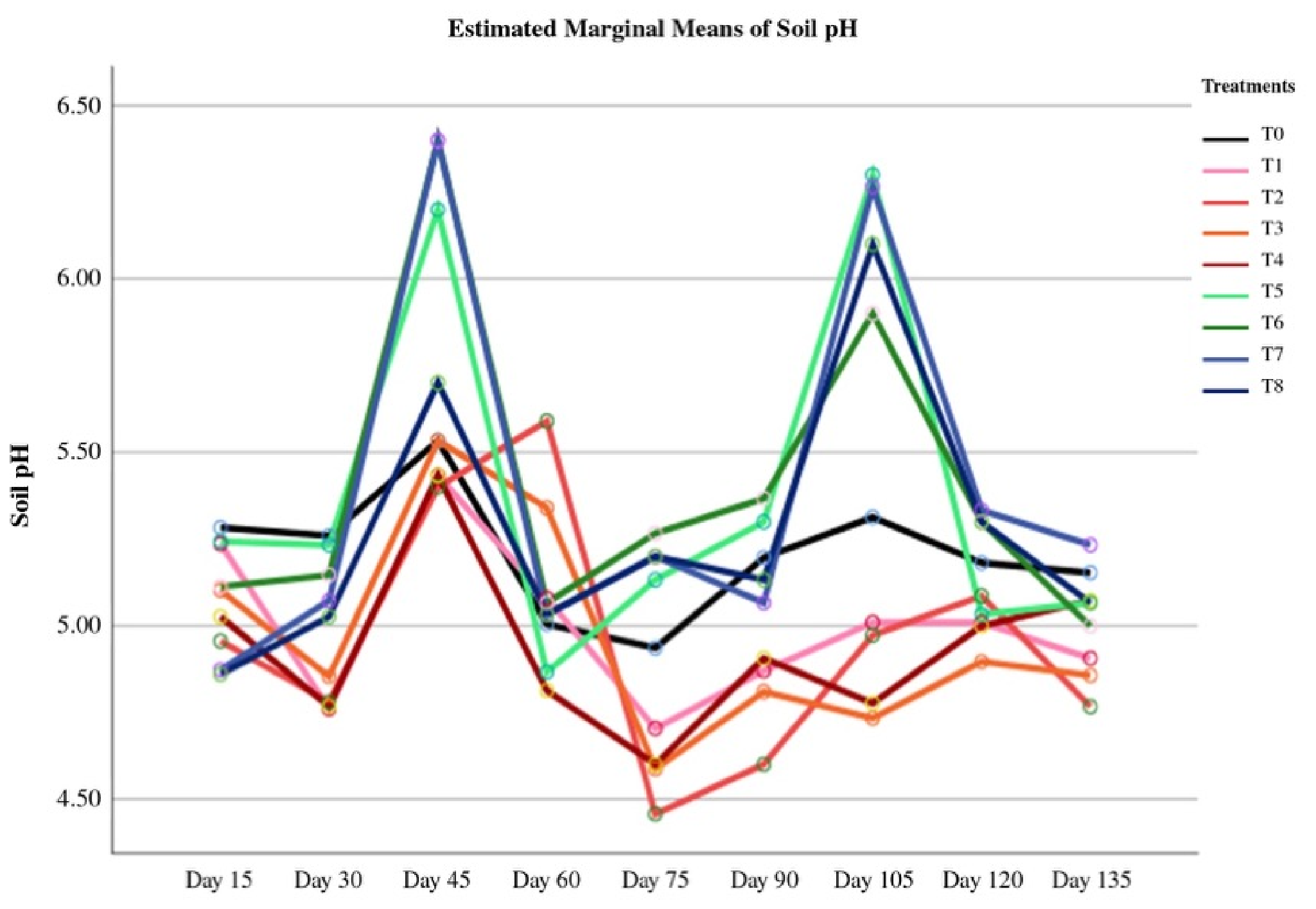
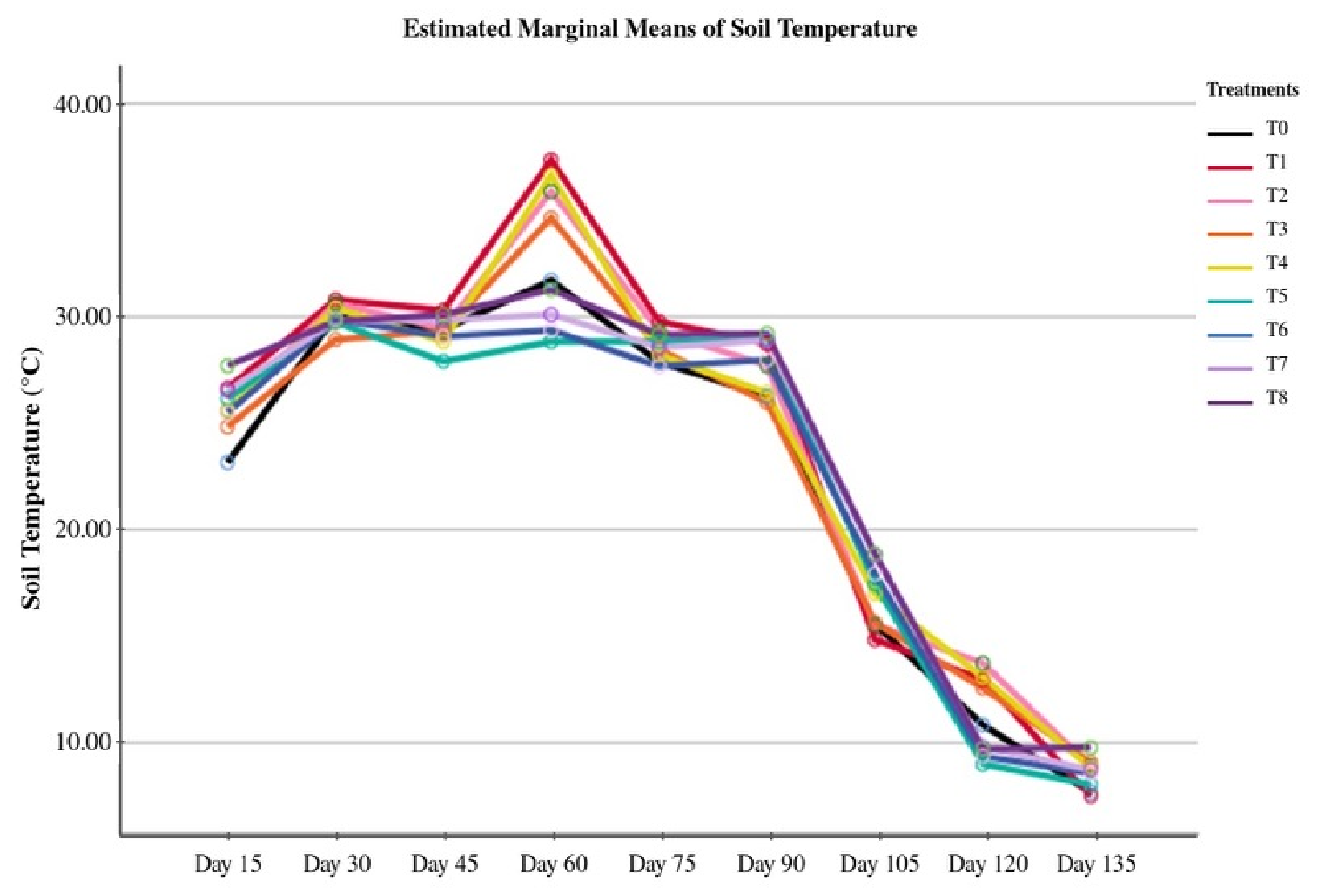
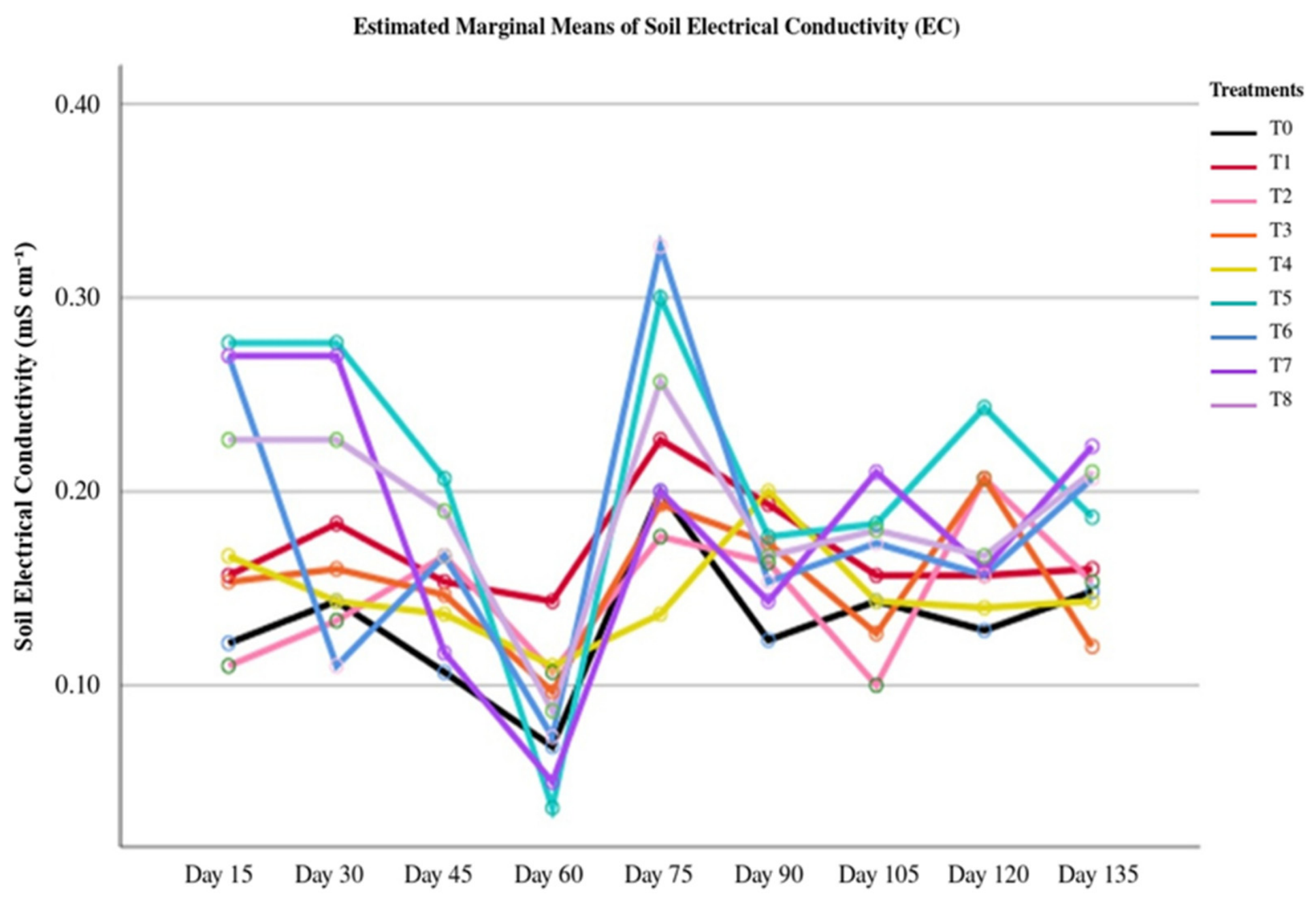
Two-way ANOVA showed that measurement time, vermicompost treatment, and their interaction significantly affected soil pH, temperature, and electrical conductivity (EC) (all p ≤ 0.001; Table 8). Because the measurement time × treatment interaction was significant for all three soil properties, the marginal means and Tukey groupings presented in Table 9 were interpreted descriptively and evaluated together with the time-specific treatment patterns shown in Figure 1, Figure 2 and Figure 3. Across measurement occasions, mean pH ranged from 4.90 on day 75 to 5.76 on day 45, whereas treatment marginal means ranged from 4.93 in T4 to 5.40 in T6. Mean temperature increased from 25.49 °C on day 15 to 32.75 °C on day 60 and subsequently decreased to 8.48 °C on day 135; treatment marginal means ranged from 22.49 to 24.32 °C. Mean EC ranged from 0.08 mS cm−1 on day 60 to 0.22 mS cm−1 on day 75, with treatment marginal means ranging from 0.13 mS cm−1 in the untreated control to 0.21 mS cm−1 in T5 (Figure 1, Figure 2 and Figure 3; Table 9).
Soil temperature generally increased from 25.49 °C on day 15 to a maximum of 32.75 °C on day 60 and then decreased progressively to a minimum of 8.48 °C on day 135 (Figure 2 and Table 9). Thus, the most pronounced decline occurred during the second half of the experiment.
Electrical conductivity (EC) values ranged from 0.08 to 0.22 mS cm−1 during the experiment (Figure 3 and Table 9). Across measurement occasions, the highest mean EC was recorded on day 75 (0.22 mS cm−1), whereas the lowest was recorded on day 60 (0.08 mS cm−1). When averaged across measurement occasions, the highest mean EC was observed in the treatment receiving a single application of 30 g solid vermicompost (0.21 mS cm−1), whereas the control had the lowest mean value (0.13 mS cm−1; Table 9).

3.5. Longitudinal Mixed-Model Analysis of Seedling Growth and Leaf Chlorophyll Content

Type III tests of fixed effects from the REML-based linear mixed models for seedling height, root collar diameter, and leaf chlorophyll content are presented in Table 10.
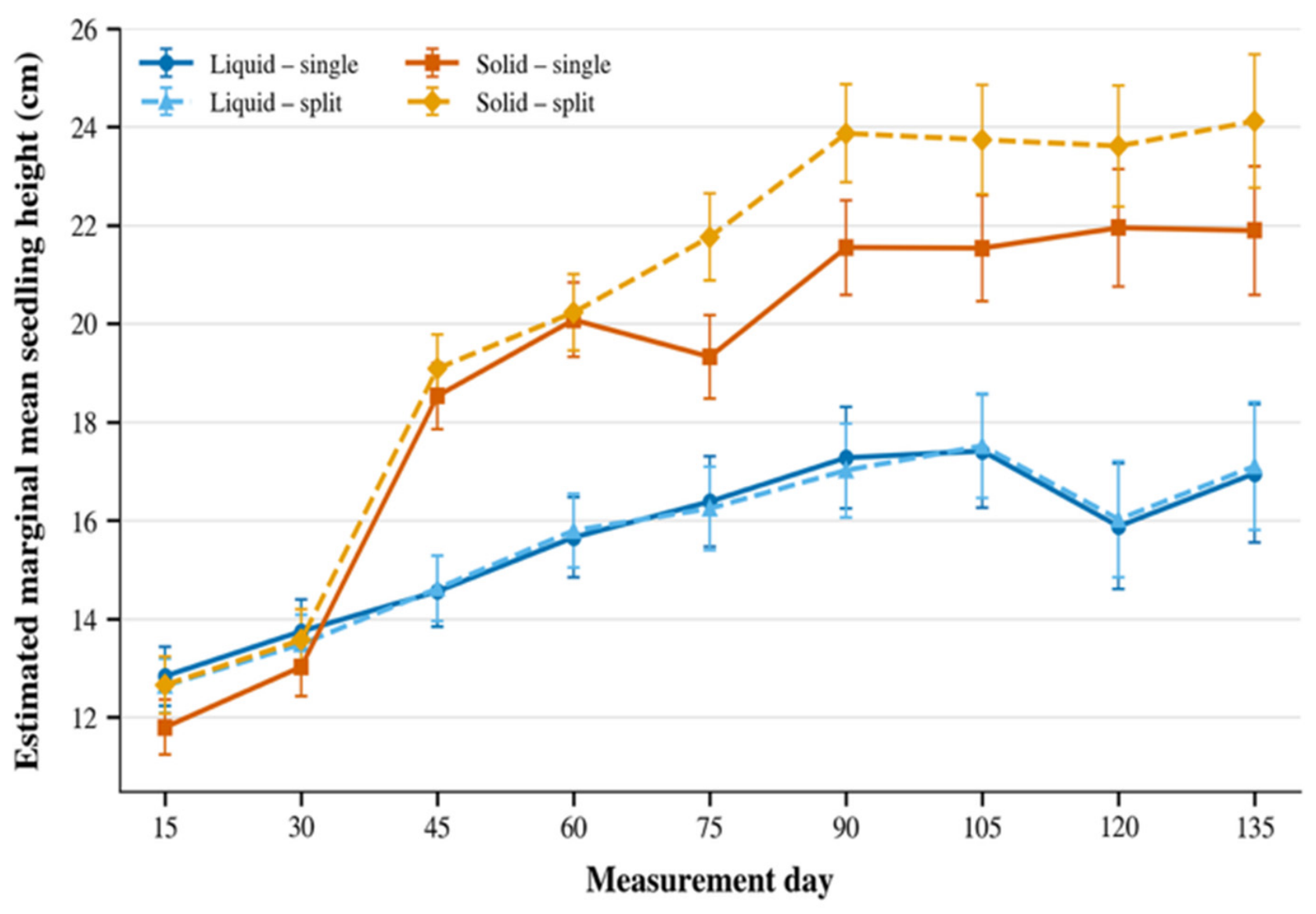
Analysis using a linear mixed-effects model fitted by REML showed that after adjustment for baseline seedling height, seedling height was significantly affected by vermicompost form (F (1, 165.57) = 103.30, p < 0.001), time (F (8, 811.95) = 193.40, p < 0.001), and the form × time interaction (F (8, 811.95) = 45.69, p < 0.001). The form × application schedule × time interaction was also significant (F (8, 811.95) = 2.91, p = 0.003), whereas the remaining experimental effects reported in Table 10 were not significant (p > 0.05). As shown in Figure 4, estimated marginal means adjusted for baseline seedling height indicated that the effect of application schedule on temporal seedling growth differed between vermicompost forms. Single and split applications produced similar growth trajectories under liquid vermicompost. Under solid vermicompost, however, split application resulted in progressively greater adjusted seedling height, particularly from day 75 onward, and produced the highest adjusted mean on day 135 (24.11 cm).
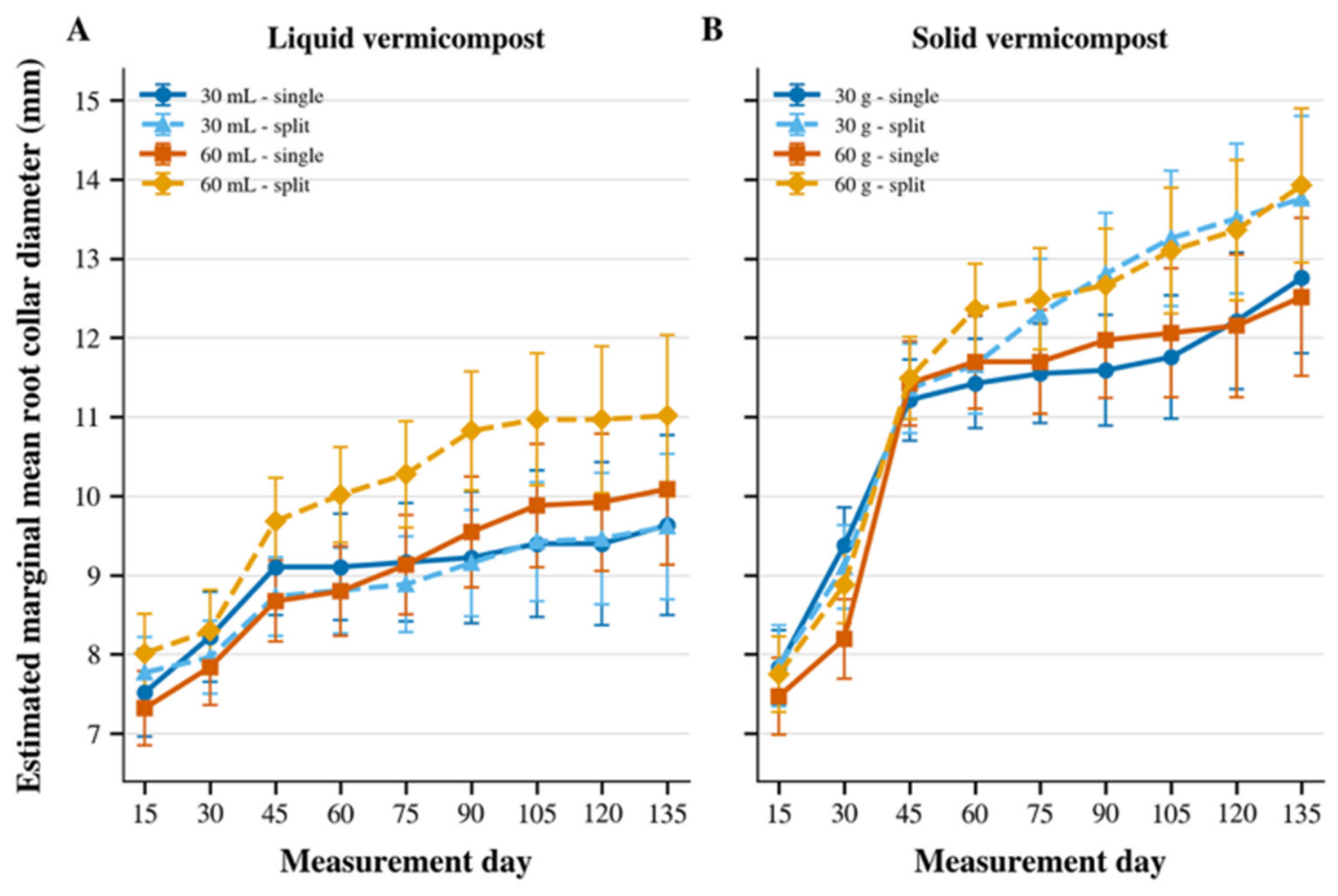
After adjustment for baseline root collar diameter, vermicompost form (F (1, 164.88) = 105.62, p < 0.001), application schedule (F (1, 163.23) = 7.35, p = 0.007), time (F (8, 784.70) = 155.71, p < 0.001), and the form × time interaction (F (8, 784.70) = 31.94, p < 0.001) significantly affected the root collar diameter. The dose within form × application schedule × time interaction was also significant (F (8, 784.70) = 2.04, p = 0.039), whereas the remaining experimental effects reported in Table 10 were not significant (p > 0.05). As shown in Figure 5, baseline-adjusted estimated marginal means indicate that temporal changes in root collar diameter depend on dose within vermicompost form and application schedule. Treatment combinations had relatively similar adjusted means on day 15, but their trajectories diverged as the experiment progressed. On day 135, the highest adjusted mean was obtained with 60 g solid vermicompost applied in split doses (13.92 mm), followed by 30 g solid vermicompost applied in split doses (13.76 mm). Among the liquid treatments, the highest final adjusted mean was obtained with 60 mL applied in split doses (11.01 mm). At the final measurement occasion, split application was associated with greater root collar diameter, particularly under solid vermicompost.
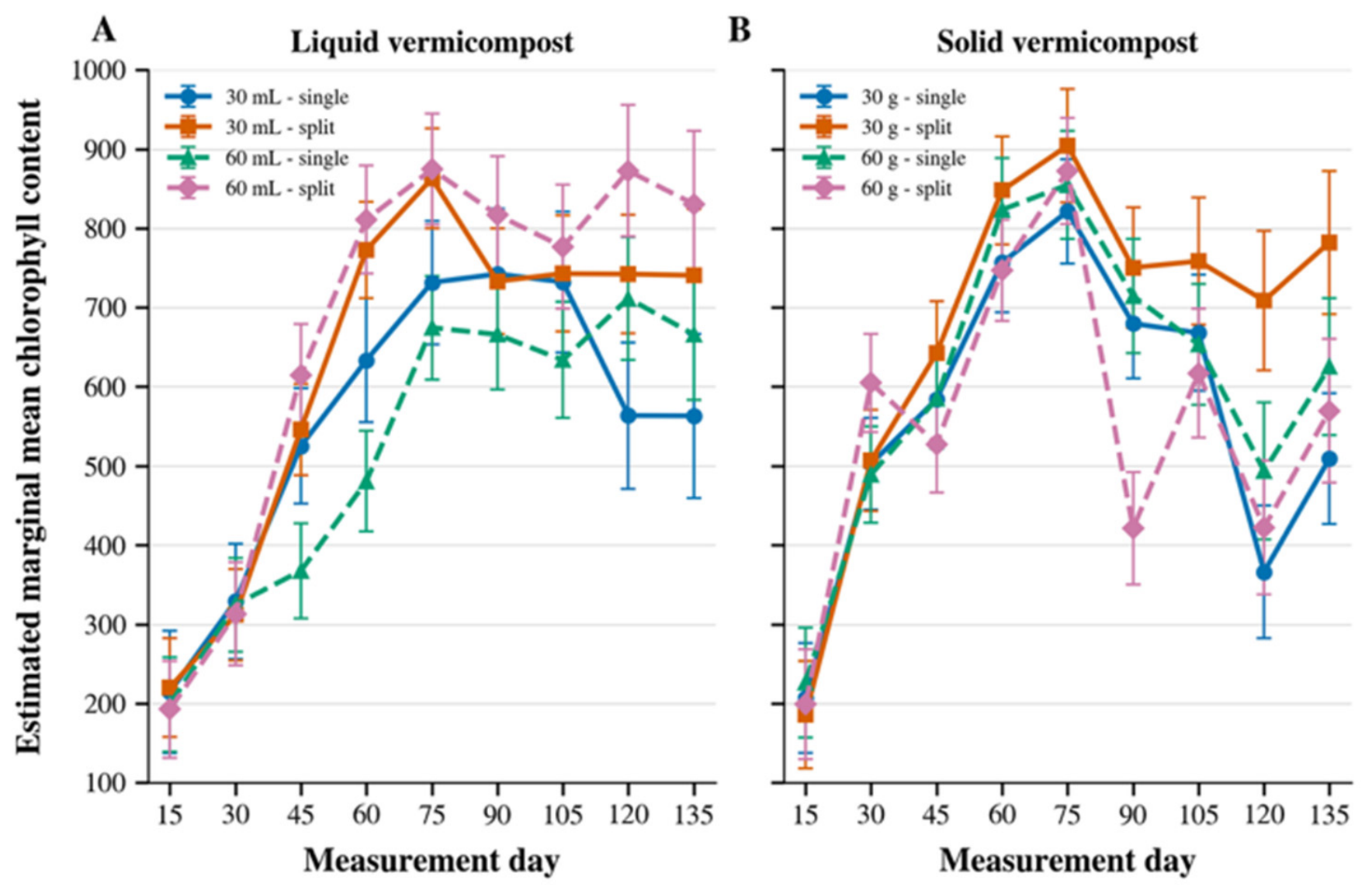
Leaf chlorophyll content was significantly affected by application schedule (F (1, 166.43) = 19.74, p < 0.001) and time (F (8, 912.30) = 239.76, p < 0.001). The form × application schedule (F (1, 166.43) = 7.04, p = 0.009) and dose within form × application schedule interactions (F (1, 166.43) = 15.23, p < 0.001) were also significant. All interaction terms involving time were significant (F (8, 912.30) = 3.86–28.98, all p < 0.001), including the dose within form × application schedule × time interaction (F (8, 912.30) = 4.73, p < 0.001). In contrast, the main effects of vermicompost form and dose within form were not significant (p > 0.05).
As shown in Figure 6, estimated marginal means indicated that temporal changes in leaf chlorophyll content depended on dose within vermicompost form and application schedule. On day 135, the highest estimated chlorophyll content was obtained with 60 mL of liquid vermicompost applied in split doses (830.58 µmol m−2), followed by 30 g of solid vermicompost applied in split doses (782.27 µmol m−2). In contrast, 60 g of solid vermicompost applied in split doses showed marked declines on days 90 and 120. These contrasting temporal trajectories indicate that no single treatment combination consistently produced the highest leaf chlorophyll content across all measurement occasions.

4. Discussion

The growth responses observed in tea seedlings may reflect the combined roles of vermicompost as a nutrient source and soil amendment capable of influencing physical, chemical, and biological processes in the root zone. In particular, selected split-dose solid vermicompost treatments produced the greatest descriptive increases in seedling height and root collar diameter. These responses may be associated with the biochemical composition of solid vermicompost and its capacity to sustain nutrient availability in the root zone [31]. Humic substances, plant growth regulators, and beneficial microorganisms contained in vermicompost have been reported to promote root development, improve nutrient uptake efficiency, and consequently support increases in seedling height and root collar diameter [32,33,34]. Although root development was not measured in the present study, enhanced early growth may contribute to the establishment of a stronger seedling structure. However, whether this advantage persists during subsequent growth stages requires longer-term evaluation.
The changes observed in pH and electrical conductivity following vermicompost treatments suggest that vermicompost may influence the chemical properties of the soil. The results of the two-way analysis of variance revealed that the measurement time × treatment interaction significantly affected pH, EC, and soil temperature, indicating that temporal changes in these variables differed among treatments. Tea (Camellia sinensis) prefers slightly acidic soil conditions for optimal growth and nutrient uptake. The pH values recorded in this study (4.90–5.76) remained within the general range considered suitable for tea cultivation, suggesting that the treatments did not shift soil pH to levels likely to restrict seedling growth [35].
The modestly higher mean pH values recorded in the solid vermicompost treatments may indicate their potential to moderate growing-medium acidification under high-rainfall conditions. Similarly, the higher EC values observed in some treatments may reflect an increase in soluble ions, including plant nutrients. However, because all EC values remained within a low range, the growing medium was unlikely to have imposed substantial salinity stress on the seedlings. This pattern may be consistent with the gradual release of nutrients from vermicompost, although nutrient-release dynamics were not measured directly in this study. Vermicompost applications have also been reported to modify soil reaction, stimulate microbial activity, and promote plant growth by improving nutrient availability [35,36,37,38,39].
The findings of this study are generally consistent with previous reports that vermicompost applications promote seedling development [19,20,21,40,41,42,43]. In the present study, selected solid vermicompost treatments produced more pronounced increases in seedling height and root collar diameter than the liquid vermicompost treatments. However, this apparent advantage was primarily associated with morphological growth, because the leaf chlorophyll responses depended on the application schedule and its interactions with vermicompost form and dose within form rather than on the main effect of form alone. The stronger morphological responses to solid vermicompost may be associated with differences in the retention and availability of organic matter, nutrients, and microbial components in the root zone [44]. In contrast, liquid vermicompost may provide more rapidly available nutrients and bioactive compounds, although their persistence in the growing medium may be shorter. Under the high-rainfall conditions of the study area, differences in nutrient retention and leaching may also have contributed to the contrasting responses to solid and liquid vermicompost; however, nutrient losses were not measured directly. This interpretation is consistent with previous studies describing prolonged nutrient availability from solid vermicompost and faster but potentially shorter-term physiological responses to liquid vermicompost products [14,16,32,33,34,45,46].
Dividing the same total fertilizer amount among multiple applications was associated with greater final seedling height and root collar diameter in some treatment combinations, particularly under solid vermicompost. However, the REML results showed that the effects of application schedule depended on vermicompost form, dose within form, measurement time, and the trait evaluated; therefore, split application was not consistently superior across all treatments and measurement occasions. One possible explanation is that split applications may have synchronized nutrient supply more closely with plant demand and reduced potential nutrient losses compared with a single application. However, because nutrient losses and fertilizer-use efficiency were not measured directly, this explanation remains hypothetical. The findings nevertheless indicate that application timing should be considered together with vermicompost form and dose in organic fertilizer management. Heavy rainfall and excessive irrigation have been reported to increase nutrient losses and reduce fertilizer-use efficiency [47,48,49,50,51]. Similarly, fertilizer application timing has been reported to play an important role in growth performance and nutrient use efficiency in Eucalyptus grandis × E. urophylla seedlings [52]. More broadly, recent tea propagation studies have shown that early plantlet growth responses can vary considerably depending on treatment conditions and the growing medium [53].
The higher final chlorophyll contents observed in some split-dose treatment combinations suggest that application schedule may influence temporal chlorophyll responses. Leaf chlorophyll content exhibited a different response pattern from seedling height and root collar diameter. Leaf chlorophyll responses may also vary with measurement conditions and timing, as chlorophyll-related optical responses can be influenced by diurnal thermal and light conditions [54]. Although selected solid vermicompost treatments produced greater increases in morphological traits, the main effect of vermicompost form on chlorophyll content was not significant. Instead, chlorophyll dynamics depended on application schedule and its interactions with vermicompost form, dose within form, and measurement time. The highest final adjusted chlorophyll content was obtained with 60 mL liquid vermicompost applied in split doses, whereas solid vermicompost treatments produced higher values at some other measurement occasions. Therefore, the results do not demonstrate an overall physiological superiority of either vermicompost form. Measurement of leaf N concentration could help determine whether the observed increases in chlorophyll content were associated with improved nitrogen nutritional status in the seedlings. Because leaf nutrient concentrations and photosynthetic activity were not measured, the contrasting chlorophyll trajectories cannot be attributed directly to differences in nutrient availability, nutrient-use efficiency, or photosynthetic performance.
Liquid vermicompost applications have also been reported to increase leaf chlorophyll content and improve plant physiological performance [27,28,29,55]. Similarly, vermicompost applications during the seedling stage have been reported to increase chlorophyll content and promote the accumulation of other photosynthetic pigments, including carotenoids [56,57,58]. These findings provide relevant context for the chlorophyll responses observed in the present study, although their magnitude and temporal pattern varied according to vermicompost form, dose within form, application schedule, and measurement time.
Overall, the supplementary treatment-wise comparisons indicated that split applications provided advantages in some treatment combinations. However, the factorial longitudinal analyses showed that the effects of application schedule were trait- and time-dependent and could not be characterized solely by the main effects of application schedule or dose. Vermicompost form and its interaction with time significantly affected seedling height and root collar diameter, whereas leaf chlorophyll content was influenced by application schedule, time, and several interactions involving vermicompost form and dose within form (Table 10). Because significant higher-order interactions were detected for all three traits, the corresponding main effects and lower-order interactions should be interpreted in the context of these higher-order interactions. Under the environmental conditions of this study, split applications may therefore offer advantages for certain vermicompost form–dose combinations, but their superiority should not be generalized across all traits and measurement periods. These findings underscore the importance of considering vermicompost form, dose within form, application schedule, and measurement time jointly when developing vermicompost management strategies for tea seedlings.

5. Conclusions and Recommendations

In this study, the effects of vermicompost applications on seedling height, root collar diameter, leaf chlorophyll content, and selected physicochemical properties of the growing medium were evaluated over time in Camellia sinensis seedlings. The findings showed that seedling growth and chlorophyll responses varied among treatments and measurement periods, with these temporal patterns influenced by vermicompost form, dose within form, application schedule, and their interactions.
Supplementary treatment-wise comparisons and baseline-adjusted estimated marginal means showed that specific split applications of solid vermicompost produced the greatest final seedling height and root collar diameter values. However, the mixed-model results indicated that these responses depended on measurement time and treatment combination and therefore did not represent a uniform advantage of split application across all conditions. The observed advantages of split nutrient supply in certain combinations may be associated with more sustained nutrient availability, although this mechanism was not directly measured in the present study.
Leaf chlorophyll content varied significantly with application schedule and measurement time, together with several interactions involving vermicompost form and dose within form. However, the overall main effect of vermicompost form was not significant. Although certain liquid vermicompost treatments produced large relative increases in chlorophyll content, solid vermicompost treatments reached higher absolute chlorophyll values during several measurement periods, demonstrating that the response depended on the specific treatment combination and measurement time. Because leaf nutrient concentrations, photosynthetic rate, and pigment composition were not measured, the physiological mechanisms underlying these responses could not be determined directly.
Vermicompost treatment, measurement time, and their interaction significantly affected soil pH, electrical conductivity, and temperature. Nevertheless, the observed pH values remained within the acidic range considered suitable for tea cultivation, while the EC values remained low and were unlikely to impose substantial salinity stress under the conditions of this study. These findings suggest that the tested vermicompost treatments modified the physicochemical conditions of the growing medium without shifting its pH or EC beyond ranges considered suitable for tea seedlings during the experimental period.
Overall, dose within vermicompost form did not have a significant main effect on seedling height, root collar diameter, or leaf chlorophyll content in the factorial mixed models. Application schedule significantly affected the root collar diameter and chlorophyll content but not seedling height, while significant higher-order interactions were detected for all three traits. Therefore, the influence of application schedule cannot be interpreted independently of vermicompost form, dose within form, measurement time, and the response trait evaluated. Under the environmental conditions of this study, split applications appear promising for selected vermicompost form–dose combinations; however, their superiority should not be generalized across all traits and measurement periods. This study provides longitudinal evidence that application schedule and temporal response should be considered jointly when developing vermicompost management practices for tea seedlings.

Recommendations

  • Under the conditions of this study, selected split applications of solid vermicompost can be considered promising for improving seedling height and root collar diameter. However, their effectiveness should be validated across different growing media, tea genotypes, environmental conditions, and longer-term field trials before broader practical recommendations are made.
  • Certain liquid vermicompost treatments produced substantial relative increases in leaf chlorophyll content and may warrant further evaluation for their effects on physiological performance. However, these responses should not be interpreted as direct evidence of improved plant nutrition because leaf nutrient concentrations and photosynthetic performance were not measured.
  • In a combined fertilization strategy, solid vermicompost may be applied in split doses as the primary root-zone nutrient source, while liquid vermicompost may be used as a supplementary root-zone application during active seedling growth
  • Future studies should jointly assess leaf and growing-medium nutrient contents, root development, microbial activity, photosynthetic performance, and nutrient losses through leaching to clarify the mechanisms underlying the observed responses.
  • The potential use of vermicompost as an environmentally sustainable organic fertilizer source in tea cultivation should be evaluated through economic analyses and producer-scale trials.

Author Contributions

Conceptualization, T.O. and T.Y.; methodology, T.O., G.E.O., F.Y. and T.Y.; software, T.O., G.E.O., F.Y. and T.Y.; validation, M.S. and G.E.O.; formal analysis, T.O., G.E.O., F.Y. and T.Y.; investigation, M.S., and G.E.O.; resources, M.S., T.O., G.E.O., F.Y. and T.Y.; data curation, T.O., B.P., R.E. and F.Y.; writing—original draft preparation, T.O., G.E.O., M.S., F.Y. and T.Y.; writing—review and editing, T.O. and T.Y.; visualization, T.O., G.E.O., M.S., F.Y. and T.Y.; supervision, T.O. and T.Y.; project administration, T.O. and T.Y.; funding acquisition, T.O. and T.Y. All authors have read and agreed to the published version of the manuscript.

Funding

This study has been supported by the Recep Tayyip Erdoğan University Development Foundation (Grant Number: 020260090300703).

Data Availability Statement

The original contributions presented in the study are included in the article. Further inquiries can be directed to the corresponding author.

Acknowledgments

This study was conducted within the scope of the project coded “FLO-2025-1925”, supported by the Scientific Research Projects Coordination Unit of Recep Tayyip Erdoğan University, and two TÜBİTAK 2209-A projects entitled “Determination of the Effects of Solid Vermicompost Applied Once and at Different Time Intervals on the Growth and Development of Camellia sinensis L. (Tea) Seedlings (1919B012330916)” and “Determination of the Effects of Liquid Vermicompost Applied to Container-Grown Camellia sinensis Seedlings at Different Intervals and Doses on Seedling Growth and Development (1919B012323646)”. The authors would like to thank Hüseyin Tuncer Terzioğlu for his valuable practical and logistical assistance during the experimental work.

Conflicts of Interest

The authors declare no conflicts of interest.

Abbreviations

The following abbreviations are used in this manuscript:
ANOVAAnalysis of Variance
CRDCompletely Randomized Design
ECElectrical Conductivity
HSDHonestly Significant Difference
IBMInternational Business Machines
NANot Available
REMLRestricted Maximum Likelihood
SDStandard Deviation
SPSSStatistical Package for the Social Sciences
USDUnited States Dollar

References

  1. Şen, A.; Erdal, L. Exzotic Herbal Teas as a Gastronomy Trend. Int. J. Acad. Stud. 2022, 2, 41–59. [Google Scholar] [CrossRef] [Scilit]
  2. Gopi, S.; Rasika, A.; Chavan, S.M.; Ingale, V.M.; Dhekale, J.S.; Prathapan, K. Prospects of tea processing in India. Int. J. Tea Sci. 2024, 18, 10–15. [Google Scholar] [CrossRef] [Scilit]
  3. Nian, B.; Chen, L.; Yi, C.; Shi, X.; Jiang, B.; Jiao, W.; Liu, Q.; Lv, C.; Ma, Y.; Zhao, M. A high performance liquid chromatography method for simultaneous detection of 20 bioactive components in tea extracts. Electrophoresis 2019, 40, 2837–2844. [Google Scholar] [CrossRef] [Scilit] [PubMed]
  4. Mukhopadhyay, M.; Mondal, T.K.; Chand, P.K. Biotechnological advances in tea (Camellia sinensis [L.] O. Kuntze): A review. Plant Cell Rep. 2016, 35, 255–287. [Google Scholar] [CrossRef] [Scilit] [PubMed]
  5. Bermúdez, S.; Voora, V.; Larrea, C.; Luna, E. Global Market Report: Tea Prices and Sustainability; International Institute for Sustainable Development: Winnipeg, MB, Canada, 2024; Available online: https://www.iisd.org/system/files/2024-01/2024-global-market-report-tea.pdf (accessed on 18 April 2025).
  6. Spherical Insights LLP. Global Tea Market Insights Forecasts to 2033 (Report ID: SI3876). 2024. Available online: https://www.sphericalinsights.com/reports/tea-market (accessed on 18 April 2025).
  7. Bursalıoğlu, E. The effects of fertilization on the green tea elements. Environ. Res. Technol. 2019, 2, 98–102. [Google Scholar] [CrossRef] [Scilit]
  8. Yurtoğlu, N. Tea Cultivation and Tea Policies in the Republic of Turkey (1923–1960). J. Hist. Stud. 2018, 10, 209–232. [Google Scholar] [CrossRef] [Scilit]
  9. Erdoğan, C.; İşeri, Ö.D.; Eyidoğan, F. Agriculture in the 100th Anniversary of the Republic of Türkiye. Int. J. Food Agric. Anim. Sci. 2024, 4, 45–58. [Google Scholar] [CrossRef] [Scilit]
  10. Yüksek, T. Effects of land use management on surface soil properties, erosion indices and green tea yield in humid Blacksea region. Fresenius Environ. Bull. 2009, 18, 848–857. [Google Scholar]
  11. Yüksek, T.; Verep, B.; Baltacı, C. Investigation of vermiwash obtained from california red worm which fed cow dung in terms of trace and nutrient elements. Turk. J. Agric.-Food Sci. Technol. 2017, 5, 986–991. [Google Scholar] [CrossRef] [Scilit]
  12. Atılgan, A.; Coşkan, A.; Saltuk, B.; Erkan, M. The Level of Chemical and Organic Fertilizer Usage and Potential Environmental Impacts in Greenhouses in Antalya Region. Ecology 2007, 15, 37–47. [Google Scholar]
  13. Yüksek, F.; Altun, L.; Karaöz, Ö.; Şengönül, K.; Yüksek, T.; Küçük, M. The effect of altitude on soil properties and leaf traits in wild Vaccinium arctostaphylos L. populations in the forest understory in Fırtına River basin. In Proceedings of the International Caucasian Forestry Symposium, Artvin, Türkiye, 24–26 October 2013; Artvin Çoruh University: Artvin, Türkiye, 2013; pp. 577–583. [Google Scholar]
  14. Pathma, J.; Sakthivel, N. Microbial diversity of vermicompost bacteria that exhibit useful agricultural traits and waste management potential. SpringerPlus 2012, 1, 26. [Google Scholar] [CrossRef] [Scilit] [PubMed]
  15. Haynes, R.J.; Zhou, Y.-F. Comparison of the chemical, physical and microbial properties of composts produced by conventional composting or vermicomposting using the same feedstocks. Environ. Sci. Pollut. Res. 2016, 23, 10763–10772. [Google Scholar] [CrossRef] [Scilit] [PubMed]
  16. El-Shaieny, A.-H.A.H.; Abd-Elkarim, N.A.A.; Taha, E.M.; Gebril, S. Bio-Stimulants Extend Shelf Life and Maintain Quality of Okra Pods. Agriculture 2022, 12, 1699. [Google Scholar] [CrossRef] [Scilit]
  17. Saba, Z.; Magwaza, L.S.; Sithole, N.J.; Mditshwa, A.; Odindo, A.O. Physico-chemical analysis of vermicompost mixtures. Agronomy 2023, 13, 1056. [Google Scholar] [CrossRef] [Scilit]
  18. Tian, M.; Yu, R.; Guo, S.; Yang, W.; Liu, S.; Du, H.; Liang, J.; Zhang, X. Effect of vermicompost application on the soil microbial community structure and fruit quality in melon (Cucumis melo). Agronomy 2024, 14, 2536. [Google Scholar] [CrossRef] [Scilit]
  19. Suthar, S. Pilot-scale vermireactors for sewage sludge stabilization and metal remediation process: Comparison with small-scale vermireactors. Ecol. Eng. 2010, 36, 703–712. [Google Scholar] [CrossRef] [Scilit]
  20. Wu, J.; Ren, Z.; Zhang, C.; Motelica-Heino, M.; Deng, T.; Wang, H.; Dai, J. Effects of soil acid stress on the survival, growth, reproduction, antioxidant enzyme activities, and protein contents in earthworm (Eisenia fetida). Environ. Sci. Pollut. Res. 2020, 27, 33419–33428. [Google Scholar] [CrossRef] [Scilit] [PubMed]
  21. Yüksek, T. Effect of different feeding materials on the trace and nutrient elements of vermicompost using Eisenia fetida. J. Anatol. Environ. Anim. Sci. 2022, 7, 97–104. [Google Scholar] [CrossRef] [Scilit]
  22. Atiyeh, R.M.; Lee, S.; Edwards, C.A.; Arancon, N.Q.; Metzger, J.D. The influence of humic acids derived from earthworm-processed organic wastes on plant growth. Bioresour. Technol. 2002, 84, 7–14. [Google Scholar] [CrossRef] [Scilit] [PubMed]
  23. Suthar, S. Vermicomposting of vegetable-market solid waste using Eisenia fetida: Impact of bulking material on earthworm growth and decomposition rate. Ecol. Eng. 2009, 35, 914–920. [Google Scholar] [CrossRef] [Scilit]
  24. Lazcano, C.; Domínguez, J. The use of vermicompost in sustainable agriculture: Impact on plant growth and soil fertility. In Soil Nutrients; Nova Science Publishers: New York, NY, USA, 2011; pp. 1–23. [Google Scholar]
  25. Getnet, M.; Raja, N. Impact of vermicompost on growth and development of cabbage, Brassica oleracea Linn. and their sucking pest, Brevicoryne brassicae Linn. (Homoptera: Aphididae). Res. J. Environ. Earth Sci. 2013, 5, 104–112. [Google Scholar] [CrossRef] [Scilit]
  26. Sengupta, S.; Bhattacharyya, K.; Mandal, J.; Chattopadhyay, A.P. Complexation, retention and release pattern of arsenic from humic/fulvic acid extracted from zinc and iron enriched vermicompost. J. Environ. Manag. 2022, 318, 115531. [Google Scholar] [CrossRef] [Scilit] [PubMed]
  27. Yüksek, T.; Oğuztürk, T.; Çorbacı, Ö.L. The Effect of Worm Fertilizer and Peat Applications on the Development of Plectranthus amboinicus (Lour.) Spreng Plant in Different Pot Environment. J. Anatol. Environ. Anim. Sci. 2020, 5, 743–749. [Google Scholar] [CrossRef] [Scilit]
  28. Yüksek, T.; Çemberci, B. Determination of the effect of worm fertilizer obtained from red California worm fed with a mixture of municipal waste and clay soil on the growth of Daphne odora Thunb. ‘Aureomarginata’. J. Anatol. Environ. Anim. Sci. 2022, 7, 314–322. [Google Scholar] [CrossRef] [Scilit]
  29. Atiyeh, R.M.; Subler, S.; Edwards, C.A.; Bachman, G.; Metzger, J.D.; Shuster, W. Effects of vermicomposts and composts on plant growth in horticultural container media and soil. Pedobiologia 2000, 44, 579–590. [Google Scholar] [CrossRef] [Scilit]
  30. Ranjit, K.; Bhattacharjee, H.; Kuchi, V.S. Standardization of organic manure and bio-inoculants for production of improved planting material of tea. Int. J. Agric. Environ. Biotechnol. 2020, 13, 39–49. [Google Scholar] [CrossRef] [Scilit]
  31. Yüksek, T.; Atamov, V.; Türüt, K. Determination of some nutrient elements in solid vermicompost obtained from red California worm feeding with brewed tea waste and domestic food waste. J. Anatol. Environ. Anim. Sci. 2019, 4, 263–271. [Google Scholar] [CrossRef] [Scilit]
  32. Atiyeh, R.M.; Edwards, C.A.; Subler, S.; Metzger, J.D. Pig manure vermicomposts as a component of a horticultural bedding plant medium: Effects on physicochemical properties and plant growth. Bioresour. Technol. 2001, 78, 11–20. [Google Scholar] [CrossRef] [Scilit] [PubMed]
  33. Domínguez, J.; Aira, M.; Kolbe, A.R.; Gómez-Brandón, M.; Pérez-Losada, M. Changes in the composition and function of bacterial communities during vermicomposting may explain beneficial properties of vermicompost. Sci. Rep. 2019, 9, 9657. [Google Scholar] [CrossRef] [Scilit] [PubMed]
  34. Gómez-Brandón, M.; Martínez-Cordeiro, H.; Domínguez, J. Changes in the nutrient dynamics and microbiological properties of grape marc in a continuous-feeding vermicomposting system. Waste Manag. 2021, 135, 1–10. [Google Scholar] [CrossRef] [Scilit] [PubMed]
  35. Liu, N.; Lou, X.; Li, X.; Shuai, Z.; Liu, H.; Jiang, Z.; Wei, S. Rhizosphere dissolved organic matter and iron plaque modified by organic amendments and its relations to cadmium bioavailability and accumulation in rice. Sci. Total Environ. 2021, 792, 148216. [Google Scholar] [CrossRef] [Scilit] [PubMed]
  36. Tejada, M.; González, J.L. Application of two vermicomposts on a rice crop: Effects on soil biological properties and rice quality and yield. Agron. J. 2009, 101, 336–344. [Google Scholar] [CrossRef] [Scilit]
  37. Blouin, M.; Hodson, M.E.; Delgado, E.A.; Baker, G.; Brussaard, L.; Butt, K.R.; Dai, J.; Dendooven, L.; Peres, G.; Tondoh, J.E.; et al. A review of earthworm impact on soil function and ecosystem services. Eur. J. Soil Sci. 2013, 64, 161–182. [Google Scholar] [CrossRef] [Scilit]
  38. Lim, S.L.; Wu, T.Y.; Lim, P.N.; Shak, K.P.Y. The use of vermicompost in organic farming: Overview, effects on soil and economics. J. Sci. Food Agric. 2015, 95, 1143–1156. [Google Scholar] [CrossRef] [Scilit] [PubMed]
  39. Oyege, I.; Balaji Bhaskar, M.S. Effects of Vermicompost on Soil and Plant Health and Promoting Sustainable Agriculture. Soil Syst. 2023, 7, 101. [Google Scholar] [CrossRef] [Scilit]
  40. Atik, A. Effect of different concentrations of vermicompost (Biohumus) on the root collar diameter and height growth in the seedlings of Anatolian Black Pine. J. For. 2014, 1, 29–36. [Google Scholar]
  41. Korkmaz, S.H.; Akıncı, İ.E. Effect of different vermicompost applications on yield and quality of lettuce (Lactuca sativa L. var. longifolia). Mustafa Kemal Univ. J. Agric. Sci. 2023, 28, 122–135. [Google Scholar] [CrossRef] [Scilit]
  42. Vardhan, A.V.; Singh, D.; Yadav, A.; Bahadur, V.; Shukla, P.K.; Lawrence, R. Effects of vermiwash and different growing media on germination, seedling growth & longevity of Ber seeds. Pharma Innov. J. 2022, 11, 1781–1784. [Google Scholar]
  43. Durak, A.; Altuntaş, Ö.; Kutsal, İ.K.; Işık, R.; Karaat, F.E. The effects of vermicompost on yield and some growth parameters of lettuce. Turk. J. Agric.-Food Sci. Technol. 2017, 5, 1566–1570. [Google Scholar] [CrossRef] [Scilit]
  44. Oğuztürk, T.; Yüksek, T. Pre-treatment strategies to enhance germination success in Camellia sinensis L. seeds: Hot water and liquid fertilizer applications. Anatol. J. For. Res. 2025, 11, 377–383. [Google Scholar] [CrossRef] [Scilit]
  45. Canellas, L.P.; Olivares, F.L.; Okorokova-Façanha, A.L.; Façanha, A.R. Humic acids isolated from earthworm compost enhance root elongation, lateral root emergence, and plasma membrane H+ATPase activity in maize roots. Plant Physiol. 2002, 130, 1951–1957. [Google Scholar] [CrossRef] [Scilit] [PubMed]
  46. Kalantari, S.; Ardalan, M.M.; Alikhani, H.A.; Shorafa, M. Comparison of Compost and Vermicompost of Yard Leaf Manure and Inorganic Fertilizer on Yield of Corn. Commun. Soil Sci. Plant Anal. 2011, 42, 123–131. [Google Scholar] [CrossRef] [Scilit]
  47. Addiscott, T.M. Fertilizers and nitrate leaching. In Agricultural Chemicals and the Environment; Hester, R.E., Harrison, R.M., Eds.; The Royal Society of Chemistry: Cambridge, UK, 1996; pp. 1–26. [Google Scholar] [CrossRef] [Scilit]
  48. Moreno, F.; Cabrera, F.; Murillo, J.M.; Fernandez, J.E.; Fernandez-Boy, E.; Cayuela, J.A. Nitrate leaching under irrigated agriculture. In Sustainability of Irrigated Agriculture; Pereira, L.S., Feddes, R.A., Gilley, J.R., Lesaffre, B., Eds.; Springer: Dordrecht, The Netherlands, 1996; pp. 407–415. [Google Scholar] [CrossRef] [Scilit]
  49. Padilla, F.M.; Gallardo, M.; Manzano-Agugliaro, F. Global trends in nitrate leaching research in the 1960–2017 period. Sci. Total Environ. 2018, 643, 400–413. [Google Scholar] [CrossRef] [Scilit] [PubMed]
  50. Messiga, A.J.; Dyck, K.; Ronda, K.; van Baar, K.; Haak, D.; Yu, S.; Dorais, M. Nutrients leaching in response to long-term fertigation and broadcast nitrogen in blueberry production. Plants 2020, 9, 1530. [Google Scholar] [CrossRef] [Scilit] [PubMed]
  51. Kiani, M.; Raave, H.; Simojoki, A.; Tammeorg, O.; Tammeorg, P. Recycling lake sediment to agriculture: Effects on plant growth, nutrient availability, and leaching. Sci. Total Environ. 2020, 753, 141984. [Google Scholar] [CrossRef] [Scilit] [PubMed]
  52. Zeng, S.; Jacobs, D.F.; Sloan, J.L.; Xue, L.; Li, Y.; Chu, S. Split fertilizer application affects growth, biomass allocation, and fertilizer uptake efficiency of hybrid Eucalyptus. New For. 2013, 44, 703–718. [Google Scholar] [CrossRef] [Scilit]
  53. Yüksek, T.; Şenal, A.; Yüksek, F.; Sağır, Ç.; Çeltek, S.; Oğuztürk, T. Influence of different indole-3-butyric acid (IBA) doses, Aloe vera gel, and rooting media on rooting performance and growth of tea (Camellia sinensis) cuttings. Plants 2026, 15, 2155. [Google Scholar] [CrossRef] [Scilit] [PubMed]
  54. Oğuztürk, T. Investigation of the relationships between chlorophyll, color, and temperature in Pittosporum tobira (Thunb.) W.T. Aiton leaves. J. Anatol. Environ. Anim. Sci. 2026, 11, 1–7. [Google Scholar] [CrossRef] [Scilit]
  55. Amyanpoori, S.; Ovassi, M.; Fathinejad, E. Effect of vermicompost and triple superphosphate on yield of corn (Zea Mays L.) in Behbahan . J. Exp. Biol. Agric. Sci. 2015, 3, 494–499. [Google Scholar] [CrossRef] [Scilit]
  56. Akinnuoye-Adelabu, D.B.; Steenhuisen, S.; Bredenhand, E. Improving pea quality with vermicompost tea and aqueous biochar: Prospects for sustainable farming in Southern Africa. S. Afr. J. Bot. 2019, 123, 278–285. [Google Scholar] [CrossRef] [Scilit]
  57. Ruan, S.; Luo, H.; Zeng, X.; Wen, R.; Wu, F.; Tang, X. Effects of different vermicompost rates on growth, 2-acetyl-1-pyrroline, photosynthesis and antioxidant responses of fragrant rice (Oryza sativa L.) seedling. Phyton-Int. J. Exp. Bot. 2021, 90, 1273–1283. [Google Scholar] [CrossRef] [Scilit]
  58. Gonçalves, E.N.; Azevedo, T.; Medeiros, C.; Carvalho, M.T.; Lopes, H.; Ferreira, H.; Gonçalves, B.; Falco, V.; Sousa, J.R.; Roboredo, M.; et al. Effects of aqueous vermicompost extracts produced from winery residues on seedling growth and photosynthetic pigments of Lepidium sativum L. and Cucumis sativus L.: A preliminary in vitro study. Sustainability 2026, 18, 7257. [Google Scholar] [CrossRef] [Scilit]
Figure 1. Estimated marginal means of soil pH across measurement days under different vermicompost treatments.
Plants 15 03082 g001
Figure 2. Effects of vermicompost treatments on soil temperature across measurement times.
Plants 15 03082 g002
Figure 3. Effects of vermicompost treatments on soil electrical conductivity (EC; mS cm−1) across measurement times.
Plants 15 03082 g003
Figure 4. Vermicompost form × application schedule × time interaction for seedling height. Values are baseline-adjusted estimated marginal means with 95% confidence intervals.
Plants 15 03082 g004
Figure 5. Dose within vermicompost form × application schedule × time interaction for root collar diameter. (A) liquid vermicompost treatments; (B) solid vermicompost treatments. Values are baseline-adjusted estimated marginal means with 95% confidence intervals.
Plants 15 03082 g005
Figure 6. Dose within vermicompost form × application schedule × time interaction for leaf chlorophyll content. (A) liquid vermicompost treatments; (B) solid vermicompost treatments. Values are estimated marginal means with 95% confidence intervals.
Plants 15 03082 g006
Table 1. Some physicochemical properties of solid and liquid vermicompost.
ParametersSolid VermicompostLiquid Vermicompost
N (%)2.530.94
P2O5 (mg kg−1)1748.251104
K (mg kg−1)77902875.23
Ca (mg kg−1)12,942.754526.77
Mn (mg kg−1)1626.50156.51
S (mg kg−1)1478.50469.44
Al (mg kg−1)6599.754522.54
pH6.365.81
EC (μS/cm)437.75864.25
Moisture (%)42.56NA
Organic Matter (%)32.29NA
Table 2. Vermicompost applications used in the study and experimental design.
Treatment Vermicompost FormTotal
Dose
Application
Mode
Management GroupsSeedlings per Management GroupInitial Number of Seedlings (n)
T0Control--6530
T1Liquid30 mLSingle application6530
T2Liquid30 mLSplit application
(10 mL × 3)
6530
T3Liquid60 mLSingle application6530
T4Liquid60 mLSplit application
(20 mL × 3)
6530
T5Solid30 gSingle application6530
T6Solid30 gSplit application (10 g × 3)6530
T7Solid60 gSingle application6530
T8Solid60 gSplit application (20 g × 3)6530
Table 3. Root collar diameter of tea seedlings under different vermicompost treatments at each measurement occasion, with the results of one-way ANOVA and Tukey’s HSD test. SD = standard deviation. Within each measurement day, means followed by different lowercase letters are significantly different according to Tukey’s HSD test (p < 0.05), whereas means sharing the same letter are not significantly different.
DaysTreatmentsF
(p)
T0T1T2T3T4T5T6T7T8
Day 0Mean6.887.126.696.636.577.177.306.956.960.903
(0.515)
S.D.1.291.051.291.240.981.401.081.331.26
Groupaaaaaaaaa
Day 15Mean7.647.657.627.157.818.008.107.507.781.011
(0.429)
S.D.1.351.171.441.321.251.381.021.471.38
Groupaaaaaaaaa
Day 30Mean8.188.357.817.678.109.549.358.238.915.463
(<0.001)
S.D.1.481.411.331.271.221.321.531.411.24
Groupab abaaabccabbc
Day 45Mean9.049.248.588.509.4811.3811.6011.4511.5216.524
(<0.001)
S.D.1.501.751.421.321.441.842.141.821.83
Groupab abaaabbbbc
Day 60Mean9.149.248.658.639.8111.5811.9011.7312.3921.288
(<0.001)
S.D.1.531.751.471.311.691.721.921.701.88
Groupab abaabcccc
Day 75Mean9.299.298.738.9610.0711.7112.5511.7312.5220.872
(<0.001)
S.D.1.631.721.461.171.791.902.091.701.86
Groupab abaabcccc
Day 90Mean9.539.359.009.3810.6211.5813.0512.0012.7019.051
(<0.001)
S.D.1.611.771.601.211.941.862.351.601.99
Groupaaaabbcdcdd
Day 105Mean9.889.539.279.7110.7611.7513.5512.0913.1317.465
(<0.001)
S.D.1.691.741.591.301.971.823.021.662.01
Groupabaaabbccdfdeef
Day 120Mean9.949.539.319.7510.7612.2113.7512.1813.3918.317
(<0.001)
S.D.1.721.741.641.361.972.113.111.652.10
Groupabaaabbcdcd
Day 135Mean10.399.769.469.9210.8112.7514.0012.5513.9617.772
(<0.001)
S.D.1.991.791.701.562.062.353.151.712.16
Groupabaababbcddcd
Table 4. Mean seedling height, standard deviations, and results of one-way ANOVA and Tukey’s HSD test for tea seedlings under different vermicompost treatments at each measurement occasion. SD = standard deviation. Within each measurement day, means followed by different lowercase letters are significantly different according to Tukey’s HSD test (p < 0.05), whereas means sharing the same letter are not significantly different.
DaysTreatmentsF (p)
T0T1T2T3T4T5T6T7T8
Day 0Mean12.0212.1812.0812.2912.2912.8311.8011.7712.480.910 (0.509)
S.D.1.421.471.811.781.522.121.991.721.50
Groupaaaaaaaaa
Day 15Mean11.8412.7912.2512.9012.9512.3312.5011.4112.651.849 (0.069)
S.D.1.421.671.972.251.522.482.092.131.64
Groupaaaaaaaaa
Day 30Mean12.7813.1812.8814.3314.0013.8813.5012.3213.482.431
(0.015)
S.D.1.581.332.272.321.902.422.092.792.02
Groupababcabcbcbcabcaabc
Day 45Mean14.8114.5313.7714.6015.3819.2118.7518.0019.2613.565
(<0.001)
S.D.2.071.622.772.132.133.664.363.734.32
Groupaaaaabbbb
Day 60Mean15.1315.4115.2715.9216.2420.7119.5519.5920.7414.899
(<0.001)
S.D.2.152.002.592.722.174.123.903.465.22
Groupaaaaabbbb
Day 75Mean15.6315.8214.9016.9617.5019.7521.4019.0521.9616.055
(<0.001)
S.D.2.262.142.552.391.483.764.353.115.56
Groupababcabbcdeefcdf
Day 90Mean17.0216.4416.3818.1317.5722.3823.6520.8623.9117.117
(<0.001)
S.D.2.921.892.402.241.584.574.943.696.54
Groupaaaaabccbc
Day 105Mean17.2616.7916.8318.0418.1222.6724.0020.5523.3015.116
(<0.001)
S.D.3.022.332.382.691.974.314.603.766.48
Groupaaaaabccbc
Day 120Mean16.3915.5315.7716.2516.1923.0424.0521.0023.0022.638
(<0.001)
S.D.2.912.242.862.561.994.374.843.326.60
Groupaaaaabccbbc
Day 135Mean16.9616.4716.7917.4617.3322.7524.8021.1824.2620.715
(<0.001)
S.D.2.692.042.812.391.894.484.443.575.97
Groupaaaaabccbc
Table 5. Absolute and percentage changes in seedling height between day 0 and day 135 under different vermicompost treatments.
ParametersTreatments
T0T1T2T3T4T5T6T7T8
Day 0 (cm)12.0212.1812.0812.2912.2912.8311.8011.7712.48
Day 135 (cm)16.9616.4716.7917.4617.3322.7524.8021.1824.26
Amount of change (cm)4.944.294.715.175.049.9213.009.4111.78
Rate of change (%)41.1035.2238.9942.0741.0177.32110.1779.9594.39
Note: Rate of change (%) = [(Day 135 − Day 0)/Day 0] × 100. Treatment codes are defined in Table 2.
Table 6. Mean leaf chlorophyll content, standard deviations, and results of one-way ANOVA and Tukey’s HSD test under different vermicompost treatments at each measurement occasion. SD = standard deviation. Within each measurement day, means followed by different lowercase letters are significantly different according to Tukey’s HSD test (p < 0.05), whereas means sharing the same letter are not significantly different.
DaysTreatmentsF (p)
T0T1T2T3T4T5T6T7T8
Day 15Mean216.15198.91220.36197.30192.49206.58180.50235.00213.410.904
(0.514)
S.D.94.7950.61113.9545.9162.4163.5962.7366.5666.40
Groupaaaaaaaaa
Day 30Mean334.96299.49330.69316.22301.67520.34482.94486.16604.117.977
(<0.001)
S.D.133.16149.78126.3981.02138.44250.76264.21255.11285.47
Groupaaaaabbbb
Day 45Mean460.54513.54551.33368.18614.80579.07619.28584.73527.458.547
(<0.001)
S.D.152.58155.57144.1983.06123.96107.89139.81118.97219.50
Groupbbccdadcddcdbcd
Day 60Mean741.74655.42779.31491.28810.12750.98861.95830.19747.1712.45
(<0.001)
S.D.107.56173.88182.82143.12144.67153.01105.09161.78195.89
Groupbcbcdacdbcdcdbcd
Day 75Mean787.80726.61867.16679.05874.46818.99914.98848.23872.407.658
(<0.001)
S.D.138.04168.08138.43104.1194.25137.32139.6592.21185.61
Groupbcabcdacdcdcdcd
Day 90Mean725.95738.71732.48674.42816.76684.55755.30726.25421.057.712
(<0.001)
S.D.206.02176.50224.40184.81103.89223.06199.87192.83150.57
Groupbcbcbcbcbbcbca
Day 105Mean698.42744.19717.44633.60776.55667.90758.52653.33620.541.658
p = 0.111
S.D.207.64125.14185.99181.25108.02246.15210.53221.51218.29
Groupaaaaaaaaa
Day 120Mean616.96560.26751.70719.45872.48346.11702.50465.17398.5318.917
(<0.001)
S.D.201.64216.58217.19176.04109.25123.67165.82155.34224.26
Groupdecdfefgaefbcab
Day 135Mean581.79539.71733.92673.22825.35528.32738.78636.55557.155.940
(<0.001)
S.D.209.37204.41200.07170.6197.04243.92211.49189.85166.46
Groupabacdbcdacdabcab
Table 7. Absolute and percentage changes in leaf chlorophyll content between days 15 and 135 under different vermicompost treatments.
ParametersT0T1T2T3T4T5T6T7T8
Day 15 (Mean ± SD)216.15 ± 94.79198.91 ± 50.61220.36 ± 113.95197.30 ± 45.91192.49 ± 62.41206.58 ± 63.59180.50 ± 62.73235.00 ± 66.56213.41 ± 66.40
Day 135 (Mean ± SD)581.79 ± 209.37539.71 ± 204.41733.92 ± 200.07673.22 ± 170.61825.35 ± 97.04528.32 ± 243.92738.78 ± 211.49636.55 ± 189.85557.15 ± 166.46
Amount of change (µmol m−2)365.64340.80513.56475.92632.86321.74558.28401.55343.74
Rate of change (%)169.16171.33233.06241.22328.78155.75309.30170.87161.07
Note: Rate of change (%) = [(Day 135 − Day 15)/Day 15] × 100. Treatment codes are defined in Table 2.
Table 8. Two-way ANOVA results for the effects of measurement time, vermicompost treatment, and their interaction on growing-medium properties.
VariableSourceType III Sum of SquaresdfMean SquareFp-Value
pHMeasurement time18.348.002.2941.56<0.001
Treatment8.738.001.0919.79<0.001
Measurement time × treatment14.5564.000.234.12<0.001
Soil Temperature (°C)Measurement time18,066.588.002258.321023.10<0.001
Treatment114.458.0014.316.48<0.001
Measurement time × treatment441.5764.006.903.13<0.001
EC (mS cm−1)Measurement time0.328.000.0415.58<0.001
Treatment0.178.000.028.29<0.001
Measurement time × treatment0.3164.000.001.870.001
Table 9. Marginal means, standard deviations, and multiple-comparison groups for growing-medium pH, temperature, and electrical conductivity (mS cm−1) according to measurement time and vermicompost treatment. SD = standard deviation. Within each measurement day, means followed by different lowercase letters are significantly different according to Tukey’s HSD test (p < 0.05), whereas means sharing the same letter are not significantly different.
VariablesDay 15Day 30Day 45Day 60Day 75Day 90Day 105Day 120Day 135
pHMean5.105.025.765.084.905.045.475.135.03
S.D.0.230.260.470.370.340.270.640.190.20
Groupbabdbabcdbab
Soil T. (°C) Mean25.4929.9929.3532.7528.5727.6416.7211.198.48
S.D.2.360.790.973.361.261.902.301.881.06
Groupdgghfecba
EC (mS cm−1) Mean0.190.180.150.080.220.160.160.170.17
S.D.0.090.070.050.040.080.050.050.050.04
Groupdcdbaebcdbcbcdbcd
VariablesT0T1T2T3T4T5T6T7T8
pHMean 5.215.004.964.974.935.385.405.395.27
S.D.0.310.270.410.360.290.510.460.550.45
Groupbaaaacccbc
Soil T. (°C)Mean22.4924.3224.0823.2723.8922.7722.8123.4523.95
S.D.8.719.768.778.438.718.598.338.478.57
Groupadcdabccdababbccd
EC (mS cm−1)Mean0.130.170.150.150.150.210.180.180.19
S.D.0.050.040.050.050.040.100.090.090.07
Groupabcabababdcdcdcd
Note. Soil T = soil temperature (°C); EC = electrical conductivity (mS cm−1); SD = standard deviation. Within each row, means followed by the same lowercase letter are not significantly different according to Tukey’s HSD test at p ≤ 0.05. Because the measurement time × treatment interaction was significant for all three variables, the marginal means and Tukey groupings are presented for descriptive purposes and should be interpreted together with the time-specific treatment patterns shown in Figure 1, Figure 2 and Figure 3.
Table 10. Type III tests of the experimental fixed effects from the linear mixed-effects models fitted by restricted maximum likelihood (REML) for seedling height, root collar diameter, and leaf chlorophyll content.
Fixed EffectSeedling HeightRoot Collar DiameterLeaf Chlorophyll Content
df1df2Fpdf1df2Fpdf1df2Fp
Vermicompost form1165.57103.30<0.0011164.88105.62<0.0011166.430.030.868
Dose within form1165.772.790.0971163.102.020.1581166.432.260.135
Application schedule1165.643.290.0721163.237.350.0071166.4319.74<0.001
Form × application schedule1165.593.560.0611163.480.400.5291166.437.040.009
Dose within form × application schedule1166.630.040.8411163.361.350.2461166.4315.23<0.001
Time8811.95193.40<0.0018784.70155.71<0.0018912.30239.76<0.001
Form × time8811.9545.69<0.0018784.7031.94<0.0018912.3028.98<0.001
Dose within form × time8811.951.710.0928784.701.830.0688912.303.86<0.001
Application schedule × time8811.951.760.0818784.701.890.0598912.307.87<0.001
Form × application schedule × time8811.952.910.0038784.700.780.6248912.304.69<0.001
Dose within form × application schedule × time8811.950.820.5898784.702.040.0398912.304.73<0.001
Note. df1 = numerator degrees of freedom; df2 = denominator degrees of freedom. Dose was nested within vermicompost form. The models for seedling height and root collar diameter were adjusted for the corresponding day-0 values. No baseline adjustment was made for leaf chlorophyll content because it was not measured on day 0. Significant p values (p < 0.05) are shown in bold.
Disclaimer/Publisher’s Note: The statements, opinions and data contained in all publications are solely those of the individual author(s) and contributor(s) and not of MDPI and/or the editor(s). MDPI and/or the editor(s) disclaim responsibility for any injury to people or property resulting from any ideas, methods, instructions or products referred to in the content.