
Communication

Seasonal Dynamics of Chlorophyll Fluorescence in the Evergreen Peumus boldus and the Semideciduous Colliguaja odorifera Under Field Conditions

1
Departamento de Ciencias Forestales, Facultad de Ciencias Agrarias y Forestales, Universidad Católica del Maule, Av. San Miguel 3605, Talca 3460000, Chile
2
College of Forestry, Agriculture, and Natural Resources, University of Arkansas at Monticello, 110 University Ct, Monticello, AR 71656, USA
3
CESAF, Facultad de Ciencias Forestales y de la Conservación de la Naturaleza, Universidad de Chile, Avenida Santa Rosa 11365, La Pintana, Santiago 8003636, Chile
*
Author to whom correspondence should be addressed.
Plants 2026, 15(2), 276; https://doi.org/10.3390/plants15020276
Submission received: 18 December 2025 / Revised: 10 January 2026 / Accepted: 14 January 2026 / Published: 16 January 2026
(This article belongs to the Special Issue Mediterranean Shrub Ecosystems Under Climate Change)

Abstract

We used chlorophyll fluorescence techniques to investigate seasonal variations in photosystem II (PSII) quantum yield in five-year-old saplings of the sclerophyllous Peumus boldus Molina (evergreen) and Colliguaja odorifera Molina (semideciduous) planted in a semiarid site with a Mediterranean-type climate. Chlorophyll fluorescence rise kinetics (OJIP) were monitored monthly for one year (September 2024 to September 2025). With this information, we estimated the relative deviation of the performance index (PIABS) of each species from the average PIABS in each season (denoted as ∆PIABS). P. boldus was associated with destruction of PSII reaction centers and incapacity for electron transport, i.e., higher values of parameters ABS/RC (effective antenna size of an active reaction center) and F0 (minimal fluorescence), whereas C. odorifera was associated with higher photosynthetic performance i.e., higher values of PIABS, PITOT (total performance index), FV/F0 (ratio between variable and minimal fluorescence), and FV/FM (maximum quantum yield of primary PSII photochemistry). PIABS exhibited a 52 and 38% reduction (i.e., −∆PIABS) during spring and winter in P. boldus, but an increase (i.e., +∆PIABS) of 52 and 37% in the same seasons for C. odorifera. P. boldus was considerably more depressed during the winter–spring season than the summer months. This suggests that PSII function in P. boldus is more sensitive to low temperatures in winter and spring than the lack of water and high temperatures during summer.

1. Introduction

The Mediterranean semiarid ecosystems of Central Chile are characterized by dry and warm summers, with high temperatures and radiation loads, and mild winter temperatures. Whereas this ecosystem covers c.a. 2 million hectares between 30° and 40° S [1] and sustains a diverse number of endemic plant species [2], it faces increasing threats due to severe and intense droughts, fires, land use change, and degradation [3]. The evergreen Peumus boldus Molina and the semideciduous Colliguaja odorifera Molina are two typical species cohabiting in these ecosystems that play an ecological role. P. boldus is an important source of timber, tannins, and medicinal products [4], whereas C. odorifera tend to resist drought stress at early outplanting [5] and is therefore a good candidate for initiating ecological restoration programs. However, both species exhibit an array of different adaptive strategies to survive under the harsh conditions found in Mediterranean-type climates [6,7]. The presence of P. boldus is more abundant on South- and East-facing slopes (i.e., the wettest in the Southern Hemisphere) and in altitudes lower than 1000 m a.s.l. than in other conditions [8,9]. It exhibits leaf rolling as a mechanism to decrease transpiration [10,11], but a low photosynthetic performance at early outplanting during the summer months [5]. In contrast, as drought-deciduous species increase with aridity [12], C. odorifera appears on dry north-facing slopes (i.e., the driest in the Southern Hemisphere) [8,13]. The species exhibits leaves with inclination angles higher than 65° [5], which allows it to reduce high radiation loads during summer and helps in maintaining photosynthesis [14]. Its semideciduous habit and high leaf shedding in summer [6] also help in balancing water absorption with transpiration demand during the summer and dry months. Contrary to P. boldus, C. odorifera seedlings exhibit high performance in photosynthetic parameters related to absorption and trapping of photons, heat dissipation, and electron transport during summer [5].
In addition to coping with the combination of summer stress factors, plants are also prone to suffering winter photoinhibition. During summer, drought, solar radiation, and high temperatures impair photosynthetic performance, but in winter, low temperatures negatively affect plants’ metabolic functions [15], especially in evergreen sclerophyllous species [16], causing damage to physiological and metabolic processes [17]. Despite temperatures in Mediterranean-type ecosystems never being too low or too high to exceed the operational limits of photosynthesis [12], no attempt has been made to understand the photosynthetic responses that P. boldus and C. odorifera have developed to cope with and survive throughout the different seasons of the year, particularly during the two critical periods for photosynthetic activity, i.e., during summer drought and low winter temperatures. Both seasons challenge the successful restoration of sclerophyllous species in the context of current and future global change scenarios [18]. The lack of success in the establishment phase causes important failures in restoration projects [19], especially when species are not selected properly. It is thus of paramount importance to select well-adapted species in restoration projects and to implement silvicultural techniques for successful establishment after planting. A preliminary step is to provide insights into seedling photosynthetic performance and inform species-based selection for restoration properly.
The use of chlorophyll fluorescence is a widely employed tool in photosynthesis research as it enables rapid and non-destructive evaluation of the structure and function of the photosynthetic apparatus in response to environmental conditions [20]. This technique provides a quantitative estimate of electron transport rates and photosystem PSII (PSII) efficiency, allowing a rapid evaluation of light trapping, primary photochemistry, and efficiency of electron transport [21]. Typical responses of sclerophyllous species under the harsh conditions of Mediterranean ecosystems are a reduction in the performance index (PIABS), the most important parameter related to energy conservation from photons absorbed by the PSII antenna to the reduction of PSI acceptors [22,23]. In terms of summer temperature, it has been reported that the sclerophyllous Quercus ilex L. has an optimal range for photosynthetic performance up to 35 °C in summer [15]. In the same species, it was observed that during summer, the potential efficiency of PSII photochemistry (FV/FM) and PIABS decreased to values close to 0.5 and < 5, respectively, in seedlings at full sun, suggesting photoinhibition [24]. In contrast, temperatures below –5 °C in winter can induce ice formation in the mesophyll cells of Q. ilex, inhibiting CO2 uptake [15]. In the sclerophyllous Nerium oleander L. it was reported that FV/FM drastically fell to values close to 0.5 during winter [14]. Similarly, in Q. ilex, a decrease in FV/FM and PIABS during the winter months was reported (i.e., FV/FM ~ 0.68 and PIABS ~ 8), clearly indicating inefficiency of the photosynthetic apparatus [24]. In the present study, we aimed to investigate the seasonal dynamics of chlorophyll fluorescence in two common sclerophyllous species cohabiting sites with Mediterranean-type climate after 5 years on a Mediterranean drought-prone site.

2. Results

2.1. Microclimatic Conditions at the Study Site

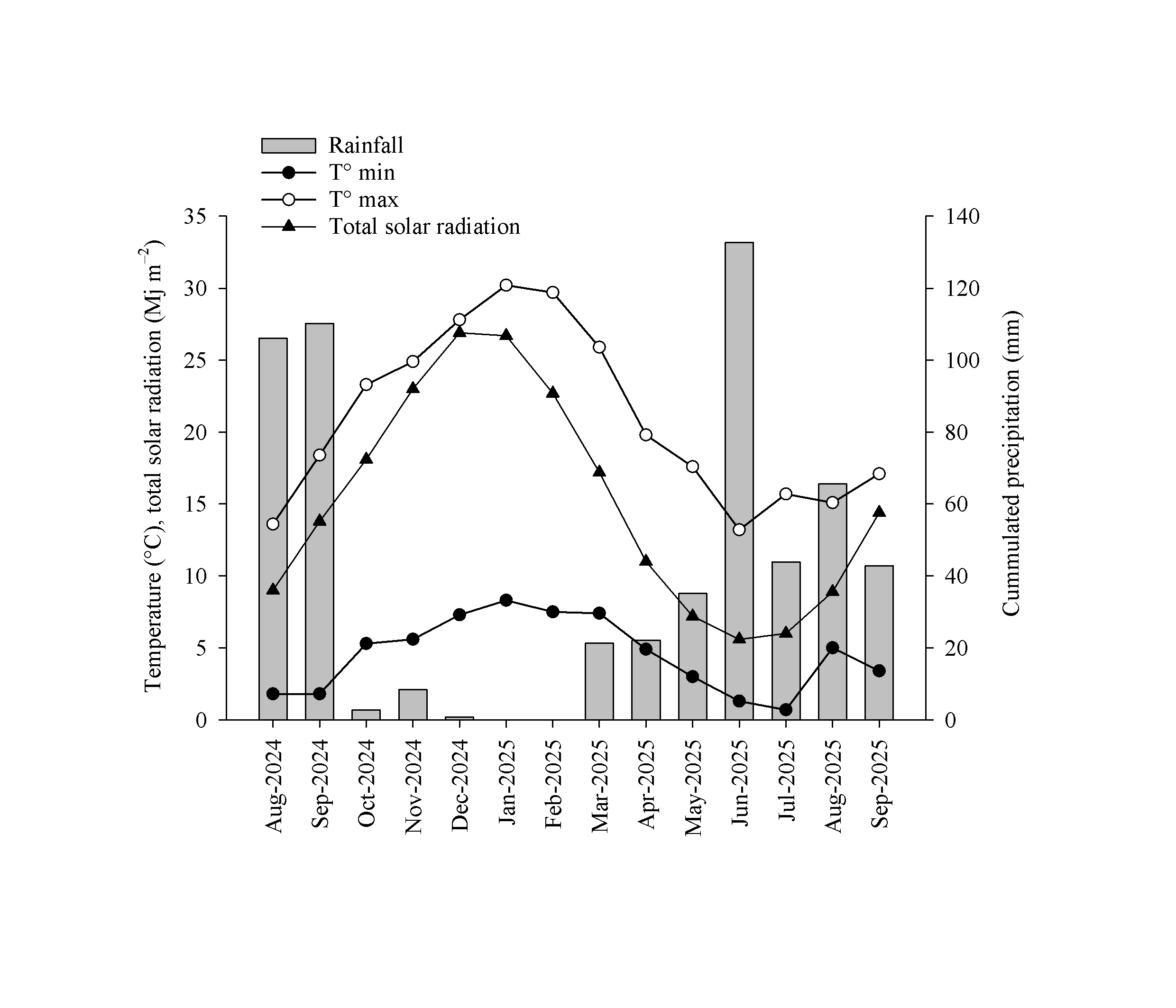
Precipitation was highest in August and September 2024 and June 2025 (106, 110, and 133 mm, respectively) (Figure 1). Rainfall was low from October to December 2024 and absent in January and February 2025. Air temperature was minimum in July 2025 (0.7 °C), but no temperatures below zero occurred during the study period. The maximum average air temperature was 31 °C in January 2025. Solar radiation was maximum in December 2024 and January–February 2025 and minimum in July 2025.

2.2. Relationships Among Variables and Species

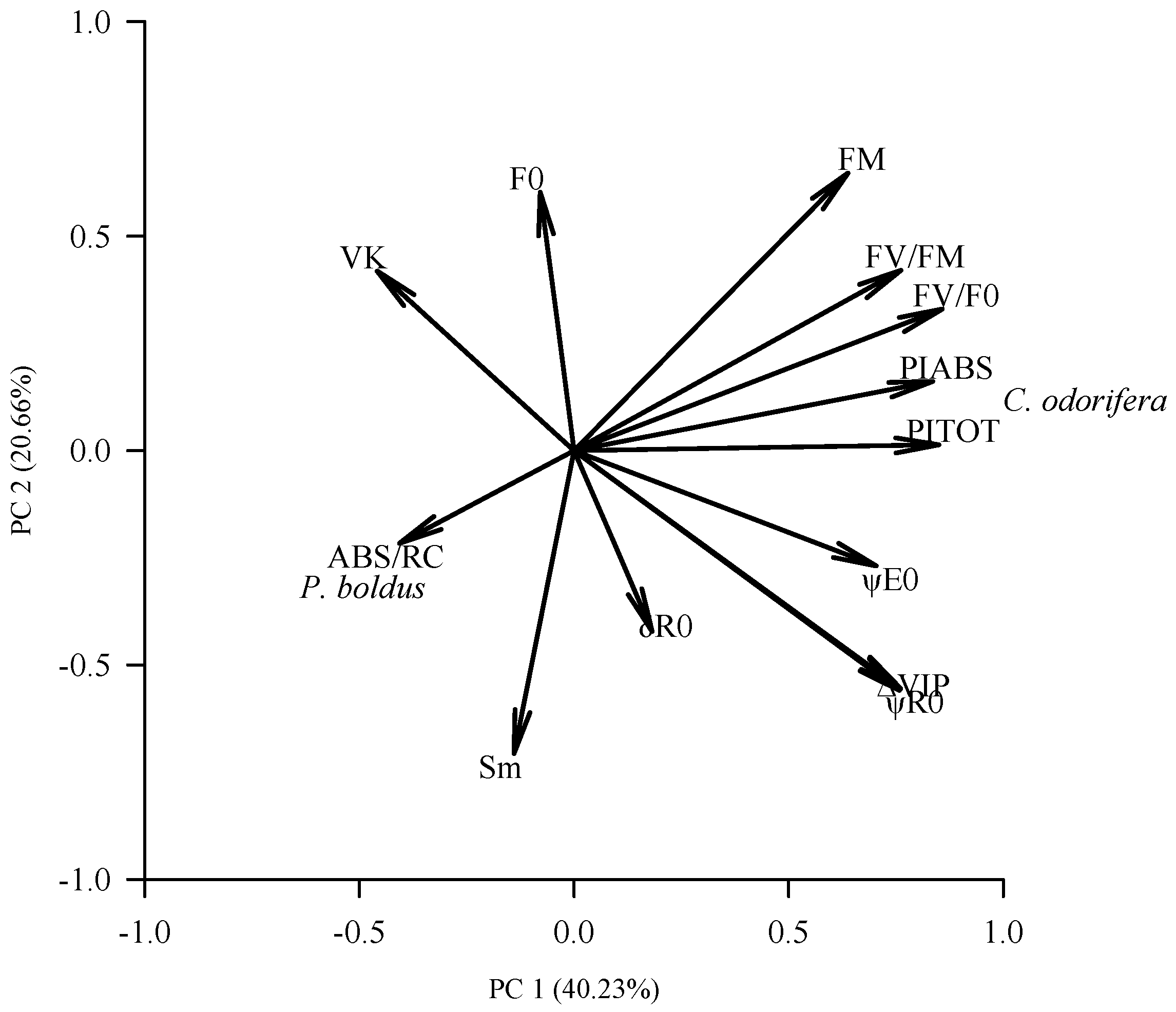
The principal component analysis indicated that the first (PC 1) and second (PC 2) principal components explained 61% of the variability in the species under study (Figure 2). The PC1 captures the seedling performance index (mainly PIABS and PITOT), whereas the PC2 captures the number of electron acceptors and the area above the curve (Sm, F0, and FM). PIABS and PITOT appeared to be positively correlated with FV/FM and FV/F0 (correlation > 0.68) but negatively correlated with ABS/RC and VK (–0.43 < r < –0.18). C. odorifera is associated with higher PIABS and PITOT, whereas P. boldus is associated with higher ABS/RC.

2.3. Seasonal Variations in Chlorophyll Fluorescence Associated with the Species

There were variations in almost all chlorophyll fluorescence parameters at the species level, except for Sm, FM, and VK (Table 1). The highest PIABS, PITOT, and FV/FM were found in C. odorifera (18.9, 19.9, and 0.71, respectively), whereas P. boldus exhibited the lowest values of these parameters but the highest ABS/RC and F0 (3.74 and 168.5, respectively). Seasons were also different in the analyzed parameters. The highest PIABS and FM were reported in spring (21.1 and 523.6, respectively), and the lowest values during autumn (4.8 and 355.1, respectively). The winter photoinactivation degree (PhI) was 0.35 and 0.17 for P. boldus and C. odorifera, respectively.
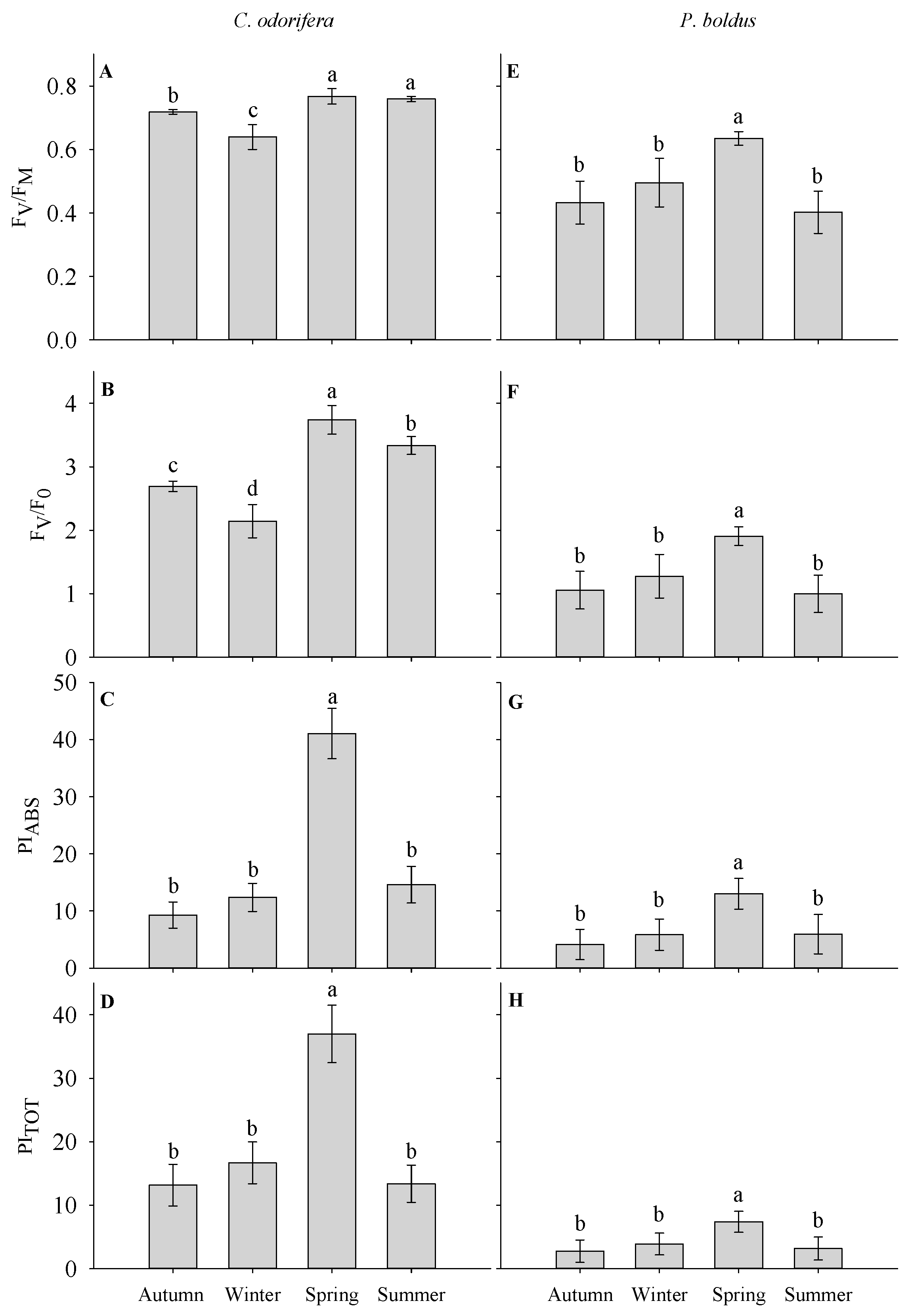
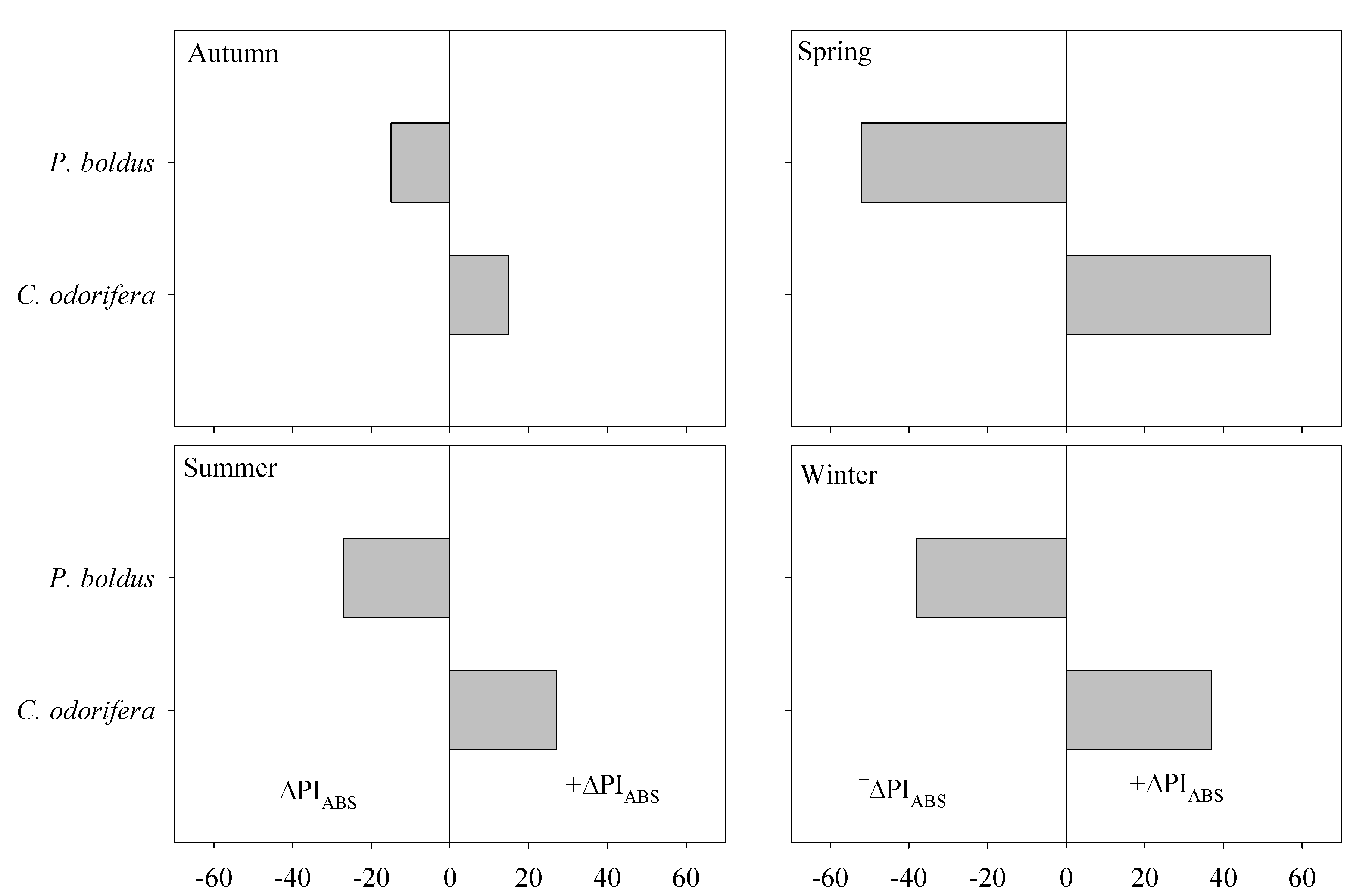
Species differed across seasons in variables related to PIABS (interaction Species × Season in Table 1). Both species exhibited the highest PIABS, PITOT, FV/F0, and FV/FM during spring, but the lowest values differed according to the species (Figure 3). FV/F0 and FV/FM were low in C. odorifera in autumn, but P. boldus exhibited low values of all parameters across seasons. Because of this, we estimated the relative deviation of PIABS (the most important parameter of plant vitality) of each species from the average PIABS in each season separately. We found that C. odorifera was the best performer as it has +∆PIABS of 33% on average across the entire year. In contrast, P. boldus was a poor performer, as it negatively deviates from PIABS in all seasons, but during winter and spring, it exhibited the lowest performance (−∆PIABS = 52 and 38%, respectively) (Figure 4).

3. Discussion

Most restoration projects with sclerophyllous species in Central Chile lack of success in the establishment phase because species are planted without knowledge on ecophysiological requirements. In this study we present the first attempt to provide physiologically based information that may guide the selection of appropriate species to restore degraded sites characterized by Mediterranean-type climates in Central Chile. We report on the photosynthetic performance between P. boldus and C. odorifera, which was markedly different throughout the year. Both species cohabit the same ecosystem, but their dominance and abundance are more niche-specific. It is well established that C. odorifera replaces P. boldus as aridity increases, being thus more common on north-facing slopes (i.e., higher temperatures and irradiation), whereas P. boldus is more abundant on South and East-facing slopes [8,13]. Adaptations to these different habitat conditions seem to have influenced the seasonal fluctuations in chlorophyll fluorescence in the common garden site and worked better in C. odorifera than in P. boldus. Although P. boldus is evergreen with a long photosynthetic period, its seasonal performance was lower than the semideciduous C. odorifera with short periods of activity but superior photochemical efficiency.
During summer, C. odorifera had FV/FM of 0.76 and a positive deviation of PIABS, indicating a physiological state relatively close to optimal [25]. In P. boldus FV/FM reached minimum values of 0.40, and PIABS negatively deviated from the reference PIABS, indicating a depression of the photosynthetic apparatus [14,26]. It might be possible that this is a strategy of P. boldus aimed at increasing the non-radiative dissipation of excitation energy, but this hypothesis needs to be further elucidated. The decrease in all photosynthetic parameters in P. boldus during summer suggests structural damage to the PSII and inefficient thermal dissipation of energy. This was evidenced by the lower values of FV/F0 (i.e., the efficiency of the water-splitting system), which is considered a proxy for heat dissipation [27]. In contrast, C. odorifera exhibited higher values of FV/F0. These results suggest that in summer, C. odorifera has superior capacity to maintain higher PSII center openness during periods of high temperature and radiation load, thereby reducing its susceptibility to damage [28,29].
During the winter-spring months, P. boldus experienced a drastic decrease in PIABS (Figure 4), a parameter that summarizes light trapping, trapped exciton flux, and electron transfer [30,31,32]. Mild temperatures during winter also limit plant growth [33,34], but P. boldus seems particularly sensitive to mild temperatures in both winter and spring. The deviation of the average PIABS value was negative in P. boldus during winter and spring (−∆PIABS 50 and 38%, respectively) but positive in C. odorifera in the same seasons (+∆PIABS 52 and 37%, respectively). Reductions in photosynthetic capacity (i.e., FV/FM) during winter have also been reported in Mediterranean species [14,26,35], and were associated with damage in the photosynthetic apparatus. In addition, the winter photoinactivation degree of P. boldus (PhI = 0.35) was higher than that reported in the Mediterranean N. oleander and Myrtus communis L. (PhI = 0.27 and 0.24, respectively [15]), corroborating its higher sensitivity and inactivation of PSII during winter.
The low photosynthetic efficiency of P. boldus was corroborated by the highest F0 (basic fluorescence) and ABS/RC (apparent antenna size of an active PSII) throughout the year. The higher F0 indicates destruction of PSII reaction centers and physical separation of the PSII from associated pigment antennae [36], whereas relatively larger PSII antenna size suggests the presence of a non-QA reducing reaction center [31], which occurs when overexcitation of the photosynthetic apparatus of P. boldus cannot appropriately be transferred to photosynthetic electron transport [5]. These results corroborate the sustained decreases in PSII efficiency of P. boldus under field conditions and its inability to balance photodamage and repair. It is known that P. boldus exerts strict stomatal control under stressful conditions [37], which adds a ‘bottleneck’ of electrons and contributes to its decreased photochemistry capacity. Thus, in general, C. odorifera showed a higher utilization of the absorbed energy in electron transport and, therefore, higher CO2 assimilation than P. boldus.

4. Materials and Methods

4.1. Characteristics of the Study Site and Plant Material

The experimental site was in the Las Brisas Experimental Station (35°34′ S, 72°06′ W) of the Universidad de Chile, San Javier, Chile. The site is located on a north-facing slope and is characterized by a Mediterranean-type climate with an annual average temperature of 14.2 °C and precipitation of 816 mm (70% concentrated during the winter months) and scant precipitation in summer. The average minimum and maximum temperatures are 5.0 and 29.5 °C, and the dry period is around 7 months [38]. Summer is typically hot and dry, with a maximum daily temperature of 36 °C during January. The soil type is sandy clay (47% sand, 17% lime, 36% clay) with a pH of 6.1 and low fertility and belongs to the Treguaco soil association (Dystric Xerochrepts, according to Soil Taxonomy classification). The electrical conductivity is 0.03 dS m−1 and the organic matter content is 1.5%. Available N, P, and K are 4, 8, and 168 mg kg−1, respectively. The soil profile is deep and well-developed, formed from metamorphic rocks, especially highly weathered mica schists and gneiss, with brown colors in 10YR and 7.5YR hues on the surface, transitioning to dark brown in the 7.5YR hue at depth [39]. The Treguaco soil predominantly occupies the high sectors and the eastern slope and is well-structured and friable, with good porosity that allows for good root development [39]. To characterize the climatic information during the study period, we obtained data from a weather station located 15 km from the planting site (Estancia Flora weather station), which belongs to the Instituto de Investigaciones Agropecuarias (https://agrometeorologia.cl accessed on 25 November 2025). From this station, we obtained average monthly values for temperature (minimum and maximum, °C), cumulated precipitation (mm), and total solar radiation (Mj m−2) from August 2024 to September 2025.
In 2019, seeds from P. boldus and C. odorifera were collected in a site located 20 km from the study area and cultivated in a nursery for 9 months. The plantation was carried out in July 2020, at a planting density of 1 × 1 m. The mean seedling height for P. boldus and C. odorifera was 15.4 and 33.8 cm, respectively. The experiment followed a randomized complete block design with five replicates, which were located continuously in the study area. A rectangular plot of 10 seedlings in a 2 × 5 m seedling arrangement (spacing of 1 × 1 m) was the experimental plot. Each replicate had 20 seedlings, and a total of 100 seedlings were planted (2 species × 5 replicates × 10 seedlings per replicate = 100 seedlings). During summer 2020–2021, seedlings were irrigated with 2 L−1 week−1 during five months (i.e., November 2020 to March 2021). After that, no more irrigations were applied. The present study was performed using five-year-old seedlings, where the recorded survival was 81% and 33% for C. odorifera and P. boldus, respectively.

4.2. Seasonal Variations in Chlorophyll Fluorescence

From the surviving seedlings, we took three individuals per species in 3 replicates chosen randomly (i.e., a total of 18 plants from replicates 1, 2, and 5) and used them for the subsequent measurements of chlorophyll fluorescence. Measurements were carried out between the 8th and 13th day of each month, from September 2024 to September 2025. One healthy and attached leaf of each seedling was marked for chlorophyll fluorescence measurements, which was assessed using an OS30p+ fluorometer (OptiSciences, Hudson, NH, USA). Leaves were dark-adapted for 30 min using leaf clips, and then, the OJIP kinetics of transients were induced with a pulse of saturating red light of 3500 µmol (photon) m−2 s−1. This saturating pulse was chosen based on previous tests to avoid over-reduction in the photosynthetic apparatus [5]. The fluorescence intensity was recorded from 20 µs to 3 s, and the data were analyzed using the JIP-test [30]. The introduced basic fluorescence parameters are listed in Table 2.

4.3. Data Analyses

For the analysis of chlorophyll fluorescence, the monthly data were grouped in seasons of the year for the Southern Hemisphere (i.e., summer: December, January, and February; autumn: March, April, and May; winter: June, July, and August; and spring: September, October, and November). A principal component analysis (PCA) with the Equamax rotation of the axis was first carried out with the aim of exploring the relationship between species and photosynthetic performance. This analysis was performed in InfoStat version 2020 (Group Infostat, Universidad Nacional de Córdoba, Argentina). Data were standardized and the 13 physiological variables were included as ‘response variables’, whereas the factor species (C. odorifera and P. boldus) was included as a ‘classification variable’. After that, we evaluated the differences among species, seasons, and the interaction between factors through two-way analysis of variance. The model used was
Y = μ + R + Species + Season + Species × Season + ε
where Y is the observed phenotypic value, µ is the overall mean, R is the random effect of replicates, species is the fixed effect of species (C. odorifera and P. boldus), season is the fixed effect of a season of the year (summer, autumn, winter, and spring), Species × Season is the interaction between both factors, and ε represents the experimental random error. Significant value means were separated by Tukey’s test for p < 0.05. To meet the assumptions of normality and constant variances, traits were transformed when needed. Additionally, we estimated the winter photoinactivation degree (PhI) for Mediterranean evergreen woody plants as (PhI = 1 − (FV/FMwinter/FV/FMspring) [15]. We calculated the average PIABS with all data in each season (value 0 in Figure 4) and then calculated the percentage of deviation from this average for each species in each season separately. This was indicated as +∆PIABS (positive deviation) and −∆PIABS (negative deviation) in Figure 4. This statistical analysis was performed with SPSS version 22.0 software (SPSS Inc., Chicago, IL, USA).

5. Conclusions

C. odorifera had superior photosynthetic performance compared to P. boldus across the different seasons of the year. This species showed a higher utilization of the absorbed energy in electron transport and, therefore, higher photosynthetic performance, which is consistent with its occurrence on north-facing slopes with higher temperatures and radiation loads. In contrast, P. boldus was considerably depressed during the entire year. The higher reduction in photochemical efficiency of P. boldus during the winter–spring months (i.e., −ΔPIABS) suggests that the mildly low temperatures of Mediterranean-type ecosystems may also be a considerable stress factor for this species, as it limits the photon trapping and photochemical phase of photosynthesis. As PSII function in P. boldus is more sensitive to environmental conditions in the early stages of establishment, the selection of this species for the restoration of Mediterranean-type climate sites must include silvicultural treatments aimed at improving survival and growth conditions across the entire year (e.g., higher and more frequent irrigation doses in summer and protection from low temperatures in winter–spring).

Author Contributions

Conceptualization, S.E.; methodology S.E.; formal analysis, S.E.; writing—original draft preparation, S.E.; writing—review and editing, M.Y., C.M. and E.M.-H.; funding acquisition, C.M. All authors have read and agreed to the published version of the manuscript.

Funding

This work was partially supported by the Fondo de Investigación del Bosque Nativo, from the Corporación Nacional Forestal (CONAF-Chile), project title “Contribución a la rehabilitación del Bosque y Matorral Esclerófilo de la Región del Maule”, grant number 015/2017.

Data Availability Statement

The raw data supporting the conclusions of this article will be made available by the authors on request. The data are not publicly available due to privacy.

Acknowledgments

We acknowledge the Pantanillos Experimental Station from the Universidad de Chile for providing the lead author access to the study site during the study period.

Conflicts of Interest

The authors declare no conflicts of interest.

Abbreviations

The following abbreviations are used in this manuscript:
F0Minimal fluorescence from a dark-adapted leaf
FMMaximal fluorescence from a dark-adapted leaf
FVMaximal variable fluorescence from a dark-adapted leaf
FV/FMMaximum quantum yield of primary PSII photochemistry
FV/F0Ratio between variable and minimal fluorescence
O stepOrigin fluorescence value at 20 µs
K stepFluorescence value at 0.3 ms
J stepFluorescence value at 2 ms
I stepFluorescence value at 30 ms
P stepMaximum fluorescence or FM
SmNormalized area above the curve from F0 to FM
ABS/RCEffective antenna size of an active reaction center (RC)
PIABSPerformance index for energy conservation from photons absorbed by PSII to the reduction of intersystem electron acceptors
PITOTPerformance index for energy conservation from photons absorbed by PSII antenna to the reduction of PSI acceptors.
ψE0Probability that the energy of a trapped excitation is used for electron transport beyond QA
ψR0Quantum yield for reduction in the end electron acceptors at the PSI acceptor side
δR0Efficiency with which an electron from the intersystem electron carriers is transferred to reduce end electron acceptors at the PSI acceptor side
VKRelative fluorescence at the K-step
ΔVIPRelative contribution of electron flow to the PSI end acceptors (i.e., ferredoxin and NADPH)

References

  1. Sepulveda, M.; Bown, H.E.; Fernandez, L.B. Stomatal conductance responses of Acacia caven to seasonal patterns of water availability at different soil depths in a Mediterranean Savanna. Water 2018, 10, 1534. [Google Scholar] [CrossRef]
  2. Armesto, J.J.; Arroyo, M.T.K.; Hinojosa, F.L. In The Physical Geography of South America; Veblen, T.T., Young, K.R., Orme, A.R., Eds.; The Mediterranean environment of central PM Chile. Oxford University Press: Oxford, UK, 2007; pp. 184–199. [Google Scholar]
  3. Cueto, D.A.; Alaniz, A.J.; Hidalgo-Corrotea, C.; Vergara, P.M.; Carvajal, M.A.; Barrios-Saravia, A. Chilean Mediterranean forest on the verge of collapse? Evidence from a comprehensive risk analysis. Sci. Total Environ. 2025, 964, 178557. [Google Scholar] [CrossRef]
  4. Smith-Ramirez, C.; Grez, A.; Galleguillos, M.; Cerda, C.; Ocampo-Melgar, A.; Miranda, M.D.; Muñoz, A.A.; Rendón-Funes, A.; Díaz, I.; Cifuentes, C.; et al. Ecosystem services of Chilean sclerophyllous forests and shrublands on the verge of collapse: A review. J. Arid Environ. 2023, 211, 104927. [Google Scholar] [CrossRef]
  5. Espinoza, S.; Magni, C.; Yáñez, M.; Toro, N.; Martínez-Herrera, E. Foliar Traits Drive Chlorophyll Fluorescence Variability in Chilean Sclerophyllous Species Under Early Outplanting Stress. Plants 2025, 14, 2682. [Google Scholar] [CrossRef]
  6. Montenegro, G.; Riveros De La Puente, F. Comparison of differential environmental responses of Colliguaya odorifera. Flora 1977, 166, 125–135. [Google Scholar] [CrossRef]
  7. Ehleringer, J.R.; Comstock, J.P. In The California chaparral: Paradigms re-examined; Keeley, S.C., Ed.; Stress tolerance and adaptive variation in leaf absorptance and leaf angle. Natural History Museum of Los Angeles County Science Series: Los Angeles, CA, USA, 1989; pp. 21–24. [Google Scholar]
  8. Armesto, J.J.; Martίnez, J.A. Relations between vegetation structure and slope aspect in the mediterranean region of Chile. J. Ecol. 1978, 66, 881–889. [Google Scholar] [CrossRef]
  9. Cabello, A.; Donoso, C. In Las Especies Arbóreas de los Bosques Templados de Chile y Argentina. Autoecología; Donoso, C., Ed.; Peumus boldus (Molina) Johnston. Boldo, Folo. Familia: Monimiaceae. Marisa Cuneo Ediciones: Valdivia, Chile, 2013; pp. 510–515. [Google Scholar]
  10. O’Toole, J.C.; Cruz, R.T. Leaf rolling and transpiration. Plant Sci. Lett. 1979, 16, 111–114. [Google Scholar] [CrossRef]
  11. Doll, U.; Aedo, D.; Lopez, P. Caracterización morfológica de tres procedencias de boldo (Peumus boldus) en una plantación joven de 6 años. Bosque 2005, 26, 45–54. [Google Scholar] [CrossRef]
  12. Mooney, H.A.; Dunn, E.L. Photosynthetic systems of Mediterranean-climate shrubs and trees of California and Chile. Am. Nat. 1970, 104, 447–453. [Google Scholar] [CrossRef]
  13. Armesto, J.J.; Gutierrez, J. El efecto del fuego en la estructura de la vegetación de Chile central. An. Mus. Hist. Nat. Valpso 1978, 11, 43–48. [Google Scholar]
  14. Falster, D.S.; Westoby, M. Leaf size and angle vary widely across species: What consequences for light interception? New Phytol. 2003, 158, 509–525. [Google Scholar] [CrossRef]
  15. Larcher, W. Temperature stress and survival ability of Mediterranean sclerophyllous plants. Plant Biosys. 2000, 134, 279–295. [Google Scholar] [CrossRef]
  16. Karavatas, S.; Manetas, Y. Seasonal patterns of photosystem 2 photochemical efficiency in evergreen sclerophylls and drought semi-deciduous shrubs under Mediterranean field conditions. Photosynthetica 1999, 36, 41–49. [Google Scholar] [CrossRef]
  17. Źróbek-Sokolnik, A. In Environmental Adaptations and Stress Tolerance of Plants in the Era of Climate Change; Ahmad, P., Prasad, M., Eds.; Temperature Stress and Responses of Plants. Springer: New York, NY, USA, 2012; pp. 113–134. [Google Scholar]
  18. Matesanz, S.; Valladares, F. Ecological and evolutionary responses of Mediterranean plants to global change. Environ. Exp. Bot. 2014, 103, 53–67. [Google Scholar] [CrossRef]
  19. Bannister, J.R.; Vargas-Gaete, R.; Ovalle, J.F.; Acevedo, M.; Fuentes-Ramirez, A.; Donoso, P.J.; Promis, A.; Smith-Ramírez, C. Major bottlenecks for the restoration of natural forests in Chile. Restor. Ecol. 2018, 26, 1039–1044. [Google Scholar] [CrossRef]
  20. Swoczyna, T.; Kalaji, H.M.; Bussotti, F.; Mojski, J.; Pollastrini, M. Environmental stress- what can we learn from chlorophyll a fluorescence analysis in woody plants? A review. Front. Plant Sci. 2022, 13, 1048582. [Google Scholar] [CrossRef]
  21. Stirbet, A.; Lazár, D.; Kromdijk, J.; Govindjee. Chlorophyll a fluorescence induction: Can just a one-second measurement be used to quantify abiotic stress responses? Photosynthetica 2018, 56, 86–104. [Google Scholar] [CrossRef]
  22. Kalaji, H.M.; Schansker, G.; Ladle, R.J.; Goltsev, V.; Bosa, K.; Allakhverdiev, S.I.; Brestic, M.; Bussotti, F.; Calatayud, A.; Dabrowski, P.; et al. Frequently asked questions about in vivo chlorophyll fluorescence: Practical issues. Photosynth. Res. 2014, 122, 121–158. [Google Scholar] [CrossRef] [PubMed]
  23. Kalaji, H.M.; Carpentier, R.; Allakhverdiev, S.I.; Bosa, K. Fluorescence parameters as early indicators of light stress in barley. J. Photochem. Photobiol. 2012, 112, 1–6. [Google Scholar] [CrossRef]
  24. Ceacero, C.J.; Díaz-Hernández, J.L.; del Campo, A.D.; Navarro-Cerrillo, R.M. Evaluación temprana de técnicas de restauración forestal mediante fluorescencia de la clorofila y diagnóstico de vitalidad de brinzales de encina (Quercus ilex sub. ballota). Bosque 2012, 33, 191–202. [Google Scholar] [CrossRef]
  25. Björkman, O.; Demmig, B. Photon yield of O2 evolution and chlorophyll fluorescence characteristics at 77K among vascular plants of diverse origins. Planta 1987, 170, 89–504. [Google Scholar] [CrossRef]
  26. Adams, W.W., III; Demmig-Adams, B.; Verhoeven, A.S.; Barker, D.H. ‘Photoinhibition’ during winter stress: Involvement of sustained xanthophyll cycle-dependent energy dissipation. Aust. J. Plant. Physiol. 1994, 22, 261–276. [Google Scholar] [CrossRef]
  27. Tsimilli-Michael, M. Revisiting JIP-test: An educative review on concepts, assumptions, approximations, definitions and terminology. Photosynthetica 2020, 58, 275–292. [Google Scholar] [CrossRef]
  28. Park, Y.-I.; Chow, W.S.; Anderson, J.M. Light inactivation of functional photosystem II in leaves of peas grown in moderate light depends on photon exposure. Planta 1995, 196, 401–411. [Google Scholar] [CrossRef]
  29. Baroli, I.; Melis, A. Photoinhibition and repair in Dunaliella salina acclimated to different growth irradiances. Planta 1996, 198, 640–646. [Google Scholar] [CrossRef]
  30. Strasser, R.J.; Tsimilli-Michael, M.; Srivastava, A. In Chlorophyll a Fluorescence: A Signature of Photosynthesis. Advances in Photosynthesis and Respiration; Papageorgiou, G.C., Govindjee, Eds.; Analysis of the chlorophyll a fluorescence transient. Springer: Dordrecht, The Netherlands, 2004; pp. 321–362. [Google Scholar]
  31. Strasser, R.J.; Srivastava, A.; Tsimilli-Michael, M. In Probing Photosynthesis: Mechanisms, Regulation and Adaptation; Yunus, M., Pathre, U., Mohanty, P., Eds.; The fluorescence transient as a tool to characterize and screen photosynthetic samples. Taylor & Francis: London, UK, 2000; pp. 445–483. [Google Scholar]
  32. Strasser, R.J.; Tsimilli-Michael, M.; Qiang, S. Simultaneous in vivo recording of prompt and delayed fluorescence and 820-nm reflection changes during drying and after rehydration of the resurrection plant Haberlea rhodopensis. Biochim. Biophys. Acta 2010, 1797, 1313–1326. [Google Scholar] [CrossRef] [PubMed]
  33. Mitrakos, K. A theory for Mediterranean plant life. Acta Oecol. 1980, 1, 245–252. [Google Scholar]
  34. Larcher, W. In Components of Productivity of Mediterranean-Climate Regions. Basic and Applied Aspects; Margaris, N.S., Mooney, H.A., Eds.; Low temperature effects on Mediterranean sclerophylls: An unconventional viewpoint. Dr W Junk Publ.: The Hague, The Netherlands; Boston, MA, USA; London, UK, 1981; pp. 259–265. [Google Scholar]
  35. García-Plazaola, J.I.; Faria, T.; Abadía, A.; Chaves, M.M.; Pereira, J.S. Seasonal changes in xanthophyll composition and photosynthesis of cork oak (Quercus suber L.) leaves under Mediterranean climate. J. Exp. Bot. 1997, 48, 1667–1674. [Google Scholar] [CrossRef]
  36. Guissé, B.; Srivastava, A.; Strasser, R.J. The polyphasic rise of the chlorophyll a fluorescence (OKJIP) in heat-stressed leaves. Archs. Sci. Genève 1995, 48, 147–160. [Google Scholar]
  37. Yáñez, M.A.; Espinoza, S.E.; Magni, C.R.; Martinez-Herrera, E. Early Growth and Physiological Acclimation to Shade and Water Restriction of Seven Sclerophyllous Species of the Mediterranean Forests of Central Chile. Plants 2024, 13, 2410. [Google Scholar] [CrossRef]
  38. Santibáñez, F. Atlas agroclimático de Chile. Estado actual y tendencias del clima. Tomo III: Regiones de Valparaíso, Metropolitana, O’Higgins y Maule; Universidad de Chile, Facultad de Ciencias Agronómicas: Santiago, Chile, 2017. [Google Scholar]
  39. CIREN. Estudio agrológico Región del Maule: Descripción de Suelos Materiales y Símbolos, Sobre ortoimágenes a Escala de Salida 1: 10.000. 2012, (Pub. CIREN N° 178/2012); Centro de Información de Recursos Naturales: Providencia, Santiago, 2012. [Google Scholar]
Figure 1. Monthly maximum and minimum temperature (open and solid circles, respectively), total solar radiation (triangles), and cumulated precipitation (bars) at the study site (data obtained from Estancia Flora agroclimatic station (35°29′ S, 72°13′ W), San Javier, Chile).
Plants 15 00276 g001
Figure 2. Distribution of the JIP-test parameters in the species surveyed according to the principal component analysis (PCA). F0 = minimal fluorescence from a dark-adapted leaf; FM = maximal fluorescence from a dark-adapted leaf; FV/FM = maximum quantum yield of primary PSII photochemistry; FV/F0 = ratio between variable and minimal fluorescence; Sm = normalized area above the curve from F0 to FM; ABS/RC = effective antenna size of an active reaction center (RC); PIABS = performance index for energy conservation from photons absorbed by PSII to the reduction of intersystem electron acceptors; PITOT = performance index for energy conservation from photons absorbed by PSII antenna to the reduction of PSI acceptors; ψE0 = probability that the energy of a trapped excitation is used for electron transport beyond QA; ψR0 = quantum yield for reduction in the end electron acceptors at the PSI acceptor side; δR0 = efficiency with which an electron from the intersystem electron carriers is transferred to reduce end electron acceptors at the PSI acceptor side; VK = relative fluorescence at the K-step; ΔVIP = efficiency with which a PSII trapped electron is transferred to final PSI acceptors.
Plants 15 00276 g002
Figure 3. Average values for FV/FM (A,E), FV/F0 (B,F), PIABS (C,G), and PITOT (D,H) for C. odorifera (panels AD) and P. boldus (panels EH) in each season. Lowercase letters indicate differences across seasons. Each bar represents average values for nine seedlings on each date of measurement, and error bars represent the standard error.
Plants 15 00276 g003
Figure 4. Relative deviation of the performance index (PIABS) of each species in relation to the average PIABS of all data in each season. The 0 represents the average PIABS for each season.
Plants 15 00276 g004
Table 1. F-values and significance from the analysis of variance on Chl a fluorescence parameters in P. boldus and C. odorifera during the 2024–2025 season.
ParameterEffect
SpeciesSeasonSpecies × Season
VK0.4 ns0.9 ns1.4 ns
ABS/RC7.5 **1.1 ns0.4 ns
F022.3 **3.1 *0.2 ns
FM2.8 ns8.7 **0.3 ns
FV/FM55.1 **4.3 **3.2 *
FV/F097.7 **8.5 **3.1 *
ΔVIP54.6 **1.6 ns0.6 ns
δR042.3 **7.7 **1.9 ns
Sm0.6 ns6.2 **0.3 ns
ψE05.0 *3.3 *1.8 ns
ψR052.0 **1.7 ns0.5 ns
PIABS29.9 **18.1 **6.0 **
PITOT53.7 **10.2 **4.8 **
** = p < 0.001; * = p < 0.05; ns = non-significant (p > 0.05). F0 = minimal fluorescence from a dark-adapted leaf; FM = maximal fluorescence from a dark-adapted leaf; FV/FM = maximum quantum yield of primary PSII photochemistry; FV/F0 = ratio between variable and minimal fluorescence; Sm = normalized area above the curve from F0 to FM; ABS/RC = effective antenna size of an active reaction center (RC); PIABS = performance index for energy conservation from photons absorbed by PSII to the reduction of intersystem electron acceptors; PITOT = performance index for energy conservation from photons absorbed by PSII antenna to the reduction of PSI acceptors; ψE0 = probability that the energy of a trapped excitation is used for electron transport beyond QA; ψR0 = quantum yield for reduction in the end electron acceptors at the PSI acceptor side; δR0 = efficiency with which an electron from the intersystem electron carriers is transferred to reduce end electron acceptors at the PSI acceptor side; VK = relative fluorescence at the K-step; ΔVIP = efficiency with which a PSII trapped electron is transferred to final PSI acceptors.
Table 2. Main terms obtained for the analysis of the fluorescence transient OJIP.
Technical fluorescence parameters
F0Minimal fluorescence from a dark-adapted leaf
FMMaximal fluorescence from a dark-adapted leaf
FVMaximal variable fluorescence from a dark-adapted leaf
FV/FMMaximum quantum yield of primary PSII photochemistry
FV/F0Ratio between variable and minimal fluorescence
O stepOrigin fluorescence value at 20 µs
K stepFluorescence value at 0.3 ms
J stepFluorescence value at 2 ms
I stepFluorescence value at 30 ms
P stepMaximum fluorescence or FM
JIP-test derived parameters
SmNormalized area above the curve from F0 to FM
ABS/RCEffective antenna size of an active reaction center (RC)
PIABSPerformance index for energy conservation from photons absorbed by PSII to the reduction of intersystem electron acceptors
PITOTPerformance index for energy conservation from photons absorbed by PSII antenna to the reduction of PSI acceptors.
ψE0Probability that the energy of a trapped excitation is used for electron transport beyond QA
ψR0Quantum yield for reduction in the end electron acceptors at the PSI acceptor side
δR0Efficiency with which an electron from the intersystem electron carriers is transferred to reduce end electron acceptors at the PSI acceptor side
VKRelative fluorescence at the K-step
ΔVIPRelative contribution of electron flow to the PSI end acceptors (i.e., ferredoxin and NADPH)
PITOT was obtained as PIABS × δR0/(1 − δR0), whereas δR0 was obtained as ψR0/ψE0 [20].
Disclaimer/Publisher’s Note: The statements, opinions and data contained in all publications are solely those of the individual author(s) and contributor(s) and not of MDPI and/or the editor(s). MDPI and/or the editor(s) disclaim responsibility for any injury to people or property resulting from any ideas, methods, instructions or products referred to in the content.