Article

One Step Forward in Understanding the Mechanism of Action of Wood Vinegar: Gas Exchange Analysis Reveals New Information


1
BioAgryLab, Department of Life Sciences, University of Siena, 53100 Siena, Italy
2
Department of Life Sciences, University of Siena, 53100 Siena, Italy
3
Istituto Nazionale Geofisica e Vulcanologia (INGV), 605, Via di Vigna Murata, 00143 Rome, Italy
4
National Biodiversity Future Center, 90133 Palermo, Italy
*
Author to whom correspondence should be addressed.
Plants 2026, 15(2), 262; https://doi.org/10.3390/plants15020262 (registering DOI)
Submission received: 2 December 2025 / Revised: 6 January 2026 / Accepted: 13 January 2026 / Published: 15 January 2026
(This article belongs to the Section Crop Physiology and Crop Production)

Abstract

Wood vinegar (WV), a by-product of woody biomass pyrolysis, is increasingly used in agriculture as a sustainable biostimulant, although its effects on plant stress resistance and underlying mechanisms remain poorly understood. Recent studies propose that WV may act through a eustress-based mechanism, defined as a mild and controlled stress that activates adaptive physiological responses and enhances plant performance without causing structural or metabolic damage. This study investigated the physiological and biochemical effects of WV on strawberry plants grown under three water-deficit stress levels [no stress (NS), moderate stress (MS), and high stress (HS)] and treated with WV either via fertigation (0.5% v/v, WV1) or foliar spray (0.2% v/v, WV2). Gas exchange parameters (A, gsw, E, Ci, WUE), total chlorophyll content, and nutrient balance ratios (Fe/Mn and K/Ca) were measured after a three-month growth period. PERMANOVA revealed significant effects of both WV and water-deficit stress, as well as their interaction, on most parameters. Under NS and MS conditions, WV reduced A, gsw, E, and Ci while increasing WUE, indicating enhanced water-use efficiency and improved physiological adjustment to water limitation. Chlorophyll content remained stable, demonstrating preserved photosynthetic integrity. Nutrient ratios further supported a controlled ion rebalancing associated with adaptive stress responses under NS and MS, whereas HS conditions indicated the onset of distress. Overall, the data demonstrate that WV enhances plant stress resistance primarily by inducing eustress-mediated physiological regulation rather than by directly stimulating growth.

1. Introduction

Wood vinegar (WV) is a bio-based product obtained through pyrolysis, a thermochemical process in which woody biomass is burned under limited or no oxygen presence [1,2,3]. The resulting gases are condensed in an external tank in the form of an amber liquid, rich in >300 compounds (i.e., polyphenols, organic acids, esters, ketones, etc.) [4]. The chemical characteristics of WV are influenced by different factors, including the biomass feedstock, heating rate, pyrolysis temperature, and the configuration of the condensation systems. Based on all these factors, different types of WV can vary significantly, leading to different effects when used as bio-stimulants in agriculture [5,6].
In recent years, WV has been used in agriculture as an environmentally friendly bio-stimulant to improve plant growth and yield [7,8,9,10] serving as a sustainable alternative to chemical fertilizers. The use of this type of products is also supported by supranational organizations, such as the European Commission (EC), which introduced several important targets to reduce the use of chemical pesticides and fertilizers [11,12]. Beyond its agronomic relevance, WV has gained interest as a low-input tool potentially capable of enhancing plant resilience under sub-optimal environmental conditions.
Following this wave, scientific research, according to Scopus data, has marked an upward trend since 2020, with >50 papers published in international journals linked to the keywords “wood vinegar”, “pyroligneous acid”, “wood distillate” [13]. Most studies have investigated the benefits of this by-product on crops directly evaluating its potential to influence the photosynthetic parameters and the metabolism of plants rather than elucidating its mechanism of action [14,15,16]. This gap is primarily related to the complex chemical composition of the WV, which significantly complicates the attribution of effects to individual components [17]. As a result, WV is increasingly interpreted as a functional mixture capable of triggering integrated physiological responses rather than acting through single-molecule effects.
In our previous research [18,19,20], we proposed eustress as a possible mechanism of action for WV. Eustress is a form of mild, beneficial stress that activates positive adaptive responses in plants [21,22], whereas distress leads to irreversible impairment of photosynthetic performance and structural integrity [23]. The eustress hypothesis suggests that biostimulants’ chemical composition may contain compounds that stimulate defense pathways and enhance antioxidant activity, “priming” the plants to better withstand drought, pathogens, or nutrient imbalances without causing damages [24,25,26].
Fedeli et al. [19] showed that plants sprayed weekly with 0.2% WV exhibited stable or increased chlorophyll content at the end of the experiment, but, after the first WV application, a reduction in the photosynthetic parameters (Fv/Fm and PIabs) was observed. Additionally, Noel et al. [27] supported the eustress hypothesis, showing that WV increased CO2 fixation and enhanced the synthesis and turnover of different photosynthetic pigments, specifically the β-carotene, a key antioxidant involved in photoprotection. Moreover, it was also observed that WV raises both the leaf Chla/Chlb ratio and the root nodulation in soybean (Glycine max (L.) Merr. subsp. max), a further indication of an adaptive adjustment typical of the eustress responses rather than a simple enrichment effect.
Drought stress represents one of the most relevant abiotic constraints in crop production and provides an appropriate physiological framework to test the eustress hypothesis. Water deficit severity can range from mild to severe, triggering progressive responses such as stomatal regulation, osmotic adjustment, activation of antioxidant defenses, and hormone-mediated signaling, particularly involving abscisic acid. Under moderate drought, plants often prioritize adaptive strategies that preserve photosynthetic efficiency and water-use efficiency, whereas severe drought leads to metabolic disruption and growth inhibition. Recent syntheses emphasize that drought tolerance relies on the coordinated regulation of stomatal behavior, redox homeostasis, and hormonal crosstalk rather than on single traits alone [28].
Within this context, WV-induced eustress may act as a priming stimulus, enhancing plant preparedness to cope with water deficit by pre-activating defense and regulatory pathways without imposing the metabolic costs associated with strong stress responses.
Based on this evidence, this study aimed to investigate the mechanism of action of WV in two different application methods (i.e., fertirrigation and foliar spray) after the post-fruiting stage (three months of growing period) of strawberry (Fragaria × ananassa (Duchesne ex Weston) Duchesne ex Rozier, cv ANIA) used as a model plant, under different water stress conditions. Gas exchange (i.e., net CO2 assimilation rate (A), stomatal conductance (gsw), transpiration rate (E), intercellular CO2 concentration (Ci), intrinsic water-use efficiency (WUE)), total chlorophyll, and nutrient balance ratios (i.e., Fe/Mn and K/Ca) were measured to understand whether WV elicits beneficial low-level stress responses under normal and abiotic conditions.

2. Results and Discussion

The application of WV with both application methods (i.e., WV1: fertirrigation; WV2: foliar spray) significantly impaired the physiological and biochemical patterns of strawberry plants, with similar values alone or in combination with water stress (Table 1), supporting the idea of the eustress mechanism of action of the WV [19].

2.1. Gas Exchange

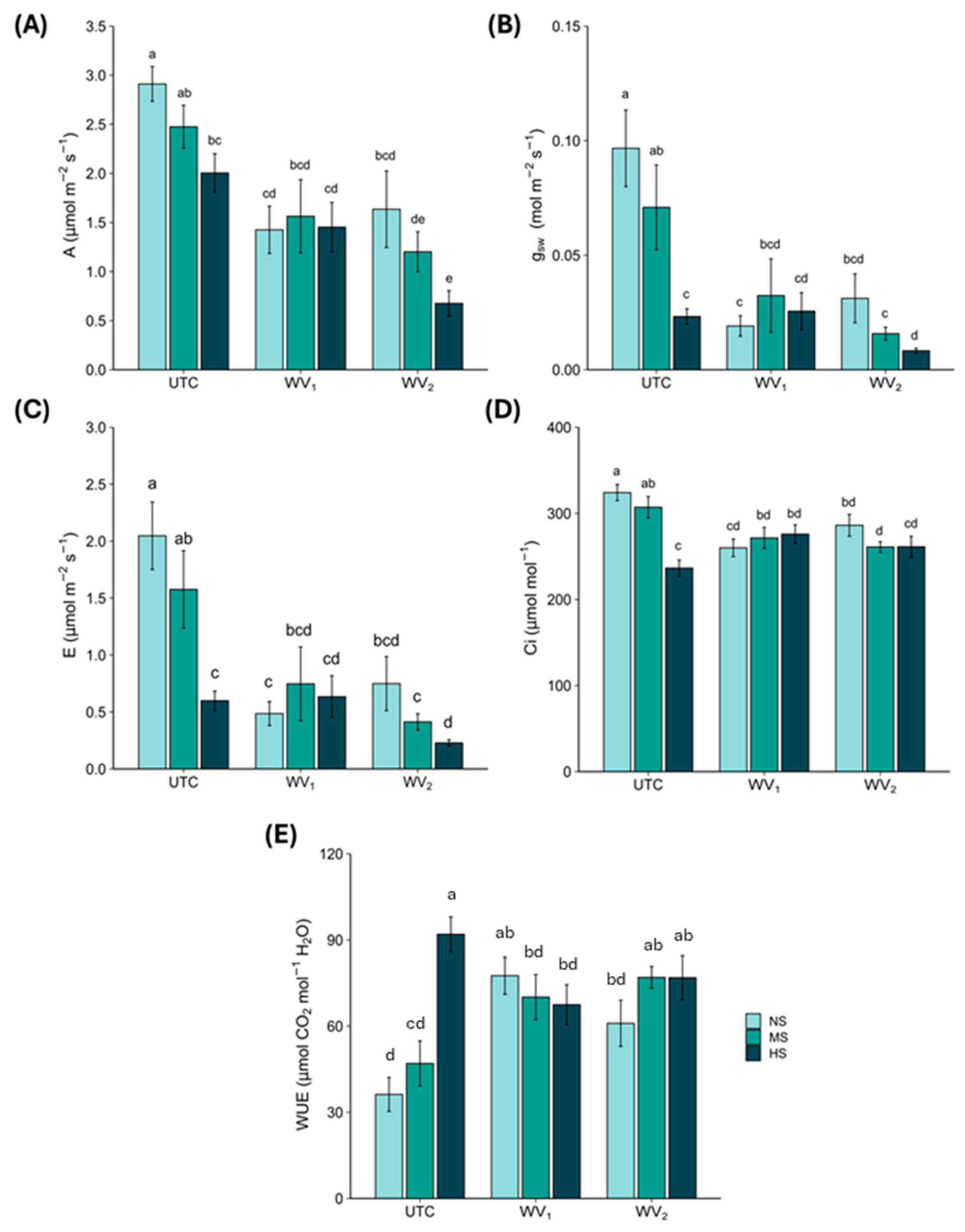
At NS condition, on one hand both WV treatments showed significant reduction in A, gsw, E, and Ci (WV1: −51%, −80%, −76%, −20%,, respectively, and WV2: −44%, −68%, −63%, −12%, respectively) compared with UTC (Figure 1A–D, 2). On the other hand, a statistically significant increase was reported for WUE in both WV1 (+114%) and WV2 (+68%) compared with UTC (Figure 1E, 3).
At MS condition only WV2 determined a statistically significant reduction in A, gsw, E, and Ci (−51%, −78%, −74%, −15%, respectively) compared with UTC (Figure 1A–D, 2). Regarding WUE, WV2 showed a statistically significant increase (+64%) compared with UTC (Figure 1E, 2).
A similar pattern was observed at HS, in which WV2 caused a statistically significant reduction in A, gsw, and E (−66%, −64%, −62%, respectively) compared with UTC (Figure 1A–C, 2); instead WV1 showed a significant reduction in WUE (−27%; p < 0.05). Differently, both WV1 (+17%; p < 0.05) and WV2 (+11%; p > 0.05) showed an increase in Ci compared with UTC (Figure 1E, 2).
From a general perspective, the above results showed a clear and coherent physiological response. In both application methods, WV triggered a water-saving mechanism in the plants, concerning the stomatal regulation (reduction in gsw and E) under eustress conditions [29,30]. The reduction of A is generally attributed to photosynthetic damage [31,32]; however, in our case, the total chlorophyll content (see Section 3.2) did not vary among the WV-treated and UTC plants. The observed reduction of A could be attributed to a direct consequence of the minor availability of CO2 caused by stomata closure, as already shown by several research studies [32,33].
Ci showed two different responses to the tested treatments. As concerns NS and MS, we observed a decrease of Ci in WV-treated plants, in which the reduction of gsw limited CO2 entrance and resulted in a corresponding reduction in A [34,35]. In contrast, in HS, we observed an increase in Ci, suggesting the onset of non-stomatal limitations. Indeed, CO2 seems to be no longer used in the biochemical processes of photosynthesis, showing the beginning of a distress [34,35], despite, in our case, the chlorophyll content did not decrease (see Section 2.2).
The hypothesis of eustress was also supported by the results of WUE, since its increase reported in NS and MS suggests that the WV-treated plants were able to ameliorate the efficiency of the water use. This pattern, together with gsw, E, and total chlorophyll content, points out a clear and coherent response to the eustress hypothesis, whereby the plants reduced the gas exchange for an optimization of the water saving, without inducing impairments in the photosynthetic apparatus (see Section 2.2).

2.2. Chlorophyll

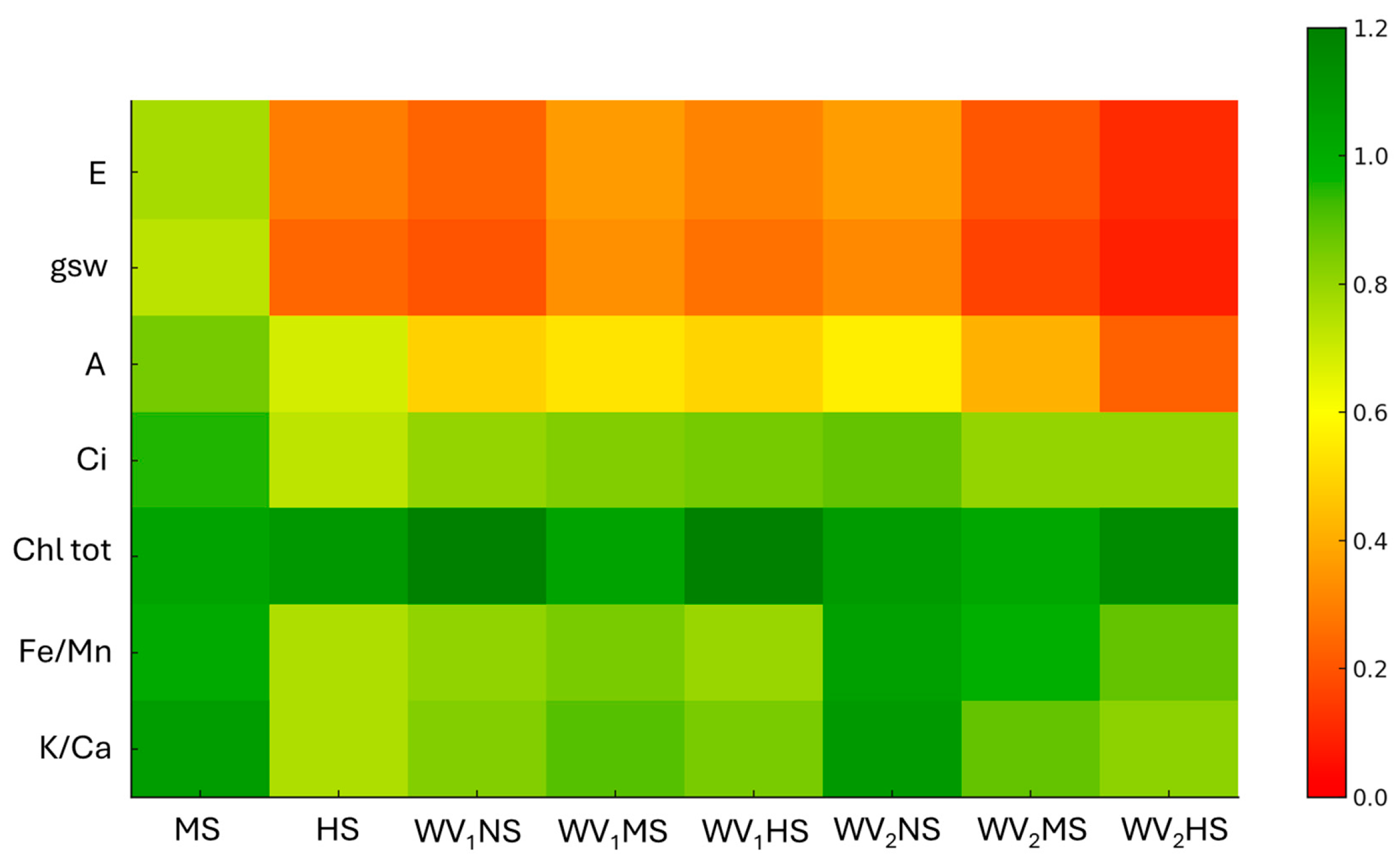
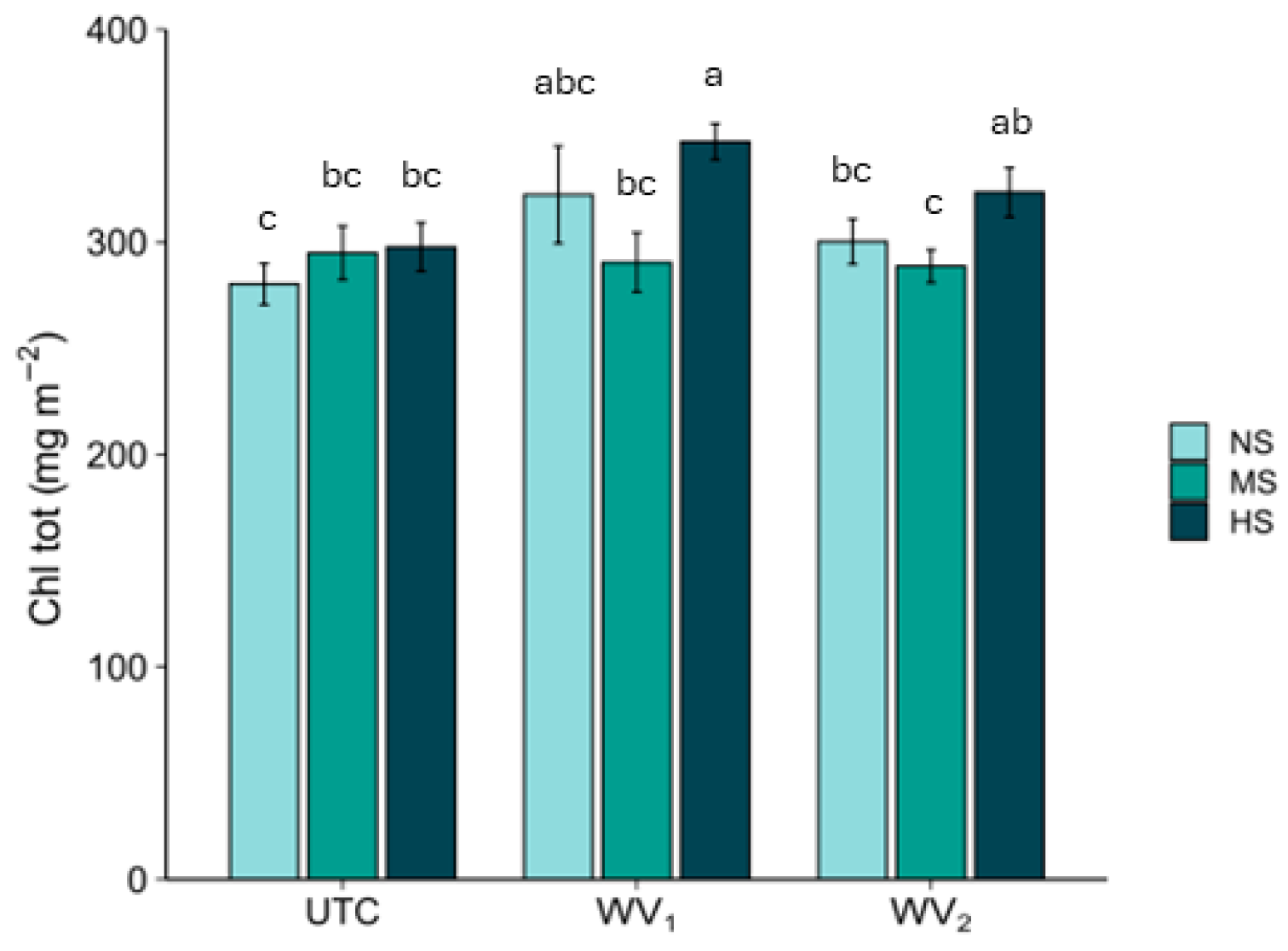
Chlorophyll content showed no statistically significant variation among the treatments, with the only exception in HS, in which WV1 showed a significant increase (+8%) compared with UTC (Figure 2 and Figure 3).
Several studies reported an increase in chlorophyll content due to the application of WV, in both foliar and fertirrigation methods. For example, Hur et al. [36] and Mohd Amnan et al. [37] reported a significant increase in chlorophyll content in Oryza sativa L. and Pandanus amaryllifolius Roxb., respectively, following foliar applications of WV. Similarly, Abdel-Sattar et al. [38] and Afsharipour et al. [39] observed increases in Anthracothorax mango L. and Cucumis sativus L. when WV was applied through fertigation. The lack of variation in chlorophyll content in our research was consistent with the results reported by Fedeli et al. [19] in which the first applications of WV determined a reduction in the key photosynthetic parameters (i.e., Fv/Fm and PIabs), followed by a progressive recovery. After several applications, both parameters returned to control values, indicating an absence of structural damage to the PSII [19]. Since Fv/Fm and PIabs are common indicators in the photosynthetic efficiency [40,41,42], these results highlight once again that WV impacts the plants positively, without inducing distress. This perspective was also coherent with previous studies showing that WV raises the antioxidant content in plants (leaves, roots and fruits; [43,44,45,46,47]). These effects are a clear indication of an eustress effect that contributes to maintaining the integrity of the PSII functionality and also reflects an enhancement in growth, yield, and nutritional parameters of the plants.

2.3. Nutrient Balance Ratios

Under NS conditions, WV1 showed a significant reduction (−17%) in K/Ca; at MS conditions, both WV treatments showed a significant reduction in K/Ca (WV1: −16%; WV2: −18%); under HS conditions, no significant differences were observed among the treatment K/Ca. No statistically significant differences were reported in Fe/Mn ratio in any condition (Table 2, Figure 2).
The nutritional ratios investigated (i.e., K/Ca and Fe/Mn) are widely used for the evaluation of ionic balance and nutrient homeostasis in plants [48,49,50]. Fe/Mn is an indicator of micronutrient homeostasis, since a reduction in this ratio reflects the limited availability of Fe or a relative increase in Mn content, with negative effects on the plant’s photosynthetic systems [51,52]. Differently, K/Ca is an indicator of cation balance, as a decrease in this ratio reflects a prevalence of Ca over K, suggesting an enhancement of structural stability of cell walls but a reduced osmotic capacity, potentially affecting stomatal regulation and gas-exchange efficiency under stress [53,54]. Since these ratios generally reflect the ability of plants to maintain a stable ionic balance under stressful conditions, they allow the interpretation of the type of stress to which plants are subjected, eustress or distress [55,56,57]. The Fe/Mn showed a slight but not significant decrease in both UTC and WV-treated plants across the levels of the water stress (NSMSHS; Table 2), indicating that the micronutrient homeostasis was maintained, avoiding any negative effects on the PSII. This stability, observed also in WV-treated plants, suggests that WV did not disrupt Fe-Mn balance but rather supported its preservation under increasing stress conditions, consistent with a controlled eustress response. The K/Ca reduction observed in NS (WV1) and MS conditions (WV1 and WV2) suggests that the WV favored Ca accumulation, indicating a controlled physiological reorganization typical of a eustress response.
This pattern shows that WV helps the plants to regulate their cation balance as long as the stress remains within an acceptable range. Contrary, at HS, the absence of variation in WV-treated plants indicates that the WV was no longer able to regulate the stress, pointing to the onset of distress. This evidence was supported by the observed results in gas exchange parameters: together with the reduction in A and gsw, Ci increased in HS, highlighting a phenomenon typical of the onset of distress [32,58]. Moreover, the stability of chlorophyll is coherent with this general overview, since in the early stages of the distress, functional alterations are mainly observed before structural changes, such as pigment degradation [59,60,61,62].

3. Materials and Methods

3.1. Wood Vinegar Characteristics

The WV used in this study was provided by Bio-Esperia S.r.l. (Arezzo, Italy) [63]. It was obtained through the pyrolysis (650 °C) of five different woody materials (Castanea sativa Mill., Robinia pseudoacacia L., Fraxinus L., Alnus glutinosa (L.) Gaertn., and Quercus robur L.). The chemical characteristics of this WV are reported in Table 3.

3.2. Experimental Design

The experiment was conducted from April to July 2025 in a climate-controlled chamber (23 ± 1 °C; 70 ± 5% RH; 350 mmol m−2 s−1 PAR; 16/8 h day/night) on strawberry plants (Fragaria × ananassa, cv ANIA) at the vegetative stage, purchased from a local nursery (Castiglion Fiorentino, Arezzo, Tuscany, Italy). The cultivar used does not present documented drought- or disease-resistance traits and was therefore selected as a representative commercial genotype to evaluate physiological responses to water deficit and biostimulant application. The plants (n = 72) were grown individually in plastic pots (10 × 10 × 10 cm) filled with commercial growing medium (Vigor Plant Srl, Italy; the physicochemical characteristics are reported in Celletti et al. [65]). Once in the laboratory, the plants were subjected to three different WV treatments: (i) plants grown without the addition of WV (UTC, control plants); (ii) plants fertigated with WV at 0.5% (v/v) (WV1); and (iii) plants foliar sprayed with WV at 0.2% (v/v) (WV2).
Each treatment was further divided into three water-deficit stress levels applying different water holding capacity (WHC): (i) no stress (NS, plants grown with 70% WHC); (ii) moderate stress (MS, plants grown with 50% WHC); (iii) high stress (HS, plants grown with 30% WHC).
Soil moisture was kept at the target water-deficit stress level for the entire experiment period (3 months) by measuring the weight of each pot daily and adding water only as needed to reach the corresponding WHC for each treatment. WV was applied once a week for a total of twelve applications.

3.3. Gas Exchange Parameters

Before the harvest of the plants, leaf gas exchange parameters were measured on fully expanded leaves using a LI-6800 Portable Photosynthesis System (Li-Cor 6800; Li-Cor Inc., Lincoln, NE, USA [66]). For each treatment, eight plants were evaluated, with one measurement taken per plant (n = 72). All measurements were conducted between 11:00 and 14:00. Inside the leaf chamber, CO2 was maintained at 400 μmol mol−1, and airflow was set to 600 μmol s−1. Data acquisition was performed once steady-state gas exchange was reached, after CO2 and H2O fluxes became constant. Data on net CO2 assimilation rate (A; expressed as µmol m−2 s−1), intercellular CO2 (Ci; expressed as µmol mol−1), stomatal conductance (gsw; expressed as mol m−2 s−1), and transpiration rate (E; expressed as µmol m− 2 s− 1) were collected. Based on the value acquired and according to Rico et al. [67], the intrinsic water-use efficiency (WUE), expressed as the ratio between A/gsw (µmol CO2 mol−1 H2O), was calculated.

3.4. Chlorophyll Content

The total chlorophyll content (Chl tot; expressed as mg m−2) was measured on fully expanded leaves using a portable, non-invasive chlorophyll content meter (CCM-300, Opti-Sciences Inc., Hudson, NH, USA [68]). For each leaf, three readings were taken, avoiding the main leaf nerves [64].

3.5. Nutrient Balance Ratios

The content of potassium (K), calcium (Ca), iron (Fe), and manganese (Mn) was quantified using a portable X-ray fluorescence analyzer (Olympus, Waltham, MA, USA [69,70,71]). At the end of the experiment, the leaves were oven dried (70 °C for 56 h; Perez-Harguindeguy et al. [72]) and ground with a professional mixer (IKA A10, IKA‑Werke GmbH & Co. KG, Staufen im Breisgau, Germany) to obtain a pulverized material. Subsequently, ca. 1 g of powder was inserted in the instrument compartment for the determination of the elements. The accuracy of the measurements was estimated following the calibration reported in Fedeli et al. [73]. The K/Ca and Fe/Mn nutrient balance ratios were calculated as indicators of the plant’s capacity to preserve ionic homeostasis and discriminate between eustress and distress conditions.

3.6. Statistical Analysis

A permutational analysis of variance (PERMANOVA) was performed to assess the effect of wood vinegar and water stress. When the PERMANOVA indicated a significant (p < 0.05) result, a pairwise permutation t-test (p < 0.05) was applied for post hoc comparisons. RStudio was used to run all the statistical analyses [74]. A heatmap was generated to visualize the multivariate response patterns across treatments relative to their respective controls. Data handling and preprocessing were performed in RStudio version 2026.01.0+392 using the tidyverse package suite. The heatmap was generated with the pheatmap and RColorBrewer packages, which allowed standardized scaling of variables and the application of a continuous red–yellow–green color gradient reflecting decreasing to increasing values relative to the control (NS). The data matrix was row-centered to improve comparability among traits, and clustering was disabled in order to preserve the experimental treatment order. All other figures were generated using ggplot2, with graphical enhancements supported by the scales, cowplot, and ggpubr packages to improve readability, consistency.

4. Conclusions and Future Directions

This study showed that wood vinegar (WV), applied via fertigation or foliar spray, elicits a coherent suite of physiological and biochemical adjustments in strawberry plants, consistent with a eustress-driven mechanism of action. Under no-stress and moderate water-deficit conditions, WV reduced gas exchange while increasing WUE, without affecting chlorophyll content or micronutrient homeostasis, indicating a controlled optimization of water use rather than photosynthetic impairment. Nutrient balance ratios further confirmed regulated ionic adjustments characteristic of beneficial low-level stress. Only under high water deficit did WV lose its regulatory capacity, showing early signs of distress, although without structural damage to the photosynthetic apparatus.
These results should be interpreted considering this study’s limitations, including the use of a single species and cultivar and the focus on short-term physiological indicators. Accordingly, the proposed mechanism is inferred rather than directly demonstrated.
Future studies integrating multi-cultivar trials, long-term agronomic outcomes, and molecular or hormonal analyses are needed to further validate the eustress hypothesis.

Author Contributions

Conceptualization, S.D., R.F. and S.L.; methodology, R.F.; software, S.D., L.G. and R.F.; formal analysis, S.D., L.G. and R.F.; investigation, S.D.; resources, S.L.; data curation, S.D., L.G. and R.F.; writing—original draft preparation, S.D., L.G. and R.F.; writing—review and editing, S.D., L.G., R.F. and S.L.; visualization, S.D., L.G. and R.F.; supervision, R.F. and S.L.; project administration, S.L.; funding acquisition, S.L. All authors have read and agreed to the published version of the manuscript.

Funding

This research was funded within the project funded under the National Recovery and Resilience Plan (NRRP), Mission 4 Component 2 Investment 1.4—Call for tender No. 3138 of 16 December 2021, rectified by Decree n.3175 of 18 December 2021 of the Italian Ministry of University and Research, funded by the European Union—NextGenerationEU. Project code CN_00000033, Concession Decree No. 1034 of 17 June 2022 adopted by the Italian Ministry of University and Research, CUP B63C22000650007, Project title “National Biodiversity Future Center—NBFC”.

Data Availability Statement

Data are available upon reasonable request from the corresponding author. The data are not publicly available due to privacy and ethical restrictions.

Acknowledgments

The authors thank Francesco Barbagli (BioEsperia, BioDea) for kindly providing the wood vinegar used in this study.

Conflicts of Interest

The authors declare no conflicts of interest.

References

  1. Grewal, A.; Abbey, L.; Gunupuru, L.R. Production, prospects and potential application of pyroligneous acid in agriculture. J. Anal. Appl. Pyrolysis 2018, 135, 152–159. [Google Scholar] [CrossRef]
  2. Aguirre, J.L.; Baena, J.; Martín, M.T.; Nozal, L.; González, S.; Manjón, J.L.; Peinado, M. Composition, ageing and herbicidal properties of wood vinegar obtained through fast biomass pyrolysis. Energies 2020, 13, 2418. [Google Scholar] [CrossRef]
  3. Iacomino, G.; Idbella, M.; Staropoli, A.; Nanni, B.; Bertoli, T.; Vinale, F.; Bonanomi, G. Exploring the potential of wood vinegar: Chemical composition and biological effects on crops and pests. Agronomy 2024, 14, 114. [Google Scholar] [CrossRef]
  4. Wei, Q.; Ma, X.; Dong, J. Preparation, chemical constituents and antimicrobial activity of pyroligneous acids from walnut tree branches. J. Anal. Appl. Pyrolysis 2010, 87, 24–28. [Google Scholar] [CrossRef]
  5. Zhu, K.; Gu, S.; Liu, J.; Luo, T.; Khan, Z.; Zhang, K.; Hu, L. Wood vinegar as a complex growth regulator for rapeseed. Agronomy 2021, 11, 510. [Google Scholar] [CrossRef]
  6. Maresca, V.; Fedeli, R.; Vannini, A.; Munzi, S.; Corrêa, A.; Cruz, C.; Loppi, S. Wood distillate enhances seed germination. Appl. Sci. 2024, 14, 631. [Google Scholar] [CrossRef]
  7. Mungkunkamchao, T.; Kesmala, T.; Pimratch, S.; Toomsan, B.; Jothityangkoon, D. Wood vinegar and fermented bioextracts enhance growth and yield of tomato. Sci. Hortic. 2013, 154, 66–72. [Google Scholar]
  8. Benzon, H.R.L.; Lee, S.C. Potential of wood vinegar in enhancing fruit yield and antioxidant capacity in tomato. Korean J. Plant Resour. 2016, 29, 704–711. [Google Scholar] [CrossRef]
  9. Fedeli, R.; Dichiara, M.; Carullo, G.; Tudino, V.; Gemma, S.; Butini, S.; Campiani, G.; Loppi, S. Unlocking the potential of biostimulants in sustainable agriculture: Effect of wood distillate on the nutritional profiling of apples. Heliyon 2024, 10, e37599. [Google Scholar] [CrossRef]
  10. Ofoe, R.; Mousavi, S.M.N.; Thomas, R.H.; Abbey, L. Foliar application of pyroligneous acid synergizes with fertilizer in tomato. Sci. Rep. 2024, 14, 1934. [Google Scholar] [CrossRef]
  11. European Commission. European Green Deal. Available online: https://commission.europa.eu/strategy-and-policy/priorities-2019-2024/european-green-deal_en (accessed on 14 August 2025).
  12. European Commission. Farm to Fork. Available online: https://food.ec.europa.eu/horizontal-topics/farm-fork-strategy_en (accessed on 14 August 2025).
  13. Scopus Data. Available online: https://www.scopus.com/ (accessed on 19 November 2025).
  14. Luo, X.; Wang, Z.; Meki, K.; Wang, X.; Liu, B.; Zheng, H.; You, X.; Li, F. Effect of co-application of wood vinegar and biochar on seed germination and seedling growth. J. Soils Sediments 2019, 19, 3934–3944. [Google Scholar] [CrossRef]
  15. Mirsoleimani, A.; Najafi-Ghiri, M.; Boostani, H.R.; Heydari, H. Effect of wood vinegar on vegetative growth and nutrient uptake in two citrus rootstocks. J. Hortic. Postharvest Res. 2024, 7, 301–316. [Google Scholar]
  16. De Guzman, R.S.; Dadural, M.I.Y. Seed germination and seedling growth of mango as affected by different concentrations of wood vinegar. Galaxy Int. Interdiscip. Res. J. 2021, 9, 49–60. [Google Scholar]
  17. Theapparat, Y.; Chandumpai, A.; Faroongsarng, D. Physicochemistry and utilization of wood vinegar from tropical biomass. In Tropical Forests; Springer: Cham, Switzerland, 2018; pp. 163–183. [Google Scholar]
  18. Fedeli, R.; Cruz, C.; Loppi, S.; Munzi, S. Hormetic effect of wood distillate on hydroponically grown lettuce. Plants 2024, 13, 447. [Google Scholar] [CrossRef]
  19. Fedeli, R.; Loppi, S.; Cruz, C.; Munzi, S. Evaluating seawater and wood distillate for sustainable hydroponic cultivation: Implications for crop growth and nutritional quality. Sustainability 2024, 16, 7186. [Google Scholar] [CrossRef]
  20. Fedeli, R.; Marotta, L.; Frattaruolo, L.; Panti, A.; Carullo, G.; Fusi, F.; Saponara, S.; Gemma, S.; Butini, S.; Cappello, A.R.; et al. Nutritionally enriched tomatoes (Solanum lycopersicum L.) grown with wood distillate: Chemical and biological characterization. J. Food Sci. 2023, 88, 5324–5338. [Google Scholar] [CrossRef]
  21. Bienertova-Vasku, J.; Lenart, P.; Scheringer, M. Eustress and distress: Neither good nor bad, but rather the same? BioEssays 2020, 42, 1900238. [Google Scholar] [CrossRef]
  22. Kupriyanov, R.; Zhdanov, R. The eustress concept: Problems and outlooks. World J. Med. Sci. 2014, 11, 179–185. [Google Scholar]
  23. Lichtenthaler, H.K. The stress concept in plants: An introduction. Ann. N. Y. Acad. Sci. 1998, 851, 187–198. [Google Scholar] [CrossRef]
  24. Zhuang, D.; Li, H.B.; Wang, Y.; Zhou, D.; Zhao, L. Nanoparticle-elicited eustress intensifies cucumber adaptation to water deficit. Environ. Sci. Technol. 2025, 59, 3613–3623. [Google Scholar] [CrossRef] [PubMed]
  25. Caicedo-Lopez, L.H.; Guevara-Gonzalez, R.G.; Ramirez-Jimenez, A.K.; Feregrino-Perez, A.A.; Contreras-Medina, L.M. Eustress application through elicitation for capsaicinoids enhancement: A review. Phytochem. Rev. 2022, 21, 1941–1968. [Google Scholar] [CrossRef]
  26. El-Nakhel, C.; Pannico, A.; Kyriacou, M.C.; Giordano, M.; De Pascale, S.; Rouphael, Y. Macronutrient deprivation eustress elicits secondary metabolites in lettuce. J. Sci. Food Agric. 2019, 99, 6962–6972. [Google Scholar] [CrossRef]
  27. Noel, R.; Schueller, M.J.; Ferrieri, R.A. Radiocarbon flux measurements reveal why pyroligneous acid stimulates plant growth. Int. J. Mol. Sci. 2024, 25, 4207. [Google Scholar] [CrossRef]
  28. He, Z.; Zhang, P.; Jia, H.; Zhang, S.; Nishawy, E.; Sun, X.; Dai, M. Regulatory mechanisms and breeding strategies for crop drought resistance. New Crops 2024, 1, 100029. [Google Scholar] [CrossRef]
  29. Franco-Navarro, J.D.; Padilla, Y.G.; Álvarez, S.; Calatayud, Á.; Colmenero-Flores, J.M.; Gómez-Bellot, M.J.; Hernández, J.A.; Martínez-Alcalá, I.; Penella, C.; Pérez-Pérez, J.G.; et al. Advancements in water-saving strategies and crop adaptation to drought: A comprehensive review. Physiol. Plant. 2025, 177, e70332. [Google Scholar] [CrossRef] [PubMed]
  30. Chaves, M.M.; Oliveira, M.M. Mechanisms underlying plant resilience to water deficits: Prospects for water-saving agriculture. J. Exp. Bot. 2004, 55, 2365–2384. [Google Scholar] [CrossRef] [PubMed]
  31. Baker, N.R. Chlorophyll fluorescence: A probe of photosynthesis in vivo. Annu. Rev. Plant Biol. 2008, 59, 89–113. [Google Scholar] [CrossRef]
  32. Flexas, J.; Medrano, H. Drought-inhibition of photosynthesis in C3 plants: Stomatal and non-stomatal limitations revisited. Ann. Bot. 2002, 89, 183–189. [Google Scholar] [CrossRef]
  33. Chaves, M.M.; Flexas, J.; Pinheiro, C. Photosynthesis under drought and salt stress: Regulation mechanisms from whole plant to cell. Ann. Bot. 2009, 103, 551–560. [Google Scholar] [CrossRef]
  34. Ma, Y.; Yuan, Z.; Wei, Z.; Yan, F.; Liu, X.; Li, X.; Hou, J.; Hao, Z.; Liu, F. Stomatal and non-stomatal regulations of photosynthesis in response to salinity, and K and Ca fertigation in cotton (Gossypium hirsutum L cv.). Environ. Exp. Bot. 2025, 230, 106092. [Google Scholar] [CrossRef]
  35. Salmon, Y.; Lintunen, A.; Dayet, A.; Chan, T.; Dewar, R.; Vesala, T.; Hölttä, T. Leaf carbon and water status control photosynthetic limitations. New Phytol. 2020, 226, 690–703. [Google Scholar] [CrossRef]
  36. Hur, G.; Ashraf, M.; Nadeem, M.Y.; Rehman, R.S.; Thwin, H.M.; Shakoor, K.; Seleiman, M.F.; Alotaibi, M.; Yuan, B.-Z. Exogenous application of wood vinegar improves rice yield and quality by elevating photosynthetic efficiency. Plant Physiol. Biochem. 2025, 218, 109306. [Google Scholar]
  37. Mohd Amnan, M.A.; Teo, W.F.A.; Aizat, W.M.; Khaidizar, F.D.; Tan, B.C. Foliar application of oil palm wood vinegar enhances Pandanus amaryllifolius tolerance under drought stress. Plants 2023, 12, 785. [Google Scholar] [CrossRef]
  38. Abdel-Sattar, M.; Mostafa, L.Y.; Rihan, H.Z. Enhancing mango productivity with wood vinegar, humic acid, and seaweed extract applications as an environmentally friendly strategy. Sustainability 2024, 16, 8986. [Google Scholar] [CrossRef]
  39. Afsharipour, S.; Seyedi, A.; Dastjerdi, A.M. Salinity tolerance in Cucumis sativus seedlings: The role of pistachio wood vinegar on the improvement of biochemical parameters and seedlings vigor. BMC Plant Biol. 2025, 25, 224. [Google Scholar] [CrossRef] [PubMed]
  40. Rapacz, M.; Wójcik-Jagła, M.; Fiust, A.; Kalaji, H.M.; Kościelniak, J. Genome-wide associations of chlorophyll fluorescence OJIP parameters in barley. Front. Plant Sci. 2019, 10, 78. [Google Scholar] [CrossRef] [PubMed]
  41. Oxborough, K.; Baker, N.R. Resolving chlorophyll a fluorescence images of photosynthetic efficiency. Photosynth. Res. 1997, 54, 135–142. [Google Scholar] [CrossRef]
  42. Lootens, P.; Van Waes, J.; Carlier, L. Effect of a short photoinhibition stress on photosynthesis. Photosynthetica 2004, 42, 187–192. [Google Scholar] [CrossRef]
  43. Zhou, H.; Fu, K.; Shen, Y.; Li, R.; Su, Y.; Deng, Y.; Xia, Y.; Zhang, N. Wood vinegar-induced stress response against tomato Fusarium wilt. Plants 2024, 13, 157. [Google Scholar] [CrossRef]
  44. Ye, Y.; Sun, H.; Wang, Y.; Xu, Z.; Han, S.; He, G.; Yin, K.; Zhang, H. Wood vinegar alleviates photosynthetic inhibition under Pseudomonas syringae infection. J. Plant Interact. 2022, 17, 801–811. [Google Scholar] [CrossRef]
  45. Zhang, T.; Li, Y.; Tang, Y.; Ding, Y.; Rui, Y. Mechanisms of wood vinegar alleviating salt stress in wheat. Agronomy 2025, 15, 2078. [Google Scholar]
  46. Junlin, Z.; Guangjie, Z.; Yi, T.; Wenli, L.; Chang, Y.; Yanan, X.; Deshun, X.; Guang, C.; Chumney, X.; Danying, W. Wood vinegar enhances the survival rate of rice seeds under flooding stress. Rice Sci. 2025. [Google Scholar] [CrossRef]
  47. Fedeli, R.; Vannini, A.; Grattacaso, M.; Loppi, S. Wood distillate (pyroligneous acid) boosts nutritional traits of potato tubers. Ann. Appl. Biol. 2023, 183, 135–140. [Google Scholar] [CrossRef]
  48. Nestby, R.; Lieten, F.; Pivot, D.; Lacroix, C.R.; Tagliavini, M. Influence of mineral nutrients on strawberry fruit quality. Int. J. Fruit Sci. 2005, 5, 139–156. [Google Scholar] [CrossRef]
  49. Kabata-Pendias, A. Trace Elements in Soils and Plants; CRC Press: Boca Raton, FL, USA, 2000. [Google Scholar]
  50. Khan, M.I.R.; Nazir, F.; Maheshwari, C.; Chopra, P.; Chhillar, H.; Sreenivasulu, N. Mineral nutrients in plants under changing environments. Plant Genome 2023, 16, e20362. [Google Scholar] [CrossRef]
  51. Gerretsen, F.C. Manganese in relation to photosynthesis: I carbon dioxide assimilation and manganese deficiency symptoms of oats. Plant Soil. 1949, 1, 346–358. [Google Scholar] [CrossRef]
  52. Somers, I.I.; Shive, J.W. The iron–manganese relation in plant metabolism. Plant Physiol. 1942, 17, 582. [Google Scholar] [CrossRef]
  53. Marschner, H. Marschner’s Mineral Nutrition of Higher Plants; Academic Press: London, UK, 2011. [Google Scholar]
  54. Mengel, K.; Kirkby, E.A. Principles of Plant Nutrition; Springer: Dordrecht, The Netherlands, 2012. [Google Scholar]
  55. Osmolovskaya, N.; Shumilina, J.; Bureiko, K.; Chantseva, V.; Bilova, T.; Kuchaeva, L.; Laman, N.; Wessjohann, L.A.; Frolov, A. Ion homeostasis response to nutrient-deficiency stress in plants. In Cell Growth; Intechopen: London, UK, 2019; Volume 61. [Google Scholar]
  56. Qu, R.; Han, G. Effects of high Ca and Mg stress on plant water-use efficiency. PeerJ 2022, 10, e13925. [Google Scholar] [CrossRef]
  57. Xu, C.; Yang, H.; Huang, C.; Lan, M.; Zou, Z.; Zhang, F.; Zhang, L. Interaction mechanism of Fe, Mg and Mn in karst soil–mango system. Land 2023, 12, 256. [Google Scholar] [CrossRef]
  58. Farquhar, G.D.; Sharkey, T.D. Stomatal conductance and photosynthesis. Annu. Rev. Plant Physiol. 1982, 33, 317–345. [Google Scholar] [CrossRef]
  59. Akley, E.K.; Ampim, P.A.; Obeng, E.; Sanyare, S.; Yevu, M.; Owusu Danquah, E.; Amoako, O.A.; Tengey, T.K.; Avedzi, J.K.; Avornyo, V.K.; et al. Wood vinegar promotes soil health and the productivity of cowpea. Agronomy 2023, 13, 2497. [Google Scholar] [CrossRef]
  60. Krasensky, J.; Jonak, C. Drought, salt, and temperature stress-induced metabolic rearrangements. J. Exp. Bot. 2012, 63, 1593–1608. [Google Scholar] [CrossRef]
  61. Mittler, R. Abiotic stress, the field environment and stress combination. Trends Plant Sci. 2006, 11, 15–19. [Google Scholar] [CrossRef]
  62. Villagómez-Aranda, A.L.; Feregrino-Pérez, A.A.; García-Ortega, L.F.; González-Chavira, M.M.; Torres-Pacheco, I.; Guevara-González, R.G. Activating stress memory: Eustressors in plant breeding. Plant Cell Rep. 2022, 41, 1481–1498. [Google Scholar] [CrossRef]
  63. BioDea. 2025. Available online: https://biodea.bio/prodotto/distillato-di-legno-bio/ (accessed on 14 October 2025).
  64. Fedeli, R.; Celletti, S.; Loppi, S. Wood distillate promotes the tolerance of lettuce in extreme salt stress conditions. Plants 2024, 13, 1335. [Google Scholar] [CrossRef]
  65. Celletti, S.; Fedeli, R.; Ghorbani, M.; Aseka, J.M.; Loppi, S. Exploring sustainable alternatives: Wood distillate alleviates the impact of bioplastic in basil plants. Sci. Total Environ. 2023, 900, 166484. [Google Scholar] [CrossRef]
  66. Licor 2025; LI-6800 Portable Photosynthesis System Instruction Manual. Version 3, 2019. Available online: https://www.licor.com/products/photosynthesis/LI-6800 (accessed on 24 September 2025).
  67. Rico, E.I.; de la Fuente, G.C.M.; Morillas, A.O.; Ocaña, A.M.F. Drought tolerance in 14 olive cultivars. Photosynth. Res. 2024, 159, 1–16. [Google Scholar] [CrossRef]
  68. Opti-Sciences. CCM-300 Chlorophyll Content Meter. Opti-Sciences Inc.: Hudson, NH, USA, 2025. Available online: https://opti-sciences.com/products/content-meters/ccm-300/ (accessed on 23 September 2025).
  69. Olympus. Olympus Corporation. (s.d.). X-Ray Fluorescence Analyzer. Olympus Corporation: Waltham, MA, USA, 2025. Available online: https://www.olympus-europa.com/company/country-home/ (accessed on 24 September 2025).
  70. Et-Tazy, L.; Fedeli, R.; Khibech, O.; Lamiri, A.; Challioui, A.; Loppi, S. Effects of monoterpene-based biostimulants on chickpea (Cicer arietinum L.) plants: Functional and molecular insights. Biology 2025, 14, 657. [Google Scholar] [CrossRef] [PubMed]
  71. Fedeli, R.; Zhatkanbayeva, Z.; Loppi, S. Wood distillate as a solution for growing crops under water deficiency. Crops 2025, 5, 22. [Google Scholar] [CrossRef]
  72. Perez-Harguindeguy, N.; Diaz, S.; Garnier, E.; Lavorel, S.; Poorter, H.; Jaureguiberry, P.; Cornelissen, J.H.C. Corrigendum: New handbook for standardised measurement of plant functional traits worldwide. Aust. J. Bot. 2016, 64, 715–716. [Google Scholar] [CrossRef]
  73. Fedeli, R.; Di Lella, L.A.; Loppi, S. Suitability of XRF for routine analysis of multi-elemental composition: A multi-standard verification. Methods Protoc. 2024, 7, 53. [Google Scholar] [CrossRef]
  74. R Core Team. R: A Language and Environment for Statistical Computing; R Foundation for Statistical Computing: Vienna, Austria, 2025; Available online: https://www.R-project.org/ (accessed on 12 October 2025).
Figure 1. Leaf gas exchange parameters (mean ± standard error): (A) net CO2 assimilation rate (A), (B) stomatal conductance (gsw), (C) transpiration rate (E), (D) intercellular CO2 concentration (Ci), (E) intrinsic water-use efficiency (WUE), UTC = plants untreated, WV1 = plants fertigated with wood vinegar at 0.5% (v/v), and WV2 = plants foliar sprayed with wood vinegar at 0.2% (v/v). NS = no stress, MS = moderate stress, and HS = high stress. Different letters indicate statistically significant (p < 0.05) differences between treatments.
Plants 15 00262 g001
Figure 2. Heatmap showing the change in gas exchange parameters (A, gsw, E, Ci, WUE), chlorophyll content (Chl tot), and nutrient balance ratios (Fe/Mn and K/Ca) under different water stress treatments alone (MS and HS) and in combination with wood vinegar (WV) in both fertigation (WV1) and foliar spray application (WV2) expressed as ratio respect to the control (NS). Green shades indicate an increase, while red shades represent a decrease compared to NS. The intensity of the color reflects the magnitude of the variation.
Plants 15 00262 g002
Figure 3. Total chlorophyll content (Chl tot) (mean ± standard error). UTC = plants untreated; WV1 = plants fertigated with wood vinegar at 0.5% (v/v); and WV2 = plants foliar sprayed with wood vinegar at 0.2% (v/v). NS = no stress, MS = moderate stress, and HS = high stress. Different letters indicate statistically significant (p < 0.05) differences between treatments.
Plants 15 00262 g003
Table 1. Results of PERMANOVA analysis on transpiration rate (E), net CO2 assimilation rate (A), intercellular CO2 concentration (Ci), stomatal conductance (gsw), intrinsic water-use efficiency (WUE), total chlorophyll content (Chl tot), and nutrient balance ratios (Fe/Mn and K/Ca). Water–deficit stress levels (WS) and wood vinegar (WV). df: degree of freedom; SS: sum of square; R2: coefficient of determination; and F-value: ratio of explained to unexplained variance. * = p < 0.05; ** = p < 0.01; *** = p < 0.001.
E A
 dfSSR2F-valueSSR2F-value
WS20.650.084.96 **0.290.052.61
WV22.210.2817.0 ***1.670.2915.1 ***
WS × WV40.930.123.56 **0.280.051.29
Residual634.110.52 3.480.61 
Total717.91.00 5.731.00 
  Ci  gsw 
dfSSR2F-valueSSR2F-value
WS20.040.136.95 **0.720.084.91 **
WV20.020.052.772.340.2716.1 ***
WS × WV40.080.256.96 ***1.120.133.85 **
Residual630.190.57 4.600.52 
Total710.331.00 8.781.00 
  WUE  Chl tot 
dfSSR2F-valueSSR2F-value
WS20.310.15.60 **0.030.114.82 *
WV20.310.15.53 **0.020.083.41 *
WS × WV40.620.215.50 ***0.020.061.25
Residual631.760.59 0.220.75 
Total713.001.00 0.291.00 
 Fe/MnK/Ca
dfSSR2F-valueSSR2F-value
WS20.080.093.52 *0.100.125.14 **
WV20.100.104.15 *0.020.020.97
WS × WV40.050.051.110.090.112.34
Residual630.730.76 0.630.74 
Total710.961.00 0.851.00 
Table 2. Nutrient balance ratios (Fe/MnK/Ca) expressed as mean ± standard error. UTC = plants untreated; WV1 = plants fertigated with wood vinegar at 0.5% (v/v); WV2 = plants foliar sprayed with wood vinegar at 0.2% (v/v). NS = no drought stress, MS = mild drought stress, and HS = high drought stress. Different letters indicate statistically significant (p < 0.05) differences between treatments.
Treatment Water Stress LevelFe/MnK/Ca
UTCNS0.34 ± 0.03 ab1.01 ± 0.09 abc
MS0.34 ± 0.02 a1.08 ± 0.04 a
HS0.26 ± 0.02 c0.77 ± 0.07 c
WV1NS0.27 ± 0.03 abc0.84 ± 0.04 bc
MS0.29 ± 0.02 abc0.91 ± 0.05 bc
HS0.27 ± 0.02 bc0.85 ± 0.06 bc
WV2NS0.36 ± 0.03 a1.09 ± 0.12 ab
MS0.34 ± 0.03 ab0.89 ± 0.06 bc
HS0.30 ± 0.01 abc0.82 ± 0.03 c
Table 3. Main chemical characteristics of the wood distillate (Fedeli et al. [64]).
ParameterValueMethod
TOC (% DW) 58.03CHNS Elemental Analysis
TN (% DW) 1.06CHNS Elemental Analysis
H (% DW) 7.27CHNS Elemental Analysis
S (% DW) 0.07CHNS Elemental Analysis
pH 4.00UNI EN ISO 10523:2012
Density (g mL−1) 1.05 
Flash point (°C)>60ASTM D6450-16°
Total organic compounds (g L−1) 33.8 
Acidity (mg L−1) 1289.0APAT CNR IRSA 2010 B Man 29 2003
Organic acids (mg L−1) 32.3 
Acetic acid (mg L−1) 21.5 
Polyphenols (g L−1) 24.5 
Phenols (g L−1) 3.00 
PCBs (mg L−1)<0.2CNR IRSA 24b Q 64 Vol 3 1988
Hydrocarbons C < 12 (mg L−1)<0.1EPA 5021A 2014 + EPA 8015D 2003
Hydrocarbons C10–C40 (mg L−1)<0.1UNI EN ISO 9377-2:2002
16 US-EPA PAHs (mg L−1) EPA 3550C 2007 + EPA 8310 1986
Acenaphthene<0.05 
Acenaphthylene<0.05 
Anthracene<0.05 
Benzo[a]anthracene<0.05 
Benzo[a]pyrene<0.05 
Benzo[b]fluoranthene<0.05 
Benzo[g,h,i]perylene<0.05 
Benzo[k]fluoranthene<0.05 
Chrysene<0.05 
Dibenz[a,h]anthracene<0.05 
Fluoranthene<0.05 
Fluorene<0.05 
Indeno[1,2,3-cd]pyrene<0.05 
Naphthalene<0.05 
Phenanthrene<0.05 
Pyrene<0.05 
Macronutrients (mg L −1) Alkaline melting + ICP-MS analysis
Ca 325.50 
K 23.49 
Mg 6.79 
P 7.28 
Micronutrients (mg L −1) Alkaline melting + ICP-MS analysis
Cu 0.18 
Fe 21.16 
Mn 0.58 
Mo 0.0007 
Zn 3.22 
Other nutrients Alkaline melting + ICP-MS analysis
Al 1.96 
Ba 0.06 
Cr 0.03 
Na 103.59 
TOC: total organic carbon. TN: total nitrogen. PCBs: polychlorinated biphenyls. 16 US-EPA PAHs: list of 16 priority polycyclic aromatic hydrocarbons as classified by the United States Environmental Protection Agency. Al: aluminum; Ba: barium; C: carbon; Ca: calcium; Cr: chromium; Cu: copper; Fe: iron; K: potassium; Mg: magnesium; Mn: manganese; Mo: molybdenum; N: nitrogen; Na: sodium; and Zn: zinc.
Disclaimer/Publisher’s Note: The statements, opinions and data contained in all publications are solely those of the individual author(s) and contributor(s) and not of MDPI and/or the editor(s). MDPI and/or the editor(s) disclaim responsibility for any injury to people or property resulting from any ideas, methods, instructions or products referred to in the content.