Experimental Florivory Influences Reproductive Success in the Field Bindweed (Convolvulus arvensis)



Abstract
1. Introduction
2. Results
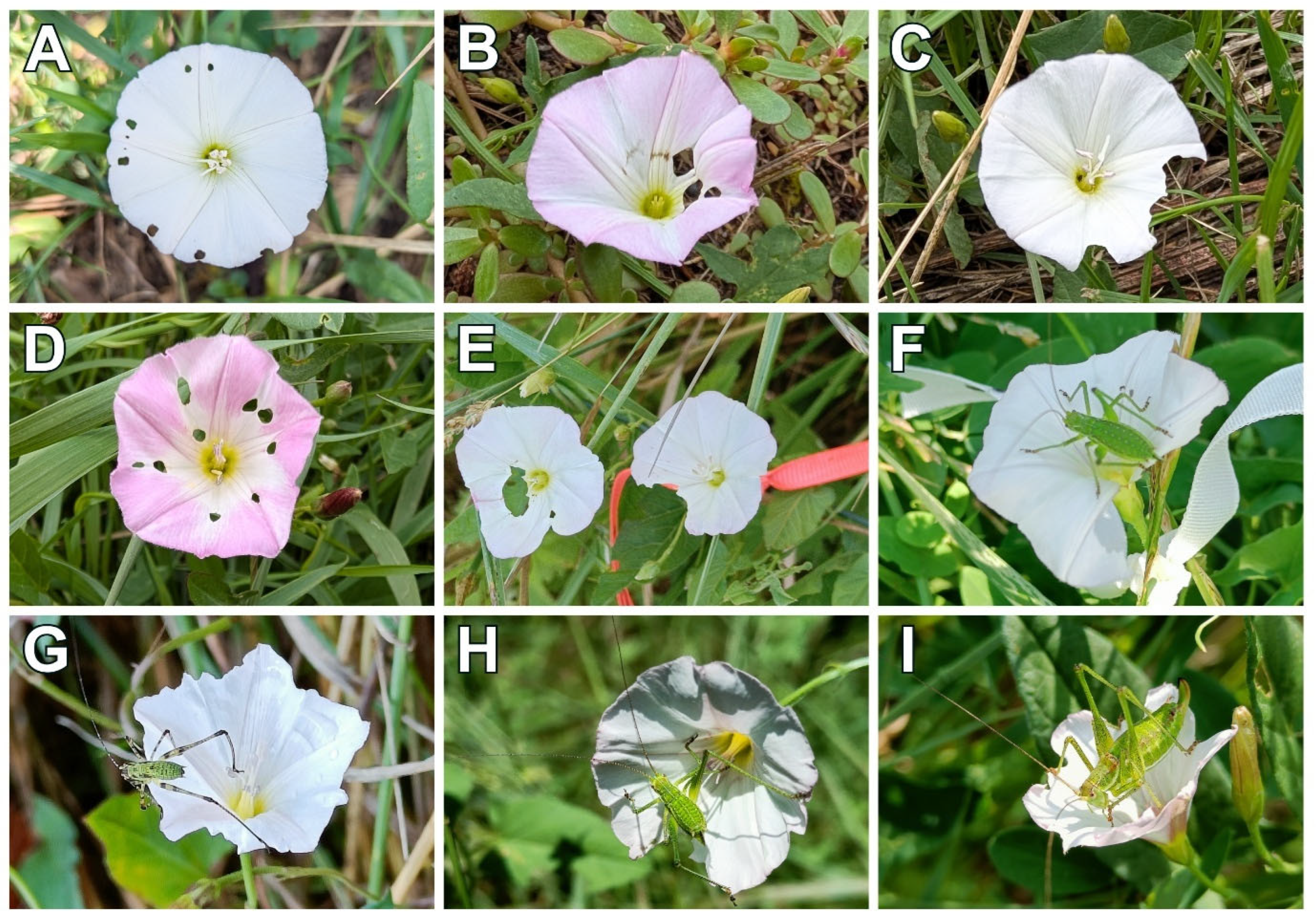
2.1. Field Surveys
2.2. Field Experiment
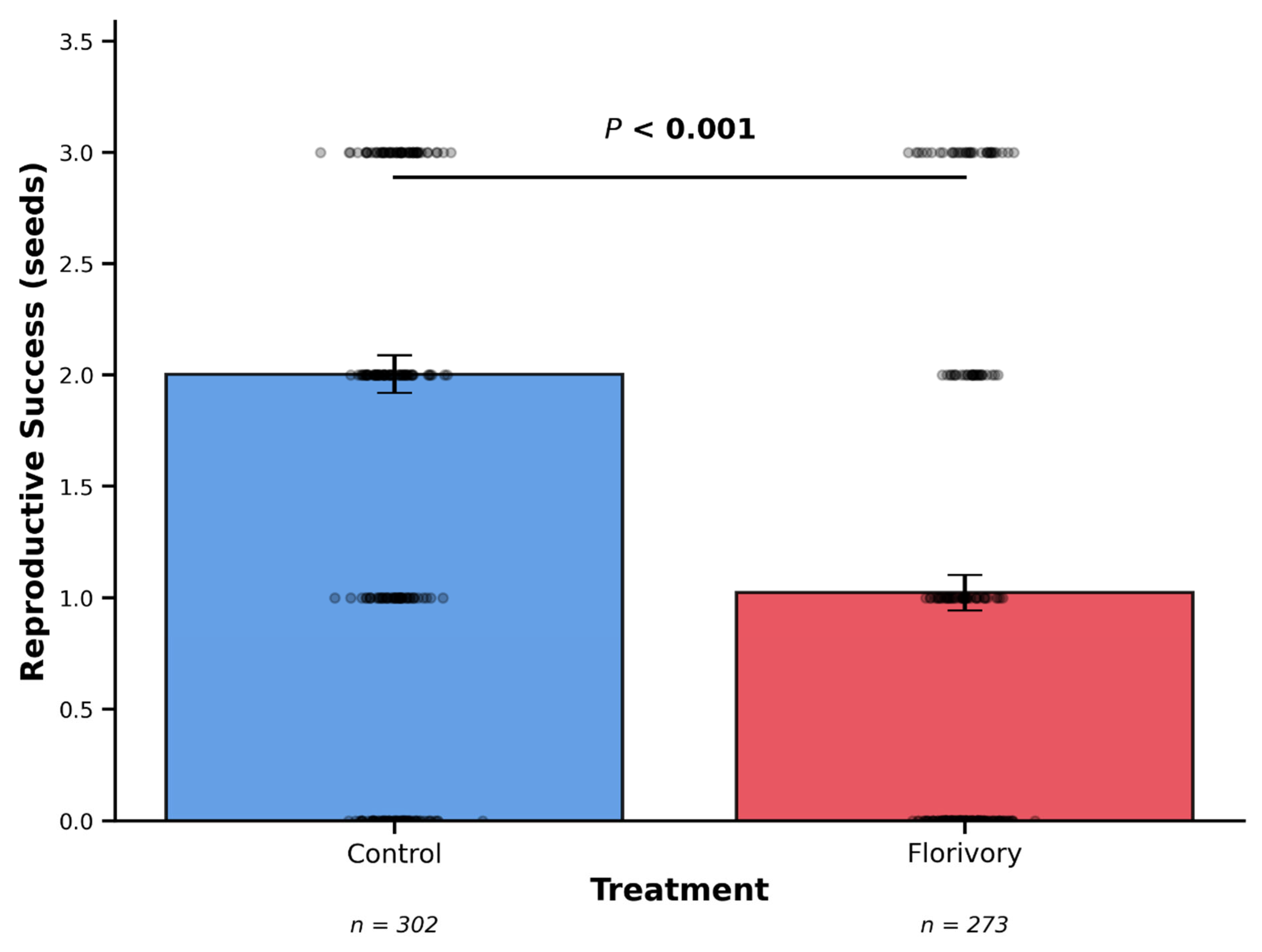
2.2.1. Results of GLMM on C. arvensis Reproductive Success Measured by Number of Seeds
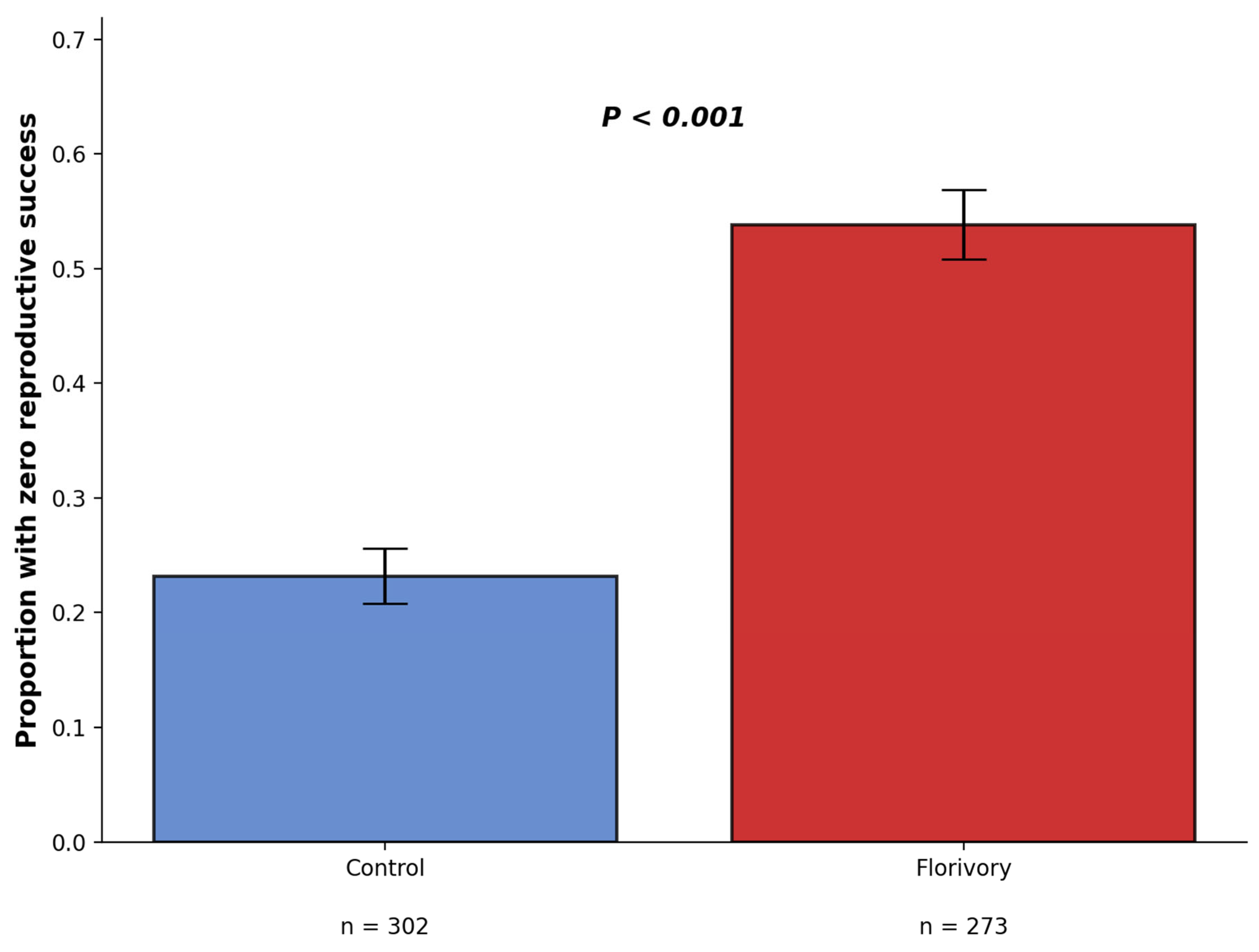
2.2.2. Results of GLMM on Total Reproductive Failure of C. arvensis
2.2.3. Results of GLMM on Disappearance Rate of C. arvensis
2.3. Laboratory Experiment
3. Discussion
4. Limitations
5. Conclusions
6. Materials and Methods
6.1. Field Surveys
6.2. Field Experiment
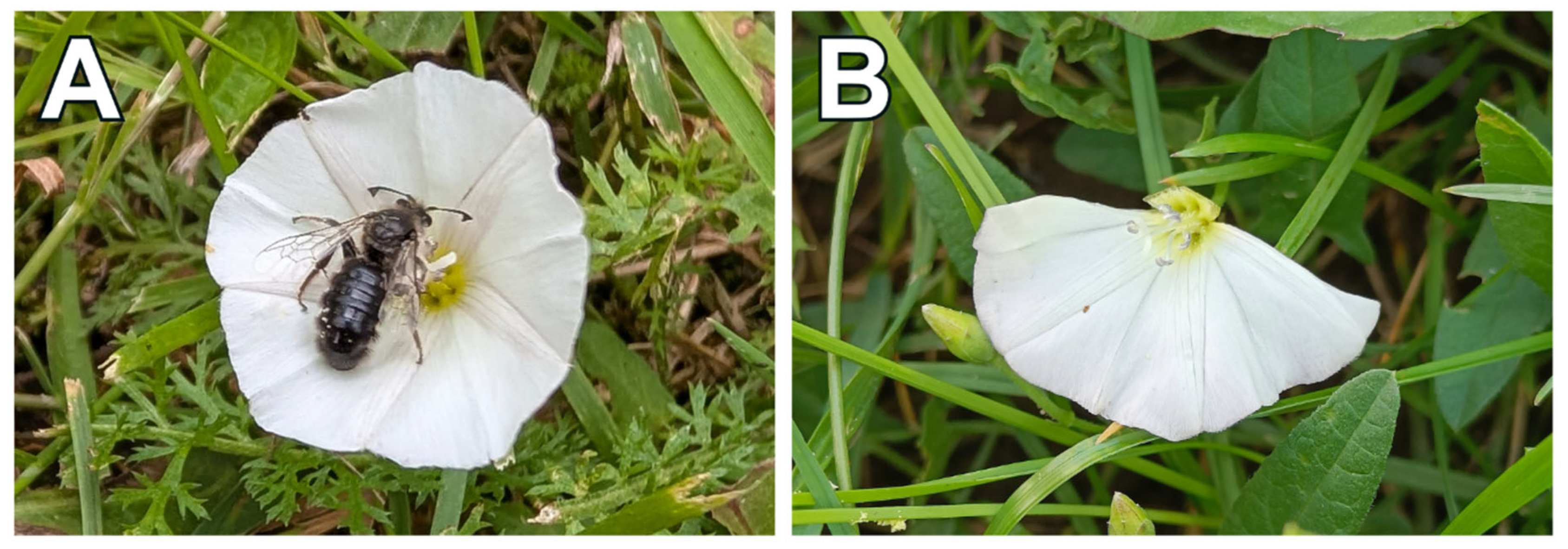
6.3. Laboratory Experiment
6.4. Statistical Analyses
Supplementary Materials
Author Contributions
Funding
Data Availability Statement
Acknowledgments
Conflicts of Interest
References
- Jia, S.; Wang, X.; Yuan, Z.; Lin, F.; Ye, J.; Hao, Z.; Luskin, M.S. Global signal of top-down control of terrestrial plant communities by herbivores. Proc. Natl. Acad. Sci. USA 2018, 115, 6237–6242. [Google Scholar] [CrossRef] [PubMed]
- Pringle, R.M.; Abraham, J.O.; Anderson, T.M.; Coverdale, T.C.; Davies, A.B.; Dutton, C.L.; Veldhuis, M.P. Impacts of large herbivores on terrestrial ecosystems. Curr. Biol. 2023, 33, R584–R610. [Google Scholar] [CrossRef] [PubMed]
- Mertens, D.; Douma, J.C.; Kamps, B.B.; Zhu, Y.; Zwartsenberg, S.A.; Poelman, E.H. Quantifying direct and indirect effects of early-season herbivory on reproduction across four brassicaceous plant species. Funct. Ecol. 2024, 38, 1611–1629. [Google Scholar] [CrossRef]
- Jacobsen, D.J.; Hewko, C.D. Vegetative induction increases plant resistance to antagonistic insect frugivores. bioRxiv 2024. [Google Scholar] [CrossRef]
- Gols, R. Tolerance to insect herbivory increases with progressing plant development. Plant Biol. 2025, 27, 287–296. [Google Scholar] [CrossRef] [PubMed]
- Rusman, Q.; Lucas-Barbosa, D.; Hassan, K.; Poelman, E.H. Plant ontogeny determines strength and associated plant fitness consequences of plant-mediated interactions between herbivores and flower visitors. J. Ecol. 2020, 108, 1046–1060. [Google Scholar] [CrossRef]
- Lehndal, L.; Ågren, J. Herbivory differentially affects plant fitness in three populations of the perennial herb Lythrum salicaria along a latitudinal gradient. PLoS ONE 2015, 10, e0135939. [Google Scholar] [CrossRef]
- McCall, A.C.; Irwin, R.E. Florivory: The intersection of pollination and herbivory. Ecol. Lett. 2006, 9, 1351–1365. [Google Scholar] [CrossRef]
- Boaventura, M.G.; Villamil, N.; Teixido, A.L.; Tito, R.; Vasconcelos, H.L.; Silveira, F.A.; Cornelissen, T. Revisiting florivory: An integrative review and global patterns of a neglected interaction. New Phytol. 2022, 233, 132–144. [Google Scholar] [CrossRef]
- Rodríguez-Morales, D.; Aguirre-Jaimes, A.; García-Franco, J.G. Effects of florivory on floral visitors and reproductive success of Sagittaria lancifolia (Alismataceae) in a Mexican Wetland. Plants 2024, 13, 547. [Google Scholar] [CrossRef]
- Ghara, M.; Ewerhardy, C.; Yardeni, G.; Matzliach, M.; Sapir, Y. Floral herbivory does not reduce pollination-mediated fitness in shelter rewarding Royal Irises. bioRxiv 2017, 184382. [Google Scholar] [CrossRef]
- Vega-Polanco, M.; Rodríguez-Islas, L.A.; Escalona-Domenech, R.Y.; Cruz-López, L.; Rojas, J.C.; Solís-Montero, L. Does florivory affect the attraction of floral visitors to buzz-pollinated Solanum rostratum? Arthropod-Plant Interact. 2020, 14, 41–56. [Google Scholar] [CrossRef]
- Ye, Z.M.; Jin, X.F.; Wang, Q.F.; Yang, C.F.; Inouye, D.W. Pollinators shift to nectar robbers when florivory occurs, with effects on reproductive success in Iris bulleyana (Iridaceae). Plant Biol. 2017, 19, 760–766. [Google Scholar] [CrossRef]
- Martins, J.K.S.S.; Carneiro, A.; Souza, L.; Almeida-Cortez, J. How pollinator visits are affected by flower damage and ants presence in Ipomoea carnea subs. fistulosa (Martius and Choise) (Convolvulaceae)? Braz. J. Biol. 2019, 80, 47–56. [Google Scholar] [CrossRef]
- Tsuji, K.; Ohgushi, T. Florivory indirectly decreases the plant reproductive output through changes in pollinator attraction. Ecol. Evol. 2018, 8, 2993–3001. [Google Scholar] [CrossRef]
- Cárdenas-Ramos, D.; Mandujano, M.C. Florivory effects on pollinator preference and the reproductive output of a threatened living rock cactus, Ariocarpus retusus (Cactaceae). Haseltonia 2019, 25, 133–139. [Google Scholar] [CrossRef]
- Krupnick, G.A.; Weis, A.E.; Campbell, D.R. The consequences of floral herbivory for pollinator service to Isomeris arborea. Ecology 1999, 80, 125–134. [Google Scholar] [CrossRef]
- 18; Mulligan, G.A. Autogamy, allogamy, and pollination in some Canadian weeds. Can. J. Bot. 1972, 50, 1767–1771. [Google Scholar] [CrossRef]
- Waddington, K.D. Foraging patterns of halictid bees at flowers of Convolvulus arvensis. Psyche 1976, 83, 112–119. [Google Scholar] [CrossRef]
- Prokop, P.; Neupauerova, D. Flower closure in the field bindweed (Convolvulus arvensis): A field test of the pollination hypothesis. Turk. J. Bot. 2014, 38, 877–882. [Google Scholar] [CrossRef]
- Prokop, P. Urban environment decreases pollinator availability, fertility, and prolongs anthesis in the field bindweed (Convolvulus arvensis Linnaeus, 1753). Plant Signal. Behav. 2024, 19, 2325225. [Google Scholar] [CrossRef]
- Schaller, N. The concept of agricultural sustainability. Agric. Ecosyst. Environ. 1993, 46, 89–97. [Google Scholar] [CrossRef]
- Culhavi, C.D.; Manea, D. Controlling Convolvulus arvensis L. in grain maize and winter wheat in Banat (Romania). Res. J. Agric. Sci. 2011, 43, 21–27. [Google Scholar]
- Carper, A.L.; Adler, L.S.; Irwin, R.E. Effects of florivory on plant-pollinator interactions: Implications for male and female components of plant reproduction. Am. J. Bot. 2016, 103, 1061–1070. [Google Scholar] [CrossRef]
- McCall, A.C. Florivory affects pollinator visitation and female fitness in Nemophila menziesii. Oecologia 2008, 155, 729–737. [Google Scholar] [CrossRef]
- Mulligan, G.A.; Kevan, P.G. Color, brightness, and other floral characteristics attracting insects to the blossoms of some Canadian weeds. Can. J. Bot. 1973, 51, 1939–1952. [Google Scholar] [CrossRef]
- Prokop, P.; Zvaríková, M.; Ježová, Z.; Fedor, P. Functional significance of flower orientation and green marks on tepals in the snowdrop Galanthus nivalis (Linnaeus, 1753). Plant Signal. Behav. 2020, 15, 1807153. [Google Scholar] [CrossRef] [PubMed]
- 28; Jones, P.L.; Ryan, M.J.; Chittka, L. The influence of past experience with flower reward quality on social learning in bumblebees. Anim. Behav. 2015, 101, 11–18. [Google Scholar] [CrossRef]
- Møller, A.P.; Eriksson, M. Pollinator preference for symmetrical flowers and sexual selection in plants. Oikos 1995, 73, 15–22. [Google Scholar] [CrossRef]
- Møller, A.P.; Sorci, G. Insect preference for symmetrical artificial flowers. Oecologia 1998, 114, 37–42. [Google Scholar] [CrossRef] [PubMed]
- Goulson, D.; Cruise, J.L.; Sparrow, K.R.; Harris, A.J.; Park, K.J.; Tinsley, M.C.; Gilburn, A.S. Choosing rewarding flowers; perceptual limitations and innate preferences influence decision making in bumblebees and honeybees. Behav. Ecol. Sociobiol. 2007, 61, 1523–1529. [Google Scholar] [CrossRef]
- Mothershead, K.; Marquis, R.J. Fitness impacts of herbivory through indirect effects on plant–pollinator interactions in Oenothera macrocarpa. Ecology 2000, 81, 30–40. [Google Scholar] [CrossRef]
- 33; Patiño, S.; Jeffree, C.; Grace, J. The ecological role of orientation in tropical convolvulaceous flowers. Oecologia 2002, 130, 373–379. [Google Scholar] [CrossRef] [PubMed]



Disclaimer/Publisher’s Note: The statements, opinions and data contained in all publications are solely those of the individual author(s) and contributor(s) and not of MDPI and/or the editor(s). MDPI and/or the editor(s) disclaim responsibility for any injury to people or property resulting from any ideas, methods, instructions or products referred to in the content. |
© 2026 by the authors. Licensee MDPI, Basel, Switzerland. This article is an open access article distributed under the terms and conditions of the Creative Commons Attribution (CC BY) license.
Share and Cite
Prokop, P.; Purkart, A.; Litavský, J. Experimental Florivory Influences Reproductive Success in the Field Bindweed (Convolvulus arvensis). Plants 2026, 15, 225. https://doi.org/10.3390/plants15020225
Prokop P, Purkart A, Litavský J. Experimental Florivory Influences Reproductive Success in the Field Bindweed (Convolvulus arvensis). Plants. 2026; 15(2):225. https://doi.org/10.3390/plants15020225
Chicago/Turabian StyleProkop, Pavol, Adrián Purkart, and Juraj Litavský. 2026. "Experimental Florivory Influences Reproductive Success in the Field Bindweed (Convolvulus arvensis)" Plants 15, no. 2: 225. https://doi.org/10.3390/plants15020225
APA StyleProkop, P., Purkart, A., & Litavský, J. (2026). Experimental Florivory Influences Reproductive Success in the Field Bindweed (Convolvulus arvensis). Plants, 15(2), 225. https://doi.org/10.3390/plants15020225