
Nomenclatural Remarks and Typifications in the Genus Olea L. (Oleaceae)




Abstract
1. Introduction
- (1)
- The lectotype of the Linnaean name O. europaea is the specimen preserved at Herb. Clifford: 4, Olea 1α BM (barcode BM000557513), designated by Green & Wickens (1989: 294) [1].
- (2)
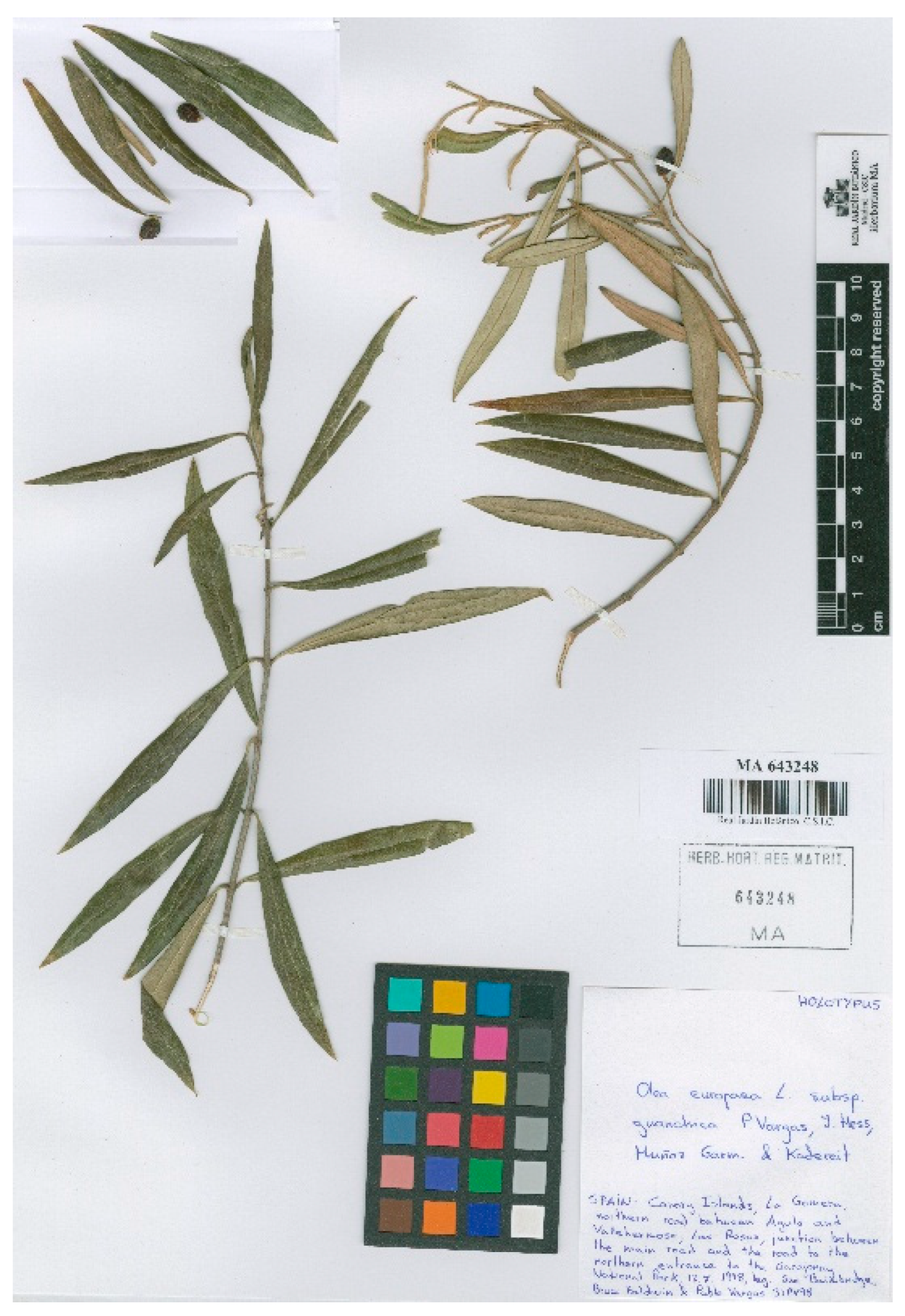
- The holotype of O. europaea subsp. guanchica is the specimen at MA with barcode MA643248 (see below), with an isotype at MJG. This material was collected in La Gomera, Canary Islands [37,38,39] sub O. cerasiformis Rivas Mart. & del Arco, as a replacement name of O. europaea subsp. guanchica P. Vargas et al. [6].
- (3)
- The holotype of O. maroccana Greuter & Burdet is somewhat cryptic. Olea maroccana is a replacement name of O. salicifolia Barbéro, Benabid, Quézel, Rivas Mart. & A. Santos in Doc. Phytosoc., ser. 2, 6: 319 (1982), nom. illeg.; an illegitimate later homonym (see ICN Art. 53.1) of O. salicifolia Wall. ex G. Don fil. Gen. Hist. 4: 48. 1837. The name is currently accepted as O. europaea subsp. maroccana (Greuter & Burdet) P. Vargas et al. [6,7,12]. The holotype was indicated in the protologue as “in ditione Ida ou Tanane, regno maroccano, prope Tamrhaght 250 m. In herbario facultatis-Saint-Jérôme, Marseille” [In the region of Ida or Tanane, Moroccan kingdom, near Tamrhaght, 250 m. In the herbarium of the Faculty of Saint-Jérôme, Marseille] [40]. Later, Médail and co-workers [7] mentioned “S.W. Morocco, Ida-ou-Tanane, near Tamrhakht, P. Quézel, iv.1982 (MARSSJ TYPUS) (inflorescence)”. MARSSJ is the herbarium code of the herbarium at Université Paul Cézanne, in Mirabeau, France.
2. Results and Discussion
2.1. Biological and Nomenclatural Background
2.2. Typification of the Names
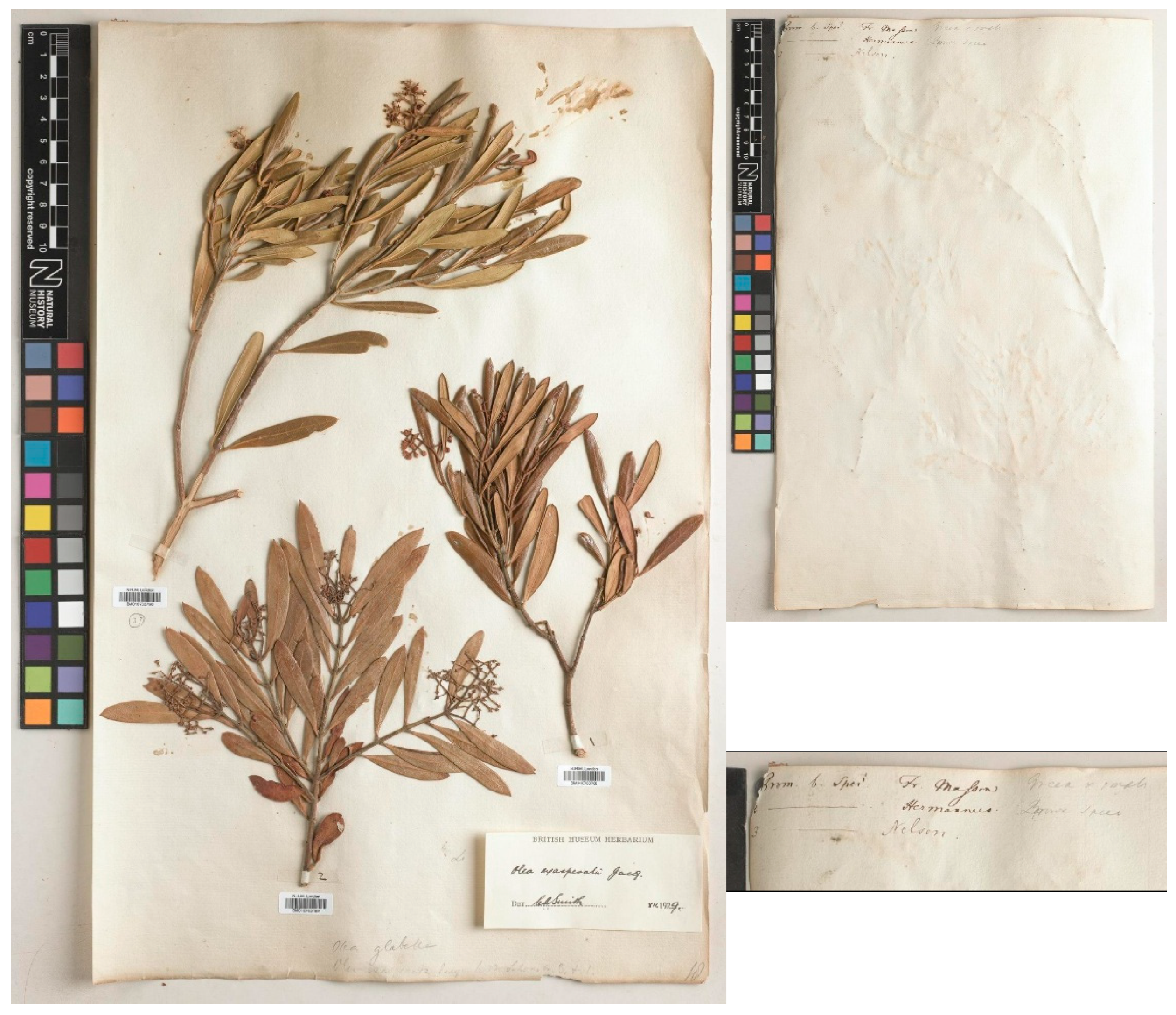
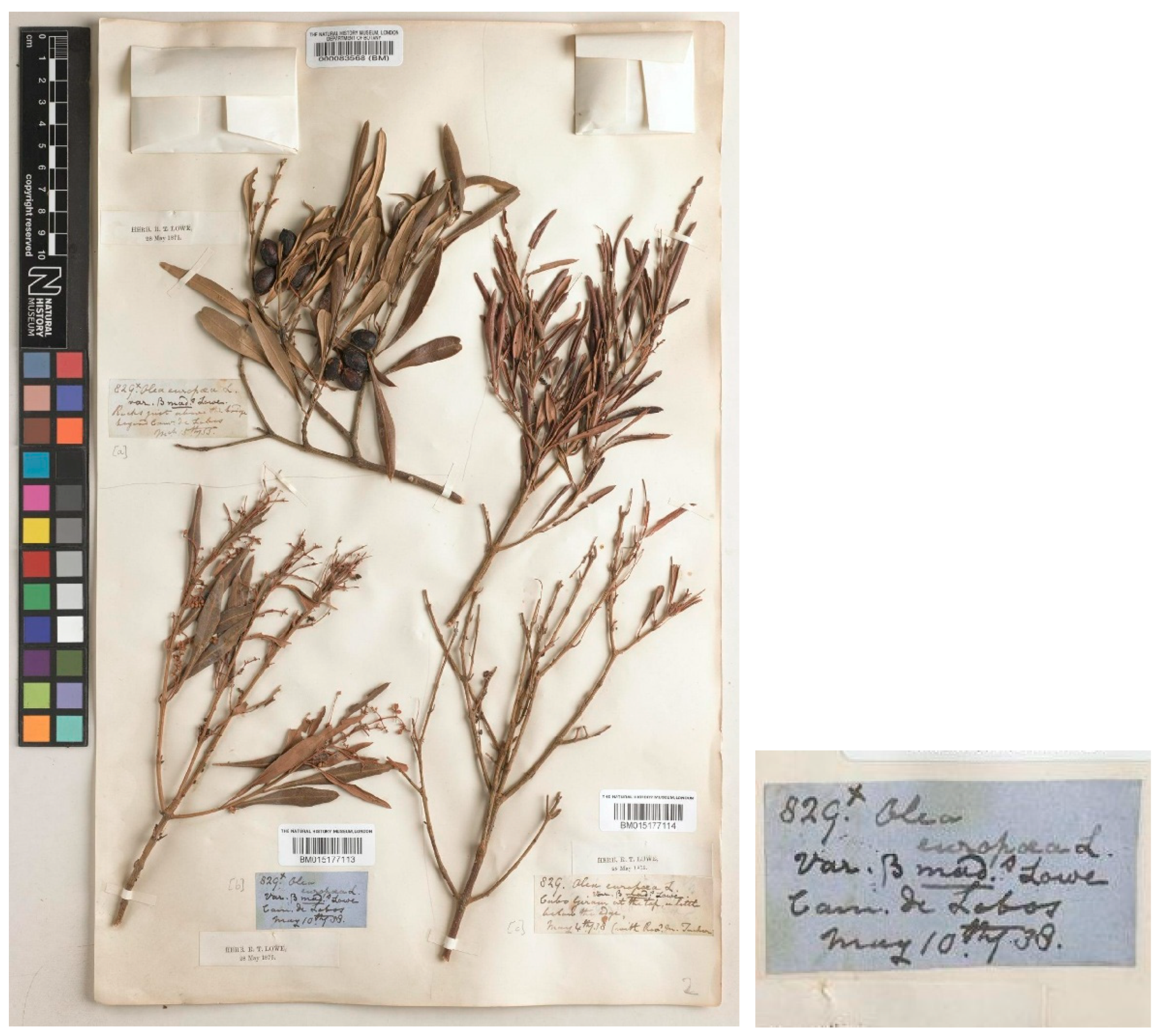
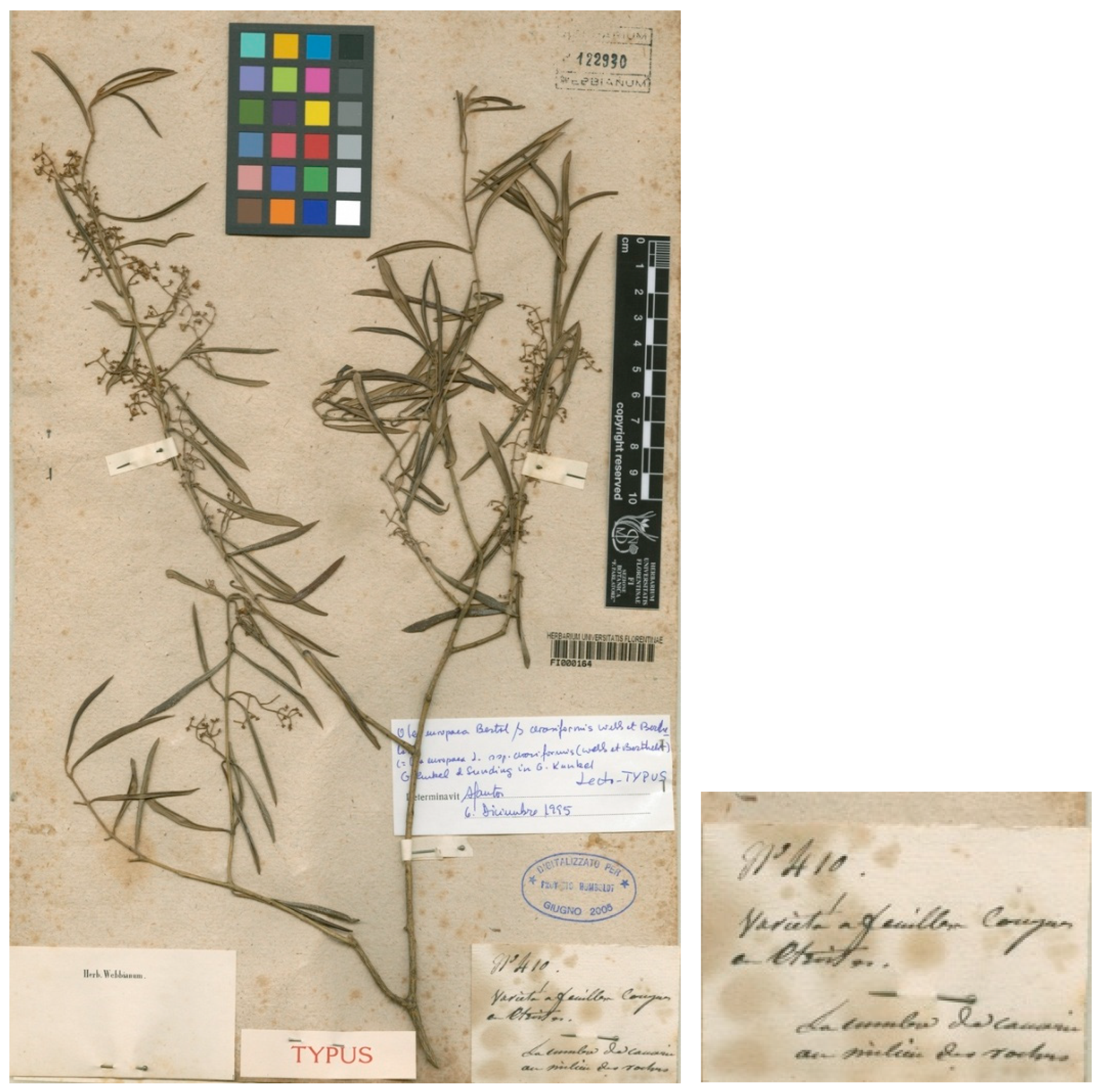
2.2.1. Olea europaea subsp. cerasiformis, O. europaea var. maderensis, and O. europaea subsp. guanchica
Olea europaea subsp. cerasiformis
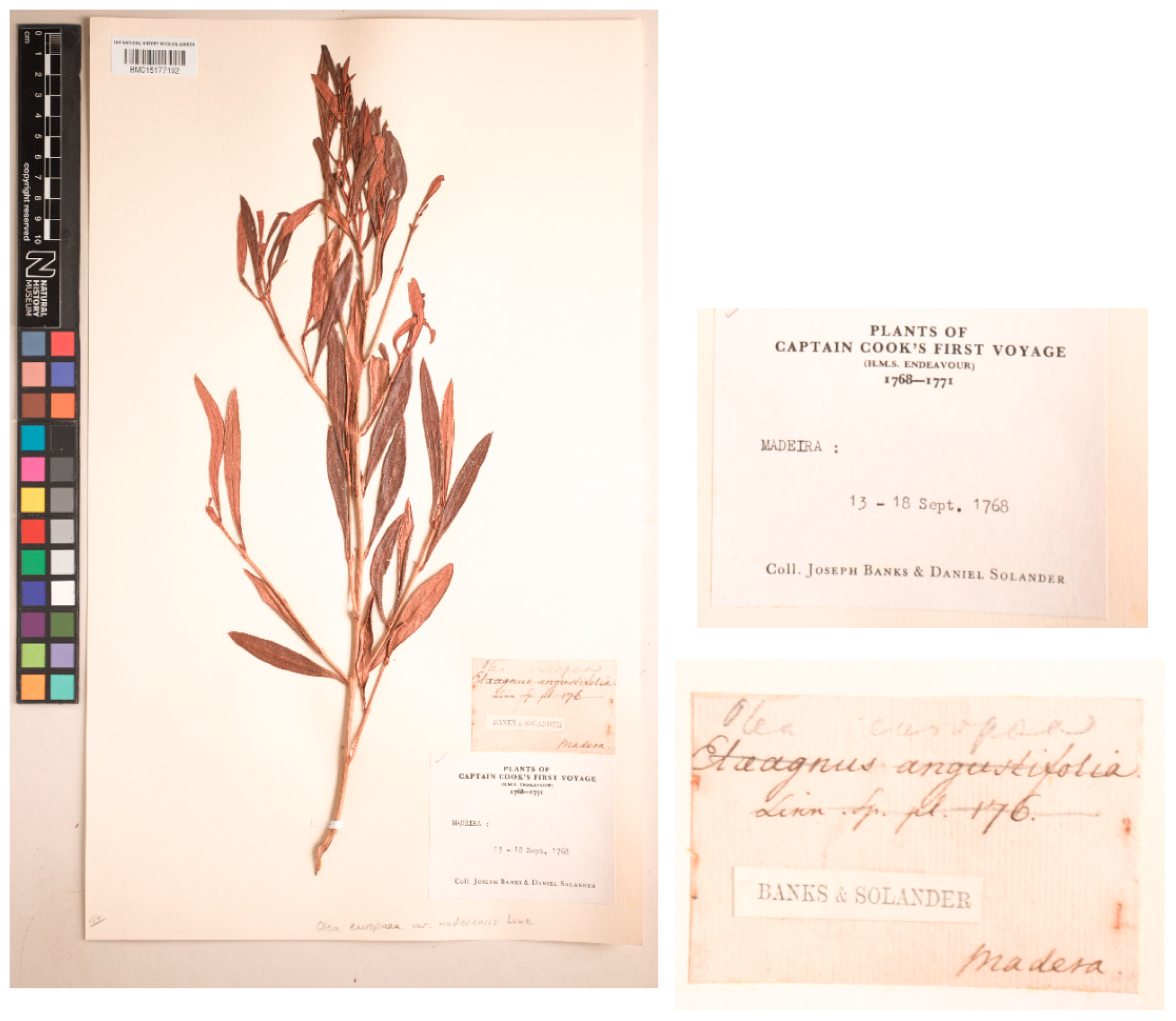
Olea europaea var. maderensis
Olea europaea subsp. guanchica
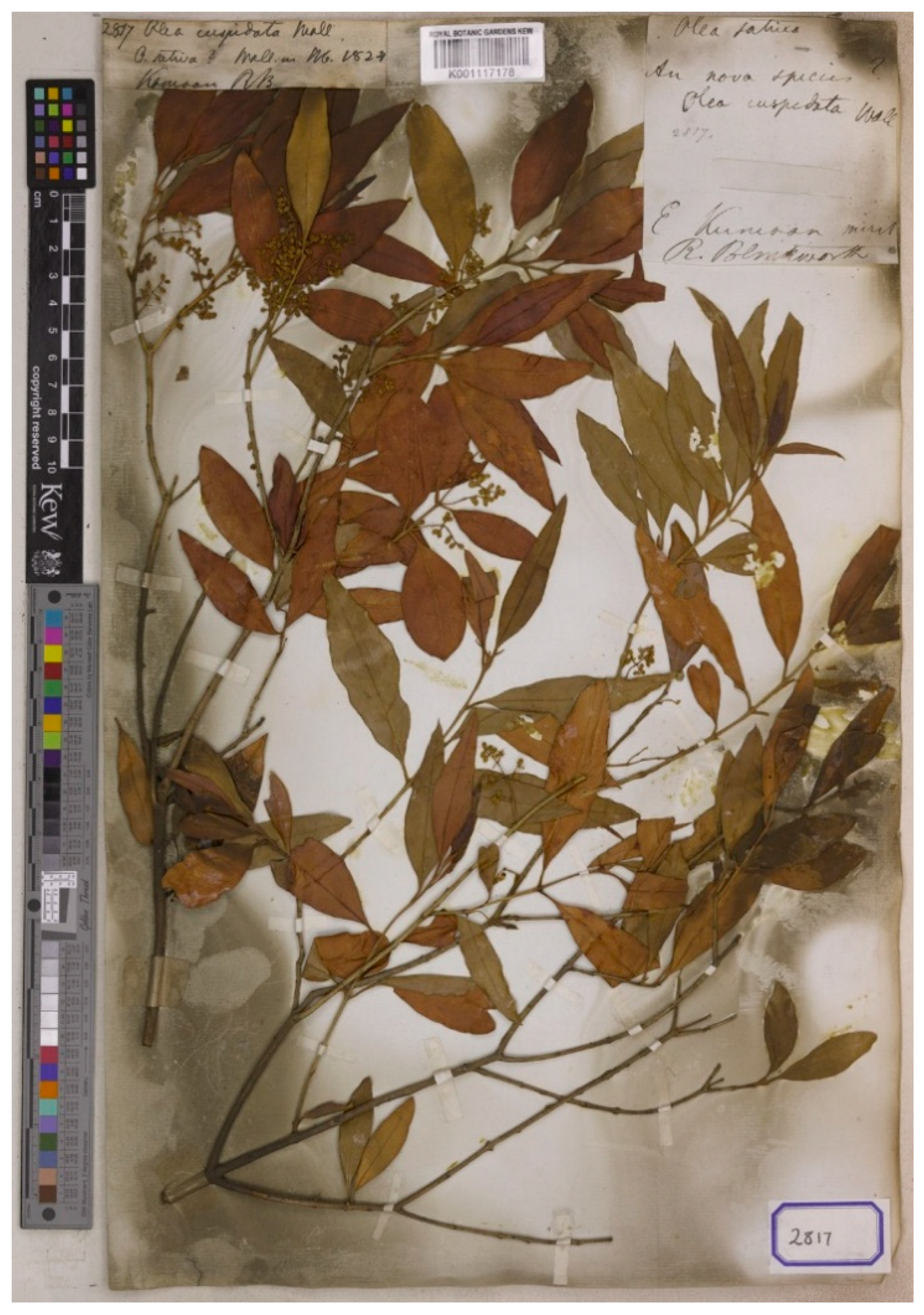
2.2.2. Olea cuspidata
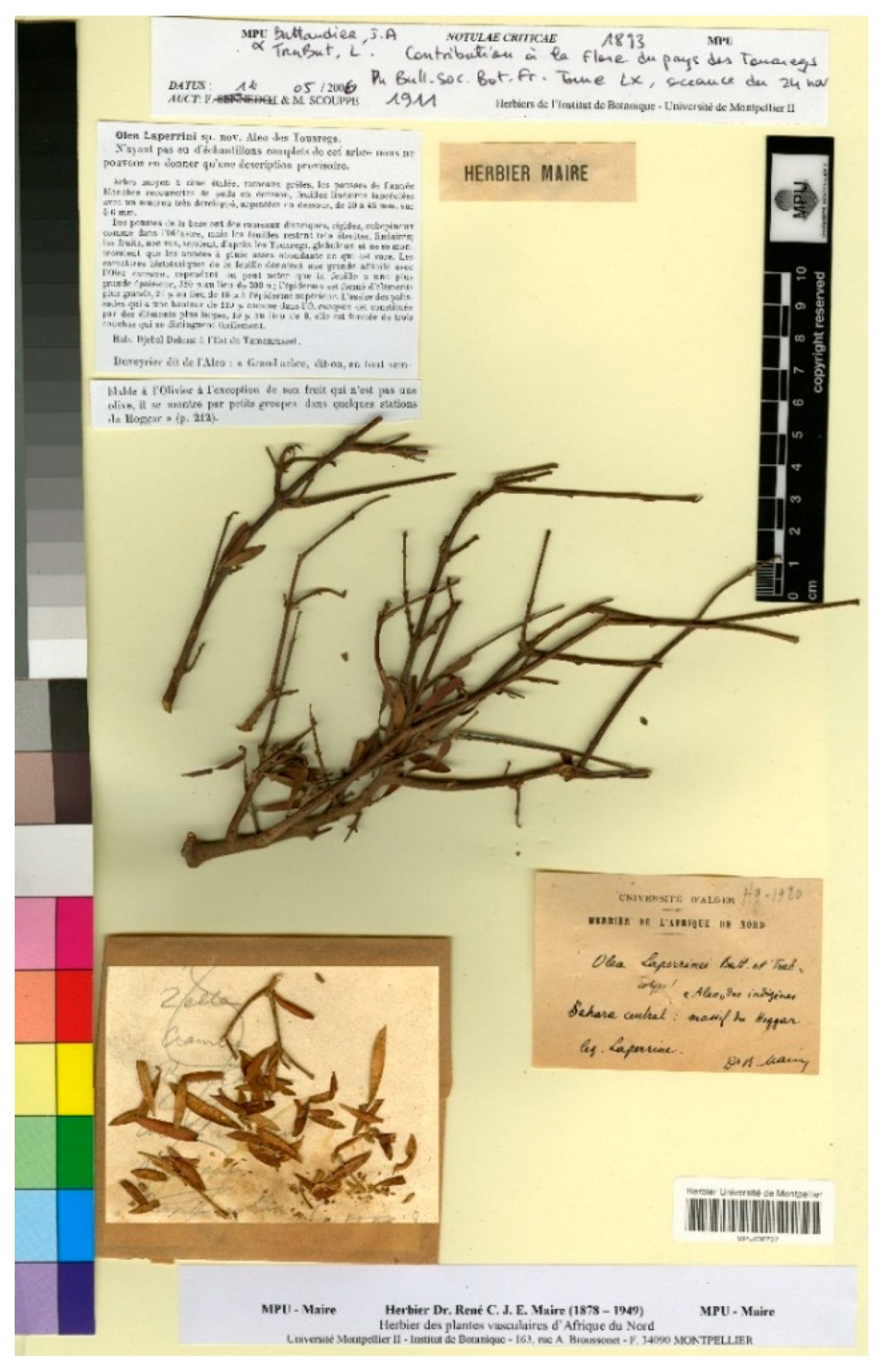
2.2.3. Olea laperrinei
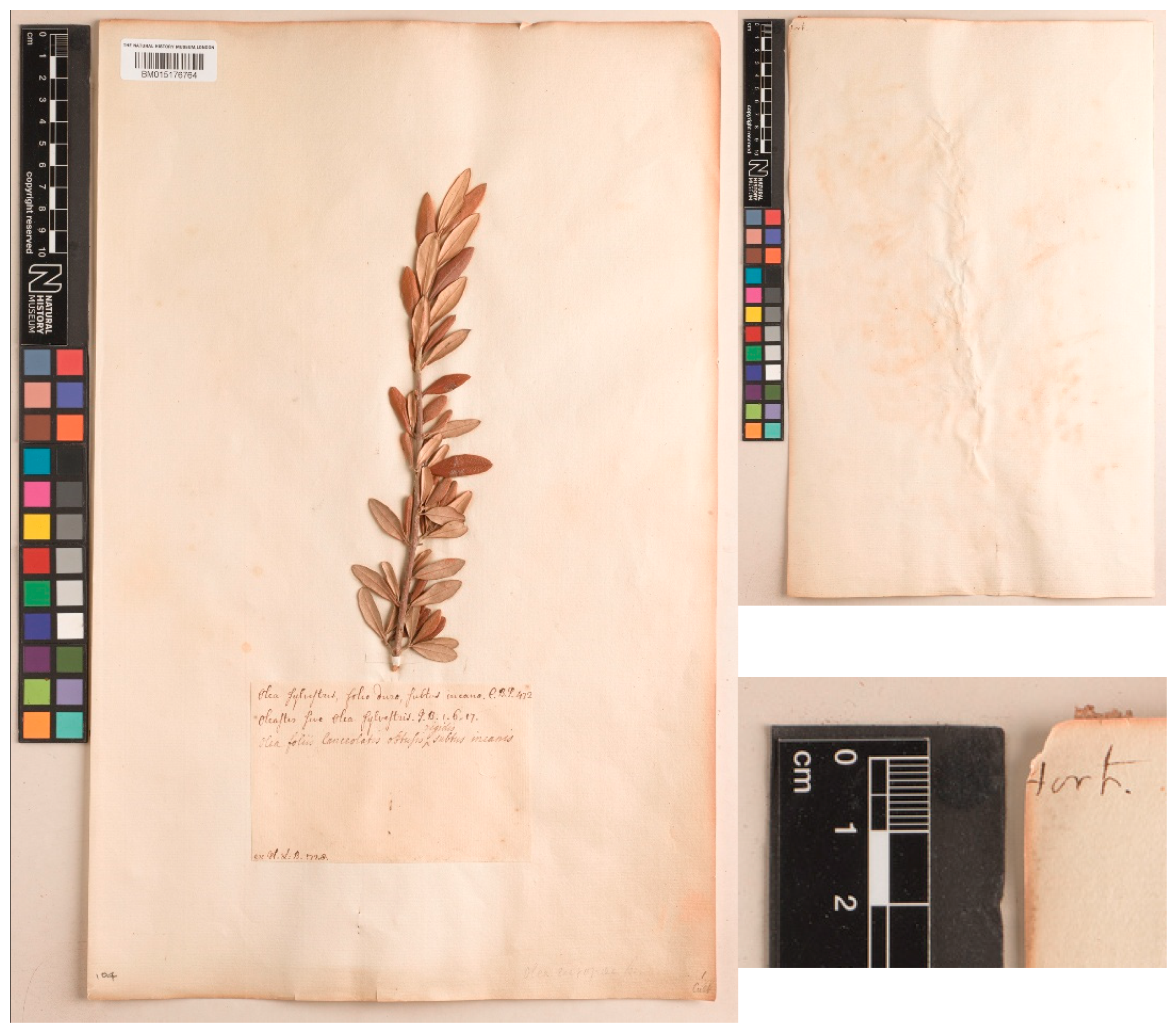
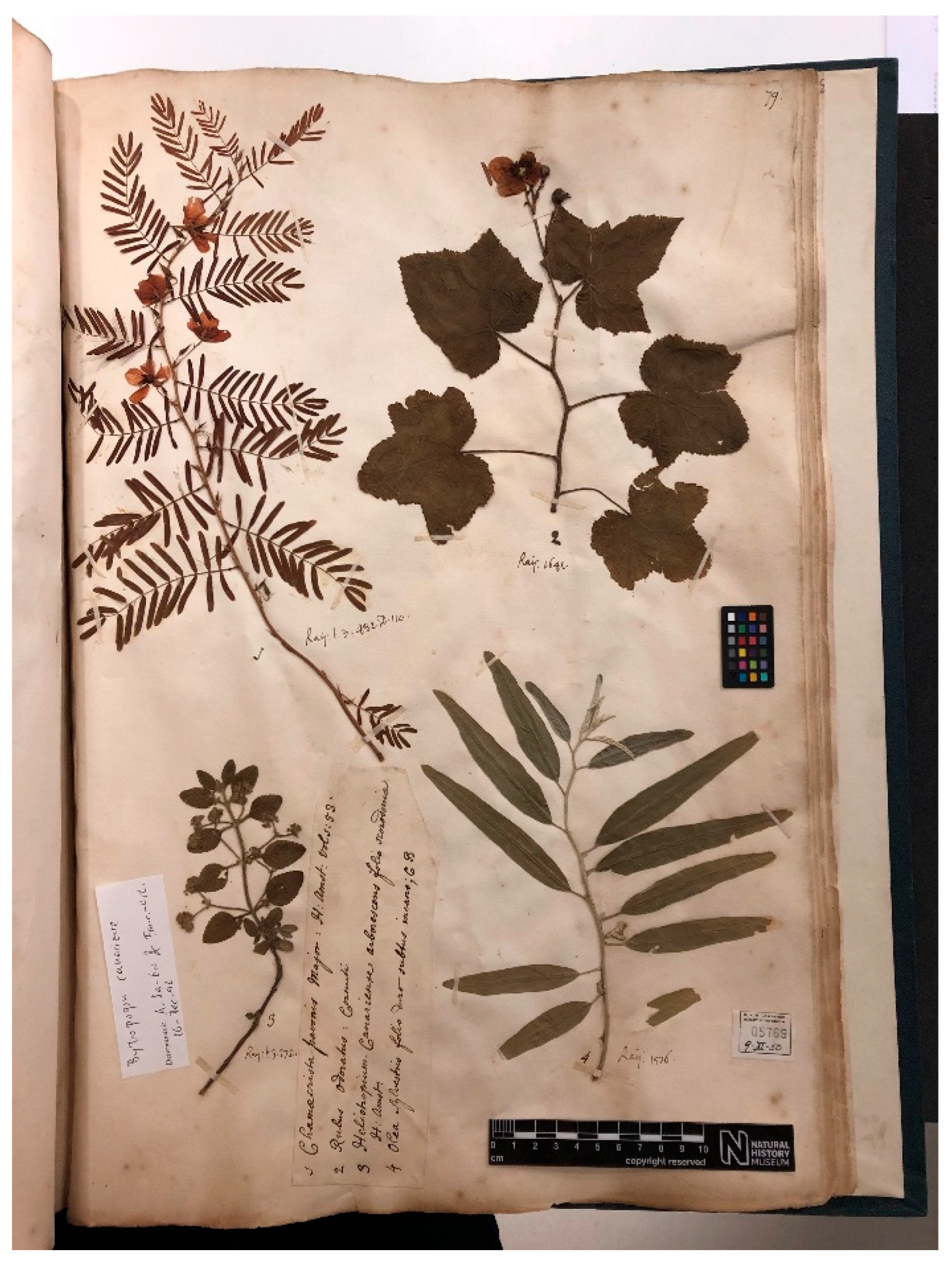
2.2.4. Olea sylvestris
3. Materials and Methods
Author Contributions
Funding
Data Availability Statement
Acknowledgments
Conflicts of Interest
References
- Green, P.S.; Wickens, G.E. The Olea europaea Complex. In The Davis and Hedge Festschrift; Tan, K., Hedge, I., Eds.; Edinburgh University Press: Edinburgh, UK, 1989; pp. 287–299. [Google Scholar]
- Besnard, G.; Green, P.S.; Bervillé, A. The genus Olea: Molecular approaches of its structure and relationships to other Oleaceae. Acta Bot. Gall. 2001, 149, 49–66. [Google Scholar] [CrossRef]
- Besnard, G.; Anthelme, F.; Baali-Cherif, D. The Laperrine’s olive tree (Oleaceae): A wild genetic resource of the cultivated olive and a model species for studying the biogeography of the Saharan Mountains. Acta Bot. Gall. 2012, 159, 319–328. [Google Scholar] [CrossRef]
- Green, P.S. A revision of Olea L. (Oleaceae). Kew Bull. 2002, 57, 91–140. [Google Scholar] [CrossRef]
- Hess, J.; Kadereit, J.W.; Vargas, P. The colonization history of Olea europaea L. (Oleaceae) in Macaronesia based on internal transcribed spacer 1 (ITS-1) sequences, random amplified polymorphic DNAs (RAPD), and inter-simple sequence repeats (ISSR) evidence. Mol. Ecol. 2000, 9, 857–868. [Google Scholar] [CrossRef] [PubMed]
- Vargas, P.; Muñoz Garmendia, F.; Hess, J.; Kadereit, J. Olea europaea subsp. guanchica and subsp. maroccana (Oleaceae), two new names for olive tree relatives. An. Jard. Bot. Madr. 2001, 58, 360–361. [Google Scholar]
- Médail, F.; Quézel, P.; Besnard, G.; Khadari, B. Systematics, ecology and phylogeographic significance of Olea europaea L. ssp. maroccana (Greuter & Burdet) P. Vargas et al., a relictual olive tree in south-west Morocco. Bot. J. Linn. Soc. 2001, 137, 249–266. [Google Scholar] [CrossRef]
- Breton, C.; Médail, F.; Bervillé, A. Olea europaea subsp. maroccana: Cette sous-espèce est-elle justifiée? J. Soc. Bot. Fr. 2005, 30, 19–25. [Google Scholar] [CrossRef]
- Besnard, G.; Christin, P.A.; Baali-Cherif, D.; Bouguedoura, N.; Anthelme, F. Spatial genetic structure in the Laperrine’s olive (Olea europaea subsp. laperrinei), a long-living tree from central-Saharan mountains. Heredity 2007, 99, 649–657. [Google Scholar] [CrossRef]
- Besnard, G.; Rubio de Casas, R.; Vargas, P. Nuclear and plastid DNA polymorphism reveals large-scale reticulation in the olive tree complex (Olea europaea L.). J. Biogeogr. 2007, 34, 736–752. [Google Scholar] [CrossRef]
- Besnard, G.; Garcia-Verdugo, C.; Rubio de Casas, R.; Treier, U.A.; Galland, N.; Vargas, P. Polyploidy in the olive complex (Olea europaea L.): Evidence from flow cytometry and nuclear microsatellite analyses. Ann. Bot. 2008, 101, 25–30. [Google Scholar] [CrossRef]
- Besnard, G.; Rubio de Casas, R.; Christin, P.-A.; Vargas, P. Phylogenetics of Olea (Oleaceae) based on plastid and nuclear ribosomal DNA sequences: Tertiary climatic shifts and lineage differentiation times. Ann. Bot. 2009, 104, 143–160. [Google Scholar] [CrossRef]
- Brito, G.; Loureiro, J.; Lopes, T.; Rodriguez, E.; Santos, C. Genetic characterisation of olive trees from Madeira Archipelago using flow cytometry and microsatellite markers. Genet. Resour. Crop Evol. 2008, 55, 657–664. [Google Scholar] [CrossRef]
- Julca, I.; Marcet-Houben, M.; Vargas, P.; Gabaldón, T. Phylogenomics of the olive tree (Olea europaea) reveals the relative contribution of ancient allo- and autopolyploidization events. BMC Biol. 2018, 16, 15. [Google Scholar] [CrossRef] [PubMed]
- Julca, I.; Vargas, P.; Gabaldón, T. Phylogenomics of the Olea europaea complex using 15 whole genomes supports recurrent genetic admixture together with differentiation into seven subspecies. BMC Biol. 2023, 21, 85. [Google Scholar] [CrossRef]
- Kassa, A.; Konrad, H.; Geburek, T. Molecular diversity and gene flow within and among different subspecies of the wild olive (Olea europaea L.): A review. Flora 2019, 250, 18–26. [Google Scholar] [CrossRef]
- Fanelli, V.; Mascio, I.; Falek, W.; Miazzi, M.M.; Montemurro, C. Current Status of Biodiversity Assessment and Conservation of Wild Olive (Olea europaea L. subsp. europaea var. sylvestris). Plants 2022, 11, 480. [Google Scholar] [CrossRef]
- Breton, C.; Tersac, M.; Bervillé, A. Genetic diversity and gene flow between the wild olive (oleaster, Olea europaea L.) and the olive: Several Plio-Pleistocene refuge zones in the Mediterranean Basin suggested by simple sequence repeats analysis. J. Biogeogr. 2006, 33, 1916–1928. [Google Scholar] [CrossRef]
- Hannachi, H.; Sommerlatte, H.; Breton, C.; Msallem, M.; El Gazzah, M.; Ben El Hadj, S.; Bervillé, A. Oleaster (var. sylvestris) and subsp. cuspidata are suitable genetic resources for improvement of the olive (Olea europaea subsp. europaea var. europaea). Genet. Resour. Crop Evol. 2009, 56, 393–403. [Google Scholar] [CrossRef]
- Besnard, G.; Khadari, B.; Navascués, M.; Fernández-Mazuecos, M.; El Bakkali, A.; Arrigo, N.; Baali-Cherif, D.; Brunini-Bronzini de Caraffa, V.; Santoni, S.; Vargas, P.; et al. The complex history of the olive tree: From late Quaternary diversification of Mediterranean lineages to primary domestication in the northern Levant. Proc. Biol. Sci. 2013, 280, 20122833. [Google Scholar] [CrossRef]
- Breton, C.M.; Warnock, P.; Bervillé, A.J. Origin and History of the Olive. In Olive Germplasm. The Olive Cultivation, Table Olive and Olive Oil Industry in Italy; Muzzalupo, I., Ed.; InTech: Rijeka, Croatia, 2012; pp. 3–22. [Google Scholar] [CrossRef]
- Barranco, D.; Cimato, A.; Fiorino, P.; Rallo, L.; Touzani, A.; Castañeda, C.; Serafini, F.; Trujillo, I. World Catalogue of Olive Varieties (Catálogo Mundial de Variedades de Olivo); Consejo Oleícola Internacional: Madrid, España, 2000. [Google Scholar]
- Fabbri, A.; Baldoni, L.; Caruso, T.; Famiani, F. (Eds.) The Olive: Botany and Production; CAB International: Wallingford, UK, 2023. [Google Scholar]
- Tourvas, N.; Ganopoulos, I.; Koubouris, G.; Kostelenos, G.; Manthos, I.; Bazakos, C.; Stournaras, V.; Molassiotis, A.; Aravanopoulos, F. Wild and cultivated olive tree genetic diversity in Greece: A diverse resource in danger of erosion. Front. Genet. 2023, 14, 1298565. [Google Scholar] [CrossRef]
- Besnard, G.; Bervillé, A. Multiple origins for Mediterranean olive (Olea europaea L. ssp. europaea) based on mitochondrial DNA polymorphisms. C. R. Acad. Sci. Ser. III 2000, 323, 173–181. [Google Scholar] [CrossRef]
- Amane, M.; Ouazzani, N.; Lumaret, R.; Debain, C. Chloroplast DNA variation in the wild and cultivated olives (Olea europaea L.) of Morocco. Euphytica 2000, 116, 59–64. [Google Scholar] [CrossRef]
- Zohary, D.; Hopf, M.; Weiss, E. Domestication of Plants in the Old World: The Origin and Spread of Domesticated Plants in Southwest Asia, Europe, and the Mediterranean Basin; Oxford University Press: Oxford, UK, 2012. [Google Scholar]
- Fiorino, P.; Nizzi Griffi, F. The spread of olive farming. Olivae 1992, 44, 9. [Google Scholar]
- Brenes, M.; García, A.; Garrido, A. Phenolic compounds in olive oils and their relationships with olive fruit. Oleuropein hydrolysis during storage. J. Agric. Food Chem. 1993, 41, 1088–1091. [Google Scholar] [CrossRef]
- Tous, J.; Ferguson, L. Olive Growing; FAO Plant Production and Protection Paper 148; Food and Agriculture Organization of the United Nations: Rome, Italy, 1996. [Google Scholar]
- Kalogeropoulos, N.; Tsimidou, M. Antioxidants in Greek Virgin Olive Oil. Antioxidants 2014, 3, 387–401. [Google Scholar] [CrossRef]
- Foxhall, L. Olive Cultivation in Ancient Greece: Seeking the Ancient Economy; Oxford Academic: Oxford, UK, 2007. [Google Scholar] [CrossRef]
- Chovanec, Z. Cracking the History of the Olive: Differentiating Olive Oil and Other Mediterranean Plant Oils Through Organic Residue Analysis. Mediterr. Archaeol. Archaeom. 2022, 22, 45–65. [Google Scholar]
- Boskou, D. History and characteristics of the olive tree. In Olive Oil: Chemistry and Technology; Boskou, D., Ed.; AOCS Press: Champaign, IL, USA, 1996; pp. 1–11. [Google Scholar]
- Kapellakis, I.E.; Tsagarakis, K.P.; Crowther, J.C. Olive oil history, production and by-product management. Rev. Environ. Sci. Biotechnol. 2008, 7, 1–26. [Google Scholar] [CrossRef]
- FAOSTAT. Crops and Livestock Products Database; Food and Agriculture Organization of the United Nations: Rome, Italy, 2025; Available online: https://www.fao.org/faostat/en/#data/QCL (accessed on 7 November 2025).
- Greuter, W.; Raus, T. Med-Checklis Notulae, 15. Willdenowia 1989, 19, 27–48. [Google Scholar] [CrossRef]
- Vargas, P.; Kadereit, J.W. Molecular fingerprinting evidence (ISSR, Inter-Simple Sequence Repeats) for a wild status of Olea europaea L. (Oleaceae) in the Eurosiberian North of the Iberian Peninsula. Flora 2001, 196, 142–152. [Google Scholar] [CrossRef]
- Rivas-Martínez, S.; Díaz, T.E.; Fernández-González, F.; Izco, J.; Loidi, J.; Lousã, M.; Penas, A. Vascular plant communities of Spain and Portugal (addenda to the syntaxonomical checklist of 2001, part I). Itinera Geobot. 2002, 15, 5–922. [Google Scholar]
- Barbéro, M.; Benabid, A.; Quézel, P.; Rivas Martinez, S.; Santos-Guerra, A. Contribution à l’étude des Acacio-Arganietalia du Maroc occidental. Doc. Phytosociol. 1982, 6, 311–338. [Google Scholar]
- Quézel, P.; Barbéro, M. Variations climatiques au Sahara et en Afrique sèche depuis le Pliocène: Enseignements de la flore et de la végétation actuelles. Bull. Écol. 1993, 24, 191–202. [Google Scholar]
- Quézel, P. La flore du bassin méditerranéen: Origine, mise en place, endémisme. Ecol. Mediterr. 1995, 20, 19–39. [Google Scholar] [CrossRef]
- Quézel, P. Réflexions sur l’Évolution de la Flore et de la Végétation au Maghreb Méditerranéen; Ibis Press: Paris, France, 2000. [Google Scholar]
- Zohary, D.; Spiegel-Roy, P. Beginnings of fruit growing in the Old World. Science 1975, 187, 319–327. [Google Scholar] [CrossRef] [PubMed]
- Zohary, M. Plants of the Bible; Cambridge University Press: Cambridge, UK, 1982. [Google Scholar]
- Moldenke, H.N.; Moldenke, A.L. Plants of the Bible; Chronica Botanica: Waltham, MA, USA, 1952. [Google Scholar]
- Weiss, E. Beginnings of fruit growing in the Old World—Two generations later. Isr. J. Plant Sci. 2015, 62, 75–85. [Google Scholar] [CrossRef]
- Melamed, Y.; Kislev, M.E.; Weiss, E.; Simchoni, O. Extinction of water plants in the Hula Valley: Evidence for climate change. J. Hum. Evol. 2011, 60, 320–327. [Google Scholar] [CrossRef] [PubMed]
- Kislev, M.E.; Simchoni, O.; Weiss, E. Reconstruction of the Landscape, Human Economy, and Hut Use According to Seeds and Fruit Remains from Ohalo II. In Ohalo II—A 23,000-Year-Old Fisher-Hunter-Gatherers’ Camp on the Shore of the Sea of Galilee; Catalogue No. 20; Nadel, D., Ed.; Hecht Museum, University of Haifa: Haifa, Israel, 2002; pp. 21–23. [Google Scholar]
- Weiss, E. Glimpsing into a Hut: Economy and Society of Ohalo II Inhabitants. In From Foragers to Farmers: Papers in Honour of Gordon C. Hillman; Fairbairn, A., Weiss, E., Eds.; Oxbow Books: Oxford, UK, 2009; pp. 153–160. [Google Scholar]
- Zohary, D. Olive, Olea europea (Oleaceae). In Evolution of Crop Plants, 2nd ed.; Smartt, J., Simmonds, N.W., Eds.; Longman: London, UK, 1995; pp. 423–427. [Google Scholar]
- Zohary, D.; Hopf, M. Domestication of Plants in the Old World; Oxford University Press: New York, NY, USA, 2000. [Google Scholar]
- Newberry, P.E. On some African species of the genus Olea and the original home of the cultivated olive-tree. Proc. Linn. Soc. Lond. 1937, 150, 3–16. [Google Scholar] [CrossRef]
- Ben-Dor, E.; Dag, A.; Perelberg, A.; Chen, T.; Ben Dor, Y.; Low Ramati, D.; Tietel, Z.; Galili, E.; Heinze, B.; Barazani, O. Genetic and phenotypic evidence suggest the existence of indigenous olive population of wild var. sylvestris in the Carmel coast, southern Levant. BMC Plant Biol. 2024, 24, 896. [Google Scholar] [CrossRef]
- Vargas, P.; Talavera, S. Olea. In Flora Iberica; Castroviejo, S., Aedo, C., Laínz, M., Muñoz Garmendia, F., Nieto Feliner, G., Paiva, J., Benedí, C., Eds.; Real Jardín Botánico, CSIC: Madrid, Spain, 2012; Volume 11, pp. 136–139. [Google Scholar]
- Mariotti, R.; Belaj, A.; de la Rosa, R.; Muleo, R.; Cirilli, M.; Forgione, I.; Valeri, M.C.; Mousavi, S. Genealogical tracing of Olea europaea species and pedigree relationships of var. europaea using chloroplast and nuclear markers. BMC Plant Biol. 2023, 23, 452. [Google Scholar] [CrossRef]
- Turrill, W.B. Wild and cultivated olives. Kew Bull. 1951, 6, 437–442. [Google Scholar] [CrossRef]
- Terral, J.-F.; Alonso, N.; Chatti, N.; Fabre, L.; Fiorentino, G.; Marinval, P.; Jordá, G.P.; Pradat, B.; Rovira, N.; Alibert, P. Historical biogeography of olive domestication (Olea europaea L.) as revealed by geometrical morphometry applied to biological and archaeological material. J. Biogeogr. 2004, 31, 63–77. [Google Scholar] [CrossRef]
- Newton, C.; Lorre, C.; Sauvage, C.; Ivorra, S.; Terral, J.-F. On the origins and spread of Olea europaea L. (olive) domestication: Evidence for shape variation of olive stones at Ugarit, Late Bronze Age, Syria—A window on the Mediterranean Basin and on the westward diffusion of olive varieties. Veg. Hist. Archaeobot. 2013, 23, 567–575. [Google Scholar] [CrossRef]
- Rivas-Martínez, S.; Fernández-González, F.; Loidi, J.; Lousã, M.; Penas, A. Syntaxonomical checklist of vascular plant communities of Spain and Portugal to association level. Itinera Geobot. 2001, 14, 5–341. [Google Scholar]
- Gianguzzi, L.; Bazan, G. The Olea europaea L. var. sylvestris (Mill.) Lehr. forests in the Mediterranean area. Plant Sociol. 2019, 56, 3–34. [Google Scholar] [CrossRef]
- Acerbo, G. La marcia storica dell’olivo nel Mediterraneo. Atti Soc. Prog. Sci. 1937, 1, 1–22. [Google Scholar]
- Belaj, A.; Muñoz-Diez, C.; Baldoni, L.; Porceddu, A.; Barranco, D.; Stovic, Z. Genetic diversity and population structure of wild olives from the North-western Mediterranean assessed by SSR markers. Ann. Bot. 2007, 100, 449–458. [Google Scholar] [CrossRef]
- Belaj, A.; León, L.; Satovic, Z.; De La Rosa, R. Variability of wild olives (Olea europaea subsp. europaea var. sylvestris) analyzed by agromorphological traits and SSR markers. Sci. Hortic. 2011, 129, 561–569. [Google Scholar] [CrossRef]
- Beghè, D.; Piotti, A.; Satovic, Z.; De la Rosa, R.; Belaj, A. Pollen-mediated gene flow and fine-scale spatial genetic structure in Olea europaea subsp. europaea var. sylvestris. Ann. Bot. 2017, 119, 671–679. [Google Scholar] [CrossRef]
- Besnard, G.; Terral, J.-F.; Cornille, A. On the origins and domestication of the olive: A review and perspectives. Ann. Bot. 2018, 121, 587–588. [Google Scholar] [CrossRef] [PubMed]
- Rubio, R.; Balaguer, L.; Manrique, E.; Pérez, M.E.; Vargas, P. On the historical presence of the wild olive (Olea europaea L. var. sylvestris (Miller) Lehr. (Oleaceae)) in the Eurosiberian Region of the Iberian Peninsula. An. Jard. Bot. Madr. 2002, 59, 342–344. [Google Scholar]
- de Bolòs, O.; Vigo, J. Flora dels Països Catalans; Pirolàcies–Compostes; Barcino: Barcelona, Spain, 1996; Volume 3. [Google Scholar]
- López González, G. Los Árboles y Arbustos de la Península Ibérica e Islas Baleares, Tomo I & II; Mundi-Prensa: Madrid, Spain, 2001. [Google Scholar]
- Ruiz de la Torre, J. Flora Mayor; Organismo Autónomo de Parques Nacionales: Madrid, Spain, 2006; 1756p. [Google Scholar]
- Díez, C.M.; Trujillo, I.; Martínez-Urdiroz, N.; Barranco, D.; Rallo, L.; Marfil, P.; Gaut, B.S. Olive domestication and diversification in the Mediterranean Basin. New Phytol. 2015, 206, 436–447. [Google Scholar] [CrossRef]
- Albertini, E.A.E.; Torricelli, R.; Bitocchi, E.; Raggi, L.; Marconi, G.; Pollastri, L.; Di Minco, G.; Battistini, A.; Papa, R.; Veronesi, F. Structure of genetic diversity in Olea europaea L. cultivars from central Italy. Mol. Breed. 2011, 27, 533–547. [Google Scholar] [CrossRef]
- Díez, C.M.; Trujillo, I.; Barrio, E.; Belaj, A.; Barranco, D.; Rallo, L. Centennial olive trees as a reservoir of genetic diversity. Ann. Bot. 2011, 108, 797–807. [Google Scholar] [CrossRef]
- Barazani, O.; Westberg, E.; Hanin, N.; Dag, A.; Kerem, Z.; Tugendhaft, Y.; Hmidat, M.; Hijawi, T.; Kadereit, J.W. A comparative analysis of genetic variation in rootstocks and scions of old olive trees: A window into the history of olive cultivation practices and past genetic variation. BMC Plant Biol. 2014, 14, 146. [Google Scholar] [CrossRef]
- Aumeeruddy-Thomas, Y.; Moukhli, A.; Haouane, H.; Khadari, B. Ongoing domestication and diversification in grafted olive–oleaster agro-ecosystems in Northern Morocco. Reg. Environ. Change 2017, 17, 1315–1328. [Google Scholar] [CrossRef]
- Pease, A.S. Notes on ancient grafting. Trans. Am. Philol. Assoc. 1933, 64, 66–76. [Google Scholar] [CrossRef]
- Myles, S.; Boyko, A.R.; Owens, C.L.; Brown, P.J.; Grassi, F.; Aradhya, M.K.; Prins, B.; Reynolds, A.; Chia, J.-M.; Ware, D.; et al. Genetic structure and domestication history of the grape. Proc. Natl. Acad. Sci. USA 2011, 108, 3530–3535. [Google Scholar] [CrossRef] [PubMed]
- Cornille, A.; Giraud, T.; Smulders, M.J.; Roldán-Ruiz, I.; Gladieux, P. The domestication and evolutionary ecology of apples. Trends Genet. 2014, 30, 57–65. [Google Scholar] [CrossRef]
- Warschefsky, E.J.; Klein, L.L.; Frank, M.H.; Chitwood, D.H.; Londo, J.P.; Von Wettberg, E.J.; Miller, A.J. Rootstocks: Diversity, domestication, and impacts on shoot phenotypes. Trends Plant Sci. 2016, 21, 418–437. [Google Scholar] [CrossRef]
- Mudge, K.; Janick, J.; Scofield, S.; Goldschmidt, E. A history of grafting. Hortic. Rev. 2009, 35, 437–493. [Google Scholar] [CrossRef]
- Barazani, O.; Waitz, Y.; Tugendhaft, Y.; Dorman, M.; Dag, A.; Hamidat, M.; Hijawi, T.; Kerem, Z.; Westberg, E.; Kadereir, J.W. Testing the potential significance of different scion/rootstock genotype combinations on the ecology of old cultivated olive trees in the southeast Mediterranean area. BMC Ecol. 2017, 17, 3. [Google Scholar] [CrossRef]
- García-Verdugo, C.; Granado-Yela, C.; Manrique, E.; Rubio de Casas, R.; Balaguer, L. Phenotypic Plasticity and Integration across the Canopy of Olea europaea subsp. guanchica (Oleaceae) in Populations with Different Wind Exposures. Am. J. Bot. 2009, 96, 1454–1461. [Google Scholar] [CrossRef] [PubMed]
- García-Verdugo, C.; Forrest, A.D.; Fay, M.F.; Vargas, P. The relevance of gene flow in metapopulation dynamics of an oceanic island endemic, Olea europaea subsp. guanchica. Evolution 2010, 64, 3525–3536. [Google Scholar] [CrossRef]
- Hansen, A.; Sunding, P. Flora of Macaronesia. Checklist of Vascular Plants, 4th ed.; Sommerfeltia, 17; Botanical Garden and Museum, University of Oslo: Oslo, Norway, 1993; 295p. [Google Scholar]
- Turland, N.J. Oleaceae. In Flora of Madeira; Press, J.R., Short, M.J., Eds.; The Natural History Museum: London, UK, 1994; pp. 255–257. [Google Scholar]
- Press, J.R.; Short, M.J. Flora of Madeira; The Natural History Museum, HMSO: London, UK, 1994. [Google Scholar]
- Sociedade Portuguesa de Botânica. Flora-On: Flora of Portugal Interactive. Available online: https://flora-on.pt (accessed on 15 December 2025).
- Kunkel, G. Monographiae Biolgicae Canariensis 3; 58. Excmo; Cabildo Insular: Las Palmas de Gran Canaria, Spain, 1972. [Google Scholar]
- Webb, P.B.; Berthelot, S. Histoire Naturelle des Îles Canaries; Tome Troisième, Deuxième Partie, Phytographia Canariensis, Sectio III; Béthune: Paris, France, 1845. [Google Scholar]
- Lowe, R.T. XXVII. Novitiæ Floræ Maderensis: Or Notes and Gleanings of Maderan Botany. Trans. Camb. Philos. Soc. 1838, 6, 523–551. [Google Scholar]
- Lowe, R.T. A Manual Flora of Madeira and the Adjacent Islands of Porto Santo and the Desertas; John van Voorst: London, UK, 1872; Volume 2, Part 1. [Google Scholar]
- Turland, N.J.; Wiersema, J.H.; Barrie, F.R.; Gandhi, K.N.; Gravendyck, J.; Greuter, W.; Hawksworth, D.L.; Herendeen, P.S.; Klopper, R.R.; Knapp, S.; et al. (Eds.) International Code of Nomenclature for Algae, Fungi, and Plants (Madrid Code); Regnum Vegetabile 162; University of Chicago Press: Chicago, IL, USA, 2025. [Google Scholar]
- Lowe, R.T. Primitiae et Novitiae Faunae el Florae Maderae et Port us Sancti; John van Voorst: London, UK, 1853. [Google Scholar]
- Santos-Guerra, A.; Carine, M.A.; Francisco-Ortega, J. Macaronesian botany and the Endeavour voyage: The collections and records of Joseph Banks and Daniel Solander from Madeira. Rev. Sci. Insul. 2020, 3, 165–220. [Google Scholar] [CrossRef]
- von Buch, C.L. Physicalische Beschreibung der Canarischen Inseln; Königlich Akademie der Wissenschaften: Berlin, Germany, 1825. [Google Scholar]
- Britten, J. Robert Brown’s list of Madeiran plants. J. Bot. 1904, 42, 1–8, 39–46, 175–182, 197–200. [Google Scholar]
- Moore, D.T. Some aspects of the work of Robert Brown and the Investigator naturalists in Madeira during August 1801. Arch. Nat. Hist. 2001, 28, 383–394. [Google Scholar] [CrossRef]
- Don, G. A General System of Gardening and Botany; Corolliflorae; Gilbert & Rivington: London, UK, 1838; Volume 4. [Google Scholar]
- Battandier, J.-B.; Trabut, L. Observations sur quelques-unes des plantas citées. Descriptions d’espèces nouvelles. Bull. Bot. Soc. Fr. 1912, 59, 669–677. [Google Scholar]
- Duveyrier, H. Exploration du Sahara: Les Touâreg du Nord; Challamel Ainé Libraire-Éditeur: Paris, France, 1864; Volume 1. [Google Scholar]
- Miller, P. The Gardener’s Dictionary, 8th ed.; Printed for the author: London, UK, 1768; Available online: https://www.biodiversitylibrary.org/item/10276#page/2/mode/1up (accessed on 15 December 2025).
- Bauhin, C. Pinax Theatri Botanici; Sumptibus & Typis Ludovici Regis: Basel, Switzerland, 1623; Available online: https://bibdigital.rjb.csic.es/records/item/10754-pinax-theatri-botanici?offset=1 (accessed on 15 January 2025).
- Boerhaave, H. Index Alter Plantarum Quae in Horto Academico Lugduno-Batavo Aluntur Conscriptus ab Hermanno Boerhaave; Pars Secunda; Apud Janssonios Vander Aa: Leiden, The Netherlands, 1727. [Google Scholar]
- Clusius, C. Rariorum Plantarum Historia; Ex Officina Plantiniana apud Ioannem Moretum: Antwerp, Belgium, 1601. [Google Scholar] [CrossRef]
- Britten, J. Philip Miller’s plants. J. Bot. 1913, 51, 132–135. [Google Scholar]
- Wajer, J. Philip Miller. In The Collectors: Creating Hans Sloane’s Extraordinary Herbarium; Carine, M., Ed.; Natural History Museum: London, UK, 2020; pp. 72–77. [Google Scholar]
- Miller, P. The Gardeners Dictionary: Containing the Methods of Cultivating and Improving the Kitchen, Fruit, and Flower Garden, 4th ed.; John and James Rivington: London, UK, 1754. [Google Scholar]
- Miller, P. The Gardeners Dictionary: Containing the Methods of Cultivating and Improving the Kitchen, Fruit, and Flower Garden, 6th ed.; John and James Rivington: London, UK, 1759. [Google Scholar]
- Miller, P. The Gardeners Dictionary: Containing the Methods of Cultivating and Improving the Kitchen, Fruit, and Flower Garden, 7th ed.; John and James Rivington: London, UK, 1764. [Google Scholar]
- Sloane, H. A Voyage to the Islands Madera, Barbados, Nieves, S. Christophers and Jamaica; British Museum: London, UK, 1707; Volume 1. [Google Scholar]
- Menezes de Sequeira, M.; Santos-Guerra, A.; Jarvis, C.E.; Oberli, A.; Carine, M.A.; Maunder, M.; Francisco-Ortega, J. The Madeiran plants collected by Sir Hans Sloane in 1687, and his descriptions. Taxon 2010, 59, 598–612. [Google Scholar] [CrossRef]
- Lowe, R.T. A Manual Flora of Madeira and the Adjacent Islands of Porto Santo and the Desertas; John van Voorst: London, UK, 1868; Volume 1, Parts 1–5. [Google Scholar]
- Harcourt, E.V. A Sketch of Madeira, Containing Information for the Traveller, or Invalid Visitor; John Murray: London, UK, 1851. [Google Scholar]
- Vieira, R.M.V. Flora da Madeira. Plantas vasculares naturalizadas no archipélago da Madeira. Bol. Mus. Munic. Funchal Hist. Nat. 2002, 8, 5–281. Available online: https://publications.cm-funchal.pt/jspui/bitstream/100/837/1/Bolmmf_s08_2002_pp005-282.pdf (accessed on 15 December 2025).
- Jardim, R.; Menezes de Sequeira, M. List of Vascular Plants (Pteridophyta and Spermatophyta). In A List of the Terrestrial Fungi, Flora and Fauna of Madeira and Selvagens Archipelagos; Borges, P.A.V., Abreu, C., Aguiar, A.M.F., Carvalho, P., Jardim, R., Melo, I., Oliveira, P., Sérgio, C., Eds.; Direcção Regional do Ambiente da Madeira: Funchal, Portugal; Universidade dos Açores: Funchal, Portugal, 2008; pp. 13–25. [Google Scholar]
- Thiers, B. Index Herbariorum: A Global Directory of Public Herbaria and Associated Staff; New York Botanical Garden’s Virtual Herbarium: Bronx, NY, USA, 2017; Available online: http://sweetgum.nybg.org/science/ih/ (accessed on 22 January 2025).
- Barnhart, J.H. Biographical Notes Upon Botanists; The New York Botanical Garden: New York, NY, USA, 1965. [Google Scholar]
- Jarvis, C.E. Order Out of Chaos: Linnaean Plant Names and Their Types; Linnean Society of London and the Natural History Museum: London, UK, 2007. [Google Scholar]


Disclaimer/Publisher’s Note: The statements, opinions and data contained in all publications are solely those of the individual author(s) and contributor(s) and not of MDPI and/or the editor(s). MDPI and/or the editor(s) disclaim responsibility for any injury to people or property resulting from any ideas, methods, instructions or products referred to in the content. |
© 2026 by the authors. Licensee MDPI, Basel, Switzerland. This article is an open access article distributed under the terms and conditions of the Creative Commons Attribution (CC BY) license.
Share and Cite
Ferrer-Gallego, P.P.; Wajer, J.; Ferrer-Gallego, R. Nomenclatural Remarks and Typifications in the Genus Olea L. (Oleaceae). Plants 2026, 15, 185. https://doi.org/10.3390/plants15020185
Ferrer-Gallego PP, Wajer J, Ferrer-Gallego R. Nomenclatural Remarks and Typifications in the Genus Olea L. (Oleaceae). Plants. 2026; 15(2):185. https://doi.org/10.3390/plants15020185
Chicago/Turabian StyleFerrer-Gallego, P. Pablo, Jacek Wajer, and Raúl Ferrer-Gallego. 2026. "Nomenclatural Remarks and Typifications in the Genus Olea L. (Oleaceae)" Plants 15, no. 2: 185. https://doi.org/10.3390/plants15020185
APA StyleFerrer-Gallego, P. P., Wajer, J., & Ferrer-Gallego, R. (2026). Nomenclatural Remarks and Typifications in the Genus Olea L. (Oleaceae). Plants, 15(2), 185. https://doi.org/10.3390/plants15020185