The Genetic Transformation Mechanism and Application of Plant Hairy Roots



Abstract
1. Introduction
2. Mechanism of R. rhizogenes-Mediated Adventitious Hairy-Root Formation in Plants
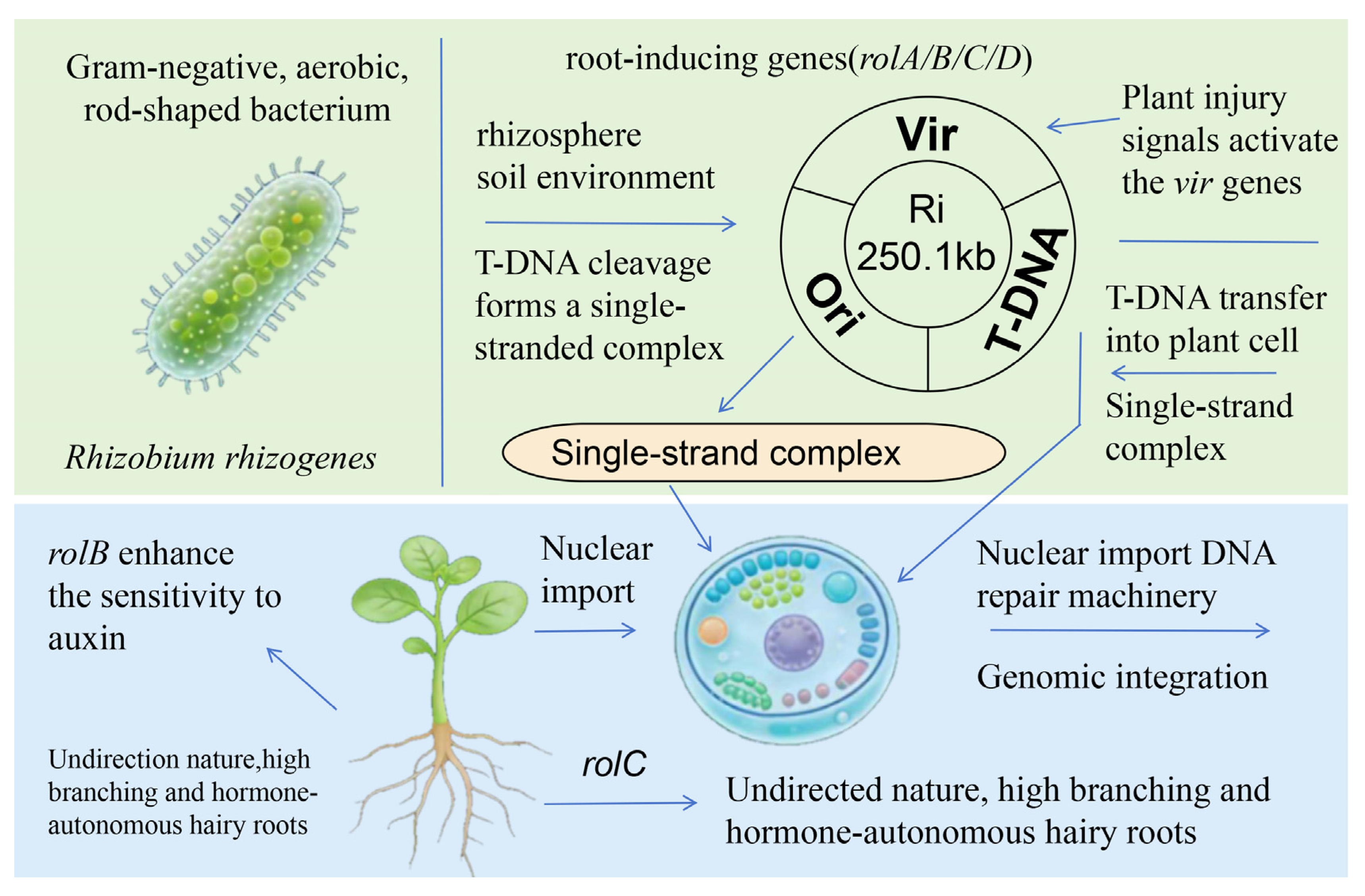
2.1. Structure and Function of R. rhizogenes
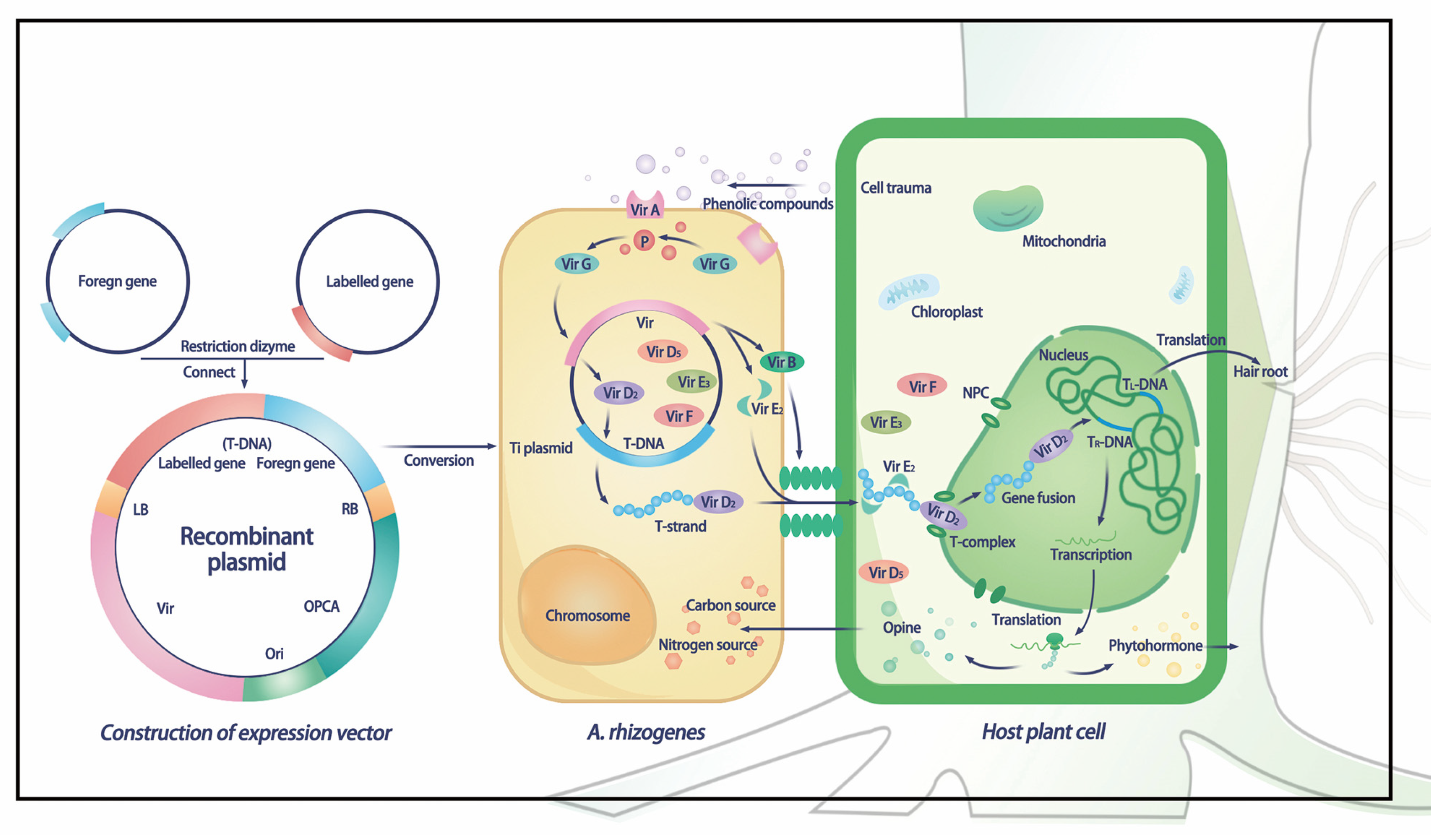
2.2. Mechanism of Hairy-Root Formation
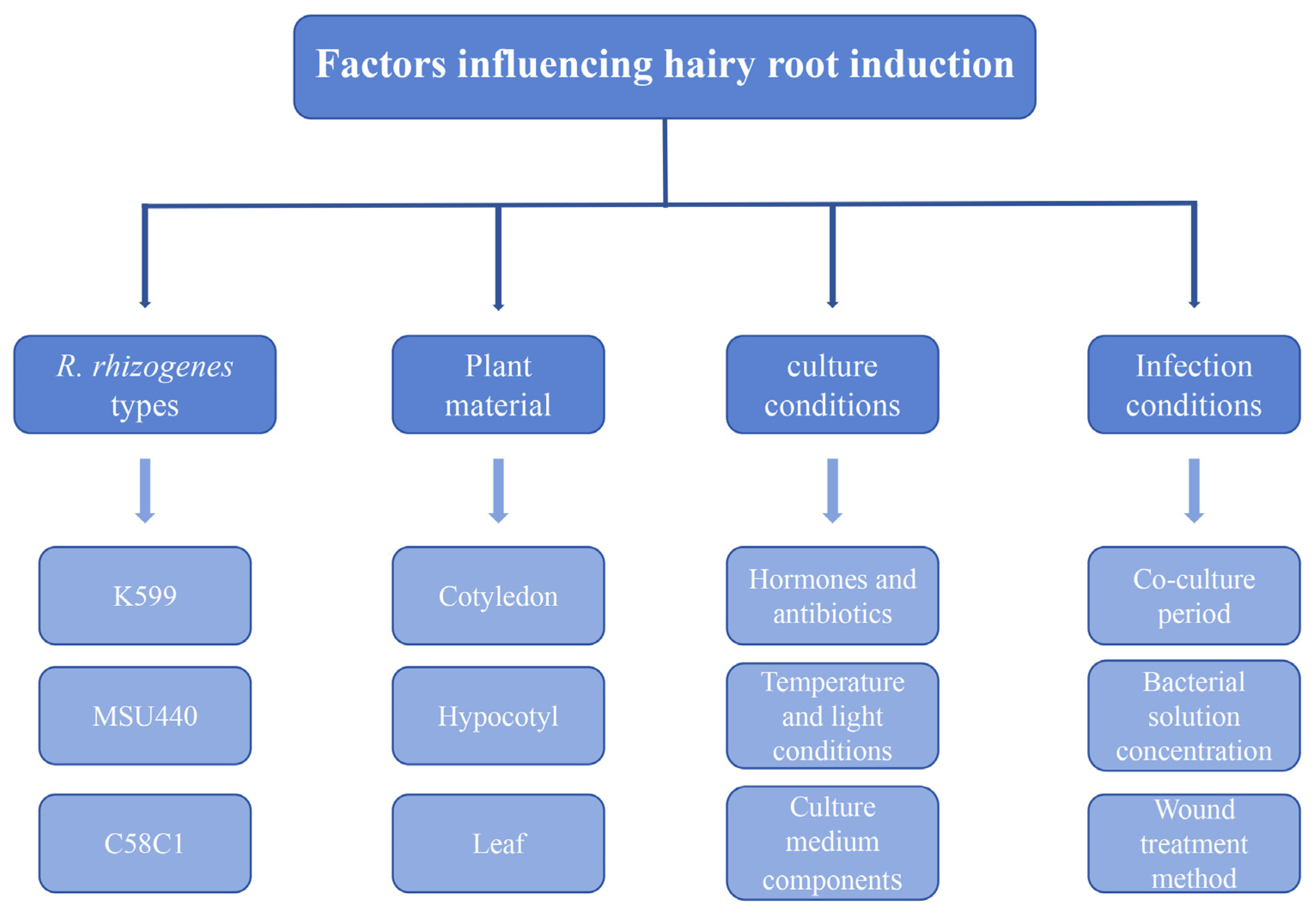
3. Factors Influencing Hairy-Root Induction
3.1. R. rhizogenes Types
3.2. Plant Material
3.3. Infection Conditions
3.4. Culture Conditions
4. Genetic Transformation Systems of Plant Hairy Roots
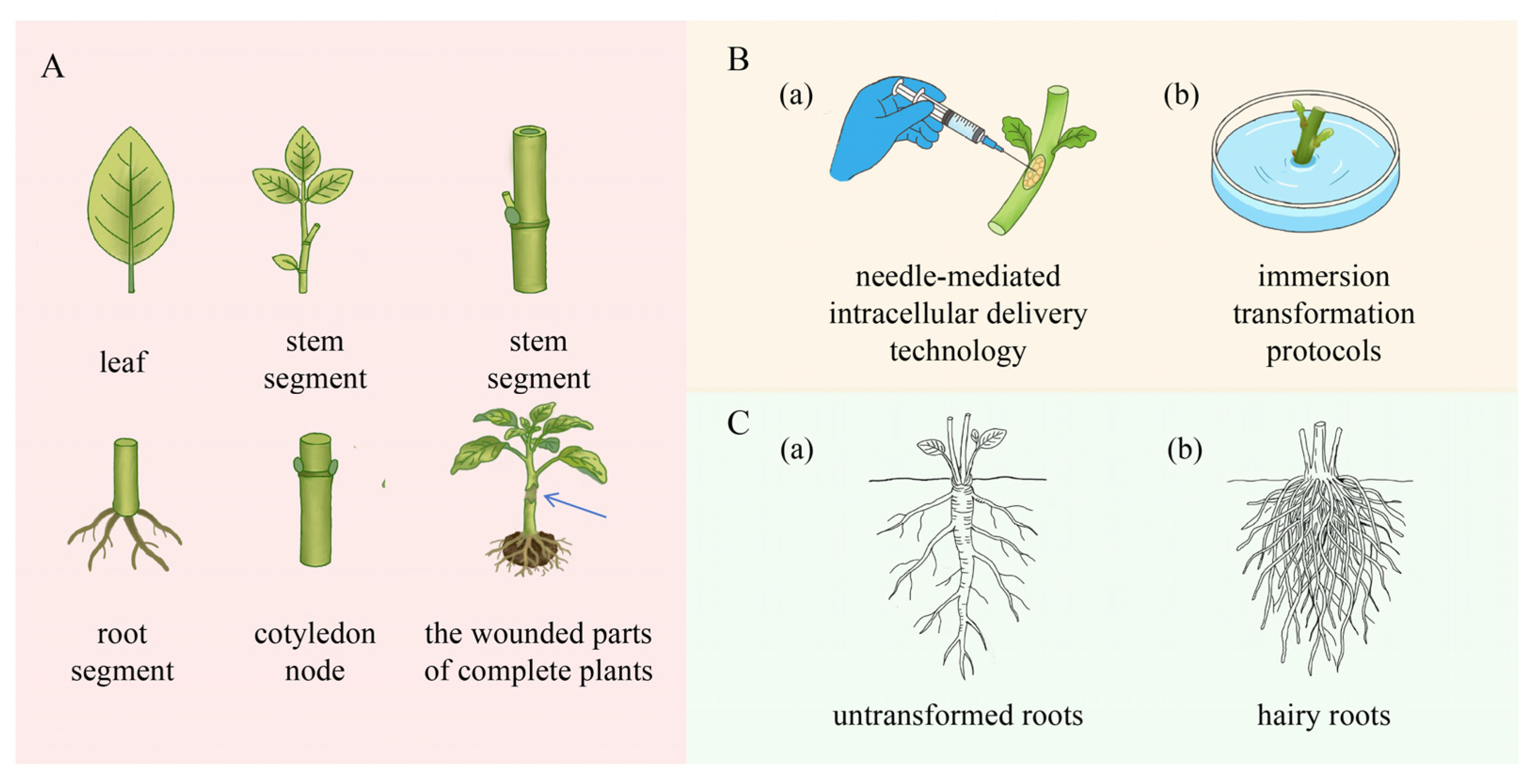
4.1. Transformation Methods and Operation Procedures
4.2. Establishment of Hairy-Root Regeneration Plant Systems
4.3. The Process of and Strategies for Optimizing CRISPR/Cas9 Gene Editing in Hairy Roots
5. Applications of Plant Hairy-Root Genetic Transformation
5.1. Research on Improving Plant Molecular Breeding
5.2. Sustainable Production of Secondary Metabolites via the Genetic Transformation System for Plant Hairy Roots
5.3. Application of Plant Hairy Roots for Environmental Remediation
6. Discussion
Author Contributions
Funding
Data Availability Statement
Acknowledgments
Conflicts of Interest
References
- Leech, D.; Previtera, D.A.; Zhang, Y.; Botella, J.R.; Crisp, P.A. Precision plant epigenome editing: What, how, and why. Trends Plant Sci. 2026, 31, 192–204. [Google Scholar] [CrossRef] [Scilit] [PubMed]
- Ramkumar, T.R.; Lenka, S.K.; Arya, S.S.; Bansal, K.C. A Short History and Perspectives on Plant Genetic Transformation. In Biolistic DNA Delivery in Plants: Methods and Protocols; Springer: New York, NY, USA, 2020; pp. 39–68. [Google Scholar] [CrossRef] [Scilit] [PubMed]
- Stiles, A.R.; Liu, C.-Z. Hairy Root Culture: Bioreactor Design and Process Intensification; Springer: Berlin/Heidelberg, Germany, 2013; pp. 91–114. [Google Scholar] [CrossRef] [Scilit] [PubMed]
- Su, W.; Xu, M.; Radani, Y.; Yang, L. Technological Development and Application of Plant Genetic Transformation. Int. J. Mol. Sci. 2023, 24, 10646. [Google Scholar] [CrossRef] [Scilit] [PubMed]
- Yan, Y.; Zhu, X.; Yu, Y.; Li, C.; Zhang, Z.; Wang, F. Nanotechnology Strategies for Plant Genetic Engineering. Adv. Mater. 2022, 34, 2106945. [Google Scholar] [CrossRef] [Scilit] [PubMed]
- Lian, W.N.; Chang, C.H.; Chen, Y.J.; Dao, R.L.; Luo, Y.C.; Chien, J.Y.; Hsieh, S.L.; Lin, C.H. Intracellular delivery can be achieved by bombarding cells or tissues with accelerated molecules or bacteria without the need for carrier particles. Exp. Cell Res. 2007, 313, 53–64. [Google Scholar] [CrossRef] [Scilit] [PubMed]
- Nguyen, V.; Searle, I.R. An Efficient Root Transformation System for Recalcitrant Vicia sativa. Front. Plant Sci. 2022, 12, 781014. [Google Scholar] [CrossRef] [Scilit] [PubMed]
- Wittmer, J.; Pijnenburg, M.; Wijsman, T.; Pelzer, S.; Adema, K.; Kerstens, M.; Kutevska, A.N.; Fierens, J.; Hofhuis, H.; Sevenier, R.; et al. Rational design of induced regeneration via somatic embryogenesis in the absence of exogenous phytohormones. Plant Cell 2025, 37, koaf252. [Google Scholar] [CrossRef] [Scilit] [PubMed]
- Cao, X.Y.; Bai, S.S.; Li, J.; Sun, Y.W. A simple and efficient system for evaluating plant genome editing efficiency and its application in optimizing the ISAam1 TnpB nuclease. Front. Plant Sci. 2025, 16, 1620874. [Google Scholar] [CrossRef] [Scilit] [PubMed]
- Ma, H.J.; Meng, X.Y.; Xu, K.; Li, M.; Gmitter, F.G.; Liu, N.G.; Gai, Y.P.; Huang, S.Y.; Wang, M.; Wang, N.; et al. Highly efficient hairy root genetic transformation and applications in citrus. Front. Plant Sci. 2022, 13, 1039094. [Google Scholar] [CrossRef] [Scilit] [PubMed]
- Moriuchi, H.; Okamoto, C.; Nishihama, R.; Yamashita, I.; Machida, Y.; Tanaka, N. Nuclear localization and interaction of RolB with plant 14-3-3 proteins correlates with induction of adventitious roots by the oncogene rolB. Plant J. 2004, 38, 260–275. [Google Scholar] [CrossRef] [Scilit] [PubMed]
- Malarz, J.; Yudina, Y.V.; Stojakowska, A. Hairy Root Cultures as a Source of Phenolic Antioxidants: Simple Phenolics, Phenolic Acids, Phenylethanoids, and Hydroxycinnamates. Int. J. Mol. Sci. 2023, 24, 6920. [Google Scholar] [CrossRef] [Scilit] [PubMed]
- Jariani, P.; Naghavi, M.R. Hairy roots as a platform for recombinant protein expression and secondary metabolite production: Current status and future prospects. Vitr. Cell. Dev. Biol. Plant 2025, 61, 25–41. [Google Scholar] [CrossRef] [Scilit]
- Elbouzidi, A.; Taibi, M.; Haddou, M.; Baraich, A.; Sadougui, I.; Bellaouchi, R.; Asehraou, A.; Chaabane, K.; El Guerrouj, B.; Addi, M. Hairy roots as a biotechnological tool for medicinal plant secondary metabolites: A systematic review. J. Biotechnol. 2026, 409, 117–136. [Google Scholar] [CrossRef] [Scilit] [PubMed]
- Maharjan, B.K.; Islam, M.T.; Muzaffar, A.; Tschaplinski, T.J.; Tuskan, G.A.; Chen, J.G.; Yang, X.H. Woody Plant Transformation: Current Status, Challenges, and Future Perspectives. Plants 2025, 14, 3420. [Google Scholar] [CrossRef] [Scilit] [PubMed]
- Paret, M.L.; Sharma, S.K.; Green, L.M.; Alvarez, A.M. Biochemical Characterization of Gram-Positive and Gram-Negative Plant-Associated Bacteria with Micro-Raman Spectroscopy. Appl. Spectrosc. 2010, 64, 433–441. [Google Scholar] [CrossRef] [Scilit] [PubMed]
- Suzuki, K.; Tanaka, K.; Yamamoto, S.; Kiyokawa, K.; Yoshida, K. Ti and Ri Plasmids. In Microbial Megaplasmids; Springer: Berlin/Heidelberg, Germany, 2009. [Google Scholar] [CrossRef] [Scilit]
- Actis, L.A.; Tolmasky, M.E.; Crosa, J.H. Bacterial plasmids: Replication of extrachromosomal genetic elements encoding resistance to antimicrobial compounds. Front. Biosci. 1999, 4, D43. [Google Scholar] [CrossRef] [Scilit] [PubMed]
- Kralemann, L.E.M.; de Pater, S.; Shen, H.X.; Kloet, S.L.; van Schendel, R.; Hooykaas, P.J.J.; Tijsterman, M. Distinct mechanisms for genomic attachment of the 5′ and 3′ ends of Agrobacterium T-DNA in plants. Nat. Plants 2022, 8, 526–534. [Google Scholar] [CrossRef] [Scilit] [PubMed]
- Gelvin, S.B. Plant DNA Repair and Agrobacterium T-DNA Integration. Int. J. Mol. Sci. 2021, 22, 8458. [Google Scholar] [CrossRef] [Scilit] [PubMed]
- van Attikum, H.; Bundock, P.; Hooykaas, P.J.J. Non-homologous end-joining proteins are required for Agrobacterium T-DNA integration. EMBO J. 2001, 20, 6550–6558. [Google Scholar] [CrossRef] [Scilit] [PubMed]
- Shen, H.X.; Li, Z. DNA Double-Strand Break Repairs and Their Application in Plant DNA Integration. Genes 2022, 13, 322. [Google Scholar] [CrossRef] [Scilit] [PubMed]
- Nishizawa-Yokoi, A.; Gelvin, S.B. Transformation and regeneration of DNA polymerase T mutant rice plants. Plant Direct 2023, 7, e526. [Google Scholar] [CrossRef] [Scilit] [PubMed]
- Nishizawa-Yokoi, A.; Saika, H.; Hara, N.; Lee, L.Y.; Toki, S.; Gelvin, S.B. Agrobacterium T-DNA integration in somatic cells does not require the activity of DNA polymerase θ. New Phytol. 2021, 229, 2859–2872. [Google Scholar] [CrossRef] [Scilit] [PubMed]
- David, C.; Chilton, M.D.; Tempé, J. Conservation of T-DNA in Plants Regenerated from Hairy Root Cultures. Nat. Biotechnol. 1984, 2, 73–76. [Google Scholar] [CrossRef] [Scilit]
- Fernández-Piñán, S.; Sànchez-Guirado, C.; Figueras, M.; Serra, O. Gene Downregulation in Potato Roots Using Agrobacterium rhizogenes-Mediated Transformation. Methods Mol. Biol. 2021, 2354, 353–372. [Google Scholar] [CrossRef] [Scilit] [PubMed]
- Slightom, J.L.; Durand-Tardif, M.; Jouanin, L.; Tepfer, D. Nucleotide sequence analysis of TL-DNA of Agrobacterium rhizogenes agropine type plasmid. Identification of open reading frames. J. Biol. Chem. 1986, 261, 108–121. [Google Scholar] [CrossRef] [Scilit]
- Moriguchi, K.; Maeda, Y.; Satou, M.; Hardayani, N.S.N.; Kataoka, M.; Tanaka, N.; Yoshida, K. The complete nucleotide sequence of a plant root-inducing (Ri) plasmid indicates its chimeric structure and evolutionary relationship between tumor-inducing (Ti) and symbiotic (Sym) plasmids in Rhizobiaceae. J. Mol. Biol. 2001, 307, 771–784. [Google Scholar] [CrossRef] [Scilit] [PubMed]
- Liu, W.; Liu, H.; Liu, X.; Yue, Z.; Yan, J.; Wei, L.; Wang, H.; Zhao, P.; Bian, G.; Zhang, Q.; et al. Molecular mechanism of cold acclimation regulating freezing tolerance in Prunus mume. Plant Physiol. 2026, 201, kiag333. [Google Scholar] [CrossRef] [Scilit] [PubMed]
- Mallol, A.; Cusidó, R.M.; Palazón, J.; Bonfill, M.; Morales, C.; Piñol, M.T. Ginsenoside production in different phenotypes of Panax ginseng transformed roots. Phytochemistry 2001, 57, 365–371. [Google Scholar] [CrossRef] [Scilit] [PubMed]
- Gelvin, S.B. Integration of Agrobacterium T-DNA into the Plant Genome. Annu. Rev. Genet. 2017, 51, 195–217. [Google Scholar] [CrossRef] [Scilit] [PubMed]
- Lohrmann, J.; Harter, K. Plant Two-Component Signaling Systems and the Role of Response Regulators. Plant Physiol. 2002, 128, 363–369. [Google Scholar] [CrossRef] [PubMed]
- Azizi-Dargahlou, S.; Pouresmaeil, M. Agrobacterium tumefaciens-Mediated Plant Transformation: A Review. Mol. Biotechnol. 2024, 66, 1563–1580. [Google Scholar] [CrossRef] [Scilit] [PubMed]
- Tiwari, M.; Mishra, A.K.; Chakrabarty, D. Agrobacterium-mediated gene transfer: Recent advancements and layered immunity in plants. Planta 2022, 256, 37. [Google Scholar] [CrossRef] [Scilit] [PubMed]
- Hwang, H.H.; Yu, M.; Lai, E.M. Agrobacterium-Mediated Plant Transformation: Biology and Applications. Arab. Book 2017, 15, e0186. [Google Scholar] [CrossRef] [Scilit] [PubMed]
- Biswas, D.; Chakraborty, A.; Mukherjee, S.; Ghosh, B. Hairy root culture: A potent method for improved secondary metabolite production of Solanaceous plants. Front. Plant Sci. 2023, 14, 19. [Google Scholar] [CrossRef] [Scilit] [PubMed]
- Bahramnejad, B. A critical review on use of Agrobacterium rhizogenes and their associated binary vectors for plant transformation. Biotechnol. Adv. 2019, 37, 107405. [Google Scholar] [CrossRef] [Scilit] [PubMed]
- Weisberg, A.J.; Davis, E.W.; Tabima, J.; Belcher, M.S.; Chang, J.H. Unexpected conservation and global transmission of agrobacterial virulence plasmids. Science 2020, 368, eaba5256. [Google Scholar] [CrossRef] [Scilit] [PubMed]
- Hooykaas, P. The Ti Plasmid, Driver of Agrobacterium Pathogenesis. Phytopathology 2023, 113, 594–604. [Google Scholar] [CrossRef] [Scilit] [PubMed]
- Veremeichik, G.N.; Bulgakov, D.V.; Solomatina, T.O.; Makhazen, D.S. In the interkingdom horizontal gene transfer, the small rolA gene is a big mystery. Appl. Microbiol. Biotechnol. 2023, 107, 2097–2109. [Google Scholar] [CrossRef] [Scilit] [PubMed]
- Xu, M.Y.; Su, W.B.; Hwarari, D.; Zuo, Y.Y.; Hao, Z.D.; Shi, J.S.; Chen, J.H.; Yang, L.M. An efficient genetic transformation and gene editing system mediated by Agrobacterium rhizogenes for Liriodendron hybrid and its application. J. Plant Physiol. 2025, 315, 154639. [Google Scholar] [CrossRef] [Scilit] [PubMed]
- Chen, X.; Zhao, J.G.; Ji, C.C.; Du, T.L.; Wang, M.T.; Shu, J.Y.; da Silvai, J.A.T.; Yu, X.A. Rapid genetic transformation of herbaceous peony without tissue culture via Agrobacterium rhizogenes: Optimization using rhizomes, stems, roots, and seedlings. J. Plant Physiol. 2026, 318, 154709. [Google Scholar] [CrossRef] [Scilit] [PubMed]
- Gelvin, S.B. Agobacterium-mediated plant transformation: The biology behind the “gene-Jockeying” tool. Microbiol. Mol. Biol. Rev. 2003, 67, 16–37. [Google Scholar] [CrossRef] [Scilit] [PubMed]
- Christey, M.C. Invited review: Use of Ri-mediated transformation for production of transgenic plants. Vitr. Cell. Dev. Biol.-Plant 2001, 37, 687–700. [Google Scholar] [CrossRef] [Scilit]
- Tzfira, T.; Citovsky, V. Agrobacterium-mediated genetic transformation of plants: Biology and biotechnology. Curr. Opin. Biotechnol. 2006, 17, 147–154. [Google Scholar] [CrossRef] [Scilit] [PubMed]
- Rodrigues, S.D.; Delmotte, D.; De Coster, G.; Sweron, O.; van den Steen, E.; De Saeger, J.; Pauwels, L.; De Coninck, B. A highly efficient platform for Arabidopsis hairy root induction using Agrobacterium strain K599. Plant Cell Tissue Organ Cult. 2025, 163, 83. [Google Scholar] [CrossRef] [Scilit]
- Lu, J.; Huang, Y.W.; Guo, Y.H.; Fan, C.G.; Yuan, G.Z.; Zhou, R.; Sun, J.J.; Bai, M.J.; Wang, K.; Liu, J.Y.; et al. Agrobacterium rhizogenes-Mediated Hairy Root Transformation in Rosa. Horticulturae 2025, 11, 49. [Google Scholar] [CrossRef] [Scilit]
- Cheng, Y.Y.; Wang, X.L.; Li, C.; Ji, J.; Liu, T.F.; Duan, K.X. Highly efficient Agrobacterium rhizogenes-mediated hairy root transformation for gene functional and gene editing analysis in soybean. Plant Methods 2021, 17, 73. [Google Scholar] [CrossRef] [Scilit] [PubMed]
- Zhou, L.L.; Wang, Y.L.; Wang, P.L.; Wang, C.L.; Wang, J.M.; Wang, X.F.; Cheng, H.M. Highly efficient Agrobacterium rhizogenes-mediated hairy root transformation for gene editing analysis in cotton. Front. Plant Sci. 2022, 13, 1059404. [Google Scholar] [CrossRef] [Scilit] [PubMed]
- Pan, J.Y.; Zheng, Y.P.; Wang, T.C.; Xiong, P.P.; Cui, K.B.; Zeng, L.H.; Fang, T. Establishment of an Efficient Agrobacterium rhizogenes-Mediated Hairy Root Transformation System for Functional Analysis in Passion Fruit. Plants 2025, 14, 2312. [Google Scholar] [CrossRef] [Scilit] [PubMed]
- Kasule, F.; Lee, K.; Ji, Q.; Grosic, S.; Wang, K. Endogenous expression of the wound signal peptide ZmREF1 enhances Agrobacterium-mediated transformation of maize inbred B104. Plant Cell Rep. 2026, 45, 94. [Google Scholar] [CrossRef] [Scilit] [PubMed]
- Pushyami, B.; Beena, M.R.; Sinha, M.K.; Kirti, P.B. In vitro regeneration and optimization of conditions for Agrobacterium mediated transformation in jute, Corchorus capsularis. J. Plant Biochem. Biotechnol. 2011, 20, 39–46. [Google Scholar] [CrossRef] [Scilit]
- Ziemienowicz, A. Agrobacterium-mediated plant transformation: Factors, applications and recent advances. Biocatal. Agric. Biotechnol. 2014, 3, 95–102. [Google Scholar] [CrossRef] [Scilit]
- Kudoyarova, G.R.; Arkhipova, T.N.; Melent’Ev, A.I. Role of Bacterial Phytohormones in Plant Growth Regulation and Their Development. Sustain. Dev. Biodivers. 2015, 12, 69–86. [Google Scholar] [CrossRef] [Scilit]
- Hisano, H.; Matsuura, T.; Mori, I.C.; Yamane, M.; Sato, K. Endogenous hormone levels affect the regeneration ability of callus derived from different organs in barley. Plant Physiol. Biochem. 2016, 99, 66–72. [Google Scholar] [CrossRef] [Scilit] [PubMed]
- Ribas, A.F.; Dechamp, E.; Champion, A.; Bertrand, B.; Combes, M.C.; Verdeil, J.L.; Lapeyre, F.; Lashermes, P.; Etienne, H. Agrobacterium-mediated genetic transformation of Coffea arabica (L.) is greatly enhanced by using established embryogenic callus cultures. BMC Plant Biol. 2011, 11, 92. [Google Scholar] [CrossRef] [Scilit] [PubMed]
- Zhi, L.L.; Hu, X.Y. Adventitious Root Regeneration: Molecular Basis and Influencing Factors. Phyton-Int. J. Exp. Bot. 2023, 92, 2825–2840. [Google Scholar] [CrossRef] [Scilit]
- Zhu, Y.T.; Zhu, X.; Wen, Y.; Wang, L.H.; Wang, Y.L.; Liao, C.L.; Zhao, M.; Li, T.T.; Liu, D.X.; Li, B.B.; et al. Plant hairy roots: Induction, applications, limitations and prospects. Ind. Crops Prod. 2024, 219, 119104. [Google Scholar] [CrossRef] [Scilit]
- Ono, N.N.; Tian, L. The multiplicity of hairy root cultures: Prolific possibilities. Plant Sci. 2011, 180, 439–446. [Google Scholar] [CrossRef] [Scilit] [PubMed]
- Nguyen, D.V.; Hoang, T.T.H.; Le, N.T.; Tran, H.T.; Nguyen, C.X.; Moon, Y.H.; Chu, H.H.; Do, P.T. An Efficient Hairy Root System for Validation of Plant Transformation Vector and CRISPR/Cas Construct Activities in Cucumber (Cucumis sativus L.). Front. Plant Sci. 2022, 12, 770062. [Google Scholar] [CrossRef] [Scilit] [PubMed]
- Su, Y.K.; Lin, C.C.; Zhang, J.; Hu, B.; Wang, J.; Li, J.Y.; Wang, S.Q.; Liu, R.H.; Li, X.; Song, Z.Q.; et al. One-Step Regeneration of Hairy Roots to Induce High Tanshinone Plants in Salvia miltiorrhiza. Front. Plant Sci. 2022, 13, 913985. [Google Scholar] [CrossRef] [Scilit] [PubMed]
- Chen, Z.; Yang, X.; Tang, M.; Wang, Y.; Zhang, Q.; Li, H.; Zhou, Y.; Sun, F.; Cui, X. Molecular Characterization and Drought Resistance of GmNAC3 Transcription Factor in Glycine max (L.) Merr. Int. J. Mol. Sci. 2022, 23, 12378. [Google Scholar] [CrossRef] [Scilit] [PubMed]
- Cui, M.L.; Liu, C.; Piao, C.L.; Liu, C.L. A Stable Agrobacterium rhizogenes-Mediated Transformation of Cotton (Gossypium hirsutum L.) and Plant Regeneration From Transformed Hairy Root via Embryogenesis. Front. Plant Sci. 2020, 11, 604255. [Google Scholar] [CrossRef] [Scilit] [PubMed]
- Qin, Y.Q.; Wang, D.; Fu, J.X.; Zhang, Z.K.; Qin, Y.H.; Hu, G.B.; Zhao, J.T. Agrobacterium rhizogenes-mediated hairy root transformation as an efficient system for gene function analysis in Litchi chinensis. Plant Methods 2021, 17, 103. [Google Scholar] [CrossRef] [Scilit] [PubMed]
- Yan, H.Q.; Ma, D.D.; Yi, P.P.; Sun, G.L.; Chen, X.Y.; Yi, Y.; Huang, X.L. Highly efficient Agrobacterium rhizogenes-mediated transformation for functional analysis in woodland strawberry. Plant Methods 2023, 19, 99. [Google Scholar] [CrossRef] [Scilit] [PubMed]
- Ma, H.J.; Liu, N.G.; Sun, X.P.; Zhu, M.L.; Mao, T.F.; Huang, S.Y.; Meng, X.Y.; Li, H.F.; Wang, M.; Liang, H.L. Establishment of an efficient transformation system and its application in regulatory mechanism analysis of biological macromolecules in tea plants. Int. J. Biol. Macromol. 2023, 244, 125372. [Google Scholar] [CrossRef] [Scilit] [PubMed]
- Sarkar, J.; Misra, A.; Banerjee, N. Genetic transfection, hairy root induction and solasodine accumulation in elicited hairy root clone of Solanum erianthum D. Don. J. Biotechnol. 2020, 323, 238–245. [Google Scholar] [CrossRef] [Scilit] [PubMed]
- Hernández-Piedra, G.; Ruiz-Carrera, V.; Sánchez, A.J.; Azpeitia-Morales, A.; Calva-Calva, G. Induction of Hairy Roots on Somatic Embryos of Rhizoclones from Typha domingensis Seedlings. Plants 2020, 9, 1679. [Google Scholar] [CrossRef] [Scilit] [PubMed]
- Tai, Y.L.; Zhang, J.; Chen, Y.H.; Yuan, Y.; Wang, H.G.; Yu, L.Y.; Li, S.S.; Yang, L.; Jin, Y.F. Establishment and validation of a callus tissue transformation system for German chamomile (Matricaria chamomilla L.). BMC Plant Biol. 2023, 23, 659. [Google Scholar] [CrossRef] [Scilit] [PubMed]
- Rezazadehfar, P.; Rezayian, M.; Niknam, V.; Mirmasoumi, M. Elicitor-enhanced steroidal sapogenin accumulation in hairy root cultures of Trigonella foenum-graecum. Sci. Rep. 2024, 14, 19106. [Google Scholar] [CrossRef] [Scilit] [PubMed]
- Li, P.W.; Zhang, Y.L.; Liang, J.; Hu, X.F.; He, Y.; Miao, T.H.; Ouyang, Z.Y.; Yang, Z.C.; Amin, A.K.; Ling, C.C.; et al. Agrobacterium rhizogenes-mediated marker-free transformation and gene editing system revealed that AeCBL3 mediates the formation of calcium oxalate crystal in kiwifruit. Mol. Hortic. 2024, 4, 1. [Google Scholar] [CrossRef] [Scilit] [PubMed]
- Abdelkawy, A.M.; Alshammari, S.O.; Hussein, H.A.A.; Abou El-Enain, I.M.M.; Abdelkhalek, E.S.; Radwan, A.M.; Kenawy, S.K.M.; Maaty, D.A.M.; Abed, N.N.; Sabry, S.; et al. Effect of silver nanoparticles on tropane alkaloid production of transgenic hairy root cultures of Hyoscyamus muticus L. and their antimicrobial activity. Sci. Rep. 2023, 13, 10397. [Google Scholar] [CrossRef] [Scilit] [PubMed]
- Amini, S.; Fattahi, M.; Nazemiyeh, H. Optimization of induction and hairy root culture establishment in two mullein species, Verbascum erianthum and Verbascum stachydiforme. Sci. Rep. 2024, 14, 5636. [Google Scholar] [CrossRef] [Scilit] [PubMed]
- Zhang, T.; Liu, K.; Chen, J.; Zhao, S.; Zhou, W.; Chen, S.; Su, Y.; Zhang, C. An efficient hairy root transformation system for protein interaction and gene editing analysis in roses. Hortic. Plant J. 2025, in press. [Google Scholar] [CrossRef] [Scilit]
- Zhang, J.; Mao, X.; Huang, B.; Lei, M.; Miao, Y.; Liu, D. Establishment of high-efficiency hairy root and genetic transformation system in Cynanchum stauntonii. J. Biotechnol. 2025, 402, 21–29. [Google Scholar] [CrossRef] [Scilit] [PubMed]
- Gad, K.; Huu, C.N.; Plaschil, S.; Kappel, C.; Lenhard, M. Genetic transformation of Primula sieboldii using Agrobacterium rhizogenes and whole-plant regeneration from transgenic hairy roots. Front. Plant Sci. 2025, 16, 1623387. [Google Scholar] [CrossRef] [Scilit] [PubMed]
- Xia, J.Y.; Shu, J.F.; Lin, S.; Zhu, J.J.; Lin, F.B.; Fang, R.X.; Huo, L.Q.; Liu, J.H.; Xu, K.; Ma, H.J. Establishment and comparative analysis of Agrobacterium-mediated genetic transformation systems for Actinidia valvata and Actinidia chinensis. Front. Plant Sci. 2026, 17, 1764453. [Google Scholar] [CrossRef] [Scilit] [PubMed]
- Yu, W.J.; Tian, H.R.; Chen, Y.F.; Lyu, S.; Fan, Y.L. Stable transformation mediated by Agrobacterium tumefaciens in Jonquil is better than Agrobacterium rhizogenes. Front. Plant Sci. 2025, 16, 1594197. [Google Scholar] [CrossRef] [Scilit] [PubMed]
- Meng, D.; Yang, Q.; Dong, B.Y.; Song, Z.H.; Niu, L.L.; Wang, L.T.; Cao, H.Y.; Li, H.H.; Fu, Y.J. Development of an efficient root transgenic system for pigeon pea and its application to other important economically plants. Plant Biotechnol. J. 2019, 17, 1804–1813. [Google Scholar] [CrossRef] [Scilit] [PubMed]
- Jedličková, V.; Stefková, M.; Sedlácek, M.; Panzarová, K.; Robert, H.S. Hairy Root Transformation and Regeneration in Arabidopsis thaliana and Brassica napus. J. Vis. Exp. 2023, 202, e66223. [Google Scholar] [CrossRef] [Scilit] [PubMed]
- Wang, H.; Cheng, K.M.; Li, T.J.; Lan, X.Y.; Shen, L.; Zhao, H.Y.; Lü, S.Y. A Highly Efficient Agrobacterium rhizogenes-Mediated Hairy Root Transformation Method of Idesia polycarpa and the Generation of Transgenic Plants. Plants 2024, 13, 1791. [Google Scholar] [CrossRef] [Scilit] [PubMed]
- Vu, P.B.T.; Tran, T.Q.; Nguyen, K.D.; Tran, H.; Cao, D.M.; Quach, P.N.D. Enhanced hairy root induction in garlic (Allium sativum L.) via Agrobacterium rhizogenes: Targeting the basal plate of intact sprout. Not. Bot. Horti Agrobot. 2025, 53, 14670. [Google Scholar] [CrossRef] [Scilit]
- Kulshreshtha, A.; Ramasamy, M.; Irigoyen, S.; Padilla, C.S.; Tu, C.K.; Laughlin, K.; Borneman, J.; Mandadi, K.K. High-efficiency genome-editing, transgene evaluation, and antimicrobial efficacy testing using Citrus medica L. hairy roots. Plant J. 2026, 125, e70745. [Google Scholar] [CrossRef] [Scilit] [PubMed]
- Kumar, S.; Prakash, S.; Kumari, P.; Sanan-Mishra, N. A robust in-vitro and ex-vitro Agrobacterium rhizogenes-mediated hairy root transformation system in mungbean for efficient visual screening of transformants using the RUBY reporter. BMC Plant Biol. 2025, 25, 724. [Google Scholar] [CrossRef] [Scilit] [PubMed]
- Tian, M.; Luo, L.L.; Jin, B.L.; Liu, J.N.; Chen, T.; Tang, J.F.; Shen, Y.; Zhang, H.Y.; Guo, J.; Zhang, H.W.; et al. Highly efficient Agrobacterium rhizogenes-mediated gene editing system in Salvia miltiorrhiza inbred line bh2-7. Plant Biotechnol. J. 2025, 23, 2406–2417. [Google Scholar] [CrossRef] [Scilit] [PubMed]
- Omelchenko, D.O.; Glagoleva, E.S.; Stepanova, A.Y.; Logacheva, M.D. Callus Induction Followed by Regeneration and Hairy Root Induction in Common Buckwheat. Methods Mol. Biol. 2024, 2791, 1–14. [Google Scholar] [CrossRef] [Scilit] [PubMed]
- Chen, C.L.; Hu, Y.X.; Ikeuchi, M.; Jiao, Y.L.; Prasad, K.; Su, Y.H.; Xiao, J.; Xu, L.; Yang, W.B.; Zhao, Z.; et al. Plant regeneration in the new era: From molecular mechanisms to biotechnology applications. Sci. China Life Sci. 2024, 67, 1338–1367. [Google Scholar] [CrossRef] [Scilit] [PubMed]
- Perez-Garcia, P.; Moreno-Risueno, M.A. Stem cells and plant regeneration. Dev. Biol. 2018, 442, 3–12. [Google Scholar] [CrossRef] [Scilit] [PubMed]
- Makhzoum, A.B.; Sharma, P.; Bernards, M.A.; Trémouillaux-Guiller, J. Hairy Roots: An Ideal Platform for Transgenic Plant Production and Other Promising Applications. In Phytochemicals, Plant Growth, and the Environment; Recent Advances in Phytochemistry; Springer: New York, NY, USA, 2012; Volume 42, pp. 95–142. [Google Scholar] [CrossRef] [Scilit]
- Gerszberg, A.; Wiktorek-Smagur, A. Hairy root cultures as a multitask platform for green biotechnology. Plant Cell Tissue Organ Cult. 2022, 150, 493–509. [Google Scholar] [CrossRef] [Scilit]
- Fan, Y.L.; Zhang, X.H.; Zhong, L.J.; Wang, X.Y.; Jin, L.S.; Lyu, S.H. One-step generation of composite soybean plants with transgenic roots by Agrobacterium rhizogenes-mediated transformation. BMC Plant Biol. 2020, 20, 208. [Google Scholar] [CrossRef] [Scilit] [PubMed]
- Wang, H.Y.; Zheng, Y.S.; Zhou, Q.; Li, Y.; Liu, T.K.; Hou, X.L. Fast, simple, efficient Agrobacterium rhizogenes-mediated transformation system to non-heading Chinese cabbage with transgenic roots. Hortic. Plant J. 2024, 10, 450–460. [Google Scholar] [CrossRef] [Scilit]
- Wang, X.P.; Chen, S.S.; Zhang, H.N.; Luo, P.; Zhou, F.P.; Zeng, B.S.; Xu, J.M.; Fan, C.J. Agrobacterium-mediated genetic transformation of the most widely cultivated superior clone Eucalyptus urophylla × E. grandis DH32-29 in Southern China. Front. Plant Sci. 2023, 13, 1011245. [Google Scholar] [CrossRef] [Scilit] [PubMed]
- Wu, J.; Wang, Y.; Zhang, L.X.; Zhang, X.Z.; Kong, J.; Lu, J.; Han, Z.H. High-efficiency regeneration of Agrobacterium rhizogenes-induced hairy root in apple rootstock Malus baccata (L.) Borkh. Plant Cell Tissue Organ Cult. 2012, 111, 183–189. [Google Scholar] [CrossRef] [Scilit]
- Lian, Z.Y.; Nguyen, C.D.; Liu, L.; Wang, G.L.; Chen, J.J.; Wang, S.H.; Yi, G.J.; Wilson, S.; Ozias-Akins, P.; Gong, H.J.; et al. Application of developmental regulators to improve in planta or in vitro transformation in plants. Plant Biotechnol. J. 2022, 20, 1622–1635. [Google Scholar] [CrossRef] [Scilit] [PubMed]
- Mehraj, H.; Maruyama, T.; Tsuruta, M.; Ueno, S. Developmental regulatory genes: Key switches in the developmental events of plant tissue culture. Curr. Plant Biol. 2025, 44, 100550. [Google Scholar] [CrossRef] [Scilit]
- Kareem, A.; Durgaprasad, K.; Sugimoto, K.; Du, Y.J.; Pulianmackal, A.J.; Trivedi, Z.B.; Abhayadev, P.V.; Pinon, V.; Meyerowitz, E.M.; Scheres, B.; et al. PLETHORA Genes Control Regeneration by a Two-Step Mechanism. Curr. Biol. 2015, 25, 1017–1030. [Google Scholar] [CrossRef] [Scilit] [PubMed]
- He, Y.B.; Zhang, T.; Sun, H.; Zhan, H.D.; Zhao, Y.D. A reporter for noninvasively monitoring gene expression and plant transformation. Hortic. Res. 2020, 7, 152. [Google Scholar] [CrossRef] [Scilit] [PubMed]
- Liu, L.; Qu, J.H.; Wang, C.Y.; Liu, M.; Zhang, C.M.; Zhang, X.Y.; Guo, C.; Wu, C.G.; Yang, G.D.; Huang, J.G.; et al. An efficient genetic transformation system mediated by Rhizobium rhizogenes in fruit trees based on the transgenic hairy root to shoot conversion. Plant Biotechnol. J. 2024, 22, 2093–2103. [Google Scholar] [CrossRef] [Scilit] [PubMed]
- Wang, P.L.; Si, H.; Li, C.H.; Xu, Z.P.; Guo, H.M.; Jin, S.X.; Cheng, H.M. Plant genetic transformation: Achievements, current status and future prospects. Plant Biotechnol. J. 2025, 23, 2034–2058. [Google Scholar] [CrossRef] [Scilit] [PubMed]
- Dhiman, N.; Patial, V.; Bhattacharya, A. The Current Status and Future Applications of Hairy Root Cultures. In Biotechnological Approaches for Medicinal and Aromatic Plants: Conservation, Genetic Improvement and Utilization; Kumar, N., Ed.; Springer: Singapore, 2018; pp. 87–155. [Google Scholar] [CrossRef] [Scilit]
- Sakure, A.A.; Thounaojam, A.S.; Kumar, S.; Patel, D.A. Biotechnological Approaches for Medicinal and Aromatic Plant-Based Products. In Biosynthesis of Bioactive Compounds in Medicinal and Aromatic Plants: Manipulation by Conventional and Biotechnological Approaches; Kumar, N., Singh, R.S., Eds.; Springer Nature: Cham, Switzerland, 2023; pp. 1–39. [Google Scholar] [CrossRef] [Scilit]
- Aoki, H.; Teramura, H.; Schepetilnikov, M.; Ryabova, L.A.; Kusano, H.; Shimada, H. Enhanced translation of the downstream ORF attributed to a long 5′ untranslated region in the OsMac1 gene family members, OsMac2 and OsMac3. Plant Biotechnol. 2014, 31, 221–228. [Google Scholar] [CrossRef] [Scilit]
- Onodera, H.; Shingu, S.; Ohnuma, M.; Horie, T.; Kihira, M.; Kusano, H.; Teramura, H.; Shimada, H. Establishment of a conditional TALEN system using the translational enhancer dMac3 and an inducible promoter activated by glucocorticoid treatment to increase the frequency of ta rgeted mutagenesis in plants. PLoS ONE 2018, 13, e0208959. [Google Scholar] [CrossRef] [Scilit] [PubMed]
- Kusano, H.; Ohnuma, M.; Mutsuro-Aoki, H.; Asahi, T.; Ichinosawa, D.; Onodera, H.; Asano, K.; Noda, T.; Horie, T.; Fukumoto, K.; et al. Establishment of a modified CRISPR/Cas9 system with increased mutagenesis frequency using the translational enhancer dMac3 and multiple guide RNAs in potato. Sci. Rep. 2018, 8, 13753. [Google Scholar] [CrossRef] [Scilit] [PubMed]
- Kong, Q.; Li, J.; Wang, S.; Feng, X.; Shou, H. Combination of Hairy Root and Whole-Plant Transformation Protocols to Achieve Efficient CRISPR/Cas9 Genome Editing in Soybean. Plants 2023, 12, 1017. [Google Scholar] [CrossRef] [Scilit] [PubMed]
- Niazian, M.; Belzile, F.; Torkamaneh, D. CRISPR/Cas9 in Planta Hairy Root Transformation: A Powerful Platform for Functional Analysis of Root Traits in Soybean. Plants 2022, 11, 1044. [Google Scholar] [CrossRef] [Scilit] [PubMed]
- de Koning, R.; Daryanavard, H.; Garmyn, J.; Kiekens, R.; Toili, M.E.M.; Angenon, G. Fine-tuning CRISPR/Cas9 gene editing in common bean (Phaseolus vulgaris L.) using a hairy root transformation system and in silico prediction models. Front. Plant Sci. 2023, 14, 1233418. [Google Scholar] [CrossRef] [Scilit] [PubMed]
- Nakayasu, M.; Akiyama, R.; Lee, H.J.; Osakabe, K.; Osakabe, Y.; Watanabe, B.; Sugimoto, Y.; Umemoto, N.; Saito, K.; Muranaka, T.; et al. Generation of α-solanine-free hairy roots of potato by CRISPR/Cas9 mediated genome editing of the St16DOX gene. Plant Physiol. Biochem. 2018, 131, 70–77. [Google Scholar] [CrossRef] [Scilit] [PubMed]
- Moose, S.P.; Mumm, R.H. Molecular Plant Breeding as the Foundation for 21st Century Crop Improvement. Plant Physiol. 2008, 147, 969–977. [Google Scholar] [CrossRef] [Scilit] [PubMed]
- Wang, L.L.; Zhang, T.; Li, C.T.; Zhou, C.J.; Liu, B.; Wu, Y.K.; He, F.M.; Xu, Y.Q.; Li, F.L.; Feng, X. Overexpression of Wild Soybean Expansin Gene GsEXLB14 Enhanced the Tolerance of Transgenic Soybean Hairy Roots to Salt and Drought Stresses. Plants 2024, 13, 1656. [Google Scholar] [CrossRef] [Scilit] [PubMed]
- Su, L.-C.; Zhong, Y.-T.; Li, L. Physiological regulation effect of AhHDA1 on peanut hairy roots to drought stress. Plant Physiol. J. 2017, 53, 1893–1900. [Google Scholar] [CrossRef]
- Wang, S.K.; Sun, Z.J.; Cao, W.H.; Liu, H.; Aioub, A.A.A.; Hu, Z.N.; Wu, W.J. Establishment of Agrobacterium rhizogenes-mediated RNAi of Phryma leptostachya accelerates the functional identification of key genes of the furofuran lignan biosynthetic pathway. Ind. Crops Prod. 2023, 204, 117260. [Google Scholar] [CrossRef] [Scilit]
- Kumagai, H.; Kouchi, H. Gene silencing by expression of hairpin RNA in Lotus japonicus roots and root nodules. Mol. Plant-Microbe Interact. 2003, 16, 663–668. [Google Scholar] [CrossRef] [Scilit] [PubMed]
- Chen, Y.; Zhu, P.P.; Wu, S.Y.; Lu, Y.; Sun, J.; Cao, Q.H.; Li, Z.Y.; Xu, T. Identification and expression analysis of GRAS transcription factors in the wild relative of sweet potato Ipomoea trifida. BMC Genom. 2019, 20, 911. [Google Scholar] [CrossRef] [Scilit] [PubMed]
- Singh, P.; Prasad, R.; Tewari, R.; Jaidi, M.; Kumar, S.; Rout, P.K.; Rahman, L.U. Silencing of quinolinic acid phosphoribosyl transferase (QPT) gene for enhanced production of scopolamine in hairy root culture of Duboisia leichhardtii. Sci. Rep. 2018, 8, 13939. [Google Scholar] [CrossRef] [Scilit] [PubMed]
- Ren, C.; Lin, Y.; Mohamed, M.S.M.; Liu, C.; Liang, Z. A simplified RUBY reporter-enabled hairy-root system for rapid evaluation of genome editing and gene function in grapevine. Planta 2026, 263, 100. [Google Scholar] [CrossRef] [Scilit] [PubMed]
- Di Pinto, A.; Forte, V.; D’Attilia, C.; Possenti, M.; Felici, B.; Augelletti, F.; Sessa, G.; Carabelli, M.; Morelli, G.; Frugis, G.; et al. A Rapid Hairy Root-Based Platform for CRISPR/Cas Optimization and Guide RNA Validation in Lettuce. Plants 2026, 15, 1161. [Google Scholar] [CrossRef] [Scilit] [PubMed]
- Jedličková, V.; Štefková, M.; Sánchez López, J.F.; Grimplet, J.; Rubio Cabetas, M.J.; Robert, H.S. Genome editing in almond using hairy root transformation system. Plant Cell Tissue Organ Cult. 2024, 159, 74. [Google Scholar] [CrossRef] [Scilit]
- Zhang, M.; Zhou, L.; Afridi, M.; Guo, H.; Cheng, H. An efficient hairy root system for validation of CRISPR/Cas system activities in cotton. Funct. Integr. Genom. 2025, 25, 116. [Google Scholar] [CrossRef] [Scilit] [PubMed]
- Pagare, S.; Bhatia, M.; Tripathi, N.; Bansal, Y.K. Secondary Metabolites of Plants and their Role: Overview. Curr. Trends Biotechnol. Pharm. 2015, 9, 293–304. [Google Scholar]
- Guerriero, G.; Berni, R.; Muñoz-Sanchez, J.A.; Apone, F.; Abdel-Salam, E.M.; Qahtan, A.A.; Alatar, A.A.; Cantini, C.; Cai, G.; Hausman, J.F.; et al. Production of Plant Secondary Metabolites: Examples, Tips and Suggestions for Biotechnologists. Genes 2018, 9, 309. [Google Scholar] [CrossRef] [Scilit] [PubMed]
- Gutierrez-Valdes, N.; Häkkinen, S.T.; Lemasson, C.; Guillet, M.; Oksman-Caldentey, K.M.; Ritala, A.; Cardon, F. Hairy Root Cultures—A Versatile Tool with Multiple Applications. Front. Plant Sci. 2020, 11, 33. [Google Scholar] [CrossRef] [Scilit] [PubMed]
- Ozyigit, I.I.; Dogan, I.; Hocaoglu-Ozyigit, A.; Yalcin, B.; Erdogan, A.; Yalcin, I.E.; Cabi, E.; Kaya, Y. Production of secondary metabolites using tissue culture-based biotechnological applications. Front. Plant Sci. 2023, 14, 1132555. [Google Scholar] [CrossRef] [Scilit] [PubMed]
- Wawrosch, C.; Zotchev, S.B. Production of bioactive plant secondary metabolites through in vitro technologies-status and outlook. Appl. Microbiol. Biotechnol. 2021, 105, 6649–6668. [Google Scholar] [CrossRef] [Scilit] [PubMed]
- Pedreño, M.A.; Almagro, L. Carrot hairy roots: Factories for secondary metabolite production. J. Exp. Bot. 2020, 71, 6861–6864. [Google Scholar] [CrossRef] [Scilit] [PubMed]
- Li, Y.R.; Zhao, Z.A.; Hu, J.; Lei, T.; Chen, Q.B.; Li, J.N.; Yang, L.J.; Hu, D.; Gao, S.P. MeJA-induced hairy roots in Plumbago auriculata L. by RNA-seq profiling and key synthase provided new insights into the sustainable production of plumbagin and saponins. Front. Plant Sci. 2024, 15, 1411963. [Google Scholar] [CrossRef] [Scilit] [PubMed]
- Dinglasan, J.L.N.; Otani, H.; Doering, D.T.; Udwary, D.; Mouncey, N.J. Microbial secondary metabolites: Advancements to accelerate discovery towards application. Nat. Rev. Microbiol. 2025, 23, 338–354. [Google Scholar] [CrossRef] [Scilit] [PubMed]
- Lin, J.J.; Li, W.; Liu, Y.; Yang, F.R.; Liang, L.; Zeng, Y.R.; Li, Y.H.; Xue, Z.Y.; French, C.E.; Guo, J.; et al. Engineering Salvia miltiorrhiza hairy roots as a scalable platform for high-yield production of paclitaxel and ginsenoside precursors. Plant Commun. 2026, 7, 101830. [Google Scholar] [CrossRef] [Scilit] [PubMed]
- Kochan, E.; Szymanska, G.; Kwiatkowski, P.; Sienkiewicz, M. Linalool as a novel natural factor enhancing ginsenoside production in hairy root cultures of American ginseng. Plant Cell Tissue Organ Cult. 2023, 153, 285–293. [Google Scholar] [CrossRef] [Scilit]
- Savitha, B.C.; Thimmaraju, R.; Bhagyalakshmi, N.; Ravishankar, G.A. Different biotic and abiotic elicitors influence betalain production in hairy root cultures of Beta vulgaris in shake-flask and bioreactor. Process Biochem. 2006, 41, 50–60. [Google Scholar] [CrossRef] [Scilit]
- Aragao, M.M.; Alvarez, M.A.; Caiafa, L.; Santos, M.O. Nicotiana hairy roots for recombinant protein expression, where to start? A systematic review. Mol. Biol. Rep. 2023, 50, 4587–4604. [Google Scholar] [CrossRef] [Scilit] [PubMed]
- Wongsamuth, R.; Doran, P.M. Production of monoclonal antibodies by tobacco hairy roots. Biotechnol. Bioeng. 1997, 54, 401–415. [Google Scholar] [CrossRef] [Scilit]
- Agostini, E.; Talano, M.A.; González, P.S.; Oller, A.L.W.; Medina, M.I. Application of hairy roots for phytoremediation: What makes them an interesting tool for this purpose? Appl. Microbiol. Biotechnol. 2013, 97, 1017–1030. [Google Scholar] [CrossRef] [Scilit] [PubMed]
- Ibañez, S.; Talano, M.; Ontañon, O.; Suman, J.; Medina, M.I.; Macek, T.; Agostini, E. Transgenic plants and hairy roots: Exploiting the potential of plant species to remediate contaminants. New Biotechnol. 2016, 33, 625–635. [Google Scholar] [CrossRef] [Scilit] [PubMed]
- Boominathan, R.; Doran, P.M. Ni-induced oxidative stress in roots of the Ni hyperaccumulator, Alyssum bertolonii. New Phytol. 2002, 156, 205–215. [Google Scholar] [CrossRef] [Scilit] [PubMed]
- Eapen, S.; Suseelan, K.N.; Tivarekar, S.; Kotwal, S.A.; Mitra, R. Potential for rhizofiltration of uranium using hairy root cultures of Brassica juncea and Chenopodium amaranticolor. Environ. Res. 2003, 91, 127–133. [Google Scholar] [CrossRef] [Scilit] [PubMed]
- Talano, M.A.; Frontera, S.; González, P.; Medina, M.I.; Agostini, E. Removal of 2,4-diclorophenol from aqueous solutions using tobacco hairy root cultures. J. Hazard. Mater. 2010, 176, 784–791. [Google Scholar] [CrossRef] [Scilit] [PubMed]
- Gujarathi, N.P.; Haney, B.J.; Park, H.J.; Wickramasinghe, S.R.; Linden, J.C. Hairy roots of Helianthus annuus: A model system to study phytoremediation of tetracycline and oxytetracycline. Biotechnol. Prog. 2005, 21, 775–780. [Google Scholar] [CrossRef] [Scilit] [PubMed]
- Bonilla, J.O.; Jofré, R.V.; Callegari, E.A.; Paez, M.D.; Kurina-Sanz, M.; Magallanes-Noguera, C. Unraveling the molecular response of Brassica napus hairy roots in the active Naphthol blue-black removal: Insights from proteomic analysis. J. Hazard. Mater. 2024, 478, 135425. [Google Scholar] [CrossRef] [Scilit] [PubMed]
- Lokhande, V.H.; Kudale, S.; Nikalje, G.; Desai, N.; Suprasanna, P. Hairy root induction and phytoremediation of textile dye, Reactive green 19A-HE4BD, in a halophyte, Sesuvium portulacastrum (L.) L. Biotechnol. Rep. 2015, 8, 56–63. [Google Scholar] [CrossRef] [Scilit] [PubMed]
- Butler, N.M.; Jansky, S.H.; Jiang, J.M. First-generation genome editing in potato using hairy root transformation. Plant Biotechnol. J. 2020, 18, 2201–2209. [Google Scholar] [CrossRef] [Scilit] [PubMed]
- Rahman, S.U.; Khan, M.O.; Ullah, R.; Ahmad, F.; Raza, G. Agrobacterium-Mediated Transformation for the Development of Transgenic Crops; Present and Future Prospects. Mol. Biotechnol. 2024, 66, 1836–1852. [Google Scholar] [CrossRef] [Scilit] [PubMed]
- Kiryushkin, A.S.; Ilina, E.L.; Guseva, E.D.; Pawlowski, K.; Demchenko, K.N. Hairy CRISPR: Genome Editing in Plants Using Hairy Root Transformation. Plants 2022, 11, 51. [Google Scholar] [CrossRef] [Scilit] [PubMed]
- Tietz, S.M.; Brenner, K.; Moyo, T.; Young, P.R.; Vivier, M.A. Optimized protocol for efficient generation, confirmation, transformation, and CRISPR editing of grapevine hairy roots. J. Exp. Bot. 2026, 77, erag165. [Google Scholar] [CrossRef] [Scilit] [PubMed]
- Guivarc’h, A.; Boccara, M.; Prouteau, M.; Chriqui, D. Instability of phenotype and gene expression in long-term culture of carrot hairy root clones. Plant Cell Rep. 1999, 19, 43–50. [Google Scholar] [CrossRef] [Scilit] [PubMed]
- Sevon, N.; Hiltunen, R.; Oksman-Caldentey, K.M. Somaclonal variation in transformed roots and protoplast-derived hairy root clones of Hyoscyamus muticus. Planta Medica 1998, 64, 37–41. [Google Scholar] [CrossRef] [Scilit] [PubMed]
- Häkkinen, S.T.; Moyano, E.; Cusidó, R.M.; Oksman-Caldenter, K.M. Exploring the Metabolic Stability of Engineered Hairy Roots after 16 Years Maintenance. Front. Plant Sci. 2016, 7, 1486. [Google Scholar] [CrossRef] [Scilit] [PubMed]



| Plant Species | Most Responsive Explant Type | Bacterial Strain | Transformation Trend | Efficiency | Factors Associated with Efficiency > 70% |
|---|---|---|---|---|---|
| Cucumis sativus L. [60] | Cotyledon | K599 | Herbaceous | 100% | 1. Strain chosen: K599. 2. Co-culture duration: 5 days is the optimal duration; shorter or longer durations will reduce efficiency. 3. Culture solution concentration: OD600 = 0.4. |
| Salvia miltiorrhiza [61] | Leaf | Ar.qual | Herbaceous | 73.85% | 1. Bacterial solution concentration: OD600 = 0.6. 2. Inoculation time: 10 min. 3. Co-culture time: 3 days. 4. Screening agent concentration: 7.5 mg/L of ampicillin effectively inhibits non-transformed explants. |
| G. max [62] | Hypocotyl | K599 | Herbaceous | - | - |
| G. hirsutum [63] | Cotyledon | AR1193 | Herbaceous | 12% | - |
| Litchi chinensis [64] | Stem segment | MSU440 | Woody | 9.33% (overall conversion efficiency) | - |
| Fragaria vesca [65] | Hypocotyl | MSU440/C58C1 | Herbaceous | 71.43% (Positive eGFP root frequency) | 1. Strain selection: MSU440 or C58C1 is superior to Ar1193 and K599. 2. Tissue culture material: The lower hypocotyl provides the best result. 3. Optimized parameters: OD600 = 0.7, infiltration for 10 min, co-culture for 4 days. |
| Camellia sinensis [66] | Leaf | ATCC15834 | Woody | Maximum 14.23% | - |
| Solanum erianthum [67] | Leaf | A4 | Herbaceous | 72% | 1. Bacterial solution concentration: OD600 = 0.6–0.8. 2. Co-culture time: 2 days. 3. Dark culture: Induction under complete darkness and inhibition by light. 4. There is no need for acetylsalicylic alcohol (AS) |
| Typha domingensis [68] | Somatic embryo | K599 | Herbaceous | 68% | - |
| Matricaria chamomilla [69] | Rootless plant wound | ATCC15834 | Herbaceous | - | - |
| Trigonella foenum-graecum [70] | Leaf | MSU and 15834 | Herbaceous | - | - |
| Actinidia chinensis and Actinidia eriantha [71] | The leaves, petioles, and stem segments of young tissue from culture plants | K599 | Woody | 80% | 1. Unlabeled transformation: There is no need for antibiotic screening, simplifying the process. 2. Infection time: 10~13 min is the optimal duration. 3. Root tip removal method: Removing the tip of the root can increase regeneration efficiency from 10% to 37%. 4. Applicable to multiple varieties: Effective for both ‘Hongyang’ and ‘White’. |
| Hyoscyamus muticus [72] | Hypocotyl | A4 | Herbaceous | 73.4% | 1. Strain selection: Strain A4 is significantly superior to strain 15834. 2. Callus: The hypocotyl shows the strongest response. 3. Silver nanoparticle induction: 100 mg/L of AgNPs results in peak levels of total alkaloids, scopolamine, and hyoscyamine. |
| Verbascum erianthum and Verbascum stachyiforme [73] | Leaves at 21 days of age | A13 | Herbaceous | 80.55% | 1. Strain selection: A13 belongs to the Mitchi strain, containing 12 T-DNA transfer enhancer sequences, with strong virulence. 2. Age of explants: The best age is 21 days, and the effect significantly decreases by 14 and 28 days. 3. Inoculation method: Direct injection into 3 wounds is superior to 5 wounds. 4. Co-culture time: 72 h is better than 48 h. 5. Optimization of culture medium: B5 + 1.5 mg/L of NAA can inhibit browning, and the growth index can reach 20.42. |
Disclaimer/Publisher’s Note: The statements, opinions and data contained in all publications are solely those of the individual author(s) and contributor(s) and not of MDPI and/or the editor(s). MDPI and/or the editor(s) disclaim responsibility for any injury to people or property resulting from any ideas, methods, instructions or products referred to in the content. |
© 2026 by the authors. Licensee MDPI, Basel, Switzerland. This article is an open access article distributed under the terms and conditions of the Creative Commons Attribution (CC BY) license.
Share and Cite
Liu, H.; Zhang, Z.; Bian, G.; Li, P. The Genetic Transformation Mechanism and Application of Plant Hairy Roots. Plants 2026, 15, 2160. https://doi.org/10.3390/plants15142160
Liu H, Zhang Z, Bian G, Li P. The Genetic Transformation Mechanism and Application of Plant Hairy Roots. Plants. 2026; 15(14):2160. https://doi.org/10.3390/plants15142160
Chicago/Turabian StyleLiu, Haolin, Zhengyang Zhang, Guangya Bian, and Ping Li. 2026. "The Genetic Transformation Mechanism and Application of Plant Hairy Roots" Plants 15, no. 14: 2160. https://doi.org/10.3390/plants15142160
APA StyleLiu, H., Zhang, Z., Bian, G., & Li, P. (2026). The Genetic Transformation Mechanism and Application of Plant Hairy Roots. Plants, 15(14), 2160. https://doi.org/10.3390/plants15142160