Ionome Dynamics in Grapevine Leaves

 ,
,  ,
,  , and
, and 
Abstract
1. Introduction
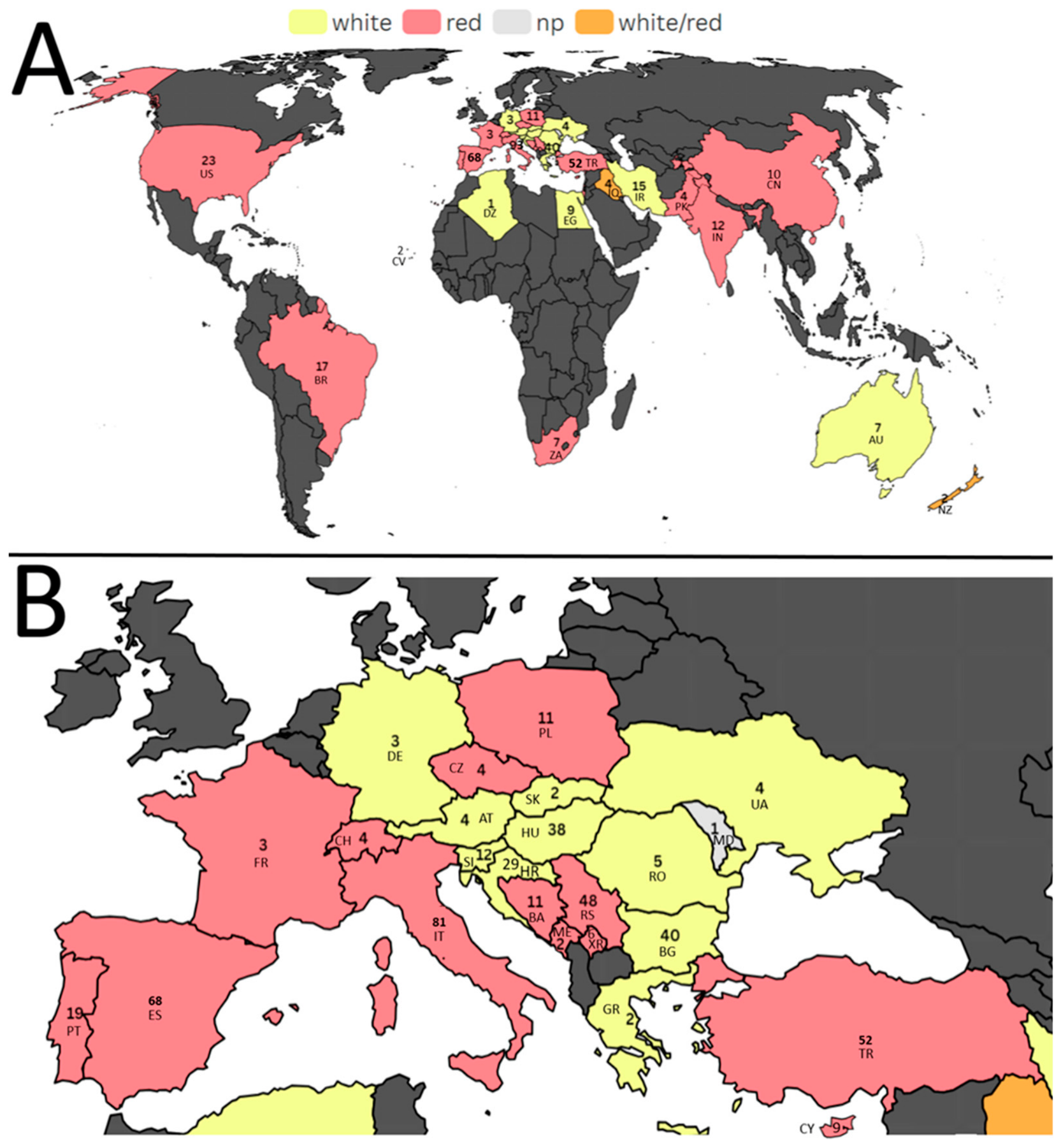
2. Global Overview of the Concentration of Elements in Grapevine Leaves
2.1. Essential Elements
2.2. Non-Essential and Toxic Elements
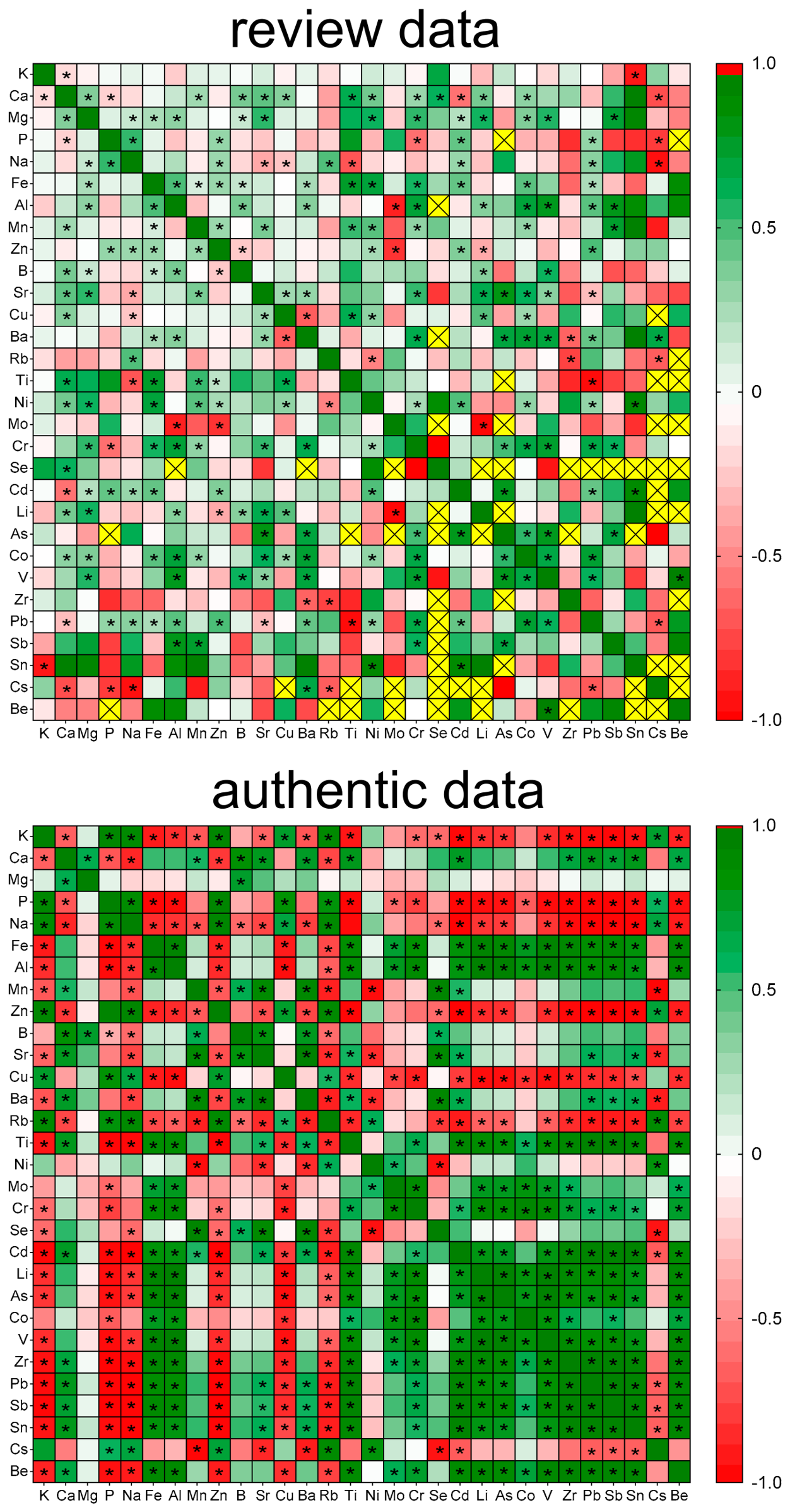
2.3. Correlation Analyses
3. Slovak Data: Concentration of Elements in Grapevine Leaves
3.1. Essential Elements in Leaves
3.2. Non-Essential and Toxic Elements in Leaves
3.3. Soil Elemental Profile and Bioaccumulation
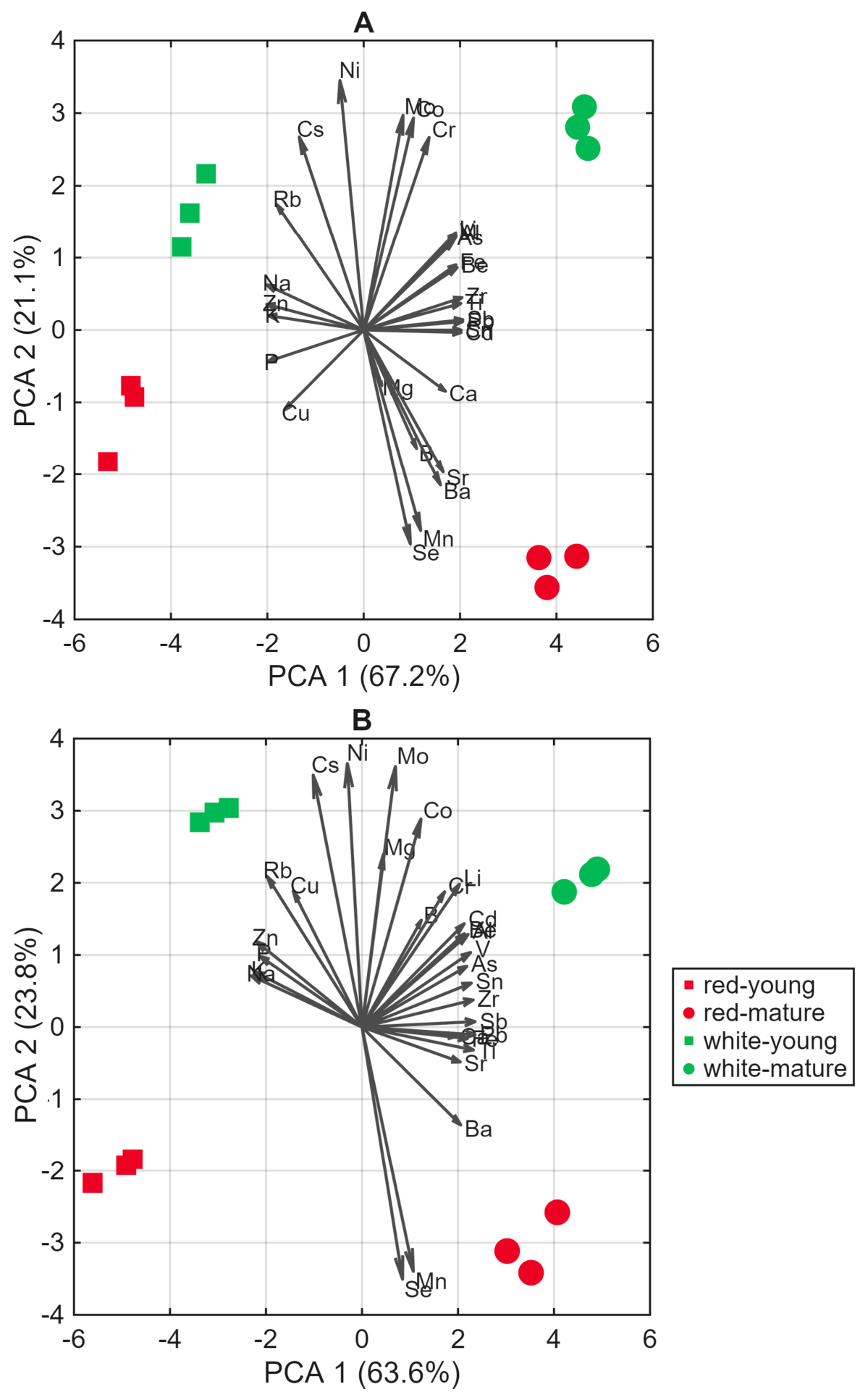
3.4. Correlation and PCA Analyses
4. Materials and Methods
4.1. Literature Search, Screening Process and Coding Scheme
4.2. Authentic Slovak Samples
4.3. Quantification of Elements in Authentic Samples
4.4. Statistical Analysis
5. Conclusions and Further Perspectives
Supplementary Materials
Author Contributions
Funding
Data Availability Statement
Conflicts of Interest
References
- Cesco, S.; Tolotti, A.; Nadalini, S.; Rizzi, S.; Valentinuzzi, F.; Mimmo, T.; Porfido, C.; Allegretta, I.; Giovannini, O.; Perazzolli, M.; et al. Plasmopara viticola infection affects mineral elements allocation and distribution in Vitis vinifera leaves. Sci. Rep. 2020, 10, 18759. [Google Scholar] [CrossRef] [PubMed]
- Kovačič, G.-R.; Čuš, F.; Lesnik, M.; Pulko, B.; Valdhuber, J.; Vršič, S. The impact of copper fungicides on the copper content in organs and wine from a ’Sauvignon Blanc’ grapevine. Mitt. Klosterneubg. 2016, 66, 106–112. [Google Scholar]
- Gulan, L.; Stajić, J.M.; Milenković, B.; Zeremski, T.; Milić, S.; Krstić, D. Plant uptake and soil retention of radionuclides and metals in vineyard environments. Environ. Sci. Pollut. Res. 2021, 28, 49651–49662. [Google Scholar] [CrossRef] [PubMed]
- Marschner, P. (Ed.) Marschner’s Mineral Nutrition of Higher Plants, 3rd ed.; Academic Press: London, UK, 2012. [Google Scholar]
- Lisek, J.; Popińska, W. Macronutrient status in grapevine leaves and soil in response to fertilizers and biostimulants. Agriculture 2025, 15, 2333. [Google Scholar] [CrossRef]
- Kováčik, J.; Husáková, L.; Vydra, M.; Piroutková, M.; Patočka, J. Metallomics of dill: Influence of environmental stress and contamination of commercial samples. J. Environ. Sci. 2025, 157, 478–488. [Google Scholar] [CrossRef] [PubMed]
- Shahzad, B.; Tanveer, M.; Hassan, W.; Shah, A.N.; Anjum, S.A.; Cheema, S.A.; Ali, I. Lithium toxicity in plants: Reasons, mechanisms and remediation possibilities—A review. Plant Physiol. Biochem. 2016, 107, 104–115. [Google Scholar] [CrossRef] [PubMed]
- Kang, D.J.; Seo, Y.J.; Ishii, Y. Distribution of cesium and cationic mineral elements in napiergrass. SN Appl. Sci. 2019, 1, 1665. [Google Scholar] [CrossRef]
- Kováčik, J.; Vydra, M. The impact of nickel on plant growth and oxidative balance. Physiol. Plant. 2024, 176, e14595. [Google Scholar] [CrossRef] [PubMed]
- Amorós, J.A.; Pérez-de-los Reyes, C.; García Navarro, F.J.; Bravo, S.; Chacón, J.L.; Martínez, J.; Jiménez Ballesta, R. Bioaccumulation of mineral elements in grapevine varieties cultivated in “La Mancha”. J. Plant Nutr. Soil Sci. 2013, 176, 843–850. [Google Scholar] [CrossRef]
- Cugnetto, A.; Santagostini, L.; Rolle, L.; Guidoni, S.; Gerbi, V.; Novello, V. Tracing the “Terroirs” via the elemental composition of leaves, grapes and derived wines in cv. Nebbiolo (Vitis vinifera L.). Sci. Hortic. 2014, 172, 101–108. [Google Scholar] [CrossRef]
- Liang, J.; Fang, H.L.; Zhang, T.L.; Wang, X.X.; Liu, Y.D. Heavy metal in leaves of twelve plant species from seven different areas in Shanghai, China. Urban For. Urban Green. 2017, 27, 390–398. [Google Scholar] [CrossRef]
- Likar, M.; Vogel-Mikuš, K.; Potisek, M.; Hančević, K.; Radić, T.; Nečemer, M.; Regvar, M. Importance of soil and vineyard management in the determination of grapevine mineral composition. Sci. Total Environ. 2015, 505, 724–731. [Google Scholar] [CrossRef] [PubMed]
- Cancela, J.J.; Fandiño, M.; González, X.P.; Rey, B.J.; Mirás-Avalos, J.M. Seasonal variation of macro and micronutrients in blades and petioles of Vitis vinifera L. cv. Mencía and Sousón. J. Plant Nutr. Soil Sci. 2018, 181, 498–515. [Google Scholar] [CrossRef]
- Martínez-Moreno, A.; Parra, M.; Intrigliolo, D.S.; López-Urrea, R.; Pérez-Álvarez, E.P. Medium-term impacts of saline water deficit irrigation on soil, vine nutrient status, yield and grape composition of Vitis vinifera L. cv. Monastrell. Sci. Hortic. 2025, 342, 114036. [Google Scholar] [CrossRef]
- Navarro, S.; León, M.; Roca-Pérez, L.; Boluda, R.; García-Ferriz, L.; Pérez-Bermúdez, P.; Gavidia, I. Characterisation of Bobal and Crujidera grape cultivars, in comparison with Tempranillo and Cabernet Sauvignon: Evolution of leaf macronutrients and berry composition during grape ripening. Food Chem. 2008, 108, 182–190. [Google Scholar] [CrossRef]
- Romic, M.; Zovko, M.; Romic, D.; Bakic, H. Improvement of vineyard management of Vitis vinifera L. cv. Grk in the Lumbarda vineyard region (Croatia). Commun. Soil Sci. Plant Anal. 2012, 43, 209–218. [Google Scholar] [CrossRef]
- Maillard, A.; Diquélou, S.; Billard, V.; Laîné, P.; Garnica, M.; Prudent, M.; Garcia-Mina, J.-M.; Yvin, J.-C.; Ourry, A. Leaf mineral nutrient remobilization during leaf senescence and modulation by nutrient deficiency. Front. Plant Sci. 2015, 6, 317. [Google Scholar] [CrossRef] [PubMed]
- Khan, A.S.; Ibrahim, M.; Basra, S.M.A.; Ali, S.; Almas, M.H.; Azam, M.; Anwar, R.; Hasan, M.U. Post-bloom productivity and quality of early-season maturing grapes (Vitis vinifera). Int. J. Agric. Biol. 2020, 24, 1217–1225. [Google Scholar] [CrossRef]
- Milićević, T.; Relić, D.; Škrivanj, S.; Tešić, Ž.; Popović, A. Assessment of major and trace element bioavailability in vineyard soil applying different single extraction procedures and pseudo-total digestion. Chemosphere 2017, 171, 284–293. [Google Scholar] [CrossRef] [PubMed]
- Li, J.-X.; Luo, M.-M.; Tong, C.-L.; Zhang, D.-J.; Zha, Q. Advances in fruit coloring research in grapevine: An overview. Plant Growth Regul. 2024, 103, 51–63. [Google Scholar] [CrossRef]
- Milićević, T.; Urošević, M.A.; Relić, D.; Vuković, G.; Škrivanj, S.; Popović, A. Bioavailability of potentially toxic elements in soil–grapevine (leaf, skin, pulp and seed) system and environmental and health risk assessment. Sci. Total Environ. 2018, 626, 528–545. [Google Scholar] [CrossRef] [PubMed]
- Khaska, S.; Le Gal La Salle, C.; Sassine, L.; Bruguier, O.; Roig, B. Innovative isotopic method to evaluate bioaccumulation of As and MTEs in Vitis vinifera. Sci. Total Environ. 2019, 651, 1126–1136. [Google Scholar] [CrossRef] [PubMed]
- Hassan, M.U.; Chattha, M.U.; Khan, I.; Chattha, M.B.; Aamer, M.; Nawaz, M.; Ali, A.; Khan, M.A.U.; Khan, T.A. Nickel toxicity in plants: Reasons, toxic effects, tolerance mechanisms, and remediation possibilities—A review. Environ. Sci. Pollut. Res. 2019, 26, 12673–12688. [Google Scholar] [CrossRef] [PubMed]
- Riaz, M.; Rafiq, M.; Nawaz, H.H.; Miao, W. Bridging molecular insights and agronomic innovations: Cutting-edge strategies for overcoming boron deficiency in sustainable rapeseed cultivation. Plants 2025, 14, 995. [Google Scholar] [CrossRef] [PubMed]
- Kavanová, M.; Lattanzi, F.A.; Grimoldi, A.A.; Schnyder, H. Phosphorus deficiency decreases cell division and elongation in grass leaves. Plant Physiol. 2006, 141, 766–775. [Google Scholar] [CrossRef] [PubMed]
- Carvalho, M.R.; Woll, A.; Niklas, K.J. Spatiotemporal distribution of essential elements through Populus leaf ontogeny. J. Exp. Bot. 2016, 67, 2777–2786. [Google Scholar] [CrossRef] [PubMed]
- Porro, D.; Bertoldi, D.; Bottura, M.; Pedò, S. Five-year period of evaluation of leaf mineral concentrations in resistant varieties in Trentino (northeastern Italy). BIO Web Conf. 2022, 44, 01002. [Google Scholar] [CrossRef]
- Mladenova, E.; Voyslavov, T.; Bakardzhiyski, I.; Karadjova, I. From the soil to the wine—Elements’ migration in monovarietal Bulgarian wines. Molecules 2025, 30, 475. [Google Scholar] [CrossRef] [PubMed]
- Calzarano, F.; Amalfitano, C.; Seghetti, L.; Cozzolino, V. Nutritional status of vines affected with esca proper. Phytopathol. Mediterr. 2009, 48, 20–31. [Google Scholar]
- Mahlungulu, A.; Kambizi, L.; Akinpelu, E.A.; Nchu, F. Levels of heavy metals in grapevine soil and leaf samples in response to seasonal change and farming practice in the Cape winelands. Toxics 2023, 11, 193. [Google Scholar] [CrossRef] [PubMed]
- Kováčik, J.; Husáková, L.; Graziani, G.; Patočka, J.; Vydra, M.; Rouphael, Y. Nickel uptake in hydroponics and elemental profile in relation to cultivation reveal variability in three Hypericum species. Plant Physiol. Biochem. 2022, 185, 357–367. [Google Scholar] [CrossRef] [PubMed]
- Srivastava, V.; Sarkar, A.; Singh, S.; Singh, P.; de Araujo, A.S.F.; Singh, R.P. Agroecological responses of heavy metal pollution with special emphasis on soil health and plant performances. Front. Environ. Sci. 2017, 5, 64. [Google Scholar] [CrossRef]
- Wang, X.; Liu, X.; Wang, W. National-scale distribution and its influence factors of calcium concentrations in Chinese soils from the China global baselines project. J. Geochem. Explor. 2022, 233, 106907. [Google Scholar] [CrossRef]
- Pepi, S.; Grisenti, P.; Sansone, L.; Chicca, M.; Vaccaro, C. Chemical elements as fingerprints of geographical origin in cultivars of Vitis vinifera L. raised on the same SO4 rootstock. Environ. Sci. Pollut. Res. 2018, 25, 490–506. [Google Scholar] [CrossRef] [PubMed]
- Kováčik, J.; Štěrbová, D.; Babula, P.; Švec, P.; Hedbavny, J. Toxicity of naturally-contaminated manganese soil to selected crops. J. Agric. Food Chem. 2014, 62, 7287–7296. [Google Scholar] [CrossRef] [PubMed]
- Bora, F.-D.; Bunea, C.-I.; Rusu, T.; Pop, N. Vertical distribution and analysis of micro-, macroelements and heavy metals in the system soil–grapevine–wine in vineyards from North-West Romania. Chem. Cent. J. 2015, 9, 19. [Google Scholar] [CrossRef] [PubMed]
- Alagić, S.Č.; Tošić, S.B.; Dimitrijević, M.D.; Nujkić, M.M.; Papludis, A.D.; Fogl, V.Z. The content of the potentially toxic elements, iron and manganese, in the grapevine cv. Tamjanika growing near the biggest copper mining/metallurgical complex on the Balkan Peninsula: Phytoremediation, biomonitoring, and some toxicological aspects. Environ. Sci. Pollut. Res. 2018, 25, 34139–34154. [Google Scholar] [CrossRef] [PubMed]
- Moher, D.; Liberati, A.; Tetzlaff, J.; Altman, D.G.; PRISMA Group. Preferred reporting items for systematic reviews and meta-analyses: The PRISMA statement. PLoS Med. 2009, 6, e1000097. [Google Scholar] [CrossRef] [PubMed]
- Pranckutė, R. Web of Science (WoS) and Scopus: The titans of bibliographic information in today’s academic world. Publications 2021, 9, 12. [Google Scholar] [CrossRef]
- Page, M.J.; McKenzie, J.E.; Bossuyt, P.M.; Boutron, I.; Hoffmann, T.C.; Mulrow, C.D.; Shamseer, L.; Tetzlaff, J.M.; Akl, E.A.; Brennan, S.E.; et al. The PRISMA 2020 statement: An updated guideline for reporting systematic reviews. BMJ 2021, 372, n71. [Google Scholar] [CrossRef] [PubMed]
- Rohatgi, A. WebPlotDigitizer, Version 5.2; Computer Software, 2015. Available online: https://automeris.io/WebPlotDigitizer/ (accessed on 23 June 2026).
- Aydin, O.; Yassikaya, M.Y. Validity and reliability analysis of the PlotDigitizer software program for data extraction from single-case graphs. Perspect. Behav. Sci. 2022, 45, 239–257. [Google Scholar] [CrossRef] [PubMed]
- Kováčik, J.; Husáková, L.; Vlassa, M.; Piroutková, M.; Vydra, M.; Patočka, J.; Filip, M. Elemental profile identifies metallurgical pollution in epiphytic lichen Xanthoria parietina and (hypo)xanthine correlates with metals. Sci. Total Environ. 2023, 883, 163527. [Google Scholar] [CrossRef] [PubMed]
- Abd El-Khalek, A.F.; Mazrou, Y.S.A.; Hatterman-Valenti, H.M.; Awadeen, A.A.; El-Mogy, S.M.M.; El-Kenawy, M.A.; Belal, B.E.A.; Mohamed, M.A.; Hassan, I.F.; El-Wakeel, H.F.; et al. Improvement in physiochemical characteristics of ‘Prime Seedless’ grapes by basal defoliation with foliar-sprayed low-biuret urea and cyanocobalamin under mediterranean climate. Agronomy 2024, 14, 815. [Google Scholar] [CrossRef]
- Abou-Zaid, E.A.A.; Eissa, M.A. Thompson seedless grapevines growth and quality as affected by glutamic acid, vitamin B, and algae. J. Soil Sci. Plant Nutr. 2019, 19, 725–733. [Google Scholar] [CrossRef]
- Akin, A. Effects of some growth regulating applications on leaf yield, raw cellulose and nutrient element content of the Müsküle table grape variety. Afr. J. Biotechnol. 2011, 10, 5601–5607. [Google Scholar]
- Alagić, S.Č.; Tošić, S.B.; Dimitrijević, M.D.; Antonijević, M.M.; Nujkić, M.M. Assessment of the quality of polluted areas based on the content of heavy metals in different organs of the grapevine (Vitis vinifera) cv Tamjanika. Environ. Sci. Pollut. Res. 2015, 22, 7155–7175. [Google Scholar] [CrossRef] [PubMed]
- Aljabary, A.M.O.; Al-Baytie, M.R.S.; Ahmed, Z.S. Effect of number eyes leftafter pruning, fertilization with humic acid and spraying with gibberellic acid in some mineral content of vineyards Thompson cv. Vitis vinifera L. Plant Arch. 2018, 18, 2061–2067. [Google Scholar]
- Al-Saif, A.M.; Abdel-Hak, R.S.; Saleh, M.M.S.; Farouk, M.H.; Hamed, S.R. Green-nano manganese and its impact on the growth, yield, and fruit properties of flame seedless grapes. Agronomy 2024, 14, 1464. [Google Scholar] [CrossRef]
- Amorós, J.-A.; Esbrí, J.M.; García-Navarro, F.-J.; Pérez-de-los-Reyes, C.; Bravo, S.; Villaseñor, B.; Higueras, P. Variations in mercury and other trace elements contents in soil and in vine leaves from the Almadén Hg-mining district. J. Soils Sediments 2014, 14, 773–777. [Google Scholar] [CrossRef]
- Angelova, V.R.; Ivanov, A.S.; Braikov, D.M. Heavy metals (Pb, Cu, Zn and Cd) in the system soil–Grapevine–Grape. J. Sci. Food Agric. 1999, 79, 713–721. [Google Scholar] [CrossRef]
- Arrobas, M.; Ferreira, I.Q.; Freitas, S.; Verdial, J.; Rodrigues, M.Â. Guidelines for fertilizer use in vineyards based on nutrient content of grapevine parts. Sci. Hortic. 2014, 172, 191–198. [Google Scholar] [CrossRef]
- Arrobas, M.; Thais Nepomuceno Carvalho, J.; Raimundo, S.; Poggere, G.; Rodrigues, M.Â. The safe use of compost derived from municipal solid waste depends on its composition and conditions of application. Soil Use Manag. 2022, 38, 917–928. [Google Scholar] [CrossRef]
- Aslanpour, M.H.D.B.; Baneh, H.D.; Tehranifar, A.; Shoor, M. Evaluating the absorption rate of macro and microelements in the leaf of grape Sefid Bidaneh cv. under drought conditions. Int. Trans. J. Eng. Manag. 2019, 10, 515–525. [Google Scholar] [CrossRef]
- Banjanin, T.; Uslu, N.; Vasic, Z.R.; Özcan, M.M. Effect of grape varieties on bioactive properties, phenolic composition, and mineral contents of different grape-vine leaves. J. Food Process. Preserv. 2021, 45, e15159. [Google Scholar] [CrossRef]
- Bartkovský, M.; Semjon, B.; Regecová, I.; Baričičová, V.; Očenáš, P.; Šuľáková, L.; Marcinčák, S. The effect of a leaf fertilization method using humic acids on the minerality and chemical composition of Sauvignon Blanc wine from the Slovak wine region. Fermentation 2024, 10, 651. [Google Scholar] [CrossRef]
- Bas, E.O.; Gazioglu Sensoy, R.I. Comparative analysis of salt stress responses in the grapevine (Vitis vinifera L.) cultivars: Insights from morphological and physiological assessments. Russ. J. Plant Physiol. 2024, 71, 178. [Google Scholar] [CrossRef]
- Bavaresco, L.; Colla, R.; Fogher, C. Different responses to root infection with endophytic microorganisms of Vitis vinifera L. cv. Pinot Blanc grown on calcareous soil. J. Plant Nutr. 2000, 23, 1107–1116. [Google Scholar] [CrossRef]
- Bavaresco, L.; Fogher, C. Lime-chlorosis occurrence and leaf mineral composition of grapevine treated by root microorganisms. J. Plant Nutr. 1996, 19, 87–98. [Google Scholar] [CrossRef]
- Bavaresco, L.; Giachino, E.; Pezzutto, S. Grapevine rootstock effects on lime-induced chlorosis, nutrient uptake, and source–sink relationships. J. Plant Nutr. 2003, 26, 1451–1465. [Google Scholar] [CrossRef]
- Bavaresco, L.; Poni, S. Effect of calcareous soil on photosynthesis rate, mineral nutrition, and source-sink ratio of table grape. J. Plant Nutr. 2003, 26, 2123–2135. [Google Scholar] [CrossRef]
- Bavaresco, L.; Zamboni, M. Influence of the rootstock and potassium fertilizer on phytoalexin synthesis in Pinot Blanc grown in a calcareous soil. Vitis 1990, 29, 295. [Google Scholar] [CrossRef]
- Bayz, H.A.; Hussein, S.A.; Ahmed, O.I. Effect of soil mulching and spraying with growth regulator salicylic acid on the characteristics of the mineral content of two cultivars of young grape vines (Halwani and Kamali). IOP Conf. Ser. Earth Environ. Sci. 2024, 1371, 042053. [Google Scholar] [CrossRef]
- Benahmed Djilali, A.; Benseddik, A.; Boughellout, H.; Allaf, K.; Nabiev, M. Biological and functional properties of vine leaves. N. Afr. J. Food Nutr. Res. 2021, 5, 43–52. [Google Scholar] [CrossRef]
- Beni, C.; Rossi, G. Conventional and organic farming: Estimation of some effects on soil, copper accumulation and wine in a central Italy vineyard. Agrochimica 2009, 53, 147–159. [Google Scholar]
- Benito, A.; Romero, I.; Domínguez, N.; García-Escudero, E.; Martín, I. Leaf blade and petiole analysis for nutrient diagnosis in Vitis vinifera L. cv. Garnacha Tinta: Leaf nutritional diagnosis for Garnacha Tinta vines. Aust. J. Grape Wine Res. 2013, 19, 285–298. [Google Scholar] [CrossRef]
- Bertoldi, D.; Villegas, T.R.; Larcher, R.; Santato, A.; Nicolini, G. Arsenic present in the soil-vine-wine chain in vineyards situated in an old mining area in Trentino, Italy. Environ. Toxicol. Chem. 2013, 32, 773–779. [Google Scholar] [CrossRef] [PubMed]
- Brataševec, K.; Sivilotti, P.; Vodopivec, B.M. Soil and foliar fertilization affects mineral contents in Vitis vinifera L. cv. ‘Rebula’ leaves. J. Soil Sci. Plant Nutr. 2013, 13, 650–663. [Google Scholar]
- Bravo, S.; Amorós, J.A.; Pérez-de-los-Reyes, C.; García, F.J.; Moreno, M.M.; Sánchez-Ormeño, M.; Higueras, P. Influence of the soil pH in the uptake and bioaccumulation of heavy metals (Fe, Zn, Cu, Pb and Mn) and other elements (Ca, K, Al, Sr and Ba) in vine leaves, Castilla-La Mancha (Spain). J. Geochem. Explor. 2017, 174, 79–83. [Google Scholar] [CrossRef]
- Brunetto, G.; Marques, A.C.R.; Trentin, E.; Sete, P.B.; Soares, C.R.F.S.; Ferreira, P.A.A.; De Melo, G.W.B.; Zalamena, J.; Da Silva, L.O.S.; Marchezan, C.; et al. Arbuscular mycorrhizal fungi inoculation as strategy to mitigate copper toxicity in young field-grown vines. Ciência E Técnica Vitivinícola 2023, 38, 60–66. [Google Scholar] [CrossRef]
- Buesa, I.; Pérez-Pérez, J.G.; Visconti, F.; Strah, R.; Intrigliolo, D.S.; Bonet, L.; Gruden, K.; Pompe-Novak, M.; De Paz, J.M. Physiological and transcriptional responses to saline irrigation of young ‘tempranillo’ vines grafted onto different rootstocks. Front. Plant Sci. 2022, 13, 866053. [Google Scholar] [CrossRef] [PubMed]
- Cataldo, E.; Fucile, M.; Mattii, G.B. Composting from organic municipal solid waste: A sustainable tool for the environment and to improve grape quality. J. Agric. Sci. 2022, 160, 502–515. [Google Scholar] [CrossRef]
- Daccak, D.; Lidon, F.C.; Pessoa, C.C.; Luís, I.C.; Coelho, A.R.F.; Marques, A.C.; Ramalho, J.C.; Silva, M.J.; Rodrigues, A.P.; Guerra, M.; et al. Enrichment of grapes with zinc-efficiency of foliar fertilization with ZnSO4 and ZnO and implications on winemaking. Plants 2022, 11, 1399. [Google Scholar] [CrossRef] [PubMed]
- Degaris, K.A.; Walker, R.R.; Loveys, B.R.; Tyerman, S.D. Comparative effects of deficit and partial root-zone drying irrigation techniques using moderately saline water on ion partitioning in Shiraz and Grenache grapevines: Deficit irrigation with saline water. Aust. J. Grape Wine Res. 2016, 22, 296–306. [Google Scholar] [CrossRef]
- Dehelean, A.; Magdas, D.A.; Cristea, G. Investigation of Trace Metals Content and Carbon Isotopic Composition on the Soil Leaf-Fruit Chain from Some Transylvanian Areas. Anal. Lett. 2013, 46, 498–507. [Google Scholar] [CrossRef]
- Demirer, T.; Müftüoglu, N.M.; Dardeniz, A.; Örs, T. Determination of the nutrition standard of soil and leaf analysis of Bozcaada Çavusu grape variety grown in Çanakkale, Turkey. Asian J. Chem. 2007, 19, 3997–4006. [Google Scholar]
- Di Marco, S.; Mazzullo, A.; Cesari, A.; Osti, F. How Iron Could Be Involved in Esca Fungi Development. Phytopathol. Mediterr. 2001, 40, 449–452. [Google Scholar] [CrossRef]
- Dinis, L.-T.; Correia, C.M.; Ferreira, H.F.; Gonçalves, B.; Gonçalves, I.; Coutinho, J.F.; Ferreira, M.I.; Malheiro, A.C.; Moutinho-Pereira, J. Physiological and biochemical responses of Semillon and Muscat Blanc à Petits Grains winegrapes grown under Mediterranean climate. Sci. Hortic. 2014, 175, 128–138. [Google Scholar] [CrossRef]
- Do Nascimento, C.W.A.; Da Silva, F.B.V.; Lima, L.H.V.; Silva, J.R.; De Lima Veloso, V.; Da Silva, F.L.; De Freitas, S.T.; Dos Santos, L.F.; Dos Santos, M.A. Silicon application to soil increases the yield and quality of table grapes (Vitis vinifera L.) grown in a semiarid climate of Brazil. Silicon 2023, 15, 1647–1658. [Google Scholar] [CrossRef]
- Fallahi, E.; Shafii, B.; Stark, J.C.; Fallahi, B.; Hafez, S.L. Influence of wine grape cultivars on growth and leaf blade and petiole mineral nutrients. HortTechnology 2005, 15, 825–830. [Google Scholar] [CrossRef]
- Farouk, S.; Belal, B.E.A.; EL-Sharkawy, H.H.A. The role of some elicitors on the management of Roumy Ahmar grapevines downy mildew disease and it’s related to inducing growth and yield characters. Sci. Hortic. 2017, 225, 646–658. [Google Scholar] [CrossRef]
- Gąstol, M.; Domagała-Świątkiewicz, I. Trace element partitioning in ‘Sibera’ grapevines as affected by nitrogen fertilisation. S. Afr. J. Enol. Vitic. 2016, 35, 217–225. [Google Scholar] [CrossRef]
- Gil-Pérez, B.; Zarco-Tejada, P.J.; Correa-Guimaraes, A.; Relea-Gangas, E.; Navas-Gracia, L.M.; Hernández-Navarro, S.; Sanz-Requena, J.F.; Berjón, A.; Martín-Gil, J. Remote sensing detection of nutrient uptake in vineyards using narrow-band hyperspectral imagery. Vitis 2010, 49, 167–173. [Google Scholar] [CrossRef]
- Goodarzi, K.; Hosseini Farahi, M. Evaluating the ability of sulfur and animal manure to relieve Fe, Mn, Zn, Cu and B deficiency in “Seah” table grapes in Cisakht region of Iran. Acta Hortic. 2014, 1018, 287–291. [Google Scholar] [CrossRef]
- Güneş, A.; Köse, C.; Turan, M. Yield and mineral composition of grapevine (Vitis vinifera L. cv. Karaerik) as affected by boron management. Turk. J. Agric. For. 2015, 39, 742–752. [Google Scholar] [CrossRef]
- Hirzel, D.R.; Steenwerth, K.; Parikh, S.J.; Oberholster, A. Impact of winery wastewater irrigation on soil, grape and wine composition. Agric. Water Manag. 2017, 180, 178–189. [Google Scholar] [CrossRef]
- Howell, C.L.; Myburgh, P.A.; Lategan, E.L.; Schoeman, C.; Hoffman, J.E. Effect of irrigation using diluted winery wastewater on Vitis vinifera L. cv. Cabernet Sauvignon in a sandy alluvial soil in the breede river valley–vegetative growth, yield and wine quality. S. Afr. J. Enol. Vitic. 2016, 37, 211–225. [Google Scholar] [CrossRef]
- Hummes, A.P.; Bortoluzzi, E.C.; Tonini, V.; da Silva, L.P.; Petry, C. Transfer of copper and zinc from soil to grapevine-derived products in young and centenarian vineyards. Water Air Soil Pollut. 2019, 230, 150. [Google Scholar] [CrossRef]
- Chopin, E.I.B.; Marin, B.; Mkoungafoko, R.; Rigaux, A.; Hopgood, M.J.; Delannoy, E.; Cancès, B.; Laurain, M. Factors affecting distribution and mobility of trace elements (Cu, Pb, Zn) in a perennial grapevine (Vitis vinifera L.) in the Champagne region of France. Environ. Pollut. 2008, 156, 1092–1098. [Google Scholar] [CrossRef] [PubMed]
- Iacono, F.; Porro, A.D.; Scienza, A.; Stringari, G. Differential effects of canopy manipulation and shading of Vitis vinifera L. cv. Cabernet Sauvignon: Plant nutritional status. J. Plant Nutr. 1995, 18, 1785–1796. [Google Scholar] [CrossRef]
- Irani, H.; ValizadehKaji, B.; Naeini, M.R. Biostimulant-induced drought tolerance in grapevine is associated with physiological and biochemical changes. Chem. Biol. Technol. Agric. 2021, 8, 5. [Google Scholar] [CrossRef]
- Kamiloğlu, Ö. Impact of rootstocks on fruit quality, mineral nutrition and leaf physiology of ‘Red Globe’ in the East Mediterranean region. Appl. Ecol. Environ. Res. 2022, 20, 4363–4376. [Google Scholar] [CrossRef]
- Karažija, T.; Štimac, M.; Petek, M.; Šatvar, M.; Lazarević, B. Long-term effects of organic fertilizers on microelements status in grapevine leaf on calcareous soil. Sci. Pap. Ser. B Hortic. 2021, 65, 122–127. [Google Scholar]
- Karimi, R. Potassium-induced freezing tolerance is associated with endogenous abscisic acid, polyamines and soluble sugars changes in grapevine. Sci. Hortic. 2017, 215, 184–194. [Google Scholar] [CrossRef]
- Karimi, R.; Ghabooli, M.; Rahimi, J.; Amerian, M. Effects of foliar selenium application on some physiological and phytochemical parameters of Vitis vinifera L. cv. Sultana under salt stress. J. Plant Nutr. 2020, 43, 2226–2242. [Google Scholar] [CrossRef]
- Kaya, G.; Yaman, M. Determination of trace metals in plant leaves as biomonitor of pollution extent by a sensitive Stat-AAS method. Instrum. Sci. Technol. 2012, 40, 61–74. [Google Scholar] [CrossRef]
- Kocsis, L.; Lehoczky, É. Applications in sustainable production: The effect of the graperootstock-scion interaction on the potassium and calcium content of the leaves in connection with yield production. Commun. Soil Sci. Plant Anal. 2000, 31, 2283–2289. [Google Scholar] [CrossRef]
- Kocsis, L.; Lehoczky, É. The significance of yield production and sugar content of the grapejuice with macronutrients in grape rootstock–scion combinations on dry climatic condition. Commun. Soil Sci. Plant Anal. 2002, 33, 3159–3166. [Google Scholar] [CrossRef]
- Kőrösi, L.; Bognár, B.; Czégény, G.; Lauciello, S. Phase-selective synthesis of anatase and rutile TiO2 nanocrystals and their impacts on grapevine leaves: Accumulation of mineral nutrients and triggering the plant defense. Nanomaterials 2022, 12, 483. [Google Scholar] [CrossRef] [PubMed]
- Lai, H.-Y.; Juang, K.-W.; Chen, B.-C. Copper concentrations in grapevines and vineyard soils in central Taiwan. Soil Sci. Plant Nutr. 2010, 56, 601–606. [Google Scholar] [CrossRef]
- Likar, M.; Stres, B.; Rusjan, D.; Vogel-Mikuš, K.; Regvar, M. Grapevine leaf ionome is shaped by soil factors and plant age. Plant Soil Environ. 2022, 68, 415–423. [Google Scholar] [CrossRef]
- Lyu, H.; Grafton, M.; Ramilan, T.; Irwin, M.; Sandoval, E. Assessing the leaf blade nutrient status of Pinot Noir using hyperspectral reflectance and machine learning models. Remote Sens. 2023, 15, 1497. [Google Scholar] [CrossRef]
- Ma, J.; Zhang, M.; Liu, Z.; Chen, H.; Li, Y.C.; Sun, Y.; Ma, Q.; Zhao, C. Effects of foliar application of the mixture of copper and chelated iron on the yield, quality, photosynthesis, and microelement concentration of table grape (Vitis vinifera L.). Sci. Hortic. 2019, 254, 106–115. [Google Scholar] [CrossRef]
- Maia, M.; Cavaco, A.R.; Laureano, G.; Cunha, J.; Eiras-Dias, J.; Matos, A.R.; Duarte, B.; Figueiredo, A. More than just wine: The nutritional benefits of grapevine leaves. Foods 2021, 10, 2251. [Google Scholar] [CrossRef] [PubMed]
- Marques, R.; Prudêncio, M.I.; Abreu, M.M.; Russo, D.; Marques, J.G.; Rocha, F. Chemical characterization of vines grown in incipient volcanic soils of Fogo Island (Cape Verde). Environ. Monit. Assess. 2019, 191, 128. [Google Scholar] [CrossRef] [PubMed]
- Mercurio, M.; Grilli, E.; Odierna, P.; Morra, V.; Prohaska, T.; Coppola, E.; Grifa, C.; Buondonno, A.; Langella, A. A ‘Geo-Pedo-Fingerprint’ (GPF) as a tracer to detect univocal parent material-to-wine production chain in high quality vineyard districts, Campi Flegrei (Southern Italy). Geoderma 2014, 230–231, 64–78. [Google Scholar] [CrossRef]
- Mostashari, M.; Khosravinejad, A.; Golmohammadi, M. Comparative study of DOP and CND methods for leaf nutritional diagnosis of Vitis vinifera in Iran. Commun. Soil Sci. Plant Anal. 2018, 49, 576–584. [Google Scholar] [CrossRef]
- Naegele, R.P.; Londo, J.P.; Zou, C.; Cousins, P. Identification of SNPs associated with magnesium and sodium uptake and the effect of their accumulation on micro and macro nutrient levels in Vitis vinifera. PeerJ 2021, 9, e10773. [Google Scholar] [CrossRef] [PubMed]
- Nagy, P.T.; Pintér, T. Effects of foliar biofertilizer sprays on nutrient uptake, yield, and quality parameters of Blaufrankish (Vitis vinifera L.) grapes. Commun. Soil Sci. Plant Anal. 2015, 46, 219–227. [Google Scholar] [CrossRef]
- Nakajima, H.; Behboudian, M.H.; Greven, M.; Zegbe-Domínguez, J.A. Mineral contents of grape, olive, apple, and tomato under reduced irrigation. J. Plant Nutr. Soil Sci. 2004, 167, 91–92. [Google Scholar] [CrossRef]
- Niemiec, M.; Niemiec, M.; Chowaniak, M.; Komorowska, M.; Zuzek, D.; Saidali Mamurovich, G.; Kodirov Gafurovich, K.; Usmanov, N.; Kamilova, D.; Rahmonova, J.; et al. Evaluation of the chemical composition of soil as well as vine leaves and berries from the selected commercial farms in the republic of Tajikistan. J. Elem. 2020, 25, 675–686. [Google Scholar] [CrossRef]
- Nikolaou, N.; Karagiannidis, N.; Koundouras, S.; Fysarakis, I. Effects of different P-sources in soil on increasing growth and mineral uptake of mycorrhizal Vitis vinifera L. (cv Victoria) vines. OENO One 2002, 36, 195–204. [Google Scholar] [CrossRef]
- Nitin, P.S.; Patel, V.B.; Singh, S.K.; Verma, M.K.; Mishra, G.P.; Anil, D.; Puneeth, P.V. Stionic influence of grape cultivar Syrah (Vitis vinifera L.) on inter-specific hybrid rootstocks. S. Afr. J. Enol. Vitic. 2025, 46, 54–69. [Google Scholar] [CrossRef] [PubMed]
- Nogales, A.; Santos, E.S.; Abreu, M.M.; Arán, D.; Victorino, G.; Pereira, H.S.; Lopes, C.M.; Viegas, W. Mycorrhizal inoculation differentially affects grapevine’s performance in copper contaminated and non-contaminated soils. Front. Plant Sci. 2019, 9, 1906. [Google Scholar] [CrossRef] [PubMed]
- Oliveira, V.D.S.; Lima, A.M.N.; Salviano, A.M.; Bassoi, L.H.; Pereira, G.E. Heavy metals and micronutrients in the soil and grapevine under different irrigation strategies. Rev. Bras. Ciência Solo 2015, 39, 162–173. [Google Scholar] [CrossRef]
- Ortiz-Villajos, J.A.A.; Navarro, F.J.G.; Martín-Consuegra, S.B.; Ballesta, R.J.; Moreno, R.G. Geochemical influence of soil on leaf and grape (Vitis vinifera L. ’Cencibel’) composition in La Mancha region (Spain). Vitis 2012, 51, 111–118. [Google Scholar] [CrossRef]
- Özdemir, G.; Tangolar, S. Effect of iron applications on Fe, Zn, Cu and Mn compositions of grapevine leaves. Asian J. Chem. 2007, 19, 2438–2444. [Google Scholar]
- Pachnowska, K.; Ochmian, I. Influence of rootstock on elemental composition in leaves and grapes of vine cultivar ‘Regent’ grown in North-Western Poland. J. Appl. Bot. Food Qual. 2018, 91, 180–186. [Google Scholar] [CrossRef]
- Pantelić, M.M.; Zagorac, D.Č.D.; Ćirić, I.Ž.; Pergal, M.V.; Relić, D.J.; Todić, S.R.; Natić, M.M. Phenolic profiles, antioxidant activity and minerals in leaves of different grapevine varieties grown in Serbia. J. Food Compos. Anal. 2017, 62, 76–83. [Google Scholar] [CrossRef]
- Pepi, S.; Chicca, M.; Piroddi, G.; Tassinari, R.; Vaccaro, C. Geographical origin of Vitis vinifera cv. Cannonau established by the index of bioaccumulation and translocation coefficients. Environ. Monit. Assess. 2019, 191, 436. [Google Scholar] [CrossRef] [PubMed]
- Pérez-De-Los-Reyes, C.; Ortíz-Villajos, J.A.A.; Navarro, F.J.G.; Martín-Consuegra, S.B.; Ballesta, R.J. Grapevine leaf uptake of mineral elements influenced by sugar foam amendment of an acidic soil. Vitis J. Grapevine Res. 2013, 52, 157–164. [Google Scholar]
- Peršurić Palčić, A.; Jeromel, A.; Pecina, M.; Palčić, I.; Gluhić, D.; Petek, M.; Herak Ćustić, M. Decreased leaf potassium content affects the chemical composition of must for sparkling wine production. Horticulturae 2022, 8, 512. [Google Scholar] [CrossRef]
- Peuke, A.D. Nutrient composition of leaves and fruit juice of grapevine as affected by soil and nitrogen fertilization. J. Plant Nutr. Soil Sci. 2009, 172, 557–564. [Google Scholar] [CrossRef]
- Pinamonti, F. Compost mulch effects on soil fertility, nutritional status and performance of grapevine. Nutr. Cycl. Agroecosyst. 1998, 51, 239–248. [Google Scholar] [CrossRef]
- Porro, D.; Dallaserra, M.; Zatelli, A.; Ceschini, A. The interaction between nitrogen and shade on grapevine: The effects on nutritional status, leaf age and leaf gas exchanges. Acta Hortic. 2001, 564, 253–260. [Google Scholar] [CrossRef]
- Porro, D.; Ramponi, M.; Tomasi, T.; Rolle, L.; Poni, S. Nutritional implications of water stress in grapevine and modifications of mechanical properties of berries. Acta Hortic. 2010, 868, 73–80. [Google Scholar] [CrossRef]
- Prodanova-Marinova, N.; Staneva, I.; Tsvetanov, E. Competitive relations between young vines and weed species for mineral nutrients uptake in the nursery. Bulg. J. Agric. Sci. 2023, 29, 458–463. [Google Scholar]
- Quartacci, M.F.; Ranieri, A.; Sgherri, C. Antioxidative defence mechanisms in two grapevine (Vitis vinifera L.) cultivars grown under boron excess in the irrigation water. Vitis 2015, 54, 51–58. [Google Scholar] [CrossRef]
- Rasouli, M.; Bayanati, M.; Tavakoli, F. Improving quantitative and qualitative traits of grapes cv. ‘Fakhri’ of Iran with foliar application of potassium silicate and humic acid. Russ. J. Plant Physiol. 2024, 71, 86. [Google Scholar] [CrossRef]
- Reeve, J.R.; Carpenter-Boggs, L.; Reganold, J.P.; York, A.L.; McGourty, G.; McCloskey, L.P. Soil and winegrape quality in biodynamically and organically managed vineyards. Am. J. Enol. Vitic. 2005, 56, 367–376. [Google Scholar] [CrossRef]
- Reta, K.; Lazarovitch, N.; Fait, A. Metabolic and physiological analysis reveals distinct salinity tipping point in Vitis vinifera cv. Syrah to enter a stress response mode. Plant Stress 2025, 16, 100864. [Google Scholar] [CrossRef]
- Richardson, J.B.; Chase, J.K. Transfer of macronutrients, micronutrients, and toxic elements from soil to grapes to white wines in uncontaminated vineyards. Int. J. Environ. Res. Public Health 2021, 18, 13271. [Google Scholar] [CrossRef] [PubMed]
- Romero, I.; Benito, A.; Dominguez, N.; Garcia-Escudero, E.; Martin, I. Leaf blade and petiole nutritional diagnosis for Vitis vinifera L. cv. Tempranillo by deviation from optimum percentage method. Span. J. Agric. Res. 2014, 12, 206–214. [Google Scholar] [CrossRef]
- Romero, I.; García-Escudero, E.; Martín, I. Effects of leaf position on blade and petiole mineral nutrient concentration of Tempranillo grapevine (Vitis vinifera L.). Am. J. Enol. Vitic. 2010, 61, 544–550. [Google Scholar] [CrossRef]
- Romero, P.; Botía, P.; Gil-Muñoz, R.; Del Amor, F.M.; Navarro, J.M. Evaluation of the effect of water stress on clonal variations of Cv. Monastrell (Vitis vinifera L.) in south-eastern Spain: Physiology, nutrition, yield, berry, and wine-quality responses. Agronomy 2023, 13, 433. [Google Scholar] [CrossRef]
- Rozane, D.E.; Vahl De Paula, B.; Wellington Bastos De Melo, G.; Haitzmann Dos Santos, E.M.; Trentin, E.; Marchezan, C.; Stefanello Da Silva, L.O.; Tassinari, A.; Dotto, L.; Nunes De Oliveira, F.; et al. Compositional nutrient diagnosis (CND) applied to grapevines grown in subtropical climate region. Horticulturae 2020, 6, 56. [Google Scholar] [CrossRef]
- Sabir, A. Vegetative and reproductive growth responses of grapevine cv. “Italia” (Vitis vinifera L.) grafted on different rootstocks to contrasting soil water status. J. Agric. Sci. Technol. 2016, 18, 1681–1692. [Google Scholar]
- Sabir, A.; Yazar, K.; Sabir, F.; Kara, Z.; Yazici, M.A.; Goksu, N. Vine growth, yield, berry quality attributes and leaf nutrient content of grapevines as influenced by seaweed extract (Ascophyllum nodosum) and nanosize fertilizer pulverizations. Sci. Hortic. 2014, 175, 1–8. [Google Scholar] [CrossRef]
- Sala, F.; Camen, D.; Herbei, M.V.; Blidariu, C. Analysis of vine nutrition and productivity based on statistical indicators. Horticulturae 2024, 10, 397. [Google Scholar] [CrossRef]
- Salih, Z.R.; Khudhur, N.S.; Muhammad, M.Q. Bioaccumulation of different heavy metals and toxicity assessment using different indices in grape plants and soil around power generators in Erbil province. Environ. Monit. Assess. 2025, 197, 757. [Google Scholar] [CrossRef] [PubMed]
- Sedláček, M.; Pavloušek, P.; Lošák, T.; Zatloukalová, A.; Filipčík, R.; Hlušek, J.; Vítězová, M. The effect of arbuscular mycorrhizal fungi on the content of macro and micro elements in grapevine (Vitis vinifera L.) leaves. Acta Univ. Agric. Silvic. Mendel. Brun. 2013, 61, 187–191. [Google Scholar] [CrossRef]
- Schreiner, R.P.; Lee, J. Effects of post-véraison water deficit on ‘Pinot noir’ yield and nutrient status in leaves, clusters, and musts. HortScience 2014, 49, 1335–1340. [Google Scholar] [CrossRef]
- Sharma, J.; Upadhyay, A.K.; Sawant, S.D.; Sawant, I.S. Studies on shiny spot symptom development on grapevine leaves and its effect on fruitfulness, disease incidence and vine yield. Indian J. Hortic. 2009, 66, 48–52. [Google Scholar]
- Si, P.; Shao, W.; Yu, H.; Xu, G.; Du, G. Differences in Microbial communities stimulated by malic acid have the potential to improve nutrient absorption and fruit quality of grapes. Front. Microbiol. 2022, 13, 850807. [Google Scholar] [CrossRef] [PubMed]
- Soja, G.; Wimmer, B.; Rosner, F.; Faber, F.; Dersch, G.; Von Chamier, J.; Pardeller, G.; Ameur, D.; Keiblinger, K.; Zehetner, F. Compost and biochar interactions with copper immobilisation in copper-enriched vineyard soils. Appl. Geochem. 2018, 88, 40–48. [Google Scholar] [CrossRef]
- Squeri, C.; Gatti, M.; Garavani, A.; Vercesi, A.; Buzzi, M.; Croci, M.; Calegari, F.; Vincini, M.; Poni, S. Ground truthing and physiological validation of Vis-NIR spectral indices for early diagnosis of nitrogen deficiency in cv. Barbera (Vitis vinifera L.) grapevines. Agronomy 2019, 9, 864. [Google Scholar] [CrossRef]
- Stanimirovic, B.; Vujovic, D.; Pejin, B.; Popovic Djordjevic, J.; Maletic, R.; Raicevic, P.; Tesic, Z. A contribution to the elemental profile of the leaf samples of newly developed Cabernet Franc varieties. Nat. Prod. Res. 2019, 33, 1209–1213. [Google Scholar] [CrossRef] [PubMed]
- Domagała-Świątkiewicz, I.; Gąstoł, M. Effect of nitrogen fertilization on the content of trace elements in cv. Bianca grapevine (Vitis sp.). J. Elem. 2013, 18, 39–53. [Google Scholar] [CrossRef]
- Taghavi, T.; Hoseinabadi, H.; Solgi, M.; Askari, M.; Rahemi, A. Influence of vinegar and chelated iron field sprays on mineral nutrients and fruit quality of grapes (cv. ’Thompson Seedless’). Mitteilungen Klosterneubg. 2020, 70, 75–86. [Google Scholar]
- Tan, S.; Crabtree, G.D. Competition between perennial ryegrass sod and ‘Chardonnay’ wine grapes for mineral nutrients. HortScience 1990, 25, 533–535. [Google Scholar] [CrossRef]
- Tangolar, S.; Tangolar, S.; Alkan Torun, A.; Ada, M.; Göçmez, S. Influence of supplementation of vineyard soil with organic substances on nutritional status, yield and quality of ‘Black Magic’ grape (Vitis vinifera L.) and soil microbiological and biochemical characteristics. OENO One 2020, 54, 1143–1157. [Google Scholar] [CrossRef]
- Thum, A.B.; Arruda, D.C.; Ducati, J.R.; Pithan, P.A.; Rolim, S.B.A. The influence of mineral content on spectral features of vine leaves. Int. J. Remote Sens. 2020, 41, 9161–9179. [Google Scholar] [CrossRef]
- Tonev, D.; Geleva, E.; Damianova, A.; Grigorov, T.; Goutev, N.; Protohristov, H.; Stoyanov, C.; Bashev, V.; Popov, E.; Tringovska, I.; et al. Radiological and microanalytical studies of fine Melnik wines. C. R. L’Acad. Bulg. Sci. 2016, 69, 707–716. [Google Scholar]
- Topalovic, A.; Godjevac, D.; Perovic, N.; Trifunovic, S. Comparative study of the phenolic composition of seeds from grapes cv Cardinal and Alphonse Lavallee during last month of ripening. Ital. J. Food Sci. 2012, 24, 159–166. [Google Scholar]
- Toselli, M.; Baldi, E.; Marcolini, G.; Malaguti, D.; Quartieri, M.; Sorrenti, G.; Marangoni, B. Response of potted grapevines to increasing soil copper concentration. Aust. J. Grape Wine Res. 2009, 15, 85–92. [Google Scholar] [CrossRef]
- Tutus, A.; Gazioglu Sensoy, R.I. Pruning and fertilization impact on leaf-mineral composition in high-altitude cultivation of grapevines (Vitis vinifera L.). Appl. Fruit Sci. 2024, 66, 1867–1876. [Google Scholar] [CrossRef]
- Tzortzakis, N.; Chrysargyris, A. Olive-mill and grape-mill residue impact the growth, physiology and nutrient status of grapevines young cuttings. Sustain. Chem. Pharm. 2024, 37, 101362. [Google Scholar] [CrossRef]
- Tzortzakis, N.; Chrysargyris, A. Alternative growing media under the same fertigation scheme affected mineral accumulation and physiological parameters in grapevine cultivars. Horticulturae 2025, 11, 479. [Google Scholar] [CrossRef]
- Úbeda, X.; Francos, M.; Eguzkiza, P.; Stefanuto, E.B. Soil and grapevine leaf quality in organic vineyards of different ages in DO Rioja-Alavesa, northern Spain. Span. J. Soil Sci. 2021, 11, 4198. [Google Scholar] [CrossRef]
- Verdenal, T.; Zufferey, V.; Dienes-Nagy, Á.; Bieri, S.; Bourdin, G.; Reynard, J.-S.; Spring, J.-L. Exploring grapevine canopy management: Effects of removing main leaves or lateral shoots before flowering. OENO One 2024, 58, 1–12. [Google Scholar] [CrossRef]
- Victorino, G.; Santos, E.S.; Abreu, M.M.; Viegas, W.; Nogales, A. Detrimental effects of copper and EDTA co-application on grapevine root growth and nutrient balance. Rhizosphere 2021, 19, 100392. [Google Scholar] [CrossRef]
- Vystavna, Y.; Rätsep, R.; Klymenko, N.; Drozd, O.; Pidlisnyuk, V.; Klymenko, M. Comparison of soil-to-root transfer and translocation coefficients of trace elements in vines of Chardonnay and Muscat white grown in the same vineyard. Sci. Hortic. 2015, 192, 89–96. [Google Scholar] [CrossRef]
- Vystavna, Y.; Rushenko, L.; Diadin, D.; Klymenko, O.; Klymenko, M. Trace metals in wine and vineyard environment in southern Ukraine. Food Chem. 2014, 146, 339–344. [Google Scholar] [CrossRef] [PubMed]
- Vystavna, Y.; Schmidt, S.I.; Klimenko, O.E.; Plugatar, Y.V.; Klimenko, N.I.; Klimenko, N.N. Species-dependent effect of cover cropping on trace elements and nutrients in vineyard soil and Vitis. J. Sci. Food Agric. 2020, 100, 885–890. [Google Scholar] [CrossRef] [PubMed]
- Walker, R.R.; Blackmore, D.H.; Clingeleffer, P.R.; Correll, R.L. Rootstock effects on salt tolerance of irrigated field-grown grapevines (Vitis vinifera L. cv. Sultana) 2. Ion concentrations in leaves and juice. Aust. J. Grape Wine Res. 2004, 10, 90–99. [Google Scholar] [CrossRef]
- Yang, Y.; Fang, X.; Chen, M.; Wang, L.; Xia, J.; Wang, Z.; Fang, J.; Tran, L.-S.P.; Shangguan, L. Copper stress in grapevine: Consequences, responses, and a novel mitigation strategy using 5-aminolevulinic acid. Environ. Pollut. 2022, 307, 119561. [Google Scholar] [CrossRef] [PubMed]
- Yildiz, H.; Cakir, O.; Cakiroglu, K.; Karatas, N. A comparative study on the bioactivity and mineral content of different grapevine (Vitis vinifera L.) leaves cultivated in Türkiye. Appl. Fruit. Sci. 2024, 66, 657–666. [Google Scholar] [CrossRef]
- Yumuşakbaş, H.; Uğur, Y.; Maraş, Z.; Büyüksoylu, S.; Erdoğan, S. Assessment of heavy metal accumulation and essential nutrients in fruits: Implications for food safety and environmental sustainability. Environ. Monit. Assess. 2025, 197, 622. [Google Scholar] [CrossRef] [PubMed]
- Zareei, E.; Zaare-Nahandi, F.; Oustan, S.; Hajilou, J.; Dadpour, M. Insight into the role of magnetic nutrient solution on leaf morphology and biochemical attributes of Rasha grapevine (Vitis vinifera L.). Plant Physiol. Biochem. 2022, 185, 290–301. [Google Scholar] [CrossRef] [PubMed]
- Zhang, P.; Dong, T.; Jin, H.; Pei, D.; Pervaiz, T.; Ren, Y.; Jia, H.; Fang, J. Analysis of photosynthetic ability and related physiological traits in nodal leaves of grape. Sci. Hortic. 2022, 304, 111251. [Google Scholar] [CrossRef]
- Zheng, H.-J.; Wang, X.; Ma, W.-F.; Gou, H.-M.; Liang, G.-P.; Mao, J. Temporal variations in photosynthesis and leaf element contents of ‘Marselan’ grapevines in response to foliar fertilizer application. Plants 2025, 14, 946. [Google Scholar] [CrossRef] [PubMed]
- Zinicovscaia, I.; Sturza, R.; Gurmeza, I.; Vergel, K.; Gundorina, S.; Duca, G. Metal bioaccumulation in the soil–leaf–fruit system determined by neutron activation analysis. J. Food Meas. Charact. 2019, 13, 592–601. [Google Scholar] [CrossRef]
- Zufferey, V.; Spring, J.-L.; Verdenal, T.; Dienes, A.; Belcher, S.; Lorenzini, F.; Koestel, C.; Rösti, J.; Gindro, K.; Spangenberg, J.; et al. The influence of water stress on plant hydraulics, gas exchange, berry composition and quality of Pinot Noir wines in Switzerland. OENO One 2017, 51, 17–27. [Google Scholar] [CrossRef]
- Cohen, J. Statistical Power Analysis for the Behavioral Sciences; Routledge Academic: New York, NY, USA, 1988; ISBN 0-8058-0283-5. [Google Scholar]



| N | Min. | Max. | Mean | SE | Lower 95% CI | Upper 95% CI | |
|---|---|---|---|---|---|---|---|
| Ca (mg/g) | 401 | 0.07 | 94.8 | 18.5 | 0.593 | 17.3 | 19.7 |
| K (mg/g) | 477 | 0.1 | 42.5 | 9.36 | 0.263 | 8.85 | 9.88 |
| Mg (mg/g) | 366 | 0.01 | 15.4 | 3.40 | 0.098 | 3.21 | 3.6 |
| P (mg/g) | 352 | 0.11 | 8.13 | 2.26 | 0.0742 | 2.12 | 2.41 |
| Na (mg/g) | 156 | 0.012 | 14.1 | 0.724 | 0.144 | 0.439 | 1.01 |
| Fe (mg/g) | 388 | 0.0135 | 2.83 | 0.165 | 0.0113 | 0.142 | 0.187 |
| Al (mg/g) | 72 | 0.0189 | 1.61 | 0.201 | 0.0361 | 0.129 | 0.273 |
| Mn (mg/g) | 331 | 0.0027 | 1.03 | 0.117 | 0.00699 | 0.103 | 0.13 |
| Sr (µg/g) | 65 | 3.46 | 381 | 96.2 | 10.8 | 74.6 | 118 |
| Cu (µg/g) | 288 | 0.5 | 619 | 64.3 | 6.41 | 51.7 | 76.9 |
| Zr (µg/g) | 11 | 0.052 | 168 | 44.1 | 19.7 | 0.204 | 87.9 |
| B (µg/g) | 206 | 6.4 | 498 | 37.4 | 3.15 | 31.2 | 43.6 |
| Zn (µg/g) | 390 | 0.02 | 596 | 34.4 | 2.59 | 29.3 | 39.5 |
| Li (µg/g) | 41 | 0.01 | 45 | 22.7 | 2.33 | 18 | 27.4 |
| Ba (µg/g) | 67 | 1.39 | 98.2 | 22.3 | 2.31 | 17.6 | 26.9 |
| As (µg/g) | 26 | 0.001 | 63 | 6.44 | 3.34 | −0.431 | 13.3 |
| V (µg/g) | 37 | 0.001 | 130 | 5.70 | 3.4 | −1.33 | 12.4 |
| Rb (µg/g) | 27 | 1.39 | 35 | 5.46 | 1.18 | 3.04 | 7.89 |
| Ti (µg/g) | 14 | 0.12 | 18.6 | 5.28 | 1.63 | 1.77 | 8.8 |
| Cs (µg/g) | 16 | 0.029 | 10.4 | 4.93 | 0.787 | 3.26 | 6.61 |
| Ni (µg/g) | 89 | 0.04 | 47.9 | 3.89 | 0.773 | 2.36 | 5.43 |
| Pb (µg/g) | 124 | 0.0043 | 40.5 | 2.88 | 0.545 | 1.8 | 3.96 |
| Cr (µg/g) | 64 | 0.001 | 6.19 | 1.77 | 0.28 | 1.21 | 2.34 |
| Co (ng/g) | 68 | 10 | 3220 | 685 | 110 | 465 | 904 |
| Cd (ng/g) | 133 | 1 | 3680 | 344 | 58.5 | 228 | 459 |
| Se (ng/g) | 21 | 10 | 2150 | 180 | 99.7 | −28 | 388 |
| Sn (ng/g) | 6 | 35.8 | 180 | 94.2 | 24.6 | 31 | 157 |
| Mo (ng/g) | 26 | 4.02 | 500 | 92.9 | 25.8 | 39.8 | 146 |
| Sb (ng/g) | 14 | 1 | 51.5 | 17.1 | 3.32 | 9.91 | 24.2 |
| Be (ng/g) | 5 | 2.36 | 3.71 | 2.73 | 0.249 | 2.04 | 3.42 |
| White Leaves | Red Leaves | Soil | ||||
|---|---|---|---|---|---|---|
| Young | Mature | Young | Mature | White | Red | |
| K (mg/g) | 18.7 a | 9.10 c | 16.1 b | 9.81 c | 10.8 | 10.5 |
| Ca (mg/g) | 9.27 b | 10.5 b | 5.38 c | 13.4 a | 69.3 | 75.0 |
| P (mg/g) | 5.48 a | 2.61 c | 5.37 a | 3.44 b | 0.83 | 1.03 |
| Mg (mg/g) | 1.73 a | 1.33 b | 1.22 b | 1.71 a | 8.05 | 10.2 |
| Fe (µg/g) | 44.8 c | 70.6 a | 43.6 c | 56.7 b | 20,364 | 18,961 |
| Zn (µg/g) | 42.9 a | 21.9 b | 42.4 a | 21.9 b | 65.0 | 70.6 |
| B (µg/g) | 36.0 b | 34.3 b | 30.6 b | 43.3 a | 32.7 | 40.1 |
| Mn (µg/g) | 32.9 c | 47.0 b | 49.1 b | 78.4 a | 549.0 | 513.8 |
| Rb (µg/g) | 30.2 a | 9.98 c | 23.1 b | 2.85 d | 71.7 | 72.5 |
| Na (µg/g) | 19.6 a | 11.8 b | 20.7 a | 10.6 b | 6332 | 6176 |
| Al (µg/g) | 17.9 c | 57.8 a | 10.4 d | 30.8 b | 43,855 | 47,213 |
| Cu (µg/g) | 15.3 a | 11.7 b | 15.1 a | 14.1 a | 30.7 | 36.8 |
| Sr (µg/g) | 10.5 c | 13.6 b | 10.6 bc | 29.6 a | 154.9 | 249.9 *** |
| Ba (µg/g) | 2.58 c | 3.18 b | 2.80 bc | 5.04 a | 306.51 | 349.54 |
| Ni (µg/g) | 2.08 a | 1.96 a | 1.39 b | 0.74 c | 23.9 | 26.4 |
| Ti (µg/g) | 0.83 b | 2.16 a | 0.42 c | 1.92 a | 2343 | 1898 ** |
| Cr (ng/g) | 470.5 b | 932.9 a | 375.0 b | 432.2 b | 43,852 | 39,735 |
| Mo (ng/g) | 273.3 b | 365.9 a | 237.6 b | 235.4 b | 736.6 | 1550 *** |
| Cs (ng/g) | 103.8 a | 57.1 b | 60.9 b | 18.4 c | 3989 | 5639 *** |
| Sb (ng/g) | 29.6 c | 109.6 a | 22.0 c | 93.9 b | 709.8 | 762.5 |
| V (ng/g) | 29.6 c | 90.9 a | 17.1 d | 49.5 b | 52,294 | 50,571 |
| Pb (ng/g) | 28.7 b | 91.2 a | 18.3 b | 84.5 a | 12,983 | 12,772 |
| Se (ng/g) | 25.1 c | 31.9 b | 36.4 b | 58.5 a | 4891 | 4619 |
| Li (ng/g) | 23.4 c | 57.5 a | 15.5 d | 34.3 b | 24,035 | 32,161 * |
| Co (ng/g) | 23.4 b | 34.8 a | 19.9 b | 20.6 b | 7612 | 7980 |
| Sn (ng/g) | 10.6 b | 17.8 a | 8.98 b | 17.6 a | 2156 | 2459 |
| As (ng/g) | 9.89 c | 18.9 a | 8.43 c | 12.6 b | 33,130 | 32,332 |
| Zr (ng/g) | 9.01 c | 23.9 a | 7.22 c | 19.0 b | 21,454 | 22,513 |
| Cd (ng/g) | 2.33 b | 3.71 a | 2.13 b | 3.67 a | 280.5 | 371.8 * |
| Be (ng/g) | 0.79 b | 1.56 a | 0.56 b | 1.24 a | 1337 | 1559 |
Disclaimer/Publisher’s Note: The statements, opinions and data contained in all publications are solely those of the individual author(s) and contributor(s) and not of MDPI and/or the editor(s). MDPI and/or the editor(s) disclaim responsibility for any injury to people or property resulting from any ideas, methods, instructions or products referred to in the content. |
© 2026 by the authors. Licensee MDPI, Basel, Switzerland. This article is an open access article distributed under the terms and conditions of the Creative Commons Attribution (CC BY) license.
Share and Cite
Kováčik, J.; Vydra, M.; Husáková, L.; Piroutková, M.; Dresler, S.; Dekan, M.; Duchoň, F. Ionome Dynamics in Grapevine Leaves. Plants 2026, 15, 2021. https://doi.org/10.3390/plants15132021
Kováčik J, Vydra M, Husáková L, Piroutková M, Dresler S, Dekan M, Duchoň F. Ionome Dynamics in Grapevine Leaves. Plants. 2026; 15(13):2021. https://doi.org/10.3390/plants15132021
Chicago/Turabian StyleKováčik, Jozef, Marek Vydra, Lenka Husáková, Martina Piroutková, Sławomir Dresler, Martin Dekan, and František Duchoň. 2026. "Ionome Dynamics in Grapevine Leaves" Plants 15, no. 13: 2021. https://doi.org/10.3390/plants15132021
APA StyleKováčik, J., Vydra, M., Husáková, L., Piroutková, M., Dresler, S., Dekan, M., & Duchoň, F. (2026). Ionome Dynamics in Grapevine Leaves. Plants, 15(13), 2021. https://doi.org/10.3390/plants15132021