


Abstract
The Qinghai–Tibet Plateau (QTP) is highly sensitive to global climate change, and the stability of its grassland ecosystems is critical for regional ecological security and livestock development. Therefore, investigating future spatial distribution changes of dominant species on the QTP is of great importance for grassland management. In this study, an ensemble model was used to simulate and analyze the potential distribution and centroid migration directions of dominant species in alpine meadow, alpine grassland, desert grassland, and temperate grassland under current and future climate scenarios (SSP2-4.5 and SSP5-8.5). The results show that the ensemble model achieved excellent predictive accuracy for all species (AUC > 0.9, TSS > 0.7, Kappa > 0.6). Elevation is the key factor governing species distribution, while climate drivers differ significantly among species. The distribution of dominant species in alpine meadow and alpine grassland is primarily co-driven by the mean monthly temperature range (MTR), isothermality (ISO), and annual precipitation (AP); desert grassland dominants are mainly influenced by AP and the mean temperature of the driest quarter (MTDQ); and temperate grassland dominants are driven by the precipitation of the coldest quarter (PCQ) and AP. The suitable habitats of dominant species in the future will generally expand towards high-altitude, high-latitude regions in the north and northwest, with centroid migration directions varying markedly among species. Specifically, the centroids of desert grassland dominants and S. bungeana in temperate grassland will migrate northwest under SSP2-4.5 and SSP5-8.5, while N. splendens and S. krylovii in temperate grassland will migrate southwest. For alpine meadow and alpine grassland dominants, the centroids will generally move northwest under SSP2-4.5 but diverge under SSP5-8.5—E. nutans and S. purpurea in alpine grassland will continue to migrate northwest, whereas alpine meadow dominants and P. annua in alpine grassland will migrate east or northeast. This study provides a theoretical basis for grassland conservation, biodiversity conservation, and livestock production in response to climate change on the QTP.
1. Introduction
The Qinghai–Tibet Plateau (QTP) is the largest plateau in the world (covering an area of approximately 2.5 million km2), with grasslands accounting for more than 60% of its total area [1,2]. Due to its distinctive geography and climate, the QTP is regarded as one of the most sensitive regions to global climate change [3]. The QTP has already experienced an earlier and faster warming process, which is expected to continue at an accelerated pace in the future [4,5], with the regional climate exhibiting a marked trend towards warmer and wetter conditions [6,7]. Grasslands on the QTP not only serve as the foundation for the sustainable development of plateau animal husbandry but also serve as key carriers for maintaining alpine biodiversity and ecosystem service functions [8,9]. However, with the increasing frequency of global extreme heatwaves and drought events, changes in regional hydrothermal patterns are driving significant shifts in vegetation distribution, posing a serious threat to the stability of terrestrial ecosystems [10,11]. Against this background, investigating the responses and habitat suitability dynamics of different grassland types on the QTP to future climate change is not only a major scientific question in global climate change research but also a practical issue that urgently needs to be clarified for regional pastoral planning and ecological conservation decision-making.
As the core carriers of plant community structure and function, the distribution patterns and dynamics of dominant species are key indicators for revealing trends in ecosystem evolution [12]. Dominant species not only determine the structural characteristics of plant communities but also profoundly affect ecosystem service functions [13]. Focusing on dominant species can simplify complex ecological research and provide a critical entry point for studying grassland ecosystems under climate change [12,14]. Existing studies indicate that the spatial distribution areas of dominant species in alpine meadow and alpine grassland on the QTP account for approximately 76% and 92% of the total alpine grassland area, respectively [15]. Bai and Hou (2021) examined the impact of climate change on Leymus chinensis, a dominant grassland plant species in northern China [14]. Hou et al. (2023) reported that dominant species play a leading role in shaping community stability in the northern Tibetan grasslands [16]. Furthermore, climate warming can further enhance the competitive advantage of dominant species by reshaping the pattern of interspecific competition [17,18]. For example, Ma and Sun (2018) found that the distribution range of the alpine grassland dominant species Stipa purpurea on the QTP will continue to expand with increasing temperature [19]. Ma et al. (2023) pointed out that the cold- and drought-tolerant biological traits of dominant species are the core mechanisms underlying the response of alpine grassland to climate change [20]. Therefore, studying changes in the distribution patterns of grassland dominant species in the context of climate change can provide a theoretical basis for predicting future trends in grassland vegetation succession.
In recent years, ecological niche modeling (ENM) (e.g., Maxent, random forests, support vector machines, etc.) has gained increasing attention in predicting the impacts of future climate change on species distribution [21] and species invasions [22]. As the predictions of ENMs depend on the actual locations of species occurrences and environmental variables, different models for the same species may yield divergent results [23,24,25]. Currently, ensemble methods, such as multi-model inference and model averaging, have been employed to reduce uncertainties among ENMs, as they have been shown to improve model predictions, reduce overfitting in species modeling, and often outperform single models in predicting species distributions [24,25,26,27]. For example, Canturk et al. employed an ensemble modeling approach to project the potential distributions of Prunus avium L. [26], Laurus nobilis L. [27], and Picea orientalis [28] under future climate change scenarios. Yang et al. (2024) predicted the impacts of future climate change on the distribution and niche of the key afforestation species Cupressus funebris through an ensemble model [29]. Amindin et al. (2024) employed an ensemble approach to forecast the future distribution of Fritillaria imperialis [30]. However, existing studies have largely focused on the spatial distribution modeling of single or rare species, and systematic research on changes in the distribution of diverse grassland types on the QTP under different future climate scenarios remains scarce.
Based on the above research background, this study proposes the following scientific hypotheses: (1) Elevation is the dominant environmental factor constraining the geographic distribution of species, while the combined effects of temperature and precipitation drive clear niche differentiation among dominant species of different grassland types. (2) Climate warming will promote the expansion of suitable habitats of dominant species towards higher altitudes and higher latitudes in the future. (3) The centroid migration directions of dominant species vary among different grassland types. To test these hypotheses, this study selected 12 dominant species from alpine meadow, alpine grassland, desert grassland, and temperate grassland on the QTP. We then simulated their spatial distribution patterns under current and future climate scenarios through the ensemble modeling of three ENMs, analyzed the dominant factors influencing their distribution, and quantified changes in suitable habitats and centroid shift trajectories. Subsequently, we extrapolated the trends in spatial distribution changes for different grassland types in the future, with the aim of providing a theoretical basis for understanding the response mechanisms of alpine grassland ecosystems to climate change.
2. Results
2.1. Model Evaluation and Main Driving Factors Affecting the Distribution of Dominant Species
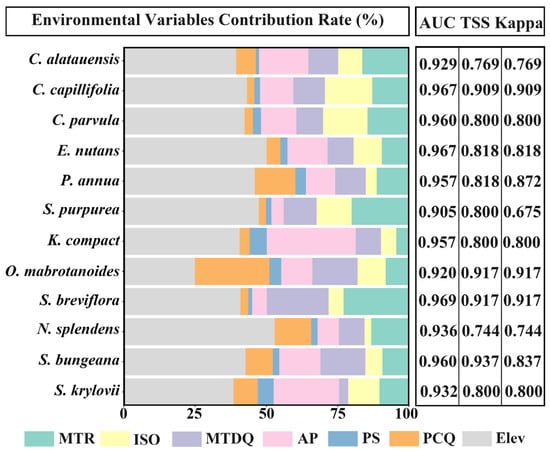
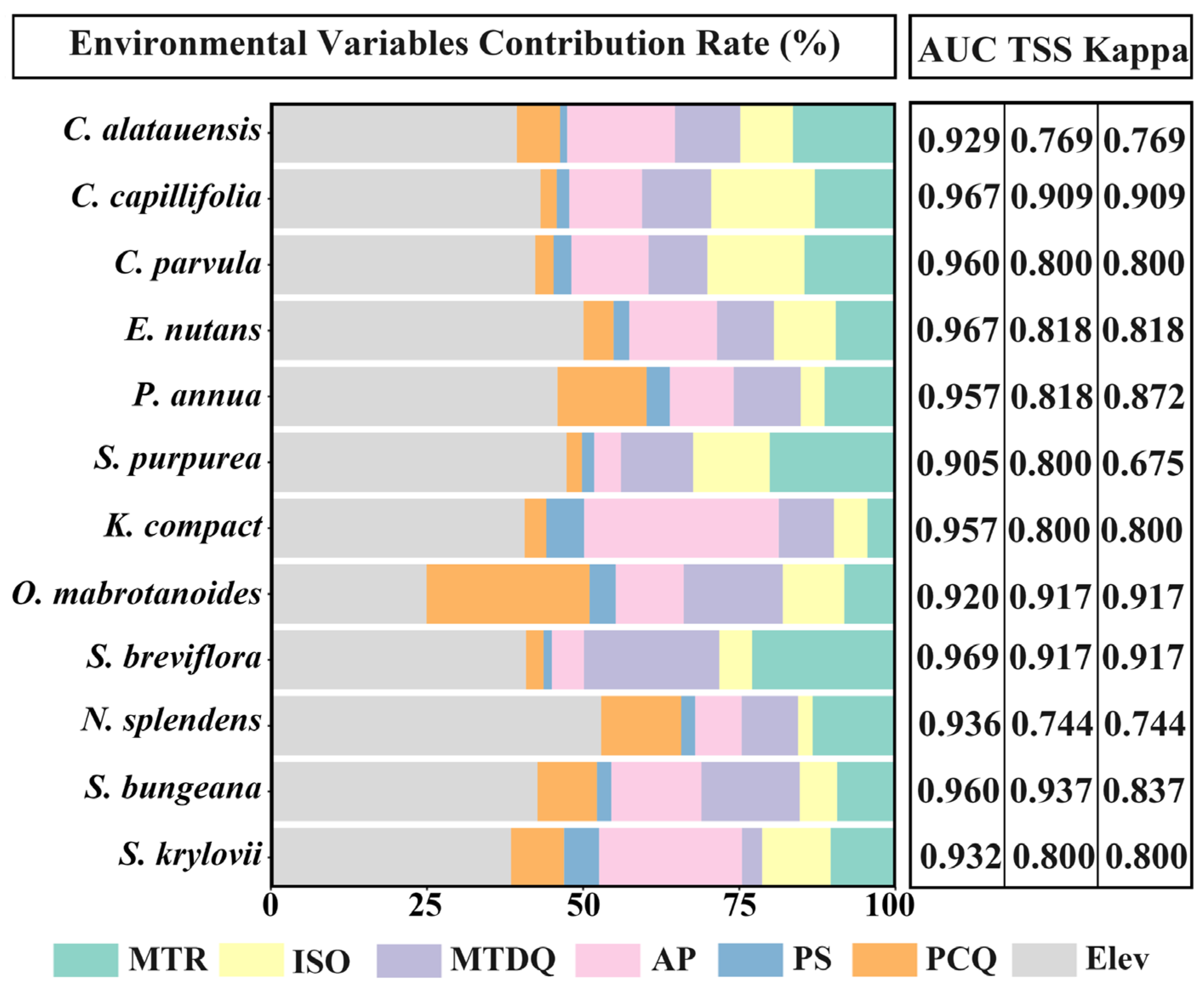
Our results show that the ensemble model exhibited excellent predictive accuracy for the 12 dominant species, with AUC > 0.9, TSS > 0.7, and Kappa > 0.6 for all species (Figure 1). This indicates that the ensemble model, constructed based on the relationship between species occurrence points and environmental factors, has high reliability in simulating species distributions. The contribution rates of environmental variables reveal that elevation is the primary driver affecting the distribution of the 12 species, while the effects of climate variables differ significantly among species of different grassland types, collectively reflecting the adaptive differentiation of species to the hydrothermal gradient on the QTP. Specifically, temperature (Mean monthly temperature range (MTR), Isothermality (ISO), and Mean temperature of the driest quarter (MTDQ)) and Annual precipitation (AP) play a key regulatory role in the distribution of C. alatauensis, C. capillifolia, C. parvula and E. nutans; S. purpurea and S. breviflora exhibit a relatively strong response to variations in temperature (MTR, ISO, and MTDQ); O. abrotanoides, S. bungeana and S. krylovii are primarily driven by AP and precipitation of the coldest quarter (PCQ); AP makes a significant contribution to the distribution of K. ceratoides; and the distribution of P. annua and N. splendens is primarily driven by a combination of temperature (MTR and MTDQ) and PCQ.
Figure 1.
Predicted potential distribution of dominant species across different grassland types under the current climate: environmental variable contribution rate (%) and ensemble model accuracy (AUC, TSS and Kappa). Here, MTR represents mean monthly temperature range, ISO represents isothermality, MTDQ represents mean temperature of the driest quarter, AP represents annual precipitation, PS represents precipitation seasonality, PCQ represents precipitation of the coldest quarter, and Elev represents elevation.
2.2. Potential Distribution of Dominant Species Under Current and Future Climate Scenarios
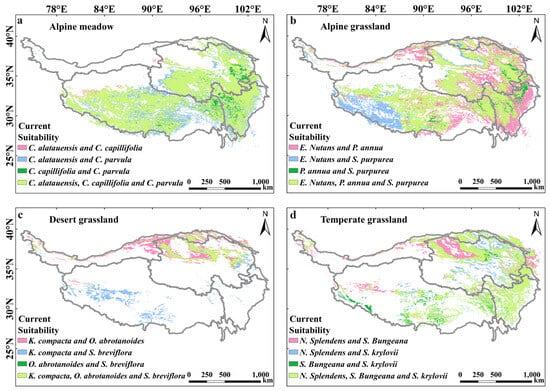
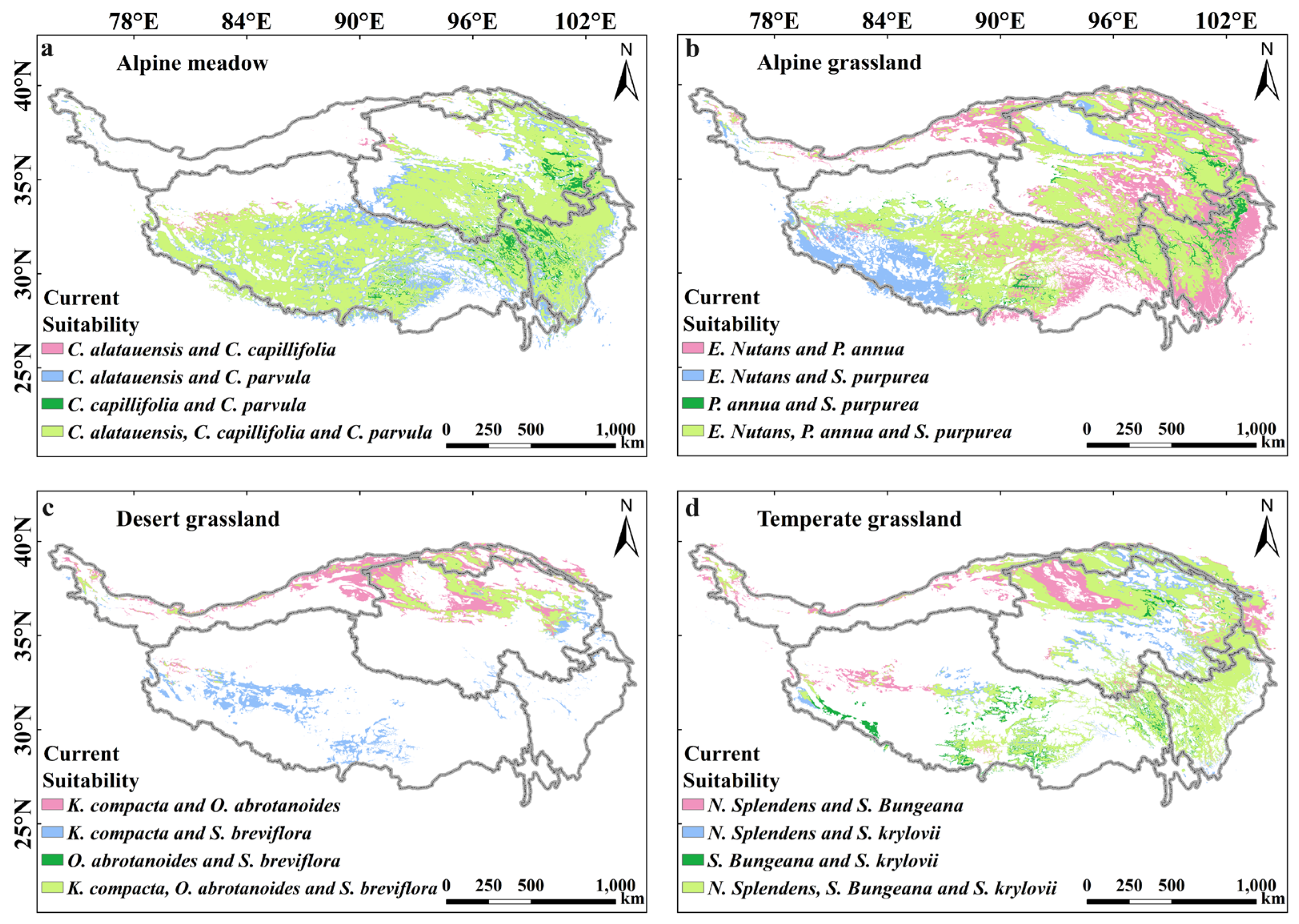
Our results show that the potentially suitable habitats for the dominant species of four grassland types on the QTP exhibit significant spatial heterogeneity under the current climate (Figure 2). The potential distribution overlap of the three dominant species in alpine meadows is the largest, reaching 142.1 × 10⁴ km2, mainly concentrated in eastern Tibet, western Sichuan, and southern Qinghai (Figure 2a, Table 1); among them, the area of potential distribution overlap between C. capillifolia and C. parvula is concentrated in the southeastern QTP, while C. alatauensis and C. parvula are distributed in a strip-like pattern along the southern QTP. The area of overlap in the potential distributions of the three dominant species in alpine grassland is 105.57 × 10⁴ km2, mainly concentrated in the northern Tibetan Plateau and the semi-arid region of southern Qinghai (Figure 2b, Table 1); among them, the overlap in the potential distributions of E. nutans and P. annua is relatively extensive, whereas S. purpurea and E. nutans are concentrated in the southwestern QTP. The area of potential distribution overlap for the three dominant species in desert grassland is the smallest (17.32 × 10⁴ km2), with a generally fragmented distribution mainly around the northern Tsaidam Basin (Figure 2c, Table 1). The overlap in the potential distributions of K. compacta and O. abrotanoides is concentrated in the northwestern QTP, while K. compacta and S. breviflora are mainly distributed in the southwestern QTP. The distribution of temperate grasslands exhibits a pattern of being more abundant in the east and less in the west, with the overlap in the potential ranges of its dominant species (74.44 × 10⁴ km2) mainly concentrated in the low-altitude regions of the northeastern QTP (Figure 2d, Table 1). Specifically, the overlap in the potential ranges of N. splendens and S. bungeana is mainly distributed in the northeastern QTP, while S. bungeana and S. krylovii are distributed in the southern QTP.
Figure 2.
Current suitable habitat distribution patterns of dominant species across different grassland types on the QTP. Among them, subfigure (a) represents alpine meadow, (b) represents alpine grassland, (c) represents desert grassland, and (d) represents temperate grassland.
Table 1.
The potential distribution areas of dominant species of different grassland types under current and future climate scenarios (I, II, and III represent the dominant species in different grassland types, where I represents C. alatauensis (alpine meadow), E. nutans (alpine grassland), K. compacta (desert grassland), and N. splendens (temperate grassland); II represents C. capillifolia (alpine meadow), P. annua (alpine grassland), O. abrotanoides (desert grassland) and S. bungeana (temperate grassland); III represents C. parvula (alpine meadow), S. purpurea (alpine grassland), S. breviflora (desert grassland) and S. krylovii (temperate grassland)).
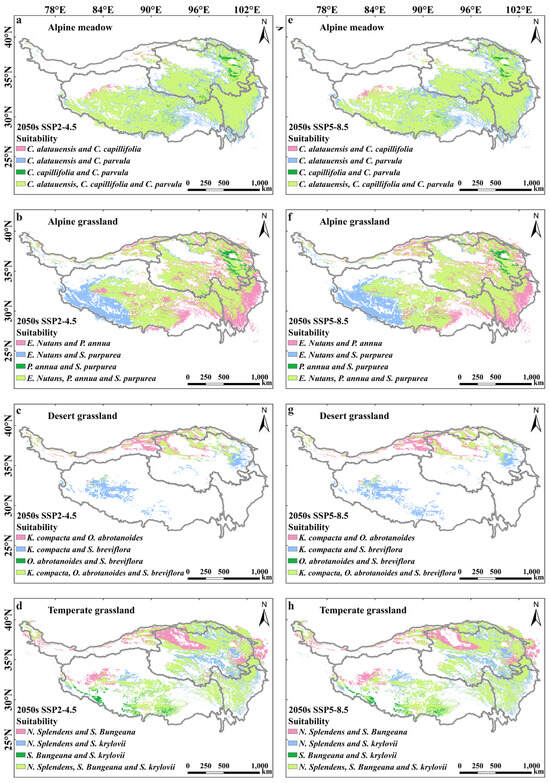
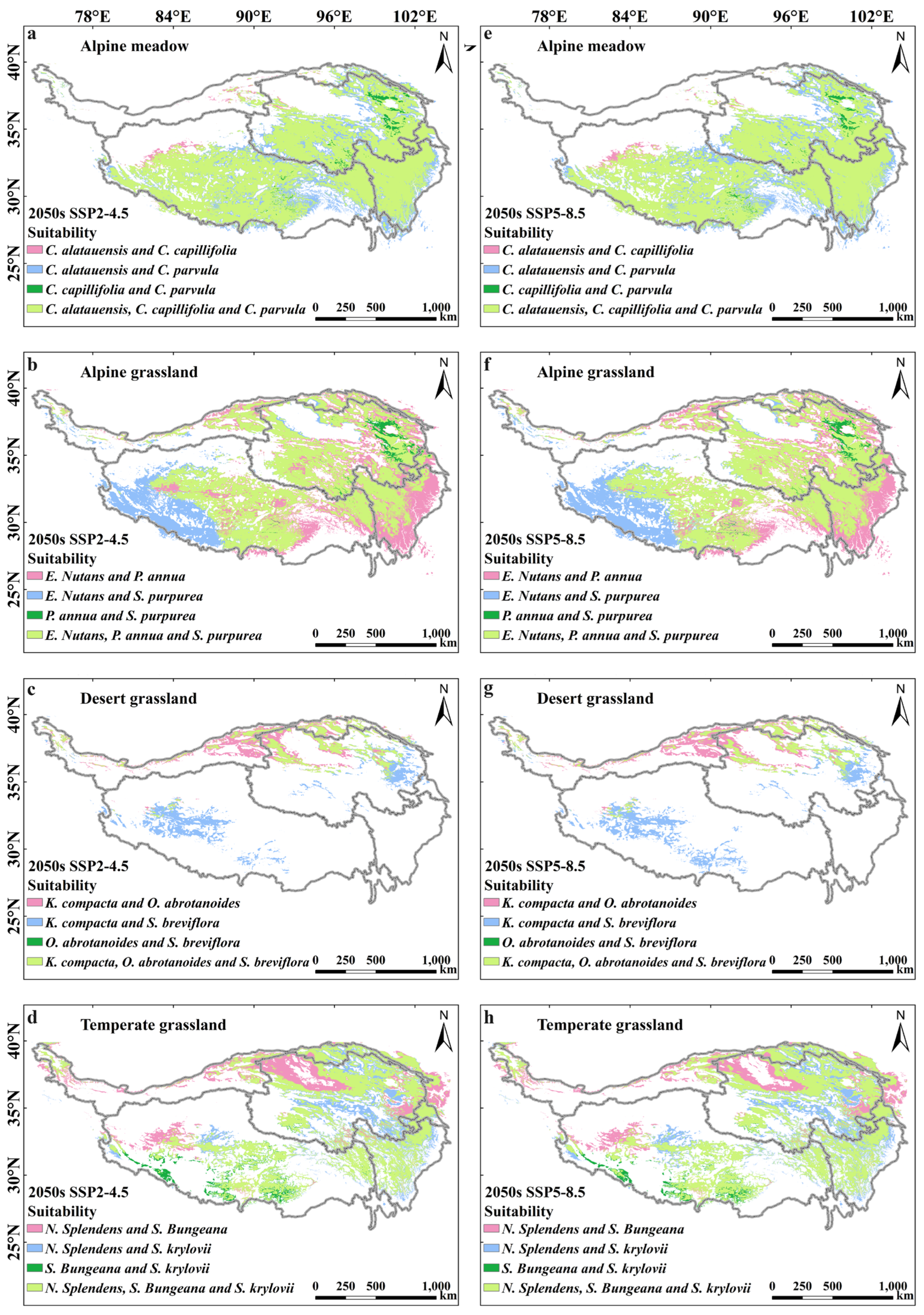
The suitable habitat patterns of dominant species in four grassland types on the QTP show significant changes under SSP2-4.5 and SSP5-8.5 scenarios (Figure 3). Under the SSP2-4.5 and SSP5-8.5 scenarios, the overlap in the potential distribution of the three dominant species in alpine meadows exhibits an increasing trend from southeast to northwest. Its area will expand to 163.88 × 10⁴ km2 (+15.33%) under SSP2-4.5 and contract to 155.73 × 10⁴ km2 (+9.59%) under SSP5-8.5, but is still higher than the current level (Figure 3a,e, Table 1). For alpine grassland, the overlap in the potential ranges of the dominant species will expand by 18.82% and 15.45% under SSP2-4.5 and SSP5-8.5, respectively, with expansion mainly in the northern and western parts of the QTP, shifting overall to higher altitudes (Figure 3b,f, Table 1). In particular, the overlap areas between E. nutans and P. annua, and between P. annua and S. purpurea, will shrink, while the area of overlap between E. nutans and S. purpurea will expand significantly, leading to a shift in niche overlap patterns. Desert grasslands remain fragmented and show no significant change under SSP2-4.5 but tend to contract under SSP5-8.5 (−10.45%) (Figure 3c,g, Table 1). Specifically, the overlap areas between K. compacta and O. abrotanoides will shrink significantly, and the overlap between K. compacta and S. breviflora will expand continuously, while O. abrotanoides and S. breviflora nearly disappear, shifting overall northwest. The overlap in the potential ranges of the three dominant species in temperate grassland expands significantly under SSP2-4.5 and SSP5-8.5, with expansion rates increasing with emission intensity (21.21% and 29.15%, respectively) (Figure 3d,h, Table 1). The areas of overlap between N. splendens and S. bungeana and between N. splendens and S. krylovii will expand continuously, primarily in the southern and southeastern parts of the QTP, while the area of overlap between S. bungeana and S. krylovii will contract continuously.
Figure 3.
Potential distribution of dominant species across different grassland types on the QTP under future climate change. The columns in the figure correspond to two SSPs (SSP2-4.5 and SSP5-8.5), with subfigures (a–d) and (e–h) representing the four grassland types under each scenario: (a,e) represent alpine meadow, (b,f) represent alpine grassland, (c,g) represent desert grassland, and (d,h) represent temperate grassland.
2.3. Changes in the Potential Distribution of Dominant Species from the Current to the Future
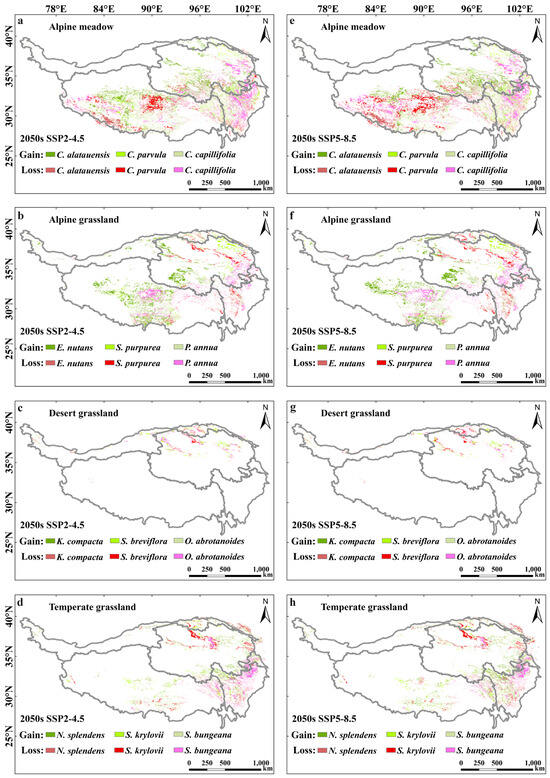
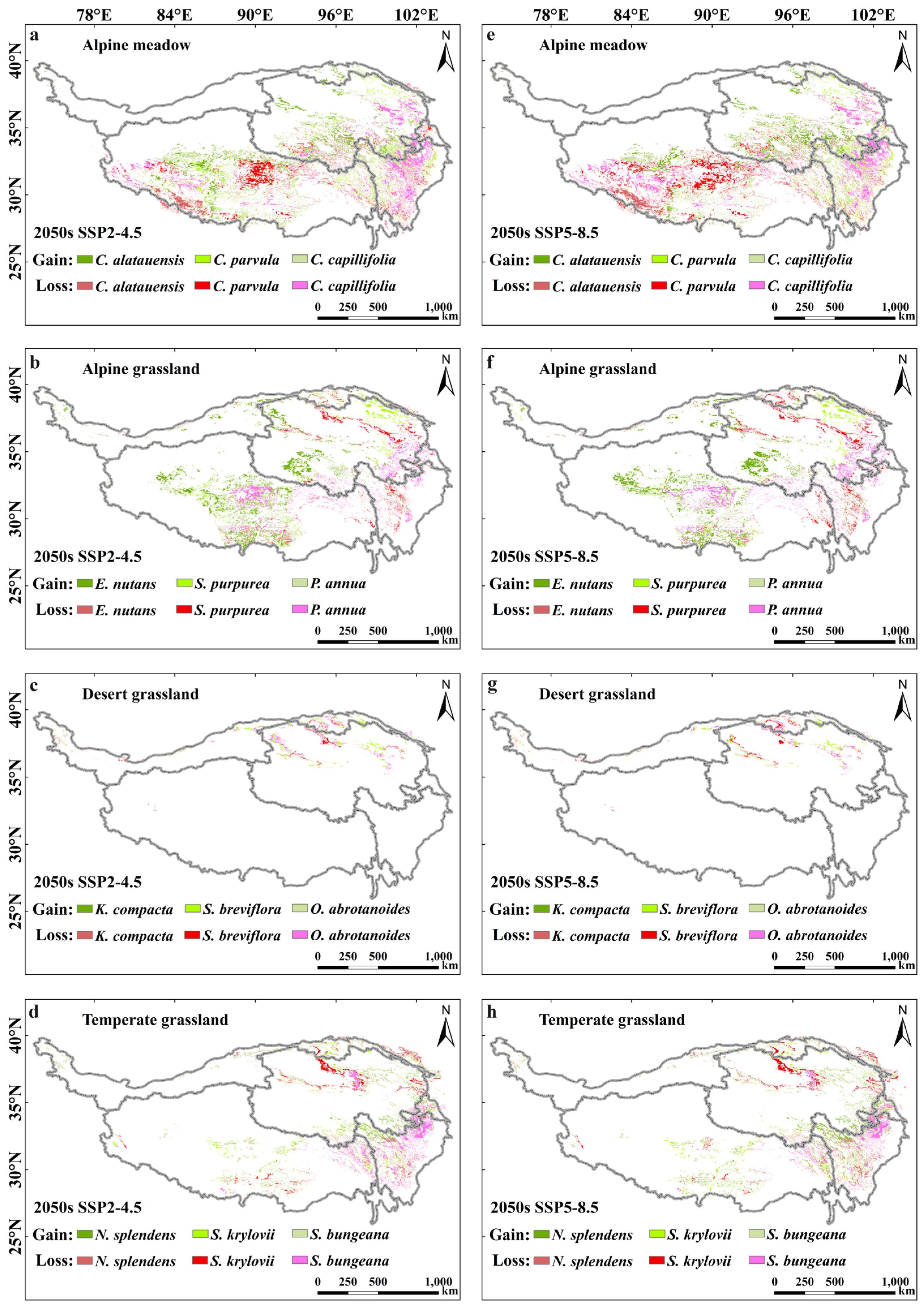
Figure 4 illustrates the spatial patterns of distribution expansion and contraction for dominant species of the four grassland types on the QTP under SSP2-4.5 and SSP5-8.5 from the current to the future. The suitable area of C. alatauensis will be dominated by expansion, and the expansion areas under SSP2-4.5 and SSP5-8.5 are 10.18 × 10⁴ km2 and 9.78 × 10⁴ km2, respectively, mainly occurring in the northern and northeastern parts of the QTP (Figure 4a,e, Table 2). However, C. capillifolia and C. parvula show a contraction trend, which intensifies with higher carbon emission intensity, mainly occurring in the central region of the QTP. In the alpine grassland, the expansion of the suitable habitat of E. nutans is dominant, and this habitat will continue to expand under SSP2-4.5 and SSP5-8.5 in the northwestern QTP (Figure 4b,f, Table 2). The suitable habitats of P. annua and S. purpurea will continue to shrink, mainly in the southeast of the QTP. For K. compacta, O. abrotanoides and S. breviflora (desert grassland), only a slight expansion is observed along the northern margin under SSP2-4.5, with no obvious contraction; expansion decreases slightly while contraction patches increase marginally under SSP5-8.5 (Figure 4c,g, Table 2). The suitable habitats of N. splendens, S. bungeana, and S. krylovii will continue to expand under SSP2-4.5 and SSP5-8.5. Their expansion trend mainly occurs in the Hengduan Mountains and the southern river valleys, while shrinkage occurs in the northeastern margin of the QTP (Figure 4d,h, Table 2). Overall, under the SSP5-8.5 scenario, the expansion range of the most dominant species is reduced compared to the moderate emission scenario, while contraction trends become more pronounced in some regions, and clear differentiation is observed among the different grassland types.
Figure 4.
Comparison of changes in the potential distribution of 12 dominant species across different grassland types under future and current climate conditions. The columns in the figure correspond to two SSPs (SSP2-4.5 and SSP5-8.5), with subfigures (a–d) and (e–h) representing the four grassland types under each scenario: (a,e) represent alpine meadow, (b,f) represent alpine grassland, (c,g) represent desert grassland, and (d,h) represent temperate grassland.
Table 2.
Area changes in the potential distribution of dominant species in different grassland types from the current to the future (I, II, and III represent the dominant species in different grassland types, where I represents C. alatauensis (alpine meadow), E. nutans (alpine grassland), K. compacta (desert grassland), and N. splendens (temperate grassland); II represents C. capillifolia (alpine meadow), P. annua (alpine grassland), O. abrotanoides (desert grassland) and S. bungeana (temperate grassland); III represents C. parvula (alpine meadow), S. purpurea (alpine grassland), S. breviflora (desert grassland) and S. krylovii (temperate grassland)).
2.4. Centroid Migration of Dominant Species in Different Grasslands on the QTP
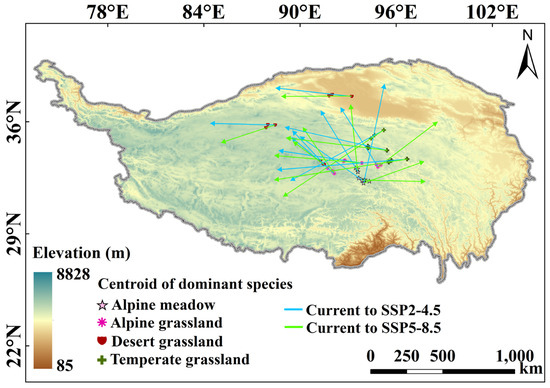
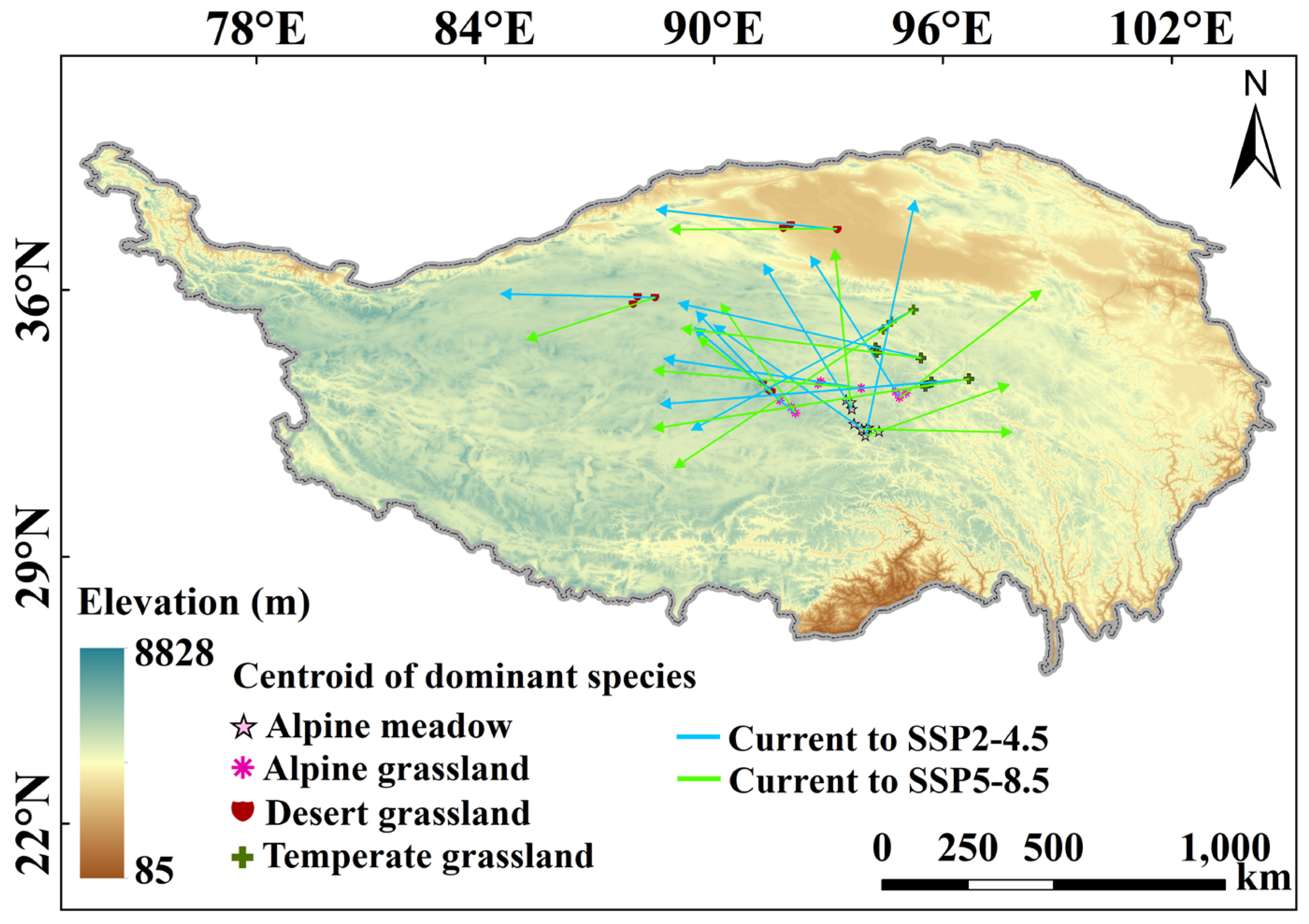
Our results indicate that the centroid migration directions of dominant species in different grassland types exhibit significant differences under future climate change (Figure 5). The centroids of gravity for dominant species in alpine meadow and alpine grassland will generally migrate northwest under the SSP2-4.5 scenario, whereas this unidirectional trend will diverge under the SSP5-8.5 scenario. Specifically, the centroids of E. nutans and S. purpurea in alpine grassland will continue to migrate northwest, while alpine meadow species and P. annua in alpine grassland will migrate east or northeast. In contrast, the centroids of dominant species in desert grassland will migrate northwest under the SSP2-4.5 and SSP5-8.5 scenarios; among temperate grasslands, the centroids of N. splendens and S. krylovii will migrate southwest, whereas the centroids of S. bungeana will migrate northwest. Overall, the centroid shifts of all dominant species are predominantly toward higher altitudes or higher latitudes on the QTP, which also reflects differences in the sensitivity of dominant species from different grassland types to climate change.
Figure 5.
The migration direction of geographical centroids shifting for 12 dominant species across different grassland types on the QTP under SSP2-4.5 and SSP5-8.5. The arrows are only used to indicate the direction of migration.
3. Discussion
3.1. The Reliability of Model Predictions
Plant species are more sensitive to climate change than animals [31]. Understanding how species’ habitats respond to climate change is critical for developing effective conservation strategies [26,32]. We simulated the current and future potential suitable habitats of 12 dominant species from four grassland types on the QTP based on an ensemble model. The model evaluation results showed that all species had AUC > 0.9, TSS > 0.7, and Kappa > 0.6, indicating that the ensemble model predictions have high accuracy and reliability, which is consistent with previous studies [26,27,28,33]. Numerous previous studies have shown that different modeling methods often yield considerably different predictions for the distribution of the same species, whereas ensemble methods, by integrating the outputs of multiple models, can effectively circumvent the biases and uncertainties of single models [23,25,34]. This constitutes the primary rationale for the selection of ensemble modeling in this study.
3.2. Analysis of the Contribution of Key Drivers to the Dominant Species on the QTP
This study reveals that the significant spatial differentiation of hydrothermal conditions on the QTP under the current climate leads to a high heterogeneity in the potentially suitable areas for the dominant species of the four grassland types. Meanwhile, the contribution rates of environmental drivers confirmed that elevation plays a dominant role in shaping the geographical patterns of the 12 dominant species, while the combined effects of temperature and precipitation drive the adaptive differentiation of dominant species across different grassland types. This further corroborates the characteristic of elevation-driven hydrothermal heterogeneity in the alpine ecosystems of the QTP [35,36,37]. C. alatauensis, C. capillifolia, and C. parvula are species that prefer humid and cold environments [38,39], but their responses to environmental factors differ markedly among species. The distribution of C. alatauensis is mainly regulated by AP, whereas C. capillifolia and C. parvula are more sensitive to ISO. This may be attributed to their different strategies for alleviating low-temperature stress on the QTP, arising from differences in internal structure and growth microenvironment [40,41]; or it may stem from differences in seed dispersal capacity and limitations in pollinator distribution [42]. The dominant drivers for E. nutans and P. annua in alpine grassland are AP and PCQ, respectively, while the dominant driver for S. purpurea in alpine grassland is MTR. This is because in water-limited alpine grassland, warming may have a negative impact on plant growth, and increased precipitation can alleviate the water stress caused by warming [43], which also explains the regulatory role of precipitation-related factors for most alpine steppe species. The dominant species of desert grassland exhibit a fragmented distribution around the periphery of the Tsaidam Basin, which is closely related to their native environmental characteristics of aridity and water scarcity [44]. The suitable area for the dominant species of temperate grassland shows a pattern of “more in the east, less in the west,” indicating their dependence on warm, humid valleys and lowland environments [45]. The main drivers for N. splendens and S. bungeana are MTR and MTDQ, respectively, whereas the dominant driver for S. krylovii is AP. These differences may arise because temperature and precipitation influence the biogeographic patterns of soil nutrients, thereby leading to variations in the dominant drivers among different species [45,46,47]. These environmentally driven differentiation patterns reveal the mechanism of niche differentiation of dominant grassland species along hydrothermal gradients on the QTP, which confirms the conclusion that the combined effects of elevation, temperature, and precipitation jointly drive niche differentiation.
3.3. Impacts of Future Climate Change on the Potential Areas of Dominant Species
Climate change can alter species distribution patterns, and species typically respond to climate change through migration, local adaptation, or extinction [48]. Under the SSP2-4.5 and SSP5-8.5 scenarios, the suitable habitats for the dominant species of four grassland types on the QTP will generally expand to the north, northwest, and high-altitude, high-latitude regions (Figure 4). This finding is consistent with previous studies that show global warming will drive plant expansion toward higher altitudes or higher latitudes [26,49,50,51]. Warmer and wetter conditions favor the expansion of potential habitats for alpine meadow and alpine grassland dominants under SSP2-4.5, while excessive warming under SSP5-8.5 reduces their expansion. In contrast, temperate grassland dominant species show a continuous expansion trend under both scenarios, while suitable areas for desert grassland dominant species remain relatively stable under SSP2-4.5 but exhibit significant contraction under SSP5-8.5. This implies that climate warming will ameliorate cold conditions at high altitudes and high latitudes [52,53], whereas higher temperatures can promote the growth of poisonous weeds [54,55], the hatching and reproduction of pests [10], and exacerbate drought conditions [8], thereby exerting a negative impact on grassland growth.
In addition, we found that the centroid migration of the potential distribution of desert grassland dominant species is consistently northwest under SSP2-4.5 and SSP5-8.5, and the centroids of alpine meadow and alpine grassland dominant species shift northwest under SSP2-4.5, which is consistent with the typical adaptive migration pattern of alpine vegetation in response to warming stress [49,50,51]. However, the centroids of E. nutans and S. purpurea in alpine grassland will continue to move northwest under SSP5-8.5, while alpine meadow and Poa annua in alpine grassland will migrate east or northeast. This eastward migration may be explained by the fact that rising temperatures will make the eastern and northeastern high-latitude regions cooler and wetter [56,57], thereby providing moisture conditions that compensate for heat stress in cold-wet-preferring species, thus forming new “climate refugia.” Yan and Tang (2019) also show that most endemic species on the QTP are concentrated in the relatively low-altitude zones of the southern and eastern plateau, where conditions are warmer, wetter, and more stable than in the interior plateau [58]. Additionally, the centroid of S. bungeana will migrate northwestward. This finding is consistent with the study by Qiao et al. (2020), which reported a northwest shift in the potential distribution of S. bungeana under future climate [47]. However, contrary to the general expectation that species migrate to higher altitudes and latitudes in response to climate warming, our results show that the centroids of N. splendens and S. krylovii will move to the southwest. This phenomenon may be attributed to the complex interaction between rising temperature and precipitation changes. Increased precipitation in the southwestern high-altitude regions of the QTP could partially counteract the negative impacts of elevated temperatures [53,59]. On the other hand, constraints from non-climatic factors, such as soil nutrient limitation, may prevent the formation of stable, suitable habitats even when temperature conditions are favorable [46,60], ultimately driving their migration toward the southwest, where hydrothermal and soil conditions are more suitable. Such interspecific differentiation fundamentally reflects the divergent climate adaptation mechanisms formed by different species based on their own physiological tolerance thresholds, resource utilization strategies, and other factors [61,62]. These findings indicate that species may mitigate the impacts of climate change by shifting their ranges.
In fact, it remains uncertain whether most species will be able to migrate sufficiently rapidly to cope with ongoing climate change [63]. When species fail to keep pace with the velocity of climate change, they lose favorable climatic space and undergo significant range contractions [64,65]. As generation times differ among species, the impacts of climate change rates may vary, and together with variability in genetic variation within populations, these factors may determine their potential for local adaptation [66,67]. Moreover, climate change will affect some species more strongly than others, leading to altered interspecific interactions [68] and potentially exacerbating community instability [69], which may further influence species’ migration capacity. At the same time, alpine plants have a limited ability for seed dispersal and long-distance migration [70], which will directly constrain their migration processes. Furthermore, the projected warming and humidification trend on the QTP will enhance the competitive advantage of these species, thereby affecting community structure and driving shifts in grassland types [10,15,71]. These findings explain the dynamic process of succession of the four grassland types on the QTP from the perspective of species niches; consequently, the predicted changes in grassland types in this study provide theoretical guidance for the rational planning and management of livestock activities. However, this study only analyzed the effects of climate and elevation on the distribution of dominant species of different grasslands, without considering biotic factors such as interspecific relationships and human disturbance or abiotic factors such as soil environment [60,72]; further in-depth research is needed in the future.
4. Materials and Methods
4.1. Study Area
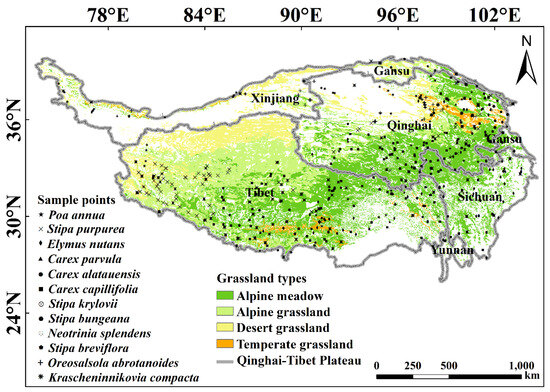
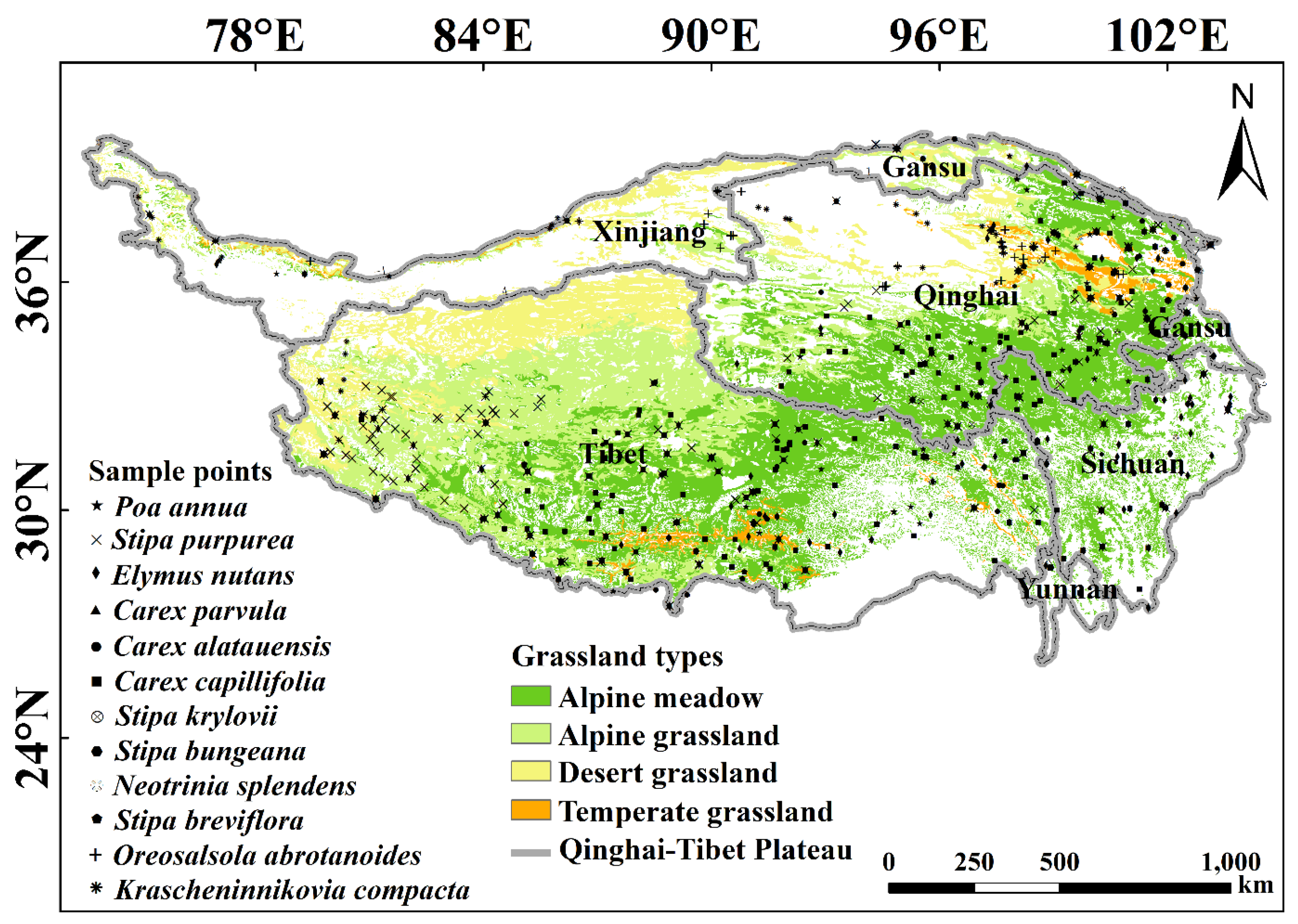
The QTP (73°19′–104°47′ E, 26°00′–39°47′ N) is located in western China, covering nearly 25% of China’s total area [73]. The annual mean temperature across the QTP ranges from −5.6 to 17.6 °C, with diurnal temperature variations between 14 and 17 °C [74]. From southeast to northwest, the climatic conditions shift from warm and humid to cold and dry [75]. Grasslands are the dominant vegetation type on the QTP, with alpine meadow, alpine grassland, desert grassland, and temperate grassland together accounting for 73.6% of the total area of the QTP [10] (Figure 6). The 12 dominant species used in this study include Carex alatauensis, Carex capillifolia and Carex parvula for the alpine meadow [76]; Elymus nutans, Poa annua and Stipa purpurea for alpine grassland [10,77]; Krascheninnikovia ceratoides, Oreosalsola abrotanoides and Stipa breviflora for desert grassland [44,78]; and Neotrinia splendens, Stipa bungeana and Stipa krylovii for temperate grassland [45,46,79].
Figure 6.
Occurrence data of the 12 dominant species and distribution of grassland types on the QTP.
4.2. Data Sources
4.2.1. Species Distribution Data
Species occurrence data were primarily obtained from the field survey conducted by Jin et al. (2022) on the QTP during 2018–2021 [80]; the National Specimen Information Infrastructure (NSII, http://www.nsii.org.cn); the Chinese Field Herbarium (CFH, http://www.cfh.ac.cn); and the Global Biodiversity Information Facility (GBIF, https://www.gbif.org) (GBIF.org, GBIF Occurrence Download. Available online: https://doi.org/10.15468/dl.jkt9af (accessed on 2 may 2026)). Specimen information was verified online through the Chinese Virtual Herbarium (CVH, https://www.cvh.ac.cn). The longitude, latitude, and species name of each species occurrence record were saved in CSV format. In addition, to reduce spatial autocorrelation and sampling bias and to ensure a more even distribution of occurrence points, we removed duplicate records and applied spatial filtering, retaining only one occurrence record within a 1 km radius. Specifically, we defined a 1 km radius around each sampling point and removed all other points within that circle; points other than the center of the circle were deleted. Finally, we obtained 1214 valid occurrence records for 12 species. Among them, C. alatauensis (99), C. capillifolia (213), C. parvula (215), E. nutans (178), P. annua (50), S. purpurea (176), K. ceratoides (45), O. abrotanoides (38), S. breviflora (55), N. splendens (49), S. bungeana (54), and S. krylovii (42) (Figure 6).
4.2.2. Environmental Data and Preprocessing
Elevation data and current (representative 1970–2000) and future (2050: average of 2041–2060) bioclimatic variables (Table S1 provides the specific names and their meanings) were downloaded from WorldClim 2.1 (http://www.worldclim.org/) with a spatial resolution of 30″ [81]. To account for future climate uncertainty, we used 2050 climate data based on the BCC-CSM2-MR Global Climate Model (GCM), which has been widely applied in species distribution modeling on the QTP [82,83]. In addition, we consider two Shared Socioeconomic Pathways (SSPs) scenarios [84,85,86]: SSP2-4.5 and SSP5-8.5, where the number after SSP represents the conversion of the warming effect of carbon dioxide into an equivalent wattage of radiation gain. SSP2-4.5 represents a “middle way” model of social, economic and technological trends throughout the twenty-first century that does not deviate significantly from historical development (with a radiative forcing of about 4.5 W/m2); SSP5-8.5, which represents rapid global economic and social development alongside a shift toward resource- and energy-intensive lifestyles, is estimated to result in a radiative forcing of about 8.5 W/m2 in the year 2100.
Spatial autocorrelation among environmental variables may affect the analysis of the relationship between species distribution and environment [87]. To avoid multicollinearity among the environmental variables, we conducted a correlation analysis using the Spearman correlation coefficient to examine the relationship between 19 climate factors and elevation at the species locations (Figure S1). If the absolute correlation coefficient |r| ≥ 0.7, the two variables were considered highly correlated. Therefore, we removed variables with a correlation higher than 0.7 [88], and the final ensemble model considered seven variables (Table 3).
Table 3.
Environment variables for modeling.
4.3. Ensemble Model Construction and Performance Evaluation
Ensemble methods, which combine multiple single models, can effectively reduce the uncertainty associated with different model predictions and are widely used in species distribution modeling [24,89]. To simulate the potential suitable habitats of dominant species in four grassland types under the future climate, we constructed an ensemble model using a weighted average approach, incorporating three ENMs: maxent, random forest (RF), and support vector machine (SVM). Among them, Maxent predicts occurrence probability by modeling the nonlinear relationship between species occurrence points and environmental factors [90]. In this paper, it was run using the default parameters of the “dismo” package in R (version 4.4.1). RF constructs an ensemble decision tree by bootstrap resampling (we set ntree = 1000 and implement it using the “randomForest” function) and avoids overfitting by randomly selecting samples and splitting attributes [91,92]. SVM projects the data into a high-dimensional feature space for pattern classification [93]. We use a radial basis kernel function (based on the “e1071” package in R) and perform parameter tuning based on 10-fold cross-validation. The weight () of each model was calculated based on the area under the receiver operating characteristic curve (AUC) value according to the formula . Subsequently, we used the “randomPoints” function to randomly generate pseudo-absence data in the study area at a ratio of presence to pseudo-absence of 1:1 [94]. Among them, the ensemble model was built using 80% of the randomly selected data, with the remaining 20% used to evaluate the current predictive performance of the model. As the AUC is often considered insufficient for evaluating the performance of species distribution models [95], we evaluated the accuracy of model predictions using three metrics: AUC, True Skill Statistic (TSS), and Cohen’s Kappa (Kappa) [96,97]. The higher values of AUC, TSS, and Kappa indicate stronger model performance and greater reliability of the results. Generally, AUC values between 0.7 and 0.8 are considered general, 0.8–0.9 are considered good, and 0.9–1.0 are considered excellent; TSS values between 0.6 and 0.8 are considered good, and 0.8–1.0 are considered excellent; Kappa values between 0.4 and 0.75 are considered good, and values greater than 0.75 are considered excellent [81,98].
4.4. Changes in the Potential Distribution of Dominant Species and Centroid Migration
In this study, we used the sum of maximizing sensitivity and specificity to determine the threshold [99], which is unaffected by the prevalence of the data used to build the model and tends to favor sensitivity (true presence) over specificity (true absence) [100]. Subsequently, we divided the suitable habitats (low, medium, and high) and unsuitable habitats for species distribution based on this threshold. Furthermore, to facilitate the comparison of suitable habitat changes for different species between current and future (SSP2-4.5 and SSP5-8.5), we converted the continuous probabilities into binary data (0–1) according to the threshold, where values below the threshold were assigned 0 (i.e., absence) and values above the threshold were assigned 1 (i.e., presence), thereby visualizing the changes in species spatial distribution patterns under future climate change. Calculated according to [current + 2 (future + 1)] − 2, the result has four scenarios: 0 represents the unsuitable habitats; 1 indicates the distribution that will be lost under future climate change; 2 indicates the distribution that will be gained under future climate change; 3 indicates stable distributions under future climate change. Moreover, we obtained the potential spatial overlap area of the three dominant species in the same grassland type by superimposing the independent distribution map layers of the three dominant species in the same grassland type.
In addition, shifts in the geographic center of species distribution over time can reflect the overall trajectory of its range change [101,102]. We assumed the study area constitutes a homogeneous plane, where the point at which the species distribution reaches a balance in terms of torque on this plane is the geographic center of the species distribution [103]. Let be the probability of survival in terms of environmental adaptation for the patch (i, j) predicted by the ENM, and and represent the latitude and longitude of the center of patch (i, j), respectively. We calculated the geographic distribution center’s latitude (N) and longitude (E) by setting and . Meanwhile, we calculated the geographic distance between two centers using the following formula:
where and represent the latitudes and longitudes of centers A and B, respectively, and r is the Earth radius, which takes the value of 6378.137 km, with and .
5. Conclusions
This study used an ensemble model to simulate the potential distribution of 12 dominant species across four grassland types (alpine meadow, alpine grassland, desert grassland, and temperate grassland) on the QTP under current and future climate scenarios and systematically revealed the spatial pattern dynamics of the suitable habitats of these dominant species and their driving mechanisms. The main findings are as follows: (1) The ensemble model showed excellent predictive accuracy for the 12 dominant species (AUC > 0.9, TSS > 0.7, Kappa > 0.6). (2) Elevation is the key environmental factor affecting their distribution, and the combined effects of temperature and precipitation dominate the niche differentiation among different grassland types, reflecting the adaptive characteristics of dominant species in different grassland types along the hydrothermal gradient. (3) The current and future potential distributions of the dominant species exhibit clear spatial differentiation along the southeast–northwest hydrothermal gradient of the QTP, and the contraction of suitable habitats for all species will intensify with increasing carbon emissions. (4) The direction of centroid migration varies among dominant species of different grassland types. Specifically, the centers of gravity of the desert grassland and S. bungeana will migrate to the northwest, while N. splendens and S. krylovii will migrate to the southwest; the alpine meadow and alpine grassland will migrate to the northwest under the SSP2-4.5 scenario and diverge under the SSP5-8.5 scenario. Overall, this study overcomes the limitations of previous studies that focused on a single species or a single grassland type; deduces the overall evolution of grassland types from the distribution changes of dominant species; quantifies the spatial response patterns of QTP grasslands under climate change; and provides scientific theoretical support for the conservation of alpine ecosystems, the maintenance of biodiversity, and adaptive grassland management.
Supplementary Materials
The following supporting information can be downloaded at https://www.mdpi.com/article/10.3390/plants15131972/s1, Figure S1. Spearman correlation analysis of environment variables. Table S1. Meaning of 19 bioclimatic factors and topographical variables.
Author Contributions
Methodology, W.-W.G. and W.-T.W.; software, W.-W.G.; formal analysis, W.-W.G., W.-L.L. and W.-T.W.; data curation, W.-W.G., X.-Y.L. and S.-Q.L.; writing—original draft preparation, W.-W.G.; writing—review and editing, W.-W.G. and W.-L.L.; supervision, J.X.; funding acquisition, W.-L.L., W.-T.W., W.-Y.W. and H.-K.Z. All authors have read and agreed to the published version of the manuscript.
Funding
This research was funded by the National Natural Science Foundation of China (grant 31170430 and 41471450 to W.-L.L., grant 32260293 to W.-T.W., and grant 32371684 to H.-K.Z.); the Major Science and Technology Project of Gansu Province—International Cooperation Category (grant 25ZDWA03 to W.-L.L.); the earmarked fund for the China Agriculture Research System (grant CARS-34 to W.-L.L.); the Natural Science Foundation of Qinghai Province (grant 2025-ZJ-990M to H.K.Z.); the National Key R&D Program of China (grant 2023YFF1304305 to W.-Y.W.); and International (Regional) Cooperation and Exchange (ICE) Projects of the National Natural Science Foundation of China (NSFC) (grant W2412148 to W.-Y.W.).
Data Availability Statement
The original contributions presented in this study are included in the article/Supplementary Materials. Further inquiries can be directed to the corresponding author.
Acknowledgments
The authors sincerely thank the anonymous reviewers for their constructive suggestions and comments, which helped enhance the quality of this paper. We also extend our gratitude to the State Key Laboratory of Herbage Improvement and Grassland Agro-Ecosystems and College of Pastoral Agriculture Science and Technology at Lanzhou University for their support.
Conflicts of Interest
The authors declare no conflicts of interest.
References
- Dong, S.; Sherman, R. Enhancing the resilience of coupled human and natural systems of alpine rangelands on the Qinghai-Tibetan Plateau. Rangel. J. 2015, 37, i–iii. [Google Scholar] [CrossRef] [Scilit]
- Shen, H.; Dong, S.; Li, S.; Xiao, J.; Han, Y.; Yang, M.; Zhang, J.; Gao, X.; Xu, Y.; Li, Y. Grazing enhances plant photosynthetic capacity by altering soil nitrogen in alpine grasslands on the Qinghai-Tibetan plateau. Agric. Ecosyst. Environ. 2019, 280, 161–168. [Google Scholar] [CrossRef] [Scilit]
- Li, M.; Wu, J.; He, Y.; Wu, L.; Niu, B.; Song, M.; Zhang, X. Dimensionality of grassland stability shifts along with altitudes on the Tibetan Plateau. Agric. For. Meteorol. 2020, 291, 108080. [Google Scholar] [CrossRef] [Scilit]
- Qin, J.; Yang, K.; Liang, S.; Guo, X. The altitudinal dependence of recent rapid warming over the Tibetan Plateau. Clim. Change 2009, 97, 321–327. [Google Scholar] [CrossRef] [Scilit]
- Yang, K.; Wu, H.; Qin, J.; Lin, C.; Tang, W.; Chen, Y. Recent climate changes over the Tibetan Plateau and their impacts on energy and water cycle: A review. Glob. Planet. Change 2014, 112, 79–91. [Google Scholar] [CrossRef] [Scilit]
- He, Z.; Zhou, T.; Chen, J.; Fu, Y.; Peng, Y.; Zhang, L.; Yao, T.; Farooq, T.H.; Wu, X.; Yan, W. Impacts of climate warming and humidification on vegetation activity over the Tibetan Plateau. Forests 2023, 14, 2055. [Google Scholar] [CrossRef] [Scilit]
- Wang, Y.; Lv, W.; Xue, K.; Wang, S.; Zhang, L.; Hu, R.; Zeng, H.; Xu, X.; Li, Y.; Jiang, L. Grassland changes and adaptive management on the Qinghai–Tibetan Plateau. Nat. Rev. Earth Environ. 2022, 3, 668–683. [Google Scholar] [CrossRef] [Scilit]
- Dong, N.; Liu, Z.; Luo, M.; Fang, C.; Lin, H. The effects of anthropogenic land use changes on climate in China driven by global socioeconomic and emission scenarios. Earth’s Future 2019, 7, 784–804. [Google Scholar] [CrossRef] [Scilit]
- Xu, T.; Zhao, X.; Zhang, X.; Wang, X.; Geng, Y.; Hu, L.; Zhao, N.; Mao, S.; Liu, H.; Kang, S. Sustainable development of ecological grass-based livestock husbandry in Qinghai-Tibet Plateau alpine area: Principle, technology and practice. Acta Ecol. Sin. 2020, 40, 6324–6337. [Google Scholar] [CrossRef]
- Li, M.; Wang, J.; Zhang, X.; Zhang, Y.; Wang, Z.; Yang, Y. Distribution of potential suitable areas of dominant species in alpine grasslands and alpine meadows in the TP under future climate scenarios. Acta Ecol. Sin. 2024, 22, 10162–10177. [Google Scholar] [CrossRef]
- Liu, G.; Liu, H.; Yin, Y. Global patterns of NDVI-indicated vegetation extremes and their sensitivity to climate extremes. Environ. Res. Lett. 2013, 8, 025009. [Google Scholar] [CrossRef] [Scilit]
- Avolio, M.L.; Forrestel, E.J.; Chang, C.C.; La Pierre, K.J.; Burghardt, K.T.; Smith, M.D. Demystifying dominant species. New Phytol. 2019, 223, 1106–1126. [Google Scholar] [CrossRef] [Scilit] [PubMed]
- Zong, N.; Shi, P.; Zhao, G.; Zheng, L.; Niu, B.; Zhou, T.; Hou, G. Variations of nitrogen and phosphorus limitation along the environmental gradient in alpine grasslands on the Northern Xizang Plateau. Chin. J. Plant Ecol. 2021, 45, 444–455. [Google Scholar] [CrossRef] [Scilit]
- Bai, W.; Hou, X. Research Progress on the Effects of Climate Change on Dominant Plant Species of Grassland. Chin. J. Grassl. 2021, 43, 107–114. [Google Scholar] [CrossRef]
- Wang, Y.; Xue, K.; Hu, R.; Ding, B.; Zeng, H.; Li, R.; Xu, B.; Pang, Z.; Song, X.; Li, C. Vegetation structural shift tells environmental changes on the Tibetan Plateau over 40 years. Sci. Bull. 2023, 68, 1928–1937. [Google Scholar] [CrossRef] [Scilit] [PubMed]
- Hou, G.; Shi, P.; Zhou, T.; Sun, J.; Zong, N.; Song, M.; Zhang, X. Dominant species play a leading role in shaping community stability in the northern Tibetan grasslands. J. Plant Ecol. 2023, 16, rtac110. [Google Scholar] [CrossRef] [Scilit]
- Milazzo, M.; Mirto, S.; Domenici, P.; Gristina, M. Climate change exacerbates interspecific interactions in sympatric coastal fishes. J. Anim. Ecol. 2013, 82, 468–477. [Google Scholar] [CrossRef] [Scilit] [PubMed]
- Traill, L.W.; Lim, M.L.; Sodhi, N.S.; Bradshaw, C.J. Mechanisms driving change: Altered species interactions and ecosystem function through global warming. J. Anim. Ecol. 2010, 79, 937–947. [Google Scholar] [CrossRef] [Scilit] [PubMed]
- Ma, B.; Sun, J. Predicting the distribution of Stipa purpurea across the Tibetan Plateau via the MaxEnt model. BMC Ecol. 2018, 18, 10. [Google Scholar] [CrossRef] [Scilit] [PubMed]
- Ma, P.; Zhao, J.; Zhang, H.; Zhang, L.; Luo, T. Increased precipitation leads to earlier green-up and later senescence in Tibetan alpine grassland regardless of warming. Sci. Total Environ. 2023, 871, 162000. [Google Scholar] [CrossRef] [Scilit] [PubMed]
- Pearson, R.G.; Dawson, T.P. Predicting the impacts of climate change on the distribution of species: Are bioclimate envelope models useful? Glob. Ecol. Biogeogr. 2003, 12, 361–371. [Google Scholar] [CrossRef] [Scilit]
- Jiménez-Valverde, A.; Peterson, A.T.; Soberón, J.; Overton, J.; Aragón, P.; Lobo, J.M. Use of niche models in invasive species risk assessments. Biol. Invasions 2011, 13, 2785–2797. [Google Scholar] [CrossRef] [Scilit]
- Hartley, S.; Harris, R.; Lester, P.J. Quantifying uncertainty in the potential distribution of an invasive species: Climate and the Argentine ant. Ecol. Lett. 2006, 9, 1068–1079. [Google Scholar] [CrossRef] [Scilit] [PubMed]
- Koo, K.A.; Park, S.U.; Kong, W.-S.; Hong, S.; Jang, I.; Seo, C. Potential climate change effects on tree distributions in the Korean Peninsula: Understanding model & climate uncertainties. Ecol. Model. 2017, 353, 17–27. [Google Scholar] [CrossRef] [Scilit]
- Thuiller, W.; Lafourcade, B.; Engler, R.; Araújo, M.B. BIOMOD–a platform for ensemble forecasting of species distributions. Ecography 2009, 32, 369–373. [Google Scholar] [CrossRef] [Scilit]
- Canturk, U.; Koç, İ.; Erdem, R.; Ozturk Pulatoglu, A.; Donmez, S.; Ozkazanc, N.K.; Sevik, H.; Ozel, H.B. Climate-driven shifts in wild Cherry (Prunus avium L.) habitats in Türkiye: A multi-model projection for conservation planning. Forest 2025, 16, 1484. [Google Scholar] [CrossRef] [Scilit]
- Canturk, U.; Koc, I.; Erdem, R.; Ozturk Pulatoglu, A.; Sevik, H.; Ozel, H.B.; Adiguzel, F.; Ozkazanc, N.K. Possible Shift of Suitable Distribution Habitats of Laurus nobilis L. in Türkiye with the Effects of Global Climate Change. Atmosphere 2026, 17, 516. [Google Scholar] [CrossRef] [Scilit]
- Canturk, U. Predicting the possible distribution areas of Picea orientalis under climate change in Türkiye. Trees 2026, 40, 26. [Google Scholar] [CrossRef] [Scilit]
- Yang, J.; Huang, Y.; Su, M.; Liu, M.; Yang, J.; Wu, Q. Spatial distribution patterns of the key afforestation species Cupressus funebris: Insights from an ensemble model under climate change scenarios. Forests 2024, 15, 1280. [Google Scholar] [CrossRef] [Scilit]
- Amindin, A.; Pourghasemi, H.R.; Safaeian, R.; Rahmanian, S.; Tiefenbacher, J.P.; Naimi, B. Predicting current and future habitat suitability of an endemic species using data-fusion approach: Responses to climate change. Rangel. Ecol. Manag. 2024, 94, 149–162. [Google Scholar] [CrossRef] [Scilit]
- Schleuning, M.; Fründ, J.; Schweiger, O.; Welk, E.; Albrecht, J.; Albrecht, M.; Beil, M.; Benadi, G.; Blüthgen, N.; Bruelheide, H. Ecological networks are more sensitive to plant than to animal extinction under climate change. Nat. Commun. 2016, 7, 13965. [Google Scholar] [CrossRef] [Scilit] [PubMed]
- Mawdsley, J.R.; O’malley, R.; Ojima, D.S. A review of climate-change adaptation strategies for wildlife management and biodiversity conservation. Conserv. Biol. 2009, 23, 1080–1089. [Google Scholar] [CrossRef] [Scilit] [PubMed]
- Koç, İ. Predicting the potential geographic distribution of Fagus orientalis Lipsky under climate change using an ensemble model approach in Türkiye. Sci. Nat. 2025, 112, 93. [Google Scholar] [CrossRef] [Scilit] [PubMed]
- Diniz-Filho, J.A.F.; Mauricio Bini, L.; Fernando Rangel, T.; Loyola, R.D.; Hof, C.; Nogués-Bravo, D.; Araújo, M.B. Partitioning and mapping uncertainties in ensembles of forecasts of species turnover under climate change. Ecography 2009, 32, 897–906. [Google Scholar] [CrossRef] [Scilit]
- An, H.; Zhai, J.; Song, X.; Wang, G.; Zhong, Y.; Zhang, K.; Sun, W. Impacts of extreme precipitation and diurnal temperature events on grassland productivity at different elevations on the plateau. Remote Sens. 2024, 16, 317. [Google Scholar] [CrossRef] [Scilit]
- Fan, J.; Shao, Q.; Liu, J.; Wang, J.; Harris, W.; Chen, Z.; Zhong, H.; Xu, X.; Liu, R. Assessment of effects of climate change and grazing activity on grassland yield in the Three Rivers Headwaters Region of Qinghai–Tibet Plateau, China. Environ. Monit. Assess. 2010, 170, 571–584. [Google Scholar] [CrossRef] [Scilit] [PubMed]
- Guo, J.; Zhai, L.; Sang, H.; Cheng, S.; Li, H. Effects of hydrothermal factors and human activities on the vegetation coverage of the Qinghai-Tibet Plateau. Sci. Rep. 2023, 13, 12488. [Google Scholar] [CrossRef] [Scilit] [PubMed]
- Li, Z.; Zhang, D. Responses of biomass and non-structural carbohydrates to soil moisture gradient of two Carex species in an alpine meadow in Southeast Qinghai-Xizang Plateau. BMC Plant Biol. 2025, 25, 1141. [Google Scholar] [CrossRef] [Scilit] [PubMed]
- Xiong, Y.; Yu, Q.; Xiong, Y.; You, M.; He, L.; Wu, G.; Peng, J.; Yan, L.; Deng, D.; Ma, X. High-quality genome assembly of Carex capillifolia reveals genetic adaptations to drought stress in the Qinghai-Xizang Plateau. J. Genet. Genom. 2026, 53, 827–840. [Google Scholar] [CrossRef] [Scilit] [PubMed]
- Miehe, G.; Miehe, S.; Kaiser, K.; Jianquan, L.; Zhao, X. Status and dynamics of the Kobresia pygmaea ecosystem on the Tibetan Plateau. AMBIO A J. Hum. Environ. 2008, 37, 272–279. [Google Scholar] [CrossRef] [Scilit]
- Niu, Y.; Squires, V.; Hua, L. Ideas and perspectives: Soil cracking should be given great attention in the collapse of Kobresia ecosystems on the Tibetan Plateau. Biogeosciences Discuss. 2023, 2023, 1–12. [Google Scholar] [CrossRef] [Scilit]
- Ghazoul, J.J.B.R. Pollen and seed dispersal among dispersed plants. Biol. Rev. 2005, 80, 413–443. [Google Scholar] [CrossRef] [Scilit] [PubMed]
- Wei, H.; Zhao, J.; Luo, T. The effect of pika grazing on Stipa purpurea is amplified by warming but alleviated by increased precipitation in an alpine grassland. Plant Ecol. 2019, 220, 371–381. [Google Scholar] [CrossRef] [Scilit]
- Li, L.; Chen, J.; Han, X.; Zhang, W.; Shao, C. Desert Steppe Ecosystem. In Grassland Ecosystems of China: A Synthesis and Resume; Springer: Cham, Switzerland, 2020; pp. 249–283. [Google Scholar]
- Ni, X.; Guo, W.; Liu, T.; Li, S.; Zhang, J. Long-term effects of altered precipitation patterns on Alpine vegetation species composition on the Qinghai-Tibet Plateau. Forests 2022, 14, 47. [Google Scholar] [CrossRef] [Scilit]
- Liu, J.; Lu, S.; Zhang, R.; Li, N.; Hou, D. Biogeographical patterns and ecological cascades of soil nutrients, plant nutrients, and population traits of Neotrinia splendens grasslands in the Qinghai-Tibet Plateau. BMC Plant Biol. 2025, 25, 1402. [Google Scholar] [CrossRef] [Scilit] [PubMed]
- Qiao, X.; Guo, K.; Li, G.; Zhao, L.; Li, F.Y.; Gao, C. Assessing the collapse risk of Stipa bungeana grassland in China based on its distribution changes. J. Arid. Land 2020, 12, 303–317. [Google Scholar] [CrossRef] [Scilit]
- Liang, Q.; Xu, X.; Mao, K.; Wang, M.; Wang, K.; Xi, Z.; Liu, J. Shifts in plant distributions in response to climate warming in a biodiversity hotspot, the Hengduan Mountains. J. Biogeogr. 2018, 45, 1334–1344. [Google Scholar] [CrossRef] [Scilit]
- Parmesan, C.; Yohe, G. A globally coherent fingerprint of climate change impacts across natural systems. Nature 2003, 421, 37–42. [Google Scholar] [CrossRef] [Scilit] [PubMed]
- You, J.; Qin, X.; Ranjitkar, S.; Lougheed, S.C.; Wang, M.; Zhou, W.; Ouyang, D.; Zhou, Y.; Xu, J.; Zhang, W. Response to climate change of montane herbaceous plants in the genus Rhodiola predicted by ecological niche modelling. Sci. Rep. 2018, 8, 5879. [Google Scholar] [CrossRef] [Scilit] [PubMed]
- Zhao, Y.; Jiang, L.; Qiu, L.; Fu, Q.; Tan, S. Climate-driven “nowhere to go” for alpine plants: Impact of climate change on the geographic distribution of Dipsacoideae species in China. Glob. Ecol. Conserv. 2025, 63, e03892. [Google Scholar] [CrossRef] [Scilit]
- Shen, M.; Tang, Y.; Chen, J.; Zhu, X.; Zheng, Y. Influences of temperature and precipitation before the growing season on spring phenology in grasslands of the central and eastern Qinghai-Tibetan Plateau. Agric. For. Meteorol. 2011, 151, 1711–1722. [Google Scholar] [CrossRef] [Scilit]
- Wei, Y.; Lu, H.; Wang, J.; Wang, X.; Sun, J. Dual influence of climate change and anthropogenic activities on the spatiotemporal vegetation dynamics over the Qinghai-Tibetan plateau from 1981 to 2015. Earth’s Future 2022, 10, e2021EF002566. [Google Scholar] [CrossRef] [Scilit]
- Jiang, J.; Jin, L.; Huang, L.; Wang, W. The future climate under different CO2 emission scenarios significantly influences the potential distribution of Achnatherum inebrians in China. Sustainability 2022, 14, 4806. [Google Scholar] [CrossRef] [Scilit]
- Wang, D.; Cui, B.; Duan, S.; Chen, J.; Fan, H.; Lu, B.; Zheng, J. Moving north in China: The habitat of Pedicularis kansuensis in the context of climate change. Sci. Total Environ. 2019, 697, 133979. [Google Scholar] [CrossRef] [Scilit] [PubMed]
- Dausmann, K.H.; Cooper, C.E. Are Hibernators Toast? Global Climate Change and Prolonged Seasonal Hibernation. Glob. Change Biol. 2026, 32, e70659. [Google Scholar] [CrossRef] [Scilit] [PubMed]
- Bucchignani, E.; Montesarchio, M.; Cattaneo, L.; Manzi, M.P.; Mercogliano, P. Regional climate modeling over China with COSMO-CLM: Performance assessment and climate projections. J. Geophys. Res. Atmos. 2014, 119, 12151–12170. [Google Scholar] [CrossRef] [Scilit]
- Yan, Y.; Tang, Z. Protecting endemic seed plants on the Tibetan Plateau under future climate change: Migration matters. J. Plant Ecol. 2019, 12, 962–971. [Google Scholar] [CrossRef] [Scilit]
- Liu, E.; Zhou, G.; He, Q.; Wu, B.; Zhou, H.; Gu, W. Climatic mechanism of delaying the start and advancing the end of the growing season of Stipa krylovii in a semi-arid region from 1985–2018. Agronomy 2022, 12, 1906. [Google Scholar] [CrossRef] [Scilit]
- Huang, N.; He, J.; Chen, L.; Wang, L. No upward shift of alpine grassland distribution on the Qinghai-Tibetan Plateau despite rapid climate warming from 2000 to 2014. Sci. Total Environ. 2018, 625, 1361–1368. [Google Scholar] [CrossRef] [Scilit] [PubMed]
- Nunes, L.A.; Raxworthy, C.J.; Pearson, R.G. Evidence for ecological processes driving speciation among endemic lizards of Madagascar. Evolution 2022, 76, 58–69. [Google Scholar] [CrossRef] [Scilit] [PubMed]
- Somero, G. The physiology of climate change: How potentials for acclimatization and genetic adaptation will determine ‘winners’ and ‘losers’. J. Exp. Biol. 2010, 213, 912–920. [Google Scholar] [CrossRef] [Scilit] [PubMed]
- Sekercioglu, C.H.; Schneider, S.H.; Fay, J.P.; Loarie, S.R. Climate change, elevational range shifts, and bird extinctions. Conserv. Biol. 2008, 22, 140–150. [Google Scholar] [CrossRef] [Scilit] [PubMed]
- Lewis, O.T. Climate change, species–area curves and the extinction crisis. Philos. Trans. R. Soc. B Biol. Sci. 2005, 361, 163. [Google Scholar] [CrossRef] [Scilit] [PubMed]
- Visser, M.E. Keeping up with a warming world; assessing the rate of adaptation to climate change. Proc. R. Soc. B Biol. Sci. 2008, 275, 649. [Google Scholar] [CrossRef] [Scilit] [PubMed]
- Berg, M.P.; Kiers, E.T.; Driessen, G.; Van Der Heijden, M.; Kooi, B.W.; Kuenen, F.; Liefting, M.; Verhoef, H.A.; Ellers, J. Adapt or disperse: Understanding species persistence in a changing world. Glob. Change Biol. 2010, 16, 587–598. [Google Scholar] [CrossRef] [Scilit]
- Aitken, S.N.; Yeaman, S.; Holliday, J.A.; Wang, T.; Curtis-McLane, S. Adaptation, migration or extirpation: Climate change outcomes for tree populations. Evol. Appl. 2008, 1, 95–111. [Google Scholar] [CrossRef] [Scilit] [PubMed]
- Martin, T.E. Abiotic vs. biotic influences on habitat selection of coexisting species: Climate change impacts? Ecology 2001, 82, 175–188. [Google Scholar] [CrossRef]
- Alexander, J.M.; Chalmandrier, L.; Lenoir, J.; Burgess, T.I.; Essl, F.; Haider, S.; Kueffer, C.; McDougall, K.; Milbau, A.; Nuñez, M. Lags in the response of mountain plant communities to climate change. Glob. Change Biol. 2018, 24, 563–579. [Google Scholar] [CrossRef] [Scilit] [PubMed]
- Lenoir, J.; Gégout, J.-C.; Marquet, P.A.; de Ruffray, P.; Brisse, H. A significant upward shift in plant species optimum elevation during the 20th century. Science 2008, 320, 1768–1771. [Google Scholar] [CrossRef] [Scilit] [PubMed]
- Shi, X.; Wang, J.; Zhang, L.; Chen, S.; Zhao, A.; Ning, X.; Fan, G.; Wu, N.; Zhang, L.; Wang, Z. Prediction of the potentially suitable areas of Litsea cubeba in China based on future climate change using the optimized MaxEnt model. Ecol. Indic. 2023, 148, 110093. [Google Scholar] [CrossRef] [Scilit]
- Chen, B.; Zhang, X.; Tao, J.; Wu, J.; Wang, J.; Shi, P.; Zhang, Y.; Yu, C. The impact of climate change and anthropogenic activities on alpine grassland over the Qinghai-Tibet Plateau. Agric. For. Meteorol. 2014, 189, 11–18. [Google Scholar] [CrossRef] [Scilit]
- Wang, Z.; Cui, G.; Liu, X.; Zheng, K.; Lu, Z.; Li, H.; Wang, G.; An, Z. Greening of the Qinghai–Tibet plateau and its response to climate variations along elevation gradients. Remote Sens. 2021, 13, 3712. [Google Scholar] [CrossRef] [Scilit]
- Gong, X.; Wang, X.; Li, Y.; Ma, L.; Li, M.; Si, H. Observed changes in extreme temperature and precipitation indices on the Qinghai-Tibet Plateau, 1960–2016. Front. Environ. Sci. 2022, 10, 888937. [Google Scholar] [CrossRef] [Scilit]
- Li, W.; Wang, N.; Liang, C.; Yu, S.; Tian, F.; Cao, X. Regional peculiarities in the importance of precipitation and temperature on mid-to-late Holocene arboreal degradation on the eastern Tibetan Plateau. Glob. Planet. Change 2023, 229, 104252. [Google Scholar] [CrossRef] [Scilit]
- Su, H.; Wang, Z.; Ma, L.; Qin, R.; Chang, T.; Zhang, Z.; Yao, J.; Li, X.; Li, S.; Hu, X. Multitrophic diversity of the biotic community drives ecosystem multifunctionality in alpine grasslands. Ecol. Evol. 2024, 14, e70511. [Google Scholar] [CrossRef] [Scilit] [PubMed]
- Wang, J.; Zhong, M.; Wu, R.; Dong, Q.; Wang, K.; Shao, X. Response of plant functional traits to grazing for three dominant species in alpine steppe habitat of the Qinghai–Tibet Plateau, China. Ecol. Res. 2016, 31, 515–524. [Google Scholar] [CrossRef] [Scilit]
- Dong, S.; Zhang, Y.; Shen, H.; Li, S.; Xu, Y. Grasslands on the Third Pole of the World; Springer: Cham, Switzerland, 2023. [Google Scholar]
- Huang, L.; Wang, Z.; Ma, Z.; Yang, F.; Li, L.; Serekpayev, N.; Nogayev, A.; Hou, F. Effects of long-term grazing and nitrogen addition on the growth of Stipa bungeana population in typical steppe of Loess Plateau. Chin. J. Plant Ecol. 2024, 48, 317–330. [Google Scholar] [CrossRef] [Scilit]
- Jin, Y.; Wang, H.; Wei, L.; Hou, Y.; Hu, J.; Wu, K.; Xia, H.; Xia, J.; Zhou, B.; Li, K. A plot-based dataset of plant community on the Qingzang Plateau. Chin. J. Plant Ecol. 2022, 46, 846. [Google Scholar] [CrossRef] [Scilit]
- Fick, S.E.; Hijmans, R.J. WorldClim 2: New 1-km spatial resolution climate surfaces for global land areas. Int. J. Climatol. 2017, 37, 4302–4315. [Google Scholar] [CrossRef] [Scilit]
- He, X.; Burgess, K.S.; Yang, X.; Ahrends, A.; Gao, L.; Li, D. Upward elevation and northwest range shifts for alpine Meconopsis species in the Himalaya–Hengduan Mountains region. Ecol. Evol. 2019, 9, 4055–4064. [Google Scholar] [CrossRef] [Scilit] [PubMed]
- Shi, N.; Naudiyal, N.; Wang, J.; Gaire, N.P.; Wu, Y.; Wei, Y.; He, J.; Wang, C. Assessing the impact of climate change on potential distribution of Meconopsis punicea and its influence on ecosystem services supply in the southeastern margin of Qinghai-Tibet Plateau. Front. Plant Sci. 2022, 12, 830119. [Google Scholar] [CrossRef] [Scilit] [PubMed]
- IPCC. Climate Change 2021: The Physical Science Basis. Contribution of Working Group I to the Sixth Assessment Report of the Intergovernmental Panel on Climate Change; Masson-Delmotte, V., Zhai, P., Pirani, A., Connors, S.L., Péan, C., Berger, S., Caud, N., Chen, Y., Goldfarb, L., Gomis, M.I., et al., Eds.; Cambridge University Press: Cambridge, UK, 2021. [Google Scholar]
- van Vuuren, D.P.; Carter, T.R. Climate and socio-economic scenarios for climate change research and assessment: Reconciling the new with the old. Clim. Change 2014, 122, 415–429. [Google Scholar] [CrossRef] [Scilit]
- Meinshausen, M.; Nicholls, Z.R.; Lewis, J.; Gidden, M.J.; Vogel, E.; Freund, M.; Beyerle, U.; Gessner, C.; Nauels, A.; Bauer, N. The shared socio-economic pathway (SSP) greenhouse gas concentrations and their extensions to 2500. Geosci. Model Dev. 2020, 13, 3571–3605. [Google Scholar] [CrossRef] [Scilit]
- Jing, W.; Jun, M.; Rui, W. Predicting the potential geographic distribution of Bactrocera bryoniae and Bactrocera neohumeralis (Diptera: Tephritidae) in China using MaxEnt ecological niche modeling. J. Integr. Agric. 2020, 19, 2072–2082. [Google Scholar] [CrossRef] [Scilit]
- Bateson, M.; Martin, P. Measuring Behaviour: An Introductory Guide; Cambridge University Press: Cambridge, UK, 2021. [Google Scholar]
- Araújo, M.B.; Whittaker, R.J.; Ladle, R.J.; Erhard, M. Reducing uncertainty in projections of extinction risk from climate change. Glob. Ecol. Biogeogr. 2005, 14, 529–538. [Google Scholar] [CrossRef] [Scilit]
- Phillips, S.J.; Anderson, R.P.; Schapire, R.E. Maximum entropy modeling of species geographic distributions. Ecol. Model. 2006, 190, 231–259. [Google Scholar] [CrossRef] [Scilit]
- Breiman, L. Random forests. Mach. Learn. 2001, 45, 5–32. [Google Scholar] [CrossRef] [Scilit]
- Guisan, A.; Thuiller, W.; Zimmermann, N.E. Habitat Suitability and Distribution Models: With Applications in R.; Cambridge University Press: Cambridge, UK, 2017. [Google Scholar]
- Müller, K.-R.; Mika, S.; Tsuda, K.; Schölkopf, K. An introduction to kernel-based learning algorithms. In Handbook of Neural Network Signal Processing; CRC Press: Boca Raton, FL, USA, 2018; pp. 181–201. [Google Scholar]
- Iturbide, M.; Bedia, J.; Herrera, S.; del Hierro, O.; Pinto, M.; Gutiérrez, J.M. A framework for species distribution modelling with improved pseudo-absence generation. Ecol. Model. 2015, 312, 166–174. [Google Scholar] [CrossRef] [Scilit]
- Lobo, J.M.; Jiménez-Valverde, A.; Real, R. AUC: A misleading measure of the performance of predictive distribution models. Glob. Ecol. Biogeogr. 2008, 17, 145–151. [Google Scholar] [CrossRef] [Scilit]
- Leroy, B.; Meynard, C.N.; Bellard, C.; Courchamp, F. virtualspecies, an R package to generate virtual species distributions. Ecography 2016, 39, 599–607. [Google Scholar] [CrossRef] [Scilit]
- Allouche, O.; Tsoar, A.; Kadmon, R. Assessing the accuracy of species distribution models: Prevalence, kappa and the true skill statistic (TSS). J. Appl. Ecol. 2006, 43, 1223–1232. [Google Scholar] [CrossRef] [Scilit]
- Zhang, L.; Liu, S.; Sun, P.; Wang, T.; Wang, G.; Zhang, X.; Wang, L. Consensus forecasting of species distributions: The effects of niche model performance and niche properties. PLoS ONE 2015, 10, e0120056. [Google Scholar] [CrossRef] [Scilit] [PubMed]
- Liu, C.; White, M.; Newell, G. Selecting thresholds for the prediction of species occurrence with presence-only data. J. Biogeogr. 2013, 40, 778–789. [Google Scholar] [CrossRef] [Scilit]
- Liu, C.; Berry, P.M.; Dawson, T.P.; Pearson, R.G. Selecting thresholds of occurrence in the prediction of species distributions. Ecography 2005, 28, 385–393. [Google Scholar] [CrossRef] [Scilit]
- Hamel, P.B.; Dawson, D.K.; Keyser, P.D. How we can learn more about the Cerulean Warbler (Dendroica cerulea). The Auk 2004, 121, 7–14. [Google Scholar] [CrossRef] [Scilit]
- He, Y.; Chen, Y.; Tang, H.; Yao, Y.; Yang, P.; Chen, Z. Exploring spatial change and gravity center movement for ecosystem services value using a spatially explicit ecosystem services value index and gravity model. Environ. Monit. Assess. 2011, 175, 563–571. [Google Scholar] [CrossRef] [Scilit] [PubMed]
- Cao, H.; Dong, R.; Deng, H.; Yu, L.; Liu, J.; Wang, H.; Ma, H. The concept and application of centroids in the spatial analysis of regional ecosystems. Acta Ecol. Sin. 2016, 36, 3639–3645. [Google Scholar] [CrossRef]

Disclaimer/Publisher’s Note: The statements, opinions and data contained in all publications are solely those of the individual author(s) and contributor(s) and not of MDPI and/or the editor(s). MDPI and/or the editor(s) disclaim responsibility for any injury to people or property resulting from any ideas, methods, instructions or products referred to in the content. |
© 2026 by the authors. Licensee MDPI, Basel, Switzerland. This article is an open access article distributed under the terms and conditions of the Creative Commons Attribution (CC BY) license.