Potential of Carbon Sequestration in Biominerals of Buglossoides arvensis (L.) I.M. Johnst. Fruits Under Contrasting Soil Calcium Content


Abstract
1. Introduction
2. Results
2.1. Soil Properties
2.2. Buglossoides Arvensis Growth Parameters
2.3. Buglossoides Arvensis Physiological Traits
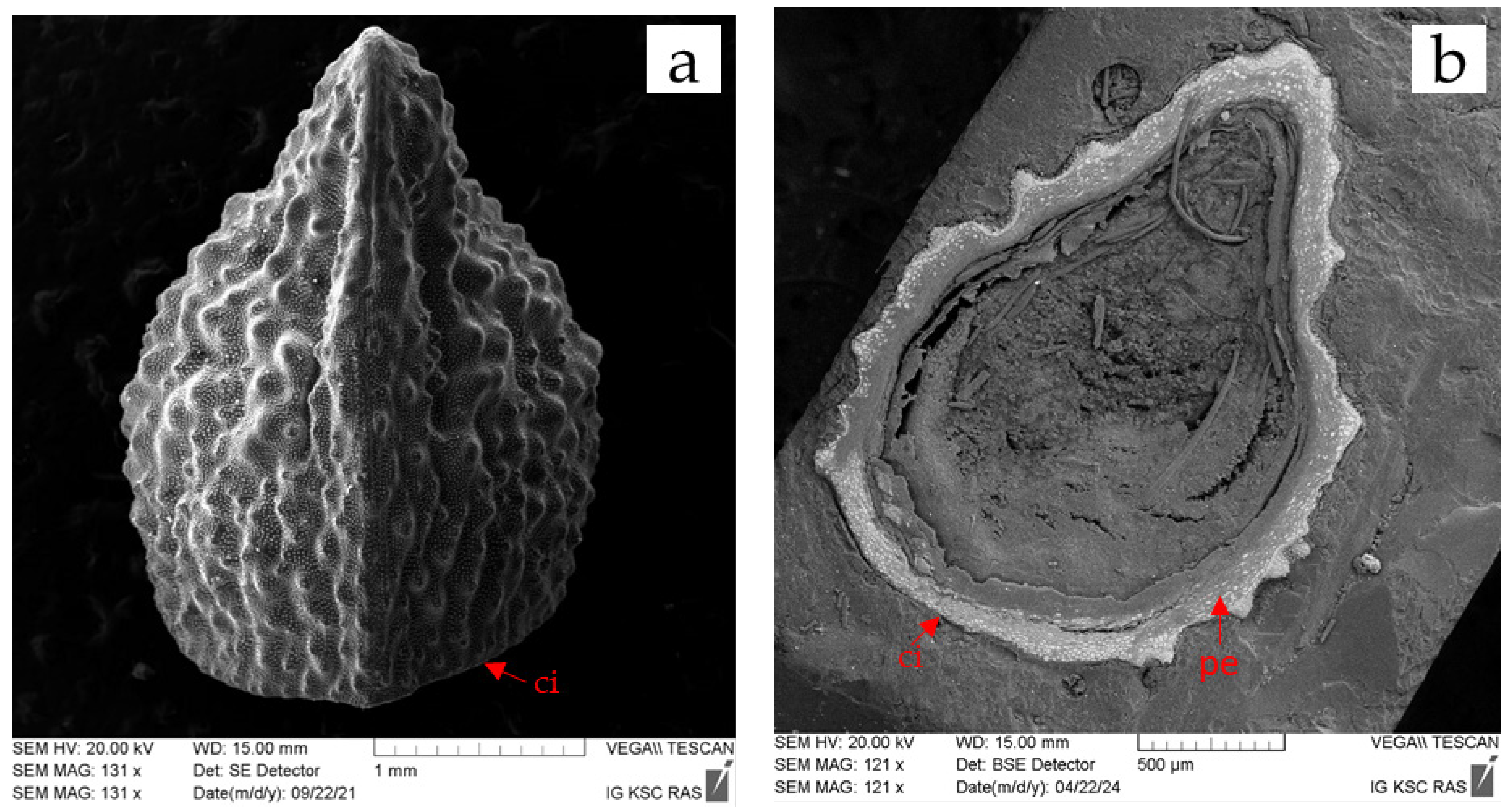
2.4. Nutlet Morphology
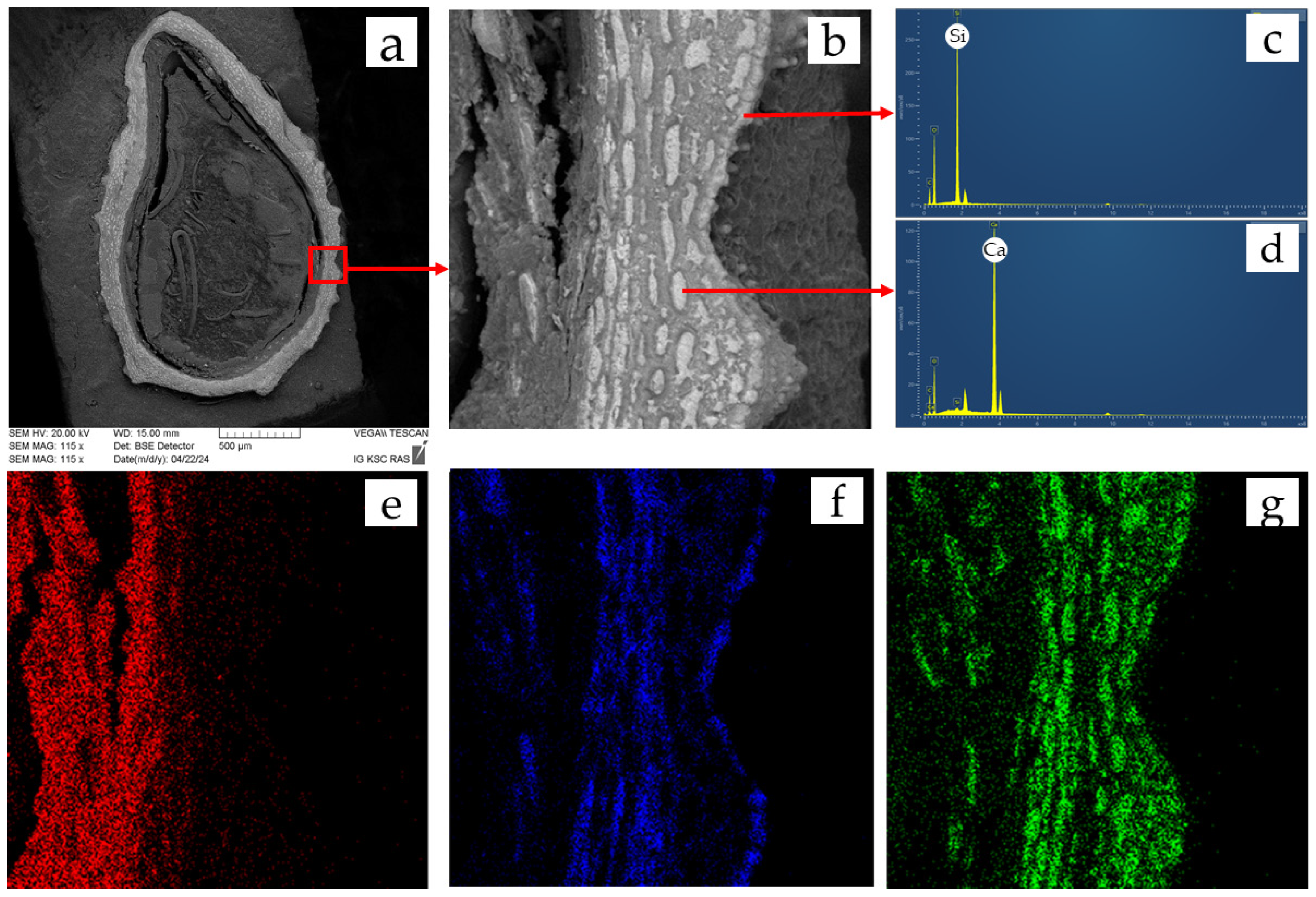
2.5. SEM Analysis of Nutlet Pericarp
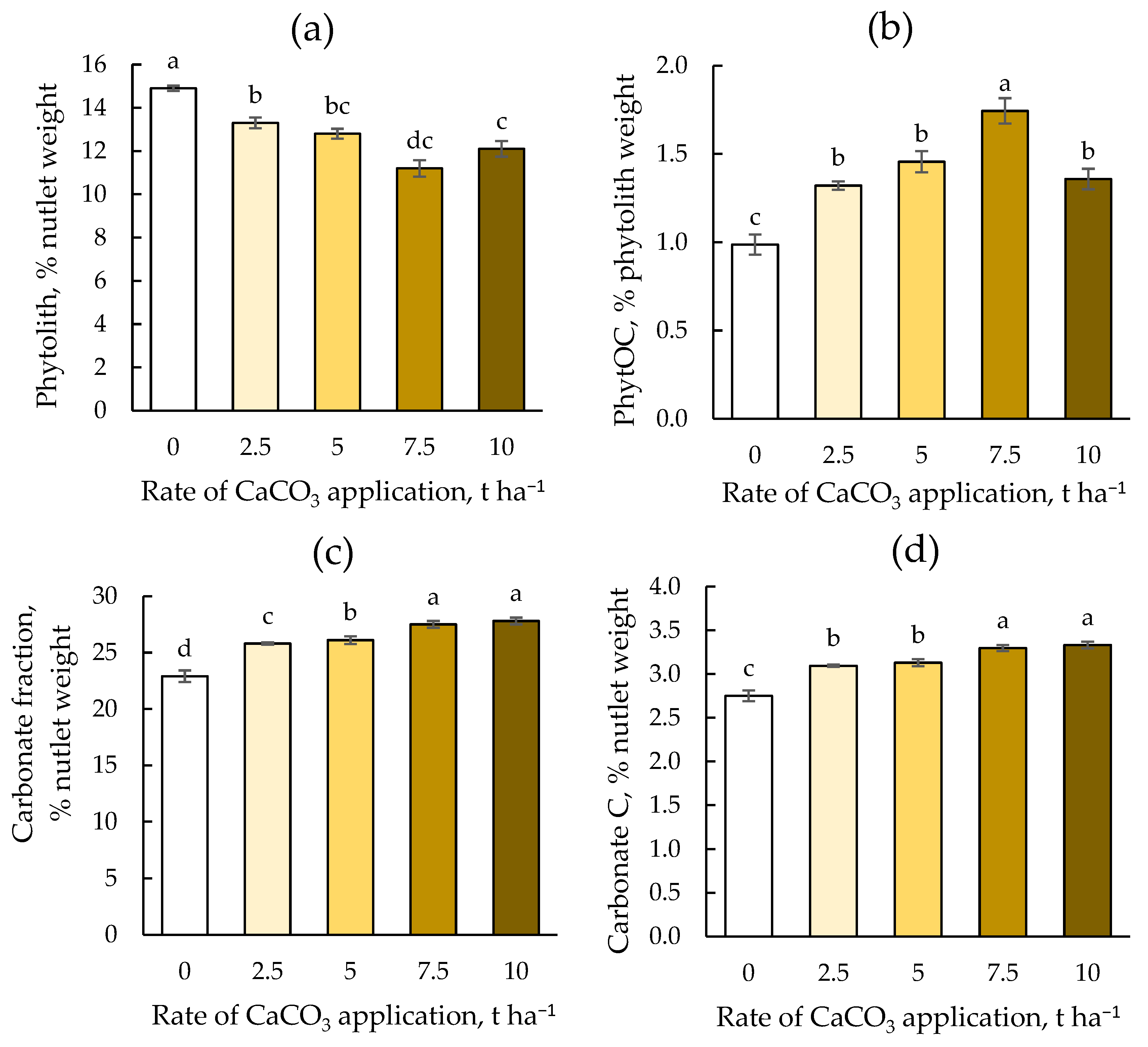
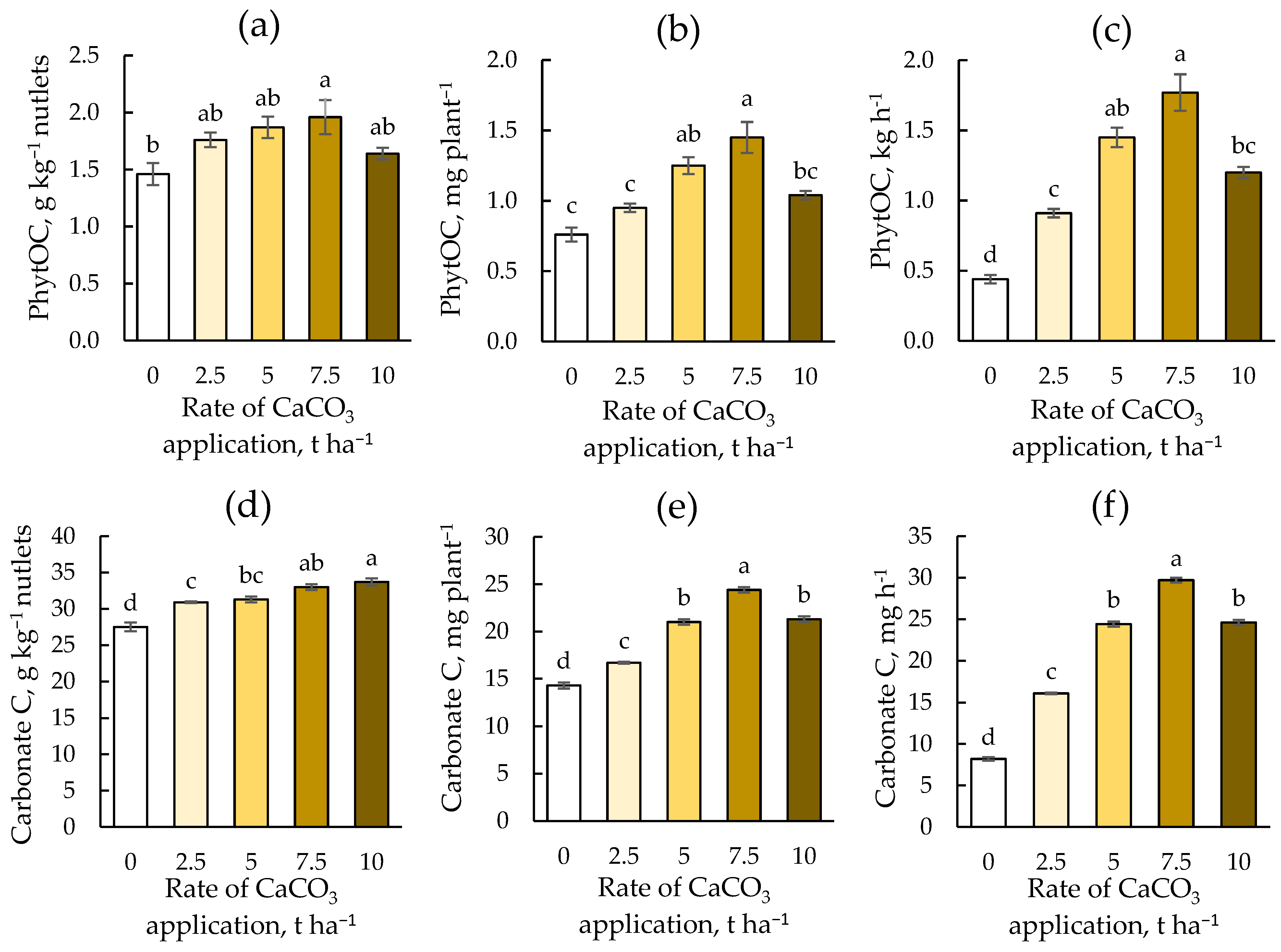
2.6. Carbon Content in Biominerals of Buglossoides arvensis Fruits
3. Discussion
4. Materials and Methods
4.1. Soil Treatment and Plant Sowing
4.2. Plant Growth and Productivity
4.3. Plant Physiological Parameters
4.4. Scanning Electron Microscopy
4.5. Nutlet Morphology Parameters
4.6. Soil Chemical Analyses
4.7. Measurement of Carbonates, Phytoliths, and PhytOC Content
4.8. Statistical Test
5. Conclusions
Author Contributions
Funding
Data Availability Statement
Acknowledgments
Conflicts of Interest
Abbreviations
| EDX | Energy dispersive X-ray |
| PhytOC | Phytolith-occluded carbon |
| SEM | Scanning electron microscopy |
References
- Franceschi, V.R.; Nakata, P.A. Calcium oxalate in plants: Formation and function. Annu. Rev. Plant Biol. 2005, 56, 41–71. [Google Scholar] [CrossRef]
- He, H.; Veneklaas, E.J.; Kuo, J.; Lambers, H. Physiological and ecological significance of biomineralization in plants. Trends Plant Sci. 2014, 19, 166–174. [Google Scholar] [CrossRef] [PubMed]
- Perry, C.C.; Keeling-Tucker, T. Biosilicification: The role of the organic matrix in structure control. J. Biol. Inorg. Chem. 2000, 5, 537–550. [Google Scholar] [CrossRef] [PubMed]
- Carnelli, A.L.; Madella, M.; Theurillat, J.P. Biogenic silica production in selected alpine plant species and plant communities. Ann. Bot. 2001, 87, 425–434. [Google Scholar] [CrossRef]
- He, H.; Bleby, T.M.; Veneklaas, E.J.; Lambers, H.; Kuo, J. Precipitation of Calcium, Magnesium, Strontium and Barium in Tissues of Four Acacia Species (Leguminosae: Mimosoideae). PLoS ONE 2012, 7, e41563. [Google Scholar] [CrossRef] [PubMed]
- Weigend, M.; Mustafa, A.; Ensikat, H.-J. Calcium phosphate in plant trichomes: The overlooked biomineral. Planta 2018, 247, 277–285. [Google Scholar] [PubMed]
- Kim, Y.; Caumon, M.-C.; Barres, O.; Sall, A.; Cauzid, J. Identification and composition of carbonate minerals of the calcite structure by Raman and infrared spectroscopies using portable devices. Spectrochim. Acta—A Mol. Biomol. Spectrosc. 2021, 261, 119980. [Google Scholar] [CrossRef] [PubMed]
- Ostroumova, T.; Zakharova, E. The study of crystals in the fruits of some Apiaceae species using energydispersive spectroscopy. Int. J. Plant Biol. 2023, 14, 347–360. [Google Scholar] [CrossRef]
- Pustovoytov, K.; Riehl, S.; Hilger, H.H.; Schumacher, E. Oxygen isotopic composition of fruit carbonate in Lithospermeae and its potential for paleoclimate research in the Mediterranean. Glob. Planet. Change 2010, 71, 258–268. [Google Scholar] [CrossRef]
- Pustovoytov, K.; Riehl, S. Suitability of biogenic carbonate of Lithospermum fruits for 14C dating. Quatern Res. 2006, 65, 508–518. [Google Scholar] [CrossRef]
- Messager, E.; Badou, A.; Fröhlich, F.; Deniaux, B.; Lordkipanidze, D.; Voinchet, P. Fruit and seed biomineralization and its effect on preservation. Archaeol. Anthropol. Sci. 2010, 2, 25–34. [Google Scholar] [CrossRef]
- Ikkonen, E.N.; Ovczinnikova, S.V.; Pustovoytov, K.; Nikerova, K.M.; Fedorov, A.A.; Prokopovich, P.F.; Golyeva, A.A.; Mergelov, N.S.; Sibelev, O.S.; Popova, T.V.; et al. Identification and Distribution of Biominerals in Pericarp of Boraginaceae Fruits. Russ. J. Plant Physiol. 2025, 72, 125–135. [Google Scholar] [CrossRef]
- Cabanes, D. Phytolith Analysis in Paleoecology and Archaeology. In Handbook for the Analysis of Micro-Particles in Archaeological Samples. Interdisciplinary Contributions to Archaeology; Henry, A.G., Ed.; Springer: Cham, Switzerland, 2020; pp. 255–288. [Google Scholar]
- Hodson, M.J. The development of phytoliths in plants and its influence on their chemistry and isotopic composition. Implications for palaeoecology and archaeology. J. Archaeol. Sci. 2016, 68, 62–69. [Google Scholar] [CrossRef]
- Watling, K.M.; Parr, J.F.; Rintoul, L.; Brown, C.L.; Sullivan, L.A. Raman, infrared and XPS study of bamboo phytoliths after chemical digestion. Spectrochim. Acta Part A Mol. Biomol. Spectrosc. 2011, 80, 106–111. [Google Scholar] [CrossRef]
- Song, Z.; McGrouther, K.; Wang, H. Occurrence, turnover and carbon sequestration potential of phytoliths in terrestrial ecosystems. Earth-Sci. Rev. 2016, 158, 19–30. [Google Scholar] [CrossRef]
- Zamanian, K.; Pustovoytov, K.; Kuzyakov, Y. Carbon Sources in Fruit Carbonate of Buglossoides arvensis and Consequences for 14C Dating. Radiocarbon 2017, 59, 141–150. [Google Scholar] [CrossRef][Green Version]
- Parr, J.F.; Sullivan, L.A. Soil carbon sequestration in phytoliths. Soil Biol. Biochem. 2005, 37, 117–124. [Google Scholar] [CrossRef]
- Tan, L.; Fan, X.; Yan, G.; Peng, M.; Zhang, N.; Ye, M.; Gao, Z.; Song, A.; Nikolic, M.; Liang, Y. Sequestration Potential of Phytolith Occluded Carbon in China’s Paddy Rice (Oryza sativa L.) Systems. Sci. Total Environ. 2021, 774, 145696. [Google Scholar] [CrossRef]
- Li, Z.; Song, Z.; Jiang, P. Biogeochemical sequestration of carbon within phytoliths of wetland plants: A case study of Xixi wetland. China Chin. Sci. Bull. 2013, 58, 2480–2487. [Google Scholar] [CrossRef]
- Cheng, X.; Lv, H.; Liu, S.; Li, C.; Li, P.; Zhou, Y.; Shi, Y.; Zhou, G. The phytolith carbon sequestration in terrestrial ecosystems: The underestimated potential of bamboo forest. Ecol. Process. 2023, 12, 62. [Google Scholar] [CrossRef]
- Das, S.; Beegum, S.; Acharya, B.S.; Panday, D. Soil Carbon Sequestration: A Mechanistic Perspective on Limitations and Future Possibilities. Sustainability 2025, 17, 6015. [Google Scholar] [CrossRef]
- Li, Z.; Guo, F.; Cornelis, J.-T.; Song, Z.; Wang, X.; Delvaux, B. Combined Silicon-Phosphorus Fertilization Affects the Biomass and Phytolith Stock of Rice Plants. Front. Plant Sci. 2020, 11, 67. [Google Scholar] [CrossRef] [PubMed]
- Sun, X.; Liu, Q.; Tang, T.; Chen, X.; Luo, X. Silicon Fertilizer Application Promotes Phytolith Accumulation in Rice Plants. Front. Plant Sci. 2019, 10, 425. [Google Scholar] [CrossRef] [PubMed]
- Mustafa, A.; Ensikat, H.-J.; Weigend, M. Mineralized trichomes in Boraginales: Complex microscale heterogeneity and simple phylogenetic patterns. Ann. Bot. 2018, 121, 741–751. [Google Scholar] [CrossRef] [PubMed]
- Haynes, R.J. What effect does liming have on silicon availability in agricultural soils? Geoderma 2019, 337, 375–383. [Google Scholar] [CrossRef]
- Caubet, M.; Cornu, S.; Saby, N.P.; Meunier, J.D. Agriculture increases the bioavailability of silicon, a beneficial element for crop, in temperate soils. Sci. Rep. 2020, 10, 19999. [Google Scholar] [CrossRef] [PubMed]
- Liang, Y.C.; Ma, T.S.; Li, F.J.; Feng, Y.J. Silicon availability and response of rice and wheat to silicon in calcareous soils. Commun. Soil Sci. Plant Anal. 1994, 25, 2285–2297. [Google Scholar] [CrossRef]
- Jing, T.; Li, J.; He, Y.; Shankar, A.; Saxena, A.; Tiwari, A.; Maturi, K.C.; Solanki, M.K.; Singh, V.; Eissa, M.A.; et al. Role of calcium nutrition in plant Physiology: Advances in research and insights into acidic soil conditions—A comprehensive review. Plant Physiol. Biochem. 2024, 210, 108602. [Google Scholar] [CrossRef] [PubMed]
- Yu, X.; Keitel, C.; Dijkstra, F.A. Ameliorating soil acidity with calcium carbonate and calcium hydroxide: Effects on carbon, nitrogen, and phosphorus dynamics. J. Soil Sci. Plant Nutr. 2023, 23, 5270–5278. [Google Scholar] [CrossRef]
- Qiu, L. Research Progress on the Effects of Soil Acidity and Alkalinity on Plant Growth. Open J. Appl. Sci. 2022, 12, 1045–1053. [Google Scholar] [CrossRef]
- Neina, D. The role of soil pH in plant nutrition and soil remediation. Appl. Environ. Soil Sci. 2019, 2019, 5794869. [Google Scholar]
- Viktor, A.; Cramer, M.D. The influence of root assimilated inorganic carbon on nitrogen acquisition/assimilation and carbon partitioning. New Phytol. 2005, 165, 157–169. [Google Scholar] [PubMed]
- Brix, H. Uptake and photosynthetic utilization of sediment-derived carbon by Phragmites australis (Cav.) Trin. ex Steudel. Aquat. Bot. 1990, 38, 377–389. [Google Scholar] [CrossRef]
- Hodson, M.J.; White, P.J.; Mead, A.; Broadley, M.R. Phylogenetic variation in the silicon composition of plants. Ann. Bot. 2005, 96, 1027–1046. [Google Scholar] [CrossRef] [PubMed]
- Guo, F.; Song, Z.; Sullivan, L.; Wang, H.; Liu, X.; Wang, X.; Li, Z.; Zhao, Y. Enhancing phytolith carbon sequestration in rice ecosystems through basalt powder amendment. Sci. Bull. 2015, 60, 591–597. [Google Scholar] [CrossRef]
- Parr, J.; Sullivan, L.; Chen, B.; Ye, G.; Zheng, W. Carbon bio-sequestration within the phytoliths of economic bamboo species. Glob. Change Biol. 2010, 16, 2661–2667. [Google Scholar] [CrossRef]
- Song, Z.L.; Liu, H.Y.; Li, B.L.; Yang, X.M. The production of phytolith-occluded carbon in China’s forests: Implications to biogeochemical carbon sequestration. Glob. Change Biol. 2013, 19, 2907–2915. [Google Scholar] [CrossRef]
- Li, B.; Song, Z.; Li, Z.; Wang, H.; Gui, R.; Song, R. Phylogenetic variation of phytolith carbon sequestration in bamboos. Sci. Rep. 2014, 4, 4710–4716. [Google Scholar] [CrossRef] [PubMed]
- Gallagher, K.L.; Alfonso-Garcia, A.; Sanchez, J.; Potma, E.O.; Santos, G.M. Plant growth conditions alter phytolith carbon. Front. Plant Sci. 2015, 6, 753. [Google Scholar] [CrossRef] [PubMed]
- Hodson, M.J. Phytoliths in Archaeology: Chemical Aspects. In Encyclopedia of Global Archaeology; Smith, C., Ed.; Springer International Publishing AG: Cham, Switzerland, 2018; pp. 1–8. [Google Scholar]
- Santos, G.M.; Masion, A.; Alexandre, A. When the carbon being dated is not what you think it is: Insights from phytolith carbon research. Quat. Sci. Rev. 2018, 197, 162–174. [Google Scholar] [CrossRef]
- Lato, A.; Berbecea, A.; Lato, I.; Crista, F.; Crista, L.; Sala, F.; Radulov, I. Mitigating Soil Acidity: Impact of Aglime (CaCO3) Particle Size and Application Rate on Exchangeable Aluminium and Base Cations Dynamics. Sustainability 2025, 17, 8135. [Google Scholar] [CrossRef]
- Atkins, W.R.G. Seasonal variations in the phosphate and silicate content of sea water during 1926 and 1927 in relation to the phytoplankton crop. J. Mar. Biol. Assoc. UK 1928, 15, 191–205. [Google Scholar] [CrossRef]
- Parr, J.F.; Lentfer, C.J.; Boyd, W.E. A comparative analysis of wet and dry ashing techniques for the extraction of phytoliths from plant material. J. Archaeol. Sci. 2001, 28, 875–886. [Google Scholar] [CrossRef]
- Jenkins, E. Phytolith taphonomy: A comparison of dry ashing and acid extraction on the breakdown of conjoined phytoliths formed in Triticum durum. J. Archaeol. Sci. 2009, 36, 2402–2407. [Google Scholar] [CrossRef]
- Kameník, J.; Mizera, J.; Řanda, Z. Chemical composition of plant silica phytoliths. Environ. Chem. Lett. 2013, 11, 189–195. [Google Scholar] [CrossRef]




| Parameter | 0 Ca | 2.5 Ca | 5 Ca | 7.5 Ca | 10 Ca |
|---|---|---|---|---|---|
| pHH2O | 5.36 ± 0.01 e* | 6.09 ± 0.01 d | 6.23 ± 0.02 c | 6.49 ± 0.03 b | 7.33 ± 0.02 a |
| pHKCl | 4.46 ± 0.01 e | 5.15 ± 0.03 d | 5.21 ± 0.02 c | 5.66 ± 0.01 b | 6.94 ± 0.01 a |
| Total C, g kg−1 | 53 ± 4 b | 49 ± 4 bc | 80 ± 4 a | 44 ± 1 c | 41 ± 1 c |
| Total N, g kg−1 | 2.5 ± 0.2 b | 2.5 ± 0.2 b | 4.6 ± 0.1 a | 2.7 ± 0.4 b | 2.4 ± 0.1 b |
| Total P, g kg−1 | 0.53 ± 0.02 a | 0.51 ± 0.01 ab | 0.47 ± 0.01 bc | 0.47 ± 0.01 bc | 0.46 ± 0.01 c |
| Available P, mg kg−1 | 46 ± 1 a | 45 ± 2 a | 45 ± 1 a | 39 ± 2 b | 44 ± 1 ab |
| Available K, mg kg−1 | 34 ± 0 b | 37 ± 2 a | 39 ± 0 a | 38 ± 1 a | 38 ± 1 a |
| Available Ca, g kg−1 | 1.6 ± 0.1 d | 2.2 ± 0.2 bc | 1.8 ± 0.1 cd | 2.4 ± 0.1 b | 4.1 ± 0.1 a |
| Available Si, mg kg−1 | 137 ± 4 d | 139 ± 7 d | 183 ± 9 c | 205 ± 1 b | 237 ± 6 a |
| Parameter | 0 Ca | 2.5 Ca | 5 Ca | 7.5 Ca | 10 Ca |
|---|---|---|---|---|---|
| Seeding density, plant m−2 | 58 ± 6 b* | 97 ± 10 a | 116 ± 13 a | 122 ± 12 a | 116 ± 11 a |
| Plant height, cm | 55 ± 2 c | 58 ± 2 bc | 64 ± 2 ab | 69 ± 3 a | 63 ± 4 ab |
| Shoot dry weight, g | 1.3 ± 0.1 c | 1.5 ± 0.1 b | 1.9 ± 0.2 a | 1.8 ± 0.2 ab | 1.7 ± 0.2 abc |
| Nutlet weight, g per 1000 nutlets | 2.79 ± 0.02 c | 2.93 ± 0.02 b | 2.91 ± 0.03 b | 2.91 ± 0.02 b | 3.02 ± 0.02 a |
| Pericarp weight, g per 1000 nutlets | 1.87 ± 0.03 a | 1.97 ± 0.10 a | 1.93 ± 0.02 a | 1.98 ± 0.09 a | 1.91 ± 0.09 a |
| Pericarp weight, % nutlet | 67 | 67 | 66 | 68 | 63 |
| Number of inflorescences per plant | 3.7 ± 0.3 a | 3.1 ± 0.2 a | 3.5 ± 0.3 a | 3.4 ± 0.2 a | 3.1 ± 0.2 a |
| Number of fruits per plant | 47 ± 5 b | 46 ± 3 b | 58 ± 5 ab | 63 ± 6 a | 52 ± 5 ab |
| Number of nutlets per plant | 187 ± 20 b | 185 ± 13 b | 232 ± 22 ab | 253 ± 26 a | 207 ± 20 ab |
| Yield, g plant−1 | 0.52 ± 0.05 b | 0.54 ± 0.04 b | 0.67 ± 0.06 ab | 0.74 ± 0.08 a | 0.63 ± 0.06 ab |
| Yield, t ha−1 | 0.30 ± 0.03 c | 0.52 ± 0.06 b | 0.78 ± 0.08 a | 0.90 ± 0.08 a | 0.73 ± 0.07 ab |
| Parameter | 0 Ca | 2.5 Ca | 5 Ca | 7.5 Ca | 10 Ca |
|---|---|---|---|---|---|
| An *, μmol m−2 s−1 | 8.8 ± 0.7 a | 10.0 ± 0.8 a | 8.0 ± 0.6 a | 8.9 ± 0.4 a | 7.9 ± 0.7 a |
| Tr, mmol m−2 s−1 | 1.38 ± 0.10 a | 1.50 ± 0.16 a | 1.29 ± 0.08 a | 1.30 ± 0.09 a | 1.24 ± 0.06 a |
| gs, mmol m−2 s−1 | 112 ± 13 a | 134 ± 20 a | 109 ± 16 a | 102 ± 9 a | 96 ± 8 a |
| Ci:Ca | 0.58 ± 0.03 a | 0.54 ± 0.04 a | 0.57 ± 0.05 a | 0.57 ± 0.03 a | 0.52 ± 0.05 a |
| R, μmol m−2 s−1 | 0.72 ± 0.03 a | 0.70 ± 0.05 a | 0.69 ± 0.06 a | 0.64 ± 0.04 a | 0.65 ± 0.10 a |
| Parameter | 0 Ca | 2.5 Ca | 5 Ca | 7.5 Ca | 10 Ca |
|---|---|---|---|---|---|
| Nutlet height, mm | 2.13 ± 0.02 b* | 2.19 ± 0.02 a | 2.16 ± 0.02 ab | 2.15 ± 0.02 ab | 2.13 ± 0.02 b |
| Nutlet width, mm | 1.50 ± 0.02 a | 1.54 ± 0.02 a | 1.49 ± 0.02 a | 1.50 ± 0.01 a | 1.49 ± 0.02 a |
| Pericarp thickness mean, μm | 100 ± 3 b | 117 ± 5 a | 110 ± 4 ab | 101 ± 4 b | 115 ± 4 a |
| Cicatrix thickness, μm | 115 ± 9 a | 110 ± 7 a | 111 ± 4 a | 98 ± 7 a | 105 ± 4 a |
| Particle size, mm | <0.002 | 0.002–0.05 | 0.05–2.0 | >2.0 |
| Distribution, % | 4.1 | 48.2 | 47.8 | 0.0 |
Disclaimer/Publisher’s Note: The statements, opinions and data contained in all publications are solely those of the individual author(s) and contributor(s) and not of MDPI and/or the editor(s). MDPI and/or the editor(s) disclaim responsibility for any injury to people or property resulting from any ideas, methods, instructions or products referred to in the content. |
© 2026 by the authors. Licensee MDPI, Basel, Switzerland. This article is an open access article distributed under the terms and conditions of the Creative Commons Attribution (CC BY) license.
Share and Cite
Ikkonen, E.; Linkevich, E.; Nikerova, K. Potential of Carbon Sequestration in Biominerals of Buglossoides arvensis (L.) I.M. Johnst. Fruits Under Contrasting Soil Calcium Content. Plants 2026, 15, 1940. https://doi.org/10.3390/plants15131940
Ikkonen E, Linkevich E, Nikerova K. Potential of Carbon Sequestration in Biominerals of Buglossoides arvensis (L.) I.M. Johnst. Fruits Under Contrasting Soil Calcium Content. Plants. 2026; 15(13):1940. https://doi.org/10.3390/plants15131940
Chicago/Turabian StyleIkkonen, Elena, Elizaveta Linkevich, and Ksenia Nikerova. 2026. "Potential of Carbon Sequestration in Biominerals of Buglossoides arvensis (L.) I.M. Johnst. Fruits Under Contrasting Soil Calcium Content" Plants 15, no. 13: 1940. https://doi.org/10.3390/plants15131940
APA StyleIkkonen, E., Linkevich, E., & Nikerova, K. (2026). Potential of Carbon Sequestration in Biominerals of Buglossoides arvensis (L.) I.M. Johnst. Fruits Under Contrasting Soil Calcium Content. Plants, 15(13), 1940. https://doi.org/10.3390/plants15131940