Strigolactones in Plant Abiotic Stress Resilience: Hormonal Crosstalk, Mechanistic Regulation, and Agricultural Prospects

 ,
,  and
and
Abstract
1. Introduction
2. Review Methodology and Literature Search Strategy
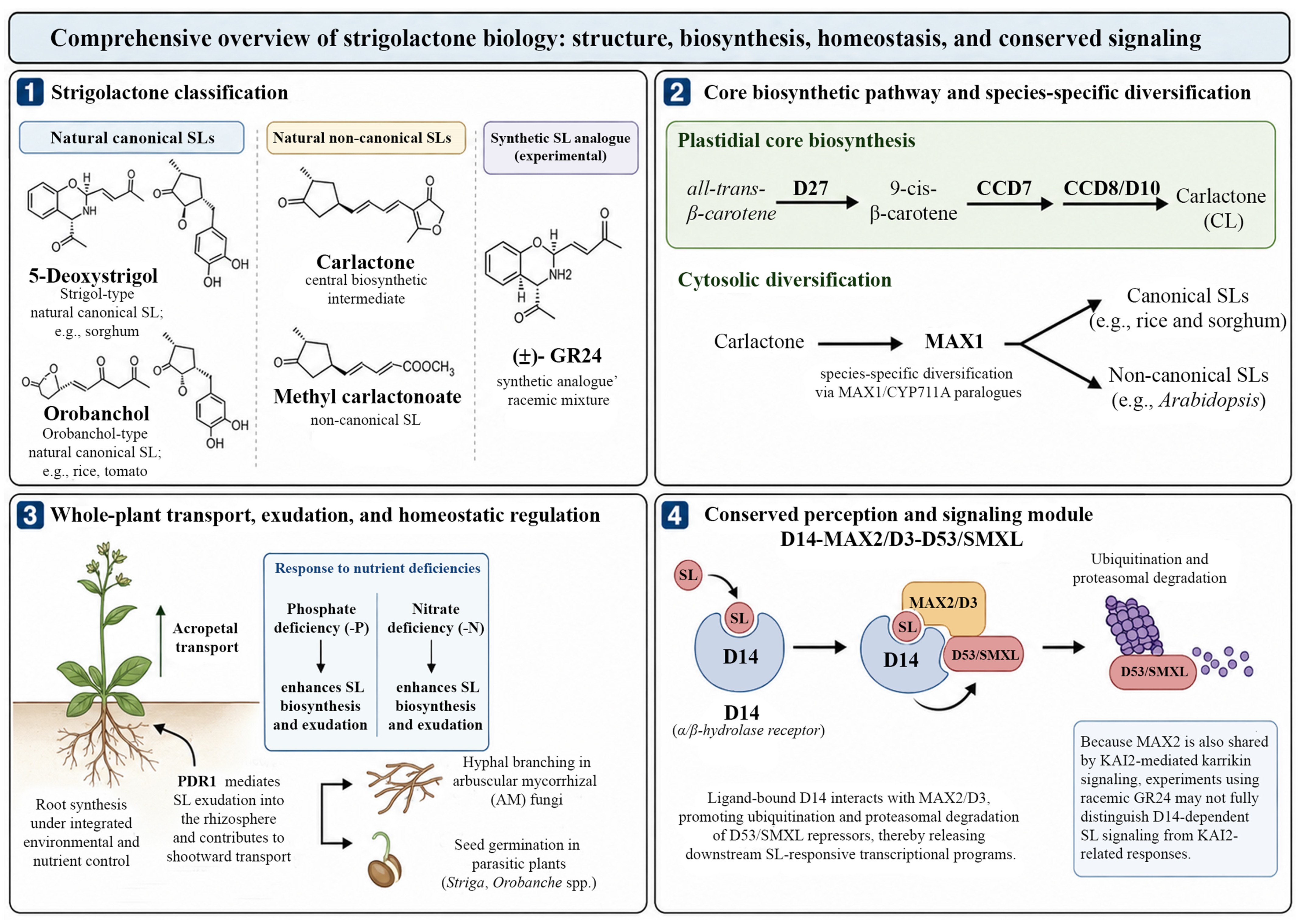
3. Strigolactones: Structural Diversity, Biosynthesis, Transport, and Signaling
3.1. Structural Diversity of Strigolactones
3.2. Biosynthesis of Strigolactones
3.3. Transport and Regulation of SL Homeostasis
3.4. Perception and Signal Transduction
3.5. Stress-Responsive Regulation of SL Pathways
4. Strigolactones in Plant Growth–Stress Coordination
4.1. Root–Shoot Architectural Remodeling Under Stress
4.2. Resource Allocation and Developmental Plasticity
4.3. Rhizosphere Interactions and Mycorrhizal Support
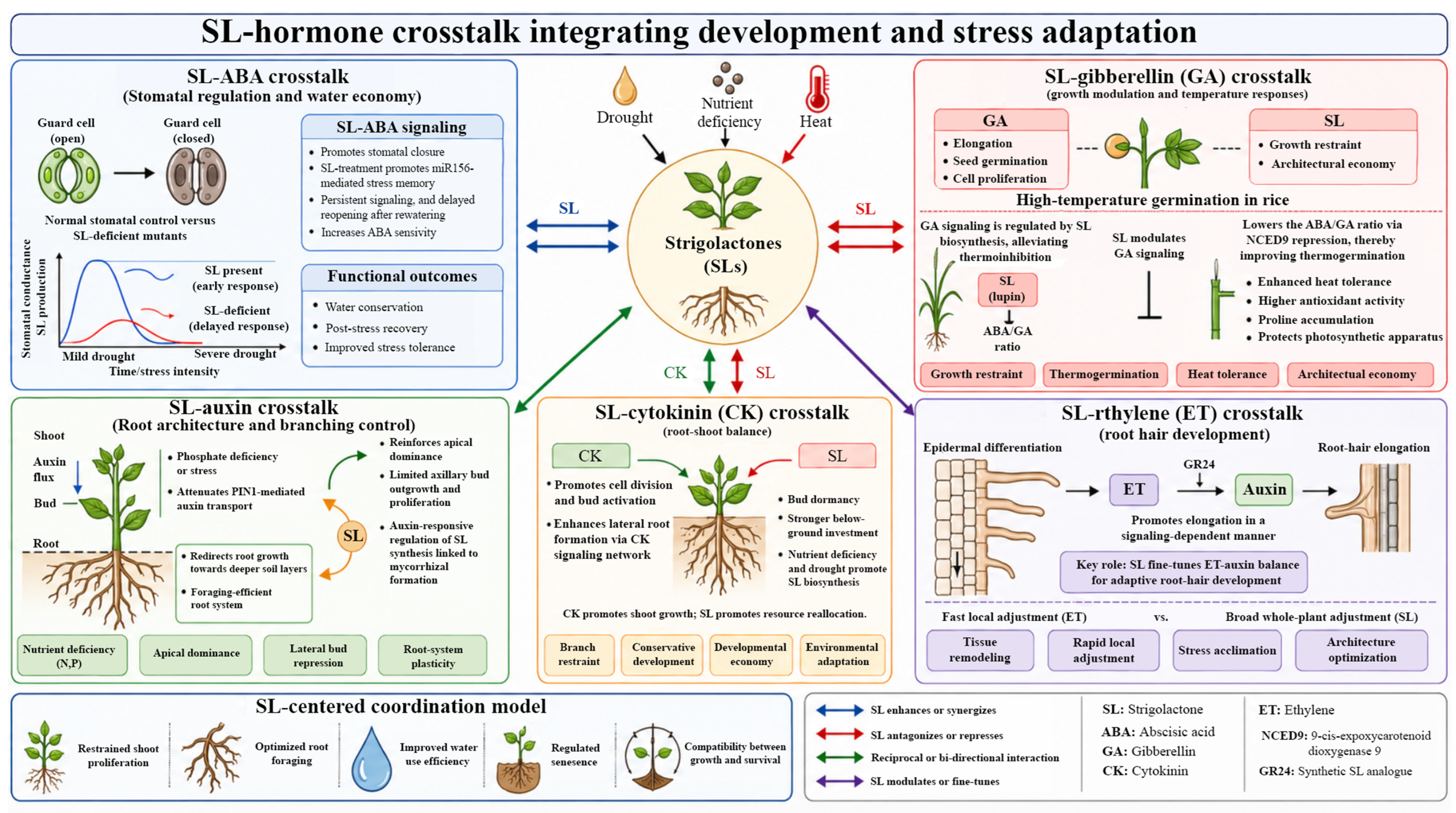
5. Crosstalk Between Strigolactones and Phytohormones Under Abiotic Stress
5.1. Strigolactone–ABA Crosstalk in Stomatal Regulation and Water-Deficit Signaling
5.2. Strigolactone–Auxin Crosstalk in Root Architecture and Branching Control
5.3. Strigolactone–Cytokinin Crosstalk in Root–Shoot Balance
5.4. Strigolactone–Ethylene Crosstalk in Root Hair Development and Stress Acclimation
5.5. Strigolactone–Gibberellin Crosstalk in Growth Modulation and Temperature Responses
5.6. Integrated Hormonal Model of SL-Mediated Adaptation
6. Stress-Specific Roles of Strigolactones in Abiotic Stress Mitigation
6.1. Drought Stress
6.2. Salinity Stress
6.3. Heavy-Metal Stress
6.4. High-Temperature Stress
6.5. Low-Temperature Stress
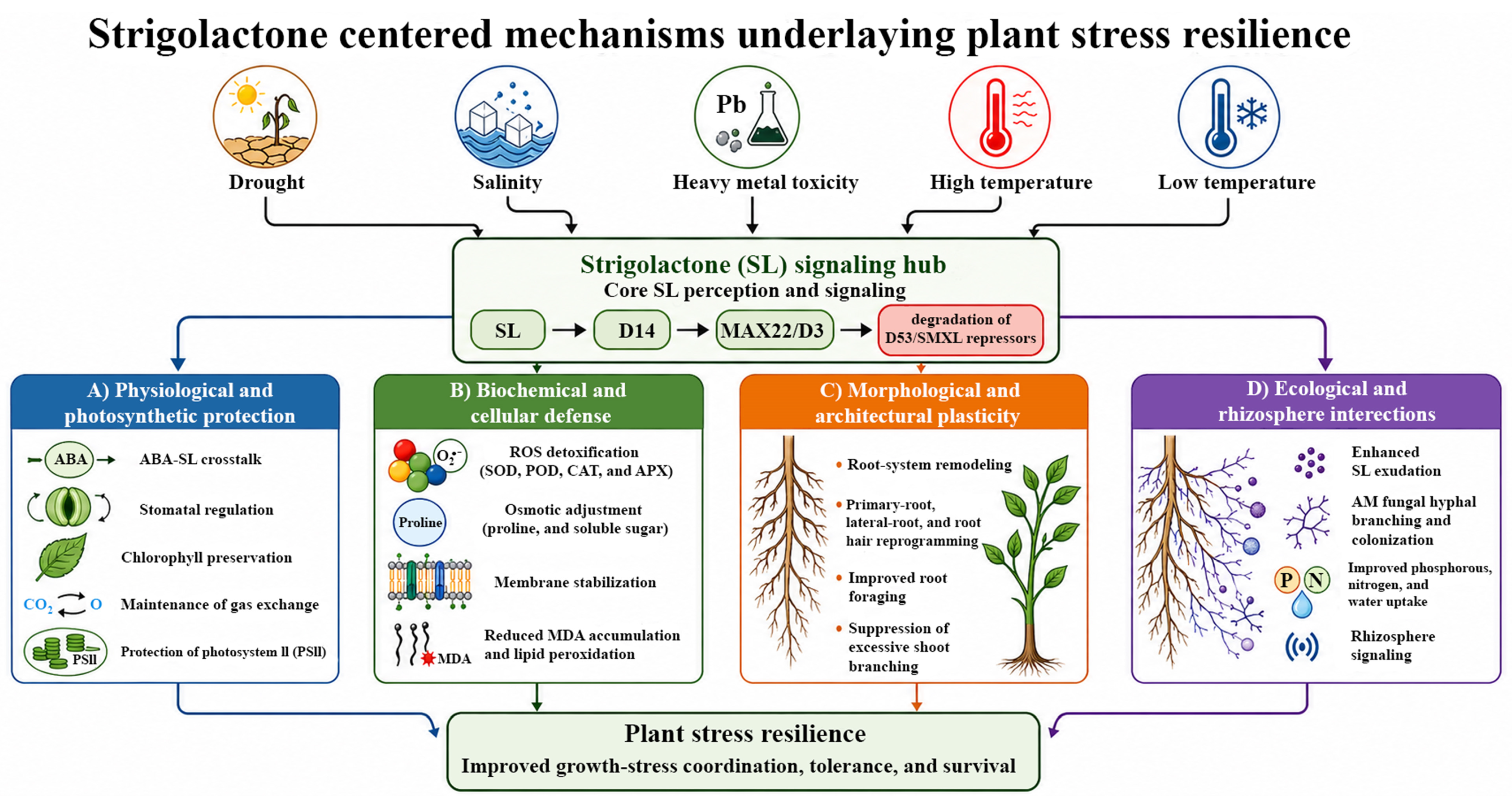
7. Mechanistic Basis of Strigolactone-Mediated Abiotic Stress Resilience
7.1. Regulation of Stress Signaling and Transcriptional Reprogramming
7.2. Maintenance of Redox Homeostasis and Antioxidant Defense
7.3. Osmotic Adjustment, Ion Homeostasis, and Membrane Stability
7.4. Protection of Photosynthesis and Metabolic Performance
7.5. Root System Remodeling, Growth and Developmental Plasticity, and Rhizosphere-Assisted Tolerance
7.6. Integrated Mechanistic Framework
8. Translational and Agricultural Prospects of Strigolactones
8.1. Exogenous Application of SL Analogs for Stress Priming
8.2. Genetic Manipulation of SL Biosynthesis and Signaling Pathways
8.3. Strigolactones in Breeding Climate-Resilient Crops
8.4. Opportunities and Limitations in Agricultural Translation
8.5. Future Priorities and Research Gaps
9. Conclusions and Future Perspectives
Author Contributions
Funding
Data Availability Statement
Acknowledgments
Conflicts of Interest
Abbreviations
References
- Dong, J.; Fu, H.; Wang, Z.; Zhang, L.; Liu, Z.; Hu, Y.; Shen, F.; Wang, W. Mechanisms of Strigolactone-Regulated Abiotic Stress Responses in Plants. Plants 2025, 14, 2582. [Google Scholar] [CrossRef]
- Khan, M.K.; Pandey, A.; Hamurcu, M.; Vyhnánek, T.; Zargar, S.M.; Kahraman, A.; Topal, A.; Gezgin, S. Exploring strigolactones for inducing abiotic stress tolerance in plants. Czech J. Genet. Plant Breed. 2024, 60, 55–69. [Google Scholar] [CrossRef]
- Qi, J.; Mao, Y.; Cui, J.; Lu, X.; Xu, J.; Liu, Y.; Zhong, H.; Yu, W.; Li, C. The role of strigolactones in resistance to environmental stress in plants. Physiol. Plant. 2024, 176, e14419. [Google Scholar] [CrossRef]
- Raza, A.; Javed, R.; Zahid, Z.; Sharif, R.; Hafeez, M.B.; Ghouri, M.Z.; Nawaz, M.U.; Siddiqui, M.H. Strigolactones for Sustainable Plant Growth and Production Under Adverse Environmental Conditions. In Plant Performance Under Environmental Stress; Husen, A., Ed.; Springer: Cham, Switzerland, 2021. [Google Scholar] [CrossRef]
- Hossain, A.; Raza, A.; Maitra, S.; Asaduzzaman, M.; Islam, M.R.; Hossain, M.J.; El Sabagh, A.; Garai, S.; Mondal, M.; Abdel Latef, A.A.H.; et al. Strigolactones: A Novel Carotenoid-Derived Phytohormone—Biosynthesis, Transporters, Signalling, and Mechanisms in Abiotic Stress. In Plant Growth Regulators; Aftab, T., Hakeem, K.R., Eds.; Springer: Cham, Switzerland, 2021. [Google Scholar] [CrossRef]
- Pandey, A.; Sharma, M.; Pandey, G.K. Emerging Roles of Strigolactones in Plant Responses to Stress and Development. Front. Plant Sci. 2016, 7, 434. [Google Scholar] [CrossRef] [PubMed]
- Khalid, M.F.; Shafqat, W.; Khan, R.I.; Jawaid, M.Z.; Hussain, S.; Saqib, M.; Rizwan, M.; Ahmed, T. Unveiling the resilience mechanism: Strigolactones as master regulators of plant responses to abiotic stresses. Plant Stress 2024, 12, 100490. [Google Scholar] [CrossRef]
- Chesterfield, R.J.; Vickers, C.E.; Beveridge, C.A. Translation of strigolactones from plant hormone to agriculture: Achievements, future perspectives, and challenges. Trends Plant Sci. 2020, 25, 1087–1106. [Google Scholar] [CrossRef]
- Soliman, S.; Wang, Y.; Han, Z.; Pervaiz, T.; El-kereamy, A. Strigolactones in Plants and Their Interaction with the Ecological Microbiome in Response to Abiotic Stress. Plants 2021, 11, 3499. [Google Scholar] [CrossRef]
- Selwal, N.; Wani, A.K.; Akhtar, N.; Kaur, M.; Jassal, P.S. Molecular insights of strigolactone biosynthesis, signalling pathways, regulatory roles, and hormonal crosstalks in plant systems. S. Afr. J. Bot. 2023, 160, 9–22. [Google Scholar] [CrossRef]
- Trasoletti, M.; Visentin, I.; Campo, E.; Schubert, A.; Cardinale, F. Strigolactones as a hormonal hub for the acclimation and priming to environmental stress in plants. Plant Cell Environ. 2022, 45, 3611–3630. [Google Scholar] [CrossRef]
- Fathi, A.; Ghadirnezhad Shiade, S.R.; Shohani, F.; Asgharipour, M.R.; Mitra, D.; Mansouri, S.; Alymanesh, M.R.; Taylor, N.L.; Fazeli, A. Harnessing strigolactones and phytohormone interactions to enhance plant adaptation under climate change. Discov. Plants 2025, 2, 296. [Google Scholar] [CrossRef]
- Ameen, F.; Hussain, I.; Afzal, S.; Rasheed, R.; Ashraf, M.A.; Iqbal, M. Crosstalk between strigolactones and major hormones in plants under abiotic stresses. S. Afr. J. Bot. 2025, 177, 187–200. [Google Scholar] [CrossRef]
- Cook, C.E.; Whichard, L.P.; Turner, B.; Wall, M.E.; Egley, G.H. Germination of Witchweed (Striga lutea Lour.): Isolation and Properties of a Potent Stimulant. Science 1966, 154, 1189–1190. [Google Scholar] [CrossRef]
- Akiyama, K.; Matsuzaki, K.I.; Hayashi, H. Plant sesquiterpenes induce hyphal branching in arbuscular mycorrhizal fungi. Nature 2005, 435, 824–827. [Google Scholar] [CrossRef]
- Gomez-Roldan, V.; Fermas, S.; Brewer, P.B.; Puech-Pagès, V.; Dun, E.A.; Pillot, J.P.; Letisse, F.; Matusova, R.; Danoun, S.; Portais, J.C.; et al. Strigolactone inhibition of shoot branching. Nature 2008, 455, 189–194. [Google Scholar] [CrossRef]
- Umehara, M.; Hanada, A.; Yoshida, S.; Akiyama, K.; Arite, T.; Takeda-Kamiya, N.; Magome, H.; Kamiya, Y.; Shirasu, K.; Yoneyama, K.; et al. Inhibition of shoot branching by new terpenoid plant hormones. Nature 2008, 455, 195–200. [Google Scholar] [CrossRef]
- Yoneyama, K.; Brewer, P.B. Strigolactones, how are they synthesized to regulate plant growth and development? Curr. Opin. Plant Biol. 2021, 63, 102072. [Google Scholar] [CrossRef] [PubMed]
- Shahzad, K.; Danish, S.; Mubeen, S.; Dawar, K.; Fahad, S.; Hasnain, Z.; Ansari, M.J.; Almoallim, H.S. Minimization of heavy metal toxicity in radish (Raphanus sativus) by strigolactone and biochar. Sci. Rep. 2024, 14, 13616. [Google Scholar] [CrossRef]
- Guan, Y.; Li, L.; Wang, D.; Zhou, J.; Qi, W.; Cheng, Y.; Jiang, Y.; Du, Q.; Zhang, D.; Quan, M. Multifaceted functions of strigolactones in annual and perennial plants: Developmental regulation, phytohormone crosstalk and abiotic stresses. Plant Stress 2025, 16, 100895. [Google Scholar] [CrossRef]
- Sánchez Martín-Fontecha, E.; Cardinale, F.; Bürger, M.; Prandi, C.; Cubas, P. Novel mechanisms of strigolactone-induced DWARF14 degradation in Arabidopsis thaliana. J. Exp. Bot. 2024, 75, 7145–7159. [Google Scholar] [CrossRef]
- Lee, J.; Seo, M.G.; Lim, Y.; Hong, S.; An, J.T.; Jeong, H.Y.; Lee, C.; Park, S.J.; Song, G.; Kwon, C.T. Modulating the strigolactone pathway to optimize tomato shoot branching for vertical farming. J. Integr. Plant Biol. 2025, 68, 113–129. [Google Scholar] [CrossRef] [PubMed]
- Karniel, U.; Koch, A.; Bar Nun, N.; Zamir, D.; Hirschberg, J. Tomato Mutants Reveal Root and Shoot Strigolactone Involvement in Branching and Broomrape Resistance. Plants 2024, 13, 1554. [Google Scholar] [CrossRef]
- El-Beltagi, H.S.; Gad, M.; Khedr, N.; Abdel-Haleem, M.; Al Saikhan, M.S.; Shalaby, T.A.; El-Mogy, M.M.; Khedr, E.H. Strigolactones as Integrative Regulators of Plant Adaptation and Resilience to Abiotic Stress. Plant Cell Environ. 2026. [Google Scholar] [CrossRef]
- Mansoor, S.; Mir, M.A.; Karunathilake, E.; Rasool, A.; Ştefănescu, D.M.; Chung, Y.S.; Sun, H. Strigolactones as promising biomolecule for oxidative stress management: A comprehensive review. Plant Physiol. Biochem. 2023, 206, 108282. [Google Scholar] [CrossRef] [PubMed]
- Sun, H.; Li, W.; Burritt, D.J.; Tian, H.; Zhang, H.; Liang, X.; Miao, Y.; Mostofa, M.G.; Tran, L.P. Strigolactones interact with other phytohormones to modulate plant root growth and development. Crop J. 2022, 10, 1517–1527. [Google Scholar] [CrossRef]
- Mehmood, I.; Wani, K.I.; Aftab, T. Strigolactone Interplay with Other Phytohormones Under Stressed and Normal Conditions. In Strigolactones in Plants; Wiley: Hoboken, NJ, USA, 2025; pp. 161–191. [Google Scholar] [CrossRef]
- Alvi, A.F.; Sehar, Z.; Fatma, M.; Masood, A.; Khan, N.A. Strigolactone: An emerging growth regulator for developing resilience in plants. Plants 2022, 11, 2604. [Google Scholar] [CrossRef] [PubMed]
- Mehmood, I.; Wani, K.I.; Aftab, T. Nature, Structural Diversity, Biosynthetic Pathway, and Strigolactone Transport in Plants. In Strigolactones in Plants; Wiley: Hoboken, NJ, USA, 2025; pp. 13–34. [Google Scholar] [CrossRef]
- Al-Babili, S.; Bouwmeester, H.J. Strigolactones, a Novel Carotenoid-Derived Plant Hormone. Annu. Rev. Plant Biol. 2015, 66, 161–186. [Google Scholar] [CrossRef]
- Ou, H.; Xie, D.; Yao, R.; Shan, X. Strigolactones: Biosynthesis, transport, perception, and signal transduction. Mol. Plant 2026, 19, 515–537. [Google Scholar] [CrossRef] [PubMed]
- Rehman, N.U.; Li, X.; Zeng, P.; Guo, S.; Jan, S.; Liu, Y.; Huang, Y.; Xie, Q. Harmony but Not Uniformity: Role of Strigolactone in Plants. Biomolecules 2021, 11, 1616. [Google Scholar] [CrossRef]
- Zwanenburg, B.; Pospíšil, T. Structure and Activity of Strigolactones: New Plant Hormones with a Rich Future. Mol. Plant 2013, 6, 38–62. [Google Scholar] [CrossRef]
- Wang, Y.; Bouwmeester, H.J. Structural diversity in the strigolactones. J. Exp. Bot. 2018, 69, 2219–2230. [Google Scholar] [CrossRef]
- Visentin, I.; Ferigolo, L.F.; Russo, G.; Korwin Krukowski, P.; Capezzali, C.; Tarkowská, D.; Gresta, F.; Deva, E.; Nogueira, F.T.; Schubert, A.; et al. Strigolactones promote flowering by inducing the miR319-LA-SFT module in tomato. Proc. Natl. Acad. Sci. USA 2024, 121, e2316371121. [Google Scholar] [CrossRef]
- Sağlam, S.; Özel, H.; Çevik, B.; Gerçek, Y.C. Effects of GR24 and 24-eBL on the growth of wheat (Triticum aestivum L.) seedlings grown under salt stress. N. Z. J. Crop Hortic. Sci. 2025, 53, 2447–2467. [Google Scholar] [CrossRef]
- Wang, Y.; Gouaille, L.; Meng, J.; Nicolas, M.; Ogé, L.; Jiang, Z.; Crespel, L.; Ding, Y.; Le Gourrierec, J.; Li, G.; et al. Decoding the sugar–strigolactone crosstalk: New frontier in plant growth and stress resilience. Hortic. Res. 2026, 13, uhaf278. [Google Scholar] [CrossRef]
- Saeed, W.; Naseem, S.; Ali, Z. Strigolactones Biosynthesis and Their Role in Abiotic Stress Resilience in Plants: A Critical Review. Front. Plant Sci. 2017, 8, 1487. [Google Scholar] [CrossRef]
- Abe, S.; Sado, A.; Tanaka, K.; Kisugi, T.; Asami, K.; Ota, S.; Kim, H.I.; Yoneyama, K.; Xie, X.; Ohnishi, T.; et al. Carlactone is converted to carlactonoic acid by MAX1 in Arabidopsis and its methyl ester can directly interact with AtD14 in vitro. Proc. Natl. Acad. Sci. USA 2014, 111, 18084–18089. [Google Scholar] [CrossRef] [PubMed]
- Brewer, P.B.; Yoneyama, K.; Filardo, F.; Meyers, E.; Scaffidi, A.; Frickey, T.; Akiyama, K.; Seto, Y.; Dun, E.A.; Cremer, J.E.; et al. LATERAL BRANCHING OXIDOREDUCTASE acts in the final stages of strigolactone biosynthesis in Arabidopsis. Proc. Natl. Acad. Sci. USA 2016, 113, 6301–6306. [Google Scholar] [CrossRef]
- Kretzschmar, T.; Kohlen, W.; Sasse, J.; Borghi, L.; Schlegel, M.; Bachelier, J.B.; Reinhardt, D.; Bours, R.; Bouwmeester, H.J.; Martinoia, E. A petunia ABC protein controls strigolactone-dependent symbiotic signalling and branching. Nature 2012, 483, 341–344. [Google Scholar] [CrossRef] [PubMed]
- Zhou, F.; Lin, Q.; Zhu, L.; Ren, Y.; Zhou, K.; Shabek, N.; Wu, F.; Mao, H.; Dong, W.; Gan, L.; et al. D14–SCFD3-dependent degradation of D53 regulates strigolactone signaling. Nature 2013, 504, 406. [Google Scholar] [CrossRef]
- Wang, L.; Wang, B.; Jiang, L.; Liu, X.; Li, X.; Lu, Z.; Meng, X.; Wang, Y.; Smith, S.M.; Li, J. Strigolactone Signaling in Arabidopsis Regulates Shoot Development by Targeting D53-Like SMXL Repressor Proteins for Ubiquitination and Degradation. Plant Cell 2015, 27, 3128–3142. [Google Scholar] [CrossRef]
- Palayam, M.; Yan, L.; Nagalakshmi, U.; Gilio, A.K.; Cornu, D.; Boyer, F.D.; Dinesh-Kumar, S.P.; Shabek, N. Structural insights into strigolactone catabolism by carboxylesterases reveal a conserved conformational regulation. Nat. Commun. 2024, 15, 6500. [Google Scholar] [CrossRef] [PubMed]
- Mayzlish-Gati, E.; De-Cuyper, C.; Goormachtig, S.; Beeckman, T.; Vuylsteke, M.; Brewer, P.B.; Beveridge, C.A.; Yermiyahu, U.; Kaplan, Y.; Enzer, Y.; et al. Strigolactones are Involved in Root Response to Low Phosphate Conditions in Arabidopsis. Plant Physiol. 2012, 160, 1329–1341. [Google Scholar] [CrossRef]
- Kohlen, W.; Charnikhova, T.; Liu, Q.; Bours, R.; Domagalska, M.A.; Beguerie, S.; Verstappen, F.; Leyser, O.; Bouwmeester, H.; Ruyter-Spira, C. Strigolactones are Transported through the Xylem and Play a Key Role in Shoot Architectural Response to Phosphate Deficiency in Nonarbuscular Mycorrhizal Host Arabidopsis. Plant Physiol. 2011, 155, 974–987. [Google Scholar] [CrossRef] [PubMed]
- Liu, W.; Kohlen, W.; Lillo, A.; Ivanov, S.; Hartog, M.; Limpens, E.; Jamil, M.; Smaczniak, C.; Kaufmann, K.; Yang, W.C.; et al. Strigolactone Biosynthesis in Medicago truncatula and Rice Requires the Symbiotic GRAS-Type Transcription Factors NSP1 and NSP2. Plant Cell 2011, 23, 3853–3865. [Google Scholar] [CrossRef]
- Yildirim, E.; Yuce, M.; Yaprak, E.; Ucar, S.; Aydin, M.; Turan, M.; Ghosh, T.K.; Dolaş, Z.; Akca, M.; Oztemiz, F. Strigolactone mitigates nickel toxicity by regulating nutrient uptake, antioxidant defense, vitamins and phytohormones biosynthesis in pepper seedlings. J. Hazard. Mater. 2026, 502, 140955. [Google Scholar] [CrossRef] [PubMed]
- Ruyter-Spira, C.; Kohlen, W.; Charnikhova, T.; Van Zeijl, A.; Van Bezouwen, L.; De Ruijter, N.; Cardoso, C.; Lopez-Raez, J.A.; Matusova, R.; Bours, R.; et al. Physiological Effects of the Synthetic Strigolactone Analog GR24 on Root System Architecture in Arabidopsis: Another Belowground Role for Strigolactones? Plant Physiol. 2011, 155, 721–734. [Google Scholar] [CrossRef] [PubMed]
- Dawood, M.F.A.; Eissa, M.A.; Mir, M.I.; Muhammad, M.; Abideen, Z.; Thabet, S.G.; Abdel Latef, A.A.H. Strigolactones for boosting plant stress tolerance. In Using Stimulants to Improve Plant Health; Elsevier: Amsterdam, The Netherlands, 2026; pp. 359–387. [Google Scholar] [CrossRef]
- Wang, J.Y.; Chen, G.T.E.; Alashoor, K.F.; Al-Babili, S. Characterization and Quantification of Strigolactones in Root Exudates. In Plant Hormones; Mukhtar, S., Ed.; Methods in Molecular Biology; Humana: New York, NY, USA, 2026; Volume 3026. [Google Scholar] [CrossRef]
- Beveridge, C.A.; Kyozuka, J. New genes in the strigolactone-related shoot branching pathway. Curr. Opin. Plant Biol. 2010, 13, 34–39. [Google Scholar] [CrossRef]
- Crawford, S.; Shinohara, N.; Sieberer, T.; Williamson, L.; George, G.; Hepworth, J.; Müller, D.; Domagalska, M.A.; Leyser, O. Strigolactones enhance competition between shoot branches by dampening auxin transport. Development 2010, 137, 2905–2913. [Google Scholar] [CrossRef]
- Yao, T.; Xu, X.; Xie, R.; Zhou, C.; Li, D. The biosynthesis and signaling regulation of strigolactones in plants. Plant Sci. 2026, 364, 112947. [Google Scholar] [CrossRef]
- Umehara, M.; Hanada, A.; Magome, H.; Takeda-Kamiya, N.; Yamaguchi, S. Contribution of Strigolactones to the Inhibition of Tiller Bud Outgrowth under Phosphate Deficiency in Rice. Plant Cell Physiol. 2010, 51, 1118–1126. [Google Scholar] [CrossRef]
- Sang, D.; Chen, D.; Liu, G.; Liang, Y.; Huang, L.; Meng, X.; Chu, J.; Sun, X.; Dong, G.; Yuan, Y.; et al. Strigolactones regulate rice tiller angle by attenuating shoot gravitropism through inhibiting auxin biosynthesis. Proc. Natl. Acad. Sci. USA 2014, 111, 11199–11204. [Google Scholar] [CrossRef]
- Arite, T.; Kameoka, H.; Kyozuka, J. Strigolactone Positively Controls Crown Root Elongation in Rice. J. Plant Growth Regul. 2012, 31, 165–172. [Google Scholar] [CrossRef]
- Kapulnik, Y.; Delaux, P.M.; Resnick, N.; Mayzlish-Gati, E.; Wininger, S.; Bhattacharya, C.; Sejalon-Delmas, N.; Combier, J.P.; Bécard, G.; Belausov, E.; et al. Strigolactones affect lateral root formation and root-hair elongation in Arabidopsis. Planta 2011, 233, 209–216. [Google Scholar] [CrossRef]
- Jiang, L.; Matthys, C.; Marquez-Garcia, B.; De Cuyper, C.; Smet, L.; De Keyser, A.; Boyer, F.D.; Beeckman, T.; Depuydt, S.; Goormachtig, S. Strigolactones spatially influence lateral root development through the cytokinin signaling network. J. Exp. Bot. 2016, 67, 379–389. [Google Scholar] [CrossRef]
- Barbier, F.; Fichtner, F.; Beveridge, C. The strigolactone pathway plays a crucial role in integrating metabolic and nutritional signals in plants. Nat. Plants 2023, 9, 1191–1200. [Google Scholar] [CrossRef]
- Danish, S.; Hareem, M.; Dawar, K.; Naz, T.; Iqbal, M.M.; Ansari, M.J.; Salmen, S.H.; Datta, R. The role of strigolactone in alleviating salinity stress in chili pepper. BMC Plant Biol. 2024, 24, 209. [Google Scholar] [CrossRef]
- Yamada, Y.; Furusawa, S.; Nagasaka, S.; Shimomura, K.; Yamaguchi, S.; Umehara, M. Strigolactone signaling regulates rice leaf senescence in response to a phosphate deficiency. Planta 2014, 240, 399–408. [Google Scholar] [CrossRef]
- Li, X.; Wu, G.; Lie, Z.; Aguila, L.C.R.; Khan, M.S.; Luo, H.; Liu, X.; Liu, J. Microbial community variation in rhizosphere and non-rhizosphere soils of Castanopsis hystrix plantations across stand ages. J. For. Res. 2025, 36, 82. [Google Scholar] [CrossRef]
- Yoneyama, K.; Xie, X.; Kusumoto, D.; Sekimoto, H.; Sugimoto, Y.; Takeuchi, Y.; Yoneyama, K. Nitrogen deficiency as well as phosphorus deficiency in sorghum promotes the production and exudation of 5-deoxystrigol, the host recognition signal for arbuscular mycorrhizal fungi and root parasites. Planta 2007, 227, 125–132. [Google Scholar] [CrossRef] [PubMed]
- Wu, F.; Gao, Y.; Yang, W.; Sui, N.; Zhu, J. Biological Functions of Strigolactones and Their Crosstalk with Other Phytohormones. Front. Plant Sci. 2022, 13, 821563. [Google Scholar] [CrossRef] [PubMed]
- Haider, I.; Andreo-Jimenez, B.; Bruno, M.; Bimbo, A.; Floková, K.; Abuauf, H.; Ntui, V.O.; Guo, X.; Charnikhova, T.; Al-Babili, S.; et al. The interaction of strigolactones with abscisic acid during the drought response in rice. J. Exp. Bot. 2018, 69, 2403–2414. [Google Scholar] [CrossRef]
- Visentin, I.; Pagliarani, C.; Deva, E.; Caracci, A.; Turečková, V.; Novák, O.; Lovisolo, C.; Schubert, A.; Cardinale, F. A novel strigolactone-miR156 module controls stomatal behaviour during drought recovery. Plant Cell Environ. 2020, 43, 1613–1624. [Google Scholar] [CrossRef]
- Visentin, I.; Vitali, M.; Ferrero, M.; Zhang, Y.; Ruyter-Spira, C.; Novák, O.; Strnad, M.; Lovisolo, C.; Schubert, A.; Cardinale, F. Low levels of strigolactones in roots as a component of the systemic signal of drought stress in tomato. New Phytol. 2016, 212, 954–963. [Google Scholar] [CrossRef]
- Hayward, A.; Stirnberg, P.; Beveridge, C.; Leyser, O. Interactions between Auxin and Strigolactone in Shoot Branching Control. Plant Physiol. 2009, 151, 400–412. [Google Scholar] [CrossRef]
- Ferguson, B.J.; Beveridge, C.A. Roles for auxin, cytokinin, and strigolactone in regulating shoot branching. Plant Physiol. 2009, 149, 1929–1944. [Google Scholar] [CrossRef]
- Marzec, M.; Melzer, M. Regulation of Root Development and Architecture by Strigolactones under Optimal and Nutrient Deficiency Conditions. Int. J. Mol. Sci. 2018, 19, 1887. [Google Scholar] [CrossRef] [PubMed]
- Hu, Z.; Yamauchi, T.; Yang, J.; Jikumaru, Y.; Tsuchida-Mayama, T.; Ichikawa, H.; Takamure, I.; Nagamura, Y.; Tsutsumi, N.; Yamaguchi, S.; et al. Strigolactone and Cytokinin Act Antagonistically in Regulating Rice Mesocotyl Elongation in Darkness. Plant Cell Physiol. 2014, 55, 30–41. [Google Scholar] [CrossRef] [PubMed]
- Kapulnik, Y.; Resnick, N.; Mayzlish-Gati, E.; Kaplan, Y.; Wininger, S.; Hershenhorn, J.; Koltai, H. Strigolactones interact with ethylene and auxin in regulating root-hair elongation in Arabidopsis. J. Exp. Bot. 2011, 62, 2915–2924. [Google Scholar] [CrossRef]
- Rasmussen, A.; Hu, Y.; Depaepe, T.; Vandenbussche, F.; Boyer, F.D.; Van Der Straeten, D.; Geelen, D. Ethylene Controls Adventitious Root Initiation Sites in Arabidopsis Hypocotyls Independently of Strigolactones. J. Plant Growth Regul. 2017, 36, 897–911. [Google Scholar] [CrossRef]
- Marzec, M. Strigolactones and Gibberellins: A New Couple in the Phytohormone World? Trends Plant Sci. 2017, 22, 813–815. [Google Scholar] [CrossRef]
- Ito, S.; Yamagami, D.; Umehara, M.; Hanada, A.; Yoshida, S.; Sasaki, Y.; Yajima, S.; Kyozuka, J.; Ueguchi-Tanaka, M.; Matsuoka, M.; et al. Regulation of strigolactone biosynthesis by gibberellin signaling. Plant Physiol. 2017, 174, 1250–1259. [Google Scholar] [CrossRef] [PubMed]
- Ni, J.; Gao, C.; Chen, M.S.; Pan, B.Z.; Ye, K.; Xu, Z.F. Gibberellin Promotes Shoot Branching in the Perennial Woody Plant Jatropha curcas. Plant Cell Physiol. 2015, 56, 1655–1666. [Google Scholar] [CrossRef]
- Wang, H.; Chen, W.; Eggert, K.; Charnikhova, T.; Bouwmeester, H.; Schweizer, P.; Hajirezaei, M.R.; Seiler, C.; Sreenivasulu, N.; Von Wirén, N.; et al. Abscisic acid influences tillering by modulation of strigolactones in barley. J. Exp. Bot. 2018, 69, 3883–3898. [Google Scholar] [CrossRef]
- Ma, Q.; Xia, Z.; Cai, Z.; Li, L.; Cheng, Y.; Liu, J.; Nian, H. GmWRKY16 Enhances Drought and Salt Tolerance Through an ABA-Mediated Pathway in Arabidopsis thaliana. Front. Plant Sci. 2019, 9, 405762. [Google Scholar] [CrossRef] [PubMed]
- Min, Z.; Li, R.; Chen, L.; Zhang, Y.; Li, Z.; Liu, M.; Ju, Y.; Fang, Y. Alleviation of drought stress in grapevine by foliar-applied strigolactones. Plant Physiol. Biochem. 2019, 135, 99–110. [Google Scholar] [CrossRef]
- Li, X.; Li, Z.; Shi, Z.; Wu, T.; Wu, G.; Sheng, H.; Zhou, S.; Wang, L.; Tang, X.; Liu, J. Differences in physiological and ecological adaptations of Ipomoea pes-caprae in sandy beaches and coral islands. Glob. Ecol. Conserv. 2026, 65, e04043. [Google Scholar] [CrossRef]
- Zhang, X.; Ma, C.; Zhang, L.; Su, M.; Wang, J.; Zheng, S.; Zhang, T. GR24-mediated enhancement of salt tolerance and roles of H2O2 and Ca2+ in regulating this enhancement in cucumber. J. Plant Physiol. 2022, 270, 153640. [Google Scholar] [CrossRef]
- Ma, N.; Hu, C.; Wan, L.; Hu, Q.; Xiong, J.; Zhang, C. Strigolactones improve plant growth, photosynthesis, and alleviate oxidative stress under salinity in rapeseed. Front. Plant Sci. 2017, 8, 1671. [Google Scholar] [CrossRef] [PubMed]
- Zhang, Y.; van Dijk, A.D.J.; Scaffidi, A.; Flematti, G.R.; Hofmann, M.; Charnikhova, T.; Verstappen, F.; Hepworth, J.; van der Krol, S.; Leyser, O.; et al. Rice cytochrome P450 MAX1 homologs catalyze distinct steps in strigolactone biosynthesis. Nat. Chem. Biol. 2014, 10, 1028–1033. [Google Scholar] [CrossRef]
- Ma, C.; Bian, C.; Liu, W.; Sun, Z.; Xi, X.; Guo, D.; Liu, X.; Tian, Y.; Wang, C.; Zheng, X. Strigolactone alleviates the salinity-alkalinity stress of Malus hupehensis seedlings. Front. Plant Sci. 2022, 13, 901782. [Google Scholar] [CrossRef] [PubMed]
- Zhang, J.; Feng, N.; Zheng, D.; Khan, A.; Du, Y.; Wang, Y.; Deng, R.; Wu, J.; Xiong, J.; Sun, Z.; et al. Strigolactone Alleviates NaCl Stress by Regulating Antioxidant Capacity and Hormone Levels in Rice (Oryza sativa L.) Seedlings. Agriculture 2024, 14, 1662. [Google Scholar] [CrossRef]
- Tai, Z.; Yin, X.; Fang, Z.; Shi, G.; Lou, L.; Cai, Q. Exogenous GR24 Alleviates Cadmium Toxicity by Reducing Cadmium Uptake in Switchgrass (Panicum virgatum) Seedlings. Int. J. Environ. Res. Public Health 2017, 14, 852. [Google Scholar] [CrossRef] [PubMed]
- Nisa, Z.U.; Wang, Y.; Ali, N.; Chen, C.; Zhang, X.; Jin, X.; Yu, L.; Jing, L.; Chen, C.; Elansary, H.O. Strigolactone signaling gene from soybean GmMAX2a enhances the drought and salt-alkaline resistance in Arabidopsis via regulating transcriptional profiles of stress-related genes. Funct. Integr. Genom. 2023, 23, 216. [Google Scholar] [CrossRef] [PubMed]
- Jariani, P.; Sabokdast, M.; Rajabi, F.; Naghavi, M.R.; Dedicova, B. Enhancing salinity tolerance in wheat: The role of synthetic Strigolactone (GR24) in modulating antioxidant enzyme activities, ion channels, and related gene expression in stress responses. Sci. Rep. 2025, 15, 24216. [Google Scholar] [CrossRef] [PubMed]
- Chi, C.; Xu, X.; Wang, M.; Zhang, H.; Fang, P.; Zhou, J.; Xia, X.; Shi, K.; Zhou, Y.; Yu, J. Strigolactones positively regulate abscisic acid-dependent heat and cold tolerance in tomato. Hortic. Res. 2021, 8, 237. [Google Scholar] [CrossRef] [PubMed]
- Li, Q.; Wang, B.; Yu, H. New mechanism of strigolactone-regulated cold tolerance in tomato. New Phytol. 2025, 245, 921–923. [Google Scholar] [CrossRef]
- Guo, S.; Wei, X.; Ma, B.; Ma, Y.; Yu, Z.; Li, P. Foliar application of strigolactones improves the desiccation tolerance, grain yield and water use efficiency in dryland wheat through modulation of non-hydraulic root signals and antioxidant defense. Stress Biol. 2023, 3, 54. [Google Scholar] [CrossRef]
- Mostofa, M.G.; Van Ha, C.; Rahman, M.M.; Nguyen, K.H.; Keya, S.S.; Watanabe, Y.; Itouga, M.; Hashem, A.; Abd Allah, E.F.; Fujita, M.; et al. Strigolactones modulate cellular antioxidant defense mechanisms to mitigate arsenate toxicity in rice shoots. Antioxidants 2021, 10, 1815. [Google Scholar] [CrossRef]
- Chi, C.; Chen, X.; Zhu, C.; Cao, J.; Li, H.; Fu, Y.; Qin, G.; Zhao, J.; Yu, J.; Zhou, J. Strigolactones positively regulate HY5-dependent autophagy and the degradation of ubiquitinated proteins in response to cold stress in tomato. New Phytol. 2025, 245, 1106–1123. [Google Scholar] [CrossRef]
- Wang, D.; Xi, Z. Strigolactone agonists/antagonists for agricultural applications: New opportunities. Adv. Agrochem. 2022, 1, 61–72. [Google Scholar] [CrossRef]
- Bari, V.K.; Nassar, J.A.; Aly, R. CRISPR/Cas9 mediated mutagenesis of MORE AXILLARY GROWTH 1 in tomato confers resistance to root parasitic weed Phelipanche aegyptiaca. Sci. Rep. 2021, 11, 3905. [Google Scholar] [CrossRef]
- Janeeshma, E.; Habeeb, H.; Shackira, A.; Sinisha, A.; Mirshad, P.; Khoshru, B.; Henao, S.G.; Rani, A.; Verma, D.; Fathi, A.; et al. Strigolactone and analogues: A new generation of plant hormones with multifactorial benefits in environmental sustainability. Environ. Exp. Bot. 2024, 223, 105775. [Google Scholar] [CrossRef]
- Li, X.; Lu, J.; Zhu, X.; Dong, Y.; Liu, Y.; Chu, S.; Xiong, E.; Zheng, X.; Jiao, Y. AtMYBS1 negatively regulates heat tolerance by directly repressing the expression of MAX1 required for strigolactone biosynthesis in Arabidopsis. Plant Commun. 2023, 4, 100675. [Google Scholar] [CrossRef]
- Ali, M.; Wang, Z.; Guo, Q.; Wang, Y.; Cai, Y.; Du, J.; Pi, E.; Ding, P.; Shen, J. Mapping plant cell-type-specific responses to environmental stresses. Trends Plant Sci. 2026. Epub ahead of printing. [Google Scholar] [CrossRef]
- Butt, H.; Jamil, M.; Wang, J.Y.; Al-Babili, S.; Mahfouz, M. Engineering plant architecture via CRISPR/Cas9-mediated alteration of strigolactone biosynthesis. BMC Plant Biol. 2018, 18, 174. [Google Scholar] [CrossRef]
- Ban, X.; Qin, L.; Yan, J.; Wu, J.; Li, Q.; Su, X.; Hao, Y.; Hu, Q.; Kou, L.; Yan, Z.; et al. Manipulation of a strigolactone transporter in tomato confers resistance to the parasitic weed broomrape. Innovation 2025, 6, 100815. [Google Scholar] [CrossRef]
- Ali, M.; Kaderbek, T.; Khan, M.A.; Skalicky, M.; Brestic, M.; Elsabagh, M.; El Sabagh, A. Biosynthesis and multifaceted roles of reactive species in plant defense mechanisms during environmental cues. Plant Stress 2025, 18, 101102. [Google Scholar] [CrossRef]
- Jamil, M.; Mutinda, S.; Wang, J.Y.; Barminga, D.; Mwihaki, A.; Navangi, L.; Okiyo, T.O.; Patil, R.H.; Ngatia, T.; Mudavadi, P.; et al. Evaluation of formulated strigolactone analogs for Striga management in Kenyan agriculture. J. Agric. Food Res. 2025, 21, 101921. [Google Scholar] [CrossRef]
- Kaniganti, S.; Palakolanu, S.R.; Thiombiano, B.; Damarasingh, J.; Bommineni, P.R.; Che, P.; Sharma, K.K.; Jones, T.; Bouwmeester, H.; Bhatnagar-Mathur, P. Developing Striga resistance in sorghum by modulating host cues through CRISPR/Cas9 gene editing. Plant Cell Rep. 2025, 44, 90. [Google Scholar] [CrossRef]
- Zhang, C.; Wang, F.; Jiao, P.; Liu, J.; Zhang, H.; Liu, S.; Guan, S.; Ma, Y. The Overexpression of Zea mays Strigolactone Receptor Gene D14 Enhances Drought Resistance in Arabidopsis thaliana L. Int. J. Mol. Sci. 2024, 25, 1327. [Google Scholar] [CrossRef]
- Kelly, J.H.; Tucker, M.R.; Brewer, P.B. The Strigolactone Pathway Is a Target for Modifying Crop Shoot Architecture and Yield. Biology 2023, 12, 95. [Google Scholar] [CrossRef]



| Gene/Protein | Species | Functional Role | Pathway Step | Stress Relevance | Evidence and Interpretive Note | Ref. |
|---|---|---|---|---|---|---|
| D27/DWARF27 | Arabidopsis; rice | β-carotene isomerase converting all-trans-β-carotene to 9-cis-β-carotene | Early plastidial biosynthesis | Induced by nutrient limitation and linked with stress-responsive SL production | Endogenous-pathway evidence: expression and mutant phenotypes support its role upstream of SL-dependent growth and stress responses. | [31,33,37] |
| CCD7/MAX3/D17/HTD1/RMS5/DAD3 | Arabidopsis; rice; pea; petunia | Cleaves 9-cis-β-carotene toward SL precursor formation | Early plastidial biosynthesis | Responsive to phosphate starvation and feedback regulation in SL-deficient backgrounds | Strong biosynthetic marker: changes indicate pathway activation, but stress tolerance must be confirmed with mutants, rescue, or native SL measurements. | [33,37,45] |
| CCD8/MAX4/D10/RMS1/DAD1 | Arabidopsis; rice; pea; petunia | Converts the CCD7 product to carlactone | Early plastidial biosynthesis | Central node in feedback-controlled SL biosynthesis under nutrient and stress signals | Endogenous SL-deficiency evidence: ccd8/max4/d10-type mutants are useful for testing causal stress functions beyond GR24 responses. | [31,33,37] |
| MAX1/CYP711A1 and CYP711A paralogues | Arabidopsis; rice | Oxidize carlactone/CLA and direct production of canonical and non-canonical SLs | Downstream biosynthesis and diversification | Shapes species-specific SL profiles relevant to branching, nutrient foraging, AMF signaling, and stress adaptation | Key structure–function node: downstream products differ among species; therefore, SL abundance alone may not predict biological output. | [31,33,39] |
| CYP722C | Tomato; cotton; cowpea | Converts CLA-derived intermediates into species-specific canonical SLs | Downstream diversification | May influence crop-specific rhizosphere signaling, parasitic-weed risk, and stress-associated SL profiles | Species-specific evidence needed: functional consequences under abiotic stress remain less resolved than core D27/CCD7/CCD8 steps. | [31,35] |
| CLAMT and LBO | Arabidopsis | CLAMT methylates CLA to MeCLA; LBO converts MeCLA to downstream oxidized derivatives | Late non-canonical SL metabolism | Fine-tunes non-canonical SL pools associated with branching and developmental plasticity | Added interpretive caution: late-pathway products should not be treated as functionally equivalent to canonical SLs or GR24. | [35,40] |
| CXE15/CARBOXYLESTERASE15 | Arabidopsis | Degrades canonical and non-canonical SLs | Catabolism/homeostasis | Adds a degradation layer to development- and stress-linked SL homeostasis | Homeostatic control: catabolism may explain transient or tissue-specific SL responses under stress, but direct stress studies remain limited. | [35,44] |
| PDR1/ABCG transporter | Petunia | Mediates SL exudation into the rhizosphere and contributes to shootward movement | Transport/exudation | Regulates partitioning between internal hormonal signaling and external rhizosphere communication | Ecological specificity: transporter-mediated exudation can promote AMF interaction but may also increase parasitic-weed germination risk. | [37,41] |
| D14 | Arabidopsis; rice; petunia | α/β-hydrolase receptor for canonical SL perception | Ligand perception | Connects endogenous SL fluctuations with shoot branching, root architecture, hormone crosstalk, and stress-associated outputs | D14-dependent evidence is required before assigning a stress phenotype to canonical SL signaling. | [35,42] |
| MAX2/D3 | Arabidopsis; rice | F-box component of the SCF ubiquitin ligase complex | Signal transduction shared by D14 and KAI2 pathways | Required for degradation of repressors and full SL/KAI2-related responsiveness | Not SL-specific alone: max2/d3 phenotypes require comparison with d14 and kai2 mutants or ligand-specific assays. | [35,42,43] |
| D53 and SMXL6/SMXL7/SMXL8 | Rice; Arabidopsis | Transcriptional repressors degraded after SL perception | Repressor removal/transcriptional derepression | Release SL-responsive developmental and stress-associated transcriptional programs | Mechanistic output node: degradation links SL perception to downstream targets involved in branching, roots, senescence, and stress adaptation. | [35,42,43] |
| KAI2 and SMAX1/SMXL2/SMXL3/SMXL4 | Arabidopsis and other plants | KAI2 perceives karrikins/KL-like butenolides; SMAX1/SMXL2/3/4 act as downstream repressors | KAI2-related signaling module | Associated with germination, seedling establishment, environmental cue responses, and stress-associated developmental plasticity | Newly emphasized: KAI2-related signaling must be separated from D14-dependent SL signaling, especially in rac-GR24 or max2-based studies. | [35,43] |
| GR24/rac-GR24 and stereochemically defined SL analogs | Experimental tool across many species | Synthetic ligands used to probe SL-related responses | Exogenous analog evidence | Often improves stress traits such as antioxidant activity, root growth, stomatal behavior, and photosynthesis | Analog-only evidence is suggestive, not definitive: rac-GR24 may activate both D14- and KAI2-related routes; stereospecific ligands and genetic controls are preferred. | [24,25,26,27,35,43] |
| Hormone Partner | SL-Linked Molecular Node | Downstream Targets/Physiological Processes | Stress Context | Representative Outcome | Evidence Strength and Interpretive Caution | Ref. |
|---|---|---|---|---|---|---|
| Abscisic acid (ABA) | D14–MAX2/D3–D53/SMXL module; ABA-sensitive guard-cell signaling; miR156-linked recovery module; PYR/PYL–PP2C–SnRK2–ABF/AREB targets | Stomatal closure, water-loss control, drought recovery, osmotic adjustment, antioxidant activation, aquaporin and LEA/RD-type responses | Drought, osmotic stress, salinity, rewatering/recovery | Mild drought in rice is associated with a strong increase in SL production, whereas prolonged severe drought shows weaker SL induction with stronger ABA accumulation; tomato SL–miR156 signaling delays stomatal reopening after rewatering. | Relatively strong endogenous/mixed evidence: supported by mutants, grafting/native SL measurements, ABA-response assays, and GR24 rescue. Cell-type priority: guard cells and vascular/root tissues should be resolved using reporter, single-cell, or spatial methods. | [11,35,66,67,68,78] |
| Auxin | PIN1-mediated auxin canalization; TIR1/AFB–Aux/IAA–ARF signaling; BRC1/TB1/FC1-like TCP factors; auxin-regulated SL biosynthesis | Apical dominance, axillary bud inhibition, tillering, primary/lateral root development, root hair elongation, AMF-associated root adaptation | Nutrient deficiency, drought, salinity-associated architectural adjustment, developmental stress | SLs restrict bud auxin export and reinforce apical dominance; under nutrient stress, SL–auxin interaction redirects root architecture and root-hair development rather than uniformly increasing or suppressing root branching. | Strong developmental mechanism; stress translation is context-dependent. Interpret root outcomes by nutrient status, species, developmental stage, and endogenous-vs.-GR24 evidence. | [12,26,54,55,69] |
| Cytokinin (CK) | Antagonistic bud activation network; AHK–AHP–ARR phosphorelay; CK-linked lateral-root patterning; 6-BA suppression of FaD14/FaMAX2 under drought | Root–shoot balance, lateral-root patterning, shoot activation/restraint, developmental prioritization under resource limitation | Drought, phosphate deficiency, nutrient limitation, early developmental stress | CK generally favors shoot activation and cell division, whereas SLs favor conservative allocation and branch restraint; in tall fescue, 6-BA suppresses drought-induced FaD14 and FaMAX2 expression. | Moderate evidence: clear developmental antagonism, but fewer stress-specific causal tests. Future work should test CK-response reporters and SL mutants under defined stress stages. | [12,13,35,59,71,72] |
| Ethylene (ET) | EIN2–EIN3/EIL–ERF signaling; ET–auxin root-hair module; RHD6/RSL-type root-hair regulators; overlap with senescence and local tissue remodeling | Root-hair elongation, epidermal differentiation, absorptive surface formation, local growth adjustment, senescence-associated remodeling | Nutrient stress, drought acclimation, salinity-associated root adjustment | GR24 promotes root-hair elongation in an ET- and auxin-associated context, supporting absorptive capacity under stress-prone conditions. | Focused but narrower evidence: strongest for root-hair/epidermal responses; broader whole-plant SL–ET stress claims require endogenous and cell-type-resolved validation. | [13,54,73,74] |
| Gibberellin (GA) | GA regulation of SL biosynthesis; GID1–DELLA–PIF module; ABA/GA balance; NCED, GA20ox, GA3ox, and GA2ox-related targets | Seed germination, elongation, thermoresponsive growth, flowering/reproductive transition, branching and developmental timing | Heat stress, thermo-inhibition, germination, developmental timing, reproductive stress sensitivity | SL treatment can reduce the ABA/GA ratio under high-temperature germination conditions and improve heat-adjusted growth responses; GA can also act upstream of SL biosynthesis in rice. | Mixed evidence: mechanistically plausible and supported in selected systems, but many heat/GA claims remain analog-based and need D14/KAI2-discriminating tests. | [13,34,75,76,77] |
| Integrated SL–hormone network | D14/MAX2/KAI2 discrimination; tissue-specific hormone modules; dynamic reweighting of ABA, auxin, CK, ET, and GA nodes | Growth–stress coordination, redox and osmotic protection, root–shoot allocation, stomatal control, flowering/reproductive stability, rhizosphere interaction | Combined or sequential drought, salinity, heat, cold, heavy-metal, and nutrient stresses | Dominant nodes likely shift with stress order, intensity, duration, tissue type, developmental stage, and cell identity. | New synthesis: future studies should combine mutants, native SL profiling, hormone reporters, CRISPR/Cas materials, single-cell/nucleus RNA-seq, and spatial transcriptomics to distinguish conserved from stress-specific nodes. | [24,25,26,27,28,29,35,65] |
| Stress | Species | Mutant/Genetic Material | SL/GR24 Application | Gene-Expression or Native-SL Profile | Major Physiological/Biochemical Outcome | Evidence Category | Ref. |
|---|---|---|---|---|---|---|---|
| Drought | Arabidopsis thaliana | SL-biosynthetic mutants max3 and max4; signaling mutant max2 | Foliar GR24 | Mutants show impaired endogenous SL biosynthesis/signaling; ABA-linked stomatal regulation implicated | GR24 increased survival from 29% to 100%; max mutants showed accelerated water loss | Mixed endogenous-exogenous evidence | [3,11] |
| Drought | Grapevine | Not reported | Exogenous GR24 | Not reported | Improved chlorophyll content, photosynthetic rate, and plant water status | Analog-based physiological evidence | [80] |
| Drought | Winter wheat | Not reported | Foliar/root GR24 | ABA accumulation and drought-responsive physiological changes reported | Improved membrane stability, antioxidant defense, root biomass, root length density, and grain yield | Analog-based with hormone-response evidence | [81,92] |
| Drought | Maize | Not reported | 15 µM GR24 | Not reported | Increased root growth, chlorophyll, photosynthesis, and antioxidant activity; reduced H2O2, O2•−, and MDA | Analog-based physiological/biochemical evidence | [1] |
| Salinity | Tomato | SL-deficient ccd7 mutant | GR24 rescue | ccd7 salt-sensitive phenotype rescued by GR24, supporting endogenous SL involvement | Improved salt tolerance and reduced stress injury | Mixed endogenous-exogenous evidence | [1] |
| Salinity | Rice | Not reported | 1–1.2 µM GR24 | Not reported | Improved germination, plant height, root length, chlorophyll, photosynthesis, and antioxidant enzymes; reduced MDA | Analog-based physiological/biochemical evidence | [8,82] |
| Salinity | Rapeseed | Not reported | 0.18 µM GR24 | Not reported | Improved shoot/root growth, PSII quantum yield, and antioxidant activity; decreased lipid peroxidation | Analog-based physiological evidence | [83] |
| Salinity | Apple | Not reported | 100 µM GR24 | Upregulation of MhCHX15, MhSOS1, MhCAX5 and H+-ATPase-related genes | Reduced wilting; improved ion homeostasis, antioxidant defense, and membrane stability | Analog-based with gene-expression evidence | [85,86] |
| Salinity | Wheat | Not reported | 10 µM GR24 | Upregulation of TaAPX, TaGPX, TaSOS1, TaAKT2, TaHAK and stress-responsive TFs; downregulation of TaP5CS | Increased grain yield; reduced H2O2 and MDA; enhanced APX and POX activity | Analog-based with transcriptomic/gene-expression evidence | [4] |
| Heavy metal | Rice | SL-deficient mutants d10 and d17 | Compared with WT | Mutant phenotype indicates endogenous SL contribution to arsenate tolerance | SL mutants showed greater biomass reduction and stress sensitivity than WT | Endogenous genetic evidence | [8] |
| Heavy metal | Barley | SL-response mutant hvd14.d | Compared with WT | D14-related signaling implicated in metal-stress tolerance | Greater metal accumulation, oxidative injury, and growth inhibition than WT | Endogenous signaling-mutant evidence | [6] |
| Heavy metal | Lettuce | Not reported | 20 µM GR24 | Not reported | Increased leaf/root biomass, chlorophyll, and nutrient accumulation; reduced Pb accumulation and oxidative damage | Analog-based physiological/biochemical evidence | [1] |
| Heavy metal | Tomato | Not reported | GR24 | Activation of ascorbate–glutathione cycle-related detoxification responses | Improved growth and reduced oxidative damage under Cr stress | Analog-based biochemical evidence | [4] |
| Heavy metal | Soybean | Not reported | GR24 | Glyoxalase-mediated detoxification activated | Reduced Cd accumulation and improved growth | Analog-based detoxification evidence | [9] |
| Heavy metal | Pepper | Not reported | 20 µM SL treatment | Stress-responsive gene expression modulated under Ni stress | Improved growth, antioxidant capacity, sucrose, and nutrient status | Analog-based with gene-expression evidence | [48] |
| Heat | Tomato | Silenced CCD7, CCD8, MAX1, and MAX2 lines | 1, 3, and 9 µM GR24 | Heat induced CCD7, CCD8, MAX1, MAX2 and increased endogenous solanacol | Increased HSP70, ABA synthesis, and antioxidant activity; reduced MDA and H2O2; silencing increased heat sensitivity | Strong endogenous + exogenous evidence | [90] |
| Heat | Tall fescue | Not reported | 0.01 µM GR24 | Altered expression of cell-cycle and auxin-transport genes, including TIR1, PIN1, PIN2, and PIN5 | Improved crown-root and leaf elongation under heat | Analog-based with gene-expression evidence | [96,97] |
| Heat | Narrow-leafed lupine | Not reported | 3 µM rac-GR24 | Not reported | Increased SOD, proline, glyoxalase activity, and photosynthetic performance; decreased lipid peroxidation | Analog-based physiological/biochemical evidence | [89] |
| Heat | Arabidopsis thaliana | Not reported | 0.1 and 20 µM GR24 | ABA/GA ratio altered through NCED repression and GA/CK accumulation | Alleviated thermo-inhibition during seed germination | Analog-based hormone-response evidence | [98] |
| Low temperature | Tomato | Not reported | GR24; cold treatment | Cold induced CCD7, CCD8, MAX1, MAX2 and increased endogenous solanacol; NCED6 and CBF1 induced by GR24 | Improved antioxidant activity, ABA-associated cold signaling, and photosynthetic protection | Endogenous + exogenous gene-expression evidence | [91,94] |
| Low temperature | Brassica rapa | Not reported | 0.1 µmol L−1 GR24 | MPK3, MPK6, ICE1, and COR upregulated | Increased SOD, POD, CAT, APX, proline, and soluble proteins; decreased H2O2, MDA, and relative conductivity | Analog-based with gene-expression evidence | [79] |
| Low temperature | Mung bean | Not reported | 1 and 10 µM GR24 | Not reported | Increased RWC, soluble sugars, proline, and PSII performance; reduced O2•−, H2O2, and MDA | Analog-based physiological/biochemical evidence | [79] |
| Low temperature | Pea and Arabidopsis thaliana | SL-deficient and SL-response mutants; max4-1 and max2-1 mutants | Compared with WT | Mutant phenotypes indicate endogenous SL contribution to chilling tolerance | Altered leaf development and reduced rosette area under chilling | Endogenous mutant evidence | [91,94] |
Disclaimer/Publisher’s Note: The statements, opinions and data contained in all publications are solely those of the individual author(s) and contributor(s) and not of MDPI and/or the editor(s). MDPI and/or the editor(s) disclaim responsibility for any injury to people or property resulting from any ideas, methods, instructions or products referred to in the content. |
© 2026 by the authors. Licensee MDPI, Basel, Switzerland. This article is an open access article distributed under the terms and conditions of the Creative Commons Attribution (CC BY) license.
Share and Cite
Huang, C.; Wu, L.; Xiong, J.; Liu, H.; Ma, Y.; Luo, X.; Chen, L.; Haider, F.U.; Chen, Y. Strigolactones in Plant Abiotic Stress Resilience: Hormonal Crosstalk, Mechanistic Regulation, and Agricultural Prospects. Plants 2026, 15, 1855. https://doi.org/10.3390/plants15121855
Huang C, Wu L, Xiong J, Liu H, Ma Y, Luo X, Chen L, Haider FU, Chen Y. Strigolactones in Plant Abiotic Stress Resilience: Hormonal Crosstalk, Mechanistic Regulation, and Agricultural Prospects. Plants. 2026; 15(12):1855. https://doi.org/10.3390/plants15121855
Chicago/Turabian StyleHuang, Cheng, Lin Wu, Jia Xiong, Hua Liu, Yuhua Ma, Xumei Luo, Leiru Chen, Fasih Ullah Haider, and Yan Chen. 2026. "Strigolactones in Plant Abiotic Stress Resilience: Hormonal Crosstalk, Mechanistic Regulation, and Agricultural Prospects" Plants 15, no. 12: 1855. https://doi.org/10.3390/plants15121855
APA StyleHuang, C., Wu, L., Xiong, J., Liu, H., Ma, Y., Luo, X., Chen, L., Haider, F. U., & Chen, Y. (2026). Strigolactones in Plant Abiotic Stress Resilience: Hormonal Crosstalk, Mechanistic Regulation, and Agricultural Prospects. Plants, 15(12), 1855. https://doi.org/10.3390/plants15121855