Review

Decoding Bacillus spp.: Antimicrobial Diversity, Biocontrol Mechanisms, and Safe Deployment in Plant Disease Management

Department of Biological Sciences, College of Science, King Faisal University, Al-Ahsa 31982, Saudi Arabia
Plants 2026, 15(12), 1834; https://doi.org/10.3390/plants15121834 (registering DOI)
Submission received: 9 May 2026 / Revised: 6 June 2026 / Accepted: 8 June 2026 / Published: 13 June 2026

Abstract

Chemical agents have long been used to control plant diseases, but their effects on the environment and lack of alignment with sustainable development goals are making them gradually unsuitable. One trend in green agriculture is the use of Bacillus species for the biocontrol of plant diseases. Due to their vast metabolic and genetic diversity, Bacillus spp. can contribute significantly to the soil ecosystem, while also enhancing plant resilience to biotic and abiotic stresses. Bacillus spp. are widely used in the agrobiotech industry due to their multi-functional versatility and are well-known for protecting plants from numerous plant diseases. In this review, we discussed the diversity and functions of antimicrobial compounds (AMCs) produced by Bacillus spp., along with their roles in plant growth promotion (PGP), and immunity. Furthermore, we highlighted the potential of Bacillus spp. as biopesticides in host plants, ways to enhance their biocontrol efficacy, and also addressed their possibility to cause disease in host plants. Considering the beneficial impacts of Bacillus spp. on PGP and pathogen biocontrol and their disease-causing capability, we discussed the possible solutions for a safe development of Bacillus-based biocontrol agent (BCA). Collectively, these insights can guide the selection of Bacillus strains with broad-spectrum or target-specific activity against pathogens, ensuring minimal adverse effects on the host.

1. Introduction

Plant diseases pose a major risk to worldwide food security, reducing crop yield and quality, thereby causing substantial economic losses. It is estimated that approximately 15% of unprotected crops worldwide are lost annually due to plant diseases caused by numerous plant pathogens [1]. These pathogens, including viruses, bacteria, fungi, nematodes, and parasites, cause a wide range of plant diseases that lead to substantial crop losses worldwide [2,3]. Although the use of agrochemicals, such as herbicides, insecticides, fungicides, and rodenticides, has historically contributed to higher crop productivity and quality, these chemical compounds are deliberately introduced into the environment to target living organisms and may pose environmental and human health risks [4]. Growing concerns over pesticide residues and their impacts have driven a shift toward more sustainable and environmentally conscious crop management practices in recent years [3].
Biological management through the use of beneficial microbes offers a promising approach to control plant diseases, strengthening plant immunity and promoting environmental sustainability [3]. Microbial BCAs, often isolated from the phyllosphere, endosphere, or rhizosphere bacteria, play a key role in suppressing plant pathogenic microorganisms by preventing infection and limiting pathogen establishment in host plants [3,5]. Recently, bacteria have gained increased attention due to their intimate association with host tissues and enhanced resilience to both biotic and abiotic stresses. Root-associated endophytes are known to synthesize phytohormones, such as auxins and gibberellins, which contribute significantly to growth and development [6,7]. Among the microbes, Bacillus spp. have emerged as promising BCAs because of their ability to suppress plant pathogens through multiple mechanisms, including competition for nutrient and space, modification of plant surface characteristics, production of AMCs, disruption of disease progression, and activation of systemic resistance (SR) in plants [5,7,8]. However, some Bacillus spp. have also been reported to exert harmful effect on plants, animals and humans depending on species, host, and different environmental conditions [9,10]. Therefore, it is also essential to understand the factors contributing to Bacillus-induced pathogenicity across different hosts before employing these bacteria as biofertilizer or BCA in agricultural systems. This review highlights the role of Bacillus spp. in plant growth and immunity, the bioactive metabolites they synthesize, their potential as BCAs, their pathogenic attributes, and future research prospective.

2. Role of Bacillus spp. in Plants

Numerous bacteria have characteristics that promote plant development, thereby enhancing agricultural productivity and increasing resistance to various diseases and environmental stressors [11]. Bacillus is one of the most studied plant growth-promoting rhizobacteria (PGPR). In a study on spore-forming bacteria for the biocontrol of Heterodera glycines on soybean, approximately 92.6% of PGPR that caused mortality of H. glycines belong to the genus Bacillus [12]. Based on diverse biochemical traits, such as the production of lipopeptides and polyketides (PKs), potassium solubilization, proteolytic and amylolytic activity, siderophore production, and biofilm formation, numerous Bacillus spp. have been identified as promising plant growth promoters [6].
Bacillus spp. are capable of synthesizing siderophores, typically forming halo zones ranging from 2.5 to 5.33 mm. Recent findings demonstrated that B. licheniformis BaDB06 in Lessertia frutescens contributed for 24% siderophores formation, whereas B. subtilis ZIM3 was the greatest producer with 26% contribution [11]. Additionally, Bacillus spp., particularly B. subtilis, facilitate nodulation by encouraging the colonization of symbiotic bacteria [13]. Bacillus spp. also contribute to plant nutrition through the solubilization of inorganic nutrients and the production of volatile organic compounds (VOCs) [5]. VOCs, such as acetoin (3-hydroxy-2-butanone) and 2,3-butanediol produced by B. subtilis, modulate cytokinin and ethylene (ET) homeostasis, resulting in enhanced plant growth. Applying 2,3-butanediol, a VOC produced by B. subtilis, significantly increases leaf size in Arabidopsis thaliana [14]. B. cereus (ADJ1) isolated from Agave desmettiana Jacob showed strong PGP properties, including high production of indole-3-acetic acid (IAA) (9.46 µgml−1), ammonia (64.67 µmol mL−1), zinc solubilization, ACC deaminase production, and biofilm formation. Furthermore, it also enhanced nitrogen fixation, hydrogen cyanide generation, and enhanced wheat germination and seedling development under salt stress [15]. Similarly, seeds of wheat cv. Pakistan-13 treated with B. methylotrophicus demonstrated increased biomass, longer roots, and improved vegetative shoot growth under salt stress [16]. Although variability exists among strains, these findings collectively suggest that siderophore production in Bacillus spp. typically falls within a moderate functional range, indicating that PGP is likely driven by a combination of traits rather than a single dominant mechanism.
Plant growth and agricultural productivity are seriously threatened by global climate change, which is made worse by environmental conditions like drought, salt, greenhouse gas emissions, and extremely high temperatures. Bacillus spp. help the plants to withstand abiotic stress [17]. Across cultivars, salinity, and seasons, the use of endophytes, such as B. firmus J22N and Bacillus sp. REN51N increased peanut pod and haulm yield by 14–19%. In peanuts, the inoculation of endophytes in seeds coated with charcoal-based carrier (109–1010 CFU/g carrier) resulted in increased potassium absorption, decreased levels of phenol and H2O2, and increased proline accumulation in saline water (1.5–2.0 dS/m) [17]. Some Bacillus strains exhibit strong growth-promoting effects, especially under stress. For instance, B. cereus PK6-15, B. subtilis PK5-26, and B. circulans PK3-109 significantly enhanced A. thaliana growth under salt stress [18]. When compared to uninoculated plants under salt stress, B. circulans PK3-15 and PK3-109 boosted plant fresh weight by more than 50%; however, they did not stimulate plant growth under normal circumstances [18]. These findings suggest that some Bacillus spp. could be promising BCAs only under stress conditions and thereby the specific stress-tolerant trait of Bacillus spp. could be useful in specific stressed areas. Moreover, different Bacillus spp. were also reported to be associated with stress response and antioxidant gene upregulation [19]. According to another study, B. megaterium CACC109 and CACC119 strains demonstrated a number of activities that promote plant growth, such as nitrogen fixation, phosphate solubilization, siderophore secretion, IAA production, 1-aminocyclopropane-1-carboxylate deaminase activity, and exopolysaccharide production. Following inoculation, CACC109 and CACC119 enhanced root development in both stressed and non-stressed circumstances and markedly enhanced rice (Oryza sativa L.) seed germination under osmotic stress (LB liquid medium supplemented with polyethylene glycol 6000 at concentrations of 0, 10, and 20%, respectively, and mannitol with 0, 150, and 200 mM, respectively) [19]. Their application upregulated genes associated with antioxidant activity (e.g., OsCAT, OsPOD, OsAPX, and OsSOD) and genes that respond to drought (e.g., OsWRKY47, OsZIP23, OsDREB2, OsNAC066, OsAREB1, and OsAREB2) increased in the treated plants [19].
Various Bacillus spp. produce plant growth regulators during their interactions with plants, including gibberellins, ET, abscisic acid, cytokines, and IAA, which have a substantial influence on the processes of plant growth and development [20]. In A. thaliana, VOCs synthesized by B. subtilis OKB105 can control auxin homeostasis, causing elevated auxin levels in the roots and lesser auxin levels in the leaves. This redistribution may be able to provide the best possible plant growth since auxin restricts leaf expansion while encouraging root development [21]. It is known that B. subtilis is capable of producing phytohormones on its own. For example, inoculating lettuce plants with B. subtilis (capable of producing cytokinin) greatly boosted the concentration of cytokinin in plants and improved plant growth and development. Over the course of eight days, the cytokinin-producing strain of B. subtilis enhanced lettuce growth, increasing shoot and root biomass by approximately 30% [22]. In both treated and untreated tomato plants, B. velezensis, B. megaterium, and Herpaspirillum huttiense, either separately or in combination, reduced the levels of hydrogen peroxide (H2O2) and malondialdehyde (MDA) and enhanced the activities of antioxidant enzymes [23]. The production of enzymes, such as superoxide dismutase (SOD), glutathione reductase (GR), catalase (CAT), ascorbate peroxidase (APX), lipid peroxidase (POD), and H2O2 content in leaves, as well as the uptake of potassium in peanuts, were significantly modulated in another study [17]. Salinity raised the activities of the enzymes that scavenge reactive oxygen species (ROS) and endophytes like B. firmus J22N, B. tequilensis SEN15N, and Bacillus spp. REN51N further boosted their activities [17]. The role of Bacillus spp. having plant growth-promoting and immunity-boosting capability has been summarized in Table 1.

3. Bacillus spp. as BCAs in Plants

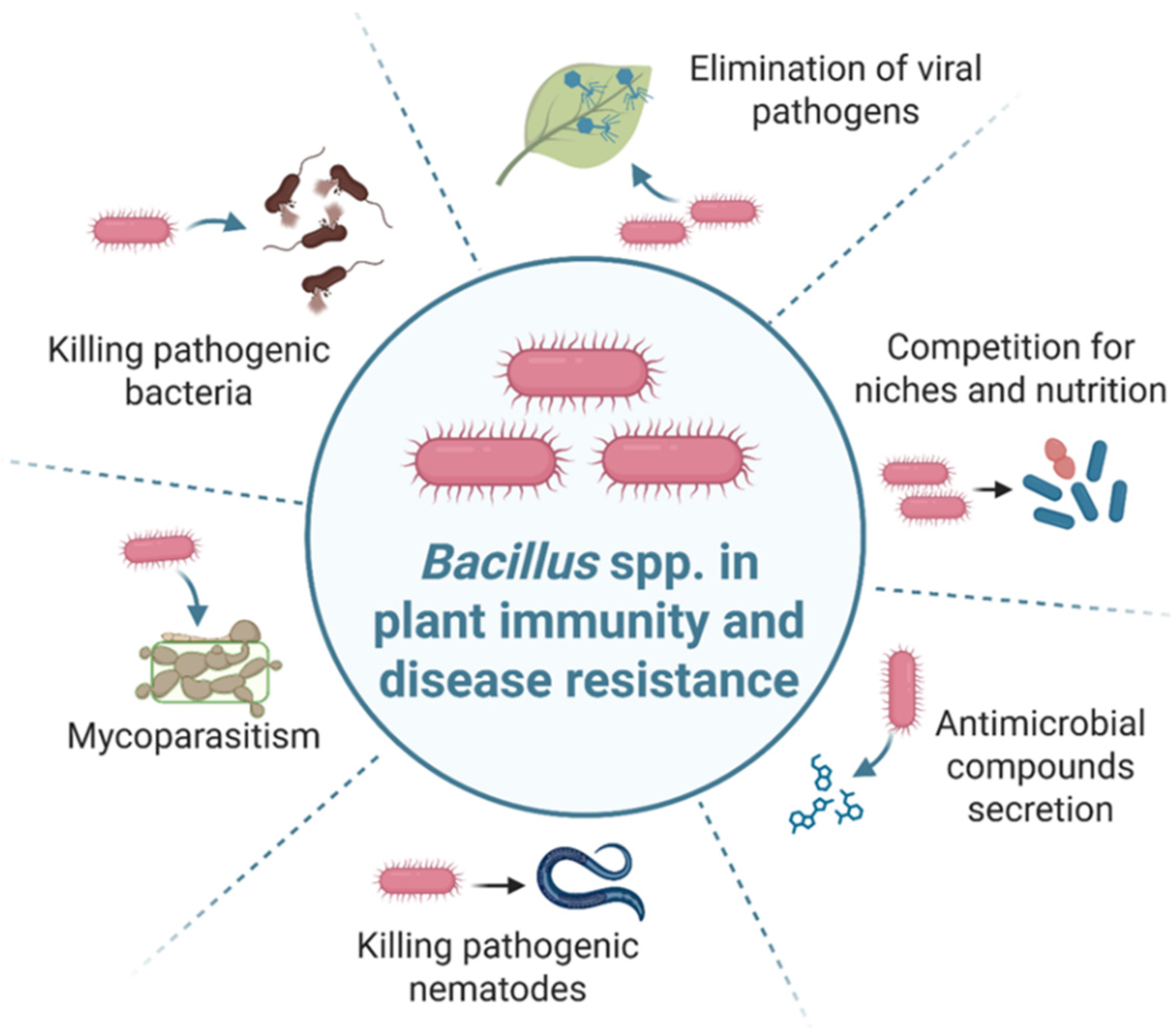
Numerous studies have examined the role of Bacillus spp. in PGP and crop disease management. Several Bacillus spp. have been identified as effective BCAs for controlling a wide range of diseases in major crops [5]. The application of Bacillus spp. enhances plant growth and suppresses bacterial, fungal, nematode, and viral diseases without posing environmental risks. In the rhizosphere, plant–microbe interactions enable Bacillus spp. to form biofilms and produce secondary metabolites, such as fengycin, iturin, bacillomycin, and surfactin, which collectively suppress plant pathogens [3,5]. As shown in Figure 1, Bacillus-mediated biocontrol involves a combination of direct antagonism, competition, and induction of plant immune responses, emphasizing the multifaceted nature of pathogen suppression.
Additionally, Bacillus spp. are widely utilized in agricultural research as promising BCAs [5]. Figure 2 summarizes the diverse agricultural applications of Bacillus spp., ranging from disease suppression to microbiome modulation and PGP.

3.1. Biocontrol of Bacterial Pathogens

Bacillus spp. have demonstrated strong biocontrol efficacy against bacterial plant pathogens through direct antagonism and host-mediated resistance. For instance, B. velezensis D significantly suppressed Ralstonia solanacearum, the causal agent of tobacco bacterial wilt, while simultaneously enhancing host resistance under greenhouse conditions [30]. Similarly, B. velezensis SS-38.4 effectively colonized the phyllosphere of sugar beet and reduced disease severity caused by Pseudomonas syringae, highlighting the importance of ecological fitness in successful biocontrol [31]. In another study, B. velezensis MJ23 producing antimicrobial lipopeptides exhibited strong antibacterial activity against Xanthomonas oryzae pv. oryzae, disrupting pathogen cell membranes and inhibiting biofilm formation [32]. Recent genomic and functional studies further indicate that Bacillus strains deploy diverse mechanisms, including antibiotic production, competition for nutrients, and induction of SR, enabling broad-spectrum suppression of bacterial pathogens [33]. Collectively, these findings emphasize that effective biocontrol by Bacillus spp. is not solely dependent on AMCs but also on their ability to colonize plant niches and modulate host immunity. Bacillus spp. also modulate the microbial composition in the rhizosphere, thereby suppressing the pathogens. For instance, inoculation with B. atrophaeus DX-9 increased the relative abundance of Nitrobacter, Agrobacterium, and Bradyrhizobium [34]. B. velezensis JZ also suppressed B. altitudinis m-1, the causal agent of strawberry leaf spot, mainly by increasing intracellular ROS and decreasing Ca2+-ATPase activity, without significantly altering cell membrane permeability [35]. In cherry plants, Bacillus strains WY66 and WY519 induced genes associated with jasmonic acid (JA), ET, and salicylic acid (SA) pathways, thereby suppressing Agrobacterium tumefaciens, the pathogen responsible for crown gall [36]. Taken together, these findings indicate that Bacillus strains employ distinct but converging mechanisms including oxidative stress induction, ion transport disruption, and phytohormone signaling to suppress pathogens, highlighting a coordinated multi-target mode of action rather than a single dominant pathway. Although Bacillus inoculation can significantly influence rhizosphere and endosphere microbial assemblages, current evidence indicates that many of these effects are transient and highly context-dependent. Long-term studies across multiple cropping cycles and crop rotations are still needed to determine whether inoculation-induced microbiome shifts persist, are reversible, or result in stable alterations of indigenous microbial community structure and function.

3.2. Biocontrol of Fungal Pathogens

Bacillus spp. act as BCAs controlling different fungal pathogens in plants [2]. Some Bacillus strains also enrich beneficial microbial communities while reducing pathogen populations, thereby enhancing plant growth [37]. For example, B. velezensis NT35 significantly reduced the relative abundance of Ilyonectria, Fusarium, Neonectria, and Dactylonectria pathogens causing root rot and rusty root rot in ginseng and promoted beneficial rhizosphere bacteria, including Luteimonas, Nocardioides, Sphingomonas, and Gemmatimonas [37]. This strain enriched members of Sphingomonadales, Sphingomonadaceae, and Actinomycetes and inhibited the mycelial growth of I. robusta by 94.12% at 107 CFU/mL. Sporulation and spore germination inhibition reached 100% and 90.31% at 104 and 108 CFU/mL, respectively [37]. The high biocontrol efficiency observed for B. velezensis NT35 suggests that effective biocontrol is strongly associated with simultaneous modulation of both pathogen suppression and rhizosphere microbial restructuring. This indicates that community-level shifts, rather than direct antagonism alone, play a critical role in disease suppression. Bacillus spp. were also found effective in reducing postharvest diseases and regulating their gene expression [38,39]. Gray mold caused by Botrytis cinerea is a major disease of tomato, and Bacillus spp. have shown significant potential in suppressing soil-borne fungal pathogens. Bacillus strains exhibited antagonistic activity against Rhizoctonia solani, Sclerotium rolfsii, and Fusarium oxysporum f. sp. ciceri, which cause root rot, collar rot, and wilt in chickpea (C. arietinum L.) respectively [40]. Members of the B. amyloliquefaciens complex (B. amyloliquefaciens, B. velezensis, B. nakamurai, and B. siamensis) are recognized as promising BCAs for fungal disease control [41]. For instance, B. amyloliquefaciens YN201732 produces lipopeptides, particularly bacillomycin D and fengycin, that effectively suppress Erysiphe cichoracearum, the agent of tobacco powdery mildew [42]. B. amyloliquefaciens SQ-2 inhibited more than 40% of mycelial growth in all tested grape varieties, with 53% inhibition in Kyoho grapes. SEM analysis confirmed severe morphological damage to Aspergillus tubingensis [43]. Additionally, B. amyloliquefaciens SFB-1 suppressed C. fimbriata by inducing mycelial swelling, completely inhibiting spore germination at 108 CFU/mL, and reducing mycelial growth by 81.01% [38]. Transcriptome profiling revealed 1164 DEGs associated with cell wall integrity, membrane stability, germination, detoxification, and oxidative stress [38]. For postharvest anthracnose in mango caused by Colletotrichum gloeosporioides, B. siamensis significantly reduced disease severity and enhanced fruit quality, with transcriptomic evidence indicating upregulation of genes involved in plant–pathogen interactions, hormone signaling, and resistance compound biosynthesis [39].

3.3. Biocontrol of Nematodes

Several Bacillus spp. have also shown strong nematicidal activity (Table 2). B. velezensis VB7 caused 96.66% juvenile mortality and 87.95% egg hatching inhibition in Meloidogyne incognita after 96 h. The strain activated MAMP-triggered immunity by upregulating WRKY, LOX, PAL, MYB, and PR genes [44]. B. velezensis YS-AT-DS1 (Bv-DS1) exhibits nematicidal activity against Meloidogyne incognita with a 71.62% mortality rate in second-stage juvenile (J2s). The combined effects of Bv-DS1 on protecting plants against RKN and promoting their growth may be linked to the control of water and solute transport through TIP (tonoplast intrinsic protein). Therefore, in sustainable agriculture, the Bv-DS1 strain may be employed as a BCA for RKN control [45]. Strains B. aryabhattai Ba1-7, B. megatherium Ba2-4, and B. halotolerans Ba2-6 effectively controlled Heterodera glycines and enhanced soybean growth, with Ba2-6 inducing SR through upregulation of R1, PR3a, PR5, and NPR1-2 linked to SA and JA pathways [46]. VOCs from B. cereus G5 showed strong fumigant activity against M. graminicola, reducing gall formation and nematode populations. The VOCs stimulated defense-related genes in SA (OsNPR1, OsWRKY45, and OsPAL1), JA (OsJaMYB, OsAOS2), and ET (OsACS1) pathways [47]. Compounds, such as allomatrine, morantel, 1-octen-3-ol, and 3-methyl-2-butanol, exhibited potent nematicidal activity, with 1-octen-3-ol showing an LC50 of 758.95 mg/L against M. graminicola J2s [47].

3.4. Biocontrol of Viral Diseases

Although Bacillus spp. are primarily recognized for their antibacterial and antifungal activities, accumulating evidence indicates that they can also suppress plant viral diseases through multiple direct and indirect mechanisms. One of the best-characterized mechanisms involves the induction of systemic resistance (ISR), whereby Bacillus-derived metabolites activate salicylic acid (SA), jasmonic acid (JA), and ethylene (ET) signaling pathways, leading to enhanced expression of pathogenesis-related (PR) genes and reduced viral accumulation [30,84]. Treatment with B. subtilis strains has been reported to significantly reduce disease severity caused by Tobacco mosaic virus (TMV), Cucumber mosaic virus (CMV), and Tomato-spotted wilt virus (TSWV) through activation of host defense responses [82,83,90]. Lipopeptides such as surfactin, fengycin, and iturin have also been implicated in antiviral defense through membrane-associated signaling events that enhance plant immune responses and stimulate the accumulation of defense-related metabolites [84,91]. Furthermore, B. amyloliquefaciens and B. velezensis strains have been shown to increase antioxidant enzyme activities, including superoxide dismutase, catalase, and peroxidase, thereby mitigating virus-induced oxidative stress and limiting symptom development [91,92]. Recent transcriptomic studies further suggest that Bacillus-mediated antiviral activity involves extensive reprogramming of hormone-regulated defense networks and RNA-silencing-associated pathways, resulting in reduced viral titers and enhanced plant resilience [82]. In addition to ISR, several Bacillus species produce extracellular ribonucleases (RNases) capable of degrading viral RNA molecules, thereby interfering with viral replication and systemic movement. In greenhouse trials, B. subtilis 26D and Ttl2 enhanced tomato resistance to potato virus X (PVX) and potato virus Y (PVY) by releasing RNases and phytohormones, reducing viral accumulation, restoring fruit yield, and induced systemic resistance (ISR) via activation of SA- and JA-related genes. They also modulated hormone levels, reducing abscisic acid accumulation in PVY infection and increasing abscisic acid in PVX-infected plants, thereby improving resistance [93]. Collectively, these findings demonstrate that Bacillus spp. suppress viral diseases through a combination of RNase-mediated viral RNA degradation, lipopeptide-triggered immune priming, antioxidant regulation, and ISR activation, highlighting their potential as sustainable biological tools for managing economically important plant viruses.
However, as research continues, several Bacillus-based BCAs are commercially available for controlling soil-borne pathogens and protecting crops (Table 3), while many others are under evaluation for future deployment.

4. Secondary Metabolites Synthesized by Bacillus spp. for Agricultural Applications

Bacillus spp. synthesize structurally varied secondary metabolites with broad antimicrobial activity [5]. Based on biosynthetic origin, Bacillus peptide antibiotics are categorized into nonribosomal peptide synthetases (NRPSs) and ribosomally synthesized peptides (RSPs) [5]. Moreover, Bacillus spp. also produce some antibacterial and antifungal VOCs [96].

4.1. Nonribosomal Peptides

NRPSs, such as gramicidin, tyrocidine, bacitracin, surfactin, iturins, and fengycins, are produced through multienzyme thiotemplate systems that select and condense amino acid residues. Following synthesis, these peptides may undergo further modifications, such as heterocyclic ring formation, acylation, glycosylation, or N-methylation [5,7,97]. Bacillus lipopeptides represent a major group of NRPSs, notably the surfactin, iturin, and fengycin families. Surfactin is a heptapeptide containing D-configured residues at positions 3 and 6, with applications in biocontrol, food preservation, medicine, and bioremediation, although commercial use remains limited by low yields and high production costs [98,99]. This class of antimicrobial peptides (AMPs), which are produced by various Bacillus spp., includes linchenysin, pumilacidin, and WH1fungin [98,99]. Moreover, B. subtilis species produce a family of antifungal lipopeptide substances called iturinic, which includes iturin, bacillomycin D, bacillomycin F, bacillomycin L, mycosubtilin, and mojavensin [100,101]. The fengycin, another family of antifungal lipopeptides, comprising fengycin, plipastatin, and Agrastatin1, is characterized by a specific peptide sequence linked to a C14–C18 β-hydroxy fatty acid [102]. Fengycin exerts its antifungal effects by damaging cell walls and membranes, disrupting metabolic activities, inducing programmed cell death and autophagy, and activating plant defense responses [95]. Although these lipopeptides share amphiphilic properties, their membrane targets and mechanisms of action differ substantially. Surfactins primarily interact with phospholipid bilayers, causing membrane destabilization and increased permeability through detergent-like effects, but generally exhibit weaker direct antifungal activity. In contrast, iturins display a strong affinity for ergosterol-containing fungal membranes, where they induce pore formation, ion leakage, and cell death. Fengycins preferentially interact with fungal membrane phospholipids and lipid microdomains, resulting in membrane deformation and disruption of filamentous fungal growth, while exerting comparatively limited effects on most bacterial membranes. These differences in membrane specificity contribute to the complementary antimicrobial spectra of Bacillus lipopeptides [95,97].
Recent work continues to uncover new non-ribosomally synthesized lipopeptides (e.g., Baelezcin A), a novel cyclic lipopeptide (C52H91N7O13) produced by B. velezensis SJ100083. Structural elucidation using ultrahigh-performance liquid chromatography quadrupole Orbitrap high-resolution mass spectrometry (UHPLC-Q-Orbitrap-HRMS) and nuclear magnetic resonance (NMR) confirmed its composition. Application of Baelezcin A at 25 mg/L significantly reduced both the incidence and severity of cherry gray mold caused by Botrytis cinerea [103]. It caused the accumulation of ROS within the spores and the trickle of mycelium cytoplasmal contents, which caused decreased spore germination [103]. Regardless of the lipopeptides, there are other NRPSs as well. It has been demonstrated that some strains of B. subtilis and B. licheniformis release the non-ribosomal peptide bacitracin, which inhibits the cell wall of Gram-positive bacteria [104]. The N-terminal alanine residue and L-anticapsin in the small peptide bacilysin, which is released by B. subtilis, B. amyloliquefaciens, and B. pumilus, have antibacterial action against different plant pathogenic bacteria [5]. Under iron-limited circumstances, a number of Bacillus spp. produce bacillibactin and petrobactin [105]. Paenibacillus larvae synthesizes the tripeptide antibiotic, sevadicin, consisting of D-phenylalanine, D-alanine, and tryptophan via an NRPS-encoded gene cluster, which exhibits antibacterial activity [106]. Phosphonate natural compounds synthesized non-ribosomally by Bacillus have been another promising source of salable pesticides. Recently two new phosphonates were reported, produced by B. velezensis for agricultural use. Isolation and structure clarification discovered a novel di- and tripeptide made of l-alanine and a C-terminal l-phosphonoalanine, which were named phosphonoalamides E and F [107].

4.2. Polyketides (PKs) and Hybrid Metabolites

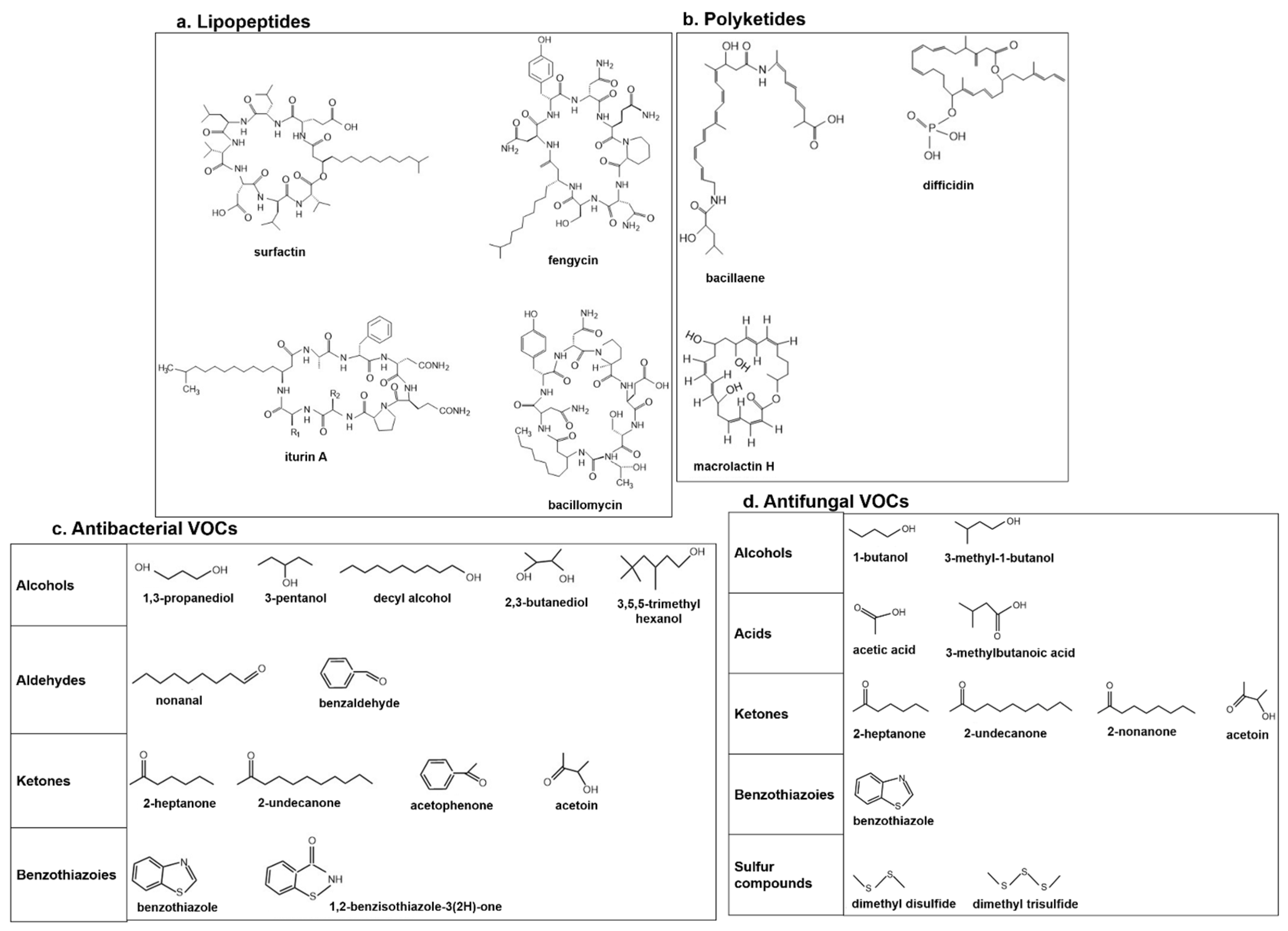
Bacillus spp. also produce PKs, a class of RSP-associated antimicrobial and anticancer compounds. Major PK compounds produced by Bacillus spp. are bacillaene, difficidin, and macrolactin [108]. They have a wide variety of structures and are usually cationic (Figure 3).
The underlying metabolic pathways including the gene clusters encoding polyketide synthases (PKSs) are now being increasingly well-understood [7]. For example, Bacillaene is encoded by pksX gene cluster [109]. The antifungal PK basiliskamide was produced by B. laterosporus [110]. The synthesis of PKs by B. amyloliquefaciens FZB42 has been thoroughly investigated, and three PKS gene clusters (pks1, pks2, and pks3) have been identified. These clusters play a role in the biosynthesis of difficidin/oxydifficidin (pks3), macrolactins (pks2), and bacillaene (pks1, also called pksX) [111]. Recent research has reported new PKs produced by Bacillus spp. Chemical investigation of the organic extract of B. velezensis MBTDLP1 is characterized as a novel antimicrobial agent that mimics macrocyclic PK showing prospective antibacterial potential against methicillin-resistant S. aureus (MIC 0.38 µg/mL) and is presented by positive control chloramphenicol (6.25 µg/mL) [112]. Additional examples of RSP antibiotics made by Bacillus spp. include subtilins, ericins, mersacidin, and sublancin 168 [113]. A recent study showed B. safensis APC 4099 to be a potential BCA. Genomic study of B. safensis APC 4099 discovered biosynthetic gene clusters encoding numerous AMPs and secondary metabolites. In particular, RSP safencin E, a new, anionic, circular bacteriocin that is 6 kDa in size, was shown to be 52.5% identical to butyrivibriocin AR10. Moreover, gene clusters encoding RSPs including pumilarin and plantazolicin, pumilacidin A, bacilysin, and bacillibactin were also identified in B. safensis APC 4099 [114]. As BCAs for food ecosystems against spoiling and pathogenic bacteria, B. safensis and its bioactive substances provide a remedy to the worldwide issue of the 1.3 billion tons of agricultural produce wasted each year [114].

4.3. Volatile Organic Compounds (VOCs)

In addition to nonribosomal peptides and polyketides, Bacillus spp. produce a diverse range of VOCs that contribute to pathogen suppression, plant growth promotion, and induction of host defense responses. Unlike diffusible metabolites, VOCs can act over long distances through the gaseous phase, enabling interactions with pathogens and plants without direct physical contact [14]. Bacillus-derived VOCs mainly include alcohols, ketones, aldehydes, sulfur-containing compounds, pyrazines, and aromatic compounds, many of which originate from amino acid catabolism, pyruvate metabolism, and fatty acid degradation pathways. Among the best-characterized VOCs are acetoin (3-hydroxy-2-butanone) and 2,3-butanediol, produced through pyruvate fermentation pathways. These compounds enhance plant growth by modulating phytohormone signaling and inducing systemic resistance [14,21]. VOCs produced by B. subtilis have been shown to increase biomass accumulation in A. thaliana and alter auxin homeostasis, thereby promoting root development and stress adaptation [14,21]. In addition to growth-promoting effects, several ketones, aldehydes, and sulfur-containing volatiles exhibit direct antimicrobial activity by disrupting membrane integrity, inhibiting spore germination, and interfering with pathogen metabolism. Recent studies have also demonstrated that Bacillus VOCs possess nematicidal activity. For example, VOCs produced by B. cereus G5, including 1-octen-3-ol and 3-methyl-2-butanol, significantly reduced Meloidogyne graminicola populations and activated SA-, JA-, and ET-associated defense pathways in rice [47]. A recent study reported a novel formaldehyde dehydrogenase in B. subtilis that detoxifies formaldehyde, which is toxic for all living forms, creating a favorable environment for other beneficiary microbes in the rhizosphere and within plants [96]. Collectively, VOCs represent a mechanistically distinct class of antimicrobial metabolites that complement lipopeptides and polyketides in Bacillus-mediated biocontrol (Table 4). Identifying such novel compounds and knowing their beneficial effects may open a new era for agricultural evolution. Figure 3 illustrates the structural diversity of major antimicrobial metabolites produced by Bacillus spp., highlighting the distinction between lipopeptides, PKs, and VOCs which differ in target specificity.

5. Improving the Biocontrol Efficacy of Bacillus spp.

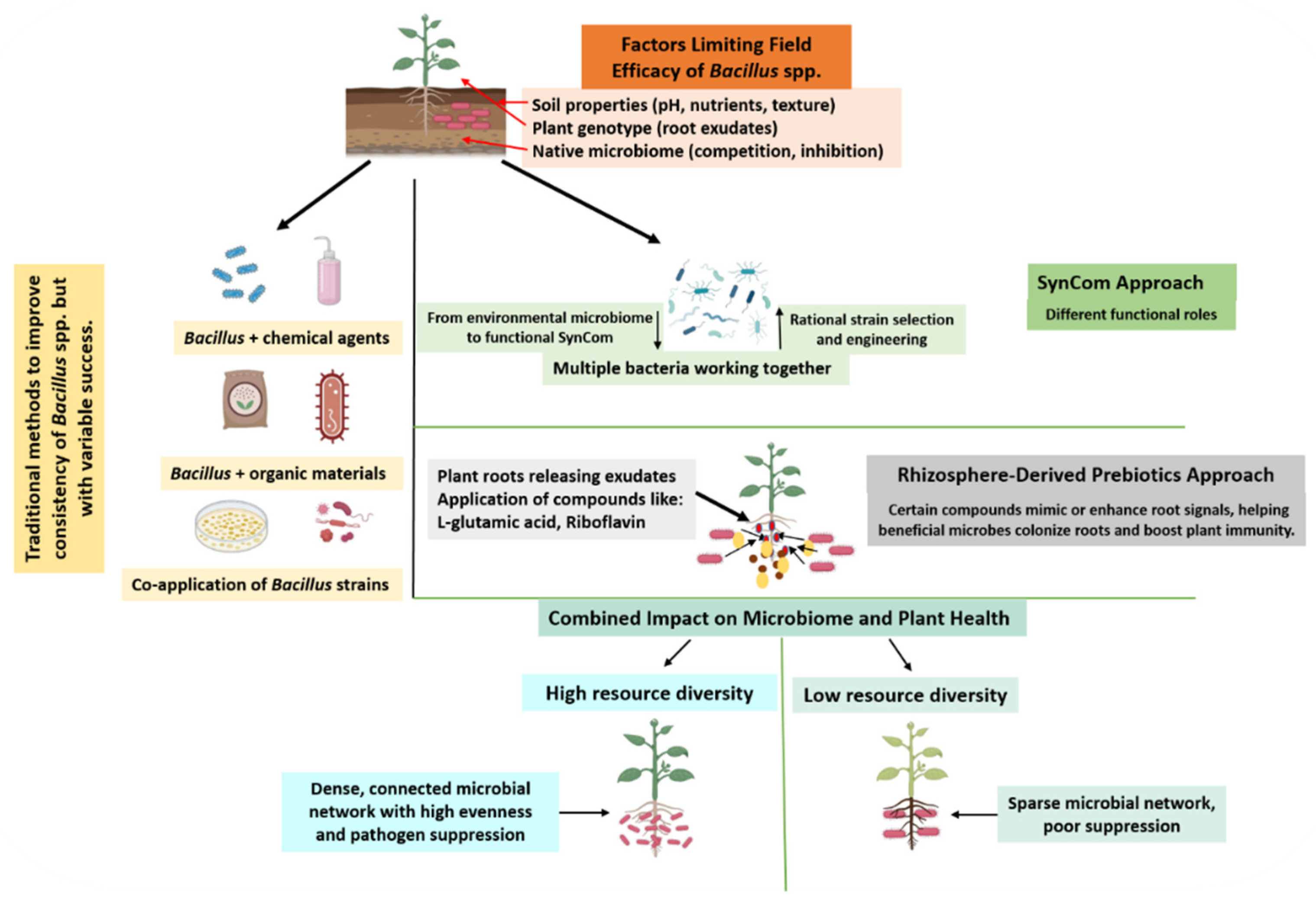
Practical applicability and expansion of BCAs are typically constrained by their inconsistent prevention performance in field settings. The colonization and functional efficiency of inoculated Bacillus spp. can be influenced by a variety of complex and dynamic variables, including soil properties, plant genotypes, and native microbiome [115]. As a result, several strategies have been tried to increase their effectiveness. These include applying bacterial isolates and chemical agents (such as bactericides) together, using antagonistic metabolites in place of or together with BCAs, and combining Bacillus strains with organic ingredients to create bioorganic fertilizers [115,116,117]. Two new approaches are synthetic microbial consortia (SynCom) and rhizosphere-derived prebiotics, which have been compiled to increase the biocontrol effectiveness of Bacillus spp. on various levels [118].
The term “SynCom” describes a community made up of a small number of strains with various roles. A well-designed SynCom can demonstrate more metabolic variation, environmental adaption capacity, and broader/stronger activities as compared to individual BCAs [67]. Compared to a single strain, coinoculation of the BCAs B. velezensis BN8.2, Pseudomonas chlororaphis subsp. piscium PS5, and Trichoderma virens T2C1.4 considerably reduced banana Fusarium wilt [119]. A recent study shows that the particular combination of B. velezensis AP197 and B. velezensis AP298 can improve the biological control efficiency of several plant diseases [120]. At present, rational SynCom building typically adheres to the design–build–test–learn (DBTL) cycle and may be accomplished using either a “top down” or “bottom up” methodology. The process of gradually selecting important microbes from environmental samples by physical and functional analysis is known as the “top down strategy” [121]. A recent study revealed the main rhizobacteria species that reduce maize seed-borne Fusarium were identified by investigation using progressive dilution and rhizodepositional attraction. In order to create a simplified SynCom, a bacterial consortium comprising eight strains from the genera Bacillus, Burkholderia, Enterobacter, Lysobacter, Stenotrophomonas, Pseudoxanthomonas, Pseudomonas, and Acinetobacter was built using these crucial strains and modified based on higher environmental stability and disease suppression capacity. SynCom is more efficient than a single strain and randomly generated microbiota at inhibiting seed-borne Fusarium [122]. An alliance of five bacterial isolates for the control of fungal pathogen in Nicotiana attenuata, including P. azotoformans A70, P. Frederiksbergensis A176, and Arthrobacter nitroguajacolicus E46 with B. megaterium B55 and B. mojavensis K1 may develop improved biofilms over time. Strain K1 synthesizes the antifungal compound surfactin, which inhibits fungal growth [123]. These highlighted the conceptual basis of SynCom for creating synthetic microbiome with exceptional ecological stability and biocontrol efficacy. A “bottom up” strategy for increasing Bacillus spp. biocontrol efficacy aims to optimize circumstances at the microbiological level. This entails enhancing the innate biocontrol systems of the bacteria as well as their interactions with the pathogen and plant. Important tactics include boosting the synthesis of advantageous metabolites such as enzymes and antibiotics, improved nutrient uptake, and encouraging advantageous plant–microbe interactions [121]. In order to create a “bottom up”-based SynCom against two Fusarium pathogens, a previous study chose a consortium of four strains that include B. amyloliquefaciens, Serratia marcescens, P. fluorescens, and Rahnella aquatilis from 150 bacterial isolates. Consequently, both Fusarium pathogens were considerably suppressed by the microbial consortium, which was consistently more effective than the individual isolates [124].
When used directly in the field, BCAs, which are identifiable as unique invading species, typically cannot adapt to the local soil matrix or interact with the local microbiota, which results in poor biocontrol efficiency and ineffective rhizosphere colonization [125]. Certain chemicals can be created as prebiotics to improve root colonization and biocontrol efficiency because specific signals emitted from root exudates or root deposits attract Bacillus spp. and trigger their activities [118]. The external supplementation with L-glutamic acid, which changed the rhizosphere microbiota and enhanced the major taxa in the strawberry anthosphere, and also enhanced the proportions of Bacillaceae, Streptomyces, and Burkholderiaceae in the tomato rhizosphere, significantly lowered diseases caused by Botrytis and Fusarium in both habitats [125]. Riboflavin was recognized as a multifunctional prebiotic that enhances the biocontrol efficacy of B. subtilis Tpb55 against tobacco black shank induced by P. nicotianae by stimulating the activity of CAT, POD, SOD, and β-1,3-glucanase in the roots of Tpb55-inoculated tobacco seedlings [126]. The augmentation of resource variety modified trophic network structure, enhanced microbial evenness, and thus improved the reliability of effective pathogen management. On the other hand, the consequences of poor resource variety on invading resistance were more diverse and less effective. Therefore, plant disease suppression was greatly aided by increases in the evenness and connectivity of dominant species brought about by high resource diversity. Additionally, microbial processes relevant to the control of the plant immune system were elevated by high carbohydrate diversity [127]. Figure 4 depicts the role of rhizosphere-derived signals and prebiotics in enhancing Bacillus colonization and activity, providing a framework for improving field-level biocontrol consistency.
To face real-world challenges, it is important to select or engineer strains that maintain functional activity under abiotic stress. Recent studies highlight that stress-tolerant Bacillus (e.g., B. subtilis, B. amyloliquefaciens) capable of producing stable lipopeptides (such as surfactin) and forming robust biofilms exhibits enhanced persistence under drought, salinity, and temperature fluctuations [128,129]. Climate-resilient B. velezensis strains (e.g., TL7, S1) demonstrate stable, broad-spectrum antifungal activity, enhanced plant growth, and environmental stress resilience, making them highly suitable for sustainable, climate-smart agriculture by maintaining performance across variable field conditions [130]. At the same time, modern formulation strategies have significantly improved the survival, shelf life, and field persistence of Bacillus-based BCAs. Microencapsulation using polymers such as alginate, chitosan, carrageenan, and gum-based matrices protects spores from UV radiation, desiccation, and oxidative stress while enabling controlled release. For instance, alginate or natural gum microcapsules containing B. velezensis achieved up to 90% pathogen inhibition and improved long-term shelf life the stability in soil [131]. Similarly, spray-dried encapsulated formulations increased spore survival upto 95% in B. thuringiensis subsp. kurstaki IMBL-B9 compared to non-encapsulated cells and maintained increased survival rate and storage stability at 54 ± 2 °C for up to 6 weeks [132,133]. Slow-release macrosphere systems using chitosan–carrageenan further enhanced disease control in crops such as Chinese cabbage by improving bacterial persistence and delivery efficiency. It further improved persistence by ensuring gradual microbial release and sustained metabolite production, making them particularly suitable for long-duration field applications [134]. Consequently, seed coatings are most appropriate for early-season protection, whereas microencapsulated and slow-release systems are preferred for improving storage stability and maintaining consistent field performance under variable environmental conditions [135]. These advances demonstrate that formulation optimization is central to translating lab efficacy into field reliability. Moreover, integrating Bacillus-based BCAs with crop rotation, reduced chemical inputs, and organic amendments has been shown to improve consistency and long-term efficacy. Large-scale agricultural programs, particularly in Brazil, demonstrate that combining multifunctional Bacillus strains with agronomic management practices enhances both disease suppression and crop productivity under field conditions [136].

6. Bacillus spp. as Opportunistic Pathogens

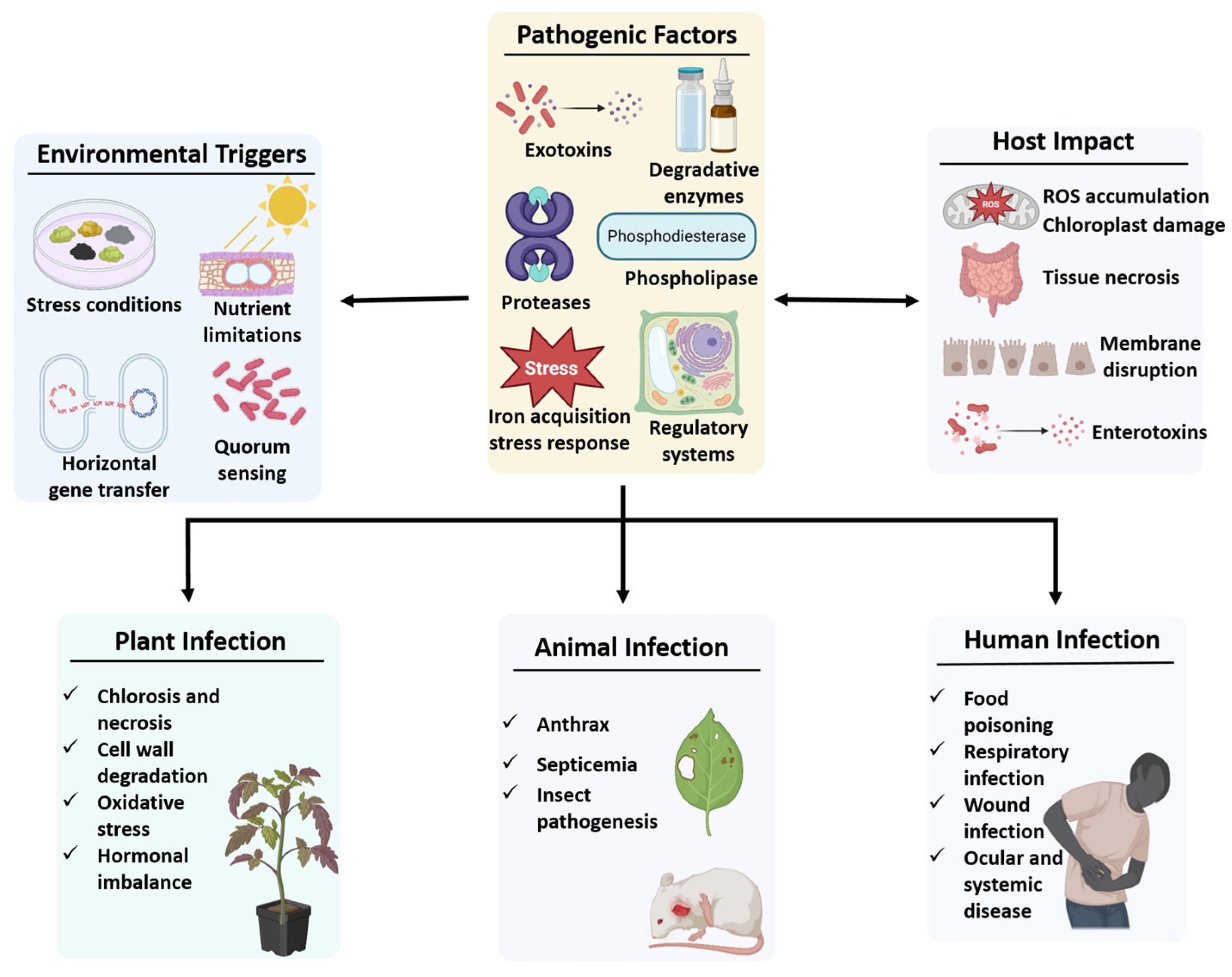
Although many Bacillus species are recognized for their role as plant growth-promoting rhizobacteria (PGPR) and BCAs, a growing body of evidence highlights their potential as opportunistic pathogens in plants, animals, and humans [137,138,139]. This dual lifestyle reflects a remarkable ecological and evolutionary plasticity within the Bacillus genus, driven by genetic diversity, horizontal gene transfer, environmental triggers, and host–microbe interactions (Figure 5) [140]. Effective evaluation of Bacillus in agricultural systems, therefore, requires an integrated understanding of both beneficial traits and pathogenic potential.

6.1. Physiological Disruption in Plants

In plant systems, opportunistic pathogenicity may manifest through Bacillus-induced physiological disruptions, especially under favorable conditions such as high inoculum load, stressed hosts, or weakened immune responses [140]. Fruit rot on muskmelon (Cucumis melo) was reported to be caused by B. pumilus in China. When bacterial rot in onion bulbs was found in South Korean warehouses in 2008, B. amyloliquefaciens was found to be the causative agent of onion bulb [141]. Reisolated from inoculation onion bulbs, the isolated bacteria produced the identical rot symptom as was observed in naturally infected onions after storage [141]. B. altitudinis has recently been found to be a cause pomegranate seed rot in China [142]. Pathogenic determinants such as cell wall-degrading enzymes, proteases, and phospholipases can compromise plant cellular integrity by degrading structural components, disrupting membranes, and inducing oxidative imbalance [143]. Such disruptions can lead to chloroplast ultrastructure damage, impaired photosynthesis, lipid peroxidation, and accumulation of ROS, ultimately manifesting as necrotic lesions or chlorosis in infected tissues [144]. The interplay between ROS and host antioxidant defenses shapes disease progression. Production of ROS beyond the buffering capacity of enzymes like SOD, CAT, and POD can intensify tissue damage [145]. In contrast, beneficial Bacillus strains often enhance antioxidant capacity and prime defense pathways, highlighting how different strain genotypes yield divergent physiological outcomes [146]. Recent advances indicate that ROS and reactive nitrogen species (RNS) function not only as indicators of oxidative stress but also as central signaling molecules that coordinate plant immune responses. ROS–RNS crosstalk regulates redox homeostasis, antioxidant enzyme activities, defense-related gene expression, hypersensitive responses, and programmed cell death through complex signaling networks spanning chloroplasts, mitochondria, peroxisomes, and the apoplast [147]. Within this framework, Bacillus-mediated modulation of ROS accumulation and antioxidant defenses can be viewed as part of a broader redox signaling cascade that integrates hormonal pathways, stress perception, and pathogen defense. Beneficial Bacillus strains often promote balanced ROS production and enhanced antioxidant capacity, whereas opportunistic pathogenic strains may trigger excessive oxidative stress and cellular damage. Thus, the contrasting effects of different Bacillus species on host redox status likely reflect their differential influence on ROS–RNS signaling networks that ultimately determine plant resistance or susceptibility. Comparative studies on stress signatures between benign and opportunistic strains deepen our mechanistic understanding of how specific virulence determinants outweigh host defenses [145,148]. The predominant bacteria responsible for peach fruit rot was B. velezensis zk1. It damaged the chloroplasts, mitochondria, respiratory chain function, and associated free radical scavenging enzyme systems. MDA levels rose as a result of cell death, but levels of vitamin C, dialdehyde, flavonoids, and total phenols fell. Activities of ammonia lyase, polyphenol oxidase, SOD, CAT, POD, and APX also declined [10].

6.2. Opportunistic Pathogen in Human and Animals

There have also been reports of several B. subtilis strains causing illness in other living forms. For instance, the virulence genes of B. subtilis G7 isolated from a deep-sea hydrothermal vent are abundant and capable of killing fish and mice [149]. Before being recognized as a human pathogen that causes both intestinal and extraintestinal disorders, B. cereus was thought to be innocuous for almost 80 years [150]. Numerous toxins, such as the pore-forming toxins hemolysin BL (HBL) and nonhemolytic enterotoxin (NHE), have been linked to illness. HBL binds to the mammalian surface receptors LITAF and CDIP1, and both HBL and NHE cause potassium efflux and trigger the NLRP3 inflammasome, which results in pyroptosis [150]. Common intestinal disorders caused by B. cereus include diarrhea, vomiting, and nausea. Nevertheless, it has been linked to severe infections in immunocompromised hosts and can result in endophthalmitis, which may lead to blindness, and septicemia [151]. Highly resistant spores produced by B. anthracis may spread to grazing animals and linger in the environment for decades. Uncoagulated blood leaking from natural openings and acute or hyperacute septicemia cause anthrax to cause abrupt death without any outward clinical symptoms. Infected animals, carcasses, or animal products are typically the source of infection in humans [152]. The Centers for Disease Control and Prevention (CDCs) state that sudden death is a common symptom in animals, with a recent study reporting 998 deaths out of 6354 instances. Depending on the kind of anthrax, the fatality rate in people varies; inhalational anthrax is the most lethal, with death rates as high as 50% [8]. Numerous diseases, including bacteremia, septicemia, wound infections, and endocarditis, can also be brought on by other Bacillus spp., such as B. cereus, B. subtilis, and B. licheniformis, especially in immunocompromised people [153]. Some proteins produced by some Bacillus spp. are responsible for molecular mimicry and evade the host immune system. Sphingomyelinases (SMase) are phosphodiesterases found in bacterial and mammalian cells that catalyze the hydrolysis of sphingomyelin (SM) [154,155]. Pathogenic bacteria like B. cereus and B. anthracis generate SMase C, one of the bacterial sphingomyelinases, which breaks down the ester link between ceramide and phosphocholine. Its catalytic function is identical to that of human neutral sphingomyelinase 2 (nSMase2) [154,156]. Numerous physical and clinical activities, including membrane dynamics, cellular signaling, migration, colonization, immune system evasion in the initial phases of infections, and infection development, are facilitated by SMase C [154,155,156]. B. thuringiensis, famous for insecticidal Cry toxins, has also caused opportunistic infections in immunocompromised animals and humans, indicating that host range can extend beyond target pests under some conditions [157]. Strains classified as B. cereus biovar anthracis have recently emerged as anthrax-like pathogens by acquiring plasmids analogous to those of B. anthracis [138]. This confirms that virulence in Bacillus can be conferred through plasmid acquisition and recombination, illustrating dynamic genomic plasticity driving pathogenic phenotypes [138,158].

6.3. Environmental Triggers of Pathogenic Shift

Pathogenicity in Bacillus is not strictly determined by taxonomy but can be triggered by environmental and host factors [140]. Temperature stress, nutrient limitation, and host immune suppression create conditions conducive to expression of virulence traits [159]. For example, alternative sigma factor SigB in Bacillus cereus under heat shock and nutrient stress conditions reprogram gene expression to enhance survival and potentially virulence-associated traits [159]. Quorum sensing systems modulate expression of toxins and degradative enzymes in response to cell density [160]. Iron acquisition systems and oxidative stress response regulators (e.g., PerR, SigB) are pivotal in enabling survival and virulence under fluctuating abiotic stresses [161]. Environmental stressors may also alter the balance between beneficial and pathogenic outcomes. For example, under drought or heat stress in plants, physiological barriers are compromised, potentially facilitating opportunistic infection by Bacillus strains that might otherwise function as beneficial rhizobacteria [157].

7. Strategic Selection and Safe Deployment of Bacillus spp. as BCAs in Plants

The expanding use of Bacillus spp. as BCAs in crop protection requires a rigorous selection framework that integrates genomic safety, physiological performance, and ecological stability [139,162].

7.1. Strain-Level Safety Assessment and Selection

Whole-genome sequencing (WGS) has become the cornerstone of safe strain selection [162,163,164]. Comparative genomics enables identification of toxin gene clusters such as hbl, nhe, and cytK, enterotoxin operons (hblACD, nheABC, and cytK) as well as plasmid-borne virulence determinants associated with lineages related to B. anthracis and B. thuringiensis [139,165]. Moreover, strain-level variation within closely related taxa necessitates exclusion based on genomic content rather than species identity. Recent experimental work demonstrated that strain-specific characterization of B. velezensis isolates reveals significant differences in functional gene clusters, supporting the need for genome-guided selection prior to field use [67]. Beneficial strains typically promote antioxidant enzyme activities (SOD, CAT, and POD) and induce systemic resistance (ISR) via JA and ET signaling pathways [3]. Lipopeptides commonly produced by B. subtilis and B. velezensis are central to antifungal activity and ISR priming without exerting host toxicity [95,97]. Stress-response profiling under variable temperature, osmotic, and nutrient conditions is essential, as environmental stress may activate latent virulence pathways in some strains [159]. Stable expression of beneficial traits across environmental gradients is therefore a key selection criterion. Species with established safety and agricultural performance records should be prioritized. These include B. subtilis, B. amyloliquefaciens, and B. velezensis. These taxa are renowned for producing antimicrobial metabolites, siderophores, and VOCs that suppress fungal pathogens such as Fusarium, Rhizoctonia, and Botrytis spp. [7,97]. However, some strains within these species were also reported pathogenic to plants [10]. Multilocus sequence typing (MLST) and average nucleotide identity (ANI) analyses ensure accurate taxonomic placement and prevent misclassification within the Bacillus spp. [163].

7.2. Field Deployment and Ecological Monitoring

Formulation technology significantly influences both efficacy and biosafety. Bacillus spp. are commonly formulated as endospores due to their environmental resilience [95]. However, inoculum density must be optimized to avoid ecological imbalance or unintended proliferation. Encapsulation, carrier-based granules, and seed-coating formulations enable controlled release and targeted rhizosphere colonization [131,132,134]. Localized soil or seed treatments are preferable to broad foliar applications when targeting soil-borne pathogens, minimizing exposure to non-target environments and reducing ecological risks [166]. Field-scale experiments demonstrated that defined inoculum concentrations of B. velezensis effectively controlled target organisms while maintaining controlled population dynamics in complex substrates such as manure systems [166]. Long-term environmental monitoring is essential following field deployment. Horizontal gene transfer (HGT) within soil microbial communities may alter strain characteristics over time. Periodic reisolation and genomic reassessment can confirm genetic stability and absence of acquired virulence factors [164]. Quantitative molecular tools such as strain-specific qPCR enable precise tracking of Bacillus populations in the rhizosphere. For example, a recent study developed a TaqMan-based detection system for B. velezensis that allowed accurate quantification of colonization dynamics and demonstrated a direct relationship between population stability and controlled biocontrol performance [167]. Such monitoring frameworks are essential to detect unintended proliferation or ecological imbalance and ensure long-term biosafety.

7.3. Regulatory and Biosafety Compliance

Regulatory frameworks governing microbial biopesticides require toxicological, environmental, and non-target organism assessments [140]. Transparent genomic documentation, safety assays, and reproducible efficacy data enhance regulatory approval and public acceptance. Where necessary, genome editing approaches may be used to remove undesirable genes, although compliance with biosafety regulations for genetically modified microorganisms must be ensured [140].
Robust biosafety assurance of Bacillus-based BCAs is achieved through compliance with established regulatory frameworks that evaluate microbial products prior to commercialization and field deployment. In the United States, the United States Environmental Protection Agency (EPA) regulates microbial biopesticides under the Federal Insecticide, Fungicide, and Rodenticide Act (FIFRA), classifying them as microbial pesticides distinct from biochemical and conventional chemical pesticides [168]. The EPA requires a comprehensive data package including strain identity, manufacturing process, toxicology (acute oral, dermal, and inhalation), pathogenicity/infectivity, and environmental fate. Importantly, microbial agents such as Bacillus spp. must undergo Tier I and Tier II ecological risk assessments, which evaluate effects on non-target organisms (e.g., pollinators, aquatic species) and environmental persistence before registration [169]. Similarly, in the European Union, the European Food Safety Authority (EFSA) conducts scientific risk assessments for microbial active substances under Regulation (EC) No. 1107/2009. EFSA classifies microbial BCAs based on taxonomic identity and biological properties, requiring detailed characterization at the strain level, including genome-based identification, absence of virulence factors, and antimicrobial resistance profiling [170]. Risk assessment focuses on human health (toxicity, infectivity), environmental safety (soil persistence, dispersal), and non-target organism effects, supported by experimental data. For example, EFSA evaluations of B. velezensis strains have emphasized the need for exclusion of enterotoxin genes and confirmation of non-pathogenic behavior under realistic exposure scenarios [171].
These regulatory systems adopt a multi-tiered, weight-of-evidence approach, integrating laboratory assays, genomic data, and field studies to determine safety. These frameworks ensure that only strains meeting stringent biosafety and ecological compatibility criteria are approved, thereby mitigating risks associated with opportunistic pathogenicity and unintended environmental impacts. A major limitation of current regulatory frameworks is that safety assessments are largely species-based, whereas accumulating evidence indicates that pathogenicity and beneficiality in Bacillus are often strain-specific and influenced by environmental conditions. Consequently, future regulatory frameworks should incorporate genomic risk profiling and condition-dependent phenotypic assessments rather than relying solely on taxonomic classification.

8. Conclusions and Future Perspectives

Bacillus spp. represent a multifunctional platform for sustainable plant disease management, integrating antimicrobial metabolite production, microbiome modulation, and activation of host immune responses. Isolating and applying specific Bacillus strains having well-known biocontrol capabilities should be used for specific application, such as B. velezensis Y6 for controlling R. solani in rice [67]. However, inconsistencies in field performance and the emerging recognition of opportunistic pathogenicity highlight the necessity for precision-based strain selection and biosafety evaluation. The safe selection and deployment of Bacillus spp. as BCAs depend on a multi-tiered strategy integrating genomic exclusion of virulence determinants, physiological validation, ecological monitoring, and regulatory compliance. Recognizing the genetic proximity between beneficial strains and opportunistic pathogens underscores the necessity of strain-level precision. An important challenge in the development of Bacillus-based BCAs is distinguishing beneficial strains from opportunistic pathogenic relatives. Comparative genomic analyses have shown that beneficial Bacillus strains are generally enriched in biosynthetic gene clusters involved in antimicrobial production, rhizosphere competence, biofilm formation, and plant growth promotion, whereas pathogenic strains frequently harbor virulence-associated genes encoding enterotoxins, hemolysins, or other host-damaging factors. Nevertheless, the presence or absence of specific genes alone may not reliably predict ecological behavior, because microbial phenotypes are also shaped by gene regulation, environmental conditions, and host–microbe interactions. Consequently, genomic screening should be complemented by transcriptomic, metabolomic, and phenotypic characterization to ensure accurate biosafety assessment and strain selection. New emerging techniques like CRISPR-Cas9, ZFNs, and TALENs could be applied to make engineered Bacillus-based BCAs for better efficacy with broad spectrum applications, while keeping the adverse effect at the minimum level. However, despite their considerable potential, the practical deployment of genetically engineered microbial biocontrol agents remains constrained by stringent regulatory requirements and public acceptance concerns in many jurisdictions, particularly within the European Union (EU), where genetically modified microorganisms are subject to separate and substantially more rigorous approval procedures than conventional microbial biopesticides. Furthermore, linking genome mining with functional metabolomics will accelerate the discovery of novel AMCs. Regardless of the discovery of numerous novel gene clusters of prospective antimicrobials, their parts have not yet been investigated and they are still uncharacterized.
Real-world experiments other than the lab and controlled greenhouse experiments would greatly help in understanding their capability and real-world efficacy which might show further development steps to mitigate these challenges and ensure safe BCA development. The expression of antimicrobial biosynthetic gene clusters in Bacillus spp. is strongly influenced by environmental conditions, including soil moisture, temperature, pH, nutrient status, and plant-derived signals. These factors can modulate the production of bioactive metabolites through stress-responsive regulatory pathways and quorum-sensing mechanisms. Consequently, environmental fluctuations may affect the consistency of Bacillus-mediated pathogen suppression under field conditions. Although abiotic stress can alter bacterial physiology, colonization dynamics, and secondary metabolite production, there is currently limited evidence that beneficial Bacillus strains undergo a transition toward pathogenic phenotypes. Future multi-omics studies are needed to elucidate how environmental stressors regulate biosynthetic gene cluster expression and influence the ecological stability and biocontrol efficacy of Bacillus inoculants. Simultaneous transcriptomic and metabolomic profiling of individual strains under plant-beneficial versus stress-induced conditions could reveal key regulatory switches controlling antimicrobial production, host colonization, stress adaptation, and virulence-associated traits. As some Bacillus strains can also be pathogenic to plants and animals, precautions should be taken using these stains as BCAs. Machine learning approach in analyzing the specific stain physiology and genomics combining with other multiomic approaches will enable the proper exploitation of Bacillus-based BCAs’ fundamental processes and application potential for ecofriendly and sustainable plant disease management.
Although current knowledge of Bacillus–host interactions has been largely derived from bulk transcriptomic, metabolomic, and physiological analyses, these approaches often mask the substantial cellular heterogeneity that exists within plant tissues during microbial colonization. Recent advances in single-cell RNA sequencing (scRNA-seq) and spatial transcriptomics have revealed that individual cell types can exhibit distinct transcriptional programs, signaling responses, and immune states during plant–microbe interactions. These technologies have successfully resolved cell-type-specific responses to bacterial, fungal, and viral colonization and uncovered spatially coordinated defense networks that cannot be detected using conventional bulk analyses. A recent review highlights how integrating single-cell and spatial omics can transform our understanding of plant–microbe interactions by linking microbial colonization patterns with host cellular responses at unprecedented resolution [172]. Applying these approaches to Bacillus–plant systems represents a promising future direction for elucidating niche-specific colonization strategies, immune modulation, and the molecular determinants that distinguish beneficial endophytes from opportunistic pathogens.

Funding

This work was supported by the Deanship of Scientific Research, Vice Presidency for Graduate Studies and Scientific Research, King Faisal University, Saudi Arabia (KFU263092).

Data Availability Statement

No new data were created or analyzed in this study.

Conflicts of Interest

The authors declare no conflicts of interest.

References

  1. Dobrzyński, J.; Jakubowska, Z.; Kulkova, I.; Kowalczyk, P.; Kramkowski, K. Biocontrol of Fungal Phytopathogens by Bacillus Pumilus. Front. Microbiol. 2023, 14, 1194606. [Google Scholar] [CrossRef] [PubMed]
  2. Islam, T.; Danishuddin; Tamanna, N.T.; Matin, M.N.; Barai, H.R.; Haque, M.A. Resistance Mechanisms of Plant Pathogenic Fungi to Fungicide, Environmental Impacts of Fungicides, and Sustainable Solutions. Plants 2024, 13, 2737. [Google Scholar] [CrossRef]
  3. Islam, T.; Haque, M.A.; Barai, H.R.; Istiaq, A.; Kim, J.-J. Antibiotic Resistance in Plant Pathogenic Bacteria: Recent Data and Environmental Impact of Unchecked Use and the Potential of Biocontrol Agents as an Eco-Friendly Alternative. Plants 2024, 13, 1135. [Google Scholar] [CrossRef] [PubMed]
  4. Sha, Y.; Zeng, Q.; Sui, S. Screening and Application of Bacillus Strains Isolated from Nonrhizospheric Rice Soil for the Biocontrol of Rice Blast. Plant Pathol. J. 2020, 36, 231–243. [Google Scholar] [CrossRef]
  5. Islam, T.; Rabbee, M.F.; Choi, J.; Baek, K.H. Biosynthesis, Molecular Regulation, and Application of Bacilysin Produced by Bacillus Species. Metabolites 2022, 12, 397. [Google Scholar] [CrossRef]
  6. Kumar, N.; Dubey, R.C. Plant Growth Promoting Endophytic Bacteria Bacillus Australimaris BLR41 and Enterobacter Kobei BLR45 Enhance the Growth of Medicinal Plant Barleria Lupulina Lindl. J. Pure Appl. Microbiol. 2022, 16, 2647–2658. [Google Scholar] [CrossRef]
  7. Rabbee, M.F.; Hwang, B.S.; Baek, K.H. Bacillus Velezensis: A Beneficial Biocontrol Agent or Facultative Phytopathogen for Sustainable Agriculture. Agronomy 2023, 13, 840. [Google Scholar] [CrossRef]
  8. Islam, S.S.; Sarker, M.S.; Akhter, A.H.M.T.; Shanta, I.S.; Rahman, A.K.M.A.; Sufian, M.A. Animal, Human, and Environmental Perspectives on Anthrax in Bangladesh. Heliyon 2024, 10, e23481. [Google Scholar] [CrossRef]
  9. Han, V.C.; Yu, N.H.; Yoon, H.; Ahn, N.H.; Son, Y.K.; Lee, B.H.; Kim, J.C. Identification, Characterization, and Efficacy Evaluation of Bacillus Velezensis for Shot-Hole Disease Biocontrol in Flowering Cherry. Plant Pathol. J. 2022, 38, 115–130. [Google Scholar] [CrossRef] [PubMed]
  10. Zeng, Y.; Yu, Q.; Cheng, S. Effects of Bacillus Velezensis Zk1 on the Physiology and Metabolism of Peaches. Int. J. Food Sci. Technol. 2022, 57, 2203–2215. [Google Scholar] [CrossRef]
  11. Tsipinana, S.; Obi, L.; Amoo, S.; Adeleke, R. Plant Growth-Promoting Potential of Bacterial Endophytes Isolated from Lessertia Frutescens. S. Afr. J. Bot. 2024, 174, 768–778. [Google Scholar] [CrossRef]
  12. Xiang, N.; Lawrence, K.S.; Kloepper, J.W.; Donald, P.A.; McInroy, J.A. Biological Control of Heterodera Glycines by Spore-Forming Plant Growth-Promoting Rhizobacteria (PGPR) on Soybean. PLoS ONE 2017, 12, e0181201. [Google Scholar] [CrossRef]
  13. Blake, C.; Christensen, M.N.; Kovacs, A.T. Molecular Aspects of Plant Growth Promotion and Protection by Bacillus Subtilis. Mol. Plant-Microbe Interact. 2021, 34, 15–25. [Google Scholar] [CrossRef]
  14. Ryu, C.M.; Faragt, M.A.; Hu, C.H.; Reddy, M.S.; Wei, H.X.; Paré, P.W.; Kloepper, J.W. Bacterial Volatiles Promote Growth in Arabidopsis. Proc. Natl. Acad. Sci. USA 2003, 100, 4927–4932. [Google Scholar] [CrossRef]
  15. Dhar, S.K.; Kaur, J.; Singh, G.B.; Chauhan, A.; Tamang, J.; Lakhara, N.; Asyakina, L.; Atuchin, V.; Mudgal, G.; Abdi, G. Novel Bacillus and Prestia Isolates from Dwarf Century Plant Enhance Crop Yield and Salinity Tolerance. Sci. Rep. 2024, 14, 14645. [Google Scholar] [CrossRef] [PubMed]
  16. Amna; Ud Din, B.; Sarfraz, S.; Xia, Y.; Kamran, M.A.; Javed, M.T.; Sultan, T.; Hussain Munis, M.F.; Chaudhary, H.J. Mechanistic Elucidation of Germination Potential and Growth of Wheat Inoculated with Exopolysaccharide and ACC- Deaminase Producing Bacillus Strains under Induced Salinity Stress. Ecotoxicol. Environ. Saf. 2019, 183, 109466. [Google Scholar] [CrossRef]
  17. Pal, K.K.; Dey, R.; Sherathia, D.N.; Devidayal, D.N.; Mangalassery, S.; Kumar, A.; Rupapara, R.B.; Mandaliya, M.; Rawal, P.; Bhadania, R.A.; et al. Alleviation of Salinity Stress in Peanut by Application of Endophytic Bacteria. Front. Microbiol. 2021, 12, 650771. [Google Scholar] [CrossRef] [PubMed]
  18. Bokhari, A.; Essack, M.; Lafi, F.F.; Andres-Barrao, C.; Jalal, R.; Alamoudi, S.; Razali, R.; Alzubaidy, H.; Shah, K.H.; Siddique, S.; et al. Bioprospecting Desert Plant Bacillus Endophytic Strains for Their Potential to Enhance Plant Stress Tolerance. Sci. Rep. 2019, 9, 18154. [Google Scholar] [CrossRef]
  19. Lee, S.; Kim, J.A.; Song, J.; Choe, S.; Jang, G.; Kim, Y. Plant Growth-Promoting Rhizobacterium Bacillus Megaterium Modulates the Expression of Antioxidant-Related and Drought-Responsive Genes to Protect Rice (Oryza sativa L.) from Drought. Front. Microbiol. 2024, 15, 1430546. [Google Scholar] [CrossRef]
  20. Zhang, D.; Xu, H.; Gao, J.; Portieles, R.; Du, L.; Gao, X.; Borroto Nordelo, C.; Borrás-Hidalgo, O. Endophytic Bacillus Altitudinis Strain Uses Different Novelty Molecular Pathways to Enhance Plant Growth. Front. Microbiol. 2021, 12, 692313. [Google Scholar] [CrossRef] [PubMed]
  21. Xie, S.S.; Wu, H.J.; Zang, H.Y.; Wu, L.M.; Zhu, Q.Q.; Gao, X.W. Plant Growth Promotion by Spermidine-Producing Bacillus Subtilis OKB105. Mol. Plant-Microbe Interact. 2014, 27, 655–663. [Google Scholar] [CrossRef] [PubMed]
  22. Arkhipova, T.N.; Veselov, S.U.; Melentiev, A.I.; Martynenko, E.V.; Kudoyarova, G.R. Ability of Bacterium Bacillus Subtilis to Produce Cytokinins and to Influence the Growth and Endogenous Hormone Content of Lettuce Plants. Plant Soil 2005, 272, 201–209. [Google Scholar] [CrossRef]
  23. Abbas, M.M.; Ismael, W.H.; Mahfouz, A.Y.; Daigham, G.E.; Attia, M.S. Efficacy of Endophytic Bacteria as Promising Inducers for Enhancing the Immune Responses in Tomato Plants and Managing Rhizoctonia Root-Rot Disease. Sci. Rep. 2024, 14, 1331. [Google Scholar] [CrossRef]
  24. Wu, S.; Zhang, Y.; Wang, M.; Liu, Y.; Li, L.; He, F.; Xiao, J. 1-Methylcyclopropene and Bacillus Treatment Affects Blueberry Storage Quality and Antioxidant Levels. Horticulturae 2024, 10, 859. [Google Scholar] [CrossRef]
  25. Ma, X.; Zhang, B.; Xiang, X.; Li, W.; Li, J.; Li, Y.; Tran, L.S.P.; Yin, H. Characterization of Bacillus Pacificus G124 and Its Promoting Role in Plant Growth and Drought Tolerance. Plants 2024, 13, 2864. [Google Scholar] [CrossRef]
  26. Mantea, L.E.; El-Sabeh, A.; Mihasan, M.; Stefan, M. Bacillus Safensis P1.5S Exhibits Phosphorus-Solubilizing Activity Under Abiotic Stress. Horticulturae 2025, 11, 388. [Google Scholar] [CrossRef]
  27. Liu, S.; Huang, Y.; Zheng, Q.; Zhan, M.; Hu, Z.; Ji, H.; Zhu, D.; Zhao, X. Cd-Resistant Plant Growth-Promoting Rhizobacteria Bacillus Siamensis R27 Absorbed Cd and Reduced Cd Accumulation in Lettuce (Lactuca sativa L.). Microorganisms 2024, 12, 2321. [Google Scholar] [CrossRef]
  28. Maslennikova, D.; Koryakov, I.; Yuldashev, R.; Avtushenko, I.; Yakupova, A.; Lastochkina, O. Endophytic Plant Growth-Promoting Bacterium Bacillus Subtilis Reduces the Toxic Effect of Cadmium on Wheat Plants. Microorganisms 2023, 11, 1653. [Google Scholar] [CrossRef]
  29. Sharma, A.; Kashyap, P.L.; Srivastava, A.K.; Bansal, Y.K.; Kaushik, R. Isolation and Characterization of Halotolerant Bacilli from Chickpea (Cicer arietinum L.) Rhizosphere for Plant Growth Promotion and Biocontrol Traits. Eur. J. Plant Pathol. 2019, 153, 787–800. [Google Scholar] [CrossRef]
  30. Wang, J.; Peng, Y.; Xie, S.; Yu, X.; Bian, C.; Wu, H.; Wang, Y.; Ding, T. Biocontrol and Molecular Characterization of Bacillus Velezensis D against Tobacco Bacterial Wilt. Phytopathol. Res. 2023, 5, 50. [Google Scholar] [CrossRef]
  31. Rosić, I.; Nikolić, I.; Anteljević, M.; Đorđević, S.; Berić, T.; Stanković, S.; Medić, O. Soil-Dwelling Bacillus Velezensis SS-38.4 Efficiently Colonizes Sugar Beet Phyllosphere and Controls Phytopathogenic Pseudomonas Syringae. Phytopathol. Res. 2025, 7, 56. [Google Scholar] [CrossRef]
  32. Jumpathong, J.; Uawisetwathana, U.; Intha, N.; Phakdee, N.; Pathaichindachote, W.; Rod-in, W.; Sirijan, M. Antagonistic Activity and Application of Lipopeptide-Producing Bacillus Velezensis as Biocontrol Agent against Rice Bacterial Leaf Blight in Vivo. Physiol. Mol. Plant Pathol. 2026, 142, 103054. [Google Scholar] [CrossRef]
  33. Kiesewalter, H.T.; Lozano-Andrade, C.N.; Wibowo, M.; Strube, M.L.; Maróti, G.; Snyder, D.; Jørgensen, T.S.; Larsen, T.O.; Cooper, V.S.; Weber, T.; et al. Genomic and Chemical Diversity of Bacillus Subtilis Secondary Metabolites against Plant Pathogenic Fungi. mSystems 2021, 6, 1128. [Google Scholar] [CrossRef]
  34. Cao, J.; Ma, Y.; Fu, J.; Wang, Z.; Zhao, Y.; Zhong, N.; Zhao, P. Bacillus Atrophaeus DX-9 Biocontrol against Potato Common Scab Involves Significant Changes in the Soil Microbiome and Metabolome. aBIOTECH 2025, 6, 33–49. [Google Scholar] [CrossRef] [PubMed]
  35. Zhang, L.; Liu, Z.; Pu, Y.; Zhang, B.; Wang, B.; Xing, L.; Li, Y.; Zhang, Y.; Gu, R.; Jia, F.; et al. Antagonistic Strain Bacillus Velezensis JZ Mediates the Biocontrol of Bacillus Altitudinis M-1, a Cause of Leaf Spot Disease in Strawberry. Int. J. Mol. Sci. 2024, 25, 8872. [Google Scholar] [CrossRef]
  36. Li, Y.; Gao, Z.; Kong, W.; Xiao, Y.; Adjei, M.O.; Fan, B. Biocontrol of Crown Gall Disease of Cherry Trees by Bacillus Velezensis. Plants 2025, 14, 475. [Google Scholar] [CrossRef]
  37. Li, X.; Wang, J.; Shen, H.; Xing, C.; Kong, L.; Song, Y.; Hou, W.; Gao, J.; Jiang, Y.; Chen, C. Biocontrol and Growth Promotion Potential of Bacillus Velezensis NT35 on Panax Ginseng Based on the Multifunctional Effect. Front. Microbiol. 2024, 15, 1447488. [Google Scholar] [CrossRef]
  38. Gao, F.; Zhou, X.; Yang, D.; Chen, J.; Kgosi, V.T.; Zhang, C.; Ma, J.; Tang, W.; Liang, Z.; Sun, H. Potential Utility of Bacillus amyloliquefaciens SFB-1 as a Biocontrol Agent for Sweetpotato Black Rot Caused by Ceratocystis Fimbriata. Genes 2024, 15, 1540. [Google Scholar] [CrossRef] [PubMed]
  39. Jiang, Z.; Li, R.; Tang, Y.; Cheng, Z.; Qian, M.; Li, W.; Shao, Y. Transcriptome Analysis Reveals the Inducing Effect of Bacillus Siamensis on Disease Resistance in Postharvest Mango Fruit. Foods 2022, 11, 107. [Google Scholar] [CrossRef]
  40. Mageshwaran, V.; Gupta, R.; Singh, S.; Sahu, P.K.; Singh, U.B.; Chakdar, H.; Bagul, S.Y.; Paul, S.; Singh, H.V. Endophytic Bacillus Subtilis Antagonize Soil-Borne Fungal Pathogens and Suppress Wilt Complex Disease in Chickpea Plants (Cicer arietinum L.). Front. Microbiol. 2022, 13, 994847. [Google Scholar] [CrossRef]
  41. Wang, S.Y.; Herrera-Balandrano, D.D.; Wang, Y.X.; Shi, X.C.; Chen, X.; Jin, Y.; Liu, F.Q.; Laborda, P. Biocontrol Ability of the Bacillus amyloliquefaciens Group, B. amyloliquefaciens, B. velezensis, B. nakamurai, and B. siamensis, for the Management of Fungal Postharvest Diseases: A Review. J. Agric. Food Chem. 2022, 70, 6591–6616. [Google Scholar] [CrossRef] [PubMed]
  42. Jiao, R.; Cai, Y.; He, P.; Munir, S.; Li, X.; Wu, Y.; Wang, J.; Xia, M.; He, P.; Wang, G.; et al. Bacillus amyloliquefaciens YN201732 Produces Lipopeptides With Promising Biocontrol Activity Against Fungal Pathogen Erysiphe Cichoracearum. Front. Cell. Infect. Microbiol. 2021, 11, 598999. [Google Scholar] [CrossRef] [PubMed]
  43. Li, S.; Dai, S.; Huang, L.; Cui, Y.; Ying, M. Biocontrol Ability of Strain Bacillus amyloliquefaciens SQ-2 against Table Grape Rot Caused by Aspergillus Tubingensis. J. Agric. Food Chem. 2024, 72, 24374–24386. [Google Scholar] [CrossRef]
  44. Kamalanathan, V.; Sevugapperumal, N.; Nallusamy, S. Antagonistic Bacteria Bacillus Velezensis VB7 Possess Nematicidal Action and Induce an Immune Response to Suppress the Infection of Root-Knot Nematode (RKN) in Tomato. Genes 2023, 14, 1335. [Google Scholar] [CrossRef]
  45. Hu, Y.; You, J.; Wang, Y.; Long, Y.; Wang, S.; Pan, F.; Yu, Z. Biocontrol Efficacy of Bacillus Velezensis Strain YS-AT-DS1 against the Root-Knot Nematode Meloidogyne Incognita in Tomato Plants. Front. Microbiol. 2022, 13, 1035748. [Google Scholar] [CrossRef]
  46. Zhou, Y.; Chen, J.; Feng, Y.; Xiang, P.; Li, J.; Chen, L.; Guo, Y. Biocontrol Potential of Bacillus Strains against Soybean Cyst Nematode (Heterodera Glycines) and for Promotion of Soybean Growth. BMC Microbiol. 2024, 24, 371. [Google Scholar] [CrossRef]
  47. Ye, S.; Zhou, S.; Ma, Y.; Yang, J.; Shi, X.; Zhang, R.; Yang, Z.; Peng, D.; Ding, Z. Biocontrol Activity and Potential Mechanism of Bacillus Cereus G5 against Meloidogyne Graminicola. Pestic. Biochem. Physiol. 2024, 204, 106079. [Google Scholar] [CrossRef]
  48. Ooi, Y.S.; Mohamed Nor, N.M.I.; Furusawa, G.; Tharek, M.; Ghazali, A.H. Application of Bacterial Endophytes to Control Bacterial Leaf Blight Disease and Promote Rice Growth. Plant Pathol. J. 2022, 38, 490–502. [Google Scholar] [CrossRef]
  49. Ahmed, W.; Dai, Z.; Zhang, J.; Li, S.; Ahmed, A.; Munir, S.; Liu, Q.; Tan, Y.; Ji, G.; Zhao, Z. Plant-Microbe Interaction: Mining the Impact of Native Bacillus amyloliquefaciens WS-10 on Tobacco Bacterial Wilt Disease and Rhizosphere Microbial Communities. Microbiol. Spectr. 2022, 10, e0147122. [Google Scholar] [CrossRef] [PubMed]
  50. Wang, B.; Li, L.; Lin, Y.; Shen, D.; Shao, X.; Zhong, C.; Qian, G. Targeted Isolation of Biocontrol Agents from Plants through Phytopathogen Co-Culture and Pathogen Enrichment. Phytopathol. Res. 2022, 4, 19. [Google Scholar] [CrossRef]
  51. Sun, Y.; Su, Y.; Meng, Z.; Zhang, J.; Zheng, L.; Miao, S.; Qin, D.; Ruan, Y.; Wu, Y.; Xiong, L.; et al. Biocontrol of Bacterial Wilt Disease in Tomato Using Bacillus Subtilis Strain R31. Front. Microbiol. 2023, 14, 1281381. [Google Scholar] [CrossRef]
  52. Kashyap, A.S.; Manzar, N.; Rajawat, M.V.S.; Kesharwani, A.K.; Singh, R.P.; Dubey, S.C.; Pattanayak, D.; Dhar, S.; Lal, S.K.; Singh, D. Screening and Biocontrol Potential of Rhizobacteria Native to Gangetic Plains and Hilly Regions to Induce Systemic Resistance and Promote Plant Growth in Chilli against Bacterial Wilt Disease. Plants 2021, 10, 2125. [Google Scholar] [CrossRef]
  53. Dowarah, B.; Agarwal, H.; Krishnatreya, D.B.; Sharma, P.L.; Kalita, N.; Agarwala, N. Evaluation of Seed Associated Endophytic Bacteria from Tolerant Chilli Cv. Firingi Jolokia for Their Biocontrol Potential against Bacterial Wilt Disease. Microbiol. Res. 2021, 248, 126751. [Google Scholar] [CrossRef]
  54. Milovanović, T.P.; Jelušić, A.; Iličić, R.; Trkulja, N.; Damnjanović, J.; Adžić, S.; Živković, I. Biocontrol Potential of Indigenous Pepper Seed Bacillus Strains against Xanthomonas Euvesicatoria. Pest Manag. Sci. 2025, 81, 4875–4885. [Google Scholar] [CrossRef]
  55. Rabbee, M.F.; Islam, N.; Baek, K.H. Biocontrol of Citrus Bacterial Canker Caused by Xanthomonas Citri Subsp. Citri by Bacillus Velezensis. Saudi J. Biol. Sci. 2022, 29, 2363–2371. [Google Scholar] [CrossRef]
  56. Hu, Y.; Yang, X.; Wu, H.; Li, Q.; Xiao, G.; Wu, F.; Li, F.; He, Z.; Lin, X.; Ding, T. Biocontrol of Tobacco Bacterial Wilt by Bacillus Velezensis Y19: Insights into Chemotaxis, Competition and Antagonism. Physiol. Mol. Plant Pathol. 2026, 143, 103140. [Google Scholar] [CrossRef]
  57. Chebotar, V.K.; Gancheva, M.S.; Chizhevskaya, E.P.; Erofeeva, A.V.; Khiutti, A.V.; Lazarev, A.M.; Zhang, X.; Xue, J.; Yang, C.; Tikhonovich, I.A. Endophyte Bacillus Vallismortis BL01 to Control Fungal and Bacterial Phytopathogens of Tomato (Solanum lycopersicum L.) Plants. Horticulturae 2024, 10, 1095. [Google Scholar] [CrossRef]
  58. Mácha, H.; Marešová, H.; Juříková, T.; Švecová, M.; Benada, O.; Škríba, A.; Baránek, M.; Novotný, Č.; Palyzová, A. Killing Effect of Bacillus Velezensis Fzb42 on a Xanthomonas Campestris Pv. Campestris (Xcc) Strain Newly Isolated from Cabbage Brassica Oleracea Convar. Capitata (L.): A Metabolomic Study. Microorganisms 2021, 9, 1410. [Google Scholar] [CrossRef]
  59. Chen, M.; Lin, H.; Zu, W.; Wang, L.; Dai, W.; Xiao, Y.; Zou, Y.; Zhang, C.; Liu, W.; Niu, X. Evaluating Native Bacillus Strains as Potential Biocontrol Agents against Tea Anthracnose Caused by Colletotrichum Fructicola. Plants 2024, 13, 2889. [Google Scholar] [CrossRef]
  60. B, K.; Ashraf, S.; S, N.; I, J.; N, S.; K, M.; Raish, M. Whole Genome Sequencing of Rice Endophyte Bacillus Paralicheniformis NB Stem 4: A Potential Biocontrol Agent for the Suppression of Pearl Millet Blast Disease. Physiol. Mol. Plant Pathol. 2025, 138, 102663. [Google Scholar] [CrossRef]
  61. Li, C.; Cheng, P.; Zheng, L.; Li, Y.; Chen, Y.; Wen, S.; Yu, G. Comparative Genomics Analysis of Two Banana Fusarium Wilt Biocontrol Endophytes Bacillus Subtilis R31 and TR21 Provides Insights into Their Differences on Phytobeneficial Trait. Genomics 2021, 113, 900–909. [Google Scholar] [CrossRef]
  62. Zhu, J.; Tan, T.; Shen, A.; Yang, X.; Yu, Y.; Gao, C.; Li, Z.; Cheng, Y.; Chen, J.; Guo, L.; et al. Biocontrol Potential of Bacillus Subtilis IBFCBF-4 against Fusarium Wilt of Watermelon. J. Plant Pathol. 2020, 102, 433–441. [Google Scholar] [CrossRef]
  63. Wang, M.; Geng, L.; Sun, X.; Shu, C.; Song, F.; Zhang, J. Screening of Bacillus Thuringiensis Strains to Identify New Potential Biocontrol Agents against Sclerotinia Sclerotiorum and Plutella Xylostella in Brassica campestris L. Biol. Control 2020, 145, 104262. [Google Scholar] [CrossRef]
  64. Spantidos, T.N.; Douka, D.; Katinakis, P.; Venieraki, A. Genomic Insights into Plant Growth Promotion and Biocontrol of Bacillus Velezensis Amfr20, an Olive Tree Endophyte. Horticulturae 2025, 11, 384. [Google Scholar] [CrossRef]
  65. Ding, X.; Qin, Y.; Liu, Z.; Liu, Z.; Li, B.; Li, Z.; Zhou, R. Isolation and Identification of Bacillus Velezensis Bac302 and Its Biocontrol Potential against Alternaria Tenuissima Causing Leaf Blight on Schisandra Chinensis. Physiol. Mol. Plant Pathol. 2026, 142, 103143. [Google Scholar] [CrossRef]
  66. Sudharsan, R.; Kannan, C.; Vanitha, A.; Praveen, A.; Sowmya, P.; Gowri Shankar, J.; Kesavan, M.; Krishnamoorthy, R.; Alshuniaber, M.A.; Osman, M.A.; et al. Genomic Insights into Endophytic Bacillus amyloliquefaciens BBE16 and Bacillus Velezensis BBE18 Reveal Their Biocontrol Potential against Fusarium Wilt in Banana. Physiol. Mol. Plant Pathol. 2026, 143, 103144. [Google Scholar] [CrossRef]
  67. Tao, H.; Li, X.; Huo, H.; Cai, Y.; Cai, A. Bacillus Velezensis Y6, a Potential and Efficient Biocontrol Agent in Control of Rice Sheath Blight Caused by Rhizoctonia Solani. Microorganisms 2024, 12, 1694. [Google Scholar] [CrossRef]
  68. Meng, X.; Cai, H.; Luo, Y.; Zhao, X.; Fu, Y.; Zou, L.; Zhou, Y.; Tu, M. Biocontrol Potential of Endophytic Bacillus Velezensis LSR7 Against Rubber Red Root Rot Disease. J. Fungi 2024, 10, 849. [Google Scholar] [CrossRef]
  69. Xu, Y.; Wang, L.; Liang, W.; Liu, M. Biocontrol Potential of Endophytic Bacillus Velezensis Strain QSE-21 against Postharvest Grey Mould of Fruit. Biol. Control 2021, 161, 104711. [Google Scholar] [CrossRef]
  70. Feng, B.; Li, P.; Chen, D.; Ding, C. Inhibition Activity of Tomato Endophyte Bacillus Velezensis FQ-G3 against Postharvest Botrytis Cinerea. Folia Microbiol. 2024, 69, 361–371. [Google Scholar] [CrossRef] [PubMed]
  71. Ashraf, S.; Krishna Nayana, R.U.; Nakkeeran, S.; Nallusamy, S.; Fatimah, N.; Jardan, Y.A.B.; Raish, M. Nicotinamide Mononucleotide From Bacillus Licheniformis MW301654 Unravels the Nematicidal Property Against Meloidogyne Incognita. J. Basic Microbiol. 2024, 65, e2400533. [Google Scholar] [CrossRef] [PubMed]
  72. Mousa, E.S.M.; Elbagory, M.; Mahdy, M.E.; Abo-Koura, H.A.; Omara, A.E.D. Microencapsulation of Bacillus Megaterium in Humic Acid-Supplied Alginate Beads Enhances Tomato Growth and Suppresses the Root-Knot Nematode Meloidogyne Javanica Under Greenhouse Conditions. Horticulturae 2024, 10, 1284. [Google Scholar] [CrossRef]
  73. Liu, H.; Fu, G.; Li, Y.; Zhang, S.; Ji, X.; Qiao, K. Biocontrol Efficacy of Bacillus Methylotrophicus TA-1 Against Meloidogyne Incognita in Tomato. Plant Dis. 2023, 107, 2709–2715. [Google Scholar] [CrossRef]
  74. Dai, M.M.; Liu, R.; Jiang, H.; Zhang, X.P.; Song, W.W.; Zhang, J.; Liang, C.; Zhao, H.H.; Shi, Q.Q. Volatile Organic Compounds of Bacillus Pumilus Strain S1-10 Exhibit Fumigant Activity Against Meloidogyne Incognita. Plant Dis. 2023, 107, 3057–3063. [Google Scholar] [CrossRef]
  75. Shi, F.; Yang, D.; Meng, X.; Li, J.; Zhu, Y.; Liu, J. Effects of Paecilomyces Lilacinus and Bacillus Pumilus on Stem Nematode and Rhizosphere Bacterial Communities of Sweet Potato. Sci. Rep. 2024, 14, 23290. [Google Scholar] [CrossRef]
  76. Mannaa, M.; Park, A.; Park, J.; Jeon, H.W.; Jung, H.; Jeon, H.S.; Han, G.; Kim, J.C.; Seo, Y.S. Eco-Friendly Biocontrol of Pine Wilt Disease: Enhancing Tree Defense with Bacillus Subtilis JCK-1398 for Sustainable Forest Management. Sci. Total Environ. 2024, 955, 177233. [Google Scholar] [CrossRef]
  77. Mannaa, M.; Park, A.R.; Kim, J.C.; Seo, Y.S. Microbial Allies Recruited by Bacillus Subtilis JCK-1398 to Defend Pine Trees against Pinewood Nematode. Sci. Rep. 2025, 15, 9670. [Google Scholar] [CrossRef]
  78. Tian, X.L.; Zhao, X.M.; Zhao, S.Y.; Zhao, J.L.; Mao, Z.C. The Biocontrol Functions of Bacillus Velezensis Strain Bv-25 Against Meloidogyne Incognita. Front. Microbiol. 2022, 13, 843041. [Google Scholar] [CrossRef]
  79. Yao, Y.; Wang, L.; Zhai, H.; Dong, H.; Wang, J.; Zhao, Z.; Xu, Y. Bacillus Velezensis A-27 as a Potential Biocontrol Agent against Meloidogyne Incognita and Effects on Rhizosphere Communities of Celery in Field. Sci. Rep. 2025, 15, 1057. [Google Scholar] [CrossRef] [PubMed]
  80. Mian, S.; Machado, A.C.Z.; Hoshino, R.T.; Mosela, M.; Higashi, A.Y.; Shimizu, G.D.; Teixeira, G.M.; Nogueira, A.F.; Giacomin, R.M.; Ribeiro, L.A.B.; et al. Complete Genome Sequence of Bacillus Velezensis Strain Ag109, a Biocontrol Agent against Plant-Parasitic Nematodes and Sclerotinia Sclerotiorum. BMC Microbiol. 2024, 24, 194. [Google Scholar] [CrossRef] [PubMed]
  81. Rajamanickam, S.; Nakkeeran, S. Flagellin of Bacillus amyloliquefaciens Works as a Resistance Inducer against Groundnut Bud Necrosis Virus in Chilli (Capsicum Annuum L.). Arch. Virol. 2020, 165, 1585–1597. [Google Scholar] [CrossRef] [PubMed]
  82. Guo, Q.; Sun, Y.; Ji, C.; Kong, Z.; Liu, Z.; Li, Y.Y.; Li, Y.Y.; Lai, H. Plant Resistance to Tomato Yellow Leaf Curl Virus Is Enhanced by Bacillus amyloliquefaciens Ba13 through Modulation of RNA Interference. Front. Microbiol. 2023, 14, 1251698. [Google Scholar] [CrossRef] [PubMed]
  83. Abdelkhalek, A.; Aseel, D.G.; Király, L.; Künstler, A.; Moawad, H.; Al-Askar, A.A. Induction of Systemic Resistance to Tobacco Mosaic Virus in Tomato through Foliar Application of Bacillus amyloliquefaciens Strain TBorg1 Culture Filtrate. Viruses 2022, 14, 1830. [Google Scholar] [CrossRef]
  84. Khan, R.; He, P.P.; Chen, X.; He, P.P.; Ahmed, A.; Wu, Y.; Tang, G.; Tang, P.; Li, X.; Munir, S.; et al. Bacillus Endophytes for Sustainable Management of Tomato Spotted Wilt Virus and Yield Production. Pest Manag. Sci. 2024, 81, 2073–2085. [Google Scholar] [CrossRef]
  85. Sofla, A.S.S.A.; Taheri, H.; Parizipour, M.H.G.; Soleymani, F. Molecular and Phenotypic Responses of Rhizobacteria-Treated Tomato Plants to Tomato Mosaic Virus Under Greenhouse Conditions. Iran. J. Biotechnol. 2023, 21, 106–117. [Google Scholar] [CrossRef]
  86. Harish, S.; Nivedha, M.; Sangeetha, C.; Saranya, P.S.; Saravanakumari, K.; Anandhi, K. Bio-Consortia of Bacillus Spp. Induces Defense Gene Expression and Suppresses Orthotospovirus Arachinecrosis in Tomato. Mol. Biol. Rep. 2025, 52, 94. [Google Scholar] [CrossRef]
  87. Kishorkumar, C.; Harish, S.; Karthikeyan, G.; Sharmila, D.J.S.; Nivedha, M. Harnessing Nanoencapsulated Bacillus Spp. Consortia To Combat Groundnut Bud Necrosis Orthotospovirus in Tomato. ACS Appl. Mater. Interfaces 2024, 16, 11185–11193. [Google Scholar] [CrossRef]
  88. Vanthana, M.; Nakkeeran, S.; G, M.V.; Renukadevi, P.; Vinodkumar, S.; Sivakumar, U.; Suganthi, A. Flagellin and Elongation Factor of Bacillus Velezensis (VB7) Reprogramme the Immune Response in Tomato towards the Management of GBNV Infection. J. Virol. Methods 2022, 301, 114438. [Google Scholar] [CrossRef]
  89. Gayathri, M.; Sharanya, R.; Renukadevi, P.; Nakkeeran, S.; Saranya, N.; Varanavasiappan, S.; Raveendran, M.; Suhail, A.; Alkahtani, S. Deciphering the Antiviral Nature of Endophytic Bacillus Spp. against Groundnut Bud Necrosis Virus in Cowpea and Tomato. Front. Microbiol. 2024, 15, 1410677. [Google Scholar] [CrossRef]
  90. Kang, B.R.; Park, J.S.; Jung, W.J. Antiviral Activity by Lecithin-Induced Fengycin Lipopeptides as a Potent Key Substrate against Cucumber Mosaic Virus. Microb. Pathog. 2021, 155, 104910. [Google Scholar] [CrossRef] [PubMed]
  91. Xuan, Z.; Wang, Y.; Shen, Y.; Pan, X.; Wang, J.; Liu, W.; Miao, W.; Jin, P. Bacillus Velezensis HN-2: A Potent Antiviral Agent against Pepper Veinal Mottle Virus. Front. Plant Sci. 2024, 15, 1403202. [Google Scholar] [CrossRef] [PubMed]
  92. Jourdan, E.; Henry, G.; Duby, F.; Dommes, J.; Barthélemy, J.P.; Thonart, P.; Ongena, M. Insights into the Defense-Related Events Occurring in Plant Cells Following Perception of Surfactin-Type Lipopeptide from Bacillus Subtilis. Mol. Plant-Microbe Interact. 2009, 22, 456–468. [Google Scholar] [CrossRef]
  93. Veselova, S.V.; Sorokan, A.V.; Burkhanova, G.F.; Rumyantsev, S.D.; Cherepanova, E.A.; Alekseev, V.Y.; Sarvarova, E.R.; Kasimova, A.R.; Maksimov, I.V. By Modulating the Hormonal Balance and Ribonuclease Activity of Tomato Plants Bacillus Subtilis Induces Defense Response against Potato Virus X and Potato Virus Y. Biomolecules 2022, 12, 288. [Google Scholar] [CrossRef]
  94. Microbial, E.; Clark, S.; Lal Verma, M.; Kumar, A.; Devi Chintagunta, A.; Jeevan Kumar Samudrala, P.; Bardin, M.; Lichtfouse, E. Microbial Production of Biopesticides for Sustainable Agriculture. Sustainability 2024, 16, 7496. [Google Scholar] [CrossRef]
  95. Fazle Rabbee, M.; Baek, K.H. Antimicrobial Activities of Lipopeptides and Polyketides of Bacillus Velezensis for Agricultural Applications. Molecules 2020, 25, 4973. [Google Scholar] [CrossRef]
  96. Klein, V.J.; Troøyen, S.H.; Brito, L.F.; Courtade, G.; Brautaset, T.; Irla, M. Identification and Characterization of a Novel Formaldehyde Dehydrogenase in Bacillus Subtilis. Appl. Environ. Microbiol. 2024, 90, e0218123. [Google Scholar] [CrossRef]
  97. Rabbee, M.F.; Sarafat Ali, M.; Choi, J.; Hwang, B.S.; Jeong, S.C.; Baek, K. hyun Bacillus Velezensis: A Valuable Member of Bioactive Molecules within Plant Microbiomes. Molecules 2019, 24, 1046. [Google Scholar] [CrossRef]
  98. Sumi, C.D.; Yang, B.W.; Yeo, I.C.; Hahm, Y.T. Antimicrobial Peptides of the Genus Bacillus: A New Era for Antibiotics. Can. J. Microbiol. 2015, 61, 93–103. [Google Scholar] [CrossRef]
  99. Zhen, C.; Ge, X.F.; Lu, Y.T.; Liu, W.Z. Chemical Structure, Properties and Potential Applications of Surfactin, as Well as Advanced Strategies for Improving Its Microbial Production. AIMS Microbiol. 2023, 9, 195. [Google Scholar] [CrossRef]
  100. Dunlap, C.A.; Bowman, M.J.; Rooney, A.P. Iturinic Lipopeptide Diversity in the Bacillus Subtilis Species Group—Important Antifungals for Plant Disease Biocontrol Applications. Front. Microbiol. 2019, 10, 471193. [Google Scholar] [CrossRef] [PubMed]
  101. Islam, T.; Tamanna, N.T.; Sagor, M.S.; Zaki, R.M.; Rabbee, M.F.; Lackner, M. Antimicrobial Peptides: A Promising Solution to the Rising Threat of Antibiotic Resistance. Pharmaceutics 2024, 16, 1542. [Google Scholar] [CrossRef]
  102. Chen, M.; Wang, H.; Zhang, C.; Zhang, Y.; Sun, H.; Yu, L.; Zhang, Q.; Chen, X.; Xiao, H. Recent Advances in Antimicrobial Lipopeptide Fengycin Secreted by Bacillus: Structure, Biosynthesis, Antifungal Mechanisms, and Potential Application in Food Preservation. Food Chem. 2025, 489, 144937. [Google Scholar] [CrossRef]
  103. Yuan, Z.; Zhou, B.; Wu, X.; Wang, L.; Li, G.; Liu, J.; Kang, Q.; Wu, D.; Li, J. Isolation, Structural Characterization and Sporicidal Properties of Baelezcin A, a Novel Cyclic Lipopeptide from Bacillus Velezensis SJ100083 against Gray Mold. J. Sci. Food Agric. 2023, 103, 5916–5926. [Google Scholar] [CrossRef]
  104. Zhao, X.; Kuipers, O.P. Identification and Classification of Known and Putative Antimicrobial Compounds Produced by a Wide Variety of Bacillales Species. BMC Genom. 2016, 17, 882. [Google Scholar] [CrossRef] [PubMed]
  105. Lee, J.Y.; Passalacqua, K.D.; Hanna, P.C.; Sherman, D.H. Regulation of Petrobactin and Bacillibactin Biosynthesis in Bacillus Anthracis under Iron and Oxygen Variation. PLoS ONE 2011, 6, e20777. [Google Scholar] [CrossRef] [PubMed]
  106. Tang, Y.; Frewert, S.; Harmrolfs, K.; Herrmann, J.; Karmann, L.; Kazmaier, U.; Xia, L.; Zhang, Y.; Müller, R. Heterologous Expression of an Orphan NRPS Gene Cluster from Paenibacillus Larvae in Escherichia Coli Revealed Production of Sevadicin. J. Biotechnol. 2015, 194, 112–114. [Google Scholar] [CrossRef]
  107. Wilson, J.; Cui, J.; Nakao, T.; Kwok, H.; Zhang, Y.; Kayrouz, C.M.; Pham, T.M.; Roodhouse, H.; Ju, K.S. Discovery of Antimicrobial Phosphonopeptide Natural Products from Bacillus Velezensis by Genome Mining. Appl. Environ. Microbiol. 2023, 89, e0033823. [Google Scholar] [CrossRef]
  108. Fickers, P. Antibiotic Compounds from Bacillus: Why Are They so Amazing? Am. J. Biochem. Biotechnol. 2012, 8, 38–43. [Google Scholar] [CrossRef]
  109. Butcher, R.A.; Schroeder, F.C.; Fischbach, M.A.; Straight, P.D.; Kolter, R.; Walsh, C.T.; Clardy, J. The Identification of Bacillaene, the Product of the PksX Megacomplex in Bacillus Subtilis. Proc. Natl. Acad. Sci. USA 2007, 104, 1506–1509. [Google Scholar] [CrossRef] [PubMed]
  110. Barsby, T.; Kelly, M.T.; Andersen, R.J. Tupuseleiamides and Basiliskamides, New Acyldipeptides and Antifungal Polyketides Produced in Culture by a Bacillus Laterosporus Isolate Obtained from a Tropical Marine Habitat. J. Nat. Prod. 2002, 65, 1447–1451. [Google Scholar] [CrossRef]
  111. Chakraborty, K.; Thilakan, B.; Raola, V.K.; Joy, M. Antibacterial Polyketides from Bacillus amyloliquefaciens Associated with Edible Red Seaweed Laurenciae Papillosa. Food Chem. 2017, 218, 427–434. [Google Scholar] [CrossRef]
  112. Chakraborty, K.; Francis, A.; Chakraborty, R.D.; Asharaf, S.; Kizhakkekalam, V.K.; Paulose, S.K. Marine Macroalga-Associated Heterotrophic Bacillus Velezensis: A Novel Antimicrobial Agent with Siderophore Mode of Action against Drug-Resistant Nosocomial Pathogens. Arch. Microbiol. 2021, 203, 5561–5575. [Google Scholar] [CrossRef]
  113. Choyam, S.; Jain, P.M.; Kammara, R. Characterization of a Potent New-Generation Antimicrobial Peptide of Bacillus. Front. Microbiol. 2021, 12, 710741. [Google Scholar] [CrossRef]
  114. Kamilari, E.; O’Connor, P.M.; de Farias, F.M.; Johnson, C.N.; Buttimer, C.; Deliephan, A.; Hill, D.; Fursenko, O.; Wiese, J.; Stanton, C.; et al. Bacillus Safensis APC 4099 Has Broad-Spectrum Antimicrobial Activity against Both Bacteria and Fungi and Produces Several Antimicrobial Peptides, Including the Novel Circular Bacteriocin Safencin E. Appl. Environ. Microbiol. 2025, 91, e0194224. [Google Scholar] [CrossRef]
  115. Xiong, W.; Guo, S.; Jousset, A.; Zhao, Q.; Wu, H.; Li, R.; Kowalchuk, G.A.; Shen, Q. Bio-Fertilizer Application Induces Soil Suppressiveness against Fusarium Wilt Disease by Reshaping the Soil Microbiome. Soil Biol. Biochem. 2017, 114, 238–247. [Google Scholar] [CrossRef]
  116. Liu, L.; Zhao, K.; Cai, L.; Zhang, Y.; Fu, Q.; Huang, S. Combination Effects of Tebuconazole with Bacillus Subtilis to Control Rice False Smut and the Related Synergistic Mechanism. Pest Manag. Sci. 2023, 79, 234–243. [Google Scholar] [CrossRef]
  117. Liu, Y.; Shu, X.; Chen, L.; Zhang, H.; Feng, H.; Sun, X.; Xiong, Q.; Li, G.; Xun, W.; Xu, Z.; et al. Plant Commensal Type VII Secretion System Causes Iron Leakage from Roots to Promote Colonization. Nat. Microbiol. 2023, 8, 1434–1449. [Google Scholar] [CrossRef]
  118. Du, J.X.; Li, Y.; Ur-Rehman, S.; Mukhtar, I.; Yin, Z.; Dong, H.; Wang, H.; Zhang, X.; Gao, Z.; Zhao, X.; et al. Synergistically Promoting Plant Health by Harnessing Synthetic Microbial Communities and Prebiotics. iScience 2021, 24, 102918. [Google Scholar] [CrossRef]
  119. Prigigallo, M.I.; Gómez-Lama Cabanás, C.; Mercado-Blanco, J.; Bubici, G. Designing a Synthetic Microbial Community Devoted to Biological Control: The Case Study of Fusarium Wilt of Banana. Front. Microbiol. 2022, 13, 967885. [Google Scholar] [CrossRef]
  120. Liu, K.; McInroy, J.A.; Hu, C.H.; Kloepper, J.W. Mixtures of Plant-Growth-Promoting Rhizobacteria Enhance Biological Control of Multiple Plant Diseases and Plant-Growth Promotion in the Presence of Pathogens. Plant Dis. 2018, 102, 67–72. [Google Scholar] [CrossRef]
  121. Lawson, C.E.; Harcombe, W.R.; Hatzenpichler, R.; Lindemann, S.R.; Löffler, F.E.; O’Malley, M.A.; García Martín, H.; Pfleger, B.F.; Raskin, L.; Venturelli, O.S.; et al. Common Principles and Best Practices for Engineering Microbiomes. Nat. Rev. Microbiol. 2019, 17, 725–741. [Google Scholar] [CrossRef]
  122. Xun, W.; Ren, Y.; Yan, H.; Ma, A.; Liu, Z.; Wang, L.; Zhang, N.; Xu, Z.; Miao, Y.; Feng, H.; et al. Sustained Inhibition of Maize Seed-Borne Fusarium Using a Bacillus-Dominated Rhizospheric Stable Core Microbiota with Unique Cooperative Patterns. Adv. Sci. 2023, 10, e2205215. [Google Scholar] [CrossRef]
  123. Santhanam, R.; Menezes, R.C.; Grabe, V.; Li, D.; Baldwin, I.T.; Groten, K. A Suite of Complementary Biocontrol Traits Allows a Native Consortium of Root-Associated Bacteria to Protect Their Host Plant from a Fungal Sudden-Wilt Disease. Mol. Ecol. 2019, 28, 1154–1169. [Google Scholar] [CrossRef]
  124. Palmieri, D.; Vitullo, D.; De Curtis, F.; Lima, G. A Microbial Consortium in the Rhizosphere as a New Biocontrol Approach against Fusarium Decline of Chickpea. Plant Soil 2017, 412, 425–439. [Google Scholar] [CrossRef]
  125. Kim, D.R.; Jeon, C.W.; Cho, G.; Thomashow, L.S.; Weller, D.M.; Paik, M.J.; Lee, Y.B.; Kwak, Y.S. Glutamic Acid Reshapes the Plant Microbiota to Protect Plants against Pathogens. Microbiome 2021, 9, 244. [Google Scholar] [CrossRef]
  126. Zhang, C.; Gao, J.; Han, T.; Tian, X.; Wang, F. Integrated Control of Tobacco Black Shank by Combined Use of Riboflavin and Bacillus Subtilis Strain Tpb55. BioControl 2017, 62, 835–845. [Google Scholar] [CrossRef]
  127. Zhou, X.; Liu, L.; Zhao, J.; Zhang, J.; Cai, Z.; Huang, X. High Carbon Resource Diversity Enhances the Certainty of Successful Plant Pathogen and Disease Control. New Phytol. 2023, 237, 1333–1346. [Google Scholar] [CrossRef]
  128. Çam, S.; Küçük, Ç.; Almaca, A. Bacillus Strains Exhibit Various Plant Growth Promoting Traits and Their Biofilm-Forming Capability Correlates to Their Salt Stress Alleviation Effect on Maize Seedlings. J. Biotechnol. 2023, 369, 35–42. [Google Scholar] [CrossRef]
  129. Chen, Y.H.; Liu, J.Y.; Hwang, S.G.; Lin, Y.H.; Huang, J.W.; Huang, T.P. Biofilms of Bacillus Subtilis as Biostimulants for Plant Resilience to Drought and Flooding. Sci. Rep. 2026, 16, 6113. [Google Scholar] [CrossRef]
  130. Thanh Tam, L.T.; Jähne, J.; Luong, P.T.; Phuong Thao, L.T.; Nhat, L.M.; Blumenscheit, C.; Schneider, A.; Blom, J.; Kim Chung, L.T.; Anh Minh, P.L.; et al. Two Plant-Associated Bacillus Velezensis Strains Selected after Genome Analysis, Metabolite Profiling, and with Proved Biocontrol Potential, Were Enhancing Harvest Yield of Coffee and Black Pepper in Large Field Trials. Front. Plant Sci. 2023, 14, 1194887. [Google Scholar] [CrossRef]
  131. Moradi Pour, M.; Hassanisaadi, M.; Kennedy, J.F.; Saberi Riseh, R. A Novel Biopolymer Technique for Encapsulation of Bacillus Velezensis BV9 into Double Coating Biopolymer Made by in Alginate and Natural Gums to Biocontrol of Wheat Take-All Disease. Int. J. Biol. Macromol. 2024, 257, 128526. [Google Scholar] [CrossRef] [PubMed]
  132. Duraisamy, K.; Yu, N.H.; Kim, S.H.; Baek, J.H.; Son, J.Y.; Choi, E.; Park, M.G.; Kim, J.; Choi, J.Y.; Sang, M.K.; et al. Development of a New Broad-Spectrum Microencapsulation-Based Spray Drying Formulation of Bacillus Thuringiensis Subsp. Kurstaki IMBL-B9 for the Control of Moths. Front. Microbiol. 2023, 14, 1273725. [Google Scholar] [CrossRef] [PubMed]
  133. de Oliveira, J.L.; Gómez, I.; Sánchez, J.; Soberón, M.; Polanczyk, R.A.; Bravo, A. Performance Insights into Spray-Dryer Microencapsulated Bacillus Thuringiensis Cry Pesticidal Proteins with Gum Arabic and Maltodextrin for Effective Pest Control. Appl. Microbiol. Biotechnol. 2024, 108, 181. [Google Scholar] [CrossRef]
  134. Kang, H.; Fan, T.; Shi, Y.; Xie, X.; Li, L.; Xiang, S.; Xie, J.; Li, B.; Chai, A. Encapsulation of Bacillus Velezensis and Its Biocontrol Efficiency against Plasmodiophora Brassicae in Chinese Cabbage. Sci. Hortic. 2024, 337, 113473. [Google Scholar] [CrossRef]
  135. Fadiji, A.E.; Xiong, C.; Egidi, E.; Singh, B.K. Formulation Challenges Associated with Microbial Biofertilizers in Sustainable Agriculture and Paths Forward. J. Sustain. Agric. Environ. 2024, 3, e70006. [Google Scholar] [CrossRef]
  136. Vasques, N.C.; Nogueira, M.A.; Hungria, M. Increasing Application of Multifunctional Bacillus for Biocontrol of Pests and Diseases and Plant Growth Promotion: Lessons from Brazil. Agronomy 2024, 14, 1654. [Google Scholar] [CrossRef]
  137. Sangwan, N.; Gangwal, A.; Jain, P.; Langtso, C.; Srivastava, S.; Dhawan, U.; Baweja, R.; Singh, Y. Anthrax: Transmission, Pathogenesis, Prevention and Treatment. Toxins 2025, 17, 56. [Google Scholar] [CrossRef]
  138. Ferris, A.M.; Dawson, D.G.; Eyler, A.B.; Yeager, J.J.; Bohannon, J.K.; Boydston, J.A.; Krause, M.L.; Balzli, C.L.; Wahl, V.; Jenkins, T.D.; et al. Bacillus Cereus Biovar Anthracis Causes Inhalational Anthrax-like Disease in Rabbits That Is Treatable with Medical Countermeasures. PLoS Neglected Trop. Dis. 2025, 19, e0012973. [Google Scholar] [CrossRef]
  139. Ehling-Schulz, M.; Lereclus, D.; Koehler, T.M. The Bacillus Cereus Group: Bacillus Species with Pathogenic Potential. Microbiol. Spectr. 2019, 7. [Google Scholar] [CrossRef]
  140. Etesami, H. The Dual Nature of Plant Growth-Promoting Bacteria: Benefits, Risks, and Pathways to Sustainable Deployment. Curr. Res. Microb. Sci. 2025, 9, 100421. [Google Scholar] [CrossRef] [PubMed]
  141. Hwang, S.K.; Back, C.G.; Win, N.K.K.; Kim, M.K.; Kim, H.D.; Kang, I.K.; Lee, S.C.; Jung, H.Y. Occurrence of Bacterial Rot of Onion Caused by Bacillus amyloliquefaciens in Korea. J. Gen. Plant Pathol. 2012, 78, 227–232. [Google Scholar] [CrossRef]
  142. Ye, X.; Wang, C.; Ng, T.B.; Zhang, W. Study on the Biocontrol Potential of Antifungal Peptides Produced by Bacillus Velezensis against Fusarium Solani That Infects the Passion Fruit Passiflora Edulis. J. Agric. Food Chem. 2021, 69, 2051–2061. [Google Scholar] [CrossRef] [PubMed]
  143. Karačić, V.; Miljaković, D.; Marinković, J.; Ignjatov, M.; Milošević, D.; Tamindžić, G.; Ivanović, M. Bacillus Species: Excellent Biocontrol Agents against Tomato Diseases. Microorganisms 2024, 12, 457. [Google Scholar] [CrossRef]
  144. Sahu, P.K.; Jayalakshmi, K.; Tilgam, J.; Gupta, A.; Nagaraju, Y.; Kumar, A.; Hamid, S.; Singh, H.V.; Minkina, T.; Rajput, V.D.; et al. ROS Generated from Biotic Stress: Effects on Plants and Alleviation by Endophytic Microbes. Front. Plant Sci. 2022, 13, 1042936. [Google Scholar] [CrossRef] [PubMed]
  145. Li, Y.; Xia, L.; Meng, Y.; Shen, X.; Wan, X.; Gan, F.; Zhang, R. Bacillus Velezensis SQR9-Emitted Volatiles Enhance Arabidopsis Salt Tolerance via ROS Scavenging and Ion Transport Regulation. Plants 2026, 15, 218. [Google Scholar] [CrossRef]
  146. Ayaz, M.; Ali, Q.; Zhao, W.; Chi, Y.K.; Ali, F.; Rashid, K.A.; Cao, S.; He, Y.Q.; Bukero, A.A.; Huang, W.K.; et al. Exploring Plant Growth Promoting Traits and Biocontrol Potential of New Isolated Bacillus Subtilis BS-2301 Strain in Suppressing Sclerotinia Sclerotiorum through Various Mechanisms. Front. Plant Sci. 2024, 15, 1444328. [Google Scholar] [CrossRef]
  147. Ali, M.; Kaderbek, T.; Khan, M.A.; Skalicky, M.; Brestic, M.; Elsabagh, M.; Sabagh, A. El Biosynthesis and Multifaceted Roles of Reactive Species in Plant Defense Mechanisms during Environmental Cues. Plant Stress 2025, 18, 101102. [Google Scholar] [CrossRef]
  148. Mikiciuk, G.; Miller, T.; Kisiel, A.; Cembrowska-Lech, D.; Mikiciuk, M.; Łobodzińska, A.; Bokszczanin, K. Harnessing Beneficial Microbes for Drought Tolerance: A Review of Ecological and Agricultural Innovations. Agriculture 2024, 14, 2228. [Google Scholar] [CrossRef]
  149. Gu, H.J.; Sun, Q.L.; Luo, J.C.; Zhang, J.; Sun, L. A First Study of the Virulence Potential of a Bacillus Subtilis Isolate from Deep-Sea Hydrothermal Vent. Front. Cell. Infect. Microbiol. 2019, 9, 439629. [Google Scholar] [CrossRef]
  150. Enosi Tuipulotu, D.; Mathur, A.; Ngo, C.; Man, S.M. Bacillus Cereus: Epidemiology, Virulence Factors, and Host–Pathogen Interactions. Trends Microbiol. 2021, 29, 458–471. [Google Scholar] [CrossRef]
  151. Buckley, K.; Grotticelli, J. Bacillus cereus, 4th ed.; StatPearls Publishing: Saint Petersburg, FL, USA, 2023; Volume 1, ISBN 9780128243152. [Google Scholar]
  152. Subedi, D.; Pantha, S.; Jyoti, S.; Gautam, B.; Kaphle, K.; Yadav, R.K.; Ghimire, S.; Dhakal, S. Anthrax in Humans, Animals, and the Environment and the One Health Strategies for Anthrax Control. Pathogens 2024, 13, 773. [Google Scholar] [CrossRef]
  153. Minnaard, J.; Rolny, I.S.; Pérez, P.F. Bacillus, 4th ed.; University of Texas Medical Branch at Galveston: Galveston, TX, USA, 1996; ISBN 9781498721684. [Google Scholar]
  154. Xiang, H.; Jin, S.; Tan, F.; Xu, Y.; Lu, Y.; Wu, T. Physiological Functions and Therapeutic Applications of Neutral Sphingomyelinase and Acid Sphingomyelinase. Biomed. Pharmacother. 2021, 139, 111610. [Google Scholar] [CrossRef] [PubMed]
  155. Ozturk, O.K.; Oyardi, O.; Dundar, Y. Quinazoline Derivatives as Novel Bacterial Sphingomyelinase Enzyme Inhibitors. Bioorganic Chem. 2024, 154, 108079. [Google Scholar] [CrossRef]
  156. Shamseddine, A.A.; Airola, M.V.; Hannun, Y.A. Roles and Regulation of Neutral Sphingomyelinase-2 in Cellular and Pathological Processes. Adv. Biol. Regul. 2015, 57, 24–41. [Google Scholar] [CrossRef]
  157. Belousova, M.E.; Malovichko, Y.V.; Shikov, A.E.; Nizhnikov, A.A.; Antonets, K.S. Dissecting the Environmental Consequences of Bacillus Thuringiensis Application for Natural Ecosystems. Toxins 2021, 13, 355. [Google Scholar] [CrossRef]
  158. Zimmermann, F.; Köhler, S.M.; Nowak, K.; Dupke, S.; Barduhn, A.; Düx, A.; Lang, A.; De Nys, H.M.; Gogarten, J.F.; Grunow, R.; et al. Low Antibody Prevalence against Bacillus Cereus Biovar Anthracis in Taï National Park, Côte d’Ivoire, Indicates High Rate of Lethal Infections in Wildlife. PLoS Neglected Trop. Dis. 2017, 11, e0005960. [Google Scholar] [CrossRef]
  159. Yeak, K.Y.C.; Tempelaars, M.; Wu, J.L.; Westerveld, W.; Reder, A.; Michalik, S.; Dhople, V.M.; Völker, U.; Pané-Farré, J.; Wells-Bennik, M.H.J.; et al. SigB Modulates Expression of Novel SigB Regulon Members via Bc1009 in Non-Stressed and Heat-Stressed Cells Revealing Its Alternative Roles in Bacillus Cereus. BMC Microbiol. 2023, 23, 37. [Google Scholar] [CrossRef]
  160. Juszczuk-Kubiak, E. Molecular Aspects of the Functioning of Pathogenic Bacteria Biofilm Based on Quorum Sensing (QS) Signal-Response System and Innovative Non-Antibiotic Strategies for Their Elimination. Int. J. Mol. Sci. 2024, 25, 2655. [Google Scholar] [CrossRef] [PubMed]
  161. Sheldon, J.R.; Heinrichs, D.E. Recent Developments in Understanding the Iron Acquisition Strategies of Gram Positive Pathogens. FEMS Microbiol. Rev. 2015, 39, 592–630. [Google Scholar] [CrossRef] [PubMed]
  162. Ivanova, N.; Sorokin, A.; Anderson, I.; Galleron, N.; Candelon, B.; Kapatral, V.; Bhattacharyya, A.; Reznik, G.; Mikhailova, N.; Lapidus, A.; et al. Genome Sequence of Bacillus Cereus and Comparative Analysis with Bacillus Anthracis. Nature 2003, 423, 87–91. [Google Scholar] [CrossRef]
  163. Magome, T.G.; Surleac, M.; Hassim, A.; Bezuidenhout, C.C.; van Heerden, H.; Lekota, K.E. Decoding the Anomalies: A Genome-Based Analysis of Bacillus Cereus Group Strains Closely Related to Bacillus Anthracis. Front. Microbiol. 2025, 16, 1527049. [Google Scholar] [CrossRef] [PubMed]
  164. Sekar, Y.S.; Chellapandi, P.; Suresh, K.P.; Saranya, S.V.; Papanna, M.; Gulati, B.R.; Amachawadi, R.G.; Khatoon, M.; Hemadri, D.; Archana, C.A.; et al. Genomic Adaptability and Virulence of Bacillus Anthracis: A Machine Learning-Based Pan-Genome and Comparative Analysis. BMC Genom. 2026, 27, 141. [Google Scholar] [CrossRef] [PubMed]
  165. Vergnaud, G.; Antwerpen, M.H.; Grass, G. Bacillus Anthracis Phylogeography: Origin of the East Asian Polytomy and Impact of International Trade for Its near Global Dispersal. Pathogens 2025, 14, 1041. [Google Scholar] [CrossRef]
  166. Ramesar, D.R.; Hunter, C.H. Manure Trial Evaluation of Bacillus Velezensis PHP1601 as a Viable Biocontrol Candidate against Nuisance Fly Species at an Operational Piggery. BioControl 2023, 68, 617–628. [Google Scholar] [CrossRef]
  167. Su, Z.; Liu, G.; Li, C.; Liu, X.; Guo, Q.; Wang, P.; Dong, L.; Lu, X.; Zhao, W.; Zhang, X.; et al. Establishment and Application of Quantitative Detection of Bacillus Velezensis HMB26553, a Biocontrol Agent against Cotton Damping-off Caused by Rhizoctonia. Biotechnol. J. 2024, 19, e2300412. [Google Scholar] [CrossRef]
  168. Ali, S.; Islam, T.; Almalki, M.A.; Rabbee, M.F. Harnessing Phage Biocontrol Strategies for Managing Bacterial Plant Pathogens. BioControl 2026. [Google Scholar] [CrossRef]
  169. Frederiks, C.; Wesseler, J.H.H. A Comparison of the EU and US Regulatory Frameworks for the Active Substance Registration of Microbial Biological Control Agents. Pest Manag. Sci. 2019, 75, 87–103. [Google Scholar] [CrossRef]
  170. Bennekou, S.H.; Allende, A.; Bearth, A.; Casacuberta, J.; Castle, L.; Coja, T.; Crépet, A.; Halldorsson, T.I.; Hoogenboom, R.; Jokelainen, P.; et al. Guidance on the Characterisation of Microorganisms in Support of the Risk Assessment of Products Used in the Food Chain. EFSA J. 2025, 23, e9705. [Google Scholar] [CrossRef]
  171. Bampidis, V.; Azimonti, G.; Bastos, M.d.L.; Christensen, H.; Dusemund, B.; Kouba, M.; Fašmon Durjava, M.; López-Alonso, M.; López Puente, S.; Marcon, F.; et al. Safety and Efficacy of a Feed Additive Consisting of Bacillus Velezensis NITE BP-01844 (BA-KING®) for Chickens for Fattening, Chickens Reared for Laying, Turkeys for Fattening, Turkeys Reared for Breeding and All Avian Species for Fattening, or Rearing T. EFSA J. 2022, 20, e07152. [Google Scholar] [CrossRef] [PubMed]
  172. Ali, M.; Wang, Z.; Guo, Q.; Wang, Y.; Cai, Y.; Du, J.; Pi, E.; Ding, P.; Shen, J. Mapping Plant Cell-Type-Specific Responses to Environmental Stresses. Trends Plant Sci. 2026. [Google Scholar] [CrossRef]
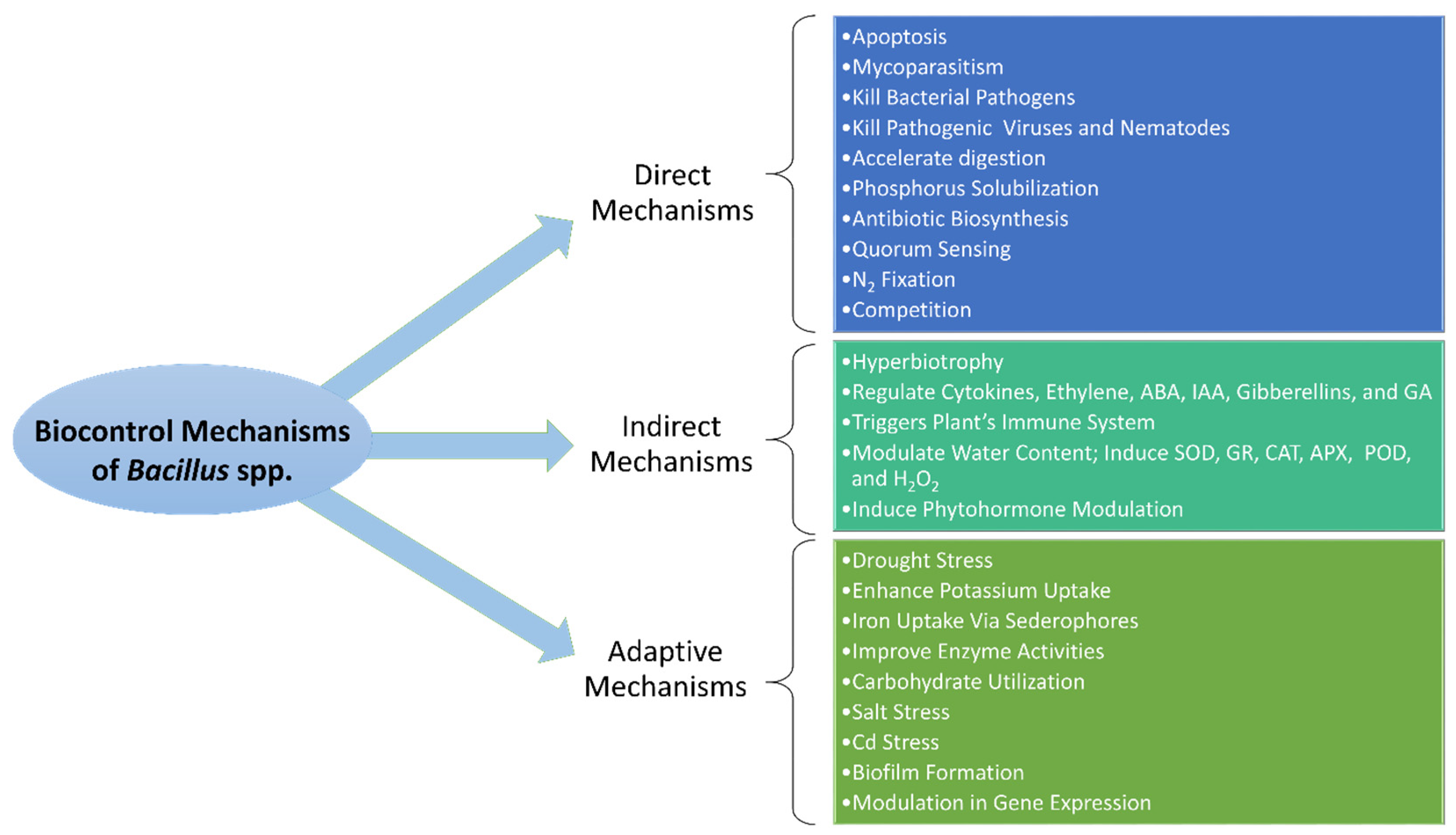
Figure 1. Biocontrol mechanisms of Bacillus spp. in plant growth promotion (PGP) and pathogen control. The figure illustrates their direct, indirect and adaptive effects against pathogens, modulation of plant immune responses and phytohormones, and enhancement of plant tolerance to abiotic stresses.
Plants 15 01834 g001
Figure 2. Overview of Bacillus spp. mediated plant protection through multiple antagonistic and immunomodulatory mechanisms. Bacillus species enhance plant immunity and disease resistance through diverse strategies including production of antimicrobial compounds, competition for nutrients and niches, and suppression of pathogenic microbes and exhibit mycoparasitism, nematode inhibition, and antiviral activities, contributing to overall plant health and resilience.
Plants 15 01834 g002
Figure 3. Key AMCs produced by Bacillus spp. (a) Main lipopeptides, (b) PKs produced by Bacillus spp., (c) VOCs showing antibacterial activity against phytopathogenic bacteria, (d) VOCs showing antifungal activity against phytopathogenic fungi.
Plants 15 01834 g003
Figure 4. Strategies enhancing field performance of Bacillus-based BCAs. The left side of the figure shows the traditional methods to improve the biocontrol efficacy of Bacillus spp. like using chemicals with Bacillus spp. or using different Bacillus spp. The right side of the figure shows modern SynCom and rizosphere-derived prebiotics approaches and combines impact of microbiome to boost the biocontrol efficacy of Bacillus spp.
Plants 15 01834 g004
Figure 5. Cross-kingdom opportunistic pathogenicity of Bacillus spp.: environmental triggers, virulence determinants, and host physiological disruption. The schematic illustrates how environmental stressors (nutrient limitation, abiotic stress, and horizontal gene transfer) can activate pathogenic determinants in Bacillus spp., including toxin complexes (Hbl, Nhe, CytK), degradative enzymes (proteases, phospholipases, cell wall-degrading enzymes), and regulatory systems controlling iron acquisition and oxidative stress responses. These factors mediate physiological and molecular disruptions across plant, animal, and human hosts, leading to oxidative stress, membrane damage, tissue necrosis, and systemic disease manifestations.
Plants 15 01834 g005
Table 1. Role of different Bacillus spp. in plant growth and immunity.
Bacillus spp.FunctionReferences
B. altitudinis Y-14Lowered the fruit deterioration rate and quality decay, repressed MDA buildup, improved SOD and POD action levels. 1-methylcyclopropene + B. altitudinis Y-14 treatment effectively condensed the deterioration rate.[24]
B. australimaris BLR41Shoot length was observed by 30% in the medicinal plant Barleria lupulina Lindl in the test by zinc and phosphate solubilization.[6]
B. licheniformis BaDB6, B. velezensis SM-95Stimulated seedling development of Lessertia frutescens and produce siderophores and hydrolytic enzymes.[11]
B. pacificus G124Enhanced plant drought tolerance, leaf area, chlorophyll content, relative water content, and root enlargement in both A. thaliana and Medicago sativa seedlings under barren conditions. Moreover, G124 improved antioxidant enzyme actions and osmolyte gathering, while reducing MDA and ROS levels.[25]
B. safensis P1.5SSolubilize phosphate under abiotic stress like different pH, temperature, and salinity. [26]
B. siamensis R27Stimulated lettuce seedling growth and aided removed Cd2+ from the growth medium with 80.1% efficacy and improved antioxidant actions for scavenging ROS brought by Cd2+ stress.[27]
B. subtilisImproved wheat (Triticum aestivum L.) seed germination in different Cd concentrations.[28]
B. subtilisB. subtilis decreased the buildup of superoxide, improved the plant defense enzymes in chickpea plants (Cicer arietinum L.) through seed biopriming.[29]
B. subtilis OKB105Control auxin homeostasis in A. thaliana. [21]
B. velezensis, B. megaterium, Produce IAA, gibberellic acid (GA), and siderophore, and solubilize phosphate. [23]
Table 2. Recent research on Bacillus spp. as BCAs against different plant pathogens.
Bacillus spp. as BCAPathogenic Bacterial SpeciesTreated PlantReferences
Bacillus sp. USML8 and USML9, and Bacillus sp. USMR1,Xanthomonas oryzae pv. oryzaeRice[48]
Bacillus WY66 and WY519A. tumefaciensCherry[36]
B. amyloliquefaciens WS-10R. solanacearumTobacco[49]
B. safensis ZK-1P. syringae pv. actinidiae, P. alcaligenes ZK-2, Clarireedia paspaliKiwifruit
Turf grass
[50]
B. subtilis R31R. solanacearumTomato[51]
B. subtilis KA9R. solanacearumChili[52]
B. subtilis KJ-2, and B. amyloliquefaciens WK-2R. solanacearumChili[53]
B. velezensis ZK-3X. oryzae pv. oryzaeRice[50]
B. velezensis JZB. altitudinis m-1Strawberry[35]
B. velezensis P64, B. safensis P114, and B. halotolerans P122X. euvesicatoriaPepper[54]
B. velezensis Bv21X. citri subsp. citriOnion[55]
B. velezensis JCK-1618, and B. velezensis JCK-1696Bukholderia contaminans [9]
B. velezensis Y19R. solanacearumTobacco[56]
B. vallismortis BL01Erwinia carotovora 3304, E. carotovora pv. atroseptica 822, X. campestris pv. vesicatoria 7767, P. syringae pv. tomato 8949, P. syringae pv. atrofaciens P-88, P. syringae 213Tomato[57]
B. velezensis FZB42Xanthomonas campestris pv. campestrisCabbage[58]
Pathogenic fungal species
B. amyloliquefaciens SFB-1Ceratocystis fimbriataSweet potato[38]
B. amyloliquefaciens YN201732E. cichoracearumTobacco[42]
B. atrophaeus DX-9Streptomyces spp.Potato[34]
B. inaquosorum, B. tequilensis, and B. spizizeniiC. fructicolaTea[59]
B. paralicheniformis NB stem 4Magnaporthe griseaPearl millet[60]
B. siamensisC. gloeosporioidesMango[39]
B. subtilisFusarium spp.Banana[61]
B. subtilis IBFCBF-4F. oxysporumWatermelon[62]
B. subtilisR. solani, S. rolfsii, and F. oxysporum f. sp. ciceriChickpea plants[40]
B. thuringiensisS. sclerotiorumMustard[63]
B. velezensis Amfr20R. solani, Verticillium dahliae, C. acutatum, F. oxysporum f.sp. radicis-lycopersiciOlive[64]
B. velezensis Bac302Alternaria tenuissimaChinese herb (Schisandra chinensis)[65]
B. velezensis BBE18F. oxysporum f. sp. cubenseBanana[66]
B. velezensis Y6R. solaniRice[67]
B. velezensis LSR7Ganoderma pseudoferreumRubber[68]
B. velezensis ZK-3Magnaporthe oryzaeRice[50]
B. velezensis QSE-21B. cinereaTomato[69]
B. velezensis FQ-G3B. cinereaTomato[70]
B. velezensis NT35Ilyonectria robustaGinseng[37]
Pathogenic parasitic species
B. aryabhattai Ba1-7, B. megatherium Ba2-4, and B. halotolerans Ba2-6SCN (H. glycines)Soybean[46]
B. cereus G5RKN (M. graminicola)Rice[47]
B. licheniformis MW301654M. incognitaBanana[71]
B. megateriumRKN (M. javanica)Tomato[72]
B. methylotrophicus TA-1M. incognitaTomato[73]
B. pumilus S1-10M. incognitaGinger[74]
B. pumilus Y-26Stem nematode (Ditylenchus destructor)Sweet potato[75]
B. subtilis JCK-1398PWN (Bursaphelenchus xylophilus)Pine[76]
B. subtilis JCK-1398(PWN, B. xylophilus)Pine[77]
B. velezensis Bv-25M. incognita [78]
B. velezensis VB7RKN (Meloidogyne incognita)Tomato[44]
B. velezensis A-27M. incognita [79]
B. velezensis Ag109M. javanica and Pratylenchus brachyurusSoybean[80]
Pathogenic virial species
B. amyloliquefaciensGBNVChili[81]
B. amyloliquefaciensTomato yellow leaf curl virus (Begomovirus)Tomato[82]
B. amyloliquefaciens TBorg1TMV (Tobamovirus)Tomato[83]
B. amyloliquefaciensTomato-spotted wilt virus (Tospo virus)Tomato[84]
B. subtilis DR06TMV (Tobamo virus)Tomato[85]
B. subtilis BST8 + B. subtilis EBPBS-4 + B. subtilis Bbv57Orthotospovirus arachinecrosisTomato[86]
B. subtilis BST8, and Bbv57, and B. amyloliquefaciens Ka1GBNVTomato[87]
B. velezensis VB7 and B. licheniformis Soya1GBNVTomato[88]
B. licheniformis, B. tequilensis NBL6, B. velezensis VB7GBNV Orthotospovirus arachinecrosisCowpea and tomato[89]
Table 3. Commercial BCAs using Bacillus spp. available on the market (adopted and modified from [94,95]).
Brand NameBacteria UsedManufacturerMode of ActionTarget UseFormulation
RhizoVitalB. amyloliquefaciens FZB24ABiTEP, Gmbh (Berlin, Germany)PGPSoil and seed treatmentLiquid
Double nickelB. amyloliquefaciens D747Certis Biologicals (Columbia, MD, USA)Antibiosis, ISR inductionAntifungal Wettable powder (WP)
Stargus, AmplitudeB. amyloliquefaciens F727Marrone Bio Innovations, Bio Ag Services (Faisalabad, Pakistan)Antibiosis, ISR induction, PGPAntifungalWP
TaegroB. amyloliquefaciens FZB24Novozymes, Salem, VA, USAAntagonistic activity, ISRAntifungalWP
LifeGard WGB. mycoides JCertis SUA (San Diego, CA, USA)ISR, fungicidesBroad spectrum antifungalWettable granular
SonataB. pumilus QST2808Bayer (Leverkusen, Germany)Produce antifungal compoundsPowdery mildew, rustsLiquid
Serenade ASOB. subtilis QST713Bayer (Leverkusen, Germany)Produce lipopeptides, induces SRBroad spectrum antifungalLiquid suspension
CompanionB. subtilis GB03Growth Products, Gustafson Inc., Plano, TX, USAAntagonistic metabolites, PGPTurf, ornamentals, vegetablesLiquid
ThuricideB. thuringiensisBonide, Southern Ag (Boone, NC, USA)Toxin production (Cry proteins)Lepidopteran larvae (insects)Liquid or dust
Biobit, DipelB. thuringiensis Subsp. kurstakiValent BioScienes (Libertyville, IL, USA), Certis (Columbia, MD, USA)Toxin production (Cry proteins)Caterpillars (e.g., armyworms, loopers)WP or DF
XenTari, AgreeB. thuringiensis subsp. AizawaiValent BioSciences (Libertyville, IL, USA), Certis USACry proteinsDiamondback moth, armywormWP or DF
Table 4. Major VOCs produced by Bacillus spp. and their agricultural applications.
VOC ClassRepresentative CompoundsMajor Biological ActivityTarget OrganismReferences
AlcoholsAcetoin, 2,3-butanediolPlant growth promotion, ISR inductionEnhanced biomass accumulation, modulation of cytokinin, ET and auxin signaling[14,21]
Alcohols3-Methyl-2-butanol, 1-Octen-3-olNematicidal activitySuppression of M. graminicola and gall formation[47]
KetonesAcetoin (3-hydroxy-2-butanone)Growth promotion and defense primingIncreased growth and activation of plant defense pathways[14]
AldehydesFormaldehyde-derived metabolic intermediatesDetoxification and ecological fitnessImproved microbial survival in plant-associated environments[96]
Sulfur-containing compoundsDimethyl sulfide, dimethyl disulfideAntifungal and antibacterial activityInhibition of fungal and bacterial pathogens[7,97]
Aromatic/heterocyclic VOCsBenzothiazoleAntimicrobial activity and defense signalingFungal suppression and host defense activation[7,97]
Mixed VOC blendStrain-specific VOC mixturesRoot growth promotion and stress adaptationAltered auxin homeostasis and enhanced root architecture[18,21]
Disclaimer/Publisher’s Note: The statements, opinions and data contained in all publications are solely those of the individual author(s) and contributor(s) and not of MDPI and/or the editor(s). MDPI and/or the editor(s) disclaim responsibility for any injury to people or property resulting from any ideas, methods, instructions or products referred to in the content.