Article

Functional Characterisation of NF-YCs in True Leaf Biomass Accumulation

1
Yantai Key Laboratory of Molecular Breeding for High-Yield and Stress-Resistant Crops and Efficient Cultivation, The Engineering Research Institute of Agriculture and Forestry, Ludong University, Yantai 264025, China
2
Yantai Technology Center of Characteristic Plant Gene Editing & Germplasm Innovation, College of Horticulture, Ludong University, Yantai 264025, China
3
Changli Institute of Pomology, Hebei Academy of Agriculture and Forestry Sciences, Qinhuangdao 066600, China
4
State Key Laboratory for Crop Stress Resistance and High-Efficiency Production, Northwest A&F University, Yangling 712100, China
*
Authors to whom correspondence should be addressed.
These authors contributed equally to this work.
Plants 2026, 15(12), 1789; https://doi.org/10.3390/plants15121789
Submission received: 9 May 2026 / Revised: 28 May 2026 / Accepted: 9 June 2026 / Published: 10 June 2026
(This article belongs to the Special Issue Biological Signaling in Plant Development)

Abstract

Leaf biomass accumulation is a critical determinant of photosynthetic capacity and crop productivity. In Arabidopsis thaliana, multiple hormonal and environmental pathways, including brassinosteroid (BR), auxin and light signaling, as well as functional proteins such as TNY (TINY), SAUR21 (SMALL AUXIN UP-RNA21) and HY5 (ELONGATED HYPOCOTYL 5), play important roles in regulating leaf growth. However, the precise regulatory mechanisms integrating these factors during leaf biomass accumulation remain incompletely understood. Herein, we showed that NF-YC3/4/9, members of the NUCLEAR FACTOR Y subunit C family, were required for normal leaf cell expansion. Loss-of-function mutation of NF-YC3/4/9 (nf-ycT) resulted in significantly smaller true leaves with reduced leaf cell expansion. NF-YC9 directly regulated the expression of HY5, HYH, and SAUR21 and indirectly regulated the expression of TNY. These results help reveal the function of NF-YCs in leaf growth and provide insights into the regulation of hormonal and transcriptional networks controlling leaf biomass accumulation in A. thaliana.

1. Introduction

Leaves serve as the main photosynthetic structures in plants, efficiently transforming solar energy into biological energy to support plant growth and development [1]. Accumulation of leaf biomass, encompassing the increased size and number of true leaves, before flowering boosts photosynthetic performance and stimulates seed development, consequently improving seed production and quality [2]. Moreover, the young leaves and bolting stalks of Brassica crops are also important sources of diverse nutrients and phytochemicals beneficial to human health [3]. However, the precise regulatory mechanisms integrating multiple hormonal and transcriptional pathways during leaf biomass accumulation remain incompletely understood.
The close evolutionary relationship between A. thaliana and Brassica crops makes it an ideal model system for studying leaf biomass accumulation [4,5]. Leaf initiation occurs at the peripheral regions of the shoot apical meristem. A cylindrical primordium flattens to form the leaf blade. Following the cessation of cell proliferation, cells begin to enlarge and expansion predominates as the principal driver of organ growth [6]. In the regulatory network controlling leaf biomass accumulation in A. thaliana, factors that mediate hormonal and environmental signals play critical roles [2,7,8,9]. Of these, TNY was demonstrated to negatively regulate leaf growth, likely by interfering with brassinosteroid (BR)-mediated cell elongation processes [10]. At the post-translational level, BIN2 (BRASSINOSTEROID-INSENSITIVE 2) phosphorylates and stabilizes TNY [10]. Besides BRs, auxin is also recognized to promote cell elongation through enhanced wall extensibility [11]. Auxin receptor ABP1 (AUXIN BINDING PROTEIN 1) promotes cell expansion by regulating cell wall remodeling gene expression and modulating xyloglucan structure. [12]. Among auxin-induced genes, SAURs form the largest family, with 79 members in A. thaliana and comparable numbers in other plants [13]. The expression of numerous auxin-inducible SAURs is tightly linked to ongoing cell expansion [14]. Members of the SAUR19 subfamily act as positive regulators of cell expansion. Their overexpression promotes cell enlargement, whereas their knockdown reduces growth. These effects are likely mediated by modulation of auxin transport [15], and constitutive SAUR19 expression in tomato promotes auxin-independent elongation growth [14]. bZIP transcription factor (TF) HY5 plays a central role in the light signaling pathway, promoting photomorphogenesis through direct or indirect interactions with multiple key factors, including B-box-containing proteins, and regulating nearly one-third of the genes in the Arabidopsis genome [16,17,18,19]. Moreover, besides having shorter hypocotyls, HY5 overexpression lines also showed markedly smaller leaves, which are associated with its interaction with ABI5 (ABA INSENSITIVE 5) and alterations in ABA signaling [20]. HYH (HY5-HOMOLOG) has been shown to share overlapping functions with HY5 and act redundantly in regulating plant growth and development [21]. Nevertheless, the precise regulatory mechanisms by which these factors orchestrate leaf biomass accumulation remain to be fully elucidated.
In higher plants, the NF-YCs (NUCLEAR FACTORY C proteins) serve as crucial regulators involved in diverse developmental processes and stress response. In A. thaliana, NF-YCs are required for CONSTANS-mediated, photoperiod-dependent flowering regulation [22]. The NF-YC–RGL2 (RGA-LIKE 2) module mediates crosstalk between GA and ABA signaling to modulate seed germination [23]. NF-YCs and ARP6 (ACTIN-RELATED PROTEIN 6) cooperatively suppress hypocotyl elongation by mediating H2A.Z deposition at target IAAs during photomorphogenesis [24]. NF-YC9 overexpression increases seedling sensitivity to abscisic acid [25]. The QQS orphan gene and its interactor NF-YC4 confer enhanced resistance to pests and pathogens [26]. Jasmonate signaling enhances salt stress tolerance via the NF-YC9-YA1-YB2 trimeric complex [27]. SUMOylation promotes the assembly of the NF-YC10-YB3 complex to enhance thermotolerance [28]. NF-YCs cooperate with ABF3 (ABSCISIC ACID RESPONSIVE ELEMENTS-BINDING FACTOR 3) and ABF4 to modulate SOC1 (SUPPRESSOR OF OVEREXPRESSION OF CO 1) expression, thereby mediating drought-accelerated flowering [29]. NF-YCs also negatively regulate seed germination in response to salinity stress [30]. However, the role of NF-YCs in regulating leaf biomass accumulation remains poorly characterized, and their functional relationship with the aforementioned factors remains to be elucidated.
In this study, it was found that nf-ycT (nf-yc3-2 nf-yc4-1 nf-yc9-1) mutant true leaves were significantly smaller than those of the wild type, with reduced leaf cell expansion. nf-ycT mutation affected the expression of a series of genes involved in hormone response and photomorphogenesis, including transcription factors HY5, HYH, and TNY and hormone-related BAT1 (BR-RELATED ACYLTRANSFERASE 1), GRACE (GERMINATION REPRESSION AND CELL EXPANSION RECEPTOR-LIKE KINASE), and SAUR21. Notably, NF-YC9 directly regulates the expression of HY5, HYH, and SAUR21. These results indicate that NF-YCs function as important modulators linking hormone regulation and leaf biomass accumulation.

2. Materials and Methods

2.1. Plant Materials and Growth Conditions

The nf-ycT triple mutant (nf-yc3-2 nf-yc4-1 nf-yc9-1) in the Col-0 background and complementation line in nf-ycT background (pNF-YC9:NF-YC9-FLAG;nf-ycT) have been utilized previously [31]. Seeds were stratified at 4 °C for 2 days prior to transfer to a growth chamber. Detailed growth conditions for all plants were as previously reported [30]. Briefly, one-week-old seedlings cultivated on 1/2 MS medium were transferred to 0.6 L pots containing a 4:1 (v/v) mixture of nutrient soil and autoclaved vermiculite, and then maintained under 16 h light (natural daylight supplemented with LED lamps, average intensity 160 μmol·m−2·s−1)/8 h dark cycles with 60 ± 5% relative humidity at 22 °C.

2.2. Morphological Observation

Randomly selected whole plants and true leaves were photographed with a Canon camera (Canon EOS 7D, Tokyo, Japan). To examine subepidermal cells, the middle region of true leaves was peeled to expose the subepidermal layer, and images were captured using an Olympus BX63 microscope (Olympus BX63, Tokyo, Japan). Leaf area and cell area were quantified using ImageJ software (version 1.54; National Institutes of Health, Bethesda, MD, USA). The cell number per leaf was estimated by dividing the average leaf area by the average cell area.

2.3. RNA-Seq Experiment and Data Analysis

RNA-seq analysis was performed on 10-day-old seedlings cultivated on 1/2 MS medium of the nf-ycT and Col-0. For each genotype, three biological replicates were submitted to BGI-Tech (Shenzhen, China) for sequencing according to their standard pipeline (http://bgitechsolutions.com/sequencing/45, accessed on 14 March 2025). In brief, paired-end reads were generated on a BGISEQ-500 platform. Low-quality reads were discarded using SOAPnuke (v1.4.0). The reference genome of A. thaliana was retrieved from TAIR (https://www.arabidopsis.org/, accessed on 14 March 2025), and read alignment was performed with HISAT (http://www.ccb.jhu.edu/software/hisat, accessed on 14 March 2025). Differentially expressed genes (DEGs) were defined by |log2 fold change| ≥ 1 and false discovery rate (FDR) ≤ 0.05. Functional enrichment analysis of gene ontologies (GO) was carried out via the DAVID platform (https://davidbioinformatics.nih.gov/, accessed on 25 November 2025).

2.4. Gene Expression Analysis

For each genotype, total RNA was extracted using the Plant RNA Kit (Transgen Biotech Co. Ltd., Beijing, China) and subsequently converted to cDNA with EasyScript One-Step gDNA Removal and cDNA Synthesis SuperMix (Transgen Biotech Co. Ltd., Beijing, China). RT-qPCR was performed on an Applied Biosystems StepOne Plus™ instrument (Applied Biosystems, Waltham, MA, USA) using SYBR Green Master Mix (Transgen Biotech Co. Ltd., Beijing, China) with three biological replicates. Transcript abundance was calculated relative to the internal reference gene EF1αA4. Primer sequences are provided in Supplementary Table S1.

2.5. ChIP-qPCR Assay

ChIP-qPCR was performed following a previously described protocol [30]. Briefly, seedlings of pNF-YC9:NF-YC9-FLAG;nf-ycT and Col-0 were vacuum-infiltrated with 1% formaldehyde on ice for 15 min to cross-link proteins, and the reaction was quenched by adding 125 mM glycine for another 5 min. After two washes with distilled water, the samples were snap-frozen in liquid nitrogen. Isolated chromatin was sonicated to produce DNA fragments ranging from 250 to 700 bp. The sheared chromatin was immunoprecipitated overnight at 4 °C using Pierce anti-FLAG magnetic beads (Thermo Fisher, Waltham, MA, USA). The beads were collected on a magnetic stand, washed, and the immune complexes were eluted twice. The eluates were then reverse-crosslinked in 5 M NaCl at 65 °C for 10 h, followed by protein digestion with 1 M Tris-HCl (pH 6.5), 0.5 M EDTA, and 1.5 μL proteinase K (20 mg/mL) at 45 °C for 1 h. DNA was purified via phenol/chloroform/isoamyl alcohol (25:24:1) extraction and stored at −80 °C. Relative enrichment of each fragment was determined via RT-qPCR. Three technical replicates were run per independent experiment, and the entire experiment was repeated three times. Enrichment values were normalized to the internal control EF1αA4 (ratio of pNF-YC9:NF-YC9-FLAG;nf-ycT to Col-0), with TUB2 serving as a negative control. All ChIP-qPCR primers are listed in Supplementary Table S1.

2.6. Dual-Luciferase Assay

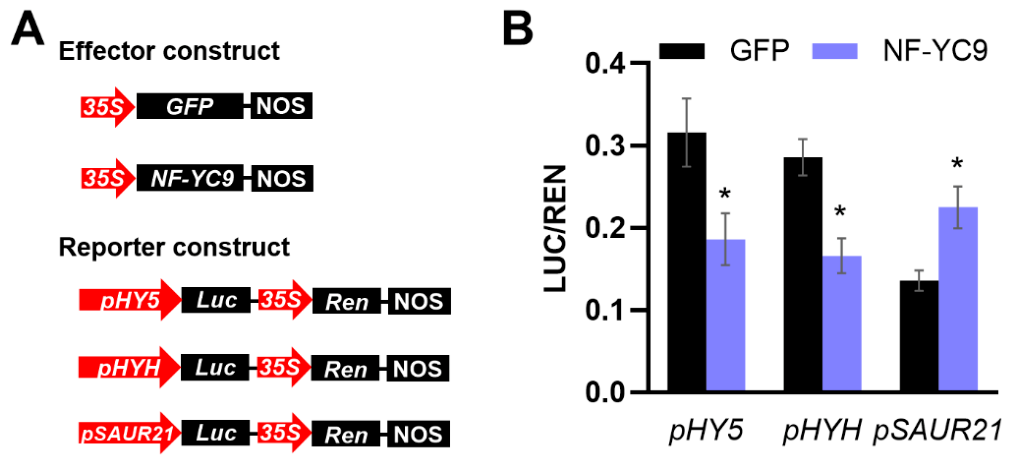
Dual-luciferase reporter assays were carried out as previously described [30]. Effector constructs carrying GFP or NF-YC9, along with reporter constructs containing the promoters of HY5, HYH, or SAUR21, were introduced into Agrobacterium tumefaciens strain GV3101 harboring pSoup-P19 (Weidi Biotechnology, Shanghai, China). Plasmid mixtures were infiltrated into young leaves of 4-week-old Nicotiana benthamiana plants. Infiltrated plants were then placed in a growth chamber under long-day conditions (16 h light/8 h dark) at 22 °C for three days. Total protein was extracted from the infiltrated leaf tissues using Cell Lysis Buffer (Yeasen Biotechnology, Shanghai, China). Firefly luciferase (LUC) and Renilla luciferase (REN, internal control) activities were measured with a Luciferase Reporter Gene Assay Kit (Yeasen Biotechnology, Shanghai, China) on a multifunctional microplate reader (Tecan, Männedorf, Switzerland). Nine independent biological replicates were examined for each combination. Primers used for vector construction are listed in Supplementary Table S1.

2.7. Statistical Analyses

A completely randomized design was adopted. Data are presented as mean ± SD. Statistical comparisons between two groups were performed using a two-tailed Student’s t-test. A significance level of p < 0.05 was considered statistically significant.

3. Results

3.1. nf-ycT Triple Mutant Exhibits Reduced True Leaf Size

Previous β-glucuronidase (GUS) reporter assays in A. thaliana seedlings revealed that NF-YC3, NF-YC4, and NF-YC9 exhibited strong and consistent leaf mesophyll and vascular expression [22]. Therefore, NF-YCs were selected as potential targets in this study to investigate their roles in the leaf growth process. Considering the potential functional redundancy among NF-YCs, the nf-ycT triple mutant (nf-yc3-2 nf-yc4-1 nf-yc9-1) in the Col-0 background was selected for phenotypic analysis.
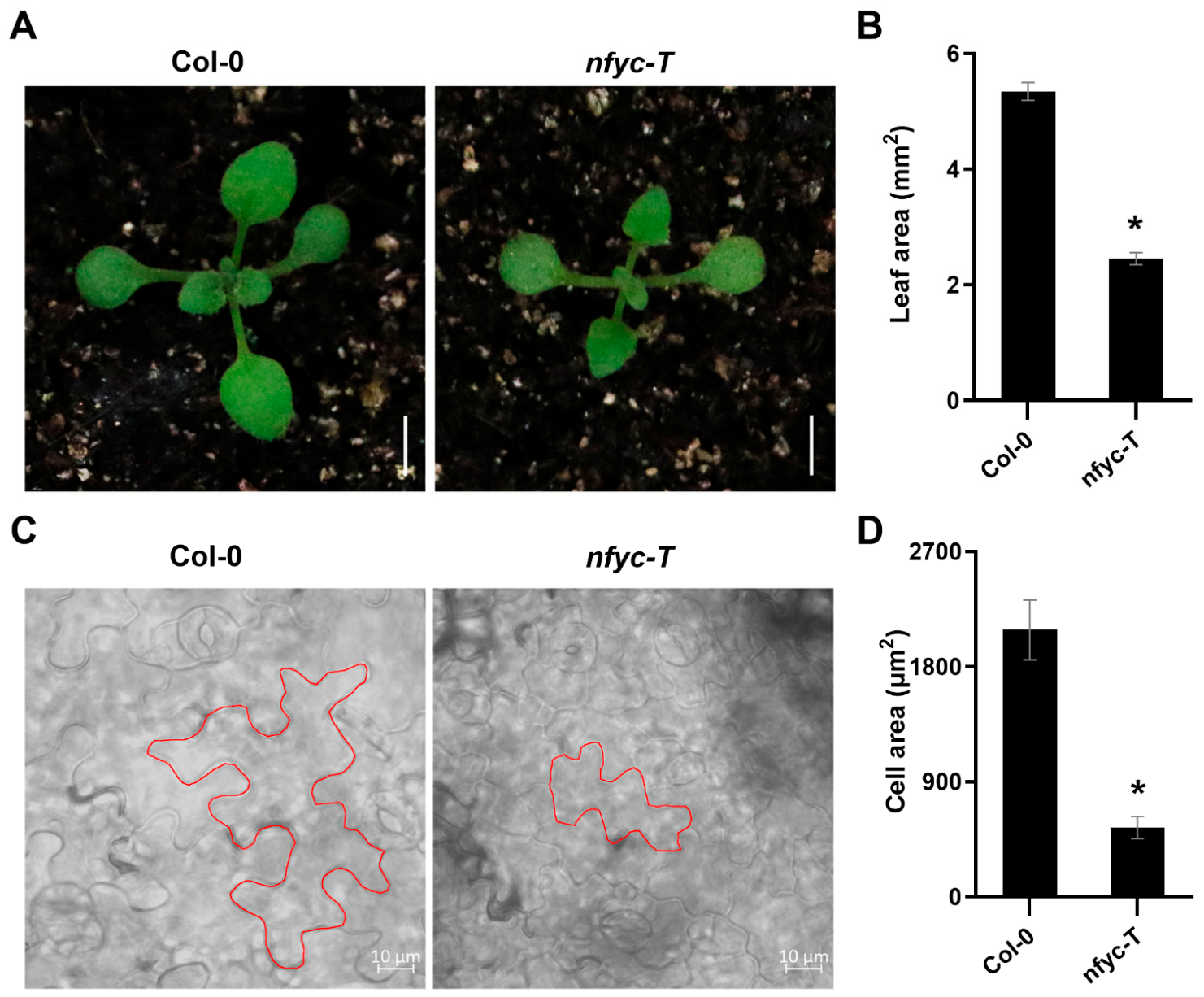
The nf-ycT were grown in a growth chamber together with the wild-type control. Phenotypic observation revealed that at about 14 days after germination (DAG), nf-ycT seedlings were significantly smaller than Col-0 (Figure 1A). Leaf area measurement further showed that the true leaf area of nf-ycT was approximately half that of Col-0 (Figure 1B). Because cell size is a key determinant of leaf size, the subepidermal cell area was measured in nf-ycT and Col-0 leaves. The cell area was significantly reduced in nf-ycT leaves (Figure 1C,D). Moreover, nf-ycT showed significantly reduced true leaf biomass relative to Col-0, as measured by total true leaf fresh weight at 14 DAG (Supplementary Figure S1), despite a slight increase in leaf cell number (Supplementary Figure S2). Collectively, these results suggest that NF-YCs promote true leaf biomass accumulation by increasing cell area during leaf development in A. thaliana.

3.2. Transcriptome Profiling of the nf-ycT Quadruple Mutant

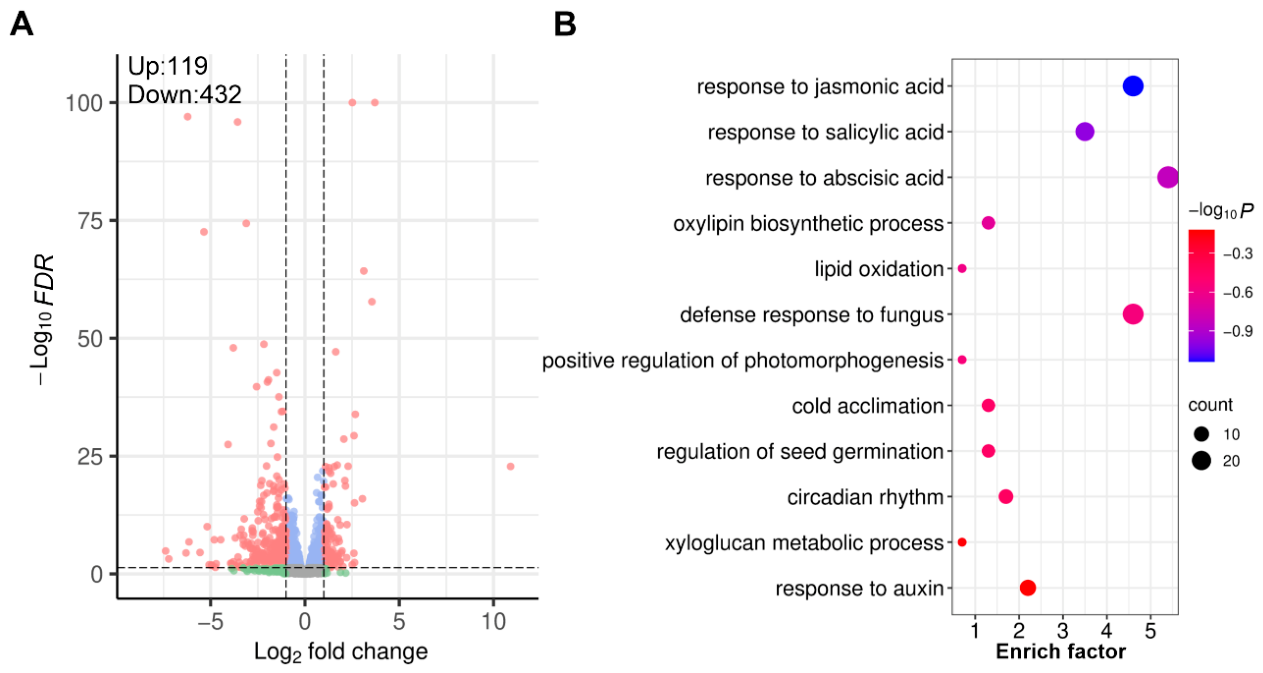
To understand the role of NF-YCs in promoting true leaf biomass accumulation, a genome-wide transcriptome analysis was conducted using true leaves of nf-ycT and Col-0 harvested at 10 DAG. The transcriptional changes identified in this assay could promote, at least in part, a deeper insight into the regulatory circuits underlying the NF-YC-controlled regulation of leaf development. The assay identified 551 differentially expressed genes (DEGs), among which 432 were downregulated and 119 were upregulated in nf-ycT leaves (Figure 2A; Supplementary Table S2).
To gain insight into the functional categories and pathways perturbed by the loss of NF-YC function, GO enrichment analysis was conducted on the identified DEGs. GO enrichment analysis revealed that the DEGs were significantly enriched in functional categories associated with responses to multiple phytohormones (including jasmonic acid (JA), salicylic acid (SA), abscisic acid (ABA), and auxin), abiotic and biotic stresses (cold and fungal infection), as well as photomorphogenesis, seed germination, and xyloglucan metabolism (Figure 2B). Collectively, these findings imply that NF-YCs regulate leaf growth by potentially integrating multiple regulatory networks, including those associated with phytohormone signaling, light-responsive pathways, and cell wall metabolism.

3.3. Verification of DEGs by qRT-PCR

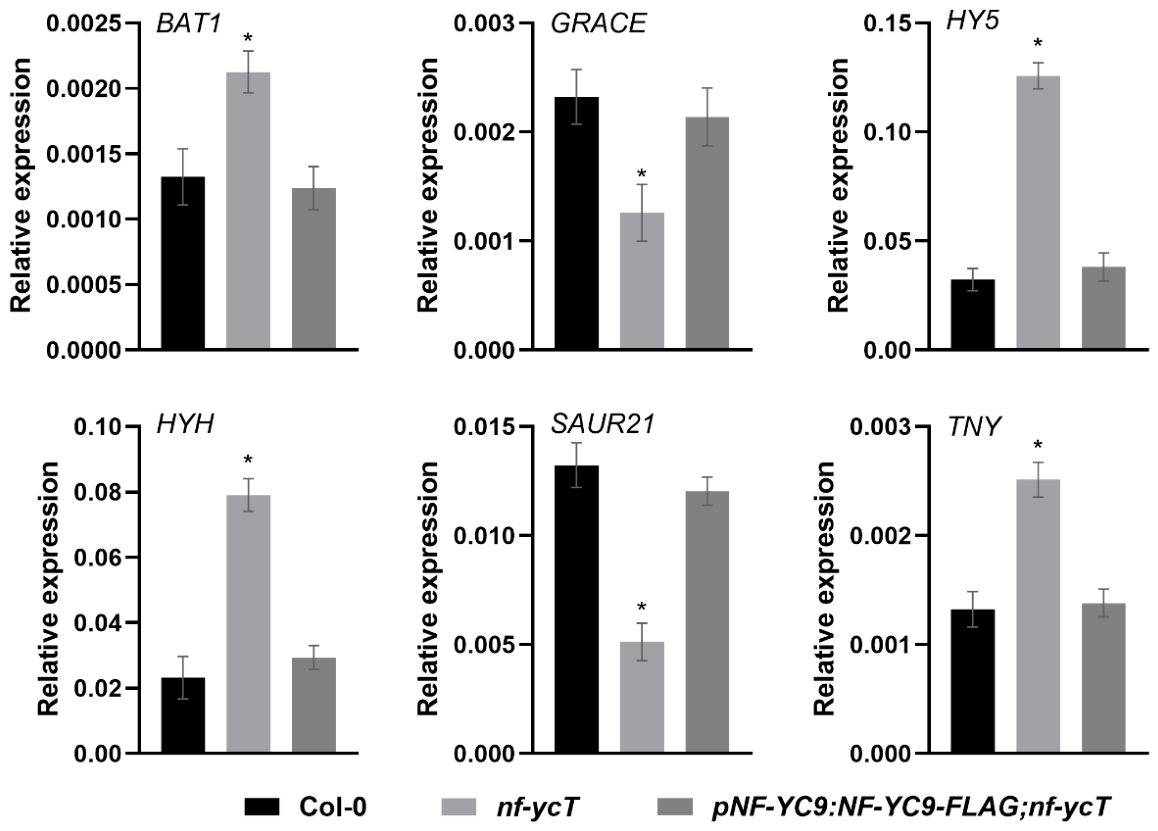
Based on the above GO enrichment results, some hub genes associated with the key biological processes were selected and analyzed. The expression of JA-signaling-related genes JAZ3 (JASMONATE-ZIM-DOMAIN PROTEIN 3), JAZ8, JAZ7, and JAZ10 was downregulated, whereas the ethylene-related gene TNY2 was upregulated. Among GA-signaling components, RGL2 was upregulated. Auxin-related genes SAUR21, IAA1 (INDOLEACETIC ACID-INDUCED PROTEIN 1), and IAA5 were downregulated, whereas PIN5 (PIN-FORMED 5) was upregulated. For BR signaling, both BAT1 and TNY were upregulated. ABA-associated genes ABI5 and CYP707A3 were also upregulated. Stress-responsive genes HSFA2 (HEAT SHOCK TRANSCRIPTION FACTOR A2), CBF1 (C-REPEAT/DRE BINDING FACTOR 1), and CBF2 were upregulated, while P5CS1 was downregulated. Xyloglucan metabolic genes XTH24 (xyloglucan endotransglucosylase/hydrolase 24) and XTH25 were downregulated. Light-responsive genes HY5 and HYH were upregulated, whereas the fungus-responsive gene OPR3 (OXOPHYTODIENOATE-REDUCTASE 3) was downregulated (Supplementary Table S2). Furthermore, based on their functional characterization in previously published studies, candidate genes involved in growth regulation, including BAT1, GRACE, HY5, HYH, SAUR21, and TNY, were selected for qRT-PCR validation of their expression patterns in true leaves of nf-ycT, pNF-YC9:NF-YC9-FLAG;nf-ycT and Col-0 plants at 10 DAG (Figure 3). As expected, the qRT-PCR results for these six genes in nf-ycT and Col-0 were consistent with the transcriptome data (Supplementary Table S2), and their expression levels could be restored to the wild-type level in the pNF-YC9:NF-YC9-FLAG;nf-ycT line. The NF-YC9-FLAG fusion protein retained the same biological function as NF-YC9 in true leaves (Supplementary Figure S3). Collectively, the transcriptome approach proves to be a powerful means to uncover genes downstream of NF-YCs.

3.4. NF-YC9 Directly Binds to the Promoters of HY5, HYH, and SAUR21

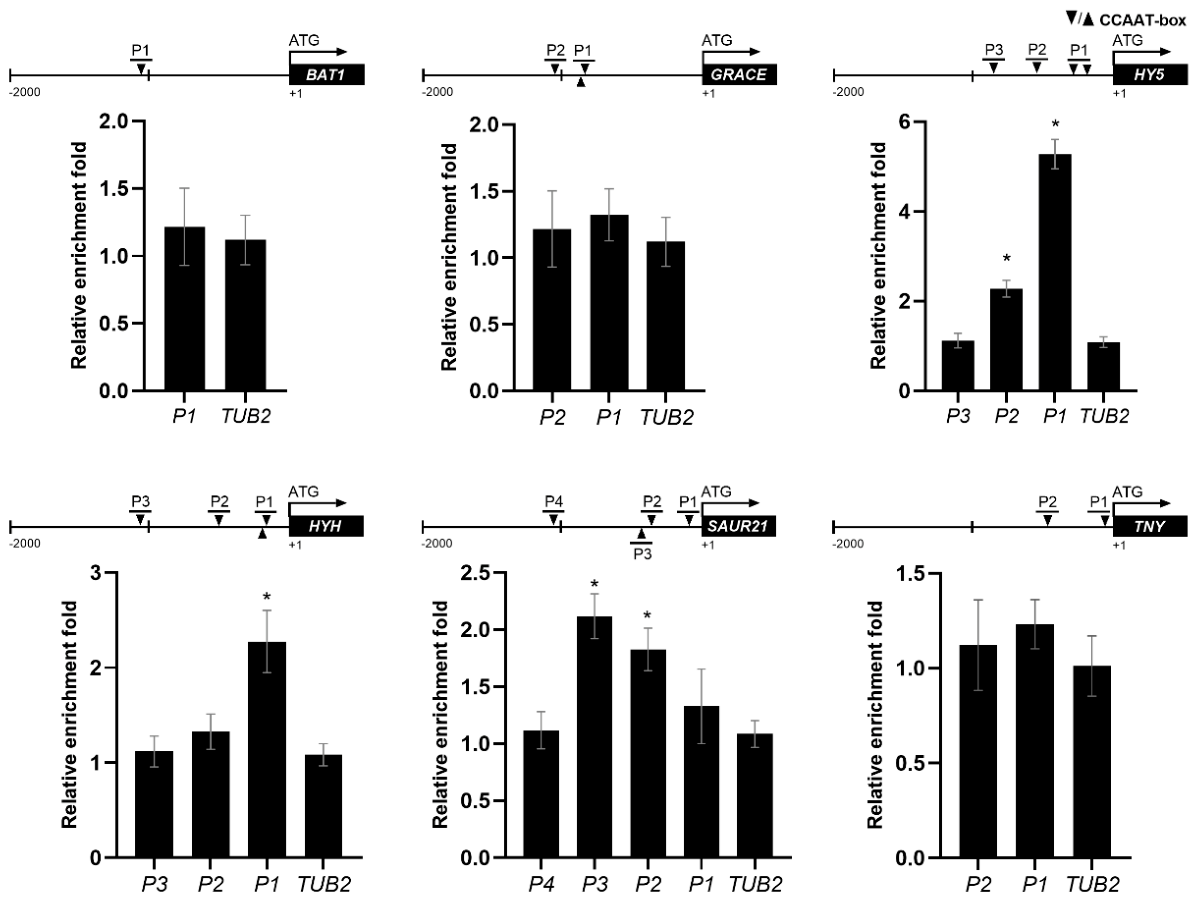
NF-YCs are subunits of the trimeric NF-Y complex, which binds selectively to the CCAAT-box motif in eukaryotes. Sequence analysis revealed that the promoters of all six DEGs contained CCAAT-box motifs (Figure 4). To investigate how NF-YCs regulate the expression of these six genes, ChIP-qPCR assays were performed using true leaves of pNF-YC9:NF-YC9-FLAG;nf-ycT plants at 14 DAG. The ChIP-qPCR results showed that NF-YC9 was associated with the promoter regions near fragments P1 and P2 of HY5, fragments P1 of HYH, and fragments P2 and P3 of SAUR21, whereas it did not bind to the promoters of BAT1, GRACE, or TNY (Figure 4). These results suggest that HY5, HYH, and SAUR21 are direct targets of NF-YC9, but BAT1, GRACE, and TNY are not.

3.5. NF-YC9 Directly Regulates the Expression of HY5, HYH, and SAUR21

Additionally, this work assessed the transcriptional regulation of NF-YC9 on HY5, HYH, and SAUR21 via dual-luciferase reporter assay in N. benthamiana leaves. Constructs harboring HY5, HYH, and SAUR21 promoter-driven LUC, and 35S promoter-driven REN were used as reporters. The pGreenII 62-SK recombinant vectors carrying the CDSs of GFP and NF-YC9 were used as effectors (Figure 5A). The NF-YC9 effector led to a decrease in ProHY5:LUC and ProHYH:LUC expression and an elevation of ProSAUR21:LUC expression relative to the GFP control (Figure 5B). In summary, these results collectively demonstrate that NF-YC9 binds to the promoters of HY5, HYH, and SAUR21, thus directly regulating their expression to promote true leaf biomass accumulation.

4. Discussion

Leaves serve as the primary photosynthetic organs in plants. Leaf biomass, determined by leaf number and size, directly impacts photosynthetic efficiency and consequently crop yield and quality [2,32]. As a fellow member of the Brassicaceae family, A. thaliana research can shed light on Brassica crops important to human consumption [33,34]. However, the molecular basis of leaf biomass accumulation in A. thaliana remains elusive.
It is well established that leaf size is governed by cell number and size, and that the pre-flowering increase in true leaf number and size enhances leaf biomass accumulation by promoting photosynthetic efficiency [32,35,36]. The reverse genetic assays in this study showed that the true leaves of nf-ycT were significantly smaller than those of Col-0, which might be caused by reduced cell area at 14 DAG (Figure 1). Consistently, the fresh weight of nf-ycT true leaves was also lower than that of Col-0 (Supplementary Figure S1). Therefore, NF-YCs function as positive regulators of true leaf biomass accumulation. The discrepancy in leaf size phenotypes between our study and that of Kumimoto et al. (2010) may be attributed to differences in developmental stages [22]. Moreover, the strong impact of nf-ycT on flowering time subsequently influences late leaf development [22]. Future studies using gene editing to uncouple the flowering defect from the nf-ycT mutation would allow a more comprehensive assessment of leaf phenotypes at the mature stage. Notably, the phenotypic difference was only observed in true leaves but not in cotyledons (Figure 1), further indicating that NF-YCs act as key regulators of true leaf development rather than causing a general growth delay. Similarly, recent studies have revealed that TOP1αs, which are also well-known regulators of flowering time, are involved in true leaf biomass accumulation by modulating cell division, without affecting cotyledons [2]. Given their shared roles in the regulation of both flowering time and leaf growth [37,38], whether any functional connection exists between NF-YCs and TOP1αs, such as protein–protein interaction or transcriptional regulation, represents an intriguing avenue for future investigation.
Leaf biomass accumulation is tightly governed by a complex transcriptional regulatory network [39]. Transcriptomic analysis comparing nf-ycT and Col-0 revealed that the differentially expressed genes (DEGs) were significantly enriched in multiple leaf growth-related biological processes, such as light and hormone responses (Figure 2). Previous studies reported that NF-YCs, together with RGL2, repress GA-mediated seed germination by promoting ABI5 expression [23]. In our study, both RGL2 and ABI5 were upregulated in the nf-ycT mutant (Supplementary Table S2). Given that NF-Ys are important regulators mediating plant development and environmental responses, the opposite role of NF-YCs in ABA signaling between germination and leaf growth may result from spatiotemporal regulation of NF-Y complexes, which consist of various NF-YA/B/C subunits at different developmental stages [40]. Moreover, it has been reported that HY5 shares a substantial set of target genes with NF-YCs [41], and this conclusion is further corroborated by the identification of DEG ABI5 in the present study (Supplementary Table S2). Taken together with previous findings, this suggests that both NF-YCs and HY5 may act upstream of ABI5 [20]. Notably, a recent study demonstrated a physical interaction between NF-YC9 and HY5 [42], seemingly further confirming their co-function at the same regulatory tier. However, our study uncovers a novel transcriptional regulatory mode in which NF-YC9 and HY5 constitute a complex feed-forward loop that controls leaf growth (Figure 4). Based on these findings, we propose that NF-YCs may regulate true leaf growth through HY5-mediated light signaling—a possibility that warrants further investigation, for example, by manipulating light quality or photoperiod conditions.
Phytohormones form a complex regulatory network that controls leaf biomass accumulation. Auxin promotes apoplast acidification by activating cell wall-related gene expression and stimulating proton pump synthesis. It also activates PM H+-ATPases via phosphorylation of their penultimate threonine residue, further contributing to apoplast acidification [11,43]. Moreover, activation of PM H+-ATPase leads to PM hyperpolarization, consequently facilitating solute and water uptake and providing the increased intracellular turgor required for cell expansion [14]. Cell expansion is defined as an increase in cell size and thus plays a fundamental part in plant growth and development [12]. Recent evidence suggests that SAURs can also modulate H+ pumps [13]. Therefore, the reduced cell size observed in the nf-ycT mutant may be associated with decreased auxin-mediated intracellular turgor. GRACE acts as a positive regulator of cell expansion and organ growth, likely through perceiving a yet-unknown ligand via its structurally distinct island domain [44]. BAT1 encodes an acyltransferase that regulates endogenous BR levels by acylating brassinolide, castasterone, and typhasterol, and overexpression of BAT1 leads to typical dwarf growth defects resulting from BR deficiency [45]. On the other hand, JAZs and IAAs function as key repressors of JA and auxin signaling, and their roles in leaf growth regulation, as well as their relationships with NF-YCs, warrant further investigation [46]. The complex patterns of up- and down-regulated genes associated with diverse hormones in the downstream network suggest that additional modulators may be involved in the NF-YC-mediated pathway [23]. Future yeast two-hybrid library screening would therefore be a valuable approach to dissect the interplay between hormone regulation and transcriptional control. In summary, these findings provide insights into the understanding of how NF-YCs coordinate hormonal and light signaling to regulate leaf growth and lay a foundation for breeding high-biomass cultivars to improve crop productivity through biotechnological strategies.

Supplementary Materials

The following supporting information can be downloaded at https://www.mdpi.com/article/10.3390/plants15121789/s1. Supplementary Figure S1. Comparison of total true leaf fresh weight between nf-ycT and Col-0. Supplementary Figure S2. Comparison of cell number of first true leaf between nf-ycT and Col-0. Supplementary Figure S3. Comparison of leaf area and cell area between Col-0 and pNF-YC9:NF-YC9-FLAG;nf-ycT line. Supplementary Table S1. Primers used in this study. Supplementary Table S2. List of differentially expressed genes between nf-ycT and Col-0.

Author Contributions

D.L. and D.Z. conceived and designed the research; S.Y., X.W. and B.Z. per-formed the experiments; Y.S. (Yujiao Song), G.Z., Y.S. (Yaping Song), T.Z., G.N. and Y.W. provided technical assistance; X.W., D.L. and D.Z. wrote the manuscript with contributions from all the authors; Y.W. and G.Z. supervised and complemented the writing. All authors have read and agreed to the published version of the manuscript.

Funding

This work was supported by the Scientific Research Start-up Foundation for Introducing Advanced Talent of Ludong University (Grant No. 20230015), Ludong University, Yantai, Shandong 264025, China; and the Open Project Program of State Key Laboratory for Crop Stress Resistance and High-Efficiency Production (Grant No. SKLCSRHPKF2026011), Northwest A&F University, Yangling, Shaanxi 712100, China.

Data Availability Statement

The raw data supporting the conclusions of this article will be made available by the authors upon request. Sequence data mentioned in this work can be retrieved from the Arabidopsis Genome Initiative database under the following accession numbers: BAT1 (AT4G31910), GRACE (AT1G74360), HY5 (AT5G11260), HYH (AT3G17609), NF-YC3 (AT1G54830), NF-YC4 (AT5G63470), NF-YC9 (AT1G08970), SAUR21 (AT5G18030), TNY (AT5G25810).

Conflicts of Interest

The authors declare no conflicts of interest.

References

  1. Barber, J. Photosynthetic energy conversion: Natural and artificial. Chem. Soc. Rev. 2009, 38, 185–196. [Google Scholar] [CrossRef] [PubMed]
  2. Peng, D.; Guo, Y.; Hu, H.; Wang, X.; He, S.; Gao, C.; Liu, Z.; Chen, M. Functional characterisation of BnaA02. TOP1α and BnaC02. TOP1α involved in true leaf biomass accumulation in Brassica napus L. Plant J. 2024, 120, 1358–1376. [Google Scholar] [CrossRef]
  3. Soengas, P.; Velasco, P.; Fernández, J.C.; Cartea, M.E. New vegetable brassica foods: A promising source of bioactive compounds. Foods 2021, 10, 2911. [Google Scholar] [CrossRef]
  4. Koenig, D.; Weigel, D. Beyond the thale: Comparative genomics and genetics of Arabidopsis relatives. Nat. Rev. Genet. 2015, 16, 285–298. [Google Scholar] [CrossRef]
  5. He, S.; Ma, R.; Liu, Z.; Zhang, D.; Wang, S.; Guo, Y.; Chen, M. Overexpression of BnaAGL11, a MADS-box transcription factor, regulates leaf morphogenesis and senescence in Brassica napus. J. Agric. Food Chem. 2022, 70, 3420–3434. [Google Scholar] [CrossRef]
  6. Debernardi, J.M.; Mecchia, M.A.; Vercruyssen, L.; Smaczniak, C.; Kaufmann, K.; Inze, D.; Rodriguez, R.E.; Palatnik, J.F. Post-transcriptional control of GRF transcription factors by micro RNA miR396 and GIF co-activator affects leaf size and longevity. Plant J. 2014, 79, 413–426. [Google Scholar] [CrossRef]
  7. Wilson, K.; Long, D.; Swinburne, J.; Coupland, G. A Dissociation insertion causes a semidominant mutation that increases expression of TINY, an Arabidopsis gene related to APETALA2. Plant Cell 1996, 8, 659–671. [Google Scholar] [CrossRef]
  8. Van Leene, J.; Blomme, J.; Kulkarni, S.R.; Cannoot, B.; De Winne, N.; Eeckhout, D.; Persiau, G.; Van De Slijke, E.; Vercruysse, L.; Vanden Bossche, R. Functional characterization of the Arabidopsis transcription factor bZIP29 reveals its role in leaf and root development. J. Exp. Bot. 2016, 67, 5825–5840. [Google Scholar] [CrossRef]
  9. Li, Y.; Liu, W.; Zhong, H.; Zhang, H.L.; Xia, Y. Redox-sensitive bZIP 68 plays a role in balancing stress tolerance with growth in Arabidopsis. Plant J. 2019, 100, 768–783. [Google Scholar] [CrossRef]
  10. Xie, Z.; Nolan, T.; Jiang, H.; Tang, B.; Zhang, M.; Li, Z.; Yin, Y. The AP2/ERF Transcription Factor TINY Modulates Brassinosteroid-Regulated Plant Growth and Drought Responses in Arabidopsis. Plant Cell 2019, 31, 1788–1806. [Google Scholar] [CrossRef] [PubMed]
  11. Majda, M.; Robert, S. The role of auxin in cell wall expansion. Int. J. Mol. Sci. 2018, 19, 951. [Google Scholar] [CrossRef]
  12. Paque, S.; Mouille, G.; Grandont, L.; Alabadí, D.; Gaertner, C.; Goyallon, A.; Muller, P.; Primard-Brisset, C.; Sormani, R.; Blázquez, M.A. AUXIN BINDING PROTEIN1 links cell wall remodeling, auxin signaling, and cell expansion in Arabidopsis. Plant Cell 2014, 26, 280–295. [Google Scholar] [CrossRef]
  13. Ren, H.; Gray, W.M. SAUR proteins as effectors of hormonal and environmental signals in plant growth. Mol. Plant 2015, 8, 1153–1164. [Google Scholar] [CrossRef]
  14. Spartz, A.K.; Lor, V.S.; Ren, H.; Olszewski, N.E.; Miller, N.D.; Wu, G.; Spalding, E.P.; Gray, W.M. Constitutive expression of Arabidopsis SMALL AUXIN UP RNA19 (SAUR19) in tomato confers auxin-independent hypocotyl elongation. Plant Physiol. 2017, 173, 1453–1462. [Google Scholar] [CrossRef] [PubMed]
  15. Spartz, A.K.; Lee, S.H.; Wenger, J.P.; Gonzalez, N.; Itoh, H.; Inzé, D.; Peer, W.A.; Murphy, A.S.; Overvoorde, P.J.; Gray, W.M. The SAUR19 subfamily of SMALL AUXIN UP RNA genes promote cell expansion. Plant J. 2012, 70, 978–990. [Google Scholar] [CrossRef]
  16. Xu, D.; Jiang, Y.; Li, J.; Holm, M.; Deng, X.W. The B-box domain protein BBX21 promotes photomorphogenesis. Plant Physiol. 2018, 176, 2365–2375. [Google Scholar] [CrossRef]
  17. Singh, A.; Ram, H.; Abbas, N.; Chattopadhyay, S. Molecular interactions of GBF1 with HY5 and HYH proteins during light-mediated seedling development in Arabidopsis thaliana. J. Biol. Chem. 2012, 287, 25995–26009. [Google Scholar] [CrossRef] [PubMed]
  18. Abbas, N.; Maurya, J.P.; Senapati, D.; Gangappa, S.N.; Chattopadhyay, S. Arabidopsis CAM7 and HY5 physically interact and directly bind to the HY5 promoter to regulate its expression and thereby promote photomorphogenesis. Plant Cell 2014, 26, 1036–1052. [Google Scholar] [CrossRef]
  19. Xu, D.; Li, J.; Gangappa, S.N.; Hettiarachchi, C.; Lin, F.; Andersson, M.X.; Jiang, Y.; Deng, X.W.; Holm, M. Convergence of light and ABA signaling on the ABI5 promoter. PLoS Genet. 2014, 10, e1004197. [Google Scholar] [CrossRef]
  20. Bhagat, P.K.; Verma, D.; Sharma, D.; Sinha, A.K. HY5 and ABI5 transcription factors physically interact to fine tune light and ABA signaling in Arabidopsis. Plant Mol. Biol. 2021, 107, 117–127. [Google Scholar] [CrossRef] [PubMed]
  21. Gangappa, S.N.; Botto, J.F. The multifaceted roles of HY5 in plant growth and development. Mol. Plant 2016, 9, 1353–1365. [Google Scholar] [CrossRef]
  22. Kumimoto, R.W.; Zhang, Y.; Siefers, N.; Holt, B.F., III. NF–YC3, NF–YC4 and NF–YC9 are required for CONSTANS-mediated, photoperiod-dependent flowering in Arabidopsis thaliana. Plant J. 2010, 63, 379–391. [Google Scholar] [CrossRef]
  23. Liu, X.; Hu, P.; Huang, M.; Tang, Y.; Li, Y.; Li, L.; Hou, X. The NF-YC-RGL2 module integrates GA and ABA signalling to regulate seed germination in Arabidopsis. Nat. Commun. 2016, 7, 12768. [Google Scholar] [CrossRef]
  24. Zhang, C.; Qian, Q.; Huang, X.; Zhang, W.; Liu, X.; Hou, X. NF-YCs modulate histone variant H2A. Z deposition to regulate photomorphogenic growth in Arabidopsis. J. Integr. Plant Biol. 2021, 63, 1120–1132. [Google Scholar] [CrossRef]
  25. Bi, C.; Ma, Y.; Wang, X.-F.; Zhang, D.-P. Overexpression of the transcription factor NF-YC9 confers abscisic acid hypersensitivity in Arabidopsis. Plant Mol. Biol. 2017, 95, 425–439. [Google Scholar] [CrossRef] [PubMed]
  26. Qi, M.; Zheng, W.; Zhao, X.; Hohenstein, J.D.; Kandel, Y.; O’Conner, S.; Wang, Y.; Du, C.; Nettleton, D.; MacIntosh, G.C. QQS orphan gene and its interactor NF-YC 4 reduce susceptibility to pathogens and pests. Plant Biotechnol. J. 2019, 17, 252–263. [Google Scholar] [CrossRef] [PubMed]
  27. Li, X.; Li, C.; Shi, L.; Lv, G.; Li, X.; Liu, Y.; Jia, X.; Liu, J.; Chen, Y.; Zhu, L. Jasmonate signaling pathway confers salt tolerance through a NUCLEAR FACTOR-Y trimeric transcription factor complex in Arabidopsis. Cell Rep. 2024, 43, 113825. [Google Scholar] [CrossRef]
  28. Huang, J.; Huang, J.; Feng, Q.; Shi, Y.; Wang, F.; Zheng, K.; Huang, Q.; Jiang, J.; Luo, S.; Xie, Y. SUMOylation facilitates the assembly of a Nuclear Factor-Y complex to enhance thermotolerance in Arabidopsis. J. Integr. Plant Biol. 2023, 65, 692–702. [Google Scholar] [CrossRef] [PubMed]
  29. Hwang, K.; Susila, H.; Nasim, Z.; Jung, J.-Y.; Ahn, J.H. Arabidopsis ABF3 and ABF4 transcription factors act with the NF-YC complex to regulate SOC1 expression and mediate drought-accelerated flowering. Mol. Plant 2019, 12, 489–505. [Google Scholar] [CrossRef]
  30. Zhang, D.; He, T.; Wang, X.; Zhou, C.; Chen, Y.; Wang, X.; Wang, S.; He, S.; Guo, Y.; Liu, Z.; et al. Transcription factor DIVARICATA1 positively modulates seed germination in response to salinity stress. Plant Physiol. 2024, 195, 2997–3009. [Google Scholar] [CrossRef]
  31. Tang, Y.; Liu, X.; Liu, X.; Li, Y.; Wu, K.; Hou, X. Arabidopsis NF-YCs mediate the light-controlled hypocotyl elongation via modulating histone acetylation. Mol. Plant 2017, 10, 260–273. [Google Scholar] [CrossRef]
  32. Seepaul, R.; Kumar, S.; Boote, K.J.; Small, I.M.; George, S.; Wright, D.L. Physiological analysis of growth and development of winter carinata (Brassica carinata A. Braun). GCB Bioenergy 2021, 13, 1112–1133. [Google Scholar] [CrossRef]
  33. Yan, G.; Yu, P.; Tian, X.; Guo, L.; Tu, J.; Shen, J.; Yi, B.; Fu, T.; Wen, J.; Liu, K. DELLA proteins BnaA6. RGA and BnaC7. RGA negatively regulate fatty acid biosynthesis by interacting with BnaLEC1s in Brassica napus. Plant Biotechnol. J. 2021, 19, 2011–2026. [Google Scholar] [CrossRef]
  34. Li, D.; Wang, X.; Song, Y.; Sun, J.; Yu, S.; Zhu, B.; Liu, X.; Zhao, G.; Zhao, T.; Wang, L. Transcription Factor BnaC04. MYB89 Negatively Regulates Seed Fatty Acid Biosynthesis in Brassica napus. Plants 2025, 14, 3495. [Google Scholar] [CrossRef]
  35. Li, S.; Zhu, Y.; Varshney, R.K.; Zhan, J.; Zheng, X.; Shi, J.; Wang, X.; Liu, G.; Wang, H. A systematic dissection of the mechanisms underlying the natural variation of silique number in rapeseed (Brassica napus L.) germplasm. Plant Biotechnol. J. 2020, 18, 568–580. [Google Scholar] [CrossRef]
  36. Horiguchi, G.; Ferjani, A.; Fujikura, U.; Tsukaya, H. Coordination of cell proliferation and cell expansion in the control of leaf size in Arabidopsis thaliana. J. Plant Res. 2006, 119, 37–42. [Google Scholar] [CrossRef]
  37. Zhong, P.; Li, J.; Luo, L.; Zhao, Z.; Tian, Z. TOP1α regulates FLOWERING LOCUS C expression by coupling histone modification and transcription machinery. Development 2019, 146, dev167841. [Google Scholar] [CrossRef] [PubMed]
  38. Yao, X.; Chen, A.; Jian, M.; Li, X.; Liu, X.; Hou, X.; Zhang, C.; Li, K. NF-YCs modulate RNA polymerase II-mediated transcription to regulate FLM expression. Plant J. 2025, 122, e70293. [Google Scholar] [CrossRef] [PubMed]
  39. Rodriguez, R.E.; Debernardi, J.M.; Palatnik, J.F. Morphogenesis of simple leaves: Regulation of leaf size and shape. Wiley Interdiscip. Rev. Dev. Biol. 2014, 3, 41–57. [Google Scholar] [CrossRef] [PubMed]
  40. Kavi Kishor, P.B.; Ganie, S.A.; Wani, S.H.; Guddimalli, R.; Karumanchi, A.R.; Edupuganti, S.; Naravula, J.; Kumar, V.; Polavarapu, R.; Suravajhala, P. Nuclear factor-Y (NF-Y): Developmental and stress-responsive roles in the plant lineage. J. Plant Growth Regul. 2023, 42, 2711–2735. [Google Scholar] [CrossRef]
  41. Jing, Y.; Zhang, D.; Wang, X.; Tang, W.; Wang, W.; Huai, J.; Xu, G.; Chen, D.; Li, Y.; Lin, R. Arabidopsis chromatin remodeling factor PICKLE interacts with transcription factor HY5 to regulate hypocotyl cell elongation. Plant Cell 2013, 25, 242–256. [Google Scholar] [CrossRef]
  42. Myers, Z.A.; Kumimoto, R.W.; Siriwardana, C.L.; Gayler, K.K.; Risinger, J.R.; Pezzetta, D.; Holt, B.F., III. NUCLEAR FACTOR Y, subunit C (NF-YC) transcription factors are positive regulators of photomorphogenesis in Arabidopsis thaliana. PLoS Genet. 2016, 12, e1006333. [Google Scholar] [CrossRef]
  43. Perrot-Rechenmann, C. Cellular responses to auxin: Division versus expansion. Cold Spring Harb. Perspect. Biol. 2010, 2, a001446. [Google Scholar] [CrossRef] [PubMed]
  44. Wu, Z.; Liang, S.; Song, W.; Lin, G.; Wang, W.; Zhang, H.; Han, Z.; Chai, J. Functional and structural characterization of a receptor-like kinase involved in germination and cell expansion in Arabidopsis. Front. Plant Sci. 2017, 8, 1999. [Google Scholar] [CrossRef] [PubMed]
  45. Schneider, K.; Breuer, C.; Kawamura, A.; Jikumaru, Y.; Hanada, A.; Fujioka, S.; Ichikawa, T.; Kondou, Y.; Matsui, M.; Kamiya, Y. Arabidopsis PIZZA has the capacity to acylate brassinosteroids. PLoS ONE 2012, 7, e46805. [Google Scholar] [CrossRef]
  46. Liu, H.; Timko, M.P. Jasmonic acid signaling and molecular crosstalk with other phytohormones. Int. J. Mol. Sci. 2021, 22, 2914. [Google Scholar] [CrossRef] [PubMed]
Figure 1. NF-YCs function as positive regulators of true leaf biomass accumulation. (A) Morphological observation of whole plants and developing true leaves of nf-ycT and Col-0 at 14 DAG. Scale bars = 2 mm (B) Statistical analysis of the first true leaf area in nf-ycT versus Col-0 at 14 DAG. Data are presented as means ± SD (n = 7). Asterisks mark significant differences between nf-ycT and Col-0 (two-tailed paired Student’s t-test; p ≤ 0.05). (C) Microscopic observation of subepidermal cells in the middle region of the first true leaves of nf-ycT and Col-0 at 14 DAG. Representative intact cells are outlined by red lines. Scale bars = 10 μm. (D) Comparison of mean cell area in the first true leaves of nf-ycT and Col-0 at 14 DAG. Data are presented as means ± SD (n = 7). Asterisks denote significant differences compared with Col-0 (two-tailed paired Student’s t-test; p ≤ 0.05).
Plants 15 01789 g001
Figure 2. Transcriptomic profiling reveals leaf growth-associated genes affected by nf-ycT mutation. (A) Volcano plots showing global gene expression patterns in nf-ycT true leaves relative to Col-0 at 10 DAG. Red dots indicate differentially expressed genes (DEGs) meeting the criteria of |log2 fold change (FC)| ≥ 1 and false discovery rate (FDR) ≤ 0.05. (B) GO enrichment analysis performed on DEGs from nf-ycT true leaves compared with Col-0.
Plants 15 01789 g002
Figure 3. RT-qPCR quantification of transcript levels of leaf growth-associated DEGs in the nf-ycT, pNF-YC9:NF-YC9-FLAG;nf-ycT and Col-0 plants. Data were normalized to EF1αA4 as an internal reference. Values are presented as means ± SD (n = 3). Asterisks denote significant differences relative to Col-0 (two-tailed paired Student’s t test, p ≤ 0.05).
Plants 15 01789 g003
Figure 4. NF-YC9 targets the HY5, HYH, and SAUR21 promoters. ChIP-qPCR analysis of NF-YC9 binding to the promoter regions of BAT1, GRACE, HY5, HYH, SAUR21, and TNY in true leaves. The fold enrichment of each fragment was calculated by first normalizing the target DNA amount to a genomic fragment of EF1αA4 (internal control) and then normalizing the value obtained for pNF-YC9:NF-YC9-FLAG;nf-ycT to that of Col-0. The TUB2 fragment served as a negative control. Values are means ± SD (n = 3). Asterisks indicate significant differences relative to the enrichment of the TUB2 fragment (two-tailed paired Student’s t-test, p ≤ 0.05). The schematic representation above the bars illustrates the promoters with putative CCAAT-box motifs upstream of the ATG start codons. Exons are shown as black boxes, whereas promoter regions are shown as black lines. CCAAT-box motifs are indicated by black triangles. PCR-amplified fragments are indicated by black lines positioned above the CCAAT-box motifs.
Plants 15 01789 g004
Figure 5. NF-YC9 regulates the transcriptional activities of HY5, HYH, and SAUR21. (A) Schematic diagrams depicting the effectors (GFP and NF-YC9) and the reporters carrying the HY5, HYH, and SAUR21 promoters. (B) Transient dual-luciferase reporter assay. Each reporter construct was co-introduced with the GFP or NF-YC9 effector construct and transiently expressed in leaf cells of 4-week-old N. benthamiana plants. The infiltrated plants were maintained in a growth chamber under long-day conditions (16 h light/8 h dark) at 22 °C for 3 days. Renilla luciferase (REN) activity served as an internal control, and the relative LUC activity (LUC/REN) reflected the relative transcriptional activity of the HY5, HYH, and SAUR21 promoters. Relative activities were calculated by normalizing to the GFP control. Values are means ± SD (n = 9). Asterisks denote significant differences in relative LUC activity between the NF-YC9 effector and the GFP control (two-tailed paired Student’s t-test, p ≤ 0.05).
Plants 15 01789 g005
Disclaimer/Publisher’s Note: The statements, opinions and data contained in all publications are solely those of the individual author(s) and contributor(s) and not of MDPI and/or the editor(s). MDPI and/or the editor(s) disclaim responsibility for any injury to people or property resulting from any ideas, methods, instructions or products referred to in the content.