Ontogenetic Shifts in Mycorrhiza-Mediated Neighborhood Effects Among Multi-Stemmed Species in a Subtropical Forest

 , and
, and 
Abstract
1. Introduction
2. Results
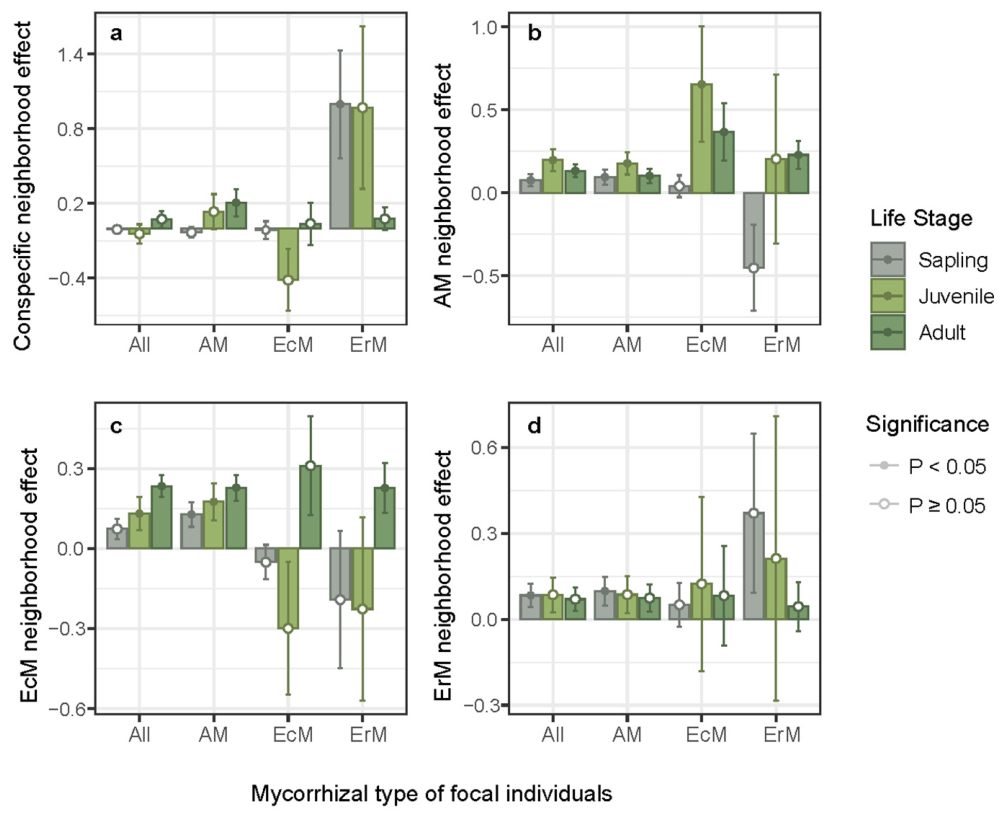
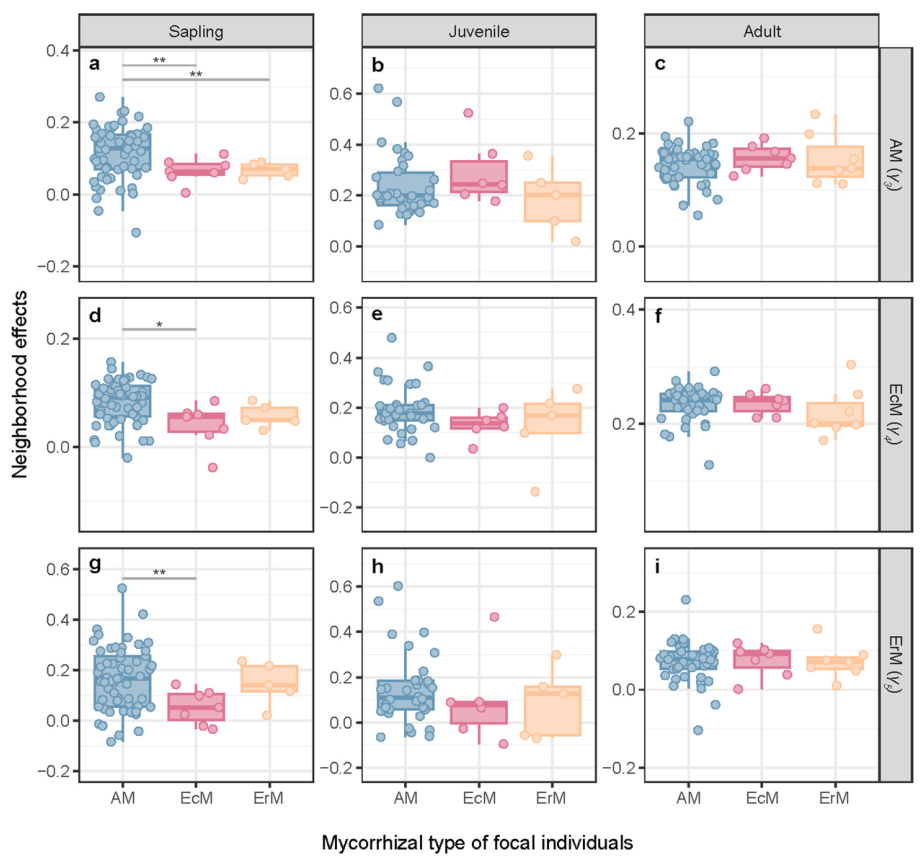
2.1. Ontogenetic Shifts in Mycorrhiza-Dependent Neighborhood Effects on Survival
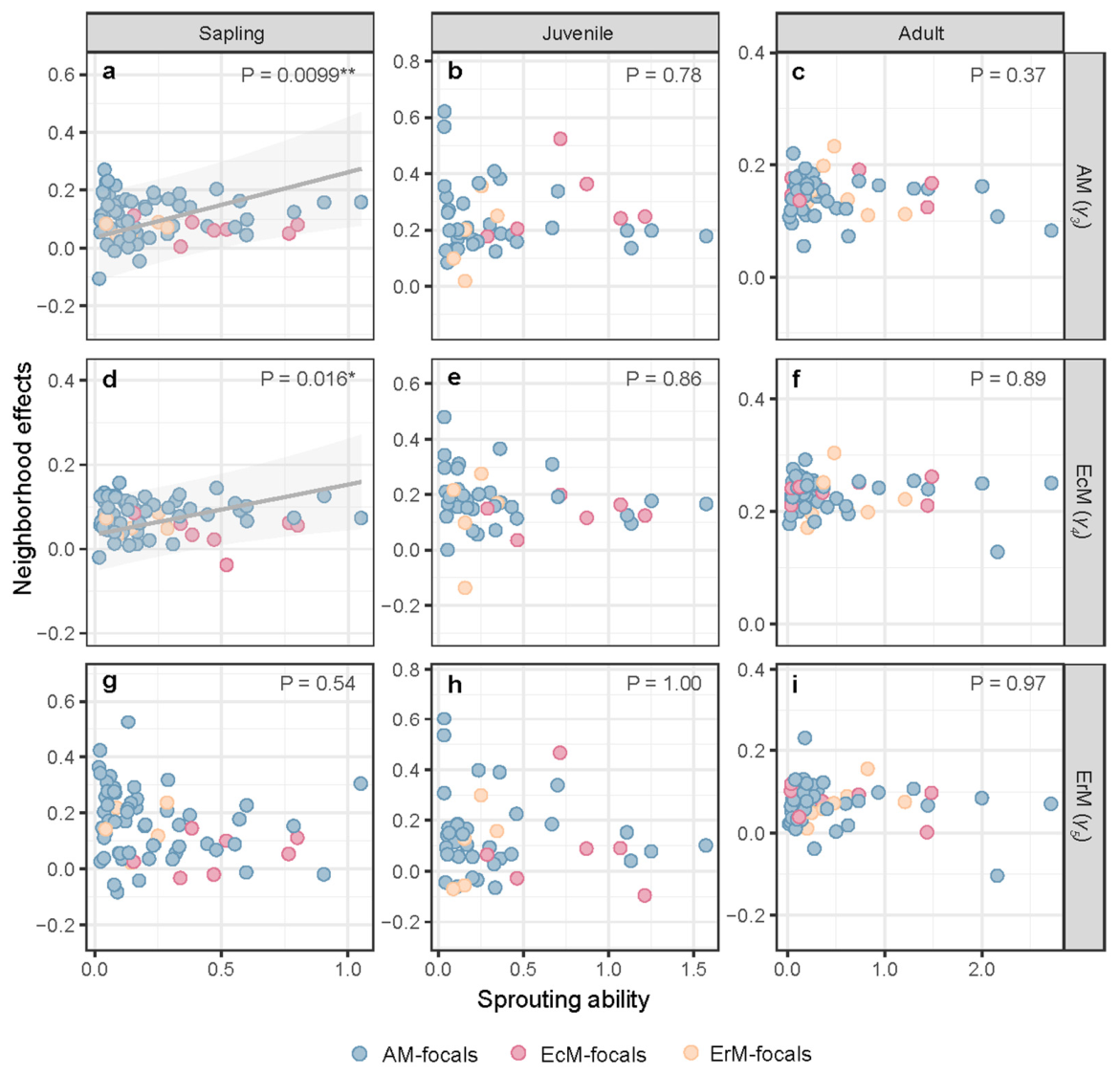
2.2. Relationship Between Mycorrhiza-Mediated Neighborhood Effects and Species-Specific Sprouting Ability
3. Discussion
3.1. Mycorrhizae-Mediated Neighborhood Effects on Survival Across Tree Ontogeny
3.2. Ontogenetic Shifts in Mycorrhiza-Mediated Neighborhood Effects Correlate with the Sprouting Ability of Multi-Stemmed Species
4. Materials and Methods
4.1. Study Site and Tree Census
4.2. Tree Ontogenetic Classes and Mycorrhizal Type
4.3. Sprouting Ability of Multi-Stemmed Species
4.4. Neighborhood Variables
4.5. Statistical Analysis
5. Conclusions
Supplementary Materials
Author Contributions
Funding
Data Availability Statement
Acknowledgments
Conflicts of Interest
References
- Janzen, D.H. Herbivores and the number of tree species in tropical forests. Am. Nat. 1970, 104, 501–528. [Google Scholar] [CrossRef] [Scilit]
- Connell, J.H. On the role of natural enemies in preventing competitive exclusion in some marine animals and in rain forest trees. In Dynamics of Populations; Den Boer, P.J., Gradwell, G.R., Eds.; Centre for Agricultural Publishing and Documentation: Wageningen, The Netherlands, 1971; pp. 298–312. [Google Scholar]
- Tedersoo, L.; Bahram, M.; Zobel, M. How mycorrhizal associations drive plant population and community biology. Science 2020, 367, eaba1223. [Google Scholar] [CrossRef] [Scilit] [PubMed]
- Chen, L.; Swenson, N.G.; Ji, N.; Mi, X.; Ren, H.; Guo, L.; Ma, K. Differential soil fungus accumulation and density dependence of trees in a subtropical forest. Science 2019, 366, 124–128. [Google Scholar] [CrossRef] [Scilit]
- Jiang, F.; Pu, X.; Schmid, B.; Reich, P.B.; Liang, J.; Abbasi, A.O.; Aguirre-Gutiérrez, J.; Zambrano, A.M.A.; Altman, J.; Álvarez-González, J.G.; et al. Mycorrhizal symbioses and tree diversity in global forest communities. Sci. Adv. 2025, 11, eadt5743. [Google Scholar] [CrossRef] [Scilit]
- Delavaux, C.S.; LaManna, J.A.; Myers, J.A.; Phillips, R.P.; Aguilar, S.; Allen, D.; Alonso, A.; Anderson-Teixeira, K.J.; Baker, M.E.; Baltzer, J.L.; et al. Mycorrhizal feedbacks influence global forest structure and diversity. Commun. Biol. 2023, 6, 1066. [Google Scholar] [CrossRef] [Scilit] [PubMed]
- Eagar, A.C.; Abu, P.H.; Brown, M.A.; Moledor, S.M.; Smemo, K.A.; Phillips, R.P.; Case, A.L.; Blackwood, C.B. Setting the stage for plant–soil feedback: Mycorrhizal influences over conspecific recruitment, plant and fungal communities, and coevolution. J. Ecol. 2025, 113, 1327–1344. [Google Scholar] [CrossRef] [Scilit]
- Lasky, J.R.; Bachelot, B.; Muscarella, R.; Schwartz, N.B.; Forero-Montaña, J.; Nytch, C.J.; Swenson, N.G.; Thompson, J.; Zimmerman, J.K.; Uriarte, M. Ontogenetic shifts in trait-mediated mechanisms of plant community assembly. Ecology 2015, 96, 2157–2169. [Google Scholar] [CrossRef] [Scilit]
- Zhu, Y.; Comita, L.S.; Hubbell, S.P.; Ma, K. Conspecific and phylogenetic density-dependent survival differs across life stages in a tropical forest. J. Ecol. 2015, 103, 957–966. [Google Scholar] [CrossRef] [Scilit]
- Pu, X.; Jin, G. Conspecific and phylogenetic density-dependent survival differs across life stages in two temperate old-growth forests in Northeast China. For. Ecol. Manag. 2018, 424, 95–104. [Google Scholar] [CrossRef] [Scilit]
- Delavaux, C.S.; Weigelt, P.; Dawson, W.; Duchicela, J.; Essl, F.; van Kleunen, M.; König, C.; Pergl, J.; Pyšek, P.; Stein, A.; et al. Mycorrhizal fungi influence global plant biogeography. Nat. Ecol. Evol. 2019, 3, 424–429. [Google Scholar] [CrossRef] [Scilit]
- Phillips, R.P.; Brzostek, E.; Midgley, M.G. The mycorrhizal-associated nutrient economy: A new framework for predicting carbon–nutrient couplings in temperate forests. New Phytol. 2013, 199, 41–51. [Google Scholar] [CrossRef] [Scilit]
- Shi, J.; Wang, X.; Wang, E. Mycorrhizal symbiosis in plant growth and stress adaptation: From genes to ecosystems. Annu. Rev. Plant Biol. 2023, 74, 569–607. [Google Scholar] [CrossRef] [Scilit]
- Bennett, J.A.; Maherali, H.; Reinhart, K.O.; Lekberg, Y.; Hart, M.M.; Klironomos, J. Plant-soil feedbacks and mycorrhizal type influence temperate forest population dynamics. Science 2017, 355, 181–184. [Google Scholar] [CrossRef] [Scilit] [PubMed]
- Smith, S.E.; Read, D.J. Mycorrhizal Symbiosis; Academic Press: London, UK, 2010. [Google Scholar]
- Becklin, K.M.; Pallo, M.L.; Galen, C. Willows indirectly reduce arbuscular mycorrhizal fungal colonization in understorey communities. J. Ecol. 2012, 100, 343–351. [Google Scholar] [CrossRef] [Scilit]
- Perotto, S.; Daghino, S.; Martino, E. Ericoid mycorrhizal fungi and their genomes: Another side to the mycorrhizal symbiosis? New Phytol. 2018, 220, 1141–1147. [Google Scholar] [CrossRef] [Scilit]
- Soudzilovskaia, N.A.; van Bodegom, P.M.; Terrer, C.; Zelfde, M.v.t.; McCallum, I.; Luke McCormack, M.; Fisher, J.B.; Brundrett, M.C.; de Sá, N.C.; Tedersoo, L. Global mycorrhizal plant distribution linked to terrestrial carbon stocks. Nat. Commun. 2019, 10, 5077. [Google Scholar] [CrossRef] [Scilit] [PubMed]
- Ward, E.B.; Duguid, M.C.; Kuebbing, S.E.; Lendemer, J.C.; Bradford, M.A. The functional role of ericoid mycorrhizal plants and fungi on carbon and nitrogen dynamics in forests. New Phytol. 2022, 235, 1701–1718. [Google Scholar] [CrossRef] [Scilit]
- Ward, E.B.; Duguid, M.C.; Kuebbing, S.E.; Lendemer, J.C.; Warren, R.J., II; Bradford, M.A. Ericoid mycorrhizal shrubs alter the relationship between tree mycorrhizal dominance and soil carbon and nitrogen. J. Ecol. 2021, 109, 3524–3540. [Google Scholar] [CrossRef] [Scilit]
- Bellingham, P.J.; Sparrow, A.D. Resprouting as a life history strategy in woody plant communities. Oikos 2000, 89, 409–416. [Google Scholar] [CrossRef] [Scilit]
- Clarke, P.J.; Lawes, M.J.; Midgley, J.J.; Lamont, B.B.; Ojeda, F.; Burrows, G.E.; Enright, N.J.; Knox, K.J.E. Resprouting as a key functional trait: How buds, protection and resources drive persistence after fire. New Phytol. 2013, 197, 19–35. [Google Scholar] [CrossRef] [Scilit] [PubMed]
- Gomes, L.; Lenza, E.; Souchie, F.F.; Pinto, J.R.R.; Maracahipes-Santos, L.; Furtado, M.T.; Maracahipes, L.; Silvério, D. Long-term post-fire resprouting dynamics and reproduction of woody species in a Brazilian savanna. Basic Appl. Ecol. 2021, 56, 58–71. [Google Scholar] [CrossRef] [Scilit]
- Chen, M.; Zhang, C.; Deng, Y.; Li, F.; Li, F.; Tang, Z.; Wei, Z.; Zhang, C.; Lin, L. Effect of topographic factors on sprouting characteristics of woody plants in subtropical semi-humid evergreen broad-leaved forests. Biodivers. Sci. 2024, 32, 24282. [Google Scholar] [CrossRef] [Scilit]
- Heineman, K.D.; Turner, B.L.; Dalling, J.W. Nutrient availability predicts multiple stem frequency, an indicator of species resprouting capacity in tropical forests. J. Ecol. 2021, 109, 1633–1648. [Google Scholar] [CrossRef] [Scilit]
- Ye, D.; Qian, H.; Wang, L.; Jin, F.; Ni, J.; Chen, S.; Song, Y.; Chen, J. Sprouting characteristics of woody species in a subtropical evergreen broad-leaved forest in Gutianshan of Qianjiangyuan National Park, East China. Acta Ecol. Sin. 2018, 38, 3562–3568. [Google Scholar] [CrossRef] [Scilit]
- Shi, C.; Zhang, H.; Tang, Z. Sprouting as a survivorship trait for woody plants: The influence of trunk size and neighbourhood competition. Funct. Ecol. 2026, 40, 140–149. [Google Scholar] [CrossRef] [Scilit]
- Fang, J.; Chen, A.; Peng, C.; Zhao, S.; Ci, L. Changes in forest biomass carbon storage in China between 1949 and 1998. Science 2001, 292, 2320–2322. [Google Scholar] [CrossRef] [Scilit]
- Li, Y.; Bao, W.; Bongers, F.; Chen, B.; Chen, G.; Guo, K.; Jiang, M.; Lai, J.; Lin, D.; Liu, C.; et al. Drivers of tree carbon storage in subtropical forests. Sci. Total Environ. 2019, 654, 684–693. [Google Scholar] [CrossRef] [Scilit]
- Fang, J.; Yu, G.; Liu, L.; Hu, S.; Chapin, F.S. Climate change, human impacts, and carbon sequestration in China. Proc. Natl. Acad. Sci. USA 2018, 115, 4015–4020. [Google Scholar] [CrossRef] [Scilit]
- Jiang, C.; Fu, J.; Wang, Y.; Chai, P.; Yang, Y.; Mi, X.; Yu, M.; Ma, K.; Chen, J. The Habitat Type and Scale Dependences of Interspecific Associations in a Subtropical Evergreen Broad-Leaved Forest. Forests 2022, 13, 1334. [Google Scholar] [CrossRef] [Scilit]
- Yu, M.; Hu, Z.; Yu, J.; Ding, B.; Fang, T. Forest vegetation types in Gutianshan Natural Reserve in Zhejiang. J. Zhejiang Univ. Agric. Life Sci. 2001, 27, 23–28. [Google Scholar]
- Ye, D.; Dong, R.; Mi, X.; Lu, W.; Zheng, Z.; Yu, M.; Ni, J.; Chen, J. Characteristics and effects of sprouting on species diversity in a subtropical evergreen broad-leaved forest in Gutianshan, East China. Biodivers. Sci. 2017, 25, 393–400. [Google Scholar] [CrossRef] [Scilit]
- Chi, X.; Wang, Q.; Guo, Q.; Yang, X.; Tang, Z. Sprouting characteristics of communities during succession in an evergreen broad-leaved forest on Gutian Mountain, East China. Biodivers. Sci. 2019, 27, 24–32. [Google Scholar] [CrossRef] [Scilit]
- Chen, L.; Wang, Y.; Mi, X.; Liu, X.; Ren, H.; Chen, J.; Ma, K.; Kraft, N.J.B. Neighborhood effects explain increasing asynchronous seedling survival in a subtropical forest. Ecology 2019, 100, e02821. [Google Scholar] [CrossRef] [Scilit] [PubMed]
- Wang, Y.; Cadotte, M.W.; Chen, J.; Mi, X.; Ren, H.; Liu, X.; Yu, M.; Zhang, J.; Ma, K. Neighborhood interactions on seedling survival were greatly altered following an extreme winter storm. For. Ecol. Manag. 2020, 461, 117940. [Google Scholar] [CrossRef] [Scilit]
- Johnson, D.J.; Condit, R.; Hubbell, S.P.; Comita, L.S. Abiotic niche partitioning and negative density dependence drive tree seedling survival in a tropical forest. Proc. R. Soc. B Biol. Sci. 2017, 284, 20172210. [Google Scholar] [CrossRef] [Scilit] [PubMed]
- Zhu, Y.; Queenborough, S.A.; Condit, R.; Hubbell, S.P.; Ma, K.; Comita, L.S. Density-dependent survival varies with species life-history strategy in a tropical forest. Ecol. Lett. 2018, 21, 506–515. [Google Scholar] [CrossRef] [Scilit] [PubMed]
- Franklin, O.; Näsholm, T.; Högberg, P.; Högberg, M.N. Forests trapped in nitrogen limitation–an ecological market perspective on ectomycorrhizal symbiosis. New Phytol. 2014, 203, 657–666. [Google Scholar] [CrossRef] [Scilit]
- Simard, S.W.; Beiler, K.J.; Bingham, M.A.; Deslippe, J.R.; Philip, L.J.; Teste, F.P. Mycorrhizal networks: Mechanisms, ecology and modelling. Fungal Biol. Rev. 2012, 26, 39–60. [Google Scholar] [CrossRef] [Scilit]
- Lekberg, Y.; Arnillas, C.A.; Borer, E.T.; Bullington, L.S.; Fierer, N.; Kennedy, P.G.; Leff, J.W.; Luis, A.D.; Seabloom, E.W.; Henning, J.A. Nitrogen and phosphorus fertilization consistently favor pathogenic over mutualistic fungi in grassland soils. Nat. Commun. 2021, 12, 3484. [Google Scholar] [CrossRef] [Scilit]
- Packer, A.; Clay, K. Soil pathogens and spatial patterns of seedling mortality in a temperate tree. Nature 2000, 404, 278–281. [Google Scholar] [CrossRef] [Scilit]
- Bueno, C.G.; Moora, M.; Gerz, M.; Davison, J.; Öpik, M.; Pärtel, M.; Helm, A.; Ronk, A.; Kühn, I.; Zobel, M. Plant mycorrhizal status, but not type, shifts with latitude and elevation in Europe. Glob. Ecol. Biogeogr. 2017, 26, 690–699. [Google Scholar] [CrossRef] [Scilit]
- Shinohara, N.; Kobayashi, Y.; Nishizawa, K.; Kadowaki, K.; Yamawo, A. Plant–mycorrhizal associations may explain the latitudinal gradient of plant community assembly. Oikos 2024, 2024, e10367. [Google Scholar] [CrossRef] [Scilit]
- Niinemets, Ü. Responses of forest trees to single and multiple environmental stresses from seedlings to mature plants: Past stress history, stress interactions, tolerance and acclimation. For. Ecol. Manag. 2010, 260, 1623–1639. [Google Scholar] [CrossRef] [Scilit]
- Mao, Z.; Wiegand, T.; Corrales, A.; Fang, S.; Hao, Z.; Lin, F.; Ye, J.; Yuan, Z.; Wang, X. Mycorrhizal types regulate tree spatial associations in temperate forests: Ectomycorrhizal trees might favour species coexistence. Ecol. Lett. 2024, 27, e70005. [Google Scholar] [CrossRef] [Scilit]
- Guerrero-Campo, J.; Palacio, S.; Pérez-Rontomé, C.; Montserrat-Martí, G. Effect of root system morphology on root-sprouting and shoot-rooting abilities in 123 plant species from eroded lands in North-east Spain. Ann. Bot. 2006, 98, 439–447. [Google Scholar] [CrossRef] [Scilit]
- Kong, D.; Wang, J.; Wu, H.; Valverde-Barrantes, O.J.; Wang, R.; Zeng, H.; Kardol, P.; Zhang, H.; Feng, Y. Nonlinearity of root trait relationships and the root economics spectrum. Nat. Commun. 2019, 10, 2203. [Google Scholar] [CrossRef] [Scilit] [PubMed]
- Kramer-Walter, K.R.; Bellingham, P.J.; Millar, T.R.; Smissen, R.D.; Richardson, S.J.; Laughlin, D.C. Root traits are multidimensional: Specific root length is independent from root tissue density and the plant economic spectrum. J. Ecol. 2016, 104, 1299–1310. [Google Scholar] [CrossRef] [Scilit]
- Mi, X.; Sun, Z.; Song, Y.; Liu, X.; Yang, J.; Wu, J.; Ci, X.; Li, J.; Lin, L.; Cao, M.; et al. Rare tree species have narrow environmental but not functional niches. Funct. Ecol. 2021, 35, 511–520. [Google Scholar] [CrossRef] [Scilit]
- Konvalinková, T.; Püschel, D.; Janoušková, M.; Gryndler, M.; Jansa, J. Duration and intensity of shade differentially affects mycorrhizal growth- and phosphorus uptake responses of Medicago truncatula. Front. Plant Sci. 2015, 6, 65. [Google Scholar] [CrossRef] [Scilit]
- Read, D.J.; Perez-Moreno, J. Mycorrhizas and nutrient cycling in ecosystems—A journey towards relevance? New Phytol. 2003, 157, 475–492. [Google Scholar] [CrossRef] [Scilit] [PubMed]
- Everham, E.M.; Brokaw, N.V. Forest damage and recovery from catastrophic wind. Bot. Rev. 1996, 62, 113–185. [Google Scholar] [CrossRef] [Scilit]
- Keeley, J.E. Seed Production, Seed Populations in Soil, and Seedling Production After Fire for Two Congeneric Pairs of Sprouting and Nonsprouting Chaparal Shrubs. Ecology 1977, 58, 820–829. [Google Scholar] [CrossRef] [Scilit]
- Legendre, P.; Mi, X.; Ren, H.; Ma, K.; Yu, M.; Sun, I.-F.; He, F. Partitioning beta diversity in a subtropical broad-leaved forest of China. Ecology 2009, 90, 663–674. [Google Scholar] [CrossRef] [Scilit] [PubMed]
- Condit, R. Tropical Forest Census Plots: Methods and Results from Barro Colorado Island, Panama and a Comparison with Other Plots; Springer-Verlag: Berlin Heidelberg, Germany; R. G. Landes Company: Georgetown, TX, USA, 1998. [Google Scholar]
- Bian, Y.; Wu, Q.; Zheng, R.; Fu, J.; Chen, J.; Mi, X.; Yu, M.; Wang, Y. Temporal and habitat-specific variations in drivers of aboveground biomass dynamics in a Chinese subtropical forest. Front. Plant Sci. 2025, 15, 1531654. [Google Scholar] [CrossRef] [Scilit]
- Zheng, B.; Chen, X.; Ni, J. A dataset on the plant growth form and life form of vascular plants in China. Biodivers. Sci. 2024, 32, 23468. [Google Scholar] [CrossRef] [Scilit]
- Zhu, Y.; Mi, X.; Ren, H.; Ma, K. Density dependence is prevalent in a heterogeneous subtropical forest. Oikos 2010, 119, 109–119. [Google Scholar] [CrossRef] [Scilit]
- Brundrett, M.; Tedersoo, L. Misdiagnosis of mycorrhizas and inappropriate recycling of data can lead to false conclusions. New Phytol. 2019, 221, 18–24. [Google Scholar] [CrossRef] [Scilit]
- Soudzilovskaia, N.A.; Vaessen, S.; Barcelo, M.; He, J.; Rahimlou, S.; Abarenkov, K.; Brundrett, M.C.; Gomes, S.I.F.; Merckx, V.; Tedersoo, L. FungalRoot: Global online database of plant mycorrhizal associations. New Phytol. 2020, 227, 955–966. [Google Scholar] [CrossRef] [Scilit] [PubMed]
- Nanami, S.; Kawaguchi, H.; Tateno, R.; Li, C.; Katagiri, S. Sprouting traits and population structure of co-occurring Castanopsis species in an evergreen broad-leaved forest in southern China. Ecol. Res. 2004, 19, 341–348. [Google Scholar] [CrossRef] [Scilit]
- Bond, W.J.; Midgley, J.J. Ecology of sprouting in woody plants: The persistence niche. Trends Ecol. Evol. 2001, 16, 45–51. [Google Scholar] [CrossRef] [Scilit]
- Song, X.; Katabuchi, M.; Chase, J.M.; Johnson, D.J.; Zhang, W.; Deng, X.; Cao, M.; Yang, J. Drought tolerance and species abundance mediate dry season negative density dependence in a tropical forest. Ecology 2024, 105, e4382. [Google Scholar] [CrossRef] [PubMed]
- Comita, L.S.; Muller-Landau, H.C.; Aguilar, S.; Hubbell, S.P. Asymmetric density dependence shapes species abundances in a tropical tree community. Science 2010, 329, 330–332. [Google Scholar] [CrossRef] [Scilit]
- Vesk, P.A.; Warton, D.I.; Westoby, M. Sprouting by semi-arid plants: Testing a dichotomy and predictive traits. Oikos 2004, 107, 72–89. [Google Scholar] [CrossRef] [Scilit]
- Jiang, F.; Zhu, K.; Cadotte, M.W.; Jin, G. Tree mycorrhizal type mediates the strength of negative density dependence in temperate forests. J. Ecol. 2020, 108, 2601–2610. [Google Scholar] [CrossRef] [Scilit]
- Bürkner, P.-C. Advanced Bayesian multilevel modeling with the R package brms. R J. 2018, 10, 395–411. [Google Scholar] [CrossRef] [Scilit]



| Mycorrhizal Type | Sapling | Juvenile | Adult |
|---|---|---|---|
| AM | 71 | 43 | 51 |
| EcM | 7 | 7 | 7 |
| ErM | 6 | 6 | 7 |
Disclaimer/Publisher’s Note: The statements, opinions and data contained in all publications are solely those of the individual author(s) and contributor(s) and not of MDPI and/or the editor(s). MDPI and/or the editor(s) disclaim responsibility for any injury to people or property resulting from any ideas, methods, instructions or products referred to in the content. |
© 2026 by the authors. Licensee MDPI, Basel, Switzerland. This article is an open access article distributed under the terms and conditions of the Creative Commons Attribution (CC BY) license.
Share and Cite
Wang, Y.; Wu, Q.; Yang, Y.; Ma, J.; Yu, S.; Mi, X.; Chen, J.; Yu, M. Ontogenetic Shifts in Mycorrhiza-Mediated Neighborhood Effects Among Multi-Stemmed Species in a Subtropical Forest. Plants 2026, 15, 1784. https://doi.org/10.3390/plants15121784
Wang Y, Wu Q, Yang Y, Ma J, Yu S, Mi X, Chen J, Yu M. Ontogenetic Shifts in Mycorrhiza-Mediated Neighborhood Effects Among Multi-Stemmed Species in a Subtropical Forest. Plants. 2026; 15(12):1784. https://doi.org/10.3390/plants15121784
Chicago/Turabian StyleWang, Yunquan, Qi Wu, Yidan Yang, Jianhui Ma, Shuisheng Yu, Xiangcheng Mi, Jianhua Chen, and Mingjian Yu. 2026. "Ontogenetic Shifts in Mycorrhiza-Mediated Neighborhood Effects Among Multi-Stemmed Species in a Subtropical Forest" Plants 15, no. 12: 1784. https://doi.org/10.3390/plants15121784
APA StyleWang, Y., Wu, Q., Yang, Y., Ma, J., Yu, S., Mi, X., Chen, J., & Yu, M. (2026). Ontogenetic Shifts in Mycorrhiza-Mediated Neighborhood Effects Among Multi-Stemmed Species in a Subtropical Forest. Plants, 15(12), 1784. https://doi.org/10.3390/plants15121784