SCPA-Net: Text-Enhanced Cross-Platform Framework with Semantic Consistency Enhancement for Pine Wilt Detection
Abstract
1. Introduction
- (1)
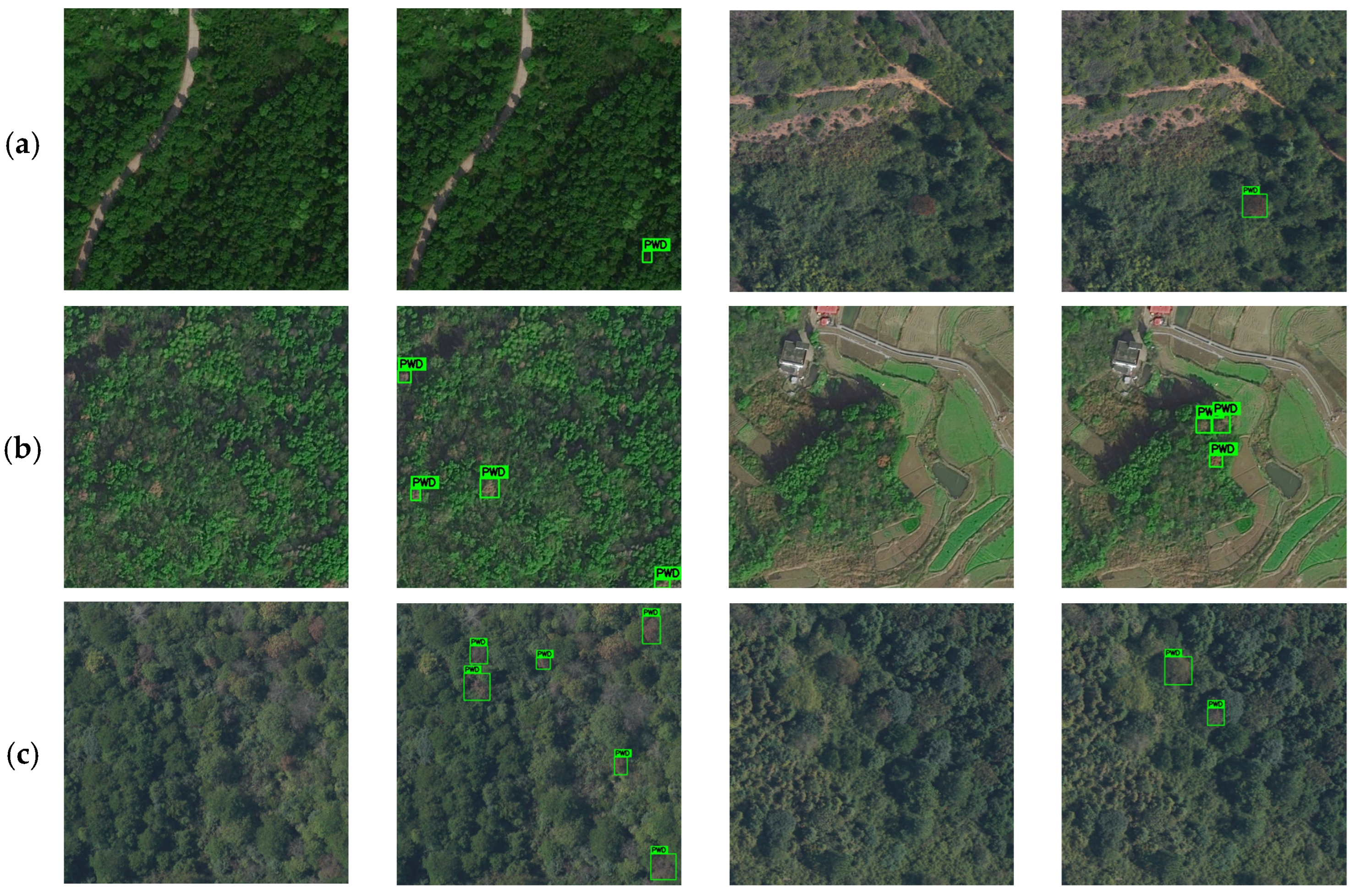
- As shown in Figure 1a, Satellite and UAV remote-sensing images have different spatial resolutions, observation scales, imaging perspectives and texture details. Therefore, due to the above reasons, the feature distribution and high-level semantic representation of PWD tree crowns vary among platforms. Most of the existing methods have been developed for a single platform and do not have good constraints on high-level semantic consistency between UAV and satellite images. As a result, there is a risk of feature misalignment and performance degradation in cross-platform transfer and joint detection.
- (2)
- As shown in Figure 1b, PWD tree crowns in a complex forest environment are exposed to shading caused by shadows, bare ground, healthy crowns and other areas with similar textures. In such cases, the background context frequently occurs simultaneously with the diseased target, and the model may learn spurious correlations as a result to produce false alarms. Existing detection methods are generally local convolution-based representations or simple attention augmentations. However, they do not explicitly model the heterogeneous relationships among the target areas and background areas, and they lack a causal mechanism for suppressing background confounding effects. Therefore, the current models are still unable to recognise the actual diseased area in a cluttered background consistently.
- (3)
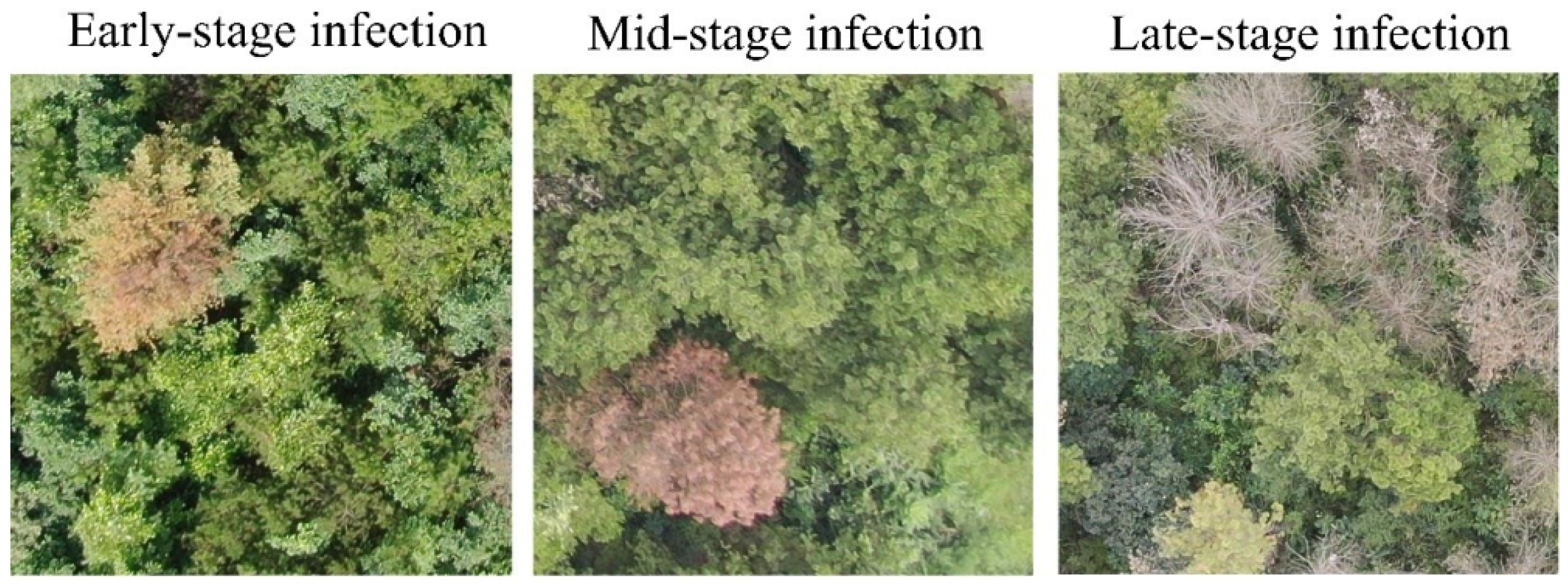
- As shown in Figure 1c, the PWD tree crowns have shown various phenotypes at different stages of the disease. Diseased trees in their early stages generally have only a mild change in colour, blurred boundaries and weak reactions, so they are much harder to detect than those in the middle and later stages. Most of the current methods are single-stage static training models that mix samples from all stages and learn them at the same time. Such a strategy does not have a continuous learning mechanism to keep up with the progress of weak phenotype cognition. Therefore, when the model needs to adapt to early-stage ambiguous diseased trees, it is often dominated by more obvious late-stage samples. At the same time, cross-stage learning may result in forgetting the previously learned knowledge. It will reduce the detection rate of early weak-phenotype trees and generally weaken the model.
- (1)
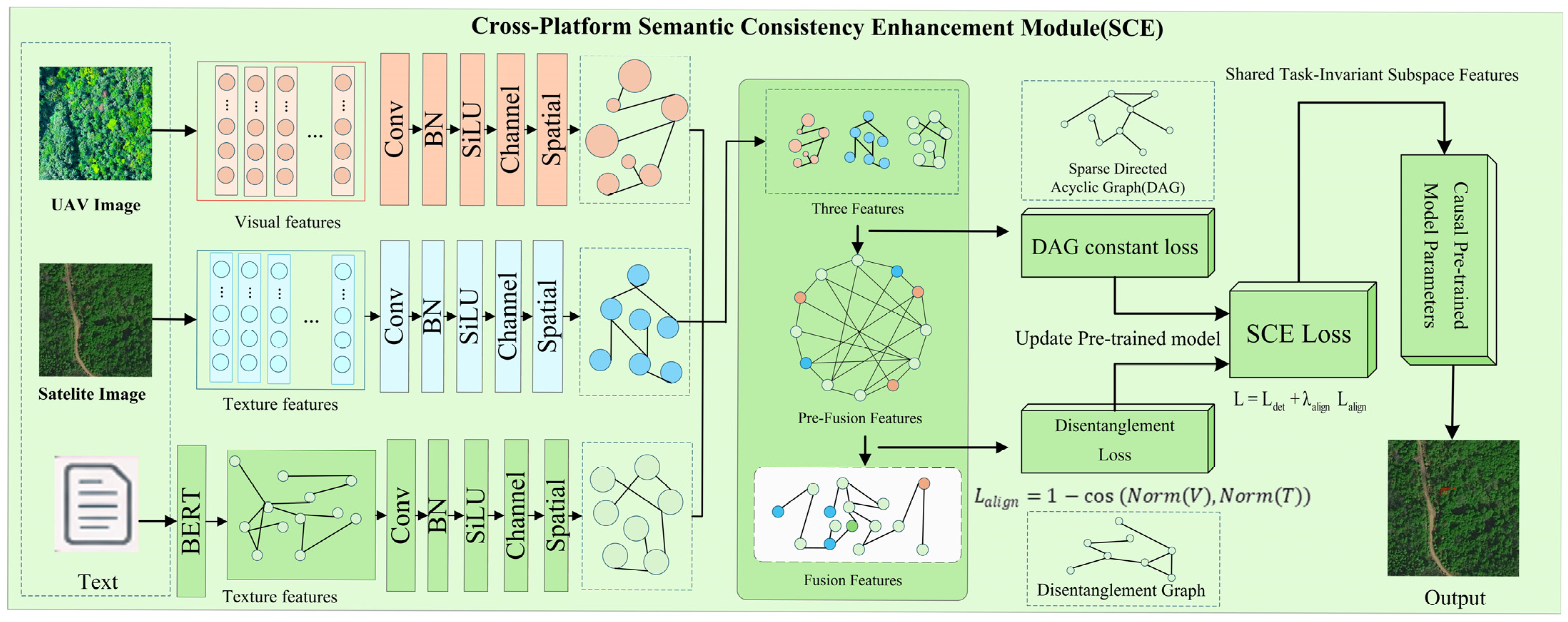
- To deal with the problem of high-level semantic shift caused by different resolutions, scales and viewpoints of UAV and satellite remote sensing images, a Cross-Platform Semantic Consistency Enhancement (SCE) module is proposed. Increase the consistency of high-level semantic representations for diseased targets across platforms and thus reduce cross-platform semantic misalignment in this module. Enhance the feature responses of the discriminative channels and salient regions to improve the cross-platform recognition capability of the model for pine wilt disease targets.
- (2)
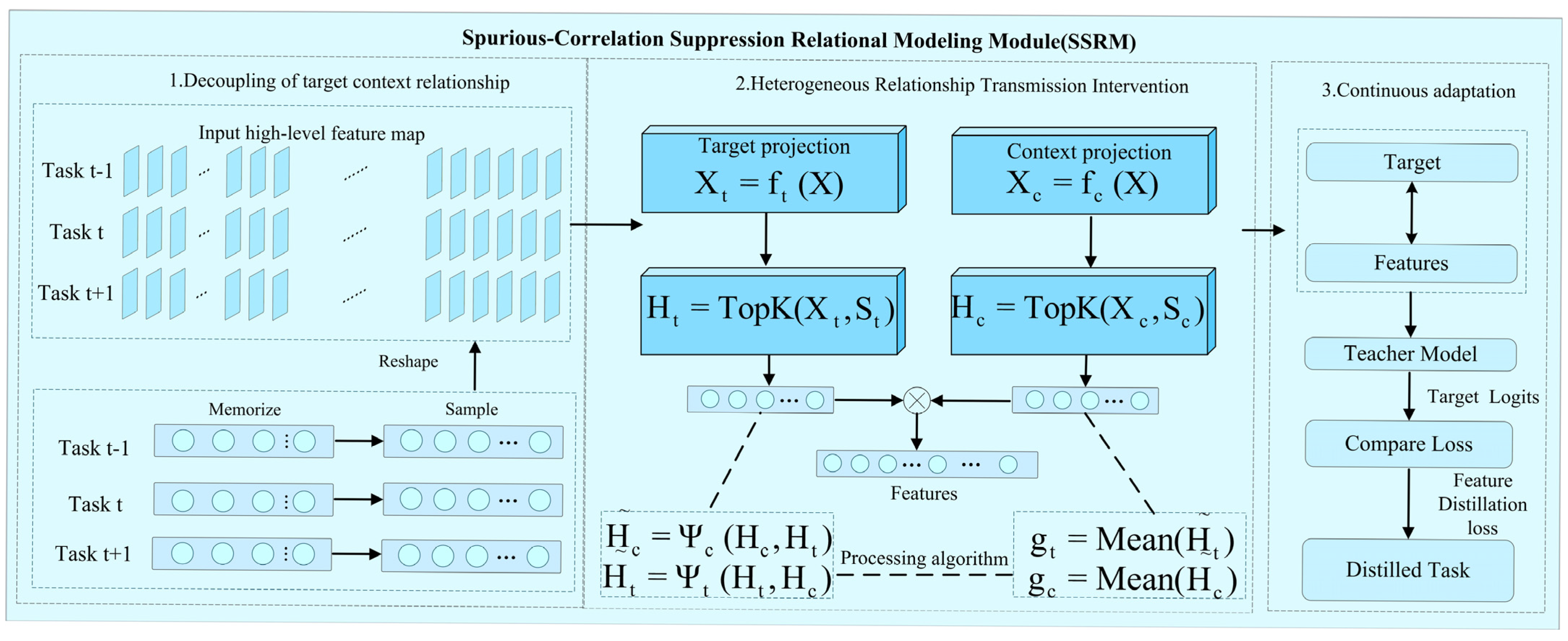
- To solve the problem of easy interference caused by the background in complex forest scenes for diseased targets and to avoid spuriously correlated responses, a Spurious-Correlation Suppression Relational Modeling module (SSRM) is proposed. Strengthen the relational modelling capability of target regions and background regions in this module, and reduce non-causal interference from a complex background. Therefore, the model will be more suitable for extracting actual disease-related discriminative features and improving the detection accuracy and stability in complex situations.
- (3)
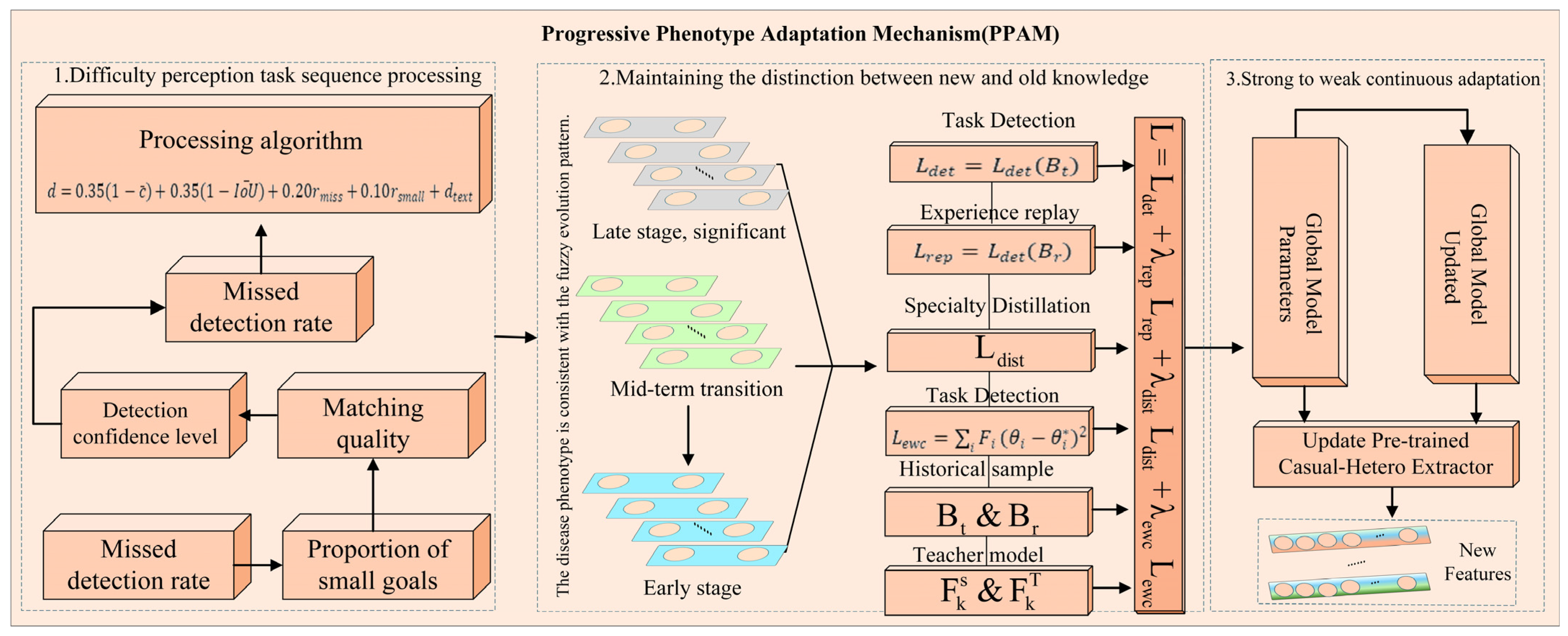
- To address the problem of knowledge forgetting and performance fluctuations in the progressive transition of pine wilt disease phenotypes from obvious to ambiguous, a Progressive Phenotype Adaptation Mechanism (PPAM) has been proposed. In this way, a progressive phenotype task sequence from easy to difficult can be created to improve the continuous adaptation ability of the model to samples at all stages of the disease. Jointly optimise the retention of old knowledge and the acquisition of new knowledge to improve learning stability for weak-phenotype samples and cross-stage complex samples effectively.
- (4)
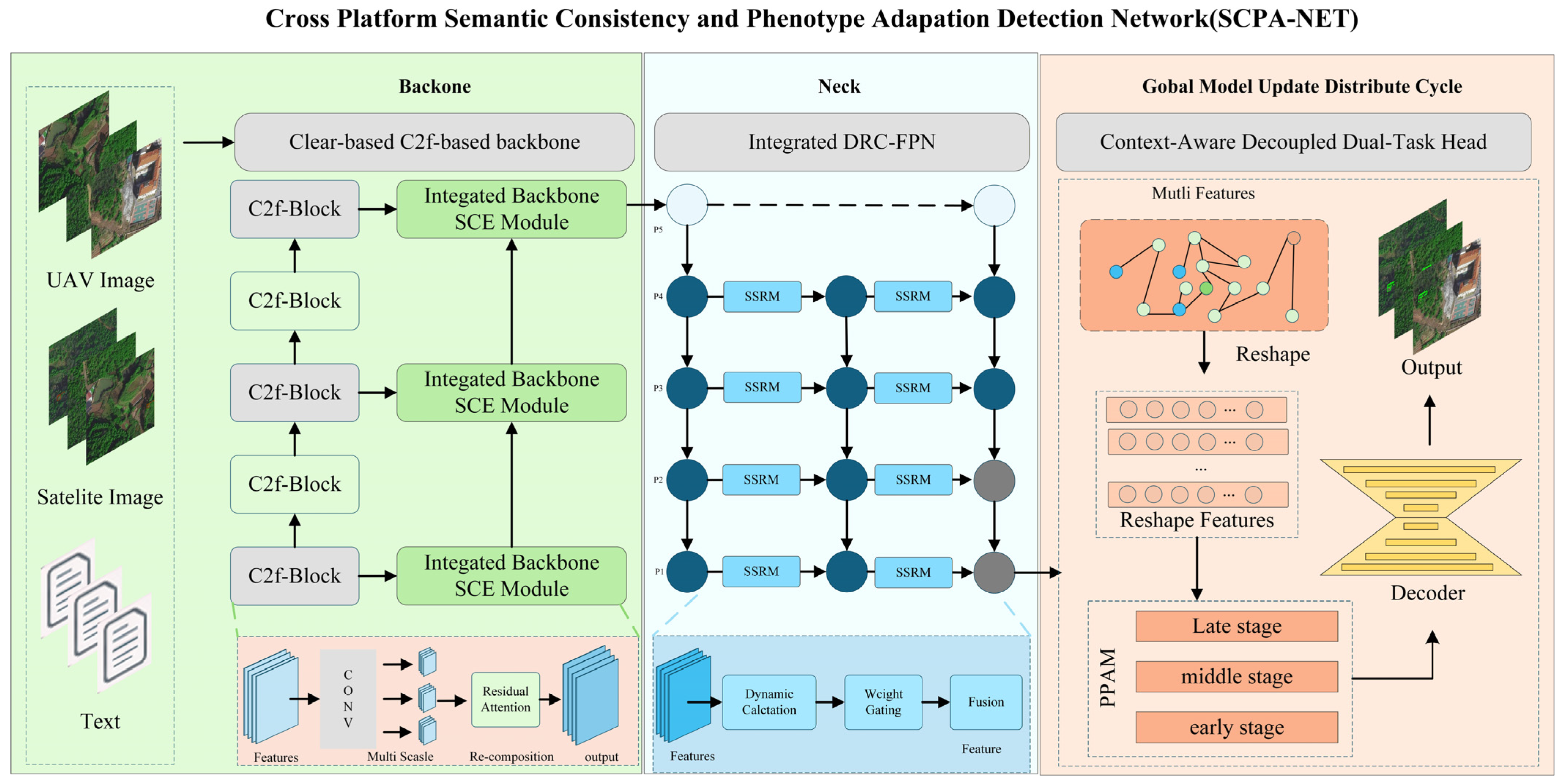
- A cross-platform semantic consistency and phenotype adaptation detection network named SCPA-Net has been built for pine wilt disease cross-platform detection. A network of multiple data types has been built, and these will be combined in a three-part collaborative optimisation framework for SCE, SSRM and PPAM. Based on the results of the experimental tests, the proposed network has shown good performance in module effectiveness, comparison tests and generalisation tests. Based on the above results, this method can stably improve the cross-platform semantic consistency model, suppress interference caused by complex backgrounds, and enhance adaptation to weak-phenotype samples; thus, both the overall detection accuracy and robustness, as well as the cross-platform generalisation ability of the model, will be improved.
2. Materials and Methods
2.1. Dataset Acquisition and Processing
Feature Analysis of Samples at Different Phenotypic Stages of Pine Wilt Disease
2.2. SCPA-Net
2.2.1. Cross-Platform Semantic Consistency Enhancement (SCE) Module
2.2.2. Spurious-Correlation Suppression Relational Modeling Module (SSRM)
2.2.3. Progressive Phenotype Adaptation Mechanism (PPAM)
3. Experiments
3.1. Experimental Setting
3.2. Evaluation Metrics Overview
3.3. Module Effectiveness Experiments
3.3.1. Effectiveness of the SCE
3.3.2. Effectiveness of the SSRM
3.3.3. Effectiveness of the PPAM
3.4. Ablation Experiments
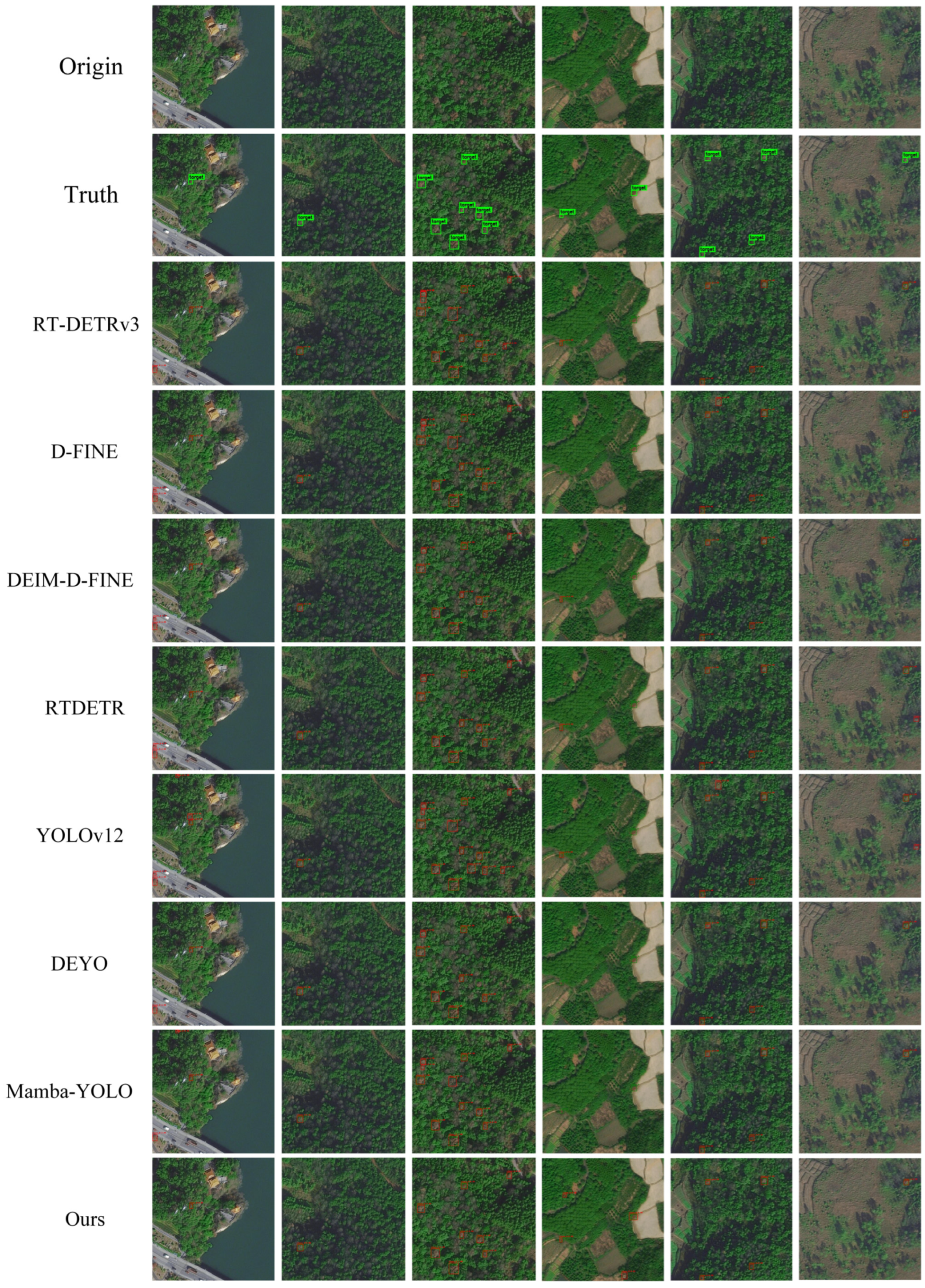
3.5. Comparison Experiments with Other Networks
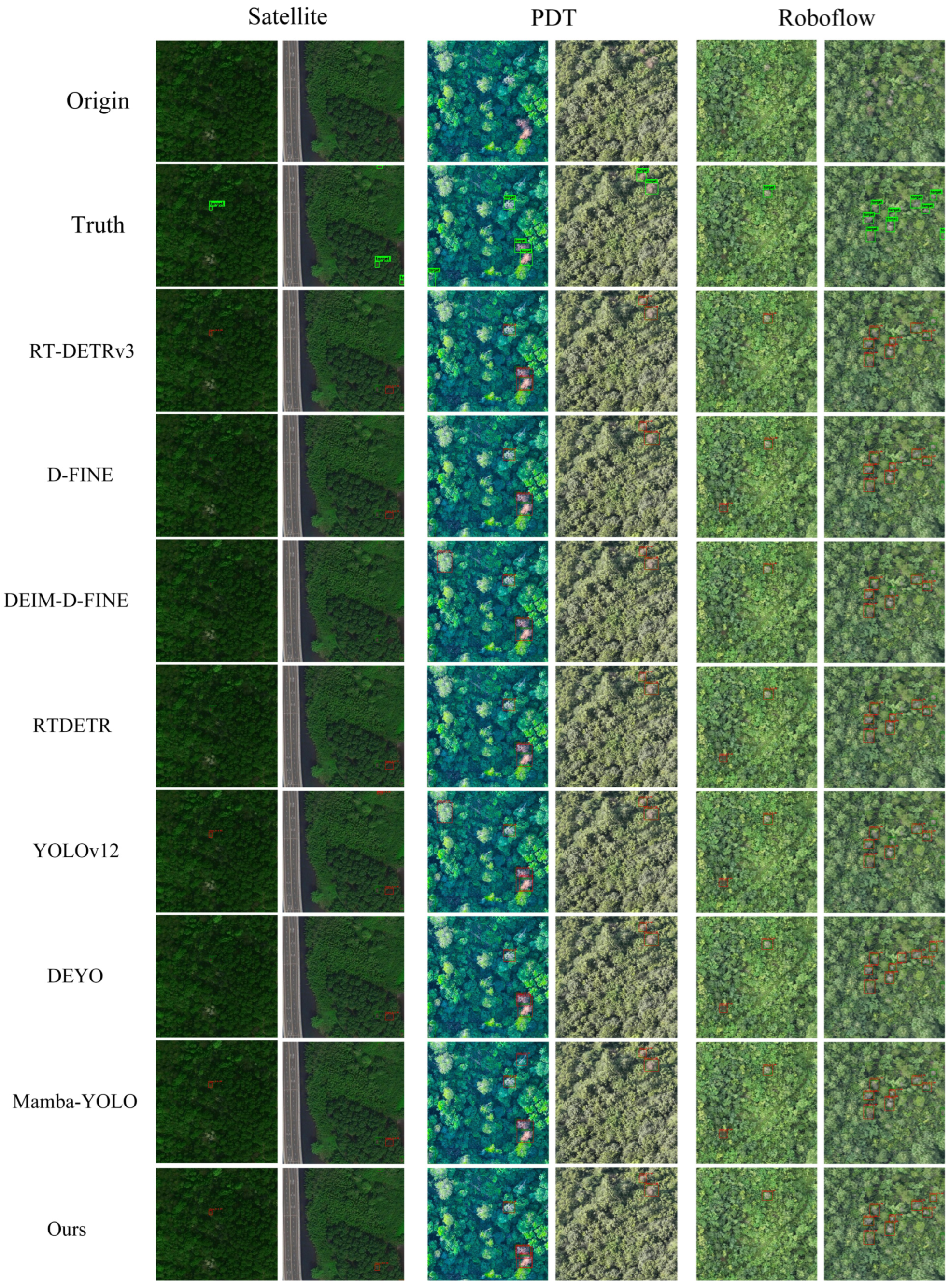
3.6. Generalization Experiments
3.6.1. Generalization Experiment of Satellite Dataset
3.6.2. Generalization Experiment of PDT Public Dataset
3.6.3. Generalization Experiment of Roboflow Pine Wilt Disease Dataset
4. Discussion
5. Conclusions
Author Contributions
Funding
Data Availability Statement
Conflicts of Interest
References
- Zhou, H.; Yuan, X.; Zhou, H.; Shen, H.; Ma, L.; Sun, L.; Fang, G.; Sun, H. Surveillance of pine wilt disease by high resolution satellite. J. For. Res. 2022, 33, 1401–1408. [Google Scholar] [CrossRef]
- Wu, B.; Liang, A.; Zhang, H.; Zhu, T.; Zou, Z.; Yang, D.; Tang, W.; Li, J.; Su, J. Application of conventional UAV-based high-throughput object detection to the early diagnosis of pine wilt disease by deep learning. For. Ecol. Manag. 2021, 486, 118986. [Google Scholar] [CrossRef]
- Li, X.; Liu, Y.; Huang, P.; Tong, T.; Li, L.; Chen, Y.; Hou, T.; Su, Y.; Lv, X.; Fu, W.; et al. Integrating multi-scale remote-sensing data to monitor severe forest infestation in response to pine wilt disease. Remote Sens. 2022, 14, 5164. [Google Scholar] [CrossRef]
- Du, Z.; Wu, S.; Wen, Q.; Zheng, X.; Lin, S.; Wu, D. Pine wilt disease detection algorithm based on improved YOLOv5. Front. Plant Sci. 2024, 15, 1302361. [Google Scholar] [CrossRef]
- Su, J.; Qin, B.; Sun, F.; Lan, P.; Liu, G. Identification of Pine Wilt-Diseased Trees Using UAV Remote Sensing Imagery and Improved PWD-YOLOv8n Algorithm. Drones 2024, 8, 404. [Google Scholar] [CrossRef]
- Wu, Y.; Yang, H.; Mao, Y. Detection of the pine wilt disease using a joint deep object detection model based on drone remote sensing data. Forests 2024, 15, 869. [Google Scholar] [CrossRef]
- Liu, W.; Xie, Z.; Du, J.; Li, Y.; Long, Y.; Lan, Y.; Liu, T.; Sun, S.; Zhao, J. Early detection of pine wilt disease based on UAV reconstructed hyperspectral image. Front. Plant Sci. 2024, 15, 1453761. [Google Scholar] [CrossRef] [PubMed]
- Wang, J.; Zhao, J.; Sun, H.; Lu, X.; Huang, J.; Wang, S.; Fang, G. Satellite remote sensing identification of discolored standing trees for pine wilt disease based on semi-supervised deep learning. Remote Sens. 2022, 14, 5936. [Google Scholar] [CrossRef]
- Lv, W.; Zhao, J.; Huang, J. Monitoring Pine Wilt Disease Using High-Resolution Satellite Remote Sensing at the Single-Tree Scale with Integrated Self-Attention. Remote Sens. 2025, 17, 2197. [Google Scholar] [CrossRef]
- Shi, H.; Chen, L.; Chen, M.; Zhang, D.; Wu, Q.; Zhang, R. Advances in global remote sensing monitoring of discolored pine trees caused by pine wilt disease: Platforms, methods, and future directions. Forests 2024, 15, 2147. [Google Scholar] [CrossRef]
- Cai, P.; Chen, G.; Yang, H.; Li, X.; Zhu, K.; Wang, T.; Liao, P.; Han, M.; Gong, Y.; Wang, Q.; et al. Detecting individual plants infected with pine wilt disease using drones and satellite imagery: A case study in Xianning, China. Remote Sens. 2023, 15, 2671. [Google Scholar] [CrossRef]
- Ma, Y.; Chai, L.; Jin, L.; Yan, J. Hierarchical alignment network for domain adaptive object detection in aerial images. ISPRS J. Photogramm. Remote Sens. 2024, 208, 39–52. [Google Scholar] [CrossRef]
- Qi, Y.; Yang, S.; Chen, J.; Zhang, M.; Zhu, J.; Liu, X.; Zheng, H. A Modality Alignment and Fusion-Based Method for Around-the-Clock Remote Sensing Object Detection. Sensors 2025, 25, 4964. [Google Scholar] [CrossRef]
- Tian, S.; Kang, L.; Xing, X.; Tian, J.; Fan, C.; Zhang, Y. A relation-augmented embedded graph attention network for remote sensing object detection. IEEE Trans. Geosci. Remote Sens. 2021, 60, 1000718. [Google Scholar] [CrossRef]
- Kaur, S.; Sharma, H. Multimodal graph neural networks for earth observation and sustainable resource management: A comprehensive review and research roadmap. Discov. Sustain. 2025, 7, 21. [Google Scholar] [CrossRef]
- Zhang, W.; Wang, X.; Wang, H.; Cheng, Y. Causal meta-reinforcement learning for multimodal remote sensing data classification. Remote Sens. 2024, 16, 1055. [Google Scholar] [CrossRef]
- Akçay, M.T. Unifying graph neural networks causal machine learning and conformal prediction for robust causal inference in rail transport systems. Sci. Rep. 2025, 15, 39079. [Google Scholar] [CrossRef]
- Li, H.; Jiang, H.; Gu, X.; Peng, J.; Li, W.; Hong, L.; Tao, C. CLRS: Continual learning benchmark for remote sensing image scene classification. Sensors 2020, 20, 1226. [Google Scholar] [CrossRef]
- Peng, R.; Zhao, W.; Li, K.; Ji, F.; Rong, C. Continual contrastive learning for cross-dataset scene classification. Remote Sens. 2022, 14, 5105. [Google Scholar] [CrossRef]
- Feng, H.; Zhang, L.; Yang, X.; Liu, Z. Enhancing class-incremental object detection in remote sensing through instance-aware distillation. Neurocomputing 2024, 583, 127552. [Google Scholar] [CrossRef]
- Xu, C.; Zheng, X.; Lu, X. Multi-level alignment network for cross-domain ship detection. Remote Sens. 2022, 14, 2389. [Google Scholar] [CrossRef]
- Chen, D.; Cheng, T.; Hong, S.; Gao, W.; Lu, Z.; Yang, L.; Ji, C.; Cheng, L. Unsupervised Domain Adaptation for Cross-domain Remote Sensing Object Detection via Joint Input and Feature Space. Res. Sq. 2025; posted. [CrossRef]
- Zhao, X.; Zhao, L.; Shi, K.; Ren, R.; Zhang, Z. YOLO-CMFM: A Visible-SAR Multimodal Object Detection Method Based on Edge-Guided and Gated Cross-Attention Fusion. Remote Sens. 2025, 18, 136. [Google Scholar] [CrossRef]
- Liu, Z.-Q.; Zhang, Z.; Meng, Y.; Tang, P. Global heterogeneous graph convolutional network: From coarse to refined land cover and land use segmentation. Int. J. Digit. Earth 2024, 17, 2353110. [Google Scholar] [CrossRef]
- Zhao, C.; Chen, S.; Zhang, J.; Fan, X.; Liu, M. CRLMDG-LM: Causal representation learning-guided multi-target domain generalization network for fine-grained landslide mapping from high-resolution remote sensing images. Knowl.-Based Syst. 2025, 330, 114796. [Google Scholar] [CrossRef]
- Wang, Y.; Li, L.; Liu, X.; Jiao, L.; Huang, Z.; Liu, F.; Ma, W.; Yang, S. Dual Causal-Aware Detection Transformer for Remote Sensing Images. IEEE Trans. Geosci. Remote Sens. 2025, 63, 5649214. [Google Scholar] [CrossRef]
- Yu, C.-C.; Chen, T.-Y.; Hsu, C.-W.; Cheng, H.-Y. Incremental scene classification using dual knowledge distillation and classifier discrepancy on natural and remote sensing images. Electronics 2024, 13, 583. [Google Scholar] [CrossRef]
- Sun, J.; Cheng, D.; Yang, X.; Wang, N. Dual Domain Control via Active Learning for Remote Sensing Domain Incremental Object Detection. In Proceedings of the IEEE/CVF International Conference on Computer Vision, Honolulu, HI, USA, 19–25 October 2025. [Google Scholar]
- Zhang, Y.; Xing, M.; Zhang, J.; Vitale, S. SCF-CIL: A Multi-Stage Regularization-Based SAR Class-Incremental Learning Method Fused with Electromagnetic Scattering Features. Remote Sens. 2025, 17, 1586. [Google Scholar] [CrossRef]
- Cheng, G.; Yang, H.; Tian, Y.; Xie, M.; Dang, C.; Ding, Q.; Feng, X. WMFA-AT: Adaptive Teacher with Weighted Multi-Layer Feature Alignment for Cross-Domain UAV Object Detection. Remote Sens. 2025, 17, 3854. [Google Scholar] [CrossRef]
- Chen, L.; Han, J.; Wang, Y. DATR: Unsupervised domain adaptive detection transformer with dataset-level adaptation and prototypical alignment. IEEE Trans. Image Process. 2025, 34, 982–994. [Google Scholar] [CrossRef]
- Han, J.; Yang, W.; Wang, Y.; Chen, L.; Luo, Z. Remote sensing teacher: Cross-domain detection transformer with learnable frequency-enhanced feature alignment in remote sensing imagery. IEEE Trans. Geosci. Remote Sens. 2024, 62, 5619814. [Google Scholar] [CrossRef]
- Zhang, Q.; Wang, D.; Yu, X. RLita: A region-level image–text alignment method for remote sensing foundation model. Remote Sens. 2025, 17, 1661. [Google Scholar] [CrossRef]
- Park, S.; Kim, Y.; Kim, S.Y.; Ro, Y.M. Remote Sensing Large Vision-Language Model: Semantic-augmented Multi-level Alignment and Semantic-aware Expert Modeling. arXiv 2025, arXiv:2506.21863. [Google Scholar]
- Long, J.; Li, M.; Wang, X.; Stein, A. Semantic Change Detection Using a Hierarchical Semantic Graph Interaction Network from High-Resolution Remote Sensing Images. ISPRS J. Photogramm. Remote Sens. 2024, 211, 318–335. [Google Scholar] [CrossRef]
- Zhao, C.; Chen, S.; Zhang, J.; Liu, M. CICRL-FLM: Counterfactual inference causal representation learning network for fine-grained landslide mapping from satellite remote sensing images. GISci. Remote Sens. 2025, 62, 2598078. [Google Scholar] [CrossRef]
- Wang, H.; Sun, L. YOLOv7-tiny-CR: A Causal Intervention Framework for Infrared Small Target Detection with Feature Debiasing. Appl. Sci. 2025, 15, 13008. [Google Scholar] [CrossRef]
- Liu, R.; Zhang, Q.; Lin, D.; Zhang, W.; Ding, S.X. Causal intervention graph neural network for fault diagnosis of complex industrial processes. Reliab. Eng. Syst. Saf. 2024, 251, 110328. [Google Scholar] [CrossRef]
- Bai, L.; Song, H.; Feng, T.; Fu, T.; Yu, Q.; Yang, J. Revisiting class-incremental object detection: An efficient approach via intrinsic characteristics alignment and task decoupling. Expert Syst. Appl. 2024, 257, 125057. [Google Scholar] [CrossRef]
- Lee, Y.; Lee, D.; Kwak, T.; Kim, Y. ER-PASS: Experience Replay with Performance-Aware Submodular Sampling for Domain-Incremental Learning in Remote Sensing. Remote Sens. 2025, 17, 3233. [Google Scholar] [CrossRef]
- De Monte, R.; Pezze, D.D.; Susto, G.A. Teach YOLO to Remember: A Self-Distillation Approach for Continual Object Detection. arXiv 2025, arXiv:2503.04688. [Google Scholar] [CrossRef]
- Loke, B.S.Y.; Quadri, F.; Vivanco, G.; Casagrande, M.; Fenollosa, S. Overcoming catastrophic forgetting in neural networks. arXiv 2025, arXiv:2507.10485. [Google Scholar] [CrossRef]
- Wang, S.; Xia, C.; Lv, F.; Shi, Y. RT-DETRv3: Real-Time End-to-End Object Detection with Hierarchical Dense Positive Supervision. In Proceedings of the 2025 IEEE/CVF Winter Conference on Applications of Computer Vision (WACV), Tucson, AZ, USA, 26 February–6 March 2025. [Google Scholar]
- Peng, Y.; Li, H.; Wu, P.; Zhang, Y.; Sun, X.; Wu, F. D-FINE: Redefine regression task in DETRs as fine-grained distribution refinement. arXiv 2024, arXiv:2410.13842. [Google Scholar]
- Huang, S.; Lu, Z.; Cun, X.; Yu, Y.; Zhou, X.; Shen, X. Deim: Detr with improved matching for fast convergence. In Proceedings of the Computer Vision and Pattern Recognition Conference, Nashville, TN, USA, 10–17 June 2025. [Google Scholar]
- Zhao, Y.; Lv, W.; Xu, S.; Wei, J.; Wang, G.; Dang, Q.; Liu, Y.; Chen, J. Detrs beat yolos on real-time object detection. In Proceedings of the IEEE/CVF Conference on Computer Vision and Pattern Recognition, Seattle, WA, USA, 16–22 June 2024. [Google Scholar]
- Tian, Y.; Ye, Q.; Doermann, D. Yolov12: Attention-centric real-time object detectors. arXiv 2025, arXiv:2502.12524. [Google Scholar]
- Ouyang, H. DEYO: DETR with YOLO for step-by-step object detection. arXiv 2022, arXiv:2211.06588. [Google Scholar]
- Wang, Z.; Li, C.; Xu, H.; Zhu, X.; Li, H. Mamba yolo: A simple baseline for object detection with state space model. Proc. AAAI Conf. Artif. Intell. 2025, 39, 8205–8213. [Google Scholar] [CrossRef]
- Yuan, X.; Zhou, G.; Yan, Y.; Yan, X. Detection of pine wilt disease in UAV remote sensing images based on SLMW-Net. Plants 2025, 14, 2490. [Google Scholar] [CrossRef]
- Wu, Z.; He, M.; Zhou, G.; Yan, X.; Zhang, J.; Liu, Z.; Tan, X.; Zhang, H. TVIM: Text-Enhanced UAV Framework with Vegetation-Index Masking for Precision Pine Wilt Localization. IEEE Trans. Geosci. Remote Sens. 2026, 64, 4402522. [Google Scholar] [CrossRef]
- Ye, X.; Pan, J.; Liu, G.; Shao, F. Exploring the close-range detection of UAV-based images on pine wilt disease by an improved deep learning method. Plant Phenomics 2023, 5, 0129. [Google Scholar] [CrossRef]
- Shi, H.; Zhu, Z.; Feng, X.; Xie, Y.; Guo, H.; Xue, P.; Wang, Y. A Detection Method of Pine Wilt Disease Based on Improved YOLOv11 with UAV Remote Sensing Images. Ecol. Evol. 2025, 15, e72823. [Google Scholar] [CrossRef]
- Yao, J.; Song, B.; Chen, X.; Zhang, M.; Dong, X.; Liu, H.; Ye, C.; Zhang, L.; Lu, Y.-B.; Xu, C.; et al. Pine-Yolo: A Method for Detecting Pine Wilt Disease in Uav Remote Sensing Images. SSRN. Available online: https://ssrn.com/abstract=4721133 (accessed on 1 June 2026).





| Hardware environment | CPU | AMD Ryzen 7 5800H |
| GPU | NVIDIA GeForce RTX 3090 | |
| RAM | 64 GB | |
| Video Memory | 24 GB | |
| Software environment | OS | Windows 10 × 64 |
| CUDA Toolkit | V10.2 | |
| CUDNN | V8.2.1 | |
| Python | 3.8 |
| Group | Model | Precision | Recall | F1-Score | mAP50 |
|---|---|---|---|---|---|
| a | WMLFA | 63.86% | 62.05% | 62.94% | 61.28% |
| CPA | 63.34% | 61.58% | 62.45% | 60.84% | |
| LFA | 64.07% | 62.26% | 63.15% | 61.53% | |
| RlITA | 64.39% | 62.61% | 63.49% | 61.87% | |
| SAM | 64.55% | 62.86% | 63.69% | 62.04% | |
| SCE | 65.20% | 63.61% | 64.39% | 62.65% | |
| b | HSGI | 63.21% | 61.86% | 62.53% | 61.02% |
| HGC | 63.46% | 62.17% | 62.81% | 61.29% | |
| AM-CCR | 63.78% | 62.34% | 63.05% | 61.57% | |
| CAM | 64.02% | 62.46% | 63.23% | 61.84% | |
| CIGN | 64.26% | 62.58% | 63.41% | 62.07% | |
| SSRM | 65.89% | 62.76% | 64.29% | 63.11% | |
| c | TAL-TD | 62.28% | 62.74% | 62.51% | 61.66% |
| PASS | 63.26% | 63.08% | 63.17% | 61.93% | |
| DDC-AL | 62.16% | 63.31% | 62.73% | 62.15% | |
| SDC | 63.34% | 63.55% | 63.44% | 62.37% | |
| EWC | 63.68% | 63.71% | 63.70% | 62.54% | |
| PPAM | 64.73% | 64.50% | 64.61% | 62.97% |
| Group | Multimodal Input | SCE | SSRM | PPAM | Precision | Recall | F1-Score | mAP50 |
|---|---|---|---|---|---|---|---|---|
| ① | - | - | - | - | 63.23% | 61.38% | 62.29% | 61.57% |
| ② | √ | 63.97% | 62.03% | 62.98% | 61.85% | |||
| ③ | √ | √ | 65.20% | 63.61% | 64.39% | 62.65% | ||
| ④ | √ | √ | 65.89% | 62.76% | 64.29% | 63.11% | ||
| ⑤ | √ | √ | 64.73% | 64.50% | 64.61% | 62.97% | ||
| ⑥ | √ | √ | √ | 67.31% | 65.57% | 66.43% | 64.10% | |
| ⑦ | √ | √ | √ | 66.47% | 67.39% | 66.92% | 65.26% | |
| ⑧ | √ | √ | √ | 68.66% | 66.51% | 67.57% | 64.58% | |
| ⑨ | √ | √ | √ | √ | 72.64% | 74.53% | 73.57% | 67.78% |
| Network | Flops (G) | Parm (M) | Precision | Recall | F1-Score | mAP50 |
|---|---|---|---|---|---|---|
| RT-DETRv3-R50 | 136 | 42 | 63.37% | 64.78% | 64.07% | 56.57% |
| D-FINE-L | 91 | 31 | 68.40% | 69.47% | 68.93% | 62.64% |
| DEIM-D-FINE-L | 95 | 34 | 67.37% | 68.68% | 68.01% | 58.53% |
| RTDETR-L | 125 | 47 | 63.82% | 65.26% | 64.53% | 63.84% |
| YOLOv12L | 88.9 | 26.4 | 64.51% | 71.36% | 67.76% | 62.12% |
| DEYO-L | 155 | 51 | 68.92% | 65.95% | 67.40% | 55.02% |
| Mamba-YOLO-L | 156.2 | 57.6 | 66.37% | 73.77% | 69.87% | 62.57% |
| Ours | 99.6 | 38.9 | 72.64% | 74.53% | 73.57% | 67.78% |
| Group | Dataset | Model | Precision | Recall | F1-Score | mAP50 |
|---|---|---|---|---|---|---|
| a | Satellite | RT-DETRv3-R50 | 64.78% | 50.64% | 56.84% | 44.52% |
| D-FINE-L | 63.19% | 49.62% | 55.59% | 42.65% | ||
| DEIM-D-FINE-L | 63.54% | 48.25% | 54.85% | 43.32% | ||
| RTDETR-L | 64.83% | 50.79% | 56.96% | 45.81% | ||
| YOLOv12-L | 66.25% | 52.26% | 58.43% | 46.97% | ||
| DEYO-L | 65.42% | 51.96% | 57.92% | 47.87% | ||
| Mamba-YOLO-L | 66.35% | 54.78% | 60.01% | 48.66% | ||
| Ours | 73.32% | 62.38% | 67.41% | 53.93% | ||
| b | PDT | RT-DETRv3-R50 | 78.14% | 76.09% | 77.10% | 70.02% |
| D-FINE-L | 79.17% | 75.36% | 77.22% | 70.38% | ||
| DEIM-D-FINE-L | 77.71% | 77.25% | 77.48% | 72.06% | ||
| RTDETR-L | 78.38% | 76.09% | 77.22% | 71.20% | ||
| YOLOv12-L | 81.73% | 74.34% | 77.86% | 69.53% | ||
| DEYO-L | 78.76% | 77.84% | 78.30% | 72.48% | ||
| Mamba-YOLO-L | 76.41% | 77.87% | 77.13% | 70.61% | ||
| Ours | 83.70% | 79.73% | 81.67% | 75.68% | ||
| c | Roboflow | RT-DETRv3-R50 | 81.48% | 80.45% | 80.96% | 76.53% |
| D-FINE-L | 88.78% | 80.85% | 84.62% | 78.18% | ||
| DEIM-D-FINE-L | 87.82% | 81.84% | 84.72% | 79.92% | ||
| RTDETR-L | 91.16% | 77.14% | 83.57% | 74.87% | ||
| YOLOv12-L | 89.66% | 78.45% | 83.68% | 75.81% | ||
| DEYO-L | 85.11% | 73.55% | 78.91% | 71.51% | ||
| Mamba-YOLO-L | 88.61% | 80.81% | 84.53% | 77.98% | ||
| Ours | 91.96% | 82.46% | 86.95% | 80.55% |
| Network | Precision | Recall | F1-Score | mAP50 |
|---|---|---|---|---|
| SLMW-Net | 69.84% | 72.57% | 71.18% | 65.32% |
| TVIM | 70.61% | 71.82% | 71.21% | 64.89% |
| PWD-YOLO | 68.53% | 70.15% | 69.33% | 64.81% |
| YOLOv11-OC | 67.93% | 70.67% | 69.27% | 63.96% |
| Pine-Yolo | 69.19% | 71.62% | 70.38% | 65.11% |
| Ours | 72.64% | 74.53% | 73.57% | 67.78% |
Disclaimer/Publisher’s Note: The statements, opinions and data contained in all publications are solely those of the individual author(s) and contributor(s) and not of MDPI and/or the editor(s). MDPI and/or the editor(s) disclaim responsibility for any injury to people or property resulting from any ideas, methods, instructions or products referred to in the content. |
© 2026 by the authors. Licensee MDPI, Basel, Switzerland. This article is an open access article distributed under the terms and conditions of the Creative Commons Attribution (CC BY) license.
Share and Cite
He, S.; Zhao, W.; Wang, P.; He, M. SCPA-Net: Text-Enhanced Cross-Platform Framework with Semantic Consistency Enhancement for Pine Wilt Detection. Plants 2026, 15, 1744. https://doi.org/10.3390/plants15111744
He S, Zhao W, Wang P, He M. SCPA-Net: Text-Enhanced Cross-Platform Framework with Semantic Consistency Enhancement for Pine Wilt Detection. Plants. 2026; 15(11):1744. https://doi.org/10.3390/plants15111744
Chicago/Turabian StyleHe, Shicong, Weizhi Zhao, Peng Wang, and Mingfang He. 2026. "SCPA-Net: Text-Enhanced Cross-Platform Framework with Semantic Consistency Enhancement for Pine Wilt Detection" Plants 15, no. 11: 1744. https://doi.org/10.3390/plants15111744
APA StyleHe, S., Zhao, W., Wang, P., & He, M. (2026). SCPA-Net: Text-Enhanced Cross-Platform Framework with Semantic Consistency Enhancement for Pine Wilt Detection. Plants, 15(11), 1744. https://doi.org/10.3390/plants15111744