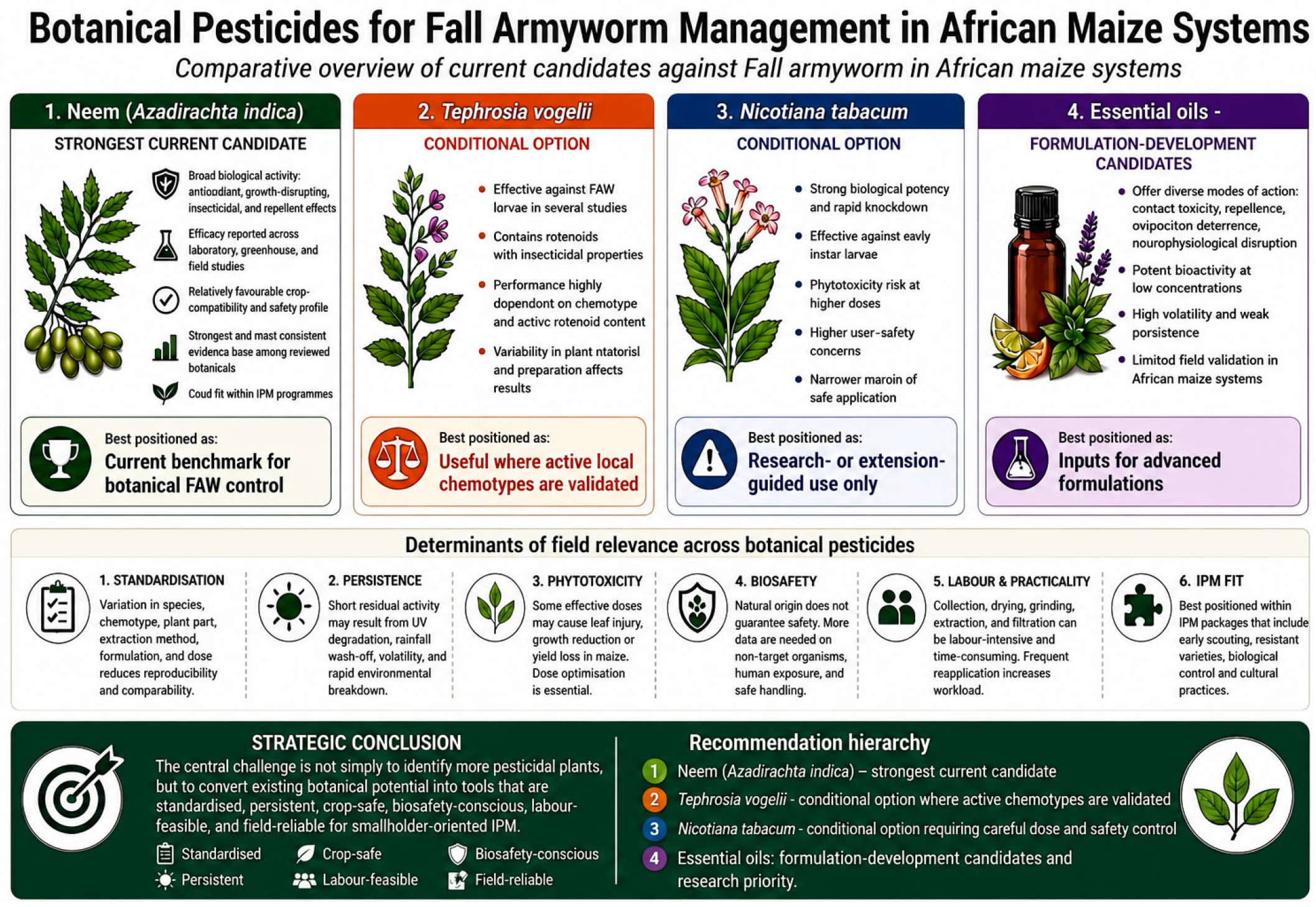
Botanical Pesticides Against Fall Armyworm in African Maize Systems: A Structured Narrative Review and SWOT Synthesis


Abstract
1. Introduction
2. Results and Discussion
2.1. Botanical Pesticides Evaluated Against Fall Armyworm in African Maize Systems
2.1.1. Crude Plant Extracts and Powders
Limonoid-Rich Botanicals
- Azadirachta indica
Rotenoid-Rich Botanicals
Alkaloid-Rich Botanicals
Other Crude Botanicals with Limited or Emerging Evidence
2.2. Essential Oils
2.2.1. Monoterpene-Rich Oils
2.2.2. Other Volatile-Oil Systems with Emerging Evidence
2.3. Application Scope and Promotion Scenarios
2.3.1. Agroecological and Crop Context
2.3.2. Target FAW Developmental Stages and Timing of Control
2.3.3. User Groups and Operational Scales
2.3.4. Suitable Promotion Scenarios
2.4. Cross-Cutting Determinants of Field Relevance
2.4.1. Standardisation
2.4.2. Persistence and Environmental Degradation
2.4.3. Phytotoxicity
2.4.4. Non-Target Effects and Biosafety
2.4.5. Labour and Usability
2.4.6. Fit Within IPM
2.5. Evidence-Based SWOT Synthesis of Botanical Pesticides Against Fall Armyworm in African Maize Systems
2.6. Conclusions
3. Materials and Methods
3.1. Review Design and Scope
3.2. Literature Search Strategy
3.3. Eligibility Criteria
3.4. Study Selection and Data Extraction
3.5. Evidence Classification and Synthesis
3.6. SWOT Framework Development
3.7. Methodological Limitations
Supplementary Materials
Author Contributions
Funding
Data Availability Statement
Acknowledgments
Conflicts of Interest
Abbreviations
| FAW | Fall armyworm |
| SWOT | Strength, Weaknesses, Opportunities and Threats |
References
- Goergen, G.; Kumar, P.L.; Sankung, S.B.; Togola, A.; Tamò, M. First Report of Outbreaks of the Fall Armyworm Spodoptera frugiperda (J.E. Smith) (Lepidoptera, Noctuidae), a New Alien Invasive Pest in West and Central Africa. PLoS ONE 2016, 11, e0165632. [Google Scholar] [CrossRef]
- Togola, A.; Beyene, Y.; Bocco, R.; Tepa-Yotto, G.; Gowda, M.; Too, A.; Boddupalli, P. Fall Armyworm (Spodoptera frugiperda) in Africa: Insights into Biology, Ecology and Impact on Staple Crops, Food Systems and Management Approaches. Front. Agron. 2025, 7, 1538198. [Google Scholar] [CrossRef]
- Nyamutukwa, S.; Mvumi, B.M.; Chinwada, P. Sustainable Management of Fall Armyworm, Spodoptera frugiperda (J.E. Smith): Challenges and Proposed Solutions from an African Perspective. Int. J. Pest Manag. 2024, 70, 676–694. [Google Scholar] [CrossRef]
- Matova, P.M.; Kamutando, C.N.; Warburton, M.L.; Williams, W.P.; Magorokosho, C.; Shimelis, H.; Labuschagne, M.; Day, R.; Gowda, M. New Techniques for Breeding Maize (Zea mays) Varieties with Fall Armyworm Resistance and Market-Preferred Traits for Sub-Saharan Africa. Plant Breed. 2023, 142, 1–11. [Google Scholar] [CrossRef]
- Odong, T.L.; Obongo, I.; Ariong, R.; Adur, S.E.; Adumo, S.A.; Onen, D.O.; Rwotonen, B.I.; Otim, M.H. Farmer Perceptions, Knowledge, and Management of Fall Armyworm in Maize Production in Uganda. Front. Insect Sci. 2024, 4, 1345139. [Google Scholar] [CrossRef]
- Ngegba, P.M.; Cui, G.; Khalid, M.Z.; Zhong, G. Use of Botanical Pesticides in Agriculture as an Alternative to Synthetic Pesticides. Agriculture 2022, 12, 600. [Google Scholar] [CrossRef]
- Monica, K.K.; Fernadis, M.; Duncan, C.; Winnie, N.; Daniel, K.; Léna, D.G. Area-Wide Pest Management and Prospects for Fall Armyworm Control on Smallholder Farms in Africa: A Review. Sustain. Environ. 2024, 10, 2345464. [Google Scholar] [CrossRef]
- Van Den Berg, J.; Du Plessis, H. Chemical Control and Insecticide Resistance in Spodoptera frugiperda (Lepidoptera: Noctuidae). J. Econ. Entomol. 2022, 115, 1761–1771. [Google Scholar] [CrossRef]
- Prasanna, B.; Huesing, J.E.; Eddy, R.; Peschke, V.M. Fall Armyworm in Africa: A Guide for Integrated Pest Management, 1st ed.; CDMX: CIMMYT; USAID: Mexico City, Mexico, 2018. [Google Scholar]
- Rioba, N.B.; Stevenson, P.C. Opportunities and Scope for Botanical Extracts and Products for the Management of Fall Armyworm (Spodoptera frugiperda) for Smallholders in Africa. Plants 2020, 9, 207. [Google Scholar] [CrossRef]
- Chawanda, G.; Tembo, Y.L.B.; Donga, T.K.; Kabambe, V.H.; Stevenson, P.C.; Belmain, S.R. Agroecological Management of Fall Armyworm Using Soil and Botanical Treatments Reduces Crop Damage and Increases Maize Yield. Front. Agron. 2023, 5, 1114496. [Google Scholar] [CrossRef]
- Ullah, F.; Govindharaj, G.P.P.; Hyder, M.; Sarangi, S.; Gul, H.; Li, X.; Guedes, R.N.C.; Desneux, N.; Lu, Y. From Plants to Pest Targets: Revisiting Botanical Insecticides for Lepidopteran Pest Management. Agric. Commun. 2025, 3, 100113. [Google Scholar] [CrossRef]
- Bateman, M.L.; Day, R.K.; Rwomushana, I.; Subramanian, S.; Wilson, K.; Babendreier, D.; Luke, B.; Edgington, S. Updated Assessment of Potential Biopesticide Options for Managing Fall Armyworm (Spodoptera frugiperda) in Africa. J. Appl. Entomol. 2021, 145, 384–393. [Google Scholar]
- Tavares, W.R.; Barreto, M.D.C.; Seca, A.M.L. Aqueous and Ethanolic Plant Extracts as Bio-Insecticides—Establishing a Bridge between Raw Scientific Data and Practical Reality. Plants 2021, 10, 920. [Google Scholar] [CrossRef]
- Bhosle, D.; Srinivasan, T.; Elaiyabharathi, T.; Shanmugam, P.S.; Vellaikumar, S. A Review on Use of Botanical Extracts for the Management of Fall Armyworm Spodoptera frugiperda (Smith, 1797) [Noctuidae, Lepidoptera]. J. Plant Dis. Prot. 2025, 132, 17. [Google Scholar] [CrossRef]
- Fenibo, E.O.; Matambo, T. Biopesticides for Sustainable Agriculture: Feasible Options for Adopting Cost-Effective Strategies. Front. Sustain. Food Syst. 2025, 9, 1657000. [Google Scholar] [CrossRef]
- National Research Council, Board on Science, & Technology for International Development. Neem: A Tree for Solving Global Problems; National Academies Press: Washington, DC, USA, 1992. [Google Scholar]
- Isman, M.B. Bridging the Gap: Moving Botanical Insecticides from the Laboratory to the Farm. Ind. Crops Prod. 2017, 110, 10–14. [Google Scholar] [CrossRef]
- Adusei, S.; Azupio, S. Neem: A Novel Biocide for Pest and Disease Control of Plants. J. Chem. 2022, 2022, 6778554. [Google Scholar] [CrossRef]
- Gahukar, R.T. Factors Affecting Content and Bioefficacy of Neem (Azadirachta indica A. Juss.) Phytochemicals Used in Agricultural Pest Control: A Review. Crop Prot. 2014, 62, 93–99. [Google Scholar] [CrossRef]
- Adhikari, C.; Dhungana, S.; Tiwari, S.; Thapa, R.B.; Neupane, S.; Sharma, S.D. Laboratory and Field Evaluation of Insecticides Against Fall Armyworm (Spodoptera frugiperda J.E. Smith) Larvae on Maize. J. Plant Prot. Soc. 2024, 9, 1–17. [Google Scholar] [CrossRef]
- Abudulai, M.; Shepard, B.M.; Mitchell, P.L. Antifeedant and Toxic Effects of a Neem (Azadirachta indica A. Juss)-Based Formulation Neemix® Against Nezara viridula (L.) (Hemiptera: Pentatomidae). J. Entomol. Sci. 2003, 38, 398–408. [Google Scholar]
- Campos, E.V.R.; de Oliveira, J.L.; Pascoli, M.; de Lima, R.; Fraceto, L.F. Neem Oil and Crop Prot: From Now to the Future. Front. Plant. Sci. 2016, 7, 1494. [Google Scholar]
- Belmain, S.R.; Amoah, B.A.; Nyirenda, S.P.; Kamanula, J.F.; Stevenson, P.C. Highly Variable Insect Control Efficacy of Tephrosia vogelii Chemotypes. J. Agric. Food Chem. 2012, 60, 10055–10063. [Google Scholar] [CrossRef]
- National Library of Medicine. National Centre for Biotechnology Information Chemical Structures. Available online: https://pubchem.ncbi.nlm.nih.gov/ (accessed on 29 April 2026).
- Senthil-Nathan, S. Physiological and Biochemical Effect of Neem and Other Meliaceae Plants Secondary Metabolites against Lepidopteran Insects. Front. Physiol. 2013, 4, 359. [Google Scholar] [CrossRef]
- Aniwanou, C.T.S.; Sinzogan, A.A.C.; Deguenon, J.M.; Sikirou, R.; Stewart, D.A.; Ahanchede, A. Bio-Efficacy of Diatomaceous Earth, Household Soaps, and Neem Oil against Spodoptera frugiperda (Lepidoptera: Noctuidae) Larvae in Benin. Insects 2021, 12, 18. [Google Scholar] [CrossRef] [PubMed]
- Liywalii, K.; Tembo, A.; Muyabe, O.; Musenge, D.C.; Mulenga, M.; Silombe, M.; Movwe, T.; Banda, R.; Chola, E.; Mubita, S.; et al. Evaluating the Efficacy of Neem (Azadirachta indica) and Chili (Capsicum spp.) Extracts for the Control of Fall Armyworm (Spodoptera frugiperda) in Maize (Zea mays) Production in Zambia. J. Exp. Agric. Int. 2026, 48, 361–374. [Google Scholar] [CrossRef]
- Phambala, K.; Tembo, Y.; Kasambala, T.; Kabambe, V.H.; Stevenson, P.C.; Belmain, S.R. Bioactivity of Common Pesticidal Plants on Fall Armyworm Larvae (Spodoptera frugiperda). Plants 2020, 9, 112. [Google Scholar] [CrossRef]
- Tulashie, S.K.; Adjei, F.; Abraham, J.; Addo, E. Potential of Neem Extracts as Natural Insecticide against Fall Armyworm (Spodoptera frugiperda (J. E. Smith) (Lepidoptera: Noctuidae). Case Stud. Chem. Environ. Eng. 2021, 4, 100130. [Google Scholar] [CrossRef]
- Okello, T.R.; Wacal, C.; Peter, W.D.; Tekkara, A.O.; Gumisiriya, C.; Kagorora, J.P.K. Potential of Neem (Azadirachta indica) Extract in Managing Fall Armyworm on Maize. J. Agric. Sci. 2024, 16, 114. [Google Scholar] [CrossRef]
- Acharya, R.; Sharma, S.R.; Barman, A.K.; Kim, S.M.; Lee, K.Y. Control Efficacy of Azadirachtin on the Fall Armyworm, Spodoptera frugiperda (J.E. Smith) by Soil Drenching. Arch. Insect Biochem. Physiol. 2023, 113, e22020. [Google Scholar] [CrossRef] [PubMed]
- Sisay, B.; Tefera, T.; Wakgari, M.; Ayalew, G.; Mendesil, E. The Efficacy of Selected Synthetic Insecticides and Botanicals against Fall Armyworm, Spodoptera frugiperda, in Maize. Insects 2019, 10, 45. [Google Scholar] [CrossRef] [PubMed]
- Assefa, F.; Ayalew, D. Status and Control Measures of Fall Armyworm (Spodoptera frugiperda) Infestations in Maize Fields in Ethiopia: A Review. Cogent Food Agric. 2019, 5, 1641902. [Google Scholar] [CrossRef]
- Mekonnen, B.B.; Mohammed, O.A.; Hagos, H.G. Evaluation of the Efficacy of Neem Extracts for Controlling Fall Armyworm (Spodoptera frugiperda (J.E. Smith) (Lepidoptera: Noctuidae) on Maize Plant in Small-Scale Maize Farms, in Case of Afar Regional Administration Northeastern of Ethiopia. Agric. Biol. Res. 2024, 41, 1–5. [Google Scholar]
- Mkindi, A.G.; Tembo, Y.; Mbega, E.R.; Medvecky, B.; Kendal-smith, A.; Farrell, I.W.; Ndakidemi, P.A.; Belmain, S.R.; Stevenson, P.C. Phytochemical Analysis of Tephrosia vogelii across East Africa Reveals Three Chemotypes That Influence Its Use as a Pesticidal Plant. Plants 2019, 8, 597. [Google Scholar] [CrossRef]
- Nemeyimana, J.; Muhooozi, R.S.; Nuwagira, U.; Ssenkuba, F. The Efficacy of Tephrosia vogelii and Azadirachta indica Leaf Extract Combinations against Fall Armyworm, Spodoptera frugiperda, in Maize. Preprint 2023. [Google Scholar]
- Mukanga, M.; Matimelo, M.; Lwinya, K.; Machuku, O.; Chilipa, L.; Lupapula, M.; Tembo, S.M.; Chipabika, G. Efficacy of Selected Pesticides against the Fall Armyworm Infestation in Small Holder Maize Production in Zambia. Int. J. Agric. Biosci. 2024, 13, 237–249. [Google Scholar] [CrossRef]
- Kimutai Maiyo, W.; Wangila, P.; KOwino, I.; Makatiani, J. Pesticidal Activity of Crude Extracts of Aloe Secundiflora, Nicotiana tabacum and Tephrosia Vogelii Against Fall Armyworm (Spodoptera frugiperda). Int. J. Adv. Res. 2023, 11, 388–395. [Google Scholar] [CrossRef]
- Chilanga, E.; Mbeya, R.; Ng’ambi, V.; Chilanga, M. Integrated Developmental and Green Social Work Field Education to Control Fall Armyworm Infestation in Maize Crops in Malawi. Transform. Soc. Work 2024, 2, 1–16. [Google Scholar] [CrossRef]
- Use of Neorautanenia Mitis and the Fall Armyworm. Available online: https://www.fao.org/countryprofiles/news-archive/detail-news/en/c/1631735/ (accessed on 19 April 2026).
- Sakadzo, N.; Makaza, K.; Chikata, L. Biopesticidal Properties of Aqueous Crude Extracts of Tobacco (Nicotiana tabacum L.) Against Fall Armyworm (Spodoptera frugiperda J.E. Smith) on Maize Foliage (Zea mays L.) Diets. Agric. Sci. 2020, 2, 47–55. [Google Scholar] [CrossRef]
- Kasambala Donga, T.; Eklo, O.M. Environmental Load of Pesticides Used in Conventional Sugarcane Production in Malawi. Crop Prot. 2018, 108, 71–77. [Google Scholar]
- Nyongesa, L.N.; Kiprotich, K.; Omayio, D.O.; Wamalwa, E.N.; Riungu, G.M.; Ouma, V.O.; Leitich, R.K. Potential for Integrated Botanicals and Host Resistance in Maize for Management of Fall Armyworm in Kenya. Afr. Crop Sci. J. 2025, 33, 309–3256. [Google Scholar] [CrossRef]
- Siazemo, M.K.; Simfukwe, P. An Evaluation of the Efficacy of Botanical Pesticides for Fall Armyworm Control in Maize Production. OAlib 2020, 7, e6746. [Google Scholar] [CrossRef]
- Munyore, M.; Rioba, N.B. Evaluation of Garlic (Allium sativum) and Onion (Allium cepa) Extracts for the Management of the Fall Armyworm (Spodoptera frugiperda) on Baby Corn (Zea mays L) under Greenhouse Conditions. Sci. Herit. J. 2020, 4, 64–69. [Google Scholar]
- Kyerematen, R.; Dohbia, A.R.A.; Adu-Acheampong, S.; Kankam, F. Control of Fall Armyworm (Spodoptera frugiperda) with Lemon Basil (Ocimum africanum) in Tolon, Northern Region of Ghana. Int. J. Trop. Insect Sci. 2025, 45, 937–942. [Google Scholar] [CrossRef]
- Kona, N.E.M.; Khalafalla, T.A.; Adam, A.M.; Mahmoud, M.E.E. The Efficacy of Some Plants Extracts on Fall armyworm (Spodoptera frugiperda, J.E. Smizh) in Sudan. J. Agron. Res. 2021, 3, 31–37. [Google Scholar] [CrossRef]
- Josue, M.T.; Alexis, O. Effectiveness of Neem Oil and Jatropha Oil in Controlling Spodoptera frugiperda (J.E Smith) on Maize in the Republic of Chad. Eur. Sci. J. 2022, 18, 223. [Google Scholar] [CrossRef]
- Abd El-Rahman, S.F.; Haron, E.N.; Gaber, N.M. Toxicological and Biochemical Effects of Some Safe Compounds on Fall Armyworm, Spodoptera frugiperda (J.E. Smith) (Lepidoptera: Noctuidae). Pol. J. Entomol. 2025, 94, 36–49. [Google Scholar] [CrossRef]
- Usseglio, V.L.; Dambolena, J.S.; Zunino, M.P. Can Essential Oils Be a Natural Alternative for the Control of Spodoptera frugiperda? A Review of Toxicity Methods and Their Modes of Action. Plants 2023, 12, 3. [Google Scholar] [CrossRef]
- Usseglio, V.L.; Beato, M.; Dambolena, J.S.; Zunino, M.P. Potential of Essential Oils and Major EO Constituents in the Chemical Control of Spodoptera frugiperda. Plants 2025, 14, 2204. [Google Scholar] [CrossRef]
- Bibiano, C.S.; Alves, D.S.; Freire, B.C.; Vilela Bertolucci, S.K.; Carvalho, G.A. Toxicity of Essential Oils and Pure Compounds of Lamiaceae Species against Spodoptera frugiperda (Lepidoptera: Noctuidae) and Their Safety for the Nontarget Organism Trichogramma pretiosum (Hymenoptera: Trichogrammatidae). Crop Prot. 2022, 158, 106011. [Google Scholar] [CrossRef]
- Ayala-Guerrero, L.M.; Mondragón-Rojas, F.J.; Cabrera-Hidalgo, A.D.J.; Bivian-Hernández, M.d.l.Á.; Gómez-Patiño, M.B.; Andrade-Hoyos, P.; Mendieta-Moctezuma, A.; Ibarra-Torres, P. Fumigant Toxicity of Essential Oils of the Lamiaceae Family Against Spodoptera frugiperda Larvae. Insects 2026, 17, 162. [Google Scholar] [CrossRef]
- de Oliveira, E.R.; Alves, D.S.; Carvalho, G.A.; de Oliveira, B.M.R.G.; Aazza, S.; Bertolucci, S.K.V. Toxicity of Cymbopogon flexuosus Essential Oil and Citral for Spodoptera frugiperda. Ciência Agrotecnologia 2018, 42, 408–419. [Google Scholar] [CrossRef]
- Moustafa, M.A.M.; El-Said, N.A.; Alfuhaid, N.A.; El Hefny, D.E.; Helmy, R.M.A.; Fónagy, A.; Ibrahim, E.-D.S. Field Evaluation of the Bioactivity of Flonicamid and Flubendiamide and Their Mixtures with the Lemongrass, Cymbopogon citratus, Essential Oil on Fall Armyworm (Lepidoptera: Noctuidae) Infesting Sweet Corn and Dissipation of Chemicals in Seeds and Husks1. J. Entomol. Sci. 2024, 520–541. [Google Scholar] [CrossRef]
- Ismail, S.M. Synergistic Action of Lemongrass Oil and Permethrin on Biochemical Responses of Spodoptera frugiperda (J.E. Smith). J. Agric. Sci. Eng. 2024, 6, 133–140. [Google Scholar]
- Díaz, A.S.; Luz, T.Z.; Mendes, G.R.; Andrade, E.D.; Bertolucci, S.K.V.; Alves, D.S.; Carvalho, G.A. Toxicity of Ocimum basilicum L. (Lamiaceae) Essential Oil to Spodoptera frugiperda (J.E. Smith, 1797) (Lepidoptera: Noctuidae) and Its Selectivity for Telenomus remus Nixon, 1937 (Hymenoptera: Scelionidae). Crop Prot. 2026, 203, 107551. [Google Scholar] [CrossRef]
- Ibrahim, S.S.; El-Kholy, M.Y.; Shalaby, S.E.S.M. Insecticidal Effects of Nano-Encapsulated Lemongrass Essential Oil on the Population Parameters of Spodoptera frugiperda Using Two-Sex Life Table. Sci. Rep. 2025, 15, 11138. [Google Scholar] [CrossRef] [PubMed]
- Giraldi, G.T.; do Amaral, W.; Zimmermann, R.C.; Mazarotto, E.J.; Schafaschek, A.M.; Gerber, A.E.; Maia, B.H.L.N.S.; dos Santos, E.F.; Navarro da Silva, M.A.; Foester, L.A. Insecticidal Activity, Toxicity and Biochemical Alterations of Drimys brasiliensis Essential Oil against Spodoptera frugiperda. J. Pest Sci. 2025, 98, 693–703. [Google Scholar] [CrossRef]
- Sombra, K.E.S.; de Aguiar, C.V.S.; de Oliveira, S.J.; Barbosa, M.G.; Zocolo, G.J.; Pastori, P.L. Potential Pesticide of Three Essential Oils against Spodoptera frugiperda (J.E. Smith) (Lepidoptera: Noctuidae). Chil. J. Agric. Res. 2020, 80, 617–628. [Google Scholar] [CrossRef]
- Tanga, C.M.; Onyango, L.O.; Malusi, P.; Subramanian, S.; Tenkouano, A.; Beesigamukama, D. Insect Oil-Based Biorationals as Novel Alternative against the Invasive Tomato Leafminer [Phthorimaea absoluta] and Fall Armyworm [Spodoptera frugiperda]. J. Agric. Food Res. 2026, 25, 102583. [Google Scholar] [CrossRef]
- Ayllón-Gutiérrez, R.; Díaz-Rubio, L.; Montaño-Soto, M.; Haro-Vázquez, M.d.P.; Córdova-Guerrero, I. Applications of Plant Essential Oils in Pest Control and Their Encapsulation for Controlled Release: A Review. Agriculture 2024, 14, 1766. [Google Scholar] [CrossRef]
- Giongo, A.M.M.; Vendramim, J.D.; Forim, M.R. Evaluation of Neem-Based Nanoformulations as Alternative to Control Fall Armyworm. Ciência Agrotecnologia 2016, 40, 26–36. [Google Scholar] [CrossRef]
- Barrera-Cortés, J.; Sosa-Trejo, J.; Sánchez-Barrera, I.M.; Lina-García, L.P.; León Navarrete, F.D.; Mancera-López, M.E. Nanoformulations of the Piper auritum Kunth (Piperales: Piperaceae) Essential Oil for the Control of Spodoptera frugiperda (J.E. Smith) (Lepidoptera: Noctuidae). Agriculture 2026, 16, 308. [Google Scholar] [CrossRef]
- Wangrawa, D.W.; Waongo, A.; Traore, F.; Sanou, D.; Lahondere, C.; Sané, A.R.; Borovsky, D.; Ouédraogo, S.N.; Sanon, A. The Essential Oils Compounds of Lippia multiflora Moldenke and Cymbopogon schoenanthus (L.) Spreng Repel and Affect the Survival of the Maize Pest Spodoptera frugiperda (Lepidoptera: Noctuidae) Larvae. Psyche J. Entomol. 2024, 2024, 1202962. [Google Scholar] [CrossRef]
- Kobenan, K.C.; Kouadio, I.S.; Kouakou, M.; Silvie, P.; Kouadio, K.N.B.; N’goran, K.E.; Kouakou, B.J.; Amangoua, N.F.; Tehia, K.E.; Uba, A.I.; et al. In Vitro and Molecular Docking Evaluation of Larvicidal Effects of Essential Oils of Five Aromatic Plants on the Fall Armyworm Spodoptera frugiperda J.E. Smith (Lepidoptera: Noctuidae) from Ivory Coast. Chem. Biodivers. 2023, 20, e202300411. [Google Scholar] [CrossRef]
- Durofil, A.; Radice, M.; Blanco-Salas, J.; Ruiz-Téllez, T. Piper aduncum Essential Oil: A Promising Insecticide, Acaricide and Antiparasitic. A Review. Parasite 2021, 28, 42. [Google Scholar] [CrossRef]
- Assalin, M.R.; de Castro, S.C.; Mioti, M.V.; dos Santos, V.T.; Fazolin, M.; Forim, M.R.; do Nascimento Queiroz, S.C.; Marinho-Prado, J.S.; Tasic, L. Nanoencapsulation of Essential Oil of Piper aduncum: Evaluation of Insecticidal Activity and Phytotoxicity of a Botanical Pesticide. Plant Nano Biol. 2025, 11, 100137. [Google Scholar] [CrossRef]
- Fazolin, M.; Monteiro, A.F.M.; Bizzo, H.R.; Gama, P.E.; Viana, L.d.O.; de Lima, M.É.C. Insecticidal Activity of Piper aduncum Oil: Variation in Dillapiole Content and Chemical and Toxicological Stability during Storage. Acta Amaz. 2022, 52, 179–188. [Google Scholar] [CrossRef]
- Macedo Silva, S.; Paulo Arantes Rodrigues da Cunha, J.; Henrique Souza Zandonadi, C.; Heros Teodoro de Assuncao, H.; Gregorio Marques, M. Synergistic Effects of Binary Mixtures of Linalool with Pyrethroids Against Fall Armyworm. Biosci. J. 2020, 36, 228–237. [Google Scholar] [CrossRef]
- Negrini, M.; Fidelis, E.G.; Schurt, D.A.; Silva, F.D.S.; Pereira, R.S.; Bizzo, H.R. Insecticidal Activity of Essential Oils in Controlling Fall Armyworm, Spodoptera frugiperda. Arq. Inst. Biológico 2019, 86, e1112018. [Google Scholar] [CrossRef]
- Devrnja, N.; Milutinović, M.; Savić, J. When Scent Becomes a Weapon—Plant Essential Oils as Potent Bioinsecticides. Sustainability 2022, 14, 6847. [Google Scholar] [CrossRef]
- Kumar, R.; Kaur, R.; Ranout, A.S.; Nadda, G. A Review on Novel Formulations and Delivery Systems of Botanical Insecticides for Enhanced Efficacy. Neotrop. Entomol. 2025, 54, 81. [Google Scholar] [CrossRef]
- Thole, G.K.; Donga, T.; Njoloma, J.; Nyoka, B.; Mng’, S.; Chimungu, J.; Missanjo, E.; Katengeza, S.; Harrison, R. Reduced Fall Armyworm (Spodoptera frugiperda J.E. Smith) Infestation and Leaf Damage in Maize Fields Adjacent to Forested Margins in Two Districts of Malawi. J. Entomol. 2026, 23, 1–12. [Google Scholar] [CrossRef]
- Harrison, R.D.; Thierfelder, C.; Baudron, F.; Chinwada, P.; Midega, C.; Schaffner, U.; van den Berg, J. Agro-Ecological Options for Fall Armyworm (Spodoptera frugiperda J.E. Smith) Management: Providing Low-Cost, Smallholder Friendly Solutions to an Invasive Pest. J. Environ. Manag. 2019, 243, 318–330. [Google Scholar] [CrossRef]
- Oyege, I.; Switz, A.; Oquendo, L.; Prasad, A.; Bhaskar, M.S.B. Green Synthesis of Neem Extract and Neem Oil-Based Azadirachtin Nanopesticides for Fall Armyworm Control and Management. Ecotoxicol. Environ. Saf. 2025, 295, 118168. [Google Scholar] [CrossRef]
- Mora, J.; Blanco-Metzler, H. Evaluation of Botanical Insecticides in Controlling the Population of Fall Armyworms (Spodoptera frugiperda Smith) Present on Corn Crops (Zea mays) Located in Santa Cruz, Guanacaste. In IOP Conference Series: Earth and Environmental Science, Proceedings of the International Conference on Organic Agriculture in the Tropics: State of the Art, Challenges and Opportunities, Yogyakarta, Indonesia, 20–24 August 2017; Institute of Physics Publishing: Bristol, UK, 2018; Volume 215. [Google Scholar]
- Oliveira, J.A.C.; Figueiredo, K.G.; Fernandes, L.A.; Carvalho, V.C.; Alves, D.S.; Ugucioni, J.C.; Oliveira, J.L.; Carvalho, H.W.P.; Bertolucci, S.K.V.; Carvalho, G.A. Toxicity of Nanoemulsified Eugenia uniflora (Myrtaceae) Essential Oil to Spodoptera frugiperda (Lepidoptera: Noctuidae) and Selectivity to Trichogramma pretiosum (Hymenoptera: Trichogrammatidae). Plants 2026, 15, 248. [Google Scholar] [CrossRef] [PubMed]
- Nonci, N.; Noveriza, R.; Meilin, A.; Melati, M.; Manzila, I.; Pustika, A.B.; Rahma, H.; Najamuddin, E.; Muis, A. Toxicity Test of Compound Essential Oil Nanoemulsion on Fall Armyworm (Spodoptera frugiperda J.E. Smith) Eggs. Cogent Food Agric. 2025, 11, 2435584. [Google Scholar] [CrossRef]
- Soares, A.P.; Zocolo, G.J.; Bueno, A.D.F. The Overlooked Impact of Botanical Pesticides on Non-Target Organisms. Plants 2026, 15, 917. [Google Scholar] [CrossRef] [PubMed]


| Scientific Name of Botanical Pesticides/Essential Oil | Country | Pub. Year | Trial Setting | Formulation/ Plant Part | Standardized Rate/ Concentration | Main Reported Outcome | Ref. |
|---|---|---|---|---|---|---|---|
| Azadirachta indica | Malawi | 2023 | Field | Dry leaf powder (whorl) | 3 g/whorl | Reduced larval abundance and leaf damage; yield protection reported | [11] |
| Azadirachta indica | Malawi | 2020 | Screenhouse/laboratory | Aqueous leaf extract | 10% w/v (100 g/L) | Strong activity against early larvae; lower damage than control | [29] |
| Azadirachta indica | Benin | 2021 | Field | Neem oil | 4.5 L/ha | Comparable or better field control than the semi-synthetic standard in some sites | [27] |
| Azadirachta indica | Uganda | 2024 | Field | Leaf powder/extract | 200 g per L | Higher concentrations improved suppression under field conditions | [31] |
| Azadirachta indica | Zambia | 2026 | Field | Aqueous kernel extract | 5% (w/v)/(50 g/L) | Effective suppression under smallholder field conditions reported | [28] |
| Azadirachta indica | Ethiopia | 2025 | Field | Aqueous kernel extract | 600 g per L | Reduced FAW incidence and damage in small-scale farms | [35] |
| Tephrosia vogellii | Malawi | 2020 | Screenhouse/laboratory | Aqueous leaf extract | 10% w/v (100 g/L) | Activity reported, but less consistent than neem under comparable tests | [29] |
| Tephrosia vogelii + Azadirachta indica | Uganda | 2023 | Greenhouse/field-linked | Combined leaf extracts | 200 g/L | Combination treatment reported as promising against FAW | [37] |
| Tephrosia vogellii | Kenya | 2023 | Laboratory | Crude leaf extract | 30 mg/L | Larvicidal activity reported against FAW | [39] |
| Nicotiana tabacum | Malawi | 2023 | Field | Dry leaf powder (whorl) | 3 g/whorl | Strong suppression of larvae and damage, but agronomic caution required | [11] |
| Nicotiana tabacum | Zimbabwe | 2020 | Laboratory | Aqueous crude extract | 25% (w/v)/175 g/L | Strong larvicidal activity reported on maize foliage diets | [42] |
| Nicotiana tabacum | Kenya | 2023 | Laboratory | Crude extract | 30 mg/L | Activity reported against FAW alongside other crude botanicals | [39] |
| Neorautanenia mitis | Malawi | 2024 | Demonstration/field-linked | Tuber-based preparation | 50 g/L | Locally important practice reported, but evidence remains under-validated | [40] |
| Jatropha curcas/neem oil systems | Chad | 2022 | Field | Oil formulations | 1.25–1.4 L/ha | Botanical oils reported to reduce FAW under field conditions | [49] |
| Lippia multiflora/Cymbopogon schoenanthus | Burkina Faso | 2024 | Laboratory | Essential oils | NR | Repellent activity and adverse larval survival effects reported | [66] |
| Ocimum gratissimum, Ocimum canum, Cymbopogon citratus, C. nardus and Citrus sp. | Côte d’Ivoire | 2023 | Laboratory | Essential oils | NR | Larvicidal effects reported for several aromatic oil systems | [67] |
| SWOT Dimension | Evidence-Based Point | Strategic Implication | Key Supporting References |
|---|---|---|---|
| Strength | Many pesticidal plants are locally available and can be prepared with relatively low cash expenditure, which makes botanical control relevant to low-input smallholder systems. | Botanicals are most defensible where affordability, local access, and farmer-managed preparation are central to pest management decisions. | [10,76] |
| Plant-derived products can affect FAW through multiple pathways: toxicity, repellence, feeding deterrence, and growth disruption, rather than through a single acute mechanism alone. | This broadens their value within integrated pest management and helps explain why damage reduction may occur even when rapid mortality is incomplete. | [6,12,17,18,19,20,50,51,52,53,55,63] | |
| Neem currently provides the strongest balance of laboratory, field, and agronomic support among the botanicals reviewed in African maize systems. | Neem is the clearest current benchmark for cautious recommendation and for comparing the practical readiness of other botanicals. | [11,27,28,29,30,31,32,33,34,35] | |
| Weakness | Efficacy remains inconsistent because studies differ in plant species, plant part, extraction method, dose, surfactant use, and, in some cases, chemotype. | Standardisation and, where relevant, chemotype verification are needed before efficacy claims can be generalized with confidence. | [14,15,24,29,30,31,36] |
| Residual activity is often short because of azadirachtin, and many volatile constituents degrade under sunlight, rainfall, heat, oxidation, or volatility. | Formulation improvement is needed to increase persistence and make field performance less dependent on immediate post-application conditions. | [10,34,46,63] | |
| Some otherwise promising botanical pesticides have narrower crop-safety or user-safety margins, with tobacco providing the clearest example of the efficacy-versus-safety trade-off. | Optimization and routine crop-safety reporting are essential before farmer-facing promotion can be justified. | [11,43,51,80] | |
| Labour demand remains high because farmer-made treatments often require collecting plant material, drying or pounding it, preparing extracts, filtering them, and applying them repeatedly. | Operational feasibility should be treated as part of efficacy assessment, especially in outbreak conditions and labour-constrained smallholder systems. | [11,31] | |
| Weakness | Evidence on non-target effects, occupational exposure, and broader biosafety remains much thinner than evidence on target-pest suppression. | Biosafety claims should remain qualified until they are supported by direct evidence rather than inferred from plant origin alone. | [58,81] |
| Opportunity | The literature already points to tractable improvements through standardized preparation protocols, clearer dose reporting, and better source characterization of active plant material. | Research effort should prioritise improving reliability of the strongest candidates rather than simply expanding species lists. | [14,15,24,29,30,31,36] |
| Emulsions, stabilized oils, encapsulation, and other delivery technologies could extend residual activity and improve leaf adhesion or dose consistency. | Short persistence can be treated as a formulation problem to be solved, not only as an intrinsic limitation of botanicals. | [63,74,79] | |
| Botanical pesticides are most likely to deliver value when embedded in IPM through early scouting, early-instar targeting, and integration with biological and cultural control. | The strongest promotion pathway is selective, context-specific, and IPM-linked rather than blanket substitution for synthetic insecticides. | [7,9,10,16] | |
| Threat | Premature promotion of poorly validated botanicals, or of materials whose activity depends strongly on variable plant quality, chemotype, or destructive harvesting, could undermine farmer confidence and sustainability. | The main strategic threat is loss of credibility caused by overclaiming before interventions are sufficiently standardized, field-validated, and responsibly sourced. | [17,20,24,29,30,31,36,40,45,48,49,78] |
| Several candidate botanicals remain under-validated, conditionally effective, or sustainability-constrained because efficacy may depend on variable plant quality or chemotype, evidence is still sparse, or use relies on destructive harvesting. | Overpromotion before these constraints is resolved risks presenting locally promising or research-stage botanicals as broadly field-ready recommendations. | [17,20,24,29,30,31,36,40,45,48,49,78] |
Disclaimer/Publisher’s Note: The statements, opinions and data contained in all publications are solely those of the individual author(s) and contributor(s) and not of MDPI and/or the editor(s). MDPI and/or the editor(s) disclaim responsibility for any injury to people or property resulting from any ideas, methods, instructions or products referred to in the content. |
© 2026 by the authors. Licensee MDPI, Basel, Switzerland. This article is an open access article distributed under the terms and conditions of the Creative Commons Attribution (CC BY) license.
Share and Cite
Kasambala Donga, T.; Nakoma-Ngoma, T.; Matumba, L.; Bokosi, J. Botanical Pesticides Against Fall Armyworm in African Maize Systems: A Structured Narrative Review and SWOT Synthesis. Plants 2026, 15, 1637. https://doi.org/10.3390/plants15111637
Kasambala Donga T, Nakoma-Ngoma T, Matumba L, Bokosi J. Botanical Pesticides Against Fall Armyworm in African Maize Systems: A Structured Narrative Review and SWOT Synthesis. Plants. 2026; 15(11):1637. https://doi.org/10.3390/plants15111637
Chicago/Turabian StyleKasambala Donga, Trust, Theresa Nakoma-Ngoma, Limbikani Matumba, and James Bokosi. 2026. "Botanical Pesticides Against Fall Armyworm in African Maize Systems: A Structured Narrative Review and SWOT Synthesis" Plants 15, no. 11: 1637. https://doi.org/10.3390/plants15111637
APA StyleKasambala Donga, T., Nakoma-Ngoma, T., Matumba, L., & Bokosi, J. (2026). Botanical Pesticides Against Fall Armyworm in African Maize Systems: A Structured Narrative Review and SWOT Synthesis. Plants, 15(11), 1637. https://doi.org/10.3390/plants15111637