Article

Phytochemical Profile and In Vivo Assessment of Toxicity and Anti-Inflammatory Activity of Cenostigma pluviosum var. peltophoroides (Benth.) Gagnon & G.P. Lewis

by
Natanael Teles Ramos de Lima
1,
Gabriela Ribeiro de Sousa
2,
Gustavo Gomes da Silva
3,
Geovana Ferreira Guedes Silvestre
1,
Alan Ferreira Alves
1,
Ivana Maria Fechine
4,
Maria de Fatima Agra
5,
Alisson Macário de Oliveira
3,
Josean Fechine Tavares
1,6,
Marcelo Sobral da Silva
1,6 and
José Maria Barbosa Filho
1,6,*
1
Postgraduate Program in Natural and Synthetic Bioactive Products, Federal University of Paraíba, João Pessoa 58051-900, Brazil
2
Postgraduate Program in Pharmaceutical Sciences, State University of Paraíba, Campina Grande 58429-500, Brazil
3
Department of Pharmacy, Federal University of Rio Grande do Norte, Natal 59078-970, Brazil
4
Department of Pharmacy, State University of Paraíba, Campina Grande 58429-500, Brazil
5
Program of Biotechnology, Center for Biotechnology, Federal University of Paraíba, João Pessoa 58051-900, Brazil
6
Department of Pharmaceutical Sciences, Health Sciences Centre, Federal University of Paraíba, João Pessoa 58051-900, Brazil
*
Author to whom correspondence should be addressed.
Plants 2026, 15(10), 1508; https://doi.org/10.3390/plants15101508
Submission received: 8 April 2026 / Revised: 6 May 2026 / Accepted: 13 May 2026 / Published: 15 May 2026

Abstract

Cenostigma pluviosum var. peltophoroides, known as “sibipiruna,” is a plant rich in polyphenols used in traditional medicine for gastrointestinal disorders. The study aimed to investigate the chemical composition of the crude ethanolic extract of the stem bark (CEECP), evaluating its in vivo toxicity, genotoxicity, mutagenicity and anti-inflammatory activity. The plant material was macerated in 95% ethanol for 72 h, and the solvent was removed by rotary evaporation to obtain CEECP. Chemical characterization was performed by HPLC-ESI-MS/MS in negative mode. In vivo approaches were performed using male/female Swiss albino mice. Acute toxicity was assessed at a single high dose of 2000 mg/kg. Mutagenicity was investigated by the micronucleus test and genotoxicity by the comet assay, both at a dose of 2000 mg/kg. Anti-inflammatory activity was evaluated in carrageenan-induced paw edema and peritonitis models, at doses of 50, 100, and 200 mg/kg. HPLC-ESI-MS/MS analysis showed the presence of hydrolyzable tannins, phenolic acid heterosides, and biflavonoids. The safety profile of the CEECP was demonstrated for the first time, with no evidence of acute toxicity, mortality, mutagenicity, or genotoxicity at the tested doses. The extract significantly reduced paw edema in a dose-dependent manner at doses of 100 and 200 mg/kg, with inhibition rates of 65.78% and 73.12%, respectively, and also decreased leukocyte migration in the peritonitis model by 61.81% and 72.79% at the same doses. These findings indicate the CEECP as a source of pharmacologically relevant phytocompounds and, most notably, demonstrate its pronounced anti-inflammatory activity. Furthermore, the extract exhibited a favorable safety profile in the toxicological evaluations, highlighting the extract as a promising anti-inflammatory agent.

1. Introduction

Inflammatory diseases represent a major global health problem, encompassing a wide range of illnesses and infectious processes. One of their main characteristics is the presence of pain, which significantly affects the quality of life of affected individuals [1]. Although conventional pharmacological treatments are widely used to manage inflammation and pain, their prolonged use is often associated with significant adverse effects, limiting their long-term application [2]. In this context, the continuous search for new bioactive compounds with anti-inflammatory and analgesic potential has become increasingly important, aiming to offer safer and more effective alternatives for improving health.
Medicinal plants are a fundamental resource for human health, especially in regions where access to drugs remains limited. In recent decades, there has been a growing scientific and social interest in identifying safer therapeutic alternatives derived from natural sources [3,4]. However, despite their widespread use, plant-derived products are not necessarily free of toxic effects, and their complex chemical composition can significantly influence their biological activity and safety profiles [5]. Therefore, rigorous toxicological evaluation is essential to establish safe dosage ranges and identify potential adverse effects, including organ toxicity, and genotoxic or mutagenic damage [6].
In this context, the genus Cenostigma has attracted increasing attention due to its ethnomedicinal relevance and phytochemical diversity. Historically included in Caesalpinia sensu lato (Fabaceae, subfamily Caesalpinioideae), recent phylogenetic advances have led to its taxonomic reclassification, although a specific portion of the available biological data remains associated with its former designation. Species belonging to this group have been traditionally used in the treatment of various conditions, including malaria, fever, respiratory infections, dysentery, inflammatory disorders, and parasitic diseases [7,8].
Cenostigma pluviosum var. peltophoroides (Fabaceae), a Brazilian endemic species popularly known as “sibipiruna,” occurs predominantly in the Atlantic Forest and Pantanal biomes and is widely used for ornamental purposes [9,10]. In folk medicine, the stem bark has been used to treat gastrointestinal disorders such as diarrhea and dysentery [11]. Previous studies report various biological activities for this species, including antimicrobial, antimalarial, antifungal, antiviral, and wound-healing effects, highlighting its pharmacological potential [12,13,14,15,16].
Despite these reports, there is a notable lack of comprehensive studies addressing both the pharmacological efficacy and the safety profile of this species. To our knowledge, this is the first study to simultaneously investigate the anti-inflammatory activity, the in vivo toxicological profile, and the genotoxic and mutagenic potential of the ethanolic extract obtained from the stem bark of C. pluviosum. Furthermore, this work provides a detailed phytochemical characterization of this species by HPLC-ESI-MS/MS, expanding current knowledge about its chemical composition.
In this context, the present study aims to evaluate its anti-inflammatory effects, assess its safety through behavioral, hematological, and biochemical parameters, and investigate potential genotoxic risks, thus contributing to the scientific validation of its traditional use and supporting the development of safer phytotherapeutic agents.

2. Results

2.1. Phytochemical Characterization by HPLC-ESI-MS/MS

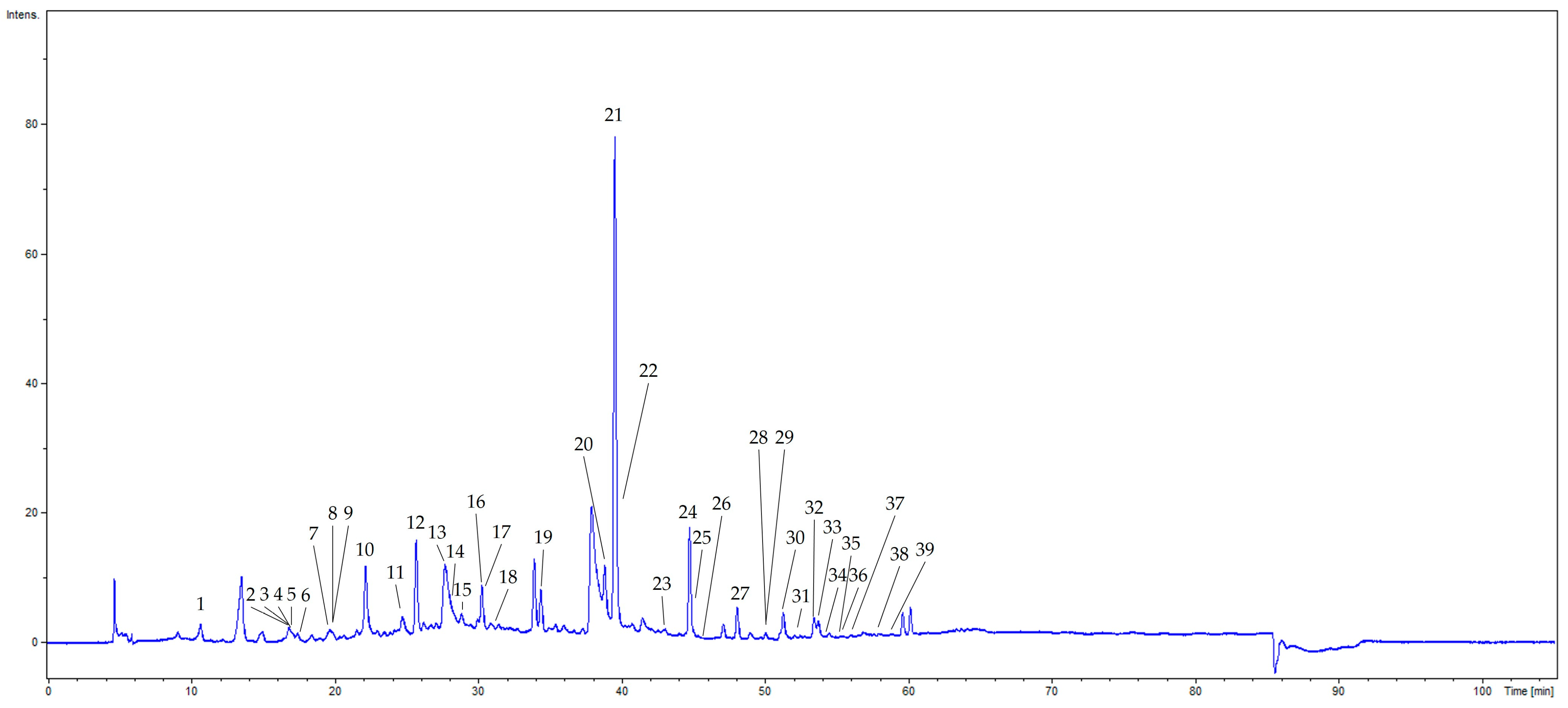
A total of 39 compounds were identified by HPLC-ESI-MS/MS. The total ion chromatogram of the stem bark extract of Cenostigma pluviosum is shown in Figure 1. Data concerning the identification of the peaks are summarized in Table 1, in which we report the retention time, the m/z value of the deprotonated ion, molecular formula and the calculated m/z value, mass error expressed in ppm, fragmentation data provided and the proposed chemical identity (annotation).
LC-MS analysis of CEECP revealed a chemical profile characterized by a high abundance of phenolic compounds. Representative molecules included hydrolyzable tannins, phenolic acids, lignans, and flavonoids, with a notable presence of biflavonoids. Ellagitannins and gallotannins were the predominant classes, including complex structures containing galloyl and hexahydroxydiphenoyl (HHDP) groups. Additionally, several simple phenolic acids were identified, such as gentisic, vanillic, and syringic acids, mainly in glycosylated forms. The profile also included derivatives of ellagic acid, many of which were methylated.

2.2. Acute Oral Toxicity

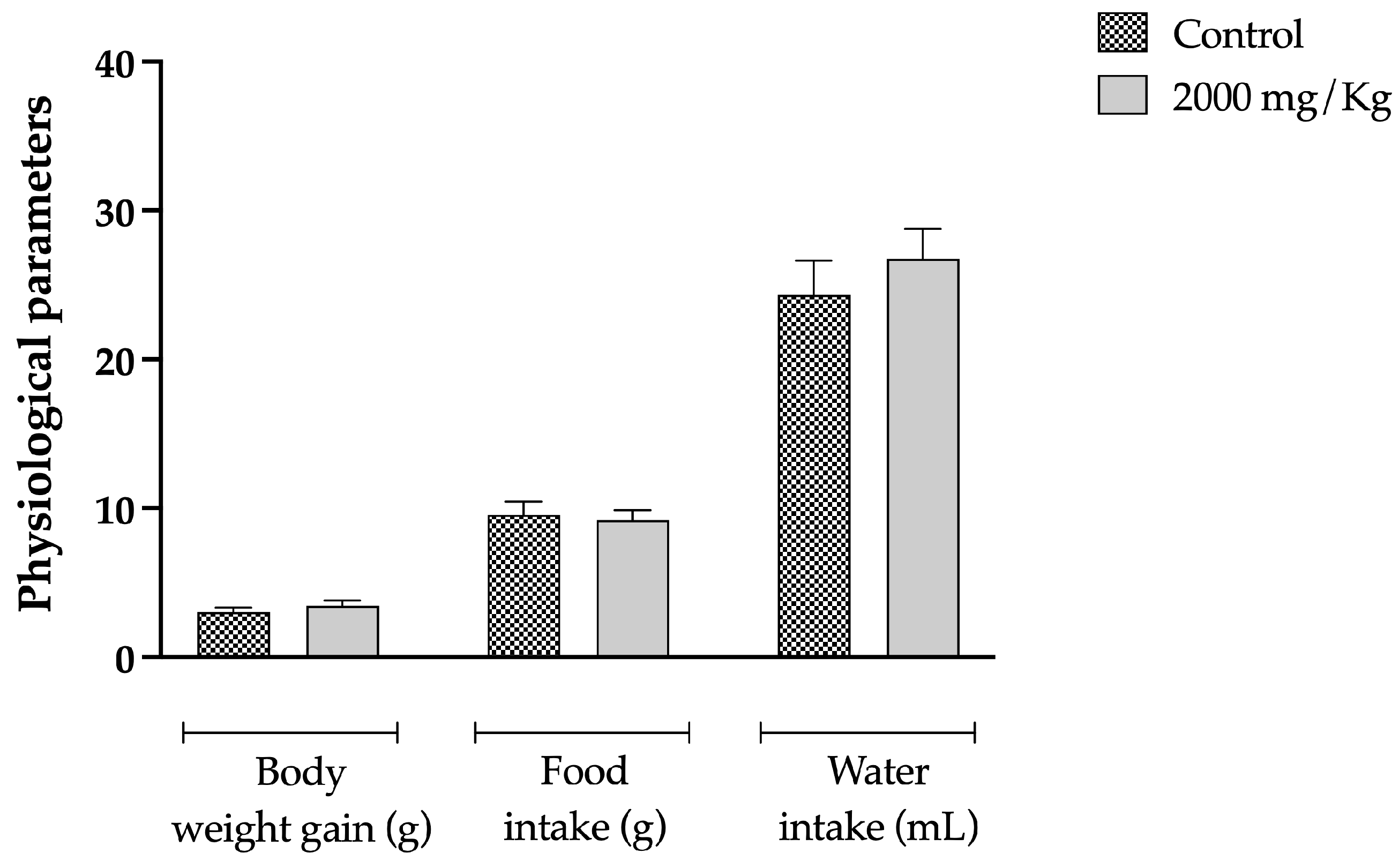
Toxicological evaluation of CEECP demonstrated no significant alterations (p > 0.05) in the general, hematological, biochemical, and morphological parameters evaluated in the acute toxicity protocol (2000 mg/kg). Taken together, the values indicate that, under the experimental conditions employed, CEECP did not promote detectable signs of systemic toxicity (Figure 2 and Table 2 and Table 3). No differences were observed in body weight gain, feed consumption or water intake, in hematological parameters, including erythrocyte and leukocyte counts, hematimetric indices and leukocyte differential, or biochemical markers of renal function, liver function, protein profile, and total cholesterol.
In addition, analysis of the relative weight of vital organs, such as the liver, kidneys, lungs, heart, and spleen, did not show any treatment-related changes at doses of 2000 mg/kg (Table 4).

2.3. Genotoxicity

In the micronucleus test evaluation (Table 5), treatment with CEECP at a dose of 2000 mg/kg did not significantly increase the number of micronucleated polychromatic erythrocytes (MNPCE), and the PCE/NCE ratio in the treated group remained comparable to the negative control (p > 0.05).
The positive control (DXR) significantly increased MNPCE frequency (28.2 ± 2.4), whereas CEECP did not alter the PCE/NCE ratio compared to the untreated control, indicating the absence of myelotoxicity and mutagenicity, and no induction of chromosomal or bone marrow damage in mice.
Similarly, in the comet assay (Table 6), CEECP did not increase the total frequency of damaged cells nor alter the distribution of damage classes relative to the negative control (p > 0.05). The average damage score also remained similar to the control. Class 0 cells were predominant in the treatment with CEECP in peripheral blood collected after 24 h, while the group treated with doxorubicin showed a significant increase in the number of damaged cells, a higher proportion of damage classes 2 and 3, and a significant increase in the total score (p < 0.05) (79.22), which validates the experimental data of this study.

2.4. Anti-Inflammatory

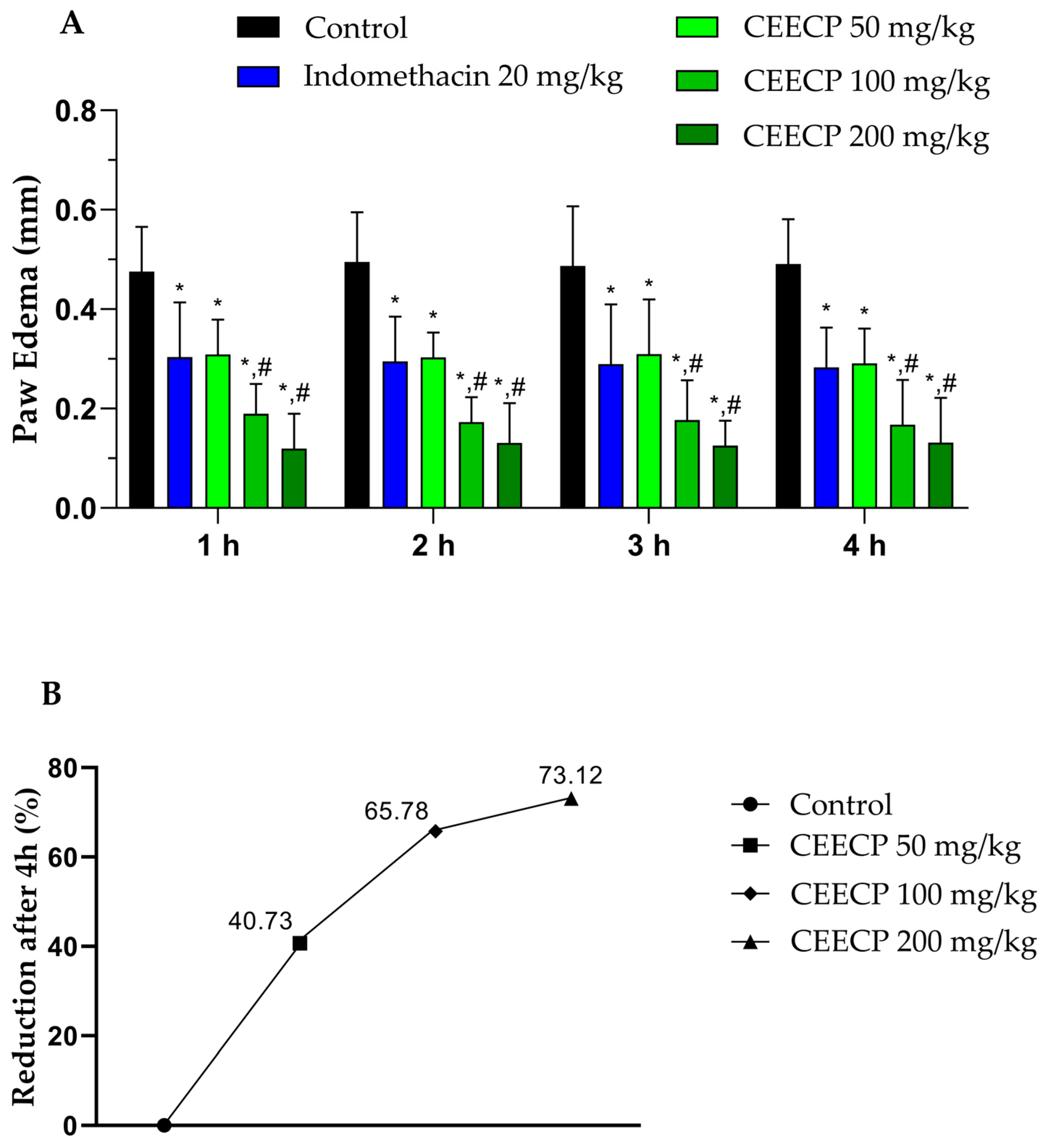
The anti-inflammatory effect of CEECP is shown in Figure 3. The sustained pronounced and progressive edema over the 4 h in the negative control group (untreated) confirms the adequate induction of the inflammatory response and validates the experimental model. Complementarily, the positive control group treated with Indomethacin (20 mg/kg) showed significant and consistent inhibition of edema (p < 0.05), demonstrating the sensitivity of the protocol in detecting compounds with anti-inflammatory activity.
Administration of CEECP significantly reduced carrageenan-induced paw edema in a dose-dependent manner. As shown in Figure 3B, CEECP produced inhibition of 40.7%, 65.8%, and 73.1% at doses of 50, 100, and 200 mg/kg, respectively, after 4 h, compared with the control group. Indomethacin showed 42.36% inhibition, which was statistically significant only relative to the vehicle group. Notably, edema was significantly reduced (p < 0.05) in all CEECP-treated groups from the first hour after injection, indicating an early onset of anti-inflammatory activity.
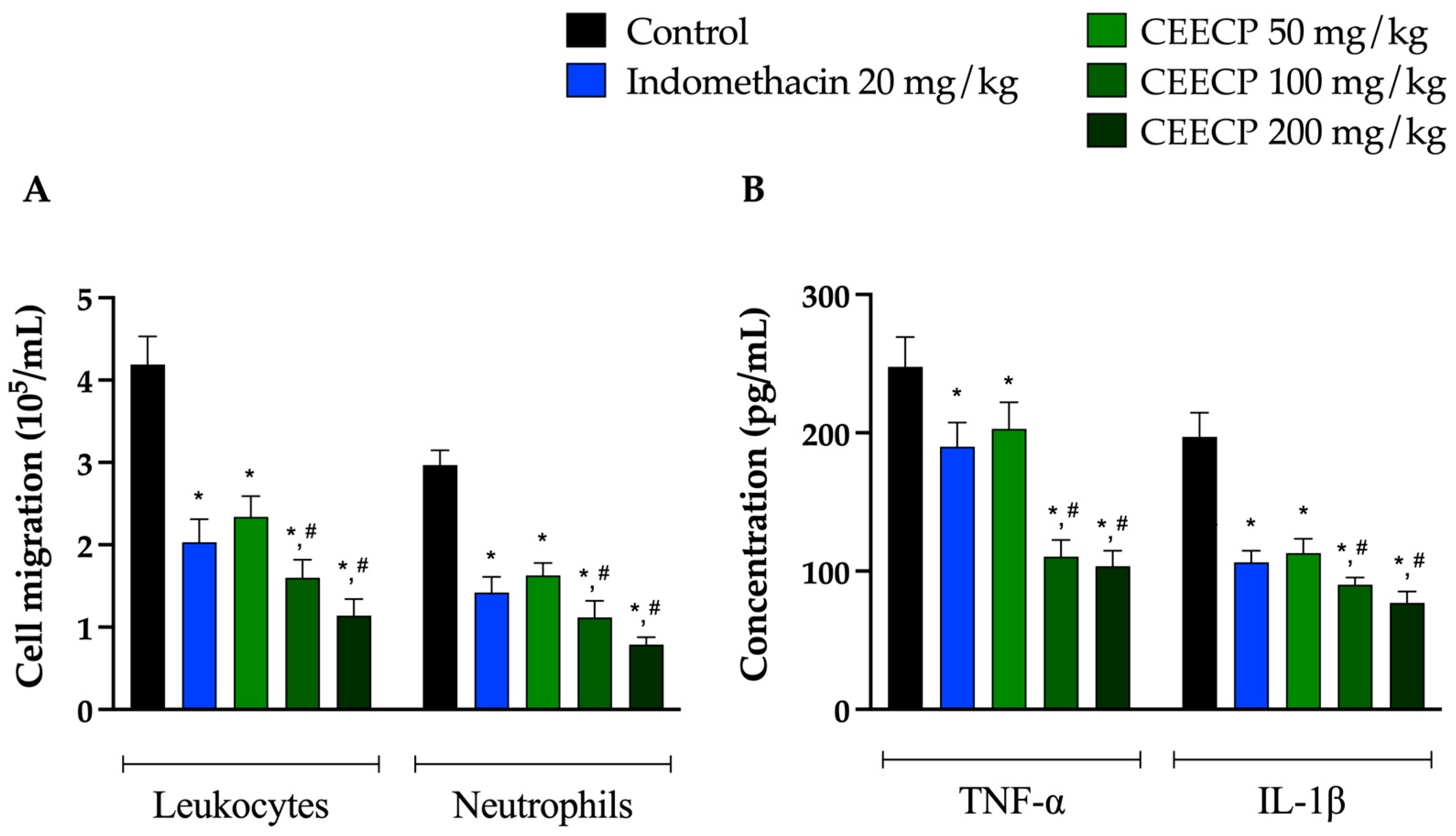
Similarly, CEECP significantly reduced total leukocyte and neutrophil migration in the carrageenan-induced peritoneal exudate model in a dose-dependent manner. At 100 mg/kg, the extract inhibited leukocyte and neutrophil migration by 61.81% and 62.29%, respectively, while at 200 mg/kg, the inhibition reached 72.79% for leukocytes and 73.40% for neutrophils. Notably, these effects were greater than those observed with indomethacin. Furthermore, CEECP significantly decreased the levels of tumor necrosis factor-α (TNF-α) and interleukin-1β (IL-1β) (Figure 4).
In general, the 50 mg/kg dose showed moderate anti-inflammatory activity in both experimental models, promoting significant reductions when compared to the control group. In the paw edema assay, even at the lowest dose tested, CEECP demonstrated a relevant pharmacological effect. Similarly, in the peritoneal exudate model, this dose significantly reduced leukocyte and neutrophil migration, although to a lesser extent compared to the 100 and 200 mg/kg doses. Thus, the 50 mg/kg dose can be considered the lowest effective dose evaluated, producing a significant, but not maximal response.

3. Discussion

LC-MS/MS analysis allowed the detection of 39 relevant peaks (Table 1) throughout the 60 min chromatographic run, representing different classes of phenolic compounds. Identification was performed by comparing published reference data and by isolating the compounds.
Six of these peaks (1, 3, 5, 6, 7, and 9) were attributed to phenolic glycosides, showing fragmentation patterns characteristic of sugar unit loss, with neutral losses of −162 Da (hexoses), −132 Da (pentoses), or −294 Da, corresponding to the elimination of a hexose-pentose disaccharide [36]. The identified aglycones included gallic acid, gentisic acid, vanillic acid, and syringic acid, evidenced by the characteristic base ions at MS2 spectra formed after sugar cleavage, observed at m/z 169 ([M−162−H]), 153 ([M−162−H]), 167 ([M−294−H] and 197 ([M−294−H]), respectively; a disaccharide loss is also shown in compound 6 and 9 [17,18,19,20,22].
Ellagic acid derivatives were detected at peaks 19, 20, 22, and 25, based on the analysis of MS2 spectra, which showed characteristic fragment ions at m/z 315, attributed to methyl ellagic acid, and at m/z 328, corresponding to dimethyl ellagic acid. Compounds 19 and 20 presented deprotonated molecular ions [M−H] at m/z 477 and 447, respectively. Both exhibited similar fragmentation profiles, differing mainly in the sugar unit attached to the aglycone, being a hexose in compound 19 and a pentose in compound 20. In the MS2 spectra, the ion at m/z 315, related to methyl ellagic acid, showed an additional fragment at m/z 299, corresponding to the loss of a methyl group (−CH3). Similarly, for dimethyl ellagic acid, the sequential loss of two methyl groups was observed, evidenced by the ions at m/z 314 and 299, confirming the fragmentation pattern expected for these derivatives [26,32,33,34,35].
Compounds 2, 4, 8, and 1016 were assigned to the class of hydrolyzable tannins, based on the presence of characteristic fragments of this class in the MS2/MS3 spectra. In general, all the mentioned compounds showed fragmentation patterns compatible with hydrolyzable tannins, with neutral losses corresponding to sugar losses, galoyl ([M−H−152]), gallic acid ([M−H−170]), and HHDP ([M−H−302]) groups were observed. However, compound 11, assigned to chebulanin, differed by containing a unit derived from chebulinic acid (chebuloyl group), evidenced by the characteristic loss of 320 Da, resulting in the formation of the fragment ion at m/z 319, typical of this structural subclass [37]. Hydrolyzable tannins are widely distributed throughout various organs of the Fabaceae family, such as seeds, leaves, stems, bark, branches, and fruits. Interestingly, in the LC–MS/MS analysis performed in this study, no condensed tannins were identified, despite this class being generally regarded as more abundant in plants than hydrolyzable tannins [38,39].
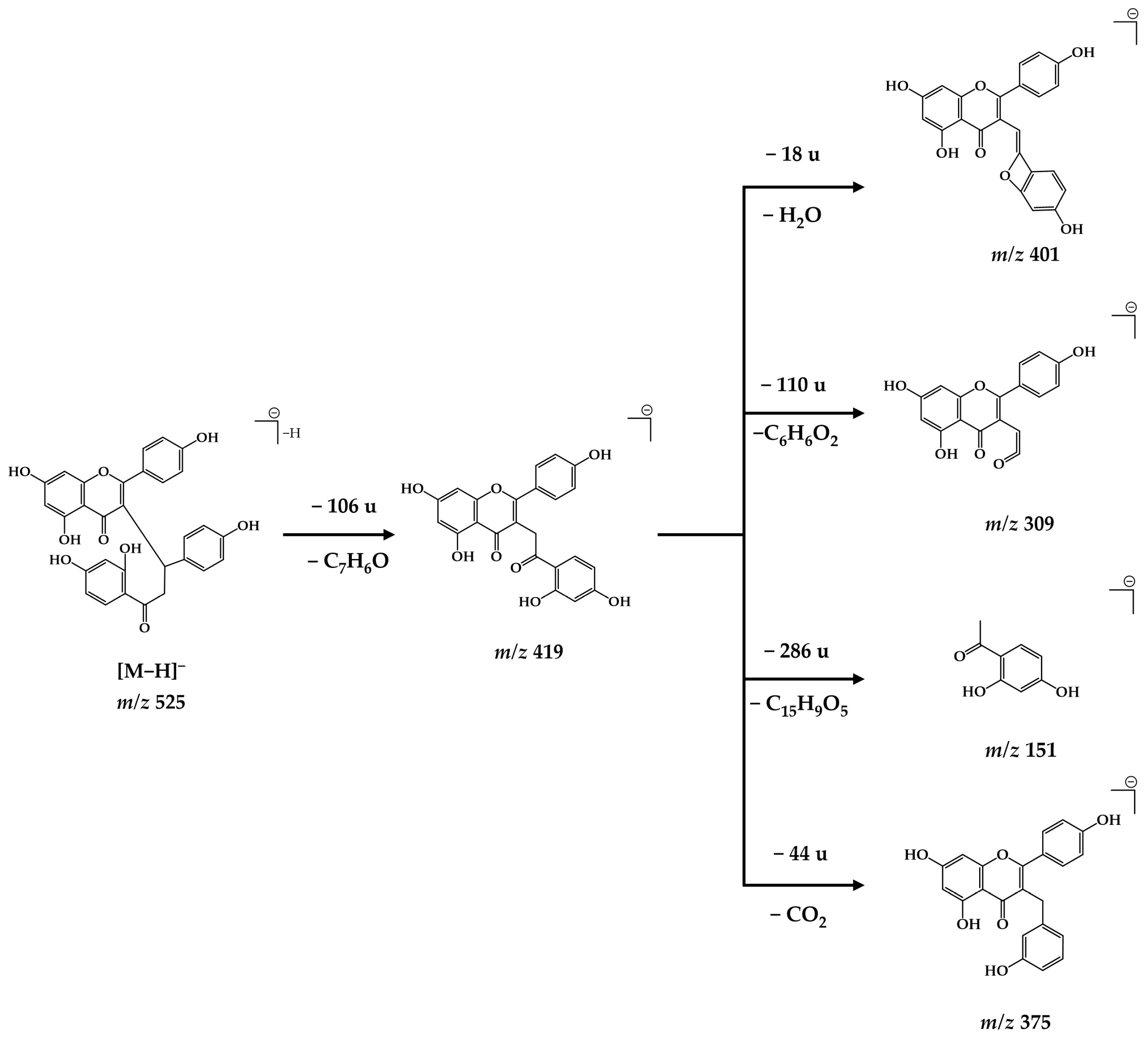
Peaks 23, 24, and 2639 were assigned to biflavonoids, metabolites frequently reported in the Caesalpinioideae subfamily [40]. Compound 27 was identified after isolation, and its structural characterization by NMR allowed correlation with the corresponding mass spectrum. In LC–MS, it presented a deprotonated ion at m/z 525.1206 [M−H], and high-resolution mass spectrometry allowed the proposition of the molecular formula C30H22O9 (calculated for the neutral ion), confirming its identity. The proposed fragmentation of caesalpinioflavone can be seen in Figure 5.
The fragmentation of caesalpinioflavone leads to the formation of the diagnostic ion m/z 419, generated from the precursor m/z 525 [M−H] through a 1,2-aryl migration of the apigenin-derived unit (from Cβ to Cα of dihydrochalcone unity), followed by retro-Michael cleavage with neutral elimination of a p-quinonemethide group (106 Da). From this intermediate, three fragments are observed in the MS3 spectra: the m/z 401 ion, resulting from dehydration (loss of 18 Da), probably associated with intramolecular rearrangement involving the 2′ hydroxyl group of chalcone and the adjacent carbonyl group; the m/z 375 ion, formed by a neutral loss of 44 Da, is attributed to an α-cleavage of the side-chain carbonyl group with electronic rearrangement and increased conjugation of the flavonoid system [41]. The base peak m/z 309 results from the elimination of the A ring of chalcone (110 Da). All the fragments derived from the m/z 419 ion, except for m/z 309, exhibit low relative intensity in the mass spectrum, indicating that formation of the m/z 309 ion is energetically favored. Its high intensity is consistent with its greater stability, resulting from the extensive delocalization of the negative charge through the conjugated π system.
The methoxylated derivatives of caesalpinioflavone (31, 33-35) are inferred by the 15 Da increase in the mass of the deprotonated ion, observed at m/z 539 [M−H], compared to the non-methoxylated compound, as well as by the molecular formula C31H23O9 determined by high-resolution mass spectrometry [42]. The preservation of the neutral losses of 106 Da, attributed to the elimination of the p-quinonemethide group, and of 110 Da, characteristic of the elimination of the resorcinol unit from ring A of the chalcone, indicates that the fragmentation pattern of the chalcone moiety remains unchanged. This behavior suggests that the methoxyl group is located in the flavone unit or in a position on ring A of the chalcone that does not interfere with the diagnostic cleavages observed.
The unknown biflavonoids (26, 28-30, 32, 36 and 37) could not be fully annotated due to the absence of fragmentation patterns described in the literature for comparison. The preliminary assignment to this class was based on the molecular formula determined by high-resolution mass spectrometry, elution in a chromatographic region characteristically rich in biflavonoids, and the similarity of the fragmentation profile with compounds previously annotated as belonging to this class [43]. Thus, the present data broaden the phytochemical knowledge of the species and genus, and provide a basis for guiding future investigations aimed at isolating and structurally elucidating new biflavonoids, potentially novel for the species.
The preparations used traditionally are frequently administered orally, in the form of infusions, decoctions, or extracts. Despite their widespread traditional use, medicinal plant preparations require scientific validation regarding both efficacy and safety, including integrated toxicological assessments [44,45]. In this context, considering that the oral toxicity of C. pluviosum had not yet been investigated, we first evaluated the acute oral toxicity of the ethanolic extract of the stem bark of this species, which is used in traditional medicine [7].
Since no mortality was observed at the limit dose of 2000 mg/kg, the median lethal dose (LD50) could not be experimentally determined and was therefore considered to exceed this value. According to the guidelines of the OECD for acute oral toxicity testing, the limit dose of 2000 mg/kg is commonly employed to assess substances with low expected toxicity [44]. Thus, the LD50 of CEECP indicates low acute oral toxicity under the conditions tested. Based on standard body surface area conversion factors, this dose corresponds to a human equivalent dose of approximately 162 mg/kg, suggesting a relatively wide margin of safety for oral exposure [46].
Hematological analysis is an important tool for assessing the health status of animals, since the hematopoietic system is highly sensitive to chemical compounds, reflecting the physiological, nutritional, and pathological conditions of the organism. Therefore, measuring these parameters allows for the identification of possible alterations or adverse effects on blood constituents, and aids in investigating the biological effects of chemical compounds or plant extracts on the blood system [47,48].
The evaluation of biochemical parameters, especially those related to liver and kidney function, such as creatinine, urea, ALT, AST, alkaline phosphatase, and GGT, demonstrated that CEECP did not promote significant differences between the treated groups and the control group (p > 0.05). In general, acute toxicity assay indicated that the C. pluviosum extract exhibited a favorable safety profile under the evaluated conditions, with classification in Category 5 of the Globally Harmonized System (GHS), due to the absence of mortality and adverse clinical signs at the 2000 mg/kg dose. Importantly, the lack of significant alterations in hematological and biochemical parameters reinforces the absence of systemic toxicity under the experimental conditions. These findings suggest that the CEECP does not interfere with key physiological processes, particularly those related to hepatic and renal function, which are commonly affected by xenobiotics.
Toxicological assessment is particularly important, since differences in safety profiles can occur even between species belonging to the same family and subfamily. An example is the leguminous species Albizia coriaria Welw. ex Oliv., a medicinal tree whose stem bark is traditionally used to treat flu, coughs, fever, inflammation, pain and snake bites. Studies with the ethanolic extract of the stem bark of this species in rats have reported several behavioral, physiological and biochemical changes associated with exposure to the extract, such as piloerection, hyperventilation, lethargy, and significant and progressive increases in body weight, erythrocyte count, alkaline phosphatase and AST levels; also, it showed an estimated LD50 close to 2000 mg/kg; contrary to the evidence in our study, where the same dose did not cause mortality or adverse clinical signs, indicating that it is a safe dose [49].
Further studies are needed to characterize the toxicological profile of species of the genus Cenostigma, especially considering their use in traditional medicine and the fact that some exhibit significant toxic effects. In this context, Cenostigma pyramidale stands out for having well-established toxicological effects in livestock, such as sheep and goats. In these animals, significant reproductive and teratogenic effects are described, including early embryonic loss and abortions, especially when the plant is consumed by females in the early stages of gestation. Notably, the toxic effects persist even in dried leaves, leading to increased cases of poisoning during dry periods. On the other hand, there is no evidence of significant toxicity in males, and a positive effect on body development has even been reported [50].
Also belonging to the genus, the species Cenostigma macrophyllum has been used in folk medicine for the treatment of stomach and intestinal diseases, commonly as decoctions or infusions prepared from stem bark, leaves and flowers. Its leaf extract was administered orally to female rats at a dose of 500 mg/kg, and no estrogenic activity or histopathological changes in the heart, kidneys, and liver of pregnant rats were observed. However, it interfered with the estrous cycle, reducing the number of estrus cycles and increasing their duration, indicating the need for caution in its use in women of reproductive age [51,52]. These findings highlight the complexity of the toxicological profile within the genus and reinforce the need for specific evaluations for each species.
Although no signs of acute toxicity were observed following a single oral administration at the limit dose over a 14-day observation period, our study is limited to acute exposure and does not provide information on potential subchronic or chronic effects. Therefore, additional studies involving repeated-dose toxicity and mechanistic approaches are necessary to better characterize the toxicological profile of the CEECP.
The perception of greater safety associated with medicinal plants, when compared to synthetic drugs, has contributed to the increased use of phytoderivatives in the treatment of various health conditions. However, the traditional and sometimes indiscriminate use of these products raises concerns about their potential to cause adverse effects, especially regarding toxicity. Despite their widespread traditional use, medicinal plants require scientific validation regarding both efficacy and safety, including integrated toxicological assessments. Given that plant extracts are complex mixtures of bioactive compounds, they carry the potential to induce mutagenic and genotoxic effects, including chromatid breaks and fragmentations, gap formation, sister chromatid exchanges and fusions, as well as structural alterations in DNA [53,54].
The mutagenic potential of CEECP was evaluated in mice using micronucleus and comet assays, revealing no evidence of mutagenicity or myelotoxicity at the tested dose. These experimental results corroborate previous studies demonstrating the absence of mutagenic activity in the flowers and leaves of Cenostigma pluviosum var. peltophoroides (basionym: Caesalpinia peltophoroides Benth.) and indicate a potential antimutagenic effect. C. peltophoroides fractions significantly reduced the frequency of micronuclei in bone marrow erythroblasts compared to the positive control treated with cyclophosphamide. Notably, the ethyl acetate fraction of the flower achieved a 60.1% reduction, and the methanolic fraction of the leaf achieved a 55% reduction. No fraction increased the frequency of micronuclei compared to the negative control, indicating the absence of intrinsic mutagenicity. Collectively, statistically significant reductions exceeding 48% reinforce the potential of these fractions to protect against genetic damage induced by mutagenic agents [55].
In the comet assay, CEECP did not increase DNA damage, showing results comparable to the negative control, while doxorubicin significantly elevated damaged cells and damage scores. CEECP did not induce micronucleus formation or DNA damage in the comet assay, indicating no detectable genotoxic effects under the tested conditions [53,54]. In contrast, studies with Cenostigma gardnerianum stem bark have demonstrated distinct behavior, in which the ethanolic extract of the bark showed a high frequency of micronuclei in the Allium cepa test, especially at concentrations from 2 mg/mL, indicating genotoxic potential and the ability to induce damage to cellular DNA. This divergence in results may be related to phytochemical differences between the species, as well as the experimental models employed (plant vs. mammal) [56]. Thus, while C. gardnerianum shows evidence of genotoxicity under specific conditions, C. pluviosum demonstrates a more favorable genotoxic safety profile, underscoring its potential for safe pharmacological applications.
The type of solvent used in extraction can significantly influence the toxicological profile of the resulting extract. In general, aqueous extracts tend to have lower genotoxic potential compared to methanolic extracts. Due to its intermediate polarity, ethanol efficiently extracts a wide spectrum of phytochemicals, resulting in more chemically complex extracts, which can impact their biological and toxicological profile. Therefore, the evaluation of possible genotoxic and mutagenic effects of ethanolic extracts becomes particularly relevant, considering their wide use and efficiency in the extraction of bioactive metabolites [57].
The CEECP is characterized as a rich source of phenolic compounds; these constituents may underlie both the observed pharmacological effects and their potential protective properties; they are frequently described in the literature for their antioxidant capacity and their modulation of mechanisms involved in maintaining DNA integrity [58,59]. Our study represents an important step in characterizing the genotoxic profile of C. pluviosum, providing preliminary evidence of safety under controlled experimental conditions. These findings establish a scientific basis for future, more comprehensive investigations, including long-term exposure studies, additional experimental models, and mechanistic analyses, contributing to the consolidation of knowledge about the genotoxic safety of the species.
Considering the carrageenan-induced paw edema assay, the tested doses of 50, 100, and 200 mg/kg correspond to approximate human equivalent doses of 4, 8, and 16 mg/kg, respectively, based on standard body surface area conversion factors. These human equivalent doses, together with the favorable toxicological profile observed, suggest a relatively wide margin of safety for potential oral use [46].
The anti-inflammatory effects observed for CEECP are consistent with those described for species related to the same genus, such as Cenostigma macrophyllum. In that study, the extract promoted a significant reduction in formalin-induced paw edema, with notable percentage inhibitions at 100 mg/kg, in addition to decreasing carrageenan-induced neutrophil migration, pointing to an effect on the cellular phase of inflammation. Similarly, CEECP also demonstrated relevant anti-inflammatory activity in the present study, evidenced by the significant reduction in the inflammatory parameters evaluated. Both species share anti-inflammatory activity and C. macrophyllum also demonstrated a similar phytochemical profile to C. pluviosum, comprising ellagic acid, gallic acid derivatives and biflavonoids [51]. Taken together, the results are consistent with the pharmacological and phytochemical similarities between phylogenetically related species, and suggest that shared bioactive compounds, such as phenolic compounds, may be responsible for the observed effects.
Previous studies with C. pluviosum leaf extract demonstrated that it significantly inhibited prostaglandin E2 (PGE2) production in ex vivo assays, in addition to showing notable anti-inflammatory activity in a rat ear edema model, with 70.90% inhibition, a value statistically superior to the negative control and comparable to that of dexamethasone (64.10%). These results indicate that the extract contains bioactive compounds capable of acting at different levels of the inflammatory response, both in ex vivo experimental systems and in vivo models. According to the phytochemical characterization of the stem bark carried out in this study, a chemical similarity is observed in relation to the leaves, as both contain ellagic acid, gallic acid and their derivatives, in addition to biflavonoids. However, they differ in that the leaves exhibit a broader chemical profile, with the presence of condensed tannins, flavonoid monomers and their glycosides, as well as nitrogenous compounds, which were not detected in the stem bark extract [60].
As evidenced by LC-MS/MS analysis, the remarkable anti-inflammatory activity of CEECP can be attributed to its phytocomplex comprising various classes of polyphenols, including tannins, flavonoids, ellagic acid derivatives and phenolic acid heterosides. Several reports in the literature show that tannins have anti-inflammatory, analgesic, immunomodulatory, antinociceptive, and antipyretic effects [61].
Polyphenols, like tannins, can alleviate inflammation by modulating inflammatory mediators, inhibiting inflammatory enzymes, and suppressing pro-inflammatory transcription factors. These compounds can inhibit enzymes such as cyclooxygenases (COX-1 and COX-2), reducing the production of prostaglandins, especially PGE2; suppress the expression of pro-inflammatory cytokines, such as TNF-α, IL-6, and IL-8, as well as decreasing the activation of nuclear factor kappa B (NF-κB), an important regulator of the expression of genes involved in the inflammatory response; and reduce nitric oxide (NO) production by inhibiting the iNOS enzyme. Anti-inflammatory activity through neutralization of free radicals and reactive oxygen species (ROS), as well as inhibition of ROS-producing enzymes such as xanthine oxidase and NADPH oxidase, has also been widely reported [62,63,64].
The injection of carrageenan into the rat paw induces edema through the release of inflammatory mediators in two phases. The early phase, occurring within the first two hours, involves the release of vasoactive mediators such as histamine, serotonin, and bradykinin, leading to increased permeability and vasodilation. The late phase, extending from approximately the second to the fifth hour, involves the production of additional inflammatory mediators and further progression of the inflammatory response [65,66,67].
The paw edema and peritonitis assays complement each other in evaluating the different phases of acute inflammation. While the carrageenan-induced paw edema assay assesses the extract’s ability to modulate the mediators involved in the initial phases of inflammation, as evidenced by the significant reduction in edema observed in this study, the peritonitis model reflects the cellular phase by evaluating leukocyte recruitment to the peritoneal cavity. In this context, the results suggest that CEECP exerts anti-inflammatory activity, possibly through modulation of vasoactive mediators from the early stages of the inflammation. Consequently, by acting in the initial phases of inflammation, the extract reduces the production of pro-inflammatory cytokines such as TNF-α and IL-1β, leading to decreased leukocyte migration [68,69].
NF-κB stands out as one of the main regulators of the inflammatory response, transducing signals from the cytoplasm to the nucleus and regulating the expression of several genes involved in the formation of pro-inflammatory cytokines (TNF-α, IL-1, and IL-6), chemokines, and cell adhesion molecules [70]. Several molecules reported in the literature were also detected in our LC–MS/MS analysis and have been associated with the modulation of pro-inflammatory mediators. Among them, the hydrolyzable tannins identified in this study, corilagin [71,72], chebulanin [73], chebulagic acid [74] and pedunculagin [75], have been shown to inhibit NF-κB and/or modulate its signaling pathways, thereby reducing the expression of pro-inflammatory mediators. The reduction in TNF-α and IL-1β levels suggests a possible modulation of upstream inflammatory signaling pathways, potentially involving NF-κB activation, although this mechanism was not directly investigated in the present study.
These anti-inflammatory properties of ellagitannins are supported by experimental data in a variety of models. Corilagin has shown in vivo efficacy in treating cholestasis at 40 mg/kg, lowering oxidative stress indicators and reducing NF-κB activation, evidenced by decreased nuclear translocation of the p65 subunit. Chebulanin exhibited anti-arthritic effects at 80 mg/kg and inhibited NF-κB and MAPK signaling pathways, as demonstrated by reduced phosphorylation of IκBα and NF-κB p65, as well as suppression of MAPK components such as p38 and JNK. Interestingly, less polar and more structurally complex tannins like chebulagic acid and pedunculagin demonstrated greater activity at lower concentrations (5–25 µM), inhibiting NF-κB and MAPK activation in cellular models and suppressing pro-inflammatory mediators like NO, PGE2, TNF-α, and IL-6. These effects were associated with decreased phosphorylation of IκBα, reduced nuclear levels of NF-κB subunits (p65 and p50), and inhibition of MAPK signaling proteins, including p38, JNK, and ERK [71,72,73,74,75].
The metabolism of ellagitannins and ellagic acid derivatives involves the hydrolysis of the sugar fraction of these molecules, releasing ellagic acid, which is subsequently converted by the gut microbiota into urolithins. These metabolites have been extensively studied for their anti-inflammatory effects, acting on the modulation of inflammatory genes and proteins, such as inducible nitric oxide synthase (iNOS, COX-2, PTGES, and NF-κB), as well as prostaglandins and pro-inflammatory cytokines involved in the regulation of the inflammatory response and associated processes, such as fibroblast migration and monocyte adhesion [76,77].
Caesalpinioflavone, identified by mass spectrometry and subsequently isolated in this study, has been previously reported to exhibit anti-inflammatory activity. The compound promoted a 69.23% reduction in ear edema at a dose of 0.5 mg/kg, greater than that of the reference drugs indomethacin and dexamethasone (43.38% and 56.00%, respectively), and may therefore play a significant role in the overall anti-inflammatory effect of the extract [78,79].
In summary, the synergistic action of the phenolic compounds identified in CEECP likely underlies its significant anti-inflammatory activity and may potentiate its pharmacological effects. Finally, the safety profile demonstrated in toxicological assays supports CEECP as a promising source of phytocompounds with pharmacological applications.

4. Materials and Methods

4.1. Plant Material

The stem bark of Cenostigma pluviosum var. peltophoroides was collected in May 2018 from the garden of the Pharmaceutical Technology Laboratory, located on campus I of the Federal University of Paraíba, João Pessoa (7°8′28.0104″ S and 34°50′47.958″ W), Paraíba. The specimens were identified, and an exsiccate (code Agra et al. 7040) is deposited in the Herbarium Prof. Lauro Pires Xavier (JPB). The study is registered in the Sistema Nacional de Gestão do Patrimônio Genético e do Conhecimento Tradicional Associado (SisGen) under code A339C6A.

4.2. Extraction and Chemical Characterization of the CEECP by LC-MSn

The stem barks were dried at 40 °C and 14 kg of stem bark powder was obtained after pulverization. The powder was macerated in 95% EtOH, using a stainless steel container, for 72 h, and the process was repeated three times. The extractive solution was concentrated in a rotary evaporator at a temperature of 45–50 °C, obtaining the crude ethanolic extract (377.1 g).
HPLC-MS analyses were performed using a Shimadzu (Shimadzu Corporation, Kyoto, Japan) analytical high-performance liquid chromatograph equipped with a SIL-20A HT autoinjector, two LC-20AD pumps, a DGU-20A5 on-line degasser, a SPD-M20A UV-VIS detector, and a CBM-20A control system. A Kromasil C-18 5 μm 100 Å, 250 mm × 4.6 mm (Kromasil®, Nouryon, Bohus, Sweden) analytical column was connected to the system. For the liquid chromatography system, acidified ultrapure water (0.1% formic acid) and chromatographic-grade methanol served as mobile phases A and B, respectively. In the elution method, the concentration of mobile phase B was gradually increased from 5% to 100% over a 60 min run, with a flow rate of 0.6 mL/min. Column temperature was maintained at room temperature (20 °C). For low-resolution acquisition, the chromatograph was coupled to a Bruker Ion-Trap Amazon X (Bruker Daltonics, Billerica, MA, USA) mass spectrometer with an electrospray ionization (ESI) source. The analysis parameters were: capillary 3.5 kV, ESI operating in negative mode, end plate offset 500 V, nebulizer 4 psi, dry gas (N2) with a flow rate of 8 L/min and temperature of 200°C. CID fragmentation was achieved in auto MS/MS mode using the advanced resolution mode for MS and MS/MS mode. The spectra (m/z 50–1500) were recorded every 2 s. For the analysis, a sample of 1 mg of the crude ethanolic extract of C. pluviosum stem bark (CEECP) was dissolved in methanol to obtain a 1 mg·mL−1 solution. The solution was filtered through a 0.45 μm PVDF membrane, and 10 μL was injected into the chromatographic system.
Subsequently, the same sample prepared for low-resolution analysis was reinjected into a high-resolution mass spectrometer, BRUKER® micrOTOF II (Bruker Daltonics, Billerica, MA, USA), with an electrospray ionization source, operating in negative mode. For high-resolution HPLC-ESI-MS analyses, the same column and the same chromatographic conditions were used as described above. The micrOTOF II spectrometer analysis parameters were 4.0 kV capillary, a 500 V end plate offset, a 4.0 bar nebulizer, a dry gas (N2) flow rate of 8.0 L/min, and a temperature of 200 °C. Spectra (m/z 50–1000) were recorded every 2.0 s. Sodium formate was used as the internal calibrator during the chromatographic run.
Compounds were annotated based on the ions of the deprotonated molecule, fragmentation patterns (MS2 and MS3), and corresponding data from scientific literature. Details regarding the isolation and structural characterization of caesalpinioflavone can be found in the Supplementary Material section.

4.3. In Vivo Toxicity Experiments

4.3.1. Ethical Procedures and Vivarium Conditions

The experimental protocols were approved by the Ethics Committee on the Use of Animals (CEUA) of the UNIFACISA University Center, under approval number 03.0001.2024/05.2024, in accordance with the standards established by the National Council for the Control of Animal Experimentation (CONCEA). For the pharmacological assays, adult Swiss albino mice (Mus musculus), weighing between 28 and 31 g and aged between 50 and 54 days were used, with animals of both sexes employed in the acute oral toxicity test. The animals were kept under standard laboratory conditions, with a 12 h light/dark cycle, controlled temperature (22 ± 2 °C) and relative humidity between 50 and 55%, receiving filtered water and standard rodent feed ad libitum. Euthanasia was performed by intraperitoneal administration of a hyperdose of 10% ketamine (300 mg/kg) combined with 2% xylazine (30 mg/kg), in accordance with the CONCEA Euthanasia Practice Guidelines (2018).

4.3.2. Acute Toxicity Assay

The acute toxicity of the ethanolic extract of the stem bark of Cenostigma pluviosum var. peltophoroides (Benth.) Gagnon & G.P.Lewis (CEECP) was evaluated according to the instructions of the Organization for Economic Co-operation and Development (OECD). Female mice were separated into two groups (n = 5 for each group) that received C. pluviosum var. peltophoroides (2000 mg/kg) or 0.9% saline by gavage in a single oral dose (100 µL/10 g bw). Behavioral changes were evaluated during the first 4 h according to the parameters described by Malone (1983) [80] and Almeida et al. (1999) [81]. Weight gain and water and food consumption were measured daily until the 14th day. On the 15th day after the beginning of treatment and fasting for 6 h, the animals were anesthetized with ketamine 100 mg/kg and xylazine 5 mg/kg solution, and blood was collected for biochemical and hematological analyses. The LD50 value was determined according to the method described in OECD Guidelines 423 [82].

4.3.3. Biochemical and Hematological Analysis

At the end of toxicity assays, blood was collected from the animals and the following biochemical parameters were evaluated: total protein, albumin, alanine aminotransferase (ALT), aspartate aminotransferase (AST), alkaline phosphatase, gamma-glutamyl transferase (GGT), urea and creatinine, using specific kits (Labtest Diagnóstica, Lagoa Santa, Brazil) and a COBAS Mira Plus analyzer (Roche Diagnostics Systems, Basel, Switzerland). Hematological analysis was performed using an automatic analyzer (Counter-ABC Vet Animal Blood, Montpellier, France) and optical microscopy; the parameters evaluated were: erythrocytes, hemoglobin, hematocrit, mean corpuscular volume (MCV), mean corpuscular hemoglobin (MCH), mean corpuscular hemoglobin concentration (MCHC) and total and differentiated leukocyte analysis.

4.3.4. Genotoxicity and Mutagenicity Assessment

For the comet assay, an aliquot (10 µL) of blood from each animal was mixed with 0.5% agarose at 36.5 °C on microscope slides. The slides were covered with coverslips at 4 °C for 30 min. Then, the coverslips were removed and the slides were immersed for 1 h in lysis solution [2.0 M NaCl, 100 mM EDTA, 10 mM Tris, 0.2 M NaOH, 2% (w/v) sodium lauryl sarcosine, 0.5% (v/v) Triton X-100, and 1% (v/v) dimethyl sulfoxide] at 4 °C, protected from light. Subsequently, an electrophoresis run was performed at 4 °C for 20 min at 280 mA and 25 V. The slides were fixed in 100% ethanol for 30 min and covered with 30 mL of ethidium bromide staining solution (30 mg/mL) and coverslips. The evaluation was performed under a fluorescence microscope (400×) and 600 cells were evaluated for the presence of nucleoids and classified according to the tail size into the following classes: 0—no tail; 1—tail smaller than the diameter of the head (nucleus); 2—tail length measuring 1–2 times the diameter of the head; 3—tail length measuring more than twice the diameter of the head [83].
To evaluate the genotoxic profile of CEECP treatment, the micronucleus test was used in mouse erythrocytes based on the method described by Oliveira et al. with minor modifications [84]. Briefly, groups of male mice (n = 5) were treated with saline (negative control) or CEECP (2000 mg/kg) orally in a single dose. 24 h after treatments, aliquots (10 µL) of peripheral blood (tail) were applied to slides previously stained with acridine orange and analyzed under a fluorescence microscope. A total of three slides per animal were prepared and the micronucleus frequency was determined after counting 2000 erythrocytes per slide.

4.4. Anti-Inflammatory Activity

The doses of 50, 100, and 200 mg/kg were selected for the anti-inflammatory assays based on previous studies evaluating the pharmacological effects of species from the genus Cenostigma, in which this range is commonly employed in in vivo models [51,85,86]. Additionally, the selection of these doses was supported by the results of the acute oral toxicity test. Therefore, the chosen doses fall within a safe range for pharmacological evaluation while allowing the assessment of dose-dependent effects.

4.4.1. Carrageenan-Induced Paw Edema

Male mice were divided into five groups (n = 6) and treated with CEECP (50, 100 or 200 mg/kg p.o.), saline (0.9% p.o., orally) or indomethacin (20 mg/kg, positive control, intraperitoneally), 30 min before edema induction. Subsequently, paw edema was induced by injecting 15 μL of 2% (w/v) carrageenan into the subplantar region of the right paw. For comparison, the left paw received 15 μL of saline solution. Paw edema was evaluated by measuring hind paw thickness using a digital caliper at 1, 2, 3, and 4 h after carrageenan injection [87]. The percentage change in hind paw thickness (%) was determined using the following formula:
Percentage   change   in   hind   paw   thickness = final   hind   paw   thickness initial   hind   paw   thickness final   hind   paw   thickness × 100

4.4.2. Peritonitis

Male mice were divided into five groups (n = 6) and treated with CEECP (50, 100, or 200 mg/kg p.o.), saline (0.9% p.o.), or indomethacin (20 mg/kg i.p.) 30 min before the start of the assay. The animals received an intraperitoneal injection of 1% carrageenan. After 4 h, the animals were sacrificed and 2 mL of heparinized PBS was injected into the peritoneal cavity; the exudate was then immediately collected. The leukocyte count of the peritoneal lavage was expressed as leukocytes/mL [88,89]. The percentage of leukocytes inhibition was calculated using the following formula:
% Leukocyte inhibition = (1 − T/C) × 100
where T represents the number of leukocytes in the treated group (extract or reference drug), and C represents the number of leukocytes in the control group. Cytokine levels in the peritoneal fluid were quantified using a bead-based multiplex immunoassay (Milliplex MAP 7-plex kit, Millipore, Merck, Darmstadt, Germany), according to the manufacturer’s instructions [90].

4.5. Statistical Analysis

The data obtained were analyzed in GraphPad Prism® version 8.0 and expressed as mean values with standard deviation (±SD). Statistically significant differences were calculated using one-way analysis of variance (ANOVA) followed by Bonferroni or Dunnett’s test (when necessary). Values were considered significantly different at p < 0.05.

5. Conclusions

The chemical profile of the ethanolic extract of the stem bark of Cenostigma pluviosum var. peltophoroides revealed a predominance of phenolic compounds across different classes, including biflavonoids, hydrolyzable tannins, lignans, and phenolic acids derivatives. In vivo toxicity test showed a safe profile of the CEECP at a dose of 2000 mg/kg, with no evidence of genotoxicity or mutagenicity. Notably, this is the first report describing the toxicological safety of the extract of Cenostigma pluviosum var. peltophoroides. In pharmacological assays, CEECP showed dose-dependent anti-inflammatory activity, with an anti-edematogenic effect already observed at a dose of 50 mg/kg and more pronounced responses at doses of 100 and 200 mg/kg, in the first hour of the experiment. Furthermore, the CEECP was able to significantly reduce the migration of total leukocytes and neutrophils, as well as decrease the levels of the pro-inflammatory cytokines TNF-α and IL-1β.
In combination, these results demonstrate the anti-inflammatory potential of C. pluviosum and confirm the safety profile of the CEECP at the doses evaluated. Moreover, the study opens perspectives for future investigations aimed at elucidating the mechanisms of action involved, identifying new secondary metabolites present in the species and supporting the potential development of botanical extracts for phytotherapeutic applications, including topical or oral formulations, as new anti-inflammatory agents.

Supplementary Materials

The following supporting information can be downloaded at: https://www.mdpi.com/article/10.3390/plants15101508/s1, Figure S1. Base peak chromatogram of the crude ethanolic extract of the stem bark of Cenostigma pluviosum by HPLC–ESI–MSn; Figure S2. 1H NMR spectrum of caesalpinioflavone in CD3OD; Figure S3. 13C NMR spectrum of caesalpinioflavone in CD3OD; Figure S4. 1H-13C HMBC spectrum of caesalpinioflavone in CD3OD; Figure S5. 1H-13C HSQC spectrum of caesalpinioflavone in CD3OD; Table S1. 1H and 13C NMR data of Caesalpinioflavone (400 and 100MHz, CD3OD) compared with literature.

Author Contributions

N.T.R.d.L. (Conceptualization, Investigation, Methodology, Software, Formal Analysis, Data Curation, Writing—Original Draft), G.R.d.S. (Conceptualization, Methodology, Investigation, Formal Analysis, Data Curation, Writing—Review And Editing), G.G.d.S. (Conceptualization, Methodology, Investigation, Formal Analysis, Data Curation, Writing—Review And Editing), G.F.G.S. (Methodology, Formal Analysis, Data Curation), A.F.A. (Methodology, Formal Analysis, Data Curation, Writing—Review And Editing), I.M.F. (Conceptualization, Funding Acquisition, Resources, Investigation, Data Curation, Writing—Original Draft), M.d.F.A. (Validation, Data curation), A.M.d.O. (Conceptualization, Methodology, Software, Formal Analysis, Data Curation, Validation, Visualization, Writing—Review And Editing), J.F.T. (Funding, Acquisition, Resources, Investigation, Data Curation, Writing), M.S.d.S. (Funding, Acquisition, Resources, Investigation, Data Curation, Writing), J.M.B.F. (Conceptualization, Funding, Acquisition, Resources, Supervision, Investigation, Data Curation, Writing—Original Draft). All authors have read and agreed to the published version of the manuscript.

Funding

This research was funded by: Conselho Nacional de Desenvolvimento Científico e Tecnológico (CNPq) from Brazil, grant number #316996/2023-8, Coordenação de Aperfeicoamento de Pessoal de Nível Superior Brazil (CAPES, finance code 001), Paraíba State Research Foundation (FAPESQ-PB) through PRONEX program, (grant number #030/2023), and CNPQ/FAPESQ-PB through: Regional Scientific and Technological Development Program (PDCTR, grant number #300989/2022-9, Edital 6/2020).

Institutional Review Board Statement

The animal study protocol was approved by the Ethics Committee on the Use of Animals of Unifacisa–Campina Grande, Paraíba (protocol code 03.0001.2024/05.2024; approved on 6 August 2024) and conducted in accordance with the guidelines of the National Council for the Control of Animal Experimentation (CONCEA).

Data Availability Statement

The original contributions presented in this study are included in the article/supplementary material. Further inquiries can be directed to the corresponding author.

Acknowledgments

The authors express their gratitude to the State University of Paraíba (Universidade Estadual da Paraíba—UEPB), to the National Council for Scientific and Technological Development for the funding, to the Multiuser Laboratory for Characterization and Analyses (LMCA) of the Federal University of Paraíba (UFPB), to Unifacisa, and Federal University of Pernambuco (UFPE).

Conflicts of Interest

The authors declare no conflicts of interest.

References

  1. Rodríguez-Yoldi, M.J. Anti-Inflammatory and antioxidant properties of plant extracts. Antioxidants 2021, 10, 921. [Google Scholar] [CrossRef]
  2. Sohail, R.; Mathew, M.; Patel, K.K.; Reddy, S.A.; Haider, Z.; Naria, M.; Habib, A.; Abdin, Z.U.; Chaudhry, W.R.; Akbar, A. Effects of non-steroidal anti-inflammatory drugs (NSAIDs) and gastroprotective NSAIDs on the gastrointestinal tract: A narrative review. Cureus 2023, 15, 4. [Google Scholar] [CrossRef]
  3. Khumalo, G.P.; Van Wyk, B.E.; Feng, Y.; Cock, I.E. A review of the traditional use of southern African medicinal plants for the treatment of inflammation and inflammatory pain. J. Ethnopharmacol. 2021, 283, 114436. [Google Scholar] [CrossRef] [PubMed]
  4. Abdalla, Y.O.A.; Subramaniam, B.; Nyamathulla, S.; Shamsuddin, N.; Arshad, N.M.; Mun, K.S.; Awang, K.; Nagoor, N.H. Natural products for cancer therapy: A review of their mechanism of actions and toxicity in the past decade. J. Trop. Med. 2022, 2022, 5794350. [Google Scholar] [CrossRef] [PubMed]
  5. Emerald, M. Medicinal plants: Therapeutic potential, safety, and toxicity. In Drug Discovery and Evaluation: Safety and Pharmacokinetic Assays; Springer International Publishing: Cham, Switzerland, 2024; pp. 1327–1397. [Google Scholar] [CrossRef]
  6. Mugale, M.N.; Dev, K.; More, B.S.; Mishra, V.S.; Washimkar, K.R.; Singh, K.; Maurya, R.; Rath, S.K.; Chattopadhyay, D.; Chattopadhyay, N. A comprehensive review on pre-clinical safety and toxicity of medicinal plants. Clin. Complement. Med. Pharmacol. 2024, 4, 100129. [Google Scholar] [CrossRef]
  7. do Nascimento, B.O.; David, J.M. Chemical composition, biological activities and traditional uses of plants from the segregated genus Caesalpinia sensu lato. Phytochem. Rev. 2024, 23, 1–93. [Google Scholar] [CrossRef]
  8. Zanin, J.L.B.; De Carvalho, B.A.; Salles Martineli, P.; Dos Santos, M.H.; Lago, J.H.G.; Sartorelli, P.; Viegas, C., Jr.; Soares, M.G. The genus Caesalpinia L. (Caesalpiniaceae): Phytochemical and pharmacological characteristics. Molecules 2012, 17, 7887–7902. [Google Scholar] [CrossRef]
  9. Carvalho, P.E.R. Sibipiruna: Caesalpinia pluviosa var. peltophoroides. In Espécies Arbóreas Brasilei-Ras. Embrapa Informação Tecnológica; Embrapa Florestas: Paraná, Brazil, 2008; pp. 474–484. [Google Scholar]
  10. Gaem, P.H. Cenostigma in Flora e Funga do Brasil. Jardim Botânico do Rio de Janeiro. Available online: https://floradobrasil.jbrj.gov.br/FB606077 (accessed on 13 February 2026).
  11. Bourdy, G.; DeWalt, S.J.; De Michel, L.R.C.; Roca, A.; Deharo, E.; Muñoz, V.; Balder-rama, L.; Quenevo, C.; Gimenez, A. Medicinal plants uses of the Tacana, an Amazonian Bolivian ethnic group. J. Ethnopharmacol. 2000, 70, 87–109. [Google Scholar] [CrossRef]
  12. Kayano, A.C.A.; Lopes, S.C.; Bueno, F.G.; Cabral, E.C.; Souza-Neiras, W.C.; Yamau-chi, L.M.; Foglio, M.A.; Eberlin, M.N.; Mello, J.C.P.; Costa, F.T. In vitro and in vivo assessment of the anti-malarial activity of Caesalpinia pluviosa. Malar. J. 2011, 10, 112. [Google Scholar] [CrossRef]
  13. De Souza, J.; Nascimento, M.D.; Borsodi, M.; De Almeida, A.; Rossi-Bergmann, B.; De Oliveira, A.; Costa, S. Leaves from the Tree Poincianella pluviosa as a Renewable Source of Antiplasmodial Compounds against Chloroquine-Resistant Plasmodium falciparum. J. Braz. Chem. Soc. 2017, 29, 1318–1327. [Google Scholar] [CrossRef]
  14. Guidi, A.C.; De Paula, M.N.; Mosela, M.; Delanora, L.A.; Soares, G.C.A.; De Morais, G.R.; De Medeiros, D.C.; De Oliveira, A.G., Jr.; Novello, C.R.; Baesso, M.L.; et al. Stem bark extract of Poincianella pluviosa incorporated in polymer film: Evaluation of wound healing and anti-staphylococcal activities. Injury 2020, 51, 840–849. [Google Scholar] [CrossRef]
  15. Andriani, G.M.; Morguette, A.E.B.; Spoladori, L.F.A.; Pereira, P.M.L.; Cabral, W.R.C.; Fernandes, B.T.; Tavares, E.R.; Almeida, R.S.; Lancheros, C.A.C.; Nakamura, C.V.; et al. Antifungal Combination of Ethyl Acetate Extract of Poincianella pluviosa (DC.) L. P. Queiros Stem Bark With Amphotericin B in Cryptococcus neoformans. Front. Microbiol. 2021, 12, 660645. [Google Scholar] [CrossRef]
  16. Pattaro-Júnior, J.R.; Araújo, I.G.; Moraes, C.B.; Barbosa, C.G.; Philippsen, G.S.; Freitas-Junior, L.H.; Guidi, A.C.; De Mello, J.C.P.; Peralta, R.M.; Fernandez, M.A.; et al. Antiviral activity of Cenostigma pluviosum var. pel-tophoroides extract and fractions against SARS-CoV-2. J. Biomol. Struct. Dyn. 2022, 41, 7297–7308. [Google Scholar] [CrossRef] [PubMed]
  17. Zhao, H.-Y.; Fan, M.-X.; Wu, X.; Wang, H.-J.; Yang, J.; Si, N.; Bian, B.-L. Chemical Profiling of the Chinese Herb Formula Xiao-Cheng-Qi Decoction Using Liquid Chromatography Coupled with Electrospray Ionization Mass Spectrometry. J. Chromatogr. Sci. 2012, 51, 273–285. [Google Scholar] [CrossRef] [PubMed]
  18. Mena, P.; Calani, L.; Dall’Asta, C.; Galaverna, G.; García-Viguera, C.; Bruni, R.; Crozier, A.; Del Rio, D. Rapid and Comprehensive Evaluation of (Poly)phenolic Compounds in Pomegranate (Punica granatum L.) Juice by UHPLC-MSn. Molecules 2012, 17, 14821–14840. [Google Scholar] [CrossRef]
  19. Quirantes-Piné, R.; Funes, L.; Micol, V.; Segura-Carretero, A.; Fernández-Gutiérrez, A. High-performance liquid chromatography with diode array detection coupled to electrospray time-of-flight and ion-trap tandem mass spectrometry to identify phenolic compounds from a lemon verbena extract. J. Chromatogr. A 2009, 1216, 5391–5397. [Google Scholar] [CrossRef]
  20. Navarro, M.; Arnaez, E.; Moreira, I.; Quesada, S.; Azofeifa, G.; Wilhelm, K.; Vargas, F.; Chen, P. Polyphenolic Characterization, Antioxidant, and Cytotoxic Activities of Mangifera indica Cultivars from Costa Rica. Foods 2019, 8, 384. [Google Scholar] [CrossRef]
  21. Maier, C.; Conrad, J.; Carle, R.; Weiss, J.; Schweiggert, R.M. Phenolic Constituents in Commercial Aqueous Quillaja (Quillaja saponaria Molina) Wood Extracts. J. Agric. Food Chem. 2015, 63, 1756–1762. [Google Scholar] [CrossRef] [PubMed]
  22. Berto, C.; Maggi, F.; Nya, P.C.B.; Pettena, A.; Boschiero, I.; Dall’Acqua, S. Phenolic Constituents of Erigeron floribundus (Asteraceae), a Cameroonian Medicinal Plant. Nat. Prod. Commun. 2014, 9, 1691–1694. [Google Scholar] [CrossRef]
  23. Liu, Y.; Seeram, N.P. Liquid chromatography coupled with time-of-flight tandem mass spectrometry for comprehensive phenolic characterization of pomegranate fruit and flower extracts used as ingredients in botanical dietary supplements. J. Sep. Sci. 2018, 41, 3022–3033. [Google Scholar] [CrossRef]
  24. Bueno, F.G.; Panizzon, G.P.; De Leite Mello, E.V.S.; Lechtenberg, M.; Petereit, F.; De Mello, J.C.P.; Hensel, A. Hydrolyzable tannins from hydroalcoholic extract from Poincianella pluviosa stem bark and its wound-healing properties: Phytochemical investigations and influence on in vitro cell physiology of human keratinocytes and dermal fibroblasts. Fitoterapia 2014, 99, 252–260. [Google Scholar] [CrossRef]
  25. Lachowicz-Wiśniewska, S.; Pratap-Singh, A.; Kapusta, I.; Kruszyńska, A.; Rapak, A.; Ochmian, I.; Cebulak, T.; Żukiewicz-Sobczak, W.; Rubiński, P. Flowers and Leaves Extracts of Stachys palustris L. Exhibit Stronger Anti-Proliferative, Antioxidant, Anti-Diabetic, and Anti-Obesity Potencies than Stems and Roots Due to More Phenolic Compounds as Revealed by UPLC-PDA-ESI-TQD-MS/MS. Pharmaceuticals 2022, 15, 785. [Google Scholar] [CrossRef]
  26. Samet, S.; Ayachi, A.; Fourati, M.; Mallouli, L.; Allouche, N.; Treilhou, M.; Téné, N.; Mezghani-Jarraya, R. Antioxidant and Antimicrobial Activities of Erodium arborescens Aerial Part Extracts and Characterization by LC-HESI-MS2 of Its Acetone Extract. Molecules 2022, 27, 4399. [Google Scholar] [CrossRef]
  27. Santiago, J.C.C.; Albuquerque, C.A.B.; Muribeca, A.d.J.B.; Sá, P.R.C.; Pamplona, S.d.G.S.R.; Silva, C.Y.Y.e.; Ribera, P.C.; Fontes-Júnior, E.d.A.; da Silva, M.N. Margaritaria nobilis L.F. (Phyllanthaceae): Ethnopharmacology and Application of Computational Tools in the Annotation of Bioactive Molecules. Metabolites 2022, 12, 681. [Google Scholar] [CrossRef]
  28. Tarone, A.G.; Goupy, P.; Ginies, C.; Marostica, M.R.; Dufour, C. Advanced characterization of polyphenols from Myrciaria jaboticaba peel and lipid protection in in vitro gastrointestinal digestion. Food Chem. 2021, 359, 129959. [Google Scholar] [CrossRef] [PubMed]
  29. Aguilar-Zárate, P.; Wong-Paz, J.E.; Michel, M.; Buenrostro-Figueroa, J.; Díaz, H.R.; Ascacio, J.A.; Contreras-Esquivel, J.C.; Gutiérrez-Sánchez, G.; Aguilar, C.N. Characterisation of Pomegranate-Husk polyphenols and Semi-Preparative fractionation of punicalagin. Phytochem. Anal. 2017, 28, 433–438. [Google Scholar] [CrossRef]
  30. Shahzad, M.N.; Ahmad, S.; Tousif, M.I.; Ahmad, I.; Rao, H.; Ahmad, B.; Basit, A. Profiling of phytochemicals from aerial parts of Terminalia neotaliala using LC-ESI-MS2 and determination of antioxidant and enzyme inhibition activities. PLoS ONE 2022, 17, e0266094. [Google Scholar] [CrossRef] [PubMed]
  31. Chernonosov, A.A.; Karpova, E.A.; Lyakh, E.M. Identification of phenolic compounds in Myricaria bracteata leaves by high-performance liquid chromatography with a diode array detector and liquid chromatography with tandem mass spectrometry. Rev. Bras. Farmacogn. 2017, 27, 576–579. [Google Scholar] [CrossRef]
  32. Da Silva, F.; Hanna, A.C.; De Souza, A.; Da Silva Filho, F.; Canhoto, O.; Magalhães, A.; Benevides, P.; De Azevedo, M.; Siani, A.; Pohlit, A.; et al. Integrative Analysis Based on HPLC-DAD-MS/MS and NMR of Bertholletia excelsa Bark Biomass Residues: Determination of Ellagic Acid Derivatives. J. Braz. Chem. Soc. 2018, 30, 830–836. [Google Scholar] [CrossRef]
  33. Neto, G.G.; Da Costa, R.; Zanini, C.; Aguiar, A.C.; De Souza, J.; De Souza, G.; Severino, R.; Cass, Q.; Cruz, F.; Oliva, G.; et al. Chemical Prospection of Qualea grandiflora Mart. Fruit and Stem Extracts and Their in vitro and in vivo Antiplasmodial Activity. J. Braz. Chem. Soc. 2020, 31, 1475–1484. [Google Scholar] [CrossRef]
  34. Singh, A.; Bajpai, V.; Kumar, S.; Sharma, K.R.; Kumar, B. Profiling of gallic and ellagic acid derivatives in different plant parts of Terminalia arjuna by HPLC-ESI-QTOF-MS/MS. Nat. Prod. Commun. 2016, 11, 239–244. [Google Scholar] [CrossRef] [PubMed]
  35. Cunja, V.; Mikulic-Petkovsek, M.; Weber, N.; Jakopic, J.; Zupan, A.; Veberic, R.; Stampar, F.; Schmitzer, V. Fresh from the Ornamental Garden: Hips of Selected Rose Cultivars Rich in Phytonutrients. J. Food Sci. 2016, 81, C369–C379. [Google Scholar] [CrossRef] [PubMed]
  36. Rodríguez, E.P.; Li, Y.; Vaniya, A.; Shih, P.M.; Fiehn, O. Alternative identification of glycosides using MS/MS matching with an in silico-modified aglycone mass spectra library. Anal. Chem. 2023, 95, 10618–10624. [Google Scholar] [CrossRef] [PubMed]
  37. Yu, J.; Zhao, X.; He, Y.; Zhang, Y.; Tang, C. An Innovative Strategy for Untargeted Mass Spectrometry Data Analysis: Rapid Chemical Profiling of the Medicinal Plant Terminalia chebula Using Ultra-High-Performance Liquid Chromatography Coupled with Q/TOF Mass Spectrometry–Key Ion Diagnostics–Neutral Loss Filtering. Molecules 2025, 30, 2451. [Google Scholar] [CrossRef]
  38. Chung, K.-T.; Wong, T.Y.; Wei, C.-I.; Huang, Y.-W.; Lin, Y. Tannins and Human Health: A review. Crit. Rev. Food Sci. Nutr. 1998, 38, 421–464. [Google Scholar] [CrossRef]
  39. Bule, M.; Khan, F.; Nisar, M.F.; Niaz, K.; Nabavi, S.; Saeedi, M.; Sanches Silva, A. Tannins (hydrolysable tannins, condensed tannins, phlorotannins, flavono-ellagitannins). In Recent Advances in Natural Products Analysis; Elsevier: Amsterdam, The Netherlands, 2020; pp. 132–146. [Google Scholar]
  40. De Almeida Silva Brilhante, A.R.R.; De Sousa, G.R.; De Aquino-Vital, A.K.S.; De Li-ma, N.T.R.; De Lima Souza, R.B.; De Souza, T.A.; Scotti, M.T.; Filho, J.M.B.; Tavares, J.F.; Da Silva, M.S. Fabaceae Flavonoids Beyond the Commonplace: A Review of Chemical Diversity, Pharmacological Activities, Mass Spectrometric Profiling and In Silico Insights into Their Subclasses. Plants 2025, 14, 3549. [Google Scholar] [CrossRef]
  41. Demarque, D.P.; Crotti, A.E.; Vessecchi, R.; Lopes, J.L.; Lopes, N.P. Fragmentation reac-tions using electrospray ionization mass spectrometry: An important tool for the struc-tural elucidation and characterization of synthetic and natural products. Nat. Prod. Rep. 2016, 33, 432–455. [Google Scholar] [CrossRef]
  42. Frański, R.; Gierczyk, B.; Kozik, T.; Popenda, Ł.; Beszterda, M. Signals of diagnostic ions in the product ion spectra of [M − H] ions of methoxylated flavonoids. Rapid Commun. Mass Spectrom. 2018, 33, 125–132. [Google Scholar] [CrossRef]
  43. Yao, H.; Chen, B.; Zhang, Y.; Ou, H.; Li, Y.; Li, S.; Peiying, S.; Lin, X. Analysis of the total biflavonoids extract from Selaginella doederleinii by HPLC-QTOF-MS and its in vitro and in vivo anticancer effects. Molecules 2017, 22, 325. [Google Scholar] [CrossRef]
  44. Organisation for Economic Co-operation and Development. OECD Guideline for the Testing of Chemicals No. 425: Acute Oral Toxicity—Up-and-Down Procedure; OECD Publishing: Paris, France, 2001. [Google Scholar]
  45. Luo, P.; Feng, X.; Liu, S.; Jiang, Y. Traditional Uses, Phytochemistry, Pharmacology and Toxicology of Ruta graveolens L.: A Critical Review and Future Perspectives. Drug Des. Dev. Ther. 2024, 18, 6459–6485. [Google Scholar] [CrossRef]
  46. Nair, A.B.; Jacob, S. A simple practice guide for dose conversion between animals and human. J. Basic. Clin. Pharm. 2016, 7, 27–31. [Google Scholar] [CrossRef] [PubMed]
  47. Liju, V.B.; Jeena, K.; Kuttan, R. Acute and subchronic toxicity as well as mutagenic evaluation of essential oil from turmeric (Curcuma longa L). Food Chem. Toxicol. 2013, 53, 52–61. [Google Scholar] [CrossRef] [PubMed]
  48. Nwaka, A.C.; Ikechi-Agba, M.C.; Okechukwu, P.U.; Igwenyi, I.O.; Agbafor, K.N.; Orji, O.U.; Ezugwu, A.L. The effects of ethanol extracts of Jatropha curcas on some hematological parameters of chloroform intoxicated rats. Am.-Euras. J. Sci. Res. 2015, 10, 45–49. Available online: https://idosi.org/aejsr/aejsr10(1)15.html (accessed on 12 May 2026).
  49. Obakiro, S.B.; Kiyimba, K.; Owor, R.O.; Andima, M.; Lukwago, T.W.; Kawuma, C.; Ga-vamukulya, Y.; Nabatanzi, A.; Kibuule, D.; Kato, C.D.; et al. Acute and subacute toxicity profile of ethanolic stem bark extract of Albizia coriaria Welw. ex Oliv. in Wistar albino rats. Toxicol. Rep. 2024, 12, 178–185. [Google Scholar] [CrossRef] [PubMed]
  50. Bezerra, J.J.L.; Lucena, R.B. Poisonings in ruminants by Cenostigma pyramidale (Tul.) Gagnon & GP Lewis (Fabaceae): A mini-review of teratogenic potential and phytochemical evidence. Toxicon 2024, 246, 107794. [Google Scholar] [CrossRef]
  51. Moreira, B.O.; De Carvalho, A.L.; Alves, C.Q.; Morbeck, L.L.B.; Cruz, M.P.; Yatsuda, R.; David, J.P.; David, J.P.; David, J.M.; David, J.M. Evaluation of anti-inflammatory, antinociceptive and biological activities of Cenostigma macrophyllum standardized extracts and determination and quantification of the main metabolites. RSC Adv. 2019, 9, 41256–41268. [Google Scholar] [CrossRef]
  52. Santos, D.B.; De Olveira, J.M.G.; Bueno, M.N.; Sales, P.A.B.; Da Costa, C.L.S.; Chaves, M.H.; Martins, M.d.C.C.E.; Costa, A.P.R. Effects of ethanol extract of Cenostigma macrophyllum Tul. (caneleiro) on reproductive parameters of female rats. Rev. Cuba. Plantas Med. 2015, 20, 265–276. [Google Scholar]
  53. Celik, T.A. Potential Genotoxic and Cytotoxic Effects of Plant Extracts. In A Compendium of Essays on Alternative Therapy; InTech: Rijeka, Croatia, 2012; pp. 233–250. [Google Scholar]
  54. Bardoloi, A.; Soren, A.D. Genotoxicity induced by medicinal plants. Bull. Natl. Res. Cent. 2022, 46, 119. [Google Scholar] [CrossRef]
  55. Muller, A.P.; Vieira-Júnior, G.M.; Sugui, M.M.; Campos, K.E. Tratamento com frações de extratos de Caesalpinia peltophoroides em camundongos: Avaliação mutagênica, antimutagênica e metabólica. Rev. Bras. Plantas Med. 2024, 21, 239–247. [Google Scholar] [CrossRef]
  56. Sampaio, L.L.; De Andrade Gomes, J.; De Araújo, L.W.B.; Pacheco, N.I.; Lima, I.C.; Neto, J.C.P.; Viana, D.d.S.F. In vivo study on the toxic, cytotoxic, and genotoxic potentials of stem bark ethanolic extract of Cenostigma gardnerianum Tul. (Caneleiro). Res. Soc. Dev. 2020, 9, e37985015. [Google Scholar] [CrossRef]
  57. Plaskova, A.; Mlcek, J. New insights of the application of water or ethanol-water plant extract rich in active compounds in food. Front. Nutr. 2023, 10, 1118761. [Google Scholar] [CrossRef] [PubMed]
  58. Noviany, N.; Hadi, S.; Nofiani, R.; Lotulung, P.D.; Osman, H. Fabaceae: A significant flavonoid source for plant and human health. Phys. Sci. Rev. 2022, 8, 3897–3907. [Google Scholar] [CrossRef]
  59. Al-Naqeb, G.; Kalmpourtzidou, A.; Giampieri, F.; De Giuseppe, R.; Cena, H. Genotoxic and antigenotoxic medicinal plant extracts and their main phytochemicals: “A review”. Front. Pharmacol. 2024, 15, 1448731. [Google Scholar] [CrossRef]
  60. Rosa, W.; Da Silva Domingos, O.; De Oliveira Salem, P.P.; Caldas, I.S.; Murgu, M.; Lago, J.H.G.; Sartorelli, P.; Dias, D.F.; Chagas-Paula, D.A.; Soares, M.G. In vivo anti-inflammatory activity of Fabaceae species extracts screened by a new ex vivo assay using human whole blood. Phytochem. Anal. 2021, 32, 859–883. [Google Scholar] [CrossRef]
  61. Fraga-Corral, M.; Otero, P.; Cassani, L.; Echave, J.; Garcia-Oliveira, P.; Carpena, M.; Chamorro, F.; Lourenço-Lopes, C.; Prieto, M.A.; Simal-Gandara, J. Traditional applications of tannin rich extracts supported by scientific data: Chemical composition, bioavailability and bioaccessibility. Foods 2021, 10, 251. [Google Scholar] [CrossRef]
  62. Kiss, A.K.; Piwowarski, J.P. Ellagitannins, gallotannins and their metabolites-the contribution to the anti-inflammatory effect of food products and medicinal plants. Curr. Med. Chem. 2018, 25, 4946–4967. [Google Scholar] [CrossRef] [PubMed]
  63. Yahfoufi, N.; Alsadi, N.; Jambi, M.; Matar, C. The immunomodulatory and Anti-Inflammatory role of polyphenols. Nutrients 2018, 10, 1618. [Google Scholar] [CrossRef]
  64. Marrone, G.; Di Lauro, M.; Izzo, F.; Cornali, K.; Masci, C.; Vita, C.; Occhiuto, F.; Daniele, N.; Lorenzo, A.; Noce, A. Possible beneficial effects of hydrolyzable tannins deriving from Castanea sativa L. in internal medicine. Nutrients 2024, 16, 45. [Google Scholar] [CrossRef]
  65. Henriques, M.G.; Silva, P.M.; Martins, M.A.; Flores, C.A.; Cunha, F.Q.; Assreuy-Filho, J.; Cordeiro, R.S. Mouse paw edema. A new model for inflammation? Braz. J. Med. Biol. Res. 1987, 20, 243–249. [Google Scholar] [PubMed]
  66. Posadas, I.; Bucci, M.; Roviezzo, F.; Rossi, A.; Parente, L.; Sautebin, L.; Cirino, G. Carra-geenan-induced mouse paw edema is biphasic, age-weight dependent and displays dif-ferential nitric oxide cyclooxygenase-2 expression. Br. J. Pharmacol. 2004, 142, 331–338. [Google Scholar] [CrossRef]
  67. Eddouks, M.; Chattopadhyay, D.; Zeggwagh, N.A. Animal models as tools to investigate antidiabetic and Anti-Inflammatory plants. Evid. Based Complement. Altern. Med. 2012, 2012, 142087. [Google Scholar] [CrossRef]
  68. Kumar, A.; Aswal, S.; Semwal, R.B.; Chauhan, A.; Semwal, D.K. Insights on the pharmacological, phytochemical and ethnobotanical aspects of Artemisia roxburghiana: A rather less explored but therapeutically important species of lower Himalayas. Phytochem. Rev. 2018, 18, 199–214. [Google Scholar] [CrossRef]
  69. Lopes, A.H.; Silva, R.L.; Fonseca, M.D.; Gomes, F.I.; Maganin, A.G.; Ribeiro, L.S.; Marques, L.M.M.; Cunha, F.Q.; Alves-Filho, J.C.; Zamboni, D.S.; et al. Molecular basis of carrageenan-induced cytokines production in macrophages. Cell Commun. Signal. 2020, 18, 141. [Google Scholar] [CrossRef] [PubMed]
  70. Mao, H.; Zhao, X.; Sun, S.-C. NF-κB in inflammation and cancer. Cell. Mol. Immunol. 2025, 22, 811–839. [Google Scholar] [CrossRef]
  71. Jin, F.; Cheng, D.; Tao, J.-Y.; Zhang, S.-L.; Pang, R.; Guo, Y.-J.; Ye, P.; Dong, J.-H.; Zhao, L. Anti-inflammatory and anti-oxidative effects of corilagin in a rat model of acute cholestasis. BMC Gastroenterol. 2013, 13, 79. [Google Scholar] [CrossRef]
  72. Shen, Y.; Teng, L.; Qu, Y.; Liu, J.; Zhu, X.; Chen, S.; Yang, L.; Huang, Y.; Song, Q.; Fu, Q. Anti-proliferation and anti-inflammation effects of corilagin in rheumatoid arthritis by downregulating NF-κB and MAPK signaling pathways. J. Ethnopharmacol. 2021, 284, 114791. [Google Scholar] [CrossRef] [PubMed]
  73. Liu, F.; Liu, Y.; Zhan, S.; Lv, J.; Sun, F.; Weng, B.; Liu, S.; Xia, P. Chebulanin exerts its an-tiinflammatory and anti-arthritic effects via inhibiting NF-κB and MAPK activation in collagen-induced arthritis mice. Int. Immunopharmacol. 2020, 88, 106823. [Google Scholar] [CrossRef]
  74. Reddy, D.B.; Reddanna, P. Chebulagic acid (CA) attenuates LPS-induced inflammation by suppressing NF-κB and MAPK activation in RAW 264.7 macrophages. Biochem. Bio-Phys. Res. Commun. 2009, 381, 112–117. [Google Scholar] [CrossRef]
  75. Yin, J.; Kim, H.H.; Hwang, I.H.; Kim, D.H.; Lee, M.W. Anti-Inflammatory Effects of Phenolic Compounds Isolated from Quercus mongolica Fisch. ex Ledeb. on UVB-Irradiated Human Skin Cells. Molecules 2019, 24, 3094. [Google Scholar] [CrossRef]
  76. González-Sarrías, A.; Larrosa, M.; Tomás-Barberán, F.A.; Dolara, P.; Espín, J.C. NF-κB-dependent anti-inflammatory activity of urolithins, gut microbiota ellagic acid-derived metabolites, in human colonic fibroblasts. Br. J. Nutr. 2010, 104, 503–512. [Google Scholar] [CrossRef]
  77. García-Villalba, R.; Giménez-Bastida, J.A.; Cortés-Martín, A.; Ávila-Gálvez, M.Á.; Tomás-Barberán, F.A.; Selma, M.V.; Espín, J.C.; González-Sarrías, A. Urolithins: A Comprehensive Update on their Metabolism, Bioactivity, and Associated Gut Microbiota. Mol. Nutr. Food Res. 2022, 66, e2101019. [Google Scholar] [CrossRef] [PubMed]
  78. Zanin, J.L.B.; Massoni, M.; Santos, M.H.D.; De Freitas, G.C.; Niero, E.L.O.; Schefer, R.R.; Lago, J.H.G.; Ionta, M.; Soares, M.G. Caesalpinioflavone, a New Cytotoxic Biflavonoid Isolated from Caesalpinia pluviosa var. peltophoroides. J. Braz. Chem. Soc. 2015, 26, 804–809. [Google Scholar] [CrossRef]
  79. Domingos, O.S.; Alcântara, B.G.V.; Santos, M.F.C.; Maiolini, T.C.S.; Dias, D.F.; Baldim, J.L.; Lago, J.H.G.; Soares, M.G.; Chagas-Paula, D.A. Anti-Inflammatory Derivatives with Dual Mechanism of Action from the Metabolomic Screening of Poincianella pluviosa. Molecules 2019, 24, 4375. [Google Scholar] [CrossRef] [PubMed]
  80. Malone, M.H. The pharmacological evaluation of natural products—General and specific approaches to screening ethnopharmaceuticals. J. Ethnopharmacol. 1983, 8, 127–147. [Google Scholar] [CrossRef] [PubMed]
  81. Almeida, R.N.; Falcão, A.C.G.M.; Diniz, R.S.T.; Quintans-Júnior, L.J.; Polari, R.M.; Barbosa-Filho, J.M.; Agra, M.F.; Duarte, J.C.; Ferreira, C.D.; Antoniolli, A.R.; et al. Metodologia para avaliação de plantas com atividade no sistema nervosocentral e alguns dados experimentais. Rev. Bras. Farm. 1999, 80, 72–76. [Google Scholar]
  82. Organisation for Economic Co-operation and Development. OECD Guideline for the Testing of Chemicals No. 423: Acute Oral Toxicity—Acute Toxic Class Method; OECD Publishing: Paris, France, 2001. [Google Scholar]
  83. Hartmann, A.; Speit, G. The contribution of cytotoxicity to DNA-effects in the single cell gel test (comet assay). Toxicol. Lett. 1997, 90, 183–188. [Google Scholar] [CrossRef]
  84. De Oliveira, A.M.; De Freitas, A.F.S.; Paiva, P.M.G.; Napoleão, T.H. Genotoxicity assessment of saline extract from Pilosocereus gounellei (Cactaceae) and its chemopreventive effect against cyclophosphamide-induced DNA damage. Heliyon 2020, 6, e03811. [Google Scholar] [CrossRef]
  85. Cavalcanti, M. Antinociceptive and Anti-inflammatory Effects of the Hydroalcoholic Fraction from Leaves of Cenostigma macrophyllum Tul. var. acuminata Teles Freire (Leguminosae) in Rodents. Orthop. Rheumatol. Open Access J. 2017, 8, 555733. [Google Scholar] [CrossRef]
  86. Viana, A.F.S.C.; Fernandes, H.B.; Chaves, M.H.; Viana, D.A.; Santos, V.G.; Braga, A.D.; Silva, A.C.A.; Lopes, M.T.P.; Oliveira, R.D.C.M. Cenostigma macrophyllum Tul. var. acuminata Teles Freire Fraction Leaves Stimulate Gastric Healing in Rats and Human Cell Cultures. J. Med. Food 2020, 24, 248–257. [Google Scholar] [CrossRef]
  87. Winter, C.A.; Risley, E.A.; Nuss, G.W. Carrageenin-Induced edema in hind paw of the rat as an assay for antiinflammatory drugs. Exp. Biol. Med. 1962, 111, 544–547. [Google Scholar] [CrossRef]
  88. Lapa, A.J.; Souccar, C.; Lima-Landman, T.R.; Castro, M.A.; Lima, T.C. Plantas Medicinais: Métodos de Avaliação da Atividade Farmacológica; Sociedade Brasileira de Plantas Medicinais: São Paulo, Brazil, 2008; p. 144. [Google Scholar]
  89. Quintans-Júnior, L.J.; Guimarães, A.G.; De Santana, M.T.; Araújo, B.E.S.; Moreira, F.V.; Bonjardim, L.R.; Araújo, A.A.S.; Siqueira, J.S.; Antoniolli, Â.R.; Botelho, M.A.; et al. Citral reduces nociceptive and inflammatory response in rodents. Rev. Bras. Farmacogn. 2011, 21, 497–502. [Google Scholar] [CrossRef]
  90. De Oliveira, A.M.; De Freitas, A.F.S.; De Souza Costa, M.D.; Da Silva Torres, M.K.; De Araújo Castro, Y.A.; Almeida, A.M.R.; Paiva, P.M.G.; Carvalho, B.M.; Napoleão, T.H. Pilosocereus gounellei (Cactaceae) stem extract decreases insulin resistance, inflammation, oxidative stress, and cardio-metabolic risk in diet-induced obese mice. J. Ethnopharmacol. 2020, 265, 113327. [Google Scholar] [CrossRef]
Figure 1. Chromatogram at 254 nm of crude ethanolic extract of the stem bark of Cenostigma pluviosum by HPLC–DAD–ESI–MSn.
Plants 15 01508 g001
Figure 2. Body weight gain, food and water consumption of mice orally treated with CEECP during the toxicity study. Values expressed as mean ± SD (n = 5/group). No significant differences (p > 0.05) were found in comparison with the control.
Plants 15 01508 g002
Figure 3. Effect of CEECP on carrageenan-induced hind paw edema in mice. (A) Percentage inhibition of paw edema over time and (B) percentage reduction after 4 h. Data are expressed as mean ± SEM (n = 6). * Significantly different from the control (vehicle) and # significantly different from the indomethacin-treated group (ANOVA followed by Bonferroni post hoc test, p < 0.05).
Plants 15 01508 g003
Figure 4. Effect of C. pluviosum on leukocyte and neutrophil migration (A) in carrageenan-induced peritoneal exudate and on TNF-α and IL-1β levels (B) in mice. Data are expressed as mean ± SEM (n = 6). * Significantly different from the control (vehicle) and # significantly different from the indomethacin-treated group (ANOVA followed by Bonferroni post hoc test, p < 0.05).
Plants 15 01508 g004
Figure 5. Proposed structures for the caesalpinioflavone (27) fragments consecutive to small neutral losses.
Plants 15 01508 g005
Table 1. Phytochemical profile of the crude ethanolic extract of the stem bark of Cenostigma pluviosum by HPLC–ESI–MSn.
PeakR.T.
(min)
[M−H] m/zMolecular FormulaCalculatedError (ppm)MS2/MS3AnnotationRef.
111.1331.0677C13H15O10331.0671−1.9MS2 [331]: 313; 271; 241; 211; 193; 169; 125/MS3 [331 ➔ 169]: 125, 97Galloyl-O-hexoside[17]
216.9483.0782C20H19O14483.0780−0.4MS2 [483]: 331; 313; 271; 169/MS3 [483 ➔ 331]: 313; 271; 241; 193; 169; 151; 125Digalloyl-O-hexoside isomer[18]
317.0315.0725C13H15O9315.0722−1.1MS2 [315]: 225; 179; 153; 108/MS3 [315 ➔ 153]: 151; 109Gentisic acid-O-hexoside[19]
417.4495.0790C21H19O14495.0780−2.0MS2 [495]: 343; 325; 289; 169/MS3 [495 ➔ 343]: 191; 169; 125Digalloyl quinic acid[20]
517.5329.0885C14H17O9329.0878−2.2MS2 [329]: 167/MS3 [329 ➔ 167]: 152; 123; 108Vanillic acid-O-hexoside[18]
617.8461.1296C19H25O13461.13010.9MS2 [461]: 461; 329; 293; 167; 152;/MS3 [461 ➔ 167]: 152; 123; 108Vanillic acid-O-hexoside-pentoside[21]
719.8359.0995C15H19O10359.0984−3.2MS2 [359]: 197/MS3 [359 ➔ 197]: 182; 153; 138Syringic acid-O-hexoside[22]
820.4483.0782C20H19O14483.0780−0.4MS2 [483]: 423, 331, 313, 271, 169/MS3 [483 ➔ 313]: 285; 242; 179; 169Digalloyl-O-hexoside isomer[23]
920.4491.1429C20H27O14491.1406−4.6MS2 [491]: 370; 197/MS3 [491 ➔ 197]: 182; 138; 121Syringic acid-O-hexoside-pentoside[21,22]
1022.5801.0831C34H25O23801.0792−4.9MS2 [801]: 757; 631/MS3 [801 ➔ 757]: 713; 631; 613; 603; 435; 273Mallotinic acid[24]
1125.2651.0828C27H23O19651.08391.7MS2 [651]: 633; 607; 481; 463; 319; 275; 231; 205/MS3 [651 ➔ 633]: 589; 545; 463; 331; 319; 275, 257; 231Galloyl-chebuloyl-hexose (Chebulanin)[25]
1226.0633.0755C27H21O18633.0733−3.5MS2 [633]: 589; 463; 419; 301; 275; 245/MS3 [633 ➔ 301]:Galloyl-HHDP-hexose (Corilagin)[26]
1328.0953.0937C41H29O27953.0902−3.7MS2 [953]: 935; 909; 801; 633; 463; 301/MS3 [953 ➔ 935]: 633; 463; 301Galloyl-Chebuloyl-HHDP-hexose (Chebulagic acid)[27]
1428.2469.0050C21H9O13469.0049−0.3MS2 [469]: 425/MS3 [469 ➔ 425]: 299Tergallic acid dilactone/valoneic acid bilactone[28]
1529.2785.0843C34H25O22785.0843−0.1MS2 [785]: 633; 617; 616; 483/MS3 [785 ➔ 633]: 589; 463; 437; 419; 301; 275Digalloyl-HHDP-hexose (Pedunculagin II)[29,30]
1630.4785.0843C34H25O22785.0843−0.1MS2 [785]: 615; 465; 301; 275; 245/MS3 [785 ➔ 301] 257Digalloyl-HHDP-hexose isomer[29,30]
1730.6197.0453C9H9O5197.04551.0MS2 [197]: 169/MS3 [197 ➔ 169]: 125Ethyl gallate[31]
1831.1521.2038C26H33O11521.2028−1.9MS2 [521]: 359/MS3 [521 ➔ 359]: 344; 296Cyclolariciresinol-O-
hexoside
[18]
1934.2477.0683C21H17O13477.0675−1.7MS2 [477]: 315, 300/MS3 [477 ➔ 300]: 300, 243, 228Methyl ellagic acid-O-hexoside[32,33]
2039.2447.0570C20H15O12447.0569−0.3MS2 [477]: 315, 300/MS3 [477 ➔ 300]: 300, 243, 228Methyl ellagic acid-O-pentoside[34]
2139.4723.5044---MS2 [723]: 677/MS3 [723 ➔ 677]: 659; 593; 451; 367; 225Unknown-
2239.9461.0728C21H17O12461.0725−0.6MS2 [461]: 446; 328/MS3 [461 ➔ 328]: 313Dimethyl ellagic acid-O-pentoside[26,35]
2343.0523.1039C30H19O9523.1035−0.8MS2 [523]: 413; 387; 326; 197; 169/MS3 [523 ➔ 387]: 293Unknown biflavonoid-
2444.8523.1015C30H19O9523.10353.7MS2 [523]: 413; 387; 326; 197; 169/MS3 [523 ➔ 387]: 343; 329; 293; 281; 235Unknown biflavonoid-
2545.1329.0303C16H9O8329.0303−0.1MS2 [329]: 314; 299, 284; 270/MS3 [329 ➔ 314]: 299; 285; 271Dimethyl ellagic acid[34]
2645.4509.1255C30H21O8509.1242−2.5MS2 [509]: 399; 373; 293/MS3 [509 ➔ 373]: 355; 279; 271; 253; 237; 209; 185; 135Unknown biflavonoid-
2748.4525.1206C30H21O9525.1191−2.9MS2 [525]: 419; 415; 309; 151/MS3 [525 ➔ 419]: 401; 375; 309; 151Caesalpinioflavone *-
2850.4509.1252C30H21O8509.1242−2.0MS2 [509]: 399; 373/MS3 [509 ➔ 373]: 305; 271; 253; 209; 135Unknown biflavonoid-
2950.4537.1171C31H21O9537.11913.7MS2 [537]: 443; 431; 427; 401; 375/MS3 [537 ➔ 401]: 386; 307; 295; 293; 281; 235; 165Unknown biflavonoid-
3050.8509.1245C30H21O8509.1242−0.6MS2 [509]: 399; 373/MS3 [509 ➔ 373]: 305; 263; 253; 237; 153; 135Unknown biflavonoid-
3152.4539.1343C31H23O9539.13480.9MS2 [539]: 433; 375; 323/MS3 [539 ➔ 433]: 415; 389; 323Methoxylated derivative of caesalpinioflavone-
3252.8509.1250C30H21O8509.1242−1.7MS2 [509]: 399; 373; 363/MS3 [509 ➔ 373]: 355; 271; 253; 209; 185; 135Unknown biflavonoid-
3353.1539.1356C31H23O9509.1348−1.6MS2 [539]: 433/ MS3 [539 ➔ 433]: 415, 389; 339; 309; 295; 283; 239, 151Methoxylated derivative of caesalpinioflavone-
3454.1539.1340C31H23O9539.13481.5MS2 [539]: 433; 323/MS3 [539 ➔ 433]: 415; 389; 323Methoxylated derivative of caesalpinioflavone-
3554.8539.1348C31H23O9539.1348−0.1MS2 [539]: 495; 429; 308/MS3 [539 ➔ 429]: 308Methoxylated derivative of caesalpinioflavone-
3654.9551.0985C31H19O10551.0984−0.3MS2 [539]: 536; 493; 483; 455; 399; 389; 375; 331; 307/MS3 [551 ➔ 375]: 331; 307Unknown biflavonoid-
3755.6509.1234C30H21O8509.12421.6MS2 [509]: 399; 373/MS3 [509 ➔ 399]: 357; 355; 289; 264; 263Unknown biflavonoid-
3857.9553.1500C32H25O9553.15040.7MS2 [553]: 459; 447; 429; 401; 308/MS3 [553 ➔ 308]: 295; 280; 265; 252; 221Dimethoxylated derivative of caesalpinioflavone-
3958.5553.1500C32H25O9553.15040.7MS2 [553]: 509; 443; 322; 282/MS3 [553 ➔ 443]: 428; 322Dimethoxylated derivative of caesalpinioflavone-
R.T. = Retention time. * Identified by 1H and 13C NMR.
Table 2. Hematological parameters of mice treated with CEECP in acute toxicity evaluation.
ParameterTreatment
Control2000 mg/kg
Erythrocytes (106/mm3)6.20 ± 0.526.49 ± 0.38
Hematocrit (%)41.19 ± 3.4544.51 ± 4.16
Hemoglobin (g/dL)14.55 ± 0.7915.03 ± 1.05
MCV (%)42.07 ± 4.0645.12 ± 4.31
MCH (%)17.46 ± 1.0518.24 ± 1.10
MCHC (%)36.39 ± 3.0738.17 ± 3.19
Leukocytes (103/mm3)8.12 ± 0.848.45 ± 0.75
Segmented (%)58.40 ± 4.5459.09 ± 3.29
Lymphocytes (%)27.76 ± 2.3426.01 ± 2.06
Monocytes (%)8.48 ± 0.678.29 ± 0.74
MCV: mean corpuscular volume; MCH: mean corpuscular hemoglobin; MCHC: mean corpuscular hemoglobin concentration. Values represent the mean ± SD (n = 5/group for acute toxicity). No significant differences (p > 0.05) were found in comparison with control.
Table 3. Biochemical parameters of the blood of mice treated with C. pluviosum per os.
ParameterTreatment
Control2000 mg/kg
Creatinine (mg/dL)4.15 ± 0.414.48 ± 0.39
BUN (mg/dL)0.49 ± 0.080.46 ± 0.07
Albumin (g/dL)3.59 ± 0.323.40 ± 0.35
Total protein (g/dL)9.65 ± 0.679.72 ± 0.82
ALT (U/L)42.44 ± 4.1539.54 ± 4.09
AST (U/L)39.18 ± 3.5438.22 ± 3.65
Bilirubin0.49 ± 0.030.45 ± 0.04
Alkaline phosphatase (IU/L)8.43 ± 0.458.95 ± 0.67
GGT (U/L)7.29 ± 0.327.81 ± 0.65
Total Cholesterol (mg/dL)91.04 ± 5.4695.01 ± 7.58
BUN: blood urea nitrogen; ALT: Alanine aminotransferase; AST: Aspartate aminotransferase; GGT: gamma-glutamyl transferase. Values represent the mean ± SD (n = 5/group for acute toxicity). No significant differences (p > 0.05) were found in comparison with control.
Table 4. Evaluation of the relative weight (g/10 g animal body weight) of mice treated daily with C. pluviosum extract per os.
ParameterTreatment
ControlCEECP
2000 mg/kg
Liver2.24 ± 0.192.37 ± 0.14
Kidney0.39 ± 0.020.41 ± 0.03
Lung0.29 ± 0.030.27 ± 0.04
Heart0.25 ± 0.030.27 ± 0.03
Spleen0.21 ± 0.030.19 ± 0.02
Values represent the mean ± SD (n = 5/group for acute toxicity). No significant differences (p > 0.05) were found in comparison with control.
Table 5. Evaluation of in vivo genotoxicity of C. pluviosum by determination of the number of micronucleated polychromatic erythrocytes (MNPCE) from bone marrow of mice.
TreatmentsNumber of MNPCE per Animal
M1M2M3M4M5Mean MNPCEPCE/NCE
Negative control110110.8 ± 0.1 #1.02 ± 0.11 #
CEECP 2000 mg/kg011110.8 ± 0.1 #1.09 ± 0.08 #
DXR 30 mg/kg i.p.322925272828.2 ± 2.4 *0.64 ± 0.10 *
Values represent the mean ± SD. * Significantly different from the negative control (p < 0.05); # Significantly different from the DXR (p < 0.05). In control, mice received saline 0.9% per os. MNPCE: micronucleated polychromatic erythrocytes; M: mice; DXR: Doxorubicin (positive control). PCE: polychromatic erythrocytes. NCE: normochromatic erythrocytes.
Table 6. Mean frequency of damaged cells, average distribution between the classes of damage and average scoring for the assessment of genotoxicity of mice treated with CEECP and respective controls.
Treatments and Cells AnalyzedTotal 1Comet ClassScores
0123
Peripheral blood (24 h sample)
Negative control
1.78 ± 0.18 #98.22 ± 6.65 #1.36 ± 0.14 #0.42 ± 0.06 #0.00 ± 0.00 #1.35 ± 0.14 #
CEECP 2000 mg/kg2.02 ± 0.24 #97.98 ± 4.74 #1.51 ± 0.18 #0.51 ± 0.05 #0.00 ± 0.00 #1.44 ± 0.10 #
DXR 30 mg/kg77.46 ± 5.21 *22.54 ± 1.87 *60.57 ± 4.78 *14.44 ± 2.33 *2.45 ± 0.20 *79.22 ± 6.11 *
Values represent the mean ± SD. * Significantly different from the negative control (p < 0.05). # Significantly different from the DXR (p < 0.05). In control, mice received saline 0.9% per os. 1 Total number of damaged cells (class 1 + 2 + 3). DXR: Doxorubicin (positive control).
Disclaimer/Publisher’s Note: The statements, opinions and data contained in all publications are solely those of the individual author(s) and contributor(s) and not of MDPI and/or the editor(s). MDPI and/or the editor(s) disclaim responsibility for any injury to people or property resulting from any ideas, methods, instructions or products referred to in the content.