Article

Overexpression of a Xylem-Dominant Expressing BTB Gene, PtrBTB82, Influences Cambial Activity and SCW Synthesis in Populus trichocarpa


by
Siran Zhu
1,†,
Hongtao Yao
1,†,
Jiayi Liu
1,
Xiao Zhao
2,
Jiyao Cheng
1,
Chong Wang
1,
Wenjing Xu
1,
Chunming Li
1,* and
Yuxiang Cheng
1,*
1
State Key Laboratory of Tree Genetics and Breeding, Northeast Forestry University, Harbin 150040, China
2
Qiqihar Branch of Heilongjiang Academy of Forestry, Qiqihar 161005, China
*
Authors to whom correspondence should be addressed.
These authors contributed equally to this work.
Plants 2026, 15(1), 68; https://doi.org/10.3390/plants15010068 (registering DOI)
Submission received: 26 November 2025 / Revised: 20 December 2025 / Accepted: 22 December 2025 / Published: 25 December 2025

Abstract

The BTB/POZ protein family is widely distributed across the biological kingdom, and its various subfamilies perform diverse physiological functions, including regulating plant growth and development, defending against pathogen invasion, participating in metabolic regulation, and responding to abiotic stresses. However, the functional roles of BTB genes in wood formation remain largely unknown. In this study, a total of 103 BTB genes were identified in Populus trichocarpa. Expression pattern analysis and β-glucuronidase (GUS) staining revealed that PtrBTB82 was predominantly expressed in the xylem. Overexpression of PtrBTB82 in P. trichocarpa significantly reduced cambial activity, resulted in a narrower xylem, and altered the chemical composition of the secondary cell wall, suggesting that PtrBTB82 plays the roles in wood formation. Quantitative real-time PCR (RT-qPCR) analysis showed that overexpression of PtrBTB82 suppressed the expression of genes related to the WUSCHEL-related pathway and plant hormone signaling, which may underlie the reduced cambial activity and inhibited xylem development. Moreover, genes associated with lignin biosynthesis (PtrPALs, PtrC4H1, Ptr4CL and PtrCAD1) were upregulated, while secondary wall cellulose synthase genes (PtrCESA7A/B and PtrCESA8A) were markedly downregulated in the overexpression lines, likely contributing to the altered chemical composition of the wood. Collectively, this study provides new insights into the role of PtrBTBs in wood formation, thereby revealing the functional diversity of the BTB family in plants.

1. Introduction

Wood, a terrestrial huge biomass, is a valuable renewable resource for human life and industrial products including construction, papermaking, and bioenergy. Wood formation in trees is a complex process that begins with the proliferation of vascular cambium cells and their inward differentiation into xylem cells, followed by cell enlargement, secondary cell wall deposition, and programmed cell death, which eventually results in mature wood [1]. Given the huge biomass generated annually by the vascular cambium and the wide range of applications for wood, understanding the molecular mechanisms of wood formation, especially cambial activity and secondary cell wall (SCW) synthesis is of great significance.
Vascular cambium regulates secondary growth and produces wood in woody plants via hormone signaling pathways and multilayered transcriptional networks [2]. Auxin signaling is critical for maintaining cambial activity [3]. Studies have shown that auxin levels in the cambial zone, which are mediated by IAA (Aux/IAA transcriptional repressors), ARF (auxin response factor), and PIN (PIN-FORMED protein), have a direct influence on cell division and xylem differentiation [4,5,6]. Meanwhile, cytokinin stimulates cell proliferation via the AHK/ARR signaling cascade and acts synergistically with auxin to maintain cambial activity [7]. Gibberellins and brassinosteroids work alongside auxin to control cambial cell division and vessel differentiation [8,9]. In woody plants, vascular cambium has a more sophisticated regulatory network, with WOX4 identified as a key regulator of cambial activity [10]. WOX4 stimulates the persistent proliferation of cambial cells via the conserved CLE41/44-PXY-WOX4 signaling pathway, which maintains cambial activity and secondary growth [11]. In addition, various transcription factors (TFs) including VCM1/2, VCH2/2h, PtrHB4, MYB31, and PaC3H17-PaMYB199 have been demonstrated to influence cambial cell layers and wood structure in Populus [2]. The integrations of hormone signaling and intricate transcriptional networks fine-tune vascular cambium development, controlling not only cell division and differentiation patterns, but also having a significant influence on wood SCW synthesis.
During wood formation, xylem cells such as fibers and vessels undergo a central development to thicken their cell walls, i.e., forming SCW structure. The main components of the SCWs are cellulose, lignin, and hemicellulose. Cellulose in SCWs is synthesized by the cellulose synthase (CesA) 4/7/8 complex, which determines wall thickening and microfibril orientation [12]. Lignin is composed of three monolignols: p-hydroxyphenyl (H), guaiacyl (G), and syringyl (S) lignin. These monolignols are derived from phenylalanine, which is first converted into cinnamic acid or p-coumaric acid by phenylalanine ammonia-lyase (PAL). Subsequently, they undergo a series of reductions catalyzed by 4-coumarate-CoA ligase (4-CL), cinnamoyl-CoA reductase (CCR), and cinnamyl alcohol dehydrogenase (CAD). Hydroxylation is catalyzed by p-coumaroyl shikimate 3-hydroxylase (C3H), cinnamate 4-hydroxylase (C4H), and ferulate 5-hydroxylase (F5H). Caffeoyl-CoA O-methyltransferase (CCoAOMT) and caffeic acid O-methyltransferase (COMT) catalyze methylation reactions, leading to the formation of the three lignin monomers [13]. Hemicellulose, predominantly xylan, is synthesized by glycosyltransferase complexes such as IRX9/10/14A, and its modifications regulate interactions with cellulose to maintain wall architecture and mechanical performance [14,15]. The changes in the chemical composition strongly influence wood properties, for example, reduced cellulose leads to thinner walls and decreased mechanical strength [16,17,18]. Therefore, the variation in SCW components determines the structural function and application potential of wood.
Wood formation is tightly regulated by an intricate transcription regulatory network [19,20]. NAC (NAM, ATAF1/2, and CUC2) family TFs such as SNDs (secondary wall-associated NAC-Domains) and VNDs (Vascular-related NAC-Domains) are recognized as upstream master regulators, capable of modulating the expression of downstream transcription factors at multiple tiers, thereby controlling the transcription of secondary cell wall biosynthetic genes for cellulose, hemicellulose, and lignin [21]. R2R3-MYB family members, as downstream factors, act as transcriptional activators that directly regulate genes involved in cell wall component biosynthesis, thus playing pivotal roles in promoting SCW deposition and thickening [22]. In addition to the NAC–MYB cascade, other TF families also participate in the SCW synthesis. KNOX proteins such as KNAT7 act as negative regulators of SCW deposition and members of the WRKY, bHLH, and LBD TFs participate in the regulation of SCW formation via diverse and independent regulatory pathways [23,24,25,26]. Although these investigations have identified a variety of TFs involved in wood formation, additional TF members in this process need to be discovered.
BTB (Broad-complex, tramtrack, and bric-a-brac) proteins, also known as POZ (Pox virus and zinc) zinc finger domain proteins, were first identified in Drosophila melanogaster [27]. Conserved BTB/POZ domain mediates dimerization and interactions with diverse proteins, playing key roles in transcriptional regulation, cytoskeletal stability, and ion channel regulation [28,29]. According to the type of associated domains, BTB proteins are classified into several subfamilies, including BTB-BACK, BTB-Kelch, BTB-Arm, BTB-MATH, BTB-TAZ, BTB-ANK, and BTB-NPH3 [27]. In plants, they participate in the regulation of plant morphogenesis, secondary metabolism, hormone signal transduction, and stress responses [30,31,32,33,34,35,36]. For example, MATH-BTB is involved in ABA signaling and embryonic development [37,38]; BTB-TAZ responds to various hormonal and environmental cues [39]; and BTB-NPH3 mediates phototropic responses [40]. In addition, the number of BTB family members varies greatly among different plant species [41,42,43,44,45], reflecting their evolutionary diversity and functional specialization. However, little is known on functional description of BTB gene in wood formation.
In this study, we identified a BTB gene family in Populus trichocarpa, and PtrBTB82 was substantially expressed in secondary xylem. Overexpression of PtrBTB82 in transgenic poplar inhibited vascular cambial activity, thereby limiting secondary xylem growth. Furthermore, overexpression of PtrBTB82 influenced SCW synthesis, causing changes in wood chemical composition. Our findings provide new insights into the involvement of plant BTB gene in wood formation.

2. Results

2.1. Identification and Characterization of PtrBTB Genes in P. trichocarpa

To identify the BTB genes in P. trichocarpa, we searched its genome database using the BTB/POZ conserved domain (PF00651, IPR000210, IPR011333, and IPR016073). The result identified 103 genes, each of which encodes a protein with the PF00651 domain. These genes were designated PtrBTB1 to PtrBTB103 based on their chromosomal positions (Table S1). A phylogenetic tree showed that the 103 PtrBTB proteins were divided into eight subtypes: NPH3, only-BTB, Ankyrin, MATH, BACK, Armadillo, TPR, and TAZ (Figure S1). Among these subtypes, the NPH3 subtype has the most members and the Armadillo subtype the fewest. We also used the MEME web tool to examine the distribution of preserved motifs and found eight different motifs. All PtrBTBs contain either a BTB motif or a BTB/POZ motif, and the motifs within each subtype are highly similar, but there are differences within subtypes (Figure S2A). Exon-intron gene structure analysis revealed that each subtype had the same number of exons and introns, but there were significant differences in gene structure between subtypes (Figure S2B).
We next used the poplar eFP Browser website (http://bar.utoronto.ca/efppop/cgi-bin/efpWeb.cgi; accessed on 14 March 2024) to assess the expression of BTB family genes in several poplar tissues, including root, internode, old leaf, and young leaf. Of the 103 PtrBTBs, 76 genes were recovered. After standardizing the expression data of these genes using the Min-Max Scaler, a heatmap was created to highlight their gene expression patterns in poplar tissues (Figure 1). PtrBTB79 showed high expression levels in P. trichocarpa internodes and roots with rich secondary xylem tissues. Strikingly, PtrBTB82 showed specifically high expression levels in internode tissue, indicating its potential significance in stem growth and development.
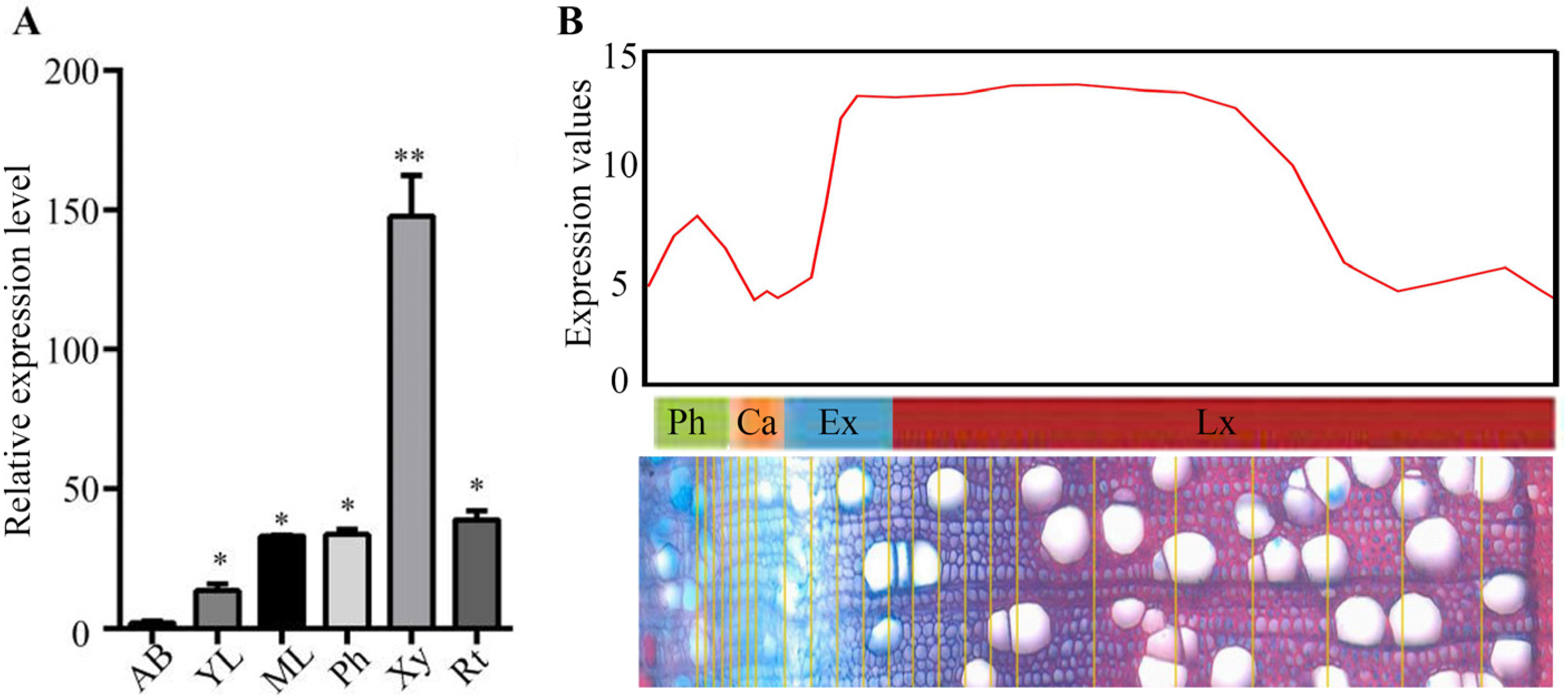
To further investigate the expression pattern of PtrBTB82, we collected total RNAs from P. trichocarpa’s apical buds, young leaves, mature leaves, phloem, xylem, and root of and used RT-qPCR to assess its transcription levels in different tissues. Among the tissues studied, xylem had the highest transcription levels of PtrBTB82 gene (Figure 2A). Using the ASPWood RNA-seq database (http://aspwood.popgenie.org; accessed on 26 May 2024), we examined the transcription levels of PtrBTB82 in various stem tissues, including phloem, cambium, expanding xylem, and lignified xylem. The result showed that PtrBTB82 had the highest transcription levels in developing xylem (Figure 2B), implying its involvement in wood formation.

2.2. Promoter Activity of PtrBTB82 Gene in ProPtrBTB82::GUS Transgenic Populus

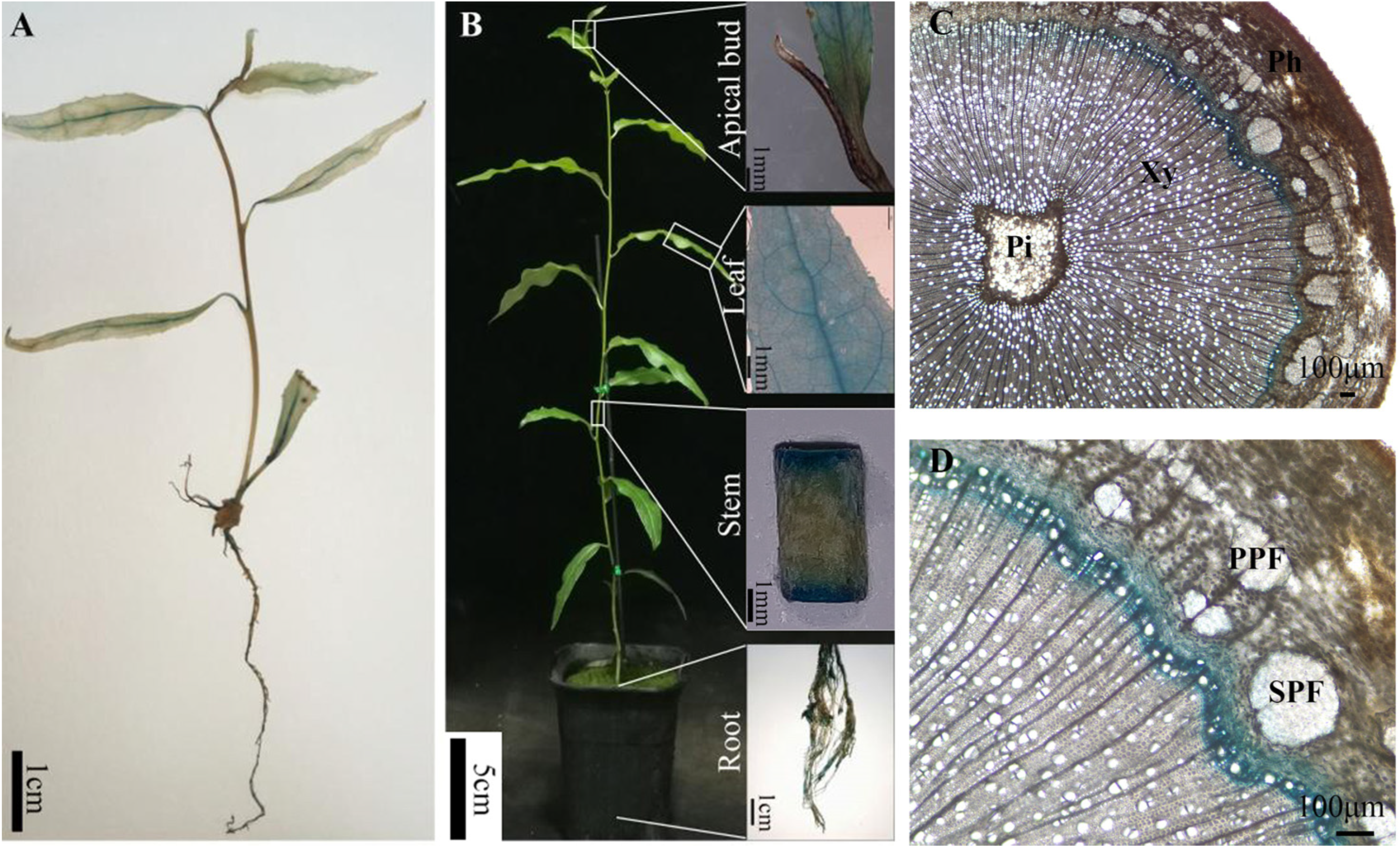
To study the promoter tissue expression pattern of PtrBTB82 gene, the promoter region (1815 bp) was extracted, and a ProPtrBTB82::GUS binary expression vector was constructed. Following transformation into wild-type (WT) P. trichocarpa, we created ProPtrBTB82::GUS transgenic plants that expressed a GUS gene driven by the PtrBTB82 promoter. GUS staining was applied to 1-month-old transgenic plantlets and 3-month-old transgenic young trees, respectively. GUS staining was visible in the leaf veins, petioles, and roots of one-month-old transgenic plantlets, but no GUS staining was detected in the apical buds or stem skins (Figure 3A). In three-month-old transgenic trees undergoing secondary xylem, GUS staining was mostly localized to leaf veins, stems, and roots, showing that PtrBTB82 promoter tissue expression activity is limited to vascular tissues (Figure 3B). Further examination of stem cross-sections revealed that GUS activity was mostly concentrated in developing xylem fiber cells, cambium, and adjacent parenchyma cells, with no activity in xylem vessel cells or phloem fiber cells (Figure 3C,D). These data indicate that PtrBTB82 is likely involved in xylem development.

2.3. Phenotypes of PtrBTB82-Overexpressing P. trichocarpa

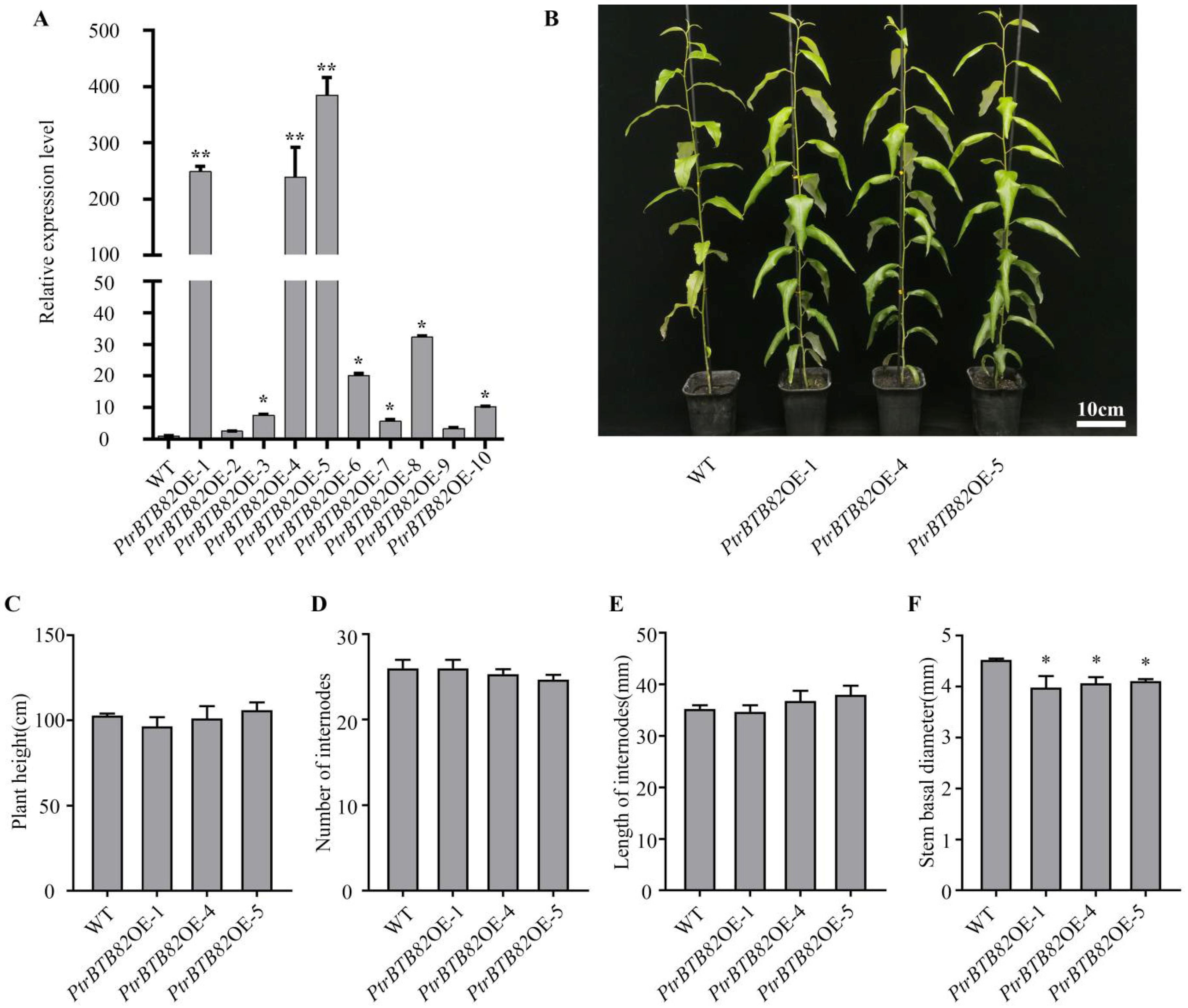
To explore the gain-of-function of PtrBTB82 in P. trichocarpa, we constructed a plant expression vector containing PtrBTB82 and overexpressed it using the cauliflower mosaic virus 35S (CaMV35S) promoter. After genomic DNA PCR, RT-PCR verification and western blotting analysis (Figure 4A and Figure S3), three overexpression lines PtrBTB82OE-1/4/5 were chosen for functional studies because they possessed more than 200-fold higher PtrBTB82 transcription levels than non-transgenic WT plants.
Next, we observed the phenotypes of WT plants and 3-month-old overexpression lines in the greenhouse. The PtrBTB82OE-1/4/5 lines showed significant morphological alterations in comparison to WT (Figure 4B). Plant height, the number and length of stem internodes did not significantly differ between PtrBTB82OE-1/4/5 and WT plants (Figure 4B–E). In contrast to WT, the three overexpression lines’ basal stem diameters decreased by 16%, 13%, and 11%, respectively (Figure 4F), suggesting that PtrBTB82 inhibits stem diameter growth in P. trichocarpa.

2.4. Overexpression of PtrBTB82 Decreases Xylem Width and Cambium Activity

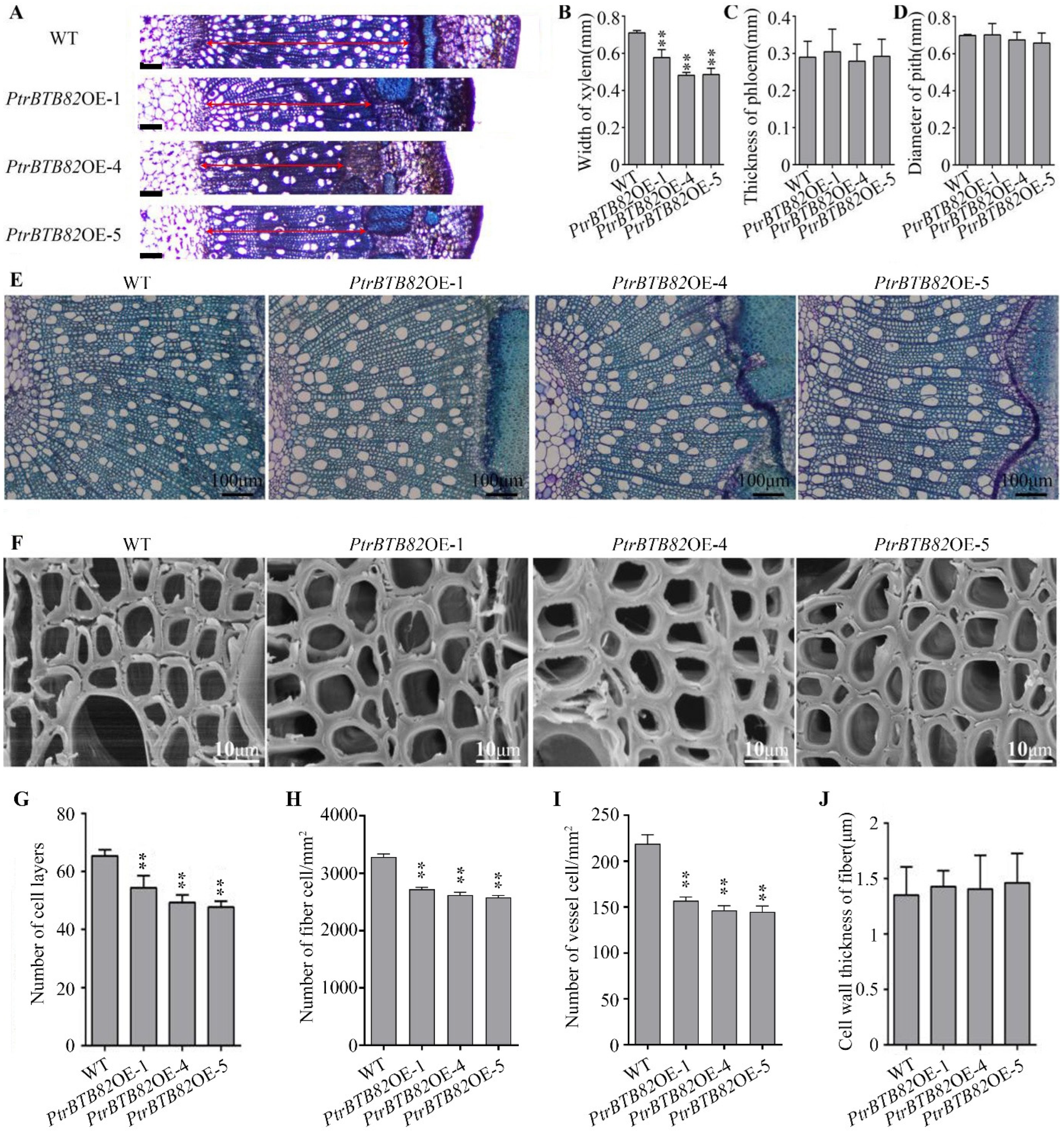
We further explored the role of PtrBTB82 in P. trichocarpa stem growth. The 12th stem internodes from 3-month-old WT and overexpression plants were cross-sectioned, and the sections stained with toluidine blue were examined under a light microscope. The results revealed that PtrBTB82 overexpression lines were drastically reduced from pith to periderm of stem cross-sections when compared to WT plants (Figure 5A). Furthermore, xylem width in PtrBTB82OE-1, -4, and -5 was reduced by 17%, 30%, and 29%, respectively, compared to WT, whereas no significant differences were found in the pith and phloem tissues (Figure 5B–D). Next, we conducted a statistical analysis of the number of secondary xylem cell layers and found that PtrBTB82OE-1, -4, and -5 had 13%, 20%, and 21% less layers than WT (Figure 5G). Statistical analysis revealed that the number of xylem fiber and vessel cells per unit area in PtrBTB82 overexpression lines was much lower than in WT plants (Figure 5H,I), indicating a considerable increase in secondary xylem cell size. Scanning electron microscopy (SEM) analysis revealed no significant changes in SCW thickness of mature xylem fibers between WT and overexpression plants (Figure 5J).
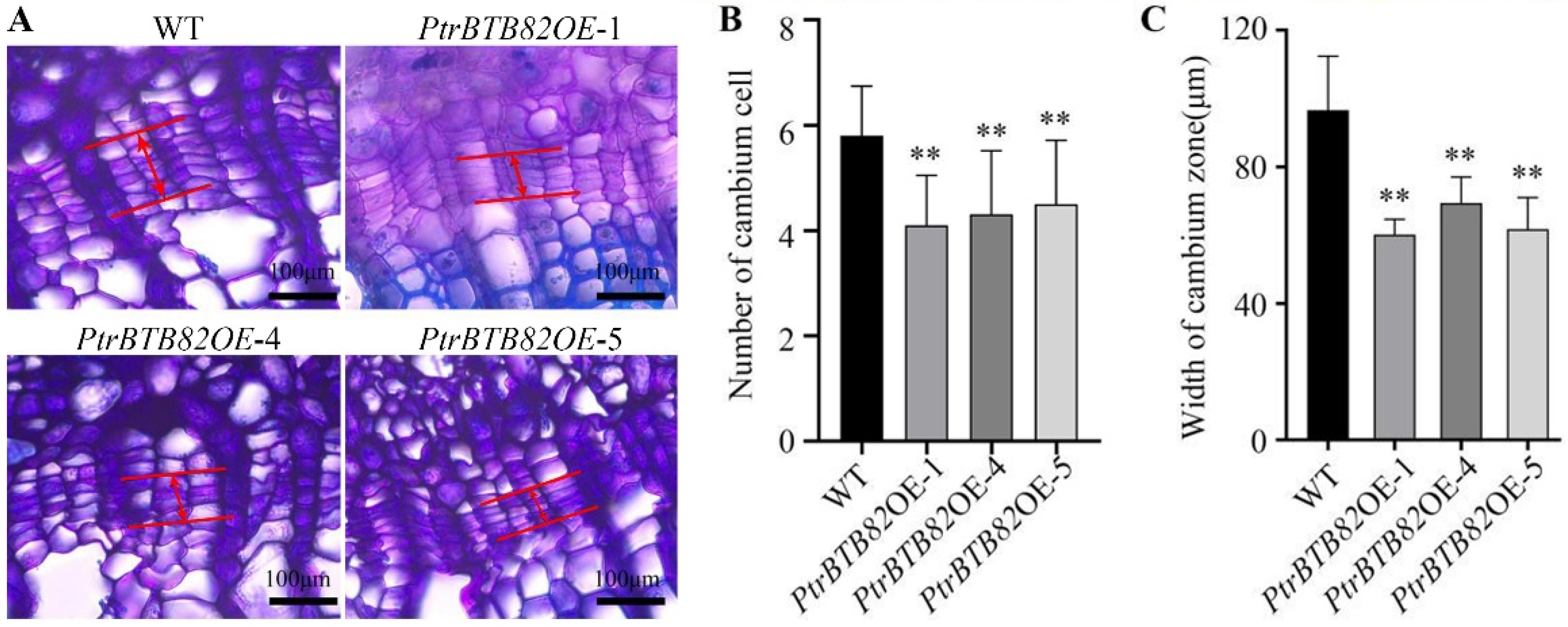
To better understand the decrease in xylem width of PtrBTB82 overexpression plants, we investigated their vascular cambium. The vascular cambium in wild-type P. trichocarpa typically exhibited six cell layers, whereas overexpression lines had four or five (Figure 6A,B). The number of cambial cell layers differed between WT and PtrBTB82 overexpression plants, indicating that PtrBTB82 reduces cambial activity. Statistical analysis revealed that the width of the cambium zone in overexpression lines was reduced by 38%, 28%, and 36%, respectively, when compared to the WT (Figure 6C). Taken together, our data indicate that PtrBTB82 suppresses secondary xylem growth by repressing cambial activity.

2.5. Overexpression of PtrBTB82 Alters Wood Chemical Composition in Poplar

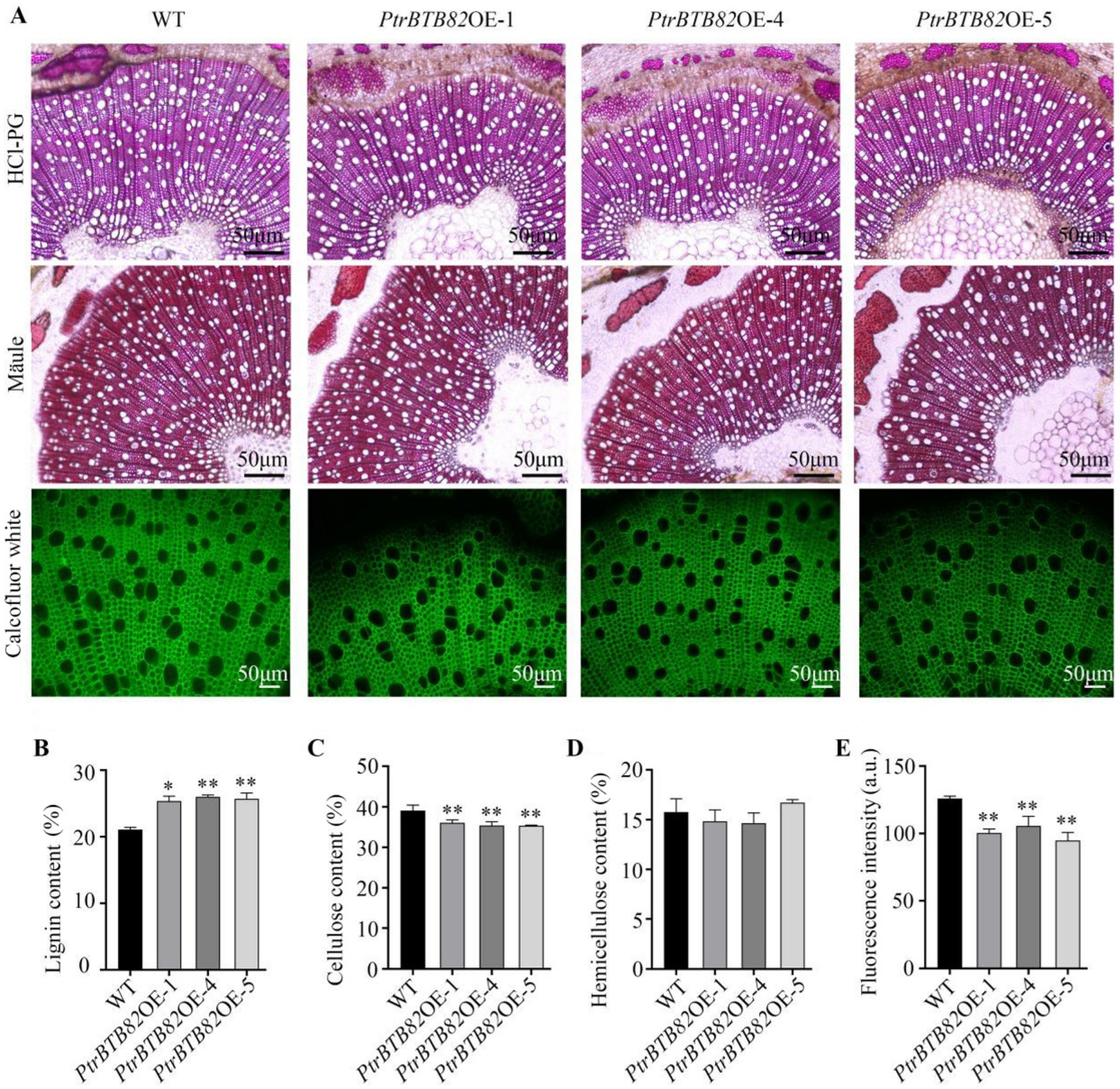
We investigate the effects of PtrBTB82 overexpression on wood composition using phloroglucinol-HCl, Mäule and calcofluor white histochemical staining, which estimates total lignin, mono-lignin, and cellulose content, respectively. PtrBTB82 overexpression lines exhibited slightly darker staining with phloroglucinol-HCl than WT does, while mono-lignin staining intensity was nearly identical in both (Figure 7A). Conversely, calcofluor white staining revealed a slight decrease in fluorescence intensity in the overexpression lines compared to WT (Figure 7A). Analysis of quantifying fluorescence intensity using ImageJ software (v1.58j) showed that the average cellulose fluorescence intensity in the overexpression lines decreased by 20.3%, 16.1%, and 24.6%, respectively, compared to WT (Figure 7E). These findings suggest that overexpression of PtrBTB82 increases lignin content and reduces cellulose content in wood.
Next, the concentrations of lignin, cellulose, and hemicellulose were determined in the wood of WT and overexpression lines. In comparison to the WT, total lignin content in PtrBTB82OE-1, -4, and -5 increased by 20%, 23%, and 22%, respectively, whereas cellulose content reduced by 7.7%, 9.5%, and 9.6% (Figure 7B,C). However, hemicellulose content did not differ significantly between WT and overexpression wood (Figure 7D). Overall, histochemical staining and quantitative measures show that overexpression of PtrBTB82 can affect lignin and cellulose levels in wood.

2.6. Expression of the Genes Associated with Cambium Activity in PtrBTB82-Overexpressing Poplars

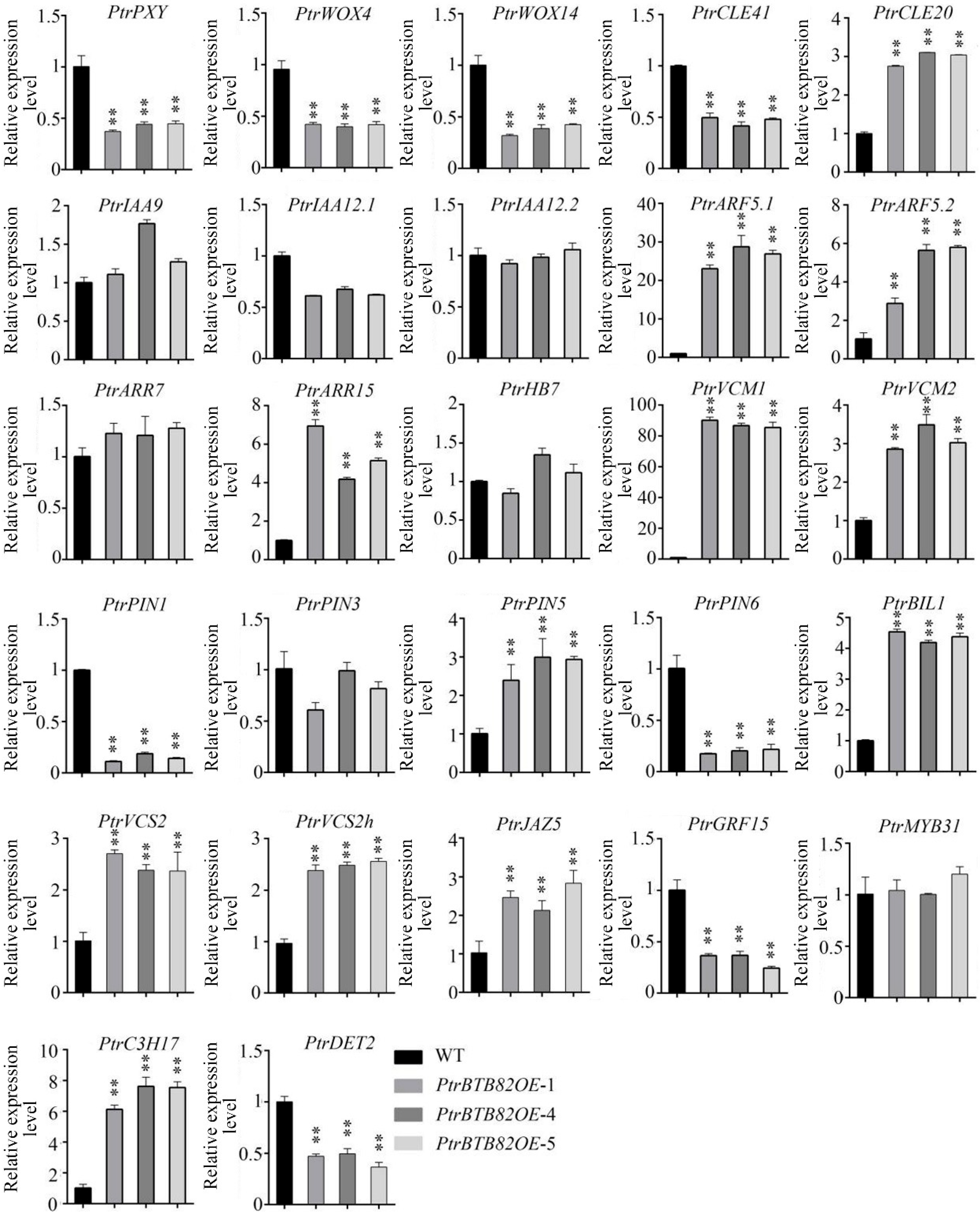
To investigate the reason for reduced cambium activity in the overexpression lines, we examined whether the expression of some genes associated with cambial activity had changed using RT-qPCR analysis. The 27 genes (Figure 8) were selected on the basis of functional annotations, mainly in hormone signaling and multilayered transcriptional networks. The CLE41-PXY-WOX4/14 signaling module, a key regulator of cambial cell division and maintenance, was markedly downregulated at transcriptional levels, indicating inhibited cambial cell proliferation in PtrBTB82-overexpressing poplars. CLE20, potentially repressing WOX4 expression via an intermediate receptor [46], was significantly upregulated, potentially enhancing the inhibition of cambial activity in the overexpression lines. The auxin transport genes PIN1 and PIN6 were synchronously downregulated, further suggesting suppression of cambial cell proliferation. Meanwhile, transcript levels of ARF5.1, ARF5.2, and ARR15 were significantly increased; the upregulation of the ARF5-ARR15 module likely inhibits cytokinin biosynthesis, possibly repressing PIN1 transcription. Additionally, PIN5 and its upstream regulators VCM1 and VCM2 were significantly upregulated, which contribute to the inhibition of cambial activity [47]. Some transcription factors VCS2/2h and C3H17 known to suppress cambial activity and BIL1 exhibited significantly increased expression in PtrBTB82-overexpressing poplar [48,49]. As an inhibitor of cambium activity [50], the jasmonic acid (JA)-related gene JAZ5 was significantly upregulated. The brassinosteroid (BR) biosynthesis gene DET2 was significantly downregulated, suggesting a reduction in BR-mediated cell expansion [51]. In contrast, the IAA9/12-ARR7 regulatory module and its downstream targets, including HB7, PIN3, and MYB31, remained stably expressed. These data indicate that PtrBTB82 should involve in cambial activity of P. trichocarpa.

2.7. Expression of Lignin, Cellulose and Semi-Cellulose Synthesis Genes in PtrBTB82-Overexpressing Poplars

To determine how PtrBTB82 affects wood SCW synthesis, transcription levels of lignin, cellulose, and hemicellulose synthesis genes were analyzed in PtrBTB82 overexpressing lines. In poplar, whole series of lignin biosynthesis enzymes were encoded by the 22 genes, i.e., PtrPAL1/2/3/4/5, PtrC4H1/2, Ptr4CL3/5, PtrHCT1/6, PtrC3H3, PtrCCoAOMT1/2/3, PtrCCR2, PtrF5H1/2, PtrCOMT2, PtrCAD1, and PtrCSE1/2, with high expression levels in secondary xylem [52].
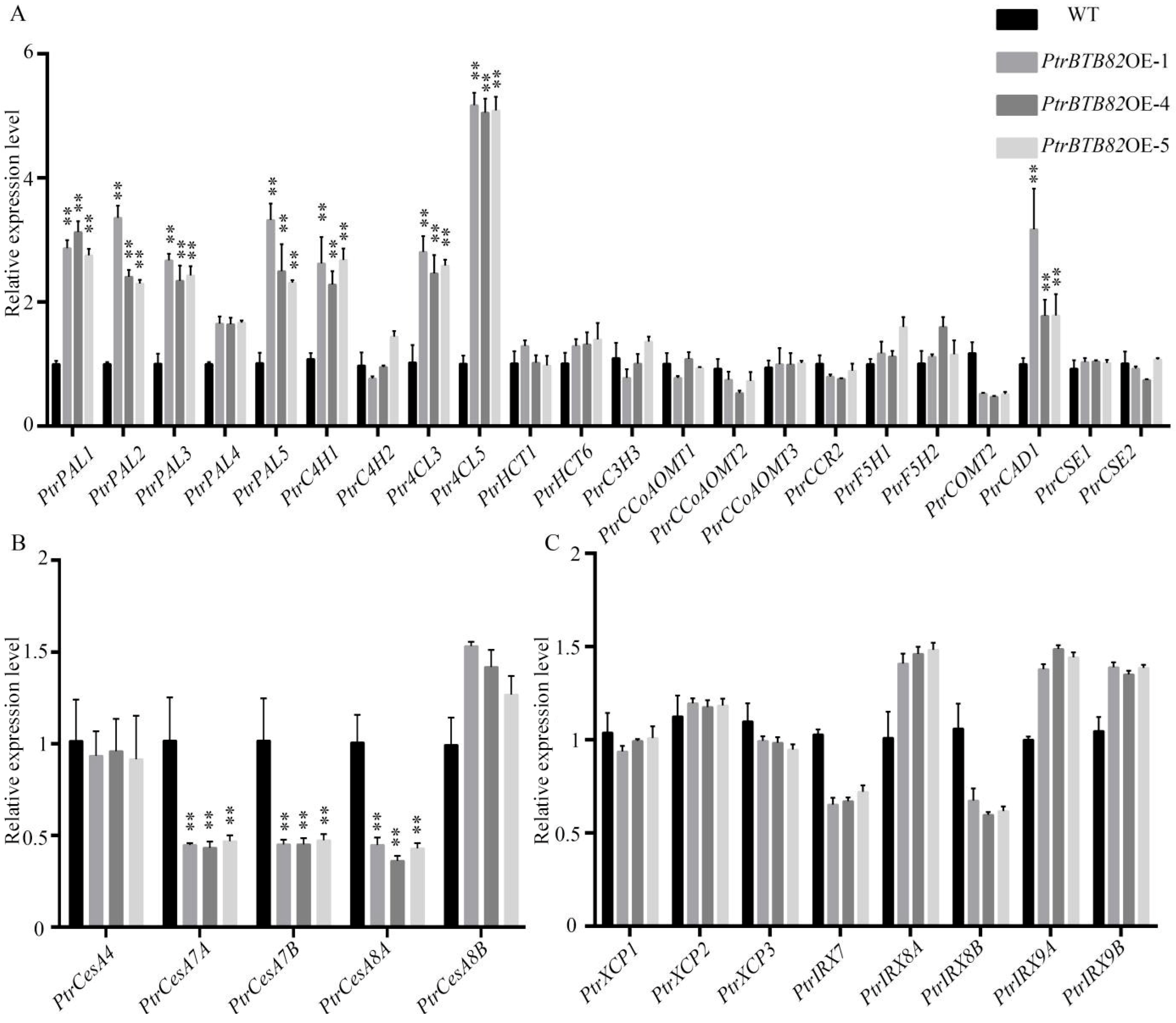
Our RT-qPCR analysis revealed that PtrPAL1/2/3/5, PtrC4H2, and Ptr4CL3/5 were upregulated more than 2-fold compared to WT in the overexpression lines at transcription levels (Figure 9A). Except for PtrCAD1, the majority of lignin biosynthetic downstream enzyme genes did not differ significantly between WT and overexpression plants (Figure 9A). For SCW cellulose synthesis genes, PtrCesA7A/B and PtrCesA8A transcript levels were dramatically reduced in the overexpression lines, whereas PtrCesA4 and PtrCesA8B transcript levels remained significantly unchanged (Figure 9B). In contrast, we found no significant changes in the expression of key hemicellulose biosynthesis genes such as PtrXCP1/2/3, IRX7, IRX8A/B, and IRX9A/B (Figure 9C). Our findings are consistent with the notion that overexpression of PtrBTB82 increases lignin content and reduces cellulose content in wood of transgenic poplars.

3. Discussion

In this study, we identified 103 BTB family genes in P. trichocarpa, slightly more than the 95 genes reported previously [44]. This discrepancy is likely due to continuous updates and refinements in protein databases, reflecting the dynamic nature of genome annotation. Generally, gene expression patterns are closely associated with biological functions, offering valuable clues about their potential roles and regulatory mechanisms. Expression profiling using the eFP browser revealed highly diverse transcriptional patterns of BTB members across roots, internodes, and leaves, suggesting functional diversification within this gene family. Among these genes, we identified an only-BTB subgroup member, PtrBTB82, that exhibited a high expression in xylem. GUS staining further confirmed its predominant activity in the secondary vascular tissues (Figure 2 and Figure 3). These results suggest that PtrBTB82 plays the role in cambial activity and SCW formation during stem development. Consistently, overexpression of PtrBTB82 in P. trichocarpa led to reduced cambial activity and consequently a narrower xylem compared with the WT (Figure 5 and Figure 6). In addition to PtrBTB82, we observed high expression of PtrBTB79 in internodes and roots. But they are distributed across different subfamilies and shares limited protein similarities, suggesting a lower possibility in analogous functions. Whether it exerts overlapping or distinct functions with PtrBTB82 in poplar remains to be determined in the future.
Cambial activity directly determines the extent and rate of wood formation. Previous studies have demonstrated that changes in phytohormone concentrations directly affect cambial activity, with the IAA9/12-ARF5-HB7 pathway being a major regulator of auxin distribution [5]. In our study, the transcriptional activity of IAA9/12 and HB7 did not change significantly, but the expression of ARF5 was altered (Figure 8). One possible explanation is the involvement of BIL1 (BIN2-LIKE1), which acts as a member of the GSK3-like kinase and a critical regulator in the brassinosteroid signaling pathway [53,54]. In addition to this role, BIL1 has been shown to enhance the inhibitory effect of ARF5 on cambial activity, and to influence downstream cytokinin signaling by activating a set of negative regulators, including ARR7/15 [55]. In our study, we found that the transcript levels of BIL1, ARF5, and ARR15 were all significantly increased in the PtrBTB82 overexpression lines. Speculatively, PtrBTB82 overexpression reduced cambial activity, possibly through the complex interplay of auxin, brassinosteroid, and cytokinin signaling pathways, rather than solely by altering auxin biosynthesis.
In addition to hormonal signaling, transcriptional regulation is essential for maintaining cambial activity. Previous studies have demonstrated that the NAC transcription factor WOX4 serves as a central regulator, not only by integrating multiple hormone signaling pathways but also by directly modulating cambial activity through the WUSCHEL-related pathway [56]. In this study, we found that CLE41, PXY, WOX4, and its homolog WOX14 were significantly downregulated in the PtrBTB82 overexpression lines. This observation suggests that PtrBTB82 should involve in the WUS-mediated pathway to influence cambial activity. CLE41 peptide is synthesized in the phloem and functions as the upstream signal of this pathway [57]. Although low-level expression of PtrBTB82 in the phloem (Figure 2 and Figure 3C,D), such low but spatially precise expression is presumptively operative to modulate CLE41 transcription. The upregulation of CLE20, a CLE peptide known to indirectly repress WOX4 expression, further supports this hypothesis [46]. Moreover, the CLE41/44-PXY module has been shown to suppress BIL1 and integrate brassinosteroid signaling into the auxin pathway to regulate cambial activity [55]. This explains why BIL1 is upregulated in the overexpression lines, and it’s further proven that PtrBTB82 overexpression reduces cambial activity by modulating CLE41 expression and affecting downstream signaling pathways. It is proposed that PtrBTB82 might act on the CLE41–PXY-WUS signaling complex, which modulates the complex interplay of auxin, brassinosteroid, and cytokinin signaling pathways.
Plant cell walls are generally classified into primary and secondary walls. In fibers and vessel elements of the trees, the SCW is a key structure that provides mechanical support. It is mainly composed of cellulose, hemicellulose and lignin, whose biosynthesis requires the coordinated expression of related genes [19]. Typically, changes in cellulose and/or lignin content may lead to the alteration in SCW thickness. PtrBTB82 overexpression significantly increased lignin content and decreased cellulose content (Figure 7), but the thickness of the SCWs remained unchanged. Previous study has shown that C4H1/2 inhibited transgenic poplar trees with reduced lignin content does not significantly change the thickness of the fiber wall [58], which is consistent with our observations. Changes in chemical composition of SCWs are usually attributable to transcriptional regulation in their biosynthetic genes. In PtrBTB82 overexpression lines, lignin biosynthetic genes, including PAL, C4H, 4CL, and CAD1, were upregulated, leading to elevated lignin accumulation. The expression of key S-lignin biosynthetic genes (PtrF5H1/2 and PtrCOMT2) remains significantly unchanged and Mäule staining for detecting S-lignin monomer reveals no obvious differences between WT and overexpression lines (Figure 7A and Figure 9). In light of these findings, G- or H-lignin might increase in overexpression lines, possibly producing the potential shift in S/G ratio.
Meanwhile, the expression of SCW CESA7A/B and CESA8A was significantly downregulated in PtrBTB82 overexpression lines, explaining the reduced cellulose content. SCW CesA genes are known to be highly conserved across vascular plants [59,60,61], and mutations in any SCW CesA gene typically lead to severe reductions in cellulose content and SCW thickness, accompanied by weakened stem mechanical strength and irregular xylem phenotypes, such as vessel collapse [61,62]. However, our results revealed a decline in cellulose content without a significant reduction in wall thickness (Figure 5J). It may be due to a compensatory effect among wall components, in which excess lignin deposition offsets the adverse impact of reduced cellulose on wall thickness. Since lignin and hemicellulose are closely associated and crosslinked during SCW formation [63], enhancing their interactions might help maintain cell wall integrity even under conditions of reduced cellulose content. In addition, the increased transcript levels of lignin biosynthesis genes together with the pronounced repression of SCW CESA genes, both of which are well-established downstream targets of the NAC-MYB master regulatory cascade [21], raise the question of whether these transcriptional changes are mediated directly by PtrBTB82 remains to be elucidated in the future.
BTB/POZ proteins constitute one of the largest families of substrate adaptors for CULLIN3-based E3 ubiquitin ligase complexes in plants [40]. The RT–qPCR results clearly reveal the broad impact of PtrBTB82 overexpression on downstream gene networks on cambial activity (Figure 8). PtrBTB82, as a member of the only-BTB subfamily, contains only a conserved BTB/POZ domain and have no obvious DNA-binding domain. It raises a question of whether it can directly interact with CUL3 and subsequently target yet-unknown positive regulators of cambial activity or SCW formation for degradation. If such, its regulatory mechanism cannot be elucidated solely through RT–qPCR analysis. Therefore, future studies employing yeast two-hybrid assays and related approaches will be required to verify whether PtrBTB82 functions in this manner.
In summary, PtrBTB82 is an only-BTB type BTB/POZ gene predominantly expressed in secondary xylem. Overexpression of PtrBTB82 in P. trichocarpa suppressed the expression of genes involved in the WUSCHEL-related pathway and plant hormone signaling, thereby reducing cambial activity and inhibiting xylem development. In addition, overexpression of PtrBTB82 led to upregulated genes associated with lignin biosynthesis (PtrPALs, PtrC4H1, Ptr4CL and PtrCAD1) while downregulating SCW CesA genes (PtrCESA7A/B and PtrCESA8A), which resulted in significant alterations in the chemical composition of wood.

4. Materials and Methods

4.1. Plant Materials and Growth Conditions

P. trichocarpa genotype Nisqually-1 was used as the plant material in this study. Sterile plantlets were propagated using in vitro tissue culture methods [64]. The WT and transgenic plant lets were grown in soil for phenotypic analysis in a greenhouse (25 to 28 °C; 16/8 h light/dark cycle) with a light intensity of ~250 μmol·m−2·s−1.

4.2. Identification of the BTB Family Genes in P. trichocarpa

We employed two complementary approaches to identify potential BTB proteins in P. trichocarpa. (1) The potential BTB proteins were identified in P. trichocarpa using the Hidden Markov Model (HMM) profiles for the conserved BTB/POZ domains (PF00651) from the InterPro database (https://www.ebi.ac.uk/interpro/; accessed on 8 March 2024). The protein sequences, genomic sequences, and coding sequences (CDS) of all BTB genes were obtained from the P. trichocarpa v4.1 genome database [65]. (2) We searched the InterPro database for BTB/POZ domains (IPR000210, IPR011333, and IPR016073) and retrieved the corresponding conserved motifs. These motifs were subsequently used to perform BLAST searches against the P. trichocarpa genome in the Phytozome database (https://phytozome-next.jgi.doe.gov/blast-search; accessed on 9 March 2024). The resulting candidate genes from two independent BLAST searches were compared, and redundant sequences were removed to obtain a non-redundant BTB gene set.

4.3. Construction of the BTB Family Phylogenetic Tree, Gene Structure and Motif Analysis

The phylogenetic tree of 103 PtrBTB proteins was constructed using the neighbor-joining (NJ) method with 1000 bootstrap replicates and p-distance in MEGA11 after alignment and trimming of amino acid sequences. The tree was then beautified using the iTOL online platform (https://itol.embl.de/; accessed on 25 May 2024). Gene structures, including the organization of exon and intron, and conserved motifs, were generated with TBtools-II software (v2.310) [66]. Conserved motifs of the PtrBTB genes were analyzed by the Multiple Expectation Maximization for Motif Elucidation (MEME) system (https://meme-suite.org/meme/tools/meme; accessed on 10 March 2024) [67].

4.4. Analysis of Electronic Expression Data

Tissue-specific expression data on the PtrBTBs were downloaded from the Populus eFP browser (http://bar.utoronto.ca/efppop/cgi-bin/efpWeb.cgi; accessed on 14 March 2024). The heatmap was generated using TBtools-II software (v2.310). Under the “Graphics” tab, the “Heatmap Illustrator” module was selected, and the downloaded expression data along with the corresponding gene IDs were imported. The dataset was normalized across all samples, and the color scale was adjusted to a range from 0 to 1 [66]. Stem tissue expression data and line charts were directly generated from the AspWood electronic expression database (http://aspwood.popgenie.org; accessed on 26 May 2024), and the underlying data were obtained from the study published by Sundell et al. [68].

4.5. RNA Extraction and RT-qPCR

For determination of PtrBTB82 transcriptional levels in various tissues of P. trichocarpa, apical buds (AB), young leaves (YL), mature leaves (ML), phloem (Ph), developing xylem (Xy), and roots (Rt) were collected from 4-month-old WT. Three biological replicates were performed for each tissue, with each replicate consisting of a pooled sample from three WT trees. For the identification of transgenic lines, developing xylem tissues were collected from WT and transformants grown in the greenhouse. For the analysis of expression of the genes associated with cambial activity and SCW biosynthesis, the rich cambial tissues and developing xylem were collected from 4-month-old WT and transgenic lines. Three biological replicates were performed, each consisting of pooled samples from three individual trees. All samples were immediately frozen in liquid nitrogen and ground into a fine powder.
Total RNA was extracted using the pBIOZOL reagent (BioFlux, Hangzhou, China). First-strand cDNA was synthesized using the PrimeScript RT reagent kit with gDNA Eraser (TaKaRa, Beijing, China), following the manufacturer’s instructions. RT-qPCR was conducted using an ABI 7500 Real-Time PCR System (Applied Biosystems, Waltham, MA, USA) and TB Green Premix Ex Taq II (TaKaRa, Beijing, China), each 20 µL reaction mixture contained 10 µL of 2× TB Green Premix Ex Taq II (Tli RNaseH Plus), 1 µL of cDNA template, 0.4 µL of ROX Reference Dye II, 0.8 µL of each gene-specific primer, and 7 µL of distilled water. Relative transcript abundance was calculated using the 2−ΔΔCT method and normalized to the expression of PtrActin2. Each assay was performed with three technical replicates. The gene-specific primers used for RT-qPCR are listed in Supplementary Table S1.

4.6. Vector Constructs

Genomic DNA was extracted from leaves of 3-month-old wild-type plants using a Plant Genomic DNA Extraction Kit (Bioteke, Beijing, China). For the pCAMBIA1300-ProPtrBTB82::GUS construct, the 1815 bp promoter regions of PtrBTB82 genes were amplified with specific primers, and the purified DNA fragments after double digestions with SacI and XbaI endonucleases were ligated into pCAMBIA1300 vector containing a GUS gene. For the pCAMBIA1300-35s::PtrBTB82-3xflag construct, the CDS of PtrBTB82 gene was ligated into the pCAMBIA1300 (double digestions with BamHI and SalI endonucleases) vector under the control of the CaMV 35S promoter. All constructs were verified by DNA sequencing. The primers used for vector construction are listed in Supplementary Table S1.

4.7. Generation of Transgenic P. trichocarpa

The constructed pCAMBIA1300-ProPtrBTB82::GUS and pCAMBIA1300-35S::PtrBTB82-3xflag vectors were introduced into the Agrobacterium tumefaciens strain GV3101 for genetic transformation of P. trichocarpa. The Agrobacterium-mediated transformation method was performed as described by Li and Zhen et al. [64]: Healthy 1-month-old wild-type P. trichocarpa tissue culture seedlings were used as the transformation material, with hygromycin (Hyg) as the selectable marker. The Agrobacterium carrying the corresponding vectors was incubated to an OD600 = 0.6. The bacterial pellet was collected by centrifugation at 2200× g for 10 min at 4 °C and resuspended in 50 mL of suspension solution (containing 0.04 g WPM, 1.25 g sucrose, 0.0136 g MES, pH = 5.2). The stems of P. trichocarpa seedlings were cut into segments approximately 1 cm in length and immersed in the suspension solution for infection with gentle shaking for 20 min. The infected explants were co-cultivated for 48 h. The stem explants were then transferred to a selection medium containing 10 mg L−1 hygromycin under light conditions. After 25 d, the stem explants were transferred to a selection medium containing 5 mg L−1 hygromycin for further cultivation. After 20 d, resistant buds were induced. The hygromycin-resistant shoots were excised and placed on a rooting medium containing 5 mg L−1 hygromycin.

4.8. GUS Staining

GUS staining analysis was performed on 1-month-old proBTB82::GUS transgenic seedlings grown in tissue culture bottles and 3-month-old trees grown in soil, with six independent lines analyzed to ensure the reliability of the results. Wild-type plants were used as negative controls, and the experiments were repeated three times. Various tissues were incubated in the GUS staining solution [0.1 M Na3PO4 buffer (pH 7.0), 10 mM EDTA, 2 mM K3[Fe(CN)6], 2 mM K4[Fe(CN)6], 1 mM X-Gluc, and 0.1% (v/v) Triton X-100] at 37 °C for 4 h. After GUS signal development, chlorophyll was removed from the samples multiple times using 75% (v/v) ethanol. Images of stem sections were captured using a EX21 upright microscope (Soptop, Ningbo, China); other tissue images were recorded using an SZX7 stereomicroscope (Olympus, Tokyo, Japan).

4.9. Protein Extraction and Western Blot Analysis

Developing xylem samples were collected from the stems of 4-month-old WT and PtrBTB82 overexpression lines. Three biological replicates were performed, each consisting of pooled samples from three individual trees. Plant materials were rapidly frozen in liquid nitrogen and ground into a fine powder. The samples were homogenized on ice for 1 h in protein extraction buffer (100 mM Tris–HCl, pH 8.0, and 1% SDS), followed by boiling for 10 min. After centrifugation at 14,000 rpm for 10 min, the supernatants (protein extracts) were collected for sodium dodecyl sulfate-polyacrylamide gel electrophoresis (SDS-PAGE) analysis. Total proteins were separated on 10% SDS-PAGE gels and transferred onto polyvinylidene fluoride (PVDF) membranes. The membranes were blocked at 4 °C overnight and then incubated for 1 h with the anti-FLAG primary antibody (1:10,000; M20008, Abmart, Shanghai, China) and the horseradish peroxidase (HRP)-conjugated secondary antibody Anti-Mouse IgG H&L (1:10,000; AB6789, Abcam, Cambridge, UK). Signals were detected using the Enhanced Chemiluminescence (ECL) Western Blotting Substrate (34579, Thermo Fisher Scientific, Waltham, MA, USA) and captured on X-ray film.

4.10. Histological Staining and Microscopy Analyses

For light microscopy, 3-month-old PtrBTB82-overexpressing (OE) plants and corresponding wild-type (WT) plants were subjected to histological analysis. Stem segments from the 6th and 12th internodes of WT and OE plants were sectioned using a vibratome (Leica VT1200S; Leica, Wetzlar, Germany) at a thickness of 70 μm. The sections were stained with 0.05% or 0.01% (w/v) toluidine blue O (TBO) solution, or with 1% phloroglucinol-HCl solution. Images of the stem sections were captured using a EX21 upright microscope (Suptop, China).
For quantification of the number of cambial cell layers in WT and PtrBTB82-overexpressing lines, stem segments at the 6th internode were collected from 3-month-old WT and PtrBTB82 overexpression lines. Stem sections were prepared using the method described above and stained with 0.01% (w/v) toluidine blue O (TBO) solution for microscopic observation. Well-preserved and clearly defined cambial regions were selected for analysis. Three trees from each line were analyzed, and the experiments were repeated three times. Each replicate included 110 measurements of the number of cambium cell layers.
For fluorescence microscopy, stem segments from the 12th internode of WT and OE plants were sectioned using a vibratome (Leica VT1200S; Leica) at a thickness of 70 μm. Lignin autofluorescence in cross-sections was imaged under the DAPI channel using an Axio Imager.A2 microscope (Zeiss, Oberkochen, Germany). Cellulose was stained with 0.01% (v/v) calcofluor white solution and imaged under the DAPI channel with the same microscope.
For scanning electron microscopy (SEM), free-hand cross-sections of stem segments from the 12th internode of 3-month-old OE and WT plants, grown under normal or inclined conditions, were coated with gold (Au) at 10 mA for 60 s, transferred to an SEM chamber (JCM-5000, Nanotech, Tokyo, Japan), and imaged to analyze secondary wall thickness. Three trees from each line were analyzed, and the experiments were repeated three times. Each replicate included 100 measurements of mature xylem fiber wall thickness (approximately 20–25 fiber layers adjacent to the cambium).

4.11. Wood Composition Assay

For the determination of lignin and crystalline cellulose content, samples were prepared as follows: the basal stems of 4-month-old WT and transgenic trees grown in the greenhouse were peeled, air-dried at 55 °C, and ball-milled into a fine powder. The powder was then sequentially washed with 70% aqueous ethanol, a chloroform/methanol (1:1, v/v) solution, and acetone. The resulting insoluble residues were used as cell wall materials for the assays of crystalline cellulose and lignin content. The crystalline cellulose and lignin contents were measured according to the methods described by Foster et al. [69,70]. Hemicellulose content was assayed according to the instructions provided by the kit manufacturer (Geruisi Biotechnology, Suzhou, China; http://geruisi-bio.com).

4.12. Statistical Analysis

All data analyses and statistical tests were conducted by GraphPad Prism version 10.4. Student’s t-test and ANOVA were used to determine the statistical significance between the mutant and WT samples. Values are displayed as the means ± standard deviation (SD), and the number of asterisks indicates statistical significance at different levels (* p < 0.05, ** p < 0.01).

Supplementary Materials

The following supporting information can be downloaded at: https://www.mdpi.com/article/10.3390/plants15010068/s1.

Author Contributions

S.Z. designed the experiment; S.Z., H.Y., J.L., X.Z., J.C., C.W., W.X., C.L. and Y.C. performed the experiment and data analysis; S.Z. wrote the manuscript; Y.C. performed review and editing. All authors have read and agreed to the published version of the manuscript.

Funding

This work was financially supported by the National Key Research and Development Program of China (2022YFD2200104), the National Natural Science Foundation of China (32201576, 32401534), and Postdoctoral Fellowship Program of CPSF (GZC20230399).

Data Availability Statement

All experimental data are provided in the main text and Supplementary Materials.

Conflicts of Interest

The authors declare no conflicts of interest.

References

  1. Luo, L.; Li, L. Molecular understanding of wood formation in trees. For. Res. 2022, 2, 5. [Google Scholar] [CrossRef] [PubMed]
  2. Wang, D.; Chen, Y.; Li, W.; Li, Q.; Lu, M.; Zhou, G.; Chai, G. Vascular cambium: The source of wood formation. Front. Plant Sci. 2021, 12, 700928. [Google Scholar] [CrossRef]
  3. Gouwentak, C.A. Cambial activity as dependent on the presence of growth hormone and the non-resting condition of stems. Protoplasma 1941, 36, 454. [Google Scholar] [CrossRef]
  4. Chandler, J.W. Auxin response factors. Plant Cell Environ. 2016, 39, 1014–1028. [Google Scholar] [CrossRef]
  5. Xu, C.; Shen, Y.; He, F.; Fu, X.; Yu, H.; Lu, W.; Li, Y.; Li, C.; Fan, D.; Wang, H.C. Auxin-mediated Aux/IAA-ARF-HB signaling cascade regulates secondary xylem development in Populus. New Phytol. 2019, 222, 752–767. [Google Scholar] [CrossRef]
  6. Wenzel, C.L.; Schuetz, M.; Yu, Q.; Mattsson, J. Dynamics of MONOPTEROS and PIN-FORMED1 expression during leaf vein pattern formation in Arabidopsis thaliana. Plant J. 2007, 49, 387–398. [Google Scholar] [CrossRef]
  7. Matsumoto-Kitano, M.; Kusumoto, T.; Tarkowski, P.; Kinoshita-Tsujimura, K.; Václavíková, K.; Miyawaki, K.; Kakimoto, T. Cytokinins are central regulators of cambial activity. Proc. Natl. Acad. Sci. USA 2008, 105, 20027–20031. [Google Scholar] [CrossRef]
  8. Björklund, S.; Antti, H.; Uddestrand, I.; Moritz, T.; Sundberg, B. Cross-talk between gibberellin and auxin in development of Populus wood: Gibberellin stimulates polar auxin transport and has a common transcriptome with auxin. Plant J. 2007, 52, 499–511. [Google Scholar] [CrossRef] [PubMed]
  9. Sorce, C.; Giovannelli, A.; Sebastiani, L.; Anfodillo, T. Hormonal signals involved in the regulation of cambial activity, xylogenesis and vessel patterning in trees. Plant Cell Rep. 2013, 32, 885–898. [Google Scholar] [CrossRef] [PubMed]
  10. Haghighat, M.; Zhong, R.; Ye, Z.-H. WUSCHEL-RELATED HOMEOBOX genes are crucial for normal vascular organization and wood formation in poplar. Plant Sci. 2024, 346, 112138. [Google Scholar] [CrossRef]
  11. Etchells, J.P.; Provost, C.M.; Mishra, L.; Turner, S.R. WOX4 and WOX14 act downstream of the PXY receptor kinase to regulate plant vascular proliferation independently of any role in vascular organisation. Development 2013, 140, 2224–2234. [Google Scholar] [CrossRef] [PubMed]
  12. Somerville, C. Cellulose synthesis in higher plants. Annu. Rev. Cell Dev. Biol. 2006, 22, 53–78. [Google Scholar] [CrossRef]
  13. Zhao, Y.; Abid, M.; Xie, X.; Fu, Y.; Huang, Y.; Cai, Z.; Lin, H. Harnessing unconventional monomers to tailor lignin structures for lignocellulosic biomass valorization. For. Res. 2024, 4, e004. [Google Scholar] [CrossRef]
  14. York, W.S.; O’Neill, M.A. Biochemical control of xylan biosynthesis—Which end is up? Curr. Opin. Plant Biol. 2008, 11, 258–265. [Google Scholar] [CrossRef]
  15. Zeng, W.; Lampugnani, E.R.; Picard, K.L.; Song, L.; Wu, A.-M.; Farion, I.M.; Zhao, J.; Ford, K.; Doblin, M.S.; Bacic, A. Asparagus IRX9, IRX10, and IRX14A are components of an active xylan backbone synthase complex that forms in the Golgi apparatus. Plant Physiol. 2016, 171, 93–109. [Google Scholar] [CrossRef] [PubMed]
  16. Xu, W.; Cheng, H.; Zhu, S.; Cheng, J.; Ji, H.; Zhang, B.; Cao, S.; Wang, C.; Tong, G.; Zhen, C. Functional understanding of secondary cell wall cellulose synthases in Populus trichocarpa via the Cas9/gRNA-induced gene knockouts. New Phytol. 2021, 231, 1478–1495. [Google Scholar]
  17. Persson, S.; Caffall, K.H.; Freshour, G.; Hilley, M.T.; Bauer, S.; Poindexter, P.; Hahn, M.G.; Mohnen, D.; Somerville, C. The Arabidopsis irregular xylem8 mutant is deficient in glucuronoxylan and homogalacturonan, which are essential for secondary cell wall integrity. Plant Cell 2007, 19, 237–255. [Google Scholar] [CrossRef]
  18. Terrett, O.M.; Dupree, P. Covalent interactions between lignin and hemicelluloses in plant secondary cell walls. Curr. Opin. Biotechnol. 2019, 56, 97–104. [Google Scholar] [CrossRef]
  19. Zhong, R.; Ye, Z.-H. Secondary cell walls: Biosynthesis, patterned deposition and transcriptional regulation. Plant Cell Physiol. 2015, 56, 195–214. [Google Scholar] [CrossRef] [PubMed]
  20. Wang, Z.; Mao, Y.; Guo, Y.; Gao, J.; Liu, X.; Li, S.; Lin, Y.-C.J.; Chen, H.; Wang, J.P.; Chiang, V.L. MYB transcription factor161 mediates feedback regulation of secondary wall-associated NAC-Domain1 family genes for wood formation. Plant Physiol. 2020, 184, 1389–1406. [Google Scholar] [CrossRef]
  21. Zhong, R.; McCarthy, R.L.; Lee, C.; Ye, Z.-H. Dissection of the transcriptional program regulating secondary wall biosynthesis during wood formation in poplar. Plant Physiol. 2011, 157, 1452–1468. [Google Scholar] [CrossRef]
  22. Nakano, Y.; Yamaguchi, M.; Endo, H.; Rejab, N.A.; Ohtani, M. NAC-MYB-based transcriptional regulation of secondary cell wall biosynthesis in land plants. Front. Plant Sci. 2015, 6, 288. [Google Scholar]
  23. Li, E.; Bhargava, A.; Qiang, W.; Friedmann, M.C.; Forneris, N.; Savidge, R.A.; Johnson, L.A.; Mansfield, S.D.; Ellis, B.E.; Douglas, C.J. The Class II KNOX gene KNAT7 negatively regulates secondary wall formation in Arabidopsis and is functionally conserved in Populus. New Phytol. 2012, 194, 102–115. [Google Scholar] [CrossRef]
  24. Jia, S.; Wang, C.; Sun, W.; Yan, X.; Wang, W.; Xu, B.; Guo, G.; Bi, C. OsWRKY12 negatively regulates the drought-stress tolerance and secondary cell wall biosynthesis by targeting different downstream transcription factor genes in rice. Plant Physiol. Biochem. 2024, 212, 108794. [Google Scholar] [CrossRef]
  25. Liu, H.; Gao, J.; Sun, J.; Li, S.; Zhang, B.; Wang, Z.; Zhou, C.; Sulis, D.B.; Wang, J.P.; Chiang, V.L. Dimerization of PtrMYB074 and PtrWRKY19 mediates transcriptional activation of PtrbHLH186 for secondary xylem development in Populus trichocarpa. New phytol. 2022, 234, 918–933. [Google Scholar]
  26. Guo, Y.; Yao, L.; Chen, X.; Xu, X.; Sang, Y.L.; Liu, L.-J. The transcription factor PagLBD4 represses cell differentiation and secondary cell wall biosynthesis in Populus. Plant Physiol. Biochem. 2024, 214, 108924. [Google Scholar] [CrossRef] [PubMed]
  27. Chaharbakhshi, E.; Jemc, J.C. Broad-complex, tramtrack, and bric-à-brac (BTB) proteins: Critical regulators of development. Genesis 2016, 54, 505–518. [Google Scholar] [PubMed]
  28. Stogios, P.J.; Downs, G.S.; Jauhal, J.J.; Nandra, S.K.; Privé, G.G. Sequence and structural analysis of BTB domain proteins. Genome Biol. 2005, 6, R82. [Google Scholar] [CrossRef]
  29. Chen, H.-Y.; Chen, R.-H. Cullin 3 ubiquitin ligases in cancer biology: Functions and therapeutic implications. Front. Oncol. 2016, 6, 113. [Google Scholar] [CrossRef] [PubMed]
  30. Hepworth, S.R.; Zhang, Y.; McKim, S.; Li, X.; Haughn, G.W. BLADE-ON-PETIOLE–dependent signaling controls leaf and floral patterning in Arabidopsis. Plant Cell 2005, 17, 1434–1448. [Google Scholar]
  31. Wang, X.-F.; An, J.-P.; Liu, X.; Su, L.; You, C.-X.; Hao, Y.-J. The nitrate-responsive protein MdBT2 regulates anthocyanin biosynthesis by interacting with the MdMYB1 transcription factor. Plant Physiol. 2018, 178, 890–906. [Google Scholar] [CrossRef]
  32. An, J.P.; Zhang, X.W.; You, C.X.; Bi, S.Q.; Wang, X.F.; Hao, Y.J. MdWRKY40 promotes wounding-induced anthocyanin biosynthesis in association with MdMYB1 and undergoes MdBT2-mediated degradation. New Phytol. 2019, 224, 380–395. [Google Scholar] [CrossRef] [PubMed]
  33. Misra, A.; McKnight, T.D.; Mandadi, K.K. Bromodomain proteins GTE9 and GTE11 are essential for specific BT2-mediated sugar and ABA responses in Arabidopsis thaliana. Plant Mol. Biol. 2018, 96, 393–402. [Google Scholar] [CrossRef]
  34. Mandadi, K.K.; Misra, A.; Ren, S.; McKnight, T.D. BT2, a BTB protein, mediates multiple responses to nutrients, stresses, and hormones in Arabidopsis. Plant physiol. 2009, 150, 1930–1939. [Google Scholar] [CrossRef] [PubMed]
  35. Zhu, H.L.; Zhu, B.Z.; Shao, Y.; Lin, X.J.; Wang, X.G.; Gao, H.Y.; Xie, Y.H.; Li, Y.C.; Luo, Y.B. Molecular cloning and characterization of ETHYLENE OVERPRODUCER 1-LIKE 1 gene, LeEOL1, from tomato (Lycopersicon esculentum Mill.) fruit. DNA Seq. 2007, 18, 131–137. [Google Scholar] [CrossRef] [PubMed]
  36. Ji, X.-L.; Li, H.-L.; Qiao, Z.-W.; Zhang, J.-C.; Sun, W.-J.; Wang, C.-K.; Yang, K.; You, C.-X.; Hao, Y.-J. The BTB-TAZ protein MdBT2 negatively regulates the drought stress response by interacting with the transcription factor MdNAC143 in apple. Plant Sci. 2020, 301, 110689. [Google Scholar] [CrossRef]
  37. Škiljaica, A.; Lechner, E.; Jagić, M.; Majsec, K.; Malenica, N.; Genschik, P.; Bauer, N. The protein turnover of Arabidopsis BPM1 is involved in regulation of flowering time and abiotic stress response. Plant Mol. Biol. 2020, 102, 359–372. [Google Scholar] [CrossRef]
  38. Bauer, N.; Škiljaica, A.; Malenica, N.; Razdorov, G.; Klasić, M.; Juranić, M.; Močibob, M.; Sprunck, S.; Dresselhaus, T.; Leljak Levanić, D. The MATH-BTB protein TaMAB2 accumulates in ubiquitin-containing foci and interacts with the translation initiation machinery in Arabidopsis. Front. Plant Sci. 2019, 10, 1469. [Google Scholar] [CrossRef]
  39. Irigoyen, S.; Ramasamy, M.; Misra, A.; McKnight, T.D.; Mandadi, K.K. A BTB-TAZ protein is required for gene activation by Cauliflower mosaic virus 35S multimerized enhancers. Plant Physiol. 2022, 188, 397–410. [Google Scholar] [CrossRef]
  40. Roberts, D.; Pedmale, U.V.; Morrow, J.; Sachdev, S.; Lechner, E.; Tang, X.; Zheng, N.; Hannink, M.; Genschik, P.; Liscum, E. Modulation of phototropic responsiveness in Arabidopsis through ubiquitination of phototropin 1 by the CUL3-Ring E3 ubiquitin ligase CRL3NPH3. Plant Cell 2011, 23, 3627–3640. [Google Scholar] [CrossRef]
  41. Li, J.; Su, X.; Wang, Y.; Yang, W.; Pan, Y.; Su, C.; Zhang, X. Genome-wide identification and expression analysis of the BTB domain-containing protein gene family in tomato. Genes Genom. 2018, 40, 1–15. [Google Scholar] [CrossRef]
  42. Shalmani, A.; Huang, Y.-B.; Chen, Y.-B.; Muhammad, I.; Li, B.-B.; Ullah, U.; Jing, X.-Q.; Bhanbhro, N.; Liu, W.-T.; Li, W.-Q. The highly interactive BTB domain targeting other functional domains to diversify the function of BTB proteins in rice growth and development. Int. J. Biol. Macromol. 2021, 192, 1311–1324. [Google Scholar] [CrossRef]
  43. Weber, H.; Bernhardt, A.; Dieterle, M.; Hano, P.; Mutlu, A.; Estelle, M.; Genschik, P.; Hellmann, H. Arabidopsis AtCUL3a and AtCUL3b form complexes with members of the BTB/POZ-MATH protein family. Plant Physiol. 2005, 137, 83–93. [Google Scholar] [CrossRef] [PubMed]
  44. Yue, J.; Dai, X.; Li, Q.; Wei, M. Genome-wide characterization of the BTB gene family in poplar and expression analysis in response to hormones and biotic/abiotic stresses. Int. J. Mol. Sci. 2024, 25, 9048. [Google Scholar] [CrossRef] [PubMed]
  45. Jing, R.; Liu, X.; Li, R.; Du, L. Genome-wide identification, characterization, and expression analysis of the BTB domain-containing protein gene family in poplar. Biochem. Genet. 2025, 1–27. [Google Scholar] [CrossRef]
  46. Zhu, Y.; Song, D.; Zhang, R.; Luo, L.; Cao, S.; Huang, C.; Sun, J.; Gui, J.; Li, L. A xylem-produced peptide PtrCLE20 inhibits vascular cambium activity in Populus. Plant Biotechnol. J. 2020, 18, 195–206. [Google Scholar] [CrossRef] [PubMed]
  47. Zheng, S.; He, J.; Lin, Z.; Zhu, Y.; Sun, J.; Li, L. Two MADS-box genes regulate vascular cambium activity and secondary growth by modulating auxin homeostasis in Populus. Plant Commun. 2021, 2, 100134. [Google Scholar] [CrossRef]
  48. Dai, X.; Zhai, R.; Lin, J.; Wang, Z.; Meng, D.; Li, M.; Mao, Y.; Gao, B.; Ma, H.; Zhang, B. Cell-type-specific PtrWOX4a and PtrVCS2 form a regulatory nexus with a histone modification system for stem cambium development in Populus trichocarpa. Nat. Plants 2023, 9, 96–111. [Google Scholar] [CrossRef]
  49. Tang, X.; Wang, D.; Liu, Y.; Lu, M.; Zhuang, Y.; Xie, Z.; Wang, C.; Wang, S.; Kong, Y.; Chai, G. Dual regulation of xylem formation by an auxin-mediated PaC3H17-PaMYB199 module in Populus. New Phytol. 2020, 225, 1545–1561. [Google Scholar] [CrossRef]
  50. Hu, M.X.; Guo, W.; Song, X.Q.; Liu, Y.L.; Xue, Y.; Cao, Y.; Hu, J.J.; Lu, M.Z.; Zhao, S.T. PagJAZ5 regulates cambium activity through coordinately modulating cytokinin concentration and signaling in poplar. New Phytol. 2024, 243, 1455–1471. [Google Scholar] [CrossRef]
  51. Wang, Y.; Hao, Y.; Guo, Y.; Shou, H.; Du, J. PagDET2 promotes cambium cell division and xylem differentiation in poplar stem. Front. Plant Sci. 2022, 13, 923530. [Google Scholar] [CrossRef]
  52. Liu, Q.; Luo, L.; Zheng, L. Lignins: Biosynthesis and biological functions in plants. Int. J. Mol. Sci. 2018, 19, 335. [Google Scholar] [CrossRef]
  53. Kim, T.-W.; Guan, S.; Burlingame, A.L.; Wang, Z.-Y. The CDG1 kinase mediates brassinosteroid signal transduction from BRI1 receptor kinase to BSU1 phosphatase and GSK3-like kinase BIN2. Mol. Cell 2011, 43, 561–571. [Google Scholar] [CrossRef]
  54. Li, J.; Nam, K.H. Regulation of brassinosteroid signaling by a GSK3/SHAGGY-like kinase. Science 2002, 295, 1299–1301. [Google Scholar] [CrossRef]
  55. Han, S.; Cho, H.; Noh, J.; Qi, J.; Jung, H.-J.; Nam, H.; Lee, S.; Hwang, D.; Greb, T.; Hwang, I. BIL1-mediated MP phosphorylation integrates PXY and cytokinin signalling in secondary growth. Nat. Plants 2018, 4, 605–614. [Google Scholar] [CrossRef] [PubMed]
  56. Kucukoglu, M.; Nilsson, J.; Zheng, B.; Chaabouni, S.; Nilsson, O. WUSCHEL-RELATED HOMEOBOX 4 (WOX 4)-like genes regulate cambial cell division activity and secondary growth in Populus trees. New Phytol. 2017, 215, 642–657. [Google Scholar] [CrossRef]
  57. Hirakawa, Y.; Kondo, Y.; Fukuda, H. TDIF peptide signaling regulates vascular stem cell proliferation via the WOX4 homeobox gene in Arabidopsis. Plant Cell 2010, 22, 2618–2629. [Google Scholar] [CrossRef]
  58. Miller, Z.D.; Peralta, P.N.; Mitchell, P.; Chiang, V.L.; Kelley, S.S.; Edmunds, C.W.; Peszlen, I.M. Anatomy and chemistry of Populus trichocarpa with genetically modified lignin content. BioResources 2019, 14, 5729–5746. [Google Scholar] [CrossRef]
  59. Tanaka, K.; Murata, K.; Yamazaki, M.; Onosato, K.; Miyao, A.; Hirochika, H. Three distinct rice cellulose synthase catalytic subunit genes required for cellulose synthesis in the secondary wall. Plant Physiol. 2003, 133, 73–83. [Google Scholar] [CrossRef] [PubMed]
  60. Suzuki, S.; Li, L.; Sun, Y.-H.; Chiang, V.L. The cellulose synthase gene superfamily and biochemical functions of xylem-specific cellulose synthase-like genes in Populus trichocarpa. Plant Physiol. 2006, 142, 1233–1245. [Google Scholar] [CrossRef] [PubMed]
  61. Zhong, R.; Morrison, W.H., III; Freshour, G.D.; Hahn, M.G.; Ye, Z.-H. Expression of a mutant form of cellulose synthase AtCesA7 causes dominant negative effect on cellulose biosynthesis. Plant Physiol. 2003, 132, 786–795. [Google Scholar] [CrossRef] [PubMed]
  62. Turner, S.R.; Somerville, C.R. Collapsed xylem phenotype of Arabidopsis identifies mutants deficient in cellulose deposition in the secondary cell wall. Plant Cell 1997, 9, 689–701. [Google Scholar]
  63. Xiao, P.; Pfaff, S.A.; Zhao, W.; Debnath, D.; Vojvodin, C.S.; Liu, C.J.; Cosgrove, D.J.; Wang, T. Emergence of lignin-carbohydrate interactions during plant stem maturation visualized by solid-state NMR. Nat Commun. 2025, 16, 8010. [Google Scholar]
  64. Li, S.; Zhen, C.; Xu, W.; Wang, C.; Cheng, Y. Simple, rapid and efficient transformation of genotype Nisqually-1: A basic tool for the first sequenced model tree. Sci. Rep. 2017, 7, 2638. [Google Scholar] [CrossRef]
  65. Sreedasyam, A.; Plott, C.; Hossain, M.S.; Lovell, J.T.; Grimwood, J.; Jenkins, J.W.; Daum, C.; Barry, K.; Carlson, J.; Shu, S. JGI Plant Gene Atlas: An updateable transcriptome resource to improve functional gene descriptions across the plant kingdom. Nucleic Acids Res. 2023, 51, 8383–8401. [Google Scholar] [CrossRef] [PubMed]
  66. Chen, C.; Wu, Y.; Li, J.; Wang, X.; Zeng, Z.; Xu, J.; Liu, Y.; Feng, J.; Chen, H.; He, Y. TBtools-II: A “one for all, all for one” bioinformatics platform for biological big-data mining. Mol. Plant 2023, 16, 1733–1742. [Google Scholar] [CrossRef]
  67. Bailey, T.L.; Boden, M.; Buske, F.A.; Frith, M.; Grant, C.E.; Clementi, L.; Ren, J.; Li, W.W.; Noble, W.S. MEME SUITE: Tools for motif discovery and searching. Nucleic Acids Res. 2009, 37, W202–W208. [Google Scholar] [CrossRef] [PubMed]
  68. Sundell, D.; Street, N.R.; Kumar, M.; Mellerowicz, E.J.; Kucukoglu, M.; Johnsson, C.; Kumar, V.; Mannapperuma, C.; Delhomme, N.; Nilsson, O. AspWood: High-spatial-resolution transcriptome profiles reveal uncharacterized modularity of wood formation in Populus tremula. Plant Cell 2017, 29, 1585–1604. [Google Scholar] [CrossRef]
  69. Foster, C.E.; Martin, T.M.; Pauly, M. Comprehensive compositional analysis of plant cell walls (lignocellulosic biomass) part I: Lignin. J. Vis. Exp. 2010, 37, 1745. [Google Scholar]
  70. Foster, C.E.; Martin, T.M.; Pauly, M. Comprehensive compositional analysis of plant cell walls (lignocellulosic biomass) part II: Carbohydrates. J. Vis. Exp. 2010, 37, 1837. [Google Scholar]
Figure 1. Hierarchical clustering of expression profiles of PtrBTB genes in different tissues. Microarray data were downloaded from the Populus eFP browser. The color scale at the right of the graph indicates the normalized expression levels, and the range is adjusted to 0–1. ML, mature leaf; YL, young leaf; RT, root; In, internode. The gene highlighted in red indicate that selected for this study.
Plants 15 00068 g001
Figure 2. Transcriptional abundances of PtrBTB82 in poplar various tissues. (A) Analysis of PtrBTB82 gene expression levels in P. trichocarpa tissues using RT-qPCR. Relative expression levels were normalized using the geometric mean of PtrActin2. Differentially expressed genes were determined by |fold change| > 2, p < 0.05. Asterisks denote a significant difference between the apical buds and other tissues using Student′s t-test: * p < 0.05, ** p < 0.01. (B) The expression pattern of PtrBTB82 across the stem tissue using AspWood RNAseq dataset. This diagram can be roughly divided into four parts, phloem (Ph), cambium zone (Ca), expanding xylem area (Ex), and lignified xylem area (Lx). In the table, each dashed line corresponds to the starting position of its respective region.
Plants 15 00068 g002
Figure 3. Histochemical GUS assays in various tissues of ProPtrBTB82::GUS transgenic P. trichocarpa. (A) One-month-old transgenic plantlets on woody plant medium. (B) Three-month-old ProPtrBTB82::GUS transgenic young trees in a greenhouse. (C) A cross-section of the 10th stem internode from three-month-old transgenic young trees. Pi, pith; Xy, xylem; Ph, phloem. (D) Magnified cross-section from (C). PPF, primary phloem fiber; SPF, secondary phloem fiber.
Plants 15 00068 g003
Figure 4. Phenotypes of PtrBTB82 overexpressing plants. (A) RT-qPCR analysis of PtrBTB82 transcription levels in wild-type (WT) and transgenic P. trichocarpa. A change of more than twofold was used to determine differential expression. (B) Morphology of WT and PtrBTB82OE-1/4/5 transgenic lines cultivated in a greenhouse for three months. (CF) A statistical examination of plant height (C), internode number (D), internode length (E), and stem basal diameter (F) in WT and transgenic lines. The values are means ± SDs (n = 3). Asterisks indicate a significant difference from WT using the Student′s t-test (* p < 0.05; ** p < 0.01).
Plants 15 00068 g004
Figure 5. Analysis of stem morphology and structure in PtrBTB82-overexpressing P. trichocarpa. (A) Light microscopic observations of cross-sections from the 12th stem internodes of 3-month-old wild-type (WT) and PtrBTB82OE-1/4/5 overexpression lines. Scale bar: 100 μm. (BD) Statistical analysis of width of xylem, thickness of phloem, diameter of pith. Values are means ± SDs (n = 3). Asterisks denote a significant difference from WT using the Student′s t-test: ** p < 0.01. (E) Magnification of the cross-sections from (A). Red arrows indicate the width of secondary xylem. (F) SEM of the 12th stem internodes from WT and PtrBTB82 overexpressing lines. (G) Statistics of the number of xylem cell layers using light microscopic images from the (E). (H,I) Statistics of the number of fiber and vessel cells per cross-sectional area (mm2). (J) Wall thickness of mature xylem fibers using the SEM images from the (F). Values are means ± SDs (n = 3 (GI), and 100 (J)). Asterisks denote a significant difference from WT using the Student′s t-test; ** p < 0.01.
Plants 15 00068 g005
Figure 6. Overexpression of PtrBTB82 reduces vascular cambial activity. (A) Light microscopic images of the 6th stem internode cross-sections from 3-month-old wild-type (WT) and PtrBTB82-overexpressing lines. Red solid lines with arrows connecting two red solid lines represented cambial zones. (B) Statistical analysis of the number of cambial cell layers in each file of WT and overexpressing lines using the light microscope from (A). The values are means ± SDs (n = 110). (C) Statistics of cambial zone width obtained with the light microscope from (A). The values are means ± SDs (n = 3). Asterisks indicate a significant difference from WT using the Student’s t-test (** p < 0.01).
Plants 15 00068 g006
Figure 7. Analysis of lignin, cellulose, and semi-cellulose content in PtrBTB82 overexpression wood. (A) A microscopic examination of cross-sections from the 12th stem internode of wild-type (WT) and overexpression lines. The cross-sections were stained with phloroglucinol-HCl, Mäule solution, and calcofluor white to determine lignin, S-lignin, and cellulose content. The green color represented fluorescent signals extracted from calcofluor white-stained cellulose using ZEN 3.1 software. (BD) Statistics for lignin, cellulose, and hemicellulose content in PtrBTB82 overexpression wood. The values are means ± SDs of three replicates (n = 3). (E) Fluorescence intensity data extracted from calcofluor white-stained cellulose. The values are the means ± SDs of three replicates (n = 50). Asterisks indicate a significant difference from WT using the Student’s t-test: * p < 0.05, ** p < 0.01.
Plants 15 00068 g007
Figure 8. Expression of the genes associated with cambial activity in PtrBTB82-overexpressing P. trichocarpa. Cambial tissues of wild-type (WT) and PtrBTB82 overexpression lines were used to isolate total RNAs for RT-qPCR analysis. These genes include WUSCHEL-related pathway (PtrCLE41, PtrPXY, PtrWOX4, and PtrWOX14), plant hormone signaling (PtrIAA9/12, PtrARF5, PtrPIN1/3/5/6, PtrARR7/15, PtrBIL1, PtrDET2, and PtrJAZ5), as well as transcriptional regulators and peptide (PtrHB7, PtrVCM1/2, PtrVCS2/2h, PtrGRF15, PtrMYB31, and PtrC3H17). A change of more than twofold with the value p < 0.05 was used to determine differential expression. Values are means ± SDs (n = 3). Asterisks denote a significant difference from WT using the Student’s t-test: ** p < 0.01.
Plants 15 00068 g008
Figure 9. Expression of lignin, cellulose and hemicellulose biosynthesis genes in PtrBTB82-overexpressing P. trichocarpa. (AC) Lignin, cellulose and hemicellulose biosynthesis genes, respectively. Developing xylem of wild-type (WT) and PtrBTB82 overexpression lines was used to isolate total RNAs for RT-qPCR analysis. A change of more than 2-fold with the value p < 0.05 was used to determine differential expression. Values are means ± SDs (n = 3). Asterisks denote a significant difference from WT using the Student’s t-test: ** p < 0.01.
Plants 15 00068 g009
Disclaimer/Publisher’s Note: The statements, opinions and data contained in all publications are solely those of the individual author(s) and contributor(s) and not of MDPI and/or the editor(s). MDPI and/or the editor(s) disclaim responsibility for any injury to people or property resulting from any ideas, methods, instructions or products referred to in the content.