Article

Long-Term Excess Nitrogen Fertilizer Reduces Sorghum Yield by Affecting Soil Bacterial Community


Chongqing Academy of Agricultural Sciences, Chongqing 401329, China
*
Authors to whom correspondence should be addressed.
Plants 2026, 15(1), 25; https://doi.org/10.3390/plants15010025 (registering DOI)
Submission received: 20 October 2025 / Revised: 11 December 2025 / Accepted: 18 December 2025 / Published: 21 December 2025

Abstract

The application of nitrogen (N) fertilizer is one of the most important measures to affect crop yield and soil bacterial communities. In this study, the four rates of N (namely N0F 0 kg N ha−1, N1F 90 kg N ha−1, N2F 180 kg N ha−1, and N3F 270 kg N ha−1) along with a control (no fertilization, CK) were evaluated for their influence on sorghum yield, soil chemical properties, bacterial community, and diversity. The results showed that the yield-increasing effect was reduced by the higher dose of N input. Compared with N0F, sorghum yield increased by 58.8% in N1F and 68.2% in N2F but decreased by 8.1% in N3F relative to N2F. The soil pH decreased significantly with increasing N application. Compared with CK or N0F, N3F treatment increased the available P content by up to 18.6% or 32.2% but decreased the alkaline hydrolysis N, available K, organic matter, and total N contents by 8.4% or 23.8%, 5.5% or 10.6%, 8.4% or 28.8%, and 11.1% or 39.6%, respectively. In addition, different fertilization treatments altered the soil bacterial communities. Excess N fertilizer led to a decrease in bacterial abundance, and compared with N0F, the absolute abundance of bacteria increased by 18.7% in N1F, while it decreased by 31.8% in N3F. The predominant phyla, including Acidobacteria, Proteobacteria, and Chloroflexi, in the microbiome shift under different N application levels. The redundancy analysis (RDA) and Pearson’s correlation analyses indicated that the soil properties, especially soil pH, available P, total P, total N, and organic matter, were the key environmental factors that defined the bacterial community in the ecosystem. Within the scope of the present experiment, N application at 90 kg N ha−1 (N1F) optimized soil bacterial community abundance in sorghum-cultivated soil, while N2F (180 kg N ha−1) achieved the highest sorghum yield, suggesting a trade-off between optimizing the soil microbiome and maximizing crop yield under long-term fertilization.

1. Introduction

Nitrogen (N) is an essential nutrient element for the growth and development of plants and has a significant impact on crop growth and soil fertility [1,2,3]. In agricultural production, the application of chemical N fertilizer is one of the most rapid and most effective ways to increase grain yield [4,5]. The rational application of N fertilization has a clear and important relationship with sustainable crop production [6,7].
Due to China’s limited cultivatable land resources, the addition of excessive N fertilizers to boost aboveground biomass is a common agricultural practice in production [8]. Large quantities of N fertilizers (frequently >100 kg N ha−1) are applied directly to farmland ecosystems through anthropogenic activities each year [9,10]. Long-term application of chemical N fertilizer affects the soil quality, plant diversity, and productivity in terrestrial ecosystems by altering the soil physiochemical characteristics [11,12] and abundance and community structure of functional microorganisms [13,14,15]. Soil microbial communities are critical mediators of nutrient cycling and soil health [16,17], making their response to N fertilization key to understanding sustainable crop production [17,18]. Indeed, over the past decade, several studies have highlighted the influence of N addition on the soil microbial community. Xing et al. (2024) [19] proposed that short-term N enrichment (experimental duration ≤ 5 years) decreased the soil microbial biomass of natural grasslands, forests, and croplands. Wang et al. (2023) [20] showed that N addition significantly reduced soil bacterial diversity and shifted microbial community structure. Moreover, excess N fertilizer also reduced N2 fixation and signal transduction, the latter of which may contribute to the decreased interactions between bacteria and fungi [21].
High-throughput sequencing has greatly expanded the understanding of bacterial communities in different ecosystems, but conventional 16S rRNA gene sequencing can only detect the relative abundance of different microbial taxa found in a given sample and cannot obtain information on absolute microbial abundance, and it does not provide accurate information on the differences in abundance of target microorganisms between different samples [22]. Recently, the absolute quantification of microbial 16S rRNA sequencing (16S-seq) methods was performed by adding a synthetic spike-in standard sequence to sample DNA, constructing and sequencing 16S rRNA amplicon libraries, and simultaneously obtaining both the absolute and relative abundance of soil bacterial communities. The spike-in represents artificial 16S rRNA fragments that are designed in silico as variable regions that lack identification with nucleotide sequences in public databases, allowing reliable tracking of spike-in sequences in 16S-seq data from any microbiome sample [22]. Therefore, a comprehensive approach of adding a DNA internal standard to soil or other environmental samples prior to DNA extraction has been demonstrated as an effective method for comparing absolute bacterial cell abundances and community composition [22,23].
Sorghum (Sorghum bicolor (L.) Moench) is the world’s fifth major cereal crop after wheat, rice, corn, and barley [24]. It is considered an important crop in many areas, especially in tropical and semi-arid areas of the world due to its drought and barren tolerance ability [25]. N is the main nutrient for C4 plant productivity and plays a critical role in cell division during sorghum growth [26]. Previous research on N fertilization in sorghum-growing ecosystems has focused on yield and quality [27,28] and nitrogen-use efficiency [29], while little is related to molecular biology and microbiome responses under different levels of long-term N fertilizer additions, especially regarding changes in bacterial community structure and abundance.
In this study, we hypothesized that N application rates exceeding 180 kg ha−1 would decrease bacterial alpha diversity, shift community composition toward copiotrophic taxa, and reduce sorghum yield due to soil acidification and microbial dysfunction. We further hypothesized that a moderate N application rate would optimize the soil bacterial community, thereby supporting sustainable yield. The objectives of this study were (1) to evaluate the impact of long-term N fertilization on sorghum yield, soil properties, and the absolute abundance/diversity of the soil bacterial community, and (2) to explore the correlations between the bacterial community, soil chemical properties, and sorghum yield under different N levels.

2. Results

2.1. Sorghum Growth Characteristics and Yield Components

The sorghum yield in different treatments ranged from 3205.56 to 5954.17 kg ha−1. It is worth noting that N application significantly increased the sorghum yield (Table 1). Compared with N0F, the sorghum yield from the N-treated plots significantly (p < 0.05) increased by 54.6–68.2%, and the highest sorghum yield was recorded in N2F treatment. Sorghum yield under the N3F treatment was significantly lower by 8.1% (p < 0.05) compared to that under N2F, while no significant difference was observed between N3F and N1F. Moreover, the sorghum plant height, ear length, and ear grain weight were also significantly increased by N application, but N had no significant effect on 1000-grain weight. However, there were no significant differences in plant height, ear length, 1000 grain weight, and ear grain weight of sorghum between the three N application treatments.

2.2. Soil Properties in Field Experiments

The yield reduction under N3F was concomitant with severe soil degradation (Table 2). Soil pH decreased significantly with increasing N application, reaching strong acidity (pH 4.74) in the N3F treatment. The pH, AN, AK, OM, and TN of soil in the N3F treatment were significantly (p < 0.05) lower than those in other treatments, indicating a profound nutrient imbalance. Under different N levels, the highest OM was recorded in N0F (p < 0.05). Compared with CK or N0F, N3F treatment increased the AP content by up to 18.6% or 32.2% but decreased the AN, AK, OM, and TN contents by 8.4% or 23.8%, 5.5% or 10.6%, 8.4% or 28.8%, and 11.1% or 39.6%, respectively.

2.3. Bacterial Communities in Different Fertilized Soils

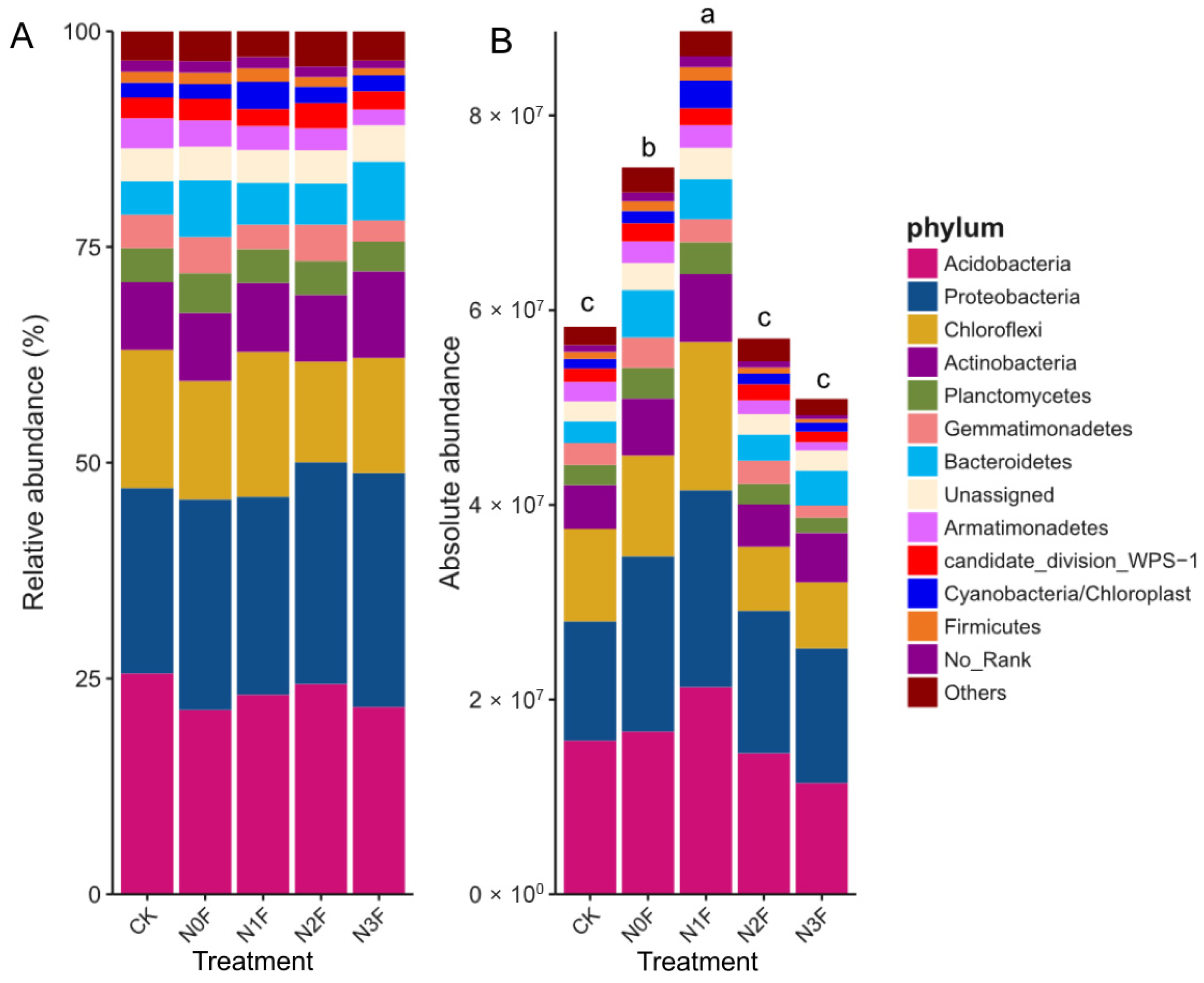
Analysis of the soil bacterial community at the phylum level revealed that its structure and abundance were significantly influenced by N application. The community was consistently dominated by Acidobacteria (24.16%), Proteobacteria (23.96%), and Chloroflexi (14.69%), followed by Actinobacteria, Bacteroidetes, and Planctomycetes, among others (Figure 1A,B).
Crucially, the absolute abundance of the entire bacterial community exhibited a unimodal response to N fertilization, peaking significantly (p < 0.05) in the N1F treatment (Figure 1B). Compared to N0F, absolute bacterial abundance increased by 18.7% in N1F and by 52.0% compared to CK. This pattern was mirrored by the three dominant phyla, which also showed their highest abundances at N1F. In stark contrast, the N3F treatment harbored the lowest total bacterial abundance, representing a 31.8% decrease compared to N0F. This suppression of bacterial abundance under N3F directly paralleled the observed yield reduction, suggesting a potential functional link.
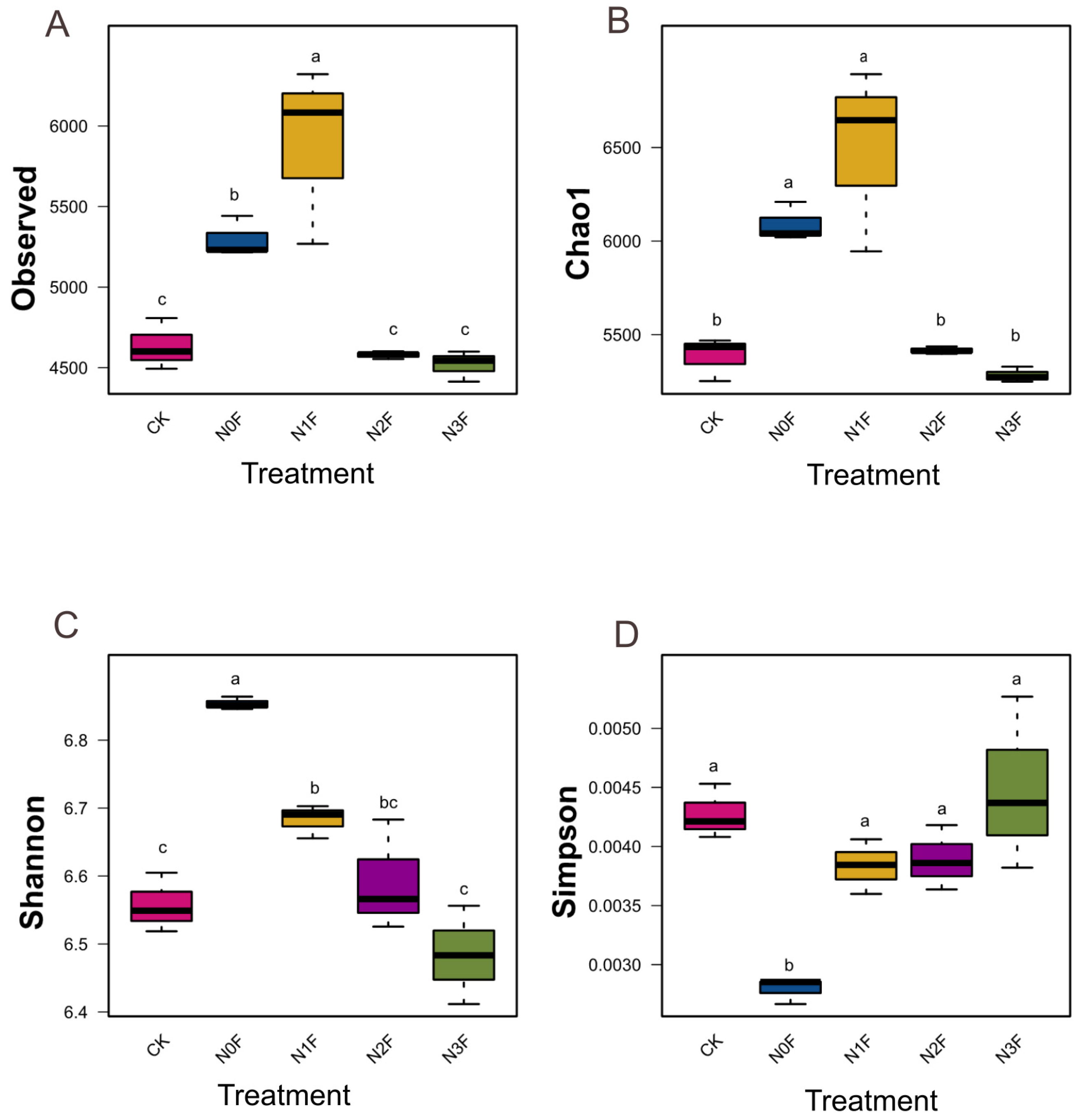
This trend was further supported by the alpha-diversity index. Both richness (observed species and Chao1) and diversity (Shannon index) generally decreased with increasing N application, indicating that high N fertilization simplifies the bacterial community (Figure 2A–C). The N1F treatment consistently supported the highest richness, while the indices for N2F and N3F were significantly lower than N0F. However, there was no significant difference in Simpson’s index among the various N application treatments (Figure 2D). The lack of significant change suggests that N fertilizer altered species richness and Shannon diversity more profoundly than community evenness in this system.
Furthermore, the Pearson correlation analysis results (Table 3) revealed a significant negative correlation between sorghum yield and the Shannon index (r = − 0.634, p = 0.010), indicating that higher yields were associated with lower bacterial diversity. Similarly, a significant positive correlation was observed between yield and the Simpson index (r = 0.585, p = 0.021), suggesting that higher yield corresponded to greater bacterial dominance (i.e., lower evenness). In contrast, no significant correlations were found between yield and richness index (observed species and Chao1). These findings imply that yield variation under long-term N fertilization is more closely linked to shifts in bacterial community structure (diversity and dominance) rather than to changes in species richness alone.
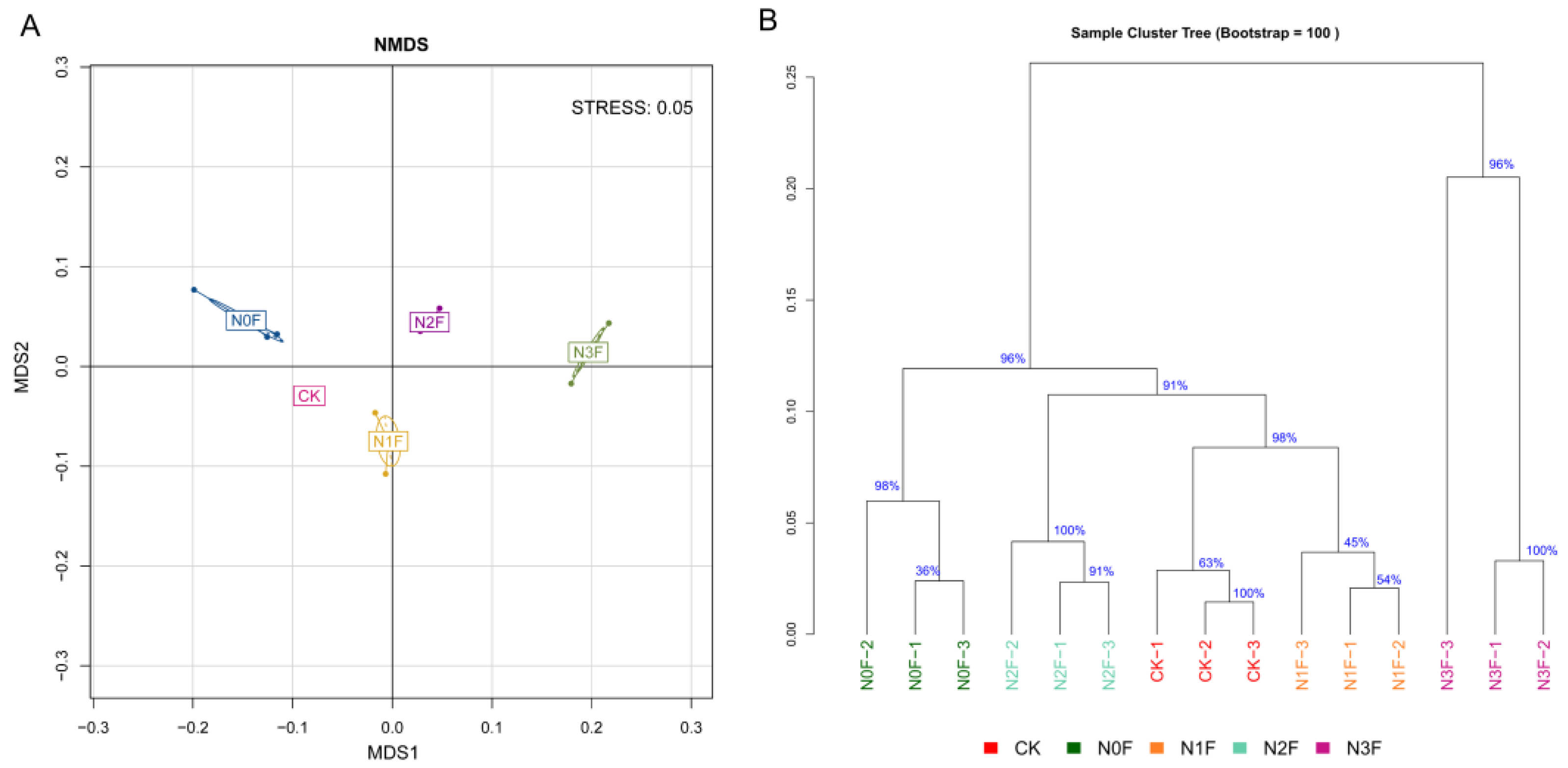
According to the results of non-metric multidimensional scaling (NMDS, Bray–Curtis, Figure 3A), the bacterial community of different treatments was undoubtedly separated. Compared with the CK, the soil bacterial communities were significantly altered by different fertilizer applications, and N input was the key factor affecting the soil bacterial community. The results of average linkage hierarchical clustering (calculated with Bray–Curtis, Figure 3B) showed that the bacteria of CK, N0F, N1F, and N2F were closer together, while the N3F was set apart, indicating that the bacterial community structure of N3F differed from the other treatments. It supported the results of NMDS.
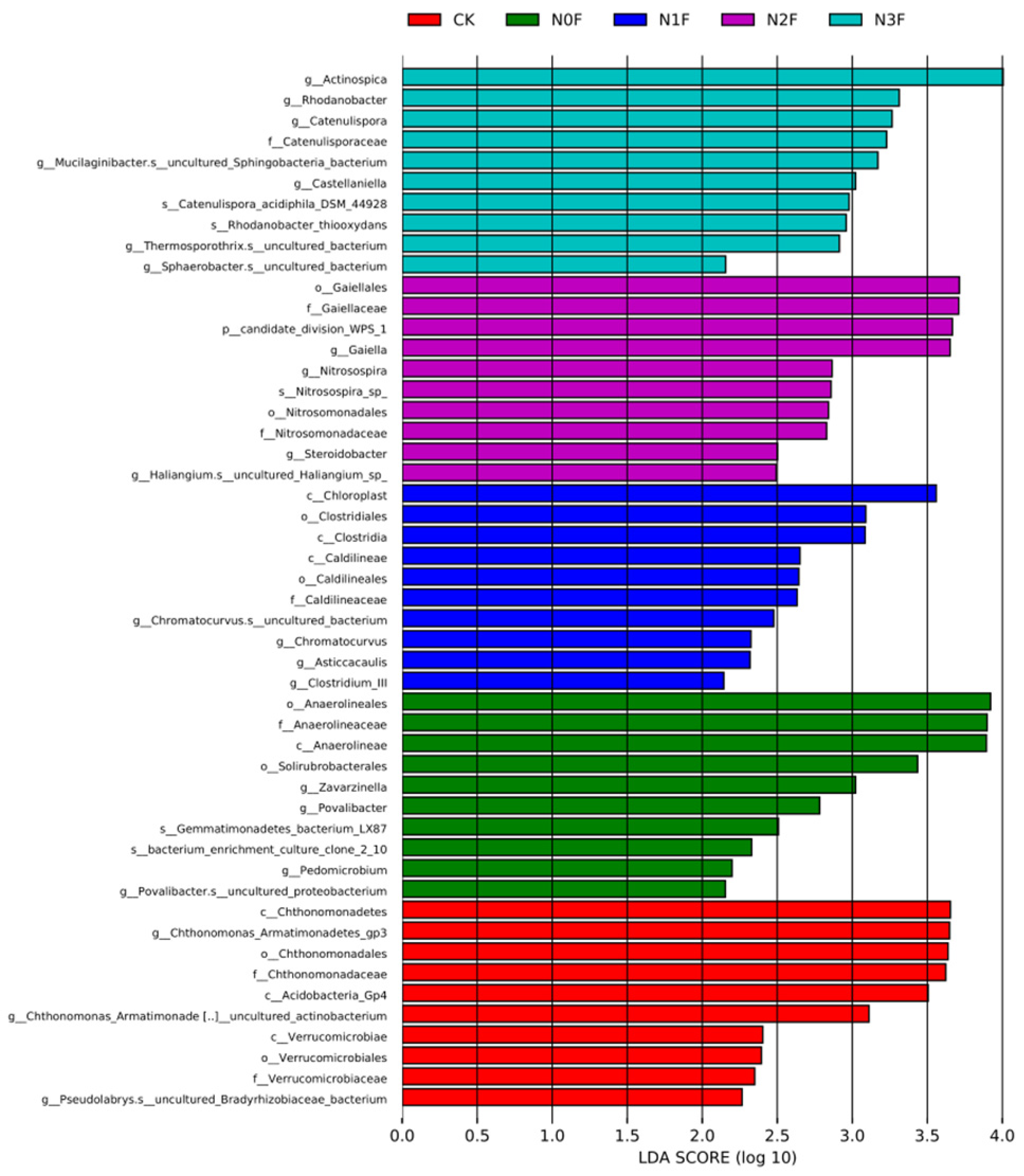
LEfSe analyses were used to evaluate the bacteria, for which the abundance and copy number were significantly different in each treatment, and to analyze the biological relevance of the species. Linear discriminant analysis (LDA) scores higher than 2 were chosen to identify bacterial groups with statistically significant differences (Figure 4). The results of LEfSe found species that differed significantly between different treatments, with changes in Proteobacteria and Thaumarchaeota occurring mainly under high-N treatments (N3F), while changes in Chloroflexi and Firmicutes were primarily observed in N1F treatments. Among them, Rhodanobacter was more abundant under the N3F condition, whereas the order clostridia showed an increase under the N1F condition. The red color represents a significantly changed taxon in the CK, including Acidobacteria, Armatimonadetes, and Elusimicrobia, while Planctomycetes and Latescibacteria, represented in the green color, are species that differ significantly in abundance between N0F treatments.
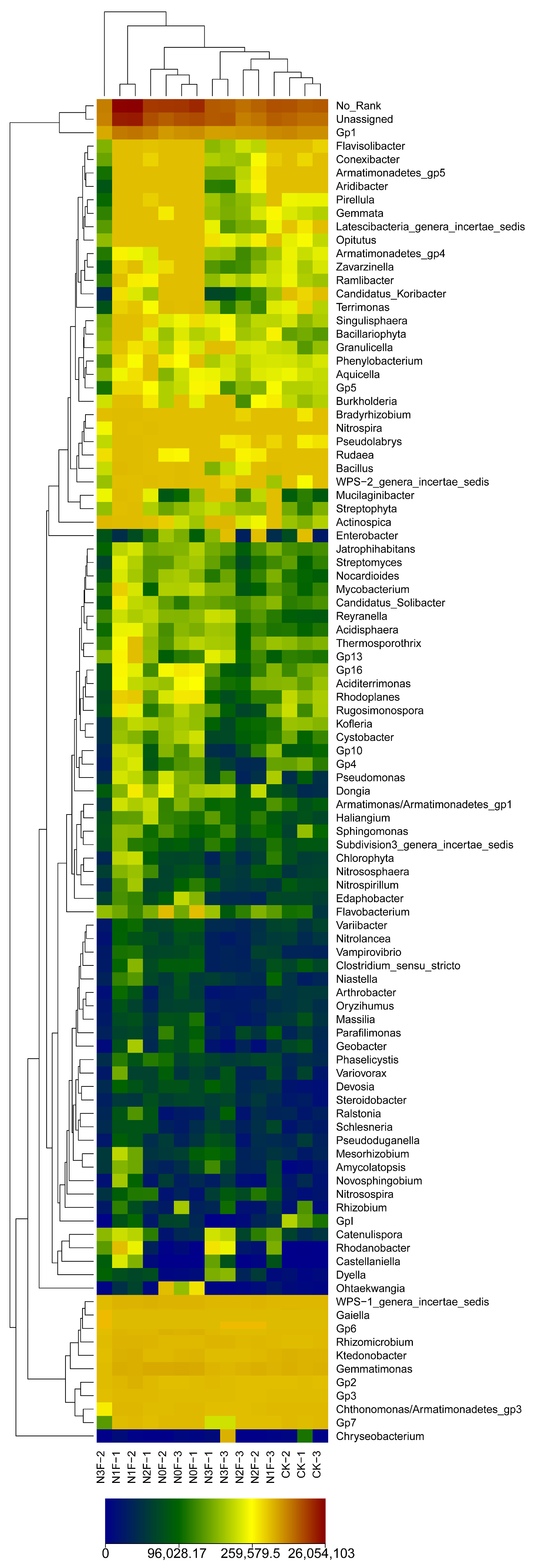
The heatmap clustered samples based on distance, reflecting the similarity and specificity of species composition of all treatment samples at a given taxonomic level. As shown in Figure 5, the N1F treatment clustered into one category, while the other N application treatments were clustered into one category. The differences in N fertilization levels resulted in different absolute abundances of most of the selected genera (top 100 genera) in the treatments. The changes in color intensity exhibited that with the increase in N fertilizer application, the absolute abundance of species increased first and then decreased, which was shown as N1F > N0F > CK > N2F > N3F. Specifically, the soil of the N1F exhibited larger bacterial community abundance than that of other treatments, as shown with more orange and red columns by the color intensity.

2.4. Relationships Between the Community of Soil Microbiome and the Chemical Properties

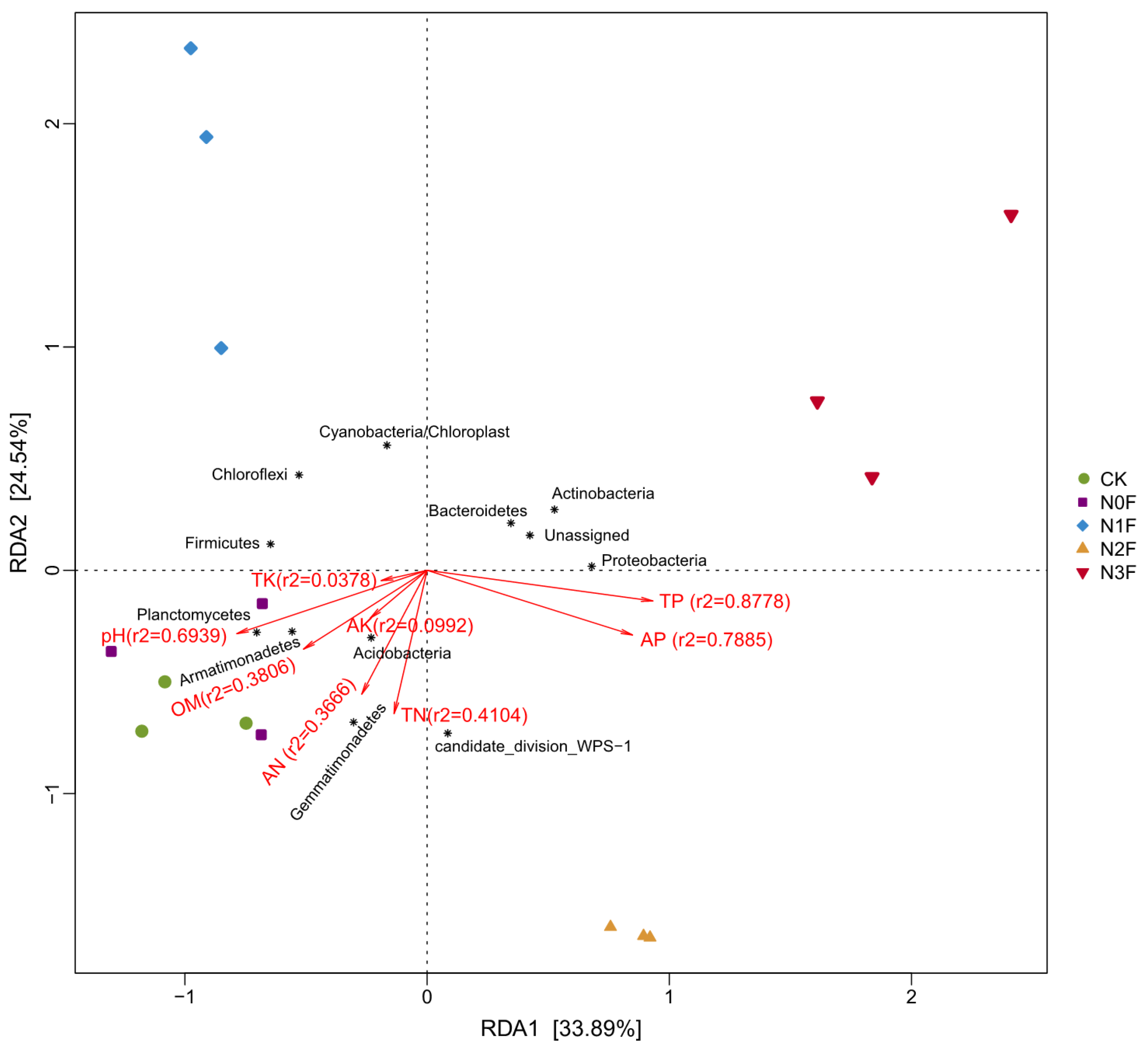
The first component (RDA1) explained 33.89% of the variation in bacterial community structure and separated the N2F- and N3F-treated soil samples from the others (Figure 6). The second component (RDA2) separated the N1F and N3F treatments from the other treatments and explained 24.54% of the variation, indicating that the environmental factors selected for this study better explained the soil bacterial community in sorghum fields with different N applications. According to the results of the RDA, the contents of pH (r2 = 0.6939) and TN (r2 = 0.4104) were found to be positively correlated with most of the dominant phyla, whereas TP (r2 = 0.8778) and AP (r2 = 0.7885) were negatively correlated with the bacterial community. Of these, soil pH and TN had a greater effect on soil bacterial community structure in the CK treatment relative to the other treatments, whereas soil P, including TP and AP, had the greatest effect on bacterial community composition in the N3F.
The Pearson correlation coefficients (Table 4) showed that both soil AP and TP content were significantly negatively correlated to the abundance of Acidobacteria (p < 0.05) and Armatimonadetes (p < 0.01), respectively. The absolute abundances of Chloroflexi and Planctomycetes were significantly negatively correlated with soil AP content (p < 0.05), and the abundance of Gemmatimonadetes was significantly positively correlated with soil OM content (p < 0.05).

3. Discussion

N fertilizer is a cornerstone of modern agriculture, profoundly influencing crop productivity and soil microbial dynamics [19,20]. Our study demonstrates that the application of N fertilizer significantly enhanced sorghum yield, yet this effect diminished at higher application rates, with the highest yield observed at 180 kg N ha−1 (N2F). This aligns with the law of diminishing returns in crop response to N input, a phenomenon widely reported in cereal production systems [30,31]. The initial yield increase can be attributed to N’s critical role in chlorophyll synthesis, photosynthesis, and cell division, which are particularly crucial for a C4 plant like sorghum [32]. A critical finding was that when the N rate was increased to 270 kg N ha−1, grain yield significantly declined, becoming statistically indistinguishable from that under the 90 kg N ha−1 treatment. We posit that this nonlinear response indicates the existence of an optimal N threshold, beyond which multiple detrimental effects are triggered. The yield reduction under the highest N rate (N3F) suggests potential negative impacts such as nutrient imbalance [33], soil acidification [34,35], or microbial dysfunction [36,37], which may ultimately constrain plant growth. Collectively, these stressors underscore the instability and negative effects of supra-optimal N application—it not only fails to provide a yield advantage but effectively reverts productivity to a level comparable with N deficiency, while likely increasing performance variability. In contrast, the 180 kg N ha−1 treatment presumably represented the optimal N supply point under our experimental conditions, sufficiently meeting sorghum demand without inducing the severe physiological and edaphic stresses associated with N excess.
Concomitant with yield responses, long-term N fertilization markedly altered soil chemical properties. A consistent decrease in soil pH with increasing N application was observed, a common consequence of nitrification and the release of H+ ions from urea hydrolysis [38]. Notably, the highest N rate (N3F) led to significant reductions in AN, AK, OM, and TN compared to the no-N control (N0F) or moderate N treatments. This indicates that excessive N input may accelerate the decomposition of soil OM, promote leaching of base cations, and disrupt nutrient cycling [1,37]. The highest available P content in N3F likely resulted from reduced sorghum P uptake due to growth inhibition under strongly acidic soil conditions (pH 4.74), coupled with decreased microbial activity that would normally immobilize P in microbial biomass. This suggests that high N-induced acidification not only limits crop growth but also alters P dynamics in the soil–plant–microbe system [1].
The structure and abundance of the soil bacterial community were highly sensitive to N fertilization regimes [39]. The application of a moderate N rate (90 kg N ha−1, N1F) resulted in the highest bacterial abundance and richness, as evidenced by the Chao1 and observed species index. This suggests a fertilization effect that alleviates N limitation for microbial growth, thereby stimulating bacterial proliferation [40]. However, higher N inputs (N2F and N3F) suppressed bacterial diversity and absolute abundance. This decline is consistent with global trends of reduced microbial biomass under N enrichment [41] and can be explained by multiple factors: soil acidification directly inhibits many acid-sensitive bacterial groups [42], and increased osmotic stress from N salts can be detrimental [43].
Shifts in the predominant bacterial phyla further elucidate the impact of N fertilization. The dominance of Acidobacteria, Proteobacteria, and Chloroflexi across treatments is typical for agricultural soils [21,44]. Acidobacteria are known for degrading complex organic compounds such as cellulose and lignin, contributing to soil organic matter turnover and carbon sequestration [45,46]. Proteobacteria include many copiotrophic groups involved in nitrogen cycling (e.g., nitrification, denitrification) [47]. Chloroflexi are often associated with oligotrophic conditions and may play a role in carbon fixation [48]. The decline in Acidobacteria and Chloroflexi under high N (N3F) could reduce soil organic matter decomposition and nutrient mineralization, thereby limiting nutrient availability for sorghum. The LEfSe, heatmap, and NMDS analyses revealed that the bacterial community under the highest N input (N3F) was distinctly separated from other treatments. Specifically, high N favored certain Proteobacteria and Thaumarchaeota, which often include nitrifiers and opportunistic r-strategists thriving in resource-rich environments [49,50]. Rhodanobacter (a denitrifier) increased under N3F, suggesting enhanced denitrification potential under high N, and it dominated at low pH [51]. In contrast, the moderate N1F treatment was characterized by a significant increase in Chloroflexi and Firmicutes, phyla containing many heterotrophs involved in organic matter decomposition [52,53]. Clostridiales (anaerobic and capable of N fixation) were enriched in N1F, indicating balanced N conditions conducive to microbial N retention [54]. The decline in Acidobacteria under high N rates is likely a combined result of soil acidification beyond their optimal range and a shift in the soil environment towards a more copiotrophic state that disadvantages these oligotrophs [55]. These taxonomic shifts underscore how N application can restructure the microbial community by selecting for taxa with specific life-history strategies and nutrient acquisition mechanisms. Correlation analyses further elucidated the link between bacterial diversity and sorghum productivity. This pattern indicates that under optimal N fertilization (N2F), the soil bacterial community may become more functionally streamlined, with certain key taxa becoming dominant and potentially more efficient in supporting plant growth [55]. Such a shift could reflect a trade-off between microbial diversity and functional specialization, where a simplified but more efficient microbiome enhances nutrient cycling and plant performance [55,56].
The driving forces behind these microbial community changes were predominantly linked to key soil chemical properties [57]. RDA and correlation analyses identified soil pH, AP, TP, TN, and OM as the primary environmental factors shaping the bacterial community. The strong correlation between soil pH and bacterial composition is well-established, as pH influences enzyme activity, nutrient solubility, and the physiological limits of most bacteria [44,58]. Bacterial community composition showed nonlinear correlations with soil pH, an effect likely driven by the strong association of pH with other determinants like OM and AP. The negative associations between AP/TP and the abundance of several phyla, including Acidobacteria and Chloroflexi, suggest that P availability, likely modulated by N-induced acidification, is a critical factor in this ecosystem [1,14]. Furthermore, the positive correlation of OM with bacterial groups like Gemmatimonadetes highlights the importance of carbon availability in sustaining a diverse and abundant microbiome [59]. This intricate web of interactions confirms that the bacterial community response to N fertilization is not direct but mediated through a cascade of changes in the soil’s physicochemical environment. Overall, long-term N fertilization significantly reduced soil pH, which, in turn, decreased bacterial diversity and shifted community composition toward acid-tolerant but less diverse taxa. These microbial changes likely impaired nutrient cycling functions, contributing to the observed yield reduction under high N input (N3F).
This study has several limitations: (1) it was conducted at a single location with one sorghum variety, limiting generalization; (2) only bacterial communities were examined, while archaea, fungi, and other microbiota may also respond to N fertilization; and (3) the experiment lacked organic or integrated nutrient management comparisons, which are important for sustainable agriculture. Future studies should include multi-location trials, multi-kingdom microbial analyses, and organic–inorganic fertilizer comparisons.

4. Materials and Methods

4.1. Experimental Site and Climatic Conditions

The experimental site was located at the Western Crop Experiment Station of Chongqing Academy of Agricultural Sciences in Wujian Town, Yongchuan District, Chongqing, China (29°10′28″ N, 105°49′13″ E). The soil at the experimental site is classified as an Alisol (World Reference Base for Soil Resources). The area enjoys a typical subtropical monsoon humid climate, with a mean annual temperature of 17.7 °C, a mean annual precipitation of 1015.0 mm, a mean annual sunshine of 1218.7 h, and a frost-free period of 317 days. Meteorological data (including daily mean temperature and precipitation) for the duration of the sorghum-growing season (March to August) in the experimental year (2018–2022) were collected from a local weather station located approximately 5 km from the test site and are presented in Appendix A Figure A1. The mean annual sunshine duration from 2018 to 2022 was 1255.4 h. The soil of each treatment plot was clay-textured with uniform fertility. Prior to the initiation of the fertilization treatments in 2018, initial soil samples were collected and analyzed. The soil alkaline hydrolysis N (AN), available P (AP), available K (AK), organic matter (OM) content, and pH value were 61.42 mg kg−1, 8.16 mg kg−1, 93.12 mg kg−1, 10.68 g kg−1, and 5.75, respectively.

4.2. Field Experiment Design

The field experiment was carried out in a continuous sorghum cropping area from 2018 to 2022. The field was rainfed, and no additional irrigation was applied during the growing season. Standard agronomic practices for weed and pest control were uniformly applied across all plots to minimize their impact on the experiment. The sorghum variety used was Jinyunuo 3, a locally adapted and high-yielding glutinous sorghum cultivar provided by the Chongqing Academy of Agricultural Sciences, China, selected for its suitability to the regional growing conditions and market demand. This experiment was carried out in a randomized block design with four nitrogen (N) fertilizer rates, including (1) no N, 0 kg N ha−1 (N0F), (2) N deficiency, 90 kg N ha−1 (N1F), (3) recommended N rate for sorghum, 180 kg N ha−1 (N2F), (4) supra-optimal levels, 270 kg N ha−1 (N3F), and no fertilization as a complete blank control (CK), which received no N, phosphorus (P), or potassium (K) fertilizers. Each treatment was replicated three times, and every plot was allocated an area of 4 m × 6 m. The application rates of conventional fertilizers were 90 kg P2O5 ha−1 (calcium superphosphate, 12% P2O5) and 75 kg K2O ha−1 (potassium chloride, 60% K2O), except for CK. N fertilizer (urea, 46% N) was applied according to the ratio of basal fertilizer: jointing fertilizer at 6:4. P and K fertilizer was added by broadcasting as a single dose and mixed into the 0–20 cm plow layer of soil before sorghum sowing. The target planting density of 105,000 plants ha−1 was established by sowing seeds at a fixed spacing within rows (50 cm between rows and 38 cm between hills within the row, with 2 plants per hill) and was maintained by thinning seedlings at the 3–5 leaf stage.

4.3. Sample Preparation and Analyses

At maturity, the grain yield was estimated to be from a harvest area of 6 m2 within the central part of each plot to avoid border effects. The grains from all plants within this area were threshed, air-dried, and weighed to calculate the plot yield. Additionally, 20 representative plants were randomly selected from each plot to determine the plant height, panicle length, and yield components, including the average ear grain weight and 1000-grain weight. The final grain yield per hectare was calculated based on the plot yield and harvest area. Soil samples were collected at the harvesting stage of sorghum in August 2022, which represented the 5th year of N fertilizer application. A square area of 20 × 20 cm was measured on the sides of each plant root circumference of 10 cm and positioned as a sampling area. The top 20 cm of soil was sampled, with 5 cores of soil (4 cm diameter) taken at chosen points through each experimental plot and mixed into one sample as a replicate, with three replicates for each treatment. All samples were composited and sieved through a 2 mm screen to thoroughly homogenize them, and the roots, stones, and other debris were removed. A portion of each soil sample was collected in a 50 mL centrifuge tube and transferred to the laboratory. The tubes were stored at −80 °C for the extraction of DNA from the soil. The remaining soil samples were air-dried and sieved to determine the soil properties.

4.4. Soil Property Determination

Soil pH was measured using a pH meter (Seven Easy Mettler Toledo, Shanghai, China) after shaking the soil water slurry (1:2.5 w/v) suspension for 30 min. The soil total N (TN) content was analyzed using the Kjeldahl method [60]. Soil total P (TP) and total K (TK) were determined by NaOH molybdenum-blue colorimetry and flame photometry (FP-6410; Xinyi Instruments, Shanghai, China), respectively. AN in soil was extracted using the alkaline hydrolysis diffusion method. AP in soil was extracted by sodium bicarbonate and measured using the molybdenum-blue method [61] (UV-2450; Shimadzu, Kyoto, Japan). AK in soil was extracted by ammonium acetate and determined by flame photometry (Hitachi Z2000; Hitachi High-Tech Corporation, Tokyo, Japan). The OM content was assayed via the potassium dichromate volumetric method [62].

4.5. DNA Extraction and Absolute Quantification of 16S rRNA

Soil samples (0.8 g wet weight) collected from the 5 treatments (CK, N0F, N1F, N2F, and N3F) were taken for total genomic DNA extraction by using the MoBioPowerSoil DNA Isolation Kit according to the manufacturer’s instructions (MoBio, Carlsbad, CA, USA). The integrity of soil DNA was tested by 0.7% agarose gel electrophoresis. There were multiple different spike-in sequences with conserved regions identical to those of selected natural 16S rRNA genes, and the artificial variable regions were added to the sample DNA pools. A known concentration (1 × 10⁶ copies per reaction) of synthetic spike-in DNA (designed with variable regions absent in natural databases) was added to each soil DNA sample prior to PCR amplification. Spike-in recovery efficiency ranged from 85 to 95%, and only samples with recovery >80% were included in the absolute abundance calculation. Spike-in sequences were bioinformatically identified and removed after absolute quantification. The DNA samples were amplified with particular primers, 515F (5′-GTGCCAGCMGCCGCGG-3′) and 907R (5′-CCGTCAATTCMTTTRAGTTT-3′), which targeted the hypervariable V4–V5 region of the bacterial 16S rRNA gene. The PCR products were purified with a PCR Clean-UpTM kit (MO BIO Labs, Solana Beach, CA, USA), and then, they were sequenced with the Illumina Miseq platform (Genesky Biotechnologies Inc., Shanghai, China).

4.6. Illumina Read Data Processing and Analysis and Absolute Quantification of 16S rRNA

TrimGalore (version 0.4.5, http://www.bioinformatics.babraham.ac.uk/projects/trim_galore/ (accessed on 22 May 2023)), FLASH2 (version 2.2.00) [63], and Mothur (version 1.25.1, https://www.mothur.org/ (accessed on 23 May 2023)) were used to process the high-throughput sequencing data. Only the sequence length longer than N200 bp with an average quality score above Q20 was included in the subsequent analysis. The filtered sequences were clustered into 16S rRNA operational taxonomic units (OTUs) based on a 97% sequence similarity with UCLUST (version 4.2.40). The resulting OTU representation sequence was annotated. Spike-in sequences were removed after absolute abundance calculation but before relative abundance and diversity analyses. A standard curve of read counts versus spike-in the DNA copy number was established, and the absolute copy number of each OTU in each sample was calculated. The aligned sequences were classified by the databases of the Ribosomal Database Project (RDP), which was performed by Mothur (version 1.25.1). The soil bacterial abundance and diversity were analyzed considering OTU tables.

4.7. Statistical Analysis

Sorghum yield, soil properties, and microbial abundance data were analyzed by using one-way analysis of variance (ANOVA) through IBM SPSS 20.0 (IBM Corporation, Armonk, NY, USA). Pearson correlation analysis was employed to examine the relationships between soil bacterial alpha diversity and sorghum yield, as well as between the soil bacterial community and environmental factors. Redundancy analysis (RDA) was implemented in the R software (version 3.2.2) to elucidate the relationships between the soil bacterial community and chemical properties under the application of different levels of N fertilization. Non-metric multidimensional scaling (NMDS) analysis was sorted based on any type of distance/non-similarity matrix for the total bacterial community analyses [64]. The average linkage hierarchical clustering and heatmap were performed by R (version 3.2.2). Microbial communities were characterized in each of the N treatments using a linear discriminant analysis (LDA) effect size (LEfSe) approach, which emphasizes statistical significance and biological relevance.

5. Conclusions

The application of N fertilizer significantly increased sorghum yields, and different N applications altered the structure and diversity of the soil bacterial community. Moderate amounts of N fertilizer increased the abundance of soil bacteria and had a significant effect on dominant microbial species, thus improving the soil bacterial community structure, while in the meantime, excessive N fertilizer decreased soil bacterial abundance. The shift in soil bacterial community composition was mainly driven by soil chemical properties such as pH, available phosphorus (AP), total phosphorus (TP), organic matter (OM), and total nitrogen (TN). Notably, sorghum yield was significantly correlated with bacterial diversity index (Shannon and Simpson), highlighting the role of microbial community structure in mediating crop productivity under N fertilization. Among the treatments, 90 kg ha−1 N per year (N1F) was optimal for enhancing soil bacterial abundance, whereas 180 kg ha−1 N (N2F) was optimal for maximizing yield. This study provides a theoretical basis for reducing N fertilization and improving soil quality for a sustainable sorghum industry.

Author Contributions

Conceptualization, X.Z. and Y.Z. (Yu Zhou); methodology, Q.W. and Y.Z. (Yu Zhou); data analysis, Q.W. and J.H.; investigation, Q.W., Y.Z. (Yaqin Zhang), Z.L., L.W., and X.Y.; data curation, Q.W., J.H., and Z.L.; writing—original draft preparation, Q.W. and Y.Z. (Yu Zhou); writing—review and editing, Q.W., Y.Z. (Yu Zhou), and X.Z.; supervision, Y.Z. (Yu Zhou) and X.Z.; project administration, Y.Z. (Yu Zhou) and X.Z.; funding acquisition, Q.W., Y.Z. (Yu Zhou), and X.Z. All authors have read and agreed to the published version of the manuscript.

Funding

The research was supported by the Natural Science Foundation of Chongqing (CSTB2024NSCQ-MSX0836), the Chongqing Research Institute Performance Incentive Guide Project (cstc2022jxjl80016, cqaas2020jxjl03), and the Chongqing Technology Innovation and Application Development Project (cstc2019jscx-msxmX0384, cstc2021jscx-gksbX0014).

Data Availability Statement

The datasets generated for this study are available on request to the corresponding author.

Conflicts of Interest

The authors declare no conflicts of interest exist in the submission of this manuscript.

Abbreviations

The following abbreviations are used in this manuscript:
ANAlkaline hydrolysis nitrogen
APAvailable phosphorus
AKAvailable potassium
ANOVAOne-way analysis of variance
KPotassium
LDALinear discriminant analysis
LEfSeLinear discriminant analysis effect size
NNitrogen
NMDSNon-metric multidimensional scaling
OMOrganic matter
OTUOperational taxonomic unit
PPhosphorus
RDPRibosomal Database Project
TKTotal potassium
TNTotal nitrogen
TPTotal phosphorus

Appendix A

Figure A1. Precipitation and daily mean temperature during the sorghum-growing season (2018–2022).
Plants 15 00025 g0a1

References

  1. Guo, J.H.; Liu, X.J.; Zhang, Y.; Shen, J.L.; Han, W.X.; Zhang, W.F.; Christie, P.; Goulding, K.W.T.; Vitousek, P.M.; Zhang, F.S. Significant acidification in major Chinese croplands. Science 2010, 327, 1008–1010. [Google Scholar] [CrossRef]
  2. Tagliavini, M.; Asensio, D.; Andreotti, C. Increasing nitrogen cycling in deciduous fruit orchards and vineyards to enhance N use efficiency and reduce N losses—A review. Eur. J. Agron. 2025, 167, 127561. [Google Scholar] [CrossRef]
  3. Willaume, M.; Raynal, H.; Bergez, J.E.; Constantin, J. Optimization of nitrogen management and greenhouse gas balance in agroecological cropping systems in a climate change context. Agric. Syst. 2025, 222, 104182. [Google Scholar] [CrossRef]
  4. Cai, S.Y.; Zhao, X.; Pittelkow, C.M.; Fan, M.S.; Zhang, X.; Yan, X.Y. Optimal nitrogen rate strategy for sustainable rice production in China. Nature 2023, 615, 73–79. [Google Scholar] [CrossRef]
  5. Ren, K.; Xu, M.G.; Li, R.; Zheng, L.; Wang, H.Y.; Liu, S.G.; Zhang, W.J.; Duan, Y.H.; Lu, C.A. Achieving high yield and nitrogen agronomic efficiency by coupling wheat varieties with soil fertility. Sci. Total Environ. 2023, 881, 163531. [Google Scholar] [CrossRef]
  6. Abubakar, S.A.; Hamani, A.K.M.; Chen, J.S.; Sun, W.H.; Wang, G.S.; Gao, Y.; Duan, A.W. Optimizing N-fertigation scheduling maintains yield and mitigates global warming potential of winter wheat field in North China Plain. J. Clean. Prod. 2022, 357, 131906. [Google Scholar] [CrossRef]
  7. Li, S.; Lei, Y.D.; Zhang, Y.Y.; Liu, J.G.; Shi, X.Y.; Jia, H.; Wang, C.; Chen, F.; Chu, Q.Q. Rational trade-offs between yield increase and fertilizer inputs are essential for sustainable intensification: A case study in wheat-maize cropping systems in China. Sci. Total Environ. 2019, 679, 328–336. [Google Scholar] [CrossRef]
  8. Han, J.L.; Jin, X.L.; Huang, S.W.; Zhu, X.Y.; Liu, J.J.; Chen, J.Y.; Zhang, A.F.; Wang, X.D.; Tong, Y.N.; Hussain, Q.; et al. Carbon and nitrogen footprints of apple orchards in China’s Loess Plateau under different fertilization regimes. J. Clean. Prod. 2023, 413, 137546. [Google Scholar] [CrossRef]
  9. Fierer, N.; Lauber, C.L.; Ramirez, K.S.; Zaneveld, J.; Bradford, M.A.; Knight, R. Comparative metagenomic, phylogenetic and physiological analyses of soil microbial communities across nitrogen gradients. ISME J. 2012, 6, 1007–1017. [Google Scholar] [CrossRef] [PubMed]
  10. Li, P.F.; Zhang, A.F.; Huang, S.W.; Han, J.L.; Jin, X.L.; Shen, X.G.; Hussain, Q.; Wang, X.D.; Zhou, J.B.; Chen, Z.J. Optimizing management practices under straw regimes for global sustainable agricultural production. Agronomy 2023, 13, 710. [Google Scholar] [CrossRef]
  11. Xu, W.X.; Liu, W.J.; Tang, S.R.; Yang, Q.; Meng, L.; Wu, Y.Z.; Wang, J.J.; Wu, L.; Wu, M.; Xue, X.X.; et al. Long-term partial substitution of chemical nitrogen fertilizer with organic fertilizers increased SOC stability by mediating soil C mineralization and enzyme activities in a rubber plantation of Hainan Island, China. Appl. Soil Ecol. 2023, 182, 104691. [Google Scholar] [CrossRef]
  12. Li, C.H.; Yan, K.; Tang, L.S.; Jia, Z.J.; Li, Y. Change in deep soil microbial communities due to long-term fertilization. Soil Biol. Biochem. 2014, 75, 264–272. [Google Scholar] [CrossRef]
  13. Zhang, Y.; Shangguan, Z.P. Long-term N addition accelerated organic carbon mineralization in aggregates by shifting microbial community composition. Agric. Ecosyst. Environ. 2023, 342, 108249. [Google Scholar] [CrossRef]
  14. Wu, C.X.; Yan, B.S.; Wei, F.R.; Wang, H.L.; Gao, L.Q.; Ma, H.Z.; Liu, Q.; Liu, Y.; Liu, G.B.; Wang, G.L. Long-term application of nitrogen and phosphorus fertilizers changes the process of community construction by affecting keystone species of crop rhizosphere microorganisms. Sci. Total Environ. 2023, 897, 165239. [Google Scholar] [CrossRef]
  15. Yang, S.D.; Xiao, J.; Liang, T.; He, W.Z.; Tan, H.W. Response of soil biological properties and bacterial diversity to different levels of nitrogen application in sugarcane fields. AMB Express 2021, 11, 172. [Google Scholar] [CrossRef]
  16. Singh, J.S.; Gupta, V.K. Soil microbial biomass: A key soil driver in management of ecosystem functioning. Sci. Total Environ. 2018, 634, 497–500. [Google Scholar] [CrossRef] [PubMed]
  17. Wang, L.; Lu, P.N.; Feng, S.J.; Hamel, C.; Sun, D.; Siddique, K.H.M.; Gan, G.Y. Strategies to improve soil health by optimizing the plant–soil–microbe–anthropogenic activity nexus. Agric. Ecosyst. Environ. 2024, 359, 108750. [Google Scholar] [CrossRef]
  18. Bossolani, J.W.; Leite, M.F.A.; Momesso, L.; Berge, H.T.; Bloem, J.; Kuramae, E.E. Nitrogen input on organic amendments alters the pattern of soil–microbe-plant co-dependence. Sci. Total Environ. 2023, 890, 164347. [Google Scholar] [CrossRef] [PubMed]
  19. Xing, W.; Chen, X.L.; Thakur, M.P.; Kardol, P.; Lu, X.M.; Bai, Y.F. Trophic regulation of soil microbial biomass under nitrogen enrichment: A global meta-analysis. Funct. Ecol. 2024, 38, 560–572. [Google Scholar] [CrossRef]
  20. Wang, X.D.; Feng, J.G.; Ao, G.; Qin, W.K.; Han, M.G.; Shen, Y.W.; Liu, M.L.; Chen, Y.; Zhu, B. Globally nitrogen addition alters soil microbial community structure, but has minor effects on soil microbial diversity and richness. Soil Biol. Biochem. 2023, 179, 108982. [Google Scholar] [CrossRef]
  21. Li, B.B.; Roley, S.S.; Duncan, D.S.; Guo, J.R.; Quensen, J.F.; Yu, H.Q.; Tiedje, J.M. Long-term excess nitrogen fertilizer increases sensitivity of soil microbial community to seasonal change revealed by ecological network and metagenome analyses. Soil Biol. Biochem. 2021, 160, 108349. [Google Scholar] [CrossRef]
  22. Smets, W.; Leff, J.W.; Bradford, M.A.; McCulley, R.L.; Lebeer, S.; Fierer, N. A method for simultaneous measurement of soil bacterial abundances and community composition via 16S rRNA gene sequencing. Soil Biol. Biochem. 2016, 96, 145–151. [Google Scholar] [CrossRef]
  23. Tkacz, A.; Hortala, M.; Poole, P.S. Absolute quantitation of microbiota abundance in environmental samples. Microbiome 2018, 6, 110. [Google Scholar] [CrossRef] [PubMed]
  24. Balakrishna, D.; Vinodh, R.; Madhu, P.; Avinash, S.; Rajappa, P.V.; Bhat, B.V. Chapter 7—Tissue culture and genetic transformation in Sorghum bicolor. In Breeding Sorghum for Diverse End Uses; Aruna, C., Visarada, K.B.R.S., Bhat, B.V., Tonapi, V.A., Eds.; Woodhead Publishing: Sawston, UK, 2019; pp. 115–130. [Google Scholar]
  25. Paterson, A.H.; Bowers, J.E.; Bruggmann, R.; Dubchak, I.; Grimwood, J.; Gundlach, H.; Haberer, G.; Hellsten, U.; Mitros, T.; Poliakov, A.; et al. The Sorghum bicolor genome and the diversification of grasses. Nature 2009, 457, 551–556. [Google Scholar] [CrossRef]
  26. Fageria, N.K.; Baligar, V.C.; Li, Y.C. The role of nutrient efficient plants in improving crop yields in the twenty first century. J. Plant Nutr. 2008, 31, 1121–1157. [Google Scholar] [CrossRef]
  27. Zhou, Y.; Huang, J.; Li, Z.B.; Wu, Y.; Zhang, J.J.; Zhang, Y.Q. Yield and quality in main and ratoon crops of grain sorghum under different nitrogen rates and planting densities. Front. Plant Sci. 2022, 12, 778663. [Google Scholar] [CrossRef]
  28. Wang, Z.L.; Nie, T.Z.; Lu, D.H.; Zhang, P.; Li, J.F.; Li, F.H.; Zhang, Z.X.; Chen, P.; Jiang, L.L.; Dai, C.L.; et al. Effects of different irrigation management and nitrogen rate on sorghum (Sorghum bicolor L.) growth, yield and soil nitrogen accumulation with drip irrigation. Agronomy 2024, 14, 215. [Google Scholar] [CrossRef]
  29. Bollam, S.; Romana, K.K.; Rayaprolu, L.; Vemula, A.; Das, R.R.; Rathore, A.; Gandham, P.; Chander, G.; Deshpande, S.P.; Gupta, R. Nitrogen use efficiency in sorghum: Exploring native variability for traits under variable N-regimes. Front. Plant Sci. 2021, 12, 643192. [Google Scholar] [CrossRef]
  30. Hirel, B.; Le Gouis, J.; Ney, B.; Gallais, A. The challenge of improving nitrogen use efficiency in crop plants: Towards a more central role for genetic variability and quantitative genetics within integrated approaches. J. Exp. Bot. 2007, 58, 2369–2387. [Google Scholar] [CrossRef] [PubMed]
  31. Li, W.; Xie, H.X.; Ren, Z.H.; Li, T.; Wen, X.X.; Han, J.; Liao, Y.C. Response of N2O emissions to N fertilizer reduction combined with biochar application in a rain-fed winter wheat ecosystem. Agric. Ecosyst. Environ. 2022, 333, 107968. [Google Scholar] [CrossRef]
  32. Bassi, D.; Menossi, M.; Mattiello, L. Nitrogen supply influences photosynthesis establishment along the sugarcane leaf. Sci. Rep. 2018, 8, 2327. [Google Scholar] [CrossRef]
  33. Magdoff, F.; Lanyon, L.; Liebhardt, B. Nutrient cycling, transformations, and flows: Implications for a more sustainable agriculture. Adv. Agron. 1997, 60, 1–73. [Google Scholar] [CrossRef]
  34. Tadesse, K.A.; Lu, Z.; Shen, Z.; Daba, N.A.; Li, J.W.; Alam, M.A.; Lisheng, L.; Gilbert, N.; Legesse, T.G.; Huimin, Z. Impacts of long-term chemical nitrogen fertilization on soil quality, crop yield, and greenhouse gas emissions: With insights into post-lime application responses. Sci. Total Environ. 2024, 944, 173827. [Google Scholar] [CrossRef] [PubMed]
  35. Fan, P.S.; Li, J.K.; Chen, P.; Wei, D.D.; Zhang, Q.Y.; Jia, Z.J.; He, C.; Ullah, J.; Wang, Q.; Ruan, Y.Z. Mitigating soil degradation in continuous cropping banana fields through long-term organic fertilization: Insights from soil acidification, ammonia oxidation, and microbial communities. Ind. Crops Prod. 2024, 213, 118385. [Google Scholar] [CrossRef]
  36. Hu, X.J.; Gu, H.D.; Liu, J.J.; Wei, D.; Zhu, P.; Cui, X.A.; Zhou, B.K.; Chen, X.L.; Jin, J.; Wang, G.H. Different long-term fertilization regimes affect soil protists and their top-down control on bacterial and fungal communities in Mollisols. Sci. Total Environ. 2024, 908, 168049. [Google Scholar] [CrossRef]
  37. Wang, C.Q.; Kuzyakov, Y. Soil organic matter priming: The pH effects. Glob. Change Biol. 2024, 30, 17349. [Google Scholar] [CrossRef] [PubMed]
  38. Zhou, G.F.; Delhaize, E.; Zhou, M.X.; Ryan, P.R. Biotechnological solutions for enhancing the aluminium resistance of crop plants. In Abiotic Stress in Plants—Mechanisms and Adaptations; InTech: London, UK, 2011; Volume 6, pp. 119–142. [Google Scholar] [CrossRef]
  39. Liu, B.; Ahnemann, H.; Arlotti, D.; Huyghebaert, B.; Cuperus, F.; Tebbe, C.C. Impact of diversified cropping systems and fertilization strategies on soil microbial abundance and functional potentials for nitrogen cycling. Sci. Total Environ. 2024, 932, 172954. [Google Scholar] [CrossRef]
  40. Lian, J.S.; Massart, S.; Li, G.H.; Zhang, J.F. Root processes counteract the suppression of nitrogen-induced priming effects by enhancing microbial activity and catabolism in greenhouse vegetable production systems. Soil Tillage Res. 2026, 255, 106802. [Google Scholar] [CrossRef]
  41. Li, X.D.; Su, L.B.; Jing, M.; Wang, K.Q.; Song, C.G.; Song, Y.L. Nitrogen addition restricts key soil ecological enzymes and nutrients by reducing microbial abundance and diversity. Sci. Rep. 2025, 15, 5560. [Google Scholar] [CrossRef]
  42. Wang, T.T.; Cao, X.X.; Chen, M.M.; Lou, Y.H.; Wang, H.; Yang, Q.G.; Pan, H.; Zhuge, Y.P. Effects of soil acidification on bacterial and fungal communities in the Jiaodong Peninsula, Northern China. Agronomy 2022, 12, 927. [Google Scholar] [CrossRef]
  43. Getzke, F.; Wang, L.; Chesneau, G.; Böhringer, N.; Mesny, F.; Denissen, N.; Wesseler, H.; Adisa, P.T.; Marner, M.; Schulze-Lefert, P.; et al. Physiochemical interaction between osmotic stress and a bacterial exometabolite promotes plant disease. Nat. Commun. 2024, 15, 4438. [Google Scholar] [CrossRef]
  44. Jiang, S.Q.; Yu, Y.N.; Gao, R.W.; Wang, H.; Zhang, J.; Li, R.; Long, X.H.; Shen, Q.R.; Chen, W.; Cai, F. High-throughput absolute quantification sequencing reveals the effect of different fertilizer applications on bacterial community in a tomato cultivated coastal saline soil. Sci. Total Environ. 2019, 687, 601–609. [Google Scholar] [CrossRef]
  45. Eichorst, S.A.; Kuske, C.R.; Schmidt, T.M. Influence of plant polymers on the distribution and cultivation of bacteria in the phylum Acidobacteria. Appl. Environ. Microbiol. 2011, 77, 586–596. [Google Scholar] [CrossRef]
  46. Belova, S.E.; Naumoff, D.G.; Suzina, N.E.; Kovalenko, V.V.; Loiko, N.G.; Sorokin, V.V.; Dedysh, S.N. Building a cell house from cellulose: The case of the soil acidobacterium Acidisarcina polymorpha SBC82T. Microorganisms 2022, 10, 2253. [Google Scholar] [CrossRef] [PubMed]
  47. Hayatsu, M.; Tago, K.; Saito, M. Various players in the nitrogen cycle: Diversity and functions of the microorganisms involved in nitrification and denitrification. Soil Sci. Plant Nutr. 2008, 54, 33–45. [Google Scholar] [CrossRef]
  48. Hug, L.A.; Castelle, C.J.; Wrighton, K.C.; Thomas, B.C.; Sharon, I.; Frischkorn, K.R.; Williams, K.H.; Tringe, S.G.; Banfield, J.F. Community genomic analyses constrain the distribution of metabolic traits across the Chloroflexi phylum and indicate roles in sediment carbon cycling. Microbiome 2013, 1, 22. [Google Scholar] [CrossRef]
  49. Fierer, N.; Bradford, M.A.; Jackson, R.B. Toward an ecological classification of soil bacteria. Ecology 2007, 88, 1354–1364. [Google Scholar] [CrossRef]
  50. Zhang, X.M.; Liu, W.; Zhang, G.M.; Jiang, L.; Han, X.G. Mechanisms of soil acidification reducing bacterial diversity. Soil Biol. Biochem. 2015, 81, 275–281. [Google Scholar] [CrossRef]
  51. Green, S.J.; Prakash, O.; Jasrotia, P.; Overholt, W.A.; Cardenas, E.; Hubbard, D.; Tiedje, J.M.; Watson, D.B.; Schadt, C.W.; Brooks, S.C.; et al. Denitrifying bacteria from the genus Rhodanobacter dominate bacterial communities in the highly contaminated subsurface of a nuclear legacy waste site. Appl. Environ. Microbiol. 2012, 78, 1039–1047. [Google Scholar] [CrossRef]
  52. Hartmann, M.; Six, J. Soil structure and microbiome functions in agroecosystems. Nat. Rev. Earth Environ. 2023, 4, 4–18. [Google Scholar] [CrossRef]
  53. Hug, L.A.; Baker, B.J.; Anantharaman, K.; Brown, C.T.; Probst, A.J.; Castelle, C.J.; Butterfield, C.N.; Hernsdorf, A.W.; Amano, Y.; Ise, K.; et al. A new view of the tree of life. Nat. Microbiol. 2016, 1, 16048. [Google Scholar] [CrossRef]
  54. Gaby, J.C.; Buckley, D.H. A comprehensive aligned nifH gene database: A multipurpose tool for studies of nitrogen-fixing bacteria. Database 2014, 2014, bau001. [Google Scholar] [CrossRef] [PubMed]
  55. Zeng, J.; Liu, X.J.; Song, L.; Lin, X.G.; Zhang, H.Z.; Shen, C.C.; Chu, H.Y. Nitrogen fertilization directly affects soil bacterial diversity and indirectly affects bacterial community composition. Soil Biol. Biochem. 2016, 92, 41–49. [Google Scholar] [CrossRef]
  56. Wagg, C.; Schlaeppi, K.; Banerjee, S.; Kuramae, E.E.; Van Der Heijden, M.G.A. Fungal-bacterial diversity and microbiome complexity predict ecosystem functioning. Nat. Commun. 2019, 10, 4841. [Google Scholar] [CrossRef]
  57. Ding, M.J.; Dai, H.X.; He, Y.; Liang, T.B.; Zhai, Z.; Zhang, S.X.; Hu, B.B.; Cai, H.Q.; Dai, B.; Xu, Y.D.; et al. Continuous cropping system altered soil microbial communities and nutrient cycles. Front. Microbiol. 2024, 15, 1374550. [Google Scholar] [CrossRef]
  58. Bahram, M.; Hildebrand, F.; Forslund, S.K.; Anderson, J.L.; Soudzilovskaia, N.A.; Bodegom, P.M.; Bengtsson-Palme, J.; Anslan, S.; Coelho, L.P.; Harend, H.; et al. Structure and function of the global topsoil microbiome. Nature 2018, 560, 233–237. [Google Scholar] [CrossRef]
  59. Fierer, N. Embracing the unknown: Disentangling the complexities of the soil microbiome. Nat. Rev. Microbiol. 2017, 15, 579–590. [Google Scholar] [CrossRef] [PubMed]
  60. Douglas, L.A.; Riazi, A.; Smith, C.J. A semi-micro method for determining total nitrogen in soils and plant material containing nitrite and nitrate. Soil Sci. Soc. Am. J. 1980, 44, 431–433. [Google Scholar] [CrossRef]
  61. Olsen, S.R.; Cole, C.V.; Watanabe, F.S.; Dean, L.A. Estimation of Available Phosphorus in Soils by Extraction with Sodium Bicarbonate; US Department of Agriculture: Washington, DC, USA, 1954. [Google Scholar]
  62. Jones, J.B., Jr.; Case, V.W. Sampling, handling, and analyzing plant tissue samples. In Soil Testing and Plant Analysis; Soil Science Society of America: Madison, WI, USA, 1990. [Google Scholar]
  63. Magoč, T.; Salzberg, S.L. FLASH: Fast length adjustment of short reads to improve genome assemblies. Bioinformatics 2011, 27, 2957–2963. [Google Scholar] [CrossRef]
  64. Clarke, K.R.; Warwick, R.M. A further biodiversity index applicable to species lists: Variation in taxonomic distinctness. Mar. Ecol. Prog. Ser. 2001, 216, 265–278. [Google Scholar] [CrossRef]
Figure 1. Relative abundances (A) and absolute abundances (B) (16S rRNA gene copies per g of soil) of the major bacterial phyla present in different N application rates of the soil samples. N0F, 0 kg N ha−1; N1F, 90 kg N ha−1; N2F, 180 kg N ha−1; N3F, 270 kg N ha−1. CK: the complete blank control with no fertilization. Different letters above the stacked bars indicate significant differences (p < 0.05) in total copy number between treatments.
Plants 15 00025 g001
Figure 2. Effect of different fertilization on Alpha diversity ((A). Observed species, (B). Chao1, (C). Shannon, and (D). Simpson) of soil microbial community. N0F, 0 kg N ha−1; N1F, 90 kg N ha−1; N2F, 180 kg N ha−1; N3F, 270 kg N ha−1. CK: the complete blank control with no fertilization. Boxes with different letters are statistically significantly different; ANOVA, p < 0.05.
Plants 15 00025 g002
Figure 3. Non-metric multidimensional scaling (NMDS) (A) and hierarchical cluster tree (B) of bacterial communities (Bray–Curtis). N0F, 0 kg N ha−1; N1F, 90 kg N ha−1; N2F, 180 kg N ha−1; N3F, 270 kg N ha−1. CK: the complete blank control with no fertilization.
Plants 15 00025 g003
Figure 4. The linear discriminant analysis effect size (LEfSe) for significantly different abundant taxa of bacteria in different treatments. N0F, 0 kg N ha−1; N1F, 90 kg N ha−1; N2F, 180 kg N ha−1; N3F, 270 kg N ha−1. CK: the complete blank control with no fertilization.
Plants 15 00025 g004
Figure 5. Heatmap of the distributions of the bacterial genera present in the soil samples of sorghum with different levels of N application. The absolute abundances of 100 bacterial genera in the soil samples are indicated by color intensity. The color gradient from blue to red indicates the species abundance from small to large. N0F, 0 kg N ha−1; N1F, 90 kg N ha−1; N2F, 180 kg N ha−1; N3F, 270 kg N ha−1. CK: the complete blank control with no fertilization.
Plants 15 00025 g005
Figure 6. Redundancy analysis (RDA) of soil bacteria community with selected environmental variables for different N fertilizer treatments. N0F, 0 kg N ha−1; N1F, 90 kg N ha−1; N2F, 180 kg N ha−1; N3F, 270 kg N ha−1. CK: the complete blank control with no fertilization. AN, alkaline hydrolysis N; AP, available P; AK, available K; OM, organic matter; TN, total N; TP, total P; TK, total K.
Plants 15 00025 g006
Table 1. Effects of different N fertilizer treatments on the growth and yield composition of sorghum.
TreatmentPlant Height (cm)Ear Length (cm)1000-Grain Weight (g)Ear Grain Weight (g)Yield
(kg ha−1)
CK150.37 ± 10.92 b30.64 ± 2.41 b26.13 ± 1.12 a35.50 ± 2.92 b3205.56 ± 232.38 c
N0F154.53 ± 9.67 b31.77 ± 1.19 b26.62 ± 0.97 a38.93 ± 3.13 b3540.28 ± 231.14 c
N1F179.27 ± 1.22 a34.74 ± 0.59 a27.29 ± 2.07 a61.46 ± 3.52 a5622.22 ± 146.86 ab
N2F182.80 ± 2.04 a35.59 ± 0.62 a28.78 ± 2.63 a64.74 ± 3.29 a5954.17 ± 82.07 a
N3F184.00 ± 1.97 a35.61 ± 1.08 a28.36 ± 0.54 a64.71 ± 1.62 a5471.94 ± 197.50 b
N0F, 0 kg N ha−1; N1F, 90 kg N ha−1; N2F, 180 kg N ha−1; N3F, 270 kg N ha−1. CK: the complete blank control with no fertilization. Means ± standard deviation (n = 3). Different letters indicate significant differences between fertilization treatments (ANOVA, p < 0.05).
Table 2. Effects of different N application levels on soil chemical properties.
TreatmentpHAN (mg kg−1)AP (mg kg−1)AK (mg kg−1)OM (g kg−1)TN (g kg−1)TP (g kg−1)TK (g kg−1)
CK5.44 ± 0.03 a44.82 ± 1.98 c10.46 ± 0.33 c96.23 ± 1.49 d10.29 ± 0.04 d0.36 ± 0.01 d0.33 ± 0.01 b20.60 ± 0.36 b
N0F5.37 ± 0.02 b53.86 ± 1.42 a9.39 ± 0.16 d101.70 ± 1.49 c13.24 ± 0.23 a0.53 ± 0.02 b0.32 ± 0.03 b19.94 ± 0.48 b
N1F4.93 ± 0.02 c48.58 ± 0.56 b8.64 ± 0.16 e109.66 ± 0.99 b10.77 ± 0.20 c0.40 ± 0.01 c0.30 ± 0.01 b22.13 ± 0.46 a
N2F4.82 ± 0.02 d56.30 ± 1.73 a11.28 ± 0.23 b113.64 ± 1.49 a11.23 ± 0.20 b0.57 ± 0.01 a0.39 ± 0.02 a22.04 ± 0.76 a
N3F4.74 ± 0.02 e41.05 ± 0.86 d12.41 ± 0.35 a90.92 ± 1.25 e9.43 ± 0.34 e0.32 ± 0.02 e0.42 ± 0.03 a19.60 ± 0.48 b
N0F, 0 kg N ha−1; N1F, 90 kg N ha−1; N2F, 180 kg N ha−1; N3F, 270 kg N ha−1. CK: the complete blank control with no fertilization. AN, alkaline hydrolysis N; AP, available P; AK, available K; OM, organic matter; TN, total N; TP, total P; TK, total K. Means ± standard deviation (n = 3). Different letters indicate significant differences between fertilization treatments (ANOVA, p < 0.05).
Table 3. Pearson correlation coefficients between sorghum yield and soil bacterial alpha-diversity index under different nitrogen fertilization treatments.
Alpha-Diversity IndexCorrelation Coefficient (r)p-ValueSignificance
Observed species−0.4330.103NS
Chao1−0.4420.094NS
Shannon−0.6340.010**
Simpson0.5850.021*
NS: not significant; *: p < 0.05; **: p < 0.01.
Table 4. Correlation between soil chemical properties and abundance of dominant soil bacterial phylum in sorghum soil.
Abundant TaxapHANAPAKOMTNTPTK
Acidobacteria0.2800.306−0.956 *0.5570.3600.136−0.899 *0.599
Proteobacteria−0.0790.375−0.7810.5080.4980.272−0.5720.366
Chloroflexi0.2400.024−0.905 *0.3010.207−0.137−0.8610.395
Actinobacteria−0.0300.002−0.7460.2000.254−0.109−0.6000.178
Bacteroidetes0.0110.185−0.4830.0300.5710.180−0.294−0.242
Planctomycetes0.3510.489−0.958 *0.5030.7010.372−0.8400.340
Gemmatimonadetes0.6180.790−0.7490.5470.923 *0.732−0.7030.264
Armatimonadetes0.6760.365−0.965 **0.3780.5900.231−0.988 **0.329
candidate_division_WPS-10.3190.859−0.7820.7450.8770.782−0.6430.465
AN, alkaline hydrolysis N; AP, available P; AK, available K; OM, organic matter; TN, total N; TP, total P; TK, total K. “*” and “**” were significantly correlated at the p = 0.05 and 0.01 levels, respectively.
Disclaimer/Publisher’s Note: The statements, opinions and data contained in all publications are solely those of the individual author(s) and contributor(s) and not of MDPI and/or the editor(s). MDPI and/or the editor(s) disclaim responsibility for any injury to people or property resulting from any ideas, methods, instructions or products referred to in the content.