


Abstract
Microbial volatile metabolites can enhance plant growth, yet the mechanisms by which plants perceive and transduce these signals are unknown. Growth of Arabidopsis thaliana Col-0 seedlings was found to be stimulated by volatiles from the soil bacterium Streptomyces coelicolor. To investigate volatile-responding candidate signaling molecules and genes, cultivation of seedlings in gas-phase contact with S. coelicolor genotypes was combined with GC-MS and plant transcriptomics. Components potentially involved were further studied using pure compounds and A. thaliana T-DNA mutants. Application of volatiles from S. coelicolor enhanced the growth of A. thaliana seedlings primarily by stimulating lateral root growth rate and inhibiting primary root extension. Concurrently, a family-wide induction of the Kelch-repeat F-box gene family KISS ME DEADLY (KMD) was observed. A. thaliana genotypes with a loss of function for the KMD family or other alterations of auxin/cytokinin signaling homeostasis suppressed the root response to both S. coelicolor total volatiles and the common microbial volatile 3-octanone. The results reveal a novel function of KMDs in mediating plant growth stimulation in response to volatile stimulation that alters auxin/cytokinin signaling and emphasize rhizospheric microbials as potential indicators of soil status to plants.
1. Introduction
Plants have many significant responses related to resource foraging, growth direction, and rate, and resource allocation in response to the environment, which, according to some authors, are considered to constitute decisions [1,2,3]. An example of such a response refers to the allocation of resources between defense- and growth-associated processes during plant development. Production of defensive compounds is especially required due to the sessile nature of plants; however, the metabolic cost depletes energy resources that could otherwise support growth and fecundity [4]. Conversely, a decision to increase growth is necessarily tied to benefits that the plant can perceive in the environment. To illustrate, during split-root growth experiments with pea plants (Pisum sativum), the plant’s increased root growth was found to be based on an assessment of available nutrients in the local and extended environment. The pea integrated root growth strategy is thus an important system for biological risk evaluation [5].
Integration of external signals is also involved in the interactions between plants and their microbiomes. Beneficial microbes trigger biostimulation in plants through mechanisms such as nutrient solubilization, hormone modulation, and stress tolerance enhancement [6], and also in biocontrol strategies to protect plants from pathogens and pests [7,8]. The signaling between microbials and plants commences via multiple pathways and molecules that have not been characterized, yet collectively make plants modify growth patterns and resource utilization [9,10,11].
Beneficial microbes have been utilized as biostimulants, promoting plant growth, nutrient uptake, and stress tolerance to increase growth and production [6]. Tissue growth occurs through cell division and expansion, both of which are governed by the plant growth hormones auxin and cytokinin, as well as the crosstalk between their signaling pathways [12]. A wide range of microorganisms have been found to stimulate the growth of various plant species, and such biostimulants are increasingly used in agriculture [10,13,14,15]. Biostimulant microorganisms can promote plants metabolically by, for example, improving nutrient access [13,16] or by microbial production of plant hormones that directly intervene in plant growth regulation [13].
However, recently, indirect interactions via emissions of non-hormonal volatiles from soil microbes have been found to influence plant growth regulation [13,17]. For example, the volatiles 2,3-butanediol and acetoin from the soil bacteria Bacillus species enhanced the growth of both Arabidopsis thaliana and tomato [18,19]. The effect was linked to auxin signaling, as the volatile-induced transcriptional responses in A. thaliana included an abundance of auxin signaling and cell wall remodeling genes, and the growth enhancement could be blocked by auxin transport inhibitors [18]. However, the developmental timing of both the plant and the microbe can influence plant responses. For instance, plant growth was enhanced in response to the volatiles from established cultures of the soil filamentous fungus Trichoderma atroviride, though volatiles from younger cultures of the same fungus caused growth inhibition in young plants and enhanced defense responses in older plants [20].
Currently, knowledge on plant perception of microbial volatiles and regulation of growth and/or defense is lacking with regard to the plant signaling components involved. Volatile profiles from cultured soil microbes are highly diverse, and plant growth effects depend on both the microbial strain and the culture conditions [21,22]. To this effect, the previously uncharacterized role of a small family of Kelch repeat F-box proteins known as KISS-ME-DEADLY (KMD) [23,24,25] is shown to function in the plant perception of volatiles from the common soil bacterium Streptomyces coelicolor. The downstream KMD-affected plant gene products that, in turn, influence auxin/cytokinin homeostasis and their involvement in the volatile-promoted tissue growth are further characterized.
2. Results
2.1. Bacterial Volatiles Enhance Tissue Expansion and Modify Root Architecture in Seedlings
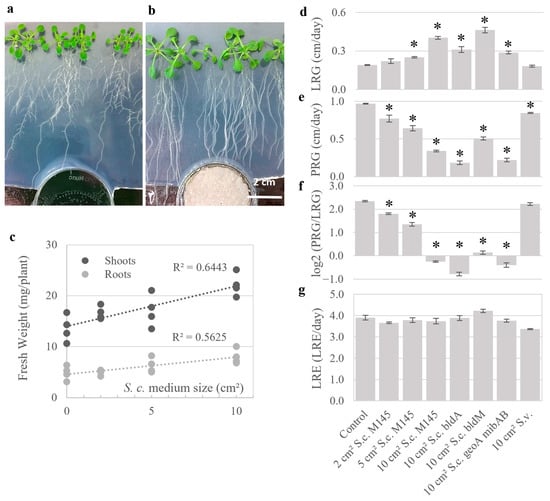
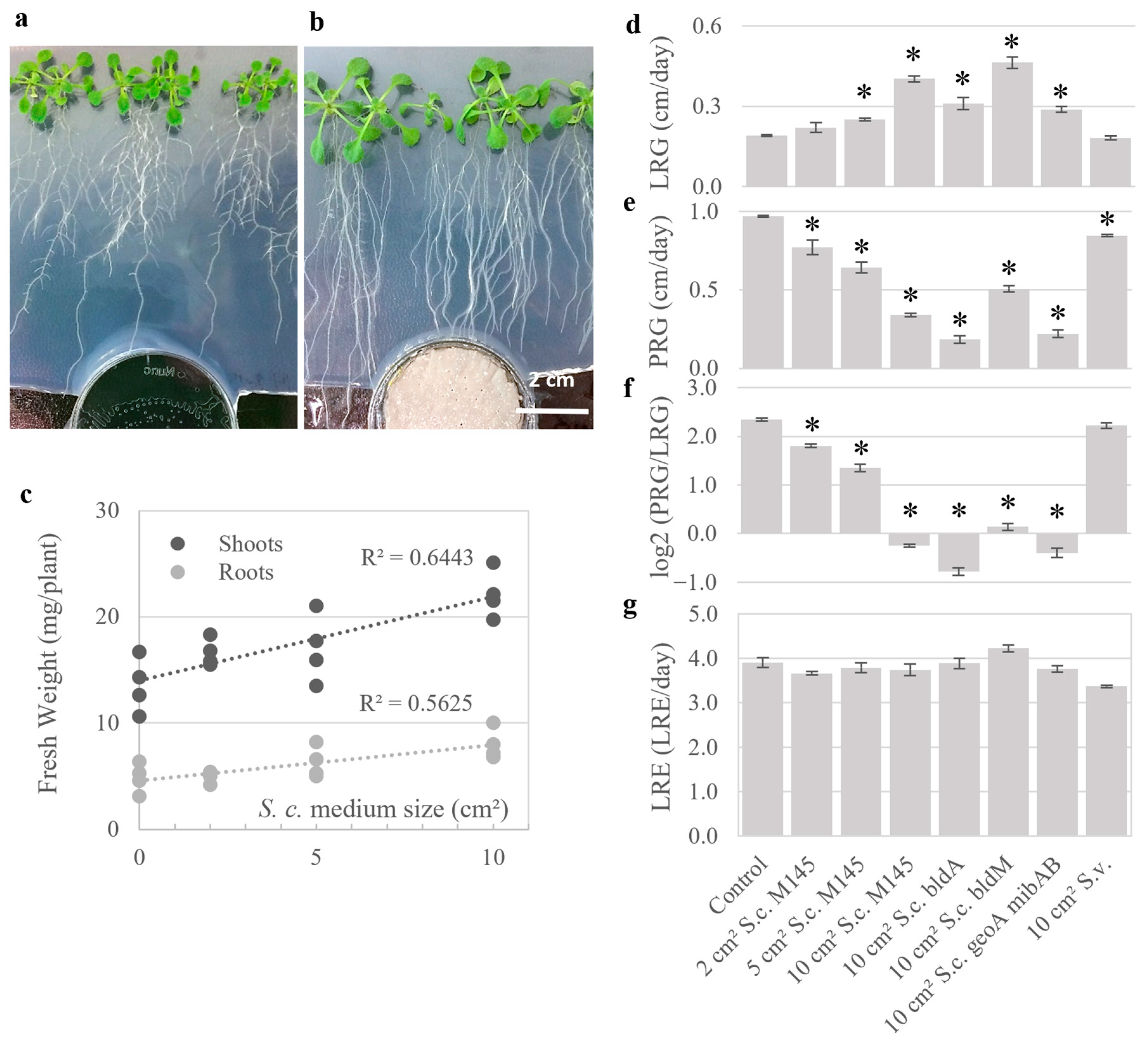
Seven-day-old A. thaliana Col-0 seedlings were exposed for six days to volatiles from cultures of the S. coelicolor M145 strain grown on the sporulation agar medium SFM (soya flour and mannitol) (Figure 1a,b). At the highest exposure, treated seedlings showed significant fresh weight increases in both roots (65%) and shoots (63%). The growth effect was linearly correlated to S. coelicolor dosage (Figure 1c). Compared to control, volatile-exposed seedlings possessed more expanded leaves, elongated petioles, shorter primary roots, and elongated lateral roots (Figure 1a,b). Quantitative analysis of root growth rate over two days of exposure to S. coelicolor volatiles confirmed that the primary and lateral roots responded oppositely to the volatile communication (Figure 1d–f, Table S1). The lateral root growth (LRG) increased to a rate roughly two-fold faster than the control (Figure 1d), while primary root growth (PRG) was strongly repressed compared to the untreated control (Figure 1e). The ratio of primary-to-lateral root growth (PRG/LRG) revealed an apparent shift in resource allocation from primary root growth to lateral root tissue investment in response to the treatment (Figure 1f). However, the rate of lateral root emergence (LRE) was unaffected by the treatment with Streptomyces volatiles (Figure 1g). These results indicate that the increased root mass observed can be attributed to a lateral root tissue expansion rather than to an increased number of organs formed.
Figure 1.
Growth of A. thaliana Col-0 in response to Streptomyces volatiles. (a,b) Representative images are shown for seven-day-old A. thaliana Col-0 seedlings that have been treated for another six days with gas-phase contact to control plates lacking bacteria (a) or to plates carrying S. coelicolor M145 grown on 10 cm2 of SFM (b). (c) Fresh weight responses of shoots and roots of seven-day-old Col-0 that have been treated ± volatiles for an additional six days, with linear regression analysis R2 values. Dosage of volatiles is expressed as the surface area of bacterial culture. (d–g) Analysis of root growth responses of seven-day-old Col-0 seedlings treated ± volatiles from different cultures of S. coelicolor bldA, bldM, geoA, mibAB, and a S. venezuelae (S.v.) (see Table S1) for two days. (d) Lateral Root Growth (LRG) is the average growth rate of the lateral root (cm per day). (e) Primary Root Growth (PRG) is the average growth rate of the primary root (cm per day). (f) Log2 (PRG/LRG) is the log2 ratio of PRG to LRG. (g) Lateral Root Emergence Rate (LRE) is the number of lateral roots emerging from the primary root per day. Bars represent standard error, and asterisks indicate significant differences to the control treatment according to Student’s t-test with false discovery rate (FDR) correction for q = 0.05.
2.2. Seedling Growth Is Modified by Volatiles Independent of Bacterial Developmental Stage
Volatile release changes during bacterial development, and therefore, it was tested whether the volatiles affecting A. thaliana seedlings are under developmental regulation in S. coelicolor and whether the two major volatiles, geosmin and 2-methylisoborneol, influence the plants. Cultures of S. coelicolor mutants of bldA (stalled in developmental progression that prevent aerial mycelium formation and sporulation due to lacking an early developmental regulator), bldM (stalled in developmental progression to aerial mycelium formation and sporulation due to lacking a later developmental regulator), geoA mibAB (lacking the major volatiles geosmin and 2-methylisoborneol), and the control strain of M145 were cultured and used to treat Col-0 seedlings via gas phase. All S. coelicolor genotypes induced similar changes in growth rate and root architecture (Figure 1d–g, Table S1, Figure S1a–c,e–g). A minor effect on lateral root growth was observed upon treatment with the geoA mibAB line, as compared to M145, but not in the equally geosmin- and 2-methylisoborneol-deficient bldM mutant, meaning that these volatiles are not responsible for the change in growth pattern. Likewise, the changes in root architecture occurred without regard to the presence of sucrose in the plant medium (Figure S1h,i), indicating that plant internal metabolic resources were not active determinants of the root architecture shift in our assays.
2.3. Screening of Volatiles from Different Isolates
To identify the compound or compounds potentially stimulating A. thaliana growth, the correlation between volatile profiles emitted from different Streptomyces isolates and their effects on plant seedlings was investigated. The analyzed cultures included S. coelicolor isolates M145, bldA, and bldM, as well as S. venezuelae, which, when cultivated on its regular sporulation medium (MYM; maltose, yeast extract, and malt extract), resulted in little or no volatile effect on the growth of A. thaliana seedlings (Figure 1d–g and Figure S1d, Table S1). Volatiles were collected from the headspaces of Streptomyces cultures for a period of 24 h and analyzed using GC-MS (Table 1). The profiles of volatile compounds from Streptomyces cultures were evaluated to identify compounds that may induce root growth responses (Table 1). Small amounts of 3-octanone and two isomers of chalcogran were found in the headspace of growth-inducing S. coelicolor cultures grown on SFM, but not in non-inducing S. venezuelae that was grown on MYM, suggesting these compounds might contribute to the stimulation of plant growth (Table 1). Despite detecting 3-octanone in various headspace collections from different S. coelicolor isolates, 3-octanone could not be detected when M145 was grown on a different batch of SFM or on GA medium. Previously, 3-octanone has been described in two other Streptomyces species [26] and its growth-stimulating effect on plants has also been demonstrated when released from other bacteria or the plant-symbiotic fungus Trichoderma [27,28,29]. Therefore, this compound was included in further investigations. The compounds acetoin and 2,3-butanediol were specifically targeted as they have previously been found to have growth effects on A. thaliana when released from bacteria [30]. However, these compounds were undetectable in all Streptomyces headspace samples. Other compounds identified have previously been observed among volatiles from various soil microbial species [21].
Table 1.
Microbial volatile analysis.
2.4. Plant Hormone Mutants Have Altered Responses to Volatiles
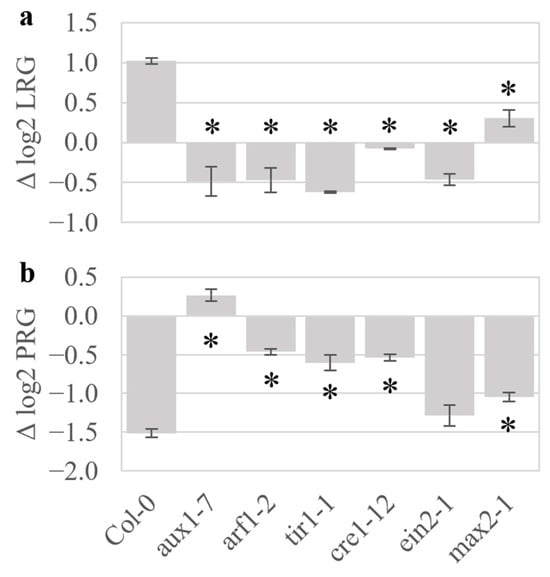
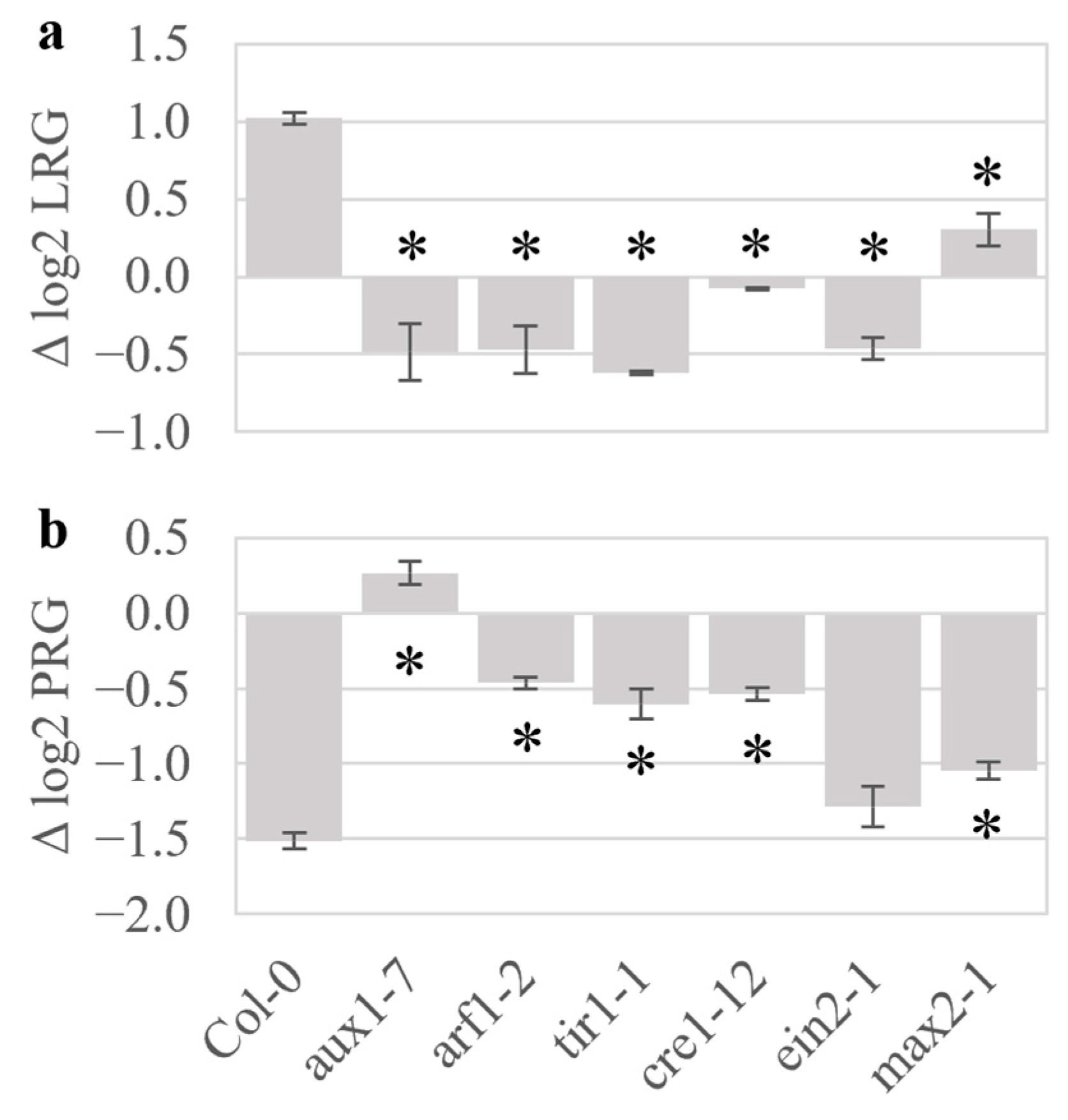
Mutants for central signaling genes in several hormone pathways of A. thaliana were screened to identify signaling processes involved in the plant response to S. coelicolor volatiles. For each plant genotype, the log2 root growth rate ratio for the presence and absence of S. coelicolor M145 volatiles was determined separately for lateral root growth (Δ log2 LRG) and primary root growth (Δ log2 PRG). This allowed normalization of the responses in the phenotypically diverse sets of mutants (Figure 2). Exposure of Col-0 to the volatiles caused a 2-fold increase in lateral root growth rate, and a 2.8-fold decrease in primary root growth rate during two days of treatment. In contrast, auxin and cytokinin response mutants, including the cytokinin-resistant mutant cre1-12, the auxin-response transcription factor arf1-2, the auxin influx transporter aux1-7, and the F-box receptor for auxin tir1-1, were overall unaffected by the volatiles after two days of exposure. However, observation of morphology after six days (Figure S2) indicated that the growth response in tir1-1 may be merely delayed. Unlike the loss of sensitivity in the cytokinin and auxin mutants, the ethylene signaling mutant ein2-1 lacked the volatile-induced lateral root growth increase, but the primary root inhibition was retained. Additionally, the strigolactone-insensitive mutant max2-1 showed less pronounced reductions in both the primary and lateral root growth effects. Mutants for other hormonal pathways, bri1-4, gai-1, and abi1-1 were also tested, but had mild to no discernible reductions in the volatile-induced growth effects (Figure S2). Further verification of auxin involvement was carried out with the auxin response reporter DR5::GFP, which responds in a dose-dependent manner to concentrations of auxin. Analysis of the DR5::GFP root tips showed alterations of auxin distribution in the root tip upon treatment with S. coelicolor volatiles (Figure S3). Finally, seedlings of Col-0 were grown on plates containing 3 µM of the cytokinin benzylaldehyde (BA) to heighten cytokinin signaling and were further challenged with volatiles from S. coelicolor. This comparison demonstrated that exogenous exposure to BA could suppress the volatile effects on lateral roots (Figure S4). The results thus clearly indicate that the primary and lateral root growth responses to S. coelicolor volatiles involve both the auxin and cytokinin response pathways.
Figure 2.
Growth of A. thaliana wild-type and hormone mutants in response to S. coelicolor volatiles. Seven-day-old seedlings of wild-type and hormone mutants were treated for two days with volatiles from S. coelicolor M145 grown on 10 cm2 of SFM sporulation medium. The figure shows log2 ratios of growth ± volatiles for primary ((a); Δ log2 LRG) and lateral ((b); Δ log2 PRG) roots. Bars represent standard error, and asterisks indicate significant differences to Col-0 according to Student’s t-test with FDR correction for q = 0.05.
2.5. The Plant Response to Bacterial Volatiles Shows Similarity to Other Biotic Responses
RNA was extracted from control and S. coelicolor volatile-treated seedlings and analyzed by transcriptome sequencing (RNA-Seq). A total of 18,493 transcripts were identified, of which 26 were significantly differentially expressed with a ratio of at least two-fold (Dataset S1). To determine the biological relevance of the response to S. coelicolor volatiles, the RNA-Seq expression profile of the 26 significantly responsive genes was compared to the public A. thaliana gene expression datasets using the Genevestigator signature search tool (Table 2, see Dataset S2). The highest profile similarity was found to the A. thaliana response to volatiles from the rhizobacterium Serratia plymuthica HRO-C48 [31]. Other similar datasets were for root colonization by the beneficial Ascomycota endophyte Colletotrichum tofieldiae and the closely related pathogen Colletotrichum incanum during phosphate starvation [32]. The RNA-Seq profile observed here is thus consistent with previous biotic treatments of A. thaliana.
Table 2.
Similarity analysis of volatile-induced.
2.6. Gene Ontology Analysis of RNA-Seq Data Identifies Initial Plant Reprogramming Components
Investigations of gene ontology (GO) were carried out by non-parametric analyses of fold changes for all 18,493 transcripts using the programs Gorilla and Genevestigator (Table 3a). The combination of analyses identified the GO bins of “Negative Regulation of Cytokinin-Activated Signaling Pathways” and “Biological Process” with the lowest FDR q-value, followed by “Response to Stimulus”, “Cell Wall Organization”, and “Regulation of Phenylpropanoid Metabolic Process”. Two GO bins, “Negative Regulation of Cytokinin-Activated Signaling Pathways” (Genevestigator) and “Regulation of Phenylpropanoid Metabolic Process” (Gorilla), were both highly enriched in a small family of kelch repeat F-box genes KISS ME DEADLY (KMD1-4) (Table 3b, Dataset S2). Moreover, the “Cell Wall Organization” GO bin mainly contained pectin degradation and extensin-like proteins, typically involved in cell wall loosening associated with growth changes [33]. Cytokinin- and auxin-associated GO bin responses to Streptomyces volatiles were also compared to previously reported responses to exogenous auxin or cytokinin, but no similarities were found (Table S2). The latter result suggests that the effect of the volatiles resides in the response pathways, downstream of the hormones themselves.
Table 3.
Gene Ontology analysis.
2.7. Transgenic Plants Deficient in KMD and Associated Cytokinin Response Proteins Are Unresponsive to Volatiles
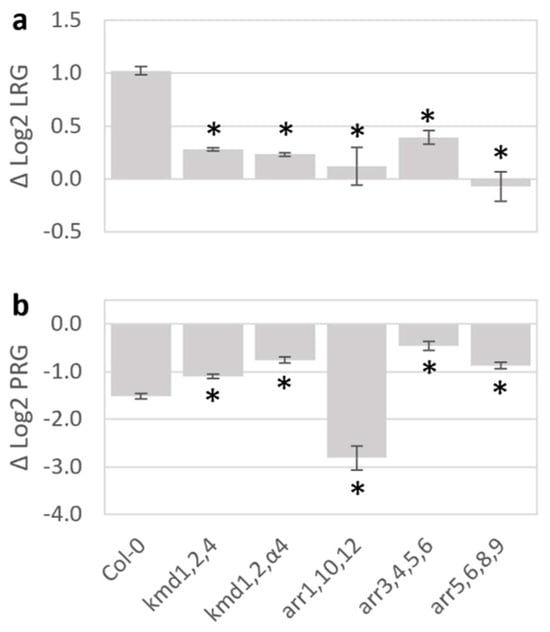
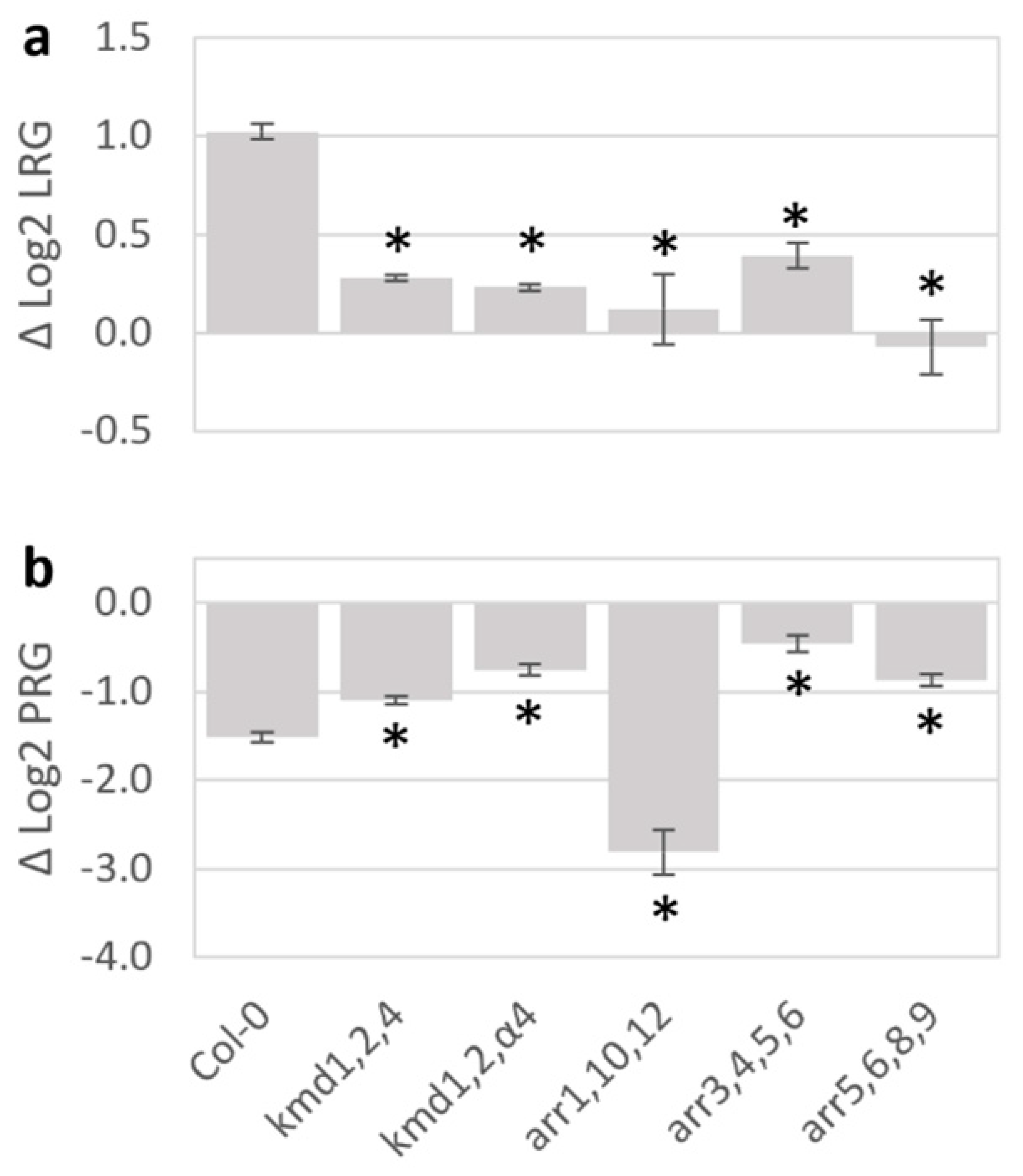
The KMD protein family consists of four regulatory F-box proteins that target cytokinin regulatory proteins for ubiquitination-mediated degradation, the transcription factors Type B-ARRs (ARR1, 10, and 12), and TCP14 [23,24,25,37]. In addition, the KMD proteins target a set of proteins that function in the initiation of the phenylpropanoid biosynthesis pathway [38]. It was found that the A. thaliana triple mutants kmd1,2,4 and kmd1,2,α4 had suppressed lateral root growth stimulation and primary root growth inhibition in response to S. coelicolor volatiles (Figure 3, Figure S5). Additionally, the cytokinin-insensitive triple mutant of the Type-B-ARR genes arr1,10,12 displayed enhanced volatile sensitivity in the primary root and lacked the volatile-induced increase in lateral root growth. Further, repressor factors of the cytokinin response known as type-A ARR proteins were tested using quadruple mutants arr3,4,5,6 and arr5,6,8,9. Both type-A ARR lines displayed volatile-resistant phenotypes, the arr3,4,5,6 being especially resistant to primary root inhibition and arr5,6,8,9 to lateral root stimulation by S. coelicolor volatiles.
Figure 3.
Volatile responses of mutants for KISS ME DEADLY and associated hormone response genes. The figure shows log2 ratios of growth ± volatiles for lateral roots ((a); Δ log2 LRG) and primary roots ((b); Δ log2 PRG) of Col-0, and genotypes deficient and/or suppressed for KISS ME DEADLY genes and associated response factors. Seven-day-old seedlings were exposed for two days to volatiles from S. coelicolor M145 growing on 10 cm2 of SFM. Bars represent standard error, and asterisks indicate significant differences to Col-0 according to Student’s t-test with FDR correction for q = 0.05.
2.8. The Root Growth Response Elicited by the Bioactive Volatile 3-Octanone Depends on KMD and Auxin/Cytokinin Homeostasis
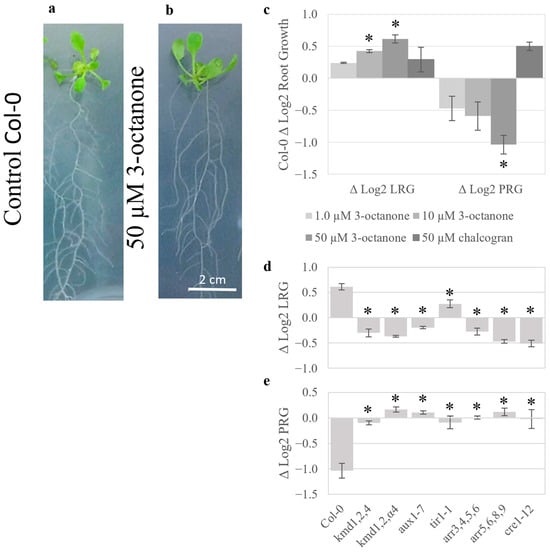
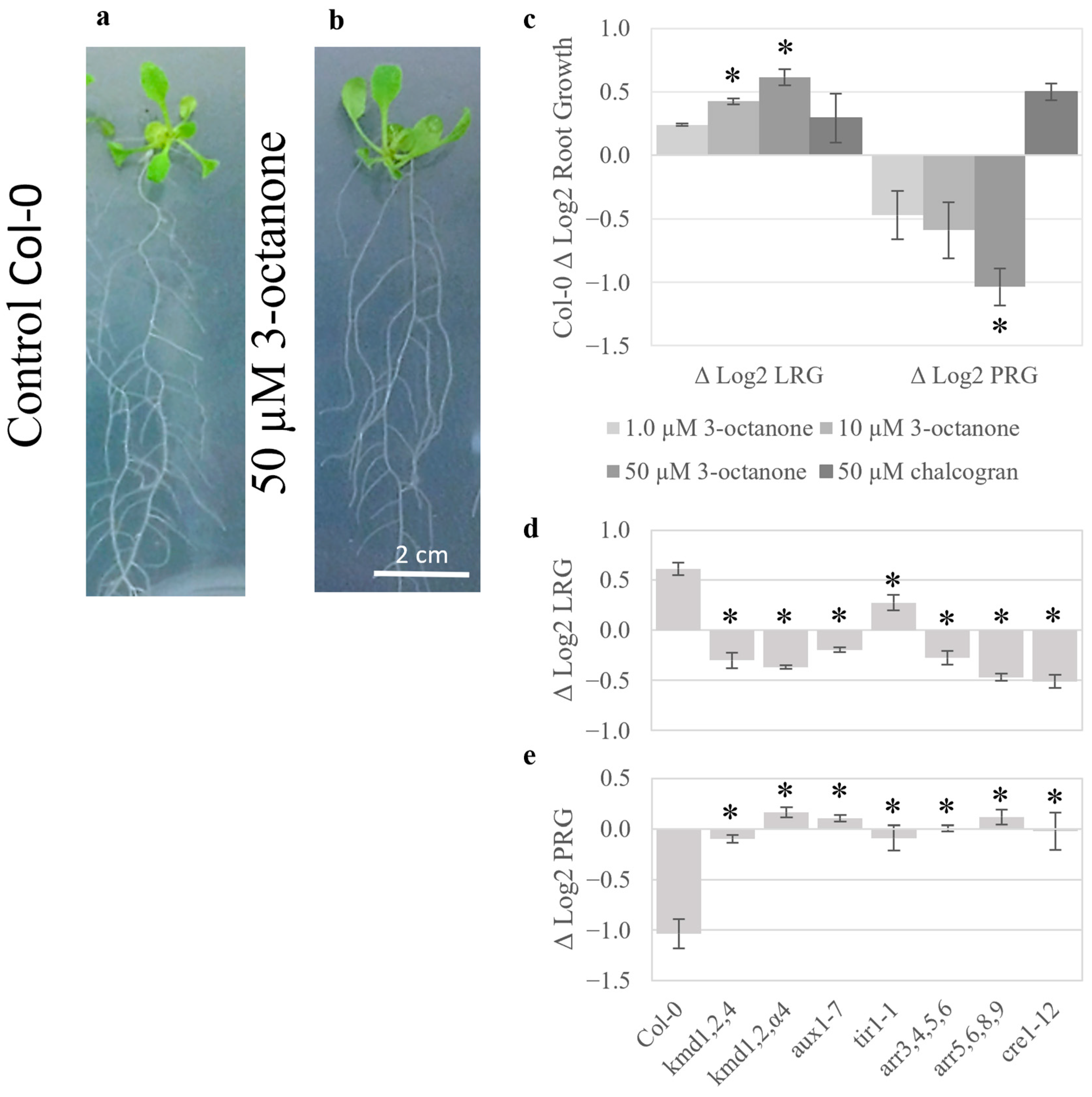
To directly test whether volatile-mediated effects on plant growth involve KMD, 3-octanone, which is known to be bioactive and was present in the Streptomyces headspaces that showed plant growth effects, was chosen (Table 1) [27,28,29]. Seven-day-old seedlings were transferred to agar plates containing pure 3-octanone or a solvent control. After six days of treatment, 3-octanone was observed to have induced lateral root growth in Col-0 (Figure 4a,b). Lateral and primary root growth was quantified over two days (Figure 4c–e). Initial studies of Col-0 seedlings with 50 µM chalcogran showed limited effects and were not elaborated on further (Figure 4c). In contrast, Col-0 treated with 3-octanone displayed dose-dependent inhibition of the primary root and stimulation of the lateral root (Figure 4), as observed for total S. coelicolor volatiles (Figure 1). Thus, 3-octanone induces a three-fold relative growth rate shift, from primary to lateral roots (Figure 4c). Genotypes deficient in KMD and other signaling components of cytokinin and auxin responses were further tested. All genotypes were resistant to the 3-octanone effect on lateral and primary root growth (Figure 4d,e). The lack of effects, being in stark opposition to the 3-octanone-induced root growth changes in Col-0, indicates that the integral network of KMD, as well as cytokinin and auxin homeostasis, must be intact for S. coelicolor volatiles or 3-octanone-induced responses to occur.
Figure 4.
Root growth responses to 3-octanone. Seven-day-old seedlings were transferred to control media or the same media supplemented with different concentrations of 3-octanone or chalcogran. Enhanced growth of roots and shoots can be seen in representative seedlings treated with media containing 3-octanone or solvent control for six days (a,b). Root growth was quantified during two days of treatment. (c) shows log2 growth ratios ± volatile compound (volatile-treated/control) for lateral (Δ log2 LRG) and primary (Δ log2 PRG) roots. (d–e) show comparisons of Col-0, kmd-genotypes, and hormone response mutants for log2 growth rate ratio ± 50 µM 3-octanone for lateral (d) and primary (e) roots. Bars represent standard error, and asterisks indicate significant differences for growth ± volatiles (c) and to Col-0 (d,e) according to Student’s t-test with FDR correction for q = 0.05.
2.9. Integrated Model of the Volatile Response Pathway
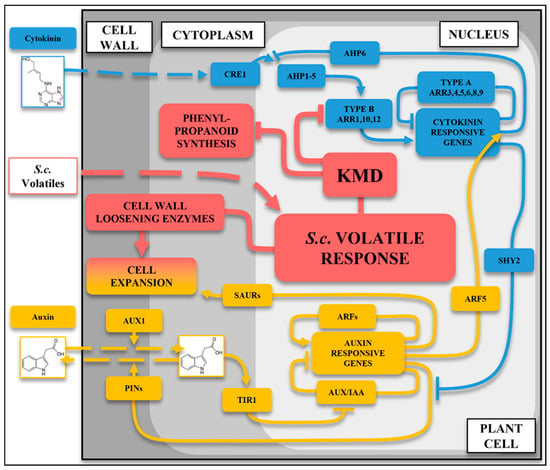
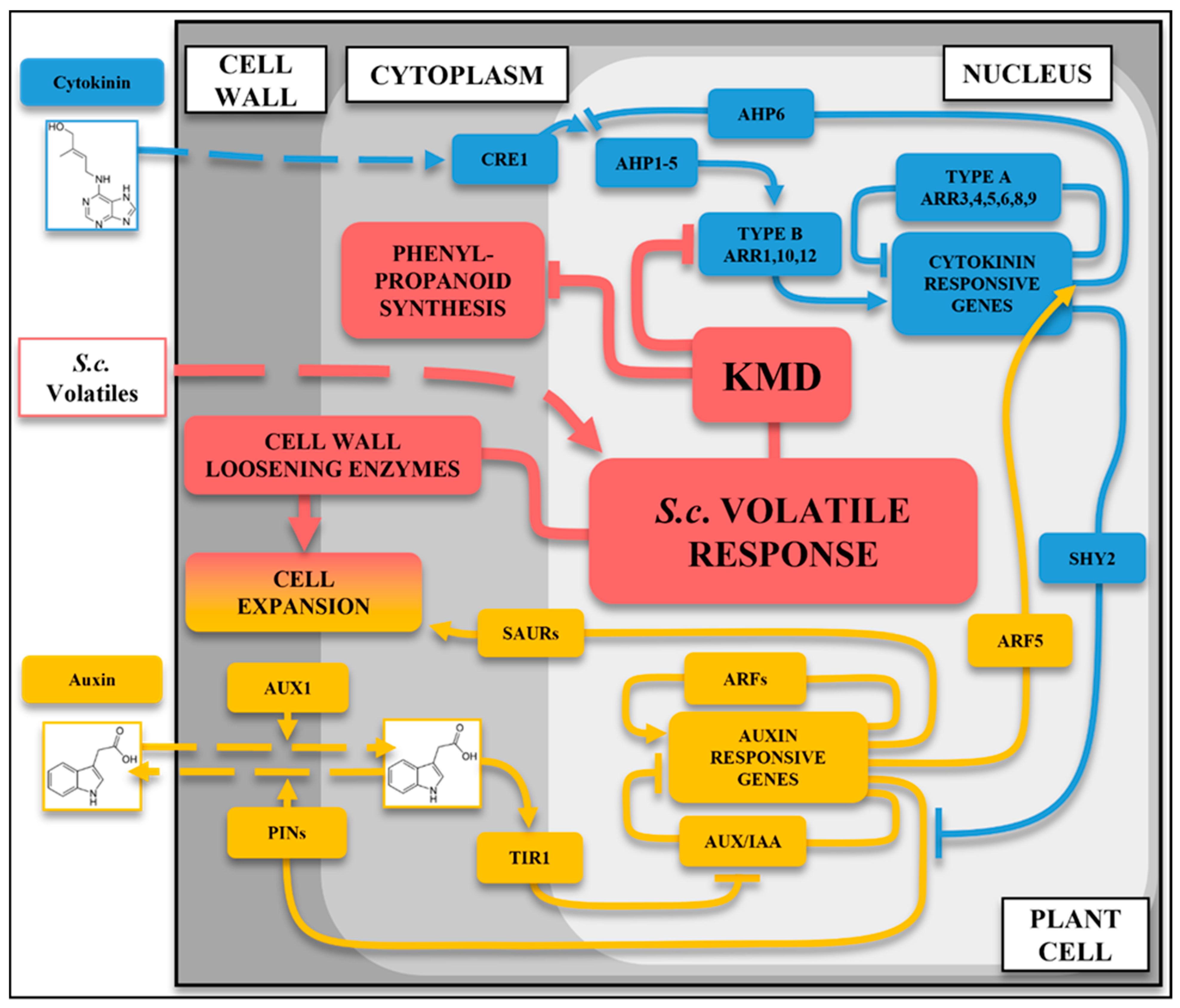
Integration of growth phenotyping, transcriptomic analysis, and Arabidopsis mutant responses reveals a coordinated response network in which Streptomyces volatiles induce KMD expression that, in turn, suppresses cytokinin signaling via degradation of type-B ARR regulators [23,25] and phenylpropanoid components [38]. This activity then relieves SHY2-mediated repression of PIN expression and enables enhanced AUX/LAX and TIR1-dependent auxin signaling alongside cell-wall-loosening processes [12,33,39]. This hormonal rebalancing informs the root growth patterning of enhanced lateral root expansion together with constrained primary root elongation, as summarized in Figure 5.
Figure 5.
A model for growth induction by S. coelicolor volatiles via KMD proteins active at the auxin-cytokinin signaling intersection. Components induced by S. coelicolor (S.c.) volatiles are colored in red, auxin pathway components in yellow, and cytokinin response pathway components are blue. Connectors ending in arrows or blocks indicate activation and suppression, respectively, and dotted lines represent movement of the compounds to the activation sites. The A. thaliana volatile response is caused by S.c. volatile perception by the plant cell. This leads to the upregulation of the KISS ME DEADLY (KMD) protein family that suppresses cytokinin signaling through the degradation of Type-B ARR proteins [23], as well as inhibiting phenylpropanoid metabolism [38]. Auxiliary to this, pectinolytic cell-wall-modifying enzymes are enhanced. The reduction in Type-B ARR proteins would lead to decreased expression of SHY2, decreasing its suppression of the auxin efflux transporters PINs, leading to increased auxin transport and signaling [12]. Auxin is transported into the plant cell via the influx transporter AUX1/LAX family [12]. Auxin then becomes a ligand of the F-box receptor protein TIR1 that binds and inhibits the AUX/IAAs transcriptional repressors, preventing their interaction with promoter elements in auxin-inducible genes [39]. ARF transcription factors are instead attracted to these promoters and activate the transcription of auxin-responsive genes, such as the SMALL AUXIN UP RNAs (SAURs) that promote cell expansion [12]. Also induced by ARFs are the AUX/IAA repressing transcription factors, which then act as a close valve for the system [12]. ARF5 has an additive response to promote the cytokinin signaling suppressor AHP6, which inhibits the cytokinin receptor AHK/CRE1 phospho-transfer to AHP1-5 proteins [12]. The reduced phosphorylation of AHP1-5 leads to inactivation of Type-B ARR proteins and enhanced suppression by ambient Type-A ARRs proteins [12].
3. Discussion
A. thaliana is adapted to an extensive range of nutrient availability and has consequently evolved decision mechanisms to adapt to variable local soil environments [40]. Root growth investments in soil niches with high microbial activity have previously been shown to improve plant overall growth by enhancing plant nutrient status, pathogen resistance, and mitigating stress responses [41,42]. It is therefore expected that higher levels of microbial activity would be cues for plant decisions to locally enhance root tissue investments [43].
The 3-octanone volatile organic compound has previously been shown to be one of many metabolites released from in vitro Streptomyces cultures [26], but has also been isolated from other rhizospheric microorganisms such as Proteobacteria, Ascomycota, and Basidiomycota [28,44,45,46]. However, 3-octanone has not been shown to be produced by vascular plants. Along with 1-octen-3-ol, 3-octanone belongs to a class of eight-carbon (C8) compounds that possess bioactivity in organisms like bacteria, fungi, and plants. Notably, 3-octanone is a conidia-inducing signal in the fungal genus Trichoderma [47], which includes several plant-symbiotic species [48]. Trichoderma-produced 3-octanone has been shown to promote the growth of plants such as A. thaliana and willow [27,28,29]. In contrast, 1-octen-3-ol induces defense responses in A. thaliana, suppresses growth and development of fungi, and reduces growth, chlorophyll accumulation, and seed germination in A. thaliana [49,50]. The bioactive C8 compounds share structural similarities with the defense regulators C9 oxylipins, and both are derived from linoleic acid [51]. Unlike the C9 oxylipins, there are currently no known components mediating the perception or response to C8 compounds in higher plants.
The bioactive volatile signal 3-octanone is consistently present in the headspace of S. coelicolor cultures grown on SFM sporulation media. This happens regardless of bacterial development because volatiles from S. coelicolor mutants stalled at different developmental states still include 3-octanone and influence the A. thaliana root growth. Based on the presence of 3-octanone in the S. coelicolor volatile headspace and the similarity in effects of 3-octanone and S. coelicolor volatiles on Arabidopsis root growth, we conclude that the action of 3-octanone is sufficient to explain the volatile elicitation effect on the root growth, although we cannot rule out that other volatiles in the Streptomyces headspace had additional effects. These data thus present the first evidence linking C8 volatiles to KMD expression and root growth modulation.
Volatiles from S. coelicolor cultured on the S. venezuelae sporulation medium (MYM) had little effect on A. thaliana root growth, whereas S. venezuelae enhanced lateral root growth only when cultured on S. coelicolor sporulation medium (SFM) (Figure S1). This indicates that the Streptomyces medium is a critical factor for volatile-mediated plant growth promotion. Likewise, in vitro studies of several other rhizospheric bacteria have revealed that plant growth promotion by volatiles depends on the culture media used for the microbe [21]. Both 3-octanone and chalcogran have been identified as signature volatiles from fungal cultures on media high in linoleic acid [52,53]. This fatty acid is highly abundant in soya flour, which is a main component of the SFM (~1.4 g linoleic acid per L) [54,55]. Unsaturated fatty acids, including linoleic, tend to be degraded rapidly in soil by abiotic conditions and by microbes [56]. To plants, soils that are enriched in linoleic acid-associated microbial volatiles may indicate a richness in organic compounds and availability of new nutritional resources for plant roots to harvest.
To investigate factors regulating the A. thaliana response to volatiles from S. coelicolor, exposed seedlings were analyzed by RNA-Seq. Transcriptional analysis revealed a differential expression pattern that displayed similarities to previously reported A. thaliana responses to beneficial microorganisms Serratia plymuthica HRO-C and Colletotrichum tofieldiae [31,32]. Two GO approaches specifically indicated the gene family KISS-ME-DEADLY (KMD) as contributors to the S. coelicolor volatile-induced gene response profile in A. thaliana. The GO bin with the lowest FDR q-value, “negative regulation of cytokinin-activated signaling pathways”, contains three out of the four genes in the KMD family. This associates the volatile response with KMD-mediated suppression of type-B ARR cytokinin signaling factors [23]. Additionally, the entire family of KMD genes is included in the likewise responsive bin “Regulation of phenylpropanoid metabolic process”, which denotes the association of KMD genes with suppression of the phenylpropanoid biosynthesis pathway, potentially lowering the capacity for defense, such as pathogen responses or herbivory deterrence [38].
Concurring with transcript analysis, investigations into broad hormone regulation by S. coelicolor volatiles response were analyzed by genetic perturbations in the plant hormone pathways. Mutant lines impaired in auxin response (aux1-7, arf1-2, and tir1-1) and cytokinin (cre1-12) signaling had the smallest initial root growth response to S. coelicolor volatiles. Consistent with the GO analysis, mutations to KMD family function suppressed both primary and lateral root responses to S. coelicolor volatiles as well as to the pure 3-octanone. The mutant lacking the targets of KMD function, Type B ARRs (ARR1,10,12), also lacked lateral root growth enhancement but retained a strong primary root inhibition, possibly due to volatile-induced KMD proteins suppressing remaining Type B ARRs, such as ARR20 [23]. Mutations in the cytokinin response-suppressive factors Type A ARRs (arr3,4,5,6 and arr5,6,8,9) also suppressed the S. coelicolor volatile growth response, further emphasizing that repression of cytokinin signaling is involved in mediating the S. coelicolor volatile-induced plant growth decision. Previous research has characterized the downstream signaling effects of KMD, which causes a shift in the cytokinin-to-auxin signaling toward more auxin-like responses (e.g., increased cell expansion and enhanced lateral root growth) and promotes synthesis of defense-associated phenylpropanoids [23,25,57]. This study identifies an upstream cue for the KMD family, which therefore can be placed as an upstream regulator of auxin/cytokinin crosstalk for effects on root growth plasticity in response to a biotic interaction. A model is suggested for the consecutive steps from KMD activation, including changes in relative tissue sensitivity to auxin and cytokinin that promote wall loosening and cell expansion [12,33]. The model is consistent with known crosstalk events that balance the auxin/cytokinin homeostasis. One such example involves SHORT HYPOCOTYL2 (SHY2), which is induced by positive regulators of cytokinin signaling of the Type-B ARR family [12,23,25]. SHY2 suppresses PIN-mediated auxin membrane transport, causing a local auxin accumulation in cells with high amounts of cytokinin-induced signal components [12]. When auxin signaling is activated, degradation of SHY2 via the SCFTIR1 ubiquitination pathway and promotion of AHP6 by ARF5 decrease the cytokinin suppression of auxin transport [12], thus mediating a developmentally tight control of growth. KMD family proteins induce degradation of Type-B ARR 1,10,20 proteins [23,25], so inactivation of the KMD genes leads to accumulation of Type-B ARRs and promotes the cytokinin response [23]. A volatile-induced KMD-mediated loss of cytokinin signaling would decrease the suppression of auxin signaling (e.g., via the ARR1,10-dependent auxin-suppressing gene SHY2) and enhance PIN expression and tissue elongation [12]. Supporting such a scenario for the root growth effect of S. coelicolor volatiles, the GO analysis also indicated induction of genes for cell wall loosening enzymes, which are associated with cell expansion [33]. The lack of transcriptional differences between control and volatile-treated plants for auxin-responsive genes in signaling, metabolism, and transport further indicates that the observed promotion of lateral roots is a result of S. coelicolor volatiles decreasing cytokinin-induced suppression of auxin signaling.
4. Conclusions
The general release of the identified active volatile 3-octanone from multiple species of bacteria and fungi, and its dependence on growth substrate composition [58,59] makes this volatile a prime candidate signal for mediating soil information to the plant, relatively independent of the specific microbial composition, yet possibly reflecting the quantitative microbial soil status. The 3-octanone is demonstrated to have a profound effect on the A. thaliana seedlings to promote lateral root growth, and consequently, total growth. The growth stimulation depends on the activation of KMD genes that lead to a modified sensitivity to the growth hormone cytokinin. This leaves the potential utilization of 3-octanone for the biostimulation of agricultural plants as an intriguing possibility; however, more information about the downstream effects of 3-octanone application must be investigated beyond the early plant growth stage.
5. Methods
Details about the statistical analysis data are described in Dataset S3. Genetic stocks used are described in Table S3.
5.1. Plant Growth System
Seeds of A. thaliana were surface-sterilized in microtubes with 70% ethanol, then 50% bleach, and finally washed three times with diH2O and stratified for 2 days at 4 °C [60]. The seeds were then placed on vertical 12 × 12 cm 0.8% agar (w/v) plates containing ½ Murashige and Skoog (MS) [61] basal medium (pH 5.50–5.65) supplemented with 88 mM sucrose, unless otherwise stated. Agar plates supplemented with compounds (such as 3-octanone) were prepared similarly, except that the compounds were added from sterile filtered stocks in dimethyl sulfoxide (DMSO) to the autoclaved growth media after allowing the media to cool to <60 °C. Thus, the volatile-supplemented agar plates also contained 0.01 µM DMSO, which was also used in control plates. Prepared agar plates were used immediately. The plates with seeds were incubated in a growth chamber (16 h light period, 120 µE m−2 s−1, 25 °C).
Vertical plates with growing plants were modified by removing the bottom 4 cm of the agar medium and placing a 3.5 cm Petri dish inside. Variably sized disks of sporulating Streptomyces cultures were placed onto the 3.5 cm mini-Petri dish after 7 days of plant growth. The plant-bacterial plates were then scanned with a Ricoh Aficio MP C5000 scanner every 2 days over a 6-day period to measure growth differences. After six days of exposure, the plates were photographed using an iSight camera (Apple). All image processing was performed by ImageJ 1.48v (National Institute of Health) [62].
5.2. Bacterial Growth
Approximately 5 µL of a spore suspension was spread over sporulation media, which was soya flour–mannitol media (SFM) for all isolates of S. coelicolor, starch and KO3 minimal media (GA), and maltose–yeast extract–malt extract (MYM) media supplemented with 0.2% trace minerals for S. venezuelae [54,63,64]. Soya flour used for SFM media was sourced from Risenta brand soya flour, Stockholm, Sweden. Streptomyces cultures were allowed to grow to a dense lawn of mycelium over a period of 8 days at 30 °C before being used for volatile treatments.
5.3. Analysis of Tissue Growth
Primary and lateral root growth was quantified over a period of two days by ImageJ analyses of scanned photos. Lateral root growth was assessed using the largest three existing lateral roots per seedling, and primary root growth was assessed per seedling. Experimental growth rates were compared internally to the overall lateral root growth/primary root growth (log2 LRG/PRG). The number of emerging lateral roots per day (LRE) was calculated per primary root present. Alternatively, volatile treatments were compared to control settings for lateral root growth (Δ log2 of volatile-treated LRG to log2 control LRG) and for primary root growth (Δ log2 of volatile-treated PRG to log2 control PRG). For each measurement of growth, averages from technical replicates of 3 or more biological replicates were pooled into 3 biological replicates and used to compare between experimental and control. The significance of growth differences was tested by Student’s t-test and verified with an FDR q-value of 0.05 [65].
5.4. Volatile Collection and Analyses
Volatiles were collected from 8-day-old Streptomyces cultures over a period of 24 h by adsorption to air filters made of Teflon tubes (4 × 40 mm), holding 50 mg Porapak Q (80/100 mesh; Alltech, Nicholasville, KY, USA). Adsorbed volatiles were desorbed by eluting from the filters with 500 µL re-distilled n-hexane. Two µL of collected volatiles were resolved by gas chromatography-mass spectrometry (GC-MS; 6890 GC and 5975 MS; Agilent Technologies Inc., Santa Clara, CA, USA) using a polar DB-WAX capillary column (30 m × 0.25 mm × 0.25 μm; J&W Scientific, Folsom, CA, USA) using helium as carrier gas at a flow rate of 35 cm/s. The oven temperature was held at 30 °C for 3 min, increased with a ramp rate of 8 °C/min to 225 °C, and held for 10 min. Compounds were then subjected to mass spectrometry in a GC-MS (6890 GC and 5975 MS; Agilent Technologies Inc., Santa Clara, CA, USA). Compound identities were determined according to mass spectra libraries at SLU Alnarp and the library of the National Institute of Standards and Technology (NIST; www.nist.gov), retention times (using the Kovats’ index [66] NIST database for polar columns) and by co-injection of authentic compound standards (Sigma, Hong Kong, China).
5.5. RNA Extraction
Single replicate experiments with volatile and control treatments were independently repeated three times using populations of approximately 20 seedlings. Seedlings were exposed to control or S. coelicolor M145 volatile conditions for 2 h and flash-frozen in liquid N2. Approximately 100 mg of tissue was placed into a microtube and then ground with plastic pestles to obtain a homogenized sample. RNA was extracted according to the protocol of the RNeasy Kit (Qiagen, Venlo, The Netherlands) and treated with the DNA-free DNA Removal Kit (ThermoFisher, Waltham, MA, USA). About 1 µg of RNA from each of the six samples (three control and three volatile-treated biological replicates) was sent to Beijing Genomic Institute (Hong Kong, China) for RNA-Seq analysis using the Hiseq 2000 Illumina sequencing platform and single-end 50 base pair sequencing.
5.6. Analysis of RNA-Seq Data
Raw reads were mapped to the genome of A. thaliana (TAIR 10) [67] as described [68]. Reads were summarized per gene (including splice variants) and divided by mRNA length to calculate reads per kb million (RPKM), which were log2-transformed. Transcripts identified as non-coding or organellar, as well as lowly expressed genes (less than 15 mapped reads per gene), were removed and excluded from the analyses. Transcripts were then mean expression-normalized according to Willems et al. 2008 [69] for calculation of log2 expression ratios and statistics. Differential expression was tested by Student’s t-test and corrected for multiple testing using a false discovery rate (FDR) q-value of 0.05 [61]. A list of significantly differentially expressed genes (log2 ratio > 1.0; FDR q-value = 0.05) was subject to “Signature Search” using Genevestigator (https://genevestigator.com/gv/, accessed on 1 February 2016) [34]. Additional analyses were performed on the entire list of expressed genes using non-parametric GO analysis using the Gorilla website (http://cbl-gorilla.cs.technion.ac.il/, accessed on 1 February 2016) [35] and the program Genevestigator with default settings (for summary see Dataset S4).
5.7. qRT-PCR Confirmation
Four independent RNA samples were analyzed in triplicate using the MAXIMA First Strand Synthesis Kit (K1671; Thermo Scientific, Waltham, MA, USA) according to the manufacturer’s guidelines. The resulting cDNA was quantified by qPCR using the MAXIMA SYBR green kit with 40 cycles in a Rotor-gene Q thermocycler (Qiagen Venlo, The Netherlands), following the settings: 95 °C, for 2 min; and cycles of (95 °C, 20 s; 60 °C, 15 s; 72 °C, 15 s; 81 °C, 20 s); 1 cycle of 50 °C, 1 min. Signals were acquired at 72 °C and 81 °C for analyzing consistency in accumulation, and comparative quantification was performed on data acquired at 81 °C. Three technical replicates were run for each biological replicate. Gene products of the housekeeping gene UPL7 (At3g53090) and three experimental genes NIT1 (At3g44310), PP2AA3 (At1g13320), and EXP5 (At3g29030) were analyzed (Figure S6). Each reaction had a volume of 20 µL and contained cDNA corresponding to 0.16 ng of DNase-treated RNA. Product identity and specificity were confirmed by melt curve analysis, as well as gel electrophoresis of representative and ambiguous samples. Individual reactions that showed unspecific products were deleted from the analysis. Primers were designed using the program Primer3, and are listed in Table S4 [70].
Supplementary Materials
The following supporting information can be downloaded at: https://www.mdpi.com/article/10.3390/plants15010124/s1, Figure S1: Growth of Arabidopsis thaliana Col-0 in response to Streptomyces volatiles; Figure S2: Growth of Arabidopsis thaliana hormone mutants in response to Streptomyces coelicolor M145 volatiles; Figure S3: Arabidopsis thaliana DR5::GFP response to Streptomyces coelicolor volatiles; Figure S4: Root growth response of Arabidopsis thaliana Col-0 seedlings exposed to Streptomyces coelicolor volatiles with cytokinin; Figure S5: Growth of Arabidopsis thaliana mutants for KMD-associated genes in response to Streptomyces coelicolor volatiles; Figure S6: qRT-PCR verification of RNA-Seq expression; Table S1: Growth data for Col-0 response to gas-phase connection to different amounts of each Streptomyces strain; Table S2: Transcriptional comparison of Arabidopsis thaliana Col-0 treated with Streptomyces coelicolor volatiles to exogenous hormone application; Table S3: Genetic stocks [71,72,73,74,75,76,77,78,79,80,81,82,83,84,85,86]; Table S4: Primer sequences; Dataset S1: RNAseq dataset; Dataset S2: RNA-Seq Differentially Expressed Gene set; Dataset S3: Statistical summary; Dataset S4: Gene ontology analysis summary.
Author Contributions
A.G.R., P.G.B., and K.F. conceived the project. B.R.D. wrote the manuscript, contributed to all molecular and genetic experiments with Arabidopsis, and contributed to the analysis of Streptomyces volatiles. V.V. conducted the majority of the Streptomyces volatile collection and analysis. All authors have read and agreed to the published version of the manuscript.
Funding
This research was funded by Plant Link number [2013-3], the Crafoord Foundation number [20150915], the Linnaeus initiative “Insect Chemical Ecology, Ethology and Evolution” IC-E3 (Formas, SLU), and the SLU Centre for Biological Control (CBC).
Data Availability Statement
The RNA-Seq data in this study have been deposited in the NCBI GEO under the accession number PRJNA573628. Figures, datasets, and Supplemental Information associated with raw data that supported the findings of this study are available from the corresponding author upon reasonable request.
Acknowledgments
We thank G. Eric Schaller at Dartmouth College for the donation of the kmd1,2,4 and kmd1,2,α4 seed stock, and Matthew Escobar at California State University at San Marcos for the seed stocks of arr1,10,12 and DR5::GFP. We also thank Olivier van Aken at Lund University for critical reading of the manuscript and Oscar M. Rollano Peñaloza at Lund University for advice on transcriptomic analysis.
Conflicts of Interest
The authors declare no conflict of interest.
References
- Gruntman, M.; Groß, D.; Májeková, M.; Tielbörger, K. Decision-making in plants under competition. Nat. Commun. 2017, 8, 2235. [Google Scholar] [CrossRef] [Scilit]
- Segundo-Ortin, M.; Calvo, P. Consciousness and cognition in plants. Wiley Interdiscip. Rev. Cogn. Sci. 2022, 13, e1578. [Google Scholar] [CrossRef] [Scilit] [PubMed]
- Lee, J.; Segundo-Ortin, M.; Calvo, P. Decision making in plants: A rooted perspective. Plants 2023, 12, 1799. [Google Scholar] [CrossRef] [Scilit] [PubMed]
- Schuman, M.C.; Baldwin, I.T. The layers of plant responses to insect herbivores. Annu. Rev. Entomol. 2016, 61, 373–394. [Google Scholar] [CrossRef] [Scilit]
- Dener, E.; Kacelnik, A.; Shemesh, H. Pea plants show risk sensitivity. Curr. Biol. 2016, 26, 1763–1767. [Google Scholar] [CrossRef] [Scilit] [PubMed]
- Kaushal, P.; Ali, N.; Saini, S.; Pati, P.K.; Pati, A.M. Physiological and molecular insight of microbial biostimulants for sustainable agriculture. Front. Plant Sci. 2023, 14, 1041413. [Google Scholar] [CrossRef] [Scilit]
- El-Saadony, M.T.; Saad, A.M.; Soliman, S.M.; Salem, H.M.; Ahmed, A.I.; Mahmood, M.; El-Tahan, A.M.; Ebrahim, A.A.M.; Abd El-Mageed, T.A.; Negm, S.H.; et al. Plant growth-promoting microorganisms as biocontrol agents of plant diseases: Mechanisms, challenges and future perspectives. Front. Plant Sci. 2022, 13, 923880. [Google Scholar] [CrossRef] [Scilit]
- Tran, T.M.; Ameye, M.; Devlieghere, F.; De Saeger, S.; Eeckhout, M.; Audenaert, K. Streptomyces strains promote plant growth and induce resistance against Fusarium verticillioides via transient regulation of auxin signaling and archetypal defense pathways in maize plants. Front. Plant Sci. 2021, 12, 755733. [Google Scholar] [CrossRef] [Scilit]
- Köhl, J.; Kolnaar, R.; Ravensberg, W.J. Mode of action of microbial biological control agents against plant diseases: Relevance beyond efficacy. Front. Plant Sci. 2019, 10, 454982. [Google Scholar] [CrossRef] [Scilit]
- Viaene, T.; Langendries, S.; Beirinckx, S.; Maes, M.; Goormachtig, S. Streptomyces as a plant’s best friend? FEMS Microbiol. Ecol. 2016, 92, fiw119. [Google Scholar] [CrossRef] [Scilit]
- Su, P.; Kang, H.; Peng, Q.; Wicaksono, W.A.; Berg, G.; Liu, Z.; Ma, J.; Zhang, D.; Cernava, T.; Liu, Y. Microbiome homeostasis on rice leaves is regulated by a precursor molecule of lignin biosynthesis. Nat. Commun. 2024, 15, 23. [Google Scholar] [CrossRef] [Scilit]
- Schaller, G.E.; Bishopp, A.; Kieber, J.J. The yin-yang of hormones: Cytokinin and auxin interactions in plant development. Plant Cell 2015, 27, 44–63. [Google Scholar] [CrossRef] [Scilit] [PubMed]
- Backer, R.; Rokem, J.S.; Ilangumaran, G.; Lamont, J.; Praslickova, D.; Ricci, E.; Subramanian, S.; Smith, D.L. Plant growth-promoting rhizobacteria: Context, mechanisms of action, and roadmap to commercialization of biostimulants for sustainable agriculture. Front. Plant Sci. 2018, 9, 1473. [Google Scholar] [CrossRef] [Scilit]
- Sharifi, R.; Ryu, C.-M. Revisiting bacterial volatile-mediated plant growth promotion: Lessons from the past and objectives for the future. Ann. Bot. 2018, 122, 349–358. [Google Scholar] [CrossRef] [Scilit] [PubMed]
- Woo, S.L.; Hermosa, R.; Lorito, M.; Monte, E. Trichoderma: A multipurpose, plant-beneficial microorganism for eco-sustainable agriculture. Nat. Rev. Microbiol. 2023, 21, 312–326. [Google Scholar] [CrossRef] [Scilit] [PubMed]
- Castiglione, A.M.; Mannino, G.; Contartese, V.; Bertea, C.M.; Ertani, A. Microbial biostimulants as response to modern agriculture needs: Composition, role and application of these innovative products. Plants 2021, 10, 1533. [Google Scholar] [CrossRef] [Scilit]
- Parmagnani, A.S.; Kanchiswamy, C.N.; Paponov, I.A.; Bossi, S.; Malnoy, M.; Maffei, M.E. Bacterial volatiles (mVOC) emitted by the phytopathogen Erwinia amylovora promote Arabidopsis thaliana growth and oxidative stress. Antioxidants 2023, 12, 600. [Google Scholar] [CrossRef] [Scilit]
- Zhang, H.; Kim, M.; Krishnamachari, V.; Payton, P.; Sun, Y.; Grimson, M.; Farag, M.A.; Ryu, C.; Allen, R.; Melo, I.S.; et al. Rhizobacterial volatile emissions regulate auxin homeostasis and cell expansion in Arabidopsis. Planta 2007, 226, 839–851. [Google Scholar] [CrossRef] [Scilit]
- Tahir, H.A.S.; Gu, Q.; Wu, H.; Raza, W.; Hanif, A.; Wu, L.; Colman, M.V.; Gao, X. Plant growth promotion by volatile organic compounds produced by Bacillus subtilis SYST2. Front. Microbiol. 2017, 8, 171. [Google Scholar] [CrossRef] [Scilit]
- Lee, S.; Hung, R.; Yap, M.; Bennett, J.W. Age matters: The effects of volatile organic compounds emitted by Trichoderma atroviride on plant growth. Arch. Microbiol. 2015, 197, 723–727. [Google Scholar] [CrossRef] [Scilit]
- Blom, D.; Fabbri, C.; Connor, E.C.; Schiestl, F.P.; Klauser, D.R.; Boller, T.; Eberl, L.; Weisskopf, L. Production of plant growth modulating volatiles is widespread among rhizosphere bacteria and strongly depends on culture conditions. Environ. Microbiol. 2011, 13, 3047–3058. [Google Scholar] [CrossRef] [Scilit]
- Fincheira, P.; Quiroz, A. Microbial volatiles as plant growth inducers. Microbiol. Res. 2018, 208, 63–75. [Google Scholar] [CrossRef] [Scilit]
- Kim, H.J.; Chiang, Y.; Kieber, J.J.; Schaller, G.E. SCF(KMD) controls cytokinin signaling by regulating the degradation of type-B response regulators. Proc. Natl. Acad. Sci. USA 2013, 110, 10028–10033. [Google Scholar] [CrossRef] [Scilit] [PubMed]
- Steiner, E.; Triana, M.R.; Kubasi, S.; Blum, S.; Paz-Ares, J.; Rubio, V.; Weiss, D. KISS-ME-DEADLY F-box proteins modulate cytokinin responses by targeting the transcription factor TCP14 for degradation. Plant Physiol. 2021, 185, 1495–1499. [Google Scholar] [CrossRef] [Scilit]
- Kim, H.J.; Kieber, J.J.; Schaller, G.E. The rice F-box protein KISS ME DEADLY2 functions as a negative regulator of cytokinin signaling. Plant Signal. Behav. 2013, 8, e26434. [Google Scholar] [CrossRef] [Scilit] [PubMed]
- Cordovez, V.; Carrion, V.J.; Etalo, D.W.; Mumm, R.; Zhu, H.; van Wezel, G.P.; Raaijmakers, J.M. Diversity and functions of volatile organic compounds produced by Streptomyces from a disease-suppressive soil. Front. Microbiol. 2015, 6, 1081. [Google Scholar] [CrossRef] [Scilit] [PubMed]
- Cottier, F.; Mühlschlegel, F.A. Communication in fungi. Int. J. Microbiol. 2012, 2012, 351832. [Google Scholar] [CrossRef] [Scilit]
- Nieto-Jacobo, M.F.; Steyaert, J.M.; Salazar-Badillo, F.B.; Nguyen, D.V.; Rostás, M.; Braithwaite, M.; De Souza, J.T.; Jimenez-Bremont, J.F.; Ohkura, M.; Stewart, A.; et al. Environmental growth conditions of Trichoderma spp. affects indole acetic acid derivatives, volatile organic compounds, and plant growth promotion. Front. Plant Sci. 2017, 8, 102. [Google Scholar] [CrossRef] [Scilit]
- Gamboa-Becerra, R.; Desgarennes, D.; Molina-Torres, J.; Ramírez-Chávez, E.; Kiel-Martínez, A.L.; Carrión, G.; Ortiz-Castro, R. Plant growth-promoting and non-promoting rhizobacteria from avocado trees differentially emit volatiles that influence growth of Arabidopsis thaliana. Protoplasma 2022, 259, 835–854. [Google Scholar] [CrossRef] [Scilit]
- Ryu, C.-M.; Farag, M.A.; Hu, C.-H.; Reddy, M.S.; Kloepper, J.W.; Paré, P.W. Bacterial volatiles induce systemic resistance in Arabidopsis. Plant Physiol. 2004, 134, 1017–1026. [Google Scholar] [CrossRef] [Scilit]
- Wenke, K.; Wanke, D.; Kilian, J.; Berendzen, K.; Harter, K.; Piechulla, B. Volatiles of two growth-inhibiting rhizobacteria commonly engage AtWRKY18 function. Plant J. 2012, 70, 445–459. [Google Scholar] [CrossRef] [Scilit]
- Hacquard, S.; Kracher, B.; Hiruma, K.; Münch, P.C.; Garrido-Oter, R.; Thon, M.R.; Weimann, A.; Damm, U.; Dallery, J.-F.; Hainaut, M.; et al. Survival trade-offs in plant roots during colonization by closely related beneficial and pathogenic fungi. Nat. Commun. 2016, 7, 11362. [Google Scholar] [CrossRef] [Scilit]
- Majda, M.; Robert, S. The role of auxin in cell wall expansion. Int. J. Mol. Sci. 2018, 19, 951. [Google Scholar] [CrossRef] [Scilit]
- Hruz, T.; Laule, O.; Szabo, G.; Wessendorp, F.; Bleuler, S.; Oertle, L.; Widmayer, P.; Gruissem, W.; Zimmermann, P. Genevestigator v3: A reference expression database for the meta-analysis of transcriptomes. Adv. Bioinform. 2008, 2008, 420747. [Google Scholar] [CrossRef] [Scilit] [PubMed]
- Eden, E.; Navon, R.; Steinfeld, I.; Lipson, D.; Yakhini, Z. GOrilla: A tool for discovery and visualization of enriched go terms in ranked gene lists. BMC Bioinform. 2009, 10, 48. [Google Scholar] [CrossRef] [Scilit] [PubMed]
- Carbon, S.; Ireland, A.; Mungall, C.J.; Shu, S.; Marshall, B.; Lewis, S. AmiGO Hub and Web Presence Working Group. AmiGO: Online access to ontology and annotation data. Bioinformatics 2009, 25, 288–289. [Google Scholar] [CrossRef] [Scilit]
- Wang, F.; Cai, X.; Wei, H.; Zhang, L.; Dong, A.; Su, W. Histone methylation readers MRG1/MRG2 interact with the transcription factor TCP14 to positively modulate cytokinin sensitivity in Arabidopsis. J. Genet. Genom. 2023, 50, 589–599. [Google Scholar] [CrossRef] [Scilit] [PubMed]
- Zhang, X.; Gou, M.; Liu, C.-J. Arabidopsis kelch repeat F-box proteins regulate phenylpropanoid biosynthesis via controlling the turnover of PHENYLALANINE AMMONIA-LYASE. Plant Cell 2013, 25, 4994–5010. [Google Scholar] [CrossRef] [Scilit]
- Jan, M.; Muhammad, S.; Jin, W.; Zhong, W.; Zhang, S.; Lin, Y.; Zhou, Y.; Liu, J.; Liu, H.; Munir, R.; et al. Modulating root system architecture: Cross-talk between auxin and phytohormones. Front. Plant Sci. 2024, 15, 1343928. [Google Scholar] [CrossRef] [Scilit]
- Leventhal, L.; Ruffley, M.; Exposito-Alonso, M. Planting genomes in the wild: Arabidopsis from genetics history to the ecology and evolutionary genomics era. Annu. Rev. Plant Biol. 2025, 76, 605–635. [Google Scholar] [CrossRef] [Scilit]
- Jansson, J.K.; McClure, R.; Egbert, R.G. Soil microbiome engineering for sustainability in a changing environment. Nat. Biotechnol. 2023, 41, 1716–1728. [Google Scholar] [CrossRef] [Scilit]
- Vacheron, J.; Desbrosses, G.; Bouffaud, M.-L.; Touraine, B.; Moënne-Loccoz, Y.; Muller, D.; Legendre, L.; Wisniewski-Dyé, F.; Prigent-Combaret, C. Plant growth-promoting rhizobacteria and root system functioning. Front. Plant Sci. 2013, 4, 356. [Google Scholar] [CrossRef] [Scilit]
- McCleery, W.T.; Mohd-Radzman, N.A.; Grieneisen, V.A. Root branching plasticity: Collective decision-making results from local and global signaling. Curr. Opin. Cell Biol. 2017, 44, 51–58. [Google Scholar] [CrossRef] [Scilit]
- Splivallo, R.; Novero, M.; Bertea, C.M.; Bossi, S.; Bonfante, P. Truffle volatiles inhibit growth and induce an oxidative burst in Arabidopsis thaliana. New Phytol. 2007, 175, 417–424. [Google Scholar] [CrossRef] [Scilit]
- Garbeva, P.; Hordijk, C.; Gerards, S.; de Boer, W. Volatiles produced by the mycophagous soil bacterium Collimonas. FEMS Microbiol. Ecol. 2014, 87, 639–649. [Google Scholar] [CrossRef] [Scilit]
- Takeuchi, T.; Kimura, T.; Tanaka, H.; Kaneko, S.; Ichii, S.; Kiuchi, M.; Suzuki, T. Analysis of volatile metabolites emitted by soil-derived fungi using head space solid-phase microextraction/gas chromatography/mass spectrometry: I. Aspergillus fumigatus, Aspergillus nidulans, Fusarium solani and Penicillium paneum. Surf. Interface Anal. 2012, 44, 694–698. [Google Scholar] [CrossRef] [Scilit]
- Kües, U.; Khonsuntia, W.; Subba, S.; Dörnte, B. Volatiles in communication of Agaricomycetes. Physiol. Genet. 2018, 15, 149–212. [Google Scholar] [CrossRef] [Scilit]
- Druzhinina, I.S.; Seidl-Seiboth, V.; Herrera-Estrella, A.; Horwitz, B.A.; Kenerley, C.M.; Monte, E.; Mukherjee, P.K.; Zeilinger, S.; Grigoriev, I.V.; Kubicek, C.P. Trichoderma: The genomics of opportunistic success. Nat. Rev. Microbiol. 2011, 9, 749–759. [Google Scholar] [CrossRef] [Scilit] [PubMed]
- Chitarra, G.S.; Abee, T.; Rombouts, F.M.; Posthumus, M.A.; Dijksterhuis, J. Germination of Penicillium paneum conidia is regulated by 1-octen-3-ol, a volatile self-inhibitor. Appl. Environ. Microbiol. 2004, 70, 2823–2829. [Google Scholar] [CrossRef] [Scilit]
- Lee, S.; Behringer, G.; Hung, R.; Bennett, J. Effects of fungal volatile organic compounds on Arabidopsis thaliana growth and gene expression. Fungal Ecol. 2019, 37, 1–9. [Google Scholar] [CrossRef] [Scilit]
- Vellosillo, T.; Martínez, M.; López, M.A.; Vicente, J.; Cascón, T.; Dolan, L.; Hamberg, M.; Castresana, C. Oxylipins produced by the 9-lipoxygenase pathway in Arabidopsis regulate lateral root development and defense responses through a specific signaling cascade. Plant Cell 2007, 19, 831–846. [Google Scholar] [CrossRef] [Scilit]
- Beck, J.J.; Mahoney, N.E.; Cook, D.; Gee, W.S. Generation of the volatile spiroketals conophthorin and chalcogran by fungal spores on polyunsaturated fatty acids common to almonds and pistachios. J. Agric. Food Chem. 2012, 60, 11869–11876. [Google Scholar] [CrossRef] [Scilit]
- Wurzenberger, M.; Grosch, W. Origin of the oxygen in the products of the enzymatic cleavage reaction of linoleic acid to 1-octen-3-ol and 10-oxo-trans-8-decenoic acid in mushrooms (Psalliota bispora). Biochim. Biophys. Acta Lipids Lipid Metab. 1984, 794, 18–24. [Google Scholar] [CrossRef] [Scilit]
- Kieser, T.; Bibb, M.J.; Buttner, M.J.; Chater, K.F.; Hopwood, D.A. Practical Streptomyces Genetics; The John Innes Foundation: Norwich, UK, 2000; p. 613. [Google Scholar]
- Prabakaran, M.; Lee, K.-J.; An, Y.; Kwon, C.; Kim, S.; Yang, Y.; Ahmad, A.; Kim, S.-H.; Chung, I.-M. Changes in soybean (Glycine max L.) flour fatty-acid content based on storage temperature and duration. Molecules 2018, 23, 2713. [Google Scholar] [CrossRef] [Scilit]
- Isidorov, V.; Jdanova, M. Volatile organic compounds from leaves litter. Chemosphere 2002, 48, 975–979. [Google Scholar] [CrossRef] [Scilit] [PubMed]
- Kurepa, J.; Shull, T.E.; Karunadasa, S.S.; Smalle, J.A. Modulation of auxin and cytokinin responses by early steps of the phenylpropanoid pathway. BMC Plant Biol. 2018, 18, 278. [Google Scholar] [CrossRef] [Scilit] [PubMed]
- Elmassry, M.M.; Farag, M.A.; Preissner, R.; Gohlke, B.-O.; Piechulla, B.; Lemfack, M.C. Sixty-one volatiles have phylogenetic signals across bacterial domain and fungal kingdom. Front. Microbiol. 2020, 11, 557253. [Google Scholar] [CrossRef] [Scilit] [PubMed]
- Pennerman, K.K.; Yin, G.; Bennett, J.W. Eight-carbon volatiles: Prominent fungal and plant interaction compounds. J. Exp. Bot. 2022, 73, 487–497. [Google Scholar] [CrossRef] [Scilit]
- Dotson, B.R.; Soltan, D.; Schmidt, J.; Areskoug, M.; Rabe, K.; Swart, C.; Widell, S.; Rasmusson, A.G. The antibiotic peptaibol alamethicin from Trichoderma permeabilises Arabidopsis root apical meristem and epidermis but is antagonised by cellulase-induced resistance to alamethicin. BMC Plant Biol. 2018, 18, 165. [Google Scholar] [CrossRef] [Scilit]
- Murashige, T.; Skoog, F. A revised medium for rapid growth and bio assays with tobacco tissue cultures. Physiol. Plant. 1962, 15, 473–497. [Google Scholar] [CrossRef] [Scilit]
- Magelhaes, P.J.; Ram, S.J.; Abramoff, M.D. Image processing with ImageJ. Biophotonics Int. 2004, 11, 36–42. [Google Scholar]
- Bush, M.J.; Bibb, M.J.; Chandra, G.; Findlay, K.C.; Buttner, M.J. Genes required for aerial growth, cell division, and chromosome segregation are targets of WhiA before sporulation in Streptomyces venezuelae. MBio 2013, 4, e00684-13. [Google Scholar] [CrossRef] [Scilit] [PubMed]
- Abrudan, M.I.; Smakman, F.; Grimbergen, A.J.; Westhoff, S.; Miller, E.L.; van Wezel, G.P.; Rozen, D.E. Socially mediated induction and suppression of antibiosis during bacterial coexistence. Proc. Natl. Acad. Sci. USA 2015, 112, 11054–11059. [Google Scholar] [CrossRef] [Scilit] [PubMed]
- Benjamini, Y.; Drai, D.; Elmer, G.; Kafkafi, N.; Golani, I. Controlling the false discovery rate in behavior genetics research. Behav. Brain Res. 2001, 125, 279–284. [Google Scholar] [CrossRef] [Scilit]
- Kováts, E. Gas-chromatographische charakterisierung organischer verbindungen. teil 1: Retentionsindices aliphatischer halogenide, alkohole, aldehyde und ketone. Helv. Chim. Acta 1958, 41, 1915–1932. [Google Scholar] [CrossRef] [Scilit]
- Lamesch, P.; Berardini, T.Z.; Li, D.; Swarbreck, D.; Wilks, C.; Sasidharan, R.; Muller, R.; Dreher, K.; Alexander, D.L.; Garcia-Hernandez, M.; et al. The Arabidopsis Information Resource (TAIR): Improved gene annotation and new tools. Nucleic Acids Res. 2012, 40, D1202–D1210. [Google Scholar] [CrossRef] [Scilit] [PubMed]
- Anders, S.; McCarthy, D.J.; Chen, Y.; Okoniewski, M.; Smyth, G.K.; Huber, W.; Robinson, M.D. Count-based differential expression analysis of rna sequencing data using r and bioconductor. Nat. Protoc. 2013, 8, 1765–1786. [Google Scholar] [CrossRef] [Scilit] [PubMed]
- Willems, E.; Leyns, L.; Vandesompele, J. Standardization of real-time pcr gene expression data from independent biological replicates. Anal. Biochem. 2008, 379, 127–129. [Google Scholar] [CrossRef] [Scilit] [PubMed]
- Koressaar, T.; Remm, M. Enhancements and modifications of primer design program primer3. Bioinformatics 2007, 23, 1289–1291. [Google Scholar] [CrossRef] [Scilit] [PubMed]
- Okushima, Y.; Overvoorde, P.J.; Arima, K.; Alonso, J.M.; Chan, A.; Chang, C.; Ecker, J.R.; Hughes, B.; Lui, A.; Nguyen, D.; et al. Functional genomic analysis of the AUXIN RESPONSE FACTOR gene family members in Arabidopsis thaliana: Unique and overlapping functions of ARF7 and ARF19. Plant Cell 2005, 17, 444–463. [Google Scholar] [CrossRef] [Scilit] [PubMed]
- Ishida, K.; Yamashino, T.; Yokoyama, A.; Mizuno, T. Three type-B response regulators, ARR1, ARR10 and ARR12, play essential but redundant roles in cytokinin signal transduction throughout the life cycle of Arabidopsis thaliana. Plant Cell Physiol. 2008, 49, 47–57. [Google Scholar] [CrossRef] [Scilit] [PubMed]
- To, J.P.C.; Haberer, G.; Ferreira, F.J.; Deruère, J.; Mason, M.G.; Schaller, G.E.; Alonso, J.M.; Ecker, J.R.; Kieber, J.J. Type-A Arabidopsis response regulators are partially redundant negative regulators of cytokinin signaling. Plant Cell 2004, 16, 658–671. [Google Scholar] [CrossRef] [Scilit]
- Pickett, F.B.; Wilson, A.K.; Estelle, M. The AUX1 mutation of Arabidopsis confers both auxin and ethylene resistance. Plant Physiol. 1990, 94, 1462–1466. [Google Scholar] [CrossRef] [Scilit]
- Higuchi, M.; Pischke, M.S.; Mähönen, A.P.; Miyawaki, K.; Hashimoto, Y.; Seki, M.; Kobayashi, M.; Shinozaki, K.; Kato, T.; Tabata, S.; et al. In planta functions of the Arabidopsis cytokinin receptor family. Proc. Natl. Acad. Sci. USA 2004, 101, 8821–8826. [Google Scholar] [CrossRef] [Scilit] [PubMed]
- Ottenschläger, I.; Wolff, P.; Wolverton, C.; Bhalerao, R.P.; Sandberg, G.; Ishikawa, H.; Evans, M.; Palme, K. Gravity-regulated differential auxin transport from columella to lateral root cap cells. Proc. Natl. Acad. Sci. USA 2003, 100, 2987–2991. [Google Scholar] [CrossRef] [Scilit] [PubMed]
- Guzmán, P.; Ecker, J.R. Exploiting the triple response of Arabidopsis to identify ethylene-related mutants. Plant Cell 1990, 2, 513–523. [Google Scholar] [CrossRef] [Scilit] [PubMed]
- Bleecker, A.B.; Estelle, M.A.; Somerville, C.; Kende, H. Insensitivity to ethylene conferred by a dominant mutation in Arabidopsis thaliana. Science 1988, 241, 1086–1089. [Google Scholar] [CrossRef] [Scilit]
- Stirnberg, P.; van de Sande, K.; Leyser, H.M.O. MAX1 and MAX2 control shoot lateral branching in Arabidopsis. Development 2002, 129, 1131–1141. [Google Scholar] [CrossRef] [Scilit]
- Ruegger, M.; Dewey, E.; Gray, W.M.; Hobbie, L.; Turner, J.; Estelle, M. The TIR1 protein of Arabidopsis functions in auxin response and is related to human SKP2 and yeast grr1p. Genes Dev. 1998, 12, 198–207. [Google Scholar] [CrossRef] [Scilit] [PubMed]
- Koornneef, M.; Reuling, G.; Karssen, C.M. The isolation and characterization of abscisic acid-insensitive mutants of Arabidopsis thaliana. Physiol. Plant. 1984, 61, 377–383. [Google Scholar] [CrossRef] [Scilit]
- Koorneef, M.; Elgersma, A.; Hanhart, C.J.; Loenen-Martinet, E.P.; Rijn, L.; Zeevaart, J.A.D. A gibberellin insensitive mutant of Arabidopsis thaliana. Physiol. Plant. 1985, 65, 33–39. [Google Scholar] [CrossRef] [Scilit]
- Noguchi, T.; Fujioka, S.; Choe, S.; Takatsuto, S.; Yoshida, S.; Yuan, H.; Feldmann, K.A.; Tax, F.E. Brassinosteroid-insensitive dwarf mutants of Arabidopsis accumulate brassinosteroids. Plant Physiol. 1999, 121, 743–752. [Google Scholar] [CrossRef] [Scilit] [PubMed]
- Becher, P.G.; Verschut, V.; Bibb, M.J.; Bush, M.J.; Molnár, B.P.; Barane, E.; Al-Bassam, M.M.; Chandra, G.; Song, L.; Challis, G.L.; et al. Developmentally regulated volatiles geosmin and 2-methylisoborneol attract a soil arthropod to Streptomyces bacteria promoting spore dispersal. Nat. Microbiol. 2020, 5, 821–829. [Google Scholar] [CrossRef] [Scilit] [PubMed]
- Kim, D.; Chater, K.; Lee, K.; Hesketh, A. Changes in the extracellular proteome caused by the absence of the BldA gene product, a developmentally significant tRNA, reveal a new target for the pleiotropic regulator AdpA in Streptomyces coelicolor. J. Bacteriol. 2005, 187, 2957–2966. [Google Scholar] [CrossRef] [Scilit] [PubMed]
- Bush, M.J.; Chandra, G.; Al-Bassam, M.M.; Findlay, K.C.; Buttner, M.J. BldC delays entry into development to produce a sustained period of vegetative growth in Streptomyces venezuelae. MBio 2019, 10, e02812-18. [Google Scholar] [CrossRef] [Scilit] [PubMed]

Disclaimer/Publisher’s Note: The statements, opinions and data contained in all publications are solely those of the individual author(s) and contributor(s) and not of MDPI and/or the editor(s). MDPI and/or the editor(s) disclaim responsibility for any injury to people or property resulting from any ideas, methods, instructions or products referred to in the content. |
© 2026 by the authors. Licensee MDPI, Basel, Switzerland. This article is an open access article distributed under the terms and conditions of the Creative Commons Attribution (CC BY) license.