Article

Pangenome-Wide Identification, Evolutionary Analysis of Maize ZmPLD Gene Family, and Functional Validation of ZmPLD15 in Cold Stress Tolerance


1
Maize Research Institute, Heilongjiang Academy of Agricultural Sciences, Harbin 150086, China
2
Institute of Agricultural Biotechnology, Jilin Academy of Agricultural Sciences (Northeast Agricultural Research Center of China), Changchun 130033, China
*
Authors to whom correspondence should be addressed.
Plants 2025, 14(24), 3858; https://doi.org/10.3390/plants14243858
Submission received: 29 October 2025 / Revised: 14 December 2025 / Accepted: 15 December 2025 / Published: 18 December 2025

Abstract

Phospholipase D (PLD) genes play key roles in plant abiotic stress responses, but the systematic identification of the maize (Zea mays) PLD family and its cold tolerance mechanism remain unclear. Using 26 maize genomes (pangenome), we identified 21 ZmPLD members via Hidden Markov Model (HMM) search (Pfam domain PF00614), including five private genes—avoiding gene omission from single reference genomes. Phylogenetic analysis showed ZmPLD conservation with Arabidopsis and rice PLDs; Ka/Ks analysis revealed most ZmPLDs under purifying selection, while three genes (including ZmPLD15) had positive selection signals, suggesting roles in maize adaptive domestication. For ZmPLD15, five shared structural variations (SVs) were found in its promoter; some contained ERF/bHLH binding sites, and SVs in Region1/5 significantly regulated ZmPLD15 expression. Protein structure prediction and molecular docking showed conserved ZmPLD15 structure and substrate (1,2-diacyl-sn-glycero-3-phosphocholine) binding energy across germplasms. Transgenic maize (B73 background) overexpressing ZmPLD15 was generated. Cold stress (8–10 °C, 6 h) and recovery (24 h) on three-leaf seedlings showed transgenic plants had better leaf cell integrity than wild type (WT). Transgenic plants retained 45.8% net photosynthetic rate (Pn), 47.9% stomatal conductance (Gs), and 55.8% transpiration rate (Tr) versus 7.6%, 21.3%, 13.8% in WT; intercellular CO2 concentration (Ci) was maintained properly. This confirms ZmPLD15 enhances maize cold tolerance by protecting photosynthetic systems, providing a framework for ZmPLD research and a key gene for cold-tolerant maize breeding.

1. Introduction

The phospholipase gene family serves as a core regulatory hub in plant metabolism and signal transduction. By hydrolyzing phospholipids, it generates a range of bioactive molecules, including free fatty acids (FFAs) [1], phosphatidic acids (PAs) [2], diacylglycerol (DAG) [3], and lysophospholipids [4], which collectively modulate multiple processes such as plant growth and development [1], stress responses [5,6], and lipid metabolism [7]. Based on their distinct hydrolysis sites, phospholipases are categorized into three major classes: phospholipase A (PLA) [8], phospholipase C (PLC) [9], and PLD [10]. Among these, PLD stands out for its role as a “signal hub” in plant responses to various abiotic and biotic stresses, acting as a key node linking stress perception, signal transduction, and resistance expression, thus attracting significant research attention [2,6,10]. Specifically, PLD cleaves phosphatidylcholine (PC) to produce PA and choline: PA functions as a central signaling molecule regulating membrane dynamics and energy metabolism, while choline contributes to the synthesis of osmoprotectants [11]. Additionally, PLD directly maintains membrane structure [12], enabling it to both sustain basic cellular functions by preserving membrane stability and activate downstream stress response pathways via the production of key signaling molecules [13].
To date, genome-wide identification of PLD genes has been successfully accomplished in a variety of crop species. For instance, 12 PLD genes have been identified in Arabidopsis thaliana (Arabidopsis) [14], 17 in Oryza sativa (rice) [15], 18 in Glycine max (soybean) [16], and 22 in Zea mays (maize) [17]. In the model plants Arabidopsis and rice, the PLD gene family is classified into seven isoforms, namely “α”, “β”, “γ”, “δ”, “φ”, “ζ”, and “κ”, based on their physicochemical properties and sequence structure characteristics [10,18]. Structurally, PLD proteins possess two key domains: a C-terminal catalytic domain containing two HKD motifs, which is essential for their hydrolytic activity, and an N-terminal domain that can be either a Phox homology/Pleckstrin homology (PX/PH) domain or a C2 domain [2]. According to the type of N-terminal domain, PLD proteins are further divided into two subfamilies: the C2-PLD subfamily and the PX/PH-PLD subfamily [10,18]. Notably, the majority of identified PLD proteins rely on the binding of calcium ions (Ca2+) and phospholipids to activate their hydrolytic activity, highlighting the significance of these cofactors in regulating PLD function [18]. This structural and functional classification provides a solid foundation for understanding the diverse roles of PLD genes across different plant species.
Beyond their structural and catalytic features, PLD genes and their hydrolytic product, PA, have been demonstrated to interact with a suite of key genes involved in plant phospholipid signaling pathways. These interacting partners include the heterotrimeric G protein Gα subunit (Gα), the aspartic protease Cardosin A, NADPH oxidase, and sphingosine kinase (SPHK). Such interactions underscore the central role of PLD in integrating multiple signaling cascades [2,19]. As one of the most crucial “second messengers” in plant stress resistance, PA exhibits the characteristics of “multi-target regulation and strong regulatory capacity”. It can directly bind to and activate core signaling pathway kinases, such as mitogen-activated protein kinases (MAPKs) and calcium-dependent protein kinases (CDPKs), thereby initiating downstream stress defense responses [20,21]. Additionally, PA plays a pivotal role in regulating ion channels. For example, it can modulate K+/Na+ transporters (e.g., SOS1) located on the cell membrane, aiding plants in extruding excess Na+ under salt stress and maintaining cellular ion homeostasis [22]. Simultaneously, PA can regulate Ca2+ channels, triggering the “calcium signal”—an early core signal for plants to perceive environmental stresses [23]. These multifaceted regulatory roles of PA, mediated by PLD, make the PLD-PA signaling module a critical player in plant adaptation to adverse environmental conditions [13]. Extensive experimental studies have been conducted to characterize the stress resistance functions of the PLD gene family in the model plant Arabidopsis thaliana, yielding valuable insights. For example, members of the PLDα and PLDδ isoforms have been shown to be involved in responses to abiotic stresses, such as salt stress and drought stress [6,10,24]. These isoforms contribute to enhancing plant tolerance by regulating processes like membrane stability and stress signal transduction [25]. Furthermore, PLDα1 and PLDδ are implicated in key physiological processes, including stomatal closure, cell senescence, and cell death [6]. Stomatal closure, in particular, is a vital mechanism for plants to reduce water loss under drought conditions, emphasizing the practical importance of these PLD isoforms in plant water use efficiency [26]. In terms of nutrient stress adaptation, PLDε has been found to promote the elongation of primary roots and root hairs under low-nitrogen conditions, facilitating plants’ ability to absorb nutrients from the soil [27]. On the biotic stress front, PLDβ is associated with the defense response against fungal pathogen infection, highlighting the role of PLD genes in plant-pathogen interactions [28]. These comprehensive studies on Arabidopsis PLD genes not only deepen our understanding of the molecular mechanisms underlying plant stress resistance [29] but also inspire further exploration into the identification and functional characterization of PLD gene families in various crop species [30]. Moreover, the findings provide essential experimental data for the development of genetically engineered crops with enhanced stress tolerance, which is of great significance for improving crop yield and quality under changing environmental conditions [31].
As a globally crucial crop, maize is severely affected by cold stress, which impairs its yield and limits its planting range [32]. Thus, identifying cold stress-related gene families, especially the phospholipase gene family, is of great significance. By specifically hydrolyzing phospholipids to produce key signaling molecules—including FFAs, IP3 (which triggers Ca2+ signaling), and PA—PLD modulates a multi-tiered cold tolerance network that spans from cellular protection (e.g., membrane stability maintenance) to developmental adaptation (e.g., reproductive stage energy allocation) [10]. This network coordinately maintains membrane lipid homeostasis (e.g., ZmPLA1-3 stabilizes thylakoid membranes, ZmPLDα preserves the cytoskeleton) [33], modulates hormone signaling (e.g., PLA provides precursors for JA synthesis) [34], mediates calcium signal transduction (e.g., PLC activates the CDPK pathway) [35], and regulates energy allocation during the reproductive stage (e.g., ZmpPLA-7 improves seed setting rate under cold stress) [36,37]. Studying this network not only reveals the “lipid–signal–metabolism” synergy mechanism underlying maize cold resistance but also provides multiple targets for molecular breeding (e.g., ZmPLA1-3 promoter markers, PLD gene editing) [38,39], facilitating the development of cold-tolerant varieties to address climate change challenges [40].
Only a few studies have reported the identification and analysis of the maize PLD gene family based on a single reference genome, and this approach fails to detect family members absent from the reference genome but present in other genomes. Hufford et al. constructed a maize pangenome using 26 high-quality genomes, which contains abundant presence–absence variations (PAVs) and SVs, laying a foundation for studying the PLD gene family and its functions in the maize pangenome [41]. In this study, we successfully identified 21 PLD pan-genes from the pangenome of 26 high-quality maize genomes, including nine core genes, two near-core genes, five dispensable genes, and five private genes (lineage-specific genes present in only one of the 26 genomes). We analyzed the non-synonymous substitution rate (Ka), synonymous substitution rate (Ks), and their ratio (Ka/Ks) of PLD family members across 26 varieties, the transcription factor (TF) interaction in the promoter SV region, and protein structure prediction combined with molecular dynamics, investigating the effects of SVs on promoter and gene structure as well as expression. Additionally, through a cold stress model, we analyzed the co-expressed TFs of PLD genes, providing theoretical support and data reference for subsequent functional identification of the PLD family in the pangenome.

2. Results

2.1. Pan-Genome-Wide ZmPLD Identification

To systematically characterize the PLD pan-gene family in maize, a comprehensive identification was conducted using 26 high-quality reference genomes. A total of 21 PLD pan-genes were successfully identified, and these genes were further classified into four categories based on their presence frequency across the 26 genomes: nine core genes (present in all 26 genomes), two near-core genes (present in most genomes with a high frequency), five dispensable genes (present in a subset of genomes), and five private genes (present in only one or a few specific genomes). Detailed information regarding the classification, gene IDs, and corresponding genome sources of these 21 PLD pan-genes is provided in Supplementary Table S1, which serves as a fundamental dataset for subsequent functional and evolutionary analyses.
To explore the evolutionary relationships of ZmPLD gene family members, a phylogenetic tree was constructed by aligning the protein sequences of the 21 maize PLD pan-genes with previously reported PLD protein sequences from Arabidopsis thaliana (a model dicot plant) and Oryza sativa (rice, a model monocot plant). This cross-species phylogenetic analysis aimed to clarify the evolutionary divergence and subtype classification of maize PLD genes. As shown in Figure 1a, the maize PLD proteins were clustered into three distinct PLD subtypes, reflecting their evolutionary conservation and functional differentiation. Specifically, nine of the 21 ZmPLD genes belonged to the α subtype, 10 genes were classified into the δ subtype, and the remaining 2 genes were grouped into the ζ subtype. This subtype distribution pattern provides insights into the functional specialization of ZmPLD genes, as different PLD subtypes are typically associated with distinct physiological roles in plants.
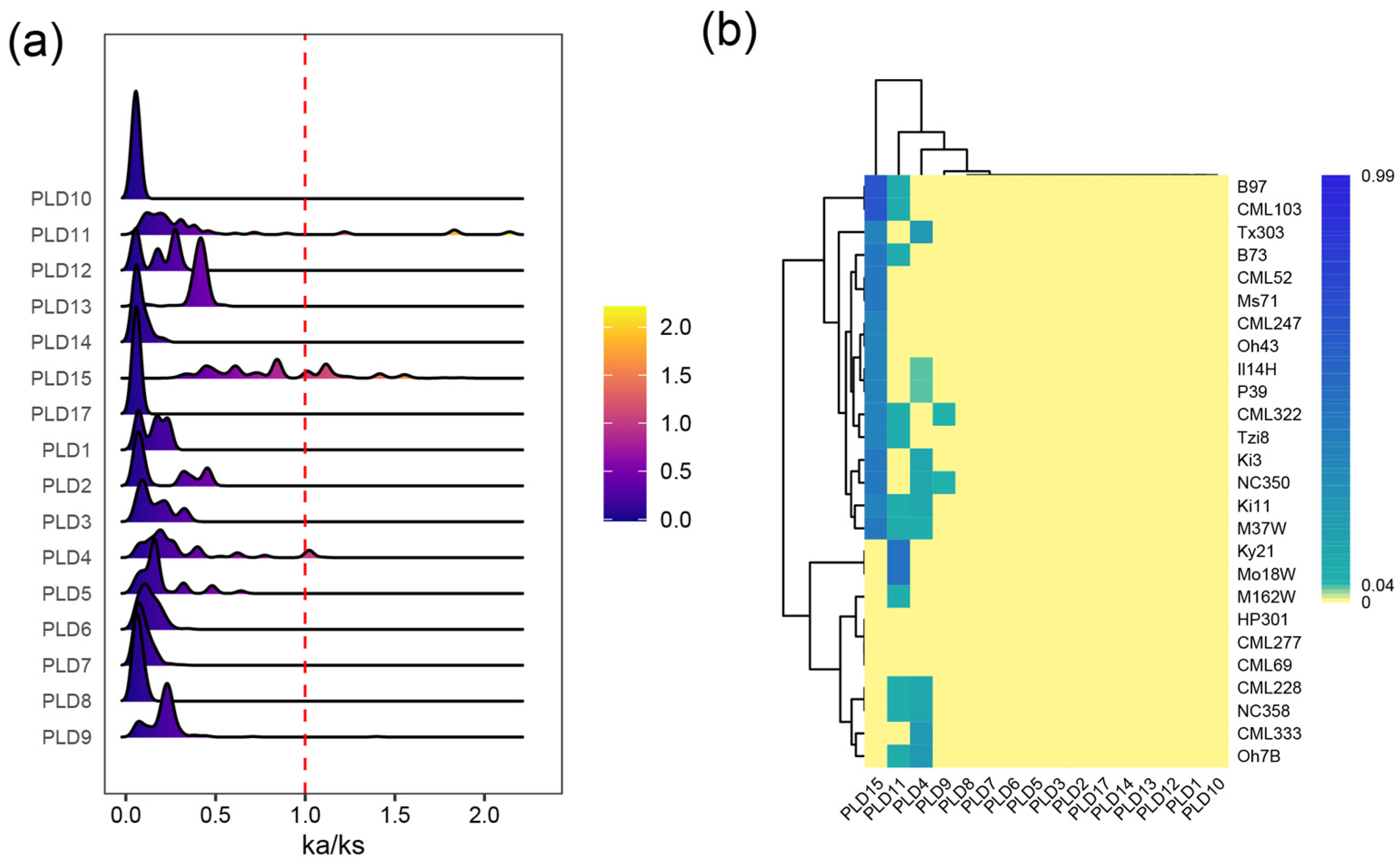
In addition to evolutionary analysis, the PAVs of ZmPLD genes across the 26 maize varieties was investigated to assess the genetic diversity of the PLD gene family. Figure 1b illustrates the PAV profile of each ZmPLD gene in the 26 genomes. Among the 21 ZmPLD pan-genes, several exhibited strict private gene characteristics: PLD16 was exclusively present in the CML277 genome, PLD18 was unique to CML52, PLD19 and PLD20 were only detected in CML228, and PLD21 was specific to CML277. Notably, PLD17 showed a slightly broader distribution, being present in three genomes, namely CML52, CML228, and Ms71. This PAV pattern not only highlights the significant genetic variation in the PLD gene family among different maize varieties but also implies that certain ZmPLD genes may be associated with specific adaptive traits of their host varieties.

2.2. ZmPLD Is Subjected to Different Selection Pressures Among Maize Varieties

During the long-term breeding process of maize, distinct cultivation conditions (such as ecological environments, agronomic management, and target traits) across different varieties have led to variations in the selection pressure acting on functional genes. The ZmPLD gene family, as a key player in regulating plant stress responses and growth development, is inevitably affected by such selection pressure, which may further drive the functional differentiation of its members among varieties. To explore the selection pressure on ZmPLD genes during maize cultivar breeding and clarify their evolutionary trends, we first screened ZmPLD gene family members that existed in at least two maize varieties (to ensure reliable sequence alignment). Then, we performed pairwise sequence alignment of the same gene family members across different varieties and calculated the Ka/Ks for each ZmPLD gene. The Ka/Ks ratio is a classic indicator to evaluate evolutionary pressure: a ratio greater than 1 indicates positive selection (advantageous mutations are retained), a ratio equal to 1 suggests neutral evolution (mutations are not affected by selection), and a ratio less than 1 reflects purifying selection (deleterious mutations are eliminated). Detailed results of this analysis are presented in Figure 2.
The distribution of Ka/Ks values of ZmPLD genes across the 26 maize cultivars is shown in Figure 2a. Among the 21 identified ZmPLD pan-genes, five were private genes that existed in only one variety; due to the lack of homologous sequences in other varieties, their Ka/Ks values could not be calculated. For the remaining 16 genes, four genes (ZmPLD4, ZmPLD9, ZmPLD11, and ZmPLD15) exhibited a high proportion of Ka/Ks values greater than 1. This result indicates that these four ZmPLD genes were under positive selection during maize domestication and cultivar breeding. Positive selection usually implies that the mutations of these genes may bring adaptive advantages to maize (e.g., enhanced stress resistance or improved agronomic traits), leading to the active retention of these variant alleles in the population and thus showing distinct variation trends. In contrast, the Ka/Ks values of all other ZmPLD genes were in the range of 0–1, which is a typical signature of purifying selection. Purifying selection suggests that these ZmPLD genes play essential and conserved roles in maize growth and development (e.g., maintaining basic membrane lipid metabolism or signal transduction), and any deleterious mutations in these genes would be eliminated by natural or artificial selection to ensure the stability of their core functions during cultivar breeding.

2.3. Expression and Structure of ZmPLD15 Genes Are Affected by SV in the Promoters

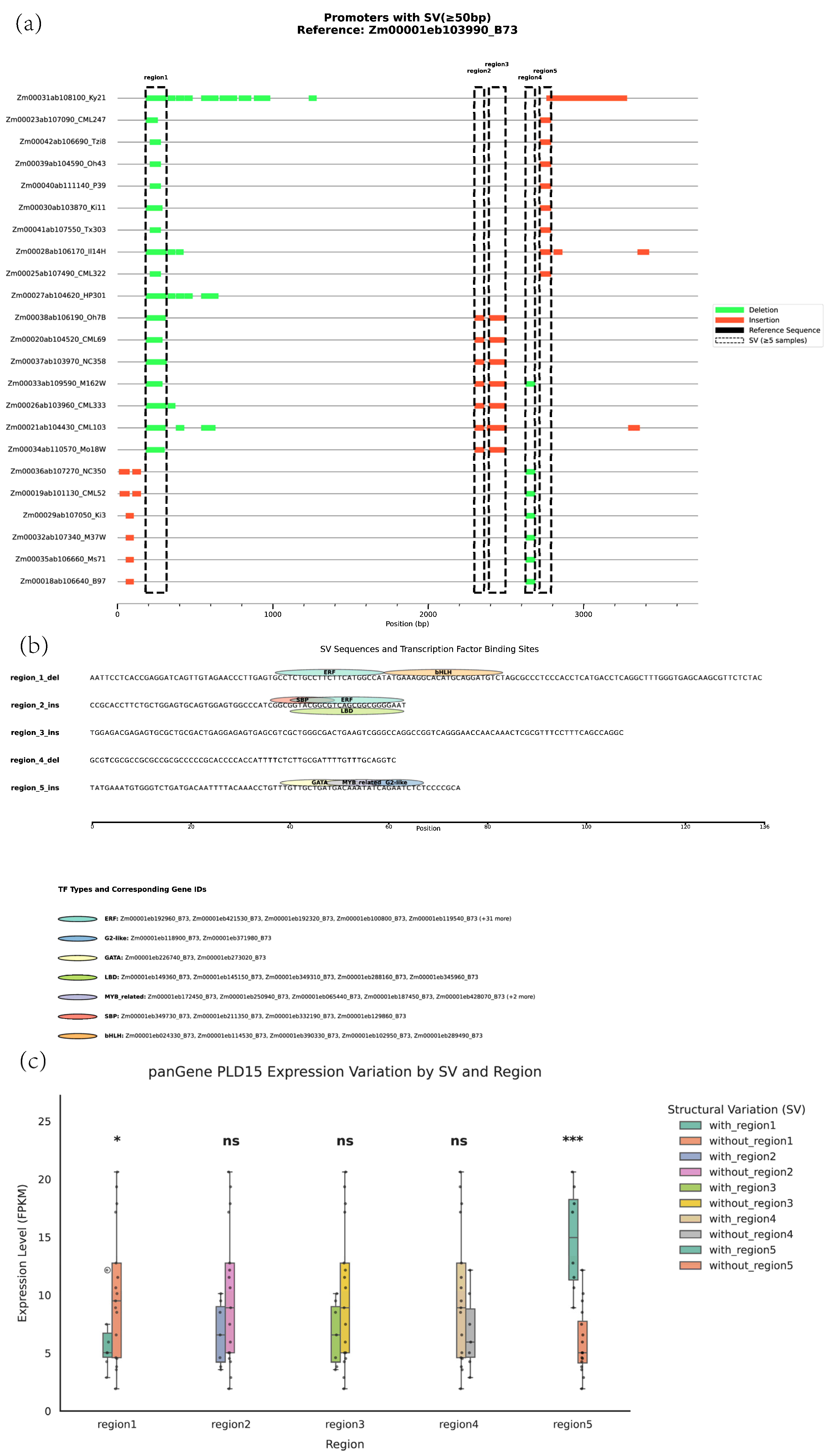
To investigate the potential impact of promoter SVs on ZmPLD15 expression, we focused on the 2000 bp upstream region of ZmPLD15 (a key candidate gene with positive selection signals) and compared it across 23 maize genomes relative to the reference genome B73 in Figure 3a. A total of five shared SVs were identified, with the criteria of being present in at least 5 maize accessions and involving insertions/deletions (Indels) longer than 50 bp. These shared SVs were further categorized based on their genetic characteristics: Region1 and Region4 were classified as deletion-type SVs (i.e., specific DNA segments missing compared to the B73 promoter), while Region2, Region3, and Region5 were defined as insertion-type SVs (i.e., additional DNA segments present relative to the B73 promoter). This classification provides a foundation for subsequent analyses of how different SV types regulate ZmPLD15 transcription.
To decipher the regulatory mechanisms underlying these promoter SVs, we employed FIMO (Find Individual Motif Occurrences) analysis to predict TF binding sites within each SV region. The results, visualized in Figure 3b, revealed distinct TF binding profiles across the SV regions. Specifically, Region1 was predicted to harbor binding sites for ERF (Ethylene Response Factor) and bHLH (basic Helix–Loop–Helix) TFs, which are well-known regulators of plant stress responses and growth development. Region2 showed potential binding sites for ERF, LBD (Lateral Organ Boundaries Domain), and SBP (SQUAMOSA Promoter Binding Protein) TFs, with LBD and SBP TFs playing critical roles in plant morphogenesis and signal transduction. Region5 was found to contain putative binding motifs for GABA (Gamma-Aminobutyric Acid)-responsive TFs, G2-like TFs, and MYB-related TFs, which are involved in abiotic stress adaptation and secondary metabolism. In contrast, no TF binding sites were detected in Region3 and Region4, suggesting that these two SV regions may not directly mediate transcriptional regulation through TF interactions.
To further validate whether these SV regions affect ZmPLD15 expression, we classified 24 maize cultivars into different groups based on the presence or absence of each SV-related sequence. We then performed a significance analysis of ZmPLD15 expression levels between groups with and without the SV sequences. As shown in Figure 3c, only the SVs in Region1 and Region5 significantly influenced ZmPLD15 expression levels. Specifically, cultivars carrying the Region1 deletion or Region5 insertion exhibited significantly different ZmPLD15 expression patterns compared to those without these SVs. This result indicates that Region1 and Region5 are functional SV regions that modulate ZmPLD15 transcription, likely through their interactions with specific TFs (as predicted in the FIMO analysis). In contrast, the presence or absence of SVs in Region2, Region3, and Region4 did not lead to significant changes in ZmPLD15 expression, further supporting that not all promoter SVs contribute to transcriptional regulation—only those with functional TF binding sites may play a role in gene expression control.

2.4. Impact of Mutations on ZmPLD15 Protein Spatial Structure and Substrate Binding Free Energy

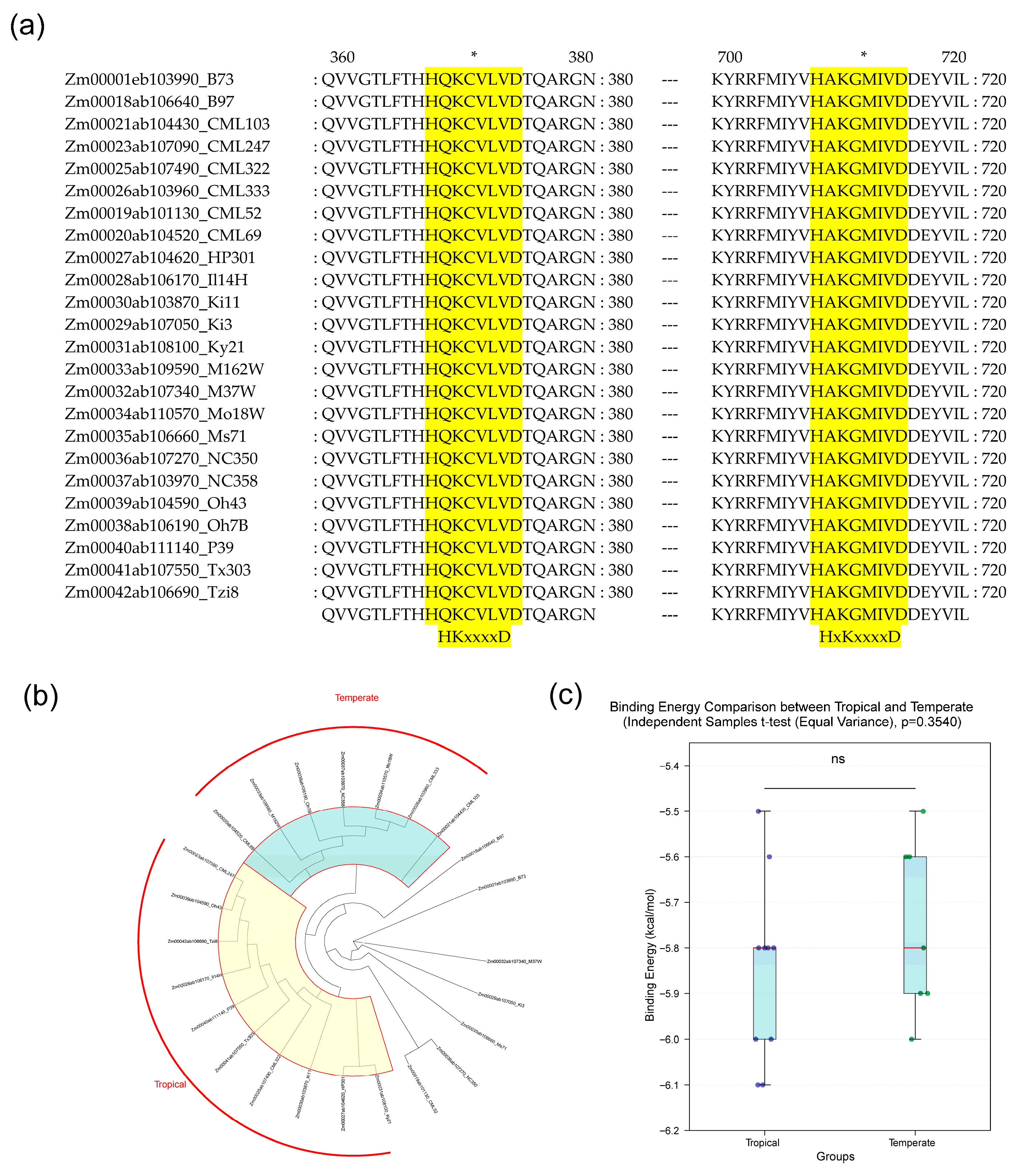
To explore whether SVs in the ZmPLD15 gene affect its protein structure (primary to tertiary) and subsequent substrate binding ability, we first predicted the sequence conservation and the three-dimensional (3D) structures of ZmPLD15 proteins encoded by 24 different maize genomes. The full-length sequence alignment of ZmPLD15 proteins (Figures S1 and Figure 4a) were highly consistent, and revealed only a few amino acid mutations. Notably, these variant amino acids were not located in functionally critical domains (e.g., the catalytic domain or substrate-binding pocket). Specifically, the two conserved HKD motifs (“HxKxxxxD”)—core elements for PLD hydrolytic activity—exhibited 100% sequence identity among all 24 ZmPLD15 proteins (Figure 4a), confirming strict conservation of the catalytic core. Consistent with the sequence conservation, the three-dimensional (3D) structures of ZmPLD15 proteins (predicted via Swiss-Model) showed no obvious conformational differences (Figure S1). Molecular docking with the substrate 1,2-diacyl-sn-glycero-3-phosphocholine (using AutoDock Vina v.1.2.7) further revealed that the substrate-binding positions of all ZmPLD15 variants were nearly identical, with minimal variations in binding free energies (ranged from −6.1 kcal/mol to −5.5 kcal/mol; Figure S1).
To evaluate the impact of geographical adaptation on substrate binding, we compared the substrate binding free energies of ZmPLD15 proteins from tropical and temperate maize germplasms (Figure 4b,c). Statistical analysis (Student’s t-test) showed no significant difference in binding free energy between the two groups (p > 0.05), indicating that the substrate binding ability of ZmPLD15 remains conserved regardless of the maize’s thermal adaptation origin.

2.5. Impact of ZmPLD15 Overexpression on Cold Stress Tolerance in Maize

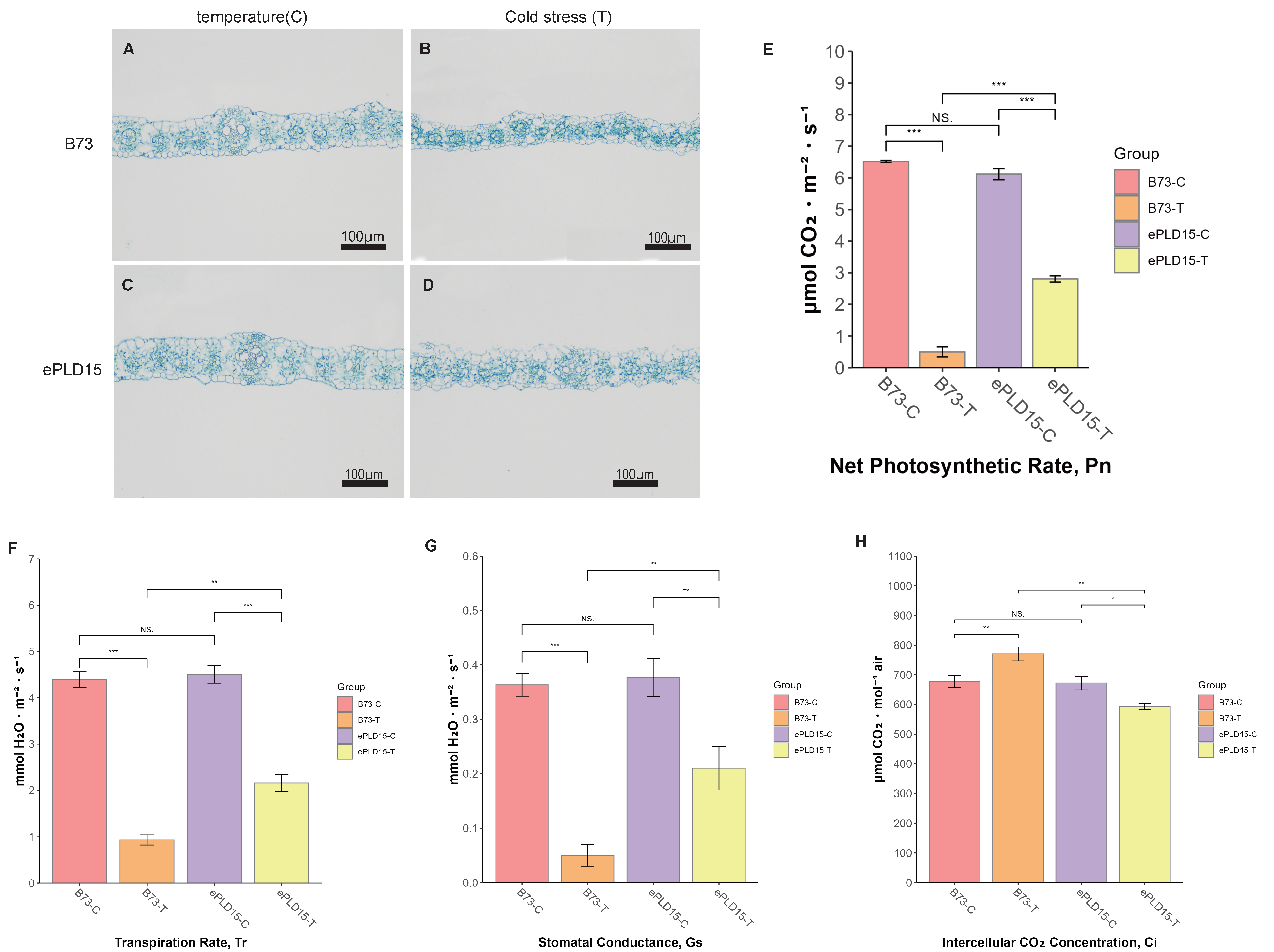
To elucidate the functional role of ZmPLD15 in maize cold stress tolerance, we established a comparative experimental system using ZmPLD15-overexpressing (ePLD15) transgenic line (background: B73) and non-transgenic wild-type (WT) B73. Before phenotypic analysis, qRT-PCR was performed to verify ZmPLD15 expression levels in WT and ePLD15 lines. Under normal temperature, the relative expression of ZmPLD15 in ePLD15 was 17.21-fold higher than that in WT; under cold stress + 24 h recovery, the expression level in ePLD15 was 16.46-fold higher than in WT (Supplementary Table S2). These results confirm that the CaMV 35S promoter effectively drove stable overexpression of ZmPLD15 in the transgenic lines, providing a reliable genetic background for subsequent cold tolerance assays. Both genotypes were subjected to cold stress treatment, and the structural integrity of leaf cells—an important indicator of cold-induced cellular damage—was observed via microscopic sectioning. As shown in Figure 5A–D, under normal temperature conditions, the leaf cells of both WT and ePLD15 plants exhibited a regular, intact structure with clear cell boundaries and full cytoplasm. However, after cold stress exposure, significant differences in cellular morphology emerged between the two genotypes: WT B73 leaves showed obvious signs of cell dehydration and wilting, including shrunken cytoplasm, disrupted cell membranes, and disorganized mesophyll cell arrangement—typical symptoms of cold-induced cellular damage. In contrast, although the leaf cells of ePLD15 plants also showed mild damage (e.g., slight cytoplasmic shrinkage), they maintained significantly better cell integrity compared to WT plants, with more intact cell membranes and a relatively organized mesophyll structure. This observation directly indicates that overexpression of ZmPLD15 enhances the structural stability of maize leaf cells under cold stress, thereby reducing cold-induced cellular damage.
To further evaluate the protective effect of ZmPLD15 on maize physiological function under cold stress, we measured key photosynthetic parameters of two materials—non-transgenic maize (WT, B73) and ZmPLD15-overexpressing transgenic line (ePLD15, B73 background)—one day after cold stress recovery, including Pn, Gs, Tr, and Ci. The full process was: three-leaf-stage seedlings were treated with cold stress (8–10 °C, 6 h) and then recovered at 25–28 °C for 24 h before measurement. These parameters are critical for assessing the photosynthetic capacity and stress recovery ability of plants. The results showed that the photosynthetic function of ePLD15 plants recovered more effectively compared to WT plants. Specifically, the Pn, Gs, and Tr of ePLD15 plants were maintained at approximately 45.8%, 47.9%, and 55.8% of their pre-stress levels, respectively, while the Ci was around 88.1% of the pre-stress value—indicating that the photosynthetic apparatus of ePLD15 plants retained a relatively high level of activity after cold stress. In sharp contrast, the photosynthetic parameters of WT plants were severely impaired: Pn, Gs, and Tr dropped to only 7.6%, 21.3%, and 13.8% of their pre-stress levels, respectively. Notably, the Ci of WT plants increased to 113.7% of the pre-stress value, which is likely due to the severe inhibition of photosynthetic CO2 fixation (resulting from damaged photosynthetic machinery) while stomatal conductance remained partially open, leading to the accumulation of CO2 in the intercellular space. Statistical analysis confirmed that all the observed differences in photosynthetic parameters between ePLD15 and WT plants were significant (p < 0.05). These results collectively demonstrate that overexpression of ZmPLD15 not only protects the structural integrity of leaf cells but also effectively maintains the photosynthetic function of maize under cold stress, thereby enhancing the cold tolerance and stress recovery ability of maize plants.

3. Discussion

Pangenome-based gene family analysis effectively captures genetic variation overlooked by single reference genomes [10,42]. In this study, we identified 21 PLD family members from the maize pangenome constructed with 26 genomes, among which five were classified as private genes—present in only one of the 26 genomes. In contrast, the most widely used B73 reference genome contains only 15 PLD genes, and of the 21 pan-genes, merely nine are core genes (present in all 26 genomes with allelic variants in each). This highlights the pangenome’s advantage in complete gene family identification. Notably, ZmPLD14 and ZmPLD17 exhibit a “complementary distribution” across genomes (presence of one correlates with absence of the other), implying functional redundancy to maintain PLD-mediated pathway stability [10,43].
The calculation of Ka/Ks for homologous PLD genes across different genomes provides critical insights into the evolutionary forces shaping the gene family during maize domestication and breeding [44]. Ka/Ks analysis of homologous ZmPLD genes revealed most ZmPLD genes under purifying selection (Ka/Ks < 1), reflecting their conserved roles in maize growth (e.g., membrane homeostasis, signal transduction) [45,46]. Notably, only three PLD genes (including ZmPLD15) showed Ka/Ks ratios > 1. Among these, PLD15 had a distinct Ka/Ks distribution peak shifted toward Ka/Ks > 1, indicating stronger positive selection—suggesting its variants confer adaptive advantages (e.g., enhanced cold tolerance) [47].
SVs in regulatory regions (especially promoters) drive transcriptional plasticity, supporting plant environmental adaptation and response to breeding selection [48]. SVs in the ZmPLD15 promoter regulate its transcription. Relative to B73, five shared SVs were identified (2 deletions, 3 insertions). Region1 (with ERF/bHLH binding sites) and Region5 (with GATA and G2-like binding sites) significantly affected ZmPLD15 expression (varieties carrying Region1 deletion or Region5 insertion showed distinct expression levels), while Regions2–4 (no functional TF binding sites) had no impact—confirming only SVs with functional elements mediate transcriptional regulation [49,50,51,52,53]. “GCATGTGC”, “GCACATGC” and “CCTCTGCCTTCTTCATGGCCA” are located in Region1 SV of ZmPLD15. As typical TF binding sites MP00084 [54,55,56,57], MP00101 [58,59,60] and MP00456 [61,62,63,64], they have been repeatedly experimentally verified in model plants such as Arabidopsis thaliana that their downstream gene expression is regulated by ERF/bHLH—type TFs. And “GAGATTCTGA” in Region5 SV of ZmPLD15 serves as the recognition site MP00022 [65] for G2-like TFs, and “TTGTCATCAGCAACA” serves as the recognition site MP00369 [66] for GATA—type TFs, which have also been experimentally verified in Arabidopsis thaliana. In contrast to the variable promoter, ZmPLD15′s coding region is highly conserved. ZmPLD15 proteins from different genomes showed minimal differences in secondary/tertiary structures (including catalytic HKD motifs and substrate-binding pockets) [67]. Molecular docking revealed 1,2-diacyl-sn-glycero-3-phosphocholine binding free energies ranged from −6.1 to −5.5 kcal/mol, with no significant differences between tropical and temperate germplasms (p > 0.05). This indicates strict evolutionary constraint on ZmPLD15′s catalytic function to ensure stable physiological roles [68].
This “variable promoter-conserved coding region” pattern reflects breeding preferences for ZmPLD15: regulatory SVs fine-tune expression (e.g., cold-induced ZmPLD15 upregulation) to enhance adaptability, while coding-region mutations (which risk disrupting protein function, e.g., membrane metabolism disorders) are avoided—aligning with the general trend of “regulatory variation driving phenotypic optimization” in crop improvement [69,70,71,72,73].
The cold tolerance advantage conferred by PLD15 overexpression first manifests in the protection of mesophyll cell photosynthetic activity—a process highly sensitive to cold stress [74,75]. Low temperatures typically disrupt the structure of thylakoid membranes (the site of light-dependent reactions) and induce the inactivation of Rubisco (the key enzyme in Calvin cycle carbon fixation), leading to non-stomatal limitations of photosynthesis [76]. Functional validation showed ePLD15 had better leaf cell integrity than WT after cold stress (8–10 °C, 6 h): ePLD15 exhibited less cytoplasmic shrinkage and membrane damage. Photosynthetic recovery was also superior in ePLD15 retained 45.8% Pn, 47.9% Gs, and 55.8% Tr of pre-stress levels, with Ci at 88.1%. In contrast, WT retained only 7.6% Pn, 21.3% Gs, and 13.8% Tr, with Ci elevated to 113.7% (CO2 accumulation from non-stomatal limitations). Together, these confirm ZmPLD15 enhances maize cold tolerance by protecting the photosynthetic system, providing a key gene for cold-tolerant breeding. Our study focuses on cold stress, but ZmPLD genes may have broader functions in other abiotic stresses. As reported, ZmbZIP54 is involved in maize Pb tolerance [77], and salt stress affects maize seed germination via specific genetic regulation [78], suggesting ZmPLD genes might be part of these multi-stress response networks.

4. Materials and Methods

4.1. Identification of Maize PLD Gene Family

Twenty-six maize genomes were obtained from the study by Hufford et al. [41]. For PLD gene identification, the HMM profile of the PLD domain (PF00614) was downloaded from the Pfam database (https://pfam.xfam.org/). HMMER 3.3.2 was used to search the annotated genes of the 26 genomes; genes with E-value < 10−5 and PLD domain alignment length > 70% were designated as ZmPLD members.

4.2. Phylogenetic Analysis and Presence/Absence Variation in ZmPLD Gene Family

For PLD phylogenetic analysis, protein sequences from maize, Arabidopsis, and rice were used: MAFFT v.7.526 for multiple alignment, Trimal 1.5.rev for trimming conserved regions, IQTree v.3.0.1 for tree building, and R’s ggtree v.3.8.2 for visualization. ZmPLD PAV data were from Hufford et al. [41]; gene IDs and presence/absence in 26 maize genomes were extracted, then visualized via Rscript v.4.3.3 with the ComplexHeatmap package v.2.13.1.

4.3. Ka/Ks Calculation

Protein and full-length coding sequence (CDS) sequences of identified ZmPLD genes were extracted from different maize genomes. Ka/Ks values were calculated using the KaKs Calculator v.3.0 with the ‘YN’ model [37,79], and density plots of these values were generated with R’s ggridges package v.0.5.6. Additionally, the proportion of ZmPLD genes with Ka/Ks > 1 was computed, and a heatmap of this proportion was constructed using R’s pheatmap package v.1.0.12.

4.4. Expression and Structure of ZmPLD15 Genes Are Affected by SV in the Promoters

For ZmPLD15, 2000-bp upstream sequences were extracted from maize genomes containing this gene. MAFFT v.7.526 was used for multiple sequence alignment, with B73 as the reference. Python v.3.10.13 was employed to identify insertions/deletions (≥50 bp) present in at least 5 promoter sequences (defined as SVs). SV sequences were extracted, and their TF binding sites were predicted via FIMO. Samples were grouped by the presence/absence of each SV, and the significance of SVs’ association with ZmPLD15 expression was analyzed. Finally, Python’s matplotlib library was used for visualization of the results.

4.5. Impact of Mutations on ZmPLD15 Protein Spatial Structure and Substrate Binding Free Energy

The sequence conservation and the 3D structures of ZmPLD15 proteins encoded by different maize genomes were conducted by MAFFT and predicted via the SwissModel website. Molecular docking of these proteins with the substrate (1,2-diacyl-sn-glycero-3-phosphocholine) was performed using AutoDock Vina v.1.2.7 to calculate binding free energies, and 3D visualization of docking results was done with PyMOL v.2.5.2. Based on phylogenetic trees and breeding information, representative temperate and tropical maize germplasms were selected. Statistical analysis of ZmPLD15 expression differences between the two groups was conducted, and results were visualized using Python’s matplotlib library.

4.6. Impact of ZmPLD15 Overexpression on Cold Stress Tolerance in Maize

The ZmPLD15 overexpression vector was constructed using the commercial vector pCAMBIA3301 (CAMBIA, Canberra, Australia). The CDS of ZmPLD15 (derived from the B73 genome, gene ID: Zm00001eb103990) was cloned and inserted into the plant expression vector pCAMBIA3301 (replacing the GUS gene) via digestion-ligation using NcoI and BstEII sites. Agrobacterium-mediated genetic transformation and glufosinate screening yielded ZmPLD15-overexpressing transgenic B73 maize mutants. Three-leaf-stage seedlings of WT and ePLD15 were subjected to cold stress (8–10 °C for 6 h), followed by 24 h recovery at room temperature. Quantitative real-time PCR (qRT-PCR) with three biological replicates of WT and ePLD15 maize seedlings were performed, and Specific primers for ZmPLD15 and ZmGAPDH are listed in Supplementary Table S3. Leaf section preparation followed the protocol described by Atkinson [80] with minor modifications for maize: 1 cm mid-leaf segments (avoid midrib) fixed in FAA (1:1:18, v/v, 4 °C, 24 h), dehydrated (gradient ethanol), embedded in paraffin (52–56 °C), sectioned (8 μm), stained (1% safranin O, 0.5% fast green), and imaged with Olympus BX53(Olympus Corporation, Hachioji, Tokyo, Japan), 400×. A CIRAS-2 portable photosynthesis system measured photosynthetic parameters (Pn, Gs, Tr, Ci) of WT and transgenic lines under room temperature and cold stress. Data were statistically analyzed and visualized using R’s ggplot2 package 3.5.1.

Supplementary Materials

The following supporting information can be downloaded at https://www.mdpi.com/article/10.3390/plants14243858/s1, Figure S1: Spatial structure simulation of ZmPLD15 proteins derived from different maize genomes and their molecular docking results with the substrate (1,2-diacyl-sn-glycero-3-phosphocholine); Table S1: Pan_gene list. Table S2: qRT-PCR Results for ZmPLD15 Overexpression Validation. Table S3: Primers Used for qRT-PCR.

Author Contributions

Conceptualization, S.-N.L.; Data curation, X.L.; Formal analysis, Q.C.; Funding acquisition, S.-N.L. and Q.C.; Investigation, X.L.; Methodology, S.-N.L. and Y.W.; Project administration, M.-H.S.; Software, M.-H.S.; Validation, Y.-L.L. and Y.S.; Writing—original draft, S.-N.L.; Writing—review & editing, Y.W. and J.-G.Z. All authors have read and agreed to the published version of the manuscript.

Funding

This research was funded by Innovation Project of Heilongjiang Academy of Agricultural Sciences: CX25JC06; Research Business Fee Project of Provincial Research Institutes under the Finance Department of Heilongjiang Province: CZKYF2024-1-C010; The earmarked fund for CARS-02-07.

Data Availability Statement

No new raw data were generated in this study. All data analyzed during the research were obtained from the publicly available pan-maize genome dataset reported by Hufford et al. (2021) [41]. The processed data generated during this study, including multiple sequence alignment results, Ka/Ks ratio calculation outputs, and phylogenetic tree annotation files, are available from the corresponding author (Yunpeng Wang, wangypbio@163.com) upon reasonable request.

Acknowledgments

Thanks to Guanshu Biotechnology Services (Changchun) Co., Ltd., for their critical support in this research. The company generously provided the server resources essential for bioinformatics analyses, which enabled the efficient processing and analysis of large-scale datasets generated in this study.

Conflicts of Interest

The authors declare no conflicts of interest.

References

  1. Ali, U.; Lu, S.; Fadlalla, T.; Iqbal, S.; Yue, H.; Yang, B.; Hong, Y.; Wang, X.; Guo, L. The functions of phospholipases and their hydrolysis products in plant growth, development and stress responses. Prog. Lipid Res. 2022, 86, 101158. [Google Scholar] [CrossRef] [PubMed]
  2. Pacheco, R.; Quinto, C. Phospholipase Ds in plants: Their role in pathogenic and symbiotic interactions. Plant Physiol. Biochem. 2022, 173, 76–86. [Google Scholar] [CrossRef] [PubMed]
  3. Yang, B.; Fan, R.; Yao, S.; Lou, H.; Li, J.; Guo, L.; Wang, X. Non-specific phospholipase Cs and their potential for crop improvement. J. Exp. Bot. 2025, eraf334. [Google Scholar] [CrossRef] [PubMed]
  4. Yuan, D.; Qin, H.; Yu, Z. Integration of hepatic lipidomics and transcriptomics reveals dysregulation of lipid metabolism in a golden hamster model of visceral leishmaniasis. Front. Immunol. 2025, 16, 1595702. [Google Scholar] [CrossRef]
  5. Ferreira, D.; Figueiredo, J.; Laureano, G.; Machado, A.; Arrabaca, J.D.; Duarte, B.; Figueiredo, A.; Matos, A.R. Membrane remodelling and triacylglycerol accumulation in drought stress resistance: The case study of soybean phospholipases A. Plant Physiol. Biochem. 2021, 169, 9–21. [Google Scholar] [CrossRef]
  6. Yang, D.; Wang, W.; Fang, Z.; Wu, S.; Chen, L.; Chen, J.; Zhang, W.; Wang, F.; Sun, T.; Xiang, L.; et al. Genome-Wide Analysis of the Phospholipase Ds in Perennial Ryegrass Highlights LpABFs-LpPLDdelta3 Cascade Modulated Osmotic and Heat Stress Responses. Plant Cell Environ. 2025, 48, 1115–1129. [Google Scholar] [CrossRef]
  7. Jang, J.H.; Bayaraa, U.; Lee, J.H.; Lee, O.R. Overexpression of the patatin-related phospholipase A gene, PgpPLAIIIbeta, in ginseng adventitious roots reduces lignin and ginsenoside content while increasing fatty acid content. Plant Physiol. Biochem. 2025, 221, 109602. [Google Scholar] [CrossRef]
  8. Zhang, H.; Zhang, Y.; Xu, N.; Rui, C.; Fan, Y.; Wang, J.; Han, M.; Wang, Q.; Sun, L.; Chen, X.; et al. Genome-wide expression analysis of phospholipase A1 (PLA1) gene family suggests phospholipase A1-32 gene responding to abiotic stresses in cotton. Int. J. Biol. Macromol. 2021, 192, 1058–1074. [Google Scholar] [CrossRef]
  9. Mandal, S.; Bandyopadhyay, S.; Tyagi, K.; Roy, A. Recent advances in understanding the molecular role of phosphoinositide-specific phospholipase C gamma 1 as an emerging onco-driver and novel therapeutic target in human carcinogenesis. Biochim. Biophys. Acta Rev. Cancer 2021, 1876, 188619. [Google Scholar] [CrossRef]
  10. Sagar, S.; Deepika; Biswas, D.K.; Chandrasekar, R.; Singh, A. Genome-wide identification, structure analysis and expression profiling of phospholipases D under hormone and abiotic stress treatment in chickpea (Cicer arietinum). Int. J. Biol. Macromol. 2021, 169, 264–273. [Google Scholar] [CrossRef]
  11. Nakamura, Y. Headgroup biosynthesis of phosphatidylcholine and phosphatidylethanolamine in seed plants. Prog. Lipid Res. 2021, 82, 101091. [Google Scholar] [CrossRef]
  12. Li, T.; Zhang, S.; Yao, S.; Li, X.; Jia, Q.; Yuan, J.; Zhang, W.; Wang, X.; Zhang, Q. Nonspecific phospholipases C3 and C4 interact with PIN-FORMED2 to regulate growth and tropic responses in Arabidopsis. Plant Cell 2024, 36, 2310–2327. [Google Scholar] [CrossRef]
  13. Yao, S.; Yang, B.; Li, J.; Tang, S.; Tang, S.; Kim, S.C.; Wang, X. Phosphatidic acid signaling in modulating plant reproduction and architecture. Plant Commun. 2025, 6, 101234. [Google Scholar] [CrossRef]
  14. Qin, C.; Wang, X. The Arabidopsis phospholipase D family. Characterization of a calcium-independent and phosphatidylcholine-selective PLD zeta 1 with distinct regulatory domains. Plant Physiol. 2002, 128, 1057–1068. [Google Scholar] [CrossRef] [PubMed]
  15. Li, G.; Lin, F.; Xue, H.W. Genome-wide analysis of the phospholipase D family in Oryza sativa and functional characterization of PLD beta 1 in seed germination. Cell Res. 2007, 17, 881–894. [Google Scholar] [CrossRef] [PubMed]
  16. Zhao, J.; Zhou, D.; Zhang, Q.; Zhang, W. Genomic analysis of phospholipase D family and characterization of GmPLDαs in soybean (Glycine max). J. Plant Res. 2012, 125, 569–578. [Google Scholar] [CrossRef] [PubMed]
  17. Chen, L.; Cao, B.; Han, N.; Tao, Y.; Zhou, S.F.; Li, W.C.; Fu, F.L. Phospholipase D family and its expression in response to abiotic stress in maize. Plant Growth Regul. 2017, 81, 197–207. [Google Scholar] [CrossRef]
  18. Yao, Y.; Li, J.; Lin, Y.; Zhou, J.; Zhang, P.; Xu, Y. Structural insights into phospholipase D function. Prog. Lipid Res. 2021, 81, 101070. [Google Scholar] [CrossRef] [PubMed]
  19. Wu, Z.; Violot, S.; Abousalham, A.; Noiriel, A. A new bacterial phospholipase D with specificity for phosphatidylethanolamine over phosphatidylcholine. Int. J. Biol. Macromol. 2025, 304, 140578. [Google Scholar] [CrossRef] [PubMed]
  20. Kim, S.C.; Yao, S.; Zhang, Q.; Wang, X. Phospholipase Ddelta and phosphatidic acid mediate heat-induced nuclear localization of glyceraldehyde-3-phosphate dehydrogenase in Arabidopsis. Plant J. Cell Mol. Biol. 2022, 112, 786–799. [Google Scholar] [CrossRef]
  21. Zhou, Y.; Zhou, D.M.; Yu, W.W.; Shi, L.L.; Zhang, Y.; Lai, Y.X.; Huang, L.P.; Qi, H.; Chen, Q.F.; Yao, N.; et al. Phosphatidic acid modulates MPK3- and MPK6-mediated hypoxia signaling in Arabidopsis. Plant Cell 2022, 34, 889–909. [Google Scholar] [CrossRef] [PubMed]
  22. Zhang, Y.; Zhao, Z.; Liu, Z.; Yao, J.; Yin, K.; Yan, C.; Zhang, Y.; Liu, J.; Li, J.; Zhao, N.; et al. Populus euphratica PeNADP-ME interacts with PePLDdelta to mediate sodium and ROS homeostasis under salinity stress. Plant Physiol. Biochem. 2024, 210, 108600. [Google Scholar] [CrossRef]
  23. Pandit, S.; Goel, R.; Mishra, G. Phosphatidic acid binds to and stimulates the activity of ARGAH2 from Arabidopsis. Plant Physiol. Biochem. 2022, 185, 344–355. [Google Scholar] [CrossRef]
  24. Chen, W.; Zhang, P.; Liu, D.; Wang, X.; Lu, S.; Liu, Z.; Yang, M.; Deng, T.; Chen, L.; Qi, H.; et al. OsPLDalpha1 mediates cadmium stress response in rice by regulating reactive oxygen species accumulation and lipid remodeling. J. Hazard. Mater. 2024, 479, 135702. [Google Scholar] [CrossRef]
  25. Deepika, D.; Singh, A. Plant phospholipase D: Novel structure, regulatory mechanism, and multifaceted functions with biotechnological application. Crit. Rev. Biotechnol. 2022, 42, 106–124. [Google Scholar] [CrossRef]
  26. Gong, F.; Zhang, T.; Lu, Y.; Govindan, V.; Liu, R.; Liu, J.; Wang, X.; Liu, D.; Zheng, Y.; Huang, L.; et al. Overexpression of TdNACB improves the drought resistance of rice. Plant Physiol. Biochem. 2024, 216, 109157. [Google Scholar] [CrossRef] [PubMed]
  27. Guan, C.; Wu, B.; Ma, S.; Zhang, J.; Liu, X.; Wang, H.; Zhang, J.; Gao, R.; Jiang, H.; Jia, C. Genome-wide characterization of LBD transcription factors in switchgrass (Panicum virgatum L.) and the involvement of PvLBD12 in salt tolerance. Plant Cell Rep. 2023, 42, 735–748. [Google Scholar] [CrossRef]
  28. Aleksandrowicz, A.; Carolak, E.; Dutkiewicz, A.; Blachut, A.; Waszczuk, W.; Grzymajlo, K. Better together-Salmonella biofilm-associated antibiotic resistance. Gut Microbes 2023, 15, 2229937. [Google Scholar] [CrossRef] [PubMed]
  29. Mao, H.; Jiang, C.; Tang, C.; Nie, X.; Du, L.; Liu, Y.; Cheng, P.; Wu, Y.; Liu, H.; Kang, Z.; et al. Wheat adaptation to environmental stresses under climate change: Molecular basis and genetic improvement. Mol. Plant 2023, 16, 1564–1589. [Google Scholar] [CrossRef]
  30. Zhang, P.; Gong, J.S.; Qin, J.; Li, H.; Hou, H.J.; Zhang, X.M.; Xu, Z.H.; Shi, J.S. Phospholipids (PLs) know-how: Exploring and exploiting phospholipase D for its industrial dissemination. Crit. Rev. Biotechnol. 2021, 41, 1257–1278. [Google Scholar] [CrossRef]
  31. Eh, T.J.; Jiang, Y.; Jiang, M.; Li, J.; Lei, P.; Ji, X.; Kim, H.I.; Zhao, X.; Meng, F. The role of trehalose metabolism in plant stress tolerance. J. Adv. Res. 2025, 76, 57–72. [Google Scholar] [CrossRef]
  32. Zeng, R.; Zhang, X.; Song, G.; Lv, Q.; Li, M.; Fu, D.; Zhang, Z.; Gao, L.; Zhang, S.; Yang, X.; et al. Genetic variation in the aquaporin TONOPLAST INTRINSIC PROTEIN 4;3 modulates maize cold tolerance. Plant Biotechnol. J. 2024, 22, 3037–3050. [Google Scholar] [CrossRef]
  33. Luklova, M.; Dubois, M.; Kameniarova, M.; Plackova, K.; Novak, J.; Kopecka, R.; Karady, M.; Pavlu, J.; Skalak, J.; Jindal, S.; et al. Light Quantity Impacts Early Response to Cold and Cold Acclimation in Young Leaves of Arabidopsis. Plant Cell Environ. 2025, 48, 5030–5052. [Google Scholar] [CrossRef]
  34. Zhang, H.; Pei, Y.; Zhu, F.; He, Q.; Zhou, Y.; Ma, B.; Chen, X.; Guo, J.; Khan, A.; Jahangir, M.; et al. CaSnRK2.4-mediated phosphorylation of CaNAC035 regulates abscisic acid synthesis in pepper (Capsicum annuum L.) responding to cold stress. Plant J. Cell Mol. Biol. 2024, 117, 1377–1391. [Google Scholar] [CrossRef]
  35. Zhang, C.; Li, G.; Pan, Y.; Li, Q.; Miao, Y.; Xiang, Y.; Zhang, A. Brassinosteroid-signaling kinase 4 activates mitogen-activated protein kinase 4 to enhance cold stress tolerance in maize. Plant Cell 2025, 37, koaf234. [Google Scholar] [CrossRef]
  36. Zou, J.; Yang, L.; Li, Y.; Piao, M.; Li, Y.; Yao, N.; Zhang, X.; Zhang, Q.; Hu, G.; Yang, D.; et al. Comparative Proteomics Combined with Morphophysiological Analysis Revealed Chilling Response Patterns in Two Contrasting Maize Genotypes. Cells 2022, 11, 1321. [Google Scholar] [CrossRef] [PubMed]
  37. Jiang, H.; Shi, Y.; Liu, J.; Li, Z.; Fu, D.; Wu, S.; Li, M.; Yang, Z.; Shi, Y.; Lai, J.; et al. Natural polymorphism of ZmICE1 contributes to amino acid metabolism that impacts cold tolerance in maize. Nat. Plants 2022, 8, 1176–1190. [Google Scholar] [CrossRef] [PubMed]
  38. Jin, R.; Kim, H.S.; Yu, T.; Zhang, A.; Yang, Y.; Liu, M.; Yu, W.; Zhao, P.; Zhang, Q.; Cao, Q.; et al. Identification and function analysis of bHLH genes in response to cold stress in sweetpotato. Plant Physiol. Biochem. 2021, 169, 224–235. [Google Scholar] [CrossRef] [PubMed]
  39. Guo, X.; Chong, K. The teosinte-derived allele COOL1 is a potential target for molecular design of chilling resilience in maize. J. Integr. Plant Biol. 2025, 67, 1205–1207. [Google Scholar] [CrossRef]
  40. Zeng, R.; Li, Z.; Shi, Y.; Fu, D.; Yin, P.; Cheng, J.; Jiang, C.; Yang, S. Natural variation in a type-A response regulator confers maize chilling tolerance. Nat. Commun. 2021, 12, 4713. [Google Scholar] [CrossRef]
  41. Hufford, M.B.; Seetharam, A.S.; Woodhouse, M.R.; Chougule, K.M.; Ou, S.; Liu, J.; Ricci, W.A.; Guo, T.; Olson, A.; Qiu, Y.; et al. De novo assembly, annotation, and comparative analysis of 26 diverse maize genomes. Science 2021, 373, 655–662. [Google Scholar] [CrossRef]
  42. Yocca, A.E.; Lu, Z.; Schmitz, R.J.; Freeling, M.; Edger, P.P. Evolution of Conserved Noncoding Sequences in Arabidopsis thaliana. Mol. Biol. Evol. 2021, 38, 2692–2703. [Google Scholar] [CrossRef]
  43. Molina-Pardines, C.; Haro-Moreno, J.M.; Rodriguez-Valera, F.; Lopez-Perez, M. Extensive paralogism in the environmental pangenome: A key factor in the ecological success of natural SAR11 populations. Microbiome 2025, 13, 41. [Google Scholar] [CrossRef]
  44. Wang, D.; Zhang, Y.; Zhang, Z.; Zhu, J.; Yu, J. KaKs_Calculator 2.0: A toolkit incorporating gamma-series methods and sliding window strategies. Genom. Proteom. Bioinform. 2010, 8, 77–80. [Google Scholar] [CrossRef]
  45. Wu, D.; Guan, L.; Wu, Y.; Wang, Y.; Gao, R.; Zhong, J.; Zhang, Q.; Wang, S.; Zhang, X.; Zhang, G.; et al. Multi-Omics Analyses Offer Novel Insights into the Selection of Sugar and Lipid Metabolism During Maize Domestication and Improvement. Plant Cell Environ. 2025, 48, 2377–2395. [Google Scholar] [CrossRef]
  46. Aleem, M.; Aleem, S.; Sharif, I.; Wu, Z.; Aleem, M.; Tahir, A.; Atif, R.M.; Cheema, H.M.N.; Shakeel, A.; Lei, S.; et al. Characterization of SOD and GPX Gene Families in the Soybeans in Response to Drought and Salinity Stresses. Antioxidants 2022, 11, 460. [Google Scholar] [CrossRef]
  47. Li, C.; Li, Y.; Song, G.; Yang, D.; Xia, Z.; Sun, C.; Zhao, Y.; Hou, M.; Zhang, M.; Qi, Z.; et al. Gene expression and expression quantitative trait loci analyses uncover natural variations underlying the improvement of important agronomic traits during modern maize breeding. Plant J. Cell Mol. Biol. 2023, 115, 772–787. [Google Scholar] [CrossRef]
  48. Shen, Z.; Li, R.Z.; Prohaska, T.A.; Hoeksema, M.A.; Spann, N.J.; Tao, J.; Fonseca, G.J.; Le, T.; Stolze, L.K.; Sakai, M.; et al. Systematic analysis of naturally occurring insertions and deletions that alter transcription factor spacing identifies tolerant and sensitive transcription factor pairs. eLife 2022, 11, e70878. [Google Scholar] [CrossRef] [PubMed]
  49. Hurieva, B.; Kumar, D.K.; Morag, R.; Lupo, O.; Carmi, M.; Barkai, N.; Jonas, F. Disordered sequences of transcription factors regulate genomic binding by integrating diverse sequence grammars and interaction types. Nucleic Acids Res. 2024, 52, 8763–8777. [Google Scholar] [CrossRef] [PubMed]
  50. Flores-Villegas, M.; Rebnegger, C.; Kowarz, V.; Prielhofer, R.; Mattanovich, D.; Gasser, B. Systematic sequence engineering enhances the induction strength of the glucose-regulated GTH1 promoter of Komagataella phaffii. Nucleic Acids Res. 2023, 51, 11358–11374. [Google Scholar] [CrossRef] [PubMed]
  51. Lu, X.; Lei, Y.; Xu, Z.; Cheng, Z.; Liu, M.; Tai, Y.; Han, X.; Hao, Z.; Li, M.; Zhang, D.; et al. Natural variations in the promoter of ZmDeSI2 encoding a deSUMOylating isopeptidase controls kernel methionine content in maize. Mol. Plant 2025, 18, 872–891. [Google Scholar] [CrossRef]
  52. Brazda, V.; Bartas, M.; Bowater, R.P. Evolution of Diverse Strategies for Promoter Regulation. Trends Genet. TIG 2021, 37, 730–744. [Google Scholar] [CrossRef]
  53. Krieger, G.; Lupo, O.; Wittkopp, P.; Barkai, N. Evolution of transcription factor binding through sequence variations and turnover of binding sites. Genome Res. 2022, 32, 1099–1111. [Google Scholar] [CrossRef]
  54. Gangappa, S.N.; Chattopadhyay, S. MYC2 differentially regulates GATA-box containing promoters during seedling development in Arabidopsis. Plant Signal. Behav. 2013, 8, e25679. [Google Scholar] [CrossRef] [PubMed]
  55. Chen, R.; Jiang, H.; Li, L.; Zhai, Q.; Qi, L.; Zhou, W.; Liu, X.; Li, H.; Zheng, W.; Sun, J.; et al. The Arabidopsis mediator subunit MED25 differentially regulates jasmonate and abscisic acid signaling through interacting with the MYC2 and ABI5 transcription factors. Plant Cell 2012, 24, 2898–2916. [Google Scholar] [CrossRef] [PubMed]
  56. Gangappa, S.N.; Maurya, J.P.; Yadav, V.; Chattopadhyay, S. The regulation of the Z- and G-box containing promoters by light signaling components, SPA1 and MYC2, in Arabidopsis. PLoS ONE 2013, 8, e62194. [Google Scholar] [CrossRef]
  57. Figueroa, P.; Browse, J. The Arabidopsis JAZ2 promoter contains a G-Box and thymidine-rich module that are necessary and sufficient for jasmonate-dependent activation by MYC transcription factors and repression by JAZ proteins. Plant Cell Physiol. 2012, 53, 330–343. [Google Scholar] [CrossRef]
  58. Babitha, K.C.; Ramu, S.V.; Pruthvi, V.; Mahesh, P.; Nataraja, K.N.; Udayakumar, M. Co-expression of AtbHLH17 and AtWRKY28 confers resistance to abiotic stress in Arabidopsis. Transgenic Res. 2013, 22, 327–341. [Google Scholar] [CrossRef] [PubMed]
  59. Nakata, M.; Mitsuda, N.; Herde, M.; Koo, A.J.; Moreno, J.E.; Suzuki, K.; Howe, G.A.; Ohme-Takagi, M. A bHLH-type transcription factor, ABA-INDUCIBLE BHLH-TYPE TRANSCRIPTION FACTOR/JA-ASSOCIATED MYC2-LIKE1, acts as a repressor to negatively regulate jasmonate signaling in Arabidopsis. Plant Cell 2013, 25, 1641–1656. [Google Scholar] [CrossRef]
  60. Sasaki-Sekimoto, Y.; Jikumaru, Y.; Obayashi, T.; Saito, H.; Masuda, S.; Kamiya, Y.; Ohta, H.; Shirasu, K. Basic helix-loop-helix transcription factors JASMONATE-ASSOCIATED MYC2-LIKE1 (JAM1), JAM2, and JAM3 are negative regulators of jasmonate responses in Arabidopsis. Plant Physiol. 2013, 163, 291–304. [Google Scholar] [CrossRef]
  61. Cutcliffe, J.W.; Hellmann, E.; Heyl, A.; Rashotte, A.M. CRFs form protein-protein interactions with each other and with members of the cytokinin signalling pathway in Arabidopsis via the CRF domain. J. Exp. Bot. 2011, 62, 4995–5002. [Google Scholar] [CrossRef]
  62. Ding, Y.; Liu, N.; Virlouvet, L.; Riethoven, J.J.; Fromm, M.; Avramova, Z. Four distinct types of dehydration stress memory genes in Arabidopsis thaliana. BMC Plant Biol. 2013, 13, 229. [Google Scholar] [CrossRef]
  63. Raines, T.; Shanks, C.; Cheng, C.Y.; McPherson, D.; Argueso, C.T.; Kim, H.J.; Franco-Zorrilla, J.M.; López-Vidriero, I.; Solano, R.; Vaňková, R.; et al. The cytokinin response factors modulate root and shoot growth and promote leaf senescence in Arabidopsis. Plant J. Cell Mol. Biol. 2016, 85, 134–147. [Google Scholar] [CrossRef]
  64. Zwack, P.J.; Compton, M.A.; Adams, C.I.; Rashotte, A.M. Cytokinin response factor 4 (CRF4) is induced by cold and involved in freezing tolerance. Plant Cell Rep. 2016, 35, 573–584. [Google Scholar] [CrossRef]
  65. Tamai, H.; Iwabuchi, M.; Meshi, T. Arabidopsis GARP transcriptional activators interact with the Pro-rich activation domain shared by G-box-binding bZIP factors. Plant Cell Physiol. 2002, 43, 99–107. [Google Scholar] [CrossRef]
  66. Jeong, M.J.; Shih, M.C. Interaction of a GATA factor with cis-acting elements involved in light regulation of nuclear genes encoding chloroplast glyceraldehyde-3-phosphate dehydrogenase in Arabidopsis. Biochem. Biophys. Res. Commun. 2003, 300, 555–562. [Google Scholar] [CrossRef] [PubMed]
  67. Li, B.; Jin, B.; Capra, J.A.; Bush, W.S. Integration of Protein Structure and Population-Scale DNA Sequence Data for Disease Gene Discovery and Variant Interpretation. Annu. Rev. Biomed. Data Sci. 2022, 5, 141–161. [Google Scholar] [CrossRef] [PubMed]
  68. Dumas, G.; Malesys, S.; Bourgeron, T. Systematic detection of brain protein-coding genes under positive selection during primate evolution and their roles in cognition. Genome Res. 2021, 31, 484–496. [Google Scholar] [CrossRef] [PubMed]
  69. Li, C.; Zhou, L.; Wu, B.; Li, S.; Zha, W.; Li, W.; Zhou, Z.; Yang, L.; Shi, L.; Lin, Y.; et al. Improvement of Bacterial Blight Resistance in Two Conventionally Cultivated Rice Varieties by Editing the Noncoding Region. Cells 2022, 11, 2535. [Google Scholar] [CrossRef]
  70. Wang, J.; Liu, J.; Guo, Z. Natural uORF variation in plants. Trends Plant Sci. 2024, 29, 290–302. [Google Scholar] [CrossRef]
  71. Barton, T.E.; Green, A.E.; Mellor, K.C.; McKnight, A.E.; Bacher, K.; Kumar, S.; Newbold, K.; Lorenz, O.; Pohler, E.; Monshi, M.S.; et al. Naturally acquired promoter variation influences Streptococcus pneumoniae infection outcomes. Cell Host Microbe 2025, 33, 1473–1483.e1476. [Google Scholar] [CrossRef]
  72. Hu, J.; Liu, C.; Du, Z.; Guo, F.; Song, D.; Wang, N.; Wei, Z.; Jiang, J.; Cao, Z.; Shi, C.; et al. Transposable elements cause the loss of self-incompatibility in citrus. Plant Biotechnol. J. 2024, 22, 1113–1131. [Google Scholar] [CrossRef]
  73. Zhou, Y.; Zhang, H.; Zhang, S.; Zhang, J.; Di, H.; Zhang, L.; Dong, L.; Lu, Q.; Zeng, X.; Liu, X.; et al. The G protein-coupled receptor COLD1 promotes chilling tolerance in maize during germination. Int. J. Biol. Macromol. 2023, 253, 126877. [Google Scholar] [CrossRef] [PubMed]
  74. Burnett, A.C.; Kromdijk, J. Can we improve the chilling tolerance of maize photosynthesis through breeding? J. Exp. Bot. 2022, 73, 3138–3156. [Google Scholar] [CrossRef] [PubMed]
  75. Song, X.; Wang, H.; Wang, Y.; Zeng, Q.; Zheng, X. Metabolomics combined with physiology and transcriptomics reveal how Nicotiana tabacum leaves respond to cold stress. Plant Physiol. Biochem. 2024, 208, 108464. [Google Scholar] [CrossRef]
  76. Duran Garzon, C.; Lequart, M.; Charras, Q.; Fournet, F.; Bellenger, L.; Sellier-Richard, H.; Giauffret, C.; Vermerris, W.; Domon, J.M.; Rayon, C. The maize low-lignin brown midrib3 mutant shows pleiotropic effects on photosynthetic and cell wall metabolisms in response to chilling. Plant Physiol. Biochem. 2022, 184, 75–86. [Google Scholar] [CrossRef]
  77. Hou, F.; Liang, Y.; Sang, M.; 77Zhao, G.; Song, J.; Liu, P.; Zou, C.; Chen, Z.; Ma, L.; Shen, Y. Complex regulatory network of ZmbZIP54-mediated Pb tolerance in maize. Plant Physiol. Biochem. 2025, 224, 109945. [Google Scholar] [CrossRef]
  78. Zhang, M.; Zhang, Y.; Deng, Z.; Liu, T.; Liang, Y.; Li, Q.; Zou, C.; Chen, Z.; Ma, L.; Shen, Y. GWAS and gene co-expression network analysis reveal the genetic control of seed germination under salt stress in maize. Theor. Appl. Genet. 2025, 138, 285. [Google Scholar] [CrossRef] [PubMed]
  79. Yang, Z.; Nielsen, R. Estimating synonymous and nonsynonymous substitution rates under realistic evolutionary models. Mol. Biol. Evol. 2000, 17, 32–43. [Google Scholar] [CrossRef]
  80. Atkinson, J.A.; Wells, D.M. An Updated Protocol for High Throughput Plant Tissue Sectioning. Front. Plant Sci. 2017, 8, 1721. [Google Scholar] [CrossRef]
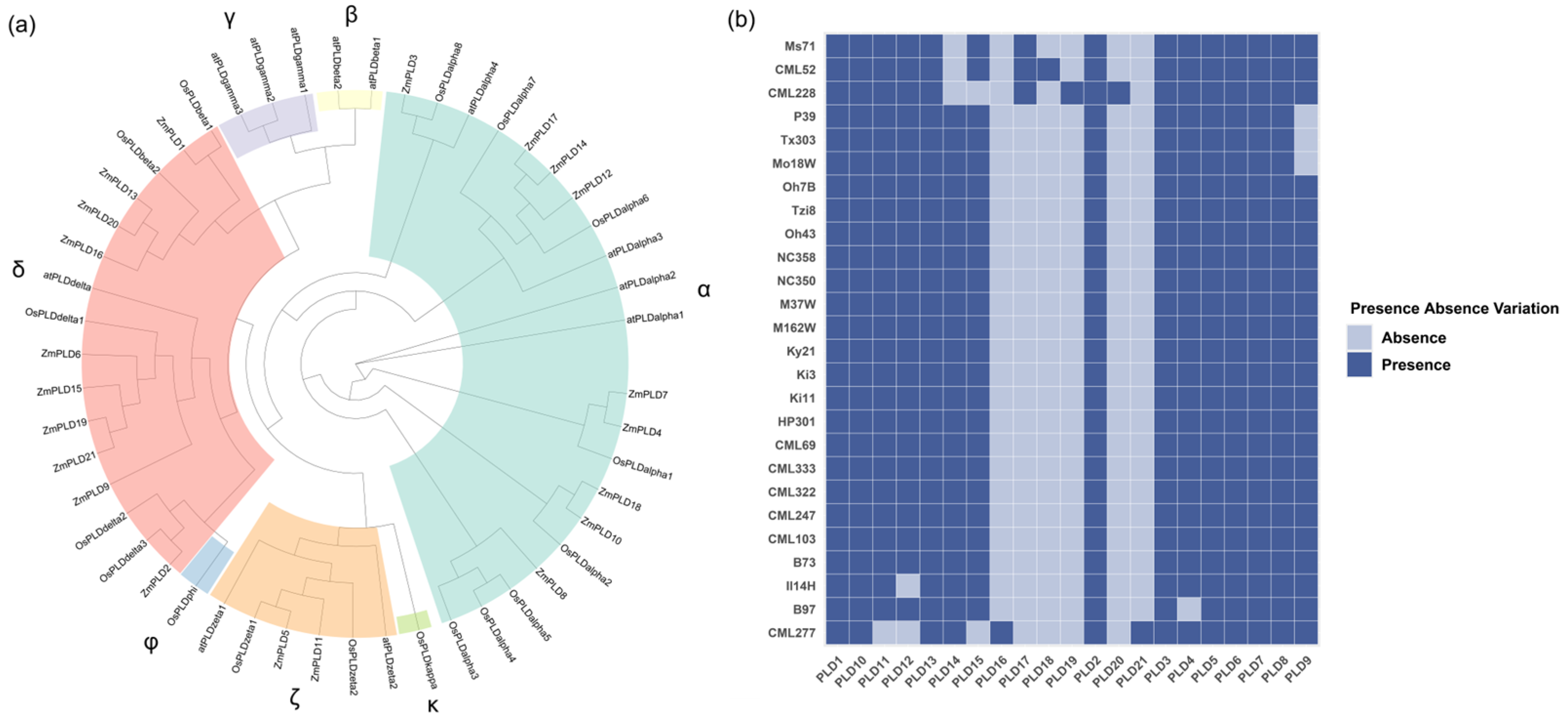
Figure 1. Phylogenetic analysis and PAVs of PLD genes in maize, rice, and Arabidopsis. (a) Phylogenetic tree of PLD genes from maize, rice, and Arabidopsis. Different colors indicate that the corresponding clades belong to the “α”, “β”, “γ”, “δ”, “φ”, “ζ”, and “κ” groups. (b) Heatmap showing the presence and absence of ZmPLD genes across 26 maize varieties. Dark blue indicates that the corresponding ZmPLD gene member is present in the genome, while light blue indicates absence.
Plants 14 03858 g001
Figure 2. Ka/Ks values of ZmPLD genes. (a) Distribution of Ka/Ks values of ZmPLD genes in 26 maize varieties, but 5 private genes were excluded because each belongs to a subfamily with only one member (Ka/Ks calculation requires ≥2 members per subfamily for reliable pairwise sequence comparison). Detailed information on private genes is provided in Supplementary Table S1. The vertical dashed line indicates the threshold value of Ka/Ks = 1.0, which is used to distinguish the evolutionary selection pressure types of different ZmPLD pan-gene family members. Values to the right of the line suggest positive selection, and values to the left indicate purifying selection. (b) Heatmap showing the occurrence frequency of Ka/Ks > 1 for each PLD gene among different maize varieties.
Plants 14 03858 g002
Figure 3. SV analysis of the PLD15 gene promoter and its effects on gene expression. (a) SV analysis in the promoter region of the PLD15 gene. (b) Analysis of TF binding sites in the SV sequences of the PLD15 promoter. (c) Analysis of the effect of the presence/absence of different SV sequences on the expression of the PLD15 gene. Dots represent the PLD15 gene expression levels of individual samples in each SV presence/absence group, and lines represent the mean ± standard deviation (mean ± SD) of the expression levels in each group. Statistical significance was determined by Student’s t-test (* p < 0.05, *** p < 0.001, ns = no significant difference). Among the five SV regions: region1 significantly affects the expression of PLD15 gene (*), region5 extremely significantly affects the expression of PLD15 gene (***), and region2, region3 and region4 have no significant effect on the expression of PLD15 gene (ns).
Plants 14 03858 g003
Figure 4. Structural simulation, molecular docking, and evolutionary analysis of ZmPLD15 proteins from different maize genomes. (a) sequence alignment of ZmPLD15 proteins derived from different maize genomes containing conserved HKD motifs. Asterisks (*) indicate the locations of HKD motifs sequences, which are key functional domains responsible for the phospholipase D activity of ZmPLD proteins. (b) Phylogenetic tree of ZmPLD15 proteins from different maize genomes. Teal indicates that all ZmPLD15 pan-gene family members in the corresponding clade are derived from temperate regions, while yellow indicates that all members in the clade are derived from tropical regions. (c) Analysis of significant differences in substrate binding free energy of ZmPLD15 proteins from tropical and temperate maize germplasms. Dots represent the statistical analysis results of substrate binding affinity of ZmPLD15 proteins among maize germplasms from different accumulated temperature zones, and lines represent the mean ± SD. Statistical significance was determined by Student’s t-test (p < 0.05, ns = no significant difference), and no significant difference was observed between the two groups.
Plants 14 03858 g004
Figure 5. Leaf anatomical structure and photosynthetic parameters of WT (B73) and ePLD15 (ZmPLD15-overexpressing transgenic line, B73 background) under normal temperature and cold stress. (AD) Leaf cross-sections (scale bar = 100 μm): (A) WT at normal temperature (25–28 °C, control, C); (B) WT after cold stress (8–10 °C, 6 h) + 24 h recovery (T); (C) ePLD15 at C; (D) ePLD15 at T. (EH) Photosynthetic parameters: (E) Pn (μmol CO2 m−2 s−1); (F) Gs (mol H2O m−2 s−1); (G) Tr (mmol H2O m−2 s−1); (H) Ci (μmol mol−1). Data are mean ± SD (n = 3 biological replicates); statistical significance was determined by Student’s t-test (* p < 0.05, ** p < 0.01, *** p < 0.001, ns = no significant difference). C = control (continuous normal temperature); T = cold stress + 24 h recovery.
Plants 14 03858 g005
Disclaimer/Publisher’s Note: The statements, opinions and data contained in all publications are solely those of the individual author(s) and contributor(s) and not of MDPI and/or the editor(s). MDPI and/or the editor(s) disclaim responsibility for any injury to people or property resulting from any ideas, methods, instructions or products referred to in the content.